No, no, that’s not us. We build on the nonviolent heritage of Gandhi, Martin Luther King, and the Freedom Riders. The day after Trump’s inauguration, we brought millions of people into the streets without any violence. (I was on Boston Common with a couple hundred thousand others. The most confrontational thing I heard was Massachusetts Attorney General Maura Healey saying to Trump, “We’ll see you in court.”)
Wednesday, James Hodgkinson started shooting at Republican congresspeople as they practiced for an annual charity baseball game against Democratic congresspeople. (In other words, while they were doing maybe the least offensive thing some of them have done all year.) House Majority Whip Steve Scalise was hit, along with a staffer and two police. He was in critical condition for a couple of days before being upgraded to serious.
Hodgkinson died after being shot by police, and so far we don’t have a note or other statement explaining his actions. But the political motivation seems obvious: He volunteered for the Sanders campaign in Iowa. He made anti-Trump comments on social media. He came all the way from Illinois, so he didn’t just happen to be in that park looking to shoot some random person. During his attack, he had a list of Republican congressmen in his pocket.
To me, as a liberal, this looks anomalous. But it doesn’t to conservatives, who blame liberals for a number of attacks we don’t identify as our own: like the shooting of five police officers in Dallas, or of two other police in New York City. The shooters appear to have been motivated by revenge against police in general for police shootings of blacks. We protested the same shootings, so they must be with us. Ditto for violence in Ferguson and Baltimore after the Michael Brown and Freddie Gray killings; liberals were also angered by those killings, so conservatives pin the violence on us.
Then there are the antifa (i.e. anti-fascist) and black bloc (named for their style of dress, not their skin color) street fighters who battle against similar right-wing hooligans. (That strikes me as a case of mutual myopia: Each side sees the thugs on the other side, and conveniently overlooks its own.) Some conservatives even blame us for attacks by Muslims. We’re the ones who stick up for Muslim rights and protest when Trump tries to get tough with them, so the killers in Orlando and San Bernadino are our people too.
If you’re a liberal like me, chances are this sounds nutty to you. And mostly it is. I have never advocated assassinating police officers or street fighting or nightclub massacres or gunning down congressional ballplayers, and I don’t consider those actions to be a rational extrapolation of anything I did advocate. I can’t see that Bernie Sanders bears any responsibility for the fact that some guy both supported his campaign and tried to kill the House majority whip. And the mere fact that you don’t want the University of California to help Milo Yiannopoulos spread his hateful message doesn’t implicate you in the Berkeley riot.
But now I do have to concede something: I need to offer other people the same kind of understanding I want for myself.
So I need to say this to conservatives: You may believe that Islam poses some unique threat to the American way of life (and I may disagree with you), but that doesn’t make you responsible for the Portland guy who yelled racial slurs at two Muslim women and then killed two guys who tried to defend them. You may interpret the 2nd Amendment differently than I do, but that doesn’t make you an accomplice to every mass shooting. You may believe abortion should be illegal, but that doesn’t equate you with the people who assassinate abortion doctors or shoot up Planned Parenthood clinics.
And yet, I don’t want to let off the hook everyone (on either side) who hasn’t actually pulled a trigger. You can’t say “somebody ought to kill that guy” and then claim innocence if somebody does. You can’t put out a wanted poster saying a doctor is “wanted by God” and then absolve yourself after someone delivers him to God. You can’t pose with a facsimile of someone’s bloody head, and express shock if someone bloodies the real head. If you invent and spread baseless conspiracy theories like Pizzagate, you are implicated if someone believes you and responds in a way that might make sense if the theory were true.
Staying involved without contributing to the problem is a tricky line to walk. It’s just as important to understand what the problem isn’t as to understand what it is.
The problem isn’t “extremism”, if that word just refers to views well outside the mainstream. The kind of libertarianism that wants to privatize the streets and zero out all anti-poverty programs is extreme. Confiscating all fortunes larger than $1 billion would be extreme. Amending the Constitution to ban all privately owned firearms or to make Christianity the official religion would be extreme. And yet, these are all proposals that people might debate rationally, without killing each other.
The problem isn’t that people are taking politics too seriously. Politics is serious. Politics is whether we go to war. It’s whether sick people get care. It’s whether your children get educated or have a shot at a job someday. It’s whether your town gets rebuilt after the hurricane, whether our food is safe to eat, or if we’ll be prepared for the next epidemic. It’s serious. It’s worth arguing about. It’s worth obsessing over, even. It’s worth getting out on the street and continuing to make your demands after the authorities say no. Taking politics seriously isn’t the problem. Serious people can have debates without killing each other.
Violence is different from seriousness or extremism. It comes out of dehumanization, out of believing that your opponents are so evil that they can’t be reasoned with, and that your side’s victory is so important that if you lose you might as well pull the Temple down on everyone. It comes from feeling cornered, like if you lose this battle you have nowhere to retreat to, no chance to find more persuasive arguments and win another day.
Lots of people in America are feeling that kind of despair. Anything you say in public, you have to figure that some desperate person is going to hear.
What goes on in those desperate minds? One of the creepiest novels I’ve ever read was John Fowles’ The Collector. It centers on a young man who wins the lottery and uses the money to pursue his fantasy: He quits his job, remodels his house to include a prison cell, kidnaps an attractive young woman, and keeps her there, hoping she will come to love him. As she get more desperate to escape, eventually she dies, and then he decides to find someone else and start the process again.
What I found most disturbing about the novel was how much I could identify with the the root fantasy: Someone who doesn’t notice you might still come to love you, if somehow circumstances could be contrived to throw you together. I’ve had that fantasy, and yet it never led to kidnapping or imprisonment or death. Probably all that would have been needed to prevent the novel’s tragedy was one good buddy, who over a beer would hear some version of the daydream before it ever hardened into a plan, appreciate it on the level of pure fantasy, and then wistfully say, “Yeah, but that would be crazy. It wouldn’t turn out well.” The Collector doesn’t have that friend and never hears that comment.
Similarly, I think many of us have, at one time or another, fantasized about being an avenging hero. That’s my best guess as to what James Hodgkinson thought he was doing: Those evil Republican congressmen would go on perpetrating their villainy, until some hero stopped them. And when he did stop them, crowds would cheer.
As we live more and more inside our separate bubbles of social media, it becomes increasingly difficult to picture people in distant bubbles as anything other than villains, and all too easy to imagine a cheering crowd. And I think we’re all just a little less likely to find ourselves having that beer with the buddy who says, “Yeah, but that would be crazy.”
I believe this new reality puts an extra responsibility on us. Not to be less serious or less intense. Not to shade our views in the direction of the Center, wherever that is. Not to stop criticizing things that are actually wrong or working to correct them. But definitely to avoid letting someone else believe that we will be in the crowd that cheers their avenging hero fantasy.
I think that means avoiding images and metaphors of violence, whether it’s Kathy Griffin’s severed-head photo or Sarah Palin’s congresspeople-in-the-crosshairs graphic. It means not dehumanizing opponents, and not exaggerating their misdeeds — or making some up out of whole cloth. It means challenging the people on our own side whose rhetoric crosses the line. And it means being, whenever we can, the sympathetic voice that keeps violent fantasy within its proper bounds, and restrains it from morphing into a plan.
For a long time, I’ve been pointing to conservative violence and conservative violent rhetoric. So it was a shock to hear that someone I probably would have agreed with on a lot of issues had gone to the park where the Republican congressional baseball team was practicing and started shooting.
Public shootings should be wake-up calls, and so I spent a big chunk of this week thinking about what people like me need to wake up to. As usual, I think conservatives went overboard in their responses, acting as if violence were a purely liberal problem they have nothing to learn from. I don’t see any reason to give in to that view, and yet I don’t want to dodge the issue with the kind of yeah-but-the-other-side-is-worse response that we hear far too often from both sides. I still think the other side is worse, but so what? That doesn’t absolve us from working on our piece of the problem.
The result of that meditation is this week’s first featured post, “Political Violence is Our Issue Too”. It should be out shortly.
The other thing that caught my attention this week was the Virginia gubernatorial primary, which was supposed to be a neck-and-neck battle for the future of the Democratic Party between an establishment candidate endorsed by all the top Virginia Democrats and an upstart progressive supported by Bernie Sanders and Elizabeth Warren. The establishment candidate won easily.
That outcome cemented a set of doubts that has been growing in my mind for some while: I keep hearing the argument that the progressive revolution has all the youth and the energy and is the wave of the future, and that the out-of-touch centrist establishment just needs to get out of the way. But I wonder: When is all that youth and energy going to start translating into votes?
Not being all that young myself, I’ve lived through a lot of liberal crusades. From McGovern to Nader to Kucinich, I keep running into the delusion that the Left is far more popular than it actually is. So with regard to today’s progressive movement, I’m in a prove-it-to-me mood. Somebody’s going to have to win something, preferably something the establishment can’t win, before I’m going to take all this rhetoric seriously.
I think about the Tea Party, and about Trump, who I regard as their candidate. Nobody got out of the way to make room for them. They took over the Republican Party by winning elections. I don’t think that’s an unreasonable test. Anyway, much more of that argument will appear at around 10 EDT in the second featured post “Why I’m Still Skeptical about the Progressive Revolution”.
When an honest man speaks, he says only what he believes to be true; and for the liar, it is correspondingly indispensable that he considers his statements to be false. For the bullshitter, however, all these bets are off: he is neither on the side of the true nor on the side of the false. His eye is not on the facts at all, as the eyes of the honest man and of the liar are, except insofar as they may be pertinent to his interest in getting away with what he says. He does not care whether the things he says describe reality correctly. He just picks them out, or makes them up, to suit his purpose.
This week’s featured post is “Social Capital and Inequality“, where I review Ryan Avents new book The Wealth of Humans.
This week everybody was talking about James Comey
Like many Americans without a 9-to-5 job (and maybe a few at work), I was glued to the TV Thursday morning during Comey’s testimony to the Senate Intelligence Committee. (Full transcript here.)
I don’t pretend to be unbiased, but I thought Comey was a compelling witness. He answered a lot of questions with a direct yes, no, or I don’t know. He didn’t seem to be trying to build his legend. (“I don’t want to make it sound like I’m Captain Courageous,” he said in response to Senator Rubio’s questions about why he didn’t confront Trump more directly.) While refusing to reveal the content of the FBI’s investigation or any classified information, he never sounded like a bureaucrat finagling a way around some legitimate question. When asked something difficult, he often started with “That’s a good question” before proceeding to give a thoughtful response.
In addition to legal implications of his testimony, I thought Comey very clearly established that the Trump’s relationship with him was not normal. In a few short months, he had more one-on-one conversations with Trump than he had with the president during the entire Bush and Obama administrations. And from the first meeting, he felt a need to document what was said because “I was honestly concerned he might lie about the nature of our meeting.” (He’d had no similar worry about Bush or Obama.)
Republican senators were left to make what seems to me to be a very bad case: Sleazy as it was, Trump’s attempt to influence Comey doesn’t rise to the level of obstruction of justice, and he was doing it to protect a friend (Mike Flynn) rather than to cover his own wrong-doing. Matt Yglesias reacts:
Congress is supposed to oversee the executive branch and police not only legal misconduct but political misconduct, like perverting the legal process to benefit his friends and allies.
Instead, congressional Republicans have chosen to stand on the ground that it’s okay to order an investigation quashed as long as you do it with a wink-wink and a nudge-nudge — even if you follow up by firing the guy you winked at. And they’re standing on the ground that it’s okay to quash an investigation as long as the investigation you quashed targeted a friend and close political associate, rather than the president himself.
That’s a standard of conduct that sets the United States up for massive and catastrophic erosion of the rule of law, not only, or even especially, because the president is behaving corruptly, but because Republican Party members of Congress have chosen to allow it.
I occasionally flashed back to the meeting Bill Clinton had with Attorney General Loretta Lynch during the investigation of Hillary’s email server. Both Clinton and Lynch came out saying that they didn’t discuss the investigation, but what if Lynch had reported that Clinton said the same things Comey reported Trump saying: asking if Lynch wanted to keep her job in the next administration, and saying he “hoped” she could let Hillary off? Would Republicans put a benign interpretation on those words then?
He’s new to government. And so he probably wasn’t steeped in the long-running protocols that establish the relationships between DOJ, FBI, and White Houses. He’s just new to this.
He’s also not “steeped in the protocols” about profiteering and other forms of corruption, or how to deal with allies. I guess it’s totally unreasonable of us to expect the President of the United States to understand his job, or to seek advice about the things he doesn’t know. (If only the Democrats had offered us a real alternative, like maybe a candidate who had been training for this job her whole life.)
Also, as a response to Comey the toddler defense is bogus on its face: The reason Trump insisted on all the witnesses leaving the room before pressuring Comey was that he knew he was doing something wrong.
Congressional Republicans are also letting Trump get away with a non-responsive nothing-to-see-here approach towards the whole Russia affair. A lot of the most suspicious elements of this scandal have been left completely unexplained: Why did the White House wait 18 days to fire Michael Flynn, after they’d been warned he might be compromised by the Russians? Why was Jared Kushner meeting with somebody from a Putin-connected Russian bank? Why did so many of Trump’s people either lie about their meetings with Russians or neglect to mention them when asked? And then finally, why was Comey fired? There was an unbelievable explanation right away, but Trump contradicted it later, and now the question has been left hanging.
Many people talk about the story as if it were he-said/she-said. But it isn’t even that, because Trump hasn’t offered any explanation at all.
Ezra Klein finds a method in the madness of Trump tweets: Trump’s primary mode of argument isn’t lying, it’s bullshitting. (Believe it or not, that’s a technical term, defined in the seminal essay “On Bullshit“.)
Lies are an effort to win an argument. Bullshitting is an effort to dominate coverage of an argument, to crowd out the truth, to distract the media with topics you prefer. Trump is very good at bullshitting. And since he doesn’t have a good counterargument to offer against Comey, he’s falling back on what he knows.
A number of people have noticed how many themes from sexual harassment cases appear: The boss maneuvered a 1-on-1 meeting and made inappropriate suggestions. Later, Comey asked his immediate supervisor not to leave him alone with the boss, but the supervisor just shrugged. When he tried to ignore the unwelcome advances and just do his job, he got fired. And now that he’s complaining, the people who hear his complaint interpret his “confusion over how to respond to a shocking request … as a signal that nothing happened”.
Is there a working woman alive who cannot identify with poor James Comey right now? The former FBI director’s boss tried to seduce him. When the seduction failed, his boss fired him. And then called him “crazy, a real nut job.” … Trump thought he had some kind of bromance going with Comey. He wined him. He dined him. And because he is transactional to his core, he expected a little somethin’ somethin’ in return.
Mr. Comey, you are not alone. How many of us have played over and over in our minds an encounter that suddenly took a creepy, coercive turn? What did I say? Were my signals clear? Did I do something ambiguous? Did I say something compromising?
Cait Bladt invents a scene from the closed hearing that followed Comey’s public testimony.
SENATOR BLUNT: Mr. Comey it is a straightforward question — you wore that suit knowing it would appeal to men like Mr. Trump and then when it did and he hugged you, you acted like it was shocking and appalling, correct?
Former U.S. Attorney Preet Bharara tells a similar story of being creeped out by Trump’s overtures, backing away from him, and then being fired.
In the nine times Trump met with or called Comey, it was always to discuss how the investigation into Russia’s election interference was affecting him personally, rather than the security of the country. He apparently cared little about understanding either the magnitude of the Russian intelligence threat, or how the FBI might be able to prevent another attack in future elections.
Trump said Friday that “100%” he’d be willing to testify under oath. But Trump says a lot of things, and I seriously doubt he will ever do this voluntarily. US News‘ Robert Schlesinger:
it wasn’t so very long ago that Trump was issuing seemingly iron-clad guarantees that he would release his tax returns
John McCain’s incoherent questioning was the sad sidebar of the Comey hearing. Twitter exploded with speculation that McCain is suffering from dementia.
I’ve had an irrational affection for McCain ever since he ran against Bush in the 2000 New Hampshire primary. McCain in 2000 had incredible mental stamina. Some days he held four or five two-hour townhall meetings; one day I was at the fourth one, and he fielded everything thrown at him, always trying to answer the question asked rather than seguing into canned talking points.
The senator I saw on TV Thursday was not the same man. And that’s unfortunate, because McCain has seemed like the most likely Republican senator to start the process of backing away from Trump,
and the British election
Prime Minister Theresa May called for a new election with the idea that the timing was favorable and she’d expand her majority, strengthening her bargaining position going into the Brexit negotiations with the European Union. It didn’t work out that way: Her Conservative Party (the Tories) started with 331 of the 650 seats in the House of Commons, and wound up with 318 instead.
That’s less than a majority, but it appears that she’ll stay in office after working out a deal with the Unionist Party, which has 10 seats and represents what used to be the Protestant faction in Northern Ireland’s civil war.
The party is likely to have a lengthy wish list of demands in return for its support for a Conservative government, including the outright rejection of any “special status” for Northern Ireland in the EU after Brexit.
In other words, the border between Ireland and Northern Ireland will be a hard border, not the soft border that currently exists because both sides are in the EU. How Catholics will take that remains to be seen, but The Independent is worried about maintaining the Northern Ireland peace agreement.
It’s intriguing to try to map British trends onto the United States, especially given that last summer’s Brexit vote can be read as a harbinger of Trump’s victory. If you make that translation, the Labour Party’s Jeremy Corbin almost pulled off what Bernie Sanders hoped to do: by turning Labour away from its Tony Blair (i.e. Clintonist) past and swinging further to the left, he drew major support from younger voters, got people to the polls who don’t usually vote, and even got a slice of UKIP (i.e. Trump) voters.
But he still didn’t win. This is where mapping UK elections onto the US gets tricky: Because the UK doesn’t have a two-party system, you don’t need anything like a majority of the votes. (Brexit, with its binary choice between Remain and Leave, was a better approximation of a US election.) The vote totals of both the Tories (42%) and Labour (40%) would have been enough for a landslide in some previous elections. In Tony Blair’s last election in 2005, for example, his Labour Party got 35% of the vote and won 355 seats. But a Sanders-like candidate who got 40% of the U.S. vote would suffer a catastrophic defeat. So the parallels have limited value.
and Wonder Woman
I haven’t seen the Wonder Woman movie yet — given the past DC movies I expected it to be terrible; apparently it isn’t — but the discussions surrounding it are fascinating.
First, there are the howls of reverse sexism directed at theaters that have scheduled a few women-only showings of the film. (Whatever other issues might arise, it was a good business decision. The screenings sold out quickly.)
As regular readers probably know, I’m skeptical about the whole concept of reverse discrimination (i.e., discrimination against some dominant group). Too often, what feels like reverse persecution is just the strange feeling of being treated like everyone else, a phenomenon I first discussed in 2012’s “The Distress of the Privileged“.
The main thing that’s problematic about all-male or all-white clubs or schools is that they can become tools for a dominant group to maintain its dominance. (If business deals are made over golf, excluding women from a golfing club excludes them from those deals.) So I guess I’d be suspicious of women-only events in those rare settings already dominated by women — say, at a convention for nurses or elementary-ed teachers — where men might already feel like outsiders. But I’m not seeing how a women-only Wonder Woman screening helps women consolidate some unfair advantage.
Back in 2014, Sian Ferguson of Everyday Feminism explained the purpose of safe spaces. The slam on safe spaces is that they are echo chambers for people who want to avoid ever hearing critical ideas. But when your group has an actual oppression problem, you can never go very long without facing criticism. The point of a safe space isn’t to avoid criticism forever, it’s to get away from it for a few hours.
As a rape victim, I am constantly exposed to the notion that I deserve to be blamed for my trauma. … The assumption my safe space makes – that I should not be blamed for my rape – is already challenged constantly by most of society.
I doubt that women who attend superhero movies are unexposed to male points of view on superheroes, including Wonder Woman.
Second, the question of whether movies are changing: Can a woman director make a summer blockbuster about a female character? I liked Michelle Wolf’s comment on The Daily Show.
You know when it will feel like women are equal at the box office? When we get to make a bad superhero movie and then immediately make another bad one. Men get chance after chance to make superhero movies. No one left crappy Batman vs. Superman saying: “Well, I guess we’re done making man movies.”
And finally, a controversy I never would have anticipated: Gal Gadot (pronounced Guh-DOTT), who plays Wonder Woman, is a Jewish Israeli. Should she count as white? This turned out to be a major topic of discussion in some Jewish circles. Dani Ishai Behan argued that the historic oppression of Jews and the continued existence of antisemitism makes Jews people of color; subsuming them into “white” erases them. Noah Berlatsky doesn’t dispute the present reality of antisemitism, the history of oppression, or the significance of Jewish identity, but countered that in the context (of people of color complaining about the few roles available to them and the few positive characters they resemble) the point is disingenuous.
Gadot is, after all, playing a white character; she was clearly cast because people see her as white. The argument that she was a person of color was transparently made in bad faith; it was meant to distract from actual POC folks asking for better representation.
and you might also be interested in …
For years, Kansas has been the proving ground for conservative economics: Tax cuts will create jobs, lower rates will increase revenue rather than diminish it, and so on. The results have been bad. Since Governor Brownback’s tax cuts in 2012, growth has been sluggish, and the end result has been not just intractable deficits, but also pressure to make up the difference by spending less on education and highways — a trade-off voters would never have approved if it had been submitted to them all at once. (“How about this? You give up good roads and schools, and the state’s credit rating goes down, but the rich get to pay less tax.”)
Well, that nightmare might be ending. After several attempts, the Republican-led legislature finally succeeded in overriding a Brownback veto to reverse much of his signature tax cut. This is a hopeful sign for the two-party system in America: Republican does not necessarily mean crazy; if something clearly doesn’t work, eventually voters see it and politicians respond.
The open question is how far this goes. Kansas will elect a new governor in 2018; moderate and conservative candidates are already angling for the Republican nomination. And if moderate Republicanism makes a comeback in Kansas, could the same thing happen nationally?
For whatever it’s worth, given that he might say the opposite tomorrow, Trump finally endorsed NATO’s Article 5, the one that pledges all NATO countries to defend each other. But Trump is still pushing the bogus idea that NATO countries spending less than 2% of their GDP on defense “owe” something to somebody.
Betsy DeVos is just as bad as Democrats feared. She wants public-funded private schools whose backers will be able to make unlimited amounts of money off the taxpayers, while not protecting LGBTQ students from bullying or harassment. Collins and Murkowski voted against DeVos’ confirmation as education secretary, but all the other Republican senators have to answer for this.
The secret of the Trump infrastructure plan is: There is no infrastructure plan. Just like there is no White House tax plan. Just like there was no White House health care plan. The simplest summary of White House economic policy to date is four words long: There is no policy.
TrumpCare was written by Congress; Trump and his HHS secretary played virtually no role. The “Trump tax cut” is vacuous; Congress will have to fill in all the details. And last week was supposed to be “Infrastructure Week”, when the administration rolled out its plan to create jobs by rebuilding the country’s worn-out public infrastructure. But the plan is mostly just a wish that other people — states, cities, profit-making corporations — will do good things. The administration has no specific projects in mind and offers little-to-no money to pay for anything.
but we need to keep paying attention to health care
In America as we used to know it, if you didn’t hear any news about a major piece of legislation, that meant it had stalled. We’re used to the idea that legislation goes through hearings, committee votes, and a series of public proposals that eventually converge on a bill, which then gets debated over several days or weeks before being voted on. Each of those events is supposed to generate headlines, so if you don’t see headlines, nothing much is happening.
Well, that’s another way that Trump’s America is different from the one we’ve been living in all our lives: The AHCA (a.k.a. TrumpCare) went through the House almost in secret. Versions were worked out in closed sessions within the Republican caucus, the hearing process did not consider any amendments, and the vote happened too fast for the Congressional Budget Office to analyze the final proposal. It wasn’t going to happen and then suddenly it was done.
Oh, but the Senate would be different, everyone said. Well, not so much.
[Majority Leader Mitch] McConnell is speeding toward a vote, with the goal of passing a healthcare bill the last week of June, before the Fourth of July recess.
Republicans have said there will be no committee hearings or markups for the bill, a major departure from the standard Senate process. Instead, the bill will go straight to the floor for a vote.
Democrats fear the legislation will be kept secret until just a couple of days before the vote, to minimize time for opposition to build.
If things were working in the usual American way, all the attention Trump and James Comey are getting would keep TrumpCare from raising the energy it needs to pass. But McConnell has come up with a different method: He’s using Trump the way a pickpocket uses a distracting partner: Trump grabs your attention like an obnoxious drunk in a bar, and McConnell quietly sneaks up behind you and steals your health insurance.
But what about the Republican moderates who were supposed to save the country from the worst excesses of the House bill? They’ve gone silent. As Josh Marshall generalizes: “The GOP moderates always cave.”
So especially if you live in a state with a Republican senator, you can’t wait for the newspapers to tell you when it’s time to take action. Whatever you can do to keep Republicans from taking health insurance away from tens of millions of Americans, you need to do it now.
and let’s close with something incredibly efficient
Inequality is different this time, because the rich are usurping a different kind of capital.
For a long time, most thinkers in the West accepted poverty as natural. As Jesus said: “The poor you will always have with you.” But by 1754, Jean-Jacques Rousseau was writing an entire discourse on the origin of inequality and blaming it largely on the practice of recognizing land as private property.
The first man who, having enclosed a piece of ground, bethought himself of saying This is mine, and found people simple enough to believe him, was the real founder of civil society. From how many crimes, wars and murders, from how many horrors and misfortunes might not any one have saved mankind, by pulling up the stakes, or filling up the ditch, and crying to his fellows, “Beware of listening to this impostor; you are undone if you once forget that the fruits of the earth belong to us all, and the earth itself to nobody.”
Thomas Paine, who in many ways was the most radical of the American revolutionaries, observed the contrasting example of the Native American tribes — where he found no parallel to European wealth or poverty — and came away with a more nuanced model of the connection between inequality and landed property, which he published in 1797 as Agrarian Justice. He started in much the same place as Rousseau:
The earth in its natural, uncultivated state, was, and ever would have continued to be THE COMMON PROPERTY OF THE HUMAN RACE. In that state every man would have been born to property. He would have been a joint life-proprietor with the rest in the property of the soil, and in all its natural productions, vegetable and animal.
But Paine also recognized that the development of modern agriculture — which he saw as necessary to feed people in the numbers and diversity of activities essential to advanced civilization — required investing a lot of up-front effort: clearing forests of trees and rocks, draining marshlands, and then annually plowing and planting. Who would do all that, if in the end the harvest would belong equally to everybody? He saw private ownership of land as a solution to this problem, but believed it had been implemented badly. What a homesteader deserved to own was his or her improvement on the productivity of the land, not the land itself. If the land a family cleared became more valuable than the forest or marshland they started with, then the homesteaders should own that difference in value, but not the land itself. [1]
Society as a whole, he concluded, deserved a rent on the land in its original state, and he proposed using that income — or an inheritance tax on land, which would not be as clean a solution theoretically, but would be easier to assess and collect — to capitalize the poor.
When a young couple begin the world, the difference is exceedingly great whether they begin with nothing or with fifteen pounds apiece. With this aid they could buy a cow, and implements to cultivate a few acres of land; and instead of becoming burdens upon society … would be put in the way of becoming useful and profitable citizens.
Paine argued this not as charity or even social engineering, but as justice: The practice of privatizing land had usurped the collective inheritance of those born without land, so something had to be done to restore the usurped value.
In one of my favorite talks (I published versions of it here and here), I extended Paine’s idea in multiple directions, including to intellectual property. Just as Paine would buy a young couple a cow and some tools, I proposed helping people launch themselves into a 21st century information economy. Like Paine, I see this as justice, because otherwise the whole benefit of technological advancement accrues only to companies like Apple or Google, reaching the rest of us only through such companies. A fortune like Bill Gates’ arises partly through innovation, effort, and good business judgment, but also by usurping a big chunk of the common inheritance.
Avent. And that brings us to Ryan Avent’s new book, The Wealth of Humans: work, power, and status in the twenty-first century. There are at least two ways to read this book. It fits into the robot-apolcalypse, where-are-the-jobs-of-the-future theme that I have recently discussed here (and less recently here and here). Avent’s title has a double meaning: On the one hand it’s about the wealth humans will produce through the continued advance of technology. But that advance will also result in society having a “wealth” of humans — more than are needed to do the jobs available.
Most books in this genre are by technologists or futurists, and consequently assemble evidence to support a single vision or central prediction. Avent is an economic journalist. (He writes for The Economist.) So he has produced a more balanced analysis, cataloging the forces, trends, and possibilities. It’s well worth reading from that point of view.
But I found Avent’s book more interesting in what it says about inequality and social justice in the current era. What’s different about the 21st century is that technology and globalism have converged to make prosperity depend on a type of capital we’re not used to thinking about: social capital. [2] And from a moral point of view, it’s not at all obvious who should own social capital. Maybe we all should.
What is social capital? Before the Industrial Revolution, capital consisted mainly of land (and slaves, where that was allowed). By the late 19th century, though, the big fortunes revolved around industrial capital: the expensive machines that sat in big factories. The difference between a rich country and a poor one was mainly that people in rich countries could afford to invest in such machinery, which then made them richer. On a national level, industrial capital showed up as government-subsidized railroads and canals and port facilities. (The Erie Canal alone created one of the great 19th-century boom towns: Buffalo.) A country that could afford to make such improvements became more productive and more prosperous.
In the 20th century, the countries that rose to wealth — first Japan and then later Singapore, Taiwan, and South Korea — did so partly through investment in machinery, but also through education. An educated populace could provide the advanced services that made an industrial economy thrive. And so we started talking about human capital, the investments that people and their governments make in acquiring skills, and intellectual capital, the patents, copyrights, and trade secrets that powered a 20th-century giant like IBM.
That may seem like a pretty complete list of the kinds of capital. But now look at today’s most valuable companies: Apple and Google, either of which might become the world’s first trillion-dollar corporation in a year or two. Each owns a small amount of land, no slaves, and virtually no industrial capital; Apple contracts out nearly all of its manufacturing, and a lot of Google’s products are entirely intangible. Both employ brilliant, well-educated people, but not hundreds of billions of dollars worth of them. They have valuable patents, copyrights, trademarks, etc., but again, intellectual property alone doesn’t account for either company’s market value. There’s something in how all those factors fit together that makes Apple and Google what they are.
That’s social capital. Avent describes it like this:
Social capital is individual knowledge that only has value in particular social contexts. An appreciation for property rights, for example, is valueless unless it is held within a community of like-minded people. Likewise, an understanding of the culture of a productive firm is only useful within that firm, where that culture governs behavior. That dependence on a critical mass of minds to function is what distinguishes social capital from human capital.
Social capital has always existed and been a factor of production, but something about the current era, some combination of globalism and technology, has brought it to the fore. Today, a firm strong in social capital — a shared way of approaching problems and taking action that is uniquely suited to a particular market at this moment in history — can acquire all the other factors of production cheaply, making social capital the primary source of its wealth. [3]
Who should own social capital? Right now it’s clear who does own a company’s social capital: the stockholders. But should they? Avent talks about Bill Gates’ $70 billion net worth — created mostly not by his own efforts but by the social organism called Microsoft — and then generalizes:
People, essentially, do not create their own fortunes. They inherit them, come to them through the occupation of some state-protected niche, or, if they are very brilliant and very lucky, through infusing a particular group of men and women with the germ of an idea, which, in time and with just the right environment, allows that group to evolve into an organism suited to the creation of economic value, a very large chunk of which the founder can then capture for himself.
Stockholders — the people who put up the money to acquire the other factors of production — currently get the vast majority of the benefit from a company’s social capital, but it’s not clear why they should. We usually imagine other forms of capital as belonging to whomever would have them if the enterprise broke up: The stockholders would sell off the land and industrial and intellectual capital, while the employees would walk away with the human capital of their experience and education. But the company’s social capital would just vanish, the way that a living organism vanishes if it gets rendered into its constituent chemicals. So, rightfully, who owns it?
Another chunk of social capital resides in nations, which are also social organisms. The very real economic value of the rule of law, voluntary compliance with beneficial but unenforceable norms, shared notions of fairness, trust that others will fulfill their commitments, and general public-spiritedness — in other words, all the cultural stuff that makes a worker or firm or idea more valuable in America or Germany than in Burundi or Yemen — who does it belong to? Who should share in its benefits?
Bargaining power. Avent does not try to sell the conservative fairy tale that the market will allocate benefits appropriately. Under the market, what each party gets out of any collective endeavor depends on its relative bargaining power, not on what it may deserve in some more abstract sense.
Avent proposes this thought experiment: What if automation got to the point where only one human worker was required to produce everything? Naively, you might expect this individual to be tremendously important and very well paid, but that’s probably not what would happen. Everyone in the world who wanted a job would want his job, and even if he had considerable skills, probably in the whole world millions of people would share those skills. So his bargaining power would be essentially zero, and even though in some sense he produced everything, he might end up working for nothing.
Globalization and automation, plus political developments like the decline of unions, have lowered the bargaining power of unskilled workers in rich countries, so they get less money, even though in most cases their productivity has increased. As communication gets cheaper and systems get more intelligent, more and more jobs can be automated or outsourced to countries with lower wages, so the bargaining power of the people in those jobs shrinks. That explains this graph, which I keep coming back to because I think it’s the single most important thing to understand about the American economy today: Hourly wages tracked productivity fairly closely until the 1970s, but have fallen farther and farther behind ever since.
Companies could have afforded to pay more — by now, the productivity is there to support a wage nearly 2 1/2 times higher — but workers haven’t had the bargaining power to demand that money, so they haven’t gotten it. [4]
A similar thing happened early in the Industrial Revolution: Virtually none of the benefits that came from industrial capital were shared with the workers, until they gained bargaining power through political action and unionization. The result is the safety net we have today.
Just as workers’ ability to reap significant benefits from the deployment of industrial capital was in doubt for decades, so we should worry that social capital will not, without significant alterations to the current economic system, generate better economic circumstances for most people.
Who’s in? Who’s out? When you do start sharing social capital, whether within a firm or within a country, you run into the question of who belongs. This is a big part of the contracting-out revolution. The janitors and cafeteria workers at Henry Ford’s plants worked for Henry Ford. But a modern technology corporation is likely to contract for those services. By shrinking down to a core competency, it can reward its workers while keeping a tight rein on who “its workers” are. No need to give stock options or healthcare benefits to receptionists and parking lot attendants if they don’t seem essential to maintaining the company’s social capital.
Things shake out similarly at the national level: The more ordinary Americans succeed in getting a share of the social capital of the United States, the greater the temptation to restrict who can get into the US and qualify for benefits — or to throw out people that many of the rest of us think shouldn’t be here.
Avent would like to see us take the broadest possible view of who’s in:
The question we ask ourselves, knowingly or not, is: With whom do we wish to share society? The easy answer, the habitual answer, is: with those who are like us.
But this answer is bound to lead to trouble, because it is arbitrary, and because it is lazy, and because it is imprecise, in ways that invite social division. There is always some trait or characteristic available which can be used to define someone seemingly like us as not like us.
There is a better answer available: that to be “like us” is to be human. That to be human is to earn the right to share in the wealth generated by the productive social institutions that have evolved and the knowledge that has been generated, to which someone born in a slum in Dhaka is every bit the rightful heir as someone born to great wealth in Palo Alto or Belgravia.
Can it happen? Much of the Avent’s book is depressing, but by the time the Epilogue rolls around he seems almost irrationally optimistic. For 200 pages, he has painted as realistic a picture as he could of the challenges we face, whether economic, technological, social, or political. But as to whether things will ultimately work out, he appears to come around to the idea that they have to, so they will. So he ends with this:
We are entering into a great historical unknown. In all probability, humanity will emerge on the other side, some decades hence, in a world in which people are vastly richer and happier than they are now. With some probability, small but positive, we will not make it at all, or we will arrive on the other side poorer and more miserable. That assessment is not optimism or pessimism. It is just the way things are.
Face to face with the unknown, it is hard to know what to feel or what to do. It is tempting to be afraid. But, faced with this great, powerful, transformative force, we shouldn’t be frightened. We should be generous. We should be as generous as we can be.
[1] The arbitrariness of this becomes clear when you consider mineral rights. If my grandfather homesteaded a plot of land, which in my generation turned out to be in the middle of a oil field, what would that wealth have to do with me that I would deserve to own it?
[2] If the term social capital rings a bell for you, you’re probably remembering Robert Putnam’s Bowling Alone, which appeared as a magazine article in 1995 and was expanded to a book in 2000. But Putnam used the term more metaphorically, expressing a sociological idea in economic terms, rather than as a literal factor of production.
[3] Henry Ford’s company probably also had a lot of social capital, but it was hard to notice behind all those buildings and machines.
[4] Individual employers will tell you that they’d go bankrupt if they had to raise wages 2 1/2 times, and in some sense that’s true: They compete with companies that also pay low wages, and would lose that competition if they paid high wages. But that is simply evidence that workers’ bargaining power is low across entire industries, rather than just in this company or that one.
In my continuing effort not to get swallowed completely by the Trump/Russia scandal (which seems overdue for a name, like Watergate or Teapot Dome), I’m continuing to read what’s-going-on-with-the-economy books. This week I want to tell you about The Wealth of Humans by Ryan Avent of The Economist. This can be read as a where-are-the-jobs-of-the-future book, which I’ve reviewed several of in the last few years. But I was more interested in Avent’s explanation of the recent increase in inequality: Technological and geo-political change has made social capital the decisive factor of production. And since few of us really understand social capital and our culture has no shared understanding of who should own it, the wealthy have been free to usurp all its benefits.
I’ll put that insight into the context of Rousseau’s and Thomas Paine’s writings on inequality, as well as one of my own favorite talks “Who Owns the World?” That’s the very reduced version of my review of the book, which will appear by 9 a.m. EDT as “Social Capital and Inequality”.
Of course the weekly summary will return to Trump/Russia, and in particular James Comey’s testimony last Thursday. There’s also the British election to discuss (reminding you that last week I passed on Nate Silver’s observation that anything could still happen). I didn’t really have to cover all the fascinating discussions that spin out of the Wonder Woman movie, but I couldn’t resist. A bunch of other things make it into the short notes, and I call special attention to Mitch McConnell’s attempt to sneak ObamaCare repeal past the public without hearings, before closing with a video reviewing the entire history of the world in less than 20 minutes.
This week everybody was talking about the U.S. withdrawing from the Paris Climate Agreement
The featured post includes my explanation of why withdrawing from Paris makes no sense. In a nutshell: If Trump thinks Obama promised to cut emissions further than he should have, he could just unilaterally lower our commitment to a level he thinks is fair. But that would mean taking a serious look at the topic and proposing a policy, which Trump seems incapable of doing.
Instead he’s spreading disinformation and sowing confusion by demanding to “renegotiate” without giving anybody a clue what he wants — most likely because he doesn’t have a clue what he wants. The Paris Agreement isn’t unfair to the U.S. for any particular reason; it’s just that all international agreements are unfair to the U.S. by definition.
When world leaders make moves that further no policy goals, they invite explanations that are either psychological or political. Krugman attributes Trump’s decision to “spite“, and Josh Marshall blames “rage and fear“, while Slate‘s Katy Waldman says:
The word for what we saw in the Rose Garden is projection. Trump feels like a tremendous man who is also, somehow, nursing an eternal wound. His country, therefore, is a tremendous nation that is hampered and thwarted by cheaters at every turn.
The political explanation is similar: Trump got elected by appealing to his base voters’ sense of grievance. He’s applying that model to the Paris Agreement not because it fits, but because it will appeal to the low-information part of his base.
On May 26, Michigan Congressman Tim Walberg answered a constituent’s question about climate change [go to about the 47 minute mark in this video]:
I believe there’s climate change. I believe there’s been climate change since the beginning of time. I think there are cycles. Do I think that man has some impact? Yeah, of course. Can man change the entire universe? No. Why do I believe that? Well, as a Christian I believe there is a creator, a God, who is much greater than us. And I’m confident that if there’s a real problem, He’ll take care of it.
In a Washington Post column, historian Lisa Vox elaborated:
only 28 percent of evangelicals believe human activity is causing climate change. Confidence that God will intervene to prevent people from destroying the world is one of the strongest barriers to gaining conservative evangelical support for environmental pacts like the Paris agreement.
Oh, holy crap. I wonder how many these only-God-can-change-the-climate folks understand that man has already changed the atmosphere. Since the Industrial Revolution, the amount of carbon dioxide in the atmosphere has increased by over 40%, from 280 parts per million to 400. (It had been relatively stable for thousands of years before that. In the distant past it has been higher or lower, but has never increased with this speed.) Unlike global average temperature estimates, atmospheric CO2 numbers don’t come out of some complicated computer model with a lot of debatable assumptions; it’s a simple measurement. It also doesn’t bounce around like temperature; there’s an annual cycle (because northern forests and grasslands soak up CO2 as they grow; the Southern hemisphere has less land and less foliage), but it goes up every year.
Global warming is a complex effect of that simple cause: Greenhouse gases like CO2 block heat from escaping into space; more CO2, more heat. Predicting exactly how fast global temperatures will rise in the future may be difficult and contentious (though not as contentious as some would have you believe). But that they will go up and why is pretty simple science.
I took a look at the Issues page on Walberg’s web site. This seems to be the only issue where he invokes God’s umbrella of protection. He doesn’t consider arguments like “It doesn’t matter if we raise taxes on the rich, because God will just make them richer” or “We don’t need to pay so much attention to terrorism, because God will protect us” or “We don’t have to worry about running up big deficits, because God will keep our economy from collapsing.”
In short, God is a rhetorical device that Walberg deploys selectively, when he wants to believe something unreasonable or convince other people to believe it.
While I’m talking about the misuse of religion in politics: Kentucky Governor Matt Bevin wants to tackle Louisville’s violence problem with “prayer patrols“. Seriously. He wants churches to send groups of 3-10 people to wander around Louisville’s bad neighborhoods and not offer any material help to anybody beyond praying for them. Because that’s the difference between the safe parts of Kentucky and the dangerous parts: not money or race or education, but closeness to God.
The Trump administration initially balked when the Office of Government Ethics demanded the White House hand over the waivers it had granted. But after a standoff the administration relented late Wednesday and released about 14 waivers covering White House staffers. They make clear that Trump’s ethics rules are remarkably flexible and that his top staffers don’t need to worry too much about staying on the right side of them. On paper, Trump’s rules are similar to those imposed by President Barack Obama, but it appears that Trump is far more willing to hand out exemptions. At this point in the Obama administration, just three White House staffers had been granted ethics waivers. So far, Trump has granted 14, including several that apply to multiple people.
Steve Bannon got a “retroactive waiver“, a concept that doesn’t even make sense.
“There is no such thing as a retroactive waiver,” [Office of Government Ethics Director Walter] Shaub said in an interview. “If you need a retroactive waiver, you have violated a rule.”
As has happened in the other two special elections to replace congressmen Trump appointed to his administration, support is shifting away from the Democratic challenger as election day approaches. John Ossoff’s lead is down to 49.1%-47.6%, well within the margin of error. The election is two weeks from tomorrow.
The federal government would make only a fractional down payment on rebuilding the nation’s aging infrastructure. Mr. Trump would rely on a combination of private industry, state and city tax money, and borrowed cash to finance the rest. It would be a stark departure from ambitious infrastructure programs of the past, in which the government played a major role and devoted substantial resources to paying the cost of large-scale projects.
A key part of the plan is privatizing essential services, like the air traffic control system. Privatization always promises big gains and small costs, but it rarely delivers.
Is it really true that female movie characters get fewer lines? Yes.
but the Kathy Griffin incident means the opposite of what people are saying
Kathy Griffin is a mid-level, mostly apolitical comic that I usually enjoy. However, she stepped way over the line this week by posting an image (which I’m not linking to) of herself holding the bloody severed head of Donald Trump. It was clearly meant to be funny — it wasn’t — rather than a suggestion that somebody should kill the president. (I interpreted the joke as how absurd Kathy Griffin would be in the role of tyrant-slayer.) However, you don’t know how everybody will read an image, so there are some places you just shouldn’t go.
On the Right, this incident is being used as evidence that the Left is unhinged, that it’s the violent hateful side of the political spectrum, and so on. However, if you look at the bigger picture, it proves exactly the opposite: Griffin’s image was immediately rejected by just about everybody on the Left. She apologized, she got fired from her annual role as a New Years’ Eve host on CNN anyway, lost a few other gigs, and I’m not aware of anybody trying to make a martyr out of her. She made a bad choice; it’s going to cost her. Life works that way.
But it doesn’t always work that way on the Right. Take a comparable example, like Ted Nugent saying in 2007 that Obama should “suck on my machine gun” and Hillary Clinton should “ride one of these into the sunset, you worthless bitch”. As far as I can tell, he paid no price for this. He never apologized or lost support. At the time, Sean Hannity defended him. More recently, Trump has let him visit the Oval Office.
When an incident like this happens among liberals, we reject it, precisely because we are not the violent hateful side of the spectrum. But when has some right-wing expression of hate been too over-the-top to be defended?
While we’re talking about comedians going over the line, I guess I have to comment on Bill Maher saying “nigger” on his HBO show Friday during his interview of Senator Ben Sasse. Slate describes it like this:
The controversy arose during Maher’s weekly Real Time show, where Sasse was a guest to discuss his new book, The Vanishing American Adult. At one point of the conversation, Maher pointed out how adults are putting a lot of effort into dressing up for Halloween these days and asked the senator whether that was a phenomenon in Nebraska as well. “It’s frowned up,” Sasse said. “We don’t do that quite as much.” Maher seemed encouraged by the answer and said that he should “get to Nebraska more.” Sasse then replied that the comedian was welcome to go: “We’d love to have you work in the fields with us.” Maher seemed surprised by Sasse’s invitation and then jokingly replied, “Work in the fields? Senator, I’m a house nigger.” Sasse grinned and chuckled.
On the plus side, he was not using the word in its worst possible sense, as an insult a particular black person, or even as a “joking” insult to a black person or blacks in general. Nor was he invoking an anti-black stereotype in order to win an argument. Directing the slur at himself in a self-deprecating joke — one where he’s not black-facing or otherwise making fun of blacks — is a usage I had not anticipated. (In the same way that Griffin’s joke was more about herself than about Trump, Maher’s was not really about blacks; what’s supposed to be humorous is picturing the scrawny Maher as a field hand.)
Still, this isn’t a private yuk-yuk among sophisticated friends. Maher knew he was on national TV, and would be seen by countless people of all races. So his remark shows either a lack of understanding of or a disrespect for the enormous freight that nigger and the stereotype it invokes still carry. Either way, it’s not OK.
One of the primary symptoms of privilege is that you think it’s up to you to judge whether the people you offend have a right to feel offended. But I think the slurs that have built up baggage for various oppressed communities now belong to them. So it’s up to blacks to decide what the appropriate use of nigger will be going forward. The rest of us should stay away from it, even if we think we’re using it in a non-racist way.
How can a non-binding agreement be as important as Trump’s critics say it is? On a much smaller scale, I’ve just been dealing with something very similar.
If you’ve ever read the Paris Agreement on climate change — it’s dull but relatively short as international agreements go, so it’s not that hard — President Trump’s announcement that the United States is withdrawing from it was a bizarre performance. As you can see from David Victor’s annotation of the speech, virtually every line of it was either false, fantastic, or based on an incorrect assumption. (Near the beginning of the speech David Roberts tweeted: “If Trump says something true, I will notify you all.” There proved to be no need.) Parts of it were even internally contradictory, like the line where he called the agreement “non-binding” and “draconian” in the same sentence.
Thus, as of today, the United States will cease all implementation of the non-binding Paris Accord and the draconian financial and economic burdens the agreement imposes on our country.
But though it was wrong in almost every detail, the picture Trump painted was very vivid: The Paris Agreement is an international conspiracy to hoodwink the United States and wreck our economy.
The fact that the Paris deal hamstrings the United States, while empowering some of the world’s top-polluting countries, should dispel any doubt as to the real reason why foreign lobbyists wish to keep our magnificent country tied up and bound down by this agreement: It’s to give their country an economic edge over the United States.
He did not mention President Obama directly, but the implication was clear: Obama agreed to this either because he was a fool or because he was in on the anti-America plot. Unlike his predecessor, Trump is pro-America — he represents “the citizens of Pittsburgh, not Paris” — so he’s calling a halt to this nonsense.
Fact-checkers and other expert critics have been easy to find, but there’s a problem with their account, especially as it relates to low-information voters who are inclined to give Trump the benefit of the doubt: Not only is the experts’ interpretation of the Paris Agreement much less arresting than Trump’s paranoid fantasy, it doesn’t seem to hang together either. If the agreement doesn’t bind us into some kind of suicide pact, and doesn’t bind other countries either, how can renouncing it have the kind of apocalyptic consequences critics claim? If the nations that signed the agreement are still free to do whatever they want, how does Paris save any polar bears or avert hurricanes or keep the ocean from swallowing Miami?
So if we’re going to help the public resist Trump’s disinformation campaign, what we really need is not more detailed analysis from experts in international law or economics or climatology. We need a simple example from everyday life that helps people understand what the Paris Agreement is and does. In particular, the example needs to demonstrate how a non-binding agreement can be important.
Luckily, I happen to have such an example handy.
The Paris Agreement is a pledge drive. I admit, this model is in my mind for serendipitous reasons: This spring I was on the committee that organized my church’s annual pledge drive. But it turns out to be a pretty accurate parallel.
Every year, our drive works like this: We announce a target, a total amount that members will need to contribute during the next year if the church is going to do all the stuff our member-elected leadership thinks we should do. We send out a brochure explaining what that stuff is, and how the total compares to what we collected the previous year.
Then we ask everybody to send in cards with pledges: “I will contribute X dollars next year.” The pledges are in no sense binding. If you run into financial problems in the course of the year, you can always call the church office and say, “I’m going to have to lower my pledge.” Or you can just not send in the money. It’s not like we can take you to court or turn your pledge card over to the bill collectors.
The Paris Agreement is like that. It announces a goal: The nations participating in the agreement want to keep the overall increase in average global temperature since the beginning of the Industrial Revolution down to 2 degrees centigrade (or 3.6 degrees Fahrenheit). Since the main cause of this increase is the rise in greenhouse gases (mainly CO2) in the atmosphere, the agreement asks nations to make a pledge to limit their carbon emissions.
Each country determines the size of its own pledge. The pledge can be changed at any time. And there’s no enforcement mechanism that kicks in if you don’t fulfill your pledge.
Just like at my church.
What good is a nonbinding agreement? If no nation is actually committed to anything in a legally enforceable way, you might well wonder what the point of the agreement is. After all, nothing stops a country from announcing an ambitious goal with a lot of fanfare, and then doing nothing. So if you’re looking for absolute certainty that the world is finally going to take serious action to fight climate change, the Paris Agreement doesn’t provide it.
So what does it do? The point of the agreement, as I see it, is more subtle: Like our pledge drive, it’s a trust-building exercise among its members.
In any collective enterprise with voluntary inputs, there’s always a free-rider problem. If, say, I contribute a lot to the church and the guy sitting next to me on Sunday morning gives practically nothing, we both get to sing the same hymns and hear the same sermon. And since no household contributes more than a percent or two of the whole budget, the direct impact of each individual’s contribution to his or her own church experience is close to zero. (If nobody contributes, we’ll have to fire the minister and turn off the heat, which I would notice. But if everybody else contributes an appropriate amount and I don’t, probably not much changes.)
Climate change is like that, especially for countries smaller than China or the United States. Denmark, for example, is a world leader in wind power. In 2015 it generated 40% of its electricity from wind, and plans to be over 50% by 2020. But it’s such a small country that, considered in isolation, its achievement makes practically no difference to the global climate. Even the U.S. isn’t big enough to turn things around by itself, which is sometimes used as an excuse for doing nothing. As Marco Rubio put it during a Republican presidential debate: “America is not a planet.”
But the nations of the Paris Agreement — everybody except Nicaragua, Syria, and now us — are really close to being a planet. If they can work together, the gains will be meaningful. Building the trust that allows them to work towards a common goal is where the pledge-drive idea comes in.
The point of a pledge drive is to make sure that if you volunteer to make some sacrifices, you can know that you won’t be alone. Before I send in a single dollar towards next year’s church budget, I get to know what all the pledges total up to. (We missed our goal this year, but we’re close enough that almost all our plans still look feasible.) And before I pledge next year, I get to find out whether this year’s pledged money actually came in. (Again, it’s usually a little bit short, due to people losing jobs and having other unexpected financial problems. But it’s never been so short that fulfilling my commitment made me feel like a sucker.)
That’s what Paris is about. It got each nation to commit to either lower its carbon emissions or (in the case of developing nations) to significantly slow the rate of increase. (China, which still has hundreds of millions of people to bring into the modern age, pledges to stop increasing emissions by 2030. They seem likely to do better than that.) Nations also agree to share information about what they’re doing and how well it’s working. There is, in addition, a literal pledge drive in which rich nations raise money to help poor nations take action. (This is the Green Climate Fund that Trump is revoking Obama’s pledge to.)
So before any nation takes Paris-based action to lower its emissions, it gets to see what the other nations are pledging to do. And along the way, every nation gets to see how faithfully the other nations are carrying out their commitments. It’s a way for sovereign nations to move forward on their own climate-change plans while feeling confident that enough other nations are moving forward that they’re not wasting their effort.
To me, that sounds pretty familiar.
What’s not in the agreement. The Paris Agreement does not specify an carbon-emission goal for any particular nation, or mandate techniques for meeting those goals. What a nation commits to do and how it fulfills that commitment is its own business. The agreement also has no enforcement mechanism, no equivalent of the World Court or the WTO that could pronounce judgment against nations that don’t meet their goals.
So Trump’s claims that the Paris Agreement “blocks the development of clean coal” or mandates that “we can’t build [coal-fired power] plants” or puts our energy reserves “under lock and key” are pure fiction. If anybody had a genuinely clean way to get energy out of coal, it would lower our emissions and help us meet our Paris goals. So clean coal is only “blocked” to the extent that it doesn’t work. And energy reserves are under lock and key only to the extent that we voluntarily forego their use.
Likewise, his statements that “foreign leaders … have more say with respect to the U.S. economy than our own citizens” and that “our withdrawal from the agreement represents a reassertion of America’s sovereignty” are nonsense. Our elected government made a pledge that it can adjust at any time. If it chooses to fulfill that pledge, how it does so is totally its own decision.
Why withdrawing makes no sense. I mean that literally. It’s not just that I disagree with Trump’s decision as a matter of policy, it’s that it makes no sense.
Think about it in terms of the pledge drive. Suppose I believed about my church what Trump seems to believe about Paris: that my pledge is so much higher than other people’s that the rest of the congregation is essentially taking advantage of my generosity. Everybody else should either pony up more money or get used to the idea of a more austere church.
OK then: Does it make sense for me to withdraw from the pledge drive? Not a bit. It’s not the pledge drive itself that I think is unfair to me, it’s the size of my voluntary contribution relative to the total. But I could fix that unilaterally. If I felt like a sucker, it might make sense for me to lower my pledge for next year, or even to call up the church office right now and angrily announce that I’m done contributing for this year, even though I haven’t fulfilled my pledge yet. If they need more money they should get it from somebody else.
Trump could have done that. If he has any particular terms in mind — which I suspect he doesn’t; I doubt he’s thought about it that deeply — the “renegotiation” he called for could just be an announcement. If he believes Obama’s pledge is unfair to us or beyond our abilities, he could lower it to an amount he considers fair and achievable. No other nations, no international authority, would need to sign off.
There is a discussion going on about how fair or achievable Obama’s goals were, or how much sacrifice the country should be willing to make to fulfill them. David Victor’s annotations are sympathetic to the view that Obama’s goals would require considerable economic sacrifice, while Paul Krugman believes that “We have almost all the technology we need, and can be quite confident of developing the rest.” (I haven’t studied the question enough to have a opinion worth sharing.)
But Trump is not engaging in that argument. He could simply tell the world what goals he considers fair and why. But he doesn’t. Instead, he’s withdrawing from the process of setting any goals at all.
Given that I could lower my pledge any time I find appropriate, the only reason I would withdraw from the entire pledge drive is if I acknowledge no responsibility to support the church financially. It would be tantamount to deciding to withdraw from the community.
That’s what Trump is doing here: He’s not defending our sovereignty or protecting our jobs or doing any of the other positive things his speech claims. He’s denying that we have any responsibility to work with the rest of the world in addressing one of the major problems of our era. He is, in essence, withdrawing from the community of nations.
The big story this week was Trump announcing that he would withdraw the United States from the Paris Agreement on climate change. It was amazing (in a bad way) to listen to his speech, because the gist of it was so divorced from actual reality: In one sentence, he described the agreement as both “nonbinding” (true) and “draconian” (false).
However, the explanation of why this was such a bad move suffered from a similar problem, especially in the eyes of low-information voters: If the agreement is nonbinding, why is it such a big deal? How can a bunch of nations stating their good intentions be so important that disavowing it has apocalyptic consequences? That disconnect, plus an inclination to distrust “liberal experts” anyway, made the criticism of Trump’s action ring false among people who are inclined to give him the benefit of the doubt.
What is needed, I decided, is not a deep legal analysis of the agreement, or a review of the evidence for climate change, or a description of the horrors that a few more degrees of global average heat could unleash. What we really need is a simple example from everyday life that illuminates what the Paris Agreement is and does.
I happen to have one handy. I just got done serving on the committee that organizes my church’s annual pledge drive. Like Paris, the pledge drive is voluntary, nonbinding, and vitally important to the survival of the church. The parallels actually run pretty deep. If you want to get technical, they’re both devices for building trust among a large number of individual decision-makers in the presence of a free-rider problem.
So that’s this week’s featured post: “The Paris Agreement is like my church’s pledge drive.” It should be out before 9 EDT. The weekly summary links to a bunch of other commentary on Paris, reviews the week’s progress on the Russia investigation, covers polls on both the Georgia special election and UK parliamentary election, and discusses the Kathy Griffin and Bill Maher blunders, plus a few other things, before closing with the best news I’ve heard in some while: Animaniacs is coming back. That should be out by 11 or so.
The question for this Court, distilled to its essential form, is whether the Constitution remains “a law for rulers and people, equally in war and peace.” And if so, whether it protects Plaintiffs’ right to challenge an Executive Order that in text speaks with vague words of national security, but in context drips with religious intolerance, animus, and discrimination.
— Chief Judge Roger Gregory, 4th Circuit Court of Appeals, 5-25-2017
This week everybody was talking about Jared Kushner
Last Monday, it had just come out that the FBI was interested in one of Trump’s senior advisers, and a lot of people who didn’t know anything for sure were speculating that it would be Jared. Whoever it turned out to be, the significance of the report was that the Russia problem didn’t just concern people who used to work for Trump, like Michael Flynn and Paul Manafort, but also someone who was still playing a major role in the Trump administration.
Well, it is Jared, and the story is stranger than any speculation I had run into:
Jared Kushner and Russia’s ambassador to Washington discussed the possibility of setting up a secret and secure communications channel between Trump’s transition team and the Kremlin, using Russian diplomatic facilities in an apparent move to shield their pre-inauguration discussions from monitoring, according to U.S. officials briefed on intelligence reports.
Monitoring by American intelligence services, that is. This does not seem to be illegal (although omitting the meeting with the Russian ambassador from his security-clearance applicationis illegal), but it raises all sorts of questions: He was already talking to the Russian ambassador face-to-face; who in the Kremlin did he want to talk to and about what? Why seek to hide those messages from the Americans?
Words like espionage are being thrown around by people who don’t use that term lightly. Some speculate that the inexperienced Kushner simply didn’t understand what he was suggesting. But he went to the meeting with Flynn, who would have understood it. The New Yorker‘s Ryan Lizza sums up:
We still don’t have a crime in this case, but there is an awful lot of coverup.
the idea was to have Mr. Flynn speak directly with a senior military official in Moscow to discuss Syria and other security issues.
Though why that conversation required dodging American intelligence isn’t clear. Another cryptic part of the NYT article says this:
And less than two weeks later, the idea was dropped when Mr. Trump announced that Rex W. Tillerson, a former chief executive of Exxon Mobil who had worked closely with Russian officials on energy deals, was his choice to become secretary of state.
My working model of Kushner resembles in part my working model of Trump, and maybe reflects my own class prejudice: I imagine that being born at the top of a real estate empire convinced Jared that he’s a lot smarter than he actually is, and shielded him from the criticism he needed if he was going to form an accurate view of his place in the world.
That model is supported by someone who actually knows Kushner: Elizabeth Spiers, who edited New York Observer for him.
I don’t even know how to quantify Kushner’s expertise, anyway. Yes, he ran the company — which he inherited, not uncommon in New York’s dynastic, insular real estate world. But he was sure he had the goods. When I worked for him, I didn’t think he had a realistic view of his own capabilities since, like his father-in-law, he seemed to view his wealth and its concomitant accoutrements as rewards for his personal success in business, and not something he would have had in any case. To me, he appeared to view his position and net worth as the products of an essentially meritocratic process.
It’s not hard to imagine such a person getting in over his head, and being manipulated by well-trained operatives like Ambassador Kislyak and General Flynn.
If you’d ever wondered why Putin would prefer Trump to Clinton, Trump’s meeting with our European allies in Brussels made it clear. In Brussels, Trump continued to work on Putin’s agenda, insulting our European allies
According to a report in the German daily Süddeutsche Zeitung, many EU officials were appalled by how little the Americans appeared to know about trade policy. The guests from Washington seemed not to be aware that EU member states only negotiate trade treaties as a bloc. According to the paper, Trump’s chief economic advisor, Gary Cohn, claimed during meetings, for example, that different customs tariffs are in place between the U.S. and Germany than between the U.S. and Belgium.
and undermining NATO. Trump’s advisers had led everyone to believe that his speech would finally unequivocally endorse the center of the treaty defining the alliance: Article 5, the one the obligates all the NATO countries to come to one another’s defense. He didn’t. Instead he continued to peddle a fiction from his campaign: that most NATO countries “owe money” either to the United States or to the alliance. They don’t.
Whether Vladimir Putin has something on Donald Trump or somehow has him in his pay hardly matters. If he doesn’t, he apparently doesn’t need to do since Trump insists on doing more or less exactly what Putin would want of him entirely on his own.
To undermine NATO in this way has, of course, been a core goal of Russian (and, earlier, Soviet) foreign policy as long as NATO has existed. And through all the ups and downs of the Cold War and post-Cold War eras, Russia has never scored a success on that front as striking as Donald Trump’s elevation to the presidency and his continued refusal to affirm that the United States will defend its allies. Why exactly Trump won’t do that remains a mystery, but the conduct itself is striking — in some ways all the more so because it involves Trump overruling the professional opinion of his own aides in favor of a different, more Russia-friendly line.
Here we see a photo of three NATO leaders and what appears to be a cardboard cut-out of Trump.
Budgets are important as statements of values. One clear headline value of the Trump budget is an overwhelming preference for cutting taxes on high-income families over providing food, medical care, housing assistance, and other support to low-income families.
Stranger than that, though, is that the whole thing seems to be based on an obvious double-counting error of something that maybe shouldn’t even have been counted once. Trump’s unspecified tax cuts are supposed to pay for themselves by generating revenue from economic growth — a dubious proposition already. But that increased growth is used again to increase revenue beyond what the current system would produce. The mistake is sizeable: $2 trillion over ten years.
and health care
The CBO analysis of the ObamaCare repeal-and-replace bill that the House passed came in. The previous version of the bill would increase the number of uninsured people by 24 million in ten years. The version the House passed (without waiting for the CBO analysis) gets that number down to 23 million.
Senate Republicans claim they’re going to do something different, but they have the same underlying problem that the House did: Republicans have made more promises than they can deliver on. 23 million extra uninsured people is the price of delivering on all the Republicans other promises: cutting taxes, reducing the deficit, giving insurance companies more freedom, and so on.
I don’t doubt that the Senate can lower that number, but to do so it will have to turn its back on promises the House fulfilled. I still don’t see a compromise that gets enough votes to pass in both chambers.
and two court decisions
The 4th Circuit Court of Appeals rejected the Trump administration’s appeal to lift a lower court’s injunction against its Muslim Ban. It wasn’t close: 10-3.
The entire issue is whether you take the President at his word: Trump’s executive order (which Chief Judge Roger Gregory abbreviated EO-2, to distinguish it from the first version, EO-1, which Trump withdrew after the 9th Circuit ruled against it) is what judges call “facially neutral”. Its text says nothing about Muslims or religion; it’s all about national security.
However, if you read EO-2 in the context of EO-1 and in the context of Trump’s campaign promise to ban Muslims from entering the country “until our country’s representatives can figure out what the hell is going on“, it’s easy to make the case that EO-2 is all about religious discrimination. That’s how Gregory’s majority opinion views it.
Based on this evidence, we find that Plaintiffs have more than plausibly alleged that EO-2’s stated national security interest was provided in bad faith, as a pretext for its religious purpose. …
EO-2 cannot be divorced from the cohesive narrative linking it to the animus that inspired it. In light of this, we find that the reasonable observer would likely conclude that EO-2’s primary purpose is to exclude persons from the United States on the basis of their religious beliefs.
From here, it goes to the Supreme Court.
Right now, the administration claims this isn’t a Muslim ban at all, and that the resemblance to what he promised on the campaign trail is just coincidental. But does anyone doubt Trump’s tune will change the instant the Supreme Court says it’s constitutional? Within a week, he’ll hold a rally somewhere and say, “I promised you a Muslim ban, and I delivered.”
Critics of the decision argue that the judges are playing politics. But I think they should be forced to answer the question the judges had to address: Do you believe the executive order was made in good faith, and not as an attempt to limit Muslim immigration simply because they are Muslims?
There are other gerrymandering cases to be decided before the Court goes on its summer break, so I’ll save more detailed comments until they come in.
and you might also be interested in
Remember how Trump was going to sort-of comply with the Emoluments Clause of the Constitution by tracking how much of his business’ profits came from foreign governments and voluntarily donating that much to the Treasury? Well, never mind. Rather than produce a transparent, auditable plan for calculating foreign-government profit, the Trump Organization sent Congress a glitzy eight-page brochure describing a process full of holes.
The short version: If they get checks that say “Government of Russia” or “Sovereign Wealth Fund of Kuwait”, they’ll keep track of the amounts and assume that the net profit rate on that property applies to that payment. (This blows off the distinction between average profit and marginal profit, and allows them to do bookkeeping tricks with depreciation.) But the TO considers it “impractical” to track foreign-government payments more subtle than that.
So, for example, if the Russian Embassy decides to throw its Christmas Party at the Trump International Hotel in Washington (pictured below), the profit on that revenue would count as foreign-government income, unless the hotel can find enough depreciation to declare a paper loss that year. But if one of Putin’s billionaire buddies throws a Christmas Party and happens to invite the ambassador and everybody from the Russian Embassy, that wouldn’t count.
Reading the brochure, you have to keep reminding yourself that we’re talking about violating Article I, Section 9 of the effing Constitution. That clause says that foreign-government money can’t be accepted in the first place “without the consent of Congress”, which Trump has not even sought. Obeying the Constitution is often inconvenient, but convenience has never been the standard.
I continue to refuse to go after Melania (for anything other that profiteering off the presidency). This week’s Melania story was about her wearing a very expensive jacket. But I defended Hillary Clinton wearing a somewhat less expensive (but still very pricey) jacket during the campaign, and I extend that defense to Melania: We pay way too much attention to the clothes and hair and shoes of women in public life. If they err on the side of frugality, they’re frumpy. If they err on the side of expense, they’re Marie Antoinette. Men face no comparable choice.
I’ve been following the problems Kansas has had after the Brownback tax cuts. Sunday, the WaPo looked at Oklahoma, where a combination of tax cuts and a decline in oil revenues has the state cutting back on — what else? — education: four-day weeks, 49th in teacher pay, big class sizes, etc.
Crystal Contreras uses a local controversy about a Anglo-owned burrito shop to make a very good point: Cultural appropriation is mostly an effect of injustice. It happens because a dominance relationship already exists. Beating it back may be emotionally satisfying, but doesn’t do much to solve the underlying problem.
Instead, I’m more interested in confronting the entire apparatus in place that make it so the dude who fell in love with Mexico on spring break is able to open a tamale bar in the ultra-gentrified Hipsterfuck Chill District, while the woman from Mexico has to risk arrest to sell tamales out of a cooler in front of the grocery store.
Her piece doesn’t claim to be the final word on the subject, but it’s a worthwhile contribution to the discussion.
I grew up in the era of the draft. Young men by the hundreds of thousands were remanded into the military under penalty of law. They were not sent to defend their homes and families against an invader, but to Vietnam to fight a war whose significance was hard to explain. (In retrospect, we lost and American life went on more-or-less as before. So what was that all about?)
Tens of thousands died there. Others came back alive, but left arms or legs behind. Some came back whole, but said little about their experiences afterwards. Some avoided the draft, either legally through student deferments (or whatever other loopholes were available when their names came up), or illegally, by going to Canada or Sweden, or (like Muhammad Ali) to prison.
I imagine that some must have had the kinds of positive experiences I liked to read about in formulaic World War II novels: They came of age. They discovered inside themselves a strength and courage that they had not previously been aware of. They bonded with other young men they probably would not have met any other way, and found friends for life.
This is all speculative for me, because I was never drafted. The draft wound down just in time to miss my age cohort: We had to register, and they held a lottery that told us what order we would have been drafted in, but no draft was held. So whether I would have died, lost a limb, locked the whole experience away in a dark corner of my mind, escaped to Toronto, gone or jail, or found myself — who can say? I was there for the beginning of the all-volunteer army, and I didn’t volunteer.
While I am personally grateful to have had the chance to make that choice, I am ambivalent about the policy that allowed me to do so. I sympathize with the Jeffersonian vision expressed in the opening of the Second Amendment: “A well regulated Militia, being necessary to the security of a free State …”. Jefferson and Madison pictured a militia-based military, where ordinary people defended their towns and farms, rather than a standing army that could be sent on imperial missions, or maybe could develop its own interests, separate from the rest of the country. When soldiering becomes a profession, they realized, military and civilian cultures can start to go in different directions. And that’s dangerous “to the security of a free State”.
That divergence has been happening, slowly but steadily, for almost half a century now. It hurts America in two different ways. On the one hand, we get chicken hawks: neo-conservative intellectuals or tough-talking radio hosts, who know that neither they nor their sons or daughters will ever be called on to back up their geopolitical theories or their jingoistic rhetoric. If anyone ends up getting shot it, it will be the rural kid whose college fund vanished after Dad lost his factory job, or the ghetto kid who sees no other way out than to sign away a few years of his life and take a chance on losing all of it.
On the other hand, families who maintain a military tradition without financial necessity may come to see themselves not as representatives of America, but as a breed apart from it — a better, braver breed that has been forced to deal with violent reality in a way that the rest of us avoid, and who therefore deserve to rule. If a fascist takeover ever succeeds in this country, it will be due not just to some Trump-like clown at the top, but also to warriors up and down the line who no longer respect civilian America.
These thoughts come to me on Memorial Day, because I have no one in particular to remember: Not only have I never been shot at, but no one close to me has died in war. Our soldiers continue to serve in war zones in Afghanistan and in parts of Iraq and Syria, but no one I know is in danger. I care about those wars only to the extent that I choose to care. If I ignore them, they will not slap me in the face by claiming someone important to me.
Memorial Day didn’t used to be like this. It began after the Civil War, a conflict that killed about 2% of the population, and is still responsible for nearly half of the total of Americans who have ever died in battle. It began, in other words, at a time when nearly everyone had someone to remember.
I picture the early Memorial Days as bittersweet holidays, full of personal anecdotes about the dead, respect, regret, and a touch of gratitude for the chance to be living in peace. You might take your children to the cemetery to tell them stories about a father or uncle they remembered either dimly or not at all, while silently you hoped that you would never have to visit their graves on a some future Memorial Day. If you prayed, it was not for the greater glory of the United States, but for peace.
For many, perhaps most of us, particularly those in the educated or managerial classes, that personal connection has been lost. We have no graves to visit, and we never seriously worry about our children going to war, because that’s not their job. They’re destined for colleges and offices and the exciting digital future. Bullets and bombs are for the lower classes to deal with.
What replaces the personal is pageantry. Rather than a reminder of the cost of war, this holiday has become either a content-free weekend marking the start of summer, or a celebration of the military. Friday night, I saw on television an example that was simultaneously trivial and ridiculous: The Boston Red Sox played the Seattle Mariners, and both teams marked the Memorial Day weekend by wearing caps of Army green with camouflage visors. (The caps are being marketed; yesterday on a sidewalk, I passed a young man wearing one.)
The changes in Memorial Day are part of a larger growth of nationalistic ritual and worship of things military. I have always been uncomfortable singing the national anthem at baseball games (a practice that began during World War I, in the 1918 World Series; perhaps this misappropriation was the true origin of the curse that prevented both teams — Red Sox and Cubs — from winning a world championship for the rest of the 20th century), because I don’t see what is patriotic about playing or watching baseball. By now, of course, that practice extends to virtually all sports events, to the point that football quarterback Colin Kaepernick could create a national controversy simply by kneeling down.
After 9-11, many teams started putting a second patriotic song (“God Bless America” or “America the Beautiful”) somewhere else in the program, like during the 7th inning stretch. Last summer, the college-summer-league team in my town began including a moment where all veterans in the house were asked to stand and be applauded by the rest of us; not just on a particular day, but every game.
This Thursday, I was at the graduation ceremony of a nearby community college. It also began with the national anthem, included “God Bless America” later in the program, and had a moment when all graduating veterans stood to be applauded. Again, nationalism and militarism seemed pasted onto this event. Why not, for example, the state song or the college song? We were told that graduates came from many different nations: Why were they required to participate in an American patriotic ritual? (Why, for that matter, are baseball players, many of whom come from Latin American countries that have no cause to remember us or our soldiers kindly?) Trump’s planners even looked into the possibility of military vehicles adding spectacle to his inaugural parade, as they did to the old Soviet Mayday celebrations.
As actual soldiers become more and more distant, we are offered the Soldier and the Veteran as symbols. They are to be honored and worshiped, not empathized with, or even taken care of. (They are, in essence, getting the Jesus treatment: Worship Him as Lord, but pay no attention to the actual person. Ignore that liberal Sermon on the Mount, or much of anything else He said.) We are offered the Nation and the Military as objects of veneration, and encouraged to take an imperial pride in their world-bestriding power.
I find myself missing the bittersweet holiday Memorial Day started out to be. Wouldn’t it be appropriate to have a day where we appreciate the huge difference in scale between the Nation’s ambitions and the costs that will filter down into our own lives? Or, perhaps, to recognize the ways that we have been insulated from those costs, which have not vanished, but are borne by someone else instead?
Memorial Day itself is becoming something to mourn for. Once a bittersweet recognition of the toll assessed by military power, it now too often becomes a celebration of that power.

 Political violence is a problem, we’re tempted to think, but not for us.
 And yet, I don’t want to let off the hook everyone (on either side) who hasn’t actually pulled a trigger. You can’t say “somebody ought to kill that guy” and then claim innocence if somebody does. You can’t put out a wanted poster saying a doctor is “wanted by God” and then absolve yourself after someone delivers him to God. You can’t pose with a facsimile of someone’s bloody head, and express shock if someone bloodies the real head. If you invent and spread baseless conspiracy theories like Pizzagate, you are implicated if someone believes you and responds in a way that might make sense if the theory were true.


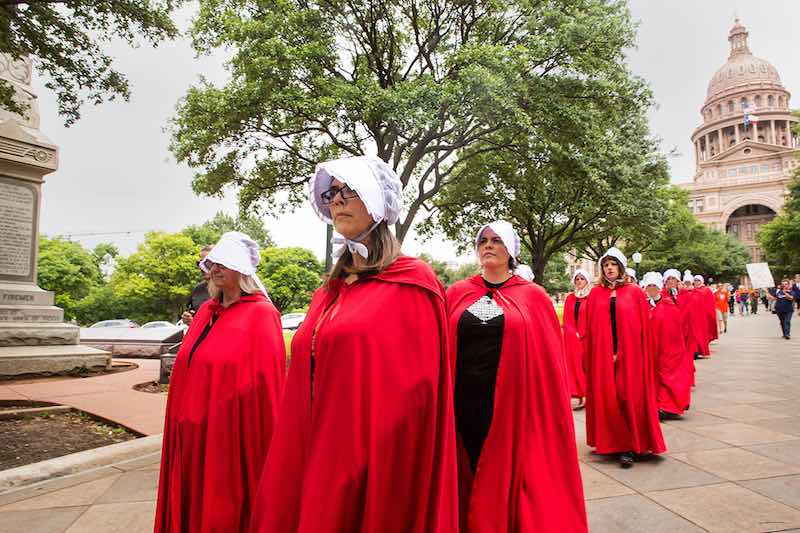
 The Weekly Sift