How the Midterm Elections Look With One Day to Go

The most important figure in tomorrow’s election is actually not on the ballot. No matter what happens, Wednesday morning Trump will still be president. This election isn’t about getting rid of Trump, it’s about controlling him. If Democrats get the majority in  one or both houses of Congress, the country will finally get some of the checks-and-balances that the Founders thought they had written into our Constitution.

Getting rid of Trump will still depend either on the 2020 elections, or on turning up evidence of impeachable offenses so compelling that more than a dozen Republican senators will be convinced.

The Senate

Republicans currently have a 51-49 majority. Tomorrow 35 seats are up for election, so on the surface you’d think it wouldn’t be that hard for Democrats to flip two seats and take control. (They need two, because Vice President Pence casts the deciding vote in a 50-50 Senate.)

However, 26 of the contested seats already belong to Democrats, so even if they hold all those, they have to flip 2 of the 9 Republican seats. It’s a tall order. (“Why did things shake out that way?” you might wonder. That’s because 2006 — when the public finally turned against the Iraq War — was a huge Democratic year, when Democrats like Claire McCaskill in Missouri and Jon Tester in Montana won seats in very red states. 2012 was Obama’s re-election year, so they managed to hold onto those seats. 2010 and 2014, by contrast, were strong years for Republicans.)

538 gives Democrats only a 1 in 6 chance of pulling this off. Here’s how it rates the individual races:

  • 18 are solid for Democrats, meaning the Democrat has at least a 95% chance to win.
  • 4 (Smith in Minnesota, Tester in Montana, Menendez in New Jersey, Manchin in West Virginia) are likely Democratic wins, with a win likelihood over 75%.
  • 3 (Nelson in Florida, Donnelly in Indiana, McCaskill in Missouri) lean Democratic, with a 60% or better win probability.
  • 2 (Sinema in Arizona, Rosen in Nevada) are toss-ups, though in each case the Democrat has a slight edge.

Already, winning all of those at the same time seems unlikely. If each race were independent of the others, for example, winning all four of the “likely” seats would only be about a 2 out of 3 bet. All three leaning seats together would be less than 1 in 3, and the two toss-ups together would be 1 in 4. (Actual combined probabilities are quite a bit higher than that, because the races are not independent rolls of the dice. As we saw with Trump’s victory in 2016, the party that wins close races in one state is more likely to win close races in another.)

Worse, all those seats together add up to just 27. In order to take control of the Senate, Democrats would need an upset in the only lean-Republican seat: North Dakota, where incumbent Democrat Heidi Heitkamp has only a 25% chance of hanging on. If she can’t pull that off, Democrats need one of the likely-Republican seats:

  • Beto O’Rourke in Texas (23%)
  • Phil Bredesen in Tennessee (20%)
  • Mike Espy in Mississippi (12%)

Unless at least one of those longshots comes in, Republicans hold control of the Senate. (Again, the races aren’t independent, which is how the odds for a Democratic majority can be as high as 1 in 6.)

The House

Democrats gaining control of the House is a much more doable job. All 435 seats in the House of Representatives are in play. Republicans currently have a 235-193 majority, with 7 seats vacant. Of the vacancies, two were formerly Democratic and five Republican. So you will sometimes hear that in order to gain a majority Democrats need to pick up 23 seats (if you count two of the vacancies as Democratic seats) or 25 seats (if you don’t).

In order to get a majority (218 out of 435), Democrats need only win the seats 538 rates as leaning their way:

  • 193 solid Democratic
  • 17 likely
  • 10 leaning

That adds up to 220. In addition, there are 18 toss-ups and 13 lean-Republican seats within range. Overall, that gives Democrats a 7 in 8 chance of winning the House. If everything breaks in their favor, they could have as large a majority as the Republicans have now.

House races, though, are unlikely to all go according to script. First, there are just so many of them that some longshot candidate is going to win somewhere. And second, House races aren’t polled as aggressively as Senate races, so some last-minute local factors could be overlooked. Somewhere, a district the media stopped paying attention to months ago is going to produce an upset.

As I’ll discuss in the hour-by-hour guide (the next post), you want to watch for toss-up or leaning seats in states where the polls close early. That will give the first indication of whether this is going to be a nail-biter or an easy Democratic win.

Governorships and state legislatures

If Democrats gain some governorships and control of some state legislatures, they’ll have a chance to undo the extreme gerrymandering that allows Republicans to maintain minority rule. (Last year, Democrats outpolled Republicans by 9% in the elections for the Virginia House of Delegates. But Republicans kept control.)

State government becomes more important as the federal government stops protecting civil rights and the environment. And if the now-more-conservative-than-ever Supreme Court overturns Roe v Wade, whether a woman can get an abortion may be up to the states.

Governors are being elected in 36 states, and at least some legislators are being elected in every state. 538 expects Republicans to win slightly more states (winding up with 26 governorships), but Democrats to wind up governing a larger percentage of the population (62%).

The closest races are in Iowa, Nevada, Ohio, Georgia, and Kansas. The two most interesting races, to me anyway, are Georgia and Florida, where Stacey Abrams and Andrew Gillum have a chance to be their states’ first black governors. (Abrams would be the first black woman governor in any state.) Abrams’ race is leaning towards her opponent, while 538 gives Gillum a 76% chance to win. Personally, I will find it very satisfying if Wisconsin finally boots out Koch puppet Scott Walker, which is the way the race is leaning.

As for state legislatures, I don’t know what to tell you, since there are very few published polls.

Ballot propositions

538 has a good rundown of the most important ones.

In general, ballot propositions cause more problems than they solve. There’s a reason we elect representatives who can focus on the issues full-time, rather settle everything by direct democracy. But in states that are heavily gerrymandered, or where running for office requires the kind of money you can only get from special interests, a ballot proposition might be the only way for the majority to make its will felt.

Michigan is one of those heavily-gerrymandered states.

Last year, Michigan Democrats won more overall votes for state House than Republicans. It was by a whisper, about half of one percentage point. But Democrats got walloped in the race that counts, as the GOP swept 63 of 110 seats.

Proposition 2 would create a non-partisan commission to draw districts for both the legislature and Michigan’s congressional districts. The commission would be given strict criteria to meet. Other anti-gerrymandering proposals are on the ballot in Colorado, Utah, and Missouri.

Given the racial biases in our justice system and the correspondingly high incarceration rate for non-whites, one way to make sure whites hold onto political power as long as possible is to keep felons from voting, even after they have served their sentences. Florida is one of the worst states for this form of voter suppression, with 10% of the voting-age population disenfranchised. Amendment 4 would give felons back their voting rights after their sentences end, except for murderers and sex offenders. (Yes, that is the proposition John Oliver was telling you about.)

Nevada, Maryland, and Michigan have propositions that would make it easier to register to vote, while Arkansas and North Carolina would make it harder to vote by requiring a photo ID.

A California proposition would repeal a number of gas taxes. A Washington proposition would create a carbon tax. Arizona’s Prop 127 would force utilities to get half their power from renewable energy by 2030.

Idaho, Nebraska, and Utah all have propositions to expand Medicaid.

Here in Massachusetts, the proposition I care most about is #3, which would protect transgender rights. I’m for it.

Why I’m Voting Straight Democratic

I’m definitely voting. But if you’re willing to run under the banner of today’s Republican Party, I can’t vote for you.


I didn’t used to be like this.

Only a few years ago, I was a meticulous voter. I’d examine each race and think hard about the individual candidates, looking for the best combination of personal character and positions on the important issues. There was a time when if I didn’t know anything about the candidates for some down-ballot office, I might leave that line blank, figuring that better-informed people should make the choice.

I don’t do that any more. Tomorrow I’m going to vote a straight Democratic ticket, including voting for and against candidates I’ve never heard of. If not for the ballot questions — I’m still meticulous about them — I’d be in and out of the voting booth in seconds.

It’s not that I think the Democratic Party is perfect. I expect that most of the Democrats I vote for will be good public servants, and will mostly promote policies I agree with. But some of the rest, I’m sure, will simply be the lesser evil. I’ve made my peace with that. I just know that they are the best hope to defeat Republicans, and Republicans need to be defeated. I can’t vote for Republicans any more.

That wasn’t always true. In my first presidential election, 1976, voting for Jerry Ford over Jimmy Carter was a real option, because I expected the country to be in decent hands no matter who won. (I dithered between the two before eventually picking a third party candidate.) Decades ago, when I was living in Massachusetts the first time, I voted for Bill Weld to be governor. He seemed like a straightforward, honest, intelligent guy. Eventually I even developed the rule-of-thumb that I would default to the Republican if I didn’t know who to vote for, figuring that only a really good Republican could win in my liberal district. When I moved to more conservative New Hampshire, I flipped that reasoning and defaulted to Democrats.

But now that I’m back in liberal Massachusetts, I’m not voting Republican for any office, no matter how trivial. In any state in the Union, I would do the same.

Have I changed? Not nearly so much as the Republican Party has. Today’s Republicans are not like the Republicans of the past, even the recent past. Today, the GOP is the party of climate change denial, discrimination against gays, gerrymandering, and baseless conspiracy theories. It’s the party that opposes the minimum wage, the party that cuts rich people’s taxes and then goes after middle-class Medicare when their tax cut creates an artificial budget crisis. (The middle-class tax cut Trump promised last week is vaporware: There is no such proposal, and once the election is over you will never hear about it again, except possibly as a cover story for another handout to the rich.)

Even worse, today’s Republican Party is a comfortable home for white supremacist fellow travelers like Rep. Steve King of Iowa. Open racists like David Duke or Richard Spencer endorse Republicans. White supremacist groups campaign for Republicans. If you want to spread anti-Semitic conspiracy theories, you go to the networks and web sites that Republicans frequent. If you’re an abuser of women, Democrats will probably throw you out, but Republicans will circle the wagons around you. If you favor something as offensive to human compassion as the death penalty for gays, Republicans will embrace you.

If you are happy carrying that party’s banner, I can’t vote for you.

And then there’s Trump. (I covered in detail what I think of Trump last week.) Back in 1990, They Might Be Giants recorded a song that starts like this:

This is where the party ends.
I can’t stand here listening to you
And your racist friend.

To me, racist is a stand-in for all sorts of bigoted positions: anti-immigrant, anti-Hispanic, sexist, homophobic, anti-Muslim, and just generally anti-everybody-who’s-not-a-white-straight-Evangelical-Christian. For every Republican candidate in the country, Trump is the bigoted friend that they can tolerate, but I can’t. For me, that’s where the party ends.

Your local Republican candidate might sound fairly reasonable from time to time. Lots of Republicans do: Paul Ryan occasionally tut-tuts when Trump says something particularly ridiculous or odious. Jeff Flake and Bob Corker have spoken up now and then. (And both retired from the Senate when they realized that even their minimal criticisms had excommunicated them from the Trump personality cult the GOP has turned into. As Flake put it: “There may not be a place for a Republican like me in the current Republican climate or the current Republican Party.”)

But in practical terms, what has any Republican official done to stand in Trump’s way? 538 models how often you’d expect a senator to vote with Trump, given Trump’s electoral margin in his or her state. Flake was actually considerably more likely to vote with Trump than the model predicted, and Susan Collins even moreso. What have any of them done to fight back, and reclaim their party for reasonable conservatism?

When push comes to shove, elected Republicans have all gotten in line behind Trump. Sometimes they’ve made a big public show of how hard the decision was (like Susan Collins supporting Trump’s tax cut, or Collins and Flake voting to elevate Brett Kavanaugh to the Supreme Court), but they’ve gotten in line. They’ve blocked congressional investigations of collusion with Russia or any other administration wrongdoing, and they’ve harassed any Justice Department investigations that Trump found inconvenient. Cabinet-level malefactors like Ryan Zinke rest easy knowing that Republicans in both houses of Congress have their back.

Rather than stand up for the principles they used to claim, Republicans who ought to know better have drunk the Kool-Aid. Ted Cruz is now embracing the man who insulted his wife and accused his father of conspiring to assassinate JFK. Lindsey Graham once understood that Trump is a “race-baiting xenophobic religious bigot”. Now he’s the most rabid of Trumpists, frothing at the mouth to defend Brett Kavanaugh and offering unconstitutional legislation to back Trump’s plan to end birthright citizenship.

I’ll just sit here wondering how you
can stand by your racist friend.

The only conservatives who have consistently held their ground against Trump are writers rather than politicians: Michael Gerson, George Will, Max Boot. All of them have urged their readers to vote for Democrats this time around. Boot writes:

Some Republicans in suburban districts may claim they aren’t for Trump. Don’t believe them. Whatever their private qualms, no Republicans have consistently held Trump to account. They are too scared that doing so will hurt their chances of reelection.

Friday, Jennifer Rubin wrote:

The midterm elections have therefore become all about Trump, about whether he’s “winning” or “paying a price” for his descent into rancor, racism and misogyny. Suddenly the real “values voters” are those who care deeply about values such as kindness, democracy, rationality and respect. If they show up and vote their values, Republicans are in big trouble.

Finally, you can see the difference between the parties in the closing arguments they are making as the election approaches: Democrats are talking about making your health insurance more secure, particularly if you’re on Medicare or have a pre-existing condition. They’re talking about student debt, climate change, voting rights, and protecting the civil rights of those whose rights are actually in question: women, racial minorities, and the LGBTQ community.

Republicans, by contrast, are closing with an issue that is almost entirely imaginary: the “threat” posed by several thousand migrants fleeing the violence of Honduras. Many of the caravaners are women and children, and the Pentagon believes most of them will never get here. Far from an “invasion”, the expressed intention of the much-hyped caravan is to surrender to US officials and ask for the asylum hearings that both international and American law promise them. (Instead, Trump is offering them a glittering symbol of the new MAGA Republic: “Barbed wire used properly,” he assures his cultists, “can be a beautiful sight.”)

There is no military issue whatsoever, so Trump’s dispatch of 5,000 (or is it 15,000?) troops to the border is pure theater — theater that will waste soldiers’ time and could cost taxpayers hundreds of millions of dollars. The conspiracy theories that Trump is using to justify this stunt have already inspired domestic terrorists like the MAGA mail bomber and the Pittsburgh synagogue shooter.

If that’s what you like — imaginary crises, conspiracy theories, money flowing from the middle class to the rich, race-baiting, voter suppression, abuse of women, and an ever more vigorous and violent white-supremacist movement — then vote Republican. You’re sure to get more of it.

But if that’s not what you want out of government, then the Republican Party as it stands today must fall. Voters need to reject it root and branch.

The Monday Morning Teaser

So the midterm elections are tomorrow. I’m sure you won’t be surprised to learn that this week’s Sift is going to focus on them.

It starts with what I’m going to do personally: “Why I’m Voting Straight Democratic” will be out before 9 EST. The short version: What the Republican Party stands for has become so toxic that if you’re comfortable running as a Republican, I can’t vote for you.

Next will come two posts that I hope you’ll find useful tomorrow night, assuming you decide to watch the election returns. The first is “How the Midterm Elections Look With One Day to Go”. It goes through the polling, what Democrats need to accomplish to get either a House or Senate majority, some of the important governor’s races, and a few of the more interesting ballot questions. That should be out before 11.

The second is “An hour-by-hour Guide to the Midterm Elections”. I’ll go through Tuesday night hour-by-hour with an eye to what polls close when and which races to focus on to see how the evening is going. Think of it as the program for your Tuesday night return-watching party. I’m hoping to get that out by noon.

The weekly summary will be short this week. It should be out by 1.

Souls in Darkness

If the soul is left in darkness, sins will be committed. The guilty one is not he who commits the sin, but he who causes the darkness.

– Victor Hugo, Les Misérables

This week’s featured post is “12 Things to Remember Before You Vote“. That’s extra-long, so I’ll try to keep this shorter than usual.

This week everybody was talking about right-wing political violence

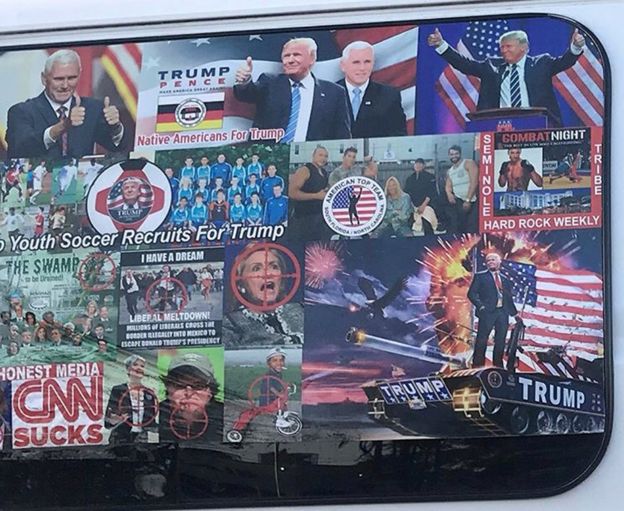
The window stickers on the mail-bomb suspect’s van window.

It’s hard to know which nightmare to discuss first: the unsuccessful attempt to assassinate 11 Democratic or liberal leaders, including two former presidents, with mail bombs, or the synagogue shooting in Pittsburgh that really did kill 11 people. One, if it had succeeded, would have been the worst single wave of political violence in America since the KKK attacks during Reconstruction. The other raises the specter of the world’s most persistent and virulent strain of hatred: anti-Semitism.

Focusing on either one ignores a crime that should ring similar alarm bells: A white man killed two black shoppers at a suburban Louisville grocery store, only minutes after trying to enter a black church and finding it locked. “Just to think that an hour and a half earlier we had 70 people in the church,” church administrator Billy Williams said.

In each case, you can look for causes in the psychology of the individuals involved, and undoubtedly you will find something. Individuals are responsible for their own actions. But at the same time, you have to ask “Why now?” In just about all times and places, I suspect, there have been angry misfits who fantasized about acts of violence against whichever people or groups they blamed for their misfortunes. But now, for some reason, the ineffable membrane between violent thought and violent action seems thinner than at any time since the riots and assassinations of 1968. Why?

To me, the answer seems obvious: The President of the United States devotes a great deal of his time and effort to spreading fear-raising conspiracy theories and labeling his critics as enemies of the nation. It’s not a coincidence that the mail-bombing suspect had turned the van he lived in into a Trump shrine. Or that the synagogue shooter saw the immigrants in the caravan crossing Mexico as “invaders“, and blamed Jews like George Soros for funding it. (The suspect in the synagogue shooting, to be fair, was not a Trump supporter. He believed many conspiracy theories Trump and the right-wing media helped spread, but blamed Trump for letting his daughter convert to Judaism and marry a Jew. “Trump is a globalist, not a nationalist. There is no #MAGA as long as there is a kike infestation.” Trump, in other words, is not MAGA enough for him.)

Trump’s defenders (like Hugh Hewitt) want to do a both-sides argument, lumping together right-wing murder and assassination attempts with liberals who refuse to serve Trump officials, or assail them verbally when they appear in public, like when Sarah Sanders was asked to leave the Red Hen Restaurant in Virginia.

These things are not the same“, Jennifer Rubin points out.

Violence is sending bombs to President Trump’s political targets. Violence is body-slamming a reporter who dares to ask a question. Violence is driving a car into a crowd, killing a young woman. Violence is killing unarmed African American youths. Violence is wife beating, sexual assault and child molestation (not demanding that accused wife beaters and sexual predators be held accountable and at the very least disqualified from high office.) Violence is forcibly separating young children from their parents (not calling out such treatment as inhumane).

Violence is not refusing to serve a White House press secretary dinner at a farm-to-table restaurant. It is not yelling at people in restaurants. It is not making mean jokes at a charity event. It is not peacefully occupying a government building to protest.

Hewitt is basically calling for a Henry II standard, which would have held the King blameless for asking “Will no one rid me of this troublesome priest?” shortly before someone killed Thomas Beckett.

But we don’t have a both-sides problem. We have an outbreak of right-wing violence that the president encourages.


Brian Klaas sums it up in a tweet-storm that starts like this:

There have always been violent extremists. But when attacks happened under Reagan or Clinton or Bush or Obama, you couldn’t point to insane anti-Semitic conspiracy theories they had recently spread. They didn’t praise neo-Nazis. They didn’t call reporters “enemy of the people”


I wish I had something insightful to say about the rising anti-Semitism, but I don’t get it. Most popular American bigotries make sense to me at some level: I can imagine the frame-of-mind of the people who hold those hatreds, point to personal experiences that I could have interpreted to fit those biases, and so on.

But the idea that the random Jews you can find by wandering into a synagogue are somehow to blame for America’s problems or my own … I just don’t get it. I don’t even know how to argue against it, because a mind that holds that thought seems foreign to me.

It doesn’t help that I have a tangential connection: The brother of one of the victims goes to my Unitarian church.

and caravans

When other networks were covering the bombs mailed to Democratic leaders, Fox and the rest of the conservative media was trying to flog the immigrant caravan story. The best discussion of this issue I found was from Beau of the Fifth Column:

but remember to vote

President Obama has no patience for your excuses.

and you also might be interested in …

The Washington Post published a gripping first-person account of an asylum-seeking woman who was separated from her 15-year-old daughter for nearly five months. The needless cruelty here is very striking.

Another WaPo article by former DHS adviser Scott Shuchart describes what was happening inside DHS when the family-separation policy was being implemented: He describes extreme levels of internal dysfunction and dishonesty, but mostly malfeasance by the political appointees, who were often warned ahead of time (by the career civil servants) of the problems they were about to cause.

But most culpable were the high-level appointees, unwilling to take ownership of what they’d decided to do; lying to their staffs in the expectation that nobody really cared what happened to poor Central American kids; cynical about the notion that most of us who swear an oath to uphold the Constitution actually mean it. I cast about for more to do, but within a month of that June meeting, I realized there was no way to keep my oath and my job.


A new study shows that a minimum-wage worker would need 2.5 jobs to afford a one-bedroom apartment.


Megyn Kelly is done at NBC’s Today show, after defending white people wearing blackface on Halloween.

I can’t say I have a lot of sympathy for either Kelly or NBC in this spat. NBC knew what it was getting with Kelly: someone who may not be aggressively racist, but has been consistently racially insensitive. In 2013, for example, Kelly jumped into a discussion about black Santa Clauses and said:

For all you kids watching at home, Santa just is white. … Just because it makes you feel uncomfortable doesn’t mean it has to change. You know, I mean, Jesus was a white man too. … He was a historical figure. That was a verifiable fact.

As I explained at the time, this was not just insensitive, it was ignorant. (Most likely, neither Saint Nicholas nor Jesus was white enough to get service at a Jim Crow lunch counter.) Kelly has a sharp mind, but she also has an oblivious white-people-are-the-center-of-the-universe worldview that she has never bothered to educate herself out of. When NBC hired her, that was already a verifiable fact.

You probably already understand why blackface is inappropriate Halloween makeup for whites, but I feel obligated to spell it out: It’s more the history of the thing than the thing itself. By wearing blackface, whites place themselves in the tradition of the minstrel show. You may think you’re honoring Martin Luther King or Barack Obama or whoever you’re supposed to be, but your intention is not the controlling factor. (Wearing an Obama mask, by contrast, does not evoke minstrelsy, and can be OK if done with respect.)

As I’ve tried to explain on several occasions, some words and symbols have such a strong historical resonance that your innocent intention can’t salvage them. You may believe a swastika just looks cool, and weren’t thinking about Nazism at all when you got that tattoo. It doesn’t matter; the symbol has a meaning independent of your intention.


In the Washington Post on Tuesday, Monica Hesse summed up what I’m now thinking about transgender policy and a lot of other sex-and-gender-related issues: Why exactly do we need to know what genitalia other people have, or what exactly they do with their biological equipment when they’re with consenting adults?

Hesse was responding to a leaked HHS proposal to define transgenderism out of existence:

The department argued in its memo that key government agencies needed to adopt an explicit and uniform definition of gender as determined “on a biological basis that is clear, grounded in science, objective and administrable.” The agency’s proposed definition would define sex as either male or female, unchangeable, and determined by the genitals that a person is born with, according to a draft reviewed by The Times. Any dispute about one’s sex would have to be clarified using genetic testing.

Other than the fact that it wouldn’t work because life is not that simple, there’s the question of what the policy is trying to accomplish. Hesse writes:

The most charitable interpretation for the government’s proposal is that we humans, as a species, have a need to organize things, and put them in categories. That we are uncomfortable with the unknown, and uncomfortable with being uncomfortable. That our aversion to this is so strong that we would rather ask unspeakably rude questions to strangers — So, are you a boy or a girl? So, who’s the wife in your same-sex relationship? — than accept that there are things we don’t need or deserve to know.

What if we allowed ourselves to remain uncomfortable? What if, instead of looking at other humans as something to be categorized, we saw in them a chance to appreciate the vastness of humanity?

As I’ve mentioned before, I experienced my own need to categorize when I watched the TV series “Billions“. The character Taylor does not claim to be either male or female. Part of me just couldn’t let that go: “What is s/he really?” It took some time for me to ask the next obvious question: “Why do I need to know?” But once I had asked that question, it started coming to mind in a lot of other situations.


Any closing I can think of seems inappropriate this week. I’ll try to do better next week.

12 Things to Remember Before You Vote

Since Inauguration Day, we’ve been dealing with a faster news cycle than we’ve seen before. Again and again, we see some news story and think: “This changes everything. I’ll never forget about this.” But in a few days there’s something else, the media focus shifts, and last week’s incredible story seems like ancient history. “Are you still going on about that?”

It’s worth remembering how strange this is, and what a shift it marks since the Obama administration. While Fox News and its ilk never lacked for some story they could manufacture outrage over — Obama put his feet on a White House desk, he saluted while holding a latte, Michele wore a sleeveless dress — really outrageous things were rare.

And so they were remembered. President Obama’s claim “If you like your health insurance you can keep it” stuck in everyone’s mind, because he so seldom cut corners on the truth. (For what it’s worth: I liked my health insurance and I kept it.) Benghazi conspiracy theories hung on forever, because so little else happened that Obama-haters could base a good conspiracy theory on. (A few months ago, I saw a guy wearing a “Benghazi: We will never forget” t-shirt. I had to wonder whether the things he will never forget about Benghazi actually happened.)

But as one Trump scandal after another vanishes down the memory hole, it takes some effort to remember things that at the time seemed unforgettable. (As I compiled this list, I kept having an “Oh yeah, that happened” response.) It’s even harder to sort out the really important things from the overhyped distractions: NFL players kneeling, Stormy Daniels, the immigrant caravan, and so on.

But when it comes time to play our role as voters, we need to remember, and we need to make sure that other people remember.

So here’s my list of the most outrageous, most objectionable things that have happened since Republicans took control of the White House and both houses of Congress. In compiling it, I have tried to avoid listing actions (like pulling out of the Paris Agreement or cutting rich people’s taxes) that I simply disagreed with because I am more liberal that President Trump. I’ve also left out times where he did something he had promised to do in the campaign, even if I consider it reprehensible.

Instead, I’m looking for violations of what previous administrations (of both parties) would have regarded as universal American values. They happen fairly regularly, but each seems to push the previous ones out of our memories.

1. Kids in Cages.

From some time in April until late June, the administration carried out a “zero tolerance” policy at the border with Mexico. According to Wikipedia:

The policy involved prosecuting all adults who were detained at the U.S.–Mexico border, sending the parents to federal jails, and placing children and infants under the supervision of the U.S. Department of Health and Human Services. According to government officials, the policy led to the separation of almost 3,000 children from their parents.

Many of these families had done nothing wrong: Seeking asylum is legally protected under both international law and US law. (Trump refers to these laws as “loopholes”.) Many who came to legal entry points trying to turn themselves in and claim asylum were turned away, forcing them to turn themselves in to border agents after crossing illegally. Texas Monthly discussed the problem with Anne Chandler of the Children’s Border Project:

TM: So if you cross any other way besides the bridge, we’re prosecuting you. But . . . you can’t cross the bridge.

AC: That’s right. I’ve talked to tons of people. There are organizations like Al Otro Lado that document border turn-backs. And there’s an effort to accompany asylum seekers so that Customs and Border Patrol can’t say, “We’re closed.” Everybody we’ve talked to who’s been prosecuted or separated has crossed the river without a visa.

By June, public outrage had forced the administration to stop routinely separating families. But HHS and the Justice Department never acknowledged that they had done anything wrong or had created a problem they needed to fix. Whatever corrective action HHS has taken has always been carried out under court order and with a lot of foot-dragging.

On July 26, responding to an ACLU class action lawsuit, a federal judge ordered all separated children, except where not appropriate, be reunited with their parent within 30 days.[19][20] On July 26, the Trump administration said that 1,442 children had been reunited with their parents while 711 remained in government shelters. Officials said they will work with the court to return the remaining children, including 431 parents of those children who have already been deported without their children.[21] As of August 20, 528 of the children — about a fifth — have still not been reunited with their parents.

A number of the children the government regards as “discharged” have been released to a sponsor in the US, rather than reunited with the families they were stolen from.

As Adam Serwer observed in The Atlantic, the cruelty of this policy is the point. Jeff Sessions may call it “deterrence” that will prevent other people from trying to come here, but that’s just a fancy language for describing cruelty: Don’t come here, because if you do we’ll take your children away.

Recently, Trump has discussed implementing a new family-separation policy:

One option weighed by the administration, as reported by the Post: Migrant families seeking asylum can be detained for up to 20 days, at which point they must decide whether to stay together in detention waiting for their cases to proceed or choose separation. This would involve children being transferred to a government shelter so other family members could claim custody.

Federal officials believe this can be done legally.

The ACLU disagrees:

“The government need not, and legally may not, indiscriminately detain families who present no flight risk or danger,” ACLU attorney Lee Gelernt said in an email to the Post. “It is deeply troubling that this Administration continues to look for ways to cause harm to small children.”

2. Putting Russia first in Helsinki.

In July, the Trump-Putin summit in Helsinki was a huge propaganda triumph for the Russian president. Trump appeared to balance the unanimous conclusion of the US intelligence agencies (that Russia interfered in the 2016 elections to help Trump) against Putin’s word, and came down in favor of Putin.

My people came to me, Dan Coats came to me and some others, they said they think it’s Russia. I have President Putin; he just said it’s not Russia. I will say this: I don’t see any reason why it would be. … I have great confidence in my intelligence people, but I will tell you that President Putin was extremely strong and powerful in his denial today.

It wasn’t just that Trump has a blind spot about his own election. In what CNN’s John King called “the surrender summit“, Trump also failed to confront Putin about his interference in European elections (including Brexit) or with any of Russia’s other bad behavior: the annexation of Crimea, fomenting a proxy war in eastern Ukraine, assassinating critics in the UK, or propping up the brutal Assad regime in Syria, just to name a few.

Instead of calling out Putin for his violations of international laws and standards, Trump said US/Russia relations are in a bad place because “we’ve all been foolish”. Trump described a Putin proposal that would have let Russian intelligence interrogate US officials (like former ambassador Mike McFaul) as “an incredible offer”. (The Senate rejected it 98-0.) In an interview with Fox News’ Tucker Carlson, Trump worried about the “aggressive people” of tiny Montenegro, a NATO ally, provoking Russia into war.

Writing in The Washington Post, Julia Ioffe put her finger on the root problem: Trump has let Putin shape his picture of reality.

It’s possible to argue about why the American president has become a mouthpiece for Russian propaganda: Does Putin have kompromat on him? Is it because his real estate empire depends on Russian money? Is he still angling to build Trump Tower Moscow?

But the reason barely matters compared to the result: When the President of the United States speaks about issues Russia cares about, more often than not what comes out of his mouth is Russian propaganda. “America First” has turned into “Russia First”.

3. The Very Fine Nazis in Charlottesville.

Trump has told reporters he is “the least racist person you have ever interviewed“. But his denials have never convinced one very important group of people: white supremacists, who are quite sure that the president is on their side. That’s why he was endorsed by former KKK grand wizard David Duke, and why Richard Spencer led a Nazi-saluting crowd in a chant of “Hail Trump! Hail victory!” after the 2016 election. It’s wrong to claim that all Trump supporters are white racists, but just about all white racists are Trump supporters.

Emboldened by Trump’s 2016 victory, a coalition of Nazis, white supremacists, Neo-Confederates, and other alt-right groups formerly considered to be on the fringes of conservative politics decided to make a big public splash in Charlottesville, Virginia in August, 2017.

In classic storm-trooper style, they held a torchlight parade Friday evening, where they chanted slogans like “Jews will not replace us“, “blood and soil“, and “Hail Trump!“. Men with AR-15s ominously hung around outside a synagogue.
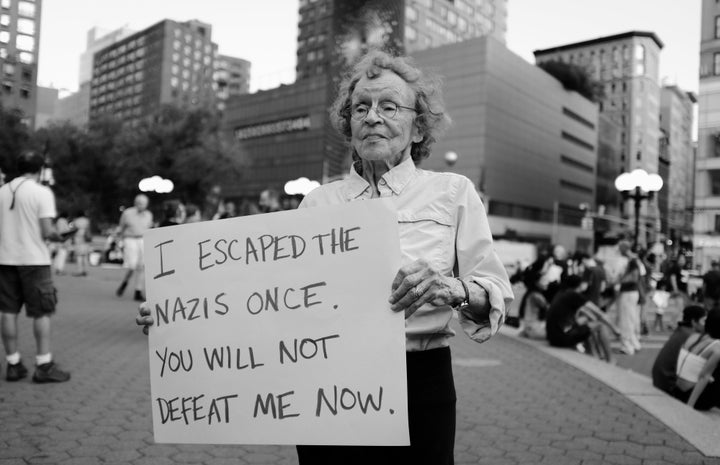
The violence of Friday night culminated Saturday afternoon, when a rally participant rammed his car into a crowd of counter-protesters, killing Heather Heyer (the only fatality of the weekend) and injuring 19 others.

Trump responded to this spectacle by pushing the organizers’ cover story: that the rally was really about a Robert E. Lee statue that Charlottesville wants to move to a less prominent spot. (The parallel with #2, where he uncritically repeated Putin’s propaganda, is worth noting.) After looking at the pre-rally posters and the line-up of speakers, Robert Tracinski at The Federalist begs to differ:

this was a Nazi march from the beginning, planned by Nazis, for Nazis. As to whether any hapless moderates strolled in there thinking this was just about the statue—well, I live in this area and used to be active in the local Tea Party group. I know people who are not white nationalists who oppose the removal of the statues based on high-minded ideas about preserving history. None of them were there, and if they had been, they would have bolted the moment they saw a bunch of guys with torches chanting “Blood and soil.”

“Very fine people”, Trump assured the country, were on “both sides”. And “both sides” were responsible for the violence, even though only one side had somebody wind up dead.

4. Alternative facts.

The Trump administration started with a bang. In his first meeting with the White House press corps, Press Secretary Sean Spicer berated reporters for stating correctly what anyone with eyes could see: Trump’s inauguration didn’t draw nearly as many people as Obama’s. But Spicer angrily insisted: “This was the largest audience to ever witness an inauguration, period.”

The next Sunday, NBC’s Chuck Todd asked Kellyanne Conway about this incident, which at the time seemed bizarre, though we’ve since gotten used to such performances.

“You’re saying it’s a falsehood. And they’re giving — Sean Spicer, our press secretary — gave alternative facts,” she said. Todd responded: “Alternative facts aren’t facts, they are falsehoods.”

At the time we didn’t know that Conway’s “alternative facts” was the opening salvo in an all-out assault on truth that has become increasingly shameless with time.

“All presidents lie,” Trump apologists say, and point to Obama’s “If you like your health plan you can keep it”, Clinton’s “I did not have sex with that woman” or Bush the First’s “Read my lips: no new taxes.” What makes those statements stand out years later, though, is how rare such lies have been for previous presidents of either party.

All presidents have presented facts selectively, emphasizing the ones that fit their narrative while skipping over the ones that didn’t. All presidents have shaded the truth and obfuscated inconvenient facts, particularly when they have been directly accused of something. But we have never seen anything like the thousands of lies Trump has let fly on every conceivable subject.

Just this week, for example, he made up riots in California that never happened, talked about a tax cut that hasn’t even been proposed in Congress, and made a baseless claim about “unknown Middle Easterners” in the current migrant caravan. Even while admitting he had no evidence of the Middle Easterners (who he presumably meant to imply were terrorists), he repeated that “they very well could be” in the caravan — as if he were justified in claiming anything not already proven false.

When things he says are proven to be false, he keeps saying them. This also is completely new in American politics. Previous presidents could be shamed into changing their misleading rhetoric. (Clinton, for example, stopped saying that he never had sex with that woman.) But Trump is shamelessly dishonest.

Some observers tend to write this off as a quirk, like your crazy uncle who tells tall tales about the good old days. But constant lying has a corrosive effect on democracy. It’s impossible to have any kind of reasonable discussion of the issues that face our country when the President can claim anything or deny anything, and (as long as Congress is OK with it) no one can hold him accountable.

5. Puerto Rico.

The Bush administration’s botched response to Hurricane Katrina was such a turning point that conservative media spent the entirety of  Obama’s two terms looking for “Obama’s Katrina”. At least two dozen unfortunate events got labeled that way, though none of the labels stuck. In the end, Obama’s Katrina was the GOP’s white whale; they chased it for eight years, but it got away.

In just its eighth month, though, the Trump administration had an honest-to-God direct Katrina parallel: Hurricane Maria, which devastated Puerto Rico on September 20, 2017. In just about every way, the Trump administration and the Republican Congress sent the message that — while Puerto Ricans may technically be American citizens under the law — they don’t really count.

Stories of the botched response are mostly anecdotal, because the administration is sticking to its line that it did “a fantastic job”, and Congress has never investigated.

In the year since Hurricane Maria slammed into Puerto Rico, killing nearly 70 percent more people than Katrina, the GOP-led House has yet to create a select committee to oversee the Trump administration’s recovery efforts. The Senate Homeland Security and Governmental Affairs Committee, which oversees FEMA, has held just two hearings related to the storm. Neither the House nor the Senate have issued any major reports, and none appear to be in the works.

Here are some of the things we do know: Rather than the two weeks required to restore electric power after Hurricane Irma (which blew through Florida only two weeks later), restoring power to Puerto Rico took eight months. Granted, the shakiness of Puerto Rico’s power grid before the hurricane made the job harder, but ordinarily in America a harder problem inspires a greater effort. Not so this time.

Much of the aid that did make it to the island got stuck in the port of San Juan. 20,000 pallets of bottled water got left on an airport runway, where they were discovered nearly a year later. While Puerto Ricans were dying in hospitals without electric power, or from the inability to get their prescriptions filled, a Navy hospital ship was treating only six patients a day.

Ten months after the storm, the official death toll stood at 64, a number everyone knew was absurd. (Only a month after landfall, CNN had talked to about half of the island’s funeral homes and found 499 storm-related deaths.) The current estimate is just below 3,000 deaths, with some estimates as high as 4,600.

The scene that sums up the Trump administration’s go-through-the-motions response was the President’s own visit to the island, where he casually flipped rolls of paper towels into a crowd the way interns throw compressed t-shirts into the stands at minor-league baseball games.

The challenge posed by Puerto Rico combined Trump’s character flaws and unfitness for office into a perfect storm of dysfunction.

  • He has below-normal levels of compassion in any case. This has been obvious in other disasters as well. Last month, during a photo op where he was handing out food to victims of Hurricane Florence in North Carolina, he told a box-lunch recipient to “have a good time“, a line he had also used at an emergency shelter in Houston after Hurricane Harvey.
  • He particularly doesn’t care about brown people who speak Spanish. “America First” has always meant “White English-speaking Americans First”. Puerto Ricans are not “Real Americans” to Trump or to Trumpists, so the fact that they were suffering — and many of them were dying — rang no alarm bells.
  • He neither understands nor takes responsibility for how government works. Part of the challenge of Hurricane Maria was the dysfunctionality of the island government. (Similar problems arose after Katrina because of inefficiencies at the Louisiana and New Orleans levels.) But a president who understood government — picture, just for the sake of argument, President Hillary Clinton — would have grasped this from the outset and planned around it. Likewise, the bureaucratic gaps between FEMA, the Pentagon, and other relevant agencies should have been taken into account, but weren’t.
  • He can’t correct his mistakes because he can’t admit them. When it became clear that the death toll was much higher than the early estimates, and that his administration hadn’t been doing “a fantastic job” at all, Trump treated that objective information as a partisan attack against himself. Rather than try to fix anything, he lashed out at the Mayor of San Juan, at Democrats, at the media, and at the Puerto Ricans themselves, who “want everything done for them“.

6. Don’t believe women.

The Kavanaugh controversy is recent enough to still be on the public radar, but it’s far from the only time when the administration has shrugged off the testimony of multiple women. Remember creepy Roy Moore? I’ll let Wikipedia sum up:

In November 2017, nine women accused Roy Moore — a United States Senate candidate and a former Chief Justice of the Supreme Court of Alabama — of sexual misconduct. Three of the women alleged that he had sexually assaulted them, two during their adolescence (one who was 16 at the time of the alleged incident, when Moore was 31, and one who was 14 at the time of the alleged incident, when Moore was 32).[1] Six other women recalled Moore pursuing romantic relationships, or engaging in inappropriate or unwanted behavior with them, while they were between the ages of 16 and 22.

Trump was unfazed in his endorsement of Moore. “He totally denies it,” the President said. And that, apparently, was all it took to convince him. After all, the accusers were just women.
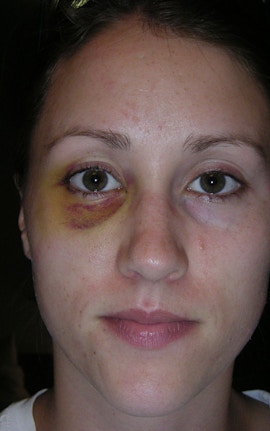
Two White House staffers, Rob Porter and David Sorensen resigned after allegations of physical violence against their wives. Rob Porter was accused by both of his ex-wives, including one who offered a black-eye photo as evidence. Even though he was aware of what the FBI had found during its background investigation, Chief of Staff John Kelly praised and defended Porter:

Rob Porter is a man of true integrity and honor, and I can’t say enough good things about him. He is a friend, a confidante and a trusted professional. I am proud to serve alongside him.

White House spokesperson Sarah Sanders called Porter “someone of the highest integrity and exemplary character”. The White House learned of the accusations in November, 2017, but did nothing about them until they became public in February, 2018.

After Porter’s resignation, Trump’s sympathy was entirely with him rather than his victims: “We certainly wish him well. It’s obviously a very tough time for him. He did a very good job while he was in the White House.”

And of course I have to mention what happened before the election: After a video of Trump bragging about his sexual assaults became public, he claimed it was merely “locker room talk” between guys, and not anything he had actually done. Subsequently, more than a dozen women came forward to say that he had sexually assaulted them, while several others alleged lesser forms of misconduct.

Trump responded to more than one of the accusations by claiming that the women were not attractive enough to assault. He said that they were all lying and promised to sue them after the election, which he never did.

7. Repeal, but don’t replace.

As a candidate, Trump railed against ObamaCare almost as much as against immigration. He wasn’t just going to get rid of the Affordable Care Act, he was going to replace it with something much, much better.

Donald Trump: I am going to take care of everybody. I don’t care if it costs me votes or not. Everybody’s going to be taken care of much better than they’re taken care of now.

Scott Pelley: The uninsured person is going to be taken care of how?

Donald Trump: They’re going to be taken care of. I would make a deal with existing hospitals to take care of people. And, you know what, if this is probably–

Scott Pelley: Make a deal? Who pays for it?

Donald Trump: –the government’s gonna pay for it.

But by the time John McCain cast his famous thumbs-down vote against it, the Republican “repeal and replace” slogan had turned into just “repeal”. Every repeal-ObamaCare plan the CBO analyzed (some plans Republicans pushed to a vote before the CBO could analyze them) would have resulted in the number of uninsured Americans going up by 10-20 million.

In the tax bill, they managed to repeal the insurance mandate; we’ll see if that change starts a death spiral (more and more heathier-than-average people opting out of the system as premiums increase) when it takes effect next year. Meanwhile, the Justice Department has filed a brief supporting a lawsuit that would declare unconstitutional ObamaCare’s protections for people with pre-existing conditions.

And there is still no TrumpCare plan, not even on paper. “Everybody’s going to be taken care of” was just a lot of blather.

8. Insulting a military widow (and lying about her congresswoman).

Already during the campaign, we saw that Trump has only conditional respect for gold-star families. If they play their assigned roles in his personal narrative, he loves them. But if they criticize him — particularly if they are not white or not Christian — he’ll come at them with both barrels.

On October 4, 2017, four American soldiers died in Niger, a land-locked Africa country that I (like most Americans, I suspect) didn’t know we had troops in, and probably couldn’t have found on a map. The White House staff drafted a public statement about the incident, but (for some unknown reason), it was never released. For weeks, Trump said nothing to the American public about these soldiers or their mission.

Eventually, a reporter shouted a question to Trump, who responded by telling a very odd lie: He made condolence calls to the families of soldiers who died in the line of duty, he claimed, but Obama and some other previous presidents hadn’t. The ensuing controversy got reporters asking questions about presidential condolence calls, and somebody eventually talked to Rep. Fredica Wilson of Florida, who is a friend of the family of one of the four dead soldiers, Sgt. LaDavid Johnson. Wilson said she had been in a car with the widow, Myeshia Johnson, and overheard Trump’s call when Myeshia put it on speakerphone.

Trump, Wilson claimed, told the widow that her husband “knew what he signed up for”, a statement she and the family found insensitive. Trump labeled this account a “total lie“, and stuck by that claim even after Wilson’s story was supported by Sgt. Johnson’s mother. When the widow gave her own interview, saying that Trump’s call “made me cry cause I was very angry at the tone of his voice and how he said he couldn’t remember my husband’s name”, Trump couldn’t let that stand either, insisting that he “spoke his name from beginning, without hesitation!”

Take that, you military widow! How dare you remember something the Commander in Chief doesn’t want remembered.

Not to be outdone, Chief of Staff John Kelly also had to get into the fiasco: He slammed Rep. Wilson by telling a false story about her. Kelly said that he had heard Wilson speak at the dedication of a new FBI field office in Miami. He described her ignoring the two dead agents the building was dedicated to and instead focusing entirely on her own role in getting funding for the building. He claimed he had been “stunned” by this, and summarized her character with “Empty barrels make the most noise.”

Unfortunately for him, the Sun Sentinel had a video of the event, which bore no resemblance to Kelly’s story. He had lied. He has never acknowledged the lie or apologized for it.

9. The swampiest administration ever.

Other than The Wall That Mexico Will Pay For and locking up Hillary Clinton, the campaign promise Trump repeated most often was that he would “Drain the swamp.”

It’s a good thing to promise, because there really is a Swamp, and it really does need to be drained: Members of Congress (from both parties) rely on contributions from special interests to fund their campaigns, and the people who work in the government’s administrative agencies (in both Republican and Democratic administrations) know that they can have lucrative second careers working for the interests they’re supposed to be regulating — but only if they play ball with the special interests rather than enforce regulations that are supposed to protect the public.

The result is a government that only works for the American people part-time. The rest of the time it works for big corporations, rich individuals, and whatever single-issue groups can afford to hire good lobbyists. (If you want a more detailed discussion of the problem, read Republic, Lost by Lawrence Lessig.)

But just as the Wall is not getting built, Mexico will never pay for it, and Hillary Clinton is still free, the Swamp is not being drained. Quite the opposite, in fact: This is the swampiest administration in my lifetime, and maybe ever.

It starts at the top: A big part of draining the swamp is enforcing transparency about the money special interests spend to gain influence and where it goes. But Trump has never liked transparency, at least not when it applies to himself.

Since Nixon, all presidents and nearly all presidential candidates have revealed their tax returns, usually going back many years. (Whenever someone on social media raises the question of how the Clintons have made so much money over the years, I point out that we know exactly how, because we have all their tax returns since Bill first ran for president in 1992.) After repeatedly promising that he would release his returns at some point in the future, Trump has settled on the position that his election win (with 46% of the vote) showed that the American people don’t care about his taxes.

As a result, we can’t say for sure whether the tax plan that he signed in December was primarily for the country’s benefit, or for his own. (We can make some guesses though: The plan looks designed specifically to cut the taxes of people like him. How big a tax cut you’ll get largely depends on how much you resemble Donald Trump.)

He also broke a longstanding tradition of American presidents insulating themselves against financial conflicts of interest by either putting their assets into a blind trust or moving all their investments to Treasury bonds. Trump turned management of The Trump Organization over to his sons, though of course he knows what they’re doing and where his investment interests lie.

He also has directly profited from his presidency. His election led to Mar-a-Lago doubling its membership fee to $200,000. Since Trump spends so much of his time there, it is a unique opportunity to pay money directly into the President’s pocket in exchange for access, leading Chris Hayes to dub Mar-a-Lago “the de facto bribery palace“. Three Mar-a-Lago members have been named ambassadors, while three others are “the shadow rulers of the Veterans Administration“. They got influence in the US government by paying Trump money. Every golfing trip also generates money for the President, as the entire presidential entourage has to be accommodated at the taxpayers’ expense.

Foreign governments pay Trump money as well. The Industrial & Commercial Bank of China pays him $2 million a year to rent the 20th floor of Trump Tower. Qatar bought a $6.5 million apartment at Trump World Tower. Saudi Arabia paid Trump’s D.C. hotel $270,000 to house veterans groups who lobbied for a Saudi interest. It would be trivial for a foreign government to pour huge amounts of money into Trump’s pocket: Just set up shell corporations to buy Trump Organization condos at inflated prices. Is that happening? How would we know?

With that example, it’s little wonder that so many cabinet heads misused public funds. Disgraced EPA head Scott Pruitt is the most famous offender (and Trump accepted his misbehavior until the publicity got to be too much; without a free press, Pruitt would still be in office). But he’s far from the only one: Wilbur Ross, Ryan Zinke, Steve Mnuchin, and Ben Carson all have scandals that would have gotten them ejected from the Obama administration. But Trump’s standards are lower.

10. Politicizing justice.

The campaign chant of “Lock her up!” (which Trump has continued to encourage in his rallies as president) was unique in American political history. I know of no previous example where an American presidential candidate threatened to put his opponent in jail, though this often happens in third-world dictatorships.

Since taking office, he has frequently put forward the idea that the Justice Department should protect him and his allies from investigations while harassing his opponents. Just last month he tweeted:

Two long running, Obama era, investigations of two very popular Republican Congressmen were brought to a well publicized charge, just ahead of the Mid-Terms, by the Jeff Sessions Justice Department. Two easy wins now in doubt because there is not enough time. Good job Jeff

I assume he’s talking about Duncan Hunter and Chris Collins, who appear to have broken some serious laws. Hunter used campaign money to upgrade his lifestyle, and filed false reports with the FEC to cover his tracks. Collins used his insider knowledge to tip off his family members to sell stock in a drug company before its bad test results became public. Pretty swampy behavior in each case. But apparently Trump believes Attorney General Sessions should have suppressed those investigations, at least until after the fall elections.

Together with allies in Congress (like Devin Nunes), Trump has run a disinformation campaign against the FBI in an attempt to discredit the Mueller investigation into his campaign’s collusion with Russia. Just about everyone involved in starting that investigation has been drummed out of the FBI, all without any evidence that the investigation is tainted. The Economist observes:

Mr Trump’s attacks on the [Department of Justice] do not help. He seems to think of the agency as part of his operation, as though he has been elected chief executive of America and the DoJ is the company’s legal department. It follows that, in failing to protect him from Mr Mueller, the department is not doing its job. He has never forgiven Mr Sessions for recusing himself from Mr Mueller’s investigation, and believes he has “the absolute right to do what I want to do with the Justice Department”.

This contravenes long-standing norms, under which a president appoints an attorney-general and other top officials, then sets general policy direction, but otherwise respects the department’s independence—and certainly does not intervene in investigations. Susan Hennessey, a fellow at the Brookings Institution and former lawyer for the National Security Agency, believes the president “has no reference to the DoJ as an institution that has to be defended—it’s entirely personal for him”. The DoJ’s independence, and the rule of law that independence protects, are not features of the American system to Mr Trump; they are pesky inconveniences.

11. Shithole countries.

During a closed-door discussion of immigration last January, Trump revolted at the idea of taking more people from countries like Haiti and various African nations: “Why do we want all these people from shithole countries coming here?” he asked, and wondered why we couldn’t get more immigrants from Norway.

Just about all American families (other than native Americans) originate from places that (at the time) could have been described in similar terms, and probably were: Ireland during the famine, for example, or the Jewish Pale in Russia during the pogroms. In general, people who are doing well stay where they are. (We don’t get more Norwegians now because — largely thanks to socialismNorway is nice place to live, in many ways nicer than the US.)

But Trump’s outlandish statement is all of a piece with the worldview that makes him so popular with the white supremacists we talked about in #3: America is for white Christian people. At every possible turn, he has tried to keep other kinds of people from coming here, and to throw out those who were already here, even if they came legally.

That simple rule of thumb explains a wide variety of Trump administration policies and rhetoric: the Muslim ban, the Wall, the mythical immigrant crime wave, and a host of others. White Christian people are good, and we want them. Any other kind of people are bad, and we want them gone.

12. Enemies of the American people.

Every administration feuds with the press, and none gets the coverage it thinks it deserves. (Nixon VP Spiro Agnew famously called the press “nattering nabobs of negativism“.) Hindsight resolves most of these disputes in the press’ favor. For example, both Presidents Johnson and Bush II criticized the media for not telling the public the “good news” about the wars in Vietnam and Iraq, respectively. But in fact those wars just weren’t going well, as the media accurately reported.

But no previous president has ratcheted up his anti-media rhetoric to Trump’s level of vitriol, not just against specific stories or reporters, but against the very idea of a free press itself. Just this morning, only days after a Trump supporter mailed a bomb to CNN, he denounced “The Fake News Media, the true Enemy of the People“. In his rallies, he points to the area reserved for reporters and says things like “these people back there, these horrible, horrendous people“. Independent observers are worried about what this abuse portends for American democracy.

“His attacks are strategic, designed to undermine confidence in reporting and raise doubts about verifiable facts,” said David Kaye and Edison Lanza, the Special Rapporteurs on freedom of expression for the United Nations and the Inter-American Commission on Human Rights, respectively.

The President has labelled the media as being the “enemy of the American people” “very dishonest” or “fake news,” and accused the press of “distorting democracy” or spreading “conspiracy theories and blind hatred”.

“These attacks run counter to the country’s obligations to respect press freedom and international human rights law,” the experts said. “We are especially concerned that these attacks increase the risk of journalists being targeted with violence.” …

“Each time the President calls the media ‘the enemy of the people’ or fails to allow questions from reporters from disfavored outlets,” the experts added, “he suggests nefarious motivations or animus. But he has failed to show even once that specific reporting has been driven by any untoward motivations.

Before the election, the term fake news actually meant something important: It referred to entirely made-up stories packaged to look like news reports and distributed over social media, like “FBI Agent Suspected in Hillary Email Leaks Found Dead in Apparent Murder-Suicide” which got noticed by more than half a million Facebook users a few days before the election.

We know this is fake because The Denver Guardian, which supposedly published it, does not exist. Fake news like this was rampant before the election. Most of it favored Trump, and some of it came from Russia.

Since the election, Trump has perverted fake news to mean any report he doesn’t like, particularly those where White House staffers leak something anonymously. Quite often, an article he labels “fake news” turns out to be true.

His statements after the capture of the MAGA bomber have ominous historical echoes: He blames the press for raising public anger against itself, and takes no responsibility for his own rhetoric.

There is great anger in our Country caused in part by inaccurate, and even fraudulent, reporting of the news. The Fake News Media, the true Enemy of the People, must stop the open & obvious hostility & report the news accurately & fairly. That will do much to put out the flame of Anger and Outrage and we will then be able to bring all sides together in Peace and Harmony. Fake News Must End!

In other words: Unless the press stops criticizing him and pointing out his lies, he will continue to unleash his brownshirts on them. Only when no one criticizes the Great Leader will he be able to “bring all sides together in Peace and Harmony”.

The Monday Morning Teaser

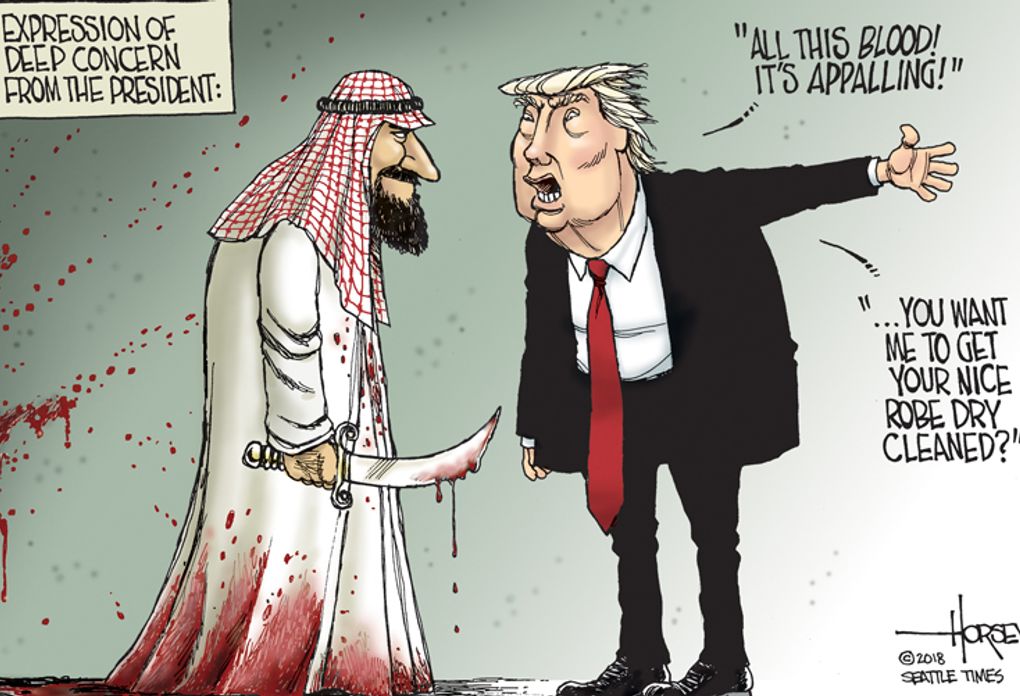
During the Trump administration, news goes by too fast for most of us to deal with it. Again and again during the last two years, something happens that makes me say: “This is too much. This cannot stand.” But then, days or weeks later, some new outrage knocks the previous ones out of the public consciousness, and even out of my consciousness. (Last week, for example, Trump’s parroting of Saudi talking points reminded me of the way he parroted Russian talking points in Helsinki. When I looked up the references, I was shocked to realize that Helsinki was just three months ago. It seemed like I was dredging up ancient history.)

So I decided to go back through the last two years and collect the outrageous actions that should never be forgotten into a piece called “12 Things to Remember Before You Vote”. Putting it together, I was amazed at how much I had forgotten. Again and again, I thought, “Oh yeah. That happened.”

There’s still a bunch of work to do on that, so it probably doesn’t post until around 11 EDT.

The weekly summary has to cover a week full of right-wing political violence: the MAGA bomber, the racial shooting outside a Kroger’s in Kentucky, the massacre of worshipping Jews in Pittsburgh. Meanwhile, right-wingers were trying to make a crisis out of a caravan of asylum-seekers coming up from Central America, and inventing outrageous lies about it. That should be out between noon and one.

We’ve got a week left to get everybody out to vote.

The Real Voter Fraud

Given that extensive and well-documented history, it’s ridiculous to keep claiming that voter fraud occurs on a scale large enough to tilt elections, yet is somehow undetectable by law enforcement. But people keep claiming it and believing it because by doing so, they can keep trying to justify efforts to put more and more hurdles in the way of potential voters and by doing so alter the outcome of elections. That is the true voter fraud.

– Jay Bookman, “The True Voting Fraud

This week’s featured post is “This is why the Founders banned Emoluments“.

This week everybody was talking about Jamal Khashoggi’s murder

I focused on the Trump-administration-corruption angle in the featured post. But corruption is contagious. Trump allies in Congress and the media have been reacting as if Khashoggi were a young black man shot by police: They’re spreading negative rumors about him.

“Trump wants to take a soft line, so Trump supporters are finding excuses for him to take it,” said William Kristol, a conservative Trump critic. “One of those excuses is attacking the person who was murdered.”


The Khashoggi murder is the latest example of the corruption of Evangelical Christianity. Consider Pat Robertson:

“For those who are screaming blood for the Saudis — look, these people are key allies,” Robertson said. While he called the faith of the Wahabists — the hardline Islamist sect to which the Saudi Royal Family belongs — “obnoxious,” he urged viewers to remember that “we’ve got an arms deal that everybody wanted a piece of…it’ll be a lot of jobs, a lot of money come to our coffers. It’s not something you want to blow up willy-nilly.”

In short: Don’t worry about a little murder here and there if you can make some money selling weapons. As the Bible says: “He who lives by the sword is a good customer.” (I believe that’s in Paul’s Epistle to the Ferengi.)


In other Trump administration corruption: The new ambassador to South Africa is a Mar-a-Lago member. That means she wrote Trump a six-figure check to join and has paid fees every year since. She’ll be the fourth Mar-a-Lago member to become an ambassador. You gotta pay to play.

Ambassadorships have been sold before: They often go to big campaign contributors. What’s new in the Trump Era is that the money goes not to the Party or the Campaign, but straight into the President’s pocket.


While he was parroting Saudi rhetoric about Khashoggi, Trump was rallying in Montana with the GOP congressman who assaulted a reporter during his previous campaign. CNN’s Chris Cillizza writes:

even as we are dealing with an international incident revolving around the near-certain murder of a journalist by a government that didn’t like what he said and wrote about them, the President of the United States is praising a member of Congress who assaulted a journalist for asking him questions.

My take on this is that Trump envies MBS. If he could have a few reporters killed here and there, he believes he’d get much more favorable coverage.

and voter suppression

When your party represents a minority of the people, you need to keep people from voting if you want to hang onto power.

Kansas is deciding whether or not Kris Kobach, who basically has Mr. Voter Suppression as Kansas Secretary of State and as vice-chair of the Presidential Advisory Commission on Election Integrity, should become governor. But that election is already tainted.

Access to the ballot box in November will be more difficult for some people in Dodge City, where Hispanics now make up 60 percent of its population … [T]he city located 160 miles west of Wichita has only one polling site for its 27,000 residents. Since 2002, the lone site was at the civic center just blocks from the local country club — in the wealthy, white part of town. For this November’s election, local officials have moved it outside the city limits to a facility more than a mile from the nearest bus stop, citing road construction that blocked the previous site. …

A Democratic Party database compiled from state voter data shows Hispanic turnout during non-presidential elections is just 17 percent compared to 61 percent turnout for white voters in Ford County in 2014. Dodge City’s turnout is below the national turnout rate of 27 percent among Latino eligible voters in 2014, which in itself was a record low that year for the country, according to the Pew Research Center.


The Washington Post sums up the voter-suppression situation in Georgia, but buries some vital information deep in the article: “There is no evidence of wide-scale voter fraud in Georgia or elsewhere in the country.”

The Guardian goes deeper:

Under Georgia procedures, registered voters who have not cast ballots for three years are sent a notice asking them to confirm they still live at their address. If they don’t return it, they are marked inactive. If they don’t vote for two more general elections after that, they are removed from the rolls.

Georgia removed more than 534,000 voters that way in 2016 and 2017. Using databases employed by commercial mailing firms, analysts commissioned by [the Palast Investigative Fund] found that 334,134 of those citizens actually still live at the address they registered.

Greg Palast elaborates:

Their registration is cancelled. Not pending, not inactive – cancelled. If they show up to vote on 6 November, they will not be allowed to vote. That’s wrong. We can prove they’re still there. They should be allowed to vote.

A similar program has removed 55K voters from the rolls in the 3rd congressional district of Alabama since February, 2017.


North Dakota has a new law that requires you to present ID when you vote. The ID has to include your street address. But there’s a problem:

Many people on Native American reservations don’t have residential addresses; they use P.O. boxes, and that’s not enough at the polls anymore. Native Americans are about 5 percent of North Dakota’s 750,000 residents, and according to the Native American Rights Fund, they’re more than twice as likely as other voters to lack a form of identification acceptable under the new law.

Curiously, there seems to be no law anywhere that disproportionately makes it harder for upper-class white people to vote.

and Elizabeth Warren

I’m struck by how the trajectory of the Pocahontas-slur story is following the Birther myth about Obama. First it was supposed to be a scandal that Obama hadn’t released his birth certificate (which presidential candidates almost never have done in the past). Then he did, and it was the wrong kind of certificate, the short form rather than the long form. Then he released the long form, and there were conspiracy theories about how it was a forgery. When those claims didn’t take off, the scandal was that he wouldn’t release his college transcripts.

Haters gonna hate; no matter what Obama did, the charge that he was hiding something about himself just wouldn’t die. When one form of it was debunked, it just shifted into some other form.

Same thing with Warren. The original charge was that her claim of Native American ancestry was an affirmative-action fraud to advance her career. Then the Boston Globe investigated and found that, no, she hadn’t gotten any of her law-school professorships by claiming to be a Native American; in fact, the people who hired her didn’t know anything about that.

Then the charge morphed into a more general she-lied-about-who-she-is claim, and Trump dared her to take a DNA test. Now she’s taken the test, which supports her claim (and Trump now says he never offered to give her favorite charity $1 million if that happened). (BTW: The assertion in a Wall Street Journal op-ed that she has a typical amount of Native American DNA for European-Americans was debunked by the science journalist the article quoted.)

So now she’s supposedly misusing DNA tests, because being a Native American depends on tribal membership. I sympathize with the underlying point, when it’s being made by actual Native Americans and not opportunistic Republicans (who in other venues are trying to stop Native Americans from voting): You shouldn’t get to claim some share of the centuries-long suffering of oppressed peoples just because you had some distant ancestor nobody would ever know about if you didn’t tell them. (Suppose, for example, that my DNA test turned up some Jewish ancestry in addition to the Germans I know about. That lab result wouldn’t entitle me to a share of the victimhood of the Holocaust.)

But I don’t see what that point has to do with Warren, who simply has been telling her family’s stories without staking any claims on them. I’ve been listening to Warren’s speeches since she got into politics, and I have never heard her claim victimhood as a descendant of Native Americans, or urge people to vote for her because she’s Native American. Her heritage comes up in campaigns because her opponents bring it up.

The other day I challenged somebody on Facebook who claimed Warren benefited from claiming Native American ancestry, and in response  I got a reference to a Boston Herald story from 1996 saying that Harvard (not Warren) answered criticism about its diversity by quoting statistics that counted her as a Native American. That’s what the issue has shrunk to.

So the goal posts keep moving, as the Warren-haters stretch to find anything they can use as a reason to hate her.

but this strikes me as important

Eight Stories of Men’s Regrets” in Thursday’s New York Times.

A few weeks ago in “Two Ways Brett Kavanaugh Could Be a Hero“, I indulged in a fantasy where Kavanaugh confessed and apologized — or at the very least admitted that he did have a high school drinking problem and may have done things he doesn’t remember —  allowing the nation to have an honest discussion about whether he should still be held accountable for what he did when he was 17. We were having that conversation anyway, after all, but his continuing denials made it unserious in some fundamental way.

That honest public debate would be a step in the direction of healing the wounds that the #MeToo movement has revealed. However it came out — whether Kavanaugh ascended to the Supreme Court, remained where he is, or left public life entirely — it would be a service to the nation.

In a sermon “Men and #MeToo” that I gave September 30 at the Unitarian Church of Quincy, Illinois, I hit that point a little harder

Male shame has been the missing piece of the #MeToo phenomenon. When the #MeToo hashtag went viral almost exactly a year ago, what was shocking about it wasn’t any particular story of some man harassing or assaulting some woman. It was that almost every woman seemed to have a story to tell. Almost every woman had some direct experience that put her on her guard, that made her feel unsettled or insecure in a way that men have a hard time imagining.

What was eye-opening to men was to look around and realize that the women in their own lives – their friends and wives and mothers and sisters and daughters – had stories to tell. But very few men took the next step, and recognized that this can’t just be the work of a few bad men in ski masks. It has to be some large percentage of the male population.

And if President Trump’s defenders are right, that his bragging about all the sexual assaults he’s committed is just “locker room talk”, then millions and millions of men must have been in those locker rooms, talking like that, or approving of such talk, or at the very least letting it go by without comment. Where are the tweets of all those confessions? Where is that sense of shame about that?

What’s really needed, I think, to complete the #MeToo movement, is for men to confess and express our shame about what we’ve done or watched being done or allowed other men to do.

Somebody at The New York Times must have had the same thought.

and you also might be interested in …

Trump is pulling out of a nuclear treaty that Reagan and Gorbachev signed in 1987. He’s also threatening to pull out of the Universal Postal Union Treaty, which goes back to the Grant administration. (Seriously. We joined the UPU in 1875.) Vox explains what the UPU does and what Trump has against it.

You have to wonder if we’ll have any treaties at all by the time Trump leaves office.


The administration is also working on a sweeping plan to deal with transgender folk: Change the definitions so that they don’t exist any more! I want to make some snide suggestions about the groups they’ll want to define away next, but my sarcasm is failing me.


Mitch McConnell has finally noticed the rising federal deficit, but ignores what caused it: the massive tax cut for the rich that he passed last year. Here’s his comment:

[The deficit is] very disturbing, and it’s driven by the three big entitlement programs that are very popular: Medicare, Social Security and Medicaid. That’s 70 percent of what we spend every year. There’s been a bipartisan reluctance to tackle entitlement changes because of the popularity of those programs. Hopefully at some point here we’ll get serious about this.

This opens an I-told-you-so opportunity too big for me to pass up. From the 10-2-2017 Weekly Sift:

For decades now, Republicans have been dancing a two-step on taxes and spending:

  1. Cut taxes a little bit for most people and hugely for the very rich, promising that economic growth will make up the lost revenue.
  2. When the lost revenue stays lost, claim that the resulting deficits are an existential threat to the Republic, necessitating previously unthinkable spending cuts.

The result of the two-step is a set of policies that could never pass as a unit. …

The rhetoric selling the idea of the [tax cut] has been populist, but the actual bill will be elitist: The rich will profit, the middle class will get a pittance (probably only temporarily), and the deficit will skyrocket. That will set up new “emergency” proposals to slash benefits the middle class would never have agreed to sacrifice to the rich, if the tax cuts hadn’t created an artificial budget “emergency”.

Not that this prediction required brilliant insight. As Paul Krugman put it Thursday:

Any political analyst who didn’t see this coming should find a different profession. After all, “starve the beast” — cut taxes on the rich, then use the resulting deficits as an excuse to hack away at the safety net — has been G.O.P. strategy for decades.


Krugman goes on to point out something else: Paul Ryan’s superPAC is airing ads accusing Democrats of wanting to cut Medicare, as if Republicans were Medicare’s protectors. But it gets worse: Dean Heller, Josh Hawley, and Ted Cruz

voted to repeal the Affordable Care Act, which protects Americans with pre-existing medical conditions, or supported a lawsuit trying to strip that protection out of the act, and are now running on the claim that they want to … protect people with pre-existing conditions.

The point is that we’re now in a political campaign where one side’s claimed position on every major policy issue is the opposite of its true position.


When Trump referred to Stormy Daniels as “Horseface“, I thought: “Dude, you’re the one who had sex with her.”


During Trump’s recent 60 Minutes interview, we got a glimpse of this painting, showing Trump hanging out with previous Republican presidents:

In the Age of Photoshop, you knew what had to happen. People just couldn’t keep their hands off. Here’s my favorite fix: Trump hanging around with other abusers of women (though I wish they hadn’t left Lincoln in).

This one was pretty good too:


Russian interference in our political process continues. This week we learned of a new criminal complaint filed against Elena Alekseevna Khusyaynova.

So who is Khusyaynova? According to the government, she has been employed by a constellation of limited-liability companies linked to Russian oligarch Yevgeny Prigozhin—whose companies are said to have funded the IRA troll farm—and she has worked for the chief accountant of an overarching Russian influence campaign known as “Project Lakhta” since around April 2014.

And the conspiracy didn’t end when Trump was elected. It continues.

In total, the government alleges, Khusyaynova’s reports reveal that the project spent more than $35 million between January 2016 and June 2018, according to the complaint. From January to June 2018 alone, Concord records reveal more than $60,000 in spending on Facebook advertising, $6,000 on Instagram advertising, and $18,000 on “bloggers,” the complaint alleges.

and let’s close with something old made new

James Corden helps Alanis Morissette update “Ironic”.

This is why the Founders banned emoluments

If Congress were doing its job, we wouldn’t have to wonder who the President is working for.


Remember Helsinki?

It was just three months ago, in July. The President of the United States stood on a stage with Vladimir Putin and was abjectly subservient to him. On the subject of Russian interference in the 2016 election, he weighed the unanimous opinion of US intelligence agencies against Putin’s denial and sided with the foreign autocrat. Putin’s other bad behavior — the ongoing proxy war against Ukraine, poisoning of critics in the UK, human-rights abuses at home — led to nary a whisper of criticism from the supposed Leader of the Free World. Trump blamed “both sides” for the poor state of US/Russian relations, and in a subsequent interview, he questioned whether the US would really go to war to defend a NATO ally like Montegnegro from Russian aggression.

If there had been any doubt that Trump was in Putin’s pocket, Helsinki ended it.

This week we saw something similar happen with Saudi Arabia.

The shifting Saudi explanations. In the weeks since the expatriate Saudi journalist (and Virginia resident and Washington Post contributor) Jamal Khashoggi disappeared into the Saudi consulate in Istanbul on October 2, the Saudi Arabian government has put out a series of narratives, each as preposterous as the last.

  • First they claimed Khashoggi left the consulate alive (and yet somehow evaded the Turkish cameras that saw him enter). Saudi officials even expressed concern about his well-being and said they were trying to find him.
  • When the Turkish government published the names and images of the Saudi agents who came to Istanbul to kill Khashoggi, the Saudis denounced “baseless allegations”. They threatened to respond to any international action against them “with a bigger one“.
  • Then they allowed that Khashoggi might be dead, but if so, it was the work of “rogue killers” who somehow murdered him inside the consulate and disposed of his body without any legitimate Saudi officials noticing.
  • The latest story is that the killing was essentially an accident: The Saudis just wanted to “return” Khashoggi to the Kingdom, i.e. kidnap him. But he struggled, one of the kidnappers got him in a chokehold, and he died. The body was then disposed of by a “local collaborator”, so the Saudis don’t know what happened to it.

Above all, the narratives insist that whatever was done to Khashoggi had nothing to do with Crown Prince Mohammad bin Salman (MBS), who Khashoggi had been especially critical of, and whose known associates seem to be the murderers.

The Trump echo chamber. Through this all, Trump has been giving his best Helsinki performance, repeating Saudi talking points as if he were working for them and not for us. King Salman’s denial of involvement, he said, was “very, very strong“. (In Helsinki, “President Putin was extremely strong and powerful in his denial.”) “Maybe these could have been rogue killers. Who knows?” (“Who knows?” is also a standard element when Trump wants to defend someone. He projects a reality where it’s impossible to know anything and all scenarios are equally likely. The hacker who hit the DNC computers “could be somebody sitting on their bed that weighs 400 pounds, OK?“) He compared MBS to Brett Kavanaugh, who (in Trump’s mind) was also wrongly accused.

In an interview with The Washington Post Saturday, Trump backed off only a little, acknowledging that the Saudi government’s stories “are all over the place”, but standing by MBS and continuing to repeat the latest Saudi talking points, without worrying about the now-abandoned talking points he repeated only a few days ago.

There is a possibility [MBS] found out about it afterward. It could be something in the building went badly awry. It could be that’s when he found about it. He could have known they were bringing him back to Saudi Arabia.

and insisting that there’s no way to really know.

Nobody has told me he’s responsible. Nobody has told me he’s not responsible. We haven’t reached that point. I haven’t heard either way.

Why? After Helsinki, Americans were left to wonder what exactly had turned Trump into such a puppet. Does Putin have kompromat to hold over his head? Is Trump paying his debt from 2016? Or does the debt go back further, to the Russian money that had come to Trump’s rescue when no one else would fund him? The explanations were suggestive, but still speculative.

This time, though, we don’t have to speculate, because Trump has told us himself:

“Saudi Arabia, I get along with all of them. They buy apartments from me. They spend $40 million, $50 million,” Trump told a crowd at an Alabama campaign rally in 2015. “Am I supposed to dislike them? I like them very much.”

Trump has downplayed his conflict of interest, tweeting: “I have no financial interests in Saudi Arabia.” But Noah Bookbinder of Citizens for Responsibility and Ethics in Washington points out how misleading that denial is: Saudi money still makes its way into his pocket, whether his interests are “in” Saudi Arabia or not.

In 2017, Saudi lobbyists spent $270,000 to reserve rooms at Trump’s hotel in Washington. The kingdom itself paid $4.5 million in 2001 to purchase a floor of Trump World Tower and continues to pay tens of thousands in annual common charges to Trump businesses for that property (the total of which could be up to $5.7 million since 2001, according to one estimate). In the past year, as bookings fell overall, Trump’s hotels in New York and Chicago reported a significant uptick in bookings from Saudi Arabia. And a major factor in a recent increase in revenue for the Trump International Hotel and Tower in Manhattan was that Saudis accompanying the crown prince during a recent visit stayed there, as The Washington Post has reported.

Jared Kushner, Trump’s point man for the Middle East and someone MBS has described as “in my pocket“, has also often sought Saudi funding for his real estate ventures.

Trump has tried to paint his own mercenary interests as the nation’s mercenary interests, weaving together a fanciful story of a $110 billion arms order that will create American jobs. But the money Trump has received (and continues to receive) is real.

He has also tried to paint the Saudis as allies that we must stand by (as a counterweight to Iran). But Trump freely criticizes more important allies, like Canada and the other NATO countries. And Senator Lindsey Graham, who is also an Iran hawk, isn’t protecting MBS. The Saudis, he says, “need us more than we need them”.

This is the most in-your-face move by a Mideast ally outside — maybe ever. To kill a man in a consulate in a foreign country, extrajudicial killing, shows contempt for the relationship. I would like to punish those involved. The Global Magnitsky Act would put punishment, sanctions on the individuals that had a hand in this.

And I find it impossible to believe that the crown prince wasn’t involved. So, go after him and his inner circle. Save the alliance. I don’t mind military sales, but I cannot do business with the current leadership. MBS, he’s done to me.

Emoluments and Congress. Even if you find the support-our-arms-customer or support-our-ally-against-Iran motives credible, you will never be sure that Trump’s real motive isn’t to keep raking in Saudi cash. Trump himself may not know for sure which motive is most compelling.

That’s why the Founders put this clause into the Constitution:

No Title of Nobility shall be granted by the United States: And no Person holding any Office of Profit or Trust under them, shall, without the Consent of the Congress, accept of any present, Emolument, Office, or Title, of any kind whatever, from any King, Prince, or foreign State.

This is not an innocent-until-proven-guilty thing: No one needs to prove that an officer of the United States government has engaged in quid-pro-quo bribery with a foreign power. It’s not necessary to identify precisely what the officer did for the foreign power, that the action wouldn’t have been done anyway, or that the gift or payment he or she received wasn’t totally innocent. What matters is only that the emolument was paid.

The point is clear: The loyalty of officers of the US government needs to be beyond question.

As the clause says, the only thing that makes an emolument legal is “the Consent of Congress”. (In a famous motivating case, Congress allowed Benjamin Franklin to keep a jewel-encrusted snuff box he was given by the King of France.) Congress is supposed to police this concern. But the current Republican majority simply does not want to know whether Trump is doing anything wrong. It has not passed any resolution consenting to the money Trump’s businesses receive from the Saudis or any other foreign government. Neither has it condemned these emoluments, or even held hearings on them. It just doesn’t want to know.

Stymied from taking any direct action, Democrats in Congress have signed on to a lawsuit attempting to enforce the Emoluments Clause through the federal courts. That case is moving forward, and a judge recently agreed that they have standing to sue. But this lengthy legal process is a far cry from the checks and balances the Founders imagined.

Remember in November. There are many different reasons to want a change of leadership in Congress. (I’ll outline a number of them next week.) But for the long-term health of the Republic, the biggest is that Congress has a constitutional role to play, and it is failing in that role. Blatantly unconstitutional things are happening in the Trump administration, while Congress averts its eyes.

It should be a bipartisan desire that the President work for the American people, and not for foreign princes or presidents. The fact that even this most basic issue has become partisan is a measure of just how far the Republican Party has fallen.

The Monday Morning Teaser

It’s not hard to pick out the biggest story this week: Jamal Khashoggi’s murder and the continuing Saudi cover-up. What’s harder is getting past the reaction of “What do you expect? It’s Saudi Arabia.” The Saudis still behead people, the ruling family is famously corrupt, and it’s considered major progress that women can drive now. Human rights, especially freedom of speech and freedom of the press, are not their strong suit. In the face of everything else that’s going on in the world, why should you care that the Saudis murdered a journalist, even if he has been living in Virginia this past year and was a contributing columnist for The Washington Post?

What hit me about the story, though, was that it led to a second Helsinki moment: All week, the President of the United States kept repeating the talking points of some other country, as if he worked for them and not for us.

In Helsinki — only three months ago, can you believe that? — Trump left Americans to wonder exactly what he owed Vladimir Putin, or what kompromot Putin was holding over his head. This week, though, we knew the reason for Trump’s unpresidential behavior, because he had told us himself: The Saudis buy a lot of stuff from the Trump Organization. Trump was reacting to the Khashoggi scandal primarily as a private businessman, not as a public servant.

So this week’s featured article is “This is why the Founders banned emoluments”. It should post between 10 and 11 EDT. The weekly summary will discuss Khashoggi, but also voter suppression, Elizabeth Warren, Mitch McConnell’s predictable plan to deal with the deficit he caused, some treaties Trump wants to pull out of (including one that goes back to the Grant administration), and a few other things, before closing with the James Korden/ Alanis Morissette update of “Ironic”. It should be out around noon.

Pace and Scale

While the pace of change that would be required to limit warming to 1.5°C can be found in the past, there is no historical precedent for the scale of the necessary transitions, in particular in a socially and economically sustainable way.

— The Intergovernmental Panel on Climate Change
Global Warming of 1.5°C

This week’s featured post is “The Media is Failing Us on Climate Change“.

This week everybody was talking about the weather

Hurricane Michael hit the Florida panhandle Wednesday as yet another “worst storm in 100 years“. These days, several places in the US each year have their worst storms in living memory. Michael was the fourth strongest storm to hit the US. You’d think people would start to notice.

Federal help seems slow to arrive.

Since the storm, there’s been no electricity and no water in Panama City. Emergency disaster relief was yet to be seen in strength as of Saturday morning and residents were growing more frustrated and desperate. Chantelle Goolspy sat in her car making phone calls to get help. Goolspy and many of her neighbors live in a public housing area in downtown Panama City that was badly devastated.

“We’re in need of food, water, anything, we’re not getting any help. The whole street needs help,” Goolspy told the Red Cross. “FEMA referred me to you. That person told me to call 211.”

One reason Michael did as much damage as it did was that it went through “rapid intensification” as it approached land, going from Category 1 to Category 4 (and nearly Category 5) in just 24 hours.

Climate scientists have begun to focus on hurricane rapid intensification as an increasingly prevalent feature in the world we’re entering. Simply put, with warmer seas, storms ought to be able to pull this off more often.

In a recent study in the Journal of Climate, researchers found more rapid intensifications in a simulation of a human-warmed world, and also that this would prove a key pathway toward more intense hurricanes in general.

As usual, it’s impossible to blame any particular storm on global warming, just as it’s impossible to blame any particular lung cancer on tobacco or any particular home run on steroids. It’s a systemic factor that increases risks.

and a missing journalist

Jamal Khashoggi, a dissident Saudi journalist who had been living in Virginia and writing for The Washington Post, disappeared October 2. He was last seen entering the Saudi consulate in Istanbul. It’s widely believed that the Saudis murdered him inside the consulate.

This has become an international incident involving Saudi Arabia, Turkey, and the United States. At first, President Trump expressed his usual disregard for non-citizen residents of the United States. An incident like this isn’t worth interrupting, say, arms sales:

This took place in Turkey and to the best of our knowledge, Khashoggi is not a United States citizen, he’s a permanent resident. We don’t like it, even a little bit. But as to whether or not we should stop $110 billion dollars from being spent in this country, knowing they [Saudi Arabia] have four or five alternatives, two very good alternatives, that would not be acceptable to me.

His further responses have resembled his reactions Russian interference in the 2016 election: He spoke to King Salman, who denied murdering Khashoggi, and Trump seems inclined to take him at his word (as he takes Putin). He repeated the Saudis “rogue killers” theory, which is a little like Trump’s fantasy of the 400-pound guy who hacked the DNC.

and the midterm elections

The Georgia governor’s election is a coin flip at this point, but Republican candidate Brian Kemp has a special advantage: He’s Secretary of State, and his office maintains the voting rolls.

Marsha Appling-Nunez was showing the college students she teaches how to check online if they’re registered to vote when she made a troubling discovery. Despite being an active Georgia voter who had cast ballots in recent elections, she was no longer registered.

“I was kind of shocked,” said Appling-Nunez, who moved from one Atlanta suburb to another in May and believed she had successfully changed her address on the voter rolls. “I’ve always voted. I try to not miss any elections, including local ones,” Appling-Nunez said.

She tried re-registering, but with about one month left before a November election that will decide a governor’s race and some competitive U.S. House races, Appling-Nunez’s application is one of over 53,000 sitting on hold with Georgia Secretary of State Brian Kemp’s office. And unlike Appling-Nunez, many people on that list — which is predominantly black, according to an analysis by The Associated Press — may not even know their voter registration has been held up.

The 53K would-be voters are about 70% black. Civil rights groups are suing.


Saturday, Senator David Perdue was campaigning for Kemp at Georgia Tech when a student tried to ask him about suppressing black votes. Perdue took his phone, then returned it and walked away.


The generic-ballot polls are going the way I expected: Republicans got a brief advantage by riling up their base over the Kavanaugh hearings. But that’s already fading while the Democratic anger is sustained.

but the ongoing sabotage of ObamaCare deserves your attention

In August, HHS issued a set of regulations to allow short-term health insurance policies that don’t meet the ACA minimum standards. The plans are as short as a year, and can be renewed for up to three years. But they have two big loopholes:

  • They don’t have to cover all the stuff ACA plans do.
  • If you do get sick, after three years, the insurance company can refuse to renew your policy, leaving you with a pre-existing condition and no insurance until the next ObamaCare open-enrollment date.

The upside of the policies is that they cost less — because companies don’t have to issue them to people with pre-existing conditions.

The essence of the idea here is to rob Peter to pay Paul. Paul, in this case, is a healthy person who

  • makes just slightly too much money to qualify for the subsidies in ObamaCare, or
  • lives in one of the states that still refuses to expand Medicaid and falls into the “Medicaid coverage gap“, making him ineligible for either Medicaid or the ACA subsidies.

In either case, the ACA required Paul to spend a serious chunk of his own money on health insurance that he believed (sometimes correctly, sometimes not) he wouldn’t need.

One provision of the Trump Tax plan passed last year is that Paul can go uninsured without paying a penalty. But under the new regulations, Paul can buy a short-term plan that covers him against the things he might worry about (like a broken leg), but not pay as much as an ACA plan costs. If he develops MS or some other expensive long-term condition, he’ll be in trouble, but he’s willing to take that risk, if it means that he’ll have thousands of dollars each year to spend on something else.

Peter is everybody else, but especially people with pre-existing conditions. Promoters of the short-term plans say that they just provide consumers with more options: If you want ACA-compliant insurance, you can still buy it. But that’s deceptive, because ACA-compliant plans will become more expensive as more and more healthy people leave the risk pool.

HHS projects that 500,000 people will shift from individual market plans to short-term plans in 2019 as a result of the proposed rule. … And by 2028, they expect the total increase in the short-term insurance population to reach 1.4 million, while the individual insurance market population is expected to decline by 1.3 million over that time. … HHS acknowledged that the people who are likely to switch to short-term plans will primarily be young and healthy. As a result of the sicker, older risk pool that will remain in the individual market, premiums will rise

The way that ObamaCare can ultimately fail is if it gets into what is called a “death spiral”: As premiums rise, more healthy people decide to risk going without ACA-compliant insurance, making the risk pool sicker and forcing premiums to go higher yet.

Ever since ObamaCare passed in 2010, Republicans have been trying to push it into that death spiral. It began with the 5-4 Supreme Court decision (written by Chief Justice Roberts) that let states opt out of Medicaid expansion, creating the Medicaid coverage gap. A series of additional court cases created doubt about the program, discouraging people from signing up. The Koch brothers spent millions of dollars on ads that further discouraged sign-ups. They prevented states from setting up exchanges, forcing that duty onto the federal government. They eliminated provisions like risk corridors that kept premiums down.

Since Trump took office, the sabotage has gotten worse. HHS has refused to spend money to promote ObamaCare by, for example, telling people when the enrollment periods are. Cost-sharing reductions are gone, further increasing premiums. The tax bill eliminated the penalty for going uninsured, motivating the healthiest people to leave the risk pool. And now, healthy people will have even more incentive to leave.

and so does the return of Iran sanctions

Trump announced on May 8 that the US was pulling out of the Iran nuclear deal. The serious effects of that decision will hit on November 4, when economic sanctions resume. NYT editorial board member Carol Giacomo writes a critical analysis.

The main difference between these sanctions and the ones that pushed Iran to negotiate with the Obama administration is that this time the US is going it alone.

Crucially, Mr. Trump has failed to enlist Britain, France, Germany, Russia and China — the major powers that joined the United States in negotiating the nuclear deal — in his anti-Iran crusade. The Europeans say the deal is in their national security interest; they resent that Mr. Trump has unilaterally upended it.

And now the Europeans are trying to save it by developing a financial mechanism that would skirt American sanctions by enabling their companies to trade oil in local currencies or barter rather than in dollars. The aim is to create an alternative way to move money in and out of Iran when Western banks, handcuffed by Mr. Trump’s sanctions, won’t do it.

All the parties face a moment of truth after Nov. 4, when, Mr. Trump has decreed, any country or company trading with Iran will be barred from doing transactions with American financial institutions.

On one hand, you have to wonder how effective these US-only sanctions will be, and whether the Iranian public will respond by revolting against its current government or rallying around it.

But I worry about this move for reasons that go way beyond Iran.

At its root, banking is about trust. The US dominates the international banking system largely because other countries and their citizens trust the soundness of the dollar and the rule of law that protects their dollar-denominated transactions. But nothing forces other countries into our system, and if we push that advantage too far, they’ll eventually create an alternative. In particular, we should be wary of any issue, like this one, that gives Europe and China a common cause against us.

Remember the larger picture: The Chinese economy is still far behind the US economy in a per capita sense, but in sheer size it is rapidly catching up and most likely will pass us in just a few years. In the long run, power follows money. So our long-term challenge is to use our waning power to construct a global system that is capable of constraining China when it eventually becomes the world’s most powerful country.

The worst thing that we can do in this situation is to wield our power in an arbitrary and self-centered way, making our former allies yearn for the day when we get pushed off our perch.

and you also might be interested in …

The US trade deficit with China set a record in September.


CNN’s way-too-early poll shows Joe Biden as the front-runner for the 2020 Democratic presidential nomination. I’m skeptical. Nate Silver, though, seems skeptical of my skepticism:

Hard to take these early polls seriously after they predicted that Hillary Clinton (!) and Donald Trump (!!) would be the party nominees in 2016.


Meanwhile Elizabeth Warren is taking on the “Pocahontas” issue.


Lynzy Lab has the perfect answer to those guys worried about false accusations.


Explanations of how Republican policies benefit the 1% are always more convincing when they come from members of the 1%, like Abigail Disney, Walt’s granddaughter. Illustrating the recent tax cut with footage from Scrooge McDuck was maybe just a little bit over the top, but I enjoyed it. Or, you could illustrate it with this graph from the Center for American Progress:


Sears Holding Company, which owns both Sears and K-Mart, is declaring bankruptcy. Once the dominant retailer in the country, Sears has lost $11.7 billion since its last profitable year in 2010. The New York Times has a lengthy obituary.


The NYT expose of how Trump got rich — by inheritance and evasion of taxes — raised a question: Some of what the Trump family did was legal and some illegal; which is the most scandalous?

It’s personally scandalous to do something illegal, but to the extent that the manipulations the Trumps pulled off are actually legal, or at the very least broadly accepted, that’s scandalous in a different way. Matt Taibbi explores that angle:

The parts I found most interesting were less about the rapaciousness of the Trump family per se than the myriad opportunities for gaming the system one presumes is available to everyone of this income level. The ordinary person cannot hire an outside appraiser to tell the IRS what it thinks he or she is worth, but the Trumps could systematically undervalue their properties for tax purposes (and then go back and overvalue them when it served their public relations needs).

The timidity that enforcement officials show toward the very wealthy is also a running theme in the story. When the Trump family claimed a $17.9 million building had fallen to $2.9 million, supposedly losing 83 percent of its value in just 18 days, the IRS auditor who caught it made them push the value back up by just $100,000.

The infamous $3.35 million casino chip scheme — an illegal multi-million-dollar loan under New Jersey law — inspired just a $65,000 fine.

And now the NYT finds that Jared Kushner also paid little-to-no tax over an 8-year period when his net worth was skyrocketing. Here the main avenue was a common (and legal) real-estate scam involving depreciation.

In theory, the depreciation provision is supposed to shield real estate developers from having their investments whittled away by wear and tear on their buildings. In practice, though, the allowance often represents a lucrative giveaway to developers like Mr. Trump and Mr. Kushner. The law assumes that buildings’ values decline every year when, in reality, they often gain value. Its enormous flexibility allows real estate investors to determine their own tax bills.

Ending the shennigans of the very rich was a big chunk of what Trump ran on in 2016. The system was rigged against ordinary people, he claimed, and he was just the guy to fix it.

The Trump tax cuts are fully paid for by: 1. Reducing or eliminating most deductions and loopholes available to the very rich.

He bragged that his business experience made him the perfect person to un-rig the tax system, because “I know the details of taxes better than anybody. Better than the greatest CPA.” As late as November of last year, he made this 4-Pinocchio claim at a rally in St. Charles, Missouri:

This is going to cost me a fortune, this thing, believe me. This is not good for me. . . . I think my accountants are going crazy right now.

But of course, that’s not what happened.

“The Trump administration was in a position to clean up the tax code and promised to get rid of some of the complexity that certain taxpayers use to their advantage,” said Victor Fleischer, a tax law professor at the University of California, Irvine. “Instead, they doubled down on those provisions, particularly the ones they have familiarity with to benefit themselves.”

and let’s close with something out of this world

Here’s what a category 4 hurricane looks like from space.