Much to cover today. I suspect the Sift will run a bit late this morning, because I’m in the Mountain Time Zone (just outside of Glacier National Park). On the other hand, my body is still on Eastern Time, so maybe it will all even out.
Today’s featured post, “The Weakness of America First” will link two big stories that are usually discussed separately: the trade war with China and the prospects of a shooting war with Iran. In both cases, President Obama had a multi-lateral approach in place, which Trump has junked in favor of one-on-one pressure, so far without any positive results. I’ll argue that not only is a go-it-alone approach fundamentally weaker, but that a pure self-interest pitch abandons the persuasive moral force of a policy based on a principled vision of a world order. Imagine being a citizen of Iran or China: Obama wanted your country to become a responsible member of the community of nations, while Trump just wants to push you around.
That should be out around 9 EDT (7 MDT) or so.
The biggest news these last two weeks has been Alabama’s abortion ban, which is the most outrageous of a series of red-state attempts to force the Supreme Court to reconsider Roe v. Wade. If you’re an Alabama man who wants to make sure his genes propagate into the next generation, rape has become a viable strategy.
Two other things shouldn’t get pushed out of our attention, though: A UN assessment of global biological diversity says that a million species are at risk of extinction in the coming decades. And Trump’s recent moves in his struggle with Congress greatly increase his threat to American democracy.
That’s depressing enough to call for an optimistic closing: Finland is educating its people on how to spot fake news, and it seems to be working. Those will all be in the weekly summary, which I’ll predict to appear around 1 EDT.
This week’s featured post is “What should ‘electable’ mean?“. If you happen to be near Quincy, Illinois (my hometown) next Sunday, I’ll be speaking at the Unitarian church at 10:45.
This week everybody was talking about Bill Barr, Robert Mueller, and Congress
It’s not clear to me how much power Trump has to stop Mueller’s testimony, or whether he is officially invoking that power or just blathering. Mueller is still a DoJ employee, so Trump could order him not to testify. But Mueller has been expected to leave his job soon, now that his investigation has wrapped up. Once he is a private citizen, it would be up to him whether to testify, though he may still honor executive privilege claims that seem legitimate to him. Mueller himself hasn’t commented yet.
This is another example of incoherence in Trump’s message. He claims Mueller has “totally exonerated” him. If that’s the case, he should want Mueller testifying in public as much as he can.
Tuesday it came out that Barr had received a letter from Mueller protesting Barr’s characterization of the report and requesting that the summaries contained in the report itself be released, which Barr decided not to do. In his subsequent testimony to Congress, Barr was asked whether Mueller agreed with his summary, and his answer gave no indication that there was any friction between them. The exact statement of the question and answer leave me thinking that it couldn’t be prosecuted as lying to Congress, but I agree with Senator Leahy: “”Mr. Barr, I feel that your answer was purposely misleading, and I think others do, too.”
Barr testified to the Senate Judiciary Committee the next day, and the hearing was contentious. He was clearly playing his role as Trump’s defender rather than attorney general. He made hair-splitting distinctions (like the difference between “firing” Mueller and “having a special counsel removed for conflict” even though the conflicts were bogus). When asked whether the White House would claim executive privilege, Barr’s answer talked about what “we” would do, not what the White House would do.
Barr then refused to appear before the House Judiciary Committee, and has ignored a subpoena for the unredacted Mueller Report. The Judiciary Committee is threatening to find him in contempt, though it’s not clear how they would enforce any penalties. Chair Jerry Nadler:
The choice is simple: We can stand up to this president in defense of the country and the Constitution we love, or we can let the moment pass us by.
Bill Barr’s complete embrace of Trumpism and rejection of traditional Justice Department standards of independence and the rule of law has provoked a lot of discussion about what happens to people when they join the Trump administration. Jim Comey, who has been in Trump’s orbit before being ejected from it, thinks he knows.
Trump’s corruption of those around him starts with behavior Comey has experienced first-hand.
It starts with your sitting silent while he lies, both in public and private, making you complicit by your silence. … Speaking rapid-fire with no spot for others to jump into the conversation, Mr. Trump makes everyone a co-conspirator to his preferred set of facts, or delusions. I have felt it — this president building with his words a web of alternative reality and busily wrapping it around all of us in the room.
Then his expectations and peer pressure push you to flatter him in public.
From the private circle of assent, it moves to public displays of personal fealty at places like cabinet meetings. While the entire world is watching, you do what everyone else around the table does — you talk about how amazing the leader is and what an honor it is to be associated with him.
Then you stop defending the institutions you’re responsible for.
Next comes Mr. Trump attacking institutions and values you hold dear — things you have always said must be protected and which you criticized past leaders for not supporting strongly enough. Yet you are silent.
You become convinced that if you weren’t in your current position, things would be much worse.
you tell yourself you are too important for this nation to lose, especially now.
By the end, you have convinced yourself that you must hold onto your job, no matter what it takes to do so.
You use his language, praise his leadership, tout his commitment to values. And then you are lost. He has eaten your soul.
and foreign policy
China: For some while we’ve been hearing that a trade deal with China was near. Then yesterday Trump tweeted:
For 10 months, China has been paying Tariffs to the USA of 25% on 50 Billion Dollars of High Tech, and 10% on 200 Billion Dollars of other goods. … The 10% will go up to 25% on Friday.
Stock markets around the world started plunging. Chinese officials “had been scheduled to arrive Wednesday for what was shaping up to be the final round of negotiations”, but now they’re not sure when or whether to come.
North Korea: Increasingly, it looks like the Trump/Kim summits have accomplished nothing beyond raising Kim Jong Un’s stature at home. This weekend, North Korea fired “multiple projectiles” towards Japan in what appears to be some kind of weapons-system test.
Trump has claimed that his diplomacy with Kim was getting rid of North Korea’s nuclear weapons, tweeting at one point that “There is no longer a Nuclear Threat from North Korea.”
Saturday’s launch comes weeks after North Korea announced it had conducted a test launch of a “new-type tactical guided weapon” that was personally overseen by Kim.
The North Korean leader declared a moratorium on missile and nuclear testing last year, but satellite imagery reported in recent months has shown continuing nuclear activity at the country’s plants.
Venezuela: An attempted coup to unseat Venezuelan President Maduro failed this week.
The NYT has an interesting article about how coups work, and why this one didn’t. It reminded me of the high-school-party problem: The cool kids will come only if they think the other cool kids are coming. Nobody wants to be on the losing side, so a coup gets the support of the various power brokers only if they think the other power brokers are in.
A weird addendum to the whole event came after Trump talked on the phone to Putin. Trump came out of the call claiming that Putin “is not looking at all to get involved in Venezuela, other than he’d like to see something positive happen for Venezuela.” WaPo’s Aaron Blake points out that Secretary of State Pompeo is saying the exact opposite: He characterized the Russian (and allied Cuban) presence in Venezuela as “an invasion”.
It’s yet another example of Trump talking to Putin and then repeating Putin’s propaganda, even when it undercuts his own administration.
but here are two article you might like that have nothing to do with Trump or politics
InVerse reports what happens when researchers hook monkeys up to an AI image generator, looking to home in on images that provoke the most neural stimulation. The maximally stimulating images are vaguely dream-like: They have realistic elements (that resemble, say, faces) but are also oddly wrong.
Don’t miss Guinevere Turner’s “My Childhood in a Cult” in the April 29 New Yorker. Turner grew up in the Lyman Family, a little-known cult that is still around.
What makes her account unique is that she didn’t experience two of the standard elements in the typical I-left-a-cult story: She wasn’t recruited and didn’t escape. Her mother joined the Family when she was pregnant with Guinevere, and (although mother and child had little to do with each other inside the cult), she was thrown out at age 11 when her mother left. She went back for a visit before starting college at 18, thought about staying, but then didn’t.
That allows her to give a remarkably balanced view of life in the Lyman Family. She sees the absurdity (Lyman’s central tenet was that spaceships would come to take him and his followers to Venus) and the ugliness (cult leaders sometimes chose 13-year-old girls to be their wives). But she also has good memories of living in a close-knit community.
In the back yard of our Los Angeles compound, the adults built a wooden pyramid, big enough to hold about twenty kids, small stilts raising it a few feet off the ground. The smell of blooming jasmine surrounded us as we climbed into it at night, sat cross-legged in a circle, and sang one note all together. We would do this for hours. There were skylights in the ceiling, and we stared up at the stars as we sang. I loved those moments, holding on to the note until I thought my lungs would burst, then taking a deep breath and starting again. It felt as if we were one being
Senate Republicans are cold to the idea, so Trump would have to do some serious arm-twisting to make legislation happen. His own chief of staff is also against it, which suggests that Trump was just free-lancing here and has no plan beyond the initial headline.
If we were talking about a mosque rather than an evangelical Christian church, we’d be hearing claims that the young man had been “radicalized” by his religious institution, or that someone at the church must have known what he was planning, but didn’t report it. But no one is going to suggest that the government should “watch and study” OPC churches, or that some of them may have to be shut down. That because we have freedom of religion in America — at least for Christians.
Another good jobs report pushes down the unemployment rate. This looks good for Trump, but it’s important to put it in the right context: Trump is continuing a trend that started in Obama’s first term.
Paul Krugman’s “The Trouble With Joe and Bernie” makes a good point: Neither candidate seems prepared for what would obviously happen after they got elected.
No matter how many friends he has made across the aisle in Congress, Biden is not going to get Republicans to negotiate bipartisan solutions. Obama tried that and it didn’t work.
what Sanders appears to believe is that he can convince voters not just to support progressive policies, but to support sweeping policy changes that would try to fix things most people don’t consider broken.
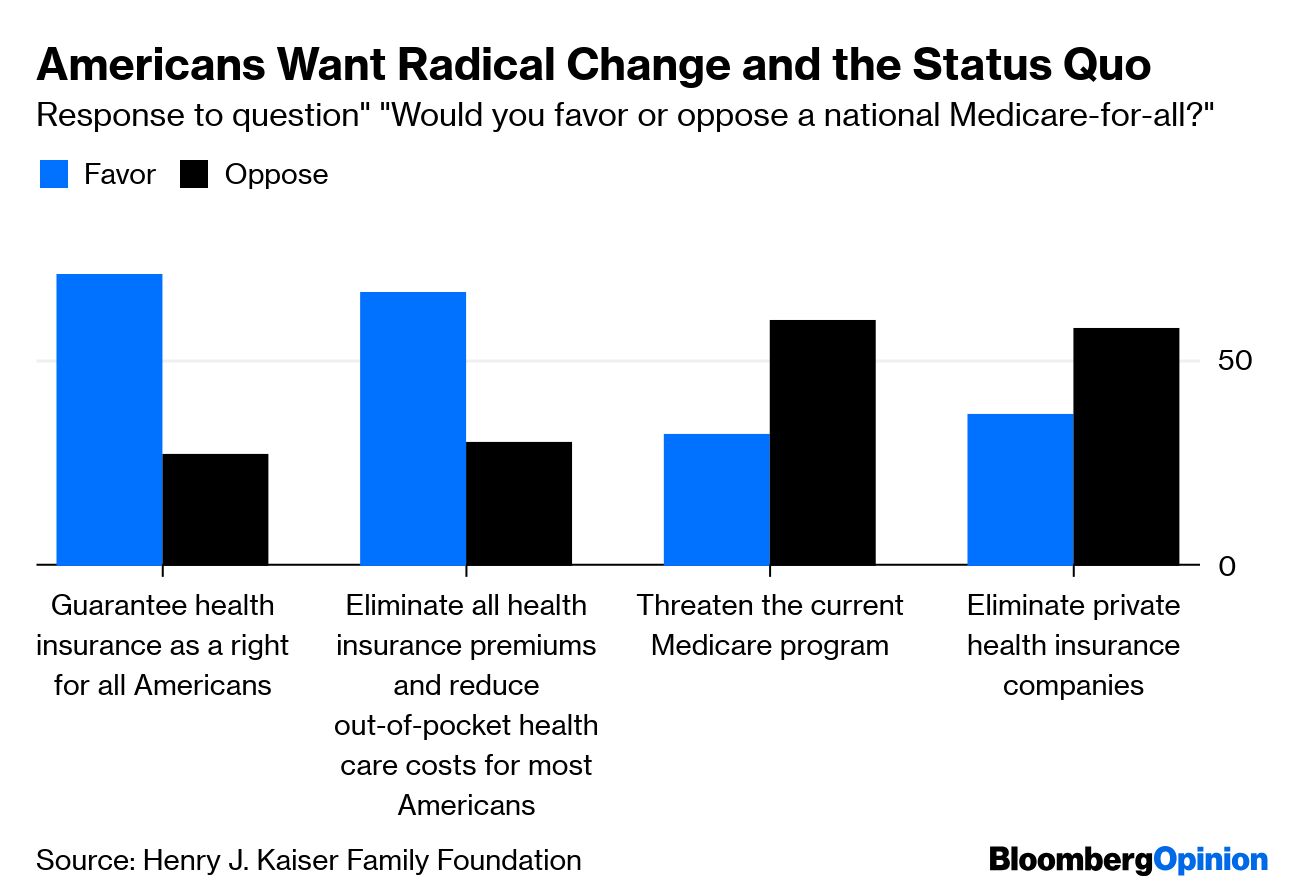
That, after all, is what his Medicare for All push, which would eliminate private insurance, amounts to. He is saying to the 180 million Americans who currently have private insurance, many of whom are satisfied with their coverage: “I’m going to take away the insurance you have and replace it with a government program. Also, you’re going to pay a lot more in taxes. But trust me, the program will be better than what you have now, and the new taxes will be less than you currently pay in premiums.”
Could those claims be true? Yes. Will voters believe them? Probably not.
I’m always amused when somebody presents an example they think obviously favors their point, when to me it obviously doesn’t. Electoral College defender Dan McLaughlin poses this hypothetical:
R candidate wins 48 states by identical 54-46 margins, D wins CA, NY & DC by 75-25 margins, D wins national popular vote. Who should win?
And my answer is: The candidate who gets the most votes. I don’t see why votes should count less if they clump together in a few states. Americans are Americans, no matter what state they live in.
Rachel Held Evans, a liberal Christian writer that I have quoted several times on this blog, died this week at age 37.
Remember the Deepwater Horizon disaster, when a problem with an offshore drilling platform caused 4.9 million barrels of crude oil to pour into the Gulf of Mexico over a period of months? Afterward, new rules were put into effect to prevent something like that from happening again. This week the Trump administration is expected to roll back a bunch of those rules. Oil companies will be grateful.
When Stephen Moore was nominated for the board of the Federal Reserve, I wondered if Senate Republicans could go that far. I mean, it’s one thing to appoint know-nothing yahoos to manage things Republicans don’t care about, like education or public housing. But the Fed controls money. Surely, I suggested, there are still some standards when we’re talking about money.
Well, apparently so. Moore’s nomination was withdrawn Thursday afternoon after a number of Republican senators expressed their doubts about supporting him. This follows fellow know-nothing Herman Cain withdrawing from consideration for the Fed board two weeks ago.
The eight 13-14-year-olds making up the confirmation class at First United Methodist Church in Omaha read a letter to the congregation expressing great love for their church, but declining to participate in the denomination’s immorality by becoming members.
We have spent the year learning about our faith and clarifying our beliefs. Most of us started the confirmation year assuming that we would join the church at the end. But with the action of the General Conference in February, we are disappointed about the direction the United Methodist denomination is heading. We are concerned that if we join at this time, we will be sending a message that we approve of this decision. We want to be clear that, while we love our congregation, we believe that the United Methodist policies on LGBTQ+ clergy and same-sex marriage are immoral.
I want to beat Trump as much as anybody does, but figuring out which candidate has the best chance isn’t as simple as many make it sound.
Democrats and other liberals may be splitting their loyalties among more than 20 candidates at the moment, but nearly all of us agree on one thing: It’s vital that we beat Donald Trump next year.
If Trump has four more years to assault the norms of democratic government, the rule of law, and the separation of powers, by 2024 the country will be virtually unrecognizable. For four more years, the US would be fighting for climate change rather than against it. The conservative majority on the Supreme Court would rise from 5-4 to 6-3 or 7-2 — locking in for decades the advantages corporations have over workers and consumers, upholding all the tools of minority rule, and constantly inventing new rights for conservative white Christians. Executive-branch corruption would become even more blatant, with Congress unable even to investigate it, much less do anything about it.
We can’t let that happen.
Searching for the anti-Trump. So there’s very good reason why a large chunk of the Democratic primary electorate lists “somebody who can beat Donald Trump” as their top criterion when looking for a candidate to support. Polls on this question are volatile and depend significantly on how the question is phrased, but all of them show electability as a huge factor. One poll in February found 56% of Democrats preferring “a Democrat you do NOT agree with on most issues, but would be a stronger candidate against Donald Trump” to “someone who agrees with you on most issues, but would have a hard time beating Donald Trump”. Only 33% made the opposite choice. A more recent poll phrased the question differently [“What’s more important to you – that Democrats nominate the presidential candidate whose positions on the issues come closest to yours, or the candidate who seems most likely to defeat Donald Trump in November 2020?”] and showed smaller but still sizeable emphasis on winning [47% for “closer on the issues” vs. 40% for “more likely to win”].
Admittedly, it’s easy to overstate those results, because poll respondents undoubtedly assume that any Democrat will share certain core positions. Democratic candidates may, for example, disagree about whether universal health care is an immediate priority or a long-term goal, but none oppose it in principle. They may have more ambitious or less ambitious plans for dealing with climate change, but none argue — as Trump has — that Obama was already doing too much. Within these bounds, though, a large number of Democrats are willing to sacrifice ideological purity for someone they think will win.
But there’s a problem. Electability is not an objective quality. Without much argument, we can sort candidates into bins like male and female, white and non-white, gay and straight, young and old, and perhaps even progressive and moderate. But who is electable and who isn’t?
The economist John Maynard Keynes once compared investing in the stock market to gambling on a beauty pageant: You win not by betting on the most beautiful contestant, but by identifying the one that other people will find beautiful. That’s what we’re trying to do when we search for an electable candidate. It’s not enough to find the one who would be the best president by your own lights; you need to pick out the one that other people will vote for. The New Republic’s Alex Pareene doubts that anyone can do that:
While the impulse to vote according to how you think a candidate would appeal to people who don’t share your priorities might make sense in theory, practice has revealed time and time again that no one involved in electoral politics—from the pundits down to the caucus-goers—has a clue who or what Americans will actually vote for.
WaPo’s Dan Balz examines past failures to predict electability, starting with Donald Trump in 2016, and going back from there to Barack Obama in 2008, Ronald Reagan in 1980, and Jimmy Carter in 1976. All started their campaigns by outcompeting candidates that the consensus said were more electable, and then proved their own electability by getting elected.
I confess to feeling conflicted about all this. I recognize what critics are saying, but I really, really want to beat Trump in 2020. So I want electability to mean something. But how should I look for it?
False notions of electability. Polls only help up to a point. Several polls have Joe Biden beating Trump by the widest margin, while one recent poll had Beto O’Rourke as the Democrats’ best bet. But do polls now tell us much about who the voters will support 18 months from now, after a long (and presumably dirty) campaign? Biden’s candidacy already seems a bit dull; by Election Day will marginal voters be too bored with him to show up? Beto is more exciting, but also less well known. I expect the Trump campaign to have limitless resources to devote to smearing his opponent. Will the mud more easily slide off of a candidate we already know well? Or does a long career just provide more targets?
I had similar qualms in 2016. Leading up to the primaries, polls consistently showed both Bernie Sanders and Hillary Clinton beating Trump, but Sanders by a wider margin. (Hillary ultimately did beat Trump by 3%, which wasn’t quite enough to counter his Electoral College advantage.) But Republicans had been smearing Hillary for decades, and had not yet begun to go after Bernie. So I tried to imagine how they would in a pre-New-Hampshire-primary post. How durable, I wondered, would Sanders’ poll lead over Trump be once he had his own invented scandal, like Obama’s birth certificate or Hillary’s role (whatever it was supposed to have been) in Benghazi? (This time around, Republicans are already working to create a scandal for Biden.)
Another thing electable shouldn’t mean is white straight Christian male. A black man and a white woman have won the popular vote in the last three presidential elections. Nancy Pelosi was supposed to doom Democrats’ chance of taking the House in 2018, but she didn’t. Women like Amy Klobuchar have won Senate seats by wide margins in the kinds of states Democrats need to win in 2020 (Minnesota). Kirsten Gillibrand’s first seat in Congress came from a red district in upstate New York. Pete Buttigieg may be the first major gay contender, but I want to see what actual voters have to say before I eliminate him.
I’m also suspicious of ideological definitions of electability. The centrist version says that Trump has abandoned the educated suburban Republicans, whose votes might be available to a Democrat moderate enough not to scare them away. 2018 seemed to bear this out; the gains that allowed Democrats to retake the House came mostly in suburban districts that had formerly elected Republicans. But the long-term record of this idea is poor; Republicans have been constantly shifting to the right since Ronald Reagan nearly took the nomination from incumbent President Gerald Ford in 1976, and yet somehow the abandoned center never provides enough votes to sweep Democrats into uncontested power. Instead, Democrats’ refusal to defend their left flank has pushed ambitious liberal ideas out of the national conversation entirely, and (until recently) has caused the center to move steadily to the right at the Republicans’ pace.
So electable can’t just mean moderate. It also can’t just mean progressive. The left-wing theory of electability is that in a polarized country, elections depend on turnout, so the candidate who best excites the base is most electable. Since turnout tends to be lowest among the poor, non-whites, and young people, candidates who appeal to these groups — generally more progressive candidates — should do better than moderates.
As sensible as that may sound in theory, evidence of it actually working is pretty thin. I’m still waiting for the progressive version of Marco Rubio: In 2010, he ran as a Tea Partier, won the Republican primary against an establishment candidate, and then went on to capture a Senate seat in a purple state. Stacey Abrams almost pulled off an even more impressive feat last year in the Georgia governor’s race, but fell short (with some voting irregularities that may have made the difference). So far, successful progressive stars have come areas that Democrats would hold in any case, like Vermont (Bernie Sanders), Massachusetts (Elizabeth Warren), and Queens (AOC). They’re winning blue districts by matching the people who already vote, not by stimulating new turnout that flips red districts.
Both sides try to claim Barack Obama as an example of their theory working, because Obama’s 2008 landslide did everything right: He inspired new turnout and he held the center. In the most impressive Democratic victory of recent years — Doug Jones winning a Senate race in Alabama — Jones won as a moderate alternative to the far-right Roy Moore, not as a progressive. But he got a big turnout from black voters anyway.
How the 2020 campaign shapes up. Trump won in 2016 with only 46% of the vote, and many his voters did not have a particularly high opinion of him. (In an exit poll, only 41% of Trump voters said they strongly favored Trump, while 50% cited dislike of his opponent as their motivation.) According to 538’s weighted average of approval polls, he had a brief honeymoon period shortly after the inauguration, when his approval was higher than his disapproval, but still not over 50%. (Obama’s approval during his honeymoon period was in the high 60s.) More recently, he’s been stuck in a narrow 39%-43% approval range. No jobs report can bring that number up; no gaffe or evidence of corruption can bring it down.
In short, it is inconceivable that Trump will be re-elected because a majority of voters actually like him or want him to continue as president. The number of people who say they will definitely not vote for Trump in 2020 has been running in the 55%-58% range.
But that doesn’t mean he won’t win; just that he only has one route to victory: Some chunk of the electorate — just enough to let Trump sneak through the door — needs to conclude that the Democrat is even worse. So Trump needs to sow dissension among Democrats, as he (and the Russians) did in 2016.
To a certain extent he’ll run by raising support: He’ll take credit for the economy (assuming that it’s still good) and for a few other (mostly fake) accomplishments like the denuclearization of North Korea. He’ll remind Evangelicals how he came through for them with judicial appointments. He’ll tell nativists about the invasion of Hispanics he’s prevented. He’ll wink and nod at white supremacists, while distancing himself from the terrorists he clearly inspires. He’ll claim to have helped farmers, even though he hasn’t. He’ll conjure up another fantasy about the fantastic healthcare plan he’ll reveal someday, the one that covers everybody and costs less and doesn’t require any new taxes.
But a lot of the positive hopes he inspired in 2016 aren’t credible any more. We all know he isn’t going to fill his administration with “the best people” or make “great deals” to end the trade deficit. He’s not going to make other countries respect America. His tax cut isn’t going to pay for itself and isn’t going to provide any serious relief to working people. His infrastructure plan is always going to be vapor. He isn’t going to settle down and become more presidential someday.
In short, that 39%-43% isn’t going to grow, because he’s really not even talking to anyone else. His famous “What have you got to lose?” message to black voters in 2016 is paradigmatic: It wasn’t delivered to blacks at all. He was speaking about blacks in Detroit, but to whites in a suburb of Lansing. The point of that speech was to convince his base that he has a message for blacks. That’s all.
Without growing his base, how will he get up to the 46%-or-so that he needs to let the Electoral College work its dark magic? He’ll need to smear the Democratic candidate enough that dissident Republicans will get behind him and marginal Democrats will decide not to vote. That’s the only path to victory, so that’s what he’ll do.
How do we cope with that? The #1 thing Democrats need to avoid is framing the 2020 primary campaign as a death struggle between rival factions, one of which will lose and probably still feel disaffected in November. If Bernie-ites see beating Biden as revenge on the establishment for his loss to Hillary in 2016, or if centrists who are still angry with Bernie for pushing his 2016 campaign long past the point of hopelessness pull out all the stops to deny Bernie again, then we’re in trouble. There’s going to be conflict in the primaries, but it needs to be a fight between siblings, not enemies.
Each campaign talks about “vetting” its rivals, but there’s a difference between raising difficult issues and laying the groundwork for a Trump smear. So, for example, it’s fine to question Sanders or Warren about how they plan to pass and pay for their ambitious plans, but it’s out of bounds to make them answer for “socialism” in Venezuela. It’s fine to point out that Klobuchar and Booker are not supporters of Medicare for All, and that each has benefited from pharmaceutical-industry contributions in past campaigns. But it’s out of bounds to declare, as if it were a proven fact, that either is “bought and paid for”. And so on.
Admittedly, my Facebook news feed is probably not the most representative window into American opinion. But there’s one pattern among progressives that has me worried: a tendency to inflate Bernie’s support (the one recent poll that had him ahead of Biden got an amazing amount of attention on my feed, and the other recent poll that had him far behind got dissed on bogus grounds) combined with a persecution narrative about all the dark forces that are working behind the scenes to ruin his chances. (MSNBC is supposedly in the tank for Biden because it’s owned by Comcast, even though I’ve seen no evidence that Comcast is either rooting for Biden or interfering with MSNBC’s editorial decisions.) It’s obvious how that could play out disastrously: If Bernie’s support turns out to be less than his supporters have convinced themselves it is, the conspiracy-theory explanation of that shortfall will be ready, and Trump will be ready to exploit it to divide his opposition.
I think that all candidates currently in the race deserve a presumption of good will. No matter now much I may disagree with some position one of them takes, I’m going to listen to their justification and consider the possibility that they really believe it. I’m not going to jump to the conclusion that they must be either crazy or corrupt, as Trump is bound to claim.
Who is electable? When I judge electability, I’m not looking for a demographic profile or a particular set of policies. Instead, I’m looking for someone who will make a good spokesperson for Democratic values, who has the skills to perform well in a debate with Trump, who thinks well on his or her feet, and who demonstrates an ability to appeal to people of all races and classes and religions and genders. I’m looking for someone who can deliver an anti-Trump critique without sounding like the pot criticizing the kettle.
I’m looking for someone mud won’t stick to, who can deflect criticism with humor, and who can deliver a sting without sounding nasty. I want a candidate who can stand up to hostile questioning without getting flustered or testy or evasive. I want someone who can get specific on policy details, but never loses sight of the millions of Americans who aren’t political wonks.
Most of all, I’m looking for someone who uses the Light Side of the Political Force, someone who can raise enthusiasm without resorting to fear or anger. Fear and anger live on Trump’s home turf; going there plays into his hand, and will motivate his voters more than ours. But our candidate also can’t be dull. If none of the people who pay attention to politics this early can get excited about a candidate, how are we going to convince the apathetic to come out and vote?
As I hope you can tell, I haven’t determined yet who the most electable candidate is. I think establishing who does or doesn’t have these qualities is what this part of the campaign is for. At this point, I’m rooting for all 20+ of them. I hope one of them surprises me.
I’m hoping to start driving west this afternoon, so I’ll try to accelerate the usual Monday schedule a little.
The featured post this week is “What should ‘electable’ mean?” Democrats all want a nominee who can beat Trump, but a lot of “electability” talk seems misguided to me. I don’t believe electability corresponds to a demographic profile, a position on the progressive/moderate spectrum, or even (at this point) a big lead in head-to-head polls against Trump. I think it’s pretty clear what Trump’s 2020 campaign will look like. What skills and background would best equip a Democrat to counter it?
That post should be up before 9 EDT.
The weekly summary will start with Bill Barr, Robert Mueller, and the House Judiciary Committee. Then it moves on to the various foreign-policy stories: China, North Korea, Venezuela. A number of short notes follow, before I close with a video fixing some misconceptions about Cinco de Mayo, which was yesterday. I’m hoping to put that out before noon.
It is not your job to tell us what we need, it is your job to comply with things we need to provide oversight over you. The day Richard Nixon failed to answer that subpoena is the day that he was subject to impeachment, because he took the power over the impeachment process away from Congress, and he became the judge and jury.
– Lindsey Graham,
House debate on the impeachment of Bill Clinton
12-18-1998
This week everybody was talking about obstruction of Congress
This week Trump announced his intention to fight “all the subpoenas“. That’s an authoritarian position that, if he gets away with it, will fundamentally change our constitutional system. That was enough to change the position against impeachment that I announced last week.
Part of that obstruction is that Bill Barr is now backing out of his commitment to testify about the Mueller Report.
and the census
For several years now I’ve been chronicling the Republican Party’s attempts to rule from the minority. Their positions on the issues are increasingly unpopular and demographic trends are against them, but rather than move with the country they’ve decided to change the rules to make their voters count more than other voters. Hence gerrymandering, voter suppression, felon disenfranchisement, and so on, plus removing all restrictions on the ability of the rich to buy elections. These factors pile onto the already anti-democratic parts of our constitutional system, like the Electoral College and the fact that small states get as many senators as large states.
As a result, a president elected with a minority of the vote can combine with a Senate majority elected by a minority of the country to appoint Supreme Court justices who will rubber-stamp these minority-rule tactics.
The latest move in that game is to rig the census. The Constitution is clear that the census is supposed to be the “actual enumeration” of “the whole number of free persons”, and that the number of congressional seats and electoral votes each state gets is based on that number. It says nothing about citizenship or eligibility to vote, but excludes “Indians not taxed”, i.e., those living in their own nations.
which the government stopped asking in the 1950s because of the projected undercount in communities with large immigrant populations.
But to Republicans, that undercount isn’t a bug, it’s a feature: They want states with a lot of non-citizens to lose representation.
A lawsuit is trying to block that move, largely because it was made outside the process established by Congress. The suit has now reached the Supreme Court. Given the questions asked by the justices during the hearing, predictions are that the Court will back the administration on this, on a 5-4 vote decided by those judges appointed by this minority president and approved by this minority Senate.
and 2020
Biden is in, making 20 Democratic presidential candidates. Is that everybody now? Biden opened with this video. The message is all theme and no policy:
I believe history will look back on four years of this president and all he embraces as a aberrant moment in time. But if we give Donald Trump eight years in the White House, he will forever and fundamentally alter the character of this nation.
That’s the biggest campaign-strategy split among Democrats so far: The Buttigieg/Beto candidates put values and narrative first, and the Warren/Sanders candidates have long lists of policy proposals.
I understand the argument for Biden: He won’t scare away people in the center, so he’s a good bet to hang on to those formerly Republican suburban voters who were responsible for the Democrats retaking the House in 2018. He has a working class image, so he should be strong in the industrial Midwestern states that put Trump over the top in 2016.
But here’s something to think about: What does Biden bring to the table that Amy Klobuchar doesn’t? And she doesn’t have the baggage of Anita Hill, voting for the Iraq invasion, …
Nate Silver rates Biden’s chance at the nomination higher than any other current candidate, but still makes him an underdog against the field. Although Sanders leads in at least one poll, Silver’s polling average has Biden at 28% and Sanders at 20%.
there’s a gap between where Sanders is polling and where Biden is, and empirically, it’s a relevant one. Based on historical data, we estimate that candidates with high name recognition who are polling at 20 percent (Sanders) in early national polls can expect to win their nominations about 15 percent of the time, other factors held equal. But candidates who are polling at 28 percent (Biden) win their nominations something more like 35 percent of the time, or roughly twice as often.
The interesting number in the new WaPo/ABC poll is that a majority of Democrats (54%) haven’t picked a candidate yet, and they don’t seem to be making up their minds very fast. (The same number was 56% in January.)
The Post-ABC poll, conducted largely before Biden’s Thursday campaign announcement, asked whom respondents support in an open-ended format that did not name any of the candidates. The results show notably lower levels of support than produced in polls that ask people to pick from a list of names.
So Biden leads the pack with 13% support and Sanders is second with 9% — not the kind of numbers that should scare other candidates out of the race. (One of Nate Silver’s points is that candidates who are already well-known have less room to grow their support. The undecided 54% know what Sanders and Biden are about, but they’re still looking.)
If you chase the link to the poll questions, one of them seems a lot more significant than it actually is: 47% of Democrats say they’re looking primarily for someone who agrees with them on the issues, while 39% say they’re primarily looking for someone who can beat Trump. Here’s why that result isn’t interesting: Just about everyone I know thinks that the way to beat Trump is to nominate someone who agrees with them on the issues. I think the tail wags the dog here. If you like Bernie, you think he’s the best bet to beat Trump. If you like Biden, you think he is, and so on down the line.
I think the best candidate to beat Trump is someone who threads the needle: progressive enough to motivate the base, but not scary to the suburban college-educated whites who had trouble deciding between Bush and Kerry in 2004 and probably voted for Hillary in 2016. Threading that needle was the secret to Obama’s 2008 landslide: He held Kerry’s voters, picked up some Bush voters, and motivated new people to come to the polls. Probably neither Biden nor Sanders is the person to pull that off in 2020, but I don’t know who is yet. So I’m in the 54%.
One of the things that worries me in this crowded primary race is that candidates will take positions that will come back to haunt them in the general election. I’m not talking about core issues of the progressive agenda, like Medicare for All or free college. I mean hot-button issues that most of the country is not even considering, and that will produce an immediate “That’s just wrong” reaction from a large segment of the electorate.
I feel like Bernie Sanders and Kamala Harris did that in their CNN town halls, in calling for felons currently in prison to retain their voting rights. Don Lemon specifically mentioned the Boston Marathon bomber, but Bernie affirmed that all prisoners should be voting. Harris responded with a less commital “We need to have that conversation.”
That’s an attack ad waiting to happen. Given the racial disparity in felony convictions, Democrats definitely need to make an issue out of restoration of voting rights after prison terms end. But in a crowded field, there’s always a temptation to push a position too far. Murderers and rapists lining up to vote in prison is an image that will scare lots of otherwise persuadable people.
The homophobic dog whistles have started: Fox News’ Geraldo Rivera describes Pete Buttigieg as a “the young buckaroo with flamboyant ideas”. Flamboyant is a dog whistle for gay, the same way that inner-city is a dog whistle for black. Rivera makes it sound like Buttigieg is campaigning in one of Elton John’s old costumes rather than a white shirt and dark tie. And which Buttigieg ideas are so “flamboyant”?
The principles that will guide my campaign are simple enough to fit on a bumper sticker: freedom, security, and democracy.
Biden’s video begins with the Charlottesville neo-Nazi “Unite the Right” rally, and with Trump saying that there were “very fine people on both sides”.
I think it’s a good move for Democrats to keep reminding the country of this moment (the low point so far in Trump’s national approval rating), because Trump can’t really counter. He continues to wink-and-nod at the extreme right, even as he denies being racist. Racism is a key part of the attraction between Trump and his base, and he’s never going to produce the whole-hearted denunciation that the majority of the country would like to hear.
All you have to do to refute that story is look at the posters that convinced people to attend. The headliner was Richard Spencer, the white nationalist leader who got mainstream attention after his Nazi-salute producing “Hail, Trump!” speech. Numerous posters included the white nationalist “You will not replace us!” slogan, which turned into “Jews will not replace us!” during the march. The Daily Stormer poster above is nakedly anti-Semitic.
So if you went to this rally intentionally, you knew what you were supporting. And if you happened to stumble in by mistake, the “Sieg Heil!” chants should have tipped you off. So I can assert with some confidence that the number “very fine people” in that torchlight parade was very close to zero.
Meanwhile, there’s been another synagogue shooting, apparently committed by someone who buys into the kinds of conspiracy theories Trump has been pushing. But Trump himself takes no responsibility.
Speaking of Lee statues … If you ever doubt that Confederate monuments are really monuments to white supremacy, consider who almost never gets memorialized: James Longstreet. He was a top Confederate general, arguably second to Lee in military significance. But after the war he supported Reconstruction, endorsed Grant for president, resisted the Lost Cause mythology, and urged Southern white politicians to cooperate with black politicians. That got him thrown out of the Confederate pantheon.
If you were trying to commemorate Confederate military history, you’d have as many monuments to Longstreet as you do to Stonewall Jackson, and way more than to KKK-founder Nathan Bedford Forrest. But if you were trying to celebrate the heroes of white supremacy, you wouldn’t. The South didn’t.
and you also might be interested in …
Yuval Levin is a conservative writer who tries to maintain some kind of intellectual rigor. In National Review, he points out the same thing a lot of people have seen in the Mueller report: the extent to which “the people who work for the president use their judgment to decide when to do what he says and when to ignore him or flatly contradict his decisions.”
This feature of the Mueller report didn’t surprise him, though, because he has been seeing the same pattern from the beginning of this administration.
On January 15 of 2017, a few days before Trump’s inauguration, the President-Elect was interviewed by the Washington Post, and when asked about health care he said his team would soon propose its own health-care reform—that it was worked out, and that it would not reduce coverage numbers but would cost less than Obamacare. The statement sent the little conservative health policy world into a frenzy: What was this plan? Who was working on it? What kinds of ideas was it based on? The barrage of group emails was soon ended, however, by a note from a member of Trump’s little policy circle, who would soon become a senior administration official. The message was simple: Trump had no idea what he was talking about, the proposal he mentioned was a figment of his imagination, and don’t worry about it—everything was under control.
This was simultaneously reassuring and alarming in the way that Mueller’s window into the administration is. It was evidence that there were people around the president who were doing the work required to govern and make decisions, but it was also evidence that the president was not at the center of that process, and that a significant amount of their work involved deciding when to ignore him.
I will point out that this is not a general or typical feature of the American presidency. It’s the unique property of an administration whose president has not earned the respect of the people who deal with him most closely.
Nothing like it appears in the various Obama-administration insider accounts I’ve read or heard about. In fact, I can’t think of a single Obama-administration tell-all book. By and large, people left the Obama administration believing that Barack Obama was an intelligent person trying his best to do a very difficult job. What passed for a shocking revelation was that Obama sometimes sneaked a cigarette after telling Michelle he had quit. That’s the Obama equivalent of paying off the porn stars you’ve had sex with while your wife was pregnant.
Michelle Cottle of the NYT editorial board wonders what Sarah Huckabee Sanders job is: Press secretaries used to hold daily briefings, but Sanders has held only two so far in 2019. She frequently doesn’t respond to press inquiries, and what she does say is often untrue.
Veteran reporter Sam Donaldson says this isn’t normal:
“Look, I’ve had the pleasure of working with almost every press secretary beginning with Pierre Salinger of John F. Kennedy’s administration and, except for Ron Ziegler who lied for Richard Nixon, I’ve never seen anything like this with Sarah Sanders,” Donaldson told CNN host Anderson Cooper.
Donaldson explained, however, how Ziegler lied only about matters related to the Watergate scandal but “would often be truthful” on other issues.
Sanders “simply lies about everything” on behalf of President Donald Trump’s administration, Donaldson claimed. “Not just one thing.”
Twitter managed to all but eradicate ISIS propaganda on its platform, but has been much less successful with white supremacist and neo-Nazi propaganda. At an all-hands meeting, an employee asked why.
With every sort of content filter, there is a tradeoff, [a technical employee] explained. When a platform aggressively enforces against ISIS content, for instance, it can also flag innocent accounts as well, such as Arabic language broadcasters. Society, in general, accepts the benefit of banning ISIS for inconveniencing some others, he said.
In separate discussions verified by Motherboard, that employee said Twitter hasn’t taken the same aggressive approach to white supremacist content because the collateral accounts that are impacted can, in some instances, be Republican politicians.
The employee argued that, on a technical level, content from Republican politicians could get swept up by algorithms aggressively removing white supremacist material. Banning politicians wouldn’t be accepted by society as a trade-off for flagging all of the white supremacist propaganda, he argued.
I think that if Twitter can’t teach an AI to distinguish between you and a neo-Nazi, maybe you need to take a long look in the mirror.
Interesting bit of nostalgic thinking in this morning’s NYT: Helen Andrews laments that there isn’t a Phylliss Schlafly in her generation to lead the anti-feminist fight. My hunch is that an interesting point is being obscured by distorted framing and bad prior assumptions, but I haven’t thought it all through yet.
The interesting part is the nostalgia for the days when one middle-class income was enough to raise a family on, allowing for the model of a breadwinning parent (usually male) and a caretaking parent (usually female), if that’s what a couple wanted to do. The problem, of course, is that in those days the model was more-or-less forced on couples, with a strict gender-based assignment of roles.
The bad background assumption is to connect the increase in women’s incomes with the stagnation of men’s incomes, and with the cost-explosion in housing, healthcare, and college that make two incomes necessary for a middle-class lifestyle. Those things happened at the same time, but I suspect the cause was something else entirely: The conservative political revolution that put the government on the side of employers rather than workers. With their increased bargaining power, employers squeezed workers incomes enough that the addition of a second income had minimal effect on household prosperity.
There should be a contest: What will the 10,000th lie be about?
In Trump’s world, everyone who turns on him at one point asked him for a favor and was turned down, making Trump the top dog in the end.
and let’s close with a fantasy that came true
Have you ever dreamed about having one golden moment that everyone will still be talking about when you’ve died, even if it’s half a century later?
“Hi, my name is John Havlicek. I played for the Boston Celtics. And on April 15, 1965, I stole the ball.”
It’s interesting to consider what makes a moment like that, in addition to the beauty of the play itself. There’s the immediate situation: the deciding game of a playoff series, a one-point lead with five seconds left. And Havlicek is memorable in his own right; he went on to have a hall-of-fame career. But the play also crystalized a larger story: The biggest rivalry in 1960s basketball was Wilt Chamberlain vs. Bill Russell. Chamberlain always had better statistics (30 points in this game to Russell’s 15), but Russell’s teams almost always figured out a way to win, as they did here.
The recent sports event that comes closest is Malcolm Butler’s Super-Bowl-saving interception in 2015. Now imagine that Butler followed that moment with another dozen years of stardom, and that Super Bowl XLIX had been a Brady/Manning showdown with both still in their prime. Then you’d have another Havlicek-stole-the-ball.
Just as I was turning against impeachment, Trump changed my mind.
Last week I re-examined my prior standards and determined that removing Trump from office was a job for the voters, not for the impeachment process. That judgment went against my inclinations, but my purpose in writing down general standards last summer (long before I knew what the Mueller investigation would find) had been precisely that: to keep me from warping my standards to match the facts available.
The logic behind my conclusion was that impeachment needs to be a forward-looking process, not a backward-looking one. (I hadn’t put it that concisely until just now, but that really is the gist of it.) When presidents have done bad things, most of the time the right solution is to wait for the term to expire and elect somebody else, then prosecute the ex-president for any crimes. Impeachment shouldn’t be a form of punishment, but rather a break-glass-in-case-of-emergency option. You impeach not because a president is guilty, but because leaving him or her in office is dangerous.
That’s why treason and bribery are the crimes explicitly mentioned in the Constitution: If the president is under the control of some foreign power or wealthy paymaster, that’s dangerous. The country can’t wait for the next election, not because of what the president has done, but because of what the president might do between now and then.
As you might imagine, my model didn’t look kindly on the Clinton impeachment. I understand why some people would be outraged or embarrassed by the sexual revelations in the Starr Report, and might have wanted to punish Clinton in some way. But by no stretch of the imagination was it dangerous to leave him in office, and in fact the country did just fine after the Senate failed to remove him.
From that point of view, Mueller’s failure to find evidence of Trump conspiring with Putin was the key point. Leaving in power a president who was beholden to a foreign dictator would be precisely the kind of situation that impeachment is meant for. Mueller did find considerable evidence of Trump obstructing justice, and I hope both that the voters will take that seriously and that he’ll be prosecuted for it after he leaves office. But it’s not the same kind of emergency.
That said, I don’t think the Mueller Report is the final word on Trump’s culpability. I think we still need to know whether he is being financially influenced by Moscow, Saudi Arabia, China, or private interests in the US. And with regard to the other scandals of the administration, from Stormy Daniels to the widespread corruption in the cabinet to Jared’s clearance, Congress should be acting to collect information for the 2020 voters, who, if they are doing their duty by our founding principles, will resounding kick Trump out of office. (If they don’t, we’ve got bigger problems that just a bad president.)
So it’s very disturbing that Trump is once again upping the stakes: The Washington Post’s Steve Vladeck summarizes:
Trump, characteristically, seems to be taking the sort of fight most of his predecessors have had with the legislative branch and making the stakes far greater — and the possible damage far worse — than ever before.
The administration’s emerging position appears to be that Congress does not really have the power to investigate the president, at least not when one chamber is controlled by his political adversaries, even if whatever information it seeks might eventually be used in an impeachment proceeding. That’s a deeply disturbing argument, and one that, if successful, would tilt the separation of powers, perhaps irrevocably, toward the executive branch.
On Wednesday, the Justice Department said a civil rights division official, John Gore, would defy a subpoena to testify on Thursday about its addition of a citizenship question to the census. This week, White House lawyers indicated that they would tell the former White House counsel Donald F. McGahn II and other former officials not to comply with subpoenas for their testimony, a person familiar with the legal strategy said.
Mr. Trump has also sued to block a congressional subpoena of his accounting firm, Treasury Secretary Steven Mnuchin missed a deadline to turn over Mr. Trump’s tax returns to lawmakers and the former head of White House personnel security, Carl Kline, ignored a subpoena ordering him to appear for a deposition about overriding recommendations to deny security clearances.
Together, the events of the week made clear that Mr. Trump has adopted a strategy of unabashed resistance to oversight efforts by the House — reveling in abandoning even the pretense of trying to negotiate accommodations and compromise with the institution controlled by his political opponents.
“The president is attempting to repeal a congressional power of oversight that goes back to the administration of George Washington,” said Charles Tiefer, a former longtime House lawyer who is now a University of Baltimore law professor. He said “the comprehensiveness and intensity of this presidential stonewalling” exceeded anything he had seen in his 40-year career.
In other words, he wants to stop Congress from collecting information that would help the voters make their judgment about him and his administration, or that could reveal additional avenues for impeachment. And that changes the game: If the president interferes in this way, he’s preventing not just Congress from doing its job, but the voters as well. If that’s allowed, then the idea that removing Trump is the voters’ job falls apart — and once again, impeachment becomes necessary.
That thought sent me back to look at “What is impeachment for?” again. My fourth legitimate reason for impeachment is:
Congress has no other way to protect itself or the judiciary from presidential encroachment. This is not explicitly stated anywhere in the Constitution, but constitutional government doesn’t work otherwise. Congress necessarily relies on the executive branch to carry out the laws it passes. Presidents famously find loopholes that allow them to do things they want and avoid doing things they don’t want. But if a president ignores clear laws or disobeys direct court orders, Congress has to have some way to preserve the powers of the legislative and judicial branches of government. Waiting for the next election isn’t good enough, because (once the pattern is established) the next president might usurp power in the same way. Impeachment is the ultimate arrow in Congress’ quiver.
That’s the situation we seem to be in at this moment. If Trump won’t submit to the same level of congressional oversight that all previous administrations have allowed, that’s reason to impeach.
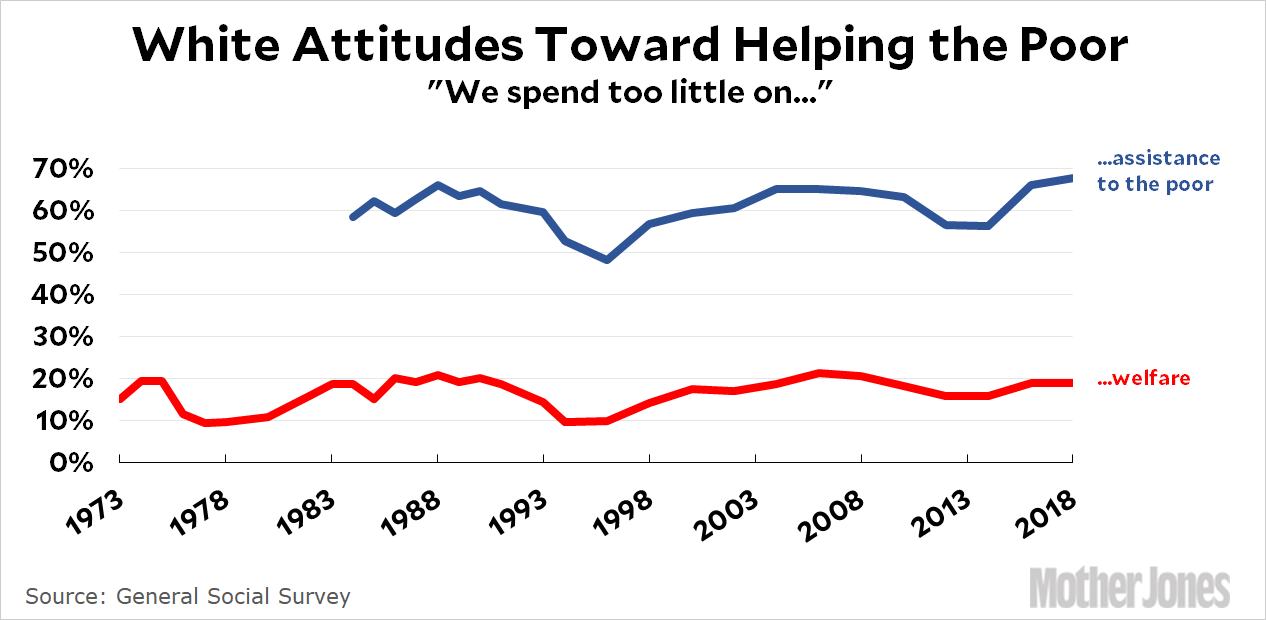
Should the point of liberal programs be to help the poor? Or to change the economy so that people don’t become poor?
In Thursday’s Washington Post, Catherine Rampell pointed out a subtle but important distinction that liberals should never lose sight of: Elizabeth Warren’s free-college and student-debt-relief plans, Rampell claimed, are “liberal but not progressive”, because “they give bigger benefits to higher-income families than to lower-income ones that actually need the help.” Rampell would rather see money targeted more directly at college-eligible low-income students.
This is a longstanding argument in liberal circles. On the one hand we have universal programs like Social Security, and on the other hand are targeted programs like food stamps. In an economic sense, targeted programs are more efficient at helping the poor — doing more with less. But that efficiency comes with some non-economic costs: increased red tape (you have to prove you qualify) and greater stigma for the recipients.
A universal entitlement is conceptually simpler: If you go to college, we’ll help you pay for it. But it costs more, because (as Rampell points out), we’ll be helping Bill Gates’ kids too. And since everything has to be paid for somehow, the universal program is more invasive to the pre-program economy. You have to tax more so that you can spend more.
A related (but not quite identical) distinction applies to our motives for having a program to begin with: Targeted programs have an air of charity about them. They don’t argue with the underlying structure of the economy, they just try to change the results. Do some people not make enough money to eat properly? Very well, then, we’ll give them food. We’ll leave alone whatever it is about the economy that creates unemployment or produces jobs that pay below-subsistence wages. We’ll just fix the food part.
Universal programs tend to be motivated more by notions of social justice: It isn’t just the outcome that’s wrong, it’s the fundamental structure of things. Yes, a targeted program would be a lighter-handed tweak of the underlying economy. But if the underlying economy is fundamentally unjust, why is a lighter hand good?
Rights. The reason it’s important to understand this distinction is that it’s easy for charitable and targeted-program attitudes to sneak their assumptions into a discussion. “Efficiency” always sounds good. But as soon as you start arguing about efficiency, you’ve bought the assumption that smaller changes are better. And often you’ve also bought an additional assumption about the program’s proper goal.
A universal program establishes a basic right, and re-defines the economy to fulfill it. Re-defining the economy is, in large part, the purpose of the program. The point of making public colleges free isn’t just to help the poor pay for education. The point is that public colleges ought to be free. A society in which public colleges are free is a more just society.
The same ideas apply across the board. One failing of our healthcare system is that too many people get priced out it, with corresponding effects on their ability to survive and thrive. ObamaCare targets people in danger of being priced out and subsidizes their health insurance, so it helps resolve that particular failing (or would if it were properly funded and overseen by an administration that believes in its purpose). But ObamaCare does not establish health care as a basic right.
The point of Medicare for All or some other universal-healthcare plan isn’t just to help the people who are being priced out of healthcare. The point is to make healthcare a basic right. That requires more government spending and taxing than even a fully funded ObamaCare. In that sense, it’s a “less efficient” use of the government’s fiscal powers, a heavy-handed reorganization rather than a light-handed tweak. If you believe that the current economy — where many people who work fulltime still can’t afford to take care of themselves or their children — is fundamentally just, then this heavy-handedness must seem outrageous.
But if you believe that the current economy is unjust, then changing it is a virtue, not a vice. There are efficiency/inefficiency arguments to be made at a number of levels, but the more important point is this: A society in which healthcare is a basic right is a more just society than the one we have now. The problem isn’t just that the current economy produces some downtrodden people who need charitable help from the rest of us, which we choose to channel through government. It’s that everyone should have a basic right to healthcare, and right now they don’t.
Vulnerability. Whether a plan gets framed as a basic right or as charity channeled through the government makes a huge difference in the politics. Most voters see charity-justified, means-tested programs as something the government does for “them”, not for “us”. Such generosity is fine as long as “we” are feeling prosperous and “they” seem deserving. But either of those factors can change, or can be changed through political rhetoric.
Means-tested programs are always open to forms of attack that universal programs are immune to: denigration and demonization of the beneficiaries. “Those people” don’t deserve our help because they are lazy or immoral or have made bad life choices. And usually, there’s no obvious place to draw the line: Are the best-off recipients truly in need, or are they just scamming us? Wherever the cut-off is, why shouldn’t it be lower?
If you think about it — and we seldom do — plenty of Social Security recipients fit the same profile as the demonized beneficiaries of means-tested programs: They’re healthy and could get jobs, but don’t want to. The reason conservative politicians don’t rail about their laziness and sense of entitlement is that Social Security is an “us”, not a “them”. They’d be demonizing their own voters, not some isolated scapegoat class.
But if Social Security ever became means-tested — as conservatives and a few efficiency-minded liberals often propose; I mean, what’s the point of sending government checks to Warren Buffett? — we’d soon see the same kinds of rhetoric and tactics: outrage at people who spend their benefits on luxuries, tightening requirements so that fewer and fewer people qualify (“I want to help the truly needy, but …”), and making the experience degrading and dis-spiriting with drug tests, long lines to file your annual re-applications, paternalistic restrictions on how you spend the money, and so on.
The rhetoric just writes itself: Picture all those lazy, able-bodied 60-somethings living on the beach in Florida, spending your tax dollars instead of working. They didn’t save when they were younger, and now they expect the government to make up the difference! Doesn’t that boil your blood?
Local services. You can see the same logic play out locally. In some cities everybody uses public transit. (I’ve taken the BART during rush hour in San Francisco. There were a lot of three-piece suits in the car.) Correspondingly, the service is good in those cities, because transit-riders are an “us”, not a “them”. But in cities (or even neighborhoods within cities) where only the poor use public transit, bus-riders are a “them” and you can forget about rail. In those places, buses are crowded and dirty; schedules are sparse and inconvenient.
Ditto for public schools. In towns where kids of all economic classes go to the same schools, standards are high and it’s not hard to pass a funding increase. But in towns where the public schools are for the poor, and the wealthy all send their kids to private schools, public education is a charity. What do “those people” expect the rest of “us” to provide for them?
Expect worse outcomes yet if Betsy DeVos ever gets her way and public schools are phased out entirely, in favor of private schools that accept government vouchers. The system will quickly devolve into two tiers: Schools that you can pay for solely with a voucher, and schools where the voucher only covers part of the cost. The voucher-only schools will be for the poor, and the vouchers will gradually shrink down to charity levels: Do “those kids” really need music or foreign languages? Are they capable of appreciating literature or higher mathematics? Why should we pay for more than just keeping them under control all day?
Of course, we’d never ask those questions about “our” kids. But “their” kids?
Back to Warren’s proposal. What Senator Warren proposed last week was a program to end tuition-and-fee costs for undergraduates at all public colleges and universities, and to cancel up to $50,000 of student debt. (There are a few means-tested pieces in her program, the biggest being that you’re only eligible for the full $50K if your annual family income is $100K or less, with the benefit phasing out by the time you hit $250K.)
It’s expensive. It costs $1.25 trillion over ten years. She plans to pay for it with an idea that will make plutocrats rage: a wealth tax on households with $50 million or more in assets.
So, no doubt about it, it’s a heavy-handed intervention in the economy. Rampell’s efficiency argument is correct: We could spend and tax a lot less if we carefully targeted the benefits on students who won’t be able to go to college otherwise, and calibrated the size of the benefit to correspond to their precise needs. That would achieve the effect of helping poor kids and working-class kids go to college with minimal changes to the rest of the economy. If you think the rest of the economy is just, that makes perfect sense.
But Warren’s plan does something that no efficiently targeted and calibrated plan can ever do: The option to go to college becomes a basic right. Whose kids are the beneficiaries? Everybody’s. It’s something that we are joining together to do for ourselves, not for some downtrodden “them”. The affected students are not recipients of our charity who constantly have to prove that they come from the deserving poor rather than the undeserving poor.
Socialism? South American Archbishop Dom Helder Camara once said: “When I give food to the poor, they call me a saint. When I ask why the poor have no food, they call me a communist.”
Since the fall of the Soviet Union, hardly anybody is really a communist any more, if they ever were. Our era’s scare-word is socialism, but it means roughly what the archbishop was talking about: building a society where a certain level of dignity and opportunity is a basic right, and does not require that you meet the standards of some paternal benefactor, who can withdraw patronage if you begin to appear undeserving.
I don’t just want to maintain the well-behaved poor at some subsistence level, while the productive power of the Earth and of our complex society accumulates in a few hands. I want our collective inheritance — the planet and the productive legacy of past generations — to work for all of us. If that earns me the title of socialist, well then, so be it.
[If you want to hear more about this point of view, check out a sermon I’ve done at several churches “Who Owns the World?“]
No sooner do I say that removing Trump needs to be the voters responsibility than he starts acting in a way that violates my impeachment standards again: Placing himself and his administration above congressional oversight.
But first, I want to talk about something else: A WaPo columnist’s critique of Senator Warren’s free-college plan, and the question it brings up: Is liberalism fundamentally about helping the poor, or about re-shaping the economy so that people don’t become poor? That’s the subject of “Charity Liberalism and Justice Liberalism”, which should be out shortly.
I still haven’t decided whether to break impeachment talk off into its own post or include it in the weekly summary. The summary will also include the census citizenship-question issue, 2020 Democrats, and a few other things, before closing with a real-life fantasy of having one golden moment in your life. That should be out between noon and 1 EDT.
The President ‘s efforts to influence the investigation were mostly unsuccessful, but that is largely because the persons who surrounded the President declined to carry out orders or accede to his requests.
This week everybody was talking about the Mueller Report
I discussed that in the featured posts. Here I’ll talk about the issues surrounding the report.
First, reading the report makes it clear that Attorney General Barr has been misrepresenting the it, both in his four-page summary and in the press conference [video, transcript] he held just before releasing his redacted version of the Report. The benefit of the doubt I granted him four weeks ago was undeserved.
Barr began his summary of the report (that reporters and the country still had not seen) with an actual partial-sentence quote, that the
investigation did not establish that members of the Trump Campaign conspired or coordinated with the Russian government in its election interference activities.
But the full sentence is a little less favorable to Trump:
Although the investigation established that the Russian government perceived it would benefit from a Trump presidency and worked to secure that outcome, and that the Campaign expected it would benefit electorally from information stolen and released through Russian efforts, the investigation did not establish that members of the Trump Campaign conspired or coordinated with the Russian government in its election interference activities.
Imagine if the AG had selected the other part of this sentence to emphasize: “the investigation established that the Russian government perceived it would benefit from a Trump presidency and worked to secure that outcome, and that the Campaign expected it would benefit electorally from information stolen and released through Russian efforts”.
A bit later, the Report explains what “did not establish” means:
while the investigation identified numerous links between individuals with ties to the Russian government and individuals associated with the Trump Campaign, the evidence was not sufficient to support criminal charges.
But Barr pretended “did not establish” meant that the opposite was established, and he spun “evidence was not sufficient to support criminal charges” into “no evidence”.
But thanks to the Special Counsel’s thorough investigation, we now know that the Russian operatives who perpetrated these schemes did not have the cooperation of President Trump or the Trump campaign – or the knowing assistance of any other Americans for that matter.
He repeated some version of Trump’s “no collusion” mantra four times, in spite of the fact that Mueller rejected that term.
All along (there are numerous examples given in the Report itself), Trump has been complaining that Barr’s predecessor, Jeff Sessions, did not “protect” him. In other words, he expected the attorney general to be his lawyer, not the chief law enforcement officer of the United States. Barr has clearly taken this to heart; his performance would have been appropriate for the President’s personal lawyer.
The basic structure of the press conference was bizarre. Typically, when the Justice Department holds a press conference to announce the release of a report, reporters have gotten advance copies of the report “under embargo”, meaning that they can’t talk about it until the release time. That makes meaningful questions possible. This time, no one could see the report until more than an hour later, so questions could only be shots in the dark.
Also, Justice Department press conferences typically center on the people who did the work. But Bob Mueller was nowhere to be found.
Stephen Colbert summed up what Barr was doing with this analogy: “Officer, before I open the trunk of this car, I’d like to first give a short speech about what you’re about to smell.”
Former FBI counter-intelligence agent Asha Rangappa explains the Russian disinformation tactic of “reflexive control”, and how it relates to Trump’s manipulation of the legally meaningless word collusion.
“collusion” is now the same as “conspiracy,” and without proof beyond a reasonable doubt of the latter, the former doesn’t exist.
He warns that we’re being similarly manipulated now by the word spying, which Trump often says and Barr used in his congressional testimony.
One winner from the Mueller Report: the news media. A lot of those stories that Trump called “fake news” turn out to be true. (Biggest example: Trump asked Don McGahn to fire Mueller. At the time, Trump characterized the newspaper report as “A typical New York Times fake story.”) Those anonymous sources quoted by the New York Times and Washington Post usually turned out to be real people who said the same thing under oath.
What Ross Douthat sees in the Mueller Report is “the same general portrait” as Michael Wolff’s book Fire and Fury:
Donald Trump as an amoral incompetent surrounded by grifters, misfits and his own overpromoted children, who is saved from self-destruction by advisers who sometimes decline to follow orders, and saved from high crimes in part by incompetence and weakness.
If you look at the report, be sure to check out Appendix C, which consists of Trump’s written answers to questions posed by the investigation. The word that best describes this testimony is slippery. Trump offers little information beyond what he knows is available to the Special Counsel from other sources, and makes no claims specific enough to be contradicted by other witnesses. In general, he just doesn’t remember.
If he’s not being slippery, the other possibility is senile dementia. I’d like to ask Mike Pence if he has read Appendix C, and if it made him consider invoking the 25th Amendment.
This is how a 30-year career at the Justice Department ends for Rod Rosenstein, who stood behind Barr unblinking and expressionless. Three weeks ago I wrote:
If Rod Rosenstein really does agree with Barr’s conclusion, I’d like to hear him say so himself, rather than let Barr put words in his mouth.
Thursday, Rosenstein looked like somebody whose daughter is being held in an undisclosed location pending his good behavior. Once again, Barr made claims in his name, but Rosenstein never spoke. Twitter noticed.
Barr’s redactions also drew some humorous comment.
President Donald Trump’s spokeswoman Sarah Sanders pushed back Friday against allegations that special counsel Robert Mueller’s Russia report exposed a culture of lying at the White House.
Sanders says there is no culture of lying at the White House, and why would she lie about that?
She’s under fire because the Mueller Report exposed this blatant lying, which she had to own up to under oath:
In the afternoon of May 10, 2017, deputy press secretary Sarah Sanders spoke to the President about his decision to fire Comey and then spoke to reporters in a televised press conference. Sanders told reporters that the President, the Department of Justice, and bipartisan members of Congress had lost confidence in Comey, ” [a]nd most importantly, the rank and file of the FBI had lost confidence in their director. Accordingly, the President accepted the recommendation of his Deputy Attorney General to remove James Comey from his position.” In response to questions from reporters , Sanders said that Rosenstein decided “on his own” to review Comey’s performance and that Rosenstein decided “on his own” to come to the President on Monday, May 8 to express his concerns about Comey. When a reporter indicated that the “vast majority” of FBI agents supported Comey, Sanders said , “Look, we’ve heard from countless members of the FBI that say very different things.” Following the press conference, Sanders spoke to the President, who told her she did a good job and did not point out any inaccuracies in her comments. Sanders told this Office that her reference to hearing from “countless members of the FBI” was a “slip of the tongue.” She also recalled that her statement in a separate press interview that rank-and-file FBI agents had lost confidence in Comey was a comment she made “in the heat of the moment” that was not founded on anything.
Typically, White House press secretaries correct their honest “slips of the tongue”. (WWCJD?) But that’s too high a standard for this White House.
Mitt Romney was the first major Republican to criticize Trump after reading the Mueller Report, tweeting:
I am sickened at the extent and pervasiveness of dishonesty and misdirection by individuals in the highest office of the land, including the President. I am also appalled that, among other things, fellow citizens working in a campaign for president welcomed help from Russia — including information that had been illegally obtained; that none of them acted to inform American law enforcement; and that the campaign chairman was actively promoting Russian interests in Ukraine.
Republican leaders fall into three basic groups:
gung-ho Trumpers (Mike Huckabee, for example, or Jim Jordan) who shout down any criticism of him, no matter how justified.
cowards (too numerous to name) or corrupt bargainers (Mitch McConnell) who recognize the damage Trump is doing to America, but avert their eyes and keep their heads down in hopes of surviving into the post-Trump era.
hand-wringers who want credit for their high moral principles, even though they are unwilling to take any action on them. (Susan Collins)
Mitt is hand-wringing here. That’s better than keeping his head down or actively collaborating, so it marks progress of a sort. I wish more Republicans would speak out like this, even if they don’t intend to do anything either. But I can’t get too excited about it. If Mitt starts demanding change and either calls for impeachment or supports a primary challenge to Trump, let me know.
and the Sri Lanka Easter bombings
Suicide attacks killed nearly 300 people in Sri Lanka yesterday. Three Christian churches and three major hotels were bombed. An Islamic terrorist group is suspected, and the government has arrested 24 people.
and Notre Dame
The iconic Paris cathedral burned last Monday. The spire fell, but the two towers, with their famous stained glass rose windows, survived.
Tragedies typically bring people together in a sense of loss and grief. So I found it bizarre how many folks tried to make this event divisive. When art, architecture, and historic relics are lost, we are all the poorer for it. OK, maybe there have been other losses that should have evoked a similar response, but didn’t. Maybe rich donors ponied up quickly for this, when they have no money for other worthy projects. I don’t care. Losses like this are emotional, and emotions can’t be weighed and measured like that.
I also have no patience with the folks who want to see some special providence in the fact that the disaster wasn’t worse, or that some particular object was saved. It would have taken only a smidgen of godly power to site somebody with a fire extinguisher in the right place when the whole thing started, but God seems not to work that way. The fact that shit happens, but that humanity survives somehow nonetheless, neither raises nor lowers the odds on the existence of a higher power.
Jon Snow: What kind of God would do something like that?
Melisandre: The one we’ve got.
and you also might be interested in …
Everybody else is running for president, so why not my congressman, Seth Moulton? I just moved to this district in the fall, though, so I can’t claim to have any special insight. Moulton is the 19th Democratic candidate. Joe Biden, the current front-runner in most polls, is expected to become the 20th on Wednesday.
Noah Smith explains in two graphs why you shouldn’t read too much into polls about specific issues: A poll that phrases the issue differently might get a different result, and a large number of people might reject the inevitable consequence of something they support.
For example: whites who think we spend too little on “assistance to the poor” change their minds when you call it “welfare”.
And Americans favor eliminating “health insurance premiums”, but not eliminating “private health insurance companies”.
While we’re talking about redactions …
Two examples of how religion is favored in America, and those who consider themselves non-religious are discriminated against.
House counsel represented to this court that the House interprets its rules to require ‘a religious invocation’.
Atheists, by definition, can’t be religious. (Of course, this interpretation will go out the window the next time it’s convenient to claim that atheism is just another religion.)
Second: Lawsuits that try to enforce the wall between church and state sometimes leave the names of the plaintiffs out of the public record for their own safety. A law that just passed the Missouri House will make this illegal, but just for church-and-state suits. In other words, if you represent a Christian majority that is imposing its will on the public square, you have the right to know exactly who is challenging you, in case you want to threaten or intimidate them. Other defendants in other suits don’t have that right, because they’re not the Christian majority.
The downside of doing something to keep yourself honest is that it might force you to stay honest.
Last June, I anticipated that the Mueller Report would eventually come out, and that we might then have to decide whether to support an impeachment. I also anticipated that partisan pressures would be intense at that point, and that people on both sides would face a strong temptation to shape their ideas about impeachment around the particulars of the evidence Mueller had found: If you were pro-Trump, no amount of wrong-doing would justify impeachment, but if you were anti-Trump, whatever Mueller found would be enough.
Certainly, we have seen enormous flip-flops among politicians who have been around since the Clinton impeachment. (Lindsey Graham is the most egregious example.) But the partisan winds affect all of us, and so I decided I wanted to get my ideas about impeachment written down before I knew precisely what Mueller would find. So I thought things through in the more-or-less abstract and posted “What is impeachment for?” I was trying to come up with an answer that I could stand by whether the target of impeachment would be a Republican or a Democrat. It should be consistent with the Founders’ intentions as expressed in the Constitution, as well as with my intuition about the impeachments in my lifetime. (I thought the Nixon impeachment was justified but the Clinton impeachment wasn’t.)
My standards for impeachment. Here’s what I came up with:
The Founders believed that any legitimate sovereignty had to come from the People, but they understood that the People would make mistakes. It was inevitable that sooner or later the United States would elect a bad president — a demagogue who was unwise, uninformed, and temperamentally unfit for the job.
It’s clear what they saw as the primary remedy for a bad president: Wait for his term to end and elect somebody else. (In the meantime, the other branches of government should use their checks and balances to minimize the harm he could do.) … Impeachment is in the Constitution for those rare cases where the country just can’t wait. … A legitimate impeachment case needs to argue that the Republic is in danger. There must be some reason why waiting for the next election either won’t work or isn’t good enough.
That led me to four situations that merit impeachment:
The president is not loyal to the People of the United States.
The president’s actions threaten the integrity of the election process.
The president’s actions prevent investigations of (1) or (2).
Congress has no other way to protect itself or the judiciary from presidential encroachment.
So if Mueller had found that Trump was conspiring with Putin, that would be a slam-dunk example of (1). But that’s not what he found. Instead, he assembled evidence of obstruction of justice, which I find convincing. So I believe that the President of the United States is a criminal.
However, back in June I anticipated this situation too:
The offense Mueller is most likely to find is obstruction of justice. The question I would have at that point is whether the obstruction succeeded. (Firing Comey, for example, may have been intended to derail the Russia investigation, but it obviously didn’t.) If Mueller’s conclusion is that Trump’s obstruction prevents us from knowing whether he was part of a treasonous conspiracy, then I would want to impeach him for that. But if Mueller did in fact get to the bottom of the Russia affair, then the impeachment decision should be based on the answer to that question.
The only loophole I can picture in that is if you hold Trump responsible for Paul Manafort’s non-cooperation, and believe that a cooperating Manafort would have revealed a treasonous conspiracy. That’s not impossible, but it seems like a stretch at this point.
Is the Republic in danger, and if so, from what? I won’t pretend that I wasn’t frightened by what I read in Mueller’s report. In one example after another, Trump displayed an attitude of lawlessness; he wanted what he wanted, and if someone told him it was illegal, he’d ask someone else to do it. (We’re getting similar reports about his immigration policy. He is already ignoring our laws defining the asylum process, and his rhetoric is preparing his cult of followers for worse abuses — for example, when he refers to laws he doesn’t like as “Democrat laws“, as if that invalidates them.) I don’t think we’ve ever had a president with such a cavalier disregard of his prime constitutional duty: to see that the laws are faithfully executed.
The president’s refusal to be interviewed by Mueller, and the answers he did give to written questions (Appendix C of the report), also show a frightening level of disrespect. If Trump really has so little memory of what he has done and who he has talked to, then the Vice President should invoke the 25th Amendment on the grounds of senile dementia. More likely, though, he just sees “I don’t remember” as a lie no one can catch you in.
In 2016, the 46% of the voters who voted for Trump, and so allowed the Electoral College to install him in office, clearly made precisely the kind of mistake that the Founders foresaw. Elections have consequences, and so our Republic is suffering for that lack of wisdom. We have already lost many of the norms that protect us from authoritarianism; for example: the independence of the Justice Department, the expectation that a president would be shamed if caught in a lie, and the expectation that a president would not profit from dealing from foreign countries (and would show us his finances so that we can check).
If the House doesn’t impeach Trump and the Senate remove him from office, what is the remedy?
In part, we’ve been living it for two years now: checks and balances need to limit the damage Trump does until the voters can repudiate him. Other government officials have repeatedly refused to carry out some of Trump’s illegal orders, and judges have stood in the way of others. Congress has refused to let him pay Putin back by relaxing sanctions. The voters elected a Democratic House that can block many of his worst ideas, and can expose wrongdoing to the public.
In some ways, though, the checks and balances are failing. It is within Congress’ power to enforce the Emoluments Clause of the Constitution more rigorously, but it hasn’t done so. Congress could have defended its own power by overriding Trump’s veto of the resolution rescinding his state of emergency, but it didn’t. But these are failures of the same people who would have to remove Trump from office in impeachment. If you can get two-thirds of the Senate to see the problem and take action, then arguably you don’t need to remove Trump from office.
But that points to the real problem: Congress doesn’t have a supermajority willing to defend the Republic against a bad president. And behind that is another problem: While polls consistently show that Trump is unpopular, the public has not decisively rejected him in the way that, say, they rejected Richard Nixon once the details of the Watergate scandal became clear.
That’s the real source of danger: About 40% of the public doesn’t believe in the American system of government any more. They are fine with a lawless, dishonest president, as long as they believe he’s on their side.
A thought experiment. How would you feel about impeachment if Trump were already a pariah, if Congress routinely overrode his vetoes, and if candidates were lining up to challenge him not just on the Democratic side, but on the Republican side also? If you were confident that he faced a landslide loss in 2020, and that Republicans might anticipate that and not renominate him — would you feel better about waiting for his term to end?
I would. In large part, my urge to impeach is driven by my fear that the electorate can’t be trusted to repudiate Trump.
But of course, as long as that’s true, the Senate will never remove him from office. If the voters won’t defend the Republic, nobody else will either.
Hazards of not impeaching. In large part, Democrats are facing now the kind of problem that Republicans faced during the Clinton/Lewinsky scandal: What can we do with our moral outrage? Republicans read the Starr Report in 1998 (unlike Mueller, Starr timed his report for maximum political effect), were outraged at the thought of extra-marital oral sex in the Oval Office, and felt: “This can’t stand. We have to do something.” [1]
The danger of doing nothing is that it creates the impression that Trump did nothing wrong. “If this were serious,” his supporters will say, “you’d be trying to impeach him.” It also immunizes him against further revelations that may come out of the investigations that Mueller spun off. It encourages him to take even more lawless actions, and may convince his subordinates that it would be no big deal to go along with him.
The politics. Some leading Democrats are taking the position that impeachment should be off the table because it’s not the best political move: Making Trump the center of the 2020 campaign plays into his hand. Instead, 2020 should be about health care, climate change, income inequality, and voting rights.
That’s true up to a point. Many of the voters we need to turn out aren’t concerned about “process issues” like whether the president respects the law. They want to know what each party plans to do for them, and what the Democrats plan has far more appeal than what Trump plans. (Most of those voters don’t really care about stopping migrant caravans either.)
Democrats shouldn’t get so caught up in opposing Trump that they lose sight of all other values. But in addition to pocketbook issues, Democrats need to be the party of honesty and good government. The very idea that Trump is a threat to American democracy, but that we’ll ignore it because that issue isn’t polling well for us right now — it undermines everything else. Some things are too important to calculate over, and this is one of them. The world where principles are just for show, and really everybody does whatever works to their advantage — that’s Trump’s world. If we move there, we lose.
Keeping the pressure on. The trick will be to find a middle way: to continue calling Trump’s lawlessness to public attention, while arguing that political repudiation is the voters’ job, and that indictment after he leaves office is a sufficient legal response. The issues raised by the Mueller report need to stay in the spotlight. For now, congressional hearings should be able to serve that purpose: Mueller and Barr need to testify in public, certainly, and probably a number of the administration officials who were told to break the law, like Don McGahn. Lawlessness in other areas, like border enforcement, needs to be pulled into the theme.
But there’s no reason why these sorts of hearings have to eclipse all other issues. The House has already passed a comprehensive voting-rights bill. It can pass bills to define the rest of a positive agenda.
[1] Our outrage, I think, is far more justified, for two reasons: The obstruction case against Trump is far stronger than the one against Clinton, and it involves misuse of his presidential powers rather than just personal vices.
When I listened to the Senate hearing of the Clinton impeachment, I was amazed by how weak the obstruction case was: Republican prosecutors told a plausible story of obstruction — Clinton induced Monica Lewinsky to lie in a civil deposition by convincing Vernon Jordan to get her a good job at Revlon — but beyond showing that all the people who needed to conspire had opportunity to communicate with each other, they had no evidence. The conspiracy was denied by everyone supposedly involved, including people who had nothing to gain by lying, like Lewinsky (who had immunity) and the folks at Revlon.

/arc-anglerfish-arc2-prod-tronc.s3.amazonaws.com/public/NYEUUTYNPBH7HPO5GW4X75ZOWA.jpg)
/arc-anglerfish-arc2-prod-tronc.s3.amazonaws.com/public/FTKESEGMDNHZLHRXC4PPZI74YE.jpg)


 and Charlottesville
 I will point out that this is not a general or typical feature of the American presidency. It’s the unique property of an administration whose president has not earned the respect of the people who deal with him most closely.