Category Archives: Weekly summaries

Each week, a short post that links to the other posts of the week.

Echoes and Resemblances

The initial, personal cause of his grievance against the universe can only be guessed at; but at any rate the grievance is here. He is the martyr, the victim, Prometheus chained to the rock, the self-sacrificing hero who fights single-handed against impossible odds. If he were killing a mouse he would know how to make it seem like a dragon.

George Orwell’s 1940 review of Mein Kampf

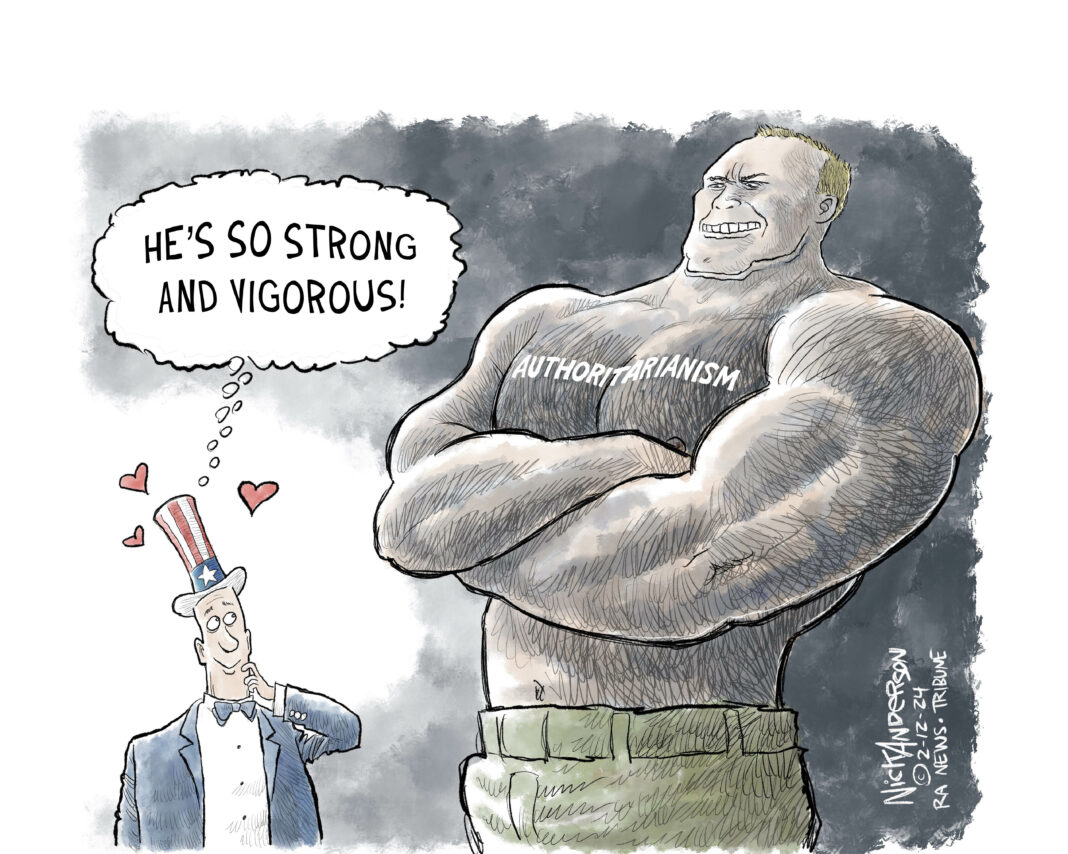
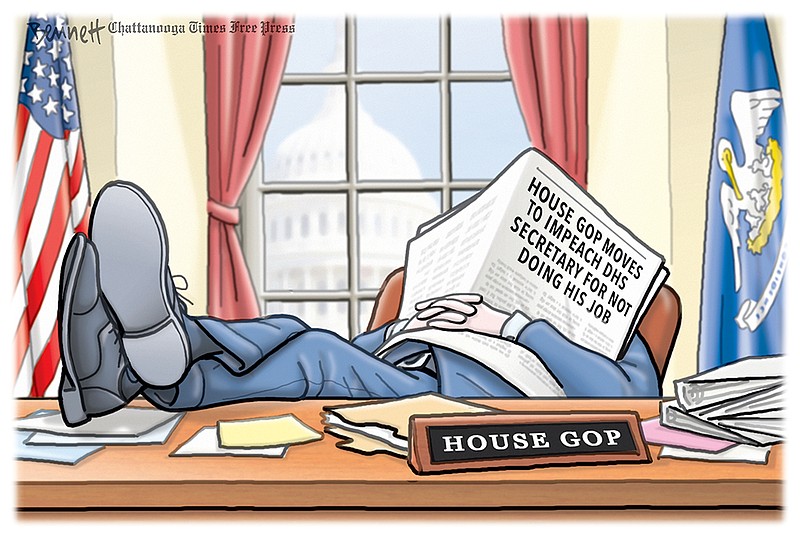
This week’s featured post is “Revisiting the fascism question“. I didn’t notice this cartoon until after that article posted.

If you wondered what I was doing with my week off last week, I was in a church speculating about death.

This week everybody was talking about Gaza

A frequently rumored deal where Hamas would release some number of hostages in exchange for a ceasefire of a certain number of days keeps not quite happening.

The war news this week centered on the Al Shifa Hospital in Gaza, which Israel has claimed sits over a Hamas command-and-control center. Meanwhile, though, it was a hospital, and conditions there became horrific while Israel searched it for Hamas fighters and their hostages. Saturday, a deal was reached to evacuate the patients that could be moved and leave the hospital with a skeleton crew to take care of the rest.

Israel turned up a collection of weapons from the hospital and a shaft that presumably goes down into deeper tunnels. But so far this evidence has fallen short of a command-and-control center, so not everyone was impressed.


It’s hard to feel good about any news coming out of Gaza. My interpretation of the October 7 attacks is that Hamas designed them to offend Israel as deeply as possible, giving Israelis the maximum motivation to come to Gaza and root them out. Simultaneously, Hamas had embedded itself in Gaza so tightly that Israel would have to do ugly, horrible things to succeed in rooting them out. For its part, Israel is now doing those ugly, horrible things, and Palestinian civilians are dying in large numbers.

Watching from the outside, I have a hard time coming up with some alternative path Israel ought to be taking, and yet I also have a hard time rooting for them to succeed in their current path. I find myself agreeing with this Nicholas Kristof column, especially this line:

Unless you believe in human rights for Jews and for Palestinians, you don’t actually believe in human rights.


There’s been a lot written — maybe appropriately so — about antisemitism on college campuses, and from the left in general. But this week we got a reminder that antisemitism on the right is far more pervasive and virulent.

Matt Yglesias wrote a fairly long column about left and right antisemitism, which I’ll oversimplify down to this: Leftists sympathize with Palestinians, and sometimes end up overshooting into hating Jews. Rightists hate Jews, and so invent conspiracy theories to justify that hatred. Neither position is good, but they’re not exactly mirror images of each other.

Cases in point are these statements by Tucker Carlson and Charlie Kirk, which blame Jews for financing “white genocide” and “anti-white causes”. Elon Musk responded to a tweet expressing a similar view with “You have said the actual truth.”


In case you thought Hamas was the only group of unreasonable radicals, The New Yorker interviews Daniella Weiss of the Israeli settler movement.

The borders of the homeland of the Jews are the Euphrates in the east and the Nile in the southwest.

That’s the land promised to Abraham’s descendants in Genesis 15. It includes big chunks of Egypt, Syria, Lebanon, and Iraq.

If someone decides to invent a new religion today, who will decide the rules? The first nation that got the word from God, the promise from God—the first nation is the one who has the right to it. The others that follow—Christianity and Islam, with their demands, with their perceptions—they’re imitating what existed already. So, why in Israel? They could be anywhere in the world. They came after us, in the double sense of the world.

She’s fine with non-Jews continuing to live in these lands, as long as they accept that

We the Jews are the sovereigns in the state of Israel and in the Land of Israel.

That means accepting that “they are not going to have the right to vote for the Knesset. No, no, no.”

and averting a government shutdown

I give Speaker Johnson credit for not waiting until the absolute last minute to recognize reality: Any plan to keep the government funded has to rely on Democratic votes, so loading a continuing resolution up with right-wing culture-war riders can’t work. The House got a relatively clean CR done Tuesday (supported by 209 Democrats and only 127 Republicans), the Senate passed it Wednesday, and President Biden signed it Thursday, with a day to spare. The ordinary business of government shouldn’t be dramatic. Things that need to get done should get done without watching some clock tick down to zero.

Johnson accomplished this by pulling the same trick Kevin McCarthy did just before the House sacked him: He avoided putting the bill through the Rules Committee (where all bills usually go, so that rules can be established for amendments, debate limits, etc., and which McCarthy had stacked with “Freedom” Caucus members as part of the deal that made him speaker). That meant it needed a 2/3rds supermajority to pass, which it only got via overwhelming Democratic support.

Predictably, passing a realistic CR with mostly Democratic votes angered the “Freedom” Caucus, which has no interest in the kind of compromise democracy always entails. So far no one is proposing another vacate-the-chair resolution. But it’s hard to see how Johnson gets past the next set of funding deadlines without a revolt.


About those deadlines: The one weird thing about the Johnson-designed CR is that it has two. The bill would extend funding until January 19 for military construction, veterans’ affairs, transportation, housing and the Energy Department. The rest of the government – anything not covered by the first step – would be funded until February 2.

It’s not clear what kind of game Johnson has in mind. Maybe he wants to get full-year appropriation bills approved for the January 19 departments approved first, then have a showdown over big cuts to the February 2 departments. Or maybe he wants to be able to have a shutdown over the January 19 departments while the others are still funded. We’ll see how Democrats maneuver in response.

In general, it’s hard to disagree with one part of Johnson’s rhetoric: Congress ought to debate individual programs on their merits, rather than vote the whole government up or down. However, such a plan requires repeated compromises with Democrats, and recognizing that the small and fractious Republican House majority can’t get its way on everything. As long as the House loads every bill with things Democrats will never support, nothing will pass and we’ll keep coming down to deadlines with the government unfunded.


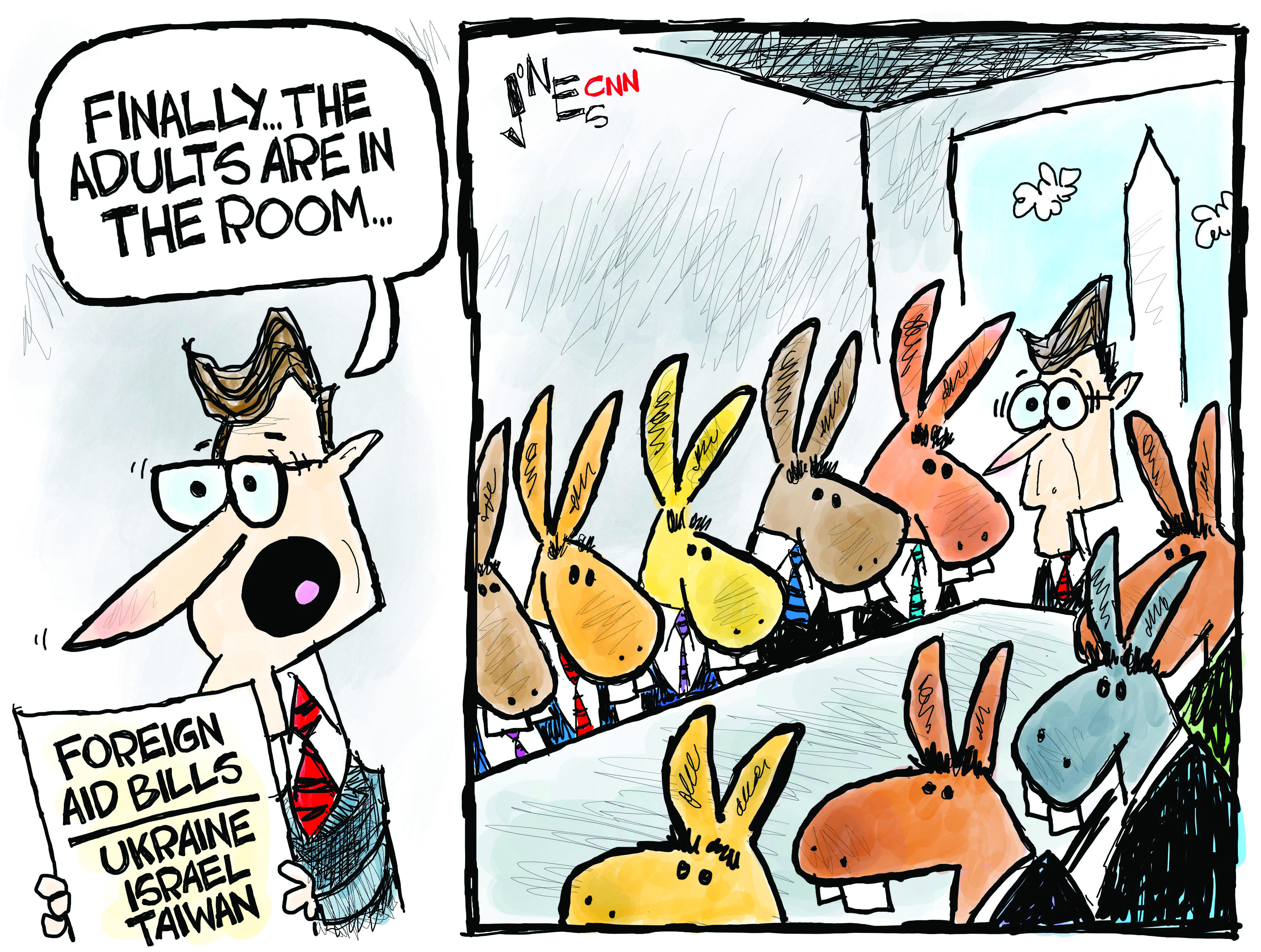
The CR does not include additional aid for Israel or Ukraine. Meanwhile, Johnson’s previous bill that coupled aid to Israel with a deficit-increasing IRS cut is dead in the Senate. If Israel (not to mention Ukraine) is going to get more aid, the House is going to have to try again.

The fact that the IRS cut increases the deficit (by making it easier for rich taxpayers to cheat; I’ve heard the cut described as “defund the tax police”) is routinely left out of conservative-media articles. Conservative media frames the situation as Democrats wanting to protect IRS bureaucrats, not Democrats wanting rich people to pay the taxes they legally owe.

Basically, there are two kinds of legislators. When something needs to get done, one kind thinks “What am I willing to give up to make this happen?” and the other thinks “What can I get people to give me to stop blocking this?”

and the China summit

President Biden met President Xi on Wednesday, and accomplished a small number of important but not flashy things: They restored communications between Chinese and American military leaders, which is how minor incidents are settled without escalating into war. And China agreed to reduce precursor chemicals for making fentanyl, which is a key point in the China-to-Mexico-to-America drug trade. The two leaders disagreed about a number of other issues, like Taiwan.


Yeah, yeah, Taiwan and trade and climate agreements and all that are important, but here’s what you were really concerned about: China will resume sending pandas to US zoos.


Back in 2018, John Oliver publicized the banned-in-China anti-Xi memes styling him as Winnie the Pooh, and now I can’t see him without noting the resemblance.

and the Tuberville drama

Senator Tuberville’s blockade on military promotions continued this week, and we found out that he has at least one ally: Mike Lee of Utah.

Several Republicans have publicly expressed frustration with Tuberville on the floor of the Senate, to no avail. Democrats are going to propose a temporary rule change to circumvent the blockade, but it needs 60 votes to pass. If all 51 Democrats show up to support the change, nine Republicans will be needed. No one knows whether the anti-Tuberville faction has that many Republicans.

and Trump’s “insurrection”

A Colorado judge weighed in Friday on whether the 14th Amendment’s insurrection clause makes Donald Trump ineligible to be president again. The ruling is a mixed bag: She finds that Trump did engage in insurrection, in the sense intended by the Amendment, but denies that the phrase “officer of the United States” was intended to include presidents. As a result, Trump’s name should appear on Colorado primary ballots.

That sounds like a victory for Trump, but Harry Litman isn’t so sure. The engaged-in-insurrection part is a finding of fact (based on extensive examination of evidence) which the appellate courts would be inclined to defer to, while the not-an-officer part is a matter of law that the higher courts will want to decide for themselves. So this Trump “victory” may set up a less victorious outcome on appeal.

The judge’s opinion is a good summary of what happened on January 6. A key point is that Trump’s words can’t be taken at face value because

Trump developed and employed a coded language based in doublespeak that was understood between himself and far-right extremists, while maintaining a claim to ambiguity among a wider audience.

and you also might be interested in …

Former first lady Rosalynn Carter died Sunday. Her husband, former president Jimmy Carter, has been in hospice since February.


When Republicans and a few Democrats voted against a resolution to expel George Santos from the House of Representatives a few weeks ago, they claimed it was because he had not yet gotten the due process that an Ethics Committee investigation would provide.

Well, the Ethics report came in Thursday, saying that

Mr Santos exploited “every aspect of his House candidacy for his own personal financial profit.”

A new expulsion resolution is expected after Thanksgiving, and it will probably pass.


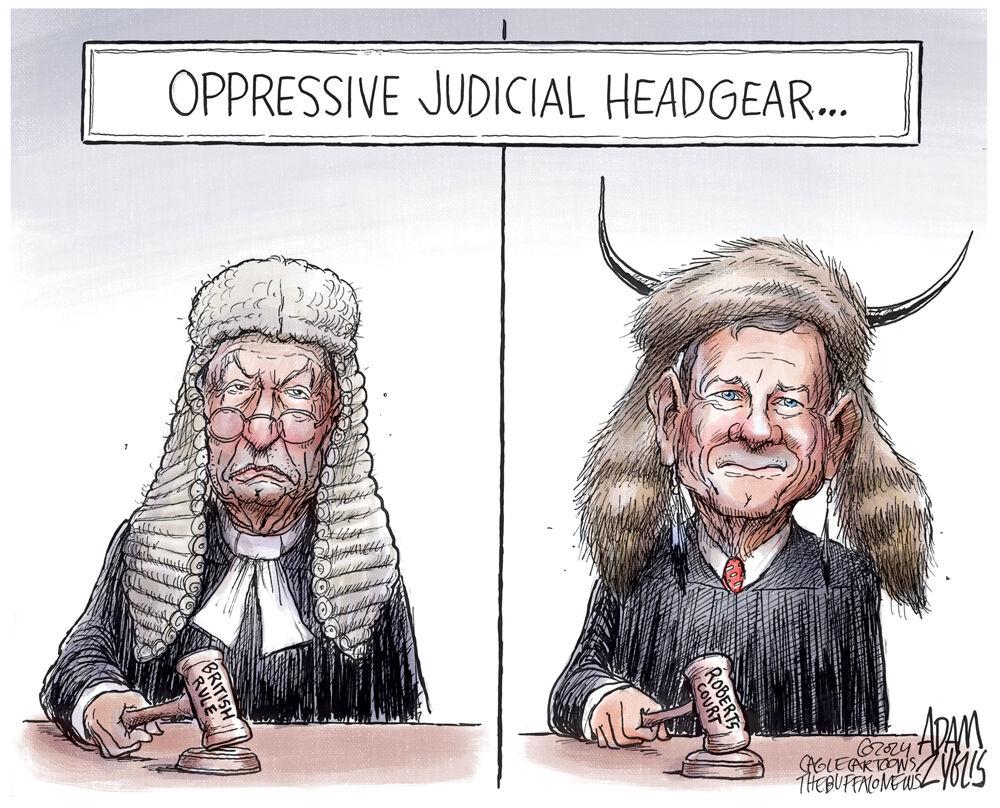
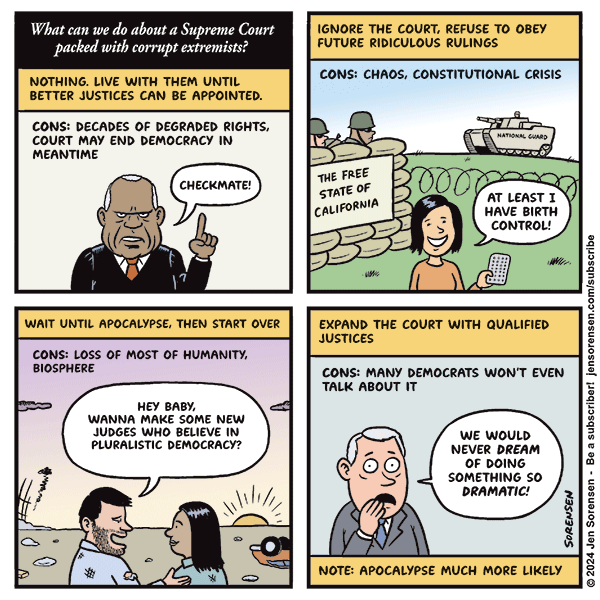
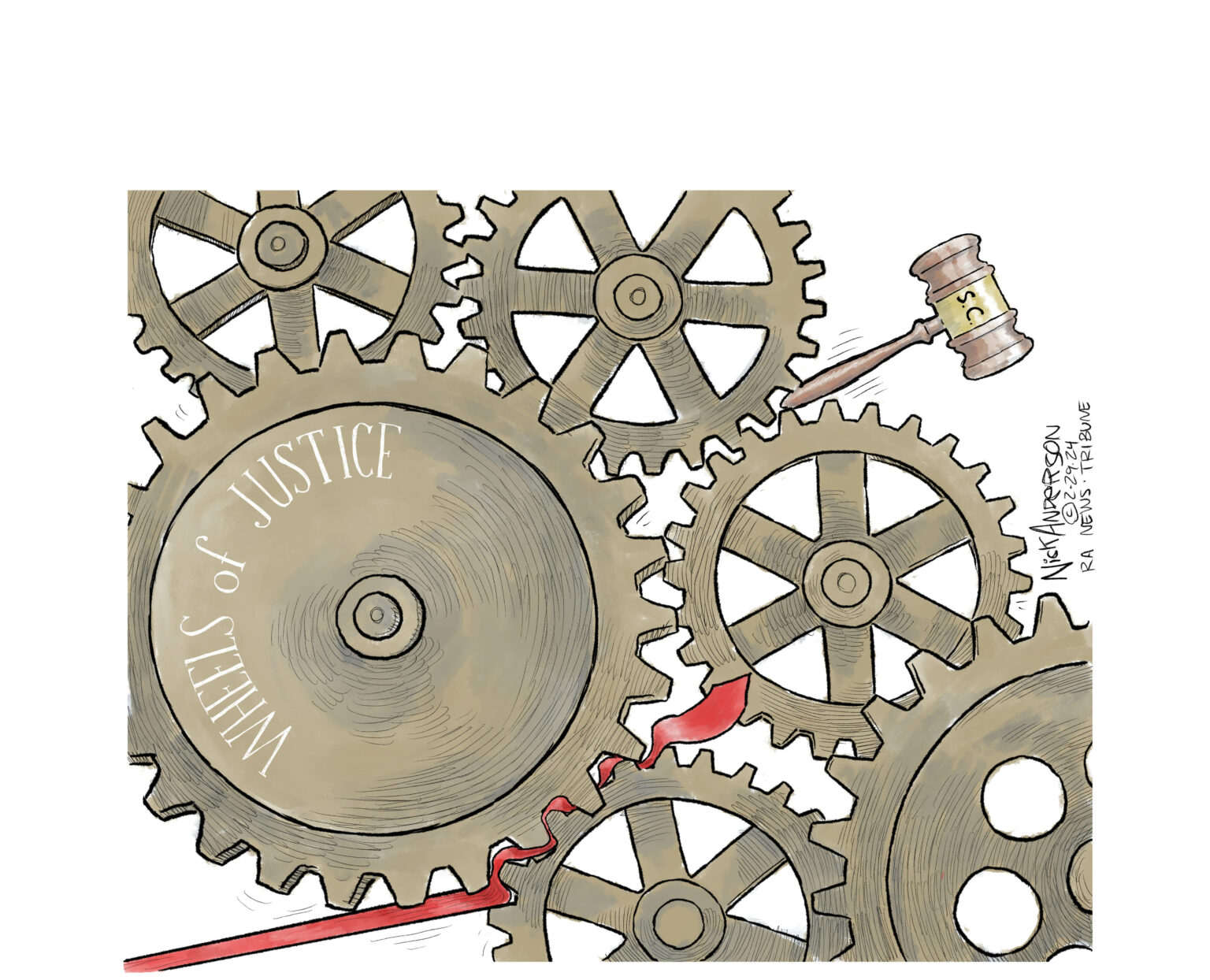
The Supreme Court finally adopted an ethics code. Critics are not impressed.

The most glaring defect of the new code is its complete lack of any enforcement power. Its 15 pages are littered with weak verbs like “should,” “should not” and “endeavor to,” which, as any college student on a pre-exam bender will tell you, is a reliable way to sound serious without actually doing the work. … Whatever the justices do, they must know there will be no professional repercussions. Appointed for life and removable only by impeachment, they are effectively untouchable.


Baseball’s A’s will move from Oakland to Las Vegas by 2028, leaving Oakland without any sports franchises. The A’s are baseball’s most traveled franchise, beginning as the Philadelphia Athletics, then moving to Kansas City, Oakland, and now Las Vegas.


My annual exercise in humility — reading various publications’ best-books-of-the-year lists and admitting how few of them I’ve even noticed — begins with the Washington Post. And Vox reviews the 25 nominees for a National Book Award.

and let’s close with an interesting question

WaPo columnist Michael Dirda raises the idea of books you come back to again and again, and refines it a little: Books you may have read only once, but you want to come back to. What’s interesting in his column isn’t his list of 22 books, but the question itself.

I’ll offer All the King’s Men as a novel I re-read every five years or so, and Gravity’s Rainbow as one I don’t re-read cover to cover, but keep coming back to for specific scenes and descriptions. (If you write, you need to keep exposing yourself to authors whose grasp of language is deeper than your own.) As for a set of books I want to come back to someday: Neal Stephenson’s Baroque Cycle and Nick Harkaway’s Gnommon, which I almost understood the second time through.

Your turn.

Doubt and Indecision

No Sift next week. The next new articles will post on November 20.

One of the painful things about our time is that those who feel certainty are stupid, and those with any imagination and understanding are filled with doubt and indecision. I do not think this is necessary.

– Bertrand Russell
Present Perplexities” (1953)

This week’s featured post is “Can we talk about Israel and Palestine?

This week everybody was avoiding talking about the war in Gaza

That reluctance is the subject of the featured post.

This week Israeli troops moved into Gaza in force, and have encircled Gaza City, cutting the region in two. The Gaza health ministry now reports over 10,000 Palestinian deaths, though this number can’t be independently verified.


Here are a couple of links that didn’t make it into the featured post: Ta-Nahisi Coates goes to the West Bank and interprets what he sees through the lens of Jim Crow: Some people can vote and others can’t. Some people can go wherever they want and others can’t. The history of how things got to be this way may be complicated, Coates says, but the morality of it is simple.

And Nicholas Kristof visits two Palestinian men he met 41 years ago on a bus.

I pushed back and noted how brutal the Hamas terrorism had been and how many Israeli civilians had been killed or kidnapped. Saleh and Mahmoud said that they mourned the Israeli deaths, but wondered why the world wasn’t equally outraged that Palestinians have been killed in cumulatively greater numbers. They were disappointed by my focus on the Hamas barbarism, and I was disappointed by their reluctance to unequivocally condemn those attacks.

… We parted, all of us less spry than we had been the first time. They were fairly ordinary Palestinian men who had mostly kept their heads down; they had avoided politics and had not lost family members to the conflict. But they had lost freedom and dignity. There are untold numbers just like them who never make the headlines but are stewing inside.

I remembered two young men full of promise and warmth, animated by hope and inhabiting a world in which Israelis and Palestinians interacted regularly and didn’t much fear each other. It is wrenching to see such change. As Saleh and Mahmoud became dads and grandfathers, they were shorn of a future, of vitality, of hope.

And that, I think, is the core of the Palestinian problem.

and talking about the new Speaker’s first bill

OK, the House has a speaker again so it’s open for business and ready to govern. Sort of.

The first order of business is a $105 billion emergency spending bill Biden proposed that included money for Israel, Ukraine, Taiwan, and the southern border. It seems likely to pass the Senate with a substantial bipartisan majority.

But “No, no, no,” the House Republican majority says. “That’s not how we want to do business any more. We’ll unbundle the pieces and look at them separately, then combine them with cuts so that spending doesn’t increase.”

One problem with that approach is that bundling proposals together is how you assemble coalitions big enough to pass things. But never mind, Israel is popular, so let’s start there: a $14.3 billion aid-to-Israel bill that is offset by a $14.3 billion cut in funding the IRS, undoing a piece of Biden’s Inflation Reduction Act that passed last year before Republicans got control of the House.

But there’s a snag in the House’s logic: The IRS funding was supposed to crack down on rich tax cheats, and is expected to raise more revenue than it costs. The Congressional Budget Office estimates that cutting $14.3 billion out of the IRS budget will decrease revenue by $26.8 billion over ten years, for a net deficit increase of $12.5 billion. (The Fox News story on the bill leaves this detail out.)

So in order to “balance” deficit-increasing aid for Israel, the House adds a deficit-increasing cut to the IRS.

A few things we can conclude from this:

  • House Republicans aren’t serious about the deficit. If they were, they’d pair the $14 billion of Israel aid with $14 billion of deficit reduction, not an additional deficit increase.
  • They aren’t serious about helping Israel. Otherwise they wouldn’t try to score political points that will slow down coming to an agreement with the Senate.
  • Getting aid to Ukraine is going to be difficult. (That should make Putin happy.)
  • Helping rich people cheat on their taxes is a high priority for them.
  • If this is how Speaker Johnson approaches legislation, avoiding a government shutdown is going to be difficult. New funding has to pass both houses of Congress by a week from Friday.

Cutting spending: Great idea! Here’s a Labor Party video from Britain a few years ago that explains how austerity (doesn’t) work.

and prejudice rising in America

There were always a number of things wrong with the “melting pot” imagery America once used to describe itself. (Chiefly: the assumption that you had to give up your prior ethnic identity to become truly American, and the fact that we never allowed Black people to fully melt in.) But there’s one thing it got right: Whatever ethnic squabbles you had in the old country should be left in the old country. Germany/France, Greece/Turkey, Serb/Croat — whatever it was, we didn’t want it here. Of course we developed our own ethnic rivalries, but at least they were based on things that happened in America, not feuds brought across the ocean. Mr. Dubois and Mr. Schwartz could be good neighbors here, whatever the Der Kaiser and la République were bickering about.

We seem to have lost that. One of the many depressing aspects of the current conflict in Israel and Gaza is antisemitic and Islamophobic violence in the United States. This much should be obvious: Your Palestinian-American neighbor is not a Hamas terrorist and your Jewish-American neighbor is not trying to steal anybody’s ancestral land. I understand that Israelis and Palestinians in the Middle East face difficult issues that I don’t know how to resolve. But the echoing violence here in America is something we can and should just stop. There’s no reason for it.

and the Trump trials

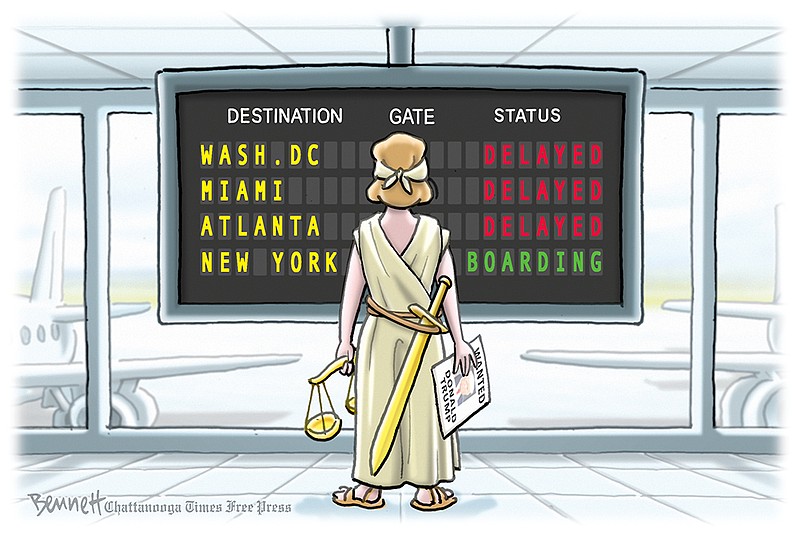
Donald Trump is testifying today in the New York civil fraud trial against the Trump Organization. Last week, Trump sons Don Jr. and Eric testified, and Ivanka is due up on Wednesday.

Last Friday on MSNBC’s “Deadline White House”, former DoJ official Andrew Weissman outlined the standard Trump family strategy on testifying. (Sorry I can’t find video on this or quote him exactly.)

The first ploy, Weissman said, is to claim to be the smartest person in the room. You see this, for example, in things Trump has said about valuing Mar-a-Lago: He knows what it is worth, and nobody else’s opinion matters. Appraisers don’t know, assessors don’t know, accountants don’t know — but he knows. When that fails, the back-up ploy is to claim to be the dumbest person in the room: It’s not my job to know these things; I have people for that. I just do what the accountants and lawyers tell me.

It will be interesting to see which way Trump himself goes today.

Don Jr. and Eric were using the second ploy in their testimony. Junior’s Wharton MBA, he testified, doesn’t mean that he knows anything about accounting. (I have it on good authority that other Wharton MBAs were mortified by this.) The accountants, the Trump sons both claimed, did the financial statements and they just signed off on them.

Both of them were tripped up by Assistant Attorneys General Colleen Faherty and Andrew Amer, who produced emails and other documents the sons couldn’t explain.

If you’ve ever had somebody else do your taxes, you should understand that accountants don’t work the way the Trumps claimed. Accountants are not auditors; they apply laws and rules to the numbers you give them. If you lie to your accountant about, say, what you spent to keep your home business operating or how much you paid for the house you just sold, it’s not up to the accountant to do an independent investigation and correct you.

Same thing here: When Trump claimed his Trump Tower apartment was three times its actual size, it wasn’t the accountants’ responsibility to get out a tape measure and check.

and tomorrow’s elections

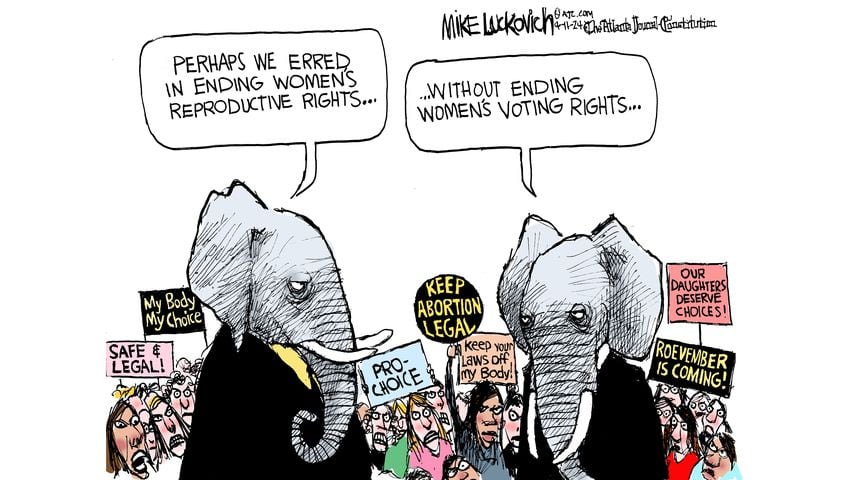
Ohio votes on whether to guarantee a right to abortion. Kentucky and Mississippi have surprisingly competitive governor’s races. And Virginia’s legislative elections will tell us whether the issues Glenn Youngkin won on two years ago still resonate.

this week’s best schadenfreude moments

Now that Mark Meadows appears to be offering testimony that contradicts what he said in his book, his publisher is suing him.


Crypto-currency fraudster Sam Bankman-Fried was convicted on all counts. Wikipedia sums up his spectacular fall:

Prior to FTX’s collapse, Bankman-Fried was ranked the 41st richest American in the Forbes 400, and the 60th richest person in world by The World’s Billionaires. His net worth peaked at $26 billion. By November 11, 2022, amid the bankruptcy of FTX, the Bloomberg Billionaires Index considered his net worth to have been reduced to zero.

The satirical NYT Pitchbot‘s take:

If the federal prosecutors can put Sam Bankman-Fried in jail for stealing billions of dollars, imagine what they can do to you.

but hardly anybody has been talking about the World Series

If you’re younger than, say, 50, you probably have no notion of what the World Series meant when I was growing up in the 1960s. For a little over a week, the world all but stopped. If somebody was playing football on Saturday or Sunday, nobody noticed.

And it wasn’t just the sports world that ground to a halt: The games were all played in the daytime until 1971, and radio broadcasts echoed through factories and other workplaces. Young fans like me applied considerable ingenuity to sneaking radios into our classrooms. (If you could stuff one of the cheap new transistor radios into a shirt pocket and cover the bulge with a sweater, you could thread the earphone cord under a sleeve as far as your left wrist — or right wrist if you were left-handed. Then you could prop your head up palm-to-ear while pretending to do schoolwork with your dominant hand.)

There were no “playoffs” until 1969, and no “wild card” teams until 1995. The regular-season champion of the National and American Leagues played each other, and since there was no interleague play during the season (until 1997), the two leagues were impossible to compare. So the Series held a considerable mystique: These match-ups — Mickey Mantle facing Sandy Koufax or Bob Gibson — could only happen in an All-Star game or a World Series. No one knew what to expect.

That mystique cloaked a difficult truth about baseball: Unlike football or basketball, baseball is so inherently random and streaky that you can’t tell how good a team is by watching it for only a week or two. (For example, countless no-name pitchers have thrown no-hitters during their one magical day in the sun, only to immediately fade back into obscurity.) So while it was undoubtedly true that occasionally the lesser team won the World Series (like the Pirates beating the Yankees in 1960 despite being outscored 55-27 over the course of seven games), it was easy to suspend disbelief and convince yourself that the winner was indeed the best team.

That’s much harder to do now. Twelve teams — nearly half of the 30-team league — get into the playoffs, so one or two of them are bound to get hot and play way over their heads for a few weeks. Whichever two teams are most favored by luck and circumstance will meet in the World Series, and one of them will win. Is that “champion” the best team in baseball? Don’t be silly.

Under the pre-1969 system, this year’s World Series would have featured the Orioles (101-61 in the regular season) against the Braves (104-58), instead of the Rangers (90-72) against the Diamondbacks (84-78). An Orioles/Braves series would have been the culmination of the drama fans had been watching all summer. (Within the National League, the Braves/Dodgers pennant race would have been epic.) Instead, those of us living outside of Texas and Arizona were scratching our heads saying, “Wait. Who are these guys again?”

Or we just ignored it. Because “World Series winner” — the Rangers this year, in case you hadn’t heard — has just become a line in a record book. It doesn’t actually mean anything any more.

and you also might be interested in …

The latest set of polls from NYT/Siena aren’t good, and aren’t good in mysterious ways: Trump has a surprising amount of support among young voters and voters of color.

I finally broke down and subscribed the The Status Kuo blog by Jay Kuo. His latest post is “One Year Out from Election 2024“, and it roughly parallels the argument I made in “About the Polls” in September. He is concerned about the polls, but still thinks Biden is in a far better position than the polls make it appear.

David Roberts:

Every single Dem presidential candidate of my lifetime, the tag-team of RW media & shitty MSM has honed in on some (often silly) weakness & beaten it to death. Gore is insincere; Kerry’s a flip-flopper; Clinton had her emails; Biden’s age. Only Obama has escaped this. …

Any realistic alternative to Biden would also be tagged with some flaw, some Thing, some narrative that the media beat to death until the public started repeating it back to them. It’s structural, just how the game works.

And then we’d get calls to shove that person aside in favor of some other even-more-unicorn unicorn that would not be subject to the same shit. There is no unicorn. Solve the structural information problem or things keep getting worse.

It reminds me of a refrain I’ve heard so often in climate/energy over the years: “they’ve polarized X, let’s talk about Y instead.” Dudes. They can polarize anything! They’ve spent decades building a giant polarization machine! There is no non-polarizeable term/tech/policy!


The vote to expel George Santos from Congress failed. But the interesting voice here is Jeff Jackson, a Democrat who voted not to expel him. Jackson points out that an Ethics Committee report on Santos is due in two weeks. The Ethics Committee process that gives investigated members certain rights, and expelling Santos without the report would set a bad precedent. Jackson fully expects to vote to expel Santos after the report comes out, but not until then.

He anticipates an objection:

“But Jeff, the other side doesn’t care about precedent or due process!” Perhaps, but I do. And I think we all should. So that’s the standard I’ll defend.

MSNBC’s Hayes Brown argues the other side:

The bigger threat, as I see it, is not that members are kicked out too easily for partisan reasons. It’s that members who are clearly unfit to serve are permitted to remain because of the letters next to their names.

and let’s close with something anachronistic

I’ve closed with this 2Cellos video before, but not for nine years. This 17th-century performance of AC/DC’s “Thunderstruck” is worth a second look.

Just for reference, here’s AC/DC’s original.

Worldviews

Someone asked me today in the media, “People are curious, what does Mike Johnson think about any issue?” I said, “Well, go pick up a Bible off your shelf and read it. That’s my worldview.

Speaker Mike Johnson to Sean Hannity

This week’s featured post is “Mike Johnson is worse than you think“.

This week everybody was talking about the new speaker

Wednesday, the House ended three weeks of chaos by electing Mike Johnson (R-LA) Speaker of the House on a party line vote. The featured post outlines why Johnson scares me more than some random right-wing extremist with similar views on most issues: Mike Johnson is a Christian Nationalist. So he feels perfectly justified in ignoring the will of the electorate and imposing his moral vision on us.

But there’s more to think about here than just Johnson. Last week I may have raised your hope that non-MAGA Republicans had found their backbones. I apologize. After watching the MAGA wing torpedo Tom Emmer’s candidacy for speaker, his supporters gave in and voted unanimously for Mike Johnson, whose ideology differs from Jim Jordan’s only by being more theocratic.

Ken Buck of Colorado is a prime example. Two weeks ago, in an interview with MSNBC’s Katy Tur, Buck seemed to be taking a principled pro-democracy stand:

I asked [Steve Scalise] last night: “Will you unequivocally and publicly state that the election, the 2020 presidential election, was not stolen?” He didn’t answer that question very clearly and Jim Jordan didn’t answer that question very clearly.

But then he backed down and voted for Johnson, who led 100 Republican members of Congress in supporting an unsuccessful lawsuit by the Texas attorney general that would have invalidated the electoral votes of Georgia, Pennsylvania, Michigan, and Wisconsin. Without those states, Joe Biden would not have had 270 electoral votes and the outcome of the election would have been thrown into dispute. (The Supreme Court refused to consider the case on the grounds that Texas had no standing.)

After casting his vote in support of Johnson on Wednesday, Buck told CNN that he had not heard Johnson acknowledge that President Joe Biden won the 2020 election, as he had previously demanded of Jordan and Scalise.

“I have not gotten that promise from Mike,” Buck said. “I hope he comes around to that point.”

Here’s how much respect Johnson has for Buck’s question: When Johnson faced the press for the first time as speaker, ABC’s Rachel Scott tried to ask something similar. She was shouted down by the Republican congresspeople surrounding Johnson, highlighted by North Carolina’s Virginia Foxx yelling, “Shut up! Shut up!” The Hill describes the Speaker’s response:

Johnson smiled, shook his head and said “next question.”

That seems to be Speaker Johnson in a nutshell: He dresses more neatly than Jim Jordan, keeps his cool, and is not as uncouth as Virginia Foxx. But he’s on the same page, and will unapologetically take advantage of their rudeness.


In the same Katy Tur interview, Rep. Buck mentioned that he wanted assurances from the speaker candidates that they would bring Ukraine funding up for a vote. It looks like he didn’t get that from Johnson either. Thursday, Speaker Johnson announced that he intended to separate Ukraine and Israel funding bills. The implication of that is that each bill would be subject to the Hastert Rule, which does not allow votes on bills that don’t have majority support inside the Republican caucus. Ukraine aid is a close question within the caucus, so it may not come up for a vote in the full House, where it would surely pass.

and the Israel/Gaza war

Unless you implicitly trust one side or the other, it’s hard to get any clear idea of what’s going on in Gaza. Bombs are falling, and whatever anyone intends, they fall (like the rain) on the just and the unjust alike. A ground invasion has started, but doesn’t seem yet to be an all-out assault. Such an assault may still be coming, but it might not.

The possibilities for the war to expand are numerous. A northern front could open between Israel and Hezbollah. A uprising in the West Bank is possible. I’ve seen a claim on X/Twitter — God knows if anything on X is true these days — that Israeli settlers are attempting to expel Palestinians. Peter Beinart believes this report enough to claim he saw it coming in his article last spring: “Could Israel Carry Out Another Nakba?“.

and another mass shooting

This is America, so you don’t have time to process one shooting before the next one happens. Saturday night, shots were fired in Tampa’s Ybor City neighborhood.

A shooting erupted in the middle of Ybor City after a Saturday night full of Halloween celebrations, leaving two dead and at least 18 people injured, Tampa police said.

But you may not be ready to think about that yet, because the rampage in Lewiston, Maine Wednesday evening is still so fresh. A shooter attacked random people in a bar and in a bowling alley, killing 18 and wounding 13. (Early reports that 50-60 people had been injured were wrong.) The shooter has been identified as Robert Card, and his body was found Friday; apparently he killed himself.

If you wanted to make the point that American gun laws are insane, you could hardly have designed an event more perfectly. In July, Card bought a Ruger SFAR high-powered rifle and a Beretta semi-automatic pistol. Ten days later, while serving as an Army reservist at a camp in New York,

the army gave Card a “Command Referral” to seek treatment after he told army personnel at Camp Smith Card had been “hearing voices” and had thoughts about “hurting other soldiers.” A National Guard spokesperson confirmed to CNN Card was transported to the nearby Keller Army Community Hospital at the United States Military Academy for “medical evaluation,” after Army Reserve officials reported Card for “behaving erratically.”

His family was also worried about him.

Card’s family told NBC News on Thursday that he had been hearing voices for months. “His mind was twisting them around,” said Katie Card, the suspect’s sister-in-law.

She said the family reached out to police and Card’s Army Reserve base as they “got increasingly concerned.”

Unfortunately, Maine only has a “yellow-flag law”, a watered-down version of the red-flag laws 21 other states have.

Even though Card underwent psychiatric treatment, [Nick] Suplina [senior vice president for law and policy at Everytown for Gun Safety] said he believes that would not have immediately set Maine’s yellow flag law into motion because that process involved a law enforcement agency in a different state. [New York]

The family would have likely had to contact police in Maine, starting a new process, Suplina said.

So in the United States, or at least in Maine, you can be crazy, people can know you’re crazy, there can be a recent record of you buying a gun suitable for mass killing, and nobody can do anything about it.

I’ve heard several local people explain that implementing a more effective red-flag law hadn’t seemed all that urgent, because Maine (and particularly a small town like Lewiston), just didn’t seem like the kind of place where these things happen. But the inadequacy of that kind of thinking has been exposed over and over again: Parkland, Florida wasn’t the kind of place where these things happen. Neither was Uvalde, Texas or Newtown, Connecticut. After last year’s Fourth of July shooting in Highland Park, Illinois, I tried to explain what that meant:

I don’t think I’ve ever been to Highland Park, and you probably haven’t either. But you’ve seen it. The movies use Chicago’s North Shore suburbs to symbolize affluent communities so sheltered from the scary aspects of modern life that teens have to seek out adventure for themselves. Ferris Bueller lived in Highland Park; so did Joel Goodsen from Risky Business. That idyllic family life The Good Wife had before her crooked-politician husband went to jail and everything fell apart? It was in Highland Park. The town sits between Lake Forest, where 1980 Best Picture Ordinary People was set, and Winnetka, site of the Home Alone house. (But parts of that movie were shot in Highland Park too.)

During their glory days with the Bulls, basketball legends Michael Jordan and Scotty Pippen had Highland Park mansions. Jefferson Airplane’s Grace Slick was born there. About 30K people live there now, and the 2010 census says the median household income is over $100K.

Here’s what I’m trying to get across: If a mass shooting can happen in Highland Park, it can happen anywhere. It can happen in your town too.

So me say it again: As long as we have these crazy gun laws, we’re all vulnerable.


Meanwhile, the Supreme Court is hearing a case that could invalidate another kind of red-flag law: one that takes guns away from domestic abusers. Such laws are excellent from two points of view:

  • They undoubtedly save the lives of spouses, children, and other close associates of violent individuals.
  • And they probably prevent mass shootings, because mass shooters often start on a smaller scale, with violence against the people closest to them.

But maybe a law disarming domestic abusers is one of those nice things we just can’t have in the United States, at least not under this Supreme Court.

According to Vox’ Ian Millhiser, Zackey Rahimi is “an individual that no sensible society would allow to have a gun”. Allegedly, in addition to assaulting his girl friend in a parking lot, Rahimi fired a gun at a bystander who witnessed the incident. He was involved in five other shooting incidents in a little over a year.

And yet, an appeals court recently found that Rahimi has a constitutional right to own a gun. In fact, any law that tries to take his guns away is unconstitutional on its face.

That means that, if the Fifth Circuit’s decision is upheld by the Supreme Court, this federal ban on firearm possession by domestic abusers may never be applied to any individual, no matter how violent that individual may be and no matter how careful the court that issued a restraining order against such an individual was in ensuring that they received due process.

But we haven’t gotten to the craziest part yet: That result is a correct application of the doctrine Clarence Thomas laid out in the 2022 Bruen decision.

Bruen held that, in order to justify nearly any law regulating firearms, “the government must demonstrate that the regulation is consistent with this Nation’s historical tradition of firearm regulation.” This means that lawyers defending even the most widely accepted gun laws, such as the federal ban on gun possession by domestic abusers, must show that “analogous regulations” also existed and were accepted when the Constitution was framed — particularly if the law addresses “a general societal problem that has persisted since the 18th century.” If they cannot, the challenged gun law must be struck down.

And that’s where we’re out of luck. Domestic abuse certainly existed in the Founding Era, but it wasn’t considered a crime. And there’s no contemporary record of any law taking flintlock pistols away from wife beaters. So unless the Court wants to backtrack on a fairly recent decision, Rahimi (and even worse people) will get to keep his guns.

and the Trump trials

Another of Trump’s co-defendants in the Georgia RICO case pleaded guilty Tuesday: Jenna Ellis.

Ellis, who once described herself as part of an “elite strike force team” of attorneys pursuing unfounded claims of election fraud, pleaded guilty to one count of aiding and abetting false statements and writings.

“If I knew then what I know now, I would have declined to represent Donald Trump in these post-election challenges,” a tearful Ellis told the judge.

What damage Ellis’ testimony might do to Trump — or to co-defendant Rudy Giuliani, who Ellis worked with closely — is still speculative. In the NYT, Norman Eisen and Amy Lee Copeland cast her as a star witness, but it’s hard to say at this point.

Rudy Giuliani, flanked by cooperating witnesses Sidney Powell and Jenna Ellis.

Two different Trump gag orders were in the news. In the civil fraud trial against the Trump Organization in New York, Judge Arthur Engoron called Trump to the stand, found his testimony not credible, and fined him $10,000. Engoron had earlier issued a gag order on Trump preventing him from attacking officers of the court when Trump had baselessly posted on Truth Social that Engoron’s law clerk was Chuck Schumer’s girlfriend. He had fined Trump $5K when the post persisted on Trump’s campaign website, which his lawyers said was “inadvertent”.

This fine came after Trump told reporters outside the courtroom on Wednesday that “This judge is a very partisan judge with a person who is very partisan sitting alongside him — perhaps even much more partisan than he is.” Judge Engoron took that as yet another reference to his clerk, which Trump denied on the stand. (He claimed he was talking about Michael Cohen, who had appeared that day as a witness. Attacking witnesses is also typically frowned upon.) This was the claim Engoron said he didn’t believe.

Meanwhile, Judge Tanya Chutkan (presiding in the federal election interference case against Trump) issued a gag order banning him from attacking prosecutors and witnesses in that trial. She stayed the order temporarily while waiting for an appellate court to rule, but then reinstated it when Trump used the temporary break in the order to go after potential witness Mark Meadows.

Trump is claiming that his status as a former president and current presidential candidate gives him rights no other criminal defendant would have. I doubt the appeals court will agree with him.

Ultimately, Trump will have to be found in contempt of court because he is in fact contemptuous of the proceedings against him. Clearly, $10K fines are not going to restrain him. Eventually, we’ll have to see if jail time works.


This should be an exciting week in the New York fraud trial: Don Jr., Eric, and Ivanka are expected to testify.

you also might be interested in …

The Commerce Department reported that the US economy grew at a 4.9% annual pace in the third quarter. (And yes, that number does account for inflation.) The previous week, a report from the Federal Reserve said that both mean and median household wealth is up. In other words, American households are generally richer than they were before the pandemic.

One of the continuing mysteries of American politics is that President Biden consistently polls badly on economic issues, while the country’s economic statistics have been quite good.


Weird weather continues to result from climate change: Hurricane Otis made landfall near Acapulco as a Category 5 storm Wednesday. It is the only Cat 5 storm to hit the Pacific coast, and intensified from a mere tropical storm in less than 24 hours.


Virginia holds its elections in odd years, making the state a possible bellwether of national trends. Two years ago, Glenn Youngkin’s upset victory in the governor’s race drew attention to critical race theory and other right-wing education tropes.

A week from tomorrow, the governorship is not on the ballot, but control of the legislature is. Democrats currently hold a small majority in the Senate and Republicans in the House.


Here are a few things Trump said in Sioux City, Iowa yesterday. He bragged about being willing to ignore our NATO obligations.

I remember, the head of a country stood up and said, “Does that mean that if Russia attacks my country, you will not be there?” And I said, “That’s right. That’s what it means. I will not protect you.”

He said hello to Sioux Falls, not realizing where he was. (Sioux Falls is in South Dakota.) And he claimed that Hungary shares a border with Russia.

The NYT collects some of Trump’s other recent blunders: He warned that the US is on the verge of World War II. He bragged about being ahead of Barack Obama in the polls, and claimed that he beat Obama in 2016. He referred to Hungarian President Viktor Orban as the president of Turkey. He pronounced Hamas as if it were hummus.

But Biden is the one who’s out of it because he’s too old.


Mike Pence suspended his presidential campaign. From the beginning, his campaign has felt like one of those moments in football when a quarterback cocks his arm and I think, “Where is he throwing that?” And sure enough, the pass goes right to a defender and gets intercepted.

Same thing here. I never understood what voters Pence was targeting. MAGA voters resent Pence for not cooperating in Trump’s coup. Non-MAGA voters resent Pence for staying loyal to Trump right up to moment of the coup. Maybe he thought that he could reclaim the Evangelical voters he led to Trump in 2016, but they’re long gone. In the GOP, the good-Christian-family-man boat sailed a long time ago.

He should have thrown the ball out of bounds and punted.


You may not know about Conservapedia, the conservative alternative to the “liberal” (i.e., reality based) Wikipedia. But Kat Abu pays attention to these things, while managing to keep her sense of humor.

and let’s close with something massive

There’s something really primal about singing along with large numbers of people. Also, large groups often sound surprisingly decent. (The notes sung tend to average out on the right ones.) Astrid Jorgensen of Australia started the Pub Choir project to create singing-together projects on an epic scale.

At Pub Choir events, Jorgensen teaches a well-known song in 3-part harmony to non-trained singers. The performance is filmed and posted on the net.

In this video, Pub Choirs in cities across Australia unite to sing Toto’s “Africa”. The result is strangely compelling, whether you like the song or not.

Null and void

It’s ridiculous that Republicans cannot elect a speaker, but it is also, at this point, unsurprising. A gaping void exists at the center of the populist strain of Republican politics; where the ideas ought to be, you too often find a long, primal scream of “Noooooooo!!!!”

– Megan McArdle
Republicans have created a void that’s becoming harder to escape

This week’s featured post is “The House, still divided“.

This week everybody was talking about chaos in the House GOP

The featured post provides a quick summary of where we are and how we got here, and then references a couple of deeper essays about how the House and the House Republican caucus actually work. But if you’re looking for some clear this-is-what-happens-next-and-when speculation, I don’t have it.


The McArdle quote above (and the article it comes from) makes a good point: Factions compromise with other factions because they have policy goals they want to achieve. But MAGA really has no goals beyond returning Trump to power. Cutting the deficit? No. When Trump was in power and had two years of a Republican Congress, they exploded the deficit with both tax cuts and spending increases. Inflation? They complain about it, but have no plan for addressing it. Crime? Ditto.

I’m sure my Republican readers would add other things they care about: the left-wing capture of schools and education policy, the progressive drift of corporations and the mainstream media, the DEI bureaucracies metastasizing across every class of institutions, the gender-medicine doctors rushing kids onto puberty blockers and hormones. …

But notice how few of the things on the list are things Congress can actually fix, even theoretically.

Imagine that you’re an establishment Republican trying negotiate for MAGA support to become speaker, or that you’re Biden trying to make a deal to keep the government open. What can you offer them that they would actually care about enough to give you something back?


If reality mattered, the House Republican infighting would smash once and for all the myth that Trump is a great deal-maker. He claims that if he were president he could bring Ukraine and Russia to an agreement in 24 hours. But the squabbling among his allies in the House has brought Congress to a standstill for three weeks with no end in sight.

Where is he, and why can’t he solve it?

In the real world, without reality-TV editing to make him look brilliant, Trump is terrible at making deals. He broke two of Obama’s agreements — the Iran nuclear deal and the Paris Climate Accords — claiming each time that he would get a “better deal”. (“I think the people of our country will be thrilled, and I think then the people of the world will be thrilled,” he said about his fantasy Paris renegotiation.) In fact, he got no deal, and in each case the country is worse off than if he had left Obama’s agreements in place.

In 2017, he came within one vote of undoing another long-negotiated Obama compromise, Obamacare. He would have taken health insurance away from millions of Americans — again with no plan to replace it beyond a fantasy.

His big diplomatic “accomplishment”, the USMCA, is basically what Obama had already negotiated as part of the Trans-Pacific Parternship, another deal Trump blew up. His flashy negotiations with North Korea produced a great photo opportunity — which benefited Kim more than anyone — and no substantive progress on the main issue, North Korea’s nuclear missiles. His trade war with China gave him great opportunities to posture, but accomplished nothing.

And then we get to Trump’s #1 issue: immigration and the border. The pieces of a deal have been lying around ever since the Gang of Eight compromise passed the Senate and died in the House in 2013. Neither side likes things the way they are and everybody has something to gain from striking a deal. But even with two years of a Republican-controlled Congress, he got no immigration legislation passed, and even shut down his own government to (unsuccessfully) pressure the Republican Congress to fund his wall.

and war

There are lots of individual stories in the Israel/Gaza war, but the fundamental situation didn’t change much this week: Hamas still holds hundreds of hostages. Israel is attacking Gaza from the air, but hasn’t launched a ground invasion yet. Lots of people in Gaza are dying (though it looks like Israel wasn’t responsible for destroying that hospital). A shipment of humanitarian aid made it into Gaza, but it’s a drop in the bucket.

If Israel has a plan for resolving this situation without killing a huge number of civilians, nobody seems to know what it is. In Israel’s defense, though, I haven’t heard a good suggestion yet for what they should do.


Hamas released two American hostages, but there are still other American hostages in Gaza. Why them? Why now? I don’t think anybody knows.


Biden gave an Oval Office speech to the nation [video, text], explaining why Israel and Ukraine deserve our support. He also said:

the United States remains committed to the Palestinian people’s right to dignity and to self-determination. The actions of Hamas terrorists don’t take that right away.

But without any viable peace plan, it’s hard to take that sentiment seriously, whether it comes from Biden or from Israeli leaders.

Biden also urged Americans not to bring the Gaza conflict home, citing the murder of a six-year-old Palestinian American near Chicago. The article says the boy’s mother came to the US 12 years ago, which would make him an American citizen.

We can’t stand by and stand silent when this happens. We must, without equivocation, denounce antisemitism. We must also, without equivocation, denounce Islamophobia.

And to all of you hurting — those of you who are hurting, I want you to know: I see you. You belong. And I want to say this to you: You’re all America. You’re all America.

Times like these are when I’m most grateful that Biden defeated Trump in 2020. I shudder to think of this kind of crisis going on in the world with Trump posturing and grandstanding and appealing to everyone’s worst impulses.


I’m impressed that the White House text of Biden’s speech includes his handful of verbal stumbles and misstatements. For example, he referred to Netanyahu as “president” rather than “prime minister”. The text corrects that mistake with a strikethrough, but doesn’t pretend he didn’t say it.


Ukraine’s summer offense didn’t gain much ground, but their increasing drone and missile capability has challenged Russia’s dominance of the Black Sea.


Mitch McConnell is still on board with helping Ukraine defend against Russia’s invasion:

No Americans are getting killed in Ukraine. We’re rebuilding our industrial base. The Ukrainians are destroying the army of one of our biggest rivals. I have a hard time finding anything wrong with that. I think it’s wonderful that they’re defending themselves- and also the notion that the Europeans are not doing enough. They’ve done almost 90 billion dollars, they’re housing a bunch of refugees who escaped. I think that our NATO allies in Europe have done quite a lot.


I was late finding “How Not to Respond to a Terrorist Attack“, which Benjamin Wittes posted the day of the the Hamas attack on Israel. But it’s well worth bookmarking and coming back to after future attacks, wherever they occur and whomever they victimize.

Fundamentally, he urges humility on those of us tempted to comment quickly. What needs to be affirmed in the immediate aftermath of murder is not deep or complex, but very simple: Murder is wrong. Not “wrong, but” or “wrong, except”, but just wrong. There is a strong temptation, which I feel myself, to segue past the tragedy of individual lives cut short, and to talk instead about the larger context, the need for revenge, what I think will or should happen next, how this event proves some other point I often make, and why people who disagree with me are dangerously misguided.

and the Trump trials

Sidney Powell and Kenneth Cheseboro pleaded guilty and have promised to cooperate with Georgia prosecutor Fani Willis. So three of the original 19 defendants in the Georgia RICO case have now pleaded guilty.

By all accounts, Powell and Cheseboro got very good deals, which they took just before their trial was supposed to begin. Neither will do jail time.

There are two theories on how they got such good deals: Either they have really juicy testimony to offer against the other conspirators, including Trump, or Willis really, really wanted to avoid revealing all her evidence and strategy in a trial before Trump’s trial. (Both Powell and Cheseboro had taken advantage of Georgia’s law giving them the right to demand a speedy trial. There’s still no trial date for the other defendants.)

Powell and Cheseboro are widely assumed to be two of the unnamed and unindicted co-conspirators in Jack Smith’s January-6-conspiracy indictment against Trump, but neither has any deal with Smith so far. As long as that’s the case, it’s hard to see what they could testify to for Willis. Either might legitimately plead the Fifth Amendment rather than describe crimes Smith could still indict them for.

If either of them makes a deal with Smith, the floodgates will open.

The biggest immediate impact of the guilty pleas is its effect on Trump politically: It’s hard to claim there was no crime when your former allies have already confessed to crimes.

As for where each fit into the larger conspiracy: Powell was at the center of spreading the Big Lie, as well as the effort to seize voting machines. Cheseboro organized the fake-elector scheme. I would expect Powell’s testimony to be most damaging to Rudy Giuliani and Cheseboro’s to John Eastman, if you’re looking for the next possible dominos. And Mark Meadows was everywhere, so any new testimony might target him.


Judge Chutkan issued a gag order against Trump

All interested parties in this matter, including the parties and their counsel, are prohibited from making any public statements, or directing others to make any public statements, that target (1) the Special Counsel prosecuting this case or his staff; (2) defense counsel or their staff; (3) any of this court’s staff or other supporting personnel; or (4) any reasonably foreseeable witness or the substance of their testimony.

and then explicitly described what is not included:

This Order shall not be construed to prohibit Defendant from making statements criticizing the government generally, including the current administration or the Department of Justice; statements asserting that Defendant is innocent of the charges against him, or that his prosecution is politically motivated; or statements criticizing the campaign platforms or policies of Defendant’s current political rivals, such as former Vice President Pence.

Trump predictably claimed that this order violates his First Amendment rights. This is in line with Trump’s refusal to acknowledge that indictment is a meaningful act. A grand jury of ordinary Americans has found that the evidence of his criminality is sufficiently strong that a trial has to be held. That’s not nothing, and it restricts a person’s rights in ways that are necessary for holding a fair trial.

For example, unindicted Americans are free to travel wherever they want. But if you’ve been indicted, you have to be present when your trial starts. The rights you would ordinarily expect as an American have been narrowed to accommodate your trial.

Again and again, Trump pretends that his indictments are nothing, and so his rights should not be restricted in any way.


Meanwhile, Justice Arthur Engoron, who is overseeing Trump’s ongoing New York $250 million civil fraud trial, fined Trump $5K for violating his previous gag order and threatened to jail him for future violations. The gag order had been issued after a Trump Truth Social post targeted Engoron’s principal clerk.

Consider this statement a gag order forbidding all parties from posting, emailing or speaking publicly about any of my staff

As requested, Trump took down the offending post. But apparently it was still posted on his campaign web site. Trump’s lawyers claimed this violation of the order was inadvertent, but at a minimum it shows Trump and his people failing to take the order seriously.

It’s just a matter of time before some judge has to jail Trump for contempt, because he is in fact contemptuous.


Forbes is claiming that former Trump Organization CFO Adam Weisselberg committed perjury during his testimony at Trump’s New York civil fraud trial. After the report was published, prosecutors cut Weisselberg’s testimony short.

Weisselberg is still on probation after pleading guilty at a previous trial and serving three months in prison.

Significantly, perjury in the first degree is also a felony punishable by up to seven years. But perhaps most importantly, the Manhattan district attorney would not have to undertake a new prosecution of Weisselberg for perjury to move to revoke his probation. It would be enough for the DA’s office simply to convince Judge Juan Merchan that Weisselberg engaged in new, criminal conduct during that [five-year] period.

and you also might be interested in …

Threats and disasters are more newsworthy than positive trends, so it’s easy to imagine the world is in worse shape than it actually is. Brian Klaas calls attention to ten charts of important trends, several of which are encouraging. For example, the percentage of the world’s population living in extreme poverty has been falling for two centuries, and falling faster in recent decades.


Rep. Jeff Jackson’s podcasts have been offering a great inside view of how the House works. Now it looks like North Carolina will gerrymander him out of Congress.


As I envision my next car, I find [one, two] cautionary tales of road trips in EVs. I am leaning towards a plug-in hybrid.


A San Francisco chef describes how his idea of a restaurant has changed post-Covid: small dining room, short menu, no reservations, and a retail shop to even out revenue. He thinks this model will catch on.

and let’s close with something harmonious

A barbershop quartet demonstrates that all music is really barbershop. A song just takes about 20 years to get there.

Unaffordable Luxury

As a nation, Israelis acted as if we could afford the luxury of a vicious internal fight, the kind in which your political rival becomes your enemy. We let animosity, demagogy and the poisonous discourse of social media take over our society, rip apart the only Jewish army in the world. This is our tragedy. And it carries a lesson for other polarized democracies: There is someone out there waiting to gain from your self-made weakness. This someone is your enemy.

Shimrit Meir

This week’s featured post is “The Weirdness in the House“.

This week everybody was talking about Kevin McCarthy’s downfall

This, and what might happen next, is the subject of the featured post.

and war in Israel and Gaza

Hamas, which controls Gaza, launched a surprise attack on Israel Saturday. The attack was unusually vicious, even by Hamas’ previous standards, and included a massacre of hundreds of Israelis attending a rave. I don’t do breaking news, so I advise you to follow developments through some more comprehensive news source.

I have a muddle of feelings about this:

  • The attacks on Israeli civilians are morally repugnant and should not be tolerated, either by Israel or by world opinion. Israel has every right to defend its citizens.
  • The people of Gaza live under awful conditions and feel abandoned by the outside world. When human beings live in a constant state of despair and hopelessness, some percentage of them will respond violently, even if their violent options are equally hopeless. This should surprise no one. You don’t have to side with Hamas to realize that any outcome leaving Gazans in despair is not a long-term solution.
  • I worry that Israel’s retaliation will be so extreme that those Americans currently saying “I stand with Israel” will be horrified. I will be happy if in the weeks to come I can confess to misjudging the nation and its government. (For comparison, think about all the regrettable things we did after 9-11.)

Predictably, American politicians are using this moment to take potshots at each other. But this did not happen because Biden showed weakness in dealing with Iran, or because Trump and other MAGA Republicans have “embraced the language of isolationism and appeasement” (as Mike Pence charged). This war isn’t about the US. Israel has plenty of deterrence capability on its own, and Hamas attacked anyway.

The most partisan thing I can legitimately say is that the US government would have an easier implementing its response if we had a confirmed ambassador in Jerusalem, our military didn’t have 300 promotions frozen, and the House had a speaker who could put through emergency aid if Israel needs it. But even if we had a full team ready to tackle the crisis, this would have happened anyway. It’s not about us.

and Trump

Every time I think Trump can’t shock me any more, he proves me wrong. This week we heard him go full Nazi in an interview with National Pulse. Talking of migrants at the southern border he said:

Nobody has any idea where these people are coming from, and we know they come from prisons. We know they come from mental institutions and insane asylums. We know they’re terrorists. Nobody has ever seen anything like we’re witnessing right now. It is a very sad thing for our country. It’s poisoning the blood of our country. [my emphasis]

The phrase “poisoning the blood” does two things: It’s a fairly direct racial reference, and it dehumanizes the people it targets. Hitler said something similar in Mein Kampf.

All great cultures of the past perished only because the originally creative race died out from blood poisoning.

At the time, Hitler was just a crazy little man who said outrageous things. Sophisticated Germans knew better than to take his rhetoric seriously.


The other thing we found out about Trump this week is that he disclosed secrets about our nuclear submarines to a foreign national who belonged to his Mar-a-Lago club. I wonder if it ever occurred to Chinese or Russian or Iranian intelligence to give agents $200K so that they could give it to Trump and join Mar-a-Lago.

In 2016, Republicans were beside themselves at the thought that classified information might have made it onto the server in Hillary’s basement, which foreign governments might have been able to hack into. Now we know that Trump just blabs secrets to random people, and they don’t care. Fox News waited nearly 24 hours before briefly mentioning this story.


When he was in office, Trump’s clubs and businesses functioned as conduits for bribery.


Trump has lashed out at his former chief of staff, John Kelly, who recently confirmed reports about Trump’s disrespect for soldiers who died or were wounded in the line of duty. Kelly joins a long list of high Trump administration officials who have bad-mouthed their former boss, calling him “a f**king moron” and many other colorful names.

Can you imagine anything like this happening to Obama? There’s virtually no such thing as an Obama-administration tell-all book. Every Obama-administration account I’ve read paints the President as sharp, compassionate, and basically decent.

and life expectancy

By now probably most of you have heard that life expectancy in the US flattened out in the 2010s (after decades of steady increase) and then started going down even before the Covid pandemic. This week two articles in The Washington Post and one in Vox provided more insight into that phenomenon.

Here’s how Dylan Matthews sums up the public’s prior understanding in Vox:

For the past decade or so, Princeton economists Angus Deaton and Anne Case have been promoting a particular story about death in America. Less-educated Americans, particularly those without college degrees, have seen their life expectancy outcomes diverge from those of more-educated Americans. Much of this divide can be explained through a category that Deaton and Case call “deaths of despair”: deaths from suicide, opioid overdoses, and liver cirrhosis and other alcohol-related causes. The deaths are concentrated in non-Hispanic whites. This phenomenon indicates something is deeply wrong with the way American society treats its most marginalized citizens, including lower-class whites.

But five WaPo reporters tell a somewhat different story: Yes, addiction and suicide are cutting into life expectancy, but the big problem is chronic diseases:

Chronic illnesses, which often sicken people in middle age after the protective vitality of youth has ebbed, erase more than twice as many years of life among people younger than 65 as all the overdoses, homicides, suicides and car accidents combined, The Post found.

In other words, we’re doing a really bad job taking care of people who need low levels of care over long periods of time, like people with diabetes, high blood pressure, or cardiovascular disease. Or maybe people who have survived one bout with cancer and are vulnerable to a recurrence. We’re also bad at helping people live in ways that avoid chronic diseases.

But we’re not failing everybody with chronic diseases, just the poorest and least educated Americans.

Wealth inequality in America is growing, but The Post found that the death gap — the difference in life expectancy between affluent and impoverished communities — has been widening many times faster. In the early 1980s, people in the poorest communities were 9 percent more likely to die each year, but the gap grew to 49 percent in the past decade and widened to 61 percent when covid struck.

The Vox article narrows this down further: The epicenter of the problem is high school dropouts in rural areas. Part of the problem is probably lifestyle choices like smoking and bad diet. Access to healthcare is also part of the story. (In the small town where I grew up, well-to-do people take for granted that you need to seek care in a major city if you have a serious problem. Less well-off people don’t have that option, and poorly educated people may not get good advice on where to go, even if they assemble the resources.)

Matthews makes a good point: While it would be great if the US could implement better health policies generally, narrowing the problem description makes it more tractable.

People dying now cannot wait for the whole US economy to transform to be more worker-friendly, as nice as that might be. They need solutions that are tailored for their specific problems, that can be implemented soon.

A second WaPo article looks at the influence of politics: It compares three demographically similar counties on the shore of Lake Erie: one in red Ohio, one in purple Pennsylvania, and one in blue New York.

New York advances policies that promote public health, while Ohio doesn’t, and Pennsylvania is in between. So New York discourages smoking with high taxes on cigarettes, it enforces seat belt laws more rigorously, and its Medicaid benefits are comparatively generous. The results show up in death rates. And we can only guess how much worse this is going to get, as MAGA politics causes people to lose faith not just in Covid vaccines, but in vaccines and medical expertise generally.

and you also might be interested in …

If you’re worried about President Biden’s mental acuity, you should watch this interview with Pro Publica’s John Harwood. Admitttedly, Harwood asks friendly questions and doesn’t aggressively try to fluster the President. But the questions are substantial, and Biden answers them thoughtfully. He sometimes has to search for words, but he has no trouble grasping what Harwood is getting at, and he gives coherent answers from the heart. He doesn’t have to control the conversation in order to follow it, so he can address the questions Harwood asks, rather than constantly steering the conversation back to some other topic.

You know what else Biden doesn’t do? Lapse into canned talking points or go off into long well-rehearsed monologues about how unfairly he’s been treated. When asked about something tricky, his answers are carefully nuanced. (For example, when asked about former Democrat Joe Lieberman’s work for the No Labels third-party movement, Biden carefully explains that he thinks No Labels is a mistake, but that Lieberman is acting within his rights as an American.)

I’ve been saying for a while that Trump displays far more signs of mental decline than Biden does. I think if you compare this video to any recent Trump speech, you’ll see it.


When Democrats scare themselves about the 2024 election, the possibility always comes up that a third-party candidacy might siphon votes away from Biden and get Trump elected again. But as The Nation notes, it’s not obvious that such candidates won’t pull more votes away from Trump.

Suppose you’re a Republican whose main gripe with Trump is that he promoted the Covid vaccine. You can protest by voting for RFK Jr.


The economy added 336K new jobs in September, and previous monthly estimates were revised upwards by 119K.

One way you can see the slant in American news coverage is the way the monthly employment reports get covered.

The US economy added 336,000 jobs in September, highlighting concern that the labor market isn’t cooling as fast as the Federal Reserve would like in its battle against inflation.

Bad news: More people are working and their wages are rising.

OK, that’s Yahoo Finance, so you’d expect their coverage to be aimed at investors rather than working people. But the same themes showed across the board: More people working for more money is at best mixed news, rather than the outcome our economic policies should be trying to achieve. Matt Yglesias tweeted an image of the headlines on the NYT home page, and commented:

The NYT covered the jobs report from four different angles, none of which involved the possible benefits of more people getting jobs.

I don’t think there’s anything intentionally sinister in this kind of coverage, but it does reflect the skewed motivations built into our commercial media: News companies rely either on people with enough disposable income to subscribe, or on advertisers, who want to reach consumers with money to spend. So news coverage is aimed primarily at people with money, rather than at people who are working for hourly wages or trying to find a job.

Fox News’ coverage, on the other hand, was sinister: They felt a need to actively misrepresent the report. Jesse Watters says “the Biden administration” (actually the nonpartisan Bureau of Labor Standards, the same career bureaucrats who produced these reports under Trump) is “cherry picking and double counting”, because government jobs (73K new jobs in state and local government, but still 2K below the pre-Covid level) shouldn’t count (because public school teachers don’t really have jobs, I suppose), and jobs in the hospitality industry “like bartenders hostesses, waitresses” are “not really careers”. And Charles Payne declared “it was not a strong jobs report” because leisure and hospitality jobs (accounting for 96K of the 336K new jobs) are “the lowest paying jobs in America” — ignoring the fact that average hourly wages rose slightly (by 0.2%) during the month and the average workweek was unchanged.


While we’re discussing Fox, The Five’s co-host Greg Gutfeld started out talking about a Philadelphia DA’s light treatment of shoplifters and looters, segued to how unfair it was that 1-6 rioters didn’t get a similar “criminal mulligan”, and then went totally off the rails, claiming that “elections don’t work” and “you need to make war” like we did to end slavery.

The race-baiting in Guttfeld’s rant was barely cloaked at all. “They” (the looters) get off easy because they’re “the oppressed”, while “we” (1-6 rioters) don’t because we’re “the oppressors”. In case you didn’t catch that, Black criminals get treated better than White patriots.


About shoplifting and other retail theft: Retailers appear to be using crime as an excuse to close stores that they wanted to close for other reasons. “Shrink”, the technical term for inventory losses as a percentage of sales, rose only slightly from 2021 to 2022. 2022’s shrink was the same as it was in 2019 and 2020. Crime appears to have been no worse at the stores Target closed than in similar stores that stayed open.


The NYT ran an apparently even-handed story about two families who moved to a different state for reasons related to politics: the Nobles moved from red Iowa to blue Minnesota, and the Huckinses from blue Oregon to red Missouri.

I’m biased here, but the two cases don’t look that similar to me. The Nobles move from suburban Des Moines to suburban Minneapolis because they have a transgender son whose treatments and school-bathroom use have become illegal in Iowa. That’s a genuinely political motive.

But the Huckinses move from a neighborhood in Portland where they didn’t feel safe to a small town in Missouri where they can leave their truck unlocked and play with their grandchildren, who already lived there with Ginger Huckins’ daughter from a previous marriage.

Both families say they’re happier in their new homes. But Steve and Ginger Huckins are better off for reasons only tangentially related to politics: their grandchildren and the small-town lifestyle. I’m sure Oregon also has small towns where they could feel safe, and Missouri includes St. Louis, where they might be no safer than in Portland. (I live in a blue Boston suburb where people aren’t very rigorous about locking things up and I never worry about walking home after dark.)

The Nobles, on the other hand, are running away from acts of the state legislature, which would create problems for their family in any part of Iowa. The article makes me wonder if there are any blue-state refugees who are truly parallel to the Nobles. I suppose someone might move to avoid taxes (one of the Huckinses’ complaints) or regulations on a business, but even those reasons seem weak compared to the state persecuting your son.


We don’t know the whole story yet, but Arkansas Governor Sarah Huckabee Sanders might be taken down by a scandal centering on a $20K podium.


My Facebook friend Jennifer Sheridan (who designed the t-shirt I’m wearing in my FB profile photo) wrote:

I think I have figured out something important about the Book Banners.

When I was a kid in school, I was a book nerd, and my friends were book nerds, and we all knew which books had “dirty parts.” We would read them, probably giggle a bit, and then get on with our lives. No one ever made a big deal about it, it was nothing.

And I realize looking back, that if you weren’t a book nerd in school, you probably don’t know there have ALWAYS been library books that had dirty parts.

If you are a grown person now, and are hearing “filthy” passages from some books that are popular today, you might find it shocking that books with those kinds of passages can be found in public school libraries.

But because you didn’t read as a kid, you think this is all something new. It isn’t new; you’ve just shown you never cared about books.

I’ll just add that I went to a religious elementary school, so I knew where all the dirty parts of the Bible were.

and let’s close with something untranslatable

One of my favorite books to randomly page through is As They Say in Zanzibar by David Crystal, a collection of proverbs and sayings from other cultures. How else would I discover that in Ukraine they say “Those who have been scalded with hot soup blow on cold water.”

Sometimes these words of wisdom seem to contradict each other. For example, Canadians are credited with “Crooked furrows grow straight grain” while on the Ivory Coast they say “A crab does not beget a bird.”

And then there are sayings that are just obscure, like the Slovenian “When you are chased by a wolf, you call the boar your uncle.”

Almost as much fun are idioms from other languages. When a someone is very stubborn, Russians say “You can sharpen an ax on his head.” To the Portuguese, taking the blame for something you didn’t do is “paying the duck”.

Where we say that something easy is “a piece of cake”, the Poles say “It’s a roll with butter.”

Simple Propositions

You guys, the UAW — you saved the automobile industry back in 2008 and before. You made a lot of sacrifices. You gave up a lot. And the companies were in trouble. But now they’re doing incredibly well. And guess what? You should be doing incredibly well too. It’s a simple proposition.

President Joe Biden,
on a picket line in Belleville, Michigan on Tuesday

This week’s featured posts are “MAGA and the Swifties” and “When should public officials resign?

This week everybody was talking about the close call on a government shutdown

McCarthy’s sudden reversal made all this week’s cartoons obsolete.

The government did not shut down Sunday morning, and will not shut down until at least November 17.

The shutdown, which had appeared nearly inevitable, was avoided when House Speaker Kevin McCarthy changed his position Saturday morning: He allowed a vote on a short-term continuing resolution. Once the resolution came to the House floor, it passed easily, 335-91. It then went to the Senate, where it passed 88-9. The bill was signed by President Biden Saturday evening with an hour to spare.

The resolution was opposed almost entirely by Republicans: 90 representatives and nine senators. Rep. Mike Quigley of Illinois was the lone Democrat in opposition. Two House Democrats, Rep. Katie Porter of California and Rep. Mary Peltola of Alaska, did not vote. The Republican opposition came mostly from the party’s right wing, the likes of Rep. Matt Gaetz of Florida and Senator Ted Cruz of Texas.

The resolution continues funding government departments at the same levels as fiscal 2023, which ended on September 30. It also added $16 billion for disaster relief, but included no additional aid to Ukraine. (A similar bill in the Senate had $6 billion for Ukraine, but the House bill got through first.)

President Biden believes he has a promise from Speaker McCarthy to allow a separate vote on Ukraine aid soon. However, Biden also believed McCarthy had committed himself to funding the government back when the debt-ceiling deal was reached in June. McCarthy ultimately came through, but not without considerable drama.

It also remains to be seen if McCarthy will continue as speaker. Gaetz and his right-wing allies in the “Freedom” Caucus had threatened to withdraw their support from McCarthy if he made a deal to get Democratic votes, as he did Saturday.

McCarthy has clearly been frustrated by the nihilism of his party’s right wing, which never proposed a government-funding deal it could support. McCarthy told reporters after the vote:

If you have members in your conference that won’t let you vote for appropriation bills, [don’t] want an omnibus and won’t vote for a stopgap measure, so the only answer is to shut down and not pay our troops: I don’t want to be a part of that team.

The next question is whether Gaetz and his allies will carry out their threat to submit a motion to vacate the chair, which would remove McCarthy from the speakership unless Democrats decided to save him. (They say they won’t without getting something in return.) Over the weekend he said he would submit the motion sometime this week. McCarthy responded with bravado: “Bring it on. Let’s get this over with.”

Also: Will anything be different as we approach November 17? McCarthy bought himself (or his successor) some time, but if he has some plan for achieving a less chaotic outcome, he hasn’t revealed it yet.

One final point: The fact that McCarthy’s change-of-mind resolved the issue so quickly is pretty convincing evidence that Republicans were causing the problem.

and the Trump trials

The New York Attorney General’s lawsuit against the Trump Organization won a big victory Tuesday: Judge Arthur F. Engoron issued a partial summary judgment on the case, declaring that Trump had committed fraud by inflating his net worth when applying for bank loans. Because Trump Organization’s fraud is ongoing, the judge

cancelled all of the business licenses for the Trump Organization and its 500 or so subsidiary  companies and partnerships after finding that Trump used them to, along with his older two sons, commit fraud.

His gaudy Trump Tower apartment, his golf courses, his Boeing 757 jet and even Mar-a-Lago could all be disposed of by a court-appointed monitor, leaving Trump with not much more than his pensions as a one term president and a television performer.

Under the New York General Business Law you can only do business in your own name as a sole proprietor or with a business license, which the state calls a “business certificate.”  All of Trump’s businesses were corporations or partnerships that require business certificates.

The judge’s ruling found that a trial was unnecessary to determine fraud, because all the arguments Trump’s lawyers presented in his defense were beside the point.

[The Office of the Attorney General] need only prove: (1) the [statements of financial condition] were false and misleading; and (2) the defendant repeatedly or persistently used the SFCs to transact business.

The instant action is essentially a “documents case”. As detailed [elsewhere in this ruling], the documents here clearly contain fraudulent valuations that defendants used in business, clearly satisfying OAG’s burden.

Trump’s attorneys instead argued a number of legally irrelevant points, like that the banks in fact did not lose money, or that the SFCs contained a clause warning the banks to do their own valuations, or that property valuations are subjective. Their stubbornness in repeating arguments the judge had already rejected as frivolous led the judge to sanction the attorneys $7500 each. (David Cay Johnston notes that this ruling could be cited in some future disbarment hearing.) University of Michigan business law professor Thomas elaborates:

What we’ve seen with Donald Trump over and over again is that often arguments that gain traction with his supporters are flatly inconsistent with the law.

Underlining that point, Trump has continued making the irrelevant arguments rather than addressing the actual ruling.

I’ve heard a number of analogies capturing why the nobody-lost-money argument fails. Here’s my favorite: What if as you were closing up at your job, you stole $100 from the till, then went to the racetrack and bet it on a horse that won? In the morning you could replace the $100, so your employer didn’t lose money. But you’re still a thief.

Probably the most egregious overvaluation was of Trump’s apartment in Trump Tower, which he claimed was three times its actual size and valued accordingly. The judge comments:

In opposition, defendants absurdly suggest that “the calculation of square footage is a subjective process” … A discrepancy of this order of magnitude, by a real estate developer sizing up his own living space of decades, can only be considered fraud.

Of course Trump will appeal, but an appeal is not just a do-over. He’ll have to support an argument that the judge did something wrong. The judge’s reasoning is simple and doesn’t seem to rely on esoteric points of law, so an appeal doesn’t seem to have much to work with.

Meanwhile, a trial on the rest of the state’s charges, including insurance fraud, will begin today. Thursday, the appeals court refused to delay that trial pending a ruling on Trump’s appeal. The trial will also determine the fines Trump will have to pay. The state is asking for $250 million.

Trump has said he’s going to appear in court today, though it’s not clear what he plans to do there, since it’s not time for him to testify, if he intends to do that at all (which I doubt). Trump says a lot of things, so I’ll believe he’s coming when I see him.


In political terms, one consequence of this decision isn’t getting the attention it deserves: Like sexual assault, Trump’s involvement in fraud is no longer just an accusation: It is a finding of a court of law. Trump is no longer just “alleged” to have committed fraud. He committed fraud.


Fani Willis got the first guilty plea from one of her 18 RICO defendants. (It’s kind of amazing this isn’t even the lead story under “Trump trials”.) Scott Hall pleaded guilty to five misdemeanors and was sentenced to five years of probation. He is also committed to testify in future proceedings, and if he doesn’t testify truthfully, the deal is revocable.

Hall’s role in the Georgia election-stealing scheme is both low-level and easily established: When Trump allies were trying to assemble (or invent) evidence of voter fraud in Georgia, they illegally accessed voting machines in Coffee County.

The security breach in the county about 200 miles southeast of Atlanta is among the first known attempts by Trump allies to access voting systems as they sought evidence to back up their unsubstantiated claims that such equipment had been used to manipulate the presidential vote. It was followed a short time later by breaches in three Michigan counties involving some of the same people and again in a western Colorado county that Trump won handily.

… Authorities say Hall and co-defendants conspired to allow others to “unlawfully access secure voting equipment and voter data.” This included ballot images, voting equipment software and personal vote information that was later made available to people in other states, according to the indictment.

In a RICO case, specific crimes like these are used to establish the existence of a corrupt organization that other defendants belong to. Hall’s guilty plea raises the question of whether it will start a stampede to make a deal with Willis before the other defendants do. A defendant’s only leverage in such a deal is if s/he can testify to something Willis can’t already prove.


In other Georgia-election-case news, former Justice Department official Jeffrey Clark and three of Trump’s fake electors lost their bid to move their cases to federal court. Mark Meadows’ similar motion had already been denied, and Trump surprisingly announced he will not try to shift his case to federal court.


Sidney Powell and Kenneth Chesebro are the first of the 18 (now 17) RICO defendants facing trial. They requested a speedy trial, which will begin October 23. CNN has speculated that they will be offered plea deals to avoid this trial, which would preview the state’s evidence to the other defendants.

and the sham impeachment hearing

Like the rest of the House Republican investigations of Joe Biden, the opening session of their impeachment inquiry did not live up to its billing. None of the witnesses called were “fact” witnesses, i.e., none of them saw or heard President Biden doing anything impeachable. The witnesses also made much weaker claims than the Republican congressmen did.

Forensic accountant Bruce Dubinsky: “I am not here today to even suggest that there was corruption, fraud or wrongdoing. More information needs to be gathered before I can make such an assessment.”

Law professor Jonathan Turley: “I do not believe that the current evidence would support articles of impeachment. That is something that an inquiry has to establish.”

That’s a far cry from the claim House Oversight Chairman Rep. James Comer made, that the GOP probes have “uncovered a mountain of evidence revealing how Joe Biden abused his public office for his family’s financial gain.”


A rule of thumb: Investigations that are going somewhere get more and more specific. For example, the Manhattan case about Trump’s Stormy Daniels payoff — widely considered the weakest of the four Trump indictments — has come down to this: 34 Trump Organization documents are fraudulent business records.

The longer the Republican investigation of Biden stays at the level of “Hunter did shady things and Joe must have been involved somehow”, the more likely it is to go nowhere.


A tip on interpreting headlines: When a headline attributes some wrong-doing to “the Biden family“, that means the article contains no new information about President Biden himself. If they had anything on Joe, that would be the headline.

and the rain

Climate Change Summer has turned into Climate Change Fall. Friday, as much as 8 inches of rain fell on parts of New York City, shutting down the subways and producing flash floods. The storm was not due to a hurricane or tropical storm. Instead, seemingly innocuous systems came together unexpectedly to produce a hurricane-like rainfall. The NYT explains:

It has been raining a lot in New York, which hasn’t seen a September this wet in over a century. Climate change is very likely stoking more ominous and lengthy downpours because as the atmosphere heats up, it can hold more moisture, said Andrew J. Kruczkiewicz, a senior researcher who specializes in flash floods at Columbia Climate School at Columbia University.

Scientific American gives the larger context:

The 2018 National Climate Assessment (a new version of which is due sometime this year) found that the amount of rain that fell during the heaviest 1 percent of rain events had increased by 55 percent across the Northeast since 1958, with most of the increase happening since 1996. That trend will only get worse as global temperature rise, causing more evaporation from oceans and lakes and giving storms more water to fuel deluges.

and Taylor Swift

The right-wing attacks against Swift are the subject of one of the features posts.

and two speeches aimed at workers

Biden and Trump each talked to auto workers, but in very different ways. Biden went out on the picket line with UAW strikers and addressed them with a bullhorn. In addition to the quote at the top of this post, he said:

Wall Street didn’t build the country. The middle class built the country, and unions built the middle class.

Biden handed the bullhorn to UAW President Shawn Fein, who said:

These CEOs sit in their offices, they sit in meetings, and they make decisions. But we make the product. They think they own the world, but we make it run. 

Whether we’re building cars or trucks or running parts distribution centers; whether we’re writing movies or performing TV shows; whether we’re making coffee at Starbucks; whether it’s nursing people back to health; whether it’s educating students, from preschool to college — we do the heavy lifting. We do the real work. Not the CEOs, not the executives.

The next day, Trump was invited by management to speak at a non-union auto parts shop.

About 400 to 500 Trump supporters were inside a Drake Enterprises facility for the speech. Drake Enterprises employs about 150 people, and the UAW doesn’t represent its workforce. It wasn’t clear how many auto workers were in the crowd for the speech, which was targeted at them.

One individual in the crowd who held a sign that said “union members for Trump,” acknowledged that she wasn’t a union member when approached by a Detroit News reporter after the event. Another person with a sign that read “auto workers for Trump” said he wasn’t an auto worker when asked for an interview. Both people didn’t provide their names.

In other words, Biden lent his support to an event workers started on their own, while Trump staged a event for the cameras, complete with extras playing phony roles. His support for working people is about as authentic as his property valuations or his marriage vows.

and Cassidy Hutchinson’s book

I read Cassidy Hutchinson’s new book Enough. A lot of what’s in it is stuff you already know if you watched her testimony and followed the news about her.

But it does make it easier to understand how she could fall under Trump’s spell: She had a psychologically abusive father whose approval she valued but could never secure. He was a head-of-the-household type who had big plans, but was never wrong. It was up to Cassidy’s mother to make the details of those plans work, and to take the blame if things fell apart. So that role was already in Cassidy’s head, waiting for Trump to slide into it.

Her description of the Trump White House resembles an abusive family in a lot of ways. Hutchinson and her boss Mark Meadows lived in fear of Trump’s temper. And if he did erupt, the explanation that he’s an over-coddled asshole wasn’t available to them. Instead, they believed they should have foreseen and prevented whatever set him off.

The book also underlines a problem in our justice system: It’s expensive, even if you did nothing wrong. When Hutchinson got her first subpoena from the January 6 Committee, everyone told her she needed a lawyer. She was driven to use a TrumpWorld lawyer when an independent lawyer quoted her a six-figure price. Only after she got disgusted with herself and wanted to change her testimony did she ask Liz Cheney for help. Cheney gave her a lead on a firm that took her case for free.

This raised a question in my mind: If you’re a witness and not a target of an investigation, and if you intend to answer all questions truthfully, why do you need a lawyer? All the coverage I’ve seen takes the necessity of counsel for granted, so I asked a lawyer I know to spell it out.

He made three points:

  • You don’t always know for sure that you won’t eventually be a target, even if you’re innocent.
  • A lawyer can negotiate about how you’ll testify, to minimize how much the investigation will disrupt your life.
  • If you’re not familiar with all the relevant laws, you may not realize that you violated one. If you did, you may need to negotiate a plea deal or a cooperation agreement.

With Trump and his allies threatening retribution if they ever get back in power, both sides need to think about this problem. Merely witnessing a suspected crime shouldn’t bankrupt you.

and you also might be interested in …

Senator Dianne Feinstein died at the age of 90. Politico looks back at her career.

Governor Newsom is wasting no time in naming her successor: Laphonza Butler, the president of Emily’s List. The official announcement is expected later today.

Newsom had made two pledges, both of which this appointment fulfills: He said he would appoint a Black woman, and that he would not give any of the candidates already running for this seat in 2024 an advantage by naming them as the interim.


I didn’t watch the second Republican presidential debate. In reading accounts of it, nothing made me feel like I missed out.

Ron DeSantis is a terrible strategist. He was riding high immediately after last fall’s midterm elections for a simple reason: He won his race handily, while Trump’s favorite candidates almost all lost. His potentially winning message against Trump was obvious: I can win and Trump will lose again. (If Trump wanted to respond by claiming he didn’t lose, let him. It makes him sound like a whiner. Ask: “So are you living in the White House now or not?” When that sets off another rant, respond with an eye roll and “Whatever.”)

DeSantis’ policy positions should have sounded conservative while remaining vague, giving a wide range of Republicans room to fantasize about the wonderful things he might do after he won.

Instead, he committed to very specific and not very popular policies, like a six-week abortion ban, taking books out of libraries, and seizing control of universities. It’s been all downhill from there.


and let’s close with something out of this world

In 2024, NASA is planning to launch a probe to study Europa, a moon of Jupiter where scientists hope to find an ocean of salty water under a thick crust of ice. The presence of water, kept in a liquid state by friction-producing tides powered by Jupiter’s gravity, opens up the possibility of finding extra-terrestrial life for the first time.

The probe, which NASA is calling the Europa Clipper, would go into orbit around Jupiter in 2030.

Over several years, it will conduct dozens of flybys of Jupiter’s icy moon Europa, gathering detailed measurements to determine if the moon has conditions suitable for life.

“OK,” I imagine you thinking, “but what’s that got to do with me?”

NASA is offering a variety of ways for you to engage with the mission. Inspired by the thought of Europan life, U.S. Poet Laureate Ada Limón has written a poem for the mission “In Praise of Mystery: a Poem for Europa“. NASA’s “Message in a Bottle” campaign invites you to cosign Limón’s message.

The poem will be engraved on the Clipper, along with participants’ names that will be etched onto microchips mounted on the spacecraft. Together, the poem and participant’s names will travel 1.8 billion miles on Europa Clipper’s voyage to the Jupiter system.

Other suggested activities have a more educational flavor: NASA provides material that might nudge you to write your own space poetry. Or you can download a line-drawing of the Clipper and Europa suitable for coloring. The coloring can get even more interesting if you put textured surfaces under the paper.

Strange Behavior

So a Democratic Senator is indicted on serious charges, and no Democrats attacking the Justice Department, no Democrats attacking the prosecutors, no Democrats calling for an investigation of the prosecution, and no Democrats calling to defund the Justice Department. Weird, huh?

Joe Walsh

This week’s featured post is “About the Polls“.

This week everybody was talking about the looming government shutdown

Typically, a government shutdown happens because the House, Senate, and Presidency aren’t all controlled by the same party, and one party wants something the other doesn’t want to give. Attempts to work out a compromise fail, so the new fiscal year starts and big chunks of the government close for lack of money.

So in 1995, Speaker Newt Gingrich wanted major cuts in spending that President Clinton wouldn’t agree to. In 2013, Republicans wanted to defund ObamaCare. Those shutdowns resulted from a dysfunctional inability to negotiate a compromise, but they at least represented a coherent clash of policy goals.

The 2018 shutdown was a bit strange, because during the post-midterm-election session, Republicans still controlled all three power centers, pending a Democratic takeover of the House when the new Congress would be seated in January. In December, Republicans had worked out a deal to fund the government that didn’t include more money for Trump’s Wall. But when he saw how badly that deal played with his base, Trump reneged.

The government was shut down for 35 days, during which time the Democrats took control of the House, ending the possibility of passing a wall-funding bill. So Trump relented, reopened the government, and then declared a national emergency that allowed him to divert money appropriated for other purposes into wall-building.

This year is stranger yet, because the Republican majority in the House can’t even agree on a set of demands, much less negotiate a compromise with the Democratic Senate and White House.

Here’s how everyone expected the process to work: Speaker McCarthy would placate the far-right “Freedom” Caucus by passing what is know as a “messaging bill” — a bill that everyone knows has no chance to become law, but which includes provisions that express what the MAGA base really wants. Of course the messaging bill would be rejected by the Senate, and then the real negotiating could begin.

The problem is that the House GOP can’t even get its messaging bill together, so negotiations with the Senate and the White House can’t start. The WaPo examines the possibilities, none of which resolve the situation in time to avoid a shutdown.

and corruption

There’s a Democratic corruption story this week: New Jersey Senator Bob Menendez got indicted for accepting bribes. New Jersey Democrats reacted the way a sane party would to such serious allegations.

Calls for his resignation mounted from ethics groups, Republicans and even longtime Democratic allies who stood by him last time, including the governor, state party chairman and the leaders of the legislature. And party strategists and elected officials were already openly speculating that one or more of a group of ambitious, young Democrats representing the state in Congress could mount a primary campaign against him.

Three-term Congressman Andy Kim has already announced his candidacy, posting:

Not something I expected to do, but NJ deserves better.

Joe Walsh comments on all the things that didn’t happen.

So a Democratic Senator is indicted on serious charges, and no Democrats attacking the Justice Department, no Democrats attacking the prosecutors, no Democrats calling for an investigation of the prosecution, and no Democrats calling to defund the Justice Department. Weird, huh?

Also: No calls for violence in the streets or civil war.

The one bad sign from Democrats is that the Democratic Senate caucus seems to be standing by Menendez. He had to resign as chair of the Foreign Relations Committee, but Majority Leader Schumer is not asking for his resignation from the Senate.


And if there’s corruption in the air, there must be a Clarence Thomas story. Pro Publica has been ahead of everybody else on Thomas scoops, and they published a new one Friday: In 2018, Thomas rode on somebody’s private jet — he never reported the trip, so we don’t know whose — to attend the winter donor summit of Stand Together, the Koch-led network of high-roller conservative money men.

During the summit, the justice went to a private dinner for the network’s donors. Thomas has attended Koch donor events at least twice over the years, according to interviews with three former network employees and one major donor. The justice was brought in to speak, staffers said, in the hopes that such access would encourage donors to continue giving.

That puts Thomas in the extraordinary position of having served as a fundraising draw for a network that has brought cases before the Supreme Court, including one of the most closely watched of the upcoming term.

Political fund-raising violates the code of ethics that applies to lower-court judges. But the Supreme Court has no formal code and is expected to police itself.

In 2021, Thomas sided with the Kochs in a 6-3 ruling allowing dark money groups to keep their donors secret. The court will soon hear a Koch-backed case that could sharply curtail the ability of government agencies to issue regulations. Pro Publica claims Thomas has flipped his position to support the Koch view.

Rep. Ted Lieu sums up:

Clarence Thomas secretly accepted millions in lavish gifts from billionaires. He secretly shows up at a fundraiser for billionaires to help raise money for a super PAC. And he votes on cases to help billionaires. This isn’t the appearance of corruption, this is corruption.

and Rupert Murdoch

While Fox News has been focusing attention on Joe Biden’s age issues, Rupert Murdoch has continued to run both Fox and News Corp at the age of 92. This week he announced he will turn the empire over to his son Lachlan, sparking a series of retrospectives about his career.

but we should be paying attention to a court case that hasn’t gotten much coverage yet

I’m becoming dangerously complacent about Supreme-Court-considers-triggering-Armageddon stories. Remember Moore v Harper and the “independent state legislature” theory? The upshot of ISL is that once you get control of a state legislature, you can gerrymander to make your control permanent, and then leverage that power to determine all the other elections in your state. “Independent” means “unchecked by the courts”, which means that if your power grab violates the state constitution, no one can call you on it.

Anyway, that was decided in June, and the Court did not in fact opt to make it easier to end democracy. It was a 6-3 decision, which means that we’re still safe from permanent minority rule, at least until John Roberts and either Brett Kavanaugh or Amy Coney Barrett change their minds. So rest easy, everybody.

Now we’ve got another end-of-the-world-as-we-know-it case coming up: Consumer Financial Protection Bureau v Community Financial Services Association, which will be argued next week and probably decided sometime in 2024.

The origin of this dispute is fairly trivial in the grand scheme of things: CFPB issued regulations cracking down on the payday-lending industry, which could use some cracking down on, because it exploits people who live paycheck-to-paycheck. CFSA represents payday lenders who would rather operate without government interference. So it sued. In the course of that lawsuit, it made an atomic-bomb-scale argument: The whole CFPB is unconstitutional.

Now, you wouldn’t expect mortgage bankers, home builders, and realtors to be fans of federal regulation, but those associations filed a brief warning that striking down all of CFPB’s rules simultaneously could cause the real estate market to seize up, disrupting some large portion of the entire economy, and possibly setting off a Depression.

But it’s actually worse than that, because of course there’s no line in the Constitution saying “Congress shall establish no consumer financial protection bureau”. So CFSA had to make a broader argument: The way CFPB is funded is unconstitutional. Congress doesn’t appropriate a specific amount of money for CFPB each year. Instead, it gets whatever funding it needs up to some cap, and the funding is perpetual until Congress says otherwise.

Here’s the problem, as described by Vox’ Ian Milhiser: If funding something without approving a specific sum each year is unconstitutional, there goes Medicare, Medicaid, Social Security, and a whole bunch of other stuff.

Under this interpretation of the Constitution, moreover, many key federal programs simply could not exist. Medicare, for example, is a health insurance program that pays for beneficiaries’ health costs as those costs arise. It is impossible for Congress to determine, in advance, the specific dollar amount that Medicare will spend in any given year. To do so, Congress would need to precisely predict which health services would be provided to every senior in the United States, and how much each one of those services would cost.

Imagine it: I recently had a fairly expensive medical test. (It came out well. Thank you for wondering.) We’re near the end of the fiscal year, so under a specific-sum appropriation system, Medicare might say, “I’m sorry, but we can’t pay for your test because medical expenses nationally ran a little high this year and we’ve already spent all the money Congress appropriated.” Every year, millions of Americans like me would game the system to get our medical care done in October rather than September. Some number of people would take their chances without care, and some of them would die.

Oh, and all those programs would be vulnerable to government shutdowns — not that we ever have to worry about that.

The hyper-conservative Fifth Circuit appeals court agreed with CFSA.

Consumer Financial reveals just how deeply delusional thinking has penetrated into the post-Trump federal judiciary. The plaintiffs’ arguments in Consumer Financial have no basis in law, in constitutional text, in precedent, or in rational thought. And they risk the sort of economic catastrophe that the United States hasn’t experienced for nearly a century.

And yet a federal appeals court bought these arguments. So now it’s up to the Supreme Court to save the United States from calamity.

It’s a safe bet that Justices Thomas and Alito will vote to blow up the system. (Alito, IMO, is the most predictable judge on the Court. You don’t need to know anything about the facts of the case or the relevant law, just who stands to benefit. He will consistently vote for Republicans over Democrats, corporations over working people, and Catholics over secularists. The CFPB protects working people from corporations, so he’ll be against it.) So we’ll need to count on two of Roberts, Kavanaugh, Gorsuch, and Barrett to save us.

and you also might be interested in …

A deal has been announced, so the writer’s strike may end soon.


Worth reading: the Atlantic article subtitled “How General Mark Milley protected the Constitution from Donald Trump.


The NYT has a disturbing article about China claiming sovereignty over the South China Sea, and how little can be done about it short of war.


Another week of Fox News, summarized by Kat Abu.


This week’s scandal: John Fetterman wears hoodies and shorts. It’s technically a violation of the Senate dress code, but when he’s dressed like that he votes from the doorway.


In the Handmaid’s-Tale dystopia known as Nebraska:

A Nebraska woman who acquired abortion pills that her teenage daughter used to end her pregnancy last year was sentenced on Friday to two years in prison.


Last week, I wondered how conservative media would erupt if AOC were caught doing something like Lauren Boebert’s lewd behavior while watching a musical. Turns out AOC was wondering the same thing.


Jimmy Carter has been in hospice for seven months, but he still enjoys peanut butter ice cream and plans to celebrate his 99th birthday this coming Sunday. Saturday he was spotted at the Plains Peanut Festival.

And while we’re talking about family values (i.e., Boebert), Jimmy and Rosalynn Carter are facing death together after 77 years of marriage.


In the silly-but-amusing category, conservative podcaster Clay Travis tweeted about Kansas City Chief tight end Travis Kelce:

Travis Kelce is doing Bud Light and covid shot commercials. He needs to fire all his marketing agents. Or he needs to just go ahead and cut his dick off, become a chick, and endorse Joe Biden.

And Ron Filipkowski replied:

He scored a touchdown today in a 41-10 win and left the game with Taylor Swift. Seems to be doing ok.


Elon Musk said he wants users to pay a monthly fee to use Twitter.

I’ve used X/Twitter for years now. I use it to cast a wider net for points of view than I’ll find in my usual news sources. I don’t often post content other than links to this blog.

Since Musk took over, I’ve thought about leaving X. And I’ve checked out Mastodon as an alternative. But inertia is powerful, so I’ve stayed.

If they start charging a fee, though, I’ll have to take positive action to stay on X. I’ll have to give them a credit card number or something. Just by doing nothing, I could quit.

I would do nothing, and see how long it took them to turn off my account. I suspect the vast majority of users would do the same. Charging a fee will probably complete Musk’s destruction of the platform, setting fire to the remainder of his $44 billion investment.

and let’s close with something uplifting

The FamilyThis web page has an article about times kids surprised their parents and older siblings with their kindness and compassion. Like this one:

had lunch with my son at school for his birthday. he can pick 2 kids to sit with him and one I had never met. i asked afterward who he was and he said “oh, i don’t really know him but no one had picked him for birthday lunch before”

Pride and violence

I envied the arrogant when I saw the prosperity of the wicked. Pride is their necklace; a garment of violence covers them. From their prosperity proceeds iniquity; the imaginations of their hearts run wild. They mock and speak with malice; with arrogance they threaten oppression. They set their mouths against the heavens, and their tongues strut across the earth.

Psalm 73

This week’s featured posts is “Don’t just connect the dots“. It sets the Biden impeachment in a larger context of conspiracy theory reasoning.

This week everybody was talking about the looming government shutdown

As always, the federal government’s fiscal year ends on September 30, i.e. a week from Saturday. So unless Congress passes and President Biden signs some new appropriation bills in the next two weeks, the government will shut down on Monday morning, October 2.

If the budget process were working the way it’s designed, funding the government would mean passing 12 separate appropriation bills, each covering some set of government activities, like defense. That seems extremely unlikely at this point. The Senate is more-or-less on track, but Kevin McCarthy’s Republican majority in the House can’t unite on a set of proposals, much less get together with the Senate and work out something both houses can pass.

Failing at 12 appropriation bills, the next option is one big omnibus bill, which has happened in recent years, and which House Republicans have been railing against. That doesn’t seem very likely at the moment either.

The third option is a continuing resolution, which allows the government to keep spending money at the same rate as last year, until Congress can get its act together to pass an omnibus. Currently, Kevin McCarthy is trying (and mostly failing) to build support for a continuing resolution.

The far-Right “Freedom” Caucus has made a series of demands for what any continuing resolutions would have to include, such as ending the Trump prosecutions. (Anything to avoid a trial in front of a jury, which would see the evidence and find Trump guilty.)

So we seem headed for a shutdown. The main issue in the shutdown is whether or not McCarthy will fulfill the deal he made with Biden in May to resolve the debt ceiling crisis. The “Freedom” Caucus thinks the spending targets in that deal are too high, so they want to renege.


When McCarthy agreed to open an impeachment inquiry targeting President Biden (without any evidence of wrongdoing), some speculated that he had bought himself credit with the far Right, which would give him some room to maneuver on the spending bills. But, as CNN analyst Stephen Collinson observed, “That narrative barely lasted a day.” Apparently any concession these people get only whets their appetite for more.

and Ken Paxton

Ken Paxton is the corrupt attorney general of Texas.

Even in the long, sordid history of Texas political scandals, Paxton stands out. The accusations leveled against him in 21 years of public life ranged from felonious to farcical: that he duped investors to whom he sold stock, profited from inside information on a land deal, made false claims in court about the 2020 presidential election, and purloined another lawyer’s expensive pen.

Other episodes gave grist to criticism that Paxton considered himself above the law, like when he fled his home last year, in a truck driven by his wife, to avoid being served a subpoena.

In March, the Republican Texas House overwhelmingly voted to impeach him on 16 counts, with 70% of Republicans voting against him. But Saturday, only 2 of 19 Republican senators voted to convict on any charge, and so he was acquitted and returns to office.

What changed? The politics, not the evidence. National Republican groups stirred up the grass roots.

It was made clear to Texas GOP senators that they’d face a very well-funded primary opponent in their next election if they voted to impeach.

“Christian” organizer Nate Fischer argues

I judge politicians on their effectiveness against the left. In an existential war, you do not remove an effective officer—much less cede his position to the enemy—because an affair or gambling problem comes to light. We are in a war for our civilization. Paxton and Boebert have been effective in important battles. But if God could use Samson as his instrument to deliver Israel, I’m skeptical of calls to toss one of our fighters out because he doesn’t meet some standard of conduct that is anything but a uniform rule across the political aisle.

And of course, any conspiracy-theory allegation against a Democrat is evidence that no standard of conduct is “a uniform rule across the political aisle”. So this “Christian” applies no moral standards at all to the conservatives he supports.

Matt Yglesias responds:

This is how corrupt people use culture war hysteria to bait you into sacrificing your interests to advance theirs; it’s the ultimate logic of Trumpism — he may be a thief, a liar, and a scumbag but at least he’s *our* scumbag.

the Hunter Biden indictment

Hunter was indicted on federal firearms charges Thursday. You’d think this would settle questions about the independence of the Justice Department from White House interference, but no.

Hunter could wind up at the center of a legal question that cuts across partisan lines. A federal appeals court representing a different district has found that the law he’s accused of violating conflicts with new Supreme Court precedents and so is unconstitutional. So people on all sides have to ask themselves what’s more important: getting/saving Hunter or gutting/preserving federal gun laws?

and the Trump interviews

Two female journalists did televised interviews with Donald Trump recently: Kristen Welker, as her inaugural broadcast as host of Meet the Press, and Megyn Kelly on her XM Radio show.

It’s hard to say what the point of doing either interview was. Conde Nast Legal Affairs Editor Luke Zaleski summarizes the problem:

Trump doesn’t do interviews. He tells long fake stories that provide an alternate reality in which he’s the hero and allow his audience to conflate themselves with him as he pretends to vanquish imaginary enemies like “Sleepy Joe” “Crooked Hillary” “the Deep State” & “Fake News”

The traditional power of the press comes from its ability to publicly shame a politician for lying or hypocrisy. But Trump has no shame. NYU journalism Professor Jay Rosen describes Welker’s approach as “zero innovation”, meaning that she treated Trump like a typical, shameable public figure.

Everything was predictable, nothing was surprising, and new host Kristen Welker did nothing to justify going to the well again with another Trump Q & A.

So Trump got a platform to spread his usual disinformation, and NBC got to publish a separate fact check, which (as we know) accomplishes little. Unlike a Cronkite-era politician, Trump is not shamed to be caught lying, and his cultists will brush off any fact-checking as “fake news”. Worse, traditional fact-checking is meant for correcting simple lies and misstatements. It can’t cope with a complete alternate reality.

“Pinning Trump down”, as Welker did when she got him to say he would testify under oath that he never ordered a subordinate at Mar-a-Lago to delete security video, is also useless. Making that statement serves Trump’s purposes now — it makes him sound determined and resolute — but when Trump does not testify at all in any of his trials, he will not feel shame for having said that he would.

The end result of this interview is that viewers are more poorly informed about Trump-related issues than they were before they watched. I have to agree with Rosen’s conclusion:

I would love to hear what [MSNBC’s Rachel Maddow] thought about NBC’s interview with Trump. She is the one who said on air: “There’s a cost to us as a news organization of knowingly broadcasting untrue things.” NBC willingly paid that cost today.

Tonight we’ll see a test of Maddow’s integrity: Will she call out her sister network?


Welker also asked Trump: “Is there any scenario by which you would seek a third term in office?” In other words, “Do you intend to ignore the Constitution?”

Trump said “No.” But again, he’s not going to feel bound by that answer, so what’s the point of asking? All Welker did was put into viewers’ minds the idea that seeking a third term (in defiance of the Constitution) is an option.


One upside of Kelly’s interview is that Trump said some things that Jack Smith will probably use against him in court.

I’m allowed to take these documents, classified or not classified. And frankly, when I have them, they become unclassified.

Aside from being nonsense legally, Trump’s statement sounds an awful lot like a confession that he did take classified documents.


It’s a mystery to me why Biden’s mental capabilities are being questioned, but not Trump’s. There could be a story like this every day:

Trump says Joe Biden is “cognitively impaired” and then accuses him of getting us into World War TWO.

Or consider this part of the Welker interview:

You talk about Kim Jong Un, right? I got along great with Kim Jong Un after the first month or two when we were sparring. But I got along great with him. We were in no danger. There was — President Biden said, and he felt even now, and President Obama told me when we sat down, Obama told me, and Biden still to this day, except I don’t think he knows, he’s only — he can’t put two sentences together. But President Obama told me, “Our biggest threat is from North Korea. We’re going to end up in a war.”

Yep. It’s Biden who can’t put two sentences together.

David Roberts raises a worthwhile question:

How would we even know if Trump’s age was affecting his mental acuity? He’s done nothing but ramble sub-literate nonsense since he came on the public stage. Could you even tell if he got dementia?

and Mitt Romney

I’ve always been of two minds about Mitt Romney, an ambivalence that comes through in “The Tragedy of Mitt Romney” which I posted during his primary campaign way back in 2012. At his best, Mitt is a conservative version of Joe Biden: a basically decent person who can listen to members of the other party, define common goals, and occasionally get something important done. RomneyCare, the Massachusetts health insurance program that became the model for ObamaCare, is a prime example.

Mitt’s tragic flaw is that he’s never had quite enough courage to be that person consistently. So he’s been a truth-teller, but only sometimes. Other times, he has pandered to the worst elements in his party. Two examples stand out: His 2012 presidential campaign ran away from his record as governor of Massachusetts, to the point of promising to repeal the same ObamaCare his program had inspired. And he bowed down to Trump during the 2016 transition, hoping to become secretary of state.

This week he announced that he’s not running for reelection in 2024. As a result, he is free from future political considerations and can be a truth-teller again. And so we have “What Mitt Romney Saw in the Senate“, a preview of an upcoming biography by McKay Coppins. The biography comes from long conversations with Romney, as well as access to his papers and journals.

And so we find out:

  • The Republican Senate caucus gave Trump a standing ovation, and then laughed at him after he left.
  • “A very large portion of my party really doesn’t believe in the Constitution.”
  • During Trump’s first impeachment, Mitch McConnell told Romney: “You’re lucky. You can say the things that we all think. You’re in a position to say things about him that we all agree with but can’t say.”
  • “No one has been more loyal, more willing to smile when he saw absurdities, more willing to ascribe God’s will to things that were ungodly than Mike Pence.”
  • Some Republicans wanted to vote for Trump’s second impeachment or conviction, but were intimidated by the prospect of right-wing violence against themselves and their families. At that time, Romney was paying $5K a day for security.

In return for this openness, Romney is being lauded as a man of principle and integrity. And he has been, up to a point and some of the time.

You know what I long for? Republicans who not only speak out against the MAGA usurpation of their party, but take that message to the voters rather than meekly slip out the Capitol’s side door like Romney and Jeff Flake and Lamar Alexander. Maybe such a race is hopeless — it was for Liz Cheney — but people of real principle would make a charge-of-the-light-brigade anyway. To paraphrase the MAGA god himself: If you don’t fight like hell, you’re not going to have a party anymore.

and you also might be interested in …

Climate Change summer is continuing as we approach fall. The worst catastrophes happen when natural disasters cause failures in human infrastructure.

More than 5,000 people are presumed dead and 10,000 missing after heavy rains in northeastern Libya caused two dams to collapse, surging more water into already inundated areas.

Meanwhile, Hurricane Lee spent most of its energy over the Atlantic, but was just 4-mph short of hurricane status when it hit Nova Scotia Saturday. Places like Halifax and Bar Harbor, Maine don’t usually have to worry about tropical storms.


The United Auto Workers are striking against the Big Three American automakers. The Atlantic explains that this is about more than just the usual wages and benefits: Government-subsidized investments in electric vehicle plants are being used to shift production to states that make it hard for workers to unionize.


As you may have heard, Saturday night Rep. Lauren Boebert was escorted out of a production of the musical “Beetlejuice” for vaping, taking flash pictures of the performance, and “creating a disturbance”. Afterwards, she denied vaping, said she didn’t realize she couldn’t take pictures, and admitted “laughing and singing too loud”. Unfortunately for her, the vaping is on video, along with some mutual groping with her date (Boebert’s divorce is still pending), as well as Boebert giving theater employees the finger on her way out the door.

In response to the clear evidence that her denial was a lie, Boebert apologized for the vaping (claiming she “genuinely did not recall” doing it), but did not comment on the public groping.

The incident provoked a stream of what-if comparisons on social media: How would conservative politicians and media personalities erupt if some prominent liberal woman like AOC behaved the same way? Or a woman of color? Or a gay or lesbian politician with a same-sex date? What if Biden did something inappropriate in public, denied it, and then explained away his denial by claiming he didn’t remember?

Who better to comment on Boebert’s “trashy” behavior than fellow “trash monster” Trae Crowder? Boebert’s “vaping and hollering stuff” in the theater doesn’t alarm him:

My fellow Trailer Americans, I ask you: Who among us? Right? I mean, we do that. We do. Get a little too excited at a public event, start cussing in front of the 8-year-olds, then act indignant when the bouncer shows up. “Oh, what? Is it illegal to have a good time now?”

What’s wrong with Boebert, according to Crowder, isn’t that she comes from the underclass, because “some of the most genuine, kindest, most empathetic people I’ve ever known were trailer babies”. We’d do well, he says, to have a Congress full of such people. But Boebert is a “ladder-puller”, who tries “to take away the same government benefit programs that kept her alive as a child”.

Boebert … somehow took all the wrong lessons away from her life and now spends her time spewing misplaced rage and making us all look bad.

BTW: If you want a view of how the world looks to the White rural underclass, I can recommend this year’s Pulitzer-Prize-winning novel Demon Copperhead by Barbara Kingsolver.


While we’re talking about the Party of Family Values, The New York Post claims South Dakota Governor (and rumored Trump VP candidate) Kristi Noem has been having an affair with former Trump advisor Corey Lewandowski. Both are married. All together, the two couples have seven children.


Remember Kim Davis, the county clerk in Kentucky who refused to issue marriage licenses for same-sex couples back in 2015? That case is still percolating through the system. Two couples sued her for damages, and a judge ruled in March 2022 that she had violated their rights. Wednesday, a jury awarded one couple $100K and the other nothing. (I’m not sure what distinction the jury saw between the two couples.)

Davis plans to appeal, on grounds that the current Supreme Court might find tempting:

We will argue religious accommodation under the First Amendment, and other state and federal laws. We will also argue that Obergefell v. Hodges was wrongly decided and should be overturned.

She previously had moved to have her case dismissed, on the grounds that she had immunity for acts performed in her official capacity. But the plaintiffs argued that official immunity doesn’t apply when the official is doing something clearly outside the law. An appellate court refused to dismiss, and in 2020 the Supreme Court decided not to hear her appeal. But this time around could be different, if the current Court is looking for an opportunity to reverse Obergefell.


Two thousand South African rhinos are looking for new homes.


A line too good not to repeat: After Mitch McConnell froze up a couple weeks ago, fellow Kentucky Senator Rand Paul was not all that supportive. Among other comments, he disputed the Capitol doctor’s claim that McConnell had not suffered a seizure, but only the effects of concussion recovery and dehydration.

Afterwards I heard a comment that Rand Paul is “nasty and brutish and short”.

and let’s close with something sentimental

In 1950, Oswald Laurence recorded a message telling patrons of the London underground to “mind the gap”. After Laurence died in 2003, his widow Margaret McCollum began going to the nearby Embankment tube station whenever she wanted to hear his voice.

Eventually, though, the transport company replaced Laurence’s recording with an artificially generated voice. Margaret then asked the company for a recording. But they did her one better: They restored Laurence’s announcement for exactly one station, Embankment.

Basic Understanding

Your letter makes clear that you lack a basic understanding of the law, its practice, and the ethical obligations of attorneys generally and prosecutors specifically.

– Fulton County District Attorney Fani Willis
letter to Rep. Jim Jordan

This week’s featured post is “We’re all in law school now“.

This week everybody was talking about the Trump trials

We’re way past the point where I can hold all the details in my head — even just one week’s events. That’s what this week’s featured post covers.


But that post didn’t cover the freshly released report that the Fulton County special grand jury wrote to recommend indictments it didn’t have the power to issue. The headline result is that it recommended indictments not just of the 19 people who have now been charged, but of 21 others, including Senator Lindsey Graham and former Senators Kelly Loeffler and David Perdue.

The theme of the featured post is that we’re all learning law these days, and here’s the lesson I draw from this report: The special grand jury and the district attorney have different jobs. The special grand jury was answering a simple question: Is there probable cause to claim that these people broke these laws?

The prosecutor is asking a different question: What charges can I present to a trial jury and convince them beyond reasonable doubt?

A second lesson to draw is that Willis is really trying to win a case, not just make a big splash.


The WaPo has a long and fascinating article about the Reffitt family: The dad (Guy) was an armed 1-6 rioter now serving an 84-month sentence. The son (Jackson) turned him in to the FBI and testified against him. The mom (Nicole) still believes Trump won and Guy is a patriot. The daughters (Peyton and Sarah) are caught in the middle.

For years and years we’ve been hearing stories about how families get pulled apart when the kids join a cult. But these days, it’s the parents who are joining a cult.

and the Covid resurgence

Several people I know have caught Covid lately, and we’re heading into the fall, when school begins and social get-togethers move indoors.

But Vox has a reassuring article. The new variant (now named Pirola) doesn’t look that dangerous. Yes, infection rates are rising (even if they’re still nowhere near previous highs), but

over the last few days, several laboratory studies have led to sighs of relief: On a cellular level, Pirola just isn’t that alarming, meaning that the chance this variant will lead to a massive, emergency room-flooding Covid surge is pretty small. Other, less mutated omicron variants remain the dominant strains, and it seems unlikely Pirola will wreak major havoc.

So: Get the updated vaccine when it comes out (soon), use common sense about exposing yourself to crowds, and try not to worry too much otherwise unless you’re specially vulnerable.


More good advice for avoiding Covid: Stay out of Florida. With Governor DeSantis’ vocal support, Florida’s quack surgeon general Joseph Ladapo is urging Florida residents not to get the new Covid vaccine.

Dr Joseph Ladapo, the governor’s hand-picked surgeon general and a vaccine skeptic previously found to have manipulated data on vaccine safety, falsely claimed the new booster shots had not been tested on humans, and contained “red flags”.

His reasoning seems to be more religious than scientific.

Casting the dispute as spiritual warfare, Ladapo posed a rhetorical question: Why did so many people follow DeSantis instead of guidance to the contrary from the national public health establishment — “all these Ph.D.s and M.D.s?”

He imputed this thinking to those people: “I hear what they’re saying, but what he’s saying feels right.”

He continued: “Because there is something within all of us that resonates with freedom. And that something is part of our connection with God and our connection with every single thing around us, including each and every one of us.

“There are these forces out there who are relentless. And they really are relentless. It’s not that they were ever done trying, and they’re not done now. They are relentless, relentless, with every breath that they take. They are thinking about how they can control you. To what ends, only God knows, but it’s nothing pretty, right?”

That’s what passes for thought on the Right these days: It’s totally mysterious why public health officials would want to slow the spread of a deadly virus, so they must have some other motive. And it’s nothing pretty.

and Tommy Tuberville

Up until now, I’ve mostly been ignoring Senator Tuberville’s holds on military promotions, figuring it was a stunt that would come to nothing. But he’s been doing it since February, with no end in sight. More than 300 promotions that need Senate approval are in limbo, and three military services — the Marines, Army and Navy — have acting chiefs rather than Senate-confirmed ones. An estimated 650 promotions could be blocked by the end of the year.

The ostensible root issue is abortion, which now trumps national security on the far Right. When the Supreme Court overturned constitutional protections for reproductive rights in its Dobbs decision, and numerous states began restricting abortions to the point of banning them entirely, the Pentagon recognized that that it had ordered tens of thousands of servicewomen of childbearing age to serve in states where they no longer had control over their own medical care.

Defense Secretary Lloyd Austin responded in October with a policy to:

Establish travel and transportation allowances for Service members and their dependents, as appropriate and consistent with applicable federal law and operational requirements, and as necessary amend any applicable travel regulations, to facilitate official travel to access noncovered reproductive health care that is unavailable within the local area of a Service member’s permanent duty station.

This is what Tuberville objects to. (Notice that the policy does not even pay for abortions. It only pays for travel.) The promotions he is blocking have nothing to do with abortion, but they are the monkey wrench he has access to. The Senate usually passes promotion lists by unanimous consent; going through the names one-by-one could take “months” of dropping all other Senate business, according to Majority Leader Schumer. By refusing consent, Tuberville has brought the promotion process to a halt.

Short-term holds have been used before to call attention to individual officers, and even that has been rare. But shutting down the whole promotion system for months at a time is unheard of.

I said that abortion was the “ostensible” issue, because the more Tuberville talks, the clearer his real problem becomes: The US armed forces are not masculine enough to suit him. (BTW, Tuberville has never served in the military.)

This is a common complaint on the Right. In 2021, Ted Cruz attacked our “woke, emasculated military” by comparing a recruiting ad targeted at women with a much manlier ad for the Russian army. (This was before the Russian military flop in Ukraine. Today, Cruz would be laughed at for saying our armed forces should be more like Russia’s.) He subsequently claimed that Democrats were “trying to turn [our troops] into pansies“. (Cruz also has never served.)

Tuberville likewise attacks our military as too “woke”. The meaning of “woke” shifts from one minute to the next, but here it seems to mean “feminine” (or perhaps “pansylike”) in some stereotypical sense. On Laura Ingraham’s Fox News show, Tuberville said:

Right now, we are so woke in the military. We’re losing recruits right and left. Secretary Del Toro of the Navy, he needs to get to building ships, he needs to get to recruiting, and he needs to get wokeness out of our Navy. We’ve got people doing poems on aircraft carriers over the loudspeaker. It is absolutely insane the direction that we’re headed in our military.

I’ll let him take the poetry thing up with Rudyard Kipling or maybe the samurai. (If you want to get scholarly, you can trace Western warrior poetry back to Archilochus.) But recruiting is the point of this policy. Of course, if you dismiss the woke idea that women have something to contribute, then any benefit from recruiting or retaining them can be ignored, as Tuberville seems to do.

But think about it, Tommy: How many women are going to join our military if they know they risk being exiled to some backward state like Alabama, where their rights are subject to the local version of the Taliban?

And before we leave this subject, what about the “and their dependents” in Austin’s memo? Even the studliest dude in the Marines might have a wife with a problem pregnancy. What about her?

One more thing: Once again we see that the rules of the Senate were written for a different era. Holds, blue slips for judicial nominees, the filibuster — they all arise from a model of disagreement within a culture of gentlemanly courtesy. The US Senate is not such a place, if it ever was. All those practices should go.

and another week of climate change

The EU’s Copernicus Climate Change Service reports that July and August were the hottest months on record by a wide margin. June was the 8th hottest month on record and the hottest June ever, giving 2023 the hottest summer.


A new UN report analyzes how well the world is doing in living up to the Paris Agreement of 2015. I haven’t read it yet, but it looks discouraging.


All summer we’ve been hearing reports of how warm the ocean is. Now that ocean heat is feeding energy into tropical storms. Hurricane Idalia jumped from Cat 1 to Cat 4 in about 24 hours “making it one of fastest rates of tropical cyclone intensification ever observed in the Atlantic basin”.

Hurricane Lee jumped from Cat 1 to Cat 5 between 5 a.m. Thursday and 5 a.m. Friday. (It subsequently degraded, and looks like it will miss land.) In the Pacific, Jova went from a tropical storm to Cat 5, also in about 24 hours.

So far, these are just unusually strong storms and not record-breakers. But no one should be surprised if new categories have to be invented before hurricane season ends in November.


Hong Kong, which had endured a Cat-2-equivalent typhoon the previous weekend, was hit with massive rains Friday. Some parts of the city got nearly 20 inches, the most rainfall there since official records began in 1884.


Grist points out that climate-related deaths are routinely undercounted. It’s a challenging problem that requires case-by-case analysis. If someone with a history of heart trouble dies when it’s 105 and a brown-out has shut down his air conditioning, that might just be counted as a heart attack without noting the role of the heat. Similarly, suppose people die of a disease they caught by drinking polluted water after a hurricane shut down their clean water source. They may not be listed as victims of the hurricane.

and you also might be interested in …

The big news this week is the earthquake inn Morocco, which so far has led to nearly 2,500 confirmed deaths. But I have no special insight into that; I’m just watching the news like anybody else.


So Elon Musk significantly overpaid for Twitter, and has since run it into the ground. But he’s a Wiley-Coyote-level super-genius, so it can’t really be his fault. Somebody else must be to blame. I know! It’s the Jews, isn’t it? It’s the Anti-Defamation League, which has scared off advertisers by pointing out that Musk has made X/Twitter a haven for Nazis, white supremacists, antisemites, and haters of every sort.

What is being done to the ADL on Twitter right now has little to do with the group’s conduct and everything to do with the symbolic role Jews play in the conspiratorial imagination. Rather than face up to the hate that has enveloped his platform, and the errors that led to the site’s degradation, Musk is claiming that the victims have had it coming.


Nate Silver is writing a new blog these days. In this post, he gives good advice to people who are freaking out about 2024 election polls: There’s a long way to go.

There are exactly four things you need to know about the horse race right now: Joe Biden could win. Donald Trump could win. Someone other than Biden or Trump could win. The odds of these scenarios do not shift very much from day to day.

I’d argue that 1 (Biden winning) is more likely than 2 (Trump winning) which, in turn, is more likely than 3 (someone else winning). But unless you’re making trades of some kind, there probably isn’t a lot to be gained from further precision than that right now.


The push to get right-wing propaganda into public schools continues. Oklahoma has joined Florida in allowing PragerU videos to supplement civics and government lessons. (I discussed PragerU’s slick distortions of history last month.)

And the board of the Pennridge School District in Bucks County, Pennsylvania (30 miles north of Philadelphia) is mandating

a new social studies curriculum that will require teachers to incorporate lessons from the 1776 Curriculum, a controversial K-12 course of study developed by Hillsdale College, a private Christian institution that promotes right-wing ideologies.

Like the PragerU videos, Hillsdale’s 1776 Curriculum minimizes slavery’s role in American history and whitewashes the Founders’ racism.

This is a consistent pattern on the Right: Lies about liberals doing something (like “indoctrinating children“) invariably lead to conservatives doing that very thing in the name of “balance” or to “set things right”. The starkest example is Trump’s stolen-election lie, which justified his own attempt to steal the 2020 election. Similarly, false claims about Biden’s “weaponization of the Justice Department” have led to open planning by Trump to weaponize the Justice Department if he gets back in office “because they’re doing it to us“. It’s tit-for-tat where the “tat” is manufactured specifically for the purpose of justifying the desired response.


That “praying coach” who got reinstated by the Supreme Court? He quit. I’m sure he’ll make a lot more money on the right-wing talk circuit than any school district would pay him to be a part-time assistant football coach. That was probably the point all along.

and let’s close with something clever

The last couple of years have demonstrated the resilience and ingenuity of the Ukrainian people in all sorts of ways. So suppose you’re a Ukrainian farmer, and you want to plant and harvest your fields like you usually do. But the war has swept through, and who knows who might have planted mines where? There are official government minesweeping units, but they’ve got higher priorities than your wheat or sunflowers. What to do?

Well, wrecked Russian tanks are an abundant raw material, so why not jury-rig something to do the job yourself?

Setting the Stakes

We need to understand that if the next 15 months remain the worst-covered election in U.S. history, it might also be the last.

– Will Bunch
Journalism fails miserably at explaining what is really happening to America

This week’s featured post is “What an innocent Trump should do“.

This week everybody was talking about Labor Day

1912: The Bread and Roses strike in Lawrence, Massachusetts

It’s a three-day weekend and an excuse for one last cookout. It marks the end of summer. It’s Week 1 of college football. It presages another school year. But isn’t it supposed to be about something else too? You hear a lot about remembering to keep Christ in Christmas, but keeping the labor movement in Labor Day seems like a much more serious problem.

So as you fire up the grill, try to make peace with your to-do list from June, and cheer for the old one-color-and-another-color, take a minute to remember what the labor movement has given us: For one thing, the weekend itself. Also: the 40-hour week, minimum wages, holidays, paid vacations, unemployment insurance, and job safety standards.

And remember how precarious it all is. Do you imagine that Elon Musk, Jeff Bezos, and the other masters of the universe want to share the wealth their enterprises produce?

Picture the new wave of technological unemployment that might result from artificial intelligence. Think about the universal abundance that is possible, and compare it to the inequality and insecurity we have now. How can we change that? (Hint: You’re not going to do it by yourself.)


Jen Sorenson provides an important reminder: In a capitalist media system, what matters isn’t people, but their money. If people mattered, you’d see more TV shows like these:

and Mitch McConnell

I don’t often feel sorry for Mitch McConnell, but it’s hard not to when you watch this clip of him freezing up behind a podium on Wednesday.

It’s the second time this has happened. The first was in late July, and both incidents followed a concussion he suffered in March after falling at a dinner event at the Waldorf Astoria in D.C. Watching his aides’ lack of alarm, I have to wonder how many similar incidents they’ve seen privately.

It’s striking to contrast the responses this incident evoked with a variety of occasions when President Biden has shown much less worrisome signs of aging. Democrats largely responded to McConnell’s lapse compassionately. Biden’s first reaction was to say “Mitch is a friend” and that he would “try to get in touch with him later this afternoon”. After talking on the phone, Biden attributed the freeze to McConnell’s concussion and said that such incidents were “part of the recovery”. He expressed confidence that McConnell “is going to be back to his old self”.

The both-sides-do-it NYT used the McConnell freeze to segue into discussion of aging politicians in general, like Dianne Feinstein and, of course, Biden. (The article paid much less attention to Trump, who obviously is in significantly worse physical condition. If I had to bet which man was most likely to survive until January of 2029, I’d pick Biden.)

Right-wing media, on the other hand, always puts the worst possible construction on anything Biden says or does (including misstatements related to a stuttering problem he’s had since childhood). Sometimes they even doctor video to make Biden look addled. Biden falling off a bicycle was front-page news, when it’s hard to imagine that Trump has ever been on a bicycle. (I recently had a similar foot-caught-on-the-pedal spill. Fortunately, no one immortalized the moment in video.)

Monday, Biden claimed he had managed to talk legendary Dixiecrat Senator Strom Thurmond into voting for the Civil Rights Act “before he died”, clearly referring to the Civil Rights Act of 1991, which Thurmond voted for at a time when Biden was also in the Senate. That claim is based on private conversations unrecorded by history, so it’s entirely possible that Biden exaggerated his role in Thurmond’s about-face. But that’s not where right-wing media went: Instead, they assumed a confused Biden was referring to the 1964 Civil Rights Act, which was voted on before Biden was a senator and which Thurmond opposed. You know: an old guy talking nonsense.

And let’s not forget Don Jr. saying John Fetterman had “mush for brains” after his stroke. One party values compassion and the other values cruelty.

and the Trump trials

The featured post discusses the obvious disconnect between what Trump is saying about his indictments and how he’s responding to them. If the indictments really are nothing but politics, and he really “did nothing wrong“, he should want to get to court as fast as possible, so that juries of ordinary American citizens can vindicate him before the election.


Unless a deal closes by Friday, Trump’s Truth Social platform could go bust, with great losses to the investors who believed in it. Who could have predicted that a Trump product might fail in the market? I mean, hitching your wagon to Trump’s genius has always been a reliable path to wealth.


There’s no way I’m going to read the recently-released 479-page transcript of Trump’s 7-hour deposition with the NY Attorney General for the civil fraud case against the family business. But Ron Filipkowski did and provided the lowlights.

Basically, he’s not liable for misrepresenting the value of his properties, because

  • A paragraph warns other parties to make their own assessments rather than rely on his numbers.
  • His brand is so potent that the value of any property increases the instant his name gets attached to it.

Also, apparently he whines a lot about how unfair the AG’s lawsuit is. Who could have predicted?

and climate change


As usual, my opponent is playing the quicksand card, while ignoring the real issues facing ordinary people today

Climate change summer continued with Hurricane Idalia. At least this time it wasn’t something completely unprecedented, like Hilary still having tropical storm strength when it hit Southern California last week. No hurricane had hit Florida’s Big Bend since 1950, but Cat 3 hurricanes hit somewhere in Florida every several years.

Not so long ago — like when President Obama and Governor Christie inspected the damage from Hurricane Sandy in 2012 — we expected political leaders to demonstrate bipartisan unity in the face of disaster. Republicans and Democrats might disagree about taxes or spending or how to handle China, but they pulled together when Americans faced a common challenge.

Apparently not so much any more. President Biden thought Governor DeSantis would be there when he toured Florida’s hurricane damage Saturday, but DeSantis had other priorities. Republican Senator Rick Scott did show up, though, and thanked Biden for the federal government’s quick response to the storm, saying it was “a big deal”.


As for weather events that never happen, this week’s Burning Man Festival in Nevada’s Black Rock Desert has had to deal with massive rains. It’s not that unusual to have a little rain during the festival. (Long ago, when I was a much cooler person, I was at Burning Man when a rain shower got tangled up with a dust storm. Mud fell from the sky.) But this quantity is unheard of.

Of course, climate change isn’t the only explanation. Maybe “God has a way of making sure everybody knows who God is“, and so is punishing people for the mock sacrifice ritual at the center of Burning Man.

Just like God is punishing Florida for being so cruel to trans kids, I imagine.


And the heat is affecting food production:

Across much of the country, the food system also struggled. In Texas, farmers reported smaller yields as their corn and cotton crops struggled to survive soaring summer temperatures. In Arizona, beekeepers spotted dead honeybees outside hives. Even underwater, off the coast of Long Island, kelp farmers recorded another year of shrinking yields.


But Jeanine Pirro from Fox News’ “The Five” isn’t worried, because weather has been happening forever.

What’s so fascinating about this is one of the first hurricanes reported I think was in the 1400’s. Now I would venture a guess that had nothing to do with fossil fuels, okay?

and as summer ends, here are a few fascinating things you didn’t really need to know

The WaPo brings us up to date on the vital issue of pizza. Pizza is popular everywhere in America, but the word means different things in different places. So asking Yelp about the best pizza in some town you’re passing through is likely to get you a pie you weren’t expecting and may not like.

So the Post breaks it down, defining New York, Chicago, Detroit, New Haven, and California Neapolitan style pizzas, and suggesting where to find the best incarnation of each. You also get some history and lore, like the name of New York’s first pizzeria in the 1890s, or this gem about Detroit pizza:

A northern Italian immigrant named Gus Guerra invented Detroit-style pizza at Buddy’s in 1946, because he needed to serve his customers something to soak up their beer. In her book, “Detroit Style Pizza: A Doughtown History,” reporter Karen Dybis writes that Guerra was adapting a homestyle recipe from his Sicilian mother-in-law using a baking pan. According to local lore, the pans responsible for the city’s signature crust came straight off the Ford assembly line.

Dybis couldn’t authenticate that legend, but she did confirm Guerra worked for Ford Motor Company as a tile setter and that his children remember him buying industrial pans from hardware stores. Blue steel pans intended for use as drip trays and scrap metal collectors have become part of the Detroit-style mystique.

In a separate article, WaPo maps the most popular pizza style by state: New York (yellow), Neapolitan-ish (pink), Chicago (brown/orange), and other (grey: Detroit style in Michigan and New Haven style in Connecticut).


Atlantic’s Amanda Mull points out that the state of retail is more complicated than most of us thought. In spite of the internet, more physical stores are opening than closing.

Mull sees an upscale/downscale bifurcation. If you’re trying to be a discount store, the internet is hard to compete with.

At the low end, the math on well-run stores has gotten worse and worse with time. Companies push prices and expenses as low as possible, which means that stores tend to be understaffed, poorly merchandised, and disorganized.

All too often, I find myself in a store wondering “What does this cost?” or even “Does anybody work here?” But at the other end of the market, people who have time to shop and money to spend want to get out of the house and have an in-person retail experience.

Consumers who are less price-sensitive can handle higher markups, and better margins mean more money sloshing around to ensure that stores always look good and are generously staffed with pleasant salespeople. On the higher end, sales require both the customers and the products to feel special.

But to prove that thriving stores don’t have to be exclusive havens for the well-to-do, she highlights Bass Pro Shops, where there is some expensive merchandise (like fishing boats and ATVs), but you can also get the Bass-logo six-dollar baseball hat. And it all happens in a setting that is engaging and entertaining.

Mull’s description of “a store that’s good at being a store” reminded me of a recent trip to the regional IKEA, where I bought a wok I didn’t know I needed and would never have searched for on Amazon. Like Bass Pro Shops, IKEA has a mix of expensive stuff and deals, organized around a unique identity. (Try the Swedish meat balls.)

Similarly, my local independent bookstore isn’t just for acquiring merchandise. Wandering its aisles evokes fantasy: Could I possibly become the kind of person who would read that tome, do those workouts, tour that country, or cook that cuisine? (Did I mention I bought a wok?)

Going shopping can be an event, an errand, or even a chore. If it’s a chore, I’d rather do it online.

and you also might be interested in …

Kat Abu gives us another week’s worth of the most batshit stories on Fox News. Watching Fox live tends to make me angry, but watching it through Kat’s eyes makes me laugh.


Bridgette Exman is the assistant superintendent of curriculum and instruction for public schools in Mason City, Iowa. Iowa recently passed one of those narrow-minded laws banning books of various sorts from classrooms and school libraries.

Iowa’s “parental rights bill,” signed into law at the end of May and made effective July 1, put public schoolteachers and administrators in an untenable position and recently thrust my own district in north-central Iowa into notoriety.

The law mandates that school libraries may only contain “age-appropriate” books free of any “descriptions or visual depictions of a sex act” as defined by Iowa Code. In a particularly draconian move, the law holds individual teachers and school librarians accountable for violations.

Like most such laws, this one is ridiculously vague. Somebody had to figure out how to apply its terms to the books in Mason City. Otherwise, either all books would have to be boxed up, or teachers would be on their own in facing risks of lawsuits or other disciplinary actions. That somebody turned out to be Bridgette, a former English teacher who loves books and hates the idea of censoring them.

Her NYT account of the moral and educational challenges she faced is clearly meant to garner our sympathy. But I had a more ambiguous reaction: Everybody who chooses to collaborate with an oppressive regime runs into these issues. Authoritarians set these situations up intentionally: If you don’t help us implement our program, even worse things will happen.

Another common pattern is that the line keeps moving: You collaborated up to here, so why not up to there? I hope the NYT checks back with Bridgette next year.


In a WSJ op-ed, Karl Rove compared Vivek Ramaswamy to Harold Hill, the con artist in The Music Man.

But Karl should be careful, because if you watch clips like “Ya Got Trouble“, you might start to think that the whole GOP sounds like Harold Hill. For “pool”, just substitute “wokeness” or “Critical Race Theory” or “drag queens”.

Meanwhile, Ted Cruz wants you to know that “they” are plotting to take away your ceiling fan and limit you to two beers a week. Ya got trouble, I tell ya.

and let’s close with something therapeutic

Venezuelan artist Maria Guadarrama imagines Disney princesses getting the therapy they desperately need.