Category Archives: Weekly summaries

Each week, a short post that links to the other posts of the week.

America (if you can keep it)

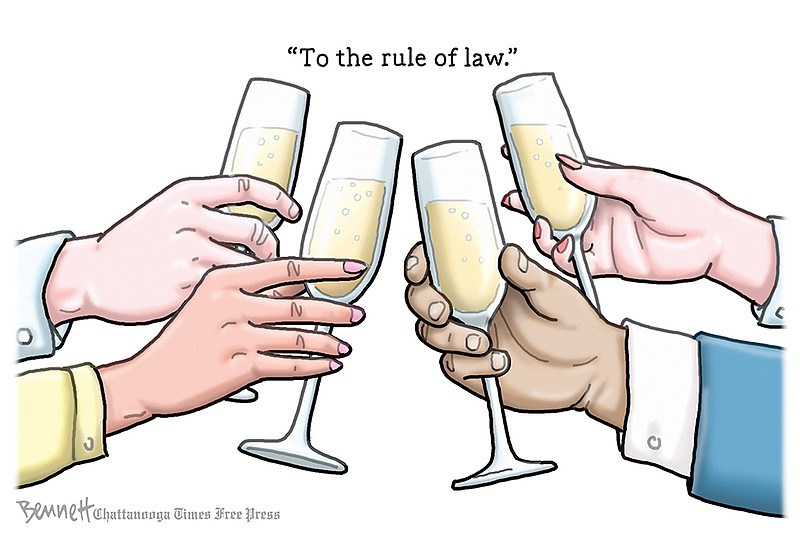
As Trump left the courtroom after his testimony, he remarked loudly, “This is not America. Not America. This is not America.” The bad news for the former president is that it is. This is the America where the rule of law still holds and where he too is required to abide by it.

Joyce Vance

There is no featured post this week.

This week everybody was talking about E. Jean Carroll

Friday, after about three hours of deliberation, a New York jury ordered Donald Trump to pay E. Jean Carroll $83.3 million: $7.3 million for the emotional distress Trump caused her, $11 million for the damage to her reputation, and $65 million in punitive damages. The punitive damages are there because Trump just won’t shut up about Carroll; a previous case that cost him $5 million hasn’t discouraged him from continuing to attack her in his rallies and on social media. Maybe, the jury figured, $65 million will be more effective.

I can’t quite imagine what audience Trump thought he was playing for in this trial: muttering during Carroll’s testimony, stomping out during her attorney’s summation speech, jousting with the judge, obsessively continuing the defamation over Truth Social during the trial, and so on. Obviously, this behavior didn’t impress the jury or endear him to the judge. I’ve got to think that most female voters are thinking: “He sexually assaults this woman, repeatedly drags her reputation through the mud, inspires his cultists to harass and threaten her for years … and he thinks he’s the victim.” I suppose some men might be happy that some other man is finally standing up to all the uppity women in the world, but I doubt they’re a winning political coalition.

And of course, the main thing Trump’s antics did was draw attention to the case, which (to put it mildly) does not cast his image in the best light. He has reminded us not just of Carroll’s accusations (which now, in the State of New York, legally have to be considered facts), but also of all the other women who have told similar stories about him and stuck by them, and of the Access Hollywood tape, where he bragged that he can grab women by the pussy and get away with it.

I mean, if you want to badly enough, I suppose you can believe that all 26 women (who have no apparent connection other than being women) are lying, and that Trump’s taped confession was just “locker room talk” to impress Billy Bush. But seriously. After you’ve tied your brain into a knot like that, can you do anything else with it?


In his first response to the verdict on Truth Social, Trump posted: “THIS IS NOT AMERICA!” Joyce Vance has the right response:

The bad news for the former president is that it is. This is the America where the rule of law still holds and where he too is required to abide by it. I look forward to more of this.


Lots of people are wondering whether Carroll will ever see this money or if Trump will ever pay it. What you may not realize is that those are two different questions. Consider the $5 million a jury awarded Carroll last year. Trump is appealing that verdict, so Carroll hasn’t gotten the money yet. But Trump has had to pay it: He posted the money to a court-controlled account that will be distributed to Carroll after Trump runs out of appeals, assuming none of them succeed.

So no matter how long Trump strings out this $83.3 million verdict, he’s going to have to put up a big chunk of the money fairly soon.


I often point out when Fox News ignores some story that breaks its preferred narrative, so I have to give it credit here. Shortly after the verdict was announced, I flipped over to Bret Baier’s show, where famous torture-memo lawyer John Yoo commented:

The whole point of this unprecedented damages is to tell Donald Trump to shut up. … It’s not just that he should stop insulting Jean Carroll, but he has to stop disrespecting the justice system.

Their take wasn’t terribly different from the one I was hearing on MSNBC and CNN.


I can’t believe I’m writing this, but we’re waiting on judges to rule in two more serious Trump cases. I mean, any other politician in the country would be ruined by the jury verdicts in the Carroll case, but that case is less “serious” because it only concerns Donald Trump’s behavior as an individual, and doesn’t directly affect the institution of the presidency or the rule of law in the United States.

In the Carroll case, I stand at a distance and reflect on one man’s shameless lack of any moral code. But Trump’s sweeping claim of presidential immunity could determine whether I continue to live in a democracy. That claim arose in an attempt to delay Trump’s federal January 6 trial, previously scheduled to being in March. The case can’t proceed until the legal system decides whether Trump can be tried at all.

At first, it looked like the appeals court wanted to get this done quickly. They held a hearing on January 9, and all three judges seemed skeptical of the whole immunity idea. But nearly three weeks have gone by without a ruling. MSNBC legal blogger Jordan Rubin speculates what might be going on: The court would like to present one unanimous opinion, with agreement on the justification and not just the outcome. That would make a clearer statement to the public and stand up better if it’s appealed to the Supreme Court. But the judges are having trouble ironing out their differences.


The other judge we’re waiting on is Arthur Engoron, who is expected to make a ruling on the New York civil fraud trial against the Trump Organization sometime in the coming week. As in the Carroll trial, Trump’s guilt has already been established in a summary judgment, and the recent trial was just to assess damages. The NY attorney general is asking for a $370 million payment and restrictions on the Trump family’s ability to do business in New York.

As noted above, Trump can still appeal a judgment he doesn’t like, but he can’t avoid putting up a large sum of money while appeals play out.


Also pending is whether or not Trump is disqualified from holding the presidency again by the 14th Amendment’s insurrection clause. The case has made it to the Supreme Court, which will hearing arguments on February 8.

Deborah Pearlstein urges the Court to give the country a clear answer to the hard questions, rather than find an easy way out.

No matter what the Court does next, its popular legitimacy will be sorely tested. Tens of millions of Americans are going to believe that it got the answer wrong, and that the result of the 2024 election is at best unfair because of it. Punting will only make already bad matters for American constitutional democracy worse. For there is no legitimacy, or democratic stability, in governing institutions that do nothing but race to see who can avoid taking responsibility for the hardest issues for the longest time. … In an era of rising antidemocratic sentiments in the United States and around the world, constitutional democracies have to be able to show that they are capable of fulfilling the most basic functions of governance. In this case, at the very least, that means deciding to decide.

She makes this interesting observation: The legal arguments for the various outcomes run counter to the justices’ political leanings. (For example: Conservatives typically favor an “originalist” reading of the Constitution, which would disqualify Trump.) So it would look very bad for the Court if the decision fell along the usual 6-3 partisan lines.


I heard on TV that the initial note from the Carroll jury used the abbreviation M, which they had to explain meant “million”. I was reminded of an exchange in the opening episode of The Beverley Hillbillies. Jed is explaining to his skeptical cousin Pearl that some city guy has bought his swamp for between 25 and 100 of “some new kind of dollars”. When Pearl protests that “There ain’t no new kind of dollars”, Jed asks: “What’d he call ’em Granny?”

And Granny says, “Milly-an dollars.”


News channels occasionally interview Trump’s former lawyers about what’s going on with his cases. Sometimes they are still on his side and sometimes not. But the networks never tell us a central piece of information for evaluating the lawyer’s opinion: Did Trump pay his legal bill or not? Is the lawyer talking about a paying former client or a deadbeat former client? Seems like that would make a difference.

and the Gaza War

The International Court of Justice made a preliminary ruling in the genocide case that South Africa has brought against Israel. Vox has a good summary.

The ICJ is the body specified by the Convention Against Genocide (a treaty signed by both Israel and South Africa) for adjudicating disputes about whether the parties are fulfilling their treaty commitments. As such, the ICJ ruled that it has jurisdiction to hear this case and that South Africa has standing to file it. Israel had asked the ICJ to dismiss the case without further investigation, which it declined to do. Instead, the ruling finds the South Africa’s claims “plausible”. Any final judgment will require a more detailed investigation and could be years away.

The ruling describes the dire conditions inside Gaza, and says

[T]he catastrophic humanitarian situation in the Gaza Strip is at serious risk of deteriorating further before the Court renders its final judgment.

South Africa had asked for an injunction requiring an immediate ceasefire, which the court did not provide. It did place a number of limitations on Israel’s Gaza campaign, “to enable the provision of urgently needed basic services and humanitarian assistance to address the adverse conditions of life faced by Palestinians in the Gaza Strip”, and instructed Israel to preserve all evidence that could be relevant to a genocide investigation.

The immediate practical effect of the ruling is likely to be small, because ICJ rulings are enforced by the UN Security Council, where the US can veto any substantive penalties against Israel. But the ruling further isolates Israel and the US from world opinion.


Israel has charged that staff members of the main UN agency providing relief to Palestinian refugees were involved in the October 7 Hamas attacks. The exact claims have not been made public, but several employees were fired in response. The US and a number of other donor countries have paused their funding of the organization, further complicating the humanitarian crisis in Gaza. The agency, UNRWA, has about 13,000 employees.


The war continues to ooze outward, with a rising risk that the US will get drawn into a larger conflict with Iran. A drone hit a US outpost in Jordan early Sunday morning, killing three US soldiers and wounding more than 30. BBC summarizes the situation:

Since mid-October, US military installations in Iraq and Syria have repeatedly come under attack by Iran-backed militias, injuring a growing number of US soldiers. The US has repeatedly retaliated by striking targets in both countries.

Iran has denied involvement, but a group it supports, Islamic Resistance in Iraq, has claimed responsibility. President Biden has pledged to “hold all those responsible to account”.

The outpost is called Tower 22, and is in the far north-east corner of Jordan, near the border with both Syria and Iraq. It is part of a deployment of around 30,000 US troops in the region, mapped by CNN.


Trump is saying the kind of stuff he always says: Bad things wouldn’t happen if he were president, because he is “strong” while Biden is “weak”. But he hasn’t specified what he would do differently. He alternately sounds isolationist and like he would strike back harder.

and the border

This week House Republicans have been demonstrating why it’s so hard to work out any compromise with them: They don’t actually want anything other than power. Their apparent policy positions are just postures they strike for Fox News and for their base voters.

The Biden administration actually does want something: more military aid to Ukraine, which is fending off an invasion by Trump’s pal Vladimir Putin. Originally, Biden hoped to get that aid included in budget deal at the beginning of the fiscal year (October 1). Most Senate Republicans and about half of House Republicans claim to back Ukraine aid, but it didn’t make the first FY 2024 continuing resolution. Or the second one in November.

Back in October, Biden repackaged Ukraine aid with Israel aid, figuring that strong Republican support for Israel would put it over the goal line. But no deal. He included money for increased enforcement at the Mexican border, because Republicans appeared to care about that. No deal: Republicans said they wanted policy changes, not just more money.

OK, then. Biden and Senate Republicans have negotiated policy changes that cause Democrats some real heartburn:

Components of the deal include a new authority that allows the president to shut down the border between ports of entry when unlawful crossings reach high levels, reforming the asylum system to resolve cases in a shorter timeframe, and expediting work permits.

Under the proposed deal, the Department of Homeland Security would be granted new emergency authority to shut down the border if daily average migrants crossing unlawfully reach 4,000 over a one-week span. Certain migrants would be allowed to stay if they proved to be fleeing torture or persecution in their countries.

It’s impossible to close the border to asylum seekers because of current law, despite multiple attempts by Trump to do so while he was in office.

Republican senators like Lindsey Graham are telling their colleagues in the House that this is a better deal than they are likely to get if Trump takes office in 2025, because Democrats would likely filibuster. (But of course Trump is going to be a dictator in his second term, so why should Republicans worry about what Congress will or won’t do?)

But there’s still a problem: Republicans don’t want to do something about the border, they want to have the worst possible situation so that they can blame Biden for it. Trump wants the border as a campaign issue. If the situation were to improve, that would be bad news for him. (In general, good news for America is bad news for Trump. He is openly rooting for an economic crash, and seems downright cheerful while predicting a “major terrorist attack“. The fact that the stock market continues to set records is an unfortunate development for him.)

So Trump instructed Speaker Johnson to torpedo any border deal, no matter what is in it. “It’s not going to happen, and I’ll fight it all the way.” Mitch McConnell said: “When we started this, the border united us and Ukraine divided us. The politics on this have changed.

Mitt Romney, who still has one more year in the Senate, made a moral critique:

The fact that [Trump] would communicate to Republican senators and congresspeople that he doesn’t want us to solve the border problem because he wants to blame Biden for it is really appalling. Someone running for president ought to try and get the problem solved as opposed to saying, “Hey, save that problem, don’t solve it, let me take credit for solving it later.”

Democratic Senator Brian Schatz of Hawaii commented:

I think if Democrats were holding up funding for the defense of three allies unless we got an unrelated thing, and then we said no to the very thing we demanded because our nominee told us to kill it, that the media would justifiably go thermonuclear on us.


Speaking of the border, what’s going on in Texas is truly outrageous. (And Dan Fromkin wants to know why the major media outlets are ignoring it. ) Texas has recently taken a variety of actions that essentially claim that it — and not the federal government — controls its border with Mexico.

Texas erected razor wire barriers along a river in Eagle Pass, Texas, that physically prevented federal Border Patrol agents from entering the area, processing migrants in those areas, or providing assistance to drowning victims. According to the DOJ, the Border Patrol was unable to aid an “unconscious subject floating on top of the water” because of these barriers.

Federal law, moreover, provides that Border Patrol agents may “have access to private lands, but not dwellings, for the purpose of patrolling the border to prevent the illegal entry of aliens into the United States.” So Texas claimed the power to use razor wire to prevent federal officers from performing their duties, in direct violation of a federal statute.

Last week, the Supreme Court ruled in the federal government’s favor, but only 5-4. The order was very terse, so we have no idea why Justices Thomas, Alito, Gorsuch, and Kavanaugh weren’t on board. Do they really want to reinterpret the supremacy clause of the Constitution?

Even so, you might think a 5-4 Supreme Court decision would end the matter, but apparently not.

On Monday the Supreme Court said the federal government has the authority to remove razor wire that Texas installed at the southern border. Homeland Security said Texas had until Friday to give federal authorities access to Eagle Pass. But Governor Abbott is doubling down saying he’ll increase state patrol of the border, adding more barriers and more razor wire. 

Texas has two related disputes with the federal government: The feds want to remove a floating barrier Texas has put in the Rio Grande, and a Texas law (set to take effect in March) would give state judges the power to issue deportation orders.

On his excellent blog Popular Information, Judd Legum goes into more detail, explaining how Governor Abbott is recreating the nullification crisis from the Jackson administration.

I forget where I first heard this suggestion, but if we simultaneously let Texas secede and admit Puerto Rico, we don’t have to change the flag.

and the 2024 campaign

The Democratic side of the New Hampshire primary was muddled, because the DNC wants South Carolina to be the first primary. So NH was unofficial, Joe Biden was not on the ballot, Biden did not campaign in NH, and a bunch of Democratic-leaning independents probably voted on the Republican side for Haley. Nonetheless, Biden’s write-in campaign got 64% of the vote, easily beating back challenges from Rep. Dean Phillips and Marianne Williamson, whose campaigns never caught fire.

Biden also got good economic news of two types: The economy continues to perform quite well, and the media is finally starting to take note of it. Both trends are captured in the WaPo’s “Falling inflation, rising growth give U.S. the world’s best recovery“.

I forgot to mention last week that the general public is also starting to catch on: consumer sentiment has jumped in recent months.


After losing in New Hampshire, Nikki Haley has just one possible winning strategy (other than hoping that some court takes Trump out of the race; see above): Her continued presence in the race annoys Trump, and if she needles him enough he might act out in ways that even his supporters will have to see as crazy.

This week she characterized Trump’s notably ungracious victory speech in New Hampshire as a “temper tantrum” and called him “unhinged”. She’s also alluded to his apparent cognitive decline: “We’ve seen him get confused.

For some time I’ve been pointing to the media magnifying symptoms of Biden’s age while minimizing Trump’s far more serious mental glitches. Apparently they needed some Republican’s permission before they could raise Trump’s cognitive issues.

If I were running Haley’s campaign, I would want her to hammer on the point that he won’t debate because he’s not up to the challenge. Make it a real playground put-up-or-shut-up thing. I double-dog dare you to debate me.


Since Trump’s New Hampshire victory made his nomination seem inevitable, news-network talking heads have been speculating about his VP choice. What’s weird to me is that hardly anybody is saying the obvious: Trump thinks he made a mistake picking Mike Pence, because Pence eventually realized he had a moral code and a responsibility to America. So he didn’t help Trump stay in office after losing the 2020 election. Like Meat Loaf, Pence would do anything for Trump, but he wouldn’t do that.

Trump doesn’t want to make that same mistake again. So what he is mainly looking for is someone with no moral code, no loyalty to America, and no will of his or her own that might conflict with Trump’s will.

In All the King’s Men, the Boss explained his choice of the comically unctuous Tiny Duffy as lieutenant governor: “You get somebody somebody can trust maybe, and you got to sit up nights worrying whether you are the somebody. You get Tiny, and you can get a good night’s sleep.”

So: Elise Stefanik, then.

and you also might be interested in …
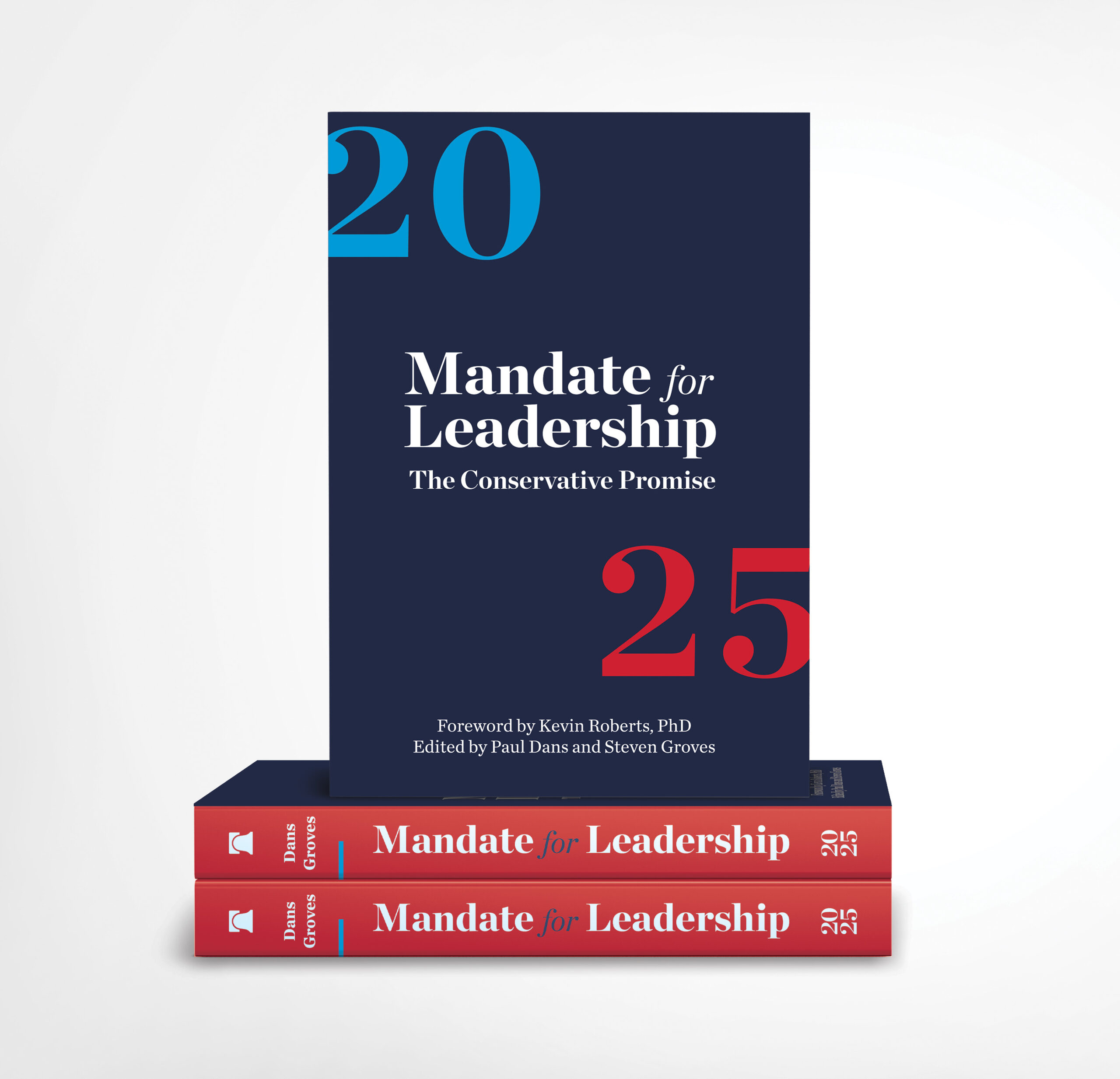
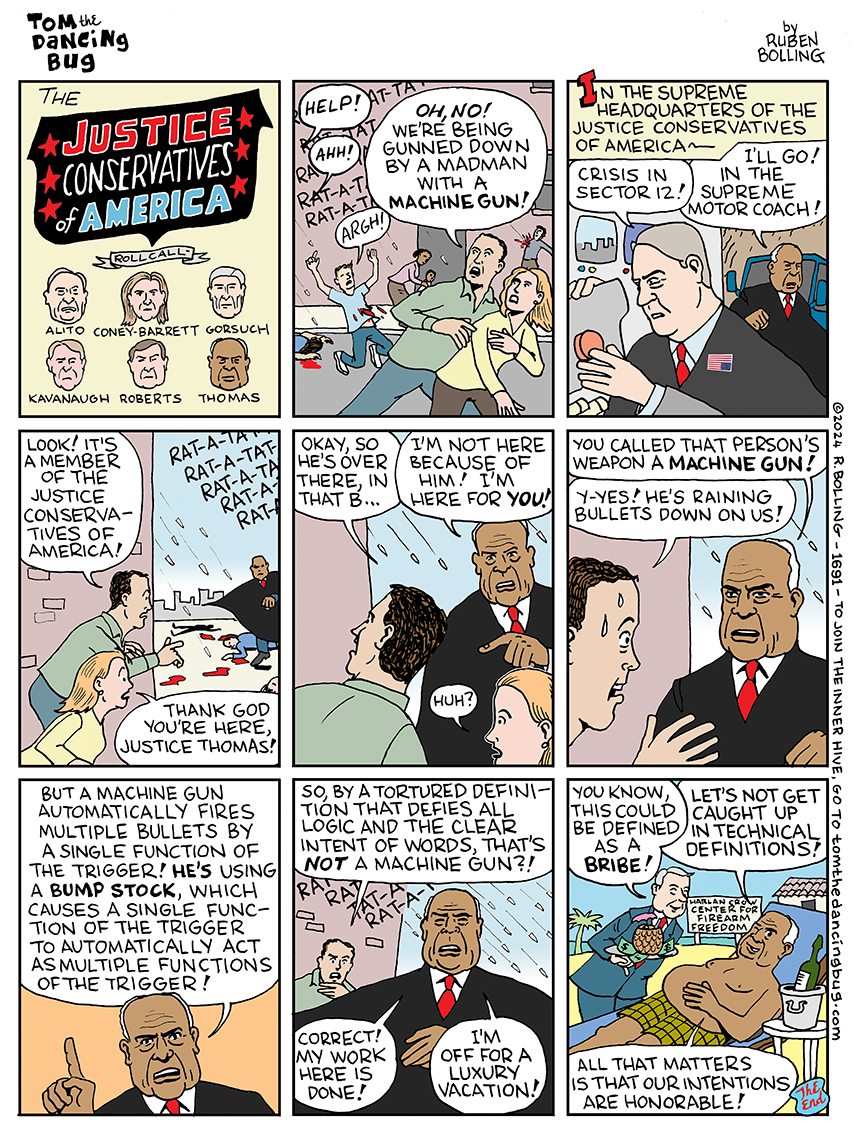
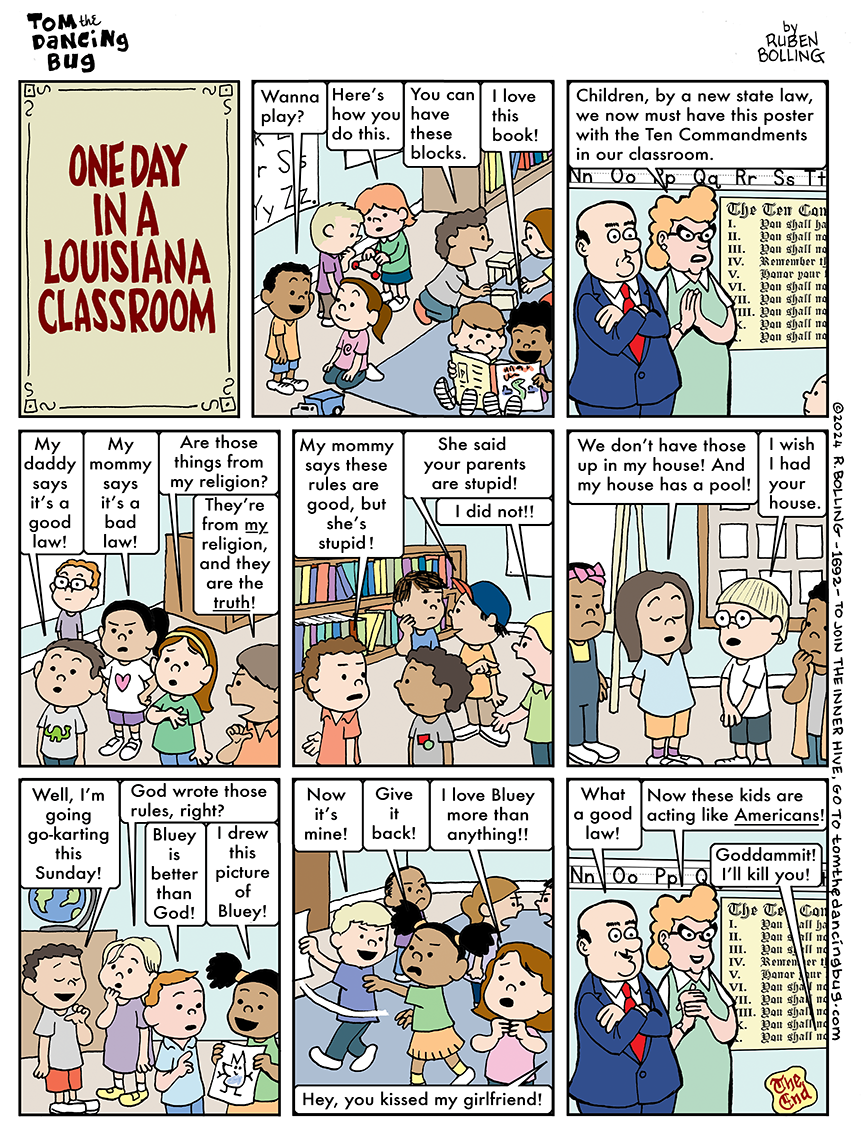
If you’ve ever wondered where those media takes on “real Americans” come from, Tom the Dancing Bug explains:


It looks like Taylor Swift is headed to the Super Bowl. Apparently some fans are annoyed with how often the cameras show us Swift in a luxury box at Kansas City Chief games, but I’m amused. From what little I know of Swift’s biography, she missed a lot of typical schoolgirl stuff while she was working to make it in the music business. Now, in her 30s, she finally gets the quintessential high school experience of rooting for her boyfriend’s football team and wearing his team jacket. I’m happy for her.

and let’s close with something eponymous

What happens when an actual penguin interns at Penguin Books?

Patterns of Stereotypes

The orthodox theory holds that a public opinion constitutes a moral judgment on a group of facts. The theory I am suggesting is that, in the present state of education, a public opinion is primarily a moralized and codified version of the facts. I am arguing that the pattern of stereotypes at the center of our codes largely determines what group of facts we shall see, and in what light we shall see them

– Walter Lippmann, Public Opinion (1921)

This week’s featured post is “Monkey-wrenching the Regulations that Protect Our Lives“.

This week everybody was talking about Iowa and New Hampshire

The Iowa caucuses happened last Monday, with Donald Trump getting a little over 50% of the Republican vote. How you interpret that depends on how you frame Trump’s role in the GOP. If you think of him as a presidential candidate among other presidential candidates, it’s a very strong result; he has more support than all his rivals combined. But if you frame him as the incumbent leader of the party, it’s a rather weak result. Imagine, for example, how the press will cover Biden if a Democratic primary is held somewhere, and he barely clears 50%.

In any case, nobody should attach too much importance to the result, because we’re talking about very few people. Just 110K Iowa Republicans turned out, out of 752K registered Republicans statewide and over 2 million total registered voters. That was down from 187K Republican caucus voters in 2016.

Last week I said that if DeSantis finished third in Iowa, he should drop out. He finished second, and dropped out yesterday anyway. His withdrawal doesn’t seem all that consequential because he didn’t have a lot of support anyway (that’s why he’s dropping out), and it’s not clear which way his voters will go. If they supported DeSantis because they liked Trump’s policies but realize that the man himself is a threat to democracy, they’ll go to Haley. But if they just wanted a younger Trump, they’ll go to Trump.

I would interpret the Iowa result this way: If you were hoping for the Republican Party to reject Trump on their own, you need to accept that it’s not going to happen.

We should see that confirmed tomorrow in New Hampshire: Trump is leading in the polls, but New Hampshire is a tricky state to predict, as Barack Obama discovered in 2016. So while a Haley victory isn’t likely, it is possible.

But even that outcome wouldn’t lead to a broader Trump defeat. NH is ideal terrain for Haley, and many Biden-leaning independents may cross over to vote for her. But that’s not a winning formula going forward.

There really is only one scenario where a NH loss leads to Trump’s undoing, and that depends on him: Everybody will be watching him, so if he responds to an unexpected loss with a racist, sexist, and generally unhinged temper tantrum, even Republicans might begin to wonder about his sanity.


Speaking in Concord, NH on Friday, Trump mixed up Nancy Pelosi and Nikki Haley, claiming that Haley was in charge of security on January 6. (His usual lie assigns that role to Pelosi.) But we’re supposed to worry about Biden’s mental acuity.


The other Trump news is all legal: The second E. Jean Carroll defamation trial got underway. The judge, following proper legal procedure, is not letting Trump re-argue something already decided by a previous jury: that Trump really did sexually assault Carroll.

Trump’s “defense”, if you want to call it that, is to replay the greatest hits of toxic masculinity. A standard claim to throw at rape victims is “Didn’t you actually enjoy it?” Well, CNN’s Joey Jackson summarized the Trump attorney’s opening statement: You weren’t injured by Trump’s defamation, you benefited from it.

It was sort of like hey, listen, be thankful Trump made you famous, right? The reality is that what do we have to do with social media and mean tweets that you get on social media. If you take on a person apt to be the president, guess what? You’re in the position you want to be. You’re on TV all the time. Emotional pain and damages, what are you talking about?

When Trump was in the courtroom, he kept muttering and commenting loud enough for the jury to hear, until the judge threatened to remove him. On the campaign trail and on social media, he keeps repeating the remarks that the previous jury had determined were defamatory.

Trump’s behavior underlines the need for substantial punitive damages, over and above Carroll’s emotional suffering and loss of reputation. The point of punitive damages is to make the defamation stop, which the $5 million original award has failed to accomplish.


In addition to the Carroll trial, we’re awaiting the judge’s decision in the NY state fraud trial. We’re also waiting for an appeals court to rule on Trump’s claim of presidential immunity, and for the Supreme Court to hear arguments about whether the 14th Amendment disqualifies him from being president again.


This moment in the Trump trials reminds me of the period between the passage of the Affordable Care Act in 2010 and the first ObamaCare insurance policies in 2014. The program was deeply unpopular then, basically because Republicans could say whatever they wanted about “death panels” or whatever, and ordinary people didn’t have any experience that could prove them wrong. Today, though, if you talk about repealing ObamaCare, millions of people understand that they would lose their health insurance. At its nadir in late 2013, only 33% of Americans had a favorable opinion of ObamaCare, while 59% do now.

Similarly, today everybody knows that Trump has been indicted, but since the cases haven’t gone to trial (largely due to Trump’s stalling tactics), he can say whatever he wants about the evidence, the prosecutors, and the judges.

If you live in the Fox News echo chamber, you’ve heard Trump’s claims, but you know nothing about the seriousness of the crimes he’s accused of or the strength of the evidence against him. It’s all just a witchhunt, a “weaponization” of the Justice Department and the legal system. He didn’t do anything wrong. If he did do something wrong, everybody does it. And if everybody doesn’t do it, there would still be “bedlam” if he were ever held to account.

But despite Trump’s stalling, at least one case is likely to go to trial before the election, and probably result in a conviction. That will be harder to spin away.

BTW: Think about that stalling. If Trump really believed that he had done nothing wrong and the indictments were all a coordinated political witchhunt, he’d be eager to go to trial so he could poke holes in the flimsy evidence against him. When a jury found him innocent after some minimal deliberation, he could crow about being vindicated. But in the real world, Trump knows he’s guilty and that the government has the goods on him, so stalling until he’s president again (and has the tools to obstruct justice) is his best bet.

and the Gaza War

The shock of the October 7 attacks by Hamas welded together a lot of people with divergent views. In Israel, a unity government was formed, a startling departure from recent years when Netanyahu has hung on by finding allies to cobble together narrow majorities in the Knesset, and a new election is needed every year or two. The Biden administration also signed on to the coalition, and has stood with Israel whenever it has been challenged in the UN and elsewhere.

But this week we began to see cracks in that coalition. Netanyahu is increasingly hostile to the Biden administration, and Israel’s internal political divisions are re-emerging.

The war is increasingly becoming a slog, which is causing the world to forget Israel’s October 7 suffering and focus instead on the humanitarian catastrophe in Gaza. Meanwhile, military operations are failing to find and rescue the hostages, and the goal of eradicating Hamas seems ever more distant. Polls indicate that Netanyahu’s goose is cooked once elections are held, which the government doesn’t want to hold during wartime. And that makes critics wonder how committed the prime minister is to ending the war.

and something you probably didn’t know you should care about

Probably the words “Chevron doctrine” make your eyes glaze over. But they shouldn’t. In the featured post, I try to explain why the Supreme Court’s looming revision of Chevron means that six corporate-tool foxes are about the seize control of the agencies that regulate all of America’s hen houses.

and you also might be interested in …

This week’s hopeful take on climate change comes from Chris Hayes’ interview with climate journalist Robinson Meyer. Near the end of the interview, Meyer talks about about lowering carbon emissions sector by sector:

We used to think the power sector was really, really hard. The power sector was the biggest source of [carbon] emissions in the US. Then cheap wind and solar happened (and we switched from coal to natural gas) and very rapidly power emissions fell.

And then … transportation became the most polluting sector of the US economy. But what’s about to happen in the next few years [as EV prices drop] is that transportation’s about to fall to second place, and industry will be the most polluting sector of the economy.

And what I suspect will happen is, just as happened with the power sector and the transportation sector, is that once industry is the most polluting sector of the economy, and people really start to focus on it, we’re going to see all these easy-to-abate emissions, that we just haven’t really noticed yet. And we’re going to get rid of them really quickly. And so, to some degree steel, chemicals, [agriculture], these are huge, challenging problems. On the other hand, they’re challenging problems because we just haven’t paid attention to them yet.


Meanwhile, there’s one fossil-fuel-reducing project that has bipartisan support: ethanol made from corn. If only it weren’t such a bad idea. If, rather than fueling internal-combustion-engine cars with ethanol, we charged EVs with solar energy, one acre of solar panels could power as much transportation as 100 acres of corn. At least that’s what 200 science faculty at 31 Iowa colleges and universities think.


Reportedly, climate change is “on the back burner” for the plutocratic overlords at Davos this year. Also, they’re sanguine about Trump regaining power and continuing to cut their taxes and deregulate their businesses. I’m reminded of Krupp and I. G. Farben in the early 1930s.

“Everyone on this stage is committed to a future of net-zero income tax payments.”

Did you hear that Biden has decriminalized crime? That’s one of the many things you don’t know because you don’t watch Fox News. Fortunately, Kat Abu does.

and let’s close with something fake

When you work hard to get things right and not be fooled by misinformation, once in a while it feels good to revel in complete fraud. Kueez.com has collected viral photos that weren’t all they appeared to be. Some are amusing, some are head-shaking, and others are laugh-out-loud funny. Probably my favorite is a water-surrounded rock and a castle getting photoshopped together.

The actual rock is in Thailand and the castle in Germany, but the combination has the single quality all successful misinformation must have: You look at it and you want it to be real.

Love and Justice

Now, we got to get this thing right. What is needed is a realization that power without love is reckless and abusive, and that love without power is sentimental and anemic. Power at its best, power at its best is love implementing the demands of justice, and justice at its best is love correcting everything that stands against love. And this is what we must see as we move on.

– Martin Luther King
Where Do We Go From Here?” (1967)

This week’s featured post is “The Corruption of the Evangelical Movement“, which is my review of Tim Alberta’s The Kingdom, the Power and the Glory.

This week everybody was talking about the Yemen attacks

Thursday, the US and the UK, supported by a number of other allies, launched air attacks on the Houthi rebels in Yemen. If you responded to that news by asking “The Who rebels Where?”, I sympathize. Yemen is a pretty much godforsaken place south of Saudi Arabia, where the Red Sea turns a corner and becomes the Gulf of Aden. You probably don’t own anything imported from Yemen. It has few resources, it’s running out of water, and its people are desperately poor.

Yemen also has a civil war that’s been going since 2014, because no matter how poor a nation is, it can always afford more guns. There’s a Sunni government backed by the Saudis, and the Shia Houthi rebels are backed by Iran. The Economist reports:

The UN estimates that 223,000 people have died from hunger and lack of medical care since the war began. 80% of the population now lives in poverty.

Last week I talked about terrorist strategy, where sometimes it makes sense to provoke someone much stronger than you in hopes that their over-reaction will win you international sympathy and new recruits. That seems to be what is happening here. The US doesn’t want to get involved in the Yemen war, where there really are no good guys. But for weeks the Houthis have been using Iran-supplied drones and missiles to attack ships in the Red Sea, which is one of the world’s busiest and most important trade routes. (More geography: The Suez canal sits at the other end of the Red Sea, so the Red Sea is the most efficient way for ships to pass between Europe and India or East Asia. It’s also how oil tankers from the Persian Gulf get to Europe.)

The Houthi attacks were starting to have a significant effect on world trade, so the Biden administration felt like it had to do something.

But the attacks are unlikely to end the Houthi rebellion, or even to deter it much. The Houthis have already endured much worse at the hands of the Saudis. At best, we have destroyed a chunk of their offensive capacity, so their attacks on shipping will have to die down until Iran can resupply them. The Economist again:

Conflict with the West could have other benefits for them. Their supposed blockade of Israel has already won them new admiration across the Arab world, tapping into pro-Palestinian sentiment at a time when Arab states are feckless bystanders to the war in Gaza. Being targeted by America, while anti-Americanism is running high because of Mr Biden’s support for Israel, will add to their popularity.

and the looming government shutdown

The observation that those who don’t learn from history are doomed to repeat it is attributed to Santayana, and the underlying idea goes back to Cicero. Usually when we quote that, we’re talking about things that happened decades or centuries ago, but in the current situation “history” is what happened in September and November, which we are now repeating.

The short version is that Republicans have a small majority (down to two seats now) in the House, while Democrats control the Senate and the White House. In order for the government to spend money (which it needs to do to keep the doors open), all three have to agree. MAGA radicals in the House believe that this position should allow them to dictate large cuts in federal spending (which are popular in the abstract, but unpopular when implemented). Democrats disagree, believing that the public will blame Republicans for any pain caused by a government shutdown. So they’re not inclined to roll over and accept the MAGA-demanded cuts, which probably can’t even pass the House.

In September, Speaker McCarthy saw this reality and negotiated a continuing resolution which more-or-less left federal spending intact until November. That act of rationality could not be allowed to stand, so MAGA Republicans forced McCarthy out. After much turmoil, he was replaced by Speaker Mike Johnson, whose conservative bona fides are much stronger than McCarthy’s were.

But reality is reality, so Johnson had to make a similar deal in November, cutting the federal-spending can into two pieces and kicking them to different points on the calendar. The first can comes up Friday, and reality still has not changed.

Last night, Johnson and Senate Majority Leader Chuck Schumer released the text of a continuing resolution that would kick both cans into March. The House “Freedom” Caucus is outraged again, but what it will do is unclear.

and the Trump trials

Trial season is gearing up, and it’s hard to tell the players without a program. Closing arguments in New York State’s civil fraud trial against the Trump Organization happened last week. It’s a bench trial, so now we’re waiting on the judge rather than a jury. Judge Engoron has already issued a summary judgment that the Trumps committed fraud, so the trial was largely to assess damages.

Engoron will consider whether to grant the attorney general’s request to fine Trump $370 million, ban him from the state’s real estate industry for life and bar him from serving as the officer or director of a New York corporation.

Engoron knows Trump is looking for grounds to appeal, so he will be very careful in how he justifies his judgment. Observers are predicting a decision in “weeks” rather than days or months.


The second E. Jean Carroll defamation trial starts tomorrow. Basically, Carroll says Trump raped her in a department store dressing room in 1995. Trump met those charges (in a book Carroll wrote) with insults, so Carroll sued him for defamation. The statute of limitations had passed for accusing him of the original assault, but New York changed the law in 2022. So she sued for damages from the assault and for insults he made after he left office. She won a $5 million settlement, which Trump is appealing.

Now the original defamation suit is coming to trial, having been delayed by all sorts of wrangling about when presidents can be sued. The judge is refusing to let Trump relitigate issues resolved in the first trial, such as whether the assault happened and whether his comments were defamatory.


We’re waiting for a federal appeals court to weigh in on whether presidential immunity prevents the government from trying Trump on January 6 charges. They are unlikely to agree with Trump on this, but how exactly they refute his claim of immunity will be important. Also important: how long they take to rule and how much time they allow for an appeal to the Supreme Court.


The Supreme Court has agreed to review the Colorado Supreme Court’s decision that Trump is disqualified from the presidency by the insurrection clause of the 14th Amendment. Oral arguments are scheduled for February 8. It’s hard to imagine this Court kicking Trump off the ballot, but it’s not clear how exactly they’ll get around the text of the 14th Amendment.


Meanwhile, Trump threatens “bedlam” if court decisions don’t go his way. And Judge Engoron suffered a bomb threat at his home. Judge Tanya Chutkan was the victim of a “swatting” incident, in which a false emergency call sent armed police to her home.

Elected Republicans almost universally ignore all this. It’s just become accepted that Trump will goad on his violent supporters, and that crossing Trump will entail physical risk. It’s the modern version of the Nazi brownshirts.

but I wrote about the Evangelical heresy of Christian Nationalism

Or, more precisely, Tim Alberta wrote about it, and I reviewed his book.

and you also might be interested in …

The Iowa Caucuses are tonight. I can’t remember the last time these were a smaller deal. Democrats aren’t having one, and Trump will obviously win the Republican caucuses. The only suspense is whether Nikki Haley can finish second. If she does, Ron DeSantis should drop out.


The Hunter Biden circus continues. Wednesday, the House Oversight Committee debated citing Hunter Biden for contempt because he refused a subpoena to be interviewed behind closed doors and insisted on testifying in public. Who should show up for this hearing but Hunter himself?

The debate went forward, underlining what a farce it all is. Republicans would say that the American people deserve answers from Hunter, and Democrats would respond: “There he is. Let’s ask him”, which the Republicans would refuse to do.

I’m adding this Oversight Committee Democrat, Texas Congresswoman Jasmine Crockett, to my list of politicians I would pay money to hear. Watch this clip from Wednesday night’s Chris Hayes show.

Friday, Hunter announced he would appear for non-public testimony.


South Africa has brought a genocide case against Israel to the International Court of Justice in The Hague, and is seeking an immediate order to stop the military campaign in Gaza.

A decision on South Africa’s request for so-called provisional measures will probably take weeks. The full case is likely to last years.

Vox explains:

Under international humanitarian law, proving allegations of genocide is incredibly difficult. And even if South Africa does prove that Israel is committing genocide — or that it is failing to prosecute incitement to genocide or prevent genocide from occurring — ICJ decisions aren’t necessarily easy to enforce. But these initial arguments aren’t yet entering that complicated territory.Instead, they’re about whether the ICJ will issue a preliminary order for Israel to stop its onslaught in Gaza immediately; the court will rule on that issue after hearing arguments from South Africa and Israel Thursday and Friday. Though Israel could ignore that ruling if it’s issued, it could make Israel’s allies less inclined to support the war.

Despite the difficulties, NYT contributor Megan Stack says the charges deserve serious consideration.

The word “genocide” rings loudly in our imagination. We think of Rwanda, Bosnia, the Armenians, the Trail of Tears and, of course, the Holocaust. I have heard many people balk at the suggestion that Gaza could be experiencing genocide. The Holocaust, after all, wiped out over 60 percent of European Jews. Israel’s war — instigated, no less, by the murder of Jews — has killed about 1 percent of the Palestinians in Gaza. One percent is terrible, of course, but genocide?

Under the genocide convention, though, the term describes an intent to wipe out a defined group of people and taking steps to achieve that end. There is no threshold of death, or proportion of death, that must be reached. It is possible to kill a relatively small number of people, but still commit an act of genocide.


Saturday, the people of Taiwan shrugged off Chinese threats and elected another president from the Democratic Progressive Party.

The result shows voters backing the DPP’s view that Taiwan is a de facto sovereign nation that should bolster defenses against China’s threats and deepen relations with fellow democratic countries, even if that means economic punishment or military intimidation by Beijing.

It is also a further snub to eight years of increasingly strongarm tactics towards Taiwan under Xi who has vowed that the island’s eventual “reunification” with the mainland is “a historical inevitability”.


The New Yorker lays out the case that a Texas woman died because of that state’s abortion laws. This case gets to the heart of how tricky life-of-the-mother exceptions really are.

Yeniifer Alvarez was an uninsured woman living in a part of central Texas without good health care, particularly prenatal care. She was overweight, diabetic, and had a history of pulmonary edema “in which the lungs fill with fluid, that strains the heart and can be fatal”.

Her pregnancy was obviously risky, and a wealthier or better-insured woman would have been under constant observation. In a state with different laws, a precautionary abortion might have been performed, under the theory that the risks were too high. When the crisis came, it took too long to get her to a hospital capable of handling her case, and she died in an ambulance.

Life-of-the-mother exceptions in abortion laws tend to assume binary choices: She gets the abortion or she dies. The less solid notion of unacceptable risk just doesn’t enter the picture.


Here’s Kat Abu’s weekly recap of Fox News.


Josh Marshall makes an unpopular point that I happen to agree with: Bad as the execution looked at the time, Biden was right to get us out of Afghanistan.


I made a New Year’s resolution to highlight more positive news about the climate and efforts to cut carbon emissions. In that vein, the Dutch company Elysian is trying to develop the first practical electric airliner. Previous electrical plane designs have carried few passengers relatively small distances, but Elysian is picturing a 90-seat plane that can go nearly 500 miles on a charge.

For comparison, New York to Boston and New York to D.C. are each a little over 200 miles.


The New York Times Magazine raises an interesting question: Could an engineering project divert warm-water flows away from a Greenland glacier and prevent it from sliding into the ocean and melting? If that idea is feasible, how big an expense would it justify?

and let’s close with something adorable

The young of just about any species can be cute. But baby rhinos? Yes, baby rhinos.

Endings and Beginnings

Wherever law ends, tyranny begins.

John Locke
Two Treatises on Government (1689)

This week’s featured posts are Catching Up on Donald Trump and Catching Up on the Gaza War.

This week everybody was talking about disqualifying Trump

That, and a bunch of other Trump news, is covered in one featured post. Something I forgot to mention in that post was Trump’s weird rant against magnets.

On the subject of magnetic elevators, Trump said, “Think of it, magnets. Now all I know about magnets is this, give me a glass of water, let me drop it on the magnets, that’s the end of the magnets.

In the inspiring words of the Insane Clown Posse: “Fuckin’ magnets, how do they work?”

But, you know, it’s Biden whose mind we are supposed to worry about.

and the Gaza War

which is covered in the other featured post.

and January 6

In the immediate aftermath of Trump’s failed coup, the GOP establishment and conservative commentariat almost universally recognized 1-6 for what it was: un-American, over the line, terrorism, etc. Over the last three years, they have completely changed their tune. Rep. Elise Stefanik, chair of the House Republican conference, is typical: Sunday she referred to those who have been tried, convicted, and sentenced for crimes committed on January 6 as “hostages“.

I believe we’re seeing the weaponization of the federal government against not just President Trump, but we’re seeing it against conservatives.

She refused to commit to certifying the 2024 election.

We will see if this is a legal and valid election. What we’re seeing so far is that Democrats are so desperate they’re trying to remove President Trump from the ballot.

Of course, President Trump will only be removed from ballots if the conservative majority on the Supreme Court finds that the Constitution disqualifies him. “Democrats” can do nothing on their own.

and 2023 becoming 2024

2023 was another great year for jobs. The economy added 2.7 million jobs during the year, bringing the 2-year total to 7.5 million new jobs. The unemployment rate held steady at 3.7% in December, and has stayed below 4% for 23 consecutive months. The Trump administration’s longest streak below 4% was 13 months.


The Economist combined “inflation, inflation breadth, GDP, jobs, and stock market performance” into a single index to rank 35 “mostly rich” countries’ economic performance in 2023. The US came in third, behind Greece and South Korea, and I might quibble about ranking us that low: Greece’s advantage is mainly in its stock market, which was up 44% compared to the US’ 4.3% gain.


https://www.climate.gov/news-features/understanding-climate/climate-change-global-temperature

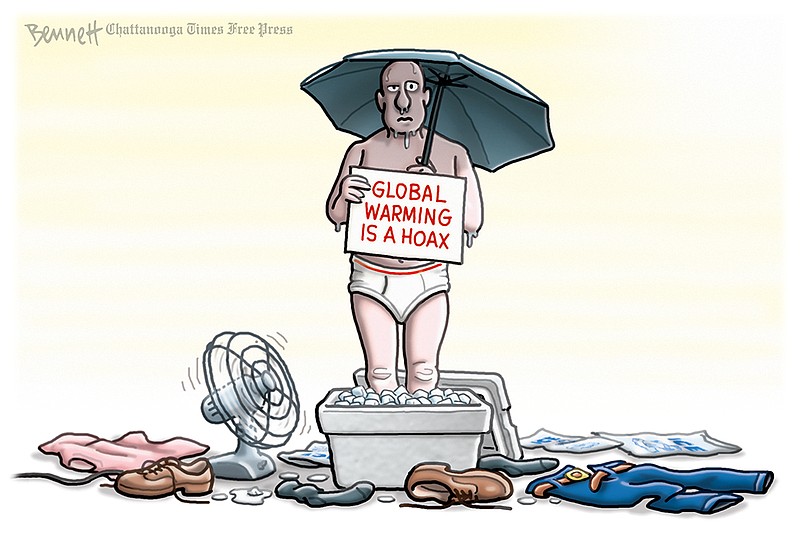
2023 was the hottest year on record by a wide margin, as global warming teamed up with an unusually strong El Nino. As anyone who follows sports knows, that’s how records get set: a trend gets topped off by special factors. (For example, Barry Bonds’ 73 home runs in 2001 was the best season of the best hitter in the home-run-happy steroid era. Between 1998 and 2001, three hitters posted six seasons of 63+ home runs, a figure no one else has reached before or since.)

The El Nino is expected to continue into this year, so 2024 could be equally hot or hotter. But it might not be, and by 2025 we can expect some regression to the mean. (In other words: Outliers are typically followed by something less outlying. For example, Shaquille O’Neal is 7’1″, but his son is only 6’10” — tall, but not as tall as Dad.) What that would mean in this case is that 2024 or 2025 will be hot, probably hotter than the average of 2018-2022, but probably not as hot as 2023. When we look back from 2030 or so, the upward trend will continue to be clear, but 2023 will probably stick up above the trend line.

1998 was a year like that: significantly hotter than any year before, but also hotter than several years after. And you know what we saw? Climate-change-denying authors writing that global warming ended in 1998. You can guess what they did: If you start your graph at 1998, it looks like global average temperature goes sideways for several years. (The two graphs here aren’t tracking precisely the same things, so they don’t perfectly match up.)

Warming trend? What warming trend?

So don’t be fooled over the next few years if you see articles claiming that the danger has passed, because global warming peaked in 2023 or 2024. It won’t have passed; the trend will just be catching up to a year with some special circumstances.


Kat Abu, who watches Fox News so we don’t have to, announced her Fox News predictions for 2024. A few highlights:

  • Greg Gutfeld is going to say the N-word.
  • If Trump is found guilty of anything this year, Sean Hannity will start his show with the words “Today, all of America was found guilty.”
  • A host will overtly call for the assassination of Joe Biden.

and Governor DeWine’s veto

On December 18, the Ohio legislature passed a Substitute House Bill 68, which included this:

Sec. 3129.02. (A) A physician shall not knowingly do any of the following: (1) Perform gender reassignment surgery on a minor individual; (2) Prescribe a cross-sex hormone or puberty-blocking drug for a minor individual for the purpose of assisting the minor individual with gender transition; (3) Engage in conduct that aids or abets in the practices described in division (A)(1) or (2) of this section, provided that this section may not be construed to impose liability on any speech protected by federal or state law. …

Sec. 3129.05. (A) Any violation of section 3129.02, section 3129.03, or section 3129.06 of the Revised Code shall be considered unprofessional conduct and subject to discipline by the applicable professional licensing board.

So, Ohio doctors who provided gender-affirming care for minors (with or without parental consent) would lose their licenses.

On December 30, Governor DeWine, a Republican, announced that he was vetoing this bill. He said:

Were I to sign Substitute House Bill 68 or were Substitute House Bill 68 to become law, Ohio would be saying that the State, that the government, knows what is best medically for a child rather than the two people who love that child the most, the parents.

In other words, the people who are actually involved in the specific case should make the decision, not the government. I wonder when DeWine or any other Republicans will grasp that this is also a reason to oppose abortion bans at any number of weeks. In some particular cases, you may not agree with the decision made by the people on the ground, but on the whole they’ll do better than the legislature.

and you also might be interested in …

the sad story of a public library in upstate New York. When the library scheduled a Drag Queen Story Hour, protests erupted, and the event was never held. You might think the anti-LGBTQ side would say, “Yay, we won!” and be happy. But no. Next they went after all the queer-themed books in the library. They harassed the librarians until they resigned. Several trustees also resigned (leaving the board without a quorum to hire new staff), and the library has been closed for four months.

As so often happens, the minister leading the anti-library charge accuses the librarians of pushing an “agenda” on the town, when in fact he is the one pushing an agenda. The librarians saw their mission as serving everyone in the town, while the minister wants the library to serve people only to the extent that they are like him.


Wednesday, the quack doctor that Ron DeSantis made Florida’s surgeon general called for a halt on the use of mRNA Covid vaccines (like Moderna’s and Pfizer’ vaccine’s), because of the claim that such vaccines can contaminate a recipient’s DNA. If you’re curious, Scientific American explains the alleged risk and why it’s not worth worrying about.


The first American moon mission since 1972 launched this morning. It’s supposed to land on the Moon on February 23. There are no astronauts, though.


Carbon offsets can be kind of an iffy thing. The credits that get bought to offset carbon emissions are often from, as Grist puts it, “distant and questionable” projects. But there is at least one offset program Grist likes: the Alaska Carbon Reduction Fund, which offsets emissions from local eco-tourism by paying for Juneau residents to replace fossil-fuel-powered furnaces with electric heat pumps.


Another environmental development worth watching: JAC Motors, a Chinese automaker backed by Volkswagen, as about to launch an EV with sodium-ion rather than lithium-ion batteries. Mining lithium is one of the major environmental trade-offs of EVs.


January 1 is a typical time for new laws to take effect. This year,

Twenty-two states and more than three dozen cities and counties increased their minimum wages in January, providing a boost to millions of the country’s lowest-paid workers.

The increases will bump wages for about 9.9 million workers, according to an analysis from the Economic Policy Institute (EPI), a Washington-based think tank.

Washington state has the highest minimum: $16.28 per hour. Just about the entire South has stuck with the federal minimum of $7.25. We can think of this as an almost-controlled experiment. Eastern Washington sits right next to the Idaho panhandle, where $7.25 is still the standard.

and let’s close with something cold

Over the weekend, my town had its first real snow of the year. So in honor of the beauty of winter, here’s a contest-winning photo.

Selective Outrage

No Sift articles will appear on Christmas or New Years.
So the next new articles will post on January 8.

This is an opportunity that my Republican colleagues denied us in 2017, when committee Democrats called for a hearing six years ago on campus discrimination, when white supremacists marched through the University of Virginia grounds shouting “Jews will not replace us.” We didn’t — couldn’t get a hearing back then.

– Rep. Donald Norcross (D-NJ)
at the “Holding Campus Leaders Accountable and Confront Antisemitism hearing

This week’s featured post is “Those University Presidents“.

This week everybody was talking about university presidents

That’s discussed in the featured post. At the risk of appearing to be soft on genocide, I take the presidents’ side over Elise Stefanik’s.

and COP28

Pretty much across the board, the story of the world’s response to climate change is simple: We’re doing the right things, we’re just not doing them fast enough. The COP28 agreement is more of that trend. So you can spin it positively (it represents progress over all previous international anti-climate-change agreements) or negatively (nations don’t commit themselves to the kind of transformation we really need).

The text of the agreement “calls on” countries to “contribute” to global efforts to reduce carbon pollution. It lists a menu of actions they can take, including “transitioning away from fossil fuels in energy systems … accelerating action in this critical decade, so as to achieve net zero by 2050.”

What the agreement doesn’t do is require a “phase-out” of fossil fuels. That ambitious language was supported by more than 100 countries, including the United States and European Union, but was fiercely opposed by fossil fuel states such as Saudi Arabia.

The agreement also calls for a tripling of renewable energy capacity and a doubling of energy efficiency, both by 2030.

Of course, none of that constitutes binding commitments.

Fundamentally, the problem is that governments are not going to get too far ahead of their people, and people’s willingness to sacrifice to stop climate change is not increasing as fast as it needs to. We can see that happening right here: If Biden imposes too much sacrifice on the American people, he’ll lose the 2024 election. And then Trump won’t just stop future progress, he’ll undo the things Biden has managed to get done.

The best we can realistically hope for is that governments won’t be too far behind their people, which can easily happen when special interests have too much influence.

and Rudy

If you watched the January 6 Committee hearings in the summer of 2022, you have to remember Shaye Moss and Ruby Freeman, the daughter/mother pair of Georgia election workers who were hounded by MAGA yahoos after Rudy Giuliani (and others) made up a lot of nonsense about them stealing massive numbers of votes from Donald Trump, who otherwise would have won Georgia.

How they supposedly accomplished that feat was never precisely spelled out. Maybe they had suitcases of fake ballots, or maybe they did something with a USB drive and those crooked Dominion Voting Systems machines (the ones Fox paid $787 million for lying about).

What isn’t in dispute is that their lives were turned upside down. They got death threats, people came to their homes, and (in one particularly disturbing video) Trevian Kutti pressured Moss to “confess to Trump’s voter-fraud allegations, or people would come to her home in 48 hours, and she’d go to jail.”

Well, Friday a jury ruled that Rudy owes Moss and Freeman $148 million for defamation, emotional distress, and punitive damages. Of course, Rudy doesn’t have $148 million, but now he’s going to have nothing, probably for the rest of his life. Fortunately for Rudy, he won’t go homeless, because the State of Georgia is offering him room and board for many years to come.


Sadly, this verdict means that Rudy won’t have the money to pay Noelle Dunphy, who probably will also win a million-dollar settlement.


Giuliani’s refusal to participate in the judicial process or testify in his own defense is the latest example of a pattern in Big Lie trials: In the media, MAGA folks talk big about the evidence they have and the claims they can prove. (Rudy is still making such claims.) But when it’s time to provide solid evidence in court, they offer nothing. That was the story in nearly all of the 60 cases Trump lost after the 2020 election. That’s what happened in the Fox/Dominion defamation trial. Fox could have saved itself 3/4 of a billion by making a plausible case that Dominion’s machines actually were faulty, but they decided not to.


Just for a moment, I’m going to put aside any sense of journalistic responsibility and approach this situation as a fiction writer: If Rudy were a character in a novel, he’d be found dead in a hotel room in a month or two. We’d all be left to wonder if he had committed suicide, or if he just miscalculated how many sleeping pills or pain killers you can take with that much alcohol. And a few conspiracy theorists would say he had been murdered.

I’m not predicting that or wishing it. I’m just saying that’s the story arc he’s on. Story arcs are not fate, but they can develop momentum.

and Kate Cox

Kate Cox is a married mother of two who wanted to have another baby. She got pregnant, decided not to have an abortion, and looked forward to her due date. But then something went wrong.

The amniocentesis confirmed her fetus was developing with full trisomy 18, an extreme chromosomal abnormality. If her child was born alive at all, they would survive only minutes, hours or days outside of the womb.

The bad news was not just for her fetus, but for her as well: She was making multiple trips to the emergency room, and doctors told her that delivering this baby could affect ability to have children in the future. All things considered, she wanted to have an abortion.

“I do not want to put my body through the risks of continuing this pregnancy,” she said. “I do not want to continue until my baby dies in my belly or I have to deliver a stillborn baby or one where life will be measured in hours or days.”

But there was another problem: Her family lives in Texas, which has outlawed nearly all abortions. When the law was being debated, its proponents said not to worry, because it contained exceptions.

Texas’ laws have narrow exceptions only to save the life or prevent “substantial impairment of major bodily function” of a pregnant patient.

Those exceptions have two problems: (1) They’re vague. (2) A doctor who interprets those exceptions too loosely might face severe consequences.

The penalties for abortion providers who violate the state’s law include a decades-long prison sentence, a $100,000 fine and the loss of a medical license. When one misinterpretation of the law could mean the loss of your vocation and freedom, it’s no wonder that the legislation has had a chilling effect on doctors in the state providing any abortions at all.

So Kate’s doctors wouldn’t proceed without a court declaration that her abortion was legal. (Picture the situation: You’re in and out of the ER with a difficult pregnancy, you’re dealing with tragic news, and you need to scramble to find a lawyer and go to court.) Fortunately, a court agreed with her.

OK, then, you might think; the law is cumbersome, but it works. But then Texas Attorney General Ken Paxton stepped in, asking the Texas Supreme Court to countermand the lower court’s decision — which it did.

The end result was that Kate had to leave the state to get treatment in a strange city from doctors she didn’t know. Her lawyers won’t announce where she went, but they say that she got the abortion and she’s doing fine.

A few observations:

  • Her story has a not-as-bad-as-it-could-have-been ending because she has means. A less well off woman wouldn’t have been able to go to court and travel the way she did.
  • The exceptions in abortion bans aren’t worth as much as you might think. Pregnancy includes lots of nebulous possibilities, and doctors are not going to risk jail time on anything but a clear-cut case.
  • The reason Kate had somewhere to go is that some states still protect women’s rights. If Congress passes a national abortion ban, as some Republicans have proposed, women like Kate will face a much more difficult problem. (Imagine waiting for the State Department to process your passport, and trying to guess how you’ll do during the plane flight.)

This case underlines a point I and others have been making for some while: It may sound reasonable to have an abortion ban after some number of weeks — 15, 20, 30, whatever. And you may think that such a law can have exceptions that avoid all the really bad possibilities.

But fundamentally, what such a law says is that past some point in pregnancy, the government will make better decisions than women can. And cases like Kate’s demonstrate that it won’t.

That’s why I’m against all abortion bans. People will say, “You want to allow abortions right up to the moment of birth?”, but that question misses the point. Women are not going to choose to carry a pregnancy for nine months just so they can abort at the last minute for no reason. In the real world, those late-term abortion decisions are complicated, and they need to be made by the people who are present, not by distant legislatures or judges.

and you also might be interested in …

Ukraine aid is still in limbo in Congress, as Republicans tie it to changes in immigration policy that the Biden administration doesn’t want. In the usual Republican logic, Biden’s failure to surrender is what’s holding everything up. As Senator Cornyn put it: “This is a catastrophe, and it’s a result of the Biden open border policies.”

This of course makes no sense, because there is no logical connection between our immigration policy and whether Ukraine should be sacrificed to Russia.

David Frum comments:

Supposedly, all leaders of Congress are united in their commitment to Ukraine—so the new speaker of the House, Mike Johnson, insists. Yet somehow this allegedly united commitment is not translating into action. Why not?

The notional answer is that Republicans must have a border-security deal as the price for Ukraine aid. But who on earth sets a price that could stymie something they affirmatively want to do? Republicans have not conditioned their support for Social Security on getting a border deal. They would never say that tax cuts must wait until after the border is secure. Only Ukraine is treated as something to be bartered, as if at a county fair. How did that happen?

Ukraine’s expendability to congressional Republicans originates in the sinister special relationship between Donald Trump and Vladimir Putin.

Meanwhile, Putin’s other major ally, Hungarian strongman and CPAC heart-throb Viktor Orban, is blocking Ukraine aid from the EU.


National Review’s Jim Geraghty thinks we’re all over-reacting to the whole Trump-as-dictator thing. America has checks-and-balances, you know.

Because if our existing checks and balances under the Constitution aren’t strong enough to stop abuses of power by Trump . . . why would you think that they’re strong enough to stop abuses of power by Joe Biden or anyone else?

If Joe Biden wanted to be dictator, if he had already tried to overturn an election he lost, and if he was the center of a dedicated personality cult willing to act on his word in spite of laws or facts, then I’d also be worried about him. Geraghty’s essay seems insane to me. But I thought you should see the argument.


Mothers for Democracy have made a powerful ad attacking the thoughts-and-prayers reaction to mass shootings. A mother prays to God to save her drowning child, and numerous others — including a couple sunbathing in the same swimming pool — offer their support, but don’t do anything. The ad concludes with: “Thoughts and prayers are meaningless when you can act.”

I’m sure right-wingers will argue that this is a typical liberal diminishing of religion, but I think plenty of religious people will see the point: Why would you expect God to do something if you choose to do nothing?


More evidence of how bad things have gotten under Biden:

Murder plummeted in the United States in 2023, likely at one of the fastest rates of decline ever recorded. What’s more, every type of Uniform Crime Report Part I crime with the exception of auto theft is likely down a considerable amount this year relative to last year according to newly reported data through September from the FBI.

It looks like murder blipped up during the 2020-21 pandemic and then went back down. It doesn’t seem to be Trump- or Biden-related.


The stock market hit record highs last week. This caused a number of people to recall Trump bragging about the stock market’s performance during his term, and predicting that it would crash if Biden were elected.

Now, the stock market is not the same as the economy, and the majority of American citizens benefit little or not at all when stocks go up. However, a rising market does mean that people with money believe the economy is going in the right direction. Joe Billionaire doesn’t buy stocks if he thinks a depression is coming.


One reason I love following Rep. Jeff Jackson is the level of insight he gives into the workings of Congress. Maybe you learned how a bill becomes law by watching Schoolhouse Rock or something. But Jeff’s experience trying to get parental leave for fathers in the National Guard was a little more complicated than that.


Amanda Marcotte attempts to answer the “Are Trump supporters evil or stupid?” question and comes down on the side of evil.

Trying to convince Trump’s loyal supporters that he’s a fascist is not worth your time. They know — it’s why they like him.

and let’s close with something scientific

You have probably seen scientific analyses proving that Santa Claus cannot possibly deliver presents to all the world’s good children in one night: the speeds involved, the amount of energy necessary to achieve them, and so on. According to one calculation, the wind resistance alone would vaporize the lead reindeer in 4.26 thousandths of a second.

However, it turns out that this only proves that a Newtonian Santa can’t exist. Things work much differently if you apply the superposition concept from quantum mechanics, which allows an object to be in many places at once, but only probabilistically. (This is the principle that allows a quantum computer to do arbitrarily many calculations simultaneously.) Bastett explains:

Santa is a quantum being. His probabilistic nature means he can be in every house at the same time on Christmas. This is why it’s vitally important no one sees him. If he’s observed, the probabilities collapse and only one house gets presents.

Eyes Open

Doctor, my eyes tell me what is wrong.
Was I unwise to leave them open for so long?

Jackson Browne

This week’s featured post is “More Questions than Answers“, a collection of opinions I’m holding tentatively. The opening quote above is in honor of all the people who just don’t feel like they can watch the news any more. I feel your pain.

This week everybody was talking about Gaza

The war is back on, and no one seems to have any idea how it ends. Friday, the US vetoed a resolution in the UN Security Council calling for a cease fire.

and Trump’s dictator remark

As I’ve been chronicling the last few weeks, major media outlets are beginning to call attention to the alarming authoritarian rhetoric of the Trump campaign and its plans for a second Trump presidency. This week, The Atlantic devoted a whole issue to “If Trump Wins“. David Frum writes:

In his first term, Trump’s corruption and brutality were mitigated by his ignorance and laziness. In a second, Trump would arrive with a much better understanding of the system’s vulnerabilities, more willing enablers in tow, and a much more focused agenda of retaliation against his adversaries and impunity for himself. When people wonder what another Trump term might hold, their minds underestimate the chaos that would lie ahead.

Apparently Sean Hannity thought it would be a good idea to calm down such talk, so in his town-hall interview with Trump, he laid a red carpet down an off-ramp: “They want to call you a dictator. To be clear, do you in any way have any plans whatsoever, if reelected president, to abuse power, to break the law, to use the government to go after people?”

At first Trump gave a whatabout answer: “You mean like they’re using right now.” But Hannity circled back: “Under no circumstances — you are promising America tonight. You would never abuse power as retribution against anybody?”

“Except day one. … I love this guy, he says, ‘You’re not going to be a dictator are you?’ I said no, no, no, other than day one. We’re closing the border and we’re drilling, drilling, drilling. After that, I’m not a dictator.”

As we all know from history, leaders who achieve dictatorial power for even a day almost never lay it down voluntarily. So like an alcoholic’s “I’ll quit after one drink”, Trump’s “no, no, no” isn’t a credible denial. He gave this answer as if it were a joke, but that’s how bullies always talk: It’s a joke until it isn’t.

So what does that answer mean?

Hannity was clearly hoping for Trump to say something reassuring, like: “This dictator talk is silly, and is just evidence of how desperate the Deep State and its media allies have gotten. They’ll say anything.”

But Trump steadfastly refused to reassure anybody. What should we make of that?

Mainly this: Trump likes the dictator talk and doesn’t want to shut it down. His cultists love the idea that he’ll be dictator, so he wants to feed that fantasy. Conversely, his enemies and potential rivals are frightened, and he wants them to stay frightened. Don’t fight back too hard against Trump, because what if he becomes dictator?

and Taylor Swift

Time named Taylor as 2023’s Person of the Year, which surprised a lot of people, but in retrospect makes a certain amount of sense. Remember how Time defines the PotY: “the individual who most shaped the headlines over the previous 12 months, for better or for worse”. The PotY list includes “fourteen U.S. Presidents, five leaders of Russia or the Soviet Union, and three Popes”

Swift is none of that, but Time’s explanation portrays her as a ray of light in a year that was otherwise full of darkness. If not Swift, then the news focus of the year is either people arguing about whether Trump belongs in jail, or Israel and Hamas killing each other’s civilians. Or maybe it’s all the weather disasters as climate change really started to take hold. Taylor Swift may not be the Person of the Year we deserve, but she’s definitely the one we need.

Personally, I’m not a Swifty — not because I dislike her or her music, but because I mainly hear current music when I’m in a shopping mall. I intend to sit down and listen to a few of her biggest hits someday, and I’m sure I’ll recognize some when I do. But at the moment nothing is labeled in my mind as a Taylor Swift song.

Anyway, the Time article makes a good case for her: her fame, her wealth, her larger-scale cultural and economic impact, and so on. One thing that surprised and impressed me is her regimen:

In the past, Swift jokes, she toured “like a frat guy.” This time, she began training six months ahead of the first show. “Every day I would run on the treadmill, singing the entire set list out loud,” she said. “Fast for fast songs, and a jog or a fast walk for slow songs.” Her gym, Dogpound, created a program for her, incorporating strength, conditioning, and weights. “Then I had three months of dance training, because I wanted to get it in my bones,” she says. “I wanted to be so over-rehearsed that I could be silly with the fans, and not lose my train of thought.”

I’m reminded of the professionalism of athletes like Tom Brady or LeBron James. There was a time when athletes were just guys blessed with talent, who would gain weight in the off-season and get back in shape during training camp. After 30, they’d develop a Babe-Ruth-style paunch, and then they were old-timers by 35. But in this era, being an athlete is a full-time job. Apparently, being a pop star is too.

I feel like Time made too little of her political impact, which USA Today described like this:

Sept. 19 was National Voter Registration Day. With one Instagram post, Swift helped the nonprofit group Vote.org register more than 35,000 new voters, a nearly 25% increase over the same day last year. The group also saw a 115% jump in 18-year-olds registering to vote. One day. One Instagram post.


Conservatives are seeing some vast liberal conspiracy in the Taylor/Time team-up. Stephen Miller tweets:

What’s happening with Taylor Swift is not organic.

Here’s what cracks me up most: The party likely to make a reality-TV star its presidential nominee for the third straight time is now horrified that media celebrities have political influence. Trump co-conspirator Jeff Clarke tweets:

If we reach the point where Dwayne The Rock Johnson and Taylor Swift run for office together we will have truly reached full-on Idiocracy

I’ve got some bad news for you, Jeff. Your party has been there since 2016.

but we need to talk a little about crime

Crime as a political issue operates in a weird way: Obviously, if you feel less safe in your neighborhood — or worse, if you’ve been the victim of a crime — that’s a huge issue to you, as it should be. But a great deal of the political impact of the crime issue consists of people’s impressions about crime in general, or even crime in places totally unlike the places they live.

Media plays a huge role in creating those impressions. In particular, if you live in rural or small-town America, but you watch Fox News, you’ve seen countless stories about how crime is spiking in those big Democrat-run cities. Joe Biden’s America, you may think, is a lawless place that needs a new sheriff. And if you believe that visiting any big city means taking your life in your hands, of course you won’t do it. So you won’t have the experience of walking down Michigan Avenue in Chicago — as I did a few weeks ago — and feeling perfectly safe.

Friday, the NYT debunked a big piece of that panic: the supposed “shoplifting epidemic” that allegedly was lowering retail profits and causing companies like Walgreens to close some high-crime stores. The National Retail Federation got a lot of coverage for its claim that “organized retail crime” was responsible for half of all the “shrink” in the industry. (“Shrink” is the industry term that covers all forms of lost inventory, including stuff that gets misplaced or stolen by employees.) Heads of big retail chains testified before Congress, demanding action.

The claims have been fueled by widely shared videos of a few instances of brazen shoplifters, including images of masked groups smashing windows and grabbing high-end purses and cellphones. But the data show this impression of rampant criminality was a mirage.

In fact, shrink has been fairly flat over the last eight years, bouncing between 1.3% and 1.6% of sales. External theft of all sorts is only about 1/3 of that number. And organized retail theft, it turns out, is a tiny fraction of that: around .07% of sales.

The NTF has since backed off its claim, and so has Walgreens. The NYT continues:

In fact, retail theft has been lower this year in most of the country than it was a few years ago, according to police data. Some exceptions, including New York City, exist. But in most major cities, shoplifting incidents have fallen 7 percent since 2019.

So do you think Fox will retract its stories, or that your uncle out in the farm country will notice if they do? Probably not.

and you also might be interested in …

Senator Tuberville’s blockade on military promotions has ended. In terms of policy, he got exactly nothing for dropping his opposition. But he did get a lot of attention and raised a lot of money, so maybe he feels good about the whole episode.


New Republic has an article on a topic I hadn’t seen before: The Red State Brain Drain.

Republican-dominated states are pushing out young professionals by enacting extremist conservative policies. Abortion restrictions are the most sweeping example, but state laws restricting everything from academic tenure to transgender health care to the teaching of “divisive concepts” about race are making these states uncongenial to knowledge workers.

The precise effect of all this on the brain drain is hard to tease out from migration statistics because the Dobbs decision is still fairly new, and because red states were bleeding college graduates even before the culture war heated up. The only red state that brings in more college graduates than it sends elsewhere is Texas. But the evidence is everywhere that hard-right social policies in red states are making this dynamic worse.


A big piece of the current sustainable-future vision is electric vehicles, which is why people are debating the significance of the latest EV sales figures: They’re up 25% from 2022, so 2023 is the first year when a million EVs will be sold. Sounds good, right?

Well, maybe not. EV sales doubled from 2020 to 2021, and doubled again from 2021 to 2022. So up 25% looks like a loss of momentum. Maybe it’s a glitch, caused by Elon Musk’s image problems bleeding into Tesla, or people waiting for the new models promised for 2024, or some other passing problem. Or maybe there’s a more serious problem.

BTW: It doesn’t look like the industry can count on Tesla’s new cybertruck to turn things around.


With anti-Muslim and anti-Jewish hate speech rising online, you might expect to find it’s a tit-for-tat situation: Jews abuse Muslims because they’re sick of Muslims abusing Jews, and round and round forever.

But no. Actually a better explanation is “Haters gonna hate”. Right-wing extremists abuse either group, depending on what the current headlines are. The rise in hate speech of all kinds actually tracks the rise in right-wing extremism, rather than any escalation of Muslim/Jew conflicts.

Contemporary discourse often pits Muslims and Jews against one another. But our research demonstrates that a large amount of seemingly disconnected hateful rhetoric about both—at least in 2017—originated from the same far-right extremist communities.


Speaking of far-right extremist communities, Alex Jones is back on X/Twitter.


Norman Lear died Tuesday at the age of 101. If you weren’t alive during the run of the hits he created, especially All in the Family (1971-1979), it’s hard to grasp his impact.

Before All in the Family, TV sitcoms were escapist entertainment, centering on either absurd characters (like the Clampetts from Beverly Hillbillies) or ideal families dealing with a series of homespun problems that were easily solved. Children (like Opie Taylor of The Andy Griffith Show, the role that made Ron Howard famous) never ran into a problem that was too big for their parents to sort out by the end of an episode. Authority figures were good, systems worked, and adults always had children’s best interests at heart.

Lear’s shows changed all that. AitF centered on a young liberal couple forced by economic stress to live with the wife’s conservative parents. Episodes dealt with racism, war, and even rape.

That much you can understand by streaming AitF now (if you can find it). What you can’t grasp is the influence AitF had on the national conversation. At the time there were three major networks, no streaming, and no way to record a show: You either watched a show at the same time everybody else did or you missed it.

Picture what that meant: If you watched some popular show, you could go to work or school the next morning expecting that maybe a third to a half of the people you met had seen it too. So whatever argument Archie Bunker and his son-in-law had been having might well continue among your friends or coworkers.

Nothing fills that role today.

and let’s close with something to pass the time

Roadtrips — I’ve been on a couple lately — are a chance to try out new podcasts. I’ve recently found two you might want to try.

How God Works by David DeSteno examines the intersection of science and spirituality. A meditation teacher, for example, might tell you to focus on your breath, or breathe in a different pattern. Physiologically, what does that do? Or what do various spiritual traditions from around the world tell us about gender diversity?

If you’re looking more for entertainment than information, check out “Welcome to Night Vale“. Night Vale is a small desert town that either has an exceptional level of weirdness, or is being covered by a very weird local radio reporter.

Accountability vs. Immunity

Defendant’s four-year service as Commander in Chief did not bestow on him the divine right of kings to evade the criminal accountability that governs his fellow citizens.

Judge Tanya Chutkan

There’s no featured post this week.

This week everybody was talking about the war in Gaza

Which is back on. Fighting resumed on Friday morning, with each side blaming the other.

During the seven-day ceasefire, Hamas agreed to release 110 people from Gaza, including 78 Israeli women and children. As part of the deal, 240 Palestinians were also released from Israeli jails. They had been accused of a range of offences, from throwing stones to incitement and attempted murder. … It is estimated that about 140 Israeli hostages remain in captivity in Gaza.

Israel has resumed bombing, and its forces have begun moving into the southern part of Gaza. Hamas is again firing rockets into Israel.


Thursday, the NYT revealed that Israel had the Hamas attack plan for over a year. Israeli officials apparently ignored the plan, which Hamas “followed with shocking precision” on October 7.

The document circulated widely among Israeli military and intelligence leaders, but experts determined that an attack of that scale and ambition was beyond Hamas’s capabilities, according to documents and officials.

Josh Marshall adds:

Very recently, ground-level analysts monitoring video surveillance of activity in Gaza saw evidence that Hamas was war-gaming and running drills for attacks that looked like components of Jericho Wall. One analyst repeatedly pressed the issue with higher-ups, but her effort to raise the alarm was again disregarded.

His column doesn’t identify a source for that information.


Politically in the US, the Gaza War has been bad for Biden, but not for the reason a lot of people think. He is undoubtedly losing votes on the left for being too pro-Israel, but he would probably lose more votes if he were more critical of Israel. (“Biden is siding with the terrorists!”)

Biden will lose votes whatever he does, because Israel/Palestine is a wedge issue that splits Democrats, but not Republicans. Republicans would probably be happy with anything Israel did, even to the point of an actual genocide. (Aside: Whatever you think of Israel’s treatment of Palestinians, it’s not genocide. Genocide is too important a word to ruin through misuse.)

Similarly, the Ukraine War is a wedge issue that splits Republicans, but not Democrats. Democrats are united behind Ukraine. Meanwhile Putin remains a hero to many MAGA Republicans, even as establishment Republicans agree with Democrats in supporting Ukraine.


I know it’s too much to expect that people will take a step back and think rationally about an issue, but if they did, they’d see that the Gaza War validates a liberal rather than conservative view of how to maintain peace. In its simplest form, the conservative idea is peace-through-strength: If we’re strong enough and tough enough, no one will attack us because they’ll know they will suffer more than we will.

The liberal vision is peace-through-justice: If everyone is getting a square deal, they won’t want to risk it by going to war.

In their purest forms, both visions are naive; real peace requires both strength and justice. But I think liberals understand that, while I don’t think conservatives do. The Hamas attack exposed the folly of the Netanyahu peace-through-strength policy. If people feel aggrieved enough, they won’t care that a war will hurt them more than you. They’ll risk their lives to bite your ankle.

and the Trump trials

Trump’ claims of presidential immunity were denied by two different D. C. federal courts Friday. A three-judge panel of the D.C. Court of Appeals rejected his motion to dismiss a civil lawsuit filed by two U.S. Capitol police officers and several Democratic lawmakers against Trump and a few other individuals and groups they want held responsible for the January 6 violence. And District Judge Tanya Chutkan rejected his motion to dismiss Jack Smith’s election interference indictment.

Nothing in the Constitution explicitly immunizes a current or former president from legal processes. However, certain kinds of immunity have been recognized by the courts: Presidents are immune from lawsuits against the consequences of carrying out their duties. And longstanding DoJ policy, based on a memo by its Office of Legal Counsel, says that a sitting president can’t be indicted. (That doctrine has never been tested in court.) And courts have recognized a vague principle that at some point, legal harassment of a president might reach the point that it violates the separation of powers between the executive and judicial branches of government.

In his motions, Trump was asking the courts to expand that immunity to vast proportions. His arguments were slapped down in both cases.

Both motions were for dismissing the cases without a trial. Dismissal motions have to clear a very high bar, because they’re claiming that a trial can’t possibly reveal anything that would matter. So the judge has to assume that the claims made by the prosecutors or plaintiffs are true, and conclude that no penalty would apply anyway.

The appeals court ruled that the civil case against Trump needs to go forward, because it’s not obvious that Trump’s actions related to the January 6 riot were part of his job.

The President, though, does not spend every minute of every day exercising official responsibilities. And when he acts outside the functions of his office, he does not continue to enjoy immunity from damages liability just because he happens to be the President.

This kind of compartmentalization has never registered with Trump. In his mind, there was no separation between his person and his presidency. If the president had some power, then he had that power, to wield as he saw fit, independent of whether he was carrying out some official duty.

Judge Chutkan ruled similarly: Committing crimes is not part of a president’s job, so crimes allegedly committed while in office can be prosecuted. (Whether those crimes were or were not committed should be decided at trial.) And she need not settle the presidential-indictment question here, because Trump is not president.

Whatever immunities a sitting President may enjoy, the United States has only one Chief Executive at a time, and that position does not confer a lifelong “get-out-of-jail-free” pass. Former Presidents enjoy no special conditions on their federal criminal liability. Defendant may be subject to federal investigation, indictment, prosecution, conviction, and punishment for any criminal acts undertaken while in office

Chutkan also denied a motion claiming that the Smith indictment should be dismissed because it criminalizes speech protected by the First Amendment.

[I]t is well established that the First Amendment does not protect speech that is used as an instrument of a crime, and consequently the Indictment—which charges Defendant with, among other things, making statements in furtherance of a crime—does not violate Defendant’s First
Amendment rights.

The question of whether Trump’s false claims about the 2020 election were part of a criminal plot has to be decided at trial.

While Defendant challenges that allegation in his Motion, and may do so at trial, his claim that his belief was reasonable does not implicate the First Amendment. If the Government cannot prove beyond a reasonable doubt at trial that Defendant knowingly made false statements, he will not be convicted; that would not mean the Indictment violated the First Amendment.


Meanwhile, there are the gag orders. WaPo keeps track of which ones are active: Judge Chutkan’s order preventing Trump from disparaging prosecutors, witnesses and court personnel involved in his trial is suspended while the appellate court considers it. They might rule any day now.

Judge Engoron’s order preventing Trump from attacking court personnel is currently in force as an appeals court evaluates it.


After normalizing Trump for many years, many voices in the mainstream media finally seems to be acknowledging his threat to America’s constitutional democracy. Thursday, WaPo editor-at-large Robert Kagan published “A Trump dictatorship is increasingly inevitable. We should stop pretending.

Today’s NYT has an article “Why a Second Trump Presidency May Be More Radical than His First“. The authors note that Trump has always had “autocratic impulses”, dating back to his praise of the Chinese massacre of the Tiananmen Square demonstrators, and reflected in his admiration for autocrats like Saddam Hussein or the Philippines’ Rodrigo Duterte, not to mention Vladimir Putin and Xi Jinping.

What would be different in a second Trump administration is not so much his character as his surroundings. Forces that somewhat contained his autocratic tendencies in his first term — staff members who saw their job as sometimes restraining him, a few congressional Republicans episodically willing to criticize or oppose him, a partisan balance on the Supreme Court that occasionally ruled against him — would all be weaker.

Princeton Professor Jan-Werner Müller has a similar article in The Guardian. He observes that establishment-Republican institutions like the Heritage Foundation are now on board with a Trump autocracy.

Trump is not hiding anything; nor does a figure like the Heritage president, who considers Hungary “not just a model for conservative statecraft, but the model”.


Liz Cheney’s book Oath and Honor comes out this week. Early reports portray it as an insider’s view of how the Republican Party officials caved in to Trump, even as they criticized and even laughed at him privately.

and Elon’s breakdown

Elon Musk is further gone than I thought. In an interview Wednesday at the NYT DealBook summit, he told companies who have responded to his antisemitic tweets by pulling their ads from X to “Go fuck yourself.”

If someone is going to try to blackmail me with advertising, blackmail me with money, go fuck yourself. GO. FUCK. YOUR. SELF.

You can watch the video. He clearly expected the audience to applaud his courageous stance, but instead there was a stunned silence. The interviewer (Andrew Ross Sorkin) then asked about “the economics of X”, which relies on advertising revenue to survive. And Elon responded:

What this advertising boycott is going to do, it’s going to kill the company. … And the whole world will know that those advertisers killed the company. We’ll document it in great detail.

When Sorkin explained how the advertisers would justify themselves, Musk countered:

Tell it to Earth. … Let’s see how Earth responds to that.

Elon seems convinced that he is the hero of this story, and that the People of Earth will frame events the way he does. How dare companies like Disney choose to spend their advertising dollars somewhere else? How dare they decide that displaying a trailer for “Wish” next to some white supremacist rant doesn’t serve their purposes? The People of Earth are so attached to the X platform and so enamored of Elon himself that they will make Disney pay for such arrogance.

Unsurprisingly, advertisers did not flock back to X after Musk’s threat to expose them to “Earth”.

Three things are worth pointing out here: First, Musk’s attempt to turn this into a free-speech issue falls flat. Sure: Antisemites, racists, misogynists, and even outright swastika-waving Nazis have a right to speak their minds and try to make converts. But they are not entitled to have someone else sponsor a platform for them.

And second, I see Elon’s stewardship of X as part of what Cory Doctorow calls “the Great Enshittening” of the internet. I would gladly spend my X-time elsewhere if some alternative platform achieved a critical mass of users, and I welcome X’s looming demise because it might create space for something better to emerge.

As for Musk himself, I see him as the kind of tragic figure Aeschylus would have found fascinating. Like the Trump saga, Elon’s story demonstrates that being worshiped is bad for mortals. Almost no humans have enough strength of character to stay sane once they’ve been surrounded by a cadre of worshipers the way Elon has.

One of the things I admire most about Barack Obama is that he has shown the good sense to keep our admiration at arm’s length.

and the Biden economy

GDP growth after inflation was 5.2% in the third quarter, which is a stunning number. At its peak in the third quarter of 2019, the Trump economy posted 4.6% growth.

The US economy continues to lead the G7 countries.

The inflation rate is now lower than when Biden took office.

And what about the claim that Biden has been bad for US oil production?


The continuing good economic news contrasts with the public view that the economy is in bad shape. David Roberts refers to this as the “vibes” problem, which Democrats have to get better at addressing.

Substantive accomplishments — even the ones the public says on polls they want/like — are not enough, in & of themselves, to win political approval. They don’t advertise themselves or tell their own story. The channels through which the public has traditionally been informed about political accomplishments have become fragmented, polluted, and dominated by lavishly funded right wingers. They can’t be relied on. … In other words, Dems are winning the war of substance but losing the vibes war, largely because they don’t seem to realize that those two fights have drifted almost entirely apart.

and you also might be interested in …

Henry Kissinger died at 100, inspiring obituaries like “Henry Kissinger, War Criminal Beloved by America’s Ruling Class, Finally Dies“. Vietnam, Cambodia, Indonesia, Chile … if you live long enough, all your crimes start to sound like ancient history.

But what I had thought was Kissinger’s most lasting contribution to American culture turns out not to be true: He wasn’t the model for Dr. Strangelove.

It is frequently claimed the character was based on Henry Kissinger, but Kubrick and Sellers denied this; Sellers said: “Strangelove was never modeled after Kissinger—that’s a popular misconception. It was always Wernher von Braun.” Furthermore, Henry Kissinger points out in his memoirs that at the time of the writing of Dr. Strangelove, he was a little-known academic.


Sandra Day O’Connor also died. The first woman to serve on the Supreme Court, she lived to be 93. Appointed by Ronald Reagan, she was the kind of conservative justice that today’s conservatives abhor. She wasn’t driven by ideology. Instead, the facts of the case mattered to her, and you couldn’t predict her vote without examining them. Politico summarizes:

[H]er decisions and her reasoning demonstrated a constant attention to the proper role of the Supreme Court as a nonpartisan arbiter of hot-button issues in American life, to the actual facts about the actual parties, and to the way in which the bench’s rulings would be experienced by the American public. … The strategy of the Roberts Court, however, has been strikingly different.


Republicans have begun talking about having a health care plan again. I say “again” not because they have had a health care plan in the past, but because they talk about having a plan every now and then.

Back in 2015 Trump promised a “terrific”, “phenomenal”, and “fantastic” system to replace ObamaCare. But once in office, he left the details to Republicans in Congress, who never united around any particular proposal. Their slogan of “repeal and replace” was always light on the “replace” side. When John McCain delivered the final vote needed to save ObamaCare in 2017, his office’s statement said:

While the amendment would have repealed some of Obamacare’s most burdensome regulations, it offered no replacement to actually reform our health care system and deliver affordable, quality health care to our citizens.

Nothing has changed in the last six years. Trump is now talking again about repealing ObamaCare.

Trump’s campaign is drawing up a health care proposal, although it is unclear when that will be released or if it will propose a full replacement plan (Republicans have struggled to put one together for years).

Not to be outdone, Ron DeSantis is also talking about a health care plan.

We need to have a health care plan that works,” he said when asked whether he will repeal and replace ObamaCare. “ObamaCare hasn’t worked. We are going to replace and supersede with a better — better plan.”

When?

DeSantis said details of the plan will likely be worked out in the spring and that his campaign would “roll out a big proposal.”

By spring, of course, DeSantis will be an ex-candidate and whatever proposal he might have come out with will be moot.

The basic conservative health-care problem is that market competition will never deliver a good health insurance system. There’s a simple reason for that: The way to make money in health insurance isn’t to deliver quality care at an affordable price. Instead, the path to high profits is to insure people who don’t get sick, and to encourage people who likely will get sick to insure with somebody else. The less government regulation a system has, the more this market imperative will assert itself.

Almost no other market works this way. For example, if you’re a car company, there’s no group of consumers that you hope doesn’t buy your car.


Sports Illustrated got nailed for apparently letting AI write articles and then crediting them to fake reporters with AI-generated photos.

What’s weird to me is the deception. I mean, why not be up-front about it? There’s nothing inherently immoral about letting ChatGPT write an article if you then fact-check, edit, and take responsibility for it. I have no plans to produce Sift articles that way, but if I did, I wouldn’t be ashamed to admit it. (I’m trying to inform people and promote my point of view rather than validate some claim about my abilities.)

In high school I worked for my local newspaper, and occasionally my job involved writing intro paragraphs for box scores of minor sporting events we hadn’t sent a reporter to: “Joe Blow scored 23 points to lead West Nowhere High to a 79-53 rout of its crosstown rival East Nowhere.” I was essentially doing the work of an AI: not reporting anything new, but applying common narrative templates to information already in the box score.

In the WaPo, Josh Tyrangiel takes a similar view: He used to work at Bloomberg, which quickly processed company earnings reports to produce headlines that its subscribers would trade on. But rapidly searching through numbers to find the most significant ones is something computers do better than humans.

Bloomberg shifted to automated earnings headlines in 2013 and has used AI to create its earnings summaries since 2018. It also employs more journalists and analysts now than it did back then — some 2,700, all of whom get to do more interesting work than writing earnings headlines and summaries.


As expected, George Santos was expelled from the House of Representatives. What’s surprising is the 114 votes not to expel him.


More evidence how out-of-it I am: The word of the year is “rizz”, which I had never heard of until I read the article. Reportedly, it is Gen Z slang for “a person’s ability to attract a romantic partner through style, charm or attractiveness”.


If you’re one of those people who does the bulk of your charity giving at the end of the year, consider the Wikimedia Foundation, which supports the Wikipedia. It doesn’t have any poster children or sad animals to show you, but Wikipedia has become central to our basic information infrastructure. I rely on it constantly for historical information, and it actually isn’t a bad way to keep track of evolving news stories, like natural disasters and mass shootings. Typically, the first reports in the media aren’t terribly accurate, and over a period of days it can be hard to sort out what was rumor and what is still considered reliable. Wikipedia collects and curates that stuff.

and let’s close with a visual pun

The artist Gustav Klimt had a very distinctive style, as you can see from one of his most famous works: The Woman in Gold.

The similarity in names inspired Carl Tétreault to produce this image of The Man With No Name: “Klimt Eastwood“.

Advantages and Disadvantages

The great tactical disadvantage for all those of us who will fight for democracy is that you have one tool to do it: democracy. You must use democratic means to defeat anti-democratic forces. And that can feel like fighting with one hand tied behind your back. But you’re either a democrat or you’re not.

Rachel Maddow

This week’s featured post is “The Remarkable Biden Economy“.

This week everybody was talking about the hostage release in Gaza

The long-rumored ceasefire-with-prisoner-exchange deal between Israel and Hamas took effect Friday. The ceasefire started then and was supposed to last four days. Talks are underway to extend that period and perhaps free more hostages. Otherwise, fighting will resume tomorrow.

Any agreement that results in real actions is a good sign: The two sides have ways to talk to each other, and are building trust that agreements made can be carried out. But there’s still a long, long way to go. (Late-breaking reports say the truce will last another two days.)

and the Dutch election

Anti-Islam and anti-EU politician Geert Wilders led his Party for Freedom to a surprisingly good showing in the parliamentary elections Wednesday. Still far from a majority, his 35 seats is the most by any individual party in the 150-seat parliament. He will get the first chance to put together a majority coalition.

I’m not sure the WaPo is correct in interpreting this result as showing a rising right-wing momentum in Europe, especially given the Polish election results in October. But it bears watching.

but we should talk more about how Trump gets covered

Major media still seems to be having a hard time figuring out how to cover Trump. In 2015, he was a man-bites-dog story who clearly was never going to be president anyway, so he got millions and millions of dollars worth of free media coverage. Entire Trump speeches were broadcast live on CNN, and quotes the media determined to be “gaffes” got repeated again and again.

Eventually, outlets noticed that they had become vehicles for disinformation. Unlike the typical presidential candidate, Trump was not embarrassed to be caught in a lie, and would keep repeating the lie long after fact-checkers had debunked it. In fact, he had more persistence than the fact-checkers, so he would keep lying, while fact-checkers found it pointless to keep repeating the same debunking columns. This led WaPo’s Glenn Kessler to invent the “bottomless Pinocchio”:

The bar for the Bottomless Pinocchio is high: The claims must have received three or four Pinocchios from The Fact Checker, and they must have been repeated at least 20 times. Twenty is a sufficiently robust number that there can be no question the politician is aware that his or her facts are wrong.

Similarly, Trump’s “gaffes” were not the usual sort of political misstatements: slips of the tongue or half-truths that got stretched to the point of hyperbole, like Hillary Clinton’s harrowing tale of landing in Bosnia under sniper fire. Trump wasn’t misspeaking, he was intentionally trolling; he said outrageous things strategically, to get attention and change the direction of the national conversation. (You can see that happening now with his trials. Are the news headlines about the damning and unanswerable evidence of his criminality? Of course not. They’re about some attack on a court official or witness or prosecutor that is likely to get somebody killed eventually.)

What many outlets came down to was a non-amplification policy: Let Trump say whatever he wants, and if it’s too outrageous we just won’t pay attention. At a surface level that made sense: If he is saying these things to manipulate our attention, ignore him.

Now, though, we’re seeing the downside of that policy as well: For years, right-wing politicians have used “dog whistles”, turns of phrase that may sound innocuous to the average voter, but communicate a more sinister message to the politician’s extremist base. So, for example, you didn’t need to say openly racist things about Black people; if you simply talked about “the inner city”, your racist supporters would get your message.

Non-amplification, though, lets Trump get all the benefits of a dog whistle while opening saying what he means. For example, when he called his political enemies “vermin” a couple weeks ago, the major news outlets didn’t cover it right away. So his followers on Truth Social got the message, but the people he was implicitly threatening to exterminate didn’t. Likewise, his sharing of a fan’s fantasy of performing a “citizen’s arrest” on NY AG Letitia James and Judge Arthur Engoron escaped immediate national attention.

I don’t know why this is so hard: You don’t give Trump a live microphone to pass on disinformation. You never quote him without an immediate fact-check. But you do cover the fact of him making racist, violent, or authoritarian remarks.


Five co-authors at Columbia Journalism Review researched similar issues, and found that almost none of the major-outlet coverage of politics informed readers/viewers about the policy issues at stake.

Instead, articles speculated about candidates and discussed where voter bases were leaning.

The authors also found a major difference between the choices made on the front pages of The New York Times as opposed to The Washington Post: In the lead-up to the 2022 elections, The Times consistently emphasized issues that favored Republican narratives, while the Post was more balanced.

Exit polls indicated that Democrats cared most about abortion and gun policy; crime, inflation, and immigration were top of mind for Republicans. In the Times, Republican-favored topics accounted for thirty-seven articles, while Democratic topics accounted for just seven. In the Post, Republican topics were the focus of twenty articles and Democratic topics accounted for fifteen—a much more balanced showing. In the final days before the election, we noticed that the Times, in particular, hit a drumbeat of fear about the economy—the worries of voters, exploitation by companies, and anxieties related to the Federal Reserve—as well as crime. Data buried within articles occasionally refuted the fear-based premise of a piece. Still, by discussing how much people were concerned about inflation and crime—and reporting in those stories that Republicans benefited from a sense of alarm—the Times suggested that inflation and crime were historically bad (they were not) and that Republicans had solutions to offer (they did not).

and you also might be interested in …

Heather Cox Richardson reminds us of the true origin of Thanksgiving: The mythic “first Thanksgiving” of Native Americans and Pilgrims had been long forgotten when it resurfaced in 1841, and inspired a nation torn by the slavery question to imagine reconciliation. A Thanksgiving holiday did not become official until President Lincoln began proclaiming days of thanksgiving during the Civil War.


Cory Doctorow is one of the most interesting voices to listen to about technology and its influence on society. In this article, he talks about why the internet keeps getting less useful and more annoying, which he labels “the Great Enshittening”. X/Twitter is an obvious case in point, but it’s far from the only example.

The problem, he says, is structural change, not that tech people suddenly became villains.

Tech has also always included people who wanted to enshittify the internet – to transfer value from the internet’s users to themselves. The wide-open internet, defined by open standards and open protocols, confounded those people. Any gains they stood to make from making a service you loved worse had to be offset against the losses they’d suffer when users went elsewhere.

It follows, then, that as it got harder for users to leave these services, it got easier to abuse users.

In other words, inside tech companies there have always been arguments between people who want to extract more value from their users and people who want to give their users better service. But the argument against exploiting users was “if we do that, they’ll leave”.

In today’s internet, though, it gets harder and harder to leave an abusive platform for a less abusive one. (I’m still using X, for example, even as I experiment with alternatives.) So “if we do that, users will leave” isn’t as persuasive an argument as it used to be.


HuffPost has an article about the work Speaker Mike Johnson used to do as an attorney for the Alliance Defense Fund, a group trying to get the courts to recognize special rights for Christians. The article quotes Johnson making a point he still makes, claiming that “separation of church and state” is not only a “misunderstood” concept, but that when Thomas Jefferson originally used the phrase, he didn’t really mean what we think.

What he was explaining is they did not want the government to encroach upon the church, not that they didn’t want principles of faith to have influence on our public life.

Johnson is counting on people not looking up the letter where Jefferson coined the phrase. Here’s the key paragraph.

Believing with you that religion is a matter which lies solely between Man & his God, that he owes account to none other for his faith or his worship, that the legitimate powers of government reach actions only, & not opinions, I contemplate with sovereign reverence that act of the whole American people which declared that their legislature should “make no law respecting an establishment of religion, or prohibiting the free exercise thereof,” thus building a wall of separation between Church & State. Adhering to this expression of the supreme will of the nation in behalf of the rights of conscience, I shall see with sincere satisfaction the progress of those sentiments which tend to restore to man all his natural rights, convinced he has no natural right in opposition to his social duties. [italics added]

The obvious corollary to Jefferson’s letter is that government can restrict actions, even if you justify your actions with some religious belief. So it’s fine if you want to believe that gays or transfolk are immoral, but if you want to turn same-sex couples away from your wedding-cake shop, that’s an action, not an opinion.


This week in When Bad Things Happen to Bad People: Derek Chauvin, the police officer convicted of murdering George Floyd, got stabbed in prison. And Kyle Rittenhouse, who became a right-wing hero after killing two people and shooting a third during the unrest following a police shooting in Kenosha, Wisconsin, is now broke, according to his lawyer.

He is working, he is trying to support himself. Everybody thinks that Kyle got so much money from this. Whatever money he did get is gone.

Not to worry, though, Rittenhouse has a book coming out. Crime may pay yet.

and let’s close with some holiday self-defense

Perhaps you’ve been lucky so far, and a few of your local retailers didn’t start playing “Jingle Bell Rock” until Black Friday. But for the next month or so all restraint is off, so you won’t be able to leave the house without hearing “Santa Baby” coming from somewhere.

I mean, some Christmas music is fine, and I’d probably miss it if I went a full season without any. But December is a whole month, and the Christmas playlist just isn’t that long. Even “O Holy Night” gets old if you hear it night after night after night.

So what you’ll need by December 25 is some off-beat Christmas music no one else is going to play, or maybe even some anti-Christmas music to channel your building resentment before it blows. Here are some of my favorites.

If you dread getting together with your dysfunctional extended family, the Dropkick Murphys have it worse than you do, and sing about it (with a very catchy tune) in “The Season’s Upon Us“.

You know that face you make when you were hoping for one kind of present and get something else entirely? Garfunkel and Oates have a song about it: “Present Face“.

It seems like every kind of place has a song explaining why Christmas so wonderful there. It’s become a formula and you can do it for anywhere, as Weird Al proved by collecting Cold War nostalgia in “Christmas at Ground Zero“. Similarly, the makers of South Park cranked out “Christmastime in Hell“.

South Park, it turns out, has an entire page of Christmas songs. Or if you want offbeat or unusual Christmas songs no one else knows about, there are entire playlists available on the web. You’re welcome.

Feel free to share your own rebellious seasonal music in the comments.

Echoes and Resemblances

The initial, personal cause of his grievance against the universe can only be guessed at; but at any rate the grievance is here. He is the martyr, the victim, Prometheus chained to the rock, the self-sacrificing hero who fights single-handed against impossible odds. If he were killing a mouse he would know how to make it seem like a dragon.

George Orwell’s 1940 review of Mein Kampf

This week’s featured post is “Revisiting the fascism question“. I didn’t notice this cartoon until after that article posted.

If you wondered what I was doing with my week off last week, I was in a church speculating about death.

This week everybody was talking about Gaza

A frequently rumored deal where Hamas would release some number of hostages in exchange for a ceasefire of a certain number of days keeps not quite happening.

The war news this week centered on the Al Shifa Hospital in Gaza, which Israel has claimed sits over a Hamas command-and-control center. Meanwhile, though, it was a hospital, and conditions there became horrific while Israel searched it for Hamas fighters and their hostages. Saturday, a deal was reached to evacuate the patients that could be moved and leave the hospital with a skeleton crew to take care of the rest.

Israel turned up a collection of weapons from the hospital and a shaft that presumably goes down into deeper tunnels. But so far this evidence has fallen short of a command-and-control center, so not everyone was impressed.


It’s hard to feel good about any news coming out of Gaza. My interpretation of the October 7 attacks is that Hamas designed them to offend Israel as deeply as possible, giving Israelis the maximum motivation to come to Gaza and root them out. Simultaneously, Hamas had embedded itself in Gaza so tightly that Israel would have to do ugly, horrible things to succeed in rooting them out. For its part, Israel is now doing those ugly, horrible things, and Palestinian civilians are dying in large numbers.

Watching from the outside, I have a hard time coming up with some alternative path Israel ought to be taking, and yet I also have a hard time rooting for them to succeed in their current path. I find myself agreeing with this Nicholas Kristof column, especially this line:

Unless you believe in human rights for Jews and for Palestinians, you don’t actually believe in human rights.


There’s been a lot written — maybe appropriately so — about antisemitism on college campuses, and from the left in general. But this week we got a reminder that antisemitism on the right is far more pervasive and virulent.

Matt Yglesias wrote a fairly long column about left and right antisemitism, which I’ll oversimplify down to this: Leftists sympathize with Palestinians, and sometimes end up overshooting into hating Jews. Rightists hate Jews, and so invent conspiracy theories to justify that hatred. Neither position is good, but they’re not exactly mirror images of each other.

Cases in point are these statements by Tucker Carlson and Charlie Kirk, which blame Jews for financing “white genocide” and “anti-white causes”. Elon Musk responded to a tweet expressing a similar view with “You have said the actual truth.”


In case you thought Hamas was the only group of unreasonable radicals, The New Yorker interviews Daniella Weiss of the Israeli settler movement.

The borders of the homeland of the Jews are the Euphrates in the east and the Nile in the southwest.

That’s the land promised to Abraham’s descendants in Genesis 15. It includes big chunks of Egypt, Syria, Lebanon, and Iraq.

If someone decides to invent a new religion today, who will decide the rules? The first nation that got the word from God, the promise from God—the first nation is the one who has the right to it. The others that follow—Christianity and Islam, with their demands, with their perceptions—they’re imitating what existed already. So, why in Israel? They could be anywhere in the world. They came after us, in the double sense of the world.

She’s fine with non-Jews continuing to live in these lands, as long as they accept that

We the Jews are the sovereigns in the state of Israel and in the Land of Israel.

That means accepting that “they are not going to have the right to vote for the Knesset. No, no, no.”

and averting a government shutdown

I give Speaker Johnson credit for not waiting until the absolute last minute to recognize reality: Any plan to keep the government funded has to rely on Democratic votes, so loading a continuing resolution up with right-wing culture-war riders can’t work. The House got a relatively clean CR done Tuesday (supported by 209 Democrats and only 127 Republicans), the Senate passed it Wednesday, and President Biden signed it Thursday, with a day to spare. The ordinary business of government shouldn’t be dramatic. Things that need to get done should get done without watching some clock tick down to zero.

Johnson accomplished this by pulling the same trick Kevin McCarthy did just before the House sacked him: He avoided putting the bill through the Rules Committee (where all bills usually go, so that rules can be established for amendments, debate limits, etc., and which McCarthy had stacked with “Freedom” Caucus members as part of the deal that made him speaker). That meant it needed a 2/3rds supermajority to pass, which it only got via overwhelming Democratic support.

Predictably, passing a realistic CR with mostly Democratic votes angered the “Freedom” Caucus, which has no interest in the kind of compromise democracy always entails. So far no one is proposing another vacate-the-chair resolution. But it’s hard to see how Johnson gets past the next set of funding deadlines without a revolt.


About those deadlines: The one weird thing about the Johnson-designed CR is that it has two. The bill would extend funding until January 19 for military construction, veterans’ affairs, transportation, housing and the Energy Department. The rest of the government – anything not covered by the first step – would be funded until February 2.

It’s not clear what kind of game Johnson has in mind. Maybe he wants to get full-year appropriation bills approved for the January 19 departments approved first, then have a showdown over big cuts to the February 2 departments. Or maybe he wants to be able to have a shutdown over the January 19 departments while the others are still funded. We’ll see how Democrats maneuver in response.

In general, it’s hard to disagree with one part of Johnson’s rhetoric: Congress ought to debate individual programs on their merits, rather than vote the whole government up or down. However, such a plan requires repeated compromises with Democrats, and recognizing that the small and fractious Republican House majority can’t get its way on everything. As long as the House loads every bill with things Democrats will never support, nothing will pass and we’ll keep coming down to deadlines with the government unfunded.


The CR does not include additional aid for Israel or Ukraine. Meanwhile, Johnson’s previous bill that coupled aid to Israel with a deficit-increasing IRS cut is dead in the Senate. If Israel (not to mention Ukraine) is going to get more aid, the House is going to have to try again.

The fact that the IRS cut increases the deficit (by making it easier for rich taxpayers to cheat; I’ve heard the cut described as “defund the tax police”) is routinely left out of conservative-media articles. Conservative media frames the situation as Democrats wanting to protect IRS bureaucrats, not Democrats wanting rich people to pay the taxes they legally owe.

Basically, there are two kinds of legislators. When something needs to get done, one kind thinks “What am I willing to give up to make this happen?” and the other thinks “What can I get people to give me to stop blocking this?”

and the China summit

President Biden met President Xi on Wednesday, and accomplished a small number of important but not flashy things: They restored communications between Chinese and American military leaders, which is how minor incidents are settled without escalating into war. And China agreed to reduce precursor chemicals for making fentanyl, which is a key point in the China-to-Mexico-to-America drug trade. The two leaders disagreed about a number of other issues, like Taiwan.


Yeah, yeah, Taiwan and trade and climate agreements and all that are important, but here’s what you were really concerned about: China will resume sending pandas to US zoos.


Back in 2018, John Oliver publicized the banned-in-China anti-Xi memes styling him as Winnie the Pooh, and now I can’t see him without noting the resemblance.

and the Tuberville drama

Senator Tuberville’s blockade on military promotions continued this week, and we found out that he has at least one ally: Mike Lee of Utah.

Several Republicans have publicly expressed frustration with Tuberville on the floor of the Senate, to no avail. Democrats are going to propose a temporary rule change to circumvent the blockade, but it needs 60 votes to pass. If all 51 Democrats show up to support the change, nine Republicans will be needed. No one knows whether the anti-Tuberville faction has that many Republicans.

and Trump’s “insurrection”

A Colorado judge weighed in Friday on whether the 14th Amendment’s insurrection clause makes Donald Trump ineligible to be president again. The ruling is a mixed bag: She finds that Trump did engage in insurrection, in the sense intended by the Amendment, but denies that the phrase “officer of the United States” was intended to include presidents. As a result, Trump’s name should appear on Colorado primary ballots.

That sounds like a victory for Trump, but Harry Litman isn’t so sure. The engaged-in-insurrection part is a finding of fact (based on extensive examination of evidence) which the appellate courts would be inclined to defer to, while the not-an-officer part is a matter of law that the higher courts will want to decide for themselves. So this Trump “victory” may set up a less victorious outcome on appeal.

The judge’s opinion is a good summary of what happened on January 6. A key point is that Trump’s words can’t be taken at face value because

Trump developed and employed a coded language based in doublespeak that was understood between himself and far-right extremists, while maintaining a claim to ambiguity among a wider audience.

and you also might be interested in …

Former first lady Rosalynn Carter died Sunday. Her husband, former president Jimmy Carter, has been in hospice since February.


When Republicans and a few Democrats voted against a resolution to expel George Santos from the House of Representatives a few weeks ago, they claimed it was because he had not yet gotten the due process that an Ethics Committee investigation would provide.

Well, the Ethics report came in Thursday, saying that

Mr Santos exploited “every aspect of his House candidacy for his own personal financial profit.”

A new expulsion resolution is expected after Thanksgiving, and it will probably pass.


The Supreme Court finally adopted an ethics code. Critics are not impressed.

The most glaring defect of the new code is its complete lack of any enforcement power. Its 15 pages are littered with weak verbs like “should,” “should not” and “endeavor to,” which, as any college student on a pre-exam bender will tell you, is a reliable way to sound serious without actually doing the work. … Whatever the justices do, they must know there will be no professional repercussions. Appointed for life and removable only by impeachment, they are effectively untouchable.


Baseball’s A’s will move from Oakland to Las Vegas by 2028, leaving Oakland without any sports franchises. The A’s are baseball’s most traveled franchise, beginning as the Philadelphia Athletics, then moving to Kansas City, Oakland, and now Las Vegas.


My annual exercise in humility — reading various publications’ best-books-of-the-year lists and admitting how few of them I’ve even noticed — begins with the Washington Post. And Vox reviews the 25 nominees for a National Book Award.

and let’s close with an interesting question

WaPo columnist Michael Dirda raises the idea of books you come back to again and again, and refines it a little: Books you may have read only once, but you want to come back to. What’s interesting in his column isn’t his list of 22 books, but the question itself.

I’ll offer All the King’s Men as a novel I re-read every five years or so, and Gravity’s Rainbow as one I don’t re-read cover to cover, but keep coming back to for specific scenes and descriptions. (If you write, you need to keep exposing yourself to authors whose grasp of language is deeper than your own.) As for a set of books I want to come back to someday: Neal Stephenson’s Baroque Cycle and Nick Harkaway’s Gnommon, which I almost understood the second time through.

Your turn.

Doubt and Indecision

No Sift next week. The next new articles will post on November 20.

One of the painful things about our time is that those who feel certainty are stupid, and those with any imagination and understanding are filled with doubt and indecision. I do not think this is necessary.

– Bertrand Russell
Present Perplexities” (1953)

This week’s featured post is “Can we talk about Israel and Palestine?

This week everybody was avoiding talking about the war in Gaza

That reluctance is the subject of the featured post.

This week Israeli troops moved into Gaza in force, and have encircled Gaza City, cutting the region in two. The Gaza health ministry now reports over 10,000 Palestinian deaths, though this number can’t be independently verified.


Here are a couple of links that didn’t make it into the featured post: Ta-Nahisi Coates goes to the West Bank and interprets what he sees through the lens of Jim Crow: Some people can vote and others can’t. Some people can go wherever they want and others can’t. The history of how things got to be this way may be complicated, Coates says, but the morality of it is simple.

And Nicholas Kristof visits two Palestinian men he met 41 years ago on a bus.

I pushed back and noted how brutal the Hamas terrorism had been and how many Israeli civilians had been killed or kidnapped. Saleh and Mahmoud said that they mourned the Israeli deaths, but wondered why the world wasn’t equally outraged that Palestinians have been killed in cumulatively greater numbers. They were disappointed by my focus on the Hamas barbarism, and I was disappointed by their reluctance to unequivocally condemn those attacks.

… We parted, all of us less spry than we had been the first time. They were fairly ordinary Palestinian men who had mostly kept their heads down; they had avoided politics and had not lost family members to the conflict. But they had lost freedom and dignity. There are untold numbers just like them who never make the headlines but are stewing inside.

I remembered two young men full of promise and warmth, animated by hope and inhabiting a world in which Israelis and Palestinians interacted regularly and didn’t much fear each other. It is wrenching to see such change. As Saleh and Mahmoud became dads and grandfathers, they were shorn of a future, of vitality, of hope.

And that, I think, is the core of the Palestinian problem.

and talking about the new Speaker’s first bill

OK, the House has a speaker again so it’s open for business and ready to govern. Sort of.

The first order of business is a $105 billion emergency spending bill Biden proposed that included money for Israel, Ukraine, Taiwan, and the southern border. It seems likely to pass the Senate with a substantial bipartisan majority.

But “No, no, no,” the House Republican majority says. “That’s not how we want to do business any more. We’ll unbundle the pieces and look at them separately, then combine them with cuts so that spending doesn’t increase.”

One problem with that approach is that bundling proposals together is how you assemble coalitions big enough to pass things. But never mind, Israel is popular, so let’s start there: a $14.3 billion aid-to-Israel bill that is offset by a $14.3 billion cut in funding the IRS, undoing a piece of Biden’s Inflation Reduction Act that passed last year before Republicans got control of the House.

But there’s a snag in the House’s logic: The IRS funding was supposed to crack down on rich tax cheats, and is expected to raise more revenue than it costs. The Congressional Budget Office estimates that cutting $14.3 billion out of the IRS budget will decrease revenue by $26.8 billion over ten years, for a net deficit increase of $12.5 billion. (The Fox News story on the bill leaves this detail out.)

So in order to “balance” deficit-increasing aid for Israel, the House adds a deficit-increasing cut to the IRS.

A few things we can conclude from this:

  • House Republicans aren’t serious about the deficit. If they were, they’d pair the $14 billion of Israel aid with $14 billion of deficit reduction, not an additional deficit increase.
  • They aren’t serious about helping Israel. Otherwise they wouldn’t try to score political points that will slow down coming to an agreement with the Senate.
  • Getting aid to Ukraine is going to be difficult. (That should make Putin happy.)
  • Helping rich people cheat on their taxes is a high priority for them.
  • If this is how Speaker Johnson approaches legislation, avoiding a government shutdown is going to be difficult. New funding has to pass both houses of Congress by a week from Friday.

Cutting spending: Great idea! Here’s a Labor Party video from Britain a few years ago that explains how austerity (doesn’t) work.

and prejudice rising in America

There were always a number of things wrong with the “melting pot” imagery America once used to describe itself. (Chiefly: the assumption that you had to give up your prior ethnic identity to become truly American, and the fact that we never allowed Black people to fully melt in.) But there’s one thing it got right: Whatever ethnic squabbles you had in the old country should be left in the old country. Germany/France, Greece/Turkey, Serb/Croat — whatever it was, we didn’t want it here. Of course we developed our own ethnic rivalries, but at least they were based on things that happened in America, not feuds brought across the ocean. Mr. Dubois and Mr. Schwartz could be good neighbors here, whatever the Der Kaiser and la République were bickering about.

We seem to have lost that. One of the many depressing aspects of the current conflict in Israel and Gaza is antisemitic and Islamophobic violence in the United States. This much should be obvious: Your Palestinian-American neighbor is not a Hamas terrorist and your Jewish-American neighbor is not trying to steal anybody’s ancestral land. I understand that Israelis and Palestinians in the Middle East face difficult issues that I don’t know how to resolve. But the echoing violence here in America is something we can and should just stop. There’s no reason for it.

and the Trump trials

Donald Trump is testifying today in the New York civil fraud trial against the Trump Organization. Last week, Trump sons Don Jr. and Eric testified, and Ivanka is due up on Wednesday.

Last Friday on MSNBC’s “Deadline White House”, former DoJ official Andrew Weissman outlined the standard Trump family strategy on testifying. (Sorry I can’t find video on this or quote him exactly.)

The first ploy, Weissman said, is to claim to be the smartest person in the room. You see this, for example, in things Trump has said about valuing Mar-a-Lago: He knows what it is worth, and nobody else’s opinion matters. Appraisers don’t know, assessors don’t know, accountants don’t know — but he knows. When that fails, the back-up ploy is to claim to be the dumbest person in the room: It’s not my job to know these things; I have people for that. I just do what the accountants and lawyers tell me.

It will be interesting to see which way Trump himself goes today.

Don Jr. and Eric were using the second ploy in their testimony. Junior’s Wharton MBA, he testified, doesn’t mean that he knows anything about accounting. (I have it on good authority that other Wharton MBAs were mortified by this.) The accountants, the Trump sons both claimed, did the financial statements and they just signed off on them.

Both of them were tripped up by Assistant Attorneys General Colleen Faherty and Andrew Amer, who produced emails and other documents the sons couldn’t explain.

If you’ve ever had somebody else do your taxes, you should understand that accountants don’t work the way the Trumps claimed. Accountants are not auditors; they apply laws and rules to the numbers you give them. If you lie to your accountant about, say, what you spent to keep your home business operating or how much you paid for the house you just sold, it’s not up to the accountant to do an independent investigation and correct you.

Same thing here: When Trump claimed his Trump Tower apartment was three times its actual size, it wasn’t the accountants’ responsibility to get out a tape measure and check.

and tomorrow’s elections

Ohio votes on whether to guarantee a right to abortion. Kentucky and Mississippi have surprisingly competitive governor’s races. And Virginia’s legislative elections will tell us whether the issues Glenn Youngkin won on two years ago still resonate.

this week’s best schadenfreude moments

Now that Mark Meadows appears to be offering testimony that contradicts what he said in his book, his publisher is suing him.


Crypto-currency fraudster Sam Bankman-Fried was convicted on all counts. Wikipedia sums up his spectacular fall:

Prior to FTX’s collapse, Bankman-Fried was ranked the 41st richest American in the Forbes 400, and the 60th richest person in world by The World’s Billionaires. His net worth peaked at $26 billion. By November 11, 2022, amid the bankruptcy of FTX, the Bloomberg Billionaires Index considered his net worth to have been reduced to zero.

The satirical NYT Pitchbot‘s take:

If the federal prosecutors can put Sam Bankman-Fried in jail for stealing billions of dollars, imagine what they can do to you.

but hardly anybody has been talking about the World Series

If you’re younger than, say, 50, you probably have no notion of what the World Series meant when I was growing up in the 1960s. For a little over a week, the world all but stopped. If somebody was playing football on Saturday or Sunday, nobody noticed.

And it wasn’t just the sports world that ground to a halt: The games were all played in the daytime until 1971, and radio broadcasts echoed through factories and other workplaces. Young fans like me applied considerable ingenuity to sneaking radios into our classrooms. (If you could stuff one of the cheap new transistor radios into a shirt pocket and cover the bulge with a sweater, you could thread the earphone cord under a sleeve as far as your left wrist — or right wrist if you were left-handed. Then you could prop your head up palm-to-ear while pretending to do schoolwork with your dominant hand.)

There were no “playoffs” until 1969, and no “wild card” teams until 1995. The regular-season champion of the National and American Leagues played each other, and since there was no interleague play during the season (until 1997), the two leagues were impossible to compare. So the Series held a considerable mystique: These match-ups — Mickey Mantle facing Sandy Koufax or Bob Gibson — could only happen in an All-Star game or a World Series. No one knew what to expect.

That mystique cloaked a difficult truth about baseball: Unlike football or basketball, baseball is so inherently random and streaky that you can’t tell how good a team is by watching it for only a week or two. (For example, countless no-name pitchers have thrown no-hitters during their one magical day in the sun, only to immediately fade back into obscurity.) So while it was undoubtedly true that occasionally the lesser team won the World Series (like the Pirates beating the Yankees in 1960 despite being outscored 55-27 over the course of seven games), it was easy to suspend disbelief and convince yourself that the winner was indeed the best team.

That’s much harder to do now. Twelve teams — nearly half of the 30-team league — get into the playoffs, so one or two of them are bound to get hot and play way over their heads for a few weeks. Whichever two teams are most favored by luck and circumstance will meet in the World Series, and one of them will win. Is that “champion” the best team in baseball? Don’t be silly.

Under the pre-1969 system, this year’s World Series would have featured the Orioles (101-61 in the regular season) against the Braves (104-58), instead of the Rangers (90-72) against the Diamondbacks (84-78). An Orioles/Braves series would have been the culmination of the drama fans had been watching all summer. (Within the National League, the Braves/Dodgers pennant race would have been epic.) Instead, those of us living outside of Texas and Arizona were scratching our heads saying, “Wait. Who are these guys again?”

Or we just ignored it. Because “World Series winner” — the Rangers this year, in case you hadn’t heard — has just become a line in a record book. It doesn’t actually mean anything any more.

and you also might be interested in …

The latest set of polls from NYT/Siena aren’t good, and aren’t good in mysterious ways: Trump has a surprising amount of support among young voters and voters of color.

I finally broke down and subscribed the The Status Kuo blog by Jay Kuo. His latest post is “One Year Out from Election 2024“, and it roughly parallels the argument I made in “About the Polls” in September. He is concerned about the polls, but still thinks Biden is in a far better position than the polls make it appear.

David Roberts:

Every single Dem presidential candidate of my lifetime, the tag-team of RW media & shitty MSM has honed in on some (often silly) weakness & beaten it to death. Gore is insincere; Kerry’s a flip-flopper; Clinton had her emails; Biden’s age. Only Obama has escaped this. …

Any realistic alternative to Biden would also be tagged with some flaw, some Thing, some narrative that the media beat to death until the public started repeating it back to them. It’s structural, just how the game works.

And then we’d get calls to shove that person aside in favor of some other even-more-unicorn unicorn that would not be subject to the same shit. There is no unicorn. Solve the structural information problem or things keep getting worse.

It reminds me of a refrain I’ve heard so often in climate/energy over the years: “they’ve polarized X, let’s talk about Y instead.” Dudes. They can polarize anything! They’ve spent decades building a giant polarization machine! There is no non-polarizeable term/tech/policy!


The vote to expel George Santos from Congress failed. But the interesting voice here is Jeff Jackson, a Democrat who voted not to expel him. Jackson points out that an Ethics Committee report on Santos is due in two weeks. The Ethics Committee process that gives investigated members certain rights, and expelling Santos without the report would set a bad precedent. Jackson fully expects to vote to expel Santos after the report comes out, but not until then.

He anticipates an objection:

“But Jeff, the other side doesn’t care about precedent or due process!” Perhaps, but I do. And I think we all should. So that’s the standard I’ll defend.

MSNBC’s Hayes Brown argues the other side:

The bigger threat, as I see it, is not that members are kicked out too easily for partisan reasons. It’s that members who are clearly unfit to serve are permitted to remain because of the letters next to their names.

and let’s close with something anachronistic

I’ve closed with this 2Cellos video before, but not for nine years. This 17th-century performance of AC/DC’s “Thunderstruck” is worth a second look.

Just for reference, here’s AC/DC’s original.