Category Archives: The Sifted Bookshelf

book reviews

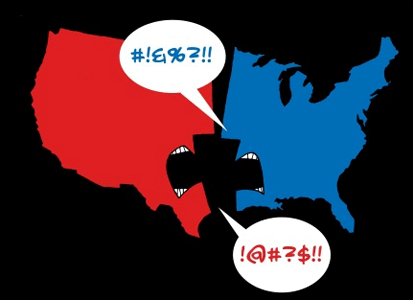
How Understanding Should Liberals Be?

In a polarized world, it’s tempting and satisfying to think: My side is right and the other side is wrong. We represent truth, justice, and all that is good; they represent lies, corruption, and all that is evil. So the most direct way to improve the world is for Us to kick the crap out of Them.

As a liberal, though, I sometimes find it just as tempting (and satisfying in a different way) to think: No one has a monopoly on Truth; there are wise and good people on all sides. Democracy doesn’t work without compromise, and for any conflict there’s usually a higher Truth that transcends both poles. So it’s important for the wise and good people on all sides to stay in dialog and work towards understanding and consensus. Only then can we achieve the kind of win/win solutions that move humanity forward.

On one path, anger and self-righteousness provide energy and direction. On the other, identification with the yet-to-be-discovered wisdom of the future yields a softer (but perhaps more lasting) determination.

Each attitude (if I’m being really honest) offers its own kind of ego boost. In one, I’m superior to those stupid and corrupt conservatives; in the other I’m superior to everyone who hasn’t been to the mountaintop and seen my vision – or at least the vision that I plan to see when I get to the mountaintop.

In the blogosphere, kick-the-crap-out-of-them liberals and find-the-higher-truth liberals have their own polarization, which often manifests in bitter fights between idealists and pragmatists. So in this post, I’m doing what any good meta-liberal would do: I’m searching for the higher truth that transcends the conflict between crap-kicking liberals and conflict-transcending liberals.

The text for my sermon is Jonathan Haidt’s recent book The Righteous Mind: Why Good People Are Divided by Politics and Religion. Obviously, Haidt hails from the conflict-transcending tribe. He describes himself as a life-long liberal from academia, but living among the common people in India opened his eyes to the worthiness of conservative values like in-group loyalty and respect for authority, and the data he has collected since convinces him that there is wisdom on both sides.

Now if only all the wise and good people could transcend polarization and get into dialog.

Not so fast. If Haidt had completely convinced me, I would write a polemic about how conflict-transcending liberals need to kick the crap out of the crap-kicking liberals who poison the dialog that we otherwise could be having with wise and good conservatives.

But I also read Charles Blow’s post in February, showing that compromise itself is a liberal value conservatives don’t share. In poll after poll, Democrats say their leaders should compromise to get something done, while Republicans say their leaders should stick to conservative principles.

Given that difference, the path of least resistance is for Democrats to compromise and Republicans to move ever further to the right. So the Heritage Foundation’s conservative alternative to HillaryCare begets ObamaCare, which Heritage now denounces as an unconstitutional Marxist plot to take over the economy.

I sometimes imagine inviting the Ricks (Santorum and Warren) to a dialog aimed at finding a truth that transcends both my secularism and their Christianity. It’s a non-starter. To the Ricks, the very idea of a truth transcending Christianity is Satanic. Even liberal Christianity might be Satanic.

Worse, you can’t negotiate with Wisdom and Goodness when Lies and Corruption are in the driver’s seat. Think about climate change: The “controversy” over global warming comes not from the laboratories of dissident scientists, but from the board rooms of Exxon-Mobil and Koch Energy.

Corporations are sociopaths; they aren’t influenced by arguments about truth and goodness. So whatever evidence emerges, fossil-fuel companies (and their PR firms, lobbyists, and senators) will challenge the scientific consensus on global warming until they’ve sold the last trainload of coal to the last power plant to run the last air conditioner.

How do you find common ground with that? Don’t we just have to win?

Haidt’s case. Armored with appropriate skepticism, then, let’s look at what Haidt has to say.

Haidt has very artfully organized his book to illustrate his own principles. He believes people first react to an idea intuitively, and only then engage their rational minds to justify their reaction. So Haidt knows that if he turns people off on page 1, none of the evidence he offers later will get a fair hearing. So instead he engagingly tells the story of how he got to his conclusions while saving the conclusions themselves until the end.

He offers (and supports with data) a model of how this all-powerful moral intuition works: Humans have evolved to ‘taste’ six different moral ‘flavors’. Four are easy to describe:

  • Care/harm. Don’t hurt the innocent, especially if they’re cute and helpless.
  • Loyalty/betrayal. Don’t break your agreements or sabotage the team.
  • Authority/subversion. Don’t get uppity and disrespect your betters.
  • Sanctity/degradation. Don’t break your community’s fundamental taboos.

Haidt spells out the emotions these flavors evoke – violations of sanctity evoke disgust, for example, while violations of loyalty evoke rage – and how these responses (even the ones that contradict others) might have evolved.

Originally fairness was a fifth flavor, but eventually he realized that this word is used ambiguously for two different flavors.

  • Liberty/oppression. Nobody is inherently better than anybody else. Example: Count each person’s vote equally.
  • Fairness/cheating. Rewards should be proportional to contributions. Example: People who worker harder should make more money.

The punch line is that liberal moral arguments focus on Care and Liberty, while conservatives season their arguments with all six flavors. (Again, there’s supporting data.)

Politically, Haidt’s book has two big takeaways for liberals: (1) We should learn how to appeal to a wider palate. (2) Conservatives aren’t evil, they just taste different flavors of morality.

Not so fast, part II. I can buy (1), but I’ve got problems with (2). First, I taste those other flavors, I’m just deeply ambivalent about them, because I understand how they can serve evil purposes as easily as good: Being a team player and respecting authority can be bad (say, when you’re in Nazi Germany). Sanctity provides the ugh-factor that justifies oppression of out-groups like homosexuals. Distributing rewards proportionately to contributions can hide an unequal distribution of the opportunities to contribute.

I love a good strong salty taste, but it makes me worry about the value of what I’m eating.

Second, go back to my Exxon-Mobil example: Corporations don’t taste any flavors of morality, they just know how to manipulate the people who do. Fry up some pink slime, add a bunch of salt, and it tastes great!

How understanding do I want to be? But now I’m leaning too far over in the crap-kicking direction. I promised some transcendence. So here’s how much of Haidt I take to heart:

First, liberals need to distinguish what we’re fighting for from who we’re fighting with.

That dittohead friend from high school or the cousin who forwards right-wing viral emails – you probably already realize that they’re not bad people. If you can stand to talk politics at all with them, Haidt has a lot to tell you: You’re never going to convince them by yelling your liberal values back at them. To be convincing, you need to understand what flavor of morality they find in the positions they’re taking, echo that value to the extent you honestly can, and then detach it from the case at hand while you add liberal flavors to the stew.

But lies are poison, no matter how they’re flavored. You can cut some slack for the woman in the next cubicle who tells you Obama is a Kenyan. But you can’t cut any slack for the lie itself. “Why do you believe that?” invites dialog, but “You might be right” just surrenders.

And that TV-talking-head that a Koch-Brothers astroturf group pays to lie for them? He’s evil. Don’t waste your compassion trying to understand anything deeper about him than his paycheck.

Compromise on proposals, not principles. There’s nothing wrong with supporting the best proposal you can pass, even if the other side also manages to get some of its agenda in as well. That’s how democracy works.

For example, the 15th Amendment guaranteed black men the right to vote. Some feminists opposed it, because it should have given women the right to vote as well.

In principle, they were right: It should have. But I’m glad the 15th Amendment passsed, especially since the 19th Amendment eventually followed.

But no post-Civil-War liberal should have said, “It’s good that the 15th Amendment doesn’t apply to women.” Pass as much as you can, but never surrender your intention to come back for more.

Liberal/conservative isn’t symmetric. Haidt is right that six-flavor conservatism has an inherent advantage over two-flavor liberalism. We just don’t have as many ways to provoke a knee-jerk response. That’s why conservatism corrolates with low-effort thought.

That’s also why we can’t just invert the knee-jerk arguments of the right. The correct response to “Black people are bad” isn’t “White people are bad.” “America is always right” shouldn’t lead to “America is always wrong.”

Our side needs nuance. We need to engage thought rather than shut it down.

In particular, we need nuance when we respond to books like The Righteous Mind. The proper response to “Conservatives are good people” isn’t “Conservatives are bad people.” It’s “In what cases and what ways are conservatives good, and how can we engage them there without betraying our own values?”

The Sifted Bookshelf: “Delirium” by Nancy Cohen

What if all the conventional wisdom about culture-war politics is wrong? You know the stuff I’m talking about:

  • The social issues favor Republicans. Coastal elites may have progressive attitudes towards female equality, reproductive rights, guns, gay rights, and so on. But the broad mass of ordinary Americans is deeply conservative.
  • Clinton and Carter proved that Democrats have to court the Bubba vote. The angry-white-male “Reagan Democrats” are the key to winning national elections.
  • The public doesn’t trust the moral values of liberals. McGovern and Mondale went down because they were too far left, Gore was tarred by Clinton’s sins, and so on.
  • Abortion caused the Religious Right to rise up. The preachers saw Roe v Wade and knew they had to take action to defend their long-held moral values.

In Delirium: How the sexual counterrevolution is polarizing America, historian Nancy Cohen looks back over the politics of the last half-century and concludes that it didn’t happen like that. This is a rich book, full of forgotten detail, but one over-arching story comes through: It’s the Religious Right that’s unpopular with the larger electorate. When “values voters” win, they win by stealth and re-interpret the results afterward.

The clearest examples are the Republican mid-term victories in 1994 and 2010. In both cases, overall turnout was low, Religious-Right turnout was high, and the public campaigns focused on other issues. Both the 1994 Contract With America and the 2010 Tea Party stayed away from culture-war issues in public, while assuring Religious-Right leaders behind the scenes that they would act on culture-war issues once they got elected (which they have). Candidates who missed the memo on stealth — Christine O’Donnell, Sharron Angle, and Joe Miller — went down to defeat.

The conservative formula for success is simple: You want the invisible Religious Right networks of viral email and church study groups behind you, and you want evangelicals ringing doorbells and making phone calls for you, but your public campaign should have as little to do with them and their issues as possible. In 2000, all the fundamentalists knew that George W. Bush was their man, but he won with a moderate image as a “uniter” and a “compassionate conservative”.

Conversely, Bill Clinton may speak with a Bubba accent, but he won in 1992 while publicly reaching out to both feminists and gays to a greater extent than any previous major-party candidate. And the more that Republicans tried to make Clinton’s personal sex life an issue, the more popular he got. Clinton left office with a higher approval rating than Ronald Reagan. Al Gore’s biggest mistake was to distance himself from the popular Clinton in an effort to placate the evangelicals who voted for Bush anyway.

The other striking theme from Delirium is that abortion is an issue-of-opportunity for the Right. The original issues are gender equality and sex. To hear them tell it now, the Religious Right was always against abortion because the Bible is against it. When Roe v Wade made abortion legal, leaders like Jerry Falwell knew they had to get involved in politics.

In fact, the causality worked in the other direction. The Bible says next to nothing about abortion, and gives no support to the bizarre idea of ensoulment-at-conception. (As best I can determine, no one held this belief until recent centuries, and Protestants didn’t pick it up in any numbers until the late 1970s, when their politics demanded a clearer theological reason to condemn abortion.) When Roe v Wade was decided in 1972, many conservative religious leaders supported abortion rights or had no opinion on the issue.

The Religious Right actually began when conservative Christian women began organizing against the Equal Rights Amendment in 1972. Abortion was not their major issue. Only after Lottie Beth Hobbs had established the grass-roots potential of an anti-feminist religious movement and drew its battle lines did the male preachers join in. Jerry Falwell didn’t preach his first anti-abortion sermon until 1978.

Glenn Greenwald Lays Out the History of “Elite Immunity”

If you’ve been reading Glenn Greenwald’s columns at Salon (or reading a Greenwald-influenced blog like the Weekly Sift) you won’t be surprised by anything you find in his recent book With Liberty and Justice for Some: How the law is used to destroy equality and protect the powerful.

Still, I found it striking to see so many individual issues laid out together and presented as a progression. It’s easy to get outraged at any one of them — say, that banks are foreclosing homes illegally and yet no bankers are going to jail — and miss the overall point: We are losing the rule of law.

If you are rich enough or powerful enough, you can break American law — either with complete impunity (like, say, Dick Cheney) or maybe paying wrist-slap fines that are a reasonable cost-of-doing-business (like Bank of America). What’s more, if anybody thinks you should be punished the way ordinary people are when they break the law, media pundits from the Right and Left alike will set them straight: Leona Helmsley was right; like taxes, the law is for “little people”.

It’s tempting to think things were always this way, but they really weren’t. This has all happened in living memory. Yes, the rich and powerful have always had better lawyers than the rest of us, and they’ve always gotten a little extra benefit of the doubt from judges and police. But never before has American society so completely accepted in principle that different rules should apply to the elite.

Glenn Greenwald traces this back to a single epochal event: President Ford pardoning Richard Nixon after the Watergate scandal forced him to resign. Nixon had resigned before the Senate could hold an impeachment trial, so Ford’s pardon meant that no Nixon trial would ever be held.

At the time the pardon was hugely unpopular, and is probably why Ford lost his re-election bid to Jimmy Carter in 1976. But looking back, the whole affair is kind of quaint. People at every level of the administration below Nixon went to jail, including Chief of Staff H. R. Haldeman and Attorney General John Mitchell. What’s more, the pardon itself was completely above board: Ford announced it in a national speech, and the presidential power to pardon is explicitly listed in the Constitution. The political price Ford paid in 1976 is exactly how the Founders envisioned keeping the pardoning power under control.

It’s hard to imagine anything like that happening now. The Bush administration broke a long list of laws: torture, spying without warrants, lying to Congress, and many others. No one has even been charged with these crimes, much less tried or punished. Like President Ford, President Obama has covered for his predecessor. But he hasn’t issued explicit pardons on national TV. Instead, he has just quietly let the whole thing drop, and occasionally claimed some dubious version of the state-secrets privilege to shut down court cases. Beyond occasional statements that we must “look forward, not backward”, President Obama has never even attempted to justify this policy to the American people.

And the outcry from the mainstream media has been … non-existent, unless you count the mainstream pundits who periodically scoff at the idea that the law should be enforced.

This didn’t happen all at once, and the successive chapters of Greenwald’s book present the gradual drift away from the rule of law. Watergate was followed by Iran-Contra, where once again pardons were issued. This time, though, it wasn’t just the president (Reagan) who was protected. President Bush the First pardoned high-ranking officials a level or two down from the president (like Defense Secretary Caspar Weinberger). In this way, Bush guaranteed that the accusations would never reach the president (or himself, in his previous role as vice-president).

In the Bush II administration, the pardon was issued by the very president whose administration was under suspicion. Scooter Libby was convicted of perjury and obstruction of justice in the CIA leak scandal, but never served time — and so was never tempted to flip on his boss, Vice President Cheney. (Greenwald points out this important fact about the Plame Affair: It only reached the point it did because another powerful institution — the CIA — insisted on pursuing the matter.)

Today, President Obama’s justification for drone strikes like the one that killed American citizen Anwar Awlaki is still secret, but seems unlikely to stand up to scrutiny. (Read the Wikipedia article on targeted killing and see if the line separating it from assassination makes any sense to you.) Obama is undoubtedly counting on his successor to continue the tradition of letting things drop.

Elite immunity entered the private sector with the telecom immunity bill. Telecom giants like AT&T illegally cooperated with warrantless spying of the Bush administration. Lawsuits against the government had already been closed off by state-secrets claims, which denied victims standing to sue. (If you couldn’t prove you’d been tapped, you couldn’t file suit.) But customer lawsuits against the telecoms were still possible and could have cost the companies billions if they lost — which they would have, because they clearly broke the law. But in 2008 a Democratic Congress passed a bill granting them retroactive immunity.

From there, not prosecuting Wall Street for laws broken during the housing bubble or the banks for foreclosure fraud seemed almost reasonable.

During this whole progression, the arguments have built on the one President Ford made: Whatever has happened, it’s time to put it all behind us. (Greenwald suggests trying that argument the next time you’re pulled over for speeding.) Powerful people let other powerful people off the hook, not for their benefit, but for ours, so that we don’t have to go through the ordeal of watching them be tried and punished. (That would be a good argument to try if your spouse catches you in an affair. Uncovering the truth would be too much of an ordeal for her and the kids. Best to let it all drop.)

But since no one is punished, the problem never gets behind us: Elite disrespect for the law only grows, guaranteeing that more laws will be broken in the future.

By pulling all these issues together, Greenwald is making an important point: Each example by itself is a partisan issue, but elite immunity is bipartisan. The powerful in government, industry, and the media are all coming to see themselves as members of a single privileged class. More and more, they close ranks against any attempt to punish crimes committed by one of their own.

“Common As Air” by Lewis Hyde

Lewis Hyde’s Common as Air isn’t just another book about copyright and intellectual property. It’s the kind of return-to-first-principles that should happen a lot more often.

This subject is usually a battle of slogans, from “information wants to be free” on one side to “theft is theft” on the other.

Hyde doesn’t go there. Instead he roots back through American and English history to examine two questions: What is property anyway? And what did the Founders think they were doing when they gave Congress the power to establish patents and copyrights?

The usual answer to the first question is that property means private property; the paradigm is a person owning a house. This is often presented as if it were natural and prior to society or culture. But Hyde goes back into English history to revive the alternate property model of the Commons.

The Commons turns out to be a lot more complex and nuanced than “The Tragedy of the Commons” would have you believe. A common was never a lawless wasteland that anyone could exploit at will. Instead, a common was land owned collectively by a community of “commoners”, who had variously defined rights subject to various restrictions. That’s why the model endured for centuries, without tragedy.

Second, the Founders were not thinking in terms of “intellectual property” at all. Instead, they saw patents and copyrights in terms of government-granted monopolies. In general, they disapproved of such monopolies, which were the crony capitalism of the 18th century. (A 20th century example: Gandhi’s Salt March protested a licensed salt monopoly in India.)

Patents and copyrights, then, were not viewed as government recognizing some natural property right. Instead, they were useful evils, in which the government granted artists and inventors temporary monopolies in exchange for communicating ideas that would eventually enter the public domain. Hence the phrasing of Article I Section 8 of the Constitution:

The Congress shall have the power … to promote the Progress of Science and useful Arts, by securing for limited Times to Authors and Inventors the exclusive Right to their respective Writings and Discoveries

Patents and copyrights were devices for managing the public domain as an informational commons. A vibrant public domain was the goal; the current system, in which copyright is essentially eternal for anything created after Mickey Mouse, would have horrified the Founders.

Hyde fleshes out this picture by examining how individual Founders viewed their writings and inventions. Franklin, for example, never tried to patent his inventions — not the Franklin stove and not the lightning rod. When Jefferson invented a new process for processing hemp, he wrote to a friend

I shall probably describe it anonymously in the public papers, in order to forestall the prevention of its use by some interloping patentee.

The most interesting part of the book is the hardest to explain, and I think I’ll have to recommend that you go read it: Hyde relates a society’s large-scale structure to its view of what a person is and should be. The current system, with individually owned property as the paradign, promotes the ideal of the autonomous individual, who is connected to and responsible for no one unless s/he chooses to form such connections.

The Founders lived with a different ideal, a public citizen, whose identity intertwined with the community s/he lived in, and who took payment in honor as much as money. Franklin, for example, did not disdain money in any way. But he also gloried in his reputation as a public benefactor, who saved the community from lightning.

Republicans Have Gone Crazy Before

The most comforting thing about reading history is that you know the story comes out at least sort of OK. After all, if the world had really ended back then, you wouldn’t be sitting here reading this book.

This week I’ve been reading Rule and Ruin: the downfall of moderation and the destruction of the Republican Party from Eisenhower to the Tea Party. You might imagine that story would be depressing, but I’m finding it strangely hopeful, for this reason: Republicans have gone crazy before, and they more-or-less recovered from it.

So they might recover again.

Regular readers of the Weekly Sift know that I think the current Republican Party is insane. I agree with David Frum that conservatives have created an alternate reality “with its own facts, its own history, its own laws of economics”. As a result, the main Republican “accomplishments” of recent years have been to prevent the country from dealing with real-world problems like global warming or growing inequality, and they’re fighting a last-ditch effort to stop Democrats from doing anything to help the 50 million Americans who lack health insurance.

Delusional thinking is understandable when the fantasy is at least pleasant. But in the conservative Bizarro World, our country is ruled by foreign-born usurper who is trying to destroy the Christian religion and replace the Constitution with either Communist dictatorship or Sharia or (somehow) both. We are beset by all manner of bizarre conspiracies, mapped out from beyond the grave by Saul Alinsky and orchestrated by Marxist multi-billionaire George Soros.

The real world has many problems, but at least it’s not that bad. If somehow we could shake our Republican countrymen awake from their nightmare, we’d be doing them a favor.

So anyway, I’m down on Republicans these days. But what you might not realize — because I have assumed it goes without saying — is that I fully support the idea of a Republican Party. I agree with a recent Thomas Friedman column: America doesn’t need a third party,

What we definitely and urgently need is a second party — a coherent Republican opposition that is offering constructive conservative proposals on the key issues and is ready for strategic compromises to advance its interests and those of the country.

On all sorts of issues — education, pollution, housing, poverty — we need a vigorous two-party debate on national standards vs. local control. Neither side should win that debate once and for all, because both represent American values that go all the way back to Hamilton vs. Jefferson.

Similarly, all the way back to the construction of postal roads and the Erie Canal, American economic development has balanced the public and private sectors. We need one reality-based party championing public-sector development and another championing private-sector development.

Isolationism vs. internationalism, workers’ rights vs. owners’ rights, preserving traditional mores vs. correcting past injustices — what’s called for in each case is not a final victory of one side over the other, but a continuing tension between conflicting values. That’s why we need two parties.

Two sane parties, that is.

Consider the budget. Just about everybody understands that it’s a bad idea to borrow another trillion dollars every year from now on. So there’s room for reasonable people to debate whether to close that deficit primarily with spending cuts or with tax increases; how that pain should be spread among the rich, the poor, and the middle class; whether to start tightening the screws immediately or wait until the economy is stronger; how to split the spending cuts among safety-net programs, investments in education or infrastructure, and defense; and many other questions.

Instead, last summer we debated whether or not the United States should pay its bills. That was not a sane discussion. And in a Republican presidential debate in August, none of the candidates would accept a hypothetical deal in which spending cuts outweighed tax increases 10-to-1. Instead, all Republican candidates have proposed tax reforms that would substantially decrease revenue. They focus tax cuts on the rich, while sometimes actually increasing the taxes of the working poor. Vague or completely unspecified spending cuts make up the difference.

On social issues, Republican presidential candidates (eventually including Romney and Paul) have endorsed an anti-abortion “personhood” position so radical that it was decisively voted down in Mississippi. Got that? Mississippi is too liberal for the current crop of Republican presidential candidates.

It’s crazy over there.

So here’s the comforting lesson from Rule and Ruin: Republicans were at least this crazy in 1964, and they got over it.

Those of us old enough to remember Barry Goldwater at all have had our memories sepia-tinted by the mellower Goldwater of the 80s, and 90s, who warned against the dangers of Jerry Falwell’s Moral Majority. But the Goldwater of 1964 was every bit the full-blown loon that Michelle Bachmann is today.

Just like present-day crazies, the 1964 extremists imagined a previously invisible conservative majority that Richard Nixon had failed to inspire in 1960, but which would turn out in droves if Republicans nominated a “real” conservative this time. In the defining pro-Goldwater tract A Choice Not an Echo Phyllis Schlafly explained:

it looks as though there is no way Republicans can possibly lose so long as we have a presidential candidate who campaigns on the issues. But … how did it happen that, in four major presidential campaigns*, Republicans were maneuvered into nominating candidates who did not campaign on the major issues?

It wasn’t any accident. It was planned that way. In each of their losing presidential years, a small group of secret kingmakers, using hidden persuaders and psychological warfare techniques, manipulated the Republican National Convention to nominate candidates who would sidestep or suppress the key issues.

Top that, Sarah Palin.

[*the four treacherous candidates were Wendell Wilkie in 1940, Thomas Dewey in 1944 and 1948, and Richard Nixon in 1960]

The Tea Party of 1964 was the John Birch Society, whose founder believed Dwight Eisenhower had been a communist sympathizer. “It is difficult,” he wrote of the five-star general and two-term Republican president, “to avoid raising the question of deliberate treason.”

But within a few years all that had been swept away. Just as Goldwater’s elderly mellowness brightens our memories of him, Kent State and Watergate have darkened our picture of Nixon, who presided over a very moderate administration overall. From the Nixon years we get the Clean Air Act, OSHA, the EPA, and the first SALT treaty with the USSR. Nixon opened relations with China, appointed more blacks than Johnson had, and increased the minority role in federal contracts both on the small-business level and in labor unions.

Nixon’s Republican Party is what I wish we had back: a party of diverse views, leaning conservative and sometimes pandering (as any party does) to the electorate’s baser instincts, but by-and-large facing the nation’s real problems and trying to solve them. Even the party’s right wing was purging itself, as Bill Buckley succeeded in marginalizing the Birchers.

So how does an insane party get its mind back? First, it has to nominate a true extremist like Goldwater. (Rick Santorum would fill the bill nicely.) Until it does, the delusional system will explain every defeat as it did McCain’s in 2008 or Nixon’s in 1960: He wasn’t extreme enough.

Second, the extremist has to go down to a historic defeat (like Goldwater’s 61-39 shellacking by LBJ) that proves for a generation that the invisible majority does not exist. Again, I’m confident Santorum could handle this part of the script.

And finally, the sane-but-cynical conservatives who thought they could harness the crazies have to become targets of insanity themselves. This is already happening. Fox News and the Drudge Report, for example, are already under fire for having “turned left”. Mitt Romney and Jon Huntsman have been assailed as “liberal” and even “socialist“. Newt Gingrich is “not a real conservative” either.

This will keep getting worse, because when reality becomes optional, no one is safe. At some point, even conservatives with impeccable credentials will realize that the beast is eating its own and has to be put down.

And then they will put it down. It happened before. It can happen again.

The Sifted Bookshelf: The Myth of Choice

So many social issues hinge on choice and individual responsibility. To what extent do our choices shape our lives, and how much choice did we really have? A struggling family pays its rent and buys the kids school clothes rather than sign up for health insurance. Should we regard that as a “choice” to be uninsured?

The poor often make bad choices. They may eat badly, handle money badly, or fail to invest enough time developing marketable skills. Is that because they lack character, or because poverty is a high-stress environment in which it’s hard to make good choices?

In another view, nothing is anybody’s fault. We’re all just automata, determined by forces beyond our control: genetics, peer pressure, advertising, culture, economic forces, childhood trauma, and so on. If one child goes to college and another to prison, it’s just the breaks.

The Myth of Choice by Kent Greenfield is the beginning of a more meaningful dialog about choice. He presents a variety of real-life examples and scientific studies that point in a more sensible direction: We do all make choices, but our options are limited by external forces. And even when the external world isn’t constraining us, we are limited by what he calls our “choice muscles”. If we have to make too many stressful decisions or apply too much willpower, they wear out and we begin to act like the kind of automata pictured by determinists.

In one experiment, people were asked to remember a number and then offered a snack. The longer the number, the more likely they were to take the cake rather than the fruit. The stress of the longer number left fewer mental resources to apply toward healthy eating.

The metaphor of “choice muscles” is a valuable addition to the discussion. As individuals, it points us toward exercising them and building them up, as well as towards avoiding needless temptations. And as a society, how do we create choice-friendly environments that make it easy to choose the things we really want, rather than overwhelming environments that make us more manipulable?

The Sifted Books of 2011: Rethinking Economics

I don’t have a book-review strategy on the Sift. In deciding what to read and what to write about, I usually just follow my nose and figure out later what it all means. So I don’t know why I reviewed exactly half as many books in 2011 as in 2010: 8 instead of 16.

In retrospect, it’s interesting to note that more than half of the 2011 books were about economics: Debt: The First 5,000 Years by David GraeberThe Seven Deadly Innocent Frauds of Economic Policy by Warren Mosler (reviewed in two parts: firstsecond), Why Marx Was Right by Terry EagletonThe Lights in the Tunnel by Martin Ford, and Consumed by Benjamin Barber.

There’s a strong contrast here with last year’s economics books. Then I was often telling you about books by economists from the liberal mainstream, like Robert Reich and Paul Krugman. But these five are more radical start-over-from-scratch books.

In retrospect, here’s what I think that means: For a long time now, I have doubted the conservative conventional wisdom that the market can solve any and all problems. But lately I’ve also begun to doubt the liberal conventional wisdom that we can achieve a fair and vibrant economy by tinkering with interest rates, regulations, and government spending. This year’s books reflect my search for a new way of thinking about the economy.

Both Graeber and Mosler are telling us that money isn’t what we think it is. Mosler’s book examines the nuts-and-bolts of how the banking system creates money, while Graeber takes a long anthropological look at where this whole idea of money comes from and how it changed society.

Eagleton challenges the capitalism-has-won narrative of the post Cold War world, and shows how our “victorious” capitalism is displaying the flaws that Marx predicted a century and a half ago. And Ford goes back to the Luddite claim that machines destroy jobs, arguing that even if it wasn’t true then, it is now.

Barber’s book is on the boundary between economics and politics, arguing that if capitalism is allowed to run wild it will destroy democracy. Consumer and citizen are two very different roles, and the more we identify with our consumer role, the less we will be able to perform our duties as citizens.

Barber presents a different side of the scene portrayed by Ford. I summarized Barber’s point like this:

The root of the problem Barber presents is capitalism’s success in satisfying all the genuine needs of people who have money, creating a situation in which “the needy are without income and the well-heeled are without needs.”

Here’s the Ford/Barber connection: In our mechanized world, the one thing the well-heeled don’t need is more labor, which is all the needy have to sell.

Given this theme, there are two books that I should have written about but didn’t. Race Against the Machine by Erik Brynjolfsson and Andrew McAfee, and the 1944 classic The Great Transformation by Karl Polanyi. Both are woefully short of effective prescriptions, but they add important ideas to the diagnosis.

Brynjolfsson and McAfee bring in this arresting image from a book I haven’t read, A Farewell to Alms by Gregory Clark: In 1901, the British economy found jobs for more than 3 million horses. All those jobs are done by machines now, and horses are purely recreational.

There was always a wage at which all these horses could have remained employed. But that wage was so low that it did not pay for their feed.

How many human workers will go the way of the horse?

Polanyi’s book is a hard read, but fascinating. He tells the story of how the market economy was created in the 1800s. That statement is already radical, because so many people believe that the market economy is natural and goes back into deep antiquity.

In fact, Polanyi says (and Graeber agrees), markets used to be only a small part of the economy. In order to have what we now think of as a market economy, markets had to be created for what Polanyi calls the three “fictitious commodities”: labor, land, and money.

Labor is only another name for a human activity that goes with life itself, which in its turn is not produced for sale but for entirely different reasons, nor can that activity be detached from the rest of life, be stored or mobilized; land is only another name for nature, which is not produced by man; actual money, finally, is merely a token of purchasing power which, as a rule, is not produced at all, but comes into being through the mechanisms of banking or state finance. None of them is produced for sale. The commodity description of labor, land, and money is entirely fictitious.

My hunch is that the re-thinking of economics has to start there.

A related question is why our political system can’t adjust to our new economic realities. That led me to look at So Damn Much Money by Robert Kaiser, which is a history of lobbying.

The possibility of another way of functioning entirely led me to Reality is Broken by Jane McGonigal. McGonigal starts with the observation that the multi-player computer games like World of Warcraft and Halo soak up vast amounts of human time, effort, and ingenuity. What makes these invented worlds so much more engaging than reality?

Part of the answer is that successful games appeal to aspects of the human character that have been left out of the homo economicus model of human nature. In other words, we aren’t all trying to get as much stuff as we can for as little effort as possible — at least not all the time. Sometimes we want to achieve self-respect and honor even if it costs us effort and money.

McGonigal describes the widespread perception among gamers that their game persona is a better human being than their work persona. Something can be done with that. (One fictional view of how that could work is the Daemon/Freedom™ series by Daniel Suarez.)

Another book I should have reviewed made a similar point looking backward rather than forward: The Honor Code by Kwame Anthony Appiah. Major social changes, he claims, come not from self-interest but from a sense of honor. Society changes because our ideas about what is honorable change.

Appiah looks at societies that ended dueling, slavery, foot-binding, and honor killings of sexually activity female relatives. In each case, he finds that the cause is not economic and not fundamentally rational; in fact, the rational arguments against the practice were well known long before they became convincing. Instead, change happens via an invisible shift in the community’s honor code: Practices that once defended honor suddenly become dishonorable.

Two books I should have reviewed that deserve more than a paragraph here are 23 Things They Don’t Tell You About Capitalism by Ha-Joon Chang and The Myth of Individualism by Peter Callero. Maybe next year.

The one book I reviewed that doesn’t fit this pattern is The Hour of Sunlight by Sami al Jundi, which is one Palestinian’s attempt to envision peace between his people and the Israelis. Interestingly, that review was an afterthought: The article I wanted to write fell through at the last minute, and I needed something to fill the space.

Forgive Us Our Debts

It’s striking how many of the big stories in the news revolve around debt:

  • the European debt crisis, with its Greek, Italian, Irish, Spanish, and Icelandic subplots;
  • the failure of the so-called “Super Committee” to reach an agreement, which is just the latest episode in the long-running saga of the U.S. federal budget deficit;
  • the continuing not-technically-a-recession, with its roots in the debt-fueled housing bubble;
  • the increasing separation of American society into a creditor class and a debtor class;
  • popular anger — expressed in both Occupy Wall Street and the Tea Party — about the misdeeds of the too-big-to-fail banks and their special relationship with the government;
  • new revelations about the role of the Federal Reserve in creating profits for the big banks, and the role of the SEC in helping them cover up their crimes. (See this week’s Short Notes.

Each one of these stories has its own nuances. Plunging into the details, understanding why none of them is exactly what it appears to be, can be strangely comforting. It feeds the illusion that if we can get to the bottom of one of these stories, eventually we can get to the bottom of all of them.

But we also need to get to the top of the story. At some point we need to get a bird’s eye view so that we can see how all those trees make a forest: What is up with debt, anyway? Why do all our problems, no matter how disconnected they seem initially, seem to revolve around it?

Several authors have tried to provide the birds-eye view, painting a unified if somewhat disturbing picture: This isn’t just about economics. It’s about democracy.

Haslett. One recent aerial reconnaissance was Adam Haslett’s Salon article This is Our New Normal. Haslett says we can’t get into a normal recovery because we aren’t in a normal recession. Instead,

In many countries, the fundamental political and economic bargain of postwar society is in the process of coming apart.

The West’s rapid economic recovery from World War II made that bargain work for about a quarter century. Wages could rise without hurting profits or causing unemployment. The poor could be lifted up and middle class could achieve a new level of prosperity without dragging down the rich.

But growth slowed down in the 1970s, and Haslett retells economic history since then as a series of lesser problems caused by our evasion of the larger problem: What should a slow-growth social contract look like? Basically, inflation and debt are two ways to hide lackluster growth. So we had inflation in the 70s, government budget deficits in the 80s, and multiple cycles of private-investment-bubble/debt-crisis from the 1990s on.

Such growth as we have seen in the last four decades is increasingly based on finance rather than manufacturing, and concentrated on the already rich. These opportunities are not only out of most people’s reach, but beyond their understanding.

Most people can understand what political forces are at play when a union demands higher wages and a company resists, citing foreign competition. … But what happens when a politician says we must lend billions of dollars to undercapitalized banks or indebted countries in order to provide liquidity to the financial system, and if we don’t we will enter a depression or blow up the euro? The content, let alone the truth, of such a proposition is hard for most people to assess.

The result is an across-the-board loss of faith in democracy: Big-money interests are unwilling to leave their fate in the hands of the ignorant masses, while the average citizen wants to believe that somebody somewhere understands this stuff and can manage it properly. And so

the key decisions are made without democratic consultation by financial bureaucrats working with private bankers. … Financial policy becomes more like foreign policy, conducted by an executive strong-arming a parliament or legislature under conditions of emergency.

But without democratic process, public debts start to lose their legitimacy. Why shouldn’t the People simply repudiate debts that have been thrust upon them by technocrats? And if they do, will creditors absorb the loss? Mount a coup? What? Haslett has no answer, but believes that even framing that question advances the needed discussion.

Hudson. An even-higher-altitude view comes from economist Michael Hudson’s article Debt Slavery in the current issue of Counterpunch. Hudson observes that ancient societies regularly ran into trouble when creditors gained too much power.

The general pattern went like this: During droughts and other natural disasters, small landholders would need more help that they could pay for and so would be forced to borrow on the lender’s terms. (As Adlai Stevenson put it, “A hungry man is not free.”) Eventually the lenders would end up owning the land, turning the original owners into serfs, slaves, or criminals.

Since small landowners were the core of effective ancient armies, this gradual reduction to slavery was a disaster from a king’s point-of-view. So mass cancellation of debts was a frequent feature of ancient imperial governance, and got instituted in the Torah as the Jubilee Year.

If creditors became too powerful for the king to cancel debts, the empire usually fell. That is Hudson’s explanation for the fall of Rome, which lost its ability to raise an army of native landowners and had to rely instead on foreign mercenaries, who eventually over-ran the empire.

“Creditor power and stable growth rarely have gone together,” Hudson writes.

The rise of democracy in the 1600s meant that debts could be owed by the People as a whole, rather than by individuals or kings who might be overthrown. However, eventually the ancient problem re-appears:

The tendency for debts to grow faster than the population’s ability to pay has been a basic constant throughout all recorded history. Debts mount up exponentially, absorbing the surplus and reducing much of the population to the equivalent of debt peonage.

Modern democracies don’t have jubilee years, but they achieve the same purpose by progressive taxation financing a social safety net, plus government control of central banks and regulation of banking in general. In recent years, though, the creditor class has gained enough political power that it can lower its own tax rates, cut the safety net, and deregulate. Hence the current global crisis.

When banks are permitted to be self-regulating and given veto power over government regulators, the economy is distorted to permit creditors to indulge in the speculative gambles and outright fraud that have marked the past decade.

The result is the kind of tension Haslett noted: Creditors want economic decisions taken away from elected officials and turned over to technocrats. But the bankers have lost sight of the big picture: Technocratic management causes the People to lose commitment to “their” public debt, which they will eventually repudiate, as has already happened in Argentina and Iceland.

Graeber. According to an old saying, you can’t tell a fish that it swims in water. That’s a good way to think of anthropologists: They’re fish who study the water the rest of us take for granted. David Graeber’s recent book Debt: The First 5,000 Years is an anthropologist’s take on economics. And so, mixing my animal metaphors, it is the highest-flying bird of all.

Graeber is writing this book to answer the question: Why do people have to pay their debts? It’s an almost universal moral principle, but its applications are perverse. He notes what he saw while studying the highland peoples of Madagascar: IMF-imposed austerity killed the mosquito eradication program. Predictably, malaria returned, killing thousands of poor children.

Now, few people would knowingly make the moral choice “Children should die so that Madagascar can give money to Citibank”, especially since the country’s indebtedness is all bound up in its colonial history. But once expressed as debt, the logic somehow seems obvious.

There is no better way to justify relations founded on violence, to make such relations seem moral, than by reframing them in the language of debt — above all, because it makes it seem that it’s the victim who’s doing something wrong.

Banks can and have, for example, lent irrational sums of money to countries whose corrupt dictators stole it. Should the People have to repay those loans? The logic of this isn’t even good capitalism. Graeber imagines asking the Royal Bank of Scotland for a million-pound loan to bet on a horserace. Good bankers would wisely turn him down.

But, imagine there was some law that said they were guaranteed to get their money back no matter what happens, even if that meant, I don’t know, selling my daughter into slavery or harvesting my organs or something. Well, in that case, why not? Why bother waiting for someone to walk in who has a viable plan to set up a laundromat or some such?

Good capitalism, in other words, depends on foolish loans not being repaid.

Moral framing. The rest of the book is a long historical/anthropological meditation on how repaying debts came to seem like the bedrock of morality. The answer is surprisingly deep and bizarre: Our language for framing moral questions has come to be based on the metaphor of debt. Moral obligations of all sorts are expressed as what we “owe”. It’s baked into the language: ought and owe come from the same root; should comes from the German schuld, meaning debt.

Even God is pictured as maintaining a ledger of our good and bad deeds, which will be read at a Day of Reckoning — a term that comes from accounting. Afterward, some will be dragged away to an eternal debtors prison, while others will see their slates wiped clean in a massive Jubilee.

As George Lakoff teaches, “common sense” is nothing more than what is implied by the unexamined assumptions contained in our framing metaphors. Consequently, “people have to pay their debts” is common sense, even though it’s actually fairly dubious.

The net effect of Graeber’s book is to de-mystify debt, and to strip it of its undeserved moral trappings. If you’re killing children to enrich bankers, the morality of that has to stand on its own.

The hidden history of money. Graeber can’t cover debt without re-examining money, whose history has largely been hidden behind myths.

Econ 101 teaches that primitive barter economies developed money to make trade more efficient. In fact, anthropologists know that there has never been a primitive barter economy. Economies based on trade develop after money, not before. (Pre-monetary economies are like families or mafias — based on relationships of mutual obligation, not trade of goods and services.) Economists hide the history of money out of shame, because it is all bound up with slavery. It’s only a slight exaggeration to say that money developed in order to buy people.

A personal relationship is a long series of inexact exchanges of favors. Money introduces the idea that indebtedness can be precisely quantified and that the account can be settled, allowing both parties to walk away from the relationship clean. (That, Graeber explains, is why we instinctively rebel at mixing money and friendship. Settling accounts is preparation for ending the relationship.)

The true history of money shows why it has destabilized the moral structure of one traditional society after another. Money distances people from each other, and reduces everything to the status of a commodity. And so we are distanced from the consequences of our demands: I don’t want parents to starve their children or old people to go without health care — I just want a good return on my money.

Summing up. Debt and its repayment is not some technical issue to be worked out by economic experts. Ultimately, a country’s debt is only meaningful in two situations: If the People are committed to repaying it, or if the country has an undemocratic government strong enough to force repayment against the People’s will. “Technocratic” solutions start us down the second path.

And finally, what a country does with its resources is a moral choice. The morality of that choice can be hidden by the language of debt, but not forever. The sooner we see through our illusions about debt, the better.

The Sifted Bookshelf: The Hour of Sunlight

The Hour of SunlightWhen extremists have been shouting — and sometimes shooting — at each other for generations, the center is a hard position to hold. Each side has its own version of history, which begins with its own people minding their own business and being horribly victimized by the other side. Each side has its own framing of law and justice and human rights, in which it has always been right and the other side has always been wrong. Even the horrible things that are undeniable — the killing of innocents, the torture of helpless prisoners — were only done to prevent (or in reprisal for) something worse perpetrated by the other side.

Sami al Jundi believes that people need to tell each other their personal stories, and that when they do, they will empathize with each other and start trying to find common solutions. That’s what he does in The Hour of Sunlight. Al Jundi is a Palestinian from East Jerusalem, and a secularized Muslim. His story is hard to pigeon-hole or stereotype, and that is the strength of his book. It made me wonder how many other stories of ordinary Israelis and Palestinians don’t fit into any of the standard molds.

Sami was a boy when Israel conquered East Jerusalem in the 1967 war. He grew up with family stories of leaving Deir Yassin in 1948 after a massacre that some Israeli writers say never happened. He grew up with a resentment against Israel and a desire to strike back. When he was a teen-ager, his two best friends went to Syria for a few days of training, and came back determined to make bombs. They blew themselves up. One died, while Sami and the other boy were badly injured. Sami got some experience of Israeli interrogation techniques and a ten-year prison sentence.

Prison, oddly enough, is where al Jundi gets his education in politics, in history, and eventually in non-violence. The political-prisoner community had a strong sense of identity, a strong education program, and the most idealistic democratic process al Jundi ever runs into. After a few years, though, an influx of new prisoners from Gaza produces a new regime and a paranoid search for collaborators. This is the first of many disillusionments about his own people that al Jundi suffers.

A greater disillusionment happens after he is free, and the Oslo agreement seems to promise peace. Al Jundi’s initial euphoria dissolves from both directions: The Israelis continue to push Palestinians out of Jerusalem neighborhoods, and the Palestinian Authority replaces the indigenous semi-democratic Palestinian underground leadership with the corrupt authoritarianism of the newly-returned PLO exiles.

His idealism leads him to work with Seeds of Peace, a group (founded and largely funded by American Jews) that brings Israeli and Palestinian youths together in workshops in Maine, where they learn nonviolence and listen to each other’s experiences. Al Jundi tries to keep the “seeds” (as the youths are called) integrated after they return to Israel/Palestine, and several invite each other to speak at their high schools.

This too falls apart from both sides. The Israeli government is upset that Jewish seeds are becoming conscientious objectors to military service, and Palestinians accuse al Jundi of being a “normalizer” — someone who wants to defang Palestinian resistance without overcoming Israeli oppression. Eventually, he is dismissed because Seeds of Peace can no longer countenance employing someone with his criminal record.

If Hour of Sunlight followed formula, this setback would be the prelude to an even bigger victory. But, at least so far, it hasn’t been. Al Jundi retains his faith in peace-making, in non-violence, and in democracy. But how he will manifest these ideas in the future remains unclear.

The Mosler Proposals

Two weeks ago I introduced you to Warren Mosler’s Seven Deadly Innocent Frauds of Economic Policy, a short and insightful book you can read for free.

Review. Mosler’s main point is simple: Money doesn’t work the way you think it does. A dollar is just a data entry at the Federal Reserve, and doesn’t represent any physical substance. So if the Fed’s computer says you have a billion dollars, then you do. Those dollars didn’t have to “come from” anywhere or correspond to anything; they’re just data. (If Delta gave you a million frequent flier miles, would those miles have to come from somewhere?)

Consequently, the U.S. government’s spending is not limited by it’s ability to tax or borrow. Dollars can simply be created out of nothing by making an entry in the Fed’s database. Here’s how it works: The Treasury “borrows” by issuing a bond which the Fed “buys” by entering a credit in the Treasury’s account. Checks to Social Security recipients, defense contractors, or whoever eventually wind up at the Fed, which “cashes” them against the balance in the Treasury’s account.

According to the Fed balance sheet at Wikipedia, the Fed currently owns $1.6 trillion of the total $14.5 trillion of Treasury securities. That’s $1.6 trillion that came from nowhere.

A debt-ceiling aside. Those debt-ceiling clocks have been ticking down to the moment when the Treasury’s account at the Fed hits zero. Tuesday, CNBC’s John Carney asked the trillion-dollar question: Does that event actually mean anything? Or would a negative number in the Fed’s database work just as well?

Carney thinks it would.

Think about it. The check comes into the Federal Reserve. It looks at the U.S. government balance and discovers that we’re at zero. What does the Federal Reserve do?

I’m pretty sure the Federal Reserve would go ahead and credit the bank submitting the check with the deposit to account for the fund transfer.

What are the constraints? Then what keeps the government from giving us all a few million? Fear of inflation. Since our economy doesn’t produce enough goods to satisfy 300 million millionaires, those magically-created dollars would bid up the price of everything.

But here’s the next major point: We have unemployed workers, idle factories, empty storefronts, and so forth. The economy is just dying to produce more, if only somebody had dollars to pay for it. In this situation, there really is a free lunch: The government creates more money by spending without taxing or borrowing, and the economy creates more goods and services. No extra inflation.

Go back to the airline analogy. If Delta created and distributed massive numbers of frequent-flier miles, all the frequent-flier seats would fill up instantly, making most people’s miles more-or-less worthless. But what if most those seats had been flying empty? Then Delta could create some quantity of new miles without damaging the value of existing miles.

If you believe that, what do you do? Obviously you spend more and tax less, until the economy starts producing close to capacity.

Some of Mosler’s proposals are larger versions of things that have already been tried: suspending the collection of Social Security and Medicare taxes while continuing to pay benefits (not threatening future benefits, since the trust funds are also just data at the Fed), and giving money to the states (because it makes no sense to lay off teachers and construction workers when we still have work for them to do).

Mosler also wants to establish universal health care through a combination of a conservative idea (health savings accounts for the first $5000 each year) and a liberal idea (Medicare-for-everybody for larger expenses).

His most creative proposal is for a new category of federal job, which pays $8 per hour plus benefits. These new hires would work throughout the government rather than in a few big make-work projects. Any government office that wanted to employ them could do so without using money from its budget.

If you’ve ever worked in an office, you know that there are always useful projects that nobody can get around to doing. You may not be able to pull a shovel-ready thousand-worker project out of the air, but you could easily put two temps to work tomorrow morning, if you could just find the money.

As the economy moves closer to capacity, many of these workers will move into better jobs (aided by their continuous work history). If industry starts to have trouble finding workers, the government can ramp up the amount that the $8 workers cost project budgets.

Mosler would clean up the residue of the housing bubble in two ways: (1) Give banks freer access to loans from the Fed in exchange for tighter regulation. (2) Have the government buy foreclosed houses from the banks (making the banks eat any negative equity) and rent them back to their owners for two years. After two years, the owners have first crack at re-buying before a general auction is held.

The real economy. Probably the best thing to glean from Mosler’s book is a respect for the real economy (goods and services) as opposed to the financial economy (dollars).

This comes through clearest when you think about future generations. We have worried way too much about the numbers in future Fed databases, as if numbers make an economy robust. Instead of good numbers, we should be trying to leave future generations skills, good health, peace, a clean environment, social cohesion, and a solid physical infrastructure.

If they have those things, they will be able to produce the goods and services they need. If not, dollars won’t help them.