In 1990, the death rate for American whites aged 45-54 (USW) was within the normal range of similarly aged people in comparable countries, and similar to the death rate for middle-aged American Hispanics (USH). In all the other countries, death rates continued their centuries-long trend of dropping, with USH tracking the United Kingdom rate almost perfectly. But starting in 1998, USW turns up.
A good summary of this new study is in The Atlantic. The upshot is that about half a million American whites are dead who would be alive if USW death rates had followed the downward track of other first-world countries. The effect seems concentrated in the less-educated classes, and the cause is a sudden jump in the rate of what are called “poisonings” — mainly deaths related to alcohol and drugs — as well as an increase in suicides and other causes related to not taking care of yourself. Atlantic concludes that middle-aged whites “are dying of despair”.
This feels personal to me. My father was a high-school-educated white who was an adolescent during the Depression. For most of my childhood, he had a good-paying factory job that allowed him to buy a small farm that he worked on the side. Needless to say, he was a hard-working guy. But he also saw himself as extremely successful: He owned a house nicer than the one he grew up in, sent his kids to college, and after he retired had a winter home in Florida. He lived to be 90.
I took advantage of the opportunities my parents gave me and got a PhD. I also feel successful, and am in excellent health at 59. But what if, rather than reaching for a better life than my father’s, I had tried to duplicate his success? It wouldn’t have worked. The good-paying no-college-needed jobs went away during my lifetime. I probably would have bounced from one low-status job to another, always wondering why I couldn’t live at the level I had thought was normal for people like me. Compared to my father, I would be a failure.
That pretty well describes one of my cousins, who had alcohol problems for most of his adult life and died a little younger than I am now.
What we’re seeing here, I believe, is the end result of privileged distress. It’s still not objectively harder to be white in American than non-white, but the traditional privileges of whiteness have shrunk, particularly for the working class, while visions of how life is supposed to be (for white people) are pegged to the achievements of our parents. Consequently, it gets harder and harder for working-class whites to live up to the expectations they were raised to have. By middle age many feel like failures, and live with a corresponding lack of self-regard.
Is it any wonder they look for scapegoats, like the Hispanic immigrants, and are attracted to anger-channeling politicians like Donald Trump? They cheer when Trump says America is going to start winning again, and they love to identify with him when he calls his opponents “losers” — because looking down on somebody else is very satisfying when you feel like a loser yourself.
Who expected that when the Republicans anointed a new front-runner, it would be somebody worse?
Ever since he announced his candidacy last summer, political insiders have been telling us that Donald Trump was a fluke of the season: It was early in the process, and people weren’t serious yet. As the primaries got closer, Trump would fade and a more acceptable mainstream candidate like Bush or Rubio or Walker would emerge. Pundits recalled the 2012 cycle, where boomlets for far-out candidates like Michele Bachmann or Hermann Cain came and went every few weeks, but the establishment eventually nominated its man, Mitt Romney. As John Podhoretz put it:
Most of those who are telling pollsters they support the outsiders are basically dating Trump and Carson. They’ll likely settle down with someone else.
And Ross Douthat predicts GOP primary voters will soon start saying this to themselves:
The Donald is fun and I admire Carson, but let’s get real: I’m going to vote Rubio.
Well, according to the Real Clear Politics poll average, Trump replaced Jeb Bush as the front-runner on July 20, and stayed on top not for just a few weeks, but until November 4. And then, it wasn’t Bush or Rubio who passed him (Walker being long gone, along with fellow mainstream GOP candidate Rick Perry). No, in the November 4 average, Ben Carson took the lead with 24.8% to Trump’s 24.6%. [1]
To me, that’s a sign not that things are settling down, but that they’ve wobbled even further off course.
The Music Man. When I think of Donald Trump, the word that comes to mind is huckster. He’s a darker version of Harold Hill from The Music Man, spinning a vision of how fantastic things will be if people do what he wants. Right now we’re looking at trouble in River City, but after we elect him America will be great again. There will be lots of good jobs for real Americans, because he’ll throw out all the Mexicans who are stealing them now, and build a big, beautiful wall to stop any more from coming in. Don’t worry about what that wall will cost, because Mexico will pay for it (from its vast storehouse of wealth). China will stop dumping cheap stuff into our economy, Putin will behave, and we’ll finally crush ISIS. Taxes will be low, and we won’t have to do without any important government service, but there won’t be a deficit.
What’s not to like? [2] After I hear Trump speak, I can’t get “76 Trombones” out of my head.
It’s hard to be a good huckster, though, if you don’t also know a lot about how the real world works. So if you look inside Trump’s business empire, I’ll bet somewhere you’ll find a legal department that hires lawyers and an accounting department full of accountants. Middle management probably includes a lot of MBAs. I haven’t noticed any of his flashy buildings falling down, so I suspect they are designed by architects and built by engineers.
That’s why, although I would expect a Trump administration to do a lot of things I wouldn’t like, I picture it doing them in a fairly sensible way. Whatever crazy things he had to say to get elected, once he was in office he’d get his economic advice from economists, his military advice from generals, and so on. His priorities would be misguided and some people would get hurt, but we’ve survived bad presidents before.
Carson is different. When you watch Ben Carson, it’s tempting to view him through the lens of Trump, as this Nick Anderson cartoon does: They say similarly crazy things, but in different styles.
But this week Carson had two major bursts of bad publicity, and in one of them [3] we see a personality type very different and far more dangerous than the huckster: Ben Carson is a crackpot.
But even the odd sound bites don’t capture the weird vibe you’ll pick up if you listen to longer chunks of Carson’s speeches. He has the crackpot’s way of saying certain common phrases as if they had an occult meaning. Political correctness, for example, is far more sinister than just an exaggerated fear of giving offense, and secular progressives are much more dangerous than just liberals who don’t go to church. Why? I haven’t been initiated into that priesthood, so I can’t guess.
Many of his stranger ideas come from a Cold War era kook, W. Cleon Skousen, a man that even the conservative National Review has characterized as an “all-around nutjob“. In an interview with Alan Colmes, Carson recommended reading Skousen’s 1958 conspiracy-theory screed The Naked Communist as a way to see the connections between Hitler’s Mein Kampf, the writings of Lenin, Saul Alinsky’s Rules for Radicals, and the Obama administration. [4]
Pyramids. This week all doubt about Carson’s crackpottery was removed when Buzzfeed unearthed a 15-minute clip from the commencement speech Carson gave at Andrews University in 1998.
At around the 3-minute mark, he starts talking about the career of the Biblical patriarch Joseph as prime minister of Egypt, building up a grain surplus from the seven fat years to eat during the seven lean years. Andrews is a religious institution (associated with Carson’s own Seventh Day Adventist denomination), so recounting a famous Bible story is a perfectly reasonable thing for a commencement speaker to do. But then Carson goes off the rails and starts talking about the pyramids. As you listen, bear three things in mind:
The pyramids aren’t any part of the Joseph story as recounted in the Bible. Nor do they figure in any other Bible story; the Bible is pyramid-free.
Nobody asked Carson about the pyramids.
The pyramids don’t seem to have anything to do with the overall themes of his speech.
In other words, he just saw a microphone in front of him and decided to lay this bit of wisdom on his audience:
My own personal theory is that Joseph built the pyramids in order to store grain. Now, all the archaeologists think that they were made for the pharaohs’ graves. But, you know, it would have to be something awfully big — when you stop and think about it, and I don’t think it would just disappear over the course of time — to store that much grain. And when you look at the way the pyramids are made, with many chambers that are hermetically sealed, they would have to be that way for a reason.
And, you know, various scientists have said, “Well, you know, there were alien beings that came down, and they had special knowledge and that’s how [garbled, maybe ‘they arose’].” And, you know, it doesn’t require an alien being when God is with you. And that’s really the key. People may not even be able to explain what it is that you’re accomplishing. But they don’t have to be able to explain it when God is there. All you have to do is accept His presence, and His total understanding of everything and link yourself with that.
All the archaeologists think one thing, but I’m a smart guy, so why shouldn’t I have a different opinion and include it in my commencement speech, even though I have no idea what I’m talking about? (He’s not joking; nobody laughs.)
And the competing theory Carson rejects — and attributes to “scientists” — is that aliens built the pyramids. (Though, I suppose, if you imagine the pyramids being built during a seven-year period, you’d need more-than-human tech.) I mean, run the experiment yourself: Google “aliens built the pyramids”. You don’t get references from Nature or Scientific American. You get a rival camp of crackpots.
This is not some unfair reference to Carson’s misspent youth. (Every interesting person has believed something weird if you go back far enough. Heck, I used to be a libertarian.) When asked, Carson verified that, yes, he still believes Joseph built the pyramids. Present-day Ben Carson attributes criticism of his pyramid theory to those ubiquitous “secular progressives”, and so tries to turn it into an argument about religion and exploit the persecution complex many conservative Christians share: Are we saying a Biblical literalist can’t be president? How is that different from a statement Carson took heat for, that a Muslim shouldn’t be president?
But the point is far simpler than that, and doesn’t depend on bias against any particular religion or even religion in general: A crackpot shouldn’t be president. I don’t care if he or she is Christian, Muslim, atheist, or whatever. If (as Paul Waldman puts it) your beliefs are “impervious to evidence” and you hold them with an “an alarming lack of what we might call epistemological modesty”, then you shouldn’t be president. [5]
Contempt for expertise. Carson’s I-thought-about-this-for-five-minutes opposition to “all the archaeologists” is a symptom of a larger problem: his contempt for people who study things and know them more deeply than Carson does. Consider this recent Carson tweet:
It is important to remember that amateurs built the Ark and it was the professionals that built the Titanic.
In the context of the pyramid quote, you realize that this isn’t just a quip. Carson really means it: Noah’s Flood is a historical event, and the Ark is one of the great achievements of ancient engineering — more evidence of what you can accomplish when God is with you.
In interview after interview, Carson proves that he hasn’t bothered to study for the presidency; he seems to believe that a president doesn’t need to understand things any better than he already does. Marketplace‘s Kai Ryssdal interviewed him on economic issues, and the transcript makes scary reading. When asked about raising the debt ceiling, Carson seems not to grasp what it is, talking instead about refusing to increase the budget. And when asked what he would cut to balance the budget, he offers nothing, and doesn’t even seem to think it would be his job to do so.
Take every departmental head, or sub-department head and tell them, “I want a 3 to 4 percent reduction.” Now anybody who tells me there’s not 3 to 4 percent fat in virtually everything that we do is fibbing to themselves. … They would have to find a place to cut. … I would provide the kind of leadership that says, “Get on the stick guys, and stop messing around, and cut where you need to cut, because we’re not raising any spending limits, period.”
Because, apparently, no previous president has thought to tell Congress or the bureaucracy to “get on the stick”.
He has proposed a flat tax (based on the Biblical notion of tithing), but doesn’t know what the rate will be. When challenged during the CNBC debate by moderator Becky Quick, who thought his plan would blow a hole in the budget even at the highest rate he has considered (15%), he told her that her math was wrong. It wasn’t.
The Carson cabinet. Think about what all this portends for a Carson presidency. Unlike Trump, he wouldn’t be looking for advice from economists or generals or constitutional lawyers, or from people who speak foreign languages and study foreign cultures and know the history of the conflicts we’re getting involved in. Those “experts” are like the builders of the Titanic. Instead, President Carson would be looking at potential cabinet members and asking “Is God with them?”. If so, then he’d count on them to build whatever arks or pyramids America needs.
That doesn’t sound like The Music Man, it sounds like the Children’s Crusade of the 13th century.
A boy began preaching in either France or Germany claiming that he had been visited by Jesus and told to lead a Crusade to peacefully convert Muslims to Christianity. Through a series of supposed portents and miracles he gained a considerable following, including possibly as many as 30,000 children. He led his followers south towards the Mediterranean Sea, in the belief that the sea would part on their arrival, allowing him and his followers to march to Jerusalem, but this did not happen. They were sold to two merchants (Hugh the Iron and William of Posqueres) who gave free passage on boats to as many of the children as were willing, but they were actually either taken to Tunisia and sold into slavery by the cruel merchants, or died in a shipwreck on San Pietro Island off Sardinia during a gale.
A crackpot president poses a far greater danger than a huckster president. The huckster knows that he’s spinning a yarn, and understands that he’s going to have to finagle something when his story starts meeting the real world. But the crackpot doesn’t grasp this. He’ll walk right onto his invisible bridge and plunge into the abyss. And anybody who follows will plunge in after him.
[1] By Saturday, Trump had regained a similarly tiny lead. It’ll probably take a week or so for this to settle out.
[2] Unless, of course, you’re one of those Mexicans he’ll throw out, or care about any of them. So Trump’s vision looks good — to steal a phrase from a recent novel — “not counting the people who don’t count”.
[3] The kerfuffle I’m not going to say much about centers on a variety of anecdotes contained in Carson’s autobiography Gifted Hands. CNN went looking for other people who might have remembered these incidents, and couldn’t find any. Politico claimed Carson had admitted one of them was false, but then had to tone down its headline, though it claims it stands by the story.
Let me explain why these reports don’t bother me: When Carson wrote Gifted Hands in 1992, the point was to tell an inspiring up-from-poverty story, not to build a case for becoming president. He wanted black kids in dodgy situations to realize that it wasn’t too late to turn their lives around and do something fantastic. So if he exaggerated how bad his life got before he turned it around to become a famous surgeon, that’s like a perfectly trim fitness instructor fibbing about how fat a slob she used to be.
I’m not inclined to hang him for it, because the overall story of Gifted Hands is still true: He was born into a bad situation and succeeded anyway. (But the NYT’s Charles Blow takes a harsher view.)
[4] Having finally read Rules for Radicals, I suspect Carson gets all his information about it from somebody else, probably fellow Skousen fan Glenn Beck. The book itself bears no resemblance to what Carson says about it.
You have to recognize that one of the rules in Saul Alinsky’s Rules for Radicals, is you make the majority believe that what they believe is no longer relevant and no intelligent person thinks that way and the way you believe is the only way intelligent people believe. And that way they’ll keep silent. Because I’ll tell you something. They don’t care if you don’t believe what they believe, as long as you keep your mouth shut.
There is no way that Carson has actually read the book, if this is what he thinks it says. A more accurate summary of Alinsky’s views is in his Playboy interview, done shortly before his death.
My only fixed truth is a belief in people, a conviction that if people have the opportunity to act freely and the power to control their own destinies, they’ll generally reach the right decisions. The only alternative to that belief is rule by an elite, whether it’s a Communist bureaucracy or our own present-day corporate establishment.
[5] As a further example of “lack of epistemological modesty”, Waldman references a later part of the commencement address, when Carson relates how he stumped a scientist with a simple question:
Would you just reconcile those two things for me, the Big Bang and entropy? Well of course he has no answer for that.
Carson repeated that anecdote almost word-for-word this September, which caused FactCheck.org to produce the answer Carson’s scientist couldn’t. It’s not that complicated, for people who want to understand it. I sincerely doubt that the conversation Carson describes really happened, because no scientist worthy of the name would be flustered by Carson’s question.
This stumping-the-scientist-with-an-obvious-question story is one of the mythic anecdotes you will hear often if you hang around in fundamentalist and evangelical circles. Others include the-famous-atheist-who-converted-on-his-deathbed and the-skeptic-who-set-out-to-list-all-the-Bible’s-contradictions-and-instead-found-God. The names and circumstances in the stories change, but the motifs have been around for centuries. They are basically religious urban legends. (So no: Christopher Hitchens did not convert on his deathbed; neither did David Hume or Thomas Paine.)
Why don’t we say “All lives matter”? For the same reason Jesus’ parable isn’t called “The Good Person”.
The picture shows a Black Lives Matter banner put up by a Unitarian Universalist church in Reno. Someone has edited the sign in red paint, replacing black with white. In recent months it’s become a thing among liberal churches to put up BLM banners, and it’s become a thing among vandals to deface them.
Usually the unwanted edits aren’t as blatant as turning black to white. At my church in Bedford, Massachusetts, black was just painted out, leaving “Lives Matter”. No doubt the painter thought he had made an improvement, because “Lives Matter” is a true statement of broader applicability. Other banners are “improved” by changing black to all, yielding another true statement: “All Lives Matter”.
What’s wrong with that? As a matter of logic, “Lives Matter” and “All Lives Matter” each imply “Black Lives Matter”, so we should still be happy, shouldn’t we? And if our anonymous editors are now happy too, then we’ve had a dialog of a sort and reached a consensus. Win-win.
What’s wrong with that?
People who make that argument are coming from such a different place that it’s often hard to figure out how to bridge the gap. But if they consider themselves Christians, I can at least suggest a place to start: Jesus’ parable of the Good Samaritan.
Have you ever thought about why the hero of that story is a Samaritan? Samaria was the next province over from Judea, where Jesus was probably telling the story. The Samaritans were ethnically related to Judeans, and practiced a similar but not identical religion. But Judeans looked down on Samaritans. [In John 4, Jesus is passing through Samaria and asks a local woman for water. Verse 4 reads: “The Samaritan woman said to him, ‘You are a Jew and I am a Samaritan woman. How can you ask me for a drink?’ (For Jews do not associate with Samaritans.)]
In Luke 10, Jesus is in a discussion with a lawyer, who makes the lawyerly suggestion that “Love thy neighbor as thyself” might be more complicated than it sounds. “But who is my neighbor?” he asks. To answer him, Jesus tells a story about a man (presumably a Judean) who is beaten and robbed on the road from Jerusalem to Jericho. A priest and a Levite pass by without helping, and then a Samaritan helps him. “Who was a neighbor to him?” Jesus asks. And the lawyer responds, “The one who had mercy on him.” (Some theologians speculate that the lawyer phrases it this way because he can’t bring himself to say “The Samaritan was a neighbor to him.”)
My question is: Why did Jesus make it all so specific? The third man could have been anybody, and the point could have been “Anybody can be your neighbor.” (If he’d put it that way, the lawyer probably would have had no trouble saying it.) That’s a nice, broad principle, and even if it doesn’t specifically say that a Samaritan can be a Judean’s neighbor, the implication would still be there for those who want to draw it.
So why didn’t Jesus tell it that way? Would we be improving the parable if we crossed out Samaritan and wrote in person?
The point, I believe, of making the third man a Samaritan rather than a generic human, is precisely that saying “A Samaritan is my neighbor” would stick in a Judean’s throat, while “Anybody can be my neighbor” probably wouldn’t. “Anybody can be my neighbor” is an abstract feel-good idea a Judean could hold in his head without raising any of his specific prejudices.
The same thing is going on with “Black Lives Matter”. It isn’t meant to say “Black lives matter more than white lives” any more than Jesus was trying to say that Samaritans are better than Judeans. The point of saying “Black lives matter” is that it sticks in the throat of a lot of white Americans. By contrast, “Lives matter” and “All lives matter” are nice, feel-good abstractions. When we say them, we can think about generic people — who we probably picture as white.
Sometimes I fantasize about Jesus coming to speak to my mostly white congregation, and wonder what he’d want to tell us. I can easily imagine him wanting to impress on us that we ought to take the lives of other people more seriously. Maybe he’d tell us a parable to get that idea across. But would his main character, the one whose life we should take more seriously, be a generic human being? I doubt it. I think he might well tell us a story about a person of color, maybe even a big scary-looking one. Until we understood that his life mattered, we wouldn’t have gotten the point.
In the full sunlight of public attention, one very smart, very well prepared Democrat is more than a match for a roomful of Republicans who have been breathing the stale air inside the conservative news bubble.
It was a bad day for America. Not nearly as bad as, say, October 23, 1983, when a Marine barracks in Beirut was bombed, killing 299 American and French servicemen, but a bad day nonetheless.
In hindsight, a lot of people might have done something differently. For instance, Republicans in Congress might have funded the State Department’s security program at the level requested, rather than repeatedly cutting it. Or the State Department might have allocated more of that scarce funding to the Benghazi compound. Or, simplest of all, Ambassador Stevens might have chosen to spend the anniversary of 9-11 in a more secure location.
Hindsight is like that. You can always find something. What’s harder — but far more important — is to find actual lessons for keeping our diplomats safer in the future. That’s the legitimate point of having Congress investigate Benghazi.
As The New Yorker‘s Jane Mayer observed a year-and-a-half ago, a good model for that investigation would have been the one the Democratically controlled House did in 1983: It respected the human tragedy of the Beirut bombing, didn’t use the lives of American servicemen as political poker chips, produced a genuinely bipartisan report, put rumors to rest rather than fanning them, and completed its job in a timely fashion rather than spawning second, third, and fourth House investigations that might have gone on for years. The bombing did not become a major issue to use against President Reagan’s 1984 re-election campaign.
As we know, Republicans in Congress decided not to follow that model. Investigating Benghazi has turned into an industry and the investigation never ends. Depending on how you count, the House Select Committee chaired by Rep. Trey Gowdy is maybe the ninth Benghazi investigation. Mayer’s article concluded:
If you compare the costs of the Reagan Administration’s serial security lapses in Beirut to the costs of Benghazi, it’s clear what has really deteriorated in the intervening three decades. It’s not the security of American government personnel working abroad. It’s the behavior of American congressmen at home.
What went wrong with the previous eight investigations — from the Republican point of view — is that they didn’t decisively nail either President Obama or then-Secretary of State Clinton. They didn’t result in grounds for impeachment, or justify fantasies of putting Hillary in jail. They didn’t substantiate rumors of a rescue mission that was ready to roll until either Obama or Clinton pulled the plug and let our people die. They didn’t justify crowd-pleasing lines like Lindsey Graham’s, “Hillary Clinton got away with murder.”
For three years now, Republican politicians have been like the guy who tells his wife he’s working to launch a new business that will make them rich, when really he’s been spending his afternoons at the bar. (“Someday soon it’s all going to come together, honey, and then you’ll see.”) They’ve been telling their base that they have the goods on Secretary Clinton. They’ve been winking and nodding at every scurrilous rumor right-wing talk radio can manufacture, implying that when they finally get Hillary under oath, they’ll confront her with the hard evidence and expose her for the whole country to see.
Unfortunately, they missed the lesson that every tale-spinning husband should know: You never actually schedule that demonstration. The fantasy that your ship is coming in can’t survive if you circle a date on the calendar and invite all your friends and relatives down to the docks.
Well, Thursday the circled date on the calendar arrived. There was Hillary Clinton, under oath, on national TV, outnumbered, in a setting designed and controlled by the House Select Committee’s Republican Chairman Trey Gowdy. But for a one-hour lunch break, they kept her answering hostile questions from 10 a.m. to 9 p.m.
I’m sure the Republicans thought they had a chance. They had ten hours, and they only needed a ten-second lapse. If Clinton stumbled once, if she contradicted herself, if she looked guilty or flustered, if she lost her cool, if she had a Freudian slip … then Fox News would have its lead story and the eventual Republican nominee would have his attack ad. It would all be worth it.
What actually happened is pretty well summed up by the cartoon at the top of the page. (Hillary didn’t really say that line. In Watchmen,Rorschach says it to his fellow prison inmates.) The Republicans didn’t have Hillary where they wanted her, she had them. For 11 hours on national TV on multiple networks, she demonstrated her most presidential qualities: She’s smart, she knows her stuff, she’s unflappable, and she has amazing stamina. Not only did she defuse Benghazi and her email server as issues — if you’ve really got something on her, why couldn’t you produce it? — but she also shut down the argument that she’s too old to be president.
Seriously, can you imagine Marco Rubio in the same chair under the same sort of questioning? Not to mention Donald Trump or – God forbid – the increasingly Chauncey Gardner-esque Ben Carson?
Meanwhile, Chairman Gowdy came out shining with sweat and looking like he’d been through the mill. (I can sympathize. When I saw Clinton this summer inside an oven — I mean, a school gym — in Nashua, I came out soaked and she still looked fresh.)
In short, it was a put-up-or-shut-up moment for the Republicans, and they had nothing to put up.
I would compare Clinton’s testimony to the time in 2010 when President Obama submitted to a Q&A at the retreat of the House Republican Caucus. He ran rings around them that day, and so they never invited him back. Needing to conform to the bizarre fantasies popular among the conservative base is a severe disadvantage when Republicans venture into the view of the general public.
I’ll conclude with some short observations.
You need a comedian to cover the Benghazi hearing properly. Trevor Noah, say.
One way you can tell how an all-day spectacle like this is going is to check which news network cuts away first: that’s the side that thinks it’s losing. Liberal MSNBC stuck with Hillary’s testimony all the way to 9 p.m., while conservative Fox News abandoned ship in mid-afternoon. MSNBC’s Steve Benen sums up
that’s how awful yesterday’s hearing was for Republicans: even conservatives who desperately wanted it to go well for the right had to concede that the gambit was a failure.
As so often happens, right-wingers are annoyed that their people let them down (if you click that link, be sure to read the comments), but won’t consider the idea that there is no Benghazi scandal to ferret out. The clamor for yet another investigation is bound to start soon.
The Republican base views investigations like fortune cookies in a big box. They think that if they open enough of them, they’re bound to find one that says what they want.
I can’t find the link, but I recall TPM’s Josh Marshall complaining a month or two ago that Clinton-haters are so rabid and unfair in their attempts to bring Bill & Hillary down that he ends up rooting for the Clintons, even though he’d rather support more liberal candidates. That effect, combined with Hillary’s strong performance in the first debate, seems to be working.
Recently, Bernie Sanders held a lead in several New Hampshire polls and had even edged ahead in Iowa, but his advantage seems to have evaporated. Two new polls in Iowa show Clinton with a commanding lead. She has a smaller 38%-34% lead in a recent New Hampshire poll.
The articles on those polls attribute her bounce to the debate, but I imagine that the growing focus on the partisan nature of the Benghazi hearings has helped her too. I expect another bounce now that she has sailed through that grueling interrogation on national TV.
You might wonder why Clinton got the debate bounce when Sanders seemed to have all the good lines. I explain it like this: Clinton came into the campaign as the presumed nominee, much as an incumbent president would. In such cases, most voters make a two-part decision: First, a yes-or-no decision on the front-runner — am I satisfied with her or am I looking for an alternative? — and only if the first decision is negative do they proceed to a him-or-her decision between the presumptive nominee and a challenger.
To a lot of Democrats, Clinton looked good enough in the debate to win the first decision. After they said “I’m OK with her as the nominee”, Sanders’ performance really didn’t matter.
If the Benghazi hearings are working in her favor, I’d expect to see the effect most strongly among women, who would be quicker to identify with a woman being picked on unfairly, and especially with a woman who faces down her critics with poise and intelligence. The Quinnipiac poll in Iowa shows Clinton with a 59%-33% advantage with women, overcoming Sanders’ 51%-39% lead among men. We’ll see if that gap grows after the Benghazi hearings.
The Week‘s Paul Waldman sums up the most damning things we’ve discovered about Benghazi:
in May of last year, we learned of a memo that a White House communication official wrote at the time, encouraging staffers not to say Benghazi represented a failure of administration policy. In other words, a guy whose job it is to craft spin crafted some spin. … At another point in the hearing, a Republican congressman spent nearly 15 minutes aggressively interrogating Clinton over whether — brace yourself — her press secretary tried to make her look good to reporters.
The bait-and-switch pattern of Republican rhetoric has been the same from the beginning: They start out talking about four dead Americans and whether Obama/Clinton could have saved them. But when it comes time to detail what the administration might have done wrong, they focus on whether the post-attack talking points contained too much spin.
I want to hear a clear acknowledgment of this obvious fact: Nothing that could have been said on the next Sunday’s talk shows would have retroactively saved Ambassador Stevens. If we’re talking about talking points, we’re not talking about saving lives.
Maybe the most bizarre aspect of Thursday’s hearing was the repeated focus on Hillary’s communication with Sidney Blumenthal. It’s an example of one of those aspects of conservative discourse that has no liberal parallel: demonizing otherwise obscure people and then associating them with anybody else you want to bring down.
That’s what’s going on when conservatives talk about Saul Alinsky, for example, ignoring the fact that he died decades ago and his books go largely unread. (If your local library owns an Alinsky book — it may not — go look for it; I guarantee it won’t be checked out. Most of the Amazon reviews on Rules for Radicals are written by conservatives who think they’ve found the Rosetta Stone of the Obama presidency.) Bill Ayers is another one; if anybody can show me some major decision that turned on Bill Ayers’ opinion, I’d love to see it. Glenn Beck went so far as to put an octogenarian college professor most liberals have never heard of — Frances Fox Piven — at the center of the vast left-wing conspiracy. His web site did at least 24 stories about her in 2011-2012. If not for Beck, I still wouldn’t know who she is.
The dystopian fantasy of a hidden left-wing power structure (that will only be revealed after the Revolution) goes back to the McCarthy Red Scare, or maybe even further to ravings about the Illuminati or the Elders of Zion. Right-wing ideas like that never die.
Here’s the closest comparison I can find: Liberals demonize billionaires who contribute hundreds of millions to conservative causes — the Koch brothers, say — and we’ll connect you to them if you get lots of their money. That’s the best I can do.
The Freedom Caucus wants a speaker who will back its next blackmail play.
Anybody who writes about the chaos in the House Republican caucus should start by admitting how much we in the general public don’t know. The 247 Republicans in the House form a group about the size of a medium-sized church or high school, so decisions can easily turn on the secret meetings of small cliques, phone conversations between leaders of factions, or even the private decisions of individuals. We don’t really know, for example, why Kevin McCarthy pulled out of the race for speaker. [1] We don’t know just how badly John Boehner wants to be done with it all. We don’t know what kinds of pressure can be brought on Paul Ryan to take the job, or whether it will succeed. (For all I know, it may already have succeeded or failed by the time you read this.)
So predicting exactly how events will play out, who’s going to wind up as speaker, how long the process will take, and so on — that’s for Beltway reporters who have inside information, and even they probably won’t know until just a few hours before the public announcements. (That ignorance won’t stop them from speculating, though.)
But in addition to the “inside baseball” of the House Republicans, there is also what stats geek Bill James once dubbed “outside baseball” — the kinds of deductions you can make from publicly available information. Outside baseball can’t tell you what the major players are thinking, but it can describe the external reality they have to deal with.
Getting to 218. Keeping with the Bill James theme, let’s start with numbers: The House has 435 members. The speaker is elected by the whole House, so the winner needs 218 votes. The way that has worked since time-out-of-mind is that the majority party has a private meeting beforehand, decides on its candidate, and then votes for him or her as a bloc on the House floor. (That majority-party meeting is what blew up Thursday, when McCarthy suddenly dropped out.)
But now we run into the Republican Party’s internal friction. The House Freedom Caucus is essentially the Tea Party faction within the Republican caucus. The HFC is generally described as having around 40 members, 36 of whom are listed in the Wikipedia article. So any Republican nominee they decide not to support falls short of 218.
In theory, Democrats could provide the handful of votes necessary to put a less-conservative candidate over the top, but why should they? Why not let the GOP’s squabbles fester and keep making embarrassing headlines? So the prospective speaker would have to offer Democrats some concession in exchange, and that would create an issue that could reverberate through a series of Republican primary challenges across the country: The “establishment Republicans” would rather make a deal with Democrats than with their “true conservative” base.
But the House needs a speaker to function, so at some point in a hung-up process, Democrats might help out just to get the House running again and avoid the bad things — government shutdowns, debt-ceiling crises — that happen when no laws are being passed. Similarly, at some point the non-HFC Republicans might fear the wrath of the country even more than primary challenges, so they’d be willing to deal with Democrats. Up to that point, though — and I think it’s still a long way off — the HFC is in a position to block any speaker it doesn’t like; except Boehner, who is already speaker and doesn’t need to win a new election.
O tempora! O mores! When you realize how easy it is for a small group to disrupt the election of a speaker, you start to wonder why this doesn’t happen all the time. For example, Democrats had only 233 seats in 2007, so any 16 renegade Democrats could have blocked Nancy Pelosi’s election. Democrats also have factions, and radical members from districts so safe they don’t have to fear bad publicity, so why didn’t a couple dozen far-left Democrats hold up Pelosi until she committed to defunding the Iraq War or passing single-payer health care or something?
The answer isn’t anything in the rules, it’s embodied in our political mores and taboos: You just don’t do that. When the party picks its candidate, you back him or her. That’s what it means for a member of Congress to belong to a party.
Or at least, that’s what it used to mean. One long-term issue hardly anybody talks about is the ongoing breakdown in our political systems’ mores and taboos. (I’ve written about it here and here.) In practice, no republic — especially not one with all the checks and balances our system has — can survive for long on its rules alone. It also needs a broad unwritten consensus on the bounds of reasonable behavior. Every year, our political mores and taboos unravel just a little bit more. [2] As a result, Congress gets more unwieldy, and the President [3] and the Supreme Court [4] keep expanding their reach so that the country continues to function.
People argue about this, but to me it’s obvious who’s unraveling the unwritten consensus: the Far Right. Combining a sense of entitlement with apocalyptic exaggeration, Tea Party rhetoric justifies its members in doing whatever it takes to get their way. Same-sex marriage, the national debt, ObamaCare, abortion — they’re all end-of-the-world issues, and God is on the Tea Party’s side. So if getting your way means refusing to do your job, telling outrageous lies, shutting down the government, or threatening to crash the economy, well, that’s just what you have to do.
The Blackmail Caucus. After Republicans took over the House in the wave election of 2010, the newly ascendant Tea Partiers began pushing a new legislative tactic: blackmail.
It’s important to understand the difference between ordinary political bargaining and blackmail. In ordinary bargaining, I push for what I want and you push for what you want; eventually we compromise on something that contains a little of each, balanced according to our relative strengths. But in blackmail, you push for what you want and I push something nobody wants, because I’m counting on you to surrender rather than let it happen.
So, for example, suppose I’ve kidnapped your daughter. I don’t want to shoot her; that wouldn’t accomplish anything for me and could expose me to a death sentence someday. In fact nobody wants me to shoot her; shooting her serves no useful purpose for anybody. But I’m counting on the fact that your distaste for seeing her dead is much stronger than mine, so you’ll do what I want.
That pretty well describes the debt ceiling crises of 2011 (when Obama paid the ransom) and 2013 (when he didn’t and John Boehner made the House back down). If the federal government ever hits the debt limit, checks will start bouncing and world markets will lose faith in U.S. bonds, with catastrophic effects for the global economy. (As Henry Blodgett summarized, “In relatively short order, therefore, the United States will stiff about 40% of the people and companies it owes money to.”) Nobody wants that, but Ted Cruz and his allies in the Freedom Caucus believed in 2013 that President Obama wanted it even less than they did, so he’d have to give in and defund ObamaCare. [5]
That was all perfectly legal. Nothing in the Constitution says that a faction in Congress can’t blackmail the rest of the country, but it used to be taboo. Now the Tea Party considers it an acceptable tactic. [6]
The Boehner problem. From the Tea Party point of view, the problem with John Boehner is that he doesn’t have enough backbone to shoot the hostages. So when Obama refused to blink in 2013, Boehner gave in and let a clean debt-ceiling resolution pass the House. Again just last month, when the Freedom Caucus was pushing to shut down the government over Planned Parenthood funding (funding that most of the country supports), Boehner again let a clean continuing resolution come to the floor, which passed with mostly Democratic votes. So the government is funded through December 11, and the current debt ceiling should last until November 5.
After Boehner blinked in the 2013 stare-down, conservatives started rumbling about ousting him as speaker. Part of the reason for announcing his resignation last month was to allow him to keep the government open without fear of retribution: You can’t fire me, I’ve already announced I’m quitting.
The open question is whether Boehner will take advantage of the Party’s inability to replace him, and just ignore the Freedom Caucus going forward. [7] He could, for example, let a clean debt-ceiling bill come to the floor and negotiate a longer-term budget deal with the Democrats.
What the Tea Party wants from the next speaker. Now we’re in a position to understand why I think the contest for the speakership is being completely mis-covered by the mainstream press. Their focus has been entirely on who. Initially, would Kevin McCarthy be more acceptable to the Freedom Caucus than Boehner? And then later, could Paul Ryan or somebody else satisfy them?
All that talk ignores the Freedom Caucus’ published desires: not a who, a what. They want the next speaker committed to backing their next blackmail play, when the debt ceiling comes up again in a few weeks or the government runs out of money in December.
That comes through clearly when you read the questionnaire the Freedom Caucus prepared for speaker candidates. Question #15 seeks a commitment from the new speaker not to allow another continuing resolution and not to allow appropriation bills to pass if they fund “Planned Parenthood, unconstitutional amnesty, the Iran deal, and Obamacare.” Question #13 lists provisions that should be attached to any debt-ceiling increase, including “significant structural entitlement reforms” (i.e., Social Security and Medicare cuts), and seeks a commitment to “not schedule the consideration of another vehicle that contains a debt limit increase”.
A number of the questions concern the process by which bills come to the floor, but the gist of them is that Freedom Caucus members should have an easier time attaching amendments (i.e., ransom demands) to debt-ceiling or government-funding resolutions.
So it’s not about personalities or trust or being “one of us”. The next time the Tea Party tries to hold the country hostage, they don’t want the Speaker to tell them no. It doesn’t matter whether the “no” comes from John Boehner or Paul Ryan or even Freedom Caucus Chair Jim Jordan. Who doesn’t matter. They want a commitment that the next speaker will shoot the hostages.
I don’t think they’ll get it. (I think that’s what Kevin McCarthy meant when he told National Review that HFC members “wanted things I couldn’t deliver”.) If they stick to their guns — and so far I don’t see any reason to think they won’t — then I don’t see anything moving until we get close to November 5, when Democrats and the Republican establishment will have to unite against them, either to elect a new speaker or to back Boehner’s debt-ceiling resolution.
That will energize a string of Tea Party primary challenges against establishment Republicans, which may have been the point all along. The ultimate goal of the Tea Party isn’t to defund Planned Parenthood or even ObamaCare, it’s to complete their takeover of the Republican Party. They’re playing a long game, and even a defeat in the speakership battle could work to their advantage.
[1] In addition to the surface explanation (that McCarthy didn’t think he could put together the 218 votes to win), there’s a conspiracy theory going around. So far it has zero direct evidence behind it, but at least makes some kind of narrative sense (i.e., it would fit right into a political novel like Advise and Consent).
On Tuesday, North Carolina Congressman Walter Jones sent an odd letter to the caucus chair, Cathy McMorris Rodgers:
With all the voter distrust of Washington felt around the country, I’m asking that any candidate for Speaker of the House, majority leader, and majority whip withdraw himself from the leadership election if there are any misdeeds he has committed since joining Congress that will embarrass himself, the Republican Conference, and the House of Representatives if they become public.
The letter has a weird I-know-something vibe to it, but doesn’t even hint at what Jones thinks he knows. The Week‘s columnist Matt Lewis tentatively suggests what it might be:
The Hill reports that congressmen were receiving emails from activists threatening to expose the affair, and that McCarthy was asked about the rumors Tuesday in a meeting with Texas Republicans.
[2] For example, the filibuster has been around just about forever, but generations of senators held a consensus that a filibuster was only appropriate on the one or two occasions in his life when a senator was willing to stake his career on an issue. So, for example, nobody filibustered Medicare.
Today, filibusters are routine, leading journalists to cover them as if the Constitution said that it takes 60 votes to pass anything through the Senate.
[3] If we wind up in a dictatorship, it won’t be because the public is disarmed or the government takes over the health care system, but because the President and the electorate simultaneously lose patience with the logjam in Congress. Imagine President Trump facing the collapse of the economy due to a debt-ceiling crisis and saying, “I’m sorry, you guys, but this is over.”
[4] The connection between congressional dysfunction and the Supreme Court’s expanded role is more subtle, but equally clear. Take Chief Justice Roberts’ decision saving ObamaCare in 2012: He ruled against the individual mandate penalty as a fine, but said it would be constitutional as a tax. In the old days, a judge would then count on Congress to fix the law. But that’s impossible now, so Roberts had a choice between killing ObamaCare and reinterpreting the text as if it had been fixed.
This kind of thing is happening more and more: Rather than give Congress instructions on how to make a law constitutional (knowing that such amendments can’t possibly pass in the current environment), the Court just fixes laws through interpretation.
[5] The other important thing to keep in mind is how against democracy this whole plan was. ObamaCare had been a major issue in the election of 2012, and President Obama had been re-elected handily. (In fact, Democratic candidates for the House also got more votes than Republican candidates, but gerrymandering maintained the Republican House majority.) So Republicans had taken their anti-ObamaCare message to the voters and lost.
[6] President Obama recently made a statement that emphasized just how one-sided blackmail tactics are:
I know, for example, that there are many Republicans who are exercised about Planned Parenthood. … But you can’t have an issue like that potentially wreck the entire U.S. economy, anymore than I should hold the entire budget hostage to my desire to do something about gun violence. I feel just as strongly about that. And I think I’ve got better evidence for it. But the notion that I would threaten the Republicans, that unless they passed gun safety measures that would stop mass shootings, I’m going to shut down the government and not sign an increase in the debt ceiling, would be irresponsible of me and the American people rightly would reject that.
Nothing in the Constitution prevents a president from making a demand like that, but Democrats still believe blackmail tactics should be taboo.
[7] President Obama has gotten much bolder after the 2014 elections, entering what I’ve been calling the aw-fukkit phase of his presidency. Boehner could join him there.
I finally got around to watching Bernie Sanders’ speech to the students at Liberty University on September 14. [video, transcript]. I wasn’t as impressed as I had expected to be.
The most impressive thing is that he was there at all. Presidential candidates usually only talk to audiences of their supporters, and when they go to foreign territory it is often only so that their supporters can see them talking tough to the opposition (like Mitt Romney’s speech to the NAACP in 2012). But I think Bernie went to the center Jerry Falwell’s empire in an honest attempt to make converts, or at least to show that he wasn’t the Devil. More candidates, on both sides of the political spectrum, should show their flags in hostile territory. I’d love to see Hillary Clinton explain her views to an NRA convention, or Donald Trump speak to La Raza.
For their part, the Liberty University people treated Sanders with respect. He got a generous introduction from President Falwell — Jerry’s son — the audience did not boo or heckle, and some Sanders’ supporters from outside the university community were allowed to attend.
Sanders made an attempt to speak his audience’s language. He quoted the Golden Rule from Jesus’ Sermon on the Mount. He quoted the verse from Amos that Martin Luther King often quoted, about justice rolling down like a river. And the rest of his speech was a litany structured around the phrase “There is no justice when …” that confronted the audience with the facts of income inequality in America.
I applaud him doing that. I think conservative Christians too often let themselves rationalize the economic process in America, without really confronting the results of that process.
But I think he made three mistakes. The first is that he gave a very traditional speech/sermon, standing at a podium with a printed text, speaking in the tone and cadence of a 19th-century orator who needs to make sure his voice carries to the back of the auditorium. Liberty University students are used to much higher production values than that. (Compare Ted Cruz’ announcement speech at the same venue, where he walks around the stage and speaks without notes, in a tone that suggests he is talking to each student individually.) Liberty is a place to give a TED talk, not a Cross of Gold speech.
Second, his message about income inequality is all statistics and no stories. As Stalin is supposed to have said, “One death is a tragedy, a million deaths is a statistic.” When I read the conversion stories of people raised in the Religious Right who subsequently leave that movement, it’s never a statistic that turns them around, it’s confronting the human reality of people that their theology has written off. (In Rachel Held Evans’ memoir Evolving in Monkey Town — I think I’ve got the right source, but my memory might have shifted the story from somewhere else — she tells about being on a mission trip to China, looking out the bus window and realizing that according to her theology, all those millions of people out there are going to Hell. It’s the first time that she realizes deep down that “the Damned” aren’t minions of the Devil, they’re mostly just people trying to live their lives as best they can.)
Similarly, what I would want to get across to the Liberty students is the human reality of poverty in America, the fact that many poor people are already doing the best they can, and that they don’t need a lecture about values and character, they need help. That is best communicated in stories. Then you can bring in statistics and argue that they need help on a scale that individual charity can’t give, a scale that nothing but government is big enough to provide.
And only then should you reach beyond the giving-help idea, and ask why our system produces so many people who need so much help. Could we organize society differently, so that more people could succeed with less help?
Finally, while I give him credit for submitting to a Q&A at the end, he didn’t seem very well prepared for the obvious question: Why does he talk so much about protecting our society’s children, but not want the government to protect the unborn?
What he says is not bad as far as it goes: He points out the inconsistency of wanting a small government that will stay out of people’s personal lives, but also wanting that government to regulate pregnancy. But that attack on the conservative position doesn’t defend the consistency of his own views. He also doesn’t confront the question on the religious/political grounds from which it came.
Here’s what I would say: Our society and our laws recognize that something makes a human life different than an animal life, so that killing a human is murder, while killing a cow or pig is just agriculture. That difference is not something you can point to on an ultrasound — that humans have hearts or feel pain — because animals have all the same organs and suffer just like we do. For most of a pregnancy, most of us would be hard pressed to tell the difference between an ultrasound of a human fetus and a chimpanzee fetus.
Religions talk about this ineffable something as a soul, but throughout history religions have had different teachings about when the soul enters the body. Jesus doesn’t talk about the issue in any records we have, but in his day just about everyone believed the soul entered the body at the quickening, the time when a woman first feels her fetus move in the womb. Some religious leaders have taught it happened later, even as late as the first breath, as the Bible describes in Genesis 2:7. More recently, many denominations have begun to teach that the soul enters the body at conception.
A basic American principle that goes back to the Founders is that the federal government should not be adjudicating theological disputes, or taking the side of one sect against another. This is a principle whose value I think we can all see, because as satisfying as it might feel sometimes to imagine the government imposing our theology on everyone else, it would be so much worse to have the government impose somebody else’s theology on us.
That’s why I believe decisions about abortion should be made not by legislators or bureaucrats, but by individual women and their families, in consultation with the medical and spiritual advisers they choose.
Republican presidential debates have made fact-checking obsolete.
In a typical political debate, fact-checkers play the same role that referees do in football: They apply standards and call penalties. And like referees, they depend on the fact that violations are fairly rare. The football-refereeing system works because, even on plays that draw flags, 20 or 21 guys do more or less what they are supposed to do, making the one or two violations stand out. But nobody could referee a game in which all the players ran around the field doing whatever.
In the same way, fact-checking works pretty well when the checkers just need to catch those half-dozen-or-so moments when somebody misquotes a statistic or gets a date wrong. If a debater cherry-picks data to “prove” a point, or oversimplifies a complex situation, a checker can introduce additional information to give readers a more complete picture — as long as it doesn’t happen too often.
But when standards of truthfulness and accuracy vanish as completely as they did in Wednesday night’s Republican presidential debate (here’s the video and transcript), fact-checking is out of its league. When the consensus of participants is that they would rather discuss an alternate reality, picking out a handful of “errors” the next morning just doesn’t address the situation.
So, for example, the debate’s most memorable moment, the one that caused a lot of observers to pick Carly Fiorina as the “winner”, was her denunciation of Planned Parenthood. In that short speech, she didn’t simply quote some numbers out of context or use an unjustified pejorative term, she invented an entire scene from the undercover videos attacking Planned Parenthood, described it in graphic detail, and then dared Barack Obama and Hillary Clinton to watch it. [1]
And Fiorina looked most presidential when she rattled off all the things America should be doing to intimidate Putin out of meddling further in Syria — unless you realize that President Obama is pretty much doing all that already.
It’s 9-11. Do you know who your president is?
Or consider the evening’s biggest applause line: when Jeb Bush responded to Donald Trump’s characterization of his brother’s presidency as “a disaster”: “You know what? As it relates to my brother, there’s one thing I know for sure. He kept us safe.”
Well, except for that one time, when (after ignoring warnings in intelligence briefings) President Bush lost far more Americans to terrorism in one day than President Obama has in seven years, and then in response lost thousands more American soldiers attacking a country that had nothing to do with 9-11 — removing a secular government that was keeping Islamic radicals in check and neutralizing Iran’s biggest rival in the region — while letting Osama bin Laden escape and stay hidden until Obama nailed him years later.
If that’s what you mean by “keeping us safe”, then sure, President Bush totally kept us safe. And the audience at the Reagan Library loved it, though what I heard them applauding was not Jeb himself, or even W’s record, but a candidate’s willingness to stand tall and spit in the face of an uncooperative Reality. That’s the quality Republicans seem to be looking for in a president this time around.
As for the Planned Parenthood videos, Ted Cruz had his own fantasies:
On these videos, Planned Parenthood also essentially confesses to multiple felonies. It is a felony with ten years’ jail term to sell the body parts of unborn children for profit. That’s what these videos show Planned Parenthood doing.
In a word: no. Even after being doctored, the videos don’t show that, “essentially” or any other way. If they did, a political smear campaign against the organization wouldn’t be necessary; you could just prosecute them.
Speaking of prosecution, Chris Christie didn’t just repeat his previously debunked lie about being appointed U.S. district attorney on September 10, [2] he spun a crowd-pleasing fantasy about prosecuting Hillary Clinton for the wildly overblown email “scandal”.
The question is, who is going to prosecute Hillary Clinton? The Obama White House seems to have no interest, the Justice Department seems to have no interest. I think it’s time to put a former federal prosecutor on the same stage as Hillary Clinton.
(APPLAUSE)
And I will prosecute her during those debates on that stage for the record we’re talking about here. The fact she had a private email server in her basement, using national security secrets running through it, could have been hacked by the Russians, the Chinese, or two 18-year-olds on a toot wanting to have some fun. [3]
Then there was Donald Trump connecting vaccines to autism — a well-studied theory that has been pretty thoroughly debunked. [4] Ben Carson, a doctor who knows better, briefly alluded to that reality, but then acquiesced to Trump’s implication that the currently recommended schedule of vaccines might cause harm, even if the individual vaccines are safe. He did not comment when Trump then told an anecdote about a child whose autism appeared shortly after vaccination. Rand Paul, who has an M.D. from Duke, volunteered his support to Trump: “I’m also a little concerned about how [vaccines are] bunched up.” [5]
No one then protested when Mike Huckabee segued from “controversies about autism” to another topic. Because there are no scientific facts on Bizarro World, there are just “controversies” — like climate change or evolution — that people can believe whatever they want about.
So how do you “fact check” that exchange? That’s not just one lineman jumping offside, it’s a rugby scrum breaking out in the middle of a field goal attempt. Throwing a flag just won’t cover it.
With all that going on, who has time for the ordinary job of a fact-checker? Like flagging Scott Walker’s absurd exaggeration that his pamphlet on healthcare is “an actual plan” to repeal and replace ObamaCare, which puts him in a position “on day one” to “send a bill up to Congress”. [6] Or ridiculing Marco Rubio’s non sequitur that “America is not a planet” as an excuse for doing nothing about climate change. Or pointing out Donald Trump’s often-repeated falsehood about birthright citizenship, that
Mexico and almost every other country anywhere in the world doesn’t have that. We’re the only ones dumb enough, stupid enough to have it. [7]
Compiling a list of errors for this debate would be misleading. Such lists imply that the rest was more-or-less correct, like the football plays that don’t draw penalties. But the specific divergences from reality that I have called out are like Jonathan Swift’s fleas: the closer you examine the text, the more you will find, without limit.
So I deny any claim that I have “fact-checked” the Republican debate. I spent three hours in Bizarro World, and while I was there I saw some strange things. But there was much, much more to see.
[1] How, I wonder, are Obama and Clinton supposed to accept Fiorina’s dare, when even the makers of the video can’t produce the scene she has conjured up?
[2] It’s not fair to mention that lie without also busting Carly Fiorina’s ridiculous secretary-to-CEO claim. Fiorina temped as a secretary during summer vacations from Stanford. Paul Krugman comments:
If her life is a story of going from “secretary to C.E.O.,” mine is one of going from mailman to columnist and economist. Sorry, working menial jobs while you’re in school doesn’t make your life a Horatio Alger story.
I picked up a few extra bucks as a busboy one New Year’s Eve, and then just a few years later I had a Ph.D. in mathematics! If that’s a rags-to-riches story, then just about every successful person in America has one.
As the pro-Carly site fromsecretarytoceo.com will tell you, she grew up in “a modest, middle-class family”, i.e., her father, Joseph Tyree Sneed III, was dean of Duke Law School before becoming Deputy Attorney General and then a federal judge.
[3] The image of national security being endangered by Hillary’s emails seems to be completely bogus. The heart of the issue has been described by The Wall Street Journal as a “bureaucratic turf war over complicated issues of classification”, i.e., whether information that the State Department considered unclassified at the time should have been reclassified, after input from other departments.
David Ignatius talked to experts whose opinions mirror what I remember from when I had a security clearance:
First, experts say, there’s no legal difference whether Clinton and her aides passed sensitive information using her private server or the official “state.gov” account that many now argue should have been used. Neither system is authorized for transmitting classified information. Second, prosecution of such violations is extremely rare. Lax security procedures are taken seriously, but they’re generally seen as administrative matters.
Where I used to work, a security violation — like leaving a secret document overnight in your desk drawer rather than locking it up in an approved safe — could earn you and your boss a very uncomfortable meeting with the security department. Repeated violations like that could probably get you fired, though I didn’t know anybody that happened to. But criminal charges were reserved for intentional espionage, not screw-ups. So the Obama administration and the Justice Department “have no interest” in prosecuting Clinton because there is no reason to do so.
[4] Autism tends to get noticed at about the same age as certain vaccines are administered. That seems to be the whole connection between the two. So there are bound to be a number of children whose autism is discovered shortly after they get vaccinated. If that correlation-in-time happens to your child, I’m sure the evidence against vaccinations seems compelling. But eliminating that kind of illusory causality is why we do scientific studies.
The CDC guidelines aren’t willy-nilly. Infants are at greater risk of complications from these diseases. That’s why we give the vaccinations to infants. There’s no evidence to support the notion that too many shots are being given too quickly. An infant’s immune system can handle it. … What we do know is that when parents delay immunizations, it puts their children at risk of acquiring life-threatening infections.
[6] For example, here’s Walker’s complete section on services for long-term illnesses like Alzheimer’s:
One of the greatest threats to middle-class American families is the obligation to pay for long-term services and supports (LTSS) for seniors who develop chronic or disabling medical problems. My plan would reform existing regulations to better protect middle-class families from financial hardship and to prepare for future LTSS. It would also deregulate the current Long-Term Care insurance market to allow the private sector, including health insurers, to offer products that reflect consumer demands for assistance at home. When LTSS and acute care services are coordinated, the cost of each can be lowered.
Does that sound like it’s ready to be passed into law “on day one”?
[7] In reality, it’s a New World vs. Old World thing. European countries by and large don’t have birthright citizenship, but most countries in the Western Hemisphere do, including Mexico and Canada. This has been pointed out often enough that Trump either doesn’t want to know it, or does know it and lies about it anyway.
More than even Donald Trump, Ben Carson’s appeal — and he has appeal; numerous recent polls have him second to Trump both nationally and in keystates — derives from not being a politician. When he talks, he does not seem to be giving a speech. If a typical politician sounds like a minister preaching on Sunday, Carson sounds like the same minister chatting with his Bible-study class on Wednesday evening. It is easy to imagine him in his previous life as a pediatric neurosurgeon, describing a particularly difficult case to a roomful of colleagues.
A second piece of his appeal is his life story: He came out of poverty, got an education, and reached the top levels of a challenging profession. Other candidates may talk about the struggles of their parents or grandparents to achieve the American dream, but Carson can point to his own rise out of poverty. (He doesn’t harp on it, though, because in the conservative circles where he travels, his story is already well known.) He is black and clearly must have experienced some racism in his life, but he projects no bitterness about it. America has been good to him, and he is grateful.
In the same way that his life embodies the American dream, his candidacy embodies a common conservative dream: that we don’t need policy experts or even political parties, we just need to turn our government over to good people with common sense. Carson expressed it like this in his announcement speech [video, transcript]
We have to get the right people in place. We need, not only to take the executive branch in 2016, and when I say we, I’m not talking Republicans – I’m talking about anybody who has common sense, you know. We have to have another wave election and bring in people with common sense, who actually love our nation and are willing to work for our nation and are more concerned about the next generation than the next election. That’s what’s going to help us. [1]
More than any other candidate, Carson communicates the truthiness of the conservative movement. [2] He has a Reaganesque ability to sound convincing while saying wild things that conservatives know in their hearts must be true, even if they aren’t.
Outline of the speech. [video, transcript] Carson announced his candidacy on May 4. He begins by introducing his wife and children, and then makes his low-key announcement.
Now, I have introduced my family. You say, well who are you? I’ll tell you. I’m Ben Carson, and I’m a candidate for President of the United States.
He then starts telling his mother’s story, as evidence that “America is a place of dreams” and in refutation of “a lot of people” who “are down on our nation”. Carson’s mother married his father at 13 to escape her family. But her husband turned out to be a bigamist, so they got divorced, leaving her as a single mother with a third-grade education. She worked as a domestic and they lived with relatives in a Boston tenement.
Boarded up windows and doors, sirens, gangs, murders. Both of our older cousins, who we adored, were killed.
But she after consulting God (“She asked God for wisdom. And you know what? You don’t have to have a Ph.D. to talk to God. You just have to have faith. And God gave her the wisdom.”), she instilled good values in Ben and his brother, and they succeeded.
From his mother’s desire to stay off welfare, he segues into a discussion of how welfare creates dependency.
there are many people who are critical of me because they say Carson wants to get rid of all the safety nets and welfare programs, even though he must’ve benefited from them. This is a blatant lie. I have no desire to get rid of safety nets for people who need them. I have a strong desire to get rid of programs that create dependency in able-bodied people. And we’re not doing people a favor when we pat them on the head and say, there, there, you poor little thing, we’re going to take care of all you needs; you don’t have to worry about anything.
And a denunciation of socialism.
You know who else says stuff like that? Socialists. … They say it’ll be a utopia and nobody will have to worry. The problem is all of those societies end up looking the same, with a small group of elites at the top controlling everything, a rapidly diminishing middle class, and a vastly expanded dependent class. [3]
Which is not what America was intended to be.
And I’m not an anti-government person by any stretch of the imagination. I think the government, as described in our Constitution, is wonderful. But, now we’ve gone far beyond what our Constitution describes, and we’ve begun to just allow it to expand based on what the political class wants, because they like to increase their power and their dominion over the people, and I think it’s time for the people to rise up and take the government back.
The “political class” is the villain of Carson’s story. [4]
I’ll tell you a secret. The political class comes from both parties and it comes from all over the place.
He paints an idealized picture of early America.
You’ve got to remember it was the can-do attitude that allowed this nation to rise so quickly. Because we had people who didn’t stop when there was an obstacle. That’s how those early settlers were able to move from one sea to the other sea across a rugged and hostile terrain. [5]
That can-do attitude contrasts with the timidity of today’s Americans, who are intimidated by political correctness.
We’ve allowed the purveyors of division to become rampant in our society and to create friction and fear in our society. People are afraid to stand up for what they believe in because they don’t want to be called a name. They don’t want an IRS audit. They don’t want their jobs messed with or their families messed with. But isn’t it time for us to think about the people who came before us? … We dare not soil their efforts by being timid now and not standing up for what we believe.
Belying his humble tone, Carson presents himself as the kind of brave man we need.
I’m not politically correct, and I’m probably never going to be politically correct because I’m not a politician. I don’t want to be a politician, because, politicians do what is politically expedient, and I want to do what is right. We have to think about that once again in our country.
When he talks about fixing the economy, he starts with the national debt:
You need to know who your representatives are. And you need to know how they voted, not how they said they voted. And if they voted to keep raising that debt ceiling, to keep compromising the future of our children and our grandchildren, you need to throw them out of office. [6]
He attributes to “economists” the view that:
when the debt to GDP ratio reaches 90%, at that point economic slowdown is inevitable. [7]
He goes on to talk about how “the most dynamic economic engine the world has ever known” won’t work “when we wrap it in chains and fetters of regulations” and “when you have high taxation rates”. The only specific policies he mentions involve cutting corporate taxes: He wants to cut the corporate tax rate, and have an even cheaper rate to induce companies to repatriate profits held overseas (though he doesn’t specify either rate). He then closes by coming back to the notion that expertise is not necessary:
The real pedigree that we need to help to heal this country, to revive this country: Someone who believes in our Constitution and is willing to put it on the top shelf. Someone who believes in their fellow man and loves this nation and is compassionate. Somebody who believes in what we have learned since we were in kindergarten. And that is, that we are one nation, under God, indivisible with liberty and justice for all.
The myth of America. Whenever American history comes up in Carson’s speech, it’s the kind of history most Americans want to believe, rather than the kind that actually happened. I’ve already mention the “can-do attitude” that built America without needing to steal Indian land or enslave African workers.
He talks about freedom of the press like this:
You know, the media, the press, is the only business in America that is protected by our Constitution. You have to ask yourself a question. Why were they the only ones protected? It was because our founders envisioned a press that was on the side of the people, not a press that was on the side of the Democrats or the Republicans or the Federalists or the Anti-Federalists.
Again, it would be nice to think so. But pamphlets were the main method of debate in early America, and “freedom of the press” meant nothing more to the Founders than the right to own a press yourself or hire somebody who could print your pamphlets. It did not refer to an institution of “the Press” as we think of it today. And such newspapers as existed in the early days of the Republic were more partisan than the present New York Times or Wall Street Journal, not less. (Wikipedia: “Nearly all weekly and daily papers were party organs until the early 20th century.”)
The idea that journalism should be a profession with professional standards of public responsibility really starts in the 1920s with Walter Lippmann.
Social truthiness. Carson’s race and up-from-the-ghetto life lend authenticity to a number of social myths conservatives like to believe. For example, his explanation of the Baltimore riots is not that anybody actually cared about Freddy Gray or police abusing their power in the black community; poor blacks just saw an opportunity to go wild and take stuff.
This past couple of weeks, there’s been a great deal of turmoil in Baltimore – where I spent 36 years of my life. … The real issue here is that people are losing hope and they don’t feel that life is going to be good for them no matter what happens. So when an opportunity comes to loot, to riot, to get mine, they take it.
And government anti-poverty programs just create dependency.
My mother was out working extraordinarily hard. Two, sometimes three, jobs at a time, as a domestic. Trying to stay off of welfare. And the reason for that was she noticed that most of the people she saw go on welfare never came off of it. And she didn’t want to be dependent. … I have a strong desire to get rid of programs that create dependency in able-bodied people. [8]
In Carson’s idealized American past, federal programs weren’t necessary, and they wouldn’t be necessary now if we recovered traditional values.
There were many communities that were separated from other communities by hundreds of miles, but they thrived. Why did they thrive? Because people were willing to work together, to work with each other. If a farmer got injured, everybody else harvested his crops. If somebody got killed, everybody else pitched in to take care of their families. That’s who we are. We, Americans, we take care of each other.
But we should do it as individuals, not through the government. And people who don’t succeed? It’s their own fault: If they’re not disabled, they must be lazy or stupid.
You don’t have to be dependent on the good graces of somebody else. You can do it on your own if you have a normal brain and you’re willing to work and you’re willing to have that can-do attitude.
People focusing on racial issues aren’t exposing problems, they’re creating problems.
We’ve allowed the purveyors of division to become rampant in our society and to create friction and fear in our society.
A lot of people perceive everything through racial eyes, but my point is that we don’t have to do that. What we have to do instead is to begin to see people as people. [9]
Conspiracy theory dog whistles. A lot has been made of Carson’s ability to rise in the polls without getting the kind of media attention that has fueled Donald Trump’s candidacy. But this ignores the extent to which Carson is a darling of the alternative conservative media: talk radio, evangelical conferences, and web-based empires like Alex Jones and Newsmax.
Carson’s speeches are littered with references that the alternative-conservative-media audience will recognize and regard as established facts, when they are nothing of the kind. For example, that the IRS is being used to persecute conservatives:
People are afraid to stand up for what they believe in because they don’t want to be called a name. They don’t want an IRS audit.
On Planned Parenthood (which isn’t mentioned in the announcement speech) Carson has said:
I know who Margaret Sanger is, and I know that she believed in eugenics, and that she was not particularly enamored with black people. And one of the reasons that you find most of their clinics in black neighborhoods is so that you can find a way to control that population.
That’s debunked here and in more detail here. (I never knew that one of those “racist” Sanger quotes floating around the internet was originally said by W.E.B. Du Bois.) And he has totally bought the claim that Planned Parenthood is “harvesting” and “selling” baby parts.
Thanks largely to Glenn Beck, Saul Alinsky (who has been dead for 43 years) has become famous as the grand strategist of the Great Liberal Conspiracy, and Rules for Radicals as important as Chairman Mao’s little red book. (Take any bad thing and use it in a sentence with “Saul Alinsky” and “George Soros” and you’re halfway to a right-wing conspiracy theory.) So Carson says:
You have to recognize that one of the rules in Saul Alinsky’s Rules for Radicals, is you make the majority believe that what they believe is no longer relevant and no intelligent person thinks that way and the way you believe is the only way intelligent people believe. And that way they’ll keep silent. Because I’ll tell you something. They don’t care if you don’t believe what they believe, as long as you keep your mouth shut.
Is anything like that true? If you google “Saul Alinsky” and look for recent references, they’re almost all from conservative sources, because he’s actually not that important in liberal discourse. Half of liberals have never heard of him, and to the rest of us Rules is one of those books we think we ought to get around to reading someday, but never do.
Consequently, people like Carson can attribute anything they want to Alinsky, and who’s going to say they’re wrong? Well, I guess I am: Fact-checking Carson gave me one last push to read Rules for Radicals. (It’s short, flows well, and you can find it free on the internet.) It doesn’t contain anything resembling the rule Carson mentions. Whether he got his “rule” from some fabricator like Beck or made it up himself I can’t say. But Alinsky’s book is all about how to get powerless people to speak up, not shut up. (The subtext is Alinsky’s disgust with the late-60s student radicals, whose rhetoric was designed to shock and piss off blue-collar workers rather than make common cause with them against the establishment.)
Conclusion. In tone and manner, Ben Carson is the anti-Trump — calm and collected, not aggressive or even particularly animated most of the time. He avoids conflict, even when baited by an expert like Trump.
But in many other ways, he’s a Trump alternative: an outsider brought in to fix our broken government; appealing to “common sense” rather than expertise in law, economics, foreign policy, the military, or any other relevant field; almost completely lacking specific proposals [10]; and free to say what white conservatives think ought to be true, unencumbered by actual facts.
[1] What I find amazing in that quote is the “actually” — as if it would be remarkable to find in our government people whose love for our country is genuine. But this is a common belief in conservative circles. In February, a poll asked Republicans whether President Obama loves America. By a 69%-11% margin, they said no.
a quality characterizing a “truth” that a person making an argument or assertion claims to know intuitively “from the gut” or because it “feels right” without regard to evidence, logic, intellectual examination, or facts.
Face it folks, we are a divided nation. Not between Democrats and Republicans, or conservatives and liberals, or tops and bottoms. No. We are divided between those who think with their head and those who know with their heart.
[3] If you compare the United States to actual socialist countries like Denmark or Sweden, Carson has it exactly backwards. A person born poor under Scandinavian socialism has a far better chance of achieving prosperity than a poor American — the exact opposite of what you’d expect if America were the land of opportunity and socialism trapped people in a “dependent class”.
And “a small group of elites” dominating “a rapidly diminishing middle class”? That’s us, not them.
[4] “The political class” is an interesting spin that allows Carson to be pro-business and pro-wealth while sounding populist. “Politicians” have betrayed us, but Carson never discusses who they’ve betrayed us to. So his proposals — a flat tax, lower corporate taxes, less regulation, a tax holiday for repatriating overseas profits — all further the interests of what Bernie Sanders calls “the billionaire class”.
[5] I find this passage particularly odd. First, because Carson’s focus on the “can-do attitude” obliterates the role of slave labor and land stolen from the Native Americans in building this country. And second, because “we” are the heroic “early settlers”. Carson identifies with them, and not with his slave ancestors, who were driven like cattle across that “rugged and hostile terrain”.
[6] Note the focus on the debt ceiling, as if we could solve the problem of rising government debt by simply outlawing it. (His web page promotes a similar gimmick, a balanced budget amendment that he doesn’t bother to state. It’s an amendment that will balance the budget; what else do you need to know?)
On that date, if the debt ceiling has not been raised, the United States will begin to default on payments that it is legally obligated to make, payments that Congress has already promised that we will make. … The Treasury will only be able to pay about 60% of the bills that are owed. In relatively short order, therefore, the United States will stiff about 40% of the people and companies it owes money to.
… To not raise the debt ceiling is to say that it is totally okay to stiff people and companies we owe money to–and, more importantly, to actually stiff them. This is astoundingly reckless and irresponsible behavior (not to mention illegal).
Apparently, refusing to pay bills you have already run up constitutes doing “what is right”.
If you honestly think that the national debt is our country’s worst problem — I don’t — then you need to talk about the budget, which Carson has not done. You need to specify which spending you’re going to cut, where the revenue is going to come from, and how the math works out. That’s the hard work of governing, which Carson has shown no interest in.
[7] Actually that’s a single team of two economists, they didn’t really say “inevitable”, and their results depended on a spreadsheet error that was exposed over two years ago. Economist Dean Baker summarizes:
When the error is corrected, there is nothing resembling the growth falloff cliff associated with a 90 percent debt-to-GDP ratio that had been the main takeaway from the initial paper.
[8] Notice he says only that she was “trying” to stay off welfare, not that she did stay off it, or that he didn’t benefit from other government programs. We know that his family received food stamps and that he got free glasses from a government program. What additional government help Carson or his mother received is conjecture.
So his life story could be told with the exact opposite spin: Government help kept his family from falling through the cracks of society, giving him the chance to work hard, get an education (at public schools), and succeed.
[9] So the situation is a little like kindergarten, when a kid would say shit or fuck. You couldn’t report that to the teacher because then you’d have to say the word yourself.
Similarly, if racists are mistreating people of a different race, how would you even notice that unless you are making racial distinctions yourself? Being truly colorblind means not just that you don’t treat people of different races differently, but that you can’t see racism at all.
[10] Looking around Carson’s web site reminds me of Ezra Klein’s comment about Mitt Romney in 2012: that he had presented “simulacra of policy proposals”, avoiding any details that would allow outside experts to analyze them. But Carson makes Romney look like a wonk. His issue-focused pages each contain about one relevant buzz-phrase that hints at Carson’s intentions.
On the health care page, that phrase is “health savings accounts”. (And that’s his field; he’s a doctor!) His tax system would be “fairer, simpler, and more equitable“. Here, at least, he has given a few more details in speeches: At the first debate, he endorsed “tithing”, which seemed to be a reference to a flat tax. Elsewhere, he elaborated: He does want a flat tax, one that applies even to the poorest people, because “we all need to have skin in the game“.
In order to raise the same revenue as the current system, he believes the flat rate would need to be “between 10 and 15 percent”. That range is an indication of how much thought he has put into this: If you make $50,000 a year, will you pay $5,000? $7,500? More if Carson’s assumptions — whatever they are — prove too optimistic? He doesn’t know.
Yes, some “real” unemployment rate is roughly double the official 5.1%. But there’s nothing sinister about that, and the job market really is gradually improving.
Some 19th-century wit — maybe British Prime Minister Benjamin Disraeli or American humorist Mark Twain or somebody else — once said that there are “lies, damned lies, and statistics“.
This week the Bureau of Labor Statistics issued its monthly jobs report, in which it asserted that the economy added a good-but-unspectacular 173,000 jobs in August, bringing the unemployment rate down to 5.1%, the lowest it’s been since early in the Great Recession of 2007-2009.
As happens every month, a number of pundits and politicians then blew a lot of hot air about how these numbers hide the “real” unemployment rate, which is much higher than 5.1%. Some even made it sound as if an evil government conspiracy is trying to fool the public into thinking things are getting better when they’re actually getting worse. Ben Carson expressed this idea in May:
What you have to know is that you can make the unemployment rate anything you want it to be, based on what numbers you include and what numbers you exclude.
Well, pretty much whatever you want to include or exclude, the BLS tracks that too, and publishes it for everybody to see. The wonks at the BLS refer to the “official” unemployment rate as U-3, but they also keep track of U-4, U-5, and U-6, each of which defines unemployed more broadly than the previous U. U-4 includes people who would like a job, but are too discouraged to look for one; U-5 adds people who want a job, but haven’t looked recently for some other reason; and U-6 adds people who are working part-time when they would rather work full-time.
U-6 is what people (like the conservative Washington Examiner and liberal Bernie Sanders) are pointing to when they say the “real” unemployment rate is 10.3%. And that’s perfectly reasonable thing to say: 10.3% of potential workers wish they could work full-time, but haven’t found jobs that let them do so.
What isn’t reasonable is the conspiratorial that’s-what-they-want-you-to-think attitude that Carson and others are promoting. For example, The Daily Caller quoted Sanders’ comment accurately, and then inaccurately claimed: “That dose of reality is like a wet blanket on President Obama’s recent claims that the economy is improving.” It was nothing of the sort.
You see, the 10.3% U-6 number wasn’t smuggled out of the BLS by some whistle-blower; it was published in the same report as the 5.1% U-3 number. And while 10.3% unemployment sounds a whole lot worse than 5.1%, in the context of similar measurements taken over time, it tells the same story: The job market has been getting consistently better since very early in President Obama’s administration.*
This graph (constructed with tools at Macrotrends), shows U-3, U-5, and U-6 over the last ten years. All three measures of unemployment bottom out in March, 2007; climb sharply to a peak October, 2009 (nine months into the Obama administration), and then decline to a level that is still a bit above the March, 2007 low.**
So U-3 is 5.1%, down from a peak of 10.1% but still not at the 4.4% pre-recession low. And U-6 is 10.3%, down from a peak of 17.4% but still not at its 8.0% pre-recession low. The two stats tell the same story.
But if you really want to make the slow-but-steady economic uptrend sound like smoke and mirrors, you selectively quote another stat openly published by the BLS: the labor participation rate, the percentage of people over 16 who are either working or looking for work.
The LPR has been going down throughout the Obama administration and now stands at 62.6%. So Carson, Paul Ryan, and other Republicans like to point to it as proof that things have actually been getting worse.
The problem with using the LPR as a measure of economic health is that good news can drive it down too, as people who have some economic slack choose not to work: older people retire, younger ones stay in school, couples let one spouse focus on raising the children, and so on.
If you just show a graph of the plunging LPR during the Obama administration, it looks like something must be going horribly wrong. But you see a different pattern if you take a longer view.
This half-century graph makes it apparent that the major trends in LPR don’t have a lot to do with the ups and downs of the business cycle. Otherwise, you’d have to conclude that the 1960s were some economic hellscape, rather than the relative good times they actually were.
What you’re mainly seeing in that big hump-in-the-graph is the life cycle of the Baby Boom generation, added to the effect of middle-class women entering (and staying in) the job market through the 1970s and 1980s. That Boomer-retirement trend is affected on the margins by the economy (as 60-somethings decide whether to retire this year or next year), but barring some catastrophe that keeps 80-year-olds looking for work in large numbers, the LPR should continue its downward trend for years to come, independent of who is president or what policies they implement.
So yes, there are some damned lies going around in the guise of statistics. But the notion that the economy and job market have been slowly getting better for the last six years is not one of them.
* If you really want to get wonky about this, we’re talking about the difference between a quantity that varies with time and its first derivative. Slightly less wonky: the difference between the raw total and the trend.
As far as I’ve noticed, Sanders has been using these numbers responsibly, to claim that the economy still needs a lot of jobs, and so could use the massive infrastructure project he has proposed. I haven’t exhaustively searched his speeches, but I haven’t seen him question the reality of the upward trend in the job market.
** It’s arguable that the 2007 low isn’t a fair comparison, since a lot of those jobs depended on the soon-to-pop real estate bubble.
Thursday, the story of the Kentucky county clerk who refused to issue marriage licenses (now that same-sex couples can marry) reached its inevitable conclusion. Having been turned away by the Supreme Court, Davis was out of legal options for delaying the moment of truth: She had to either obey a court order to issue marriage licenses, including licenses to same-sex couples, or be in contempt of court.
She chose contempt and has been jailed, while her office has begun issuing licenses in her absence. Federal Judge David Bunning had the lesser option of fining her, but concluded (correctly, I think) that fines would simply delay the resolution of the case: Davis would not pay them and would continue showing contempt for the court’s order, forcing Bunning to jail her at some later date.
Response. Presidential candidates courting the religious-right vote immediately began characterizing Davis as a martyr for her beliefs. Ted Cruz issued a statement beginning with this line:
Today, judicial lawlessness crossed into judicial tyranny. Today, for the first time ever, the government arrested a Christian woman for living according to her faith.
Mike Huckabee compared Davis to Abraham Lincoln, who “disregarded the Dred Scott 1857 decision that said black people aren’t fully human.” [1] He also tweeted that “Kim Davis in federal custody removes all doubts about the criminalization of Christianity in this country”, and is planning a rally tomorrow outside the jail where she’s being held. (Some other Republican candidates have been less supportive. Lindsey Graham has been the most blunt: “As a public official, comply with the law or resign.”)
Other voices on the right portray Davis in larger-than-life terms. RedState.com founder Erick Erickson sees her case as a harbinger of civil war. Conservative Review‘s Daniel Horowitz casts Davis as this era’s Rosa Parks, and Steve Deace wants her to run for president. (Critics compare her to a different character in the civil rights movement: George Wallace standing in the doorway of the University of Alabama, unsuccessfully trying to block integration.)
Martyrdom. The Christian tradition is rich with martyr stories, going all the way back to the stoning of Stephen and the imprisonment of Paul in the New Testament. In the Lutheran school I attended through eighth grade, we were sometimes asked to imagine facing a choice between denying our faith and punishment or death. (I have heard similar stories from Catholics.) Like Muslim suicide bombers, we were promised glories in Heaven that would more than compensate for any earthly suffering.
But is that what’s happening here? Does Kim Davis deserve the enthusiastic admiration of conservative Christians, and even the grudging respect of those who disagree with the stand she’s taking? Or is she undermining the rule of law and usurping the powers of her office to implement her personal religious agenda? [2]
What the judge said. Before deciding that question, it’s worthwhile to examine the court order she’s defying. In that order, Judge Bunning considers Davis’ arguments and explains why he is rejecting them.
Davis argues that by signing a license for a same-sex marriage, she would be expressing approval of such marriages, which her religion denies. Bunning counters:
The form does not require the county clerk to condone or endorse same-sex marriage on religious or moral grounds. It simply asks the county clerk to certify that the information provided is accurate and that the couple is qualified to marry under Kentucky law. Davis’ religious convictions have no bearing on this purely legal inquiry.
(Let me amplify that a little: Marriage-under-the-law and marriage-in-the-eyes-of-God have always been two different concepts. No one is asking Davis to affirm that same-sex marriages are valid in the eyes of God.)
A footnote spells out what the legal qualifications are:
A couple is “legally qualified” to marry if both individuals are over the age of eighteen, mentally competent, unrelated to each other and currently unmarried.
Davis also protests on free-speech grounds, claiming that an order that she sign the license form is compelled speech banned by the First Amendment. Bunning disagrees:
Because her speech (in the form of her refusal to issue marriage licenses) is a product of her official duties, it likely is not entitled to First Amendment protection.
In support of this view, he quotes a precedent from 1971:
When a citizen enters government service, the citizen by necessity must accept certain limitations on his or her freedom.
And Bunning does not see a violation of the First Amendment’s free-exercise-of-religion guarantee:
Davis remains free to practice her Apostolic Christian beliefs. She may continue to attend church twice a week, participate in Bible Study and minister to female inmates at the Rowan County Jail. She is even free to believe that marriage is a union between one man and one woman, as many Americans do. However, her religious convictions cannot excuse her from performing the duties that she took an oath to perform as Rowan County Clerk.
Bunning does not mention this quote, but the principle goes back to an 1892 decision in which Oliver Wendell Holmes ruled against a policeman fired for something he said:
The petitioner may have a constitutional right to talk politics, but he has no constitutional right to be a policeman.
Davis is perfectly free to practice her religion in her personal life, but when she assumes the role of a public official, she has to act according to law. [3]
Cashing in? Hypocrisy? It’s a safe bet that St. Paul’s imprisonment wasn’t part of his grand plan to become a celebrity and get rich. But Dan Savage has been making this prediction since Davis first hit the headlines:
No one is stating the obvious: this isn’t about Kim Davis standing up for her supposed principles—proof in a moment—it’s about Kim Davis cashing in. There’s a big pile of sweet, sweet bigot money out there waiting for her. If the owners of a pizza parlor could raise a million dollars just by threatening not to cater the gay wedding no one asked them to cater… just imagine how much of that sweet, sweet bigot money Kim Davis is going to rake in. I’m sure Kim Davis is already imagining it.
She will have written for her a ghost-written book, she will go on the lecture circuit, and she’ll never have to do an honest day’s work again.
Savage’s “proof in a moment” is a reference to Davis’ own checkered marital history: She’s been married four times and divorced three times, a practice which (unlike homosexuality) is explicitly condemned by Jesus in the Gospels.
Ad hoc purity. I have a more general complaint than hypocrisy, one that applies not just to government officials like Davis, but also to the baker [4] and florist who have been claiming persecution when they are not allowed to discriminate against same-sex couples: Their position relies on two principles, and one of them they just made up for this purpose.
The first principle is the one right-wing Christians always want to focus on: Homosexuality is sinful. Whether or not the rest of us agree, it’s incontestable that they believe it and have for a long, long time.
But since no one is asking them to commit homosexual acts, that principle by itself doesn’t create an issue. Their position requires a second principle: Christians should live according to a standard of purity that doesn’t allow them to involve themselves in other people’s sins.
Kim Davis has to imagine a pretty broad purity zone around herself, if verifying that two men are “over the age of eighteen, mentally competent, unrelated to each other and currently unmarried” involves her in the sin of their homosexuality. And the bakers who won’t sell a cake to a same-sex wedding reception — giving them no connection whatsoever to the actual marriage ceremony — must have an even broader purity zone.
Religious purity.
Now, there are religious people who try to live their lives according to extremely high standards of purity (like the Jain monks who wear masks so as not to kill any tiny insects they might otherwise breath in). But that does not include any of the right-wing Christians who are claiming persecution. Their Christian practice did not require an expanded purity zone until now, and even now it only applies to situations that involve gays.
For example, apparently the clerks who gave Kim Davis her marriage licenses didn’t balk at the fact that (according to Jesus) some of those marriages were adulterous. I’ll bet she didn’t have any trouble renting a hall or buying flowers or cakes. Even the most conservative Christians simply didn’t care about this kind of purity before same-sex marriage became legal, and still don’t care about it in any other context.
Here’s what that says to me: This isn’t about religion, not when it depends on a “sincerely held belief” that was invented solely for this purpose. So either it’s about personal animus against gays, or it’s about protesting the politics of same-sex marriage. Neither is the kind of moral or constitutional issue that Kim Davis’ defenders want to make it.
[1] I’m not sure which act of Lincoln’s Huckabee is referring to, and I suspect he doesn’t know either. Dred Scott laid out some general principles about slavery before Lincoln was elected, but what specifically did the Supreme Court order Lincoln to do? How did he defy that order?
[2] As satirized in this image and this story from The Onion. I suspect conservative Christians are picturing a world in which only conservative Christian public officials have the right to bend their duties around their religion. But a friend suggested this example, which corresponds pretty well to the Davis case: What if a Jewish meat inspector decides that his religious convictions require him to reject all pork? I’ve also seen this example: What if an official refuses to issue hunting and fishing licenses, because he takes “Thou shalt not kill” literally?
Some of the Kim Davis satire doesn’t have a political point, it’s just funny. For more humor, check out the hijacked #FreeKimDavis tag on Twitter.
[3] A common complaint by conservative pundits is that liberals are fine with liberal officials ignoring laws. President Obama’s recent executive orders on immigration are a frequently cited example. But there are some significant differences between the two cases, as becomes clear when you compare the justifications.
Instead, the memo outlines the executive branch’s strategy for handling the impossible situation Congress has created: The law would deport 11.3 million undocumented immigrants, but Congress has provided funding for dealing with only a tiny fraction of that number. Consequently, the administration must prioritize whom to deport.
When a court disagreed with the administration’s reasoning and issued an injunction against parts of the order, the administration stopped implementing it — except for one mix-up, which is being rectified without the judge needing to fine or jail anyone for contempt.
[4] As Dan Savage might have predicted, the bakers have made out like bandits. In the United States, being persecuted as a Christian is extremely profitable.

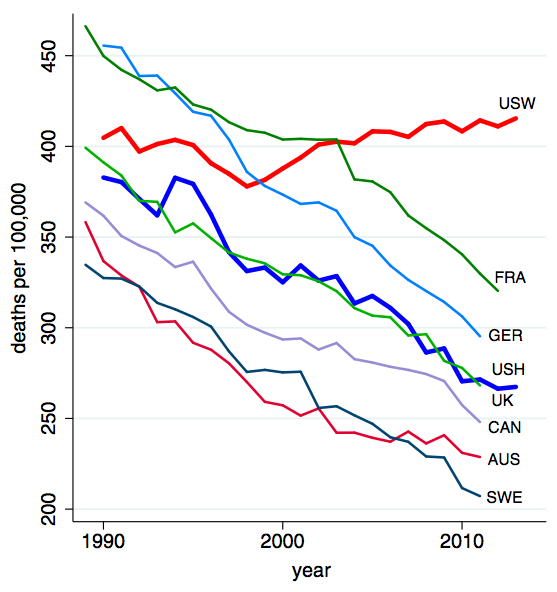 Look at this graph:


 In the same way, fact-checking works pretty well when the checkers just need to catch those half-dozen-or-so moments when somebody misquotes a statistic or gets a date wrong. If a debater cherry-picks data to “prove” a point, or oversimplifies a complex situation, a checker can introduce additional information to give readers a more complete picture — as long as it doesn’t happen too often.


 Thursday, the story of the Kentucky county clerk who refused to issue marriage licenses (now that same-sex couples can marry) reached its inevitable conclusion. Having been


 The Weekly Sift