Category Archives: Articles

Before We Even Think about Candidates for 2020

We already know how Trump is planning to beat us. Let’s go into that battle with open eyes.


President 46%. In 2016, Donald Trump was elected president with 46% of the vote, beating a Democrat who got 48%. As he was being inaugurated, he briefly benefited from the wave of hope and goodwill that greets all presidents, and for about two weeks his approval/disproval rating was positive.

He quickly dissipated all that goodwill: He gave his scary “American carnage” inaugural address. We saw the flock of shady billionaires, fossil-fuel industry puppets, and alt-right provocateurs he had appointed to high office. Sean Spicer angrily told us that we didn’t really see all that empty space on the National Mall during Trump’s inauguration, and Kellyanne Conway coined the phrase “alternative facts“. Then Mike Flynn resigned under a cloud that had something to do with lies about Russia, the Trump family kept openly profiting from his presidency, and by April his approval was below 40%. It has fluctuated in a 37%-43% range ever since.
Whatever he says or does, or how well or badly things are going, that’s how much support he has. The unemployment rate hits record lows and the stock market record highs, but he can’t get over 43%. He all but kneels to Vladimir Putin, refers to Nazis as “very fine people”, puts kids in cages, and is identified in as a conspirator in a crime Michael Cohen has already been sentenced to prison for, but he doesn’t go under 37%.

There’s a good reason for that narrow range: Unlike all previous presidents (at least since World War II; I’m kind of hazy on the presidents before FDR), Trump continues to serve up the rhetoric his base wants to hear, and doesn’t even try to speak to the nation as a whole. Most of the things he says are easily recognized as false or nonsensical as soon as you leave the Fox News bubble. (The Washington Post fact-checker estimates that during 2018 Trump averaged 15 false or misleading statements per day.) But inside that bubble, he is a prophet; he says the (untrue) things that no other president has ever had the courage to say. Every bad claim people amke about him originates from a conspiracy between the Deep State and the Fake News Media, who are “enemies of the American people“.

Unlike, say, Bill Clinton reforming welfare, George W. Bush working with Ted Kennedy on education policy, or Barack Obama offering a “grand bargain” on the federal deficit to John Boehner, Trump has never given Democratic leaders the slightest reason to hope that they might achieve their goals by working with him. Every gesture towards compromise — like the DACA-for-Wall deal Trump said he wanted or the job-creating infrastructure bill he promised — turns out to be a mirage that evaporates in the light of day. Fundamentally, Trump doesn’t accept the premise of a win/win outcome; in order for him to believe he has won, his opponents have to lose.

Even worse, he seems to take joy in trolling groups that oppose him. He never misses an opportunity to smear Latino immigrants. He makes up derogatory nicknames (like “Pocahontas” or “Cryin’ Chuck”) for U.S. senators. Whenever he needs to rile up the racists in his base, he picks a fight with some black celebrity like LeBron James or Spike Lee. (Try to remember any previous president of either party trading insults with a celebrity outside of politics, no matter what opinions they expressed.) He refers to black-majority nations as “shithole countries“, and contrasts them with countries he’d like more immigrants from, like Norway. He encourages police to be more violent with suspects.

So how does Trump plan to win? That kind of behavior raises an obvious question: How does Trump think he’s going to get re-elected? Something like a third of the country may worship him. (Literally. It’s not uncommon to run across people saying that Trump was chosen by God to be president.) They may indeed be so devoted that they don’t care if he stands “in the middle of 5th Avenue and shoots someone”, much less if he violates campaign finance laws or commits bank fraud or is a ventriloquist’s dummy for Putin.

But how do you win an election if you don’t do anything to grow a base that’s barely more than a third of the country?

Answer — the same way he did in 2016. Eezy-peezy: Rile up your third of the country so that they’re sure to vote (and depress the rest of it so that they’re not), making them maybe 40% of the electorate. Get another 6% to hold their nose and vote for you because they’re scared of your opponent. Encourage (maybe with some social-media help from Russia) 5% or so to vote for third-party candidates who have no chance to take any of your states. (Howard Schultz has already volunteered for that role.) Then count on the Electoral College to install you in office even though your opponent has more votes.

That would sound like one of the Brain’s plans to take over the world, if we hadn’t just seen it work.

Let’s not get fooled again. If you know the trap your enemy is setting, the obvious counter-strategy is to refuse to walk into it. Since the trap is two-pronged (motivate his voters, depress and split ours) we should look for two things in a potential Democratic challenger:

  • Someone who raises progressive enthusiasm, so that marginal Democratic voters (especially non-whites and young people) are drawn to the polls.
  • Someone who doesn’t scare Republican voters outside Trump’s base (especially educated suburbanites and moderates) into supporting him.

The problem: While those two are not directly contradictory, they do generally point in opposite directions. A candidate with sweeping progressive proposals (like Bernie Sanders) tends to scare the Right, while a “safer” candidate (like Joe Biden) may leave low-motivation voters wondering why they should bother.

Moving either way increases the third-party threat. In 2016, Jill Stein got votes from people who would have voted Democratic if Bernie had been the nominee. But Schultz has openly said that his motivation to run as a “centrist” arises from fear of Democrats nominating a progressive like Sanders or Elizabeth Warren.

Trumpists are preparing for either possibility. You can bet that any moderate candidate will face the same kinds of attacks “Crooked Hillary” did: He or she is a tool of the powerful special interests that are threatened by Trump’s attack on the Deep State. But CPAC (over the weekend) was a testing ground for attacks on progressives: They want to turn the US into Venezuela and even take away your hamburgers. The Green New Deal, Trump summed up, means “No planes. No energy. When the wind stops blowing, that’s the end of your electric.”

Any Trump challenger will face personal attacks that make him or her seem uniquely horrible. (“I mean, I don’t like him either, but couldn’t the Democrats have picked somebody else?”) It doesn’t really matter that the charges be true, only that they take time to refute. We’ve already seen this with Warren and the Native American issue. (Lots of people are convinced she made up her native ancestor in order to take advantage of affirmative action. There is zero evidence for this, but the issue never goes away.)

I think progressives underestimate the effectiveness of this kind of stuff, largely because Bernie never had to face it in 2016. (Republicans were counting on him to wound Hillary, so they mostly laid off of him, portraying him as a good guy with some wacky notions. Trump would occasionally cry some crocodile tears about the raw deal Bernie was getting.) It’s a mistake to draw the conclusion that Bernie was shielded by his fine moral character. Anyone can be lied about, and it’s usually not that hard to find some factual foundation to build a lie on. In a sufficiently large cloud of lies, the many absurd charges (think Pizzagate) can seem to support each other. (“I don’t know. It just seems like there’s something wrong there.”)

Don’t help him. The most important thing Democrats can do is to avoid slandering their front-runners. We need to make sure that candidates have answers for any serious questions that are bound to come up eventually, but attacks on a candidate’s fundamental honesty and decency shouldn’t be tossed around lightly.

So it’s fine to ask why Amy Klobuchar doesn’t support Medicare-for-All, but not to jump to the conclusion that she’s a tool of the insurance companies (unless you really know something). It’s fine to wonder how Bernie will pay for his proposals, but not to accuse him of trying to turn the US into Cuba.

And I don’t want to hear about how Kamala Harris isn’t black enough, or that Kirsten Gillibrand doesn’t know how to eat chicken. We’ll get enough of that kind of BS in the general-election campaign. We don’t need to start it now.

Can anybody thread the needle? The most successful Democratic campaigns of the Trump era have somehow managed to split the difference. Doug Jones won an unlikely senate seat in Alabama by avoiding progressive positions like Medicare-for-All, but the very thought of a Democrat beating Roy Moore inspired high turnout in Alabama’s black neighborhoods. Beto O’Rourke ran a surprisingly close race in Texas by creating an exciting progressive image without taking many progressive stands on the issues. That is also the path Obama took in his 2008 landslide. Obama himself was the excitement, not a revolutionary platform.

Texas and Alabama are both in the South, where a Democratic presidential nominee will only win as part of a national landslide. So I don’t think those races should define the limits of acceptable positions. But I think each issue needs to be weighed on the inspiration/fright scale. Reparations for slavery, for example, is a trap issue for Democrats. No one really believes the next president can get a reparations bill passed — and I don’t even know of a plausible reparations proposal — so I doubt the issue will inspire new support. But it will scare a lot of white people and lend itself to exaggerated charges.

At the moment, things look relatively good. The latest poll has Trump trailing a generic Democrat by 48%-41%. But of course, many polls showed even larger leads for Clinton at some point or another. That 7-point lead comes before the actual nominee either raises enthusiasm or gets torn down. It also comes before the Mueller report appears, and before investigations in the House nail down charges that Trump supporters have been able to wave away so far. There’s a strong chance of a recession beginning before the election, and who can guess what foreign crises will erupt between then and now?

The idea that 41% of the public might be able to look at the last two years and say, “I want more of that” is both scary and mind-boggling. But that’s the world we live in. Trump has about that much support and always has. He’s going to try to win again without building that base, and we know exactly how he’s going to try to do it. No matter what happens in the internal dynamics of our own process, we can’t ever lose sight of that.

I See Color

Five reasons whites shouldn’t colorblind themselves.


Tuesday night, CNN (for reasons I still don’t understand) decided to devote an hour of evening air time to billionaire Howard Schultz (a.k.a. Daddy Starbucks) answering questions in a town hall format. While answering a question about a racial incident at a Starbucks in Philadelphia, Schultz said this:

As somebody who grew up in a very diverse background as a young boy in the projects, I didn’t see color as a young boy and I honestly don’t see color now.

It’s hard to know exactly what to make of a statement like that, or how to respond to it. It’s far from the first time I’ve heard another white person (it’s always a white person) say that he or she “doesn’t see color”. Typically, people who make this statement think they’re saying something virtuous — that they’re not prejudiced against non-whites, that they try to see each person as an individual rather than through the lens of a racial stereotype, or that they treat people of all races the same. If you question them, you’re likely to hear the famous Martin Luther King quote:

I have a dream that my four little children will one day live in a nation where they will not be judged by the color of their skin, but by the content of their character.

By “not seeing color”, then, a white person is trying to live Dr. King’s dream: I’m not judging your children by the color of their skin; in fact, I’m not even noticing it.

So what’s wrong with that? Many of the people who say they don’t see color really do mean well — though some don’t; we’ll get to that — so I think they deserve a clear and honest answer.

1. It’s probably not literally true. I’ve occasionally been surprised to find out that someone I’ve known for a while has Jewish ancestry, or was born in another country and speaks English as a second language, or was brought up in a family very much richer or poorer than mine. Apparently, I really don’t “see” those things, at least not all the time. But I’ve never, ever been surprised to discover that somebody is black. I’ve never, ever had anyone say to me, “Did you realize Marcus is black? I never noticed before.”

I know that mixed-race people are sometimes hard to classify. So “Do you think of yourself as black?” can be a meaningful question. But even then I have usually spotted the uncertainty. Because I see color. I believe just about everybody does.

So “I don’t see color” has an element of willfulness to it. At best, it’s not about perception, it’s about habits of thought. Probably the more literal statement would be, “I don’t think about race.” Or maybe: “I try not to think about race.”

But even when we try not to take race into account, we often do. I try not to be prejudiced or to act in any way that promotes bigotry. But I also score badly on the implicit racism test. Like most people, I see color even when I think I don’t.

2. That’s not how dreams work. But what about the dream of a colorblind society? I mean, the one where people might notice each other’s skin color in the literal sense I just talked about, but it just doesn’t matter, because all people are judged “by the content of their character”. Race might still be part of your heritage, but in the here and now, it would only matter to the extent you want it to.

A lot of white identities are like that now. I come from German stock, while somebody else might have Polish ancestors. Germans and Poles have been at each other’s throats for centuries, but in America today none of that matters any more. Maybe we’ll trade mock-hostile barbs when Germany plays Poland in the World Cup. Maybe your grandmother taught you how to prepare kielbasa while mine taught me schnitzel. (Actually she didn’t, unfortunately.) But in all the ways that count, the ones that might re-ignite the conflicts of our ancestors, neither of us cares.

We can imagine a society where race is like that. “Your people came over from Africa? That’s interesting. Have you traced what part?” But when employers are deciding whether to hire you, police are deciding whether to arrest you (or just shoot you), or Starbucks managers are deciding whether to call 911, your race wouldn’t play any role. The percentage of the population that is in poverty or in prison or in management or prematurely in the grave wouldn’t depend on race in anything but a round-off-error sort of way.

Is that a worthy dream? I believe it is.

But I’m not trying to pretend it’s true now, because dreams don’t work that way.

If you dream about being a billionaire like Howard Schultz, the way to get there isn’t to start living like a billionaire in all the ways you can. Quite the opposite: Every time you go to the kind of restaurant a billionaire might frequent — or as close to one as your credit cards will allow — you get a little farther away from actual wealth.

I dream of a society where all people have access to health care, but I don’t bring that day closer by pretending that they already do. I dream of a world where refugees aren’t desperate to get into the United States, because their home countries are doing fine and they have lots of other good places to live. But having that dream doesn’t make me any less callous when I ignore those refugees.

I dream of a world where everyone is honest, and I can leave my laptop sitting unattended on my table at Starbucks when I go off to the bathroom. But I never do that, because dreams don’t work that way.

A colorblind teacher in a white neighborhood school would see the new black kid being picked on and think, “I wonder what that’s about.” A colorblind warden would be oblivious to the racially segregated gangs in his prison.

In American society today, race matters. You can’t deal with that reality unless you see it.

3. Having a choice about whether or not you’ll notice race today is an element of white privilege. As I write this sentence, I’m sitting in the breakfast area of a La Quinta somewhere in Maryland. A couple of hotel employees are responsible for keeping the coffee urns full and the steam tables stocked with scrambled eggs and sausages. None of them are in my line of sight right now, and I realize I don’t know what race they are. To that extent, at least, I’ve been colorblind this morning.

I can do that, because whether they’re white or black or something else, they’re here to serve me.

Similarly, when Howard Schultz sits down with a stack of resumes, thinking about who Starbucks’ next CFO should be, he can decide to ignore race if he wants to. (But given that Philadelphia incident and the bad publicity that came with it, he probably shouldn’t. Some highly visible black face would do Starbucks some good right now.)

But think about what happened to John Crawford III. He was shopping in a Wal-Mart near Dayton, Ohio, when he picked a pellet gun off a shelf and began carrying it with him while he shopped (and talked on the phone). A white customer saw him and called 911, telling police that a black man was waving a gun around at Wal-Mart. (He wasn’t.) A few minutes later, a white policeman barked orders at a very confused Crawford, and then shot him dead when he didn’t respond fast enough, because the cop believed Crawford “was about to” raise the gun. (The officer wasn’t charged with any crime, kept his job, and went back to full field duty after the investigation was complete.)

Now imagine that you’re a black parent trying to raise a son. What will you tell him that Crawford did wrong there? What do you want your boy to do differently if he’s in a similar situation? I think you warn him that Crawford didn’t see color that day. He didn’t think: “There are white people in this store who expect black men to be dangerous.” He didn’t notice when white police walked into the store, and immediately assume they might be looking for him.

The white people in the Wal-Mart could choose to be colorblind if they wanted (though the guy who called 911 clearly wasn’t). John Crawford III couldn’t get away with making that choice.

Of course, you also tell your black son about Martin’s Dream. But you’re very careful to teach him not to lose sight of the difference between the Dream and the Reality. Confusing the two could get him killed.

4. Colorblind whites make bad allies. Think about the teacher and the warden I mentioned above. Racism is real in America, and you’re not going to be much use in mitigating it if you refuse to see it.

Most racism in America today tries not to draw attention to itself. It often pretends to be something else, and has a semi-plausible explanation of its actions. If you’re not paying close attention, you might not see through that explanation.

For example, during the Obama administration, the First Family was often faulted for doing things that white First Families had done without drawing criticism. Barack was photographed putting his feet up on a historic desk. Family vacations cost the taxpayers a lot of money because of the entourage that had to come along. The White House Christmas card didn’t display any religious themes. The White House is equipped and staffed to provide a posh lifestyle, as it has for decades.

Lots of people objected to this stuff without consciously thinking about race. It wasn’t that the Obamas were black, it’s that they were living wastefully or disrespecting some important American value. But somehow that disrespect didn’t register in the same way when the president was white.

In order to notice that kind of thing and address it appropriately, you need to see color. You need to be sensitive to the idea that racism constantly lurks in the background of American society, even when the foreground looks fine.

A lot of today’s racism is baked into the system, and doesn’t depend on any individual’s prejudice. The pipeline that sends black children to mostly segregated schools, funds those schools inadequately, criminalizes discipline, and channels students in the direction of prison — it operates with or without the racism of any particular teacher or principal or policeman or judge. If they all suddenly became colorblind, the system would continue to function.

5. Idealizing colorblindness gives cover to people who invoke it in bad faith. Trump has often claimed to be “the least racist person” — the least racist person you’ve met, ever interviewed, and so on. He has made that claim while trying to ban Muslims from entering the country, building a wall to keep out Hispanics, saying that neo-Nazis are “very fine people”, and pushing the baseless theory that the first black president wasn’t really an American.

He gets away with that, at least among certain segments of the electorate, because he doesn’t explicitly invoke color. This is a constant theme in conservative circles: If I don’t explicitly mention color, I’m not racist. On paper, the law has explicitly been colorblind since the 1960s. So racism effectively ended then — except for the affirmative action programs that disadvantage whites. Non-whites are still much poorer than whites, and are under-represented in elite schools, corporate boardrooms, and high-paying professions, while over-represented in prisons and poverty programs. But any attempt to remedy those problems can’t be colorblind, so they get tarred as “reverse racism”.


I’ll give the last word to Khalil Gibran Muhammad author of The Condemnation of Blackness,

If we’re going to do something differently in the 21st century than what was done in the 20th century, it’s going to take a whole lot more white people in everyday experiences to be anti-racist and to stand up for racial justice.

Not non-racist, anti-racist. And you can’t fight what you can’t see.

A Fishy Emergency Threatens the Republic

Friday morning, Trump declared a national emergency that he said would allow him to start building his wall by redirecting funds Congress has appropriated for other purposes. The speculation-to-action ratio has been particularly high since then, with political and legal experts giving conflicting views of what will happen next. Let me see if I can boil it down without adding to the confusion.

1. The declaration was made in bad faith. There is no national emergency on the southern border. Trump admitted as much: “I could do the wall over a longer period of time. I didn’t need to do this.”

As I explained two weeks ago (under the sub-head “and national emergencies”), the point of the national emergency process is to allow the President to respond to events that unfold too fast for Congress to take action. Whatever you think about the issues of immigration and smuggling on the Mexican border, they have been playing out over decades, and are less serious now than they have been at other times.

Congress has had plenty of time to consider appropriating money to build a wall, and has decided not to do it.

With no honest case to be made for either a national emergency or for circumventing Congress to build a wall, Trump once again gave a speech full of lies.

2. This is unlike any previous emergency declaration. As Trump rightly pointed out, presidents have declared national emergencies before (59 times since the National Emergencies Act was passed in 1976, according to Fox News’ Chris Wallace). But a national emergency declaration has never been used as a partisan weapon before. Wallace challenged Trump advisor Stephen Miller to “point to a single instance when the president asked Congress for money, Congress refused to give him that money and the president then invoked national emergency powers to get the money”. Miller could not answer.

A national emergency declaration has never been challenged in Congress or the courts before, but that’s because previous presidents have used them in uncontroversial ways, not because Trump is being specially persecuted by his opponents.

3. The money will be taken from more worthy projects. USA Today lists the sources.

$3.6 billion will come from a military construction fund, and White House officials admitted that “they did not yet know which military constructions might be cancelled or delayed by the move.” Military Times lists some possibilities:

a new vehicle maintenance shop at Camp Arifjan in Kuwait, drydock repairs at Joint Base Pearl Harbor-Hickam in Hawaii, F-35 hangar improvements at Luke Air Force Base in Arizona, ongoing hospital construction at Landstuhl Regional Medical Center in Germany, and new family housing builds in South Korea, Italy and Wisconsin.

Also: a middle school on an Army base in Kentucky. Lindsey Graham explained that “It’s better for the middle school kids in Kentucky to have a secure border.”

Another $2.5 billion will come from a Defense Department drug-interdiction program. So presumably it will be easier now to get drugs into the country by boat or plane. Trump’s bogus wall, which will do little to affect drug traffic, will squeeze out programs that actually catch drug smugglers.

4. Congress still has a chance to weigh in, but there’s a catch. As originally passed in 1976, the National Emergencies Act allowed what is known as a legislative veto: Congress could override the President’s declaration if both houses agreed to do so. This is, in fact, likely to happen. The Democratic House will pass a resolution against the emergency fairly easily, and the Republican Senate will probably follow suit. (In order to do so, all 47 Democrats and 4 Republicans will have to agree. Mitch McConnell can’t prevent the resolution from coming to the floor, and it can’t be filibustered.)

However, in 1983 the Supreme Court (in regard to a different law entirely) found legislative vetoes to be unconstitutional. As laid out in the Constitution, Congress passes laws and the President has an option to veto them. Congress can delegate its power to the President (as it did in the National Emergencies Act), but it can’t switch places with the President and give itself veto power over his decisions.

As a result, Congress can still undo the President’s declaration, but it requires a joint resolution, which is then subject to a presidential veto. A two-thirds majority of each house would then be necessary to override the President’s veto. This is currently considered unlikely, because not enough Republicans are willing to go against Trump.

So the most likely scenario goes like this: Congress passes a joint resolution against the emergency, the President vetoes it, and Congress fails to override the veto.

5. Then it’s up to the courts. Congress will sue on the grounds that its power of the purse has been usurped. States along the border will sue. Property owners whose land will be seized will sue. Some of those suits have already been filed. (Congress’ suit will probably wait until after its attempt to override the emergency declaration fails.) Then the courts will have to decide whether Trump’s emergency is legitimate.

Whatever conclusion you want to hear, I can point you to an expert who predicts it. Vox assembled 11 experts, and their responses amounted to: Judges shouldn’t OK this, but there’s just enough justification that they can if they want to.

The point of view most generous to Trump is that Congress screwed up when it passed the National Emergencies Act, so its power-of-the-purse is delegated, even if it shouldn’t be. The law doesn’t define “emergency”, but trusts the president not to abuse his power to declare one. Who knew we’d eventually have an untrustworthy president?

Some judges will feel that it’s not their job to second-guess Trump on this. That’s more-or-less how the Muslim Ban case came out. After the administration revised its first two obviously-unconstitutional Muslim bans, the third one passed muster — not because the 5-4 Supreme Court majority agreed with the bigoted pile of bullshit Trump used to justify it, but because five justices deferred to the president’s judgment and declined to examine the details.

As with the Muslim ban, this case hangs on the question of bad faith: How transparently faithless does the President have to be before a judge is obligated to notice?

The problem I have with the Congress-screwed-up view is that the original version of the law didn’t delegate this much power, because Congress retained the ability to override illegitimate emergencies. Now the President only needs one-third of one house to support him. So the Supreme Court changed something significant in the law when it rejected legislative vetoes.

So I would be tempted to make the same kind of argument that conservatives have made against the Affordable Care Act: The National Emergencies Act is a coherent whole, and you can’t invalidate the legislative veto while leaving the delegation-of-power intact. I haven’t heard anyone make that argument, so there must be some reason not to (aside from the fact that all of the currently active national emergencies become invalid, which might not be a bad thing).

6. And the people. This is something worth getting into the streets about. MoveOn has protests planned today, and no doubt there will be others soon.

If you live in a state or district represented by a Republican, you need to challenge your representative to defend the Republic. The expectation that Congress can’t override a veto is based on the idea that most Republicans will stand by Trump’s seizure of power. But if they hear from enough voters, they won’t.

7. Once again, conservatives in Congress and in the courts  will face a challenge: Will they support Trump, even at the expense of what was once considered a core conservative principle? Over the last several decades, much hot air has been blown about defending “the Constitution” and “the vision of the Founding Fathers”. It goes virtually without saying that neither the Constitution nor the Founders ever envisioned or endorsed a process like this: Congress refuses to fund a presidential project, the president seizes the money, both houses vote to condemn that seizure, but it goes through anyway.

Any congressional Republican who refuses to override Trump’s emergency declaration or his subsequent veto can never again claim to be a defender of the Constitution, and should never again be allowed to invoke the Founding Fathers without hearing about this betrayal of their vision. Any judge who allows this travesty to play out can likewise never in good conscience claim to be an “originalist” or “strict constructionist” rather than a partisan judicial activist.

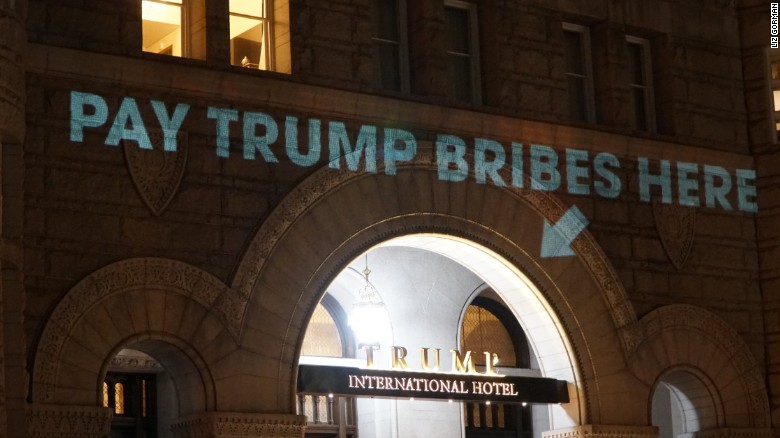
8. There are hardly any core conservative principles left. Republican respect for the Constitution has been suspect at least since Mitch McConnell ignored President Obama’s nomination of Merrick Garland. The GOP’s claim on the Constitution further eroded when the Party decided to ignore the Emoluments Clause and let Trump profit from what are essentially bribes by foreign governments and the governments of the states. But it’s also worth considering the other conservative principles that have already fallen since Trump became the Republican Party’s nominee.

Republicans once claimed to care about the federal deficit, but they have allowed Trump to blow up the federal balance sheet in a completely unprecedented fashion. The record Bush/Obama deficit of FY2009 was a response to an economic catastrophe, but Trump’s deficits are approaching those levels in the late stages of an economic expansion, when the federal budget should be in its best shape. (President Clinton had a surplus during a comparable period.) The next recession, which is due to hit soon, will send deficits into territory never before seen.

Republicans once championed a global system of free trade, but now they stand for tariffs, presidential bullying of American corporations, and one-on-one negotiations with each country.

Republicans once were the advocates for rural America, but now Republican trade policies hit farmers harder than anyone.

Republicans claim their opposition to undocumented immigration stems from a belief in the rule of law, but they support Trump in violating our laws by refusing to let refugees turn themselves in at the border and ask for asylum.

Republicans once claimed to be the party of patriotism and freedom, and promoted Ronald Reagan’s vision of America as a “shining city on a hill”. Now they stand behind a president who is totally subservient to a Russian dictator, who shows no respect to the world’s other democracies, and instead expresses admiration and envy for brutal autocrats like China’s Xi, North Korea’s Kim, and the Philippines’ Duterte.

Republicans once styled themselves as the party of traditional family values, and (particularly during the Clinton administration) talked endlessly about the importance of a president’s character. Now they make excuses for Trump’s infidelity, corruption, sexual assaults, and shameless lying.

What ground is left for Republicans to stand on, other than bigotry against Hispanics, making the rich richer, and a naked desire to wield power?

Ralph Northam and the Limits of Forgiveness

Friday, a 35-year-old yearbook photo of Virginia’s Governor Ralph Northam exploded across the internet. The picture shows two men, one in blackface and the other wearing a KKK hood, on Northam’s page in the 1984 yearbook of the Eastern Virginia Medical School, where he was a student. Northam apologized for the photo, without saying which of the figures was him. Later, he said neither was, but that he had worn blackface to imitate Michael Jackson in a dance contest around the same time.

Immediately, there were calls for him to resign the governorship he won in 2017. By the weekend, they were coming from all the major Virginia Democrats, including Senators Kaine and Warner. So far, Northam has refused to resign, but he still may.

I admit to being torn about this. My initial reaction wasn’t that this was a resign-immediately offense. But being so out of step with most other Democrats makes me acutely aware of the limitations of my point of view. This is a moment where I am very conscious of being white. The photo wasn’t intended to offend me, so it’s easy for me to say, “It was a long time ago. Let’s accept his apology and move on.”

I’m also conscious of being old. I remember Senator Robert Byrd of West Virginia, who served in the Senate from 1959 until his death in 2010. Byrd was a member of the Democratic leadership in the Senate: majority leader from 1987-1989, and President pro Tempore of the Senate (next in line for the presidency after the Speaker of the House) from 2003-2007. In short, he was not some shameful figure the Democratic Party hid in the attic.

Byrd hadn’t just taken a photo dressed up as KKK (or next to somebody dressed up as KKK). In his youth, he actually was KKK.

In the early 1940s, Byrd recruited 150 of his friends and associates to create a new chapter of the Ku Klux Klan in Sophia, West Virginia.

How was that possible? Well, he changed.

In his last autobiography, Byrd explained that he was a KKK member because he “was sorely afflicted with tunnel vision—a jejune and immature outlook—seeing only what I wanted to see because I thought the Klan could provide an outlet for my talents and ambitions.” Byrd also said in 2005, “I know now I was wrong. Intolerance had no place in America. I apologized a thousand times … and I don’t mind apologizing over and over again. I can’t erase what happened.”

When he died, civil-rights hero Congressman John Lewis wrote a tribute calling Byrd “a true statesman“.

Not so long ago, change of that magnitude could be accepted. Late in his career, even famous segregationist George Wallace changed.

In the late 1970s, Wallace announced that he was a born-again Christian and apologized to black civil rights leaders for his past actions as a segregationist. He said that while he had once sought power and glory, he realized he needed to seek love and forgiveness. In 1979, Wallace said of his stand in the schoolhouse door: “I was wrong. Those days are over, and they ought to be over.” He publicly asked for forgiveness from blacks.

Now, it’s entirely possible that Wallace hadn’t changed at all: Maybe he had been an opportunist as a segregationist, and he was still an opportunist when he asked for forgiveness. The difference may not have been anything that happened in Wallace’s conscience, but the fact that by the late 1970s blacks were voting in large numbers. I don’t think we’ll ever really know.

And perhaps the people who accepted these sorts of conversions were also simply being pragmatic: In the Alabama and West Virginia of the late 20th century, just about every white person had some kind of racist past. A party that was too pure to reclaim them would give up any possibility of being a majority.

Maybe we’re past all that now. Maybe we can throw out all the whites who have any racism in their past, and still hope for a majority. Maybe we can also throw out all the men who have ever done anything sexist, and all the straights who have a history of homophobia. Maybe America has changed so much that a party of people who don’t need any forgiveness can be a majority now.

But I have to confess, I have my doubts about that.

I worry that we’re playing into Trump’s hands when we drum Ralph Northam out of the Democratic Party. As I interpret it, Trump’s message to wavering whites and men and straights goes something like this:

You’re never going to be pure enough to satisfy the liberals. So you might as well wear your MAGA hat and fly your Confederate flag, because no matter what you do, there’s never going to be a place for you on the other side.

I’m open to the idea that Ralph Northam can’t be governor any more. Virginians seem to be saying that, and ultimately it’s their decision. I also like the idea that there’s a clear difference between the parties: Democrats would never let a man become president who brags about his sexual assaults while claiming that his accusers are too unattractive to be worth assaulting.

But as we watch Northam leave the public stage, as I suspect he will, I hope that doesn’t end the discussion. We need to think hard about where the limits of forgiveness are and how one seeks it.

Because I don’t think we’re ever going to find enough pure people to form a majority.

Another Week in the Post-Truth Administration

Trump was angry that his intelligence chiefs had contradicted him on TV, until he convinced himself that it just hadn’t happened.


This week a bizarre drama played out. On Tuesday, the chiefs of the major intelligence agencies (CIA, FBI, NSA, DIA, and NGA, along with their overseer, Director of National Intelligence Dan Coats) appeared before the Senate Intelligence Committee in an open hearing that was televised live and accompanied by a 42-page report. The chiefs were all careful not to draw this conclusion in so many words, but the inescapable message of their testimony was that the world they see bears little resemblance to the one President Trump tweets about.

In the world where the intelligence chiefs live, the major threats the US faces come from Russia and China, who “are more aligned than at any point since the mid-1950s”. The security of our elections is a major vulnerability, and other hostile countries are learning from Russia’s interference in 2016. North Korea is not denuclearizing and isn’t likely to. ISIS hasn’t been eliminated. Iran hasn’t violated the nuclear agreement President Obama negotiated. And (as the NYT noted) the threat Trump shut down the government to oppose barely registers.

Notably missing in the written review was evidence that would support building a wall on the southwestern border; the first mention of Mexico and drug cartels was published nearly halfway through the report — following a range of more pressing threats.

The senators on the committee — including Chairman Richard Burr and other well-known Republicans like Marco Rubio — likewise seemed uninterested the so-called “national emergency” on our southern border. Each member of the committee had five minutes for questions. None asked the intelligence chiefs to comment on the need for a border wall.

Trump reacted with anger and belittlement on Wednesday, tweeting that the intelligence chiefs were “extremely passive and naive” and “wrong”; he  suggested that they “should go back to school“. His reaction raised a question that I don’t think has ever been answered: If Trump’s superior knowledge isn’t coming from the intelligence services, where does it come from? Does he just know, like an oracle, or does he have access to some more reliable source, like maybe Fox & Friends.

But by Thursday, it was all good again: Trump was now comfortable in the knowledge that the testimony we all saw didn’t really happen.

Just concluded a great meeting with my Intel team in the Oval Office who told me that what they said on Tuesday at the Senate Hearing was mischaracterized by the media – and we are very much in agreement on Iran, ISIS, North Korea, etc. Their testimony was distorted [by the] press. I would suggest you read the COMPLETE testimony from Tuesday. A false narrative is so bad for our Country. I value our intelligence community. Happily, we had a very good meeting, and we are all on the same page!

Think about how backwards this all is. If any of the intelligence chiefs actually had been misquoted or taken out of context by the media, you might expect the complaint to come from them, or perhaps from their agency’s spokesperson. Such a statement might point to a quote in the media, and then give a more accurate or more complete quote from the hearing’s transcript. Or if the quote had been accurate and the chief had simply misspoken, the agency could make a clearer statement of its actual assessment.

None of that happened. Instead, Trump simply announced that there had been no contradiction, blamed the media, and claimed without evidence that “the COMPLETE testimony” backed him up. He knows, of course, that no one in his base (and few people in general) will watch two-and-a-half hours of video to check up on him. To the MAGA-hatters, the incident is just another Trump-said/media-said conflict. The ultimate truth about it is unknowable, so they will take Trump at his word.

But if you do want to take Trump’s advice and watch the whole testimony, you can do it here or here. I have, and so has Vox’ Alex Ward, who characterized Trump’s tweet as a lie and summarized the major places where Tuesday’s testimony contradicted him. Even more damaging that the verbal testimony is the accompanying report, prepared under DNI Coats’ byline. You might imagine that even the director of an intelligence agency might mess up an answer to an unanticipated question. But written reports are drawn up carefully, weighing each word and phrase. Here are a few quotes (with the original emphasis):

On North Korea:

Pyongyang has not conducted any nuclear-capable missile or nuclear tests in more than a year, has declared its support for the denuclearization of the Korean Peninsula, and has reversibly dismantled portions of its WMD infrastructure. However, we continue to assess that North Korea is unlikely to give up all of its nuclear weapons and production capabilities, even as it seeks to negotiate partial denuclearization steps to obtain key US and international concessions. North Korean leaders view nuclear arms as critical to regime survival, according to official statements and regime-controlled media.

In his oral testimony, Director General Robert Ashley of the DIA said: “The capabilities and threats that existed a year ago are still there.” This directly contradicted Trump’s tweet that “There is no longer a Nuclear Threat from North Korea.”

Iran:

We continue to assess that Iran is not currently undertaking the key nuclear weapons-development activities we judge necessary to produce a nuclear device.

ISIS:

ISIS still commands thousands of fighters in Iraq and Syria, and it maintains eight branches, more than a dozen networks, and thousands of dispersed supporters around the world, despite significant leadership and territorial losses. The group will exploit any reduction in [counter-terrorism] pressure to strengthen its clandestine presence and accelerate rebuilding key capabilities,such as media production and external operations. ISIS very likely will continue to pursue external attacks from Iraq and Syria against regional and Western adversaries, including the United States. … ISIS remains a terrorist and insurgent threat and will seek to exploit Sunni grievances with Baghdad and societal instability to eventually regain Iraqi territory against Iraqi security forces that are stretched thin.

Climate change:

Global environmental and ecological degradation, as well as climate change, are likely to fuel competition for resources, economic distress, and social discontent through 2019 and beyond. Climate hazards such as extreme weather, higher temperatures, droughts, floods, wildfires, storms, sea level rise, soil degradation, and acidifying oceans are intensifying, threatening infrastructure, health, and water and food security. Irreversible damage to ecosystems and habitats will undermine the economic benefits they provide, worsened by air, soil, water, and marine pollution

Iraq:

Iraq is facing an increasingly disenchanted public. The underlying political and economic factors that facilitated the rise of ISIS persist, and Iraqi Shia militias’ attempts to further entrench their role in the state increase the threat to US personnel.

I’ll give the last word to Alex Ward:

As president, Trump has every right to make foreign policy decisions as he sees fit, and he’s not required to listen to what the US intelligence community tells him. Intelligence is meant to help him and his advisers make the smartest, best-informed decisions possible based on the facts. If Trump chooses to completely disregard those facts and make foreign policy decisions based solely on his gut instincts, that’s his prerogative.

But that doesn’t support his claim that the media willfully mischaracterized what his top spies said. What the intelligence community effectively showed, knowingly or not, is that Trump’s foreign policy isn’t based in reality. Trump’s scapegoating the media, in this case, won’t change that.

Extortion Tactics Have No Place in American Democracy

From the beginning, the government of the United States has been founded on compromise. The Constitutional Convention created the House to give big states their due power and the Senate to protect the small states. Slave states wanted their representation in Congress to reflect their whole population, slave and free, while free states wanted representation determined only by free residents. They settled on counting 3/5 of the slave population.

Through the early 19th century, a series of compromises held the Union together: You can have Missouri as a state if we can have Maine. We’ll start a Bank of the United States, but with a charter that will need to be renewed. (It wasn’t.) Henry Clay was known as the Great Compromiser. It was a compliment, not an insult.

That pattern continued into the 20th century: Your district wants a bridge, mine wants a dam; let’s do both. Urban liberals want to fund food stamps, while rural conservatives want farm subsidies; let’s combine them into one bill.

That’s how American democracy is supposed to work: Different parts of the country may be rivals, but they’re not enemies, so win/win solutions are possible. Along the way, we discover things that just about everybody wants: safety from invaders and criminals, not letting poor people die in the streets, security in old age, good schools, effective responses to epidemics, and so on. So you fund the things that everybody wants, and you make deals on the rest. If I want your support for something you don’t care about, I’ll offer to support something you do care about too.

But something changed in American politics after the Gingrich Revolution of 1994, and it got worse after the Tea Party wave of 2010: Republicans began to adopt extortion tactics. Rather than offer quid pro quo deals to Democrats, they began packaging demands and threats: If you don’t give me what I want, I’ll do something that nobody wants. I’ll shut down the government, I’ll run us into the debt ceiling. I’ll sabotage the nation’s credit rating. Coast Guard families will be going to food banks. The FBI won’t be able to pay its informants. Air travel, going to the national parks, or even just eating food will get riskier. Then you’ll see how serious I am and understand that you have to give me what I want.

Gingrich ultimately changed his stripes; he and President Clinton worked out any number of compromises, as President Reagan and Speaker O’Neil had a decade before. They controlled spending at the same time that they raised taxes, and guess what happened? The deficit went away.

But extortion tactics were never officially renounced, and over the last decade Republicans have gone back to considering them a legitimate option. To get ObamaCare passed, President Obama needed a House majority and 60 votes in the Senate. But Republicans tried to extort a Democratic Senate and President into repeal as soon as they controlled only one house of Congress. (It’s worthwhile to try to picture the reverse situation, because it’s so hard to imagine: Picture Obama taking office in 2009 and threatening to leave our troops in Iraq stranded and unsupplied unless Congress passed his health care plan.)

And now President Trump (who was elected with 46% of the vote and has never had an approval rating over 50%) is trying to extort funding for his unpopular wall.

Partisan extortionists usually try to cloud the issue, but the difference between extortion tactics and ordinary politics is not at all hard to see. Extortion arguments have a don’t-make-me-do-this quality similar to kidnappers’ ransom demands. It isn’t that anybody wants the government shut down, it’s that one side is willing to do it to get what it wants. It’s also not hard to tell which side is extorting: Look at the issue in question and ask yourself who wants it. During the recent shutdown, the central issue was the Wall, and Trump wanted it. He wasn’t willing to make a positive offer to Democrats, so instead he threatened them with a government shutdown. The media’s popular two-sides-bickering narrative wasn’t remotely accurate: Trump was extorting, and Pelosi was resisting extortion.

Democracy can’t go on like this forever. Eventually, some leader will get elected on an openly anti-democratic platform, arguing that our constitutional system is too cumbersome to work any more. Once he gets into office, he’ll provoke an extortion crisis as a way of proving his point: How can we support a system of government that allows stuff like this to happen? Are we willing to stand by while the country falls apart, or do we want the leader to declare a national emergency, abolish Congress, and make things work again?

The way out of that scenario is for the public to re-establish the norm that extortion is not legitimate. The right way to make change is to assemble a majority, and any leader who offers a short-cut around that process — even to get something we think we want — deserves our scorn.

The End of the Shutdown

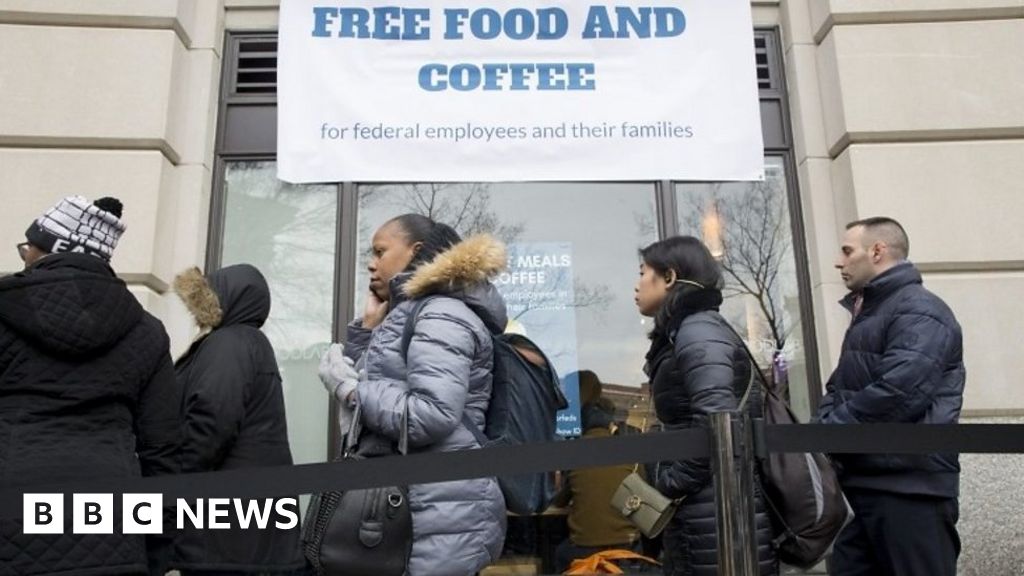
Friday night, Trump released his 800,000 hostages without getting anything for them. Zero. He signed exactly the same deal that was on the table back in December: Keep the government funded at its previous level for a few weeks while an immigration/border-security compromise gets negotiated.

The fact that it came out that way is extremely important. Giving him anything, even just the “pro-rated down payment on the Wall” he had demanded on Thursday, would invite regular government shutdowns for the rest of his term. Every time some budget bill needed to be signed, Trump could say, “No. I want more or I’ll shut down the government again.”

By holding the line until things really started to get bad, Speaker Pelosi stood by the important principle of not paying ransom. If Trump wants something from the Democrats, he can offer them something positive in exchange. (That’s how politics is supposed to work in America.) But he’s not going to get concessions just by threatening to hurt people or hurt the country.

Why now? If the same deal has been available since Day Zero, why did it happen on Day 35? There were two precipitating causes: the test votes the Senate held on Thursday, which showed Republican unity beginning to crack, and the 82-minute ground stop Friday morning at New York’s LaGuardia Airport due to air traffic controllers not coming in to keep working without pay, which caused delays that rippled across the country. This was widely interpreted (correctly, I think) as a warning sign from a system about to break down.

The Senate voted on two proposals Thursday, and neither got the 60 votes necessary to proceed. But Trump’s preferred outcome ($5.7 for the Wall, plus other restrictions on immigration and asylum) got 50 votes, with one Democratic crossover (Joe Manchin of West Virginia), while the Democrats’ proposal (open the government temporarily without additional provisions) got 52 votes, with six Republican crossovers: Lamar Alexander (Tenn.), Susan Collins (Maine), Cory Gardner (Colo.), Johnny Isakson (Ga.), Lisa Murkowski (Alaska), and Mitt Romney (Utah). (And at least a few of the Republicans who stuck by Trump were not happy.) According to the Washington Post, this outcome surprised Trump, because Jared Kushner had assured him that Democrats were about to start defecting.

But pointing to the Senate as a cause just shifts the question to another level: Why Day 35? Why did Mitch McConnell finally allow the Senate to vote on something, and why did Republican senators start to break ranks?

The LaGuardia ground stop was part of a nationwide pattern: As government workers faced losing a second paycheck, warning lights were flashing and systems were beginning to fail.

The FBI Agents Association put out a report listing the effects the shutdown was having on law enforcement. Perhaps the most egregious example: The FBI agents investigating the MS-13 gang (that Trump so often features in his anti-immigrant speeches demanding a wall) were unable to pay a translator to communicate with their informants. The Commandant of the Coast Guard tweeted:

I find it unacceptable that @USCG members must rely on food pantries & donations to get through day-to-day life.

What made this growing pressure worse for Republicans was the repeated insensitivity and tone-deafness expressed by plutocratic Trump administration officials, who are clueless about the half the country that lives paycheck-to-paycheck. Chief economic advisor Larry Kudlow described federal employees forced to choose between working without pay and losing their jobs as “volunteers”. Commerce Secretary Wilbur Ross couldn’t understand why federal workers would go to food banks when they could take out loans. And Trump himself spun Ross’ comment into a fantasy about compassionate grocers who “know the people, they been dealing with them for years, and they work along.” Perhaps extrapolating from his own experience owing hundreds of millions to Deutsche Bank, he claimed that banks too would “work along” with missed mortgage payments.

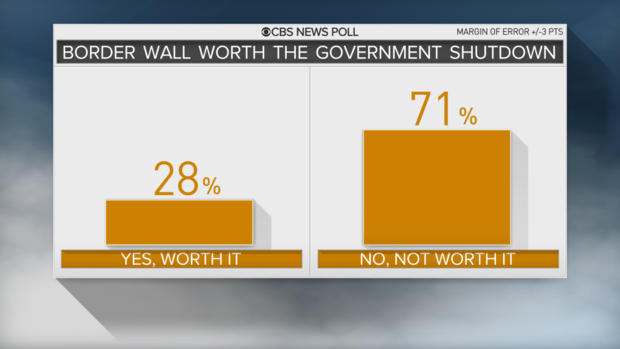
As a result, polls were turning against Republicans. Trump’s approval rating dropped from 42.2% at the beginning of the shutdown to 39.3% by the end. Polls consistently showed that the public blamed either Trump or congressional Republicans for the shutdown, and believed that getting Trump’s Wall funded was not worth shutting down the government.

Now what? The spending bill just lasts for three weeks, at which point the whole standoff could start again. In an effort to claim he hadn’t lost to Pelosi, Trump threatened as much:

This was in no way a concession. It was taking care of millions of people who were getting badly hurt by the Shutdown with the understanding that in 21 days, if no deal is done, it’s off to the races!

But it’s hard to see Republicans in Congress standing by him for another shutdown. Mitch McConnell didn’t want this shutdown and certainly doesn’t want another one. (He is fond of saying, “There’s no education in the second kick of a mule.”) And ultimately, he holds the high card over Trump: If he works out a deal with Democrats and Trump vetoes it, McConnell could sway enough Republicans to override that veto. The thought of 2/3rds of the Senate voting against him on anything should be terrifying to a president who could well face impeachment before the end of his term.

So what will happen in the next three weeks? Ezra Klein lays out four possibilities:

  1. A grand bargain on immigration takes the issue off the table for the near future.
  2. Pelosi, Schumer, and McConnell reach no deal and the government shuts down again.
  3. No immigration/wall deal, but there’s no shutdown, and Trump seeks to build his Wall without Congress by declaring a national emergency.
  4. No immigration/wall deal, but no national emergency.

I foresee a lesser bargain, similar to what Lindsey Graham and Dick Durbin have already worked out: Democrats have already signaled that they’re willing to offer more money for border security, but they think the Great Wall of Trump is a stupid waste. (Not that it matters, but reality is on their side here; the Wall is a stupid waste. Republicans know this, which is why they didn’t fund it when they had the majority in both houses.) A number of Republicans (including even Trump, at times) have said they don’t want to deport the DACA people, whose cause gets a lot of sympathy from Americans in general.

The question is how much funding for how much DACA protection. Here, I think the failure of the shutdown pushes the needle towards Democrats. This is what I picture:

  • DACA recipients get permanent legal status, with a path to citizenship left vague. Democrats can promise to eventually get them citizenship, while Republicans can deny this will ever happen.
  • Border security gets the $5.7 billion Trump was asking for, but mostly for technology at ports of entry and more immigration judges.
  • Rules for legal immigration change a bit, but Congress reaffirms support for the United States’ treaty obligations under the Convention Relating to the Status of Refugees, which Trump has been ignoring.
  • Some small number of additional barriers on the border are authorized, which Democrats will be able to claim is not Trump’s Wall, but Republicans can claim is a step toward Trump’s Wall.

Finally, I hope Democrats insist that a study be done to produce something that until now has never existed: an actual design for a sea-to-sea border wall, with a realistic cost estimate and expert estimates of its effects on illegal immigration, drug smuggling, violent crime, and the environment. The era of wild claims has to end.

Trump may or may not try to build his wall without Congress by declaring a national emergency, but I doubt it will get him anywhere. (Truman wasn’t able to seize the steel industry, and that was during wartime.) Whatever he wants that declaration to accomplish will be tied up in court for the rest of his term. The point of declaring a national emergency, I believe, is mainly to con Trump’s base into thinking that he didn’t really lose.

While I don’t think it will be effective in building a wall, declaring a bogus emergency breaks another norm that protects democracy. Down the road, it could cost us dearly: A leader’s abuse of emergency powers is a common way for democracies to become autocracies.

The Scoop That Wasn’t

For a day or so, it looked like impeachment would start happening right away. Then the Special Counsel’s Office doused the flames. Now what?


Thursday, BuzzFeed electrified the country with this claim:

President Donald Trump directed his longtime attorney Michael Cohen to lie to Congress about negotiations to build a Trump Tower in Moscow, according to two federal law enforcement officials involved in an investigation of the matter.

The accusation seemed especially strong, because it supposedly rested on much more than just Cohen’s word.

The special counsel’s office learned about Trump’s directive for Cohen to lie to Congress through interviews with multiple witnesses from the Trump Organization and internal company emails, text messages, and a cache of other documents. Cohen then acknowledged those instructions during his interviews with that office.

For most of Friday, the media buzzed with the implications. The Washington Post’s Greg Sargent compared this moment to the appearance of the tapes that brought down Richard Nixon.

if BuzzFeed’s stunning new report is true, we could be looking at a real inflection point in this whole story

Others referred to the report as a “game-changer”, the first easily-grasped-by-the-public evidence that Trump had committed a significant crime. Former Watergate prosecutor Jill Wine-Banks told Lawrence O’Donnell:

This is exactly the Watergate model. … This should be enough. … Even the Republican Senate is going to have to say, “We’ve been had.”

And then Friday night the Special Counsel’s office, which hardly ever comments on any news report, released this statement:

BuzzFeed’s description of specific statements to the Special Counsel’s Office, and characterization of documents and testimony obtained by this office, regarding Michael Cohen’s Congressional testimony are not accurate

That’s not the money quote from a longer statement; that’s the whole thing. But what does it mean? It asserts the existence of inaccuracies, but doesn’t say what they are. And it doesn’t even hint at what the actual truth might be. As best I can tell, it does two things:

  • It monkey-wrenches the drive to a quick impeachment.
  • It keeps us all in suspense about what Bob Mueller’s office will eventually report.

Reading the tea leaves. For its part, BuzzFeed rechecked its sources and didn’t back down. Editor Ben Smith responded:

We stand by our reporting and the sources who informed it, and we urge the Special Counsel to make clear what he’s disputing,

That’s the big question: Is the whole story “inaccurate”, or just some small detail? And what was it about this story that made Mueller’s office decide it needed to comment?

On Rachel Maddow’s show Friday night, several good insights pointed in opposite directions. Rachel herself related the would-be scoop to an earlier puzzle: Why was Michael Cohen charged with lying to Congress to begin with? He had already pleaded guilty to multiple felonies, and the Special Counsel didn’t ask for any additional jail time for Cohen. So why was that worth everybody’s time?

The Buzzfeed story, Maddow observed, offered an answer to that question: The charge against Cohen sets up a later charge against someone else, presumably Trump. If you’re going to accuse Trump of suborning perjury, it helps if you’ve already established that there was a perjury.

She then talked to Michael Isikoff, one of the top reporters on this beat. Isikoff said the original BuzzFeed article was full of “red flags” that should have made us all cautious. It contained no details about when or how Trump gave Cohen his instructions. What texts and emails could the article have been referring to, when Trump himself doesn’t write texts or emails? Cohen’s guilty plea had offered him a perfect opportunity to implicate Trump, and he didn’t.

Former U.S. Attorney Chuck Rosenberg, who has worked with Mueller, tried to read the tea leaves of the Special Counsel statement, and came up with a very narrow interpretation:

The Mueller team is pushing back on aspects of the Buzzfeed story. But I think in the main, what you can glean from their December 7 sentencing [of Michael Cohen] memorandum is that the core of the Buzzfeed story is accurate.

But the Washington Post’s anonymous sources come to the opposite conclusion.

People familiar with the matter said the special counsel’s office meant the statement to be a denial of the central theses of the BuzzFeed story — particularly those that referenced what Cohen had told the special counsel, and what evidence the special counsel had gathered.

The New Yorker’s Ronan Farrow offers an in-between perspective. First, BuzzFeed took a bigger chance on its reporting than he was willing to take.

I can’t speak to Buzzfeed’s sourcing, but, for what it’s worth, I declined to run with parts of the narrative they conveyed based on a source central to the story repeatedly disputing the idea that Trump directly issued orders of that kind.

But Farrow mostly agrees with the story.

Note that the general thrust of Cohen lying to Congress “in accordance with” or “to support and advance” Trump’s agenda (per Cohen’s legal memo) is not in dispute. The source disputed the further, more specific idea that Trump issued—and memorialized—repeated direct instructions.

This is consistent with numerous reports that The Trump Organization works like a Mafia family: The Boss indicates what he wants to happen without leaving specific instructions that can be quoted in court. (Not “Kill that guy”, but “Take care of the situation” or “I think you know what to do”.) Cohen may well have known what Trump wanted done without being able to point to any specific instructions. There might well be “supporting documents”, but of an indirect sort (i.e., Trump Organization people trying to coordinate their stories) rather than written directives from Trump himself.

One of the more interesting speculations is that the conflicting sources are in rival offices: the SCO on the one hand and the Southern District of New York US Attorney on the other.

Impeachment. To me, this whole incident underlines a point that Yoni Appelbaum makes in the current issue of The Atlantic, in an article written before the BuzzFeed article: America needs a formal, dignified, judicious impeachment process, rather than what’s happening now.

The investigation of Trump’s possible crimes, and the corresponding destructive effects on our democracy, should be happening in public view, not behind closed doors at the Special Counsel’s Office, or through anonymous sources in the press.

For decades, we have been talking about the expanding power of the Imperial Presidency, and what should be done about it, if anything. But just as important is the Shrinking Congress.

The fight over whether Trump should be removed from office is already raging, and distorting everything it touches. Activists are radicalizing in opposition to a president they regard as dangerous. Within the government, unelected bureaucrats who believe the president is acting unlawfully are disregarding his orders, or working to subvert his agenda. By denying the debate its proper outlet, Congress has succeeded only in intensifying its pressures. And by declining to tackle the question head-on, it has deprived itself of its primary means of reining in the chief executive.

Is the continuance of the Trump administration dangerous to democracy? That question needs an open debate, with the relevant information made public and the relevant witnesses questioned where everyone can hear them. We shouldn’t be waiting for Bob Mueller to save us, and in the meantime debating over whose anonymous sources really know what they’re talking about.

My Wife’s Expensive Cancer Drug

We’ve seen the good and bad sides of the American drug and insurance industries.


In 1996, my wife Deb was diagnosed with breast cancer. It had already spread to nearby lymph nodes, so the possibility that she would die (as her mother had just a few years before) was very real. We hit the cancer with everything the 1990s medical arsenal had to offer, on the theory that we would really only get one shot at it: If it came back, she’d probably die from it.

In 2003, it looked like it had come back. Or at least something was growing in the space between Deb’s stomach and liver. If it wasn’t a recurrence of the breast cancer, it was probably stomach or liver cancer, each of which was its own death sentence. A biopsy didn’t yield any definite results, and the tumor quickly grew to about the size of a soccer ball by the time a surgeon took it out. (It took 54 staples to close the incision.) I tried to stay as hopeful as I could, but deep down I was expecting her to die in a year or two.

The soccer ball turned out to be a gastro-intestinal stromal tumor (GIST), which only a year or two before would have been yet another death sentence. GISTs were impervious to standard turn-of-the-millennium chemotherapy, and they nearly always came back after surgery.

Fortunately for us, though, there was a new drug. Gleevec had been developed for treating leukemia, but it turned out to work on certain kinds of GISTs also, or at least the trials looked good. The short-term statistics were excellent, and the anecdotal reports were full of miracle stories where tumors just went away overnight. Long term … who knew? But long-term problems were things we could worry about in the long term. Deb’s oncologist Roger Lange (who we loved and she eventually outlived) said, “It looks like you haven’t used up your nine lives yet.”

That was the last we’ve seen of GISTs. For nearly 16 years, she’s been taking Gleevec or a generic equivalent. There are side effects (mainly a general loss of energy that exaggerates the effects of normal aging), but she can live with them. Literally.

So three cheers for modern drugs and the pharmaceutical industry that makes them! They save lives.

Wouldn’t it be great if that were the whole story? But in America, medical stories are never just about medicine. They’re also about money.

What’s your life worth to you? The economic aspect of Gleevec has always been controversial. It is made by Novartis, a private company whose purpose isn’t to save lives, but to make money for its shareholders. The drug presumably cost a lot to develop and has a small market, but for that small number of people it is literally the difference between life and death. So they should be willing to pay a lot of money, right?

That was the thinking when Novartis launched Gleevec in 2001, charging a hefty $26,400 per patient per year for the drug, a price that was then estimated to recoup development costs in two years, with profits accruing thereafter. And then something strange happened: The price kept increasing, year by year, even though alternative drugs began to hit the market. In fact, the alternatives seemed to draw Gleevec’s price upward: New drugs were introduced at even higher prices, so why shouldn’t Gleevec cost more too?

The result was that when its patent on Gleevec expired in 2015, Novartis was charging $120,000 per patient per year. (As I bounce from one reference article to the next, the prices quoted don’t line up exactly. I’m not sure why. All the articles I link to agree on the general direction of prices.) The original price was already profitable, but the increased price made Gleevec a blockbuster drug that brought in $4.7 billion a year.

Patents and generics. Outrageous as it sounds, from an investor’s point of view that’s how the system is supposed to work. Medical research is hard and costly, and a lot of it doesn’t yield any marketable products. So each successful drug has to pay not just for its own development costs, but also for all the once-similarly-promising drugs that failed. It’s precisely because blockbuster drugs can earn so much money that companies invest the resources to develop them. So I can claim that Gleevec shouldn’t cost this much, but if it didn’t, maybe it wouldn’t have been developed to begin with. And maybe Deb would be dead by now.

So OK: Big profits are a necessary evil that produces a greater good. At least that’s the theory.

If you develop a drug, you can get a patent on it that lasts 20 years from when you submitted the patent application. Typically you submit well before the drug comes to market, so you end up with 15 years or so of a monopoly on a marketable drug. As a monopolist, you can charge pretty much what you want. And if your drug is uniquely applicable to certain desperate patients, they’ll pay it if they can.

But eventually your patent runs out, and then your drug is just a chemical that any good chemical company should be able to synthesize, producing what is known as a generic drug. Generics still have to go through trials to prove that they work more-or-less as well as the original, but that process is nowhere near as risky, costly, or time-consuming as what the innovating company had to do: A generic-drug company begins with the knowledge that something like this works, and has a drug it can reverse engineer. So it’s an engineering problem, not a medical research problem.

In Gleevec’s case, the generic is known as imatinib mesylate. By now a number of companies make it, so you might expect the magic of market competition to take hold.

In the case of Lipitor (the anti-cholesterol drug that is the the drug industry’s all-time revenue champion), prices dropped about 80% after the patent expired. An even better example is aspirin: a 500 tablet bottle will cost you about $9, unless it’s on sale. Aspirin is so well understood and is produced by so many companies that the retail price is getting close to the cost of production. But a particularly bad example is insulin: It’s been around for a century or so, but lately its price has been skyrocketing. The Washington Post Magazine reports:

In the past decade alone, U.S. insulin list prices have tripled, according to an analysis of data from IBM Watson Health. In 1996, when Eli Lilly debuted its Humalog brand of insulin, the list price of a 10-milliliter vial was $21. The price of the same vial is now $275.

… The global insulin market is dominated by three companies: Eli Lilly, the French company Sanofi and the Danish firm Novo Nordisk. All three have raised list prices to similar levels. According to IBM Watson Health data, Sanofi’s popular insulin brand Lantus was $35 a vial when it was introduced in 2001; it’s now $270. Novo Nordisk’s Novolog was priced at $40 in 2001, and as of July 2018, it’s $289.

The insulin-producing companies don’t even have the excuse of a small market: About 7 million Americans need insulin.

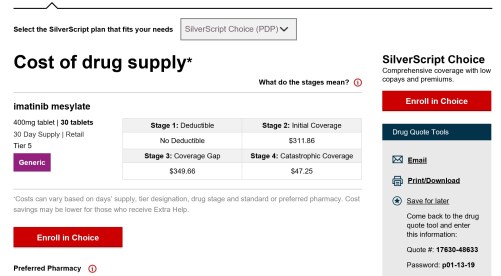
Gleevec has been more like insulin than aspirin: The generic drug companies haven’t really tried to undercut Novartis’ price. When the first generic hit the market, Gleevec was going for about $9,000 a month; the generic was priced at $8,000. Additional generic manufacturers entering the market didn’t increase that gap much.

At least, that’s what happened in the United States. In 2016, a doctor predicted:

Today, health care is globalized, and there are more than 18 generic imatinib versions available worldwide, including 3 in Canada. Generic imatinib is sold at $8,800/year in Canada and at about $400/year in India. The cost to manufacture a 1-year supply of 400-mg imatinib tablets is $159. Two years from now, the price of generic imatinib in the United States (or purchased from abroad) will be significantly lower, hopefully less than $1,000/year.

But that didn’t happen. Instead, the price has remained in the $90K-$120K range.

If you’re surprised that a generic whose annual per-patient cost of production is $159 would sell for close to $100,000, you’re not thinking like an oligopolist. Sure, you could sell imatinib mesylate for $200 a year, but why would you? People are paying $8,000 a month. Why rock that boat?

At the moment 20 states, led by Connecticut, are suing a number of generic drug makers, accusing them of price-fixing. Imatinib mesylate was not named in the original suit, but the general practices described apply to a lot of drugs. Connecticut’s assistant attorney general Joseph Nielsen describes the generic drug industry as “most likely the largest cartel in the history of the United States“.

Insurance and Medicare. If you’ve been doing the math — between $30K and $120K a year for 16 years — you must be wondering what kind of plutocrats Deb and I must be (or at least must have been when all this started) that we’re not bankrupt yet. But in fact, for most of that time very little of that cost passed through to us. Deb worked at a company that had very good insurance. And when she retired, we were allowed to keep that insurance as long as we paid our own premiums.

So in the same way that I have to be thankful to the pharmaceutical industry, I also have to be thankful to the insurance industry. Over the years, they have spent a whole lot more money on us that we spent on them.

(I have, of course, wondered what happens to GIST survivors who don’t have good insurance. The effect of the drug is invisible — the evidence that it’s working is that nothing happens — so I can imagine the temptation to just stop taking it rather than bankrupt your family.)

Unfortunately, though, Deb’s company’s insurance only carried her until age 65, when she was expected to sign up for Medicare. That happened in October (though for reasons not worth getting into, she didn’t need to worry about it until the new coverage year started this month). But OK, Medicare has Part D, which covers prescription drugs. So we’ll be OK, right?

Signing up for Part D involves choosing among a bunch of plans that are underwritten by private insurance companies. Wikipedia describes the situation like this:

Because each plan can design their formulary and tier levels, drugs appearing on Tier 2 in one plan may be on Tier 3 in another plan. Co-pays may vary across plans. Some plans have no deductibles and the coinsurance for the most expensive drugs varies widely.

In short, if you expect to need an expensive drug, you need to do your research before you pick a plan. What if you’re old and never used the internet much, or just kind of confused in your thinking? Well, you might be out of luck.

But Deb is computer savvy and diligent, so she searched the various companies’ online pricing tools until she found a plan that quoted a good price on generic Gleevec:

Ignoring the details of the various $300-something monthly charges, the annual cost was estimated at $4069.55. Not cheap, but well below the what-is-your-life-worth level, and for some reason significantly cheaper than other plans from the same company.

Estimates are not promises. She did that research in November, when decisions for the 2019 coverage year had to be made. So imagine our surprise when she went to fill her first monthly imatinib prescription in January, and discovered that it cost $2,881.07!

Your first thought, like ours, might be that something drastic had happened to the imatinib market between November and January. But no: At the same time that SilverScript was charging us $2,881.07, their pricing tool was still showing prospective customers that the price would be $348.06.

Hours spent on the phone with a wide range of SilverScript employees yielded her nothing: Yes, there was a factor-of-8 gap between the pricing estimate (which they were still showing on their web site) and the price they were actually charging us. And no, this isn’t like Wal-Mart, where they usually honor the price they display, even if it’s a mistake. (And is it a mistake? They don’t seem to be in any hurry to correct it. Maybe it’s intentional deception.) The letter we got from the grievance department says:

Please note that copays are estimates only. We are unable to provide exact copays until such time as the prescription is processed.

And if they’re quoting you one price at the exact same moment that they’re charging a drastically higher price to someone just like you, that’s just the way it goes. Maybe you should pick a different insurance company next year, based on their (possibly inaccurate) pricing information.

What happens after next month? The people who weren’t still quoting the $348.06 price were telling Deb that $2881.07 was what we could expect going forward, or maybe even something higher. So we were looking at an annual cost in the neighborhood of $30,000.

Think about what that would mean: After generics, after insurance, we’d be paying the full price that Novartis originally charged for Gleevec.

But hey, what’s your life worth?

Fortunately, though, it turned out that the SilverScript people who were quoting those prices didn’t know what they were talking about either. (Again, though, I have to wonder what is a mistake and what is intentional. If the low-price information was intended to get us to commit to their program for 2019, maybe the high-price information was intended to make Deb reconsider whether she really wanted to keep taking this drug. Because the ideal health-insurance customer is somebody who pays premiums but doesn’t use services.) Or at least that’s how it appears right now.

For some reason, nobody at SilverScript mentioned the Medicare Donut Hole. (A Blue Cross person explained it when Deb was researching whether she could switch to another Part D plan after the year started.) Follow the link if you want a more complete explanation, but what it means for us is that after we spend $5,100, we hit the catastrophic coverage phase, where the insurance starts to cover 90% of the drug’s cost. If that’s really how things play out (we’re not fully believing anything we read at this point), our annual costs will wind up being something like what the SilverScript web site was predicting for the plans we didn’t choose: Around $10,000 rather than $4,000 or $30,000.

It’s weird: After you’ve spent a week or so wondering where you’re going to come up with an extra $30,000 each year, $10,000 sounds pretty good. It’s not pocket change, but we can afford it. It beats going off the drug and finding out for sure whether it is still necessary.

The lessons I draw. There are ambiguous lessons to learn from our experience. On the one hand, thanks to drug research and health insurance, Deb is alive and we’re not bankrupt. The most important stuff has turned out well, at least so far.

But on the other hand, it seems obvious to me that this system is full of waste and corruption. Novartis should never have been able to charge such a high price for Gleevec, and there was absolutely no reason why the generic drug companies should have been able to share in those windfall profits. In theory, once patents expire the free market will drive prices down. But in the real world that doesn’t happen. Instead, a few companies divide the pie among themselves. They know they have a good thing going, and they aren’t going to ruin it by undercutting each other’s prices.

The market will never fix this, so government needs to get involved.

And why exactly is health insurance still in the private sector rather than being part of the government? The justification I usually hear is that the profit motive will produce better customer service and more efficient delivery of services. I don’t see anything in our personal experience to support that notion. To me, it looks like companies are motivated to lie to us, and none of the insurance people we have dealt with seem to be oriented towards the mission of helping people and saving lives.

When Deb was dealing with the SilverScript grievance people, she reported that they appeared to be following a script rather than trying to understand her case. Nobody seemed to grasp the idea that they were participating in a bait-and-switch fraud, or to be particularly upset if they were. Listening to her account of the conversations, I found myself wishing she had asked, “In your job dealing with grievances, have you ever actually helped anybody?” That question wouldn’t have improved our outcome in any way, but I’d just like to know.

Personally, I’d rather take my chances with government bureaucrats. People in the government may be insulated from market forces, but often they identify with the mission of their office. For example, I recently had to change my drivers’ license from New Hampshire to Massachusetts. I ran into all sorts of unexpected bureaucratic problems; for some reason, none of my documents were the exact ones the system was looking for. Through it all, though, the clerk I was dealing with did her best to guide me through the labyrinth. In her mind, she was there to help people.

That’s not the impression Deb got from SilverScript. The company isn’t trying to provide healthcare or help its customers find ways to pay for it; it’s trying to make as much money off of them as it can. The grievance department isn’t there to respond to customers’ legitimate grievances, it’s there to mollify and divert people who have been conned by the company’s deceptive practices. The individuals who work there are probably no worse than the rest of us, so they can’t identify with that mission. Instead, they sink into their scripts.

My bottom-line conclusion is that the profit motive is not serving us in health care. There has to be a better way.

Are powerful women likable?

OK, a lot of people found Hillary Clinton hard to like. But three more women gained the spotlight this week, and guess what? They’re unlikable too. Maybe there’s a problem here we need to look at.


Maybe there really was some unique I-can’t-put-my-finger-on-it thing about Hillary Clinton that put people off. Sure, she was whip-smart, had a boatload of executive and legislative experience, could stand up to 11 hours of hostile questioning, and had put forward an impressive collection of policies she wanted to implement if she got elected, but … you know. There was just something about her that made voters uncomfortable.

Maybe it was her voice, or her hair, or the way she dressed. She was just too … something. If that many people had said that many bad things about her over the years, there must have been some fire under all that smoke, right? And behind closed doors, she was supposed to have a temper. I know, John McCain’s temper was part of his charm — he was fiery and passionate sometimes, you know — but Hillary’s temper was so … we can’t say bitchy any more, can we? But you know what I mean. It was different.

OK, let’s give people a mulligan for Hillary. And let’s give another mulligan to the people who couldn’t possibly be racist, but some ineffable something about Barack Obama just felt wrong to them. He just wasn’t like the rest of us — not because he was black, of course. Lots of people are black. But … you know. And if he claimed to be an American-born Christian, didn’t that seem kind of fishy somehow? How could we trust somebody like … well, like that, whatever “that” means.

Honestly, I’m starting to get my own ideas about what sounds fishy here, but let’s not dwell on the past. Let’s talk about now. Let’s talk about Elizabeth Warren and Nancy Pelosi and Alexandria Ocasio-Cortez. All three of them have been making news lately, and they’ve all been running into unusual levels of hostility. Each of them, in her own way, has some indescribable quality that raises a lot of people’s ire.

What could it possibly be?

It’s not incompetence. Nancy Pelosi is the most talented legislator of our time. She has no real competition for that title.

When she was Speaker before, the House got stuff done. Appropriations bills got passed on time. She not only saved ObamaCare, but passed a bunch of Obama’s other progressive proposals (most of which died in the Senate).

As soon as the Democrats lost their majority in the House, everybody suddenly realized that the Speakership is a hard job. Even if you lead a partisan majority, holding it together well enough to pass an agenda takes real skill. John Boehner couldn’t do it. Paul Ryan couldn’t go it. Again and again, they would fail to get a proposal to the floor, or miscount votes and see a bill fail unexpectedly. (To this day, a Republican healthcare bill with positive content hasn’t even been drafted, much less voted on or passed.) Deals they thought they had negotiated fell apart at the last minute. Boehner just barely avoided pushing the United States into a self-inflicted financial disaster.

The Speakership is hard, unless you do it backwards and in heels like Pelosi does. Then it looks easy.

When LBJ and Sam Rayburn were the masters of Congress, their skills were appreciated even by many who disagreed with their goals. Phrases like “wheeler-dealer” and “arm-twister” got used with a certain amount of admiration. But it’s hard to imagine applying descriptors like that to a woman. Instead, she (and not Chuck Schumer) was the villain of GOP campaign ads across the country. Her own party seriously discussed not letting her be Speaker again if they regained the majority. (Schumer, meanwhile, lost seats in the Senate and was not challenged.)

It’s not inauthenticity. One complaint about Hillary Clinton was that she just wanted to be president and didn’t stand for anything. But Elizabeth Warren’s political career has a definite theme: Capitalism needs to be regulated to keep big corporations from running over ordinary people.

After the crash of 2008, Warren left a cushy position at Harvard Law School and entered public life because she wanted to protect consumers from the predations of the big banks. She ran for the Senate in 2012 because Republican opposition in the Senate made it impossible to get the job she had wanted: head of the Consumer Financial Protection Bureau (whose creation she had overseen). In the Senate, she has been a leading voice against the concentration of corporate power.

She has the working-class biography to back up her sympathies with ordinary people. Rather than being tracked for high positions early in life (like, say, Brett Kavanaugh), she came from a working-class family and her career developed slowly: She left college to get married, then followed her husband as his career took him to Houston and New Jersey. She finished a bachelor’s degree in speech pathology and  taught public-school children with learning disabilities. She interrupted that career to be an at-home mother, then later went back to school in law. She started out doing legal services from her home, then started teaching, and rose in academic ranks as an expert in laws related to bankruptcy. Eventually she got to the top of the academic heap: tenure at Harvard.

When Clinton, a centrist woman, seemed like the inevitable nominee in 2016, there was a groundswell among progressives for Warren to challenge her. Only after she refused to run did Bernie Sanders get into the race and lead progressive Democrats.

So announcing her presidential candidacy for the 2020 nomination raises one obvious question of substance: Just how much regulation does capitalism need? If you’d rather talk politics, you still have a number of interesting questions to choose from: Can she recover the support of the progressives who turned to Sanders in 2016? Can the Sanders/Warren wing of the party win this time? Can she get more support from blacks and centrists than Bernie got in 2016? And so on.

Instead, Politico raised this question:

How does Warren avoid a Clinton redux — written off as too unlikable before her campaign gets off the ground?

Politically, it’s hard to see much resemblance between Warren and Clinton, except for this: Both of them are women who saw their unfavorability ratings spike when they started to look like serious candidates. Clinton herself explained it this way:

It’s always amusing to me that when I have a job, I have really high approval ratings; when I’m actually doing the work, I get reelected with 67 percent of the vote running for reelection in the Senate. When I’m secretary of state, I have [a] 66 percent approval rating. And then I seek a job, I run for a job, and all of the discredited negativity comes out again, and all of these arguments and attacks start up.

It’s not a lack of passion and vitality. Another criticism of Clinton (which sometimes also gets said about Warren, though I don’t understand why) was that she seemed cold. But if you want a politician who is the opposite of cold, I’ve got one for you: new Congresswoman Alexandria Ocasio-Cortez. But strangely, she also has been a target of public ire.

Since upsetting a member of the House Democratic leadership in a primary and then winning his seat in the general election, Ocasio-Cortez has been targeted both for being too poor and for not being as poor as she’s supposed to be. Predictably, the too-rich criticism was based on her clothes: “That jacket and coat don’t look like a girl who struggles.”

When Paul Ryan came to Congress, he was a “young gun”; his youth was evidence of how extraordinary he must be, to get so far so fast. But AOC’s youth just points to her being a lightweight, because there’s no female equivalent of a “young gun”.

This week, we learned of a new AOC outrage: She and her friends made a dance video in college. Unlike, say, Melania Trump or Scott Brown, she kept her clothes on, but still the video is supposed to be embarrassing for some reason. My main reaction is that this video is a trivial thing that shouldn’t evoke anything more than a trivial response; mine is that college-age Alexandria looks like somebody college-age me would have wanted to go out with (assuming away the time-travel problem). But you can judge for yourself.

Somehow, though, conservatives looked at that video and saw something scandalous. I think this tells us more about them than about AOC. As Paul Krugman put it: “The mere thought of having a young, articulate, telegenic nonwhite woman serve is driving many on the right mad.”

If just being young and nonwhite were the problem, that would be one thing. But in the context of Clinton, Pelosi, and Warren, we see that being older and white doesn’t protect a woman either. The specifics of a woman’s life and character may shape how she gets disparaged, but her unique characteristics are not why she gets disparaged.

People are starting to notice. Robby Mook may have exaggerated a little about the reaction to Warren’s announcement video, but he wasn’t exactly making this up, either.

Last 24 hours shows Trump’s 2020 path to victory:
-Dem candidate releases video that explains her background, values, vision and policies
-it never mentions Trump;
-Trump responds with childish insult;
-Media only covers insult.
All process, all on Trump’s terms. No Dem message.

Maybe Trump and the press will do that with every Democratic candidate. But I also think it works better, and the media is more complicit, against women.

Peter Beinart, I think, has this right: The facts that an article cites about Warren may be true, but still contribute to a false narrative.

Mentioning the right’s attacks on Warren plus her low approval ratings while citing her “very liberal record” and the controversy surrounding her alleged Native American heritage implies a causal relationship between these facts. Warren is a lefty who has made controversial ancestral claims. Ergo, Republicans attack her, and many Americans don’t like her very much. But that equation is misleading. …

There’s nothing wrong with journalists discussing public perceptions of a candidate. The problem is that when journalists ignore what academic research and recent history teach us about gender’s role in shaping those perceptions, they imply—whether they mean to or not—that Warren’s unpopularity can be explained by factors unique to her. They start with the puzzle of her low approval ratings and then, working backward, end up suggesting that her policy views or (pseudo) scandals explain them.

… Journalists shouldn’t ignore electability. Elizabeth Warren’s comparatively low approval ratings are a legitimate news story. But the bigger story is that Americans still judge women politicians far more harshly than they judge their male competitors. Unless journalists name that unfairness, they risk perpetuating it.

“I would have voted for the woman who isn’t running.” As the 2020 campaign proceeds, other women are likely to emerge as serious candidates. (Kamala Harris and Amy Klobuchar, perhaps.) We can hope that the sheer multiplicity of targets will disperse the misogynistic fire. But here’s a wild guess on my part: Whichever one is polling last will get the most favorable coverage. In 2004, when she wasn’t running, many voices pined for Hillary Clinton, only to turn against her in 2008 and 2016, when she was actually on the ballot. Likewise in 2016, people who were voting against Clinton often claimed they could have supported Warren, if only she had run. But where are they now?

The Republican Party has a similar dynamic around blacks. At some point in the process, there’s a boomlet for a black candidate like Colin Powell, Herman Cain, or Ben Carson. But these waves always fade before any votes get cast. Having given cover to people who will never actually vote for a black, the candidacies have served their purpose.

We can’t let that happen in 2020. “I would have voted for a woman” isn’t an excuse any more. Do or don’t, but what you would have done in some alternate reality doesn’t matter.

For the most part, this kind of prejudice is structural and unconscious. “Woman politician” has become a category in people’s heads; it seems natural to treat them differently than male politicians, as if a political office changes when a woman holds it. (There has been a similar phenomenon in sports: For a long time “black quarterback” seemed to be a category of its own. Any new black quarterback would invariably draw comparisons to previous black quarterbacks, and be judged accordingly. Cam Newton came into the NFL as a tall, strong quarterback with speed and a powerful arm, but somehow John Elway was never the comparison that popped into commentators’ minds.)

As Pelosi’s speakership, Ocasio-Cortez’ congressional service, and the 2020 campaign continue, we’re going to have to monitor this constantly, both in the media and in our own minds.