Category Archives: Articles

Shared Understanding

He leaves behind a society in which the bonds of trust are degraded, in which his example licenses everyone to cheat on taxes and mock affliction. Many of his policies can be reversed or mitigated. It will be much harder to clear our minds of his lies and restore the shared understanding of reality—the agreement, however inconvenient, that A is A and not B—on which a democracy depends.

– George Packer “A Political Obituary for Donald Trump

This week’s featured posts are “Opening Thoughts About the Trump Voter” and “This Week in the Trump Coup“.

This week everybody was talking about the virus and the vaccines

The Pfizer vaccine got approval and is being administered starting today.

Meanwhile, we’re seeing the predicted effects of the traveling and gathering Americans did over Thanksgiving. Friday, we set a record with 237,000 new cases. More than 17,000 Americans died in the last week. That’s like a Vietnam War every month.

The new worry is that people won’t take the vaccine. It isn’t just the usual anti-vax folks, it’s also a Catholic thing and anti-abortion Protestant thing, because the vaccines were developed using stem cells retrieved from aborted fetuses in the 1960s. The Pope doesn’t seem to have this scruple, but he’s not Catholic enough for some folks.

And then there are the wackos, like this Florida megachurch pastor, who

has advised his congregants not to receive a COVID-19 vaccine, urging them to “believe in divine immunity” instead.

After all, divine immunity worked so well during the Black Death.

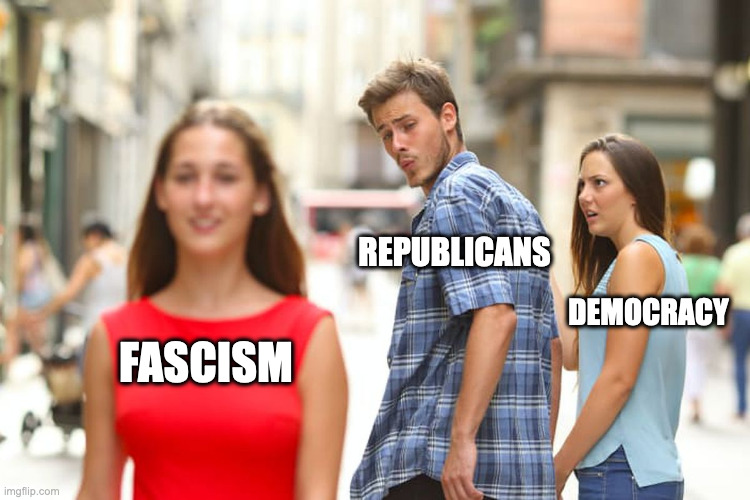
and the GOP becoming the Autocratic Party

This got covered in one of the featured posts. One thing I left out of that post: the racist nature of much of this weekend’s violence. Black churches were targets, including a historic D.C. church whose Black Lives Matter banner was torn down and burned.

and you also might be interested in …

One thing Trump’s effort to overturn the election he lost (by over seven million votes) has pointed out is how the minority-rule bugs in our democracy can cascade.

  • The Electoral College allows a candidate to lose by millions of votes and still become president, as Trump did in 2016. If Biden’s win in 2020 had been only 1% narrower across the board — if he’d won by 5.5 million votes rather than 7 million — the Electoral College would have flipped the victory to Trump.
  • Gerrymandering allows a party to control the state legislature even if a majority of the voters supports the other party. This is the case in Wisconsin, Michigan, and Pennsylvania.
  • If the state legislature can ignore the vote totals and choose electors on its own — as Trump is trying to get them to do — then a candidate can lose the popular vote not just nationally, but also in states that represent a majority of electors, and still become president.
  • If no candidate gets a majority of electoral votes, the election is decided by the House, with each state delegation getting one vote. If the minority-rule party controls — or manages to gerrymander majorities in — 26 state delegations, its candidate wins.

Currently, all these factors favor Republicans. So if they are put together, Republicans could hold the presidency with considerably less than the 46% of the vote Trump got in 2016. A Democrat could win a resounding landslide of votes, but lose the presidency.


John Le Carré, the author who rescued the spy genre from James Bond, died this weekend at 89. Critics are arguing over his greatest novel, and I admit to never having read A Perfect Spy, which tops many lists. But The Spy Who Came in From the Cold is a novel writers (of fiction and nonfiction alike) should study as they learn their craft, because it is so perfectly tight. You couldn’t edit out a single sentence without losing something.

Le Carré’s most influential insight was that intelligence work requires intelligence more than derring-do, and is more about organizations than lone-wolf operatives. First and foremost, George Smiley was a guy who read the files better than you would.

The opening chapters of The Honorable Schoolboy are about picking up the pieces after catching the mole in Tinker, Tailor, Soldier, Spy. The process involves finding patterns in what the mole had prevented British intelligence from doing or discovering — assembling the gaps in the Circus’ knowledge into a story of its own. James Bond would have been useless.

and let’s close with something awesome

Prize-winning photos of the aurora.

This Week in the Trump Coup

The big thing to note is that the Electoral College is voting today, and that none of the 306 electoral votes Biden won in the election has been taken away by Trump’s 50+ lawsuits.

During impeachment, Republicans argued that Congress would overstep if it removed Trump so close to an election, because that was for the voters to decide. But of course, now that the voters have decided by a wide margin to remove Trump themselves, Republicans hold that decision to be invalid too.

Remember how this started: Biden’s victory became clear the Saturday after the election. When Trump didn’t concede right away, as all other losing candidates in living memory have, Republicans said we should give him time to adjust to his loss. Then they argued that he had a right to pursue all his legal options until the states certified their votes. Then they pushed back the date until the electoral votes were cast.

But of course this isn’t the end of it either. Now they’re talking about challenging the electoral votes when Congress meets to count them on January 6. That challenge will fail too, and then we’ll see what else they come up with, and how long they can keep this going.

In the meantime, it’s turning into a good scam for our conman-president. He has collected nearly a quarter billion dollars from his sheep to “fund” this challenge process, which costs only a fraction of that total. The longer he can tell supporters that he has a chance to win, the longer the cash keeps rolling in.


The downside, of course, is that people believe him. They believe Biden is stealing the election, but that Trump will still prevail. And as they catch on to the fact that Trump isn’t going to prevail, they’re going to become increasingly violent.

We saw that beginning to happen this weekend, with the Proud Boys and other Trump supporters rioting in D.C. and various other cities.

Police in Olympia, Wash., arrested an armed right-wing protester and charged him with shooting a counterdemonstrator during protests on Saturday night.

In the nation’s capital, at least four people were stabbed, including someone who is now in critical condition, and 33 more were arrested, after rallies supporting President Trump descended into chaos fueled by white nationalists. D.C. Police Chief Peter Newsham estimates that as many as 700 Proud Boys and their confederates roamed downtown streets looking to start fights, clashing with about 200 anti-Trump protesters.

In Michigan

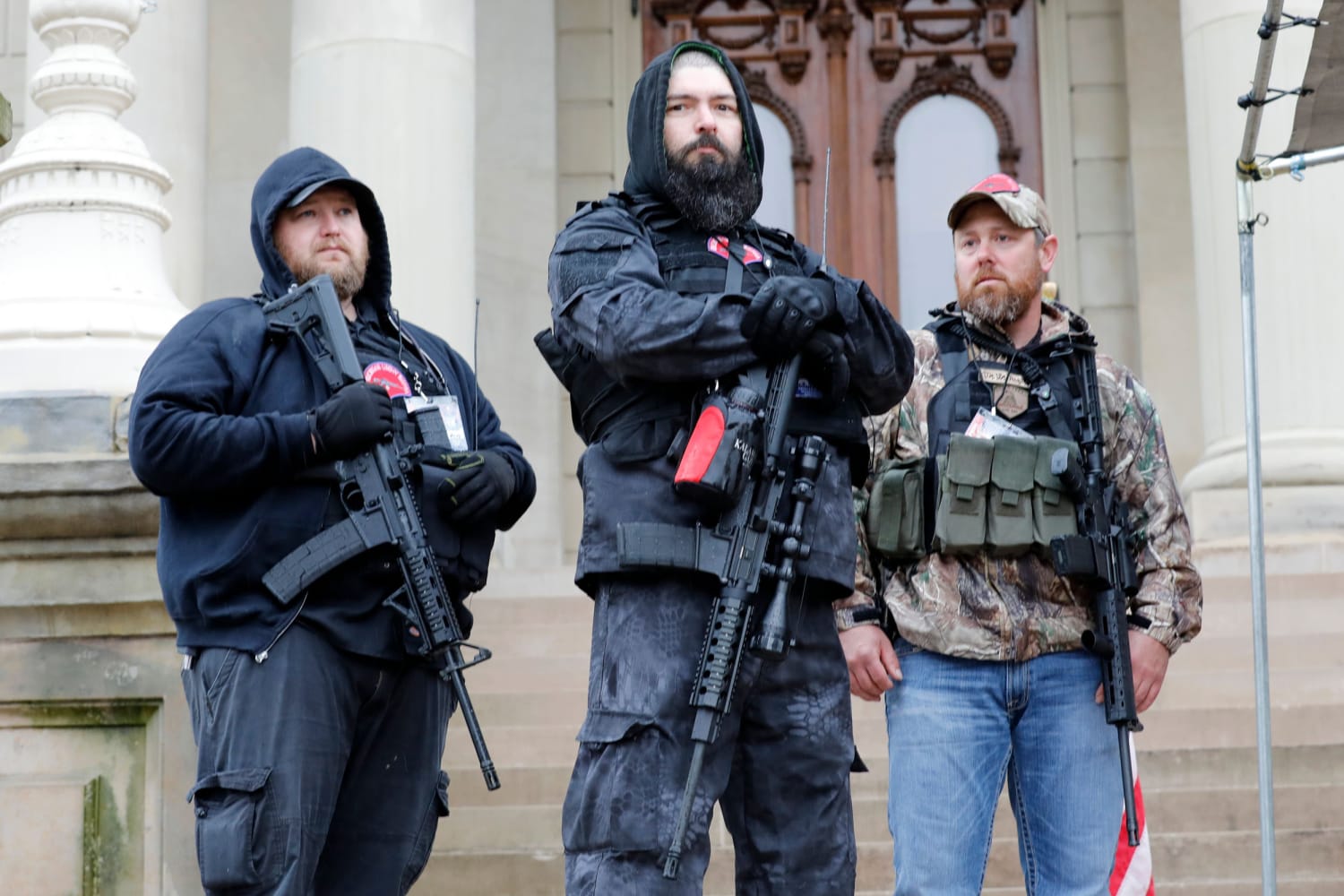
Michigan’s 16 electors will convene at 2 p.m. Eastern inside a heavily guarded state capitol in Lansing to cast their ballots for Joe Biden to become president and Kamala Harris to become vice president.

A spokeswoman for Senate Majority Leader Mike Shirkey (R) said in a statement overnight that the entire capitol complex will be closed to the public based on “recommendations from law enforcement” amid “credible threats of violence.” Police will escort each of the electors from their cars amid what’s expected to be a large “Stop the Steal” protest outside.


The week’s most horrifying story was also one of its most absurd: The lawsuit Texas filed asking the Supreme Court to overturn the presidential election results in Georgia, Michigan, Pennsylvania, and Wisconsin. The suit itself was ridiculous, because how one state chooses its electors is not any other’s state’s business — which is what the Supreme Court said when it tossed the suit for lack of standing. The absurdity and insubstantiality of it didn’t stop 17 other state attorneys general from joining the suit or 126 Republican members of Congress from signing an amicus brief supporting it.

Let’s be clear about what would have happened if Texas had won: American democracy would be over. The voters could cast 81 million votes against a sitting president, defeat him by seven million votes, and even jump the hurdles of the archaic Electoral College — and he could hang onto power anyway. It is hard to imagine how future elections could proceed, once the Supreme Court had reduced them to an empty exercise. It’s also hard to imagine the Union hanging together. Why should blue states stay in a Union where their votes don’t count?

A barrage of other Trump suits got tossed in various state and federal courts, and I’m not going to go into them all. What it comes down to is that there is no court in any state that endorses Trump’s claim that Biden’s win is fraudulent. In most of the suits, Trump’s lawyers didn’t even really make that claim; the “evidence” they kept crowing about in public and social media wasn’t anything a court would recognize.

I agree with Amanda Marcotte’s interpretation: 2/3rds of Republicans don’t “believe” Trump really won the election any more than they believed President Obama was born in Kenya. The election-fraud conspiracy theory simply justifies a position they don’t want to state in so many words: To hell with democracy. Their side should be in power no matter what the majority of Americans want.

it’s important to see those who support Trump’s coup for who they are: People who have been radicalized, through racism, hateful propaganda, and a sense of perpetual grievance, against democracy. They aren’t going to change their minds because of new facts, because the underlying belief — which is that they deserve to be in power, no matter what — is the problem here. It’s a rising American authoritarianism, and we underestimate it at our peril.


This is a good time to revisit one of my favorite Jen Sorensen cartoons, which she drew in 2015.


Arguably the most disturbing thing about the Texas lawsuit was the 126 Republicans in Congress signed an amicus brief supporting the suit. New Jersey Rep. Bill Pascrell has proposed a hardball way to punish them:

Pascrell cites Article 1, Section 5 of the Constitution in the letter, which “gives each chamber of Congress the ultimate authority to decide their membership.”

“Stated simply, men and women who would act to tear the United States government apart cannot serve as members of Congress,” Pascrell writes, adding that they were attempting to make President Trump “an unelected dictator” by endorsing the lawsuit.

Most Democrats don’t want to go that far, preferring to keep the moral high ground as the Party of Fair Play as opposed to the Party of Power At All Costs. And as a practical matter, the worst possible outcome would be for Speaker Pelosi to attempt something like this and fail for lack of a Democratic consensus.

However, I could get behind a halfway measure, which I would view as a shot across the Fascist bow: Make an example out of the 19 of those 126 Republicans who were elected from Wisconsin (1), Pennsylvania (7), Michigan (4), and Georgia (7). After all, they were on the same ballot as Biden and Trump, so the brief they signed alleges that the very election that qualifies them to sit in Congress was tainted by what the brief calls “unconstitutional ballots”. It would make perfect sense for the House to investigate this allegation before seating them. Coincidentally, this investigation should last until the Inauguration, at which point Speaker Pelosi could report that allegations of fraud were unsupported by evidence.

Opening Thoughts about the Trump Voter

Whenever I come across an idea that seems promising, I face a dilemma: Do I tell you all as soon as I start thinking about it, or do I wait until I’ve done the research to flesh it out properly? This blog’s most successful posts are the ones where I’ve taken time, done a bunch of background reading, and thought things through carefully. Not a Tea Party, a Confederate Party is a prime example. I thought about it for months, and it has gotten more than half a million hits in the last six years. Around 200 people looked at it last week.

But at the same time, there’s the question of topicality: If I know a lot of you are thinking about a question right now, shouldn’t I let you know that I’m thinking about it too? And if I have some preliminary conclusions that you might find useful, maybe I should pass them on, even if I don’t have all the i’s dotted and t’s crossed yet. So that’s what I’m doing in this post.

The 74 million. As has been clear on this blog since Election Day, I was deeply disturbed to see 74 million Americans vote for a Trump second term. After everything he’s done these last four years, 74 million Americans — millions of whom didn’t vote for him in 2016 — said, “Stay. Get some more of us killed. Finish the job of destroying American democracy.”

Blessedly, 81 million Americans said, “No. Get the hell out of here.” And despite Trump pulling every lever of presidential power to defy the People and stay in office, the institutions of democracy have held. The Electoral College is voting today, and 306 electors are pledged to Joe Biden. On January 20, Trump will become an ex-president.

And yet, those 74 million Trump voters are still with us, and many of them are still believing every ridiculous thing he says, like that he really won in a landslide, but that Biden managed to manufacture vast numbers of fake votes — under the nose of a sitting president, whose Justice Department noticed nothing. In Georgia and Arizona, this vast fraud supposedly happened under the noses of Republican governors and secretaries of state, who also noticed nothing. Trump’s claims of fraud have failed to convince judges in over fifty lawsuits, including judges Trump appointed himself.

And still they believe him. Largely because of his influence over the base voters, droves of Republican elected officials have abandoned their integrity: Eighteen state attorneys general and 126 members of Congress signed on to an insane lawsuit asking the Supreme Court to throw out the 2020 election and hand Trump a second term in spite of the voters. (All three of his Supreme Court appointees refused.) If this suit had succeeded, if defeating Trump by seven million votes (in an election that Trump appointee Christopher Krebs called “the most secure in American history“) isn’t enough to take power away from him, then all future presidential elections would be meaningless. Democracy would be over in America, and quite possibly the Union would break up.

And that’s what the Republican Party supports these days.

So what do we do? How should we understand Trump voters? How should we talk to them? How do we manage to hang on to our constitutional republic in spite of them?

I’ve been thinking about those questions a lot this last month.

The too-easy answers. There are lots of explanations of the Trump voters that strike me as too easy and too satisfying to the liberal self-image. Like:

  • They’re just stupid.
  • They’re insane.
  • They’re in thrall to a mind-numbing, reality-rejecting version of Christianity.
  • They’re in Hillary Clinton’s “basket of deplorables”: racists, sexists, homophobes, xenophobes, and Islamophobes.

I admit, none of these explanations is entirely baseless. Trump’s support is concentrated in the less-educated portion of the population, and his supporters regularly swallow his incredible (and often self-contradictory) lies. Increasingly, they are taken in by Q-Anon or similar conspiracy theories that ought to sound crazy. White supremacists are front-and-center at Trump rallies, and Trump supporters in general love to demonize Black Lives Matter or leading women of color (like AOC). The Christian leaders who back Trump (in spite of his complete ignorance of Christianity and lack of any Christian virtue) are also likely to deny evolution, climate change, the Covid-19 pandemic, and other well established aspects of reality.

Perhaps the best reason to believe these pejorative theories of Trump support is that Trump himself seems to believe them. Like conmen everywhere, he does not admire his marks. For example, whenever he needs a distraction from something he has bungled, he picks a fight with some prominent Black person, like LeBron James or Don Lemon, or he tells the Squad to “go back” where they came from. He knows that playing a racist or sexist is a good look for him.

Restoring democracy. I resist these theories, though, because they seem self-defeating to me. If 74 million voters are just stupid or crazy or incurably bigoted, then why exactly do we want to save democracy? Shouldn’t we just disenfranchise them before they disenfranchise us? If Biden could stage a coup of his own, ignore the anti-democratic Senate, and start dictating sensible policies to mitigate climate change, guarantee health care, and reduce economic inequality, wouldn’t that be a good thing?

I reject that scenario. Messy and inefficient as democracy can be, I want to find a way back to it. I believe that when you start cutting large numbers of people out of the process, it doesn’t turn out well, even if you get some good things done in the short term.

Restoring democracy in such a way that it survives into the distant future involves reversing the polarization of recent years and shaping some kind of national consensus about who we are and what we’re trying to do. (It also involves recognizing that we have to do more than just “restore” democracy, because large swathes of the citizenry were cut out of the governing process in whatever era we might imagine going back to.) We can’t do that if we begin by writing off 74 million voters.

The answer I want. So before I even start, I have to confess that I’m looking for an answer of a certain shape: I want to find something in the Trump voter (or at least in a large number of Trump voters) that I can sympathize with and imagine making common cause around. If the core of what they want is to lock immigrant kids in cages, then I can’t go there. If the essence of Trumpism is restoring the patriarchy and sending gays back to the closet, there’s no deal to be made. But what if that’s not it?

Trump’s appeal. I view Trump’s appeal as being rooted in resentment and wounded pride, which Trump has exploited in destructive ways. Trump has turned that resentment against precisely the groups Hillary’s basket-of-deplorables quote describes: against Blacks, women, gays, immigrants, and non-Christians (especially Muslims). And Trump has offered his followers a restored pride in their race, their religion, and the power of their nation to bully other nations.

But what is that resentment and that wound really about? As I see it, Blacks, women, and the rest didn’t really do anything to the MAGA-hatters; they’ve just been offered as scapegoats. Same-sex couples haven’t harmed opposite-sex couples. Trans folk haven’t stopped the rest of us from identifying as men or women, if that’s what we want to do. Every American-Christians-are-persecuted story I’ve ever looked at has fallen apart under examination.

The key to bridging the gap — not all the way to the neo-Nazis, but to a lot of ordinary Americans who voted for Trump — ought to be finding an interpretation of that wound and that resentment that doesn’t demonize the people who feel it.

The progressive account. The progressive movement offers such an explanation, but I’m not satisfied with it. Bernie Sanders and his allies will tell you that the wound is economic: Trump supporters — particularly non-college-educated white people in rural areas — feel themselves slipping out of the middle class through no fault of their own.

The best description of that economic anxiety comes from Arlie Russell Hochschild’s book Strangers in Their Own Land.

You are patiently standing in the middle of a long line stretching toward the horizon, where the American Dream awaits. But as you wait, you see people cutting in line ahead of you. Many of these line-cutters are black — beneficiaries of affirmative action or welfare. Some are career-driven women pushing into jobs they never had before. Then you see immigrants, Mexicans, Somalis, the Syrian refugees yet to come. As you wait in this unmoving line, you’re being asked to feel sorry for them all. You have a good heart. But who is deciding who you should feel compassion for? Then you see President Barack Hussein Obama waving the line-cutters forward. He’s on their side. In fact, isn’t he a line-cutter too? How did this fatherless black guy pay for Harvard? As you wait your turn, Obama is using the money in your pocket to help the line-cutters. He and his liberal backers have removed the shame from taking. The government has become an instrument for redistributing your money to the undeserving. It’s not your government anymore; it’s theirs.

There’s a long discussion about white male privilege to be had here. (The implicit assumption is that “you” deserved the spot you had in line, and so the Blacks and women and immigrants who got moved ahead of you are interlopers.) But the essence of the problem is the unmoving line. If you’re making good progress towards the Dream, and you know you’ll get there soon enough, then who really cares if somebody else gets there a little ahead of you?

So the progressive solution is to get the line moving again by taxing the wealthy and using the money to relieve the stresses of working-class life (through government-financed health care, a higher minimum wage, and a strong safety net) and to open more avenues for upward mobility (free college and revitalized infrastructure).

Do all that, the progressives say, and working-class people will realize that Democrats are back on their side, so the Trump movement will fade away.

That seems plausible, but I don’t see much supporting evidence. I think progressives were fooled by the support Bernie got in the 2016 primaries from working-class white voters in rural areas of, say, Michigan and Wisconsin. But in 2020, when Bernie was running against a man rather than a woman, those counties flipped to Biden. It was never about the progressive economic agenda.

Depleted social capital. Timothy Carney’s book Alienated America (which I did a mini-review of in a weekly summary in 2019) is a conservative look at the Trump phenomenon. Carney argues (with data to back him up) that the core Trump voters — the people who supported him in the 2016 Republican primaries over more traditional Republican candidates like Jeb Bush, John Kasich, Ted Cruz, and Marco Rubio — were not the people struggling economically. Instead, they tended to be successful people in failing communities. Not the guy who lost his job when the factory moved to Indonesia, but the guy who runs the Chevy dealership that sold trucks to guys who lost their jobs when the factory moved to Indonesia, or the guy whose plumbing-and-heating-contractor business is surviving, but hasn’t been nearly as prosperous since the local factory moved to Indonesia.

So Carney’s solution to the Trump-voter problem is to shore up the social capital of the small towns and rural areas in America’s heartland. This seems a little closer to the mark, though exactly how to do it is a little trickier. (James and Deborah Fallows’ book Our Towns, which highlights successful small towns, might be a place to start thinking about that.)

When I picture the view from my Midwestern hometown (Quincy, Illinois), Medicare for All and free college are nice, but they don’t really solve the problem. They make it easier for people to survive as individuals, and to educate their kids so they can move away and succeed in places that still have opportunity. But they don’t provide a vision of how Quincy itself thrives into the future and makes opportunities for its children to put down roots without moving away.

What all of this leaves out, though, is the kind of resentment we’re seeing right now, directed at doctors and the government officials who listen to them. The people who make a scene at Target because they don’t want to wear masks — that’s not economic anxiety or even community-social-capital anxiety. That’s something else.

It’s related to the own-the-libs anger that shows up on social media. These are the people who positively rejoice when Trump makes fun of the disabled or claims that he couldn’t possibly have molested all the women who accuse him, because they’re just too ugly. That’s not about fear that immigrants will take your job, or concern that you won’t be taken care of if you get sick, or worry that your grand-kids will have to grow up in San Francisco.

Caste. So there are two other pieces of the puzzle I’m trying to integrate in, and this is where I’m going to need some time to get the fit right. Both are related to books I finished reading this week. One is Isabel Wilkerson’s Caste, which makes the observation that a caste system provides a sense of security to people who aren’t in the bottom caste, because they know someone will always be below them. That isn’t just (or even primarily) an economic security, it’s a social and psychological security.

So the guy who believes that he’s white trash takes comfort in the idea that he’s at least white trash. As long as whites are on top, he has some claim to self-worth.

Wilkerson raises the idea that poor and working-class whites whose votes for Trump seem to run against their economic interests (because Trump’s policies may take away their health insurance and won’t raise their minimum wage) may have a broader view of their interests than just economics. They may see their whiteness as a birthright they aren’t willing to sell.

Something similar might be going on with the Christians who refuse to sell cakes or do floral arrangements for same-sex marriages. It’s absurd to believe that God cares about these lines in the sand. (Neither cakes nor flowers play any sacramental role in Christian marriage rituals.) But if these people’s self-worth comes from the social supremacy of Christianity, then making a stand that says “We’re still on top” will be important to them.

This isn’t bigotry in the hating sense. The person who feels an attachment to everybody staying in “their place” may not have any conscious animosity towards people who are assigned to different places. But the current system gives that person a “place” somewhere that isn’t the bottom, and if the system falls apart, he doesn’t know where he’ll be.

So now the question becomes: What alternative self-worth do we have to offer such a person? And how can we communicate this offer to him or her?

Defining reality. One of the hardest things for me to accept about Trump supporters is their willing acceptance of all sorts of absurdities. As various Facebook memes have been putting it lately: The pandemic is a hoax, but Trump deserves credit for producing the vaccine that I’m going to refuse to take.

Bill Barr was wonderful until he refused to go along with the Biden-stole-the-election lie, and now he’s part of the Deep State. Amy Coney Barrett has gone from savior to villain in just a few weeks. The only way to know what’s real these days is to follow Trump’s tweets, and be prepared to change your mind as he does, from one moment to the next.

The 2019 book Democracy and Truth by Sophia Rosenfeld has some clues about what’s going on here.

Every society has some process for reaching consensus on what is real, what is possible, what categories people need to keep track of, and so on. (One key element of “wokeness” is recognizing the social construction of both race and gender. Yes, there is an underlying physical reality: Some people’s skin is darker than other’s, and some people have organs that other people lack. But the exact boundaries of these categories and what — if any — significance they have varies from one society to another.) Different people play different roles in this process, with some being more empowered than others. One of the not-well-understood aspects of Trumpism is that Trumpists feel alienated from the reality-defining class.

This has been an issue for years when it comes to Christianity and evolution. The scientific community had a debate in the 1800s, and settled on the consensus that Darwinian evolution really happened, while the young-Earth account of Genesis is just a myth. Lots of Christians don’t like that conclusion, and have tried for years to argue that their definition of reality deserves as much or more deference than the scientists’ definition.

The same thing happens with climate change and all sorts of other ideas that get less attention: There’s an expert class that defines the social consensus about reality, but lots of people are in rebellion against its conclusions. At a mundane level, this plays out on the front page of The New York Times every day: Some things are really happening while others aren’t. And some things are happening but aren’t worth noting.

In general, different people are involved in different reality-defining processes. And even if you’re not involved in any of them, you might feel some connection to the people who are. For example, I play no role in deciding whether the various Covid-19 vaccines are safe. But I have friends who are biologists, and they have friends are are involved. I’ve also participated in a different research community (mathematics), so I have a general grasp of the peer-review process, and so forth. In addition, there was a point in my life when I was deciding what field to specialize in, and if I had made a different choice, I might be working with Dr. Fauci today. (Or at least I believe that.)

But many people in society feel completely separated from that process. They have opinions on the subject, but nobody cares. In fact, nobody cares about any of their opinions about what’s real and what isn’t. They don’t know anybody who decides what’s real, and they aren’t aware of ever having had a chance to enter the reality-defining class. People like them don’t define reality. Somebody else does.

That’s the kind of alienation that makes you throw a fit in Target. This mask isn’t a moon rocket, it’s a piece of cloth. Why is your opinion about it better than mine?

That alienation will also lead you to conspiracy theories, where reality gets defined by an alternative community in alternative ways. The folks in Q-Anon care what you think. Dr. Fauci doesn’t. He thinks he’s better than you are.

Trump consistently stands up for these alienated folks by thumbing his nose at the reality-defining class as a whole. There’s a pandemic? Maybe, maybe not. Doctors say masks help, but I think hydroxychloroquine is better. My friend the My Pillow Guy has a theory; why don’t we listen to him?

So here’s a thought I’m still wrestling with: How do we make the reality-defining class more accessible? Or more transparent? Or at least less off-putting?


Pardons and Their Limits

Throughout his administration, Donald Trump has tested the limits of presidential power. On his way out the door, he is testing the limits of the pardon power.


This week the Covid pandemic reached new heights and threatened to break America’s hospital system. The total number of American deaths will soon pass the number of combat deaths in World War II.

So of course the White House had not a word to say about any of that. Instead, the President’s attention was absorbed by more pressing problems: the continuing failure of his attempts to overturn the election he lost by seven million votes, and the criminal exposure he and various members of his family and his administration might face come January 21, when he no longer has the power to restrain the career investigators and prosecutors in the Department of Justice.

The first of the expected rush of lame-duck pardons was given to former national security advisor Michael Flynn. Signed the day before Thanksgiving, the text was only released last Monday. [1] Since then, Trump is reported to be discussing pardons for his children, up to 20 members and allies of his administration, and himself. [2]

All of that may yet come to nothing; Trump frequently is said to be thinking about some action that never happens (like releasing a healthcare plan). But given the approaching deadline, it’s worth considering what he can actually do.

Article II. The President’s power to pardon is established in Article II, Section 2 of the Constitution:

The President … shall have Power to grant Reprieves and Pardons for Offenses against the United States, except in Cases of Impeachment.

That sounds pretty sweeping, but as so often is the case in constitutional law, nearly every word inspires entire articles of analysis. That said, there is one clear limit that just about everyone agrees on: “Offenses against the United States” means federal crimes only. So a presidential pardon won’t protect against prosecutions for violating state laws, or against civil lawsuits.

That’s relevant, because a lot of the post-presidency legal exposure faced by Trump and his family falls outside of his pardon power. He could, for example, try to pardon himself for the seven instances of obstruction of justice that the Mueller report found to be indictable. But if he is guilty of bank and tax fraud (as Michael Cohen has claimed), New York state laws have been violated, and the alleged misappropriation of funds contributed to the Trump Inaugural Committee is a civil suit.

Self-pardons. But that brings up the issue of a self-pardon, which is untested in American law because no previous president has ever tried such a thing. Examined naively, the Article II text would seem to support the idea; it just says “power to grant pardons” with no exceptions other than impeachment.

But North Carolina Law Professor Eric Muller has an interesting interpretation, which ought to appeal to the conservatives on the Supreme Court who claim [3] to believe in Originalism: He can’t find 18th-century usages of grant as a reflexive verb. In other words, one party “grants” something to another; but nobody ever “grants” something to himself.

in the time period from 1750 to 1800 … [t]ransitive uses of the verb—“grant me,” “grant him,” “grant her,” “grant us,” “grant you,” and the like, where the person receiving the grant is different from the person doing the granting—are all common. But reflexive uses, where the person doing the granting is also the person on the receiving end? All but nonexistent.

Leading to the conclusion:

Can Donald Trump pardon himself? Perhaps, but that’s not the question the Constitution requires us to ask. Can Donald Trump grant himself a pardon? The evidence, at least according to the text of the Constitution and its original meaning, says no.

Harvard Law Professor Lawrence Tribe made a similar point to MSNBC’s Lawrence O’Donnell, and added that Article II also stipulates that the President “shall take care that the laws be faithfully executed”. If presidents could pardon themselves, they would instead be exempt from all federal laws — something the Framers clearly did not intend. The King of England might be above the law, but the President of the United States should not be.

We know that the Framers did not bother saying that the president cannot grant himself a pardon, because no one in their right mind would have imagined otherwise.

Specificity. Another problem of constitutional interpretation involves the word pardon itself. What did the Framers think it meant? University of California Law Professor Alan Rappaport argues that the Framers would have seen a pardon as a very specific reprieve from a specific violation of the law.

Most importantly, the Framers would have understood that pardons must be issued for specific crimes. They were not intended to be broad grants of immunity, get-out-of-jail-free cards bestowed by presidential grace.

This would call into question the Flynn pardon, which mentions the specific crime he pled guilty to (lying to the FBI), but also claims to cover

any and all possible offenses arising out of facts and circumstances known to, identified by, or in any manner related to the investigation of the Special Counsel, including, but not limited to, any grand jury proceedings in the United States District Court for the District of Columbia or the United States District Court for the Eastern District of Virginia.

Can such a “broad grant of immunity” really be valid, when President Trump himself may not know exactly what crimes he has put beyond the reach of legal accountability?

The model for this pardon, and for similar pardons Trump is said to be planning for his family and associates, is President Ford’s pardon of former President Nixon, which granted

a full, free, and absolute pardon unto Richard Nixon for all offenses against the United States which he, Richard Nixon, has committed or may have committed or taken part in during the period from January 20, 1969 through August 9,1974.

Well OK, then: If Nixon’s pardon is valid, then Flynn’s should be also. But is Nixon’s pardon valid? It was respected, in the sense that nobody put Nixon on trial. But precisely because Nixon’s pardon was never challenged, no judge has ever ruled on its validity.

So if Flynn has committed some crime “related to the investigation of the Special Counsel”, but not specifically identified in his pardon, the next Attorney General will have the option to indict him for it. During the subsequent trial, Flynn could ask the judge to throw out the indictment, because he had already been pardoned. But that motion would have to make its way up to the Supreme Court, because there is no compelling legal precedent for a lower-court judge to cite.

Trump family members might find themselves involved in some similar proceeding. If, say, Don Jr. gets a pardon vaguely immunizing him from anything he may or may not have done, what happens if he is prosecuted for lying to the Senate Intelligence Committee?

If vague, sweeping pardons aren’t valid, Trump’s other option is to list the crimes his children and close associates might be prosecuted for. While this would quite likely be legally valid, it would essentially be an admission of guilt. Such pardons would start to resemble the truth-and-reconciliation model, where crimes committed by an outgoing regime are excused in exchange for a full accounting of them.

Can a pardon itself be a crime? Yes. In his Senate confirmation hearing, Bill Barr admitted that offering a pardon in exchange for false testimony, or for refusing to testify, would be obstruction of justice.

So while the pardon itself might be valid, the President might commit a new crime by granting it.

In his recent book Where Law Ends, Mueller investigation veteran Andrew Weissmann says that Trump’s public praise of Paul Manafort (in particular for refusing to “break” by cooperating with the Mueller investigation, in contrast to Michael Cohen, whom Trump characterized as a “rat“) amounted to dangling a pardon in exchange for his silence. George Packer’s review of Weissman’s book summarizes:

[Manafort’s] lies were encouraged by the president, who made sympathetic noises about Manafort with the suggestion that stonewalling might earn him a pardon. Trump’s pardon power was an obstacle that the prosecutors didn’t anticipate and could never overcome. It kept them from being able to push uncooperative targets as hard as in an ordinary criminal case.

Similarly, the Flynn pardon and the commutation of Roger Stone’s sentence could be interpreted as obstruction.

Side-effects of pardons. Even if Trump’s family and associates have valid pardons, Congress may decide that it wants to know what happened during the various events they might have been prosecuted for. (What exactly was Rudy doing in Ukraine, anyway? When Flynn talked to the Russian ambassador, what instructions, if any, had Trump given him?) So the pardon recipients might be called to testify before congressional committees.

If they are called, they will have no Fifth-Amendment rights to invoke, because they can’t be prosecuted for crimes that have already been pardoned. If they refuse to testify without invoking a valid privilege, they can be cited for contempt of Congress (which a Biden-appointed US attorney might see fit to prosecute). If they testify and lie, that would be a new crime not covered by their pardons.

Not the end of the story. Ordinarily, a pardon is the end of the story: You did something; you were accused and possibly convicted of it; but a pardon wiped the slate clean and the credits roll.

The pardons Trump is considering, on the other hand, might just be another link in the chain of events. Depending on what Biden’s appointments at the Department of Justice decide [4], investigations and prosecutions could still happen, and the Supreme Court would have some important decisions to make.

And whatever the courts decide, Congress could still investigate, and Trump’s various obstructions of justice could still unravel.


[1] Combined with the previous commutation of Roger Stone’s sentence, the Flynn pardon ties up one of the few remaining loose ends in Trump’s obstruction of the Mueller investigation. The only remaining loose end is Paul Manafort, who quite likely will get his own pardon soon. The 2016 Trump campaign connected to Russia in three main ways, and the Mueller investigation ran aground when it couldn’t get the cooperation of Manafort, Stone, and Flynn.

Paul Manafort was the head of the 2016 Trump campaign until he resigned under fire that August. His associate Konstantin Kilimnik turned out to be a Russian agent. Manafort passed campaign polling data to Kilimnik, for reasons that have never been explained.

The emails that Russia hacked from the Democratic National Committee were given to WikiLeaks. Trump associate Roger Stone appeared to have advance knowledge of what was in them and when they would be released. How the Russia-WikiLeaks-Stone-Trump pipeline worked has never been explained.

Michael Flynn was convicted of lying to the FBI about his conversations with the Russian ambassador during the Obama-to-Trump transition. Flynn and Jared Kushner reportedly were trying to set up a “back channel” to Russia that would circumvent US intelligence agencies. What that was for and what Trump knew about it has never been explained.

[2] Just a suggestion: Don’t forget Melania, Don. You do not want her flipping on you.

[3] I think Originalism is a rhetorical device they use when it’s convenient, not set of principles they actually believe. One key example: There is no way the Framers intended the Bill of Rights to apply to corporations.

[4] So far, Biden and Harris have been saying exactly the right things: Whether or not to prosecute Trump-administration crimes will be decided by the Justice Department, which will regain its independence from political meddling.

Our Justice Department is going to operate independently on those issues, how to respond to any of that. I am not going to be telling them what they have to do and don’t have to do. I am not going to be saying, go prosecute, A, B, or C.

Biden is even said to be planning to keep Christoper Wray as head of the FBI. If Wray’s FBI finds evidence of Trump-era crimes, Biden will not have his fingerprints on those reports.

The Electoral College, the Trump Coup Attempt, the Georgia run-offs, and Other Post-Election Reflections

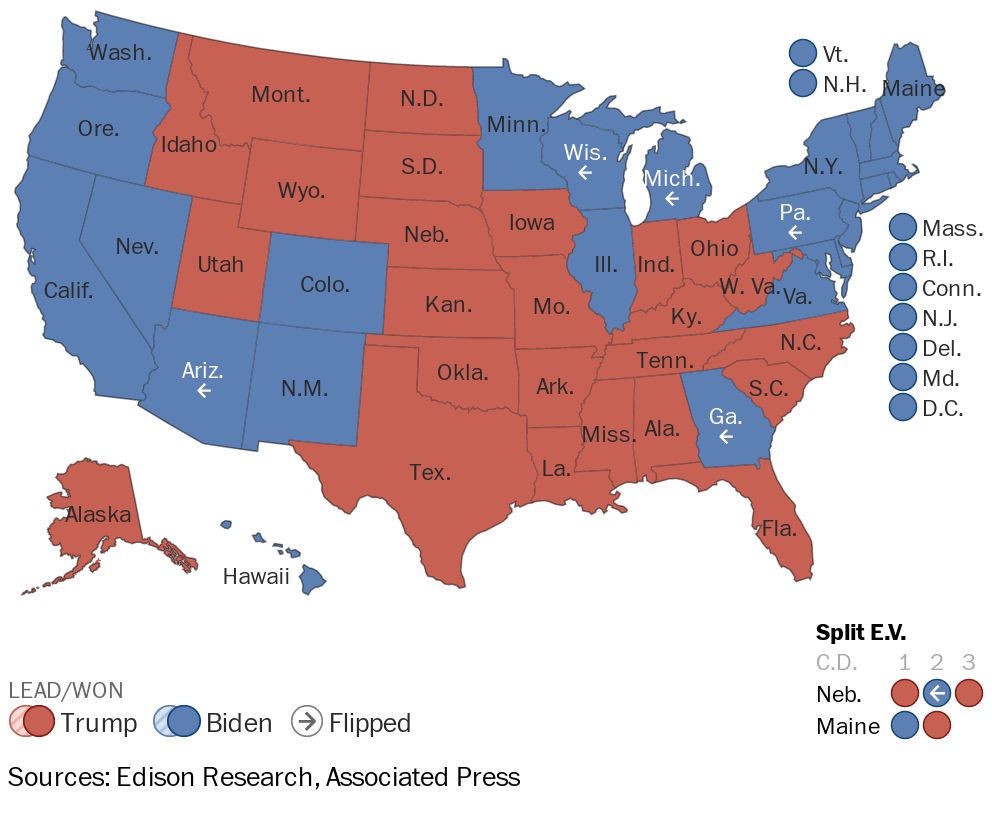
The results. Georgia and Arizona finally got called, completing the map of the 2020 presidential election. Joe Biden is the winner, 306-232, the exact same margin Trump won by in 2016.

All the Senate races have also been called, with the two Georgia races resulting in run-offs. The make-up of the new Senate is 50-48, pending those two Georgia races.

A few House races are still being determined, but the shape of the outcome is clear: Democrats will retain control, but with a slightly smaller majority.

Measuring the bias built in to the Electoral College. Since 2016 and 2020 resulted in exactly the same 306-232 split in the Electoral College, we can see just how big a Republican bias that system has compared to the popular vote. Trump was able to get his 306 electoral votes while losing the popular vote by 2.8 million. In order to get his 306 EVs, Biden had to win by a margin that so far is 5.6 million and continues to grow as the final votes are tallied.

In each case, a relatively small number of votes in a few states determined the outcome. Hillary Clinton would have won in 2016 if she had gotten 10,705 more votes in Michigan, 44,293 in Pennsylvania, and 22,749 in Wisconsin, for a total of 77,747.

Using the currently available returns, Trump would have won this year if he had gotten 10,378 more votes in Arizona, 14,173 in Georgia, and 20,547 in Wisconsin, a total of 45,098. (That would have resulted in a 269-269 Electoral College tie, which would have thrown the decision into the House. Each state gets one vote in the House, and Republicans control 26 House delegations, so Trump would have been chosen.)

Think about that: If Trump had gotten those 45K votes, he still would have lost nationally by at least 5.5 million, and probably quite a bit more. But he would be president for four more years.

Admittedly, though, a scenario where a candidate gets exactly the votes he needs in exactly the states where he needs them is far-fetched. So here’s a more plausible variation: What if Biden’s margin were just 3/4% smaller across the board?

Biden won nationally 50.9%-47.3%, a 3.6% margin. But he won Wisconsin by .7%, Arizona by .3%, and Georgia by .3%. So in my 3/4%-less scenario, Biden carries the country 50.525%-47.675%, a margin of 2.85% or 4.4-million votes. He still has a popular-vote majority — not just a plurality — but he loses all three of the closest states, so Trump gets a second term.

I don’t see any way to justify that outcome. The Electoral College has to go.


Trump’s coup attempt. Just because it isn’t working doesn’t mean that it isn’t a coup. This week, Trump has been trying to create the conditions for him to hang onto power in spite of being rejected by the voters. For the most part, the Republican Party has been cooperating with his effort to overthrow American democracy.

Going into the election, various observers were laying out what Trump might do to subvert an election defeat. Here’s Barton Gellman in The Atlantic from September:

The worst case, however, is not that Trump rejects the election outcome. The worst case is that he uses his power to prevent a decisive outcome against him. If Trump sheds all restraint, and if his Republican allies play the parts he assigns them, he could obstruct the emergence of a legally unambiguous victory for Biden in the Electoral College and then in Congress. He could prevent the formation of consensus about whether there is any outcome at all. He could seize on that un­certainty to hold on to power.

Gellman detailed the plan: deny the validity of mail-in ballots, tie the vote-count up in litigation, delay resolution until Republican state legislatures in Pennsylvania or Wisconsin feel justified in appointing their own pro-Trump electors. Make Congress or the Supreme Court — not the voters — decide who the real electors are. (Vox’ Andrew Prokop points out all the obstacles in the way of this scenario.)

So far, Trump has been carrying out that plan, and the majority of elected Republicans have been playing along with him. Fortunately for American democracy, Election Day went relatively smoothly and Biden’s win is not that close, so Trump’s litigation strategy has little to work with and a lot to accomplish: He needs to overturn — or at least cast doubt on — margins in the tens of thousands in at least three states.

He also needs to reverse the public perception that Biden won. This is why Fox News projecting a Biden victory and referring to him as the President-elect has so outraged Trump. He needs his followers to believe that the election is still undetermined.

It’s not working, and it’s not going to work — judges need to see some kind of evidence before they block certification of the election results, and Trump has none — but Trump and the Republicans should get no credit for that. They’ve been trying to overthrow American democracy; they just haven’t succeeded.

The non-transition. No one really expected Trump to make a gracious concession speech, as all previous losing candidates have done for the last century or so. Fundamentally, Trump is still that fragile-ego kid you knew in first grade: the one who never admitted a mistake and couldn’t lose at anything without claiming that the winner cheated.

(John McCain not only gave a very gracious speech in 2008, he joked about his loss later, claiming that after his election-night concession, he went to bed “and I slept like a baby. I woke up screaming every two hours.”)

But Trump has pushed his innate immaturity several steps down the road to assholery: He’s refusing to let his administration face the reality that Biden won the election and needs to get ready to take control of the government. This would be a problem in the best of times, but given that Trump is leaving Biden a broken economy and a plague running out of control, his petulance is becoming unpatriotic.

And so, the General Services Administration has not yet issued the ascertainment memo that releases funds for the transition process, providing office space and government resources like computers and email accounts. For comparison, the Obama White House issued a detailed transition memo on November 10, 2016, two days after the election.

Meanwhile, the rest of the Trump administration is refusing to meet with Biden’s people until GSA gives its OK. Biden is also not getting access to current intelligence reports like the Presidential Daily Brief. CNN reports:

Less than 10 weeks before Biden will take office, his team is locked out of crucial Covid-19 pandemic data and government agency contacts, which threatens to hamper the federal response amid peaking coronavirus cases and the expected mass distribution of a vaccine.

Again comparisons are in order: Bill Clinton began sharing PDBs with George W. Bush while the Florida recount was ongoing, “just in case” he happened to win. There is no downside to this, unless you suspect the possible next president of being a security risk.

Promoting unrest. Saturday, pro-Trump demonstrators came to Washington to join in the fantasy that Biden is stealing the election. Journalism Professor Jay Rosen used the WaPo’s coverage as an example of what not to do:

On stark display in the nation’s capital were two irreconcilable versions of America, each refusing to accept what the other considered to be undeniable fact.

What’s wrong here? The Post is acting as if actual reality is unknowable; we just have different groups saying different things. Rosen suggests saying this instead:

A militant faction had come to the nation’s capital to march for a fantasy, and to reject any institution that disallowed it, including for now Fox News.

The ongoing scam. Meanwhile, convincing the Trump personality cult that he still has a chance opens a new opportunity to scam them.

I’ve been on the Trump/Pence email list since 2016, but I’d never clicked one of the “Contribute” buttons until Thursday. That got me to a page with the following disclaimer in the fine print at the bottom:

Contributions to TMAGAC made by an Individual/Federal Multicandidate Political Committee will be allocated according to the following formula: 60% of each contribution first to Save America, up to $5,000/$5,000, then to DJTP’s Recount Account, up to a maximum of $2,800/$5,000. 40% of each contribution to the RNC’s Operating account, up to a maximum of $35,500/$15,000. Any additional funds will go to the RNC for deposit in the RNC’s Legal Proceedings account or Headquarters account, up to a maximum of $213,000/$90,000.

The marketing is all about election fraud; the email was asking me to contribute to Trump’s “Official Election Defense Fund”. But that’s not where the money would go until after $5,000 had gone to Save America and another big sum to the RNC. If I’m giving less than $8,000, none of my money would go towards funding recounts and/or lawsuits.

So what is Save America? It’s a “leadership PAC”, which means Trump has wide latitude on how to spend it. Open Secrets says:

Leadership PACs are used to fund expenses that are ineligible to be paid by campaign committees or congressional offices. Those costs can include travel to raise a politician’s profile, for instance. … Politicians often use their PACs to donate to other candidates because they are considering seeking a leadership position in Congress, a higher office, or leverage within their own party as they show off their fundraising ability.

So basically Trump is using his “election fraud” scam as a way to raise money so that he can continue to fly around the country having rallies, while continuing to skim large chunks of cash into Trump Organization properties.

BTW: Trump’s “voter fraud hotline” has shut down due to prank calls.

Georgia and the Senate. Georgia election law requires a Senate race to be decided by a majority: If nobody gets a majority, the top two candidates meet in a run-off. So both of this year’s races are going to a run-off on January 5. Incumbent Senator David Perdue will face Democratic challenger Jon Ossoff in one race, and Republican Kelly Loeffler (who was appointed to fill out the term of Republican Senator Johnny Isakson, who retired for health reasons) and Democrat Raphael Warnock are running in the other.

If Democrats win both races, the Senate is split 50-50, leaving new Vice President Kamala Harris to break the tie in the Democrats’ favor. That would mean that Chuck Schumer becomes majority leader. But if either Republican wins, Mitch McConnell stays in power.

Predicting what will happen here is beyond me. Biden narrowly won Georgia, while Perdue narrowly outpolled Ossoff. Warnock got more votes than Loeffler, but was far away from a majority (33%) in a multi-candidate race, and the third-place candidate was a Republican.

Given what we’ve just seen, it’s hard to trust polls. The contests will come down to turnout, which is also hard to guess: Will voters motivated by love or hate of Trump turn out when Trump isn’t on the ballot? With Biden headed to the White House, will voters want a Republican Senate to block him? Or will they vote against gridlock and give Biden a chance to govern? As reality dawns on the Trump personality cult, will they be angry and vote or depressed and stay home?

In Democrats’ favor, I think the Ossoff/Warnock combination works well: Warnock should get Black voters in Atlanta to turn out, while Ossoff should attract suburban women. But the temptation to be “independent” by voting for one Republican and one Democrat works against them.

What’s at stake in Georgia. It’s important to get the significance of the Georgia run-offs right, because the the Right will try to distort it.

A Mitch McConnell Senate will block virtually everything the Biden administration tries to do, including cabinet nominations. No new judges will get appointed. Every budget will be a brinksmanship drama, with a countdown to a government shutdown. Worse, McConnell will sabotage the Biden economy the same way he sabotaged the Obama economy, by forcing an inappropriately restrictive austerity. You can already see this happening in McConnell’s unwillingness to back any kind of pandemic stimulus.

But a 50-50 Senate will not be a nest incubating liberal overreach. VP Harris will break ties, but in practice the swing vote will be the 50th Democrat, who will usually be West Virginia’s Joe Manchin. If Manchin’s not for it, it’s not passing. So: no defunding the police, no government takeover of healthcare, no amnesty for illegal immigrants, no packing the Supreme Court, and no whatever else Fox News is rattling its viewers’ chains about.

In particular, a Manchin-centered Senate probably doesn’t end the filibuster, which means McConnell will retain a lot of blocking power. So the choice is whether the Senate will be mildly dysfunctional or totally dysfunctional.

Choose well, Georgia.

What Happens Tomorrow?

This year, Election Night is a lot more complicated than just watching the returns come in.


Ordinarily, on the day before an election I write about poll-closing times and what the experts expect in various states. When does it makes sense to start watching returns? What are some early indications to look for? How late will you have to stay up to see the race decided? Stuff like that.

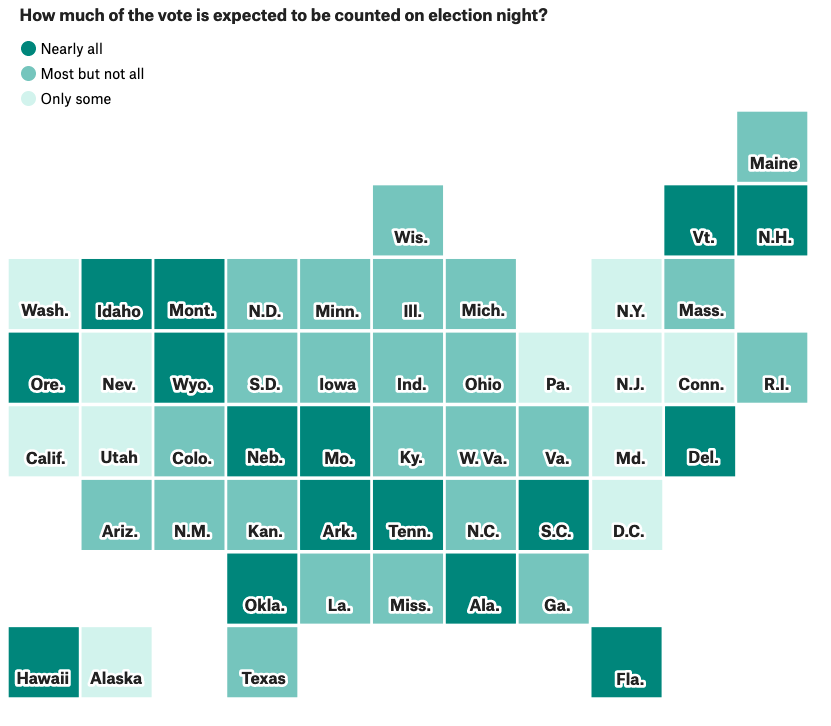
But as in everything else, 2020 is different. This year, we have to think not just about when the polls close, but how the votes are counted. When do election officials start processing early and mail-in ballots? How long will various states wait for mail-in ballots to arrive? Will courts intervene?

And then there are the possibilities that often occur in third-world countries, but we never used to have to think about in America: Will there be violence? Will the President let the ballots be counted? Will either foreign or domestic agents launch cyberattacks, or use disinformation to create chaos?

Let’s look at the ordinary stuff first, then work our way out to the unusual.

What the national polls say. As of this morning, 538’s model says Biden has a 90% chance of victory. That’s far from a sure thing, but it means that unusual (but not impossible) things will have to happen for Trump to win.

Nationally, 538’s polling average has Biden ahead 51.9% to Trump’s 43.5%. Not only is that a much bigger lead than Hillary Clinton’s 45.7%- 41.8% in 2016, but there are fewer undecided voters, and Biden’s lead has been much steadier, staying in the 8%-10% range for the last month. (In late September, Clinton led by less than the 2% she ultimately won the popular vote by.)

The conventional wisdom has been telling us that the race would tighten down the stretch, as it did in 2016, but so far there is no sign of it. In addition, the large number of votes already cast leaves less room for last-minute shifts in the public mood.

Does that mean Trump can’t win? Of course not. But it does tell us what kind of unlikely event would be required: A late-breaking shift of undecided voters wouldn’t do it. “Shy” voters afraid to tell pollsters they’re for Trump wouldn’t do it. (It’s hard to believe many of them would claim to be for Biden. Wouldn’t they just say they’re undecided?) One or two “unlucky” polls choosing an unrepresentative sample of voters wouldn’t do it.

In order for Trump to win, there has to be a large structural failure in how polls are constructed across the entire industry.

BTW. On the shy-voter theory: If there were something uniquely embarrassing about supporting Trump, I would expect to see a gap between Trump’s performance in the polls and Republican candidates lower down the ballot. Voters afraid to say they’re for Trump would be telling pollsters they’re for Thom Tillis in North Carolina or David Perdue in Georgia or Martha McSally in Arizona. But they’re not.

State polls. Of course, we don’t vote nationally, we use the archaic, Republican-biased Electoral College. That’s what the 538 model is based on. (They give Biden a 97% chance of winning the national popular vote, but only a 90% chance of becoming president. No other advanced country would tolerate a system like this.)

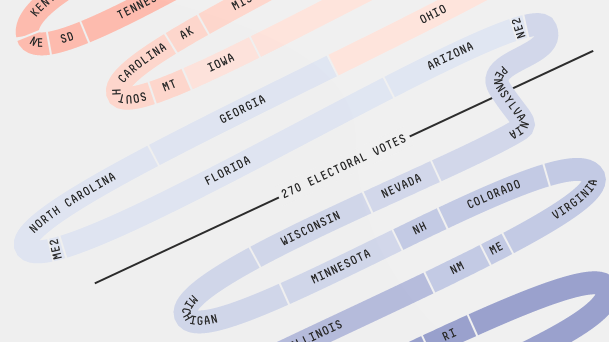
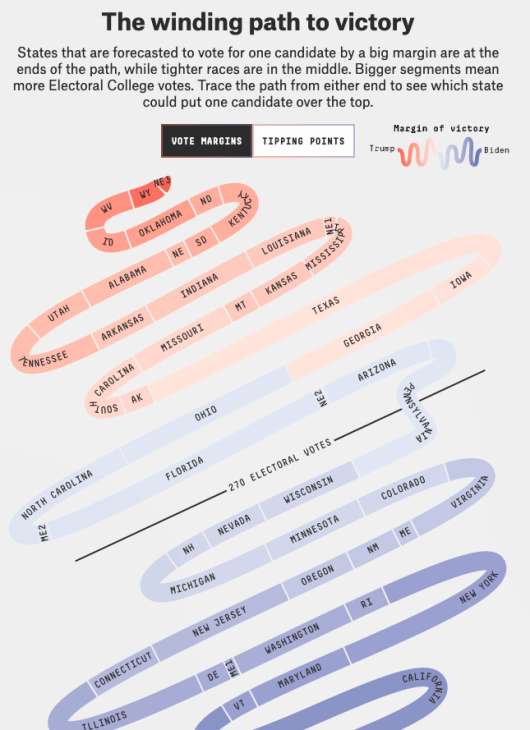
Looking at each state individually produces 538’s snake chart, the key section of which looks like this:

The easiest path for Biden to get to 270 electoral votes is to win all the states Clinton won in 2016 (the most difficult will be Minnesota and Nevada), and recapture Michigan, Wisconsin, and Pennsylvania.

The least likely state on this list for Biden is Pennsylvania, where 538’s model shows him with an 86% chance of winning, and predicts a 5.1% margin. That makes Pennsylvania the tipping-point state: the one most likely to make the difference.

If Biden should lose Pennsylvania, though, he still might win, because he also has smaller leads in Arizona, Florida, North Carolina, and Georgia. Ohio is a toss-up and Biden trails narrowly in Texas (not pictured).

This again tells us what kind of unlikely event would re-elect Trump: Polls have to be off by around 5% across the board, in states as different as Pennsylvania, Florida, and Arizona.

Election night. Ordinarily then, I’d be telling you that polls close in Pennsylvania at 8 p.m. EST, so if Biden really has that 5.1% lead, we should expect to know that he’s won by 9 or 10 o’clock. He couldn’t pass 270 until California came in at 11, but we could go to bed early and still be pretty sure we’d wake up to a Biden victory.

Not this year. Nationally, more than half the expected number of ballots have already been cast. Naively, you might expect that to make the vote-count go faster, since states could already have half or more of the votes counted when the polls close. But you would be ignoring how Republicans intend to steal this election for Trump:

Behind in the polls, Republicans are becoming increasingly blunt about their plan to win the election: don’t let everyone’s votes be counted.

As Astead Herndon and Annie Karni reported for the New York Times Saturday evening: “Trump advisers said their best hope was if the president wins Ohio and Florida is too close to call early in the night, depriving Mr. Biden a swift victory and giving Mr. Trump the room to undermine the validity of uncounted mail-in ballots in the days after.”

Matt Yglesias sums up:

Republicans — not Trump, dozens and dozens of individual state legislators across multiple states — have acted to deliberately ensure slow counting of mail-in ballots so they can later complain that the slow dribbling in of mail votes looks suspicious.

Wisconsin, Michigan, and Pennsylvania are all states where Republican majorities in the legislature have gerrymandered themselves into power. (A majority of voters in 2018 tried to give power to Democrats, but failed.) And they have prevented early vote-counting in each state. So Biden will not win Pennsylvania by 9 or 10, and probably not until Wednesday or Thursday — or later if the state is closer than polls predict.

Since Democrats have promoted early voting and voting-by-mail more than Republicans — in part because they take the pandemic seriously and Republicans do not — most likely the election-night totals will favor Trump, who will then try to declare victory and prevent further vote-counting.

I don’t expect that strategy to work, because Biden’s ultimate margin will be too big, and neither election officials nor judges are as corrupt as the GOP’s plan requires. But it does mean that you won’t learn much by watching Pennsylvania’s returns come in tomorrow night.

Instead, the first state to watch tomorrow night is Florida. Polls close at 8 eastern, and the early votes should be reported almost immediately. So Biden should have an early lead there, which will shrink over the next hour or two as the election-day votes come in. It’s possible there could be a result by 10.

Florida is a state where Biden has a small polling lead — 2.3% in 538’s analysis. As you see in the snake chart above, Biden can win the election without Florida. But winning Florida would be an early knock-out blow. If Biden holds the Clinton states and adds Florida, that’s 262 electoral votes. Trump would have to sweep all the other battleground states, including places like Michigan, where Biden has an 8.1% lead in the polls.

So Biden-wins-Florida is the go-to-bed-early scenario.

That said, Florida has been problematic for Democrats in recent elections. Clinton was favored there and lost. Ditto for Andrew Gillum in the 2018 governor’s race. Maybe pollsters have figured out what they did wrong in those races, but maybe not.

Polling errors have been running the other way in the Southwest: Kyrsten Sinema was projected to win her Senate race in Arizona by .7% and actually won by 2.4%. Ted Cruz was supposed to beat Beto O’Rourke by 4.9% and actually only won by 2.6%.

Other possible early knock-outs for Biden are North Carolina, Georgia, and (a little bit later in the evening) Arizona. Also worth watching is New Hampshire, a Clinton state Trump has campaigned in. Trump doesn’t need to win it and probably won’t. But the returns in New Hampshire could be an early clue as to whether he is getting the white-working-class surge he will need in Pennsylvania and Wisconsin.

Ohio and Texas are stretches for Biden, but if they come in, the race is a landslide. Given the similar demographics, there is no way Biden loses Pennsylvania or Michigan after winning Ohio, or fails to take Arizona after winning Texas.

That said, Republican machinations have held open the most tense scenario: Trump takes Texas, Ohio, Florida, Georgia, North Carolina, and Arizona on Tuesday, forcing Biden to count on the Michigan-Wisconsin-Pennsylvania path, which Republicans have intentionally delayed, and will now argue are taking too long.

Congress. Democrats expect to expand their House majority and have a good chance to take control of the Senate.

The current Senate is 53-47 Republican. Democrats expect to lose Doug Jones’ race in Alabama, so they need to pick up four seats elsewhere to get to 50-50. If Biden wins the presidency, Kamala Harris will hold the tie-breaking vote in the Senate.

Cook lists only one other Democratic seat in danger, Gary Peters’ in Michigan. But even that race it rates as “lean Democrat”.

Meanwhile, it rates two Republican seats — Martha McSally’s in Arizona and Cory Gardner’s in Colorado — as lean Democrat. Seven other Republican seats are toss-ups: Susan Collins in Maine, Joni Erst in Iowa, Thom Tillis in North Carolina, David Perdue and Kelly Loeffler in Georgia, Steve Danes in Montana, and Lindsey Graham in South Carolina.

538 gives the Democrats a 76% chance of gaining control of the Senate, with a 51.6 seat projection.

The same Election-Night considerations apply as in the presidential race. The early indicator is probably the North Carolina race.

Out of the ordinary. Over the weekend we started seeing our first hints of disruption or violence. “Trump Trains” of flag-flying pick-up trucks slowed or blocked traffic in a number of places like the Garden State Parkway in New Jersey, the Mario Cuomo Bridge in New York, and the Capitol Beltway in D. C.

The Garden State Parkway on Sunday.

The most ominous such event was when a Trump Train surrounded and harassed a Biden campaign bus in Texas, resulting in one minor collision.

People in vehicles that were part of a “Trump Train” began yelling profanities and obscenities and then blockaded the entire Biden entourage, according to a source familiar with the incident. At one point they slowed the tour bus to roughly 20 mph on Interstate 35, the campaign official said. The vehicles slowed down to try to stop the bus in the middle of the highway. The source said there were nearly 100 vehicles around the campaign bus. Biden staffers were rattled by the event, the source said, though no one was hurt.

When Trump heard about this incident, he tweeted “I LOVE TEXAS!”. And the Texas Republican Party was similarly unapologetic. Its statement dismissed the incident as “fake news and propaganda”, and attempted to shift focus to “the real violence” on the left.

In all these incidents, the point seemed to be to cause trouble, not just to express enthusiasm. Will they escalate?

Ron Suskind explored that possibility in “The Day After Election Day“. What if, he wonders, the Proud Boys or the army of Trump volunteers out looking for non-existent voter fraud block or violently disrupt polling places?

Disruption would most likely begin on Election Day morning somewhere on the East Coast, where polls open first. Miami and Philadelphia (already convulsed this week after another police shooting), in big swing states, would be likely locations. It could be anything, maybe violent, maybe not, started by anyone, or something planned and executed by any number of organizations, almost all of them on the right fringe, many adoring of Mr. Trump. … If something goes wrong, the media will pick this up in early morning reports and it will spread quickly, increasing tension at polling places across the country, where the setup is ripe for conflict.

Conservative media could then say the election was being stolen, summoning others to activate, maybe violently. This is the place where cybersecurity experts are on the lookout for foreign actors to amplify polling location incidents many times over, with bots and algorithms and stories written overseas that slip into the U.S. digital diet. News of even a few incidents could summon a violent segment of Mr. Trump’s supporters into action, giving foreign actors even more to amplify and distribute, spreading what is, after all, news of mayhem to the wider concentric circles of Mr. Trump’s loyalists. Groups from the left may engage as well, most likely as a counterpoint to those on the right. … Violence and conflict throughout that day at the polls would surely affect turnout, allowing Mr. Trump to claim that the in-person vote had been corrupted, if that suits his purposes.

That violence could be Trump’s Reichstag Fire.

If the streets then fill with outraged people, he can easily summon, or prompt, or encourage troublemakers among his loyalists to turn a peaceful crowd into a sea of mayhem. They might improvise on their own in sparking violence, presuming it pleases their leader.

If the crowds are sufficiently large and volatile, he can claim to be justified in responding with federal powers to bring order.

The spark for all this might be, literally, nothing at all. In 2014, an organized disinformation campaign created a fake ISIS attack on a chemical plant in Louisiana. What if some foreign actor like Russia invents an Antifa election-day atrocity? Might the fake attack create real reprisals that then spiral out of control?

I don’t even know how to evaluate scenarios like that. Are they likely? Crazy? Will we all laugh about this stuff by Friday? I have no idea.

This I do know: We’ve never had to think this way before, and the difference this time around is Trump. All previous presidents have done their best to reassure the public. He is the first to actively try to destabilize the national mood, and push us all towards panic. No matter how this comes out, I will not forgive him for that.

Finally, I want to repeat what an anonymous national security expert tells Ron Suskind: “Just understand that you’re being manipulated.” Respond accordingly. No matter what you think is happening, stay non-violent as long as you possibly can. Check your sources before you pass on rumors, so that you don’t amplify disinformation.

And keep hoping that, like kids back from a horror movie, we all eventually have a good laugh about how scared we were.

I Want To Believe

Eight days from the end of voting, the signs are good. I know you’re still worried.


Politico sums up how this race might look to a dispassionate observer:

Trump is an unpopular incumbent saddled with a recession and an out-of-control coronavirus pandemic that has killed more than 220,000 Americans. Meanwhile Biden has only seen his favorability ratings increase over time, emerging largely unscathed from Trump’s attacks on him and his son Hunter Biden. And Biden is outspending Trump down the homestretch almost everywhere

Those strategic observations are reflected in the polls: 538’s polling average has Biden up by 9.1% nationally, with few undecided voters: 52.0%-42.9%. And yes, the Electoral College rigs the system in Trump’s favor — the only reason he’s president now is that the electors overruled the voters in 2016 — but even that looks good: For some while 538’s tipping-point state has been Pennsylvania, where they project a 5.5% Biden advantage: 52.4%-46.9%. (That’s the margin in a model that projects ahead to election day. Their who’s-leading-now polling average is a bit bigger: 50.4%-44.7% or a 5.7% margin.)

If something goes wrong in Pennsylvania, Biden has other paths to victory. He’s also currently leading in North Carolina (2.5%), Florida (2.4%), Arizona (3.0%), Iowa (1.3%), and Georgia (.9%). (The model expects his leads to go away in Iowa and Georgia, but not in the other states.) And Trump’s leads are narrow in a number of states once thought to be safe for him: Ohio (1.4%) and Texas (tied).

That’s right: If you’re being all quantitative and wonky about it (like 538 always is), Biden currently looks way more likely to win Texas than Trump does to win Pennsylvania.

Feel better now? I didn’t think so.

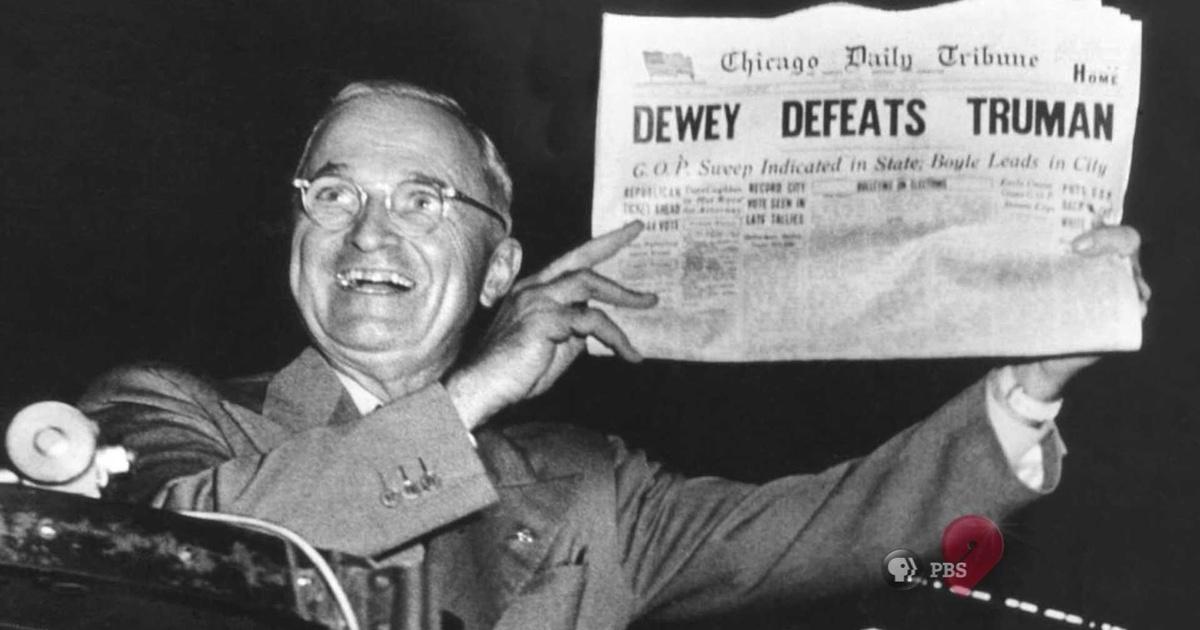
https://www.pbs.org/video/dewey-defeats-truman-iypfom/

Ghosts of 2016. Election Night 2016 was a trauma that Democrats may not recover from for a very long time. (I wonder if Republicans fretted this much about Eisenhower’s chances in 1952 after the Dewey debacle in 1948.) The Saturday before the election, the Princeton Election Consortium said Clinton had a 99% chance of winning. While other people’s speculations were less extreme — and Nate Silver’s election-eve estimate that Trump stood a 28% chance was probably about right; some unlikely things still had to happen, but everybody has gotten wet when there was a 28% chance of rain — few of us expected to see a President Trump.

And then it all fell apart: Florida and North Carolina early, and then Pennsylvania, Wisconsin, and Michigan.

So why couldn’t that happen again?

If you insist on a strict interpretation of could, then sure: Everything could still go wrong. But this isn’t like the horror-movie sequel where only one character remembers what happened in the original. Everyone is out there looking for signs that the polls are wrong, or that subterranean forces are shifting the election under our feet. Nobody’s finding them.

What’s different now: non-college voters. 538’s Dhrumil Mehta explains the extent to which the polls were wrong in 2016 and what has been done to correct them in 2020. Nationally, the 2016 polls were pretty accurate; they only mildly overestimated Clinton’s 2% popular vote win. Late polls in Michigan and Pennsylvania showed Trump momentum, even if they still had a small Clinton lead. Only Wisconsin was a true polling failure.

Mehta explains a mistake that has since been corrected by many pollsters: They didn’t rebalance their samples for education levels.

What is rebalancing? When you already know the demographics of the population you’re sampling, you may notice that your sample is off in some way. Suppose, for example, that the electorate in some state is 14% black, but your sample is only 10% black. So you might adjust for that by counting each sampled Black person as 1.4 people.

In 2016, polls in the upper Midwest regularly undersampled people without college degrees. They didn’t intend to do that, it just happened. But it didn’t occur to them to rebalance for education, and the result was that more non-college people — and especially non-college whites — voted than anyone expected. That was Trump’s margin of victory.

Pollsters know about that mistake now, and are taking various steps to avoid it this time around.

So Trump doesn’t have some magical ability to conjure voters out of nowhere. We know where his 2016 margin came from, and we’re looking for it but not finding it this time.

What’s different: margins. Biden’s polling leads are bigger and broader than Clinton’s were. Clinton went into the election leading in the polls by 3 or 4%. Biden’s lead is running 8-10%.

What’s different: favorability. One reason the 2016 race went south at the end was that Hillary Clinton had very high unfavorable ratings. Many of 2016’s “undecided” voters were actually people searching for an excuse to vote against her, which the last-minute Comey announcement provided. (Trump’s negatives were also high, but that’s where we see the effect of sexism: A male president you dislike is unfortunate, but we’ve all disliked a male president at one time or another. A female president you dislike, on the other hand, may seem like an unimaginable horror.)

The same thing does not seem to be happening to Joe Biden.

He has emerged with more Americans viewing him favorably now than at this time last year, the opposite of the usual trajectory of a campaign and far different from the circumstances that faced Hillary Clinton in 2016.

Biden may not inspire dreams of a utopian future, but he’s hard to dislike. That’s why Trump keeps trying to run against somebody else, preferably some woman: Kamala Harris or AOC or Nancy Pelosi or Clinton again.

What’s different: the news. In 2016, Clinton’s weak spot was the suspicion of corruption. Largely that was the result of a decades-long Republican smear, and none of the so-called Clinton scandals subsequently amounted to anything. (Not even Bill Barr can find an excuse to “Lock her up!”)

But nonetheless, the final-week announcement that the FBI had found more Clinton emails and needed to examine them brought that weak spot to the fore.

The news cycle this time around is playing out very differently. The Trump tactic of insinuation-with-little-basis worked in 2016 largely because the country was doing pretty well. No urgent crises loomed that we had to picture Trump or Clinton trying to handle. “What have you got to lose?” Trump asked, and a lot of people had no compelling answer.

Right now, the country is in terrible shape, and the problems hit home every day. People worry about getting sick, they worry about their vulnerable relatives, they worry about their jobs. Nobody would ask “What have you got to lose?” now.

Trump’s weak spot is that he has completely bungled the only real crisis he’s faced: the pandemic. More than 220,000 Americans are dead on his watch, and he doesn’t seem to care. “It is what it is,” he says. We’ll have to “learn to live with it”. We should thank him because millions haven’t died.

And the news cycle is bringing that to the fore: The virus is surging precisely at the moment people are voting. There’s no way to put that out of the voters’ minds.

Election night. One more consideration that’s on everybody’s mind is what will happen on November 3. Will we actually know anything that night? Or will we be in painful suspense for days or weeks?

538 has a video where Galen Druke talks through what election night might look like, and in particular the question of whether we’ll know a winner. The upshot: Florida, North Carolina, and Arizona should count ballots fairly quickly, so we probably will know who wins those states (unless they’re very close). If Biden takes any of them, he’s going to win. If Trump takes all of them, it’s still a race, but the odds tip in Trump’s favor.

You can also play with the interactive tool Druke is using. When I do that, and give Trump FL, NC, AZ, but give the other states where Biden has sizeable leads to him, leaving only Wisconsin and Pennsylvania undecided, Biden is again favored.

So there’s a chance next Tuesday won’t be an ordeal. Or maybe it will.

Feel better yet? Yeah, I know.

The Hidden Threat of a Conservative Supreme Court (and what Biden should say about it)

Three weeks ago, in “The Illegitimacy of a Conservative Supreme Court“, I focused on the Court as both the product and the enabler of minority rule: Democrats have won the popular vote in six of the last seven presidential elections, and yet the rural small-state bias built into the Electoral College has given us eight additional years of Republican presidencies. Combined with Mitch McConnell’s maneuvers and the luck of who dies when, Republican presidents have replaced four of the eight justices who left the Court during that time, with Amy Coney Barrett nominated to be the fifth, joining Clarence Thomas (appointed by the first President Bush, who did win the popular vote) to make a 6-3 conservative majority.

The Senate has an even larger rural small-state bias, which allowed McConnell’s minority-supported Senate majority to refuse to consider President Obama’s nominee Merrick Garland, stealing the seat for Neil Gorsuch, who was appointed by popular-vote-loser Donald Trump.

In short, the 6-3 majority Barrett’s confirmation would produce flies in the face of the will of the American people, who are considerably more liberal than a 6-3 Court would be. Worse, the 5-4 conservative majority has already shown a partisan Republican bias that makes rule by the Republican minority even more likely: unleashing a torrent of corporate money in Citizens United, gutting the Voting Rights Act, and refusing to recognize partisan gerrymandering as a violation of the right to vote. (The last two opinions were written by Chief Justice Roberts. In Rucho v Common Cause, he wrote that even the most extreme gerrymandering is “beyond the reach of the federal courts” and should be corrected “through legislation” that would need to pass precisely the legislatures where a minority party has been gerrymandered into power.) In its next term, the Court will hear a case that could undo the rest of the Voting Rights Act.

Why should you care? “But so what?” a voter might ask, particularly an independent voter who holds no particular sympathy for Democratic politicians kept out of power by Republicans who represent fewer people. The public associates certain high-profile issues with the Court — abortion, same-sex marriage, gun control, and affirmative action pop to mind — but what if those aren’t your issues? If you’re white, straight, unlikely to get pregnant, and not worried about mass shootings, why should a Court with an outside-the-mainstream conservative bias matter to you?

Even if you belong to some vulnerable group, you can fix most of the problems in your personal situation just by moving to a blue state. If you’re sick of being dominated by the Republican minority in Wisconsin, move to Minnesota or Illinois, where the majority still rules. And if you worry that federal courts will no longer protect you from the authentic conservative majority in Mississippi, go to Vermont or Oregon. Your abortion rights will be safe, no one will threaten your marriage, and white supremacy will be much less onerous.

So what do you need the Supreme Court for?

A recent state-court decision in Michigan, highlighted in an article in The Atlantic, points to a different kind of danger: Conservative courts can reinterpret the fundamental rules of our system of government in such a way that many important issues are placed beyond the reach of government entirely.

That’s worth caring about.

The Lochner Era. We’ve seen this before in American history, though it is passing out of living memory. Beginning in the late 1800s, the original Progressive movement tried to rein in the robber barons of the Gilded Age. People who felt crushed by a system that favored employers over employees elected representatives who passed laws to make that dominance less oppressive: child-labor laws, limits on the work-week, worker safety laws, minimum wage laws, and so on.

And the courts threw those laws out.

The case that gave the era its name in the legal history books is 1905’s Lochner v. New York. Joseph Lochner owned a bakery in Utica and liked to overwork people. But New York had passed the Bakeshop Act, a workplace-safety measure that limited bakers to working 60 hours a week or 10 hours a day. (Not only is it a bad idea for exhausted people to tend fires, but constant exposure to flour dust can cause respiratory problems.) Lochner appealed his fine to the Supreme Court, which overturned the Bakeshop Act as an “unreasonable, unnecessary and arbitrary interference with the right and liberty of the individual to contract”.

In practice, the “right to contract” meant this: If the only job available to you requires you to work yourself to death, and if your alternative is to watch your children starve, you have the “freedom” to accept that arrangement. The state can’t interfere.

In essence, Lochner put workplace issues beyond the reach of government. No matter what the voters thought, employers could use the scarcity of jobs and the surplus of workers to enforce their will. If workers lacked the market power to say no, government couldn’t say no for them.

The swan song of the Lochner Court came when it declared FDR’s National Recovery Administration unconstitutional in 1935. The threat to block the entirety of the New Deal motivated Roosevelt’s court-packing plan, the Judicial Procedures Reform Bill of 1937. And while that bill did not pass, the Court seemed to take it as a shot across the bow. It started to back off, the New Deal was allowed to proceed, and FDR eventually stayed in office long enough to replace eight of the nine justices he inherited.

Non-delegation. The Michigan case examined in The Atlantic’s article concerns a law the Michigan legislature passed in 1945 titled “Emergency Powers of Governor“. It’s a short but sweeping bill whose stated intent is

to invest the governor with sufficiently broad power of action in the exercise of the police power of the state to provide adequate control over persons and conditions during such periods of impending or actual public crisis or disaster. The provisions of this act shall be broadly construed to effectuate this purpose.

In March, Governor Gretchen Whitmer invoked these emergency powers to fight the coronavirus pandemic. On October 2, on a party-line 4-3 vote, the Michigan Supreme Court not only invalidated Whitmer’s orders, but closed the door on future emergency orders by ruling that

the [EPG] Act unlawfully delegates legislative power to the executive branch in violation of the Michigan Constitution.

The portion of the Michigan Constitution in question is rather general and open to interpretation:

The powers of government are divided into three branches: legislative, executive and judicial. No person exercising powers of one branch shall exercise powers properly belonging to another branch except as expressly provided in this constitution.

The whole point of a state-of-emergency laws is that legislation is a slow process that events can outrun. So the 1945 legislature, recognizing its limited speed, pre-loaded some powers into the governorship.

But that is now unconstitutional in Michigan.

Minority rule in Michigan. It’s worth noting that Michigan is currently a minority-rule state. A majority of the voters have repeatedly tried to elect Democrats to the legislature, but have failed to take control away from Republicans, who have gerrymandered themselves into power. In 2018, Michigan voters tried to deal with this by passing a ballot proposition to create an independent commission to draw legislative-district boundaries. Republicans sued in federal court to invalidate that law, but so far have failed. Even if the independent commission succeeds, though, the new districts won’t be in force until the 2022 election.

Governor Whitmer, meanwhile, won election in 2018 by a wide majority, 53%-44%. Despite armed protests against her emergency orders, culminating in a plot to kidnap (and possibly kill) her that was foiled this week, Whitmer remains popular, with 51/41 favorable/unfavorable rating.

She is popular for good reason: After being hit hard by coronavirus early on, Michigan has fared better than neighboring states. Currently the daily average new Covid cases per hundred thousand residents is 12 in Michigan, 21 in Indiana, and 45 in Wisconsin. (Wisconsin is another state where a minority-rule Republican majority in the legislature has blocked the efforts of a Democratic governor to fight the virus, with assistance from the state supreme court.)

In short, Governor Whitmer represents the voters of Michigan; the Republican leadership of the gerrymandered legislature does not. Moreover, even though critics of majority rule sometimes smear it as “mob rule”, in this case it is the minority-rule Republicans who are supported by a violent mob.

Neil Gorsuch. The Michigan Court’s invocation of “non-delegation” explicitly references a dissenting opinion by US Supreme Court Justice Neil Gorsuch, in which he calls for reviving the non-delegation doctrine of the Lochner Court.

Before the 1930s, federal statutes granting authority to the executive were comparatively modest and usually easily upheld. But then the federal government began to grow explosively. And with the proliferation of new executive programs came new questions about the scope of congressional delegations. Twice the Court responded by striking down statutes for violating the separation of powers.

The two cases Gorsuch cites so approvingly are the Court’s 1935 Schecter Poultry and Panama Refining decisions — precisely the ones that threatened the New Deal.

Gorsuch’s target is what conservatives pejoratively call “the administrative state”, which is embodied in agencies like the SEC, FDA, EPA, FCC, IRS, and many others that keep powerful economic interests in line.

In the same way that emergencies can develop too quickly for a legislative response, corporate interests can repackage and reinvent themselves much faster than Congress or a state legislature can counter. Congress has responded by laying out broad principles and delegating their enforcement to administrative agencies.

For example, the Clean Air Act did not list every pollutant, or lay out precise standards for controlling each one. Instead, it empowered the EPA (according to Wikipedia)

to construct a list of Hazardous Air Pollutants as well as health-based standards for each one. There were 187 air pollutants listed and the source from which they came. The EPA was given ten years to generate technology-based emission standards.

This kind of thing happens across the government. The FDA might ban some food additive, and then respond immediately with a new ban if food companies just tweak the formula in some trivial way.

Under non-delegation, though, every such decision could be challenged in court, and ultimately be decided by the corporate-favoring regulation-hating 6-3 majority. The Atlantic’s Nicholas Bagley (a University of Michigan law professor) draws the conclusion:

The nondelegation doctrine isn’t about democracy. It’s about the power to restrain government. And it will be wielded as opportunistically against a President Biden as it has been wielded against Whitmer.

What Biden should say about expanding the Court. When FDR threatened to “pack the Court” by increasing its size so that he could appoint new justices, there was good reason to do so. The Court was enforcing a theory of economics and of the government’s relationship to the economy that the American people no longer believed in. The country wanted to change, and the Supreme Court would not let it. Only by relenting did the Court make Roosevelt’s power move unnecessary.

We are not quite in that situation yet, but we could be soon. Accordingly, new court-expansion proposals are being kicked around in Democratic circles. So far, Joe Biden has been dodging the question of whether or not he supports them.

And if all you are allowed is a short answer, that’s the right response, because “yes” and “no” are both premature. I’d like to hear Biden answer the question like this:

Pack the Court? I hope it doesn’t come to that. I can promise you this: I will not come into office on Day 1 saying, “We need to change the Supreme Court.”

But as everyone can see, there are several conservative biases in our system, and those biases are combining to produce a Supreme Court that radically diverges from the American people.

Twice in the last seven elections, a Republican has become president even though another candidate got more votes. Similarly, Republicans currently have a majority in the Senate, even though their senators represent fewer voters. That situation has not been uncommon in recent years. And since the President and the Senate choose the Supreme Court, over time the Court has become far more conservative than the American people.

Now, that doesn’t have to be a problem. When John Roberts was being confirmed as chief justice, he said his political opinions didn’t matter, because a justice is just an umpire, calling balls and strikes according to a strike zone defined by the laws and the Constitution. If he, and the rest of the Court, can hold to that discipline, then they won’t get any trouble from me.

But I can’t help noticing that several times in the last two decades, the Court hasn’t called balls and strikes, but has put its thumb on the scale of politics, nearly always on the Republican side. The Court wasn’t calling balls and strikes when it opened the spigots of corporate money in Citizens United. It wasn’t calling balls and strikes when it undid the Voting Rights Act, which had been renewed by Congress in a near-unanimous vote. It wasn’t calling balls and strikes when it shrugged off partisan gerrymandering. In those cases, it was taking a political position and favoring a political party.

If it continues down that road, then we will have a problem.

Right now, the Court is considering whether to undo the biggest achievement of progressive politics in the last few decades, the Affordable Care Act — ObamaCare. If they do, they will take health insurance away from tens of millions of Americans, and remove protections from the additional tens of millions who have preexisting conditions — including everyone who has survived Covid-19. The argument for striking down that law is based on a novel legal theory that no one who voted either for or against the ACA ever considered at the time. It’s bogus, and they know it.

The ACA passed because the American people were worried about their healthcare and wanted change. They still want change; they want more change than we were able to give them then. And healthcare is just one area where the American people are crying out for change.

Early in the 20th century, the American people were also crying out for change. And so they elected state and federal representatives who legislated for a minimum wage, a limited work week, a safe workplace, and the right to organize a union. But the Supreme Court of that era said no, and invalidated law after law — hundreds of them. What that Court said to the American people was: “I don’t care what you want, you can’t have change.”

And so the change that the American people had wanted since the turn of the century was delayed until the New Deal in the 1930s.

Now if that’s what this Court has in mind, to thwart the will of the voters for decades, for as long it can, in service to an ideology that the American people don’t share, then I think the elected branches of our government will have to respond.

What will that response look like? I don’t know yet, because I haven’t seen what the Court will do. If it behaves itself, if it lets the elected branches of government do the things that the American people elect us to do, then there will be no response, because there will be no problem.

But if I’m not going to begin my administration with a plan to change the Court, I’m also not going to begin my administration by writing this Court a blank check, by saying, “Abuse your power any way you like, and I’ll just sit on my hands.”

If I’m elected, then I will have a responsibility to the voters who elected me. And if I find that the will of those voters is consistently being blocked and subverted by judges who not only are unelected, but who were appointed by people who lost the popular vote themselves, then I will have to consider the options that our constitutional system provides.

People, not politicians. That position represents a subtle shift in framing from what many other Democrats are saying. Yes, the problem has been caused by shenanigans in the Senate, capped off by the plan to rush Amy Coney Barrett’s nomination through before the voters can do anything about it. But framing this as tit-for-tat shenanigans — we’ll pack the Court if you jam Barret through — is bad politics. That’s a threat to make behind closed doors, not to broadcast to the public.

Biden should hinge his position not on how the Senate behaves, but on how the Court behaves. Striking back because Mitch McConnell stole Merrick Garland’s seat is a he-hit-me-first argument that just increases a lot of Americans’ disgust with politics, because it’s about politicians, not about them. But framing the argument as “The Supreme Court is taking away your health insurance” or “The Supreme Court won’t let us protect your drinking water” or “The Supreme Court won’t let us stop mass shootings” is a different story.

You want change, but the Supreme Court won’t let it happen. Help us fix the Supreme Court. That’s the right argument to have.

Staying Sane in Anxious Times (without being useless)

Everything dies. But not today.


On this blog, I usually report news, analyze trends behind the news, and save pastoral counseling for my occasional talks at churches. But this week I’ve been sensing an unusual level of anxiety and depression in the people I interact with, and I imagine that Sift readers are sharing a lot of those feelings. So let’s address that.

If the election were tomorrow rather than five weeks from tomorrow, I think I’d tell you all just to suck it up and think about your own issues later. But five weeks is a long time to stay in the states of mind I’m seeing, and carries risks of longer-term psychological and psychosomatic damage. So I think it makes sense to take a little time to get our heads together before the home stretch.

The depression, I think, has been building for some while, as the virus takes away more and more of what we look forward to in life. (I’m currently wondering if my usual Christmas plans can work out this year. Will I ever get to travel again?) But the anxiety is largely election-related, and increased suddenly this week in response to Barton Gellman’s article in The Atlantic, “The Election that Could Break America“.

Worst cases. I’ll have more to say about the content of that article in this week’s summary post, which should be out a few hours after this one. For now, I’ll just sum up the gist: There are scenarios in which Trump hangs onto power despite the voters’ desire to be rid of him, and he seems to be angling to push the country into those scenarios.

The worries raised by Gellman’s article (and others with similar themes) go well beyond the usual election anxieties: that some last-minute surge of support could carry Trump to an ordinary victory, or even that he might repeat 2016’s dubious achievement of winning the Electoral College despite losing the popular vote by a wide margin. Those outcomes would be disappointing, and would have a number of horrible consequences. But at the same time, they would be part of the normal ebb and flow of American politics. If the American people show the bad judgment to re-elect Trump, we’ll just have to work harder to convince them to turn the country in a new direction in future elections.

But if Trump can totally circumvent the will of the people, then something fundamental has changed. In that case, it’s hard to say what we would need to do next time, because this time we already did what we thought we needed to do, and failed anyway. And if the ordinary limits on political power-seeking can be ignored without consequence, then who can have confidence that we will have a chance to do anything at all next time? By 2024, the United States might be the kind of country where the ruling party counts the votes itself, and proclaims that it has been re-elected (for a third term, and then a fourth) by a margin that no one really believes.

In short, if the worst outcomes Gellman pictures come to pass, the American experiment with democracy might be over.

Personally, I don’t believe the worst scenarios will play out. I think the margin Biden has in the polls is real, and that it will hold up as the election approaches. (It’s worth pointing out that we all had the same doubts about the polls going into the Blue Wave of 2018, which played out exactly as the polls predicted.) In 538’s analysis, the current tipping-point state is Pennsylvania, where Republicans have gerrymandered their way into a majority in the legislature. But it’s worth noting that Biden is currently favored in four states beyond that — Arizona, Florida, North Carolina, and Ohio — any of which might put him over the top. (Arizona would leave Biden 1 vote short, which could come from either Nebraska’s or Maine’s second congressional district.) It’s one thing to imagine one cabal of local Republicans venturing into near-treasonous territory to give Trump another term, but overthrowing democracy in five states simultaneously would be much harder to pull off.

In short, Trump’s anti-democratic tactics may nudge the dial a little, or even more than a little, but still not enough to overcome a decisive message from the electorate. As Michelle Goldberg has pointed out, his strongman talk is a sign of weakness, not of strength.

Autocrats who actually have the power to fix elections don’t announce their plans to do it; they just pretend to have gotten 99 percent of the vote.

And as many people have observed: You don’t question the legitimacy of an election you expect to win. Further: “I’m going to stay in power no matter what you think” is hardly a closing message designed to convince undecided voters.

But having said that, I don’t deny the possibilities Gellman lays out, and I don’t recommend you simply put them out of your mind. There is a chance — not a likelihood, in my opinion, but a chance — that we are living in the last days of American democracy.

It’s no wonder that people are telling me they lose sleep about that. That loss of sleep is the problem I want to address.

Anxiety and denial. It’s not that you have nothing to worry about, but being low-level anxious all the time — or occasionally going into high-level anxiety and melting into a puddle — is not a useful response. No one is better off because you’re not sleeping.

So what’s a better response? Let’s start by thinking about what anxiety is and what it’s for. People in the middle of emergencies typically don’t get anxious. If your child starts to run in front of a car, you don’t get anxious, you reach out and snatch her back from the path of the car — and maybe shake for a while afterwards about what might have happened. When the wolves are chasing you, you just run, and your mind is filled with nothing but running.

In short, when you really can fight or flee, you fight or flee. Anxiety happens when you get a fight-or-flight reaction that you can’t immediately act on. You hear that a lay-off is coming at work, but who can you fight and where can you run? You just have to wait and see what happens.

Anxiety is fight-or-flight on hold. It keeps you keyed up in case you have to fight or flee soon.

And that was a fine reaction when our primitive ancestors saw a motion in the grass and had to wait a bit for more information about what it was. But it’s poorly adapted to civilized times, when problems play out over months or years. Staying keyed up for months or years will kill you just as surely as whatever might be hiding in the grass.

That’s why denial is such a popular alternative. As the 19th century philosopher Charles Sanders Peirce put it: “When an ostrich buries its head in the sand as danger approaches, it very likely takes the happiest course.”

The downside of denial is that it makes you useless, both to yourself and to others. That’s been the problem with the Trump administration’s response to coronavirus. From the top on down, they have assured us that it isn’t that bad and will go away soon, so nobody has to do anything they don’t want to do. And everybody is doing a great job, so there’s no need for recriminations and nothing to stress over. In the short term, their it’s-all-fine denial may be more pleasant than acknowledging the reality of the danger, but it has been a big factor in the deaths of more than 200,000 Americans.

The reason anxiety is unpleasant is that it’s a promissory note: We owe the future some action, and we’re keyed up so that we don’t forget.

Perhaps the most dysfunctional role for anxiety, though, is that it can become an end in itself: We’re not keyed up to do something, we’re keyed up to punish ourselves for not doing something. We hang the promissory note on the wall, not because we’re going to pay it, but so that we can feel guilty about not paying it.

That kind of self-punishment serves no one. You might as well be in denial. You’d be happier and the rest of the world would be no different.

So what should we do? The best response to chronic anxiety, in my opinion, is to kluge together a combination of action and denial.

Years ago, when I was first starting to make money I could invest towards retirement — thank you, younger self — I found myself worrying about my fledgling portfolio nearly every day. Not just checking stock prices, but wondering if my whole approach was right. Eventually I realized that daily reconsideration of my strategy was an extremely inefficient use of my attention. Rather than worry for a few minutes here or there every day, what I really needed to do was set aside some serious thinking time about once a quarter.

So I set a date to think things through in depth, and I kept that appointment. I did that every three months. In between, I might watch the market in a casual way, but I cut myself off every time I started to fret. “I have set aside a time to think that through properly, and that approach is going to work  better than anything I could figure out while I’m standing here waiting for the tea kettle to boil.”

I recommend something similar now. Using the stray moments of your attention to think about the looming end of American democracy is not going to serve either you or the nation. Instead, block out a time on your calendar (within the next few days, I suggest) to think seriously about the question: “What am I willing to do to keep Trump from hanging onto power?” Are you willing to send money to the Biden campaign or some other political group? Volunteer? Call your friends and encourage them to vote? Write or call your representatives in Congress? Write letters to the editor? Post on social media? Demonstrate against anti-democratic actions, either at your state capitol or in Washington?

Maybe all you’re willing to do is vote. OK, admit that and figure out how you’re going to do it. Are you registered? Where is your polling place? How does early voting or voting-by-mail work in your state? Don’t let your inability to take some grand action get in the way of the little you can actually do.

Once you have your list of actions, start doing them, and set aside another block of time in a week or two to think about how it’s going. Is it enough? Is it already more than I can handle? Should I correct my approach somehow?

But once you’ve decided what you’re doing and are in the process of doing it, tell your anxiety to go away. You’ve set aside a time to think about it, but that time is not now. So STFU, monkey mind. I’m working on it; it’s all going to be fine.

Plan. Do. Then do your best to put it out of your mind until it’s time to replan. Are you feeling guilty that you’re not doing enough? Make a note of that, so you can think about it during your next planning session. But don’t think about it now. You’ve already dealt with it.

When it’s time for me to be the fox, I’m the fox. But when it’s not, I’m the ostrich, and I take the happier course.

Accepting limitation. You may already be raising this objection: The problem with telling yourself “I’ve already dealt with that” is that you really haven’t. Write your check, make your phone calls, plan your march on Washington — and Donald Trump is still out there, still in power, and still plotting to hang onto power no matter what the voters want.

When you realize that, you may find yourself thinking: “As long as Trump’s coup is still possible, I haven’t done enough.”

That way lies madness. Because you are an individual, and the problems of the world are out of your scale. You’re not going to stop Trump by yourself, just like you’re not going to stop global warming or end racism. You can play a part in those stories and I hope you do. I hope you never stop looking for some way to play a bigger part (at sensible intervals, and not for a few minutes several times every day). But you are not the solution. At some point, you have to do what you’re going to do and let it go, trusting the rest of us to play our parts, and trusting God or the Universe or whatever powers work on higher scales to make things come out right.

Because you can’t guarantee a happy ending. The World is not Your Story.

So figure out what you’re going to do, do it, and then let it go.

Accepting fate. It may not shock you to learn that my midlife crisis was more philosophical than most. It wasn’t just that I had a growing bald spot or was losing my vertical leap, although those things were certainly happening. And it wasn’t even the realization that I was going to decline and die, which we all understand at some level, but don’t fully grok until the downhill path starts to open up in front of us.

My midlife crisis centered on the larger realization that none of the substitutes for personal immortality work either: All the people whose lives you change will die too. The organizations and institutions you serve may outlive you for some while, but not forever; in time, they also will collapse. Someday, the last of your descendants will die. Ultimately, civilization will fall, humanity will go extinct, the Sun will swallow up the Earth, and the Universe itself will go cold.

It’s the Ozymandias problem: “Look on my works, ye mighty, and despair.”

Why am I mentioning this now? Because the possibility of a Trump coup is causing a lot of Americans to see for the first time that our democracy is mortal. And that vision can raise a primitive terror even bigger than the prospect of living under some tinhorn dictator, as people around the world have been doing since the beginning of Time.

This wasn’t supposed to happen. Ever. Not to us.

But it might.

My midlife crisis and its resolution were bracketed not by insights from deep philosophers, but by two quotes from TV shows. At some point in The X-Files, an otherworldly character makes a matter-of-fact statement to the series’ main character: “Everything dies, Mr. Mulder.”

And in Game of Thrones, young Arya Stark mentions to her swordmaster that she has been praying to the gods. “For us,” says the master, “there is only one god. His name is Death, and we have only one thing to say to him: Not today.”

These days, I always hold those two quotes in mind. The thought that we might be living in the last days of American democracy is indeed horrible. But it shouldn’t be unthinkable, because it’s going to happen someday. Everything dies, and that includes the Constitution.

But the inevitability of Death doesn’t undo the lives we are living. We can’t save anything forever, but we can say “Not today.” And we can struggle to make good on that vow.

American democracy will die someday, because everything does. But not today. Not on November 3. Not on January 20.

That’s what we’re fighting for.

So figure out what you’re going to do, and go do it. But then let it go and live, because you’re not dying today either.

The Illegitimacy of a Conservative Supreme Court

A minority-elected President and a minority-elected Senate “majority” might cement an unpopular Supreme Court majority for decades to come — and such a Court might bless the tricks that will allow the further expansion of minority rule.


The death of liberal Supreme Court Justice Ruth Bader Ginsburg, and the likelihood that President Trump and the Republican Senate will replace her with an extreme conservative, creating a 6-3 conservative majority on the Court, raises a number of immediate questions: Can Democrats slow the process down somehow, so that Ginsburg will be replaced by a new president and a new Senate in January? Can Republicans be shamed by the hypocrisy of confirming Trump’s nominee so close to the election (after denying President Obama a Supreme Court appointment much further from the election) that they will forego a confirmation vote? If not, as is almost certain, can four Republican senators be peeled off to prevent Trump’s nominee from being confirmed? And so on.

Speculation. This kind of speculation is addictive, but of limited use. News channels love it, because the production cost of speculation is near zero — just bring your usual talking heads together and turn them loose. Viewers easily get obsessed with it, because speculation appeals to both our hopes and our fears. (Maybe something awful will happen. Or maybe we’ll be saved.) Pundits get to demonstrate their superior savvy by crafting complex House-of-Cards-style scenarios based on loopholes in the rules that lesser pundits haven’t noticed.

And in the end, what does it matter whether or not we divine the future? The useful actions we might take — expressing our desires both publicly and privately, putting pressure on our elected representatives, giving time or money to campaigns, or convincing our neighbors to share our opinions — don’t depend on knowing the future. We could just do them without knowing how they’ll come out.

Living with uncertainty is uncomfortable, but it is honest, because we don’t actually know what’s going to happen. We almost never need to know. We would all be more effective forces for justice and democracy if we spent less time speculating about events beyond our control and more time planning our actions.

Bearing in mind the pointlessness of being an armchair tactician, I want to back up and look at the larger picture: Why is the current situation a problem? Supreme Court justices, like all the leading voices in our Republic, are supposed to come and go. The Constitution defines a process by which our elected representatives replace them.

That process has gone wrong. In the long term, that’s the real problem.

Recent trends have emphasized the anti-democratic nature of our constitutional system, and the worst aspects of those trends have coalesced around the Supreme Court, creating a Court that is far more conservative than the American people. As that conservative Court increasingly excuses minority-rule tactics of gerrymandering and voter suppression, a vicious cycle has developed that threatens the legitimacy of both the Court and the government as a whole.

Democracy and the Founders. When the Constitution was written, large-scale democracy was still an untried notion. England, for example, had a Parliament, but it shared power with the King, and its electorate was still fairly small. (Universal suffrage even for men wasn’t achieved until 1918.) The Founders themselves were of two minds: The sovereignty of the People was good, but “mob rule” was bad.

The Constitution was an attempt to thread that needle. All power did eventually come from the People (minus women and non-white people), and if the (white male) People held an opinion consistently over time, they would eventually get their way. But in practice a number of institutional dams were built to control the floods of public opinion:

  • The President was chosen by an electoral college, and not by popular vote. Popular vote was not even tabulated until John Quincy Adams’ election in 1824 — and he lost that popular vote by a considerable margin to Andrew Jackson.
  • Senators were not only allocated equally to all states regardless of size, but were chosen by the state legislatures rather than direct election. Popular election of senators was established by the 17th Amendment, which wasn’t ratified until 1913.
  • Supreme Court justices were appointed for life, and became completely insulated from the electorate once they were seated. They were nominated by presidents and approved by the Senate, and so were already fairly distant from the people.

In short, not only could you not vote on Supreme Court justices, you couldn’t even vote directly for anybody involved in choosing Supreme Court justices.

The era when it didn’t matter. Over time, the entire Western world got more comfortable with democracy. Suffrage gradually expanded, as religious tests and property tests were eliminated, and finally women and racial minorities were allowed to vote. Monarchies were either overthrown or turned into showpieces. Anti-democratic institutions like the House of Lords gradually lost their power.

In the US, voters got the right to elect senators, but the rest of the anti-democratic structure remained intact. It wasn’t eliminated largely because it didn’t matter: Presidential candidates who won the popular vote won the Electoral College as well, and parties that won the House typically won the Senate also.

Oversimplifying just a bit, the anti-democratic features of our system didn’t matter because the major conflicts were regional: the North against the South, or the East against the West. To the extent that they weren’t regional, the same sorts of issues played out in large and small states alike. As recently as the 1970s, South Dakota and Idaho produced liberal icons like George McGovern and Frank Church, while New York could elect a conservative like James Buckley.

A final factor: Until the 90s, California was a swing state. The same factors that turned an election in California were likely playing out all over the country.

Why it matters now. The big divide in the country today is urban vs. rural. Even in a red state like Texas, which Trump won by 9% in 2016, the big cities — Houston, Dallas, San Antonio — voted Democratic. Other red-state cities, like Louisville, Nashville, and Atlanta, went Democratic as well.

Largely this split reflects another split: white vs. non-white. Rural populations are overwhelmingly white, urban populations overwhelmingly non-white.

Small states are small precisely because they don’t have big cities. (Rhode Island, where the Providence metro area has more people than the state itself, is the exception.) So a system that favors small states favors rural interests. In the current environment, small-state privilege means white privilege and Republican advantage.

Meanwhile, the biggest state, California, has shifted far to the left of the rest of the country. Hillary Clinton won California in 2016 by 4.3 million votes. In the rest of the US, Trump had a 1.5 million vote advantage.

The result is that the Electoral College has overruled the voters twice in the last five elections, after not causing any problems since 1876. Both times it gave us Republican presidents who led the country into major disasters: George W. Bush (the Iraq War and the Great Recession) and Donald Trump (Covid-19).

The Senate has become increasingly difficult for Democrats to win, even when the majority of voters back them. Nate Silver has done the numbers on this.

At FiveThirtyEight, our favorite way to distinguish between urban and rural areas is based on using census tracts to estimate how many people live within a 5-mile radius of you. Based on this, we can break every person in the country down into four buckets:

  • Rural: Less than 25,000 people live within a 5-mile radius of you;
  • Exurban or small town: Between 25,000 and 100,000 people within a 5-mile radius;
  • Suburban or small city: Between 100,000 and 250,000 people within a 5-mile radius;
  • Urban core or large city: More than 250,000 people within a 5-mile radius.

As it happens, the overall U.S. population (including Washington D.C. and Puerto Rico) is split almost exactly evenly between these buckets: 25 percent rural, 23 percent exurban/small town, 27 percent suburban/small city, and 25 percent urban core/large city.

But when Silver constructs, the “average state” — weighing small states the same as big states — he gets very different numbers: 35% rural, 14% urban core.

In the U.S. as a whole, 60 percent of the population is non-Hispanic white and 40 percent of the population is nonwhite. But in the average state, 68 percent of people are white and 32 percent are nonwhite.

Another way to get at the same issue is to look at how many Americans the current Republican Senate majority actually represents. (I did this same calculation on my own before realizing that Silver had already done it.)

[D]espite their current 47-53 deficit in the Senate, Democratic senators actually represent slightly more people than Republicans. If you divide the U.S. population by which party represents it in the Senate — splitting credit 50-50 in the case of states such as Ohio that have one senator from each party — you wind up with 167 million Americans represented by Democratic senators and 160 million by Republicans.

In other words, a truly representative Senate would have a 51-49 Democratic majority, not a 53-47 Republican majority. After looking at various other sorts of data, he concludes:

the Senate is effectively 6 to 7 percentage points redder than the country as a whole, which means that Democrats are likely to win it only in the event of a near-landslide in their favor nationally.

What this means for the Supreme Court. Democrats have won the presidential popular vote in six of the last seven elections, but have only gotten to take office four times. This year, Trump’s hopes for re-election hinge on repeating his 2016 path: squeaking out an Electoral College majority from a voting minority. Silver estimates that Biden has to win the popular vote by 3-4% to be confident of taking office.

Similarly, to win the Senate, Democrats will have to win at least two seats in traditionally red states like Arizona, North Carolina, Iowa, Georgia, or Montana.

In other words, the Constitutional mechanisms that were supposed to insulate the Court from mercurial swings in public opinion now serve to insulate them from the People’s sovereignty entirely. If the People split 50/50, the Court will be conservative.

The current travesty. A minority-elected President and a minority-elected Senate “majority” are now in position to appoint their third Supreme Court justice, and establish a 6-3 conservative tilt. The current conservative justices are Clarence Thomas (age 72), Samuel Alito (70), John Roberts (65), Brett Kavanaugh (55), and Neil Gorsuch (53). Add another young justice, like Amy Coney Barrett (48), and it is not hard to imagine another 15 years going by before a liberal or even moderate Court majority is possible — no matter what the voters want.

Worse, the Court has become part of a vicious cycle: Because of its partisan Republican leanings, the Court is already unwilling to defend voting rights. Chief Justice Roberts eviscerated the Voting Rights Act in 2013, and the Court has given a green light to partisan gerrymandering. We already see the result of this at the state level: In states like Wisconsin, Michigan, Pennsylvania, and North Carolina, control of the legislature is out of the reach of Democratic voters, even when they form a clear majority. Republicans regularly win 13 of Pennsylvania’s 18 seats in the House of Representatives, despite getting fewer total votes.

The United States caught in a downward spiral: Republicans empowered by a rigged system rig the system further.

Extreme action is justified. If Joe Biden wins the presidency and Democrats take the Senate, they should take action to reverse the structural rigging. Republicans and their captive media will paint these actions as extreme, but they are both justified and necessary:

  • Eliminate the Senate filibuster. With luck Democrats will have 51 votes. If it takes 60 to get anything done, nothing will get done.
  • Make states out of the District of Columbia and Puerto Rico. In addition to just being the right thing to do — taxation without representation is tyranny — this would help reverse the conservative rigging of the Senate and the Electoral College.
  • Pass voting rights laws. Gerrymandering and voter suppression can be outlawed by statute, even if the Court believes they are constitutional.
  • Add seats to the Supreme Court. The size of the Supreme Court is not in the Constitution and does not take a constitutional amendment to change. This will open a huge can of worms, but not doing it is the worse alternative.