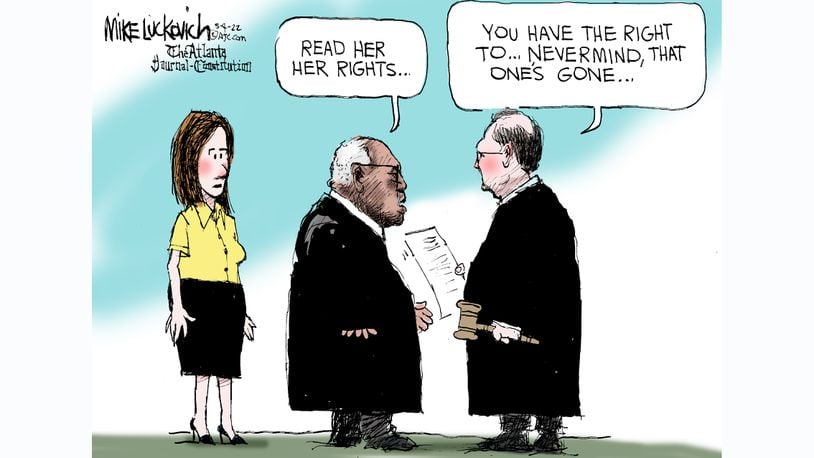
Or “Why I’m not ready to make a hero out of Mike Pence”.
Monday was the second hearing [video, transcript], while the third hearing [videotranscript] was Thursday. Two more hearings are scheduled tomorrow and Thursday at 1 p.m.
The daytime hearings have been fleshing out the case presented in the opening prime-time hearing on June 9th, which I covered last week.
Last Monday’s session focused on all the people within the Trump campaign and Trump administration who told Trump he had lost the 2020 election and debunked his claims of fraud. But Trump dismissed the views of Attorney General Bill Barr, his successor Jeff Rosen, campaign chair Bill Stepien, White House lawyer Eric Herschmann, Deputy Attorney General Richard Donoghue, and others as they refuted very specific claims of fraud — claims Trump would keep repeating.
Instead of accepting what his own experts (who christened themselves Team Normal) told him, Trump sought out less qualified people (Team Crazy) who would tell him what he wanted to hear, like Rudy Giuliani and Sidney Powell.
The hearing also surfaced a new possible criminal charge: fund-raising fraud. The people who kept contributing to Trump after the election were told their contributions would go into an “Official Election Defense Fund”.
[C]ommittee investigator Amanda Wick … disclosed that Trump aides Hanna Allred and Gary Coby said no fund technically existed. She also noted that most of the money went to Trump’s Save America PAC and that very little was used for challenging the election results.
So not only did Trump’s fund-raising pitches rely on lies about election fraud — giving Trump a financial incentive to keep lying — they also lied about where contributors’ money would go.
The third hearing centered on the plot to miscount electoral votes that was designed by lawyer John Eastman. As before, Trump’s advisors within the administration told him the plan was illegal and unworkable, but he sought out Eastman to be told that he could still hang onto power.
The plot centered on constructing slates of phony electors from the states where Biden’s win was clear but not overwhelming. Based on Trump’s false claims of fraud, the false electors would have their ballots delivered to Congress. On January 6, Eastman’s plan had Vice President Pence either accepting their votes as legitimate, or refusing to accept any votes from those states because their legitimacy was “contested”. Either would erase Biden’s Electoral College margin and re-elect Trump. Failing that, Pence could send this phony controversy back to the state legislature to be resolved. This would both delay Biden’s recognition as President-elect, and would shift pressure to Republican majorities in the legislatures to reverse the will of their states’ voters. (We might expect mini-January-6 riots in state capitols.)
Widely respected conservative Judge Michael Luttig testified that not only did this plan have “no basis in the Constitution or laws of the United States at all”, it constituted “a clear and present danger to American democracy”, one that continues as we move towards the 2024 election.
Fortunately, Mike Pence chose not to cooperate with this plan. Pence’s chief counsel Greg Jacobs testified at length about the pressure Trump and Eastman put on Pence, and described what could have happened as “a constitutional jump ball situation, political chaos in Washington, lawsuits, and who knows what happening in the streets”. When White House lawyer Eric Herschmann expressed a similar fear to Eastman — “You’re going to cause riots in the streets.” — he reported Eastman “said words to the effect of there has been violence in the history of our country, Eric, to protect the democracy or protect the republic.”
Pence came off well in Thursday’s hearing, looking like a modern-day Horatius-at-the-bridge defending American democracy against coup and chaos. And while I appreciate how hard it must have been to toss away the benefits he had earned by four years of complete subservience, I have a hard time seeing him as a hero.
I think Mike Pence should have won the 2021 Darth Vader Award for waiting until the last possible moment to do the right thing. Similar to Darth, if Mike had done the right thing sometime sooner, maybe that last possible moment would never have arisen. In particular, what if Pence had stated publicly, weeks in advance, that he did not have and would not try to exercise the power to discard electoral votes that had been certified by the states? What if he had announced that he had consulted with the attorney general and others within the Trump administration, and had determined that the Trump/Pence ticket had lost the election fair and square?
Maybe Trump’s cultists wouldn’t have arrived in DC on January 6 with the expectation that Biden’s election could still be reversed. Maybe the 1-6 violence would never have happened.
I interpret Pence’s drama as a microcosm of what the GOP spent four years doing: All through the Trump presidency, Republicans in his administration and in Congress had hoped that someone else would stop him before he destroyed American democracy. That’s why Pence kept temporizing, not committing to Eastman’s coup plan, but telling Trump he’d continue to study it. Maybe the whole thing would fall through for some other reason, and Pence would never have to stand up to Trump and Trump’s cult of personality.
Just about every major Republican — not just Pence, but Mitch McConnell, Kevin McCarthy, and many, many others — could have gone public before things got out of hand, but they decided not to. It was easier just to humor Trump and hope that his whole attempt to stay in office in spite of the voters would just run of steam somehow.
Mike Pence was the one who wound up with no one to pass the buck to. If he had gone along with Trump on January 6, then there would have been no orderly transfer of power, and Trump would either have been overthrown by violence or become de facto autocrat-for-life.
Pence isn’t a hero; he’s just the Republican who lost the game of hot potato.
If we can’t save one lake, how will we save the planet?
We all think we know why it’s so hard to motivate our fellow Americans to meet the threat of climate change:
The danger seems distant, as if we still had a lot of time to react.
The problem seems abstract: So what if statisticians claim the average day is a degree or two warmer than it would have been a few decades ago? Why is that such a big deal? Maybe the computer models are wrong and the projections of disaster are just scaremongering.
Such disasters as we’re already seeing — hurricanes, droughts, fires, heat waves — don’t come clearly marked “brought to you by climate change”. Similar things have happened in the past, so maybe these would have happened anyway.
Because climate change is global, it’s hard to connect our own actions to the outcome. If we make sacrifices, but the Chinese and Indians don’t, they’ll get an advantage on us and all the bad things will happen anyway. As Marco Rubio put it when he was running for president in 2015: “America is not a planet.“
But what if we faced an environmental disaster where none of those factors came into play? Something entirely within our borders, where the changes were visible to the naked eye, and the looming catastrophe obvious. Something clearly connected to current policies, and addressable by changing those policies.
We’d be all over that, wouldn’t we?
Well, apparently not.
Not quite two weeks ago, the New York Times reported that a combination of climate change, over-population, and profligate water use is killing the Great Salt Lake.
Last summer, the water level in the Great Salt Lake reached its lowest point on record, and it’s likely to fall further this year. The lake’s surface area, which covered about 3,300 square miles in the late 1980s, has since shrunk to less than 1,000, according to the U.S. Geological Survey.
The salt content in the part of the lake closest to Salt Lake City used to fluctuate between 9-12%, according to Bonnie Baxter, a biology professor at Westminster College. But as the water in the lake drops, its salt content has increased. If it reaches 17% — something Baxter says will happen this summer — the algae in the water will struggle, threatening the brine shrimp that consume it.
Algae and brine shrimp are the bottom of a food chain. Migratory birds who rely on the lake as a resting spot in their otherwise perilous desert crossing would go next.
While the ecosystem hasn’t collapsed yet, Baxter said, “we’re at the precipice. It’s terrifying.”
Worse, the exposed former lake bed could soon endanger humans in nearby Salt Lake City:
The lake bed contains high levels of arsenic and as more of it becomes exposed, windstorms carry that arsenic into the lungs of nearby residents, who make up three-quarters of Utah’s population. …
The soil contains arsenic, antimony, copper, zirconium and other dangerous heavy metals, much of it residue from mining activity in the region. Most of the exposed soil is still protected by a hard crust. But as wind erodes the crust over time, those contaminants become airborne.
Part of the problem is climate change, with all the complicating factors I listed above. (More of the mountain snowpack is evaporating rather than melting to feed the rivers that feed the lake.) But another big part of it isn’t: Population growth is diverting water from the rivers before it can reach the lake.
So policy changes at the state and local levels could do a lot to mitigate the problem: Water rates could go up, and future development could be discouraged.
Of major U.S. cities, Salt Lake has among the lowest per-gallon water rates, according to a 2017 federal report. It also consumes more water for residential use than other desert cities — 96 gallons per person per day last year, compared with 78 in Tucson, Arizona, and 77 in Los Angeles. … Homes around Salt Lake boast lush, forest-green lawns, despite the drought. And not always by choice.
In the suburb of Bluffdale, when Elie El kessrwany stopped watering his lawn in response to the drought, his homeowners’ association threatened to fine him. “I was trying to do the right thing for my community,” he said.
State Rep. Robert Spendlove, a Republican, introduced a bill this year that would have blocked communities from requiring homeowners to maintain lawns. He said local governments lobbied against the bill, which failed.
In the state legislative session that ended in March, lawmakers approved other measures that start to address the crisis. They funded a study of water needs, made it easier to buy and sell water rights, and required cities and towns to include water in their long-term planning. But lawmakers rejected proposals that would have had an immediate impact, such as requiring water-efficient sinks and showers in new homes or increasing the price of water.
In short, the legislature did nothing that might ask for sacrifices from individual citizens. If Utahans are still asleep to the problem — even though they can go look at the shrinking lake for themselves — the state’s political leaders are afraid to wake them up.
But they’re bound to notice eventually. The NYT article compares the Great Salt Lake to the cautionary tale of Owens Lake in California, which dried up when water feeding it was diverted to Los Angeles early in the 20th century.
On what used to be the shore of what used to be Owens Lake is what’s left of the town of Keeler. When the lake still existed, Keeler was a boom town. Today it consists of an abandoned school, an abandoned train station, a long-closed general store, a post office that’s open from 10 a.m. to noon, and about 50 remaining residents who value their space, and have lots of it.
Like Paul Krugman, I was surprised the NYT article didn’t mention a much bigger disaster: the Aral Sea in Central Asia, which was once the fourth-largest inland body of water in the world. In the 1960s, the Soviet Union irrigated much of the surrounding area in an attempt to become a major cotton exporter. With so much water evaporating in fields rather than flowing into the sea, the Aral’s ecosystem collapsed.
The Aral Sea has seen the surface area decline by 90%, and had its volume decrease by 85%, an amount equal to Lake Erie and Lake Ontario combined. The sea level has dropped by over 30 m in many places, leaving fishing boats stranded 100 kilometers from any shore. What was once the bottom of the lake has become a new desert, abandoned fishing boats listing in the sand, scoured by toxic dust storms. Ramshackle towns perch on vanished shorelines, while the population languishes in poverty and high rates of cancer, tuberculosis, digestive disorders and anemia. It’s like a scene from a post-apocalyptic movie, yet it is all too depressingly real.
Krugman makes a even more depressing point about the Great Salt Lake:
what I found really scary about the report is what the lack of an effective response to the lake’s crisis says about our ability to respond to the larger, indeed existential, threat of climate change.
The factors that make it hard to marshal the will to fight climate change globally don’t apply here. The retreat of the Great Salt Lake is a visible local problem that could spiral into disaster in the very near future. Action to prevent that disaster could be taken locally, by restricting water usage and new development.
So this should be easy: A threatened region should be accepting modest sacrifices, some barely more than inconveniences, to avert a disaster just around the corner. But it doesn’t seem to be happening.
And if we can’t save the Great Salt Lake, what chance do we have of saving the planet?
A similar pattern is replicating across the West in the face of a multi-year drought.
Again, climate change combined with rapid population growth is the problem, perhaps exacerbated by the illusion created by the 20th century, which was wetter than normal in most of the American West.
The West is where the rubber meets the road in terms of America confronting climate change. The environmental problems are local, visible, and immediate, and local solutions to those problems are available. If it’s not politically feasible to restrict water usage and curb development, the whole region is, as Grant Piper puts it, sleepwalking towards disaster.
[This article is being written before and possibly during the second hearing, which started at 10 a.m. I will cover that material, together with Wednesday’s and Thursday’s hearings, next week. As I’ve repeated many times, this is not a breaking-news blog.]
The committee kicked off its public hearings Thursday night [videotranscript]. Remembering Bob Mueller’s testimony to Congress about his investigation, I had worried that these hearings would be dull and legalistic, or that they would rehash details that, however damning they might be, had already been widely discussed by people who were open to knowing what happened. Worst of all would have been one of those talkfests where each committee member gets five minutes to audition for national attention.
I should have had more faith. The other committee members were content to let Chair Bennie Thompson and leading Republican member Liz Cheney carry the ball, and they carried it well, particularly Cheney.
The first hour of the hearing consisted of Thompson and Cheney laying out the story that the rest of the evidence will nail down, backing up their claims with short videos of testimony that the public had not seen before — mostly from people in Trump’s inner circle: Bill Barr, Jason Miller, and even Ivanka. In the second hour the committee heard from live witnesses: Capitol Police officer Caroline Edwards (who was injured battling rioters at the barricades) and documentary film-maker Nick Quested (who spent the day following Proud Boys leader Henry Tarrio).
The key points in the Committee’s narrative are:
Trump knew that he had lost the election, and that his claims of fraud were baseless. Trump campaign advisor Jason Miller testified that (as the votes were still being counted) the campaign’s data analyst told Trump that he would not win. Trump lawyer Alex Cannon investigated the election-fraud claims, and already in November had reported to Mark Meadows that “we weren’t finding anything that would be sufficient to change the results in any of the key states”. To which Meadows replied: “So there’s no there there.” Attorney General Bill Barr said he told the President within weeks of the election that his charges of fraud were “bullshit”, and in particular that his claims about Dominion voting machines were “complete nonsense”. Ivanka was shown testifying that she believed Barr.
The attack on the Capitol was planned and organized. This wasn’t a protest that spontaneously spun out of control. In response to Trump’s tweet that 1-6 would “be wild”, the Proud Boys and Oath Keepers made plans to storm the Capitol. Before Trump even began his speech, about 200 Proud Boys had left his rally to scout the Capitol’s defenses. After Trump sent the crowd in their direction, they spearheaded breaching the barriers and leading the mob into the Capitol. (A key question going forward: Were these Trumpist militias just intuiting what their leader wanted, or does some figure — Roger Stone, say — connect them more directly with the White House’s plans?)
The rioters engaged in a bloody battle against law enforcement. If the videos of the attack didn’t make this obvious enough, Officer Edwards’ testimony brought the point home: “I saw friends with blood all over their faces. I was slipping in people’s blood. You know, I — I was catching people as they fell. I — you know, I was — it was carnage. It was chaos. I — I can’t — I can’t even describe what I saw. Never in my wildest dreams did I think that, as a police officer, as a law enforcement officer, I would find myself in the middle of a battle. You know, I — I’m trained to detain, you know, a couple of subjects and — and handle — you know, handle a crowd, but I — I’m not combat trained. And that day, it was just hours of hand-to-hand combat, hours of dealing with things that were way beyond any — any law enforcement officer has ever trained for.” This contrasts with Trump’s characterization of the mob as “loving” and Rep. Andrew Clyde’s comparing the rioters to tourists.
The riot was part of a larger plan to reverse the voters’ decision and return Trump to office for a second term. Cheney quoted conservative Judge Michael Luttig: “If Dr. Eastman and President Trump’s plan had worked, it would have permanently ended the peaceful transition of power, undermining American democracy and the Constitution.” Trump pressured the Justice Department to spread his lies about election fraud. (“Just say the election was corrupt and leave the rest to me and the Republican Congressmen,” Trump told DoJ officials.) He pressured state election officials to commit fraud. (Cheney: “You will hear additional details about President Trump’s call to Georgia officials urging them to ‘find’ 11,780 votes – votes that did not exist, and his efforts to get states to rescind certified electoral slates without factual basis and contrary to law. You will hear new details about the Trump campaign and other Trump associates’ efforts to instruct Republican officials in multiple states to create intentionally false electoral slates, and transmit those slates to Congress, to the Vice President, and the National Archives, falsely certifying that Trump won states he actually lost.”) He pressured Vice President Pence to refuse to count electoral votes certified by the states, based on a theory he had been told was illegal.
Trump cheered the violence and refused to take action to stop it. Cheney: “Not only did President Trump refuse to tell the mob to leave the Capitol, he placed no call to any element of the U.S. government to instruct that the Capitol be defended.” General Milley testified that orders to get soldiers to the Capitol came from Vice President Pence, not from Trump. When told that the rioters were chanting “Hang Mike Pence”, Trump said Pence “deserves” it. (The source of that quote — which Trump denies — has still not been revealed.)
At least a few Republican members of Congress were complicit. This was the evening’s most tantalizing and least-fleshed-out point. Cheney floated this: “Representative Scott Perry, who is also involved in trying to get Clark appointed as Attorney General, has refused to testify here. As you will see, Representative Perry contacted the White House in the weeks after January 6th to seek a Presidential pardon. Multiple other Republican Congressmen also sought Presidential pardons for their roles in attempting to overturn the 2020 election.”
Conservative counter-programming. Almost as interesting as the hearing itself was how Trump and his minions dealt with it.
Fox News went to great lengths to shield their audience from any of the information the committee presented. The network not only refused to air the hearings, but went without commercial breaks for two whole hours, so that none of their viewers would be tempted to check out one of the news channels that was actually covering the news. Comedian Stephen Colbert nailed this:
Do you understand what that means? Fox News is willing to lose money to keep their viewers from flipping over and accidentally learning information. … But I’m not surprised. That’s the first rule of any cult: Never leave the compound.
Robert Reich estimates the lost revenue at around $400K. Chris Hayes describes the next level of technical detail: How Fox made sure none of the videos of Trumpist violence would make it through to their viewers, even as a picture-in-picture with Tucker Carlson talking over it.
Truth Social, Trump’s Twitter-clone, reportedly has been banning users who try to discuss the Committee’s evidence, making a mockery of the free-speech rhetoric it was founded on. This also should not be surprising: Reciprocity is not a fascist value. Fundamentally, fascism is an us-and-them worldview, where the fascists themselves have God-given rights, but their enemies do not.
Trump himself lashed out, calling the hearings a “witch hunt” and the committee members “hacks”. He attacked Bill Barr as “weak”, and said that Ivanka had “checked out” of looking at election claims. (Unaddressed question: Why shouldn’t Trump’s other supporters check out too?) He repeated his long-debunked claims of “an Election that was Rigged and Stolen”, and praised the January 6th rioters as representing “the greatest movement in the history of our Country to Make America Great Again”.
Direct criticism. If the don’t-look-behind-the-curtain defense failed, the next line was to smear the proceedings as “propaganda” or a “show trial” or “kangaroo court”, without addressing any of the evidence presented.
The Lawfare blog will be doing next-day podcasts where people call in questions about the hearings. The final question in Friday’s podcast was whether this criticism has merit. Host Benjamin Wittes answered this himself, and made a few key points:
First, the committee is not a court at all, in that no ruling will be made and no punishment will be assessed. So accusing it of being a kangaroo court conducting a show trial is a category error.
Beyond that is the question of whether the hearings are presenting accurate information, and as far as we can tell at this point, it is.
Finally, and harder to judge, is whether the committee is ignoring or omitting information that would argue against the points the committee is making. Wittes is not aware of any such information.
It’s worth pointing out that if any of the quoted witnesses feel that their testimony has been misrepresented, nothing stops them from saying so. Ivanka still has her Twitter account, for example, but hasn’t posted since May 30. Bill Barr and Mark Milley would have no trouble getting attention if they had comments to make.
Finally, it should go without saying that if what you are presenting is true, you have no responsibility to “balance” it by presenting lies. So Trump’s complaint that the Committee “refuses to talk of the Election Fraud and Irregularities that took place on a massive scale” has no merit. The evidence says not only that Trump’s claims about the election are false, but that they are conscious lies. He has known from the beginning that they are false.
Political impact. About 20 million Americans watched the hearings live, not counting those who watched it later online. Millions more have seen highlights or have heard summaries presented by journalists, comedians, or their friends. A few key facts have probably penetrated MAGA’s darkest sanctums: Not even Ivanka believes Trump’s stolen-election bullshit.
It remains to be seen whether the hearings will fade or pick up momentum. Today’s hearing undoubtedly will get a smaller audience, simply because it’s in the morning rather than prime time. But we’ll see what kind of buzz it generates.
The most effective Republican talking point against the hearings is not that the Committee’s case isn’t true, but that 1-6 is ancient history, and that Americans are much more worried about immediate issues like inflation (which the GOP has presented no plan for stopping).
Democrats have offered Republicans many opportunities to put 1-6 behind them: They could have voted to convict Trump in his second impeachment, and made him ineligible for future political office. They could have supported a bipartisan commission to investigate 1-6 and rallied behind its conclusions. They could still denounce Trump’s insurrection, denounce the Big Lie, and denounce Trump for continuing to promote it.
In short: They could take their party back from the fascist demagogue who has dominated it these last six years.
But they won’t unless public opinion forces them. That’s why these hearings are necessary.
Rumblings. The path of least resistance going forward is for the GOP to do to Trump what they did to their last failed president, George W. Bush. Bush left office in 2009, and by the 2010 election Tea Party candidates were running away from him almost as hard as they were running against Obama. In the early days of the Iraq invasion they had seen Bush as the next face on Mount Rushmore, but by 2010 the Tea Party line was that he had never really been a conservative.
Current Republicans could do something similar to Trump: claim that they are “constitutional conservatives” as opposed to the guy who tried to overthrow the Constitution after he lost the election. If they do, then the midterm elections can be about inflation or critical race theory or immigration or transgender-kids-in-your-daughter’s-locker-room or Biden’s-gonna-take-your-guns or pretty much whatever they want. If they don’t, then Trump and the Democrats will conspire to make the midterms about Trump, which is one of the few ways Republicans can blow this election.
Some conservatives grasp this logic. Fox News may be lining up behind Trump, but the rest of the Murdoch media empire is not so sure. The Wall Street Journal recognizes the basic facts of the Committee’s case, and only defends Trump against criminal liability.
The President spread falsehoods about the election. He invited supporters to Washington on Jan. 6, tweeting on Dec. 19 that it ‘will be wild!’ He riled up the crowd and urged it to march on the Capitol. After violence began, he dawdled instead of sending help. Mr. Trump bears responsibility for the mayhem. But inspiring followers to march is not the same as leading a criminal conspiracy.
Murdoch’s New York Post takes a more purely partisan angle. It shrugs off the broader threat to democracy, but wants to jettison Trump’s 2020 claims so that Republicans can focus on more effective issues and less tainted candidates.
Trump has become a prisoner of his own ego. He can’t admit his tweeting and narcissism turned off millions. He won’t stop insisting that 2020 was “stolen” even though he’s offered no proof that it’s true. … Trump can’t look past 2020. Let him remain there. Look forward! The 2024 field is rich.
Elected Republicans could follow that lead. They could choose to jump off the Trump Titanic before it sinks. But will they?
The guns I grew up with wouldn’t have been much use in a massacre.
Comparing the United States to other countries is one of the most powerful arguments for gun control. Recurring mass shootings is a problem unique to the US, and so it requires an equally unique explanation. Other industrialized countries also have mental illness, video games, abortion, secularism, and all the other factors NRA-sponsored politicians and pundits raise to divert attention from guns. But other wealthy countries don’t have America’s mass-shooting problem, or its gun-violence problem in general, because they don’t have America’s guns.
The best attempt I’ve seen to counter this argument is to compare the US not with any other country, but with our own past: The problem can’t be the sheer number of guns in the US, because Americans have always owned a lot of guns.
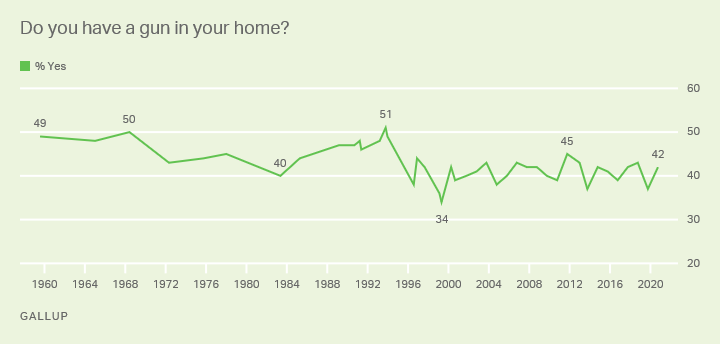
Gallup has been asking about gun ownership since the 1960s, and the percentage of American households with guns has been fairly stable, perhaps even showing a slight downward trend.
Mass shootings weren’t considered a major problem in 1960, this counter-argument goes, so the cause can’t just be guns. Whatever the X-factor is, it has to be something that has changed in recent decades. That, presumably, is how people come to blame video games, abortion, and secularism, despite their presence in other countries.
The flaw in this logic is that the guns of America’s civilian arsenal have changed a lot in recent decades. Yes, a lot of Americans have always owned guns. But they didn’t own guns like this.
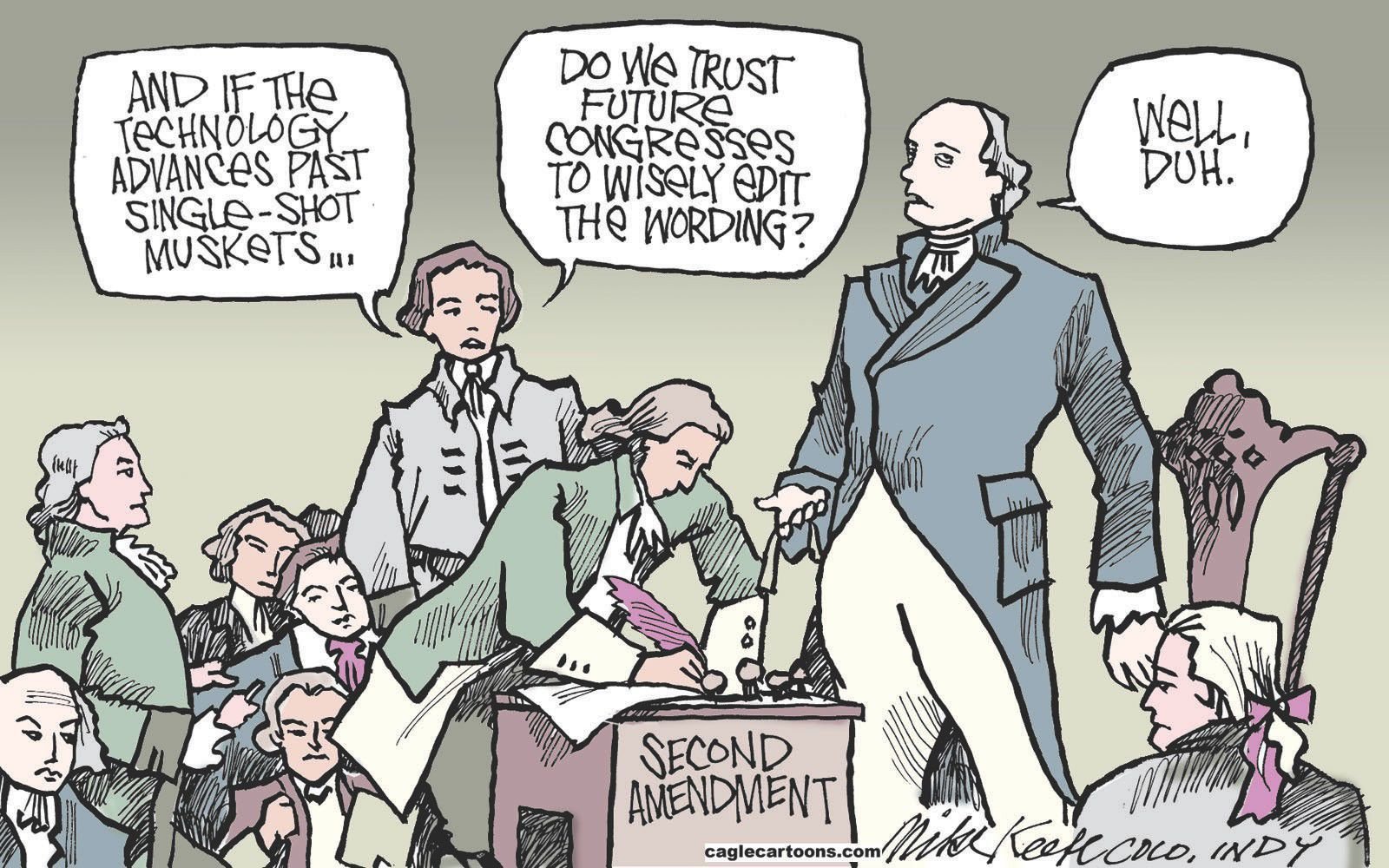
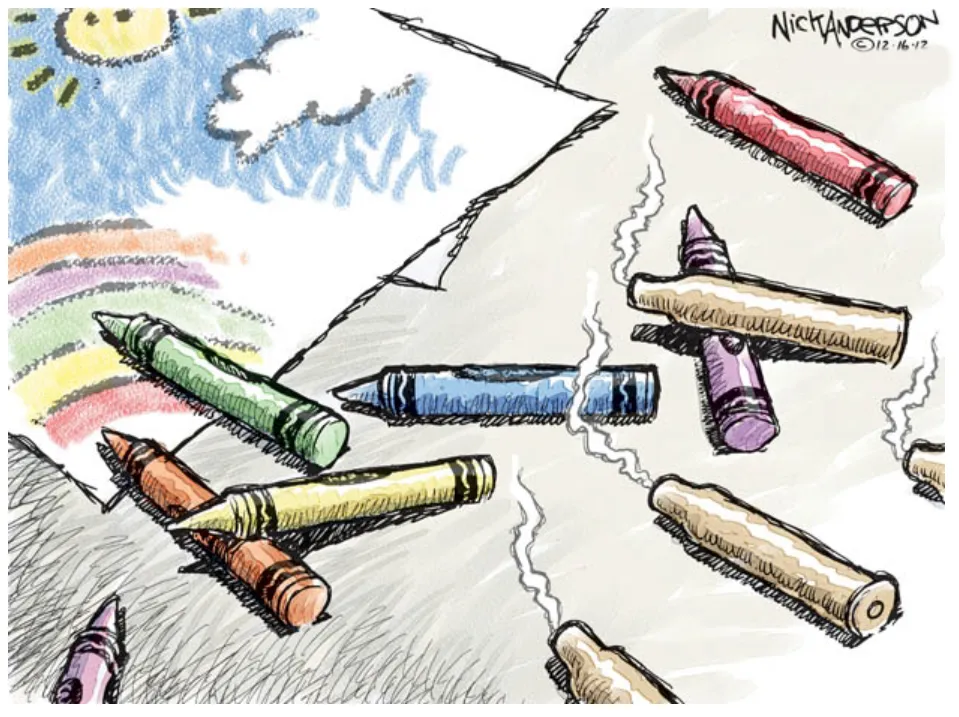
You’ll often see this point made about the guns of the 18th century, the ones the Founders had in mind when they wrote the Second Amendment — as in this cartoon.
What’s not as well appreciated is how much guns have changed in living memory. My memory, for example.
Sometime in my pre-teen years in the late 1960s, my Dad thought it might be a bonding experience for us to go hunting. So he bought a 12-gauge shotgun for himself and a .410 shotgun for me. His held five shells and mine three. Both moved new shells into the firing chamber with a pump action. Pumping could throw off your aim, so without a lot of practice it was just about impossible to shoot even the five or three shells quickly, at least if you wanted to hit anything.
And while reloading wasn’t that hard, once you got onto it, it wasn’t nearly as quick or easy as snapping in a new clip. But it didn’t need to be. The point was to keep firing until your quarry either fell or fled, which would probably happen in a matter of seconds. After that, you were looking at another extended period of stalking — that’s why the sport is called “hunting” rather than “shooting” — so you had plenty of time to dig a few shells out of a pocket and slide them into the shotgun.
Dad also owned a .22 rifle, which typically lived out on our farm, about 15 miles from our house in town. I don’t remember how many bullets it held, but it wasn’t many. I occasionally shot targets with it, but not with any practical goal like hunting or self-defense. (A post on a survivalist message board is blunt about such a rifle’s self-defense limitations: “A .22 round has virtually no ‘stopping power’. It takes a hit directly to vital organs like the heart or brain to ‘stop’ somebody with a .22.”)
That was our whole arsenal. We were, I believe, a more-or-less typical gun-owning family of the era. (At least in the rural Midwest. Perhaps things were already different in the South; I wouldn’t know.) Many of my friends had a similar exposure to guns, which they used (rarely, and under adult supervision) to hunt quail or ducks or rabbits. (I once ate fried squirrels that a neighbor had killed. They did indeed taste like chicken.) I heard about men going on deer-hunting trips, but I don’t remember my friends bragging about hunting deer themselves.
One possible use for our guns never came up: killing people intentionally. Everyone knew, of course, that a shotgun or a rifle of any caliber could kill someone. Occasionally I would hear about hunting accidents, or that someone (though not anyone I knew personally) had committed suicide with a gun. My dentist once surprised burglars at his vacation home, and they shot him with a shotgun they were stealing from him. (At least that’s the story I remember hearing. He lived, but ever after had marks on his face from where the pellets hit. Years later he became the father-in-law of my best friend from elementary school.)
But shooting people was an accident to be avoided, not something we trained to do. For practice we shot at bottles or clay pigeons, not human figures on paper. Dad and I never talked about repelling a home invasion with our shotguns, and I doubt he had such a plan. (Our home would have been pretty easy to invade in the summer, when we often just fastened a screen door with a hook. The shotguns were in the basement and unloaded. Using them quickly would have been difficult. If Dad secretly kept a more convenient gun, I believe I would have found it when I cleaned out the house after he died.) And we certainly never discussed joining a group that might fight against the government.
The guns also were not a part of our identity, either as individuals or as a family. They were sporting equipment, like baseball gloves or basketballs, and had little symbolic significance. So we did not assemble a collection to display with pride, or join a shooting club, or hang around in gun shops. I don’t think I knew what the NRA was.
I had a toy M-16 as a kid, so I knew about such weapons, which soldiers were using in Vietnam. Apparently the civilian semi-automatic version, the AR-15, was already on the market. But it never occurred to me that we might buy one. (Why would we? If you hit a rabbit with a burst from an AR-15, there wouldn’t be much left.)
In short, our gun-owning household didn’t have anything like the destructive capability that millions and millions of American households have today. If I had ever gone on a rampage with our guns, I couldn’t have run up anything like the body counts we’ve seen lately, and most of my victims would probably have lived. Once the police arrived, I couldn’t have held them at bay for long.
I don’t even remember having that fantasy. Owning a shotgun made me an occasional hunter, not a warrior. My warrior fantasies, such as they were, involved joining the military, not going out in a blaze of glory on Main Street.
So no, past America is not comparable to America today in terms of an individual’s ability to commit mass murder. The percentage of gun-owning households may not have changed that much in the past 60 years, but the guns Americans own certainly have.
The only change since the last time I covered this issue is that more people have died.
From your cousin on social media to TV talking heads and syndicated columnists, everybody who comments on current events is facing the same conundrum: What do you say when nothing has changed since the last time you spoke out? There are no new insights to offer, no arguments that didn’t prove to be futile last time.
And yet, how can you stay silent? Silence is complacency that can even be interpreted as consent. Ten-year-olds get massacred in a public school? Grandmothers get killed for shopping-while-Black? Asians get shot at a church luncheon? It happens. This is America. Things that don’t happen anywhere else happen here, sometimes one right after another. And in spite of all the other countries that have responded to horrifying mass killings by taking effective action, nothing can be done here. This is America.
This week, I’ve decided to be open about the fact that I have nothing new to say. December 14 will be the tenth anniversary of the Sandy Hook massacre of 20 six- and seven-year-olds. April 20 was the 23rd anniversary of Columbine. So I’ve had decades to compose my thoughts on mass shootings and gun control. There’s very little I can write that I haven’t written before.
So rather than repeat everything as if I just thought of it, I’ve decided to post a guide (and partial update) to my previous posts on guns. [1]
My most serious look at America’s gun problem was “How Should We Rewrite the Second Amendment?” in 2019. Google, in its great algorithmic wisdom, recommended that post to people interested in the Second Amendment, netting me more than 18,000 page views and 300 comments, almost all of them negative.
The gist of my essay was that we argue so vociferously about the Second Amendment because it no longer has any recoverable meaning relevant to current issues. From the Supreme Court to that loud guy at the bar, anybody who “interprets” the Second Amendment and “applies” it to today’s world is really just making stuff up. We yell our own particular interpretations so loudly because interpretation is all we have at this point. To the extent that we can discern the “original intent” of the Founders at all, it’s completely tangential to anything happening today.
So I proposed that we replace the Second Amendment with a new amendment to capture what we really want out of guns in this era. The core of my rewrite was:
Congress shall make no law preventing individuals from securing adequate means to defend their homes and persons, or preventing state or local governments from equipping police forces adequate to enforce their laws and ensure public safety.
I gave the federal government explicit permission to regulate interstate transportation and sale of guns, while granting states the power to regulate guns within their borders.
In the face of the pushback, I wrote a sequel the next week to summarize and address my critics’ points. In retrospect, I’m surprised how much good humor I maintained after all that abuse.
As for what the Constitution doesn’t say about guns, see my 2018 post “Three Misunderstandings about Guns and the Constitution“. In particular, the Second Amendment was never intended to facilitate an armed uprising against the federal government.
The “well-regulated militia” it envisioned was supposed to make a large federal standing army unnecessary, not to fight against one. Militias, in the Founders’ vision, would enable state and local governments to maintain public peace and enforce their laws without begging the feds for help. Because of the militias, the federal army would only be needed in case of war with a foreign power like Britain or Spain, and otherwise would be a tiny force that wouldn’t tempt an unpopular president to stage a coup.
Not a militiaman
One reason why I later proposed rewriting the amendment was that all the ships in the Founders’ harbor sailed long ago. The outcome the Founders wanted to avoid when they wrote the Second Amendment is already here: We do have a large standing army with forts all over the country, as well as various kinds of federal police from the FBI to DEA to Treasury to TSA to ICE. We can still argue about whether any of that was a good idea. But one way or the other, here we are.
People who feel safer with a gun than with guaranteed medical insurance don’t yet have a fully adult concept of scary.
One reason the gun debate goes nowhere is that the two sides aren’t really discussing the same issue. Gun-control advocates are looking at a public-health problem: Guns kill tens of thousands of Americans every year. What can be done to lower that total?
But most pro-gun arguments are story-based, because gun advocates are addressing something else entirely: Sometimes a dark fantasy gets stuck in your head and you can’t get it out. What do you do about that? Armed intruders invading your home, your daughter getting raped in the park, roaming street gangs killing people at random — those images can disrupt your peace of mind, no matter what the statistics say about their probability. Some policy change that experts predict would cut rapes in half, for example, doesn’t really help you deal with the what-if in your brain.
That’s what a gun is for. It’s a magical talisman that enables a counter-fantasy you can invoke to dispel whatever dark fantasy might be plaguing you. Home invaders? You’ll win a shoot-out with them. Your daughter? She’ll manage to get the gun out of her backpack and plug the guy before he can take it away and shoot her instead. (And the gun will never haunt her imagination on days when she’s feeling suicidal.) Gangs? You, the neighbors, and your AR-15s will form an impromptu urban warfare platoon to take them out.
Will any of that work in reality? Hardly ever, as ABC demonstrated with this gun-training exercise. But realistic thinking misses the point. If the problem lives in your personal fantasy world, a fantastic solution works just fine.
That’s why even the most common-sense gun reforms get bogged down in improbable scenarios. As in this argument against limiting the size of gun magazines: “Criminals don’t always act alone. It is often necessary to have enough ammunition to hold off multiple assailants.” Often? Would that be “often in the author’s experience” or “often in the author’s dark fantasies”?
Meanwhile, the NRA’s mouthpieces float action-movie ideas that may help you overcome your paralyzing my-child-gets-killed-at-school nightmare, but are totally disconnected from reality.
But maybe Paxton is imagining something more like Kindergarten Cop, where Arnold Schwarzenegger is an LAPD detective who goes undercover as a teacher. No doubt that movie character would fare much better against a shooter than my sister would. Which raises the question: What if we stopped recruiting teachers from wimpy liberal arts colleges and instead hired, say, ex-special-forces operatives (without raising pay, of course)? Or maybe it would be more cost effective to train the kids to defend themselves, in a scenario something like Spy Kids, or maybe Home Alone.
No, he didn’t say that Black women’s deaths don’t count.
Here’s a pattern I complain about a lot: Some prominent Democrat says something that the conservative media paraphrases in a hostile way, making the statement sound much more ridiculous or offensive than it really was. That paraphrase then gets treated as if it were the actual quote, and a game of telephone proceeds from there, with each paraphrase more offensive (and further from reality) than the previous one.
Deplorables. That’s what happened, for example, when Hillary Clinton used the phrase “basket of deplorables” to describe the “racist, sexist, homophobic, xenophobic, Islamophobic” forces that had united under the Trump banner in 2016. Conservative media quickly turned that into a declaration that Trump supporters were deplorable in and of themselves, without reference to racism, sexism, homophobia, xenophobia, or Islamophobia.
At a fundraiser on Friday, Democrat presidential candidate Hillary Clinton lashed out at her opponent GOP presidential candidate Donald Trump and his supporters. She called those supporting Trump a “basket of deplorables.”
The article included a Trump spokesman’s response:
What’s truly deplorable isn’t just that Hillary Clinton made an inexcusable mistake in front of wealthy donors and reporters happened to be around to catch it, it’s that Clinton revealed just how little she thinks of the hard-working men and women of America.
By now it’s a universal belief among Trumpists: Hillary called them deplorable, for no reason at all. What’s more, Hillary was just saying the quiet part out loud; Democrats in general look down on “the hard-working men and women of America”.
During my service in the United States Congress, I took the initiative in creating the Internet. I took the initiative in moving forward a whole range of initiatives that have proven to be important to our country’s economic growth and environmental protection, improvements in our educational system.
The vice president was not claiming that he “invented” the Internet in the sense of having thought up, designed, or implemented it, but rather asserting that he was one of the visionaries responsible for helping to bring it into being by fostering its development in an economic and legislative sense.
The claim that Gore was actually trying to take credit for the “invention” of the Internet was plainly just derisive political posturing that arose out of a close presidential campaign. If, for example, Dwight Eisenhower had said in the mid-1960s that he, while president, “took the initiative in creating the Interstate Highway System,” he would not have been the subject of dozens and dozens of editorials lampooning him for claiming he “invented” the concept of highways or implying that he personally went out and dug ditches across the country to help build the roadway. Everyone would have understood that Eisenhower meant he was a driving force behind the legislation that created the highway system, and this was the very same concept Al Gore was expressing about himself with interview remarks about the Internet.
But this also has become an article of faith on the Right: Gore made an absurd claim that undermines claims he has made on other issues, like climate change.
Democracy. Those are two of the most prominent examples, but lesser ones pop up on a regular basis. In the 2020 campaign, Fox played telephone with a Biden quote until eventually Lou Dobbs did this with it:
Joe Biden says the police are “the enemy.” Those are his words, “the enemy.”
But that was a paraphrase of a paraphrase, not “his words”. Conservatives have also spread doctored videos of Biden to either distort his views or make him look senile.
I hate stuff like that, not just because it treats public figures unfairly, but because it undermines democracy. The archetypal vision of democracy is of the public having a conversation that eventually arrives at some combination of compromise and consensus. Once such a conversation has established a public will, elected representatives can carry out that will.
But that whole vision comes apart if the public conversation centers on things that never happened, or devolves into flame wars started by insults that were never said.
Wouldn’t it be great if political campaigns could revolve around things that are real, rather than issues that have been invented to raise anger?
But if that’s what we want, we have to model it. In some arenas turnabout is fair play. But here, their abuse of democracy shouldn’t give us license to abuse it too. Personally, I’d like to save democracy, not win the ground where its corpse lies.
But did he actually say those things? You don’t have to take anybody’s word for it; the whole virtual interview is on YouTube. It’s just under half an hour, but the abortion/maternal-health portion is in the first nine-and-a-half minutes.
It’s important to set the stage: Senator Cassidy, a doctor himself, is being interviewed by Politico reporter Sarah Owermohle under the auspices of Harvard’s Chan School of Public Health. This is not a campaign rally or other political event. Both Cassidy and Owermohle appear to be in their homes, but the virtual site of the conversation is Harvard.
Owermohle begins by asking about the leaked Supreme Court opinion reversing Roe, and Cassidy minimizes its impact, as if the 15-week ban at the center of the Dobbs case is the end of the story: Abortion will still be available up to that point, women will still be able to go to liberal states to get abortions, and abortion drugs will be available through the mail.
So fundamentally, the first month or two, not much would change, except for the location of where the abortion would take place.
Now, Cassidy surely knows that far stricter bans are being passed in states like Oklahoma and Tennessee, and that they will undoubtedly stand if Justice Alito’s opinion prevails. So he’s being disingenuous, but I have to admit that this is well within the bounds of normal political spin.
Owermohle then asks if Cassidy would support a federal ban on abortion, and Cassidy dodges. He says something that would argue against it:
I’m a federalist, and I think that states should be allowed to make decisions by the tenets of democracy.
But he doesn’t actually say he wouldn’t vote for a federal ban. Similarly, he argues that a national abortion ban would never get the 60 votes needed to overcome a Senate filibuster, but says nothing about the pressure Republicans would be under to scrap the filibuster if they had a majority. So this response is slippery, but again, within the normal bounds of American politics.
Owermohle asks about next steps for the pro-life movement after Roe is overturned, probably looking for Cassidy to say something about birth control, but instead Cassidy shifts the discussion to maternal health.
I truly think we need to support the mom when the child is in utero, and to support the mom afterwards, to give her everything she needs so that she can feel comfortable bringing the baby to term [and either giving the child up for adoption or raising it herself], to support that continuum of life from within the womb to without the womb.
To her credit, Owermohle doesn’t take Cassidy’s expression of concern for pregnant women at face value, and asks a polite but challenging follow-up. She notes that Louisiana “ranks very high on maternal deaths” and asks what needs to be done to improve that.
This is the section that leads to the headlines.
[In] Louisiana, about a third of our population is African American. African Americans have a higher incidence of maternal mortality. So if you correct our population for race, we’re not as much of an outlier as would otherwise appear.
Remember, Cassidy is a doctor who thinks he’s talking to the Harvard School of Public Health, so he is assuming a sophisticated audience. In that context, he’s not arguing to ignore the deaths of Black women, he’s reframing the problem: The right question, he is claiming, isn’t why so many new mothers die in Louisiana, it’s why so many new African American mothers die nationwide. That interpretation is clear if you continue the quote:
I say that not to minimize the issue, but to focus the issue as to where it [sh]ould be. For whatever reason, people of color have a higher incidence of maternal mortality.
Does he leave “whatever reason” as an unfathomable mystery, say “Sucks to be them”, and move on? No. He talks about remedies.
Now, there’s different things we can do about that. I have something called the Connected MOMS Act.
The target of this act is a pregnant woman dependent on public transit who lives 20 miles or more from her doctor. “So you’d like a better way to monitor her than asking her to come to the doctor’s office every two weeks.” The plan calls for remote blood-pressure monitoring and a few other innovations that could spot complications from a distance.
We also have the maternal health improvements grant, which again is to promote studies of this issue as well as to look at potential remedies, if you will, if there’s racial bias that is discovered in how health care is delivered.
So we’ve got a couple things that we’re floating out there trying to take care of this issue, because it is an issue for us in Louisiana as well as for folks nationwide.
I want to point out how far out on a limb he has gone, from the point of view of the far-right Republican base: Cassidy is allowing the possibility that studies could show racial bias in health care. I think it’s obvious that such bias exists and that honest studies will find it, but the Republican base voter doesn’t want to hear that. If such a possibility were raised in a school textbook, it would be “critical race theory”.
So is Cassidy saying: “Don’t bother to count Black women”? No, he’s not. I haven’t read the two pieces of legislation he’s talking about, so it’s possible they don’t do as much as he says. Or maybe the bills include other objectionable provisions that make their passage impossible or counterproductive. I can’t judge that. But at the very least he is paying lip service to the idea that Black lives do matter.
And that’s the exact opposite of what he’s being accused of.
Republicans used to unite around the interests of the rich. Now they unite around a conspiracy theory that has repeatedly inspired mass shootings.
This weekend, we learned all over again that ideas have consequences. When people believe terrible ideas, they do terrible things.
The idea this time is White Replacement Theory: A conspiracy of Jews and liberals is trying to “replace” Whites as the dominant race in America and Europe by bringing in as many non-white immigrants as possible, by encouraging Black people to breed quickly, by diluting the white race through interbreeding, and by depressing white birth rates. The ultimate goal is the extinction of the white race, an outcome also known as white genocide. [1]
If someone really believed such a theory, what might they do? We found out Saturday:
18-year-old Payton Gendron parked his car in front of the entrance to a Tops Supermarket in a Black neighborhood in Buffalo, New York. Exiting the car wearing metal armor and holding an assault rifle, he shot and killed a female employee in front of the store, and a man packing groceries into the trunk of his car. After entering the store, he murdered the store’s guard, and by the end of his killing spree, he had shot 13 people, killing 10 of them.
Eleven of the people he shot were Black, and two were white. As the manifesto he left behind makes clear, this was fully intentional. The first listed goal in his manifesto was to “kill as many blacks as possible”.
Gendron lives in rural New York state, but (according to the manifesto he posted online) drove three hours to find a zip code with a large black population. So he wasn’t seeking revenge against particular Black people that he blamed for his real or imagined problems. He was striking a blow for the white race.
Surely now people will see … Sunday, Pete Buttigieg tweeted:
It should not be hard, especially today, for every elected official and media personality in America—left, right, and center—to unequivocally condemn white nationalism, “replacement theory,” and all that comes with it.
That might seem like a small thing to ask. After all, the Buffalo shooting feels like the kind of horrifying crime that should scare everybody straight. Sure, a news-channel entertainer like Tucker Carlson might pimp WRT to juice his ratings, a politician like Donald Trump might motivate his base by hyperbolically describing immigration as an “invasion“, and countless ignorant folks on social media might pass on these ideas to justify the racism they’ve carried all their lives. But Payton Gendron has shown us that this isn’t a game. When crazy ideas are thrown around loosely, crazy people latch onto them and do terrible things. Surely everyone will realize that now, and everything will change.
That feeling should last for at least another day or two. Enjoy it.
Because we’ve been here before, and nothing changed. We were here when Dylann Roof, 21, killed nine Black Christians during a Bible study class at the Mother Emmanuel Church in Charleston (a city he also picked because of the large number of Black people living there). And when Patrick Crusius, also 21, drove from his Dallas suburb to a WalMart in El Paso, where he tried to shoot as many Mexicans as possible; he ended up murdering 23 people of various races and nationalities and injuring 23 more. John Earnest,19, hoped to kill as many Jews as possible in Poway, California, but he wasn’t very good at it; he only murdered one and wounded three others before his gun jammed. Robert Bowers, in his 40s, also went after Jews, killing 11 worshipers at the Tree of Life synagogue in Pittsburgh.
Those were all White Replacement Theory massacres. We know because the killers were only too happy to explain their actions. Posting a manifesto has become a standard part of a WRT massacre.
There have been WRT massacres in other countries as well. In New Zealand Brenton Tarrant attacked two mosques, killing 51 people. In Norway Anders Breivik’s murder spree was at the youth camp of Norway’s Labor Party; he killed 77 people in all, most of them White teens who were growing up liberal.
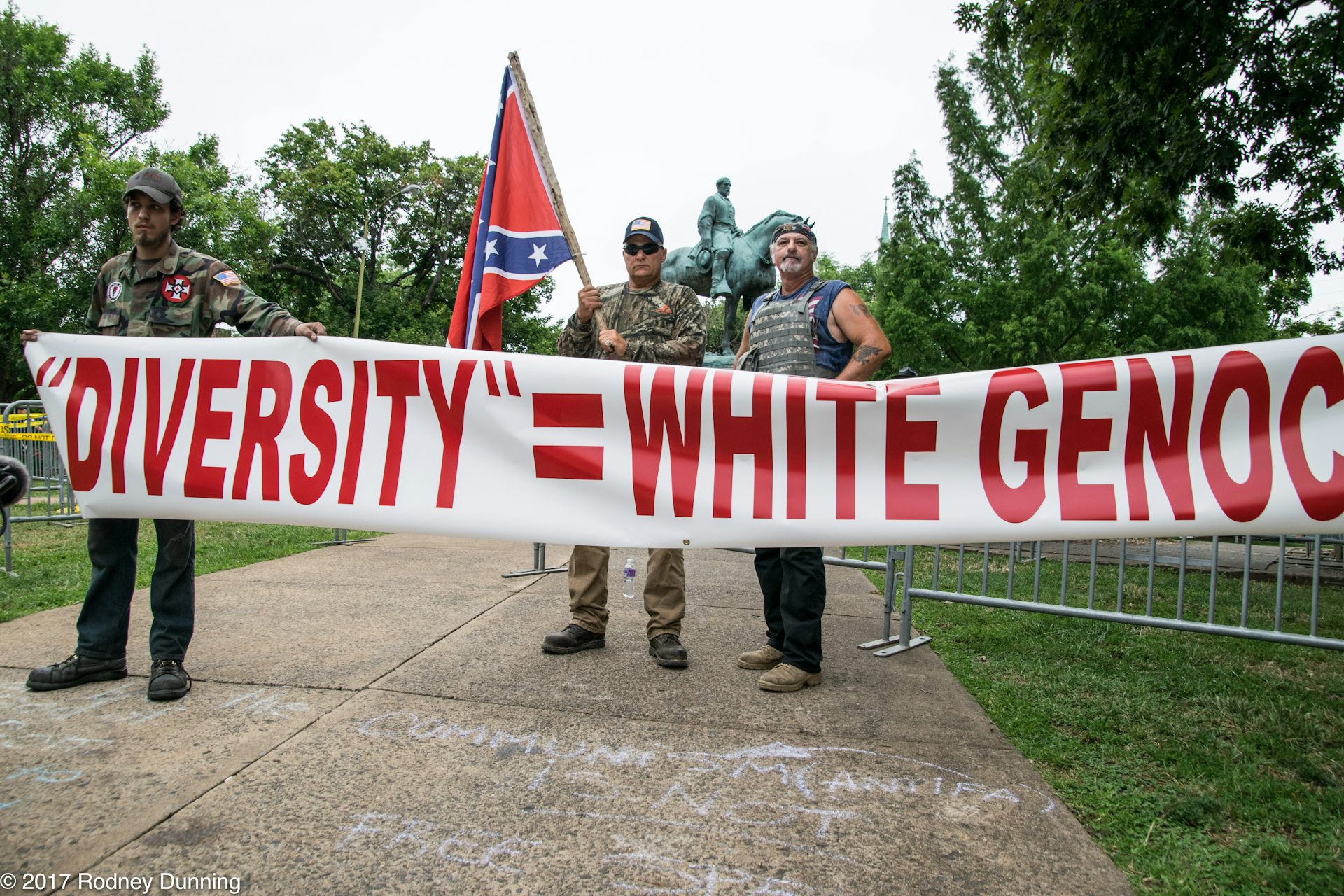
If conservative promoters of WRT were going to be scared straight, it would have happened by now. It might have happened after Charlottesville, when only Heather Heyer died, but the nation saw the spectacle of violent white supremacists marching down the streets chanting “Jews will not replace us.“
Nudges and dog whistles. Elected Republicans and Fox News hosts never explicitly tell anyone to go kill Blacks or Hispanics or Jews. But they do regularly say things that, if taken seriously, would logically result in race massacres. Why, for example, did Patrick Crusius take military weaponry to the biggest city on the US/Mexican border? Because he believed his country was being “invaded” by Mexicans, just as President Trump was saying.
When an army of foreigners invades your country, what can a heroic young man do other than go to the border and kill them? That’s what Ukrainians are doing now, and we all praise them for it.
In just the past year, Republican luminaries like Newt Gingrich, the former House speaker and Georgia congressman, and Elise Stefanik, the center-right New York congresswoman turned Trump acolyte (and third-ranking House Republican), have echoed replacement theory. Appearing on Fox, Mr. Gingrich declared that leftists were attempting to “drown” out “classic Americans.”
Would it surprise you to discover that some interpret “classic Americans” as “White people”?
Similarly, Tucker Carlson seldom talks about white and black in antagonistic terms. Instead, he looks into the camera and says “you” and “them”, leaving those terms open for his almost-entirely-white audience to interpret as they see fit. [2] But occasionally he almost comes right out with it.
He was more explicit in a video posted on Fox News’s YouTube account in September. Carlson said President Biden was encouraging immigration “to change the racial mix of the country, … to reduce the political power of people whose ancestors lived here, and dramatically increase the proportion of Americans newly arrived from the Third World.”
His Fox News colleague Laura Ingraham
told viewers in 2018 that Democrats “want to replace you, the American voters, with newly amnestied citizens and an ever-increasing number of chain migrants.” During a monologue on her program last year, she called immigration an “insurrection [that] seeks to overthrow everything we love about America by defaming it, silencing it, and even prosecuting it.
In her ads, Rep. Stefanik repeats the “insurrection” theme.
Radical Democrats are planning their most aggressive move yet: a PERMANENT ELECTION INSURRECTION. Their plan to grant amnesty to 11 MILLION illegal immigrants will overthrow our current electorate and create a permanent liberal majority in Washington.
She is no doubt aware that false conspiracy theories on the internet claim millions of illegal immigrants are already voting. By describing a path to citizenship (which doesn’t yet exist and would take years to walk) as an “INSURRECTION”, she justifies violence, like the violent attempt to keep President Trump in power after the voters rejected him in 2020.
Again, what would a heroic young White man logically do if he bought what Stefanik is selling? Someone is plotting an “insurrection” to “overthrow” his people. Is registering to vote or sending in $20 really an adequate response to that challenge?
The underground root system. Coincidentally, I was already planning to write something about WRT before Saturday, because this week it had shown up in an odd place: the Senate debate over codifying abortion rights through legislation. Republican Senator Steve Daines from Montana made a somewhat curious argument against that bill:
Why do we have laws in place that protect the eggs of a sea turtle or the eggs of eagles? Because when you destroy an egg, you’re killing a pre-born baby sea turtle or a pre-born baby eagle. Yet when it comes to a pre-born human baby rather than a sea turtle, that baby will be stripped of all protections in all 50 states under the Democrats’ bill we will be voting on tomorrow.
Most of the commenters on my social media feeds were mystified: What do sea turtles and eagles have to do with anything? Daines seemed to be talking in wild non sequiturs — unless you could fill in his unstated connection.
White replacement is the Rosetta Stone here: If laws protect sea turtle eggs and eagle eggs (I haven’t checked whether Daines was making that up), it’s because those species are endangered. You know what else is endangered? The white race, because White women are failing to reproduce at replacement rate. That is, in fact, why American women’s rights need to be taken away: because they’re not doing their primary job. They’re aborting their fetuses rather than producing the healthy White babies the race needs to avoid extinction.
Gendron also argues that Jews are behind the movement for transgender inclusivity, supposedly sponsoring transgender summer camps for “Scandinavian style whites”.
Likewise, accepting same-sex relationships lowers the birth rate of Gingrich’s “classic Americans”. And then there’s the demoralizing effect of critical race theory.
The section ends by blaming Jews for creating “infighting” between people and races. The example Gendron’s manifesto provides is that “Jews are spreading ideas such as Critical Race Theory and white shame/guilt to brainwash Whites into hating themselves and their people”.
From the outside, the issues that motivate the MAGA wing of the GOP seem like an incoherent mess. But white replacement is an underground root system that connects them all.
What’s more, WRT explains the intensity of the MAGA movement, which otherwise is also a mystery. How can a bland figure like Joe Biden incite the kind of hatred and panic we’ve seen? Why would the prospect of a Biden administration be so scary that people styling themselves as “patriots” would invade the Capitol and threaten to hang the vice president rather than permit an orderly transfer of power?
And no matter how many revelations come out about the crimes of the Trump administration and the threat to democracy it posed, why are only a handful of Republicans ready to make a clean break with him?
Because the perceived alternative is racial extinction. Otherwise it makes no sense.
Historically, American political parties have gone into the wilderness for a period of time after a disastrous administration. That’s where the GOP should be post-Trump, but it is being held together by white anxiety about the demographic trends. WRT channels that anxiety into positions on issues and energy for campaigns. And that’s why Republicans can’t walk away from it, even though it regularly and predictably leads to race massacres.
[1] I refuse to go down the rabbit hole of arguing that this is false. I’ll leave that to Farhad Manjoo and Chris Hayes. I will point out one thing: No matter how lily-white you may appear to be today, chances are your people met exactly the same kind of suspicion and hostility when they came to America. My people, the Germans, started arriving in large numbers in the 1700s, and Ben Franklin worried that we were so different we would never assimilate into the Pennsylvania colony. Hence the origin of the Pennsylvania Dutch (i.e., “Deutsch”).
[2] More than a year ago, Charles Blow pointed out something Carlson skips over:
[R]evealingly, he is admitting that Republicans do not and will not appeal to new citizens who are immigrants.
There’s no racial essence that predestines groups of people to vote a certain way. Black voters, for example, were loyal Republicans until FDR started to win them over in the 1930s. In 1956, Dwight Eisenhower still got nearly 40% of the Black vote, compared to the 8% Trump got in 2016.
If Republicans would abandon race-baiting and try to win over immigrants of all races and ethnicities, they might succeed. Demography is not destiny.
The two featured posts today look at the leaked Alito opinion overturning Roe v Wade through two very different lenses. The other post goes through the text of the opinion and examines its claims and arguments. This one considers the question: How did we get here?
In particular, whose fault is it that women in about half the states are going to lose their right to bodily autonomy, and their ability to plan their lives?
Let’s start with those most directly responsible.
Justices Alito, Barrett, Gorsuch, Kavanaugh, and Thomas. Or, as Stephen Colbert described them: “four old dudes and a woman who thinks The Handmaid’s Tale is a rom-com”.
Sometimes when we start assessing secondary blame, we lose sight of the primary blame. (Yeah, you shouldn’t have left your keys in the ignition, but the main reason your car got stolen was that some thief stole it.) Let’s not do that here: Roe is being overturned because five Supreme Court justices are putting their personal religious opinions above their duty to respect established precedents.
But a reversal is typically done after the Court has tried and failed to make the precedent work. That’s what happened, for example, when Brown v Board of Education (1954) reversed the “separate but equal” doctrine of Plessy v Ferguson (1893). In a series of cases from 1938 to 1950, the Court ordered students admitted to previously segregated white schools because the separate educational path provided for Black students was not really equal. In Brown, the Court drew a conclusion from that experience: Separate-but-equal schools were unworkable, because states with segregated schools would never provide a truly equal education to Black students.
But (in spite of what Alito claims, which I discussed in the other post) nothing about Roe and Casey has proven to be unworkable. The only major thing that has changed since Roe was decided in 1973 and upheld in 1992 is the composition of the Court. Alito, Barrett, Gorsuch, Kavanaugh, and Thomas are overturning Roe because they want to.
What’s more, they were all deceptive about this in their confirmation hearings. It’s arguable that they did not “lie”, depending on how tightly you define that word. (Thomas, I would argue, clearly did lie, though his lie may not be provable. It is simply unbelievable that, even though he was in law school when Roe was decided, he never participated in a discussion about it.) When asked about their approach to the Roe precedent, all five gave lawyerly answers that, in retrospect, were designed to deceive. If they could be cross-examined somewhere about their statements (which they can’t be, short of an impeachment hearing), all would have to say something similar to Bill Clinton’s “It depends on what the definition of ‘is’ is.”
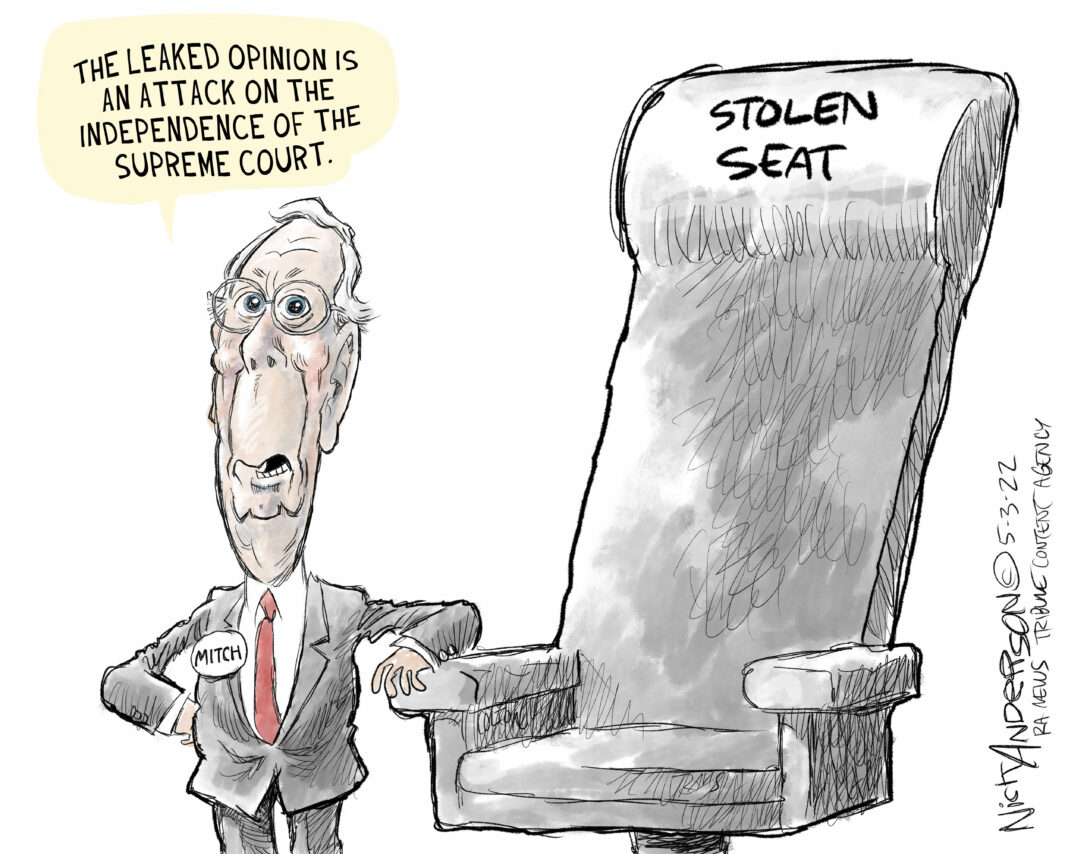
Mitch McConnell. The reason Trump got to appoint three justices in four years is that McConnell played shenanigans in the Senate.
When Antonin Scalia died 11 months before the end of President Obama’s term, Obama nominated Merrick Garland to the Court. This was in no way a radical choice: Garland was already the chief judge on the most powerful appeals court in the country; he had been confirmed for that job by 73 senators; he was widely regarded as a moderate; and at the age of 63, he would probably only hold the seat for about 20 years, rather than 30 or 40.
In short: Obama was bending over backwards to be reasonable.
McConnell knew he could not present a valid reason not to confirm Garland, so he simply refused to hold hearings or bring the nomination to a vote, which is the process the Constitution calls for. The reason he gave was that an election was coming up, and the American people should have a chance to weigh in on this decision. (They did: Hillary Clinton got millions more votes than Donald Trump, but Trump got to make the appointment, who turned out to be Neil Gorsuch.)
McConnell also pushed Brett Kavanaugh’s nomination, and rubber-stamped the sham investigation of the sexual assault charge against him. When Ruth Bader Ginsburg died two months before the 2020 election, McConnell completely reversed his 2016 rhetoric about giving the American people a voice, and rammed Amy Coney Barrett’s nomination through in record time to give Trump his third justice.
The anti-democratic structure of the Senate. If the Senate were a democratic institution, Mitch would never have been majority leader to begin with, because the GOP would not have achieved a Senate majority any time in the last 24 years.
Here’s how that works: Every state gets two senators, no matter how many people it has. So Wyoming gets one senator for every 140,000 registered voters, while California gets one for every 11 million registered voters. In other words, it takes about 70 California voters have as much influence on the Senate as one Wyoming voter.
Sounds fair, right?
But you might be thinking: “Sure, blue California is under-represented compared to red Wyoming, but red Texas is also under-represented compared to blue Vermont. So maybe it all washes out.”
It doesn’t wash out. If you run the numbers, the last time Republican senators got more votes (over a complete 6-year Senate election cycle) than Democratic senators was 1994-1998. But in the 24 years since 1998, Republicans have held a Senate majority for 12 years: half the time.
In 2016, for example, when Mitch McConnell was using his Republican “majority” to keep President Obama from appointing Merrick Garland, sitting Democratic senators had gotten 50.7% of the total six-year Senate vote, compared to the Republicans’ 44.1%.
In a democratic country, Mitch wouldn’t have been majority leader at all, and Merrick Garland would be on the Court instead of Neil Gorsuch.
Similarly, during the Trump and Bush years, a democratic Senate would have had a Democratic majority. Bush probably could have gotten Alito and Roberts through anyway, because in those rose-colored days senators were not as partisan about the Court. (Alito was approved 58-42, and Roberts 78-22.) But Gorsuch, Kavanaugh, and Barrett would not have been confirmed.
Next, you might be wondering how we got such a skewed Senate. Historical accident, right?
After 1888, when we get the installment of Benjamin Harrison in the White House, he loses the popular vote by about 100,000 votes. But he’s installed thanks to the Electoral College. The Republicans under Harrison between 1889 and 1890, they let in six new states in 12 months. That was the largest acquisition of new states in American history since the original 13 and it’s never been matched again. They let in North Dakota, South Dakota, Montana, Washington, and then Idaho and Wyoming to go ahead and make sure that they would continue to control the Senate, and the Electoral College. And they’re not hiding this. They actually go onto their media which is their equivalent of the Fox News channel at the time and say, by letting in these states, we’re going to hold onto the Senate for all time and we’re going to make sure we hold onto the White House for all time.
So if you’ve ever wondered why one Dakota wasn’t enough, that’s the reason: Republicans were packing the Senate. The Senate remains skewed in their favor to this day.
It’s almost impossible to unmake states, and hard to imagine passing a constitutional amendment to give larger states more senators, so the easiest way to change the Senate to better reflect the voting public would be to grant statehood to Puerto Rico and D.C., which presumably would elect four Democrats to the Senate. (If Democrats wanted to imitate Republicans, they could give statehood to East and West Puerto Rico, each of which could have a population roughly equal to the two Dakotas put together.) That won’t happen, McConnell says, because eliminating the Senate’s Republican bias would be “full-bore socialism“.
Also, admitting Puerto Rico and D.C. would let a lot of Hispanics and Blacks cast meaningful votes, so that’s a non-starter.
The Electoral College. Like Benjamin Harrison, Donald Trump was never elected by the American people; he was installed by the Electoral College. In 2016, he got 46% of the vote, almost 3 million votes less than Hillary Clinton’s 48%. But his 46% produced 304 electoral votes to Clinton’s 227.
A less extreme miscarriage of democracy happened in 2000. That election has often been described as “close”, but it really wasn’t that close: Al Gore got half a million more votes than George W. Bush, so there was no doubt who the People chose. But after Florida was adjudicated in his favor (the vote in Florida really was close), Bush’s fewer votes turned into a 271-266 Electoral College win. (Sixteen of those electoral votes come from the aforementioned Montana, Idaho, Wyoming, and the two Dakotas. If they were all one state, it would have 5 million people, or 9 electoral votes; Bush loses.) Bush went on to appoint Justice Alito and Chief Justice Roberts.
Minority-vote presidents aren’t an accident; that’s what the Electoral College was designed to do: make some Americans’ votes count more than others. So in 2016, a few thousand voters in Wisconsin, Michigan, and Pennsylvania overruled much larger majorities in states like California, New York, and Illinois. If you’re a Californian, your vote just doesn’t matter as much as a purple-state vote. Sucks to be you.
Why did the Founders curse us with this unjust system? In a word: slavery. Votes in slave states were supposed to count more than votes in free states.
In 1787, the slave states wanted federal power comparable to their full populations (including slaves), but for obvious reasons they didn’t want to give the vote to slaves (or women, or men who didn’t own enough property). In school, most of us learned about one result of this desire to wield power in the name of people whose rights you totally deny: the 3/5ths Compromise. In setting the number of representatives a slave state got in Congress, its slave population would be included, but at a 40% discount.
That settled the House. The Senate was already undemocratic, so no problem there. But that left the presidency: If presidents were elected by the People, states that let more people vote would have more influence on the outcome.
Can’t have that, so the Electoral College was born. Each state got one electoral vote for each senator or congressman. So no matter how few people a state let vote, its influence on the presidency was guaranteed.
As Shakespeare had Marc Antony say: “The evil that men do lives after them.” Slavery ended with the 13th Amendment in 1865, but the blatant injustice of the Electoral College lives on. Women can thank it for the loss of their bodily autonomy.
Theocrats. There are people who honestly believe that an ovum acquires a complete human soul the instant it bonds with a sperm. That sounds nutty to me (and it’s completely non-Biblical, so don’t tell me it’s the “Christian” position). But your religion is your own; it doesn’t have to make sense to me.
Where I lose patience is the point where people decide that their theological speculations give them the right to interfere in other people’s lives. You can believe whatever you want about fetuses and souls and abortion. But if you’re not the pregnant woman, what happens to the pregnancy is not your decision. And if no pregnant woman is asking for your advice, your opinion doesn’t matter.
The gullibility of purportedly pro-choice senators. Susan Collins isn’t the only one, but she is definitely on the poster.
My favorite Susan Collins joke describes how she gets lunch in the Senate cafeteria: She studies the menu for half an hour, and then orders the same thing as Mitch McConnell.
That’s pretty literally what happened during the Kavanaugh confirmation. Collins was one of the last senators to commit to Kavanaugh, who was confirmed 50-48. (Collins and Democrat Joe Manchin were the deciding votes.) For weeks, her agonizing decision process had us all speculating about what she would do. In the end, though, after all that dithering, she voted with Mitch McConnell, just as she had on the deficit-busting billionaire-boosting Trump tax cut, and as she did on Trump’s first impeachment. (She said Trump had learned “a pretty big lesson” from being impeached, and predicted that “he will be much more cautious in the future”. She voted to convict on his second impeachment, and says she’s “very unlikely” to support him in the 2024 Republican primaries. But in the general election? She leaves it open. Maybe failing to overthrow democracy on 1-6 taught him something.)
Our discussion then turned to the right of privacy, on which the Supreme Court relied in Griswold v. Connecticut, a case that struck down a law banning the use and sale of contraceptives. Griswold established the legal foundation that led to Roe eight years later. In describing Griswold as “settled law,” Judge Kavanaugh observed that it was the correct application of two famous cases from the 1920s, Meyer and Pierce, that are not seriously challenged by anyone today. Finally, in his testimony, he noted repeatedly that Roe had been upheld by Planned Parenthood v. Casey, describing it as “precedent on precedent.” When I asked him would it be sufficient to overturn a long-established precedent if five current justices believed it was wrongly decided, he emphatically said “no.”
Kavanaugh had obviously lied numerous times during is confirmation hearings, but Collins took his affirmations of Roe’s status at face value. Now she describes Kavanaugh’s apparent vote to overturn Roe as “completely inconsistent” with what he told her, but she accepts no responsibility for being such a stooge.
Pro-choice voters who refused to vote for Hillary Clinton. Who could have foreseen that electing Donald Trump might risk ending abortion rights? Well, everyone, actually. This is from an AP article written in May, 2016:
Scalia’s death was a shock, but the next few years are almost certain to produce more vacancies. Justice Ruth Bader Ginsburg is 83, Justice Anthony Kennedy turns 80 in July and Justice Stephen Breyer will be 78 before the end of the summer. A Trump nominee in any of those seats would cement conservative domination of the court for years, if not decades. By contrast, a victory by the Democrats in November probably would lead to the most liberal Supreme Court in a half-century. …
Advocates on both sides of the abortion debate were quick to react in ways that pointed to the importance of the presidential election. “Donald Trump’s list of potential Supreme Court nominees are a woman’s worst nightmare. Their records reveal a lineup of individuals who would likely overturn Roe v. Wade if given the chance, gutting what’s left of abortion access in this country and heaping punishment on women,” said Ilyse Hogue, president of NARAL Pro-Choice America. On the other side of the issue, Susan B. Anthony List President Marjorie Dannenfelser said Trump’s list was especially strong and stood in contrast to judges Democratic front-runner Hillary Clinton would choose. “There is no question Clinton would only nominate judges who stand in lock-step with the abortion lobby and would strike down even the most modest abortion limits,” Dannenfelser said.
Ruth Bader Ginsburg is fine and the New York Times writes that she has “no interest in retiring.” Justice Scalia isn’t stepping down from the U.S. Supreme Court soon and will only contemplate retirement when he “can’t do the job well.” Anthony Kennedy is in “no rush” to leave the Supreme Court. Justice Breyer has no plans to step down but will “eventually” retire one day.
The paranoid legions, frightful of voting their conscience and actually upholding our democracy, can rest assured that all four Supreme Court justices mentioned are still capable of lasting four more years.
It turned out that Scalia didn’t last six months. But even after his death reminded everyone that you never know, here’s an article advocating that gay progressives vote for Jill Stein, because even if those votes did happen to cost Hillary the election, “Trump would be an acceptable setback for the ultimate greater good.”
Many are quick to point out that this election is actually about who gets to nominate Supreme Court judges and I agree that it is better to elect a candidate who would nominate liberals to these positions.
But anyone who knows politics knows that all of the potentially vacant seats are currently occupied by conservatives, so in the worst case scenario, after Obama nominates, liberals will still have a 5-4 advantage.
That worked out great, didn’t it? Obama would choose Scalia’s replacement, Ginsburg would live forever, and Kennedy was already a “conservative”, so nobody needed to worry about a Federalist Society extremist replacing him. Supreme Court? Not a problem.
Every pro-choice American who has treated abortion as a secondary issue. For nearly fifty years, pro-choice politicians have hidden behind the Supreme Court, and pro-choice voters have let them do it.
Now that Roe is being overturned, Democrats are beginning to work on protecting abortion rights through federal legislation. But given their narrow majority in the Senate and a few Democratic senators’ unwillingness to end the filibuster, they will be unable to pass that legislation.
But Democrats have had Senate majorities about half the time in recent decades, and for about six months during the Obama administration, they had a filibuster-proof majority. Roe could have been codified then. Or the filibuster could have been eliminated long ago, when the party had a few votes to spare, and then Roe could have been codified.
Even if they could not pass legislation, they could have made Republicans vote it down again and again. They could have challenged those legislators to explain that vote to their constituents.
But it was easier to rely on the Court. As a result, after the Supreme Court’s protection of abortion rights ends, there is no second line of defense. Abortion rights are already gone in Texas, and will vanish in many other states in June.
A summary of his arguments, and how they might be used to take away other constitutional rights.
A week ago, Politico released a leaked draft of Supreme Court Justice Samuel Alito’s opinion overturning Roe v Wade. Politico claimed this was to be the majority opinion, representing not just Alito, but supported by Justices Thomas, Gorsuch, Kavanaugh, and Barrett as well. The draft dates from February, and we do not know what revisions may have been made since. The decision on the case (Dobbs v Jackson Women’s Health) is expected to be released before the Court’s current term ends in June.
The case concerns a Mississippi law that bans abortions after 15 weeks, in violation of the existing Supreme Court precedents. The Court has three basic options:
Respect the Roe and Casey precedents by invalidating the Mississippi law.
Create a loophole that allows the law to take effect, and chips away at abortion rights in general, but does not overturn Roe in its entirety.
Overturn Roe, allowing states to regulate or ban abortions as they see fit.
So it’s clear which approach Roberts will favor: Don’t make headlines by reversing Roe, but chew away at it by creating a loophole for Mississippi, maybe by changing the definition of “viability”. The language of such a decision could subtly invite states to push the boundary further, until a woman’s right to control her own pregnancy would have little practical meaning. Roe would continue to stand, but like a bombed-out building without walls or a roof, would protect no one.
That probably won’t happen, though, for a simple reason: When Barrett replaced Ruth Bader Ginsburg, Roberts lost control of the Court. He is no longer the swing vote, so he loses 5-4 decisions when he sides with the Court’s three surviving liberals.
And I warned that reversing Roe would not be the final chapter of this saga.
Roe doesn’t stand alone. It is part of a web of substantive due process decisions on a variety of issues. Reversing Roe will send ripples through the whole web, putting all those rights up for grabs.
So here we are. Unless something inside the Court has drastically changed since February, the constitutional right to abortion, which has existed for 49 years, will vanish sometime in June, and a number of other rights will be in doubt, including the right to use birth control, for consenting adults to choose their own sexual practices, and for two people of any race or gender to marry.
What does Alito’s ruling do? Alito has written an unambiguous reversal of Roe.
We hold that Roe and Casey must be overruled. The Constitution makes no reference to abortion, and no such right is implicitly protected by any constitutional provision. … Roe was egregiously wrong from the start. Its reasoning was exceptionally weak, and the decision has had damaging consequences.
Unenumerated rights. No one claims that the word “abortion” appears in the Constitution. But there are several places where a judge might find implicit protection for rights not specifically listed:
The Ninth Amendment, which says “The enumeration in the Constitution, of certain rights, shall not be construed to deny or disparage others retained by the people.” This recognizes the existence of rights beyond those the Constitution mentions, but provides little basis for identifying them.
The Equal Protection Clause of the 14th Amendment, which guarantees “any person” within the jurisdiction of the states “the equal protection of the laws”. Judges at many levels have, for example, rooted same-sex marriage here — same-sex couples are guaranteed the equal protection of the marriage laws — but Justice Kennedy’s majority opinion in Obergefell gave equal protection a secondary role.
The Due Process Clause of the 14th Amendment, which says that no one can be deprived of “liberty” without due process of law. Abortion and the related privacy rights have been rooted here, in a doctrine called “substantive due process”, which I described in March.
Another place to look for an unenumerated right is in Supreme Court precedents themselves. Under the doctrine of stare decisis, the Court will usually stand by a previous decision, even if the current justices believe the case was wrongly decided. For example, corporate personhood arises from a bad decision the Court made in 1886. It continues to be upheld despite the fact that the word “corporation” does not appear in the Constitution.
His arguments. Alito dismisses the equal-protection option like this:
[I]t is squarely foreclosed by our precedents, which establish that a State’s regulation of abortion is not a sex-based classification and is thus not subject to the “heightened scrutiny” that applies to such classifications. The regulation of a medical procedure that only one sex can undergo does not trigger heightened constitutional scrutiny unless the regulation is a “mere pretext designed to effect an invidious discrimination against one sex or the other.”
Due-process rights not otherwise mentioned in the Constitution, Alito writes, have to pass what is called the Glucksberg Test:
[T]he Court has long asked whether the right is “deeply rooted in [our] history and tradition” and whether it is essential to our Nation’s “scheme of ordered Liberty.”
He concludes that the right to abortion does not pass this test.
Until the latter part of the 20th century, there was no support in American law for a constitutional right to obtain an abortion. Zero. None. No state constitutional provision had recognized such a right. Until a few years before Roe was handed down, no federal or state court had recognized such a right. Nor had any scholarly treatise of which we are aware. …
Not only was there no support for such a constitutional right until shortly before Roe, but abortion had long been a crime in every single State.
Much of the opinion’s 98 pages consists of a long history lesson about state laws and common law cases.
Alito also addresses the possibility that a right to abortion is part of a broader right to privacy, which does pass Glucksberg.
Casey described it as the freedom to make “intimate and personal choices” that are “central to personal dignity and autonomy”. Casey elaborated: “At the heart of liberty is the right to define one’s own concept of existence, of meaning, of the universe, and of the mystery of human life.”
Alito also dismisses this justification in what is by far the weakest part of his argument, consisting mostly (in my opinion) of question-begging and because-I-said-so.
Our nation’s historical understanding of ordered liberty does not prevent the people’s elected representatives from deciding how abortion should be regulated. … This attempts to justify abortion through appeals to a broader right to autonomy and to define one’s “concept of existence” prove too much. Those criteria, at a high level of generality, could license fundamental rights to illicit drug use, prostitution, and the like.
What sharply distinguishes the abortion right from the rights recognized in the cases on which Roe and Casey rely is something that both those decisions acknowledged: Abortion destroys what those decisions call “potential life” and what the law at issue in this case regards as the life of an “unborn human being.” None of the other decisions cited by Roe and Casey involved the critical moral question posed by abortion. They are therefore inapposite. They do not support the right to obtain an abortion
And finally he dismisses stare decisis.
In this case, five factors weigh strongly in favor of overruling Roe and Casey: the nature of their error, the quality of their reasoning, the “workability” of the rules they imposed on the country, their disruptive effect on other areas of the law, and the absence of concrete reliance.
I found this part bizarre. Alito’s first two factors just reiterate that he disagrees with the original decision, which is a precondition for stare decisis being relevant at all. (If you agree with a precedent, you don’t need a doctrine to tell you to follow it.) His examples of the “unworkability” and “disruptive effect” of the Roe framework (as adjusted by Casey) are mostly examples of state legislatures persistently attempting to find loopholes that allow them to harass women seeking abortions, and engaging in bad-faith efforts to sneak harassment in as health regulations, building codes, and other Trojan horses.
Would Alito find gun-right decisions (like Heller) “unworkable” if blue states persistently harassed gun owners and forced courts to keep striking down bad-faith laws by the dozens year after year? I doubt it.
And as for “reliance”, I look at my own reliance on Roe (which I explained ten years ago): My wife and I planned our life together around the assumption that we would not have children. We took precautions to prevent pregnancy, but ultimately we could not have fully trusted our plans if abortion had not been an option.
This is not something special about us. Around the nation, women are planning their lives and careers based on the belief that they will not have to carry a fetus, give birth, or raise a child until they decide to do so. In a very real sense, women are not equal to men in a world without abortion.
More critically, since any form of birth control can fail, women whose lives will be in danger if they get pregnant will have to give up sex if abortion is not available.
So Alito’s assertion that there are no “reliance interests” in Roe is just absurd. He doesn’t rely on Roe, so he thinks no one does.
The problem with “deeply rooted in this Nation’s history and tradition”. You know what definitely is “deeply rooted in this Nation’s history and tradition”? Sexism, racism, and bigotry of all sorts. If “liberty” is going to be defined by what that word meant when the 14th Amendment passed in 1868, then only straight White Christian men will ever have unenumerated rights protected by substantive due process. Justice Kennedy acknowledged as much in his Obergefell opinion:
If rights were defined by who exercised them in the past, then received practices could serve as their own continued justification and new groups could not invoke rights once denied.
There is nothing in [the Constitution] about women at all. Most consequentially, there is nothing in that document—or in the circumstances under which it was written—that suggests its authors imagined women as part of the political community embraced by the phrase “We the People.” There were no women among the delegates to the Constitutional Convention. There were no women among the hundreds of people who participated in ratifying conventions in the states. There were no women judges. There were no women legislators. At the time, women could neither hold office nor run for office, and, except in New Jersey, and then only fleetingly, women could not vote. Legally, most women did not exist as persons.
… Women are indeed missing from the Constitution. That’s a problem to remedy, not a precedent to honor.
Think about the common-law authorities Alito cites, and some of their other opinions. In addition to opinions about abortion, for example, Sir William Blackstone’s Commentaries on the Laws of England also includes this assessment of a wife’s personhood:
By marriage, the husband and wife are one person in law: that is, the very being or legal existence of the woman is suspended during the marriage, or at least is incorporated and consolidated into that of the husband: under whose wing, protection, and cover, she performs every thing; and is therefore called in our law-french a feme-covert; is said to be covert-baron, or under the protection and influence of her husband, her baron, or lord; and her condition during her marriage is called her coverture.
but the husband cannot be guilty of a rape committed by himself upon his lawful wife, for by their mutual matrimonial consent and contract the wife hath given up herself in this kind unto her husband, which she cannot retract.
Lepore notes the opinions that Alito does not cite:
Alito cites a number of eighteenth-century texts; he does not cite anything written by a woman, and not because there’s nothing available. “The laws respecting woman,” Mary Wollstonecraft wrote in “A Vindication of the Rights of Woman,” in 1791, “make an absurd unit of a man and his wife, and then, by the easy transition of only considering him as responsible, she is reduced to a mere cypher.” She is but a part of him. She herself does not exist but is instead, as Wollstonecraft wrote, a “non-entity.”
So Alito’s litany that prior to the 20th century abortion rights can be found in
no state constitutional provision, no statute, no judicial decision, no learned treatise
is much less impressive when you realize that no woman had any input into these documents. I find it hard to argue with Lepore’s conclusion:
To use a history of discrimination to deny people their constitutional rights is a perversion of logic and a betrayal of justice.
How should we justify unenumerated rights? History is a fine tool to use when judging what unenumerated rights the Constitution implicitly guarantees to individuals and groups who were enfranchised and empowered at the time (such as straight White Christian men). But in order to keep those rights from further enlarging the unfair advantages those individuals and groups already have, we need to combine those historical findings with a generous respect for the equal protection of the laws.
Justice Kennedy recognized just such a conjunction of prinicples in Obergefell:
The Due Process Clause and the Equal Protection Clause are connected in a profound way, though they set forth independent principles. Rights implicit in liberty and rights secured by equal protection may rest on different precepts and are not always co-extensive, yet in some instances each may be instructive as to the meaning and reach of the other. In any particular case one Clause may be thought to capture the essence of the right in a more accurate and comprehensive way, even as the two Clauses may converge in the identification and definition of the right.
For example: Do men have a traditional right to bodily autonomy, even when someone else’s life is at stake? Of course they do. American law has never forced a man to, say, donate a kidney to someone who will die without it. That would be absurd. But if a woman can be forced to risk her own lives to save the life of a fetus, does she enjoy the equal protection of the laws? I don’t think so.
Many of the same men who would force a woman to give up months of her life or even risk death for a fetus also believe that the Constitution protects them against the comparatively trivial inconvenience of a vaccine shot that might save not just their own lives, but the lives of the fellow citizens that they might otherwise infect. This is not equality under the law.
And about that history … A number of authors suggest that Alito’s reading of the history of abortion is biased. One of the more amusing examples of the historical acceptance of abortion in America is Ben Franklin’s abortion recipe, which he published in 1748 as part of a textbook.
And a brief prepared for this case by the American Historical Association contradicts Alito:
The common law did not regulate abortion in early pregnancy. Indeed, the common law did not even recognize abortion as occurring at that stage. That is because the common law did not legally acknowledge a fetus as existing separately from a pregnant woman until the woman felt fetal movement, called “quickening,” which could occur as late as the 25th week of pregnancy. This was a subjective standard decided by the pregnant woman alone and was not considered accurately ascertainable by other means.
Are other rights at risk? Alito explicitly denies that his reasoning leads to the end of other rights associated with substantive due process:
As even the Casey plurality recognized, “abortion is a unique act” because it terminates “life or potential life”. … And to ensure that our decision is not misunderstood or mischaracterized, we emphasize that our decision concerns the constitutional right to abortion and no other right. Nothing in this opinion should be understood to cast doubt on precedents that do not concern abortion.
While it is true that lower courts cannot directly quote Alito’s ruling to support eliminating other privacy rights, anti-abortion extremists also describe the pill, Plan B, and IUDs — and basically all birth control other than barrier methods — as “abortificants”. If states can ban abortion, they can ban these as well.
A bill currently advancing through the Louisiana legislature would define personhood as beginning “at fertilization”, which would make the use of an IUD attempted murder. This law would probably pass muster with Alito, who says that abortion laws going forward need only pass a rational basis test, the loosest possible legal standard.
And nothing stops these same five justices from walking the same path for a different issue on a different case. Consider what Alito writes about a right to abortion:
Not only are respondents and their amici unable to show that a constitutional right to abortion was established when the Fourteenth Amendment was adopted, but they have found no support for the existence of an abortion right that predates the latter part of the 20th century — no state constitutional provision, no statute, no judicial decision, no learned treatise.
This statement is equally true if you replace “abortion” with “same-sex marriage” or “interracial marriage” or “sodomy”. Why would the radical conservative justices not make that substitution in some future case?
Vox’ Ian Millhiser points out that Alito has already made a similar argument against same-sex marriage.
Though Alito’s Dobbs opinion largely focuses on why he believes that the right to abortion fails the Glucksberg test, there is no doubt that he also believes that other important rights, such as same-sex couples’ right to marry, also fail Glucksberg and are thus unprotected by the Constitution. Alito said as much in his Obergefell dissent, which said that “it is beyond dispute that the right to same-sex marriage is not among those rights” that are sufficiently rooted in American history and tradition.
Every issue, when you come down to it, is “unique” in some way. If criminalization in 1868 shows that a right does not exist, then clearly the right of consenting adults to choose their own sexual practices, for example, is not “deeply rooted in this Nation’s history and tradition” or “implicit in the concept of ordered liberty”. Neither is the right to marry the person of your choice.
This is where it matters that Alito and his fellow conservative justices made so many misleading and deceptive statements during their confirmation hearings. Could Alito’s statement that he does not “cast doubt on precedents that do not concern abortion” be one more deceptive reassurance that will only last until the five radical justices find a more convenient opportunity to take away other rights that contradict their conservative interpretations of Christianity?
The Court can draw whatever distinctions it likes and dodge the cases it doesn’t. But the draft of Dobbs v. Jackson Women’s Health Organization stresses that states were criminalizing abortion. True enough. But in the late 19th century, Congress passed the Comstock Amendment, which criminalized contraception. States criminalized same-sex intimacy.
The draft suggests that abortion is different because of the state’s impact on fetal life. This language — and the draft’s historically questionable narrative about the doctors who originally pushed to ban abortion — will encourage antiabortion leaders to ask the conservative justices to declare that a fetus is a rights-holding person under the Fourteenth Amendment — and that abortion is unconstitutional in blue as well as red states.
If this is where a final opinion ends up, the Court has painted itself into a corner — and maybe by design. Whether abortion is different or not, the Court will not likely send this back to the states for good. It will simply invite conservatives back for the next round.
In short, anyone who trusts Alito’s statement, and so believes that birth control (Griswold), same sex marriage (Obergefell), interracial marriage (Loving), and homosexuality (Lawrence) are secure, is a fool.
We know who Samuel Alito is, and he is not trustworthy.
To many Americans, what’s been going on in Florida lately must seem so bizarre as to be almost comic. It’s gotten increasingly difficult to tell real headlines from stories in The Onion.
The witchhunt against critical race theory has gotten so out of hand that math textbooks are being banned. Public-school teachers who tell their students about the mere existence of same-sex marriages or people who transition from one gender to another (facts that may be necessary to understand other students in the classroom or their families) are not just breaking the law, they are said to be grooming the students for abuse by pedophiles. And if you object to that law, you too are probably grooming kids for pedophiles.
When was the last time a Republican governor declared war on a corporation that employs 75,000 of his constituents?
If you think DeSantis’ actions don’t fit any American model of political behavior, you’re right. But that doesn’t mean they’re completely unprecedented. As Zack Beauchamp observed in Vox, the model is Viktor Orbán’s “illiberal democracy” in Hungary. And it may be the next step in the evolution of Trumpism.
The difference between Orbánism and traditional conservatism. The central message of traditional American conservatism is that government needs to get out of the way so that the private sector can create prosperity. So: low taxes, limited regulation, limited government services for the people. What working people miss in public goods (like parks, public education, healthcare, and economic security) supposedly will be more than balanced by all the good-paying jobs that will trickle down from unfettered capitalism.
That rhetoric was never fully embodied in conservative policy, which was fine with government intervention that subsidized oil exploration, the defense industry, and other big-corporate interests. But in spite of occasional inconsistencies, it was a reliable first guess at how conservatives would view an issue.
Traditional conservatives nodded in the direction of the culture war, but their hearts were never in it. Instead, they made cynical use of social/cultural issues to win elections, so that they could assemble enough power to push their small-government economic agenda, as Thomas Frank described in What’s the Matter With Kansas? in 2004.
The trick never ages; the illusion never wears off. Vote to stop abortion; receive a rollback in capital gains taxes. Vote to make our country strong again; receive deindustrialization. Vote to screw those politically correct college professors; receive electricity deregulation. Vote to get government off our backs; receive conglomeration and monopoly everywhere from media to meatpacking. Vote to stand tall against terrorists; receive Social Security privatization. Vote to strike a blow against elitism; receive a social order in which wealth is more concentrated than ever before in our lifetimes, in which workers have been stripped of power and CEOs are rewarded in a manner beyond imagining.
Orbánism, by contrast, uses social/cultural issues as a way to increase government power and entrench the Orbán regime’s hold on that power. Beauchamp explains:
Orbán’s political model has frequently employed a demagogic two-step: Stand up a feared or marginalized group as an enemy then use the supposed need to combat this group’s influence to justify punitive policies that also happen to expand his regime’s power. Targets have included Muslim immigrants, Jewish financier George Soros, and most recently LGBTQ Hungarians.
Whoever the current scapegoat is, the ultimate enemy is always the same: the “cultural elite”.
Broadly speaking, both Orbán and DeSantis characterize themselves as standing for ordinary citizens against a corrupt and immoral left-wing cosmopolitan elite. These factions are so powerful, in their telling, that aggressive steps must be taken to defeat their influence and defend traditional values. University professors, the LGBTQ community, “woke” corporations, undocumented immigrants, opposition political parties — these are not merely rivals or constituents in a democratic political system, but threats to a traditional way of life.
In such an existential struggle, the old norms of tolerance and limited government need to be adjusted, tailored to a world where the left controls the commanding heights of culture. Since the left can’t be beaten in that realm, government must be seized and wielded in service of a right-wing cultural agenda.
The difference between Orbánism and Trumpism. At its root, Trumpism has always been a personality cult. If that wasn’t already obvious in 2016, it certainly had became so by 2020, when the Republican Convention refused to update its platform, replacing it instead with a resolution whose only substantive point was
RESOLVED, That the Republican Party has and will continue to enthusiastically support the President’s America-first agenda
In other words: The Republican Party stands for whatever President Trump chooses to announce. The party’s position on healthcare, education, foreign policy, immigration, and everything else is whatever Trump says it is.
Since Trump lost the 2020 election and tried (unsuccessfully) to stay in power anyway, Trumpworld has gotten even more culty: Where you stand in MAGA-land depends not on your support or opposition to any political philosophy or policy proposal, but what you say about Trump. Liz Cheney has been tossed out of the Wyoming Republican Party because she denies that Biden stole the election and holds Trump responsible for the 1-6 coup attempt. Marjorie Taylor Greene is at the center of the movement, because she has never breathed a word against the Orange One. If Brad Raffensperger had “found” the 11,780 votes Trump needed to win Georgia, he’d have Mar-a-Lago’s full support. But he didn’t, so Trump is campaigning against him.
Trump has become associated with both social conservatism and traditional conservatism, but the relationship is almost entirely opportunistic: Trump says things to his crowds, and if they respond he uses the line again. In the course of the 2016 campaign, these applause lines evolved into slogans, like “Build a Wall”. After he took office, underlings were tasked with turning those slogans into policies. The policies often seemed half-baked because they were: Candidate Trump never had any idea how he would implement his applause lines.
But in hindsight we often overlook all the times when candidate Trump floated liberal ideas, like when he told 60 Minutes that his healthcare plan would cover everybody and “the government’s gonna pay for it”. Or when he said his tax plan would raise taxes on the rich. If his stadium crowds had responded to those proposals the way they responded to building a wall or banning Muslims, he would happily have stolen Bernie’s agenda, and underlings would have been tasked with turning those slogans into programs.
The point was never policy. It was big, beautiful crowds cheering for Trump.
He got elected as a Republican, so he staffed his administration with Republicans and leaned on Republicans in Congress to create legislative victories for him. That was as far as his governing vision went. Paul Ryan already had a tax plan — one that handed trillions of dollars to corporations and the very rich — so that got passed. No two Republicans in Congress had the same vision of how to replace ObamaCare, so nothing happened.
Trump ended up appealing to the same kind of voters Orbán targeted — the racists, sexists, homophobes, xenophobes, and Islamaphobes Hillary Clinton labeled a “basket of deplorables” — so Trumpism started converging towards Orbánism. But it never completely got there, because ultimately Trumpism could only be about Trump. Beauchamp explains:
During his presidency, many observers on both sides of the aisle compared Trump to the Hungarian autocrat — and not without some justification. But after a 2018 visit to Hungary, I concluded that Trump was not competent or disciplined enough to implement Orbán-style authoritarianism in America on his own. The real worry, I argued, was a GOP that took on features of Orbán’s Fidesz party.
In the end, Trump is Trumpism’s biggest weakness: It’s the personality cult of a man with an unappealing personality. No wonder over 80 million Americans turned out to vote against him in 2020.
The law as a weapon. One point of convergence between Trump and Orbán is the use of boogeymen: Trump’s invading migrant caravans, for example. But it’s never been in Trump’s character to go full apocalyptic: There are villains in the world, but none of them are a match for Trump. His worldview is ultimately too episodic to support a death-struggle against the Apocalypse. Every day is a new story in which he defeats his enemies. He wins today, he won yesterday, he’ll win tomorrow. Anybody who tells you he’s not winning is peddling fake news.
Orbánism is much darker. Satanic forces threaten our entire way of life, and only a government much stronger than the current one can stand against it. Norms of civility and fair play can’t be allowed to stop us from defending society from the existential threat.
What’s hardest to grasp from a traditional American point of view is that the law, whatever it says, is just a weapon to use in the apocalyptic struggle. It does not embody ideals or principles of any kind. It’s nothing more than a stick you can use to club your enemies.
Trump sometimes used laws this way, but denied he was doing it — illustrating the adage that hypocrisy is the homage vice pays to virtue. Title 42 is a good example: A 1944 public health law allows the government to keep asylum-seeking immigrants from entering the country during a public-health emergency.
We know, of course, what Trump thought about the Covid pandemic: He repeatedly and consistently played down the idea that it was an emergency requiring drastic action, and encouraged his followers to behave as if nothing unusual were happening. When state governors took emergency anti-Covid actions, Trump tweeted things like “Liberate Michigan” while armed protesters surrounded the state capitol and conspirators plotted to kidnap Governor Whitmer.
But he wanted to shut down immigration, and Title 42 was a law that allowed him to do it. So for that purpose, and that purpose only, the Covid pandemic was an emergency.
In the Orbán model, by contrast, there is no need for hypocrisy or denial. Society is in a death struggle, so you pick up whatever weapon happens to be lying around and use it without apology.
That’s what DeSantis is doing against Disney. There is no cover story that lays out a connection between the Reedy Creek Improvement District and the Don’t Say Gay law. Nor does DeSantis claim that his sudden interest in Disney’s tax status is coincidental. Disney has sided with the pedophiles threatening to destroy American society, so it must be punished. (And other corporations must be warned what can happen if they step out of line.)
It’s not about ideology or the spirit of the laws; it’s about clubbing your enemies.
It’s worth pointing out that a government powerful enough to keep corporations in line by threatening reprisals is precisely the nightmare scenario of traditional conservatives. It is almost certainly illegal to use state power this way. But will courts packed with conservative judges say so? And if they do now, what if a President DeSantis gets to appoint even more judges?
That’s how events played out in Hungary. Here’s Beauchamp again:
This use of regulatory power to punish political opponents is right out of Orbán’s playbook. In 2015, Lajos Simicska — an extremely wealthy Hungarian businessman and longtime Orbán ally — turned on his patron, using a vulgar term to describe the prime minister.
In retaliation, the government cut its advertising in Simicska’s media outlets and shifted contracts away from his construction companies. After Fidesz’s 2018 election, Simicska sold his corporate holdings (mostly to pro-government figures). He moved to an isolated village in western Hungary; his last remaining business interest was an agricultural firm owned by his wife.
Technically, that was all probably illegal under Hungarian law too. But by then, the judiciary was under control.
This week, the New York Times has been running a series on Tucker Carlson and his message. Part 3 focuses on just how dark and apocalyptic that message has become.
Night after night, the host of the most-watched show in prime-time cable news uses a simple narrative to instill fear in his viewers: “They” want to control and then destroy “you”.
A key part of the Carlson worldview is “replacement theory”, that Democrats want to import a new electorate that can be counted on to outvote the previous White majority. He also uses the “grooming” smear to legitimize violence:
I don’t understand where then men are. Like, where are the dads? Some teacher’s pushing sex values on your third grader. Why don’t you go in there and thrash the teacher? This is an agent of the government pushing someone else’s values on your kid about sex. Where’s the pushback?
Moving on? Already, we are seeing stories about how the Republican Party is “moving on” from Trump. That buzz might gain momentum if Trump-endorsed candidates underperform in the upcoming GOP primaries, or if the January 6 Committee’s public hearings in June capture public attention. As the 2024 presidential cycle begins, Democrats, moderates, and traditional conservatives alike may be tempted to sigh with relief if some alternative to Trump emerges.
But we need to be careful not to relax too quickly. Most likely, the Trump alternative will not be some Liz Cheney or Mitt Romney-like traditional conservative, or represent a Lisa Murkowski or John Kasich-ish move back towards the political center. The alternative could be DeSantis himself, or some other MAGA 2.0 figure. We’ll need to pay attention to the darkness of the rhetoric and the commitment to the rule of law. If people believe what this candidate is saying about the threats to our way of life, what will they be willing to do to win? Or do to their enemies after they win?