Author Archives: weeklysift

Doug Muder is a former mathematician who now writes about politics and religion. He is a frequent contributor to UU World.

He’s not going to stop on his own

If Democrats put off impeachment until Trump does something worse, he’ll do something worse.


This week’s biggest news story unfolded slowly, and we still don’t have it all.

Flouting the law. Early in the week, the story centered on yet another example of the Trump administration flouting the law: On August 12, a whistleblower in the intelligence community filed an official complaint, which the the IC’s inspector general (Trump appointee Michael Atkinson) found to be “a credible urgent concern” on August 26. Invoking that phrase legally requires the Director of National Intelligence (acting DNI Joseph Maguire, who got the job after Dan Coats was let go; on July 28 Trump tweeted that Coats would leave on August 15) to pass the complaint on to the House and Senate Intelligence Committees. But he did not do so.

House Intelligence Chair Adam Schiff wrote to Maguire on September 10:

In an unprecedented departure from past practice, you have not transmitted the disclosure to the Committee, nor have you notified the Committee of the fact of the disclosure or your decision not to transmit it to the Committee. Instead, in a manner neither permitted nor contemplated under the statute, you have taken the extraordinary step of overruling the independent determination of the [Intelligence Community Inspector General] and preventing the disclosure from reaching the Committee.

He followed this up with a September 13 letter, which appears to be a response to the DNI’s refusal to produce the complaint. This letter accuses the DNI’s office of

a radical distortion of the statute that completely subverts the letter and spirit of the law, as well as arrogates to the Director of National Intelligence authority and discretion he does not possess.

The DNI’s action

raises grave concerns that your office, together with the Department of Justice and possibly the White House, are engaged in an unlawful effort to protect the President and conceal from the Committee information related to his possible “serious or flagrant” misconduct, abuse of power, or violation of law.

The letter concludes with a subpoena to deliver the complaint by September 17, or to appear before the committee to explain why on September 19. Maguire refused to do either one.

Mr. Schiff told CBS that Mr. Maguire had told him he was not providing the complaint “because he is being instructed not to, that this involved a higher authority, someone above” the director of national intelligence, a cabinet position.

That “higher authority” can only be the President.

What the complaint is about. Up to that point, no one — including Schiff or any other members of Congress — knew anything about the substance of the complaint, or why it was worth breaking the law to suppress. But then details began to leak out.

Wednesday the Washington Post reported that the complaint involved a conversation Trump had with a foreign leader.

Trump’s interaction with the foreign leader included a “promise” that was regarded as so troubling that it prompted an official in the U.S. intelligence community to file a formal whistleblower complaint

Naturally, pundits speculated about Vladimir Putin, but Thursday the New York Times reported that the complaint involved Ukraine, and included “other actions” beyond just a phone conversation.

Thursday night, Trump’s personal lawyer Rudy Giuliani let the cat out of the bag in an interview with CNN’s Chris Cuomo. It kind of has to be seen to be believed. Rudy claimed CNN won’t cover Obama/Biden scandals in Ukraine, but when Cuomo asked for the proof Giuliani says he’s assembled, he yelled, “I’m not going to give you proof!” Later in the interview he repeated that refusal and explained “You’re the enemy!” Giuliani kept on yelling:

You won’t cover it! But you want to cover some ridiculous charge that I urged the Ukrainian government to investigate corruption! Well I did, and I’m proud of it!

Just that fast, it goes from a “ridiculous charge” to something he’s proud to have done.

Friday, the Wall Street Journal reported

President Trump in a July phone call repeatedly pressured the president of Ukraine to investigate Joe Biden’s son, according to people familiar with the matter, urging Volodymyr Zelensky about eight times to work with Rudy Giuliani on a probe that could hamper Mr. Trump’s potential 2020 opponent.

Yesterday, Trump admitted he talked to Zelensky about Biden and his son, but insisted there was nothing improper in the call. However, so far he has refused to release the transcript. (As he so often does when he’s trying to deflect criticism, he says he’s “considering” releasing it. He considers a lot of things that never happen — sitting down with Robert Mueller, for example.)

By now we seem to know this much: On July 25, Trump talked to new Ukrainian President Volodymyr Zelensky, pressuring him to investigate a story (largely unsupported by facts, as Chris Cuomo lays out) that as Vice President, Biden pressured Ukraine to fire a prosecutor who had investigated his son. [2]

On August 30, Trump was reported to be considering withholding $250 million in military aid that Congress had appropriated for the Ukraine (which badly needs the aid because it is under persistent attack from Russia, which has already taken Crimea from Ukraine). On September 1, Mike Pence met with Zelensky in Warsaw. Schiff’s letter demanding the whistleblower complaint is September 10, and aid to Ukraine is released on September 12.

We still don’t know what “other actions” the complaint talks about.

Now let’s connect the dots. Those are all just facts; now I start to speculate. It appears that Trump tried to coerce Ukraine into taking action that would help his re-election campaign.

This would be an unprecedented abuse of power. Constitutionally, presidents have sweeping power over American foreign policy, but using that power to extort partisan political favors from foreign countries is an enormous breach of trust.

However, this also would be entirely consistent with everything we know about Trump. One character trait that has been consistent all through his administration is that he can’t compartmentalize. He can’t keep his government trips separate from his campaign rallies. His people can’t keep their political campaigning separate from their taxpayer-supported jobs. He can’t separate his business from his administration, or his family from his government. He can’t keep from blurting out secrets when he talks to the Russian ambassador.

Each previous president has understood the distinction between his person and the office he held. Each has understood that the power of the presidency is a trust from the People of the United States, to be used for the benefit of the nation. Sometimes presidents have crossed that line — for example, by bringing a foreign issue to a head when they needed a distraction from a domestic issue that was going badly for them — but they all knew the line was there.

Trump simply doesn’t grasp this. He is the President, so the power of the presidency is his, to do with as he likes. Sometimes that might be for the benefit of the nation (as he understands it), but he may also use that power to enrich himself and his family, cover up his mistakes, reward his friends, or strike at his enemies. And if, as in this case, the opportunity to get a partisan advantage from a foreign power presented itself, I doubt he would see anything wrong with pursuing it. One purpose of foreign aid is to make other countries do what the president wants, and this president wants Ukraine to investigate Joe Biden.

What should be done? First, no one should give Trump the benefit of the doubt on this, because he’s the one withholding information. If the whistleblower complaint [1] is as laughable as he says, he could just instruct DNI Maguire to release it so we can all enjoy the joke. If his conversation with Zelensky is as “perfect” as he says, he can release the transcript for us all to admire.

But if he won’t reveal those pieces of evidence, it’s probably because they don’t support his version of events. We all know this from childhood: If somebody stole the candy, and there’s one boy who won’t take his hands out of his pockets, you can bet that those hands are chocolate-stained.

Second, Politico’s legal affairs columnist Renato Mariotti makes an excellent point: It’s important not to try to shoehorn this abuse of power into the definitions of more typical crimes.

If what Trump is accused of doing is true, it is a kind of corrupt conduct that the criminal system is not equipped to handle. Labeling his behavior with criminal terms such as bribery and extortion not only misunderstands the statutory language, it gives Trump and his supporters ammunition with which to defend themselves, making impeachment—the proper constitutional remedy for presidential corruption—harder to achieve.

We have seen this happen already with the Russia investigation: Criminal conspiracy became the standard of judgment, and when Mueller didn’t find proof beyond reasonable doubt of Trump’s participation in that conspiracy (perhaps because his obstruction of justice worked), Trump could crow about “no collusion”. What Mueller did establish — that Trump knew about and welcomed an attempt by an enemy nation to get him elected — would have sunk any previous administration. But because winking at a foreign dictator’s attack on our democracy is not an indictable crime, Trump could claim “total exoneration“.

Trump and his defenders are already trying to spin things the same way in this case, by claiming that no explicit quid-pro-quo came up in the Zelensky conversation. (Trump’s near-simultaneous blocking of military aid Ukraine desperately needs was just a coincidence.) Quid-pro-quo would be a key element of a bribery or extortion charge, but it misses the point here. Mariotti continues:

Labeling Trump’s alleged conduct as “bribery” or “extortion” cheapens what is alleged to have occurred and does not capture what makes it wrongful. It’s not a crime—it’s a breach of the president’s duty to not use the powers of the presidency to benefit himself.

That kind of breach is what impeachment is for, and “No one should expect law enforcement to act if our elected representatives are unwilling to do so.”

Impeachment politics. It’s important to recognize that this is just another in a long series of impeachable offenses. If the evidence turns out to be what as it seems now, this may be the most flagrant violation yet, but it’s far from the only one.

  • The Mueller Report collected evidence of seven instances of obstruction of justice. (It examined ten possible obstructions, but found that three of them failed to include all three elements in the definition of obstruction.) Mueller himself refused (because of DoJ policy) to conclude that the president had committed a crime, but literally hundreds of former federal prosecutors have signed a statement saying that the evidence in the Mueller Report would be enough to indict Trump if DoJ policy did not forbid indicting a sitting president.
  • Trump’s business relationships with foreign countries and foreign governments violate the Constitution’s Emolument Clause. (Again, the reason we don’t have more complete information about this is that Trump is withholding it. Until he releases his tax returns and other relevant documents, he doesn’t deserve any benefit of the doubt.) So far, Democrats have left this violation to the courts, but that is not the proper jurisdiction. Oversight of the Executive Branch is a fundamental congressional responsibility. The primary issue is abuse of power, which is a political judgment, not a legal one.
  • Trump’s self-dealing — using presidential power to channel public money into his businesses, as well as getting government entities to do PR for his properties — is another abuse of power.
  • His stonewalling of Congress’ legitimate oversight authority — claiming ridiculous privileges, refusing subpoenas, and flouting laws requiring the administration to turn over documents — threatens the constitutional separation of powers.
  • His declaration of a phony emergency and subsequent pilfering of money to build his wall threatens the constitutional separation of powers.

As I’ve explained before, impeachment is not just about crimes, it can also be Congress’ only way to defend our system of government and maintain its status as an equal branch, if the President refuses to respect that equality. We’re at that point now.

The objection to impeachment among House Democrats isn’t that there is no case, it’s that the politics are wrong: The majority of voters aren’t there yet; some purple-district Democratic congresspeople might lose their seats if they vote to impeach; bringing impeachment to a vote and failing might be worse than doing nothing; likewise, impeaching Trump only to see the Senate acquit him might be counter-productive.

Nate Silver sums up this point of view:

I don’t understand how impeachment serves as more effective deterrent against impeachable conduct when the opposition impeaches even when it would politically benefit the president to do so (& he’d remain in office). That actually incentivizes impeachable conduct, in fact.

But Elizabeth Warren sees it differently:

A president is sitting in the Oval Office, right now, who continues to commit crimes. He continues because he knows his Justice Department won’t act and believes Congress won’t either. Today’s news confirmed he thinks he’s above the law. If we do nothing, he’ll be right.

What tips me over to Warren’s point of view is that this is not going to stop. Trump will push until he finds the line that Congress will defend. If that line hasn’t been reached yet, then he’ll push further.

Up until now, I have argued against those who worry that he’ll lose the election and refuse to leave office. And if the election happened today, I still think the system would stand against that usurpation. But if standards are allowed to continue eroding, who can say where they will be by November 2020 or January 2021?

Even Nancy Pelosi seems to recognize the seriousness of this moment:

I am calling on Republicans to join us in insisting that the Acting DNI obey the law as we seek the truth to protect the American people and our Constitution.

This violation is about our national security. The Inspector General determined that the matter is “urgent” and therefore we face an emergency that must be addressed immediately.

If the Administration persists in blocking this whistleblower from disclosing to Congress a serious possible breach of constitutional duties by the President, they will be entering a grave new chapter of lawlessness which will take us into a whole new stage of investigation.

Republicans. Democrats hesitate to pursue impeachment because they expect Republicans to refuse to defend the Republic and the Constitution against a president of their own party.

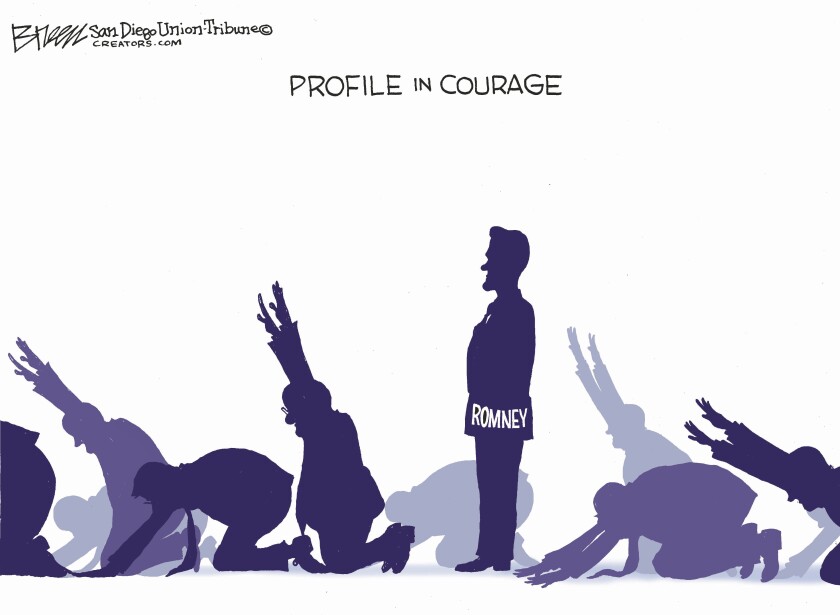
So far, for example, Mitt Romney is the only Republican in Congress who has expressed even a slight concern about either the flouting of the whistleblower law or the abuse of power allegedly described by the suppressed complaint. And his mildly expressed tweet is unlikely to make the White House quiver in fear.

If the President asked or pressured Ukraine’s president to investigate his political rival, either directly or through his personal attorney, it would be troubling in the extreme. Critical for the facts to come out.

My attention is focused on North Carolina Senator Richard Burr, the Republican who chairs the Senate Intelligence Committee. DNI Maguire’s refusal to release the whistleblower complaint is snubbing Burr in the same way that it snubs House Intelligence Chair Schiff. Will he roll over and accept that diminishment of his authority? Up until now, the Senate committee has been less partisan than the House committee. His Democratic counterpart, Senator Warner of Virginia, seems to express bipartisan confidence:

Senator Mark Warner of Virginia, the top Democrat on the Senate intelligence panel, said on Thursday that he and the committee’s Republican chairman, Senator Richard Burr of North Carolina, also expected both the inspector general and acting director to brief them early next week and “clear this issue up.”

We’ll soon see if that confidence is justified. If Burr demands to see the complaint, then things get interesting.

But in any case, if the Democratic majority in the House won’t move forward with impeachment, Senate Republicans will never be put on the spot. It may be true that they will respond in a corrupt and cowardly way. But if the question is never put to them, they don’t have to expose their corruption and cowardice.

Above all, Democrats need to ask themselves: If the abuse doesn’t stop here, with Trump pressuring a foreign leader to dig up dirt on his major rival, where will it stop?


[1] One important point is often getting shuffled aside: When government officials leak information to the press, critics ask why they didn’t do things “the right way”, by going through the official whistleblowing process. By all accounts, this whistleblower has done everything according to the proper legal process, and so far it is not going well: The complaint has not reached Congress, and it appears that the DNI has not protected his identity. The Justice Department (which has no role in the official process) has been consulted, and quite possibly the White House as well.

People throughout the government are watching. What many of them are learning, I suspect, is that if they know about wrongdoing, their only effective choices are to keep quiet or go to the press. I’m sure the Washington Post would be doing a better job of getting the complaint heard while protecting the whistleblower’s identity.

[2] The short version of the context is that Biden was one of many people pressuring Ukraine to get rid of the corrupt prosecutor, for a variety of reasons unconnected to Biden’s son. The dismissed prosecutor also claims that his Biden investigation had already concluded (without charges) before he was fired.

The Monday Morning Teaser

Another week where not much happened: Trump’s DNI is breaking the law to prevent Congress from hearing about yet another impeachable offense. Millions of people around the world rallied to demand action on climate change. Trump discussed attacking Iran, but instead sent “defensive” troops to protect the Islamist monarchy of Saudi Arabia, because they “pay cash”. (And does he mean cash to the US arms industry, or to the Trump Organization?) Israel had an election, and once again it looks like Netanyahu is out. The EPA is trying to take away California’s ability to set higher emissions and fuel-economy standards on cars. I’m sure I’m forgetting something.

In the featured post, I’ll focus on the illegally suppressed whistleblower complaint, which apparently concerns Trump’s attempt to strong-arm Ukraine into digging up dirt on Joe Biden. After reviewing what we know so far, I’ll pull back to make a larger point: The impeachable offenses aren’t going to stop. There’s something fundamentally wrong with the way Trump views his presidential power, and that wrongness is going to lead to increasingly outrageous abuses of that power. Anybody (like, say, Speaker Pelosi) who thinks we can just go on from here and talk about healthcare is kidding herself.

I’m running a bit late today, so that post may not be out until nearly 11 EDT. The weekly summary will cover all the other stuff I listed, plus some unimportant stuff like the Democratic presidential race, a striking decrease in abortions, and the return of junk health insurance. Let’s predict that for about 1.

Contrasts and Comparisons

Dozens are killed every year on skateboards. Thousands injured. Hey Beto! Heck yes, we’re going to take your SKATEBOARD!

Governor Mike Huckabee

My daughter didn’t hide in a fucking closet for 3 hours because someone was hunting and murdering her classmates with a skateboard. Asshole.

Barry Schapiro, MD

This week’s featured post is “The Democratic Healthcare Debate“.

This week everybody was talking about the attack on Saudi Arabia

Until Saturday, many of us foolishly imagined that the US could monopolize weaponized-drone technology for a while longer. But both drones and the weapons someone might put on them are comparatively cheap, and the science of them is far simpler than, say, nukes. Proliferation is inevitable.

Saturday, drones attacked Saudi Arabia’s oil facilities, at least temporarily knocking out about half of its oil production, or about 5% of the world total. Oil prices spiked by about 20% Monday morning, but settled back to about a 10% gain.

Yemen’s Houthi rebels, who Saudi Arabia is fighting in the Yemeni civil war, claimed responsibility for the attack. The Houthis are allied with Iran, and are known to use drones. The maximum range of Houthi drones is just barely long enough to put the attacked oil fields within reach. Nonetheless, the US is blaming Iran for the attacks.

A day after Secretary of State Mike Pompeo blamed Iran for the attack on Saudi oil facilities and argued there is “no evidence the attacks came from Yemen,” a senior administration official briefed CNN on information to back up Pompeo’s claims. Pompeo did not provide evidence, but the official pointed to satellite imagery provided to CNN showing the oil facilities were struck from the northwest, suggesting an attack from Iraq or Iran, among other information.

Iranian forces have a presence in Iraq. Iran denies attacking the Saudis, either from its own territory or from Iraq. Max Boot sees no reason to believe Pompeo’s claims “given how often the administration has lied about even minor matters”, but independently assesses that the Houthis “lack the sophistication to carry out such a surgical strike without a lot of help from their allies in Tehran”.

President Trump is threatening a military response against Iran, pending verification from the Saudis that Iran was responsible. Tensions between the US and Iran have been elevated ever since Trump pulled the US out of the agreement to keep Iran from acquiring nuclear weapons.

Matt Yglesias points out one of the problems Trump will have selling a war, if he decides to launch one: In addition to being president, “he also runs an opaque network of LLCs and does no financial disclosure, so we have no way of knowing how many cash payments he receives from the Saudi government.

and the Democratic debate

[video, transcript]

This is the first debate that put all the major candidates on one stage. To me, that had the subtle effect of making single-digit candidates seem stronger. Amy Klobuchar, Cory Booker, and Beto O’Rourke all had moments that sounded presidential.

I’d be surprised if the debate changed much at the top of the polls: Biden continues not to be the sharpest tool in the box, but he had no disqualifying gaffes and none of the attacks wounded him much. I could imagine that Warren stole some support from Sanders, but the effect was probably small, if it happened at all. (A 538/Ipsos poll more or less matches my intuition.)


I thought Castro’s “Are you forgetting what you said two minutes ago?” attack on Biden was unfair. The two of them were having a misunderstanding about the difference between “buying in” to Biden’s public option for healthcare and “opting in” rather than being enrolled automatically. Biden was clearly not forgetting what he had just said.


Beto’s most controversial moment was the strong position he took on assault rifles: As he has stated before, he supports not just banning new sales, but a mandatory buy-back of existing weapons.

Hell, yes, we’re going to take your AR-15, your AK-47. We’re not going to allow it to be used against our fellow Americans anymore.

I’ve spent the week in the upper South (North Carolina and Tennessee), where I heard several people tremble at the audacity of that, as if assault-weapon supporters were the majority of the country. This analogy has been made by many people before me, but often Democrats sound like victims of domestic abuse who are afraid that someone will set off their abuser. We worry that Beto’s threat will rile up AR-15 owners, and ignore the people who might be inspired to vote by the thought that somebody is finally going to get serious about mass shootings.

In a Republican debate, it would be no surprise at all to hear some candidate take extreme positions far more unpopular than Beto’s, say, that abortion should be criminalized, or that all 11 million undocumented immigrants should be rounded up and deported. No one worries that they will set off liberals; setting off liberals is considered a virtue in a Republican, not a vice.


In the discussion of mass incarceration, Biden’s statement that “no one should be in jail for a non-violent crime” is just wrong. Consider Bernie Madoff, for example. For that matter, Paul Manafort and Michael Cohen never pointed a gun at anybody, but instead fulfilled the Godfather adage “A lawyer with his briefcase can steal more than a hundred men with guns.” And if Trump obstructed justice — as the Mueller Report strongly indicates — he should go to jail.

It’s true that too many Americans are in jail, many of them for things that aren’t all that serious. But violent/non-violent is the wrong place to draw the line. More non-violent white-collar criminals should be in jail, but far fewer non-violent drug users.


Interesting poll from YouGov: They ran a ranked-choice poll, in which people listed their second, third, and fourth choices. Interestingly, Warren beat Biden in the ultimate face-off, even though Biden held a 33%-29% lead in the first round.

The poll suggests that Biden might be vulnerable in the later primaries, as the field starts to narrow. At the same time, though, we shouldn’t read too much into it for a number of reasons:

  • It’s just one poll, and different polls have diverged from each other quite a bit so far.
  • No state other than Maine currently does ranked-choice voting, so the poll doesn’t directly mimic any major primary.
  • Ranked-choice polling is in its infancy, so we don’t know yet how well it predicts people’s actual second and third choices. I might support Candidate A and imagine that B is my second choice, but if A drops out I might suddenly see the charms of C.

Another interesting polling quirk about Warren: She polls far better among people who care a lot about politics than among less involved people. This is true particularly in comparison to Bernie, who leads her substantially among those who are alienated from politics.

There are two obvious ways to interpret this: Either it’s a real division in the progressive electorate that will continue through the primaries, or support for Bernie over Warren depends largely on name recognition; as people get more information, they drift from Bernie to Warren.

Nate Silver favors the later interpretation, describing the political junkies who back Warren as “early adopters”.

and John Bolton

John Bolton, Mr. Walrus Moustache himself, is out as Trump’s national security advisor. Fired, quit — it depends on who you talk to. Incompatible differences. (It would be ironic if Bolton gets his long-desired war with Iran only after leaving the administration.)

Here’s a sign of the times: I agree with the Washington Post’s negative assessment of Bolton’s tenure as NSA (“chaos, dysfunction, and no meaningful accomplishments”), and yet I worry that he’s gone. I’m struggling to come up with an example of Trump getting rid of an official and replacing him with someone better. (OK: his second NSA, H. R. McMaster, was better than his first, Michael Flynn, who was being paid by foreign countries and should be going to jail soon. We can only hope that Trump NSAs are like Star Trek movies, where the even-numbered ones are superior.)

John Gans comments in the NYT:

Mr. Bolton’s singular achievement was to dismantle a foreign-policymaking structure that had until then kept the president from running foreign policy by the seat of his pants. Mr. Bolton persuaded Mr. Trump he didn’t need the National Security Council to make decisions; it is no surprise that the president eventually felt confident deciding he did not need a national security adviser, either. Whether Mr. Trump names a replacement for Mr. Bolton does not matter: No one is going to convince the president he needs a system now, let alone the one that existed for 70 years.

The underlying problem here is that Trump doesn’t really want a national security advisor, and doesn’t respect the expertise that the National Security Council represents. The official role of the NSA is to chair the NSC. The job entails listening to the government’s top military and intelligence people, summarizing their diverse points of view fairly, and presenting that summary to the President. (The WaPo’s version: “to oversee a disciplined policymaking process that includes the State Department, the Pentagon and intelligence agencies”.) The ideal NSA is often described as an “honest broker” pulling together the collective wisdom of the country’s foreign policy establishment.

Trump doesn’t want any of that. He has no interest in a “disciplined policymaking process”. He doesn’t care what the national-security experts have to say about what is going on in the world and what the US should do about it. He wants to be told that the world is exactly the way he thinks it is, and that his instincts for handling it are brilliant. Bolton was a terrible NSA, but at least he would occasionally disagree with Trump or tell him things he didn’t want to hear.


Ezra Klein sees the upside:

the best thing about Donald Trump is that he seems instinctually skeptical of going to war. His hiring of Bolton was a strike against that. His firing of Bolton is a rare bright spot in his presidency.

While Amanda Marcotte is balancing her negativism:

We need a German word for the confused emotions of seeing someone get what they deserve, while also hating the person who dished it out.

And Daniel Summers replies:

Let’s just hope there’s enough pox for both houses.

and you also might be interested in …

These days the really badass people in American politics are Democratic women. It started two years ago with fighter-pilot Amy McGrath, who is currently running for the Senate against Mitch McConnell.

And now Valerie Plame is raising the bar.


NYT reporters Robin Pogrebin and Kate Kelly didn’t drop the Brett Kavanaugh investigation after his confirmation vote. Yesterday the Times published an excerpt from their upcoming book The Education of Brett Kavanaugh. The excerpt concerns the accusation that didn’t get investigated, that “a freshman named Brett Kavanaugh pulled down his pants and thrust his penis at” Debbie Ramirez during a Yale party. If the NYT paywall has you stymied, Vox summarizes.

Josh Marshall heard the same thing I did in Kavanaugh’s testimony to the Judiciary Committee: He obviously lied about minor incidents mentioned in his high school yearbook.

There was no ambiguity. He was being scrutinized for a lifetime appointment to the Supreme Court and he was perfectly willing to lie under oath. The conduct was less egregious than the assault allegations. But the unambiguous evidence of willful and malicious deception was clarifying.


North Carolina is one of several states where gerrymandering maintains an entrenched Republican majority in the legislature against the will of the voters.

North Carolina has been one of the most gerrymandered states in the nation, both in congressional districts and state legislative ones. Democratic state legislators won a majority of the popular vote in 2018 but Republicans held control of both chambers.

Wednesday, the state’s Republican legislators found a new way to spit in the face of democracy. The legislature is currently in a budget battle with Democratic Governor Roy Cooper (who did get more votes than his opponent).

Since late June, the state has been stuck in a legislative impasse; Cooper vetoed a two-year budget bill, arguing it underpaid teachers, awarded unnecessary giveaways to corporations and failed to include a Medicaid expansion.

Republicans previously had a veto-proof majority in the legislature, but their 2018 loss at the ballot box at least clipped that part of their power. Wednesday, however, they came up with a new trick: After telling Democrats that no votes would be held on the September 11 anniversary, they waited for Democrats to attend a commemoration ceremony and then voted to override Cooper’s veto.

The veto override still has to pass the Senate, where it will need either one Democratic vote or some new trick.


Michelle Goldberg reviews the sequel to Margaret Atwood’s The Handmaid’s Tale. She notes the difference between a dystopia envisioned in the 1980s and the kind of dystopia we’re moving towards today: We used to worry about tyrannies that tightly controlled information, and hoped that the truth would set us free. Today the truth sits in a garbage heap of misinformation. It’s free for the taking, if you could only recognize it.


Speaking of how tyranny works today

Mr. Trump is openly hinting that CNN should be sold off in an effort to modify its coverage to something more of his liking. This is an increasingly common tactic among authoritarian leaders: no need to shutter a TV station, just find a friendly businessman or oligarch to buy it. Ask President Vladimir Putin of Russia, Viktor Orban of Hungary or Recep Tayyip Erdogan of Turkey how it is done.


More came out about #SharpieGate and the political pressure that produced that embarrassing Trump-over-science statement from NOAA. The NYT reported that

The Secretary of Commerce threatened to fire top employees at the federal scientific agency responsible for weather forecasts last Friday after the agency’s Birmingham office contradicted President Trump’s claim that Hurricane Dorian might hit Alabama, according to three people familiar with the discussion.

According to the Washington Post, the impetus came straight from Trump:

President Trump told his staff that the nation’s leading weather forecasting agency needed to correct a statement that contradicted a tweet the president had sent wrongly claiming that Hurricane Dorian threatened Alabama, senior administration officials said.

That led White House acting chief of staff Mick Mulvaney to call Commerce Secretary Wilbur Ross to tell him to fix the issue, according to the officials, who spoke on the condition of anonymity because they were not authorized to talk publicly about the issue.

This is not unusual. Trump regularly instructs government employees to cover up his mistakes or manufacture evidence for his lies.


Of all Trump’s crimes and abuses, I think it’s corruption that will ultimately bring him down. About the report from last week that US military planes have increasingly been using the obscure Scottish airport nearest Trump’s Turnberry resort (something he claimed to know nothing about):

documents obtained from Scottish government agencies show that the Trump Organization, and Mr. Trump himself, played a direct role in setting up an arrangement between the Turnberry resort and officials at Glasgow Prestwick Airport.

The government records, released through Scottish Freedom of Information law, show that the Trump organization, starting in 2014, entered a partnership with the airport to try to increase private and commercial air traffic to the region.


Mike Pence’s political action committee has spent $224K at Trump properties. His brother, Rep. Greg Pence, has spent $45K. The Daily Beast reports:

The spending by the Pence brothers reflects a broader trend taking place throughout the Republican Party, where officials are doling out campaign cash to properties and businesses associated with the president.

A decade ago, the major grift in conservative politics was to accumulate a list of gullible donors so that you could sell them miracle drugs the government has suppressed, or preparations for the coming collapse of civilization, or get-rich-quick multi-level marketing schemes. But it’s all more organized and much simpler now: Contribute money so that we can give it to Trump.


And while we’re talking about conservative grift, consider Jerry Falwell Jr.


The general insanity of open carry laws was demonstrated a week ago Saturday when a man with an assault weapon strolled through the popular farmer’s market in Alexandria, Virginia. This was a “freedom walk” organized by Right to Bear Arms Richmond.

I’ve been to that farmer’s market. It’s a bring-your-kids-and-dogs kind of event that is wholesome, upbeat … and would make an ideal site for a mass shooting, if you’re into that kind of thing. I’m sure the guy flashing his weapon felt very free, and that everyone else felt much less free. You have to wonder how many people saw the “freedom walker” and just went home.

Alexandria police were informed by R2BA-R ahead of time, and received complaints during the event, but there was nothing they could do. By Virginia law, such people aren’t doing anything wrong until they start shooting.

If you’re a prospective mass shooter these days, you don’t have to do so much of your own scouting and planning. Second Amendment activists will do it for you.

and let’s close with something natural

It’s easy to take a great nature photograph. Just go to a beautiful place and look up.

The Democratic Healthcare Debate

The differences are less stark and less consequential than either the candidates or the pundits would have you believe.


If you listened to the opening segment of Thursday’s Democratic debate, or the media discussion of it that followed, you might imagine that the ten candidates are sharply divided on healthcare. It’s easy to lose sight of the fact that the Democrats’ disagreements branch out from a fundamental agreement on two principles, both of which are wildly popular with the general public.

  • When Americans get sick, they should get the care they need.
  • Paying for needed care shouldn’t drive families into bankruptcy.

Republicans, by contrast, focus on cost rather than coverage, and plan to control costs by inducing money-conscious Americans to forego care. They envision a nation filled with people who over-use the healthcare system, and would do so even more if it weren’t so expensive (as if we all viewed a night in the ER as entertainment, and would happily schedule unnecessary colonoscopies just for kicks). And if those expenses result in hypertension patients trying to save money by doing without their prescriptions, or diabetics getting priced out of the insulin market … well, those are the sad-but-necessary results of keeping taxes low and profits high.

So the debate the Democrats are having, about how to achieve the twin goals of care without bankruptcy, just isn’t happening on the Republican side. [1] If you believe that sick Americans should get care that doesn’t bankrupt them, you should be a Democrat.

The debate. As you listen to the arguments among Democratic candidates, you need to bear that fundamental agreement in mind. The disagreements are all about how to achieve those goals: Go straight there with a massive expansion of Medicare to cover everyone, or move more gradually by adding a public option to ObamaCare? Replace the current private-insurance system (with its familiarity as well as its profiteering and inefficiency), or build on top of it?

The Trump administration, meanwhile, is backing a lawsuit that would declare ObamaCare unconstitutional and make all its provisions void. Insurance companies would once again be able drop coverage for people with preexisting conditions. [2]

Why the tax gotcha? One fundamental difference between Medicare-for-All and our current healthcare system is how it’s paid for: Many treatments that are currently paid for through premiums and co-pays would be paid by the government, i.e., through taxes. The taxes would be progressive, so the burden of payment would shift towards the wealthy.

I don’t fully understand why, but for some reason both the media and the candidates are treating this like a gotcha question: Interviewers are asking it in a challenging way and candidates are dodging it. I’m not sure why it’s so hard to say, “Payments you used to make through premiums and co-pays, you’ll now make through taxes, and unless you’re very rich you’ll probably pay a lot less.” If I were an MfA candidate, I’d back that up with a pledge: “By the time Congress has to vote on a package, independent analysts will have weighed in on the costs. And if it doesn’t save middle class households a substantial amount of money, we won’t do it.”

That said, there is one group of people who will pay more: Those who could afford to buy health insurance, but have been successfully betting that they won’t get sick. They’ll have to pay something in taxes rather than the nothing in premiums that they’re paying now.

How it will play out. The MfA vs. public-option debate comes down to two points.

  • The Medicare-for-All candidates (mainly Sanders and Warren) are right about efficiency. A universal healthcare system that covered everybody for everything would deliver better healthcare at a lower price than we’re paying now. That price would fall entirely on the government, so government spending would go up even as total healthcare spending went down.
  • The public-option candidates, who want to let the private health insurance industry keep running, but give people the option of a Medicare-like system, are right about the politics. Rightly or wrongly, large swathes of the public don’t trust the federal government enough to bet everything on a big government program with no alternatives.

Warren was right to point out that no one loves their insurance company. (Mine is Aetna right now, and no, I don’t love it.) But I think a lot of people like the idea of having another choice if MfA turns out not to be as great as advertised.

The problem is that some of the gains a universal MfA would produce depend on the universality: Doctors would only need to know one system. Public health programs with diffuse benefits could be instituted without worrying exactly who is going to pay what when. The public option would still be more efficient than private insurance, but not as good as it could be.

In the end, though, this debate is not going to make a difference, at least in the short run. Even if Sanders or Warren get elected, together with a Democratic House and Senate, the new president will still find that the votes aren’t there for Medicare for All. As we saw with ObamaCare, the program will be whatever it needs to be to get the last few votes. In other words, even with Democratic majorities and the elimination of the Senate filibuster, it is the 50th Democratic senator and the 220th Democratic representative who will call the tune. They will be moderates from swing districts.

So one way or the other, the program will get scaled back to a public option. If that program is allowed to go forward without sabotage (as Trump has been sabotaging ObamaCare), the public option will gradually gain public trust, setting up an eventual universal program that may well resemble Medicare for All.


[1] Given the wide popularity of the two fundamental Democratic points — sick people should get care without going bankrupt — Republicans generally avoid detailed discussions of healthcare. Block whatever the Democrats want to do and repeal ObamaCare, and then something will happen that solves everybody’s problems.

That came clear in the repeal-and-replace debate in 2017. The replace part was always vaporware whose details could only emerge after repeal.

That scam is still going on. WaPo’s Paige Winfield Cunningham reports that the White House has given up on the health care plan it said it was writing, to be released only after the 2020 election. “The Republican Party will become the Party of Great Healthcare!” Trump tweeted back in March. He promised “a really great HealthCare Plan with far lower premiums (cost) & deductibles than ObamaCare. In other words it will be far less expensive & much more usable than ObamaCare.”

Cunningham notes that there is no sign anyone is working on this. Groups that you’d expect to lead the charge for a Republican plan, like FreedomWorks, say they haven’t been told anything about it.

The problem is that there’s no Republican consensus for a plan to implement. RomneyCare was the only healthcare plan the GOP had, and their idea-pantry has been empty ever since Obama used Romney’s plan as the basis for his proposal.

The usual Republican answer, the free market, is a non-starter here. Private health insurance companies make money by insuring people who don’t get sick. Given its freedom, no company would insure sick people.

[2] Trump claims to want coverage for preexisting conditions, but has put forward no plan for how that would happen. BuzzFeed summarizes:

The GOP argument is that Obamacare disappearing would be so catastrophic — regulated markets would collapse, millions of low-income people would lose Medicaid, insurers could once again deny coverage to people with preexisting conditions — that Congress would have no choice but to set aside their differences and pass a replacement.

We saw something similar play out with the Budget Control Act of 2011. Supposedly, the automatic budget cuts (the “sequester”) that would set in if Congress couldn’t come to an agreement were so onerous that of course Congress would come to an agreement. We’ve been dealing with the sequester ever since.

In general, if somebody’s plan is so onerous that it can only be announced in the face of an emergency, I want no part of it.

The Monday Morning Teaser

The big news this weekend — the drone attack on the Saudi oilfields — is still unfolding: We don’t know how convincing the administration’s attempt to pin the blame on Iran will be, or what kind of response against Iran it might carry out. We don’t know whether the disruption in the world oil market will be a blip or a longer-term shortfall in supply. We don’t know whether there will be further attacks.

As I’ve often said, a weekly one-person blog can’t compete with the major networks on breaking news, so I won’t try.  In the weekly summary I’ll set up the general situation, but leave the up-to-the-minute developments to outlets better equipped to handle them.

The featured post this week will focus on the healthcare debate among Democrats. I will argue that the differences between the candidates are overblown in two ways: All the candidates believe in two sweeping principles (that Republicans deny), and (whoever is president, and even if Democrats win both houses of Congress) the program will need the votes of the most conservative Democrats. So the program that gets passed will look very similar to a program that would be passed under a different president.

That post should be out shortly.

The weekly summary will cover the drone attacks, the rest of the Democratic debate, John Bolton, another weekly dose of corruption and deceit from the Trump administration, and a few other things. I hope to get that out by 11 EDT.

Limits to Wealth

I get it that in America, there are gonna be people who are richer and people who are not so rich. And the rich are gonna own more shoes, and they’re gonna own more cars, and they may even own more houses. But they shouldn’t own more of our democracy.

Elizabeth Warren

This week’s featured post is “Looking for President GoodClimate“.

This week everybody was talking about political chaos in the UK

(I was going to say “anarchy in the UK”, but I was afraid you had to be my age to recognize the Sex Pistols reference.)

The signature virtue of a parliamentary system is supposed to be that the government’s top executive, the prime minister, by definition has a majority in parliament. That avoids the kind of gridlock or constitutional crises that America’s presidential system is prone to.

Boris Johnson, however, has lost most of the votes in parliament since he became prime minister, including a big one on a bill that orders him to ask the EU for an extension of the October 31 Brexit deadline if a deal with the EU hasn’t been reached by October 19. That bill has been approved by the Queen and is an official law now.

21 members of Johnson’s Conservative Party voted against him on the bill, whose main purpose is to avoid the no-deal Brexit that Johnson seemed to be maneuvering toward. Johnson ejected them from the Party, so he now doesn’t have a ruling majority. Ordinarily, that would result in a vote of no-confidence and a new prime minister or maybe even a new election, but for a variety of reasons Johnson’s opponents don’t want either of those right now. So he’s sailing along without a majority behind him.

It doesn’t actually matter at the moment, because Parliament is now suspended until October 14, a controversial move Johnson made to try to limit Parliament’s ability to tie his hands.

The Washington Post outlines Johnson’s four options:

  • Negotiate a deal with the EU. This seems unlikely, since talks have more-or-less broken down. The biggest hang-up is the Irish border, as I discussed last week. Johnson met with his Irish counterpart, Leo Varadkar, but “Varadkar said at a Monday morning news conference that Johnson had yet to give him any solid proposals.” There’s a reason for that: The kind of Brexit Johnson wants is incompatible with the Good Friday Accords that ended the civil war in Northern Ireland.
  • Do what Parliament asked him to do: request another delay. This would be humiliating, and Johnson has said he would “never” do it. But, like Trump, Johnson says a lot of things, and they don’t all mean what they appear to mean.
  • Resign. His replacement would probably delay Brexit, but Johnson could then run against that move and maybe win.
  • Go to jail. Sure, Parliament passed a law, but how serious is that anyway? Johnson could not ask Brussels for an extension, be cited for contempt of Parliament, and go to jail. But October 31 would arrive and a no-deal Brexit would go through.

One lesson here echoes the US’s recent troubles: Democracy depends on traditions and norms as much as constitutional provisions, because there are always anti-democratic options that aren’t taken because you just don’t do that. The system keeps going because everyone wants the system to keep going. If a country loses that, things fall apart.

and the CNN climate townhalls

Wednesday, CNN devoted seven hours of its schedule to asking ten Democratic candidates questions about climate change. I discuss my reaction in the featured post.

and another week’s worth of malfeasance

Previous administrations have all danced this dance with the media:

  1. The president says something false or ridiculous. (They all do, sooner or later. Human beings are like that.)
  2. The media points out the mistake.
  3. Either the president or his spokespeople acknowledge the mistake.
  4. The media moves on.

Again and again, President Trump has refused to dance: He is congenitally incapable of admitting a mistake, or of tolerating one of his people admitting he made a mistake. Instead, he repeats the false claim, has subordinates lie to support the false claim, and gets mad that the media refuses to move on.

After he loudly warned of the dangers of a caravan of migrants in 2018, administration officials cited a terrorism arrest statistic that was proven false. When Trump said he had ready a middle-class tax cut plan before the midterm elections, though nothing had been discussed, officials scrambled to craft a plan. When Trump fumed that the size of his inaugural crowd was reported to be smaller than his predecessor’s, White House press secretary Sean Spicer was forced to defend the false claim. And even when Trump mistakenly tweeted the nonsensical word “covfefe” late one night, the president, instead of owning up to a typo or errant message, later sent Spicer to declare, “I think the president and a small group of people know exactly what he meant.”

It got comical this week, as Trump refused to admit that his warning of Alabama being threatened by Hurricane Dorian was, at best, based on outdated information. In order to prove his point, he showed the press a NOAA map that he had crudely altered with a Sharpie, an action that is actually illegal.

As predictable and true-to-type as this series of events was, I find it disturbing. Fortunately, Hurricane Dorian was a problem that the lower-level processes of government were able to handle, so the comedy going on in the White House did little real harm. But what if Trump ever faces a Cuban-Missile-Crisis-level challenge? Will the president and his staff focus on the reality of the situation? Or will they spend all their time arguing that whatever the president did leading up to this situation wasn’t a mistake, even if it was?


This week we got two more examples of an ongoing scandal: the way that Trump uses the power of the presidency to enrich himself. The self-dealing started with his 2016 campaign, which had its offices in Trump Tower and paid rent accordingly. (This is still going on. If you’ve ever contributed to Trump’s campaign, a chunk of your money wound up in his pocket.)

After he became the nominee and then president, Republican Party events shifted to Trump properties, so that he could profit from them too. (If you’ve donated to a Republican congressional candidate, possibly some of that money has also wound up in Trump’s pocket.) The Trump International Hotel in D.C. has become the place for favor-seekers — both foreign and domestic — to hang out.

Last week we found out that Attorney General Barr is spending $30K of his own money to host a holiday party at the Trump International, essentially kicking back a sizeable chunk of his salary to his boss.

That all may be unsavory, but at least it’s private money. However, it is becoming more and more common for taxpayer money to also flow to Trump. Whenever he plays golf at Mar-a-Lago or Bedminster, for example, his entourage has to get rooms at his resort, and his security detail needs to rent golf carts to follow him around. When he meets foreign leaders at Mar-a-Lago, or if he succeeds in hosting the 2020 G7 at his Doral resort, public money flows to him.

One new instance of taxpayer money going to Trump was Vice President Pence’s stay at the Trump International Golf Links and Hotel in Doonbeg, Ireland. He was in Ireland as part of an official visit, but his meetings with Irish officials were in Dublin, 181 miles away on the other side of the Emerald Isle.

Trump has suggested before that Cabinet officials and advisers stay at his properties while they are traveling. He himself has spent 289 days of his presidency at a Trump property, according to a CNN tally.

Trump himself stayed there on a previous visit, at a $3.6 million cost to the taxpayers.

One excuse frequently given is that Trump’s properties are more convenient for a security entourage, but Secret Service veterans say no.


A second incident that raises suspicion of corruption is Politico’s report that military flights have been refueling at the obscure Prestwick Airport in Scotland — the one closest to Trump’s Turnberry resort. Politico identified one occasion where a C-17 taking supplies from the US to Kuwait refueled at Prestwick and its crew stayed overnight at Turnberry. It seems likely this has happened many times, because the military ran up an $11 million fuel bill at Prestwick.

Typically, such flights refuel at US military bases. (There was one nearby in England.) Fuel is cheaper there, and housing is already paid for. But the president makes no money out of that arrangement.

The House Oversight Committee is investigating these stop-overs, and the Pentagon seems to be stonewalling.

“The Defense Department has not produced a single document in this investigation,” said a senior Democratic aide on the oversight panel. “The committee will be forced to consider alternative steps if the Pentagon does not begin complying voluntarily in the coming days.”


Here’s how far the Trump administration is willing to go to make climate change worse, and how the traditional independence of the Justice Department has been compromised. In the Barr DoJ, advancing the president’s political agenda is a higher priority than enforcing the law, as established by this: The four auto companies who agreed with California’s fuel-economy standards (51 mpg by 2026) rather than Trump’s lower ones (37 mpg) are now under antitrust investigation.

The NYT calls this “a cruel parody of antitrust enforcement“, and says:

The investigation is particularly striking because the department has shown little interest in preventing corporations from engaging in actual anticompetitive behavior. This summer, for example, the department blessed T-Mobile’s acquisition of Sprint, a deal likely to harm mobile phone consumers and workers, and to impede innovation.

If the Justice Department wants to get serious about antitrust enforcement, there are plenty of places to get started. This investigation is an embarrassment.

and you also might be interested in …

The next Democratic debates are Thursday. The requirements were set higher this time, so only ten candidates qualified and they’ll all appear on the same stage. They’re the five I would have chosen myself: Biden, Warren, and Sanders, obviously. Harris and Buttigieg being the most likely to break into that top tier. Then Beto, Klobuchar, Booker, and Castro, all of whom bring resume and substance you’d expect of a major candidate. Of the outsider upstarts, only the most interesting, Andrew Yang. Marianne Williamson and Tom Steyer didn’t qualify.

All the white guys running to the right missed the cut: Hickenlooper, Bennet, Bullock, Ryan, Moulton, and Delaney won’t be there. Also missing this time around will be Gabbard, Gillibrand, De Blasio, and Inslee.

Hickenlooper, Moulton, Gillibrand, and Inslee have dropped out. The other non-qualifiers should give that some serious thought.


Talks with the Taliban have broken down, just as talks with the North Koreans have broken down, and talks with China won’t resume until next month. It remains to be seen whether the Trump administration can complete a deal.

The Afghan government, which so far has been excluded from the talks, was pleased.


Wednesday we got the full list of Pentagon projects that won’t happen because Trump took the money to build the southern border wall.

The Defense Department intends to ask for new money to refund these projects in next year’s budget, but Democrats are reluctant to appropriate money twice.

Recall how we got here: Congress refused to fund the border wall in last year’s budget, even after Trump shut down the government for 35 days. Instead, he declared a state of emergency — despite the fact that the only emergency on the border is the one he made — and used emergency powers to move money around. Congress voted to revoke the state of emergency, but Trump vetoed that resolution and there weren’t enough votes to override his veto.

Mitch McConnell, whose state is losing a new school for Fort Campbell, blamed Democrats.

We would not be in this situation if Democrats were serious about protecting our homeland and worked with us to provide the funding needed to secure our borders during our appropriations process

One fact is being left out the public discussion: Money for the wall was negotiable, if Trump had been willing to give the Democrats something they wanted, say, a resolution of the DACA situation. (The deal Trump offered didn’t resolve DACA, but included just a temporary reprieve from deportation.) But Trump didn’t want a negotiated settlement; he wanted a victory.


Here’s the Biden electability argument in a nutshell: A poll by the Marquette University Law School has Biden beating Trump in Wisconsin by 9 points. Sanders beats Trump by only four points. Harris and Warren are tied with Trump.

The clearest path to beating Trump in 2020 is for Democrats to flip back Pennsylvania, Michigan, and Wisconsin. Wisconsin is widely seen as the most difficult to win back, so the election could hinge on it.

and let’s close with some misunderstandings

A misheard song lyric is known as a mondegreen, a word which itself comes from a misheard lyric. Here’s a collection of mondegreens.

Looking for President GoodClimate

Wednesday, CNN devoted its entire primetime schedule to letting voters question ten leading Democratic presidential candidates (the same ten who qualified for the debate this Thursday) about their plans for dealing with climate change. I didn’t spend the full seven hours sitting in front of my TV, but I did read all the transcripts, which you can find here.

I suppose it was naive of me to hope that these townhall Q&A sessions would settle which candidate would be the best president for the climate. You may come away with a different impression, but mine was that none of the candidates eliminated themselves and none stood head-and-shoulders above the others. All agreed that climate change is a serious problem that requires significant action, and that taking that action is going to be difficult. None put forward the fossil-fuel industry talking points that you would hear in a comparable Republican setting: climate change is a hoax, the climate is always changing, nothing can be done to stop the climate from changing, doing anything will be too expensive, or the US should wait for other nations to do something first.

The things they disagreed about were fairly technical: a carbon tax vs. a cap-and-trade system vs. direct government regulation; exactly how much should be budgeted for fighting climate change and where it should come from; whether nuclear power plays any role in our post-fossil-fuel future; how much sacrifice should be expected from the average person; how to mitigate the sacrifices asked of vulnerable populations; and so forth.

In short, any of the ten would contrast strongly with Trump’s positions on the issue. (To the extent that Trump has done anything about climate change, he has opted to make it worse: pulling out of the Paris Accords, trying to roll back Obama’s automobile-gas-mileage standards, rolling back limits on power plants burning coal, rolling back regulations on methane leaks, and so on.) But which of them would be the most effective president for fighting climate change?

Reading the transcripts told me less about the candidates that it did about myself and what I’m looking for. I think that President GoodClimate has to jump several very different hurdles. He or she needs to have:

  • a vision
  • a plan that carries out the vision
  • a message to rally the public behind the vision and the plan
  • the ability to leverage the vision, plan, and public support to push Congress to pass the needed legislation and appropriate the needed money
  • the ability to use the gravity of the crisis, the example of US action, and US soft power to push other nations into action.

Jumping each hurdle requires a different skill-set; we need a president who can jump them all.

The vision and the plan. The example everyone uses for this is President Kennedy setting the goal of landing a man on the Moon by the end of the decade. Kennedy announced that vision in 1962, and it came to fruition right on schedule in 1969.

The reason this is a good parallel is that Kennedy himself had no idea how to land a man on the Moon, and in fact no one did at the time he set the goal. New techniques and technologies had to be invented for the project to succeed. At the same time, though, he managed to set a goal that was realistic. If he had announced that we would land a man on the Moon by Christmas, it wouldn’t have happened. And when Christmas came and went with no Moon landing, public enthusiasm for the whole project might have waned.

Those advances would not have happened, though, if Kennedy (and President Johnson after him) hadn’t put serious resources into making them happen. Also, the plan involved immediate action as well as speculative research. Project Mercury was already underway, and John Glenn had orbited the Earth earlier that year. When NASA had a serious setback (the cabin fire in 1967 that killed the crew of Apollo 1 during a ground exercise), the country had the tenacity and commitment to continue.

So what I’m looking for in a climate vision and plan aren’t just the most ambitious goals and the highest price tag. The vision and the plan have to ring true in some way that is hard to define. The plan needs to reach beyond what we know how to do right now. (For example: If we’re going to generate much, much more of our electricity from wind and solar, we’ll need better ways to store power on windy and sunny days.) But it can’t reach so far beyond that it loses credibility. And it has to start by ambitiously doing the things that we already know how to do; we can’t twiddle our thumbs and then depend on some magic invention appearing in the nick of time a decade from now.

An aside on cheeseburgers. It’s predictable what’s going to happen when the next president announces his or her X-trillion-dollar climate plan, which also puts limits on the fossil-fuel industry, raises the cost of certain environmentally costly consumer goods, and bans others entirely: Fossil-fuel companies (both in their own voices and by funding unofficial spokesmen behind the scenes) will become advocates for “freedom”, and there will be either a real or astro-turf uprising against this “government overreach”.

You could see this already in the questions in the CNN forum. Several candidates had to answer questions more-or-less like: “Am I still going to be able to eat cheeseburgers?” Plastic straws and incandescent light bulbs also came up. The-government-is-coming-for-your-cheeseburgers has been a very effective pro-carbon argument.

The right answer to this challenge is multi-faceted, and it’s hard to make all the points at once. Part of the answer is to invoke the seriousness of the problem and shame the triviality of the question: Do you really want to condemn your grandchildren to a Mad-Max hellscape so that you can keep eating cheeseburgers, burning inefficient lightbulbs, and using plastic straws? The World War II generation accepted gas-rationing and a number of other artificial hardships to save the world from fascism. Is there nothing you’re willing to give up for future generations?

The second facet is to bring the question back to reality. Yes, the carbon footprint of a cow is much greater than a comparable weight of chickens, or a potato patch. So yes, as a country we need to shift our eating habits so that we consume less beef and dairy. But that doesn’t mean we have to ban cheeseburgers. Maybe a cheeseburger becomes more expensive. Maybe it turns into an occasional treat rather than a staple of your diet. But the government is not coming for your cheeseburgers.

Third, the crimps on your personal lifestyle are going to be a small part of a much bigger change. You’re not going to have to bear the whole sacrifice. This is what Elizabeth Warren was getting at in her answer to the cheeseburger question:

This is exactly what the fossil fuel industry hopes we’re all talking about. That’s what they want us to talk about. … They want to be able to stir up a lot of controversy around your lightbulbs, around your straws, and around your cheeseburgers. When 70 percent of the pollution of the carbon that we’re throwing into the air comes from three industries.

And finally, we’re going to try to be smart about this, so that changes will be as painless as possible. Lightbulbs are actually a good example in this regard. When the Bush administration decided to change the nation’s lightbulbs, it didn’t just ban incandescent bulbs overnight and make us light candles or sit in the dark. The wasteful bulbs are off the shelves now (at least until Trump finds a way to bring them back), but instead we have better bulbs: longer-lasting, cheaper to operate, and so on.

Beto O’Rourke, for example, expressed his confidence in the ingenuity of American farmers and ranchers to produce the same foods with a smaller carbon footprint. (I don’t doubt that he’s right about that, but I question whether it will be enough.) And yes, today’s paper straws aren’t as good as plastic straws. But is it truly beyond the limits of science to make an equally good straw out of paper or some other biodegradable material?

Or take cars. I drive a 100,000-miler hybrid Honda Accord. My current tank of gas is getting over 45 miles per gallon, and that’s not unusual. If government standards had insisted on 45 mpg decades ago, everyone would have been forced to drive underpowered subcompacts. But I don’t suffer from a lack of room or pep in this car. Similarly, today’s all-electric cars won’t take you as far in a day as most of us would like go on a long driving trip. But someday soon they will. A future of electric cars powered by wind and solar doesn’t mean we’ll have to give up on driving the family to Yellowstone.

Rallying support. So anyway, President GoodClimate is going to face well-funded resistance that will appeal to people’s fears and resentments. Combating that is going to require a lot of political skill, simultaneously shaming people out of their petty self-centeredness and inspiring them to take on the challenge of saving the world.

Who’s up to that? Who can create not just a vision and a plan, but a message that raises public enthusiasm around implementing the plan, even if it requires some sacrifice?

And suppose the public does support the plan. That doesn’t necessarily mean Congress will pass it. We see that now in gun control. Universal background checks (which might have stopped the recent Texas shooting) are ridiculously popular, with 97% support in one recent poll. They’ve been popular for years now, and yet somehow they don’t happen. In Congress, a small, intense, well-funded resistance can overcome broad but lukewarm popular support.

That points to a different kind of political skill, the ability to put together deals that make things happen. We tend to think in either/or terms about this: an inspirational progressive visionary like Sanders or Warren, versus a moderate deal-maker like Biden or Klobuchar. But the next president has to do both.

Tomorrow the world. In a Republican presidential debate in 2015, Marco Rubio said “America is not a planet.” He was making the defeatist point that no one country, not even one as important as the United States, can solve the climate problem by itself. Even if we do everything right, it won’t make any difference if no one else goes along.

This is a common conservative trope: Collective action is impossible and individual action inadequate, so we should just do nothing.

If we buy into that line of thought, though, we condemn the next generation to a world of rising seas, expanding deserts, mass migrations, and war. The tens of thousands of migrants who currently try to cross our borders every month will be nothing compared to the masses we’ll see when much of Bangladesh is underwater and new deserts have appeared in places that now support a booming population. Even within the US, how much hotter can places like Phoenix or Houston get and still be habitable?

Fortunately, the image Rubio evoked — of the US doing everything it can and the rest of the world dragging its feet — is the exact reverse of the truth. In reality, the US is the country holding the world back. Why should India stop burning coal if the US won’t? Europe is way ahead of us in adopting sustainable electric power. Today, the biggest challenge facing environmental activists around the world is how to make change happen without the United States.

So it would be a huge improvement if the next president just went along with what other nations are doing. (If only we could invest in mass transit like China and in solar and wind power like Germany.) But the world needs more than that. The US combination of economic, scientific, and military power makes us uniquely positioned to lead. Until Trump started tearing them up, we had meaningful alliances with most of the other major powers. It would make a huge difference if we could be the world’s good example rather than its bad example.

So even as the next president turns American climate-change policy around, he or she has to be working with the world to raise standards, and to establish trade policies that promote climate-positive action around the world, rather than allowing carbon-pollution to shift to the country with the lowest standards.

The next president can be a rallying figure internationally, as Kennedy was we he said “Ich bin ein Berliner”, or Wilson was when he enunciated his 14 points for ending World War I. Who can do that? The next president also needs to be a negotiator like FDR and an alliance-builder like Truman or Eisenhower. Who can do that?

I don’t know, or at least I don’t know yet. The climate forums have just given me more questions . The answers I’m looking for are only partly contained in the programs the candidates outline on their web sites. They also require evaluating character and talents.

These are harder questions than I had thought, so it’s going to take a bit longer to make up my mind.

The Monday Morning Teaser

This week the tragedy led to comedy. Trump’s inability to admit even the most trivial mistake led to “SharpieGate”, and a number of very funny responses.

This week also included the CNN climate forums, where ten Democratic candidates faced questions about climate change. (Wouldn’t it have been nice to include President Trump in that? To hear him ramble and bumble and dodge the questions that Democrats all answered adroitly?) I don’t know whether I expected those sessions to resolve something for me, but what it really did is make me sharpen what I’m looking for in a candidate. That meditation will be this week’s featured post “Looking for President GoodClimate”, which should be out by 10 EDT or so. (Am I dating myself with the “Looking for Mr. Goodbar” reference?) Maybe next week I’ll try to apply my new standards to actual candidates.

The weekly summary will discuss SharpieGate, new examples of Trump administration corruption, the political chaos Boris Johnson has unleashed on the UK, the projects that won’t happen because Trump took the money to build his wall, the upcoming Democratic debates, and a few other things. I’m trying to get that out by noon, but I don’t have a lot of confidence in that deadline.

Better or Worse

At its best, the practice of politics is about taking steps that support people in daily life — or tearing down obstacles that get in their way. Much of the confusion and complication of ideological battles might be washed away if we held our focus on the lives that will be made better, or worse, by political decisions, rather than on the theoretical elegance of the policies or the character of the politicians themselves.

– Pete Buttigieg, Shortest Way Home

There is no featured post this week. But I’m trying out a new format for an extra-long weekly summary: a topic list at the top.

1. Cruelty, short-sightedness, and corruption. One week’s worth of administration activity.

2. Hurricane Dorian. Category 5 storms don’t seem all that rare any more.

3. More shootings. The wait-three-weeks strategy for avoiding action on gun control won’t work unless we can go three weeks without a shooting.

4. Brexit. Boris Johnson is setting the UK up for a no-deal Brexit, and Parliament will have a hard time stopping him.

5. James Comey. The FBI inspector general’s report is too boring to read, so anybody can say whatever they want about it.

6. A court ruling. An appeals court ruling on legislative prayer is yet another example of the fundamental flaw of originalism.

7. Other short notes. Hong Kong, trade war, Mayor Pete’s book. Democratic debate on the 12th.

8. A heart-warming closing. A dolphin asks a diver for help.

This week everybody was talking about cruelty, short-sightedness, and corruption

Some weeks, it seems like the Trump administration is trying to do as much damage as possible in its remaining two years. Here are some examples from just this week:

  • The EPA wants to allow more methane leaks at wells and pipelines. Methane is such a potent greenhouse gas that if too much leaks into the atmosphere during the production and transportation processes, natural gas can be worse for the climate than coal. The EPA’s move to roll back anti-methane-leak regulations undermines the strategy of using natural gas as a better-but-not-perfect bridge fuel while we develop more climate-friendly sources. That’s why even industry giants like Shell, Exxon, and BP support the Obama regulations the EPA wants to abandon.
  • Alaska’s Tongass National Forest may soon be open for logging. It’s one of the last wild places on Earth, and about 40% of the West Coast’s wild salmon spawns there.
  • Sick immigrants are being sent home to die. Every year, about 1000 immigrants facing deportation orders ask to stay in the US because they’re receiving medical care that isn’t available in their home countries. Many of them are children and many of the conditions are life-threatening. The Trump administration is canceling this “deferred action” program and has sent letters giving sick people 33 days to leave the country.
  • Not all children of Americans serving overseas will be citizens. Usually, when American parents have a child while they’re out of the country, that child is automatically a US citizen. The law makes an exception for Americans who had lived in the US less than five years before they left the country, but there’s always been an exception to the exception: If the reason you left the US was for the military or other government service, your kid is a citizen. But that exception-to-the-exception is being rolled back. “Who possibly thought this was a good idea?” asks an immigration lawyer.
  • Attorney General Barr is kicking back to the President. Barr has booked the Trump International Hotel in D.C. for a 200-person holiday party that he will pay for personally, at a cost upwards of $30K. (Barr’s Justice Department is also defending Trump against lawsuits claiming that foreign spending at the hotel is an unconstitutional emolument.) Kickbacks are a classic form of corruption: The political boss doles out jobs and contracts from the public treasury, and the people who get them give a chunk of the money back to the Boss. This is Tammany Hall stuff.
  • Trump is steering the next G7 to his struggling resort. Another classic form of corruption is for a public official to steer public contracts towards his allies in the business community. When the Boss owns the business himself, it eliminates the middleman. The US is scheduled to host the 2020 G7 meeting, and holding it at the Trump Doral Resort has many advantages — for Trump. It will draw a lot of foreign money (i.e. unconstitutional emoluments) to his property, give it lots of free publicity, and increase its prestige. Whatever advantages it has for the US or the G7 are much less clear.
  • Building the wall is more important than obeying the law. Reportedly, Trump has told his underlings to get his border wall built before the 2020 elections, and ignore laws that protect the environment and defend private property. He says he will pardon them. The White House did not deny that he said this, but claimed that he was joking.

Stay tuned. I’m sure there will be new outrages next week.

and a hurricane

As usual, I’m not going to try to compete with CNN and the Weather Channel on hurricane coverage. Dorian hit the Bahamas as a category-5 storm last night. The current prediction has it heading up Florida’s Atlantic coast towards Georgia and the Carolinas. Where or whether it will make landfall in the US is still uncertain.

This is the fourth consecutive year with a category-5 Atlantic hurricane.


Former Canadian Prime Minister Kim Campbell aroused a furor with a since-deleted tweet rooting for Dorian to hit Trump’s Mar-a-Lago resort in Palm Beach. (Dorian has turned north since then.) I generally disapprove of wishing harm on people, but I see her point here: Trump is so self-centered that nothing less than a personal loss will make him take climate change seriously.

and more shootings

Studies have shown that the public clamor to do something about gun violence tends to die down about three weeks after some horrific shooting. So that’s been the gun lobby’s strategy: stall for three weeks until public attention moves on.

But now we’re running into the limits of that strategy: It only works if the country can go longer than three weeks between shootings. Saturday’s mass shooting in Texas (on the highway connecting Midland and Odessa) came four weeks after the August 3 mass shooting in El Paso and August 4 mass shooting in Dayton. Those two were about a week after the Gilroy Garlic Festival shooting.

The Texas shooting knocked Friday night’s high-school shooting in Alabama out of the news. At least six teens were shot at a football game, but nobody died.

Will something happen this time? Governor Gregg Abbott says “I’m tired of the dying of the people of the state of Texas. The status quo is unacceptable.” But does that mean he’ll actually do anything? (Texas actually loosened its gun laws, effective yesterday.) Promising action that never arrives — as Trump did after Dayton/El Paso — has become part of the delay-three-weeks playbook.

Congress returns from recess next week. Two very reasonable background-check bills have passed the House already, but Mitch McConnell has blocked any vote on them. There has been talk about a red-flag law or the renewal of the assault weapon ban that lapsed during the Bush administration. But will anything happen?


A California workplace has an expert come in to instruct the staff on what to do if there’s an active shooter. The expert is Kayley, a girl who has had to learn all this in school.

and the countdown to a no-deal Brexit

One extreme (but very unlikely) solution to the Brexit problem is the Celtic Union shown on the map: England could go its own way while Northern Ireland, Scotland, Wales, and Cornwall stay in the EU.

An only slightly less radical path is the one Prime Minister Boris Johnson (a.k.a. the Trump of England) is maneuvering towards: The UK busts out of the EU on October 31 with no deal.

The sticking point in getting a deal with the EU is what to do with Northern Ireland: The whole point of Brexit (at least in the minds of its major supporters) is to have hard borders, so that the UK can reclaim control over the people and products that come into the country from  other EU nations. But the soft border between Ireland and Northern Ireland is at the center of the Good Friday Accords that ended the Troubles in Northern Ireland.

The EU has taken a hard line against a hard Irish border, because it feels an obligation to represent the interests of the country that is staying in the union: Ireland.

Johnson and his fellow Brexiteers have a very nuanced counter-offer: Fuck the Irish.

OK, that’s an exaggeration. Johnson is currently saying the exact opposite  — that there won’t immediately be new border checks in Northern Ireland. But he won’t say what there will be, and ultimately there’s no way to achieve his Brexit goals without a border that checks passports and collects tariffs. So the real message is more like: “Trust us. We wouldn’t fuck the Irish, would we?” Like the American Trump, though, Johnson is not particularly trustworthy.

The previous Tory government of Theresa May spent three years trying to deny the intractability of this problem. So May finally recognized her predicament and got out the only way she could: by resigning. Her successor has a different way out: Don’t let Parliament get in the way, so that a no-deal Brexit can just happen on October 31 whether Parliament likes it or not. The Economist describes the situation like this:

This week opposition parties agreed that, when the Commons returned on September 3rd, they would try to hijack its agenda to pass a law calling for another extension of the Brexit deadline. But a day later Mr Johnson trumped them by announcing a long suspension of Parliament, from September 11th to October 14th, when a Queen’s Speech will start a new session. … At almost five weeks, it will be Parliament’s longest suspension before a Queen’s Speech since 1945.

That leaves two weeks for Parliament to do something to avert a no-deal Brexit. But that’s the rub: It would have to do something: revoke the UK’s request to leave the EU, form a new government … . And that’s been the problem from the beginning: Brexit has always been just a vague idea; as soon as you zero in on an actual scenario, support goes away.

David Allen Green writes in the WaPo:

What will linger either way is the deep sense of wrongness, of the government attempting to unfairly (if not unlawfully) game the constitution so as to prevent legitimate checks and balances. This will not end well, whatever happens.

Basically, Johnson’s maneuver takes a we-made-a-mistake situation and turns it into a somebody-screwed-us situation.

What’s so bad about no deal? The UK is an island nation, so naturally a lot of necessities are imported. Roughly half of the UK’s foreign trade is with the EU. No one is proposing to cut off that trade, but suddenly it will have to find new legal channels. Businesses in the EU will still want to export to the UK (and vice versa), but they won’t know how to do it while new standards and practices are worked out. Ports and crossings that were designed for an open border will suddenly have to start checking passports and collecting tariffs, which will lead to considerable delays.

Likely problems were listed in a government document that leaked a few weeks ago.

In addition to the immediate chaos, a number of political consequences are likely within the UK: Scotland decided against independence in 2014, but Scots also voted overwhelmingly to remain in the EU. So the independence issue will rise again, particularly if a chaotic no-deal Brexit happens without Scottish MPs having a chance to vote against it.

And then there’s Northern Ireland, where the Troubles are already starting to rumble again.

and James Comey

The FBI Inspector General released its report on James Comey’s handling of the memos documenting his interactions with President Trump. I’ll warn you: This is a mind-numbingly boring document. And that’s unfortunate, because it means that most people will rely on someone else to read it for them. That, in turn, means that most people will only hear the spin allowed into their usual news bubbles.

(Something similar happened with regard to the State Department inspector general’s report about Hillary Clinton’s emails, as I reported at the time.)

Let me summarize the general shape of story here, which I think everyone agrees on: While he was FBI director, Comey wrote memos after meetings with President Trump. At the time, he had classification authority over those memos, all but two of which he decided were entirely unclassified. The ones that he judged to include classified information, he handled correctly.

Just before Comey was to testify before Congress (i.e., after he was fired), a group at the FBI reviewed the then-unclassified memos and decided that six words of one and a paragraph of another should be classified at the lowest level, Confidential. The newly classified parts were moments when President Trump had been talking about foreign countries and leaders, and the FBI group reasoned that revealing those statements might cause embarrassment to the US, because some of the countries or leaders might feel slighted. [My opinion: This is a judgment call people might legitimately disagree on, and in any case, it isn’t a big deal.]

After leaving the FBI, Comey kept the memos he believed to be unclassified. He gave one to a friend in order to get its contents leaked to the media. (The newly classified parts weren’t leaked, but the friend saw the six classified words: names of countries.) He also gave his lawyers copies of the memos he retained, so they also saw the newly classified information. In any case, none of the classified information got out.

We found no evidence that Comey or his attorneys released any of the classified information contained in any of the Memos to members of the media.

Comey treated the retained memos as personal property rather than as government property that should be returned to the FBI. The IG finds fault with him for this, because Comey wrote the memos while he was FBI Director, and they concerned conversations he wouldn’t have had if he weren’t FBI Director.

That’s the whole story told in the report.

So what should we make of this? I suspect the IG is technically correct about the ownership of the memos. But let’s consider just how minor a technicality this is: Suppose Comey had returned the memos when he left the FBI (as the IG said he should), and then (as a private citizen) had gone to his computer and written down his memories of his conversations with Trump as best he could remember them at that time, leaving out any statements that might be classified. That document would be his personal property — similar to the my-days-in-the-White-House memoirs that get published all the time. Even if it contained all the unclassified information that was in the FBI memos, showing it to his lawyers or leaking it to the media would be unobjectionable.

Anyway, this is the situation that Rep. Peter King (R-NY) described on Fox News (in a clip Trump retweeted) as:

One of the most disgraceful examples of an abuse of power by a government official…when you read this report…this is a systematic effort to go after Candidate Trump, President Elect-Trump, and President Trump….you could virtually call this an attempted coup.

He can say stuff like this in complete confidence that the people listening to him won’t read the report, which says nothing of the kind. Meanwhile, Josh Marshall makes the opposite case: Comey was a whistleblower, not a leaker:

Comey was not simply within his rights but had an affirmative obligation to bring this information to light. Critically, he had no reason to believe that the others in the existing chain of command weren’t compromised by Trump’s corruption and efforts to end the investigation. Indeed, what we have subsequently learned gives every reason to believe they were compromised. The only reason this isn’t obvious is that we’ve had Trump’s denials, lying and gaslighting in our collective heads for the last two plus years.


Full disclosure: There’s a “Comey is my homey” t-shirt, which I suppose I could wear without too much exaggeration. We were at the University of Chicago at the same time: I finished my Ph.D. in math in 1984, and he got his law degree in 1985. I don’t remember running into him.

but I paid attention to a court ruling

A federal appeals court overturned a lower court ruling and OK’d the practice of the Pennsylvania House of Representatives, which bars non-theists from acting as “guest chaplains” and leading the opening prayer.

Granted, this is not the most important thing that happened these last two weeks. Atheism, humanism, and the various forms of religion-without-God will carry on in Pennsylvania, and it’s not even that big a blow to the separation of church and state (though it doesn’t help). But I bring it up as an additional example of something I discussed in my recent Second Amendment article: how the world can change out from under a practice or text, so that it is honestly not clear how best to carry forward some legal tradition.

The strongest argument for why opening prayers are not themselves banned by the First Amendment (as a government “establishment of religion”) goes back to the First Congress. The appeals court majority opinion (written by Judge Thomas Ambro) says:

Twice the Supreme Court has drawn on early congressional practice to uphold legislative prayer. It emphasized that Congress approved the draft of the First Amendment in the same week it established paid congressional chaplains to provide opening prayers.

However, the First Congress did not write down and vote on a policy that applied to all times and places. So it’s left to us to interpret the arguments they were having and extrapolate from them. One thing they didn’t do was insist that the opening prayer satisfy some particular orthodoxy. Ambro summarizes:

[O]ne might wonder whether a religious minister can accommodate the spiritual needs of a “secular agnostic” member of the Pennsylvania House. Or, for that matter, can a Catholic priest in the U.S. Senate accommodate the spiritual needs of Chuck Schumer, or a Jewish rabbi those of Mitt Romney? These questions are as old as the Republic, but they have been settled since the Founding. In the Continental Congress, John Jay and John Rutledge opposed legislative prayer on the theory that the delegates were “so divided in religious sentiments” that they “could not join in the same act of worship.” The two future Chief Justices could not see what an Episcopalian minister could possibly offer a Presbyterian or Congregationalist lawmaker. Their view lost out, however, when Samuel Adams countered that “he was no bigot” and would gladly “hear a prayer from a gentleman of piety and virtue,” no matter his denomination.

So we are left with the question of how far such ecumenism should stretch. In the First Congress, a Christian minister of any denomination could count as “a gentleman of piety and virtue”, and that was as far as the principle needed to go. (Congress wouldn’t have its first Jewish members until 1845, and I’m not sure when a woman first offered the opening prayer.) But how far should this traditional acceptance of pluralism stretch today, when religious diversity is so much greater?

Judge Ambro extends acceptance to all theists — and to Buddhists, for reasons that don’t entirely make sense — but no further.

Legislative prayer has historically served many purposes, both secular and religious. Because only theistic prayer can achieve them all, the historical tradition supports the House’s choice to restrict prayer to theistic invocations.

Judge Felipe Restrepo, on the other hand, is horrified that his colleague has just ruled on what prayer is and what purposes it serves, “which, in my view, are precisely the type of questions that the Establishment Clause forbids the government—including courts—from answering”. His dissenting opinion interprets the opening-prayer tradition differently:

Purposeful exclusion of adherents of certain religions or persons who hold certain religious beliefs has never been countenanced in the history of legislative prayer in the United States, and, therefore, viewed in the proper context, the Pennsylvania House’s guest-chaplain policy does not fit “within the tradition long followed in Congress and the state legislatures” because it purposefully excludes persons from serving as guest chaplains solely on the basis of their religions and religious beliefs.

I’m not attempting to resolve the judges’ disagreement — a job for the Supreme Court — but only to call attention to a more general point, which is the fundamental flaw at the heart of originalism: We can hope to understand what previous generations thought about their world. But when the world changes, we can’t hold a séance and ask how they want us to respond to our world.

and you also might be interested in …

Chinese police are getting increasingly violent against the Hong Kong protests. But the large-scale demonstrations have been going on for 12 weeks and show no signs of stopping. Vox has a good what-is-this-about article.


The NYT’s Roger Cohen seems to be making a pro-Trump point in “Trump Has China Policy About Right“, but he’s actually saying the same thing I’ve been saying: China is our main global competitor, it has been playing by it’s own rules, and it’s high time we confronted them about that. But at the same time, Trump is doing this in a very stupid way: chaotically and without allies.

Cohen’s assessment of “about right” involves grossly lowering his standards, as so many pundits do when they assess Trump. Trump “flails” and is “erratic”. His attempt to order American businesses out of China is “a trademark Trump grotesquerie”. Somehow that adds up to “about right”.


The next Democratic presidential debates are set for September 12, and stricter requirements have brought the roster down to 10 candidates, who will all be on stage at the same time: Biden, Booker, Buttigieg, Castro, Harris, Klobuchar, O’Rourke, Sanders, Warren, and Yang.


As you might guess from the quote at the top, I read Pete Buttigieg’s autobiography Shortest Way Home this week. If you enjoy listening to Mayor Pete talk (I do), you’ll enjoy his book. It’s engaging, thoughtful, and at times funny.

One funny moment is when he’s filling out paperwork for the Navy Reserve. Buttigieg asks an officer for advice on the question “Are you considered a key employee in your civilian workplace?” The officer explains that it’s for first-responders and the like. Pete still doesn’t know how to answer. “Who do you work for?” the officer asks. Pete says he works for the city. “Can anyone else do your job?” Not exactly, Pete answers. “So what are you, the mayor or something?”

It turns out that no, from the Navy’s point of view the mayor is not a “key employee”.

Later, a different officer asks Pete how his employer is handling his deployment, and Pete says they’ve been wonderful about it. The officer says there’s an award he can put them in for. When he finds out Pete works for local government, the officer says that’s perfect, because politicians love getting awards like that.

I also enjoyed watching him mix together his various worlds of experience: bringing his management consultant background into city government, observing like a mayor the Kabul government’s successes and failures in providing local services under difficult conditions, and so on. (One unstated theme of the book is that for a young guy, he’s done a lot of different things.)

One amusing example is when he brings the military concept of “training age” into dating. If you’ve just start to learn about something, your “training age” is young, even if your physical age is much older. Well, Pete took a long time admitting he was gay, and then even longer before he came out publicly. So when he starts to date (after 30), he admits that with respect to dating, his training age is “practically zero”.

and let’s close with something heart-warming

It’s always chancy to imagine what another species is thinking, but in this video it sure looks like a dolphin comes to a diver for help, patiently and trustfully endures having a hook removed from its flesh and fishing line untangled from its flipper, and then swims off.

The Monday Morning Teaser

There’s no featured post this week, just a lot of short and intermediate length notes in the weekly summary. Because of the length of the summary, I’m going to try something new this week and put a table of contents at the top. I haven’t decided whether that needs to be a regular feature or not.

What stood out for me this week was the sheer number of moments when I found myself saying: “That’s just wrong.” So, for example, the EPA is proposing to roll back regulations on methane leaks. The only way that natural gas is better for the environment than coal is if methane leaks are below a certain level, and producers can easily stay well below that level if the government makes them do it. So rolling back those regulations is like saying “Screw the climate; we’re just going to keep pumping out greenhouse gases until we all choke on them.”

It went on: We’re going to throw sick immigrants out of the country so that they can go home to die. Trump is urging his underlings to break the law to get the wall built before the election. The attorney general is very publicly giving the president a $30K kickback. One thing after another.

So anyway, I’m going to talk about that, and about the latest mass shootings, and the hurricane, and Prime Minister Johnson’s maneuvering towards a no-deal Brexit, and a few other things. (I read the FBI inspector general’s report on James Comey so that you don’t have to.) It was a discouraging week in a lot of ways. So I’ll close with a heart-warming video of a diver helping a dolphin untangle itself from a hook and some fishing line.

Look for that to be out, say, by 11 EDT.