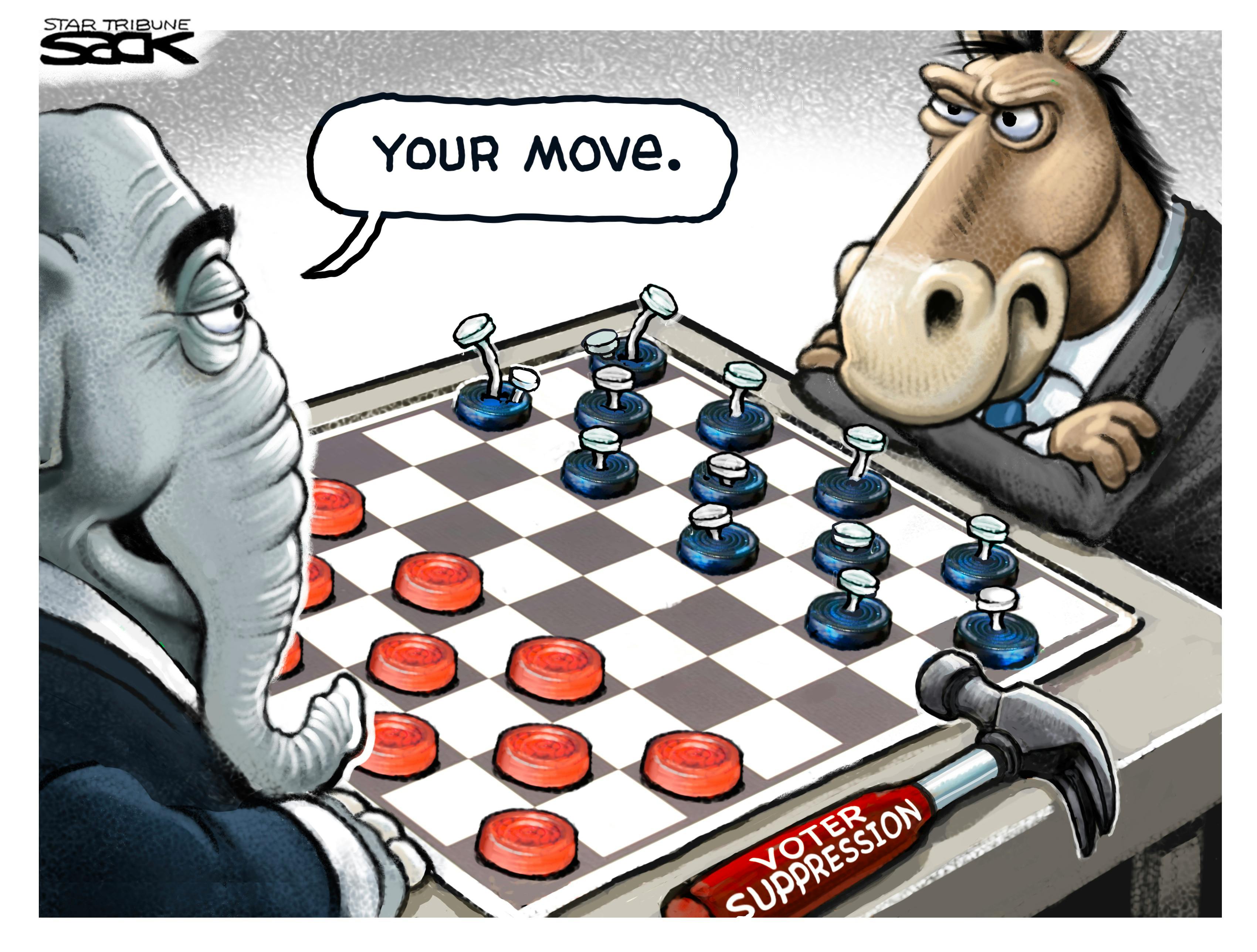
The GOP’s “freedom” rhetoric yields to its authoritarian agenda.
Standard conservative rhetoric treats the word freedom like partisan property: Republicans defend freedom, while Democrats are all Stalin-wannabees.
Usually, pro-gun rallies are where you see this trope in its purest form, but during the pandemic it has shown up in anti-public-health protests as well. Two weeks ago, we saw it in Congress, when Jim Jordan assailed Dr. Fauci with “When do Americans get their freedom back?” Occasionally, the two issues combine, as when armed protesters stormed the Oregon Capitol while the legislature debated anti-Covid measures.
Lately, though, we’ve been seeing how hollow the Right’s commitment to “freedom” is, at least when people use their freedom to support liberal causes. In previous weeks, I’ve talked at length about the anti-voting laws red-state legislatures have been passing in response to their dark-but-baseless fantasies about election fraud. But lately their focus has turned towards punishing liberal protest.
The latest push in red-state legislatures — Florida, Oklahoma, Tennessee, and Iowa so far — is for laws that criminalize protest and encourage vigilante action against protesters.
[Oklahoma] HB 1674, which Republican legislators passed earlier this week, grants civil and criminal immunity for drivers who “unintentionally” harm or kill protesters while “fleeing from a riot,” as long as there is a “reasonable belief that fleeing was necessary.”
Running over protesters is a long-standing conservative fantasy, which James Alex Fields Jr. carried out when he killed Heather Heyer in Charlottesville in 2017. If I were a Democrat in one of these legislatures, I think I’d submit a motion to rename the bill “The Heather Heyer Had It Coming Act of 2021”.
There have been at least 104 incidents of people driving vehicles into protests from May 27 through Sept. 5, including 96 by civilians and eight by police, according to Ari Weil, a terrorism researcher at the University of Chicago’s Project on Security and Threats who spoke with USA TODAY this summer.
I have some sympathy for people who unexpectedly find themselves surrounded by protesters doing threatening things, like rocking the car or pounding on its roof. But I’m not sure how many cases, if any, fit that description. In this video, for example, the driver comes back for a second pass through the crowd.
“Unintentionally” sounds like it mitigates the harm, but it actually doesn’t, because intentionality is so hard to prove in court. And the “reasonable belief” standard in the Oklahoma law creates an opening for the same kind of racial bias we see in police-shooting and stand-your-ground cases: What if the driver’s impression of danger is based on the race of the protesters, rather than any threatening actions? Might a few white jurors sympathize with a driver who got scared simply because his car was surrounded by Black people?
These laws also give the government more power to clamp down on dissent. Florida’s law, which has already been signed by Gov. DeSantis, creates new crimes that you might commit just by showing up for what you believe to be a peaceful protest.
But opponents say it would make it easier for law enforcement to charge organizers and anyone involved in a protest, even if they had not engaged in any violence.
“The problem with this bill is that the language is so overbroad and vague … that it captures anybody who is peacefully protesting at a protest that turns violent through no fault of their own,” said Kara Gross, the legislative director at ACLU Florida. “Those individuals who do not engage in any violent conduct under this bill can be arrested and charged with a third-degree felony and face up to five years in prison and loss of voting rights. The whole point of this is to instill fear in Floridians.”
If a local government chooses to decrease its law enforcement budget — to “defund the police,” as Mr. DeSantis put it — the measure provides a new mechanism for a prosecutor or a city or county commissioner to appeal the reduction to the state.
The law also increases penalties for taking down monuments, including Confederate ones, making the offense a second-degree felony punishable by up to 15 years in prison.
As with the anti-voting laws, the justification for the Florida law is largely imaginary.
Speakers including the governor said the law would protect law enforcement and private property against rioters, despite acknowledging there was little violent unrest in Florida during last year’s protests over Floyd’s death.
… Echoing DeSantis, Republican state House Speaker Chris Sprowls and Attorney General Ashley Moody vilified other states and cities for their handling of the protests last year, some of which did turn violent.
State CFO Jimmy Patronis claimed that Portland, New York and Seattle “burned to the ground” last summer.
I’m sure that’s news to the residents of those cities. If there were vast refugee camps in New Jersey, across the Hudson from burned-out New York, I’m sure I’d have heard about them. The main studios of Fox News are on Sixth Avenue, so they would just have to point a camera out the window to show us the devastation.
In general, Floridians can defend themselves with deadly force if they believe they are in imminent danger or death — and not only when they are inside their homes. The person being threatened is not required to try to flee.
If I’m protesting peacefully, and a car is bearing down on me in a threatening way, can I just shoot the driver? If his fear justifies running over me, shouldn’t my fear justify shooting him?
Conservatives don’t ask these questions, because they know they are the ones who threaten deadly violence. In a relatively small number of cases, last summer’s George Floyd protests devolved into property damage and looting. But liberals didn’t get in their cars to mow down anti-lockdown protesters, and George Floyd marchers didn’t bring their AR-15s.
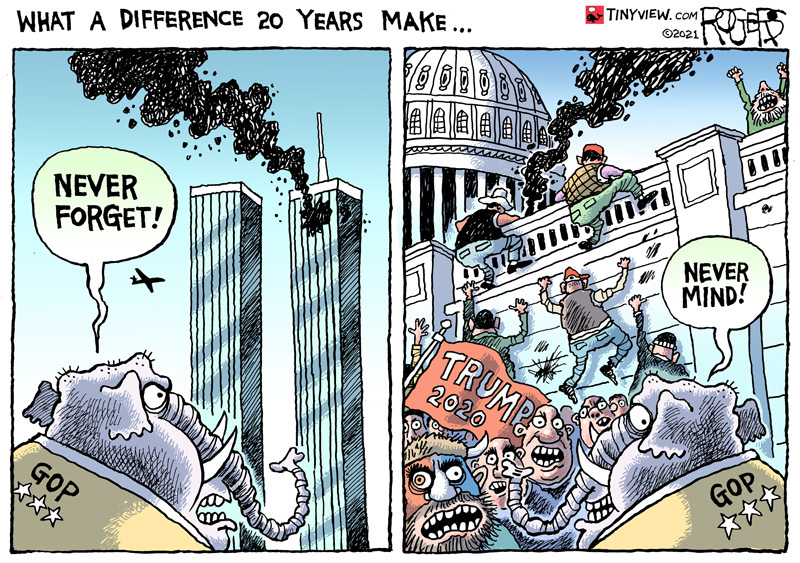
Another question conservatives like to avoid is: What if D.C. had such a law on January 6? Right now, the Justice Department expects to charge about 500 Trump cultists who trespassed into the Capitol after the crowd broke windows and pushed back police (injuring over 100 of them). But a law like Florida’s would justify felony charges against the many thousands of people from Trump’s rally who walked in the direction of the Capitol, not to mention Trump himself. By the new Florida standards, anyone who stood outside the Capitol with a Trump sign is a rioter, because they participated in a protest that had turned violent.
But for some reason, conservatives never imagine that the laws they support will ever aimed at them. Consider Thomas Webster, a retired NYPD cop who has been charged for his participation in the January 6 riot.
Prosecutors say that he “attacked a police officer with an aluminum pole and ripped off his protective gear and gas mask, causing the officer to choke.”
Lawyer for Tommy Webster, retired NYPD cop accused of beating an MPD officer with flagpole on #J6, says his client is in a “dormitory setting” with people serving time for “inner-city crimes” – “for a middle aged guy whose never been arrested before this has been a shock for him”
Who could have guessed? You beat one cop with a flagpole, and suddenly people are treating you like you’re Black or something.
The day after last week’s Sift, the jury convicted Derek Chauvin on all charges. This was both expected and surprising: People who watched the video of the murder couldn’t imagine how the jury could do anything else, but those who know the history of police acquittals had just as much difficulty picturing a conviction.
So the top of the weekly summary will discuss reactions to the verdict, which ranged from “See, I told you the system works” to “This changes nothing.” I come down somewhere in between, and link to discussions of police reforms that are still needed.
I’m sure Chauvin himself was disappointed, but probably not as much as Fox News, which clearly hoped to spend the next month focusing on whatever violent reactions a not-guilty or hung-jury verdict might lead to. Instead, their cameras saw Black people celebrating, which is a real downer for their ratings. But rather than return to the Mr. Potato Head crisis, Tucker Carlson et al have been pushing a conspiracy theory in which threats of Black violence intimidated the Chauvin jury, who otherwise would surely have ruled that kneeling on somebody’s neck for nearly ten minutes is normal police behavior.
Red-state legislatures anticipated the same (non-existent) wave of post-verdict violence by passing “anti-riot” laws that could put liberals at risk of committing a felony (or getting run over by right-wing vigilantes) any time they attend a protest. Those laws will stay on the books at least until a court can look at them, so they’re worth paying attention to. That’s why this week’s featured post is “Red States Crack Down on Protests”. I focus on the enormous gap between these laws and the conservative rhetoric about “freedom”, or right-wingers’ howls of rage when social media companies deny a platform to some fascist provocateur (like Trump). What is “freedom of speech” for conservatives becomes “rioting” when liberals do it.
That should come out shortly.
The rest of the summary will include Biden’s climate proposals, Republicans’ insubstantial counterproposal to Biden’s infrastructure plan (and why I don’t feel embarrassed about predicting they wouldn’t have a counterproposal), Biden’s popularity at the 100-day mark, why you should never brag about your crimes to women you want to date, a case that combines two of my very dissimilar fascinations (the Supreme Court and cheerleaders), and a few other things, before closing with an unusual approach to bird photography.
The countries that take decisive action now to create the industries of the future will be the ones that reap the economic benefits of the clean energy boom that’s coming.
Unless you spent the week completely off the grid, you already know that Derek Chauvin was found guilty of all charges. He’s due to be sentenced in June, and probably he will appeal on a number of grounds that seem unlikely to succeed (but you never know). So it will still be a while before we can definitely attach a number of years to his name — between 12 1/2 and 40 years, if his conviction stands — but at the moment he is a convicted murderer. It was the best result the trial could have produced.
Opinions about the larger meaning of this verdict varied widely, from “See, I told you the system works” to “This one result doesn’t really change anything.”
I come down somewhere in the middle: The Chauvin verdict establishes a floor. It shows that the well of injustice is not bottomless. Police officers cannot kill Black people with complete impunity, in broad daylight, on a city street, in front of multiple witnesses who are recording video. If Chauvin had been acquitted, or if just one juror had held out to force a retrial, we still wouldn’t know where the floor is, or even if there is one.
But the Chauvin verdict doesn’t mean that the system works, or works as well for Black people as for White people. We can’t forget what the original police report said about George Floyd: “Man Dies After Medical Incident During Police Interaction.” If the video hadn’t gone viral, that most likely would have stood as the official word. You would not know the names of Derek Chauvin or George Floyd, and Chauvin would still be abusing Black people on the streets of Minneapolis.
Most of all: The killings haven’t stopped, or even slowed down. It’s hard to give ourselves credit for progress until they do.
As for the larger struggle for justice, I think this widely viewed trial begins to establish a consensus that police mistreatment of Black people really is a thing. We didn’t all imagine this murder, and it’s not a he-said/she-said situation. It’s now public knowledge that Chauvin murdered Floyd. We all saw it happen, and we can’t unsee it.
But knowing that doesn’t mean that we know what to do about it. Many people, particularly many white men, still believe the Bad Apple theory: Chauvin was a bad cop, and he’s off the force now, so the problem has been handled. Maybe there are other bad apples, but the system can deal with them too.
The problem with the Bad Apple theory is the way other cops usually rally around a cop who kills someone or otherwise abuses authority. (Hence: “Man Dies After Medical Incident”.) In case after case, we see police investigating the victim rather than the death, while official police spokespeople and the local police union president act as PR flacks for the bad-apple cop. In other words, the whole department joins Team Bad Apple.
To a large extent, that didn’t happen this time. One reason Chauvin was convicted, I believe, was that cops testified against him. They blew up his lawyer’s claims that Chauvin acted according to his training, and that his use of force was appropriate. Maybe that signals some larger change in police culture, or maybe not; we’ll see in future cases.
Pity poor Fox News, which was all geared up to cover the post-verdict violence. You know: Dangerous Black people run wild, cheered on by Democrats. Ratings gold.
Instead, they’re left with no burning buildings to televise, and a conspiracy theory about why that is: The jury might have acquitted Chauvin, but for the threat of violence that intimidated them.
At the federal level, the George Floyd Justice in Policing Act has passed the House, but is pending in the Senate, where Democrats once again lack the votes to overcome a Republican filibuster. Unlike other issues, though, this one could result in a bipartisan compromise.
Still, there are new signs of optimism that Republican and Democratic lawmakers are serious about trying to make a deal. [Democratic Rep. Karen] Bass says she hopes the two sides can put together a framework by late May, which would be the one-year anniversary of Floyd’s murder. [Republican Senator Tim] Scott floated a potential compromise last week on reforming qualified immunity, arguing that police departments could be held accountable even if individual officers are still shielded. The South Carolina Republican has said some Democrats he has spoken with are open to his compromise and he doesn’t believe Republicans are far apart on the issues.
Additionally, Attorney General Merrick Garland has restarted the Obama-administration policy of federal oversight of local police departments, which may result in lawsuits and enforceable consent decrees.
I can’t remember who first called my attention to Beau of the Fifth Column, but I’ve become a fan. He combines working-class common sense with deep insight into what’s going on under the surface of the public conversation. I envy the way he can communicate complex ideas in five or six minutes without using polysyllabic buzzwords. Here’s what he had to say about the questions people raise to justify police killing 13-year-old Adam Toledo.
to cut greenhouse gases in half by the end of this decade. That’s where we’re headed as a nation, and that’s what we can do if we take action to build an economy that’s not only more prosperous, but healthier, fairer, and cleaner for the entire planet. These steps will set America on a path of net-zero emissions economy by no later than 2050.
Setting goals is the easy part, though. The question is whether he can get the country committed to achieving them, and in particular whether that commitment can endure even after he leaves office.
One encouraging thing about this speech is that he’s not even nodding at people who make the Environment vs. Economy argument. In the same way that we can’t reopen the economy without dealing with the virus, we can’t have a healthy economy for the future if we ignore climate change.
I see an opportunity to create millions of good-paying, middle-class, union jobs.
I see line workers laying thousands of miles of transmission lines for a clean, modern, resilient grid.
I see workers capping hundreds of thousands of abandoned oil and gas wells that need to be cleaned up, and abandoned coalmines that need to be reclaimed, putting a stop to the methane leaks and protecting the health of our communities.
I see autoworkers building the next generation of electric vehicles, and electricians installing nationwide for 500,000 charging stations along our highways.
I see the engineers and the construction workers building new carbon capture and green hydrogen plants to forge cleaner steel and cement and produce clean power.
I see farmers deploying cutting-edge tools to make [the] soil of our Heartland the next frontier in carbon innovation.
Last week, I predicted that the GOP would not come up with a counterproposal to President Biden’s infrastructure plan. Thursday, they seemed to prove me wrong, announcing what The Hill described as “a $568 billion infrastructure proposal”.
I mean, their two-page big-print document has a specific number attached to it, and even breaks it down: $299 billion for roads and bridges, $61 billion for public transit, $65 billion for broadband, and so on. That’s a proposal, right?
Not exactly. A lot of key questions remain unanswered, and I suspect it’s because the GOP Senate caucus doesn’t have any answers they agree on. The big one is: Where does this $568 billion come from? Their pamphlet rejects how Biden funds his much larger proposal: no new debt, no changes to the Trump tax cut, and no “corporate or international tax increases”. It vaguely offers to “repurpose unused federal spending”, and proposes taxing electric vehicles, which Biden wants to subsidize.
It also wants to “partner with spending from state and local governments” and “encourage private sector investment and the utilization of financing tools”, whatever that means. Which raises this question: Are the anticipated state, local, and private-sector investments included in the $568 billion? How much federal money are we really talking about here? (Trump’s ill-fated 2018 proposal claimed to be a $1.5 trillion plan, but only contained $200 billion of federal money spread over 10 years. An analysis by the Wharton Business School predicted that most of the other $1.3 trillion would never appear.)
The Washington Post notes that while the GOP “plan” appears to be about a quarter the size of Biden’s $2.3 trillion plan, it’s actually not even that big.
Congress typically passes long-term transportation funding bills, currently worth about $300 billion over five years. For example, between 2016 and 2020, Congress provided the $300 billion for roads, transit and rail, with a separate measure funding airports. The Biden plan expects that Congress will continue to provide at least that much money in the coming years. But the Republican proposal includes that $300 billion as part of its total.
So if you’re talking about new money, Republicans are offering about 1/9th what Biden is asking for — and committing themselves to oppose the most obvious ways to finance even that much, without specifying an alternative.
If the GOP pamphlet were a serious proposal, they would be on their way to writing an actual piece of legislation, which some large percentage of their senators and representatives would commit to vote for.
That’s not going to happen.
and the virus
Thanks largely to India, new-case totals are soaring worldwide. In the US, they have renewed a downward track, with daily new cases averaging around 56K. Maybe the vaccinations are getting ahead of the new variants and relaxed standards of behavior. Daily US death totals are currently just above 700.
The number of vaccinations per day in the US has peaked, and is now around 2.75 million, down from around 3.3 million. 94.8 million people have been fully vaccinated.
We seem to be hitting the point where the problem is demand, not supply, particularly in Trump country. Basically, everybody who listens to President Biden or Dr. Fauci already is either vaccinated or has shots scheduled. To get the rest of the way, we all need to start exercising our personal influence. Does somebody you know need a nudge?
The @nytimes, like countless others in Western media, has a tradition of “journalism” which takes place in an Africa without leaders, without public health officials or activists. It takes place in a vacuum of knowledge and strategy. Africa has no thinkers or planners. In Western Media, Africa has no epidemiologists, infectious disease specialists, no academics, no local journalists or medical associations are quoted. Just a vast maw of African horror witnessed only by the brave souls at the UN and the Africa bureaus of western papers.
… COVID coverage in Africa ignores reality to instead reach for any other explanation that squares with a continent devoid of brains. Most writers lean on vague ideas about “genetics” and “immunity.” It smacks of “the tenacious physical traits of the negroid race” style thinking. I cannot think of any other way to explain a decided refusal to acknowledge the actions of nations like my native Botswana which, through strict lockdown measures instituted as early as February 2020, managed to keep COVID deaths to 45 by January 2021.
It appears even as its own healthcare system is brought to its knees & exposed as a hollowed out shell of its former self, America’s media need a world where Africa can produce no solutions, can give no knowledge and is devoid of the power to positively influence the world.
and you also might be interested in …
I gotta love this story: A January 6 insurrectionist bragged about storming the Capitol to a woman the Bumble app had matched him with. “We are not a match,” she replied, and reported him to the FBI. He was arrested Thursday.
The audit grew out of Arizona Republican lawmakers’ effort late last year to toss out Joe Biden’s victory in the state. The audit won’t change the certified election results.
The audit is being led, funded and supported by people with documented records of promoting the falsehood that the Arizona vote was stolen from former President Donald Trump.
Senate Republicans are spending at least $150,000 in taxpayer money for the audit, according to audit documents.
A private fund-raiser reports bringing in another $150,000 in donations from undisclosed sources. That fund raising continues.
Democrats have been suing to stop the audit, and a hearing was scheduled for today. But yesterday the judge overseeing the case withdrew. Meanwhile, Trumpist yahoos have custody of the ballots. Nothing that we hear from this point on can be trusted or checked.
In the long-but-worth-it department: Wil Wilkerson’s “The Anti-Majoritarian Mistake“. It’s a direct answer to the idea currently popular in conservative circles that we can maintain a liberal society without majority support.
The conservative theory — which is the substantive content behind the republic-not-a-democracy slogan, to the extent there is any substantive content — is that constitutional restrictions have to protect basic liberties against a tyranny of the majority. So far, so good. But they jump ahead to the conclusion that majority rule is actually not necessary.
Wilkerson’s point is that society never comes to a complete-and-permanent agreement about what “basic liberties” are. In the long term, they can’t be defined by a minority, no matter how convinced that minority is of its own righteousness.
When minorities strip majorities of their power to successfully seek redress and assert their will within the system — which is what a stacked 6-3 Republican court majority veto over Democratic unified government could amount to — sooner or later, stymied majorities will seek to protect their rights and interests outside the system. This is what it means for a political system to lose legitimacy — in the grubby, practical, nuts-and-bolts stabilizing sense of “legitimacy.” …
There’s a sense in which basic rights, whatever those turn out to be, are non-negotiable. But what they turn out to be is the product of negotiation. … Political deliberation and negotiation can be a process of discovery, but what’s discovered depends on who’s allowed in the room. Rights don’t come to us on tablets etched by the divine. They come from people who know where the shoe pinches demanding more comfortable shoes. …
[T]he peaceful management of pluralistic disagreement is perhaps the most basic problem we need our political institutions to solve.
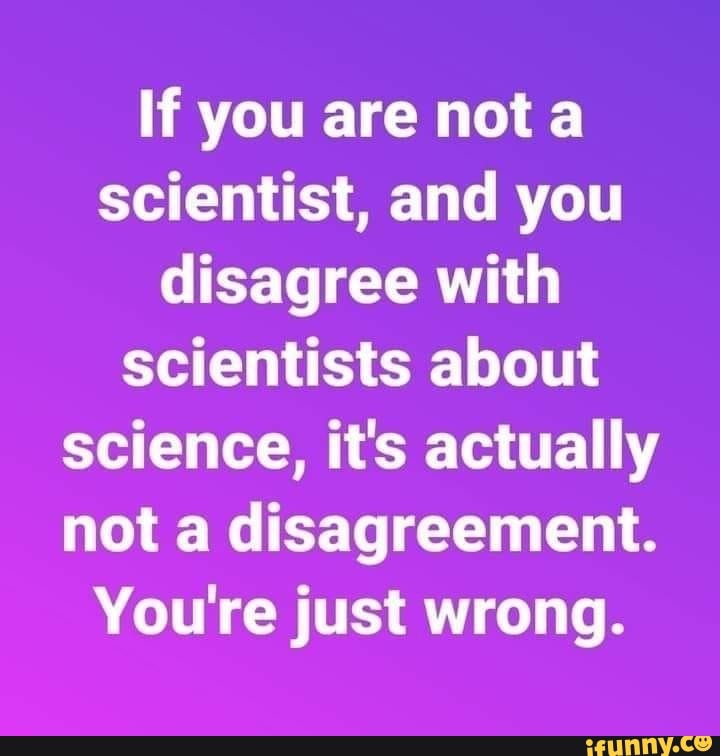
As with so many Facebook memes, I don’t know who should get credit. But it’s too good not to share.
Speaking of Fox, I have a theory: Tucker Carlson already has the next phase of his career planned, and Step 1 is getting Fox to fire him. That’s why he keeps ramping up his white-supremacist rhetoric. Fox wants to dog-whistle to those people, not appeal to them openly. But Tucker is going to find out exactly where their line is, then go out as a martyr to the Liberal Cancel Culture that even Fox is part of.
Unlike Tucker, I try to be open about when I’m speculating beyond the evidence, and that’s what I’m doing here. I don’t know whether Step 2 is entering politics or starting some more lucrative media gig that milks subscribers (like Glenn Beck does; just because you don’t notice him any more doesn’t mean that he’s not raking in the bucks) or launching some more extreme network to out-Fox Fox. But I think there’s a method in Tucker’s increasing madness.
Fascinating set of issues in a Supreme Court case about whether a school can punish a cheerleader for something she put on Snapchat. Her personal issues are all moot — a lower court restored her to the cheerleading squad and she has graduated — but the case is still alive because of the broader implications about student speech. I’m going to have to read the appellate-court ruling before I even know which side I’m on.
Matt Yglesias called attention to a fact I hadn’t noticed: Gallup reported already in 2017 that the number of Americans who described the Bible as “fables, history, moral precepts recorded by men” exceeded the number who think of the Bible as “actual word of God to be taken literally”. Both views significantly trail the fairly stable 47% who chose “inspired by God, not to be taken literally”.
and let’s close with something both airy and timely
Xavi Bou practices an unusual form of bird photography, using time studies of individual birds and flocks of birds to create arresting patterns.
someone encountering his work for the first time could be excused for having no idea what his subject is. In a project called Ornithographies, he creates mesmerizing images by taking many photographs per second and stitching up to 3,500 or more of them together. The results are beautifully abstract, capturing the energy of flight, whether in the chaotic squiggles that result when Alpine Swifts dive and swoop for insects, or the smooth, even undulations of a gull flying over the water.
So when will it be the right moment to leave? One more year, two more years, ten more years? Ten, twenty, thirty billion dollars more above the trillion we’ve already spent?
Between the police shootings and the mass shootings, it’s been hard to keep up.
Closing arguments in the Chauvin trial are happening today, and the case should go to the jury this week. By next Monday, we might have a verdict.
The nearby Daunte Wright shooting, and claim that the police officer mistook her gun for a taser, provoked a great deal of protest and skepticism. The officer has been charged with second-degree manslaughter. Chicago police released video of the shooting of 13-year-old Adam Toledo, who appeared to be unarmed and have his hands up. The NYT reports:
Since testimony [in the Chauvin trial] began on March 29, at least 64 people have died at the hands of law enforcement nationwide, with Black and Latino people representing more than half of the dead. As of Saturday, the average was more than three killings a day.
Three people are dead after someone opened fire inside a tavern in Kenosha, Wisconsin. Another three people were killed in a shooting that police said appeared to be related to a domestic incident in Texas. Authorities said a potential mass shooting was averted at San Antonio airport when a parks officer stopped a man with a box full of ammunition and a .45 caliber handgun.
Such events underscore the easy availability of deadly weapons. The 19-year-old who killed eight people in a massacre at a FedEx facility in Indianapolis late on Thursday bought his two assault rifles legally, police said over the weekend.
According to a CNN analysis, the United States has suffered at least 50 mass shootings since March 16, when eight people were killed at three Atlanta-area spas. Six of the victims were women of Asian descent.
and the virus
We’re starting to hit the vaccine-resistance wall, particularly in areas with a lot of Trump voters. The 7-day average on vaccinations peaked at 3.3 million per day a few days ago, and has dropped slightly to 3.2 million since. 131 million Americans (including me, as of Tuesday) have gotten at least one shot, and 84.3 are fully vaccinated.
The number of new cases might be starting to head back down, after briefly going about 70K per day, but it’s too soon to declare a new trend. Deaths are down to about 750 per day.
and Russia
The Treasury Department announced sanctions against a list of Russian individuals and organizations Thursday. Well down the list was Paul Manafort’s associate Konstantin Kilimnik. The write-up revealed more about Kilimnik than had been previously known to the public:
Konstantin Kilimnik (Kilimnik) is a Russian and Ukrainian political consultant and known Russian Intelligence Services agent implementing influence operations on their behalf. During the 2016 U.S. presidential election campaign, Kilimnik provided the Russian Intelligence Services with sensitive information on polling and campaign strategy. Additionally, Kilimnik sought to promote the narrative that Ukraine, not Russia, had interfered in the 2016 U.S. presidential election.
He got that “sensitive information” from Rick Gates, working under the instructions of Manafort. This completes the collusion cycle: Russia launched a social media campaign to help Trump beat Clinton in 2016, and the Trump campaign made sure they had good data to target their efforts.
BTW, “the narrative that Ukraine, not Russia, had interfered in the 2016 U.S. presidential election” wasn’t just Russian propaganda, it was a main feature of the Trump defense in his first impeachment trial.
The US and EU have the means to do what Navalny has done so well: relentlessly detail and publicize the breadth and depths of the corruption of Putin and his people.
I am puzzled why we don’t do this. I think the Russian people deserve to know just how many billions Putin has stolen and where it all is.
To the surprise of few, it looks like there isn’t going to be a Republican alternative to Biden’s infrastructure proposal. They’re just going to say no. More about this in one of the featured posts.
Senator Ed Markey and Rep. Jerry Nadler have introduced a bill to expand the Supreme Court, but Nancy Pelosi says she’s not going to bring it up for a vote.
The Falcon and the Winter Soldier series on Disney Plus is examining race in a way I didn’t expect from the Marvel Universe, even after Black Panther.
At the end of Avengers: Endgame, Steve Rogers returned to the 1940s and left the shield of Captain America to Sam Wilson, the Falcon. What to do with that shield, and with the Captain America identity it represents, is the central issue of F&WS. And that issue ends up hinging on the question: What can or should American patriotism mean to a Black man? In this week’s episode (#5) a bitter Black super-soldier from the 1950s (Isaiah Bradley) tells Sam: “They will never let a Black man be Captain America, and no self-respecting Black man would want to be.”
Sam is becoming the Barack Obama to Bradley’s Jeremiah Wright. (“For the men and women of Reverend Wright’s generation, the memories of humiliation and doubt and fear have not gone away; nor has the anger and the bitterness of those years. … That anger is not always productive … but the anger is real; it is powerful. And to simply wish it away, to condemn it without understanding its roots, only serves to widen the chasm of misunderstanding that exists between the races.”) He’s looking for a way forward that acknowledges and respects the experience of the people who came before him.
After decades of TV series that either made Black people invisible, stereotyped them, or cast them in roles where their race really didn’t matter, lately we’ve gotten a bumper crop of high-quality race-examining major-studio TV: Lovecraft Country, Watchmen, and many others.
Paul Krugman did a responsible thing Friday: He committed his thoughts about inflation to print before actual inflation heats up.
There are indeed reasons to be worried about inflationary overheating. In fact, even those of us who think it will be OK expect to see above-normal inflation this year. We just think it will be a blip. … [I]t seems to me that we should make that argument now, so as not to be accused of making excuses after the fact. This is a good time to identify which aspects of inflation might worry us, and which shouldn’t.
In short: He expects the economy to boom in the coming year, for two reasons:
vaccinated people who have been working from home and saving their money start to get out and spend that money
the government’s emergency anti-Covid spending.
Inflation will be part of that boom, as oil prices go back up and some parts of the economy grow faster than others, creating bottlenecks.
But history shows us two very different kinds of inflation: temporary blips, like during wars, and “embedded” inflation, like in the 1970s. The first kind of inflation goes away on its own as soon as the situation that caused it abates. The second won’t end without some kind of drastic intervention, like when the Fed shut down the 1970s inflation by raising interest rates over 20% and causing a major recession.
So the tricky thing going forward will be how to interpret inflation numbers: There’s nothing to worry about when depressed prices return to normal, or when a bottleneck sends prices of some particular commodity soaring temporarily. But a general inflation, where prices go up because prices are going up, is more serious.
and let’s close with an overdose of cuteness
A boy romps with golden retriever puppies, and is mobbed by them when he falls down. One of the commenters says: “This should be prescribed as a cure for depression.”
When a political party has no solutions to real problems, it has to make up fake problems.
As I discussed in the previous post, and have covered in more detail before, the GOP is not a governing party any more. If you are concerned with any real problem facing America today, they have no plan for dealing with it.
When a party is in that situation, it needs to distract the public with phony issues and phony solutions. And so, Republican majorities in legislatures around the country are passing voter-suppression laws under the guise of solving an “election integrity” problem that doesn’t exist, and is based on the Big Lie that Trump had the 2020 election stolen from him.
Those laws are a serious threat to our democracy, but at least the threat is obvious to the general public, which can then organize against it. You don’t need any special experiences or insight to understand that Georgia Republicans did something underhanded when they made it illegal to give water to people waiting in line to vote.
But the second distraction is easier for most of the electorate to overlook, because it only affects a minority that is reviled by the conservative base and misunderstood by much of the rest of the public: transgender people.
Gender-affirming care. Two kinds of anti-trans bills are working their way through red-state legislatures, and some have already become law. One bans what is called “gender-affirming care”: medical interventions (like puberty-blocking drugs) that suppress the development of characteristics related to the gender the child wants to transition from or (like estrogen or testosterone) encourage the development of characteristics related to the gender the child wants to transition to. So even if a child, the child’s parents, and their doctors all agree on a course of treatment, the state makes it illegal.
As the HR article points out, anti-trans activists have changed their tactics, but not their goals. A few years ago, anti-trans “bathroom bills” were justified by painting trans youth as predators: They would invade your child’s gender-appropriate bathroom for nefarious purposes. The current wave of anti-trans bills paints them as victims: They need “protection” from the gender-transition “fad” sweeping their generation, and the predatory doctors who profit from it. But these contradictory messages are being pushed by exactly the same people.
Trans athletes. The second kind of bill bans trans girls from sports. The Guardian summarizes:
The youth sports bills, which claim to “promote fairness in women’s sports”, are based on a simple claim: that boys will be allowed to compete against girls and have an unfair advantage.
“They’re telling parents of cisgender children that you’re losing something by allowing transgender youth to play in sports,” said Alphonso David, president of the Human Rights Campaign (HRC), an LGBTQ+ rights group. “We’ve seen this playbook before – you’re losing something if you allow same-sex couples to marry, if you protect racial minorities in the workplace, if immigration laws are respected. It’s us v them.”
In the same way that the bills to “protect” gender dysphoric youth are promoted by groups that were never interested in them before, these bills to protect girls sports are championed mostly by legislators who have shown little interest in girls sports until now. (Like the bathroom bills and the bills banning gender-affirming care, many of the girls-sports bills have been written by the Alliance Defending Freedom, a group motivated by conservative Christian religious views.)
It is the intent of the Legislature to maintain opportunities for female athletes to demonstrate their skill, strength, and athletic abilities while also providing them with opportunities to obtain recognition and accolades, college scholarships, and the numerous other long-term benefits that result from success in athletic endeavors and to promote sex equality by requiring the designation of separate sex-specific athletic teams or sports.
And that sounds marvelous, but for one fact: There’s no reason to believe that any of those opportunities for female athletes are at risk. As an ACLU report observes “transgender women and girls have been competing in sports at all levels for years”. In no state are girls sports events or teams dominated by trans athletes. Similarly, the WNBA, LPGA, and other professional women’s sports leagues have not been not overrun with trans women.
Across the country, girls participate in sports if they want to. They are not running into problems that a trans-ban will solve.
Running on the boys’ team as a ninth-grader in suburban Hartford, Terry Miller was an average track athlete, online records show, failing to qualify for any postseason events. But in 2018, Miller came out as a transgender girl. In her first season running against other girls, as a sophomore, Miller dominated. She won five state championships and two titles at the New England championships, beating the fastest girls from six states.
The next fall, as a junior, Miller won another four state titles and two more all-New England titles. In several races, she was followed closely by Andraya Yearwood, another transgender girl who had also won three state titles. … Girls who lost to [Miller] and their coaches complained that she had an unfair advantage. Parents of other girls started online petitions demanding state high school officials add a testosterone suppression requirement for transgender girls.
One measure of how rare such a situation is, though, is the number of articles that use this same example. (Anybody got a second one?) Retired high school coach Larry Strauss called competition from trans athletes a “non-controversy”.
Competitive equity is a beautiful and elusive objective for those of us who coach or oversee high school athletics. It is why we have junior varsity teams and freshmen and sophomore teams and why we try to match up teams that won’t slaughter one another. It often does not work out that way and we have all seen and heard about lopsided scores in high school football and basketball and pretty much every other sport.
There are athletes whose physical gifts and athletic talent make them so dominant that it really doesn’t seem fair (I know firsthand, having coached against some of them). And does anyone believe there is any justice in the so-called “genetic lottery”?
Scientifically, the jury is still out on when or whether trans girl athletes — particularly the ones who transitioned without going through puberty, or have received hormone treatments — have an advantage over cis girl athletes, and if so, how big that advantage is.
But what we do know is that girls sports are doing fine. To me, the right question isn’t whether trans athletes occasionally win, or even whether those victories violate some abstract ideal of fairness. The right question is whether including trans athletes ruins female sports programs for everybody else. That seems not to be happening.
In the absence of an identifiable problem, the point of these bills seems to be to harm and stigmatize transgender folk, not to protect impressionable teens or girls sports programs.
Republicans agree on one thing: They don’t like Biden’s proposal. But that’s about all.
[WV Senator Shelley Moore] Capito, who, as the top Republican on the Environment and Public Works Committee, is stuck in the middle of the struggle, said she’s crafting a “conceptual Republican bill” that includes investments in roads and bridges.
“We’re working on that right now. We haven’t made consensus on it,” she said.
Good luck with that, because Republicans still haven’t produced an alternative to ObamaCare, after more than a decade of railing against it. They have hated it to the point of shutting down the government, but an alternative? That’s too much to ask. Formal announcement of the “terrific” plan that Trump claimed to have in 2015 was always just two weeks away, but we still haven’t seen it. In 2017, he let the GOP majorities in Congress create their own “repeal and replace” bill, but the “replace” part remained empty until John McCain’s famous thumbs-down put the kibosh on the whole effort.
Similarly, when Trump really needed a Covid relief bill for his re-election campaign, Republicans couldn’t unite on one. There is no GOP plan for climate change or entitlement reform or competing with China or preventing mass shootings or solving any other American problem. They hate what Democrats want to do, and that’s as far as they go.
If the GOP was going to have a policy on anything, though, you would think it would be infrastructure. From the early Trump campaign to the American First Caucus platform that leaked this week (the one that honors America’s “uniquely Anglo-Saxon political traditions”), infrastructure has been a key pillar:
Infrastructure is one of the few areas where the federal government should exercise its constitutional authority. For decades, America has been sending trillions of dollars out the door to support the infrastructure of other nations — even to countries that hate the United [States] — with nothing to show for it. Simultaneously, our domestic infrastructure is failing, crumbling and decaying from within. This Caucus will work to direct as much money as possible to our domestic infrastructure needs.
OK, maybe we shouldn’t expect “direct as much money as possible” to include voting for a Biden proposal. But if something is that important, you’d think there would be a plan for doing it.
When I see the crumbling roads and bridges, or the dilapidated airports or the factories moving overseas to Mexico, or to other countries for that matter, I know these problems can all be fixed, but not by Hillary Clinton. Only by me.
But for before long, “infrastructure week” became a running joke. The “framework” Trump presented in 2018 never drew backing from the Republican majorities in Congress, and after the GOP lost the House, Trump walked away from negotiating with Nancy Pelosi about infrastructure until Democrats “get these phony investigations over with”. As re-election loomed, he floated price tags of $1 trillion or $2 trillion for unspecified infrastructure, but Congressional Republicans once again refused to line up behind it.
So if you ask leading Republicans whether they want to rebuild American roads and bridges, they’ll say they do. But they don’t want to raise taxes for it, and they don’t want to borrow money either. Some may talk vaguely about cutting other spending to compensate, but the those specifics also never appear. (Ten years ago, Paul Krugman was already making fun of Speaker Paul Ryan’s “magic asterisk” of unspecified spending cuts.)
That’s why this week’s headline was so predictable: Republicans are unanimously against Biden’s proposal to do what Trump said he wanted to do but never got done. It’s too big, it’s not really infrastructure, and so on. So what’s their alternative plan for solving this problem?
A counteroffer is key to beginning any process that might resemble negotiations.
One lesson President Biden seems to have learned from his Obama-administration experience is not to make concessions in exchange for nothing. If there is nothing that Republicans support, then their votes aren’t winnable. End of story.
The obstacle is that he can’t offer them what they really want: roads and bridges that appear by magic, without anyone needing to pay taxes or take on debt, and without Biden getting credit for them.
In January, after Biden announced his Covid relief proposal, Republicans pretended to make a counteroffer. Of course, it didn’t come from Mitch McConnell or anyone else authorized to speak for the whole caucus. It came from ten “moderate” GOP senators — coincidentally, the exact number needed to overcome a filibuster. That meant that if Biden gave up on the filibuster-avoiding reconciliation process, each of the ten Republicans would have veto power over the final bill. And their offer was a $600 billion package that was not even one-third of Biden’s $1.9 trillion proposal, which the American people supported.
So: give up the great majority of what you think is needed, trust that McConnell won’t turn any of us, give all ten of us the power to scupper the whole deal if any of the final details aren’t to our liking, and then maybe we’ll vote with you and with the American people.
Such a deal. Biden ignored them, got the package he wanted through reconciliation (with zero Republican votes in either house), and did something popular besides.
This time, even a phony counteroffer doesn’t seem to be in the cards. Senator Manchin may pine for the days of bipartisanship and lament the resort to reconciliation. But he does want an infrastructure bill to get done, and even he has to realize that you can’t work out a compromise with people who can’t say yes.
So that’s the choice: Vice President Harris breaking the tie on an all-Democratic reconciliation bill, or nothing.
Biden’s announcement ends not just to our war in Afghanistan, but 20 years of fantasies about what “six more months” can accomplish there.
Wednesday, President Biden announced that our troops (and those of our NATO allies) will leave Afghanistan by September 11. Unlike previous dates for withdrawal, this one isn’t based on achieving some kind of stability or other goals first; we’re just getting out.
That announcement touched off a lot of comment, both pro and con. Pro: Leaving saves American lives and resources, and gives our military more flexibility to confront challenges more central to our well-being, as may come from Russia (in Ukraine) or China (in Taiwan). Con: Without us, the Afghan government will probably fall to the Taliban. That will definitely be bad for the Afghan people, and could also harm us if the Taliban starts sheltering terrorist groups like Al Qaeda again.
But one argument has been conspicuous by its absence: If we stay for six more months, or a year, or three years, Afghan democracy will stabilize, the Afghan Army will finally have enough training, and the government we leave behind in Kabul will be able to sustain itself.
The generals and their media allies have been making that argument for almost 20 years, and I was pleased to hear Biden blow it up:
So when will it be the right moment to leave? One more year, two more years, ten more years? Ten, twenty, thirty billion dollars more above the trillion we’ve already spent? …
“Not now” — that’s how we got here. And in this moment, there’s a significant downside risk to staying beyond May 1st without a clear timetable for departure.
If we instead pursue the approach where [the US] exit is tied to conditions on the ground, we have to have clear answers to the following questions: Just what conditions [will] be required to allow us to depart? By what means and how long would it take to achieve them, if they could be achieved at all? And at what additional cost in lives and treasure?
I’m not hearing any good answers to these questions. And if you can’t answer them, in my view, we should not stay.
Biden acknowledges the possibility of a terrorist resurgence in Afghanistan, but plans to deal with that if and when it happens.
We’ll not take our eye off the terrorist threat. We’ll reorganize our counterterrorism capabilities and the substantial assets in the region to prevent reemergence of terrorists — of the threat to our homeland from over the horizon. We’ll hold the Taliban accountable for its commitment not to allow any terrorists to threaten the United States or its allies from Afghan soil.
I think of The Washington Post as the hometown paper of the defense and foreign-policy establishment, and it has been playing that role this week. The Post’s editorial board responded to Biden’s plan by predicting that “the likely result will be disaster”. But even they acknowledged that their alternative path offers no exit.
A strategy of leaving troops in the country in an effort to force the Taliban to compromise could extend the U.S. commitment for years without achieving a durable peace.
And WaPo columnist Max Boot offered a much-scaled-down version of the usual rosy scenario:
To avert such a dire contingency, Biden would not have to wage a “forever war.” He would merely have to keep a relatively small number of U.S. forces to advise and assist the Afghans who already undertake almost all of the fighting.
So: a forever skirmish, not a forever war. We’ve recently gone a whole year without a combat death in Afghanistan. Maybe that happy circumstance will continue, and the price of freezing the status quo will be low enough to tolerate indefinitely.
Or maybe not. Maybe the Taliban will tire of trying to wait us out, and will go back to trying to drive us out. And if combat deaths go back up, that will be its own reason to stay, so that the troops we are losing will not have died in vain.
But notice: This disagreement is between two sides that each have at least one foot in reality. Maybe the cost of staying in Afghanistan forever will be tolerable, or maybe we’ll find some better way of dealing with the increased terrorism threat of a Taliban-ruled Afghanistan. But nobody is counting on the Freedom Fairy to sprinkle her dust over Kandahar.
So whether you agree with Biden on this or not, you should at least thank him for bringing some honesty into the conversation.
Having written more-or-less even-handedly up to this point, I’ll take a side: I’m with Biden on this.
Way back in 2005, I expressed very similar ideas (about Iraq) in a 2005 essay I provocatively titled “Cut and Run“. At the time, “serious” foreign-policy experts were finally admitting that the 2003 Iraq invasion had been a mistake and we needed to get our troops out. But they always paired that concession with some sort of “after we fix what we’ve broken” caveat. (This became known as the Pottery Barn rule.) Typically, the sages thought our troops needed six more months to “stabilize the country” or “establish democracy” or achieve some other worthy but nebulous goal. (NYT columnist Thomas Friedman rolled his six-more-months projections forward with such regularity that six months became known as a Friedman unit.)
In “Cut and Run” I demanded a measurable answer to the question “What are we fixing?” Because in my opinion our military presence wasn’t fixing anything. After six more months, Iraq would still need “stabilizing”, and our troops would have to stay longer.
We can leave Iraq now, or we can leave after our losses have grown. That is the only choice we have.
I feel the same about Afghanistan today, after nearly 20 years of war. Whatever our original intentions might have been, by now it’s clear that we’re not building a secular, democratic, pro-Western government that will someday be strong enough to stand on its own.
There’s a lesson here, and it’s the same lesson we should have learned from Vietnam: In order to install a new form of government in a country, people on the ground have to be buying what you’re selling. As The Boston Globe’s H. D. S. Greenway puts it: In both Vietnam and Afghanistan
our clients could never shake the impression that they were puppets fighting for foreigners, while the Viet Cong and the Taliban were able to present themselves as the true patriots fighting to rid their country of colonialism.
In South Vietnam, all we had to work with was the remnant of the old French colonial administration, which local people joined for the sake of power and profit, not because they believed in the French Empire or anti-Communism or some other idealistic notion. In Afghanistan, we have a corrupt government in Kabul supported (up to a point) by a patchwork of warlords in the countryside. The Afghan people don’t believe in it, because they shouldn’t believe in it.
Over the last two decades, hundreds of thousands of American troops have served in Afghanistan — most of them honorably and some heroically. It is a shame that their effort and sacrifice has not produced a lasting result that our nation can point to with pride. But more effort and sacrifice will not redeem what bad policy has already wasted. We need to leave.
Wednesday, Rachel Maddow brought up another good point about this war, illustrated by the experience of Taliban hostage David Rhode, the Pulitzer-winning NYT journalist who was held for seven months in 2008-2009. Rhode was actually only a prisoner in Afghanistan for a week; for the half-year beyond that, the Taliban kept him in parts of Pakistan where they had free rein.
Knocking the Taliban out of power in Afghanistan was one thing. Defeating them in some kind of larger war, preventing them from ever rising again in Afghanistan, that was something that a US military conflict in Afghanistan was never going to be able to do. Not when the Taliban wasn’t confined to Afghanistan and wasn’t really based there.
In August 2010, a former Pakistani intelligence officer approached the U.S. embassy station chief in Islamabad and offered to reveal bin Laden’s location, in return for the $25 million reward, according to a retired senior U.S. intelligence official.This story was corroborated by two U.S. intelligence officials speaking to NBC News, and had been previously reported by intelligence analyst Raelynn Hillhouse. The Pakistani official informed U.S. intelligence that bin Laden had been located by the Pakistani intelligence service ISI in 2006, and held under house arrest near Pakistani intelligence and military centers ever since.
According to the retired senior U.S. intelligence official speaking to [journalist Seymour] Hersh, bin Laden was ill at this point, financially supported by some within Saudi Arabia, and kept by the ISI to better manage their complex relationship with Pakistani and Afghan Islamist groups.
So a fully military solution to the Afghan problem would mean, at a minimum, expanding the war into Pakistan, and taking down factions within the Pakistani government. Pakistan, you may recall, is a nuclear power.
I don’t think anybody wants to open that can of worms.
Last week I couldn’t come up with a featured post, so this week there are three.
The first one discusses President Biden’s decision to pull our combat troops out of Afghanistan by September 11. Unlike any announcements by previous presidents, this isn’t a goal that assumes we’ll produce some good outcome by then, and that will be reversed when we don’t. We’re just leaving.
The thing I like best about this announcement is that it has finally provoked the kind of honest discussion we should have had many years ago: Our troops are not fixing Afghanistan, so there is no point in the future when they will be done fixing it. The choices are (1) stay forever, and (2) pull out and let the Taliban take over. There are arguments for and against each path, but those are the choices. I’ll discuss that in “Finally, some honesty about Afghanistan”, which should be out shortly.
The second featured post discusses what I call “the most predictable headline of the week”: Republicans haven’t been able to unite behind an alternative to Biden’s infrastructure plan. The GOP doesn’t have a healthcare plan, a climate-change plan, or a plan to address any other real American problem. Why would anyone expect them to have an infrastructure plan? That post “The GOP: Still not a governing party” should be out around 10 EST.
The third post was supposed to be a note in the weekly summary, but there was too much to cover. When you’re a political party with no solutions to real problems, but you have power, you have to talk about something. So Republican state governments are passing anti-trans laws to address problems that aren’t problems, like confused youth being talked into gender transition by the media and predatory doctors, or cis girls being chased out of girls sports programs by boys claiming to be girls. I don’t have a title for that yet, but I’ll try to get it out by 11.
Finally, the weekly summary has new shootings to discuss, both mass shootings and police shootings. The Chauvin trail is heading into closing statements. Apparently there really was collusion between Russia and the Trump campaign. Marjorie Taylor Greene briefly tried to assemble a American First Caucus in the House to protect our “uniquely Anglo-Saxon political traditions”. And a few other things happened. I’ll try to get that out by noon.
When I look into that officer’s eyes, they’re not looking at me like I’m another human being. At best, I’m a threat. At worst, I’m an animal. That is unacceptable.
– Delegate C.T. Wilson of the Maryland House describing his experience dealing with police as a large Black man
There is no featured post this week.
This week everybody was talking about the Chauvin trial, and policing in general
The prosecution is getting close to wrapping up its case against Derek Chauvin. The defense should start this week.
I’ve found the defense attorney’s cross-examination of prosecution witnesses hard to watch, so I suspect the case they present will be even harder. In the words of The New Yorker’s Jeannie Suk Gersen, “The defense’s best hope is to instill doubt about what jurors can plainly see.”
The argument will probably be a kind of rhetorical sleight-of-hand that shows up fairly often, but doesn’t get nearly enough attention: Reduce the scene to a verbal description, then weave a new scene from that description. (I first noticed this technique during the Clinton impeachment trial. The public wasn’t buying that Clinton should be removed for having an affair and covering it up. So Republicans didn’t talk about that directly. Instead, they reduced Clinton’s actions to the legal categories of perjury and obstruction, then argued that perjury and obstruction were impeachable offenses, as they might be in other circumstances.)
So this week the horrified bystanders to Chauvin’s crime will become a potentially dangerous mob. The struggles George Floyd made while he was upright will be painted as plausible threats from his prone, handcuffed, unconscious, and dying body. Floyd’s death will be attributed to drugs and pre-existing health problems, with Chauvin’s knee on his neck merely incidental.
Reassemble that, and the defense’s question becomes: If an officer under threat from a dangerous mob is using force to subdue a resisting suspect, and the suspect happens to die for other reasons, is the officer really guilty of anything? Jurors will be invited to imagine other possible scenes that fit this description, and the blameless officers who might be convicted by the standard they set here.
Such a scene isn’t at all what the videos of Floyd’s death show, but if one juror can be induced to forget or ignore what he saw, Chauvin goes free. As the prosecutor said in his opening remarks: “Trust your eyes.”
Here’s why I expect: Chauvin won’t go free, but he won’t be convicted of the highest charge, second-degree murder. (IMO, that charge is already too low.) Consequently, he’ll face a sentence that will appear to devalue George Floyd’s life. Riots will erupt in Minneapolis and possibly elsewhere. The legal decision will be a done deal at that point, so the question will be whether Black Lives Matter activists can craft some demand that can still be met.
However the trial comes out, it’s worth appreciating that Chauvin was only charged because bystander videos went viral. If not for video, police would have circled the wagons around him and nothing would have happened. I have to wonder how many murders by police haven’t been prosecuted because the only surviving witnesses were other police.
If Chauvin goes free in spite of the video, I don’t know what comes next. Any conservatives who express horror at riots should have to answer this question: What is a community’s appropriate response when police can murder its members, the murder can be posted on YouTube, and they get away with it? What should people do when this happens over and over?
Chief Tim Gannon of the Brooklyn Center Police Department said an officer had shot the man on Sunday afternoon after pulling his car over for a traffic violation and discovering that the driver had a warrant out for his arrest. As the police tried to detain the man, he stepped back into his car, at which point an officer shot him, Chief Gannon said.
To me, it matters what the warrant was for. Was 20-year-old Daunte Wright a dangerous criminal whose immediate apprehension was necessary for public safety? Or might police have simply followed until Wright realized he wasn’t going to get away? Or did the officer decide that Wright’s failure to obey carried a death sentence, independent of whatever his original crime might have been?
The shooting touched off a riot Sunday night, and the National Guard was called out.
Nobody died in this incident, but it’s still not right: Two Virginia police approached an Army lieutenant at gunpoint, then pepper-sprayed him when he refused to get out of the car until they explained why they had stopped him. The lieutenant has filed a lawsuit against the officers.
Why are you like this?—when someone asks a police officer why he’s being asked to exit his vehicle or why he’s being stopped in the first place, why the hell can’t cops respond by…oh, I don’t know…answering the fucking question? Instead, the officers in this instance appear to have responded by typical aggression and equally typical police brutality.
Incidents like this give me sympathy for the “Abolish the Police” movement. I understand that laws need to be enforced somehow, but are men who behave like this really making us safer? Sometimes I think we should just fire everyone and start over (like the former Soviet republic of Georgia did). Maybe we should contract our policing out to civilized countries like New Zealand or Iceland.
I’m going to keep repeating this point until it’s widely acknowledged. Whenever you compare US policing to other countries, somebody raises the point that US criminals are more dangerous, because so many of them have guns. (“I’d rather be judged by 12 than carried by 6” police tell each other.) So: Trigger-happy police is a price we pay for not controlling guns.
Tom Nolan, a 27-year veteran of the Boston Police Department who’s now an associate professor of criminology and criminal justice at Merrimack College, said, “Certainly it’s not in compliance with standard police training and protocol to shoot at individuals who are fleeing the police. The police are not trained to do that unless there is a threat to an officer or innocent bystander or an imminent danger of serious bodily injury or death. Absent that there’s no justification.”
The changes do not go as far as some social justice advocates had hoped: Discipline will now largely be decided by civilian panels, for example, but police chiefs maintain a role. Some activists wanted the panels to act independently of police.
Still, the legislation imposes one of the strictest police use-of-force standards in the nation, according to experts; requires officers to prioritize de-escalation tactics; and imposes a criminal penalty for those found to have used excessive force.
A Democratic legislator described the danger he faces from police simply because he is a large Black man.
When I look into that officer’s eyes, they’re not looking at me like I’m another human being. At best, I’m a threat. At worst, I’m an animal. That is unacceptable.
Saturday Night Live’s opening skit featured a disagreement between White and Black Minneapolis news anchors: White anchors are confident that justice will be done in the Chauvin trial, while Black anchors say “We’ve seen this movie before.”
and the virus
Today should pass 120 million people at least partially vaccinated. (I get my first shot tomorrow.) The number of new cases continues to edge upward, running just below 70K per day. Deaths continue to slowly decline.
Anecdotally, I’ve been hearing for weeks that vaccination appointments were easier to get in red states, where more people are skeptical of the vaccines and even of the seriousness of Covid-19. Now there are numbers to back that up.
Russians understand that the government is lying to them about Covid deaths, and that produces a nasty result: They don’t trust the government about vaccines either. (Russia produces its own vaccine, which apparently is pretty good.)
One conclusion to draw is that of all forms of government, the one that has handled Covid the worst is authoritarian populism. Of all large countries, possibly the most inexcusably bad responses to the pandemic are the US (Trump), Russia (Trump’s role model Putin), and Brazil (led by Jair Bolsonaro, “the Tropical Trump“).
Analysis of a sample of anti-vaccine content that was shared or posted on Facebook and Twitter a total of 812,000 times between 1 February and 16 March 2021 shows that 65 percent of anti-vaccine content is attributable to the Disinformation Dozen.
I should have linked to this last week: The Trump campaign solved a cash crunch late in the 2020 campaign by scamming its own donors. Recurring donations were the default, which you had to read carefully to opt out of.
The sheer magnitude of the money involved is staggering for politics. In the final two and a half months of 2020, the Trump campaign, the Republican National Committee and their shared accounts issued more than 530,000 refunds worth $64.3 million to online donors.
I keep hearing that Republicans are bound to win back the House in 2022, because midterm elections usually favor the party that’s out of power. But I think the GOP faces an unusual number of problems this cycle, like explaining why they’re voting against things their voters like, and whether or not the party should continue to be a Trump personality cult now that he’s literally one of those crazy old men ranting about socialism.
An RNC donor retreat went to Mar-a-Lago Saturday for a Trump speech. (The Great Man could not come to them.) The speech made headlines for attacking his own party’s Senate leader. (He called Mitch McConnell a “dumb son of a bitch” and a “stone cold loser”.)
As Playbook and the New York Times have reported, Trump has become a complication for donors. They don’t want their money going toward his retribution efforts. Remember: These are exorbitantly wealthy people — some with egos as big as Trump’s — and they are not interested in hearing about how another rich guy had his ego bruised.
The 2022 GOP primaries are going to be nasty affairs, and many of them will be won by QAnon crazies or outright fascists. Republicans proved in Alabama in 2017 and Missouri in 2012 that a bad enough candidate can blow a race anywhere, and 2022 will feature some historically bad GOP candidates.
Fascist/supremacist rhetoric is getting increasingly explicit in Republican circles. Last week I quoted from an article from the Claremont Institute calling for a “counter-revolution” because “most people living in the United States today—certainly more than half—are not Americans in any meaningful sense of the term.”
I know that the left and all the little gatekeepers on Twitter become literally hysterical if you use the term “replacement,” if you suggest that the Democratic Party is trying to replace the current electorate — the voters now casting ballots — with new people, more obedient voters from the Third World. But they become hysterical because that’s what happening, actually. Let’s just say it. That’s true. …
It’s a voting-rights question. In a democracy, one person equals one vote. If you change the population, you dilute the political power of the people who live there. So every time they import a new voter, I become disenfranchised as a current voter.
In the link, Jonathan Chait points out how weird this framing is: The ordinary use of “replacement” would imply that current US citizens are being kicked out as new immigrants come in, which no one thinks is happening.
My employer hires new writers pretty often. If they fired me and gave my job to a new writer, that would be replacement. If they just created a new job, and assigned the writers to work alongside me, that would not be replacement.
If we take Carlson’s “voting-rights” view seriously — which I don’t believe he does, because he only pays attention to its anti-immigrant conclusions, rather than its full implications — then when my white ancestors arrived in the 1840s, they disenfranchised the previously established Americans; every American who turns 18 disenfranchises the rest of us; and our votes gain power whenever any other American voter dies. (Go, coronavirus!)
And let’s not ignore the racism of assuming that immigrants from the largely non-white Third World are “more obedient voters”, rather than human beings who can think for themselves. Also: No one is importing “new voters”. When immigrants arrive here (by their own choice rather because some sinister cabal “imports” them) the road to citizenship is long and full of obstacles. This is especially true for those who circumvent the legal immigration process.
Replacement Theory also comes with a lot of baggage Carlson didn’t mention, but that his white-supremacist fans are well aware of. Chait summarizes:
When Nazis marched in Charlottesville in 2017, they chanted “You will not replace us!” and, somewhat more clarifying, “Jews will not replace us!” The terrorist who gunned down 51 people in Christchurch, New Zealand, used this slogan (“The Great Replacement”) in his manifesto. …
“Replacement theory” imagines that an elite cabal, frequently described as Jewish, is plotting to “replace” the native white population with non-white immigrants, who will pollute and destroy the white Christian culture.
So why would a TV host mangle the English language in order to get the word “replacement” into his screed? Because he wanted to invoke the baggage. Tucker was giving a shout-out to the Nazis in his audience.
John Boehner has written a book in which he breaks with the Republican Party in its current form. I feel like I ought to read it, but I don’t want to, and I certainly don’t want to pay for it. I anticipate feeling the same frustration with it as the NYT’s reviewer.
Boehner doesn’t acknowledge the role that his generation of Republicans played in building the bridge from Ronald Reagan’s era to our current times. … Boehner’s memoirs are an X-ray into the mind of Reagan-era Republicans who did whatever was necessary to win and who today are seeing the high costs of their decisions.
Boehner’s generation thought they could pander to the reality-denying right-wingers while keeping them under control — basically the same mistake German industrialists and aristocrats made with Hitler. And their heirs are still doing it: Kevin McCarthy knows that Trump is an idiot and QAnon is insane, but he won’t say so. I don’t have a lot of patience with their self-justifications.
On the other hand, the way Trumpism ends is that everybody who’s not a Trumpist leaves the Republican Party, which then goes down to historic defeats until it reorganizes, once again becoming a political party with a message for the political center, rather than an authoritarian cult that sponsors political violence. Max Boot acknowledges that necessity:
those of us on the center-right can’t afford a third-party flirtation. We need to become Biden Republicans.
So I welcome Boehner’s book as a harbinger of a GOP crash-and-burn. But I’m not looking forward to reading it.
and you also might be interested in …
Matt Gaetz’ troubles aren’t getting any better. CNN reports that Trump has refused to meet with him, and Trump certainly failed to mention Gaetz during his Saturday-night ramble in front of GOP donors. Meanwhile, the attorney of his associate Joel Greenberg is hinting at a plea deal.
As I said last week, I’m waiting for some official documentation (like an indictment) before I follow this for any reason other than entertainment. But it is entertaining. The NYT told more of the Greenberg story yesterday.
While I was looking for the SNL video above, YouTube recommended I look at this Jen Psaki press briefing from March 10, where a Fox reporter peppered her with hostile questions about the situation at the Mexican border and school reopenings. This is why I love Psaki: no insults to the reporter, no rants about his network’s obvious bias or falling ratings, no threats to have his White House pass revoked. She fields the questions calmly and answers with facts.
The new Ken Burns series has people talking about Ernest Hemingway again. I’m reminded of a pattern I usually illustrate with Don Henley’s song “The Boys of Summer” (an old-guy reference that readers can update for themselves): A 15-year-old hears it and thinks, “That’s how it feels to be in love.” Ten years later he hears it and thinks, “That’s so immature. I can’t believe I ever liked that song.” Then another ten years pass and he thinks, “That’s how it felt to be in love when I was 15.”
In other words: First you’re captured by a point of view. Then you’re trying to get distance from it. But eventually you feel secure in your distance and can look back more fondly.
I think we might be ready for that third stage of reading Hemingway. First, people read his books and thought: “That’s what it means to be a man.” Then “His books are full of toxic masculinity.” Now maybe we can read him and think: “That’s what it’s like to wrestle with toxic masculinity.”
After all, Hemingway heroes are not John Wayne or James Bond. Their masculine virtues don’t lead to triumphs that right all the wrongs and let them live happily ever after with either the girl of their dreams or an endless parade of Pussy Galores. Hemingway stories center on lonely men struggling to get by in a world that is either godless or ruled by a God who is the Father in all the wrong ways. Maybe they’re a pretty accurate picture of where excessive masculinity leads.
As a writer, I feel indebted to Hemingway as a pivotal figure in American prose. 19th century novels still reflect old-time oral story-telling, where long florid descriptions help pass the endless winter nights. Hemingway changed everything by writing novels in the style of a newspaper, where each column-inch is valuable and needs to accomplish something.
We’re still influenced by him, whether we know it or not. If you’ve ever gotten impatient with an author and thought, “Can we just get on with this?”, or if you’ve had a writing teacher tell you, “Show, don’t tell” — you’ve been influenced by Hemingway.
I haven’t watched Burns’ Hemingway series yet, but I did watch HBO’s “Q: Into the Storm“, in which filmmaker Cullen Hoback tries to identify Q, and ultimately decides it’s Ron Watkins — “CodeMonkey” of the 8kun site that hosts most QAnon discussion.
I recommend watching this as entertainment, but not taking it too seriously. It is entertaining, though, and it’s fascinating/horrifying to see the people Hoback has been following for years show up at the Capitol on January 6.
and let’s close with something musical
Lubalin is a musician who turns “random internet drama” into songs. They show up on his Twitter feed, which is strangely engaging.