Prior to these hearings, Republicans tried to claim that tonight was going to be a nothingburger. They were wrong. … It was such a juicy burger that Fox News knew that even their viewers would be tempted to take a bite. Which is why — and this is true — for the first hour of his show opposite the hearings, Tucker Carlson took no commercial breaks. [Neither did Sean Hannity.] Do you understand what that means? Fox News is willing to lose money to keep their viewers from flipping over and accidentally learning information. … But I’m not surprised. That’s the first rule of any cult: Never leave the compound.
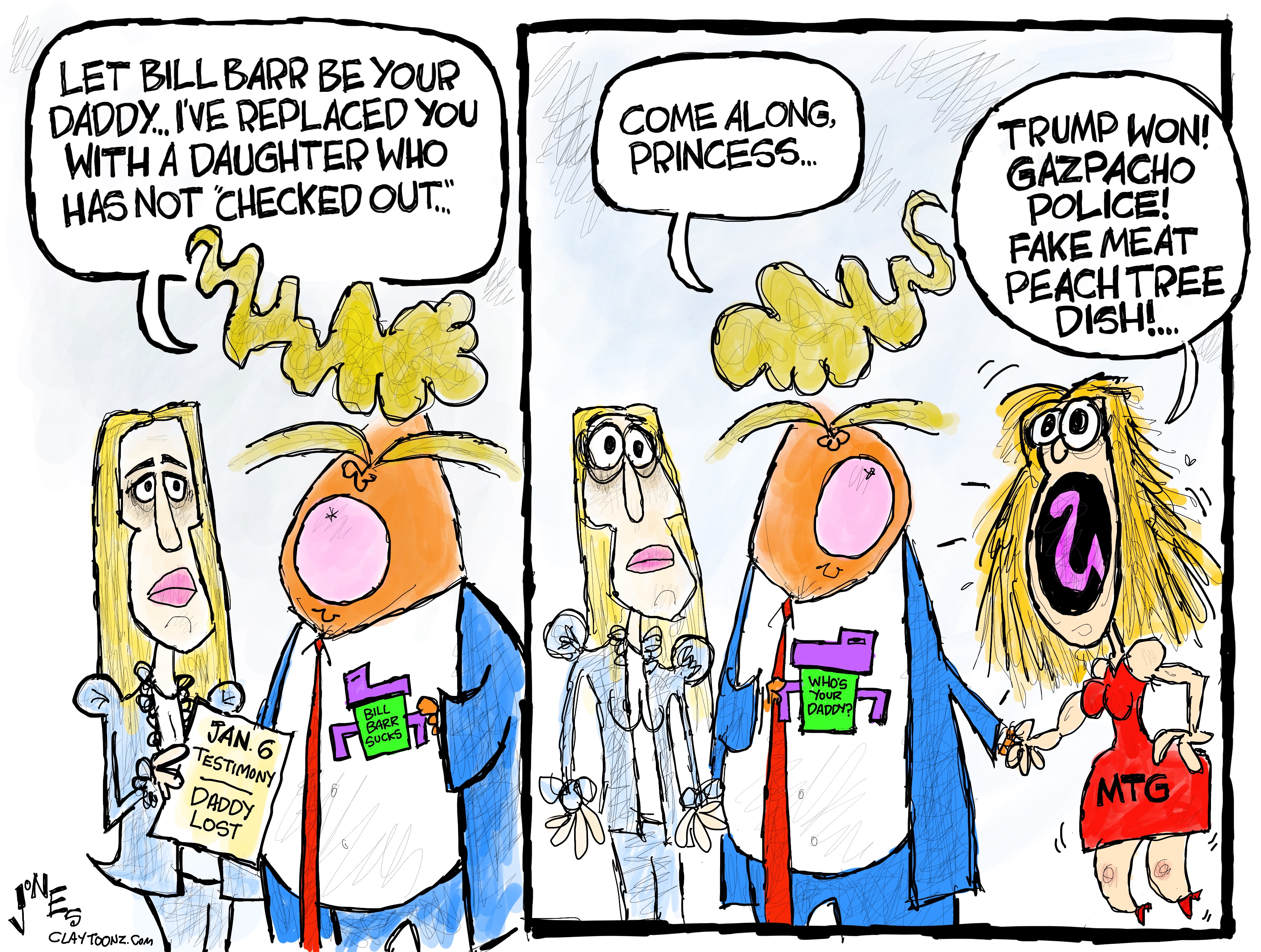
If you only get one thing out of these hearings, it should be a response you can give to anybody on social media who thinks Trump really won the 2020 election: “Not even Ivanka believes that.”
I cover the first hearing in the featured post. The second hearing is going on as I write this, but I’m writing rather than watching, so I’ll have to cover it next week.
Russian forces continue to advance slowly into eastern Ukraine, with high casualties on both sides. From the outside, it’s hard to tell who can keep this up longer.
and the pandemic
Two trends are fighting each other, so national case numbers are more-or-less flat, as a continuing decline in the Northeast is canceled out by increases in other regions. Hospitalizations are bending upwards, and deaths have been bouncing around in a 250-400 daily range for nearly two months.
The mass-shooting compromise gives credibility (probably more than they deserve) to Republican talking points about mental health and school vulnerability as causes. Vox summarizes:
The framework itself is heavy on mental health interventions, like setting aside funding for in-school mental health and support services, as well as telehealth services for individuals and families in mental health crisis. It also calls for a national expansion of community mental health services for children and families. … [A]lthough the framework is thin on details, it suggests investing in “programs to help institute safety measures in and around primary and secondary schools, support school violence prevention efforts and provide training to school personnel and students.”
But there is some gun control included as well. One carefully worded part of the framework:
Provides resources to states and tribes to create and administer laws that help ensure deadly weapons are kept out of the hands of individuals whom a court has determined to be a significant danger to themselves or others, consistent with state and federal due process and constitutional protections.
It also may close the “boyfriend loophole” in an existing law that prevents gun ownership by people under restraining orders for domestic violence, and also enhance background checks for gun purchasers under 21 years old.
Everything depends on the final wording, which remains to be worked out. Any of the ten Republicans involved in the negotiations could torpedo a bill, since all ten would be needed to break a filibuster.
According to Susan Collins, the group negotiating to revise the Electoral Count Act
has already drafted language that would make clear that the vice president’s role is ministerial in the process of counting Electoral College votes. The new language also raises the threshold for triggering a challenge to a state’s slate from one member in each chamber to 20% of the members in each body. There would be a majority vote for sustaining an objection.
and you also might be interested in …
The May consumer price index came in higher than expected: Inflation is running at 8.6%. Many economists had been theorizing that the peak inflation rate had been reached in March. But apparently not.
Obviously, this is an issue that drives down Biden’s approval numbers, but it’s not clear what he can do, what he should have done in the past, or what Republicans would do differently. Inflation would probably be lower if the American Rescue Plan hadn’t passed, but unemployment would be considerably higher. I doubt that would be a win for the country.
Some Republicans want to blame Build Back Better or even the Green New Deal for inflation, but it’s hard to see how that’s possible, since neither of them passed Congress.
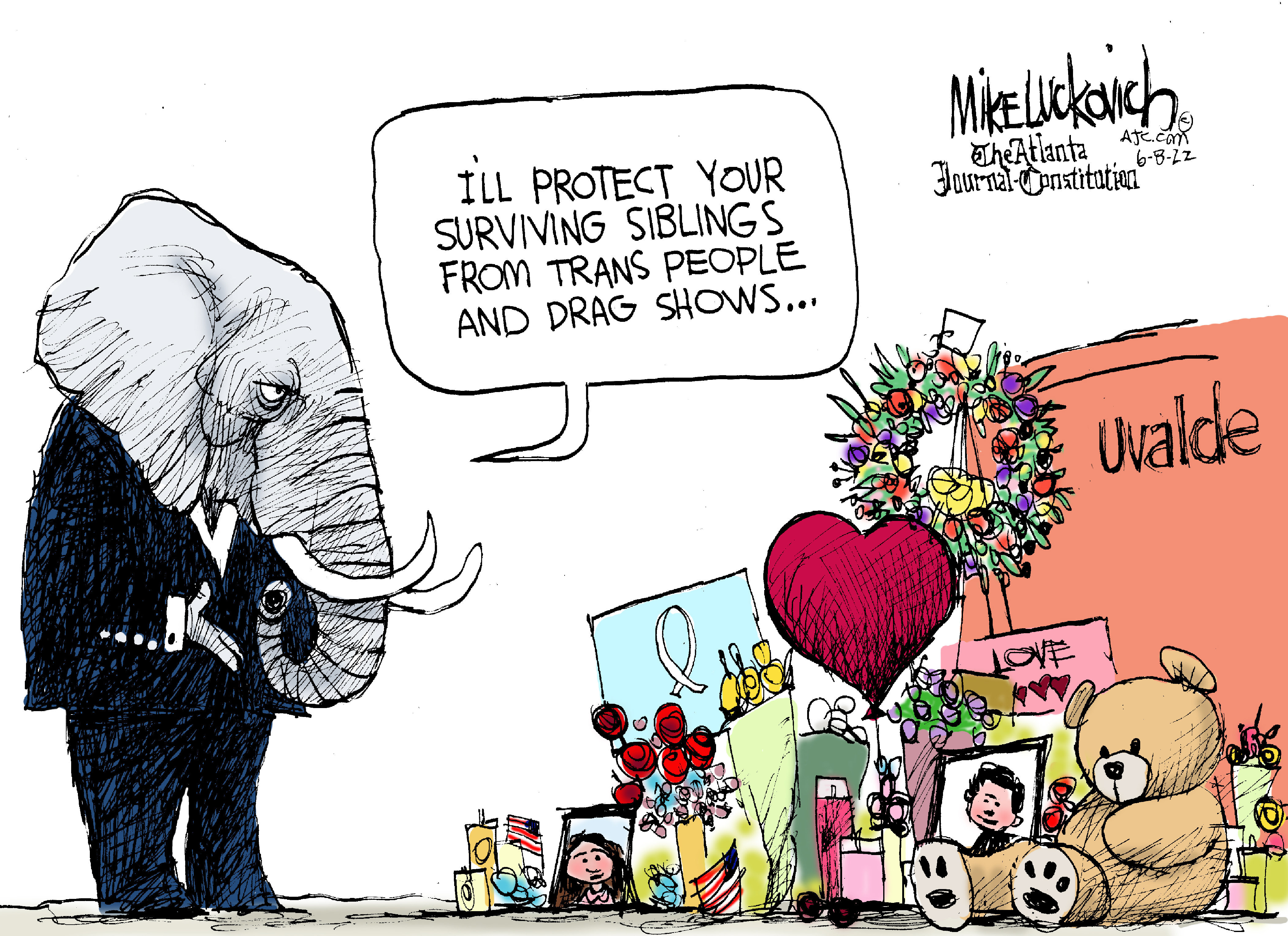
In view of the attempted right-wing coup being exposed by the 1-6 Committee hearings, the ongoing rash of mass shootings caused by our insane gun culture, and the pandemic that has already killed a million Americans, it makes perfect sense that Republicans would want to focus on … kids going to drag shows.
Yep, that’s this week’s outrage, and public officials like Ron DeSantis are talking about siccing child protective services on parents who allow such a thing.
Because apparently seeing men dress like women will do some kind of permanent damage to a minor. I can’t quite imagine what, but probably my imagination has been stunted by my childhood trauma of seeing Flip Wilson’s Geraldine character, Corporal Klinger in MASH, and various Monty Python men-dressed-as-women skits. An earlier generation of American youth had to recover from seeing Milton Berle in a dress, as well as Tony Curtis and Jack Lemmon in Some Like It Hot.
It’s a miracle the Republic has survived.
A related outrage I forgot to mention last week: Right-thinking folks are boycotting Pizza Hut because the Hut’s Book-It program (to encourage children to read more) endorsed the book Big Wig, about a boy who creates a drag character. I personally favor local pizza places, so I’ve been unofficially boycotting the national chains for many years. But if you find yourself ready to flip a coin between chain pizzerias, you might want to give the Hut an edge.
A question to meditate on: Unless they go bare-chested at the beach, women dressing like men is hardly ever a big moral issue, and a kids’ book about a girl creating a hyper-masculine fantasy character wouldn’t be worth national attention. Why is that? Extra credit if your answer also accounts for the Hebrew Bible (a.k.a. Old Testament), which denounces gay men but doesn’t mention lesbians.
A guy was arrested Wednesday for plotting to assassinate Supreme Court Justice Brett Kavanaugh. It’s kind of a bizarre story: He called 911 on himself, and gave the police his description. He was arrested with multiple weapons. As motive, he cited both the Court’s pending decision to reverse Roe v Wade and the possibility that Kavanaugh might vote to loosen gun laws.
My IRL friend Abby Hafer has published an article fleshing out one of the strongest arguments for abortion rights: The law should not be able to commandeer parts of one person’s body, even to save the life of another person. In “Do pregnant women have fewer rights than the dead?” she points out that not even a corpse can be forced to donate a kidney or liver unless permission was granted before death.
Yet the anti-abortion lobby feels that [a pregnant woman] must donate her entire body, and not for her own good. She is being required to make this sacrifice of her own organs and tissues without her consent, in order to help someone else, even though our society does not require this at any other time, from any other kind of person.
Poland is an example of what can happen when anti-abortion radicals get their way. The NYT tells the story of Izabela Sajbor, who died of sepsis after her water broke prematurely, and doctors refused to intervene for fear of killing her fetus. Shortly before dying, Sajbor wrote something that echoes Abby’s point:
They cannot help as long as the fetus is alive thanks to the anti-abortion law. A woman is like an incubator.
and let’s close with something to make us all feel smarter by comparison
[This article is being written before and possibly during the second hearing, which started at 10 a.m. I will cover that material, together with Wednesday’s and Thursday’s hearings, next week. As I’ve repeated many times, this is not a breaking-news blog.]
The committee kicked off its public hearings Thursday night [videotranscript]. Remembering Bob Mueller’s testimony to Congress about his investigation, I had worried that these hearings would be dull and legalistic, or that they would rehash details that, however damning they might be, had already been widely discussed by people who were open to knowing what happened. Worst of all would have been one of those talkfests where each committee member gets five minutes to audition for national attention.
I should have had more faith. The other committee members were content to let Chair Bennie Thompson and leading Republican member Liz Cheney carry the ball, and they carried it well, particularly Cheney.
The first hour of the hearing consisted of Thompson and Cheney laying out the story that the rest of the evidence will nail down, backing up their claims with short videos of testimony that the public had not seen before — mostly from people in Trump’s inner circle: Bill Barr, Jason Miller, and even Ivanka. In the second hour the committee heard from live witnesses: Capitol Police officer Caroline Edwards (who was injured battling rioters at the barricades) and documentary film-maker Nick Quested (who spent the day following Proud Boys leader Henry Tarrio).
The key points in the Committee’s narrative are:
Trump knew that he had lost the election, and that his claims of fraud were baseless. Trump campaign advisor Jason Miller testified that (as the votes were still being counted) the campaign’s data analyst told Trump that he would not win. Trump lawyer Alex Cannon investigated the election-fraud claims, and already in November had reported to Mark Meadows that “we weren’t finding anything that would be sufficient to change the results in any of the key states”. To which Meadows replied: “So there’s no there there.” Attorney General Bill Barr said he told the President within weeks of the election that his charges of fraud were “bullshit”, and in particular that his claims about Dominion voting machines were “complete nonsense”. Ivanka was shown testifying that she believed Barr.
The attack on the Capitol was planned and organized. This wasn’t a protest that spontaneously spun out of control. In response to Trump’s tweet that 1-6 would “be wild”, the Proud Boys and Oath Keepers made plans to storm the Capitol. Before Trump even began his speech, about 200 Proud Boys had left his rally to scout the Capitol’s defenses. After Trump sent the crowd in their direction, they spearheaded breaching the barriers and leading the mob into the Capitol. (A key question going forward: Were these Trumpist militias just intuiting what their leader wanted, or does some figure — Roger Stone, say — connect them more directly with the White House’s plans?)
The rioters engaged in a bloody battle against law enforcement. If the videos of the attack didn’t make this obvious enough, Officer Edwards’ testimony brought the point home: “I saw friends with blood all over their faces. I was slipping in people’s blood. You know, I — I was catching people as they fell. I — you know, I was — it was carnage. It was chaos. I — I can’t — I can’t even describe what I saw. Never in my wildest dreams did I think that, as a police officer, as a law enforcement officer, I would find myself in the middle of a battle. You know, I — I’m trained to detain, you know, a couple of subjects and — and handle — you know, handle a crowd, but I — I’m not combat trained. And that day, it was just hours of hand-to-hand combat, hours of dealing with things that were way beyond any — any law enforcement officer has ever trained for.” This contrasts with Trump’s characterization of the mob as “loving” and Rep. Andrew Clyde’s comparing the rioters to tourists.
The riot was part of a larger plan to reverse the voters’ decision and return Trump to office for a second term. Cheney quoted conservative Judge Michael Luttig: “If Dr. Eastman and President Trump’s plan had worked, it would have permanently ended the peaceful transition of power, undermining American democracy and the Constitution.” Trump pressured the Justice Department to spread his lies about election fraud. (“Just say the election was corrupt and leave the rest to me and the Republican Congressmen,” Trump told DoJ officials.) He pressured state election officials to commit fraud. (Cheney: “You will hear additional details about President Trump’s call to Georgia officials urging them to ‘find’ 11,780 votes – votes that did not exist, and his efforts to get states to rescind certified electoral slates without factual basis and contrary to law. You will hear new details about the Trump campaign and other Trump associates’ efforts to instruct Republican officials in multiple states to create intentionally false electoral slates, and transmit those slates to Congress, to the Vice President, and the National Archives, falsely certifying that Trump won states he actually lost.”) He pressured Vice President Pence to refuse to count electoral votes certified by the states, based on a theory he had been told was illegal.
Trump cheered the violence and refused to take action to stop it. Cheney: “Not only did President Trump refuse to tell the mob to leave the Capitol, he placed no call to any element of the U.S. government to instruct that the Capitol be defended.” General Milley testified that orders to get soldiers to the Capitol came from Vice President Pence, not from Trump. When told that the rioters were chanting “Hang Mike Pence”, Trump said Pence “deserves” it. (The source of that quote — which Trump denies — has still not been revealed.)
At least a few Republican members of Congress were complicit. This was the evening’s most tantalizing and least-fleshed-out point. Cheney floated this: “Representative Scott Perry, who is also involved in trying to get Clark appointed as Attorney General, has refused to testify here. As you will see, Representative Perry contacted the White House in the weeks after January 6th to seek a Presidential pardon. Multiple other Republican Congressmen also sought Presidential pardons for their roles in attempting to overturn the 2020 election.”
Conservative counter-programming. Almost as interesting as the hearing itself was how Trump and his minions dealt with it.
Fox News went to great lengths to shield their audience from any of the information the committee presented. The network not only refused to air the hearings, but went without commercial breaks for two whole hours, so that none of their viewers would be tempted to check out one of the news channels that was actually covering the news. Comedian Stephen Colbert nailed this:
Do you understand what that means? Fox News is willing to lose money to keep their viewers from flipping over and accidentally learning information. … But I’m not surprised. That’s the first rule of any cult: Never leave the compound.
Robert Reich estimates the lost revenue at around $400K. Chris Hayes describes the next level of technical detail: How Fox made sure none of the videos of Trumpist violence would make it through to their viewers, even as a picture-in-picture with Tucker Carlson talking over it.
Truth Social, Trump’s Twitter-clone, reportedly has been banning users who try to discuss the Committee’s evidence, making a mockery of the free-speech rhetoric it was founded on. This also should not be surprising: Reciprocity is not a fascist value. Fundamentally, fascism is an us-and-them worldview, where the fascists themselves have God-given rights, but their enemies do not.
Trump himself lashed out, calling the hearings a “witch hunt” and the committee members “hacks”. He attacked Bill Barr as “weak”, and said that Ivanka had “checked out” of looking at election claims. (Unaddressed question: Why shouldn’t Trump’s other supporters check out too?) He repeated his long-debunked claims of “an Election that was Rigged and Stolen”, and praised the January 6th rioters as representing “the greatest movement in the history of our Country to Make America Great Again”.
Direct criticism. If the don’t-look-behind-the-curtain defense failed, the next line was to smear the proceedings as “propaganda” or a “show trial” or “kangaroo court”, without addressing any of the evidence presented.
The Lawfare blog will be doing next-day podcasts where people call in questions about the hearings. The final question in Friday’s podcast was whether this criticism has merit. Host Benjamin Wittes answered this himself, and made a few key points:
First, the committee is not a court at all, in that no ruling will be made and no punishment will be assessed. So accusing it of being a kangaroo court conducting a show trial is a category error.
Beyond that is the question of whether the hearings are presenting accurate information, and as far as we can tell at this point, it is.
Finally, and harder to judge, is whether the committee is ignoring or omitting information that would argue against the points the committee is making. Wittes is not aware of any such information.
It’s worth pointing out that if any of the quoted witnesses feel that their testimony has been misrepresented, nothing stops them from saying so. Ivanka still has her Twitter account, for example, but hasn’t posted since May 30. Bill Barr and Mark Milley would have no trouble getting attention if they had comments to make.
Finally, it should go without saying that if what you are presenting is true, you have no responsibility to “balance” it by presenting lies. So Trump’s complaint that the Committee “refuses to talk of the Election Fraud and Irregularities that took place on a massive scale” has no merit. The evidence says not only that Trump’s claims about the election are false, but that they are conscious lies. He has known from the beginning that they are false.
Political impact. About 20 million Americans watched the hearings live, not counting those who watched it later online. Millions more have seen highlights or have heard summaries presented by journalists, comedians, or their friends. A few key facts have probably penetrated MAGA’s darkest sanctums: Not even Ivanka believes Trump’s stolen-election bullshit.
It remains to be seen whether the hearings will fade or pick up momentum. Today’s hearing undoubtedly will get a smaller audience, simply because it’s in the morning rather than prime time. But we’ll see what kind of buzz it generates.
The most effective Republican talking point against the hearings is not that the Committee’s case isn’t true, but that 1-6 is ancient history, and that Americans are much more worried about immediate issues like inflation (which the GOP has presented no plan for stopping).
Democrats have offered Republicans many opportunities to put 1-6 behind them: They could have voted to convict Trump in his second impeachment, and made him ineligible for future political office. They could have supported a bipartisan commission to investigate 1-6 and rallied behind its conclusions. They could still denounce Trump’s insurrection, denounce the Big Lie, and denounce Trump for continuing to promote it.
In short: They could take their party back from the fascist demagogue who has dominated it these last six years.
But they won’t unless public opinion forces them. That’s why these hearings are necessary.
Rumblings. The path of least resistance going forward is for the GOP to do to Trump what they did to their last failed president, George W. Bush. Bush left office in 2009, and by the 2010 election Tea Party candidates were running away from him almost as hard as they were running against Obama. In the early days of the Iraq invasion they had seen Bush as the next face on Mount Rushmore, but by 2010 the Tea Party line was that he had never really been a conservative.
Current Republicans could do something similar to Trump: claim that they are “constitutional conservatives” as opposed to the guy who tried to overthrow the Constitution after he lost the election. If they do, then the midterm elections can be about inflation or critical race theory or immigration or transgender-kids-in-your-daughter’s-locker-room or Biden’s-gonna-take-your-guns or pretty much whatever they want. If they don’t, then Trump and the Democrats will conspire to make the midterms about Trump, which is one of the few ways Republicans can blow this election.
Some conservatives grasp this logic. Fox News may be lining up behind Trump, but the rest of the Murdoch media empire is not so sure. The Wall Street Journal recognizes the basic facts of the Committee’s case, and only defends Trump against criminal liability.
The President spread falsehoods about the election. He invited supporters to Washington on Jan. 6, tweeting on Dec. 19 that it ‘will be wild!’ He riled up the crowd and urged it to march on the Capitol. After violence began, he dawdled instead of sending help. Mr. Trump bears responsibility for the mayhem. But inspiring followers to march is not the same as leading a criminal conspiracy.
Murdoch’s New York Post takes a more purely partisan angle. It shrugs off the broader threat to democracy, but wants to jettison Trump’s 2020 claims so that Republicans can focus on more effective issues and less tainted candidates.
Trump has become a prisoner of his own ego. He can’t admit his tweeting and narcissism turned off millions. He won’t stop insisting that 2020 was “stolen” even though he’s offered no proof that it’s true. … Trump can’t look past 2020. Let him remain there. Look forward! The 2024 field is rich.
Elected Republicans could follow that lead. They could choose to jump off the Trump Titanic before it sinks. But will they?
It’s pretty obvious what this week’s Sift is going to be about: The January 6 hearings. The 1-6 Committee’s public hearings kicked off Thursday in prime time, and it’s clear the Committee is bringing the goods: They have a case to make, and they’re making it clearly and persuasively. I’ll review what they said, how Republicans countered, and where things go from here in this week’s featured post, which should be out by 10 EDT.
That’s also when the second public hearing starts. I’m going to be putting the weekly summary together then, so I’ll stream the hearing this afternoon rather than try to cover it in real time. (As I’ve often said, this isn’t a breaking-news blog.)
The weekly summary will pick up 1-6 odds and ends that didn’t fit into the featured post, cover the continuing Russian push into eastern Ukraine, discuss the ambiguous recent Covid numbers, and poke fun at the Republican outrage-of-the-week. (Kids are going to drag shows! They’ll see men in dresses! How will the Republic survive?) That should be out around noon.
You don’t have to be that gung-ho on trans rights to realize that a world where girls’ genitals need to be inspected before they can play any sport is worse for girls than a world where once in a while there’s a trans girl on a girls’ team.
The Senate is under pressure to “do something”, but if anything gets done, it will be small. Perhaps there will be some expansion of red-flag laws that prevent some criminals and mentally ill people from buying guns, perhaps an expansion of federal background checks that would still leave loopholes. But no universal background checks, no assault weapon ban, nothing remotely on the scale of the problem.
This week’s featured post examines my own history with guns, and concludes that the apparently stable level of gun-ownership in America over the decades has masked a huge increase in the destructive potential of our civilian arsenal.
Yes, I grew up in a gun-owning household. But no, the guns (and the gun culture) of America in the 1960s and 70s bears no resemblance to what we see today.
In discussions of the Second Amendment, gun advocates often ignore the phrase “well regulated Militia”, and gun-control advocates correspondingly call attention to it. But both sides usually forget that the Constitution uses the word “Militia” elsewhere, so the word is not an impenetrable mystery to be interpreted however we see fit. The constitutional context paints a pretty clear idea what the Founders meant a militia to be.
Article I, section 8 gives Congress the power “To provide for calling forth the Militia to execute the Laws of the Union, suppress Insurrections and repel Invasions; To provide for organizing, arming, and disciplining, the Militia, and for governing such Part of them as may be employed in the Service of the United States”
Article II, section 2 says that the President “shall be Commander in Chief of the Army and Navy of the United States, and of the Militia of the several States, when called into the actual Service of the United States”.
So it’s clear that self-appointed groups of guys playing war games in the woods are NOT militias in the constitutional sense. They are not organized, armed, and disciplined by Congress, and they picture themselves BEING the insurrection, not responding to a call from Congress to submit to the command of the President and put down an insurrection.
The only organizations today that fit the constitutional uses of “Militia” are National Guard units.
Michael Fanone, a 20-year DC policeman who testified about the 1-6 riot and now works for CNN, explains why the AR-15 should be banned.
If banning them outright seems like too extreme a solution to be politically palatable, here’s another option: Reclassify semi-automatic rifles as Class 3 firearms.
That would mean that someone wanting to purchase an AR-15 would have to go through a background check, fingerprinting and review by an official from the Bureau of Alcohol, Tobacco, Firearms and Explosives — a process that takes anywhere from 12 to 16 months. And since Class 3 weapons can’t be purchased by anyone younger than 21, it would solve the issue of emotionally unstable 18-year-olds buying them.
A Class 3 firearm reclassification would also make those who are approved to purchase these weapons subject to an annual check that they are complying with federal regulations regarding secure storage of the firearm, and to confirm their licensing and other paperwork is up to date. All of these hoops and hurdles are sure to reduce the civilian demand for these weapons.
Faced with the same confluence of events that we had in 2018, even worse since now we’re reeling from the racist massacre in Buffalo along with the insanity in Texas, all the wings of today’s “stay on message” gun violence prevention lobby, from the youngest to the oldest, are not just singing from the same songbook, they’re following the same theory of change: trying to convert momentary public attention into successful lobbying of legislators, plus calling occasional big marches and walkouts aimed at converting attention into the successful lobbying of legislators. To be followed by the inevitable electioneering for candidates who are almost all Democrats. When media attention fades, as it will, this lobby has no plans to create attention on its own beyond “vote harder.” …
It’s as if we’re living in the 1950s and the only groups leading the charge for civil rights are the NAACP and the Urban League, and the only strategy they’re willing to try is polite protest and lobbying.
The House committee’s televised hearings start Thursday evening. I’m getting disturbed that I’m not hearing more buzz about that. We’re going to see in detail the story of how an American president almost overthrew democracy so that he could stay in power. It’s a big deal.
I can already predict the Republican response: It’s all just a rehash of the second impeachment hearings. But it’s not. Those hearings happened mere weeks after the insurrection, and spent most of their time recounting what happened at the Capitol on 1-6 itself.
The Committee now knows a great deal more about Trump’s conspiracy to overturn his defeat in the 2020 election. They have sources inside the Trump White House, and can trace the plot through the fake electors and the attempt to induce Vice President Pence to break his oath of office. We’ll hear just how many people told Trump explicitly that his stolen-election narrative was bullshit, and that his scheme to disrupt counting the electoral votes was illegal. I expect the hearings to reveal connections between the White House and the right-wing paramilitary groups that planned the Capitol assault. We’ll find out if Republican congressmen were involved. We’ll hear from executive-branch officials who Trump tried to pressure to go along with the plot, and get testimony about how Trump responded as events unfolded on January 6.
One indication that the Committee has the goods on Trump is just how hard his people have tried to obstruct its investigation.
Friday, Trump economic advisor (and proponent of the election-nullifying plot he called “the Green Bay sweep“) Peter Navarro was arrested for contempt of Congress. He’s pretty obviously guilty: He was subpoenaed by the 1-6 committee and just blew them off. He has tried to claim that executive privilege prevents him from testifying. However, it didn’t prevent him from writing about the same topics in his book or discussing them on television. It isn’t the world that’s not supposed to know, just Congress.
“In any event, you must appear to assert any executive privilege objections on a question-by-question basis during the deposition,” the committee wrote.
“Who are these people,” Navarro said. “This is not America. I mean, I was a distinguished public servant for four years and nobody ever questioned my ethics. And they’re treating me in this fashion.”
It actually puts an exclamation point on the fact that we have a two-tiered justice system. If you’re a Republican, you can’t even lie to Congress or lie to an FBI agent or they’re coming after you. They’re gonna bury you. They’re gonna put you in the D.C. jail and terrorize and torture you and not live up to the Constitution there.
you murder one person and suddenly ev’body’s like LAW LAW LAW
Remember: the Benghazi Committee was precisely the kind of partisan witch hunt Republicans claim the 1-6 Committee is. But Hillary Clinton testified to them for 11 hours, because she was confident she had answers for all their questions. Trump and his people, on the other hand, know that they’re guilty, so they want to prevent the American people from finding out what they did.
Can you imagine Trump showing up for hours of testimony under oath? He knows he couldn’t go five minutes without either babbling or committing perjury.
meanwhile, the pandemic continues
The trends of the past few weeks continue: Case numbers are drifting downwards, particularly in the Northeast. (In my Massachusetts county, new cases per day per 100K were running in the high 50s a few weeks ago; it’s 35 now.) Hospitalizations are well below their January peaks and deaths (now around 270 per day) never really did spike during this wave.
According to data collected by the CDC from 2010 to 2020, the agency estimates that the flu has caused 12,000–52,000 deaths annually.
Dividing by 365 gets you to 33-142 deaths per day. So right now Covid deaths are running about double the rate of a bad flu year. (That’s assuming we could maintain this rate for a whole year. If deaths shoot up again in the fall and winter, we’ll be much higher than double a flu death-rate.)
In Atlantic, Yasmin Tayag examines how this wave feels different from previous ones: It’s a much longer but shallower wave.
The recent omicron variants have gotten better at evading the vaccines’ protections against infection, but deaths among the fully vaccinated-and-boosted are still rare. I’ve noticed this in my own social circle, which is almost entirely vaccinated: More people I know have gotten sick lately, but none seriously.
and the Ukraine War
It’s been 100 days since the Russian invasion began. Russian forces occupy about a fifth of the country, mostly in the east. The Russian offensive in the east has turned into a war of attrition, with each side making claims that the battle is turning in its favor.
It gets harder and harder to imagine how this war might end. Neither side is likely to give up, and there is no obvious settlement that both could accept.
Meanwhile, a debate is rising about America’s and NATO’s long-term commitment. The NYT’s Ross Douthat expresses one side of that debate:
[G]iven the state of the war right now, the more likely near-future scenario is one where Russian collapse remains a pleasant fancy, the conflict becomes stalemated and frozen, and we have to put our Ukrainian policy on a sustainable footing without removing Putin’s regime or dismantling the Russian empire. … [I]f Kyiv and Moscow are headed for a multiyear or even multi-decade frozen conflict, we will need to push Ukraine toward its most realistic rather than its most ambitious military strategy.
The West should not aim to offer Putin an off-ramp; our goal, our endgame, should be defeat. In fact, the only solution that offers some hope of long-term stability in Europe is rapid defeat, or even, to borrow Macron’s phrase, humiliation. In truth, the Russian president not only has to stop fighting the war; he has to conclude that the war was a terrible mistake, one that can never be repeated. More to the point, the people around him—leaders of the army, the security services, the business community—have to conclude exactly the same thing.
… Only failure can persuade the Russians themselves to question the sense and purpose of a colonial ideology that has repeatedly impoverished and ruined their own economy and society, as well as those of their neighbors, for decades. Yet another frozen conflict, yet another temporary holding pattern, yet another face-saving compromise will not end the pattern of Russian aggression or bring permanent peace.
and you also might be interested in …
Dr. Oz will be the GOP’s Senate candidate in Pennsylvania, after David McCormick conceded in the photo-finish primary. Oz got just over 31% in a multi-candidate race and won by less than 1,000 votes out of 1.2 million.
The Democratic candidate, John Fetterman, is still recovering from a stroke suffered just before the primary, which appears to have been caused by an underlying heart condition. He is said to be walking several miles a day.
A couple of Republican conspiracy theories blew up this week.
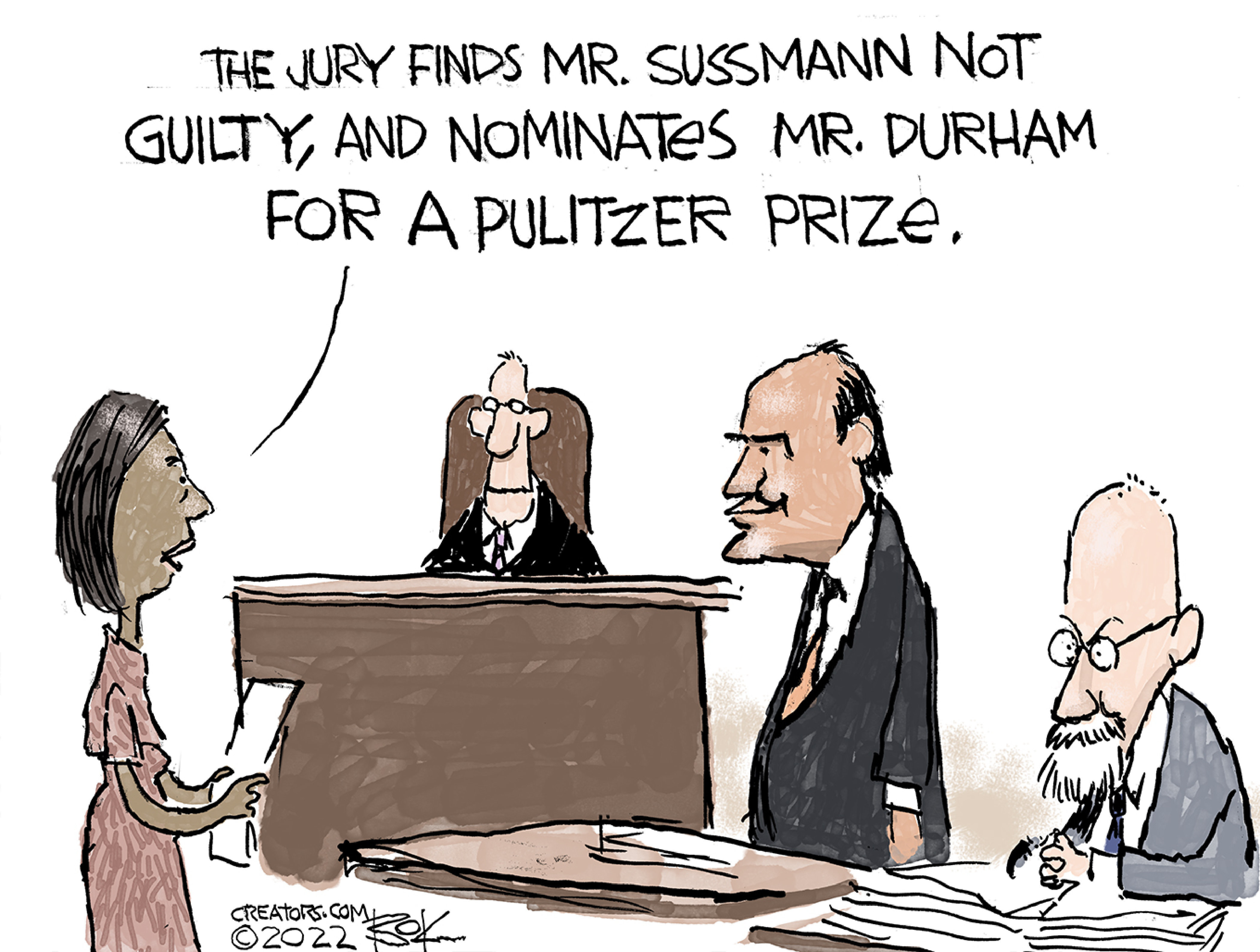
A jury took only six hours to acquit Michael Sussman of lying to the FBI. After three years of investigating the origin of the Trump/Russia investigation, this was Special Counsel John Durham’s first indictment, and it was a pretty flimsy one. The main point of the indictment seems to have been to fan pro-Trump conspiracy theories about the Clintons, not to get a conviction.
Another long-running conspiracy theory has been the “unmasking” of Michael Flynn. WaPo’s Aaron Blake summarizes the theory:
The idea was that Obama administration officials deliberately targeted Donald Trump associates — and particularly Flynn — by requesting the disclosure of their names in intelligence reports before Trump took office, doing so for political purposes. This fed into long-running allegations of the government “spying” on Trump, who chose Flynn as his national security adviser.
The Trump Justice Department investigated that claim and found nothing. BuzzFeed released the previously classified report (by then-US Attorney John Bash) last Monday:
“My review has uncovered no evidence that senior Executive Branch officials sought the disclosure of” the identities of US individuals “in disseminated intelligence reports for political purposes or other inappropriate reasons during the 2016 presidential-election period or the ensuing presidential-transition period,” Bash’s report says.
In particular, unmasking had nothing to do with the scandal that eventually got Flynn convicted of lying to the FBI (which Trump pardoned him for).
A central focus of the probe was the leak showing that Flynn had been in communication with then–Russian ambassador Sergey Kislyak prior to Trump’s inauguration, and whether Flynn’s involvement was revealed through an unmasking request from a government official.
But Bash’s review of unmasked intelligence reports about the calls found that the FBI did not in fact disseminate any that contained Flynn’s information, and that a single unmasked report that did contain Flynn’s information did not describe the calls between him and Kislyak. “For that reason, the public disclosure of the communications could not have resulted from an unmasking request,” Bash’s report concludes.
Both of these attempts to come up with a nefarious origin story for the Trump/Russia investigation ignore the fact that there were perfectly good reasons to investigate, and that the public still has not heard the full story of what went on between the Trump campaign and the Russian government.
Ohio’s legislature has passed the “Save Women’s Sports Act”, which bans transgender girls from playing sports in public schools. Reason summarizes:
So, to be very clear here, no evidence is needed that a particular athlete is trans or not a biological female in order to demand that she prove her sex. The athlete must then go to a physician and either subject herself to a physical inspection of her sexual organs or arrange for hormone or genetic tests. And no, the bill does not fund the costs of such tests. … News 5 in Cleveland notes that there is currently only a single trans female student competing in high school sports in Ohio.
You don’t have to be that gung-ho on trans rights to realize that a world where girls’ genitals need to be inspected before they can play any sport is worse for girls than a world where once in a while there’s a trans girl on a girls’ team.
Brynn Tannehill reports that her friend’s husband is a retired police officer who does police trainings. He finds that young officers are soaked in right-wing propaganda, to the point that they just don’t believe FBI statistics about right-wing domestic terrorism.
Follow up. Spoke with his wife last night. The first responders also didn’t believe that police were attacked on January 6th. Or if they were, it was Antifa. These are the people that will be propping up our post-democracy government. They’re true believers. We’re f****d.
and let’s close with something religious
George Carlin seems to be having a comeback lately, in spite of having been dead since 2008. The streaming channels I subscribe to keep recommending his videos, and he’s been coming up more often on my social media feeds. In addition to just being funny, Carlin generally gave you something to think about, like this attempt to edit the ten commandments down to a more manageable list.
The guns I grew up with wouldn’t have been much use in a massacre.
Comparing the United States to other countries is one of the most powerful arguments for gun control. Recurring mass shootings is a problem unique to the US, and so it requires an equally unique explanation. Other industrialized countries also have mental illness, video games, abortion, secularism, and all the other factors NRA-sponsored politicians and pundits raise to divert attention from guns. But other wealthy countries don’t have America’s mass-shooting problem, or its gun-violence problem in general, because they don’t have America’s guns.
The best attempt I’ve seen to counter this argument is to compare the US not with any other country, but with our own past: The problem can’t be the sheer number of guns in the US, because Americans have always owned a lot of guns.
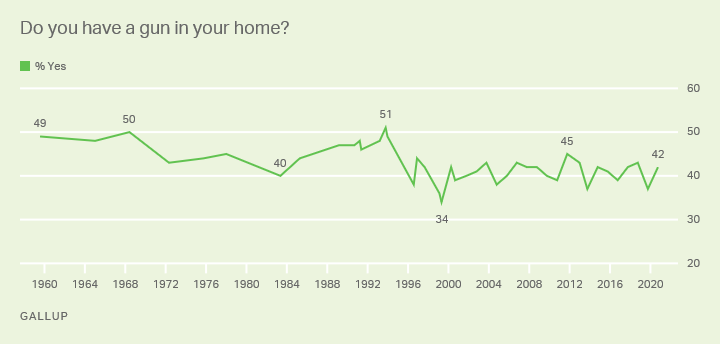
Gallup has been asking about gun ownership since the 1960s, and the percentage of American households with guns has been fairly stable, perhaps even showing a slight downward trend.
Mass shootings weren’t considered a major problem in 1960, this counter-argument goes, so the cause can’t just be guns. Whatever the X-factor is, it has to be something that has changed in recent decades. That, presumably, is how people come to blame video games, abortion, and secularism, despite their presence in other countries.
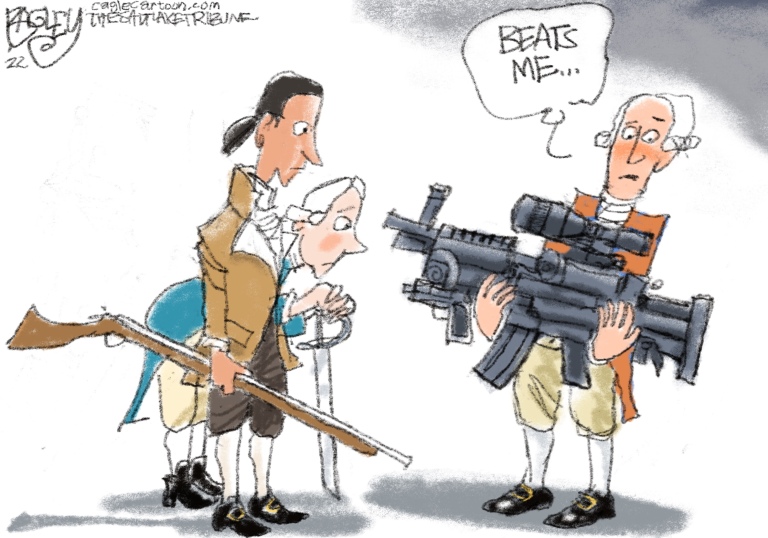
The flaw in this logic is that the guns of America’s civilian arsenal have changed a lot in recent decades. Yes, a lot of Americans have always owned guns. But they didn’t own guns like this.
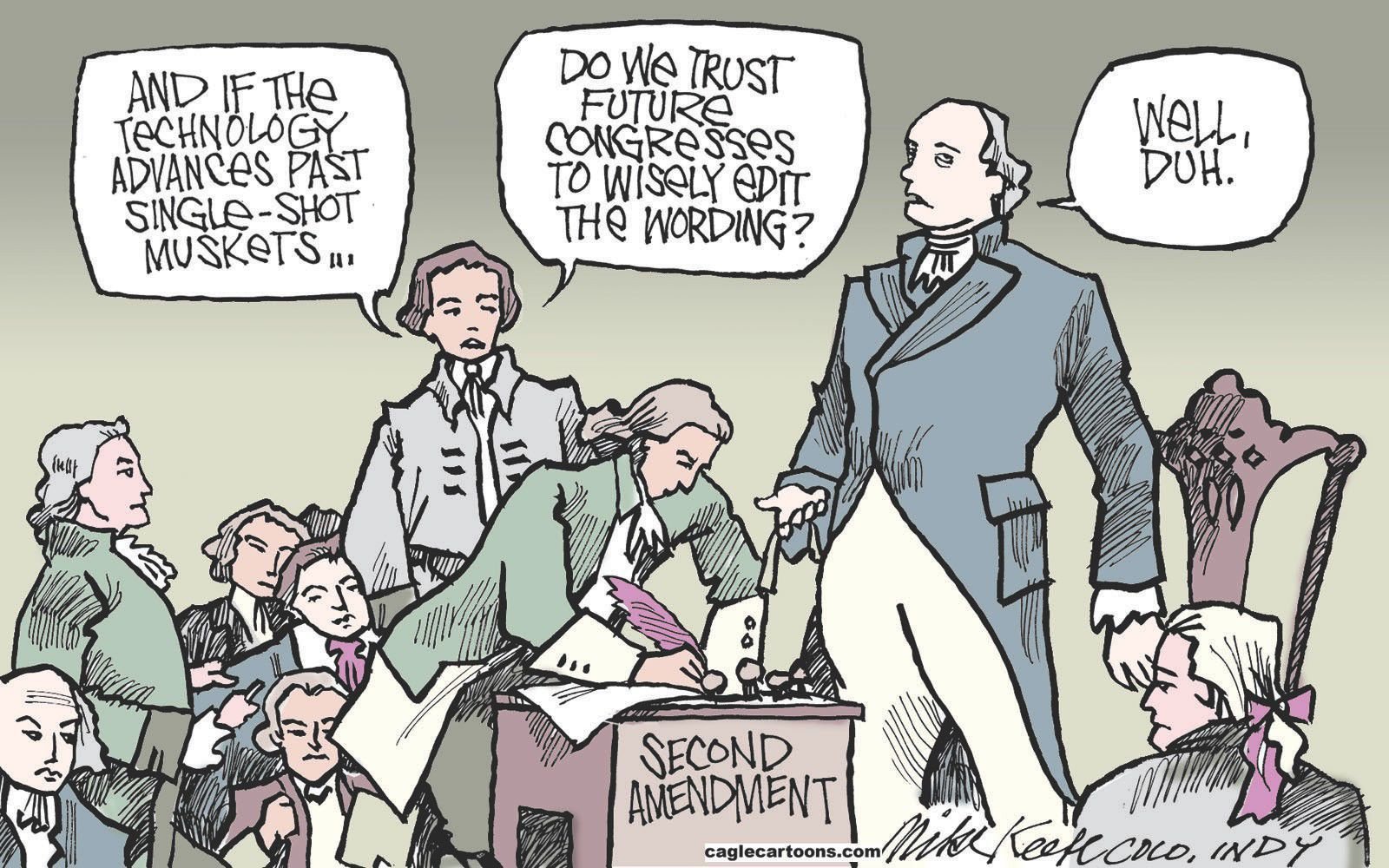
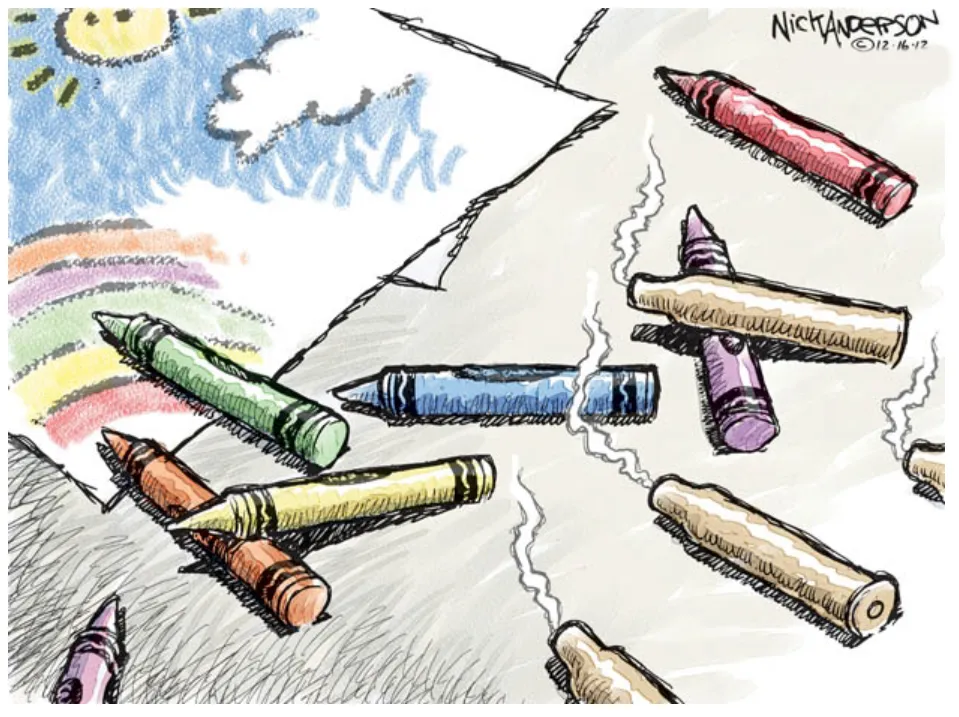
You’ll often see this point made about the guns of the 18th century, the ones the Founders had in mind when they wrote the Second Amendment — as in this cartoon.
What’s not as well appreciated is how much guns have changed in living memory. My memory, for example.
Sometime in my pre-teen years in the late 1960s, my Dad thought it might be a bonding experience for us to go hunting. So he bought a 12-gauge shotgun for himself and a .410 shotgun for me. His held five shells and mine three. Both moved new shells into the firing chamber with a pump action. Pumping could throw off your aim, so without a lot of practice it was just about impossible to shoot even the five or three shells quickly, at least if you wanted to hit anything.
And while reloading wasn’t that hard, once you got onto it, it wasn’t nearly as quick or easy as snapping in a new clip. But it didn’t need to be. The point was to keep firing until your quarry either fell or fled, which would probably happen in a matter of seconds. After that, you were looking at another extended period of stalking — that’s why the sport is called “hunting” rather than “shooting” — so you had plenty of time to dig a few shells out of a pocket and slide them into the shotgun.
Dad also owned a .22 rifle, which typically lived out on our farm, about 15 miles from our house in town. I don’t remember how many bullets it held, but it wasn’t many. I occasionally shot targets with it, but not with any practical goal like hunting or self-defense. (A post on a survivalist message board is blunt about such a rifle’s self-defense limitations: “A .22 round has virtually no ‘stopping power’. It takes a hit directly to vital organs like the heart or brain to ‘stop’ somebody with a .22.”)
That was our whole arsenal. We were, I believe, a more-or-less typical gun-owning family of the era. (At least in the rural Midwest. Perhaps things were already different in the South; I wouldn’t know.) Many of my friends had a similar exposure to guns, which they used (rarely, and under adult supervision) to hunt quail or ducks or rabbits. (I once ate fried squirrels that a neighbor had killed. They did indeed taste like chicken.) I heard about men going on deer-hunting trips, but I don’t remember my friends bragging about hunting deer themselves.
One possible use for our guns never came up: killing people intentionally. Everyone knew, of course, that a shotgun or a rifle of any caliber could kill someone. Occasionally I would hear about hunting accidents, or that someone (though not anyone I knew personally) had committed suicide with a gun. My dentist once surprised burglars at his vacation home, and they shot him with a shotgun they were stealing from him. (At least that’s the story I remember hearing. He lived, but ever after had marks on his face from where the pellets hit. Years later he became the father-in-law of my best friend from elementary school.)
But shooting people was an accident to be avoided, not something we trained to do. For practice we shot at bottles or clay pigeons, not human figures on paper. Dad and I never talked about repelling a home invasion with our shotguns, and I doubt he had such a plan. (Our home would have been pretty easy to invade in the summer, when we often just fastened a screen door with a hook. The shotguns were in the basement and unloaded. Using them quickly would have been difficult. If Dad secretly kept a more convenient gun, I believe I would have found it when I cleaned out the house after he died.) And we certainly never discussed joining a group that might fight against the government.
The guns also were not a part of our identity, either as individuals or as a family. They were sporting equipment, like baseball gloves or basketballs, and had little symbolic significance. So we did not assemble a collection to display with pride, or join a shooting club, or hang around in gun shops. I don’t think I knew what the NRA was.
I had a toy M-16 as a kid, so I knew about such weapons, which soldiers were using in Vietnam. Apparently the civilian semi-automatic version, the AR-15, was already on the market. But it never occurred to me that we might buy one. (Why would we? If you hit a rabbit with a burst from an AR-15, there wouldn’t be much left.)
In short, our gun-owning household didn’t have anything like the destructive capability that millions and millions of American households have today. If I had ever gone on a rampage with our guns, I couldn’t have run up anything like the body counts we’ve seen lately, and most of my victims would probably have lived. Once the police arrived, I couldn’t have held them at bay for long.
I don’t even remember having that fantasy. Owning a shotgun made me an occasional hunter, not a warrior. My warrior fantasies, such as they were, involved joining the military, not going out in a blaze of glory on Main Street.
So no, past America is not comparable to America today in terms of an individual’s ability to commit mass murder. The percentage of gun-owning households may not have changed that much in the past 60 years, but the guns Americans own certainly have.
After last week, when I reviewed the Sift’s past articles about guns, I thought I might go some long while without discussing the topic again. But the news hasn’t slowed down. This last week has included multi-death shootings in Tulsa, Philadelphia, Saginaw, and Chattanooga. The news cycles have begun to overlap: I hear someone talking about a mass shooting and think they’re still talking about the previous one, not the one that just happened and I haven’t noticed yet.
The reason last week’s article was a review rather than a fresh take on the subject was that I thought I had long ago said everything I have to say about guns and gun control. This week I heard an argument against gun control that made me realize that’s not quite true: The problem can’t be the guns, the argument goes, because lots of Americans have always owned guns. The cause of our mass-shooting problem, then, must be something that changed more recently. That, presumably, is how they come to blame video games or abortion or the decline of Christianity rather than guns.
What this argument overlooks, though, is that America’s guns have changed a lot in recent decades. I grew up in one of those gun-owning households of the mid-20th century. But the weapons I had access to didn’t have anything like the destructive capabilities of an AR-15.
So this week’s featured post discusses my personal history with guns. I’m calling it “America’s guns have changed in my lifetime.” It should appear shortly.
The weekly summary summarizes the news reports about the shootings I listed above. It also sets up the 1-6 Committee public hearings, which start Thursday evening. And of course there continues to be pandemic and Ukraine news. That should be out between noon and one EDT.
This week everybody was talking about gun violence
This week’s featured post is my confession that I’ve got no new ideas about America’s gun problem. Instead, I review what I’ve written on the topic since 2015. As far as I can see, nothing has changed in the last seven years, other than the list of mass shootings getting longer.
I also can’t report any ideas from others that struck me as new this week. The battle of ideas, such as it is, has been going around in circles for a very long time.
What did seem fresh, though, was the earnestness of emotion that I heard from many people, particularly from folks who aren’t politicians or news-show hosts. To me, the most moving comments came from people who have been successful enough to have people pay attention to them, but used that opportunity to channel what ordinary people are feeling.
One of them was NBA coach Steve Kerr, who on Tuesday couldn’t bring himself to focus on questions about his team’s progress in the playoffs. (They advanced to the finals on Thursday.) Violence is personal for Kerr. He was 18 when his father was gunned down by terrorists in Beirut. This is what he had to say.
The bill he’s talking about, HR-8, is summarized here. It’s hardly an attempt to seize people’s guns. Rather, it just makes it illegal to sell a gun to someone without a background check. Polls indicate that most Americans believe that’s already what the law demands, but it isn’t.
Jimmy Kimmel also had trouble keeping his voice steady. He recorded this statement without an audience.
Video can capture weaselly responses as well. In this clip, Ted Cruz has no answer for a British reporter who asks him why these kinds of shootings happen so much more often in America than anywhere else, and if our lax gun laws have something to do with it. Cruz can only pretend to be offended and storm off, because there’s nothing he can say.
Three years ago, the American Independent listed 13 absurd “causes” for mass shootings that Republicans offer to distract attention from guns. We heard just about the whole list this week as well. None of them answer the question the reporter asked Cruz: What’s special about the United States other than the ease with which people with violent intentions can lay their hands on weapons appropriate for fighting a war?
The lack of any link between shootings and video games, for example, was already clear nine years ago in this chart: If you’re having trouble reading it, the United States is the dot floating high above the field because of its per capita gun-related murders, while the Netherlands and South Korea spend far more per capita on video games.
The Texas Observer does a pretty thorough takedown of Governor Abbott and his finger-pointing at mental illness (which, of course, only exists in the US).
Abbott is simply changing the topic.
The Uvalde shooter did not kill those children with his purported mental health struggles. He did not shoot them with estrangement; he did not murder them with malaise; he did not ravage their little bodies with the inchoate rage of his misguided youth. He killed them with a goddamn assault rifle, and high-capacity magazines, designed for the precise purpose of human annihilation.
Abbott’s interest in mental health lasts just as long as it takes for voters’ attention to shift away from guns. (About four days, according to Princeton Professor Patrick Sharkey.) Just last month, he cut the state’s mental health budget.
Texas ranked last out of all 50 states and the District of Columbia for overall access to mental health care, according to the 2021 State of Mental Health in America report.
But if you think pro-gun gaslighting can’t get any worse, I have bad news for you: The problem isn’t guns, says Derek Gilbert, it’s demons. Killing so many children with an AR-15 is so hard, Gilbert improbably claims, that the Uvalde shooter couldn’t have managed it unless he were possessed by a demon who has done this before. (Again, it’s not clear why this demon doesn’t possess people in the Netherlands or South Korea.)
The police in Uvalde arrived at the school within minutes. (It’s a small town. I saw someone on Twitter claim that nothing is more than five minutes from the school.) But they didn’t enter the room where the shooter was killing children until more than an hour later. Kids were calling 911 while police were just outside the door. The police changed their story many times in the first few days. Whether we have the true story now is anybody’s guess.
and Ukraine
Russia continues to advance slowly into eastern Ukraine. CNBC calls this “a subtle momentum shift in the war”. Some of the pro-Ukraine voices I’ve been following have stopped commenting, which worries me. The Week summarizes speculations in both directions.
As the war drags on, the likelihood of a global food shortage rises. It’s easy to sensationalize that possibility, but The Economist covers it pretty well.
Russia and Ukraine supply 28% of globally traded wheat, 29% of the barley, 15% of the maize and 75% of the sunflower oil. Russia and Ukraine contribute about half the cereals imported by Lebanon and Tunisia; for Libya and Egypt the figure is two-thirds. Ukraine’s food exports provide the calories to feed 400m people. The war is disrupting these supplies because Ukraine has mined its waters to deter an assault, and Russia is blockading the port of Odessa.
Even before the invasion the World Food Programme had warned that 2022 would be a terrible year. China, the largest wheat producer, has said that, after rains delayed planting last year, this crop may be its worst-ever. Now, in addition to the extreme temperatures in India, the world’s second-largest producer, a lack of rain threatens to sap yields in other breadbaskets, from America’s wheat belt to the Beauce region of France. The Horn of Africa is being ravaged by its worst drought in four decades.
If you’re a middle-class-or-higher American, this will be a nuisance but not a crisis. Food prices will increase, but the average American household spends only 10% of its income on food. We could afford to spend more, and we could eat more cheaply without starving. And if the rest of us choose to look out for Americans who are food insecure (always a dubious proposition), they could be fine too.
What will happen in poorer countries, though, is up in the air. The world still produces plenty of calories to feed everybody, if that were a priority. But much of that production goes into producing meat (which delivers calories much less efficiently) or fuel.
and the pandemic
Case numbers, which have been increasing since late March, seem to have leveled off nationally. In the Northeast, where the current surge started a little earlier, cases have started to drift downward. Hospitalizations, a lagging indicator, are still rising nationally, but are headed down in Maine, Vermont, and Rhode Island. Deaths never did take off during this surge, but are running at 374 per day, up somewhat from a low of around 300 a few weeks ago.
At this point, if you are in good health, have no special risk factors, and have gotten all the recommended vaccinations (including boosters), you don’t need to worry that much about dying from Covid. A number of people I know personally have had Covid in the last month or so, and none have been hospitalized for it.
My personal fear at this point centers around long Covid, in which symptoms unpredictably last for months or years.
and you also might be interested in …
The Georgia Republican primary showed the limits of Trump’s influence. Few Republicans have drawn more of the Great Orange One’s wrath than Governor Brian Kemp and Secretary of State Brad Raffensperger. But both won their primaries easily.
My reading of Republican primaries to date is that the GOP base fully supports Trump’s fascism, but is ambivalent about his personal vendettas. I lean towards believing that the party’s 2024 nominee will be a post-Trump fascist, like Ron DeSantis.
Georgia Republicans should be ashamed of themselves for nominating Herschel Walker to run against Senator Raphael Warnock. I don’t know whether to feel sorry for Walker as a victim of cerebral damage from his football career or to fault him for just being stupid. But he has trouble speaking in complete sentences, as his response to the Uvalde shooting demonstrated. He’s also dishonest and prone to violence. I know Republican standards have dropped sharply in the Trump Era. But this far? Really?
One of the themes of Ibram X. Kendi’s Stamped from the Beginning was how racism in America has continuously evolved, from slavery to Jim Crow to mass incarceration and beyond. Well, I think I just saw the future of racism in America: anti-racialism, as promoted in the current Atlantic by Reihan Salam of the Koch-funded Manhattan Institute.
Anti-racialism, basically, is an updated version of color-blindness, the idea that if we just stop calling attention to race, everybody will forget about it.
If liberal anti-racism is grounded in the idea that raising the salience of race is essential to achieving racial justice, anti-racialism holds that heightened race consciousness, and the racialization of disparities and differences that would obtain in any culturally plural society, more often than not cuts against fostering integration, civic harmony, and social progress.
One true observation Salam makes is that what we currently have (and are evolving toward) is not white supremacy, strictly speaking, because an increasing number of Asians and Hispanics are finding their way into the formerly all-white “mainstream” of American society.
In The Great Demographic Illusion, Alba underscores that the American mainstream is not coterminous with whiteness. “Just as the white Protestant mainstream that prevailed from colonial times to the middle of the twentieth century evolved through the mass assimilation of Catholic and Jewish ethnics after World War II,” he writes, “the racially defined mainstream of today is changing, at least in some parts of the country, as a result of the inclusion of many nonwhite and mixed Americans.”
Salam recognizes that of course there’s still the problem of “black exceptionalism”, i.e., not even an expanded mainstream has space for Black people.
the intense racial isolation experienced by most Black descendants of enslaved African Americans remains an important social fact
But, well, it sucks to be them. The rest of us should form a broad (or at least broader) multi-racial coalition that pretends race isn’t an issue any more.
and let’s close with something from another universe
The Marvel Cinematic Universe, to be exact. There’s probably no easier piece of music to turn into a fun video than Bruno Mars’ “Uptown Funk”. But together with this collection of Marvel outtakes, it’s irresistible.
The only change since the last time I covered this issue is that more people have died.
From your cousin on social media to TV talking heads and syndicated columnists, everybody who comments on current events is facing the same conundrum: What do you say when nothing has changed since the last time you spoke out? There are no new insights to offer, no arguments that didn’t prove to be futile last time.
And yet, how can you stay silent? Silence is complacency that can even be interpreted as consent. Ten-year-olds get massacred in a public school? Grandmothers get killed for shopping-while-Black? Asians get shot at a church luncheon? It happens. This is America. Things that don’t happen anywhere else happen here, sometimes one right after another. And in spite of all the other countries that have responded to horrifying mass killings by taking effective action, nothing can be done here. This is America.
This week, I’ve decided to be open about the fact that I have nothing new to say. December 14 will be the tenth anniversary of the Sandy Hook massacre of 20 six- and seven-year-olds. April 20 was the 23rd anniversary of Columbine. So I’ve had decades to compose my thoughts on mass shootings and gun control. There’s very little I can write that I haven’t written before.
So rather than repeat everything as if I just thought of it, I’ve decided to post a guide (and partial update) to my previous posts on guns. [1]
My most serious look at America’s gun problem was “How Should We Rewrite the Second Amendment?” in 2019. Google, in its great algorithmic wisdom, recommended that post to people interested in the Second Amendment, netting me more than 18,000 page views and 300 comments, almost all of them negative.
The gist of my essay was that we argue so vociferously about the Second Amendment because it no longer has any recoverable meaning relevant to current issues. From the Supreme Court to that loud guy at the bar, anybody who “interprets” the Second Amendment and “applies” it to today’s world is really just making stuff up. We yell our own particular interpretations so loudly because interpretation is all we have at this point. To the extent that we can discern the “original intent” of the Founders at all, it’s completely tangential to anything happening today.
So I proposed that we replace the Second Amendment with a new amendment to capture what we really want out of guns in this era. The core of my rewrite was:
Congress shall make no law preventing individuals from securing adequate means to defend their homes and persons, or preventing state or local governments from equipping police forces adequate to enforce their laws and ensure public safety.
I gave the federal government explicit permission to regulate interstate transportation and sale of guns, while granting states the power to regulate guns within their borders.
In the face of the pushback, I wrote a sequel the next week to summarize and address my critics’ points. In retrospect, I’m surprised how much good humor I maintained after all that abuse.
As for what the Constitution doesn’t say about guns, see my 2018 post “Three Misunderstandings about Guns and the Constitution“. In particular, the Second Amendment was never intended to facilitate an armed uprising against the federal government.
The “well-regulated militia” it envisioned was supposed to make a large federal standing army unnecessary, not to fight against one. Militias, in the Founders’ vision, would enable state and local governments to maintain public peace and enforce their laws without begging the feds for help. Because of the militias, the federal army would only be needed in case of war with a foreign power like Britain or Spain, and otherwise would be a tiny force that wouldn’t tempt an unpopular president to stage a coup.
Not a militiaman
One reason why I later proposed rewriting the amendment was that all the ships in the Founders’ harbor sailed long ago. The outcome the Founders wanted to avoid when they wrote the Second Amendment is already here: We do have a large standing army with forts all over the country, as well as various kinds of federal police from the FBI to DEA to Treasury to TSA to ICE. We can still argue about whether any of that was a good idea. But one way or the other, here we are.
People who feel safer with a gun than with guaranteed medical insurance don’t yet have a fully adult concept of scary.
One reason the gun debate goes nowhere is that the two sides aren’t really discussing the same issue. Gun-control advocates are looking at a public-health problem: Guns kill tens of thousands of Americans every year. What can be done to lower that total?
But most pro-gun arguments are story-based, because gun advocates are addressing something else entirely: Sometimes a dark fantasy gets stuck in your head and you can’t get it out. What do you do about that? Armed intruders invading your home, your daughter getting raped in the park, roaming street gangs killing people at random — those images can disrupt your peace of mind, no matter what the statistics say about their probability. Some policy change that experts predict would cut rapes in half, for example, doesn’t really help you deal with the what-if in your brain.
That’s what a gun is for. It’s a magical talisman that enables a counter-fantasy you can invoke to dispel whatever dark fantasy might be plaguing you. Home invaders? You’ll win a shoot-out with them. Your daughter? She’ll manage to get the gun out of her backpack and plug the guy before he can take it away and shoot her instead. (And the gun will never haunt her imagination on days when she’s feeling suicidal.) Gangs? You, the neighbors, and your AR-15s will form an impromptu urban warfare platoon to take them out.
Will any of that work in reality? Hardly ever, as ABC demonstrated with this gun-training exercise. But realistic thinking misses the point. If the problem lives in your personal fantasy world, a fantastic solution works just fine.
That’s why even the most common-sense gun reforms get bogged down in improbable scenarios. As in this argument against limiting the size of gun magazines: “Criminals don’t always act alone. It is often necessary to have enough ammunition to hold off multiple assailants.” Often? Would that be “often in the author’s experience” or “often in the author’s dark fantasies”?
Meanwhile, the NRA’s mouthpieces float action-movie ideas that may help you overcome your paralyzing my-child-gets-killed-at-school nightmare, but are totally disconnected from reality.
But maybe Paxton is imagining something more like Kindergarten Cop, where Arnold Schwarzenegger is an LAPD detective who goes undercover as a teacher. No doubt that movie character would fare much better against a shooter than my sister would. Which raises the question: What if we stopped recruiting teachers from wimpy liberal arts colleges and instead hired, say, ex-special-forces operatives (without raising pay, of course)? Or maybe it would be more cost effective to train the kids to defend themselves, in a scenario something like Spy Kids, or maybe Home Alone.
Some weeks I get to choose what I write about, and some weeks events choose for me. This week it seems impossible to focus on anything but the Uvalde school shooting and the issues it raises.
But that leads to a challenge: Over the years I’ve written about guns and mass shootings several times. Has the situation changed since then? Have I decided I was wrong? Am I finding new ideas that I hadn’t considered? I went back and read my posts about guns from the last seven years, and decided the answers are no, no, and no.
So should I just rehash it all? Find some clever new spin to put a fresh face on the same ideas I told you several years ago? What about new readers who didn’t see those posts?
What I came up with begins a confession: I have no new ideas here. But I stand by the things I’ve written in the past, which I’m sure a lot of you either missed or have lost track of. (A peculiar kind of egotism is common among writers: We imagine that our readers have total recall of everything we’ve ever posted, including the pieces we’ve forgotten ourselves.) So the featured post links to and summarizes what I’ve written about guns in the past. It should be out shortly.
The weekly summary includes commentary on other people’s responses to the Uvalde shooting, and then covers last week’s primary elections, the apparent turn-around in the Covid surge, updates on the Ukraine War, and a few other things. It should be out around noon EDT.
Take any horrible thing the right wing is doing, call it X. Go back in time two years and publicly predict: “the right wing is going to do X.” You will be dismissed as a partisan crank. This has been reliably, consistently true throughout the entire right-wing escalation. Still true today.
The headline result in Pennsylvania was that a radically Trumpy candidate won the Republican primary for governor. State Senator Doug Mastriano attended the January 6 rally — there’s some dispute about how close the violence he got — and still doesn’t recognize Joe Biden’s victory. He introduced a bill for the Pennsylvania legislature to award the state’s 19 electoral votes to Trump, despite Biden getting 80,000 more votes than Trump. Governors have to sign presidential election certifications, so there is serious doubt that a Governor Mastriano would certify a Democratic victory in 2024, no matter what the voters said.
What we do know scientifically is that baby in the womb is a distinct individual — it’s not a clump of tissue. The argument, it’s 60-year-old science, is we know that’s a distinct individual with a distinct DNA. That baby deserves a right to life, whether it was conceived in incest, rape or whether there are concerns otherwise for the mom.
Speaking of Christian nationalism, Trump has endorsed Jacky Eubanks for the Michigan legislature. She was interviewed by Michael Voris of the Church Militant digital media service.
“You cannot have a successful society outside of the Christian moral order,” she claimed, insisting that “things like abortion and things like gay marriage are outside the Christian moral order.” Eubanks added: “They lead to chaos and destruction and a culture of death; we’ve abandoned the Christian moral order as a nation and we are reaping that destruction.”
When Voris suggested to Eubanks that her political opponents are likely to paint that as extreme, Eubanks countered: “I don’t see what we believe as extreme at all. We need to return to God’s moral order. That’s not radical. God’s morality is for everybody,” she said. “You cannot have happiness outside of God’s moral order.”
As I recall, there’s a group in Afghanistan that also wants to return to God’s moral order.
John Fetterman easily won the Democratic nomination for the Senate, despite suffering a stroke a few days before the primary. He spent about a week in the hospital, but has been released. He claims to expect a full recovery, but everyone will watching him closely when he starts campaigning again.
Oz has not, so far, taken Trump’s advice and claimed victory, seeming to trust the election system in a state that the ex-President claimed was corrupt two years ago. Aides to McCormick, who has previously raised doubts about electoral integrity in the state, argue that uncounted absentee ballots — the very outstanding votes that Trump falsely claimed in 2020 were proof of fraud — will put him over the top.
Neither senate primary in Georgia is expected to be close: the Herschel Walker/Raphael Warnock match-up seems set. Likewise, Stacey Abrams seems assured of the Democratic gubernatorial nomination.
The Republican side of the state-office primaries has been called “Trump’s revenge tour“. He’s trying to oust Governor Brian Kemp and Secretary of State Brad Rafensperger, the Republican officials who did their jobs in 2020 rather than “find” the votes he needed to win. (Trump’s famous call to pressure Rafensperger is still the subject of an election fraud investigation.) So far it seems not to be working: Kemp held a 32-point lead in a recent poll.
There does seem to be a bottom: Madison Cawthorn lost the Republican primary to defend his House seat.
Under Lopez’s plan, [the 2018] governor’s race would have been a runaway win for Republicans, who lost the actual race by double-digits when each vote was weighted equally.
Right now, anybody who predicts Republicans will actually do such a thing would be dismissed as a partisan crank, in accordance with the David Roberts’ principle stated at the top.
When I started writing last week’s featured post, I thought the point I was making — that White Replacement Theory was becoming central to the Republican message — was not necessarily original, but wasn’t getting the attention it deserved. Apparently, though, I was one of a number of people having the same thought at the same time.
Rolling Stone’s Talia Lavin got there a day ahead of me, and also with a sense of I’m-just-figuring-this-out:
Once you understand an obsession with racial composition and white fertility to be the driving engine of Republican politics, a number of seemingly disparate movements begin to fit together into an ugly whole. Some aspects are obvious: The anti-immigrant movement that has seen U.S. refugee admissions at historic lows and asylum seekers marooned in purgatorial camps in Mexico continues to dominate the right-wing airwaves. Historic levels of gerrymandering are ensuring that a diversifying populace remains beholden to the views of a white minority — alongside openly antidemocratic restrictions on voting and changes in election administration.
Other aspects are more veiled, but no less vitriolic. Years of fearmongering about transgender rights, and in particular their influence on youth, are linked to fears of waning fertility: anti-trans demagogues like Abigail Shrier describe trans bodies as “maimed and sterile,” and, as such, a chief motivation for the legion of anti-trans laws passed by state legislatures is the future fertility of trans children born female. The violent antifeminism of a far-right movement that sees women principally as vessels for breeding a new white generation expresses itself in a fixation on a return to “traditional” gender roles. And the culmination of generations of right-wing activism, which will secure the “domestic supply of infants,” as Justice Samuel Alito memorably put it, is poised to arrive in the form of the dissolution of Roe v. Wade. Payton Gendron, and those like him, are listening: like Brenton Tarrant, the mass shooter at a mosque in Christchurch, New Zealand, Gendron opened his manifesto with a screed on the supposedly apocalyptic consequences of “sub-replacement fertility rates” among white women.
Immigration is a problem because immigrants will outbreed the white population. Abortion is a problem because white babies will be aborted. L.G.B.T.Q. rights and feminism will take women from the home and decrease the white birthrate. Integration, intermarriage and even the presence of Black people distant from a white community — an issue apparently of keen interest in the Buffalo attack — are seen as a threat to the white birthrate through the threat of miscegenation.
Matt Schlapp, the head of the Conservative Political Action Conference, also sees the connection between replacement and abortion:
If you say there is a population problem in a country, but you’re killing millions of your own people through legalized abortion every year, if that were to be reduced, some of that problem is solved,. You have millions of people who can take many of these jobs. How come no one brings that up? If you’re worried about this quote-unquote replacement, why don’t we start there? Start with allowing our own people to live.
Like me, Ryan Cooper rejected the isolated-crazy-guy explanation of the Buffalo shooting:
the alleged shooter was just taking the conservative “replacement” rhetoric seriously. If one really believes that the white race is the foundation of American society (a disgusting lie in its own right), and that wealthy Jews and liberals are conspiring to drown that race in a tide of bestial subhuman immigrants, then mass murder is a logical conclusion
Vox’ Zack Beauchamp looks at Hungary, where Replacement Theory has become the governing ideology. In that context, the connection between racism and anti-feminism becomes clear: If the white race (or the Hungarian ethnicity) is in danger of diminishing to extinction, then its women have to be induced to have more children. Similarly, non-childbearing LGBTQ relationships threaten the race’s survival.
The Guardian reports on the CPAC conference held in Budapest this weekend. (Try to imagine US Democrats holding a conference in Havana.)
Viktor Orbán spoke on Thursday. American speakers have included Donald Trump Jr., Tucker Carlson, Ted Cruz, Rick Scott, Ken Paxton, and Kristi Noem, all building up to a climactic video speech by Donald Trump.
The conference also hosted Zsolt Bayer
a notorious Hungarian racist who has called Jews “stinking excrement”, referred to Roma as “animals” and used racial epithets to describe Black people
Debating immigration policy is fine. The United States has adjusted its flow of newcomers for 2½ centuries, creating a “melting pot” of people and cultures that defines the American experience.
But granting any credence to the racist and absurd “great replacement theory” should disqualify politicians from public office.
The editorial notes that many of Johnson’s past statements have “sounded eerily similar to the theory’s proponents”.
He told a conservative radio host in Minneapolis last month: “I’ve got to believe [Democrats] want to change the makeup of the electorate.”
The editorial brings Johnson back to the reality of his home state:
Wisconsin needs more immigrants — not for any political purposes, but because our population is graying fast and doesn’t have enough young people to take over the jobs of retirees, much less fill the new positions that growing businesses create. Wisconsin is suffering a workforce shortage, something a manufacturer such as Johnson should understand. The birth rate is declining, and the working-age population fell in every Wisconsin county except Dane and Eau Claire from 2007 to 2017. That’s an enormous challenge to Wisconsin’s economy.
Those needed immigrants may choose to favor the political party that helped them “find freedom and opportunity in America”, but
Many Cuban and Vietnamese Americans favor Republicans. It’s difficult to predict how the immigrants of today might vote tomorrow.
Especially if Republicans stop fanning racial prejudice against them.
I’m in the middle of reading The Rising Tide of Color, a 1920 book that is sometimes cited as the origin of Replacement Theory. It’s available for free at Project Gutenberg, but you need a strong stomach to read it, because it’s unapologetically racist in a way you seldom see today. It’s reminding me that some large number of Americans once viewed world history the same way Hitler did, as a story whose main characters are the various races. (Tom Buchanan speaks approvingly of a very similar book in 1925’s The Great Gatsby.)
A too-obvious-to-state assumption in RToC is that of course you identify with your (presumably white, preferably Nordic) race. A future in which your descendants aren’t white, but rather are some darker-skinned mixed race, represents a catastrophic defeat. The defeat isn’t that you won’t have descendants, but that they won’t be white.
I have a hard time wrapping my mind around that point of view. The only similar identification I can find in myself concerns culture: I am filled with a profound sense of loss if I envision a future where no one performs Shakespeare or reads Plato or studies geometry texts descended from Euclid. But a future where no one is white doesn’t bother me.
and abortion
States continue to tee up ever more restrictive abortion laws in anticipation of the Supreme Court overturning Roe next month.
Abortion … does not include the use, prescription, administration, procuring, or selling of Plan B, morning-after pills, or any other type of contraception or emergency contraception.
It also includes specific exemptions for abortions that save a woman’s life, or remove a dead fetus or an ectopic pregnancy. It kinda-sorta has a rape/incest exception, but only if the crime “has been reported to law enforcement”.
HB4327 gets around criminalizing IVF clinics (which also kill lots of fertilized ova) by stipulating that such killing only counts as “abortion” if it is done
with the purpose to terminate the pregnancy of a woman
So the point seems to be to control pregnant women, not to save “human life” as the Religious Right defines it. No pregnancy, no abortion.
While defining “life” on the basis of a fetus’ location in relation to a woman’s womb may seem like a legislative oversight, the bill was actually written with specific language to ensure this application of the law.
During the bill’s legislative debate, a Democratic state Senator inquired as to how the law would impact labs that discard fertilized eggs at an in vitro fertilization clinic. Republican state Senator and sponsor of the bill Clyde Chambliss, responded that, “The egg in the lab doesn’t apply. It’s not in a woman. She’s not pregnant.”
The Oklahoma law’s enforcement is through Texas-style private lawsuits. If you know that somebody performed an abortion or helped a woman get one, you can sue them for $10,000 (unless somebody else has already collected from them for that abortion). If you live in Oklahoma, you can sue in your own county, even if none of the relevant events happened there and it’s inconvenient for the people you’re suing.
If the abortion hasn’t happened yet, you can sue for an injunction to stop it.
I’ll be blunt about this: The archbishop is using his religion as a Trojan horse for his politics.
Pelosi has not performed an abortion, gotten one herself (as far as we know), or encouraged anyone else to get one. What she has tried to do is to protect a woman’s right to make decisions about her own pregnancy. What that woman decides should be on her, not on Pelosi.
Compare abortion to, say, guns. No one is refused communion for selling guns, or making them, or keeping them legal. In the church’s view, sins committed with those guns belong to whoever pulls the trigger, not to people further up the causal chain. Why is abortion different? Because of politics.
and the crypto crash
In retrospect, we should have known the crypto-currency boom was ending when we saw the Super Bowl ads. BitCoin was already down to $40,000, from its November peak of $65,000, and yet
Digital funny money was everywhere during the Super Bowl, without even attempting to explain what the hell crypto is. Though, in some cases, like the eToro “social investing” site, it’s just as easy to parade out some Doge and “to the moon” memes, which is basically the same as explaining how stupid this stuff is. If they explained it, they couldn’t advertise it.
It’s hard to pinpoint a tipping point on something like the dot-com bubble — the tippy-top of the Dow’s chart was thrust upward and pulled back down by more than just tech stocks — but Super Bowl XXXIV, which had over a dozen ads for startups, many of which the broader public had never heard of, might be it.
Every new market has its ups and downs. The crash of 1929 wasn’t the end of stock investing.
From the beginning, crypto was an illusion. It only seemed to make sense because it was techy, and nobody understood tech anyway.
I’m in the second camp. I’ve never owned any crypto-currency or NFT, on the general principle that if you don’t understand it, you shouldn’t invest in it. A number of articles have come out lately making the point that there was never a there there. Current Affairs interviewed crypto-skeptic Nicholas Weaver. Vox’s Emily Stewart wants to believe the hype, but “I have a hard time telling myself a coherent story about all of this” after she debunks just about everything crypto is supposed to be good for.
Sweden and Finland applied for NATO membership. Turkey is objecting. The issues: Sweden suspended weapons sales to Turkey after its Syria invasion, and both countries have taken in Kurdish refugees that Turkey classifies as terrorists.
President Biden signed a bill authorizing another $40 billion in aid to Ukraine. The NYT has a table describing what’s in it.
Masha Gessen describes what it’s like to work for Russian news media.
CNN talks to a Russian officer who resigned after participating in the invasion of Ukraine. Because this is a “special military operation” rather than a war, resignation is an option.
The German news site Deutsche Welle provides (in English) an informative 15-minute look at the Russian economy. Interesting macro-economic note: The ruble has recovered from its post-invasion crash, and is now higher than it was in February — but that’s not the good news for Russia that it appears to be. Imports have crashed as more and more countries/businesses refuse to sell to Russia. That gives the country a trade surplus, which boosts the currency. But a lack of Western retail goods is depressing consumers, while lack of Western parts is working through the supply chain, hurting production.
Mitt Romney on the suggestion that Putin’s nuclear saber-rattling should make us back away from Ukraine.
Failing to continue to support Ukraine would be like paying the cannibal to eat us last.
Every week, it seems, I could write a post called “January 6 was worse than you thought”. This week we found out that Ginni/Clarence Thomas’ corruption was worse than we thought. In 2020, Ginni was lobbying Arizona Republican legislators to ignore the voters and appoint their own slate to the Electoral College, invoking a fringe legal theory that her husband would undoubtedly have to rule on when it reached the Supreme Court.
Yes, there’s a new virus circulating: monkey pox. But it doesn’t seem nearly as contagious as Covid.
On his wannabee-Twitter platform Truth Social, former President Trump “retruthed” somebody else’s “truth” calling for civil war. Rep. Adam Kinzinger posted on actual Twitter:
Any of my fellow Republicans wanna speak out now? Or are we just wanting to get through “just one more election first…?”
and let’s close with some AI art
This week a Facebook friend shared images generated by putting Beatles’ lyrics into the Wombo app. I couldn’t resist doing something similar, so here’s what I got from “Buying a stairway to Heaven”.