Author Archives: weeklysift

Doug Muder is a former mathematician who now writes about politics and religion. He is a frequent contributor to UU World.

American democracy has been in trouble before

If we knew our history, we’d realize that the country is more resilient than we think.


Unprecedented. Every year, dictionary publisher Merriam-Webster announces a “word of the year“: a single term that in some way tells you what the year was about. Typically, it’s not a new coinage, but a common word suddenly getting more use. 2021’s word of the year was vaccine (though insurrection was a competitor), and 2020’s was pandemic. 2019’s word was an old pronoun being used in a new way: the singular they.

I don’t know what Merriam-Webster has in mind for 2022, but if it were up to me, the word of 2022 would be unprecedented. I seldom go a day without running across it somewhere.

All kinds of recent events are being cast as unprecedented. Just this week, Delta Airlines described a surge in fall air traffic as “unprecedented”. An ergonomic research group claimed recent strains on industrial workers are “unprecedented”. Tennessee Governor Bill Lee pitched an anti-crime proposal with a twofer: “Unprecedented times call for unprecedented measures.”

Both the Covid-19 pandemic and policies for containing it have been labeled “unprecedented”. Climate change has brought on all sorts of unprecedented events: not just heat waves, but droughts, storms, and floods.

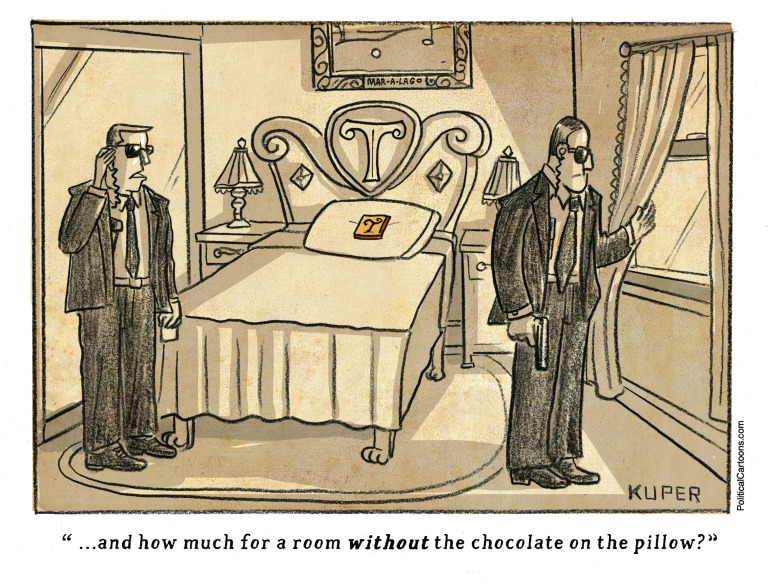
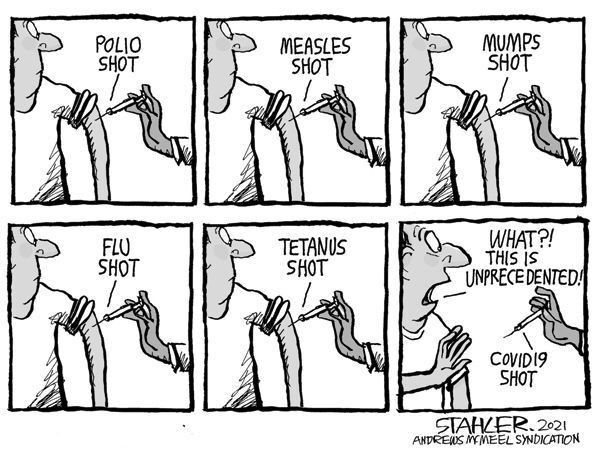
https://hanfordsentinel.com/opinion/editorial/editorial-cartoon-unprecedented/article_3e08fd25-0075-5a1f-9fc2-d93c0a86ccd9.html

But what makes unprecedented the word of 2022 is its eruption into American political news and discussions about the state of our democracy. No matter which side of the partisan divide you’re on, you see the other side doing unprecedented things that pose an unprecedented threat.

The FBI’s search of Mar-a-Lago was unprecedented, but so was the criminal activity that made it necessary. If the ultimate result is an indictment of a former president, that too would be unprecedented. The January 6th Committee’s vote to subpoena Trump wasn’t quite unprecedented, but sets up an “unprecedented” confrontation. The Committee’s hearings themselves have been unprecedented, but so was the riot (or insurrection or failed coup) they are tasked with investigating. A Trump-and-January-6 documentary released this summer was titled Unprecedented.

Day after day, we are being told that the current threat to American democracy is unlike anything that has ever happened before.

It’s a discouraging, dispiriting message, because it implies that we are on our own. History has nothing to teach us and offers no reassurances. If American democracy is Patient Zero of an previously unknown disease, who can advise us or make any predictions about our survival?

But what if our current predicament isn’t unprecedented? What if American democracy has faced crises before and muddled through them?

Historic blind spots. This is a point where the patriotic version of US history that most of us learned in high school fails us. We know about the Civil War, of course, and the Native American genocide (which used to be known as “how the West was won”). We know that Jim Crow walled Black Americans out of democracy in the South, and that women didn’t get the vote until 1920. Various consensual sexual acts were illegal for much of our history, and same-sex couples couldn’t marry until fairly recently.

But still.

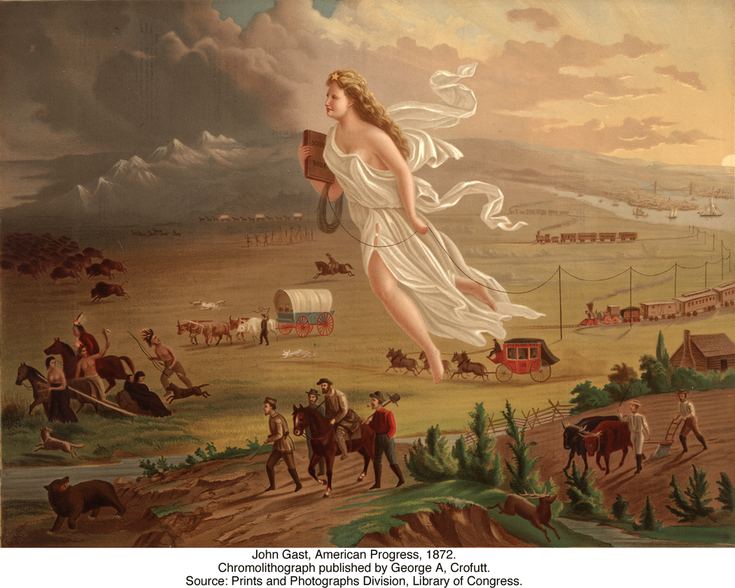
The history I learned in school embedded those failings in a narrative of progress, in which democracy and human rights were constantly expanding. We made mistakes, but we fixed them. The villainies of our past are simply backstory for the heroic saga that followed.

https://picturinghistory.gc.cuny.edu/john-gast-american-progress-1872/

This upbeat narrative is what Ron DeSantis wants Florida schools to teach today:

It was the American Revolution that caused people to question slavery. No one had questioned it before we decided as Americans that we are endowed by our Creator with unalienable rights and that we are all created equal.

So (in this telling) when Thomas Jefferson enslaved hundreds of human beings, took sexual advantage of at least one of them, and then raised his own children as slaves, he was foreshadowing abolition. His vision of human equality wasn’t hypocritical, it was prophetic.

While that onward-and-upward story may fill at least some Americans with a warm glow, it fails us in moments like these, when democracy itself is in trouble and human rights may be starting to contract. How can we cope with such unprecedented challenges?

But what if they aren’t unprecedented?

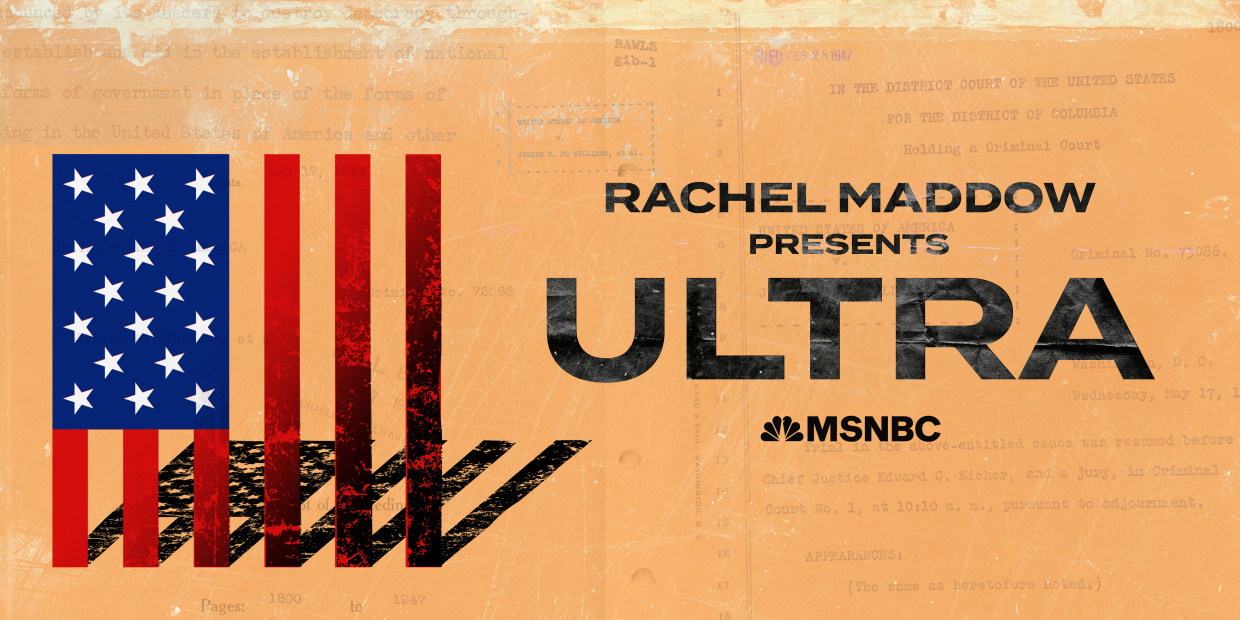
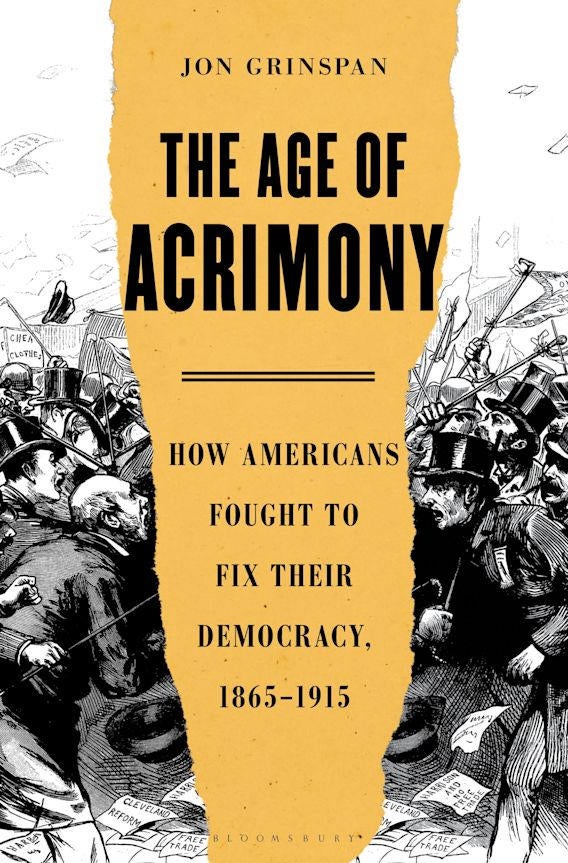
This week I spent some time examining two of the darker eras of American politics: I listened to the opening episodes of Rachel Maddow’s new podcast “Ultra“, about a fascist plot to overthrow FDR. And I read the new book by Smithsonian curator Jon Grinspan about the hyper-partisan politics of late 1800s, which he has dubbed The Age of Acrimony.

Ultra. The first episode of “Ultra” includes its own best introduction:

This is a story about politics at the edge. A violent, ultra-right authoritarian movement, weirdly infatuated with foreign dictatorships. Support for that movement among serving members of Congress who prove willing and able to use their share of American political power to defend the extremists, to protect themselves, to throw off the investigation. Violence against government targets. Plots to overthrow the United States government by force of arms. And a criminal justice system trying, trying, but ill-suited to thwart this kind of danger. …

This is a story of treachery, deceit and almost unfathomable actions on the part of people who are elected to defend the constitution, but who instead got themselves implicated in a plot to undermine it. A plot to end it. …

Perhaps most importantly, this is also the story of the Americans— mostly now lost to history— who picked up the slack in this fight, who worked themselves to expose what was going on, to investigate it, to report on it, ultimately to stop it.

And there’s a reason to know this history now. Because calculated efforts to undermine democracy, to foment a coup, to spread disinformation across the country, overt actions involving not just a radical band of insurrectionists, but actual serving members of congress working alongside them, that sort of thing is… that’s a lot of things. It’s terrible. But it is not unprecedented.

We are not the first generation of Americans to have to contend with such a fundamental threat. Lucky for us, the largely forgotten Americans who fought these fights before us, they have stories to tell.

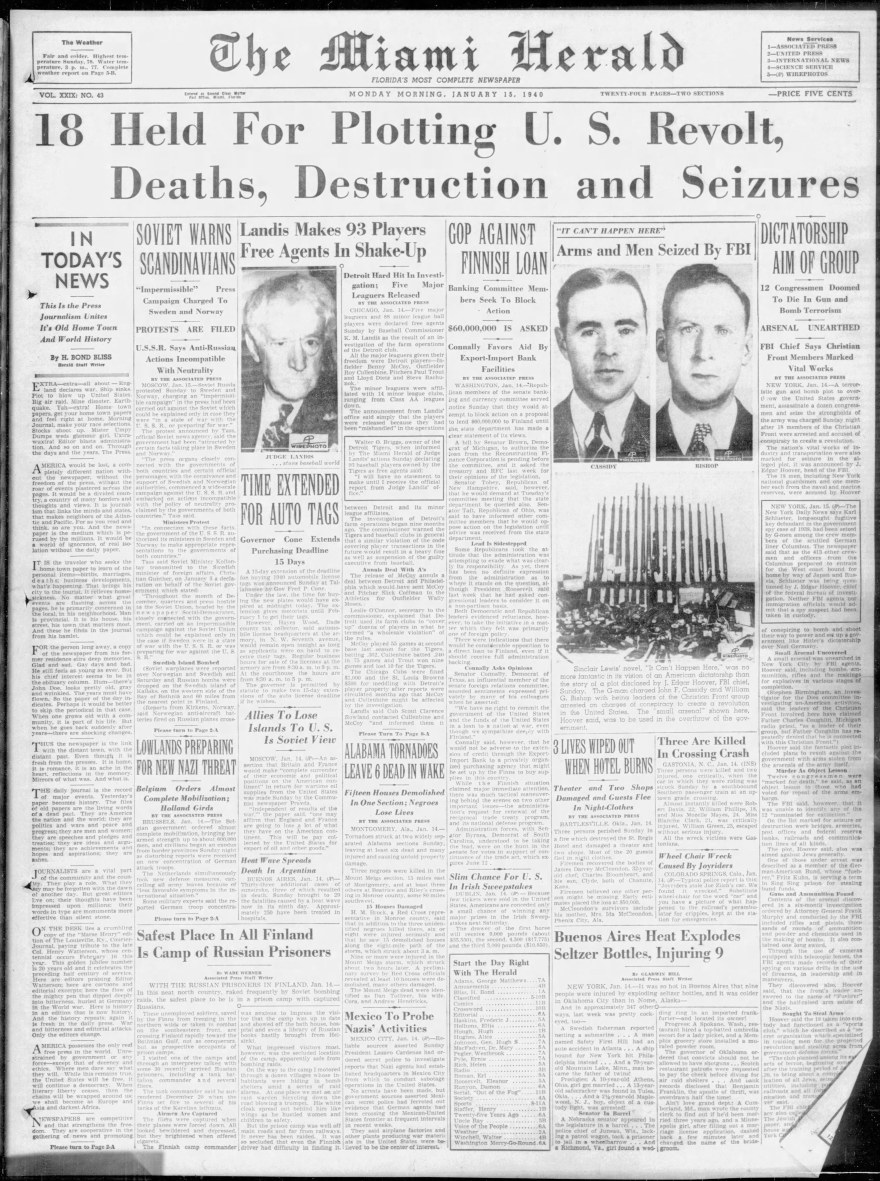
“Ultra” begins with a mysterious 1940 plane crash that killed Minnesota Senator Ernest Lundeen, along with several government agents who had begun to shadow him. Lundeen was on his way to deliver a Labor Day speech that not only urged America to stay out of the war in Europe (where Hitler had already taken over France and was threatening Britain), it was openly pro-German, and “had been ghost-written for Senator Lundeen … by a senior, paid agent of Hitler’s government operating in America”.

There was a time when I considered myself a World War II buff. But I had never heard of Senator Lundeen, or of the insurrection plot described in Episode 2, for which 18 members of the Christian Front were arrested.

The participants in that plot were never convicted, largely because of the popularity of their cause.

Prosecutors were blamed for not appreciating— not factoring in to their jury presentation— just how favorably the Christian Front was viewed in the community where the trial was held. The local press affectionately nicknamed them “The Brooklyn Boys.” The local Catholic Church supported them loudly. Nobody who was Jewish was allowed to sit on the jury. There was a local Catholic priest who was advising the Christian Front, who had been leading rallies to support them, who was close to [Father Charles] Coughlin [who coined the term “Christian Front”]. His first cousin was picked as the foreman of the jury.

And yet democracy was not overthrown by fascism, not in 1940 and not since. We’ll have to wait for future episodes (Episode 3 just posted this morning) to find out what Rachel thinks we can learn from democracy’s survival.

The Age of Acrimony. Eight years ago, in the most popular Sift post ever, I first pointed to the biggest hole in my US history education: Reconstruction.

In my high school history class, Reconstruction was a mysterious blank period between Lincoln’s assassination and Edison’s light bulb. Congress impeached Andrew Johnson for some reason, the transcontinental railroad got built, corruption scandals engulfed the Grant administration, and Custer lost at Little Big Horn. But none of it seemed to have much to do with present-day events.

And oh, those blacks Lincoln emancipated? Except for Booker T. Washington and George Washington Carver, they vanished like the Lost Tribes of Israel. They wouldn’t re-enter history until the 1950s, when for some reason they still weren’t free.

Reconstruction and much of the Gilded Age get skipped over because (in every area but technological advancement and GDP growth) they don’t fit very well into the ever-upward narrative of American progress. As Grinspan tells the story:

Americans claim that we are more divided than we have been since the Civil War, but forget that the lifetime after the Civil War saw the loudest, roughest political campaigns in our history. From the 1860s through the early 1900s, presidential elections drew the highest turnouts ever reached, were decided by the closest margins, and witnessed the most political violence. Racist terrorism during Reconstruction, political machines that often operated as organized crime syndicates, and the brutal suppression of labor movements made this the deadliest era in American political history. The nation experienced one impeachment, two presidential elections “won” by the loser of the popular vote, and three presidential assassinations. Control of Congress rocketed back and forth, but neither party seemed capable of tackling the systemic issues disrupting Americans’ lives. Driving it all, a tribal partisanship captivated the public, folding racial, ethnic, and religious identities into two warring hosts.

In hindsight, it’s hard to cast either Democrats or Republicans as the heroes of late 19th-century politics. Democrats were the proud descendants of the Confederacy in the South, combined with the corrupt big-city political machines of the North. On the other side, Republicans soon abandoned the ideals of Reconstruction and 15th Amendment’s new Black voters in favor of the vast business empires of the Rockefellers and Morgans.

More and more of the country was being herded into an impoverished urban proletariat that neither party truly represented. Republicans were on the opposite side entirely, while Democrats would “help” by distributing patronage jobs to loyal party members. Neither party saw a structural problem requiring the kinds of solutions that wouldn’t appear until the 20th century: a minimum wage, workplace safety laws, bans on child labor, unemployment insurance, an old-age pension, and protection for union organizers.

The “Wide Awakes” marching for Lincoln in 1860.

What political campaigns lacked in substance, they made up in noise. Both parties had militaristic marching clubs not entirely unlike the Nazi storm troopers of the 20th century, and torchlight parades were common demonstrations of political strength. Neighborhood political centers were typically saloons where glad-handing ward bosses would pour free drinks in exchange for votes.

The spoils system, in which the victorious party handed out government jobs to those who worked hardest on the campaign, was not a dirty secret, but rather an orderly process that people counted on. President Garfield was assassinated not by an ideological terrorist or a lunatic looking for fame, but by a disgruntled member of his own party who felt his electioneering efforts should have earned him a plum appointment.

The result of all this was a widespread belief that democracy had failed. In 1878, one of the era’s top American historians, Francis Parkman, wrote “The Failure of Universal Suffrage“.

When a man has not sense to comprehend the questions at issue, know a bad candidate from a good one, or see his own true interests — when he cares not a farthing for the general good, and will sell his vote for a dollar — when, by a native instinct, he throws up his cap at the claptrap declamation of some lying knave, and turns with indifference or dislike from the voice of honesty and reason — then his vote becomes a public pest. Somebody uses him, and profits by him.

Rule by the majority, it seemed, meant rule by the ignorant and the easily manipulated. No one appeared to know what to do about it. Parkman, for example, didn’t want a king, and thought any attempt to restrict the vote would be impractical: The People would never give up their power voluntarily, no matter how little good it was doing them. And politicians would never agree to change the system that had put them in power.

Journalist Lincoln Steffens examined seven large political machines, and assembled his conclusions in magazine articles that were reprinted in his 1904 book The Shame of the Cities.

When I set out on my travels, an honest New Yorker told me honestly that I would find that the Irish, the Catholic Irish, were at the bottom of it all everywhere. The first city I went to was St. Louis, a German city. The next was Minneapolis, a Scandinavian city, with a leadership of New Englanders. Then came Pittsburg, Scotch Presbyterian, and that was what my New York friend was. “Ah, but they are all foreign populations,” I heard. The next city was Philadelphia, the purest American community of all, and the most hopeless.

The problem, Steffens concluded, wasn’t any specific group, and it wasn’t the politicians. It was the people in general. Hoping that electing businessmen would improve the system (a perennial claim of businessmen) was pointless, because the politicians were already businessmen. They supplied what the electoral market wanted: corruption.

If we would vote in mass on the more promising ticket, or, if the two are equally bad, would throw out the party that is in, and wait till the next election and then throw out the other party that is in—then, I say, the commercial politician would feel a demand for good government and he would supply it.

But the electorate wouldn’t do that, leading Steffens to this conclusion:

The misgovernment of the American people is misgovernment by the American people.

And yet, somehow, things began to turn around. They had, in fact, already started their long slow turn when Steffens was making his tour.

Solutions? One aspect of Grinspan’s book that is alternately annoying and satisfying is that he has no concise explanation of how change happened. He’s very clear that it didn’t happen all at once, and there was no obvious turning point. Neither party took on the job of reform, and no Gilded Age Solon designed an improved political system.

The change seems to have been primarily cultural rather than political or legal. Systemic changes were the result, not the cause.

It is tempting to tell this story solely as an evolution of law, of amendments ratified granting wider and wider access. But the driving force behind our changing system has been America’s popular culture, the way we use politics.

The widespread conviction by people of both parties that the current system was distasteful and embarrassing led, over time, to a long series of changes, no one of which stands out as the pivot point.

  • Secret ballots. Believe it or not: “Before the final years of the 19th century, partisan newspapers printed filled-out ballots which party workers distributed on election day so voters could drop them directly into the boxes.” Between 1885 and 1891, all the states (acting on their own) switched to more-or-less the current system: An official ballot is printed by the government and given to voters at the polling place, where they fill it out in secret.
  • Civil service. The Pendleton Act was passed in 1883, establishing a merit system for jobs in the federal bureaucracy. State governments soon began passing their own versions.
  • Mass-market advertising. The new business model of newspapers and magazines aimed at offering advertisers near-universal distribution, rather than niche-marketing to a partisan audience. (Why would Coca-Cola want to be known as a Republican or Democratic drink?) This paved the way for standards of objectivity. Mass media has never truly been objective, and there’s some debate whether that idea even makes sense. But prior to, say, 1920, objectivity was not even an aspiration for most newspapers.
  • Parties changed their campaign styles. The torchlight parades and saloon headquarters became unfashionable, too reminiscent of the fat-cat politicians skewered by the newspaper cartoonists. Campaigns started focusing more on platforms, pamphlets, and buttons — things that you read or wore rather than things that you did.
  • Reformers began learning the nuts-and-bolts of politics and getting their hands dirty. In the post-Civil-War era, politics was considered a odious profession, unbecoming to a gentleman. One positive point in Parkman’s essay is a plea for idealistic and well-educated people to run for office. Over the next few decades many did.
  • States provided tools for direct democracy. The referendum and recall processes come from this era.
  • Political energy shifted away from the two major parties and into causes. Rather than crusading as a Republican or Democrat, you might instead devote yourself to temperance or free coinage of silver or women’s suffrage.

Very little of this was decided in elections. For example, neither party was visibly for or against the secret ballot. it didn’t take hold in one part of the country but not another.

Not all the changes were positive: This was also the era when Jim Crow was being established in the South, and the Chinese Exclusion Act passed.

And some of the beneficial developments had dark sides that we have since forgotten. A printed ballot listing all candidates also served as voter suppression: Illiterate or drunk voters might not be able to recognize candidates’ names. Southern Democrats supported the Pendleton Act because the spoils system kept allowing Republican presidents to give good jobs to their Black supporters. Temperance was a way of shutting down the saloons and taverns where working people might gather and plan.

Today, saying that a change requires a constitution amendment is equivalent to admitting that it can’t be done. But four constitutional amendments passed between 1913 and 1920: the federal income tax, direct election of senators, prohibition, and women’s suffrage.

Perhaps the oddest story of the change concerns women’s suffrage. The proposal was going nowhere in the 1880s, because politics was so obviously masculine. Who wanted his wife or daughter marching with a partisan militia, and possibly brawling with a similar group from the other party? Or hanging around in saloons getting men drunk and asking for their votes?

In a weird way, women’s inability to vote or run for office stimulated the push towards causes. Women were largely immune to the hoopla that gave men their political identities, and often diverted them away from their real interests. Undistracted by party politics, a woman might instead devote her energy to crusading for temperance or against lynching. She might organize a union or co-found the NAACP.

Giving women the vote in 1920 isn’t what changed politics. It was only because politics had changed that men could imagine including women in it.

What can we learn? Neither the 1940s nor the Gilded Age is exactly like the present era, and neither provides a blueprint for democracy’s survival. But both, I think, provide a context that give us reasons to hope.

A rose-colored view of our history, one that tells our story as one of continuous progress towards freedom and inclusion, can make us feel uniquely beset today. But in many ways democracy has always been a struggle, and the battle is never completely won.

But knowing about our past struggles may allow us to hope that American democracy is more resilient than we have been thinking. Reforms that seem impossible in one decade can become obvious in the next. The pivotal moments of history are hard to spot, because they’re probably happening inside the culture rather than in Congress.

Things may have already started to turn, and we just don’t see it yet.

The Monday Morning Teaser

Lately I’ve felt surrounded by pessimism. Partly it’s the upcoming elections — not just the belief that the Republicans will reclaim the House, but that all the other close elections will go their way as well: Georgia will elect a man who has no business anywhere near the Senate, Wisconsin will re-elect one of the worst MAGA senators, Jon Fetterman will lose to a literal snake-oil salesman because his stroke recovery isn’t going fast enough, and so on.

Polls say all those elections are in doubt, but in the minds of many of the people I talk to they’re already chalked up as losses.

But not just the elections. This week someone disgustedly told me (as if it were already a fact) that Trump is going to get away with it all. Others say that inflation can’t be tamed, a recession is inevitable, and the stock market will never turn back up. And who can predict what mischief the Supreme Court will get up to this year?

In foreign countries, Putin is going to use nuclear weapons and we’ll have to back down to him to avoid armageddon. Bolsonaro may lose his run-off, but it won’t matter because he’ll launch a coup. Xi is strengthening his hold on China. And so on.

I’ve started to wonder if maybe we’re being a little irrational about all this. Maybe there’s more reason to be hopeful than we think.

With that in mind, this week’s featured post is “American Democracy has been in trouble before”. I’m relying on two sources to look at two periods of American history: Rachel Maddow’s “Ultra” podcasts about the fascist plots of the 1940s, and Jon Grinspan’s new book The Age of Acrimony about the corrupt and violent politics of the Gilded Age.

We tend to tell American history as a story of continuous progress. That’s not only false, it serves us badly in times like these, when we really need to know that previous generations have faced similar challenges and survived them.

So that post will be out between 9 and 10 EDT.

The weekly summary will cover the latest January 6 hearing, developments in the election campaigns, some thoughts about nuclear power, the latest in the Ukraine War, and a few other things. It should post a little after noon.

Burning Bridges

Everything illegal must be destroyed. Everything stolen must be returned.

Mykhailo Podolyak, advisor to Ukrainian President Volodymyr Zelenskyy
after the attack on the Kerch Strait Bridge

This week’s featured post is “Does anything matter?

This week everybody was talking about Herschel Walker

That’s covered in the featured post.

and Ukraine

The Kerch Strait bridge linking Crimea (which Russia annexed from Ukraine in 2014) to the Russian mainland has high symbolic value. It is Europe’s longest bridge, and Putin himself drove the first vehicle across in 2018. Saturday Ukraine (apparently, they haven’t officially claimed responsibility) blew up a chunk of it.

Limited auto and train traffic has resumed, but it’s not clear how much weight of either type the damaged bridge can carry. The bridge is a major supply line for Russian troops in southern Ukraine.

Russia called the attack “vandalism” and “terrorism“, in spite of the bridge’s obvious military significance. It struck back on Sunday with air and missile attacks on Kyiv and several other Ukrainian cities. The Economist reports:

Many missiles fell nowhere near any plausible military target, suggesting that the projectiles were either inaccurate or the barrage was intended to be indiscriminate. Russia is thought to have used up a large proportion of its precision-guided missiles—as much as 70% of those in stock, according to a Western military source—and even those weapons have frequently missed their intended targets throughout the war. A large, smouldering crater stood metres away from a children’s playground in Shevchenko Park, one of the city’s busiest parks and usually packed with families.

and the fall elections

Both the House and Senate majorities are up for grabs, with each party currently favored to control one House. Nate Silver estimates a 68% chance Democrats retain control of the Senate, and a 70% chance Republicans retake the House.

Some of the Senate races once thought to be toss-ups now have clear favorites. Democrats Maggie Hassan in New Hampshire (84% chance), Mark Kelly in Arizona (82%), and John Fetterman in Pennsylvania (73%) are favored, as are Republicans Ted Budd in North Carolina (68%) and Ron Johnson (67%) in Wisconsin. If all those races come out as he projects, each party has 49 seats.

Silver still considers two races toss-ups Warnock/Walker in Georgia (Warnock 59%) and Masto/Laxalt in Nevada (Masto 51%).

For reasons I don’t understand, Real Clear Politics thinks Fetterman and Kelly will lose (even though they each lead in the RCP polling average), and projects a 52-48 Republican Senate.

and OPEC

The cartel of oil-exporting countries agreed to cut production, essentially siding with Russia against the West. Western sanctions against Russia create an opportunity for other OPEC nations to take their market share. Instead, they opt for higher prices rather than sales volume, and make it harder for Europe to do without Russian energy as winter approaches. The move is likely to start US gas prices rising again, which will work against Democrats in the fall elections.

The WaPo editorial board‘s assessment:

It looks for all the world like an attempt by [Saudi leader] MBS to influence internal U.S. politics, to the advantage of the party of former president Donald Trump, who dealt warmly with him.

When he was in office, Trump did his best to protect Crown Prince Mohammed bin Salman from suffering any consequences for his murder of Washington Post journalist Jamal Khashoggi.

and Biden’s marijuana pardons

Thursday President Biden signed a pardon for “all current United States citizens and lawful permanent residents who committed the offense of simple possession of marijuana in violation of the Controlled Substances Act”. People currently in prison will get out, and those who have served their time will have their records cleared, making it much easier for them to get jobs, loans, etc.

He also is taking other actions to get marijuana out of the justice system: He’s urging governors to follow his lead.

Just as no one should be in federal prison solely due to the possession of marijuana, no one should be in a local jail or a state prison for that reason either.

Also

the President is asking the Secretary of HHS and the Attorney General to review expeditiously how marijuana is scheduled under federal law. Federal law currently classifies marijuana in Schedule I of the Controlled Substances Act as the same schedule as for heroin and LSD, and it’s even higher than the classification for fentanyl and methamphetamine — the drugs that are driving our overdose epidemic. … [But] even as federal and state marijuana law changes, important limitations on trafficking, marketing, and underage sales should stay in place.

Vox goes into more detail, repeating a NYT analysis that about 6500 people will benefit from the pardons.

and Trump

The House committee investigating the January 6 coup attempt will hold its next (and possibly last) hearing on Thursday.


The NYT lays out the backstory of Trump’s conflict with the National Archives over the presidential documents he kept after leaving office. It suggests the first plausible motive I’ve seen.

It was around that same time [October-November, 2021] that Mr. Trump floated the idea of offering the deal to return the boxes in exchange for documents he believed would expose the Russia investigation as a “hoax” cooked up by the F.B.I. Mr. Trump did not appear to know specifically what he thought the archives had — only that there were items he wanted.

Mr. Trump’s aides — recognizing that such a swap would be a non-starter since the government had a clear right to the material Mr. Trump had taken from the White House and the Russia-related documents held by the archives remained marked as classified — never acted on the idea.

The WaPo also has a timeline of the Trump/Archives conflict.

The “deal” idea matches my impression of Trump perfectly: He views obeying the law as a concession, and wants the government to concede something in return.


Republican judges in Texas state courts are refusing to recognize the validity of subpoenas from the Georgia special grand jury investigating Trump.


The second, and apparently last, case brought to trial by the John Durham investigation starts tomorrow. The first trial (of Michael Sussman) ended in a quick acquittal. Like the Sussman charges, the indictment against Igor Danchenko is far narrower than the massive Deep State conspiracy Durham supposedly was going to uncover.

and you also might be interested in …

So Elon Musk is back to buying Twitter. Maybe.


Kentucky is now the third state where Jewish women are suing to block an abortion ban.

In a lawsuit filed Thursday in Jefferson County Circuit Court, the three plaintiffs and their attorneys argue those laws are vague, unintelligible and give preference to Christian beliefs in a way that diminishes the rights and religious freedoms of Jews. “In Judaism, reproductive health of a mother is between the mother, her rabbi and her doctor — not the attorney general,” Louisville attorney Aaron Kemper said.

The women are described as facing “reproductive challenges”, and are afraid to try to overcome those challenges due to the abortion ban.

“At this point, I’m scared to try and have another child,” she told the Herald-Leader in an interview Tuesday. “If I miscarry, I could bleed out before the doctors and the lawyers could decide whether or not they could treat me or if I needed to be prosecuted, and that’s not a risk I’m willing to take for myself or my child or my husband.”


Two new studies compared death certificates to voting registrations, and concluded that

average excess death rates in Florida and Ohio were 76% higher among Republicans than Democrats from March 2020 to December 2021

The gap started to open up about the time vaccines became available, but the researchers don’t think vaccine reluctance (which has been pushed by Fox News) is the whole reason. Refusal to take the virus seriously in other ways, like wearing masks and staying out of crowds, also plays a role.


Another mystery of political statistics: Red states have a higher percentage of chain restaurants.


According to leaks from the FBI, agents investigating Hunter Biden think he should be charged. But the fact that he hasn’t been charged yet doesn’t mean the fix is in. Donald Trump hasn’t been charged yet either.

Democrats are not a personality cult, so the ones I know are much less concerned with Hunter’s future than Republicans are with the Trump family. If there’s a good case that he broke laws, charge him. Let a jury decide. No Democrat is going to riot in the streets if a Hunter Biden indictment comes out.


Republican candidate for governor Doug Mastriano on his admiration for Ron DeSantis: “My goal is to make Pennsylvania the Florida of the North.”


If you have a perfect life and are completely stuck for something to get upset about, think about purple M&Ms. According to a host on One America News, the purple M&M (which appears to be female) might be transgender.

and let’s close with something fashionable

In a recent Paris fashion show, model Bella Hadid walked onto the stage in her underwear. Technicians then sprayed a Coperni-designed dress onto her, using Fabrican, a liquid that quickly transforms into wearable material. In ten minutes, she had a dress shaped to her body.

“You can wear this dress, keep it as a dress and put it on a hanger. But if you don’t want it anymore, you can put back the dress into the liquid and you can immediately spray it again,” Coperni’s creative director and co-founder, Sébastien Meyer, told CNN at the brand’s Paris atelier ahead of the show.

Does anything matter?

https://www.washingtonpost.com/opinions/2022/10/04/necessary-roughness/

For the Republican base, individual candidates don’t matter. The only thing on the ballot is control of the Senate.


In living memory, all kinds of scandals could topple a candidacy, including some that today wouldn’t be scandals at all. Way back in 1972, Democratic presidential nominee George McGovern had to replace his running mate, Missouri Senator Tom Eagleton, when it came out that (years before) Eagleton had been hospitalized for depression. Newt Gingrich resigned as Speaker of the House for multiple hypocrisies: He profited from the same kind of shady book deal he had targeted previous Speaker Jim Wright for, and he was having an extramarital affair with a much younger woman at the same time he was impeaching Bill Clinton for doing precisely that. (None of that stopped him from being a serious presidential contender a few years later.)

Gingrich’s designated successor Bob Livingston soon resigned after his own affairs became public, giving way to Dennis Hastert, who (it later turned out) had sexually abused at least four male students when he was a high school teacher and wrestling coach.

Two New York governors have had to resign under fire: Andrew Cuomo for sexual harrassment, and Eliot Spitzer for patronizing prostitutes. Minnesota Senator Al Franken resigned after accusations of groping. Louisiana politician David Vitter survived his prostitution scandal for years, and was even reelected to the Senate, but it came back to bite him when he ran for governor. Idaho Senator Larry Craig was arrested for “lewd behavior” in a public restroom, and several gay men described encounters with Craig, but he backed away from his announced intention to resign from the Senate, and instead decided not to seek reelection. Mark Foley resigned from Congress after sexually suggestive texts and emails he sent to teen-aged male congressional pages became public.

But all that was in a different era. In 2016, Donald Trump toughed out the Access Hollywood scandal, along with numerous accusations from women who claimed that his “grab them by the pussy” quote was more than just the “locker room talk” he claimed it was. Later it was revealed that he paid two women (one a porn star) to keep quiet about sexual affairs while he was married to Melania. His political career not only survived, but he continues to be the hero of Evangelical Christians and other “family values” voters.

During the Clinton/Lewinsky scandal of 1998, Evangelical leader James Dobson wrote:

As it turns out, character DOES matter. You can’t run a family, let alone a country, without it. How foolish to believe that a person who lacks honesty and moral integrity is qualified to lead a nation and the world! Nevertheless, our people continue to say that the President is doing a good job even if they don’t respect him personally. Those two positions are fundamentally incompatible. In the Book of James the question is posed, “Can both fresh water and salt water flow from the same spring” (James 3:11 NIV). The answer is no.

But when Christianity Today supported Trump’s first impeachment, Dobson forgot James 3:11 and jumped to Trump’s defense with talk about policy, not character. (He also completely ignored the existence of Vice President Pence.)

The editors didn’t tell us who should take his place in the aftermath. Maybe the magazine would prefer a president who is passionately pro-abortion, anti-family, hostile to the military, dispassionate toward Israel, supports a socialist form of government, promotes confiscatory taxation, opposes school choice, favors men in women’s sports and boys in girl’s locker rooms, promotes the entire LGBTQ agenda, opposes parental rights, and distrusts evangelicals and anyone who is not politically correct.

Trump’s refusal to be shamed, and Evangelical leaders’ unwillingness to hold it against him, inaugurated the nothing-matters era, at least in the GOP. (Franken’s resignation was in 2018, and Cuomo’s in 2021. But they were Democrats.) As late as 2004, National Review’s Jonah Goldberg could title a Clinton-administration retrospective “Character Matters“, and conclude: “The man never had the character for the job.”

But character apparently doesn’t matter any more. All that matters is which side you’re on.

Herschel Walker. Walker’s candidacy to replace Raphael Warnock as one of Georgia’s senators looked sketchy from the beginning. As as Georgia’s Republican Lieutenant Governor Geoff Duncan put it

Herschel Walker won the primary because he scored a bunch of touchdowns back in the 80’s and he’s Donald Trump’s friend.

Walker repeatedly exaggerated (or just invented) his accomplishments. He not only didn’t graduate in the top 1% of his class at the University of Georgia, he didn’t graduate at all. He didn’t work in law enforcement. He falsely claimed to “own” or to have “started” several businesses. He has a record of domestic violence. It’s not even clear that he lives in Georgia. He published a book about struggles with mental illness that dwarf anything Tom Eagleton went through.

After the primary, it came out that he has three more out-of-wedlock children than the public knew about.

But never mind: The bad stuff, he claimed, was all in the past. He got help for his dissociative personality disorder and Jesus has forgiven him, so he’s a new man now. Nothing in his past should count except for the touchdowns and his friendship with Trump.

The abortion scandal. This week serious scandal blew up again: The Daily Beast reported that Walker paid for a girlfriend’s abortion, in contradiction to the no-exceptions anti-abortion position he takes in public. Subsequently, his son went off on him on social media, raising once again the issues of Walker’s violence, lying, and hypocrisy.

Walker claimed not to know who The Daily Beast might be talking to, but a follow-up report narrowed it down for him: She’s also the mother of one of the children Walker has acknowledged.

Saturday, the NYT reported that it had independently verified the Beast’s article.

A woman who has said Herschel Walker, the Republican Senate nominee in Georgia, paid for her abortion in 2009 told The New York Times that he urged her to terminate a second pregnancy two years later. They ended their relationship after she refused.

In a series of interviews, the woman said Mr. Walker had barely been involved in their now 10-year-old son’s life, offering little more than court-ordered child support and occasional gifts.

Both pregnancies took place after the 2008 book in which Walker claimed to have turned his life around.

When the first Daily Beast article came out, Walker said he would file a lawsuit “tomorrow morning”. But he hasn’t.

Parties, not individuals. One reason politicians used to respond to scandal by resigning or withdrawing was that other politicians treated them like lepers. The thing to do when someone had been tainted by scandal was to get far away from them, lest you be drawn into the scandal yourself. (As a song that turns 100 next year puts it: “Nobody knows you when you’re down and out.“) That fickleness was one reason why Harry Truman famously quipped “If you want a friend in Washington, get a dog.”

But something more than public morality and judgment has changed: All elections have been nationalized. The names on the ballot may be Walker and Warnock, but what Georgia voters are really deciding is whether Republicans or Democrats will control the Senate.

And that matters, in turn, because of the increasing partisanship within the Senate. Whether or not judges will be confirmed, for example, depends less on the character or qualifications of the nominees than on the party of the president who nominated them. Whether senators are trying to boost the economy or sabotage it depends on whether or not they belong to the president’s party. (If Republicans get control of either house this year, you can expect another debt ceiling crisis in 2023. And maybe this time they’ll force the US into default.)

The result is a more tribal party that sticks together in crisis, and circles the wagons around any embattled candidate, no matter how undeserving that individual may be. And while Republicans are much further down that road than Democrats, I feel the pull myself: What could I possibly find out about his opponent that would make me root for Walker to win?

https://www.facebook.com/photo?fbid=656001989204566&set=a.305833804221388

That’s the tacit message in all the “X is on the ballot” slogans. Democracy is on the ballot. Abortion is on the ballot. The planet is on the ballot. Compared to those stakes, what do Herschel Walker and Raphael Warnock — or any competing pair of candidates — matter? You may not know or care who the candidates are in your district, but you should vote anyway.

Conservative radio host and NRA spokesperson Dana Loesch, for example, tweeted

IF true, Walker paid for one broad’s abortion compared to Warnock who wants your tax dollars to pay for EVERY broad’s abortion-as-birth control with no limitations. This isn’t a difficult choice and conservatives shouldn’t look to the left to validate their vote.

(But wait: Warnock isn’t pushing any woman to get an abortion, as Walker did. He’s just supporting women who make that decision for themselves.)

Also Loesch:

I want to control the senate and you should, too. The end.

The individual hypocrisy — for his own convenience, Walker pushed his girlfriend to exercise options he wants to take away from all the women he didn’t impregnate — doesn’t even figure. Nor does the “personhood” of a fetus matter. Republicans claim to believe fetuses are babies and that abortion is murdering a child. So if Walker had paid someone to murder one of his four breathing-and-walking-around children, would that not count either? Would conservative talking heads say “That’s just one murder. How many more murders will there be if Democrats control the Senate?”

So does anything matter? Watching Republicans circle their wagons around Walker, it’s tempting to conclude that all this, bad as it obviously is, will make no difference.

But if you think that, you’re looking in the wrong direction. OK, hardcore MAGA types are not going to change their minds. They have convinced themselves that Democrats are going to destroy America, so if the only way to prevent that is to elect grifters, hypocrites, or even outright criminals to high office, so be it.

But if the hardcore supporters of either party were the only people who voted, nobody would bother to campaign. And while it seems to be true that the number of persuadable swing voters is shrinking, there’s still a considerable pool of folks who (whatever they think) may or may not vote.

WaPo quotes conservative radio host Erick Erickson:

Every dribble of new stuff between now and the election I think increases the pool who say, ‘Screw this, let’s vote for Brian Kemp and let’s not do the other race at all.’ Those people exist in Georgia.

Those are the people who might be swayed. It’s not that some ultra-conservative Georgian is going to get pissed enough at Walker to vote for Warnock. But a sizeable number of the voters any Georgia Republican needs are racists who didn’t really want to vote for a Black guy anyway, even if he did win the Heisman. A lot are people who lean Republican, but sometimes don’t vote because they think politicians are all crooks. If they get disgusted enough with Walker, they might just forget to show up at the polls, decide at the last minute to skip the Walker/Warnock line on the ballot, or maybe write in the name of some YouTube influencer they really agree with.

Conversely, watching Christian Walker rail against his Dad on social media might convince a few young men to get off their butts and register to vote. Seeing yet another example of the hypocrisy of the religious Right might give some marginal female voters a push to go protect their bodily autonomy.

If you want to know what difference this scandal will make, you have to look there, not at the Dana Loeschs.

One final note on Christianity. Walker is responding to the scandal obliquely, with an ad his campaign calls “Grace“.

Raphael Warnock’s running a nasty, dishonest campaign. Perfect for Washington. The Reverend doesn’t even tell my full story. My true story. As everyone knows, I had a real battle with mental health. I even wrote a book about it. And by the grace of God, I’ve overcome it. Warnock’s a preacher, who doesn’t tell the truth. He doesn’t even believe in redemption. I’m Herschel Walker, saved by grace, and I approve this message.

This ad is an opportunistic mishmash of themes. On the one hand it hints at a denial: Warnock’s campaign is “dishonest”, so whatever they’re accusing me of, I didn’t do it. On the other hand, maybe I did do it, but God has forgiven me. So anyone who brings up the bad things I did or tries to hold me responsible for them “doesn’t believe in redemption”.

If there still are any Trump-era conservatives who have anything more than an opportunistic relationship with Christianity, I have a theological question: In what theory of grace does God forgive you for stuff that you still deny you did? What kind of repentance allows you to keep saying that your accusers are liars?

All the theologians I know refer to this kind of grace disdainfully as “cheap grace”, which Dietrich Bonhoeffer defined as “forgiveness without repentance”. Your sin goes away because taking responsibility for it is inconvenient. Or, as the mother of the child Walker wanted aborted put it: “He picks and chooses where it’s convenient for him to use that religious crutch.”

Amanda Marcotte points out the long-term cost Christianity is paying and will continue to pay for this kind of hypocrisy: The adults may not believe what they’re saying, but the kids do — until they realize it’s all a con.

The kids are watching. Young people raised in churches often DO believe the lies about chastity and “pro-life.” This hypocrisy exposes them to the truth before they’re too deep to extract themselves. And they turn their backs on their parents. I have met SO MANY people who became liberals because of the hypocrisy of the conservative environments they grew up in. It’s a major reason every generation is more liberal than the last. So this shit matters.

When Christians lament about the decline of their religion and the growing number of Americans with no religious affiliation, they shouldn’t vaguely blame “the culture” or “Hollywood liberals”, because they’re doing it to themselves. Christianity is losing its children because the kids see their elders saying one thing and doing something else.

The Monday Morning Teaser

This week’s big story has been the Herschel-Walker-paid-for-an-abortion scandal. In the old days, before Trump and “grab them by the pussy”, the central question would be whether the accusation was true. But today, the question is whether anyone will care. If every election is a national contest between parties, why should the morality or character of individual candidates matter?

The featured post this week will look at the Walker scandal, what it says about the changes in American politics, and whether it’s really true that nothing matters but party. That should post between 10 and 11 EST.

The weekly summary will cover the significance of Ukraine’s attack on the Kerch Strait Bridge, OPEC’s decision to back Putin rather than the West, some developments in the Trump investigations, how key Senate races are going, Biden’s marijuana pardons, why Jewish women are suing to block abortion bans, why more Republicans than Democrats are dying of Covid, and a few other things. I’m running a little behind today, so the summary may not appear until 1 or so.

Question and Answer

You know who questioned slavery? The enslaved people.

Van Jones

There’s no featured post this week.

This week everybody was talking about Ian

https://theweek.com/political-satire/1017048/boarding-up

I won’t try to cover the devastation or the human suffering, because the mainstream media has been all over that. (I can’t tell you how many NBC reporters I’ve seen standing in front of a boat sitting on top of a crushed Chevy Suburban in Fort Myers. The network appears to have declared that particular site Ground Zero.)

I do think it’s worth noticing how normal Biden’s response has been. No Sharpie controversies. No playing politics with disaster funding. No presidential whining that some governor hasn’t been nice enough to him. No tossing paper towels into a crowd, as if relief supplies come from his personal largesse.

One big reason Biden was elected was to make government normal again. This is an example of him doing precisely that. It doesn’t matter that Governor DeSantis is one of Biden’s potential rivals in 2024. Florida needs help and it’s the president’s job to see that they get it.


Disasters like Ian emphasize a point that David Graeber made in Debt: the first 5,000 years: Society rests on a core of communism that we seldom see until an emergency happens. When everything else breaks down, we help people because they need it and expect people to help because they can.

In a pure market economy, you’d be perfectly justified to frame a disaster as an opportunity to make enormous profits by, say, only rescuing people who can pay you a lot. But we all understand how unseemly that would be.

(Crassus, the rich man who joined Caesar and Pompey in Rome’s First Triumvirate, made a lot of his money by training a crew of slaves to fight fires — which happened all the time in a crowded city built out of wood. When he saw a fire, he’d show up with his crew and offer to buy adjacent properties for a low, low price. After the sale, he’d have the fire put out. What a guy!)


As I predicted last week, the hurricane in Florida made us all forget Hurricane Fiona’s damage to Puerto Rico, which never did get the 24/7 coverage of Ian. But PR isn’t back to normal yet.

On Friday – as Floridians assessed the destruction left by Hurricane Ian and the storm made landfall in South Carolina as a Category 1 – more than 230,000 customers in Puerto Rico were still without electricity, according to the PowerOutage.US website. More than 800,000 customers were without power last weekend.

Nearly 80,000 customers – about 6% – of the Puerto Rico Aqueduct and Sewer Authority were without water on Friday, according to the government’s emergency portal system website.

Fox News even forgot Puerto Rico is part of the United States.

Martha MacCallum was telling Fox News viewers about the devastating impacts of hurricanes in places such as Cuba and Puerto Rico on Wednesday when she quipped: “Thank God we have better infrastructure in our country”.

We should never forget the reason Puerto Rico isn’t a state: race and language prejudice. If the US owned an island of three million English-speaking White people, it would have joined the union decades ago.


After Hurricane Katrina flooded New Orleans, right-wing Christians proclaimed it as a sign of God’s judgment. Franklin Graham in particular showed little sympathy for the city’s suffering:

This is one wicked city, OK? It’s known for Mardi Gras, for Satan worship. It’s known for sex perversion. It’s known for every type of drugs and alcohol and the orgies and all of these things that go on down there in New Orleans. … There’s been a black spiritual cloud over New Orleans for years. They believe God is going to use that storm to bring revival.

Those voices are silent now. Florida has been competing with Texas to lead the nation in persecuting trans youth, shoving LGBTQ people back into the closet, and keeping students ignorant about racism. So what about that, fundamentalist preachers? Does God speak through storms or not? What might God be trying to tell Ron DeSantis?

Or maybe all the signs-of-God’s-judgment talk has always just been a way for flim-flam artists like Graham to put their own words into God’s mouth.

and Putin’s annexations

https://theweek.com/political-satire/1016980/vlads-referendum

He went through with it.

On Friday, Russian President Vladimir Putin formally declared four regions of Ukraine as part of Russia following sham referendums this week in eastern and southern Ukraine. Putin made the illegal decree as he lobbed even more threats against the United States and its allies, another potential escalation in the war in Ukraine and in Russia’s standoff with the West.

Putin moved to annex four regions of eastern and southern Ukraine — Luhansk, Donetsk, Kherson, and Zaporizhzhia — after officials in Russian-controlled territory staged an illegal vote on joining Russia. The Kremlin does not fully control any of these areas, and pollsters reportedly went door to door with armed soldiers in Russian-controlled zones, but Putin justified the decree by saying that it was done on behalf of the “will of millions of people.”

https://www.cnn.com/2022/10/01/europe/ukraine-russia-lyman-donetsk-intl

“Illegal” can be a loaded word, so I tracked down the basis for the claim that the annexation referendums are illegal. The 1958 commentary on the fourth Geneva Convention (1949) says:

As was emphasized in the commentary on Article 4, the occupation of territory in wartime is essentially a temporary, de facto situation, which deprives the occupied Power of neither its statehood nor its sovereignty; it merely interferes with its power to exercise its rights. That is what distinguishes occupation from annexation, whereby the Occupying Power acquires all or part of the occupied territory and incorporates it in its own territory.

Consequently occupation as a result of war, while representing actual possession to all appearances, cannot imply any right whatsoever to dispose of territory. As long as hostilities continue the Occupying Power cannot therefore annex the occupied territory, even if it occupies the whole of the territory concerned. A decision on that point can only be reached in the peace treaty.


The practical point of the annexation is to frame Ukraine’s current offensive (which is still advancing) as an attack on Russia itself rather than a recapture of its own territory. Putin has said he will use “all available means” to defend “Russia”, which raises the specter of nuclear war.

Yesterday’s NYT discusses the possibility that Russia will use nuclear weapons in Ukraine.

“The chance that Putin would strike out of the blue seems very low,” said Graham T. Allison, the author of a seminal 1971 book about the Cuban Missile Crisis, “Essence of Decision.” “But as Kennedy said back then, the plausible scenario is if a leader is forced to choose between a catastrophic humiliation and a roll of the dice that might yield success.”

Mr. Allison suspects Mr. Putin will not face that choice unless Ukraine succeeds in pushing Russian forces out of the areas Mr. Putin annexed on Friday.

For that reason, the next few weeks could prove a particularly dangerous time, a range of American and European officials agree. But Mr. Putin is not likely to use a nuclear weapon immediately.

That’s not very comforting. During the Cold War, I didn’t worry much about a Soviet first strike because it didn’t make sense from a Marxist worldview. Soviet dogma said that communism was the inevitable outcome of history. So why would you risk everything on a roll of the dice now if your eventual victory was certain? But that thinking doesn’t apply now. If Putin sees his regime going down, he might think rolling the dice is his best bet.

OTOH, a gangster regime rests on the self-interest calculations made by all the henchmen. If a lot of those calculations are based on the belief that Putin would never do something that could get them all killed, the possibility of nuclear war could start people up and down the regime reevaluating their cooperation.

I’d like to see Biden address Putin’s henchmen directly, in a statement something like this:

A nuclear attack is something that the world will never forget and never forgive. Anyone who in any way participates in such a decision or such an attack will never know a moment’s peace. You must realize that Putin’s regime will eventually fall and his protection will fail. When that happens, there will be no safe place for you. You will be hunted to the ends of the Earth.

As for how the US should respond if Putin does use a tactical nuke in Ukraine, I’ve been reluctant to say what I’m thinking, because I’d be just another ignorant guy spouting off. So I found a knowledgeable guy who is saying the same thing: former general and CIA head David Petraeus. NATO should respond directly, but with conventional weapons. The goal would be to make sure Russia lost at least as much as it had gained by using the nuke.

The US and its allies would destroy Russia’s troops and equipment in Ukraine – as well as sink its Black Sea fleet – if Russian president Vladimir Putin uses nuclear weapons in the country, former CIA director and retired four-star army general David Petraeus warned on Sunday.

I understand fully the temptation to back down: To the rest of the world, losing Ukraine is a small price to pay to avoid the kind of escalation that could lead to an all-out nuclear war. But giving in to threats means giving something up without getting anything back. Putin retains his nuclear arsenal and can make the same threat over the next conflict. Where does that road end?


CPAC has since deleted the tweet, but its reflex response to the annexations was to line up with Putin’s propaganda. The tweet referred to the four territories as “Ukrainian-occupied”, as if they had always been Russian and Ukraine is the aggressor.


A possibly related event is the rupture in the Nord Stream pipelines, which take Russian natural gas to Germany. This appears to be sabotage, but everybody is pointing fingers at everybody else. In the short term it helps Russia, because this winter Europe will realize how much it depends on Russian energy. In the long run it hurts Russia, which will need the pipelines to sell natural gas after the Ukraine-related sanctions get resolved somehow.

and other right-wing foreign governments

Speaking of ultra-conservative foreign leaders, Brazil’s Jair Bolsonaro was up for re-election yesterday. He trails another former president, Luiz Inácio Lula da Silva (known more simply as “Lula”) 48.4%-43.2%, which means a run-off will happen October 30. There has already been violence in this campaign, and it is expected to get worse.

In addition to how the run-off will come out, everyone wonders what Bolsonaro will do if he loses. Like Trump in 2020, Bolsonaro started questioning the integrity of the election before it happened. His supporters are more likely than his opponents to be armed, and the nation’s police support him. He probably has enough military support to keep Brazil’s army on the sidelines.


The far-right Fratelli d’Italia (Brothers of Italy) Party, which traces its ancestry back to the World War II Fascists, leads the new Italian government, elevating Giorgia Meloni to prime minister. Wikipedia explains the history.

FdI emerged from a right-wing split within Silvio Berlusconi‘s party, The People of Freedom (PdL), in December 2012. The bulk of the party leadership including Meloni, as well as the symbol of the movement (the tricolour flame), comes from the National Alliance (AN, 1995–2009) party, which had merged into PdL in 2009. AN was the heir to the Italian Social Movement (MSI, 1945–1995), a neo-fascist party founded by former members of the banned National Fascist Party (1921–1943) and the Republican Fascist Party (1943–1945).

American conservatives are ecstatic, and Meloni looks likely to join Hungarian authoritarian Viktor Orbán in the pantheon of foreign leaders who get cheered at CPAC (where she has already spoken twice). But lots of people on my social media feeds posted this quip:

I can’t believe they made Mussolini a woman in the reboot. This woke nonsense has ruined yet another franchise.

The most immediate problem raised by Italian neo-fascism is whether Italy will become pro-Putin voice inside NATO. So far, Meloni is not signalling that.

Meloni, 45, has sought to moderate her views recently, and this week she tweeted support for Ukrainian President Volodymyr Zelenskyy. Yet as Europe teeters on the brink of a recession stemming at least partly from energy sanctions imposed on Russia, there are fears within the Biden administration and elsewhere that Meloni could slash what’s been a significant Italian contribution to Ukraine’s defense.

Such a move could have a domino effect and cause key Western allies to push for a negotiated end to Russia’s war on Ukraine. Trump backed that position Wednesday, one Ukraine’s leaders vehemently oppose because it would likely require giving up large swaths of their territory to Putin.

and the Supreme Court

The start of the new Court term led a lot of pundits to raise a bunch of the issues I discussed last week. The NYT Editorial Board wrote:

The actual cause of [the Supreme Court’s] historic unpopularity is no secret. Over the past several years, the court has been transformed into a judicial arm of the Republican Party. This project was taking shape more quietly for decades, but it shifted into high gear in 2016, when Justice Antonin Scalia died and Senate Republicans refused to let Barack Obama choose his successor, obliterating the practice of deferring to presidents to fill vacancies on the court. Within four years, the court had a 6-to-3 right-wing supermajority, supercharging the Republican appointees’ efforts to discard the traditions and processes that have allowed the court to appear fair and nonpartisan.

The WaPo’s Ruth Marcus wrote an extended introduction to the new Court term, which includes a number of race-related cases: affirmative action and voting rights in particular. Another case revisits whether anti-discrimination laws apply to Christian businesses that turn away gay customers for religious reasons. There’s an opportunity for the Court to limit the power the Clean Water Act gives the EPA, and to increase state legislatures’ power to sway elections.

and the pandemic

Case numbers are dropping almost everywhere except where I am in New England. Nationally, deaths stubbornly remain around 400 per day.

When President Biden declared the pandemic over a couple weeks ago, I had to decide when I’ll start thinking of it as over: When the death numbers get down to about 100 per day. That would be flu-like.

According to data collected by the CDC from 2010 to 2020, the agency estimates that the flu has caused 12,000 to 52,000 deaths annually.

100 per day would be 36,500 annually, right in the middle of a normal flu range. Until then, I’m going to keep wearing masks and avoiding indoor crowds.

and you also might be interested in …

https://claytoonz.com/2022/10/01/sailing-to-fluteghazi/

The week’s dumbest controversy was about Lizzo playing James Madison’s flute. If you’ve seen references to it and want to know what it was about, click the link. But if you don’t care, don’t start caring on my account.

I aspire to someday have a life so carefree that how the Library of Congress handles James Madison’s flute rises to the top of my list.


The dumbest statement about a controversy had to be this one by Ron DeSantis, who was defending his initiative to put a right-wing slant on how Florida public schools teach American history.

It was the American Revolution that caused people to question slavery. No one had questioned it before we decided as Americans that we are endowed by our Creator with unalienable rights and that we are all created equal.

CNN’s Van Jones pointed out the obvious.

You know who questioned [slavery]? The enslaved people.

Like the history I was taught growing up, DeSantis’ history is based on the principle that only European views count. There’s no other way to justify the claim that “no one” questioned slavery before 1776, that Columbus “discovered” America, that Gutenberg (and not Bi Sheng of the Song Dynasty) invented movable type, or a bunch of other pseudo-facts I remember from my K-12 years.

The origins of movable type.

But even if you only count English-speaking White people, DeSantis’ history is just wrong.

In the 1569 case it had been ruled that English law could not recognise slavery. This view, although overturned by the ruling in Butts V. Penny, was subsequently upheld in 1701 when the Chief Justice, Sir John Holt, ruled that a slave became free as soon as he arrived in England. In this view, different from, but no less unequivocal than that of the Solicitor-General in 1677, slavery was illegal.


Judge Cannon continues to put Trump above the law. Once again, the special master that Trump chose wanted to pin down exactly what he’s claiming — this time about whether the FBI planted documents or not. But no. Those claims are allowed to float, and presumably to influence the case, without even being stated for the record, much less supported by evidence.


New Tory Prime Minister Liz Truss’ first major act was to propose a gigantic tax cut for the rich.

Last week, Truss’ government announced that they would cut taxes by £45 billion ($48 billion) in a bid to get the UK economy moving again, with a package that includes scrapping the highest rate of income tax for top earners from 45% to 40% and a big increase in government borrowing to slash energy prices for millions of households and businesses this winter.

Truss has acknowledged mistakes in how the proposal was rolled out, but seems to be standing by it, even as the pound crashes. But not everybody is behind her.

Conservative members of parliament fear the combination of tax cuts along with huge public spending to help people cope with energy bills, rising inflation, rising interest rates and a falling pound are going to make winning the next general election impossible.

Who better to comment than UK fake-news personality Jonathan Pie?


Having passed the House and gotten support from Mitch McConnell, a bill to reform the Electoral Count Act of 1887 looks likely to become law. The bill eliminates various loopholes and vagueries that Trump used to try to hang onto power after losing the 2020 election.

McConnell’s support is one more step in the continued souring of his relationship with Trump. Obviously, Trump doesn’t like the implication that his failed coup attempt was the kind of thing America should avoid in the future. But he really lashed out after McConnell supported a continuing resolution to keep the government open until after the election. On his Trump-centered Twitter-clone, the former president said McConnell “has a death wish”, which I (and a lot of other people) interpret as a suggestion that McConnell be assassinated. The same post insulted McConnell’s Chinese-American wife, Elaine Chao, who left Trump’s cabinet after January 6. Trump called her McConnell’s “China loving wife Coco Chow”.

Explain to me again how “divisive” Joe Biden is.


Speaking at a Trump rally in Michigan Saturday, Marjorie Taylor Greene said

I’m not going to mince words with you all. Democrats want Republicans dead. They’ve already started the killings.

Again, the point here seems to be to incite and justify right-wing violence.


This week I learned two words: Having an implant removed is called “explanting”. And a person known by a one-word name (like Madonna or Lula) is “mononymous”.

and let’s close with some practical information

Ryan North’s career in comic books (Dinosaur Comics, The Unbeatable Squirrel Girl, …) has led him to spend an enormous amount of time contemplating plausible supervillain schemes. Now you can benefit from his lifetime of research by reading his book How to Take Over the World.

The infrastructure chapter alone could save you billions. Where should you build your secret lair? (Not at the bottom of the ocean or on the Moon. You’d just be creating problems for yourself.) How much space do you need to achieve food and energy independence from the outside world? (The Biosphere 2 research is invaluable here.)

And then there are the more specific villainous plans. How can you create your own dinosaurs? (Actual dinosaur DNA is unrecoverable now, so the Jurassic Park technique can’t possibly work. But you might be able to create pseudo-dinosaurs by manipulating the DNA expression of the dinosaurs’ bird descendants. This technique also avoids a lot of catastrophic outcomes, because your dinosaurs’ offspring would be birds again.) What’s the most plausible path to immortality? How can you control the weather? (The plan here looks a lot like the one Neil Stephenson explores in Termination Shock, which was probably being written simultaneously.)

Supervillainy may seem like a radical career choice, but there’s no time to lose, because Disney owns Marvel Comics and Warner-Discovery owns DC. Think about what that means:

Two of the most powerful multinational corporations on the planet have spent decades, in plain sight, paying some of the most creative people alive today to design increasingly credible world-domination schemes.

So if you don’t take over the world, one of those two undoubtedly will. Your reign is bound to be better than theirs.

The Monday Morning Teaser

A lot is going on in the world right now, but none of it jumped out as something to write a featured post about. So this week’s Sift is an extra-long weekly summary, which should come out around 11 EDT.

Many of this week’s most important events happened outside the US: Putin annexed four Ukrainian regions that his forces don’t even fully control, and saber-rattled about using nuclear weapons to defend them against Ukraine’s still-advancing army. Brazil held the first round of a presidential election, setting up a run-off that will probably either unseat President Jair Bolsonairo or see him hang onto power by violence. (He’s called “the Trump of the Tropics” for a reason.) Italy has installed a political heir of Mussolini as its new prime minister. (Make Rome Great Again.)

Domestically, Hurricane Ian’s devastation of Florida’s gulf coast (and its lesser assault on South Carolina) dominated the news. The mainstream media covers such things pretty extensively, so I’ll mainly focus on second-level responses (like Biden refusing to play politics with disaster relief, how quickly everyone forgot about Puerto Rico, and the silence of the preachers who claimed Katrina’s destruction of New Orleans was God’s punishment of a “wicked city”).

The Supreme Court started a new term, leaving the nation to wonder what surprises its ruling junta has in store for us this time around.

And finally, I’ll close with something I know you’ve all been yearning for: some expert advice on how to take over the world.

Democratic Process

The Dobbs decision is the culmination of a decades-long effort by Republicans to capture the Supreme Court and use it, not just to undercut abortion rights but also to implement an unpopular agenda they cannot implement through the democratic process.

– Ian Millhiser “The Case Against the Supreme Court

This week’s featured post is “The Court’s problems run deeper than Roe“.

This week everybody was talking about Trump’s bad week

https://theweek.com/political-satire/1016897/whos-the-lunatic

Last week’s featured post was Trump-centered, and I refuse to do that two weeks in a row. Fortunately, other people covered the week’s developments quite well. The three big events were:

  • The New York Attorney General Letitia James announced a sweeping civil lawsuit accusing the Trump family and the Trump organization of fraud.
  • The special master in the Mar-a-Lago search case has been pinning Trump’s lawyers down: They can’t just vaguely imply stuff (like that Trump declassified the secret documents the FBI found or that the FBI may have planted evidence). If they want to be taken seriously, they have to make specific claims and back those claims up with evidence.
  • On appeal, the 11th Circuit reversed Judge Cannon’s decision to take the documents marked classified away from investigators and turn them over to the special master.

Those last two fulfilled the hopes I expressed last week:

The Justice Department has appealed to the 11th Circuit, which also includes a lot of Trump-appointed judges. Hopefully, though, these are real judges who will insist on applying the law, even to the man who appointed them.

https://www.facebook.com/profile.php?id=100054791807944

The NY lawsuit accuses Trump of claiming fraudulent valuations for his properties: high when he needed a loan, low when assessed for taxes.

James says in the suit that she estimates the financial benefits from this “fraudulent scheme” were $250 million. She wants Trump to give up those benefits and be permanently banned from serving as an officer in any New York business entity, and to ban the Trump Organization from buying commercial real estate in the state for five years.

Fraud is a crime, but this is not a criminal case. Other prosecutors investigated this as a criminal matter and decided not to proceed. Probably for two reasons:

  • The standard of proof in a civil case is lower: a preponderance of the evidence rather than proof beyond a reasonable doubt.
  • A jury might not be convinced that the scheme had victims. Banks that would not have made loans based on accurate valuations nonetheless got paid back. (Tax fraud would have to be prosecuted by the IRS, not the State of New York.)

As usual, Trump and his cult are claiming “witch hunt”. However, they don’t seem to be refuting any of the specific claims in the indictment. They’re throwing around a lot of outrage, but not offering a lot of facts.

Trump’s two main defenses don’t sound very good politically: His lies didn’t hurt anybody, and besides, everybody else in his business is a crook too.

https://theweek.com/political-satire/1016941/trumps-next-trick

Trump’s claim to Sean Hannity that he could declassify documents “by thinking” drew a lot of ridicule. His lawyers have refused to advance any such claim in court, and I doubt they will. After all, what if Biden’s first thought after taking office was to reclassify all Trump’s documents?

https://www.washingtonpost.com/opinions/2022/09/22/its-all-mind/

I take the claim as an indication that has no evidence to support his declassification claim. Ultimately, you just have to believe in the telepathic powers of the presidency.

In the same quote, Trump seemed to slip up:

If you’re the president of the United States, you can declassify just by saying, ‘It’s declassified,’ even by thinking about it because you’re sending it to Mar-a-Lago or wherever you’re sending it. [my italics]

To me, that implies he has more stolen classified documents hidden away somewhere else.


The weirdest and potentially scariest Trump news has to do with his increasing embrace of the QAnon movement, which is counting on him to save us all from the world-dominating conspiracy of liberal pedophiles by publicly executing thousands of them.

In a recent rally in Youngstown, Ohio (purportedly for Senate candidate J. D. Vance, who Trump belittled), Trump closed with a QAnon anthem playing in the background and people raising their index fingers in an almost religious salute.


The right-wing research I do confuses the social-media algorithms: Facebook has been showing me ads for the Trump Store, which is marking the end of summer with a sale on official Trump-branded sweatshirts. (Only $63.75!) I was going to leave a comment asking if they had any orange jumpsuits, but somebody had beaten me to it.

How about it, liberal entrepreneurs? I’m sure there’s a market.

and Russia

As his forces continue to lose on the battlefield, Putin keeps doubling down. Wednesday he announced mobilization of 300K reservists, pledging that he will “use all the means at our disposal to protect Russia and our people.” He was clear that “all the means” includes nuclear weapons, but left vague what threats would make their use necessary.

According to The Economist, Russia has not had a mobilization since World War II.

Reports have emerged of men receiving conscription papers en masse, especially in poorer areas in the east and south of the country such as Chechnya and Dagestan. In Buryatia, an ethnic-Mongolian region in eastern Siberia, men were handed draft papers in the middle of the night, regardless of their experience or profession. According to Alexandra Garmazhapova of the Free Buryatia Foundation, an anti-war group, people were drafted within minutes of Mr Putin’s speech. …

According to RAND, a think-tank, many of Russia’s reservists lack military training sufficient or recent enough to be effective fighters. Experts suggest that training could take months. Yet in one recent video, officers can be heard telling newly mobilised recruits that they will get just two weeks of training before being sent to Ukraine.

The mobilization has led to protests, which are illegal in Putin’s Russia. Reportedly, 1300 protesters were arrested Wednesday. The NYT reported yesterday that 745 were detained from protests all across the country.

Thousands more have fled since [the mobilization announcement], and many flights to destinations where Russians are not required to have a visa have sold out. Border crossings with Finland and Georgia are clogged with cars.

The Atlantic’s Anne Applebaum suggests that Putin’s speech itself was a sign of chaos in the Kremlin.

If an American president announced a major speech, booked the networks for 8 p.m., and then disappeared until the following morning, the analysis would be immediate and damning: chaos, disarray, indecision. The White House must be in crisis.

In the past 24 hours, this is exactly what happened in Moscow. The Russian president really did announce a major speech, alert state television, warn journalists, and then disappear without explanation. Although Vladimir Putin finally gave his speech to the nation this morning [i.e. Wednesday], the same conclusions have to apply: chaos, disarray, indecision. The Kremlin must be in crisis.

Putin has also begun changing the definition of “Russia and our people” by holding referendums on whether four parts of Ukraine that his forces occupy will become part of Russia. This opens up the question of whether Putin would use nuclear weapons if Ukraine’s current offensive started recapturing Ukrainian territory that Russia is annexing.

https://theweek.com/political-satire/1016939/vlad-in-a-corner

Vox summarizes the reasons Russians give for being confident they will win this war.

  • The West is weak and shiftless; it won’t match Russia’s staying power.
  • China will be Russia’s lifeline.
  • Russia doesn’t need sanctioned Western tech all that much.

The author doubts all these points.


That’s the Russian point of view, but what about the pro-Russia American Right? What are they telling themselves? Here’s a piece from The American Conservative by Trump Pentagon veteran Douglas Macgregor about how badly Ukraine is losing the war.

Moscow’s determination to destroy Ukrainian forces at the least cost to Russian lives prevailed. Ukrainian casualties were always heavier than reported from the moment Russian troops crossed into Eastern Ukraine, but now, thanks to the recent failure of Ukrainian counterattacks in the Kherson region, they’ve reached horrific levels that are impossible to conceal. … Moscow is in no hurry. The Russians are nothing if not methodical and deliberate. Ukrainian forces are bleeding to death in counterattack after counterattack. Why rush? Moscow can be patient.

Macgregor made the same case to Tucker Carlson Thursday, adding the bizarre charge that it is the West that is threatening poor innocent Russia with nukes. (Zelenskyy, Carlson elaborates, is “demanding that we preemptively nuke Russia”, a charge that not even Russian state media outlet RT is making.)

As a reality check, I went back to see what Macgregor was saying in June, when Russia was still grinding out small territorial gains. Western media, he claimed then, was “preparing the public for Ukraine’s military collapse”.

Kiev’s war with Moscow is lost. Ukrainian forces are being bled white. Trained replacements do not exist in sufficient numbers to influence the battle, and the situation grows more desperate by the hour. No amount of U.S. and allied military aid or assistance short of direct military intervention by U.S. and NATO ground forces can change this harsh reality.

The problem today is not ceding territory and population to Moscow in Eastern Ukraine that Moscow already controls. The future of the Kherson and Zaporozhye regions along with the Donbas is decided. Moscow is also likely to secure Kharkov and Odessa, two cities that are historically Russian and Russian-speaking, as well as the territory that adjoins them. These operations will extend the conflict through the summer.

That take turned out to be totally wrong; summer is over, Ukraine’s military hasn’t collapsed, and Odessa and Kharkiv are still securely Ukrainian. But why should American conservatives care about the failed predictions of the past? Putin is great! His brilliant plan will prevail! Glory to Trump! Glory to Russia!

BTW: This is another example of the difference between Left and Right in America. Not that liberal pundits always make accurate predictions, but they are much more likely to regard a huge mistake as something they need to explain. Paul Krugman, for example, was wrong about inflation. But he owned up to it and tried to learn from his mistake. Macgregor just charges ahead with new predictions of Ukrainian doom.

and hurricanes

Puerto Rico continues to dig out from Hurricane Fiona. Like Maria in 2017, it took down the electric grid. Nearly 3/4 of a million people are still without power.

Meanwhile, Ian was upgraded to a hurricane this morning and is expected to keep strengthening until it makes landfall somewhere on Florida’s gulf coast on Wednesday.

The coverage of these two storms tells you something about the importance of statehood. Florida is going to get far more attention than Puerto Rico.

and you also might be interested in …

I’ve gotten my bivalent booster Covid vaccine.


Women in Iran seem to have had enough with the theocracy. Protest movements like this are hard to gauge, especially from a distance. Who knew the George Floyd protests would spread like they did? An observation from Vox:

One thing that’s certain is that protests in Iran are becoming more frequent, says [Ali] Vaez [an analyst with International Crisis Group], which shows the degree of discontent. “We used to see this kind of outburst of public ire once a decade in Iran,” he told me. “Now it’s becoming every other year, basically, and it’s becoming more ferocious, more violent.”


As the 100th anniversary of Mussolini’s March on Rome approaches, Italy looks ready to put another far-right government in power.


DeSantis’ stunt of flying Venezuelan asylum-seekers to Martha’s Vineyard just keeps getting weirder and weirder.

The Florida Republican refuses to release the state contract that funded the flights.

WaPo’s Greg Sargent speculates about the reason: The flights don’t match the budgetary language used to fund them. If that’s true, DeSantis can’t hide it forever.


Vox untangles the Mississippi welfare fraud scandal, which is bigger than NFL Hall-of-Famer Brett Favre.

What happened in Mississippi is less a case of criminal masterminds perpetrating a heist, and closer to walking into a vault that welfare reform left open and unguarded, all while purporting to protect the government from mooching citizens.

It points to the fundamental problem with putting people who don’t care about poverty in charge of poverty programs. In their minds, this is all wasted money anyway, so why not steal it?

and let’s close with something celebratory

Rosh Hashanah began yesterday and lasts through Tuesday. It is the first of the annual High Holy Days, which will conclude October 4-5 with Yom Kippur. Here’s a quick intro to Rosh Hashanah, which notes:

While Rosh Hashanah tends to be a joyful celebration, Yom Kippur is a more somber holiday often marked by fasting.

This musical piece sounds pretty joyful.

The Court’s problems run deeper than Roe

https://www.inquirer.com/opinion/cartoons/supreme-court-packing-amy-coney-barrett-confirmation-hearing-20201022.html

On September 10, the New York Post ran the headline “Chief Justice John Roberts defends Supreme Court legitimacy“. His speech the previous evening at a conference of judges in Colorado inspired discussions on several news networks around the question: Is the current Supreme Court legitimate?

I was reminded of this passage from the 1948 political novel All the King’s Men.

It was one of those embarrassing questions like “Do you think my wife is virtuous?” or “Did you know I am a Jew?” which are embarrassing, not because of anything you might say for an answer, the truth or a lie, but because the fellow asked the question at all.

The problem isn’t so much how anyone might answer the question of the Court’s legitimacy, but that we have to answer it at all. It didn’t used to be up for debate; but now it is. The Court has done that to itself.

Polls show the Court’s approval rating at record lows. Court-packing — expanding the Court [1] so that new justices can be appointed — had been off the table politically since FDR tried it in the 1930s. But in a Marquette Law School poll taken earlier this month, 18% strongly favored increasing the number of justices, and 33% somewhat favored it, adding up to a slim majority. With some demographic groups, court-packing was fairly popular:

Expanding the court was favored by larger majorities of a number of groups: 63% of Black respondents, 61% of Hispanic respondents, 60+% of those ages 18-44, 60% of women and 56% of those making less than $30,000 per year.

These kinds of numbers matter, not because Congress is likely to take up a court-packing proposal, much less pass one, but because the whole idea constitutes a blasphemy against the mythology of the Court. The Supreme Court is supposed to be a kind of priesthood, whose lifetime appointments remove them from the hurly-burly of worldly concerns. In his confirmation hearing in 2005, Roberts waxed idealistic:

Mr. Chairman, I come before the committee with no agenda.

I have no platform.

Judges are not politicians who can promise to do certain things in exchange for votes.

I have no agenda, but I do have a commitment. If I am confirmed, I will confront every case with an open mind. I will fully and fairly analyze the legal arguments that are presented. I will be open to the considered views of my colleagues on the bench. And I will decide every case based on the record, according to the rule of law, without fear or favor, to the best of my ability. And I will remember that it’s my job to call balls and strikes and not to pitch or bat.

So what’s Roberts’ defense of the Court now?

Simply because people disagree with opinions, is not a basis for questioning the legitimacy of the court

But the problem isn’t just that the Court’s reversal of Roe — or its rulings on guns or voting rights or campaign finance or the separation of church and state — aren’t popular. The Court’s legitimacy problem runs much deeper.

The law changed not because anything changed in the world, but because new justices joined the Court.

It’s not unheard of for the Supreme Court to reverse a precedent that has stood for many years. Plessy v Ferguson, for example, established the separate-but-equal principle in 1896, and was reversed by Brown v Board of Education in 1954. But the contrast between the Brown and Dobbs reversals is striking.

The Brown reversal was unanimous, not a 5-4 decision where the three most recently appointed justices made the difference. The arguments in Brown represented a change in tactics from those in Plessy. And the world had changed around Plessy: The Brown decision cited recent psychological research on the effects of segregation on Black children; the federal government submitted a brief about how racial discrimination was hurting the United States in the Cold War competition in Africa and Asia; Black soldiers had fought for the US in two world wars; and the supposed inferiority of Black people had been challenged in sports by athletes like Jesse Owens, Joe Louis, and Jackie Robinson.

But what created the Dobbs decision was the appointment of new justices. Donald Trump had run on the promise that his judicial nominations would be “all picked by the Federalist Society“, which opposed abortion rights. He fulfilled that promise: He made three appointments, all of whom voted to overturn Roe.

Squaring that record with Roberts’ confirmation-hearing idealism requires a lot of unconvincing verbal gymnastics: True, Gorsuch, Kavanaugh, and Barrett didn’t get votes in the Senate by promising to overturn Roe. (Quite the opposite, they secured the final votes they needed by promising to respect precedent, which they did not do.) The political process was more roundabout: Trump promised to let the Federalist Society pick his judges, and Gorsuch, Kavanaugh, and Barrett sent the Federalist Society sufficient signals to convince them that they would overturn Roe.

So yes, they are politicians who got their positions by (indirectly) promising to do certain things. They were put on the Court to pitch and bat, not to call balls and strikes. That fact was widely known, and anti-abortion legislatures intentionally teed up laws that would allow the new justices to overturn Roe.

The Court’s conservative majority is due to political shenanigans in the Senate.

When Justice Scalia died, President Obama nominated Merrick Garland to replace him. Garland had a spotless record that left Republican senators no excuse to vote against him. So instead Majority Leader Mitch McConnell just refused to recognize that Garland had been nominated at all, ignoring the Constitutional directive to advise and consent on nominations, giving the excuse that the Garland nomination was too close to the 2016 election. That argument went out the window, though, when Ruth Bader Ginsburg died, and Barrett’s nomination was raced through the Senate so that she could be seated in time for any 2020 election controversies.

The exchange below is instructive: Al Franken says the Garland/Barrett hypocrisy “destroyed the legitimacy of the Court”. Republican Alice Stewart argues that the Garland maneuver is what happens “historically” when the Senate is controlled by a different party than the White House. And Franken refuses to let that lie pass: “When has it ever happened before?” he demands, and won’t stop asking the question, because Stewart can’t answer. It had never happened before.

The Court’s conservative majority is the result of minority rule.

The Founders strongly believed in the sovereignty of the People, but they left two major loopholes in the Constitution that have opened the door to minority rule: the Electoral College and the Senate. The Court’s current majority could not exist without both of them.

Trump’s three justices would never have been appointed if the Electoral College in 2016 had not reversed the decision of the voters: Hillary Clinton beat Trump nationally by nearly three million votes. [2] Worse, Mitch McConnell’s Senate majority did not represent a majority of the American people.

For the last thirty years, Republican Senate majorities have relied not on the support of a majority of American voters, but on using small-state victories to overcome large-state defeats. Since 1990, there has been only one six-year election cycle (i.e., the period during which all Senate seats come up for election) when Republican Senate candidates got more votes than their Democratic opponents. It hasn’t happened since the 1994/1996/1998 cycle. [3]

In other words, if the Senate represented the American people, Mitch McConnell would never have been majority leader.

Under a majority-rule constitution, a Democratic-majority Senate would have seated Merrick Garland, Hillary Clinton would have nominated Ruth Bader Ginsburg’s replacement to a Democratic-majority Senate, and Justice Kennedy would be hoping to live long enough to see a Republican president. Liberals would have a 5-4 majority, counting the sometimes-liberal Kennedy as part of the conservative 4.

http://thecomicnews.com/edtoons/2019/0703/gerry/01.php

The Court actively participates in a minority-rule vicious cycle.

It would be one thing if happenstance (such as who dies when) had created the conservative Court majority, and that Court went on to make impartial principled rulings about elections.

But conservative justices on the Court have been actively promoting the minority rule that installed them. Justice Roberts, for example, wrote the 5-4 opinion that gutted the Voting Rights Act, and has continued to chip away at what remains of it. [4]

That opinion has allowed Republicans to pass voter suppression laws in swing states like Georgia and Wisconsin, which might well decide which party controls the Senate next year. Roberts’ ruling could make the difference that puts Mitch McConnell back into a position where he could block a Biden nominee if some member of the Court’s conservative majority should happen to die or retire unexpectedly.

It’s a vicious cycle: A Court approved by minority rule extends minority rule.

The Roberts Court has put its thumb on the electoral scales in a variety of other ways, consistently favoring Republicans. It has refused to ban gerrymandering, arguing the absurd point that the voters should take action against the very gerrymandering that makes their votes irrelevant. It has opened the spigots of corporate campaign donations and dark money, which overwhelmingly flows to conservative candidates.

Again, we can see the results: Democrats currently lead in the generic congressional ballot polls by an average of 1.3%. And yet Republicans are favored to control the House. Why? Because Democrats have to win by 3-5% to gain a majority of seats.

Compare two recent “wave” elections. In 2018, 53.4% of voters supported Democratic House candidates, compared to 44.8% who supported Republicans. Those votes gave Democrats a 235-199 majority.

In 2010, 51.7% voted for Republican House candidates compared to 44.9% for Democrats. The resulting Republican majority? 242-193.

Fewer Republican votes yield more Republican seats. That’s a problem for people who believe in democracy, but not for the Roberts Court. The more Republican seats, the better.

It could soon get worse. The Court has decided to hear Moore v Harper, a case which raises the once-absurd “independent state legislature” doctrine. Under this theory, rules for federal elections are set by state legislatures, and no one can overrule them: governors can’t veto and state supreme courts can’t find that they violated the state constitution.

When you consider that some state legislatures are so gerrymandered that they aren’t really democratic institutions any more [5], giving them total control of federal elections is a recipe for permanent minority rule.

The Court has an ethics problem.

The only ethics code that applies to the justices is the vague “good behavior” standard in the Constitution. Each justice makes his own decisions about conflicts of interest and whether to recuse from a case. The current justices are abusing that lack of standards.

The most egregious recent case is Clarence Thomas, who rules on cases where his wife has an interest.

But also, a federal panel in 2018 dismissed 83 ethics complaints against Brett Kavanaugh, not because they weren’t serious, but because “there is no existing authority that allows lower court judges to investigate or discipline Supreme Court justices.” And we have since discovered that the FBI investigation into Christine Blasey Ford’s sexual assault accusation against Kavanaugh was rigged to find nothing.

Unpopularity is just the beginning.

Any judge has to be ready to bear the heat of making an unpopular decision, if that’s what the rule of law requires. But when changes on the Court immediately lead to changes in the meaning of the laws, the public is right to be suspicious.

And when those changes on the law are based on a minority’s ability to change the Court without ever changing the minds of the electorate, that’s a problem. Vox’ Ian Millhiser sums that problem up:

The Dobbs decision is the culmination of a decades-long effort by Republicans to capture the Supreme Court and use it, not just to undercut abortion rights but also to implement an unpopular agenda they cannot implement through the democratic process.

Worse, the Court is abusing its power to change the democratic process itself, and so is rewarding the party that installed it.

That — and not a few unpopular decisions — is the source of the Court’s legitimacy problem.


[1] Many people think the number of justices is set in the Constitution, but it isn’t. Article III says simply:

The judicial Power of the United States, shall be vested in one supreme Court, and in such inferior Courts as the Congress may from time to time ordain and establish.

leaving the details of the Court totally up to Congress. The actual number of justices has changed many times. The original court had six justices. The nine-justice court was established in 1869, and has stayed at nine ever since.

The objection to court-packing is obvious: It sets up the possibility of a tit-for-tat cycle, where new justices are approved whenever a new party takes power. But accepting that argument leaves a question unanswered: The Court has already been packed. What should be done about that?

[2] Some people add Justice Alito to this total, because he was appointed by George W. Bush, who lost the popular vote to Al Gore in 2000. However, Bush nominated Alito during his second term, after winning the popular vote in 2004. You can argue that if Gore had been elected in 2000, Bush couldn’t have been re-elected in 2004. But that argument takes us a little too far down the alternate-history rabbit hole. Gore might have lost his re-election bid in 2004, and the Republican who beat him might have appointed someone like Alito.

[3] The Senate that confirmed Amy Coney Barrett in 2020 is a good example. During the 2014/2016/2018 election cycle (when the senators serving in 2020 were elected), Democratic Senate candidates got 50.3% of the votes compared to the Republicans’ 43.3%. But that minority of votes netted the Republicans a 53-47 majority.

[4] It’s impossible to read Roberts’ 2013 Voting Rights Act decision as a legal argument; it’s a political argument, pure and simple. Here’s my summary at the time:

The VRA was vaguely justified in 1965 and is vaguely unjustified now, because “things have changed”. If I were a congressman, I would have no idea how to revise the VRA so that it passes constitutional muster. If Congress does revise it, lower court judges who rule on it will just be guessing about its constitutionality. It will have to go back to the Supreme Court before anyone knows whether it’s really a law again, because there are no standards in Roberts’ opinion by which a revision can be judged.

[5] According to a report by the Schwartzenegger Institute:

59 million Americans live under minority rule in their U.S. state legislatures following the 2018 elections. Minority rule is defined as the party with the minority of votes in the most recent election nevertheless controlling the majority of seats in the state legislature subsequent to that election. Six U.S. state legislatures were drawn by legislatures or partisan-leaning committees that resulted in minority rule following the 2018 elections. These states are Michigan, North Carolina, Ohio, Pennsylvania, Virginia, and Wisconsin

Note that all six of those states were Republican legislatures ruling over a Democratic electorate.

The Monday Morning Teaser

A few weeks ago, John Roberts defended the legitimacy of the Supreme Court, claiming “Simply because people disagree with opinions, is not a basis for questioning the legitimacy of the court.”

It’s noteworthy that Roberts feels the Court’s legitimacy needs defending, but the reasons it needs defending aren’t just that its recent decisions are unpopular. The public has started looking at the justices as politicians with agendas, because that’s what are. I’ll discuss that in this week’s featured post, which is currently titled “The Court’s problems run deeper than Roe.” It should post between 9 and 10 EDT.

The weekly summary covers Donald Trump’s very bad week, which I refuse to devote another featured post to. Also his buddy Vladimir Putin’s doubling down on his Ukraine gamble. (An interesting part of that note: the bizarre take on that war that conservative American media is putting out.) Then we have hurricanes, digging deeper into the fly-refugees-to-Martha’s-Vineyard episode, unrest in Iran, and a few other things, before closing with a Rodgers and Hammerstein interpretation of Rosh Hashanah. I’ll try to get that out by noon.