Author Archives: weeklysift

Doug Muder is a former mathematician who now writes about politics and religion. He is a frequent contributor to UU World.

Why I’m optimistic about 2024

If Biden and Trump face off again in 2024, Biden will win again.


Democrats, at least in recent years, tend to be pessimists.

Some of us were probably born with a pessimistic nature, while others were scarred by 2016. That year, even hours after all the votes had been cast, it still seemed impossible that Donald Trump could become president. The polls had said said so, though not as convincingly as many of us remember. (The Real Clear Politics final polling average had Clinton ahead by 3.2%, and she won the popular vote by 2.1%. The too-late-to-poll news had broken badly that final weekend — the second James Comey email scare — and the votes still had to fall almost perfectly for Trump to pull off an Electoral College victory.)

But independent of any data-driven expectations, how could it have happened? How could Mr. Grab-em-by-the-Pussy have beaten one of the best-qualified candidates ever?

In every election since, I’ve had to talk my friends and readers off the ledge. 2018 was a blue-wave election, but we watched the returns come in with tension. In 2020, no poll could be comforting enough. Hillary had led in the polls, and look what happened to her.

Even in early August of 2020, the what-if-Trump-refuses-to-leave worries were so widespread that I had to address them, in a post that I think holds up very well to hindsight.

Here’s something I have great faith in: If the joint session of Congress on January 6 recognizes that Joe Biden has received the majority of electoral votes, he will become president at noon on January 20 and the government will obey his orders. Where Donald Trump is at the time, and whatever he is claiming or tweeting, will be of no consequence.

If Trump’s tweets bring a bunch of right-wing militiamen into the streets with their AR-15s, they can cause a lot of bloodshed, but they can’t keep Trump in office. They are no match for the Army, whose Commander-in-Chief will be Joe Biden.

So if Trump wants to stay on as president, he has to screw the process up sooner; by January 6, it’s all in the bag, and probably it’s all in the bag by December 14. Even stretching out the process with legal proceedings won’t help him: The Constitution specifies that his term ends on January 20. If at that time there is no new president or vice president to take over, the job devolves to the Speaker of the House, who I believe will be Nancy Pelosi.

Even so, Democrats watched Trump’s post-election machinations with worry. No matter how ridiculous his lawsuits were, what about the Supreme Court? Why wouldn’t his court appointees just declare him president?

In 2022, we all trembled before the Great Red Wave that never materialized. Nearly all the MAGA extremists went down to defeat.

And still, the ghost of 2016 haunts us.

It shouldn’t. There are a bunch of reasons to be optimistic about 2024, beginning with 2020.

Biden beat Trump in 2020. It really wasn’t that close. The fact that it took so long to count the votes created the impression that the 2020 election was much closer than it actually was.

In the popular vote, it wasn’t close at all: Biden won by more than 7 million votes, or 4.5%. Compare that to 2012, when Obama beat Romney by just under 5 million votes, or 3.9%.

In the Electoral College, Biden won 306-232, which is sort of close, but not historically close. In 1976, Carter beat Ford 297-240, and that has never been considered a photo-finish. It’s nothing like 2000, when Bush beat Gore 271-266 and carried Florida by a mere 537 votes (according to the official count).

The only way that 2020 seems close is if you imagine Trump able to target votes in precisely the states where he needs them. Unlike 2000, one state wouldn’t do. The path to a 2020 Trump victory would mean “finding” him not just the 11,780 votes he needed in Georgia, but also 10,458 in Arizona and 20,683 in Wisconsin.

My point isn’t that those are unassailable margins, but that they are clear margins. It’s not a rounding error that depended on some small pile of ballots with hanging chads. To be elected, Trump didn’t just need to get the breaks. He got the breaks; a 7-million-vote margin should imply an Electoral College landslide. In order to win in 2024, Trump has to get more votes.

And that’s what the rest of my argument focuses on: Not the continued allegiance of the MAGA faithful, but the opinions of the people who picked Biden over Trump in 2024. What has happened in the last four years that would change their minds? It looks to me like all the tides are running in the other direction. [1]

Demographics continue to work in Biden’s favor. The 2020 results were strongly skewed by age: 50-and-older voters favored Trump 52%-47%, while 18-24-year-olds voted for Biden 65%-31%.

Not to be morbid (I’m 66 myself), but a non-negligible number of over-50 voters die in the course of four years, and are replaced in the electorate by people who were 14-17 in 2020. That matters. And Republicans have their usual plan to solve the problem of voting blocs that oppose them: take away their right to vote. That’s why Vivak Ramaswamy wants to raise the voting age to 25. [A quick aside: If you couple this proposal with a GOP no-exceptions abortion ban, in a few cycles there will be kids in junior high whose moms aren’t old enough to vote.]

A lot has been written about young voters and their distrust of politics-as-usual. Yes, they tend to be skeptical of both major parties and less willing than past generations to incorporate a political label into their identities. Even if they voted or rooted for Biden (or against Trump) in 2020, they’re not going to be swayed by Democratic Party loyalty in 2024. So their votes can’t be taken for granted.

All the same, they will get to election day and see two candidates. Both will seem unimaginably old. (The difference between a 78-year-old and an 81-year-old is meaningless when you’re in your 20s, and Biden is noticeably more spry than Trump. Trump also has much more of an old-man speaking style, focusing on past grievances and demanding credit for what he deems are his past successes rather than talking about the future.) But when it comes to the issues they care about, they will see a strong contrast between those men.

  • Biden has not done enough to stem climate change. But he has at least done something, while Trump still denies the problem exists and wants to roll back the progress Biden has made.
  • Biden wants to protect reproductive rights, while Trump’s Supreme Court has taken them away, and Trump’s party wants to finish the job.
  • Biden hasn’t had enough support in Congress to do much to stop gun violence and prevent school shootings, but Trump denies the problem.
  • Biden is anti-racist, while Trump is racist. (Trump and his supporters claim otherwise, but they’re not fooling anyone.) Gen Z is a minority-majority generation.
  • Biden wants to protect LGBTQ people, while Trump targets them. Even if they are not LGBTQ themselves, literally everyone in Gen Z has LGBTQ friends. Few see those friends as immoral or believe in a God who rejects them.

Granted, there are young fascists who are inspired by Trump’s authoritarian vision. But go back to my main theme: Has Trump done anything to change the minds of the majority who opposed him in 2020? When you put yourself in the place of a typical 20-something, the answer is clearly no.

Swing states have trended blue and anti-MAGA since 2020. In Arizona, the Republican Party went all-in for MAGA candidates, and got swept in all the statewide races. In Georgia, a MAGA candidate lost a Senate race, while the Trump-resisting Republicans (Brian Kemp, Brad Raffensperger) won the state offices. In Wisconsin this April, a liberal judge won the race for a seat on the state supreme court with a 10% margin. Those are the Biden states Trump needs to flip.

Looking at other flip-from-Biden-to-Trump possibilities, the situation is even less promising: Democrats won unified control of the government in Michigan. In Pennsylvania, a Democrat whose stroke prevented him from campaigning much won a 5% victory over a MAGA Republican in the Senate race, while a Democrat beat a MAGA Republican for governor by 15%.

The issues favor Biden. Abortion has been a huge issue for Democrats since the Dobbs decision last year, and figures to be huge again in 2024. The reason the Dobbs decision happened at all is that Trump appointed three Supreme Court justices, so there’s no way for him to wriggle out of that responsibility.

I could be wrong about this, but I believe this summer’s disaster-filled weather will mark an inflection point in the climate-change debate. I don’t think climate change will be an issue Trump can ignore in 2024, and I don’t think denial is a viable position any more. LaHaina burned to the ground. Smoke blotted out the New York City skyline. A tropical storm hit Los Angeles. Climate change isn’t theoretical any more; voters can see it happening with their own eyes.

In foreign policy, Trump vs Biden is a proxy for Putin vs Zelenskyy. I’ll take Zelenskyy.

What’s been holding Biden back in the polls is that his excellent economic record hasn’t registered yet with the public. But give it another year.

Biden has a better story to tell. One of the few criticisms the other Republican presidential candidates have been willing to launch against Trump is that he didn’t get much done. He didn’t build his wall, and Mexico didn’t pay for what little progress he made. He didn’t pass a plan to rebuild American infrastructure. He didn’t get US troops out of Afghanistan. He didn’t shrink the trade deficit.

What he did manage to do was cut rich people’s taxes while refusing to show us his own tax returns. He increased the deficit every year, from the $0.59 trillion deficit of FY 2016 to the record $3.13 trillion of FY 2020.

Biden has made good on many of his priorities, and along the way has done some of the things Trump promised to do, but couldn’t get done. Biden passed an infrastructure package. Withdrawing our troops from Afghanistan was an ugly process, but he got it done. He reinvested in American manufacturing. The Inflation Reduction Act is helping shift our economy away from the dying industries of the past and towards the growing industries of the future.

And it’s working. Reversing a decades-long trend, wage growth has been strongest for low-income workers. Inequality is shrinking.

Trump still represents the old Republican trickle-down economics. Biden’s vision to build the economy “from the middle out and the bottom up” is both better economics and better politics.

On election day in 2020, Trump hadn’t tried to overthrow democracy yet. While the majority of Republicans seems to have accepted Trump’s version of January 6 as either a patriotic exercise or an enthusiastic crowd that spontaneously got out of hand, a significant number of them were rightfully horrified that Trump would launch such an attack on his own country.

From his 2016 candidacy all the way through 2020, people who had happily supported Romney and McCain told themselves that Trump really wasn’t that bad. Even after he started pushing the Big Lie, they thought he just needed time to accept the reality of his defeat. On November 9, 2020, the WaPo reported this:

“What is the downside for humoring him for this little bit of time? No one seriously thinks the results will change,” said one senior Republican official. “He went golfing this weekend. It’s not like he’s plotting how to prevent Joe Biden from taking power on Jan. 20. He’s tweeting about filing some lawsuits, those lawsuits will fail, then he’ll tweet some more about how the election was stolen, and then he’ll leave.”

Such “senior Republican officials” found out they were wrong. He was plotting to prevent Biden from taking power. He really was that bad. I have to wonder what that guy thinks about Trump now.

It’s hard to say just how many Republicans and Republican-leaning independents will reject Trump’s 2024 candidacy on those grounds. Even if they don’t cross over and vote for Biden, maybe they’ll just stay home. Maybe it won’t be that many, but remember: He needs to gain votes, not lose them.

Trump’s trials will take a toll. It is undeniably amazing that Trump’s support in the Republican Party has remained so solid, even after evidence of his criminality has been widely available. (As I explained two weeks ago, Trump has not seriously challenged the evidence in any of his four indictments. If it weren’t for threats, insults, and ad hominem attacks, he’d have nothing to say.)

But even among Republicans, the number who say he has “done nothing wrong” is dropping, and the number who believe he has committed a crime is growing.

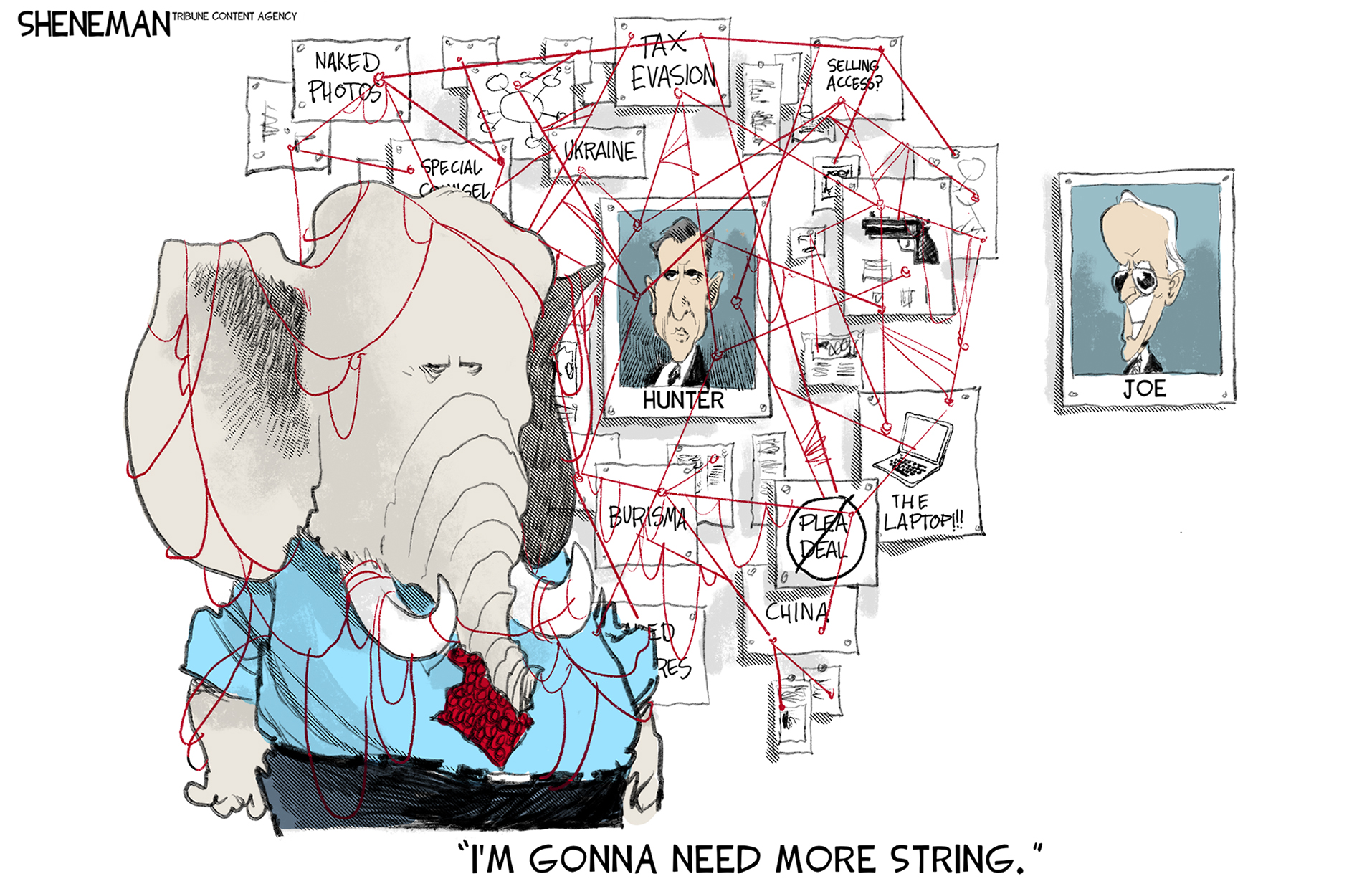
Until recently, it was possible for Republicans to stick their heads in the sand and insist Trump’s legal problems were all politics. After all, they knew that their Benghazi hearings had been political BS, and their Hunter Biden hearings were going to be BS as well, so why shouldn’t they assume Democrats were doing the same thing?

So they didn’t watch the January 6 hearings, and didn’t notice that the witnesses against Trump were nearly all Republicans and officials from his own administration. They haven’t read the indictments, so they don’t appreciate the depth of the evidence against him.

The trials — at least some of which are bound to start before the election — will be harder to ignore. And guilty verdicts reached by juries of ordinary people will be harder yet. When people like Mike Pence and Brad Raffensperger are called to testify against Trump, or his fellow defendants start to flip against him, the cognitive dissonance will be intense.

As the trials get underway, even the MAGA faithful will be shaken by Trump’s sheer impotence. Even judges he appointed won’t buy his legal arguments. He won’t dare take the stand in his own defense. All his claims that “the American people won’t stand for this” will be proven wrong. And he will suffer a long series of small indignities that he will be helpless to prevent. (When he surrenders in Georgia later this week, for example, we may find out his actual height and weight — which I suspect are nothing like the figures he’s been claiming.) He won’t even slightly resemble the godlike figure his cult imagines.

Some Republicans will never admit they were wrong about Trump, but many will reach a point where they just don’t want to think about him any more. By election day, Republican turnout may lag. And again, we’re talking about him losing votes. Where is he going to gain votes? Among the people who didn’t vote for Trump in 2020, how many are seeing the evidence against him and thinking “That’s who I want as my president”?

But what about the polls? The current RCP polling average has Biden up by a miniscule 0.4%, and two recent polls that are part of that average say the race is tied. Biden’s approval rating is 13 points underwater.

How can I not be worried about that?

Well, let’s start with the fact that Trump’s approval is 17 points underwater. Also recall that this point in 2011 marked a low in President Obama’s popularity. His approval rating was 12 points negative that September, but he went on to a 332-206 Electoral College victory the next year.

Political pundits tend to underestimate how many low-information and low-attention voters we have in the US. The political class may be obsessed with Trump and Biden, but tens of millions of Americans have not even thought about their 2024 vote yet. Millions of women have not processed yet that a vote for Trump will surrender their reproductive rights for good. Millions of young people have not understood yet that reelecting Trump will doom their future to climate change.

A few of them never will think things through like that. But the ones who do will provide a sizeable margin for Biden.


[1] A worthy question is: What happens if the Republicans somehow don’t nominate Trump? Well, if you imagine them nominating an actual moderate, the kind of Republican who can win a blue-state governorship like Maryland’s Larry Hogan or New Hampshire’s Chris Sununu, then Biden is probably in trouble. But I think I can pretty much guarantee that’s not going to happen.

A Ron DeSantis or Tim Scott will have the same issue problems as Trump: What about abortion? What about climate change? What about gay rights? Isn’t your economic plan just to keep cutting rich people’s taxes and giving corporations more freedom to poison us?

But any non-Trump Republican has an even bigger problem: What happened to Trump? Did he magically disappear? Did he accept his primary defeat gracefully and endorse the victor?

Again, that’s not going to happen. If Trump isn’t the nominee, most likely he has stomped away mad and is accusing the candidate who defeated him of fraud. I don’t think the GOP can win in that scenario.

The Monday Morning Teaser

Last week Maui was the target of this summer’s apocalyptic weather. This week it’s Southern California. A tropical storm hit San Diego and Los Angeles yesterday, and it’s raining hard in Las Vegas. This never happens. Also this week, the capital of Canada’s Northwest Territory had to be evacuated due to wildfire.

Climate change isn’t something to debate about any more. You just have to open your eyes and see it.

As usual, though, I don’t cover breaking news. So this week’s featured post will take a step back from the Trump-indictment soap opera and look at the larger picture. Lots of Democrats are anxious about the 2024 election, but I’m optimistic. The featured post will explain why. It should be out around 10 EDT.

The weekly summary will point to stories about the weather, review the recent developments in the Trump trials, explain why I haven’t been paying much attention to the Hunter Biden investigations, and cover a few other things. It should be out a little after noon.

Normal Order

He is a criminal defendant. He is going to have constraints the same as any defendant. This case is going to proceed in a normal order.

Judge Tanya Chutkan

This week’s featured post is “How did Frederick Douglass become a conservative spokesman?

This week everybody was talking about the fires in Maui

They’re still finding bodies in burned-out buildings in Lahaina, the main city in Maui. As of this morning the toll was up to 96 deaths. As you can see in the picture above, people stuck in traffic had to abandon their vehicles and try to escape on foot.

The wildfire had two main causes: dry grass and high winds. One recent theory is that the winds blew over some power lines, which sparked the grass. Extreme dryness and wind are two symptoms of climate change, and the Maui disaster is just the latest event in our Climate Change Summer, which has also included smoke from Canadian fires blanketing the Northeast, extreme rain and flooding in Vermont and Pennsylvania, and record heat in the Southwest and Florida.

Politicians who deny what we can see with our own eyes, or who want to ignore the whole issue, are not worth arguing with any more. They just need to be voted out.

and Trump’s trials

Fulton County DA Fani Willis will seek a Trump indictment this week. The Atlanta Journal Constitution’s Tamar Hallerman lays out what to expect from this indictment, which might appear as soon as tomorrow. As I keep saying, I could speculate about the content, but in a few days I can just read it.


Most of the Trump-trial news this week concerned Judge Tanya Chutkan, who is overseeing the DC trial for the January 6 conspiracy. In a hearing Friday, she issued a protective order barring Trump from using material the government is sharing in the discovery process to badger or intimidate witnesses against him. She also warned that she would be watching Trump’s public statements closely.

The fact that he is running a political campaign currently has to yield to the administration of justice. And if that means he can’t say exactly what he wants to say in a political speech, that is just how it’s going to have to be.

It’s worth noting that Americans cannot be deprived of their rights “without due process of law”. Trump temporarily faces a judge’s restrictions because a grand jury of American citizens has found sufficient evidence to indict him for several serious crimes. That’s due process of law.

If Trump does appear to be trying to intimidate witnesses or taint the jury pool, Judge Chutkan has a number of possible responses, which include revoking his bail and putting him in jail until the trial is complete. But there has been speculation that Trump would welcome such a move, because he could make political hay out of the “persecution” he had brought on himself. (I doubt this; I think Trump is terrified of jail.) So Friday Chutkan made a novel threat: If Trump won’t behave himself, she might have to move the trial along faster to protect witnesses, prosecutors, and everyone else involved (including herself).

Given that Trump’s whole strategy has been to delay the trial until he becomes president again — as I explained last week, he doesn’t seem to have any other viable defense — that threat might have some teeth.


What the people Trump targets might need protection from was underlined last week when the FBI tried to arrest a Utah man who had made detailed threats against President Biden (and other Trump enemies like Manhattan DA Alvin Bragg). A judge deemed these threats credible, so an arrest warrant was issued. The man was armed when agents arrived, and was killed when (according to the FBI) he pointed a weapon at the arresting agents.

Naturally, the man is now considered a martyr by the violent Right. These same people would respond to reports of police killing a person of color with “Why didn’t he just comply?” But the laws are supposed to work differently for them.


This is far from the first time an avowed Trump supporter has repeated Trump’s rhetoric before threatening or carrying out violent acts.

It’s worth remembering how normal American politicians respond to such situations. In 2017, a Bernie Sanders supporter brought a gun to a baseball practice for congressional Republicans and began shooting, badly wounding Rep. Steve Scalise and several others. Afterwards, Sanders made this statement:

I have just been informed that the alleged shooter at the Republican baseball practice is someone who apparently volunteered on my presidential campaign. I am sickened by this despicable act. Let me be as clear as I can be: Violence of any kind is unacceptable in our society and I condemn this action in the strongest possible terms. Real change can only come about through nonviolent action, and anything else runs against our most deeply held American values.

Trump has never made any similar statement, and it is difficult to imagine him doing so. More typically, he makes excuses for his violent supporters, lauding how “passionate” they are. On January 6, Trump explained to Kevin McCarthy that the rioters who had invaded the Capitol and were chanting “hang Mike Pence” were just “more upset about the election” than McCarthy was. When he did eventually ask the rioters to go home, he told them “We love you. You’re very special.

So if you belong to Trump’s personality cult and you want him to love you, you know what to do.


Trump’s apparent approval of violence continues. Saturday at the Iowa State Fair, Rep. Matt Gaetz told a crowd that “we know that only through force do we make any change in a corrupt town like Washington, D.C.” Trump was standing right there, and made no attempt to distance himself from Gaetz’ rhetoric.


Merrick Garland has taken a lot of criticism lately. Andrew Weissmann, formerly a top assistant to Robert Mueller, put it like this:

We [should] not forget that the predicament Jack Smith is in, racing to get and keep trial dates pre-election, is [be]cause Garland was so slow to pursue a top down investigation.

The conventional wisdom says that Garland didn’t want DoJ to prosecute Trump because he was already wary of the weaponization-of-justice cudgel the Right was going to beat him with. But the House January 6 Committee so clearly demonstrated Trump’s criminality that Garland’s see-no-evil position became untenable. So that’s how we got here, but arrived more than a year late.

Jay Kuo, however, makes an interesting counter-argument: No matter how obvious it might be to the casual observer that January 6 was a great crime against America, the laws were not written with January 6 in mind. So no matter how DoJ proceeded, it was going to have to apply laws in new ways, using interpretations that had never been tested in court.

Making Donald Trump the test case was bound to be fraught. So Garland started at the bottom, with the foot-soldiers who invaded the Capitol. Sure, they were trespassing, but wasn’t there more to it that that? What else could they be charged with? Some had attacked police, but what about the ones who hadn’t (or at least weren’t on video doing so)?

There’s a law against obstructing an official proceeding, but the main thrust of that law is about forging official documents, and whether the clause about obstructing a proceeding “otherwise” applied here hadn’t been tested. And was the joint session of Congress on January 6 an “official proceeding” under this law? What did disrupting it “corruptly” mean?

So Garland’s DoJ went about establishing these points in cases that didn’t have to carry the emotional and political baggage of a case against Trump. Appeals of some of those cases did challenge those interpretations, and those appeals weren’t resolved until April of this year. One (the meaning of “corruptly”) is still pending.

So maybe DoJ was always fated to race against the 2024 election. And maybe Attorney General Garland knew what he was doing.

and the pro-reproductive-rights vote in Ohio

Sometimes politics gets so ridiculous that only a comedian can describe it. Here’s Trae Crowder, a.k.a. the Liberal Redneck.

Ohio Republicans found out that the people of their state were likely to pass an amendment that would protect abortion rights in Ohio. And when they heard that, Ohio Republicans said, “The people of Ohio must be stopped.” So they tried to pass another law before that which would require 60% of the vote instead of the usual simple majority. So basically they went to the people of Ohio and said “Hey y’all. We want y’all to vote on whether or not your vote should count for shit.” And the people of Ohio went, “Uh, I think I’m gonna vote for my vote should count for shit.”

And Ohio Republicans just started stomping their feet and making a shocked Pikachu face. Like, I don’t know what they expected. Like what do they think? People are gonna line up around the block to disenfranchise themselves? What did they think was gonna happen, you know?

But this is their playbook now, y’all. This is what they do, because they’ve finally come to understand that they are not actually popular. Right? It took ’em a long time. For years and years they were alienating and demonizing women, Black people, gay people, Mexicans, minorities, immigrants, smart people, poor people, and everybody in between. They’ve been years doing that, and now they’re like “Why don’t anybody like us?”

Oh, I don’t know, truly a mystery for the ages, that one. But either way, they understand it now. They realize that, generally speaking, the American people do not agree with them on things like abortion, gay rights, civil rights, the economy, healthcare — none of it.

They’ve come to realize that and they’ve arrived at this conclusion: If hearts of the people cannot be won, then the will of the people must be quashed. That’s right. They understand that in a functioning democracy, their policies would be relegated to the impotent fringe, and have decided that therefore, from this point forward, this democracy should no longer properly function.

That’s what all this is about, y’all, the gerrymandering laws, voter restriction laws, and January 6 and the Big Lie — all of it.

And it’s not just in Ohio. In Wisconsin, Republicans have managed to gerrymander their way into a supermajority in the Senate, in a state where Democrats have been winning statewide races, including a race in April that gave liberals control of the state supreme court.

Now the map that gerrymanders Republicans into power is coming before the supreme court, and Republicans are threatening to use their illegitimate supermajority to impeach the new liberal justice if she doesn’t recuse herself.

The people of Wisconsin must be stopped!

and education in Florida

When Governor DeSantis got his Don’t-Say-Gay and Stop WOKE Acts through the Florida legislature, the doom-saying of many liberal pundits was written off as “alarmist”. Surely when it got down to cases, reasonable interpretations would prevail and it wouldn’t be that bad. But developments in recent weeks have shown that in fact it’s worse.

One DeSantis priority is that schools stop cooperating with kids who want to try out a different gender identity without their parents’ explicit permission. So if Timmy wants to be known at school as Tammy, Timmy/Tammy’s teachers are supposed to notify the parents, even if doing so violates the child’s trust.

But who’s to decide the gender implications of a nickname? Maybe Samantha wants to be Sam not because she’s experiencing a crisis of femininity, but because she thinks it sounds cooler. So, do her parents need to be notified? Schools don’t want to take responsibility for making such judgments. Hence this email to parents in Seminole County:

If you would like for your child to be able to use a name aside from their legal given name on any of our campuses, we will ask for you to complete the consent form titled “Parental Authorization for Deviation from Student’s Legal Name Form.”

Orange County announced a similar rule. And yes, it does mean exactly what it says.

The rule would impact everyone from students who prefer using a shorthand nickname (“Tom” versus “Thomas,” for instance), to those who prefer a different name altogether, including transgender students

All my life, I’ve gone by Doug rather than Douglas, the name on my birth certificate. And my parents never had to fill out a form to make that OK.


Last week, I reported on the controversy over whether the College Board’s AP Psychology course could be taught in Florida schools. As of last week, the state Department of Education was saying it could be taught “in a manner that is age and developmentally appropriate.” Nobody knew what that really meant, so several school districts announced they still wouldn’t teach the course.

And in a phone call Tuesday, a spokesperson for Brevard Public Schools, a district about 50 miles east of Orlando, said it was also abiding by the Education Department’s initial guidance, referring NBC News to a statement from the district last week.

“In essence, if we don’t teach all of the content, our students will not receive AP credit. If we do teach all of the content, our instructors will violate the law,” the statement said. “Therefore, we will not offer AP Psychology at any of our high schools this year.”

Wednesday, Education Commissioner Manny Diaz Jr. tried to make the state’s position clearer:

It is the Department of Education’s stance that the learning target, 6.P ‘Describe how sex and gender influence socialization and other aspects of development,’ within Topic 6.7, can be taught consistent with Florida law

But even with that explicit permission, some school districts are not willing to take the chance that the way they do teach AP Psych will match Diaz’s official view of how it can be taught. So the class won’t be reinserted into their course catalogs.


This week something similar happened with Shakespeare. Romeo and Juliet may be a classic, but fundamentally it’s about two teens who have sex despite their parents’ disapproval. And sure, it’s a tragedy and (spoilers!) they both wind up dead. But still, the whole love-and-death saga is kind of glorious somehow, especially from an emo-adolescent perspective. (According to “Don’t Fear the Reaper” they’re “together in eternity” and “we can be like they are”.) Is this “age appropriate” for high school students? In Ron DeSantis’ Christo-fascist Florida?

So, citing the bard’s overall “raunchiness”, Hillsborough County announced that it would only teach excerpts of Shakespeare, not whole plays, and several other counties were considering following that example. The bad press from those decisions caused FDoE to issue another explicit permission:

The Florida Department of Education in no way believes Shakespeare should be removed from Florida classrooms.

So R&J is back in sophomore English, and all’s well that ends well, so OK then. But still, these episodes underline something I find disturbing: In practice, Florida schools have become a place where everything not explicitly permitted is forbidden. So what happens to literature less canonized than Romeo and Juliet or topics that don’t have the College Board lobbying for them? As the vagueness of Florida’s new laws causes schools to steer clear of anything that might fall into the enormous gray zone those laws have created, how many valuable works — full of ideas that might engage teens, make them think, or spark meaningful discussions — are being swept out the door without making headlines?

Plutarch once wrote (more or less): “The mind is not a vessel to be filled, but a fire to be kindled.” But teachers are never fired for failing to kindle young minds. Being dull and demonstrating to your students that education is pointless can be the safest course — especially in Florida.


But the development that best displays the Orwellian nature of DeSantis’ “Freedom from Indoctrination” slogan is Florida’s approval of Prager University videos for use in the public schools. That’s discussed in the featured post.

and you also might be interested in …

The ongoing war between red states and their blue cities has claimed a new victim: Houston school libraries. Houston schools have been taken over by the state, leaving locally elected school boards with little say.

In Houston, Texas, dozens of public schools won’t have librarians and traditional libraries when classes start later this month. It’s part of a controversial reform effort in the state’s largest school district. The new superintendent says schools in working-class areas need good teachers more than they need librarians.


While we continue to worry about inflation, China is experiencing deflation. This can be an even more serious problem, because it can lead to cascading bankruptcies: As money gains value, debts become harder to repay. So people and businesses sell assets to raise cash, depressing prices further.

What an inflating West and a deflating China means for the world economy is hard to predict.


Using government power to make “woke” corporations toe the conservative line isn’t just a DeSantis thing, it’s catching on in Republican circles generally. Here, Fox News’ Laura Ingraham warns Apple and Disney that when Republicans regain power “everything will be on the table — your copyright and trademark protection, your special status within certain states, and even your corporate structure itself”.

Recall that Mussolini’s definition of fascism was the merger of state and corporate power.


I can’t explain why the Montgomery dock brawl went viral the way it did, but it inspired some great creativity, including this version using the theme to “Good Times” and ending with some white folding chairs painted into a Harlem Renaissance artwork.


If you’re not following Kat Abu on social media, you should be. She watches Fox News so you don’t have to, and summarizes it in a way that will usually make you laugh rather than fume.

I sometimes picture a gaggle of blond Fox News hosts watching Kat and saying, “Girl, if you just used more make-up and changed your hair, you could get a job here.”

and let’s close with something artificial

If there’s one thing AI is perfect for, it’s producing stereotypes. Most of the time that’s a problem. If you’re trusting AI to write your term paper on Transylvania, for example, you’ll need to make sure you aren’t repackaging a bunch of vampire mythology as fact. But somebody used AI to create images of the most stereotypical person from each of the 50 states.

They aren’t intended to be funny, just stereotypical. Here’s the Californian.

How did Frederick Douglass become a conservative spokesman?

History gets a remake in Florida schools.


As Ron DeSantis’ Florida continues its descent into authoritarianism, you may have missed one of the summer’s developments: In late July, Florida approved PragerU Kids videos for use in Florida public schools.

What is PragerU? You can be forgiven for not knowing what PragerU Kids is. Prager University is well known among conservatives, but nearly invisible to the rest of us (until recently). Like the fraudulent and now defunct Trump University, it is not actually a university, as its FAQ admits:

No, PragerU is not an accredited university, nor do we claim to be. We do not offer degrees. However, we are the most accessible and influential online resource for explaining the concepts that have made America great.

That right there is a clue to the Prager style: It creates misperceptions, but takes no responsibility for them: We’re not a university, we just call ourselves one. If you jumped to the conclusion that we’re a reputable academic institution, that’s on you.

Elsewhere, it describes itself more explicitly:

As a 501(c)(3) nonprofit, Prager University Foundation (“PragerU”) offers a free alternative to the dominant left-wing ideology in culture, media, and education.

It spends about $20 million a year, and its funding comes from a variety of sources, including a long list of conservative family foundations, like the Bradley Foundation ($1.6 million), Dunn Foundation ($315K), Chillemi Charitable Fund ($316K), Leven Family Foundation ($300K), Mitchell Foundation ($1.2 million), Morgan Family Foundation ($470K), Thirteen Foundation ($3.25 million), and so on. It also gets money from other conservative groups like Turning Point USA ($500K) and National Christian Foundation ($1.7 million). Several millions come via organizations supervising what are called donor-advised funds (which are basically foundations for people who can’t afford the legal overhead of foundations — I have one myself) like Fidelity Charitable Gift Funds ($4.3 million).

In short, while Prager U has some big donors, it also has a fairly wide appeal among conservatives. Its pitch is that “left-wing ideology” is so “dominant” that an alternative conservative voice is needed. It’s pro-fossil-fuel, anti-anti-racist, pro-Christian-exceptionalist, and promotes a number of myths about American history, like soft-pedaling America’s role in the history of slavery. (Soft-pedaling slavery, as we’ll see, is a persistent theme. This is probably a big reason it appeals to DeSantis’ people.)

In short, if you’re arguing the conservative side of just about any culture-war issue, you can add some intellectual trappings to your case by citing a PragerU video. Your friends and family will probably be fooled into taking the “university” thing seriously. (But that’s their fault, not Prager’s.)

PragerU Kids, as the name suggests, is the same thing aimed at children. If you’re a conservative home-schooling your kids, or an explicitly conservative private school, you probably use a lot of these videos. They’re propaganda, but like all the best propaganda, they usually don’t explicitly lie. PragerU Kids videos cherry-pick sources, conveniently overlook events that don’t fit their chosen narrative, and frame facts in deceptive ways, but they’re usually based on something. (If pressed, I suspect most PragerU folks would claim that they’re just using the same deceptive tactics liberals use.)

Just to be clear where I’m coming from, I think PragerU has every right to do what it does, and anybody who wants to view their videos (or show them to their kids) should be allowed to do so. I could even see a public-school system making some of these videos available to older children in a multi-viewpoint class that has the time and resources to provide and discuss the videos’ missing context. But for a public school teacher to show third-graders one of these videos and then send them home (as I imagine will frequently happen in Florida) is educational malpractice. It is precisely the kind of indoctrination that Governor DeSantis claims to oppose.

How does Frederick Douglass get into this? Two of PragerU Kids’ most popular characters are Leo and Layla, a brother and sister who somehow have a time-travel app on their phone. To a certain extent the app has a mind of its own, so when the kids are wondering about something in the present, they frequently get zapped back in time so that some famous historical figure can teach them the proper conservative culture-war lesson.

In one video, they are watching the news on TV, and seeing events that are clearly meant to evoke the demonstrations that followed George Floyd’s murder by a Minneapolis policeman. The murder, however, is one of those inconvenient details best omitted, so the kids see only TV commentators making excuses for “violence and destruction by some of our angrier activists” who want to “abolish the police” and “want the US system torn down” for no apparent reason.

Wondering what “abolish” even means, the kids go back in time to explore abolitionists, and meet Frederick Douglass in 1852.

Now, you might wonder why a conservative organization would want kids to talk to Douglass, who said some pretty radical things. For example, when asked to speak at a Fourth of July celebration in Rochester, New York in that very year of 1852, he questioned whether the holiday should mean anything at all to a Black man.

Fellow-citizens, pardon me, allow me to ask, why am I called upon to speak here to-day? What have I, or those I represent, to do with your national independence? Are the great principles of political freedom and of natural justice, embodied in that Declaration of Independence, extended to us? and am I, therefore, called upon to bring our humble offering to the national altar, and to confess the benefits and express devout gratitude for the blessings resulting from your independence to us?

Would to God, both for your sakes and ours, that an affirmative answer could be truthfully returned to these questions! Then would my task be light, and my burden easy and delightful. For who is there so cold, that a nation’s sympathy could not warm him? Who so obdurate and dead to the claims of gratitude, that would not thankfully acknowledge such priceless benefits? Who so stolid and selfish, that would not give his voice to swell the hallelujahs of a nation’s jubilee, when the chains of servitude had been torn from his limbs? I am not that man. In a case like that, the dumb might eloquently speak, and the ‘lame man leap as an hart.’

But such is not the state of the case. I say it with a sad sense of the disparity between us. I am not included within the pale of glorious anniversary! Your high independence only reveals the immeasurable distance between us. The blessings in which you, this day, rejoice, are not enjoyed in common. The rich inheritance of justice, liberty, prosperity and independence, bequeathed by your fathers, is shared by you, not by me. The sunlight that brought light and healing to you, has brought stripes and death to me. This Fourth July is yours, not mine. You may rejoice, I must mourn.

The Frederick Douglass who made that speech fits right into a class Florida would ban as “critical race theory”.

But that’s not what he says to Leo and Layla. The reason 1852 matters is that Douglass split with his former mentor, White abolitionist William Lloyd Garrison, in 1851. So in this video, Garrison (who is briefly portrayed when Douglass talks about him, but doesn’t get a speaking role) represents the violent extremists and Douglass the activists who patiently work within the system.

So Prager-Douglass opposes slavery, but repeats the soft-pedaling line that Prager and DeSantis favor: “The sad fact is that slavery has existed everywhere in the world for thousands of years.” (In a different video, Christopher Columbus tells the kids that “Slavery is as old as time, and has taken place in every corner of the world.”) In fine PragerU fashion, Douglass says something misleading that is carefully worded enough to be arguably true: “There was no real movement anywhere in the world to abolish slavery before the American founding. Slavery was part of life all over the world.”

Of course, France would abolish slavery in 1794 and the British Empire in 1831. Mexico’s version of the Emancipation Proclamation came in 1829, and was a major reason Texans sought independence. (The Texas Revolution was a fight for slavery, not freedom.) So the video’s assertion about 1787 (when the Constitution was adopted) might pass muster, assuming that you don’t consider the English Quakers a “real” movement. But waiting until 1865 to renounce slavery put the US near the end of the abolition process, not the beginning. Brazil would be the last major country to abolish slavery in 1888.

Prager-Douglass goes on: “Our founding fathers knew that slavery was evil and wrong” and “They wanted it to end. But their first priority was getting all 13 colonies to unite as one country.” So they tolerated slavery as “a compromise to achieve something great. … Our founders created a system they thought would have slavery end gradually.” And yes, slavery still hadn’t ended by 1852, but “complicated problems take time to solve.”

And that brings us to Prager-Douglass’ disagreement with Garrison. He says that Garrison “refuses all compromises, demands immediate change, and if he doesn’t get what he wants, he likes to set things on fire.” (What Garrison set on fire was a copy of the Constitution, which you can recognize in the video if you already know that story. If you jumped to the conclusion that he did actual property damage, like the violent demonstrators the kids had seen on TV, that’s on you, not Prager.) Prager-Douglass says he wants to work within the American system, but that Garrison wants to overturn it.

Layla tells Douglass that his way is definitely better, and says that in our time Douglass is an American hero “and that other guy isn’t really known”. (The picture shows Garrison’s statue in Newburyport, Massachusetts.) The kids are triumphalist about the present-day US: All Americans have equal voting rights, and a Black man was even elected president! (There is, of course, no point in mentioning that his administration was followed by a racist backlash, or that people might still be protesting about racial grievances.)

Prager-Douglass asks if we still have the same Constitution, and then says “I knew the US Constitution would survive and allow for positive change.” Prager-Douglass closes by advising the kids to seek change within the system, and to avoid “radicals” like Garrison (and presumably Black Lives Matter).

Who is this guy? You may have a hard time recognizing the PragerU cartoon character as the Frederick Douglass you know from history. After all, by late 1860, Douglass was promoting far more than just gradual change within the system. Speaking on the first anniversary of John Brown’s execution, he endorsed violence: “We need not only to appeal to the moral sense of these slaveholders; we have need, and a right, to appeal to their fears.”

I rejoice in every uprising at the South. Although the men may be shot down, they may be butchered upon the spot, the blow tells, notwithstanding, and cannot but tell. Slaveholders sleep more uneasily than they used to. They are more careful to know that the doors are locked than they formerly were. They are more careful to know that their bowie-knives are sharp; they are more careful to know that their pistols are loaded. This element will play its part in the abolition of slavery.

And his endorsement of the Union was conditional.

My opinion is that if we only had an abolition President to hold these men in the Union and execute the declared provisions of the Constitution, execute that part of the Constitution which is in favor of liberty, as well as put upon those passages which have been construed in favor of slavery, a construction different from that and more in harmony with the principles of eternal justice that lie at the foundation of the government — if we could have such a government, a government that would force the South to behave herself, under those circumstances I should be for the continuance of the Union. If, on the contrary — no if about it — we have what we have, I shall be glad of the news, come when it will, that the slave States are an independent government, and that you are no longer called upon to deliver fugitive slaves to their masters, and that you are no longer called upon to shoulder your arms and guard with your swords those States — no longer called to go into them to put down John Brown, or anybody else who may strike for liberty there.

That doesn’t sound at all like the PragerU cartoon character. So are they lying to the kids?

Not exactly. The PragerU Douglass seems to be based on a particular aspect of Douglass’ thinking during a particular point in his life. During the 1850s, Douglass and Garrison had a very public argument that centered on whether to give up on the American experiment in democracy.

Garrison saw little hope for it. Slavery, in his view, was part and parcel of the Union from Day 1. The word slave may not appear in the Constitution, but the shadow of slavery darkens many of its provisions, from the 3/5ths compromise to the requirement that states return those who were “held to Service or Labor” in another state. The Constitution, in his view, was a “covenant with death” and “an agreement with Hell”. Consequently, he refused to participate in electoral politics and wanted free states to secede. “No Union with Slaveholders” was his slogan.

Douglass explained his contrary view in a speech he gave in Scotland.

I, on the other hand, deny that the Constitution guarantees the right to hold property in man, and believe that the way to abolish slavery in America is to vote such men into power as well use their powers for the abolition of slavery.

Douglass held that the Constitution had been given a pro-slavery interpretation, and the US government had implemented pro-slavery policies, but he denied that the Constitution itself was at fault. In the Scotland speech, (given in March, 1860, a mere seven months before the John Brown speech I quoted earlier), he insisted that free states should stay in the Union precisely so that they could fight against slavery.

This is why today Douglass can be turned to the service of conservatives, particularly the ones like DeSantis, who want to deny that racism played (and continues to play) a structural role in the US. By cherry-picking, Douglass’ words can be put to use in much the same way that Martin Luther King’s famous quote that people “not be judged by the color of their skin but by the content of their character” is regularly trotted out in opposition to affirmative action (which King supported).

Restoring the context. The video would have you believe that history has proven Douglass right and Garrison wrong, because the Constitution and the Union have both survived, but slavery hasn’t.

However, that result didn’t happen through ordinary Constitutional processes, i.e., by convincing voters and electing abolitionist candidates, as Douglass envisioned. Instead, change came about through violence: The Southern states seceded, the North conquered them, and then in the aftermath of the war, the North imposed abolition, essentially ratifying the 13th Amendment at gunpoint.

The election of Lincoln, which precipitated the crisis, was more the result of slaveholder miscalculation than a groundswell of abolitionist feeling among American voters. As historian Douglas Egerton described the unlikely outcome of 1860 election in his book Year of Meteors, the Democratic coalition of slaveholders and Northern industrialists that had controlled the White House in 1852 and 1856 was well set up to do it again in 1860. But pro-secession Southerners revolted against nominating Northerner Stephen Douglas, split the party, and virtually guaranteed Lincoln’s victory with 40% of the popular vote in a four-candidate field.

If abolition had waited for an anti-slavery voting majority, we might still be waiting.

So history proved neither Douglass nor Garrison right, because neither of their strategies worked. In the end, the slaveholders were not outplayed by their opponents; they simply overreached and lost everything.

If you can find a Black-Lives-Matter lesson in this, you’re cleverer than I am.

Conclusion. So I, an adult with a college education and the time and interest to pursue the matter, was able to find the kernel of truth behind the PragerU Kids video and put it in some proper context. But can we really expect kids Leo’s age — the target audience of the Leo & Layla videos — to do the same?

Florida either thinks we can, or it’s content to let its children be indoctrinated.

The Monday Morning Teaser

This week downtown Lahaina, which I visited many years ago, burned to the ground in a wildfire that started in dry grass and was driven by hurricane-force winds. It was the most devastating event yet in our Climate Change Summer, emphasizing yet again that we cannot simply go on this way.

The Sift leaves breaking news to organizations that have the resources to cover it, and information about the disaster is still coming out. (And the death toll is still rising.) So if I don’t say a lot about Maui, that doesn’t imply I don’t see the seriousness of the situation there.

Instead, my attention was caught this week by something that may seem trivial by comparison. In July, the Authoritarian State of Florida approved videos by the right-wing non-university Prager University for use in public elementary schools. PragerU Kids videos constitute precisely the kind of “indoctrination” Governor DeSantis claims to be against. They are slickly produced and probably quite effective at distorting kids’ views of history and the world we live in today.

One video in particular stood out for me: Two time-traveling kids from the present go back to 1852 to talk to Frederick Douglass about abolition, and come back with a negative view of Black Lives Matter protesters today. The Douglass in the video seemed nothing like the Douglass of history, and yet I know the Prager style: They cherry-pick and deceptively reframe history, but seldom lie outright. So how did they do this?

Via the internet, I took my own trip back to the 1800s so I could listen to Douglass (or at least read his speeches). What I found emphasizes (at least to me) how tricky the Prager people really are, and why it’s so dangerous to give them this kind of access to American children. The post “How Frederick Douglass became a conservative spokesman” should appear before 10 EDT.

That leaves the weekly summary a lot to cover: Maui, of course, but also developments in Trump’s various trials, a victory for reproductive rights in the red state of Ohio, other disturbing things we’re learning about Florida education as the new school year approaches, that viral brawl in Montgomery, and a variety of other news. That post should appear before 1.

Conspiracies

The Defendant lost the 2020 presidential election. Despite having lost, the Defendant was determined to remain in power. So for more than two months following election day on November 3, 2020, the Defendant spread lies that there had been outcome-determinative fraud in the election and that he had actually won. These claims were false, and the Defendant knew they were false. … Shortly after election day, the Defendant also pursued unlawful means of discounting legitimate votes and subverting the election results. In so doing, the Defendant perpetrated three criminal conspiracies.

The United States of America v Donald J. Trump

This week’s featured post is “The Evidence Against Trump is Unchallenged“.

This week everybody was talking about Trump’s January 6 indictment

Tuesday, Donald Trump was indicted for his plot to overturn his loss in the 2020 presidential election. The indictment was widely covered in the media, so I’ll try not to rehash things you’ve undoubtedly seen many times.

The indictment is only 45 double-spaced pages, so if you don’t want somebody else’s interpretation to get in your way, you can easily read it yourself. If you do want to read somebody’s summary, let me me recommend Marcy Wheeler and Jay Kuo.

The indictment tells a simple story: Trump lost the election. He knew he had lost the election, but wanted to stay in power anyway. So he invented and spread lies about election fraud, which he used to justify a series of illegal actions:

  • pressuring election officials either to baselessly refuse to certify the legitimate election results or to change the results in his favor (as in his famous call urging Georgia Secretary of State Brad Raffensperger to “find 11,780 votes”).
  • pressuring Republican state legislatures to illegally overrule their state’s voters and instead award Trump their electoral votes.
  • enlisting Republican officials in eight states he lost to falsely claim to be the state’s electors and cast electoral votes in his favor.
  • pressuring Vice President Pence to exceed his constitutional authority and recognize the fake Trump electors.
  • taking advantage of the January 6 riot to push Republicans in Congress not to certify the votes cast by legitimate electors.

The previous indictments were all vulnerable to the criticism: “You’re indicting him for this because you can’t nail him for what you really want.” This one isn’t. The central thing I want Trump to answer for is his attempt to stay in power after losing an election. What’s more, this indictment goes to the heart of why Trump can never be allowed to wield power again: He was a danger to the republic in January 2021, and his possible return to power represents a fresh threat to the republic.


Jack Smith appears to have gone to some trouble to streamline this indictment, so that he has a chance to get a trial done before the election. That’s why the six co-conspirators are not named or indicted (though they may be later). It’s also why Trump isn’t charged with inciting a riot, because that would raise Supreme-Court-level issues about the limits of free speech.


John Eastman (a.k.a. “co-conspirator 2”) is not waffling any more: He’s defending the January 6 riot as a justified attempt to overthrow the government.

Klingenstein asked Eastman whether he would have acted in the same way in 1960 as he did in 2020, referencing the belief on the right that John F. Kennedy stole that year’s election from Richard Nixon.

Eastman replied no, and added that the stakes of 2020 represented an “existential threat to the very survivability, not just of our nation, but of the example that our nation, properly understood, provides to the world.”

The Trump 2020 lawyer went on to reference the Declaration of Independence, saying that “our founders lay this case out.”

“There’s actually a provision in the Declaration of Independence that a people will suffer abuses while they remain sufferable, tolerable while they remain tolerable,” he said. “At some point abuses become so intolerable that it becomes not only their right but their duty to alter or abolish the existing government.”

“So that’s the question,” he added. “Have the abuses or the threat of abuses become so intolerable that we have to be willing to push back?”


The January 6 indictment has overshadowed other important recent developments, like the superseding indictment in the Mar-a-Lago case, or the states that have been going after local conspirators. In addition, Fani Willis’ indictment in Fulton County will probably drop sometime in the next two weeks.

and Israel

Two articles I found worthwhile: “What Israel Has Already Lost” by Yair Rosenberg and “I don’t recognize the intolerant, illiberal country that Israel is becoming” by Max Boot. The gist I draw from these essays is that the battle for democracy is far from over, but it’s not going well.

Rosenberg points to a new willingness to demonize opponents, which he calls “an utter collapse of shared solidarity”. Boot’s column is an elegy to “the nation I fell in love with” 40 years ago. The current Israel, Boot says, “remains freer than its neighbors”, but he “simply cannot support it as unreservedly as I once did.”

but you should pay attention to this Republican vision

The Heritage Foundation has spearheaded Project 2025, a collaboration of many conservative groups that has produced Mandate for Leadership 2025. This is sets out to be a handbook for the next Republican administration, and will likely have a considerable influence on the any Republican who wins in 2024, whether it’s Donald Trump or not.

There are two main things to know about Project 2025:

  • It would make the executive branch a more perfect instrument of the President’s will by expanding the power of political appointees and making more government employees fireable.
  • It would eliminate any consideration of climate change from US government policies.

The intro to the “Taking the Reins of Office” section says:

When it comes to ensuring that freedom can flourish, nothing is more important than deconstructing the centralized administrative state. Political appointees who are answerable to the President and have decision-making authority in the executive branch are key to this essential task. The next Administration must not cede such authority to non-partisan “experts,” who pursue their own ends while engaging in groupthink, insulated from American voters.

So the next time there’s a pandemic, Heritage wants a CDC committed to the president’s agenda, not public health. It wants an EPA whose top loyalty is to the president, not the environment. This harmonizes with Trump’s Agenda 47, particularly with its plans to “crush the Deep State”.

The NYT summarizes Project 2025’s energy provisions:

The plan calls for shredding regulations to curb greenhouse gas pollution from cars, oil and gas wells and power plants, dismantling almost every clean energy program in the federal government and boosting the production of fossil fuels — the burning of which is the chief cause of planetary warming.

If you want to dig into the details, look at the chapters on the Department of Energy and the EPA. Anything related to climate change is ripped out root-and-branch: Repeal the Inflation Reduction Act, eliminate subsidies for sustainable energy, scuttle standards for energy-efficient appliances, and go full-speed-ahead on fossil fuel drilling, mining, and pipeline-building (in a quest for “American energy dominance” in the world).

These policies are laid out without ever stating an opinion about the reality of climate change or its consequences. It’s as if whatever inadequate climate-change-mitigating programs Biden has managed to install are just some irrational fad that it’s time to be done with.

Bear this plan in mind if you start thinking that the 2024 election is just about Trump. Project 2025 is the consensus of conservative thinking. If you vote for any Republican for any office, this is what you’re voting for. If you decide to stay home or vote third-party because the Democrats aren’t inspiring enough, this is what you’re acquiescing to.

and you also might be interested in …

When a state legislature is as gerrymandered as Ohio’s, a ballot initiative is really the only chance the People have to make their will known. In an election tomorrow — one specially scheduled to get a low turnout — Ohio Republicans are trying to shut that avenue down.

Issue 1, which Ohio Republican legislators put on the ballot, would make future ballot measures to change the state Constitution harder to pass in two key ways. If it’s approved, citizens who hope to put amendments to the voters would first have to collect signatures in each of the state’s 88 counties, up from 44 now. And to pass, constitutional ballot initiatives would need to win 60 percent of the vote, rather than a simple majority.

The measure’s import may not be immediately clear to voters, but it’s meant to thwart a November ballot initiative that will decide whether reproductive rights should be constitutionally protected in Ohio, where a sweeping abortion ban is tied up in court.

Republicans know they can’t win this vote on the merits, so instead they’ve launched a confusing campaign implying that this measure has something to do with protecting your children from “trans ideology“.


Remember Justin Jones and Justin Pearson, the two Black lawmakers who were expelled by the Tennessee legislature in April? They were each reinstated by local councils until a special election could be held. Those elections were held Tuesday, and both won reelection. Jones got 78% of the vote in his Nashville district, and Pearson got 90% in his Memphis district.


Is the Gulf Stream about to collapse, as The Guardian reports? Well, no. Some system related to the Gulf Stream might stop working, but not the Gulf Stream itself. Skepchick explains: The report results from a confusion between the Atlantic meridional overturning circuit, which is slowing and could conceivably stop, and the Gulf Stream, which isn’t in danger of stopping.

Now, the AMOC stopping would have serious consequences. But it’s not the Gulf Stream.


Another skirmish in Florida’s fight against education: It briefly looked like AP Psychology courses would have to be withdrawn from the state.

According to the College Board (which created the curriculum and administers the test for AP credit) “how sex and gender influence socialization and other aspects of development” has been part of the course for 30 years. But the Florida Department of Education had told superintendents that “teaching foundational content on sexual orientation and gender identity is illegal under state law”. The College Board announced that if the whole course couldn’t be taught, any mention of “AP Psychology” would have to be dropped from student transcripts.

Friday, Florida backed down, sort of.

The future of the course appeared to be in jeopardy until, late Friday, Florida Education Commissioner Manny Diaz, Jr., informed school superintendents that students will be able to take the class “in its entirety” but only if the course is taught “in a manner that is age and developmentally appropriate.”

Nobody knows yet what that means, but it seems to me to place the onus on Florida teachers, who will have to stake their careers on their interpretation of this vague guidance.


Grist examines the downturn in the plant-based meat market. Not so long ago, beef-like patties from Impossible Foods or Beyond Meat seemed like the next big thing. But rather than exploding, sales fell 8% in 2022.

Several factors are in play here: high costs (compared to actual beef), whether or not the taste is convincing (opinions vary), and an increased focus among health-conscious consumers on avoiding ultra-processed foods (plant-based meat derives as much from labs as from farms).

Personally, I experimented with imitation beef exactly once: I used it to replace the ground beef in a spaghetti sauce. I knew I was in trouble when I started browning the “meat”, and my housemates’ dog didn’t come over to investigate.


About those ultra-processed foods: The New Yorker’s Adam Gropnik paints a more ambiguous picture: He agrees that a lot of what we buy in the store includes unhealthy ingredients, but “processing” is largely in the eye of the beholder.

The history of humanity is the history of processing foodstuffs—by fire, by smoke, by pounding and pulverizing—and it can be hard to find a boundary between those ever more hallowed traditional kitchen practices and the modern ones that we are asked to condemn.

Many of the substances that look suspicious on an ingredient list are as close to “natural” as ones that we instinctively trust.

why is guar gum, extracted from one seed, any more artificial than cornstarch, extracted from another (originally by means of a method patented in the eighteen-fifties by a British industrialist)? Some version of carrageenan, which comes from the seaweed Irish moss, has been used in cooking for centuries; Great-Grandmother certainly used the lecithin from egg yolks, if not from soy oil, to emulsify her sauces.

and let’s close with something oracular

This game has been around for a few years, but I just noticed it. You can get your “Florida man horoscope” by googling “Florida man” and your birthday. Here’s what I get for mine: “Florida man wearing nothing but cowboy hat attacks woman with machete: police“.

Like the positions of the planets when I was born, I’m sure this says something important about my character and life course.

The Evidence Against Trump is Unchallenged

Trump and his followers have said a lot about his indictments.
But their arguments have little to do with whether he’s guilty.


Since his legal troubles started, Donald Trump, his lawyers, and various conservative commentators who repeat his talking points have commented at length on his various indictments. But very few of those comments present arguments his lawyers could credibly present in court. Instead, most of what you’ll hear on Fox News are arguments intended either to move public opinion, or to intimidate witnesses, prosecutors, judges, and potential jurors.

It seems clear to me that Trump’s defenders want the public focused on anything other than the central questions the indictments raise: Is he guilty? Did he do the things he’s accused of? And if he did commit these crimes, should he be above the law?

Rather than refute the prosecutors’ evidence or offer exculpatory evidence of their own, “defenses” against Trump’s indictments mostly fall into a few other categories.

Threats. A threat is not an argument. Trump has issued many of them.

The most explicit threat came shortly after the magistrate judge warned Trump that “it is a crime to intimidate a witness or retaliate against anyone for providing information about your case to the prosecution, or otherwise obstruct justice”. He then went to Truth Social and posted “IF YOU GO AFTER ME, I’M COMING AFTER YOU!

But this extreme example is far from unique. Trump supporters have threatened prosecutors and FBI agents involved in cases against him. One Trump supporter was killed after attacking an FBI office. Jack Smith (as well as his wife) is a frequent target of Trump’s vitriol. Shortly before his indictment in New York, Trump posted a picture of himself wielding a baseball bat next to a head shot of Manhattan DA Alvin Bragg.

Attacking witnesses. Saturday it was Mike Pence’s turn, leading Jack Smith to seek a protective order controlling what Trump can do with information he learns through discovery.

Joyce Vance explains why that’s a big deal:

Some of the discovery contains personal identifying information for witnesses. If publicly disclosed, that could put them at risk of doxxing, identity theft or other harm. There is also grand jury testimony from witnesses, who might be put at risk if they find themselves suddenly in the public spotlight.

A hearing on the government’s motion is scheduled for this afternoon, but it’s hard to imagine Trump changing his behavior in response to a mere warning. At some point, Judge Tanya Chutkan will have to demonstrate to Trump that he is not in control of this process. Personally, I’d give the stern warning, along with threatening a temporary revocation of his bail should he violate her order.

Very little gets through to Trump, but I think he would find a night in jail very instructive. Putting him in jail for any length of time would give him a political issue, but one night might be an effective warning shot.

Whataboutism. What about Hillary’s emails? What about Hunter Biden’s laptop? What about these pictures of Hunter’s penis? None of this has anything to do with whether Trump is guilty of the charges against him. I doubt Judge Chutkan will allow any such arguments to be made in front of the jury.

It’s all political. Assembling evidence that Trump committed felonies is “election interference“. Indicting him for his crimes makes the US a “banana republic” — because real democracies let candidates and former presidents commit crimes with impunity, apparently. (Actually not.) Again, I doubt the judge will allow the jury to hear any discussion of the political impact of either convicting or acquitting Trump. The trial will focus on whether or not he committed the crimes he’s accused of.

Ad hominem attacks. Jack Smith is “deranged“. Alvin Bragg is “a degenerate sociopath that truely hates the USA.” Fani Willis is “racist“. Countless people are “Trump haters”. Adam Schiff is a “pencil neck” and “sick”. Bill Barr is a “gutless pig“. But if Smith, Bragg, and Willis have the goods on Trump, their personal qualities won’t matter in court.

In addition to these obviously irrelevant arguments, Trump and his people make several arguments that may sound as if they are based in law, but actually aren’t. If Trump’s lawyers make these arguments in motions, judges will dismiss those motions out of hand, and juries will never hear these points.

Such as:

Trump has been indicted for exercising his First Amendment rights. Nope. This claim should not fool a first-year law student, much less a federal judge.

Trump has been indicted for, among other things, fraud. Fraud involves deception, and deception often takes the form of spoken lies. But lies that contribute to fraud are not “free speech”.

For example: If I falsely tell you the painting on my wall is an original Picasso worth millions of dollars, that’s just bragging, which I have every right to do. But if I then sell the painting to you for millions of dollars, that package of speech-plus-action is fraud.

Here’s how that “gutless pig” Bill Barr explains it:

As the indictment says, they’re not attacking his First Amendment right. He can say whatever he wants. He can even lie. He can tell people that the election was stolen when he knew better. But that does not protect you from entering into a conspiracy.

BTW: This next point may be as legally irrelevant as the things Trump is saying, but take a step back and recognize how breathtakingly unique his argument is. I’m sure Trump won’t be the first politician to claim in court that he has a First Amendment right to lie to the American public. But I doubt anyone has ever asserted that right while actively campaigning for office and expecting people to believe the things he’s saying now.

Trump didn’t lie, because he believed what he was saying. This is only relevant if Trump is planning an insanity defense, because he had no rational basis for such beliefs. The law doesn’t recognize absurd beliefs, no matter how fervently you hold them. (“Your honor, I thought pointing a gun at a teller was the normal process for making a withdrawal.”)

Trump’s own attorney general (and that AG’s successor) told him that his stolen-election claims were baseless. So did his White House counsel, the head of his cyber-security agency, the Republican secretaries of contested states like Georgia, and numerous people inside his campaign. On the other side of this question were clowns like Sidney Powell and the My Pillow guy. (As Philip Dick wrote in Valis: “Certainly it constitutes bad news if the people who agree with you are buggier than batshit.”)

This argument also runs into the two-wrongs-don’t-make-a-right principle. Former Assistant US Attorney Randall Eliason explains:

Even if he sincerely believed there was fraud [in Biden’s victory], that wouldn’t mean he could use illegal methods to overturn the result. If I honestly believe a bank had cheated me and owes me money, that doesn’t mean I can rob the bank to get my money back.

Trump just took bad legal advice. Bill Barr rephrased this point more accurately:

He would search for a lawyer who would give him the advice he wanted.

Trump was not simply a victim of what Mike Pence has called “crackpot lawyers“. He was an eager customer of crackpot lawyers.

Again, why didn’t he take more seriously the opinions of his own White House counsel and his own Justice Department? And when it came to the fake-elector scheme, any fool should have seen that it was illegal: Having people sign fake certificates attesting to something false, and then passing those certificates off as real in hopes of gaining something of value (like the presidency) — that’s textbook fraud.

He can’t get a fair trial. We’ve been listening to Trump for eight years now, so certain elements of Trumpspeak are easy to translate: “Fair” means grossly biased in his favor. He’s “treated fairly” only when everyone agrees to let him win.

So this is what the Trump camp has been saying lately about “fairness”:

  • He can’t get a fair trial in D.C., because the jury pool has too many Democrats. (And Black people: I can’t think of any other way to read Marjorie Taylor Greene’s claim that D.C. residents are “not his peers”. Trump is a private citizen. Why would any American not be his peer?) He also can’t get a fair trial in New York.

    What would be a fairer venue? West Virginia, because its three-percent Black population makes it “much more diverse“. Trump won West Virginia in 2020 by 40%. But if Trump wanted to be tried in West Virginia, he should have committed his crimes there.
  • He can’t get a fair trial from this judge, because she was appointed by Obama, ruled against him in a previous case (where he was wrong; her ruling was upheld on appeal), and has given harsh sentences to January 6 rioters. Way back in 2016, he couldn’t possibly get a fair trial in the Trump University fraud case because the judge was Mexican. He has also denounced “Obama judges” in general when they ruled against him.

However, Trump and his lawyers never mention the biggest reason he can’t get a fair trial on these charges: He’s guilty. Juries have an explicable bias against guilty people.

What does this mean? Jack Smith’s latest indictment — like the previous Trump indictments — presents compelling evidence that Trump committed several crimes. In spite of talking and posting constantly about that indictment,Trump has not challenged that evidence in any material way or offered countervailing evidence of his innocence. I draw two obvious conclusions from this:

  • Trump is guilty of the charges against him.
  • He isn’t really trying to win in court. His strategy is to delay his trials until after the election, win the election, and then use his presidential power to obstruct justice.

The Monday Morning Teaser

So, I missed a week for personal reasons. Did anything happen while I was gone?

Well, Trump got indicted again — not once, but twice, if you count the superseding indictment in the Mar-a-Lago case. And the indictment for plotting to overturn the 2020 election is the one we’ve all been waiting for. In a life and career that has been full of law-breaking, this is the one I want Trump held accountable for. If he gets away with cheating on his taxes and paying off porn stars, that’s just normal billionaire crime. But trying to stay in office after losing an election is arguably the worst thing any American president has ever done (though the Japanese removal and crimes against Native Americans make me hesitate about that). I want him to go to jail for it.

So naturally, the featured post has to be about the new indictment, but I’ll try not to repeat the wall-to-wall coverage you’ve undoubtedly seen elsewhere. To me, the striking thing in this case — and in the other Trump trials — is that he isn’t really contesting the evidence. The arguments Trump supporters make are mostly ad hominem attacks against anyone who dares to investigate the Great Orange One.

In the featured post, then, I want to model how I think we should argue with Trump supporters: Let them rant about “deranged” prosecutors, “Trump haters”, “election interference”, and “What about Hunter?”. But keep drawing them back to the evidence: Is he guilty? Did he do the things he’s accused of? If he did commit these crimes, should he be above the law? That post should come out shortly.

I wanted to keep that post focused, so more general stuff about the indictments (the text, links to other people’s analysis, etc.) will be in the weekly summary. Also: tomorrow’s vote on Ohio’s ballot initiative, yet another good jobs report, the ongoing destruction of public education in Florida, the democracy crisis in Israel, and a few other things.

Plus: I wanted to do a longer report on the Heritage Foundation’s detailed plan for the next Republican administration (and I may yet next week). But I’ll at least mention it today.

The weekly summary should come out around noon EDT.

Persuasion

No Sift next week. New articles will start appearing again on August 7.

“Stop saying I’m violent or I’ll send people to murder your family” is an unpersuasive argument.

– Amanda Marcotte
Trump threats will only backfire on him — they prove Jack Smith’s entire case

This week’s featured posts are “The Party of False Equivalence” and “The DeSantis-approved version of American racial history“.

This week everybody was talking about a January 6 Trump indictment

Tuesday, Donald Trump announced that he had received a target letter from Jack Smith, warning of a possible indictment by the DC grand jury investigating January 6 and the overall plot to reverse Trump’s 2020 defeat at the polls. The letter gave him the opportunity to tell his side of the story last week, which he decided not to do. (Trump doesn’t actually have a side of the story. His defense relies on delay, getting evidence thrown out, accusing the prosecutors of political bias, and intimidating the legal system with thinly veiled threats of violence.)

If the timing follows the pattern of the Mar-a-Lago case, an indictment should appear this week.

Much discussion ensued about what that indictment might contain, based on the target letter (that was never officially released). I repeat earlier caveats: Indulge in this speculation if you find it engaging, but don’t imagine that you’re making a wise use of your time. We’ll all see the same indictment soon enough.


In a related development, Michigan Attorney General Dana Nessel charged the state’s 16 fake Trump electors with a number of crimes, including forgery.

Jack Smith is also looking into the fake electors in seven states, but Michigan’s action suggests a sensible division of labor: The states should charge the electors themselves, and federal prosecutors should go after the Trump campaign officials who organized and promoted the plot across multiple states.

After all, trying to steal a state’s electoral votes is fundamentally an offense against that state. Also, the fake electors proceeded somewhat differently in different states, so they shouldn’t all face the same consequences. The Michigan electors created and signed a fraudulent certificate naming themselves as “the duly elected and qualified for President and Vice President of the United States from the State of Michigan” and casting Michigan’s 16 electoral votes for Donald Trump, who lost Michigan by over 150,000 votes.

New Mexico’s fake electors, by contrast, signed a certificate “on the understanding that it might later be determined that we are the duly elected and qualified Electors” — a statement that seems considerably less fraudulent.


Speaking of the Mar-a-Lago case, Judge Cannon set a trial date: May 20.

As we awaited Judge Aileen Cannon’s announcement of a trial schedule for the Mar-a-Lago documents case, the big question was: How biased towards Trump is Cannon going to be? Her previous rulings on the items seized in the Mar-a-Lago search were absurdly pro-Trump, so divorced from law and logic that they earned her a stern rebuke from a three-judge panel at the next level, in spite of two of them being Trump appointees.

Jack Smith’s people had asked for the trial to start in December, a schedule widely recognized as ambitious but not unreasonable. Trump’s lawyers asked the judge not to set a trial date at all, which would violate the law. And they argued that Trump should not be tried until after the election, when he might again be protected by a DoJ policy of not indicting a sitting president, and he could be in a position to fire Smith himself.

Giving Trump what he wanted would be asking for another slap from the appeals court, so May 20 looks like the longest delay she thought she could get away with. Most presidential primaries will be over, and Trump may well have the Republican nomination locked up. From there the date could slip further, so Trump may yet get his wish not to be tried until after the election.

But that may not be as good for Trump as he imagines. If the trial still hasn’t happened when voting starts, the election becomes a referendum on his guilt. “Vote to keep me out of jail” is not a compelling campaign slogan.

and culture wars

I’m always torn about how much play to give culture-war skirmishes. On the one hand, people saying ridiculous or obnoxious things should be called out. They’re telling us who they are, and we should take that seriously. But on the other, a lot of them are intentionally trolling so that they can ride a wave of backlash when liberals like me criticize them. And finally, culture-war issues are often shiny objects that are supposed to distract us from real problems like climate change and racism.

Even so, sometimes I just can’t ignore them.


Exhibit #1 this week was Jason Aldean’s country-music song and video “Try That in a Small Town“, which was all over my social media news feed.

Now, I grew up in a relatively small town. (Quincy, Illinois has about 40K people, making it about 1/5 the size of Macon, Georgia, where Aldean grew up.) I don’t live there any more (and Aldean doesn’t live in Macon), but I still go back regularly, a decade after my parents died. So I see the charm of small-town life, recognize the importance of respecting your roots, and understand the sting of big-city people dismissing “fly-over country” as “the middle of nowhere”.

That sting is why small-town and rural people occasionally need to cut loose with a shout of pride in who they are and where they come from, in anthems like John Mellencamp’s “Small Town“, John Denver’s “Thank God I’m a Country Boy“, and others even older. Those songs are full of positive emotions like affection, contentment, and gratitude. Fundamentally, they are what therapists refer to as I-statements: “This is what life is like for me. You may not want to live this way, but I love it.”

Aldean’s song, by contrast, is addressed to “you”, the kind of urbanite he has violent fantasies about. He’s daring you to “cross that line”, because small towns are “Full of good ol’ boys, raised up right”, so “If you’re looking for a fight, try that in a small town”.

He underscores the point by centering the video on a Tennessee courthouse that was the site of a famous lynching. And I was particularly amused by one behavior he recommends you leave in the city: “pull a gun on the owner of a liquor store” — like that never happened where I grew up. (In the real world, robbing a liquor store is the quintessential redneck crime. Grab me a six-pack on your way out the door.)

Several people on social media mentioned Ahmaud Arbery, a Black man who tried jogging in a small town, and was murdered by gun-toting racists. Sadly, his killers can’t go to an Aldean concert because they’re in prison now. Whenever this song comes up on the radio, though, I’m sure they sing along.

But you know who really ought to be upset? People who live in small towns, but somehow aren’t filled with hate and possessed by violent fantasies. (I know lots of them.) Aldean has very effectively validated all the stereotypes the rest of the country holds against them. Thanks, Jason.


And then there’s the over-the-top conservative outrage against the Barbie movie, which I haven’t seen. OK, I just wrote about a conservative music video, but at least I didn’t post a 45-minute rant and then set fire to a doll like Ben Shapiro did.

One theme of Barbie for decades has been that girls can do anything (and look fabulous). So I can’t figure why anybody would be surprised that a Barbie movie is “woke”. (I’m reminded of the people who keep asking “When did Star Trek get so woke?” Star Trek was always woke.)

I also shake my head at the people who are outraged that one of the Barbies is played by a trans woman. Seriously: You think that kids who were called “boys” but believed they were girls didn’t didn’t play with Barbies? That piece of the fan base must go back to the beginning.

and you also might be interested in …

Today, Netanyahu’s coalition in the Knesset passed his bill to limit the power of the nation’s supreme court. The bill had been the target of massive protests for months, with critics claiming that Israel would no longer be a democracy if it passed. I guess we’ll find out how accurate that assessment was.


One of the few good decisions the Supreme Court made this year was to uphold a lower-court injunction against Alabama’s congressional-district map. The map’s problem was that only 1 of the 7 districts were majority-Black, when Blacks make up 1/4th of the state’s population. The Court ruled that this was very likely a violation of the Voting Rights Act, and so could not be used for the 2024 congressional elections.

Everyone assumed the Alabama legislature would go back to the drawing board and come up with a map that had two majority-Black districts. But apparently not: The two houses of the legislature have each proposed new maps that again have only one majority-Black district. They need to finalize their decision by Friday.

Ian Milhiser makes a tongue-in-cheek reference to the days before John Roberts gutted VRA enforcement:

One novel idea that someone should try is that we could make states with a history of enacting racist voting laws, often in defiance of federal court orders, to “pre clear” their election laws with officials in Washington, DC.


Russia has pulled out of the Black Sea Grain Initiative, which had allowed Ukraine to export food. Prewar Ukraine was the source of 10% of the world’s wheat exports and half of its sunflower oil. Instead, Russia has begun bombing infrastructure in Odesa, Ukraine’s main grain-shipping port. Food prices around the world are expected to rise.


Anti-abortion activists often deny that they want to criminalize women, but that’s what’s happening. In Nebraska, a teen-aged woman was sentenced to 90 days in jail and two years probation. Her crime: She took miscarriage-inducing pills past the 20-week mark of her pregnancy, miscarried, and then disposed of the dead fetus’ body without notifying authorities. She was 17 at the time. The sentence follows her guilty plea for “concealing or abandoning a dead body”, a felony. Her mother, who acquired the pills, is awaiting sentencing.


When voters in the UK voted “Leave” in the 2016 Brexit referendum, many people foresaw a trend in which political ties of all sorts would begin to dissolve. But instead, the struggles of the post-Brexit UK have become a cautionary tale.


The NYT reports on a study that quantifies the carbon footprint of eating meat, especially beef. The subheadline says:

Researchers examined the diets of 55,500 people and found that vegans are responsible for 75 percent fewer greenhouse gases than meat-eaters.

Actually, I don’t like that way of framing the result, because it emphasizes the extremes. Even if you aren’t willing to go all the way to a vegan diet, cutting down the amount of meat you eat or shifting from beef to poultry and fish could still make a large difference. The body of the article is clear about that, but the headline lends itself to an all-or-nothing view.

and let’s close with something derivative

I love music video parodies and I love countdowns, so of course I love watchmojo.com’s countdown of their 20 favorite music-video parodies.

The Party of False Equivalence

The No Labels target voter is a moderate Democrat who watches too much Fox News.


Over the weekend, former Maryland Governor Larry Hogan appeared on a number of interview shows, where he denied he would run for president as a Republican, but hinted at being available for a third party. Friday, he tweeted something that sounded a lot like an endorsement of the No Labels view:

We have two very unpopular potential nominees, and both of them potentially face very serious legal troubles.

The word potentially does a lot of work here. Donald Trump is facing multiple felony indictments, and probably will be charged with several more in the next week or two. Meanwhile, it would be a huge shock if the special prosecutor investigating the classified documents Biden voluntarily returned to the government recommended charges. Beyond that, House Republicans have floated a number of conspiracy theories about Biden’s alleged crimes, but their evidence has a way of going poof when they try to back those claims up.

Practically the same thing, right? Two men with “very serious legal troubles”. Potentially.

You often run into these sorts of false equivalencies when you listen to No Labels people. Last Monday, Joe Manchin and Jon Huntsman made a joint appearance to tout the new “Common Sense” platform of the No Labels Party. (The two are widely expected to form a No Labels presidential ticket in 2024, though which would be on top is still undetermined.)

It’s easy to write off No Labels as a spoiler that could allow Donald Trump to regain the presidency with minority support, or to criticize its dark money support from people with unknowable intentions. But it has a story to tell that many Americans find appealing: Most of our country’s problems have simple common-sense solutions that can’t be implemented because the two parties are controlled by their extremist wings. We need a bipartisan coalition of moderates to break through the logjam.

So I decided to take No Labels seriously enough to read the “Common Sense” booklet that Manchine and Huntsman were touting. What exactly are these “common sense solutions” that only a third party can implement?

What I found, with only a few exceptions, are moderate Democratic positions that few if any Republicans in Congress would vote for. A handful of No Labels positions would give progressive Democrats heartburn, but might get a lot of Democratic support if paired with enough of the Democratic ideas in the booklet. My guess is that if the substantive proposals in the booklet were sent to Congress for an up-or-down vote, it would narrowly fail, getting the support of maybe 3/4ths of Democrats and a handful of Republicans.

This is what makes No Labels dangerous on the 2024 ballot: Trump voters will reject them out of hand, but a slice of Biden voters won’t.

The Biden voters who could be peeled off, in my view, are those (predominantly older) ones who watch a little too much Fox News and so have a collection of false ideas: that Biden is senile or “faces very serious legal troubles”, that election security is a real problem that voter ID laws can solve, that the Twitter files showed a serious government effort to silence its critics, that Biden will take away their guns, and so on.

Why aren’t there more moderate coalitions? Before I get into any of that, though, a history lesson: The reason moderate coalitions in Congress don’t come together to forge compromise solutions is that recent examples are cautionary tales, particularly for Republicans.

In 2013, four Republican and four Democratic senators formed the “Gang of Eight” to work out a compromise on one of the country’s most contentious issues: immigration. And in short run, they succeeded. They wrote a bill that passed the Senate 68-32.

Impressive as it was, though, that 68-vote bipartisan consensus contained the seeds of the bill’s eventual demise: It wasn’t really a down-the-middle vote. Instead, 14 Republicans joined all the Democrats. So when the bill got to the House, it was viewed not as a common-sense compromise, but as a Democratic bill that 14 Republican traitors had supported. So Speaker John Boehner, a Republican, never brought it up for a vote. In the 2016 Republican presidential primaries, one of the bill’s provisions — a path to citizenship for undocumented immigrants — was labeled “amnesty” and became such a hot-button issue that Gang-of-Eight member Marco Rubio had to denounce his own bill.

Comprehensive immigration reform has been dead ever since.

That outcome is typical, because bipartisanship is not a bipartisan value: Democrats recognize the need to compromise to make progress (as they did numerous times to get the bipartisan infrastructure bill passed). But Republicans don’t. The reason a handful of Republican extremists were able to hold Kevin McCarthy hostage during the election of the speaker was that making a deal with Democrats to get the last few votes he needed was unthinkable. Democrats have cooties. Working with them is dangerous for Republicans.

So No Labels is right in that we do need more bipartisan compromises. But the two parties are not equally to blame. Democrats are willing to compromise, but Republicans aren’t.

No Labels positions that are suicidal for Republicans. No Labels wants to bring the federal budget gradually into balance. (So does Biden.) The Common Sense booklet (CS) envisions something like the solution proposed by the Simpson-Bowles Commission of 2010, which it describes as a “mix of modest spending cuts and revenue increases”. Of course, Simpson-Bowles failed largely because most Republicans in Congress had signed a pledge against any tax increases, no matter how many spending cuts they were paired with. So no compromise with them was possible. I’m not sure anything has changed.

The CS immigration position resembles the Gang of Eight compromise: more legal immigration, more judges to process asylum applications faster, and a path to citizenship for the Dreamers.

On healthcare: Let Medicare negotiate with drug companies.

On gun control: No gun purchases by people under 21. Close the loopholes in the background check system.

On defense and foreign policy: a globalist foreign policy that values our allies in NATO and elsewhere. Some Republicans would agree, but not the America-first faction.

On culture wars: CS supports access to abortion, but not late-term abortions. It refuses to draw a firm line where restrictions might start. Trans rights are affirmed, along with more parental control over what children are taught about gender issues, whatever that means.

CS positions that Democrats won’t like, but could accept as part of a package. The biggest headache CS would give Democrats is on energy, where it prioritizes keeping energy costs low over replacing fossil fuels, and pushes for more nuclear power. Favoring clean energy is good, but keep developing fossil-fuel resources as well.

On Social Security, CS wants to means-test benefits for people who are currently in their 40s or younger. Whether tax increases are part of making Social Security solvent long-term is left vague.

The healthcare proposals nibble at the problem rather than going big in a Medicare-for-All fashion. Reforming the malpractice tort system is one proposal, which would offend a major Democratic constituency (lawyers) without accomplishing a whole lot.

The one piece of immigration reform Democrats would have trouble swallowing is reinstating the remain-in-Mexico plan for asylum seekers.

The education plan calls for more charter schools.

Voter ID laws, but with an emphasis on government responsibility for making IDs free and easy to get. (I have a hard time imagining what such a proposal would look like. Literally every voter-ID law I’ve seen has been a voter-suppression law.)

False equivalence. So as you can see, there are things to like and not like for both parties. But the two are not equal. A Democrat like Manchin could run on this package in a red state like West Virginia. Most other Democrats wouldn’t campaign for him, but he probably wouldn’t (and won’t) face a primary challenge.

Conversely, no Republican could run on this package without being thrown out of the party. Even in a blue state like Massachusetts (where I am now), it would be political suicide.

On the presidential level, No Labels is running in Biden’s lane. People who voted for Biden expecting him to be just a little more conservative may find them appealing. But on the flip side, I don’t think they’ll peel away any voters from Trump. Some never-Trump Republicans (like Huntsman and Hogan) may vote No Labels rather than stay home or leave the presidential line blank. But they were never going to support Trump in 2024.