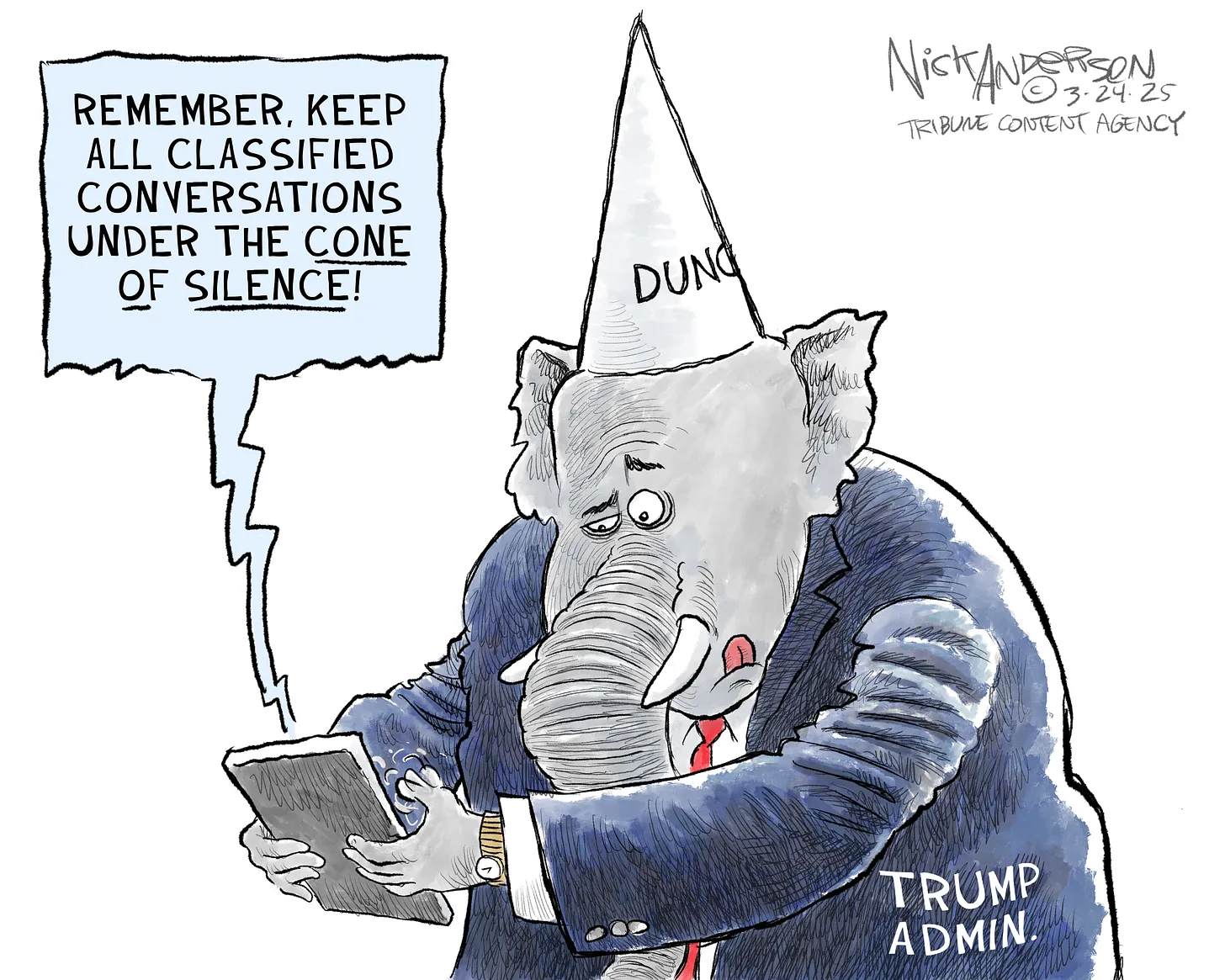
All my life, America’s leaders have encouraged us to unite in the face of disasters. But now Trump is using them to tear us apart.
This week, if you wanted to pay attention something other than Jimmy Carter’s funeral, you had two choices: the L.A. wildfires or Donald Trump’s wild statements about taking over Greenland, the Panama Canal, and even Canada. Both of those stories will get attention in this week’s summary (the next post), but what interested me more than either was something in the intersection: Trump’s wild statements about the wildfires, and the disturbing approach he is taking to public disasters in general.
When a community faces a catastrophe, it can respond in one of two opposite ways:
Survivors can bond together to mourn the dead, care for the injured, and rebuild. Shared pain can create new bonds across former social divisions. People untouched by the disaster may realize that only circumstance separates them from the victims, and may develop a new empathy not just for recent victims, but for the less fortunate in general. A post-disaster attitude of “We’re all in this together” has a chance to grow and spread.
The community can damage itself further by finger-pointing, scapegoating, and other forms of turning against itself.
Sometimes a community goes both ways simultaneously: At the same time the US was uniting to fight World War II, it was rounding up Japanese Americans and putting them in camps. After 9-11, President Bush put considerable effort into talking Americans out of blaming the attack on Muslims in general, though some did anyway.
Bush’s rhetoric was an example of responsible leadership, which does its best to turn the community response towards positive rather than negative responses. (Using 9-11 to promote an invasion of Iraq, on the other hand, was irresponsible leadership.) Responsible post-catastrophe leadership also has several other identifiable traits:
Unfounded rumors spread wildly after disasters, so responsible leaders set up reliable systems of information. They speak calmly and stick to facts in order to calm public panic.
They call attention to heroes rather than villains, promoting the notion that community members should help and trust each other.
They promote trust in the institutions set up to deal with the catastrophe, and pledge that those institutions will get the backing they need to resolve the situation.
Now look at how President-elect Trump and the right-wing media that takes its cues from him have responded to the Los Angeles wildfires. Wednesday, he posted:
One of the best and most beautiful parts of the United States of America is burning down to the ground. It’s ashes, and Gavin Newscum should resign. This is all his fault!!!
Governor Gavin Newscum refused to sign the water restoration declaration put before him that would have allowed millions of gallons of water, from excess rain and snow melt from the North, to flow daily into many parts of California, including the areas that are currently burning in a virtually apocalyptic way. He wanted to protect an essentially worthless fish called a smelt, by giving it less water (it didn’t work!), but didn’t care about the people of California. Now the ultimate price is being paid. I will demand that this incompetent governor allow beautiful, clean, fresh water to FLOW INTO CALIFORNIA! He is the blame for this. On top of it all, no water for fire hydrants, not firefighting planes. A true disaster!
NO WATER IN THE FIRE HYDRANTS, NO MONEY IN FEMA. THIS IS WHAT JOE BIDEN IS LEAVING ME. THANKS JOE!
Just about every sentence in these posts is false. The December bill that appropriated money to keep the government open added $29 billion to FEMA, and FEMA told CNN Wednesday that it had a $27 billion balance in its accounts.
That sum may well prove inadequate to meet the needs created by every disaster that ends up happening this year, but it’s not “no money.”
There were indeed some dry hydrants, but that had nothing to do with any general lack of water in Southern California, or some mythical “water restoration declaration” Newsom refused to sign. Most of the problem was a more specific lack: of water that had been pumped into tanks in the hills above LA. This created a lack of water pressure in key places, but not a regional lack of water. Shifting more water resources from Northern to Southern California would not have helped.
Firefighting planes were grounded by hurricane-level winds, not by some action of Governor Newsom.
In short, Trump spread lies in order to scapegoat Gavin Newsom, a prominent Democrat who might be his opponent when he runs for an unconstitutional third term in 2028.
Other voices on right-wing media were quick to blame DEI or whatever else they don’t like.
This is all of a piece with the right-wing response to the New Orleans terrorist attack on New Years. Long after it was known that the suspect was a US citizen born in Houston, MAGA supporters were still spreading the rumor that he had crossed the border illegally two days before. This allowed them to smear undocumented immigrants while simultaneously pinning responsibility on President Biden’s immigration policies.
Our media occasionally combats this scapegoating on a small scale, by fact-checking clear lies. But the larger story is going almost completely uncovered: Responsible leadership in times of crisis is a thing of the past. We can no longer expect that our leaders will take care to learn the facts before they speak, pass on reliable information, or try to prevent panic. Instead, they will tell lies that turn public fear and anger against their political enemies. Rather than use a crisis to bring people together, they will use it to create scapegoats and turn different groups of Americans against each other.
In the long run, that reversal of policy may be more destructive than fire.
Jimmy Carter deserved better than to have his funeral pushed out of the headlines by a climate-change-related disaster, much less by Trump’s wild ravings about conquering Greenland.
As always, I recognize the inadequacy of a one-person weekly blog to cover an ongoing regional catastrophe, so I’m not going to try to do justice to the LA fires. And what drew my attention about Trump this week wasn’t his threats to break our treaty with Panama or turn on our NATO ally Denmark. Instead, I was struck by his quick response in using the California fires to tell defamatory lies about Governor Newsom and environmental policies in general.
The news media occasionally fact-checks Trump’s statements, but the larger story is going unreported: Previous presidents — and responsible leaders at all levels — have responded to disasters by reinforcing reliable sources of information, fighting rumor and panic, and promoting the community’s impulse to draw together. Trump does the exact opposite: To him, a disaster is an opportunity to tear us apart, not pull us together.
This is big, and I call attention to it in this week’s featured post “A Disastrous Development in Our Response to Disasters”. That should be out before 9 EST.
The weekly summary has a little about the wildfires, some coverage of the Carter funeral, Trump’s bizarre threats of conquest, his minor legal setbacks, and a few other things. I’ll aim to have that out by noon.
For journalists, failing to situate Trump’s words and actions in the context of an ongoing con is tantamount to deception. It’s not just failing to tell the whole story, it’s failing to tell the central story.
This week everybody was talking about the new Congress
The headline news was that on Friday Mike Johnson hung on to the speaker’s gavel. Initially, it looked like he had failed to win a majority on the first ballot, with all 215 Democrats voting for Hakeem Jeffries, 216 Republicans for Johnson, and three Republicans not voting for Johnson. (Six other Republicans expressed their reluctance in a minor way by passing during the alphabetical rollcall. They voted for Johnson when called a second time.) But the vote was held open long enough for Johnson to negotiate with two of the holdouts and President-elect Trump to call them. They flipped their votes, giving Johnson a 218-vote majority.
Johnson’s reelection avoided all kinds of chaos and a possible constitutional crisis: The House and Senate are constitutionally obligated to meet today in joint session to count electoral votes, but the House can’t function without a speaker. If no speaker had been elected yet, the country would be in uncharted territory.
What Johnson’s narrow first-ballot election portends is open to interpretation. Until Republicans took control of the House in 2023, speaker elections typically weren’t very newsworthy. The majority party hashed out its differences between the November election and the January vote, and the identity of the new speaker was not in doubt when the new Congress convened. In 2023, though, Kevin McCarthy needed 15 ballots over five days to win the speakership, a position he held for only nine months before losing a motion to vacate the chair. The House was then incapacitated for three weeks before the Republican majority united around Mike Johnson.
Compared to what McCarthy went through, and what the House endured trying to replace him in October 2023, Johnson’s reelection was smooth sailing. But compared to any other recent speaker election, this one was full of drama and anxiety. In “normal” years, the visible intervention of the President-elect would have been frowned upon; electing a speaker is the internal business of the House, and not a matter for the executive branch to weigh in on.
It’s also worth bearing in mind that Johnson was originally the candidate of the right wing of the Republican caucus, the very people who were dragging their feet about reelecting him. What happened in the meantime? Reality happened. The right-wing “Freedom” Caucus is a movement of ideological purity. But the Speaker has a responsibility to govern the nation. Again and again, the House would need to pass some kind of bill to keep the government functioning, and no ideologically pure bill could pass the House, much less get through the Democratic Senate and be signed by President Biden. So Johnson, like McCarthy before him, was forced to either compromise with Democrats or lead the country into disaster. His decision to avoid disaster made him impure, causing “Freedom” Caucus Republicans to support him only with reluctance and as a favor to Trump.
Going forward, Johnson’s majority in the House is narrower than McCarthy’s, but the GOP also holds the White House and a majority in the Senate. So in theory, Johnson should not have to compromise any more. He’ll be negotiating with Trump and Senate Majority Leader John Thune rather than with Biden and Chuck Schumer.
However, reality is due to raise its head in a new way: Trump comes into office having raised impossible expectations. MAGA voters expect him to cut taxes, shrink the federal deficit, strengthen the military, and do wildly expensive things like round up and deport millions of undocumented immigrants — all without touching Social Security and Medicare. All this is supposed to happen in “one big beautiful bill” that presumably will also deal with the looming debt ceiling crisis.
At some point, somebody is going to have to write that bill. And all but two House Republicans (maybe fewer if Trump’s nominees from the House are approved and not yet replaced) are going to have to vote for it.
Friday’s vote for speaker is only the overture to that opera.
It’s striking how differently the two attacks have been covered. The New Orleans attack fit a familiar pattern: A native-born American from Houston with a Muslim-sounding name, Shamsud-Din Jabbar, became radicalized, presumably online. While there is no indication of foreign direction or assistance in the attack, he claimed to be inspired by ISIS and had a ISIS flag in the truck.
The coverage of the attack otherized Jabbar, painting him as a radical Islamist attacking the United States from the outside, and playing down the fact that he was a US Army veteran. Right-wing media pushed the false claim that he was foreign-born, and “crossed the U.S.-Mexico border at the Eagle Pass crossing just two days ago”. In reference to the attack, Trump posted “the criminals coming in are far worse than the criminals we have in our country”.
At first, the Las Vegas attack seemed anti-MAGA, pairing a Musk-related vehicle with a Trump-related target. But as details emerged, Matthew Alan Livelsberger proved to be a Trump supporter. A decorated active-duty special forces soldier from Colorado Springs, Livelsberger’s first marriage broke up in 2018 at least partially due to his support for Trump. He had told people he intended to vote from Trump again in 2024.
Consider this last sunset of ‘24 and my actions the end of our sickness and a new chapter of health for our people. Rally around the Trump, Musk, Kennedy, and ride this wave to the highest hegemony for all Americans! We are second to no one.
That aspect of the story has been almost completely buried. Instead, the narrative has shifted into another familiar pattern: Livelsberger is a victim, a troubled soul with PTSD.
We see this again and again in our news coverage: Muslims who kill are evil members of a global conspiracy, while right-wing White Christians who kill are troubled loners. Tom Scocca:
Two disturbed guys rent trucks and commit public acts of violence to deliver explicit ideological messages: one gets the scare story about who radicalized him, the other gets a sympathetic, nonpolitical account of his trauma
Amanda Marcotte notes the similarities rather than the differences between the two attackers: They were both men who had a certain amount of professional success while making a mess of their personal lives. Both found an extremist ideology through which to channel their rage and deflect blame for their problems, ultimately resulting in violence.
and it’s January 6 again
Four years ago, Donald Trump inspired rioters who attacked the US Capitol and delayed a constitutionally mandated joint session of Congress to count electoral votes from the 2020 election. The point of doing this was to reverse a free and fair election that he lost.
At the time, both parties were united in condemning this attack. But within months, Trump had pulled the Republican Party back into his orbit.
Last March, the Supreme Court ruled that section 3 of the 14th Amendment, which appears to ban insurrectionists from holding public offices like the presidency, has no real meaning. It was therfore unnecessary to determine whether Trump’s actions on January 6 amounted to insurrection. A few months later, after delaying long enough to make further prosecution impossible before the election, it ruled that presidents are, for nearly all practical purposes, above the law.
This November, 49% of voters decided that attempting to overthrow democracy was not a deal-breaker. Today, Congress will certify his election, setting up his inauguration on January 20.
One thing that won’t happen today: Democrats won’t riot, and the Capitol won’t be occupied by a violent mob. That’s because Democrats are not traitors, as so many Republicans are.
By all accounts, Trump is getting ready to pardon people convicted of January-6-related crimes. Many of the low-level trespassers and minor offenders have probably learned their lesson and won’t commit further Trump-inspired crimes. But I expect that a core of folks are learning the opposite lesson: that crimes committed in Trump’s name are not really crimes and will be tolerated.
An essential piece of any fascist movement is a Brownshirt contingent of violent followers who will do the Leader’s will in ways that the official police can’t or won’t. I expect the pardoned rioters to form the core of Trump’s Brownshirts.
and Trump’s sentencing
Friday, Trump will be sentenced for his conviction on 34 counts of falsifying business records. The judge has indicated that there will be no jail time.
Trump’s rhetoric is all about the prosecutor and the judge, but he was found guilty by a jury of 12 ordinary Americans. His attorneys had full opportunities to make their case, but the jury unanimously found him guilty beyond a reasonable. doubt.
and the growing subservience of The Washington Post
Meanwhile, at The Washington Post, Pulitzer Prize-winning cartoonist Ann Telnaes submitted a cartoon showing media barons — including Post owner Jeff Bezos — making offerings before a statue of Trump.
Along with Bezos, Telnaes depicted Meta founder Mark Zuckerberg and OpenAI Chief Executive Sam Altman shown bringing Trump sacks of cash. Los Angeles Times owner and billionaire medical innovator Patrick Soon-Shiong was shown bearing a tube of lipstick. Also lying prostrate was Mickey Mouse — the avatar of the Walt Disney Co. Last month, Disney settled a Trump defamation suit against ABC News by agreeing to pay $15 million to an as-yet non-existent Trump foundation and $1 million toward his legal fees.
The WaPo refused to publish the cartoon, whereupon Telnaes quit after working at the WaPo since 2008. She explained on Substack:
While it isn’t uncommon for editorial page editors to object to visual metaphors within a cartoon if it strikes that editor as unclear or isn’t correctly conveying the message intended by the cartoonist, such editorial criticism was not the case regarding this cartoon. To be clear, there have been instances where sketches have been rejected or revisions requested, but never because of the point of view inherent in the cartoon’s commentary. That’s a game changer…and dangerous for a free press.
The American Association of Editorial Cartoonists released a supporting statement:
With the resignation of editorial cartoonist and Pulitzer Prize winner Ann Telnaes from The Washington Post, corporate billionaires once again have brought an editorial cartoon to life with their craven censorship in bowing to a wannabe tyrant. Her principled resignation illustrates that while the pen is mightier than the sword, political cowardice once again eclipses journalistic integrity at The Washington Post.
The AAEC called on its members to draw cartoons supporting Telnaes and use the hashtag #StandWithAnn. Here are a few responses:
There’s an ever-growing consensus that what Israel is doing in Gaza really is genocide. Here’s Amnesty International’s report. Germany’s Der Spiegel reports that “The Israeli army is systematically destroying towns in northern Gaza and expelling the population … laying the groundwork for a military occupation – and for the possible construction of new Jewish settlements.”
Every year, TPM announces its Golden Duke Awards, for outstanding achievement in political corruption and scandal. This year, the best general interest scandal was the Supreme Court. I interpret this as a collective award, encompassing the particular scandals of Clarence Thomas and Sam Alito, as well as the general political hackery of John Roberts. The best sex scandal is Matt Gaetz. And so on.
Jess Piper expresses her frustration with the voters in her state of Missouri, who repeatedly pass progressive referenda, but then also vote for Republican legislators and other state officials who will circumvent whatever the people have just voted into law.
For the first time since that transition 24 years ago, there will be no American troops at war overseas on Inauguration Day. New data reported in the past few days indicate that murders are way down, illegal immigration at the southern border has fallen even below where it was when Mr. Trump left office and roaring stock markets finished their best two years in a quarter-century.
The manufacturing sector has more jobs than under any president since Mr. Bush. Drug overdose deaths have fallen for the first time in years. Even inflation, the scourge of the Biden presidency, has returned closer to normal, although prices remain higher than they were four years ago.
We can expect to hear negative views of the US for at least another couple months, and then Trump will start taking credit for Biden’s good results, which much of the country will begin to notice for the first time.
Heather Cox Richardson notes that Biden’s strong economy results from a policy change that Trump is likely to reverse:
Trump has promised to swing the country away from Biden’s investment in rebuilding the middle class. Biden’s focus on employment meant that unemployment dropped dramatically during his term, more people got access to affordable health care, labor unions showed historic growth, and real wages went up so much that according to economist David Doney, workers now have the highest real hourly wages since the 1960s.
Good news for workers was good news for everyone: the country’s economic growth was more than double that of any other country in the Group of 7 (G7) economically advanced democracies.
But Trump has been very clear that he rejects this system and intends to take the country back to supply-side economics, in which the government encourages the concentration of wealth at the top of the economy.
Oh, and what about inflation? Paul Krugman notes how closely US inflation tracked Europe’s inflation, and concludes that Biden’s policies probably weren’t at fault.
One of my regular walking partners has Covid. Be careful out there, folks. It’s not over.
One counterproductive argument I keep hearing goes something like this: A Trump supporter says “Make America Great Again”, and a Trump resister responds “When was America great? During slavery? When women couldn’t vote? The Native American genocide? Jim Crow?”
The problem with this argument is that it typically ends with each side hardened into its position. The resister goes away believing the supporter wants to return to an era when White male Christians reigned supreme and everyone else was second-class or worse. The supporter goes away believing that the resister resents anyone who has pride in America, and that liberals want Americans to feel ashamed of their country. But the supporter is never going to give up patriotic pride, and the resister is never going to voluntarily go back to times of oppression and domination. Both are immovable.
Imagining any kind of compromise within this frame is impossible. Is the Trump resister going to give ground and admit that a little bit of racism and sexism might be beneficial? Will the Trump supporter agree to be a little bit ashamed of his country? Not likely.
I want to claim that the root of the problem here is the frame, not the participants or their points of view. The problem is that the issue has been framed as being not doing.
If you start talking about doing, the logjam resolves: All through its history, the United States has done both great and terrible things.
As a liberal and a Trump resister, I have no trouble admitting that America and Americans have done great things over the decades. Like these:
The US played a key role in defeating both Nazi Germany and Soviet Communism.
After World War II, we helped rebuild Europe (including Germany) through the Marshall Plan rather than keep potential economic rivals down.
All through our history, we have created opportunity for people who were destitute in other countries (like the survivors of the Irish Potato Famine).
The example of our revolution and our constitution inspired the expansion of human rights around the world.
I could go on. If you’re searching for reasons to take pride in America, there are lots of them.
But here’s the key point: I can acknowledge those facts without forgetting that they all had downsides. We have never entirely lived up to the ideals of our revolution. The opportunities we offered immigrants weren’t available to everyone. Our fight against fascism in World War II also included the Japanese internment. During the Cold War we supported many oppressive right-wing regimes in the Third World, and also fought a ruinous war in Vietnam.
The problem with framing “greatness” as a state of being and pinning it to America in some past era is that those downsides either go away or become insignificant. Worse, saying America was great then, but is not great now, implicitly promotes the idea of going back. And none of those eras is a time we should want to go back to. Jim Crow America is nothing to be nostalgic about, even if that’s who we were on D-Day.
Idealizing past greatness also makes an unfair connection between our great and terrible deeds. We created unprecedented economic growth in spite of our social injustices, not because of them. Forcing gays back into the closet or women back into the kitchen won’t end inflation or bring back well-paid working class jobs.
But has America done great things? Of course it has. It’s important to recognize those achievements and take inspiration from them, because looking ahead, we need to do great things again. Converting our economy so that it no longer relies on cheap fossil fuels, for example, will be a huge undertaking. But the nation that put a man on the Moon and built the interstate highway system should be up to the task.
In fact it is the Left, not the Right, that most needs to believe in our ability to do great things. At the root of MAGA fascism lies a zero-sum view of the world: There is a limited amount of goodness to be had, so we — native-born White male Christians, or whoever “we” refers to in some particular context — have to seize all of it. There is a limited amount of freedom in the World, so any gain for women or gays or people of color must be a loss for everyone else.
Believing that the goodness in the world is a limited pile of pirate treasure, and then seizing more than your share of it, is a very shallow conception of greatness. Our greatness needs to be greater than that.
In short, it’s a mistake to get baited into arguing that America was never great. You’ll never win that argument and you shouldn’t want to. Great things still need to be done, and Americans need to see ourselves as the kind of people who can take on those challenges.
This week’s featured post expresses my frustration with having heard way too many arguments that go like this:
Trump supporter: Make American great again! Trump resister: America was never great.
I think we liberals shoot ourselves in the foot when we accept the Yes/No frame on American greatness and take the No side.
Of course there’s a jingoistic flavor of patriotism that we want to oppose. But there’s also a healthy kind of patriotism that we want to promote, the kind that sees historical American ideals like “inalienable rights” and “liberty and justice for all” as aspirations we want to achieve someday rather than as cynical propaganda. And as the world faces threats like climate change, we need to believe in an America that can take on big challenges and do great things.
And that’s the key framing change: doing as opposed to being. Rather than argue about whether America is great, or was great at some point in the past, we should be affirming the idea that America has at times done great things and could do great things in the future. We’ve also done terrible things, of course, like enslaving millions of Africans and all but wiping out the Native Americans. There’s no need to sugarcoat that.
But so much of MAGA is based on pessimism and weakness: We can’t take care of all our sick and old people (even if most of Europe can). We can’t kick our fossil fuel habit. We can’t overcome racism, sexism, and all the other traditional bigotries. But the Obama landslide of 2008 centered on the slogan “Yes we can”. Believing in our potential to do great things is as essential to liberals and progressives as it is to the Trumpists.
So “A Meditation on American Greatness” should post around 10 EST.
That leaves a lot for the weekly summary: the new Congress electing (barely) a speaker, the two New Years terrorist attacks, the January 6 anniversary, Trump’s upcoming sentencing in New York, the WaPo cartoonist incident, and a few other things. I’ll try to get that posted by noon.
Carter was president from 1977 to 1981. His single term was marred by high inflation and the Iranian hostage crisis, but looks much better in retrospect than it did at the time. I find myself pining for the roads not taken. Carter created possibilities which his successors did not pursue, and the world is worse for America’s failure to follow his lead.
Carter was the first president to recognize global warming as a problem. He installed solar panels on the White House roof (which his successor, Ronald Reagan, promptly removed). While the country did not take the path to sustainable energy he envisioned, much of the sustainable energy used today is based on research funded under his presidency. Rolling Stone makes the case that he was America’s Greatest Environmental President.
In 1978, he brought Egyptian President Anwar Sadat and Israeli Prime Minister Menachem Begin together to negotiate the Camp David Accords. The two countries have not fought a war since, and for a time, peace in the Middle East seemed possible.
Today, Carter is best known for his post-presidency. He ran for president in 1976 as a born-again Christian, and his subsequent life exemplified the Christ-like values so often lacking in Evangelical leaders. He and his wife Rosalynn (who died in 2023 after 77 years of marriage) championed Habitat for Humanity, and into their 90s were still swinging hammers to build houses for the poor. The Carter Center has been a voice for peace, democracy, and human rights for more than 40 years.
After his presidency, he returned to his farm in Plains, Georgia. He regularly taught Sunday school classes at his church. (My sister recently posted a picture she and her husband took with the Carters after attending his class in 2015.)
His death should remind us all of an era when we expected our leaders to be virtuous people — and occasionally they even were.
Jay Kuo posted a charming memory about meeting Rosalynn Carter when he was a child.
and US expansion
Recently Trump has tweeted about a variety of possible “territorial expansions” of the US — conquests, really, because there’s no sign any of these folks want to be part of the MAGA empire.
Greenland. On December 22nd, Trump released a statement that “For purposes of National Security and Freedom throughout the World, the United States of America feels that the ownership and control of Greenland is an absolute necessity.” Apparently, having Greenland continue as a territory of our NATO ally Denmark is not good enough.
And you’ll never guess why we have to take over Greenland: global warming. Here’s former Trump national security adviser Robert O’Brien on Fox News:
It’s strategically very important to the Arctic which is going to be the critical battleground of the future because as the climate gets warmer, the Arctic is going to be a pathway that maybe cuts down on the usage of the Panama Canal.
So climate change is a hoax when we’re talking about limiting the burning of fossil fuels, but it’s absolutely real when it justifies taking territory from our NATO allies or ruling indigenous peoples against their will.
James Fallows (who during the Carter administration was involved in formalizing the treaties that returned the Canal to Panama) covers all this in much more detail. The push to return the Canal to Panama, he says, originally came from the military, which doubted its ability to defend the Canal if the local population viewed it as an enemy occupation. (If you’re worried about Chinese influence now, imagine if they could arm an indigenous uprising.) That’s why he estimates the chances of the US actually retaking the Canal by force as “zero”.
The issues Trump raises about Chinese soldiers and discriminatory pricing are complete fantasies.
Fallows also points out that the Canal is a climate-change issue: Operating the locks requires water, and depends on rainfall in the local watershed. Lately that rainfall has been declining.
Canada. This is almost certainly trolling on Trump’s part. In his Christmas message he tried to appeal to Canada’s citizens: If they became “the 51st state”, he claimed, their taxes would go down and they’d reap all kinds of benefits. (Of course they’d also lose their health coverage, and their life expectancy would probably drop 3 1/4 years to match ours.)
I find myself unmoved by these visions, which I suspect are entirely vaporous. (In other words, I don’t expect to see US aircraft carriers move to menace Nuuk.) During Trump’s first term, Rachel Maddow used to say, “Watch what they do, not what they say“, implying that Trump might be doing something behind the scenes that contradicted his public rhetoric. The same thing applies here, but in reverse: He’s saying things that will excite his base and inflame his critics, but I suspect no action will result. So I refuse to be inflamed.
Liberals often suggest that Trump’s outlandish rhetoric is supposed to distract us from something else he’s doing. But here I think his own supporters are the target, and they’re supposed to overlook what he isn’t doing. Trump is not going to cut trillions from the federal budget, he’s not going to lower the price of eggs or gas, and if you’re not rich you won’t notice whatever tax cut you get. But if he can get his supporters excited about Greenland and Panama, they may not notice the bankruptcy of his other promises.
Fallows has this right: The point of Trump’s rhetoric is to stoke his followers’ sense of grievance.
and Matt Gaetz
Just as I was getting ready to post last week, the House Ethics Committee released its report on Matt Gaetz.
In sum, the Committee found substantial evidence of the following:
From at least 2017 to 2020, Representative Gaetz regularly paid women for engaging in sexual activity with him.
In 2017, Representative Gaetz engaged in sexual activity with a 17-year-old girl.
During the period 2017 to 2019, Representative Gaetz used or possessed illegal drugs, including cocaine and ecstasy, on multiple occasions.
Representative Gaetz accepted gifts, including transportation and lodging in connection with a 2018 trip to the Bahamas, in excess of permissible amounts.
In 2018, Representative Gaetz arranged for his Chief of Staff to assist a woman with whom he engaged in sexual activity in obtaining a passport, falsely indicating to the U.S. Department of State that she was a constituent.
Representative Gaetz knowingly and willfully sought to impede and obstruct the Committee’s investigation of his conduct.
Representative Gaetz has acted in a manner that reflects discreditably upon the House. Based on the above, the Committee concluded there was substantial evidence that Representative Gaetz violated House Rules, state and federal laws, and other standards of conduct prohibiting prostitution, statutory rape, illicit drug use, acceptance of impermissible gifts, the provision of special favors and privileges, and obstruction of Congress
The 42-page report outlines that “substantial evidence”. Gaetz’ protest is that the Justice Department also investigated him and did not press charges, which he (falsely) claims “exonerates” him.
Reading the report, you can see how many of the witnesses might not be credible in court, where a beyond-reasonable-doubt standard would apply to any criminal charges. In court, Gaetz’ refusal to answer questions or explain his actions would not count against him.
However, the evidence in the report is quite persuasive if the question is “Should this man be in Congress?” or “Should this man be Attorney General?”. I find it striking that the dissenting opinion at the end of the report says “While we do not challenge the Committee’s findings …” and only protests that the report should not have been released after Gaetz resigned from the House. In short, not even the Republicans on the committee were willing to defend Gaetz’ conduct or claim the process had been “weaponized” against him, as Gaetz himself claimed.
and you also might be interested in …
Whooping cough is on the rise, largely because fewer children are being vaccinated for it. Cases are up five times over last year’s totals.
You might naively think that as sea levels rise, they’ll rise the same amount everywhere. Apparently this is not true. The US Southeast seems unusually prone to sea-level rise, with an increase of seven inches since 2010 in some places.
Now that the Supreme Court has banned universities from considering race in their admissions process, Black enrollment in elite programs has dropped. Harvard Law School has 19 incoming Black students, down from 43 the previous year.
It makes headlines when police kill some unarmed person of color for no justifiable reason, but such incidents are comparatively rare. More significant, this WaPo article claims, are the less extreme but more-or-less constant abuses dished out to women, the poor, and the homeless.
I remember a similar point being made after the killing of Michael Brown started demonstrations and violence in Ferguson, Missouri in 2014. The national coverage focused on that particular death and the conflicting accounts of what really happened. To the community, though, the killing was just an extreme example of what they saw every day.
SkepChick thinks the case against black plastic utensils has been overblown.
and let’s close with something timely
Tomorrow is New Year’s Eve, when many of you will be tempted to make resolutions. Resolutions, as we all know, are extraordinarily hard to keep. The ideas always sound great: Who doesn’t want to exercise more and read more and learn a new language? But there are reasons you have lived your whole life so far without doing those things, and those reasons don’t go away just because you get a new calendar.
So more often than not, making a resolution is just setting yourself up for failure. But there is an alternative: CGP Grey suggests declaring a theme for your year rather than committing to specific goals you will probably not achieve.
So rather than commit to read one book a week, you could declare 2025 the Year of Reading. It’s a softer goal, one that will allow you to try, fail, and come back to try again. Or rather than committing to lose 15 pounds, run two miles a day, and become a vegetarian, you might declare a Year of Health. Each day, you might remind yourself that you’re trying to be healthier this year. And who knows? Maybe you will be.
Fractures are already showing in the MAGA coalition, and they haven’t even taken power yet.
When a party out of power suddenly finds itself on the verge of taking control of the White House and both houses of Congress, you’d expect to find them coasting on a wave of good feeling. Victory salves all wounds, so everybody should be ready to dance with everybody else at the inaugural balls.
Strangely, though, MAGAWorld is full of conflict these days. One Trump-supporting fascist (Steve Bannon) is calling another Trump-supporting fascist (Elon Musk) a “toddler” who needs a “wellness check” from Child Protective Services. And American workers, says Vivek Ramaswamy, can’t compete with immigrants because they suffer from our “culture”, which venerates mediocrity over excellence.
But wait: Isn’t the whole point of Trumpism that “real” (i.e. White Christian) Americans are victims of the liberal Deep State that wants to “replace” them with brown-skinned Third Worlders? What’s going on?
First skirmish: Foreign investment. Trump owes his election to two groups whose interests don’t match up: White working class voters and ultra-rich technology barons like Elon Musk. During the campaign, Trump could keep his plans vague enough that both were satisfied, and many low-wage workers could imagine that the richest man in the world was their friend.
But now that the election is over, the question keeps coming up: Who’s the real president, Trump or Elon? At first I interpreted such comments as Democratic trolling, trying to stir up trouble in MAGAWorld by taking advantage of Trump’s ego. (I remember in his first term how similar questions about Mike Pence riled him. Speculation at the time was that Trump would bask in the glory of the presidency, leaving Pence to do the actual work of governing.)
But more and more, there seems to be something to the murmurs. The move to reject a compromise and risk a government shutdown last week started with Musk, and Trump eventually got on board. Musk was the leader and Trump the follower.
Support for the stopgap spending bill then collapsed, forcing [House Speaker Mike] Johnson and his leadership team to scramble to find an alternative path forward. As they did, Musk celebrated, proclaiming that “the voice of the people has triumphed”.
It may be more accurate, however, to say that it was Musk’s voice that triumphed.
In the end, Congress passed a continuing resolution that still included the most important extras Democrats wanted: rebuilding the Key Bridge in Baltimore and disaster relief. And it kept government spending at basically the levels set before Republicans took control of the House two years ago.
We have heard for years about the problem of manufacturing businesses shipping jobs overseas to China, with its low worker wages and low environmental standards. China typically forces businesses wanting to locate factories in its country to transfer their technology and intellectual property to Chinese firms, which can then use that to undercut competitors in global markets, with state support.
Congress has been working itself into a lather about China for years now, and they finally came up with a way to deal with this issue. Sens. John Cornyn (R-TX) and Bob Casey (D-PA) have the flagship bill, which would either prohibit U.S. companies from investing in “sensitive technologies” in China, including semiconductors and artificial intelligence, or set up a broad notification regime around it.
One corporation that would be affected by this is Musk’s Tesla.
Elon Musk’s car company has a significant amount of, well, outbound investment. A Tesla Gigafactory in Shanghai opened in 2019; maybe a quarter of the company’s revenue comes from China. Musk has endorsed building a second Tesla factory in China, where his grip on the electric-vehicle market has completely loosened amid domestic competition. He is working with the Chinese government to bring “Full Self-Driving” technology to China, in other words, importing a technology that may be seen as sensitive. Musk has battery and solar panel factories that are not yet in China, but he may want them there in the future.
Second skirmish: H-1B visas. A second conflict is still playing out: One of the most important issues for the MAGA base is immigration, and in particular protecting the jobs of American citizens from immigrant competition. “They’re taking American jobs” is one of the most effective attacks on immigrants at all levels, even the ones working jobs hardly any Americans want, like picking crops by hand or watching rich people’s kids for practically no pay.
However, American corporations have a different agenda: They want to hire the best people in the world and pay them as little as possible. This is not new. America has been draining the brains of the world at least since the 1930s, when Jews and other anti-fascists escaped from Hitler’s Germany and Mussolini’s Italy. We may sympathize with the American physicists who suddenly had to compete with the likes of Albert Einstein and Enrico Fermi, or American actresses who lost roles to Marlene Dietrich or Hedy Lamarr, but in retrospect it’s hard to feel bad about letting those people into our country.
Similarly today, the US tech industry employs foreign-born workers in jobs many Americans would undoubtedly like to have. The legal vehicle that allows this is the H-1B visa. Employers can sponsor foreign nationals with at least a bachelors degree to apply for H-1B visas that allow them to live and work in the US for three years, with a possible renewal to six years. Currently, 85,000 such visas can be issued each year. 84% of them go to people from India or China. Maybe a handful of those immigrants really are exceptional Einstein-like talents we’d be foolish to turn away, but probably not all 85,000 of them.
The employer has to affirm that the worker will be appropriately paid and that his or her (mostly his) employment won’t negatively impact similar American workers. In practice, though, these provisions are hard to monitor or enforce. Critics charge that H-1B workers are easily abused, because (if no other employers are waiting in the wings) the employer can expel a worker from the US just by withdrawing sponsorship. So H-1B workers can become cheap-but-highly-trained labor that corporations may prefer to American workers that the company doesn’t hold as much leverage over.
Obviously, the tech barons want to be free to import as many cheap engineers and programmers as they want, while Americans with comparable credentials want H-1B visas limited or eliminated. This conflict goes to the heart of what “America First” really means: Should we be strengthening Team America by bringing in talent wherever we can find it, or should we be defending the livelihoods of individual Americans? (An analogy to bring this home: Imagine you’re a young outfielder for the New York Mets, and that you’ve been struggling for playing time so you can prove yourself. How do you feel about the team signing Juan Soto? Your team is better, so your odds of going to the World Series have improved. But your individual prospects have taken a hit.) TPM:
The two sides began to argue on Sunday, after Donald Trump appointed Sriram Krishan, a partner at Andreesen Horowitz, as a White House policy adviser on Artificial Intelligence to work with Sacks, the Trump administration’s crypto and AI czar.
This may seem like a relatively minor White House appointment. However, Krishan has also been a proponent of removing country caps on green cards and H1-B visas, which allow American companies to hire foreign workers for certain specializations.
Nativists like Laura Loomer (who not so long ago was rumored to be having an affair with Trump) found this appointment “deeply disturbing“. Musk and Ramaswamy replied by attacking American workers, with Musk approvingly retweeting a post that described American workers as “retarded”.
I think Paul Krugman has put his finger on what’s at stake here:
Every political movement is a coalition made up of factions with different goals and priorities. Normally what holds these factions together is realism and a willingness to compromise: Each faction is willing to give the other factions part of what they want in return for part of what it wants.
What’s different about MAGA is that I’m pretty sure that almost all of the movement’s activists (as opposed to the low-information voters who put Trump over the top) knew that he was a con man, without even concepts of a plan to reduce prices. But each faction believed that he was their con man, putting something over on everyone else.
But now the two most important factions — what we might call original MAGA, motivated largely by hostility to immigrants, and tech bro MAGA, seeking a free hand for scams low taxes and deregulation — have gone to war, each apparently fearing that they may themselves have been marks rather than in on the con.
The normal thing to do in the last week of the year is to do a year-in-review post, but I find I just can’t. The national story of the year is Donald Trump’s election to a second term, and my personal story is that my wife died at the beginning of December. I’ve been avoiding all the “goodbye to 2024” articles, because there’s just too much to say goodbye to.
Instead, the featured post this week focuses on how the MAGA coalition (which already couldn’t produce a majority vote for Trump) has begun to splinter even before their candidate even takes office. “Cracks in the MAGA Coalition” will cover the dissension between Trump’s working-class voters and his top donor, Elon Musk. (Strange thing: If you’re a working person, the richest man in the world is not your friend.) Also: the difficulties forming a working majority in the House, and the impossible expectations the Trump administration faces going forward. That should be out around 10 EST.
The weekly summary will cover Jimmy Carter’s death at 100; Trump’s aggressive comments against Greenland, Panama, and Canada; the Ethics Committee report on Matt Gaetz; and a few other things before closing with an alternative to New Years resolutions. I’m aiming to post that around noon.
About my wife: Deb was a constant but hidden presence on this blog. She was a sounding board for all the ideas, and frequently called my attention to phrases or metaphors that were unfair or would unintentionally offend some readers. She was my tireless cheerleader, who often encouraged me to take on topics that seemed impossible to cover adequately by the end of the week.
And finally: About a month before she unexpectedly died, the photographer at our godson’s wedding captured an expression that I saw often, but which had never managed to make it into photographs. May you all someday have someone who is still looking at you this way after 40 years.
This week everybody was talking about shutting down the government
It didn’t happen, but it came close, and how it came close has implications for the future.
The federal government was set to run out of money at the stroke of midnight Saturday morning. Congress hasn’t been able to pass an actual set of appropriations bills since Republicans gained “control” of the House two years ago, but the government has kept going via a series of continuing resolutions that keep kicking the can down the road. Basically, a continuing resolution says that spending can continue at current levels for a few more months. Usually, a few additional expenses get added on to a continuing resolution to respond to events unforeseen by the previous appropriations.
This time, the two parties had reached consensus on a new continuing resolution to keep things running until March, and to include extra money for hurricane relief and a few other uncontroversial things. But at the last minute, Trump and Elon Musk convinced Republicans to withdraw their support. It was a typical Trump move: Blow up an agreement by asking for one more thing.
Apparently this tactic worked for him during his business career, when he was dealing with small businessmen who had already delivered their products and foolishly expected to be paid in full. But in government all it has done is delay or completely scuttle deals that benefit both sides: Trump said he would get a better agreement when he scrapped Obama’s nuclear deal with Iran, and also when he pulled out of the Paris Accords on climate change. But to the best of my knowledge he has never actually closed one of these “better deals” he keeps talking about. (His supporters will claim the revision of NAFTA as a success, but that treaty was due for revision anyway, and the concessions from Mexico and Canada were almost entirely issues that Obama had already worked out as part of the TransPacific Partnership, another agreement Trump nixed. If Trump’s trade war with China accomplished anything, I was never able to identify what it was.)
Anyway, the one-more-thing Trump wanted this time was to eliminate the debt ceiling. The debt ceiling is a limit on how much debt the US government can issue. Currently, the Treasury is actually over the limit by about $5 trillion, but Congress had avoided a self-inflicted economic disaster by suspending the debt limit until January 1. So in a few weeks the Treasury will find itself doing tricks to avoid default, unless Congress can pass something.
I have strong feelings both ways on eliminating the debt ceiling. On the one hand, the ceiling is stupid, and other nations don’t have one for a simple reason: It can create situations where all options violate the law. (Congress has ordered the government to spend money, but not authorized any method of raising that money.) It’s not that I’m for unlimited debt, but the place to control borrowing is through the annual budget process. Once a deficit budget is approved, the government should be authorized to borrow money to cover it.
The need to keep raising the debt limit has created a series of artificial crises: Even if nothing is wrong with the actual economy, an economic disaster will ensue unless Congress acts to untangle its own knots. For the last two decades the debt limit has been a self-destruct button that Republican terrorists in Congress repeatedly threatened to push. Eliminating it would be a good thing.
On the other hand, though, after so many years of shenanigans, I don’t think Republicans should now be allowed to say, “Oh, never mind”, or to posture against unlimited debt while Democrats take the blame. I want an apology for all these past crises. I want an admission that they need to raise or circumvent the debt limit because they actually have no viable plan to control the deficit, and they foresee budget deficits extending into the years when they have unified control over the government.
If they’re actually as worried about debt as they always claim to be, they can pass unpopular tax increases or spending cuts.
Republicans may spout all kinds of nonsense about how their tax cuts will pay for themselves through higher growth — which no past tax cut ever has done. And they can fantasize about huge spending cuts that only target “waste, fraud, and abuse” without causing harm to any real American households. But when it comes time to collect money and pay it out, accounting ledgers refuse to be fooled: Something will have to cover the gap between revenue and spending.
But Trump had made his demand, so House Republicans had to respond. Speaker Johnson put together a new continuing resolution that essentially just added a two-year debt ceiling suspension to the previous deal. It failed. Two Democrats voted for it, but 38 Republicans voted against it. Then the House put together a bill more-or-less the same as the one Trump and Musk rejected, and it passed.
and what this vote portends for the new Congress
Ever since Barack Obama’s landslide election in 2008, the GOP has been the Party of No. What unites them is opposition to what Democrats want — healthcare for all, equal rights for women and minorities, the rule of law, and taking action against climate change and mass shootings, for example. But for any issue other than cutting rich people’s taxes, they struggle to get to Yes. Even during Trump’s first term, their attempt to repeal ObamaCare — a position they’d been running on for years — failed because they couldn’t agree on a replacement plan.
The vote on the continuing resolutions was similar. Trump could demand that Republicans reject the deal on the table, but he couldn’t get them to approve the resolution he wanted.
It will be interesting to see if the House will be able to function at all when the new Congress starts in January. Will Republicans be able to return Speaker Johnson to the gavel? Or agree on any speaker? What happens if they haven’t resolved that question by January 6, when they’re constitutionally obligated to count the electoral votes and announce the new president?
Going forward, Republicans in Congress will need to unite around a plan to circumvent the debt ceiling and fund the government past March. Then Trump will have an FY 2026 budget proposal. That budget will have to solidify the vague posturing he did in the 2024 campaign and is still doing. It either will or won’t implement sweeping spending cuts like the ones Musk keeps talking about. It will or won’t include billions to build the concentration camps his mass deportation plans will require. It will or won’t repeal ObamaCare or cut Social Security benefits or eliminate the Department of Education.
During the 2024 campaign, Trump created a fog of uncertainty around his plans that journalists never bothered to dispel. He will deport 10-20 million immigrants, but only the criminal ones. He will raise tariffs, deport cheap labor, and still bring down inflation. He’ll massively cut government spending without touching the programs that any particular voter cares about. And so on.
But budgets are not foggy. They fund some things but not others. They tax some things but not others. The number on the bottom line is either positive or negative.
This is the beginning of what I talked about last week: Until Trump actually takes power, he can be all things to all people. He can just claim that America is going to be great again, that all our problems will disappear, and that only bad people will be hurt by his policies. But governing involves choices, and the choices he makes will disappoint many of his voters. What those disappointments are will dictate how Democrats run against him in 2026 and 2028.
I’m late noticing this, but Paul Krugman did a good job of taking down the “waste, fraud, and abuse” claims of Musk and the other would-be budget-cutters. We’ve seen these government “efficiency” commissions before, usually better staffed and more serious that DOGE appears to be.
There is, of course, inefficiency and waste in the federal government, as there is in any large organization. But most government spending happens because it delivers something people want, and you can’t make significant cuts without hard choices.
Furthermore, the notion that businessmen have skills that readily translate into managing the government is all wrong. Business and government serve different purposes and require different mindsets.
I think Krugman has come up with a good label for the kinds of cuts the DOGE barons keep talking about: doing Willie Sutton in reverse. Sutton was the mid-20th-century thief who famously answered a question about why he robbed banks: “Because that’s where the money is.“
What’s fundamentally unserious about Musk and his partner Vivek Ramaswamy is that they keep targeting places the money isn’t, like foreign aid or federal payrolls. Cutting all foreign aid (including the money that goes to countries you like) and firing all government employees (including the ones you rely on) would not make a serious dent in the deficit.
If you want to cut government spending in any significant way, you have to cut Social Security, Medicare, Medicaid, or Defense. Defense is its own discussion, but the other three are very low-overhead programs, so the only significant cuts would be cuts to benefits.
and Trump’s media strategy
If Trump is going to succeed in his plan to turn America into a fake democracy like Orban’s Hungary, he’ll need a complacent media to keep the public complacent. His plans to achieve that are taking shape.
Fundamentally, American media is split into two parts:
News organizations that are part of giant corporations like CNN (Warner Brothers Discovery) or MSNBC (NBC Universal).
Stand-alone organizations like The Guardian or Pro Publica.
The Washington Post appears to stand alone, but its owner (Jeff Bezos) is also a major shareholder in Amazon. We’ll get to The New York Times in a minute.
Trump’s media-domination strategy is similarly twofold: The weakness of the conglomerate-owned sites is that their parent organizations are susceptible to government bribery or intimidation. Amazon, for example, either will or won’t receive government contracts, and could be threatened with antitrust enforcement or profit-killing regulations. In court, it would be hard to connect those bribes and threats to specific news stories, and so their effect on the freedom of the press would be deniable.
The stand-alone organizations, on the other hand, don’t have the deep pockets of a major corporation behind them, so they can be exhausted by frivolous litigation. We can see the beginnings of this already in Trump’s suit against The Des Moines Register for a pre-election poll that (erroneously) showed Trump trailing in Iowa.
If bad polls put you in legal jeopardy, there wouldn’t be a newspaper left in America, which might be the goal. There is something truly diabolical, but also very smart, about trying to spend the media into submission at this moment. It’s un-American, but it might also work.
The Register is owned by Gannett, and so is not a perfect example. But it’s easy to imagine how this strategy could unfold: Nearly every expose’ by Pro Publica could be result in a defamation suit. All the suits would be baseless, but who would cover the legal bills to defeat them?
That leaves us with The New York Times, which is large enough to field a team of lawyers, but is also a stand-alone corporation. But in view of its sorry performance in covering the 2024 campaign, Trump may not need any nefarious way to keep the NYT in check.
and the Constitution
Trumpists are already floating the third-term idea, putting out the idea that the limit is only on consecutive terms. Just so you know, here’s what the 22nd Amendment says:
No person shall be elected to the office of the President more than twice, and no person who has held the office of President, or acted as President, for more than two years of a term to which some other person was elected President shall be elected to the office of the President more than once.
So there’s nothing difficult to interpret here. Nothing ambiguous, nothing about consecutive terms. It’s no third term, period. If Trump is president beyond January 20, 2029, the Constitution has been violated.
Another Constitution-busting idea we’re going to hear a lot about is eliminating birthright citizenship. Here’s what the 14th Amendment says:
All persons born or naturalized in the United States, and subject to the jurisdiction thereof, are citizens of the United States and of the State wherein they reside.
Trump keeps saying he can end birthright citizenship by executive action. If he tries to follow through on that, we’ll have to count on the Supreme Court to decide whether the Constitution still means anything.
and you also might be interested in …
Remember the uproar over “Defund the Police”? The slogan was a political loser, but the thinking behind it is catching on. The idea is that local governments should have emergency responders with a variety of skills, and that armed police officers may not be the best people to send to every disturbance.
The Montana Supreme Court has agreed with a group of local teen-agers that the Montana Constitution’s promise of “a clean and healthful environment” applies to climate change. It will be interesting to see what the specific implications of this ruling are.
I’m really enjoying Paul Krugman’s post-NYT Substack blog. More and more it looks like the imprimatur of the august New York Times has been baggage that slowed Paul down.
In this column, he explains why “Health Insurance is a Racket“. The money for Americans’ healthcare coverage overwhelmingly depends on the government, whether we’re talking about direct government programs like Medicare and Medicaid or employer-sponsored programs that are motivated by tax breaks. A lot of that money passes through private health insurance companies, and they rake off a chunk of it. But what value do they really add to the process?
Paul also explains why he hasn’t supported Medicare for All proposals: They make economic sense, but they’re political losers. Most Americans covered by employer-sponsored programs report that they are happy with their coverage. So:
anyone proposing a radical reform like Medicare for all is in effect saying to large numbers of voters, “We’re going to take away insurance that you like, that you believe works for you, and replace it with something different. It will be better! Trust us!”
Still, though, even people who aren’t running on MfA proposals should be pointing out that our current system makes no sense. Something different really would be better.
Elon Musk has caused outrage in Berlin after appearing to endorse the far-right, anti-immigrant Alternative für Deutschland.
Musk, who has been named by Donald Trump to co-lead a commission aimed at reducing the size of the US federal government, wrote on his social media platform X: “Only the AfD can save Germany.”
Due to scheduling conflicts among the people I typically spend the holidays with, this last weekend was my Christmas. The festivities didn’t lend themselves to extensive news-sifting, so there won’t be a featured post this week. I’m constructing a weekly summary, which I hope to post between 10 and 11 EST.
The big thing to cover this week is something that didn’t happen: the government shutdown that was due to start Saturday morning. Trump tried his usual one-more-demand negotiating style. That was enough to scuttle a deal otherwise ready to go, but the slim GOP House majority couldn’t hold together to give him anything beyond what it had already negotiated. Sensible people then prevailed, and the deal that passed is very close to the original one.
This was a preview of what I think we’ll soon see: An even-smaller GOP House majority in the new Congress will need to stay united to pass anything, and that will be a tall order. Democrats won’t come to the rescue unless they get something in return, which Trump will hate.
Anyway, I’ll interpret what I think this portends, while noting a few other things: As predicted, Trumpists have already started talking about a third Trump term, in spite of the clear language of the 22nd Amendment. They’re also preparing to challenge birthright citizenship, in spite of the clear language of th 14th Amendment. During the next four years, the Supreme Court will be challenged again and again about whether the Constitution actually means anything in the new fascist era. We should also see pretty quickly whether press freedom survives an era in which the major news outlets are controlled by conglomerates that can be bribed or intimidated by government influence over their non-news business interests.