At long last, somebody is finally going to vote. The Iowa Caucuses are tonight, and the New Hampshire Primary is a week from tomorrow.
And I still don’t know who I’m voting for. In this week’s featured post, I’ll take you through my thinking — and make a plea for mutual understanding. It’s amazing how much hostility both Sanders and Clinton supporters are tossing at people who are slow to join them.
That should be out soon.
The weekly summary will cover other odds and ends from the presidential race (including the Republican side, which the featured post doesn’t deal with at all), note that switching back to the original water source hasn’t ended the Flint crisis, express gratitude that the authorities finally made a move against the Oregon occupation, and link to some other interesting stuff.
Keep a light, hopeful heart. But expect the worst.
— Joyce Carol Oates
This week’s featured post is “Smearing Bernie, a preview“. When the right-wing media starts painting Bernie red, will the charge stick? Will it throw him off his game?
This week everybody was talking about the weather
To me, the remarkable thing about Winter Storm Jonas — other than the fact that New Hampshire was fine place to sit it out — was how far in advance it was forecast, and how closely it matched those forecasts. Days before the storm hit, I knew it was coming and that the worst of it would be just west of Baltimore. I didn’t expect 30 inches of snow at JFK Airport, but otherwise the meteorologists did pretty well.
and the Republican campaign starting to turn nasty
To be fair, if you are Hispanic or Muslim or female or gay, the Republican campaign has been nasty all along. But lately the candidates have started being nasty to each other.
Donald Trump actually used the word nasty to describe his closest rival, Ted Cruz.
He’s a nasty guy. Nobody likes him. Nobody in Congress likes him. Nobody likes him anywhere once they get to know him. He’s a very –- he’s got an edge that’s not good. You can’t make deals with people like that and it’s not a good thing.
I don’t know how he’s going to deal with Congress. Nobody likes him.
That’s an unusual thing to say about a sitting senator. The Senate has clubby aspect to it, and you can always find people in the opposing party to say (of somebody like Joe Biden or Orrin Hatch) “I disagree with him, but he’s a good guy.” In Cruz’ case, it’s a challenge to find a senator in his own party who will tell you he’s a good guy.
Ted Cruz is a nightmare of a human being. I have plenty of problems with his politics, but truthfully his personality is so awful that 99 percent of why I hate him is just his personality. If he agreed with me on every issue, I would hate him only one percent less.
So something odd is happening: For months, everyone has been predicting that the GOP establishment would unite against Trump. But if Cruz is the alternative, they’d rather unite against Cruz.
The NYT reform-conservative columnist Ross Douthat explains “The Way to Stop Trump“. Abstract arguments about his personality or his unfaithfulness to conservative orthodoxy or his ignorance of important issues don’t seem to shake Trump’s supporters. But Trump’s business success has left a trail of victims, many of whom are the white working-class “regular guys” Trump appeals to. Put them on camera, Douthat advises, and get people to empathize with them. Joe Sixpack types who cheer when Trump is nasty to Hispanics and Muslims might have second thoughts if they saw him being nasty to people like them. (Who’s the loser now, chump?)
Tell people that he isn’t the incredible self-made genius that he plays on TV. Tell them about all the money he inherited from his daddy. Tell them about the bailouts that saved him from ruin. Tell them about all his cratered companies. Then find people who suffered from those fiascos — workers laid off following his bankruptcies, homeowners who bought through Trump Mortgage, people who ponied up for sham degrees from Trump University.
But Douthat doesn’t seem to realize that there’s a reason Trump’s Republican rivals have been reluctant to go there: Empathy is a liberal emotion. Conservatives see empathy as weakness. (President Obama was ridiculed when he cited empathy as a reason for nominating Sonia Sotomayor to the Supreme Court. “President Obama clearly believes that you measure up to his empathy standard,” Senator Grassley said during her confirmation hearing. “That worries me.”)
Conversely, Republicans glorify strong leaders who can “make the tough decisions”. Those decisions are “tough”, not because they require personal risk or sacrifice, but because they require heartlessness: who to fire, whose benefits to cut, who to torture, how many innocent-bystander deaths are acceptable collateral damage, and so on.
One prior assumption of the Fox News Fantasy World is that conservative policies have no victims; anyone who gets hurt had it coming. So it enrages conservatives when you puncture their denial by finding actual victims and putting them on camera: the Sandy Hook parents, refugee kids, families thrown off food stamps, moms of dead soldiers, and so on. They think that’s cheating. Ann Coulter once famously denounced the widows of 9-11 first-responders (“I have never seen people enjoying their husband’s death so much.”) when they criticized the Bush administration. She saw “using their grief to make a political point” as a low blow.
So while I agree with Douthat that his strategy would work, I wonder if Trump’s Republican rivals are willing to break the empathy taboo. Democrats will, though, and that’s one reason Trump is a less formidable general-election candidate than current polls indicate.
Carly Fiorina has no chance of winning the nomination or being president, so I’m not going to cover her in any detail. But her talk in Hudson, NH Saturday morning was only a few minutes down the road, so I went. Maybe 125 people showed up, filling the local American Legion hall. The audience was polite and welcoming, but subdued.
I’m always interested to observe how a female candidate navigates the narrow passage between the Weak Little Girl and Cold Heartless Bitch stereotypes. (There’s no similar dilemma for men, which is one reason male candidates it easier.) In the debates, Fiorina has tried a little too hard to look like a strong leader and ended up sounding strident to me, so I wondered if she’d seem warmer in person. She does.
Unsurprisingly, her talk assumed the Fox News Fantasy World: ObamaCare is failing, our military has been gutted, capital-G Government is strangling the economy, the world doesn’t respect us any more, Christians are persecuted, government spending can be slashed without hurting anybody, Hillary doesn’t care about the four Americans who died at Benghazi, climate change is not worth bringing up, and so on.
Here’s what I found interesting: Carly is running primarily against Donald Trump and Hillary Clinton. (No other candidates were named.) She yoked them together as the two sides of “crony capitalism”: Politicians like Clinton sell favors and businessmen like Trump buy them.
Sarah Palin’s Trump endorsement had that unique Palin touch of incoherence, the kind that left Larry Wilmore asking, “Was she drunk?” (I don’t think so, but I understand why he wonders.) I believe Sarah envies rappers, so she comes out with stuff like this:
We are mad
and we’ve been had.
They need to get used to it. …
We’re not gonna chill
In fact, it’s time to drill, baby, drill
down and hold these folks accountable.
And we need to stop the self-sabotage and elect
new, independent, a candidate who represents that
and represents America first — finally.
Pro-constitution.
Common sense solutions
that he brings to the table.
Yes, the status quo
has got to go.
Otherwise we’re just going to get more of the same.
And with their failed agenda
it can’t be salvaged
it must be savaged.
And Donald Trump is the right one to do that.
Sen. Sanders wants to dismantle Obamacare, dismantle the CHIP program, dismantle Medicare, and dismantle private insurance. … I worry if we give Republicans Democratic permission to do that, we’ll go back to an era — before we had the Affordable Care Act — that would strip millions and millions and millions of people off their health insurance.
take Medicare and Medicaid and the Children’s Health Insurance Program and the Affordable Care Act health-care insurance and private employer health insurance and he would take that all together and send health insurance to the states, turning over your and my health insurance to governors.
Under Sanders’ plan, Americans would lose their current health insurance. However, his proposal would replace their health insurance and cover the currently uninsured. The program would auto-enroll every citizen and legal resident, all of whom would be entitled to benefits. While the plan would give governors authority to administer health insurance within their states, it includes provisions to allow federal authorities to take over if the governors refuse to implement it.
It’s impossible to predict with certainty how Sanders’ plan would play out in real life. But Clinton’s statement makes it sound like Sanders’ plan would leave many people uninsured, which is antithetical to the goal of Sanders’ proposal: universal healthcare.
But while the Clinton campaign’s charges are indeed misleading and raise too much fear, they do point to some genuine issues:
Allowing the states to implement single-payer gives Republican governors too much room to monkey-wrench the program, as we’ve seen them do with ObamaCare. It’s hard to estimate how much damage a Scott Walker or Sam Brownback could do while still implementing enough of the program to keep the feds from taking over.
Politically, it’s hard to imagine how the Sanders proposal could survive the FUD campaign the health insurance companies would undoubtedly launch. The central idea — that the government is going to take away something that may be working well for you (your healthcare coverage, whether it’s private or government-sponsored) and replace it with something better — requires maintaining an unlikely level of public trust in the face of a money-is-no-object opposition campaign.
That last point deserves some elaboration: ObamaCare squeaked through Congress largely because Obama promised: “If you like your healthcare plan you can keep it.” And even though that promise was kept for the vast majority (I know I kept my plan and my doctor), he paid a large political price for the cases where things turned out differently. Any new proposal that would force everyone to learn a new system and says “Trust me, it will be better” is going to run into trouble.
Making healthcare a human right is a core Democratic principle and should continue to be. But I don’t think we can get there by asking the American people to take a leap of faith-in-government. More likely, progress will be like walking a heavy bookcase across a room: Lift one side and pivot, then rock to the other side and pivot again, always letting the floor bear most of the weight. At each major step towards universal healthcare, the majority should be able to keep what they have while a minority changes; through a series of such steps — each fulfilling the promise that the changing minority betters its lot — we can walk the public over to single payer. I wish we were strong enough to lift the bookcase and carry it to its best location, but we’re not, and I can’t imagine that we will be in my lifetime.
With that in mind, I’d like to see Democrats push to restore the public option that was taken out of ObamaCare, maybe by allowing people of any age to buy into Medicare. Over time, the greater efficiency of the public option might drive private plans out of the market, leaving us with the single-payer system Sanders (and most Democrats) ultimately want. (This is essentially the case Paul Krugman made last Monday.)
They’re still there, and if the federal government has any plans, it isn’t sharing them. Oregon Public Broadcasting continues to be the best place to follow the story.
Oregon Governor Kate Brown seems to be losing patience with the FBI’s inaction. She describes the situation as “intolerable” and says “This spectacle of lawlessness must end.” We’re also starting to hear from the real victims: the federal employees who can’t do their jobs and may feel physically in danger. Also, the people who use the wildlife refuge for its intended purposes, like Oregon resident (and novelist) Ursula Le Guin.
The militia folks have started a “common law grand jury” to decide whether to indict local government officials for “multiple constitutional crimes”. As with everything else they do, they’re taking themselves incredibly seriously, warning reporters that it’s a “felony” to pry into the grand jury’s deliberative process.
OPB also offers a psychological analysis of the possible fault lines between the various leaders of the occupation.
My pure speculation about the federal strategy is that when they finally move, they want the public reaction to be “What took you so long?” Meanwhile, the occupiers keep posting evidence of their crimes online, making a prosecutor’s job pretty easy.
and you might also be interested in
This week’s guns-make-us-safer story comes from The Seattle Times: Thursday night, a man got drunk and took his (legal) concealed weapon to a showing of the Benghazi movie 13 Hours. He fumbled with it and it fired accidentally, wounding a woman he didn’t know. But of course, think of all the terrorists who were prevented from attacking the theater that night, for fear of meeting such a formidable patriot.
A second story comes from Mississippi, where on Saturday the wife of the owner of a gun store got into an argument (over a $25 fee) with a customer picking up a repaired gun. One thing led to another, and then led to a shootout. The owner and his son are dead. The customer and his son were taken to the hospital with life-threatening injuries.
The LA Times talks to some white Republicans in an Iowa diner: They think immigration’s a problem, but they don’t want to round up and deport the local Hispanic immigrants, even if they’re here illegally.
That rings with my memories of growing up in the rural Midwest: Folks are more extreme when they talk about abstractions than when they talk about people. There’s how you feel about “homosexuality”, and then there’s how you feel about your lesbian niece. I’m not surprised something similar happens with immigrants.
Here’s an insightful video about race, and the difference between being non-racist (easy) and anti-racist (hard).
A Murdoch paper shows us how Republicans will go after Sanders, once they start taking him seriously.
Bernie Sanders, as seen by the New York Post
So far, Republican presidential candidates have been positioning themselves to run against Hillary Clinton.
In the transcript of the most recent Republican debate, I found only five mentions of Bernie Sanders. Two occurred when John Kasich was asked about the possibility of running against Sanders, and brushed it off:
We’re going to win every state if Bernie Sanders is the nominee. That’s not even an issue.
In the other three, Sanders’ name was invoked to tar somebody else. Marco Rubio said Ted Cruz typically joined with Sanders to vote against defense bills in the Senate. Twice, Sanders and Clinton were yoked together, so that Clinton could be associated with a position Bernie has taken more explicitly: Ben Carson said Clinton and Sanders blame everything on “those evil rich people”, and Chris Christie said both would raise Social Security taxes.
Clinton, on the other hand, seemed to come up in every answer. She was described as “a national security disaster”, “someone who lies to the families of those four victims in Benghazi”, “an enabler of sexual misconduct”, who wants “to take rights away from law-abiding citizens”, and whose weakness “will lead to greater war in the world”. In other settings, Donald Trump has speculated that Hillary is running “to stay out of jail“, and Chris Christie has promised to prosecute her.
In short, the Right’s barrage against Hillary targets far more than her vision of America’s future or her proposals for getting there. It’s personal, and has been since Bill’s candidacy first drew their attention a quarter century ago.
During Sunday night’s Democratic debate, the Republican National Committee made the unusual move of sending no fewer than four real-time e-mails to reporters defending the self-described democratic socialist from attacks by Hillary Clinton or echoing his message against her.
It’s not a complete love-fest, though. Republican leaders or Fox News or other conservative outlets occasionally trash the whole idea of socialism or a socialist president. But so far their criticisms of Sanders have mostly stayed philosophical: Bernie’s a good guy, he just has bad ideas.
You know that won’t last, if a Sanders presidency starts to look like a serious possibility. I suppose an optimist could imagine a Sanders/Trump, Sanders/Cruz, or Sanders/Rubio race becoming a national debate about Bernie’s issues: universal health care, an increased minimum wage, creating jobs by rebuilding America’s public infrastructure, making college free, breaking up the big banks, and so on. The GOP’s candidate could explain why he opposes Bernie’s agenda and try to convince the American people to agree with him.
But I suspect the Republicans will take a different approach, because they always do. In a general-election campaign, they won’t be satisfied to say that Sanders is wrong; instead, they’ll want to argue that there is something wrong with him. A campaign that is already centered on hatred and fear won’t change its character for Bernie. Once he is seen as a serious challenger, there will have to be reasons to hate and fear Bernie Sanders.
What reasons? Let’s assume for the moment that there is no legitimate scandal in Bernie’s past, nothing that would give pause to an objective, well-informed voter. Let’s go further and assume that he hasn’t had allies or acquaintances who can be demonized, like Jeremiah Wright or Bill Ayers.
Does that put him in the clear? I don’t think it does. Even if Sanders and everyone he has ever associated with are paragons of saintly virtue, “scandals” can always be manufactured out of nothing.
The Obama-birther issue is a classic example: Barack Obama was born in Hawaii. The State of Hawaii says so, local newspapers published birth announcements at the time, and there was never any reason (beyond the wishful thinking of people who didn’t like him) to doubt his birth or citizenship or eligibility for the presidency. But that didn’t keep the “controversy” from raging for years. (Trump voters still don’t believe Obama was born in America.)
Going back a little further, John Kerry served admirably in Vietnam, was wounded three times, and received both a bronze and a silver star for heroism. But all that was turned against him in the campaign that gave swift-boating its name. Mike Dukakis was accused of being against the Pledge of Allegiance, and responded too slowly because he just couldn’t believe anyone would take the charge seriously. (They did.) The suicide of Clinton aide Vince Foster was hyped as a murder, supposedly to cover up an affair with Hillary. (But according to a contradictory rumor, Hillary is lesbian.) Al Gore said several true things that got exaggerated, and then the blame for being a “serial exaggerator” got pinned back on him. Howard Dean yelled at the wrong time, so he was clearly unhinged.
No matter how much you admire Bernie Sanders, nobody is so perfect that they can’t be lied about or ridiculed for some blameless statement or action. If Sanders becomes a threat, the Right will go after him — personally. Not his policies or political philosophy, him.
The article is long and full of details, but even so, the evidence Sperry assembles for his claim is … well, sketchy would be a compliment.
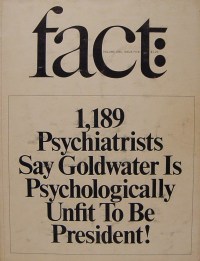
As a student in 1964, Sanders belonged to the Young Socialists League. (The article gives no evidence that YSL was all that sinister. And besides, a lot can happen in half a century. At about the same time, Hillary Clinton was a Goldwater girl.)
He worked for a union that was investigated by the infamous House Un-American Activities Committee. (That’s the one Joe McCarthy used for his witchhunts. If everyone HUAC investigated had actually conspired with the Soviets, the Republic would have fallen a long time ago.)
In the 1970s, he “headed the American People’s History Society, an organ for Marxist propaganda”. (No evidence is given for the Marxist-propaganda claim, other than a documentary favorable to the early-20th-century American socialist and labor crusader Eugene Debs. Elsewhere, a University of Vermont librarian elaborates: “In the brochure’s ‘Dear Educator’ section, Sanders announced that Debs was the first documentary in a new series called ‘The Other Side of American History,’ which would ‘deal with people and ideas that the major profit oriented manufacturers of audio-visual material will not cover because of economic and political reasons’.”)
Bernie’s Senate office displays a portrait of Debs, who like a lot of people at that time — George Bernard Shaw and H. G. Wells come to mind — was slow to recognize the dark side of the Russian Revolution. (Saying nice things about the Bolsheviks was far from the center of Debs’ political identity, which was more about organizing unions, trying to keep the U.S. out of World War I, and popularizing then-radical notions like unemployment insurance and Social Security.)
In the 1970s, Sanders belonged to the Liberty Union Party, which wanted banks and utilities to be publicly owned. (Contrary to the “diehard Communist” claim, the leader of that party says they parted ways because “Sanders was moving right”.)
As Mayor of Burlington, he supported rent control and land trusts. (In hindsight, it worked out pretty well.)
While he was mayor, Burlington’s minor-league team was called the Vermont Reds (possibly because it was a farm team of the Cincinnati Reds. Life imitates art here: In the 1970s conspiracy-theory romp Illuminatus!, a right-wing rabble-rouser warns an Ohio crowd that the time to thwart Communist world domination is now: “Are we going to wait until the godless Reds are right here in Cincinnati?”)
In the 1980s, he didn’t support President Reagan’s attempt to overthrow the elected government of Nicaragua by force, and instead attempted to find a peaceful solution to the conflict. (The Sandinistas eventually lost an election and left office voluntarily, so maybe they weren’t such Stalinist monsters after all.)
Burlington has a sister city in Russia (as part of a program established by President Eisenhower). As Mayor, Sanders and his new wife went on a group trip to that sister city not long after they got married, creating the sort-of-true claim that he “honeymooned in the Soviet Union“.
There’s more, but you get the idea. For decades, Sanders has been on the left side of the American political spectrum. He’s been suspicious of what unregulated capitalists might do and in favor of workers organizing unions to counter their power. Like the late Howard Zinn, he believes (correctly, I think) that the left side of American political history got misrepresented during the Cold War, and still isn’t told accurately. He’s been skeptical of the perpetual-warfare state, and its efforts to focus our attention on external enemies rather than internal injustice.
If that’s diehard Communism, then there are a lot more diehard Communists than I thought — including me, I guess.
Looking at the weakness of the case, you might be tempted to laugh it off. But swift-boating John Kerry was absurd too, and it worked. With money, media power, and a significant slice of the population ready to repeat whatever nonsense they’re told, the Right can go places with a narrative like this — especially against a candidate most of the country doesn’t know.
So if you were a Republican candidate running against Sanders next fall, why would you risk discussing single-payer health care on its merits (and defending the health insurance companies nobody likes) when you could instead turn the question to whether Bernie Sanders is a loyal American? I mean, Stalin supported single-payer health care, and Castro — so why are we even discussing how it works and who it benefits? The GOP candidate will favor American healthcare, not Soviet healthcare like Comrade Sanders.
Why bother disputing the moral and economic virtues of a higher minimum wage, when you could say: “I believe in wages that you earn fairly in the free market, while Comrade Sanders believes the government should set your wages”? Why defend the too-big-to-fail enormity of Citibank and Bank of America when you could instead rail against Comrade Sanders’ plan for a government takeover of the banking system? (If ObamaCare could be labeled a “government takeover of the healthcare system“, why not do the same to Sanders’ bank-break-up plan?) You could point out that strong American presidents of both parties, from Harry Truman to Ronald Reagan, won the Cold War. So why are we giving in to Communism now?
And since Sanders has declared his independence from all special interests, the Republican nominee will have much more money to use setting the terms of the general-election debate. He’ll be able to launch five attacks for every Sanders defense. Even when Sanders gets free media attention, he’ll find himself confronted with questions about Soviet healthcare and government takeovers and giving in to Communism. When you talk to your crazy uncle who lives inside the Fox News bubble, those phrases will form a buzzword-wall that you’ll never get past.
That is why the decision to vote for Sanders in the primaries — here in New Hampshire, my decision is coming up faster than most — is more complicated than it seems. Because Sanders has yet to face the full force of the right-wing bullshit machine, I put no stock at all in the polls showing him running better against Republican candidates than Hillary does, or picking up Trump voters in a race against some other Republican. And while I want to see a full public debate of the issues Bernie is raising, I’m not at all sure that will happen if we nominate him.
That may sound crazy, but the campaign you get is often not the one you thought you were signing up for. Mike Dukakis knew he’d have to defend his ideas about creating jobs, but he never expected to become the Guy Who Hates the Pledge of Allegiance or the Pro Black Rapist Candidate. (Looking back, he said: “I made a decision we weren’t going to respond. That was it. About two months later I woke up and realized I was getting killed with this stuff.”) Elizabeth Warren anticipated criticism of her banking proposals, but not how much time she would have to spend denying that she invented Native American ancestors to cash in on affirmative action.
Being in the right only helps up to a point. If the other side can launch a series of attacks that have just enough surface plausibility to demand a response, the public’s attention may never turn to the issues you’re trying to run on. The voters may never listen to all those wonderful points you want to make.
So if he’s nominated, I have to wonder how much of Bernie’s message will make it out to the voters, and how much will be swamped by bullshit issues. How much time will he spend establishing that he’s not a Bolshevik (or worse, refusing to establish that he’s not a Bolshevik, on the high principle that he shouldn’t have to), or defending some easily misrepresented Burlington city ordinance from thirty years ago? Having seen how completely the Right can re-invent a recent historical figure like Saul Alinsky, I can barely imagine what they’ll do with Eugene Debs.
Dealing with bullshit issues patiently but firmly (and occasionally managing to turn them to your advantage) requires its own kind of political skill, the kind John Kennedy demonstrated when he defused fears of his Catholicism, or Obama showed when he spoke about race and Jeremiah Wright. (That speech was the moment I realized I wanted Obama to be president.) No one believes Hillary Clinton has the oratorical gifts of JFK or Obama, but she’s been facing right-wing smears for more than two decades, and has gotten pretty good at fending them off, as she showed when she stared down the House Benghazi Committee for 11 hours in October.
Does Bernie Sanders have that in him? I don’t know. So far, nothing in his career has required it. I worry that when Fox News and Rush Limbaugh and Alex Jones put him in the crosshairs, he’ll get testy and defensive. Baseless attacks might raise his preachy side, leading him to lecture reporters rather than answer their questions or artfully deflect them or humorously turn them around. His idealism might lead him to insist that because bullshit issues shouldn’t matter, they don’t.
They do. In election after election, we’ve seen that they do. We need a candidate who can deal with them.
Is Bernie Sanders that candidate? I don’t know. That — maybe even more than how I feel about the policy differences between Clinton and Sanders — is the thing I have to decide in the next two weeks.
We’re coming down to the wire on the early primaries: Next Monday the Iowa caucuses happen, and eight days later I have to vote here in New Hampshire. As the Democratic race tightens up, I find myself wondering: So far all the Republicans have been running against Hillary, talking about Benghazi and emails and Bill’s escapades. If they started running against Bernie, what would that sound like?
Well, it turns out The New York Post jumped the gun on the anti-Bernie campaign, warning America that he’s a “diehard Communist”, and listing all sorts of “evidence” that has just about as much factual basis as … well, as the Benghazi stand-down order and all the other crap they’ve been throwing at Hillary.
But just because it’s crap doesn’t mean that it won’t work, or at least work well enough to distract the electorate from looking at the issues Bernie is trying to run on. Going back to Dukakis and the Pledge of Allegiance issue in 1988, all Democratic nominees spend a big chunk of their campaign wading through crap: swift-boating against Kerry, birtherism and “paling around with terrorists” against Obama, and so forth. Some nominees have had the political skill to cut through the noise and get the public to pay attention to their issues, and some haven’t. That has a lot to do with which ones won.
So what about Bernie and his “history” of diehard Communism? If he’s nominated, how will the Republicans use that against him and will he have the skills to deal with it? I’ll meditate on that in this week’s featured post “Smearing Bernie, a preview”. That should be out soon.
The weekly summary also has a lot of election coverage in it: Trump/Cruz is getting nasty. Hillary has been overstating the problems with Bernie’s healthcare plan, but Ezra Klein and Paul Krugman point out that there are some legitimate issues there. The Vanilla ISIS folks are still scaring the birds away in Oregon. Winter Storm Jonas clobbered the NY-Washington corridor, but left New England alone. Then there’s Flint, and verification that 2015 was the hottest year ever. And of course, a couple guns-make-us-safer stories. That should be out by 10:30.
Our collective futures depend on your willingness to uphold your duties as a citizen. To vote. To speak out. To stand up for others, especially the weak, especially the vulnerable, knowing that each of us is only here because somebody, somewhere, stood up for us.
This week everybody was talking about the State of the Union
Tuesday, President Obama gave his final State of the Union address. [video, text] I see it as the beginning of his victory lap: No matter what you may hear from the Republican presidential candidates, the United States is much better off than it was when he took office. Other than ObamaCare or the Iran nuclear deal, his accomplishments haven’t been flashy. But he came into office telling his administration “Don’t do stupid stuff” — like invading Iraq, say, or passing another huge tax cut for the rich — and for the most part they haven’t. It’s amazing how well America can do if the president isn’t doing stupid stuff.
No doubt the victory lap will peak with an appearance at the Democratic convention this summer. I expect the delegates to clap for a long, long time.
Another recent Obama broadcast is his “Guns in America” townhall conversation on CNN January 7. [video, transcript]
and Iran
This week President Obama frustrated yet again everyone who wants a war with Iran. Tuesday, Iran seized two American patrol boats and the ten sailors aboard them, claiming they had entered Iranian waters (which seems to be true). The next day the boats and the sailors were released without anyone needing to “unleash the full force and fury of the United States” as Ted Cruz pledged to do at Thursday night’s presidential debate.
At the time the nuclear deal with Iran was being debated in Congress, critics objected that the Obama administration was “leaving behind” several Americans held in Iran, including Christian minister Saeed Abedini and Washington Post reporter Jason Rezaian. The administration argued that those negotiations were better handled separately rather than putting everything together in an omnibus package. Well, Saturday, the United States and Iran completed a prisoner swap that included Abedini and Rezaian. They weren’t left behind.
It’s probably not a coincidence that Saturday also marked the end of economic sanctions against Iran, as the International Atomic Energy Agency verified that Iran had complied with its part of the nuclear deal. The sanctions had frozen Iran’s deposits in the international banking system, which have been estimated anywhere from $50-$150 billion.
Republican candidates try to make this sound like a U.S. payoff to the Iranians. For example, Donald Trump characterized the deal as: “They get $150 billion, plus seven [prisoners] and we get four [prisoners].” But the money was always theirs; we were simply holding it hostage. Obama “gave” the Iranians nothing.
What the end of sanctions will do is let Iran return to the international oil market. The anticipation of Iranian oil coming onto the market is part of why oil prices have been collapsing lately. So yes, President Obama does deserve some credit for gas prices falling below $2 a gallon.
If you’re my age, chances are David Bowie meant something special to you. It was always hard to separate his life from his art, and now it is hard to separate his death from his art, as in the “Lazarus” video from his final album Blackstar.
Alan Rickman also died this week. For most people he’s Professor Snape, but I’ll always remember him as the Metatron in Dogma. Oh, that voice. Or maybe that voice up a few octaves.
I feel remiss in not having noted the death of Meadowlark Lemon when it happened at the end of 2015. Like all athletes who make it into their 80s, Meadowlark long outlived his glory days. Many young people probably know nothing about him, and possibly nothing about the Harlem Globetrotters in general, who still exist but aren’t the cultural force they once were.
The Globetrotters began in an era when American professional sports leagues were still segregated, and black athleticism was only safe for whites if it came wrapped in comedy. (In baseball, Satchel Paige was a similar package of athletic skill and comedic showmanship.)
In Meadowlark’s lifetime the NBA was open to blacks, but for working-class white boys of my generation it still was chancy to openly imitate black stars like Bill Russell or Oscar Robertson. (I never told anybody that my reverse lay-up was styled after a photo of Elgin Baylor. That’s one reason the “Be Like Mike” series of Gatorade commercials in the 90s — with kids of all races pretending to be Michael Jordan — could sometimes make me tear up.) But imitating a funny stunt by Meadowlark or his wild-dribbling teammate Curly Neal was OK.
and the Episcopal Church
The Episcopal Church is one of the oldest religious organizations in America, going back to the Church of England’s extension to the North American colonies. George Washington attended the Church of Virginia, which why a bust of him has been in the crypt of St. Paul’s in London since 1921. (I’ve seen it.)
Thursday, that centuries-old connection frayed, as a convocation of primates from the Anglican churches of 44 countries met in Canterbury, and suspended the Episcopal Church from participation in governance of the Anglican Communion. The primates’ official statement says:
we formally acknowledge this distance by requiring that for a period of three years The Episcopal Church no longer represent us on ecumenical and interfaith bodies, should not be appointed or elected to an internal standing committee and that while participating in the internal bodies of the Anglican Communion, they will not take part in decision making on any issues pertaining to doctrine or polity.
The “distance” arises from the Episcopalians’ increasing tolerance of homosexuality, which is particularly odious to the African Anglican leaders. An openly gay Episcopal bishop was elected in 2003, and same-sex marriages were officially recognized in July. The role of women is also an issue, though many other Anglican churches ordain women as priests. Katharine Jefferts Schori was presiding bishop of the Episcopal Church from 2006-2014.
Such issues have led to the formation of a rival Anglican Church in North America, which is not officially recognized by the Anglican Communion, but is recognized by numerous African Anglican churches.
It’s hard to see how this issue resolves in three years, or in anything other than a permanent separation, since Episcopalians don’t seem likely to back down. “We’re committed to being a house of prayer for all,” said current Presiding Bishop Michael Curry. The most eloquent expression of that position came from Jim Naughton, the former head of the archdiocese of Washington, D.C.: “We can’t repent what is not sin.”
The Daily Beast‘s Jay Michaelson sees the Anglican/Episcopal rift as
just the surface of a much deeper division, reflecting the polarization of Christian life in the 21st century.
and you might also be interested in
This week’s guns-make-us-safer story concerns an Ohio man who killed his son. The 14-year-old’s skipping-school plan involved sneaking back into the basement after apparently going out to catch the bus. His father heard a noise downstairs and shot at what he believed to be an intruder.
Sociologist Victor Tan Chen elaborates on the recent study showing declining life expectancy for working-class whites, predominately due to despair-related health problems (like suicide and addiction) in middle age. Chen focuses not just on the declining economic opportunities for less-educated whites (a problem they share with less-educated non-whites, whose life expectancy is still increasing), but the simultaneous decline in sources of community (like church or union membership), and in long-term marriages. When economic disaster strikes, a go-it-alone attitude and an ideal of rugged individualism may leave a person more vulnerable to despair than a better-connected person who is even worse off financially.
Charles Alan Martin tells how his thinking about Black Lives Matter has changed:
Up until this point, I’ve stubbornly held onto the presumption that BLM needed to somehow deliver their message in a way I could find palatable when, in reality, I wasn’t owed a damned thing.
I admit, it’s satisfying to watch Cruz have to deal with this after all the completely baseless noise he and his fellow conservatives (like his Dad, for example) made about President Obama’s citizenship. I think this is a bullshit issue, but Cruz has made a career out of bullshit.
Even so, my position is simple: We have to respect the clear constitutional requirements (like being at least 35 years old), but any ambiguity should be interpreted to maximize voter choice. I will be very sad (and worried) if the American people elect Ted Cruz as our next president. But the place to stop him is at the ballot box; I don’t want to disqualify him on a technicality.
Cruz is also dealing with the revelation that he funded his Senate campaign with loans from Goldman Sachs, where his wife works, and didn’t report it properly. NPR explains the possible ramifications.
And I question how much influence David Brooks has on the Republican electorate, but the conservative NYT columnist wasn’t pulling any punches in “The Brutalism of Ted Cruz“:
Ted Cruz is now running strongly among evangelical voters, especially in Iowa. But in his career and public presentation Cruz is a stranger to most of what would generally be considered the Christian virtues: humility, mercy, compassion and grace. … He sows bitterness, influences his followers to lose all sense of proportion and teaches them to answer hate with hate. This Trump-Cruz conservatism looks more like tribal, blood and soil European conservatism than the pluralistic American kind.
BTW, “tribal, blood and soil European conservatism” sounds to me like a roundabout way of saying “fascism”.
And while I’m on that subject (again), here’s a fascinating historical tidbit from Robert O. Paxton’s The Anatomy of Fascism:
The term national socialism seems to have been invented by the French nationalist author Maurice Barrès, who described the aristocratic adventurer the Marquis de Morès in 1896 as “the first national socialist.” Morès, after failing as a cattle rancher in North Dakota, returned to Paris in the early 1890s and organized a band of anti-Semitic toughs who attacked Jewish shops and offices. As a cattleman, Morès found his recruits among the slaughterhouse workers in Paris, to whom he appealed with a mixture of anticapitalism and anti-Semitic nationalism. His squads wore the cowboy garb and ten-gallon hats that the marquis had discovered in the American West, which thus predate black and brown shirts (by a modest stretch of the imagination) as the first fascist uniform.
Now that Michael Bay’s Benghazi movie 13 Hours is out, the long-debunked myths about Benghazi are likely to be trotted out again. Fortunately, Media Matters has put together a convenient video debunking yet again the four biggest Benghazi myths. Bookmark it, and use as needed in Facebook arguments.
I was going to do my own analysis of the militia takeover of Malheur Wildlife Refuge in eastern Oregon, but it turns out there’s no need: Lots and lots of insightful articles are out there already, so I’ve decided to survey them for you.
You can come at this story from many different angles:
the day-to-day actions of the occupiers and the (so far) apparent inaction of the government in response. The best place to keep track of this is through Oregon Public Broadcasting, which has a web page collecting all its Malheur-related articles.
the legal case that sparked the occupation, the arson conviction of Dwight and Steven Hammond.
the larger land-use issues that unite many local ranchers against government policy, whether they agree with the armed occupation or not.
the off-beat and sometimes downright nutty versions of American history and constitutional law that the militiamen use to justify their actions.
how the government should respond to the occupation
the hilarious responses of various comedians and satirists.
Recent developments. As I said above, OPB is the place to keep up. If you’re waiting for a pitched battle, not much has been happening. The occupiers were supposed to be announcing their exit strategy Friday, but OPB didn’t publish one, so probably that didn’t happen. The most ridiculous recent story was the first arrest: Kenneth Mendenbach was arrested Friday for unauthorized use of a vehicle after he drove a commandeered government van into town for supplies. An unofficial spokesman for the militia called this a “dumb choice“.
An Oregon sportsman’s group, Backcountry Hunters & Anglers, have posted a video of their members tearing down one of the occupiers’ signs. They recognize the obvious:
It’s a baldfaced grab at the lands that belong to the people of the United States. I can guarantee what that means is that pretty soon they’ll start saying, “Well, you guys can’t come out on this land because it’s ranchland.”
The Hammonds. The spark the set off the conflict was the re-imprisonment of the Hammonds, when an appellate judge ruled that their conviction (for arson on public land) carried a mandatory minimum sentence of five years. A good summary of the case comes from the local U.S. attorney.
I agree that mandatory minimums are bad law, but I don’t believe in a special exception for white land-owners. So if this case motivates conservatives to get on board with criminal justice reform, that would be great. But a lot of non-violent black offenders are serving long sentences for drug convictions, and their plight doesn’t raise similar public compassion.
BTW, the Hammonds quite likely have committed many more crimes than the arsons they were convicted of. They had already plea-bargained the charges down, and the government believes one fire was set to cover up evidence of an illegal deer hunt. There’s also a child-abuse angle on the story. So, in short, I don’t see them as sympathetic figures.
Ranchers and public land. A more positive view of ranchers and the complexity of the grazing-on-public-land issue comes from Grist‘s Nathaniel Johnson. Long-term grazing rights are not property, but in some ways they sort of are. For example, a bank will give you a loan based on the value of your grazing rights. Ranchers pay higher prices for land with federal grazing rights attached, so it’s not entirely crazy for them to feel cheated if those rights are changed or eliminated.
Also at Grist, Darby Minow Smith, interviews her Montana-rancher Dad about the issues raised by the Malheur occupation. He argues that grazing on public land is a good thing, as long as it’s not over-done.
There are indicator species that show that a forest is healthy. I’ve long maintained that cows on grazing permits are an indicator that there’s a system that’s working. There’s open space out there. There aren’t subdivisions choking up around the forest.
On the other hand, The Week‘s Ryan Cooper calls attention to the underlying contradictions of “cowboy socialism”, i.e., the strange marriage of the rugged individualist stereotype to demands for free stuff (land, water, etc.) from the government.
As Marc Reisner details in his history Cadillac Desert, this is the basic problem with Western politics, even up to the present day. It has been from the very start handicapped by the reality that only extensive federal government projects could possibly facilitate the settlement and development of the region, but it has been too wedded to the cowboy mythology to admit it.
But instead of coming to terms with reality, and building quality government institutions to ensure the programs functioned properly, Western politicians simply grafted massive federal subsides onto their beloved cowboy individualism.
If the federal government hadn’t fought the Indian wars and the Mexican-American War, the West wouldn’t be available to English-speaking settlers at all. Without expensive federal investments in dams and other big infrastructure projects, most of the non-coastal West would only support populations about the size of the Native American tribes who preceded the white settlers. Without the subsidies that created the transcontinental railroads, Western ranchers would have had no way to bring a product to market. And so on.
So the idea that Western ranchers are victims of government “tyranny” is nutty. I’m reminded of this scene from Monty Python’s Life of Brian, where a Judean revolutionary gets answers to his rhetorical question “What have the Romans ever done for us?”
OPB makes the connection between the proposal to return federal lands to the states and the probable result: privatization with no regard for hard-to-monetize values like the environment. Oregon is currently trying to sell the Elliott State Forest.
Legal and historical nonsense. Pacific Standard‘s Aaron Brady attributes the claims of “federal tyranny” in Harney County to “Libertarian Fairy Tales“.
In the beginning, there was the land. But like all virgin soil, it required entrepreneurial ranchers to settle it before it could produce value, and this was central to the myth: that nothing existed before the arrival of these free men. … For the Bundys, then, nothing really happened before the 1870s. They do not mention Spanish explorers in 1532, or French Canadian trappers, or the British occupation after the war of 1812, or Oregon statehood in the 1850s. Their story most definitely does not begin thousands of years ago, when the first people settled the region. They have no time for how the Army re-settled the northern Paiute in the Malheur Indian reservation in 1872—emptying Harney County for settlement by white people—nor how those same white settlers demanded (and got) the reservation dis-established in 1879 so they could have that land too.
And then there’s the simple craziness of the occupiers’ legal/political views. Right Wing Watch‘s Miranda Blue gives some of the background, relying on Daniel Levitas’ 2002 book The Terrorist Next Door. Levitas traces the militia ideology back to the teachings of white supremacist minister William Gale: The Constitution gives the federal government no power to manage lands inside the sovereign states. (To believe this, you have to ignore or rationalize your way around Article IV, Section 3: “The Congress shall have Power to dispose of and make all needful Rules and Regulations respecting the Territory or other Property belonging to the United States”) And since the states have not stood against this federal usurpation, power reverts to the counties.
The county should be recognized as the seat of power for the people, and the sheriff is to be the “ONLY LEGAL LAW ENFORCEMENT OFFICER IN THE UNITED STATES OF AMERICA!” all healthy men between the ages of eighteen and forty-five who are not in the military could be mobilized into a posse comitatus to redress their grievances, Gale explained.
But of course, since the Harney County officials aren’t backing the occupiers, they’re not legitimate either. A “citizens grand jury” is being put together to press charges. The logic is circular: The occupiers will submit to legitimate authority, but any authority who tells them to stop what they’re doing is not legitimate.
Religion. The Bundys are Mormons, and many of the militiamen seem to have a strange interpretation of Mormonism. I know virtually nothing about Mormonism, mainstream or otherwise, so I’ll let OPB’s John Selpulvado explain.
Humor. The occupation has been fertile ground for comedy.
Precedents and federal response. The government’s wait-and-see approach to the Malheur occupation contrasts sharply with the many shootings of unarmed blacks that Black Lives Matter has called attention to, and also to the violent ejections of Occupy Wall Street protesters from numerous encampments a few years ago.
At least two other incidents have been mentioned as precedents:
the MOVE bombing in Philadelphia in 1985, in which a militant black group was bombed by the police, killing 11 and setting 63 neighboring homes on fire.
the attempted occupation of a federal wildlife refuge in Georgia in 1979, by 40 descendants of black slaves and sharecroppers who had once worked the land. Those who refused to leave were forcibly removed within three days and charged with trespassing.
Those who sympathize with the militiamen talk about Waco and Ruby Ridge, two sieges that ended in bloodshed, and were cited as motivation for the Oklahoma City bombing a few years later. Even if you don’t sympathize, that history provides an argument for under-reacting to the current incident: Why incite bloodshed that could inspire further bloodshed down the line?
And of course there’s the Bundy stand-off of 2014, in which a similar gathering of armed militiamen kept the Bureau of Land Management from recovering unpaid grazing fees by impounding the cattle of Nevada rancher Cliven Bundy, father of Ammon Bundy, a leader of the Malheur occupation. Numerous crimes were committed in the course of the stand-off (it being illegal to threaten a federal agent by pointing a weapon at him or her), but so far none have been prosecuted.
The militiamen regard the 2014 incident as a victory, and seem to feel that Malheur continues their momentum. It’s not much of a stretch to believe that this incident arises from the lack of a forceful government response in Nevada.
What I hope for. The government has a narrow path to walk. I understand the desire not to fight a pitched battle and then wait for reprisals from the militia movement. On the other hand, if Bundy and his compatriots come out of Malheur feeling victorious, they’ll go on to try something else. There’s debate about whether it’s appropriate to use the word terrorist here, but some of the same logic applies: If a group is looking for a confrontation, it’s very hard not to give them one eventually.
If the U.S. government is not willing to enforce its laws against armed right-wingers, it starts to look a little like the Weimar Republic: Hitler was arrested for treason after his first attempt to take power, the Beer Hall Putsch of 1923. But he served less than a year in prison and was back out leading his party by the end of 1924. A German government that believed in itself enough to seriously punish insurrectionists might have saved the world a lot of trouble.
So I think it’s important that the outcome of this incident, however long it takes, not give the occupiers anything they can describe as victory. There should be no concessions about the Hammonds or local land use, and the militia leaders have to go jail. Just peaceably going home — or off to the next confrontation — is not enough.
I hope someone in the government is giving serious thought to how to make that happen without killing anybody. That will be a hard feat to pull off.
After South Carolina Governor Nikki Haley gave the official Republican response to the State of the Union address, the media focused all its attention on the anti-Trump implications of her call to “resist [the] temptation” to “follow the angriest voices”, particularly where immigration was concerned.
But I was more interested in where she went from there: If the GOP is going to be more than just a megaphone for anger and fear, it needs to present a positive vision for America’s future. In other words, it needs to compete for the hope-and-change vote that Barack Obama monopolized in his 2008 landslide. So Haley laid out this hopeful program for the next Republican presidency, which I quote in full:
If we held the White House, taxes would be lower for working families, and we’d put the brakes on runaway spending and debt.
We would encourage American innovation and success instead of demonizing them, so our economy would truly soar and good jobs would be available across our country.
We would reform education so it worked best for students, parents, and teachers, not Washington bureaucrats and union bosses.
We would end a disastrous health care program, and replace it with reforms that lowered costs and actually let you keep your doctor.
We would respect differences in modern families, but we would also insist on respect for religious liberty as a cornerstone of our democracy.
We would recognize the importance of the separation of powers and honor the Constitution in its entirety. And yes, that includes the Second and Tenth Amendments.
We would make international agreements that were celebrated in Israel and protested in Iran, not the other way around.
And rather than just thanking our brave men and women in uniform, we would actually strengthen our military, so both our friends and our enemies would know that America seeks peace, but when we fight wars we win them.
Growth, jobs, education, better health insurance, liberty, the rule of law, stronger diplomacy, and seeking peace but winning wars when we’re forced to fight them — what’s not to like? That’s a far more attractive vision than the Great Wall of Mexico, or invading ISIS’ godforsaken desert, or bombing Iran, or watching a special police force round up and expel 11 million Hispanic immigrants.
My only argument with Haley (other than the issues she leaves out completely, like climate change, voting rights, the environment, racial justice, and so on) concerns the Republican policies that are supposed to produce these wonderful outcomes. And that’s why I think her litany needs some line-by-line annotation. Let’s start at the top:
If we held the White House, taxes would be lower for working families,
Maybe. But the taxcuts proposed by allRepublicancandidates focus their benefits on the rich. As was true of the Bush and Reagan tax cuts, anything working families get is just shiny wrapping on a package addressed to the wealthy.
Typically Republicans deny that their tax cuts will explode the deficit, but they always do, and then the next step is to seek cuts in programs working families count on, like Social Security and Medicare. (That small tax cut you get will be eaten up pretty quickly if you have to support your aging parents.) The following chart is from 2012, so the right side is a little out of date, but the general point is still valid.
No party could openly propose: “Let’s slash rich people’s taxes and make up the difference by cutting Social Security and Medicare.” But that is the Republican agenda. They will pass it by breaking it in two: First pass huge tax cuts that mainly benefit the rich, and then treat the resulting deficit as an emergency no one could have foreseen. Working people will have to “sacrifice” their Social Security and Medicare benefits to deal with the “emergency” created by the tax cuts.
and we’d put the brakes on runaway spending
As this chart from the libertarian Cato Institute shows, federal spending has been fairly level during the Obama administration, after increasing sharply under Bush.
and debt.
Republican candidates do propose cutting spending on things like food stamps, but after accounting for increased defense spending, the net spending cut is typically far smaller than the tax cut. So the deficit is likely to jump sharply during a Republican administration (after falling under Obama), as it did when Reagan and Bush cut taxes.
We would encourage American innovation and success instead of demonizing them,
Listening to Haley, you might imagine Democrats spouting absurdities like, “Damn that iPhone!” or “What good is this Internet fad anyway?” — which we never do. Her statement only contacts reality after you realize that innovation and success is a euphemism for billionaires. Democrats haven’t “demonized” billionaires, but we have been (correctly) pointing out that billionaires soak up just about all of America’s economic growth, leaving little for anyone else.
so our economy would truly soar and good jobs would be available across our country.
The theory that making the rich richer will produce growth and good jobs for everyone is known as trickle-down economics. In the history of humankind it has never worked, for a simple reason: When the poor and middle class have more money, they buy things that somebody needs to produce, creating new jobs and industries. But when the rich have more money, they bid up the prices of limited goods like stocks, Van Gogh paintings, and beachfront property, inflating speculative bubbles that eventually pop and damage the economy the rest of us depend on.
We would reform education so it worked best for students, parents, and teachers, not Washington bureaucrats and union bosses.
No one has gone after teachers’ unions harder than Gov. Scott Walker of Wisconsin. The benefits of this to students and parents are virtually invisible, and teachers are undeniably worse off. Sam Brownback’s Kansas exemplifies another Republican approach to education: When his tax cuts for the wealthy didn’t produce the economic boom he promised (because trickle-down economics doesn’t work), he made up the deficit by cutting money for public schools.
The Republican replacement for ObamaCare is also a fantasy. Six years after the Affordable Care Act became law, Republicans have still not agreed on an alternative, and no GOP presidential candidate has anything more than the barest sketch of a plan. Any claims about what such “reform” would do are meaningless until enough details get specified that outside experts can analyze the program’s costs and individual families can tell whether or not they’re covered. Those details are still a long way off, and may never arrive.
We would respect differences in modern families,
Would they? I think the vagueness of this claim speaks for itself. No Republican candidate will openly say, “I respect gay or lesbian couples who get married and raise children” or “I respect transgender Americans.” Large parts of the Republican base would be offended if a candidate said, “I respect blacks and whites intermarrying.”
but we would also insist on respect for religious liberty as a cornerstone of our democracy.
We would recognize the importance of the separation of powers and honor the Constitution in its entirety. And yes, that includes the Second and Tenth Amendments.
But what about the 14th Amendment? After Republican-appointed Supreme Court justices undo the recent decision legalizing same-sex marriage — as numerous candidates have promised — how will gays and lesbians receive the equal protection of the marriage laws? And conservative legal arguments against birthright citizenship — another guarantee of the plain language of the 14th Amendment — are far more convoluted than any alleged “judicial activism” of liberal judges.
It has also become common for Republicans to get misty-eyed talking about the sacred writ of the Constitution, and then demand drastic changes with their next breath.
We would make international agreements that were celebrated in Israel and protested in Iran, not the other way around.
When President Obama and Secretary Clinton got the world to agree to harsh sanctions on Iran — which forced them to bargain seriously about their nuclear program for the first time — I doubt the Iranians celebrated. And I can’t help wondering: who would these agreements Haley is talking about be with? Actual agreements require compromise. If you want to dictate terms to other countries, you have to defeat them in war first. Is that the plan?
And rather than just thanking our brave men and women in uniform, we would actually strengthen our military,
so both our friends and our enemies would know that America seeks peace, but when we fight wars we win them.
The last Republican administration started two wars and won neither of them. And yet, the last eight years have seen no Republican soul-searching or new approaches to foreign policy. (The exception is Rand Paul, who has barely any support.) If a Republican wins the presidency in November, expect to see the Pentagon and State Department led by the same people who invaded Iraq and had no plan for what to do next.
In short, I would love to see the eventual Republican nominee run on a positive vision for America rather than on anger and fear. But it would be even more wonderful if the candidate offered proposals that stood some chance of achieving that vision. That’s something neither Haley nor any other Republican has yet attempted.
I expected to do a State of the Union post. But oddly, what struck me was a stretch of Nikki Haley’s SOTU response — and not the one that got all the attention. The part of her speech that everyone covered was the anti-Trump part, where she said the GOP shouldn’t “follow the angriest voices”. More interesting to me, though, was that she went on to give a positive message about what the country could expect from a Republican president. I’m not hearing that kind of thing anywhere else, so I thought I’d call it to your attention.
Naturally, though, my reaction to that litany of future accomplishments wasn’t a simple “Gee, that’ll be great.” Instead, I went through it line-by-line and asked whether the policies Republicans are proposing could actually lead to these results. The result is “The Positive Republican Message, Annotated”. It should be out shortly.
I’ve also been paying attention to the militia that has taken over that wildlife refuge in Oregon. At first I thought I’d write an in-depth article about it, but then I decided I’d never get all the background reading done in time. So instead I started summarizing all the good articles other people have been writing. Then that got out of hand and turned into its own article after all. It still needs an introduction and a title, so that probably won’t be out until 10 or 11.
The weekly summary will cover the Iran negotiations, Obama’s SOTU and gun townhall, the Episcopal/Anglican kerfuffle, the Cruz birther thing, and a few other topics before closing with the War and Peace trailer — I’m not entirely sure what it has to do with War and Peace, but wow.
This week everybody was talking about the old and new years
The New Yorker‘s John Cassidy picked out “Six Bits of Good News from 2015“, starting with how international cooperation stopped the Ebola epidemic in West Africa. And the long-term downward trend in global poverty continued.
I find all those best-books-of-the-year lists intimidating, not to mention depressing: If the list has 100 books on it, I’ve usually read about one, and if it’s just a top-ten list, I probably haven’t read any. That’s why I much prefer lists of what literate people (who aren’t all book critics) actually read and liked this year, even if it wasn’t new. Here are lists from the staff at Vox , The Week, and The Guardian.
My personal best reads of the year: The Half Has Never Been Told by Edward Baptist (nonfiction) and Forever by Pete Hamill (fiction). In teen/tween fiction, I’d pick Zombie Baseball Beatdown by Paolo Bacigalupi. Graphic novel: I agree with Alex Abad-Santos at Vox: Ms. Marvel. Best continuing comic-book series: Astro City. I also discovered the action/suspense novels of Greg Iles this year, and saw some surprising similarities between his old Southern riverport hometown of Natchez, Mississippi and my old Midwestern riverport hometown of Quincy, Illinois.
I saw so few movies this year that I can’t judge best-movie lists. But Cinema Blend‘s list is an intriguing mix of indie-art-house stuff and blockbusters.
TPM has announced the winners of 2015’s Golden Dukes, the annual awards given to “the year’s best purveyors of public corruption, outlandish behavior, The Crazy and betrayals of the public trust”. The grand prize winner is Dennis Hastert, for the revelation that all the while he was presiding over the House’s impeachment of President Clinton, he was paying hush money to a male student he molested when he was a wrestling coach. Says one contest judge:
But the sheer depravity, the utter lack of a moral compass, and the misuse of moral authority of Hastert’s pre-Congressional illegal acts, coupled with the hypocrisy of his work to end a presidency over consensual sex with an of-age partner and his efforts to deny rights to consensual partners of age who happen to be of the same sex, Hastert’s your guy, apparently.
More pundits should follow Steve Benen’s example: He rounds up his biggest mistakes of the year.
Who can imagine, at this point, what wonders and blunders we’ll see in 2016?
and Bill Cosby and the affluenza teen
CNN has been obsessing over these two cases, but you shouldn’t. It’s good that prosecutors are finally listening to women (at least in this one case). It’s sad that a beloved cultural icon was such a sleaze in real life. But the Cosby case has very little impact on your life. The legal issues are kind of interesting, though.
The original affluenza defense was ridiculous; Ethan Couch was stupid to break the probation he was lucky to have in the first place; and what was his mom thinking in helping him run away to Mexico? But there are stories more deserving of your attention, like the next one:
Ta-Nehisi Coates discusses how police who kill citizens delegitimize police in general. If calling the police means that someone could wind up dead (with no one held accountable), then calling the police escalates conflict rather than leading to a resolution.
It will not do to note that 99 percent of the time the police mediate conflicts without killing people anymore than it will do for a restaurant to note that 99 percent of the time rats don’t run through the dining room. Nor will it do to point out that most black citizens are killed by other black citizens, not police officers, anymore than it will do to point out that most American citizens are killed by other American citizens, not terrorists. If officers cannot be expected to act any better than ordinary citizens, why call them in the first place? Why invest them with any more power?
I have a hard time apportioning the individual and collective responsibility in the Rice case. Obviously, Tamir Rice should not be dead and probably would not be dead if he were white. The officer who shot him at the very minimum should not be a cop any more, and probably should be convicted of something.
But I don’t want to pin the whole responsibility on the individual cop who pulled the trigger. There is the larger cultural problem of a police department that doesn’t value black lives. And beyond that, there’s the structural racism in our whole society, which casts black males as inherently dangerous. To most American whites, things just look different when blacks do them, a problem I illustrated with a collection of reactions to President Obama and his family in “What Should ‘Racism’ Mean?“.
I don’t doubt that when Officer Loehman looked at Rice, he saw a dangerous thug with a gun, and believed that he had a shoot immediately to defend himself. But why did he see and believe that? Why didn’t the possibility of a 12-year-old with a toy cross his mind? Or even the possibility that the “armed thug” might be talked down without violence?
Independent of what (if anything) happens to Loehman, Cleveland needs to take a hard look at how it trains its cops. All cities need to look at the us-against-them attitude within their police departments. (Why did Loehman’s partner back his story of giving Rice multiple warnings, when the video shows only two seconds between opening the car door and the first shot?) And we all need to examine our perceptual filters, to understand how we see blacks and whites differently.
and the Oregon militia stand-off
The Bundy militia is back in the news. Bundy’s son and some other armed yahoos have seized the headquarters of a national wildlife refuge in rural Oregon to protest something-or-other about land use. They have no hostages, but say they’re willing to use violence if the government tries to evict them by force.
“We are not hurting anybody or damaging any property.,” Ammon Bundy told [Oregon Public Broadcasting]. “We would expect that they understand that we have given them no reason to use lethal force upon us or any other force.”
That Vox summary article includes the goodbye-to-my-family video of militiaman Jon Ritzheimer, who seems to think he’s going to his death. To me, it resembles the videos that Palestinian suicide bombers record. I’m not the only one who sees the similarities between our homegrown extremists and foreign terrorists: the nickname “Y’all Qaeda” is catching on, though it seems a little unfair to non-terrorist Southerners. #yallqaeda
Ritzheimer waves a pocket edition of the Constitution around as if it were sacred writ, but doesn’t say what it has to do with the issue at hand. I’ve read the Constitution too, and I don’t see the connection. Part of the constitutional system is that we have courts where we resolve such questions. I don’t recall any of the Founders saying that if my interpretation of the Constitution doesn’t win out, I’ll have to start shooting people.
Tempting as it is to imagine the government taking these guys by force, I’m applying the same frame I do to Al Qaeda or ISIS terrorism: The terrorists have a narrative, and we don’t want to play into it. I want them punished in a really boring and bureaucratic way that allows them no moment of glory whatsoever.
A marketplace has emerged where public humiliation is a commodity and shame is an industry. … The more shame, the more clicks. The more clicks, the more advertising dollars.
OK, maybe that’s the second-to-next question. The next question ought to be: How is this a reason to vote against Hillary? That’s what has Paul Waldman scratching his head:
What’s much harder to figure out is why Bill Clinton’s behavior provides a reason to vote against his wife. That’s the substance of the question, which still awaits an explanation.
At the risk of stating the obvious, this is a tactic that may work great for Trump in a Republican primary – particularly with the people who make up Trump’s core constituency. But in a general election, with an electorate not driven by the things that drive Trump supporters, having a thrice married, philandering blowhard like Trump trying to beat up on a woman over her husband’s philandering, about which she is if anything the victim rather than the perpetrator, is almost comically self-destructive on Trump’s part.
It stands to reason. ISIS’ main message to Muslim youth is: There is no place for you in a world dominated by the West. Who makes that point better than Donald Trump?
and you might also be interested in
This week’s guns-make-us-safer story: Wednesday night, a Florida woman killed her 27-year-old daughter after mistaking her for an intruder. Now apply the guns-everywhere theory and imagine that the daughter had been armed and ready to shoot back when she saw a muzzle-flash in the dark. (She wasn’t.)
The Oregon bakers (the ones who think that discriminating against gays is part of their religious freedom) have finally paid their $135K fine plus interest. It wasn’t hard, because fans have sent them $515K, and the money is still coming in. Fox News’ Todd Starnes calls this “the price the Kleins had to pay for following the teachings of Jesus Christ.” I’m still searching for whatever teaching that is and where in the Bible Jesus taught it. If you know, please comment.
Steve Benen shares my view of the spying-on-Israel flap. Israel had somehow acquired inside information about our nuclear-weapons-development negotiations with Iran, and was feeding them to Republican congressmen to undermine the chances of reaching an agreement. You can say that we shouldn’t spy on our allies, but Israel wasn’t acting as an ally in this situation.
Netanyahu and his team tried and failed to derail the diplomatic efforts, but they still had hopes of sabotaging American foreign policy through Congress. For intelligence agencies, this created a real dilemma. On the one hand, the very idea of U.S. intelligence agencies spying on members of the U.S. Congress is a major problem. On the other hand, U.S. intelligence agencies spying on a foreign government actively trying to subvert American policy is about as common as a sunrise.
The tricky part, obviously, is the challenge facing intelligence officials when it’s American members of Congress who are coordinating – and to a degree, partnering – with a foreign government to undermine the foreign policy of the United States. Such a dynamic has no real precedent in the American tradition, but in the Obama era, radicalized congressional Republicans have made this rather commonplace.
BTW: about that agreement. Monday, Iran took one of the major steps towards implementation when it shipped 25,000 pounds of low-enriched uranium to Russia. According to Secretary Kerry, the “breakout time” Iran would need to construct a nuclear weapon has already tripled, from 2-3 months to 6-9 months.
As I pointed out at the time, we gave up nothing of ours to get that result. After it jumps through a few more hoops, Iran will get some of its own money back.
Paul Krugman points out that Obama’s re-election had other important consequences: Rich people paid more tax and more people had health insurance.
She starts in a good place: If you want to “make America great again”, you should define great and again. Are we talking about when black people couldn’t vote? When women weren’t in the workforce? When?
Working Americans do need to “take our country back”. But from who?
Back in 2011, in “One Word Turns the Tea Party Around“, I suggested a simple change to Tea Party rhetoric: Wherever the word government occurs, replace it with corporations. When I did that, suddenly I could agree wholeheartedly with the people Tea Party web sites loved to quote. Like Ronald Reagan:
We are fast approaching the stage of the ultimate inversion: the stage where a corporation is free to do anything it pleases, while the citizens may act only by permission.
After the switch, Grover Norquist is still a radical, but I can see where he’s coming from:
We want to reduce the size of corporations in half as a percentage of GNP over the next 25 years. We want to reduce the number of people depending on corporations so there is more autonomy and more free citizens.
When I changed Washington to Wall Street, Rand Paul was right on target:
Wall Street is horribly broken. I think we stand on a precipice. We are encountering a day of reckoning and this movement, this Tea Party movement, is a message to Wall Street that we’re unhappy and that we want things done differently.
Running the wrong way. Looking at the Tea Party rank and file — the ordinary people who swelled its ranks rather than the ones who funded it or constructed its message or rode it to Congress — I found a lot to identify with. I agreed with them on a lot of key points, which I listed:
Honest, hard-working Americans are seeing their opportunities dry up.
The country is dominated by a small self-serving elite.
Our democracy is threatened.
The public is told a lot of lies.
People need to stand up and make their voices heard.
If we stand together, we’re not as helpless as we seem.
The problem, as I saw it then, was that somehow these people had gotten turned around — to illustrate, I linked to a video of Jim Marshall’s famous wrong-way touchdown run — so that when they thought they were striking back at an oppressive government, they were in fact carrying the ball for the real sources of oppression: the billionaires and the corporations.
Tallying up. Four and a half years later, we can tally up the results of that wrong-way run. Tea Partiers provided the victory margin that gave Congress and many governorships to the Republican Party. But what has that power been used for?
To shift the tax burden from the rich to the middle class. Or, more subtly, to cover the revenue lost by cutting taxes on the rich and on corporations by cutting spending on services used by the middle class, like public schools and highways.
Whose agenda is that? How does any of it address the issues that created the Tea Party in the first place?
“Anti-establishment” Republicans. Recently, a lot of Tea Partiers claim to be catching on, so they’re now in revolt against the Republican establishment. Instead, they’re supporting supposedly anti-establishment Republicans like Ben Carson, Ted Cruz, Carly Fiorina, and especially Donald Trump.
But to me, it looks like they’re falling for the same shell game all over again. Because they’re still turned around, still trying to make common cause with billionaires and corporations against the scourge of Big Government, still expecting the wolves to help them keep the sheep dogs in check. Again, the form of the rhetoric is right, if only a few words would change. Then Ben Carson would denounce the billionaire class instead of the political class, and Carly Fiorina would say:
This is not an economy anymore that works for everyone. We have come to a pivotal point in our nation’s history where, truly, the possibilities for too many Americans — entrepreneurship and innovation — is being crushed. It’s being crushed by corporations that have grown so big, so powerful, so costly, so corrupt and so inept.
Ordinary Americans do need to “take our country back”. The question that separates liberals from Tea Partiers is: Who do we need to take our country back from?
Divide and conquer. All through American history, the very rich have used a divide-and-conquer strategy to stay on top of the more numerous classes. Particularly in desperate times, their message to working people has always been the same: There is an even more desperate class of workers coming to take what’s yours. So in order to keep what you have, you must help us keep what we have.
In the Old South, the more desperate workers were the black slaves, if they should ever get their freedom. So poor Southern whites fought and died to maintain the human property of the plantation owners. Even after the war, they were the shock troops of the KKK, whose terrorist violence crushed the Reconstruction state governments and took away the new rights of the freedmen. And was their loyalty rewarded? No, it was not. Throughout the New South, the old aristocracy continued to keep its own taxes low, maintain few public services, and (in particular) not fund the public education that might have allowed poor whites to better their lot.
All the poor whites had done was to disenfranchise their potential black allies, who might have helped them take power from their real enemies, the aristocrats.
Something similar was happening in the North, against other “invasions” of desperate workers: the Irish, the Italians, the Jews. Who benefited? The robber barons: Rockefeller, Carnegie, Vanderbilt, and all the rest. Railroad tycoon Jay Gould is supposed to have boasted that he could hire half the working class to kill the other half.
The targets then weren’t just the new ethnic groups. They were also union organizers: “communists” and “anarchists”. In the coal mines, workers sang:
They say in Harlan County
There are no neutrals there
You’ll either be a union man
Or a thug for J.H. Blair.
Which side are you on?
And the working people who stayed loyal to the bosses, were they rewarded? In the short run, a little. Busting heads for the Pinkertons paid decent money. And scab wages were good, for as long as the strike lasted. But after the moment passed, things always went back to normal fairly soon.
You load sixteen tons, and what do you get?
Another day older and deeper in debt.
In the 1920s, President Coolidge proclaimed, “The business of America is business.” His administration, followed by President Hoover’s, saw no problem in the speculative excesses of the financiers. And when it all collapsed, leaving millions of working Americans without jobs, did either the plutocrats or their politicians say, “These workers built America, we have to take care of them.”? Of course not.
Once I built a railroad, I made it run
Made it race against time
Once I built a railroad, now it’s done
Brother, can you spare a dime?
Once I built a tower up to the sun
Brick and rivet and lime
Once I built a tower, now it’s done
Brother, can you spare a dime?
Taking the country back. But you know something? Those people actually did take their country back. How? They elected a liberal: Franklin Roosevelt. That’s how we got Social Security and union rights and a minimum wage.
For once, working people didn’t let themselves be split against each other, white against black, Protestant against Catholic, native-born against immigrant. They stayed united against the people FDR called “the malefactors of great wealth”. And as a result, when World War II was over and there was new money to be made, it flowed to all classes, not just to a few people at the top. For three decades, we had rising wages, shrinking gaps between rich and poor, and increasing opportunity across the board.
Even Republicans turned liberal in those days. Dwight Eisenhower built the ultimate Big Government monument: the interstate highway system. Richard Nixon signed the Clear Air Act, put forward a national health care plan, and pursued a fiscal policy that led Milton Friedman to quip “We are all Keynesians now.” Those were good times for working people.
Today. Recent decades haven’t been so good. There’s room to argue about what caused it or which choices made it better or worse, but one thing is clear: More and more people feel desperate. And so the rich are making their old pitch: Even more desperate workers are coming to take what’s yours. If you want to keep what you have, you have to help us keep what we have.
If you’re wondering what has happened to your piece of the pie, they want you to look down the ladder at immigrants and the poor, not up at them. Look at the undocumented Hispanics, who aren’t in a position to demand the minimum wage or a 40-hour week or even safe working conditions, for fear their bosses will turn them in to the immigration police. Look at the blacks who work two minimum-wage jobs and still don’t make enough to get by without food stamps. Look at the Muslims who came here looking for a better life, just like Catholics did 150 years ago. (In those days, Catholics were the ones whose religion was supposed to be incompatible with American values.) Those are the folks you’re supposed to be afraid of and guard yourself against, not the wealthy few who are monopolizing all the benefits of the expanding economy.
Trump. The chief pitch-man for this message is a billionaire, one whose wealth comes from inherited capital and connections, who has probably never done a day’s physical labor in his life, and who I suspect has gone decades at a time hearing nothing from working people other than “Yes, Mr. Trump” and “No, Mr. Trump.” and “I’ll get that for you right away, Mr. Trump.”
He’s the guy who’s supposed to be speaking for Joe Sixpack and all the other Americans who just want a chance to work hard for a fair wage. Does that make any sense?
Trump lives here, but your wages are too high.
But, you might object, FDR was rich too. So let’s look at what Trump wants to do. He’s mostly kept things vague, but he does have a few specific proposals and positions: His tax plan gives a huge cut to the very rich; the top tax rate comes down from 39.6% to 25%, and the corporate rate shrinks even further to 15%. He opposes raising the minimum wage, calling American wages “too high”. If he has come out clearly against any of the plutocratic policies I listed above, I haven’t heard it. As the Who sang:
Meet the new boss
Same as the old boss.
The only thing that’s different about Trump is that he’s not “politically correct”. In other words, he harkens back to a day when white men didn’t have to worry about insulting blacks or Hispanics or women or gays or the disabled. Back then, if you had white skin and a penis, you just let your words fly and never looked back. (Or so I’m told.)
I suppose if you’re a white man who has been tut-tutted once too often, it can be satisfying to watch somebody flout all those new rules of courtesy. But face it: None of that is going to do anything to take the country back for working people or make America great again.
Those plans would make a real difference in the lives of working people. But there is a downside, if you want to call it that: Rich people and corporations would have to pay more tax, and Wall Street would have to pay a tax that would discourage financial manipulations by introducing some friction into their transactions.
Sanders’ proposals are also politically impossible, we are told. He can’t be elected, and if he were he wouldn’t be able to get any of his ideas through Congress. Well, they wouldn’t be impossible if all the hard-working Americans who want to take the country back would get behind him. If working-class people — and, let’s face it, specifically white working-class people — would ignore all the fear-mongering and race-baiting and instead ask themselves what’s really going to change their lives for the better, then 2016 could see a liberal sweep that could reverse all those wrong-way touchdowns of 2010 and 2014.
In order to do that, though, a lot white working-class Americans would have to turn around. They’d have to stop looking at the imaginary threats below them and focus instead on the very real ways that those at the top of the pyramid — the billionaires and the corporations — are cutting off their hopes. They’d have to stop worrying so much about Big Government — which we can get control of if we all stand together — and worry more about Big Money, which we’re never going to control without using the power of government.
Will it happen? Probably not. It’s hard to turn around once you get up a head of steam. But it has happened before, and each election is a new chance, maybe to take the country back, or at the very least, “to get down on my knees and pray we don’t get fooled again.”