Author Archives: weeklysift

Doug Muder is a former mathematician who now writes about politics and religion. He is a frequent contributor to UU World.

Decent World Order

No Sift next week. The next new articles will appear on December 22.

The degree to which America is clearly a country that is open for sale is also really remarkable. But countries that are buying your goodwill by bringing cash to the president, that is a different form of leadership than the kind where we’re guaranteeing their security and trying to have a decent world order for all of us.

Robert Kagan

This week’s featured post is “A MAGA National Security Strategy“.

Ongoing stories

  • Trump’s assault on American democracy. Thanks to the Supreme Court, Texas will conduct its 2026 congressional elections with a racially gerrymandered map.
  • Climate change. There are interesting and somewhat ironic developments in geothermal power. Details in a short note below.
  • Both Gaza and Ukraine fell off my radar this week.

This week’s developments

This week the focus was on Pete Hegseth

Secretary of War Defense Pete Hegseth is under fire from two directions:

  • Did he really give a “kill everybody” order that led to an attack on two men clinging to the wreckage of their boat? (If we’re not at war, that’s murder. If we are, it’s a war crime.)
  • The DoD inspector general’s report on Signalgate says Hegseth violated military regulations and endangered pilots engaging in an attack, but apparently stops short of finding a crime. The loophole here is that Hegseth himself had the power to declassify the information he released, even if it was irresponsible to do so.

Thursday, members of the House and Senate Armed Services and Intelligence Committees were briefed on the September 2 attack where a boat was sunk and then a second attack killed survivors clinging to the wreckage. All the reactions I’ve seen quoted followed party lines. Democrats like Mark Warner said the video was “very disturbing”, while Republican Tom Cotton said:

I saw two survivors trying to flip a boat loaded with drugs bound for the United States back over so they could stay in the fight, and potentially, given all the context we’ve heard of other narco-terrorist boats in the area coming to their aid to recover the cargo and recover those narco-terrorists

To me, the phrase “stay in the fight” is telling. What fight? Who were the boatmen trying to fight against?

The bottom line here is that eventually the video will come out, and the American people can resolve this argument for themselves. The question is whether people will be able to simply use their eyes, or will they see the scene through a haze of dehumanizing labels like “narco-terrorist”?

As for the legality of the whole boat-sinking campaign, Ron Filipkowski sums it up well:

The US government is summarily executing people on a weekly basis without telling the American people any of their names or presenting any proof of their guilt, for alleged crimes that do not carry the death penalty in the US.


Of course SNL had to get into the act.

and the national strategy

I discuss this at length in the featured post.


An important related article: Overmatched by the NYT editorial board. It discusses how our big complicated and expensive military systems repeatedly fail us in war simulations where we try to defend Taiwan against China.

The basic problem was identified already in James Fallows’ 1981 book National Defense: We need small, simple weapons that are easy to produce in large numbers, but our procurement system favors big, complex weapons that are hard to keep running and hard to replace if they get damaged in battle.

It’s been decades since I read that book, but I think I remember one key example: how Nazi Germany lost the tank war in Russia. Individually, the Russian tanks were no match for the German Tigers and Panthers. But the Russian tanks (and the Shermans imported from America) were easy to make and maintainable by any good street mechanic, while the German tanks were much more complicated and much harder to fix if they broke down.

At some point, which may already have arrived, swarms of hypersonic drones will be able to overwhelm an aircraft carrier like the Gerald Ford, which we just deployed to the Caribbean.

and the Supreme Court

It shouldn’t be surprising when the Court ignores facts, laws, and precedents to give the Republican Party an advantage, but for some reason I still was taken aback when the Court OK’d the Texas congressional map that lower courts had found violated legal guarantees against racial gerrymandering.

I’ll leave the details of the case to Paul Waldman, but the gist is that the district court held extensive hearings about whether the new Texas map was drawn according to race, and found that it was. By precedent, higher courts are supposed to defer to a lower court’s findings of fact unless they spot a clear error. (There’s a reason for that: Higher courts don’t have as much time to devote to assembling and evaluating evidence. The district judge saw and heard the witnesses, while the justices could only read the transcripts.) But the Supreme Court ignored that provision, claimed that the lower court should have given more deference to the State of Texas, and then invoked the Purcell doctrine, that courts should not change maps on the eve of an election.

But of course, as Justice Kagan points out in her dissent, it was the Texas legislature that wanted to change maps, and the legislature that controlled the timing. Letting the old map stand would have disturbed nothing and confused no one.

If Purcell prevents such a ruling, it gives every State the opportunity to hold an unlawful election. The District Court, once again aptly, made the point: Were judicial review so broadly foreclosed, then to implement even a “blatantly unconstitutional map,” the “Legislature need only to pass” it on a schedule like this one. That cannot be the law—except of course that today it is.

This is yet another abuse of the Court’s “shadow docket”, a preliminary finding that applies in this case only and may be reversed eventually. But a temporary finding is all Texas Republicans need to deliver more House seats to Speaker Johnson.

Waldman goes on to argue that Democrats have to start running against the Supreme Court.

Any Democrat who says “Voters don’t really care about this stuff” needs a good smack in the head. The answer to that problem is to make them care. Republicans do this all the time; if they have something they wish was on the agenda, they force it on the agenda, no matter how ridiculous it is or how removed it is from people’s lives. How many Americans cared five years ago about whether some middle school trans kid a hundred miles from where they live wanted to play softball? But they care about it now, because Republicans made them care.

Democrats need to do the same with the Supreme Court — loudly, angrily, personally, relentlessly. If they don’t, the next Democratic president is utterly screwed.

and geothermal power

Normally, you think about geothermal power in places like Iceland or New Zealand — places with volcanoes, where hot lava is close to the surface. But the center of the Earth is 5000 degrees Celsius, so you can find heat just about anywhere if you drill deep enough.

For years that’s been considered impractical, but maybe not much longer. Ironically, the technology to make this work has been developed by the oil and gas industry. Want to drill deep as cheaply as possible? The oil companies know how. Want to get water through rock so you can heat it in the depths? That’s been solved by the fracking companies.

Check out this New Yorker article for more detail.

and you also might be interested in …

The fundamentally anti-Christian nature of the Trump regime is being pointed out in Christmas nativity scenes all over the country. This one is from Dedham, Massachusetts:

The small print below the “ICE WAS HERE” sign says that the Holy Family is safe inside the church’s sanctuary, and gives the number of a hotline to report local ICE activity.


At a time when there is a ridiculous backlog of asylum cases, Trump has been firing immigration judges. The immigration courts that decide such cases are not part of the judicial branch, but belong to the Department of Justice. So DoJ is looking to recruit.

DHS is trying to help by posting DoJ recruitment ads on its Facebook page. The scary thing is what their ads tell you about the kind of people they’re looking for. Here’s one:

The text that goes with it is: “Deliver justice to criminal illegal aliens. Become a deportation judge. Save your country.”

If you’re not up on comic-book-based movies, that’s Judge Dredd. Wikipedia describes him like this:

Judge Dredd is a law enforcement and judicial officer in the dystopian future city of Mega-City One, which covers most of the east coast of North America. He is a “street judge”, empowered to summarily arrest, convict, sentence, and execute criminals.

So if you fantasize about summarily arresting, convicting, sentencing, and executing “criminal illegal aliens”, the Trump regime has just the job for you.


I’m not sure what to make of this theory, but it sounds plausible: James Throt, who claims to be a neuropathologist from the UK, says that the lasting neurological effects of Covid changed our brains, reducing our executive function and making us less empathetic. He claims you can see the change in behavior on dating apps.

Since 2020, apps report the same pattern: shorter messages, less reciprocity, fewer follow-ups, lower meet-up rates & a collapse in sustained conversational ability. This isn’t just “people being tired”. It’s a measurable degradation of attention, initiative & social cognition.

It might also explain why the public so easily falls for the regime’s depersonalization of vulnerable groups like immigrants or the trans community.


Speaking of depersonalizing attacks, Jamelle Bouie looks at Trump’s smearing of all Somali immigrants.


It’s hard to let go of the Trump MRI story, because what he says about it doesn’t add up. There’s no such thing as a “routine” MRI, and it’s hard to believe doctors did one without telling him what they were looking at or for.

Joyce Strong, a nurse, puts clues together and says he probably got a CT-based vascular imaging with contrast. She’s speculating, but her guess is that the testing was motivated by what I’ve been calling Trump’s symptoms of dementia — babbling, falling asleep at meetings, random outbursts, and so on.

and let’s close with something feral

The Washington Post newsroom had to be smiling when it published this: “Drunk raccoon passes out in bathroom after ransacking Va. liquor store“.

A Virginia state-run liquor store was ransacked by a masked bandit on Friday evening, authorities said, leaving a trail of broken spirit bottles strewn across the shop floor.

Apparently this kind of thing happens from time to time. The article also includes a 2016 video from Tennessee of another racoon doing something similar.

A MAGA National Security Strategy

America used to frame its self-image around freedom and democracy. Now it’s about making money and preserving whiteness.


Back in July, J. D. Vance tried his hand at answering the question “What is an American?” But first he had to say what an American wasn’t, namely, someone who agrees with the principles of the Declaration of Independence.

If you think about it, identifying America just with agreeing with the principles, let’s say, of the Declaration of Independence, that’s a definition that is way over-inclusive and under-inclusive at the same time.

I don’t think many people would argue with the over-inclusive part. As Vance observed, there are probably billions of people who agree with the founding principles of the United States. They may even identify with America the way JFK was identifying with Germany when he said “Ich bin ein Berliner.” But that doesn’t make them Americans in any real sense. Now, if they come here, work, pay taxes, and pledge their allegiance to the government defined in the Constitution, we can start to have a discussion. But until then, hardly anyone would claim they’re Americans.

Where Vance caused controversy, though, was with “underinclusive”. If your ancestors fought in the Civil War, then you “have a hell of a lot more claim over America than the people who say [you] don’t belong”, even if you don’t believe in the founding principles. Vance seemed to be saying that you could be, say, a Nazi. But if your ancestors fought for the fascist empire of its day, the Confederacy, maybe because they wanted to defend and preserve slavery, then you’re one of us.

In short, Vance’s America isn’t fundamentally about freedom or democracy or any other grand principle.

America is not just an idea. We’re a particular place, with a particular people, and a particular set of beliefs and way of life.

This is sometimes described as the “blood and soil” vision of a nation, and it quickly lends itself to what the far right calls “heritage Americans”, who are English-speaking and Christian and (predominantly) White and have a “way of life” that puts men (and not women) at the top of the pyramid. As one author explains:

Non-Christians can be tolerated, as long as they acquiesce to living in an unashamedly Christian America (i.e., submitting to Christian civil law, government support for Christianity, Christian moral, civil, and religious norms and customs, etc.). At the same time, both public and private citizens should be concerned to help the Christian Church flourish in our nation, since a collapse of Christian conversions, church plants, and influence will mark the end of America.

Like so much of Trumpism, this is deniable if you find it embarrassing (as I hope many Trumpists do). Vance didn’t actually spell all that out, and besides, it’s Vance, not Trump. Who takes what J. D. Vance says all that seriously anyway? And since Trump isn’t coherent enough to enunciate such a grand vision, MAGAts don’t have to own up to the full implications of redefining America in blood-and-soil terms.

NSS-USA. Last month, though, the regime put out a document that is harder to deny: National Security Strategy for the United States of America. The text part of it is only 29 pages, but I can’t recommend you read the whole thing, because (like nearly all regime publications) it’s full of praise for how Donald J. Trump rescued America from the pit of despair Joe Biden had left it in. Now is the winter of our discontent made glorious summer by this son of New York, and yadda, yadda, yadda.

But beyond the huckstering, the NSS-USA does have some real content. In particular, it declares an end to the era in which the US tried to be the linchpin of a rules-based global order, and tried (at least some of the time) to promote freedom and democracy. The NSS-USA characterizes this past policy both as “permanent American domination of the entire world” and as “lash[ing] American policy to a network of international institutions, some of which are driven by outright anti-Americanism and many by a transnationalism that explicitly seeks to dissolve individual state sovereignty”.

But we’re done with all that now. Instead, we’re going to control immigration, make money, and launch a “restoration and reinvigoration of American spiritual and cultural health”. And we’re not going to try to export American values like human rights that disrespect “other countries’ differing religions, cultures, and governing systems.” (So if MBS wants to lure an Washington Post journalist into a foreign embassy, kill him, and saw his body into little pieces, that’s just how they do things in Saudi Arabia, and we want to do profitable business with them. As the Emperor Vespasian supposedly said about raising funds by taxing public toilets, “Pecunia non olet“, meaning “Money doesn’t stink”, no matter where it comes from.)

Here’s what that “reinvigoration of American spiritual and cultural health” means:

We want an America that cherishes its past glories and its heroes, and that looks forward to a new golden age. We want a people who are proud, happy, and optimistic that they will leave their country to the next generation better than they found it. We want a gainfully employed citizenry—with no one sitting on the sidelines—who take satisfaction from knowing that their work is essential to the prosperity of our nation and to the well-being of individuals and families. This cannot be accomplished without growing numbers of strong, traditional families that raise healthy children.

That’s why we have to turn our schools into propaganda mills that expunge any real discussion of slavery, genocide against the Native Americans, or the ongoing effects of racism and sexism. The American past must have nothing but “glories”, and we must ignore discouraging trends like climate change, the increasing concentration of wealth, or anything else that might cause our people to expect something other than the Golden Age of Trump. The NSS-USA doesn’t define “strong traditional families” or “healthy children”, but I hear a lot of ominous subtext there.

The document then goes region by region. Some of its goals are the same as previous administrations. We don’t want a hostile power to control the oil of the Middle East, and we want to maintain our access to other critical resources. We want to avoid seeing some rival power dominate the world.

But then it starts to diverge. It defines what is basically an American sphere of influence in the Western hemisphere. We want countries that are “reasonably stable and well-governed enough to prevent and discourage mass migration to the United States”. Beyond that, we don’t care what they do to their people.

The one place where we do want to interfere in other countries’ business is with our allies.

We will oppose elite-driven, anti-democratic restrictions on core liberties in Europe, the Anglosphere, and the rest of the democratic world, especially among our allies.

However, it looks like the regime sees those “elite-driven, anti-democratic restrictions” mainly in our allies’ attempts to suppress right-wing radicalism. It promotes a view of Europe’s future that sounds a lot like proto-fascist parties such as Germany’s AfD (which Vance endorses). Due to immigration and falling native birth rates, Europe faces “civilizational erasure”. But the US wants Europe to “remain European” and to “regain its civilizational self-confidence”.

Europe’s support for Ukraine against Russia (i.e., its “unrealistic expectations for the war”) is due to its “anti-democratic” aspects.

A large European majority wants peace, yet that desire is not translated into policy, in large measure because of those governments’ subversion of democratic processes. This is strategically important to the United States precisely because European states cannot reform themselves if they are trapped in political crisis.

Again, what this “reform” consists of is not spelled out, but I suspect the model is fascist Hungary.

American diplomacy should continue to stand up for genuine democracy, freedom of expression, and unapologetic celebrations of European nations’ individual character and history. America encourages its political allies in Europe to promote this revival of spirit, and the growing influence of patriotic European parties indeed gives cause for great optimism. … We want to work with aligned countries that want to restore their former greatness.

But that’s not where NSS-USA sees Europe heading, so it wants to “cultivat[e] resistance to Europe’s current trajectory within European nations”, I suppose this means supporting blood-and-soil European parties like France’s National Rally.

If Europe refuses to defend its white cultural heritage, though, it sounds like the Trump regime wants to cut them loose.

Over the long term, it is more than plausible that within a few decades at the latest, certain NATO members will become majority non-European. As such, it is an open question whether they will view their place in the world, or their alliance with the United States, in the same way as those who signed the NATO charter

I mean, we signed a treaty with white countries. We can’t be expected to honor it if Whites become a minority.

Other than Europe, where we want political change to preserve a native-European racial mix, we care about other countries only as potential business partners. Nothing in the document suggests that Russia is an enemy, a rival, or a threat to anyone in particular. China is a frenemy, a rival we can do business with. I would really worry if I were Taiwan, because this is how NSS-USA views it:

There is, rightly, much focus on Taiwan, partly because of Taiwan’s dominance of semiconductor production, but mostly because Taiwan provides direct access to the Second Island Chain and splits Northeast and Southeast Asia into two distinct theaters

Taiwan is a fellow democracy and a long-standing ally, but who cares? It produces semiconductors and has a strategic location. China would have to cough up some serious bucks to induce us to turn our backs on that.

The Kagan interview. Robert Kagan is a historian of US foreign policy with whom I have often disagreed. Recently he was interviewed by Bill Kristol, who I also differ with on many things. But despite past differences, I’m fascinated by this interview [video, transcript], which takes a view-from-orbit perspective on American foreign policy. It happened before the NSS-USA came out, but anticipates much of it.

Kagan’s view, basically, is that the American-dominated post-World-War-II world order is a pleasant aberration in history, because for 3/4 of a century other potential great powers like Britain, France, Germany, and Japan have been content to live inside the American orbit. The unspoken contract was that America would take the lead in international affairs, the dollar would be the world’s reserve currency, and so on; and in return, the US would guarantee its allies’ security and wouldn’t use its preeminent position to take advantage of them.

Ordinarily, sovereign nations wouldn’t trust each other to keep a deal like that. (One cautionary historical example is the Delian League, an anti-Persia alliance that got coopted into an Athenian Empire.) But this one has held largely because of the faith all the nations had in shared liberal values like democracy and human rights.

Kagan sees that deal unraveling, largely because Trump doesn’t share liberal values and wants to take advantage.

[T]hat bargain has been exploded. And that’s why we are entering a new era, because if these countries, as is now the case, cannot rely on the American security guarantee, and I think the Trump administration has made it very clear that they can’t, that it’s sort of the intention of the Trump administration to make it clear that they can’t really rely on the United States, on the one hand.

While on the other hand, the United States now is using its superior power to demand, what is in effect, tribute from its allies in the form of these high tariffs. And so the United States is taking advantage of its overwhelming power and abusing it with its own allies. I don’t see how the alliance structure can continue under those circumstances. And now all these countries that have relied on the United States for their security are now going to have to go back to the world that existed before this unusual era in which they can only rely on themselves for security. And that has vast implications for regional geopolitics and global geopolitics that I think, again, Americans have not really begun to contemplate.

(Kagan doesn’t mention this, but from my point of view the contract has been slowly eroding for several years, as the US has used the dollar’s central role to finance enormous budget and trade deficits. In essence, the world sends us goods and we send them dollar-denominated bonds that we could devalue at any time. The Fed could, for example, create enough dollars out of nothing to redeem all the bonds.)

Needing to be able to go it alone, without the US, will probably change the nature of those countries and their governments. Kagan gives the example of Japan, which he says came out of World War I with a largely democratic pro-American government. But in the 1920s, America instituted high tariffs and strong barriers to immigration.

[P]olitics in Japan completely shifts, and then you get the Japan that invades Manchuria in 1931.

For now, our NATO allies may cut deals with Trump and pay his tariffs, while grasping that he no longer guarantees their security against, say, Russia. Short-term, they have little choice. But that’s not a stable situation.

Germany having to re-arm to the point where it can actually meet Soviet power means a completely new Germany again. Now, maybe a heavily armed Germany will still be a liberal Germany, that’s possible. But it’s clear that Germany’s neighbors are going to have the same reaction to that level of German power that they’ve always had in the past. If Japan can’t rely on the United States, it’s going to go become a nuclear weapon state. It’s going to build up its capabilities, and tensions between Japan and China are going to increase exponentially. And if there’s one thing Americans have learned over the past century is that when other great powers get into wars, the United States is immediately implicated in that. That’s the great lesson of World War II. And that’s why we created this liberal world order in the first place.

And again, that’s another thing that I think Americans just are not conscious of. A lot of Americans think we created this liberal order to fight the Soviet Union, which was not true. It was created without regard, even without anticipation that the Soviets were going to be the big problem. It was to prevent a return to effectively a multipolar world.

Trump may think the US can just collect its tribute and live happily ever after. But history has never worked that way before. Picture, for example, a re-militarized Germany led by a xenophobic far-right party like the AfD. What could possibly go wrong?

The Monday Morning Teaser

This week we got a look at the new National Security Strategy. If you’ve been ignoring all the MAGA rhetoric about “heritage Americans” or blood-and-soil nationalism, the new NSS codifies a lot of these ideas into national policy. Namely, immigration of non-European people is framed as a threat to the “spiritual and cultural health” of the United States, and Europe itself faces “civilizational erasure”. So the US should not only clamp down on immigration itself, but back the “patriotic parties” in Europe that want to preserve European whiteness.

Also, the US no longer stands for any particular principles like democracy or human rights. Instead, we want to do business and make money wherever we can, without disturbing “other countries’ differing religions, cultures, and governing systems.” (Except for Europe, where we want to see right-wing parties take power.) And we no longer envision or support a rules-based international order. Instead, we want to go back to the great-power spheres of influence that worked so well until World War I.

The featured post goes into greater detail about the NSS, and quotes at length from an insightful conversation between (I can’t believe I’m saying this) Robert Kagan and Bill Kristol. It should be out around 10 EST.

The weekly summary then as to cover the increasing hot water around Pete Hegseth, yet another partisan ruling by the Supreme Court, a DoJ ad apparently aimed at recruiting bloodthirsty immigration judges, a neurologist’s theory about subtle Covid-related brain damage that is changing social behavior, and a few other things. I’ll try to get it done around noon.

Killing People

I don’t think we’re necessarily going to ask for a declaration of war. I think we’re just gonna kill people that are bringing drugs into our country. We’re going to kill them. They’re going to be, like, dead.

– President Donald Trump
Oct 23 (at 58:50 in the video)

This week’s featured post is “Crime in the Cabinet“.

Ongoing stories

  • Trump’s assault on American democracy. Courts continue to push back against Trump. Trump’s spiteful indictments of James Comey and Letitia James got thrown out.
  • Climate change. COP30 was dispiriting. The fossil fuel industry seems to be winning the information war.
  • Gaza. In spite of the “ceasefire”, the death toll keeps rising. It’s now over 70,000.
  • Ukraine. It looks like Marco Rubio has managed to stop the attempt to force Ukraine to surrender to Putin’s demands.

This week’s developments

This week the Ukraine peace negotiations got more confusing

Initially, we heard that the Trump administration had negotiated a 28-point plan to end the Ukraine/Russia War. Trump’s amateur diplomat Steve Witkoff (a real estate mogul) supposedly had worked it out with Putin’s representative Kirill Dmitriev (who is the head of Russia’s sovereign wealth fund).

Ostensibly, this was “the Trump plan”. But the deal looked suspiciously one-sided, and was essentially a reiteration of Putin’s demands: Ukraine would yield all the territory that Russia claims (including territory it has been unable to conquer), Ukraine would limit the size of its army, NATO would agree not to station peacekeeping troops in Ukraine or let Ukraine join the alliance, and a few more points. Russia would yield essentially nothing, beyond making commitments similar to ones it had already broken by invading Crimea in 2014 and attacking the rest of Ukraine in 2022. Western sanctions against Russia would be dropped, opening up lots of business opportunities for men like Witkoff and Trump, if Putin felt inclined to look on them favorably.

Worse, some odd phrasing in the proposal suggested it had been translated from Russian. In other words, Witkoff had received a Russian plan and passed it off as “the Trump plan”, which Trump seemed content to go along with. Trump gave Ukraine until Thanksgiving to respond to the plan, warning that Ukrainian President Zelenskyy “is going to have to approve it” or face an even worse future for his country.

Two major things have happened since. First, Marco Rubio managed to insinuate himself into the process, pull Ukraine and our NATO allies back in with him, and rewrite the plan in a more balanced way that Putin is likely to reject. In other words, Trump’s Secretary of State for now has managed to scuttle “the Trump plan” to force Ukraine’s surrender.

Second, Bloomberg (behind a paywall) released transcripts of phone calls Witkoff had with Dmitriev and Putin’s top foreign policy advisor Yuri Ushakov. The calls raise serious doubts about Witkoff’s true loyalties. (The Foreign Office blogger Michael Weiss refers to Witkoff as “Dim Philby”, a play on the name of the famous Cold War British traitor Kim Philby. The nickname seems to be catching on.) In the transcripts, Witkoff coaches the Russians in how to pitch their proposal to Trump, as if Witkoff’s job were to manipulate Trump for the Russians, rather than the Russians for Trump.

Slate’s Fred Kaplan summarizes:

Trump is left with two choices: to either fire Witkoff, who is not a formally appointed official anyway, or essentially confirm that he is acting as a Russian tool as well. The fact that Trump has decided to send Witkoff to Moscow for further talks in the coming days suggests the latter.

Three sources tell the story in more detail: Marcy Wheeler, Fred Kaplan, and Michael Weiss.

My two conclusions:

  • The 28-point “Trump plan” is dead, at least for now. Ukraine will not be pressured to surrender for at least another week.
  • We’re going to see more of this kind of behind-the-throne maneuvering, as Trump’s cognitive abilities continue to fade. Strong-willed lieutenants like Witkoff, Rubio, J. D. Vance, Stephen Miller et al will keep trying to manipulate Trump’s increasingly simple thought processes to get their own pet projects through, or just do things and hope the details never rise to the level of Trump’s attention.

and someone killed one of the National Guard troops Trump posted to DC

Two members of the West Virginia National Guard were shot near the White House Wednesday. One, Sarah Beckstrom, has died. The other, Andrew Wolfe, is in critical condition. The two were victims of what appears to have been a planned attack. No motive has been identified.

The alleged gunman, identified as Rahmanullah Lakanwal, 29, came to the US in September 2021 under an Operation Allies Welcome program that gave some Afghans who had worked for the US government entry visas to the US. He was granted asylum in April this year, under the Trump administration, Reuters reported. Lakanwal’s ties to the Central Intelligence Agency, which worked alongside US special forces in Afghanistan, were confirmed by the CIA director, John Ratcliffe, to media outlets. The New York Times reported that the shooting suspect had worked for several US government agencies in Afghanistan, including CIA-backed units in the southern province of Kandahar, a stronghold of the Taliban.

Trump, of course, did what he always does: blamed the Biden administration, took no responsibility for his own administration’s role, and cast collective blame on all asylum seekers.

The Trump administration has halted all asylum decisions following the shooting of two National Guard soldiers in Washington DC, the US Citizenship and Immigration Services (USCIS) director has said. Joseph Edlow said the pause would be in place “until we can ensure that every alien is vetted and screened to the maximum degree possible”.

That article is an example of “sanewashing”. It makes Trump’s actions sound like a reasonable, if maybe misguided, response. But you get a different impression if you read what Trump actually posted:

Even as we have progressed technologically, Immigration Policy has eroded those gains and living conditions for many. I will permanently pause migration from all Third World Countries to allow the U.S. system to fully recover, terminate all of the millions of Biden illegal admissions, including those signed by Sleepy Joe Biden’s Autopen, and remove anyone who is not a net asset to the United States, or is incapable of loving our Country, end all Federal benefits and subsidies to noncitizens of our Country, denaturalize migrants who undermine domestic tranquility, and deport any Foreign National who is a public charge, security risk, or non-compatible with Western Civilization. These goals will be pursued with the aim of achieving a major reduction in illegal and disruptive populations, including those admitted through an unauthorized and illegal Autopen approval process. Only REVERSE MIGRATION can fully cure this situation. Other than that, HAPPY THANKSGIVING TO ALL, except those that hate, steal, murder, and destroy everything that America stands for — You won’t be here for long!

So:

  • Trump wants us to believe that immigrants (and not billionaires or Trump’s tariffs) are responsible for the dismal current economy and the long-term hollowing out of America’s middle class.
  • In general, even illegal immigrants are not a “disruptive population”. The vast majority keep their heads down, try not to draw attention to themselves, and work hard for very little money.
  • Trump is promoting the Biden-autopen conspiracy theory, which has no evidence to back it up.
  • Terminating Biden’s “illegal admissions” means getting rid of 1.3 million people who came here entirely legally, through programs like temporary protected status for victims of natural disasters.
  • “Denaturalization” is not a thing, unless your path to citizenship was based on fraud, as Melania’s probably was. Naturalized citizens are like native born citizens; you can’t get rid of them by labeling them “non-compatible with Western Civilization” or making vague claims about “undermining domestic tranquility”.

This is all White supremacist rhetoric otherwise unhinged from reality.

Some background: The US fought a war in Afghanistan for more than 20 years, until President Biden finally faced the reality that we were accomplishing nothing and pulled out in 2021. The pullout was chaotic, which only emphasized the need to get out: Presidents Bush, Obama, and Trump had been telling us for 20 years that we were building a viable government with a viable military, but in fact everything collapsed before we could even get our people out of the country.

In the chaos, everyone who had helped the US military or the CIA was in danger. Operation Allies Welcome was designed to get them out of the country before the Taliban could find and kill them. It was followed by Operation Enduring Welcome. About 200,000 Afghans got at least temporary legal status in the US.

Now one of those 200,000 has done something terrible. So of course we should have left them all to the mercy of the Taliban. And refugees from every other country are also suspect — except Whites escaping South Africa.

and Trump continues to lose in court

Not long after last week’s Sift posted, a federal judge threw out the James Comey and Letitia James indictments because Lindsey Halligan had not been lawfully appointed as US attorney for eastern Virginia. Halligan is a former personal attorney of Trump’s and has no previous experience as a prosecutor. She was appointed after the previous US attorney refused to prosecute the Comey case.

The regime may find another way to prosecute James, but the statute of limitations has run out on what Comey is accused of.

Another court just took out a different Trump prosecutor: An appellate court panel upheld a lower court ruling that Alina Habba was not legally appointed as acting US attorney for New Jersey. Every case she has prosecuted since July 1 is now subject to challenge. The issues here are slightly different than in the Halligan situation, but similarly concerns a scheme to keep a Trump-friendly and unqualified US attorney in office without Senate confirmation, beyond the 120-day period allowed for acting appointments.

and you also might be interested in …

The Epstein files issue hasn’t gone away. The Epstein Transparency Act gives the regime until December 19 to release the files. The clock is ticking.


During the shutdown, Democrats were holding out to get ObamaCare subsidies extended, in an effort to avoid premiums skyrocketing on January 1. Republicans said no, but that they’d deal with the problem after the Democrats caved on the shutdown.

Well, Democrats eventually caved, and guess what? Republicans can’t get a proposal together. Trump briefly seemed to be pushing for a plan to extend the subsidies for two years. But that ran into opposition in the House and vanished.

The basic problem is that a sizeable number of Republicans favor a plan they can’t defend in public: Let poor people die.


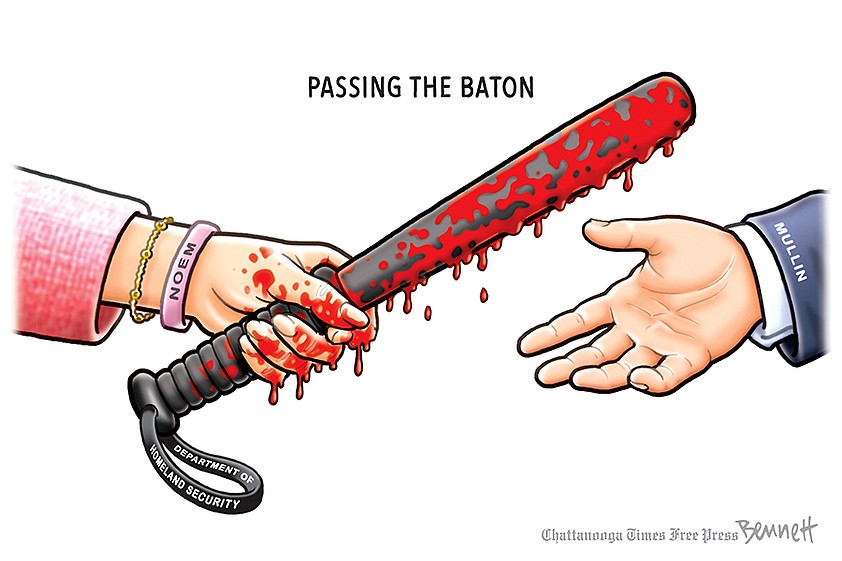
Kristi Noem’s contempt of court got covered in the featured post. But that wasn’t even the only Noem scandal this week: $220 million of DHS money has gone to an ad firm with close ties to Noem. The money is for image-building ads starring Noem herself.

Under Noem, DHS bypassed the normal competitive bidding process when awarding the contracts — allocating the majority of the money to a mysterious Delaware LLC that was created days before the deal was finalized. The Strategy Group does not appear on public documents about the deal.


My annual dose of humility: The NYT’s 100 Notable Books list for 2025. This year I’ve read three: 1929, Katabasis, and Being Jewish After the Destruction of Gaza.


In stark contrast to Trump’s apparent concern with drug smuggling, which has caused him to have the US Navy murder 80 or so Venezuelan fishermen — see the featured post — he said this week that he intends to pardon former Honduran President Juan Orlando Hernandez, who is serving a 45-year sentence in US prison for drug trafficking and related offenses.

Who knows what this is about? Maybe Hernandez paid somebody off. Or maybe Trump is just showing loyalty to a fellow criminal president, or his characteristic sympathy for people at the top of a pyramid, no matter how corrupt the pyramid is.

Similarly mystifying: Trump commuted the sentence of convicted fraudster David Gentile from seven years to 12 days. Gentile ran a Ponzi scheme that defrauded more than 10,000 investors. Does Trump just identify with fraudsters? Or is there something more sinister happening?


The War Defense Department is investigating Senator Mark Kelly for his role in an ad reminding members of the armed forces not to obey unlawful orders, which is just what the Uniform Code of Military Justice says.

President Bone Spurs and Secretary Drunkard don’t seem to understand that any story placing them next to decorated-pilot-and-astronaut Kelly works to his benefit, not theirs.

Meanwhile, South Park has its sites on Hegseth in its Thanksgiving episode. The episode ends on a song that obscenely insults Hegseth, then asks “Pete Hegseth, what you gonna do? Your kids will watch this, and their friends will see it too.”

and let’s close with something fishy

No doubt this question has been keeping you up nights: Can an octopus learn to play the piano? The answer is: kinda/sorta, if you apply huge amounts of time and ingenuity to the project.

Crime in the Cabinet

Most administrations come and go
without credible evidence of a crime by a cabinet official.
There were two this week alone.


In January of 2017, as Barack Obama was getting ready to hand the presidency over to Donald Trump after eight years in office, the Heritage Foundation’s Hans von Spakovsky pushed back on the “myth” that Obama had presided over a “scandal-free administration”. Von Spakovsky listed six of what he described as “some of the worst scandals of any president in recent decades”.

One — using the IRS to “target political opponents” — was nothing more than a canard that circulated inside the conservative information bubble. (The IRS was skeptical of the tax-exempt status of new political organizations founded to take advantage of the Supreme Court’s Citizens United ruling. Most of the investigated organizations were conservative, but that was due to the flow of money rather than specific targeting of conservative organizations. In the end, nearly all of them were recognized as tax-exempt. More importantly: No link back to the White House was ever established.)

Others — Benghazi, government personnel records getting hacked, losing track of guns allowed into Mexico as part of a smuggling investigation, veterans dying while waiting for appointments at the VA — were screw-ups not rooted in any nefarious intentions.

Only one — the Hillary Clinton email controversy — involved any credible accusation of a crime. That was investigated by the State Department during the first Trump administration, and the report found “no persuasive evidence of systemic, deliberate mishandling of classified information.” No one was ever charged with a crime, much less convicted.

That’s not unusual. Crime in the cabinet is exceedingly rare. In the history of the United States, no cabinet official was convicted of a crime until 1929, when former Interior Secretary Albert Fall was found guilty of taking bribes in the Teapot Dome scandal. Three Nixon cabinet members and his vice president were convicted of crimes, which is one reason why the Nixon administration is remembered for its corruption.

But the Trump administration has a way of wearing down our standards and making us forget that lawlessness high in the executive branch used to be exceptional. For example, Trump officials violate the Hatch Act (banning government officials from using their offices for political activity) just about every day. Such violations went unpunished in the first Trump administration, so hardly anyone notices any more.

Even so, it was striking to hear two independent credible accusations of crimes by Trump cabinet officials in the same week.

  • DHS Secretary Kristi Noem all but confessed to contempt of court yesterday when she admitted she knew a federal judge had ordered a plane carrying detainees to El Salvador to turn around, but she ordered it to continue.
  • Department of War Defense Secretary Pete Hegseth reportedly gave an order to “kill everybody” in an attack on an alleged drug-smuggling boat in the Caribbean. Two survivors clinging to wreckage were then killed in a second attack. Even if the initial attack were legitimate (which it wasn’t), killing defenseless survivors is a war crime.

The second crime is more serious than the first, so let’s start there.

Kill everybody”. Since September 2, the Trump regime has launched at least 21 attacks against boats on the high seas that it claimed were smuggling drugs, killing at least 83 people. Friday, that story got even worse, when the Washington Post published a report that Defense Secretary Hegseth had given a “kill everybody” order for the first attack. Two people survived the initial attack and were clinging to the wreckage when a second attack was ordered. It blew the survivors to bits.

If true, that incident is a clear war crime attributed to a specific person, Hegseth.

Horrifying as that is, I think it would be a mistake to lose sight of the larger picture: If we frame this wrong, it might seem as if the air campaign against the boats was fine until helpless survivors were targeted. It wasn’t. Whether Hegseth ever said “Kill everybody” or not, under his command the Department of Defense has committed 83 murders.

No operational consideration justifies the attacks. They are not like the drone attacks that have assassinated terrorist leaders, controversial and morally dubious as those might have been. In those cases, the targets might not have stayed in known locations long enough for a strike team to get there. Or the host country might not have allowed our strike team in. Often, the choice was either to send a drone or let the terrorists go on about their business.

That’s not the case here. These boats were in open seas dominated by our Navy. They could have been seized and could not have gotten away. Whatever drugs they might have been carrying would never have reached American consumers. The crews could have been captured alive, and might have given us valuable information about their suppliers or distributors.

So attacking the boats achieved nothing that couldn’t have been achieved without killing people. Instead, the Trump regime chose to kill 83 people.

Remember: Smuggling drugs is not a capital crime. Even if the alleged smugglers had been captured and given due process, they could not have legally been sentenced to death.

It’s worthwhile to put this in a more familiar context. In Clint Eastwood’s Dirty Harry movies, Harry Callahan is a cop who chafes under the legal restrictions that bind him, and that allow criminals to eventually go free. In the first movie, Harry dares a suspect to go for a gun so that he can legally kill him.

But the second movie, Magnum Force, pits Harry against a death squad of rogue cops who start a campaign of assassinations against the city’s underworld kingpins. The squad expects Harry to join them, but rogue assassinations are too much even for him. “A man’s got to know his limitations,” Harry says.

That’s what we’re seeing now: Trump and Hegseth have turned the US Navy into a rogue assassination squad. They see enough evidence to convince themselves boats are smuggling drugs, show that evidence to no one, and kill the alleged smugglers on their own authority.

Even if you’re as tough on crime as Dirty Harry, you shouldn’t approve. A government has got to know its limitations.

The Trump regime gives two justifications: First, the end justifies the means (which is precisely what Dirty Harry’s rogue cops argued). On October 23rd, Trump made the ridiculous claim that each boat blown up saves the lives of 25,000 Americans. (This is the same kind of math that caused Pam Bondi to claim that drug seizures during Trump’s first 100 days had saved 119-258 million lives.) He postulated that if he told the Congress about the operation (not to seek their authorization, which he says he doesn’t need) “I can’t imagine they’d have any problem with it. … What are they going to do, say ‘We don’t want to stop drugs pouring in’?”

Again, those boats could be stopped without blowing them up or killing anybody.

Second, the regime stretches the definition of “war” to cover this operation. The drug cartels, say Hegseth and Trump, are like ISIS or Al Qaeda. This is typical of the way the regime perverts language, so that reminding soldiers of their legal responsibility not to follow unlawful orders is “sedition”, or individuals deciding to cross our border is an “invasion”.

Smuggling has been part of the American economy since before the Revolution, from British tea to Prohibition whiskey to Colombian cocaine. It has never been considered an act of war. Those 83 people on those fishing boats were not soldiers and were not at war with the United States. They’re murder victims.

But just for a moment, grant the claim that these attacks are part of a war. That’s where the Post’s new revelations come in: Once your enemies are disarmed and helpless, it’s a war crime to kill them. If the report is true, Pete Hegseth and those down the chain who carried out his orders are guilty of war crimes.

It appears, at least for the moment, that Republicans in Congress are not going to cover this up.

Republican Sen. Roger Wicker of Mississippi, chairman of the Senate Armed Services Committee, and its top Democrat, Rhode Island Sen. Jack Reed, said in a joint statement late Friday that the committee “will be conducting vigorous oversight to determine the facts related to these circumstances.”

That was followed Saturday with the chairman of the House Armed Services Committee, Republican Rep. Mike Rogers of Alabama, and the ranking Democratic member, Washington Rep. Adam Smith, issuing a joint statement saying the panel was committed to “providing rigorous oversight of the Department of Defense’s military operations in the Caribbean.”

Hegseth denies giving the order and calls the Post’s report “fake news”.

And before I leave this topic, there is one more dot worth connecting: Military judge advocate generals (JAGs) are supposed to vet these legal issues for the armed forces. But Hegseth purged the JAGs back in February, about a month into his term:

Hegseth told reporters Monday that the removals were necessary because he didn’t want [the JAGs] to pose any “roadblocks to orders that are given by a commander in chief.”

The plan from the beginning was to give illegal orders and remove all obstacles to carrying them out.

Kristi Noem’s contempt of court. Remember back in March, when a judge ordered DHS not to deport a bunch of Venezuelans to the CECOT concentration camp in El Salvador, including turning around planes already in the air? And DHS in fact did not turn those planes around, defying the judge’s order?

The judge, James Boasberg, has kept pursuing the question of who is responsible and whether they should be charged with criminal contempt of court. Tuesday, government lawyers answered the first question: DHS Secretary Kristi Noem made the call, after consulting with Deputy Attorney General Todd Blanche, Principal Associate Deputy Attorney General (now federal appellate judge) Emil Bove, and DHS acting general counsel Joseph Mazzara.

Dean Blundell cuts through the spin and legalese to draw this conclusion: The regime just threw Noem under the bus. Government lawyers say they’ll be happy to answer any further questions in writing, but that “No live testimony is warranted at this time.” In other words: We’ll answer the questions we want to answer with very carefully crafted spin, and we don’t want to give the court or anybody else the ability to frame their own questions or insist on clear answers.

Blundell summarizes:

  • They’re naming Noem now.
  • They’re trying to keep her off the stand.
  • And they’re trying to keep other insiders and whistleblowers from testifying live

Noem responded yesterday in an interview with ABC’s Jonathan Karl:

KARL: So, I have two questions on that. First of all, is that right? Does the — does the buck effectively stop with you on this? Was this your responsibility? And had you known the judge had ordered those planes to be turned around when that order was issued?

NOEM: Yes, I made that decision. And that decision was under my complete authority and following the law and the Constitution and the leadership of this president, who is dedicated to getting dangerous criminal terrorists and gangs and cartels out of our country. And I’m so grateful that we get the opportunity every day to do that and to make decisions that will keep America safe.

KARL: Did you know about — did you know about the judge’s order when you issued your order for the planes to go (ph)?

NOEM: You know, this is an activist judge. And I understand, you know, we’re still in litigation with this against this activist judge who’s continuously tried to stop us from protecting the American people.

We continue to win. His ridiculous claims are not in good standing with the law or the Constitution. We’ll win this one as well. And we comply with all federal orders that are lawful and binding and we will continue to do that.

But I’m proud of the decision that I’ve made. Proud to work for this president each and every day to keep America safe.

So there you have it: It’s up to the regime, and not the courts, to decide what is “lawful and binding”. She disagreed with the judge, so she ignored his order. If that’s not contempt of court, I don’t know what is.

The Monday Morning Teaser

It’s easy to get worn down by the lawlessness of the Trump regime. You hear that they’ve ignored some established legal principle and think, “Oh yeah. That’s what they do.”

But this week has been special and deserves your attention. Yesterday, DHS Secretary Kristi Noem admitted on ABC that she authorized the plane that flew detainees to El Salvador after a federal judge had ordered it turned around. Her justification: James Boasberg is an “activist judge”, and Noem will decide for herself whether her orders are “lawful and binding”. This single incident is contempt of court on its own, but it points something far broader and more threatening: The regime refuses to recognize that it can be bound by the courts.

Friday, The Washington Post reported that Defense (not War) Secretary Hegseth ordered the Navy to “kill everybody” in its September 2 attack on an alleged drug-smuggling boat in the open ocean. After the first attack, two survivors were clinging to the wreckage. So a second attack was sent to blow them to bits.

In the featured article “Crime in the Cabinet”, I’ll look at these two incidents and put them in the context of US history: Crimes committed by members of the cabinet are very rare. That we learn of two in one week is completely unique. That should be out around 10 EST or so.

The weekly summary is left to cover the confusing back-and-forth of Ukraine peace proposals; the shooting of two National Guard members near the White House, and Trump’s disproportionate response to halt the processing of all asylum applications; the end of the James Comey and Tish James prosecutions; and a few other things, before closing with a piano-playing octopus. I’ll try to get that out by noon or so.

Don’t Believe It

At some point, it becomes difficult, if not impossible, to believe almost anything that Defendants represent.

US District Judge Sara Ellis,
commenting on ICE and Border Patrol testimony
contradicted by their body camera footage

This week’s featured post is “The Vibecession and the AI Bubble“.

Ongoing stories

  • Trump’s assault on American democracy. A judge found that federal agents in Chicago repeatedly instigated violence against protesters, then lied about it in reports that painted the protesters as violent.
  • Climate change. According to Grist, the COP30 conference in Brazil closed with “no new agreements to wind down fossil fuel use or curb deforestation”.
  • Gaza. Ostensibly there’s a ceasefire, but there are still attacks and people still die. The famine conditions have abated but “the UN’s World Food Programme (WFP) reports that a quarter of households in Gaza are eating just one meal daily”.
  • Ukraine. Representatives of Trump and Putin put together a 28-point peace plan, which Trump has given Zelenskyy until Thursday to accept. It comes at a time of internal Ukrainian weakness, and amounts to a demand for surrender. It’s currently being revised in talks with Ukraine and Europe, who were left out of the original formulation.

This week’s developments

This week Trump did a lot to raise your outrage

Maybe it comes from the sting of his defeat on the Epstein Transparency Act, or from worsening dementia limiting his ability to control himself, but Trump has said and done outrageous things recently at a pace that is unusual even for him. It’s hard to know how to cover them. It would be easy to fill the entire Sift with nothing else, and several hour-long news shows I watched on the rechristened MS NOW did precisely that. But I’m torn.

On the one hand, these incidents only reinforce things you already know:

  • Donald Trump is a disgusting human being.
  • He regularly gets away with outrages that would have ended the career of any previous president, or just about any previous American politician. We’re a long way from the era when Obama could spark outrage by wearing a tan suit or putting his feet up on the Resolute Desk.

Meanwhile, substantive things have been happening in foreign affairs, in the economy, in the courts, and so on. Being drawn into Trump’s Crazytown antics removes us from the world of events that have lasting consequences for our lives and for the future of our nation.

On the other hand, ignoring these persistent outrages makes us complicit in normalizing them. American presidents have never acted like this before, and no one should want this kind of behavior to become acceptable.

So here’s my compromise: I’m going to list the three biggest outrages and link to longer accounts of them, because you should know what happened. But I’m also not going to let them take over and drive out all other news.

  • He threatened six Democratic lawmakers with arrest, trial, and death for making a video repeating the standard Defense Department doctrine that soldiers should refuse to carry out unlawful orders. (No one seems to remember the origin story of the right-wing Oath Keepers after President Obama took office: “More specifically, the group’s members, which number in the thousands, pledge to disobey orders they deem unlawful”. Right-wingers considered that position patriotic in 2009.) Trump has since denied that he was making a death threat, but who knows how his more rabid followers might interpret his statements? If somebody actually does shoot at (rather than just threaten) one or more of the Democrats, it will be a textbook case of stochastic terrorism. Notably, one of the Democrats is Arizona’s Senator Mark Kelly, whose wife Gabby Giffords has already survived a shooting.
  • He called a female White House reporter “piggy”. A week ago Friday, Catherine Lucey from Bloomberg was part of a press gaggle on Air Force One. She asked the kind of hard, direct question reporters are supposed to put to presidents: “if there’s nothing incriminating in the [Epstein] files”, why was he blocking their release? Trump pointed to her in a threatening way (see photo above) and said, “Quiet, quiet piggy.” The White House press secretary later defended this response as “frank and honest“.

This wasn’t an action of Trump himself, but falls into the same outrage category: The Coast Guard briefly considered reclassifying swastikas and nooses as “potentially divisive” rather than hate symbols. Public outcry made them walk that back.

Meanwhile, we still haven’t seen the Epstein files. The Epstein Transparency Act gives the Justice Department 30 days to produce the files. Trump says his DoJ will because there’s nothing to hide, but we’ll see what happens.

The Trump-ordered sham investigations into Epstein’s links to prominent Democrats opens the possibility that DoJ will claim it can’t release information related to an ongoing investigation.

It bears repeating that Trump could have ordered the files released at any time and still could. He didn’t need an act of Congress to force his hand. It’s absurd to claim that you support doing something that you could have done a long time ago and chose not to do.

The best people to deal with absurdity are comedians, so here’s The Daily Show’s take on the situation, where Jordan Klepper applies “Occam’s Giant Fucking Machete“. The whole routine is amusing, but if you’re pressed for time skip ahead to about the 12:30 mark.

and Marjorie Taylor Greene

It’s been interesting these last few months watching MTG become estranged from the Trump regime on issues like Medicaid, ObamaCare subsidies, and the Epstein files. In every case, she has taken the path consistent with Trump’s base and the promises he made them, while Trump has done something else. Just before he flipped back to the release-the-files side (sort of), Trump branded MTG as “Marjorie Traitor Greene”, which MTG claimed (believably) resulted in death threats.

Sadly, like Jeff Flake, Adam Kinzinger, and others before her, MTG decided not to stand and fight. Friday night she released a video announcing that she will resign from Congress on January 5 (coincidentally, just after her pension vests).

Her video is worth watching, mostly because of how well she describes the people she claims to represent. There’s some Christian-right stuff in there about abortion and trans rights, but mostly she’s talking about working-class people who have seen their prospects diminish and who have little hope for their children to have a better life. She’s not wrong about that, and Democrats have to figure out how to speak to and for these people.

Two places in the video stand out for other reasons. Around the 6:30 mark, she has just finished outlining all the ways she has fought for Trump and the Trump agenda in Congress before differing with him on a few issues. But then she says:

Loyalty should be a two-way street, and we should be able to vote our conscience and represent our district’s interests, because our job-title is literally “representative”. … Standing up for American women who were raped at 14 years old, trafficked and used by rich powerful men, should not result in me being called a traitor and threatened by the president of the United States, whom I fought for.

Around 9:15, she compares her relationship with Trump to a broken marriage:

I refuse to be a battered wife, hoping it all goes away and gets better. If I am cast aside by the President and the MAGA political machine and replaced by neo-cons, Big Pharma, Big Tech, military-industrial war complex, foreign leaders, and the elite donor class that can never ever relate to real Americans, then many common Americans have been cast aside and replaced as well.

But there was real news about Ukraine

Thursday, Axios published a leaked draft of a 28-point peace plan worked out by representatives of Trump and Putin, without input from either Ukraine or its European allies. The plan is shockingly one-sided. Ukraine gives in to Russia’s demands: limiting the size of its army, rewriting its constitution to outlaw NATO membership, and even surrendering more territory than Russia has conquered. In exchange it gets only nebulous commitments without clear enforcement mechanisms. Timothy Snyder goes through the proposal point-by-point.

Snyder points to something others have noticed: The plan’s curious phrasing suggests that it was translated from Russian. In other words, Trump’s peace plan was really just Trump’s name attached to Putin’s demands. Much of the plan is in the passive voice, like “Ukraine’s sovereignty will be confirmed.” Exactly who is doing this confirming is never specified. Treaties and other agreements are not written like this.

At first it wasn’t clear whether this was a final product, but Trump quickly got behind it and insisted that Ukraine accept it by Thanksgiving. “He’s going to have to approve it,” Trump said of Zelensky, who is politically weak right now because of a corruption scandal in his administration.

Europe pushed back, and Trump fumed. But today it looks like a second draft will happen after consultation with Europe and Ukraine. Probably Russia will reject this, and we’ll be back to square one.

and the AI bubble

That’s covered in the featured post.

and the regime’s bad week in court

Thursday, US District Judge Sara Ellis ordered ICE and Border Patrol thugs to stop brutalizing the people of Chicago. But an appeals court stayed her order, claiming it was too broad. Then she released 233 very damning pages of her findings. Specifically, federal agents and their leader Greg Bovino repeatedly lied, submitting reports that didn’t match what their body cameras recorded.

After reviewing all the evidence submitted to the Court and listening to the testimony elicited at the preliminary injunction hearing, during depositions, and in other court proceedings, the Court finds Defendants’ evidence simply not credible. … Defendants specifically directed the Court to certain videos and timestamps “to aid the Court in its review of those videos.” Presumably, these portions of the videos would be Defendants’ best evidence to demonstrate that agents acted in line with the Constitution, federal laws, and the agencies’ own policies on use of force when engaging with protesters, the press, and religious practitioners. But a review of them shows the opposite—supporting Plaintiffs’ claims and undermining all of Defendants’ claims that their actions toward protesters, the press, and religious practitioners have been, as Bovino has stated, “more than exemplary.”

Quite the opposite, the videos repeatedly show federal agents as the provocateurs, introducing violence into otherwise peaceful protests:

For example, Defendants directed the Court to two videos of agents outside the Broadview facility the evening of September 19, 2025. In those videos, agents stand behind a fence preparing to leave the facility’s gates and disperse what Defendants described as an unruly mob. The scene appears quiet as the gate opens, revealing a line of protesters standing in the street holding signs. Almost immediately and without warning, agents lob flashbang grenades, tear gas, and pepper balls at the protesters, stating, “fuck yea!”, as they do so, and the crowd scatters. This video disproves Defendants’ contentions that protesters were the ones shooting off fireworks, refusing orders, and acting violently so as to justify the agents’ use of force.

Or this:

Defendants also highlighted an October 3, 2025 video, presumably to show that agents driving the streets faced constant danger from cars ramming them on purpose. But instead of leaving this impression, the video … suggests that the agent drove erratically and brake-checked other motorists in an attempt to force accidents that agents could then use as justifications for deploying force.

After listing other examples and alluding to many others, Ellis conclude:

[A]t some point, it becomes difficult, if not impossible, to believe almost anything that Defendants represent. … Overall, after reviewing all the evidence, the Court finds that Defendants’ widespread misrepresentations call into question everything that Defendants say they are doing in their characterization of what is happening at the Broadview facility or out in the streets of the Chicagoland area during law enforcement activities.

Slate’s Mark Joseph Stern quotes Skye Perryman to respond to the objection that none of this matters because the Supreme Court will knuckle under to Trump anyway:

Listen, this is why we’re doing what we’re doing in the district courts. We are fully aware that somewhere down the line we can lose. But this is the place where the fog of war doesn’t enter the room. What enters the room is people telling the truth and the judge making findings. That is the story we tell, and it’s what we can do to hold the line right now. … [I]t’s frustrating that this order has been stayed. In other words, this changes nothing on the ground. But it is important to have the judge who ordered agents to wear bodycams now make findings in which she says: You just lied. And I think that is the value of all this.


Also Thursday, US District Judge Jia Cobb ruled that Trump’s deployment of the National Guard to DC was probably illegal. Her preliminary injunction gives the government until December 11 to get the troops out of DC.


And the prosecution of James Comey continues to be a comedy of errors. Recall: The career prosecutors found no case worth bringing to a grand jury, so Trump fired the US attorney and brought in Lindsey Halligan, his former personal lawyer. She couldn’t get any other lawyers in her office to accompany her, so she went to the grand jury alone. Having never prosecuted a case before, and trying to move quickly before the statute of limitations ran out, she made a botch of it.

Law-fare’s Benjamin Wittes comments:

It is actually hard to keep up with the pace of developments. Multiple times a day, documents land on this docket that contain new inanities, new abominations in the sight of the law, new factual revelations, new reasons to wonder not whether this case will collapse but only how. At the hearing the other day, Judge Michael Nachmanoff seemed to be struggling with exactly this question, asking an attorney for Comey—in effect—which motion he wants the judge to dismiss the case based on.


US District Judge James Boasberg will hold hearings next week to determine whether contempt charges are justified in the case where administration officials refused to turn around a plane deporting detainees to El Salvador.

and you also might be interested in …

One of the week’s great mysteries is why Trump’s Oval Office meeting with NYC Mayor Zohran Mamdani was such a love-fest. In the photo above, Trump is wearing the expression that South Park uses when Trump looks at his lover Satan.


The NYT is staying with the Kash Patel abuse-of-government-perks story. There are two pieces of it: use of his government jet for personal travel (something he criticized previous FBI Director Christopher Wray for), and assigning FBI SWAT agents as a protection team for his country-singer girlfriend.

and let’s close with something to be thankful for

I’ve long thought that the Fox News canard of a “war on Christmas” had it backwards: Christmas is the aggressor and is rapidly advancing against all our other holidays. As soon as Halloween was over, Christmas decorations started appearing, and the deluge of Christmas music can’t be far behind.

If you want to try to hold the Thanksgiving line, though, Country Living has a playlist of Thanksgiving songs you can use.

The Vibecession and the AI bubble

Depressed consumers and record-setting stock markets don’t usually go together.
Why are they both happening now?


I recently came across these two facts:

Those two puzzle pieces are hard to fit together. Naively, you might think the S&P 500 and the Index of Consumer Sentiment measure the same thing: optimism about the economy. But apparently the economy looks very different depending on where you stand: Investors are optimistic, consumers pessimistic.

Statistics. Government statistics paint a mixed picture: GDP growth for the first half of 2025 was 2.1%, which is about what it’s been averaging for years now, and is neither good nor bad. At 4.4%, unemployment is higher than it’s been lately, but relatively low by historical standards. (It was more than twice that high during the Great Recession of 2008-2009, and briefly peaked at 13.2% early in the Covid lockdown.) Inflation is running at about 3% — rising somewhat recently and higher than the Fed target of 2%, but well below the 7% of 2021, not to mention the 13.3% of 1979. Interest rates are in similar territory: A 30-year mortgage is running around 6.11%, which is neither exceptionally high nor exceptionally low, compared to, say, 3.15% in 2021 and 7% in 2023, not to mention 16% in 1982.

For a few years now, economists have been scratching their heads and talking about the “vibecession“, an economy that feels worse than the data justifies. (Paul Krugman has written several paywalled articles on this, beginning here.) In 2024, the Biden administration was fighting consumers’ pessimistic vibes, and now the Trump administration is. (The public’s assessment of Trump’s handling of the economy is deeply negative: 40% approval vs. 57% disapproval, according to the RCP polling average.)

Stocks. The stock market’s euphoria is somewhat easier to square with the ho-hum economic numbers: The record gains don’t represent a broad optimism about the economy, but instead are concentrated in a handful of stocks that have something to do with artificial intelligence (AI). For example, a flagship consumer company like Proctor & Gamble that has little to do with AI has seen its stock fall this year, from 180 in January to about 150 now. Pepsi was at 165 early this year and is at 146 now. Target is down from 145 to 87.

Understand that I have cherry-picked those companies to make a point; most stock prices have increased somewhat this year. But a J. P. Morgan analyst wrote in September:

AI related stocks have accounted for 75% of S&P 500 returns, 80% of earnings growth and 90% of capital spending growth since ChatGPT launched in November 2022.

The poster child for the AI boom is Nvidia, which you may not realize has recently become the most valuable corporation in the world, with a market capitalization (i.e., stock price per share times number of shares) that briefly topped $5 trillion at the end of October. Even more impressive: It didn’t cross the $1 trillion mark until sometime in 2023. The stock (adjusted for splits) was below $15 at the beginning of 2023 and hit $212 a few weeks ago.

Other AI heavyweights include Microsoft, Google, Amazon, Broadcom, IBM, Oracle, and a few other corporations. Not all of their stocks have soared as far and as fast as Nvidia’s, but their investors have been doing quite well.

Why don’t consumers identify with this boom? It’s simple: AI hasn’t really affected everyday life much yet, so it doesn’t feel like we’re in the middle of a generation-defining revolution. I know lots of people who have played with ChatGPT or some other AI app, and I’ve gotten used to the AI summary at the top of Google searches (though I don’t trust it yet). But I know very few people who either buy significant AI-related products or use AI tools to produce products they couldn’t produce otherwise.

At the moment, AI’s significance in the economy doesn’t justify its significance in the stock market. We’re at a point with AI similar to where we were with the internet in 2000: Most of us could check weather.com or order a cheap book from Amazon, but our lives had not yet significantly changed. Like the Internet stocks in 2000, AI stock valuations are based on visions of a future that is still to arrive.

Is AI in a bubble? That gap between investor’s visions and current reality raises a question: The Internet bubble popped, with great losses to many investors and an impact on the broader economy. Is AI also a bubble, and what will happen if it pops?

I’m currently reading 1929: Inside the Greatest Crash in Wall Street History by Andrew Ross Sorkin. I’ve also lived through the internet bubble of 2000-2001 and the subprime-mortgage real estate bubble of 2008. One common characteristic of bubbles is that accounting departments get a bit creative near the end. Everyone is convinced the market will keep going up, and a rising market can hide a lot of corner-cutting. (As legendary investor Warren Buffet once put it: “It’s only when the tide goes out that you discover who’s been swimming naked.”)

That kind of questionable accounting is happening inside the big AI-related companies today. This post by Shanaka Anslem Perera is a bit wonky, but puts the puzzle pieces together, focusing on Nvidia.

Wednesday evening, Nvidia reported its third-quarter earnings, which were up and looked excellent. The stock surged. And then a combination of human and (ironically) machine intelligence started digging into the footnotes of that report: Nvidia was booking sales that its customers were slow to pay for. In short, it was delivering chips, but not raking in a corresponding amount of cash. Second, its inventories were growing, which contradicts the common belief that Nvidia benefits from insatiable demand.

A third tell-tale sign is the incestuous flow of capital among the various AI corporations.

Perera writes:

The structure extends throughout the AI ecosystem. Microsoft invested $13 billion in OpenAI. OpenAI committed $50 billion to Microsoft Azure cloud services over five years. Microsoft uses those committed dollars to purchase Nvidia GPUs for Azure datacenters. Nvidia books the GPU sales as revenue.

Oracle announced a $300 billion, five-year cloud infrastructure partnership with OpenAI. This partnership requires Oracle to deploy Nvidia GPUs. Oracle has pre-ordered $8 billion in Blackwell architecture chips from Nvidia. OpenAI’s ability to fulfill its $300 billion Oracle commitment depends on OpenAI generating revenue that currently runs at $3.7 billion annually—a gap of $56.3 billion per year.

The total network spans $610 billion in circular commitments, according to an analysis of SEC filings, venture capital deal databases, and disclosed partnerships. The money flows in loops: Nvidia invests in AI startups, startups commit to cloud spending, cloud providers purchase Nvidia hardware, Nvidia recognizes revenue, but the cash never completes the circuit because the underlying economic activity—AI applications generating profit—remains insufficient.

That’s a complicated diagram, and AI is an intimidating subject. But a parallel example from a more mundane industry makes the pattern easier to grasp: How Boston Chicken went broke in the 1990s.

In a nutshell, the Boston Market formula worked like this: the company raised money in the stock market and then loaned it to large, sophisticated franchisees (known as “area developers”), who used the funds to open lots of Boston Market stores in a short time.

These developers then paid the company a franchise fee for each new store, royalties on food sales and interest on the loans. So right away, the Boston Market operation looked hugely profitable. That boosted the stock, which gave the company yet more cheap capital to lend to developers, to open yet more stores.

Even if the individual Boston Market franchisees were hemorrhaging money, that would have no impact on the parent company’s bottom line. The franchisees’ costs and losses were their own problem.

As a whole, the Boston Market corporate/franchisee operation wasn’t profitable, but the corporate side of it looked profitable by pushing its losses off on the franchisees. Ultimately, the loans the corporation had made to the franchisees couldn’t be repaid, and the whole scheme unraveled.

Something similar is happening with Nvidia: It raises money on the stock market and invests it in companies like Open AI and Coreweave, who send it to Microsoft or Amazon, who in turn use it to buy Nvidia’s products. Eliminate the middlemen, and Nvidia is essentially buying its own products. You can’t make money doing that, no matter what your earning statements say. What’s missing here is the consumer: Who’s going to buy enough AI-related products to make everyone involved profitable?

Patterns like this can resolve in one of two ways: Either the industry as a whole starts making money, i.e., the AI-to-consumer link suddenly develops in ways that produce boatloads of cash to pay for Nvidia’s chips, or the whole thing collapses on itself.

For historical perspective on this kind of thing, one classic read is Only Yesterday by Frederick Lewis Allen. The book is 1931’s view of the roaring 1920s. By 1931, the Depression was deepening and all the investment booms of the 20s had gone bust. But the striking thing about them (from our point of view, which Allen could not foresee) is that the narratives behind those booms were not wrong: The story of the Florida land boom was that Northerners were going to start retiring to Florida. Suburban real estate bubbled because automobiles would make it possible to move away from the crowded cities. Even the stock market boom that ended in the crash of 1929 had good narrative sense behind it: The Nvidea of the late 1920s was RCA, because radio was going to change everything. Also: chains like Sears and Montgomery Ward were going to out-compete the Mom-and-Pop stores. The automobile market still had a lot of growth in it. Aviation was a field with a big future. And so on.

The visions that inspired the booms of the 1920s nearly all came true, but not until the 1950s, long after the original investors were bankrupt. That happened again in the internet bubble: The internet did change everything, but not as fast or as easily as the boom companies needed it to. Something similar could happen with AI. The seers of an AI-dominated future don’t have to be wrong, they could just be too optimistic about timing.

What happens then? The larger economy is always harmed when a bubble pops, because a large quantity of capital appears to suddenly vanish. Actually, it went away gradually over a period of time as people made investments that weren’t going to pay off within the time horizons they needed. But the bubble obscured that reality, so when it pops the loss seems instantaneous. Loans that seemed to have adequate collateral suddenly don’t, and companies that had seemed healthy are suddenly insolvent. Bankruptcies lead to other bankruptcies like falling dominoes — I can’t pay you back because I was counting on other people to pay me back.

Because I’m losing money in one area, I need to sell my investments in other areas to raise cash. So the losses spread. (Tech investors also tend to be cryto-currency fans, expect to see Bitcoin prices collapse first, before a widespread banking crisis. That’s already started.)

Even people and businesses that are solvent stop spending, just from the sheer uncertainty of everything. Eventually governments have to step in, both by spending to prop up demand and as a lender of last resort to keep the banking system from collapsing.

None of that is inevitable. But it looks increasingly likely.

Obliviousness

Urbana is basically the country club and the ghetto, and neither group has any idea that the other group exists.

– Beth Macy, Paper Girl,
on returning to the Ohio town where she grew up

This week’s featured post is “Beth Macy Goes Home Again“.

Ongoing stories

  • Trump’s assault on American democracy. Post his election disaster, the shutdown, and the growing threat of the Epstein files, Trump’s coalition is showing some cracks.
  • Climate change. The COP30 international conference is happening in Brazil, without the US. Everyone is frustrated by the world’s slow progress in addressing climate change.
  • Gaza. The UN is voting today on a US-sponsored resolution to establish an international Gaza stabilization force.
  • Ukraine. As the weather gets colder, the drone war moves to center stage. Russia blew up an oil tanker in Odessa; Ukraine hit an oil refinery.

This week’s developments

This week everybody was talking about the shutdown aftermath

No one is happy with how the shutdown came out. It lasted a record 43 days, during which a lot of people worked without pay, saw their government services delayed, or perhaps even went hungry. But in the end it turned out to be an almost entirely symbolic fight, as Democrats got no concessions on their central issue: keeping ObamaCare premiums from skyrocketing in 2026.

The question is whether a better deal could have emerged later. Fundamentally, the Democrats’ problem is that you can’t play chicken with somebody who’s not afraid to wreck their car. As much as Americans were suffering, and as much as they were blaming that suffering on Trump, it’s not clear that Trump cared.

As Politico notes: SNAP benefits will start again soon, if they haven’t already. But meanwhile, millions of Americans will lose their benefits, due to “work requirements” that seemed designed to trap people into disqualifying themselves.

and whether Trump was involved in Epstein’s crimes

Last night, Trump flipped on releasing the Epstein files. After unsuccessfully trying to badger Republicans like Nancy Mace and Lauren Boebert into removing their names from the discharge petition to bring the Epstein Transparency Act to a vote in the House, and facing an overwhelming defeat when it finally will be voted on later this week, Trump reversed course, announcing that “House Republicans should vote to release the Epstein files” because “we have nothing to hide”.

Probably this means that he is confident the Senate will block the bill, but we’ll see.

I have to confess that when the Jeffrey Epstein sex-trafficking scandal got sucked into Q-Anon’s crazy theory of a world-ruling pedophile cabal, I lost what little interest I had. Surely this was just another conspiracy theory, blown way out of proportion by a cult of lunatics. (After all, if Democrats were synthesizing some eternal-youth elixir out of the blood of children, why did Joe Biden and Bill Clinton look so old? This was just one of the many bits of cognitive dissonance even a cursory glance at the theory raised.)

But lo and behold, there’s a kernel of truth at the center of all that nonsense. Jeffrey Epstein and Ghislaine Maxwell either induced or forced hundreds of under-age (or barely above the age of consent) girls into offering sexual services to their friends, who appear to have been some very powerful people. Rather than just internet rumors, there are real victims speaking out publicly, providing evidence strong enough to strip Prince Andrew of his title, send Maxwell to prison for sex trafficking, and get Epstein arrested and held in federal prison, where (the government says) he hung himself before a trial could happen.

In addition to trying to block release of what the Justice Department knows, various other facts make Trump look guilty of something:

There’s certainly a lot of smoke there, but whether Trump himself is in the fire has not yet been proved. This week we got even more smoke, as the House Oversight Committee released 20,000 emails it obtained from the Epstein estate. Trump was mentioned thousands of times in the emails — more than anyone else — and the emails strongly imply that Trump knew what Epstein was doing but stayed quiet about it. In one, Trump is described as a “dog that hasn’t barked”.


Epstein victims made a one-minute video pushing to have all the Justice Department’s files released.


OK, just for a moment assume the worst: Trump is shown to be an Epstein client; he’s abused underage girls. Does it make a difference?

Tim Whitaker argues that for Trump’s Evangelical supporters, it won’t. His argument has two main points: First, none of Trump’s previous sexual scandals (which Whitaker lists) have dented the MAGA/Evangelical alliance.

Despite these realities White Evangelicals overwhelmingly voted for him in 2016, 2020 and 2024 choosing instead to ignore or explain away what is an obvious reality: Trump already IS a sexual abuser. He doesn’t need to be on a client list for that to be demonstrated. His words, actions and court cases prove that he is.

Second, Evangelical churches have tolerated vast amounts of sexual misconduct in their leaders. Even if a big-time preacher loses his position in scandal, before long he’s been rehabilitated and is leading somewhere else.


Megan Kelly is already lining up how she’ll defend Trump if he turns out to be a participant in Epstein’s crimes: Epstein wasn’t really that bad.

Kelly went on to allege that she knew “somebody very, very close” to the Epstein case “who is in a position to know virtually everything.” She claimed the unidentified individual “told me, from the start years and years ago, that Jeffrey Epstein, in this person’s view, was not a pedophile.”

“He was into the barely legal type. Like, he liked 15-year-old girls. And I realize this is disgusting. I’m definitely not trying to make an excuse for this,” she continued. “I’m just giving you facts, that he wasn’t into, like, 8-year-olds. But he liked the very young teen types that could pass for even younger than they were, but would look legal to a passerby.”

OK, let’s start here: A 15-year-old isn’t “barely legal” in most states. At best she’s barely illegal. Here in Massachusetts, the age of consent is 16 — and the only reason it’s that low is to avoid criminalizing 16-year-old boys. If somebody wanted to raise the age-of-consenting-to-men-over-25 to 18 or higher, I’d be for it.

Additionally (as I’ve observed before about Israel and genocide), when you start listing technical distinctions in the definition of a word like “pedophile”, you’ve already gone far astray.

meanwhile, Trump’s coalition begins to crack

In the most plausible American-democracy-survives-Trump scenario, a Democratic sweep of the 2025 elections is followed by elected Republicans claiming independence from their president. It’s too soon to say that’s definitely happening, but there are signs.

One of the biggest factors enabling Trump’s rising autocracy in the nation as a whole has been that he had already achieved autocracy in the Republican Party. Combined with narrow Republican control of both houses of Congress, his complete domination of elected Republicans has allowed him to usurp congressional powers and avoid investigations of the most blatant corruption.

Recently, though, cracks have been forming. Trump’s cover-up of the Epstein scandal and the Big Beautiful Bill’s deep cuts to Medicaid and SNAP have allowed Marjorie Taylor Greene to get between Trump and his base. This week that dissension erupted into outright schism, as Trump withdrew his support of MTG, called her “Wacky” and “a ranting Lunatic”, and dangled an endorsement to tempt some Trump-loyal Republican to challenge her in a primary.

Tucker Carlson has also been increasingly critical of the regime lately, most recently claiming that the FBI is hiding something about Thomas Crooks, the gunman who tried to assassinate Trump during the 2024 campaign. Previously, he had denounced the post-Kirk-murder crackdown on free speech as well as the Epstein cover-up and the attack on Iran. (Isolationism is another issue where a Republican can out-MAGA Trump. Look for resistance to Trump’s escalating threats to Venezuela.)

When Trump demanded that Senate Republicans end the shutdown by scrapping the filibuster, Majority Leader John Thune calmly said no. Indiana just refused to accede to Trump’s redistricting demand. And former Indiana Governor Mitch Daniels published an op-ed that appears to be even-handed, but contains some veiled criticism of Trump. He offers this hope for the future:

At some point, the public could tire of playground insults and asinine nicknames, and start asking for a little more substance from those elected to serve them. Interminable stalemate, especially when the country enters a stretch of serious economic or national security difficulty, could trigger a collective demand to “Grow up.”

It’s not a revolt yet, but Trump’s levers of power are becoming unreliable. A would-be autocrat’s most important asset is the belief that his power cannot be resisted, that everyone must either give in or be run over. That’s slipping.


Jack Hopkins is always more cynical and speculative than I am. Now he’s assessing signs that the powers behind Trump are already choosing their new champion.

and you also might be interested in …

Following up on last week’s featured post: The Washington Post spells out how the Trump administration is allowing junk insurance back into the market.


CBS hasn’t been completely MAGAfied yet. Last night 60 Minutes focused on one of Trump’s corrupt pardons:

Last month, President Trump granted a pardon to a billionaire felon, after the felon’s company enriched a Trump family business. The pardon went to Changpeng Zhao, a Chinese-born businessman, who was accused by the Justice Department of causing, quote, “…significant harm to U.S. national security…” The president says he does not know Zhao. Our reporting shows that Zhao’s company supported a Trump family firm at critical moments leading up to the president’s pardon.


Trump’s feds seem to be pulling out of Chicago. The next American city for them to invade is Charlotte. This is the first swing state Trump has invaded, and I suspect he’ll regret it in 2026.


The reason global air temperatures don’t go up every year is that some years the oceans soak up more of the extra heat. But that energy doesn’t go away. An article in Grist explores what happens when oceans start expelling heat rather than absorbing it.


United States Conference of Catholic Bishops voted overwhelmingly for a statement critical of Trump’s immigration policies.

We oppose the indiscriminate mass deportation of people. We pray for an end to dehumanizing rhetoric and violence, whether directed at immigrants or at law enforcement. We pray that the Lord may guide the leaders of our nation, and we are grateful for past and present opportunities to dialogue with public and elected officials.


In some previous week, we saw that Kash Patel was using an FBI plane to go to his girl friend’s concerts. This week we find out that he has given her an FBI security detail.

Something I wonder about: With all the federal agents doing stuff like this, or trying to find dirt on Trump’s enemies, or working on deporting nannies and landscapers, is anybody actually trying to catch criminals any more?


The regime didn’t start blowing up boats it claims were smuggling drugs until September, but apparently Emil Bove, who was acting attorney general at the time and has since become a federal appellate judge, was describing the policy back in February.

So far, 20 strikes have killed about 75 people, and the regime has offered no evidence for its claims that the boats were smuggling drugs.

Ignoring the morality of killing people because you suspect them of a crime, the attacks are also bad strategy. When you capture people, you can flip them to get information. You can also capture their phones and other information devices. When you blow the boat up, you can’t do any of that.

“All this strategy is doing is killing people and the same amount of drugs is getting into the U.S.,” the former senior DOJ official said. “You didn’t save anybody or increase the number of people you’re saving in the U.S. It’s extraordinarily shortsighted and I don’t think it gets you the goal you want.”

Beth Macy Goes Home Again

The author of Dopesick goes back to her small Ohio home town and wonders: Could a troubled teen do today what she did decades ago? Maybe. But the hurdles to jump are higher now.


In the Broadway musical A Little Night Music, a minor character sings a poignant song about hope and hopelessness in the serving class. In “The Miller’s Son“, the verses argue with the chorus, as a kitchen maid alternately dreams of a better life and realizes that the only pleasures available to her are momentary ones that lead nowhere.

Her opening thought is that “I shall marry the miller’s son, pin my hat on a nice piece of property.” Each verse lets the fantasy run a little wilder: “I shall marry the businessman, five fat babies and lots of security”, and then “I shall marry the Prince of Wales, pearls and servants and dressing for festivals.” Of course, if the pleasures of the moment lead to a pregnancy, none of that is possible. But was it ever possible? She ends by bitterly repeating “I shall marry the miller’s son”, recognizing that for her such a match is no more likely than the Prince of Wales.

Beth Macy is 60-something now. She came from a poor family with an alcoholic father in the small town of Urbana, Ohio. She studied hard in school and was a good if unspectacular student. She went to college on a Pell Grant, became a journalist, and (eventually) an author of several best-selling books — one of which, Dopesick, about how corporate greed led to an opioid crisis in small-town America, was made into an Emmy-winning miniseries.

Her life, from one point of view, is the quintessential American rags-to-riches story we like to tell children: Work hard, don’t give up, and you can make something of yourself, no matter how unlikely that may seem at the moment. Abe Lincoln went from a log cabin to the White House; you can too.

But in her new book Paper Girl, Macy goes back to Urbana and (over a period of years) interviews everyone from her relatives to troubled high school students to the mayor. The main question on her mind: Is the path that she walked still open today? Along the way she learns a lot about hopelessness in the White working class, its turn to the political right, and political polarization in general.

Getting a degree. The quick answer to Macy’s original question is: The path is still open, but much narrower and more treacherous than it was in her day.

She follows several of Urbana’s young people who grew up in difficult circumstances, and runs into the same story again and again: They have the talent and ambition to get out of poverty and possibly make it in the wider world, teacher and other mentors are rooting for them, but something comes up. Juggling a job, school, and ongoing family trauma gets to be too much. Or some close relative needs care and has no one else to provide it. Or maybe it’s something as simple as a car repair they have no money to cover; the fifty miles to the state university turns into an insurmountable obstacle.

Almost as bad as the immediate problems is the fatalism they lead to: Of course something would come up. People don’t actually walk the path to education or training and a secure future any more. It was never in the cards for them to marry the miller’s son.

What reminded me of “The Miller’s Son” was how the get-educated path can sound just as improbable as the make-the-NBA or become-a-rap-star path. People have done it, but could you do it? Is it worth making sacrifices (and asking others to make sacrifices for you) to keep that dream alive?

Politics. So what changed between the 1970s and 80s and the 2020s? Part of it is political: As a society, we stopped investing in education. When Macy got her Pell grant, it was a free ticket to college, but it no longer is. Once, Pell grants were how we made real the promise of America, and we told ourselves (truthfully) that a college grad’s increased lifetime earnings would lead to income tax payments that more than reimbursed the government for its generosity. But during the miserly years of the Reagan revolution (and Clinton’s ratification of much of that course change), poor young people in college became just another kind of welfare queen.

And as federal support was drying up, colleges themselves have gotten more expensive, largely because states pay a much smaller part of the costs of their state university systems. Financial aid shifted from grants to loans, so that a graduate might start a career with six-figure debts. And if you didn’t graduate — if, say, something came up that knocked you out of college — you’d have almost as much debt but not the degree to help you pay it off.

Piling on further, the degree itself is not worth as much in the job market. Even a STEM degree might not help you if the job market is looking for some other kind of STEM degree the year you graduate. (For example, the freshmen who chose a computer science major four years ago may not have realized they’d have to compete with AI algorithms for entry-level jobs.)

I’m not sure anybody is asking this question, but they should: What kind of program would it take to make the promise of America real today?

Family. Macy quickly notices the symptoms that students’ lives have changed: High school graduation rates are down. Attendance is down. Ohio’s liberalized homeschooling laws make even those numbers look better than they actually are, as parents who can’t get their children to school and are sick of dealing with truant officers sign a paper saying their child is being homeschooled. No one checks that the child is actually getting an education.

Meanwhile, public schools are losing funds to Ohio’s private-school voucher program, which makes private schools less expensive for the well-off without truly making them accessible to the poor.

Of course, homeschooling only works if home is working. And here we run into the opioid crisis Macy chronicled in Dopesick. She tells stories of teens who either couchsurf or are homeless through high school, because one parent is a drug addict and the other is in jail. It’s hard to say whether there is more sexual abuse than in Macy’s teen years, but there is certainly a lot of it. Paying attention to trigonometry or Shakespeare is probably not at the forefront of many students’ minds.

Many teachers, counselors, and coaches try to step into the breach, but it’s too much for them. A gay man who runs a teen center wrangled a grant out of the state, but couldn’t get the local government to sign off on it because of homophobic fears that he was “recruiting” teens into the gay lifestyle.

Community. In Macy’s day, Urbana was a more integrated community, at least in the sense of class. One way she coped with her dysfunctional family was by spending a lot of time with friends whose families were thriving. But increasingly, Urbana is siloed into the haves and have-nots.

Urbana is basically the country club and the ghetto, and neither group has any idea that the other group exists.

So a present-day Beth Macy may not know about those thriving families or be invited into their homes. She might not hear friends’ professional-class dreams and wonder “Why not me?”

A journalist herself, who began her career writing features about local characters for local newspapers, Macy sees great significance in the decline of local journalism: Urbana’s main local news outlets are Facebook pages and advertising sheets that publish press releases rather than news stories. How do Urbana’s people hear about folks unlike themselves? How do they find out about events happening outside their silo?

The results are twofold: On the one hand, Urbana’s citizens have lost their town as a source of identity, causing them to seek identity in politics or religion. On the other, they have lost a sense of their fellow citizens as Us, and have a corresponding willingness to accept conspiracy theories about Them.

Polarization. Urbana, and in particular its working-class population, is among the victims of globalization. The family business that once was the town’s major employer was long ago sold off, and most of its jobs have gone overseas. When Bill Clinton was pushing NAFTA and similar once-Republican free-trade policies, the promise was that new jobs would replace the old jobs, and that the overall benefit to the American economy would allow us to invest in retraining the displaced workers.

That never worked out. The new jobs weren’t where they needed to be, and the retraining rarely prepared the displaced workers adequately. Most of them wound up working in places like WalMart and never regaining the financial stability the old jobs had offered. Many found ways to retire early or claim disability.

So when Trump tells such people that they’ve been forgotten, he’s not wrong. Much of what he tells them after that is false; the Haitians in nearby Springfield were never eating the local dogs and cats. But having seen them and offered at least some explanation of their situation gets him in the door. When he offers to deport the immigrants who are “stealing their jobs”, that’s at least a plan of some sort.

Now connect that with the sense of hopelessness in the young people: They can’t hope to get the jobs their parents or grandparents had. Getting post-high-school training and going on to land the good jobs that still exist — that seems like a pipe dream, not a realistic plan. Parents can’t look forward to their children having a better life than they did.

One of the questions “Make America Great Again” always raises is “When was the great age that ‘again’ promises to restore?” The obvious answers raise issues of racism and sexism: Was America great during Jim Crow? Was it great when women couldn’t get a credit card without their husbands’ signature? When gays had to be in the closet? When?

And yes, MAGA has always been tainted by a background scent of bigotry. But fundamentally, “again” appeals to the feeling among White working-class families that Americans like them used to have hope. Those dim memories make them feel entitled to hope, and to recognize that they don’t have it now.

Someone must have taken it from them.

That’s the opening that Q-Anon and other conspiracy theories exploit. Macy recounts many conversations with relatives or high school friends who have bought some form of conspiracy theory. When Macy tries to offer facts, she is told “You can’t trust the media.” And she replies “But I am the media.” If this provokes any cognitive dissonance in people who ought to trust her, it’s not enough.

That disconnect is, I think, typical of the college/non-college divide. If you went to college, and even moreso if you went to graduate school, you have a sense of the accessibility of expertise. I may not know Anthony Fauci, for example, but I know biologists who understand infectious diseases. There was a point in my life where I could have gone into biology or climate science or a discipline at the center of some other alleged conspiracy. When would the conspirators have read me in? Why don’t my friends ever tell me about such moments?

But if you didn’t go to college, those disciplines may seem so distant that literally anything could be happening there.

Privilege. I think I also understand now why the MAGA working class is so hostile to any “woke” talk about White privilege or male privilege. Again, racism and sexism probably play some role, but maybe not the main role.

It’s always been the habit or ruling classes to rob Peter to pay Paul. If a ruling class has a debt, chances are it will steal from someone else to pay it, like the United States taking Liberia to offer to freed slaves. I mean, God forbid that those who profited from slavery should shoulder the cost!

Integration of public schools followed a similar pattern: Well-to-do Whites thrust that social experiment onto working-class Whites, while either moving to upscale suburbs or sending their own children to private schools.

So if recognition of privilege takes hold, who will be asked to pay the debt owed to the un-privileged groups? White or male MAGAts anticipate being handed the bill themselves, and not being able to pass it on to the billionaires. And they’re probably not wrong.

How to win them back? For too long, Democrats have tried to depend on Truth to win out: Climate change is real. Privilege exists. Immigrants benefit the economy. Cutting rich people’s taxes never works out for those who aren’t rich. And so on.

What we miss is that Truth will not win out if the Truth is hopeless. If the Truth is: “You’re screwed. Try to get used to it”, that Truth will not win elections for us, even if the other party offers transparent nonsense.

We need to recognize the hopeless parts of America and begin speaking to them. We need to begin offering plans for them and their children and their communities to have futures they can believe in.