Bullies seem to have a finely tuned awareness of where the margins of permission lie as regards abuses, and choose their targets based on whose suffering will be most broadly acceptable to others.
Here we see a combination of a substantive issue with one of those blood-boiling but essentially meaningless things we see over and over: We find ourselves in an all-out trade war with our nearest neighbor and closest ally. That’s important. And Trump has ordered the name of Lake Ontario changed to Lake America, which is annoying but of no real consequence. (As soon as Trump is out of office, no one will say “Lake America” or “Gulf of America” ever again.)
As [Prime Minister Carney] described it, he was faced with a trade agreement that was suddenly transformed into an attack on Canadian sovereignty, an attempted psychological annexation that could have turned Canada into an American client state, a sort of North American Belarus.
an all-out trade war would create a lot of pain in the U.S. in addition to inflicting severe damage to the Canadian economy. And all indications are that the Canadians will be much more willing to bear the pain of a trade war than Americans will – especially given that the great majority of Americans are already dissatisfied with Trump’s economic management.
Former Trump official Miles Taylor sees Canada’s resistance as a harbinger of nations getting fed up with trying to appease Trump. “nothing on earth scares Donald Trump like an opponent who fights back.”
Trump’s bid to control who can cast a mail-in ballot had another set-back Thursday, when his executive order was blocked by a federal judge. A previous block had been lifted by the Supreme Court just a few days before, but on technical grounds that didn’t reach the merits of the case.
Things continue to look good for Democrats. A series of polls in Michigan have El-Sayed up slightly. Josh Marshall concludes:
I’m not saying El-Sayed has this wrapped up. I’m saying that the idea that he can’t win or that the results of the primary were some kind of decisive setback for Democrats’ chances just can’t be squared with the available evidence. At least not so far. This is very much a race and it’s one in which El-Sayed kind of has to be viewed as a favorite to at least some degree.
So-called “centrist” pundits like Jonathan Chait really need to calm down. His column is about how El-Sayed needs to denounce this guy and separate himself from that guy more strongly than just saying he disagrees with what they’re saying. Chait says virtually nothing about what El-Sayed himself says or believes or hopes to do in the Senate.
Last week, I described the Democrats’ chance of winning a Senate majority this fall. I went through the states commonly viewed as having competitive Senate races and came out with a winning scenario — far from a sure thing, but more than wishful thinking. I didn’t consider any of the true long-shot races Jay Kuo covered Thursday: Mississippi, Kansas, South Carolina, Nebraska, and Arkansas. I’d be surprised if any of these red states seats flipped, but Kuo makes a good case that it’s not impossible.
and Venezuela
Friday, Trump announced on social media “THE BIGGEST OIL DEAL IN WORLD HISTORY!” The deal, which AFAIK still hasn’t been confirmed by any on-the-record American government office, supposedly involves 17 oil fields with 65 billion barrels of proven reserves.
The agreement allows for the United States to partner with an unnamed private operator in Venezuela to create a new private company to take hold of the reserves, according to a U.S. official familiar with the contours of the deal. The official, who was not authorized to comment publicly and spoke on the condition of anonymity, added that [Venezuelan President Delcy] Rodríguez granted the company 100-year rights to develop the oil fields. The deal gives the United States 55% effective output of the new private company — including an ownership stake and rights to buy oil at cost. The company would be the second largest corporate holder of proven reserves after Saudi Aramco, according to the official.
Phillips O’Brien points out that there all kinds of problems with this arrangement. For one thing,
it is not clear what element of the US government (if any) either can or will hold the equity stake in any new company
The American stake would have to be controlled and overseen by some particular department or agency, and without any congressional action it’s not clear who could do that. And without Senate ratification, this isn’t an official treaty. Like Obama’s nuclear deal with Iran, it could be cancelled by any future president.
There are also problems on the Venezuelan side, because their constitution does not allow the government to sign away the country’s natural resources. If a future Venezuelan government thought it could get away with taking the oil fields back, it would face no legal barriers.
And finally, who are we making this agreement with? When we deposed Maduro, we were supposedly bringing freedom to the Venezuelan people. But since then we’ve ignored the democratic opposition and recognized Maduro’s henchmen as the government. O’Brien sums up:
I am providing this information so that there is no mistake about what the Trump administration is, and has been doing. It got rid of Maduro to entrench even more ruthless alleged criminals, the exact kind of people with which it can and, indeed, likes to do business.
Add to the mix that the country’s oil industry is a mess and requires huge amounts of capital investment (which so far the major oil companies haven’t been willing to fund). It will take years to substantially increase production. Also, Venezuelan crude oil is heavier than most American refineries can process, so there won’t be any big increase in gasoline production any time soon. Clean Technica has a fairly technical analysis that comes to the conclusion:
Raising output materially would require something closer to $100 billion over a decade. That scale of capital must be patient, politically insulated, and confident in long term demand. Even if someone was willing to pay for it, significant increases are a decade away in a world clearly pivoting away from oil and toward renewables and electrification.
and you also might be interested in …
I hope to review Gil Duran’s “The Nerd Reich” before long. In the meantime, check out this five-minute video about J. D. Vance and his puppet-master Peter Thiel.
David Frum looks at how other countries have recovered money from their past despots, and speculates about using civil suits to claw back Trump’s “ill-gotten gains”.
For about a year Christopher Armitage was a corrections officer in a prison. It taught him something about politics and the psychology behind MAGA.
I began to see a pattern that my psychology training wouldn’t let me ignore. The same personality traits that concentrated behind bars, what psychologists call the “dark triad” of psychopathy, narcissism, and Machiavellianism, were appearing throughout our political system. The empathy deficits that defined prison life weren’t confined to cellblocks. They were running for office, hosting talk shows, and writing legislation. … American conservatism has become an ideology that systematically suppresses empathy. It rewards the prison mentality: dominate or be dominated, trust only your tribe, see kindness as weakness. It’s created a political movement that mirrors the psychological dynamics of incarceration, complete with gang colors in the form of red hats and protection rackets in the form of vote-for-us-or-the-criminals-will-get-you rhetoric. …
The prison mirror reflects perfectly here: just as inmates must perform toughness to maintain status, conservative politicians must perform cruelty. Expressing empathy for the wrong group, immigrants, trans kids, the poor, marks you as weak, a “RINO” who’ll get primaried
A Stanford student newspaper won its suit against the Trump administration. It claimed that international students were afraid to write articles for fear they would be deported if Trump disagreed with what they said. The judge ruled that foreign citizens on student visas have the same free-speech rights Americans do, and that they cannot be deported based on what they have written or said.
and let’s close with a look back
I’m sure you’ve had no trouble finding coverage of Dolly Parton, who died Tuesday. She was one of the few public figures — it’s hard to find a comparable one — whose appeal spanned the political divide. She was an authentic up-from-poverty success story who never forgot about the kind of people she grew up around. Late in life, her philanthropy was as famous as her music.
If you wonder what the fuss is all about, The Guardian provides a curated list of 10 of her best songs. As someone lost a spouse less than two years ago, I resonate with her final hit “If You Hadn’t Been There” about her husband Carl Dean who died in 2025 a few weeks before their 59th anniversary. “I wouldn’t be here if you hadn’t been there.”
Labor Day is the traditional signal for Democrats — but usually not Republicans these days — to abandon their edgier positions and “move to the center”. In some situations this is common sense. In others it’s dangerous.
A classic business-school homework problem concerns where to place snack shops on a popular beach. If there are two competitors, where should they set up to get the most business? The best solution for customers — assuming the beach is evenly populated and nobody wants to walk further than necessary to get a Sno-Cone — is to put one shop 1/4 of the way from the left edge of the beach and the other 1/4 from the right edge. That way, nobody has to cross more than 1/4 of the beach to get served.
But now imagine you’re running leftmost shop. If you nudge a little to the right, you may pick up some of the other shop’s customers, while losing few of your own (i.e., only the ones at the far left end who look at the longer walk and decide they’d rather do without). Of course, the same logic motivates your competitor to shift left, and the process continues until your two shops are side-by-side in the center. Customers overall are worse off, but that’s market capitalism for you. Nobody ever said the market produces ideal solutions. (Oh, wait. I guess some people do say that. Never mind.)
For a lot of political professionals (especially Democrats, for some reason), that homework problem frames their fundamental thinking about campaigns. Politics happens on a left/right spectrum, and the ideal marketing position for your candidate is in the center. If you’re unfortunate enough to be working for a left-leaning candidate, you need to nudge him or her to the right as far as you can. Doing so puts your political shop closer to more of the electorate, so it’s just common sense.
Arguments against this way of thinking revolve around what the model leaves out. For example, it removes the moral dimension from politics. No one lives or dies because they have to walk a little further to get their Sno-Cones. But lives clearly do hang on decisions about war, healthcare, abortion, foreign aid, and many of the other issues decided by our political process.
The Right clearly understands this. Take the abortion issue for example. If you believe that every fertilized ovum has a soul that is sacred to God, then abortion is murder and is always wrong. (I critiqued this position several years ago.) Republicans know this position is far outside the American mainstream, but they never move left in any serious way. (Thought experiment: How much support could you raise on the Right for a compromise that capped the number of legal abortions in America, establishing some criteria for who gets those abortions? If a million baby-murders is unacceptable, how about 100,000? I’m guessing the answer is no support at all.) One Republican position after another is rooted in Christian nationalism, with its underlying frame of spiritual warfare between Good and Evil. Compromise with Evil is wrong, even if it could win you a few votes.
Another factor left out of the snack-shop model is authenticity. People who get to the front of the line never doubt that the shop wants to sell them the items on its menu. But when politicians say things that are popular but out of sync with their previous positions, do you believe them? If Mike Johnson announced that government spending cuts had gone too far, or if AOC promised to get tough on illegal immigrants, would you buy that? Even if you liked the new position, would you be more likely to vote for them? Or less likely, because you might doubt that they had any authentic beliefs at all?
And finally, what do “left” and “right” mean, anyway? Free trade used to be a conservative position, but now tariffs are. If I defend San Francisco’s sanctuary city policies, is that a left-wing position (because it’s globalist rather than nationalist) or right-wing (because I’m defending local control against federal intervention)? If you want to stop corruption and keep inflation low, are you liberal or conservative?
The primary “center” position is that you are willing to “work across the aisle” to “get things done”. But what things?
So here’s the point I’m trying to make: Calls for Democrats to move to the center do have a logic to them. But to evaluate the wisdom of those calls, you need to reconsider the factors the beach-snack-shop model leaves out. What particular positions are we being asked to change? Would anyone believe us if we did announce those changes? And who are we abandoning when we do?
Let me suggest a list of people to bear in mind when you ask that third question.
Asylum seekers. In the wake of the Holocaust, the nations of the world recognized that people who are facing dire situations in their home countries need to have somewhere to go. We signed those treaties and implemented their principles in law. Currently, our asylum system is swamped, and its delays create opportunities for immigrants to game the system. But the right solution is to fix the system, not abandon the principles embodied in our laws and agreements. We shouldn’t turn people away just so they can be killed back home.
Women with problem pregnancies. Laws that protect fetuses often endanger pregnant women. In some states, a pregnant woman’s life needs to be in immediate danger before she can get an abortion. Even if that danger is predictable, it can’t be acted on until it arrives. And sometimes doctors wait too long.
Trans people. Something I know from my own friend group (and their children) is that trans people are real. They aren’t making it all up, and they’re not looking to gain some advantage. To move to the center, do I have to pretend that they’re not real? Do I have to support laws that solve no problems, but mark them for harassment? Do I have to stop parents from using their best judgment about what medical treatments their children need?
The working poor. Many Americans who have jobs and work full schedules can’t afford health insurance for themselves and their families. Do I need to become OK with that?
Victims of ICE’s crimes. The world saw the murders of Rene Good and Alex Pretti. Nothing has been done to bring the murderers to justice or reform the organization that employed and shelters them. Seldom does a week go by without some shocking abuse of ICE’s power. Do we just ignore this, or blame it on a few bad apples (who nonetheless must be protected)?
People in poverty. In poor countries, the cost of saving lives is fairly small. Elon Musk’s destruction of USAID seems likely to result in hundreds of thousands, if not millions, of deaths. The endangered people are also real. Should we not care about them?
A final question to ask about reaching compromise in the center: Who are we compromising with? Are they offering some actual compromise, or just demanding our approval for their abusive policies?
An important article to read when thinking about this question is A. R. Moxon’s “Soon You Too Will Be a Commie“. Moxon puts a completely different frame on the Right: They’re not a rival snack shop on the other side of the beach, they’re bullies looking for people that they can abuse without consequences. He recalls his own childhood bullies accusing him of being gay, him denying it, and them beating him up anyway.
[B]ullies seem to have a finely tuned awareness of where the margins of permission lie as regards abuses, and choose their targets based on whose suffering will be most broadly acceptable to others. Seems to me bullies always seek to expand the margins of permission for their violence, and one of their standard tactics is expanding the definition of whatever group is broadly acceptable, to include more and more people. Seems to me that when you insist that you aren’t in that group, or take pains to demonstrate that you aren’t in that group, you appease the bully’s premise that a person who [is] in that group deserves abuse. Seems to me that when you get the abuse anyway, the bully has successfully completed the expansion of permission wherein that group now includes you. In a bully’s world, where gay means a beating is deserved, eventually you’ll be gay, too.
Moxon is focused on a somewhat different issue — the pressure Democrats are under to denounce “far-left” allies. (See Abdul El-Sayed and Hassan Piker, which I’ll say more about in the weekly summary.) But the same principles apply to many of the groups on my list above. One complaint I have often heard about Kamala Harris’ 2024 campaign is that she shouldn’t have talked so much about trans rights. But here’s the problem with that critique: During her 2024 campaign, I don’t believe Harris talked at all about trans rights. It was the Trump campaign that relentlessly raised the trans issue: “Kamala is for they/them. President Trump is for you.” Trump (falsely) accused a Olympic medal-winning boxer of being trans. But Harris had defended trans rights in the 2020 primaries (making up for a mixed record previously), and that was all it took. No number of speeches about kitchen-table issues could make the trans issue go away.
What would she have had to do? Come out against trans rights? Repeat some anti-trans framing, the way Rep. (and current Senate candidate) Seth Moulton did after the 2024 election? (“I have two little girls, I don’t want them getting run over on a playing field by a male or formerly male athlete, but as a Democrat I’m supposed to be afraid to say that.”) Become a bully herself?
With regard to protecting any of the groups I listed above, what is the compromise position? (Restoring half of the money Musk took from USAID? Funding fewer ICE concentration camps?) Who would those compromises appeal to, and how many votes would they be worth?
It won’t work to just stop talking about those issues, because Republicans have a lot of money to keep raising them. That’s the lesson of the Harris campaign. And no maybe-you’re-right rhetoric will be strong enough. I don’t think you can split the difference between bullies and their victims. You can either defend the victims or join the bullies.
Next weekend is Labor Day, which is the traditional let’s-get-serious moment in American election campaigns. Ad wars heat up, and people who don’t pay a lot of attention to politics begin to wonder what offices are up for grabs this time and who they might want to fill them.
The conventional wisdom says this is the time to stop trying to rally your base and start talking to the swing voters, who occupy some theoretical “center” of the political spectrum. It’s time to drop your edgier positions and focus on so-called “kitchen table issues” like the price of gas. That’s the question I address in this week’s featured post “Hazards and pitfalls of moving to the center”. In that post, I try to give move-to-the-center its due as a logical path forward, while examining what this kind of thinking leaves out.
The question I come down to is: When you get down to the nuts-and-bolts of exactly which positions you would need to change or de-emphasize, who would you be abandoning? I’ll try to get that out by 10 EDT.
In the weekly summary, I’ll continue the practice I started last week of separating substantive developments from the ones that just boil your blood, for example separating Lake America from the larger trade war with Canada. Among those substantive issues are the apparent deal to control Venezuela’s oil, the heat build-up in the oceans, the fall elections, and the continuing effort to control the worst excesses of the Trump regime through the courts. And I’ll close with a farewell to Dolly Parton.
Here is the thing. If you tell me that you believe that race is a biological category and that it is a guide to the objective superiority and inferiority of groups of people, I am not calling you a racist to insult you, I am calling you a racist because it best describes your beliefs.
Iran. The Strait of Hormuz is still closed. We’re still running out of precision missiles. Trump still has no plan.
Ukraine. Ukraine continues to hammer Russia’s oil industry, which is the foundation of its economy. They’re not targeting oil as much as Phillips O’Brien wants them to, but attacks are ramping up. Meanwhile, Russia is trying to knock out Ukraine’s power grid for the winter, and is doing it much better now that US air-defense aid is completely exhausted.
This week’s developments
This week everybody was talking about our strange foreign policy
So North Korea is good and Canada is bad. Got it?
As North Korea goes full speed ahead on building the nuclear weapons we’re spending billions to keep Iran from getting, Trump wants a summit meeting with Kim Jong Un. To make himself more attractive to Kim, Trump cut short our planned military exercises with South Korea, saying that the exercises are “inappropriate and hostile” to the North, which is in the running for the most oppressive country in the world. If you’re looking for some good behavior that Trump is rewarding, you won’t find any.
Trump has maintained that he enjoys a “great relationship” with Kim, telling reporters on Wednesday: “He likes me”.
That’s all that matters. Previous American presidents didn’t think having a “great relationship” with one of the world’s bloodiest dictators was a worthy goal, absent some concession from the North Koreans. But Trump is focused on himself, not on the interests of the United States or the free world.
Meanwhile, we have entered into a trade war with Canada. Phillips O’Brien summarizes: The dispute is
is about far more than trade, it is about Canada’s right to exist as a sovereign state. … Canada is faced with a USA that is now fundamentally dishonest and rapacious. Moreover, it is faced with a US government that denies its ultimate right to exist and speaks openly (and regularly) about how Canada should be annexed into the USA.
All through Trump’s second term, foreign leaders have been treating him like a crazy uncle: Flatter him. Don’t do anything to set him off. Don’t call him on his bad behavior. Canadian Prime Minister Mark Carney is done with that. He described the impossibility of coming to any agree with the Trump regime.
We’ve recognized from the start that America has changed. We recognize that sometimes, its signature is written in pencil.
In other words, an agreement with Trump only lasts until he decides he wants something else from you. Friday, tariffs on an estimated $20 billion of Canadian goods went into effect, and Trump is threatening 50% across-the-board tariffs on January 1.
US President Donald Trump has said Canada wants “the benefits of being a state, without being one” after trade talks between the two countries collapsed late on Friday.
He has repeatedly said that Canada should be “the 51st state”. How do you negotiate with that?
and control of the Senate
That’s the subject of the featured post. Democrats’ odds are only improved by the tone-deaf candidates Republicans are running in key states. Here, North Carolina Senate candidate Michael Whatley disparages the anti-data-center movement.
You gotta remember that this opposition to data centers is not organic. This is being ginned up.
As if the big money were against data centers rather than behind them.
and some outrage stories: Harp and the USS Trump
As I’ve mentioned before, I don’t know what to do with stories that grab public attention, raise people’s blood pressure, and maybe illustrate character flaws of certain important people, but have no direct impact on our lives. Lately, though, they’ve been turning up so regularly that I feel like they need their own category. Feel free to skip down to the next section.
This week we heard endlessly about Natalie Harp, Trump’s closest aide. It all started with this fairly innocuous line by Georgia Senator Jon Ossoff, who is running for reelection in November.
[I’ve added links in case you don’t recognize the news stories Ossoff is referencing. They’re all legitimately fact-based.]
Now, the heart of Ossoff’s charge is “He doesn’t want to do the job.” We’re at war, and we appear to be losing. The economy is beginning to stall out. Working Americans are having a harder and harder time paying for basic necessities like groceries and fuel — not to mention health insurance. The annual budget deficit may exceed $2 trillion before the fiscal year ends next month. We’re continuing to do nothing — and even go backwards in a lot of ways — in the face of climate change. But our president doesn’t have a lot to say about any of that. If you retain anything from Ossoff’s quote, that’s what it should be.
But that’s not what the White House responded to. Trump and all his minions appeared to take deep offense at “He wants … to travel with Natalie.”
But although Ossoff’s aside resonated with the junkies, the majority of Americans likely had no idea who this Natalie woman was, and might never have given it another thought. But then the West Wing lost its mind. And Trump did too. Their pushback was so overwhelming, so obviously coordinated, so ugly and personal that it became a story. The White House inadvertently created news, as well as a permission structure for even the most cautious, fact-based media organizations to take on the topic. Which is why the name Natalie Harp is now everywhere.
This is known as the “Streisand effect“: By objecting to a fairly minor story, you turn it into a major story. So anyway, Natalie Harp is a 35-year-old executive assistant who makes around $150K a year. She is with Trump constantly, prints out flattering news stories and social media posts for him to read, and helps him post his Truth Social rants. She — and not Secretary of State Rubio — was with Trump in the catering truck when he ditched Air Force One in Ankara.
Ossoff’s flip mention of her might be interpreted as hinting that she has a romantic relationship with Trump. But he didn’t exactly say that, and most of the follow-up commentary doesn’t say that either. (Compared to the attacks Trump regularly dishes out — with Natalie’s help — what Ossoff said was fairly tame.) And even if she does, it may seem a little creepy, but it’s neither my business nor yours; consenting adults and all that. The far more damaging interpretation of her role — also probably false — is that the big bag she is always carrying contains his supply of adult diapers.
Here’s the part that does matter:
Trump often says stuff that makes you wonder what world he’s living in. Well, it’s Natalie’s World. Both her behavior and the relentlessly worshipful stuff she shows him communicates to Trump that he is a uniquely successful president who is widely admired and universally loved by the American people. Those ridiculous AI-generated images he posts of himself as Jesus or a great general — where do you think he gets them?
She worked for a year without a security clearance. Given her constant proximity to the president, you have to assume that she’s seen or heard some of the nation’s most important secrets. But she didn’t have clearance because she didn’t submit the appropriate forms.
She is the most egregious example of a general trend inside the Trump regime: The sole qualification for any job — attorney general, defense secretary, whatever — is abject submission and obsequious flattery.
But for the most part, I think we should all feel silly for having spent this much time on her. I know I do.
Another story that is more symbolic than consequential: According to ABC News and “three sources familiar with the matter”, the Navy is thinking about renaming an aircraft carrier under construction. The USS Doris Miller may be renamed for Donald Trump.
If true, this is outrageous in both directions: In the United States, we don’t name things after sitting presidents. Or at least we didn’t used to. Honors like these are supposed to be History’s to decide. Worse, Trump has no military record, and is widely believed to have dodged the draft during the Vietnam War by speciously claiming to have “bone spurs”. He’s also in the process of losing the Iran War.
But as in the previous note, the Navy knows that flattery is the way to get what you want from Trump. And Trump knows (I believe) that future generations will be ashamed of him and the things that happened during his presidency. If he waits for the judgment of History, there won’t be any Trump aircraft carriers or battleships or airports or performing arts centers.
The other side of this swap is to dishonor Doris Miller.
Doris “Dorie” Miller (October 12, 1919 – November 24, 1943) was a U.S. Navy sailor who was the first black recipient of the Navy Cross and a nominee for the Medal of Honor. As a mess attendant second class aboard the battleship USS West Virginia, Miller helped carry wounded sailors to safety during the attack on Pearl Harbor. He then operated an anti-aircraft gun and, despite no prior training in gunnery, officially shot down one plane (according to Navy Department records), but Miller and other eyewitnesses claimed a range of four to six.
What makes Miller’s story even more inspiring is that in 1941 Black sailors weren’t assigned significant combat duties. Without the chaos of Pearl Harbor, he might have spent the war peeling potatoes and ladling out soup.
But Pete Hegseth’s Pentagon is doing everything it can to erase the contributions of anyone who isn’t or wasn’t a White man. Naming an aircraft carrier after a Black hero? Impossible!
Your life and everybody else’s will go on as before, but it’s hard to look away.
When people tell you about how “far left” or “out of the mainstream” Democratic candidates like El-Sayid are, remind them of Victor Marx, the Republican candidate for governor of Colorado. In Marx’s book, he describes physical battles he has fought against people possessed by demons.
His detailed descriptions include claims that one man “transformed” in front of him, developing “pointy” ears and “superhuman strength.” In another episode, Marx said a “demonized” teenage girl “turned reptilian” before his eyes.
and you also might be interested in …
The Abraham Lincoln is now headed home, to be replaced by the George Washington.
Slavin said he was being fired “for stating in a CBS interview that hypothetical censorship of news for service members would constitute a red line.” … “I stand by the principle that Stars and Stripes must remain editorially independent, as required by law and by the department’s own policies,” Slavin said.
Korte said on X: “Today, I was informed that the Department of Defense is firing me for insubordination after I told a CBS reporter that I work for Stars and Stripes — not the Pentagon, not the administration, and not any policy maker.”
As our HHS Secretary and President keep badmouthing vaccines, kindergarten vaccination rates are headed downward. The rates vary considerably from one state to the next. Idaho is the least-vaccinated state, with only 75% of kindergarten children getting the MMR vaccine, compared to Maine’s 98%.
Often this gets framed as a personal choice by parents, but it’s more than that. When vaccination rates dip below the level of herd immunity, diseases can spread widely. Some children are unable to benefit from vaccinations, so herd immunity is their only protection. Each unvaccinated child creates risks for other children.
Texas is refusing to extradict an ICE agent accused of shooting a Minneapolis man through a home’s front door and then lying about it, falsely claiming that the man had attacked him. TPM pulls together several examples of Trump or Trump allies preventing criminal ICE agents from facing justice.
and let’s close with something aspirational
Going to a dance lesson this afternoon. Think I’ll come out looking like Astaire?
A few months ago it looked like a pipe dream. But maybe …
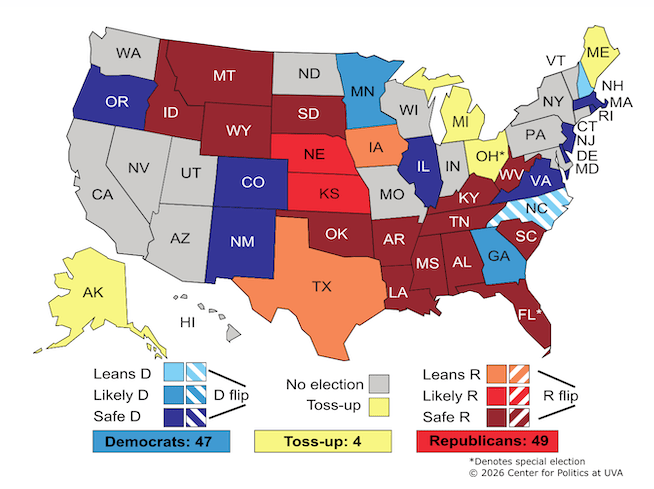
For some while, conventional wisdom has said that the Democrats were likely to retake control of the House in 2026, but that the Senate was too much to hope for. The GOP’s current margin is 53-47, assuming independents Bernie Sanders and Angus King continue to caucus with the Democrats. A 50-50 Senate is still Republican, because VP Vance would cast the deciding vote. So Democrats need to net four additional seats to get a 51-49 majority. Given the states a Democrat would have to carry — places like Ohio and Alaska — it seemed impossible.
It seems a lot more possible now.
Let’s not underestimate the challenge. To start with, Democrats need to hang on to seats in Michigan and Georgia, neither of which are a sure thing. The most likely flip is North Carolina, and from there it gets tricky. That map above is from the University of Virginia’s Center for Politics. In order to prevail, Democrats would need to sweep the map’s four toss-up seats: Alaska, Michigan, Ohio, and Maine. Also, the Iowa and Texas seats may not be as secure for Republicans as the map claims.
But the polls look promising. The current RCP polling averages have Democratic Senate candidates substantially ahead in North Carolina and Georgia, and narrowly ahead in Alaska, Michigan, Ohio, Maine, and Texas. In Iowa the Democrat is narrowly behind.
Nate Silver notes that Democrats often poll well in August, only to see the race turn against them in the fall. In red states, marginal Republicans have a way of returning to their established party loyalties as the election approaches, even if they initially found the Democrat attractive. And Republican candidates will have plenty of money to hammer at Democrats, labeling them “communists”, attacking their manhood (Talerico, Ossoff), or raising bigotry against their name and religion (El-Sayed).
What makes predicting the final results tricky is that the various races probably aren’t independent. The electorate will likely focus on a few key points that all the races will hinge on. So if Democrats lose Maine, they probably can’t make up for it by taking Texas. If Maine is gone, Texas will be gone too.
But this is where I get optimistic, because I don’t see the state of the country and the world cooperating with a Republican bounce-back. Trump won’t magically pull out a win in Iran. The price of gas will still be high. And Trump shows no signs of learning election discipline, so he’ll probably keep talking about ballrooms and revenge indictments, and keep being obvious about his corruption. I doubt he’ll focus on making the economy work for the working-class voters Republicans need. So if a wave breaks on Election Day, it should break in Democrats’ favor, with frustrated working-class Whites finally giving up on Trump and his enablers.
Let’s take the key states one by one.
Alaska. The Data For Progress site finds Alaskans focused on affordability, and their Republican governor is deeply unpopular (-23 favorable-unfavorable). Trump carried the state by 13% in 2024, but his favorability has collapsed too. (He’s at -1.)
Alaska has an unusual system. Four candidates come out of its jungle primary, and the general election has ranked-choice voting. (I like this system.) A lot has been made of there being two Dan Sullivans in the race (the Republican candidate and an independent), but probably it will have no effect. If you’re confused about which Dan Sullivan is which, you’ll rank them next to each other and it will all work out. (That’s one reason I like this system. It handles various kinds of election trickery well.)
The Democrat in the race is Mary Peltola. She has won two elections to be Alaska’s only representative in the House, and lost in 2024 by only 2-3%, running well ahead of Kamala Harris in the state. So Alaskans know who she is and she’ll be hard to smear. The RCP polling average has her up 2%, and the betting markets make her the favorite.
Georgia. This is the surprise, at least to me. Jon Ossoff is running a very strong race and is ahead in the RCP average by a comfortable 7.5%. He’s emerging as a possible 2028 presidential candidate. Ossoff is one of the Democrats’ best messengers at framing Trump’s corruption.
Iowa. Seriously? Democrats are competitive in Iowa? This year, yes. This is the seat currently held by Joni Ernst. Rep. Ashley Hinson (R) is running against State Rep. Josh Turek. Turek is running on his centrist record in the legislature — which is probably the only way an Iowa Democrat breaks through — so don’t expect any progressive fireworks.
Anyway, Hinson is running slightly ahead (.7%) in the polls. And that close race is not a fluke, because the Democratic candidate for governor, Rob Sand, currently has a 5% lead. Apparently, the nation’s second-highest cancer rate and contaminated water are big local issues. Also, cheap land and Republican government have made Iowa a target for corporations building data centers.
Maine. A lot of national pundits thought Democrats blew their chance to oust Susan Collins in the Graham Platner fiasco. That doesn’t seem to be the case. Democrats united quickly around Platner’s replacement, Troy Jackson, and Collins is still dogged by the same issues: her deciding vote to confirm Brett Kavanaugh (who was the deciding vote to overturn Roe v Wade), her wishywashy position on ICE’s Portland surge, and her general position as someone who expresses “concern” about the Trump regime’s outrages, but will get in line when Trump needs her vote. Maine went for Harris over Trump by 7% in 2024, and you have to wonder how Collins will win over those Harris voters when the national winds are blowing the other way.
The closer we get to November, the further in the rear-view mirror Platner is. Currently Jackson is ahead by 2.3% in the RCP average. Collins has a lot of billionaire money behind her, but that might work against her as much as for her.
Michigan. Abdul El-Sayed beat the Democratic establishment’s chosen candidate in the primary. The party establishment has since gotten behind El-Sayed, but I have to wonder how much hard feeling remains in the electorate. Republicans will spend a lot of money demonizing him as a “terrorist” and raising bigotry against his name and Muslim religion.
In his favor, El-Sayed is a strong candidate. He interviews well, in that he gives quotable answers to hostile questions without sounding abrasive. He keeps his eye on the ball. For example, in response to a question about Islamophobia, he replied:
That’s the best you’ve got? You can’t actually talk about what you want to do? My name is not raising your gas prices. My name is not taking us to war. My name is not the reason you can’t afford your groceries.
Polls currently are close, with El-Sayed narrowly ahead (.7%). Two factors point in opposite directions: Polls overestimated El-Sayed’s support in the primary (which often happens in cases where bigotry is an issue; people get into the voting booth and express prejudices they wouldn’t admit otherwise). But also, time helps Democrats unite, and Republican Mike Rogers won’t know what to do with debates: A smear works better when the target remains at a distance, and El-Sayed is the far more articulate candidate. But not debating looks cowardly.
El-Sayed’s challenge is to get voters to listen to him rather than react to him as a string of labels from attack ads: a far-left Muslim terrorist. I think he’s up to the job.
North Carolina. Here’s a case where the Chuck Schumer model of candidate recruitment worked well. Schumer looks for experienced candidates with name recognition who know how to raise money. In North Carolina, that describes Roy Cooper, a two-term governor who was succeeded by another Democrat when term limits wouldn’t let him run in 2025.
Trump won North Carolina by about 3% in 2024, but his recent approval-disapproval number is -18%.
RCP has Cooper up by 8%, which isn’t a lock but looks pretty good.
Ohio.Sherrod Brown is another familiar face. He won election to the Senate in 2006, 2012, and 2018 before losing to Bernie Moreno by less than 4% in 2024. Trump won Ohio by 11% in 2024. I can’t find recent Trump favorability polls from Ohio, but I think it’s safe to say he’s in negative territory.
Polls are scattered on this race. The only poll since June has Brown up 8%, but the RCP average includes polls since March, and only gives Brown a .6% edge. I might like to claim that Brown has momentum, but nobody has polled Ohio twice, so it’s hard to make apples-to-apples comparisons.
Texas. This is the long shot Democrats would most like to see come in. Just by his existence, James Talerico is demonstrating the hypocrisy of the Christian Nationalist movement and Evangelical Christianity’s right-wing sellout in general. Talerico is a seminary student who takes the teachings of Jesus seriously, rather than making Jesus the mascot of the home team.
Ken Paxton, on the other hand, is blatantly corrupt. In 2023, he was impeached as attorney general by a legislature heavily controlled by his own party, but escaped removal from office. He has been repeatedly investigated and/or indicted. His wife sued for divorce, accusing him of adultery. I don’t quite see how voters can square all that with Christianity, other than “He’s on our team.”
Talerico is one of the few Democrats with a fund-raising advantage. RCP has him up by 1.2%, but I will be pleasantly surprised if that holds up. I have great faith in the hypocrisy of Texas “Christians”. They’ll find a way to come home to Paxton.
Pull it together. For what it’s worth, my best guess is that Democrats hold their seats in Georgia and Michigan. They flip North Carolina, Maine, and probably Alaska. Meanwhile, Iowa and Texas seem like too much to hope for. That leaves Democrats ahead 50-49, and Ohio decides the majority. If you make me choose, I think Brown puts Democrats over the top, but its very iffy.
Friday J. D. Vance was in Ohio campaigning for a Republican ticket that includes John Husted, whose Senate race against Sherrod Brown is one of the toss-ups that may decide control. I really wonder if J. D. reads his speeches ahead of time:
I believe this November, we will face a choice: Do we demand that our government serves us rather than the fraudsters and the criminals? Do we demand that the American president fight for the American people first?
I couldn’t have said it better myself. The only comment I needed to make was to add the links.
If James Talerico’s approach to Christianity is making you rethink your rejection of that faith, you should check out the blog “Backyard Church” by Dan Foster. Like me, Foster was raised in a denomination where the most important thing was to hold “correct” beliefs. In the post “There Are Two Ways to be a Christian“, he describes that approach as simply one way.
One begins with the question: What do I need to believe? The other begins somewhere else entirely: What kind of person am I becoming? … Suddenly, spiritual growth isn’t measured primarily by how much theology I know or how certain I am about it. It’s measured by what is happening to me. Am I becoming more loving? Am I more patient than I used to be? More generous? More forgiving?
The primaries are about over, so it’s time to look to the fall election. Trump’s polls are way down, and Democrats are ahead on the generic congressional ballot polls by around 6.4%, which should easily be big enough to overcome the Republicans’ gerrymandering advantage. So let’s assume Democrats take the House.
For a long time, conventional wisdom said the Senate was a bridge too far. Democrats need to flip four seats, net, and the states that are up weren’t looking favorable. But a combination of bad national issues (affordability, the Iran War, …) and bad candidates (Ken Paxton) is overcoming that natural GOP advantage. So while there’s still a lot of work to be done, Democrats have a real shot at achieving a Senate majority. That’s the topic of the featured post, which should be out between 10 and 11 EDT.
That leaves the weekly summary to discuss Trump bizarre foreign policy (North Korea good, Canada bad), ICE’s usual collection of offenses, the emergence of data centers as a surprise political issue, and a few other things. That should appear between noon and 1.
There’s a maddening tendency among elected officials and the political press to equate “far left” and “far right” candidates as occupying equally extreme, dangerous ends of the political spectrum, though those in the former camp mostly want universal healthcare and affordable housing while the latter is more likely to endorse the forced deportation of non-white people from the United States.
Iran. As it becomes harder to deny that his war is lost, Trump’s rhetoric has become increasingly fantastic. The two-month window for a larger deal set by June’s memorandum of understanding has now run out, but Trump says he is “in no hurry” to end the war. But if Oman gets in the way of a settlement with Iran, “we’ll bomb the shit out of them”. He has also threatened to declare the Strait of Hormuz, which remains closed, “a territory of the United States”.
Ukraine.Phillips O’Brien: “Russia’s allies show they are more intent on helping Russia win than Ukraine’s are in helping Ukraine win. The difference is stark.” He counts Trump as an ally of Russia.
This week’s developments
This week everybody was talking about primary elections
For the second week in a row, a progressive Democrat’s big lead in the polls evaporated on election day. Last week, Abdul El-Sayed was supposed to have a double-digit victory in the Michigan Senate race, but instead he barely squeaked out a win. This week, progressive Francesca Hong actually lost by half a percent to David Crowley (who was supported by the current governor) in the Democratic primary for Wisconsin’s governor.
Undecideds went overwhelmingly for Crowley, as media focused on Hong’s more out-of-the-mainstream past statements.
Young voters (who overwhelmingly supported Hong) didn’t vote in the same numbers as older voters.
Hong’s more enthusiastic supporters were more likely to respond when pollsters called.
Pundits love to play the expectations game, and announce some “collapse” or “surge” as results come in differently from the most recent polls. But in truth there are just votes. You get more of them than the other candidates, or you don’t.
My state, Massachusetts, has its primary September 1, and the marquee race is for the Democratic Senate nomination. My congressman, Seth Moulton, is running against incumbent Senator Ed Markey, primarily on the age issue: Moulton is 47 and Markey is 79. Unlike most generational primary struggles, though, Markey is the more progressive candidate.
So far, I am unmoved by Moulton’s case. To me, the age issue has to be backed up by something more substantive: examples where the older candidate is out of touch with today’s world. Absent an argument like that, I don’t see the point.
and the Abraham Lincoln
When we go to war without adequate planning, eventually the men and women of our armed forces suffer the consequences.
You’ve probably already heard the gist of this story: Due to the Iran War, the aircraft carrier Abraham Lincoln has been at sea for a long time without shore leave for the crew or the kind of maintenance that can only be done in a port. The situation has been complicated by damage Iranian missiles did to a naval base in Bahrain, which would ordinarily be the logistics hub supplying the Lincoln while it was deployed in the Middle East. So it’s being supplied through Diego Garcia, a British island in the Indian Ocean over 2000 miles away. The strain of constant deployment with limited supplies is taking its toll.
The families say that their loved ones have described food shortages and standing in line for the ship’s store for an hour or more, and that the store often lacks basic supplies like toothpaste, soap and deodorant. Families said there have been times during the deployment when the Lincoln was rationing portions. Nicole Conrad’s son is serving on the Lincoln, and she hasn’t been able to see his face in seven months. Exchanging messages from the ship, he has told her about days when the showers were locked and laundry was closed, and about food shortages on board that meant his meal was half a cup of rice and two tortillas.
USA Today has published photos of meals served aboard the Lincoln and also the USS Tripoli, which is also deployed to the Middle East. The trays pictured are from the Tripoli.
When Dan F.’s daughter said hygiene products were running low on the [Tripoli], the family sent a care package with shampoo and conditioner, deodorant, toothpaste and tampons, filling every open space with candy and snacks. They filled the second box with Emergen-C vitamin C packets – Dan’s daughter said she was feeling a sore throat coming on – and clean socks. The boxes were sent nearly a month ago, yet neither has reached its destination.
It’s easy to imagine being homesick and going stir crazy after more than 260 days at sea. What civilians have a harder time appreciating is the stress level on an aircraft carrier.
The flight deck of an aircraft carrier is already one of the most dangerous places in the military. High-speed aircraft with powerful engines can burn sailors and blow them overboard. Spinning propellers can cause accidents. And the constant loading and unloading of bombs, missiles and rockets pose the risk of explosions and fires.
The Sailors and Marines of the Abraham Lincoln Carrier Strike Group remain resilient and resolved after more than 260 days at sea, 10,000 aircraft flights, and 1.5 million pounds of ordnance expended. No service members aboard the aircraft carrier have died, and the one Sailor who fell overboard Aug. 3 was quickly and safely recovered. The rampant misreporting on Abraham Lincoln’s historic deployment is a disservice to our men and women in uniform and their loved ones.
The sister of a Lincoln crew member in his late 30s said that the remarks made her want to grab Trump and Hegseth and shake them. “I grew up in a United States where you have to be very respectful of the military, as they’re making the ultimate sacrifice and protecting their country, and now you have the commander-in-chief and defense secretary dismissing their experiences and calling them liars. I’m really angry,” she said. “It’s a feeling of betrayal. These are frustrating, false and careless comments, and they are going to have a lot of consequences for my brother.”
No one expects China to invade Taiwan because an American aircraft carrier has left the region. But the carrier’s absence gives the Chinese another opportunity to show its strength, said Bryan Clark, a former Navy submariner who is a defense analyst at the Hudson Institute.
“They’re using this as part of the narrative to demonstrate to the Philippines, to Japan, to Indonesia and others that the US is not the big dog in the western Pacific anymore,” Clark said. “They would just prefer that countries in the region decide that China is the bigger power and the US is not able to guarantee their security anymore.”
While continuing to deny that the US supply of high-tech missiles is being depleted, Trump is blaming the problem (which he insists doesn’t exist) on President Biden, who gave Patriots and other weapons to Ukraine.
I am reminded of what Donald Rumsfeld said when he was Secretary of Defense during the Iraq War:
You go to war with the Army you have, not the Army you might want or wish to have at a later time.
Whatever you think about how Biden handled our armed forces, Trump arrived in office commanding a particular stockpile of weapons. It was up to him to use them wisely. But Trump has never in his life taken responsibility for any of his numerous mistakes.
and ignorance-based executive orders
If there was a theme of the week, it was Trump giving orders based on his disastrous combination of ignorance and confidence. Two were related to his ignorance of naval technology and ship design, and another had to do with public health.
Trump has frequently cited his admiration of steam-powered catapults for launching planes off aircraft carriers, rather than the newer electromagnetic tech. Thursday, he signed a memo instructing the War Defense Department to replace the newer systems with the older tech.
The new mandate would likely cost billions of dollars and revert the Navy’s most advanced ships to a system that takes more sailors to operate and is more difficult to maintain.
Reportedly, Trump also has the Navy looking at redesigning the Ford-class carriers still under construction to move the tower to the center of the ship, similar to the look of World War II era carriers.
The changes – including moving the multistory aircraft carrier’s command center tower to the ship’s middle – would cost billions and worsen chronic delays, sources said. Officials also told The Post that changing the command center to the middle would remove 3 key benefits: additional parking spaces, reduced launch time and lowered chances of turbulence during landing.
Neither of these examples is Trump taking a side in a previously existing dispute among experts. It’s just Trump deciding that expertise doesn’t matter.
US President Donald Trump has signed an order that … recommends splitting the mumps, measles and rubella (MMR) shots. … The order also recommends that the number of childhood vaccines drop to 11 from the existing 18 recommended by the American Academy of Pediatrics (AAP).
During a the signing announcement, Trump spread anti-vax nonsense, claiming at one point that
I’ve seen proof of it. Where they have a vaccination that looks like the size of a bottle of soda poured into a little child’s body.
He also implied, without saying outright, that vaccines are related to autism, a well-studied and often refuted piece of anti-vax propaganda.
Trump has no real authority here, since vaccine requirements are set by the states. Mainly, this order will make parents more doubtful of vaccines and less likely to get their children vaccinated. Separating the shots would require more office visits and more expense, further motivating parents to skip some.
Meanwhile, the regime is bungling the cyclospora outbreak. The cyclospora parasite is suspected of causing over 24K illnesses so far this year, resulting in an enormous increase in the usage of the phrase “explosive diarrhea”. The center of the outbreak is in Michigan, and many cases have been traced through Taco Bell to lettuce from a plant in Mexico run by Taylor Farms.
The NYT explores how efforts to shrink the US government and loosen its regulations have made it harder to prevent outbreaks like this, and harder to track them after they arise. The Guardian points out that Congress mandated a better system for tracing outbreaks 15 years ago, but it has been repeatedly delayed and now is set for 2028.
It turns out that “big government” isn’t always a bad thing. In many ways, those much-derided “bureaucrats” are like offensive linemen in football: When they’re doing their jobs well, nobody notices them. It’s only when the quarterback gets sacked that you see a replay of the guy who was supposed to stop that from happening.
and Trump in the catering truck
I’m always torn about covering stories in which Trump does something outrageous, but it doesn’t affect most people’s lives. (That’s why I’m ignoring the fun people had making fun of Trump’s new hairpiece.) They leave me asking “Can you believe a guy like this is our president?”. But in some larger sense they’re inconsequential.
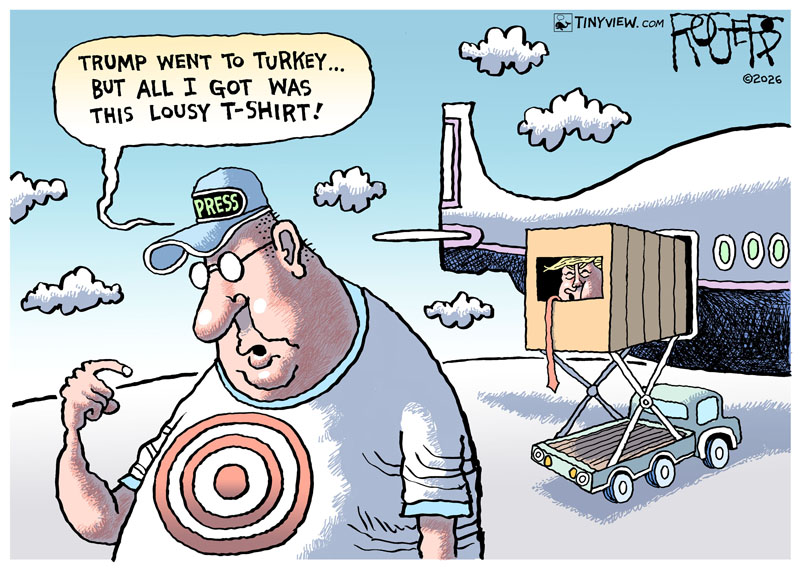
The Air Force One story that broke this week is a great example: Trump flew to the NATO summit in Turkey in the luxury jet he got as bribe from Qatar. While he was there, US intelligence heard rumors about a plot to shoot down his return flight on July 8, a plan made simpler by the fact that the Qatari jet still hasn’t gotten all of its security upgrades. Without referencing the threat, Trump moved back to the older Air Force One plane, which also carried the White House press corps and several high officials, including Secretary of State Marco Rubio and Treasury Secretary Scott Bessent, as well as top aides Stephen Miller and Steven Cheung.
But it turns out that flight was only a decoy. After boarding the plane, Trump was whisked away in a catering truck and taken to another plane, which went to the UK where he met up with AF-1 again as if he had never left it.
There are two possibilities here: Either the threat was not serious, in which case Trump was just being a scared little rabbit. Or it was serious, and to save himself he was content to sacrifice not just journalists, but some of his own cabinet and staff as well.
History will little note nor long remember this incident, but it says a lot about our president’s character.
and you might also be interested in …
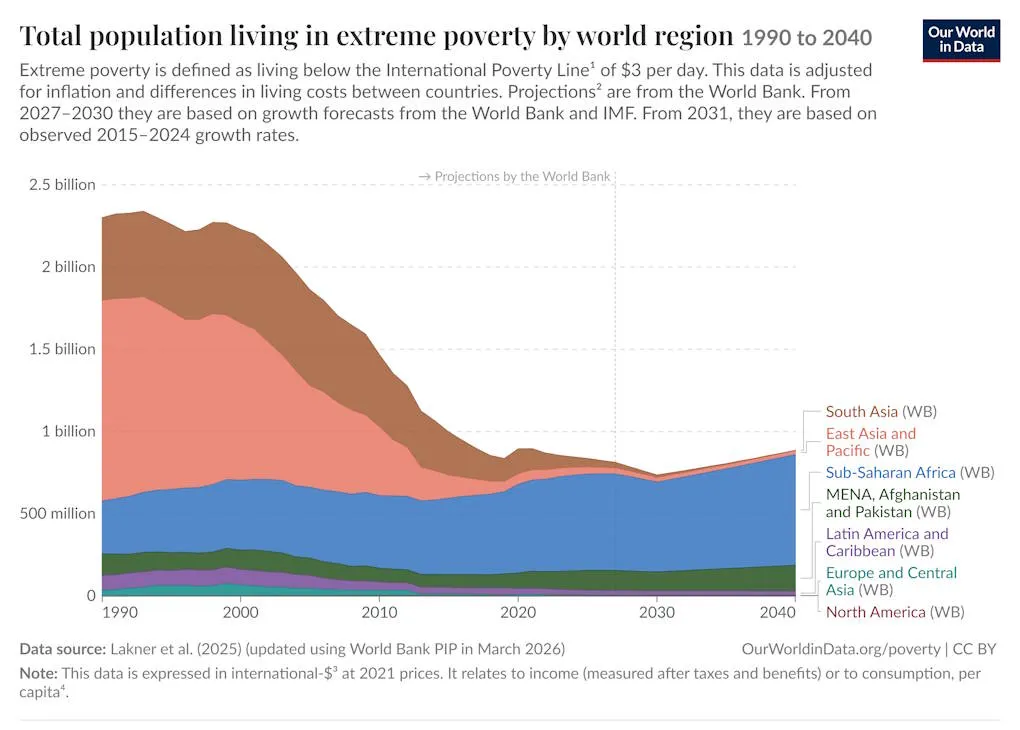
I copied the graph above from Noah Smith’s Noahpinion blog. The original is on the Our World in Data site. I find it very striking. 36 years ago, extreme poverty was a worldwide phenomenon, mostly distributed across East Asia, South Asia, and Africa. Today it is largely a sub-Saharan Africa problem, with some contribution from the Middle East, North Africa, Afghanistan, and Pakistan.
I don’t have any grand conclusion to draw from this graph, other than that big changes in poverty are possible. And it’s surprising that a change of this magnitude would draw so little attention.
The Trump administration is planning to dramatically reshape the data the Census Bureau collects, setting the stage for an audacious effort to curtail crucial information used in voting rights complaints and revive a right-wing effort, pursued in Trump’s first term, to exclude undocumented immigrants from the count used to determine how many members of Congress represent each state in Congress.
The point would be to count fewer non-citizens in 2030 and thus lower the number of congressional seats that go to states with a lot of non-citizens, like New York and California.
Representatives shall be apportioned among the several States according to their respective numbers, counting the whole number of persons in each State, excluding Indians not taxed.
That clause superseded the famous 3/5 clause in the original Constitution that distinguished free people from slaves. The word “citizen” appears five times in the Amendment, so the authors knew how to use it. The fact that they stipulated “persons” should be taken literally.
It’s possible the Supreme Court plans to continue its piece-by-piece repeal of the 14th Amendment. Section 3 (which bans from office anyone who has taken part in an insurrection) was made meaningless in 2024. This June, four justices wanted to ignore the birthright citizenship clause. (They’ll get another shot at it this year.) But if not, the regime’s new census rules should go down quickly.
TPM’s Layla Jones examines the century-long history of right-wing attempts to gain an advantage by monkeying with the census.
White House Press Secretary Karoline Leavitt is leaving her job because “I cannot be the best mom my two young children deserve while devoting the constant time, energy, and attention required of the White House Press Secretary”. The Contrarian is not inclined to be generous:
Karoline Leavitt’s farewell post contained no mention of a single administration accomplishment she’s proud of — just how extreme the left has become. Fitting, considering her tenure.
To be fair, she did mention “the many historic accomplishments of this Administration” without getting specific about any. The Guardian notes that her tenure started with an outrageous lie — “she claimed that the Biden administration had planned to use $50m in taxpayer dollars to send condoms to Gaza”, and did not improve from there.
A snide comment I’ve seen frequently on social media is that Leavitt is quitting in order to spend more time lying to her family.
Last Monday, ICE agents cut off the car of US citizen Caroline Molina. They then jumped out of their van, and one of the agents pointed his weapon through her driver-side window, in the manner of the agent who murdered Renee Good in Minneapolis. He was yelling at her, claiming that she tried to run them over — which was a complete lie.
Molina yelled back at them that she had a dashcam video recorder, so she could prove they were “full of shit”. They eventually left. Both the dashcam video and the video she shot out her window are here.
Unraveled has verified the agents in Molina’s videos were far from their usual base of operations. The team has been recorded inflicting violence on immigrants, protesters, and observers in the Chicago area since last summer, including outside the region’s ICE facility in Broadview, Illinois that became the epicenter of anti-deportation protests during Operation Midway Blitz last autumn. Members of the same team were also recorded intimidating and threatening drivers in the Twin Cities in mid-January—in the brief period after federal agents killed Renée Good, and before U.S. Customs and Border Protection (CBP) agents killed 37-year old intensive care nurse Alex Pretti.
Will the agents be disciplined? Of course not.
ICE has been dragging its feet about its agents wearing body cameras that might capture their illegal actions. But they’re about to roll out electric-shock gloves. No doubt they’ll use them wisely.
If you want to understand the 21st century, take a wide-angle view of the 20th.
During the 1800s, the technological underpinnings of the 20th century economy gradually arose and got implemented on a large scale. The steamboat and then the railroad revolutionized transportation. The telegraph, telephone, and mass-market newspapers revolutionized communication, creating new possibilities for democracy, but also for advertising and propaganda. Eli Whitney’s interchangeable parts allowed low-skill factory workers to mass produce goods that formerly required highly skilled craftspeople. The limited liability corporation and developments in banking and security trading enabled a unified management to wield quantities of capital far beyond what any individual entrepreneur could raise.
Each of those developments was of historical significance on its own, and many people recognized that they were living in an age of wonders. The introduction to Lilaquat Ahamed’s recent book 1873 calls attention to three enormous infrastructure projects that all were completed in 1869-70: the American transcontinental railroad, the Suez Canal, and the rail link from Bombay to Calcutta.
One French paper even hazarded a guess that these three critical links in the global transportation chain would now enable a traveler to go around the world in fewer than eighty days.
What was harder to see than the individual wonders, though, was what they added up to: Large chunks of humanity, tens of millions of people, were becoming economically, socially, and culturally integrated in a way the world had not previously seen.
The first large-scale demonstration of the new possibilities came during the American Civil War, when the North mobilized the Union states into a vast war-production machine, fielding a well-equipped army far larger than Napoleon had used to invade Russia just half a century before. (Unlike Napoleon, the Union managed to keep its army supplied.) That integrated productive machine was largely allowed to dissolve once the war was won, but its example raised a question that first got a full expression in Edward Bellamy’s 1888 utopian time-travel novel Looking Backward: 2000-1887: What if a similar nationwide integration could be directed towards peaceful goals? Could a war-style mobilization provide everyone with enough to eat and clothes to wear and decent housing to live in?
While Bellamy’s vision and others like it may have been politically inspiring, no mobilize-for-peace movement gained power in the United States. But private-sector visionaries like J. P. Morgan and John D. Rockefeller were grasping the business possibilities of large-scale integration. All (or nearly all) of the oil wells in the country could become Standard Oil. All the steel mills could become U. S. Steel. With Morgan’s capital and guiding hand, industry after industry united into trusts that could monopolize their particular markets. Rather than a dozen or more competing entities risking the over-production that regularly crashed prices in a boom-and-bust fashion, a nation-spanning monopoly corporation could manage production and keep prices consistently high. Simultaneously, the lack of competition for labor could keep wages low. Concentrated wealth enabled political manipulation that kept the laws friendly and insured streams of government contracts for railroads and other infrastructure projects.
The result was the Gilded Age. Rockefeller became the world’s first billionaire, but he was just the apex of a wealthy class that became a kind of shadow government. The epitome of the new organization was the company town: a small city dominated by a single mine or factory, whose owner also owned the houses workers lived in and the stores where they had to shop. The town might even have its own money: Workers could be paid in company scrip that could only be redeemed in company shops. The spirit of the times is captured retrospectively in the 20th-century song 16 Tons about a worker in a coal-mining town:
St. Peter don’t you call me, cause I can’t go. I owe my soul to the company store.
Eventually, the progressive political movement pushed back against the excesses of the Gilded Age oligarchs: Antitrust laws were passed, unions eventually were protected rather than broken by police, and government regulation limited corporate power. The process took decades, but Standard Oil was broken up into smaller companies that became known as the Seven Sisters. Morgan’s dominance of banking was replaced by the Federal Reserve, which at least nominally had a responsibility to the public.
Over the same time period, Europe was developing similar technological infrastructure, and in World War I the major European powers shared the American experience of full-scale mobilization: An entire nation could become one big engine powered by a single purpose. By the end of the war, people all over Europe were (in a variety of partial or limited ways) asking Bellamy’s question: Large-scale economic integration made a new level of production possible. What could or should be done with it?
That question raised additional questions: Who would manage this engine? And manage it for whose benefit? One way to read the turmoil of the 20th century (from the end of World War I through the Cold War) is as a battle between different answers to those questions.
Fascism took society’s power structure as it found it and integrated the pieces into a corporate state with a single leader. Industries would still be dominated by huge corporations like Krupp in steel or I. G. Farben in chemicals. But the ruling political party would take over the media and the educational system so that it could mold public opinion to its liking. The Leader would have a cult of personality, and the frustrations of the working classes would be channeled to target scapegoats like Jews or foreigners. Gleichschaltung, an engineering term related to synchronization, was a system of political, economic, and social pressure — ultimately backed by the police and the concentration camps — to bring individual opinions (or at least public expressions of individual opinions) into line with the state’s official ideology.
Communism upended the existing power structure and replaced it with institutions created by the state. Like fascism, it controlled media, education, and the police. But it demolished private-sector institutions entirely: Individual farms were gathered into collective farms. Leaders of the various industries were government officials without even nominal independence. Centralized authority attempted to script economic development in five-year plans.
Liberal democracy roughly followed the model of the Progressive Era United States: Private-sector corporations continued to exist and were allowed to manage themselves within bounds established by an elected government. Wealthy individuals and corporations would, of course, try to influence the electorate or corrupt the government, and would sometimes succeed. But when public misery reached extreme levels — as it did during the Great Depression — a political revolution like the New Deal became possible.
Each of these systems had its moments of success. Fascism took Germany from desperation to a continent-bestriding empire in eight short years, creating the autobahn and other large-scale infrastructure projects. Soviet Russia became one of the world’s two superpowers, with nuclear weapons and the first artificial satellite. Though the quantity and quality of Soviet goods never caught up with the West, Russian consumers who remembered the deprivations of the 1930s felt very fortunate indeed by the 1960s.
But the winner of the 20th-century competition was liberal democracy, with a victory so clear that in 1992 Francis Fukuyama heralded “the end of history“. To be fair, Fukuyama did not mean to say that history was over, but that — on this question at least — it had reached an answer.
the end-point of mankind’s ideological evolution and the universalization of Western liberal democracy as the final form of human government.
You might expect a trend created by technology to be disrupted by subsequent technologies. But the pull of integration was only reinforced by the major developments of the 20th century: radio, television, the electrical grid, automobiles, highways, chain stores, and eventually computers and the internet.
The propaganda industry of World War I inspired a post-war advertising revolution that did not simply announce products but shaped public opinion, creating markets rather than simply responding to them. (See Walter Lippman’s 1922 classic Public Opinion and Edward Bernays’ 1928 Propaganda. By 1967 John Kenneth Galbraith had put it all together in The New Industrial State. Focusing on the Ford Motor Corporation, Galbraith concluded that the market-defining power it shared with GM and Chrysler made it an altogether new kind of entity that Adam Smith would not recognize as a firm.)
It’s important to realize that no major nation refused to integrate. The possibilities of increased production and wealth were just too tempting, both to leaders and to the general public. Much was lost in the transition to the new integrated society: The pressure to conform restricted individuality. Physical and social mobility disrupted families and communities. Materialism challenged religion. By the mid-20th century, we had a new word, totalitarianism, to express the new level of intrusion and oppression that an integrated society made possible. But eventually, ordinary people (most clearly in liberal democracies, but also in fascist and communist countries) came to experience a level of luxury their ancestors could not have imagined. Refusing, or going back, was never really an option.
What the 20th century example means to us. So now let’s talk about the 21st century. It has become a commonplace observation that cheap personal computers and the internet are revolutionary in the way that the printing press was in the 15th century. But the early manifestations of that revolution were fairly trivial: You could order and start reading an e-book without leaving your bedroom, or download a real-time satellite image of the current weather system, or carry your entire music collection on a device in your pocket. Those who didn’t live through this period may have a hard time imagining how marvelous it all seemed. It was indeed an age of wonders. And yet, society was still society. If you wanted to go on living your life as if nothing were changing, you could.
But consider what has happened since, not as a series of individual developments, but as a whole:
Surveillance capitalism. The services and devices we all use give each of us an enormous data trail. Your phone knows where you’ve carried it. Your car knows where you’ve driven. Your TV knows what you’ve watched. Your voice-activated Siri or Alexa can listen to your conversations. Your supermarket tracks your purchases. Your smart house knows what hours you keep and what rooms you like to use. Your internet browser knows what you’ve shown an interest in. All those entities are owned by companies that can and do sell the information they collect.
Social media algorithms. TikTok, Instagram, Facebook, and YouTube don’t just show you what you look for, they also make models of your interests and suggest what you might look at next. The algorithms that do this are not designed for your benefit. Instead, they exploit addictive patterns in the human mind, hooking you with anger or fear, and then drawing you ever further down various rabbit holes. Their goal is to hold your attention longer so that they can sell the advertising they can show you. In addition, Elon Musk’s X has a clear propagandistic purpose. It privileges Musk’s own neo-Nazi posts, and possibly similar voices. In short, the algorithms don’t just reflect your interests, they can and do change your interests, and perhaps your personality as well.
Artificial intelligence. The tech giants are building out a massive computing infrastructure that can process data on scales never before imagined.
The weakness of 20th-century totalitarian surveillance was simple: Who was going to listen to all those recordings or watch all those camera feeds? Who was going to assemble the clues you inadvertently left to figure out what you intended to do? Maybe if you were a world leader or a suspect in some important investigation, the KGB or FBI or some similar organization might assign you enough watchers and analysts to make sense of it all. But the vast majority of us just aren’t worth that kind of attention.
We aren’t worth that kind of human attention. But maybe going forward we will be worth that kind of AI attention.
Similarly, 20th-century marketing and propaganda was based on statistical models. What were most people thinking? How would an average person respond to this message or that one? But 21st-century attempts to influence consumers and voters are increasingly personalized: What message would motivate you to do what the messenger wants?
20th-century corporations used mass-market advertising to create and alter large-scale trends. (How could Proctor and Gamble turn bad breath or body odor into embarrassing social problems that required its mouthwash or deodorant?) But a 21st-century marketer has the time and energy to analyze you as an individual. (Are you ready to buy a new car? What would cause you to choose this one rather than that one?) 21st-century politicians can target a message at you individually, whether the purpose is to change your vote, or just to make you give up on the possibility of figuring out what is true or what you should do about it.
Put it together: Just by living your life, you create an enormous data stream. The capability to analyze that data stream either exists or soon will exist. That analysis might produce a pretty good picture of what you know, what you believe, and how you think. Knowing that, the algorithms that decide what information comes to your attention might know just what to show you to make you do what their clients want you to do — buy a product, vote for a candidate, join a movement, or whatever.
It’s easy to make a dystopia out of this, but hold off on that thought for a second. What this all points to is that a deeper level of social/economic/cultural integration is now possible. That power could be used for good or ill, just as the power created by the previous integration was.
In a dystopia, AI might analyze your data trail, figure out exactly what conspiracy theory might hook you, and at a key moment send you just the right upsetting pseudo-fact that pushes you towards mass-murder or suicide bombing.
In a utopia, the algorithms might cheer you up when you’re depressed, nudge you to make that career change you’ve been thinking about, or even search out (or create) a place in the economy for someone with your exact combination of talents and disabilities.
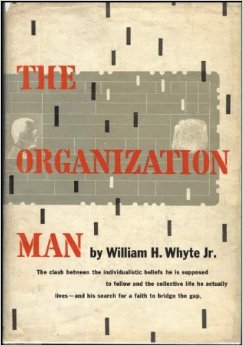
The near-universal psychological trauma of 20th-century was the thought that the system is indifferent to us, that we don’t fit and there is no place for us. In order to survive, we need to hide our inner selves and become organization men or men in grey flannel suits who are made of ticky-tacky and all look just the same.
In a utopia, the system would not be indifferent. It would try to meet us halfway and find roles we could fill with our authentic selves.
And maybe along the way, we could have another productivity bump, similar to the last one. Maybe in a few decades that increased integration will have ordinary people living in what would seem like unimaginable luxury now, albeit with the loss of some cultural values that seem important today.
Which way things will go depends on the same questions as last time: Who is going to manage this integrated society, and for whose benefit?
Right now, we’re on the Gilded Age track. Musk, Bezos, et al. are managing the transition for their own benefit, just like Rockefeller and Morgan did. They’re collaborating with a corrupt government and using their increased power to squeeze the rest of us ever tighter. We may end up in the online equivalent of the company town, owing our souls to the owners.
But look for each of the three 20th-century competitors to make their cases again. The fascism of the Trump regime is not particularly well-founded in the new possibilities, and is being derailed by Trump’s own greed and ignorance. But the last two years do point out how eagerly Gilded Age oligarchs will line up behind a fascist leader.
Communism may also get a second chance. One reason Soviet Communism failed was the sheer impracticality of central planning in a large modern economy. A market in essence is a distributed-processing system for managing production and consumption. The market-oriented liberal democracies simply had more processing power and greater flexibility and creativity than any Soviet central planner could apply to the job. But a 21st-century central planner’s capabilities may may be better suited.
If we are lucky, liberal democracy will also get a second chance. But for that to happen, some significant number of people need to grasp what’s happening and apply our creativity to doing something about it. Certainly we’ll have to revive the 20th-century progressive tools of antitrust and unions. But we also have to hope that the new possibilities include new tools for fighting back against oligarchy and escaping the company town.
It may seem impossible, but the first Gilded Age seemed unassailable too. As George Orwell put it, “Whoever is winning at the moment will always seem to be invincible.”
Usually I take the news one week at a time, but today’s featured post takes a step back to examine a much wider time span: I’m looking at the technological developments that led to the first Gilded Age in the late 19th century, and trying to draw a parallel to the current internet/social-media/AI technologies that have landed us in a new Gilded Age. We may be in for a reprise of the fascism/communism/democracy struggle that dominated the 20th century. Lately it’s been easy to focus on the dystopian possibilities of the tech revolution, but we shouldn’t lose sight of the utopian possibilities as well.
As in the 20th century, it’s all going to hang on who manages the new society, and for who’s benefit. Right now this Second Gilded Age is being managed by tech oligarchs for their own benefit, just as the First Gilded Age was managed for the benefit of the Rockefellers and Morgans. But that changed, and our own situation could change as well.
That post is tentatively titled “Revolutions too big to see”, though I still hope to come up with something better. It should be out before 10 EDT. If you like it, I hope you’ll promote it to other people who might like it. I feel like this is more important than my usual blog posts, and I hope it can get a wider readership.
The week didn’t have a truly dominant news story, in my opinion. The weekly summary will divide its attention among primary elections, the USS Abraham Lincoln fiasco, Trump in the catering truck, and a variety of ignorance-based executive orders like the new recommendations for vaccines. Expect to see that around noon.
Trump’s assault on American democracy. Blanche is fully installed as AG. Money for the rest of this calendar year has been voted. So there’s nothing restraining Trump from doing his worst between now and the fall elections.
Iran.Phillips O’Brien: “A quick lesson on winning and losing a war. If you start a war of choice, blow through masses of your weapons stocks so that you cannot escalate effectively, and find the country you attacked dictating negotiating terms while in a stronger strategic position … You lost.”
Ukraine. Trump has seemed to waver between favoring Russia and favoring Ukraine. But in fact it’s always been Russia.
This week’s developments
This week everybody was talking about the economy
Wednesday, Donald Trump told a crowd in Las Vegas that this is “the greatest economy we’ve ever had by far“. Friday, the Labor Department released its July jobs report: The US lost 23,000 jobs in July, and the more robust hiring reported in May was revised downward by 66,000 jobs. The unemployment rate ticked downward to 4.1%, but for the wrong reason: The people who stopped looking for work outnumbered the people who lost jobs. More technically, the labor participation rate declined to 61.4% of the working-age population. Other than the Covid era, that’s the lowest rate in 50 years. Wage growth was at an annual rate of 3.2%, which doesn’t quite keep pace with inflation.
That doesn’t sound like such a great economy.
And here’s something that nobody talks about any more: Remember, back when Joe Biden was president, how the growing national debt was an existential threat to the United States? In March 2025, when the second Trump administration was young and all problems could still be blamed on Biden, the Republican-led House Budget Committee reported:
If Congress does not act swiftly to confront the structural disconnect between reckless federal spending and incoming revenues, our nation will experience either slow and painful economic demise through sustained stagnation or a swift and catastrophic sovereign debt crisis whereby our creditors lose confidence in our ability to service and repay our debt. This distrust will jeopardize the dollar’s dominance as the world’s reserve currency and result in massive tax hikes and austere spending cuts. Both scenarios would imperil our Republic and our nation’s future.
Well, since then Trump and congressional Republicans have cut taxes for the rich again, started an unnecessary war, and massively boosted military spending. They tried to cover that with cuts to food programs and health care, but the numbers didn’t balance. So the federal deficit for the first nine months of FY2026 has been $1.4 trillion. It’s still an open question whether the year’s final total will top $2 trillion or not. The deficit has broken $2 trillion only once before: in FY2021, a combined Trump/Biden year (running from October 2020 to September 2021), when the government was trying to keep the economy functioning during the Covid shutdown.
The striking thing about the current deficit is that no external emergency requires it. The economy does not need stimulus to get out of a massive recession. No one has attacked us. No plague, famine, or natural disaster demands government intervention. No, Trump is running this deficit by choice. He has chosen to fight an unnecessary war and to cut rich people’s taxes. And the House Budget Committee doesn’t seem terribly alarmed about it.
Here’s what worries me: We’re running this massive deficit while the big tech companies are borrowing unprecedented amounts of money to spend on their AI infrastructure. Yet somehow, this combination of public and private spending isn’t causing a boom. GDP growth is limping along somewhere in the 2-3% range that it’s been in since around 2011 (except for the Covid collapse and recovery, which were lower and higher).
I’m no economist, but it looks to me like we’re masking a major recession with borrowed money.
Overall, the economy lost 23,000 jobs in July: Women lost 32,000 jobs, while men gained 9,000. Many of the jobs lost were in local government and leisure and hospitality—real jobs that real women, who are already dealing with slowed wages and rising inflation, work. Meanwhile, a whopping 165,000 women exited the work force last month, meaning they were neither working nor looking for a new job. The number of men in the labor force remained steady. … In fact, more than double the number of women have left the labor force than men since the start of the year. A total of 845,000 women have left the workforce since January, while 406,000 men have left.
The theory that fewer immigrants means more jobs for native-born Americans … it’s just not panning out.
and Todd Blanche
Well, a few Republican senators managed to get media attention with their public hand-wringing, but in the end all but Collins and Murkowski knuckled under, so Blanche was confirmed as attorney general 50-49. Fifty Republican senators have now signaled their approval of vindictive prosecutions, winking at obvious corruption, and continuing the Epstein cover-up.
I don’t know how fair this point is, but I have seen it fairly often: As soon as Susan Collins came out against Blanche, we knew Trump had the votes to confirm him. She only strays off the MAGA reservation when they don’t need her vote.
I know: You can talk about an 85-year-old who holds no government office and is making no decisions that affect Americans’ lives. So Senator Rand Paul of Kentucky published Anthony Fauci’s diary, and then pulled Fauci in for questioning before the Senate Homeland Security and Governmental Affairs Committee.
Consider the context of this appearance: Before he left office, President Biden gave Fauci a sweeping pardon so that the incoming administration wouldn’t be able to harass him with vindictive prosecutions. We’ve just seen James Comey vindictively prosecuted for lying to Congress, when he actually did no such thing. Career prosecutors recommended against pressing charges, but the prosecutor Trump illegally appointed went ahead with them. The illegal appointment caused the charges to be thrown out by the judge.
So Fauci’s pardon covers everything he did while he was actually in government, but testifying before Congress put him in danger of being prosecuted for lying to Congress, whether he told the truth or not. So Fauci took the Fifth Amendment 111 times.
You might think that would insulate him from prosecution, but guess again. Paul introduced a motion to find him in contempt of Congress. The committee approved that motion. Ordinarily it would go to the floor of the Senate, where it probably would not pass. So Paul wants DoJ to act on the referral of his committee, without the full Senate.
With all this smoke, you might be wondering if there’s a fire somewhere. I don’t think there is. There is legitimate scientific debate about whether Covid-19 leapt from animals to humans spontaneously in China or whether the virus leaked from a Chinese lab. But that debate has gotten swallowed up by a conspiracy theory that the virus was created in that lab, perhaps intentionally, perhaps with NIH funding that Fauci had some oversight over. There seems to be nothing to that theory.
Looking back, it’s hard to remember just how scary Covid was and how little anybody understood about it. Over a million Americans died of the virus, and perhaps millions more would have died without the vaccines. We all did things (I recall my household wiping down our groceries) that look silly in hindsight.
During this time, Fauci gave the best advice he could, which was always based on incomplete information. On the whole, though, his advice wasn’t that bad. And besides, he never had the power to impose his views. That had to be done by governors, school boards, and other elected officials at various levels.
Thankfully, I have never had to make decisions based on incomplete information while people were dying around me.
an El-Sayed’s win in Michigan
This is the subject of the featured post. But I have a few things to say that weren’t in that article.
Robert Reich had this comment on the idea that the Democratic Party is the subject of a hostile takeover:
The Democratic party isn’t being taken over by “the left” or by democratic socialists. There’s no civil war between progressives and moderates. We aren’t witnessing an ideological battle between the “left” and the “center”.
We’re seeing the US wake up to the tyranny that’s engulfed us, and to a crisis of affordability that’s causing most Americans to struggle financially while fueling the biggest stock market rally in history.
Trump’s tyranny and America’s affordability crisis are related. … When corporate America and Wall Street are unleashed – when the president of the United States has made an implicit deal with the moneyed interests to back him and his authoritarian regime in exchange for tax cuts, deregulation, monopolization and pay-to-play corruption – of course prices soar and wages stagnate.
One thing I don’t like about special-interest ads is that the interests usually don’t own their message. I wouldn’t care how much Elon Musk had spent in Wisconsin if he had appeared in ads himself and said, “I’m Elon Musk, and I want you to elect Brad Schimel to your state supreme court.” Ditto if AIPAC ads had said, “We’re AIPAC, and we want you to vote for Haley Stevens because she supports continuing US military aid to Israel, while her opponent, Abdul El-Sayed, does not.”
If all political ads were that straight-shooting, the Supreme Court’s otherwise bizarre notion that money is speech would almost make sense. But AIPAC-supported ads about El-Sayed being “disrespectful to women” aren’t just deceptive about El-Sayed, they mask why AIPAC doesn’t like him.
According to Politico a big reason Rep Andy Ogles, one of the slimiest and terrible members of the GOP House caucus, went down to defeat is that he was targeted with $2 million by a SuperPAC funded by solar industry execs. They didn’t hit him on renewables or environment policy. They used garden variety attacks about Ogles’ missed votes while playing up the conservative credentials of his primary challenger.
PACs do that because the honest message — “We’re solar executives and Andy Ogles has been working against our industry.” — wouldn’t persuade enough voters.
A hilarious attack ad against El-Sayed’s opponent Mike Rogers is framed like a drug ad. The drug is called “Endless War”, and Rogers is pitching for it.
Trump seems to think this meme works in his favor. (Note the misplaced apostrophe.)
Yeah, he’s right. One [America] in which your overlords are two people who don’t like each other but join in the interest of making billions of dollars off of you, or two people who genuinely love each other, enjoyed some pancakes together, want to come together to build the kind of America where they can raise a family, and know that that family is going to have the good things.”
So yes, you’ve got two different visions of America. Donald Trump’s vision is the one you’re living in right now. Can you afford your gas? Can you afford your groceries? Do you believe, when you look your kids in the eye, that they’re going to have a better future than you did?
and you also might be interested in …
They two parties really do have different standards. Unlike Democrat Graham Platner, Republican Rep. Max Miller has not withdrawn from his race and will be on the November ballot.
The WaPo claims Trump is upset with WarDefenseSecretary Pete Hegseth for hiding the munitions shortage from him, and that Hegseth in turn blamed his Deputy Secretary Stephen Feinberg. (The White House claims the whole story is “fake news”. The Pentagon says: “Secretary Hegseth did not mislead anyone about our munitions posture, and he did not blame Deputy Secretary Feinberg. These claims about depleted stockpiles, internal disagreements, the Secretary’s position on Iran … are equally fictional.” Those quotes are also in the WaPo, because that’s what journalists do.)
A couple of observations here:
Any idiot knows that you don’t just go down to Home Depot and get yourself more Patriots and THAADs and Tomahawks. The Pentagon stockpile is the only one, and these missiles take years to manufacture in any quantity. So the whole idea that Trump would buy Hegseth’s claim that the munitions problem had been “fixed” points to Corporal Bonespurs’ ignorance about war.
The old adage that “Amateurs talk tactics, professionals study logistics” needs third classification for Hegseth: Complete doofuses talk testosterone and worry about the race and gender of their officers.
Paul Krugman used the previous story as one of many examples of administration officials lying to each other, which is one reason why they are governing so badly across the board.
The fact is that it isn’t possible for an administration to be completely dishonest with the courts and the general public while being honest with itself. Do you believe that when Trump boasts about $18 trillion in foreign investment, Kevin Hassett, the administration’s top economist, quietly tells him, “Just between you and me, Mr. President, that number comes out of nowhere, and even the investment promises we have received are vaporware”? Of course not. … So the Iran War is just the most visible of many ongoing, self-inflicted disasters perpetrated by this administration.
A few weeks ago I reviewed Cory Doctorow’s bookEnshittification, which focuses on the software platforms that are increasingly making life miserable. But the trend is larger than that. There’s a broad trend for big conglomerates to buy famous brands and then cut quality. There are big short-term profits to be made before the brand’s reputation is used up. One article focused on how this trend has affected cookware.
Yesterday, Phillips O’Brien’s weekend update on the Ukraine war veered into media criticism. He needed to explain why the latest Trump regime nonsense about “helping” Ukraine — Trump is and always has been on Putin’s side in this war — had gotten so much serious coverage. O’Brien originally thought he was writing a niche blog for military strategists, but suddenly has seen his substack vault into popularity (with people like me).
[W]hat I have discovered, which is not enlightening, is that the actual reporting of war and politics these days in most media outlets can be incredibly weak. The system often seems broken—reporting White House inspired narratives that have no basis in fact as actual events, and replacing rigor with herd behavior.
He started trying to figure out why that was.
Doing what I have done over the last few years has been learning experience (and not it a good way) about how much of the media (and much of the think-tank community) works. The key thing in both worlds is not being accurate or truthful as much as it is gaining access to power and being seen to be smart. Access and perceived intelligence—usually drastically greater than real intelligence—is the currency of these worlds.
Thus to maintain access, some reporters and commentators will say exactly what the White House wants, time and again, even after the White House narrative has been shown to be nonsense (many times). When it comes to think tanks, many are not interested in attempting even-handed or rigorous research; instead, they want to impress funders and also maintain access, and thus they publish crap to appeal to power and maintain their perceived viability (in most cases they have none). This means that much of what is produced in think-tanks is of laughable quality, meant to signal access and support, not to actually analyze a problem or policy.
When I started this blog, nearly all of my sources were mainstream media: CNN, NYT, WaPo, with occasional deeper articles from The Atlantic and a few similar outlets. And I still quote those sources selectively: When they publish a checkable fact, the fact usually checks out.
Increasingly, though, I am relying on blogs written by people like O’Brien, Paul Krugman, Josh Marshall, Jess Piper, Jay Kuo, Marc Elias, and so on. Why? Because they aren’t chasing access to sources in the Trump regime, so they can maintain higher standards.
So it’s none of my business, or yours, whether or not Ariana Grande has an eating disorder. The public response to recent photos is probably counter-productive. But if it leads to an intelligent discussion of celebrity culture and eating disorders in general, some good may come of it.
[Grande’s] body has also become a proxy on to which wider cultural anxieties are projected. In a moment of GLP-1 drugs reinstating the aspiration of thinness, body positivity in retreat, bonesmashing still on the up, and Maga tradwives once again moralizing fatness, fears about the return of aughts-era anorexia have settled on to Grande herself. Whether or not those fears belong to her alone is almost beside the point. Her body has become the site through which the culture argues with itself.
That can’t be a comfortable position to be in, no matter what her actual health situation is. Send a few good vibes her way, however that works in your religious tradition.
Trump is already preparing his response for when Republicans lose big in the fall: Voters are “not angry at me, but they are angry at Republicans.” Nothing in the history of the world has ever been his fault.
But as Trumpism has flailed and failed, it hasn’t consolidated the kind of authoritarian power anticipated by its most alarmed opponents. At the moment, Trump 2.0 has no great popularity, no legislative capacity, no policy legacy that a Democratic successor can’t easily roll back. The president himself might still be a dangerous figure, there might be darker forces waiting in the wings — but I don’t think that justifies making anti-populism the measure of all things.
But look at what he has implicitly admitted there: If Trump doesn’t have a Democratic successor willing and able to roll this back, American democracy is in real trouble.
We have masked federal police who obey Trump rather than the law, and who get away with murdering people in the streets if they protest against Trump’s policies. We have a massive concentration camp system under construction and partially operational. We have a “unitary executive” who has obliterated all the boundaries that used to wall off certain key areas of government power from the whims of the president. That executive is immune from prosecution after he leaves office for all “official acts”, which might include having political rivals jailed.
The whole point of Trump’s effort to control elections is that he doesn’t have to be popular. The point of encroaching on the power of Congress is that he doesn’t need legislative capacity. Give him two more years of a supine Congress and it might be too late.
Expect to hear a lot of it’s-not-so-bad between now and the midterm elections. Everyone who isn’t dyed-in-the-wool MAGA needs to respond to the fall elections like a four-alarm fire. But what if your candidate lost in the Democratic primaries? What if the Democratic nominee makes you feel uneasy for reasons that may or may not have something to do with your subliminal biases against color or religion or gender? What if you have a lot to do and getting out to vote feels like a hassle?
But if it’s not really so bad, then you can stay home or vote for the White guy or teach the politicians a lesson by voting for a third party. I mean, what’s the harm?
and let’s close with something mythic
It’s hard to tell if it’s too soon to joke about Mitch McConnell’s situation, since we don’t really know what that situation is. But The Wizard of Was is pretty darn funny.