Monthly Archives: October 2023

Worldviews

Someone asked me today in the media, “People are curious, what does Mike Johnson think about any issue?” I said, “Well, go pick up a Bible off your shelf and read it. That’s my worldview.

Speaker Mike Johnson to Sean Hannity

This week’s featured post is “Mike Johnson is worse than you think“.

This week everybody was talking about the new speaker

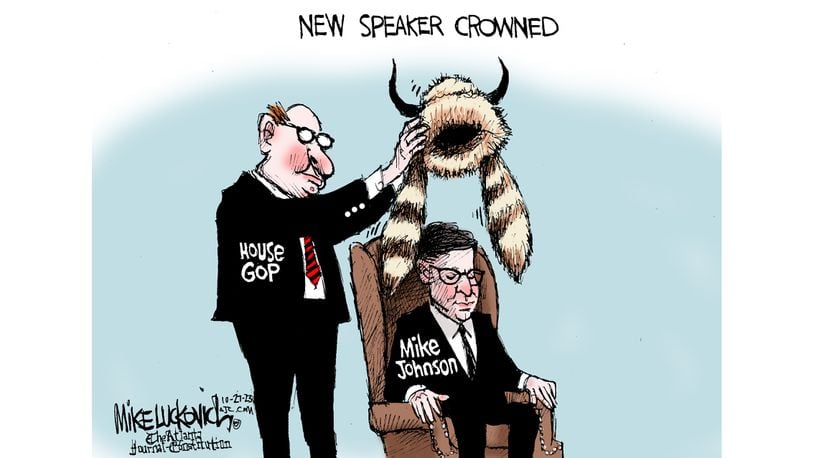
Wednesday, the House ended three weeks of chaos by electing Mike Johnson (R-LA) Speaker of the House on a party line vote. The featured post outlines why Johnson scares me more than some random right-wing extremist with similar views on most issues: Mike Johnson is a Christian Nationalist. So he feels perfectly justified in ignoring the will of the electorate and imposing his moral vision on us.

But there’s more to think about here than just Johnson. Last week I may have raised your hope that non-MAGA Republicans had found their backbones. I apologize. After watching the MAGA wing torpedo Tom Emmer’s candidacy for speaker, his supporters gave in and voted unanimously for Mike Johnson, whose ideology differs from Jim Jordan’s only by being more theocratic.

Ken Buck of Colorado is a prime example. Two weeks ago, in an interview with MSNBC’s Katy Tur, Buck seemed to be taking a principled pro-democracy stand:

I asked [Steve Scalise] last night: “Will you unequivocally and publicly state that the election, the 2020 presidential election, was not stolen?” He didn’t answer that question very clearly and Jim Jordan didn’t answer that question very clearly.

But then he backed down and voted for Johnson, who led 100 Republican members of Congress in supporting an unsuccessful lawsuit by the Texas attorney general that would have invalidated the electoral votes of Georgia, Pennsylvania, Michigan, and Wisconsin. Without those states, Joe Biden would not have had 270 electoral votes and the outcome of the election would have been thrown into dispute. (The Supreme Court refused to consider the case on the grounds that Texas had no standing.)

After casting his vote in support of Johnson on Wednesday, Buck told CNN that he had not heard Johnson acknowledge that President Joe Biden won the 2020 election, as he had previously demanded of Jordan and Scalise.

“I have not gotten that promise from Mike,” Buck said. “I hope he comes around to that point.”

Here’s how much respect Johnson has for Buck’s question: When Johnson faced the press for the first time as speaker, ABC’s Rachel Scott tried to ask something similar. She was shouted down by the Republican congresspeople surrounding Johnson, highlighted by North Carolina’s Virginia Foxx yelling, “Shut up! Shut up!” The Hill describes the Speaker’s response:

Johnson smiled, shook his head and said “next question.”

That seems to be Speaker Johnson in a nutshell: He dresses more neatly than Jim Jordan, keeps his cool, and is not as uncouth as Virginia Foxx. But he’s on the same page, and will unapologetically take advantage of their rudeness.


In the same Katy Tur interview, Rep. Buck mentioned that he wanted assurances from the speaker candidates that they would bring Ukraine funding up for a vote. It looks like he didn’t get that from Johnson either. Thursday, Speaker Johnson announced that he intended to separate Ukraine and Israel funding bills. The implication of that is that each bill would be subject to the Hastert Rule, which does not allow votes on bills that don’t have majority support inside the Republican caucus. Ukraine aid is a close question within the caucus, so it may not come up for a vote in the full House, where it would surely pass.

and the Israel/Gaza war

Unless you implicitly trust one side or the other, it’s hard to get any clear idea of what’s going on in Gaza. Bombs are falling, and whatever anyone intends, they fall (like the rain) on the just and the unjust alike. A ground invasion has started, but doesn’t seem yet to be an all-out assault. Such an assault may still be coming, but it might not.

The possibilities for the war to expand are numerous. A northern front could open between Israel and Hezbollah. A uprising in the West Bank is possible. I’ve seen a claim on X/Twitter — God knows if anything on X is true these days — that Israeli settlers are attempting to expel Palestinians. Peter Beinart believes this report enough to claim he saw it coming in his article last spring: “Could Israel Carry Out Another Nakba?“.

and another mass shooting
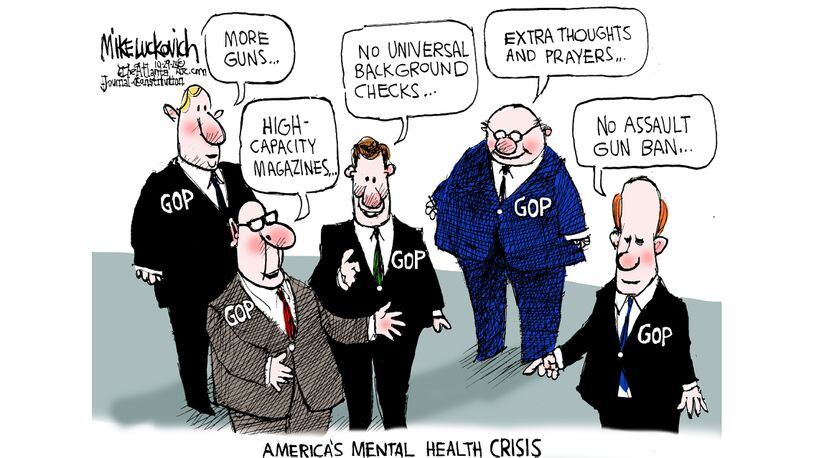
This is America, so you don’t have time to process one shooting before the next one happens. Saturday night, shots were fired in Tampa’s Ybor City neighborhood.

A shooting erupted in the middle of Ybor City after a Saturday night full of Halloween celebrations, leaving two dead and at least 18 people injured, Tampa police said.

But you may not be ready to think about that yet, because the rampage in Lewiston, Maine Wednesday evening is still so fresh. A shooter attacked random people in a bar and in a bowling alley, killing 18 and wounding 13. (Early reports that 50-60 people had been injured were wrong.) The shooter has been identified as Robert Card, and his body was found Friday; apparently he killed himself.

If you wanted to make the point that American gun laws are insane, you could hardly have designed an event more perfectly. In July, Card bought a Ruger SFAR high-powered rifle and a Beretta semi-automatic pistol. Ten days later, while serving as an Army reservist at a camp in New York,

the army gave Card a “Command Referral” to seek treatment after he told army personnel at Camp Smith Card had been “hearing voices” and had thoughts about “hurting other soldiers.” A National Guard spokesperson confirmed to CNN Card was transported to the nearby Keller Army Community Hospital at the United States Military Academy for “medical evaluation,” after Army Reserve officials reported Card for “behaving erratically.”

His family was also worried about him.

Card’s family told NBC News on Thursday that he had been hearing voices for months. “His mind was twisting them around,” said Katie Card, the suspect’s sister-in-law.

She said the family reached out to police and Card’s Army Reserve base as they “got increasingly concerned.”

Unfortunately, Maine only has a “yellow-flag law”, a watered-down version of the red-flag laws 21 other states have.

Even though Card underwent psychiatric treatment, [Nick] Suplina [senior vice president for law and policy at Everytown for Gun Safety] said he believes that would not have immediately set Maine’s yellow flag law into motion because that process involved a law enforcement agency in a different state. [New York]

The family would have likely had to contact police in Maine, starting a new process, Suplina said.

So in the United States, or at least in Maine, you can be crazy, people can know you’re crazy, there can be a recent record of you buying a gun suitable for mass killing, and nobody can do anything about it.

I’ve heard several local people explain that implementing a more effective red-flag law hadn’t seemed all that urgent, because Maine (and particularly a small town like Lewiston), just didn’t seem like the kind of place where these things happen. But the inadequacy of that kind of thinking has been exposed over and over again: Parkland, Florida wasn’t the kind of place where these things happen. Neither was Uvalde, Texas or Newtown, Connecticut. After last year’s Fourth of July shooting in Highland Park, Illinois, I tried to explain what that meant:

I don’t think I’ve ever been to Highland Park, and you probably haven’t either. But you’ve seen it. The movies use Chicago’s North Shore suburbs to symbolize affluent communities so sheltered from the scary aspects of modern life that teens have to seek out adventure for themselves. Ferris Bueller lived in Highland Park; so did Joel Goodsen from Risky Business. That idyllic family life The Good Wife had before her crooked-politician husband went to jail and everything fell apart? It was in Highland Park. The town sits between Lake Forest, where 1980 Best Picture Ordinary People was set, and Winnetka, site of the Home Alone house. (But parts of that movie were shot in Highland Park too.)

During their glory days with the Bulls, basketball legends Michael Jordan and Scotty Pippen had Highland Park mansions. Jefferson Airplane’s Grace Slick was born there. About 30K people live there now, and the 2010 census says the median household income is over $100K.

Here’s what I’m trying to get across: If a mass shooting can happen in Highland Park, it can happen anywhere. It can happen in your town too.

So me say it again: As long as we have these crazy gun laws, we’re all vulnerable.


Meanwhile, the Supreme Court is hearing a case that could invalidate another kind of red-flag law: one that takes guns away from domestic abusers. Such laws are excellent from two points of view:

  • They undoubtedly save the lives of spouses, children, and other close associates of violent individuals.
  • And they probably prevent mass shootings, because mass shooters often start on a smaller scale, with violence against the people closest to them.

But maybe a law disarming domestic abusers is one of those nice things we just can’t have in the United States, at least not under this Supreme Court.

According to Vox’ Ian Millhiser, Zackey Rahimi is “an individual that no sensible society would allow to have a gun”. Allegedly, in addition to assaulting his girl friend in a parking lot, Rahimi fired a gun at a bystander who witnessed the incident. He was involved in five other shooting incidents in a little over a year.

And yet, an appeals court recently found that Rahimi has a constitutional right to own a gun. In fact, any law that tries to take his guns away is unconstitutional on its face.

That means that, if the Fifth Circuit’s decision is upheld by the Supreme Court, this federal ban on firearm possession by domestic abusers may never be applied to any individual, no matter how violent that individual may be and no matter how careful the court that issued a restraining order against such an individual was in ensuring that they received due process.

But we haven’t gotten to the craziest part yet: That result is a correct application of the doctrine Clarence Thomas laid out in the 2022 Bruen decision.

Bruen held that, in order to justify nearly any law regulating firearms, “the government must demonstrate that the regulation is consistent with this Nation’s historical tradition of firearm regulation.” This means that lawyers defending even the most widely accepted gun laws, such as the federal ban on gun possession by domestic abusers, must show that “analogous regulations” also existed and were accepted when the Constitution was framed — particularly if the law addresses “a general societal problem that has persisted since the 18th century.” If they cannot, the challenged gun law must be struck down.

And that’s where we’re out of luck. Domestic abuse certainly existed in the Founding Era, but it wasn’t considered a crime. And there’s no contemporary record of any law taking flintlock pistols away from wife beaters. So unless the Court wants to backtrack on a fairly recent decision, Rahimi (and even worse people) will get to keep his guns.

and the Trump trials

Another of Trump’s co-defendants in the Georgia RICO case pleaded guilty Tuesday: Jenna Ellis.

Ellis, who once described herself as part of an “elite strike force team” of attorneys pursuing unfounded claims of election fraud, pleaded guilty to one count of aiding and abetting false statements and writings.

“If I knew then what I know now, I would have declined to represent Donald Trump in these post-election challenges,” a tearful Ellis told the judge.

What damage Ellis’ testimony might do to Trump — or to co-defendant Rudy Giuliani, who Ellis worked with closely — is still speculative. In the NYT, Norman Eisen and Amy Lee Copeland cast her as a star witness, but it’s hard to say at this point.
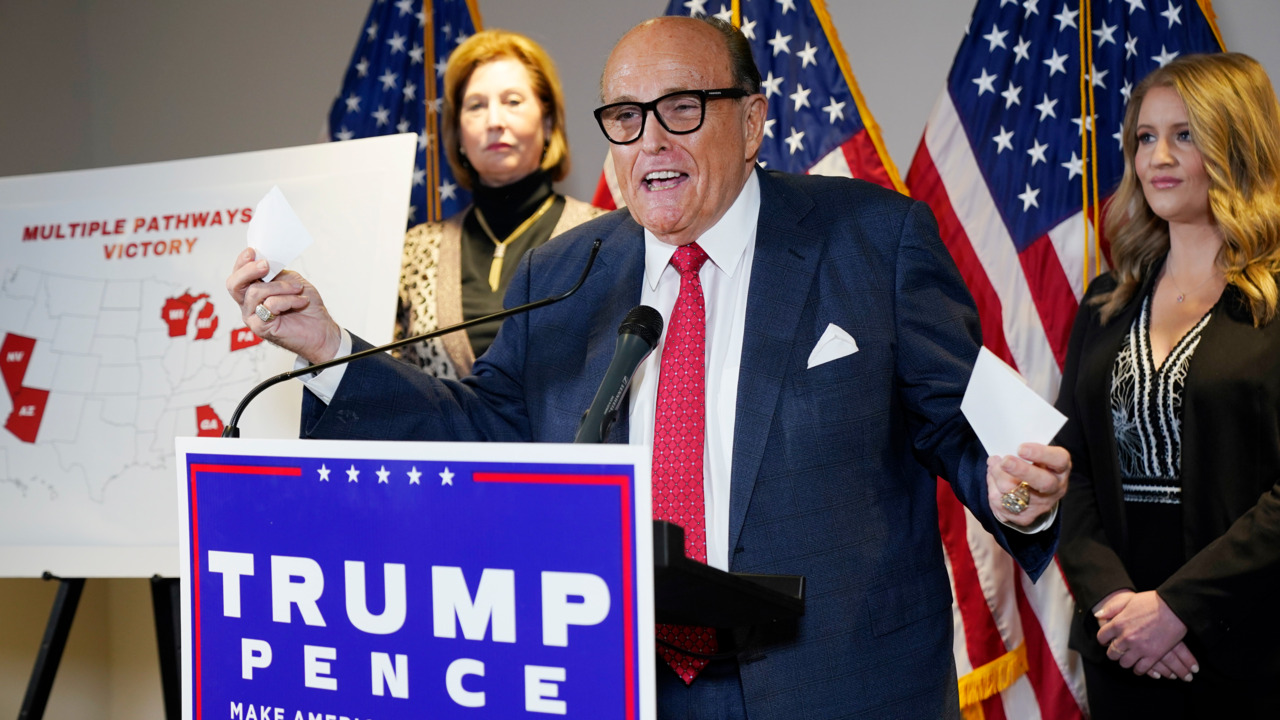
Rudy Giuliani, flanked by cooperating witnesses Sidney Powell and Jenna Ellis.

Two different Trump gag orders were in the news. In the civil fraud trial against the Trump Organization in New York, Judge Arthur Engoron called Trump to the stand, found his testimony not credible, and fined him $10,000. Engoron had earlier issued a gag order on Trump preventing him from attacking officers of the court when Trump had baselessly posted on Truth Social that Engoron’s law clerk was Chuck Schumer’s girlfriend. He had fined Trump $5K when the post persisted on Trump’s campaign website, which his lawyers said was “inadvertent”.

This fine came after Trump told reporters outside the courtroom on Wednesday that “This judge is a very partisan judge with a person who is very partisan sitting alongside him — perhaps even much more partisan than he is.” Judge Engoron took that as yet another reference to his clerk, which Trump denied on the stand. (He claimed he was talking about Michael Cohen, who had appeared that day as a witness. Attacking witnesses is also typically frowned upon.) This was the claim Engoron said he didn’t believe.

Meanwhile, Judge Tanya Chutkan (presiding in the federal election interference case against Trump) issued a gag order banning him from attacking prosecutors and witnesses in that trial. She stayed the order temporarily while waiting for an appellate court to rule, but then reinstated it when Trump used the temporary break in the order to go after potential witness Mark Meadows.

Trump is claiming that his status as a former president and current presidential candidate gives him rights no other criminal defendant would have. I doubt the appeals court will agree with him.

Ultimately, Trump will have to be found in contempt of court because he is in fact contemptuous of the proceedings against him. Clearly, $10K fines are not going to restrain him. Eventually, we’ll have to see if jail time works.


This should be an exciting week in the New York fraud trial: Don Jr., Eric, and Ivanka are expected to testify.

you also might be interested in …

The Commerce Department reported that the US economy grew at a 4.9% annual pace in the third quarter. (And yes, that number does account for inflation.) The previous week, a report from the Federal Reserve said that both mean and median household wealth is up. In other words, American households are generally richer than they were before the pandemic.

One of the continuing mysteries of American politics is that President Biden consistently polls badly on economic issues, while the country’s economic statistics have been quite good.


Weird weather continues to result from climate change: Hurricane Otis made landfall near Acapulco as a Category 5 storm Wednesday. It is the only Cat 5 storm to hit the Pacific coast, and intensified from a mere tropical storm in less than 24 hours.


Virginia holds its elections in odd years, making the state a possible bellwether of national trends. Two years ago, Glenn Youngkin’s upset victory in the governor’s race drew attention to critical race theory and other right-wing education tropes.

A week from tomorrow, the governorship is not on the ballot, but control of the legislature is. Democrats currently hold a small majority in the Senate and Republicans in the House.


Here are a few things Trump said in Sioux City, Iowa yesterday. He bragged about being willing to ignore our NATO obligations.

I remember, the head of a country stood up and said, “Does that mean that if Russia attacks my country, you will not be there?” And I said, “That’s right. That’s what it means. I will not protect you.”

He said hello to Sioux Falls, not realizing where he was. (Sioux Falls is in South Dakota.) And he claimed that Hungary shares a border with Russia.

The NYT collects some of Trump’s other recent blunders: He warned that the US is on the verge of World War II. He bragged about being ahead of Barack Obama in the polls, and claimed that he beat Obama in 2016. He referred to Hungarian President Viktor Orban as the president of Turkey. He pronounced Hamas as if it were hummus.

But Biden is the one who’s out of it because he’s too old.


Mike Pence suspended his presidential campaign. From the beginning, his campaign has felt like one of those moments in football when a quarterback cocks his arm and I think, “Where is he throwing that?” And sure enough, the pass goes right to a defender and gets intercepted.

Same thing here. I never understood what voters Pence was targeting. MAGA voters resent Pence for not cooperating in Trump’s coup. Non-MAGA voters resent Pence for staying loyal to Trump right up to moment of the coup. Maybe he thought that he could reclaim the Evangelical voters he led to Trump in 2016, but they’re long gone. In the GOP, the good-Christian-family-man boat sailed a long time ago.

He should have thrown the ball out of bounds and punted.


You may not know about Conservapedia, the conservative alternative to the “liberal” (i.e., reality based) Wikipedia. But Kat Abu pays attention to these things, while managing to keep her sense of humor.

and let’s close with something massive

There’s something really primal about singing along with large numbers of people. Also, large groups often sound surprisingly decent. (The notes sung tend to average out on the right ones.) Astrid Jorgensen of Australia started the Pub Choir project to create singing-together projects on an epic scale.

At Pub Choir events, Jorgensen teaches a well-known song in 3-part harmony to non-trained singers. The performance is filmed and posted on the net.

In this video, Pub Choirs in cities across Australia unite to sing Toto’s “Africa”. The result is strangely compelling, whether you like the song or not.

Mike Johnson is worse than you think

Most Americans don’t know much about Christian Nationalism.
They’re about to find out.


If you hadn’t heard of Mike Johnson until this week, don’t be embarrassed. Neither had I and neither had anybody but his Louisiana constituents and the most obsessive observers of politics. And so since Wednesday, when the House Republican caucus suddenly pulled unity out of a hat and elected Johnson speaker on a party-line vote, we’ve seen a lot of scrambling to characterize him.

Matt Gaetz, who had started this three-week circus by introducing a motion to get rid of Kevin McCarthy, declared victory by christening Johnson as “MAGA Mike”. Critics pointed to his role in Trump’s election denial: He organized the 100+ House Republicans who signed an amicus brief in the Texas lawsuit challenging the electoral votes of Georgia, Michigan, Wisconsin, and Pennsylvania, and offered legal cover to the 147 Republicans who voted not to certify Joe Biden’s victory.

After initially repeating Trump’s baseless lie that voting software developed for Venezuelan dictator Hugo Chavez had flipped votes from Trump to Biden (the same lie that Fox News refused to defend in court, and so had to pay Dominion Voting Systems $787 million to compensate for), by January 6 Johnson was making a claim less obviously insane:

On the eve of the Jan. 6 votes, Mr. Johnson had honed his arguments undermining the election to be more palatable. He presented colleagues with arguments they could use to oppose the will of the voters without embracing conspiracy theories and the lies of widespread fraud pushed by Mr. Trump. Mr. Johnson instead faulted the way some states had changed voting procedures during the pandemic, saying it was unconstitutional. [1]

Other people noted his extreme views on social issues: Johnson has sponsored a six-week abortion ban. As a lawyer for Americans Defending Freedom, he defended laws criminalizing gay sex (which doesn’t sound very freedom-loving to me). He sponsored a federal version of Florida’s Don’t Say Gay law. He’s a climate-change denier who fights all efforts to discourage fossil fuel use. His discussion of the border dog-whistles the racist Great Replacement Theory. All of which caused the NYT’s Jamelle Bouie to characterize him as “an election-denying extremist who believes that his allies have the right to nullify election results so that they can impose their vision of government and society on an unwilling public”.

And that analysis is true as far as it goes, but it misses the underlying theme that justifies these views and portends worse ones we haven’t heard yet: Mike Johnson is a Christian Nationalist.

Christian Nationalism. In a nutshell, Christian Nationalism is the belief that the United States was founded not as a secular republic, but as a specifically Christian nation. In an interview with Politico, Kristin Kobes Du Mez, a historian who specializes in evangelical Christianity and politics, elaborates:

Christian nationalism essentially posits the idea that America is founded on God’s laws, and that the Constitution is a reflection of God’s laws. Therefore, any interpretation of the Constitution must align with Christian nationalists’ understanding of God’s laws. Freedom for them means freedom to obey God’s law, not freedom to do what you want.

On most contentious issues, this puts Christian Nationalists on the same side as ordinary conservatives, and makes it easy to confuse one with the other. But there’s a difference: Ordinary conservatives at least give lip service to the idea of fairness, while Christian Nationalists don’t. Their side represents God’s Truth, so of course they should win. The appropriate standards are God’s standards, so it would be ridiculous to apply abstract rules equally to both sides.

For example, one point I often make in my articles on the Supreme Court’s “religious freedom” cases is that they aren’t about freedom at all; they’re about giving special rights to Christians. (The “praying football coach” won his case because he’s Christian. No Muslim or other non-Christian coach should imagine that the Court will defend his right to lead players in prayer on the 50-yard line.) But I make that point expecting the other side to deny it. If I could argue with Sam Alito or Amy Coney Barrett, I would expect them to spin their position in a way that makes it sound scrupulously principled and fair.

Similarly, when I accuse MAGA Republicans of being against democracy, I expect them to dodge, not to confront the point. Somehow, they’ll paint gerrymandering, voter suppression, the Electoral College, and the filibuster as pro-democracy, not anti-democracy.

But in either case, a true Christian Nationalist might accept my characterization and openly defend it: Of course Christians should get special rights, because the United States is a Christian nation. And ultimate sovereignty belongs to God, not to the People. If democracy leads to the People voting down God’s laws, then democracy has to go. [2]

For example, in this broadcast radio host Brian Fischer of the American Family Association claimed that the First Amendment’s “free exercise” clause only applies to Christians.

But the point is, by “religion” the Founders were thinking of Christianity. So the purpose was to protect the free exercise of the Christian faith. It wasn’t about protecting anything else. They weren’t providing any cover or shelter for the free exercise of Islam or even Judaism or even atheism. They weren’t saying you can’t do it, I want to be clear on that. They weren’t prohibiting that. They were just saying “That’s not what we’re talking about here.” …

If we don’t understand the word “religion” to mean “Christianity” as the Founders intended it, then we have no way to stop Islam. We have no way to stop Satanism. We have no way to stop any other sort of sinister religious practice that might creep onto these fruited plains.

Mike Johnson. While Du Mez admitted she had never heard Johnson characterize himself as a Christian Nationalist, she believes the shoe fits.

I feel comfortable applying that [label]; it’s not in a pejorative way. It’s simply descriptive. As he understands it, this country was founded as a Christian nation. …

But he goes much deeper than that, and really roots that in what he would call a biblical worldview: The core principles of our nation reflect these biblical truths and biblical principles. He has gone on record saying things like, for him, this biblical worldview means that all authority comes from God and that there are distinct realms of God-ordained authority, and that is the family, the church and the government.

Now, all this authority, of course, is under this broader understanding of God-given authority. So it’s not the right of any parents to decide what’s best for their kids; it’s the right of parents to decide what’s best for their kids in alignment with his understanding of biblical law. Same thing with the church’s role: It is to spread Christianity but also to care for the poor. That’s not the government’s job.

And then the government’s job is to support this understanding of authority and to align the country with God’s laws.

You can hear his belief in God’s sovereignty in his first speech to the House as Speaker:

I want to tell all my colleagues here what I told the Republicans in that room last night. I don’t believe there are any coincidences in a manner like this. I believe that scripture, the Bible is very clear that God is the one that raises up those in authority. He raised up each of you, all of us, and I believe that God has ordained and allowed each one of us to be brought here for this specific moment in this time. [3]

In an interview he gave during his first campaign for Congress, Johnson said:

We don’t live in a democracy, because a democracy is two wolves and a lamb deciding what’s for dinner. … The Founders set [our system] up because they followed the Biblical admonition on what a civil society is supposed to look like.

And:

The Founders believed that we’re endowed by our Creator with these rights, and that we owe our allegiance ultimately to our Creator, because He’s going to be the judge of all of us. One day, every knee is going to bow before the Lord.

God ordained civil government with certain authority. But He gave it limited authority. … The overarching problem we have right now is that the government has gone beyond the scope of the authority that was ordained by God. … And when the government grows and it expands its scope of authority, it usurps it from somewhere else. It takes the power and authority that God had ordained for the Church and the Family.

The Christian-establishing Constitution is what Christian Nationalists have in mind when they talk about defending or restoring “the Constitution” — not the document that you or I might read, the one that never once mentions God, and whose meanings and intentions Americans have been arguing about since the Founding, but that document overlaid with a very specific set of interpretations rooted in an Evangelical Christian moral vision.

In this way, they are treating the Constitution much the way they treat the Bible itself — as if their own very elaborate interpretations were sitting right there in the text. As Speaker Johnson told Sean Hannity:

I am a Bible-believing Christian – someone asked me today… people are curious, “What does Mike Johnson think about any issue under the Sun?” I said, “Well, go pick up a Bible off your shelf and read it, that’s my worldview – that’s what I believe.”

But if you ever do what Johnson suggests — pick up a Bible and try to read it de novo, as if no one had ever told you what it is supposed to mean — you almost certainly will fail to find anything resembling a “worldview”, and certainly not a view that transparently applies to the 21st-century world. [4]

Instead, you’ll find a number of evocative stories open to a wide range of interpretations. To take an extreme example from the very beginning: In the Garden of Eden story, it’s not entirely clear that the serpent is the villain. What the serpent tells Eve turns out to be true, and God’s threat that she will die if she eats the forbidden fruit only becomes true because God makes it true: He banishes her and Adam from the Garden specifically so that they won’t eat from the Tree of Life. So which of the two supernatural antagonists has Eve’s best interests at heart?

In short, the people who want to bring America “back to the Bible”, or to “restore the Constitution”, aren’t talking about the actual Bible or the actual Constitution. They are talking about these revered documents with their particular sect’s interpretations pasted on top of them.

And now one of them is running the House of Representatives.


[1] Note what is not being claimed here: that Biden’s voters weren’t real or weren’t entitled to vote. Instead, the claim is that these legitimate voters cast their votes in ways that shouldn’t have counted — like by mail in districts that in previous elections had different rules about voting by mail.

Even if this claim had some legal legitimacy, which I doubt, trying to fix it two months after the election violated the way we have always done things here in America: We argue about the election rules before the election. We don’t wait to see who wins, and then, if we lose, try to invalidate the votes of fellow citizens who voted in good faith under the rules their local officials had laid out for them.

[2] Arguing with a Christian Nationalist can be jarring for precisely this reason: They happily take the position you had hoped to trap them in. It’s as if a child accused their parents of liking another child better, and the parents replied, “Of course we like Jenny better. Now shut up and clean your room.”

[3] Someone needs to ask Johnson whether God has raised up Joe Biden to his current place of authority. I can’t guess what his answer would be.

[4] Try this experiment: Find some article (like this one) listing all the Bible verses that supposedly condemn abortion. Now go to each one and read the whole chapter the verse comes from. You will discover that, in context, these verses have nothing to do with abortion.

Anti-abortion views, like many other conservative Christian views, do not come from the Bible. They come from somewhere else — largely whatever the Christian community wants to believe — and are imposed on the Bible through interpretation.

The Monday Morning Teaser

This is America, so you don’t get a chance to process one mass shooting before there’s another one. Saturday night in the Ybor City neighborhood of Tampa, two were killed and at least 18 injured when a dispute between two groups devolved into gunfire. This follows Wednesday’s single-shooter rampage in Lewiston, Maine. Meanwhile, the Supreme Court may be about to trash state red-flag laws that keep guns away from dangerous people. I haven’t decided yet whether to cover our gun problem in a featured article or in a very long note in the weekly summary.

What I know I’m writing a featured article about is the ascension of Mike Johnson to the speakership. Initially, Johnson was covered as just another MAGA extremist, but in fact it’s worse than that: He’s a follower of Christian Nationalist pseudo-historian David Barton. That post should appear maybe around 10 EDT. If there’s a gun article, it will follow around 11.

The weekly summary will discuss how the House GOP “moderates”, who seemed to have found their backbones when Jim Jordan was running for speaker, crumbled completely in the Johnson vote. I don’t have a lot to say about the Israel/Gaza War, but I’ll link to people who do. There’s Trump trial news every week: more people flipped on him, two different judges are trying to figure out how to discipline his outbursts (which would send any other defendant to jail for contempt), and his children are going to have to testify this week in the Trump Organization fraud trial. And he gets more befuddled on the campaign trail, where he projects his own mental decline onto President Biden.

You may not have noticed Mike Pence was running for president, but he has dropped out. A Cat 5 hurricane hit Acapulco without drawing much media attention. Virginia is about to have an important election. And I’ll close with 18,000 people singing a Toto song. I’ll try to get that out by noon or so.

Null and void

It’s ridiculous that Republicans cannot elect a speaker, but it is also, at this point, unsurprising. A gaping void exists at the center of the populist strain of Republican politics; where the ideas ought to be, you too often find a long, primal scream of “Noooooooo!!!!”

– Megan McArdle
Republicans have created a void that’s becoming harder to escape

This week’s featured post is “The House, still divided“.

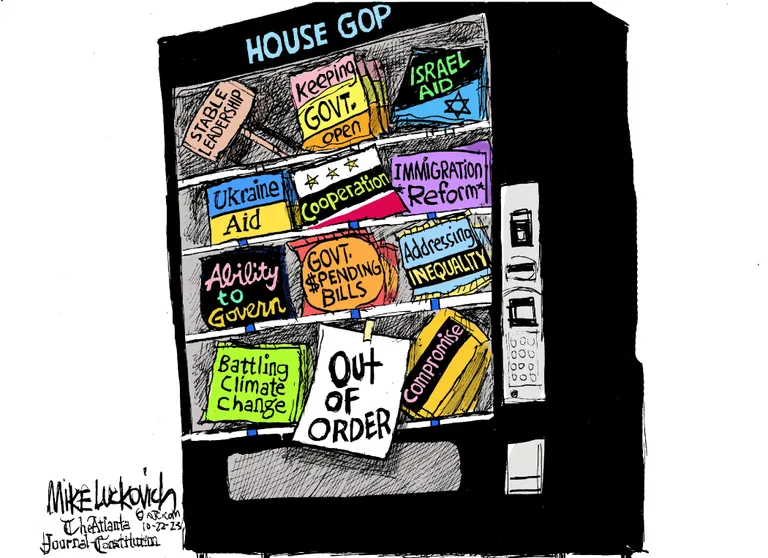
This week everybody was talking about chaos in the House GOP

The featured post provides a quick summary of where we are and how we got here, and then references a couple of deeper essays about how the House and the House Republican caucus actually work. But if you’re looking for some clear this-is-what-happens-next-and-when speculation, I don’t have it.


The McArdle quote above (and the article it comes from) makes a good point: Factions compromise with other factions because they have policy goals they want to achieve. But MAGA really has no goals beyond returning Trump to power. Cutting the deficit? No. When Trump was in power and had two years of a Republican Congress, they exploded the deficit with both tax cuts and spending increases. Inflation? They complain about it, but have no plan for addressing it. Crime? Ditto.

I’m sure my Republican readers would add other things they care about: the left-wing capture of schools and education policy, the progressive drift of corporations and the mainstream media, the DEI bureaucracies metastasizing across every class of institutions, the gender-medicine doctors rushing kids onto puberty blockers and hormones. …

But notice how few of the things on the list are things Congress can actually fix, even theoretically.

Imagine that you’re an establishment Republican trying negotiate for MAGA support to become speaker, or that you’re Biden trying to make a deal to keep the government open. What can you offer them that they would actually care about enough to give you something back?


If reality mattered, the House Republican infighting would smash once and for all the myth that Trump is a great deal-maker. He claims that if he were president he could bring Ukraine and Russia to an agreement in 24 hours. But the squabbling among his allies in the House has brought Congress to a standstill for three weeks with no end in sight.

Where is he, and why can’t he solve it?

In the real world, without reality-TV editing to make him look brilliant, Trump is terrible at making deals. He broke two of Obama’s agreements — the Iran nuclear deal and the Paris Climate Accords — claiming each time that he would get a “better deal”. (“I think the people of our country will be thrilled, and I think then the people of the world will be thrilled,” he said about his fantasy Paris renegotiation.) In fact, he got no deal, and in each case the country is worse off than if he had left Obama’s agreements in place.

In 2017, he came within one vote of undoing another long-negotiated Obama compromise, Obamacare. He would have taken health insurance away from millions of Americans — again with no plan to replace it beyond a fantasy.

His big diplomatic “accomplishment”, the USMCA, is basically what Obama had already negotiated as part of the Trans-Pacific Parternship, another deal Trump blew up. His flashy negotiations with North Korea produced a great photo opportunity — which benefited Kim more than anyone — and no substantive progress on the main issue, North Korea’s nuclear missiles. His trade war with China gave him great opportunities to posture, but accomplished nothing.

And then we get to Trump’s #1 issue: immigration and the border. The pieces of a deal have been lying around ever since the Gang of Eight compromise passed the Senate and died in the House in 2013. Neither side likes things the way they are and everybody has something to gain from striking a deal. But even with two years of a Republican-controlled Congress, he got no immigration legislation passed, and even shut down his own government to (unsuccessfully) pressure the Republican Congress to fund his wall.

and war

There are lots of individual stories in the Israel/Gaza war, but the fundamental situation didn’t change much this week: Hamas still holds hundreds of hostages. Israel is attacking Gaza from the air, but hasn’t launched a ground invasion yet. Lots of people in Gaza are dying (though it looks like Israel wasn’t responsible for destroying that hospital). A shipment of humanitarian aid made it into Gaza, but it’s a drop in the bucket.

If Israel has a plan for resolving this situation without killing a huge number of civilians, nobody seems to know what it is. In Israel’s defense, though, I haven’t heard a good suggestion yet for what they should do.


Hamas released two American hostages, but there are still other American hostages in Gaza. Why them? Why now? I don’t think anybody knows.


Biden gave an Oval Office speech to the nation [video, text], explaining why Israel and Ukraine deserve our support. He also said:

the United States remains committed to the Palestinian people’s right to dignity and to self-determination. The actions of Hamas terrorists don’t take that right away.

But without any viable peace plan, it’s hard to take that sentiment seriously, whether it comes from Biden or from Israeli leaders.

Biden also urged Americans not to bring the Gaza conflict home, citing the murder of a six-year-old Palestinian American near Chicago. The article says the boy’s mother came to the US 12 years ago, which would make him an American citizen.

We can’t stand by and stand silent when this happens. We must, without equivocation, denounce antisemitism. We must also, without equivocation, denounce Islamophobia.

And to all of you hurting — those of you who are hurting, I want you to know: I see you. You belong. And I want to say this to you: You’re all America. You’re all America.

Times like these are when I’m most grateful that Biden defeated Trump in 2020. I shudder to think of this kind of crisis going on in the world with Trump posturing and grandstanding and appealing to everyone’s worst impulses.


I’m impressed that the White House text of Biden’s speech includes his handful of verbal stumbles and misstatements. For example, he referred to Netanyahu as “president” rather than “prime minister”. The text corrects that mistake with a strikethrough, but doesn’t pretend he didn’t say it.


Ukraine’s summer offense didn’t gain much ground, but their increasing drone and missile capability has challenged Russia’s dominance of the Black Sea.


Mitch McConnell is still on board with helping Ukraine defend against Russia’s invasion:

No Americans are getting killed in Ukraine. We’re rebuilding our industrial base. The Ukrainians are destroying the army of one of our biggest rivals. I have a hard time finding anything wrong with that. I think it’s wonderful that they’re defending themselves- and also the notion that the Europeans are not doing enough. They’ve done almost 90 billion dollars, they’re housing a bunch of refugees who escaped. I think that our NATO allies in Europe have done quite a lot.


I was late finding “How Not to Respond to a Terrorist Attack“, which Benjamin Wittes posted the day of the the Hamas attack on Israel. But it’s well worth bookmarking and coming back to after future attacks, wherever they occur and whomever they victimize.

Fundamentally, he urges humility on those of us tempted to comment quickly. What needs to be affirmed in the immediate aftermath of murder is not deep or complex, but very simple: Murder is wrong. Not “wrong, but” or “wrong, except”, but just wrong. There is a strong temptation, which I feel myself, to segue past the tragedy of individual lives cut short, and to talk instead about the larger context, the need for revenge, what I think will or should happen next, how this event proves some other point I often make, and why people who disagree with me are dangerously misguided.

and the Trump trials

Sidney Powell and Kenneth Cheseboro pleaded guilty and have promised to cooperate with Georgia prosecutor Fani Willis. So three of the original 19 defendants in the Georgia RICO case have now pleaded guilty.

By all accounts, Powell and Cheseboro got very good deals, which they took just before their trial was supposed to begin. Neither will do jail time.

There are two theories on how they got such good deals: Either they have really juicy testimony to offer against the other conspirators, including Trump, or Willis really, really wanted to avoid revealing all her evidence and strategy in a trial before Trump’s trial. (Both Powell and Cheseboro had taken advantage of Georgia’s law giving them the right to demand a speedy trial. There’s still no trial date for the other defendants.)

Powell and Cheseboro are widely assumed to be two of the unnamed and unindicted co-conspirators in Jack Smith’s January-6-conspiracy indictment against Trump, but neither has any deal with Smith so far. As long as that’s the case, it’s hard to see what they could testify to for Willis. Either might legitimately plead the Fifth Amendment rather than describe crimes Smith could still indict them for.

If either of them makes a deal with Smith, the floodgates will open.

The biggest immediate impact of the guilty pleas is its effect on Trump politically: It’s hard to claim there was no crime when your former allies have already confessed to crimes.

As for where each fit into the larger conspiracy: Powell was at the center of spreading the Big Lie, as well as the effort to seize voting machines. Cheseboro organized the fake-elector scheme. I would expect Powell’s testimony to be most damaging to Rudy Giuliani and Cheseboro’s to John Eastman, if you’re looking for the next possible dominos. And Mark Meadows was everywhere, so any new testimony might target him.


Judge Chutkan issued a gag order against Trump

All interested parties in this matter, including the parties and their counsel, are prohibited from making any public statements, or directing others to make any public statements, that target (1) the Special Counsel prosecuting this case or his staff; (2) defense counsel or their staff; (3) any of this court’s staff or other supporting personnel; or (4) any reasonably foreseeable witness or the substance of their testimony.

and then explicitly described what is not included:

This Order shall not be construed to prohibit Defendant from making statements criticizing the government generally, including the current administration or the Department of Justice; statements asserting that Defendant is innocent of the charges against him, or that his prosecution is politically motivated; or statements criticizing the campaign platforms or policies of Defendant’s current political rivals, such as former Vice President Pence.

Trump predictably claimed that this order violates his First Amendment rights. This is in line with Trump’s refusal to acknowledge that indictment is a meaningful act. A grand jury of ordinary Americans has found that the evidence of his criminality is sufficiently strong that a trial has to be held. That’s not nothing, and it restricts a person’s rights in ways that are necessary for holding a fair trial.

For example, unindicted Americans are free to travel wherever they want. But if you’ve been indicted, you have to be present when your trial starts. The rights you would ordinarily expect as an American have been narrowed to accommodate your trial.

Again and again, Trump pretends that his indictments are nothing, and so his rights should not be restricted in any way.


Meanwhile, Justice Arthur Engoron, who is overseeing Trump’s ongoing New York $250 million civil fraud trial, fined Trump $5K for violating his previous gag order and threatened to jail him for future violations. The gag order had been issued after a Trump Truth Social post targeted Engoron’s principal clerk.

Consider this statement a gag order forbidding all parties from posting, emailing or speaking publicly about any of my staff

As requested, Trump took down the offending post. But apparently it was still posted on his campaign web site. Trump’s lawyers claimed this violation of the order was inadvertent, but at a minimum it shows Trump and his people failing to take the order seriously.

It’s just a matter of time before some judge has to jail Trump for contempt, because he is in fact contemptuous.


Forbes is claiming that former Trump Organization CFO Adam Weisselberg committed perjury during his testimony at Trump’s New York civil fraud trial. After the report was published, prosecutors cut Weisselberg’s testimony short.

Weisselberg is still on probation after pleading guilty at a previous trial and serving three months in prison.

Significantly, perjury in the first degree is also a felony punishable by up to seven years. But perhaps most importantly, the Manhattan district attorney would not have to undertake a new prosecution of Weisselberg for perjury to move to revoke his probation. It would be enough for the DA’s office simply to convince Judge Juan Merchan that Weisselberg engaged in new, criminal conduct during that [five-year] period.

and you also might be interested in …

Threats and disasters are more newsworthy than positive trends, so it’s easy to imagine the world is in worse shape than it actually is. Brian Klaas calls attention to ten charts of important trends, several of which are encouraging. For example, the percentage of the world’s population living in extreme poverty has been falling for two centuries, and falling faster in recent decades.


Rep. Jeff Jackson’s podcasts have been offering a great inside view of how the House works. Now it looks like North Carolina will gerrymander him out of Congress.


As I envision my next car, I find [one, two] cautionary tales of road trips in EVs. I am leaning towards a plug-in hybrid.


A San Francisco chef describes how his idea of a restaurant has changed post-Covid: small dining room, short menu, no reservations, and a retail shop to even out revenue. He thinks this model will catch on.

and let’s close with something harmonious

A barbershop quartet demonstrates that all music is really barbershop. A song just takes about 20 years to get there.

The House, Still Divided

With several looming crises demanding Congress’ immediate attention,
the House of Representatives has been frozen for three weeks,

with no end in sight.


Quick review. Matt Gaetz moved to kick Kevin McCarthy out of the speaker’s chair three weeks ago. Eight Republicans and all the Democrats voted yes, so McCarthy was out. Then Steve Scalise tried to unify the Republican conference around his bid to be speaker, but he saw that wasn’t working and dropped his candidacy before a vote was held.

Next up was Jim Jordan, who had Trump’s endorsement and kept saying he could get the votes, but didn’t. Twenty Republicans voted against him on the first ballot, 22 on the second, and 25 on the third. Then the Republican conference held a secret ballot on whether he should continue, and the majority said no. So Jordan has also withdrawn. [1]

In between Jordan’s second and third attempts, the idea of empowering Speaker Pro Tempore Patrick McHenry came up. His exact powers under the current rules are vague, but are being interpreted narrowly, so that he can only preside over votes to elect a new speaker. The House could allow him to act more like a speaker himself, so that bills could come to the floor and the House could function again. [2] But that idea went nowhere within the Republican conference and never came to a vote on the floor.

Jordan’s third failed vote happened Friday, after which the Republican conference asked him not to continue. He withdrew, an ever-increasing number of obscure Republicans have thrown their names out as speaker candidates, and the Republicans took the weekend off, as if they had all the time in the world. They’ll reconvene tonight to try to find a new candidate, and maybe the whole House will vote sometime.

Meanwhile, the world is not waiting for House Republicans to either get their act together or ask Democrats for help. The Ukrainians and Israelis are undoubtedly running out of certain key munitions, and a government shutdown is looming in less than four weeks.

The Democrats. Meanwhile, House Democrats have stayed united behind Minority Leader Hakeem Jeffries, and Republicans have not sought their cooperation.

On their own, without getting any concessions whatever, Democrats could have helped Republicans save McCarthy or elect Jordan — the only options that made it to the floor where they were allowed to vote. But other than maybe Gaetz or Marjorie Taylor Greene, Jordan is the last person Democrats want to see as speaker, so that was never going to happen. And McCarthy had crossed and double-crossed everybody during his nine months as speaker, so in the absence of a public deal, Democrats had no motive to bail him out of his well-earned troubles. (As one member put it: “It’s not our circus and he’s not our clown.”)

Democrats have been pretty clear about what they want in exchange for getting the Republicans out of this mess. [3] They want a power-sharing deal similar to what the Senate did last term when it was split 50/50: equal numbers from each party on committees (with Republicans as chairs, because the GOP still holds a majority), and some mechanism that would allow either party’s leadership to bring a bill to the floor.

They would probably settle for this much: A speaker who admits Joe Biden won the 2020 election, together with guarantees that the new speaker will

So far, though, Democrats have been offered exactly nothing. Republicans have insisted that they will elect a speaker on their own, which they have been unable to do.

Why are House Republicans doing this? It’s a great question. If you’re pressed for time, you can settle on “because they’re incompetent jerks” and not be wrong.

But I found two essays that offer a deeper understanding: Josh Marshall’s “The Inside Story of How Jim Jordan Broke the Model, Didn’t Become Speaker and Decided That was Fine“, which is behind TPM’s member paywall, and “The game theory of the Republican speakership crisis“, which is on Nate Silver’s Substack blog. [4]

Marshall describes the “stable and functional system” that House Republicans have operated under since the 2010 Tea Party wave election. This system is designed to deal with a particular problem: The mythology of the far Right says that they represent “the American people” [5], but their actual policies — ban abortion, promote fossil fuel use, cut Social Security, abandon Ukraine, expel the Dreamers, ban books about gender or race from schools and libraries, make voting as hard as possible, cut rich people’s taxes — are unpopular outside a few dozen deep-red districts. So the Party needs to have one message for its true believers and another for the general public.

The congressional party is controlled and run by the hard right minority variously called the Tea Party or Freedom Caucus. But they are a bit too hot for national public consumption. They also rely on the idea that their far right policy agenda has broad public support but is held back by a corrupt/bureaucratic establishment. For both of these reasons a system was developed in which this far right group runs the caucus, but from the background, while it is nominally run by a mainstreamish Republican leader. Under John Boehner, Paul Ryan or Kevin McCarthy this basic dynamic remained more or less the same. It works for everybody because the Freedom Party calls the shots while the party maintains broad electoral viability via figureheadish leadership.

Meanwhile the stresses created by the gap between party goals and electoral viability is played out in psychodrama between a cluster of self-styled rebels and the beleaguered leader of the moment. This feature is more important than it looks. The big Freedom Caucus beef with McCarthy was that he couldn’t take the far right legislation they jammed through the House and magically force the Senate to pass it and Biden to sign it. The true believers are thus in a perpetual state of being betrayed by a menagerie of RINOs and other softies who make up the ever-shifting definition of ‘the establishment,’ a fact that keeps the conservative media fundraising water wheel chugging forward.

Making Jim Jordan speaker would have broken this model, which is probably why it didn’t happen. Going into the 2024 congressional elections with Speaker Jordan would be suicide for Republicans in swing districts, and they know it. Meanwhile, members from pro-fascist districts can’t go back to their voters and say they elected a speaker who won’t impose his will on Biden by shutting down the government. So there are really only two possible outcomes:

  • A speaker so obscure that both the “Freedom” Caucus and swing-district Republicans can claim they got what they wanted (and express shock if the new speaker does something unpopular in their district).
  • A deal with Democrats that “Freedom” Caucus members can cite as a new betrayal by “the establishment”.

Glassman’s take. On Silver’s blog, Nate lets Matt Glassman explain how the House really works: A speaker’s power isn’t primarily located in his or her office, but comes from leading a procedural coalition.

In the modern House, the Speaker almost always has a partisan majority that gives him this deferential backing to create a procedural coalition. That is, backbench members vote in lockstep on procedural matters such as what bills to consider and what rules to consider them under, even if they are opposed to the actual legislation. They do this because the benefits they receive from the party, such as committee assignments, electoral support, and the help of other party members on bills they do like, outweigh the small costs of occasionally having bills on the floor they oppose. Bucking the party on procedural votes is a serious transgression.

In turn, the empowered leadership supports the backbenchers, by raising massive sums of money and spreading it around to campaigns, by protecting the Members from tough votes from coming up on the floor, and by developing a party program and negotiating deals between party factions, as well as with the Senate and president.

McCarthy’s problem during the 118th Congress was that he never had a stable procedural coalition.

So McCarthy was a Speaker In Name Only.

To Glassman, then, the question is bigger than just the one-day problem of electing a speaker: Going forward, does the majority that elects the new speaker represent a new coalition that the speaker can call on day after day to govern the House? If not, the chamber will soon be back in the same soup.

This is why it never made any sense for McCarthy to seek Democratic votes to bail him out when his partisan procedural coalition was failing. If Democrats had helped McCarthy win the Speakership in January—perhaps by voting present, as many observers suggested they could do in exchange for some goodies—it might have won him the office, but it would have left him in the exact same bind on the very next vote (the vote on the rules package). Unless he was willing to create a permanent procedural majority coalition with the Democrats, there was no point in getting their help that one time. His only choice was to try to make peace with the GOP rebels. Ditto on the resolution to vacate the Speakership.

Likewise, unless Democrats were ready to form a lasting coalition with McCarthy, it made no sense to save him.

McCarthy didn’t need one vote, one time. He needed an ongoing procedural coalition. Unless the Democrats were going to form a permanent alliance with him, saving him on the vacate vote wouldn’t have done any good.

Glassman notes the same far-right dynamic Marshall pointed out: Unlike the GOP moderates, the “Freedom” Caucus has a narrative that works either way:

In fact, the core brand of the Freedom Caucus is their opposition to the GOP House leadership. It’s almost impossible for the party leadership to discipline HFC members and induce party loyalty, because they prefer to be at odds with the leadership; defeating their policy proposals, cutting them out of negotiations, or calling them out publicly as disloyal to the party only serves to reinforce their brand among their constituents and allies in conservative media. …

And so the story of the 118th Congress has largely been one of the Freedom Caucus holding the GOP leadership hostage, forcing leadership to either sign on to their extreme conservative populist agenda—one that has no chance of policy success in the Senate or with President Biden—or see their procedural majority fall apart. There’s no compromise. You either do what they want, or you go work with the Democrats after they abandon you. It’s a win/win for them, in any case. They either get their policies, or they get their betrayal narrative.

Hardball competition. Most of the time, the competing wings of the GOP resemble the two women who came to Solomon claiming the same baby: When Solomon announced his decision to cut the baby in two, one woman was satisfied and the other withdrew her claim so that the baby might live. [6]

In my analogy (which Glassman doesn’t make), the baby is the country, the “Freedom” Caucus is the first woman, and the GOP establishment is the second. Again and again — the debt ceiling crisis is the most recent example — the far Right has shown itself willing to let the country come to harm if that’s what’s necessary to get their way.

They thought their tactics would work here: In the medium-to-long term, the country faces disaster with no speaker and a frozen Congress, and the Republican Party faces electoral disaster if its dysfunction keeps bringing this level of chaos while the whole world watches. So obviously the establishment Republicans would have to give in and let Jim Jordan take the gavel. With no Solomon in the picture to reward those who actually care about America, how could Jordan lose? Scalise played his assigned role as Solomon’s second woman and withdrew his claim, leaving Jordan as the only choice.

And that’s where the narrative changed. Such a blatant display of independence-for-me, party-loyalty-for-you was too much for a small group of moderates and Republicans interested in governing (like Appropriations Committee Chair Kay Granger, who is the point person on the issue of keeping the government open).

And this is the upshot to the first roll call vote on Jordan’s Speakership candidacy: a group in the GOP besides the Freedom Caucus decided to play hardball. The longstanding asymmetry and Freedom Caucus monopoly on hardball behavior may be coming to end.

Glassman has no idea how this resolves. He lays out four possibilities, one of which (Jordan grinding out an eventual victory the way McCarthy did in January) has already failed. The other three are:

  • Republicans come up with a candidate so obscure that all factions can spin his/her speakership as a victory. There’s a certain beer-goggles effect needed to bring this about: It’s getting late and they’ve got to go home with somebody. [7]
  • Moderates make a deal with Democrats.
  • There’s a bipartisan deal to empower McHenry, so the House can do business without a permanent speaker.

Glassman leans towards the third option, while recognizing that (like the other two) it’s just a band-aid: There’s still no governing coalition that can keep the House functioning.


[1] Tim Miller comments:

Is there a better encapsulation of the GOP elected officials during the Trump years than Jim Jordan winning 194-25 GOP votes in the public ballot and then losing the majority by secret ballot?

Miller is referring to the level of intimidation the GOP’s far right wields against the rest of the Republican caucus. At times this goes as far as physical threats, like those Don Bacon, Mariannette Miller-Meeks, Carlos Gimenez, and others complained about after opposing Jordan.

I want to sympathize with Bacon et al, but did they really not know until now that their party’s base is full of violent fascists? Wasn’t the attack on Nancy Pelosi’s husband a clue? Clearly, they just never thought the leopards would eat their faces.

For the record, Jordan has denounced threats against his opponents. But I’m not impressed. Back in the heyday of lynchings and the KKK, Southern states would send distinguished gentlemen to Congress, who of course would express horror about what the ruffians back home were doing. It meant nothing then and it means nothing now. Jordan plays to and postures for the violent Right, just as the Southern gentlemen did then.

[2] Article I Section 5 of the Constitution says, “Each House may determine the Rules of its Proceedings.” So the House can do whatever a majority of its members want, assuming a majority can be found to want something.

[3] Of course they’d be thrilled if a handful of Republicans would join them to make Jeffries speaker, but I don’t think even the Democrats who make that suggestion consider it a serious possibility.

[4] Substack will ask you to pay to subscribe to Silver’s blog, but it will let you click through without subscribing. BTW, I’m developing a policy on Substack subscriptions: I’m shameless about clicking through once or twice, but the fourth or fifth time I consult the same blog I usually subscribe.

[5] As Rep. Russell Fry said of Jim Jordan: “The American people trust him.” Clearly, Rep. Fry does not consider me an American.

[6] For those who don’t recall the rest of the story, Solomon’s first judgment was just a test. After he saw the women’s responses, he concluded that the woman who was willing to lose her case to save the baby’s life was the real mother.

[7] Matt Ygelsias jokes about the current list of nine candidates:

At least four of these people aren’t real, they’re just making up names.

The Monday Morning Teaser

This week’s big stories are mostly just continuations of last week’s stories: the war in Gaza, the House of Representatives frozen by the Republican majority’s inability to choose a speaker, and the Trump trials.

The featured post last week focused on Gaza; this week it focuses on the House. In addition to the play-by-play of Jim Jordan’s failure to become speaker, I found a couple of insightful articles about why the Republican majority is the way it is. “The House, still divided” should appear around 10 EDT.

The weekly summary will include a few odds and ends about the House that would have cluttered the featured post, a quick rundown of developments in Gaza (including Biden’s speech to the nation Thursday night), the significance of Kenneth Chesebro and Sidney Powell pleading guilty (and promising to testify against other defendants) in the Georgia RICO trial, and a few other things, before closing with a barbershop quartet’s amusing medley of 90s pop-music hits. I’m aiming to get that out around noon.

Oppositional Thinking

What do my worst enemies want me to do — and how can I do just the opposite?

– Thomas Friedman,
Israel has never needed to be smarter than in this moment

This week’s featured post is “My 9-11 Flashbacks“.

This week everybody was talking about war

The featured post is only tangentially about Israel, Hamas, and Gaza. It’s more about how memories of all the mistakes we made after 9-11 keep getting in the way as I try to process what’s happening in Israel and Gaza.

As usual, I’m not trying to cover breaking news. Israeli troops are massing outside of Gaza, but if you want to know what exactly they’re doing, you’ll have to look somewhere else.


One thing that I don’t think the mainstream news sources are explaining very well is why Egypt isn’t letting in Gazan refugees. There are probably a bunch of reasons, but one is the fear that anyone who leaves Gaza won’t be allowed back in after the conflict subsides. By letting refugees in, Egypt fears it will be assisting in an ethnic cleansing.

Palestinians and Arab nations are marked by the experience of the 1948 war surrounding Israel’s creation when Palestinians were expelled or fled to neighboring countries and have not been allowed to return since, a major sticking point in the long defunct peace process.


This is the first major war since Elon Musk destroyed Twitter as a reliable source of raw news reports. As a result, misinformation and disinformation are rampant.


The extremists on both sides are hard to understand. For example: the various people and groups who are standing with Hamas. I suspect there aren’t many such people, but they’ve made themselves hard to ignore.

Liberal economist Noah Smith explains like this:

It’s one thing to believe that Israel is an apartheid regime and that war against it is justified; it’s another to believe that massacring random festival goers is an acceptable way to prosecute that war. … People always have a choice whether to cheer for atrocities or to refuse to cheer for them. When your rallies end up with swastikas and “Gas the Jews” and people making fun of dead innocents, well, you made the wrong choice.

He notes a split between Democratic Socialist leaders and the left-wing grass roots:

Bernie Sanders strongly condemned Hamas’ attack, as did AOC. The “Squad” called for Israel not to take military action in response, which is highly unrealistic, but which doesn’t constitute an endorsement of Hamas in the slightest. Elizabeth Warren, who has been consistently pro-Palestinian over the years, broke down in tears at the reports of Hamas’ violence and said “I’m here today to say unequivocally there is no justification for terrorism ever.” And so on. A number of New York leaders from the Democratic party have scolded the DSA rally; AOC denounced the rally’s “bigotry and callousness”.

As an explanation of support for Hamas among the grass-roots leftists, Smith points to the failure of 20th-century leftist projects: Communism fell, decolonization happened largely without revolution, and democratic (i.e., non-revolutionary) socialism has been pretty successful in Europe.

Swedish workers are not going to start a revolution, because Swedish social democracy is pretty damn nice.

Palestine was one of the few places where the old models seemed to fit, so Western leftists have invested much of their identity in it.

So when their chosen heroes — the freedom fighters in whom they invested so much moral cachet — showed up at a concert and started beheading raver kids and Asian workers and abducting grandmas and God knows what else, what were Western leftists supposed to do? In situations like that there are really only two things you can do, without switching your whole ideology — you either tell yourself that your team’s inhumanity is justified in the name of higher goals, and march shoulder to shoulder in the streets with the most belligerent elements, or you pull back and call on both sides to avoid killing civilians. Left-leaning leaders chose the latter, but many on the grassroots chose the former.


And then there’s the other extreme, the one rooting for ethnic cleansing in Gaza.

Often in the last few months I’ve linked to Kat Abu’s tweets. Her home page claims “I watch Fox News so you don’t have to.” Her summaries of what goes on on Fox in a typical week are often both accurate and hilarious.

I had never paid attention to her ethnicity, which turns out to be Palestinian. It wasn’t something she focused on much, at least not enough to draw the notice of a casual observer like me. Since the recent conflict started, though, she hasn’t been shying away from it.

I’ve been seeing straight-up calls for Palestinian genocide on my [timeline] for the past 48 hours. If you’re someone who carries this view, join me on a livestream so you can describe exactly how my family and I should be annihilated to my face.

She was serious:

I’ve got two takers for the “Tell Kat How You Would Exterminate Her And Her Loved Ones” livestream, which I’m aiming to do Friday afternoon. Anyone rooting for Palestinian extermination can be a guest, so long as (1) you stay on topic (pro-genocide) and (2) your camera stays on.

But the event didn’t come off:

Both volunteers for this livestream have backed down — one called me a cunt and the other pretended a day later that he was *actually* just talking about Hamas.

and the House

Steve Scalise’s candidacy for speaker has come and gone, but little else has changed this week. Republicans are still unable to unite behind a leader and unwilling to make a deal with Democrats. And so there is no speaker and the House is not functioning.

This has real-world consequences. The most obvious ones are that Israel and Ukraine are going to run out of key munitions if Congress doesn’t authorize sending them more, and that the government is on track to shut down on November 17.

The NYT summarizes the state of the House. Last week I noted how unlikely a bipartisan deal seemed, but that it might become the only way out. A week later, that possibility is still unlikely, but its odds are rising as other possible escapes fizzle.

and democracy

Results won’t be official for another day or two, but it looks like the Law and Justice Party is going to lose control of Poland. If so, this is huge. Law and Justice is a right-wing populist party that has been undermining democracy since it took power in 2015. Wikipedia says:

The party has caused what constitutional law scholar Wojciech Sadurski termed a “constitutional breakdown” by packing the Constitutional Court with its supporters, undermining parliamentary procedure, and reducing the president’s and prime minister’s offices in favour of power being wielded extra-constitutionally by party leader Jarosław Kaczyński. After eliminating constitutional checks, the government then moved to curtail the activities of NGOs and independent media, restrict freedom of speech and assembly, and reduce the qualifications required for civil service jobs in order to fill these positions with party loyalists. The media law was changed to give the governing party control of the state media, which was turned into a partisan outlet, with dissenting journalists fired from their jobs. Due to these political changes, Poland has been termed an “illiberal democracy“, “plebiscitarian authoritarianism”, or “velvet dictatorship with a façade of democracy”.

That the voters retain enough power to toss L&J out is amazing, and it bodes well for other illiberal countries like Hungary.


Meanwhile New Zealand is moving rightward. At the moment, though, this looks like the normal back-and-forth of democratic politics, rather than the more fundamental kind of change Poland might be having.


Speaking of places trying to restore democracy, it looks like Wisconsin Republicans won’t go through with their plan to impeach newly elected Wisconsin Supreme Court Justice Janet Protasiewicz. Protasiewicz’ election tipped the court’s majority to the liberals, and in particular threatened the heavily gerrymandered district maps that have given Republicans supermajorities in the legistlature, in a state where their party has been narrowly losing statewide races lately.

What better use for a supermajority than to remove a judge who might find that those maps violate the state constitution? But when the Assembly’s speaker, Robin Vos, consulted two retired WSC justices on the plan, both poured cold water on it.

Maybe the voters of Wisconsin will once again get a chance to choose the legislature.

and health care

Once in a while, one person’s story really captures the insanity of the American health care system. Tuesday, that person was Mary Lou Retton, the gymnast who won five gold medals in the 1984 Olympics, and whose exuberant smile graced Wheaties boxes and other commercial products for years afterward.

Retton is 55 now, and according to her daughter’s Instagram post, is in a Texas ICU fighting for her life against a rare form of pneumonia. She has no health insurance, so her daughter is asking for donations to cover her mother’s bills.

What do you have to do in this country to be worthy of medical care?

Another example of our national dysfunction turned up two weeks ago in John Oliver’s piece on prison health care, which he kicked off with clips of local news anchors trying to get their viewers upset about paying for inmates’ medical conditions.

It is just wild to point out that the only place Americans are guaranteed health care is jail, and make it sound like somehow the problem is prisoners, and not our deeply broken system.

This is a standard feature of right-wing framing, which you can also see in this quote from CPAC:

Why, while we have veterans in the street, we have homeless people all over the place, we have inflation going crazy, are we going to send billions and billions and billions of dollars [to Ukraine]?

The constant refrain is that if you find (or imagine) an example of unfairness, the solution is to level down rather than level up: Rather than do something to help veterans in the street or other homeless people, cut off Ukraine aid. Don’t provide more people with health care, take it away from prisoners. In the name of fairness, everybody should suffer.


Three Alabama hospitals will soon stop delivering babies, leaving two entire counties without a birthing hospital. This is in a state that already has high rates of maternal and infant mortality. The hospitals attribute the closings to staffing shortages and funding problems. None of the articles I read made a connection between the difficulty getting ob-gyn doctors to come to Alabama and the state’s draconian abortion laws. But I have to think it plays a role.

and you also might be interested in …

George Santos and Bob Menendez both got superceding indictments. The charges are that Santos conned his contributors by abusing their credit card information, and that Menendez was an agent of Egypt.


Moms for Liberty is a dark-money-funded astroturf movement to move public schools in a conservative direction by banning books and introducing right-wing curricula. Salon highlights a group of parents in Bucks County, Pennsylvania that is trying to fight back.


When RFK Jr. was running as a Democrat against Biden, Sean Hannity promoted him hard, giving him an hour-long interview with softball questions. But then Kennedy announced he was running as an independent, and polls showed him potentially pulling votes away from Trump. So Hannity turned on a dime and became a hostile interviewer.

Fox News hosts don’t work for their viewers, they work on them.

and let’s close with something rare

I didn’t see the ring-of-fire eclipse Saturday, which was better in the western states. The photo above is from Panama.

My 9-11 Flashbacks

The worst damage we suffered from the attack came from the things we did in response.


I spent a lot of this week meditating about why I’ve been finding the reports out of Israel and Gaza so hard to watch. I suspect most of you haven’t had to think too hard about this question: You’re compassionate people and whenever others suffer on this scale, it’s naturally going to affect you. Turning away might not always be admirable, but it is certainly understandable.

Over the years, though, I’ve gotten pretty good at compartmentalizing other people’s pain. I don’t think that’s anything to brag about either, but I find it necessary in order to stare at the news as intently as I do each week. I need to be able to spend an afternoon focusing on hurricane survivors, the looming climate apocalypse, America’s rising fascist movement, and dozens of other dismal developments — and then go make dinner and talk to my wife about our next vacation. Whatever might be going on out there, dragging that misery into my personal life (and spreading it out among my friends) is not going to help.

But this week I’ve found myself ducking a lot of my standard news sources. A news anchor I usually like starts interviewing a young adult who narrowly escaped the Hamas attack, or parents who don’t know where their daughter is now, or a nurse who works in a Gaza hospital that will soon be unable to provide basic services — and I think: “Not another one. Can we get on to something else? Isn’t there a game I can watch?”

It took me several days to figure out what was going on: I’ve been reacting to this crisis personally because it keeps flashing me back to 9-11. Not to the events themselves (which happened out there in the world and so were handled, more or less, by my compartmentalization processes), but to the emotions that swept through the country afterward, and that I often got swept up in. Those emotions energized us to take action — horrible actions, as it turned out. Mistakes we are still paying for.

In my internal system, those emotions got tagged as dangerous. Alarm bells go off whenever I feel them, either because they are rising from within myself or because I am resonating empathically with others. Never do that again. Simply feeling those emotions makes me anticipate making some unfixable mistake.

Nous sommes tous Américains. The 9-11 attack did not affect me directly. I was not in New York, and no one I knew personally died on that day. I had been to the top of the World Trade Center years before, but the building held no great symbolic value for me. (I do remember spontaneously beginning to cry, though, when I heard reports that hijacked Flight 93, the one crashed by the passengers, might have been targeting the Capitol. The thought of losing the Capitol seemed overwhelming.)

So the Hamas attacks against Israel haven’t been flashing me back to watching the second plane hit (that’s when we knew the first wasn’t an accident), or to people jumping off the burning towers, or to anything else that happened on that day.

What I keeping flashing back to is the aftermath.

For a few days, maybe even longer, the whole world was on our side. Even in France, which had often and noisily chafed under decades of living in the shadow of American power, Le Monde announced “Nous sommes tous Américains” — We are all Americans. Even ten years later:

The Eiffel Tower itself was flanked by 82-foot-tall scaffolding replicas of the World Trade Center, emblazoned with a new slogan of solidarity, in French and English: Les Français N’oublieront Jaimais. The French Will Never Forget.

It didn’t take long for our shock and loss to transmute into wounded pride and a determination to strike back. Three days later, President Bush went to ground zero and addressed the rescue workers through a bullhorn.

I can hear you! I can hear you! The rest of the world hears you! And the people — and the people who knocked these buildings down will hear all of us soon!

And the crowd chanted back: USA! USA!

We weren’t victims any more. We were avengers.

The horribleness of the attack seemed to dwarf anything that had ever happened before. All previous moral judgments became trivial. Around the country, Americans were asking “Why do they hate us?”, as if hating the world’s hegemonic power required some deep explanation. And we did not wait for answers to that question, because we knew that there could be no answers. Even trying to answer might imply that we had this coming, and that thought was unthinkable.

Nine days after the attack, President Bush provided the only acceptable answer in an address to Congress: They are Evil, so they hate us because we are Good.

Americans are asking, why do they hate us?  They hate what we see right here in this chamber — a democratically elected government.  Their leaders are self-appointed.  They hate our freedoms — our freedom of religion, our freedom of speech, our freedom to vote and assemble and disagree with each other.

They want to overthrow existing governments in many Muslim countries, such as Egypt, Saudi Arabia, and Jordan.  They want to drive Israel out of the Middle East.  They want to drive Christians and Jews out of vast regions of Asia and Africa.

These terrorists kill not merely to end lives, but to disrupt and end a way of life.  With every atrocity, they hope that America grows fearful, retreating from the world and forsaking our friends.  They stand against us, because we stand in their way.

I remember that feeling: America was not merely a victim of evil, and we were not merely finding ourselves on the side of good: We were the avatar of Good. We now had a bottomless moral credit that would justify anything we chose to do in response.

And we used that credit.

We violated what we had agreed to in the Convention Against Torture, calculating (probably incorrectly) that the information we would get from suspected terrorists about potential attacks would prevent more suffering than we were inflicting. We violated our own constitution by setting up a “law-free zone” in Guantanamo, where we could do whatever we wanted to whomever we could ship there. We set up a means to ignore the rights of American citizens by declaring them “enemy combatants“.

Worst of all, we overthrew the governments of Afghanistan and Iraq without any notion of what to do next. Those invasions were popular when they happened, but they had been sold to the American public with a variety of shifting justifications and goals: We were preventing future attacks. We were shutting down terrorist bases. We were capturing weapons of mass destruction before they could be used against us. We were freeing people from oppression. We were spreading democracy. We would create models of government that would inspire the Muslim world.

And since neither the public nor the government had a clear picture of what we were doing, there were no principles to help us design our programs or standards to judge them by.

And it cost. At least seven thousand American troops died in combat, and half again as many contractors. Tens of thousands have committed suicide since returning home. Tens of thousands suffered debilitating wounds. The monetary cost ran into the trillions.

Notice that I have not even mentioned the death and suffering and material destruction that we inflicted on others.

And the value of what that sacrifice bought us is probably negative. In Afghanistan, we ended up giving the country back to the Taliban when the government and army we had spent 20 years building fell apart before we could even get our troops clear. In Iraq, we neutralized the regional counterweight to Iran, which is now a much bigger threat to us, to the Saudis, and to Israel than it ever was in Saddam’s day.

I can’t believe any American strategist intended those outcomes. But here we are.

The mousetrap. So that’s what I’ve been reliving: the thrill of believing I represent Good in its eternal struggle with Evil; the energy of rage running wild, unchecked by any of its usual restraints; the righteousness of a victimhood that grants me infinite moral credit, enough to balance anything I might decide to do — and how badly that all worked out.

Those feelings are the tastiest cheese any mousetrap ever offered.

How much of that cheese Israel and those who identify with Israel will now gobble up is hard to say. Maybe they’ll be wiser than we were. Maybe they’ll do better. Certainly there is one difference: President Bush enjoyed record approval ratings after 9-11, while Netanyahu has seen his popularity fall. Maybe that political reality will keep him grounded, and not let him see himself as a superhero who “will rid the world of the evil-doers“.

Maybe. We can all hope. History, Mark Twain is supposed to have said, does not actually repeat. It only rhymes. But listening for that rhyme has been wearing me down.

The Monday Morning Teaser

It’s been more than a week since the Hamas attack on Israel, and it still dominates every news program. Air attacks on Gaza have been going on for some while, and Israeli troops are massing for what could be a re-occupation. If there is anything else going on in the world, it’s having a hard time getting anyone’s attention.

From the news networks’ treatment of the topic, I gather their ratings must be up. But not because of people like me. I find I’m having a hard time watching. I tune into my usual programs, check that no surprising new development has transpired, and then go stream a drama or watch a sports event.

This isn’t normal for me. Ordinarily, I have a very thick skin for the news, even news that includes a lot of human suffering. So I’ve had to introspect about what’s going on with my emotions: Why is this so hard to watch? That’s the topic of this week’s featured post. For those of you who are also avoiding the news these days, I’ll summarize: This war has been flashing me back to 9-11; not so much the events of that day as the way it felt afterwards — that heady sense of my country being the avatar of Good in its eternal battle with Evil.

America got carried away with that mythic identification, and as a result we did horrible things. We’re still paying for those mistakes. So hearing echoes of those emotions now is terrifying; it makes me feel as if I’m about to do something I’ll regret for a long time.

That post, “My 9-11 Flashbacks”, should be out soon.

The weekly summary includes some less self-centered accounts of the war. It also discusses the continuing dysfunction of the House of Representatives. Everything else has gotten snowed under this week, so it will be covered by short notes. A scheduling conflict doesn’t give me as much time this morning, so the summary will have to post by around 11.

Unaffordable Luxury

As a nation, Israelis acted as if we could afford the luxury of a vicious internal fight, the kind in which your political rival becomes your enemy. We let animosity, demagogy and the poisonous discourse of social media take over our society, rip apart the only Jewish army in the world. This is our tragedy. And it carries a lesson for other polarized democracies: There is someone out there waiting to gain from your self-made weakness. This someone is your enemy.

Shimrit Meir

This week’s featured post is “The Weirdness in the House“.

This week everybody was talking about Kevin McCarthy’s downfall

This, and what might happen next, is the subject of the featured post.

and war in Israel and Gaza

Hamas, which controls Gaza, launched a surprise attack on Israel Saturday. The attack was unusually vicious, even by Hamas’ previous standards, and included a massacre of hundreds of Israelis attending a rave. I don’t do breaking news, so I advise you to follow developments through some more comprehensive news source.

I have a muddle of feelings about this:

  • The attacks on Israeli civilians are morally repugnant and should not be tolerated, either by Israel or by world opinion. Israel has every right to defend its citizens.
  • The people of Gaza live under awful conditions and feel abandoned by the outside world. When human beings live in a constant state of despair and hopelessness, some percentage of them will respond violently, even if their violent options are equally hopeless. This should surprise no one. You don’t have to side with Hamas to realize that any outcome leaving Gazans in despair is not a long-term solution.
  • I worry that Israel’s retaliation will be so extreme that those Americans currently saying “I stand with Israel” will be horrified. I will be happy if in the weeks to come I can confess to misjudging the nation and its government. (For comparison, think about all the regrettable things we did after 9-11.)

Predictably, American politicians are using this moment to take potshots at each other. But this did not happen because Biden showed weakness in dealing with Iran, or because Trump and other MAGA Republicans have “embraced the language of isolationism and appeasement” (as Mike Pence charged). This war isn’t about the US. Israel has plenty of deterrence capability on its own, and Hamas attacked anyway.

The most partisan thing I can legitimately say is that the US government would have an easier implementing its response if we had a confirmed ambassador in Jerusalem, our military didn’t have 300 promotions frozen, and the House had a speaker who could put through emergency aid if Israel needs it. But even if we had a full team ready to tackle the crisis, this would have happened anyway. It’s not about us.

and Trump

Every time I think Trump can’t shock me any more, he proves me wrong. This week we heard him go full Nazi in an interview with National Pulse. Talking of migrants at the southern border he said:

Nobody has any idea where these people are coming from, and we know they come from prisons. We know they come from mental institutions and insane asylums. We know they’re terrorists. Nobody has ever seen anything like we’re witnessing right now. It is a very sad thing for our country. It’s poisoning the blood of our country. [my emphasis]

The phrase “poisoning the blood” does two things: It’s a fairly direct racial reference, and it dehumanizes the people it targets. Hitler said something similar in Mein Kampf.

All great cultures of the past perished only because the originally creative race died out from blood poisoning.

At the time, Hitler was just a crazy little man who said outrageous things. Sophisticated Germans knew better than to take his rhetoric seriously.


The other thing we found out about Trump this week is that he disclosed secrets about our nuclear submarines to a foreign national who belonged to his Mar-a-Lago club. I wonder if it ever occurred to Chinese or Russian or Iranian intelligence to give agents $200K so that they could give it to Trump and join Mar-a-Lago.

In 2016, Republicans were beside themselves at the thought that classified information might have made it onto the server in Hillary’s basement, which foreign governments might have been able to hack into. Now we know that Trump just blabs secrets to random people, and they don’t care. Fox News waited nearly 24 hours before briefly mentioning this story.


When he was in office, Trump’s clubs and businesses functioned as conduits for bribery.


Trump has lashed out at his former chief of staff, John Kelly, who recently confirmed reports about Trump’s disrespect for soldiers who died or were wounded in the line of duty. Kelly joins a long list of high Trump administration officials who have bad-mouthed their former boss, calling him “a f**king moron” and many other colorful names.

Can you imagine anything like this happening to Obama? There’s virtually no such thing as an Obama-administration tell-all book. Every Obama-administration account I’ve read paints the President as sharp, compassionate, and basically decent.

and life expectancy

By now probably most of you have heard that life expectancy in the US flattened out in the 2010s (after decades of steady increase) and then started going down even before the Covid pandemic. This week two articles in The Washington Post and one in Vox provided more insight into that phenomenon.

Here’s how Dylan Matthews sums up the public’s prior understanding in Vox:

For the past decade or so, Princeton economists Angus Deaton and Anne Case have been promoting a particular story about death in America. Less-educated Americans, particularly those without college degrees, have seen their life expectancy outcomes diverge from those of more-educated Americans. Much of this divide can be explained through a category that Deaton and Case call “deaths of despair”: deaths from suicide, opioid overdoses, and liver cirrhosis and other alcohol-related causes. The deaths are concentrated in non-Hispanic whites. This phenomenon indicates something is deeply wrong with the way American society treats its most marginalized citizens, including lower-class whites.

But five WaPo reporters tell a somewhat different story: Yes, addiction and suicide are cutting into life expectancy, but the big problem is chronic diseases:

Chronic illnesses, which often sicken people in middle age after the protective vitality of youth has ebbed, erase more than twice as many years of life among people younger than 65 as all the overdoses, homicides, suicides and car accidents combined, The Post found.

In other words, we’re doing a really bad job taking care of people who need low levels of care over long periods of time, like people with diabetes, high blood pressure, or cardiovascular disease. Or maybe people who have survived one bout with cancer and are vulnerable to a recurrence. We’re also bad at helping people live in ways that avoid chronic diseases.

But we’re not failing everybody with chronic diseases, just the poorest and least educated Americans.

Wealth inequality in America is growing, but The Post found that the death gap — the difference in life expectancy between affluent and impoverished communities — has been widening many times faster. In the early 1980s, people in the poorest communities were 9 percent more likely to die each year, but the gap grew to 49 percent in the past decade and widened to 61 percent when covid struck.

The Vox article narrows this down further: The epicenter of the problem is high school dropouts in rural areas. Part of the problem is probably lifestyle choices like smoking and bad diet. Access to healthcare is also part of the story. (In the small town where I grew up, well-to-do people take for granted that you need to seek care in a major city if you have a serious problem. Less well-off people don’t have that option, and poorly educated people may not get good advice on where to go, even if they assemble the resources.)

Matthews makes a good point: While it would be great if the US could implement better health policies generally, narrowing the problem description makes it more tractable.

People dying now cannot wait for the whole US economy to transform to be more worker-friendly, as nice as that might be. They need solutions that are tailored for their specific problems, that can be implemented soon.

A second WaPo article looks at the influence of politics: It compares three demographically similar counties on the shore of Lake Erie: one in red Ohio, one in purple Pennsylvania, and one in blue New York.

New York advances policies that promote public health, while Ohio doesn’t, and Pennsylvania is in between. So New York discourages smoking with high taxes on cigarettes, it enforces seat belt laws more rigorously, and its Medicaid benefits are comparatively generous. The results show up in death rates. And we can only guess how much worse this is going to get, as MAGA politics causes people to lose faith not just in Covid vaccines, but in vaccines and medical expertise generally.

and you also might be interested in …

If you’re worried about President Biden’s mental acuity, you should watch this interview with Pro Publica’s John Harwood. Admitttedly, Harwood asks friendly questions and doesn’t aggressively try to fluster the President. But the questions are substantial, and Biden answers them thoughtfully. He sometimes has to search for words, but he has no trouble grasping what Harwood is getting at, and he gives coherent answers from the heart. He doesn’t have to control the conversation in order to follow it, so he can address the questions Harwood asks, rather than constantly steering the conversation back to some other topic.

You know what else Biden doesn’t do? Lapse into canned talking points or go off into long well-rehearsed monologues about how unfairly he’s been treated. When asked about something tricky, his answers are carefully nuanced. (For example, when asked about former Democrat Joe Lieberman’s work for the No Labels third-party movement, Biden carefully explains that he thinks No Labels is a mistake, but that Lieberman is acting within his rights as an American.)

I’ve been saying for a while that Trump displays far more signs of mental decline than Biden does. I think if you compare this video to any recent Trump speech, you’ll see it.


When Democrats scare themselves about the 2024 election, the possibility always comes up that a third-party candidacy might siphon votes away from Biden and get Trump elected again. But as The Nation notes, it’s not obvious that such candidates won’t pull more votes away from Trump.

Suppose you’re a Republican whose main gripe with Trump is that he promoted the Covid vaccine. You can protest by voting for RFK Jr.


The economy added 336K new jobs in September, and previous monthly estimates were revised upwards by 119K.

One way you can see the slant in American news coverage is the way the monthly employment reports get covered.

The US economy added 336,000 jobs in September, highlighting concern that the labor market isn’t cooling as fast as the Federal Reserve would like in its battle against inflation.

Bad news: More people are working and their wages are rising.

OK, that’s Yahoo Finance, so you’d expect their coverage to be aimed at investors rather than working people. But the same themes showed across the board: More people working for more money is at best mixed news, rather than the outcome our economic policies should be trying to achieve. Matt Yglesias tweeted an image of the headlines on the NYT home page, and commented:

The NYT covered the jobs report from four different angles, none of which involved the possible benefits of more people getting jobs.

I don’t think there’s anything intentionally sinister in this kind of coverage, but it does reflect the skewed motivations built into our commercial media: News companies rely either on people with enough disposable income to subscribe, or on advertisers, who want to reach consumers with money to spend. So news coverage is aimed primarily at people with money, rather than at people who are working for hourly wages or trying to find a job.

Fox News’ coverage, on the other hand, was sinister: They felt a need to actively misrepresent the report. Jesse Watters says “the Biden administration” (actually the nonpartisan Bureau of Labor Standards, the same career bureaucrats who produced these reports under Trump) is “cherry picking and double counting”, because government jobs (73K new jobs in state and local government, but still 2K below the pre-Covid level) shouldn’t count (because public school teachers don’t really have jobs, I suppose), and jobs in the hospitality industry “like bartenders hostesses, waitresses” are “not really careers”. And Charles Payne declared “it was not a strong jobs report” because leisure and hospitality jobs (accounting for 96K of the 336K new jobs) are “the lowest paying jobs in America” — ignoring the fact that average hourly wages rose slightly (by 0.2%) during the month and the average workweek was unchanged.


While we’re discussing Fox, The Five’s co-host Greg Gutfeld started out talking about a Philadelphia DA’s light treatment of shoplifters and looters, segued to how unfair it was that 1-6 rioters didn’t get a similar “criminal mulligan”, and then went totally off the rails, claiming that “elections don’t work” and “you need to make war” like we did to end slavery.

The race-baiting in Guttfeld’s rant was barely cloaked at all. “They” (the looters) get off easy because they’re “the oppressed”, while “we” (1-6 rioters) don’t because we’re “the oppressors”. In case you didn’t catch that, Black criminals get treated better than White patriots.


About shoplifting and other retail theft: Retailers appear to be using crime as an excuse to close stores that they wanted to close for other reasons. “Shrink”, the technical term for inventory losses as a percentage of sales, rose only slightly from 2021 to 2022. 2022’s shrink was the same as it was in 2019 and 2020. Crime appears to have been no worse at the stores Target closed than in similar stores that stayed open.


The NYT ran an apparently even-handed story about two families who moved to a different state for reasons related to politics: the Nobles moved from red Iowa to blue Minnesota, and the Huckinses from blue Oregon to red Missouri.

I’m biased here, but the two cases don’t look that similar to me. The Nobles move from suburban Des Moines to suburban Minneapolis because they have a transgender son whose treatments and school-bathroom use have become illegal in Iowa. That’s a genuinely political motive.

But the Huckinses move from a neighborhood in Portland where they didn’t feel safe to a small town in Missouri where they can leave their truck unlocked and play with their grandchildren, who already lived there with Ginger Huckins’ daughter from a previous marriage.

Both families say they’re happier in their new homes. But Steve and Ginger Huckins are better off for reasons only tangentially related to politics: their grandchildren and the small-town lifestyle. I’m sure Oregon also has small towns where they could feel safe, and Missouri includes St. Louis, where they might be no safer than in Portland. (I live in a blue Boston suburb where people aren’t very rigorous about locking things up and I never worry about walking home after dark.)

The Nobles, on the other hand, are running away from acts of the state legislature, which would create problems for their family in any part of Iowa. The article makes me wonder if there are any blue-state refugees who are truly parallel to the Nobles. I suppose someone might move to avoid taxes (one of the Huckinses’ complaints) or regulations on a business, but even those reasons seem weak compared to the state persecuting your son.


We don’t know the whole story yet, but Arkansas Governor Sarah Huckabee Sanders might be taken down by a scandal centering on a $20K podium.


My Facebook friend Jennifer Sheridan (who designed the t-shirt I’m wearing in my FB profile photo) wrote:

I think I have figured out something important about the Book Banners.

When I was a kid in school, I was a book nerd, and my friends were book nerds, and we all knew which books had “dirty parts.” We would read them, probably giggle a bit, and then get on with our lives. No one ever made a big deal about it, it was nothing.

And I realize looking back, that if you weren’t a book nerd in school, you probably don’t know there have ALWAYS been library books that had dirty parts.

If you are a grown person now, and are hearing “filthy” passages from some books that are popular today, you might find it shocking that books with those kinds of passages can be found in public school libraries.

But because you didn’t read as a kid, you think this is all something new. It isn’t new; you’ve just shown you never cared about books.

I’ll just add that I went to a religious elementary school, so I knew where all the dirty parts of the Bible were.

and let’s close with something untranslatable

One of my favorite books to randomly page through is As They Say in Zanzibar by David Crystal, a collection of proverbs and sayings from other cultures. How else would I discover that in Ukraine they say “Those who have been scalded with hot soup blow on cold water.”

Sometimes these words of wisdom seem to contradict each other. For example, Canadians are credited with “Crooked furrows grow straight grain” while on the Ivory Coast they say “A crab does not beget a bird.”

And then there are sayings that are just obscure, like the Slovenian “When you are chased by a wolf, you call the boar your uncle.”

Almost as much fun are idioms from other languages. When a someone is very stubborn, Russians say “You can sharpen an ax on his head.” To the Portuguese, taking the blame for something you didn’t do is “paying the duck”.

Where we say that something easy is “a piece of cake”, the Poles say “It’s a roll with butter.”