Monthly Archives: October 2022

Playing defense

No Sift next week. The next new articles will post on November 7.

The greatest way to defend democracy is to make it work.

Tommy Douglas

This week’s featured posts are three separate closing arguments for (1) why you should vote, and (2) why you should vote for Democrats. “Closing argument: Democracy“, “Closing argument: Abortion“, and “Closing argument: Biden’s accomplishments“.

This week everybody was talking about the midterm elections

https://claytoonz.com/2022/10/19/debating-maga/

Since I won’t be blogging next Monday, I decided to post my closing arguments today. (Otherwise they’d appear the day before the election, which seems too late to convince anybody.) I encourage you to send these links to anybody you think needs to see them.

and the UK
https://theweek.com/political-satire/1017709/the-revolving-door

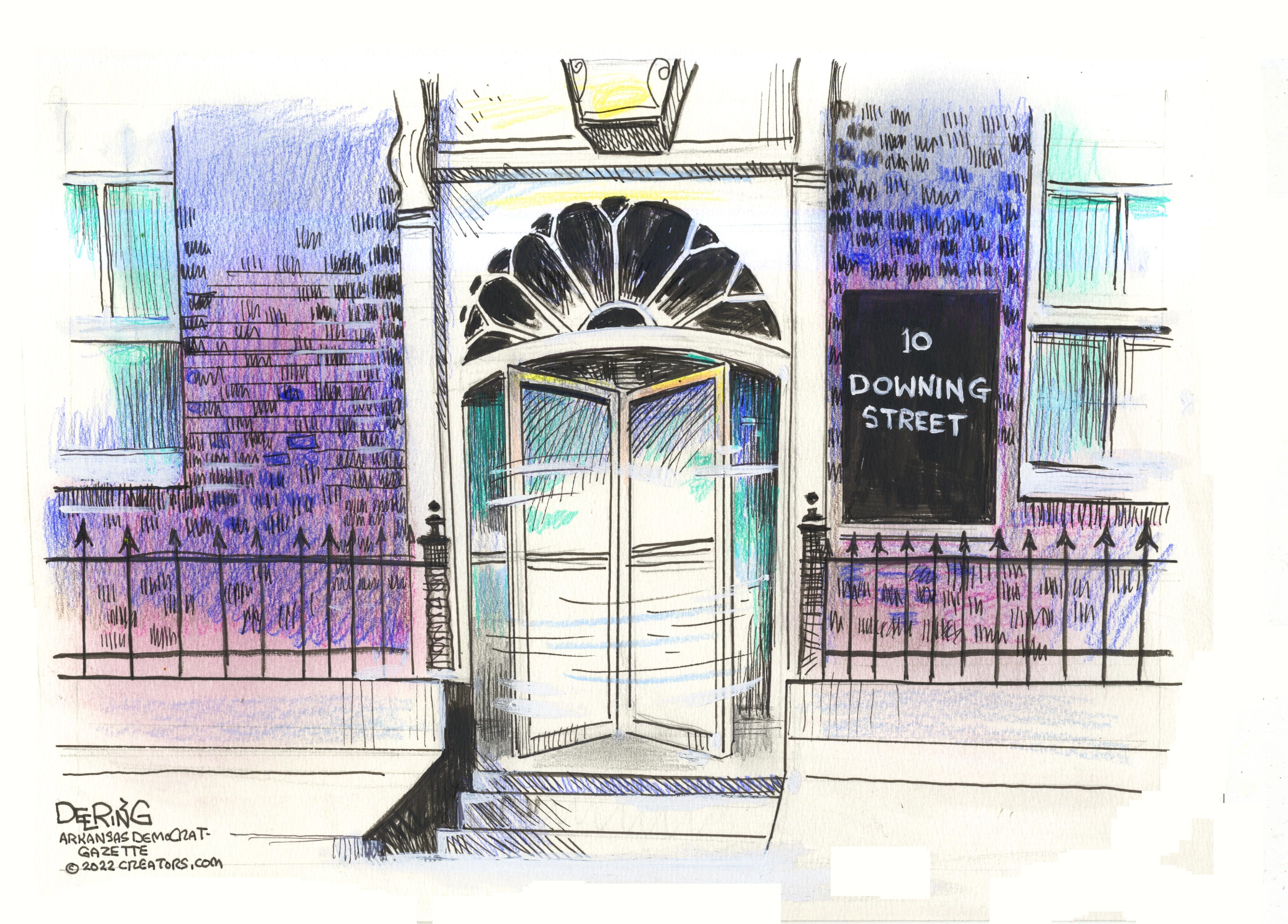
Liz Truss’ reign as prime minister is over after about six weeks. She’s the third PM in a row to have a short tenure: David Cameron served a respectable six years before leaving in 2016 after the Brexit referendum. He was replaced by Theresa May, who resigned in 2019 because she couldn’t get a Brexit agreement negotiated and approved. Boris Johnson lasted for three chaotic years before resigning in scandal in July, but not actually leaving office until September.

Truss came into office promoting a big tax-cuts-for-the-rich plan that was (1) deeply unpopular with voters and (2) spooked the capital markets, sending the pound plunging. (For what it’s worth, Trump economic advisor Larry Kudlow loved it, and claimed Truss’ plan looked just like what Kevin McCarthy wants to do if he becomes Speaker.)

Now she’s resigned too, and it looks like Rishi Sunak is going to replace her.

The Conservative Party (home of everybody I’ve mentioned so far) still has a majority in Parliament and doesn’t have to hold new elections until 2024. But its polls have crashed and there’s general acclaim for holding elections sooner, which is a thing that can happen in the British system. We’ll see.

As for what this is all about, Vox interviews Johns Hopkins Professor Matthias Matthijs, who claims these years of instability trace back to Brexit.

There is one clear root cause of Britain’s woes, according to Matthijs: Brexit. The vote to Leave or Remain in the EU, he says, scrambled UK partisan affiliations and created new, polarized political identities around one dominant issue. The decision to leave unleashed serious economic aftershocks, which were impossible to ignore or paper over indefinitely. The result has been a chaotic, unsteady Britain, battling social malaise and political upheaval in the aftermath of the pandemic and amid an inflation crisis sweeping the global economy.

and Trump legal notices
https://theweek.com/political-satire/1017655/the-great-garland

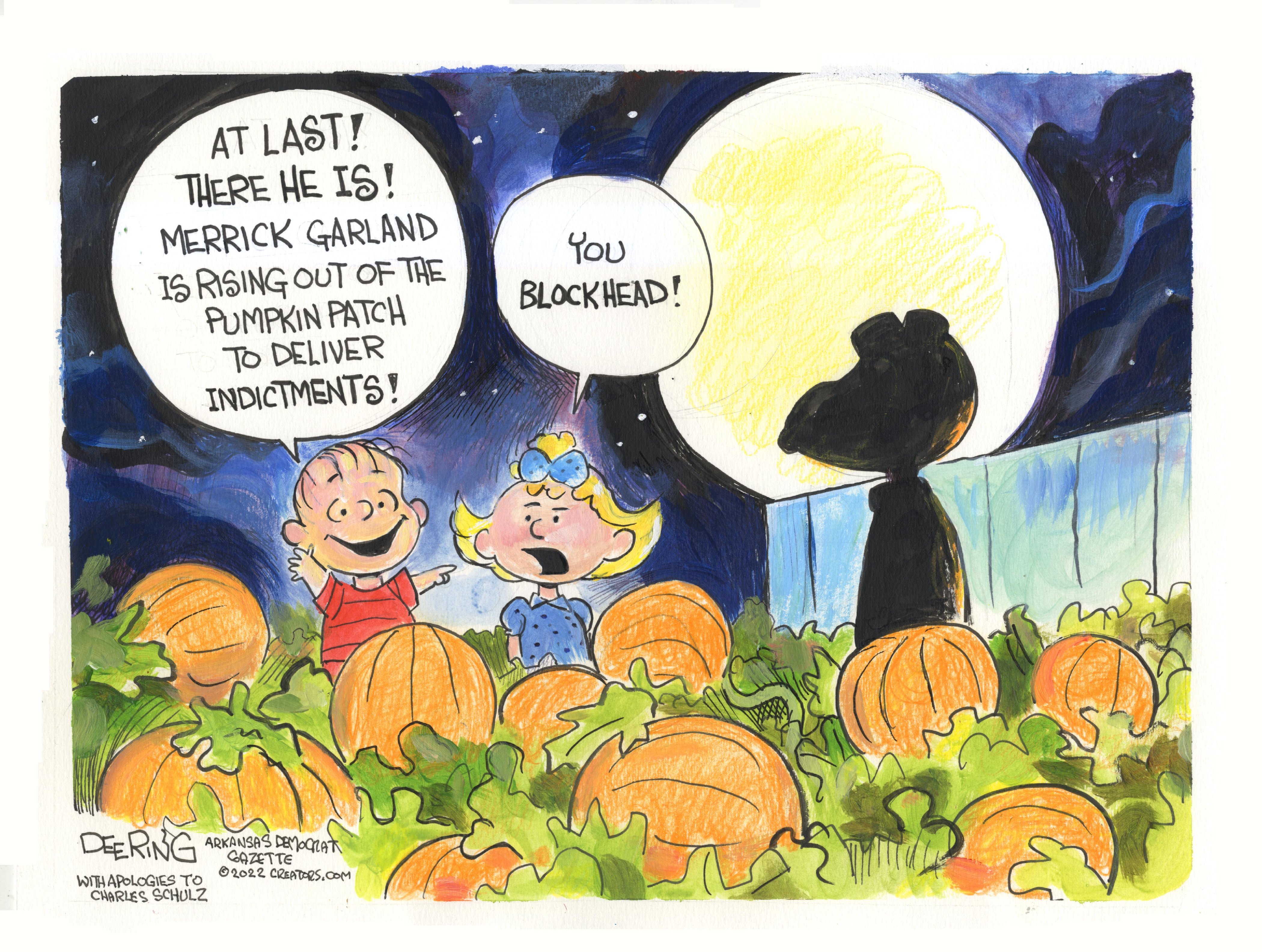
Trump is facing so many legal challenges these days that you really can’t tell the players without a program. This summary of the week’s events may be incomplete.


Friday, the January 6 committee subpoenaed Trump. The subpoena says:

[W]e have assembled overwhelming evidence … that you personally orchestrated and oversaw a multi-part effort to overturn the 2020 presidential election and to obstruct the peaceful transfer of power. … Because of your central role in each element of these actions, the Select Committee unanimously directed the issuance of a subpoena seeking your testimony and relevant documents in your possession.

No doubt he’ll run out the clock until the committee dissolves at the end of the year. But that will make him look weak and cowardly compared to Hillary Clinton, who faced the Republican Benghazi Committee for 11 hours and ate their lunch.


Wednesday, Trump gave a deposition under oath in the civil suit where E. Jean Carroll is charging him with defamation. In a memoir she published in 2019, Carroll claimed Trump had raped her in a department store dressing room in the mid-1990s. Trump told reporters that she was “totally lying” and that he never knew her, a claim that became suspicious when The Cut published a picture of them (with spouses) talking at a party in 1987. Trump managed to delay his deposition for years, but he finally had to do it. (The deposition isn’t public, so I don’t really know, but my bet is that he sounded like a dementia patient, and just kept repeating “I don’t remember.” That’s how his written testimony in the Mueller investigation was.)


The Trump Organization’s trial for tax fraud starts today. The case is related to the charges for which CFO Allen Weisselberg has already pleaded guilty. Trump himself has not been indicted.


Also on Wednesday, a federal judge ruled that Trump lawyer John Eastman (the guy who came up with the Mike-Pence-can-decide-the-presidency theory) has to turn a number of Trump-related emails over to the January 6 committee. Eastman had claimed attorney/client privilege, but the judge invoked the crime/fraud exception to that privilege. The judge’s order says:

The emails show that President Trump knew that the specific numbers of voter fraud were wrong but continued to tout those numbers, both in court and to the public. The Court finds that these emails are sufficiently related to and in furtherance of a conspiracy to defraud the United States.


The special master reviewing the non-classified documents the FBI seized in their search of Mar-a-Lago — the one Trump nominated himself — is getting impatient with some of Trump’s bizarre claims, like that a document can be personal, and yet also subject to executive privilege. Trump has never grasped that president was a role he played; it did not adhere to his person.

Meanwhile, WaPo reported this:

At least one of the documents seized by the FBI describes Iran’s missile program, according to these people, who spoke on the condition of anonymity to describe an ongoing investigation. Other documents described highly sensitive intelligence work aimed at China, they said.

Unauthorized disclosures of specific information in the documents would pose multiple risks, experts say. People aiding U.S. intelligence efforts could be endangered, and collection methods could be compromised. In addition, other countries or U.S. adversaries could retaliate against the United States for actions it has taken in secret.

Clearly, nothing to worry about.


Lindsey Graham appealed to the Supreme Court in a last-ditch attempt to get out of testifying to the Fulton County, Georgia grand jury about his possible interference in the 2020 election. I’ve got to wonder what question he is afraid to answer under oath, that it’s worth going to this much trouble.


Friday, Steve Bannon was sentenced to four months in prison for contempt of Congress. He defied a subpoena from the January 6 committee similar to the one Trump got. (Again: What question is he afraid of?) His sentence won’t begin until his appeals are exhausted, but he’s going to jail eventually, because this case is really really simple: He got a legal subpoena and he didn’t show up.

Meanwhile, his completely unrelated fraud trial should start in November.

and John Durham’s final whimper

The Durham investigation was supposed to uncover some huge anti-Trump plot inside the Deep State, and demonstrate that the Trump/Russia investigation was based on politics rather than evidence. Trump promised it would uncover “the crime of the century“, and claimed Durham was “coming up with things far bigger than anybody thought possible”.

But as so often happens with Trump’s claims, when it’s time to produce evidence they come up short. It happened again in the Igor Danchenko case, which concluded Tuesday with an acquittal. The jury deliberated for only nine hours, and a juror quoted by the Washington Post said there were “no holdouts“.

As in the Sussman case, the only other Durham indictment that went to trial, the charge was that someone lied to the FBI, not that the FBI investigation itself was corrupt or ill-founded. And even that small claim could not be proved to a jury. Danchenko’s lawyer said:

If this trial has proven anything, it’s that the special counsel’s investigation was focused on proving crimes at any cost as opposed to investigating whether any occurred

Charlie Savage and Linda Qiu of the NYT point out that Durham applied very different standards when he was investigating CIA torture during the Bush administration.

At the time, Mr. Durham had set a high bar for charges and for releasing information related to the investigation. Throughout his 2008-2012 investigation, he found no one he deemed worthy of indictment even though two detainees had died in the C.I.A.’s custody, and he fought a Freedom of Information Act lawsuit to avoid disclosing to the public his findings and witness interview records.

Durham’s grand jury has expired with no other indictments outstanding, so this looks like the end of the line for his long, expensive, and unproductive investigation. He’ll produce a report that will probably make his master happy by rehashing all the conspiracy theories he did not prove. But in the end “the crime of the century” has resulted in two acquittals, one minor guilty plea, and no one going to jail.

and you also might be interested in …

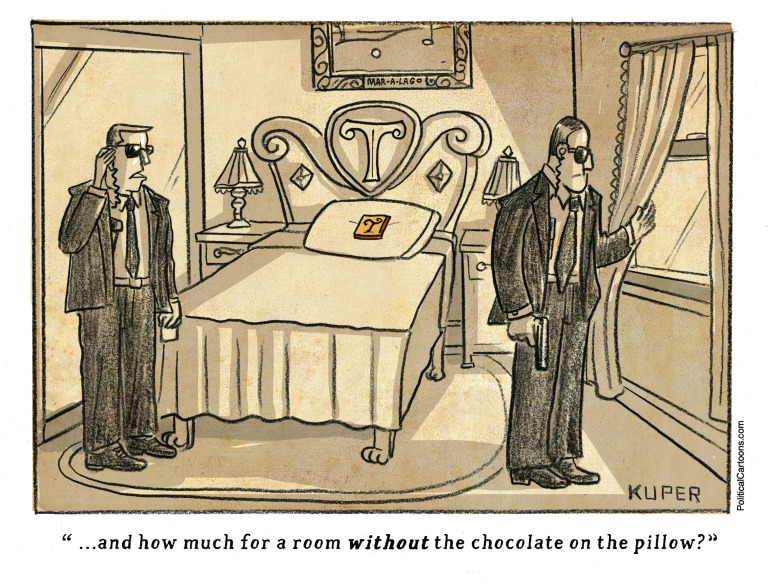
Last Monday, WaPo revealed one more way that the Trump Organization had scammed the government: Family members with Secret Service protection stayed in Trump hotels, which then overcharged the agents who protected them.

The records show that in 40 cases the Trump Organization billed the Secret Service far higher amounts than the approved government rate — in one case charging agents $1,185 a night to stay at the Trump International Hotel in D.C. The new billing documents, according to a congressional committee’s review, show that U.S. taxpayers paid the president’s company at least $1.4 million for Secret Service agents’ stays at Trump properties for his and his family’s protection.

That $1,185 was five times the government rate, and the $1.4 million doesn’t include payments to Trump’s Mar-a-Lago or Bedminster properties, which he frequently visited as president.

Eric Trump’s previous claims that agents got discounted rates or stayed “free”, and that the government “saved a fortune”, appear to be lies.
https://theweek.com/political-satire/1017627/pricey-chocolate

Back in August, Florida Governor Ron DeSantis announced with great fanfare that his new Election Crimes Office had arrested 20 Floridians who had voted illegally in 2020. This was seen on the Right as evidence that voter fraud is rampant and that more states should have their own ECOs.

From the beginning, though, the cases seemed a bit off. The 20 were all people who had been in prison, and who believed (incorrectly, it turned out) that the 2018 referendum returning felon voting rights applied to them. So they registered, were sent voter cards by local election officials, and then voted.

Since the 20 were confused and the government itself erred by approving their registrations, simply revoking those registrations seems like an adequate response. But instead the ECO charged them with a third-degree felony punishable by up to five years in prison. (The point seems to be to terrorize people who aren’t sure about their eligibility. It’s a voter-suppression tactic.)

Friday, the first case came to court, and the charges were dismissed because the state prosecutors have no jurisdiction.

Statewide prosecutors, which are an extension of the Attorney General’s office, are prosecuting all of the election fraud cases that were brought in August. In order for the statewide prosecutor to have jurisdiction, the crimes alleged must have occurred in at least two judicial circuits.

The judge agreed with the defense’s argument that the alleged violations, applying to vote and voting while ineligible, only occurred in Miami-Dade County. Thus, the statewide prosecutor was found to not have jurisdiction.

Statewide prosecutors argued that the alleged crimes were committed in Leon County in addition to Miami-Dade County, because the defendants’ applications and votes were later transmitted to the Department of State in Tallahassee.

In other words, this whole story is yet another DeSantis stunt that got him headlines without accomplishing anything other than harassing some powerless people. If there is in fact a vast conspiracy of illegal voters, Florida still has not uncovered it.


Ten years ago, Rick Perlstein (author of all those history-of-the-conservative-movement books like Nixonland and Reaganland) explored the connection between conservative politics and hucksterism in “The Long Con“. It turns out that if you’re selling something of no particular value, a mailing list of conservative donors is a gold mine, because the conservative movement is a self-selected group of people who are easily fooled.

I mean, if you believe that 1-6 was an antifa plot or Trump is God’s anointed, the sky’s pretty much the limit, isn’t it?

Updating Perlstein’s points a little, Alex Jones makes his money selling overpriced dietary supplements, and Tucker Carlson’s show is sponsored by dubious products that promise to treat your diabetes or get rid of your toe fungus, made by companies that frequently get in trouble with the FDA. (If you needed to sell such products, where would you look for suckers? That communist FDA — it’s constantly tying creative entrepreneurs in red tape and keeping you from using products that work. Am I right?)

But this week we got an even more striking example of the pattern. A right-wing blogger known as Vox Day has been raising money to make a right-wing superhero movie based on the conservative-themed comic-book character Rebel, whose Wonder-Woman-like costume includes the Confederate battle flag’s X of stars across her face and chest. The script, written by Day and Chuck Dixon, has her battling “a global police force hunting down freethinking conservatives”.

A plot ripped right out of today’s headlines, don’t you think?

Day claims to have raised $1 million, which he put in escrow in hopes of leveraging it into enough financing to make the film (which is already listed on IMDB and had a trailer on Vimeo until … well, we’ll get to that).

To hold the money, Theodore Beale (Vox Day’s real-life alter ego) turned to cryptocurrency billionaire James Wolfgramm, whose firm Ohana Capital Finance promises “banking to the unbankable”.

And guess what? The million dollars is gone, and it turns out Wolfgramm wasn’t really a billionaire at all. So (sorry, early investors) there’s not going to be a movie. Who (other than Rick Perlstein) could have imagined?

But don’t worry, Beale is not discouraged and is already working on a new project. I’m sure you’ll be hearing from him soon.

and let’s close with something super, sort of

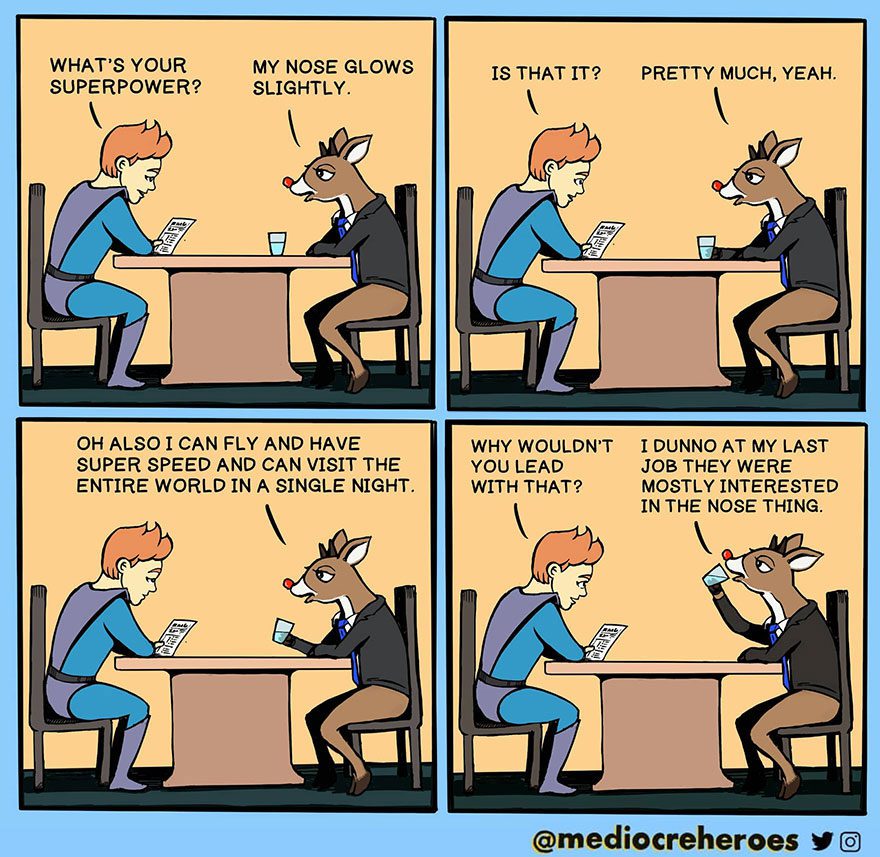
This week I ran across The Mediocre Superheroes, an online comic strip that I find hilarious. There’s an article about it here, or you could just browse.
Closing Arguments: Biden’s accomplishments

With a refreshing lack of bombast, President Biden and the Democratic Congress have gotten a lot done.


People who believe the media has a liberal bias should consider two phenomena:

  • How easy it is to make people forget the disasters that Democratic presidents inherit from their Republican predecessors.
  • How quickly Democratic accomplishments pass out of the public’s attention, as if they never happened.

So any account of Joe Biden’s accomplishments has to start by recalling where we were on Inauguration Day, a memory that has somehow grown rosy in some people’s minds. (President Obama had to deal with a similar amnesia, as many people forgot Bush had handed him the worst economic disaster since the Great Depression.)

  • Unemployment was at 6.3%, compared to 3.5% last month.
  • 104,265 Americans died of Covid in January, 2021, a rate of 3,363 per day. The current rate is 361 per day.
  • 12-month GDP was $22.22 trillion, barely more than the February 2020 level of $21.92, and well below August 2022’s $25.80 trillion.
  • American troops were still in Afghanistan, having accomplished virtually nothing after 20 years of nation-building that Trump pledged to end, but didn’t.
  • The federal budget deficit for FY 2020 (October, 2019 through September 2020, Trump’s last full year in office) was $3.1 trillion. The FY 2022 deficit was $1.4 trillion. We are currently in FY 2023, whose deficit is projected to be $1.2 trillion.

So let’s start there. Under Biden, we have significantly lower unemployment, higher GDP, fewer Covid deaths, a lower deficit, and our troops are out of Afghanistan.

https://theweek.com/political-satire/1017493/biden-did-that

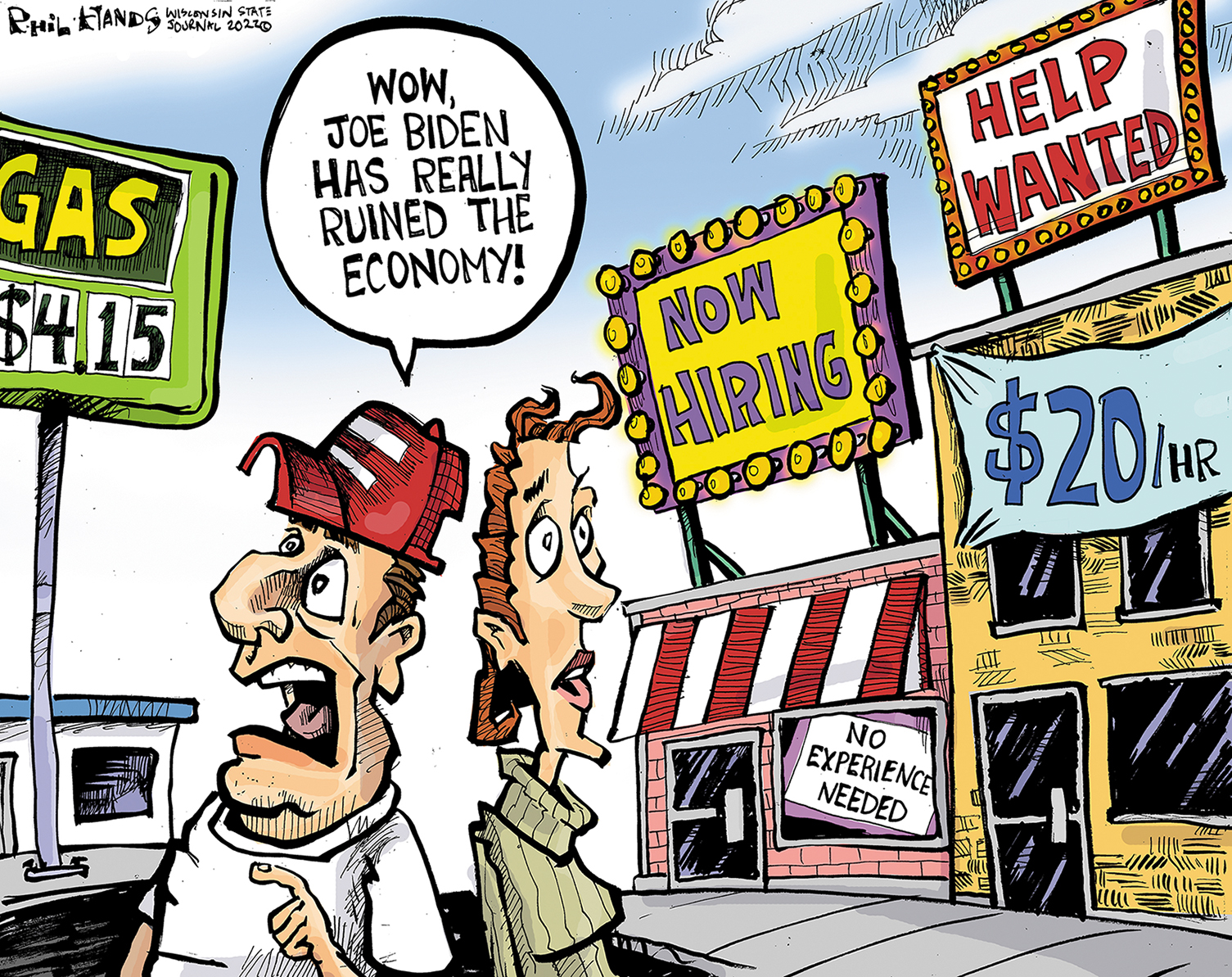
The economy. In 2019, when unemployment spent most of the year in the 3.5-3.7% range, Trump declared it “the greatest economy in history“. Then the pandemic hit, the economy collapsed, and unemployment skyrocketed to 14.8% in April, 2020.

Both Trump and Biden fought to keep the economy going with emergency stimulus measures, including direct payments to individuals. As a result, the March-September period of this year once again saw unemployment in the 3.5-3.7% range. Jobs are once again plentiful, wages are rising, and many businesses complain about not being able to find enough workers.

The cost of this impressive economic performance in challenging circumstances has been inflation, which peaked at 9.1% (year-over-year) in June and has since been trending downward, though it remains an uncomfortably high 8.2%. (The war in Ukraine also factors into rising energy and food prices.) However, the US is doing relatively well in comparison with similar economies. Inflation is running at 10% in the 19-country eurozone and 10.1% in the United Kingdom.

It is hard to see how any of this will improve if Republicans reclaim either house of Congress. Looking forward to 2024, it will be in Republicans’ interest to block whatever Biden tries to do, especially if it would help the economy. In particular, we can expect a Republican-controlled house of Congress to return to the ransom-demanding practices the GOP used against President Obama. Expect another debt-ceiling crisis, and perhaps this time they’ll push the country into default.

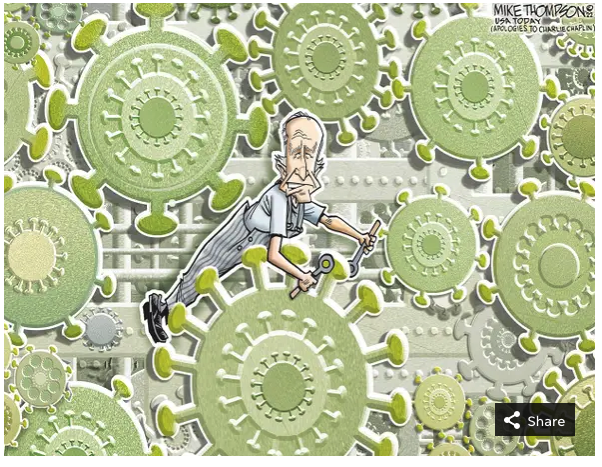
https://www.usatoday.com/picture-gallery/opinion/cartoons/2020/09/27/biden-harris-democrats-2020-election-voting-presidency/3554097001/

Covid. In spite of his overall mismanagement of the Covid crisis, Trump deserves credit for funding the “warp speed” plan to develop a vaccine quickly. The first vaccines were approved in December 2020, leaving Biden to figure out how to get shots into Americans’ arms.

That was a key part of the American Rescue Plan that Biden got through Congress and signed less than two months after taking office. Remember how, under Trump, states competed with each other for resources to fight the pandemic? That hasn’t happened under Biden. Vaccines have been distributed fairly and for free. (Pfizer recently announced its intention to charge $110-130 per dose when government funding runs out. Imagine if we’d had to pay that from the beginning.)

Republicans could have given Trump credit for the vaccines and made vaccinating the country a bipartisan goal, but instead decided to go the other way. Together with conservative media, they ran a disinformation campaign about vaccines, masks, and everything else Covid-related. As a result, blue Massachusetts has an 82% vaccination rate; red Alabama 52%. Nonetheless, Biden still managed to get 68% of Americans fully vaccinated, including 93% of those over 65.

One cost of Republican disinformation, it’s worth pointing out, has been paid by their voters.

Average excess death rates in Florida and Ohio were 76% higher among Republicans than Democrats from March 2020 to December 2021, according to a working paper released last month by the National Bureau of Economic Research.

Believing what Republican politicians and Fox News hosts tell you can endanger your health.

Foreign policy. When Biden took office, NATO was in shambles. Trump had repeatedly questioned the value of the alliance, and had even suggested the US might not fulfill our treaty obligations to defend other NATO countries if they were attacked. He seemed unable to criticize Vladimir Putin, and even took Putin’s side against US intelligence services in a particularly egregious meeting in Helsinki.

Biden’s reassembly of the alliance has been masterful. NATO has stood together in helping Ukraine resist the Russian invasion, and has even drawn Sweden and Finland into the alliance. Putin, who dominated Trump, has been completely outplayed by Biden. (Trump has continued to be in thrall to the Russian dictator. Shortly after the Ukraine invasion began, Trump described Putin’s move as “genius“.)

The US exit from Afghanistan was ugly, but necessary. To his credit, Biden was willing to swallow the medicine that three previous presidents had passed on to their successors. Trump had entered office promising to end the Afghan war, and repeatedly said he was doing so (including ordering an abrupt withdrawal after the 2020 election, which was not carried out). But he didn’t. Biden did.

After 20 years of nation building, including countless billions spent training and equipping the Afghan army, the Afghan government couldn’t even hang on long enough for us to get out of the country. Sad as those events were to witness, they demonstrated conclusively that our presence, and the continuing sacrifices of our troops, were accomplishing nothing.

Legislation. Another unfulfilled Trump promise that Biden delivered on was the bipartisan infrastructure package.

The legislation will put $110 billion into roads, bridges and other major projects. It will invest $66 billion in freight and passenger rail, including potential upgrades to Amtrak. It will direct $39 billion into public transit systems.

The plan will put $65 billion into expanding broadband, a priority after the coronavirus pandemic left millions of Americans at home without effective internet access. It will also put $55 billion into improving water systems and replacing lead pipes.

That bill didn’t just start the long-delayed rebuilding of America, it also proved that the two parties can still work together. 19 Republican senators and 13 representatives voted to pass it.

Biden’s third major piece of legislation was the Inflation Reduction Act, which he signed in August. This is the first major piece of legislation to fight climate change, and is projected to result in the US’s greenhouse gas emissions in 2030 being 40% below 2005 levels. It also cuts the deficit and reduces prescription drug prices.

Executive orders. President Biden has used his power to help Americans who need it. Among many other moves, he has ordered a limited student debt forgiveness (though Republicans have gone to court to block it), and is also pardoning non-violent federal prisoners whose only offense is marijuana possession.

Closing Argument: Abortion

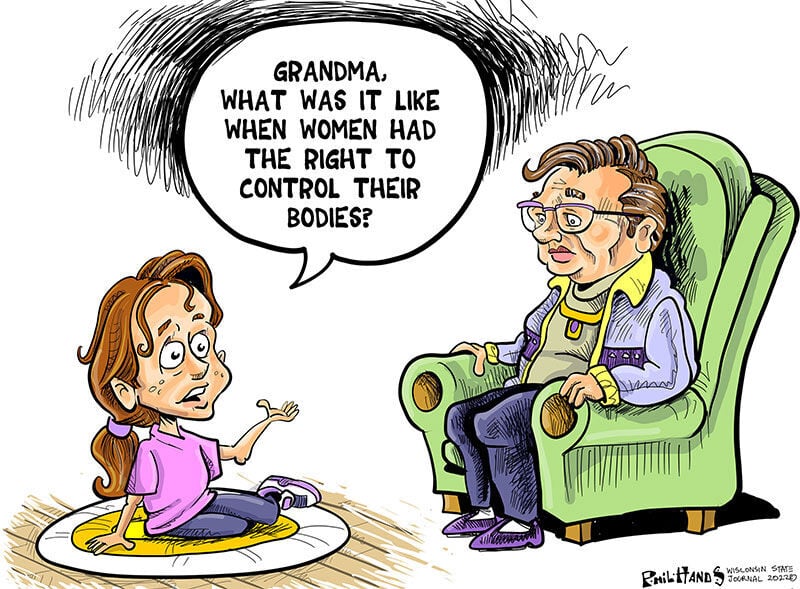
https://madison.com/opinion/cartoon/hands-on-wisconsin-end-of-roe-means-fewer-rights-for-women/article_5769a345-2d8d-5b54-8307-4fa275b9a8e7.html

Will women make their own decisions, or will government decide for them?


For decades, abortion has been a get-out-the-vote issue for Republicans, but not so much for Democrats. After all, as long as the Supreme Court was there to protect your rights, what practical difference could an anti-abortion legislature or Congress make?

But now that Trump’s three appointees have taken their seats on the Court, women’s rights (and privacy rights of all kinds) are up for grabs again. If you want to defend those rights, you have to vote.

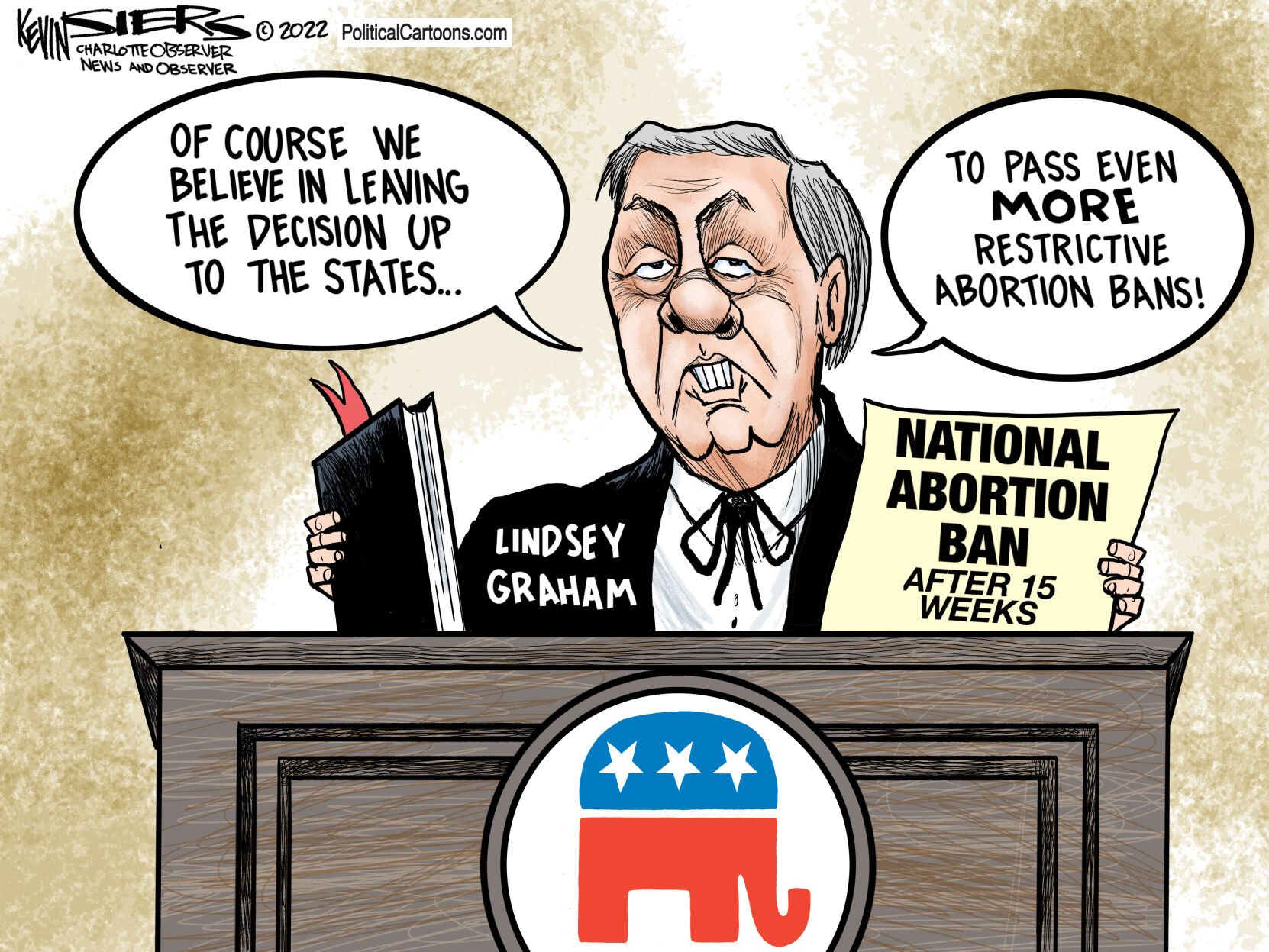
The two parties’ positions. Last June’s Dobbs decision has allowed states to pass some truly horrible laws that not only deny women’s bodily autonomy, but even put their lives in danger. Initially, Republicans claimed the Court had simply returned the abortion question to the states, implicitly promising that women in blue states would keep the rights they had before Dobbs. But now many are pushing for a national abortion ban.

If history is any guide, Republicans who haven’t publicly supported such a ban — and perhaps even some who have taken a stand against one — will get in line once it comes up for a vote. Few GOP congresspeople have the backbone to stand up against the anti-abortion movement, and even fewer have shown a willingness to buck Donald Trump. So if a bill is on the floor and Trump is pushing them to support it, what do you think they will do?

https://www.dailyastorian.com/opinion/editorial-cartoon-national-abortion-ban/article_5f259790-3593-11ed-a5fe-236574f0cac2.html

By contrast, Democrats support a law that would restore the rights women lost when Roe was overturned.

“Why haven’t they already passed it?” is a fair question. Such a law has passed the House, but fell one vote short of a majority in the Senate. Two Democratic senators haven’t been willing to create an exception to the filibuster that would allow a majority to pass the law. But if Democrats gain two seats in the Senate — say, if John Fetterman replaces Pat Toomey in Pennsylvania and Mandela Barnes replaces Ron Johnson in Wisconsin — the law will pass and President Biden will sign it.

What’s wrong with the state abortion bans? The best argument against the various state abortion bans is to look at specific examples of what they’ve done.

The case that got the most publicity was when a raped 10-year-old had to leave Ohio and go to Indiana to get an abortion. (Indiana has since passed a ban nearly as extreme as Ohio’s, but it does have a rape exception. That law is being challenged in state courts.)

But while they may appear comforting, the exceptions in state abortion bans often provide little protection in practice. The ban in Texas, for example, includes an exception to protect a pregnant woman’s life. But when Amanda Zurawski found out that her fetus was not viable and that continuing to carry it was dangerous, all she could do was wait. The fetus wasn’t dead yet, and she wasn’t dying yet, so under the law, nothing could be done. She describes her experience like this:

People have asked why we didn’t get on a plane or in our car to go to a state where the laws aren’t so restrictive. But we live in the middle of Texas, and the nearest “sanctuary” state is at least an 8-hour drive. Developing sepsis—which can kill quickly—in a car in the middle of the West Texas desert, or 30,000 feet above the ground, is a death sentence, and it’s not a choice we should have had to even consider. But we did, albeit briefly.

Instead, it took three days at home until I became sick “enough” that the ethics board at our hospital agreed we could legally begin medical treatment; three days until my life was considered at-risk “enough” for the inevitable premature delivery of my daughter to be performed; three days until the doctors, nurses, and other healthcare professionals were allowed to do their jobs. 

By the time I was permitted to deliver, a rapidly spreading infection had already claimed my daughter’s life and was in the process of claiming mine.

I developed a raging fever and dangerously low blood pressure and was rushed to the ICU with sepsis. Tests found both my blood and my placenta teeming with bacteria that had multiplied, probably as a result of the wait. I would stay in the ICU for three more days as medical professionals battled to save my life. 

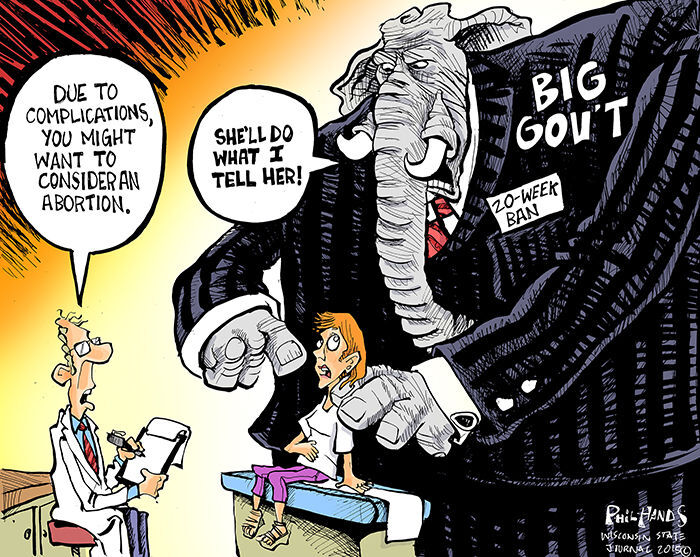
https://madison.com/opinion/cartoon/phil-hands-the-battle-for-abortion-rights-in-editorial-cartoons/collection_267451d3-8cf7-53a8-a089-58541ae775db.html#10

Mylissa Farmer tells a similar story. Her fetus was dying and her own life was in danger, but she wasn’t quite sick enough yet for doctors in Missouri to help her. She had to travel to Illinois for treatment.

Since their ordeal, Farmer has lost trust. While she still feels her obstetrician at Freeman Hospital in Joplin is a good doctor, she’s worried about whether medical professionals in Missouri will be able to offer patients necessary care.

“I haven’t lost trust in care, but I’ve lost trust (doctors) will be allowed to make the medical decisions they need to make,” she said.

She’s lost trust in the politicians who represent her, as well.

Despite reaching out to various legislators, she has yet to receive an answer that satisfies her: Why is this law written this way? If it’s to protect women, why did she have to be in danger before she could get care in-state? Why is it such a binary law?

“The world is too nuanced to put such strict rules in place,” Farmer said.

Farmer’s story is not unique. According to the American College of Obstetricians and Gynecologists, preterm premature rupture of membranes happens in 2% to 3% of pregnancies in the United States, and leads to preterm birth in one out of four cases.

Imagine if a similar law were in place nationally. Where would women like Farmer go then?

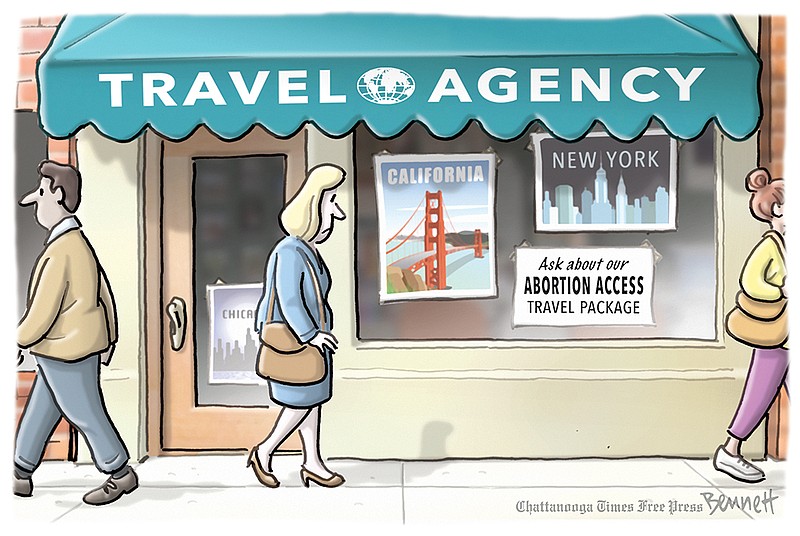
https://www.timesfreepress.com/news/2022/sep/15/the-entrepreneur/

The new laws treat other health dilemmas with similar disdain. Imagine discovering, shortly after you miss your first period, or perhaps during a prenatal physical, that you have cancer. Chemo-therapy and radiation can seriously harm or even kill a fetus. So what’s the alternative? Wait until the baby is born, and hope that your cancer is still treatable by then? If you’re not facing immediate death, that could be the only legal option. No wonder an article in the journal Demography concludes:

Overall, denying all wanted induced abortions in the United States would increase pregnancy-related mortality substantially, even if the rate of unsafe abortion did not increase.

Who decides? Pro-life rhetoric tends to gloss over such complexities. Pregnancies are problem-free, loving families are lined up to adopt even the most damaged newborns, and so the right thing to do is obvious. All we need is a law to make women do it.

But once you admit that there are any valid exceptions, then someone has to decide which individual cases are exceptional enough to qualify. Republicans believe that those decisions should be made by legislatures, or perhaps by hospital lawyers trying to avoid liability under laws the legislature left vague.

Democrats believe those decisions are best made by the people involved: the pregnant woman, advised by her family, her trusted friends, and the best medical and moral advisors she can find. This is especially true when there are significant risk-tradeoffs to weigh. Take the cancer example: Some women may feel so committed to the life growing inside them that they don’t hesitate to risk their own lives. That decision could be heroic, but the law should not force heroism on people.

And I can easily imagine a husband protesting against heroism: “I’m not ready to sign up for a future where you die and I’m left to raise a child by myself.” Those kinds of discussions need to happen inside families, not in Congress or in front of a hospital ethics board.

Religion. Most abortion decisions are not driven by health considerations, but by how a woman pictures her life proceeding with or without a child, and how she frames the moral questions abortion raises.

Different individuals and different religions see those questions differently. Some (but not all) Christian sects believe that a fertilized ovum already has a human soul, and that killing it is murder. Some (but not all) Jewish sects believe that the soul enters the body much later, perhaps not until the first breath. (See the creation of Adam in Genesis 2:7.) Other religions and non-religious people’s opinions are all over the map. Most Americans appear to believe that the moral status of a fetus starts low and increases as it develops, which is why few people worry much about fertilized ova frozen in fertility clinics.

Whose opinion should control? Consider that if you ate a hamburger yesterday, a Hindu might tell you that the steer it came from had a soul every bit as significant as your own, one that may have inhabited a human body in a previous incarnation. Should this Hindu theology limit what you can eat?

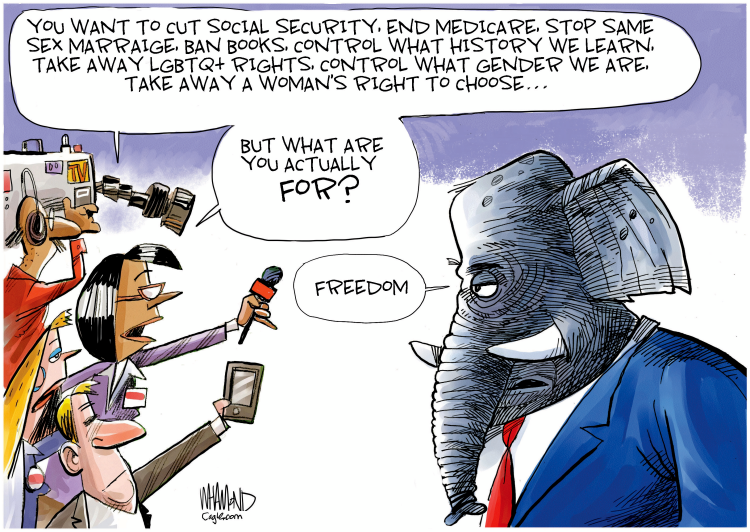
Democrats believe that disputed religious questions should be decided by individuals, and that, unless the government has a secular reason to intervene, your behavior should be governed by your own beliefs (or lack thereof). Republicans believe that conservative Christian theology should control everyone’s behavior, a position they sometimes call “freedom”.

https://www.cagle.com/dave-whamond/2022/10/the-party-of-freedom

Late-term abortions. Anti-abortion activists believe late-term abortions are their trump card. In one typical attack, the National Republican Senatorial Committee claims “Radical John Fetterman Supports Abortion Up Until the Moment of Birth“. The headline conjures up an image of Fetterman (or any Democrat) actively supporting abortion, as if he recommends that women get abortions and tries to persuade them to do so.

But nothing remotely like that is actually happening.

What most (not all) Democrats believe is what I said in the previous section: The decision whether or not to have an abortion can be difficult, and is best made by the people involved rather than by the government. Republicans, on the other hand, believe in some absolute cut-off: After some number of weeks, the government’s judgment automatically becomes better than the family’s. Your case is exceptional if the government says it’s exceptional.

In fact, late abortions are precisely the situations where the government’s arbitrary rules have the least to offer. Such abortions are rare (about 1% of all abortions take place after 21 weeks, and far fewer after 24 weeks), and almost every one is a unique story in which something has unexpectedly gone wrong with a wanted pregnancy. (Though many abortions near the deadline take place because jumping through anti-abortion hoops can delay a poor woman, who may have trouble assembling the resources she needs to travel to a distant city and stay there through a waiting period.)

The Guardian quotes one woman’s husband:

For those who believe these babies are unwanted, Matt says: “You’re not going to wait until halfway through your pregnancy to finally have an abortion.”

I can think of no better closing than to repeat what Mylissa Farmer said:

The world is too nuanced to put such strict rules in place.

https://www.washingtonpost.com/comics/2022/06/27/cartoons-abortion-supreme-court-dobbs/

Closing Argument: Democracy

https://theweek.com/political-satire/1017617/dangerous-business

One of the two parties in these elections has stopped believing in elections.
You should vote for the one that still does believe.


The last time a Republican was president, he did one of the worst things any American president has ever done: He tried to stay in power after losing an election.

The testimony we have heard since, from his own campaign workers and appointees, as well as elected Republican officials in state and local governments, have stripped away all innocent explanations: He knew he had lost. He knew his claims of fraud were false. He knew his plot to appoint fake electors and count their votes was illegal. He knew the crowd he incited to storm the Capitol was prepared to do violence. And after violence broke out, he refused to tell his mob to go home until it was clear that their attempt to intimidate Congress had failed.

His schemes were thwarted only when elected Republicans and his own appointees refused to do his bidding: Mike Pence, Brad Raffensperger, Aaron Van Langevelde, Jeffrey Rosen, Mike Shirkey, Rusty Bowers, and many others at all levels of government. If not for them, he might have succeeded in overthrowing our Constitution or sparking a civil war.

Afterwards, some Republicans in Congress tried to hold the would-be usurper accountable for his actions and reaffirm their party’s commitment to our system of government: Liz Cheney, Adam Kinzinger, Peter Meijer, and several others.

You could imagine a Republican Party in which all those people are heroes: They did their jobs, fulfilled their oaths, and saved American democracy. But that party doesn’t exist. Instead, almost all the Republicans who resisted the coup attempt have been drummed out of office. (Raffensperger, who survived a primary challenge, is a lonely exception. Whether Pence will ever again win a Republican primary is an open question.)

https://www.washingtonpost.com/opinions/2022/10/19/telnaes-election-democracy-gas-prices/

Instead, the ex-president’s personality cult has solidified its hold on the GOP. The most strident promoters of the stolen-election lie, like Marjorie Taylor Greene, have risen, while those who briefly denounced the coup, like Kevin McCarthy and Lindsey Graham, have had to eat their words to retain their influence. Mitch McConnell can’t even defend his own wife against racist abuse. In the current election cycle, the party has been saddled with absurd candidates like Herschel Walker “because he scored a bunch of touchdowns back in the 80’s and he’s Donald Trump’s friend“.

Across the country, Republicans who still refuse to recognize their candidate’s loss in 2020 are running to oversee the 2024 elections, while his Supreme Court appointees consider whether to re-interpret the Constitution to allow state legislatures to ignore both their state constitutions and the will of their voters. Republicans running for governor in swing states — Kari Lake in Arizona, Doug Mastriano in Pennsylvania — have said they wouldn’t have certified Biden’s 2020 victory, without citing any evidence to justify such a move (because there is none). Some Republican candidates — Ron Johnson in Wisconsin — were active participants in illegal 2020 plots.

https://claytoonz.com/2022/10/17/lake-o-lies/

Worse, many MAGA Republicans are following Trump’s example by undermining elections in general: If they lose, they claim fraud without any evidence. Others are openly attacking democracy, like Utah Senator Mike Lee, who said: “We want the human condition to flourish. Rank democracy can thwart that.” Like their leader, many Republicans flirt with racism and anti-semitism, and some don’t even try to hide it.

Even a liberal like me can see that America needs a viable conservative party. It’s healthy that our national conversation include voices saying that government should do less, that traditions should change slowly, and that free enterprise plays an important role in our prosperity. Even as I support the consensus of scientific opinion on subjects like climate change or vaccination, I recognize that those views should not go unchallenged. Every party, even one that I support, needs someone looking over its shoulder.

But the conservative party America needs would be loyal to our Constitution rather than to one man. It would support the institutions of democracy and defend the People’s right to elect someone else.

The current GOP is not that party, and it will not become that party until voters have disciplined it for supporting illegal and violent attempts to seize power. It is the insurrectionists who need to be run out of town, not the people who stopped the insurrection plot from succeeding.

That discipline needs to start in these elections. You may agree or disagree with me about inflation, government spending, regulations, taxes, how to balance women’s rights against fetal rights, and many other issues. But we can have those arguments later. Because in the long run, if we lose our democracy, it won’t matter which of us makes the better case.

The Monday Morning Teaser

I’ll be taking next week off, so the next Sift after today won’t be until the day before the midterm elections. That’s too late to try to persuade anybody, so today’s Sift will focus on the closing arguments I think Democrats should be making.

My original vision was of a series of short, punchy posts on single issues, with an umbrella post to list and link to them. And I’ve mostly done that, but the short-and-punchy resolution has been hard to keep. So instead I have a series of not-incredibly-verbose posts lined up. I hope you will find them useful in convincing friends who are undecided about who to vote for or about voting at all. There actually is a lot on the line in this election.

Anyway, the closing arguments are broken into Democracy, Abortion, and Biden’s Achievements posts. They should come out in that order between now and about 11 EDT. I’m still deciding whether the umbrella post is necessary.

I had hoped that moving so much material into those posts would shrink the weekly summary, but then the week happened. The UK government fell; the week’s developments in the various Trump legal battles is a story in itself; John Durham lost his final case, capping a long, expensive, and unproductive investigation into the allegedly nefarious origins of the Russia “hoax”; and I just couldn’t resist telling the story of the would-be conservative movie-maker who lost his investors’ money to a grifter. (Conservatives have a hard time spotting grifters, don’t they? It’s almost like the movement seeks out gullible people and grooms them to be conned.)

So the summary may not show up until 1 or so.

See you in two weeks.

Roads Not Taken

The misgovernment of the American people is misgovernment by the American people.

– Lincoln Steffens, The Shame of the Cities (1904)

This is our last election. It is fascism or communism. We are at the crossroads. I take the road to fascism.

Father Charles Coughlin (1936)

This week’s featured post is “American Democracy has been in trouble before“.

This week everybody was talking about the upcoming elections

https://theweek.com/political-satire/1017532/america-inside-out

Polls seem to be tipping back towards Republicans as inflation continues and the stock market keeps falling. But it’s not too late for them to turn again.

Conventional wisdom says Democrats should hope voters are thinking about abortion or democracy or Trump rather than the economy. But I wonder if perhaps the Democrats’ closing message ought to focus on what Republicans will do to the economy if they win one or both houses of Congress: They’ll sabotage it, like they did when Obama was president.

That seems pretty obvious, but not many Democrats are talking about it.

Republicans are already promising a return to their Obama-era hostage-taking policies. If they get hold of any lever of power, you can count on them to force government shutdowns and to play chicken with the debt ceiling. If the Fed succeeds in starting a recession, they’ll try to make it worse with spending cuts.

When I imagine a debt-ceiling crisis, the worst thing is that the MAGA generation of right-wing radicals is significantly dumber than the Tea Party generation. Ted Cruz may have pretended otherwise, but he always knew what a disaster it would be if the US defaulted on its debt. I don’t think Marjorie Taylor Greene does, and I can’t see Kevin McCarthy standing up to her, especially if Trump thinks a global economic panic will help him in 2024.

https://theweek.com/political-satire/1017493/biden-did-that

and Ukraine

Unable to win on the front lines, Putin seems to have settled on a Battle-of-Britain strategy. He’s raining destruction on Ukrainian cities in hope of breaking the people’s will. It didn’t work for Hitler, but I guess you never know.

and the Trump subpoena

https://theweek.com/political-satire/1017533/the-big-climb

The January 6 Committee held another hearing on Thursday. I didn’t feel like I learned much that was new, but the Committee did bolster what might be its closing argument: January 6 wasn’t a rally that got out of control. Rather, it was the culmination of a plot to steal the 2020 election that Trump was already hatching the summer before.

The conclusion of the hearing was a unanimous vote to subpoena Trump himself. I think it’s extremely unlikely that Trump will ever testify to the Committee, which goes out of business on January 1 and certainly won’t be renewed if Republicans get control of the House. But issuing the subpoena does establish a key point: Trump isn’t telling his side of the story because he doesn’t want to, not because the Committee doesn’t want to hear it.

and other egregious malefactors

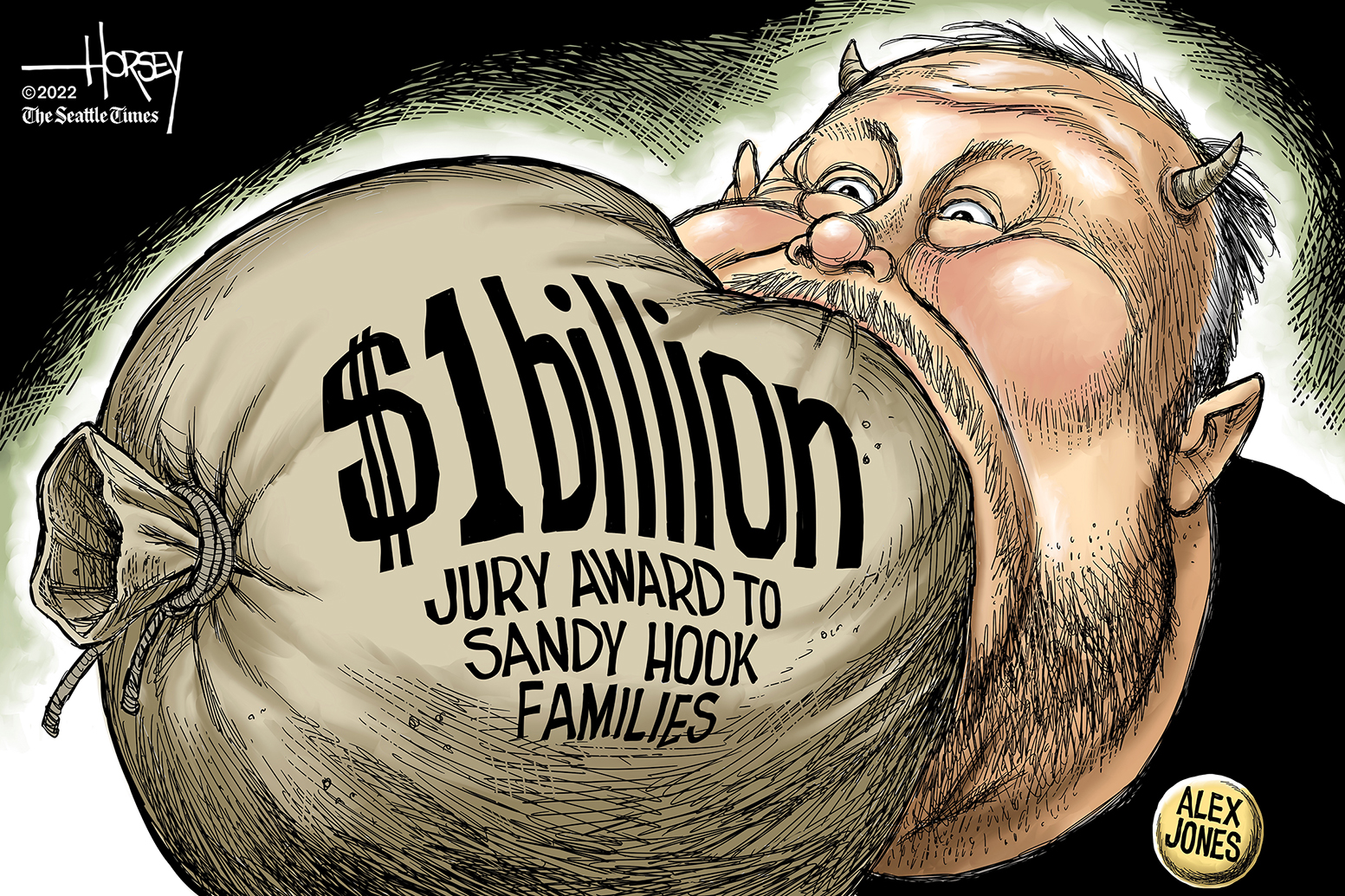
https://theweek.com/political-satire/1017491/stuffed

A Connecticut jury decided Alex Jones owes the Sandy Hook families nearly $1 billion. That’s on top of the $50 million a Texas jury awarded earlier this year, and it doesn’t count possible punitive damages still to be assessed by the judge.

Most observers believe Jones doesn’t have a billion dollars, though he does have considerably more than he claims. (Somewhere in the hundreds of millions, probably.) Declaring bankruptcy probably won’t save him.

When the last appeal ends, the experts predict Jones will be left owing many millions of dollars to the Sandy Hook families he defamed in his broadcasts, in addition to other creditors chasing him through bankruptcy court.

“Alex Jones probably doesn’t have much of a project in life at this point other than beating these kinds of money judgments,” said UConn law professor Minor Meyers. “By and large, he is going to have a hard time earning money without immediately being forced to hand it over. He may really enjoy being a radio personality, but I can’t imagine he wants to do it pro bono.”


Steve Bannon’s contempt-of-Congress trial has moved to the sentencing phase. The government is asking for a six month prison sentence, rather than the maximum two years.


So Sean Hannity played a recording of a Biden phone message to his son Hunter from October, 2018. (Obtained how, exactly?) It revealed Biden as a compassionate father trying to support a troubled son.

It’s Dad. I called to tell you I love you. I love you more than the whole world, pal. You gotta get some help. I don’t know what to do. I know you don’t either. I’m here, no matter what you need. No matter what you need, I love you.

For some reason, Hannity appeared to consider this a “gotcha” of some sort, which says more about Hannity than he probably intended to reveal.

I keep seeing tweets from people who made some mistakes in their lives and wish their parents had been more like Joe Biden.


Perhaps the most interesting thing about Tucker Carlson’s interview with Kanye West is how Carlson edited out Kanye’s anti-semitism to fit the story he wanted to tell.

Media Matters’ Matt Gertz has the details, along with this summary of Tucker’s overall message and mission.

Tucker Carlson Tonight revolves around an antisemitic conspiracy theory. The host posits that a cabal of global elites controls the heights of U.S. politics, media, culture, and business, and is using its power to corrupt American children, destroy western civilization, and replace its population with immigrants.

Carlson’s innovation is that he generally deracinates these familiar antisemitic tropes. While open white supremacists might argue, for example, that Jews are using immigration to replace the white population with a black and brown one, Carlson tells his viewers that elites like the financier George Soros (who is Jewish) are replacing “legacy Americans” with people from “far-away countries” in the “third world.”

Carlson’s stated worldview is close enough that neo-Nazis regularly praise his show for mainstreaming their blood-soaked positions. But Carlson’s careful use of language, and his furious denials that he is a racist, give the Fox brass just enough plausible deniability that they can continue to defend and support his program. 

but maybe we should be talking about nuclear power

This week, the stock broker I inherited from my father tossed out a speculative idea: NuScale Power. He said he couldn’t recommend it, because he wasn’t sure exactly what the company does. But one of his other clients had done the research and was very hot on it. So it might be something to look into, given that my portfolio has been light on energy stocks ever since I purged my fossil-fuel holdings.

The symbol for the stock is SMR, which turns out to stand for “small modular reactor”, a new generation of nuclear power plants that promise to be smaller, safer, easier to build, and less one-of-a-kind than current nuclear power plants. The environmental news site Grist had a mostly favorable article about SMRs in 2020.

While it’s true that renewable energy is cheap now, most energy wonks think it will get expensive when renewables are powering the entire grid, which will require building lots of batteries to deal with fluctuations in the sun and wind. Sure, there are studies suggesting it wouldn’t be prohibitively expensive to power the country purely on renewables, but the most accurate ones — which model the nitty-gritty details of how electrical systems work — tend to show that the best way to keep renewable power cheap is by having a source of clean energy that can be turned up when wind dies and the sun is hiding behind the clouds, said Matt Bowen, a research scholar at the Center on Global Energy Policy, at Columbia University.

“In the energy world, there are really two camps: The all-renewables camp and everyone else,” he said. “I’m with everyone else.”

The negative case was outlined by Farhad Manjoo last month in the NYT: At best, nuclear power is the expensive kind of power you throw into a low-CO2-emission system when its renewables-and-batteries component is failing to keep up with demand. Manjoo recognizes the potential of SMRs, but if you have to do research to make a power-generation system work, why not spend your research dollars on better renewables and batteries? (And I’ll add this: There’s still no long-term storage plan for the radioactive waste.)

In the end, I decided SMR is not for me (which is one reason I feel no ethical qualms about discussing it here; I’m not touting a stock I own). Even if nuclear does have a role to play in the transition to a low-carbon-emission future, that role looks purely transitional to me. So a nuclear power-plant construction company doesn’t seem like a good long-term investment. If I bought into the industry now, I’d also have to figure out when to sell.

and you also might be interested in …

One of the most important topics in political research is just how social media contributes to political polarization. A new study in Proceedings of the National Academy of Sciences has a surprising answer. (The study itself is behind a paywall, but an article about it is here.)

Most people think social media is polarizing because it isolates you inside an echo chamber. You are constantly hearing people agree with you that Trump or Biden is a villain, so there’s no reason you should change your mind.

The study says it doesn’t work quite that way. What establishes and hardens a political identity is that social media also exposes you to opposition. You solidify as this or that when you argue with people on the other side.

We shouldn’t think of the internet as an “echo chamber” in which our arguments are repeated back to us until we get more and more convinced. I think it’s more like the island in the Lord of the Flies: it creates a social space that affords the emergence of separate social groups, it strengthens collective identities, and pushes opposing groups into conflict. This leads to a form of politics that is based on cycles of conflict between two warring tribes.


Slate examines just how hard it is for a transman to get breast-reduction surgery. Anti-trans mythology imagines doctors all too eager to prey on impressionable people, especially minors, by pushing irreversible gender-affirming treatments. The article claims exactly the opposite is true.

This detail sounds especially weird:

It is, after all, much easier for cis people to get plastic surgery than for trans people to get gender-affirming care. In 2020, there were 15.6 million cosmetic procedures performed in the U.S., according to the American Society of Plastic Surgeons. Breast augmentations were one of the most popular surgeries, with 3,223 of these procedures performed on people aged 13 to 19.

If that sounds OK to you, but you still object to a similarly aged person with a female birth certificate getting their breasts reduced, you might want to think some more about that.


Apropos of nothing, Dan Kois’ retrospective on Rod McKuen is fascinating. Kois is too young to remember when McKuen sold poetry books by the millions and was the kind of celebrity poets never get to be.

But by the time I was a teenager, he had completely vanished from the cultural landscape. I only know of him because I spent the entire 1990s in thrift stores and used bookshops, and everywhere I went, I saw Rod McKuen’s name.

Eventually, Kois’ article turns into a meditation on cultural memory.

One of the weird contradictions of living in the future is that every artist is at the tip of your fingers, but you can only find who your fingers know to search for. In the not-so-distant past, artists could avoid slipping away thanks to only the physical evidence: a record in a thrift store, a used book with a man in a white turtleneck on its cover, murmuring to the bewildered shopper, “Who am I? To whom did I matter? To whom did I stop mattering?”

The Spotify algorithm, Amazon’s recommendations, they’ll never, ever show you Rod McKuen. Those are designed to direct you towards things that other people like right now. But thrift stores, used bookshops, and Goodwills are, accidentally, perfectly designed to show you things that people liked decades ago, then stopped liking.


I love surprising science results. The WaPo’s Well Being column offers this:

“Healthy fat is not about the amount of fat” someone carries, said Jeffrey Horowitz, a professor at the University of Michigan, who studies exercise and metabolism. It is about how well that fat functions, he said. “A person who has healthier fat is much better off than someone with the same body fat percentage whose fat is unhealthy.”

Apparently, what you want are small fat cells that can expand or contract as the body’s supply-and-demand of calories requires. What you don’t want are big inefficient fat cells leaking fatty acids that can build up inside vital organs.

This is why physical activity can make you healthier, even if you don’t lose weight or even lose fat. Exercise can “remake” your fat.

and let’s close with something batty

It turns out that bats aren’t just screeching for no reason, or even necessarily echolocating. A lot of the time they’re arguing with each other.

Yossi Yovel and his colleagues recorded a group of 22 Egyptian fruit bats, Rousettus aegyptiacus, for 75 days. Using a modified machine learning algorithm originally designed for recognizing human voices, they fed 15,000 calls into the software. They then analyzed the corresponding video to see if they could match the calls to certain activities.

They found that the bat noises are not just random, as previously thought, reports Skibba. They were able to classify 60 percent of the calls into four categories. One of the call types indicates the bats are arguing about food. Another indicates a dispute about their positions within the sleeping cluster. A third call is reserved for males making unwanted mating advances and the fourth happens when a bat argues with another bat sitting too close. In fact, the bats make slightly different versions of the calls when speaking to different individuals within the group, similar to a human using a different tone of voice when talking to different people.

American democracy has been in trouble before

If we knew our history, we’d realize that the country is more resilient than we think.


Unprecedented. Every year, dictionary publisher Merriam-Webster announces a “word of the year“: a single term that in some way tells you what the year was about. Typically, it’s not a new coinage, but a common word suddenly getting more use. 2021’s word of the year was vaccine (though insurrection was a competitor), and 2020’s was pandemic. 2019’s word was an old pronoun being used in a new way: the singular they.

I don’t know what Merriam-Webster has in mind for 2022, but if it were up to me, the word of 2022 would be unprecedented. I seldom go a day without running across it somewhere.

All kinds of recent events are being cast as unprecedented. Just this week, Delta Airlines described a surge in fall air traffic as “unprecedented”. An ergonomic research group claimed recent strains on industrial workers are “unprecedented”. Tennessee Governor Bill Lee pitched an anti-crime proposal with a twofer: “Unprecedented times call for unprecedented measures.”

Both the Covid-19 pandemic and policies for containing it have been labeled “unprecedented”. Climate change has brought on all sorts of unprecedented events: not just heat waves, but droughts, storms, and floods.

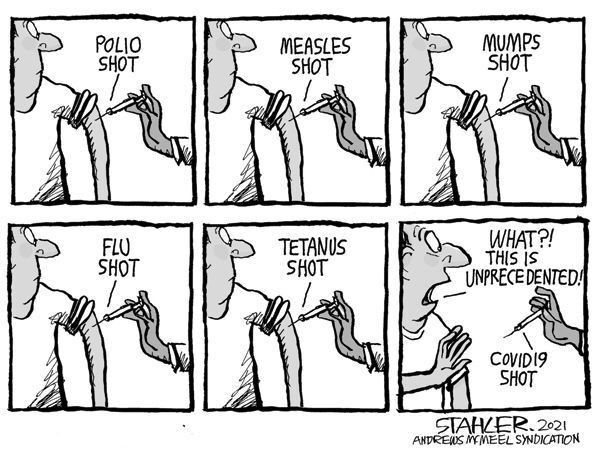
https://hanfordsentinel.com/opinion/editorial/editorial-cartoon-unprecedented/article_3e08fd25-0075-5a1f-9fc2-d93c0a86ccd9.html

But what makes unprecedented the word of 2022 is its eruption into American political news and discussions about the state of our democracy. No matter which side of the partisan divide you’re on, you see the other side doing unprecedented things that pose an unprecedented threat.

The FBI’s search of Mar-a-Lago was unprecedented, but so was the criminal activity that made it necessary. If the ultimate result is an indictment of a former president, that too would be unprecedented. The January 6th Committee’s vote to subpoena Trump wasn’t quite unprecedented, but sets up an “unprecedented” confrontation. The Committee’s hearings themselves have been unprecedented, but so was the riot (or insurrection or failed coup) they are tasked with investigating. A Trump-and-January-6 documentary released this summer was titled Unprecedented.

Day after day, we are being told that the current threat to American democracy is unlike anything that has ever happened before.

It’s a discouraging, dispiriting message, because it implies that we are on our own. History has nothing to teach us and offers no reassurances. If American democracy is Patient Zero of an previously unknown disease, who can advise us or make any predictions about our survival?

But what if our current predicament isn’t unprecedented? What if American democracy has faced crises before and muddled through them?

Historic blind spots. This is a point where the patriotic version of US history that most of us learned in high school fails us. We know about the Civil War, of course, and the Native American genocide (which used to be known as “how the West was won”). We know that Jim Crow walled Black Americans out of democracy in the South, and that women didn’t get the vote until 1920. Various consensual sexual acts were illegal for much of our history, and same-sex couples couldn’t marry until fairly recently.

But still.

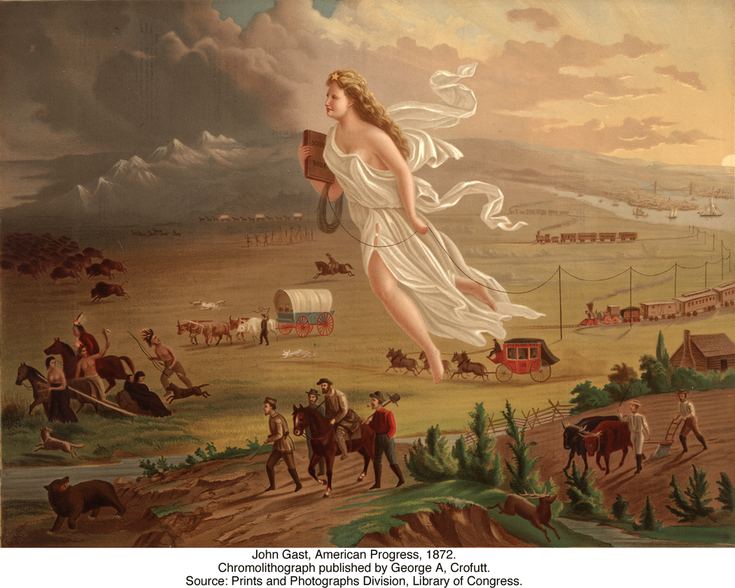
The history I learned in school embedded those failings in a narrative of progress, in which democracy and human rights were constantly expanding. We made mistakes, but we fixed them. The villainies of our past are simply backstory for the heroic saga that followed.

https://picturinghistory.gc.cuny.edu/john-gast-american-progress-1872/

This upbeat narrative is what Ron DeSantis wants Florida schools to teach today:

It was the American Revolution that caused people to question slavery. No one had questioned it before we decided as Americans that we are endowed by our Creator with unalienable rights and that we are all created equal.

So (in this telling) when Thomas Jefferson enslaved hundreds of human beings, took sexual advantage of at least one of them, and then raised his own children as slaves, he was foreshadowing abolition. His vision of human equality wasn’t hypocritical, it was prophetic.

While that onward-and-upward story may fill at least some Americans with a warm glow, it fails us in moments like these, when democracy itself is in trouble and human rights may be starting to contract. How can we cope with such unprecedented challenges?

But what if they aren’t unprecedented?

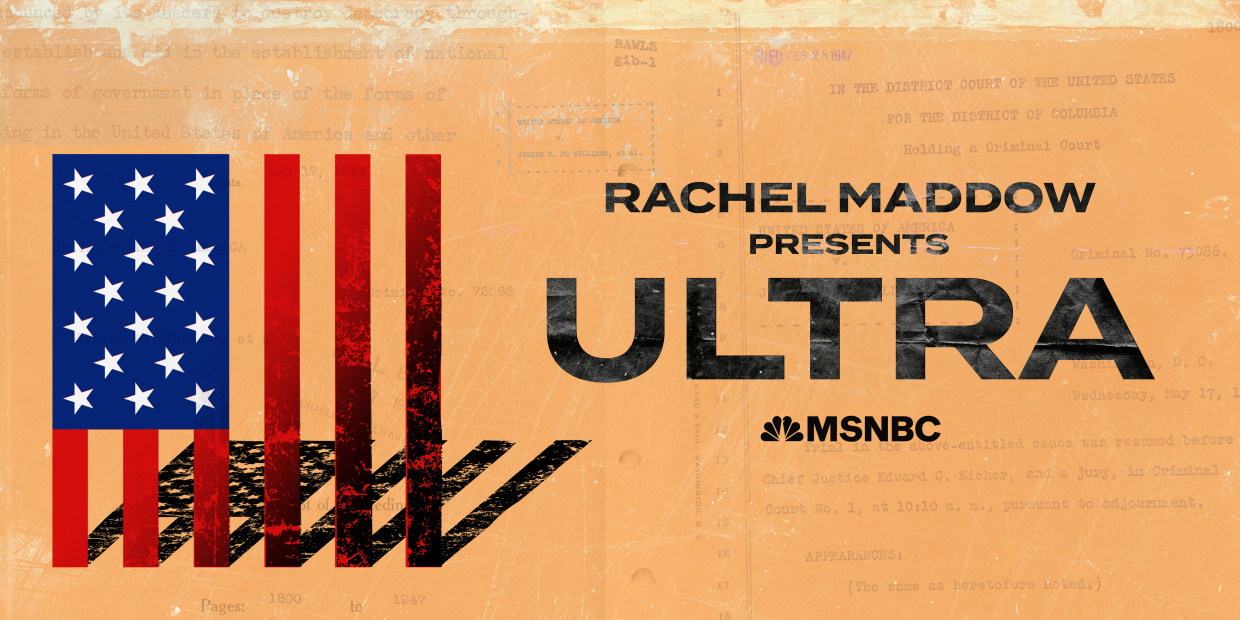
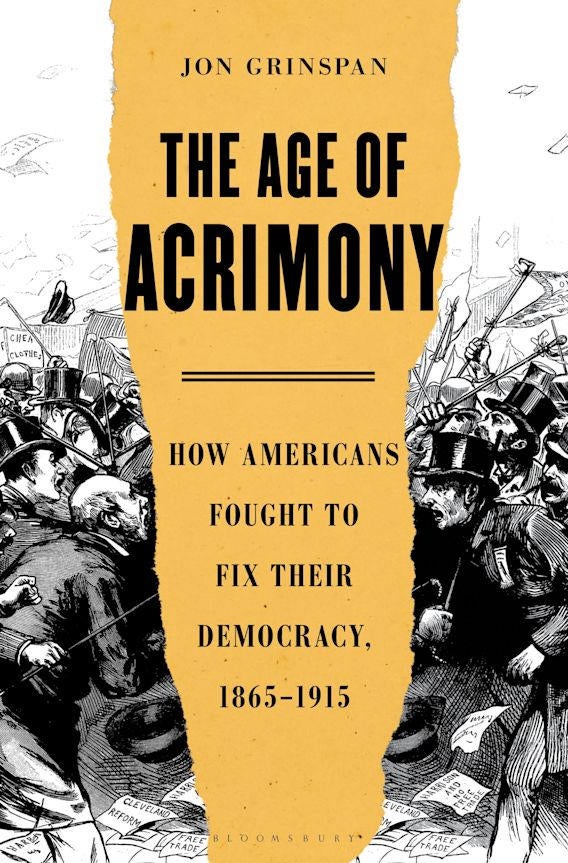
This week I spent some time examining two of the darker eras of American politics: I listened to the opening episodes of Rachel Maddow’s new podcast “Ultra“, about a fascist plot to overthrow FDR. And I read the new book by Smithsonian curator Jon Grinspan about the hyper-partisan politics of late 1800s, which he has dubbed The Age of Acrimony.

Ultra. The first episode of “Ultra” includes its own best introduction:

This is a story about politics at the edge. A violent, ultra-right authoritarian movement, weirdly infatuated with foreign dictatorships. Support for that movement among serving members of Congress who prove willing and able to use their share of American political power to defend the extremists, to protect themselves, to throw off the investigation. Violence against government targets. Plots to overthrow the United States government by force of arms. And a criminal justice system trying, trying, but ill-suited to thwart this kind of danger. …

This is a story of treachery, deceit and almost unfathomable actions on the part of people who are elected to defend the constitution, but who instead got themselves implicated in a plot to undermine it. A plot to end it. …

Perhaps most importantly, this is also the story of the Americans— mostly now lost to history— who picked up the slack in this fight, who worked themselves to expose what was going on, to investigate it, to report on it, ultimately to stop it.

And there’s a reason to know this history now. Because calculated efforts to undermine democracy, to foment a coup, to spread disinformation across the country, overt actions involving not just a radical band of insurrectionists, but actual serving members of congress working alongside them, that sort of thing is… that’s a lot of things. It’s terrible. But it is not unprecedented.

We are not the first generation of Americans to have to contend with such a fundamental threat. Lucky for us, the largely forgotten Americans who fought these fights before us, they have stories to tell.

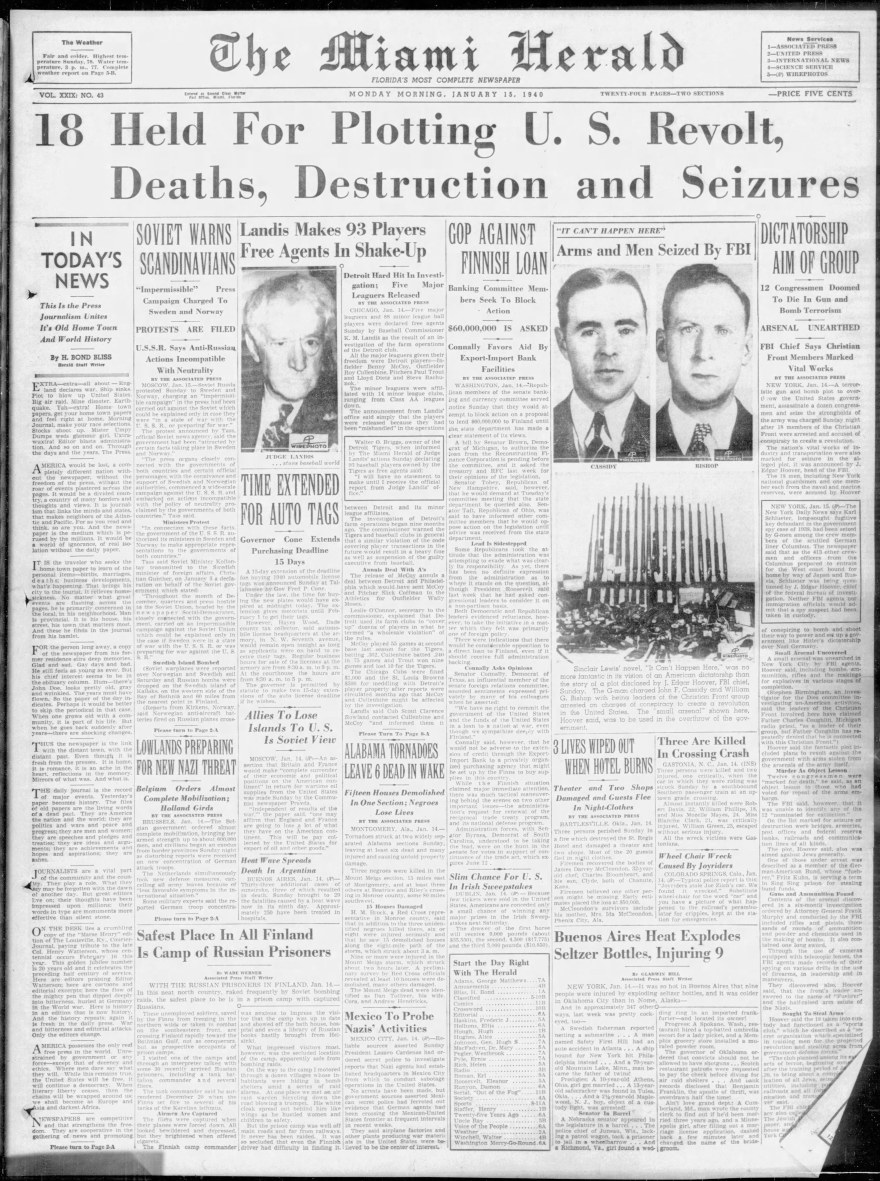
“Ultra” begins with a mysterious 1940 plane crash that killed Minnesota Senator Ernest Lundeen, along with several government agents who had begun to shadow him. Lundeen was on his way to deliver a Labor Day speech that not only urged America to stay out of the war in Europe (where Hitler had already taken over France and was threatening Britain), it was openly pro-German, and “had been ghost-written for Senator Lundeen … by a senior, paid agent of Hitler’s government operating in America”.

There was a time when I considered myself a World War II buff. But I had never heard of Senator Lundeen, or of the insurrection plot described in Episode 2, for which 18 members of the Christian Front were arrested.

The participants in that plot were never convicted, largely because of the popularity of their cause.

Prosecutors were blamed for not appreciating— not factoring in to their jury presentation— just how favorably the Christian Front was viewed in the community where the trial was held. The local press affectionately nicknamed them “The Brooklyn Boys.” The local Catholic Church supported them loudly. Nobody who was Jewish was allowed to sit on the jury. There was a local Catholic priest who was advising the Christian Front, who had been leading rallies to support them, who was close to [Father Charles] Coughlin [who coined the term “Christian Front”]. His first cousin was picked as the foreman of the jury.

And yet democracy was not overthrown by fascism, not in 1940 and not since. We’ll have to wait for future episodes (Episode 3 just posted this morning) to find out what Rachel thinks we can learn from democracy’s survival.

The Age of Acrimony. Eight years ago, in the most popular Sift post ever, I first pointed to the biggest hole in my US history education: Reconstruction.

In my high school history class, Reconstruction was a mysterious blank period between Lincoln’s assassination and Edison’s light bulb. Congress impeached Andrew Johnson for some reason, the transcontinental railroad got built, corruption scandals engulfed the Grant administration, and Custer lost at Little Big Horn. But none of it seemed to have much to do with present-day events.

And oh, those blacks Lincoln emancipated? Except for Booker T. Washington and George Washington Carver, they vanished like the Lost Tribes of Israel. They wouldn’t re-enter history until the 1950s, when for some reason they still weren’t free.

Reconstruction and much of the Gilded Age get skipped over because (in every area but technological advancement and GDP growth) they don’t fit very well into the ever-upward narrative of American progress. As Grinspan tells the story:

Americans claim that we are more divided than we have been since the Civil War, but forget that the lifetime after the Civil War saw the loudest, roughest political campaigns in our history. From the 1860s through the early 1900s, presidential elections drew the highest turnouts ever reached, were decided by the closest margins, and witnessed the most political violence. Racist terrorism during Reconstruction, political machines that often operated as organized crime syndicates, and the brutal suppression of labor movements made this the deadliest era in American political history. The nation experienced one impeachment, two presidential elections “won” by the loser of the popular vote, and three presidential assassinations. Control of Congress rocketed back and forth, but neither party seemed capable of tackling the systemic issues disrupting Americans’ lives. Driving it all, a tribal partisanship captivated the public, folding racial, ethnic, and religious identities into two warring hosts.

In hindsight, it’s hard to cast either Democrats or Republicans as the heroes of late 19th-century politics. Democrats were the proud descendants of the Confederacy in the South, combined with the corrupt big-city political machines of the North. On the other side, Republicans soon abandoned the ideals of Reconstruction and 15th Amendment’s new Black voters in favor of the vast business empires of the Rockefellers and Morgans.

More and more of the country was being herded into an impoverished urban proletariat that neither party truly represented. Republicans were on the opposite side entirely, while Democrats would “help” by distributing patronage jobs to loyal party members. Neither party saw a structural problem requiring the kinds of solutions that wouldn’t appear until the 20th century: a minimum wage, workplace safety laws, bans on child labor, unemployment insurance, an old-age pension, and protection for union organizers.

The “Wide Awakes” marching for Lincoln in 1860.

What political campaigns lacked in substance, they made up in noise. Both parties had militaristic marching clubs not entirely unlike the Nazi storm troopers of the 20th century, and torchlight parades were common demonstrations of political strength. Neighborhood political centers were typically saloons where glad-handing ward bosses would pour free drinks in exchange for votes.

The spoils system, in which the victorious party handed out government jobs to those who worked hardest on the campaign, was not a dirty secret, but rather an orderly process that people counted on. President Garfield was assassinated not by an ideological terrorist or a lunatic looking for fame, but by a disgruntled member of his own party who felt his electioneering efforts should have earned him a plum appointment.

The result of all this was a widespread belief that democracy had failed. In 1878, one of the era’s top American historians, Francis Parkman, wrote “The Failure of Universal Suffrage“.

When a man has not sense to comprehend the questions at issue, know a bad candidate from a good one, or see his own true interests — when he cares not a farthing for the general good, and will sell his vote for a dollar — when, by a native instinct, he throws up his cap at the claptrap declamation of some lying knave, and turns with indifference or dislike from the voice of honesty and reason — then his vote becomes a public pest. Somebody uses him, and profits by him.

Rule by the majority, it seemed, meant rule by the ignorant and the easily manipulated. No one appeared to know what to do about it. Parkman, for example, didn’t want a king, and thought any attempt to restrict the vote would be impractical: The People would never give up their power voluntarily, no matter how little good it was doing them. And politicians would never agree to change the system that had put them in power.

Journalist Lincoln Steffens examined seven large political machines, and assembled his conclusions in magazine articles that were reprinted in his 1904 book The Shame of the Cities.

When I set out on my travels, an honest New Yorker told me honestly that I would find that the Irish, the Catholic Irish, were at the bottom of it all everywhere. The first city I went to was St. Louis, a German city. The next was Minneapolis, a Scandinavian city, with a leadership of New Englanders. Then came Pittsburg, Scotch Presbyterian, and that was what my New York friend was. “Ah, but they are all foreign populations,” I heard. The next city was Philadelphia, the purest American community of all, and the most hopeless.

The problem, Steffens concluded, wasn’t any specific group, and it wasn’t the politicians. It was the people in general. Hoping that electing businessmen would improve the system (a perennial claim of businessmen) was pointless, because the politicians were already businessmen. They supplied what the electoral market wanted: corruption.

If we would vote in mass on the more promising ticket, or, if the two are equally bad, would throw out the party that is in, and wait till the next election and then throw out the other party that is in—then, I say, the commercial politician would feel a demand for good government and he would supply it.

But the electorate wouldn’t do that, leading Steffens to this conclusion:

The misgovernment of the American people is misgovernment by the American people.

And yet, somehow, things began to turn around. They had, in fact, already started their long slow turn when Steffens was making his tour.

Solutions? One aspect of Grinspan’s book that is alternately annoying and satisfying is that he has no concise explanation of how change happened. He’s very clear that it didn’t happen all at once, and there was no obvious turning point. Neither party took on the job of reform, and no Gilded Age Solon designed an improved political system.

The change seems to have been primarily cultural rather than political or legal. Systemic changes were the result, not the cause.

It is tempting to tell this story solely as an evolution of law, of amendments ratified granting wider and wider access. But the driving force behind our changing system has been America’s popular culture, the way we use politics.

The widespread conviction by people of both parties that the current system was distasteful and embarrassing led, over time, to a long series of changes, no one of which stands out as the pivot point.

  • Secret ballots. Believe it or not: “Before the final years of the 19th century, partisan newspapers printed filled-out ballots which party workers distributed on election day so voters could drop them directly into the boxes.” Between 1885 and 1891, all the states (acting on their own) switched to more-or-less the current system: An official ballot is printed by the government and given to voters at the polling place, where they fill it out in secret.
  • Civil service. The Pendleton Act was passed in 1883, establishing a merit system for jobs in the federal bureaucracy. State governments soon began passing their own versions.
  • Mass-market advertising. The new business model of newspapers and magazines aimed at offering advertisers near-universal distribution, rather than niche-marketing to a partisan audience. (Why would Coca-Cola want to be known as a Republican or Democratic drink?) This paved the way for standards of objectivity. Mass media has never truly been objective, and there’s some debate whether that idea even makes sense. But prior to, say, 1920, objectivity was not even an aspiration for most newspapers.
  • Parties changed their campaign styles. The torchlight parades and saloon headquarters became unfashionable, too reminiscent of the fat-cat politicians skewered by the newspaper cartoonists. Campaigns started focusing more on platforms, pamphlets, and buttons — things that you read or wore rather than things that you did.
  • Reformers began learning the nuts-and-bolts of politics and getting their hands dirty. In the post-Civil-War era, politics was considered a odious profession, unbecoming to a gentleman. One positive point in Parkman’s essay is a plea for idealistic and well-educated people to run for office. Over the next few decades many did.
  • States provided tools for direct democracy. The referendum and recall processes come from this era.
  • Political energy shifted away from the two major parties and into causes. Rather than crusading as a Republican or Democrat, you might instead devote yourself to temperance or free coinage of silver or women’s suffrage.

Very little of this was decided in elections. For example, neither party was visibly for or against the secret ballot. it didn’t take hold in one part of the country but not another.

Not all the changes were positive: This was also the era when Jim Crow was being established in the South, and the Chinese Exclusion Act passed.

And some of the beneficial developments had dark sides that we have since forgotten. A printed ballot listing all candidates also served as voter suppression: Illiterate or drunk voters might not be able to recognize candidates’ names. Southern Democrats supported the Pendleton Act because the spoils system kept allowing Republican presidents to give good jobs to their Black supporters. Temperance was a way of shutting down the saloons and taverns where working people might gather and plan.

Today, saying that a change requires a constitution amendment is equivalent to admitting that it can’t be done. But four constitutional amendments passed between 1913 and 1920: the federal income tax, direct election of senators, prohibition, and women’s suffrage.

Perhaps the oddest story of the change concerns women’s suffrage. The proposal was going nowhere in the 1880s, because politics was so obviously masculine. Who wanted his wife or daughter marching with a partisan militia, and possibly brawling with a similar group from the other party? Or hanging around in saloons getting men drunk and asking for their votes?

In a weird way, women’s inability to vote or run for office stimulated the push towards causes. Women were largely immune to the hoopla that gave men their political identities, and often diverted them away from their real interests. Undistracted by party politics, a woman might instead devote her energy to crusading for temperance or against lynching. She might organize a union or co-found the NAACP.

Giving women the vote in 1920 isn’t what changed politics. It was only because politics had changed that men could imagine including women in it.

What can we learn? Neither the 1940s nor the Gilded Age is exactly like the present era, and neither provides a blueprint for democracy’s survival. But both, I think, provide a context that give us reasons to hope.

A rose-colored view of our history, one that tells our story as one of continuous progress towards freedom and inclusion, can make us feel uniquely beset today. But in many ways democracy has always been a struggle, and the battle is never completely won.

But knowing about our past struggles may allow us to hope that American democracy is more resilient than we have been thinking. Reforms that seem impossible in one decade can become obvious in the next. The pivotal moments of history are hard to spot, because they’re probably happening inside the culture rather than in Congress.

Things may have already started to turn, and we just don’t see it yet.

The Monday Morning Teaser

Lately I’ve felt surrounded by pessimism. Partly it’s the upcoming elections — not just the belief that the Republicans will reclaim the House, but that all the other close elections will go their way as well: Georgia will elect a man who has no business anywhere near the Senate, Wisconsin will re-elect one of the worst MAGA senators, Jon Fetterman will lose to a literal snake-oil salesman because his stroke recovery isn’t going fast enough, and so on.

Polls say all those elections are in doubt, but in the minds of many of the people I talk to they’re already chalked up as losses.

But not just the elections. This week someone disgustedly told me (as if it were already a fact) that Trump is going to get away with it all. Others say that inflation can’t be tamed, a recession is inevitable, and the stock market will never turn back up. And who can predict what mischief the Supreme Court will get up to this year?

In foreign countries, Putin is going to use nuclear weapons and we’ll have to back down to him to avoid armageddon. Bolsonaro may lose his run-off, but it won’t matter because he’ll launch a coup. Xi is strengthening his hold on China. And so on.

I’ve started to wonder if maybe we’re being a little irrational about all this. Maybe there’s more reason to be hopeful than we think.

With that in mind, this week’s featured post is “American Democracy has been in trouble before”. I’m relying on two sources to look at two periods of American history: Rachel Maddow’s “Ultra” podcasts about the fascist plots of the 1940s, and Jon Grinspan’s new book The Age of Acrimony about the corrupt and violent politics of the Gilded Age.

We tend to tell American history as a story of continuous progress. That’s not only false, it serves us badly in times like these, when we really need to know that previous generations have faced similar challenges and survived them.

So that post will be out between 9 and 10 EDT.

The weekly summary will cover the latest January 6 hearing, developments in the election campaigns, some thoughts about nuclear power, the latest in the Ukraine War, and a few other things. It should post a little after noon.

Burning Bridges

Everything illegal must be destroyed. Everything stolen must be returned.

Mykhailo Podolyak, advisor to Ukrainian President Volodymyr Zelenskyy
after the attack on the Kerch Strait Bridge

This week’s featured post is “Does anything matter?

This week everybody was talking about Herschel Walker

That’s covered in the featured post.

and Ukraine

The Kerch Strait bridge linking Crimea (which Russia annexed from Ukraine in 2014) to the Russian mainland has high symbolic value. It is Europe’s longest bridge, and Putin himself drove the first vehicle across in 2018. Saturday Ukraine (apparently, they haven’t officially claimed responsibility) blew up a chunk of it.

Limited auto and train traffic has resumed, but it’s not clear how much weight of either type the damaged bridge can carry. The bridge is a major supply line for Russian troops in southern Ukraine.

Russia called the attack “vandalism” and “terrorism“, in spite of the bridge’s obvious military significance. It struck back on Sunday with air and missile attacks on Kyiv and several other Ukrainian cities. The Economist reports:

Many missiles fell nowhere near any plausible military target, suggesting that the projectiles were either inaccurate or the barrage was intended to be indiscriminate. Russia is thought to have used up a large proportion of its precision-guided missiles—as much as 70% of those in stock, according to a Western military source—and even those weapons have frequently missed their intended targets throughout the war. A large, smouldering crater stood metres away from a children’s playground in Shevchenko Park, one of the city’s busiest parks and usually packed with families.

and the fall elections

Both the House and Senate majorities are up for grabs, with each party currently favored to control one House. Nate Silver estimates a 68% chance Democrats retain control of the Senate, and a 70% chance Republicans retake the House.

Some of the Senate races once thought to be toss-ups now have clear favorites. Democrats Maggie Hassan in New Hampshire (84% chance), Mark Kelly in Arizona (82%), and John Fetterman in Pennsylvania (73%) are favored, as are Republicans Ted Budd in North Carolina (68%) and Ron Johnson (67%) in Wisconsin. If all those races come out as he projects, each party has 49 seats.

Silver still considers two races toss-ups Warnock/Walker in Georgia (Warnock 59%) and Masto/Laxalt in Nevada (Masto 51%).

For reasons I don’t understand, Real Clear Politics thinks Fetterman and Kelly will lose (even though they each lead in the RCP polling average), and projects a 52-48 Republican Senate.

and OPEC

The cartel of oil-exporting countries agreed to cut production, essentially siding with Russia against the West. Western sanctions against Russia create an opportunity for other OPEC nations to take their market share. Instead, they opt for higher prices rather than sales volume, and make it harder for Europe to do without Russian energy as winter approaches. The move is likely to start US gas prices rising again, which will work against Democrats in the fall elections.

The WaPo editorial board‘s assessment:

It looks for all the world like an attempt by [Saudi leader] MBS to influence internal U.S. politics, to the advantage of the party of former president Donald Trump, who dealt warmly with him.

When he was in office, Trump did his best to protect Crown Prince Mohammed bin Salman from suffering any consequences for his murder of Washington Post journalist Jamal Khashoggi.

and Biden’s marijuana pardons

Thursday President Biden signed a pardon for “all current United States citizens and lawful permanent residents who committed the offense of simple possession of marijuana in violation of the Controlled Substances Act”. People currently in prison will get out, and those who have served their time will have their records cleared, making it much easier for them to get jobs, loans, etc.

He also is taking other actions to get marijuana out of the justice system: He’s urging governors to follow his lead.

Just as no one should be in federal prison solely due to the possession of marijuana, no one should be in a local jail or a state prison for that reason either.

Also

the President is asking the Secretary of HHS and the Attorney General to review expeditiously how marijuana is scheduled under federal law. Federal law currently classifies marijuana in Schedule I of the Controlled Substances Act as the same schedule as for heroin and LSD, and it’s even higher than the classification for fentanyl and methamphetamine — the drugs that are driving our overdose epidemic. … [But] even as federal and state marijuana law changes, important limitations on trafficking, marketing, and underage sales should stay in place.

Vox goes into more detail, repeating a NYT analysis that about 6500 people will benefit from the pardons.

and Trump

The House committee investigating the January 6 coup attempt will hold its next (and possibly last) hearing on Thursday.


The NYT lays out the backstory of Trump’s conflict with the National Archives over the presidential documents he kept after leaving office. It suggests the first plausible motive I’ve seen.

It was around that same time [October-November, 2021] that Mr. Trump floated the idea of offering the deal to return the boxes in exchange for documents he believed would expose the Russia investigation as a “hoax” cooked up by the F.B.I. Mr. Trump did not appear to know specifically what he thought the archives had — only that there were items he wanted.

Mr. Trump’s aides — recognizing that such a swap would be a non-starter since the government had a clear right to the material Mr. Trump had taken from the White House and the Russia-related documents held by the archives remained marked as classified — never acted on the idea.

The WaPo also has a timeline of the Trump/Archives conflict.

The “deal” idea matches my impression of Trump perfectly: He views obeying the law as a concession, and wants the government to concede something in return.


Republican judges in Texas state courts are refusing to recognize the validity of subpoenas from the Georgia special grand jury investigating Trump.


The second, and apparently last, case brought to trial by the John Durham investigation starts tomorrow. The first trial (of Michael Sussman) ended in a quick acquittal. Like the Sussman charges, the indictment against Igor Danchenko is far narrower than the massive Deep State conspiracy Durham supposedly was going to uncover.

and you also might be interested in …

So Elon Musk is back to buying Twitter. Maybe.


Kentucky is now the third state where Jewish women are suing to block an abortion ban.

In a lawsuit filed Thursday in Jefferson County Circuit Court, the three plaintiffs and their attorneys argue those laws are vague, unintelligible and give preference to Christian beliefs in a way that diminishes the rights and religious freedoms of Jews. “In Judaism, reproductive health of a mother is between the mother, her rabbi and her doctor — not the attorney general,” Louisville attorney Aaron Kemper said.

The women are described as facing “reproductive challenges”, and are afraid to try to overcome those challenges due to the abortion ban.

“At this point, I’m scared to try and have another child,” she told the Herald-Leader in an interview Tuesday. “If I miscarry, I could bleed out before the doctors and the lawyers could decide whether or not they could treat me or if I needed to be prosecuted, and that’s not a risk I’m willing to take for myself or my child or my husband.”


Two new studies compared death certificates to voting registrations, and concluded that

average excess death rates in Florida and Ohio were 76% higher among Republicans than Democrats from March 2020 to December 2021

The gap started to open up about the time vaccines became available, but the researchers don’t think vaccine reluctance (which has been pushed by Fox News) is the whole reason. Refusal to take the virus seriously in other ways, like wearing masks and staying out of crowds, also plays a role.


Another mystery of political statistics: Red states have a higher percentage of chain restaurants.


According to leaks from the FBI, agents investigating Hunter Biden think he should be charged. But the fact that he hasn’t been charged yet doesn’t mean the fix is in. Donald Trump hasn’t been charged yet either.

Democrats are not a personality cult, so the ones I know are much less concerned with Hunter’s future than Republicans are with the Trump family. If there’s a good case that he broke laws, charge him. Let a jury decide. No Democrat is going to riot in the streets if a Hunter Biden indictment comes out.


Republican candidate for governor Doug Mastriano on his admiration for Ron DeSantis: “My goal is to make Pennsylvania the Florida of the North.”


If you have a perfect life and are completely stuck for something to get upset about, think about purple M&Ms. According to a host on One America News, the purple M&M (which appears to be female) might be transgender.

and let’s close with something fashionable

In a recent Paris fashion show, model Bella Hadid walked onto the stage in her underwear. Technicians then sprayed a Coperni-designed dress onto her, using Fabrican, a liquid that quickly transforms into wearable material. In ten minutes, she had a dress shaped to her body.

“You can wear this dress, keep it as a dress and put it on a hanger. But if you don’t want it anymore, you can put back the dress into the liquid and you can immediately spray it again,” Coperni’s creative director and co-founder, Sébastien Meyer, told CNN at the brand’s Paris atelier ahead of the show.

Does anything matter?

https://www.washingtonpost.com/opinions/2022/10/04/necessary-roughness/

For the Republican base, individual candidates don’t matter. The only thing on the ballot is control of the Senate.


In living memory, all kinds of scandals could topple a candidacy, including some that today wouldn’t be scandals at all. Way back in 1972, Democratic presidential nominee George McGovern had to replace his running mate, Missouri Senator Tom Eagleton, when it came out that (years before) Eagleton had been hospitalized for depression. Newt Gingrich resigned as Speaker of the House for multiple hypocrisies: He profited from the same kind of shady book deal he had targeted previous Speaker Jim Wright for, and he was having an extramarital affair with a much younger woman at the same time he was impeaching Bill Clinton for doing precisely that. (None of that stopped him from being a serious presidential contender a few years later.)

Gingrich’s designated successor Bob Livingston soon resigned after his own affairs became public, giving way to Dennis Hastert, who (it later turned out) had sexually abused at least four male students when he was a high school teacher and wrestling coach.

Two New York governors have had to resign under fire: Andrew Cuomo for sexual harrassment, and Eliot Spitzer for patronizing prostitutes. Minnesota Senator Al Franken resigned after accusations of groping. Louisiana politician David Vitter survived his prostitution scandal for years, and was even reelected to the Senate, but it came back to bite him when he ran for governor. Idaho Senator Larry Craig was arrested for “lewd behavior” in a public restroom, and several gay men described encounters with Craig, but he backed away from his announced intention to resign from the Senate, and instead decided not to seek reelection. Mark Foley resigned from Congress after sexually suggestive texts and emails he sent to teen-aged male congressional pages became public.

But all that was in a different era. In 2016, Donald Trump toughed out the Access Hollywood scandal, along with numerous accusations from women who claimed that his “grab them by the pussy” quote was more than just the “locker room talk” he claimed it was. Later it was revealed that he paid two women (one a porn star) to keep quiet about sexual affairs while he was married to Melania. His political career not only survived, but he continues to be the hero of Evangelical Christians and other “family values” voters.

During the Clinton/Lewinsky scandal of 1998, Evangelical leader James Dobson wrote:

As it turns out, character DOES matter. You can’t run a family, let alone a country, without it. How foolish to believe that a person who lacks honesty and moral integrity is qualified to lead a nation and the world! Nevertheless, our people continue to say that the President is doing a good job even if they don’t respect him personally. Those two positions are fundamentally incompatible. In the Book of James the question is posed, “Can both fresh water and salt water flow from the same spring” (James 3:11 NIV). The answer is no.

But when Christianity Today supported Trump’s first impeachment, Dobson forgot James 3:11 and jumped to Trump’s defense with talk about policy, not character. (He also completely ignored the existence of Vice President Pence.)

The editors didn’t tell us who should take his place in the aftermath. Maybe the magazine would prefer a president who is passionately pro-abortion, anti-family, hostile to the military, dispassionate toward Israel, supports a socialist form of government, promotes confiscatory taxation, opposes school choice, favors men in women’s sports and boys in girl’s locker rooms, promotes the entire LGBTQ agenda, opposes parental rights, and distrusts evangelicals and anyone who is not politically correct.

Trump’s refusal to be shamed, and Evangelical leaders’ unwillingness to hold it against him, inaugurated the nothing-matters era, at least in the GOP. (Franken’s resignation was in 2018, and Cuomo’s in 2021. But they were Democrats.) As late as 2004, National Review’s Jonah Goldberg could title a Clinton-administration retrospective “Character Matters“, and conclude: “The man never had the character for the job.”

But character apparently doesn’t matter any more. All that matters is which side you’re on.

Herschel Walker. Walker’s candidacy to replace Raphael Warnock as one of Georgia’s senators looked sketchy from the beginning. As as Georgia’s Republican Lieutenant Governor Geoff Duncan put it

Herschel Walker won the primary because he scored a bunch of touchdowns back in the 80’s and he’s Donald Trump’s friend.

Walker repeatedly exaggerated (or just invented) his accomplishments. He not only didn’t graduate in the top 1% of his class at the University of Georgia, he didn’t graduate at all. He didn’t work in law enforcement. He falsely claimed to “own” or to have “started” several businesses. He has a record of domestic violence. It’s not even clear that he lives in Georgia. He published a book about struggles with mental illness that dwarf anything Tom Eagleton went through.

After the primary, it came out that he has three more out-of-wedlock children than the public knew about.

But never mind: The bad stuff, he claimed, was all in the past. He got help for his dissociative personality disorder and Jesus has forgiven him, so he’s a new man now. Nothing in his past should count except for the touchdowns and his friendship with Trump.

The abortion scandal. This week serious scandal blew up again: The Daily Beast reported that Walker paid for a girlfriend’s abortion, in contradiction to the no-exceptions anti-abortion position he takes in public. Subsequently, his son went off on him on social media, raising once again the issues of Walker’s violence, lying, and hypocrisy.

Walker claimed not to know who The Daily Beast might be talking to, but a follow-up report narrowed it down for him: She’s also the mother of one of the children Walker has acknowledged.

Saturday, the NYT reported that it had independently verified the Beast’s article.

A woman who has said Herschel Walker, the Republican Senate nominee in Georgia, paid for her abortion in 2009 told The New York Times that he urged her to terminate a second pregnancy two years later. They ended their relationship after she refused.

In a series of interviews, the woman said Mr. Walker had barely been involved in their now 10-year-old son’s life, offering little more than court-ordered child support and occasional gifts.

Both pregnancies took place after the 2008 book in which Walker claimed to have turned his life around.

When the first Daily Beast article came out, Walker said he would file a lawsuit “tomorrow morning”. But he hasn’t.

Parties, not individuals. One reason politicians used to respond to scandal by resigning or withdrawing was that other politicians treated them like lepers. The thing to do when someone had been tainted by scandal was to get far away from them, lest you be drawn into the scandal yourself. (As a song that turns 100 next year puts it: “Nobody knows you when you’re down and out.“) That fickleness was one reason why Harry Truman famously quipped “If you want a friend in Washington, get a dog.”

But something more than public morality and judgment has changed: All elections have been nationalized. The names on the ballot may be Walker and Warnock, but what Georgia voters are really deciding is whether Republicans or Democrats will control the Senate.

And that matters, in turn, because of the increasing partisanship within the Senate. Whether or not judges will be confirmed, for example, depends less on the character or qualifications of the nominees than on the party of the president who nominated them. Whether senators are trying to boost the economy or sabotage it depends on whether or not they belong to the president’s party. (If Republicans get control of either house this year, you can expect another debt ceiling crisis in 2023. And maybe this time they’ll force the US into default.)

The result is a more tribal party that sticks together in crisis, and circles the wagons around any embattled candidate, no matter how undeserving that individual may be. And while Republicans are much further down that road than Democrats, I feel the pull myself: What could I possibly find out about his opponent that would make me root for Walker to win?

https://www.facebook.com/photo?fbid=656001989204566&set=a.305833804221388

That’s the tacit message in all the “X is on the ballot” slogans. Democracy is on the ballot. Abortion is on the ballot. The planet is on the ballot. Compared to those stakes, what do Herschel Walker and Raphael Warnock — or any competing pair of candidates — matter? You may not know or care who the candidates are in your district, but you should vote anyway.

Conservative radio host and NRA spokesperson Dana Loesch, for example, tweeted

IF true, Walker paid for one broad’s abortion compared to Warnock who wants your tax dollars to pay for EVERY broad’s abortion-as-birth control with no limitations. This isn’t a difficult choice and conservatives shouldn’t look to the left to validate their vote.

(But wait: Warnock isn’t pushing any woman to get an abortion, as Walker did. He’s just supporting women who make that decision for themselves.)

Also Loesch:

I want to control the senate and you should, too. The end.

The individual hypocrisy — for his own convenience, Walker pushed his girlfriend to exercise options he wants to take away from all the women he didn’t impregnate — doesn’t even figure. Nor does the “personhood” of a fetus matter. Republicans claim to believe fetuses are babies and that abortion is murdering a child. So if Walker had paid someone to murder one of his four breathing-and-walking-around children, would that not count either? Would conservative talking heads say “That’s just one murder. How many more murders will there be if Democrats control the Senate?”

So does anything matter? Watching Republicans circle their wagons around Walker, it’s tempting to conclude that all this, bad as it obviously is, will make no difference.

But if you think that, you’re looking in the wrong direction. OK, hardcore MAGA types are not going to change their minds. They have convinced themselves that Democrats are going to destroy America, so if the only way to prevent that is to elect grifters, hypocrites, or even outright criminals to high office, so be it.

But if the hardcore supporters of either party were the only people who voted, nobody would bother to campaign. And while it seems to be true that the number of persuadable swing voters is shrinking, there’s still a considerable pool of folks who (whatever they think) may or may not vote.

WaPo quotes conservative radio host Erick Erickson:

Every dribble of new stuff between now and the election I think increases the pool who say, ‘Screw this, let’s vote for Brian Kemp and let’s not do the other race at all.’ Those people exist in Georgia.

Those are the people who might be swayed. It’s not that some ultra-conservative Georgian is going to get pissed enough at Walker to vote for Warnock. But a sizeable number of the voters any Georgia Republican needs are racists who didn’t really want to vote for a Black guy anyway, even if he did win the Heisman. A lot are people who lean Republican, but sometimes don’t vote because they think politicians are all crooks. If they get disgusted enough with Walker, they might just forget to show up at the polls, decide at the last minute to skip the Walker/Warnock line on the ballot, or maybe write in the name of some YouTube influencer they really agree with.

Conversely, watching Christian Walker rail against his Dad on social media might convince a few young men to get off their butts and register to vote. Seeing yet another example of the hypocrisy of the religious Right might give some marginal female voters a push to go protect their bodily autonomy.

If you want to know what difference this scandal will make, you have to look there, not at the Dana Loeschs.

One final note on Christianity. Walker is responding to the scandal obliquely, with an ad his campaign calls “Grace“.

Raphael Warnock’s running a nasty, dishonest campaign. Perfect for Washington. The Reverend doesn’t even tell my full story. My true story. As everyone knows, I had a real battle with mental health. I even wrote a book about it. And by the grace of God, I’ve overcome it. Warnock’s a preacher, who doesn’t tell the truth. He doesn’t even believe in redemption. I’m Herschel Walker, saved by grace, and I approve this message.

This ad is an opportunistic mishmash of themes. On the one hand it hints at a denial: Warnock’s campaign is “dishonest”, so whatever they’re accusing me of, I didn’t do it. On the other hand, maybe I did do it, but God has forgiven me. So anyone who brings up the bad things I did or tries to hold me responsible for them “doesn’t believe in redemption”.

If there still are any Trump-era conservatives who have anything more than an opportunistic relationship with Christianity, I have a theological question: In what theory of grace does God forgive you for stuff that you still deny you did? What kind of repentance allows you to keep saying that your accusers are liars?

All the theologians I know refer to this kind of grace disdainfully as “cheap grace”, which Dietrich Bonhoeffer defined as “forgiveness without repentance”. Your sin goes away because taking responsibility for it is inconvenient. Or, as the mother of the child Walker wanted aborted put it: “He picks and chooses where it’s convenient for him to use that religious crutch.”

Amanda Marcotte points out the long-term cost Christianity is paying and will continue to pay for this kind of hypocrisy: The adults may not believe what they’re saying, but the kids do — until they realize it’s all a con.

The kids are watching. Young people raised in churches often DO believe the lies about chastity and “pro-life.” This hypocrisy exposes them to the truth before they’re too deep to extract themselves. And they turn their backs on their parents. I have met SO MANY people who became liberals because of the hypocrisy of the conservative environments they grew up in. It’s a major reason every generation is more liberal than the last. So this shit matters.

When Christians lament about the decline of their religion and the growing number of Americans with no religious affiliation, they shouldn’t vaguely blame “the culture” or “Hollywood liberals”, because they’re doing it to themselves. Christianity is losing its children because the kids see their elders saying one thing and doing something else.