Monthly Archives: January 2019

Crisis and Spectacle

Rather than governing, the leader produces crisis and spectacle.

– Timothy Snyder The Road to Unfreedom

This week’s featured posts are “The End of the Shutdown” and “Extortion Tactics Have No Place in American Democracy“.

This week everybody was talking about the end of the shutdown

The featured posts look at the shutdown from two perspectives: One is news-oriented; it summarizes the events and looks ahead to the possibilities. The other takes a more long-term view: If extortionist tactics are considered legitimate, eventually democracy will unravel. Someday a leader will point to the chaos of a shut-down government and blame not the other party, but democracy itself. He’ll offer to make it all go away, and people will listen.


It’s minor in the long run, but Nancy Pelosi won her staredown with Trump regarding the State of the Union. I like the way Amanda Marcotte summed it up:

Typical. A woman offers a soft no. The man pretends not to understand her and presses his case. And she is forced to resort to a forceful no.

and Roger Stone’s indictment

The indictment itself is here, and a good summary of what it means is at Lawfare. The essence of the 7-count indictment doesn’t concern what Stone did, but how he lied about what he did, both to Congress and to investigators. Also, he tried to influence other witnesses, including telling one to “do a Frank Pentangeli”. (Pentangeli is a character in The Godfather II who claims not to remember anything when it comes time to testify before Congress.)

Trump defenders are once again claiming that an indictment for anything other than conspiracy with the Russians shows that Mueller doesn’t have evidence of conspiracy with the Russians. But that doesn’t follow logically, and they still have no answer to the question: Why did so many of Trump’s people feel that they had to lie about their Russian contacts, even in situations where lying was illegal?

but I’m fascinated to see what’s making it into the public discussion

Maybe I’ll write about this more next week. (There was already so much to cover this week.) But I’m being amazed at the ideas that are being talked about lately.

Last Monday, the head of the flight attendants union called for a general strike to end the government shutdown. The general strike — when workers of all kinds stop working, rather than just workers at a particular place or in a particular industry — is a tactic seldom mentioned these days. But it makes a certain amount of sense as a response to a government shutdown. That speech (as best I can tell) didn’t make the NYT or the WaPo, but Atlantic mentioned it. Teen Vogue gave its readers a primer on the whole idea of a general strike.

Alexandria Ocasio-Cortez has brought a lot of attention to the idea of a much higher top income-tax bracket. She’s been talking about 70% on incomes over $10 million. The idea makes sense and is popular. It’s so hard to argue against that Republicans like Scott Walker have had to misrepresent her plan.

And this week, Elizabeth Warren came out with an “ultra-millionaire” tax that is on wealth rather than income. Net worth higher than $50 million would be taxed at 2%, and over a billion at 3%.

Not so long ago, all these ideas would have been dismissed and ignored by the mainstream media.

and you also might be interested in …

The US and the Taliban have announced agreement on a framework for peace in Afghanistan. The pieces are that the Taliban will not allow its territory to be used as a staging ground for terrorists, the US will withdraw its troops, and the Taliban will begin negotiating directly with the Afghan government amid a general ceasefire.

A framework is a long way from actual peace, as we have seen with North Korea. But this is hopeful.


Slate’s Mark Joseph Stern foresees a consequence of Brett Kavanaugh replacing Anthony Kennedy on the Supreme Court (and indirectly of Neil Gorsuch taking the seat that should have gone to Merrick Garland): Concealed carry of firearms may soon be legal everywhere.

The immediate case before the Court simply asks that the right to a handgun in the home be extended to a right to transport a firearm between homes. But a national right to concealed carry or even open carry may be the ultimate result. Once you have a constitutional right to possess a gun outside of your home, it’s hard to come up with any obvious boundary.


Russell Baker died at the age of 93. People under, say, 40 may not remember him (except possibly as a host of Masterpiece Theatre), but he was a long-time New York Times columnist who won two Pulitzers, one for his columns and one for the story of his Depression-era childhood, Growing Up.

I haven’t read Growing Up since shortly after it came out in 1983, but I imagine it would hold up well. In the introduction Baker explains why he wrote it: His mother had just died, and as she faded to the point where she couldn’t converse any more, he thought about all the questions he would still like to ask. Then he thought about his own children, and how they probably wouldn’t be curious about his life until it was too late to ask him about it. He wrote Growing Up in anticipation of their future curiosity. The book is full of memorable characters, including Uncle Harold, whose engaging stories of family history were often interrupted by his wife yelling from another room: “Harold, quit telling those lies!”


Various fixes to Theresa May’s Brexit plan are going to be voted on in Parliament tomorrow. It’s still very unclear what will happen.

and let’s close with something unusual

We all know that fish form schools, but who teaches them? Manatees.

Extortion Tactics Have No Place in American Democracy

From the beginning, the government of the United States has been founded on compromise. The Constitutional Convention created the House to give big states their due power and the Senate to protect the small states. Slave states wanted their representation in Congress to reflect their whole population, slave and free, while free states wanted representation determined only by free residents. They settled on counting 3/5 of the slave population.

Through the early 19th century, a series of compromises held the Union together: You can have Missouri as a state if we can have Maine. We’ll start a Bank of the United States, but with a charter that will need to be renewed. (It wasn’t.) Henry Clay was known as the Great Compromiser. It was a compliment, not an insult.

That pattern continued into the 20th century: Your district wants a bridge, mine wants a dam; let’s do both. Urban liberals want to fund food stamps, while rural conservatives want farm subsidies; let’s combine them into one bill.

That’s how American democracy is supposed to work: Different parts of the country may be rivals, but they’re not enemies, so win/win solutions are possible. Along the way, we discover things that just about everybody wants: safety from invaders and criminals, not letting poor people die in the streets, security in old age, good schools, effective responses to epidemics, and so on. So you fund the things that everybody wants, and you make deals on the rest. If I want your support for something you don’t care about, I’ll offer to support something you do care about too.

But something changed in American politics after the Gingrich Revolution of 1994, and it got worse after the Tea Party wave of 2010: Republicans began to adopt extortion tactics. Rather than offer quid pro quo deals to Democrats, they began packaging demands and threats: If you don’t give me what I want, I’ll do something that nobody wants. I’ll shut down the government, I’ll run us into the debt ceiling. I’ll sabotage the nation’s credit rating. Coast Guard families will be going to food banks. The FBI won’t be able to pay its informants. Air travel, going to the national parks, or even just eating food will get riskier. Then you’ll see how serious I am and understand that you have to give me what I want.

Gingrich ultimately changed his stripes; he and President Clinton worked out any number of compromises, as President Reagan and Speaker O’Neil had a decade before. They controlled spending at the same time that they raised taxes, and guess what happened? The deficit went away.

But extortion tactics were never officially renounced, and over the last decade Republicans have gone back to considering them a legitimate option. To get ObamaCare passed, President Obama needed a House majority and 60 votes in the Senate. But Republicans tried to extort a Democratic Senate and President into repeal as soon as they controlled only one house of Congress. (It’s worthwhile to try to picture the reverse situation, because it’s so hard to imagine: Picture Obama taking office in 2009 and threatening to leave our troops in Iraq stranded and unsupplied unless Congress passed his health care plan.)

And now President Trump (who was elected with 46% of the vote and has never had an approval rating over 50%) is trying to extort funding for his unpopular wall.

Partisan extortionists usually try to cloud the issue, but the difference between extortion tactics and ordinary politics is not at all hard to see. Extortion arguments have a don’t-make-me-do-this quality similar to kidnappers’ ransom demands. It isn’t that anybody wants the government shut down, it’s that one side is willing to do it to get what it wants. It’s also not hard to tell which side is extorting: Look at the issue in question and ask yourself who wants it. During the recent shutdown, the central issue was the Wall, and Trump wanted it. He wasn’t willing to make a positive offer to Democrats, so instead he threatened them with a government shutdown. The media’s popular two-sides-bickering narrative wasn’t remotely accurate: Trump was extorting, and Pelosi was resisting extortion.

Democracy can’t go on like this forever. Eventually, some leader will get elected on an openly anti-democratic platform, arguing that our constitutional system is too cumbersome to work any more. Once he gets into office, he’ll provoke an extortion crisis as a way of proving his point: How can we support a system of government that allows stuff like this to happen? Are we willing to stand by while the country falls apart, or do we want the leader to declare a national emergency, abolish Congress, and make things work again?

The way out of that scenario is for the public to re-establish the norm that extortion is not legitimate. The right way to make change is to assemble a majority, and any leader who offers a short-cut around that process — even to get something we think we want — deserves our scorn.

The End of the Shutdown

Friday night, Trump released his 800,000 hostages without getting anything for them. Zero. He signed exactly the same deal that was on the table back in December: Keep the government funded at its previous level for a few weeks while an immigration/border-security compromise gets negotiated.

The fact that it came out that way is extremely important. Giving him anything, even just the “pro-rated down payment on the Wall” he had demanded on Thursday, would invite regular government shutdowns for the rest of his term. Every time some budget bill needed to be signed, Trump could say, “No. I want more or I’ll shut down the government again.”

By holding the line until things really started to get bad, Speaker Pelosi stood by the important principle of not paying ransom. If Trump wants something from the Democrats, he can offer them something positive in exchange. (That’s how politics is supposed to work in America.) But he’s not going to get concessions just by threatening to hurt people or hurt the country.

Why now? If the same deal has been available since Day Zero, why did it happen on Day 35? There were two precipitating causes: the test votes the Senate held on Thursday, which showed Republican unity beginning to crack, and the 82-minute ground stop Friday morning at New York’s LaGuardia Airport due to air traffic controllers not coming in to keep working without pay, which caused delays that rippled across the country. This was widely interpreted (correctly, I think) as a warning sign from a system about to break down.

The Senate voted on two proposals Thursday, and neither got the 60 votes necessary to proceed. But Trump’s preferred outcome ($5.7 for the Wall, plus other restrictions on immigration and asylum) got 50 votes, with one Democratic crossover (Joe Manchin of West Virginia), while the Democrats’ proposal (open the government temporarily without additional provisions) got 52 votes, with six Republican crossovers: Lamar Alexander (Tenn.), Susan Collins (Maine), Cory Gardner (Colo.), Johnny Isakson (Ga.), Lisa Murkowski (Alaska), and Mitt Romney (Utah). (And at least a few of the Republicans who stuck by Trump were not happy.) According to the Washington Post, this outcome surprised Trump, because Jared Kushner had assured him that Democrats were about to start defecting.

But pointing to the Senate as a cause just shifts the question to another level: Why Day 35? Why did Mitch McConnell finally allow the Senate to vote on something, and why did Republican senators start to break ranks?

The LaGuardia ground stop was part of a nationwide pattern: As government workers faced losing a second paycheck, warning lights were flashing and systems were beginning to fail.

The FBI Agents Association put out a report listing the effects the shutdown was having on law enforcement. Perhaps the most egregious example: The FBI agents investigating the MS-13 gang (that Trump so often features in his anti-immigrant speeches demanding a wall) were unable to pay a translator to communicate with their informants. The Commandant of the Coast Guard tweeted:

I find it unacceptable that @USCG members must rely on food pantries & donations to get through day-to-day life.

What made this growing pressure worse for Republicans was the repeated insensitivity and tone-deafness expressed by plutocratic Trump administration officials, who are clueless about the half the country that lives paycheck-to-paycheck. Chief economic advisor Larry Kudlow described federal employees forced to choose between working without pay and losing their jobs as “volunteers”. Commerce Secretary Wilbur Ross couldn’t understand why federal workers would go to food banks when they could take out loans. And Trump himself spun Ross’ comment into a fantasy about compassionate grocers who “know the people, they been dealing with them for years, and they work along.” Perhaps extrapolating from his own experience owing hundreds of millions to Deutsche Bank, he claimed that banks too would “work along” with missed mortgage payments.

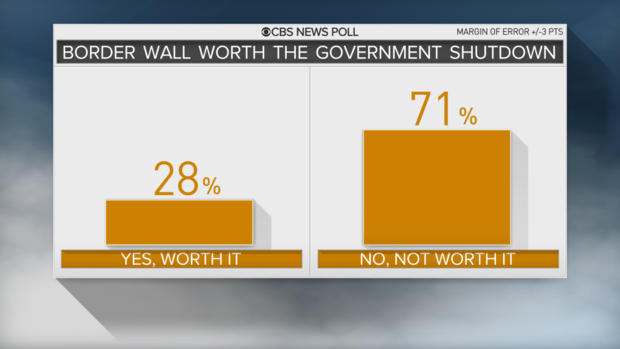
As a result, polls were turning against Republicans. Trump’s approval rating dropped from 42.2% at the beginning of the shutdown to 39.3% by the end. Polls consistently showed that the public blamed either Trump or congressional Republicans for the shutdown, and believed that getting Trump’s Wall funded was not worth shutting down the government.

Now what? The spending bill just lasts for three weeks, at which point the whole standoff could start again. In an effort to claim he hadn’t lost to Pelosi, Trump threatened as much:

This was in no way a concession. It was taking care of millions of people who were getting badly hurt by the Shutdown with the understanding that in 21 days, if no deal is done, it’s off to the races!

But it’s hard to see Republicans in Congress standing by him for another shutdown. Mitch McConnell didn’t want this shutdown and certainly doesn’t want another one. (He is fond of saying, “There’s no education in the second kick of a mule.”) And ultimately, he holds the high card over Trump: If he works out a deal with Democrats and Trump vetoes it, McConnell could sway enough Republicans to override that veto. The thought of 2/3rds of the Senate voting against him on anything should be terrifying to a president who could well face impeachment before the end of his term.

So what will happen in the next three weeks? Ezra Klein lays out four possibilities:

  1. A grand bargain on immigration takes the issue off the table for the near future.
  2. Pelosi, Schumer, and McConnell reach no deal and the government shuts down again.
  3. No immigration/wall deal, but there’s no shutdown, and Trump seeks to build his Wall without Congress by declaring a national emergency.
  4. No immigration/wall deal, but no national emergency.

I foresee a lesser bargain, similar to what Lindsey Graham and Dick Durbin have already worked out: Democrats have already signaled that they’re willing to offer more money for border security, but they think the Great Wall of Trump is a stupid waste. (Not that it matters, but reality is on their side here; the Wall is a stupid waste. Republicans know this, which is why they didn’t fund it when they had the majority in both houses.) A number of Republicans (including even Trump, at times) have said they don’t want to deport the DACA people, whose cause gets a lot of sympathy from Americans in general.

The question is how much funding for how much DACA protection. Here, I think the failure of the shutdown pushes the needle towards Democrats. This is what I picture:

  • DACA recipients get permanent legal status, with a path to citizenship left vague. Democrats can promise to eventually get them citizenship, while Republicans can deny this will ever happen.
  • Border security gets the $5.7 billion Trump was asking for, but mostly for technology at ports of entry and more immigration judges.
  • Rules for legal immigration change a bit, but Congress reaffirms support for the United States’ treaty obligations under the Convention Relating to the Status of Refugees, which Trump has been ignoring.
  • Some small number of additional barriers on the border are authorized, which Democrats will be able to claim is not Trump’s Wall, but Republicans can claim is a step toward Trump’s Wall.

Finally, I hope Democrats insist that a study be done to produce something that until now has never existed: an actual design for a sea-to-sea border wall, with a realistic cost estimate and expert estimates of its effects on illegal immigration, drug smuggling, violent crime, and the environment. The era of wild claims has to end.

Trump may or may not try to build his wall without Congress by declaring a national emergency, but I doubt it will get him anywhere. (Truman wasn’t able to seize the steel industry, and that was during wartime.) Whatever he wants that declaration to accomplish will be tied up in court for the rest of his term. The point of declaring a national emergency, I believe, is mainly to con Trump’s base into thinking that he didn’t really lose.

While I don’t think it will be effective in building a wall, declaring a bogus emergency breaks another norm that protects democracy. Down the road, it could cost us dearly: A leader’s abuse of emergency powers is a common way for democracies to become autocracies.

The Monday Morning Teaser

After looking like it would never end, the government shutdown suddenly ended. I’m planning two featured posts about that. The first is newsy. It collects how the shutdown ended, and what’s likely to happen next. (I will be amazed if the government shuts down again in three weeks. If it does, I expect Trump’s support in the Senate to crumble very quickly.) That’s nearly done and should be out before 9 EST.

The second is more of an opinion piece about how these extortionist tactics need to end. The Founders pictured Congress working as their own Constitutional Convention had worked: by compromise, where you assemble majority support by giving a lot of people part of what they want. For the last ten years, though, Republicans have recognized extortion as a legitimate tactic: If they don’t get what they want, they’ll do something nobody wants, like shut down the government or let it hit the debt limit. The point of those tactics has been to try to push through something that doesn’t have majority support, like repealing ObamaCare or building a wall.

I don’t think there’s any way to make such tactics illegal, though ideas for preventing future shutdowns are floating around. But we need to restore the idea that they’re illegitimate; the public needs to understand that anybody who proposes such a thing is fundamentally opposed to American democracy.

I hope to get that post out by 11. The weekly summary also has Roger Stone’s indictment to talk about, as well as the peace framework for Afghanistan, the UK’s continuing Brexit crisis, proposals for new taxes on the rich, and a few other things. Let’s imagine getting that posted between noon and 1.

Proper Outlets

The fight over whether Trump should be removed from office is already raging, and distorting everything it touches. Activists are radicalizing in opposition to a president they regard as dangerous. Within the government, unelected bureaucrats who believe the president is acting unlawfully are disregarding his orders, or working to subvert his agenda. By denying the debate its proper outlet, Congress has succeeded only in intensifying its pressures.

– Yoni Appelbaum “Impeach Donald Trump” The Atlantic, March , 2019

This week’s featured post is “The Scoop That Wasn’t“.

This week everybody was talking about impeachment

For about 24 hours, it looked like we were headed there sooner rather than later. BuzzFeed apparently had a scoop that showed Trump to be guilty of the same sort of crime that brought down Nixon. Then the Special Counsel’s Office released a cryptic statement casting doubt on that article. The featured post examines where that leaves us.


Meanwhile, Rudy Giuliani moved the goal posts again:

I never said there was no collusion between the campaign, or between people in the campaign. I have no idea. I said “the President of the United States”. There is not a single bit of evidence the president of the United States committed the only crime you can commit here, conspired with the Russians to hack the DNC.

So the denial is down to this: The President himself wasn’t personally involved in hacking the DNC. They used to claim that the whole Mueller investigation was a witch hunt. Now they’re just denying that Trump was responsible for one particular act of witchcraft.

and Brexit

The March 29 deadline for the United Kingdom to leave the European Union keeps getting closer, but Parliament is no closer to approving a plan for what happens then. If March 29 arrives without any action from Parliament, the UK faces what is called a “hard Brexit“: The European Union views it as a foreign country with hardly any special privileges. For example, thousands of flights between British and European airports might have to be cancelled. UK citizens could only come into the EU if they had at least six months left on their passports.

Prime Minister May’s plan for Brexit got crushed in Parliament, 432-202, with opposition both from pro-EU MPs and from those who don’t think her planned break with the EU is sharp enough. She’s expected to present her Plan B today, but moves in either direction may lose as many votes as they gain.

The EU’s highest court has ruled that the UK can unilaterally cancel Brexit and stay in the EU on the same terms as before. But it’s not clear that plan could pass Parliament either.

Lesson for the future: Never hold a referendum where the choices are (1) something as specific as staying in the EU under the current agreement, and (2) a vague “do something else”. A more rational process would have been to authorize the PM to negotiate a leave-the-EU agreement, without making any commitment to go through with that plan until it went up for a referendum against staying in the EU under the current agreement. Two choices, equally specific.

and the shutdown

Four weeks into the shutdown, Trump made his first offer to Democrats. (Up until then, he’d issued nothing but demands.) The offer isn’t much: In exchange for $5.7 billion for his Wall,

  • participants in the DACA and Temporary Protected Status programs get three more years of protection from deportation. These deportations are already on hold until court cases play out, so it’s not clear how much of an improvement three years is over whatever will happen anyway.
  • an additional $800 million would go to humanitarian services at the border.
  • Trump would allow Central American minors to apply for asylum without leaving their home countries, at the cost of making them easier to deport if they come here.

These are all examples of Trump partially undoing damage he has caused since taking office. Trump is the one who announced the end of DACA and removed hundreds of thousands of refugees from TPS. His family-separation and zero-tolerance policies created the humanitarian crisis on the border. And Central American minors only lost the ability to apply for asylum from home when Trump cancelled an Obama program.

So basically, he’s just offering to sell back a bunch of hostages he has taken, with the option to take them again if he gets re-elected. A real concession would be something that moved the ball from where it was when he took office, like offering DACA recipients some kind of permanent legal status. (I am undecided about whether such a concession would be enough to make a deal. But at least it would be a concession.)

Meanwhile, Democrats are making their own offer: more money to do border security right, rather than build a giant monument to xenophobia and racism. The next open-the-government bill in the House will include more money for ports-of-entry (where illegal drugs really come in), and to hire more immigration judges (to drive the case backlog down). Offering asylum to those in danger in their home countries, after all, is a treaty commitment backed by our own laws (laws which the President is sworn to faithfully uphold). If the length of the processing backlog is creating problems, let’s address that directly.

The basic problem is that Trump is living in his own reality. He thinks keeping the government closed gives him leverage, and that he should be able to extort some real price to open it again. Democrats, meanwhile, see Trump’s poll numbers falling and don’t understand why they should pay to make that stop.

Trump has complained that he’ll “look foolish” if he ends the shutdown without getting anything for it. But he WAS foolish. He can’t expect Democrats to cover that up for him.


The humanitarian crisis at the border didn’t just happen, it was planned. NBC News reports:

Trump administration officials weighed speeding up the deportation of migrant children by denying them their legal right to asylum hearings after separating them from their parents, according to comments on a late 2017 draft of what became the administration’s family separation policy obtained by NBC News.

The draft also shows officials wanted to specifically target parents in migrant families for increased prosecutions, contradicting the administration’s previous statements. In June, Department of Homeland Security Secretary Kirstjen Nielsen said the administration did “not have a policy of separating families at the border” but was simply enforcing existing law.

Senator Jeff Merkley wants to investigate Homeland Security Secretary Kirstjen Nielsen for lying to Congress when she declared “we’ve never had a policy for family separation“.


I think Nancy Pelosi’s suggestion that Trump delay the State of the Union (which is traditionally delivered in the House chamber) was brilliant. Trump is unmoved by the strains on the country that his shutdown is producing, but if he has to forgo his biggest TV extravaganza of the year, that hits him where he lives.

and more people running for president

Kamala Harris and Kirsten Gillibrand are in. Along with Tulsi Gabbard and Elizabeth Warren, that makes more women candidates than any party has ever fielded. It will be interesting to see what difference that makes in the process.

In 2016, Hillary Clinton and Carly Fiorina were each “the woman” in their party’s race. In some symbolic sense, they were women entering a men’s club, so how the men would treat them was up in the air. When Trump made sexist comments about Fiorina’s looks, for example, no other women were in a position to call him on it. But when the numbers are more equal, men may not get away with the same behavior.

It will also be harder to use sexist stereotypes while implying that they refer to something specific about a particular candidate. If there’s just one woman in a race, maybe she really does dress funny or have a screechy voice or disappoint in some other way that coincidentally matches a stereotype. But if all the women are counted out for reasons like that, it’ll be pretty clear what’s going on.

but we should be talking about Martin Luther King this weekend

MLK Day should be more than an excuse for a three-day weekend. We should do our best each year to remember King as he was, resisting the temptation to whitewash his message into some vague “color blindness”, and refusing to let his name be co-opted by people working against the principles he championed.

and the incident on the Capitol Mall


First there was a viral video showing MAGA-hatted teen punks harassing a Native American elder on the Capitol Mall. They apparently came from Covington Catholic High School in Kentucky, and had come to the Mall for a pro-life rally. Here’s one observer’s account:

The group outnumbered us and enclosed our small group, chanting ‘build the wall’ and other trumpisms. The group was clearly looking for ANY opportunity to get violent and they consistently infringed upon our space, inching closer and closer, bumping into us and daring us to get physical. They surrounded us, screaming, cajoling, and mocking the elder singer with intentionally disrespectful dancing and attempting to chant/sing louder than him.

Then a much longer video became available, and conservative media started claiming it vindicated the Covington kids. It’s an easy claim to make, because who’s going to watch two hours of video to check you?

I haven’t. But here’s the impression I’m getting from people who have. A handful of Black Hebrew Israelites, the kind of street preachers who like to bait passers-by into debates, started baiting the Covington Catholic kids “using aggressive, provocative and sometimes offensive language to engage, as they usually do.”

The kids could have walked away, which is what most people do when street preachers try to engage them. But instead they responded with their own hostility. This is where the Native American elder, Nathan Phillips, entered the scene. He was on the Capitol Mall for an indigenous people’s rally, and thought the Covington kids were about to get violent against he Black Hebrew Israelites, who they greatly outnumbered. So he walked into the space between the two groups, trying to drum and sing them apart.

Phillips then tried to get to the steps of the Lincoln Memorial, so he could do his song from the top, but the kids blocked his way. That’s where the viral video starts.

and you also might be interested in …

Of all the ways that Trump has profited off his presidency, the most obviously illegal has been the Trump International Hotel in Washington DC. The hotel is housed in the Old Post Office, which is owned by the federal government and managed by the General Services Administration. The Trump Organization’s lease with the government says

No member or delegate to Congress, or elected official of the Government of the United States or the Government of the District of Columbia, shall be admitted to any share or part of this Lease, or to any benefit that may arise therefrom

Also, the Hotel does business with foreign governments (even moreso now that dealing with the Hotel is a way of bribing the President), which raises the issue of the Constitution’s emoluments clause.

No Title of Nobility shall be granted by the United States: And no Person holding any Office of Profit or Trust under them, shall, without the Consent of the Congress, accept of any present, Emolument, Office, or Title, of any kind whatever, from any King, Prince, or foreign State.

Those both seem pretty clear, but in March, 2017 the GSA ruled that its new boss could continue to benefit from the lease, without regard to the emoluments issue. This is literally the definition of self-dealing: As head of the government, Trump was overseeing the lease that he was holding as a private businessman.

This week the GSA inspector general issued a report on this decision. The IG doesn’t get into a legal analysis of either issue, but makes it clear that GSA didn’t even consider the constitutional issue. (The word “punted” comes up.)

the decision to exclude the emoluments issues from GSA’s consideration of the lease was improper because GSA, like all government agencies, has an obligation to uphold and enforce the Constitution

The report ends by making recommendations about future leases. Apparently the IG expects the current issues to play out in the courts.


A clear example of why the Trump International Hotel shouldn’t be owned by the President came up Wednesday. T-Mobile had a big merger deal brewing with Sprint, and it needed approval from the administration. So what did it do? It had its executives repeatedly stay at the Trump International.

These visits highlight a stark reality in Washington, unprecedented in modern American history. Trump the president works at 1600 Pennsylvania Ave. Trump the businessman owns a hotel at 1100 Pennsylvania.

Countries, interest groups and companies such as T-Mobile — whose future will be shaped by the administration’s choices — are free to stop at both, and to pay the president’s company while also meeting with officials in his government. Such visits raise questions about whether patronizing Trump’s private business is viewed as a way to influence public policy, critics said.


Vicious cycle: climate change plays a key role in a wave of destructive fires in California. Responsibility for the fires sends Pacific Gas & Electric into bankruptcy. In bankruptcy, it can renegotiate the terms of contracts it signed with providers of renewable energy, possibly sending them into bankruptcy, and making climate change worse.


Republicans in Congress have just noticed that Rep. Steve King from Iowa is a racist. I wonder how long it will take them to figure out that Trump shares the same viewsTrevor Noah makes fun of just how apparent King’s racism has been for many years.


I can’t believe we’re all talking about a Gillette ad. This one.

First off, I can’t see what there is here for anybody to get upset about. Whoopi Goldberg on The View summed up the message as “Don’t be a jerk”, which is pretty much the way I saw it.

And second, I’m never going to be a Gillette fan anyway, for reasons I outlined in a 2012 article “What Shaving Taught Me About Capitalism“. For generations, Gillette has used its advertising moxie and market power to drive up the cost of shaving. I think if a young man learns how to use either an old-fashioned double-edged safety razor or an even more old-fashioned straight razor, within a week or two he won’t be cutting himself any more, and he’ll save many thousands of dollars over his lifetime. Or he could skip the whole thing and grow a beard as soon as he could.

So I think it’s ridiculous to boycott Gillette over a commercial that tells you not to be a jerk. But I couldn’t boycott the company if I wanted to, because I stopped buying their products a long time ago.

and let’s close with something

If, like me, you’re in the deep freeze this week, look at how much fun winter is in Russia.

The Scoop That Wasn’t

For a day or so, it looked like impeachment would start happening right away. Then the Special Counsel’s Office doused the flames. Now what?


Thursday, BuzzFeed electrified the country with this claim:

President Donald Trump directed his longtime attorney Michael Cohen to lie to Congress about negotiations to build a Trump Tower in Moscow, according to two federal law enforcement officials involved in an investigation of the matter.

The accusation seemed especially strong, because it supposedly rested on much more than just Cohen’s word.

The special counsel’s office learned about Trump’s directive for Cohen to lie to Congress through interviews with multiple witnesses from the Trump Organization and internal company emails, text messages, and a cache of other documents. Cohen then acknowledged those instructions during his interviews with that office.

For most of Friday, the media buzzed with the implications. The Washington Post’s Greg Sargent compared this moment to the appearance of the tapes that brought down Richard Nixon.

if BuzzFeed’s stunning new report is true, we could be looking at a real inflection point in this whole story

Others referred to the report as a “game-changer”, the first easily-grasped-by-the-public evidence that Trump had committed a significant crime. Former Watergate prosecutor Jill Wine-Banks told Lawrence O’Donnell:

This is exactly the Watergate model. … This should be enough. … Even the Republican Senate is going to have to say, “We’ve been had.”

And then Friday night the Special Counsel’s office, which hardly ever comments on any news report, released this statement:

BuzzFeed’s description of specific statements to the Special Counsel’s Office, and characterization of documents and testimony obtained by this office, regarding Michael Cohen’s Congressional testimony are not accurate

That’s not the money quote from a longer statement; that’s the whole thing. But what does it mean? It asserts the existence of inaccuracies, but doesn’t say what they are. And it doesn’t even hint at what the actual truth might be. As best I can tell, it does two things:

  • It monkey-wrenches the drive to a quick impeachment.
  • It keeps us all in suspense about what Bob Mueller’s office will eventually report.

Reading the tea leaves. For its part, BuzzFeed rechecked its sources and didn’t back down. Editor Ben Smith responded:

We stand by our reporting and the sources who informed it, and we urge the Special Counsel to make clear what he’s disputing,

That’s the big question: Is the whole story “inaccurate”, or just some small detail? And what was it about this story that made Mueller’s office decide it needed to comment?

On Rachel Maddow’s show Friday night, several good insights pointed in opposite directions. Rachel herself related the would-be scoop to an earlier puzzle: Why was Michael Cohen charged with lying to Congress to begin with? He had already pleaded guilty to multiple felonies, and the Special Counsel didn’t ask for any additional jail time for Cohen. So why was that worth everybody’s time?

The Buzzfeed story, Maddow observed, offered an answer to that question: The charge against Cohen sets up a later charge against someone else, presumably Trump. If you’re going to accuse Trump of suborning perjury, it helps if you’ve already established that there was a perjury.

She then talked to Michael Isikoff, one of the top reporters on this beat. Isikoff said the original BuzzFeed article was full of “red flags” that should have made us all cautious. It contained no details about when or how Trump gave Cohen his instructions. What texts and emails could the article have been referring to, when Trump himself doesn’t write texts or emails? Cohen’s guilty plea had offered him a perfect opportunity to implicate Trump, and he didn’t.

Former U.S. Attorney Chuck Rosenberg, who has worked with Mueller, tried to read the tea leaves of the Special Counsel statement, and came up with a very narrow interpretation:

The Mueller team is pushing back on aspects of the Buzzfeed story. But I think in the main, what you can glean from their December 7 sentencing [of Michael Cohen] memorandum is that the core of the Buzzfeed story is accurate.

But the Washington Post’s anonymous sources come to the opposite conclusion.

People familiar with the matter said the special counsel’s office meant the statement to be a denial of the central theses of the BuzzFeed story — particularly those that referenced what Cohen had told the special counsel, and what evidence the special counsel had gathered.

The New Yorker’s Ronan Farrow offers an in-between perspective. First, BuzzFeed took a bigger chance on its reporting than he was willing to take.

I can’t speak to Buzzfeed’s sourcing, but, for what it’s worth, I declined to run with parts of the narrative they conveyed based on a source central to the story repeatedly disputing the idea that Trump directly issued orders of that kind.

But Farrow mostly agrees with the story.

Note that the general thrust of Cohen lying to Congress “in accordance with” or “to support and advance” Trump’s agenda (per Cohen’s legal memo) is not in dispute. The source disputed the further, more specific idea that Trump issued—and memorialized—repeated direct instructions.

This is consistent with numerous reports that The Trump Organization works like a Mafia family: The Boss indicates what he wants to happen without leaving specific instructions that can be quoted in court. (Not “Kill that guy”, but “Take care of the situation” or “I think you know what to do”.) Cohen may well have known what Trump wanted done without being able to point to any specific instructions. There might well be “supporting documents”, but of an indirect sort (i.e., Trump Organization people trying to coordinate their stories) rather than written directives from Trump himself.

One of the more interesting speculations is that the conflicting sources are in rival offices: the SCO on the one hand and the Southern District of New York US Attorney on the other.

Impeachment. To me, this whole incident underlines a point that Yoni Appelbaum makes in the current issue of The Atlantic, in an article written before the BuzzFeed article: America needs a formal, dignified, judicious impeachment process, rather than what’s happening now.

The investigation of Trump’s possible crimes, and the corresponding destructive effects on our democracy, should be happening in public view, not behind closed doors at the Special Counsel’s Office, or through anonymous sources in the press.

For decades, we have been talking about the expanding power of the Imperial Presidency, and what should be done about it, if anything. But just as important is the Shrinking Congress.

The fight over whether Trump should be removed from office is already raging, and distorting everything it touches. Activists are radicalizing in opposition to a president they regard as dangerous. Within the government, unelected bureaucrats who believe the president is acting unlawfully are disregarding his orders, or working to subvert his agenda. By denying the debate its proper outlet, Congress has succeeded only in intensifying its pressures. And by declining to tackle the question head-on, it has deprived itself of its primary means of reining in the chief executive.

Is the continuance of the Trump administration dangerous to democracy? That question needs an open debate, with the relevant information made public and the relevant witnesses questioned where everyone can hear them. We shouldn’t be waiting for Bob Mueller to save us, and in the meantime debating over whose anonymous sources really know what they’re talking about.

The Monday Morning Teaser

For a day there, it looked like impeachment would start sooner rather than later: Buzzfeed reported that Trump had directed Michael Cohen to lie to Congress, which is pretty close to what Nixon was impeached for. Then the Special Counsel’s Office put out a cryptic denial, leaving everybody uncertain about what it all meant. Was the Buzzfeed report mostly true, but with some minor inaccuracies? Was it a complete hoax? Who could say?

Maximal uncertainty was probably what the SCO was shooting for, and they achieved it. I’ll try to sort out the divergent tea-leaf readings in the featured post, “The Scoop That Wasn’t”. I’ll try to get that out by 10:30 EST, but if it slips it will probably slip all the way to noon.

In the weekly summary, there’s shutdown news, but nothing that heralds a solution. Brexit continues to flounder; as I said a few weeks ago, all possible conclusions seem unlikely. (I’m reminded of a pregame show where a commentator joked, “I don’t think either of these teams can win this game.”) I can’t help commenting on the MAGA-hat-wearing teens who harassed the Native American elder on the Capitol Mall. An inspector general says the GSA screwed up when it overlooked the constitutional issues in Trump’s ownership of the Trump International Hotel. And that Gillette ad. And I’m in the deep-freeze here in New England, so I’ll be looking for a closing that makes winter seem funny. That’s probably out by 1.

With Whom the Buck Stops

The buck stops here.

sign on President Truman’s desk

The buck stops with everybody.

Donald J. Trump

This week’s featured post is “My Wife’s Expensive Cancer Drug“. Because in America, medical stories are never just about medicine. They’re also about money.

This week everybody was talking about the same stuff as last week

Namely: the partial government shutdown and the Wall that is the central bone of contention.

It’s important not to lose the context of this battle:

  • In February, Trump’s original budget asked for “$1.6 billion to support the construction of 65 miles of new border wall system.”
  • On December 19, the Senate passed a continuing resolution with $1.6 billion for border security, but stipulated that it not be used to build walls in places that did not already have them. This was a bipartisan compromise that went through by voice vote, and Senate Republicans believed Trump would sign it.
  • Trump then demanded an additional $5.6 billion for the Wall, offered Democrats essentially nothing in exchange, and the government shut down on December 22.

The situation hasn’t really changed in the 3+ weeks since. Trump’s “negotiating” has amounted to repeating the same demands and lying to the public about the consequences of having or not having a southern border wall. (Not only are the problems Trump points to vastly overblown, but a wall would do very little to solve them.) Meanwhile, he torpedoes any effort by Republicans in Congress to come up with an offer the Democrats might consider.

The Democrats’ position hasn’t changed either: Most of the departments that have been shut down have nothing to do with border security or the Wall, so why not just re-open them? (If you’re a soybean farmer in North Dakota waiting for a subsidy check to make up for the Chinese exports you lost in Trump’s trade war, the Wall has nothing to do with you. So what sense does it make to leave the Department of Agriculture closed?) On the substance of the issue, Democrats believe the Wall is a silly waste of money, not to mention being an environmental disaster and a symbolic declaration that brown people aren’t welcome here.

The latest way Trump is upping the tension is by threatening to declare a national emergency and repurpose funds that Congress has already approved for dealing with real emergencies, like hurricane recovery in Texas, Florida, and Puerto Rico. Friday, he backed off a little, saying he wouldn’t do that “so fast“. To which MSNBC’s Ari Melber tweeted:

If you can delay it, schedule it, or decide later whether or not it exists … it’s probably not an emergency.

I said last week that I thought using an emergency declaration to circumvent Congress’ constitutional powers would be an impeachable offense. Frank Bowman discusses that possibility on Slate. It’s complicated.

Usually, the emergency declaration is presented as a way that Trump can allow the government to re-open without seeming to have “lost”. (The conflict would then move to the courts, where Trump would probably lose.) But Friday White House officials were floating the idea that Trump might declare an emergency to build the wall and then keep the government closed.

Trump’s allies say the president is reluctant to hand Democrats a “win” by reopening the government after he’s invoked emergency powers. They claim that in such a scenario, Trump’s political opponents would avoid making a single concession and potentially score a major victory if the administration were to lose in federal courts as many legal experts predict.

“He could say, ‘Look, I’m going to get what I want and then I’m still going to screw you,’” a former White House official told POLITICO. “It’s making Democrats feel pain instead of declaring a national emergency, opening the government up, and making it so they don’t have to give anything,” the former official added.

Because it’s never about what’s best for the country. It’s about winning and making your enemies feel pain.


Everybody’s wondering how this ends, and the only possibility I can see is that Trump’s support in the Senate crumbles. I can’t guess how long it will take for that to happen.


An important side issue is why and how the major networks covered Trump’s Oval Office speech on Wednesday. Nothing in Trump’s speech constituted news, and much of it was false. So why did it deserve live coverage? Before the speech, James Fallows laid out the case against. Afterwards he tweeted: “The networks’ decision to air this presentation looks worse after-the-event than it did before.”

There is precedent for networks refusing a president’s request for airtime: They rejected Obama’s request to speak to the nation about immigration in 2014. I find it worthwhile, if a bit depressing, to compare Trump’s speech to Obama’s. Not so long ago, we had a president we could respect, who talked to us as if he and we were all adults.


Trump claimed Thursday that he had never said Mexico would literally pay for the Wall. “Obviously I never said this and I never meant they’re going to write out a check.” But in fact he did. CNN has the documentation from his campaign web site. And in an April 2016 interview with Sean Hannity, Hannity challenged whether the Mexico-will-pay claim was literal. “They’re not going write us a check…” Hannity challenged. And Trump replied: “They’ll pay. They’ll pay, in one form or another. They may even write us a check by the time they see what happens. They may.”


The steel-slat design for the Wall is maybe a little less impenetrable than Trump lets on. This hole was made with an industrial saw.


A furloughed worker at the National Gallery describes his first week of idleness.

and Trump’s collusion with Russia

Friday, the New York Times broke this story:

In the days after President Trump fired James B. Comey as F.B.I. director, law enforcement officials became so concerned by the president’s behavior that they began investigating whether he had been working on behalf of Russia against American interests

Apparently, Robert Mueller inherited that counter-intelligence investigation when he got appointed special counsel.

Yesterday, The Washington Post added this detail:

President Trump has gone to extraordinary lengths to conceal details of his conversations with Russian President Vladi­mir Putin, including on at least one occasion taking possession of the notes of his own interpreter and instructing the linguist not to discuss what had transpired with other administration officials, current and former U.S. officials said.

… As a result, U.S. officials said there is no detailed record, even in classified files, of Trump’s face-to-face interactions with the Russian leader at five locations over the past two years. Such a gap would be unusual in any presidency, let alone one that Russia sought to install through what U.S. intelligence agencies have described as an unprecedented campaign of election interference.

… Senior Democratic lawmakers describe the cloak of secrecy surrounding Trump’s meetings with Putin as unprecedented and disturbing.

I can’t think of any innocent explanation for this. Saturday, Fox News’ Jeanine Pirro asked Trump whether he is or ever has been working for Russia, he replied “I think it’s the most insulting thing I’ve ever been asked.” That, you may note, is not a denial.

Max Boot lists 18 reasons to think that Trump might be a Russian asset.

These revelations follow what we learned Tuesday: That when he was running Trump’s campaign, Paul Manafort was sharing the campaign’s polling data with Konstantin V. Kilimnik, who is widely believed to be a Russian intelligence agent.


Thursday, Treasury Secretary Steve Mnuchin gave a classified briefing to Congress about his department’s decision to relax sanctions against companies owned by Russian oligarch Oleg Deripaska.

Speaker Nancy Pelosi of California called the presentation “one of the worst classified briefings we’ve received from the Trump administration” and accused Mr. Mnuchin of “wasting the time” of Congress. She said Mr. Mnuchin was unresponsive to important questions.

… Representative Brad Sherman, another California Democrat, said he opposed easing the sanctions because it would only increase the wealth of Mr. Deripaska. He said Mr. Mnuchin had no response to that argument except that lawmakers should trust the administration.

and 2020

Julián Castro is running. Tulsi Gabbard is running. Kamala Harris is saying “I might“, which sounds a lot like “I will” at this stage.


The media continues to cover Trump’s insults as if they were news. Just today, the Washington Post made a headline of Trump’s “trash heap” comment on Joe Biden, and of his “Wounded Knee” reference in a tweet about Elizabeth Warren. I can’t find any other coverage of Biden or Warren in the WaPo today. Apparently, journalists learned nothing from 2016.

but there are some articles I’m trying to ignore

Here’s one typical of the type, from Politico: “Exasperated Democrats try to rein in Ocasio-Cortez“. Guess what? Not all Democrats are as liberal as Alexandria Ocasio-Cortez, and the ones who don’t agree with her wish she’d get less attention. She got her seat by beating an incumbent Democrat in a primary, and she thinks other progressives should try to do the same thing, particular if (like her) they come from a district that is more liberal than the Democrat representing it. Democrats who aren’t as liberal as their districts hope she doesn’t support their challengers.

None of that should be surprising, and it’s hard for me to see why it’s newsworthy. But I think we’re going to see a lot of articles like that, for a simple reason: Conflict is easier to cover than governing. Reporters at places like Politico would rather write Democrats-are-fighting-each-other stories than Democrats-are-working-on-legislation stories.

Politico reporters and their ilk are like the village gossip, who gets attention by asking “Did you hear what so-and-so said about you? What do you think about that?” and then taking your response back to so-and-so and doing the same thing. That kind of reporting doesn’t require the reporter to learn anything about climate change or immigration or any other substantive issue. The resulting article doesn’t have to make government or the legislative process interesting to its readers.

Instead, political reporters get to write about conflict and manipulate their readers’ outrage. If you don’t like AOC, you read the Politico article and think “Who does she think she is?” If you do, it’s “Why can’t jealous Democrats do their own jobs and get off her back?” Meanwhile, you’ve learned nothing about the country’s problems or how Democrats in Congress are trying to address them. Later, reporters will talk to the same citizens they have failed to inform, and write about how people don’t think Democrats are doing anything.

I think we should ignore them.

and you also might be interested in …

Christians never stop trying to use tax money to promote their religion. In Florida and North Dakota, the legislature is considering bills to force school districts to offer courses on the Bible. In Kentucky, such a bill has already passed, but the curriculum hasn’t been implemented yet.

This is yet another example of the hypocrisy in the conservative value of “local control”. Why can’t communities decide for themselves whether or not to offer such courses?

Constitutionally, the line is pretty clear for people who want to understand it: It’s legal to teach about religion in public schools, but illegal to teach religion. The difference is simple. If the teacher says, “Most Christians believe that Jesus rose from the dead”, that’s OK. If the teacher says “Jesus rose from the dead”, that’s not OK.

and let’s close with something prescient

Life imitates art:

“Trackdown” aired on CBS between 1957 and 1959 and took place in Texas following the Civil War. The series followed Texas Ranger Hoby Gilman, played by Robert Culp, on his adventures protecting the people of the Lone Star State. The 30th episode of the show, titled “The End of The World,” premiered on May 9, 1958, and saw a con man named Walter Trump, played by Lawrence Dobkin, attempt to scam the entire town.

The fictional Trump warned the Texans that apocalyptic meteors would strike the town at midnight, but he could protect everyone. … His solution was to build a wall made of magical metal that would repel the meteors and keep everyone safe.

The full episode is on YouTube.

My Wife’s Expensive Cancer Drug

We’ve seen the good and bad sides of the American drug and insurance industries.


In 1996, my wife Deb was diagnosed with breast cancer. It had already spread to nearby lymph nodes, so the possibility that she would die (as her mother had just a few years before) was very real. We hit the cancer with everything the 1990s medical arsenal had to offer, on the theory that we would really only get one shot at it: If it came back, she’d probably die from it.

In 2003, it looked like it had come back. Or at least something was growing in the space between Deb’s stomach and liver. If it wasn’t a recurrence of the breast cancer, it was probably stomach or liver cancer, each of which was its own death sentence. A biopsy didn’t yield any definite results, and the tumor quickly grew to about the size of a soccer ball by the time a surgeon took it out. (It took 54 staples to close the incision.) I tried to stay as hopeful as I could, but deep down I was expecting her to die in a year or two.

The soccer ball turned out to be a gastro-intestinal stromal tumor (GIST), which only a year or two before would have been yet another death sentence. GISTs were impervious to standard turn-of-the-millennium chemotherapy, and they nearly always came back after surgery.

Fortunately for us, though, there was a new drug. Gleevec had been developed for treating leukemia, but it turned out to work on certain kinds of GISTs also, or at least the trials looked good. The short-term statistics were excellent, and the anecdotal reports were full of miracle stories where tumors just went away overnight. Long term … who knew? But long-term problems were things we could worry about in the long term. Deb’s oncologist Roger Lange (who we loved and she eventually outlived) said, “It looks like you haven’t used up your nine lives yet.”

That was the last we’ve seen of GISTs. For nearly 16 years, she’s been taking Gleevec or a generic equivalent. There are side effects (mainly a general loss of energy that exaggerates the effects of normal aging), but she can live with them. Literally.

So three cheers for modern drugs and the pharmaceutical industry that makes them! They save lives.

Wouldn’t it be great if that were the whole story? But in America, medical stories are never just about medicine. They’re also about money.

What’s your life worth to you? The economic aspect of Gleevec has always been controversial. It is made by Novartis, a private company whose purpose isn’t to save lives, but to make money for its shareholders. The drug presumably cost a lot to develop and has a small market, but for that small number of people it is literally the difference between life and death. So they should be willing to pay a lot of money, right?

That was the thinking when Novartis launched Gleevec in 2001, charging a hefty $26,400 per patient per year for the drug, a price that was then estimated to recoup development costs in two years, with profits accruing thereafter. And then something strange happened: The price kept increasing, year by year, even though alternative drugs began to hit the market. In fact, the alternatives seemed to draw Gleevec’s price upward: New drugs were introduced at even higher prices, so why shouldn’t Gleevec cost more too?

The result was that when its patent on Gleevec expired in 2015, Novartis was charging $120,000 per patient per year. (As I bounce from one reference article to the next, the prices quoted don’t line up exactly. I’m not sure why. All the articles I link to agree on the general direction of prices.) The original price was already profitable, but the increased price made Gleevec a blockbuster drug that brought in $4.7 billion a year.

Patents and generics. Outrageous as it sounds, from an investor’s point of view that’s how the system is supposed to work. Medical research is hard and costly, and a lot of it doesn’t yield any marketable products. So each successful drug has to pay not just for its own development costs, but also for all the once-similarly-promising drugs that failed. It’s precisely because blockbuster drugs can earn so much money that companies invest the resources to develop them. So I can claim that Gleevec shouldn’t cost this much, but if it didn’t, maybe it wouldn’t have been developed to begin with. And maybe Deb would be dead by now.

So OK: Big profits are a necessary evil that produces a greater good. At least that’s the theory.

If you develop a drug, you can get a patent on it that lasts 20 years from when you submitted the patent application. Typically you submit well before the drug comes to market, so you end up with 15 years or so of a monopoly on a marketable drug. As a monopolist, you can charge pretty much what you want. And if your drug is uniquely applicable to certain desperate patients, they’ll pay it if they can.

But eventually your patent runs out, and then your drug is just a chemical that any good chemical company should be able to synthesize, producing what is known as a generic drug. Generics still have to go through trials to prove that they work more-or-less as well as the original, but that process is nowhere near as risky, costly, or time-consuming as what the innovating company had to do: A generic-drug company begins with the knowledge that something like this works, and has a drug it can reverse engineer. So it’s an engineering problem, not a medical research problem.

In Gleevec’s case, the generic is known as imatinib mesylate. By now a number of companies make it, so you might expect the magic of market competition to take hold.

In the case of Lipitor (the anti-cholesterol drug that is the the drug industry’s all-time revenue champion), prices dropped about 80% after the patent expired. An even better example is aspirin: a 500 tablet bottle will cost you about $9, unless it’s on sale. Aspirin is so well understood and is produced by so many companies that the retail price is getting close to the cost of production. But a particularly bad example is insulin: It’s been around for a century or so, but lately its price has been skyrocketing. The Washington Post Magazine reports:

In the past decade alone, U.S. insulin list prices have tripled, according to an analysis of data from IBM Watson Health. In 1996, when Eli Lilly debuted its Humalog brand of insulin, the list price of a 10-milliliter vial was $21. The price of the same vial is now $275.

… The global insulin market is dominated by three companies: Eli Lilly, the French company Sanofi and the Danish firm Novo Nordisk. All three have raised list prices to similar levels. According to IBM Watson Health data, Sanofi’s popular insulin brand Lantus was $35 a vial when it was introduced in 2001; it’s now $270. Novo Nordisk’s Novolog was priced at $40 in 2001, and as of July 2018, it’s $289.

The insulin-producing companies don’t even have the excuse of a small market: About 7 million Americans need insulin.

Gleevec has been more like insulin than aspirin: The generic drug companies haven’t really tried to undercut Novartis’ price. When the first generic hit the market, Gleevec was going for about $9,000 a month; the generic was priced at $8,000. Additional generic manufacturers entering the market didn’t increase that gap much.

At least, that’s what happened in the United States. In 2016, a doctor predicted:

Today, health care is globalized, and there are more than 18 generic imatinib versions available worldwide, including 3 in Canada. Generic imatinib is sold at $8,800/year in Canada and at about $400/year in India. The cost to manufacture a 1-year supply of 400-mg imatinib tablets is $159. Two years from now, the price of generic imatinib in the United States (or purchased from abroad) will be significantly lower, hopefully less than $1,000/year.

But that didn’t happen. Instead, the price has remained in the $90K-$120K range.

If you’re surprised that a generic whose annual per-patient cost of production is $159 would sell for close to $100,000, you’re not thinking like an oligopolist. Sure, you could sell imatinib mesylate for $200 a year, but why would you? People are paying $8,000 a month. Why rock that boat?

At the moment 20 states, led by Connecticut, are suing a number of generic drug makers, accusing them of price-fixing. Imatinib mesylate was not named in the original suit, but the general practices described apply to a lot of drugs. Connecticut’s assistant attorney general Joseph Nielsen describes the generic drug industry as “most likely the largest cartel in the history of the United States“.

Insurance and Medicare. If you’ve been doing the math — between $30K and $120K a year for 16 years — you must be wondering what kind of plutocrats Deb and I must be (or at least must have been when all this started) that we’re not bankrupt yet. But in fact, for most of that time very little of that cost passed through to us. Deb worked at a company that had very good insurance. And when she retired, we were allowed to keep that insurance as long as we paid our own premiums.

So in the same way that I have to be thankful to the pharmaceutical industry, I also have to be thankful to the insurance industry. Over the years, they have spent a whole lot more money on us that we spent on them.

(I have, of course, wondered what happens to GIST survivors who don’t have good insurance. The effect of the drug is invisible — the evidence that it’s working is that nothing happens — so I can imagine the temptation to just stop taking it rather than bankrupt your family.)

Unfortunately, though, Deb’s company’s insurance only carried her until age 65, when she was expected to sign up for Medicare. That happened in October (though for reasons not worth getting into, she didn’t need to worry about it until the new coverage year started this month). But OK, Medicare has Part D, which covers prescription drugs. So we’ll be OK, right?

Signing up for Part D involves choosing among a bunch of plans that are underwritten by private insurance companies. Wikipedia describes the situation like this:

Because each plan can design their formulary and tier levels, drugs appearing on Tier 2 in one plan may be on Tier 3 in another plan. Co-pays may vary across plans. Some plans have no deductibles and the coinsurance for the most expensive drugs varies widely.

In short, if you expect to need an expensive drug, you need to do your research before you pick a plan. What if you’re old and never used the internet much, or just kind of confused in your thinking? Well, you might be out of luck.

But Deb is computer savvy and diligent, so she searched the various companies’ online pricing tools until she found a plan that quoted a good price on generic Gleevec:
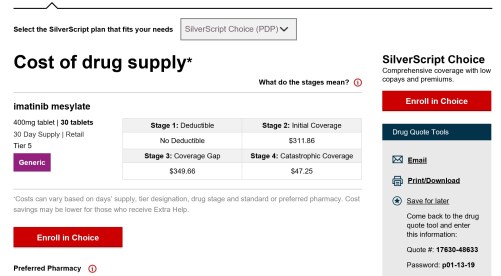
Ignoring the details of the various $300-something monthly charges, the annual cost was estimated at $4069.55. Not cheap, but well below the what-is-your-life-worth level, and for some reason significantly cheaper than other plans from the same company.

Estimates are not promises. She did that research in November, when decisions for the 2019 coverage year had to be made. So imagine our surprise when she went to fill her first monthly imatinib prescription in January, and discovered that it cost $2,881.07!

Your first thought, like ours, might be that something drastic had happened to the imatinib market between November and January. But no: At the same time that SilverScript was charging us $2,881.07, their pricing tool was still showing prospective customers that the price would be $348.06.

Hours spent on the phone with a wide range of SilverScript employees yielded her nothing: Yes, there was a factor-of-8 gap between the pricing estimate (which they were still showing on their web site) and the price they were actually charging us. And no, this isn’t like Wal-Mart, where they usually honor the price they display, even if it’s a mistake. (And is it a mistake? They don’t seem to be in any hurry to correct it. Maybe it’s intentional deception.) The letter we got from the grievance department says:

Please note that copays are estimates only. We are unable to provide exact copays until such time as the prescription is processed.

And if they’re quoting you one price at the exact same moment that they’re charging a drastically higher price to someone just like you, that’s just the way it goes. Maybe you should pick a different insurance company next year, based on their (possibly inaccurate) pricing information.

What happens after next month? The people who weren’t still quoting the $348.06 price were telling Deb that $2881.07 was what we could expect going forward, or maybe even something higher. So we were looking at an annual cost in the neighborhood of $30,000.

Think about what that would mean: After generics, after insurance, we’d be paying the full price that Novartis originally charged for Gleevec.

But hey, what’s your life worth?

Fortunately, though, it turned out that the SilverScript people who were quoting those prices didn’t know what they were talking about either. (Again, though, I have to wonder what is a mistake and what is intentional. If the low-price information was intended to get us to commit to their program for 2019, maybe the high-price information was intended to make Deb reconsider whether she really wanted to keep taking this drug. Because the ideal health-insurance customer is somebody who pays premiums but doesn’t use services.) Or at least that’s how it appears right now.

For some reason, nobody at SilverScript mentioned the Medicare Donut Hole. (A Blue Cross person explained it when Deb was researching whether she could switch to another Part D plan after the year started.) Follow the link if you want a more complete explanation, but what it means for us is that after we spend $5,100, we hit the catastrophic coverage phase, where the insurance starts to cover 90% of the drug’s cost. If that’s really how things play out (we’re not fully believing anything we read at this point), our annual costs will wind up being something like what the SilverScript web site was predicting for the plans we didn’t choose: Around $10,000 rather than $4,000 or $30,000.

It’s weird: After you’ve spent a week or so wondering where you’re going to come up with an extra $30,000 each year, $10,000 sounds pretty good. It’s not pocket change, but we can afford it. It beats going off the drug and finding out for sure whether it is still necessary.

The lessons I draw. There are ambiguous lessons to learn from our experience. On the one hand, thanks to drug research and health insurance, Deb is alive and we’re not bankrupt. The most important stuff has turned out well, at least so far.

But on the other hand, it seems obvious to me that this system is full of waste and corruption. Novartis should never have been able to charge such a high price for Gleevec, and there was absolutely no reason why the generic drug companies should have been able to share in those windfall profits. In theory, once patents expire the free market will drive prices down. But in the real world that doesn’t happen. Instead, a few companies divide the pie among themselves. They know they have a good thing going, and they aren’t going to ruin it by undercutting each other’s prices.

The market will never fix this, so government needs to get involved.

And why exactly is health insurance still in the private sector rather than being part of the government? The justification I usually hear is that the profit motive will produce better customer service and more efficient delivery of services. I don’t see anything in our personal experience to support that notion. To me, it looks like companies are motivated to lie to us, and none of the insurance people we have dealt with seem to be oriented towards the mission of helping people and saving lives.

When Deb was dealing with the SilverScript grievance people, she reported that they appeared to be following a script rather than trying to understand her case. Nobody seemed to grasp the idea that they were participating in a bait-and-switch fraud, or to be particularly upset if they were. Listening to her account of the conversations, I found myself wishing she had asked, “In your job dealing with grievances, have you ever actually helped anybody?” That question wouldn’t have improved our outcome in any way, but I’d just like to know.

Personally, I’d rather take my chances with government bureaucrats. People in the government may be insulated from market forces, but often they identify with the mission of their office. For example, I recently had to change my drivers’ license from New Hampshire to Massachusetts. I ran into all sorts of unexpected bureaucratic problems; for some reason, none of my documents were the exact ones the system was looking for. Through it all, though, the clerk I was dealing with did her best to guide me through the labyrinth. In her mind, she was there to help people.

That’s not the impression Deb got from SilverScript. The company isn’t trying to provide healthcare or help its customers find ways to pay for it; it’s trying to make as much money off of them as it can. The grievance department isn’t there to respond to customers’ legitimate grievances, it’s there to mollify and divert people who have been conned by the company’s deceptive practices. The individuals who work there are probably no worse than the rest of us, so they can’t identify with that mission. Instead, they sink into their scripts.

My bottom-line conclusion is that the profit motive is not serving us in health care. There has to be a better way.

The Monday Morning Teaser

I’m tempted to repost last week’s weekly summary and see if anyone notices. The government is still in partial shutdown. Trump is still lying about the Wall and posturing rather than negotiating. Democrats are waiting for him to get real, while simultaneously waiting for Mitch McConnell to remember that he still has a job. If you didn’t watch the news this week, you didn’t miss much, at least not on that story.

The Trump/Russia story got a little racier. At the time of Mueller’s appointment, the FBI was investigating whether or not Trump is a Russian asset. That probe got folded into Mueller’s investigation. Also, Trump has been unusually secretive about his conversations with Putin. And Paul Manafort was sending internal Trump-campaign polling data to Putin allies. But there’s nothing to see here; it’s all a witch hunt.

Meanwhile, Democrats keep lining up to run against Trump in 2020. And the media seems to have learned nothing from the way Trump manipulated them in 2016: They’re still covering his insults as headline news, and crowding out actual substantive information about potential challengers. They’re also doing their best to rev up Democrats-are-fighting-each-other stories, which are easier to cover than Democrats-are-trying-to-govern stories.

But this week’s featured article is more personal than that. My wife is a survivor of two different cancers, and takes a very expensive drug to keep one of them from coming back. That’s given us a window into both the good and bad sides of American health care and health insurance, including an incredible (to me, at least) development this month, as she starts Medicare Part D coverage. I’ll write that up in “My Wife’s Expensive Cancer Drug”, which should come out around 11 EST.

Expect the weekly summary around noon. Or go back and read last week’s.