Monthly Archives: November 2018

Political Asymmetry

No Sift next week. The next new articles will appear December 10.

To speak of “polarization” is to assume symmetry. No fact emerges more clearly from our analysis of how four million political stories were linked, tweeted, and shared over a three-year period than that there is no symmetry in the architecture and dynamics of communications within the right-wing media ecosystem and outside of it.

– Benkler, Faris, and Roberts, Network Propaganda

This week’s featured post is “The Media isn’t ‘Polarized’. It has a Right-Wing Cancer.” In it, I review the recent book Network Propaganda, which you can read for free online.

If you happen to be near Billerica, Massachusetts on Sunday, you can hear me speak at the Unitarian Universalist Church on “Men and #MeToo”.

This week everybody was talking about Trump vs. the law

A federal judge blocked the administration’s new asylum rules, which would have automatically denied asylum to anyone who crossed the border somewhere other than a recognized border crossing. In the ruling, he wrote:

Congress has clearly commanded in the [Immigration and Naturalization Act] that any alien who arrives in the United States, irrespective of that alien’s status, may apply for asylum – “whether or not at a designated port of arrival.” Notwithstanding this clear command, the President has issued a proclamation, and the Attorney General and the Department of Homeland Security have promulgated a rule, that allow asylum to be granted only to those who cross at a designated port of entry and deny asylum to those who enter at any other location along the southern border of the United States.

The rule barring asylum for immigrants who enter the country outside a port of entry irreconcilably conflicts with the INA and the expressed intent of Congress. Whatever the scope of the President’s authority, he may not rewrite the immigration laws to impose a condition that Congress has expressly forbidden.

So: There’s a law, the judge quotes it, and Trump’s policy obviously violates it.

Try to keep that in mind, because from there Trump did everything possible to try to make the controversy into yet another clash of personalities. Without responding to the question of whether he was violating the law, he denounced the “Obama judge” and the Ninth Circuit that he serves in. That prompted Chief Justice John Roberts to issue a statement directly contradicting the President:

We do not have Obama judges or Trump judges, Bush judges or Clinton judges. What we have is an extraordinary group of dedicated judges doing their level best to do equal right to those appearing before them. … The independent judiciary is something we should all be thankful for.

Trump argued back, and tweeted, and returned to the subject in a Thanksgiving call to the troops, claiming that “It’s a terrible thing when judges take over your protective services, when they tell you how to protect your border.” But it is the law that tells the President what to do. The judge is just reading the law.

Trump’s trolling has produced a bunch of drama and drawn a lot of media attention. But he still has not addressed the plain fact that his policy violates the law. The key conflict here is not Trump vs. an Obama judge or the Ninth Circuit or John Roberts or any other collection of Deep State enemies. It’s Trump vs. the law.


On Slate, Angelo Guisado explains why asylum seekers cross the border illegally:

the U.S. Customs and Border Protection systematically and unlawfully rejects their asylum attempts at official ports of entry.

The unwillingness of the Trump administration to process asylum claims at ports of entry led 450 would-be asylum seekers to camp out on the Mexican side of bridges leading to El Paso. Rather than deal with them according to the law, U.S. custom officials arranged with Mexican officials to have the migrants removed.

The administration says there is a deal with Mexico to keep asylum seekers on the Mexican side of the border until their asylum petition is granted. (Though the incoming Mexican government says there is no deal yet , and incoming House Oversight Committee Chair Elijah Cummings says “that’s not the law“.) I worry that the next step is to slow down the process even further, in hopes that people will give up.

In a tweet concerning an incident at the border on Sunday, Lindsey Graham tweeted about “the broken laws governing asylum”. But it’s not that the laws are broken, it’s that the administration keeps breaking them.


I know I don’t do breaking news well, and things often turn out to be different than they first appear, so I’m not going to say much about the tear gas attack against the would-be border-crossers Sunday. The Guardian has a lot of pictures.


In other legal news concerning Trump, the New York attorney general’s suit against the Trump Foundation will go forward. A state judge in New York denied a motion by the Trump family to dismiss the suit, which claims the Foundation “functioned as little more than a checkbook to serve Mr. Trump’s business and political interests.” The AG seeks to dissolve the Foundation and claim monetary damages from the Trump family.

One argument Trump’s lawyers made for dismissing the suit was of a piece with his continuing attack on our judicial system. Basically, the claim was that Trump can’t get a fair hearing in a state like New York, where he is unpopular. This is similar to the claim he made against Judge Curiel in the Trump University case, that Curiel couldn’t hear Trump fairly because he was “Mexican”. Judges, in Trump’s view, are not experts who rule on the law, they are just people expressing their opinions. They rule for or against him because they like or dislike him, and not because of facts and the law.


Earlier this month, another judge put a serious delay on the administration’s approval of the Keystone XL oil pipeline into Canada. The judge claims that government agencies “simply discarded” factual findings made under the Obama administration, without providing “reasoned explanations”.

“This has been typical of the Trump administration,” said Mark Squillace, an expert on environmental law at the University of Colorado Law School. “They haven’t done a good job dealing with the factual findings of the previous administration. The courts have been clear that you can change your position, even if it’s for a political reason. But you have to show your work, how you got from Point A to Point B.”

and Trump’s shrug at MBS murdering a Washington Post contributor

Again, ignore Trump’s blather and keep the basic facts in mind: It is increasingly clear that Saudi Crown Prince Mohammad bin Salman ordered the killing of Wsahington Post contributor Jamal Khashoggi, which took place October 2 at a Saudi consulate in Istanbul, where Khashoggi had gone to get documentation about his divorce so that he could remarry. (His Turkish fiance was waiting in the car.) Khashoggi was a Saudi journalist who had gotten on the wrong side of the Saudi government and had gone into voluntary exile. After some time in London he had moved to Virginia in June, 2017 and had been living as a legal permanent resident of the United States.

So an American president should have three issues with MBS: killing journalists whose only threat to you is what they might write, killing people who have left your country and are on the soil of our NATO ally, and killing people who live under our protection.

This week the White House put out a statement. It is poorly written, poorly thought out, full of falsehoods, and morally bankrupt. The gist of it is that America’s relationship with Saudi Arabia and with MBS as the heir apparent will go forward without a hitch. It makes two arguments:

  • Saudi Arabia is a necessary ally in the regional power struggle with Iran.
  • The Saudis are good customers of the U.S., particularly of the U.S. defense industry.

Apparently, this means they can do whatever they want and we just have to accept it. It’s hard to reconcile this passivity with Trump’s frequent invocation of how “strong” America has become under his rule. In response, Hawaiian Democrat Rep. Tulsi Gabbard tweeted:

being Saudi Arabia’s bitch is not “America First.”

Trump’s defense of MBS is similar to his defense of Vladimir Putin: We live in a nihilistic world where nothing can actually be known, so we might as well believe the people we want to believe. (As they say in Assassin’s Creed: “Nothing is true. Everything is permitted.“)

King Salman and Crown Prince Mohammad bin Salman vigorously deny any knowledge of the planning or execution of the murder of Mr. Khashoggi. Our intelligence agencies continue to assess all information, but it could very well be that the Crown Prince had knowledge of this tragic event – maybe he did and maybe he didn’t!

In a subsequent interview Trump hammered harder on this point: US intelligence agencies don’t really know anything, their leaders just “have feelings, certain ways“. Well, the Saudis have feelings too. (In the same interview, he said “if we went by this standard, we wouldn’t be able to have anybody as an ally”. Try to imagine how that statement goes down in Canada or the UK.)

Julian Sanchez parodied the White House statement’s style and logic:

Crucifixion is a terrible, terrible thing. Should never happen. And we may never know whether Jesus was guilty of crimes against Rome. Who can say? But thirty pieces IS a lot of silver, and it would be very foolish to turn it down.


Republicans as well as Democrats have spoken out against Trump’s position. I would characterize the bipartisan criticism like this: The question isn’t whether you believe in “America first”, but rather what you think America is, and where you think American strength comes from. If America is defined by blood and soil, and if its strength comes purely from money and arms, then Trump is right. But if you believe that America is primarily about ideals and values, that anyone who shares those ideals and values is our natural ally, and that our greatest strength comes from the power of those ideals and values, then he is surrendering America, not putting it first.

The next question is what Congress can do. Rep. Brad Stevens (D-CA) wants Congress to intervene in a deal to sell nuclear technology to the Saudis, making sure that the nuclear material can’t be used for weaponry. If the erratic and unpredictable MBS is going to be king, letting the Saudis go nuclear is not measurably better than letting the Iranians go nuclear.


BTW, you can’t overlook Trump’s personal financial interest in keeping the Saudis happy. The true operating principle here might be “Trump first!”


Matt Yglesias writes:

Since Trump is very clearly betraying American values, it’s tempting to accept the notion that he is implementing a trade-off that advances American interests. But “don’t murder our people” and “don’t use embassies located in allied countries as killing zones” are not airy values. They are interests too.

and the Mississippi Senate run-off

The run-off between Democrat Mike Espy and Republican Cindy Hyde-Smith is tomorrow. Given that it’s Mississippi, you’d think Hyde-Smith would have an easy time of it. But she’s doing her best to screw it up. The Senate will be Republican either way: 53-47 if she wins and 52-48 if she loses.

and what we learn from the midterm results

The Democrats’ lead in the House national popular vote keeps growing: It’s up to 8.1%, or just over 9 million votes. That’s bigger than any other recent “wave” election: 2010 (Republicans win by 6.8% or 6 million votes), 2006 (Democrats 8%, 6.5 million), 1994 (Republicans 7.1%, 5 million). But it still can’t touch the Mother of All Midterm Waves, the post-Watergate 1974 election, which Democrats won by 16.8%.

If the remaining undecided election (CA-21) goes to the Republican (who is currently slightly ahead), Democrats will have a 234-201 majority.


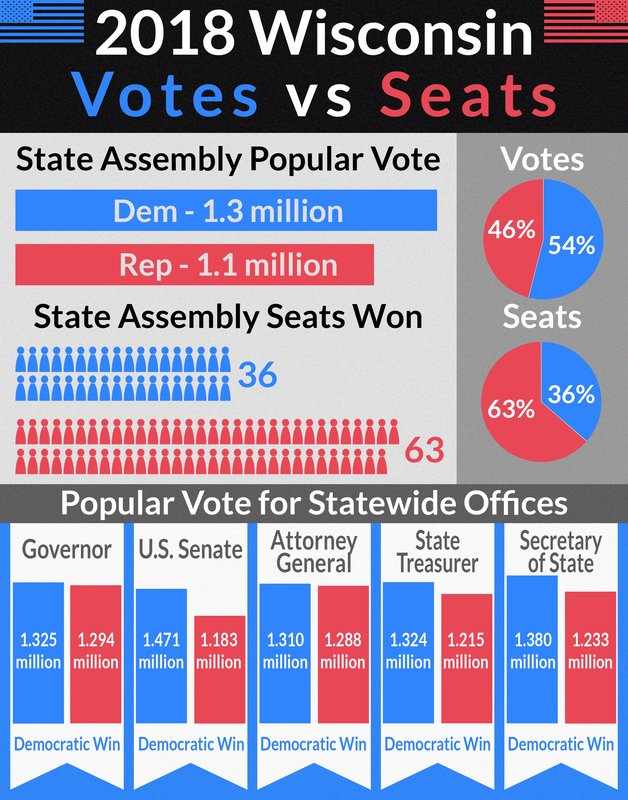
Here’s a way to judge the impact of gerrymandering nationwide: In 2016, Republicans won the House national popular vote, but only by 0.9%. That yielded a larger majority than the Democrats will have: 241-194. So a margin nine times bigger gives Democrats a smaller majority.


Nancy Pelosi seems to be doing what she does best: counting votes until she comes up with a majority.

I think Monica Hesse is onto something:

The Nancyness of Nancy Pelosi is like the Hillaryness of Hillary Clinton: It’s not a definition so much as a collection of amorphous descriptors — cackling, scheming, elitist, ex-wife-like — that nobody can ever quite articulate, other than to say they don’t like it.

With that in mind, I’ve been watching a different set of impossible standards attach to Alexandria Ocasio-Cortez as she gets ready to enter Congress. She doesn’t have enough money in her bank account, her clothes are too nice, and so on. How long before her Alexandrianity becomes similarly disqualifying? Before long, we’ll probably start hearing: “I don’t know what it is, I just don’t like her. She’s got too much baggage.”

The phenomenon here is something I would call bank-shot misogyny. Direct misogyny says “I don’t like her because she’s a woman.” Bank-shot misogyny relies on the fact that (due to the structural misogyny in our national conversation) mud tends to slide off men and stick to women. Then it asks, “Can’t we find someone with less mud on her?”


A number of articles have reminded us that presidents whose parties lose in midterm elections still often get re-elected: Reagan in 1984, Clinton in 1992, Obama in 2012.

But it’s hard to see how those examples will help Trump. In each case, the midterm loss caused the president to change course, to be more cautious, and to work harder to find common ground with the other party. It’s hard to picture Trump learning that lesson, because Trump never makes mistakes and all conflicts are somebody else’s fault, so there’s never anything for him to learn.


Not so long ago, Illinois and Missouri were both swing states, but they have gone in opposite directions: Illinois is now reliably blue, Missouri reliably red. Bill Clinton won Missouri twice, but Hillary lost it in 2016 by 18%. Republican presidential candidates won Illinois six straight times in 1968-1988, but have lost it seven straight times since. Trump lost it by 17%.

Now it looks like several other central states may be separating in a similar fashion. According to Nate Silver, Democratic House candidates won the popular vote in Pennsylvania by 10%, in Wisconsin by 8%, and in Michigan by 7%. Meanwhile, they lost in Ohio by 5.5%.

For decades, Ohio has been the ultimate swing state. (The last time its electoral votes went to the loser was to Nixon in 1960.) But that seems to be changing, so now it’s red even in a blue year. Virginia, conversely, has made a quick trip from reliably red (Bush by 8% in 2004) to solidly blue (Democratic House candidates by 10% in 2018). Ditto Colorado (Bush by 8% in 2000, Dem House by 10% in 2018).


A Washington Post article about Wisconsin politics shows a promising national model: Trump outrage motivated people to become active in politics, but once they got there they didn’t just try to spread Trump outrage. Instead they branched out into voting rights and progressive local issues.


There’s a weird idea going around that House Democrats either won’t or shouldn’t launch a bunch of Trump investigations “because voters have little tolerance for partisan witch hunts”.

I agree that Democrats shouldn’t try to drum up scandal out of nothing, as Republicans did during the Obama administration. (Benghazi deserved one investigation, not eight.) But there is plenty of legitimate wrongdoing and bad policy to investigate. There’s no need for witch-hunting when there’s a crime wave going on.

So Democrats shouldn’t chase wild rumors or grill Ivanka about her emails. But somebody needs to ask exactly how we started putting kids in cages at the border, and look into how Trump is profiting from his presidency. The wastes of money by various cabinet officials deserve public scrutiny. Once the Mueller Report comes in, the House should hold hearings to publicize its findings and to debate whether they merit further action. That’s not witch hunting, that’s Congress doing its job.

In short, Democrats should have high standards for what they investigate. But I think there’s plenty of material that meets high standards.

but we should all be watching the Justice Department

Tuesday, the New York Times reported that Trump had told White House Counsel Don McGahn that he wanted to order the Justice Department to prosecute Hillary Clinton and Jim Comey. McGahn reportedly told the president that this would be an abuse of power and could be grounds for impeachment.

Like all stories with anonymous sourcing, you have to maintain some degree of skepticism. I don’t believe the Times makes up sources (as Trump often claims), but anonymous leaks usually come from people trying to make themselves look good. McGahn looks good here, so he (or someone loyal to him) is probably the source.

Two things about this story are worrisome: First, it paints a picture of a president with authoritarian impulses, who is only being restrained by underlings who still believe in the rule of law. Second, McGahn has left the White House, and the Justice Department is in the hands of a Trumpist hack, Acting Attorney General Matthew Whitaker. If Trump pushes on the system again, it might yield to him.

And Whitaker has his own issues. A number of legal cases will force judges to rule soon on whether his appointment was legal. And somebody in Congress needs to ask him about this:

Before becoming Jeff Sessions’ chief of staff, acting Attorney General Matthew Whitaker received more than $1.2 million in salary from a conservative nonprofit that does not reveal its donors, according to financial disclosure forms.

That would be one of those justified investigations I talked about. No need to nail him to the wall, but get an answer: What was he paid for?

and the climate

A joint report issued by 13 federal agencies directly contradicts the administration’s rhetoric on global warming. Current policy is to loosen climate-change-fighting restrictions in order to spur economic growth. But the report emphasizes the cost of climate change: The report predicts

that if significant steps are not taken to rein in global warming, the damage will knock as much as 10 percent off the size of the American economy by century’s end.

… in direct language, the 1,656-page assessment lays out the devastating effects of a changing climate on the economy, health and environment, including record wildfires in California, crop failures in the Midwest and crumbling infrastructure in the South. Going forward, American exports and supply chains could be disrupted, agricultural yields could fall to 1980s levels by midcentury and fire season could spread to the Southeast, the report finds.

Meanwhile, Republican senators are holding the line on current GOP rhetoric: Doing anything about global warming will break the economy, which just sort of ignores the whole report. Doing nothing about global warming is going to break the economy.

And then there’s this:The NYT has a good article about the persistence of coal as a fuel for electrical plants, in spite of the environmental costs and economic competition from cleaner fuels.

and you also might be interested in

There are lots of rumors about what Robert Mueller might do next, but we’ll all know soon enough.


The stock market has been plunging lately (though it’s up so far this morning), but Trump econ advisor Larry Kudlow isn’t worried about a recession. Of course, he also wasn’t worried about a recession in 2008.


Paul Krugman points to a way forward on health care: Congress may be gridlocked, but a lot can be done in states that Democrats control:

The most dramatic example of how this can be done is New Jersey, where Democrats gained full control at the end of 2017 and promptly created state-level versions of both the mandate and reinsurance [two provisions of the ACA that Republicans have managed to undo at the national level]. The results were impressive: New Jersey’s premiums for 2019 are 9.3 percent lower than for 2018, and are now well below the national average. Undoing Trumpian sabotage seems to have saved the average buyer around $1,500 a year.

Now that Democrats have won control of multiple states, they can and should emulate New Jersey’s example, and move beyond it if they can. Why not, for example, introduce state-level public options — actuarially sound government plans — as alternatives to private insurance?

Insurance works better with a bigger population. So how about it, California?


Are you ready for your annual dose of humility? The NYT’s 100 Notable Books list is out. This year I have read exactly two of the novels: The Witch Elm by Tana French and Spinning Silver by Naomi Novik. Of the nonfiction books: zero.


“Money laundering” isn’t supposed to be this literal: Dutch police found $400K hidden in a washing machine.


Retired General Stan McCrystal writes about his decision to get rid of his portrait of Robert E. Lee.

We want to be proud of our past, so it’s tempting to look at only the best aspects of it. … There is, in the end, little point in studying a version of history that contains cartoons and monuments rather than real people with nuanced actions and decisions — people whose complexities can teach us about our own. As we come to learn more about our world and ourselves, it is crucial to reexamine our role models and our enemies. There is tremendous value in wrestling with the errors over which history commonly glosses.


This week included the strange tale of the 26-year-old American, John Chau, who went to the remote North Sentinel Island to attempt to convert the natives to Christianity. The natives killed him, as they have killed or tried to kill any outsiders who come to their island. North Sentinel sits in the Bay of Bengal as part of the Andaman chain, and is technically part of India. The Indian government has put it off limits and the Indian navy patrols to keep outsiders away. Chau had hired a fishing boat to stay offshore, and paddled in on a kayak.

This is one of those stories that people going to project their own values onto. To me it points out the hazards of living in a myth rather than in reality. With no common language and little common experience, Chau would have needed years to communicate even the most basic notions of his religion, and he seems not to have made preparations for that kind of stay. He apparently paid no attention to the possibility that he might bring diseases that could wipe the natives out. I picture him expecting some kind of Pentecost miracle, with himself as St. Peter. That lack of realism got him killed.


The Washington Post reported last Monday that Ivanka Trump (like Hillary Clinton) used a personal email account for public business. This is an apparent violation of the Presidential Records Act, because Ivanka isn’t just the president’s daughter, she has an official position in the White House. Like Clinton, Ivanka says that she did not understand the rules and had no ill intent. Like Clinton, she addressed the issue by having a lawyer review her records to separate the public emails from the private ones.

The point here shouldn’t be to make problems for Ivanka, but to point out how bogus a lot of the Hillary-email hoo-ha was (as I explained at the time). If the Presidential Records Act is anything like the Federal Records Act that Clinton ran afoul of, violations are not a go-to-jail offense.


George Lakoff’s advice on how to cover Trump:

Journalists could engage in what I’ve called “truth sandwiches,” which means that you first tell the truth; then you point out what the lie is and how it diverges from the truth. Then you repeat the truth and tell the consequences of the difference between the truth and the lie. If the media did this consistently, it would matter. It would be more difficult for Trump to lie.

Actually, it would still be incredibly easy for Trump to lie — he’s a natural — but he wouldn’t get as much benefit out of it.

and here’s something odd

While re-reading the Astro City comic book series this week — I know, I should be reading all that nonfiction on the NYT’s Notable Books list instead —  I ran across the strangely prescient issue #7, published in 2014: Winged Victory, the Astro City universe’s most Wonder-Woman-like character, is being framed as a fraud. Her biggest victories, it is claimed, were staged; the women she has been sheltering and teaching to defend themselves are actually being abused all over again; and so on. When WV goes to a microphone to defend herself, she is shouted down by protesters chanting — wait for it — “Lock her up!” Trump’s crowds didn’t start chanting that about Hillary until 2016.

I’m reminded of an episode of Zorro from 1959, where a Spanish captain gives a patriotic speech and comes darn close to JFK’s “ask not” quote from 1961.

and let’s close with some gross but bizarrely fascinating animal facts

Scientists at Georgia Tech now have an explanation for how wombats manage to poop out cubes. They’re the only known animals with stackable cubic poop.

But even wombat poop is not as amazing as whale earwax. Whales don’t have fingers they can stick into their ears, so their earwax just accumulates through their lives. (Never thought about that, did you?) And they’re huge, so ultimately they wind up with waxy plugs in their ear canals that can be as long as ten inches, plugs that The Atlantic compares to “a cross between a goat’s horn and the world’s nastiest candle”.

It turns out that an earwax plug contains a record of the whale’s life, if you know how to read it.

As whales go through their annual cycles of summer binge-eating and winter migrations, the wax in their ears changes from light to dark. These changes manifest as alternating bands, which you can see if you slice through the plugs. Much as with tree rings, you can count the bands to estimate a whale’s age. And you can also analyze them to measure the substances that were coursing through the whale’s body when each band was formed. A whale’s earwax, then, is a chronological chemical biography.

Researchers at Baylor University have begun studying whale earwax plugs, which coincidentally had been accumulating in museums for more than a century.

“Museums are notorious for collecting everything, and waiting for the science to catch up,” [biology professor Stephen] Trumble says. “We called Charles Potter at the Smithsonian Institution, and he said, ‘It’s interesting you called because we have pallets and pallets of these ear plugs sitting around, and we’re thinking of throwing them away.’ Instead of being thrown away, those ear plugs are now objects of wonder.”

Makes you curious about what else is occupying space in Smithsonian warehouses, doesn’t it?

Trumble and research partner Sascha Usenko measured stress hormones in the plugs, combined findings across numerous whales, and produced “a 146-year chronicle of whale stress”, which turns out to have an obvious-in-retrospect correlation with the output of the whaling industry. The exception is a peak during World War II, when whaling was down, but whales were probably being stressed by underwater explosions. Whale stress is back up lately, possibly in response to climate change.

The Media isn’t “Polarized”, It Has a Right-Wing Cancer

As individuals, liberals and conservatives share all the failings humans are prone to. But left-wing media and right-wing media are structured differently, and the implications are huge.


What’s the difference between right-wing media and left-wing media? Or between conservatives and liberals in general? If you have an answer, how do you know that your answer is objective, rather than just a reflection of your own bias? (As John Locke observed more than three centuries ago: “Everyone is orthodox to himself.”) Or if you think there is no difference, couldn’t your both-sides-ism itself be a bias? Wouldn’t it be odd if Right and Left had exactly the same levels of reasonability or factuality?

How would you know?

Network Propaganda. In Network Propaganda, (whose text and illustrations are available free online, as well as for sale as a book or e-book) Yochai Benkler, Robert Faris, and Hal Roberts go to great lengths to produce an objective look at how news travels through the different regions of the US political universe.

It starts with data.

We collected and analyzed two million stories published during the 2016 presidential election campaign, and another 1.9 million stories about the Trump presidency during its first year. We analyze patterns of interlinking between the sites to understand the relations of authority and credibility among publishers high and low, and the tweeting and Facebook sharing practices of users to understand attention patterns to these media.

What they found overall looks like this:

This aggregate view of the open web link economy during the 2016 election period shows a marked difference between the right and everything that is not the right. There is a clear overlap and interaction between the left, center-left, and center media outlets. These are all centered on the cluster of professional, mainstream journalism sites: the Washington Post, the New York Times, CNN, and Politico form a basin of attraction for outlets ranging from the editorially conservative Wall Street Journal, ABC News, Business Week, or USA Today, through the liberally oriented MSNBC. Zooming in, we see that the right side of the spectrum, by contrast, has Breitbart and Fox News as its basin of attraction, has almost no overlap with the center, and is sharply separated from the rest of the map. The other leading sites on the right include the New York Post, the Washington Times, the Daily Caller, the Daily Mail, and the Washington Examiner. There is almost no center-right, and what there is, anchored around the National Review, is distinct from the set of sites anchored by Fox and Breitbart on the right. The Huffington Post, the Guardian, and MSNBC receive the largest number of media inlinks on the left, joined by Mother Jones, Slate, Vox, and Salon.

Dynamics. This structure produces two distinct dynamics on the left and right. People of all persuasions like to have their prior opinions reinforced, and so we are all susceptible to clickbait (fantastic headlines that appeal to our biases, but have no real substance) and fake news (made-up or grossly exaggerated stories that we want to believe). So both kinds of disinformation are constantly being produced on the extreme Left and Right alike. The difference is what happens then.

there is ample supply of and demand for false hyperpartisan narratives on the left. The difference is that the audience and hyperpartisan commercial clickbait fabricators oriented toward the left form part of a single media ecosystem with center, center-left, and left-wing sites that are committed to journalistic truth-seeking norms. Those norm-constrained sites, both mainstream and net-native, serve as a consistent check on dissemination and validation of the most extreme stories when they do emerge on the left, and have no parallels in the levels of visibility or trust that can perform the same function on the right.

In other words: False stories that come from the Left drift towards the center and get debunked. And that’s usually the end of them. Sites on the far Left know that a lot of their audience also listens to NPR or reads The New York Times. Even if a story has to make it all the way to the center-right (The Wall Street Journal, say, or National Review) before it gets shot down, the correction will filter back, making left-wing sites look bad if they keep repeating the false information.

Nothing similar happens on the Right.

Dynamics on the right tend to reinforce partisan statements, irrespective of their truth, and to punish actors—be they media outlets or politicians and pundits—who insist on speaking truths that are inconsistent with partisan frames and narratives dominant within the ecosystem.

In other words, the right-wing news ecosystem has no antibodies that fight infection by false information. Left and Right are each exposed to misinformation and disinformation, but nothing on the Right keeps it from taking root.

It is not that Republicans are more gullible, or less rational, than Democrats. It is not that technology has destroyed the possibility of shared discourse for all. It is the structure of the media ecosystem within which Republican voters, whether conservatives or right-wing radicals, on the one hand, and Republican politicians, on the other hand, find themselves that made them particularly susceptible to misperception and manipulation, while the media ecosystem that Democrats and their supporters occupied exhibited structural features that were more robust to propaganda efforts and offered more avenues for self-correction and self-healing.

Examples. The book illustrates this bifurcated pattern with

parallel but politically divergent false rumors, about Trump raping a 13-year-old and Hillary and Bill Clinton being involved in pedophilia, [and how the rumors] followed fundamentally different paths through the media ecosystems into which each was introduced.

The Trump-rape story was based on a Jane Doe lawsuit. It made an initial splash on the Left, as Democrats on social media shared and reposted  a Huffington Post article arguing that the case deserved media attention. But the same day as the HuffPost article, The Guardian ran a skeptical article, claiming the suit had been “orchestrated by an eccentric anti-Trump campaigner with a record of making outlandish claims about celebrities.” Within a week the story had virtually vanished, even from very liberal news sources.

The Clinton pedophilia story, on the other hand, began in May, 2016 and continued to rattle through the right-wing echo chamber for the rest of the campaign.

Newt Gingrich, former Speaker of the House of Representatives, made the accusation on-air, interviewed by Sean Hannity and by Greta Van Susteren on Fox News. Bret Baier, anchoring Fox News’s prime-time news show ran a detailed segment on the accusations of Bill Clinton flying to Orgy Island on the Lolita Express. Fox News online published the underlying materials. Rush Limbaugh discussed the allegation as something everyone knows. Trump’s campaign adviser and national security adviser in waiting, Michael Flynn, tweeted it out. Breitbart, the most widely shared right-wing online site whose on-leave CEO Steve Bannon was then running Trump’s campaign, aired an interview constructed of pure disinformation. It seems highly unlikely that any of the people involved—Prince, Flynn, or the publishers of Breitbart—thought that the accusation that Hillary Clinton had flown six times to Orgy Island was anything other than utterly false, and yet they published it four days before the election on Breitbart’s radio station and online. Not one right-wing outlet came out to criticize and expose this blatant lie for what it was. [my emphasis] In the grip of the propaganda feedback loop, the right-wing media ecosystem had no mechanism for self-correction, and instead exhibited dynamics of self-reinforcement, confirmation, and repetition so that readers, viewers, and listeners encountered multiple versions of the same story, over months, to the point that both recall and credibility were enhanced. It is hardly surprising, then, that a YouGov poll from December 2016 found that over 40 percent of Republican respondents thought that it was at least somewhat likely that someone was running a pedophilia ring out of the Clinton campaign.

This disinformation had real-world consequences. In December, a young man fired three shots in a DC-area pizza restaurant supposedly involved in the pedophilia ring.

Despite extensive efforts, we were unable to find an example of disinformation or commercial clickbait started on the left, or aimed from abroad at the left, that took hold and became widely reported and believed in the broader network that stretches from the center to the left for any meaningful stretch of time

A second set of examples came from the “fake news awards” President Trump announced in 2017.

Comparing the Uranium One, Seth Rich, and Lolita Express and Orgy Island diffusion patterns we observed in earlier chapters on the one hand, and the various winners of the “fake news awards” on the other hand, underscores the fundamentally different dynamics in the right wing as compared to the rest of the American political media ecosystem. When observing right-wing conspiracy theories, we saw positive feedback loops between the core of that network—composed of Fox News, leading Republican pundits, and Breitbart—and the remainder of the online right-wing network. In those cases we saw repetition, amplification, and circling of the wagons to criticize other media outlets when these exposed the errors and failures of the story. By contrast, the mainstream media ecosystem exhibited intensive competition to hold each other to high journalistic standards, and a repeated pattern of rapid removal of content, correction, and in several cases disciplining of the reporters involved. Moreover, in none of these cases did we find more than a smattering of repetition and amplification of the claims once retracted.

Why doesn’t the Left do the same thing? This is one of the book’s more interesting points. People watch news programs for two purposes: to stay informed and to have their worldview reaffirmed. Since the 1980s, the Right has established an alternate news system that primarily serves the second purpose. But this isn’t just an ideological crusade, it also makes money.

So why doesn’t a parallel system make money on the Left? (It’s been tried. Air America tried to establish liberal talk radio during the Bush years, but went bankrupt.) Various liberal news outlets exist, but they’ve never escaped from the mainstream news ecosystem. It’s tempting to claim some superior virtue on the Left, but that’s not where Network Propaganda goes. Instead, it finds a first-mover advantage: Once a self-contained right-wing propaganda system exists, it allows the left-wing audience to gets its worldview affirmation from the center.

But once one wing has established the strategy of partisan bias confirmation, the centrist media with their truth-seeking institutions and reputations suddenly deliver a new benefit to partisans of the opposite pole—as objective external arbiters they can offer institutionalized credibility to reinforce their view that what their opposition is saying is false. Once one partisan media pole is established, the coverage of existing objective media outlets takes on a partisan flavor without any shift in their own focus on objectivity.

The mainstream media will be able to reconcile their goals of truth-seeking and confirmation from the center with providing a steady flow of partisan-confirming news for the wing in opposition to the wing that is already in the grip of the propaganda feedback loop. The outlets that formed the partisan ecosystem have a first-mover advantage over outlets that try to copy them on the opposite side, because as they decrease the value of the mainstream media to their own audiences, they increase it for the putative audiences of their opponents. The further the first-moving partisan media ecosystem goes down the path of its own propaganda feedback loop, the greater its tendency to produce untrue statements, and the greater the opportunities for reality-check centrist media organizations to deliver news that is both truthful and pleasing to partisans from the other side.

Fox is not a news network. During the primary campaign, Fox News represented traditional conservatism and was skeptical of Trump. Consequently, it lost ground to Breitbart as the center of right-wing coverage. After the election, though, it regained its standing by going full Trump.

Chapter 5, “The Fox Diet”, demonstrates how not just the content, but the timing, of Fox coverage derived from what the Trump administration needed, rather than what was new or true or relevant.

One case involves the argument that Democratic activist Seth Rich was murdered to hide the fact that he, not Russia, was responsible for leaking the Democratic National Committee (DNC) emails. The other case involves use of a story surrounding a company called Uranium One to attack the integrity and independence of the key law enforcement officers involved in the special counsel investigation. The timing and pattern we show in these case studies strongly suggest that they were launched for the specific partisan purpose of deflecting the Trump-Russia allegations and undermining the special counsel investigation. And in the two specifically fact-based cases, we show that Fox News actively promoted these stories despite the fact that they were repeatedly fact checked and debunked by a wide variety of professional journalists.

Both the Seth Rich and Uranium One stories had initially flared and died down, but re-emerged months or even years later when Trump needed them to shift the narrative. Uranium One was initially an anti-Clinton story early in the campaign, but was repackaged after the election as an Deep-State-law-enforcement story when the Mueller investigation heated up and Trump needed to undermine its credibility.

Manipulating the mainstream media. The existence of a propaganda network, one that constantly accuses traditional journalists of bias, puts those journalists under constant pressure to prove their objectivity. Often this takes the form of “balance” — finding a negative story about one side to balance a negative story about the other.

a core driver of the [Clinton] email focus was misapplication of the objectivity norm as even-handedness or balance, rather than truth seeking. If professional journalistic objectivity means balance and impartiality, and one is confronted with two candidates who are highly unbalanced—one consistently lies and takes positions that were off the wall for politicians before his candidacy, and the other is about as mainstream and standard as plain vanilla—it is genuinely difficult to maintain balanced coverage. The solution was uniformly negative coverage, as Patterson and colleagues showed, and a heavy focus on detailed objective facts. The emails were catnip for professional journalists. They gave journalists something concrete to work with. They had the aura of salacious reporting of uncovered secrets, while being unimpeachably factual and professional. And they allowed the mainstream publications to appear balanced in that their coverage of the two candidates was equally hard-hitting and tough.

The result was that Trump by far got the advantage of news coverage during the campaign: Coverage of Clinton tended to be about scandals, many of which had dubious substance. Trump, on the other hand, got covered for his positions on immigration, jobs, and trade.

Articles about Clinton in The New York Times and Washington Post often had scandalous headlines that were walked back by details far down the column. Such articles were frequently cited on the Right (as NYT and WaPo stories seldom are) to validate an anti-Clinton narrative.

Consider where the actual balance-of-scandals tilted: the Trump sexual harassment stories had numerous first-person witnesses, while the Trump University fraud eventually required a $25 million settlement. Supposed scandals about the Clinton Foundation were almost entirely conspiracy theories, while the largely uninvestigated Trump Foundation is currently facing a lawsuit calling for its dissolution for self-dealing. And yet this was the balance of coverage:

The Right needs this kind of mainstream cooperation, because the number of people who live inside the right-wing bubble is somewhere iin the range of 25-30% of the population — not nearly enough to win elections.

Russia and other bad actors. The good news in the book is the authors’ conclusion that Russian social media campaigns, fake news entrepreneurs, Cambridge Analytica, and Facebook’s news algorithms actually had little effect on the course of news coverage.

The Russians tried but were unlikely to have been a critical factor. The commercial bullshit artists made some money, but were peripheral. And while Facebook’s data team certainly did make it possible for a complete outsider running with little help from party institutions to identify millions of voters and reach out to them effectively, the Cambridge Analytica manipulative advertising and the dark ads part of the story was still, in 2016, more of a red herring than the game changer some made it out to be.

[Note: This is about the effectiveness of Russian social media campaigns. No one disputes that the DNC emails hacked by the Russians and distributed by WikiLeaks had a major impact.]

However, the existence of a right-wing propaganda ecosystem, with correspondingly low resistance to false facts it wants to believe, is a continuing vulnerability in the American political system. As long as it exists, it will be open to outside manipulation.

Russian propaganda seems to have targeted both sides, and Facebook clickbait sites tried to manipulate denizens of all sides of the American public sphere. But, just as we saw in the case of the competing Trump rape and Clinton pedophilia frames, the responsiveness and success appear to have been very different in the two parts of the media ecosystem. In the right-wing media the propaganda feedback loop enabled conspiracy theories, false rumors, and logically implausible claims to perform better, survive longer, and be shared more widely than were parallel efforts aimed at the left.

The authors also saw little effect from far-right-wing groups (like white supremacists) seeding their messages into the right-wing core. The problem wasn’t that VDare or The Daily Stormer manipulated Fox News into spreading racist anti-immigrant messages, but that Fox went looking for those memes.

In general,

a population with high trust in bias-confirming news and high distrust in bias-disconfirming, professional-norms-driven media will be more vulnerable to disinformation campaigns than a population that has generally higher trust in professional journalism on average, but lower trust in any given media outlet…. As Joanne Miller and her collaborators and, independently, Adam Berinsky have shown, for Democrats, the more knowledgeable they are about politics, the less likely they are to accept conspiracy theories or unsubstantiated rumors that harm their ideological opponents. But for Republicans more knowledge results in, at best, no change in the rate at which they accept conspiracy theories, and at worst, actually increases their willingness to accept such theories.

What can be done? Something, but not a lot. Mainstream media needs to recognize that it lives in a propaganda-rich environment, and that the propaganda does not come equally from both sides.

When mainstream professional media sources insist on coverage that performs their own neutrality by giving equal weight to opposing views, even when one is false and the other is not, they fail. … [T]he present journalistic practice of objectivity as neutrality has perverse effects in the media ecosystem we document here. By maintaining the “one side says x, the other side says y” model of objectivity in the presence of highly asymmetric propaganda efforts, mainstream media become sources of legitimation and amplification for the propagandists.

Instead of balance, mainstream journalism needs to focus on truth-seeking and accountability. The authors make an interesting suggestion about, for example, anonymous sources. A responsible editor will insist on knowing a reporter’s sources, but an irresponsible organization could abuse that practice. What if some independent, highly trusted organization were set up that news organizations could use to verify their anonymous sources without revealing them? The system might function like peer review in science.

Journalists also need to apply skepticism to illicitly obtained documents that come from, say, Russian hackers rather than whistle-blowers.

Recognizing the asymmetry we document here requires editors to treat tips or “exclusives,” as well as emails or other leaked or hacked documents with greater care than they have in the past few years. The “Fool me once, shame on you . . .” adage suggests that after, for example, the New York Times’s experience with Peter Schweizer and the Uranium One story, mainstream professional journalists need to understand that they are subject to a persistent propaganda campaign trying to lure them into amplifying and accrediting propaganda. This happens of course as normal politics from both sides of the partisan system, but our work here shows that one side is armed with a vastly more powerful engine for generating and propagating propaganda.

But ultimately the Right will have to fix itself. It may seem far-fetched at the moment, but traditional conservatives (as opposed to white supremacists or other right-wing extremists) must already realize that the current system is not working for them.

There is nothing conservative about calling career law enforcement officials and the intelligence community the “deep state.” The fact that the targets of the attack, like Robert Mueller, Rod Rosenstein, or Andrew McCabe, were life-long Republicans merely underscores that fact. There is nothing conservative about calling for a trade war. There is nothing conservative about breaking from long-held institutional norms for short-term political advantage. And there is nothing conservative about telling Americans to reject the consensus estimate of the CIA, the FBI, and the NSA that we were attacked by Russia and suggesting instead that these agencies are covering up for a DNC conspiracy. What has happened first and foremost to make all these things possible is that the Republican Party has been taken over by ever-more right-wing politicians.

The authors suggest that a series of election losses might motivate such a re-assessment of where the trends of the last 30 years have brought the conservative movement. Network Propaganda was published prior to the recent midterm elections, but we can hope that 2018 was the first in a series of such losses.

The Monday Morning Teaser

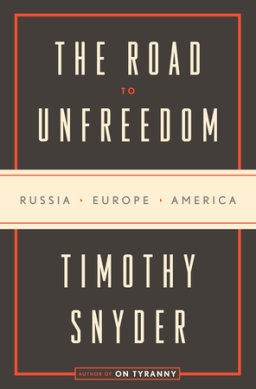
Last week I wrote about Timothy Snyder’s The Road to Unfreedom, which discusses the mythic needs that fascism satisfies, and describes how propaganda patterns that start in Putin’s Russia have propagated to Europe and the United States. This week I want to look at what made the US political system particularly vulnerable to this kind of disruption.

So this week’s book is Network Propaganda by Yochai Benkler, Robert Faris, and Hal Roberts. The authors did a massive analysis of millions of new articles over two years and how they propagated across social media. And they come to an interesting conclusion: American news media is bifurcated, but not polarized. Right and Left are not equivalent.

In other words, there are two news ecosystems in the US: a right-wing one anchored by Fox News and Breitbart, and a more varied one that spans from the center-right to the far left. The two systems deal with partisan propaganda differently: Left-wing propaganda fairly quickly drifts to the center and center-right, where it gets debunked and dies. But right-wing propaganda stays in an echo chamber where it gets reflected and reinforced.

This week’s featured post will flesh that out. It should appear around 11 EST. The weekly summary will cover Trump administration’s efforts to circumvent immigration law, and how that is being blocked by the courts. (Trump wants to make that a personalities issue, but it’s really about the law.) Also the decision to ignore the Khashoggi murder and stand by Saudi Arabia, further analysis of the midterm election results, what’s going on in the Justice Department, and the new climate report. It will close with gross-but-fascinating facts about wombat poop and whale earwax. It should be out a little after noon.

Lies and Traps

The adage that there are two sides to a story makes sense when those who represent each side accept the factuality of the world and interpret the same set of facts. Putin’s strategy of implausible deniability exploited this convention while destroying its basis. He positioned himself as a side of the story while mocking factuality. “I am lying to you openly and we both know it” is not a side of the story. It is a trap.

– Timothy Snyder, The Road to Unfreedom

This week’s featured post, “The Big Picture: from Russia to Ukraine to Brexit to Trump“, looks at Timothy Snyder’s The Road to Unfreedom.

His analysis of the Putin/Trump style of propaganda has me rethinking how I cover Trump, so this week’s summary is an experiment: Putin and Trump say outrageous things in order to become the story themselves, shifting the focus away from the issues on the ground. Just this week, for example, Trump has blathered a lot of nonsense about the California wildfires. It would be easy to get focused on Trump’s nonsense, and lose sight of the fact that homes are burning, people are dying, and millions of Californians are dealing with a serious air-quality problem.

On the other hand, we shouldn’t all just ignore that our President is disinforming the public, which includes a segment that is inclined to believe him. So here’s what I’m trying this week: I will try to stay focused on the underlying issues. At places where Trump made headlines with a crap statement, I’ll mention that this happened, characterize it with a single adjective (like “Trump said something stupid about this”), and provide a link in case you feel that you must know what it was.

We can’t lose sight of the fact that Trump says ignorant and offensive things on an almost daily basis. But that’s not really news any more.

This week everybody was talking about undecided races

Almost all of them came to a conclusion this week (other than the run-off in the Mississippi Senate race, which will happen next Tuesday).

  • Republicans took both the governorship and the Senate seat in Florida.
  • Stacey Abrams admitted that Brian Kemp will be Georgia’s next governor. But after a long series of voter-suppression abuses by Kemp in his role as Secretary of State, Abrams refused to concede: “Let’s be clear, this is not a speech of concession. Because concession means to acknowledge an action is right, true or proper. As a woman of conscience and faith I cannot concede that. But my assessment is the law currently allows no further viable remedy.”
  • Democrat Kyrsten Sinema won the Arizona Senate race.

A number of close House races weren’t decided until this week, and three are still out. The most interesting was in Maine-2, where the state’s ranked-choice-voting system made a difference:

In this election, the initial round had GOP incumbent Bruce Poliquin winning 46.1 percent and [Democrat Jared] Golden receiving 45.9 percent. Third party candidates garnered 8 percent. After re-allocating these third party votes, the final result was 50.53 percent to 49.47 percent in favor of Golden.

The Republican loser is going to court, claiming that ranked-choice-voting is unconstitutional. But I don’t think he has any kind of a case. Here’s the sum total of what the Constitution says about House elections:

The House of Representatives shall be composed of Members chosen every second Year by the People of the several States, and the Electors in each State shall have the Qualifications requisite for Electors of the most numerous Branch of the State Legislature.

I don’t know how you read a ban on ranked-choice voting into that.

Think how much grief would be avoided if every state had RCV: If you want to vote Green or Libertarian or write in Bozo the Clown, fine. As long as you also express a preference between the Republican and Democratic candidates, you’ve got that base covered.

So here’s where we stand at the moment: Republicans control the Senate 52-47, with the Mississippi run-off pending. Democrats control the House 233-199 with three seats still undecided. The new Congress will be seated on January 3.

The current House popular vote count has the Democrats ahead by 7.7%, or more than 8.5 million votes. (Nate Silver expects it to get into 8-9% range when the final votes are tallied.) The Republican wave of 2010 had a margin of 6.8% or just under 6 million votes. The Republicans’ smaller 2010 victory gave them a larger 242-192 majority, because the system is rigged in their favor.


Don’t say it can’t happen: A Democratic challenger for a seat in the Kentucky legislature appears to have won by 1 vote.

and Nancy Pelosi

20 House Democrats have told the Washington Post that they won’t vote for Nancy Pelosi as Speaker. If they all follow through, that would keep Pelosi from having the 218 votes necessary to win. Most of the 20 are from purple districts where Pelosi had been demonized as a far-left liberal, but some are also progressives who think Pelosi is too close to big donors and too willing to compromise with the business interests Republicans represent. But if she isn’t re-elected, it’s hard to guess what happens next: Other candidates may be able to block Pelosi, but who has enough support to win?

I’m for Pelosi. She is a brilliant behind-the-scenes tactician. When she was Speaker before, she skillfully steered Obama’s agenda through the House, including a bunch of progressive measures that then died in the Senate, like a cap-and-trade bill to fight climate change and a public option for ObamaCare. She was key in the legislative maneuver that finally passed ObamaCare (after Scott Brown’s upset win for Ted Kennedy’s Senate seat ruined the original plan). Arguably, Democrats lost the House in 2010 because she had convinced members from conservative districts to risk too much.

While leading the minority these last few years, she has repeatedly run rings around Paul Ryan. By holding her caucus together against bills like ObamaCare repeal, the Trump tax cut, and the early versions of budget bills, she made it necessary for Ryan to hold his caucus together, something he was often unable to do.

It would be very strange for a party to get back into power and then reject its leader. Typically, a party leader is in trouble when his or her party loses seats. Tennis great Martina Navratalova (whose Twitter feed is highly political) summed up what I suspect a lot of women are thinking:

It is amazing,really. loses in the Senate and keeps his leadership role and makes the biggest democratic gain in the House since Watergate and they want her to quit. Go figure. A man loses and keeps his place, a woman wins and gets booted?!?

The point here isn’t that anti-Pelosi Democrats are against women having power. The dynamic is more complicated than that. Many Democrats are concerned about the baggage that comes from Pelosi being a decades-long target of Republican demonization — demonization that sticks to a woman more easily than a man. (We saw this with Hillary Clinton in 2016. Bill could abuse women and continue to be a charming scamp, but Hillary was tarred by her defense of Bill.) Others want someone who would cast a better public image, in an era when our subconscious image of a “leader” is still inescapably male. Alexandra Petri satirizes:

That’s not a woman thing, though. It’s just a her thing. I would have that issue with anyone who had her baggage, that same difficult-to-pin-down sense that something about her was fundamentally tainted. …

What I want is not impossible! I want someone who is not tainted by polarizing choices in the past, but who also has experience, who is knowledgeable but doesn’t sound like she is lecturing, someone vibrant but not green, someone dignified but not dowdy, passionate but not a yeller, precise but not mechanical, someone lacking in off-putting ambition but capable of asking for what she wants, not accompanied but not alone, in a day but not in a month or a year, when the moon is neither waxing nor waning, carrying a sieve full of water and a hen’s tooth. Easy!

That’s why I’m so worried about our current slate of choices. A woman, sure, but — Kamala Harris? Elizabeth Warren? Kirsten Gillibrand? There are specific problems with each of them, entirely personal to each of them, all insurmountable. We need someone fresh. Someone without baggage. Joe Biden, maybe. But female! If you see.

I can’t wait to vote for a woman in 2020. A nameless, shapeless, faceless woman I know nothing about who will surely be perfect.

If Pelosi isn’t progressive enough for you, who is the progressive candidate that the caucus can unite behind, and how does that Speaker not lose all the suburban Republican seats that Democrats just flipped? If she’s too far left for you, who is the more moderate candidate, and how does that candidate inspire young people to vote? How does this leadership struggle resolve without sparking a round of those Democrats-are-in-chaos stories that the media is always eager to write? Is that how we want the new Congress to introduce itself to the American people?

I think Nancy Pelosi represents an ideologically diverse party as well as anybody else can. And she also is good at her job. She should keep it.


In October, I was at a fund-raiser for Rep. Bill Foster of Illinois, who currently is one of the 20 planning not to vote for Pelosi. Foster made what I think is an excellent procedural suggestion: discharge petitions should be anonymous.

OK, that’s some inside baseball that needs an explanation. One of the maddening things about the House is that the Speaker can keep a bill from coming to a vote, even if a majority of the membership supports it. One example of this was the bipartisan comprehensive immigration reform that the Senate passed in 2013. It never got a vote in the House, despite the widespread belief that it would pass if it did. If the DREAM Act could have come to the floor any time in the last several years, it would have passed. But Republican speakers have repeatedly blocked it.

The way get around the speaker’s roadblock is a discharge petition: If a majority of the House signs a petition asking for a bill to come up for a vote, it does. But this almost never happens. The reason is that signing a discharge petition against a speaker of your own party is considered treason, and members who do this will be severely punished by losing their committee assignments, losing support from their party’s national campaign committee, and so on.

That’s why Foster thinks discharge petitions should be anonymous: Some neutral official could verify the petition and report the number of signatures without revealing who they are. It would make the House a little less dysfunctional.

and fires

Record-setting wildfires continue to burn in California. The death toll is up to about 80, but with more than a thousand people missing, that number is bound to go up. In San Francisco, masks and filters are necessary if you want to breathe normally.

Grist outlines the conditions that led to the fire that destroyed the town of Paradise:

According to local meteorologist Rob Elvington, the Camp Fire began under atmospheric conditions with “no analog/comparison” in history for the date. Northern California’s vegetation dryness was off the charts — exceeding the 99th percentile for any single day as far back as local records go. “Worse than no rain is negative rain,” wrote Elvington. The air was so dry, it was sucking water out of the land.

The problem is how global climate change is affecting the local climate: Summers are hotter and the winter rains come later.

Fire disasters on a scale recently considered inconceivable now appear to be the inevitable. Six of the 10 most destructive wildfires in California history have ignited in the past three years. In little more than a year, two other California towns (Redding and Santa Rosa) have been similarly devastated by fires. As long as we continue on a business-as-usual path, it’s a matter of where, not when, another California town will be erased from the map.


So Trump went out to view the damage and said something stupid, in case you haven’t had your daily dose of outrage yet.

But I think a better use of your time would be to watch this episode of Showtime’s “Years of Living Dangerously” from 2014.

It follows two story lines, one of which is Arnold Schwarzenegger interviewing people who fight brush fires and reflecting on how climate change has (in a very short period of time) turned California’s wildfire season into a nearly year-round event. (The other story line, Harrison Ford looking into deforestation in Indonesia, is pretty interesting too.)

and you also might be interested in …

The Brexit deadline hits in March, and it’s still not clear how it’s all going to resolve. Prime Minister May’s proposal has already led to resignations from her cabinet and might bring down her government. My opinion: The problem is that the British public was bamboozled by the Leave campaign. Now that it’s time to produce the unicorns and rainbows Brexit was supposed to bring, no one can find them.

As someone (I can’t remember who) observed, the structure of the Leave/Remain vote was screwed up. Leave was a “do something else” option rather than a plan. Any actual plan will result in a majority saying, “That’s not what I voted for.”


Supreme Court Justice Sonia Sotomayor on Brett Kavanaugh joining the Court: “The nine of us are now a family.” I am reminded of a line from Neal Stephenson’s Snow Crash: “It was like being in a family. A really scary, twisted, abusive family.”


Nothing is what it used to be, not even the kilogram.


A Pacific Standard reporter goes home to Michigan and reports on the effects of gerrymandering.


Trump responded to criticism from retired Admiral Bill McRaven by saying something childish. Here are details, if you need them.


The CIA has concluded that the murder of Washington Post columnist Jamal Khashoggi was ordered by the Saudi crown prince, Mohammed bin Salman. But Trump has a history of believing what he wants to believe rather than what the experts conclude. Just as he believes Putin’s denials of interfering in the 2016 election, and he believes MBS.


Jim Acosta has his White House pass back, following a court order. The judge didn’t rule on Acosta and CNN’s First Amendment claims, but found against the Trump administration on 5th Amendment grounds of no due process. So the White House is drafting a process for expelling reporters who ask hard questions and won’t take lies for answers.

Sarah Huckabee Sanders responded:

Today, [LIE] the court made it clear that there is no absolute First Amendment right to access the White House [/LIE]. In response to the Court, we will temporarily reinstate the reporter’s hard pass. We will also further develop rules and processes to ensure fair and orderly press conferences in the future. There must be decorum at the White House.

I will repeat something I’ve written many times: When Trump defines some standard of decorum that he is willing to live by, then he’ll be in a position to ask other people to uphold that standard. But if his rules say that other people have to behave while he can keep on doing anything he wants, the rest of us should just laugh at him.

For example, Sunday (in the middle of a tweet demonstrating that his complete ignorance of the legal issue he was discussing), Trump called incoming House Intelligence Committee Chair Adam Schiff by a derogatory name he probably hasn’t heard since junior high. That’s White House decorum, and there’s nothing Jim Acosta could do to lower it.

Meanwhile, Trump’s people are moving the goalposts on the First Amendment. Wayne Slater tweets:

Cory Lewandowski on : “There is no freedom of speech to ask any question you want or to ask it in a derogatory manner.” Actually, that’s what free speech is.


Remember the middle-class tax cut that Trump pulled out of nowhere just before the midterm elections? Surprise! It’s not happening. Chief Economic Adviser Larry Kudlow told Politico:

We’ve been noodling more on this middle-class tax cut, how to structure it, and even pay for it. I don’t think the chances of that are very high, because the Democrats are going to go after the corporate tax and all that stuff.

Kudlow is also skeptical of any infrastructure deal.

Anybody that thinks, you know, like this trillion-dollar [infrastructure spending] number, which is over 10 years — we don’t have that

The top Republican in the new Congress was blunter:

Senate Majority Leader Mitch McConnell (R-Ky.) on Wednesday flatly rejected the idea of doing a big infrastructure deal with Democrats. “Republicans are not interested in a $900 billion stimulus,” he told reporters.

As I suggested last week, Democrats in the House should pass an infrastructure bill. The American people should know that Democrats want to rebuild the country, but Republicans don’t.


Another story that has all but vanished (now that it can’t be used to bring Trump voters to the polls) is the migrant caravan. Migrants who hitchhiked rides rather than walking all the way have started to arrive in Tijuana, where they are waiting for caravan leaders. The bulk of the caravan is still hundreds of miles away.

A Methodist minister from San Antonio is traveling with the caravan and sharing his experiences on Facebook.

Refugees sharing their stories with the pastor tell of having their children kidnapped and other relatives killed in Central America. Their journey, Rogers says, is “not about a better life in American terms, it’s just about living.” Their goals, he adds, are to seek an education for their children and “be free from violence and rape and murder.” Rogers admits that claim may sound “extreme,” but says he has firsthand knowledge, obtained by being “willing to talk and learn,” that it’s “exactly what is going on here.”

Teen Vogue (whose articles often are deeper and more serious than its name would lead you to expect) also has a correspondent in the caravan.


Drain the swamp:

The Trump administration’s top environmental official for the Southeast was arrested Thursday on criminal ethics charges in Alabama reported to be related to a scheme to help a coal company avoid paying for a costly toxic waste cleanup.


It’s not hard to see why our national political discussions are so bizarre when you consider the history that many of our students have been taught:

Texas’ Board of Education voted Friday to change the way its students learn about the Civil War. Beginning in the 2019-2020 school year, students will be taught that slavery played a “central role” in the war.

The state’s previous social studies standards listed three causes for the Civil War: sectionalism, states’ rights and slavery, in that order. In September, the board’s Democrats proposed listing slavery as the only cause. … In the end, the Republican-led board landed on a compromise: Students will be taught about “the central role of the expansion of slavery in causing sectionalism, disagreements over states’ rights and the Civil War.”

But no doubt some Texas history teachers are reading this line and rolling their eyes about “political correctness”.


Stan Lee — the man who really told Peter Parker that “with great power comes great responsibility” — has died at age 95. Stan and artist Jack Kirby created the core of the Marvel Universe in the early 1960s. Unlike the previous generation of comic creators, Stan made heroes (Spider-Man, Hulk, Daredevil) with insecurities, self-doubts, and moral quandaries. His teams (Fantastic Four, Avengers, X-Men) had internal divisions. His villains (Dr. Doom, Magneto) had backstories that explained their choice of the dark side.

Another seminal figure in popular culture also died this week: writer William Goldman, who was responsible for The Princess Bride and Butch Cassidy and the Sundance Kid.

and let’s close with something unexpected

Finally, Roy Clark died this week at 85. People my age (and younger folks who watch re-runs on obscure cable stations) may remember him from the country comedy show “Hee-Haw”. Or maybe his hit “Yesterday, When I Was Young” rings a bell. But amidst the jokes and popular country songs, people sometimes overlooked that he could flat-out play the guitar. In a guest appearance on the sitcom “The Odd Couple”, he went outside his usual genre to show another side of his talent.

The Big Picture: From Russia to Ukraine to Brexit to Trump

The author of On Tyranny is back with a travelogue of The Road to Unfreedom


For several years now, we’ve been observing a global trend of once-democratic countries moving towards fascism. The paradigmic example is Putin’s Russia, but various other “right-wing populist” leaders have taken their countries some greater or lesser distance down the same road: Duterte in the Philippines, Erdogan in Turkey, Orban in Hungary, Duda in Poland, Trump in the US, and (soon) Bolsonaro in Brazil. Even in countries that have held the extreme right at bay, some proto-fascist party has shown surprising strength: National Rally in France, Alternative for Germany, Austria’s Freedom Party, and several others.

Each country has a unique story to tell about personalities, opposition weakness, dissatisfaction among key voting blocs, or previous government corruption. But when you look at the larger picture, you have to ask why. Why now? Why the right rather than the left? Why everywhere at once?

Timothy Snyder has an answer for you. Like all big theories, it’s a bit speculative. If you want a case ready to take to court, you won’t find it here. But if you’re looking for way to tell one big story about the current crisis of democracy rather than framing it as an unfortunate convergence of many little stories, his recent book The Road to Unfreedom is as a good a narrative as I’ve found.

To an extent, I’m misrepresenting The Road to Unfreedom in this article. I’ll be focusing on the abstract stuff in the background, the frame that holds it together. But Snyder’s book is anything but abstract; it is also a detailed description of how the internal politics of Putin’s Russia led to the invasion of Ukraine, and then to information warfare against the European Union and the United States. It maps out the common tactics that show up again and again, from Russia to Ukraine to Brexit to Trump.

But why did those tactics work so well in so many different countries?

Two mythologies and the reality they hide. Snyder points to a sea change in the dominant mythology of democratic societies. For decades, we have been living under a flawed but more-or-less benign mythology he calls “the politics of inevitability”, which is a version of the myth of progress: Irreversible historical trends are pushing us towards an “end of history” in which all nations will become human-rights-respecting democracies joined in a global market. As we approach this goal, many good things are supposed to happen: societies become more tolerant, more and more groups achieve justice and get their rights recognized, and technological progress leads to economic growth that raises the overall standard of living.

The exact timing of these benefits may depend on some heroic action here or there, and occasionally there might be a temporary setback. But the overall outcome is destined; it just happens.

Politics in an era of inevitability becomes either boring or frustrating, depending on your point of view. On issue after issue — a new trade pact, a newly recognized civil right, a new market, new patterns of behavior that correspond to new technologies — there seems to be no real choice. The Future is going there; you either get with the program or you don’t.

Over the last two decades or so, that myth has been undermined, by a lack of progress, by hitting environmental limits, and by contradictions among the various values “the Future” was supposed to optimize. Climate change presents a possibility of dystopia rather than utopia. Both globalization and technological change have produced losers as well as winners. As new groups get their rights recognized, groups privileged by the old arrangements may feel less and less at home; society used to fit them like a glove, and it no longer does. The increased freedom of capitalists may lead to decreased opportunities for workers, and while overall economic growth may continue, the new wealth may simply pile up at the top.

Occasionally, the failure of inevitability manifests in some shocking statistic like this one: Life expectancy in the United States fell in both 2015 and 2016. The drop (from 78.9 years in 2014 to 78.6 years in 2016) corresponded to an increase in deaths related to hopelessness: drug overdoses and suicides. In the face of such news, the rhetoric of inevitable progress becomes unconvincing.

The faltering of inevitability has made room for a rival myth that Snyder calls “the politics of eternity”: Your own group (whatever it is) is perpetually virtuous and innocent, but it is surrounded and assailed by evil enemies. He refers to this viewpoint as “eternal” because the story never changes.

When each day is devoted to emotional venting about supposed enemies, the present becomes endless, eternal.

Nothing your group does can ever besmirch its innocence, and the rightful steps it takes to defend itself will never be accepted by the evil forces that assail it. All victories and defeats are just temporary. Only an annihilating defeat or a millennial victory at the end of time could truly break the cycle.

Both myths hide the reality that history is whatever humans make it. We are perpetually confronted with choices, and many outcomes are possible. Humanity makes progress (or not) depending on what we do. Virtue is not something we are born with or inherit from our ancestors; it either manifests in our actions or it does not.

Fictionalization. Inevitability politicians offer an idealized future. Eternity politicians have no utopian vision, so they instead offer a return to an idealized past. If you are suffering here and now, inevitability frames your pain as an aberration or a temporary inconvenience or a worthy sacrifice. Eternity, on the other hand, has no better future to offer you, but it tells you who to blame.

An eternity politician defines foes rather than formulating policies.

One key difference between the two myths is that the Future actually arrives, a little bit at a time. So the case for progress is inherently a fact-based case. An inevitability politician may make up facts, perhaps, or twist them, but he can’t do without them. “A plausible future,” Snyder writes, “requires a factual present.”

But eternity-politics requires only struggle, and the less factual the struggle, the easier it is to maintain. A real struggle might come to some conclusion, but an entirely made-up one never will.

The politics of eternity requires and produces problems that are insoluble because they are fictional.

So, for example, the millions of illegal voters who decide American elections can’t be stopped, because they’re not real. The struggle against them will go on forever. Democrats can never stop trying to take your guns, because they weren’t trying to take your guns in the first place. The War on Christmas will come back every year, regardless of anything the faithful might do to defend themselves.

People believe these narratives because they are emotionally satisfying, not because they are factual. And so eternity propaganda doesn’t simply repeat what it wants the public to believe, but attempts to destroy the public’s confidence in any factual present or coherent narrative of history. Snyder describes Putin’s propaganda during the invasion of Ukraine like this:

According to Russian propaganda, Ukrainian society was full of nationalists but not a nation; the Ukrainian state was repressive but did not exist; Russians were forced to speak Ukrainian though there was no such language.

The point is not to win a rational argument, but to make rational argument impossible.

The tools and attitudes of ordinary journalism have failed to deal with this more fundamental attack.

One can mark the fictions and contradictions. This is not enough. These utterances were not logical arguments or factual assessments, but a calculated effort to undo logic and factuality. … The adage that there are two sides to a story makes sense when those who represent each side accept the factuality of the world and interpret the same set of facts. Putin’s strategy of implausible deniability exploited this convention while destroying its basis. He positioned himself as a side of the story while mocking factuality. “I am lying to you openly and we both know it” is not a side of the story. It is a trap.

And if the war is against factuality itself, the press becomes an enemy of the People.

in the Russian model, investigative reporting must be marginalized so that news can become a daily spectacle. The point of spectacle is to summon the emotions of both supporters and detractors and to confirm and strengthen polarization; every news cycle creates euphoria or depression, and reinforces a conviction that politics is about friends and enemies at home, rather than about policy that might improve the lives of citizens.

Already in 2014, as the Russia was invading Ukraine, Putin was unveiling a media strategy that has since become very familiar to American news consumers.

Western editors, although they had the reports of the Russian invasion on their desks in the late days of February and the early days of March 2014, chose to feature Putin’s exuberant denials. And so the narrative of the Russian invasion of Ukraine shifted in a subtle but profound way: it was not about what was happening to Ukrainians, but about what the Russian president chose to say about Ukraine.

You might think that history would be useful to a nostalgic movement, but only a vague, cherry-picked history will do. Putin, for example, is the heroic inheritor of both the czars and the Soviets who overthrew them. Similarly in the United States, Trumpists simultaneously revere the statues of slave-owning Confederates and blame slavery on the Democrats, claiming the legacies of both Abraham Lincoln and Jefferson Davis as it suits them. Actual history will never support the perpetual virtue and innocence of Russians, Americans, or anyone else, so it must be made incoherent as well.

Authoritarianism arrives not because people say that they want it, but because they lose the ability to distinguish between facts and desires.

Why Russia? In the West, the Great Recession of 2008 was a hammer blow to the myth of inevitability. For communities that had been stagnant or even falling behind for decades, it put an exclamation point on a growing sense that utopia was not coming.

But Russia had gotten to that point much sooner. Within one generation, the fall of the Soviet Union blasted away the Communist vision of historical inevitability, and the corruption and incompetence of the Yeltsin regime discredited the market-democracy alternative. So Russia was the ideal place to hone the new tactics, because it was ahead of other nations on the path to despair and cynicism.

From the beginning of his rule, Putin offered Russians narratives of danger, first from the terrorist Chechens. But after his fraudulent re-election in 2011 brought protesters into the streets, Putin decided he needed a larger enemy: the West, and particularly the United States. The protests, he claimed, resulted from a conspiracy by Secretary of State Hillary Clinton.

Putin’s subsequent information war on the West has been motivated by internal politics. Russians know that their own democracy is a fraud, but Putin needs them to understand that all democracies are frauds. No Western nation should stand as an example Russians can aspire to.

Trump. Snyder goes into considerable detail about the course of the Ukraine war (where the current stalemate serves Putin’s interest), as well as the particular myths that have made the European Union vulnerable to attacks like Brexit. But let’s skip straight to Trump.

Trump’s advance to the Oval Office had three stages, each of which depended upon American vulnerability and required American cooperation. First, Russians had to transform a failed real estate developer into a recipient of their capital. Second, this failed real estate developer had to portray, on American television, a successful businessman. Finally, Russia intervened with purpose and success to support the fictional character “Donald Trump, successful businessman” in the 2016 presidential election.

Snyder often repeats the  notion of “Donald Trump, successful businessman” as a fundamentally fictional character.

In these conditions, a fictional candidate enjoyed a considerable advantage.

From his campaign through his administration, Trump has been about spectacle and outrage, rather than about substantive plans to improve the lives of Americans — even the Americans who voted for him. He provides emotional benefits for his followers — an energizing anger, self-righteousness, and revenge against largely imaginary enemies — rather than healthcare or highways or schools.

Trump governed just as he had run for office: as a producer of outrage rather than as a formulator of policy.

This can only work for an electorate that expects nothing better from government. And in that sense, it is the failure of inevitability politics that made us vulnerable.

The American politics of inevitability also prepared the way for the American politics of eternity more directly: by generating and legitimizing vast economic inequality at home. If there was no alternative to capitalism, then perhaps yawning gaps in wealth and income should be ignored, explained away, or even welcomed? If more capitalism meant more democracy, why worry? These mantras of inevitability provided the cover for the policies that made America more unequal, and inequality more painful.

Trump’s message resonated (at least among whites) wherever there was hopelessness.

The correlation between opioid use and Trump voting was spectacular and obvious, notably in the states that Trump had to win. … Every Pennsylvania county that Obama won in 2012 but Trump won in 2016 was in opioid crisis.  … With one exception, every Ohio county in opioid crisis posted significant gains for Trump in 2016 over Romney in 2012. … In Scioto County, Ohio, ground zero of the American opioid epidemic, Trump took a spectacular 33% more votes than Romney had.

It was in the localities where the American dream had died that Trump’s politics of eternity worked. He called for a return to the past, to a time when America was great. Without inequality, without a sense that the future was closed, he could not have found the supporters he needed.

Getting off the road to unfreedom. The recent mid-term elections demonstrated that Americans are not yet in thrall to eternity politics. The final tallies are not in yet, but in the best measure of national sentiment — the total popular vote for the House — Trump’s party looks to have lost by something like 8%. (Obama’s 2008 landslide was a 7% victory.)

But as we can see by looking at other countries, Trump is not unique. It was the failure of our politics and our culture that made us vulnerable to eternity politics. In Snyder’s view, we need to resist the charms of national mythology.

To break the spell of inevitability, we must see ourselves as we are, not on some exceptional path, but in history alongside others. To avoid the temptation of eternity, we must address our own particular problems, beginning with inequality, with timely public policy. To make of American politics an eternity of racial conflict is to allow economic inequality to worsen. To address widening disparities of opportunity, to restore a possibility of social advance and thus a sense of the future, requires seeing Americans as a citizenry rather than as groups in conflict. America will have both forms of equality, racial and economic, or it will have neither.

He ends with a call for a “politics of responsibility”, one recognizing that history has no direction of its own, and that we have no pre-ordained special role inside it. We can make a better world if we collectively decide to do so, but we can’t just wait for the better world to arrive on its own.

If we see history as it is, we see our places in it, what we might change, and how we might do better. We halt our thoughtless journey from inevitability to eternity, and exit the road to unfreedom

The Monday Morning Teaser

The aftermath of an election is a good time to step back from tactics and the day-to-day news cycle. So this week I’ll discuss what I learned from reading Timothy Snyder’s recent book The Road to Unfreedom. It provides the broadest vision I’ve seen so far of the global swing towards right-wing populism. That article should be out around 11 EST.

The weekly summary will summarize what is known about the mid-term election results, which are still not completely decided. As the final mail-in ballots from California get tabulated, the Democrats’ margin in the national popular vote continues to grow. It’s now well beyond the Republicans’ margin in the 2010 wave.

I’ll also cover the rebellion against Nancy Pelosi, the now-forgotten migrant caravan, the similarly forgotten middle-class tax cut, California wildfires, the Brexit mess, and a string of deaths of significant pop-culture figures, including Stan Lee. The closing is an amazing out-of-genre guitar solo from one of the recently departed, country-music star Roy Clark. That should be out a little after noon.

This week I’ll also be trying out a new approach to covering Trump. The challenge Trump poses is that you end up talking about whatever ridiculous thing he just said or tweeted, and the underlying issue gets lost in the Trump-said-a-bad-thing furor. And yet, like most other commentators, I feel like I can’t just let him say this stuff without some kind of pushback. So this week, while discussing underlying issues, I will also mention in passing that Trump had something stupid or offensive to say about this. I’ll provide a link for those who think they need to know what it was, but I won’t repeat it.

Battles in Progress

If the Georgia race had taken place in another country—say, the Republic of Georgia—U.S. media and the U.S. State Department would not have hesitated to question its legitimacy … Kemp’s asterisk win suggests that the battle for voting rights, which many imagined was over and done with in the last century, is still very much in progress.

Carol Anderson, Emory University

This week’s featured post is “A Legislative Agenda for House Democrats“.

This week everybody was talking about the midterm results

Early Tuesday evening, I was having 2016 flashbacks: The optimistic polls in Florida appeared to be wrong, and the first House toss-up race (Virginia-5) went to the Republican. The earliest returns came from Indiana, where Joe Donnelly was losing, dooming the admittedly unlikely Democrats-take-the-Senate scenario from the outset. The Blue Wave just wasn’t happening.

Then things got better. Votes are still being counted (especially mail-in votes in California), so no one has a precise estimate of the national popular vote in the House races yet. But Wikipedia’s running total currently has the Democratic margin at 6.5%. In 2010, an election everyone calls a Republican wave, the GOP won the House national popular vote by 6.8%. The Republican wave looked bigger, because it picked up 63 House seats that year compared to the Democrats’ 34-44 seats this year. (538 is estimating a final total gain of 38 seats.) In 2010, the GOP wound up with 242 seats. Democrats will probably wind up somewhere in the low 230s. The difference? Gerrymandering. Republican control on the state level has allowed them to construct a large number of secure districts.

As it stands now, Republicans have 51 Senate seats and Democrats 46, with three (Florida, Arizona, and Mississippi) still to be decided. Arizona will likely go Democratic and Mississippi Republican (after a run-off). So the final Senate composition will likely be either 53-47 or 52-48. (It was 52-48 before Doug Jones won the Alabama special election last year.)

In the House, Democrats have 225 seats (already more than the 218 needed for a majority) and Republicans 200, with 10 still undecided.

As we wait to see if Bill Nelson and Andrew Gillum can prevail in the Florida recount, let’s take a few moments to bid a very joyous good-bye to Kris Kobach, Scott Walker, Dana Rohrabacher, Dave Bratt, Peter Roskam, and Pete Sessions. Too bad Steve King couldn’t join you.

and the subversion of democracy

This year, Georgia went all-out to keep non-whites from voting, with the result that Secretary of State Brian Kemp looks likely to move up to the governorship. Emory University Professor Carol Anderson writes in The Atlantic:

In the end, it looks like Kemp won. It’s impossible to know if his attempts to restrict the franchise are what pushed him over the line. But if the Georgia race had taken place in another country—say, the Republic of Georgia—U.S. media and the U.S. State Department would not have hesitated to question its legitimacy … Kemp’s asterisk win suggests that the battle for voting rights, which many imagined was over and done with in the last century, is still very much in progress.


In September, “Cost of Voting in the American States” in Election Law Journal tried to quantify how difficult it was to vote in the various states in 2016. This graph summarizes the results:

The pattern is pretty clear: If you find it hard to vote, most likely your state — Mississippi, Virginia, Tennessee, Indiana, Texas — is governed by Republicans. (Virginia has since elected a Democratic governor, but he doesn’t have a majority in the legislature. North Carolina might rank higher if the Supreme Court hadn’t invalidated its voter-suppression law. It has since made another try.) The easiest states are more mixed, with red North Dakota and Iowa getting into the top five with blue Oregon and California and purple Colorado. (I think Fair Play is still a Midwestern value, though the South has lost it.)


This graphic captures just how gerrymandered Wisconsin’s state legislature is:

In short, the people of Wisconsin have lost all control of their legislature. Republicans will hold power because that’s just how it is. What the voters want doesn’t matter any more.

Wisconsin’s Republican state legislators are currently discussing whether to use their ill-gotten power to clip the wings of the voters’ newly elected Democratic governor. Following the model of North Carolina after Democrat Roy Cooper won the governorship in 2016, a special lame-duck session of the Wisconsin legislature could pass laws limiting the governor’s power, which current Republican Governor Scott Walker could sign before he leaves office.

Following that 2016 coup, the Electoral Integrity Project (which normally pays attention to third-world countries) stopped rating North Carolina as a democracy. Soon, Wisconsin may not count as a democracy either.

and the Justice Department

The morning after the election, Trump accepted Jeff Sessions’ resignation as Attorney General and replaced him not with either of the two Senate-confirmed subordinates (Deputy AG Rod Rosenstein or Solicitor General Noel Francisco), but with Sessions’ chief of staff Matthew Whitaker, who had previously been described as the White House’s “eyes and ears” in the Justice Department.

The big thing this does is put a Trump loyalist in the role of overseeing the Mueller investigation. Trump has repeatedly whined that Sessions should have “protected” him, rather than following Justice Department regulations and recusing himself from an investigation into activities he had been involved with. Now Trump has an AG who will put him first and the law second.

NYT conservative columnist Bret Stephens comments:

Of all the ways in which Donald Trump’s presidency has made America worse, nothing epitomizes it quite so fully as the elevation of Matthew Whitaker as acting attorney general of the United States. Intellectually honest conservatives — the six or seven who remain, at any rate — need to say this, loudly. His appointment represents an unprecedented assault on the integrity and reputation of the Justice Department, the advice and consent function of the Senate, and the rule of law in the United States.

He lists the ways: Whitaker is “unqualified”, “shady”, “a hack”, “a crackpot”, “barely legal”, and “dangerous”.

It says something about how atrocious this appointment is that even Trump is now distancing himself from Whitaker, falsely claiming not to know him despite the latter’s repeated Oval Office visits. It’s the Michael Cohen treatment. When a rat smells a rat, it’s a rat.

A number of questions immediately arise:

  • Is this legal? (Former Solicitor General Neal Katyal and George Conway say no: The appointment of an acting AG who has not been confirmed by the Senate “defies one of the explicit checks and balances set out in the Constitution, a provision designed to protect us all against the centralization of government power.” Stephens says he’s “not fully convinced” by this argument, which is why he called Whitaker “barely legal”.
  • Should Whitaker also be recused from overseeing the Mueller investigation, as Sessions was? Whitaker has a long history of public statements prejudging the Mueller investigation, and has connections to a major witness, Sam Clovis. Whether that legally adds up to recusal under Justice Department guidelines hasn’t been determined yet, though seven major Democrats in Congress have asked the DOJ’s ethics office to review the situation. It seems unlikely that Whitaker will recuse himself, whatever the rules say. Neal Katyal (who helped write the regulations defining a special counsel) also has an opinion on this: “But no one — and I mean no one — ever thought the regulations we wrote would permit the president to install some staff member of his choice from the Justice Department to serve as acting attorney general and thereby oversee the special counsel. Such a proposal would have been laughed off Capitol Hill within a nanosecond as fundamentally at odds with the most cardinal principle that no one is above the law.”
  • Assuming that the point of promoting Whitaker was to screw up the Mueller investigation, what can he do? Benjamin Wittes argues that he can’t do much. We’ll soon see whether he’s right.

and the latest attack on the free press

CNN’s Jim Acosta lost his White House press pass because he asked a question Trump didn’t like. (He challenged Trump’s false characterization of the migrant caravan as “an invasion”.) When Trump said “OK, that’s enough”, a female intern tried to take the microphone away from Acosta, who held up an arm to fend her off (while saying “Pardon me, ma’am.”).

Sarah Sanders later falsely accused Acosta of “laying hands on” the intern, and backed up her claim with a video that was later shown to have been doctored. (The speeded-up version makes Acosta’s arm move look like a blow.) Trump has explicitly threatened to expel other reporters as well.

This is really fascist stuff here, and I don’t think the White House press corps is reacting with the seriousness the incident deserves. Other reporters are certainly condemning the White House move, but they continue going in for briefings.

What the Acosta incident points out is that White House briefings have become Potemkin democracy. The administration spokespeople routinely lie, and if a reporter protests against being lied to, he or she will be ejected. By showing up, reporters become props in a propaganda exercise that falsely projects the appearance of a democratic government facing a free press.

and mass shootings

Less than two weeks after the Pittsburgh synagogue shooting, we had the Thousand Oaks country-music-bar shooting. I heard someone comment: “We should just leave the flags at half mast all the time.”

Scientific American pushes back against the notion that nothing can be done.

The right gun laws do prevent shootings, research strongly indicates. And these laws do not mean confiscating everybody’s guns. Here are [four] life-saving laws and the data that supports them.

The laws:

  • Require people to apply, in-person, at local law enforcement agencies for gun purchase permits.
  • Ban individuals convicted of any violent crime from gun purchase.
  • Make all serious domestic violence offenders surrender firearms.
  • Temporarily ban gun possession among individuals who have had, in the past five years, two or more convictions for DUI or another crime that indicates alcohol abuse.

None of that would prevent law-abiding people from defending their homes or teaching their children to hunt or doing any other benign gun-related activity.

but I’m trying to figure out the lesson of the mid-term elections

Going into the midterms, there were two theories of how Democrats should try to win:

  • Move to the center to appeal to moderate voters turned off by Trump.
  • Move to the left to inspire non-voters to turn out.

The 2018 election results didn’t settle that argument. In Texas, Beto O’Rourke ran a progressive campaign, got a huge voter turnout, and came closer to beating Ted Cruz than anyone would have thought possible a year ago. In Arizona, Kyrsten Sinema ran a centrist race (pledging to be “an independent voice” who would work across party lines) and appears to have won.

Five incumbent Democratic senators in red states — Claire McCaskill, Heidi Heitkamp, Joe Donnelly, Joe Manchin, and Jon Tester — ran as moderates: three lost and two won. (Manchin probably feels good about his vote for Brett Kavanaugh, but Tester is probably also happy with his vote against.)

In governors’ races, Andrew Gillum and Stacey Abrams tested the expand-the-progressive-electorate theory and got very close, though it still appears that they came up short. But in Kansas,

A Democrat, Laura Kelly, reached out to Kansas’ sizable contingent of moderate Republicans and touted the endorsement of two former Republican governors and two former Republican senators.

She won. So progressives and centrists alike can point to successes for their side and failures for the other.

Looking ahead, I believe the best Democratic presidential strategy is to somehow go both ways. (That’s my interpretation of Obama’s 2008 win.) We need a candidate who excites progressives without scaring moderates.


Lawrence Lessig claims the midterms teach a third lesson: Focus on good-government reforms. He attributes Beto’s attraction not to his progressive proposals, but to his commitment to refuse PAC money and rely on small donors. There’s nothing left, right, or centrist about wanting to represent the voters rather than the big donors.

and you also might be interested in …

Sunday was the 100th anniversary of the end of World War I. World leaders gathered in France to mark the occasion, but Trump blew off a ceremony honoring American war dead because it was raining. Chief of Staff John Kelly managed to get there by car.

The incident points out a longer-term issue that belies Trump’s claim to respect our military: He still hasn’t visited troops in a combat zone, claiming he has been “very busy” (though not too busy to play golf most weekends). President Obama had only been in office three months when he visited troops in Iraq, and George W. Bush went to Baghram Air Force Base in Afghanistan on several occasions.


Many observers (most amusingly John Oliver) have pointed out the injustices involved in the cash bail system. This is why California will eliminate cash bail next October. But Michelle Alexander (author of the central book on mass incarceration of black people, The New Jim Crow) points out that some of the obvious ways to replace the bail system have unintended consequences and open up new possibilities for abuse.


Firoozeh Dumas is coming home from Munich and dreads bringing her daughter back to an American public school. It turns out that when a rich country values education more than low taxes, as Germany does, its schools can do amazing things — without bake sales or students going door-to-door selling wrapping paper.


An update on European fascism: Warsaw has an annual fascist march. This year, Poland’s president and prime minister were in it.

In February 2018, National Radical Camp, one of the groups involved in organising tomorrow’s march protested in front of Warsaw’s Presidential Palace demanding the President sign the so-called Holocaust Law — a controversial bill which outlaws blaming Poland or Polish citizens for crimes committed during the Holocaust. They shouted slogans such as “Stop Jewish occupation of Poland” and “Go back to Israel”.

The Guardian reports on Sunday’s march:

Lining up in parallel columns, Polish soldiers stood side-by-side with members of the National-Radical Camp (ONR), the successor to a pre-war Polish fascist movement, and representatives of Forza Nuova, an Italian neo-fascist movement, as they were addressed by [President Andrzej] Duda at the march’s inauguration.

Poland is also considering a ban on “homosexual propaganda” similar to the one Russia imposed in 2013.

Better news: Poland’s ruling Law and Justice Party lost big in local elections in major cities.

The results show that Law and Justice can count on only roughly a third of the vote in Poland. If next year’s parliamentary election were held today, the party would be pushed out of power.

In Hungary, though, the Orban government just gets more entrenched. Virtually all the major news outlets have passed into the hands of government allies.

[J]ournalists I met in Budapest were struck by how quickly the press had changed, and that all it took to break this pillar of democracy was a combination of money and fear. “It’s not Russia,” Csaba Lukacs told me. “No one thinks that someone will be shot. Everyone thinks that he will lose his job. It’s enough.”

and let’s close with a post-election meditation

I’ve used this closing before, but I think it’s timely this week. If you got too wrapped up in the election and need to pull back, try this guided meditation.

A Legislative Agenda for House Democrats

Come January, Democrats will control the House of Representatives. Now what?

The obvious answer, of course, is investigate. There is no lack of stuff that needs looking into, beginning with the ways that Trump and his family have used his presidency to make money and continuing through a variety of abuses in the cabinet. Congressional hearings on climate change or on the bungled federal response to Hurricane Maria could bring important facts to the public’s attention. And I think it would be great if the public became aware of all the places American troops are stationed and the low-level conflicts they’re involved in. (When four soldiers died in Niger last year, we shouldn’t have all been scratching our heads about what they’d been doing there.) Unlike the Republican Congress under Obama, Democrats won’t need to manufacture conspiracy theories in order to keep their investigators and subcommittees busy.

But what about legislation? Obviously, the new Democratic House can’t make new laws on its own, but that shouldn’t stop it from passing bills that put an agenda in front of the public. The Republican House did this during the Obama years: It couldn’t repeal ObamaCare by itself, but it passed a series of ObamaCare-repeal bills to put itself on record, and to get repealing ObamaCare into the public debate.

The question is: What kind of agenda? One school of thought says to go big: Medicare for all, $15 minimum wage, and maybe a basic income guarantee. But I wouldn’t start there, for two reasons. First, Republicans would easily unite against those proposals, and enough red-state Democrats might blanch that they wouldn’t pass. I want to hear news reports about Democrats trying to do something in the public interest and Republicans blocking them, not about Democrats arguing with each other over how radical to be. And second, the public still needs to be convinced on those programs. (I know, there are polls saying people like Medicare for All at the slogan level. But an actual bill would have to raise the money to pay for it, and I’m not convinced its popularity would hold once it was coupled with tax increases.)

Instead of trying to sell the public on a progressive agenda, I would suggest gaining the public’s trust by passing bills the public already supports, ones Speaker Ryan and the Republican committee chairs have been blocking. Let’s not start by trying to convince the public to get on our side; let’s start by showing the public we’re on their side. If we do that — particularly if we propose things Trump or congressional Republicans have already paid lip service to — Republican senators will constantly be forced to explain why they aren’t getting on board.

So far that may sound too timid. But it actually leaves room for a fairly broad agenda.

A voting rights bill. As I’ll describe more fully in the next post, the Georgia governor’s election was a sad commentary on the state of American democracy. If Stacey Abrams does indeed lose, as seems likely at this point, there is a very good case that the governorship was stolen by Secretary of State Kemp, who had oversight over his own election and used it to his advantage.

Living in a mostly white, largely professional-class suburb of Boston, I was able to vote in ten minutes. My door-to-door time, including driving to and from the polling place, was about half an hour. But if you are poor or live in a neighborhood that is mostly non-white — especially if you find yourself in a state governed by Republicans — you probably had a very different experience.

Even Americans with partisan leanings usually retain a sense of fair play. (Republican officials like Brian Kemp don’t, but that’s a different issue.) It would be hard to explain opposition to a bill that put limits on voter purges, enforced standards about the number and distribution of polling places, and penalized states where people had to wait hours to vote. The Supreme Court threw out the part of the Voting Rights Act that forced historically racist states to pre-clear election-law changes with the Justice Department. But Chief Justice Roberts’ objections don’t apply if that penalty arises from current rather than historical behavior.

A campaign finance bill. Given how unlikely it is that the Senate would pass anything that limited the political power of the rich, you can argue that it’s silly to worry too much about how the Supreme Court would react to a campaign finance bill. Even so, the bill would have more credibility with the public if it took recent Court decisions into account. If it were obviously doomed in the courts, Mitch McConnell could label the whole effort “political theater” and feel justified in ignoring it.

Two provisions stand out as feasible: first, the DISCLOSE Act, a sunshine bill that would force PACs to reveal the source of their funds and corporations to disclose their political spending, ending the whole “dark money” phenomenon. The Supreme Court already anticipated this in the Citizens United decision. Justice Kennedy wrote:

With the advent of the Internet, prompt disclosure of expenditures can provide shareholders and citizens with the information needed to hold corporations and elected officials accountable for their positions and supporters. Shareholders can determine whether their corporation’s political speech advances the corporation’s interest in making profits, and citizens can see whether elected officials are “in the pocket” of so-called moneyed interests. The First Amendment protects political speech; and disclosure permits citizens and shareholders to react to the speech of corporate entities in a proper way. This transparency enables the electorate to make informed decisions and give proper weight to different speakers and messages.

Republicans in Congress, though, have blocked such bills in the past.

Second, a tax break to encourage small donations and discourage candidates from accepting big ones. Larry Lessig has proposed

a voucher system, where taxpayers would get a $50 tax refund and use it to donate to congressional candidates who agreed to opt in to the program: If they accepted the vouchers, the only other funds they could take would be individual contributions of $100 or less.

Because Lessig’s plan doesn’t stop rich individuals from donating, it should pass muster even among the money-is-speech justices. Maryland Rep. John Sarbanes has proposed the Government By the People Act to implement a small-donor matching system.

The DREAM Act. A broad majority of the public sympathizes with undocumented immigrants who were brought to the US as children, grew up here, and know no other country. President Obama exempted them from deportation and allowed them work permits in his Deferred Action for Childhood Arrivals (DACA) executive order, but Trump reversed that order in September, 2017. Courts have temporarily prevented the administration from ending DACA, but its ultimate fate depends on Congress.

The possible deportation of the DREAMers has been a political football ever since. Trump has essentially been holding them hostage, offering them legal status (usually without a path to citizenship) in exchange for Democrats giving in on the rest of his immigration agenda. Because Democrats have refused to pay this ransom, Trump blames them for whatever happens, as extortionists typically do. (“Nice family you got there. It’d be a shame if anything happened to it.”)

Passing a version of the DREAM Act (which has been kicking around since 2001 and was passed by the House in 2010) would lay things out clearly: Democrats want to do right by the Dreamers and Republicans don’t.

A government ethics bill. The most popular promise Trump has reneged on is to “drain the Swamp”. Quite the opposite, the Trump administration is the most overtly corrupt since … well, maybe the Grant administration. (Though President Grant himself seems to have been relatively honest and died almost penniless. He wrote his memoirs while dying of cancer in hopes of leaving his family enough to live on.)

Back in September, House Democratic #2 Steny Hoyer suggested what might be in such a bill:

To better police the ethics of elected officials, Hoyer said, Congress should require the president and vice president to make public their most five recent tax returns, ban House members from serving on corporate boards and require House members to link to their personal financial disclosure statements on their House websites. Hoyer also called for giving subpoena power to the Office of Government Ethics, which polices executive branch personnel.

I think it’s also important to slow down the “revolving door” between government and regulated industries. Formulating exact rules here is tricky, because people who leave either Congress or some executive-branch office need to be able to continue their careers somehow. But it’s unseemly for an individual to have power over an industry and then take a high-paying job inside it. (Both sides do this. When Eric Holder stopped being Obama’s attorney general, he went back to his previous law firm, which represents “many of the large banks Holder declined to prosecute for their alleged role in the financial crisis”.) Even when everyone involved has good intentions, the appearance of corruption undermines public confidence in government.

The Chris Collins case shows how low the bar currently is. Rep. Collins, a New York Republican who was re-elected Tuesday while under indictment, became the largest investor in Innate Immunotherapies, a company whose activities fell within the scope of a committee he served on, the Energy and Commerce Subcommittee on Health. While continuing to serve on that subcommittee, he joined the company’s board of directors, and encouraged members of his family and other congressmen to buy its stock. All that was legal. He didn’t get into trouble until he used the inside information he got as a board member to warn his relatives to sell before certain bad news became public.

A health care bill. Health care was the main issue Democrats ran on. To a large extent, they pledged just to prevent bad things from happening: They’d block Republicans from cutting Medicare and Medicaid, and from further sabotaging ObamaCare.

But if that’s all they do, the public will have a right to feel disappointed. They should also do at least two positive things: pass a bill that would allow Medicare and Medicaid to negotiate drug prices with pharmaceutical companies, and lower health insurance premiums for millions of Americans by shoring up ObamaCare.

Trump campaigned on the drug-price-negotiation issue, and before taking office he accused pharmaceutical companies of “getting away with murder“. But while it would be false to say he had done nothing on this issue, his limited steps in this direction (which haven’t taken effect yet) mainly just mean that the companies will get away with fewer murders.

That’s not entirely his fault. When the Bush administration added prescription drug coverage to Medicare, the bill included a provision preventing the government from negotiating drug prices. Everything the current administration has done has to fit within that law. But Trump never pushed the Republican Congress to change that law, and it hasn’t.

If Democrats did repeal that provision, it would put both Trump and many Senate Republicans on the spot: You said you were for this, and here it is. Will you support it?

There’s also broad public agreement that ObamaCare subsidies aren’t big enough and taper off too quickly. For people just above the income cut-off for subsidies, the policies are still pretty expensive. Trump’s solution to this problem has been to re-introduce junk insurance: short-term policies aimed at healthy people. In the long run, these plans create more problems than they solve: If people on temporary insurance do turn up expensive long-term health problems, they’ll quickly find themselves in trouble. And draining healthy people out of the ObamaCare system raises premiums for those who have to stay.

But rejecting Trump’s solution doesn’t mean that Democrats should ignore the problem that makes many lower-middle-class people like the junk-insurance option. A Democratic health care bill should expand the ObamaCare subsidies to put the “affordable” back in the Affordable Care Act.

Where should the money come from? How about helping Trump implement another one of the campaign promises he seems to have forgotten: cutting tax loopholes that only the very rich can take advantage of. The poster child of plutocratic tax breaks is the carried interest loophole, which allows hedge fund managers to treat ordinary income like capital gains. Trump campaigned against it, but his big tax bill did nothing to change it.

That’s a pattern. The tax code is more riddled than ever with breaks for the very wealthy. Democrats should target a bunch of them and say: “This is how we can afford to lower health insurance premiums.”

A gun control bill. A fairly short and simple bill could collect proposals that are already popular with the public and have been implemented already in some states: universal background checks, an assault weapon ban, and a ban on high-capacity magazines.

LGBTQ rights. Nancy Pelosi has already promised a high priority to the Equality Act, which would add sexual orientation and gender identity to the list of protected characteristics in existing federal civil rights legislation. The Religious Right is already huffing and puffing about this, but I don’t think they represent a majority of the public.

An infrastructure bill. Another unfulfilled Trump campaign promise was a trillion-dollar plan to create jobs by rebuilding the nation’s public infrastructure, which everyone agrees could use the upgrade. After considerable delay, what he finally proposed was largely smoke and mirrors: a “framework” whose details were never filled in. He crowed that it would lead to $1.5 trillion in infrastructure spending, but it contained only $200 billion in federal money, spread over ten years; the rest was supposed to come from state/local governments and the private sector.

There were two immediate problems:

Democrats were skeptical of what the public/private partnerships might give away: Do we really want our public infrastructure winding up in the hands of private corporations? (Picture the interstate highway system working like cable TV.) The framework’s proposal to “streamline” and “shorten” the permitting process by removing “regulatory barriers” might simply be a way to gut federal environmental protections.

In short, the idea that there’s a deal to be made here seems naive. Yes, Trump and the Democrats both want new infrastructure, but as soon as you add any details at all, there’s not much overlap in their visions.

So House Democrats should act as if Trump’s framework never existed, and should propose a plan of direct federal spending on infrastructure. Where should the money come from? If the Senate has already shelved the ObamaCare plan mentioned above, Democrats could re-use the plutocratic tax breaks I talked about then.

But there is a bolder plan that also makes sense (even if it does violate some of the principles I discussed at the top): tie infrastructure spending to a carbon tax.


In short, while bolder initiatives are always possible, there is low-hanging fruit that can be picked first. The stump speeches of conservative politicians like Sarah Palin often invoke the phrase “common sense solutions”. Passing the proposals I’ve listed, I think, would do a lot to take that phrase back.

The Monday Morning Teaser

Republicans will gain in the Senate, but in the House the Blue Wave came, leaving Democrats in control. What to do with this new power? Investigate the administration, obviously, but what about legislating? The House can’t pass laws by itself, but it can show the country what a new agenda would look like. I’ll discuss my suggestions in “A Legislative Agenda for House Democrats”. That should be out by 10 EST.

I had expected the weekly summary mainly to sum up the election results, but that plan didn’t account for the Trump-era news cycle. Already, Jeff Sessions has been replaced with a loyalist hack, we had yet another mass shooting, Trump has begun purging the White House press corps, and he embarrassed our nation in France. It never stops. (I long for a 2020 candidate who will pledge to Make Government Boring Again.)

I’ll cover all that, discuss developments in European fascism, and see if I can figure out where Tuesday’s election results point the Democrats as we look to 2020. That should appear by noon.


Where the Party Ends

This is where the party ends.
I can’t stand here listening to you
and your racist friend.

– “Your Racist Friend” by They Might Be Giants

This week’s featured posts are “Why I’m Voting Straight Democratic“, “How the Midterm Elections Look with One Day to Go“, and “An hour-by-hour Guide to Election Night 2018“.

This week everybody was talking about tomorrow’s elections

The featured posts probably already go on at too much length, so I’ll not add to them here.

and birthright citizenship

One way Trump interrupts a news cycle that is going badly for him — like his rhetoric inspiring assassination attempts and an anti-Semitic massacre — is to make an outrageous proposal. This time the proposal was to undo an important part of the 14th Amendment by executive order. The 14th Amendment says:

All persons born or naturalized in the United States and subject to the jurisdiction thereof, are citizens of the United States and of the State wherein they reside.

The legal reasoning to circumvent this clear statement is pretty much of a sham. Garrett Epps explains:

The citizenship-denial lobby has focused on the words subject to the jurisdiction. Its members argue that citizens of foreign countries, even if they live in the U.S., are not subject to U.S. jurisdiction, and thus their children are not covered by the clause. To test this idea, ask yourself: If a foreign citizen rear-ends your car on your drive home today, will you, or the police, allow him to drive away on the grounds that a foreign citizen cannot be arrested, ticketed, or sued?
Foreign citizens are “subject to the jurisdiction” of our police and courts when they are in the U.S., whether as tourists, legal residents, or undocumented immigrants. Only one group is not “subject to the jurisdiction”—accredited foreign diplomats and their families, who can be expelled by the federal government but not arrested or tried.That’s who the framers of the clause were discussing in Section 1—along with one other group. In 1866, when the amendment was framed, Indians living under tribal rule were not U.S. citizens.

The idea that the authors of the 14th Amendment meant to exclude children of “illegal immigrants” from citizenship is anachronistic, because the term made no sense in 1866. The federal government wouldn’t have any immigration rules to speak of until the Page Act of 1875, which kept Chinese women out of the US.

Coverage of Trump’s claim fell into the “both sides” trap.

By reporting that an outlandish legal argument is, in fact, one on which “reasonable minds disagree,” journalists do not simply mislead their readers. They literally can change the outcome of a case raising that outlandish legal argument. They create space for judges who are sympathetic to Trump to reach the decision Trump wants. And they create an aura of legitimacy over such a decision even if it has no basis in law.

and Brazil

The global swing towards fascism continues. A combination of recession, corruption, and high crime led Brazilian voters to elect Jair Bolsonaro to be their president, starting January 1.

The opposition to Bolsonaro has been driven by his numerous discriminatory comments on race, gender and sexual orientation, as well as remarks in favour of torture and Brazil’s former military dictatorship, in power from 1964 to 1985, which have angered and alarmed millions of Brazilians.

Bolsonaro has described having a daughter as a “weakness”, told a congresswoman she was “too ugly” to be raped, claimed some black people were not “even good for procreation”, and said he would rather one of his four sons “die in an accident” than be gay.

and you also might be interested in …

Chris Hayes’ Why Is This Happening? podcast has the kind of depth that his weekend show used to. (Since moving to weeknights, he’s had to be more headline-oriented.) The Oct. 30 edition is an interview with Michael Tesler, co-author of Identity Crisis: The 2016 Presidential Campaign and the Battle for the Meaning of America.


Iran sanctions are back.


The emoluments lawsuit reaches the discovery phase. This is important, because it means that the plaintiffs will get to look behind the curtain into some of the Trump Organization’s books. Judge’s decision.

and let’s close with something unusual

At the Metropolitan Museum of Art in New York, break dancers perform in medieval armor. I don’t know what it means, but it looks cool.