Monthly Archives: March 2016

Common Mistakes

In going to war, it is a common mistake to begin at the wrong end: to act first, and wait for disaster to discuss the matter.

— Thucydides, History of the Peloponnesian War, 5th century B.C.

This week’s featured post is “Buying Back American Democracy“. And if yesterday’s church service left you feeling uninspired or maybe even a little alienated, check out the “Struggling With Easter” service I led three years ago.

Last week’s featured post “Tick, Tick, Tick … the Augustus Countdown Continues” turned out to be way more popular than I expected, with more than 8000 hits in its first week.

This week everybody was talking about terrorism

As you undoubtedly know, Tuesday morning three bombs went off in Brussels, two at the airport and one at a train station, killing 34 (including three suicide bombers) and injuring 300. The perpetrators had ISIS training, and some were connected with the Paris attacks in November.

Whenever something like this happens, I try to remind people of the points I covered in “Terrorist Strategy 101: a review“. What makes a terrorist attack different from all other kinds of warfare is that its targets have no military significance. In this case, for example, the attackers did not go after NATO headquarters (which is also in Brussels), or a Belgian air base. If they killed or injured any military personnel, it was by coincidence.

A terrorist attack is similar to a bank shot in pool. The attack itself accomplishes little that is useful to the attacking side, so its whole purpose is the bounce it leads to: the response from the side attacked. That’s why, if some response immediately leaps to mind, you always have to ask yourself: “Is this exactly what they want me to do?”

The pool of potential ISIS recruits consists of Muslims who feel that a world community dominated by the West has no place for them, and leaves them nothing but bad choices: They can be ruled by autocrats more loyal to Western money than to their citizens, like the House of Saud or the generals in Cairo. Or they can live in war zones like Syria or Iraq or Libya or Gaza. Or they can come to the West and join a despised and dishonored underclass.

ISIS’s terrorism aims to goad us into responses that expand their recruiting pool by justifying that view of Islam and the West. If they can get us to heap scorn on Islam in general, to ghettoize and demean immigrant Muslims in Western nations, to commit atrocities against innocent Muslims in the Middle East, or in some other way to make it harder for Muslims anywhere to find a place in our world order, then they’ve succeeded.

President Obama understands this, which is why he always seems so unresponsive after an attack. He generally says something equivalent to: We have a long-term strategy, which is to tightly focus our counterattacks on the people who threaten us and our allies. That strategy is going to succeed and so we’re going to stick with it.

Admittedly, that’s really unsatisfying. What anybody with mammalian hormones wants to hear is that we’re going to lay waste to everything that has even the faintest connection to the attackers, until they’re really sorry they riled us up. But that’s a sucker’s response; the whole point of the attack was to trigger it.


By contrast, Ted Cruz went straight for the sucker response:

We need to immediately halt the flow of refugees from countries with a significant al Qaida or ISIS presence.

We need to empower law enforcement to patrol and secure Muslim neighborhoods before they become radicalized.

We need to secure the southern border to prevent terrorist infiltration.

And we need to execute a coherent campaign to utterly destroy ISIS.

The bizarre implication of that second point is that we don’t just have a problem with terrorist individuals, like the couple who carried out the San Bernardino massacre, but that we face a threat from entire Muslim neighborhoods. Even weirder is Cruz’ belief that a heavier police presence in those neighborhoods can prevent “radicalization”, when it obviously would push in precisely the opposite direction: Nothing alienates people faster than being hassled by police because of their race or religion.

Vox connects this radicalized-neighborhood paranoia to the imaginary “no-go zones” in Muslim neighborhoods of European cities, a bit of dystopian nonsense Bobby Jindal invented after the Paris attacks. As so often happens in the conservative echo chamber, delusions don’t get corrected as facts emerge; instead, each delusion becomes a building block for the next one.

Cruz has spelled out his “coherent campaign to utterly destroy ISIS” before: carpet bomb areas that include large numbers of ISIS fighters, rather than being “politically correct” by trying not to kill innocent civilians. (Words that might substitute for “politically correct” here are humane or not a war criminal.) Killing their innocent wives and children might radicalize a few people too.

Trump similarly took the bait, reiterating his endorsement of torture and “knocking the hell” out of ISIS, whatever that means. The Chicago Tribune‘s Rex Huppke summarized the Cruz/Trump approach:

We see problem. We hit problem with big stick. Problem go away.

and Cuba

Bloody attacks and fist-waving responses are more eye-catching, but in the long run the most important thing that happened this week was probably President Obama’s trip to Cuba. He was the first American president to visit since President Coolidge came three decades before the Cuban Revolution.

Obama is doing what he can to normalize relations, but he can’t end the embargo against Cuba without an act of Congress, which he is unlikely to get because Congress is broken. At this point no one can argue that the half-century-long embargo has succeeded in overthrowing the Castro government, or that it will succeed if we stick with it just a little bit longer. It is one of those temporary policies that has continued through the decades precisely because it wasn’t working. If it had worked the way it was supposed to, Castro would have fallen in 1960 or 1962 and we’d have normalized relations with his successor.

This is something to remember when Donald Trump calls for a “temporary” ban on Muslim immigration “until we can figure out what’s going on“. Once something like that gets started, it can continue for half a century or more simply because no event allows us to declare victory and we can’t admit our mistake.

The Cuban embargo was such a mistake. In Cold War Europe, Communist East Germany had to limit travel to West Germany because it couldn’t let its citizens compare the two societies. Similarly, Communist Cuba would have had to prevent its citizens from measuring their lives against their cousins’ in Miami. But the embargo allowed Castro to blame us for the separation.


Everything Obama does is an outrage to conservatives, so this trip was too. Their outrage crystallized around this photo of Obama with a Che Guevara mural in the background.

How dare he! Of course it was fine for President Reagan to speak under a bust of Lenin at Moscow State University.

Or for the first President Bush to be photographed in Tiananmen Square with Mao’s image behind him.

But Obama and Che … that’s completely different!

This continues a pattern that goes back to the earliest days of the Obama presidency: When he does things that many previous presidents have done without incident — put his feet on a desk, take a vacation with his family, send a secular-themed Christmas card — it provokes outrage. It’s almost as if Obama himself were different, in some indefinable way, from all previous presidents. (I cataloged a bunch of examples of Obama-specific outrage two years ago in “What Should ‘Racism’ Mean?“.)

and the 2016 campaigns

The Sanders campaign has been saying for weeks that things would get better for them when the campaign got to the West, and they were right. Clinton may have won the Arizona primary, but Sanders put up huge margins in the caucuses in Utah, Idaho, Washington, Alaska, and Hawaii.

As a result, Clinton’s lead in pledged delegates shrank from 327 last week to 230. The amount that Clinton is running ahead of her minimum winning pace (according to Nate Silver’s model) fell from 112 to 92.

Unfortunately for Sanders, that nearly finishes the caucuses. (Participating in a caucus requires more time and effort than voting in a primary, which favors the candidate generating more enthusiasm.) Wyoming and North Dakota are the only state caucuses left. Worse, most of the remaining primaries are closed (i.e., restricted to registered Democrats), which favors Clinton. The big states still to come — New York, Pennsylvania, California — have large minority populations, which also favors Clinton.

The next contest is an open primary a week from tomorrow in Wisconsin. The limited recent polling indicates a small edge for Clinton. Two weeks later comes a closed primary in New York, where Clinton was a senator and recent polls have her up by around 30%. As I said last week, Clinton could still self-destruct in some way, but unless she does, it’s over.


If you thought the Republican race couldn’t go lower after the nationally televised discussion of Trump’s penis a few weeks ago, you were wrong. And it just keeps getting worse.

One point I’ll make about the smear-the-other-guy’s-wife exchange: Neither Melania Trump or Heidi Cruz has faced anything like the vitriol that has been unleashed on Michelle Obama these last eight years. Michelle has been a First Lady we should all be able to take pride in, but apparently she looks like a gorilla if you put your racist glasses on.


Thursday evening I was at a Massachusetts house party for Illinois Rep. Bill Foster, the only physicist in Congress. (If you’re a science type and aren’t excited by your local House race, check him out. He’s been winning close elections in a traditionally Republican district and needs your help.) Barney Frank spoke. Barney is expecting a 1964-scale landslide this fall, with Trump playing the Goldwater role.


Jamelle Bouie debunks “the myth of the Trump Democrat”. Trump’s favorable/unfavorable ratings among Democrats are roughly the same as Ted Cruz’, or about where Mitt Romney was four years ago. Likewise, among working-class white Obama voters, Trump and Cruz are about equally popular. In short, Trump’s working-class white support mainly comes from people who stopped voting for Democrats a long time ago.

Josh Marshall and Nate Silver make a similar point with different data: In those blue states where Trump’s appeal to working-class whites is supposed to turn things around, there’s no sign of that happening. Trump trails Clinton by wide margins in rust-belt states like Pennsylvania and Michigan. When he has won primaries in blue states like Massachusetts, he’s been doing it with a fairly small number of voters, due to a relatively small Republican electorate split among many candidates.

Summing up: It’s way too early to say that Trump can’t win in the fall, but the scenarios Democrats worry about aren’t showing up in the numbers yet.

and bigotry

Apparently the biggest emergency in North Carolina is something about bathrooms. Wednesday, the NC legislature was called back for a special session to deal with the horrifying prospect of Charlotte protecting LGBT rights. In a single day (which allowed 30 whole minutes for public comment), Republicans managed to introduce, hold hearings on, pass through both houses, and sign into law a bill that:

overturns Charlotte’s ban [on LGBT discrimination]: It also prevents any local governments from passing their own non-discrimination ordinances, mandates that students in the state’s schools use bathrooms corresponding to the gender on their birth certificate, and prevents cities from enacting minimum wages higher than the state’s.

So can we finally dispose of the myth that Republicans and conservatives favor local control over Big Government? If a city or town in North Carolina wants to protect LGBT rights or insist on workers being paid a living wage, the bigger government in Raleigh says they can’t. And if the consensus opinion at some state college is that they can deal with gender ambiguity in their bathrooms, well, forget about it; the bureaucrats have spoken. Conservative political correctness says that men are men and women are women, so that’s that. (BTW: What if there’s a typo on your birth certificate?)

In another context, I ran into a phrase this week that applies here: dominance politics. There is no actual problem here that needs solving, and certainly nothing that couldn’t wait for the legislature’s next regular session. The point of the bill, which is emphasized by the elimination of all normal procedure in its passage, is for Christian culture warriors to express their dominance.

Naturally, a backlash is brewing, as national and multinational businesses that have LGBT employees resist sending them to work in a state where they have been declared to be second-class citizens, with no rights which the majority is bound to respect.

and you might also be interested in

This week’s guns-make-us-safer story isn’t about somebody shooting somebody by mistake, it’s evidence that nobody really believes the NRA’s propaganda. As in 2012, the 2016 Republican Convention will ban guns. I mean, if a good guy with a gun is the best way to stop a bad guy with a gun, what could be safer than to crowd thousands and thousands of good guys with guns into an arena? As Colorado State Rep. Carol Murray put it:

when you have a gun-free zone, it’s like saying, ‘Come and get me.’

I shudder to think of all those unarmed Republicans huddled together with nothing but professional law enforcement to protect them, waiting helplessly for someone to come and get them. It’s just too horrible.


If you listen to Trump or Cruz speeches, you’ll frequently hear the prediction that Hillary Clinton will soon be indicted for her emails, or, if not, it will only be because the Obama Justice Department is blocking such an indictment.

One typical version of this Republican fantasy was in the March 20 New York Post. According to anonymous “associates in the private sector” who claim to have contact with unnamed FBI agents, who supposedly know the mind of FBI director Jim Comey (whether by talking to him directly or by hearing talk filtered through several other intermediaries), Comey “is getting stonewalled, despite uncovering compelling evidence that Clinton broke the law.”

The article is a near-perfect conspiracy theory: Since even its third-hand sources are anonymous, and neither the “compelling evidence” nor the laws allegedly broken are specified, nothing in the story can be checked against reality. And it makes no predictions that could be checked in the future: If nothing happens, that’s because Obama’s stonewalling succeeded.

A much more compelling analysis comes from Richard Lempert, one of the authors of the security manual for the Department of Homeland Security, who explains why Clinton won’t and shouldn’t be indicted: Whenever you identify a specific law that Clinton might have broken, and then check the known facts against the provisions of that law, there’s no crime.


The staff of Malheur National Wildlife Refuge is cleaning up and getting ready to reopen in a few weeks. Estimates of the costs to taxpayers stemming from the Bundy occupation are at $5.7 million and rising, not to mention the loss of time and data in environmental research projects, and the unquantifiable damage to archeological sites. This week, local media got its first look at how trashed the place was.

and let’s close with an intervention

Ireland gives America the girl-to-girl talk we really need. “Don’t give away your nuclear codes to the first megalomaniac that flashes his cash at you. You’re worth more than that, America. Have some self respect.”

Buying Back American Democracy

Reversing Citizens United might take a decade or more. But that doesn’t mean nothing can be done in the meantime.


A few weeks ago I got an email from an anti-Citizens-United group inviting me to learn about their 10-year plan for amending the Constitution to regain control of money in politics.

I think they wanted to motivate me and give me hope, but in fact I found their message depressing. I know they were trying to be realistic, but maybe I just wasn’t ready for that much reality: Ten years? And a result that soon only if everything goes according to plan!

But they’re right; constitutional amendments face a high bar, and building up the strength to clear that bar can take a long time. The various groups and leaders pushing a constitutional amendment haven’t even united on a text yet, or even an intention: Should the amendment just deal with campaign finance, or should it also cover corporate personhood? Should it ban corporate contributions itself, or just empower Congress to do so? And so on.

I have to admit it: Given where we are, ten years might be optimistic.

But Scalia’s gone. Doesn’t that change everything? OK, maybe a constitutional amendment is still far in the future, but couldn’t the Supreme Court just reverse Citizens United itself? In theory, yes. The Supreme Court could find a case tomorrow, and issue a ruling that said, “Our bad. Let’s just pretend that never happened.”

If the Senate approves Judge Garland, or if Bernie or Hillary gets to replace Justice Scalia with somebody even more liberal, quite likely the Court will soon have a majority that even wants to undo CU. But there’s still a problem: The law isn’t supposed to work that way, and (in spite of decades of conservative complaints about “liberal activist judges”) the four current liberal justices plus Garland or whoever probably will have more legal integrity than to reverse a ruling just because they don’t like it. [1]

The Supreme Court is supposed to work according to a principle called stare decisis, which basically means that old decisions should stand. In general, it wouldn’t do for the laws to keep shifting every time a new justice got appointed, so the Court is obligated to try to make past decisions work, even if the current justices would have decided those cases differently. [2]

So a more liberal Supreme Court may stop the bleeding, in that it probably wouldn’t continue John Roberts’ conservative-judicial-activism project of dismantling campaign finance law completely. But we can’t count on it to reverse old decisions, at least not without trying everything else first.

What exactly are we stuck with? For the time being, then, we’re stuck in the world Citizens United created. And that leaves us with the question: Given that we’re stuck here, is there anything we can do to make our politics less corrupt, and to lessen the undue influence billionaires and corporations have on the political process? In other words: Is there legislation (short of a constitutional amendment) that Congress could pass and that the Supreme Court wouldn’t declare unconstitutional?

Answering that question requires us to understand what exactly we’re stuck with. Basically what it comes down to is:

  • Money is speech.
  • The more political speech the better.

There is even — I hate to admit — a certain logic to this. We don’t put any limits on how much Verizon can spend on convincing us that they have the best wireless network, or how much Pfizer can spend telling us that they have the answer to erectile dysfunction. So why should political advertising be treated worse? The Founders’ intent was that political speech be freer than any other kind, not more restricted.

The big problem with Citizens United is that while it does recognize some exceptions to those principles, it ignores situations so similar as to make no difference. For example, CU still allows a ban on quid-pro-quo campaign contributions. In other words, you can’t say to a senator: “I’ll contribute a million dollars to your super-PAC if you vote for this bill that benefits my business” (at least not if somebody in the room is wearing a wire). But if a senator just happens to vote your way a lot and you just happen to spend a pile of money to keep him in office, that’s fine. [3]

In the real world, of course, large contributions are a corruption problem, even if no direct quid pro quo exists or is even implied. Imagine, for the moment, that Senator Inhofe came to his position on climate change honestly. Even so, it’s hard to imagine any Oklahoma citizen getting him to change his mind through evidence or argument, simply because at this point Inhofe knows which side his bread is buttered on. As Upton Sinclair put it: “It is difficult to get a man to understand something, when his salary depends on his not understanding it.”

What that leaves. In short, according to the current interpretation of the First Amendment, the law can’t get between a large contributor and the megaphone he wants to buy or rent to make his point. So what options does that leave?

It’s simple really: The law can try to influence the other players in the system. It can give more power to small contributors, and to people who don’t have enough money to contribute to political campaigns at all. And it can influence candidates to refuse money from corporate PACs and instead focus their fund-raising on the newly empowered small donors.

In other words, if we can’t stop billionaires from spending vast amounts to get their way, we can at least make sure that they aren’t gatekeepers. We can use public money to make sure there is a non-billionaire-approved path to financing a congressional campaign. So yes, there will continue to be billionaire-funded and corporate-funded candidates running for Congress. But those don’t have to be all the viable candidates.

The problem with public financing. In a nutshell: Systems that finance campaigns with public money tend to become status-quo-protection schemes.

In every election there are fringe candidates who run just for vanity’s sake or to promote some crazy point of view. (In recent New Hampshire presidential primaries, we’ve had Vermin Supreme, who could generously be described as a performance artist.) If public financing were available to pay for their campaigns, they’d come out of the woodwork, wasting huge quantities of tax money.

So a candidate-based public financing system needs some way to vet the candidates. Looking at recent presidential candidates, for example, the system would have needed some way to decide that, say, Martin O’Malley and Jim Gilmore were serious in a way that Vermin Supreme wasn’t (even though most of the electorate hadn’t heard of any of them). In practice, such a system tends to favor incumbents (who obviously are serious candidates) and to favor the Republicans and Democrats over any new parties that try to emerge. (If you’re the Republican or Democratic nominee for an office, you’re obviously serious; if you’re nominated by the Rent is Too Damn High Party, maybe not.)

So a candidate-based or party-based campaign-finance system is easily painted as the Washington political establishment voting to subsidize itself. And if the public doesn’t keep close tabs on it, that’s what it can turn into.

Keeping citizens in control. Ideally, candidates in every race from the presidency down to city council would be able to do what Bernie Sanders is doing: raise enough money from small contributors to run a viable campaign. Sanders may not win and he may be outspent, but he has raised enough money to tell the voters who he is and what he wants to do.

Such small-donor financing may just barely be possible at the presidential level, where even low-information voters pay some degree of attention fairly early in the process. But is the waitress or trucker who gives $50 to Bernie Sanders also going to come up with $50 every couple of years for a Senate candidate and a House candidate and a governor and on and on? How will such voters even learn enough about lower-office candidates to know which ones are worth supporting? The way things stand, planning a congressional campaign around these kinds of contributors just isn’t practical. And that’s why Congress seems so corrupt: If you’re serious about running a competitive campaign, you have to either raise money from special interests or be so rich that you’re practically a special interest yourself.

But even at the level of senator and representative, it’s not impossible to raise money from small donors, it’ s just very, very unlikely that you’ll raise enough of it. And that brings us to the idea of small-donor public financing: What if public financing wasn’t focused on candidates or parties, but instead was used to magnify the effect of small donors? In other words, what if your donation of $20 to a candidate qualified that candidate for an additional $100 of public financing?

Such a plan would leave citizens in control, rather than bureaucrats or politicians. If voters wanted to give money to a well-known Republican or Democrat, fine. But if they’d rather give to an outsider major-party candidate, or to a Libertarian or a Socialist, or even to Vermin Supreme, that would be up to them. The public money would follow their lead.

Rep. John Sarbanes of Maryland [4] has a bill to do that. The Government By the People Act has three parts:

  • A $25 tax credit for people who contribute at least $25 to a congressional candidate. Essentially, the government is refunding to you the first $25 of contributions you make. So almost everybody has the means to donate something.
  • A 6-to-1 match of contributions up to $150 to congressional candidates who qualify for the match by agreeing to forego PAC contributions and getting sufficiently many small contributions. So if you give a qualifying candidate $50, his campaign gets $300. [5]
  • Provides additional matching in the home stretch of a campaign for candidates who raise $50,000 in small-donor contributions.

So even under the current Supreme Court interpretations of the First Amendment, no billionaire’s or lobbyist’s rights are infringed. If the Koch Brothers want to spend millions to oust your representative (as they have tried to oust mine), they still can. But a candidate who wants to appeal to the people rather than to monied interests has a plausible path to victory. Sarbanes does the math:

Imagine 35 people gathering at a neighbor’s home, each giving $50. With matching funds, that would add up to $10,500. Do five of those events, and 175 people donate a combined $52,500.

Politicians suddenly would find it worthwhile to spend time in backyards with real voters, rather than in rarefied high-rises with big shots. More importantly, the candidate would have made connections with people who would be willing to knock on doors and help work phone banks, something K Street swells never would do.

Why would Republicans go for this? As the party that benefits most from big-money contributions, Republicans generally get an advantage from the current system. So naturally, most of the current co-sponsors of Sarbanes’ bill are Democrats.

But among voters, Republicans worry as much as Democrats about the corruption of the current system. (That’s why Trump’s pledge to self-finance his primary campaign is working so well for him.) And while any public-financing plan would have a cost, there is a conservative case that this would be money well spent: If it could prevent just one Bridge to Nowhere or one Solyndra loan, the plan would easily pay for itself. That’s why a Republican as conservative as North Carolina’s Walter Jones is on board.

And there’s a self-serving answer to why congresspeople of either party might support such reform: If you build a network of small donors in your district, that network is yours. No one can call you up and threaten to take it away from you if you don’t do what they want. But under the current system, many apparently secure senators and representatives live in terror of getting such a call.

Whether we’re talking about liberals or conservatives, no one goes into politics because they dream of toadying for lobbyists and kissing the rings of billionaires. The dream is of being a real decision-maker, not the puppet of some vested interest.

Summary. We can continue laying the groundwork for an anti-Citizens-United constitutional amendment some time in the far future, and we can continue hoping that a future Supreme Court will see the inherently corrupting nature of huge campaign contributions. But in the meantime, there is an actual piece of legislation that would be a big help.

Politicians who think the current system works in their favor may want to ignore that bill. But their voters — even their conservative Republican voters — see the problem and want a solution. So if we can get the Sarbanes bill on the national agenda, to the point that every candidate will have to take a position on it, lots of people you don’t expect might decide they’d better support it. And even politicians who seem to be securely on somebody’s leash may decide they’d like to chew through that leash.


[1] Just for perspective: During the ten years between Scalia’s death and, Alito replacing O’Connor in 2006, the Court probably had a majority that wanted to reverse Roe v Wade. But it didn’t happen.

[2] A good example of how the process is supposed to work is in Chapter 4 of David Strauss’ book The Living Constitution, in which he describes how Brown v Board in 1954 came to overrule Plessy v Ferguson of 1896. The 1954 Court didn’t just reverse the 1896 Court out of the blue. In between came a long series of cases, in which the Court kept trying and failing to square “separate but equal” with the rest of the American legal tradition. By 1954, separate-but-equal was so full of exceptions and provisos that it couldn’t hold together. So Brown wasn’t just saying that separate-but-equal was a bad idea, it was saying “We tried to make this work and we can’t do it.”

[3] Suppose, say, that Senator James Inhofe is the voice of climate-change denial in the Senate and uses his position as chair of the Environment and Public Works Committee to block any effort to shift America away from its dependence on fossil fuels. And then suppose that his top campaign contributions all come from producers or consumers of large quantities of fossil fuels. The Supreme Court sees no problem there that the law might want to address; quite the opposite, it sees any law that might get in the way of that arrangement as a violation of free speech.

In particular, there are virtually no limits to what a contributor can spend on political “speech” if there is no direct coordination with the candidate. So if, say, the Koch Brothers decide (totally on their own) that (for the good of the country) they want voters to keep electing wise senators (like Jim Inhofe), and if they want to spend vast amounts of their money to say so (whether Jim Inhofe likes it or not), that is simply their First Amendment right.

[4] If the name rings a bell, you’re probably thinking of his father, Senator Paul Sarbanes.

[5] To me, that sounds like a 5-to-1 match, with your original dollar making the sixth. But apparently that’s not how they figure. I’m making my math consistent with the examples Sarbanes gives.

The Monday Morning Teaser

Lots of news this week: Brussels, Cuba, the continuing presidential campaign, and so forth. But the featured post is about none of them. (My thinking about terrorism hasn’t changed since “Terrorist Strategy 101“, and I’m resisting the temptation to turn the Sift into a stop-Trump blog. My opinion of Trump is already out there in “Trump is an opportunistic infection“, “Peak Drumpf” and last week’s “Tick, Tick, Tick … the Augustus Countdown Continues“.) Instead, the featured post will be “Buying Back American Democracy”, about the campaign reform legislation that is still possible after Citizen’s United — immediately, without a constitutional amendment.

Some backstory about that: The weekend before the New Hampshire primary, I had the good fortune to be among the handful of people sitting around two tables at a Manchester coffee shop, listening to Rep. John Sarbanes of Maryland and my congresswoman (Rep. Annie Kuster) talk about Sarbanes’ proposed Government By the People Act. I thought at the time that more people should know about this, but week after week my planned article got nosed out by more time-sensitive pieces. So this week I decided to ignore the breaking news and finally post it. Look for it sometime before 9 EST.

And rest assured, the weekly summary does wade into the news, before closing with Ireland giving America a tough girl-to-girl talk about that bad boyfriend she’s been hanging around with lately.

Very Bad Things

Riots aren’t necessarily a bad thing.

Scottie Nell Hughes,
a Tea Party activist who has campaigned with Donald Trump

This week’s featured post is “Tick, Tick, Tick … the Augustus Countdown Continues“.

This week everybody was talking about the Supreme Court

President Obama nominated Merrick Garland to fill the seat vacated when Justice Scalia died.  As Chief Judge of the second-most-powerful court in the country, Garland is arguably the most important judge not already on the Supreme Court. If you’re just looking at pure legal qualifications, this is the most qualified person Obama could have picked.

So this much is clear: President Obama did his job and played it straight, offering the Senate someone they have no reason to treat as if he had cooties. If there’s some weird political gamesmanship going on, it comes the other side.

Many progressives are disappointed, wishing Obama had made a bolder, more liberal choice — not to mention a younger nominee who might expect to be around for several decades, rather than a 63-year-old. (Another name often mentioned is Sri Srinivasan, who is 49.) But at a time when the Senate is controlled by the opposite party, I think it’s appropriate to trim in their direction just a bit, making agreement easier and obstruction harder.

I’m feeling a little smug about the advice I gave right after Justice Scalia’s death:

If I were Obama, I would take McConnell’s obstruction threat seriously, and appoint whoever I thought would work best in a why-don’t-they-do-their-jobs attack ad. I’d be looking for a Mr. Rogers type: Somebody who exudes a sense of basic decency, who wouldn’t ring any alarm bells about affirmative action or political correctness.

That’s pretty much what he did.

and primary results

Democrats. Sanders’ hope for winning the nomination depended on keeping Clinton’s victories isolated in the South, with her Massachusetts win looking like a fluke. Yes, she had a big delegate lead, but that was because the Southern primaries all came early in the process; everything would change when the big rust belt states started voting.

His surprise win in Michigan seemed portentous, even if didn’t do much to close the gap. (Because the vote was so close, Sanders only got 4 more delegates out of Michigan than Clinton did.) What if he gained momentum and swept the other Midwestern industrial states by larger margins?

Well, now we know that isn’t going to happen. Tuesday, Clinton finished her Southern sweep by decisively winning Florida and North Carolina. But more importantly, she also won big in Ohio, narrowly in Illinois, by an infinitesimal margin in Missouri. Sanders did not win anywhere. So now it’s Michigan that looks like the fluke.

I know a lot of you aren’t going to want to hear this, but it’s over; Clinton will be nominated. There are no winner-take-all states on the Democratic calendar that would allow Sanders to catch up in big chunks, and that’s what he needs to do.

Nate Silver sums up:

It’s not that it’s mathematically impossible for Sanders to win; Clinton could have some sort of epic meltdown. But she controls her own fate while Sanders doesn’t really control his, and she has quite a lot of tolerance for error.

The Sanders campaign argues that the calendar has turned in their favor; now that the South is out of the way, the remaining primaries are better for them. And that’s true, but not on the scale they need. Here the significant number isn’t Clinton’s 327-delegate lead in the raw count, but that she’s 112 delegates ahead of the pace Silver’s model says she needs if she’s going to win, taking state characteristics into account. (If the delegate count were currently 1050-968 in Clinton’s favor, Silver would regard the race as essentially even, given that Sanders’ worst states are behind him. But she actually leads 1162-835.)

For example, suppose Sanders were to win 41 of Arizona’s 75 delegates tomorrow. (The most recent poll shows Clinton well ahead, but it’s not very reliable.) That would lower Clinton’s raw lead by 7, but since Silver’s model tagged Arizona as Sanders-favorable going in and set 34 as Clinton’s delegate target, she would remain 112 delegates ahead of her projected winning pace.


Republicans. Donald Trump also had a good day Tuesday, but his prospects are murkier. He leads Cruz and Kasich in delegates 695-424-144, but he has less than half of the delegates awarded so far, and Silver’s model has him 24 delegates behind the pace he needs if he’s going to win a majority.

The RCP national polling average has Trump fluctuating between 30-40%, with Cruz and Kasich both rising and the open question of what Rubio’s supporters will do now that he’s out of the race. The only post-Rubio poll has Trump/Cruz/Kasich at 43/28/21. So there’s a real possibility Trump will enter this summer’s Republican Convention with a clear delegate lead, but not the majority necessary to nominate him.


Sanders and Kasich are both being told that if you can’t win you should quit. This seems silly to me: If you have a case to make and the means to make it, I don’t see the problem. If the candidate, donors, and volunteers are willing to accept the risk that they may be wasting their time and money, that’s up to them.

On the other hand, if your last chance is to run a harshly negative campaign against your party’s front-runner, that raises a different question: Is your slim hope of victory so important that it’s worth sabotaging your party in the more likely case that you don’t get nominated? But that’s more a question of tactics than of continuing or quitting. So far, neither Sanders nor Kasich has been that negative.


One message coming from the Sanders camp is starting to annoy me: They never say it in so many words, but they often imply that their supporters should count more than Clinton’s supporters.

For example, when they start enthusing about Sanders’ support among young voters, even in primaries that he lost, I find myself thinking: “Yeah, but each under-30 voter only gets one vote, and older voters get one vote too.”

I hear something similar in the more recent argument that if Sanders wins a bunch of late primaries, the superdelegates should respect his momentum and give him the nomination, even if Clinton has won more non-super delegates (subdelegates?) and gotten more total votes. Sanders strategist Tad Devine even suggests pledged delegates should break faith with the voters who elected them if Sanders wins late primaries: “When a frontrunner assumes the lead, that frontrunner needs to win to the end.”

Again: Everyone agrees that the early primaries favored Clinton and the late ones favor Sanders. But late-primary voters, like early-primary voters, should just get one vote.


If you’re a Democrat fretting over the higher turnout in Republican primaries this year, 538‘s Harry Enten says you should stop:

Democrats shouldn’t worry. Republicans shouldn’t celebrate. As others have pointed out, voter turnout is an indication of the competitiveness of a primary contest, not of what will happen in the general election. The GOP presidential primary is more competitive than the Democratic race.

He has the historical analysis to back that up. A particularly striking example is 1988, when (like today) a two-term president was headed out the door: The Democratic primary turnout that year was nearly double the Republican, but Bush beat Dukakis decisively in the fall.

and let’s follow up on some previous discussions

Trump as con man. I talked about this two weeks ago in “Peak Drumpf“. The New Yorker consults an expert: Maria Konnikova, author of The Confidence Game. She never makes a definite pronouncement, claiming you’d have to see into Trump’s head to be sure, but the upshot of her article “Donald Trump, Con Artist?” is: Yeah, probably.

Trump-inspired violence. [discussed last week] Of course there were new incidents, since Trump has done nothing to tone things down. As VoxDara Lind concludes:

Maybe it’s gone so far that even Donald Trump can’t stop it. But no one knows that yet, because Donald Trump hasn’t tried.

In the both-parties-are-the-same version of reality, Bernie Sanders is the Democratic equivalent of Donald Trump. But look how each responds to accusations that he promotes his supporters’ aggressive behavior.

Bernie draws a clear line between peaceful protest and disruptive violence.

We have never — not once — urged any supporter of ours to disrupt a meeting, and I think that’s kind of counter-productive. Having a respectful demonstration, a protest, is I think absolutely right. … [but] disrupting rallies is not my style. I would urge people not to do that.

Trump, on the other hand, never completely disowns his followers’ violence, or draws any clear line at all. Sometimes he openly praises violence, saying things like “Maybe [the protester] should have been roughed up.” and “If you see somebody getting ready to throw a tomato, knock the crap out of them, would you?” and “I love the old days. You know what they used to do to guys like that in a place like this? They’d be carried out on a stretcher, folks.”

When he does distance himself from acts of violence, the message is always mixed. A vague denial that he condones or promotes violence is followed with praise for his violent supporters: They are “very passionate“. They have “spirit“. They “love this country“. (I hear echoes of the way a wifebeater excuses his crimes: He loves this woman so much she just makes him crazy.) Their victims are “bad dudes … big, strong, powerful guys doing damage to people” — damage that for some reason is never caught on video, despite happening in rooms full of Trump supporters with smart phones. (BTW: What racial image is conjured up by the phrase bad dude?)

This week, when Trump predicted riots at the Republican Convention if he isn’t nominated — a scenario that I don’t think was in the public mind until that moment — he did not condemn the possibility or commit himself to trying to stop it, but said only “I wouldn’t lead it.” A prominent Trump supporter (though not quite a spokesman) went farther while talking to Wolf Blitzer:

Riots aren’t necessarily a bad thing … [Not] if it means it’s because [Trump supporters are] fighting the fact that our establishment Republican Party has gone corrupt and decided to ignore the voice of the people and ignore the process.

Huffington Post reporters Daniel Marans and Ryan Grim lay out six steps to brownshirt-like violence. The Chicago protest could mark the beginning of Step 4: The opposition fights back. Trump’s tweet “Be careful Bernie, or my supporters will go to your [events]!” threatens Step 5: Going on offense. (Though that threat hasn’t materialized yet.) Next comes Step 6: Picking a shirt (or hat) color.

I’ve seen claims that Step 6 is happening too, but so far I’m not convinced: The so-called Lion’s Guard looks more like a small-scale fascist group (I use that word carefully, having read their blog) trying to get publicity than an organic Trump-supporter group with serious membership. From what I’ve seen so far, it could just be one guy with an overactive imagination.

Apple vs. FBI. I talked about this last month. More recently Jonathan Zdziarski writes:

At the end of the day, I sit here and look at the core questions that are on the table. Should the government have carte blanche rights to force anyone to work for them? Should the privacy of people’s entire past be subject to a warrant? Should people be allowed to have private conversations, private thoughts, private ideas – all things stored on people’s iPhones – subject to search by the government? I am honestly in shock, and saddened by the fact that any of these questions could be raised at all in this country.

And Boing Boing quotes Zdziarski’s summary of an Apple legal brief: “If it please the Court, tell the FBI to go fuck themselves.” That’s a “translation” of this:

Apple instead objects to the government’s attempted conscription of it to send individual citizens into a super-secure facility to write code for several weeks on behalf of the government on a mission that is contrary to the values of the company and these individuals.

Privileged Distress. Several people have pointed out the resonance between “When You’re Accustomed To Privilege, Equality Feels Like Oppression” and my second-most-popular post “The Distress of the Privileged” from 2012. It’s good to see these ideas spreading.

While we’re on the subject, Chicago Theological Seminary claims to give its students “white privilege glasses“.

The Bundys and their allies. [The Bundy-ranch stand-off was discussed in “Rights Are for People Like Us” and “Cliven Bundy and the Klan Komplex“. I covered the Malheur Refuge occupation week-to-week earlier this year.] The government is throwing the book at both father and son.

The Oregon incident drew Cliven Bundy away from his armed camp and into a situation where he could be easily arrested for charges stemming from the 2014 standoff at his ranch: “conspiracy, assault on a law enforcement officer, carrying a firearm in a crime of violence, obstruction of justice, interference with commerce by extortion and aiding and abetting others in breaking the law”. Thursday, his petition to be released from jail pending trial was denied. Judge Carl Hoffman explained:

I do not believe, Mr. Bundy, that you will comply with my court orders any more than you have complied with previous court orders.

Refusing to acknowledge federal authority — which I’m sure ingratiates him to the federal judge — Bundy has declined to enter a plea in the case.

Grant County Sheriff Glenn Palmer, whose jurisdiction adjoins Harney County, where the Malheur Wildlife Refuge sits, openly sympathized with the occupiers, and is now under investigation by Oregon Justice Department for his role in the 41-day standoff.

The occupation’s leaders were on their way to meet with Palmer when they were arrested (in a confrontation where LaVoy Finnicum was killed). The state police originally planned to make the stop at a more tactically advantageous site in Grant County, but decided to avoid Palmer’s territory and instead set up their roadblock in Harney.

From jail, Ammon Bundy spoke out in Sheriff Palmer’s favor:

Sheriff Palmer went to the source and found out the truth. He found out that we at the refuge stood for the Constitution, [and the protesters] love this country and would not hurt another person.

That deep desire to harm no one must have been what all the guns were for.

Oregon Public Broadcasting has also been calling attention to the links between the Malheur occupiers and Republican politicians via the Coalition of Western States.

Ferguson. When we last talked about this, Ferguson’s city council had balked at full compliance with the deal it had negotiated with the feds, and the Justice Department responded by filing a lawsuit. That seems to have gotten them back into line. The issue going forward is whether Ferguson can survive financially or will have to go bankrupt. But it looks like they won’t be allowed to solve that problem by using their police force and municipal courts to squeeze money out of the poor.

and you might also be interested in

A concise explanation of how the rich have used race to divide the working classes, going all the way back to colonial times.


Vanity Fair imagines how things might have gone if Donald Trump had run as a Democrat. In some ways his appeal to working-class anger would work better there, but there would be a problem:

Democrats still make an effort to base their policies and debates, however imperfectly, on fact. That’s an awkward fit for Trump, who has a habit of making things up.


In case you’ve been hoping Republicans unite around Ted Cruz, think about the list foreign policy advisors he put out:

The first name on the list? Frank “Obama is a Muslim” Gaffney, Bloomberg reports. Gaffney is the Joe McCarthy of Islamophobia. His think tank, the Center for Security Policy, is dedicated to raising awareness about the jihadist infiltration of the American government. For Gaffney, Barack Hussein Obama is but the tip of the iceberg — in truth, the Muslim Brotherhood has placed operatives throughout the federal government. Among their top agents: Clinton adviser Huma Abedin and anti-tax zealot Grover Norquist.

and let’s close with some Rose Garden rap

Many of you have probably seen this already, but it’s worth a second look. Lin-Manuel Miranda, creator and star of the Hamilton musical, shows President Obama how to freestyle.

Tick, Tick, Tick … the Augustus Countdown Continues

If we can’t make our republican system of government work, eventually the people will clamor for a leader who can sweep it all away. Many of them already do.


In the 2013 post “Countdown to Augustus” I laid out a long-term problem that I come back to every year or so:

[R]epublics don’t work just by rules, the dos and don’t explicitly spelled out in their constitutions. They also need norms, things that are technically within the rules — or at least within the powers that the rules establish — but “just aren’t done” and arouse public anger when anyone gets close to doing them. But for that public anger, you can often get an advantage by skirting the norms. And when it looks like you might get away with it, the other side has a powerful motivation to cut some other corner to keep you in check.

… As Congress becomes increasingly dysfunctional, as it sets up more and more of these holding-the-country-hostage situations, presidents will feel more and more justified in cutting Congress out of the picture.

We know where that goes: Eventually the Great Man on Horseback appears and relieves us of the burden of Congress entirely.

The immediate motivation for that post was the debt-ceiling crisis of 2013, when Congress was threatening to blow up the global economy unless President Obama signed off on the repeal his signature achievement, ObamaCare. Various bizarre ways out were proposed, including minting a trillion-dollar coin to deposit with the Federal Reserve.

I had previously raised the declining-norms theme in “Escalating Bad Faith“, about the tit-for-tat violation of norms relating to presidential appointments and the filibuster, going back several administrations. And I returned to it in 2014 in “One-and-a-half Cheers for Executive Action” as Obama tried to circumvent the congressional logjam on immigration reform.

The historical model I keep invoking is the Roman Republic, which didn’t fall all at once when Julius Caesar crossed the Rubicon or his nephew Octavian became the Emperor Augustus, but had been on such a downward spiral of norm-busting dysfunction for so long (about a century) that it was actually a relief to many Romans when Augustus put the Republic out of its misery. In “Countdown” I pointed out the complexity of that downward trend:

About half of the erosion in Rome was done by the good guys, in order to seek justice for popular causes that the system had stymied.

So now we are experiencing a new escalation in norm-breaking: The President has nominated a well-qualified judge to fill a vacancy on the Supreme Court, and the Senate is simply ignoring him.

At various times in American history, individual senators of both parties have postured about the Senate’s prerogatives, usually in the abstract, and usually in an attempt to influence the president to choose a nominee more to their liking than the ones they suspected he had in mind. But in the long history of the American Republic, we have never been in this place before. The Senate has never simply ignored a nominee for the Supreme Court.

The gravity of this may not be apparent to most Americans. Day to day, the country is continuing just fine without a fully staffed Court. Justice Scalia died over a month ago, and his absence isn’t causing anything in particular to go wrong. In some ways it’s like operating a nuclear power plant with the emergency-response systems turned off: As long as there’s no emergency that needs a response, nobody notices.

But what happens if the 2016 election comes out like the 2000 election? What if the outcome hangs on some dispute that only the Supreme Court can resolve? As hard as it was on the country when the Court’s poorly reasoned 5-4 decision in Bush v Gore handed the presidency to the man who lost the popular vote, imagine where we would be if the Court had tied 4-4 and been unable to reach a decision?

Constitutional crises are rare in this country, but they happen, and only the Supreme Court can resolve them in a way that preserves our system of government. Legally, a tie at the Court means that the lower-court opinion stands, whatever it was. But in a true crisis, would a lower court have the prestige to make the other branches of government respect its decision?

Go back to the Watergate crisis, and the Court’s order that the Nixon administration turn over to Congress its tapes of Oval Office conversations. At the time, some advised Nixon to defy the Court and burn the tapes. What would have happened next is anybody’s guess, but the unanimity of the Court’s decision gave it additional moral force, and Nixon complied — even though the tapes led quickly and directly to his resignation. If that decision had split 4-4, along what were seen to be partisan lines, history might have played out differently. Nixon might have reasoned that he wasn’t defying a lower court, he was just breaking the tie.

Disputes between lower courts also happen, and if the Supreme Court can’t resolve them, we wind up with different laws applying in different jurisdictions. Imagine, for example, if the availability of ObamaCare or whether you could get married, depended not on which state you live in, but which federal appellate district.

What if appellate courts disagree about jurisdiction? If a government computer in Utah captures a phone conversation between Georgia and Wisconsin, that one case might lead three courts to rule simultaneously on whether the Fourth Amendment has been violated. Whose order should be followed?

Scenarios like that show why leaving a vacancy at the Court is playing with fire. Maybe we’ll get away with it this time. Maybe nothing that can’t be put off or papered over will happen between now and whenever the Senate starts processing nominations again — say, next year. (Or maybe something will happen, and some other branch of government will decide to seize whatever illegitimate power it thinks is necessary to keep the country running.)

But an optimistic reading of the situation only works if we ignore the larger trend. This is not an isolated incident, and we will not return to “normal” after it resolves. Once broken, a norm is never quite the same. The next violation is easier, inspires less public outrage, and usually goes farther. Jonathan Chait elaborates:

It turns out that what has held together American government is less the elaborate rules hammered out by the guys in the wigs in 1789 than a series of social norms that have begun to disintegrate. Senate filibusters were supposed to be rare, until they became routine. They weren’t supposed to be applied to judicial nominations, then they were. The Senate majority would never dream of changing the rules to limit the filibuster; the minority party would never plan to withhold all support from the president even before he took office; it would never threaten to default on the debt to extort concessions from the president. And then all of this happened.

More likely than a return to the prior status quo is that blockades on judicial appointments will become just another “normal” tactic. After all, the Constitution may assign the Senate the duty to “advise and consent” on nominations, but it sets no time limit. Founding-era commentary, like Federalist 78, may envision a Court that is above politics. (The whole point of a lifetime appointment is to make any political deal with a nominee unenforceable. Once a justice is in, that’s it; he or she is beyond reprisal and requires nothing further from any elected official.) It may take for granted that the Senate will consider nominees on their individual merits, rather than on which partisan bloc chooses them. But the Founders didn’t explicitly write any of that into the rules, so …

If Hillary Clinton wins in November and Republicans retain the Senate, they may feel shamed by their promises to let the voters decide the Court’s next nominee and give her a justice. Or maybe not — maybe some dastardly Clinton campaign tactic, or reports of voter fraud on Fox News, will make them rescind their promise. The Supreme Court could remain deadlocked at 4-4 for the remainder of her term, causing federal rulings to pile up and further fracturing the country into liberal and conservative zones with dramatically different constitutional interpretations.

Conversely, if a Republican wins the White House while Democrats retake the Senate, the new Senate majority leader may decide that, rather than let Republicans reap the benefit of their new tactic, he’ll just push it further. Chait describes what either course leads to:

A world in which Supreme Court justices are appointed only when one party has both the White House and the needed votes in Congress would look very different from anything in modern history. Vacancies would be commonplace and potentially last for years. When a party does break the stalemate, it might have the chance to fill two, three, four seats at once. The Court’s standing as a prize to be won in the polls would further batter its sagging reputation as the final word on American law. How could the Court’s nonpolitical image survive when its orientation swings back and forth so quickly?

… The Supreme Court is a strange, Oz-like construction. It has no army or democratic mandate. Its legitimacy resides in its aura of being something grander and more trustworthy than a smaller Senate whose members enjoy lifetime appointments. In the new world, where seating a justice is exactly like passing a law, whether the Court can continue to carry out this function is a question nobody can answer with any confidence.

Our awareness of our dissolving norms ought to be sharpened by the current presidential campaign. Donald Trump makes a lot more sense as a candidate when you realize that he’s not running for President, he’s running for Caesar. His fans and followers are looking for that Man on Horseback who will sweep away all the rusted-over formalities and just make things work.

The Washington Post provides the following graph, based on data from the World Values Survey. It’s disturbing enough that 28% of American college graduates think it might be good to have “a strong leader who doesn’t have to bother with congress and elections”, but among non-graduates it is actually a close question: Democracy still beats authoritarianism, but only 56%-44%.

Vox has several graphs like this one, showing that frustration with democracy is increasing:

The pundits, representing an educated class that still mostly thinks democracy is a good idea, are horrified whenever Trump breaks one of the norms of American political campaigns by endorsing violence, or insulting entire religions or ethnic groups, or talking about the size of his penis during a televised debate. Yet his popularity rises, because here is a man who won’t be bound. He refuses to be tied in knots by rules or traditions or archaic notions of courtesy and honesty and fair play. His willingness to break our taboos of public speech symbolizes his willingness to break our norms of government once he takes power — not one at a time, like Mitch McConnell, but all of them at once. And lots of people like that.

Some of the biggest applause lines in a Trump speech are when he imagines exercising powers that presidents don’t have (if Ford tries to move an auto plant to Mexico, he will impose punitive tariffs until they back down), or using American military power for naked aggression (if Mexico won’t pay for the wall he wants to build, he’ll attack them), or committing war crimes (if terrorists aren’t afraid of their own deaths, he’ll have to kill their families).

Establishment Republicans are currently wringing their hands about the prospect of Trump leading their party into the fall elections. They are searching party rules for norm-bending ways to deny him the nomination in spite of the primary voters. But long-term, the way to stop Trump and future prospective Caesars is simple: Make democracy work again.

It’s not rocket science: End the policy of blanket obstruction. Pass laws that have majority support rather than bottling them up in the House or filibustering them in the Senate. Seek out workable compromises that give each side something to take pride in, rather than promoting an ideal of purity that frames every actual piece of legislation as a betrayal. Stop trying to keep people you don’t like from voting, or gerrymandering congressional districts so that voting becomes irrelevant. Come up with some workable campaign-finance system that lets legislators pay attention to all their constituents, rather than just the deep-pocketed ones.

In short, don’t just follow the rules in the most literal way possible, grabbing every advantage they don’t explicitly forbid; govern in good faith, fulfilling to the best of your abilities the duties you have been entrusted with.

They could start by holding hearings on Judge Garland, as if he were a presidential nominee and one of the most widely respected judges in the country (which he is). By itself, that may not save the Republic, but it would be a welcome gesture of good faith.

The 2016 Republican primaries, in which none of the establishment candidates seemed to understand where the real threat was coming from until it was too late, have a lesson for politicians of both parties: The most important fight of our era is not the Republicans against the Democrats, the liberals against the conservatives, or even the collectivists against the individualists. The battle we have to win is the Catos and Ciceros against the Caesars.

If the American Republic is going to survive, its mechanisms have to work. If they don’t work — if the system stays as clogged as it has been these last few years, and each cycle of attack-and-reprisal gums things up worse — then eventually someone will sweep it all away. Maybe not Trump, maybe not this year, but someone, someday sooner than you might think possible. That would be a tragedy of historic proportions, but crowds would cheer as it happened.

The Monday Morning Teaser

So now we have the unprecedented situation of a Supreme Court nominee that the Senate is ignoring. That’s one more tick in the “Countdown to Augustus” I’ve been talking about since 2013: the slow degradation of the norms and traditions that make the Republic work, leading up to the moment when our system of government becomes so dysfunctional that large numbers of people will be happy to see a strongman sweep it all away.

This year the significance of the countdown is highlighted, because one of our presidential candidates seems to be auditioning for the role of Caesar, and doing quite well with it so far.

I’ll pull all those threads together in this week’s featured post “Tick, Tick, Tick … the Augustus Countdown Continues”. That should be out around 9 EST.

In the weekly summary, I’ll discuss the Garland nomination and the state of the presidential race in both parties, touch base with a series of ongoing stories I’ve sifted before, and link to a video of Tim Wise very concisely describing how the rich have used race to divide the working classes since the 1600s, before closing with a viral video of Obama hosting Hamilton.

De-trolling

No man is free who is not master of himself.

Pythagoras

This week’s featured post is “My Racial Blind Spots“, where I try to answer the question that Don Lemon asked Bernie and Hillary.

This week, I’m feeling trolled

If I had to pick a moment when I started on the path that led to current-events blogging and eventually to the Weekly Sift, it would be one beautiful summer day in (as best I can reconstruct it) 2000. I was walking through a lovely stretch of woods, but all I could do was rage about the issues I’d been hearing about on TV: Elián González, the Microsoft antitrust trial, and some other things I can’t even remember now. Then I had one of those view-yourself-from-the-outside experiences, and I thought: “This is nuts. I’m in an idyllic setting and I’m miserable. Why am I letting CNN control my emotions like this?”
I resolved to be more mindful about bringing my own values and my own interests and my own point-of-view to the news, rather than letting somebody else control my attention. I would strive to focus on the issues that I found to be important, rather than the ones that had been chosen for me. And when I did think about the “hot” issues, I would do it as myself, not as an outrage machine programmed by somebody else.

Three years later, I felt good enough about my relationship to the news that I started sharing it by blogging. Eventually that became a weekly thing, and in 2008 I started the Weekly Sift. But that summer walk in the woods has continued to be a touchstone: Am I really bringing my own intelligence to the news, or am I just reacting? Am I absorbing events and processing them, or is stuff just bouncing off of me like another wall in the echo chamber?

Right now, I’m finding this presidential campaign to be a challenge, and I suspect many of you are too. I feel two black holes trying to draw me in: First, the mainstream horse-race coverage of the presidential campaign, where polls and tactics and spin are all that matters, and speculation about who will win eclipses thinking about whether any of these people would be good at this job, or what their administrations would mean for this country and the world.

And second, Donald Trump. Two weeks in a row, my featured post has been about Trump: “Trump is an opportunistic infection” and “Peak Drumpf“. And again this week, what is the obvious thing to write about? The escalating threat of violence at Trump rallies, leading to the cancellation of his rally in Chicago, Secret Service agents rushing the stage to protect him in Dayton, and demonstrators getting pepper-sprayed in Kansas City.

Neither of those black holes should be ignored, because there’s a lot of important stuff to think through: Who wins this election seems really important. And the Trump candidacy represents something different from all the major campaigns of my lifetime, one that it’s not obvious how to respond to.

But at the same time, I keep noticing that my affect is all wrong: I don’t want to think, I want to react. I want to get whipped up and whip everybody else up too.

That’s what it feels like when I’m being trolled. When somebody has trolled me, responding always seems desperately important, as if taking a moment or two to consider other options would be an act of cowardice and risk catastrophic loss of face.

But I’ve come to believe that those are precisely the times when it’s most important to take that moment, and use it to connect with your higher ideals, your deeper values, and the wide sweep of your life. After remembering the fullness of who you are, you can return to the current circumstances ready to apply your full creative intelligence, rather than do the knee-jerk thing the troll is probably counting on you to do.

So this week the featured post is about something else, because there’s a lot more to pay attention to than polls and the Donald. But of course, that stuff is happening too. So take a moment, and then we can plunge in.

OK, now let’s talk about violence

We’re not used to violence at American political rallies, and I hope we don’t get used to it. But it’s important to remember that the violence we’ve seen so far has been more threat than reality. It’s a dark cloud and a few sprinkles, not a rainstorm.

A few protesters inside the Trump rallies have been pushed or punched by Trump supporters, and a number have been dragged away by the security people, but I know of no serious injuries. Trump has talked about violence by protesters, but so far that seems to be mostly in his fevered imagination. The protesters who got inside the Chicago rally and caused its cancellation intended to be noticed and (in some cases) loud, but their prepared tactics focused on resisting violence, not using it. (I’ve heard several interviews where protesters talked about linking arms, a tactic that makes it hard for anybody to drag you away, but doesn’t threaten others.)

So far, the most noticeable violence has been in Trump’s rhetoric: He has talked about wanting to punch a protester in the face, instructed supporters to “knock the crap out of them“, offered to pay the defense costs of supporters who fight with protesters (he’s still deciding whether to follow through on that promise), and so on. He may eventually get violence on the scale he’s asking for, with people carried out on stretchers, but so far he hasn’t.

The Trump spokesman who announced the Chicago cancellation said it had been done after “meeting with law enforcement”, but (like so much that comes out of the Trump campaign) this seems to be misleading at best. Chicago Police deny advising cancellation, and had been confident of their ability to maintain order until thousands of Trump supporters were told they came all this way for nothing, with the implication that those protesters were to blame.

To me, the point of cancelling the Chicago rally was to change the media narrative about violence: Trump wants to shift blame onto the protesters and make himself the victim rather than the villain.

and the First Amendment

The line from the Trump campaign is that the protesters “shut down our First Amendment rights“. This is based on a perverse notion of the First Amendment that conservatives have been pushing at least since Sarah Palin in 2008:

If [the media] convince enough voters that that is negative campaigning, for me to call Barack Obama out on his associations, then I don’t know what the future of our country would be in terms of First Amendment rights and our ability to ask questions without fear of attacks by the mainstream media.

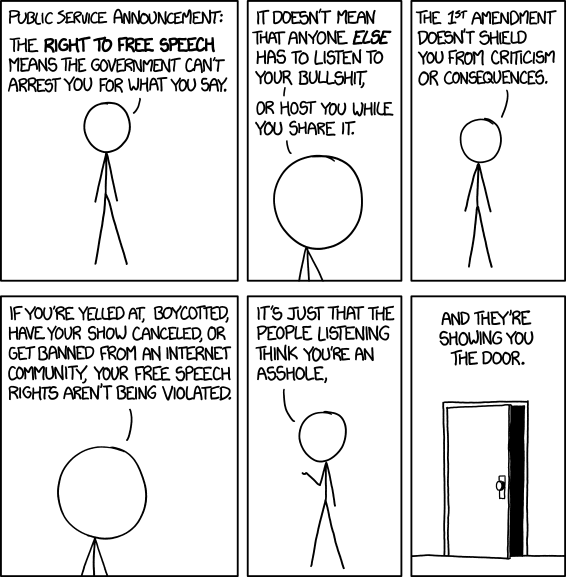
As I define it in “A Conservative-to-English Lexicon”, First Amendment rights means “The right of a conservative to speak and write publicly without criticism.” The real First Amendment, though, works like this: If Trump wants to speak, he has a right to do so. But if other people want to protest non-violently, they have a right to do that too. Depending on how public the event is and whether protesters are inside or outside, Trump’s campaign may then have the right to demand they leave. But if the prospect of being heckled causes Trump to cancel a speech, that’s on him. Nobody has taken away his rights.

XKCD elaborates:

Trump’s exaggerated claim on First Amendment rights is widely shared among his followers. In a Frank Luntz focus group on Fox News, one Trump supporter complained that “You can’t even speak the truth any more or you’ll be called a racist or a bigot.” And the woman next to him chimed in: “I have a right to my opinion without being labeled something.”

No she doesn’t. This pernicious misconception of free speech survives from the days of overt white supremacy, when anyone who disagreed with the status quo was too intimidated to speak up.

In fact, you have no right to speak your mind “without being labeled something”. You do have a right to speak your mind, but if what you say convinces other people that you’re a bigot, an idiot, or whatever else, they have a right to speak their minds too.

Imagine if the same extended interpretation of the First Amendment applied to liberals: When Trump called Sanders a communist, he’d have been violating Bernie’s First Amendment rights. And that’s obviously ridiculous, even to a liberal like me.

Until the Chicago protests, everybody was talking about Sanders’ upset victory in Michigan

Last week I speculated that blacks, older voters, and middle-aged women looked like a winning coalition for Hillary Clinton, and said that Bernie Sanders would have to dent that somehow to pull out a Michigan win.

I also repeated Nate Silver’s reading of the polls: He wasn’t going to.

But he did. According to the exit poll, Clinton still carried the black vote, but not by the enormous margins she had been running up in the South. Michigan blacks went for Clinton 68%-28%, which is way less than in Tuesday’s other Democratic primary, Mississippi, where blacks chose Clinton 89%-11%.

Overall, independents made the difference. Only 69% of the Democratic primary electorate described themselves as Democrats, and they went for Clinton 58%-40%. Self-described independents went for Sanders 71%-28%.

In terms of delegates, Clinton continued moving towards nomination: She picked up 95 delegates and Sanders 71. According to the 538 model, Clinton is running 13% above a minimal victory pace, down slightly from 14% a week ago.

Nobody knows what this means for tomorrow’s primaries in Illinois, Ohio, Florida, and North Carolina. In all those states, Clinton leads in the polls … just like she did in Michigan. The most unpredictable one has got to be Illinois: Like Michigan, it’s an open primary, so independents could make the difference. Also, local issues come into play: Bernie’s supporters are being credited/blamed for shutting down the Chicago Trump rally, which could move voters in either direction. Also, the unpopularity of Mayor Emanuel might drag Clinton down, and an unusually hotly contested states attorney primary is bringing Black Lives Matter voters to the polls.

and Trump keeps rolling (in BS)

Tuesday, after winning in Mississippi and Michigan, Donald Trump had the oddest victory celebration ever. He held a press conference instead of a rally (as he’s been doing lately), and called reporters’ attention to a table of “successful” Trump products to counter Mitt Romney’s claim that “a business genius he is not“.

That would be weird enough: At a moment when most candidates would be praising the wisdom of the voters and thanking all the volunteers whose hard work produced this important victory, Trump did an infomercial for his brand. But it’s actually weirder than that, because as The Daily Show’s Jordan Klepper (and all the other reporters who bothered to investigate) discovered: “It’s all bullshit.None of the products was what he said it was.

and you might also be interested in

This week’s guns-make-us-safer story is about Jamie Gilt, a Florida mom who had been boasting on Facebook about how much her 4-year-old son enjoys target shooting. (I mean: guns and preschoolers. What could possibly go wrong?)

Tuesday, she was driving with the boy in the back seat when he apparently got hold of a handgun on the floor and fired it through the driver’s seat, hitting his mother in the back. She survived.


Trying to display some former-First-Lady solidarity and find something nice to say about Nancy Reagan during the coverage of her funeral, Hillary came up with this:

It may be hard for your viewers to remember how difficult it was for people to talk about HIV/AIDS back in the 1980s. And because of both President and Mrs. Reagan—in particular Mrs. Reagan—we started a national conversation.

Which is kind of the reverse of how things actually happened. A few hours later, she issued a statement walking it back. The Atlantic‘s “Gaffe Track” draws the moral:

Don’t speak ill of the dead, but don’t make things up about them, either.


The way conservative media preys on older people and changes their characters for the worse has been noted before, but now there’s a documentary about it, “The Brainwashing of My Dad” by Jen Senko.


I think the Supreme Court roadblock is going to cost incumbent Republicans in purple states, particularly if Trump is their nominee. I’ve seen this commercial about our NH incumbent senator:

Donald Trump wants the Senate to delay filling the Supreme Court vacancy so he can choose the nominee next year. And Senator Kelly Ayotte is right there to help. Ayotte joined Trump and party bosses in refusing to consider any nominee, ignoring the Constitution.


If you want to know what Republican one-party rule looks like, check out Kansas, where all notions of constitutionality and fair play have gone out the window.


President Obama’s job approval, which has been negative in the RCP polling average since June, 2013, is positive again.

One advantage I believe the Democrats are going to have this fall: Our convention is going to be inspiring and heart-warming. President Obama will get the send-off he deserves, the loser of the nomination struggle will make an impassioned speech about the importance of uniting to win, the VP will be somebody we can take pride in, and the entire week will highlight the positive human values that Democrats share.

By contrast, even if the Republicans manage to unite behind Trump and avoid a scorched-earth battle, their convention is going to be about scapegoating and raising anger, probably worse than the public-relations disasters of 1964 and 1992. The unpredictable, barely coherent ramble that makes a Trump rally speech so entertaining is going to play badly as an acceptance speech. It’s not going to be pretty.


A religion professor at Mercer University finds that the popularity of Trump and Cruz represent two distinct failures of Christian teaching. In Cruz he sees a failure of commission, a distortion of Christian priorities that is nonetheless taught in many churches and has been part of right-wing politics for many years. But Trump looks like a failure of omission. Churches aren’t teaching Trumpism, but their members aren’t getting the moral foundation for resisting it:

In the Christian moral formation of these supposed Christians they have not been offered an adequate inoculation against this kind of politics. What they needed was instruction in a version of Christianity with ironclad commitments to civility, solidarity, justice, mercy, compassion, rule of law, and human rights, commitments so strong and so well-engrained in believers that to support someone like Trump would be unthinkable. But they have not received that inoculation.


Lots of people have noticed that President Obama is aging, as presidents tend to do. But I don’t hear nearly as much talk about the far more remarkable fact that Michelle isn’t.


A couple of weeks ago I was having a medical test that gave me a lot of time to chat with the tech, a 50-ish woman who for some reason wanted to talk politics even though she claimed to have no interest in it. She had voted for Trump in the NH primary on the advice of her husband, who pays much more attention to such things than she does. But now she was having second thoughts. Trump seemed “dumb” and “a bully”, while John Kasich was looking much nicer.

I thought I might learn more from her than she would from me, so I didn’t interrupt.

She didn’t justify either her decision to vote for Trump or her subsequent regret by mentioning any policy at all. Not the wall, not the Muslim ban, not trade, not jobs, not America’s role in the world — nothing. Her son had served in both Iraq and Afghanistan (and is safely home now), but she didn’t talk about either finishing the job in those countries or avoiding similar boondoggles in the future.

For all non-political purposes she seemed like an intelligent, well-intentioned person. But presenting a policy argument to her would have been like talking to somebody who doesn’t follow baseball about whether the Red Sox overpaid for David Price or would have done better to spend that money last year to hang on to Jon Lester. (If you have no idea what I’m talking about and don’t see why you should, that’s the point.)

So consider this note a follow-up on the voter model I presented in “Say, you want a revolution?“. If you’re politically active, you need to understand that the voters may not be who you think they are, and their support or opposition probably doesn’t mean what you think it means.


I wonder if it’s significant that the final line of the Game of Thrones trailer is: “Apologies for what you are about to see.”

and let’s close with a view from far away

Funny or Die gives us the U.S. presidential race as seen from Finland.

My Racial Blind Spots

What if I had to answer that debate question?


“What racial blind spots do you have?” CNN’s Don Lemon asked Bernie Sanders and Hillary Clinton.

Their answers weren’t all that impressive, and I suppose I shouldn’t have expected them to be. After all, the question resembles the standard “What is your biggest weakness?” challenge that job interviewers have been throwing at applicants forever, usually with disappointing results.

Probably nobody’s answer to Lemon’s question would be 100% accurate, because your biggest blind spots are always the ones you aren’t aware of, what Donald Rumsfeld used to call the “unknown unknowns“. If you can describe a blind spot, you’ve already taken a step towards filling it in.

So while it would be easy to stand in judgment over Bernie and Hillary’s answers, the more interesting question is: How would I answer Don Lemon? What are my racial blind spots?

Blind spots come mainly from the holes in a person’s experience, and I certainly have some. As a white person, I have been in the racial majority almost everywhere I’ve gone. I grew up in a mostly white neighborhood, went to mostly white schools, and earned my living in mostly white workplaces. In stores I (mostly) stand in line with other whites. If I find myself sitting next to a stranger at a bar, it’s usually another white. On TV dramas, I mostly watch white people deal with the problems of other white people. And on TV news shows — Don Lemon notwithstanding — I mostly watch whites interview other whites.

Being white may not be mandatory in my world, but it is normal.

I understand that not every white person’s experience is that limited. You might have been the one white guy on your high school basketball team, or the lone white waitress at a Mexican restaurant, or something like that. But I never was.

And that (lack of) experience gave me this blind spot: Thinking about race seems optional to me.

It’s not that I don’t think about race, or about the ways that non-whites’ lives are different from mine. Those sorts of issues come up all the time on this blog. I’ve written about how the Obamas’ experience in the White House has been different than other First Families. I’ve researched the racial history that my formal education swept under the rug. I wrote about Trayvon Martin and Ferguson. I’ve explained what dog whistles are, and how to notice them.

But I think about that stuff when I choose to. I have, for example, read Maya Angelou’s I Know Why the Caged Bird Sings. And while I was reading, I thought a lot about growing up black in the Jim Crow South. But as soon as I put that book down, Angelou’s reality vanished for me as completely as Westeros does when a Game of Thrones episode ends.

And so, I have a hard time grasping that thinking about race isn’t optional for American blacks. To be black in America is to be constantly aware that many of the people around you are white, and that they might at any moment start reacting strangely to your blackness.

I just finished reading Democracy in Black by Eddie Glaude Jr. Mostly it’s a book about politics written by a Princeton professor. But a few personal stories sneak in. At one point in his childhood, Glaude’s family moved from the black part of their small Mississippi town to the “good” part, a section occupied by whites and a few upwardly mobile black families. On his first day in the new neighborhood, Glaude and another boy were playing in the dirt with their toy trucks, until the boy’s father came out and yelled at his son: “Get over here. Stop playing with that nigger.”

Another story concerned Glaude’s son Langston, who he sent to Brown. Langston’s urban studies class was assigned to visit a rich Providence neighborhood and make various observations. But in a wealthy neighborhood, a young black man sitting on a park bench with a notebook draws police attention, and being an Ivy League student or the son of an Ivy League professor is no excuse. With a hand on a weapon, a policeman intimidated Langston until he voluntarily left.

You can listen to stories like that (which nearly all blacks seem to have) and think: “Those are just isolated incidents. I’ll bet that doesn’t happen very often.” But how often would it have to happen before you came to the conclusion that you had to be on your guard all the time?

Blacks can never “check out” of race. They can’t say, “Today I’m just going to be a human being and forget about being black.”

But I can forget about race whenever I want, and so sometimes it seems strange to me that they don’t. “I don’t see race,” a lot of whites say, and I know what they mean: Of course I notice that the new guy at work is black, but it’s not a thing. I’m not going to go all In the Heat of the Night on him and act like black people shouldn’t have these sorts of jobs. I’m not going to harass him or insult him or treat him badly in any conscious way. If somebody makes it a thing, it’s not going to be me.

Because that’s how my blind spot tempts me to think about race: It’s optional. I can choose not to think about being white and he can choose not to think about being black, and then there won’t be any race problem.

But the new guy can’t just stop thinking about being black, any more than I could stop thinking about being white if somebody dropped me into the middle of Africa. What’s more, he shouldn’t, for the sake of his own safety. What if, when the policeman put his hand on his gun, Langston Gaude hadn’t thought about being black, and instead had thought about being an American citizen in a place where he had every right to be? Might he not have become the next Eric Garner or John Crawford?

That’s what “the talk” is about: Making sure that when the police show up, your black son will never forget that he’s black.

If you’re black in America, you never know when your blackness is going to become an issue. And if it is becoming an issue, you’d better not be slow to catch on, because you’ll need to implement some strategy — challenge, retreat, deflect, avoid — before things get out of hand.

Of course, race wouldn’t seem optional to me if I didn’t also have a second blind spot: a belief that unconscious racism doesn’t count. If I’m not trying to be a racist, well, that should be good enough. So of course it would be wrong for me to say (or even to think) “I don’t want to hire that guy because he’s black.” But if I just have a bad feeling about him, while one of his white competitors impresses me for no quantifiable reason — what’s wrong with that? Don’t I have a right to have hunches about people?

Sure I do. But before I act on those hunches, I ought to take into account the ways my thinking and feeling have been shaped by the cultural stereotypes built up over centuries. Even today, being black in America is like playing golf on a course that is more sandtrap than fairway. Getting to the green isn’t impossible, but just about anything blacks do exposes them to negative judgment, because there’s a very narrow path between lazy and pushy, between too sloppy and too flashy, between looking stupid and being a know-it-all, between refusing to stand up for yourself and being scary. That cellphone he’s taking out of his pocket looks like a gun because … well, it just does. And when Barack Obama acts like he’s President of the United States, it looks uppity. Who does he think he is?

We may not call people niggers any more, but the stereotypes that were designed to keep niggers in their place are still with us.

But if unconscious racism is something I have to take into account, then I have to think about race all the time. And that’s another thing to project onto blacks and resent: Why do they make everything about race? Why can’t we just be people together?

There’s an answer to that, but I hate to hear it: One big reason we can’t just be people together is that I don’t know how. I know how to pretend that I’m doing it. I know how to act as if I didn’t notice race. I know enough not to use certain words or tell certain kinds of jokes. I think I know how to get past my unconscious racism with individual people, eventually, once I get to know them. (But whether that’s true or not, you’d have to ask them.)

But I don’t know how to be people together with everyone, regardless of race. All I know is how not to notice when I’m failing. I can just take all that evidence and shove it into a blind spot.

The Monday Morning Teaser

I stopped myself from writing a Trump-centered featured article for the third straight week. I know the buzz was all about the cancelled Chicago rally and the potential for violence whenever he speaks, but I’m trying to resist being trolled. I think it’s completely within Trump’s power to generate a new reason to talk about him every week, and I refuse to do that from now to November.

So this week’s featured article is a step back from the news cycle, or maybe a tangent off of it. I start with a debate question Don Lemon asked Bernie and Hillary, and rather than argue that one of them answered better than the other, I try to answer it myself: What are my racial blind spots?

The weekly summary starts with a meditation on the tendency for my attention to get captured by bright shiny objects like Trump or speculating about polls, and the need to occasionally take a step back to make sure this is really ME thinking, rather than the news cycle thinking through me. Having done that, I still have to discuss violence at Trump rallies and what’s going on in the primaries, but I hope I’m doing it with more perspective.

I also have another guns-make-safer link, a comment on President Obama’s rising job approval, and a conversation I had with a low-information voter, before closing with an amusing take on what our election process must look like from, say, Finland.

Unsound minds

He speaks his mind, but his mind isn’t right.

— 13-year-old Jayka,
in “Kids React to Donald Trump

This week’s featured post is “Peak Drumpf“, where I make the case that we finally have the right anti-Trump argument.

This week everybody was talking about that strange debate

The best response to Trump’s nationally televised, out-of-the-blue claims about his genitalia is College Humor’s #TrumpShowUsYourPenis campaign.

It’s about transparency. He brought the subject up, and since fact-checkers have determined that so many of his other claims are false, this one requires evidence. The demand isn’t even partisan: If Hillary claimed to have a big penis, they’d want to see that too.

and the presidential race in general

After Super Tuesday, the question in both parties has been: “Is it over?”

I’ve been amazed by the number of pundits I’ve heard say something equivalent to: “Unless something changes, the leaders will end up winning” — as if this were the kind of wisdom people should pay them for. (A better version is sometimes attributed either to Yogi Berra or a Chinese proverb: “If you don’t change, you’ll end up where you’re headed.”)

The most intelligent answer to the question comes, as it so often does, from Nate Silver’s 538. Using a model of which states are good for which candidates, they’ve traced a most-likely-path-to-the-nomination for each candidate. In other words: If a candidate were going to just barely win a majority of the pledged delegates — phrasing the question that way puts to the side what the Democratic super-delegates will do — how many would you expect come from each primary or caucus? And how does that compare with the number of delegates that candidate has gotten in the contests decided so far?

On the Republican side, Donald Trump is running 5% ahead of his minimum winning pace. On the Democratic side, Hillary Clinton is 14% ahead of pace.

Neither of those leads is all that intimidating in an absolute sense, given that something like 2/3 of the delegates are still to be chosen. But what is making Trump and especially Clinton seem inevitable is that some underlying trend has to change before anybody can beat either of them. Cruz or Rubio has to catch fire, or Sanders has to become competitive among black voters, or something.

If you can’t say exactly what that “something” is or why it’s going to start happening now (when it hasn’t been happening so far), the current trend feels locked in. That’s why George Orwell observed, “Whoever is winning at the moment will always seem to be invincible.”

I will say this about the Democratic race: I think the results so far show that blacks plus older voters plus middle-aged women is a winning coalition for Clinton. Sanders can’t turn things around unless he breaks that somehow.

A sports analogy: Sanders’ situation is like a running football team (i.e., a slow-and-steady offense) that falls behind. At some point the team has to drop its running game plan and start passing, because time is running out. It’s not that Sanders can’t win at this point, but that he can’t win just by continuing to do what he’s been doing. Pushing the analogy further, Clinton could still blunder into losing, as the other team could if it committed a string of turnovers.


Tomorrow’s Michigan primary is a good test. If Sanders were to become competitive among blacks and pull off a win in Michigan — which in an abstract sense ought to be perfect for his economic message — the race would be wide open. Clinton’s lead would then look like a regional Southern thing.

But the polls say that’s not going to happen. The RCP average of polls in Michigan has Clinton up by 22 points, and the poll most favorable to Sanders still has him trailing by 11. Nate Silver gives Clinton a 99% chance of winning in both Michigan and tomorrow’s other primary, Mississippi.


About the super-delegates: My personal opinion is that if Clinton and Sanders wind up virtually tied, the super-delegates will put Hillary over the top. But if Sanders has any advantage larger than a round-off error, the super-delegates will come around as well.


Last week I discussed Clinton’s strong showing among black voters from the point of view of “What do I know? I’m a white guy.”

I’ve got something better this week. Dopper0189 on Daily Kos explains “Why black voters vote the way they do“. It’s a long post with a lot of different insights, very few of which I would have guessed.

The big thing I learn from dopper0189 is that you can’t win over the black community with an if-you-build-it-they-will-come approach. Even if your policies seem (to you) like they would obviously benefit many blacks, you have to go out and sell those policies to the black community in very specific terms. This isn’t because blacks can’t make the connections themselves, but because they’ve seen those connections fail so many times. Plans that are targeted at “everybody” somehow wind up defining “everybody” in a way that leaves them out. That goes all the way back to Social Security, which originally made no provision for household servants or field workers or many other black-dominated jobs.

Going forward, let’s look past Bernie for a minute, to 2020 or 2024. If a future progressive candidate is going to marshal the kind of black support that it seems s/he ought to get, it’s going to take a lot of work over a period of time. The candidate is going to have to start building those relationships well before the campaign, the way Hillary did.

and you might also be interested in

Trump introduced his healthcare plan. It’s about what I expected: A collection of ideas that have been hashed over in Republican circles for years — like circumventing state regulators by letting insurance companies sell from whatever state they want (presumably the one that most tilts the field in their favor) — plus a number of promises and assurances that the specified proposals don’t deliver. Vox comments:

He says, “We must also make sure that no one slips through the cracks simply because they cannot afford insurance. We must review basic options for Medicaid and work with states to ensure that those who want healthcare coverage can have it.”

There’s a hint of a promise there that under Trumpcare, everything will be fine. Everyone will have access to health insurance, should they desire it. But there’s nothing in Trump’s proposal that takes him from point A to point B. There’s no explanation of whether the government will pay for this care and how they’ll deliver it

Two things stand out: TrumpCare eliminates ObamaCare’s guarantee that people with pre-existing conditions can buy insurance on reasonable terms. And rather than the subsidies ObamaCare offers to help poor and working-class people buy insurance, Trump offers only a tax deduction for premiums. So if you aren’t currently paying income tax, you get no help buying health insurance; and if you are paying income tax, those who pay a higher rate benefit more from the deduction.


Unemployment continues to fall: down to 4.9% in February. That’s the lowest rate since February, 2008, when President Bush’s economic collapse was just getting started.

Critics from Bernie Sanders to Ben Carson sometimes express skepticism about the unemployment rate, since it doesn’t count would-be workers too discouraged to look for a job, part-time workers who want full-time work but can’t find it, and various other people who have reason to be disappointed in the job market.

But as I’ve explained before, the Bureau of Labor Statistics keeps track of those folks too. It publishes a variety of unemployment measures, prosaically denoted U-1 through U-6. U-1 is people unemployed for more than 15 weeks (currently 2.1%, flat since October, down from 2.5% a year ago). The unemployment rate you see in the headlines is U-3, while U-6 is the broadest measure of unemployment.

U-6 in February was 9.7%, which sounds bad compared to 4.9%, but also reflects a big improvement in the job market when you make apples-to-apples comparisons: A year ago U-6 was 11%. It hasn’t been this low since May, 2008, and it peaked at 17.1% in late 2009 and early 2010.


Governor Bobby Jindal writes in the WSJ that President Obama is to blame for Donald Trump. That is true in the same sense that President Lincoln was to blame for the KKK. If he’d just left slavery alone, the backlash against abolition would never have been necessary.

I’m left wondering if Jindal has found some way to blame Obama for the mess the Jindal administration left behind in Louisiana.


I’ve got a book recommendation: Misbehaving, the making of behavioral economics by Richard H. Thaler. The standard economics (that you may have learned in college) is based on the notion that markets are made up of rational actors who use all the publicly available information to make the best possible individual decisions. Everybody knows that’s not strictly true, but since the 1950s economists have held that it’s a good-enough assumption for making economic predictions.

Since the 1970s, Thaler’s career has revolved around poking holes in that worldview. In other words, he’s been looking for and documenting situations where the quirky decision-making of real human beings leads to results very different than the rational-actor models constructed by economists.

Not only is that an interesting topic that has all sorts of fascinating real-world applications (including the over-valuing of high draft picks in the NFL), but Thaler is a marvelous story-teller. His stories — of experiments in human decision-making, and of his attempts to introduce more realistic thinking into the stuffy and self-important world of academic economists — are consistently amusing. The book’s ongoing theme is that whether you are talking about contestants on Dutch game shows or University of Chicago business school professors choosing offices in a new building, people are funny — and you can’t really understand the world until you account for the predicable ways that people are funny.

The title has a wonderful double meaning: Economic models can fail when humans “misbehave” by not making the supposedly rational choices the model calls for. But by pointing out such embarrassing glitches, Thaler was also “misbehaving” according to the community standards of economists. So his career is a story of successful rebellion.

Finally, there’s political significance to the revolution Thaler has been leading: Idealizing markets, and exaggerating the powers of the people who participate in them, tempts a person to turn all of society’s decision-making over to “the Market”. For decades, economists’ false assumptions have biased their analysis in favor of market-based solutions. But people who are still making those simplistic Econ-101 arguments in favor of free markets are behind the times. They are, as Keynes observed, “slaves of some defunct economist”.

and let’s close with some tongue-in-cheek advice to black filmmakers

If they’d wanted Straight Outta Compton to win an Oscar, it should have centered on Paul Giamatti’s character.

If you’re not getting the joke, read David Sirota’s essay “Oscar Loves a White Savior“.