Those two puzzle pieces are hard to fit together. Naively, you might think the S&P 500 and the Index of Consumer Sentiment measure the same thing: optimism about the economy. But apparently the economy looks very different depending on where you stand: Investors are optimistic, consumers pessimistic.
Statistics. Government statistics paint a mixed picture: GDP growth for the first half of 2025 was 2.1%, which is about what it’s been averaging for years now, and is neither good nor bad. At 4.4%, unemployment is higher than it’s been lately, but relatively low by historical standards. (It was more than twice that high during the Great Recession of 2008-2009, and briefly peaked at 13.2% early in the Covid lockdown.) Inflation is running at about 3% — rising somewhat recently and higher than the Fed target of 2%, but well below the 7% of 2021, not to mention the 13.3% of 1979. Interest rates are in similar territory: A 30-year mortgage is running around 6.11%, which is neither exceptionally high nor exceptionally low, compared to, say, 3.15% in 2021 and 7% in 2023, not to mention 16% in 1982.
For a few years now, economists have been scratching their heads and talking about the “vibecession“, an economy that feels worse than the data justifies. (Paul Krugman has written several paywalled articles on this, beginning here.) In 2024, the Biden administration was fighting consumers’ pessimistic vibes, and now the Trump administration is. (The public’s assessment of Trump’s handling of the economy is deeply negative: 40% approval vs. 57% disapproval, according to the RCP polling average.)
Stocks. The stock market’s euphoria is somewhat easier to square with the ho-hum economic numbers: The record gains don’t represent a broad optimism about the economy, but instead are concentrated in a handful of stocks that have something to do with artificial intelligence (AI). For example, a flagship consumer company like Proctor & Gamble that has little to do with AI has seen its stock fall this year, from 180 in January to about 150 now. Pepsi was at 165 early this year and is at 146 now. Target is down from 145 to 87.
Understand that I have cherry-picked those companies to make a point; most stock prices have increased somewhat this year. But a J. P. Morgan analyst wrote in September:
AI related stocks have accounted for 75% of S&P 500 returns, 80% of earnings growth and 90% of capital spending growth since ChatGPT launched in November 2022.
The poster child for the AI boom is Nvidia, which you may not realize has recently become the most valuable corporation in the world, with a market capitalization (i.e., stock price per share times number of shares) that briefly topped $5 trillion at the end of October. Even more impressive: It didn’t cross the $1 trillion mark until sometime in 2023. The stock (adjusted for splits) was below $15 at the beginning of 2023 and hit $212 a few weeks ago.
Other AI heavyweights include Microsoft, Google, Amazon, Broadcom, IBM, Oracle, and a few other corporations. Not all of their stocks have soared as far and as fast as Nvidia’s, but their investors have been doing quite well.
Why don’t consumers identify with this boom? It’s simple: AI hasn’t really affected everyday life much yet, so it doesn’t feel like we’re in the middle of a generation-defining revolution. I know lots of people who have played with ChatGPT or some other AI app, and I’ve gotten used to the AI summary at the top of Google searches (though I don’t trust it yet). But I know very few people who either buy significant AI-related products or use AI tools to produce products they couldn’t produce otherwise.
At the moment, AI’s significance in the economy doesn’t justify its significance in the stock market. We’re at a point with AI similar to where we were with the internet in 2000: Most of us could check weather.com or order a cheap book from Amazon, but our lives had not yet significantly changed. Like the Internet stocks in 2000, AI stock valuations are based on visions of a future that is still to arrive.
Is AI in a bubble? That gap between investor’s visions and current reality raises a question: The Internet bubble popped, with great losses to many investors and an impact on the broader economy. Is AI also a bubble, and what will happen if it pops?
I’m currently reading 1929: Inside the Greatest Crash in Wall Street History by Andrew Ross Sorkin. I’ve also lived through the internet bubble of 2000-2001 and the subprime-mortgage real estate bubble of 2008. One common characteristic of bubbles is that accounting departments get a bit creative near the end. Everyone is convinced the market will keep going up, and a rising market can hide a lot of corner-cutting. (As legendary investor Warren Buffet once put it: “It’s only when the tide goes out that you discover who’s been swimming naked.”)
That kind of questionable accounting is happening inside the big AI-related companies today. This post by Shanaka Anslem Perera is a bit wonky, but puts the puzzle pieces together, focusing on Nvidia.
Wednesday evening, Nvidia reported its third-quarter earnings, which were up and looked excellent. The stock surged. And then a combination of human and (ironically) machine intelligence started digging into the footnotes of that report: Nvidia was booking sales that its customers were slow to pay for. In short, it was delivering chips, but not raking in a corresponding amount of cash. Second, its inventories were growing, which contradicts the common belief that Nvidia benefits from insatiable demand.
The structure extends throughout the AI ecosystem. Microsoft invested $13 billion in OpenAI. OpenAI committed $50 billion to Microsoft Azure cloud services over five years. Microsoft uses those committed dollars to purchase Nvidia GPUs for Azure datacenters. Nvidia books the GPU sales as revenue.
Oracle announced a $300 billion, five-year cloud infrastructure partnership with OpenAI. This partnership requires Oracle to deploy Nvidia GPUs. Oracle has pre-ordered $8 billion in Blackwell architecture chips from Nvidia. OpenAI’s ability to fulfill its $300 billion Oracle commitment depends on OpenAI generating revenue that currently runs at $3.7 billion annually—a gap of $56.3 billion per year.
The total network spans $610 billion in circular commitments, according to an analysis of SEC filings, venture capital deal databases, and disclosed partnerships. The money flows in loops: Nvidia invests in AI startups, startups commit to cloud spending, cloud providers purchase Nvidia hardware, Nvidia recognizes revenue, but the cash never completes the circuit because the underlying economic activity—AI applications generating profit—remains insufficient.
That’s a complicated diagram, and AI is an intimidating subject. But a parallel example from a more mundane industry makes the pattern easier to grasp: How Boston Chicken went broke in the 1990s.
In a nutshell, the Boston Market formula worked like this: the company raised money in the stock market and then loaned it to large, sophisticated franchisees (known as “area developers”), who used the funds to open lots of Boston Market stores in a short time.
These developers then paid the company a franchise fee for each new store, royalties on food sales and interest on the loans. So right away, the Boston Market operation looked hugely profitable. That boosted the stock, which gave the company yet more cheap capital to lend to developers, to open yet more stores.
Even if the individual Boston Market franchisees were hemorrhaging money, that would have no impact on the parent company’s bottom line. The franchisees’ costs and losses were their own problem.
As a whole, the Boston Market corporate/franchisee operation wasn’t profitable, but the corporate side of it looked profitable by pushing its losses off on the franchisees. Ultimately, the loans the corporation had made to the franchisees couldn’t be repaid, and the whole scheme unraveled.
Something similar is happening with Nvidia: It raises money on the stock market and invests it in companies like Open AI and Coreweave, who send it to Microsoft or Amazon, who in turn use it to buy Nvidia’s products. Eliminate the middlemen, and Nvidia is essentially buying its own products. You can’t make money doing that, no matter what your earning statements say. What’s missing here is the consumer: Who’s going to buy enough AI-related products to make everyone involved profitable?
Patterns like this can resolve in one of two ways: Either the industry as a whole starts making money, i.e., the AI-to-consumer link suddenly develops in ways that produce boatloads of cash to pay for Nvidia’s chips, or the whole thing collapses on itself.
For historical perspective on this kind of thing, one classic read is Only Yesterday by Frederick Lewis Allen. The book is 1931’s view of the roaring 1920s. By 1931, the Depression was deepening and all the investment booms of the 20s had gone bust. But the striking thing about them (from our point of view, which Allen could not foresee) is that the narratives behind those booms were not wrong: The story of the Florida land boom was that Northerners were going to start retiring to Florida. Suburban real estate bubbled because automobiles would make it possible to move away from the crowded cities. Even the stock market boom that ended in the crash of 1929 had good narrative sense behind it: The Nvidea of the late 1920s was RCA, because radio was going to change everything. Also: chains like Sears and Montgomery Ward were going to out-compete the Mom-and-Pop stores. The automobile market still had a lot of growth in it. Aviation was a field with a big future. And so on.
The visions that inspired the booms of the 1920s nearly all came true, but not until the 1950s, long after the original investors were bankrupt. That happened again in the internet bubble: The internet did change everything, but not as fast or as easily as the boom companies needed it to. Something similar could happen with AI. The seers of an AI-dominated future don’t have to be wrong, they could just be too optimistic about timing.
What happens then? The larger economy is always harmed when a bubble pops, because a large quantity of capital appears to suddenly vanish. Actually, it went away gradually over a period of time as people made investments that weren’t going to pay off within the time horizons they needed. But the bubble obscured that reality, so when it pops the loss seems instantaneous. Loans that seemed to have adequate collateral suddenly don’t, and companies that had seemed healthy are suddenly insolvent. Bankruptcies lead to other bankruptcies like falling dominoes — I can’t pay you back because I was counting on other people to pay me back.
Because I’m losing money in one area, I need to sell my investments in other areas to raise cash. So the losses spread. (Tech investors also tend to be cryto-currency fans, expect to see Bitcoin prices collapse first, before a widespread banking crisis. That’s already started.)
Even people and businesses that are solvent stop spending, just from the sheer uncertainty of everything. Eventually governments have to step in, both by spending to prop up demand and as a lender of last resort to keep the banking system from collapsing.
None of that is inevitable. But it looks increasingly likely.
The author of Dopesick goes back to her small Ohio home town and wonders: Could a troubled teen do today what she did decades ago? Maybe. But the hurdles to jump are higher now.
In the Broadway musical A Little Night Music, a minor character sings a poignant song about hope and hopelessness in the serving class. In “The Miller’s Son“, the verses argue with the chorus, as a kitchen maid alternately dreams of a better life and realizes that the only pleasures available to her are momentary ones that lead nowhere.
Her opening thought is that “I shall marry the miller’s son, pin my hat on a nice piece of property.” Each verse lets the fantasy run a little wilder: “I shall marry the businessman, five fat babies and lots of security”, and then “I shall marry the Prince of Wales, pearls and servants and dressing for festivals.” Of course, if the pleasures of the moment lead to a pregnancy, none of that is possible. But was it ever possible? She ends by bitterly repeating “I shall marry the miller’s son”, recognizing that for her such a match is no more likely than the Prince of Wales.
Beth Macy is 60-something now. She came from a poor family with an alcoholic father in the small town of Urbana, Ohio. She studied hard in school and was a good if unspectacular student. She went to college on a Pell Grant, became a journalist, and (eventually) an author of several best-selling books — one of which, Dopesick, about how corporate greed led to an opioid crisis in small-town America, was made into an Emmy-winning miniseries.
Her life, from one point of view, is the quintessential American rags-to-riches story we like to tell children: Work hard, don’t give up, and you can make something of yourself, no matter how unlikely that may seem at the moment. Abe Lincoln went from a log cabin to the White House; you can too.
But in her new book Paper Girl, Macy goes back to Urbana and (over a period of years) interviews everyone from her relatives to troubled high school students to the mayor. The main question on her mind: Is the path that she walked still open today? Along the way she learns a lot about hopelessness in the White working class, its turn to the political right, and political polarization in general.
Getting a degree. The quick answer to Macy’s original question is: The path is still open, but much narrower and more treacherous than it was in her day.
She follows several of Urbana’s young people who grew up in difficult circumstances, and runs into the same story again and again: They have the talent and ambition to get out of poverty and possibly make it in the wider world, teacher and other mentors are rooting for them, but something comes up. Juggling a job, school, and ongoing family trauma gets to be too much. Or some close relative needs care and has no one else to provide it. Or maybe it’s something as simple as a car repair they have no money to cover; the fifty miles to the state university turns into an insurmountable obstacle.
Almost as bad as the immediate problems is the fatalism they lead to: Of course something would come up. People don’t actually walk the path to education or training and a secure future any more. It was never in the cards for them to marry the miller’s son.
What reminded me of “The Miller’s Son” was how the get-educated path can sound just as improbable as the make-the-NBA or become-a-rap-star path. People have done it, but could you do it? Is it worth making sacrifices (and asking others to make sacrifices for you) to keep that dream alive?
Politics. So what changed between the 1970s and 80s and the 2020s? Part of it is political: As a society, we stopped investing in education. When Macy got her Pell grant, it was a free ticket to college, but it no longer is. Once, Pell grants were how we made real the promise of America, and we told ourselves (truthfully) that a college grad’s increased lifetime earnings would lead to income tax payments that more than reimbursed the government for its generosity. But during the miserly years of the Reagan revolution (and Clinton’s ratification of much of that course change), poor young people in college became just another kind of welfare queen.
And as federal support was drying up, colleges themselves have gotten more expensive, largely because states pay a much smaller part of the costs of their state university systems. Financial aid shifted from grants to loans, so that a graduate might start a career with six-figure debts. And if you didn’t graduate — if, say, something came up that knocked you out of college — you’d have almost as much debt but not the degree to help you pay it off.
Piling on further, the degree itself is not worth as much in the job market. Even a STEM degree might not help you if the job market is looking for some other kind of STEM degree the year you graduate. (For example, the freshmen who chose a computer science major four years ago may not have realized they’d have to compete with AI algorithms for entry-level jobs.)
I’m not sure anybody is asking this question, but they should: What kind of program would it take to make the promise of America real today?
Family. Macy quickly notices the symptoms that students’ lives have changed: High school graduation rates are down. Attendance is down. Ohio’s liberalized homeschooling laws make even those numbers look better than they actually are, as parents who can’t get their children to school and are sick of dealing with truant officers sign a paper saying their child is being homeschooled. No one checks that the child is actually getting an education.
Meanwhile, public schools are losing funds to Ohio’s private-school voucher program, which makes private schools less expensive for the well-off without truly making them accessible to the poor.
Of course, homeschooling only works if home is working. And here we run into the opioid crisis Macy chronicled in Dopesick. She tells stories of teens who either couchsurf or are homeless through high school, because one parent is a drug addict and the other is in jail. It’s hard to say whether there is more sexual abuse than in Macy’s teen years, but there is certainly a lot of it. Paying attention to trigonometry or Shakespeare is probably not at the forefront of many students’ minds.
Many teachers, counselors, and coaches try to step into the breach, but it’s too much for them. A gay man who runs a teen center wrangled a grant out of the state, but couldn’t get the local government to sign off on it because of homophobic fears that he was “recruiting” teens into the gay lifestyle.
Community. In Macy’s day, Urbana was a more integrated community, at least in the sense of class. One way she coped with her dysfunctional family was by spending a lot of time with friends whose families were thriving. But increasingly, Urbana is siloed into the haves and have-nots.
Urbana is basically the country club and the ghetto, and neither group has any idea that the other group exists.
So a present-day Beth Macy may not know about those thriving families or be invited into their homes. She might not hear friends’ professional-class dreams and wonder “Why not me?”
A journalist herself, who began her career writing features about local characters for local newspapers, Macy sees great significance in the decline of local journalism: Urbana’s main local news outlets are Facebook pages and advertising sheets that publish press releases rather than news stories. How do Urbana’s people hear about folks unlike themselves? How do they find out about events happening outside their silo?
The results are twofold: On the one hand, Urbana’s citizens have lost their town as a source of identity, causing them to seek identity in politics or religion. On the other, they have lost a sense of their fellow citizens as Us, and have a corresponding willingness to accept conspiracy theories about Them.
Polarization. Urbana, and in particular its working-class population, is among the victims of globalization. The family business that once was the town’s major employer was long ago sold off, and most of its jobs have gone overseas. When Bill Clinton was pushing NAFTA and similar once-Republican free-trade policies, the promise was that new jobs would replace the old jobs, and that the overall benefit to the American economy would allow us to invest in retraining the displaced workers.
That never worked out. The new jobs weren’t where they needed to be, and the retraining rarely prepared the displaced workers adequately. Most of them wound up working in places like WalMart and never regaining the financial stability the old jobs had offered. Many found ways to retire early or claim disability.
So when Trump tells such people that they’ve been forgotten, he’s not wrong. Much of what he tells them after that is false; the Haitians in nearby Springfield were never eating the local dogs and cats. But having seen them and offered at least some explanation of their situation gets him in the door. When he offers to deport the immigrants who are “stealing their jobs”, that’s at least a plan of some sort.
Now connect that with the sense of hopelessness in the young people: They can’t hope to get the jobs their parents or grandparents had. Getting post-high-school training and going on to land the good jobs that still exist — that seems like a pipe dream, not a realistic plan. Parents can’t look forward to their children having a better life than they did.
One of the questions “Make America Great Again” always raises is “When was the great age that ‘again’ promises to restore?” The obvious answers raise issues of racism and sexism: Was America great during Jim Crow? Was it great when women couldn’t get a credit card without their husbands’ signature? When gays had to be in the closet? When?
And yes, MAGA has always been tainted by a background scent of bigotry. But fundamentally, “again” appeals to the feeling among White working-class families that Americans like them used to have hope. Those dim memories make them feel entitled to hope, and to recognize that they don’t have it now.
Someone must have taken it from them.
That’s the opening that Q-Anon and other conspiracy theories exploit. Macy recounts many conversations with relatives or high school friends who have bought some form of conspiracy theory. When Macy tries to offer facts, she is told “You can’t trust the media.” And she replies “But I am the media.” If this provokes any cognitive dissonance in people who ought to trust her, it’s not enough.
That disconnect is, I think, typical of the college/non-college divide. If you went to college, and even moreso if you went to graduate school, you have a sense of the accessibility of expertise. I may not know Anthony Fauci, for example, but I know biologists who understand infectious diseases. There was a point in my life where I could have gone into biology or climate science or a discipline at the center of some other alleged conspiracy. When would the conspirators have read me in? Why don’t my friends ever tell me about such moments?
But if you didn’t go to college, those disciplines may seem so distant that literally anything could be happening there.
Privilege. I think I also understand now why the MAGA working class is so hostile to any “woke” talk about White privilege or male privilege. Again, racism and sexism probably play some role, but maybe not the main role.
It’s always been the habit or ruling classes to rob Peter to pay Paul. If a ruling class has a debt, chances are it will steal from someone else to pay it, like the United States taking Liberia to offer to freed slaves. I mean, God forbid that those who profited from slavery should shoulder the cost!
Integration of public schools followed a similar pattern: Well-to-do Whites thrust that social experiment onto working-class Whites, while either moving to upscale suburbs or sending their own children to private schools.
So if recognition of privilege takes hold, who will be asked to pay the debt owed to the un-privileged groups? White or male MAGAts anticipate being handed the bill themselves, and not being able to pass it on to the billionaires. And they’re probably not wrong.
How to win them back? For too long, Democrats have tried to depend on Truth to win out: Climate change is real. Privilege exists. Immigrants benefit the economy. Cutting rich people’s taxes never works out for those who aren’t rich. And so on.
What we miss is that Truth will not win out if the Truth is hopeless. If the Truth is: “You’re screwed. Try to get used to it”, that Truth will not win elections for us, even if the other party offers transparent nonsense.
We need to recognize the hopeless parts of America and begin speaking to them. We need to begin offering plans for them and their children and their communities to have futures they can believe in.
Some Democrats want the party’s message to center on preserving democracy. Others say no, we should run against the Trump economy. What if we could do both at the same time?
But I also often hear another point of view: Maybe we ourselves care about democracy, but democracy issues are too abstract to run on in the 2026 midterms. At any given moment, most Americans aren’t using their due-process rights, and aren’t counting on court orders to protect them. If troops are turned loose on some far-off city they never visit, or if some politicians play an unfair game against other politicians, what’s it to them? Instead, Democrats should run on “kitchen table issues” that hit people in the pocketbook.
Right now what they’re feeling is the everyday things that are affecting them: the cost of groceries, gas prices, paying for rent. That is the number one issue; we need to be focused on that.
More and more, though, I’m becoming convinced that Democracy-or-Economy is a false choice, for a simple reason: An authoritarian economy is a bad economy.
Think about the countries that are further down the authoritarian road than we are, the ones often described as Trump’s models: Putin’s Russia, Orbán’s Hungary, Erdoğan’s Turkey, and so on. None of them are places you’d want to go to start a business or begin your career. Before long, Trump’s America won’t be such a place either.
Let’s think about why that is.
No checks and balances. We often talk about checks and balances as a procedural virtue, the kind of thing good-government types get excited about for reasons no one else understands. At times Americans even lament about all the checks and balances, because they make it hard to get things done.
But if we think about this purely economically, checks and balances serve a very practical purpose: error correction. When a leader gets a really bad idea in his head and begins to implement it, people who occupy other positions of power in the government can make him change course before things go too far. As the implications of the bad idea start showing up in the economy, the people who are suffering can appeal to other centers of power for relief.
In an autocratic system, on the other hand, no one can tell the autocrat he’s wrong. Policies that almost everyone else knows are destructive can nonetheless proceed all the way to disaster. Take Turkey for example:
A principal factor in Turkey’s poor economic performance over the past decade was President Erdogan’s misguided belief that interest rates were the cause of rather than the cure for inflation. This induced him to lean heavily on the Central Bank of Turkey to cut interest rates even at a time when inflation was rising. He did so by firing a succession of central bank presidents and by appointing a central bank board that totally complied with his desire for low interest rates.
It was only when inflation soared to 85 percent and when the Turkish lira was in free fall that Erdogan was forced to make an abrupt monetary policy U-turn.
Similarly, Putin’s war against Ukraine (whatever you think of it morally or even militarily) has done enormous damage to Russia’s economy. Mere weeks into the war, it became clear that expectations of a quick and easy victory had been delusional. At that point, Russia would have been much better off if someone else in the government — a leader in the parliament, perhaps — had been able to go to Putin and say, “This isn’t working. You’re going to have to figure a way to change course.”
Anyone who tried that, though, faced a serious risk of being dropped out of a high window. So more than three years later, a war that nearly everyone knows is a bad idea churns on.
We’re seeing something similar happen now with Trump’s tariffs. They’re doing precisely what nearly all economists said they would do: raise prices and slow growth. Pointedly, they’re not doing what Trump said they would do: bring manufacturing jobs back to the US. In fact, while manufacturing employment in the US surged during Biden’s administration, it has fallen during Trump’s.
Not only are the Trump tariffs a bad idea in general, they’ve been implemented in the worst possible way: erratically. Tariffs work by changing the market’s expectations. The only way a tariff might convince a company to go through a years-long process to move a factory to the US is if the company is convinced the tariff will still be there when the new factory opens. But when tariff rates seem to depend on what Trump had for breakfast, who knows what to expect two or three years from now?
As with Erdoğan and Putin, though, no one can tell Trump this simple fact. He has filled his administration with yes-men, and Republicans in Congress are afraid to challenge him. No independent agency or rival branch of government can stand in his way. And so we charge forward towards an economic disaster.
No single person is always right. So a country needs to have a way (or maybe many ways) to correct its leader when that leader is wrong. Checks and balances allow democratic governments to correct their errors, but autocratic governments can stay on the wrong path for a very long time.
Crony capitalism. If the foolishness of Trump’s tariffs is so obvious, you might wonder why he doesn’t see it himself. The answer is simple: Emergency laws passed by Congress under previous administrations (at least if you believe Trump’s interpretation of those laws, which is being tested in court) give the president the power to raise or lower tariffs at will, without any further input from Congress or anyone else.
In other words, tariffs are a place where Trump could seize autocratic power, so he has. His ability to raise tariffs or grant exceptions to them give him enormous power over some of our largest corporations. He can reward those who play ball with him and punish those who don’t.
In the textbooks, capitalism is supposed to work like this: The way to get rich is to come up with better and better ways to produce products and services that people want. Build a better mousetrap, the adage says, and the world will beat a path to your door.
In an autocratic system, though, the way to get rich is to get on the good side of the autocrat — maybe through flattery, through political support, or by cutting him in on the action. If you do, then you can expect lucrative government contracts, or maybe regulations you get to ignore will handicap your competitors, or maybe you’ll be allowed to cheat your customers without them having any recourse against you. On the other hand, if you displease the autocrat, your government contracts might suddenly disappear.
Think about all the times you’ve heard someone referred to as a “Russian oligarch”. Have these rich men invented anything? Developed anything? Marketed some new product? Of course not. They are rich because they are allies of Putin. And when Putin decides he doesn’t trust them any more, they fall — sometimes literally.
Again, ignore the morality for a minute and just focus on the economics. Whatever problems a textbook capitalist economy may produce, it does have one signature advantage: better mousetraps. Economic decisions are made for economic reasons, so they tend to turn out better economically.
Not so in an autocratic system, where economic decisions are made to bolster the autocrat’s power.
For example, one of the most important regulatory decisions governments face at the moment is what to do with crypto-currencies. Maybe they’re the future of finance, or maybe they’re a bubble waiting to pop. Maybe they will turn out to have benefits if they’re regulated properly, but huge downsides if they’re not.
$TRUMP (stylized in all caps) is a meme coin associated with United States president Donald Trump, hosted on the Solana blockchain platform. One billion coins were originally created; 800 million remain owned by two Trump-owned companies, after 200 million were publicly released in an initial coin offering (ICO) on January 17, 2025. Less than a day later, the aggregate market value of all coins was more than $27 billion, valuing Trump’s holdings at more than $20 billion. A March 2025 Financial Times analysis found that the crypto project netted at least $350 million through sales of tokens and fees.
Although Hungary’s GDP reaches roughly 77% of the EU average, lifting it above several low-income EU nations, its households nonetheless remain poorer in consumption terms. This discrepancy highlights the fact that economic output isn’t translating into real benefits for Hungarian families.
Behind the numbers lies a painful reality: under Viktor Orbán’s increasingly authoritarian and pro‑Russian Fidesz regime, Hungary has been systematically pillaged. State-owned industries have been hollowed out, public subsidies redirected to political allies, and EU funds commandeered by power networks close to the government. Meanwhile, ordinary Hungarians contend with low real wages, high inflation, brain drain, and a hollowed middle class—classic symptoms of wealth siphoning from citizens into elite pockets.
Bad information. Information is the lifeblood of a market economy; the more accurate and trustworthy a country’s economic information is, the better its economy will work.
Conversely, the less trustworthy economic information is, the more cautious economic decision-makers will be. If, say, a car company thinks that incomes are rising, it might be inclined to increase production, figuring that richer citizens will buy more cars.
But what if its executives suspect the government is just making up the numbers that show incomes rising? Then they’ll be slower to react, even if incomes actually are rising. That kind of sluggishness will percolate through the economy.
It would be bad enough if bad information from the government caused unsuspecting people to make bad economic decisions out of ignorance. But within the government itself, decision-makers will be afraid to make good decisions, because those very decisions might communicate that they doubt what the autocrat is telling them.
There’s a vicious spiral that nations collapsing into autocracy tend to follow. It goes like this. Capital controls, price controls, informational vacuums, monetizing the debt, defaulting on it, and crashing the currency.
He paints a picture of what might come next: Trump’s tariffs increase companies’ costs, so they will want to raise prices. But then Trump will pressure them not to raise prices, because inflation makes him look bad.
So to stem this inflationary tsunami, autocrats tend to put in place price controls—autocrats tell CEOs you’d better not raise prices this much, on this or that. Often, they’re hard, dictated by an “economic board” or equivalent body. In America’s case, they’ll probably be softer: Trump dictating to boardrooms, threatening them, bullying them, coercing them into not raising prices.
If you can’t raise prices, you have to cut costs — in other words, lay off workers. But rising unemployment also makes the autocrat look bad, so he’ll lower interest rates in an attempt to increase economic activity. (That’s assuming Trump has taken control of the Federal Reserve, which he is trying to do.)
But when interest rates go lower than the inflation rate, nobody wants to own your currency. So the dollar falls. That starts investment capital fleeing the country, which the autocrat then tries to make illegal: No, you can’t invest your money in more stable countries.
What I’m trying to teach you is that autocratic collapse becomes a vicious spiral. It’s a very real one, which we’ve seen around the world, from Latin America to Asia and beyond. And it has a classic pattern, which goes like this. Tariffs beget price controls. Price controls beget unemployment. Inflation surges, the economy slows, and demand shrinks, usually dramatically. Autocrats cook the books to try and hide it all. Markets stop functioning, and crashes and crises erupt. … All of this is very real. This isn’t a far-off prediction: it’s an observation. This vicious spiral has already begun.
I’m not as fatalistic about this as Umair is: The tariffs are just getting rolling, the bad results are already becoming apparent, and there’s still time for the checks and balances we have left to function.
But the path he describes is in front of us, and we need to get off of it — not just for moral or idealistic reasons, but because it leads to an economic catastrophe.
So we don’t need to choose Democracy or Economy as the center of the anti-Trump message. We democracy to save us from the autocratic economic spiral Trump has started.
Can Trump decide for himself the extent of his own power?
Many of the Trump administration’s most controversial actions are based on novel (and perhaps far-fetched) interpretations of existing laws. The most objectionable deportations are based on a bizarre reading of the 1798 Alien Enemies Act, and soon the Supreme Court will have to rule on whether it really does give Trump he power he claims. Similarly, many of the tariffs he has declared are based on the International Emergency Economic Powers Act of 1977.
But the same question arises: In the IEEPA, Congress delegated certain powers to the President. But did it delegate these powers, to be used in this situation.
Wednesday, the United States Court of International Trade said no.
The argument. Simplifying somewhat, the Trump administration argues that the IEEPA gives Trump essentially unlimited powers over tariffs. He can invoke the IEEPA by declaring a national emergency of his choosing, and once he does, the emergency powers Congress has delegated to the President allow him to do just about whatever he wants. Courts have no power to intervene, because the existence of an emergency and the measures necessary to deal with it are “political questions” that unelected judges have no business resolving.
The counter-argument is that emergency laws like the IEEPA delegate specific powers with limitations, not dictatorial powers for the President to use however he likes. Even if you could interpret the language of the law to grant unlimited power, that would itself be unconstitutional: Congress can only delegate its power up to a point.
Moreover, the courts have a necessary role in interpreting whether a President’s use of an emergency power is within the limitations of the statute. Otherwise we’re back in the dictatorial situation: The President has as much power as he says he has, and no one can say otherwise.
Ordinary tariffs. Some background: Presidents don’t ordinarily make tariffs. Tariffs are taxes, and the Constitution assigns Congress “Power To lay and collect Taxes, Duties, Imposts and Excises”. Congress is also empowered to “regulate Commerce with foreign Nations”. So that’s typically how tariffs get done: Congress passes a law establishing them, like the ill-fated Smoot-Hawley Tariff Act of 1930.
This Congress has not passed a tariff bill, and Trump has not asked it to. Instead he has invoked the IEEPA, which Wikipedia describes like this:
The IEEPA authorizes the president to declare the existence of an “unusual and extraordinary threat … to the national security, foreign policy, or economy of the United States” that originates “in whole or substantial part outside the United States.” It further authorizes the president, after such a declaration, to block transactions and freeze assets to deal with the threat and requires the president to report to Congress every 6 months on the circumstances, threats and actions taken. In the event of an actual attack on the United States, the president can also confiscate property connected with a country, group, or person that aided in the attack.
IEEPA falls under the provisions of the National Emergencies Act (NEA), which means that an emergency declared under the act must be renewed annually to remain in effect.
A textbook example of the IEEPA in action was what President Bush II did after 9-11: He declared an emergency and blocked the assets of organizations identified as terrorist.
Emergency tariffs. Tariffs come into the picture because President Nixon used a predecessor of IEEPA (the Trading With the Enemy Act of 1917, or TWEA) to raise tariffs across the board. That action was contested in court, and an appeals court reversed a lower-court finding that the tariffs exceeded the power Nixon was delegated under TWEA. In reversing that decision, the higher court emphasized that the President’s power was not unlimited. Nixon had
imposed a limited surcharge, as a temporary measure calculated to help meet a particular national emergency, which is quite different from imposing whatever tariff rates he deems desirable
After that ruling, Congress passed IEEPA to pull back some of the power it had delegated to the President. The TWEA powers were now reserved for wartime, while IEEPA covered “national emergencies” short of war. These powers
may only be exercised to deal with an unusual and extraordinary threat with respect to which a national emergency has been declared for purposes of this chapter and may not be exercised for any other purpose.
Questions related to the balance of trade are dealt with in a separate piece of legislation: Section 122 of the Trade Act, where the President’s powers are still more restricted: Tariff surcharges are limited to 15% and 150 days.
But the Trump administration’s position in court is that the IEEPA’s delegation of power is essentially unlimited: It’s up to the President to decide what a national emergency is and what measures are necessary to “deal with” it. Courts can’t second-guess him, because that’s a “political question” off limits to the unelected judiciary. (So if the President declares that vaping constitutes a national emergency and banning pogo sticks is necessary to deal with it, courts have no power to intervene.)
The court didn’t buy any of that. The language of the statute is not the President’s to interpret.
This language, importantly, does not commit the question of whether IEEPA authority “deal[s] with an unusual and extraordinary threat” to the President’s judgment. It does not grant IEEPA authority to the President simply when he “finds” or “determines” that an unusual and extraordinary threat exists. … Indeed, “[t]he question here is not whether something should be done; it is who has the authority to do it.” [Biden v. Nebraska, 600 U.S. at 501]. The court simply asks whether the President’s action “deal[s] with an unusual and extraordinary threat.” Congress provided the necessary standards for resolving this inquiry when it enacted IEEPA, and the court’s task is to apply them.
Which tariffs are at issue? Trump used IEEPA authority to impose tariffs of three types
worldwide tariffs. The 10% tariff on all imports.
retaliatory tariffs. The country-by-country tariffs Trump announced on “liberation day”.
trafficking tariffs. Tariffs against Canada, Mexico, and China to pressure them to prevent fentanyl smuggling into the US.
The court rejects all of them. There are other tariffs, including tariffs on metals and car parts, that Trump invoked on other authorities. Those were not questioned.
Nondelegation and Major Questions. During the Biden administration, the Supreme Court created new legal principles to restrain executive power. Nondelegation is essentially the idea that certain powers are so central to Congress’ role that they can’t be delegated. So legislation that delegates those powers broadly, rather than in very specifically defined circumstances, is unconstitutional.
The major questions doctrine says that large-scale grants of power to the executive branch must be made explicitly in the authorizing legislation. For example, the Court used this doctrine to knock down President Biden’s cancellation of student debt. The authorizing legislation allowed the executive branch to tinker with student loan repayments. But if Congress had intended to allow the President to cancel over a trillion dollars of debt, it would have said so explicitly.
Findings. The Court of International Trade found that Trump’s worldwide and retaliatory tariffs were balance-of-trade remedies that belonged under the restrictions of Section 122, not the IEEPA. A trade deficit by itself is not an “unusual and extraordinary threat” that invokes IEEPA emergency powers.
The President’s assertion of tariff-making authority in the instant case, unbounded as it is by any limitation in duration or scope, exceeds any tariff authority delegated to the President under IEEPA. The Worldwide and Retaliatory tariffs are thus ultra vires and contrary to law
The trafficking tariffs fail because they do not “deal with” the emergency that the President has declared. Fentanyl smuggling may well be a national emergency, but the connection to tariffs on Mexico, Canada, and China is too indirect and tenuous.
“Deal with” connotes a direct link between an act and the problem it purports to address. A tax deals with a budget deficit by raising revenue. A dam deals with flooding by holding back a river. But there is no such association between the act of imposing a tariff and the “unusual and extraordinary threat[s]” that the Trafficking Orders purport to combat.
Trump argues that the tariffs are necessary to put pressure on the targeted nations, so that they will crack down on fentanyl smuggling.
The Government’s “pressure” argument effectively concedes that the direct effect of the country-specific tariffs is simply to burden the countries they target. It is the prospect of mitigating this burden, the Government explains, that will induce the target countries to crack down on trafficking within their jurisdictions. See Gov’t Resp. to Oregon Mots. at 39. But however sound this might be as a diplomatic strategy, it does not comfortably meet the statutory definition of “deal[ing] with” the cited emergency. It is hard to conceive of any IEEPA power that could not be justified on the same ground of “pressure.”
The Government’s reading would cause the meaning of “deal with an unusual and extraordinary threat” to permit any infliction of a burden on a counterparty to exact concessions, regardless of the relationship between the burden inflicted and the concessions exacted. If “deal with” can mean “impose a burden until someone else deals with,” then everything is permitted. It means a President may use IEEPA to take whatever actions he chooses simply by declaring them “pressure” or “leverage” tactics that will elicit a third party’s response to an unconnected “threat.” Surely this is not what Congress meant when it clarified that IEEPA powers “may not be exercised for any other purpose” than to “deal with” a threat.
The ruling concludes:
In so holding, the court does not pass upon the wisdom or likely effectiveness of the President’s use of tariffs as leverage. That use is impermissible not because it is unwise or ineffective, but because [the law] does not allow it.
What happens now. The International Trade Court is not the final authority, and the administration has already appealed to the appellate court for the Federal Circuit. That court has put a stay on the ITC’s ruling until it has time to consider the case. Ultimately, this is probably headed to the Supreme Court.
That will be an interesting test for this Supreme Court, which expanded its own power to overrule presidential orders during the Biden administration. But do the same limitations apply to Democratic and Republican presidents? Or has the law become partisan, so that what was done matters less than who did it?
The politics. The Trump administration interprets all its losses in court as judges making their own policy decisions and trying to impose them on the executive branch. Stephen Miller, for example, decried how “15 Communist judges” spread through the courts can “block and freeze each executive action”.
That framing allows Trump’s people to describe the issues the way they want, and then say that judges are against what the administration is for. Trump wants to deport dangerous criminals, while judges want to stop him. Trump wants to defend our economy from predatory foreign countries, but judges want to stop him, and so on.
But that framing sidesteps whether the United States will continue to be a country of laws, or whether it will become a Trump dictatorship. The Constitution defines the powers of our government, and assigns them to different branches. When Trump gathers all those powers to himself — and more powers that the Constitution does not assign to anyone — our way of life is endangered.
Whatever legitimate goals Trump may have — deporting criminals or protecting American jobs or whatever — can be accomplished in legal ways. (For example, Trump could ask Congress for a new tariff law. He could deport criminals through the immigration courts.) When he ignores legal pathways in favor of illegal ones, he needs to be stopped.
Since the Republicans took it over in January, one of our three branches of government has been AWOL: Congress. The Executive branch has been all too active, as President Trump has sought to exercise powers the Constitution does not grant him. That has kept the judicial branch busy as well, processing lawsuits that try to block Trump’s illegal actions.
But where has Congress been? Not only has it passed almost no laws, but it has watched mutely as the Trump administration refuses to spend money it appropriated and closes down agencies it established. The Senate shrugged as Trump nominated one absurdly unfit and unqualified character after another to the most important positions in our government. And as one scandal after another unfolded, Congress has not even held any noteworthy investigative hearings.
However, there is one congressional power that neither the President nor the Supreme Court has yet figured out how to usurp in any major way: authorizing the government to collect taxes and spend money.
So we saw Congress act back in March, when the government was about to run out of money. It did just about the minimum possible: passed a continuing resolution that kept fiscal 2025 spending at more-or-less the same level as fiscal 2024. But the money runs out again when FY2026 starts on October 1.
From the beginning, there’s been pressure on Congress’ Republican leadership to put its mark on the new budget. After all, if the government keeps spending the same amounts of money on the same things, what was the point of giving the GOP control? The Party needs a budget it can take back to its voters and say, “See? This is what you sent us to Washington to do.”
Or, to put it another way: Republicans own the FY 2026 budget. They can’t blame Biden or Nancy Pelosi or any of their usual scapegoats. So what are they going to do?
If you’ve ever managed anything — a household, a church, a business, or whatever — you know that budgets are where the rubber meets the road. You can say lofty things about your values, your principles, or who you care about, but it’s all just words until you have to put numbers on paper. When real dollars start coming in and going out, your rhetoric doesn’t matter any more.
That’s a particular problem for MAGA Republicans this year, because much of what they’ve been telling their voters isn’t true. In particular, they’ve been claiming for years that government spending is full of waste and fraud that serves no legitimate public purpose. So spending can be drastically cut without hurting anybody other than the bureaucrats and the fraudsters. They can spend even more on Trump priorities like border security and missile defense, and still find enough waste and fraud to give big tax cuts to the Dear Leader’s wealthy friends — all without increasing the national debt that they claim is destroying the nation.
But then there are those pesky numbers, and disciplines like arithmetic that they still haven’t managed to write out of the national curriculum. So as of yesterday, when the budget bill squeaked through the House Budget Committee on its second try, it can be summed up in three points:
In theory, this combination — transferring wealth from the working poor to the very rich, while worsening the debt problem Republicans claim is an existential threat to the Republic — should repel the White working-class voters who provided Trump’s margin of victory. But we’ll see. Whatever comes out of this process, Trump will claim that it’s wonderful. Perhaps his MAGA base will be loyal enough and gullible enough to believe him, as they so often do.
What Democrats need to do during this process is keep the discussion focused on things that are real, and cut through Republican attempts to cloud the real issues.
Work requirements. The biggest attempt to cloud the reality of the Medicaid and food stamp cuts is the imposition of work requirements on recipients. This sounds great to the typical MAGA voter, who has been fed story after story of able-bodied young men taking advantage of the system. These moochers, Speaker Mike Johnson says, “need to be out working instead of playing videogames all day.”
When Arkansas applied this policy in 2018, it failed disastrously. Even though nearly all enrollees should have met the work requirement or qualified for an exemption, a large share tripped over the red tape and lost their health care coverage anyway. About 1 in 4 people in Arkansas subject to the requirements—about 18,000 people—lost coverage in just the first seven months of the new policy, before a federal judge determined that the policy violated the purpose of the Medicaid program and put a stop to it.
New Hampshire followed Arkansas’ lead in 2019, and similarly found that about 2 out of 3 enrollees subject to the new policy would have lost their health care coverage in the first two months—so the state suspended the program. Shortly after, it was halted permanently by a federal court.
And in Georgia, the only state allowed to continue a work requirement policy, which applied to a narrow eligibility expansion, the administrative costs to run the program were astronomical—nearly $60 million in the first year to cover just 4,200 people.
Think it through: If you’re going to require recipients to work (or engage in some other worthwhile behavior like school), they’re going to have to provide proof that they’re working, and do it on a regular basis. And you’ll have to hire more bureaucrats to check up on that paperwork.
Now picture the life of typical Medicaid or SNAP recipients, who are not playing video games all day. They’re working 30 hours or more a week at something close to minimum wage, dealing with inefficient public transportation or unreliable car pools because they don’t have a car, and probably juggling child care at the same time. Many of them are not well educated, so they have trouble navigating complex systems. Completing a new set of forms (with supporting documentation) every 90 days or so has a way of slipping through the cracks.
Now think about health insurance. If you’re healthy, nothing happens when you lose health insurance, at least not right away. Your kids will complain if you don’t get dinner on the table, and your boss may fire you if you’re late for work, but if your Medicaid paperwork slides a day or two, that doesn’t seem like an emergency. How are you going to allocate your time?
So yes, the government can save money by imposing work requirements. But those savings come from denying care to people who are actually eligible. (The people who are working the most hours are the ones who will have the hardest time keeping their paperwork up to date.) And much of the savings is eaten up by the increased bureaucracy.
The bill includes a range of other cruel Medicaid policies that should also come out. In yet another play to harass people off of their Medicaid coverage, it would roll back a rule finalized by the Biden administration to modernize and simplify how people enroll and stay enrolled in coverage. Repealing this rule will save the government $162 billion over the next 10 years— largely because rolling back the rule reinstates a lot of unnecessary red tape, which reduces the total number of people enrolled.
ObamaCare. For years Republicans tried to repeal ObamaCare, but now they’re taking refuge in it. Specifically, they argue that people who get kicked out of Medicaid can still get subsidized policies on the ObamaCare marketplaces.
Subsidized, but not free. And that brings up a public-policy aspect of healthcare: We don’t want people to gamble with their health insurance.
I know how this works because decades ago I did it myself: In the two or three months between the end of my final school year and the beginning of my first job-with-benefits, I went without health coverage. It would have cost me hundreds of dollars a month to fill the gap, which seemed like a lot of money to me at the time. I was healthy, so why not risk it?
I got away with it. Lots of people do. But the ones who don’t end up costing our healthcare system a lot of money, because emergency rooms are the least efficient way to take care of people.
Again, if you’re healthy, nothing immediately goes wrong when your health insurance lapses. The kids will suffer if you stop buying groceries, and they’ll complain if they have to keep wearing clothes they’ve outgrown. The landlord may throw you out if you stop paying rent. But if you don’t have health insurance for a month or two, maybe you get away with it. Doing without can look like the easiest way to fill the hole in your budget. And then months stretch into years, until something happens.
We don’t want to tempt people to make that trade-off.
Values. Finally, think about what we’re giving away here: health care and food. We’re not giving poor people sports cars and Super Bowl tickets. If someone “takes advantage” of you to get the medicine and treatment they need, or food for themselves or their families, are you really that upset? How many needy people are you willing to cut off to make sure that some handful of young men aren’t playing video games all day?
If your answer to that question isn’t tiny, you might want to take another look at your moral values.
He pitched the tariffs as “reciprocal”, i.e., matching our tariffs on imports to the tariffs other nations have put on our exports. However, no one can find nations whose tariffs are anything like the ones Trump is imposing in return. In his announcement, Trump also referred to “non-tariff barriers” to American exports. He framed any trade deficit as the result of some form of unfairness to American exports, which the new tariffs attempt to equalize.
As a result, when people finally figured out how the tariffs were being calculated, the tariff rate was simply half of the trade deficit with that country as a percentage of that country’s total exports to the US. So it’s a function of that country’s trade surplus/deficit with the US, not any specific unfairness in its tariffs or laws.
That’s how the highest tariff rate wound up falling on Lesotho, a tiny poor country surrounded by South Africa. Lesotho makes denim for jeans and also exports diamonds and a few other commodities. Few Lesothans can afford imported goods from the US.
The administration has made three cases for its tariffs, which The Atlantic’s Derek Thompson points out contradict each other. The tariffs are supposed to
Raise $6 trillion in revenue (if you believe Trump aide Peter Navarro).
Restore free trade by incentivizing other nations to negotiate away their trade barriers against us (if you believe Palmer Luckey).
Bring manufacturing jobs back to the US (if you believe Stephen Miran, the chair of the Council of Economic Advisers).
In order to raise revenue and increase US manufacturing, the tariffs have to last for many years, which they can’t do if they are a negotiating ploy to lower other country’s tariffs and trade barriers. Similarly, no tariff is going to restore coffee production to the US, because our climate doesn’t lend itself to coffee production.
Global stock markets reacted to the tariffs by collapsing. If you’re an investor yourself, you may not realize how unusual this is. A market truism is “Buy on rumor, sell on news.” In other words, you make your moves in anticipation of events, not in reaction to them. Once a thing is announced, you close the position you based on it and look for the next thing you think is going to happen.
So the widespread expectation, as the world awaited the tariff announcement, was that the stock market would get a small bounce out of it. Rumors of tariffs had been depressing stock prices for months, but once the news was out, investor attention would shift to something else. But the actual tariffs turned out to be far worse than anything investors had anticipated, so the reaction was down instead of up.
So if the market isn’t anticipating tariffs any more, what is it anticipating? The recession these tariffs are expected to cause. J. P. Morgan is one of many forecasters now predicting a recession. Morgan economists anticipate the unemployment rate rising to 5.3%.
But no one knows how far the predicted downturn will go, because recession fears can be self-validating. People afraid of losing their jobs tend not to spend as much, which in turn causes other people to lose their jobs. Businesses expecting a downturn will cancel expansion plans and emphasize cost-cutting.
The administration’s response to these fears has been a no-pain/no-gain message that was totally absent from Trump’s 2024 campaign. On the campaign trail, Trump kept talking about positive change that would happen “very quickly” or “on Day One“.
But now, Treasury Secretary Scott Bessant is talking about a “detox period” where the economy breaks its addiction to government spending.
The right-wing news bubble is doing its best to help push the administration’s story, or just to distract its viewers from the bad news. When the market started crashing Thursday morning, I channel-scanned and observed the same thing The Daily Show saw:
CNN: Stock market plummets MSNBC: Stock market craters Highlights for Children: Stock market down big FOX News: New info about alleged cover-up of Biden’s decline
So the 30% or so of the country that is die-hard Trump is likely to keep drinking the kool-aid. But the additional 20% that won the election for him is experiencing considerable cognitive dissonance and even buyers’ remorse. To them, Trump was a great businessman who would handle the economy better than Biden did. That image is hard to sustain as you worry about your job, watch prices of foreign-produced goods rise, and see your 401(k) investments sink.
It’s clear that Trump loves tariffs. It’s not clear why.
LIstening to President Trump talk about tariffs is like listening to a teen-age boy talk about the object of his crush. Tariffs have every conceivable virtue and no drawbacks. The Daily Show runs together a series of Trump tariff quotes:
Tariffs are easy. They’re fast. They’re efficient. And they bring fairness. … We’re going to bring so many things back to our country, and the thing that’s going to get us there is tariffs. … We’ll take in hundreds of billions of dollars in tariffs. And we’re going to make our country so strong and so rich. It will never be so rich. … Tariffs. It’s a beautiful word, isn’t it?
Maria! Say it loud and there’s music playing. Say it soft and it’s almost like praying. Maria! I’ll never stop saying “Maria”.
To hear Trump tell it:
The threat of tariffs will make other countries do what he wants.
Tariffs are essentially free money. They will provide a dependable stream of government revenue that comes from foreigners rather than Americans.
In order to avoid tariffs, corporations will move production facilities from other countries to the United States, creating good jobs here.
What’s not to like? But strangely, most economists don’t like tariffs, and the stock market tanks whenever it looks like Trump is getting serious about imposing them. So what’s going on?
Well, to start with, those justifications contradict each other. If tariffs are going to raise money and cause corporations to change their production patterns and supply chains, they need to be imposed for the long term. (Ford isn’t going to move a Mexican factory back to the US unless they expect a tariff to be in place for years.) But if a tariff is supposed to change a country’s behavior, it has to come off as soon as the behavior changes. (Tariffs won’t make Mexico crack down on fentanyl-smuggling cartels unless the Mexican government expects the tariffs to end when it does.)
So which is it? Does he want long-term tariffs to raise money and move supply chains, or short-term tariffs to threaten other countries with?
And even if you pick one or the other, it doesn’t really work. Using a tariff to change a country’s behavior might (or might not) work once, acting like a threat from a protection racket. (“Nice economy you got there. It’d be a shame if something happened to it.”) But national leaders are smart enough to know that extortionists never go away after they’re paid. If a country gives Trump some concession to avoid a tariff, and then he comes back and threatens it again, they going to figure out that he intends to bleed them dry. Resisting being pushed around by the US is always a good look for a foreign politician, so they’re going to dig in their heels. Some already are.
A tariff can raise money, but that money will come from Americans, not foreigners. The American importer pays the tax, and probably passes it on to its customers. In the end, a big broad-based tariff will act like a national sales tax, which raises money by raising the cost of whatever is sold. Worse, that money tends to come from poorer Americans, who have to spend nearly all the money they get their hands on. (Meanwhile, the rich can pile up savings and pay nothing.) All those working-class Trump voters have essentially voted to shift the tax burden onto themselves.
Tariffs can work to change production and investment decisions — that’s their traditional use. (Typically, a developing country tariffs imported goods to encourage local manufacturers to replace the import. That was how the US used them in the 1800s, and how nations like South Korea used them more recently.) But in order to have that influence, a tariff needs to be predictable. And that’s a problem for Trump:
February 1: Trump orders 25% tariffs on Mexico and Canada.
February 3: He pauses the Mexico and Canada tariffs for a month.
February 27: He announces that the 25% Mexico/Canada tariffs will be back on when the month runs out.
March 4: The 25% tariffs go into effect.
March 5: The tariffs related to the auto industry are paused for a month.
March 6: Tariffs on goods covered by the USMCA (a trade agreement Trump signed in his first term) are paused for a month. (That covers about half of Mexican imports and 38% of Canadian imports.)
So OK, imagine you’re a CEO trying to decide where to invest your company’s capital. How do you plan for that?
Conspiracy theories. When the reasons a leader gives for his actions don’t make sense, inevitably people start trying to imagine what the real reason is. The most prominent conspiracy theories about the tariffs that I’ve heard are
It’s a shakedown. Your tariffs go up until you figure out who to bribe. The Big Picture blog quotes a study describing what happened during the trade war with China in Trump’s first term: “Politically connected companies were far more likely to receive valuable tariff exemptions than those that were not connected to Trump or Republicans. Specifically, the authors found that companies that had invested substantially into the GOP before or at the start of Trump 1.0 were more likely to win exemptions to Trump’s tariffs than those that had not.”
It’s a market manipulation. The market crashes whenever Trump announces a tariff. So if you know when he’ wa’s going to do that, you can make a killing by selling short, and then covering your short after he reverses himself. So Trump jerking the markets around is a way for well-connected insiders to make money.
Trump hates Canada.
The Canada-hating theory requires a little explanation. Trump’s original reason for both the Canada and Mexico tariffs was to defend the border from illegal immigrants and fentanyl smuggling. So in order to avoid the tariffs, Canada would have to address those problems and show real results. But there’s a catch: There is no problem to address in Canada. Take fentanyl, for example. According to the Council on Foreign Relations:
Canada plays virtually no role in the U.S. fentanyl influx, especially compared to the other countries. The country contributes less than 1 percent to its southern neighbor’s street fentanyl supply, as both the Canadian government and data from the DEA report.
[R]emember that Canada can’t concede to U.S. demands, even if it were in a mood to do so (which it very much isn’t) because there aren’t any coherent U.S. demands; Canada has done nothing wrong!
But hey, truth has never been a problem for a Trump administration. Sunday, the White House sent National Economic Council Director Kevin Hassett (and maybe some other people I didn’t notice) out to lie on the talk shows.
I can tell you that in the situation room I’ve seen photographs of fentanyl labs in Canada that the law enforcement folks were leaving alone. Canada’s got a big drug problem.
Yes, Hassett has seen photographs he can’t show you. I haven’t heard such convincing evidence since Bush and Cheney were getting ready to invade Iraq.
They mistake our modesty for meekness, our kindness for consent, our nation for another star on their flag and our love of a hot cheesy poutine with their love of a hot cheesy Putin. … We are not the 51st anything. We are the first to unite in the crisis, the first to build bridges – not walls – and the first to stand on guard for thee.
So whatever Trump is trying to do to Canada, I don’t think it’s working. But what is he trying to do? That question is just as mysterious as the tariffs themselves. Krugman’s theory goes like this:
In any case, efforts to find some kind of economic justification for Trump’s Canada-hatred have the feeling of desperate efforts to avoid the obvious. Canada is a pretty decent place, as nations go. And Trump, whom nobody would describe as a decent person, dislikes and maybe even fears people who are.
Let me put a less psychological spin on this: Trump is building a hellscape, an America where people hate each other, let each other go hungry or die without healthcare, where diseases once eradicated come back, where corrupt oligarchs pillage the government and corporations are free to despoil the environment and treat workers like slaves. And then there’s Canada, right across the border, ready to demonstrate that life doesn’t have to be this way.
Sure, countries like Denmark or New Zealand also prove that point, but they’re far enough away that nobody in Trump’s base needs to notice them. Your cousin from Des Moines probably isn’t going to come home raving about Copenhagen or Christchurch. But Toronto, Vancouver — maybe. So Canada needs to be slandered in advance, painted as an enemy country full of propaganda that can’t be trusted. Say something about Canada and MAGA types will roll their eyes as if you’d just quoted something you heard on MSNBC.
And as for the tariffs, I’ll explain them like this: Tariffs are a power that Congress has yielded almost entirely to the President. So they’re a model for what Trump wants the country to be. He can announce a tariff without anybody wondering whether he has the votes for it. He says “tariffs” and there are tariffs. A day later he can say “no tariffs” and they go away. And every time he does, there are headlines and big moves in the stock market and people getting upset. Trump loves that stuff. He’ll never learn how to use his tariff power constructively, because it’s a toy that is just too tempting to leave on the shelf. For as long as he’s president, he’ll feel compelled to take that toy down and play with it.
Worldwide inflation has been a lingering symptom of the Covid pandemic. Trump and Biden share blame for the US inflation, and reelecting Trump won’t fix it.
Polls show that voters trust Trump more than Biden (and probably Harris) on economic issues, and the main reason for that is the inflation we’ve seen since Biden took office. The Republican platform and Trump’s convention speech both appealed to that issue, claiming that Trump will “end inflation … very quickly”.
A few things get lost in this promise, like:
Inflation is already ending, just as the Great Recession had already ended when Trump took office in 2017. So all a reelected President Trump will have to do to “end inflation” is to announce that it’s over. That can happen “very quickly”.
The low gas prices Trump’s supporters point to weren’t due to his energy policy. They came from the fact that the economy was shut down for Covid and nobody was driving.
Post-Covid inflation has been a worldwide phenomenon. Any explanation that pins the blame on Biden alone is simplistic.
Many of Trump’s policy proposals will increase prices, not lower them.
But rather than point fingers about inflation, let’s see if we can tell its story in a way that makes sense.
The roots of the recent inflation stretch back to the Covid pandemic, which reached the US in 2020, the final year of Trump’s term. That seems like a weird claim to make, because in 2020 itself, the threat was deflation. Gas prices, for example, dropped to an average of $1.84 in April, 2020, because the economy was largely shut down. If you had gas to sell, few people were buying. As the economy contracted and more and more people lost their jobs, the economic threat was a Depression-style cascade of bankruptcies: My business is closed, so I can’t pay my suppliers or landlord, so they go bankrupt and can’t pay the people who were counting on them. And so on.
But let’s tell the story from the beginning. Today, after a vaccine and treatments like Paxlovid have been developed, and after the virus itself has evolved into less lethal forms, many of us have repressed our memories of just how terrifying the early months of the Covid crisis were. At the time, the only treatment to speak of was to keep patients’ blood oxygen up in any way possible, and hope that if they didn’t die their immune systems would eventually win out.
In the early places where the infection got loose, such as Italy and New York City, it overwhelmed the health-care system. Sick people languished on cots in hallways, and refrigerator trucks supplemented the morgues. A lack of good data made it hard to determine just how lethal the virus was. Nobody knew how many asymptomatic cases hadn’t been noticed, and the number of Covid deaths might be either higher or lower than death certificates indicated. But the early estimates of lethality were around 3%; about 3% of infected people died. (That later got revised downward to 1.4%.)
So governments faced a lose/lose choice: If the virus were allowed to run wild, probably everyone would get it eventually, so about 3% of the population would die. In the US, that would mean over 10 million people. (The 1.4% rate implies around 5 million American deaths.) The alternative was to shut down non-essential activities where crowds of people might gather and spread the infection: sports events, political rallies, churches, concerts, and so on. Additionally, bars and restaurants, schools, movie theaters, factories, and offices were likely to spread the virus. When social interactions were unavoidable, governments could encourage masking and social distancing.
The point of all this wasn’t to defeat the virus, but to slow it down. The hope was that a slower-spreading virus wouldn’t overwhelm the healthcare system (“flatten the curve”, we were told), and that extra time might allow discovery of better treatments or a vaccine. That more-or-less worked out: In the US, “only” 1.2 million died, rather than 5-10 million. (If we had handled the virus as well as Canada, perhaps fewer than half a million Americans would have died.)
But there was a cost. The unemployment rate went over 14%, and that was an undercount. Millions of other Americans continued to receive a paycheck, but weren’t really working. (A government loan program allowed small-business loans to be forgiven if a business maintained its payroll.) What was going to happen to those unemployed through no fault of their own? What good did it do to keep them from getting sick if they were going to lose their homes and starve?
Again, a lose/lose choice: In order to avoid mass poverty, cascading bankruptcies, and economic destruction that might take years to recover from, governments propped up people’s incomes. In the US, I already mentioned the loan program. Unemployment benefits were repeatedly extended beyond their ordinary expiration dates. State and local governments got federal money that allowed them not to fire their employees. Landlords weren’t allowed to evict non-paying tenants. Occasionally, the government would just send everyone a check, whether they were covered by some income-protection program or not. Other countries took similar steps.
Because tax revenues were collapsing at the same time that governments were taking on these additional expenses, deficits skyrocketed. The largest US federal budget deficit ever came in FY2020 (October 2019 through September 2020), the last year of the Trump administration: $3.13 trillion. The next year (1/3 Trump, 2/3 Biden) was nearly as bad: $2.78 trillion.
What that money was doing was even more inflationary than the deficit itself: People were being paid not to produce anything. So: more money, but fewer goods and services to spend it on. This was inevitably going to increase prices.
But inflation didn’t hit right away, because people confined to their homes didn’t spend much. There was no point buying a new car, for example, when your current car was sitting unused in the garage. The cruise lines and theme parks were shut down, and no one wanted to risk spending hours sitting elbow-to-elbow in an airliner, so vacation spending collapsed. You had to keep buying food, but beyond that, the richer half of households worked from home, cashed their government checks, and let their money sit in the bank.
But when the economy opened up again, all that money was bound to come out and drive prices upward. In addition, not everything restarted at the same rate, so the economy developed bottlenecks that increased prices further. The Ukraine War disrupted the world’s grain and oil markets, adding additional inflationary pressure.
Post-Covid inflation was a worldwide phenomenon that peaked in 2022, when US inflation was 8%. Bad as that was, things were even worse in comparable economies like the UK (9.1%) and European Union (8.8%), while some smaller countries saw catastrophic levels, like Turkey at 72.3% and Argentina at 72.4%.
The final lose/lose choice was how fast to restart the economy. Unemployment was still over 6% when Joe Biden became president, and he had learned a hard lesson from the aftermath of the Great Recession. The stimulus spending President Obama had managed to secure during the two years when he had congressional majorities wasn’t sufficient, and after 2010 he battled Republican leaders in Congress for every penny. The result was an economic recovery so slow that many Americans barely noticed it. Not until 2016 did economic indicators return to the normal range. They continued upward from there, allowing Trump to take credit for “the greatest economy ever” when the trends Obama established continued into his term. (Look at the GDP and unemployment graphs below and see if you can pick out when the “Trump boom” started.)
Given Obama’s experience, Biden opted for a faster restart. To his credit, he invested the stimulus money wisely: building infrastructure and laying the groundwork for a post-fossil-fuel economy.
But the main thing he bought with that spending was job creation. By early 2022, the unemployment rate was back at pre-Covid (“greatest economy ever”) lows, and went slightly lower still. But Biden’s stimulus exacerbated the inflation that was already due to arrive.
The Federal Reserve responded to that inflation by increasing interest rates, which has brought its own hardships. The US economy has been surprisingly resilient under those interest rates, but it remains to be seen whether inflation can be beaten without starting a recession. (As I write, data from a slowing economy is sending the stock market plunging.)
So the impact of the Covid pandemic continues to be felt.
Conclusions. Nostalgia for the pre-Covid 2019 economy is understandable, but thinking of it as “the Trump economy” is a seductive illusion. Trump’s main economic achievement was that he didn’t screw up the recovery that began under Obama.
When Covid hit, the effect was going to be felt somewhere: as millions of deaths, as depression, or as inflation. Trump and Biden made similar policy choices, taking on massive deficits to lessen deaths and avoid depression. The bill for those choices was inflation, which in many ways was the lesser evil. Even in retrospect, I can’t wish the US government had taken a different path.
That bill came due under Biden, but the responsibility for it falls on Trump and Biden alike. That’s not because either of them performed badly, but because the pandemic’s toll had to be paid somehow. Governments got to choose the form of payment (and most made similar choices), but not paying wasn’t an option.
Trump’s primary talent is salesmanship, so he excels at taking credit for anything good that happens and avoiding blame for anything bad. His 2024 campaign has done an impressive job of selling 2019 as the typical “Trump economy”; if things got drastically worse in 2020, that wasn’t his fault. So if we just reelect him, he often implies, it will be as if Covid never happened. 2019 will magically return.
It won’t. Presidents do not wave magic wands, or move economies with their personal charisma. Presidents affect economies through their policies of taxing, spending, and regulation. So far, the policies Trump has put forward are vague and his numbers don’t add up. (The Republican platform promises to cut taxes, increase defense spending, rebuild our cities, maintain Social Security and Medicare at current levels, and yet reduce deficits by cutting “wasteful spending” that it never identifies. We’ve heard such promises before, and they never work out.) Some of his proposals, like a 10% across-the-board tariff on imports or deporting millions of low-wage workers, would increase inflation, not decrease it.
Whoever we elect in November, I can promise you one thing: 2025 will be its own year. It won’t be 2019 again.
A higher retirement age, an abortion ban, more tax cuts for corporations and the rich, less regulation, an end to wokeness, and to burn as much fossil fuel as humanly possible. And that’s not all.
Wednesday, the House Republican Study Committee put out a report on its budget proposals for FY 2025, which begins in October. The mainstream media publicized a few of its more controversial features, like recommending an increase in the retirement age, federally banning abortion by giving fertilized ova 14th Amendment rights, and reversing nearly everything that would hasten the day when sustainable energy replaces fossil fuels.
But the report is 180 pages, and you can’t really appreciate the steady drumbeat of wrongheadedness until you read the whole thing (which I did). This article summarizes the report in some detail. But first, let me justify why this document deserves your attention.
How political parties communicate their vision. Ordinarily, there are several ways you can figure out what a political party stands for:
position papers of the party’s nominee
a detailed platform passed by the national convention
bills they pass in any house of Congress they control, even if those bills fail in the other chamber or get vetoed by the president
Unfortunately, none of that works with today’s GOP. Apparently, having an “Issues” page on your campaign website is an obsolete idea. Googling either “Donald Trump for President” or “Joe Biden for President” will take you to a fundraising page with no “Issues” tab. Adding “issues” to the search helps a little with Biden, but not Trump. The Biden search will lead you to a “Priorities” page at WhiteHouse.gov, but it’s a bit out of date. (Covid-19 is still the first priority mentioned.) For Trump you’ll be directed to various news outlets’ summaries of what he stands for, not an official statement by the Trump campaign.
Of course, you could instead listen to what Trump says in his speeches, if you can make any sense out of them, beyond grasping Trump’s desire for revenge against the long list of people he feels have wronged him. As I described last week (after his “bloodbath” remark), he tends to speak in word salads that allow his partisans to claim that he didn’t really mean whatever part of his speech you found alarming.
As for platforms, the Democrats passed a fairly detailed one in 2020, which (again) is a little out of date. For example, it says “We will maintain transatlantic support for Ukraine’s reform efforts and its territorial integrity.”, but that was before Russia’s full-scale invasion started.
The Republicans don’t even offer that much. Their 2020 “platform” complains a lot about the media misrepresenting the Party’s positions, but says “the 2020 Republican National Convention will adjourn without adopting a new platform until the 2024 Republican National Convention”. What it does say is that “the Republican Party has and will continue to enthusiastically support the President’s America-first agenda”. In short: We’re for a man, not a set of ideas.
But the Republican majority that has controlled the House in 2023-2024 is almost completely unable to pass legislation. Simply keeping the government open has been a struggle, which finally came to a conclusion Friday, halfway through FY 2024.
Instead, their time has been dominated by battles over the speakership and investigations of the Biden family that have produced little more than talking points to raise on Fox News. The only major bill I could find that passed the House and died in the Democratic Senate was the Secure the Border Act, which would have funded a border wall and reinstituted President Trump’s wait-in-Mexico immigration policy.
So OK, you might conclude that Republicans at least have a position on the border. Of course, when Democrats tried to offer them most of what they wanted on that issue, they turned it down, preferring to retain the border as a talking point rather than take any action on it. So maybe they care about the border and maybe they don’t.
There are other places you might look to find a Republican vision for the future, but most of them are by outside groups: The Heritage Foundation, for example, has put together Project 2025, which Mother Jones has described as “a blueprint for a wannabe-White-House-autocrat”. That vision calls for undoing any effort to avoid a climate catastrophe, dismantling the civil service, and a few other things.
But that’s the Heritage Foundation, not any official GOP group. So it’s deniable.
The House Republican Study Committee report, on the other hand, actually is something. This committee is not the whole Republican conference, but it’s close: Its membership includes 166 of the 218 (or so) House Republicans. By itself, it’s the “majority of the majority” of House Republicans’ Hastert Rule. The intro letter is promising (other than the apostrophe missing in its first line – “the President of the United States cognitive decline”):
The RSC budget for Fiscal Year (FY) 25 does not shy away from the severity of the challenges America faces. As any family knows, attempting to live within your means when you are in debt is challenging. The RSC budget provides a sober pathway to balance the budget, reduce prices, preserve the programs Americans have paid into, and create economic growth and opportunity. As in previous years, the RSC budget also celebrates the work of House conservatives who have fought for legislation that preserves American values, combats Biden’s woke and weaponized government, and protects the freedoms that should be enjoyed by every American.
So OK, let’s go. What’s in it? Let’s take the sections in order.
Deregulation. This is the first section of the plan, and I was immediately unimpressed. The section’s second paragraph is:
The cost of federal regulations in 2022 was estimated to be $1.939 trillion—amounting to 7.4 percent of GDP.[footnote 1] To contextualize, the total amount of individual income tax revenues for 2022 was $2.263 trillion.[2] Despite the high fiscal toll on the American people, the Biden administration has continued to push for regulation after regulation.
Footnote [1] is a report by the Competitive Enterprise Institute, a libertarian think tank known for climate-change denial. And while that report does contain the $1.939 trillion estimate, it sends you to another footnote, and I was unable to track down what this number really means.
In general, conservative estimates of the “cost” of regulation ignore any balancing consideration of the benefits. For example, a regulation forcing utilities to replace lead water pipes with something less toxic will cost them money. However, the children whose brain development is not compromised by that lead will grow up to be more intelligent, more productive, and less likely to commit crimes (because lead exposure affects impulse control). So even if we ignore moral considerations and just talk about dollars, those are real economic benefits that any honest appraisal would have to weigh against the costs. But the CEI doesn’t do that kind of stuff.
Among the specific Biden administration regulations the RSC report calls out is “A Green New Deal emissions proposal that will make vehicles significantly more expensive”. Again, the costs of not regulating carbon emissions are ignored: stronger hurricanes, more wildfires, longer droughts, etc. The RSC targets any effort to avoid or mitigate climate change by reducing fossil fuel dependence. So: more drilling, more pipelines, less conservation, more gas-guzzling vehicles, and less accountability for energy companies.
A long list of proposals are backward-looking slaps at Covid regulations like vaccine or mask mandates. These proposals would tie the hands of public health officials in the next pandemic, whatever it is.
Another long list of proposals remove restraints from banks and other financial industries, allowing them to resume many dangerous and deceptive practices that were exposed after the 2008 financial collapse. A perennial Republican proposal is to do away with the Consumer Financial Protection Bureau, because why would consumers ever need to be protected from predatory banks and other lenders?
But OK, reasonable people can disagree about whether current federal regulations are cost-effective, or whether we need less regulation rather than more. But the proposals endorsed in this section are unlikely to lead to wiser regulatory decisions. Most of them amount to regulating the regulators, binding agencies in red tape that will make it nearly impossible for them to stop corporations who decide to make money by, in effect, killing people.
Taxes. The second section is about tax reform. You might expect Republicans to object to Biden’s tax policies, and maybe trace them back to Obama’s policies.
But no. This section begins by decrying all the taxes ever collected from Americans.
By the end of 2024, the federal government will have taken $98.9 trillion in wealth out of the hands of Americans since 1789 through taxes and other revenue.[71] To the lament of Americans everywhere, the size of government and subsequent mandatory wealth transfers have increased dramatically since the ratification of the 16th Amendment in 1913, which gave the federal government the power to tax income. From the New Deal to the Great Society, the Left has continued to tap into Americans’ hard-earned dollars to fund a bloated federal government. Put simply, bureaucrats in Washington and Democrats in Congress believe they know how to spend your money better than you.
Preach, brother! Why couldn’t the government just leave me alone to build my own interstate highway system?
The simple fact is that through government we can buy things collectively that we can’t buy as individuals: parks, clean air, defense from invaders, public health projects, and stuff like that. Precisely where to place the boundary between the public and private sectors, and how to raise the money for public-sector investments, are also questions people of good faith might legitimately argue about. But “they believe they know how to spend your money better than you” is just a stupid way to look at these questions.
And when you talk about the “bloated federal government” created by the New Deal and the Great Society, what you’re really talking about are Social Security (from the New Deal) and Medicare and Medicaid (from the Great Society). Put together, those programs make up 45% of the federal budget.
Those all fit under the general description of insurance, something government provides much more efficiently than the private sector. (To see why this is, look at medical insurance. A private insurance company devotes much of its marketing budget to making sure they attract the right kind of clients — the ones who are unlikely to get sick. But Medicare insures everybody over 65, so it can’t manipulate its client base. Also, private insurance routinely undercovers preventative care, because a company might be paying to prevent a problem that won’t appear until after the client has switched to another company.)
The HSC report makes one point about the tax system that it’s hard to argue with: “Carve-outs for special interests embody corporate cronyism”, which is bad. However, I don’t think they see the same cronies I do, because a fundamental theme of their plan is to end “high rates of taxation on investments and savings”.
I just finished doing my taxes, and, as usual, I’m appalled: Being retired, most of my income consists of dividends and capital gains, which are taxed at rates far lower than what working people pay on their wages. So even though I benefit, I see the favorable rates on investment income as “carve-outs for special interests”. Treating wages and investment income the same is what seems fair and simple to me. (Typically, the hardest part of my taxes is filling out the “Qualified Dividends and Capital Gains Worksheet”. But it saves me thousands, so I do.)
Fairest of all is cracking down on rich people who cheat on their taxes — which is why I support the Inflation Reduction Act’s increase in the enforcement budget of the IRS. (The HSC report falsely refers to this as “Providing funding to hire 87,000 new IRS agents to spy on low-and middle-income Americans.”)
And continuing their pro-global-warming agenda, the RSC wants to repeal all the fossil fuel taxes in the Inflation Reduction Act, together with any tax breaks for sustainable energy sources.
The RSC also wants to eliminate federal inheritance taxes, a.k.a. “the death tax”. Since the threshold for filing estate tax is now $13.6 million, only the estates of very wealthy people pay this tax. (If you don’t think $13.6 million sounds like wealth, you’re out of touch with the American people.)
The RSC Budget would cut taxes by nearly $5.5 trillion over the next 10 years. The pro-growth effects of these tax reductions would result in $566 billion of additional revenue.
This is what George H. W. Bush correctly called “voodoo economics” when he ran against Reagan in 1980. The RSC’s voodoo is what lets it cut taxes and claim that it produces a balanced budget.
Poverty and Welfare. The RSC report has a clear view of why people are poor: They’re lazy and need to be pushed to work more.
The RSC Budget would require all federal benefit programs be reformed to include work promotion requirements that would help people move away from dependence and toward self-sufficiency.
Studies evaluating TANF and its predecessor’s work requirements found that the modest employment increases that occurred shortly after the requirements were first implemented faded over time (generally because most adults not subject to the requirements also found jobs, just a bit more slowly).[40] These requirements did little to reduce poverty and tended to increase rates of deep poverty (defined as income below half of the federal poverty line), rigorous evaluations found.[41] Families who lost cash assistance faced serious consequences that include higher rates of hardship, such as higher risk of homelessness, utility shutoffs, and lower school attendance among children.
Fundamentally, the Republican view of motivation is “Carrots for the rich. Sticks for the poor.” If you want rich people to do something, you have to give them a tax break or a subsidy. But if you want poor people to do something, you need to threaten them with a punishment.
But this paragraph is my favorite:
Despite two positive changes included in the Fiscal Responsibility Act, one unintended consequence was to exempt homeless individuals, veterans, and individuals aged 24 and under who were previously in foster care from the work requirement. The RSC budget supports revising existing SNAP law to ensure that these groups of people are subject to the work requirement if they do not have dependents. SNAP and our welfare system should embrace that work conveys dignity and self-sustainment and encourage individuals to find gainful employment, not reward them for staying at home.
Did you catch that? We need to be careful that we don’t reward homeless people for staying at home.
The RSC does not grasp the concept of a poverty trap, something constructive that people could theoretically do to escape poverty, but they can’t do practically because they’re too poor. For example, homeless people have trouble maintaining basic hygiene, which makes it very hard for them to get hired. But if they don’t somehow come up with jobs, we’re going to stop subsidizing their food. This is going to give them “dignity”.
Republicans also want to bundle all such programs into “block grants” that give states “flexibility to administer their own programs”. These bundles have a terrible history, because the poor can’t afford lobbyists. As a result, money in the grants tends to wind up being spent on all sorts of things other than poor people. This was at the root of the Brett Favre fraud in Mississippi.
They also want to turn child nutrition into block grants, and the report decries the “widespread fraud” in the free school lunch and breakfast program, i.e., some kids who aren’t quite poor enough are getting fed.
Defense. The RSC proposes a $895.2 billion FY 2025 defense budget, slightly more than Biden’s $850 budget. The report lists a number of things it wants to fund, but doesn’t say which ones are already in Biden’s budget.
One thing the RSC does want to do with the defense budget is fight its culture wars, eliminating any money for “woke training and programming”, such as teaching soldiers of different races, genders, and religions how to get along and respect one another. It worries about military aid to Ukraine and other nations going through international organizations that “have a history of promoting abortion or sexual orientation and gender identity programs”. It’s not enough that our money not go into such programs; the organizations associated with them are too tainted to use. It wants Defense strategy to ignore climate change, and cancels funding for efforts to run military bases on sustainable power by 2030.
DOD should not waste valuable taxpayer dollars on inefficient forms of energy. Energy needs should be met through the most cost-effective and tactically sound methods possible. The DOD should be prohibited from entering into any contract for the procurement or production of any non- petroleum-based fuel for use as the same purpose or as a drop-in substitute for petroleum. Further, the Armed Forces should be exempt from procurement requirements for clean-energy vehicles and renewable energy portfolio standards for DOD facilities.
The RSC wants to privatize as much of the military’s support positions as possible. This includes doing away with the independent school system on military bases, which is excellent.
There are long sections focused on China and Russia, but again, it’s hard to tell which proposals differ from what Biden wants to do. The report is strongly supportive of Ukraine, but does not mention that Republicans have been blocking funding since September.
The fact that Iran is “closer than ever before to a nuclear weapon” is somehow Biden’s fault, when it was Trump who cancelled the agreement that controlled Iran’s nuclear programs. The report describes Trump’s “maximum pressure” campaign against Iran as “successful”, even though this policy failed to produce the “better deal” Trump promised.
The Hamas attack on Israel is also somehow Biden’s fault, and had nothing to do with Trump’s decision to ignore the Palestinian problem entirely.
Conservative values. There’s a long section on abortion, beginning with
RSC celebrates the Dobbs v. Jackson Women’s Health Organization decision as a historic victory in the effort to defend innocent life and to return to the Constitution as it was written. … The RSC Budget applauds the following measures designed to advance the cause of life:
Then follows a long list of proposals various Republicans have advanced to limit women’s access to abortion, including ones that would federally block drug-induced abortions, prohibit abortions after the mythical six-week “fetal heartbeat”, recognize a newly fertilized ovum as a “person” under the 14th Amendment, ban abortions at 15-weeks due to mythical fetal pain, prohibit the use of fetal stem cells in research, prohibit any ObamaCare health insurance policy from covering abortion, prevent telehealth services from prescribing abortion drugs, deny federal funds to universities whose student health organizations provide abortions, and dozens of others.
The report endorses a similar list of anti-critical-race-theory proposals, which ban teaching or promoting “critical race theory” in all sorts of settings. No one can define CRT, but as best I can tell, any recognition of White privilege in America or any truthful recounting of America’s racial history violates these proposed laws.
A number of proposals to protect gun rights are lauded, including several that prevent the government from keeping track of who owns or purchases guns. The RSC also wants to defund red-flag rules that take guns away from domestic abusers, allow concealed carry across state lines, and remove regulations on silencers. The problem of mass shootings is not mentioned.
The report endorses the usual bunch of anti-trans proposals: targeting trans athletes, banning care options, mandating bathroom policies, etc. The section on the border is about what you’d expect: finish Trump’s wall, reinstitute Trump’s cruel and probably illegal treatment of migrants, etc. Some proposals (like hiring more asylum judges to process cases faster) were included in the border proposal Republicans tanked after Trump said he wanted the issue to campaign on. The RSC also wants to reinterpret the 14th Amendment so that it no longer guarantees birthright citizenship, despite what the text actually says.
Healthcare. The RSC wants to return to the bad old days before ObamaCare. The report calls for a “more market-oriented” approach to health insurance, and promises lower premiums by eliminating “ObamaCare mandates”. In other words, you could once again buy junk insurance that doesn’t cost as much but will vanish in a puff of smoke when you actually need it. States would be empowered to define what insurance plans have to cover, and insurance companies could sell across state lines. This would lead to a race-to-the-bottom among states, similar to what we saw with credit card regulation after interstate banking was approved. (There’s a reason why you have to send your payments to South Dakota.) Younger, healthier individuals could get lower-priced policies, taking them out of the insurance pool. The result would be exorbitantly expensive insurance for people who actually need care. The Inflation Reduction Act’s provisions to control drug prices would be repealed. Medicaid and the Children’s Health Insurance Program would be “streamlined” by turning them into block grants to the states.
Medicare. The RSC plan to “save” Medicare is essentially a privatization plan, where Medicare mainly provides premium supports for private insurance programs.
This plan ignores one essential fact about private health insurance: Competition between insurance companies does not center on providing better care at lower prices, but on luring healthier clients and discouraging sicker ones. Denying care is a double-win for an insurance company. Not only does the company not pay for the care, but patients who need care will be motivated to find other insurance.
Take cancer, for example. You don’t really know how good your plan’s cancer coverage will be until you get cancer. But at that point you have become an undesirable customer, so the company would rather you switched to some other insurance. Providing the kind of care and service that attracts people with cancer is a bad business model.
Social Security. The report points to the projection that the Social Security Trust Fund will run out of money in 2033, and correctly observes that there are three things to do about that: keep the program running with money from the general fund, raise taxes, or cut benefits. It rejects the first two options and proposes to cut benefits.
Recognizing political dynamite, the RSC refuses to cut current benefits for people already retired. However, Republicans would
force Congress to vote on cost-of-living increases every year, as opposed to the current system where COLAs are automatic
lower benefits for future retirees in a means-tested way
raise the retirement age as life expectancy rises.
None of these benefit cuts are quantified. And, as always, Republicans promise increased revenues from the (mythical) economic growth that their income tax cuts will promote. These days, though, they also add in the economic “growth” that will come from burning more fossil fuels (as long as you don’t have to account for the costs of climate change).
Raising the retirement age as people live longer and are able to work longer makes a certain intuitive sense. But there’s a problem: The gains in lifespan almost entirely benefit wealthier people. Working class and poor people, in general, have had only modest increases in life expectancy in recent decades.
[T]he study shows that in the U.S., the richest 1 percent of men lives 14.6 years longer on average than the poorest 1 percent of men, while among women in those wealth percentiles, the difference is 10.1 years on average.
This eye-opening gap is also growing rapidly: Over roughly the last 15 years, life expectancy increased by 2.34 years for men and 2.91 years for women who are among the top 5 percent of income earners in America, but by just 0.32 and 0.04 years for men and women in the bottom 5 percent of the income tables.
Also, while people who do primarily mental work can easily work into their 70s if they’re so inclined, people who do physical labor often don’t have that option. If you raise their retirement age, they’ll wind up eating cat food.
Budget reform. The RSC proposes a series of “reforms” that would lock the government into conservative priorities, no matter what the voters want. Like a constitutional amendment to cap revenues and force a balanced budget.
This proposal would bar annual spending in excess of 20 percent of GDP and prevent Congress from relying on tax increases to balance the budget, which is key to preserving a dynamic and innovative economy.
This is a seriously bad idea. For example, consider the recent pandemic. In FY 2020 (Trump’s last full year), federal spending was over 30% of GDP. That spending was what allowed Americans to stay home, and prevented many Americans from losing their homes when their jobs disappeared. If the government had been limited to 20% of GDP, Covid would have run wild and probably millions more Americans would have died. Millions of others would have been homeless.
Now start imagining various future climate-change doom scenarios — seas rising, farmlands turning to deserts, and so on. The government would just have to throw up its hands.
And not allowing Congress to raise taxes makes all sorts of policy changes impossible, whether voters want them or not. Republicans wouldn’t have to argue against Medicare for All or the Green New Deal, for example, because both would be constitutionally infeasible.
The RSC also proposes that the reconciliation process not be allowed to increase spending or taxes. In other words, if Republicans get control of the presidency and Congress, they can use reconciliation to pass their priorities (like the Trump tax cuts), but if Democrats get control, they can’t pass theirs (like the Inflation Reduction Act).
Other mandatory spending. There’s a grab-bag of stuff in here, most of which was too in-the-weeds for me to evaluate. However, I did notice the proposals to end student loan forgiveness, auction off the TVA’s non-nuclear assets, revoke the charters of home-loan guaranteeing agencies Fannie Mae and Freddie Mac, and reduce the benefits of federal employees.
Non-defense discretionary spending. Another grab-bag of (mostly) cuts. Stop the Forest Service from buying more land. Eliminate anything to do with “the left’s climate agenda”, or any program that can be tarred as “woke”. Eliminate the Consumer Product Safety Commission because it advances “Biden’s radical climate agenda, including attempting to ban gas stoves”. (This whole talking point is a canard. The footnote that supposedly supports it includes a CPSC spokesman saying the commission “isn’t coming for anyone’s gas stoves”.)
The RSC wants to cut funding for the Cybersecurity and Infrastructure Security Agency, not because cybersecurity isn’t a problem, but because CISA is trying to fight disinformation online. The Republican agenda is based on disinformation, so they see this as a threat. Similarly, Republicans want to eliminate Targeted Violence and Terrorism Prevention Grants, because the program doesn’t exempt right-wing terrorist groups. OSHA is targeted for cuts to get revenge for President Biden’s Covid vaccine mandates. Similarly, the US contribution to the World Health Organization is eliminated.
Of course Republicans want to cut funding for the EPA and leave the Paris Climate Accords. Also: stop funding Amtrak and prohibit spending on high-speed rail.
The report calls for eliminating the National Endowment for the Arts, National Endowment for the Humanities, and Corporation for Public Broadcasting, as well as cutting support for the Smithsonian (because the museum complex is too woke).
So there it is: the Republican fantasy world in its full glory. Now you know what you’re voting for if you vote Republican in November.
Under Biden, the US has faced the post-Covid challenges better than just about any other country in the world.
The polls. Most readers of this blog, I imagine, are worried about the polls. A string of polls have shown Trump with a lead over President Biden, and the current RCP poll average has Trump up by 2.3%.
Now, 2.3% isn’t much, and polls a year ahead of the election are not that meaningful, particularly when the media focus is on the opposing party’s primary campaign. A number of Republican candidates are touring the country and putting their commercials on television, and those ads start from the premise that the Democratic president is doing a terrible job and deserves to lose. President Obama had a small lead (less than 1%) over Mitt Romney at this point 12 years ago, and the RCP had Romney ahead at several points in October of 2012. Obama wound up winning by 3.9%.
The betting markets — whose predictive record is probably even worse than the early polls — are mixed. One has Trump-to-win at 40 cents on the dollar and Biden-to-win at 37 cents. But Democrat-to-win-the-presidency is at 55 cents.
I have explained in a past post why I think Biden will still win. But what the polls do tell us is that three important parts of the Biden message have not gotten through yet to most voters:
A second Trump term will mean the end of American constitutional democracy. In his response to losing the 2020 election, Trump showed us just how little he respects the will of the voters and how much he is willing to do to hang onto power. His recent rhetoric and his announced plans for a second term are openly authoritarian, and can be fairly described as fascist.
Biden has been an excellent president, particularly in his stewardship of the economy. The issue on which the polls give Trump his biggest advantage over Biden is the economy. But this is a complete misperception. The Covid pandemic disrupted the economy of every nation on the globe, and recovery has been difficult everywhere. But under Biden, the US economy is doing as well or better than just about any country in the world: GDP is rising, jobs are plentiful, and wages-after-inflation are rising. Post-pandemic inflation was a worldwide phenomenon, but the US has handled it better than most.
Biden will continue fighting climate change. Trump will reverse the progress Biden has made. Getting from a fossil-fuel-based economy to a sustainable-energy economy will require a lot of government investment, because the advantages of a more temperate planet are hard for private-sector corporations to capture. Biden began making those investments in the American Rescue Plan, and more emphatically in the Inflation Reduction Act. The Republican Party is still in the pocket of the oil companies, though, so any Republican victory will not just stop that progress, but actively undo it.
I covered the first point last week. In this post I want to look at the second. I hope to get to the third before long.
The state of the country on Inauguration Day. One similarity between the Biden and Obama administrations is that both presidents were handed an economy in terrible shape, a fact that the opposing party was very good at getting the public to forget. The month Obama took office, the economy lost nearly 600,000 jobs, the unemployment rate was 7.6%, and many worried that we were headed into a second Great Depression. The bad trends continued for several months, but by January, 2017, Obama was able to hand off to Trump an economy in very good shape: 4.8% unemployment, consistent job growth that would lower it further, and low inflation.
Four years later, the economy Trump handed off to Biden was doing very badly indeed: unemployment at 6.3%, GDP at virtually the same level it had been at the start of the pandemic, and a federal budget deficit of around $150 billion per month.
Trump tends to get a mulligan for that poor overall performance, because we usually think of the pandemic like a hurricane or other natural disaster: It’s an unfortunate thing that (mostly) wasn’t his fault, and that screwed up his plans as much as it did ours.
For some reason, though, Biden doesn’t get the same mulligan: Not only didn’t Covid magically end on Inauguration Day, but the disruptive policies that world leaders (including Trump) implemented to fight Covid have had longer-term effects. So Biden has had to sail through choppy economic waters since Day One, and has done so remarkably well.
The inevitability of post-pandemic inflation. Compounding the economic problems of the Covid shutdown was an overhang of savings: Like most other countries, the US (under Trump, remember) had shut down much of its economy intentionally, in order to save lives. To a large extent, this had meant paying people not to work: The government subsidized shut-down businesses that kept people on their payrolls, and even sent money to people directly.
For many people, these payments were life-savers. Otherwise, they would have been homeless during a deadly pandemic. (Recall, even with these mitigation efforts, Covid deaths peaked in January, 2021, with over 100K deaths in the US that month.) Those personal bankruptcies could easily have cascaded into business bankruptcies, Great-Depression style.
For others, though, the government checks went straight into the bank, because most of what they had been spending money on was shut down. No one was driving, for example, both because travel seemed unsafe and because there was nowhere to go. (The collapse of demand sent average gas prices down to $1.82 per gallon. This number is sometimes used today as a things-were-better-under-Trump argument, but in fact it is a measure of just how bad things got. If we have another pandemic that kills thousands of people every day, gas prices will sink again.) No one bought new cars, because their current car was rusting in the garage. Cruise ships and airliners looked like death traps.
At a macro level, the effect of this policy was to preserve purchasing power even as production dropped. Basic supply-and-demand thinking makes the outcome obvious: As soon as people started buying again, inflation was going to cut loose.
That’s what happened around the world.
Biden’s dilemma. By January, 2021, the US economy had begun to reopen, but it was still 9.9 million jobs short of where it had been when the nation first felt the effects of the pandemic in February, 2020. So the twin threats of inflation and recession were both looming. Too much government stimulus would exacerbate inflation, but too little might repeat the mistake both the US and Europe made in response to the Great Recession of 2008, when a focus on austerity slowed growth so much that it took years for the economy to fully recover.
Economic performance. Under Biden, the unemployment rate fell from 6.3% to under 4% by February, 2022, and has stayed below 4% ever since. During the period Trump describes as “the greatest economy ever”, unemployment got as low as 3.5%. But it was 3.4% in both January and March of this year.
The price of that impressive jobs performance has been inflation, which peaked in the summer and has declined considerably since: 3.2% year-over-year rather than 9% in the summer.
But US inflation is not purely Biden’s responsibility. Our inflation performance parallels (and in fact is somewhat better than) inflation rates around the world, which (according to Statista) peaked at 8.7% in 2022 and fell to 6.9% this year.
That inflation is unfortunate, but American wages have largely kept up. Average real hourly earnings (i.e., adjusted for inflation) were at $11.03 (in constant dollars from 1982) in February, 2020, rose considerably early in the pandemic (to $11.72 in April, 2020, probably because workers able to keep working from home made more money to begin with), fell to a low of $10.92 in June, and have risen back to $11.05 by October.
So average real wages are back at pre-pandemic, best-economy-ever levels, and are rising.
What’s more, Biden actually got some important things done with that money the government needed to spend to stimulate the economy back to full employment: He financed a vaccine program that has saved countless American lives, began making good on Trump’s failed promises to rebuild our infrastructure, and started the US transition to a sustainable-energy economy.
What’s the Trump anti-inflation plan? It is an article of faith on the right that inflation would not have happened under Trump — the post-pandemic overhang of savings would have dissipated with no effect, and jobs would have bounced back without additional stimulus. Going forward, we’d be back to the full-employment low-inflation days of February, 2020.
What policies would bring this about? That’s where things get murky. Republicans in Congress talk about cutting spending, but that didn’t work so well, either here or in Europe, in the aftermath of the Great Recession. What’s more, Trump has never cut spending. Federal spending increased every year under Trump (even before the pandemic). And who’s going to pay for the ten futuristic cities he has promised to build?
In short, if you’re counting on Trump to beat inflation, you’re betting on the magic of the Trump name, because he hasn’t offered us anything else.
Why doesn’t Biden get credit for his good economic record? Trump has one talent that Biden lacks: He is very good at claiming credit when things go right and at blaming others when things go wrong. So, for example, his administration’s pre-Covid economic record mainly consisted of keeping going the trends that Obama had established. (Look at that job-creation graph above. The slope in Trump pre-pandemic performance is exactly the same as the trend in Obama’s second term.) But in retrospect it’s the Trump economy, not the Obama economy.
Ditto for the Covid mulligans: Trump gets one, but Biden doesn’t. Matt Yglesias summarizes:
It’s like how we don’t hold the disastrous state of the economy in 2020 against Trump because the pandemic interceded, but somehow Joe Biden is personally culpable for the fact that restoring full employment and real output couldn’t be achieved at zero cost.
But a discussion between NYT business writers Binyamin Applebaum and Peter Coy pinpoints a second reason: People aren’t reacting to the current state of the economy at all, but to their long-term pessimism about the future.
In an NBC News poll released last weekend, only 19 percent of respondents said that they were confident the next generation would have better lives than their own generation. NBC said it was the smallest share of optimists dating back to the question’s introduction in 1990. …
I think what we’re experiencing is a crisis of faith in the narrative of capitalism — at least as practiced in the United States in 2023 — as an engine of shared prosperity. Americans are dying sooner. They can’t afford to own a home. The cost of college is crushing. Global warming looms. And the world seems a lot less safe and stable than it did a few years ago.
As for what we do about that …
In 2024, Biden and Trump will represent two options for dealing with that pessimism: With Biden, we can continue taking small steps in the right direction that may or may not be adequate to the scale of the problems. With Trump, we can distract ourselves chasing “enemies within”, punishing scapegoats, and imagining that our leader has some messianic power to make us all great again.

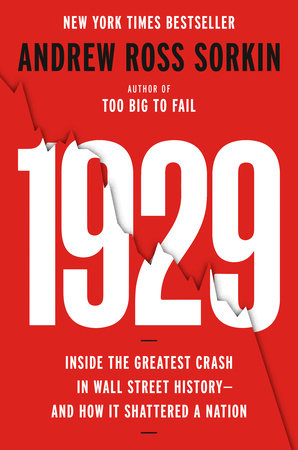




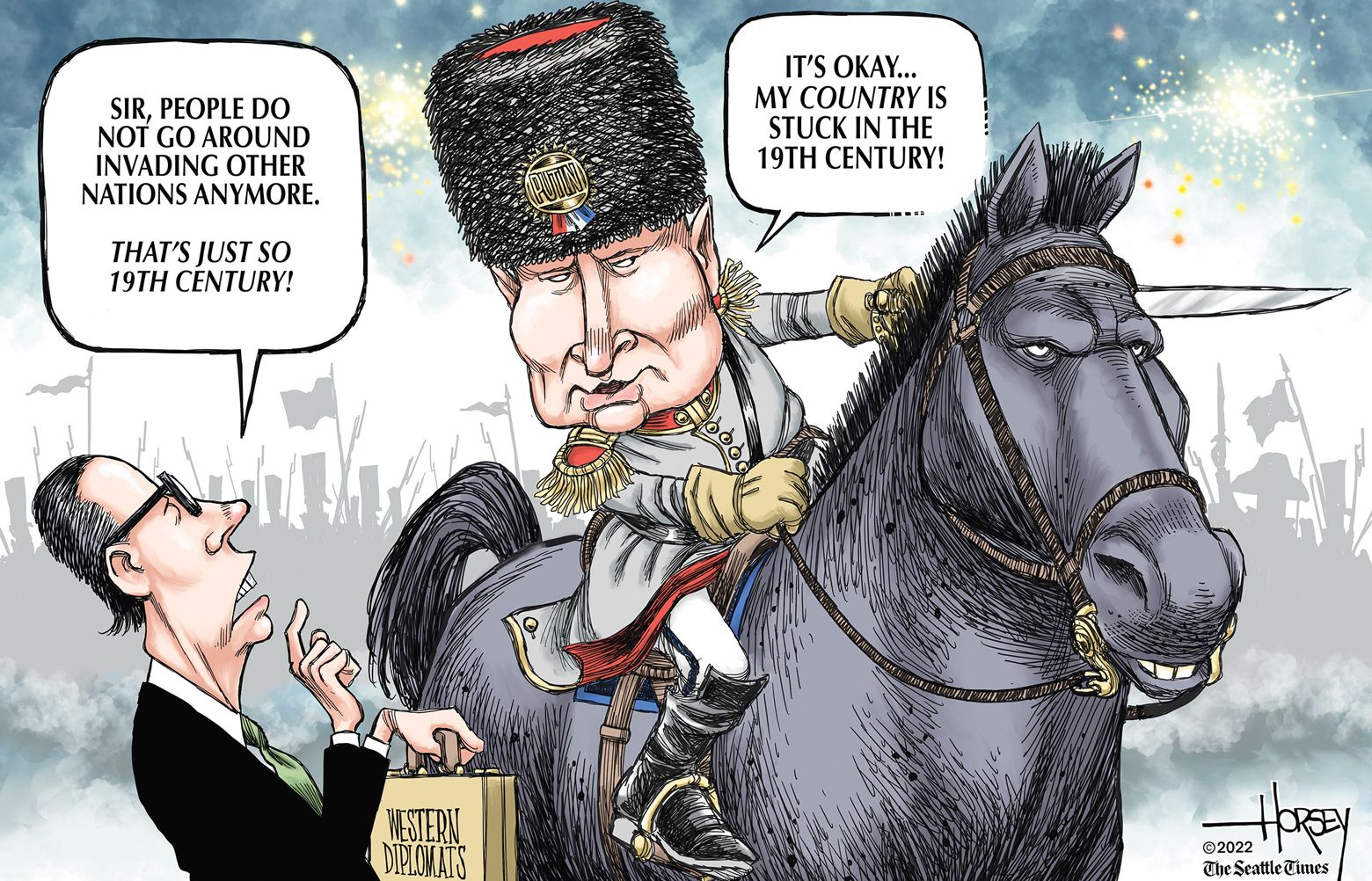

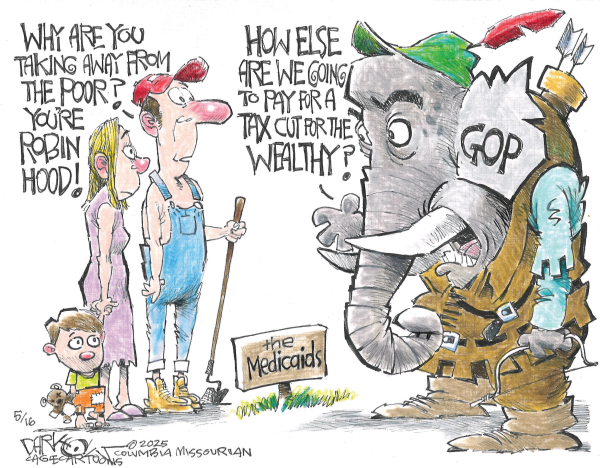


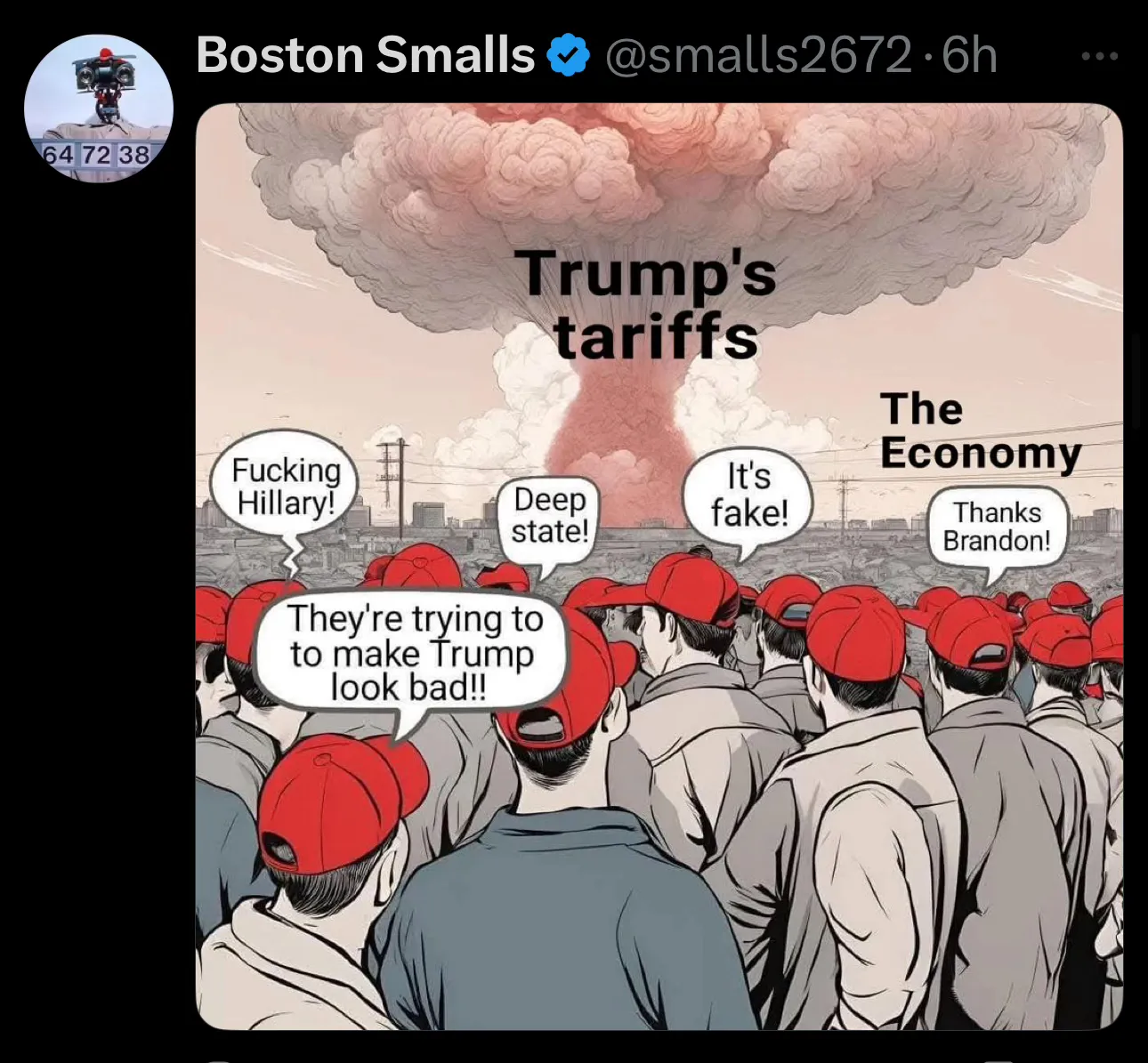

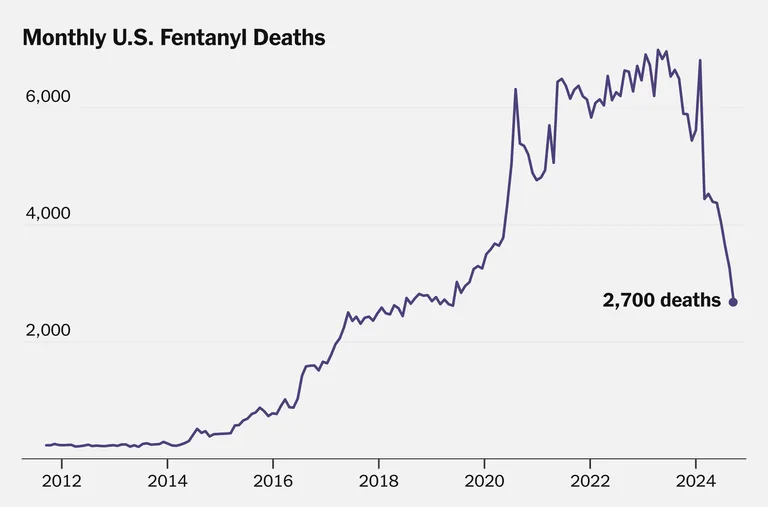
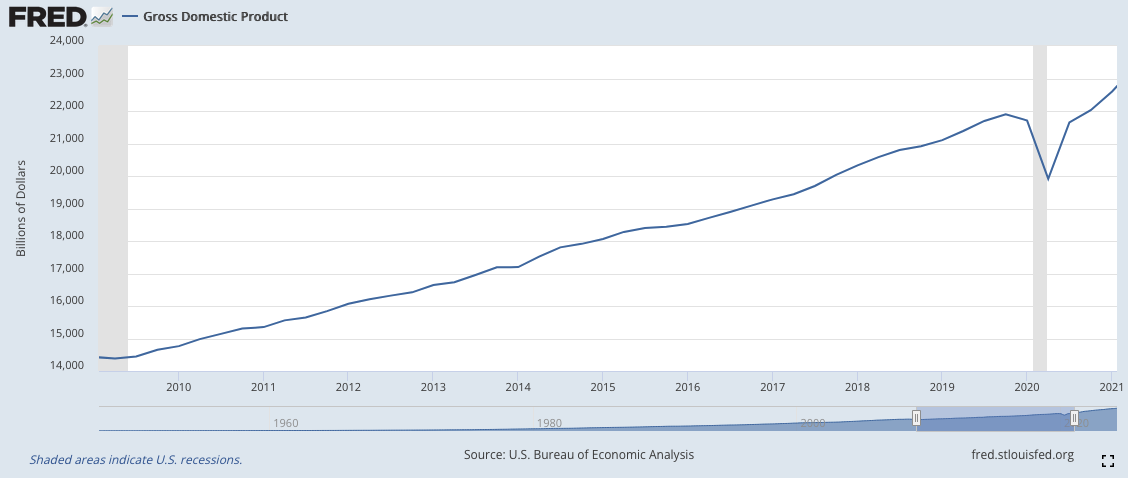
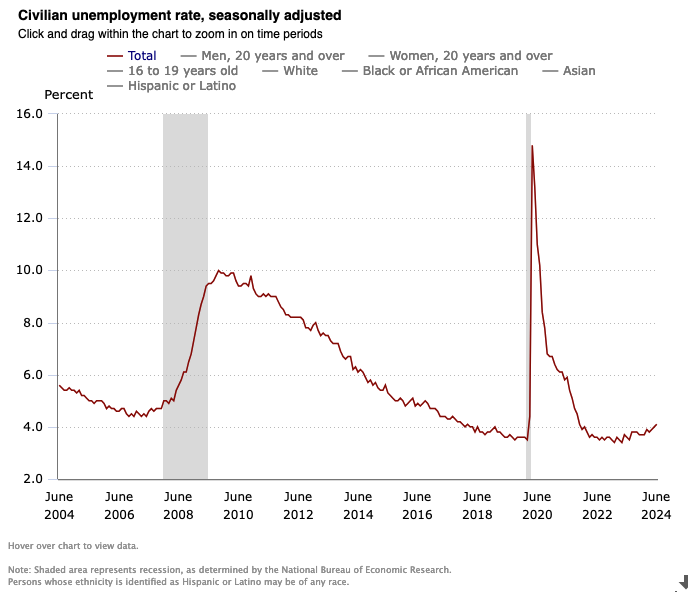
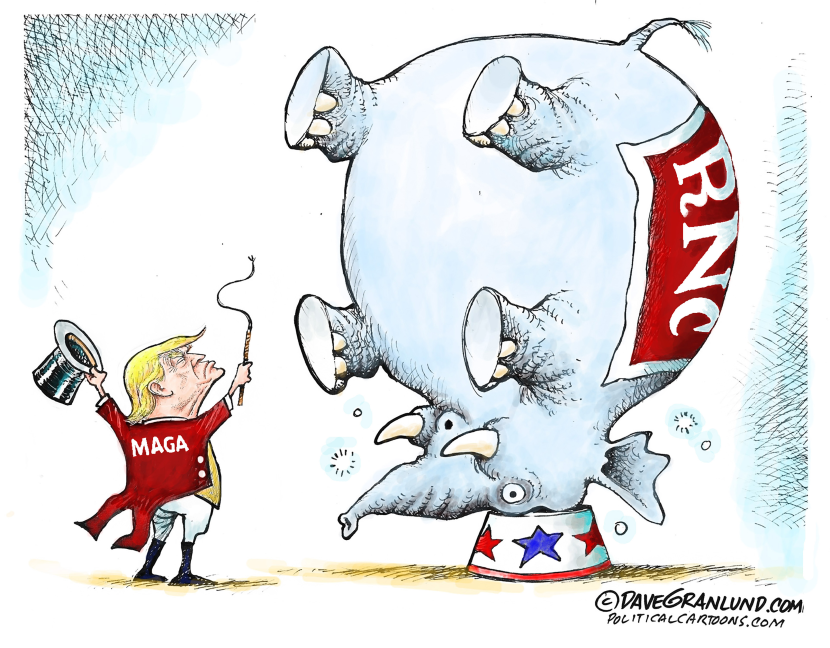

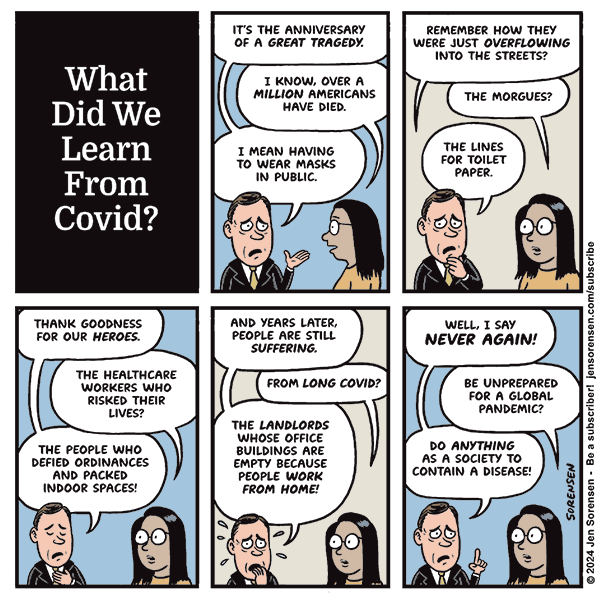

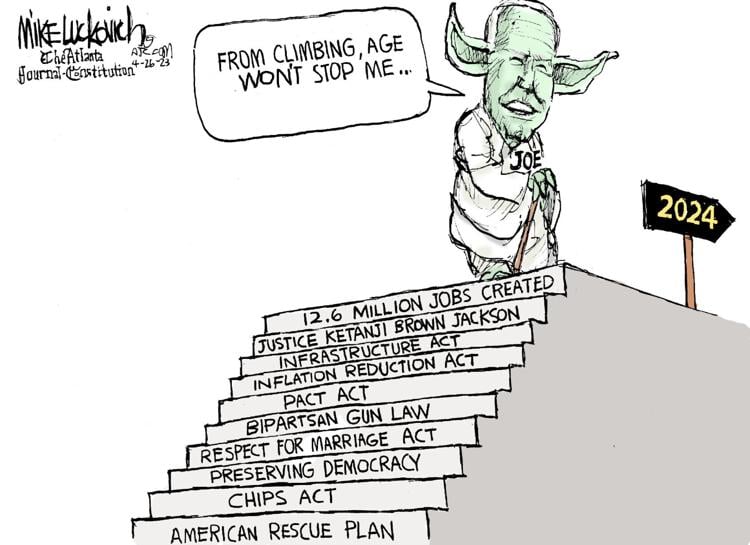


 The Weekly Sift