Democrats can’t resist Trump until he starts doing things.
In a Perry Bacon article I linked to two weeks ago, he cautioned against “turning into an amateur political strategist”. It’s a tough temptation to resist, and I’ve been in several conversations recently that veered into who the Democrats’ 2028 nominee should be, what groups of voters we should be trying to win over, how our message needs to change, and so on.
If you find your mind heading in that direction, all I can say is “Slow down.” The election of 2028 or even 2026 will be fought on a battlefield that doesn’t exist yet.
I think the place for political thinking to start is with one obvious fact: The Trumpists won in 2024. They got the White House and both houses of Congress. They control the Supreme Court to an extent that no partisan faction has in my lifetime. And I draw one major conclusion from those facts: The ball is in their court. We can’t know precisely what they’ll do with it until they start doing things. The things they do and the consequences of those actions will shape the landscape of 2026 and 2028.
Trump has raised many hopes and expectations among the people who voted for him. Specifically:
The economy is going to be fabulous. Not only will inflation stop, but prices will go back down to what they were the last time Trump was president. The trade deficit will vanish: Americans will get good jobs making the products we no longer import, but other Americans won’t lose their jobs making products for export. Increased oil and gas production will make energy much cheaper, lowering the price of everything. But we won’t have to worry about increased disasters from climate change.
Trump will wield unchecked power without abusing it. Neither Congress nor the courts nor the states will be able to stand in his way. But he won’t be petty and go after political opponents who broke no laws. He won’t make Americans afraid to criticize him. He won’t govern for his own profit. He won’t alter the rules to make future Democratic victories impossible. And he won’t ignore the Constitution to seek a third term.
The government is going to get drastically smaller. Spending will go way down without cutting Social Security or Medicare or defense. Regulations will be slashed without unleashing bad behavior from predatory corporations. Taxes will go down, but the budget deficit will vanish. Corruption will disappear. Private companies and the free market will serve Americans’ interests better and more efficiently than big government programs like ObamaCare or Medicare for All.
American strength will make the world safer. Wars in Ukraine and the Middle East will end on terms favorable to US interests. Terrorism will stop. Tariffs will be an unanswerable weapon that makes other countries do what we want.
The immigration problem will be solved. The Army will round up 10-20 million undocumented nonwhite people living here, without terrorizing the rest of us. They will be held in camps until they can be deported to other countries, who will accept them for fear of American tariffs. That roundup and detention power will be wielded without abuse, and only the bad, criminal immigrants will be affected. The good Latinos will stay and the bad ones will get kicked out. American industries (like agriculture) won’t be affected by the sudden departure of their work force.
Normal (i.e., White, Christian, straight) Americans will matter again. Small towns and rural areas will make a comeback. Working people will get a fair shake and won’t be exploited by giant unregulated corporations, so unions and consumer-protection agencies won’t be needed.
And more. Now, I think the picture I just painted is a fairy tale, because many of those goals are contradictory and most of the rest are unlikely. But just for a moment, let’s imagine Trump fulfills all of it. The people who voted for him look at the results and say, “That’s what I voted for.” The people who didn’t vote for him have to admit (if we are honest) that our fears were groundless. How do the Democrats surge in 2026 and 2028 to regain power?
It’s simple: They don’t. And more than that, they shouldn’t. If the MAGA movement can do all that, it will deserve to stay in power. Gavin Newsom (or whoever you’re picturing) won’t be able to run against it. No “message” you can come up with will win over Hispanics or suburban women or demoralized nonvoters or whichever other group you attribute our 2024 loss to.
What that means in practice is that, while we continue to espouse our own values, and oppose nominees and proposals that look wrong to us, it’s way too soon to start shaping any sort of campaign. A large chunk of the 2026 and 2028 campaigns will necessarily be reactive. Trump will disappoint many of the people who voted for him, either by not doing what he said he would do (“build the wall” from his first administration) or by doing it and having it turn out differently than he said it would. Future Democratic campaigns will center on exploiting that disappointment.
But we can’t design those campaigns until we see who he disappoints and how.
So what does that mean Democrats should be doing now? Laying the groundwork for the Trump-disappointed-you campaign, whatever it turns out to be. We need to constantly call attention to the ways Trump tries to move the goalposts. (Bringing prices down, we now learn from him, is very hard.) We need to highlight those people who are being harmed by his policies, once those policies start to take shape.
The upcoming leadership battle in the House will be the first substantive thing to look at. For the first time in decades, all committee chairs will be White men.
The budget will be a target-rich environment, because Republican math just doesn’t work. Either their cuts won’t total up the way they anticipated, or they will cut things they said they wouldn’t. Probably both. And if there’s a deficit, they own it.
I know that vision is not nearly as inspiring as a ten-point-plan to elect AOC. But this is the reality we have arrived in: The voters have given MAGA a chance to prove itself. We won’t know how to run against them until we see how they fail that test.
Recovering from the disillusionment of the election is taking longer than I expected.
Many articles are being written about how best to resist the incoming Trump administration and its expected assault on democracy and human rights. I had planned to write a post curating those articles for you, picking out the best ones and summarizing their advice. Unfortunately, I’ve bookmarked more of them than I’ve read, and I haven’t given the ones I’ve read enough serious thought.
That lack of motivation has forced me to admit something about myself: I’m not ready to resist yet. I hope I will be soon.
Everybody’s absorbing the reality of the election at their own pace and in their own way, I suppose. Prior to the election, I advised my readers over and over again not to speculate about what would happen. Like many advice-givers, I almost listened to myself. I refused to anticipate and dwell on either the thrill of victory or the agony of defeat. (I’m dating myself: When I was growing up, “the thrill of victory and the agony of defeat” was the well-known catch-phrase of ABC’s Wide World of Sports.) And yet, deep down, I stubbornly refused to believe the American people would do this. Even at the lowest points, like after Biden’s disastrous debate, I would think about a second Trump administration and think, “No. That can’t happen.”
In retrospect, my faith in the good judgment of the American electorate looks like the faith of a wife who is certain that her husband won’t ever cheat on her, or a child who is sure Dad will never go back to drinking, because it led to so much pain the first time.
But here we are.
I had imagined I was living in an early British detective novel, where Sherlock Holmes or Miss Marple would eventually figure everything out and justice would triumph. Instead, I woke up in an American detective novel by Dashiell Hammit or Raymond Chandler, where the Powers That Be have known all along who the murderer is, but see no reason to do anything about it.
Here we are.
Many of my friends have reported periods of anger, which I haven’t experienced yet. Maybe that’s still coming or maybe I’m just not built that way. Instead, I’ve been living with a deep sense of disappointment. I don’t anticipate any satisfaction coming when Trump voters lose their health insurance or see his tariffs reignite inflation in their grocery stores. When Trump-supporting Hispanics have their naturalization revoked or see their birthright citizenship denied, I don’t expect “I told you so” to taste delicious in my mouth. It will be a sad day, even if they did it to themselves. They are my countrymen, even if my country tells me otherwise.
But I’m still not ready to construct my resistance strategy. I hope I will be soon. Andrea Pitzer is right about this much: Most countries that experienced a fascist takeover didn’t enjoy the luxury of three months to plan. But one of those months is gone already. The clock is ticking.
I can tell I’ll eventually come around. One weird aspect of my psychology is that I’m aware of a subconscious personality who communicates with me — and occasionally critiques my behavior — through my brain’s musical soundtrack. (I noticed it my senior year in college, when I was trying to keep a relationship from getting too serious because I anticipated it ending with graduation. All spring I unaccountably found myself humming “Frosty the Snowman”.)
Lately it’s been playing a song I haven’t heard in years, maybe decades: Graham Nash’s “Chicago“, which he wrote in response to the Chicago 7 trial. It’s aimed at someone Nash wants to “come to Chicago” to protest, and hopes that the listener isn’t like Jack, who won’t help “cause he’ll turn the other ear”. And he envisions this:
We can change the world. Rearrange the world. It’s dying to get better.
I wonder.
In my uninspired wanderings through resistance articles, I have noticed a few things, which I’ll pass on in lieu of a better post in some future week.
The simplest advice has been repeated by many people, so you’ve probably heard it already: Timothy Snyder says “Don’t obey in advance.” In their formation phase, authoritarian regimes wonder what they can get away with. When people anticipate the regime’s demands and comply before they’re asked, they teach the government what it can do. We’ve seen simple examples already: When the Washington Post and LA Times owners torpedoed their editorial departments’ Harris endorsements, they signaled to Trump that he can control the press through the government’s influence on the owners’ other businesses. Seth Moulton — my congressman, sadly — has already offered that many Democrats are willing to surrender trans rights without a fight.
Other examples are more local, like libraries that remove LGBTQ memoirs or non-White fiction before anyone demands it, or sociology departments that voluntarily pare back their programs to avoid discussing White supremacy.
The other thing I’ve been struck by is the importance of perception. The power of an authoritarian regime rests more on belief than on institutional power or even guns. No one resists because everyone believes that (in the words of Star Trek’s Borg Collective) “resistance is futile”. But if enough people believe resistance isn’t futile, then it’s not.
That’s why Trump and his people are working so hard to assert that his sub-50% showing in the election is a “mandate” or even a “landslide“. But if you voted for someone other than Trump, you belong to the majority. And there’s certainly no mandate for implementing Project 2025 policies, which he explicitly denied during the campaign.
Similarly, we can expect a Day One shock-and-awe campaign, where it will seem as everything is happening at once: mass deportation, attacks on abortion rights and trans rights, tariffs, oil drilling on public lands, rolling back environmental regulations, firing civil-service workers, and so on. Trump and his people will make it sound as if these are all done deals — it’s happened already, get over it.
But in fact it won’t have happened. Most of his Day One moves will be challenged in court or require agreement from Congress, either of which will (at a minimum) take time, and may result in significant revisions or even reversal. Every delay means that less gets done, and the secret to saving American democracy is making sure that Trump doesn’t finish it off before the next elections.
So one of the worst things we can do is be defeatist, and claim that democracy is already lost. That does Trump’s work for him.
Power worship blurs political judgement because it leads, almost unavoidably, to the belief that present trends will continue. Whoever is winning at the moment will always seem to be invincible. If the Japanese have conquered south Asia, then they will keep south Asia for ever, if the Germans have captured Tobruk, they will infallibly capture Cairo; if the Russians are in Berlin, it will not be long before they are in London: and so on. This habit of mind leads also to the belief that things will happen more quickly, completely, and catastrophically than they ever do in practice. The rise and fall of empires, the disappearance of cultures and religions, are expected to happen with earthquake suddenness, and processes which have barely started are talked about as though they were already at an end.
Trump’s overthrow of democracy has barely started. We can’t let him pretend that it has already succeeded.
Perry Bacon‘s list of things to do or avoid doing is well chosen. The gist: Get involved in something beyond electoral politics, like union, a local issue-oriented group, or a politically committed liberal church. (After initial skepticism, Perry is a UU now. Welcome!) Don’t obsess over political news or Democratic strategy.
Some of Trump’s cabinet picks are merely unorthodox, but others are expressions of dominance.
The Roman historian Cassius Dio told this story about the Emperor Caligula and his horse Incitatus:
[Caligula] used to invite [Incitatus] to dinner, where he would offer him golden barley and drink his health in wine from golden goblets; he swore by the animal’s life and fortune and even promised to appoint him consul, a promise that he would certainly have carried out if he had lived longer.
Modern historians generally believe that if he made this promise at all, Caligula was joking.
Caligula once said that he would appoint his horse Incitatus consul, which was probably a joke intended to belittle the Senate’s authority.
In the old Roman Republic, the consulship had been the top executive office and was anything but a joke. When Caligula’s great-grandfather Augustus established the imperial system, he preserved the forms and rituals of the Republic and ruled from behind the scenes, not as consul or dictator (as his own uncle Julius Caesar had done) but as “First Citizen”. (In Latin, princeps, the origin of the word “prince”.) Caligula, on the other hand, had no patience with such niceties and wanted to rub senators’ noses in the emptiness of their formal titles. “You want to be consul? So does my horse.”
Matt Gaetz. The Incitatus story came to mind Wednesday after President-elect Trump announced that he would nominate Rep. Matt Gaetz to be attorney general, a possibility only slightly less absurd than Incitatus’ consulship.
Gasps were heard during a meeting of Republican lawmakers when the nomination for America’s top US prosecutor was announced, Axios reported, citing sources in the room.
Republican Congressman Mike Simpson of Idaho reportedly responded with an expletive.
“I don’t think it’s a serious nomination for the attorney general,” Alaska Republican Senator Lisa Murkowski said.
Gaetz has a law degree, but no experience in law enforcement or the judiciary. He has been dogged by persistent accusations of sex trafficking and relationships with underage girls, though the Justice Department declined to file charges. [1] The House Ethics Committee had been about to publish a report of their investigation into his sexual misconduct, but Gaetz has avoided this by resigning his House seat to accept Trump’s offer. (Typically, members of Congress who take cabinet seats wait to resign until after the Senate confirms them.) Republican Senators have said they’d like to see the report, but Speaker Johnson is against releasing it to them — something he would obviously do if it cleared Gaetz.
I’ll give you the truth why I’m not speaker. It’s because one person, a member of Congress, wanted me to stop an ethics complaint because he slept with a 17-year-old.
Like Incitatus, though, Gaetz knows who his master is. He has been abjectly loyal to Donald Trump, and has said his is “proud of the work we did” on January 6. [2]
This is the last chance we’re gonna have of saving this country. And if you wanna get in the way, fine. But we’re gonna try to get you out of the Senate, too if you try to do that.
As for the mainstream media, sanewashing is still the order of the day. The NYT describes the Gaetz nomination as a “loyalist” and WaPo characterizes Gaetz as “outspoken“.
Confirming Gaetz will verify that two significant American institutions have lost their independence: not just the Justice Department, but the Senate also. It will be a major step in the direction of autocracy. Democratic Senator Sheldon Whitehouse refers to this as “the crawl test“, and Ezra Klein writes:
Demanding Senate Republicans back Gaetz as attorney general and Hegseth as Defense Secretary is the 2024 version of forcing Sean Spicer to say it was the largest inauguration crowd ever. These aren’t just appointments. They’re loyalty tests. The absurdity is the point.
Pete Hegseth. And that brings us to our next horse, Pete Hegseth.
Let’s start with the good: He has a strong academic record, receiving a bachelors degree in politics from Princeton (where he wrote for the conservative Princeton Tory and played on the school’s varsity basketball team), and then a masters in public policy from the Kennedy School at Harvard. [3] He was an infantry officer in the Minnesota National Guard, volunteered to be posted to Baghdad, and received a bronze star. He also served in Afghanistan and was promoted to major.
From there things go downhill. He was at first chosen to be one of the 25,000 National Guard troops protecting Joe Biden’s 2021 inauguration (which needed protection given the post-January-6 threats of right-wing violence), but was removed as a possible “insider threat” in view of two tattoos: a Jerusalem cross and “Deus Vult” (“God wills it” an 11th-century Crusader battle cry). Either might be a simple expression of Christian devotion, but they are also associated with Christian nationalism and even neo-Nazism. [4]
Hegseth’s political positions have been described as Christian nationalist. In his book, American Crusade: Our Fight to Stay Free, he said he believes there are “irreconcilable differences between the Left and the Right in America leading to perpetual conflict that cannot be resolved through the political process”. He furthermore called for an “American crusade”, which he described as “a holy war for the righteous cause of human freedom”.
In short, the Crusades — a Christian war against infidels, particularly Muslims — figure prominently in his thinking.
His business career was undistinguished, and his time managing conservative political action groups raises more red flags without any proven wrong-doing. He ran a Minnesota PAC that spent 1/3 of its funds on Christmas parties, and as director of Concerned Veterans for America he hired his brother and paid him over $100K.
Hegseth was investigated for a sexual assault in 2017, but (like Gaetz) was not charged. [5]
But the reason he’s been nominated is that Trump liked him as a weekend contributor to Fox & Friends. He joined Fox News in 2014, and is best known for advocating pardons for war criminals, including Eddie Gallagher. (Gallagher was pardoned by Trump and had his rank restored, despite testimony against him from seven of his 21 platoon members, one of whom said “The guy is freaking evil.”)
Nothing in Hegseth’s background qualifies him to run a department with nearly three million employees and an $842 billion annual budget. But he does bring to the job an anti-LGBTQ and patriarchal zeal that fits well with Trump’s criticisms of the “woke” military.
Given his past pronouncements, and those of President-elect Trump, Hegseth is expected to end any diversity programs in the U.S. military, and perhaps retire or replace senior officers he sees as “woke” or who did not get the position through what he sees as merit alone.
His view of war crimes also aligns with Trump, who said after pardoning a different war criminal that “We train our boys to be killing machines, then prosecute them when they kill!”
How Trumpists see their team.
Tulsi Gabbard. This former Democratic congresswoman has been nominated to be Director of National Intelligence. The DNI is the primary liaison between the 17 US intelligence agencies and the President. The DNI’s office (ODNI) produces the Presidential Daily Brief, which integrates and distills reports from all the agencies.
Democratic Rep. Debbie Wasserman Schultz probably went too far by characterizing Gabbard as “likely a Russian asset“, but some hosts on Russian state TV appear to agree, referring to her as “our girlfriend Tulsi“. Gabbard has often echoed Russian propaganda about the Ukraine War. During her unsuccessful 2020 presidential campaign, she received favorable coverage from Russian state media.
Less than one month into her presidential campaign, there were at least 20 Gabbard stories on three major Moscow-based English-language websites affiliated with or supportive of the Russian government — all of which celebrated her candidacy.
She has also been a defender of the Assad regime in Syria, a Russian ally.
Our allies are reported to be alarmed by her nomination, and there is talk that the other Five Eyes countries — Australia, Britain, Canada, and New Zealand — may stop sharing information with us, for fear of where that information might go next.
Gabbard has no previous experience in intelligence. She has not worked for a US intelligence agency and was not a member of the Intelligence Committee when she was in Congress.
RFK Jr. It’s possible to describe RFK Jr. in glowing terms: He wants to Make America Healthy Again. He wants to take on the Big Pharma and Big Food oligopolies, and fight the forces that make Americans prone to chronic diseases.
Throughout the year, we observed an increasing trend in the prevalence of low-credibility news about vaccines. We also observed a considerable amount of suspicious YouTube videos shared on Twitter. Tweets by a small group of approximately 800 “superspreaders” verified by Twitter accounted for approximately 35% of all reshares of misinformation on an average day, with the top superspreader (@RobertKennedyJr) responsible for over 13% of retweets.
Then there’s the danger of fluoridated water, which is a John Birch Society conspiracy theory I remember from childhood. RFK would like to eliminate water fluoridation, due to various health problems that overexposure to fluoride can cause. But like so many of his causes, his anti-fluoride case is overstated and full of misinformation. Fluoridated water has proven cavity-prevention benefits, and local monitoring should be sufficient to prevent over-exposure.
Kennedy denies responsibility for a measles outbreak in Samoa that killed 83 people, but he did play a role.
Children’s Health Defense, the nonprofit anti-vax outfit he led until becoming a presidential candidate, had helped spread misinformation that contributed to the decline in measles vaccination that preceded the lethal eruption. And during his trip to Samoa, Kennedy had publicly supported leading vaccination opponents there, lending credibility to anti-vaxxers who were succeeding in increasing vaccine hesitation among Samoans.
That, in a nutshell, is the main thing to fear about Kennedy heading HHS: He’ll encourage public doubts about vaccines that have all but eliminated various once-common diseases. If vaccination levels fall below what is necessary to maintain herd immunity, those disease can make a comeback.
The U.S. is already seeing an uptick in some vaccine-preventable childhood diseases, says Dr. Adam Ratner, a pediatric infectious disease specialist in New York City and author of a forthcoming book about the resurgence of measles and the growing anti-vaccine movement.
Measles outbreaks and cases of chickenpox and pneumococcal disease are on the rise in the U.S., he notes.
“When we see children in the hospital with complications of these things that we can prevent or at least decrease the risk of by using vaccines, it’s very frustrating,” he says.
As vaccine hesitancy continues to spread, Alissa and other pediatricians worry that other devastating childhood diseases like polio could re-emerge.
As for sticking it to Big Pharma and Big Food, I have a theory about that: I deeply disbelieve in Trump’s populism, and think that fundamentally he is on the side of Big Whatever. But RFK Jr. could still be useful to him by creating a threat Trump could use to shake the big companies down.
What’s next? These particular picks were so outrageous that many other nominees are passing without comment, like Mike Huckabee as ambassador to Israel, Steven Miller as deputy chief of staff for policy, and Kristi Noem as Secretary of Homeland Security. And I’ve seen many people use the Simpsons’ worst [blank] SO FAR meme. (We’re still waiting for a Treasury secretary.)
It’s been hard to parody Trump’s team, because anything you suggest could become tomorrow’s reality. (Last week, Gaetz becoming attorney general might have gotten a good laugh.) The only real way to stay ahead of the game is to propose fictional characters:
Donald Trump picks Baltimore based developer Russell “Stringer” Bell as Secretary of Housing and Urban Development.
But to repeat a previous point: The question is what the Senate will do. It’s encouraging that Republican senators stuck by their own choice (John Thune) for majority leader, and didn’t give in to Trump’s choice (Rick Scott). Maybe that means the Senate will play the role the Founders intended, checking and balancing the President. At least sometimes.
[1] Not filing an indictment isn’t actually a ringing endorsement. It means only prosecutors didn’t think they could convince a jury beyond a reasonable doubt. But according to Gaetz’ defenders, if there’s not enough evidence to send you to jail, you might as well be attorney general.
[2] Trump’s tweet announcing Gaetz calls him “a Champion for the Constitution and the Rule of Law”, which is the kind of up-is-down statement we’re going to see a lot of.
The rest of the new DoJ management team will also be compromised: Trump has nominated his personal attorneys, Todd Blanche and John Sauer, as Deputy Attorney General and Solicitor General. At least they have some relevant experience: Blanche was once a federal prosecutor and Sauer was solicitor general for Missouri.
[4] At a minimum these are anti-Islam symbols. The Jerusalem Cross goes back to the Crusades, and is also known as the Crusaders’ Cross. If I were a senator vetting Hegseth, I’d point to Deus Vult and ask him precisely what he thinks God wills in the 21st century.
[5] The Washington Post published more details about the assault Saturday, including that Hegseth paid the accuser to sign a nondisclosure agreement.
[A] detailed memo was sent to the Trump transition team this week by a woman who said she is a friend of the accuser. The memo, a copy of which was obtained by The Post, alleged he raped the then-30-year-old conservative group staffer in his room after drinking at a hotel bar. … The accuser, whose identity has not been made public, filed a complaint with the police alleging she was sexually assaulted days after the Oct. 7, 2017, encounter in Monterey, California, but the local district attorney did not bring charges. Police confirmed that they investigated the incident. After she threatened litigation in 2020, Hegseth made the payment and she signed the nondisclosure agreement, his attorney said.
Once again, not being formally indicted for a crime seems to be the gold standard for Trump nominees.
People who used to deny that Trump is a fascist have been changing their minds.
From the beginning of his first presidential campaign, it was clear Donald Trump was not like other candidates. The difference was not in political philosophy, because he barely seemed to have one. On any given day, he might be for or against a national healthcare program. He might want to raise or cut taxes on the rich. If “conservative” had been defined by Ronald Reagan and carried into the present by Republicans like Paul Ryan, then Trump was not a conservative.
Meanwhile, he celebrated his supporters’ violent tendencies, called Mexican immigrants rapists, and promised to ban Muslims from entering the country. Maybe we needed a different word for this. Maybe the word was fascist.
For years, the word fascist had mainly just served as an insult in American politics. Yes, there were people on the right-wing fringe who waved swastikas and celebrated Hitler’s birthday, but they had no power and nobody took them seriously. If you heard some congressman or cabinet secretary described as a fascist, it was hyperbole. No significant player in American government was literally a fascist. [1]
But maybe it was time to dust that word off as a serious descriptor. If you were going to do that in a responsible way, though, you had to be clear about what you were using the word to mean. It couldn’t just be “somebody more conservative than me” or “somebody I don’t like”. It needed a real definition that could be applied objectively.
And that was actually kind of tricky, because historical fascism has not displayed a defining set of policy positions, like communism’s public ownership of the means of production. Once in power, fascists become chameleons, championing whatever ideas their leaders find useful. Fascism often resembles a charismatic religion more than a political philosophy; the important thing is the spirit, not adherence to some 10-point plan.
But by November of 2015, I was ready to start using the word again, so I wrote “The Political F-Word” to say what I would mean by it. I said fascism was more about social psychology than politics, and described it as:
“a dysfunctional attempt of people who feel humiliated and powerless to restore their pride by:
styling themselves as the only true and faithful heirs of their nation’s glorious (and possibly mythical) past, [2]
identifying with a charismatic leader whose success will become their success,
helping that leader achieve power by whatever means necessary, including violence,
under his leadership, purifying the nation by restoring its traditional and characteristic virtues (again, through violence if necessary),
reawakening and reclaiming the nation’s past glory (by war, if necessary),
all of which leads to the main point: humiliating the internal and external enemies they blame for their own humiliation.”
I could easily see Hitler’s and Mussolini’s fascism in that description, and believed that it fit Trumpism as well, with its vague allusions to making America great “again” (without specifying when exactly that greatness was present or how it was lost), its persistent claims of persecution and victimhood, its emphasis on “owning the libs”, its hatred of immigrants, the violence of its rhetoric (which is frequently echoed in the manifestos of mass murderers), its focus on “real Americans”, and (most of all) the cult of personality around Donald Trump himself. [3]
The subsequent eight years, I believe, have borne out what I saw in 2015. The January 6 insurrection, for example, was a direct manifestation of “helping that leader achieve power by whatever means necessary, including violence”, and so are the current threats of violence against the prosecutors and judges who attempt to make Trump submit to the rule of law.
Still, not everyone agreed, and calling Trump a fascist was controversial. To many, fascist meant Hitler, and (whatever you might think of him) Trump was not Hitler. This week, Tom Nichols summarized his thinking like this: He was against using fascist through the 2016 campaign because
Trump, as a person and as a public figure, is just so obviously ridiculous; fascists, by contrast, are dangerously serious people, and in many circumstances, their leaders have been unnervingly tough and courageous. Trump—whiny, childish, unmanly—hardly fits that bill.
At the time, I thought this view was unhistorical, because Hitler also had seemed ridiculous to many Germans, even after he had become chancellor. But Nichols continued:
After Trump was elected, I still warned against the indiscriminate use of fascism, because I suspected that the day might come when it would be an accurate term to describe him, and I wanted to preserve its power to shock and to alarm us. I acknowledged in August 2022 that Trump’s cult “stinks of fascism,” but I counseled “against rushing toward the F-word: Things are poised to get worse, and we need to know what to watch for.”
Well, Nichols is now shocked and alarmed. What changed his mind? The same things that have swayed a lot of pundits lately: the escalating rhetoric that now routinely dehumanizes his opponents as “vermin” and immigrants as “poisoning the blood of our country“, coupled with a series of ominous proposals for his second administration:
Add the language in these speeches to all of the programmatic changes Trump and his allies have threatened to enact once he’s back in office—establishing massive detention camps for undocumented people, using the Justice Department against anyone who dares to run against him, purging government institutions, singling out Christianity as the state’s preferred religion, and many other actions—and it’s hard to describe it all as generic “authoritarianism.” Trump no longer aims to be some garden-variety supremo; he is now promising to be a threat to every American he identifies as an enemy—and that’s a lot of Americans.
Nichols is not alone. [4] Though The Economist does not use the F-word, it says that Trump “poses the biggest danger to the world in 2024”. WaPo’s Dan Balz also avoids fascist, but says his rhetoric is “associated with authoritarian leaders of the past”, whoever they might be. His colleague Aaron Blake puts recent Trump quotes side-by-side with Hitler’s use of the same language. The New Yorker’s John Cassidy warns that the 2024 election is
a struggle to prevent the election of a President whose embrace of fascistic imagery and authoritarian governance goes well beyond what comes out of his mouth.
In short, it’s not just the crazy things Trump says or how he says them. It’s what he’s done and plans to do.
The 2020 election plot. It’s important to realize that we’ve gone well beyond the point of Trump-says-a-lot-of-crazy-things. Openly fascist ideas and proposals are percolating in TrumpWorld right now, and are still not being taken seriously by many American voters. But before we go into those, we need to lay out what Trump has already done: launched a plot to stay in power after losing the 2020 election.
People who think we can put January 6 behind us tell the story like this: After it became clear that Trump had lost the 2020 election, he latched on to every rumor of fraud because he didn’t want to admit defeat. His stolen-election rhetoric resonated with his most radical supporters, and the result was a January 6 rally that got out of hand. Eventually, though, Trump told the rioters to go home and left office peacefully. He still may be claiming he won in 2020, but so what?
Both the evidence gathered by the House January 6 Committee [5] and the Georgia and D.C. indictments against Trump, though, tell a different story:
As soon as it became clear that Trump was likely to lose the 2020 election, he began preparing to claim fraud and stay in office.
Within a few days of the November 3 election, his campaign officials and other top advisors told him that he had lost.
Within a few weeks, all his administration’s top investigators — Bill Barr in Justice, Chris Krebs at the Cybersecurity and Infrastructure Security Agency, and others — told him that his claims of election fraud had no basis in fact. No one in a position to know supported those claims.
Republican officials in key states — Georgia, Michigan, Arizona — told him that the votes had been counted accurately. Again, no one in a position to know said otherwise.
In order to find support for the view that he had won the election, Trump had to turn to amateur conspiracy theorists like Sidney Powell and Mike Lindell.
Barr’s successors at Justice refused to send state legislators a letter falsely claiming that evidence of significant election fraud had been found and recommending that they reconsider their states’ electoral votes.
Republican-controlled state legislatures all refused Trump’s urging to ignore the election results and appoint Trump electors instead of Biden electors.
Officials close to Trump coordinated attempts in multiple states for Trump supporters to falsely claim to be electors, and to fraudulently cast Electoral College votes for Trump.
His own vice president, Mike Pence, resisted his urging to count the votes of the fake electors, or to refuse to count electoral votes from states Biden had won.
The January 6 assault on the Capitol was planned in advance by groups like the Proud Boys, and their leaders have been convicted of seditious conspiracy. A direct connection from the White House to the Proud Boys has not been nailed down in evidence publicly available, but may have gone through Roger Stone.
The more details come out, the clearer it becomes that this plot could have worked if only Trump had more yes-men in key positions. If the Justice Department had backed rumors of election fraud, Republican legislatures would have had cover to submit alternate slates of electors, and Mike Pence might have been convinced to count those votes, creating a constitutional crisis that the Supreme Court (with three Trump appointees) might have been unwilling to resolve in Biden’s favor. A military leader unlike Mark Milley might have provided troops to put down any subsequent disorder, and Trump would be President for Life. [6]
From the preparations for his second administration, we can conclude that Trump has learned a lesson from his first failed attempt to overthrow the constitutional order, and will not make the same mistakes again. He’ll appoint a compliant attorney general, a compliant vice president, and military leaders willing to do what they’re told. Former Trump Chief of Staff John Kelly put it like this:
The lesson the former president learned from his first term is don’t put guys like me … in those jobs. The lesson he learned was to find sycophants.
Plans for Trump’s second term. According to many reports, Trump did not expect to win in 2016, so he paid little attention to the transition plan drafted by Chris Christie. Top jobs were filled in a haphazard way, often with conservatives who had little previous connection to Trump, like General John Kelly, or with people like Senator Jeff Sessions, who backed Trump but retained independent views of how government was supposed to function. The Trump legislative agenda was largely left to Speaker Paul Ryan, who engineered a Reagan-style tax cut for corporations and the rich, but failed to “repeal and replace” ObamaCare.
As a result, Trump was frequently told that he couldn’t do what he wanted to do; it was illegal or unethical or against the norms of the federal government. By the end of his term, he had gotten rid of most of those people, but there were still enough establishment conservatives around to thwart his attempt to steal a second term.
Weaponize the Justice Department against his enemies. Trump claims that the indictments against him are purely political. [7] But rather than promise to restore the Justice Department to its proper function, Trump promises to do to his enemies what he (falsely) claims has been done to him. In an interview with Univision, he said:
What they’ve done is they’ve released the genie out of the box. … They’ve done indictments in order to win an election. They call it weaponization, and the people aren’t going to stand for it. But yeah, they have done something that allows the next party. I mean, if somebody if I happen to be president and I see somebody who’s doing well and beating me very badly, I say go down and indict them. Mostly what that would be, you know, they would be out of business. They’d be out they’d be out of the election.
This is third-world-country stuff, “arrest your opponent”. And that means I can do that, too.
In general, I’m trying to source Trump’s second-term plans to his own words and quotes from allied organizations and named advisors, rather than anonymous sources (though the Mueller Report often attached names and testimony under oath to anonymously-sourced reports Trump had labeled “fake news” at the time). But I’ll make an exception for this quote from the WaPo:
In private, Trump has told advisers and friends in recent months that he wants the Justice Department to investigate onetime officials and allies who have become critical of his time in office, including his former chief of staff, John F. Kelly, and former attorney general William P. Barr, as well as his ex-attorney Ty Cobb and former Joint Chiefs of Staff chairman Gen. Mark A. Milley, according to people who have talked to him, who, like others, spoke on the condition of anonymity to describe private conversations. Trump has also talked of prosecuting officials at the FBI and Justice Department, a person familiar with the matter said.
One person who believes this account is John Kelly:
There is no question in my mind he is going to go after people that have turned on him.
Use the military against Americans. During his administration, Trump threatened to invoke the Insurrection Act, which allows deploying the active-duty military to enforce law and order within the United States itself. (During riots and natural disasters, governors may call out their state’s chapter of the National Guard, which consists of ordinary citizens and is the successor to the “militia” mentioned in the Constitution.) According to the NYT, he was talked out of doing so by Attorney General Bill Barr, Defense Secretary Mark Esper, and Joint Chiefs Chair Mark Milley — exactly the kind of appointees he will avoid in a second administration.
Instead, Trump reportedly plans to invoke the Insurrection Act on Day One of a second term. This would put the military on call to respond wherever he found it necessary.
Turn the federal government into a patronage machine. In the early days of the United States, the government worked according to the “spoils system”, in which federal jobs were plums a new president could award to his political allies. This led to a lot of corruption and inefficiency, so a series of reforms were passed that made most federal jobs nonpartisan civil service jobs.
Trump began trying to undo the civil service in his first term. A month before the 2020 election, he ordered the creation of “Schedule F” jobs — tens of thousands of positions formerly protected by civil service rules that would become fireable by the president.
Rather than take advantage of this power grab, President Biden reversed Trump’s executive order. But Trump has pledged to restore it if he regains office. Presidents already need to make about 4000 appointments when they take office, but Trump’s plan could cover ten times as many jobs. The Heritage Foundation’s Project 2025 is assembling a database of Trump loyalists who could fill those jobs. According to Axios:
intense attention will be given to the social-media histories of anyone being considered for top jobs. Those queasy about testing the limits of Trump’s power will get flagged and rejected.
Create massive detention camps for immigrants and the homeless. Trump has pledged to conduct “the largest domestic deportation operation in American history”, a statement fleshed out by Trump advisor and speech-writer Stephen Miller, who told the NYT:
Any activists who doubt President Trump’s resolve in the slightest are making a drastic error: Trump will unleash the vast arsenal of federal powers to implement the most spectacular migration crackdown. The immigration legal activists won’t know what’s happening.
Miller is talking about rounding up not just “illegal” immigrants, deporting “millions per year”, but also revoking the legal status of many others: foreign students who participate in demonstrations Trump disagrees with, immigrants granted temporary protected status because they escaped from countries the US deems unsafe, Afghans evacuated after the Taliban takeover, and others.
To help speed mass deportations, Mr. Trump is preparing an enormous expansion of a form of removal that does not require due process hearings. To help Immigration and Customs Enforcement carry out sweeping raids, he plans to reassign other federal agents and deputize local police officers and National Guard soldiers voluntarily contributed by Republican-run states.
To ease the strain on ICE detention facilities, Mr. Trump wants to build huge camps to detain people while their cases are processed and they await deportation flights. And to get around any refusal by Congress to appropriate the necessary funds, Mr. Trump would redirect money in the military budget, as he did in his first term to spend more on a border wall than Congress had authorized.
The threat of non-action. In addition to the things Trump is planning to do in a second administration, we have to consider the things he might choose not to do: enforce the law against groups who do violence against his opponents. From the beginning, Trump has defended his supporters when they get violent, from describing two Trumpists who beat a homeless man in 2015 as “passionate” to saying “We love you. You’re very special.” to the January 6 rioters, whom he says he will pardon.
In the early Hitler years, the more serious threat was not that the official Gestapo would whisk you away to a concentration camp, but that the unofficial Brownshirts would beat or murder you with no interference from the police. Kristallnact was not police enforcing draconian laws, but hooligans running free. If you think the Proud Boys or Oath Keepers wouldn’t like to play a similar role today, you haven’t been paying attention.
[1] On the Right, the word communist is still used this way, as when Trump promised to “root out the communists, Marxists, fascists and the radical-left thugs that live like vermin within the confines of our country”. I doubt he could define communist, Marxist, or fascist. The words are simply barbs that he throws at people.
[2] Four years after my F-word post, Trump made this point clearly in his January 6 speech:
Just remember this: You’re stronger, you’re smarter, you’ve got more going than anybody. And they try and demean everybody having to do with us. And you’re the real people, you’re the people that built this nation. You’re not the people that tore down our nation.
[3] The 2020 Republican Convention, for example, refused to write a platform that would endorse any specific policies, but declared instead that it “enthusiastically supports President Trump” and would “enthusiastically support the President’s America-first agenda” — whatever turns that might take.
any motion to amend the 2016 Platform or to adopt a new platform, including any motion to suspend the procedures that will allow doing so, will be ruled out of order
Going forward, the Republican Party would be Donald Trump, and its policies would be whatever Trump said they were.
[4] You might think Nichols’ article would have an apologetic tone, something like: “You guys were right, he is a fascist.” But no. Those of us who saw further ahead than Nichols are to blame for “the overuse of fascist” that “wore out the part of the public’s eardrums that could process such words”.
I see it the other way: Maybe if people like Nichols had taken Trump’s fascism more seriously in 2015, more of the public could have processed the threat then, and we could have avoided this whole mess.
What this point ignores is that nearly all the testimony heard by the committee came from Trump appointees, Republicans at the state level who supported Trump’s 2020 campaign, and even members of the Trump family. There would have been more even testimony from Trump supporters if so many (including Trump himself) had not refused to testify. Steve Bannon, Mark Meadows, Jim Jordan, and Peter Navarro went so far as to defy subpoenas.
I can’t help believing that if any of those people could have testified to Trump’s innocence without committing perjury, they would have.
The possible bias of the Committee’s report was an issue in the recent hearing in a Colorado court about whether Trump is disqualified from being on the ballot in 2024 by the 14th Amendment’s insurrection clause. The judge’s ruling noted:
while Trump spent much time contesting potential biases of the Committee members and their staff, he spent almost no time attacking the credibility of the Committee’s findings themselves. The Hearing [in Colorado] provided Trump with an opportunity to subject these findings to the adversarial process, and he chose not to do so, despite frequent complaints that the Committee investigation was not subject to such a process. Because Trump was unable to provide the Court with any credible evidence which would discredit the factual findings of the January 6th Report, the Court has difficulty understanding the argument that it should not consider its findings
We are going to win four more years. And then after that, we’ll go for another four years because they spied on my campaign. We should get a redo of four years.
Doubting his intent would be repeating another mistake Germans made with Hitler: believing that he didn’t really mean what he said. Hitler’s 1925 book Mein Kampf laid out much of what he wanted to do and later did, but many Germans refused to take his writings seriously.
[7] That position is hard to square with the evidence those indictments lay out. Trump has been indicted because he committed crimes.
In practice, Trump simply does not address the evidence against him. See the quote from the judge’s ruling in note [5].
[8] In this context, it’s worth pointing out that the Nazi death camps did not start out as death camps, and did not specifically target Jews. In the beginning, the camps housed “undesirables” like Communists. Over time, the definition of “undesirable” expanded, and the limits of what could be done to them loosened.
Trump and his followers have said a lot about his indictments. But their arguments have little to do with whether he’s guilty.
Since his legal troubles started, Donald Trump, his lawyers, and various conservative commentators who repeat his talking points have commented at length on his various indictments. But very few of those comments present arguments his lawyers could credibly present in court. Instead, most of what you’ll hear on Fox News are arguments intended either to move public opinion, or to intimidate witnesses, prosecutors, judges, and potential jurors.
It seems clear to me that Trump’s defenders want the public focused on anything other than the central questions the indictments raise: Is he guilty? Did he do the things he’s accused of? And if he did commit these crimes, should he be above the law?
Rather than refute the prosecutors’ evidence or offer exculpatory evidence of their own, “defenses” against Trump’s indictments mostly fall into a few other categories.
Threats. A threat is not an argument. Trump has issued many of them.
The most explicit threat came shortly after the magistrate judge warned Trump that “it is a crime to intimidate a witness or retaliate against anyone for providing information about your case to the prosecution, or otherwise obstruct justice”. He then went to Truth Social and posted “IF YOU GO AFTER ME, I’M COMING AFTER YOU!”
But this extreme example is far from unique. Trump supporters have threatened prosecutors and FBI agents involved in cases against him. One Trump supporter was killed after attacking an FBI office. Jack Smith (as well as his wife) is a frequent target of Trump’s vitriol. Shortly before his indictment in New York, Trump posted a picture of himself wielding a baseball bat next to a head shot of Manhattan DA Alvin Bragg.
Attacking witnesses. Saturday it was Mike Pence’s turn, leading Jack Smith to seek a protective order controlling what Trump can do with information he learns through discovery.
Some of the discovery contains personal identifying information for witnesses. If publicly disclosed, that could put them at risk of doxxing, identity theft or other harm. There is also grand jury testimony from witnesses, who might be put at risk if they find themselves suddenly in the public spotlight.
A hearing on the government’s motion is scheduled for this afternoon, but it’s hard to imagine Trump changing his behavior in response to a mere warning. At some point, Judge Tanya Chutkan will have to demonstrate to Trump that he is not in control of this process. Personally, I’d give the stern warning, along with threatening a temporary revocation of his bail should he violate her order.
Very little gets through to Trump, but I think he would find a night in jail very instructive. Putting him in jail for any length of time would give him a political issue, but one night might be an effective warning shot.
Whataboutism. What about Hillary’s emails? What about Hunter Biden’s laptop? What about these pictures of Hunter’s penis? None of this has anything to do with whether Trump is guilty of the charges against him. I doubt Judge Chutkan will allow any such arguments to be made in front of the jury.
It’s all political. Assembling evidence that Trump committed felonies is “election interference“. Indicting him for his crimes makes the US a “banana republic” — because real democracies let candidates and former presidents commit crimes with impunity, apparently. (Actually not.) Again, I doubt the judge will allow the jury to hear any discussion of the political impact of either convicting or acquitting Trump. The trial will focus on whether or not he committed the crimes he’s accused of.
Ad hominem attacks. Jack Smith is “deranged“. Alvin Bragg is “a degenerate sociopath that truely hates the USA.” Fani Willis is “racist“. Countless people are “Trump haters”. Adam Schiff is a “pencil neck” and “sick”. Bill Barr is a “gutless pig“. But if Smith, Bragg, and Willis have the goods on Trump, their personal qualities won’t matter in court.
In addition to these obviously irrelevant arguments, Trump and his people make several arguments that may sound as if they are based in law, but actually aren’t. If Trump’s lawyers make these arguments in motions, judges will dismiss those motions out of hand, and juries will never hear these points.
Such as:
Trump has been indicted for exercising his First Amendment rights. Nope. This claim should not fool a first-year law student, much less a federal judge.
Trump has been indicted for, among other things, fraud. Fraud involves deception, and deception often takes the form of spoken lies. But lies that contribute to fraud are not “free speech”.
For example: If I falsely tell you the painting on my wall is an original Picasso worth millions of dollars, that’s just bragging, which I have every right to do. But if I then sell the painting to you for millions of dollars, that package of speech-plus-action is fraud.
Here’s how that “gutless pig” Bill Barr explains it:
As the indictment says, they’re not attacking his First Amendment right. He can say whatever he wants. He can even lie. He can tell people that the election was stolen when he knew better. But that does not protect you from entering into a conspiracy.
BTW: This next point may be as legally irrelevant as the things Trump is saying, but take a step back and recognize how breathtakingly unique his argument is. I’m sure Trump won’t be the first politician to claim in court that he has a First Amendment right to lie to the American public. But I doubt anyone has ever asserted that right while actively campaigning for office and expecting people to believe the things he’s saying now.
Trump didn’t lie, because he believed what he was saying. This is only relevant if Trump is planning an insanity defense, because he had no rational basis for such beliefs. The law doesn’t recognize absurd beliefs, no matter how fervently you hold them. (“Your honor, I thought pointing a gun at a teller was the normal process for making a withdrawal.”)
Trump’s own attorney general (and that AG’s successor) told him that his stolen-election claims were baseless. So did his White House counsel, the head of his cyber-security agency, the Republican secretaries of contested states like Georgia, and numerous people inside his campaign. On the other side of this question were clowns like Sidney Powell and the My Pillow guy. (As Philip Dick wrote in Valis: “Certainly it constitutes bad news if the people who agree with you are buggier than batshit.”)
This argument also runs into the two-wrongs-don’t-make-a-right principle. Former Assistant US Attorney Randall Eliason explains:
Even if he sincerely believed there was fraud [in Biden’s victory], that wouldn’t mean he could use illegal methods to overturn the result. If I honestly believe a bank had cheated me and owes me money, that doesn’t mean I can rob the bank to get my money back.
Trump just took bad legal advice.Bill Barr rephrased this point more accurately:
He would search for a lawyer who would give him the advice he wanted.
Trump was not simply a victim of what Mike Pence has called “crackpot lawyers“. He was an eager customer of crackpot lawyers.
Again, why didn’t he take more seriously the opinions of his own White House counsel and his own Justice Department? And when it came to the fake-elector scheme, any fool should have seen that it was illegal: Having people sign fake certificates attesting to something false, and then passing those certificates off as real in hopes of gaining something of value (like the presidency) — that’s textbook fraud.
He can’t get a fair trial. We’ve been listening to Trump for eight years now, so certain elements of Trumpspeak are easy to translate: “Fair” means grossly biased in his favor. He’s “treated fairly” only when everyone agrees to let him win.
So this is what the Trump camp has been saying lately about “fairness”:
He can’t get a fair trial in D.C., because the jury pool has too many Democrats. (And Black people: I can’t think of any other way to read Marjorie Taylor Greene’s claim that D.C. residents are “not his peers”. Trump is a private citizen. Why would any American not be his peer?) He also can’t get a fair trial in New York.
What would be a fairer venue? West Virginia, because its three-percent Black population makes it “much more diverse“. Trump won West Virginia in 2020 by 40%. But if Trump wanted to be tried in West Virginia, he should have committed his crimes there.
However, Trump and his lawyers never mention the biggest reason he can’t get a fair trial on these charges: He’s guilty. Juries have an explicable bias against guilty people.
What does this mean? Jack Smith’s latest indictment — like the previous Trump indictments — presents compelling evidence that Trump committed several crimes. In spite of talking and posting constantly about that indictment,Trump has not challenged that evidence in any material way or offered countervailing evidence of his innocence. I draw two obvious conclusions from this:
Trump is guilty of the charges against him.
He isn’t really trying to win in court. His strategy is to delay his trials until after the election, win the election, and then use his presidential power to obstruct justice.
I can imagine showing Trump mercy, but only if he changes his behavior, which I don’t expect him to do.
It shouldn’t be surprising that many Republican presidential candidates are promising (or at least considering) a pardon for Donald Trump if the electorate entrusts them with that power. Some Republicans go so far as to suggest that Biden should pardon Trump in order to “heal the country”. But what is surprising, at least to me, is that apparently a significant fraction of Democrats agree. [1]
So let’s think this through. There are two standards you might use to judge a pardon: justice and the national interest. They don’t necessarily point in the same direction: You might imagine that even if Trump is guilty as sin, the United States will be a better place in the long run if he gets off. (Or you might not.)
Justice. To me, it’s pretty clear that sending Trump to jail would be just. He has broken numerous laws over his lifetime, and has manipulated the justice system to escape accountability again and again.
In both of the criminal cases, it’s worth observing that almost none of Trump’s defenders are challenging the fact of his guilt: The 34 business records in the New York case really are false, he really did violate the Espionage Act, and he really did obstruct the government’s attempt to recover the documents he stole.
But the bottom line is that he did the things he’s been charged with. Everyone knows it.
And then we get to the indictments still pending, which most likely will cover even worse behavior: Later this summer, Georgia is likely to indict him for his fake-elector scheme and his attempt to pressure Georgia officials into cheating for him in the 2020 election. And Jack Smith is still investigating the larger conspiracy the fake-elector scheme was part of: Trump lost the 2020 election, knew he had lost, but schemed to stay in power through illegal means, including inciting violence against Congress. [2]
That was undeniably the worst breech of faith any American president has ever committed. If he had succeeded, all future elections would be meaningless, and the American experiment in democracy would be over.
So does he deserve to be in jail? Does he deserve to stay there until he dies?
Yes. Unquestionably.
The Trump distortion field. That said, we need to be careful not to get caught in the Trump distortion field. In Trump’s mind, everything is about him. There is no right or wrong, just for-him or against-him. No one has principles, they just love him or hate him. [3]
What we saw for four years was the nation being run in his personal interest. The Covid pandemic, for example, was bad for his image, and a lockdown would slow the economy and hurt his reelection chances. So he told the country Covid was no big deal. It was just another flu; there weren’t that many cases; it would all clear up on its own; and so on.
The result was that the US government was slow to react, and probably hundreds of thousands of Americans died unnecessarily. (If we had the same death rate as Canada, about 700,000 dead Americans would still be alive. An opinion piece in Scientific American labeled Trump’s response to the pandemic “incompetent and malevolent”. ) But so what? Minimizing the pandemic was good for Trump, and what else matters?
If you stand too close to Trump, or let your eyes fix on him for too long, you can get caught in the same mindset: All that matters is what happens to him. If you like him, he should be president again, probably forever. If you don’t, he should die in jail.
In order to think about the national interest, you need to consciously wrench your mind out of that distortion field: It’s not all about him. It’s about us. It’s about the country. What’s best for the United States of America?
I just said I think he deserves to die in jail. But personally, I don’t need to see that happen. He did terrible things to this country and set terrible forces in motion. But our top priority should be to stop those forces. What happens to him is secondary.
The national interest. So what’s the national-interest case for Biden to pardon Trump? In the Washington Post, American Enterprise Institute fellows Marc Thiessen and Danielle Pletka claim that such a pardon would “heal the country”, “spare the country the ordeal of a trial”, and make Biden “a true statesman”.
The central problem, they claim, is that the public is not convinced of Trump’s guilt or that the law is being applied fairly to him.
Selective prosecution is not a defense in a court of law, but the court of public opinion is another matter. Millions will see Trump’s prosecution as illegitimate, and any conviction as unjust. That will further erode public confidence in our judicial system and the principle of equal justice under law.
In addition, prosecuting a political rival sets a bad precedent. It “opens Pandora’s box”.
A Trump trial would be one of the most divisive events in the history of our republic. It would set a new precedent — and create enormous pressure on the next Republican president to go after President Biden, his family and other Democrats.
Let’s take these points one by one.
Pandora’s box. Biden did not open this box and nothing he can do will shut it.
If Trump becomes president again, does anyone really believe he won’t abuse his power in the same ways he did last time? Will Biden’s pardon fill him with gratitude? Will he slap his forehead and say, “Oh, now I get it. I’m supposed to use my power in the country’s interest!”?
Of course not. Whether he is pardoned or not, if he has a second term President Trump will seek revenge on everyone who has crossed him. Someone like Jeffrey Clark will be his attorney general, and then we’ll learn what a weaponized Justice Department really looks like.
If some other MAGA-friendly Republican is elected, we can expect him or her to abuse power in whatever ways present themselves, independent of what Biden does now. [4] The MAGA base will expect no less.
The second problem with the Pandora’s-box point is that it ignores the difference between guilt and innocence. Remember: Trump is guilty of the things he’s been charged with. That matters.
If Biden is actually committing crimes — as Trump did and does and will do in the future — then by all means the next administration should prosecute him. But if he isn’t, then he shouldn’t be prosecuted.
Is that really so hard to understand?
Apparently it is, because we’re already seeing House Republicans abuse their impeachment power. Trump was impeached twice because he committed impeachable offenses. MAGA Republicans are now seeking to impeach Biden because … well, it’s tit-for-tat. They have nothing on him, but they want revenge for Trump’s impeachments. [5]
Public opinion. Back when I was in high school, one of my friends was paranoid. He was sure the rest of us were talking behind his back and making plans we didn’t tell him about. Almost anything could set him off and derail what would otherwise be a fun event. So avoiding any appearance of conspiracy became an important part of any plan.
In short, his paranoia caused us to talk behind his back and work out strategies for handling him. In retrospect, that probably wasn’t the best response.
It’s not the best response here either.
The idea that Trump is a victim of selective prosecution, and that the charges against him are unjust and illegitimate — those notions didn’t arise spontaneously. They’ve been carefully cultivated by the right-wing media and by Trump himself. [6]
If the Biden administration gives in to that point of view by reading the polls and letting Trump walk, then it winds up doing precisely what Trump is accusing it of doing: selectively enforcing the law to satisfy political considerations.
In the long run, the best way to maintain the appearance of justice is to act justly. It’s not a perfect solution — people can still lie about you or view you through the lens of paranoia — but at least you can defend yourself with integrity.
The ordeal of a trial. For the moment, let’s grant the assumption that Trump’s multiple trials will be national ordeals, and may even result in riots, shootings, bomb threats, and other political violence from the same kind of people who have been violent in his name in the past.
How should the nation avoid that trauma? Thiessen and Pletka put the onus on Biden: He should preempt a federal trial by pardoning Trump. (However, there’s not much Biden can do about the New York or potential Georgia prosecutions.)
But Steve Benen points out that there’s another way to avoid a trial: Trump could plead guilty. In the wake of the Hunter Biden plea, it would be hard for the government not to offer him a pretty sweet deal. Maybe he gets a year or two of house arrest at Mar-a-Lago, where he can continue to host parties and work on his golf game.
And I could be OK with that. As I said above: He may deserve to die in jail, but I don’t need to see it happen. I could accept compromising on justice if it accomplishes something for the nation.
And what would a Trump plea deal acquire for the nation? Resolution.
The two realities. Political polarization is indeed a serious national problem. But it arises out of a deeper problem: Trump’s supporters have created their own reality, which they work hard to maintain.
In MAGA reality (which Rachel Maddow has dubbed “Earth-2“, following a trope from the DC superhero universe), Trump has done nothing wrong, but is being persecuted by the Deep State, which is afraid that he will “drain the swamp” if he returns to power. This is all nonsense, but it is very persistent nonsense that can justify any level of political shenanigans, including violence.
The problem with a Thiessen/Pletka unconditional pardon is that it does nothing to resolve the gap between Earth-1 and Earth-2. They admit as much: “Trump wouldn’t have to admit he did anything wrong.”
Quite the opposite, in fact. It’s pretty easy to predict how Trump would crow: His immense popularity and the weakness of the government’s case had forced Biden to back down. On Earth-2, compromise is a sign of weakness, and that’s how they’d frame it: Trump is strong; Biden is weak.
Rather than depolarize the situation, a pardon would ramp up pressure to also release the other “political prisoners” — those convicted of January 6 offenses. After all, Biden would have admitted his prosecution of Trump was all political. So weren’t the prosecutions of Trump’s supporters political too?
An unconditional pardon would encourage a larger political trend on the Right: the belief that laws should not apply to them. For example, look at Texas Governor Greg Abbott’s support for pardoning convicted murderer Daniel Perry. Perry murdered a man protesting police brutality in Austin; the stand-your-ground argument Abbott favors was offered by Perry’s defense and rejected by the jury.
But Perry is a right-winger who killed a left-winger, so let him go. Ditto for Kyle Rittenhouse, who didn’t just get off — he’s become a hero because he killed a couple leftists. Go team!
This is how the Weimar Republic fell; it gradually lost the will to defend itself against right-wing violence. The Beer Hall Putsch of 1923 had no chance of overthrowing the government. Much like January 6, it was an almost comical collection of errors and exaggerated expectations. For his leading role in the putsch, an obscure and funny-looking politician named Adolf Hitler was found guilty of treason. He was leniently sentenced to a mere five years in prison, and then let go after nine months, which he had spent writing Mein Kampf.
As we all remember, he and his followers were so grateful for the government’s mercy that they never caused a problem again.
What should happen. The virtue of a Trump plea deal is that the case reaches resolution: Trump admits he committed crimes. To that extent at least, Earth-2 rejoins Earth-1, where the rest of us live.
But suppose he doesn’t want to do that — which I’m sure he doesn’t. [7] Well, then, there’s still something to be resolved, and that’s what trials are for.
At the conclusion of the trial, maybe some MAGA fanatic will ignore the evidence and hang the jury, but for the moment let’s assume not. Then there’s a result: not a he-said/she-said, but a verdict. Trump is guilty.
What then? Again, there’s a chance for mercy — a light sentence — but only if Trump accepts the verdict. On the other hand, if he stays his course, if he denounces the judge, the jury, and the entire American justice system, then he needs to go to jail.
If he wants to keep maintaining his alternate reality — and encouraging his followers to join him there — no one can stop him. But showing him mercy in that situation accomplishes nothing for the nation. As far as I’m concerned, in that scenario he can stay in prison until he dies. It’s only just.
[1] 30% of Democrats in one poll, though I find myself suspicious. A number of the questions in the poll frame issues in a Trump-friendly way — like asking people if they think Joe Biden or Hillary Clinton also mishandled classified documents before asking their opinion of the Trump indictment. So I wonder if the poll didn’t so much measure public opinion as talk people into something, a technique known as “push polling“.
I’ll bet if you pushed in the other direction, preceding the pardon question with ones framing the situation against Trump (“Should former presidents be above the law?”), you’d get very different results.
Nonetheless, I’m sure the number of Democrats supporting a pardon is not zero, because I know one personally.
[3] That’s why he keeps getting surprised by the people he appoints to office. Jeff Sessions, John Kelly, Bill Barr, Pat Cipollone — they were on his side, so why did they stop doing what he asked them to do? Neil Gorsuch, Brett Kavanaugh, Amy Coney Barrett — they were supposed to be Trump-lovers, so why didn’t they give him the presidency after he lost the 2020 election? How did they become Trump-haters so quickly?
[5] The two parties are not the same in this regard. Republicans “opened Pandora’s box” by impeaching President Clinton on flimsy grounds, and Democrats could have fired back by targeting his successor (George W. Bush) for his torture policies (which would not have been so flimsy). But the day after the 2006 election that made her speaker, Nancy Pelosi announced that impeachment was “off the table”.
[6] There’s an echo here of the Big Lie. On January 6, when Ted Cruz argued against Congress certifying Biden’s election, he called for appointing an electoral commission “to conduct a 10-day emergency audit, consider the evidence, and resolve the claims [of fraud]”. (It’s a mystery to me what he thought could be accomplished in those ten days. If the commission came back and said, “We haven’t found any evidence of fraud, so Biden won”, would Trump have said “Well, OK then”?)
In his argument for delaying certification, Cruz did not point to any evidence of fraud, but to polls that said large numbers of Americans believed there might be fraud.
Recent polling shows that 39% of Americans believe the election that just occurred, “was rigged.” You may not agree with that assessment. But it is nonetheless a reality for nearly half the country. … Tens of millions of Americans will see a vote against the objection as a statement that voter fraud doesn’t matter, isn’t real and shouldn’t be taken seriously.
Why did “tens of millions of Americans” believe the 2020 election was rigged? Because Trump and his supporters had lied to them. Delaying certification would have rewarded Trump for lying so successfully.
Same thing here. Trump’s done a very good job of fooling his supporters into thinking he’s being persecuted. But he isn’t; he’s being prosecuted because he committed crimes. The government should deal with reality rather than shadow-box with the effects of Trump’s lies.
[7] No one ever argues that Trump should do something he doesn’t want to do because it would be good for the country. Such considerations only apply to Biden.
Legally, Jack Smith has Trump dead to rights. Now we get to see whether facts and the law still matter.
Thursday night, we heard (at first via Trump himself) that a Florida grand jury convened by Special Counsel Jack Smith had returned an indictment in the Mar-a-Lago documents case. At first, most observers expected that we wouldn’t see the indictment itself until tomorrow, when Trump will be officially processed. But Friday the indictment was unsealed. In all there are 37 charges against Trump:
31 counts of “willful retention of national security information”. This is one fundamental crime applied to 31 documents, some classified at the very highest levels.
one count of “conspiracy to obstruct justice”
one count of “withholding a document or record”
one count of “corruptly concealing a document or record”
one count of “concealing a document in a federal investigation”
one count of “scheme to conceal”
one count of “false statements and representations”
Trump’s valet Walt Nauta is also named as a co-conspirator in counts 32-36, plus has his own count of “false statements and representations”.
If you add up the maximum sentences of all the charges, Trump could theoretically be sentenced to hundreds of years. By that’s a pointless exercise, because sentencing seldom works that way. It’s enough to point out that (if convicted and jailed) Trump, who will turn 77 on Wednesday, faces a strong likelihood of dying in prison.
Special Counsel Jack Smith made his first public appearance Friday. His statement was short and made a few simple points:
Trump was indicted “by a grand jury of citizens in the Southern District of Florida”. In other words, while Trump may rail against Smith himself or Merrick Garland or President Biden, the ultimate decision was made by ordinary American citizens with no political ax to grind. Given that Trump carried Florida in 2016 and 2020, and that Republicans swept the state in 2022, it’s quite likely that many of the jurors are Republicans who have voted for Trump in the past. [1]
If you want to “understand the scope and the gravity of the crimes charged”, you should read the indictment.
“Our laws that protect national defense information are critical to the safety and security of the United States and they must be enforced. Violations of those laws put our country at risk.”
“Adherence to the rule of law is a bedrock principle of the Department of Justice. And our nation’s commitment to the rule of law sets an example for the world. We have one set of laws in this country, and they apply to everyone.”
The narrative. Smith has written an indictment that is more revealing and readable than the 34-count indictment Manhattan DA Alvin Bragg produced for the hush-money case in April. It tells the following story:
While he was president, Trump collected souvenirs (“newspapers, press clippings, letters, notes, cards, photographs, official documents, and other materials”) that he jumbled together in cardboard bankers’ boxes (like the ones in my storage space). When he left the presidency, he had “scores” of those boxes transported from the White House to Mar-a-Lago.
Beginning in May, 2021, the National Archives and Records Administration (NARA) made a series of fruitless requests that Trump turn over the official documents, which belong to the US government. [2]
Meanwhile, stacks of Trump’s boxes were being shuttled from place to place inside Mar-a-Lago. In addition to being Trump’s residence, Mar-a-Lago was a club which (during the period in question) had more than 100 employees and tens of thousands of guests who were not cleared to see classified documents. Many of these locations (a ballroom, a bathroom) were highly insecure. On one occasion a stack of boxes tipped over, spilling the contents — including classified documents — onto the floor of a storage area.
In January of 2022, 15 boxes were shipped to NARA. These boxes included 197 classified documents, including 30 top secret documents, some of which had the additional markings of SCI (special compartmented information) and SAP (special access program), indicating that they were particularly sensitive, even compared to other top-secret documents. [3]
The indictment notes two occasions when Trump showed classified documents to someone without clearance to see them. In one conversation, which was taped, Trump showed a plan to invade “Country A” to an author, saying “When I was president I could have declassified it. … Now I can’t.”
NARA told the Department of Justice about these documents in February, 2022, and a criminal investigation was opened in March. A federal grand jury began investigating in April. On May 11, the grand jury subpoenaed “all documents with classification markings in the possession, custody, or control of TRUMP or The Office of Donald J. Trump”.
In conversations with two of his lawyers (one of whom appears to be Evan Corcoran), Trump suggested a variety of illegal strategies: simply not responding to the subpoena, saying there were no documents, or getting rid of the documents. He hinted that Corcoran should dispose of the documents for him, so that he could deny doing it. (These conversations are reminiscent of Michael Cohen’s descriptions of his conversations as Trump’s lawyer. “He doesn’t give you orders. He speaks in a code … much like a mobster would do.”)
When it became clear that Corcoran would not commit one of the crimes Trump was suggesting, Trump schemed with Nauta to circumvent Corcoran: He knew when and where Corcoran would search for documents subject to the subpoena, and he had Nauta move boxes around so that Corcoran wouldn’t find them.
After Corcoran found 35 classified documents, Trump made a nonverbal suggestion that Corcoran not turn them all over to the government.
He made a funny motion as though – well okay why don’t you take them with you to your hotel room and if there’s anything really bad in there, like, you know, pluck it out. And that was the motion that he made. He didn’t say that.
Corcoran had the 35 documents turned over, and drafted a certification (which he had another lawyer sign) saying that a diligent search had been done and these were all the documents the subpoena sought.
In July, the FBI acquired Mar-a-Lago surveillance video showing the boxes being moved. In August, they returned with a search warrant and found 102 classified documents Corcoran had missed — 27 from Trump’s office and 75 from the storage room Corcoran had searched. 17 of the documents were top secret.
The 31 documents in the indictment. In his public statements, Trump has made fanciful claims that he could declassify documents by thinking about them, or that there was a standing order declassifying any documents he took up to the White House residence. [4] As anyone who has ever had a security clearance should understand, these claims are not just false, they are absurd; the system couldn’t work that way. [5]
The indictment faces a problem that shows up whenever someone is prosecuted under the Espionage Act: It can’t just tell us what information the defendant revealed or risked, because then the indictment itself would reveal that information. (It’s a problem similar to one in the stoning scene from Life of Brian, where the priest can’t specify the accused’s blasphemy without himself saying the forbidden name of God.)
This problem will only get worse when the case goes to trial: The judge will need access to the 31 documents, and large parts of them (possibly redacted, with the judge’s approval) will have to be made available to Trump’s lawyers.
But the indictment includes only terse summaries. Document 17, for example, is top secret with something about its special markings redacted. (I’d guess the markings included a code word.) The summary says only: “Document dated January, 2020 concerning military capabilities of a foreign country.”
The indictment also lists the intelligence services that classified the documents, which includes all the major ones: CIA, NSA, DoD, NRO, and several others.
From the list, and the fact that the totals in the indictment indicate that not all the top-secret documents are listed, we can make two deductions:
The most sensitive documents Trump compromised are not listed at all. So whatever you think after reading the listed summaries, the real security breach is worse than that.
All the intelligence agencies would have liked to leave their documents off the list and out of the trial, but they must have gotten together and agreed that they would each pony up something.
Assessing the damage. From the early days of the Trump administration, it was clear that Mar-a-Lago posed a security problem. He had not even been in office for a month when North Korea launched a missile test while Trump was entertaining Japanese Prime Minister Shinzo Abe at Mar-a-Lago (and making a profit off the entourages of both leaders).
In previous administrations, the leaders would be ushered away into the White House situation room or the nearest secure location by their aides. The documents and advice they receive at such moments are often some of the nation’s most closely guarded secrets. … As CNN reported and the Facebook photos later illustrated, Abe, Trump and their parties stayed at their tables as their aides passed them bits of paper, lighting them up with their mobile phones so they could be read, while the keyboard vocalist hired for the night sang on and Mar-a-Lago guests huddled around to get a better view.
So foreign intelligence services have had years to place agents at the club, as members, guests, employees, or even gate-crashers. It seems likely that some have succeeded. (Picture this cover story for a spy: Some foreign friend or business associate of Jared Kushner has a nephew who just flunked out of Florida Atlantic and needs a job.)
WAGNER: Republicans in Congress have sort of been hiding behind the fact that the intelligence community assessment regarding the implications, the fallout from the retention of these documents — that assessment is not complete. And they’re saying “We don’t know yet what damage, if any, has been done to national security.” You’re suggesting that that assessment is quite complicated. Is your outside guess that this is going to take quite some time longer? …
BRENNAN: Quite frankly, I don’t think that the intelligence community will ever be able to determine conclusively what might have been compromised.
In addition to whatever our enemies may have found out, Trump has done incalculable damage to our relationships with our allies. Allied intelligence services (say, Israel’s Mossad or the UK’s GCHQ) risk revealing their own spies and capabilities when they share secrets with the US. What might they start holding back, now that they have seen how badly the US protects such information?
Likely defenses. Normally, when we talk about an indicted person’s possible defenses, we mean legal defenses — arguments or testimony or evidence that can be presented in court to undermine the prosecution’s case and convince either the judge or the jury to let the defendant off.
That’s not what we’re going to see from Trump, though, because he’s just guilty. Smith has him dead to rights. If this were an ordinary trial, any competent lawyer would be negotiating a deal to minimize his jail time.
But Trump’s hopes lie outside the courtroom. If he can stall long enough, the 2024 election might happen before he’s convicted. And if the economy is in bad enough shape — say, because Trump’s friends in Russia and Saudi Arabia engineer a huge run-up in gas prices — he could win it. Then he could fire Smith and pull the plug on any federal prosecution. And if New York or Georgia find him guilty of something, he can hole up in the White House and dare them to come get him.
Trump’s previous run-ins with the legal system have proceeded on two tracks: an in-court track where his lawyers present theories that are bizarre but are at least coherent, and an in-public track where Trump presents wild, baseless, contradictory arguments that are persuasive to his followers, but would get his lawyers sanctioned if they brought them into court.
That split was clearest in the 55 lawsuits he filed (and lost all but one inconsequential one) to overturn his defeat in the 2020 election. In public, Trump and his lawyer Rudy Giuliani were alleging all kinds of fraud for which they had no evidence. In front of judges, however, Trump’s lawyers said nothing of the kind, instead arguing that technical details about how small numbers of ballots were handled should invalidate elections in entire states.
We are already seeing the same kind of split in this case. Trump and his followers howled with rage after the indictment came out, but none of what they’ve said challenges the evidence in the indictment or the laws he is accused of violating. Instead, Trump issues blanket denials (“I am an innocent man“), attacks Jack Smith (“deranged”, “lunatic”, and most bizarrely suggesting that Jack Smith is not his real name, whatever that is supposed to imply), engages in whataboutism regarding the Bidens or the Clintons, and says that indicting a leading presidential contender makes the US a “banana republic“. [6]
None of that can be brought into court, where his lawyers will have to stick to this case and the evidence against him.
Worst of all, Trump and many of his allies are broadly hinting at violence. On stage at Trump’s Saturday rally in Georgia, election-denier Kari Lake said:
I have a message tonight for Merrick Garland and Jack Smith and Joe Biden — and the guys back there in the fake news media, you should listen up as well, this one is for you. If you want to get to President Trump, you are going to have go through me, and you are going to have to go through 75 million Americans just like me. And I’m going to tell you, most of us are card-carrying members of the N.R.A. [7]
Needless to say, Trump’s lawyers would be disbarred if they went into court and threatened violence. They probably also will not mention obviously false interpretations of law, like the notion that the Presidential Records Act gives Trump the right to do “whatever I want” with highly classified documents [see endnote 2 again], or that he could declassify documents with his mind.
Trump also will not testify in his own defense, because Donald Trump is a terrible witness. He can lie proficiently when he monologues to a sympathetic crowd or is interviewed by a journalist he can talk over. But when he faces cross-examination, the penalty of perjury, and a judge with authority to hold him in contempt, he is unconvincing and likely to reveal (or even brag about) facts that hurt his defense.
A recent case in point is his deposition in the E. Jean Carroll lawsuit. (There is no Fifth Amendment right in civil lawsuits, so he had to submit to an interview.) Trump’s lawyers did not put him on the stand in his own defense, and his taped deposition was cited by Carroll’s lawyers, not Trump’s.
That will leave Trump’s legal team without much to argue, which is what happens when the evidence clearly says that a defendant is guilty.
The judge. Given that Trump’s main hope is to stall and hope that he (or some sympathetic Republican) wins the presidency in 2025, it was very disturbing to hear the case assigned to Judge Aileen Cannon, who was clearly in the tank for Trump when she oversaw his lawsuit challenging the FBI’s search of Mar-a-Lago and trying to get the seized documents back.
In issuing a series of rulings favorable to him, Judge Cannon, a Trump appointee, effectively disrupted the investigation until a conservative appeals court ruled she never had legitimate legal authority to intervene.
Her rulings were not just bad, they were outrageous. A three-judge panel of appeals court judges (two appointed by Trump) reversed her decisions unanimously.
The NYT went on to explain that the choice of Cannon was random, but weighted by various factors that made her a more likely choice than any of the six other eligible judges.
Cannon may be shy about showing such blatant favoritism again, but she doesn’t have to. She can just slow-walk the trial until after the 2024 election. If Republicans win, the case will likely go away.
People who are not worried about this possibility give two reasons for their calm:
The same appeals court that reversed Cannon the first time might keep Cannon in line or sympathize with a DoJ motion to assign the case to a different judge.
Jack Smith had to know Cannon was a possibility when he sought the indictment in Florida rather than DC. He must have had some reason to accept that risk.
We’ll see. The first hints will come tomorrow.
Endgame. But assume for a minute that a trial (either here or somewhere else) actually takes place and results in a prison sentence. Several people have remarked on the logistical difficulties of imprisoning an ex-president — like, does his secret service detail go to prison too?
But I don’t see Trump voluntarily submitting to demeaning restrictions, even if it’s just long-term house arrest. My opinion, based on very little, is that he’ll wind up in either Russia or Saudi Arabia.
People I’ve raised this possibility to are way too confident in the government’s ability to prevent it. “Take away his passport,” they say. But suppose Trump sees the writing on the wall while he’s still campaigning. He schedules a rally in Alaska, but his campaign plane passes the airport and just keeps flying towards Russia. What’s the government going to do, shoot it down?
[1] I wasn’t able to find the number of jurors on this specific grand jury, but by law a federal grand jury has 16-23 members, and 12 votes are required to approve an indictment. The exact number of votes for the Trump indictment is unknown, which is typical.
[2] Trump has tried to muddy up people’s understanding of the PRA, but it’s actually quite clear.
Upon the conclusion of a President’s term of office, or if a President serves consecutive terms upon the conclusion of the last term, the Archivist of the United States shall assume responsibility for the custody, control, and preservation of, and access to, the Presidential records of that President.
While he is still in office, a president can go back-and-forth with the Archives over what is a presidential or a personal record. But that negotiation ends when he leaves office. And much as I hate to agree with Bill Barr, he’s right about this:
Battle plans for an attack on another country or Defense Department documents about our capabilities are in no universe Donald J. Trump’s personal documents.
[3] I used to have a top-secret clearance, but never saw an SCI or SAP document. I know someone who was additionally cleared into at least one SCI compartment, but never saw an SAP document. I am personally appalled by the idea of such documents sitting in cardboard boxes in a Mar-a-Lago bathroom, and being moved about by Mar-a-Lago employees with no clearances whatsoever.
People with clearances — there are millions of us — routinely endure all sorts of hassles to secure their documents. For example, I used to have a safe in my office where the classified documents in my possession were supposed to be kept whenever I wasn’t using them. If I was reading a classified document, I couldn’t go to the bathroom without either taking a document with me, finding some other cleared person to babysit it, or putting it back in the safe. And I couldn’t write down the safe’s combination, because if I did, that note would become a classified document and belong inside the safe.
If you’ve jumped through such hoops for years, it is deeply offensive to read about Trump’s cavalier treatment of documents far more sensitive than anything I came into contact with.
[4] These defense are not just absurd (see next note), but they’re also largely irrelevant, because the Espionage Act is older than the classification system.
The World War One era law predates classification of documents but makes it a crime to willfully retain national defense information that could be useful to foreign adversaries.
A document’s classification is an indication of how useful it could be to foreign adversaries. But under the Espionage Act, the utility is the legal standard, not the classification.
[5] Trump talks as if pieces of paper are classified, and so their status can be changed by moving them from here to there. Actually, information is classified. So if a document is classified or declassified, all copies of it share the same status.
Suppose that a dozen people have copies of the same top-secret document. When Trump (while still president) looks at his copy and thinks “declassified” or takes it up to the White House residence, invoking his fantasized automatic declassification order, the other 11 copies would be instantaneously declassified as well, without their possessors being notified in any way. If any of them should happen to choose that moment to send a copy to The New York Times or the Russian embassy, that presumably would be OK.
It’s appalling that Trump would even imagine such a system. Documents are classified for reasons, which might include sources (i.e., protecting the lives of spies) or methods (i.e., not letting our enemies know how much our surveillance systems can see or what our analysts can deduce from that information). It would be ridiculously irresponsible to declassify a document without knowing those reasons and weighing the costs and benefits.
So the idea that anyone would declassify a document purely for personal convenience — because I want to read it here rather than there — should strike horror into the heart of any loyal American citizen.
[6] Apparently Scotland is a banana republic too, since Nicola Sturgeon, who was First Minister as recently as March, was arrested for questioning in a corruption investigation Sunday.
Current or former political leaders facing legal troubles is not not uncommon in countries that bear no resemblance to the stereotypical “banana republic” — a term which Latin Americans understandably find offensive. Israeli Prime Minister Netanyahu has been charged. Former Italian Prime Minister Silvio Berlusconi (who died this morning at 86) was convicted of several crimes. Former French Presidents Nicolas Sarkozy and Jacques Chirac have been convicted. Former German President Christian Wulff faced trial for corruption, but was acquitted.
Healthy democracies recognize that their laws apply even to leaders and former leaders.
[7] Lake’s numbers don’t work. The NRA has only 4.3 million members, so they can’t constitute “most” of the 74.2 million who voted for Trump in 2020.
The verdict constitutes personal vindication for Carroll and vicarious vindication for any woman who has ever felt powerless after being mistreated by a man. While there’s still a long way to go, men — even powerful men — no longer have complete impunity.
Politically, it will mean nothing. Members of Trump’s personality cult will double- and triple-down on his “witch hunt” and “persecution by the Deep State” narratives.
That first response seems obviously true to me. But I want to call the second into question. Politically, this might matter, even to people deep inside the right-wing echo chamber. But you’ll only see the effects if you know where to look.
A jury verdict is different. First, let’s talk about why the verdict should matter: As of now, the conclusion that Trump sexually assaulted Carroll and then aggressively lied about it “with actual malice” isn’t just an accusation liberals toss around on Facebook or discuss on left-leaning MSNBC shows. It’s not coming from a blue-state prosecutor looking for votes. It’s the verdict of a jury.
Think about what that means: If you sit nine ordinary people down, impress on them that they have a serious job to do, and then make them consider the evidence in detail, they will unanimously conclude that Carroll’s accusations against Trump are true.
That’s something that never happens on social media or within the information bubbles of either side. In those settings, you can’t make people listen to anything they don’t want to hear. You can’t put together a detailed argument without being pulled down the what-about-Hunter-Biden or it’s-all-a-witch-hunt rabbit holes. If someone answers an accusation with a biting-but-vacuous remark, a Trump-favoring host can end the discussion there, as if there were no conceivable counter-response.
But that’s not how things work in court. In court, the jury had to focus on this case, rather than something Bill Clinton did or didn’t get away with. Both sides had a chance to produce evidence and arguments at whatever length they felt necessary. Jurors had to evaluate witnesses as individual people — not with a general brush-off like “women lie all the time”, but here are Carroll, the two friends she told about the attack, and two other women who say Trump attacked them in similar ways. Listen to their voices, look them in the eye — is this particular woman lying to you right now?
The jury — all six men and three women of them — decided those women were telling the truth, and that Trump (who could have testified in person but didn’t, and was present only through a taped deposition) was lying.
That’s hard to brush off. It should matter. But will it?
Digging in deeper. People who think it won’t point to two reactions: First, Trump’s rivals for the 2024 Republican nomination aren’t jumping on it. Asa Hutchinson said “The jury verdict should be treated with seriousness and is another example of the indefensible behavior of Donald Trump.” But he was the exception. Mike Pence (who styles himself as a defender of Christian moral values) characterized Trump’s sexual assault as “just one more story focusing on my former running mate that I know is a great fascination to members of the national media, but I just don’t think is where the American people are focused.”
In other words: Sure, Trump violently attacked a woman — probably several women — and then lied about it, but shit happens. No big deal. Do you know what eggs cost these days?
When I convened a group of GOP voters the day after Trump’s indictment, their assessment was nearly unanimous: “It’s a complete distraction and it’s a waste of time.” “It’s being blown out of proportion.” “Just ridiculous and a terrible direction for us to go.”
We asked one group whether they had donated to Trump before the indictment. Only three out of nine had, but after the indictment, all nine said they would. None said another indictment or arrest would change their minds. And none thought Trump should drop out.
“As far as a mug shot goes, he’s going to market the hell out of that,” said Chris, a two-time Trump voter from Illinois, imagining a future arrest. “Every one of us is going to buy one of those shirts.” Most hands went up when I asked who would buy one.
How conservatives change their minds. I know what Democrats and Lincoln-Project Republicans would like to see: former Trump voters being confronted by the Carroll verdict and announcing that it has changed their minds. “I used to believe X about Trump, but now that I’ve heard this I have to believe Y.”
Almost no one is saying that, so commentators think the verdict makes no difference.
But that’s not how conservatives change their minds. On the Right, humility is a sign of weakness. (Jesus must have been misquoted about the meek.) So you never admit you were wrong and you never apologize.
And yet, conservative opinions do change occasionally. Sometimes they even reverse.
Think about George W. Bush. In the early days of the Iraq invasion, conservatives were ready to put him on Mount Rushmore. But by 2010 they were complaining that he had never really been a conservative at all. Or Ronald Reagan. For decades after he left office, Reagan was the defining Republican, and his core principles — including an expansive view of American power and free trade — were the core principles of the party. Now, “globalism” and “free trade” are dirty words, and Reagan hardly ever comes up as an example to emulate.
And yet, there was never a come-to-Jesus moment when conservatives repented their previous views and pledged to go a different way. Instead, a conservative sea change happens like this: People who used to be zealots for a particular view go silent for a while. And when they start talking again, they have the opposite view, which they put forward as if they had always believed it.
Segregation. That’s what happened with Jim Crow. From the 1950s through the 1970s, White Evangelicals were staunch opponents of civil rights. Jerry Falwell, for example, responded to the Supreme Court’s decision to integrate public schools like this:
If Chief Justice Warren and his associates had known God’s word and had desired to do the Lord’s will, I am quite confident that the 1954 decision would never have been made. … The facilities should be separate. When God has drawn a line of distinction, we should not attempt to cross that line.
In the 1960s, he railed against Martin Luther King:
In a 1964 sermon, “Ministers and Marchers,” Falwell attacked King as a Communist subversive. After questioning “the sincerity and intentions of some civil rights leaders such as Dr. Martin Luther King Jr., Mr. James Farmer, and others, who are known to have left-wing associations,” Falwell declared, “It is very obvious that the Communists, as they do in all parts of the world, are taking advantage of a tense situation in our land, and are exploiting every incident to bring about violence and bloodshed.”
The true origin of the Religious Right as a political force was not Roe v Wade, as they will tell you now, but the government’s denial of tax-exempt status to the segregated religious schools that had sprung up to offer White parents an all-White option for their children’s education.
Today, however, you will hear none of that from the vast majority of Evangelical preachers. Falwell’s pro-segregation sermons have vanished from his online archives. MLK is revered as an advocate of color-blindness. No one talks about segregated academies any more.
But you will search in vain to find a turning point. There never was a Jeremiah who called out White Evangelical segregationism and convinced the movement to change its ways. Do you know when the Southern Baptist Convention repented for its support of slavery? Not 1866, but 1995, long after all the slave-owners and slave-traders were dead.
Where to look. So if you’re expecting the scales to fall from right-wing eyes, for MAGA followers to suddenly start looking at the evidence and say, “Hey, I was wrong about Trump”, you’re expecting something that never happens. That’s not how conservatives change their minds.
What could happen, though, is that people who have been loud Trump supporters might start talking about other things. Maybe people who have been traveling the country to attend Trump rallies (as if they were Grateful Dead concerts) will realize they have other things to do. Without much fanfare, their Trump flags might come down. (Not because anyone changed their minds about him, of course, but because they got some other flag that they need to find a place for.) And then, some months hence, they will never have been Trump supporters — just as they were never George W. Bush supporters, their fathers never yelled obscenities at Black children integrating the schools, their grandfathers never participated in lynchings, and their more distant ancestors never owned slaves.
“I always knew there was something off about that guy,” they will tell you.
I’m not guaranteeing that such things are happening, but they could be. It is true that Trump’s crowds are shrinking (and have been for a while). Despite all the hoopla, ratings on his CNN town hall were high (3.3 million viewers), but not off the charts. (Joe Biden’s CNN town hall in 2020 had 3.4 million.)
So if you’re wondering about whether your MAGA cousin is reevaluating Trump, don’t ask him. Just listen for the silence.
Maybe soon. Trump-related stories were all over the news this week, but they point towards a future where Trump may not matter.
I didn’t want to write another Trump post this week, but the convergence of headlines was hard to ignore. This week:
Trump announced his 2024 candidacy.
Republicans and conservative media were surprisingly cool about a Trump candidacy.
Merrick Garland named a special prosecutor to investigate/prosecute Trump.
Elon Musk restored Trump’s Twitter account.
So I guess I have to pay attention.
Has he finally jumped the shark? Last week I was skeptical that the GOP was finally getting over Trump. Sure, he endorsed a string of bad candidates who lost winnable races, and a statistical analysis indicated that MAGA Republican candidates for Congress ran about five points behind non-MAGA Republican candidates. And yes, Ron DeSantis’ surprisingly large victory margin in Florida supported the idea that he is a winner while Trump is a loser. So it wasn’t all that surprising that a few GOP leaders and conservative pundits began inching away from the Former Guy.
A week ago, I wasn’t buying it. Republicans have tried to move away from Trump before — most recently after he incited a mob to attack Congress in an effort to hang onto power after losing the 2020 election. But it never lasts. After January 6, it took about three weeks for Kevin McCarthy to go from wanting Trump to resign to making a Mar-a-Lago pilgrimage. Why should this time be different?
But this week, maybe I am buying it. I’m at least examining the possibility. Trump announced his 2024 candidacy Tuesday, and the response was not what either he or I expected. No major network carried the whole speech live: Fox and CNN started to, but then cut away as Trump rambled. The Fox coverage was particularly Orwellian: As Trump droned on, the network’s talking heads enthused about the greatness of the event they had stopped broadcasting. “This was an absolutely brilliant speech,” Mike Huckabee proclaimed, using the past tense to describe something that was still happening, “the best I have heard him give in a long time.”
Most news outlets ran articles on the speech, but they were more skeptical than thrilled or horrified. The snarkiest was Rupert Murdoch’s New York Post, whose cover said “Florida Man Makes Announcement, page 26”. Trump had probably pictured his fans cheering and his enemies trembling in fear or outrage. But I don’t think he expected so many people to laugh.
The Democratic response is also telling. Democrats worry about whether Biden is up for another run, about who could replace him if he isn’t, and about whether younger Trumpists like DeSantis or Youngkin might be harder to demonize than the Mar-a-Loser. Beating Trump, on the other hand, is a familiar challenge. We did it before, we’ll do it again.
Et tu, pastor? Apparently even Evangelical leaders are jumping off Trump’s sinking yacht.
“He used us to win the White House. We had to close our mouths and eyes when he said things that horrified us,” [televangelist Mike] Evans wrote. “I cannot do that anymore.”
Had to? The supposed heirs to the tradition of the Prophet Nathan and John the Baptisthad to bow down to Trump. And the spark causing Evans to turn away is not some new outrage that he just can’t stomach — or even a straw that finally broke his back — but Trump’s loss of power and influence.
What might be happening. Here’s my theory: The hard-core Trump cultist worries about being a loser, but in his mind he becomes a winner by identifying with the ultimate winner, Donald Trump. As the classic children’s hymn “Jesus Loves Me” puts it: “They are weak, but He is strong.” Trump is fighting the same dark forces that the cultist blames for his own disappointments, but Trump is going to defeat them.
Trump constantly stokes this identification, claiming that people who attack him are really attacking his followers, as if his followers had been assaulting women, taking money from foreign governments, or stealing classified documents.
But what if Trump starts to look like a loser himself? He rolled through the 2016 primaries, then in November unexpectedly won in the Electoral College in spite of losing the popular vote by millions. When he lost bigly to Biden in 2020, he said he really won, and his cult agreed to believe that story. But in 2022, Trump’s candidates lost all over the country. (And this is where the Trump cult’s anti-Biden and anti-Democrat propaganda boomerangs: How could all those MAGA Republicans possibly have lost? Biden is senile. Fetterman is a vegetable after his stroke. Everybody hates Gretchen Whitmer because of her Covid tyranny. How did they win? How did they beat Trump?)
So you lose once and claim the other guy cheated. OK, maybe. But you can’t go to that well over and over. The message has to be: “The other guy cheated me, and I’m going to make him pay.” If you can’t make him pay, if you get cheated again and again — then you’re just like the rest of the losers.
What happens then? I don’t expect Trump’s followers to turn on him because he has stopped winning. But I do think their enthusiasm starts to fade, because he’s not delivering the ego boost they need any more. So maybe they just quietly drift away.
Establishment Republicans hope someone like DeSantis can excite the base without reproducing Trump’s embarrassing transgressions, but I don’t that’s going to work. Trump’s trangressiveness is an irreplaceable part of his appeal. He does whatever he wants. He calls Mexicans rapists, cheats the taxman, taunts his opponents with playground nicknames, grabs women by the pussy — and gets away with it all. That’s what being a “winner” means to Trump’s base.
Telling it like it isn’t.The Atlantic’s David Graham made another good observation about the difference between Trump 2024 and Trump 2016. In spite of all his exaggerations and lies, Trump 2016’s appeal
was built on his willingness to speak the supposedly obvious facts that other politicians would not. He would tell voters that the political system was rigged toward donors. He would say that free-trade policies had harmed many Americans. If they were racist or xenophobic, he’d speak their truths, too. The central appeal was common sense, even when it was neither common nor sensical.
But Trump 2024 asks his followers to disbelieve things they can see and misremember events they lived through.
Consider this account of his presidency from the announcement speech: “Two years ago when I left office, the United States stood ready for its golden age. Our nation was at the pinnacle of power, prosperity, and prestige, towering above all rivals, vanquishing all enemies, and striding into the future confident and so strong … There was never a time like this … When the virus hit our shores, I took decisive action and saved lives and the U.S. economy.”
Some people might want to remember 2020 that way, but few will be able to manage it.
The special counsel. Friday, Attorney General Merrick Garland appointed Jack Smith as special counsel to investigate events related to January 6, and also to the classified documents and presidential records found at Mar-a-Lago. In his press conference, Garland said:
Based on recent developments, including Trump’s announcement that he is a candidate for president in the next election, and the current president’s intention to be a candidate in the next election, I have concluded it is in the public interest to appoint a special counsel.
This announcement has both optimistic and pessimistic interpretations for people who want to see Trump held accountable for his crimes. The pessimistic interpretation is that Merrick Garland is adding his name to the list of people who couldn’t manage to nail Trump. James Comey couldn’t do it. Bob Mueller. The first and second sets of impeachment managers. The January 6 Committee. And now Merrick Garland. He passes the baton to Jack Smith — and why should Smith do any better than the previous investigators?
The new Special Counsel, unlike Special Counsel Mueller, WILL be able to indict Trump as he is no longer POTUS and WILL NOT have to worry about being fired from one day to the next by sitting POTUS. And he inherits a large amount of evidence and a team that is in place already. The new Special Counsel also will not have to overcome, as Special Counsel Mueller did, Trump’s dangling presidential pardons to thwart cooperation with the investigation. Or using DOJ to stymie and misrepresent the investigation.
New York magazine’s Intelligencer column presents a more balanced view: However it unfolds, this process is still going to take a long time. The big timing decision for Smith to make is whether to indict Trump quickly for the Mar-a-Lago documents — a fairly simple case that is nearly ready to go — or to wait until a more complex January 6 investigation is complete and charge everything at once.
Trump and Twitter. And speaking of sinking yachts, Elon Musk arbitrarily announced the reactivation of Trump’s Twitter account Saturday evening. Trump had been banned from Twitter because he misused it to foment violence on January 6, and seemed like to misuse it again. To me, that logic still holds, but apparently not to Musk. He had previously said that the no major reinstatements would happen until he could convene “a content moderation council with widely diverse viewpoints”. But never mind. Musk posted a poll Thursday and announced the result Saturday.
Anyway, at the moment all this means is that Trump’s old tweets are available again. Trump has not tweeted anything new yet, and his agreement with Truth Social (which he at least partially owns) puts restrictions on what he can post on other social-media platforms. So we’ll see what happens.
He may be worried about returning to Twitter only to see it quickly declare bankruptcy, which Musk has floated as a possibility. There’s a limit to how much failure his public image can stand to be associated with.
Trump’s lawsuit against Hillary’s vast conspiracy was dismissed, and the Durham investigation is winding down without proving much of anything. But in their day, these two Trump-will-be-vindicated hoaxes kept the money flowing in.
When I was growing up fundamentalist, Jesus’ second coming was always imminent. Any day now, the Heavens would open and there He would be, declaring an end to secular history and beginning a period of judgment that would separate the believers from the unbelievers. On that day, the doubters would be proven wrong and there would be “wailing and gnashing of teeth”. The righteous, on the other hand, would “shine forth as the sun in the kingdom of their Father”.
And in the meantime, you should keep sending in your money.
You can’t fully understand Trumpism without holding that picture in mind. Whatever evidence of Trump’s criminality the “fake news media” might present, and whatever testimony the 1-6 committee gets from Trump’s own people, the real Truth is going to be revealed any day now. His persecutors will be routed, and their sinister plots will be revealed.
In the meantime, keep sending Trump your money.
Like Jesus’ second coming, Trump’s final vindication can be predicted again and again — and those predictions can fail again and again — without undermining the basic narrative that it’s coming any day now. [1] Just scrap the old details for new ones and you’re good to go. Did Trump leave the presidency without invoking Q-Anon’s “storm”? Did none of his 82 post-election lawsuits prove fraud, even when he got them heard by judges he appointed? No problem: Those fantasies kept the money rolling in until new fantasies could be ginned up.
Recently, two other major Trump-vindication vehicles have gone bust: the Hillary conspiracy lawsuit and the Durham investigation. Each was a big deal in its day, but, you know, life moves on. The suit got dismissed and the investigation is closing up shop without finding any of the crimes Trump promised.
But never mind, they kept the money flowing.
The great Clinton conspiracy. It sounds weird to say this, but one of the most amusing things I read these last two weeks was Judge Donald Middlebrooks’ dismissal of Trump’s sprawling lawsuit against Hillary Clinton, Jim Comey, and everybody else the Former Guy has ever blamed for investigating his collusion with Russia.
Middlebrooks’ opinion reads like a professor grading the work of a particularly disappointing first-year law student. The judge keeps backing up to explain fundamental things the student (i.e., Trump’s lawyers) should have read in the textbook (i.e., landmark precedents).
A complaint filed in federal court must contain “a short and plain statement of the claim showing that the pleader is entitled to relief.” Each allegation must be simple, concise, and direct. Each claim must be stated in numbered paragraphs, and each numbered paragraph limited as far as practicable to a single set of circumstances.
Plaintiff’s Amended Complaint is 193 pages in length, with 819 numbered paragraphs. It contains 14 counts, names 31 defendants, 10 “John Does” described as fictitious and unknown persons, and 10 “ABC Corporations” identified as fictitious and unknown entities. Plaintiff’s Amended Complaint is neither short nor plain, and it certainly does not establish that Plaintiff is entitled to any relief.
More troubling, the claims presented in the Amended Complaint are not warranted under existing law. …
At this stage, a court must construe the complaint in the light most favorable to the plaintiff and accept as true all the plaintiff’s factual allegations. However, pleadings that “are no more than conclusions, are not entitled to the assumption of truth. While legal conclusions can provide the framework of a complaint, they must be supported by factual allegations.” A pleading that offers “labels and conclusions, and a formulaic recitation of the elements of a cause of action will not do.”
The rest of the ruling is a series of that’s-not-what-the-law-says, the-reference-in-your-footnote-doesn’t-support-the-point-you’re-making, and so on, culminating in the judge’s refusal to let Trump’s lawyers amend their complaint a second time:
It’s not that I find the Amended Complaint “inadequate in any respect”; it is inadequate in nearly every respect. … At its core, the problem with Plaintiff’s Amended Complaint is that Plaintiff is not attempting to seek redress for any legal harm; instead, he is seeking to flaunt a 200-page political manifesto outlining his grievances against those who have opposed him, and this Court is not the appropriate forum.
I’m reminded of the scene in The Paper Chase where Professor Kingsfield says to a student, “Here is a dime. Call your mother and tell her there is serious doubt about you becoming a lawyer.”
The inescapable conclusion of Judge Middlebrooks’ critique is that no competent lawyer ever intended this complaint to be the basis for a serious lawsuit. Rather, the only credible purposes would have been to get headlines for filing the suit, and to fund-raise off of those headlines.
In short, the anti-Hillary suit was part of the continuing grift against Trump’s own followers: Neither Hillary nor any of the other defendants was ever going to pay Trump damages, but the prospect of the vast Trump-persecuting conspiracy finally being exposed would induce the MAGA cultists to keep their wallets open.
Durham. When Trump accuses his opponents of doing something, it’s only a matter of time before he does the same thing himself (if he hasn’t already). In his mind, the Mueller investigation was an expensive taxpayer-sponsored witch hunt against him. So of course he had to have his own expensive taxpayer-sponsored witch hunt.
When Bill Barr announced this investigation in 2019, conservatives were expecting the grand finale to the Mueller story, the counter-attack that would uncover all the illegal machinations the FBI and others had done to try to nail Trump. As recently as February, Trump was still promising that Durham was finding evidence of “the crime of the century” and “treason at the highest level”. He was “coming up with things far bigger than anybody thought possible”.
Durham may go down as a great hero in this country that will be talked about for years.
But that was all part of the grift. Trump was reacting with such glee to a court filing related to Durham’s indictment of Michael Sussman, a minor figure accused of a minor crime that Durham could not prove. (The jury acquitted Sussman after only six hours of deliberation.) No “crime of the century” involving high-profile conspirators like President Obama or Hillary Clinton.
Now the Durham investigation appears to be shutting down, having lasted longer and cost more than the Mueller probe it was supposed to be investigating. It also has accomplished far less: Mueller proved that Russia did help the 2016 Trump campaign, and that it committed crimes to do so. Mueller didn’t come up with enough evidence to indict the Trump campaign itself in the conspiracy, though he did trace a suspiciously large number of links between Trump’s people and Putin’s. The investigation dead-ended at Paul Manafort and Roger Stone, both of whom were convicted of felonies, but got pardons from Trump, presumably as a reward for their silence.
Durham has one case left: against Igor Danchenko, who is accused of lying to the FBI about the information in the Steele dossier, which Trump wants to claim was the sole source of the Trump/Russia investigation. (It wasn’t. It wasn’t even the primary source.) Again, somebody may have lied about something that, in the end, didn’t really matter. Or maybe not: Durham’s standards appear to be far lower than Mueller’s, so his Danchenko case may be no more convincing than the one against Sussman.
But while Durham’s long-running investigation may look like a flop from a legal point of view, Atlantic’s David Graham explains that it did what it was supposed to do:
Even if Durham approached the probe with earnest sincerity, the real reason he was appointed is that Donald Trump’s political con requires the promise of total vindication right around the corner. For a time, Durham provided that hope for Trump backers. But now, as Trump moves on to other ploys, the Durham probe has served its purpose, even though it has produced no major convictions or epiphanies.
The grift goes on. So now is Trump’s Save America PAC going to apologize for raising money under false pretenses and send it all back? Don’t be silly. The Great Orange Conman has indeed “moved on to other ploys”. Now that investigations on numerous fronts threaten to expose his crimes, he needs your money more than ever.
Don’t ask what he did with the quarter-billion-plus he’s already collected, or why such a fabulously wealthy man needs your money at all. [2] The Forces of Evil are still at work, conspiring to find the top-secret documents Trump stole, expose his fraudulent business practices, and piece together his conspiracy to steal the presidency. So it’s time for all red-blooded Americans to step up, forget all the times Trump has lied in the past about conspiracies against him, and send in their money. (Also, stand by to riot again if he’s indicted.)
Objectively, things may keep looking worse and worse for Trump, but that’s how this story is supposed to go: the worse, the better. Signs of the End Times just lead to the Great Judgment.
Any minute now, the trumpet will blow, and the sky will be full of angels.
[1] I am reminded of one of the great opening paragraphs of any autobiography ever. In Knee Deep in Paradise, TV actress Brett Butler wrote:
I spent the first twenty years of my life waiting for two men I was reasonably certain would never come back – my daddy and Jesus Christ. I don’t wait for them anymore. My dad, anyway. And at least with Jesus I didn’t spend all that time thinking he was gone because of something I did.

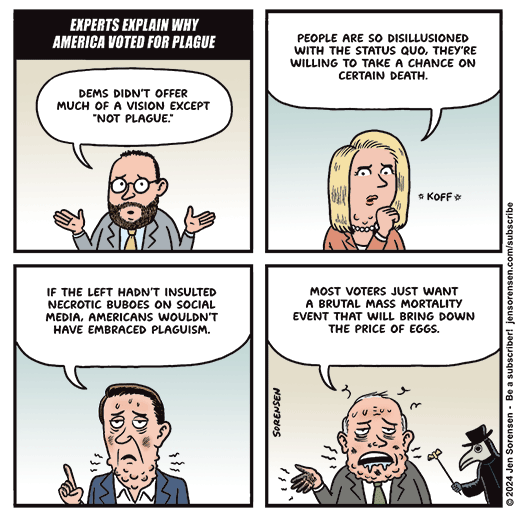

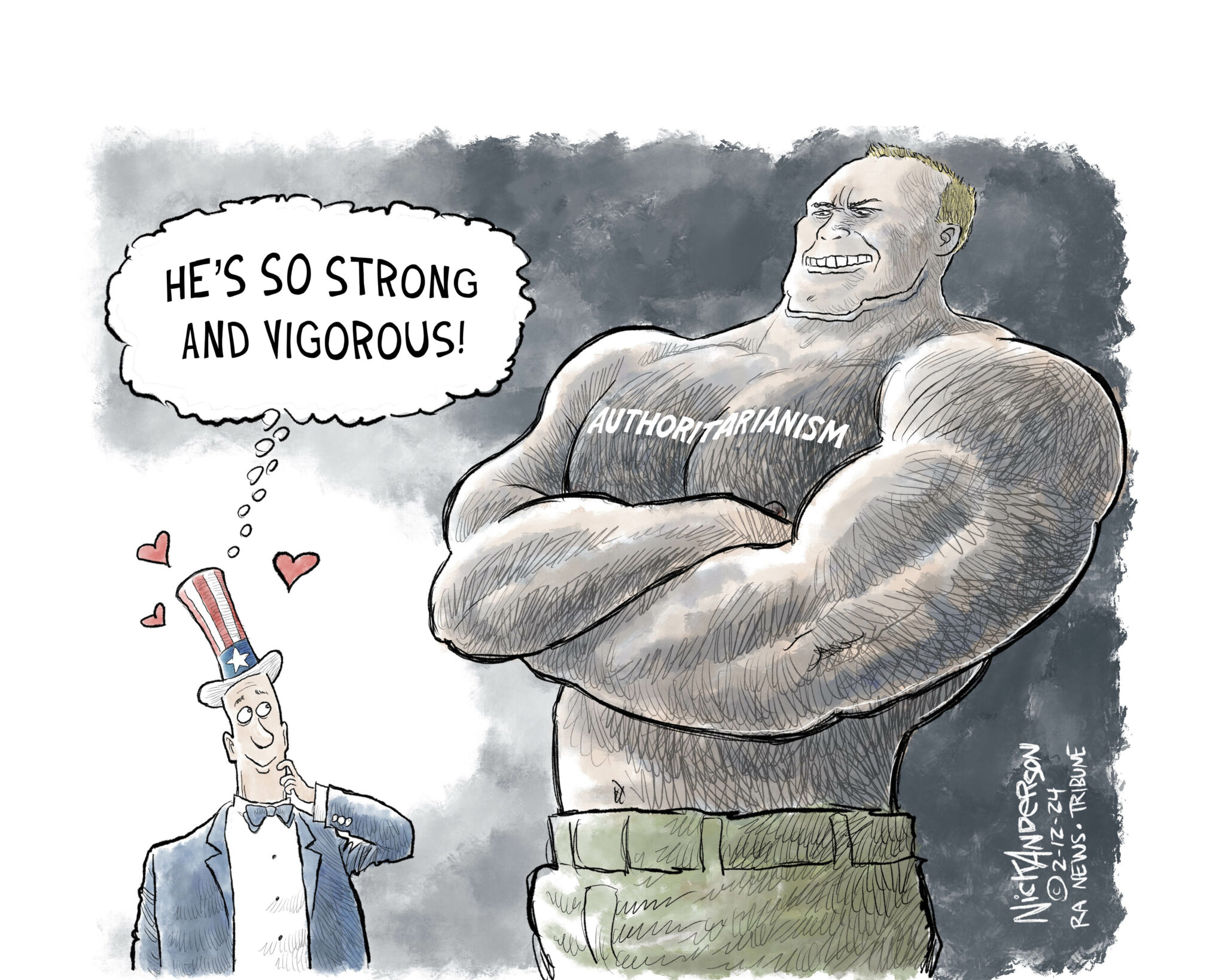


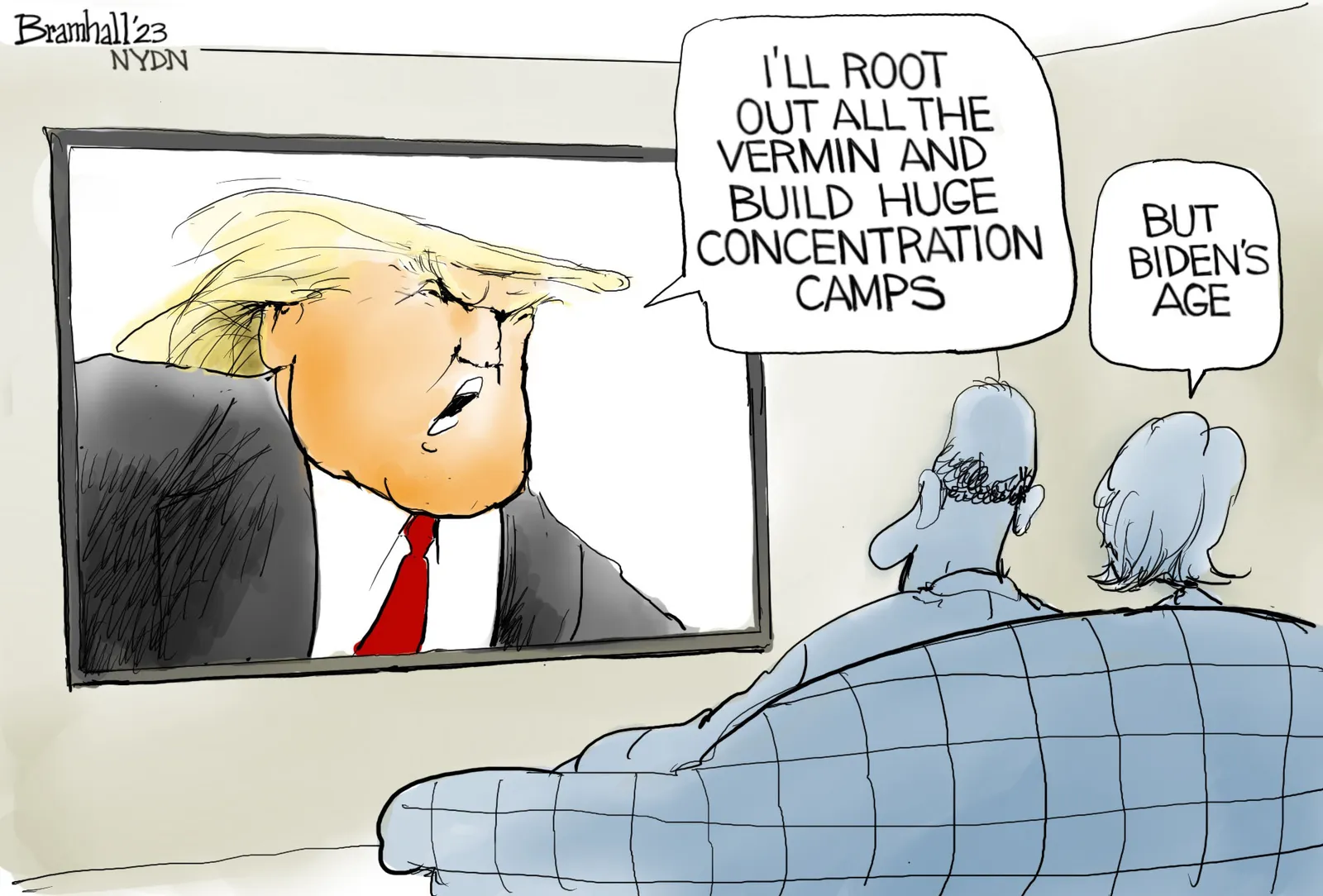

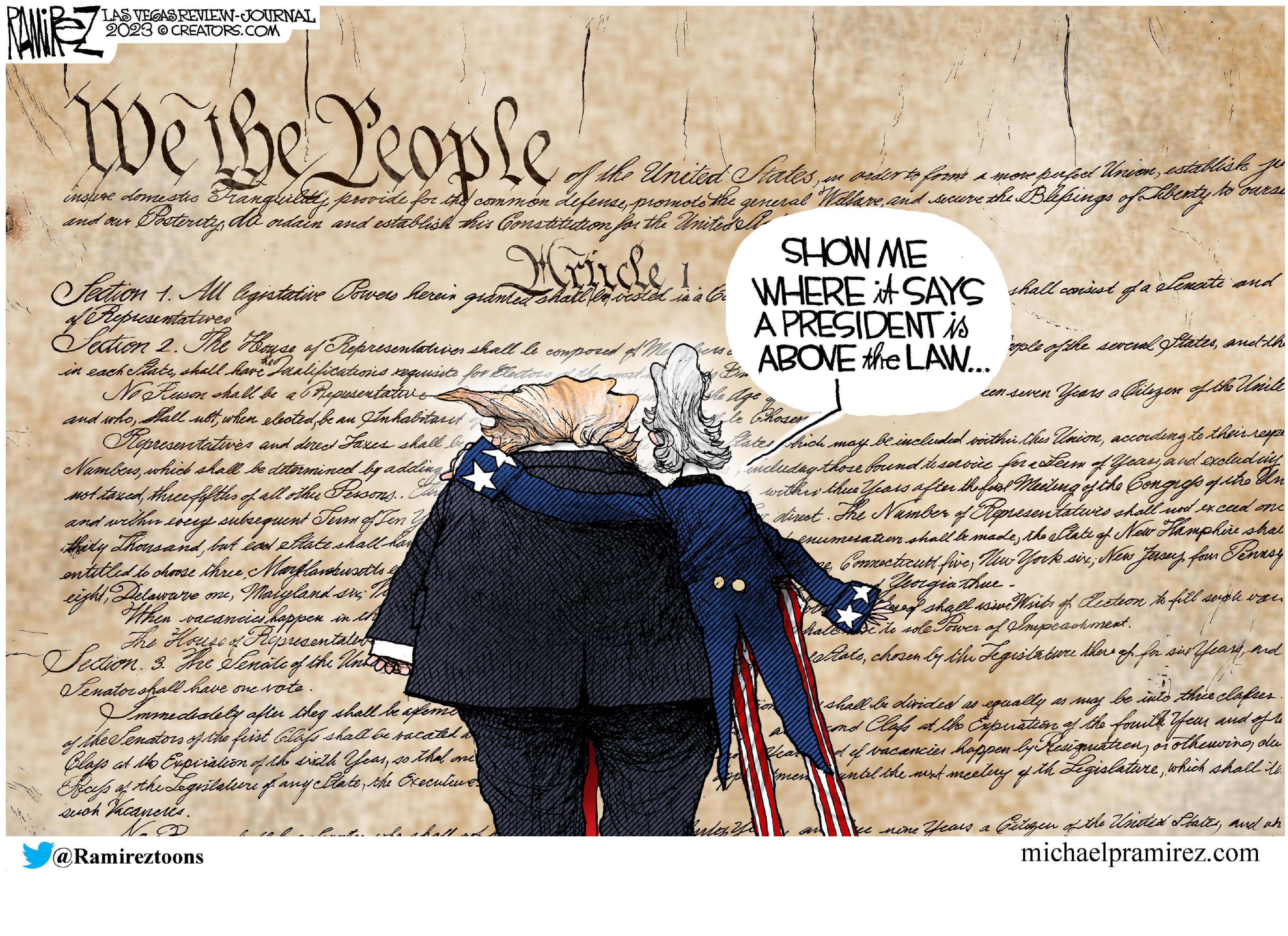
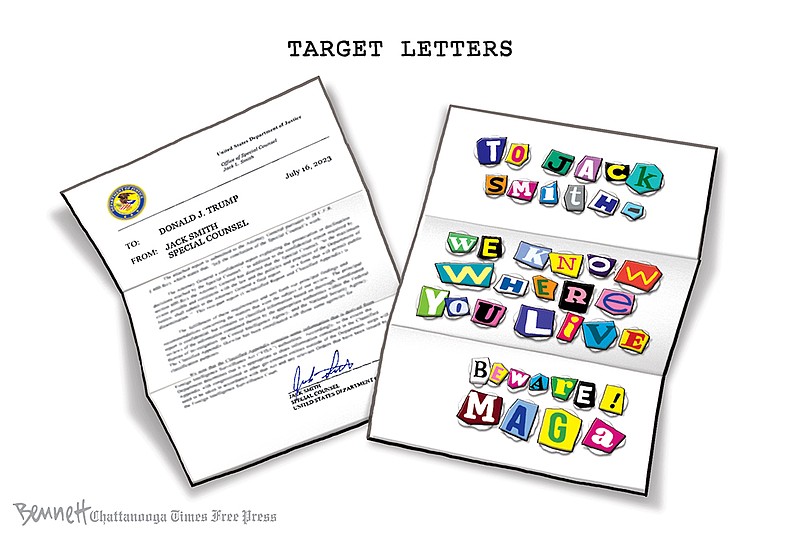


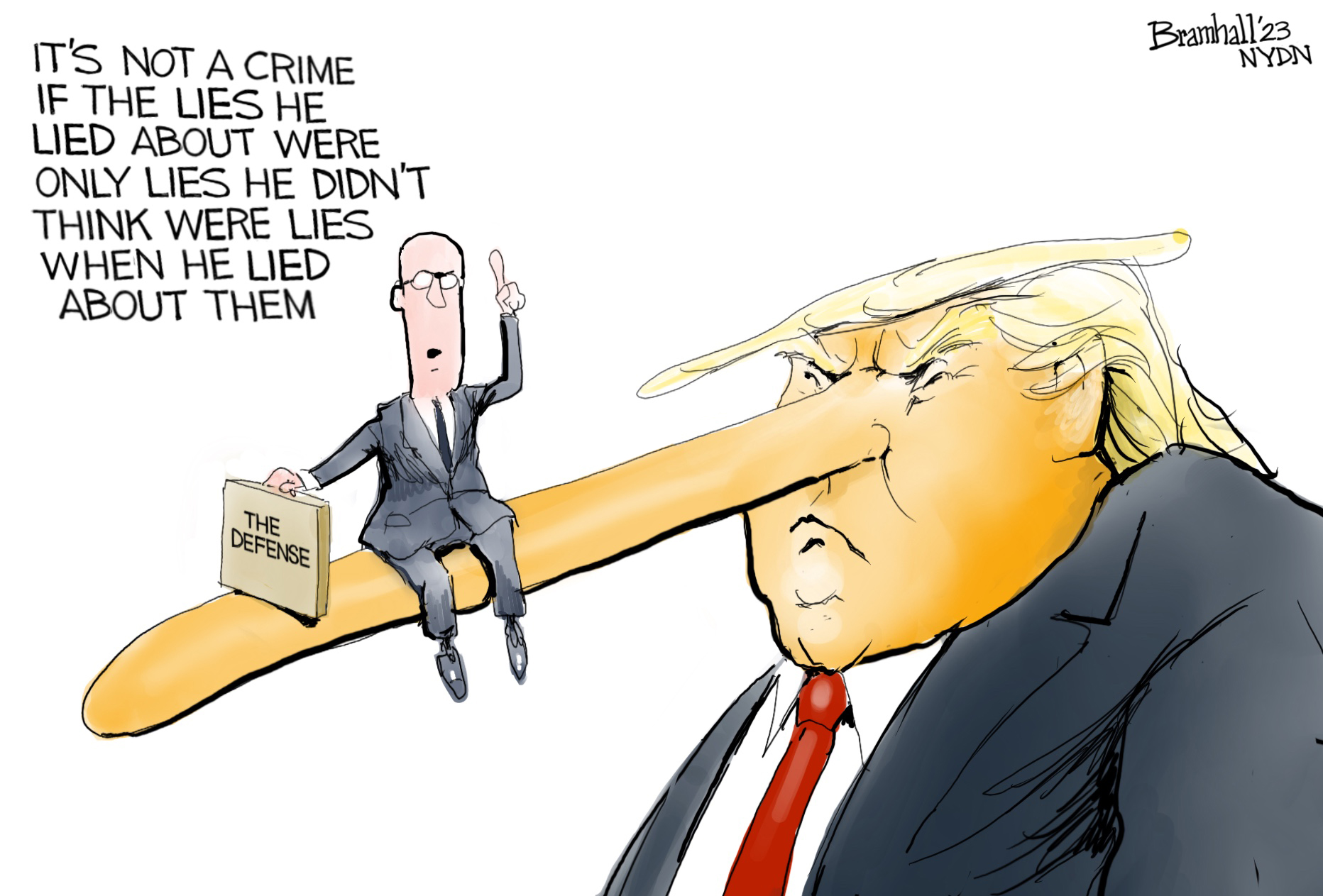
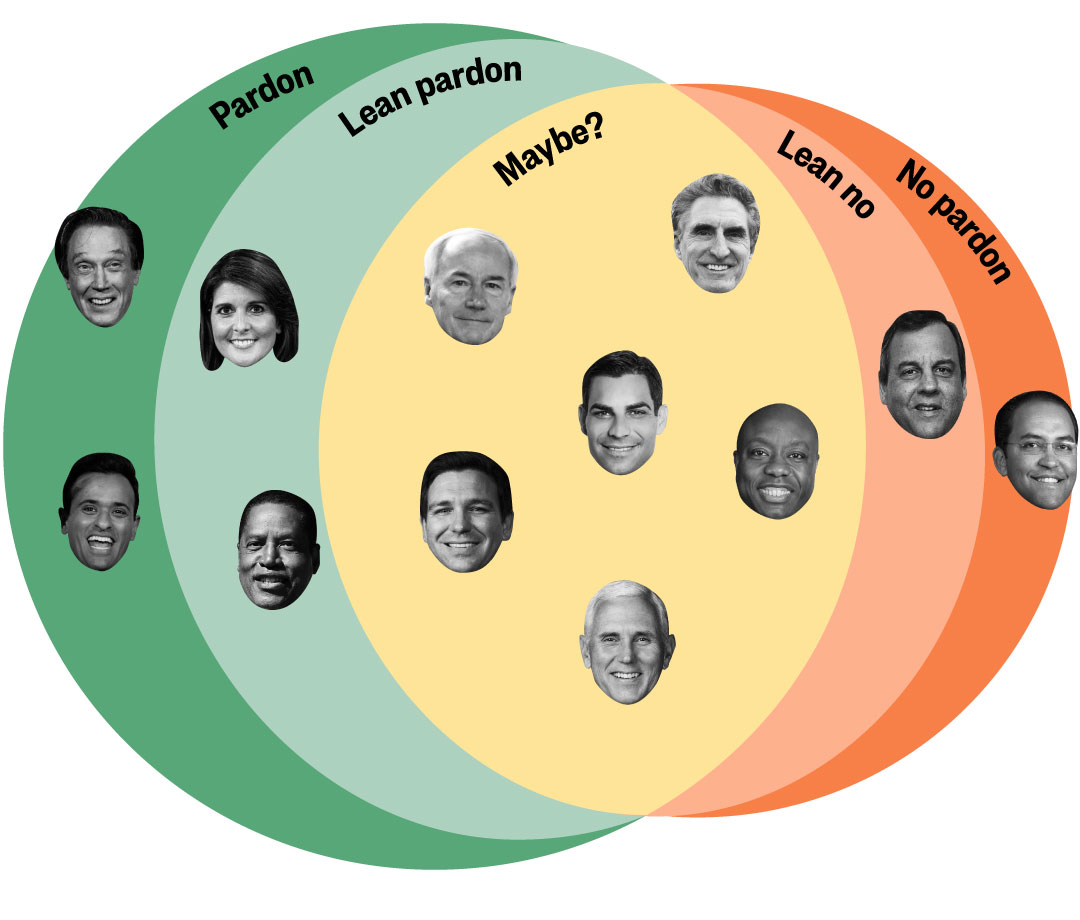
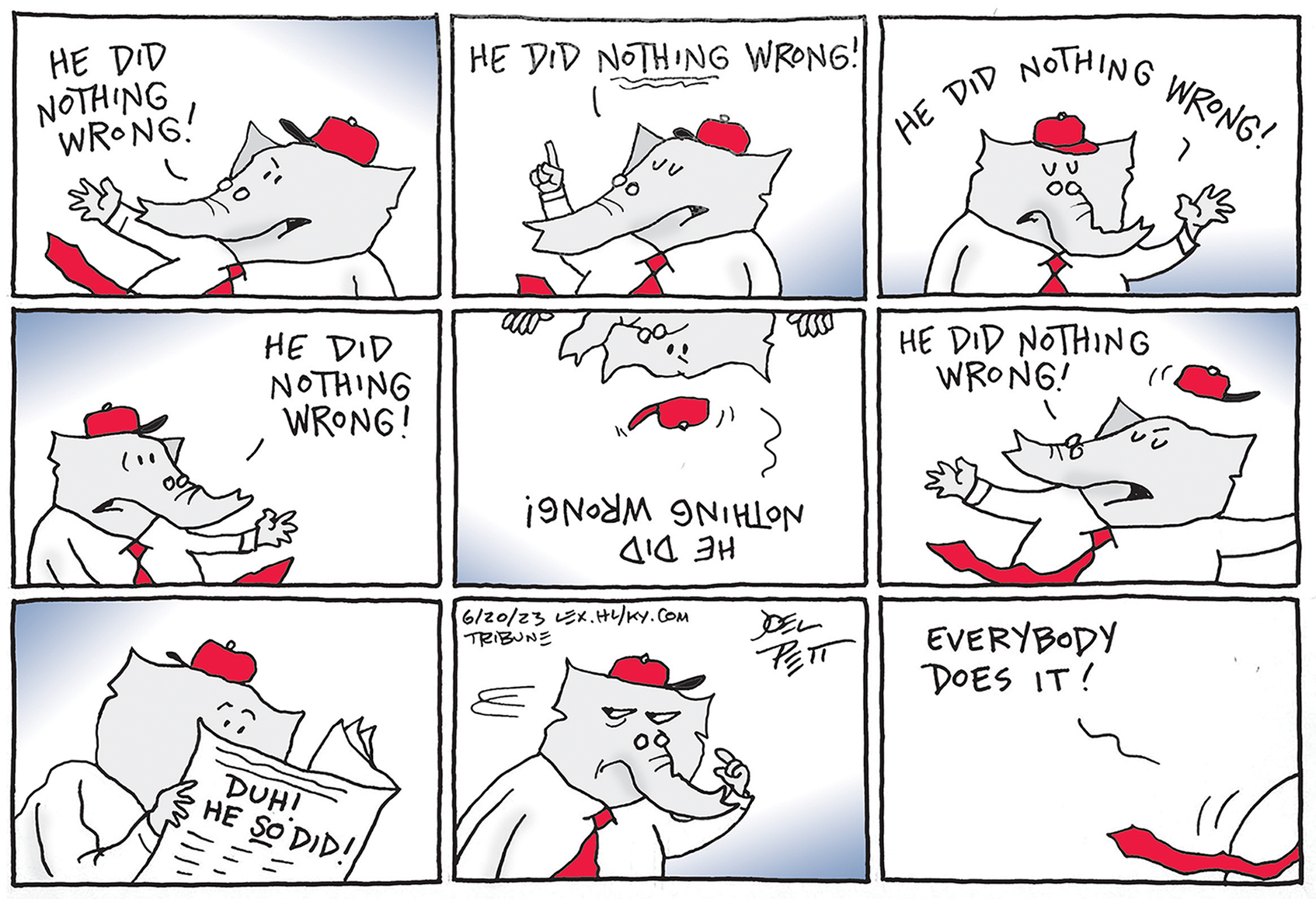
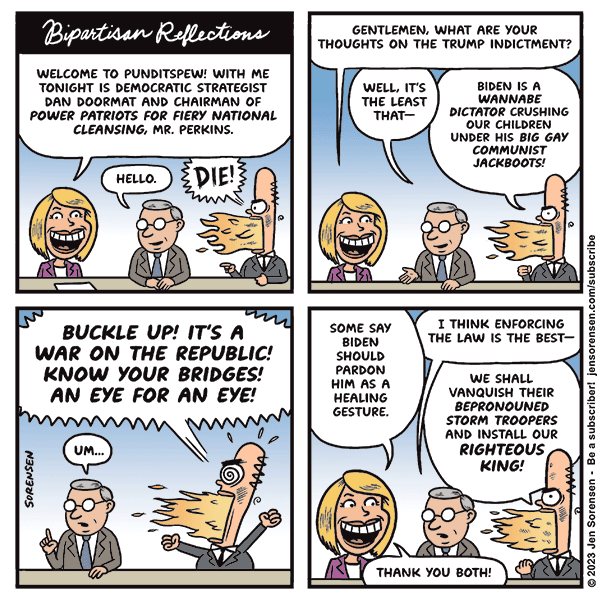
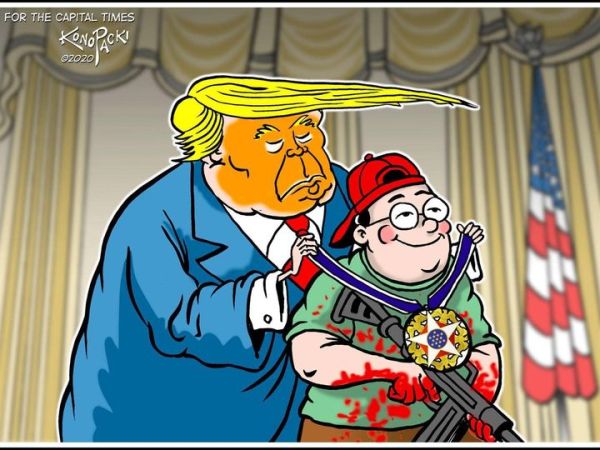
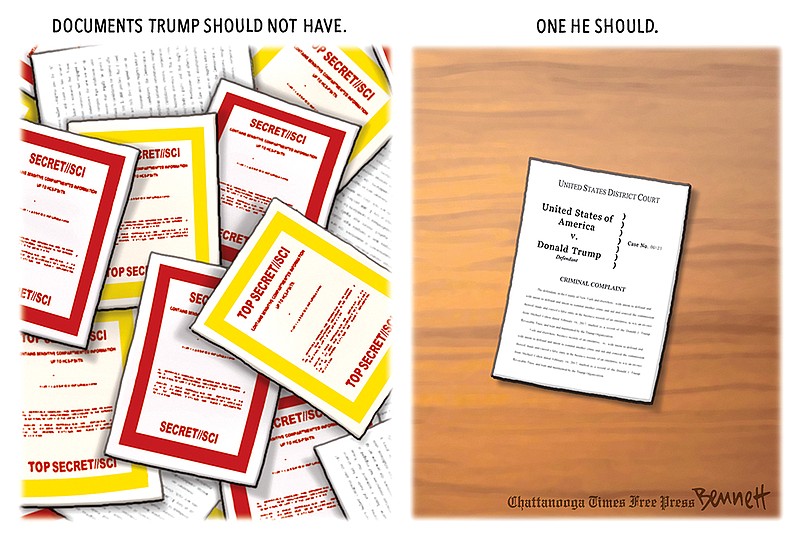
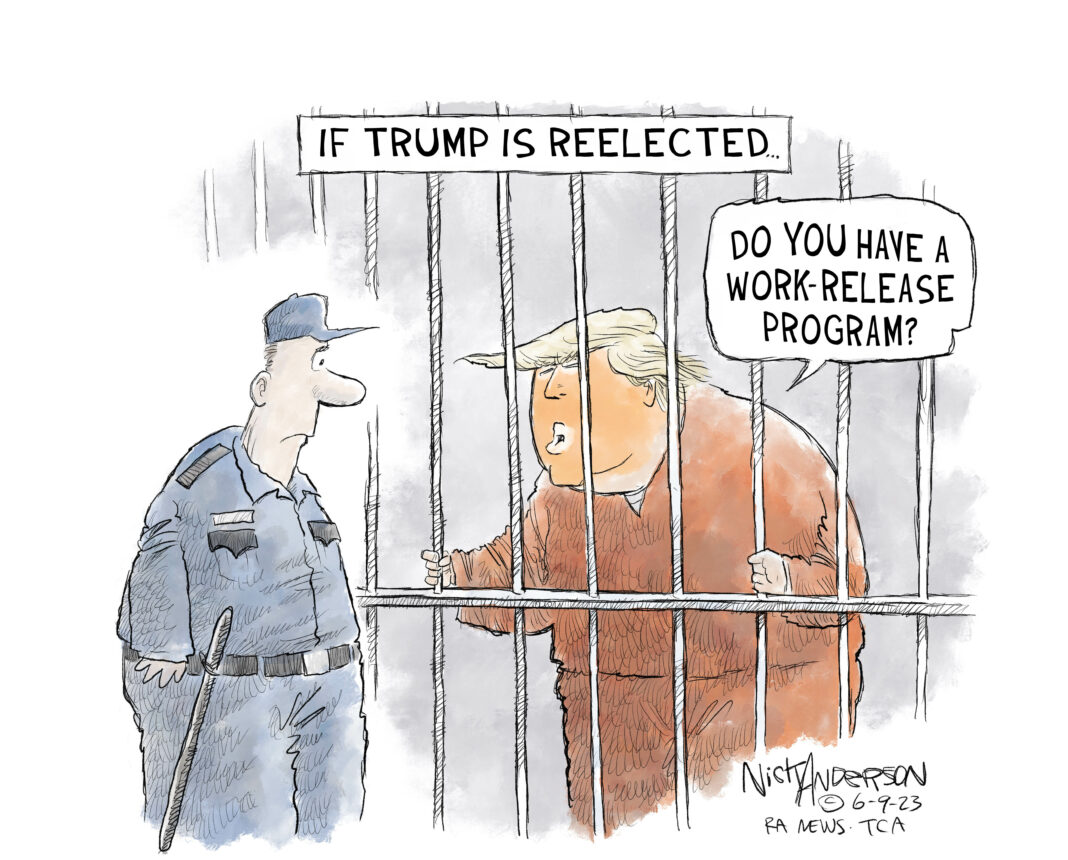


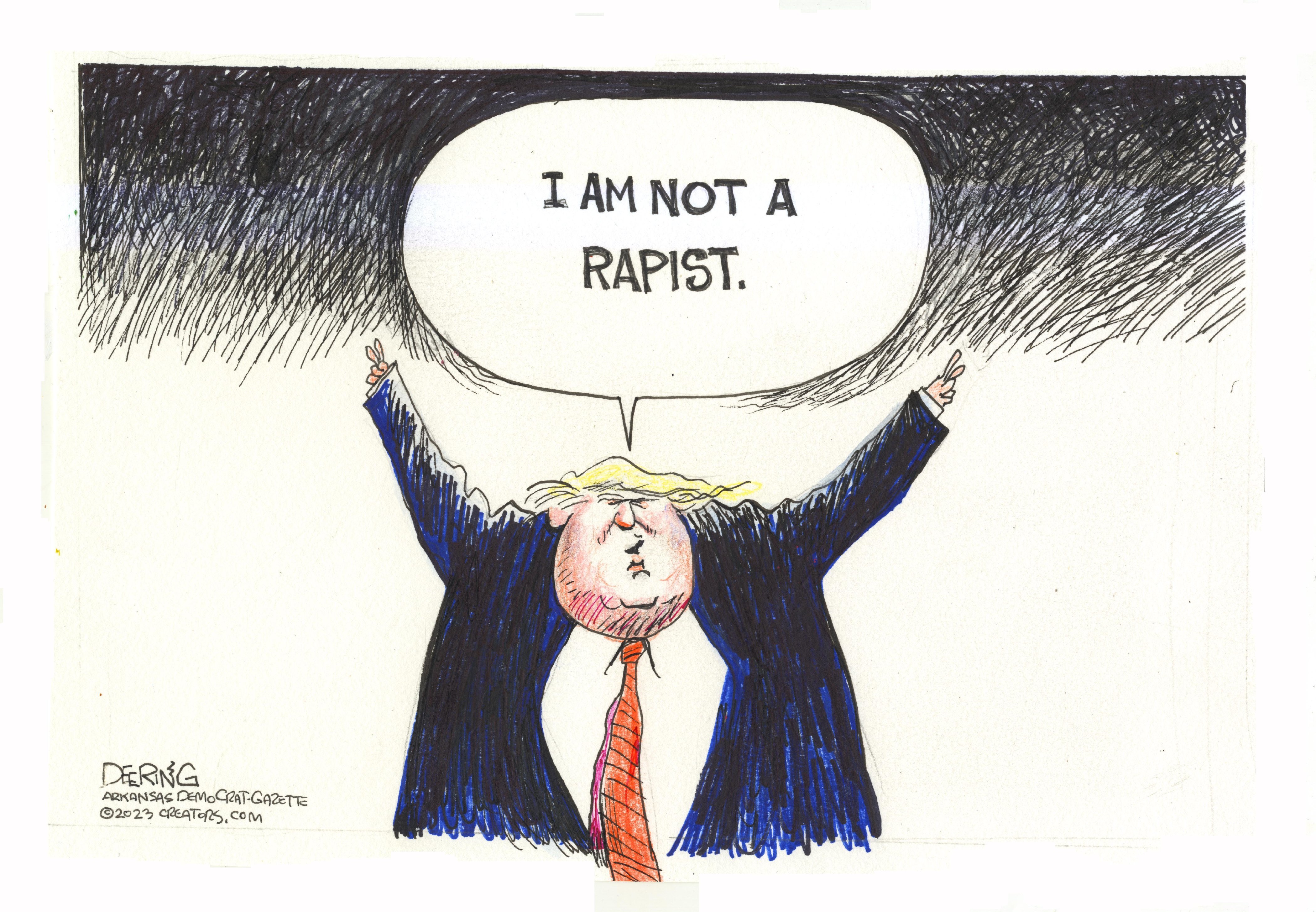
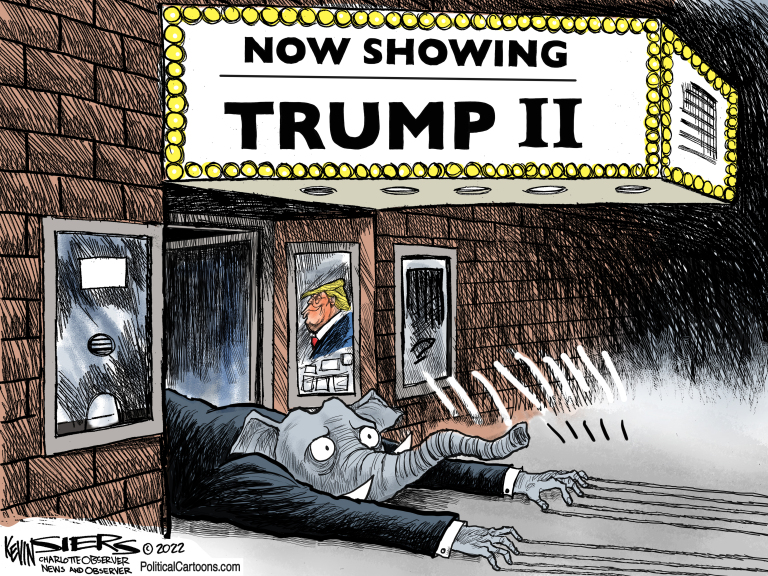


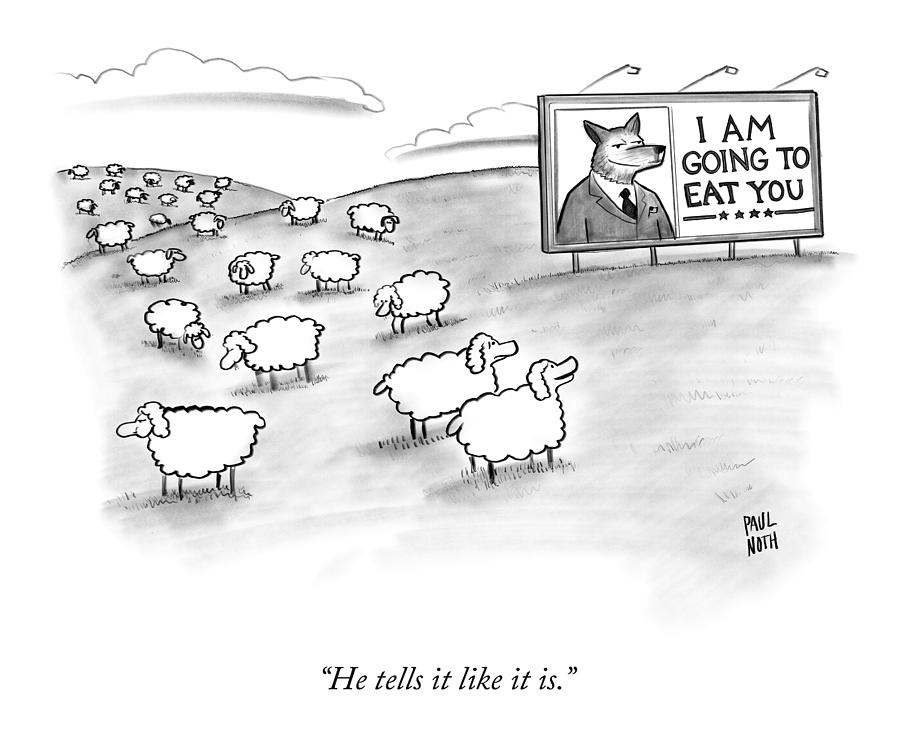
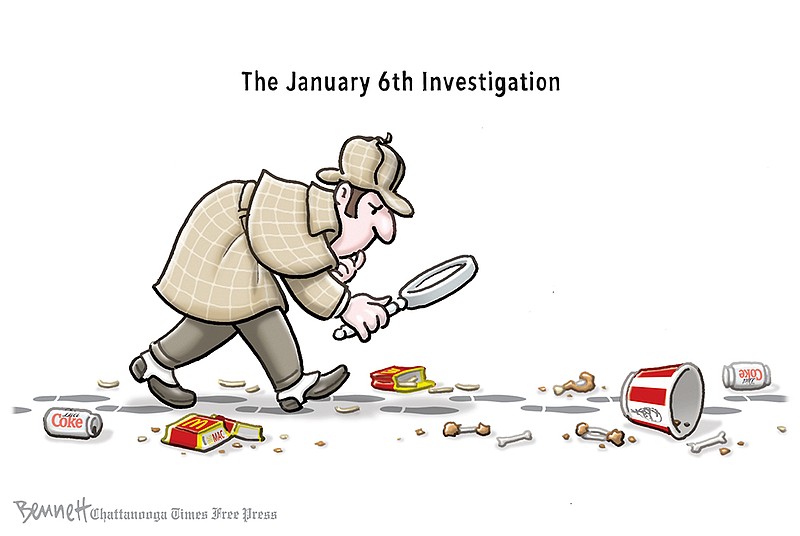
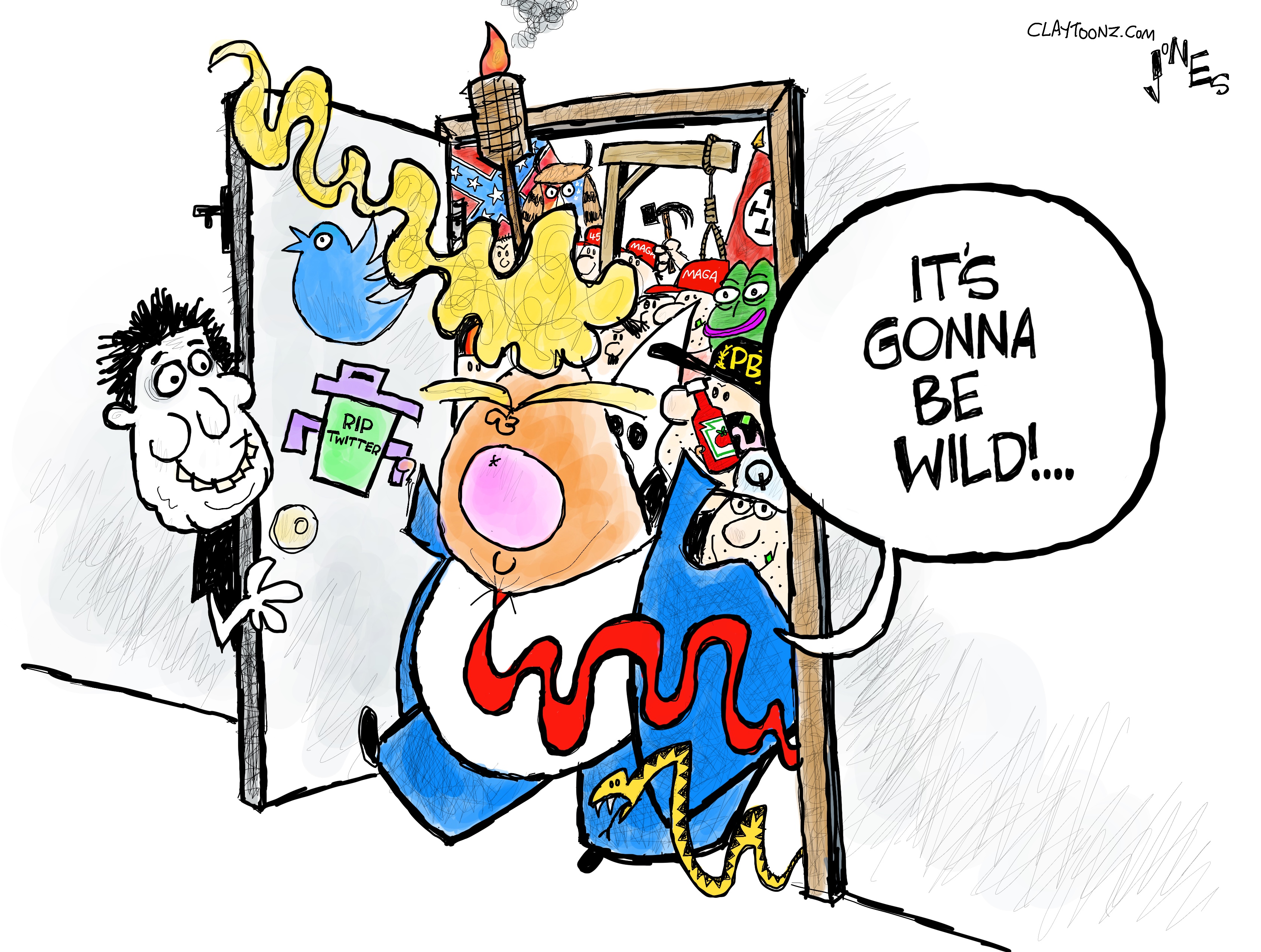


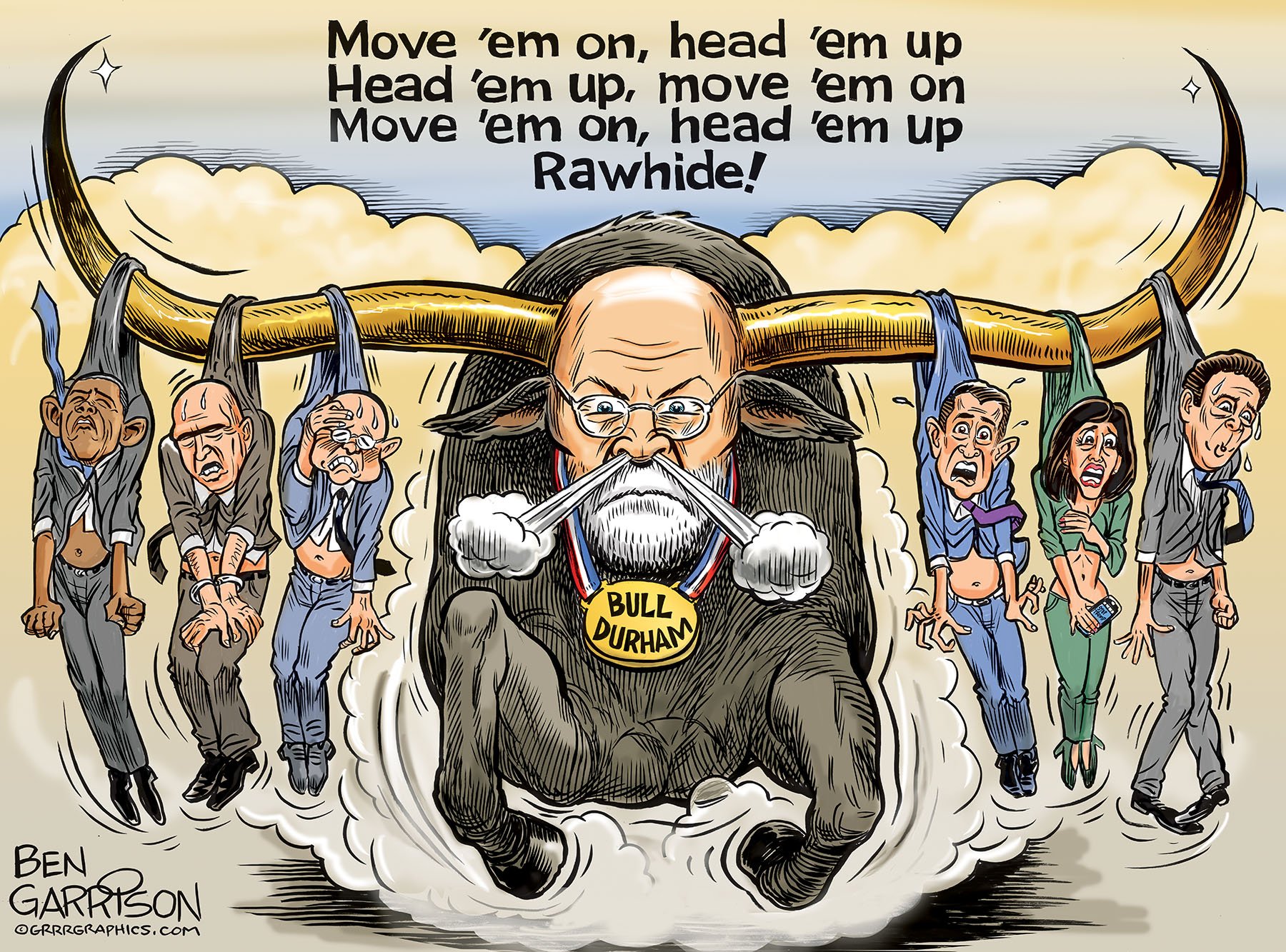
 The Weekly Sift