Tag Archives: Trump administration

Will the courts hold the line?

The Trump administration has suffered a series of defeats in court recently. Will that matter?


It’s been a bad week or two for Trump in court. Jay Kuo counts the ways:

After Kuo’s post, Trump suffered another loss in court:

A federal judge on Wednesday ruled Donald Trump’s administration unlawfully terminated about $2.2bn in grants awarded to Harvard University and can no longer cut off research funding to the Ivy League school.

The judges in these cases have been sending a clear message: The law still counts for something, and it doesn’t change just because Trump says so.

But for that message to stick, two things have to happen: The Supreme Court has to back up the lower-court decisions, and the Trump administration has to obey the court orders once they become final. Will those things happen? I’ve seen both optimistic and pessimistic views.

Kuo is the optimist.

There’s an understandable tendency to hear about a big court victory for the good guys but then cynically dismiss it, claiming either that the Supreme Court will overturn it, or that the Trump White House will simply ignore the courts’ orders.

I want to encourage readers to not fall into this trap. True, the Supreme Court has intervened in a few cases to lift a few injunctions imposed by lower courts, and that admittedly has been awful to see. But it hasn’t ruled substantively on much of anything yet. And that has allowed court victories by the good guys to produce some real progress.

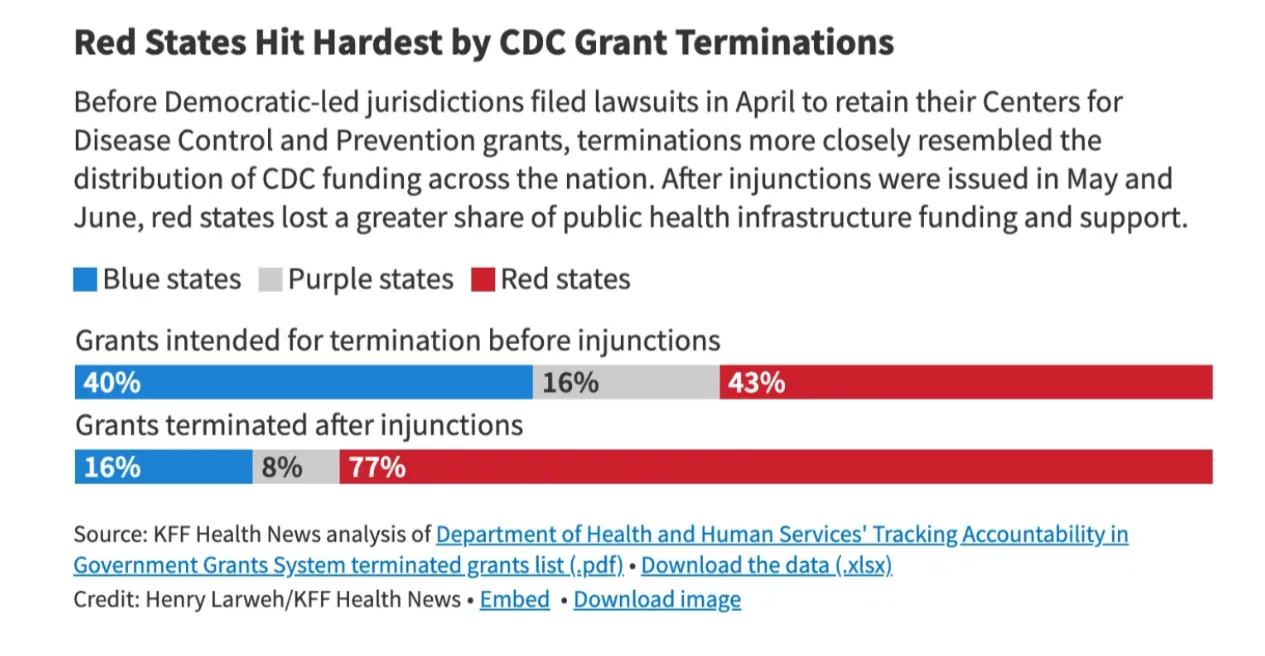
He points to blue-state attorneys general suing to claw back CDC grants the Trump administration had frozen. Red states, with their Trump-worshipping AGs, have taken the loss.

The Department of Justice wants the American public to assume that none of the orders granted by federal judges are being heeded. They want us to believe that they, and not the judiciary, are in control. But this is simply not the case.

Kuo points to the Guatemalan-children case, where (unlike in an earlier case with adults) planes in the air really did turn around, because “this time the government wasn’t up to playing more games with the courts”.

The pessimist side is represented by Vox’ Ian Milhiser, who summarizes “The overwhelming evidence that the Supreme Court is on Donald Trump’s team“.

The Court’s Republican majority now hands Trump several victories every month, only explaining themselves when they feel like it. When they do explain those decisions, they are often incomprehensible. The Republican justices exempt Trump from rules that apply to every other litigant, including the most recent Democratic president. Their decision permitting Trump to commit crimes doesn’t even attempt to argue that presidential immunity can be found in the Constitution — instead making a policy argument that Trump should not be chilled from taking “bold and unhesitating action” for fear of prosecution.

Nor is Trump the only litigant who receives this Court’s special treatment. The Republican justices favor religious conservatives so much that they will make up fake facts to bolster Christian conservative litigants. Meanwhile, they hate abortion providers so much that they once handed down an anti-abortion decision that, if taken seriously, would permit every state to neutralize any constitutional right.

If any other government official behaved this way, it would be obvious they were placing partisanship ahead of the law. It is no less obvious when these six specific government officials do so. The most reasonable explanation for the Republican justices’ behavior is that they are acting in bad faith.

It’s possible that even the most well-reasoned lower-court decisions against Trump will be reversed based on some gobbly-gook reasoning that we can expect to conveniently vanish should a Democrat ever again assume the presidency. That’s certainly what happened in the Trump immunity ruling.

But it’s worth noting that although the Court has thrown procedural hurdles in the way of those who would stop Trump’s lawlessness, and has sometimes reversed injunctions without much explanation, so far it has given Trump very few outright victories on the underlying merits of the cases. Birthright citizenship, for example, still stands.

The people caught in the middle are the lower-court judges themselves, ten of whom took the unusual step of talking anonymously to NBC News. Their problem is simple: When you do your best to apply the law as it was written and has always been interpreted, and then the Supreme Court reverses your decision in a shadow-docket ruling with little or no explanation, what do you do with the next case? You can’t apply the Court’s new reasoning, because that reasoning was never published.

In late July, the Constitution Daily Blog listed five Trump executive orders that are likely to hit the Supreme Court soon:

  • reversing birthright citizenship.
  • invoking the Alien Enemies Act to deport immigrants
  • using emergency powers to impose tariffs
  • firing heads of agencies protected by Congress
  • banning transgender people from serving in the military

I could imagine (but not agree with) the Court siding with Trump on the last two. But if any of the first three get the Court’s blessing, something is seriously wrong.

The Democrats’ Shutdown Strategy

The government runs out of money again on October 1. That gives the Democratic minorities in Congress some rare leverage. What should they do with it?


The 2026 fiscal year starts in less than a month, and nobody yet knows what the FY2026 federal budget will have in it.

In the House, Republicans currently hold a 219-212 majority, so they can pass whatever budget they want if they have fewer than four defectors. In the Senate they have a 53-47 majority, but they need 60 votes to overcome a filibuster. So Democrats have leverage in the House only if the Republicans can’t stay unified, but Republicans need seven Democratic votes in the Senate unless they’re willing to nuke the filibuster. (Don’t count that out. Trump will almost certainly ask for it before conceding anything he cares about.)

This raises two questions: Are Democrats willing to shut down the government if Republicans don’t negotiate with them in good faith? And if they are willing to take such a stand, what concessions should they ask for?

Ezra Klein discussed the first question in yesterday’s NYT. He notes that Democrats faced a similar decision in March when the previous continuing resolution ran out. Hakeem Jeffries in the House wanted to go for a shutdown, but Chuck Schumer in the Senate didn’t. Schumer won out, and Democrats got nothing for their cooperation.

This looked really bad at the time, and demoralized Democrats around the country. But Klein notes that in the moment it actually was a close call. Schumer argued:

  • The courts were already reining in Trump’s excesses.
  • Markets were reeling from Trump’s tariff announcements; a shutdown would just give him a chance to blame Democrats for the economic chaos.
  • A shutdown would help DOGE eliminate government jobs and departments.

In addition, Klein notes that the Democrats weren’t ready for that battle. They hadn’t agreed on a message worth shutting down the government for.

But now, he claims, none of those arguments hold. The Supreme Court hasn’t held the line, markets have stabilized without a tariff-fueled economic catastrophe, and Elon Musk is gone.

Even more, Trump’s autocratic project is up and running now.

I want to be very clear about what I am saying here. Donald Trump is corrupting the government — he is using it to hound his enemies, to line his pockets and to entrench his own power. He is corrupting it the way the Mafia would corrupt the industries it controlled. You could still, under Mafia rule, get the trash picked up or buy construction materials. But the point of those industries had become the preservation and expansion of the Mafia’s power and wealth. This is what Trump is doing to the government. This is what Democrats cannot fund. This is what they have to try to stop.

… The case for a shutdown is this: A shutdown is an attentional event. It’s an effort to turn the diffuse crisis of Trump’s corrupting of the government into an acute crisis that the media, that the public, will actually pay attention to.

So when they get public attention, what exactly should Democrats demand? Jen Rubin makes these five suggestions:

  • Defend Congress’ power of the purse by undoing FY2025’s rescissions.
  • Reverse the Medicaid cuts that take effect after the 2026 elections.
  • Restrictions on DHS’ most outrageous practices: No rendition to third countries. No masks. Reports on how many people without criminal records are being rounded up.
  • New sanctions to pressure Russia into peace talks.
  • Ban stock trading for members of Congress, as well as the president and vice president.

The key test for demands is that Republicans should sound ridiculous defending what the Democrats want to put a stop to. (This is a lesson taught by the Epstein files.) Do Republicans want to shut the government down to defend Trump’s right to trade stocks? They should go right ahead.

If I had to sum up in one word the reason Democrats should give for their stand, it would be “corruption”. I think both Rubin and Klein would agree with that, and it’s also in line with what the Epstein phenomenon should be teaching Democrats.


BTW: A simple case in point about how Trump is using his power to gain wealth:

President Donald Trump said Friday that the U.S. will host next year’s Group of 20 summit at his golf club in Doral, Florida, arguing it was “the best location” for the high-stakes international gathering but insisting his family’s business “will not make any money on it.”

Of course it won’t. Trump would never lie about something like that, and no doubt his independent Justice Department would watch like a hawk to make sure nothing corrupt happened.

Lysenkoism Comes to America

As RFK Jr. purges the CDC and cancels billions in research grants, Americans need a refresher course on what happened to Soviet biological research during the Stalin years.


In many ways, Trofim Lysenko was just the man Stalin had been looking for. He grew up in the peasantry rather than the elitist intelligentsia. He promised new techniques for growing crops that might solve the Soviet Union’s difficulty producing food in the same quantities the Czars had. And he represented a rebellion against Mendelian genetics, whose vision of evolution relied more on the individual’s struggle for survival than on the collective class struggle more in line with Marxist ideology.

From our 21st century point of view, as well as from the perspective of 20th-century geneticists, Lysenko was a crank. He espoused “vernalization”, a process by which winter wheat could be converted to spring wheat and then pass its new abilities on to its descendants. Following LeMarck rather than Mendel, he believed that acquired characteristics could be inherited — a possibility that appealed to a regime dedicated to producing the “new Soviet man”.

Wikipedia explains:

Lysenko’s political success was mostly due to his appeal to the Communist Party and Soviet ideology. His attack on the “bourgeois pseudoscience” of modern genetics and the proposal that plants can rapidly adjust to a changed environment suited the ideological battle in both agriculture and Soviet society. Following the disastrous collectivization efforts of the late 1920s, Lysenko’s new methods were seen by Soviet officials as paving the way to an “agricultural revolution.” Lysenko himself was from a peasant family and was an enthusiastic advocate of Leninism. The Party-controlled newspapers applauded Lysenko’s practical “success” and questioned the motives of his critics, ridiculing the timidity of academics who urged the patient, impartial observation required for science. Lysenko was admitted into the hierarchy of the Communist Party, and was put in charge of agricultural affairs.

He used his position to denounce biologists as “fly-lovers and people haters”, and to decry traditional biologists as “wreckers” working to sabotage the Soviet economy. He denied the distinction between theoretical and applied biology, and rejected general methods such as control groups and statistics:

“We biologists do not take the slightest interest in mathematical calculations, which confirm the useless statistical formulae of the Mendelists … We do not want to submit to blind chance … We maintain that biological regularities do not resemble mathematical laws.”

By 1940, Lysenko had become the director of the Institute of Genetics of the Soviet Academy of Sciences. Those who opposed him or criticized his theories did not fare well.

From 1934 to 1940, under Lysenko’s admonitions and with Stalin’s approval, many geneticists were executed (including Izrail Agol, Solomon Levit, Grigorii Levitskii, Georgii Karpechenko and Georgii Nadson) or sent to labor camps. The famous Soviet geneticist and president of the Agriculture Academy, Nikolai Vavilov, was arrested in 1940 and died in prison in 1943. In 1936, the American geneticist Hermann Joseph Muller, who had moved to the Leningrad Institute of Genetics with his Drosophila fruit flies, was criticized as bourgeois, capitalist, imperialist, and a promoter of fascism, and he returned to America via Republican Spain. Iosif Rapoport, who worked on mutagens, refused to publicly repudiate chromosome theory of heredity, and suffered several years as a geological lab assistant. Dmitry Sabinin’s book on plant physiology was abruptly withdrawn from publication in 1948. He died by suicide in 1951.

His hold on power began to waver after Stalin’s death in 1953, but he remained influential far into the Krushchev years. The results were predictable:

Lysenko’s ideas and practices contributed to the famines that killed millions of Soviet people; the adoption of his methods from 1958 in the People’s Republic of China had similarly calamitous results, contributing to the Great Chinese Famine of 1959 to 1961.

Historians regard the Lysenko Era as a prime example of what can happen when ideology triumphs over science. During the same period, Soviet rocket scientists led the world in space exploration, and Soviet nuclear physicists nearly caught up with the far-better-funded Americans. But Soviet biology and agronomy could not free themselves from the ideological mud.

RFK Jr. Today, we are seeing history beginning repeat itself, with RFK Jr. as the new Lysenko. Like Lysenko, he has gained the backing of an autocratic regime; criticizing RFK Jr. or his Make America Healthy Again (MAHA) movement marks someone as anti-MAGA, exposing them to the retribution of the US government. At the moment, that just means firing from government jobs or the cancellation of research grants; it doesn’t yet send you to a labor camp. But the regime is young.

Unlike Lysenko, RFK Jr. is a child of wealth and privilege; he undoubtedly would not be where he is if his name were Smith. But he has tapped into a similar anger against elites and a distrust of expertise. He favors explanations that are sweeping and easily explained, while distrusting results that depend on careful procedures and statistical analysis.

Research. Also like Lysenko, Kennedy is a crank. His anti-vaccine ideas (which are his most prominent, but not his only departure from scientific orthodoxy) are fixed, baseless, and impervious to data. Control groups and statistics may “confirm the useless statistical formulae” of MRNA vaccines, or refute Kennedy’s hobby-horse belief that vaccines cause autism, but no matter. Henceforth, the US government will not fund MRNA research, and a report claiming that autism is caused by vaccines or other environmental factors should be out this month:

We will have announcements as promised in September, finding interventions, certain interventions, now that are clearly almost certainly causing autism. And we’re going to be able to address those in September.

Kennedy has long claimed that environmental factors like vaccines, toxins, or food additives are likely culprits behind the rising rate of autism diagnoses, arguing research to back this up has been blocked by federal authorities. In fact, research on the environmental factors related to autism had been proceeding for years at the National Institute for Occupational Safety and Health. Kennedy cancelled its funding, along with more than 50 other autism-related studies.

What is wrong with that research? It keeps coming to inconvenient conclusions. Autism, it seems, is a more complicated problem than Kennedy wants to acknowledge.

Genetic factors account for a significant portion of autism cases. Research like the kind McCanlies and other government-funded scientists have conducted over the past two decades has established that environmental factors have a role, too, and can combine with genetics. Multiple factors can even converge within the same individual. Some of those environmental risks could be reduced by the very measures the Trump administration is rolling back.

But “genetic factors” are anti-MAHA, just as they were anti-Soviet. All our ills must be traceable to human deeds in the food industry, Big Pharma, or our own lifestyle choices.

Ideology over science. This week, the Center for Disease Control was decapitated: RFK fired Director Susan Monarez, a Senate-confirmed Trump appointment who had only served for three weeks. Her attorneys said that she had “refused to rubber-stamp unscientific, reckless directives and fire dedicated health experts.”

Presumably, this referred to new recommendations on who should get Covid vaccines, and possibly other pending announcements from the CDC’s Advisory Committee on Immunization Practices. Kennedy dismissed all 17 members of the ACIP in June, and replaced them largely with unqualified people more in line with his views. (The resignation letter of Immunization and Respiratory Diseases head Demetre Daskalakis described them as “people of dubious intent and more dubious scientific rigor”.) Similarly, Monarez’ interim replacement is Jim O’Neill, who is neither a doctor nor a scientist, but

was an early supporter of Kennedy’s Make America Healthy Again movement and a vocal critic on social media of the CDC’s role during the pandemic.

The double-tap of firing Monarez and backing new vaccine recommendations motivated more by ideology than science led to the resignations of three other top CDC officials: Chief Medical Officer Deb Houry, Daskalakis, and Dan Jernigan, who led the National Center for Emerging and Zoonotic Infectious Disease.

A key issue for Houry, Daskalakis and Jernigan are the actions Kennedy has taken that align with the views of anti-science activists. Houry told NPR that ethically they couldn’t abide the direction the agency is taking, and she said they wanted to time their departures for impact after the news broke that Monarez was being fired.

Daskalakis’ resignation letter went into detail:

I am unable to serve in an environment that treats CDC as a tool to generate policies and materials that do not reflect scientific reality and are designed to hurt rather than to improve the public’s health. … The data analyses that supported this decision have never been shared with CDC despite my respectful requests to HHS and other leadership.  This lack of meaningful engagement was further compounded by a “frequently asked questions” document written to support the Secretary’s directive that was circulated by HHS without input from CDC subject matter experts and that cited studies that did not support the conclusions that were attributed to these authors. … We are seven months into the new administration, and no CDC subject matter expert from my Center has ever briefed the Secretary.  I am not sure who the Secretary is listening to, but it is quite certainly not to us.  Unvetted and conflicted outside organizations seem to be the sources HHS use over the gold standard science of CDC and other reputable sources.

Thursday, CDC employees staged a brief walkout to protest the agency’s turn away from science, and to support Monarez and the resigning officials.

The medical community is beginning to adjust to a CDC that can no longer be trusted. For example, numerous non-government medical groups are preparing their own vaccine advice.

Political Pandering. Kennedy owes his position to Donald Trump, so MAHA will always serve MAGA. Trump’s EPA has been working entirely counter to Kennedy’s long-espoused views, but he has had nothing to say about that.

The Environmental Protection Agency, under Administrator Lee Zeldin, is rolling back rules and regulations that will result in an increase in air pollution, which multiple studies have linked to autism. The agency is in the process of reversing bans on several chemicals, including TCE, one of the solvents associated with the disorder, and has told a federal court it won’t legally defend certain aspects of a ban on methylene chloride, another of the solvents linked to autism. It also began dismantling its Office of Research and Development, which has funded research into the environmental conditions contributing to autism.

It is hard to escape the conclusion that RFK Jr. does not actually care about the things he says he cares about, but simply wants the spotlight and a position of power.

He has also gone along with the Trump administration’s anti-DEI mandates, which have been interpreted to blackball research into the ways that women’s health is different from men’s, or racial factors that affect illness. Both are legitimate areas of research, but can’t be discussed in the current political environment.

This is where we find ourselves: with current public health practices and future medical research controlled by one man who is as opinionated as he is ignorant: the American Lysenko.

An Authoritarian Economy is a Bad Economy

Some Democrats want the party’s message to center on preserving democracy. Others say no, we should run against the Trump economy. What if we could do both at the same time?


When I talk to liberal activists, the issue that most scares them is Trump’s assault on democracy: denial of due process, flouting of court orders, siccing the Justice Department on his personal or political enemies, misusing the military by marching troops into Democratic cities like Los Angeles, usurping Congress’ power of the purse, sending masked thugs out to racially profile the population and whisk people off into what we might as well call concentration camps, extorting personal payments out of businesses by threatening them with government power, trying to keep power (even if the voters disapprove) by gerrymandering Congress, and so on.

But I also often hear another point of view: Maybe we ourselves care about democracy, but democracy issues are too abstract to run on in the 2026 midterms. At any given moment, most Americans aren’t using their due-process rights, and aren’t counting on court orders to protect them. If troops are turned loose on some far-off city they never visit, or if some politicians play an unfair game against other politicians, what’s it to them? Instead, Democrats should run on “kitchen table issues” that hit people in the pocketbook.

Right now what they’re feeling is the everyday things that are affecting them: the cost of groceries, gas prices, paying for rent. That is the number one issue; we need to be focused on that.

More and more, though, I’m becoming convinced that Democracy-or-Economy is a false choice, for a simple reason: An authoritarian economy is a bad economy.

Think about the countries that are further down the authoritarian road than we are, the ones often described as Trump’s models: Putin’s Russia, Orbán’s Hungary, Erdoğan’s Turkey, and so on. None of them are places you’d want to go to start a business or begin your career. Before long, Trump’s America won’t be such a place either.

Let’s think about why that is.

No checks and balances. We often talk about checks and balances as a procedural virtue, the kind of thing good-government types get excited about for reasons no one else understands. At times Americans even lament about all the checks and balances, because they make it hard to get things done.

But if we think about this purely economically, checks and balances serve a very practical purpose: error correction. When a leader gets a really bad idea in his head and begins to implement it, people who occupy other positions of power in the government can make him change course before things go too far. As the implications of the bad idea start showing up in the economy, the people who are suffering can appeal to other centers of power for relief.

In an autocratic system, on the other hand, no one can tell the autocrat he’s wrong. Policies that almost everyone else knows are destructive can nonetheless proceed all the way to disaster. Take Turkey for example:

A principal factor in Turkey’s poor economic performance over the past decade was President Erdogan’s misguided belief that interest rates were the cause of rather than the cure for inflation. This induced him to lean heavily on the Central Bank of Turkey to cut interest rates even at a time when inflation was rising. He did so by firing a succession of central bank presidents and by appointing a central bank board that totally complied with his desire for low interest rates.

It was only when inflation soared to 85 percent and when the Turkish lira was in free fall that Erdogan was forced to make an abrupt monetary policy U-turn.

Similarly, Putin’s war against Ukraine (whatever you think of it morally or even militarily) has done enormous damage to Russia’s economy. Mere weeks into the war, it became clear that expectations of a quick and easy victory had been delusional. At that point, Russia would have been much better off if someone else in the government — a leader in the parliament, perhaps — had been able to go to Putin and say, “This isn’t working. You’re going to have to figure a way to change course.”

Anyone who tried that, though, faced a serious risk of being dropped out of a high window. So more than three years later, a war that nearly everyone knows is a bad idea churns on.

We’re seeing something similar happen now with Trump’s tariffs. They’re doing precisely what nearly all economists said they would do: raise prices and slow growth. Pointedly, they’re not doing what Trump said they would do: bring manufacturing jobs back to the US. In fact, while manufacturing employment in the US surged during Biden’s administration, it has fallen during Trump’s.

Not only are the Trump tariffs a bad idea in general, they’ve been implemented in the worst possible way: erratically. Tariffs work by changing the market’s expectations. The only way a tariff might convince a company to go through a years-long process to move a factory to the US is if the company is convinced the tariff will still be there when the new factory opens. But when tariff rates seem to depend on what Trump had for breakfast, who knows what to expect two or three years from now?

As with Erdoğan and Putin, though, no one can tell Trump this simple fact. He has filled his administration with yes-men, and Republicans in Congress are afraid to challenge him. No independent agency or rival branch of government can stand in his way. And so we charge forward towards an economic disaster.

No single person is always right. So a country needs to have a way (or maybe many ways) to correct its leader when that leader is wrong. Checks and balances allow democratic governments to correct their errors, but autocratic governments can stay on the wrong path for a very long time.

Crony capitalism. If the foolishness of Trump’s tariffs is so obvious, you might wonder why he doesn’t see it himself. The answer is simple: Emergency laws passed by Congress under previous administrations (at least if you believe Trump’s interpretation of those laws, which is being tested in court) give the president the power to raise or lower tariffs at will, without any further input from Congress or anyone else.

In other words, tariffs are a place where Trump could seize autocratic power, so he has. His ability to raise tariffs or grant exceptions to them give him enormous power over some of our largest corporations. He can reward those who play ball with him and punish those who don’t.

In the textbooks, capitalism is supposed to work like this: The way to get rich is to come up with better and better ways to produce products and services that people want. Build a better mousetrap, the adage says, and the world will beat a path to your door.

In an autocratic system, though, the way to get rich is to get on the good side of the autocrat — maybe through flattery, through political support, or by cutting him in on the action. If you do, then you can expect lucrative government contracts, or maybe regulations you get to ignore will handicap your competitors, or maybe you’ll be allowed to cheat your customers without them having any recourse against you. On the other hand, if you displease the autocrat, your government contracts might suddenly disappear.

Think about all the times you’ve heard someone referred to as a “Russian oligarch”. Have these rich men invented anything? Developed anything? Marketed some new product? Of course not. They are rich because they are allies of Putin. And when Putin decides he doesn’t trust them any more, they fall — sometimes literally.

Again, ignore the morality for a minute and just focus on the economics. Whatever problems a textbook capitalist economy may produce, it does have one signature advantage: better mousetraps. Economic decisions are made for economic reasons, so they tend to turn out better economically.

Not so in an autocratic system, where economic decisions are made to bolster the autocrat’s power.

For example, one of the most important regulatory decisions governments face at the moment is what to do with crypto-currencies. Maybe they’re the future of finance, or maybe they’re a bubble waiting to pop. Maybe they will turn out to have benefits if they’re regulated properly, but huge downsides if they’re not.

But how can we expect wise regulations under these circumstances?

$TRUMP (stylized in all caps) is a meme coin associated with United States president Donald Trump, hosted on the Solana blockchain platform. One billion coins were originally created; 800 million remain owned by two Trump-owned companies, after 200 million were publicly released in an initial coin offering (ICO) on January 17, 2025. Less than a day later, the aggregate market value of all coins was more than $27 billion, valuing Trump’s holdings at more than $20 billion. A March 2025 Financial Times analysis found that the crypto project netted at least $350 million through sales of tokens and fees.

Here’s how things have worked out in Hungary:

Although Hungary’s GDP reaches roughly 77% of the EU average, lifting it above several low-income EU nations, its households nonetheless remain poorer in consumption terms. This discrepancy highlights the fact that economic output isn’t translating into real benefits for Hungarian families.

Behind the numbers lies a painful reality: under Viktor Orbán’s increasingly authoritarian and pro‑Russian Fidesz regime, Hungary has been systematically pillaged. State-owned industries have been hollowed out, public subsidies redirected to political allies, and EU funds commandeered by power networks close to the government. Meanwhile, ordinary Hungarians contend with low real wages, high inflation, brain drain, and a hollowed middle class—classic symptoms of wealth siphoning from citizens into elite pockets.

Bad information. Information is the lifeblood of a market economy; the more accurate and trustworthy a country’s economic information is, the better its economy will work.

Conversely, the less trustworthy economic information is, the more cautious economic decision-makers will be. If, say, a car company thinks that incomes are rising, it might be inclined to increase production, figuring that richer citizens will buy more cars.

But what if its executives suspect the government is just making up the numbers that show incomes rising? Then they’ll be slower to react, even if incomes actually are rising. That kind of sluggishness will percolate through the economy.

We already started down that road last week, when Trump fired the head of the Bureau of Labor Statistics because BLS’ June jobs report (accurately) made his economy look bad. Similarly, Trump doesn’t want to deal with climate change, so his Department of Energy is now issuing reports that say it’s not a big problem. Past National Climate Assessments have been taken off government web sites, and the Energy Secretary says they’re going to be revised — presumably to paint a picture Trump (and his political allies in the fossil fuel industry) finds more palatable.

It would be bad enough if bad information from the government caused unsuspecting people to make bad economic decisions out of ignorance. But within the government itself, decision-makers will be afraid to make good decisions, because those very decisions might communicate that they doubt what the autocrat is telling them.

The dystopian picture. If you want to see how the pieces might come together, look at a dystopian vision by the blogger Umair, “America’s Path Towards an Authoritarian Economy“.

There’s a vicious spiral that nations collapsing into autocracy tend to follow. It goes like this. Capital controls, price controls, informational vacuums, monetizing the debt, defaulting on it, and crashing the currency.

He paints a picture of what might come next: Trump’s tariffs increase companies’ costs, so they will want to raise prices. But then Trump will pressure them not to raise prices, because inflation makes him look bad.

So to stem this inflationary tsunami, autocrats tend to put in place price controls—autocrats tell CEOs you’d better not raise prices this much, on this or that. Often, they’re hard, dictated by an “economic board” or equivalent body. In America’s case, they’ll probably be softer: Trump dictating to boardrooms, threatening them, bullying them, coercing them into not raising prices.

If you can’t raise prices, you have to cut costs — in other words, lay off workers. But rising unemployment also makes the autocrat look bad, so he’ll lower interest rates in an attempt to increase economic activity. (That’s assuming Trump has taken control of the Federal Reserve, which he is trying to do.)

But when interest rates go lower than the inflation rate, nobody wants to own your currency. So the dollar falls. That starts investment capital fleeing the country, which the autocrat then tries to make illegal: No, you can’t invest your money in more stable countries.

What I’m trying to teach you is that autocratic collapse becomes a vicious spiral. It’s a very real one, which we’ve seen around the world, from Latin America to Asia and beyond. And it has a classic pattern, which goes like this. Tariffs beget price controls. Price controls beget unemployment. Inflation surges, the economy slows, and demand shrinks, usually dramatically. Autocrats cook the books to try and hide it all. Markets stop functioning, and crashes and crises erupt. … All of this is very real. This isn’t a far-off prediction: it’s an observation. This vicious spiral has already begun.

I’m not as fatalistic about this as Umair is: The tariffs are just getting rolling, the bad results are already becoming apparent, and there’s still time for the checks and balances we have left to function.

But the path he describes is in front of us, and we need to get off of it — not just for moral or idealistic reasons, but because it leads to an economic catastrophe.

So we don’t need to choose Democracy or Economy as the center of the anti-Trump message. We democracy to save us from the autocratic economic spiral Trump has started.

“Unitary Executive” is a euphemism for Tyrant

How a conservative legal theory set us on a path to fascism.


If you clear your mind of preconceptions and read the Constitution end to end, I think you’ll see not just a list of rules and procedures, but a vision of the proper governance of a free people. [1] The newly established Government of the United States does not rule over its people in totality. Instead, the People have granted the government a specific list of powers to achieve specific goals.

Alexander Hamilton, for example, thought this structure made an explicit Bill of Rights unnecessary.

For why declare that things shall not be done which there is no power to do? Why, for instance, should it be said that the liberty of the press shall not be restrained, when no power is given by which restrictions may be imposed?

During the ensuing centuries, the power of the US government has grown, largely because social and economic change made the powers granted to it more significant. Interstate and international commerce, for example, was a comparatively small part of the average American’s life in 1787. Today, on the other hand, restricting your purchases to products wholly made within your home state would involve radical lifestyle choices. The power to regulate interstate commerce, consequently, opened the door to a much broader regulatory power.

Similarly, technological progress has opened up unforeseen new worlds of commerce and communication, requiring someone to define new ground rules. America’s ascension to world power likewise extended the powers of our government.

But those enhanced powers did not automatically flow to the President. The Constitution gave those expandable powers to Congress, including what has become known as the Elastic Clause, because it can be stretched in so many ways.

The Congress shall have Power… To make all Laws which shall be necessary and proper for carrying into Execution the foregoing Powers, and all other Powers vested by this Constitution in the Government of the United States, or in any Department or Officer thereof.

Other powers are split between Congress and the President. So, for example, the President can enforce the laws, but cannot make laws. The President is commander-in-chief, but cannot build an army or declare war. [2] The judiciary, in turn, defines what the laws mean.

The 20th century saw the growth of what has become known as the “administrative state”: The kind of detailed and fast-changing regulation that the government’s new powers required couldn’t be managed through a body as cumbersome as Congress. [3] And so Congress empowered a smorgasbord of agencies: FDA, SEC, EPA, Federal Reserve, and so on — each with its own power and purview.

In this manner, some of the spirit of Constitution was preserved, even as the executive branch expanded: Specific powers were granted for specific purposes. Each agency had its own mission, and while the agencies were part of the executive branch and overseen by presidential appointees, the rank-and-file employees belonged to the civil service and maintained a degree of independence. [4]

The norms of the presidency, in turn, required a President to compartmentalize, or at least to maintain the appearance of compartmentalization. So, for example, it was considered scandalous if President Obama was directing the IRS to give conservative organizations a hard time. [5] President Biden and Attorney General Merrick Garland kept their distance from Special Counsel Jack Smith’s investigation and subsequent indictment of Donald Trump.

A President is human and has enemies and resentments, but s/he is not supposed to use the government to exact personal vengeance. The person-with-enemies and the President-with-powers are intended to be kept separate.

But during the Reagan years, conservatives began to float the notion of a “unitary executive”. The theory is based on the first line of Article II of the Constitution, which says:

The executive Power shall be vested in a President of the United States of America.

For a long time this was interpreted loosely: Any grant of executive power had to pass through the President in some way, but did not come from him minute-to-minute. FBI directors, for example, were appointed by a President, but served 10-year terms that stretched well beyond the 4- or 8-year term of the appointing President, and were fired only for cause. [6] Similarly, chairs of the Federal Reserve are appointed by a President, but have never been replaced simply because a new President takes office.

But the Unitary Executive Theory says that any executive power is by definition a presidential power. The various agencies and officials of the executive branch are essentially fingers of the President’s hand. They do the detail work that is beneath the President’s notice, but have no real independence.

For a long time the unitary executive was a crank theory, but under the partisan Roberts Supreme Court it has increasingly become the law of the land. [7] In Trump’s second administration, the Court has allowed the firing of a series of people previously believed to be independent and protected by law.

“By means of such actions, this Court may facilitate the permanent transfer of authority, piece by piece by piece, from one branch of Government to another,” Justice Elena Kagan wrote for herself, as well as Justices Sonia Sotomayor and Ketanji Brown Jackson.

Most recently, Trump has attempted to reshape (and shrink by half) the Department of Education simply by firing its employees. [8]

Proponents of the unitary executive argue — as authoritarians often do — that government power will be wielded more efficiently by a single hand, and that government will be more responsive to the voters when elected officials are better able to implement the programs they ran on.

But the behavior of the Trump administration belies these claims. In a government of largely independent agencies, each wielding its own power to achieve a specific mission, American individuals and institutions have to worry about the laws and agencies as individual entities. So: You worry about the IRS at tax time, and try to make sure that your returns follow their rules. You worry about the Justice Department if you are contemplating some crime of theft or violence. A corporation worries about the SEC in its dealings with the market and their own stockholders, about the EPA when it considers what emissions its factories are putting into the environment, and about OSHA when it designs its work environment. And so on.

But under a unitary executive, when all these agencies are fingers of the same hand, everyone has to worry about being seen as enemies of the government. If we have displeased the executive in some way, any agency of government might be used to punish us or whip us back into line.

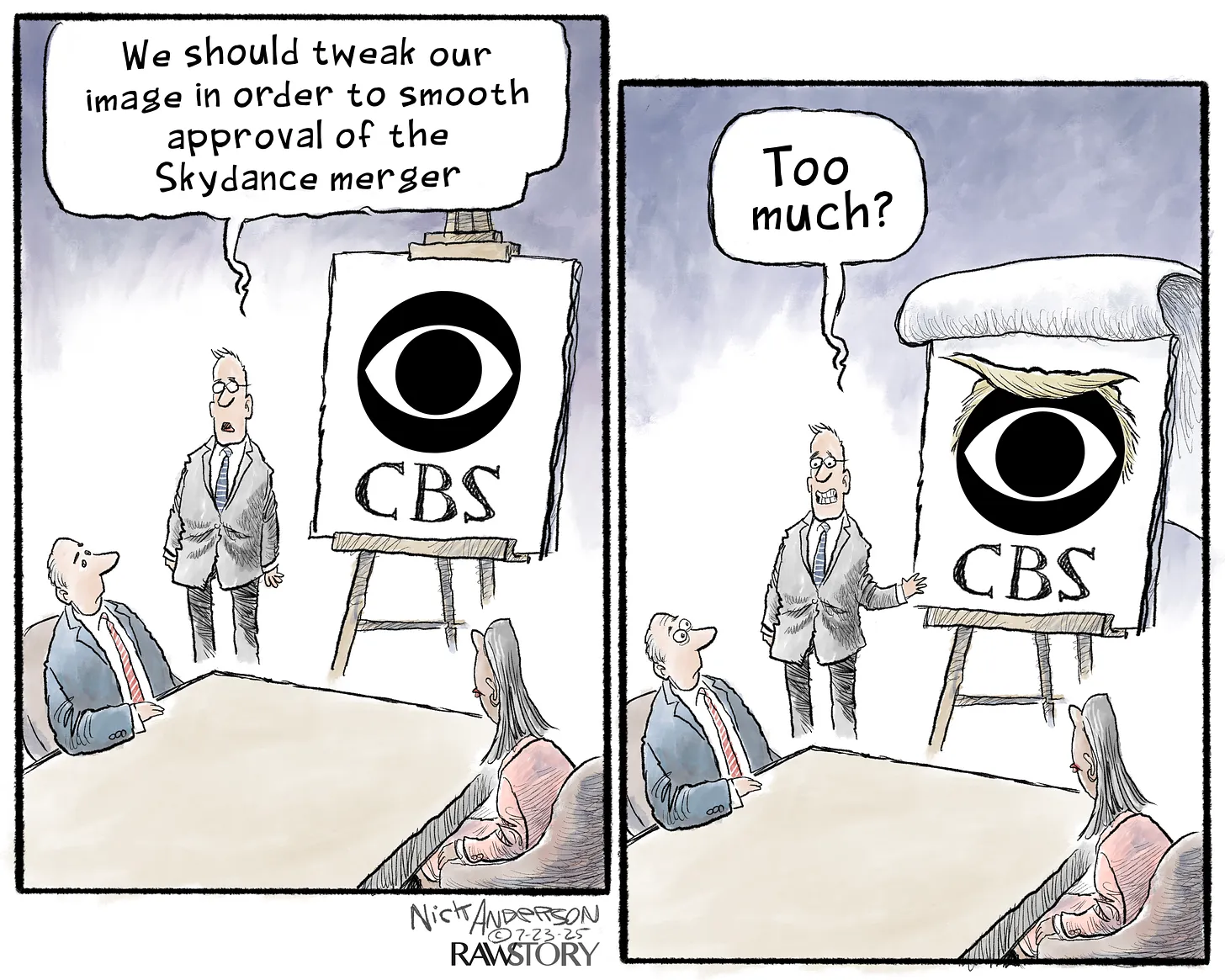
Take CBS. Does their news coverage displease Trump? Then the FCC balks at the corporate merger of CBS parent Paramount and cash-rich Skydance. It balks not until a specific public interest is satisfied, as would be the case under another administration’s FCC, but until Paramount has paid Trump $16 million to settle an otherwise baseless lawsuit, until Stephen Colbert’s show is cancelled, and until CBS agrees to have an ombudsman address complaints of anti-Trump “bias” in its news coverage.

Take Columbia University. Complaints that university wasn’t doing enough to protect Jewish students from harassment would ordinarily fall under the civil rights division of the Education Department, which might make a referral to the civil rights division of the Justice Department, with a narrow focus on the experience of the university’s Jewish students. But under a unitary executive, the offense is more general and the consequences far more sweeping: Columbia allowed pro-Palestinian demonstrations that expressed opinions contrary to Trump’s support of Israel’s government.

And so, the State Department revoked the green card and student visa of protest leader Mahmoud Khalil, allowing ICE (which is part of Homeland Security, not the the State Department) to arrest and detain Khalil for three and a half months without filing any criminal charges against him. Columbia’s research grants (primarily from the Health and Human Services Department) were frozen, and all of its federal grants were threatened. [9]

And the result? Not a specific set of adjustments to Columbia’s policies about antisemitism (antisemitism was always just a pretext), but a sweeping agreement to get Columbia right with the Trump administration, “including the re-organisation of its Middle Eastern studies department, and hiring a team of ‘special officers’ empowered to remove students from campus and make arrests”.

A similar administration assault on Harvard resulted in demands to

  • shift power from “faculty and administrators more committed to activism than scholarship” to “those most devoted to the scholarly mission of the University and committed to the changes indicated in this letter”, i.e., from Trump-hostile faculty to Trump-friendly faculty.
  • “reform its recruitment, screening, and admissions of international students to prevent admitting students hostile to the American values and institutions inscribed in the U.S. Constitution and Declaration of Independence” and “report to federal authorities … any foreign student … who commits a conduct violation”.
  • authorize an “external party” satisfactory to the government “to audit the student body, faculty, staff, and leadership for viewpoint diversity, such that each department, field, or teaching unit must be individually viewpoint diverse”. [10]

Again, the administration has mounted pressure by trying to freeze funds from a wide range of government departments. This is happening not at the end of a process in which Harvard has been found guilty of something and refused voluntary reforms, but as cudgel to beat the University into line with the administration. (Harvard is fighting this in court.)

The administration has also gone after law firms, getting concessions in exchange for release from a variety of threats that include

limiting the ability of attorneys to obtain access to government buildings, stopping any consideration for future employment with the government, canceling government contracts, and preventing any company that uses such a firm from obtaining federal contracts.

To sum up: Increasingly, we are in an environment where it is not enough to obey the laws. Instead, you need to maintain a friendly relationship with the government, and particularly not offend Trump himself. Otherwise, the full power of the government might come down on you.

The Germans have a word for this: gleichschaltung.

Gleichschaltung is a compound word that comes from the German words gleich (same) and Schaltung (circuit) and was derived from an electrical engineering term meaning that all switches are put on the same circuit allowing them all to be simultaneously activated by throwing a single master switch.

This unitary-executive metaphor goes back to the Nazis, because of course it does.

The Nazi term Gleichschaltung, meaning “synchronization” or “coordination“, was the process of Nazification by which Adolf Hitler—leader of the Nazi Party in Germany—established a system of totalitarian control and coordination over all aspects of German society “from the economy and trade associations to the media, culture and education”.

The unitary executive is precisely the person with his or her hand on that master switch. If American society retains any freedom, it will be due to the restraint of that executive, not to our inherent human rights.

So getting rid of Trump will not be enough to restore American freedom, as long as his successor — whether MAGA or some Democrat — continues to be a unitary executive holding the government’s master switch. Restoring freedom will require a sweeping change in the Supreme Court, as well as in re-establishing cultural expectations of the compartmentalization of presidential power.


[1] Recognizing, of course, that in 1787 not everyone was free. Much of our social progress in the last quarter-millennium has consisted of extending that vision of freedom more and more widely.

[2] The Founders never imagined the US achieving the kinds of world-spanning power it has today, or that it would need to maintain powerful armed forces in peacetime. Nor could they imagine a nuclear war, which could be lost before Congress could be convened.

[3] Imagine having to pass a new law each time a pharmaceutical company marketed a new drug or a food company began using a new preservative.

[4] This is the origin of the notion of a “Deep State”. President after president came into office with ideas for sweeping change, only to discover that the actual government had a great deal of bureaucratic inertia. The career employees of the various agencies had their own vision of their mission, which did not change just because they had a new boss.

You can see this today, for example, in the Justice Department, where many career employees — more than half in some offices — have quit rather than carry out orders that, by their lights, are corrupt. It’s impossible to know how many other civil servants have quietly sabotaged plans that violate what they see as their agency’s mission.

People join the EPA because they want to protect the environment, DoD because they want to defend the country, and so on. If asked to do something counter to those goals, they will do their best not to cooperate.

Properly understood, then, the Deep State is a culture, not a conspiracy.

[5] He wasn’t. IRS targeting of conservative groups for heightened scrutiny was never conclusively established, and no link to the Obama White House was ever found.

[6] Prior to Trump, only Bill Clinton had fired an FBI director — for ethical violations, in that case.

But President Trump fired FBI Director James Comey on a pretext in 2017, only four years into his term. During his transition period in 2024, Trump announced Kash Patel as his replacement for his own appointee Christopher Wray, seven years into Wray’s term. Wray might have challenged his apparent dismissal, but chose instead to resign.

[7] At least when Republicans are in the White House. The Roberts Court repeatedly found that President Biden had overstepped his legal authority. But now that Trump is president again, the bounds of presidential power have become increasingly vague and malleable.

[8] I have to wonder how well this would have worked for Biden. Would the Court have allowed him to eliminate student debt by firing all the people tasked with keeping track of it or collecting payments?

[9] Ordinarily, ending federal grants might be the conclusion of an anti-discrimination finding against a recalcitrant institution, not an opening salvo.

[10] “Viewpoint diversity” is a common MAGA euphemism for giving preference to MAGA-friendly students and professors. An economics department with no Marxists can be “viewpoint diverse”, but a biology department with no creationists might not be.

Yes, he does think you’re stupid

Democrats should avoid the substance of the Epstein controversy and focus on a single point: If his supporters feel Trump is insulting and disrespecting them, they’re right. The best thing that could come from this episode is if they begin to question the other “hoaxes” and “fake news” Trump has sold them on.


Yes, he does think you’re stupid. He always has.

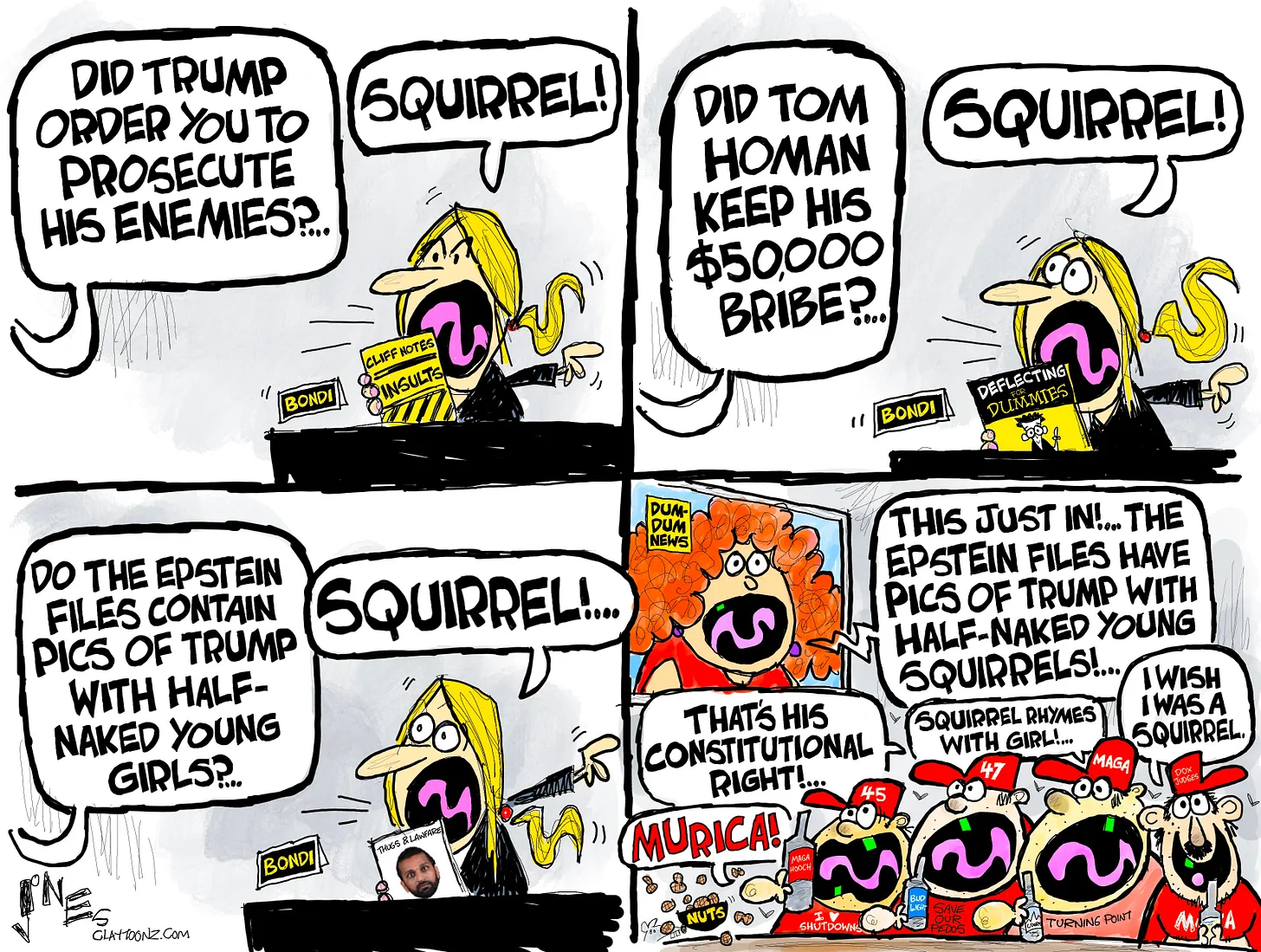
That’s the only Democratic/liberal message that seems useful to me here. Trump ran on a promise to release the Epstein Files. It was key to promoting his image as the man who would finally stand up to the the Deep State and end the ability of privileged elites to do whatever they want with impunity. His Justice Department repeatedly teased his base with the notion that major revelations were coming soon. The holy grail of the Epstein conspiracy theory — the client list, the names of the powerful men who allegedly abused Epstein’s harem of underage girls — was on Pam Bondi’s desk, awaiting her review.

And then: Never mind. There never was a client list. Epstein’s death in prison was just the suicide that authorities had always claimed. Nothing suspicious about it. Nothing to reveal. Just: Move on everybody. Go back to talking about tax cuts or mass deportation or Joe Biden’s dementia. (A good summary of the contradictions between these official announcements and DOJ’s previous statements is in Senator Durbin’s letter to Attorney General Bondi.)

Trump has seemed surprised, offended, and then angry when his supporters did not do as they were told. The whole Epstein conspiracy theory, he now claims, was concocted by Democrats. It’s a “hoax” that only “stupid” and “foolish” Republicans fall into.

This time, though, the base isn’t falling into line. Two weeks have gone by, and still MAGA World is roiled by the controversy. Trump has tried to placate them by having Pam Bondi ask a judge to release the grand jury files from the Maxwell trial, but that’s unlikely to satisfy anyone: It will take time, the judge will likely say no, and even if he said yes, the information presented to the grand jury was aimed at Epstein and his partner Ghislaine Maxwell, who is currently in jail. If a client list exists, it wouldn’t be there.

The Trump administration has much more extensive information now, and could release it quickly. It just chooses not to.


This MAGA infighting seems like a godsend to Democrats, but it’s a tricky gift to open. Democrats have never bought into the Epstein conspiracy theory, which was rooted in the idea that Epstein’s fabled client list would be full of high-ranking Democrats and the liberal Hollywood elite. (It’s related to the Pizzagate theory that connected Hillary Clinton to a network that trafficked missing children for sexual exploitation.)

One thing Democrats lack these days, at least among the voters who shifted from Biden in 2020 to Trump in 2024, is authenticity. Championing the Epstein theory won’t help, because Democrats can’t do it authentically. (I know I can’t.)

I can’t even authentically call for DOJ to release its files. There’s a reason Merrick Garland never did: DOJ has terrifying investigative power, and a corresponding responsibility not to abuse that power. DOJ policy is to release the information it collects only in indictments and trials. It releases information to prosecute crimes, not to defame people that it can’t prove a case against.

That would be a terrible policy to reverse, especially in the Trump era. DOJ exists to enforce the law, not to keep the public informed.

Congressional investigation, though, is an avenue to inform the public. It would be entirely appropriate for a congressional committee to inquire about the strange contradictions in the administration’s public statements, or for Congress to appoint a commission to inquire.

But that’s as far as I think Democrats should go: Call for investigating the contradictions, not for investigating the conspiracy theory itself. If Republicans are willing to take the lead on a deeper investigation, fine. But that’s not for us to do.

One thing we can do, though, is validate the outrage felt among the MAGA rank-and-file: Yes, he does think you’re stupid. He thinks he can tell you up is down and you’ll start repeating it. He’s been doing it for years. Maybe this is a moment for you to re-evaluate many things.

That’s the point I think Democrats, liberals, and anybody else trying to turn the tide of fascism should emphasize. Not some Epstein conspiracy theory of our own. Not even the demand for DOJ to release the files. It seems obvious Trump has something to hide here, but I wouldn’t even dwell on that.

But Trump has always counted on his ability to influence the thinking of his followers. He has been uncanny in knowing how to wave a red flag, change the subject, or make himself the victim. This time, though, his Jedi mind tricks aren’t working. Even the magic word “hoax” is failing to make his followers go glassy-eyed and get back in line. All over MAGA, people are thinking about the Epstein Files and thinking, “I don’t care what he said. Those are the droids I’m looking for.”

But if members of his cult have briefly stepped outside his mind control, encourage them to stay there. If you don’t believe him when he says the Epstein stuff is a “hoax”, maybe you should re-examine all the other “hoaxes” he has claimed, from climate change to the well-established facts that Biden won the 2020 election and Russia interfered in Trump’s favor in 2016.

Most MAGA folks won’t do this re-examination, because are in fact the sheep Trump believes they are. But a few will. Jess Piper, who lives in Trump country, argues that they will never be converted into Democratic voters, and she’s probably right. But if they just lose their enthusiasm and decide to sit out future elections, that could make a difference.

Is Epstein what will finally break through?

For years, Democrats have imagined that someday Trump’s dupes might return to reality and turn against him. But what if they could turn against him without returning to reality?


If you were a 2024 Trump voter, the last half-year has given you all kinds of good reasons to reassess your decision.

  • He didn’t reverse inflation like he said he would.
  • He didn’t end the Ukraine War “in 24 hours” like he said he would.
  • His Big Beautiful Bill increases the deficit he said he’d reduce.
  • He never found the millions of dangerous migrant criminals he said existed, so instead ICE is rounding up gardeners and dishwashers and moms.
  • Thanks to his Medicaid cuts, your rural hospital might close soon.
  • His on-again-off-again tariffs make it impossible for you to manage your small business.
  • Even though you worked hard and thought your office was doing something worthwhile, you lost your government job.
  • He fired the people you need to process your application for veterans benefits or Social Security.

And so on. As far as we can tell, though, hardly anybody in MAGA World cares about this kind of stuff. To the extent that Trump has lost support, it’s mainly among independents. Against all evidence, his base voters continue to believe he’s on their side, and everything that indicates otherwise is fake news.

What seems to be breaking through to them, though, is the Trump administration’s handling of information about Jeffrey Epstein, the rich pedophile who died in his prison cell in 2019. The case has exactly zero effect on their lives, but this is what they care about.

What upset them? Last week, Attorney General Pam Bondi released a memo claiming there is nothing to see: The famous Epstein “client list” that she said was “on my desk” a few months ago … well, it never existed. (Does her desk still exist? Was she ever really attorney general?) So there is no “evidence that could predicate an investigation against uncharged third parties”. And Epstein’s death was a jailhouse suicide, just like the official report said at the time.

The DOJ and FBI say in the memo that no “further disclosure” of Epstein-related material “would be appropriate or warranted.”

So: case closed. If you’ve been obsessed with Epstein, find something else to think about.

Worse, Trump himself has backed up Bondi on Truth Social.

What’s going on with my “boys” and, in some cases, “gals?” They’re all going after Attorney General Pam Bondi, who is doing a FANTASTIC JOB! We’re on one Team, MAGA, and I don’t like what’s happening. We have a PERFECT Administration, THE TALK OF THE WORLD, and “selfish people” are trying to hurt it, all over a guy who never dies, Jeffrey Epstein. … Kash Patel, and the FBI, must be focused on investigating Voter Fraud, Political Corruption, ActBlue, The Rigged and Stolen Election of 2020, and arresting Thugs and Criminals, instead of spending month after month looking at nothing but the same old, Radical Left inspired Documents on Jeffrey Epstein. LET PAM BONDI DO HER JOB — SHE’S GREAT! The 2020 Election was Rigged and Stolen, and they tried to do the same thing in 2024 — That’s what she is looking into as AG, and much more. One year ago our Country was DEAD, now it’s the “HOTTEST” Country anywhere in the World. Let’s keep it that way, and not waste Time and Energy on Jeffrey Epstein, somebody that nobody cares about.

But if we shouldn’t “waste Time and Energy” on Epstein, who “nobody cares about”, why have Trump and his people kept talking about Epstein for years?

I feel silly writing about this, because I have never cared about Jeffrey Epstein or the various conspiracy theories about his activities. Apparently, he was a rich man with a lot of rich and powerful friends. He induced a number of underage girls to have sex with him, and perhaps also with his friends. Some believe that he kept evidence of these statutory rapes to blackmail his one-time “friends”, and that their influence is what kept him out of prison so long. He was arrested in 2005 and convicted in 2008, but served an embarrassingly trivial sentence. He was arrested again in 2019 and died in his jail cell a month later. The official report on his death says that he committed suicide, but rampant speculation says that he was murdered to keep him from implicating the people he procured underage girls for.

Honestly, I’ve never cared. I feel sorry for the girls he abused. I’m glad he was arrested and I’m glad his girl-friend and co-conspirator Ghislaine Maxwell is in jail. If anybody has solid evidence that he had “clients” who also abused the girls, I’d like to see them punished too. If that group includes prominent Democrats or Hollywood bigwigs, so be it. (That’s an attitude I have towards a lot of alleged crimes: If there’s some kind of evidence, have at it.) But there’s a lot of injustice in the world, and for me this case does not stand high above many others. I have no theory about what “really” happened to Epstein, and no interest in forming one.

But not so in the fever swamps of MAGA. For these folks, Epstein was a real-life case that validated the wild and otherwise baseless conspiracy theories of Q-Anon.

Their core belief is that a cabal of Satanic, cannibalistic child molesters in league with the deep state is operating a global child sex trafficking ring and that Donald Trump is secretly leading the fight against them.

The Satanic cabal supposedly included the Clintons and all sorts of other people. And someday soon, Trump would bring them down by unleashing “the Storm”

when thousands of people will be arrested and possibly sent to Guantanamo Bay prison or face military tribunals. The U.S. military will then take over the country, and the result will be salvation and utopia.

This theory was always nutty, going back to the gun-toting guy in 2016 who showed up at a DC pizza place thinking he was going to liberate the children being held captive in the basement the building didn’t have. And Trump — a known friend of Epstein and a sex offender in his own right — was maybe the least likely person in the world to be cast in the savior role.

But being in a cult means never having to say you’re sorry. Over the years, the repeated failure of Q’s predictions disillusioned a lot of his followers. However, Mike Rothschild, who wrote the book on Q-Anon, says:

QAnon as a movement based around secret codes and clues and riddles doesn’t so much exist anymore. But it doesn’t need to exist anymore because its tenets have become such a major part of mainstream conservatism and such a big part of the base of people that reelected Donald Trump.

For years, Trump has been happy to let these crazies anoint him as their messiah. He “re-truthed” their memes.

More recently, though, the conspiracy theory seemed to be coming back to bite him. Elon Musk claimed to have seen the “Epstein Files” — though what that had to do with the job he was supposedly doing to cut government spending isn’t clear — and said that Trump was in them. “That is the real reason they have not been made public.” Musk deleted that post after Trump threatened his government contracts.

Plus, the MAGA natives were getting increasingly restless. Trump had said he would release whatever files the government had on the Epstein case. His nominees talked about them in their confirmation hearings. So where were they? It was time to produce the evidence that would prove those Q-Anon claims once and for all.

And the answer is … oh, never mind. Nothing to see here. Let’s all go back to some other fantasy, like voter fraud or the migrant crime wave.

Trump has told his base to turn on a dime before, and they have. Appointees like Bill Barr or Jim Mattis are “the best people” until they say something Trump doesn’t like, and then they were always suspect. Elon was a “genius” until he became “crazy”. Deficits are a problem until they aren’t. Any hint of Joe Biden or his family profiting off their government service is “the Swamp”, but Trump and his family making billions from foreigners investing in their crypto schemes is just good business. And so on.

But this time seems like a bridge too far. Tucker Carlson and Steve Bannon can’t go there. Dan Bongino is unhappy.

In order to restore peace in MAGA World, Trump will probably have to throw Pam Bondi under the bus, despite the FANTASTIC JOB she’s been doing. It wasn’t him, Trump’s cultists will say to comfort each other, it was her.

But then what? A new AG, one untainted by Bondi’s nothing-to-see-here blunder, does what exactly? Releases something, obviously. But what?

Soviet Premier Nikita Khrushchev is said to have given this advice to then-Vice-President Richard Nixon: If the people believe in an imaginary river, don’t tell them there isn’t one. Promise to build them an imaginary bridge.

It’s time for Trump to deliver his imaginary bridge over the Epstein controversy. How will he do it?

Meanwhile, what should the rest of us do? The worst thing we can do, I think, is get drawn into the argument. The real issues in America today are

  • the continuing march of fascism, and the complicity of Congress and the Supreme Court in subverting American democracy
  • the vast economic inequality in our country, and government policies that keep making it worse
  • climate change

In the face of all that, I have no theory about Epstein and no interest in forming one. Anybody who has evidence of some unprosecuted crime should feel free to pursue their investigation, but I have other stuff to do.

If the MAGA movement wants to tear itself to pieces over this, that’s all to the good. Make popcorn and enjoy the show. But they’ll eventually put their movement back together, and they’ll do it with an explanation that makes as little sense as everything else they do. We can hope that the friction will scrape away a few cultists, who finally realize that Trump has been playing them for fools all along. A few. Probably not that many.

Meanwhile, there are real issues to worry about. I have no time to waste on imaginary rivers or the bridges that might cross them.

Trump only has ICE for you

The most dangerous feature of Trump’s Big Beautiful Bill is one of its least publicized: ICE becomes a massive federal police force, overseeing a system of “detention” centers that could easily become concentration camps.


Despite all the side deals necessary to get it passed, the basic structure of Trump’s Big Beautiful Bill never changed from proposal to signing: It cuts rich people’s taxes (with a few crumbs like no-tax-on-tips thrown in for working people), and partially pays for those cuts by also cutting safety-net benefits like Medicaid and SNAP (i.e., food stamps). What those cuts don’t cover gets added to the deficit. So:

  • benefits for rich people
  • cuts for poor people
  • more debt for everyone.

Probably you knew that, and maybe you also heard that there was money for immigration enforcement. But the sheer size of the new anti-immigrant money hasn’t gotten the attention it deserves. NPR estimates the total immigration enforcement appropriation as “about $170 billion“. That’s larger than the defense budget of Russia.

The bill includes $45 billion to build Trump’s border wall. (So much for claims that he nearly completed it during his first term or that Mexico would pay for it. He didn’t build much of it and Mexico isn’t contributing a dime.) But the scarier piece of this is the additional $45 billion to build more ICE detention camps. The WaPo reports:

U.S. Immigration and Customs Enforcement officials say they plan to use the [$45 billion] to roughly double the nation’s detention capacity to 100,000 beds, giving them more capacity to arrest undocumented immigrants targeted for deportation.

Lincoln Square’s Don Moynihan puts this in perspective.

For context, this is more than the combined budget for all 50 state prison systems. The current budget for the federal Bureau of Prisons is just over $8.3 billion.

There is also money to hire many more ICE agents.

The agency, which currently has about 6,000 deportation officers, would also receive billions of dollars more to hire an additional 10,000 new agents by 2029.

Masked ICE agents kidnapping people off the streets and making them disappear is already a cause for concern. So is the Trump administration’s claim that ICE’s victims should not have due process rights. Now consider the possibility that the majority of these new agents will have less loyalty to the Constitution than to Trump personally. They will be Trump hires empowered to carry out a Trump mission (with the perk that they get to beat up a lot of brown people).

Harvard political scientist Theda Skocpol comments:

Last spring, when Dan Ziblatt and I taught a comparative course on democratic backsliding, our study of the Hungarian and German (1920s-30s) cases left me slightly reassured about the United States today.  Hungary is highly centralized, and in Germany the most important state transformation happened just before Hitler was appointed Chancellor, when the previous government nationalized the Prussian police and bureaucracy, removing it from Social Democratic control in federated Germany’s largest state.  Not long after, unexpectedly, Hitler could easily turn the centralized agencies into his Gestapo core.  I thought last year that the USA was somewhat protected against any similar coerceive authoritarian takeover by its federal structure, given state and local government rights to control most U.S. police powers (I presented this argument in my Madison lecture for the Sept 2024 American Political Science Association). 

But now I see that the Miller-Trump ethno-authoritarians have figured out a devilishly clever workaround.   Immigration is an area where a U.S. President can exercise virtually unchecked legal coercive power, especially if backed by a Supreme Court majority and corrupted Department of Justice.  Now Congress has given ICE unprecedented resources – much of this windfall to be used for graft with private contractors Trump patronizes, but lots of to hire street agents willing to mask themselves and do whatever they are told against residents and fellow American citizens.  The Miller-Trumpites are not interested only in rounding up undocumented immigrants.  They will step up using ICE and DOJ enforcements use to harass Democrats, citizen critics, and subvert future elections if they can. 

Jay Kuo draws a worrisome conclusion that I share:

Once you spend that much on internal security, the system—which is profit-driven by the companies providing the apparatus—begins to feed on itself. It will demand ever more bodies in a supercharged prison/industrial complex.

And fascism expert Timothy Snyder is using the C-word:

With the passage of Trump’s death bill, we face the prospect of many great harms, including an archipelago of concentration camps across the United States.

In particular, Snyder worries that the detainees might become slave labor, which makes a perverted kind of sense: As Trump causes a labor shortage by rounding up immigrants, the detained immigrants might be rented out to do things like pick crops.

If these fears seem over-the-top, consider a little history. The Nazi concentration camps were not originally conceived as death mills. Hitler used the Reichstag Fire (in February, 1933) as evidence that a Communist revolution was at hand, and began rounding up his political enemies as Communist co-conspirators. Needing a place to put them, he opened the Dachau concentration camp in March.

At the time, Dachau was just a place political opponents could be kept outside the ordinary legal process. But as time went by, the convenience of having a black hole they could drop people into was just too tempting for the Nazi government. The mission of Dachau and the subsequent camps kept expanding, until they became the horror we now associate with concentration camps.

I find it too easy to imagine history repeating itself. ICE already sees itself as unencumbered by law, and its targets as undeserving of human rights. ICE may not, at the moment, be a Gestapo, and places like the new Alligator Alcatraz in Florida may not yet deserve the Alligator Auschwitz label critics have given it. But what prevents that progression from taking place?

All the visible forces push that way. We have already seen reality drift from the Trump administration’s rhetoric. Supposedly ICE was “making us safer” by rounding up violent criminals. But now they’re grabbing harmless people who are simply raising their children and doing their jobs, like the wife of this Marine Corps veteran and the father of three Marine sons. TracReports estimates that 71.7% of ICE detainees have no criminal record. CBS discovered that a similar percentage of the Venezuelans flown to El Salvador’s notorious CECOT prison had no criminal record.

Here’s a simple example of ICE’s sense of license: Florida law gives members of the legislature the right to make unannounced inspections of any state-run facility. Five Democratic legislators showed up to inspect Alligator Alcatraz and were denied access. Law? What law?

Imagine that someday you get scooped by ICE, maybe because you have brown skin and Spanish surname, or maybe because some AI has determined that your blog is too critical of Trump. There you are in Alligator Alcatraz or some other camp designed to hold undesirables. The letter of the law favors you, but the lawyers your family hires get the kind of run-around Kilmar Abrego Garcia has gotten. Where does your story go from there?

Questions to ask as a war begins

Saturday night, the United States joined Israel’s air war against Iran. The most significant piece of the US intervention was to do what Israel could not: drop giant bunker-buster bombs on the underground Iranian nuclear research facility at Fordow. The US dropped 14 GBU-57 bombs, the largest non-nuclear bomb in our arsenal. (They are also sometimes referred to as MOPs, massive ordinance penetrators.)

The attack came a week after Israel began bombing Iran, and ended several days of what had appeared to be indecision on Trump’s part. Wednesday, he said: “I may do it, I may not do it. I mean, nobody knows what I’m going to do.” He suggested a two-week window for negotiations, then attacked in two days. (As several people have pointed out, “two weeks” is Trumpspeak for “I have no idea”. He seems to believe that two weeks is long enough for the news cycle to forget about an issue.) Like so many of Trump’s actions, this has been justified after the fact as intentional misdirection rather than indecision.

In response, the Iranian Parliament has authorized closing the Strait of Hormuz, but has left the final decision up to Iran’s Supreme National Security Council. One-fifth of the world’s oil goes through that strait, which sits at the mouth of the Persian Gulf. Closing it would raise world oil prices substantially, at least in the short term. So far, markets seem not to be taking the threat seriously.

As I’ve often said, a one-person weekly blog can’t do a good job of covering breaking news, particularly if it breaks on the other side of the world. So you should look to other sources for minute-to-minute or day-to-day coverage.

I also frequently warn about the pointlessness of most news-channel speculation. The vast majority of pundits have no idea what’s going to happen next, so taking their scenarios seriously is at best a waste of time and at worst a way to make yourself crazy.

So if I can’t reliably tell you what’s happening or what’s going to happen, what can I do? At the moment, I think the most useful discussion to have on this blog is to ask the right questions.

What are we trying to accomplish in this war? Failure to get this right has been the major failing in America’s recent wars. Our government has frequently marshaled public support by invoking a wide variety of motives, with the result that we never quite know when we’re done. Our involvement in Afghanistan started out as a hunt for Osama bin Laden and the Al Qaeda leadership behind 9-11. But it quickly evolved into an attempt to establish a friendly regime in Kabul, combat Muslim extremism in general, test counter-insurgency theories, and prove that liberal democracy could work in the Muslim world. So our apparent early success turned into a two-decade failure.

Similarly in Iraq. Were we trying to depose Saddam Hussein? Chase down the (apparently false) rumors of his nuclear program? Control Iraq’s oil? Try yet again to build liberal democracy in the Muslim world? If all we had wanted to do was replace Saddam with a friendlier dictator, that’s not a very inspiring ambition, but we might have been in-and-out quickly. Instead, the failure to find Saddam’s mythical weapons of mass destruction left the Bush administration grasping after some other definition of victory, and getting stuck in another long-term war with dubious goals.

The early indications about this war are not encouraging. Maybe we’re just trying to make sure Iran doesn’t get nuclear weapons. Of course, Obama had a treaty in place that did just that, which Trump ditched, claiming he could get a “better deal”. This war, apparently, is that “better” deal.

But maybe we want to topple the Islamic Republic. Maybe we once again want to control the oil. Those kind of goals bring back Colin Powell’s “Pottery Barn rule“: If we break the country’s government, we own own the ensuing problems until we can fix them. That implies the same kind of long-term commitment we had in Iraq.

Of course, Trump might walk away from such a moral obligation, since he has little notion of morality in any sphere. Then we wind up with a failed state three times the size of Afghanistan, and who knows what kind of mischief might germinate there?

Did our attack work? The answer to this question depends on the answer to the previous question: What does “work” mean?

If the goal was simply to destroy Iran’s current nuclear program, maybe it did work, or can be made to work soon. Trump announced that the attacks were “a spectacular military success” which “completely and totally obliterated” the target sites. But then, he would say that no matter what happened, wouldn’t he? Without someone on the ground, it’s impossible to know.

And without regime change, or without some kind of verifiable agreement in which the current regime renounces nuclear weapons, any such damage is just temporary. Any nation with sufficient money and will can develop nuclear weapons. If Iran comes out of this war with money and will, it can start over.

If the goal is regime change or “unconditional surrender”, the attack hasn’t worked yet and may never. Air war is a poor tool for establishing a new government. I would hope we learned our lesson from Dick Cheney’s famous “we will, in fact, be greeted as liberators” comment, but maybe not. I’ve heard commentators cite internal political opposition to the Iranian theocracy as some kind of ally, but It’s hard for me to picture how that works.

Apply the same logic to the United States: I am deeply opposed to the Trump administration and regard it as a threat to the tradition of American constitutional government. But would I favor some Chinese operation to overthrow Trump? No. What if the internal opposition in Iran is like me? Might they have to unite behind their government to avoid foreign domination?

What could Iran do in response? It’s always tempting to imagine that I will take some extreme action and that will be the end of the matter. Probably you’ve seen this yourself in online discussions. Somebody says something stupid, and you come up with some devastating comment, figuring that the other person will slink off in disgrace.

It doesn’t usually work out that way, does it? The other person will strike back at least as hard as you did, and the exchange might go on for days. You never planned on a flame war eating up hours of your time, but there you are.

Same thing here. Iran might close the Strait of Hormuz to oil tankers, sending the price of gas shooting up and the world economy reeling. It might attack American troops stationed in various places around the Middle East. It might launch terrorist attacks in the US itself. (Do you trust this 22-year-old to protect you?)

Even worse is the possibility of the unexpected. We seem to be at a hinge point in the history of warfare, where drones and various other new technologies change the battlefield in ways that are hard to imagine. Ukraine’s attack on Russia’s Siberian bomber bases is a case in point, but there are others.

Traditional symbols of power may be vulnerable, the way that the American battleships at Pearl Harbor were vulnerable to the new technology of air power. Are we prepared for, say, a massive drone attack sinking an aircraft carrier? What about a cyberattack blacking out some major city? If we suffer such an unexpected blow to our prestige and power, will we be able to respond in a rational way?

What will this war do to the United States itself? The War on Terror undermined the consensus against torture, and authorized previously unprecedented levels of government spying on ordinary Americans.

So far, this war looks like another few steps down the road to autocracy. We attacked Iran because Trump decided to. Bush’s invasion of Iraq, by contrast, was authorized by a bipartisan vote in Congress (to the shame of opportunistic Democrats who should have stood against it). That vote was preceded by a spirited public debate and mass protests.

This time, Congress was not consulted in any formal way. And even informally, a few congressional Republicans were informed ahead of time, but played no part in the decision. Democrats were not consulted at all. No effort at all has been made to convince the American public that this war is in our interests.

So far we’ve been treating this war as if it were a reality show involving Trump, Netanyahu, and the Iranian leadership. We’re just spectators. Until, that is, our city blacks out or we can’t afford gas.

Trump Invades Los Angeles

It started with ICE raids at Home Depots and other places undocumented immigrants might congregate to look for work.

Xochitl, a Guatemalan mother of two, was inside a McDonald’s that shares the parking lot with the Home Depot when she said she saw numerous agents running after men she sees every day but knows only by their nicknames. She said she momentarily froze but then began walking in the opposite direction of agents who were detaining food vendors on sidewalks.

“They were just grabbing people,” she said. “They don’t ask questions. They didn’t know if any of us were in any kind of immigration process.”

Anti-ICE protesters gathered, as they do in towns and cities all over America. (There’s a weekly protest outside a Massachusetts ICE facility one town over from mine. I haven’t attended yet, but I feel like I should.) Increasingly, ICE is targeting not the violent criminals Trump campaigned against (who never existed in the numbers he claimed), but the neighbors, friends, and co-workers of ordinary Americans.

By Friday, the situation had devolved into law enforcement officers using tear gas and protesters shooting fireworks at ICE. Who started the violence? Hard to say. In this video, a man describes an ICE raid causing a traffic jam. When agents began dragging people out of a local business, people stuck in the jam began taking videos on their phones. “We’re not there to protest. We were stuck at the light.” The tear gas, the man claims, was aimed at the people taking videos on their phones. “One of the agents, I hear them: ‘Go for the people with the phones’.”

Local officials thought the police response was appropriate to the size of the disturbance, but Trump evidently disagreed. Saturday, he federalized 2000 troops from the California National Guard and placed them under the command of Defense Secretary Pete Hegseth.

Using National Guard troops to control unrest is a well established practice, but usually the troops are requested by the governor. Here, Governor Newsom (and LA Mayor Karen Bass) opposed using the troops, but Trump sent them in anyway — something that hasn’t been done since 1965, when LBJ sent troops to Alabama to protect civil rights workers.

Trump’s over-the-top response has created an additional reason to protest: the appearance of a military takeover as federalized troops are used against the citizens of a major American city. A weekly blog can’t cover breaking news, so I’ll just have to wait and see how this plays out.

The legal authority here is tricky. Jay Kuo breaks it down: Trump is invoking his authority under Title 10, which allows him to use National Guard troops to respond to “a rebellion against the authority of the Government of the United States”. Characterizing spontaneous demonstrations as “rebellion” against the US government is a bit of a stretch, but it’s the kind of stretch the Trump administration has made before, like when it claimed illegal immigration is an “invasion” that justifies invoking the Alien Enemies Act.

But Title 10 doesn’t allow martial law.

So here’s the part that’s a bit hard to grasp at first. Title 10 permits the President to federalize the troops and put them under his command. But what they are permitted to do as military troops operating on domestic soil is still governed by other laws.

And one of those laws is the Posse Comitatus Act.

The PCA doesn’t allow federal troops to play the role of local law enforcement. All they can do is protect federal buildings and federal agents carrying out their duties.

The Insurrection Act makes an exception to the Posse Comitatus Act, and so would be a step towards martial law. But so far Trump has not invoked the Insurrection Act.

Now I’ll begin to speculate: It looks like Trump wants this confrontation, and is hoping the situation escalates. This will provide lots of violent video to show on Fox News, of blue-state citizens battling US troops. After a few days of that, he can justify invoking the Insurrection Act, turning LA into a military occupation zone.

It’s hard not to connect this directly provoked confrontation with the events scheduled for next Saturday. Trump has planned a North-Korea-style military parade in Washington. Ostensibly, the parade is to celebrate the 250th birthday of the US Army. But coincidentally, Saturday is also Trump’s own birthday.

Trump’s $45 million birthday party has incited plans for thousands of counter-protests around the country, under the theme “No Kings“. Whether he intends to meet these protests with state violence remains to be seen.