

You may think that Trump’s policies are just indifferent to climate change. You would be wrong.
Not so long ago, conventional wisdom said that an administration should focus on one goal at a time. In order to get significant changes through Congress, it was necessary to shepherd public opinion, which would fail to coalesce if you pursued too many initiatives at once.
So if you had wanted the Obama administration to pursue green taxes or a cap-and-trade plan for CO2 emissions, you were out of luck: His priority was ObamaCare, and by the time he got around to climate change, he had lost his majority in Congress.
But things don’t work that way any more, largely because Trump barely needs Congress. If you rule by executive order rather than legislation, use the full power the Supreme Court has granted the unitary executive, don’t worry too much about the letter of the law, and dare the courts to stop you, you don’t need public support. And across the board, Trump doesn’t have it.
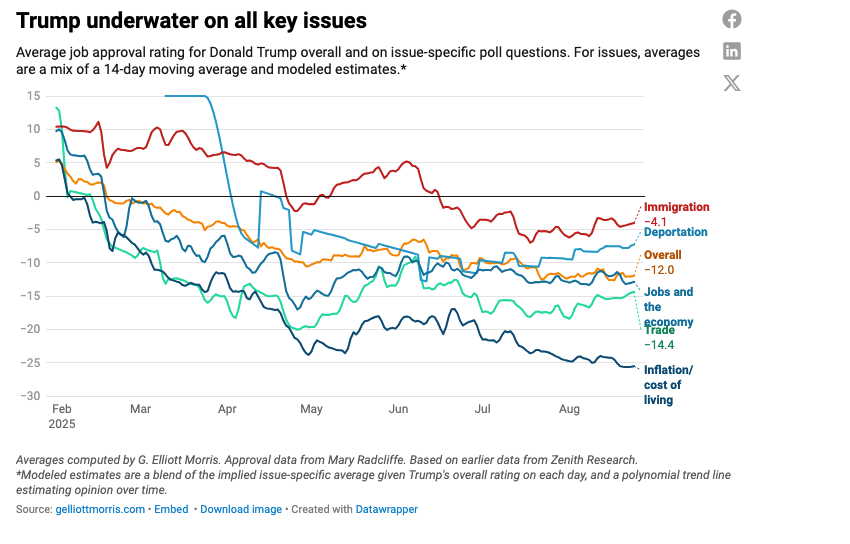
In fact, the shoe is on the other foot: It’s the opposition that needs public support to try to stop what Trump is doing. The more things he does at once, the more scattered the opposition gets. And our news cycle tends to fragment issues, making the larger picture harder to grasp.
Nowhere is this more apparent than with regard to climate change and CO2 emissions. You may have heard individual reports about how this offshore wind project was cancelled or those EV subsidies phased out. If you have heard enough such stories, you may have pieced together a general impression that the Trump administration is indifferent to climate change.
But the actual situation is far worse. Across the board, the administration has targeted any effort to take action to reduce CO2 emissions. Worse, the US government is now actively promoting fossil fuels, even in situations where the free market would make a more sustainable choice.
The Trump administration is not indifferent to climate change. It is working hard to make it worse.
Electrification
Fundamentally, the strategy for dealing with climate change has two pieces: electrify everything, and then produce electricity without burning fossil fuels. The Trump administration has attacked both sides of this plan.
Electric vehicles. The so-called “Big Beautiful Bill” cuts off virtually all subsidies for electric vehicles by the end of this fiscal year, September 30. That’s not just the tax credit for purchasing an EV, but also subsidies for electrifying commercial fleets and installing charging stations.
EVs are a natural fit for fleets of vehicles that have a defined territory and return to base every night, like postal delivery trucks. The Biden administration planned to use such government fleets to jump-start the larger EV market.
But under Trump, EVs have become no-nos within the federal government. Not only are federal agencies not installing any charging stations or buying new EVs, they’re ripping out brand-new charging stations and selling off EVs at a loss. All-in-all, de-electrifying the federal vehicle fleet could cost as much as $1 billion.
Think about that: The government is not just reassessing future EV purchases and deciding they are too expensive. That would be a suspicious calculation, but at least a plausible one. In fact, though, it is spending money to get rid of the EVs and EV infrastructure it has.
Sustainable electrical generation. Trump has long had an animus against wind power, going back at least to 2012, when he thought offshore wind turbines marred the view from his Aberdeenshire golf course. Since then, he has been a font of anti-wind disinformation, charging that wind turbines not only kill large numbers of birds, but that offshore wind farms are driving whales crazy and causing them to beach themselves and die. (The birds claim is exaggerated — birds do run into turbine blades occasionally, but a 2009 study concluded that wind farms kill far fewer birds per kilowatt hour than fossil fuel plants. The connection to whale deaths is entirely imaginary.)
Trump’s Big Beautiful Bill terminated a variety of subsidies for sustainable energy, wind and solar alike. But his administration is actively anti-sustainable-power. The Interior Department has created new bureaucratic requirements for wind or solar projects on federal land, and just this week halted work on a wind farm offshore from Rhode Island. The project was scheduled to begin delivering power to Rhode Island and Connecticut homes in 2026.
The order to stop work on the Revolution Wind project is the latest move by the Trump administration targeting the country’s renewable energy industry. President Trump, a longtime critic of the wind industry, in January issued a moratorium on new development of offshore wind projects. The Internal Revenue Service recently put out new guidance that makes it harder for companies building wind and solar projects to qualify for federal tax incentives. And the Commerce Department is investigating whether imports of wind turbines and their components threaten national security.
Wednesday Trump posted to Truth Social:
Any State that has built and relied on WINDMILLS and SOLAR for power are seeing RECORD BREAKING INCREASES IN ELECTRICITY AND ENERGY COSTS. THE SCAM OF THE CENTURY! We will not approve wind or farmer destroying Solar. The days of stupidity are over in the USA!!! MAGA
End-to-end, this post is nutty. Electricity costs are rising because of demand, especially demand for computation related to AI and cryptocurrency mining. The Sustainability By Numbers blog ran the state-by-state numbers and found no correlation, positive or negative, between sustainable energy and prices.
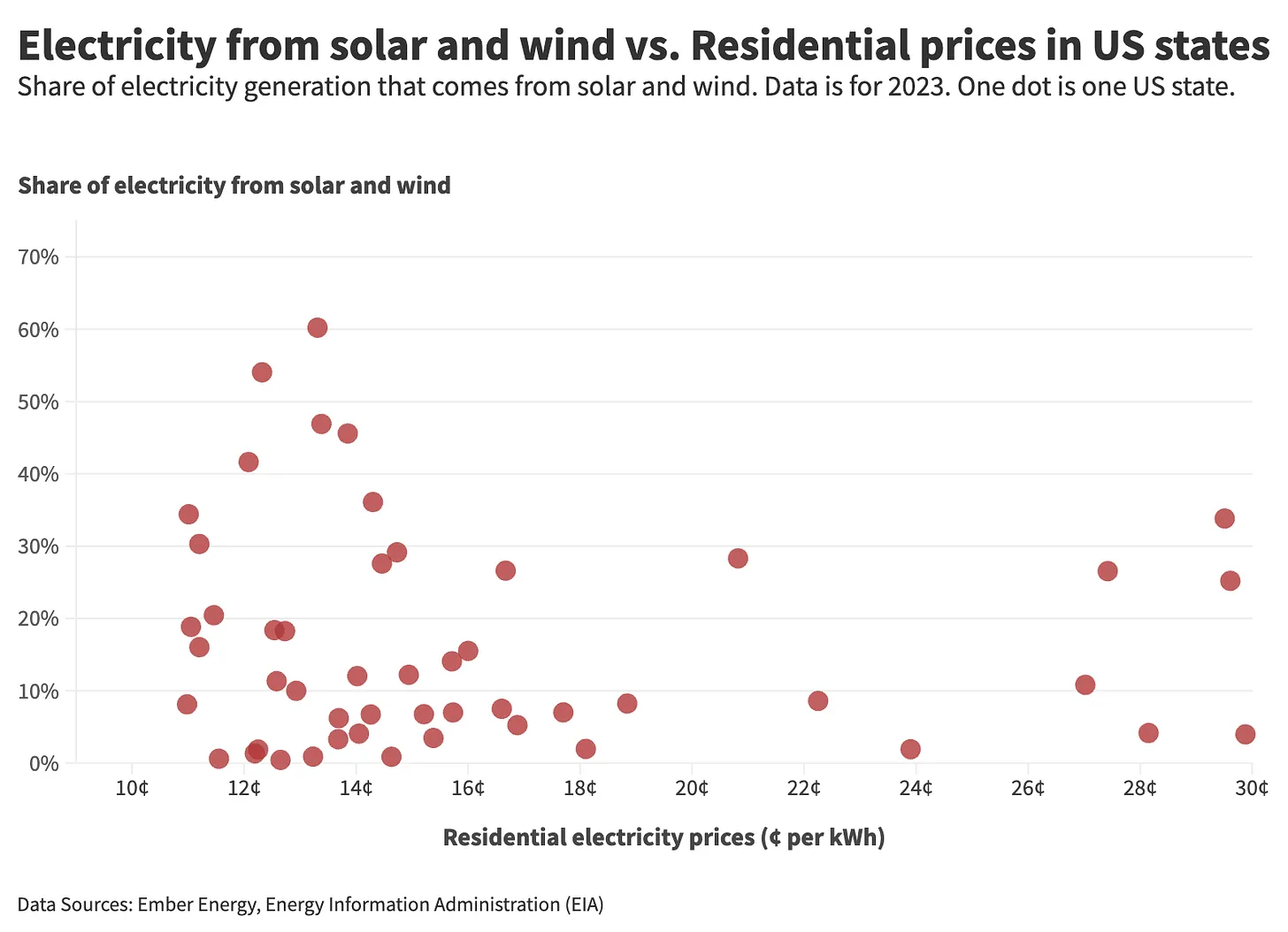
Besides, just take a step back and think this through from economic first principles: Adding supply is not going to raise costs.
Meanwhile, farmers love their windmills and solar installations. The payments give them a source of income that isn’t affected by the usual hazards of drought, insects, or fungus.
Equally nutty is a Trump post that “STUPID AND UGLY WINDMILLS ARE KILLING NEW JERSEY”. NJ.com fact-checks: New Jersey’s offshore wind project has already been cancelled before coming online, and the state barely has any windmills.
Even worse than the specific projects being cancelled is the chill this sends across the industry. If you are a utility looking for additional generating capacity, wind and solar now entail a political risk that is hard to work into your calculations. If you make a success out of sustainable energy, you are making Trump look bad. He may come after you.
Conservation. One way to partially mitigate the increased demand from AI and crypto — both of which Trump favors — is to use less electricity to power our household appliances. This effort has been going on since the days of Bush Sr., and its flagship has been the Energy Star program. Energy Star certification has helped consumers identify appliances that use less electricity, saving them $500 billion in their utility bills.
Funding for Energy Star was zeroed out in Trump’s original Big Beautiful Bill proposal, but Congress seems to have put it back. Whether or not this money will actually be spent is another question, one that probably depends on what the Supreme Court says about Trump’s previous attempts to impound funds.
Drill, Baby, Drill
While the Big Beautiful Bill was zeroing out subsidies for EVs and sustainable energy, it was increasing subsidies for fossil fuel production. The Union of Concerned Scientists’ Equation blog lists the benefits and estimates the cost to the taxpayers at $80 billion over the next ten years.
But this week’s most outrageous energy story concerned a coal-fired utility plant in Michigan. Coal is probably the dirtiest form of energy in common use, but the Trump administration loves it.
Donald Trump has made several unusual moves to elongate the era of coal, such as giving the industry exemptions from pollution rules. But the gambit to keep one Michigan coal-fired power station running has been extraordinary – by forcing it to remain open even against the wishes of its operator.
The hulking JH Campbell power plant, which since 1962 has sat a few hundred yards from the sand dunes at the edge of Lake Michigan, was just eight days away from a long-planned closure in May when Trump’s Department of Energy issued an emergency order that it remain open for a further 90 days.
On Wednesday, the administration intervened again to extend this order even further, prolonging the lifetime of the coal plant another 90 days, meaning it will keep running until November – six months after it was due to close.
This order, like so many of the questionable things Trump has done, is justified by a mythical “state of emergency” that he can see but no one else can. The Energy Department says the local electrical grid will be strained by the loss of this plant, but the operating utility doesn’t think so. While it’s not unusual for a utility to seek permission to extend the life of a coal plant that violates pollution standards, extending the life of a plant the operator wants to close is virtually unheard of.
So far, 71 coal plants, along with dozens of other chemical, copper smelting and other polluting facilities, have received “pollution passes” from the Trump administration according to a tally by the Environmental Defense Fund, allowing greater emissions of airborne toxins linked to an array of health problems. Coal is, despite Trump’s claims, the dirtiest of all fossil fuels and the leading source of planet-heating pollution.
Information
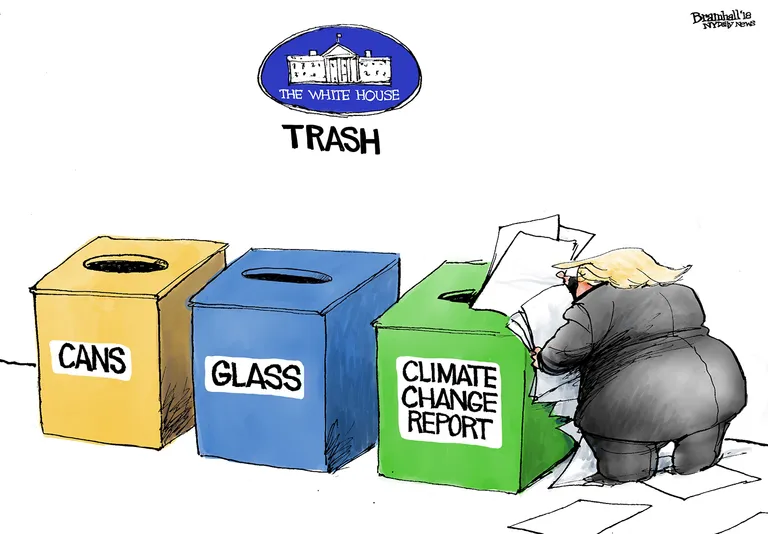
If you want to assess the current state of the planet and its climate, the federal government does not want to help you.
In accordance with the Global Change Research Act of 1990, the federal government has produced a National Climate Assessment every four years.
The sprawling report is the most influential source of information about how climate change affects the United States.
The National Climate Assessment is widely used by teachers, city planners, farmers, judges and regular citizens looking for answers to common questions such as how quickly sea levels are rising near American cities and how to deal with wildfire smoke exposure. The most recent edition had a searchable atlas that allowed anyone to learn about the current and future effects of global warming in their specific town or state.
Sadly, though, the federal web site that hosts the report has been taken offline. Work on the next report has been halted and the contract to produce it cancelled. It’s up in the air whether any report at all will appear when the next one is due in 2027. Perhaps some fossil-fuel industry think tank will produce one. DoE recently published a climate-change-denying report by five fringe scientists.
The attack on the USGCRP and national climate assessment did not come as a surprise. In the Heritage Foundation’s far-right policy blueprint Project 2025, Russ Vought – now Trump’s head of the office and management and budget – called to end the USGCRP or fill it with pro-oil industry members.
Past climate assessments have been removed from government websites so they can be “updated” to better represent the administration’s anti-scientific views.
“We’re reviewing them, and we will come out with updated reports on those and with comments on those reports,” [Energy Secretary Chris] Wright told CNN’s Kaitlan Collins in an interview on “The Source.”
Wright dismissed the past reports, saying “they weren’t fair in broad-based assessments of climate change.”
OK, that change involves assessment and dissemination of new climate info. But what about gathering it in the first place?
President Donald Trump’s budget request for fiscal year 2026 includes no money for the Orbiting Carbon Observatories, which can precisely show where carbon dioxide is being emitted and absorbed and how well crops are growing.
One of the observatories is a satellite launched in 2014, and the other was attached to the International Space Station in 2019. The two systems are
more sensitive and accurate than any other systems in the world, operating or planned, and a “national asset” that should be saved, said David Crisp, a retired NASA scientist who led their development. They helped scientists discover, for example, that the Amazon rain forest emits more carbon dioxide than it absorbs, while boreal forests in Canada, Russia and places where permafrost is melting absorb more than they emit, Crisp said. They also can detect the “glow” of photosynthesis in plants, which helps monitor drought and predict food shortages that can lead to civil unrest and famine, he said.
The OCO instruments in the space station might just be turned off, while the satellite could be “brought down”, i.e., allowed to burn up in the atmosphere. Needless to say, launching a replacement satellite (assuming the US government ever cares about climate again) will be far more expensive than just maintaining the one already in orbit.
Why make this very wasteful decision?
NASA said in an emailed statement Wednesday that the missions were “beyond their prime mission” and being terminated “to align with the President’s agenda and budget priorities.”
The Trump EPA is also taking steps to make it harder for a future administration to undo its damage. It is trying to reverse a 2009 finding that CO2 is a pollutant that it can regulate under the Clean Energy Act.
The endangerment finding is the basis for rules regulating climate pollution from coal and gas-fired power plants, car and truck exhaust and methane from the oil and gas industry.
Now, the Trump EPA is arguing that the endangerment finding was a mistake and overstepped the EPA’s statutory power. Daren Bakst, director of the Center for Energy and Environment at the Competitive Enterprise Institute, comments:
If the EPA finds the 2009 endangerment finding is no longer applicable, Bakst says that “would preclude future greenhouse gas regulations.” And he says “it should be easy to repeal existing rules that are predicated on the 2009 finding.”
Foreign policy
The administration is not just seeking to burn more fossil fuels at home, it’s also pushing fossil-fuel exports overseas. For example, the recent trade deal announced between the US and the EU stipulated that the EU buy $750 billion of US energy exports — primarily fossil fuels — over the next three years. Trump got this benefit for US energy companies by threatening Europe with crippling tariffs.
In June, the NYT contrasted the energy styles of the world’s two great powers, the US and China. The Chinese are investing heavily in sustainable energy and leading the world in exports of sustainable-energy technology.
While China is dominating clean energy industries, from patented technologies to essential raw materials, the Trump administration is using the formidable clout of the world’s biggest economy to keep American oil and gas flowing.
In a full reversal from the Biden administration’s effort to pivot the American economy away from fossil fuels, the Trump White House is opening up public lands and federal waters for new drilling, fast-tracking permits for pipelines and pressuring other countries to buy American fuels as a way of avoiding tariffs.
Washington is essentially pursuing a strong-arm energy strategy, both at home and abroad with allies and friends. It’s premised on the idea that the modern world is already designed around these fuels, and the United States has them in abundance, so exporting them benefits the American economy even if solar energy is cleaner and often cheaper.
This month, the International Energy Agency predicted something the Trump administration did not want to hear:
Lately, the I.E.A.’s influential forecasts have suggested that global demand for oil and gas could peak by the end of the decade as electric-vehicle sales grow and the cost of solar panels and battery storage plummets.
The US responded in a typical Trumpian fashion, by threatening the messenger.
Chris Wright, Mr. Trump’s energy secretary and a former fracking executive, has called the agency’s projections of peak oil demand “nonsensical” and has said the United States could withdraw from the global organization if it doesn’t change the way it operates. House Republicans have said the agency is publishing “politicized information to support climate policy advocacy” and have threatened to withhold U.S. funding.
In short, I don’t know what other conclusion to draw: The Trump administration is trying to make climate change worse. I could speculate about why, but that seems like a distraction. The What is more important than the Why. The Trump administration is trying to make climate change worse.


 The Weekly Sift