When a decade ends, it’s always tempting to look back and come up with a single defining theme. Often that exercise winds up being artificial and its conclusion a bit forced. But as we approach the end of 2019 the theme seems clear: The story of the Teens was the decline of democracy.
2010 in the United States. On New Year’s Day in 2010, we were living in a very different world. Barack Obama had been elected in a landslide in 2008, bringing huge Democratic majorities to both houses. The first major sign of a rightward pendulum swing — Scott Brown’s surprise victory in the race for the Senate vacancy caused by Ted Kennedy’s death — would happen soon (January 19), but the extent of November’s Democratic wipe-out was not at all apparent yet.
Brown’s victory ruined the filibuster-proof Senate majority that the Democrats had maintained for a few months (since Al Franken had finally been seated in July), but Nancy Pelosi maneuvered her House majority and the reconciliation rules to get ObamaCare passed anyway by the end of March.
The economic disaster of 2008 was finally starting to resolve. When Obama took office, the economy had been hemorrhaging jobs, bankruptcies were starting to cascade, and the possibility of a Great-Depression-style collapse had seemed possible for the first time in almost 80 years. (One sign of the looming apocalypse: In September of 2008, a major money-market fund “broke the buck” and stopped redeeming its shares at $1.) The balanced-budget rules most states lived under had been forcing them to make the problem worse: As revenues fell, they had to stop construction projects, cut safety-net programs, and lay off teachers.
But by 2010, a variety of government interventions had begun to stabilize the situation: TARP and a loose Federal Reserve policy had stopped the banking collapse; a federal bailout saved the US auto industry; Obama’s $800-billion stimulus program had cut taxes, shored up state government finances, and started restoring the country’s infrastructure. Unemployment was still high and many people were still suffering, but the feeling that the bottom was about to fall out of everything had passed. A slow-but-steady economic expansion began, and has continued for the rest of the decade.
As the Republican revival took the form of the Tea Party, it was possible to believe in that movement’s grass-roots sincerity, despite the billionaire Koch money behind it. Perhaps large numbers of people really were alarmed by the rapidly growing federal debt, and by the government’s role in the economy, which the bailouts had at least temporarily increased. (By now, of course, we know that concern about the debt was entirely bogus. Trump’s looming trillion-dollar deficits disturb none of the people who angsted about Obama’s.)
Despite the Tea Party, though, the Republican establishment seemed firmly in control of the GOP’s direction. The Reagan policy configuration was unchanged: strong defense, a forceful American presence in the world, free trade, low taxes, low regulation, traditional sexual mores, and an immigration policy that accommodated business’ need for cheap labor.
But more than that, Republicans still participated in a national consensus on democracy so widespread it could mostly go unstated: The two major parties competed to persuade a majority of the American electorate, and whichever party succeeded in getting the majority of votes would, of course, control the government. Despite Republicans’ knowledge that they did better in low-turnout elections, and their occasional efforts to make voting harder for poor and non-white citizens, at least in public they had to acknowledge that voting was a good thing, something the public should be encouraged to do.
As the party of the rich, Republicans had always found it easier to raise large sums of money than Democrats. But controlling money in politics was still at least partly a bipartisan issue, exemplified by the McCain-Feingold law of 2002. As a practical matter, Republicans were more likely to oppose campaign-finance rules than Democrats; but open defenses of plutocracy were rare.

For the most part, Republicans were still part of a nationwide consensus on fair play. This was best exemplified by a moment in John McCain’s 2008 campaign, in which a woman questioning McCain said Barack Obama was “an Arab”, and seemed ready to go further if McCain hadn’t taken the microphone away from her.
I have to tell you. Sen. Obama is a decent person and a person you don’t have to be scared of as president of the United States.
Violations could be found on both sides, of course, but the general consensus (at least in public) was that candidates should not smear each other in ways that would make it hard for the winner to govern.
A number of rules of fair play held in Congress as well. The Constitution gave the Senate the power to “advise and consent” on presidential appointments, but both parties exercised this power with some restraint. For the most part, the president was allowed to get his way unless there was something egregiously wrong about a particular nominee.
There had been a few rumblings in the other direction. On democracy, Tom DeLay’s 2003 Texas redistricting plan intended to net more Republican seats in Congress just by shifting boundary lines, without the need to persuade any voters. As for fair play, McCain’s VP choice, Sarah Palin, had no qualms about blowing racist dog whistles in Obama’s direction, or accusing him of “pallin’ around with terrorists“. But these seemed to be excesses rather than signs of the future.
2010 around the world. Internationally, Europe was having a harder time recovering from the Great Recession than the US, and the biggest threat to the unity of the EU was that struggling economies like Greece might need to escape EU austerity rules and the discipline of the euro. The Syrian Civil War, with its consequent Syrian refugee problem, hadn’t started yet. (The entire Arab Spring, with it’s brief promise of democracy, had not yet bloomed and died.) Anti-immigrant and anti-Muslim sentiment existed in Europe, but was nothing like the continent-wide issue it later became. Far-right parties in France and Germany had yet to take off, and Brexit was a notion from the lunatic fringe of British politics.
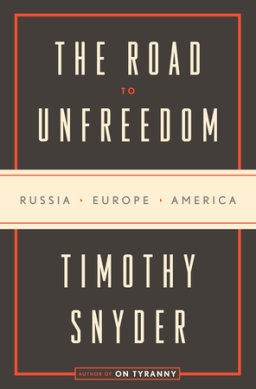
But the biggest difference was in eastern Europe. It was already clear by 2010 (to those who were paying attention) that Vladimir Putin was an autocrat running a government-shaped crime syndicate. But no one yet appreciated the threat he posed outside Russia, or foresaw that his democracy-to-autocracy model would be imitated in Hungary, Poland, Turkey, India, Brazil, and even the United States. (My best description of that strategy is probably the one in the review of Timothy Snyder’s The Road to Unfreedom, or possibly Levitsky and Ziblatt’s How Democracies Die.)
I would argue that Putin has been the single most influential figure of the 2010s. Russia in 2010 was (and still is) a relatively minor economy dependent on an industry with little long-term future (oil). And yet, look at all he accomplished: His ruthless intervention in Syria pushed millions of immigrants towards Europe, where his simultaneous information-warfare campaign inflamed anti-immigrant feelings and boosted nationalist populist movements across the EU. His thumb-on-the-scale was arguably the difference in both the Brexit referendum and the Trump election. At the end of the decade, a foreign-policy goal of every Russia leader since Stalin might finally be in sight: the dissolution of NATO.
In 2010, it was even possible to believe that China would eventually find its way to democracy. The theory went like this: Sooner or later, the rising Chinese middle class would seek a voice in government. But while Chinese prosperity grew through the Teens, if anything China moved the other way politically. Power has increasingly become centered in President-for-Life Xi.
The Republican embrace of minority rule. In Conservative Parties and the Birth of Democracy (reviewed here), Daniel Ziblatt examined different European nations’ paths toward democracy and found a key difference: It mattered how the old ruling class felt about yielding its power to democratic institutions. Britain developed a viable conservative party that (through its alliance with the Church of England and its traditional morals), saw a way to continue to compete for power in a democratic system. But Germany’s upper classes never stopped seeing democracy as a threat, and were constantly tempted to seize power in non-democratic ways, eventually producing Hitler rather than Churchill.
The big story of the Teens in the US was the loss of a conservative party committed to democracy. The Republican Party has increasingly found itself at odds with democracy, and instead has openly embraced minority rule. In the Trump Era, Republicans no longer even attempt to attract majority support: 46% was enough to produce an electoral college win in 2016, and Trump has spent the last three years talking almost exclusively to that 46%.
In fact, it’s worth looking at all three elected branches of government. In the 2016 presidential election, Trump got 62,984,828 votes (46.1%) while Hillary Clinton got 65,853,514 (48.2%). In the 2018 elections for the House, Republican candidates got 50,861,970 votes (44.8%) and Democrats 60,572,245 (53.4%).
Computing the Senate popular vote is a little more complicated, because it takes six years for all the seats to come up, so you have to total across three elections. In 2014, Republican candidates got 24,631,488 votes (51.7%) and Democrats 20,875,493 votes (43.8%). In 2016 it was Republicans 40,402,790 (42.4%), Democrats 51,496,682 (53.8%). In 2018, Republicans got 34,723,013 (38.8%) and Democrats 52,260,651 (58.4%).
That works out to a total of 99,575,291 Republican votes and 124,632,826 Democratic votes. (The totals are roughly double the House totals because each state elects two senators.) That 25 million vote margin for the Democrats (roughly 55%-45%) has produced a 53-47 Republican majority.
Think about what that means: The American people voted for Democrats to control the presidency and both houses of Congress, but in fact they only succeeded in giving Democrats control of the House.
The retreat from fair play. So far we’ve just talked about anti-democratic elements inherent in our government’s constitutional structure. But during the Teens, Republicans used that minority power to entrench minority rule further.
The 2010 census was the beginning of a redistricting wave that has gerrymandered both federal and state districts to lock in Republican majorities. On the federal level, the Democratic wave of 2018 (53.4%) was considerably larger than the Republican wave of 2010 (51.7%), but produced a smaller majority (235 seats in 2018 vs 242 in 2010).
But it is on the state level where democracy has truly vanished. I could pick several states as examples, but probably the clearest is Wisconsin, where gerrymandering has locked in a large Republican majority in the legislature that the Democratic majority in the electorate is unable to oust.
Despite Democrats winning every statewide office on the ballot and receiving 200,000 more total votes, Republicans lost just one seat in Wisconsin’s lower house this cycle. And that victory was by a razor-thin 153 votes. Democrats netted 1.3 million votes for Assembly, 54 percent statewide. Even so, [Assembly Speaker] Vos will return to the Capitol in 2019 with Republicans holding 63 of 99 seats in the Assembly, a nearly two-thirds majority.
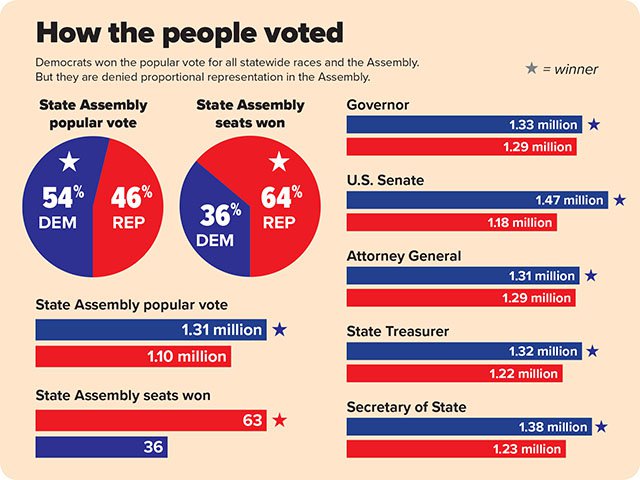
Republicans in Wisconsin: Losing the vote, but holding the legislature.
Far from being embarrassed by their minority support in the electorate or cowed by the mandate voters gave the new Democratic governor, the Wisconsin Republican majority in the legislature responded to the voters’ rebuke by passing laws to cut the new governor’s powers.
And those totals are after considerable efforts to suppress the vote of blocs likely to support Democrats. The one-two punch of minority rule is
- Make it hard for Democratic blocs to vote.
- Herd them into a small number of districts so that even a majority of Democratic votes can’t oust Republican majorities in the legislature.
This works because of minority rule on the federal level: A minority president and a minority Senate get to stack the judiciary with judges who are fine with tactics that entrench minority rule even deeper. That’s how we wound up with a conservative Supreme Court that has refused to block voter suppression and gerrymandering, and has opened the door to unlimited money in political campaigns — including unlimited money to influence Senate approval of judges. So the initial anti-democratic tilt built into the Constitution has been amplified.
You might think this reliance on a minority would be an embarrassing secret for Republicans, but in fact it is not. More and more openly, they defend the notion that the majority should not control the government.
For example, the Electoral College used to be seen as a historical relic that wasn’t worth the trouble it would take to get rid of it. But now it is actively defended by conservative publications like National Review and politicians like Senator Mike Lee. The fundamental unfairness of the Senate is cast as the great wisdom of the Founders, who apparently foresaw that Californians wouldn’t deserve to have their votes count for as much as Alaskans.
Gerrymandering and voter suppression aren’t shameful any more, they’re just how the game is played. And unlimited money is “free speech”. Even violence is no longer beyond the pale: Trump has repeatedly warned of violence if his followers don’t get what they want, and Trump supporters like Robert Jeffress even talk about “civil war“.
The drift towards autocracy. Most worrisome of all, in my opinion, is Republicans’ increasing tolerance of and support for autocratic words and actions from their leader. I can find no parallel in American history for how Trump has handled Congress’ refusal to fund his wall: He declared a phony emergency and seized money appropriated for other purposes. Even a congressional resolution to cancel the emergency was unavailing: Trump vetoed it, and held enough support in Congress to block a veto override.
So the precedent is established: As long as a president’s allies control 1/3 of one house, he can ignore the power of the purse that the Constitution gives Congress.
Republicans in Congress have also refused to protect Congress’ oversight power. Since Democrats gained control of the House, the administration has blocked all attempts to investigate his administration.
Nazi comparisons should always be handled with care, but this one seems appropriate to me: It’s a mistake to brush off what Trump clearly says he wants to do, as Germans brushed off the more outrageous sections of Mein Kampf. What Trump tells us every day in his tweets and at his rallies is that people who oppose him should be punished. Hillary should be in jail; Adam Schiff should be handled the way they do in Guatemala; Rep. Omar should be sent back where she came from; the whistleblower and his sources are “spies” who should be subject to the death penalty.
Already, everyone responsible for launching the investigation into Trump’s ties with Russia has been hounded out of the Justice Department. Amazon has been denied a large Pentagon contract because Jeff Bezos’ Washington Post is critical of Trump.
It’s a mistake to write this off as “Trump being Trump”. If he acquires the power to inflict more punishment, as he well might if Congress fails to impeach him and the Electoral College re-elects him (once again against the will of the voters), more punishments will happen.
Trends are not fate. George Orwell once wrote: “Whoever is winning at the moment will always seem to be invincible.” So it is a mistake to despair. Trends often reverse right at the moment when they seem most unstoppable, and often the reversal is only apparent in hindsight. But it is also foolish not to notice the trend, which for the last ten years has run counter to democracy, particularly in the United States.