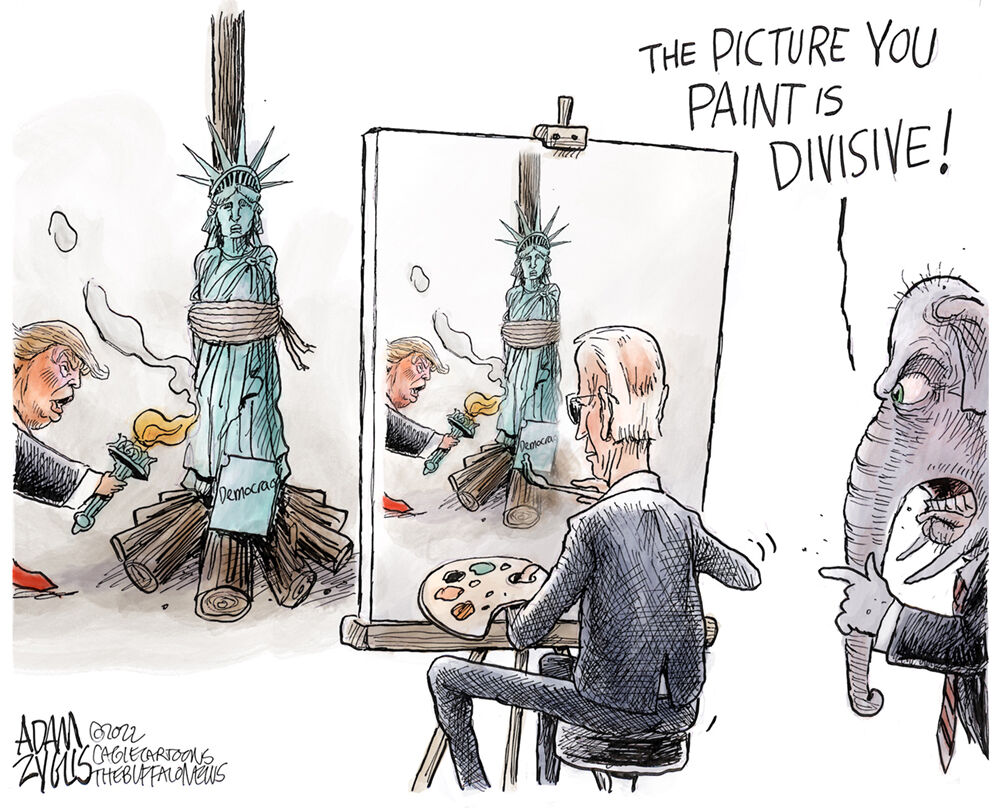
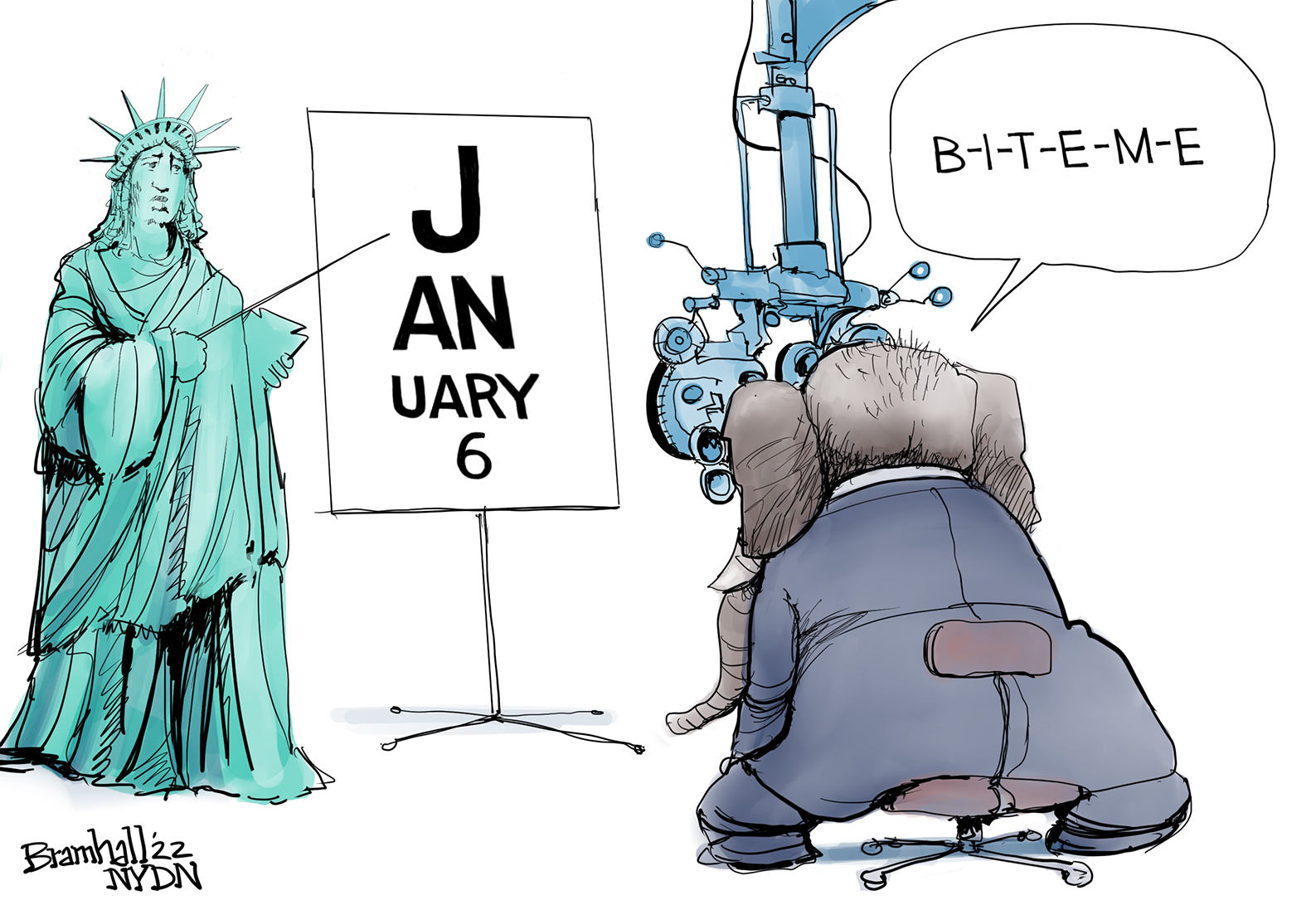
One of the two parties in these elections has stopped believing in elections. You should vote for the one that still does believe.
The last time a Republican was president, he did one of the worst things any American president has ever done: He tried to stay in power after losing an election.
His schemes were thwarted only when elected Republicans and his own appointees refused to do his bidding: Mike Pence, Brad Raffensperger, Aaron Van Langevelde, Jeffrey Rosen, Mike Shirkey, Rusty Bowers, and many others at all levels of government. If not for them, he might have succeeded in overthrowing our Constitution or sparking a civil war.
Afterwards, some Republicans in Congress tried to hold the would-be usurper accountable for his actions and reaffirm their party’s commitment to our system of government: Liz Cheney, Adam Kinzinger, Peter Meijer, and several others.
You could imagine a Republican Party in which all those people are heroes: They did their jobs, fulfilled their oaths, and saved American democracy. But that party doesn’t exist. Instead, almost all the Republicans who resisted the coup attempt have been drummed out of office. (Raffensperger, who survived a primary challenge, is a lonely exception. Whether Pence will ever again win a Republican primary is an open question.)
Across the country, Republicans who still refuse to recognize their candidate’s loss in 2020 are running to oversee the 2024 elections, while his Supreme Court appointees consider whether to re-interpret the Constitution to allow state legislatures to ignore both their state constitutions and the will of their voters. Republicans running for governor in swing states — Kari Lake in Arizona, Doug Mastriano in Pennsylvania — have said they wouldn’t have certified Biden’s 2020 victory, without citing any evidence to justify such a move (because there is none). Some Republican candidates — Ron Johnson in Wisconsin — were active participants in illegal 2020 plots.
Worse, many MAGA Republicans are following Trump’s example by undermining elections in general: If they lose, they claim fraud without any evidence. Others are openly attacking democracy, like Utah Senator Mike Lee, who said: “We want the human condition to flourish. Rank democracy can thwart that.” Like their leader, many Republicans flirt with racism and anti-semitism, and some don’t even try to hide it.
Even a liberal like me can see that America needs a viable conservative party. It’s healthy that our national conversation include voices saying that government should do less, that traditions should change slowly, and that free enterprise plays an important role in our prosperity. Even as I support the consensus of scientific opinion on subjects like climate change or vaccination, I recognize that those views should not go unchallenged. Every party, even one that I support, needs someone looking over its shoulder.
But the conservative party America needs would be loyal to our Constitution rather than to one man. It would support the institutions of democracy and defend the People’s right to elect someone else.
The current GOP is not that party, and it will not become that party until voters have disciplined it for supporting illegal and violent attempts to seize power. It is the insurrectionists who need to be run out of town, not the people who stopped the insurrection plot from succeeding.
That discipline needs to start in these elections. You may agree or disagree with me about inflation, government spending, regulations, taxes, how to balance women’s rights against fetal rights, and many other issues. But we can have those arguments later. Because in the long run, if we lose our democracy, it won’t matter which of us makes the better case.
If we knew our history, we’d realize that the country is more resilient than we think.
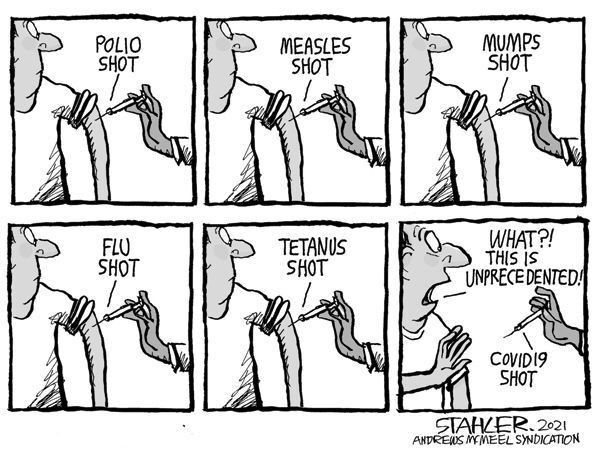
Unprecedented. Every year, dictionary publisher Merriam-Webster announces a “word of the year“: a single term that in some way tells you what the year was about. Typically, it’s not a new coinage, but a common word suddenly getting more use. 2021’s word of the year was vaccine (though insurrection was a competitor), and 2020’s was pandemic. 2019’s word was an old pronoun being used in a new way: the singular they.
I don’t know what Merriam-Webster has in mind for 2022, but if it were up to me, the word of 2022 would be unprecedented. I seldom go a day without running across it somewhere.
All kinds of recent events are being cast as unprecedented. Just this week, Delta Airlines described a surge in fall air traffic as “unprecedented”. An ergonomic research group claimed recent strains on industrial workers are “unprecedented”. Tennessee Governor Bill Lee pitched an anti-crime proposal with a twofer: “Unprecedented times call for unprecedented measures.”
But what makes unprecedented the word of 2022 is its eruption into American political news and discussions about the state of our democracy. No matter which side of the partisan divide you’re on, you see the other side doing unprecedented things that pose an unprecedented threat.
Day after day, we are being told that the current threat to American democracy is unlike anything that has ever happened before.
It’s a discouraging, dispiriting message, because it implies that we are on our own. History has nothing to teach us and offers no reassurances. If American democracy is Patient Zero of an previously unknown disease, who can advise us or make any predictions about our survival?
But what if our current predicament isn’t unprecedented? What if American democracy has faced crises before and muddled through them?
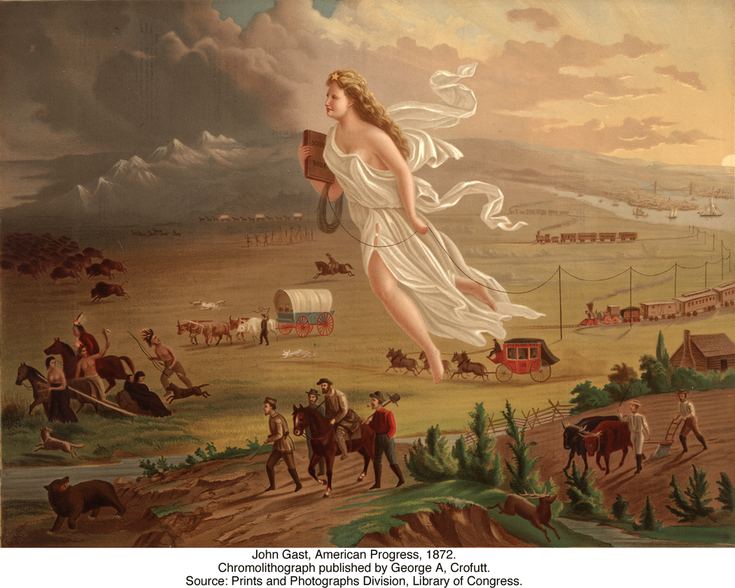
Historic blind spots. This is a point where the patriotic version of US history that most of us learned in high school fails us. We know about the Civil War, of course, and the Native American genocide (which used to be known as “how the West was won”). We know that Jim Crow walled Black Americans out of democracy in the South, and that women didn’t get the vote until 1920. Various consensual sexual acts were illegal for much of our history, and same-sex couples couldn’t marry until fairly recently.
But still.
The history I learned in school embedded those failings in a narrative of progress, in which democracy and human rights were constantly expanding. We made mistakes, but we fixed them. The villainies of our past are simply backstory for the heroic saga that followed.
It was the American Revolution that caused people to question slavery. No one had questioned it before we decided as Americans that we are endowed by our Creator with unalienable rights and that we are all created equal.
So (in this telling) when Thomas Jefferson enslaved hundreds of human beings, took sexual advantage of at least one of them, and then raised his own children as slaves, he was foreshadowing abolition. His vision of human equality wasn’t hypocritical, it was prophetic.
While that onward-and-upward story may fill at least some Americans with a warm glow, it fails us in moments like these, when democracy itself is in trouble and human rights may be starting to contract. How can we cope with such unprecedented challenges?
But what if they aren’t unprecedented?
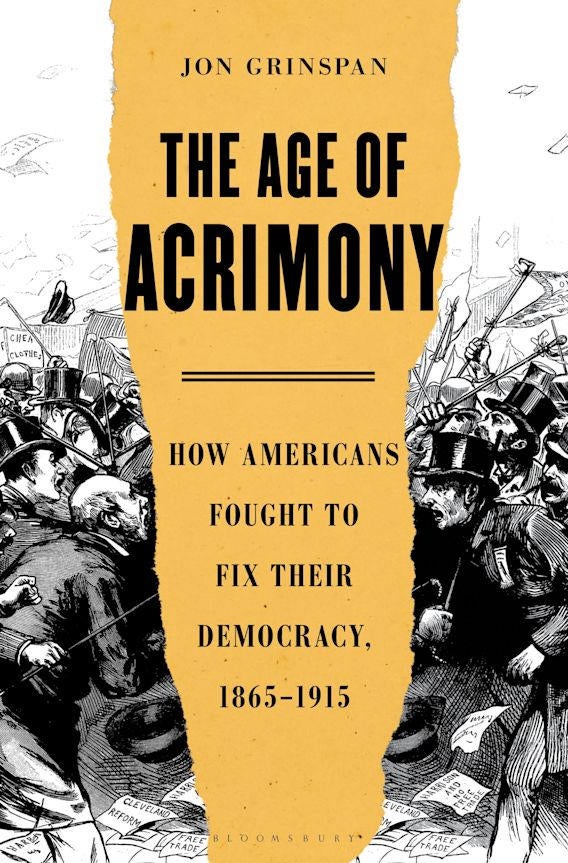
This week I spent some time examining two of the darker eras of American politics: I listened to the opening episodes of Rachel Maddow’s new podcast “Ultra“, about a fascist plot to overthrow FDR. And I read the new book by Smithsonian curator Jon Grinspan about the hyper-partisan politics of late 1800s, which he has dubbed The Age of Acrimony.
This is a story about politics at the edge. A violent, ultra-right authoritarian movement, weirdly infatuated with foreign dictatorships. Support for that movement among serving members of Congress who prove willing and able to use their share of American political power to defend the extremists, to protect themselves, to throw off the investigation. Violence against government targets. Plots to overthrow the United States government by force of arms. And a criminal justice system trying, trying, but ill-suited to thwart this kind of danger. …
This is a story of treachery, deceit and almost unfathomable actions on the part of people who are elected to defend the constitution, but who instead got themselves implicated in a plot to undermine it. A plot to end it. …
Perhaps most importantly, this is also the story of the Americans— mostly now lost to history— who picked up the slack in this fight, who worked themselves to expose what was going on, to investigate it, to report on it, ultimately to stop it.
And there’s a reason to know this history now. Because calculated efforts to undermine democracy, to foment a coup, to spread disinformation across the country, overt actions involving not just a radical band of insurrectionists, but actual serving members of congress working alongside them, that sort of thing is… that’s a lot of things. It’s terrible. But it is not unprecedented.
We are not the first generation of Americans to have to contend with such a fundamental threat. Lucky for us, the largely forgotten Americans who fought these fights before us, they have stories to tell.
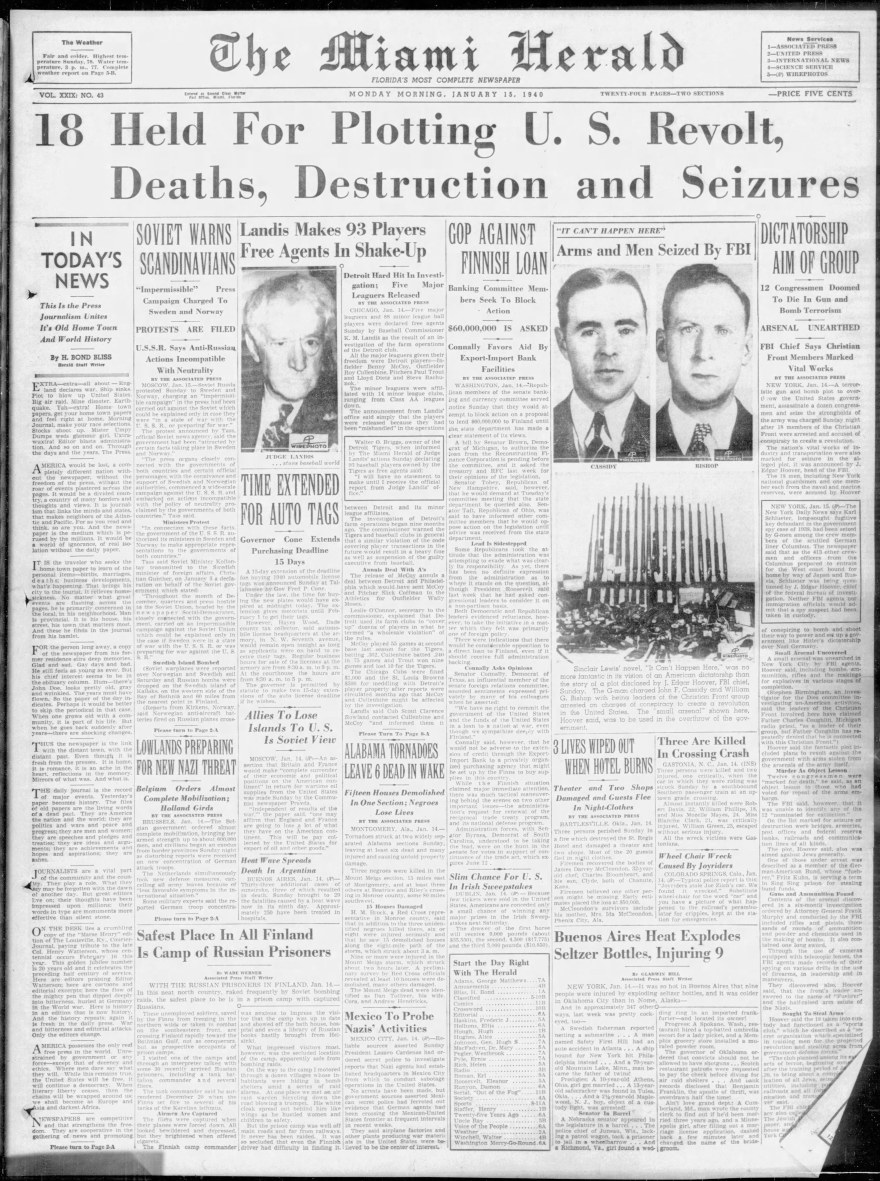
“Ultra” begins with a mysterious 1940 plane crash that killed Minnesota Senator Ernest Lundeen, along with several government agents who had begun to shadow him. Lundeen was on his way to deliver a Labor Day speech that not only urged America to stay out of the war in Europe (where Hitler had already taken over France and was threatening Britain), it was openly pro-German, and “had been ghost-written for Senator Lundeen … by a senior, paid agent of Hitler’s government operating in America”.
There was a time when I considered myself a World War II buff. But I had never heard of Senator Lundeen, or of the insurrection plot described in Episode 2, for which 18 members of the Christian Front were arrested.
The participants in that plot were never convicted, largely because of the popularity of their cause.
Prosecutors were blamed for not appreciating— not factoring in to their jury presentation— just how favorably the Christian Front was viewed in the community where the trial was held. The local press affectionately nicknamed them “The Brooklyn Boys.” The local Catholic Church supported them loudly. Nobody who was Jewish was allowed to sit on the jury. There was a local Catholic priest who was advising the Christian Front, who had been leading rallies to support them, who was close to [Father Charles] Coughlin [who coined the term “Christian Front”]. His first cousin was picked as the foreman of the jury.
And yet democracy was not overthrown by fascism, not in 1940 and not since. We’ll have to wait for future episodes (Episode 3 just posted this morning) to find out what Rachel thinks we can learn from democracy’s survival.
The Age of Acrimony. Eight years ago, in the most popular Sift post ever, I first pointed to the biggest hole in my US history education: Reconstruction.
In my high school history class, Reconstruction was a mysterious blank period between Lincoln’s assassination and Edison’s light bulb. Congress impeached Andrew Johnson for some reason, the transcontinental railroad got built, corruption scandals engulfed the Grant administration, and Custer lost at Little Big Horn. But none of it seemed to have much to do with present-day events.
And oh, those blacks Lincoln emancipated? Except for Booker T. Washington and George Washington Carver, they vanished like the Lost Tribes of Israel. They wouldn’t re-enter history until the 1950s, when for some reason they still weren’t free.
Reconstruction and much of the Gilded Age get skipped over because (in every area but technological advancement and GDP growth) they don’t fit very well into the ever-upward narrative of American progress. As Grinspan tells the story:
Americans claim that we are more divided than we have been since the Civil War, but forget that the lifetime after the Civil War saw the loudest, roughest political campaigns in our history. From the 1860s through the early 1900s, presidential elections drew the highest turnouts ever reached, were decided by the closest margins, and witnessed the most political violence. Racist terrorism during Reconstruction, political machines that often operated as organized crime syndicates, and the brutal suppression of labor movements made this the deadliest era in American political history. The nation experienced one impeachment, two presidential elections “won” by the loser of the popular vote, and three presidential assassinations. Control of Congress rocketed back and forth, but neither party seemed capable of tackling the systemic issues disrupting Americans’ lives. Driving it all, a tribal partisanship captivated the public, folding racial, ethnic, and religious identities into two warring hosts.
In hindsight, it’s hard to cast either Democrats or Republicans as the heroes of late 19th-century politics. Democrats were the proud descendants of the Confederacy in the South, combined with the corrupt big-city political machines of the North. On the other side, Republicans soon abandoned the ideals of Reconstruction and 15th Amendment’s new Black voters in favor of the vast business empires of the Rockefellers and Morgans.
More and more of the country was being herded into an impoverished urban proletariat that neither party truly represented. Republicans were on the opposite side entirely, while Democrats would “help” by distributing patronage jobs to loyal party members. Neither party saw a structural problem requiring the kinds of solutions that wouldn’t appear until the 20th century: a minimum wage, workplace safety laws, bans on child labor, unemployment insurance, an old-age pension, and protection for union organizers.
The “Wide Awakes” marching for Lincoln in 1860.
What political campaigns lacked in substance, they made up in noise. Both parties had militaristic marching clubs not entirely unlike the Nazi storm troopers of the 20th century, and torchlight parades were common demonstrations of political strength. Neighborhood political centers were typically saloons where glad-handing ward bosses would pour free drinks in exchange for votes.
The spoils system, in which the victorious party handed out government jobs to those who worked hardest on the campaign, was not a dirty secret, but rather an orderly process that people counted on. President Garfield was assassinated not by an ideological terrorist or a lunatic looking for fame, but by a disgruntled member of his own party who felt his electioneering efforts should have earned him a plum appointment.
The result of all this was a widespread belief that democracy had failed. In 1878, one of the era’s top American historians, Francis Parkman, wrote “The Failure of Universal Suffrage“.
When a man has not sense to comprehend the questions at issue, know a bad candidate from a good one, or see his own true interests — when he cares not a farthing for the general good, and will sell his vote for a dollar — when, by a native instinct, he throws up his cap at the claptrap declamation of some lying knave, and turns with indifference or dislike from the voice of honesty and reason — then his vote becomes a public pest. Somebody uses him, and profits by him.
Rule by the majority, it seemed, meant rule by the ignorant and the easily manipulated. No one appeared to know what to do about it. Parkman, for example, didn’t want a king, and thought any attempt to restrict the vote would be impractical: The People would never give up their power voluntarily, no matter how little good it was doing them. And politicians would never agree to change the system that had put them in power.
Journalist Lincoln Steffens examined seven large political machines, and assembled his conclusions in magazine articles that were reprinted in his 1904 book The Shame of the Cities.
When I set out on my travels, an honest New Yorker told me honestly that I would find that the Irish, the Catholic Irish, were at the bottom of it all everywhere. The first city I went to was St. Louis, a German city. The next was Minneapolis, a Scandinavian city, with a leadership of New Englanders. Then came Pittsburg, Scotch Presbyterian, and that was what my New York friend was. “Ah, but they are all foreign populations,” I heard. The next city was Philadelphia, the purest American community of all, and the most hopeless.
The problem, Steffens concluded, wasn’t any specific group, and it wasn’t the politicians. It was the people in general. Hoping that electing businessmen would improve the system (a perennial claim of businessmen) was pointless, because the politicians were already businessmen. They supplied what the electoral market wanted: corruption.
If we would vote in mass on the more promising ticket, or, if the two are equally bad, would throw out the party that is in, and wait till the next election and then throw out the other party that is in—then, I say, the commercial politician would feel a demand for good government and he would supply it.
But the electorate wouldn’t do that, leading Steffens to this conclusion:
The misgovernment of the American people is misgovernment by the American people.
And yet, somehow, things began to turn around. They had, in fact, already started their long slow turn when Steffens was making his tour.
Solutions? One aspect of Grinspan’s book that is alternately annoying and satisfying is that he has no concise explanation of how change happened. He’s very clear that it didn’t happen all at once, and there was no obvious turning point. Neither party took on the job of reform, and no Gilded Age Solon designed an improved political system.
The change seems to have been primarily cultural rather than political or legal. Systemic changes were the result, not the cause.
It is tempting to tell this story solely as an evolution of law, of amendments ratified granting wider and wider access. But the driving force behind our changing system has been America’s popular culture, the way we use politics.
The widespread conviction by people of both parties that the current system was distasteful and embarrassing led, over time, to a long series of changes, no one of which stands out as the pivot point.
Secret ballots.Believe it or not: “Before the final years of the 19th century, partisan newspapers printed filled-out ballots which party workers distributed on election day so voters could drop them directly into the boxes.” Between 1885 and 1891, all the states (acting on their own) switched to more-or-less the current system: An official ballot is printed by the government and given to voters at the polling place, where they fill it out in secret.
Civil service. The Pendleton Act was passed in 1883, establishing a merit system for jobs in the federal bureaucracy. State governments soon began passing their own versions.
Mass-market advertising. The new business model of newspapers and magazines aimed at offering advertisers near-universal distribution, rather than niche-marketing to a partisan audience. (Why would Coca-Cola want to be known as a Republican or Democratic drink?) This paved the way for standards of objectivity. Mass media has never truly been objective, and there’s some debate whether that idea even makes sense. But prior to, say, 1920, objectivity was not even an aspiration for most newspapers.
Parties changed their campaign styles. The torchlight parades and saloon headquarters became unfashionable, too reminiscent of the fat-cat politicians skewered by the newspaper cartoonists. Campaigns started focusing more on platforms, pamphlets, and buttons — things that you read or wore rather than things that you did.
Reformers began learning the nuts-and-bolts of politics and getting their hands dirty. In the post-Civil-War era, politics was considered a odious profession, unbecoming to a gentleman. One positive point in Parkman’s essay is a plea for idealistic and well-educated people to run for office. Over the next few decades many did.
States provided tools for direct democracy. The referendum and recall processes come from this era.
Political energy shifted away from the two major parties and into causes. Rather than crusading as a Republican or Democrat, you might instead devote yourself to temperance or free coinage of silver or women’s suffrage.
Very little of this was decided in elections. For example, neither party was visibly for or against the secret ballot. it didn’t take hold in one part of the country but not another.
Not all the changes were positive: This was also the era when Jim Crow was being established in the South, and the Chinese Exclusion Act passed.
And some of the beneficial developments had dark sides that we have since forgotten. A printed ballot listing all candidates also served as voter suppression: Illiterate or drunk voters might not be able to recognize candidates’ names. Southern Democrats supported the Pendleton Act because the spoils system kept allowing Republican presidents to give good jobs to their Black supporters. Temperance was a way of shutting down the saloons and taverns where working people might gather and plan.
Today, saying that a change requires a constitution amendment is equivalent to admitting that it can’t be done. But four constitutional amendments passed between 1913 and 1920: the federal income tax, direct election of senators, prohibition, and women’s suffrage.
Perhaps the oddest story of the change concerns women’s suffrage. The proposal was going nowhere in the 1880s, because politics was so obviously masculine. Who wanted his wife or daughter marching with a partisan militia, and possibly brawling with a similar group from the other party? Or hanging around in saloons getting men drunk and asking for their votes?
In a weird way, women’s inability to vote or run for office stimulated the push towards causes. Women were largely immune to the hoopla that gave men their political identities, and often diverted them away from their real interests. Undistracted by party politics, a woman might instead devote her energy to crusading for temperance or against lynching. She might organize a union or co-found the NAACP.
Giving women the vote in 1920 isn’t what changed politics. It was only because politics had changed that men could imagine including women in it.
What can we learn? Neither the 1940s nor the Gilded Age is exactly like the present era, and neither provides a blueprint for democracy’s survival. But both, I think, provide a context that give us reasons to hope.
A rose-colored view of our history, one that tells our story as one of continuous progress towards freedom and inclusion, can make us feel uniquely beset today. But in many ways democracy has always been a struggle, and the battle is never completely won.
But knowing about our past struggles may allow us to hope that American democracy is more resilient than we have been thinking. Reforms that seem impossible in one decade can become obvious in the next. The pivotal moments of history are hard to spot, because they’re probably happening inside the culture rather than in Congress.
Things may have already started to turn, and we just don’t see it yet.
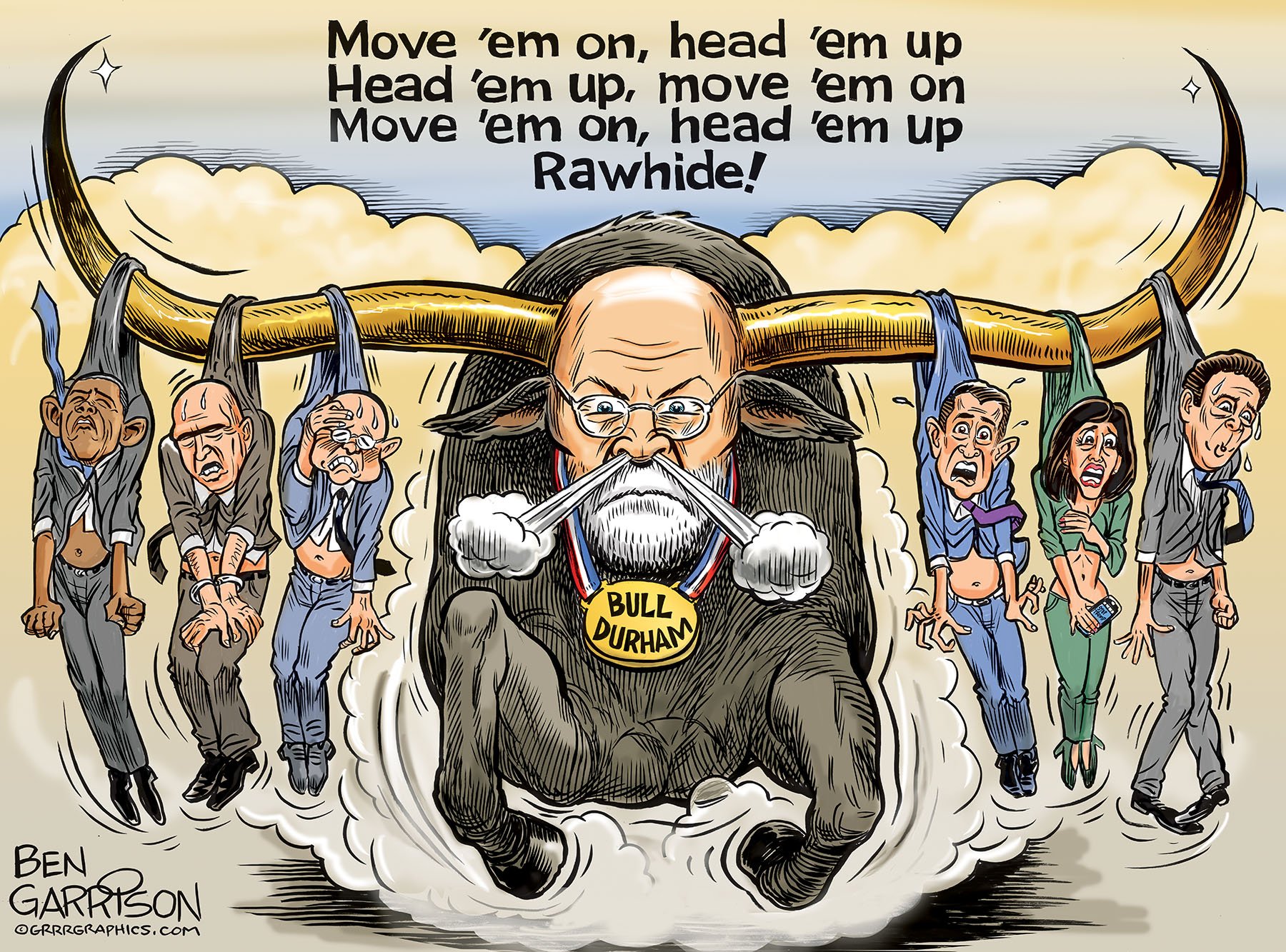
Trump’s lawsuit against Hillary’s vast conspiracy was dismissed, and the Durham investigation is winding down without proving much of anything. But in their day, these two Trump-will-be-vindicated hoaxes kept the money flowing in.
When I was growing up fundamentalist, Jesus’ second coming was always imminent. Any day now, the Heavens would open and there He would be, declaring an end to secular history and beginning a period of judgment that would separate the believers from the unbelievers. On that day, the doubters would be proven wrong and there would be “wailing and gnashing of teeth”. The righteous, on the other hand, would “shine forth as the sun in the kingdom of their Father”.
And in the meantime, you should keep sending in your money.
You can’t fully understand Trumpism without holding that picture in mind. Whatever evidence of Trump’s criminality the “fake news media” might present, and whatever testimony the 1-6 committee gets from Trump’s own people, the real Truth is going to be revealed any day now. His persecutors will be routed, and their sinister plots will be revealed.
In the meantime, keep sending Trump your money.
Like Jesus’ second coming, Trump’s final vindication can be predicted again and again — and those predictions can fail again and again — without undermining the basic narrative that it’s coming any day now. [1] Just scrap the old details for new ones and you’re good to go. Did Trump leave the presidency without invoking Q-Anon’s “storm”? Did none of his 82 post-election lawsuits prove fraud, even when he got them heard by judges he appointed? No problem: Those fantasies kept the money rolling in until new fantasies could be ginned up.
Recently, two other major Trump-vindication vehicles have gone bust: the Hillary conspiracy lawsuit and the Durham investigation. Each was a big deal in its day, but, you know, life moves on. The suit got dismissed and the investigation is closing up shop without finding any of the crimes Trump promised.
But never mind, they kept the money flowing.
The great Clinton conspiracy. It sounds weird to say this, but one of the most amusing things I read these last two weeks was Judge Donald Middlebrooks’ dismissal of Trump’s sprawling lawsuit against Hillary Clinton, Jim Comey, and everybody else the Former Guy has ever blamed for investigating his collusion with Russia.
Middlebrooks’ opinion reads like a professor grading the work of a particularly disappointing first-year law student. The judge keeps backing up to explain fundamental things the student (i.e., Trump’s lawyers) should have read in the textbook (i.e., landmark precedents).
A complaint filed in federal court must contain “a short and plain statement of the claim showing that the pleader is entitled to relief.” Each allegation must be simple, concise, and direct. Each claim must be stated in numbered paragraphs, and each numbered paragraph limited as far as practicable to a single set of circumstances.
Plaintiff’s Amended Complaint is 193 pages in length, with 819 numbered paragraphs. It contains 14 counts, names 31 defendants, 10 “John Does” described as fictitious and unknown persons, and 10 “ABC Corporations” identified as fictitious and unknown entities. Plaintiff’s Amended Complaint is neither short nor plain, and it certainly does not establish that Plaintiff is entitled to any relief.
More troubling, the claims presented in the Amended Complaint are not warranted under existing law. …
At this stage, a court must construe the complaint in the light most favorable to the plaintiff and accept as true all the plaintiff’s factual allegations. However, pleadings that “are no more than conclusions, are not entitled to the assumption of truth. While legal conclusions can provide the framework of a complaint, they must be supported by factual allegations.” A pleading that offers “labels and conclusions, and a formulaic recitation of the elements of a cause of action will not do.”
The rest of the ruling is a series of that’s-not-what-the-law-says, the-reference-in-your-footnote-doesn’t-support-the-point-you’re-making, and so on, culminating in the judge’s refusal to let Trump’s lawyers amend their complaint a second time:
It’s not that I find the Amended Complaint “inadequate in any respect”; it is inadequate in nearly every respect. … At its core, the problem with Plaintiff’s Amended Complaint is that Plaintiff is not attempting to seek redress for any legal harm; instead, he is seeking to flaunt a 200-page political manifesto outlining his grievances against those who have opposed him, and this Court is not the appropriate forum.
I’m reminded of the scene in The Paper Chase where Professor Kingsfield says to a student, “Here is a dime. Call your mother and tell her there is serious doubt about you becoming a lawyer.”
The inescapable conclusion of Judge Middlebrooks’ critique is that no competent lawyer ever intended this complaint to be the basis for a serious lawsuit. Rather, the only credible purposes would have been to get headlines for filing the suit, and to fund-raise off of those headlines.
In short, the anti-Hillary suit was part of the continuing grift against Trump’s own followers: Neither Hillary nor any of the other defendants was ever going to pay Trump damages, but the prospect of the vast Trump-persecuting conspiracy finally being exposed would induce the MAGA cultists to keep their wallets open.
Durham. When Trump accuses his opponents of doing something, it’s only a matter of time before he does the same thing himself (if he hasn’t already). In his mind, the Mueller investigation was an expensive taxpayer-sponsored witch hunt against him. So of course he had to have his own expensive taxpayer-sponsored witch hunt.
When Bill Barr announced this investigation in 2019, conservatives were expecting the grand finale to the Mueller story, the counter-attack that would uncover all the illegal machinations the FBI and others had done to try to nail Trump. As recently as February, Trump was still promising that Durham was finding evidence of “the crime of the century” and “treason at the highest level”. He was “coming up with things far bigger than anybody thought possible”.
Durham may go down as a great hero in this country that will be talked about for years.
But that was all part of the grift. Trump was reacting with such glee to a court filing related to Durham’s indictment of Michael Sussman, a minor figure accused of a minor crime that Durham could not prove. (The jury acquitted Sussman after only six hours of deliberation.) No “crime of the century” involving high-profile conspirators like President Obama or Hillary Clinton.
Now the Durham investigation appears to be shutting down, having lasted longer and cost more than the Mueller probe it was supposed to be investigating. It also has accomplished far less: Mueller proved that Russia did help the 2016 Trump campaign, and that it committed crimes to do so. Mueller didn’t come up with enough evidence to indict the Trump campaign itself in the conspiracy, though he did trace a suspiciously large number of links between Trump’s people and Putin’s. The investigation dead-ended at Paul Manafort and Roger Stone, both of whom were convicted of felonies, but got pardons from Trump, presumably as a reward for their silence.
Durham has one case left: against Igor Danchenko, who is accused of lying to the FBI about the information in the Steele dossier, which Trump wants to claim was the sole source of the Trump/Russia investigation. (It wasn’t. It wasn’t even the primary source.) Again, somebody may have lied about something that, in the end, didn’t really matter. Or maybe not: Durham’s standards appear to be far lower than Mueller’s, so his Danchenko case may be no more convincing than the one against Sussman.
But while Durham’s long-running investigation may look like a flop from a legal point of view, Atlantic’s David Graham explains that it did what it was supposed to do:
Even if Durham approached the probe with earnest sincerity, the real reason he was appointed is that Donald Trump’s political con requires the promise of total vindication right around the corner. For a time, Durham provided that hope for Trump backers. But now, as Trump moves on to other ploys, the Durham probe has served its purpose, even though it has produced no major convictions or epiphanies.
The grift goes on. So now is Trump’s Save America PAC going to apologize for raising money under false pretenses and send it all back? Don’t be silly. The Great Orange Conman has indeed “moved on to other ploys”. Now that investigations on numerous fronts threaten to expose his crimes, he needs your money more than ever.
Don’t ask what he did with the quarter-billion-plus he’s already collected, or why such a fabulously wealthy man needs your money at all. [2] The Forces of Evil are still at work, conspiring to find the top-secret documents Trump stole, expose his fraudulent business practices, and piece together his conspiracy to steal the presidency. So it’s time for all red-blooded Americans to step up, forget all the times Trump has lied in the past about conspiracies against him, and send in their money. (Also, stand by to riot again if he’s indicted.)
Objectively, things may keep looking worse and worse for Trump, but that’s how this story is supposed to go: the worse, the better. Signs of the End Times just lead to the Great Judgment.
Any minute now, the trumpet will blow, and the sky will be full of angels.
[1] I am reminded of one of the great opening paragraphs of any autobiography ever. In Knee Deep in Paradise, TV actress Brett Butler wrote:
I spent the first twenty years of my life waiting for two men I was reasonably certain would never come back – my daddy and Jesus Christ. I don’t wait for them anymore. My dad, anyway. And at least with Jesus I didn’t spend all that time thinking he was gone because of something I did.
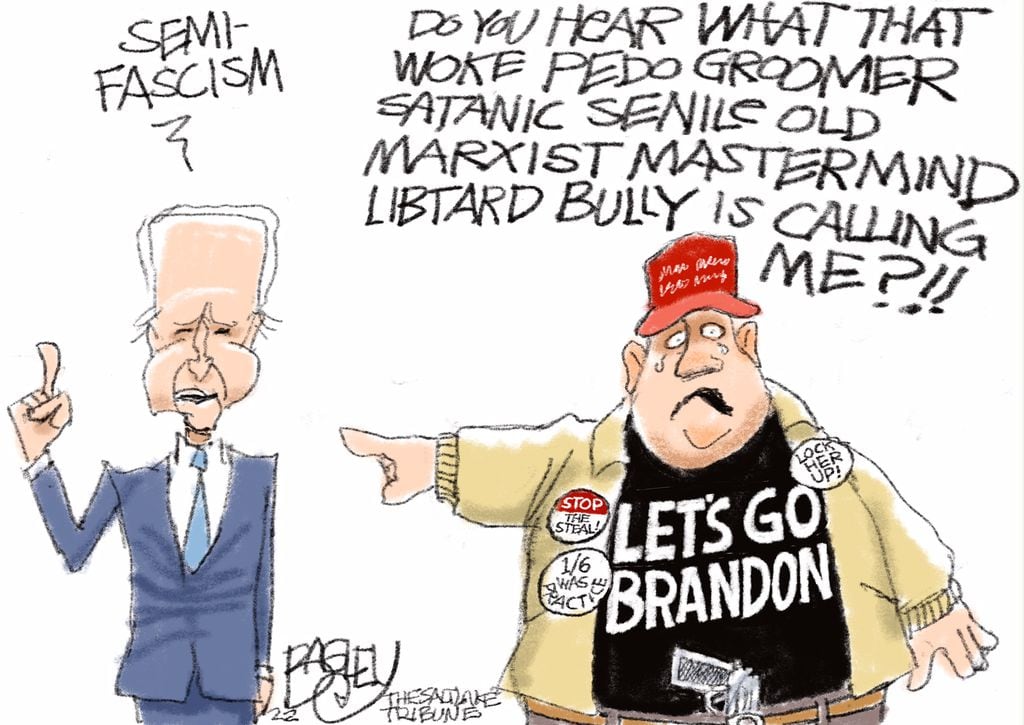
Biden’s counter-attack started on August 25, when he described “extreme MAGA philosophy” as “semi-fascist“. It continued in a prime-time speech Thursday night from Independence Hall in Philadelphia:
MAGA forces are determined to take this country backwards, backwards to an America where there is no right to choose, no right to privacy, no right to contraception, no right to marry who you love. They promote authoritarian leaders, and they fanned the flames of political violence that are a threat to our personal rights, to the pursuit of justice, to the rule of law, to the very soul of this country.
They look at the mob that stormed the United States Capitol on Jan. 6, brutally attacking law enforcement, not as insurrectionists who placed a dagger at the throat of our democracy, but they look at them as patriots. And they see their MAGA failure to stop a peaceful transfer of power after the 2020 election as preparation for the 2022 and 2024 elections.
They tried everything last time to nullify the votes of 81 million people. This time, they’re determined to succeed in thwarting the will of the people.
If you doubted a single word of that, Trump proved Biden’s point Thursday by promising — if he should ever become president again — to “look very, very favorably about full pardons”, with a “full apology”, no less, for his Brownshirts, the rioters he drew to Washington and incited to attack the Capitol on January 6.
Apparently, Trump supporters should be free to beat up police and intimidate Congress. The law should not apply to political violence, if that violence works to Trump’s advantage.
But in spite of the obvious truth in Biden’s remarks, the pro-fascist voices shrieked in horror: Biden had “insulted” “half the people living in this country“, i.e. everyone who voted for Trump. (Who aren’t “half the country”, by the way. That’s why he lost.)
But two points: (1) Not all of those 74 million Trump votes came from “MAGA Republicans” or even Trump supporters; they just liked him better than Biden. And probably most of those voters did not expect Trump to try to hang onto power by inciting violence after he lost; they might not have voted for him if they had.
Immediately after January 6, lots of Republicans felt that way — not just Liz Cheney and Adam Kinzinger, but also Kevin McCarthy, Mitch McConnell, Lindsey Graham and many others. But then elected officials saw which way the wind was blowing within the GOP, and most of them weathervaned back into the MAGA fold. They aren’t Trumpists, they’re just opportunists and cowards.
So Biden carefully targeted his criticism:
Now, I want to be very clear, very clear up front. Not every Republican, not even the majority of Republicans, are MAGA Republicans. Not every Republican embraces their extreme ideology. I know, because I’ve been able to work with these mainstream Republicans.
But the MAGA folks ignored that part of the speech and continued to insist that Trump voters ARE Trump; you can’t attack him without attacking them. Which also proves Biden’s point: Telling the masses to identify with the Leader, to see his pains as their pains and his enemies as their enemies, is one of the traits of fascism.
Which brings up the second point: (2) Biden (and me and a lot of other liberals) are not using “fascism” as an insult. It is descriptive term that means something — and that meaning clearly applies to Trump and his personality cult.
[Fascism is] a dysfunctional attempt of people who feel humiliated and powerless to restore their pride by:
styling themselves as the only true and faithful heirs of their nation’s glorious (and possibly mythical) past,
identifying with a charismatic leader whose success will become their success,
helping that leader achieve power by whatever means necessary, including violence,
under his leadership, purifying the nation by restoring its traditional and characteristic virtues (again, through violence if necessary),
reawakening and reclaiming the nation’s past glory (by war, if necessary),
all of which leads to the main point: humiliating the internal and external enemies they blame for their own humiliation.
Again, I haven’t changed that definition (not even the italics) since 2015. Trump and his movement have spent the last 7 years proving me right about them, from the demonization of Muslims to the intentional cruelty of his border policy to the mob violence of January 6.
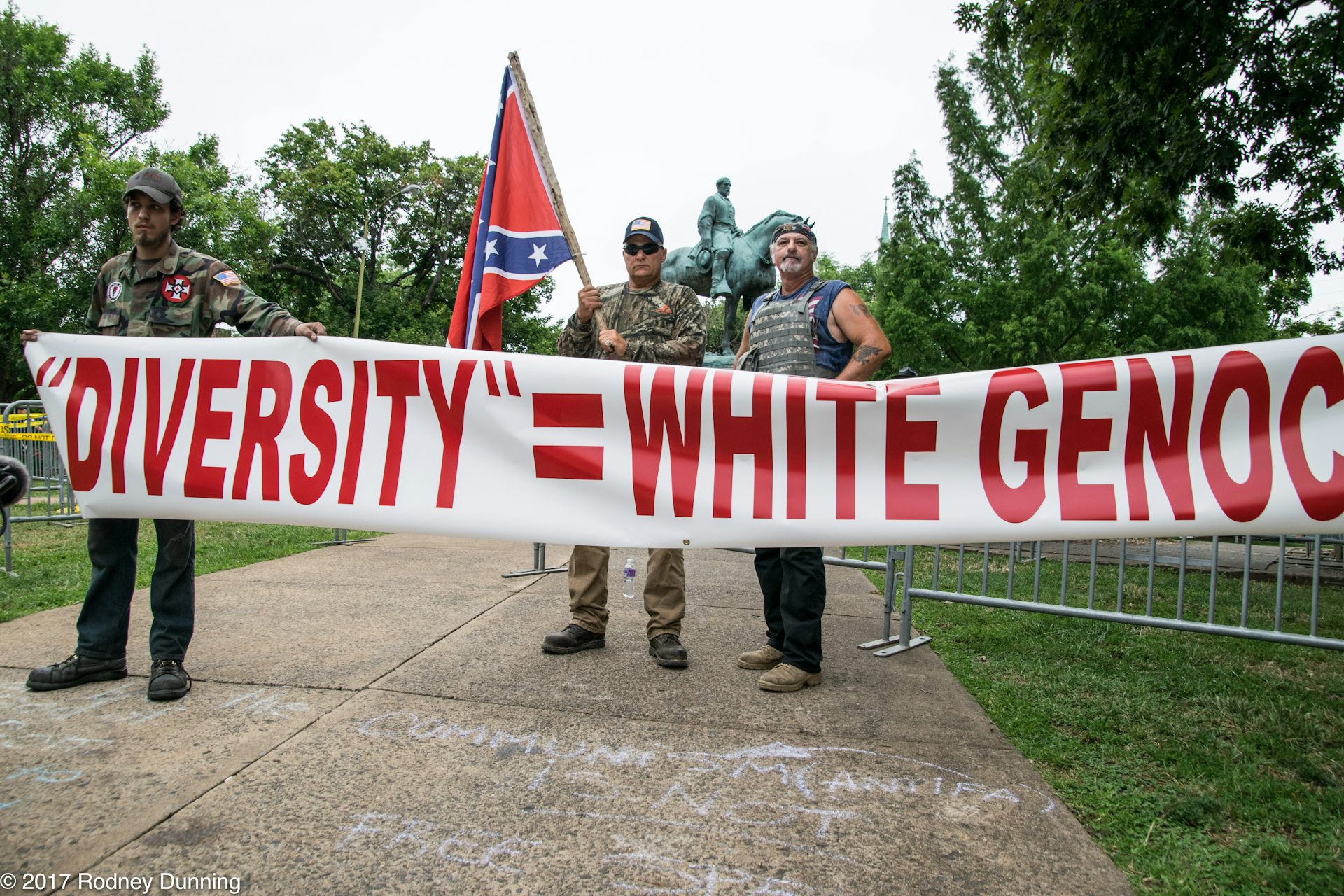
And what unites Trump’s mob? Identification with one of the groups that might feel aggrieved by the slipping of its former dominance. If the core of your identity is to be White, male, Christian, rural, or heterosexual, and you feel wronged by a society that no longer honors you as you feel you deserve (or sufficiently punishes people who are different from you), then you are a “real American” who needs to bask in the gold-plated glow of Trump’s reflected greatness, and needs his strength to strike back at those who have looked down on you.
As I said in 2015, fascism appears mercurial because it’s not “political” in any ordinary sense; it has no characteristic ideology or economic program, just friends and enemies. Fascism is a phenomenon of social psychology. It’s about dominance and grievance and humiliation and projecting images of strength, not potential solutions to the problems of Americans’ real lives.
The GOP’s decision not to write a platform in 2020 was textbook fascism: Our policy is Trump. Today, the way a candidate gets Trump’s endorsement and the backing of his cult is not to champion a set of ideals or policies, it’s to champion Trump himself, and his made-up grievances about the 2020 election and the FBI’s “invasion” of Mar-a-Lago.
Imagine a candidate who pledged to advance all of the Trump administration policies, but said that Biden had been legitimately elected and the January 6 riot was wrong. Could that candidate get Trump’s endorsement? I think not.
Trump doesn’t have policies, he has grievances. If you also feel aggrieved, he wants you to identify your grievances with his, and to vicariously experience satisfaction when he is victorious again and achieves a humiliating revenge against his enemies.
The Info-warrior. Friday, a Texas jury assessed $45.2 million in punitive damages against Alex Jones, on top of the $4.1 million it previously ordered him to pay in ordinary damages. The $49.3 million total would go to Neil Heslin and Scarlett Lewis, whose 6-year-old son Jesse Lewis was killed in the Sandy Hook massacre. On his widely viewed program Info Wars, Jones repeatedly claimed that the massacre was a hoax designed to give the government an excuse to confiscate guns, that Heslin and Lewis were “crisis actors”, and that their son never existed.
Because a large number of Jones’ fans actually believe the dark fantasies he spins, Heslin and Lewis have not only seen their grief exploited for someone else’s gain, but they’ve been harassed and even in physical danger for the last nine years.
As the linked article makes clear, the total amount Jones ends up paying could go either up or down. He might appeal to get this judgement reduced, but he also faces additional cases brought by other victims of his malicious lies. Or he might wriggle out of accountability by abusing the bankruptcy laws.
Like a lot of people, I take satisfaction from the prospect of Jones paying millions of dollars. I don’t throw the word evil around lightly, but Alex Jones qualifies. He has amassed a huge fortune by slandering people who have already suffered something worse than most of us can imagine. This is purely predatory behavior, and there is no excuse for it.
The quarterback. Last Monday, another punishment was announced (pending appeal): NFL quarterback Deshaun Watson will be suspended for six games. Watson was the target of lawsuits by 24 female massage therapists. Despite playing for a team (the Houston Texans) that had its own massage therapists, Watson arranged private appointments with more than sixty women, 24 of whom claim he tried to pressure them into sexual acts.
Watson sat out all last season (with pay) while the Texans watched the progress of the cases against him and tried to decide what to do with him. (He had demanded a trade before the scandals broke, but his value was hard to determine until the criminal probes concluded.) Ultimately, Watson was not indicted and he has settled all but one of the suits. The Texans then traded him to the Cleveland Browns, who signed him to a five-year $230 million contract. The contract was structured to have a large signing bonus, but a small first-year salary. As a result, he’ll lose only $345K if he misses the six games.
Like a lot of people, I had the exact opposite reaction to this announcement: Really? That’s all? I don’t know what I thought justice would be, but this isn’t it. If the decision stands, Watson will be back on the field for the Browns’ game against Baltimore on October 23. He should barely notice the lack of $345K, and it will be as if nothing ever happened. Come February, his accusers might be watching him in the Super Bowl. [1]
The former president. Meanwhile, the mills of justice grind very slowly in the case of Donald Trump. The House January 6 Committee has put together a compelling case that he did the single worst thing any American president has ever done to the country: He lost an election and tried to stay in power anyway. The January 6 attack on the Capitol was the culmination of a much larger anti-democracy plot, which he set in motion and tried to benefit from.
If he had succeeded, the republic set up by the Founders would effectively have fallen. After ignoring the Constitution and overruling the voters in 2020, why would he ever give up power? And if he should happen to die or retire, why should any future president give up power?
Whether Trump will face any consequences for these actions is still up in the air. Mitch McConnell and his fellow Republican senators refused to hold Trump accountable in his second impeachment trial. A Georgia prosecutor is investigating the former president’s attempts to reverse that state’s 2020 election, and the Department of Justice finally appears to be going up the chain from the January 6 rioters to the plotters whose will they were carrying out.
Will any of that lead to indictments? Convictions? Jail time? It’s still not clear.
The point of punishment. I’m discussing these three men together — Jones, Watson, Trump — because their cases raise a common theme: What is punishment for? How much is enough? Thinking about Jones and Watson, I believe, can give us insight into what we should want for Trump.
As I said above, it’s satisfying to see bad men punished. That’s a very human response. Particularly when evil-doers appear to prosper, it’s easy to convince yourself that anything bad that might happen to them is justified and even good. [2]
At the same time, I believe that the propensity to glory in revenge (whether personal, vicarious, or rooted in some abstract sense of justice) is not humanity’s best feature. At some point we need to let the Past pass, so that we can move ahead unencumbered.
But when is that? When can we say “OK, enough”? [3]
Nixon. Before we think about that, I want to consider one more example: Richard Nixon. President Ford pardoned Nixon about a month after he resigned, and as a result Nixon was never held fully accountable for his crimes. He never went to prison. He never even had to stand trial, so no once-and-for-all judgement about his actions was ever recorded.
At the time (I turned 18 shortly after the pardon, so I got to vote against Ford in 1976), I thought Nixon got off too easily. OK, he had to leave power, but most of us never have much power. If being returned to the ranks of ordinary citizens counts as “punishment”, then presidents really are above the rest of us in a way that I think the Founders never intended.
But as I look back now, I’m willing to cut Ford a little more slack. Even without a trial or prison, Nixon became a cautionary tale in American politics. For decades afterwards, a stain of illegitimacy hovered over everything he did. No American politician wanted to hear his or her actions compared to Nixon’s. His name went unmentioned at Republican conventions. Post-Nixon presidents couldn’t justify their actions by citing Nixon as a precedent.
In retrospect, I think that was a good outcome.
What I want for Trump, Jones, and Watson. What I want for each of them is not some specific punishment. What I want is an outcome that makes them cautionary tales for anyone in a position to offend in similar ways.
I want current and future sports stars to consider their possible actions and think “I don’t want to become another Deshaun Watson.” I want current and future conspiracy-theory entertainers to think, “That might gain me some viewers, but it’s a little too much like Alex Jones.”
And most of all, I want a stain of illegitimacy to fall across everything Donald Trump ever did. I want the adjective “Trumpian” to become a pejorative label that every major American politician tries to deflect, just as no one wanted to be “Nixonian” for the rest of the 20th century. I want the advisors and assistants in all future administrations to consider what happened to Trump’s people and think about what they might be risking.
What kind of punishments would do that?
It’s tempting to see the Nixon example as proof that punishment isn’t necessary at all. But Nixon was a very different case: By the time he left office, his party had already turned against him. He was never again a force in American politics.
By contrast, Trump is actively trying to return to power, and remains a cult figure whose members regard him as a hero.
He won’t go quietly into the Past, so he has to be brought down. I don’t see how that happens without mug shots, a trial, and an orange jumpsuit. The evidence against him needs to be presented in a court where he is not in control, with the result (I hope) that a jury unanimously convicts him of crimes. He needs to go to jail.
His trial and sentencing will be traumatic for the country, but his own actions and lack of remorse make it necessary. There needs to be an outcome whose reality he can’t deny. His followers may continue to claim, against all evidence, that he won the 2020 election. But if he’s in jail they can’t claim that a jury acquitted him.
How much jail time? Revenge says “He tried to overthrow my country’s Constitution and sent his mob to attack my Capitol.” The rest of his life would not be long enough to satisfy my desire for Revenge.
But that’s not an urge I want to indulge. So: how long? Long enough for the country to move on, and for the Republican Party to find new leaders. A four-year political cycle needs to come and go without any expectation that he might participate.
So that’s what I want: four years.
[1] For comparison, Tom Brady served a four-game suspension at the conclusion of the Deflategate saga. The Patriots managed a 3-1 record while he was gone. After he returned, the team continued on to the Super Bowl, where Brady led a historic comeback against the Atlanta Falcons and was named MVP. That game is considered one of the highlights of his career.
[2] I believe this is where the myth of Hell comes from. For many people, the vision of bliss in Heaven would be incomplete without the knowledge that the people who abused them in life are suffering endless torment. My own beliefs about God or the afterlife are uncertain, and waver sometimes from day to day. But one thing I’m certain I don’t believe is that a loving God condemns anyone to eternal suffering.
[3] My detailed analysis is in a sermon I gave in 1999, “Forgiveness“. I stand by it.
Before you complain about the 1-6 hearings being “one-sided”, you might want to ask Trump what his side of the story is.
As the January 6 Committee wraps up its public hearings until September, it’s time to assess what we’ve learned and where we are. Using primarily testimony from people inside Trump’s orbit (and occasionally inside his family), the Committee has put together a compelling narrative of how the January 6 riot happened. The key points are:
Trump lost the election.
His own experts, in his campaign as well as his appointees in the government, knew that his claims of widespread election fraud were false, and told him so on numerous occasions. This was not a matter of debate among administration officials. Every official in a position to investigate came to the same conclusion.
Trump tried everything he could think of to stay in power in spite of the voters. At every level, he tried to influence and intimidate Republican officials to change the results in his favor.
He pressured Justice Department leaders to lie about the conclusions of their investigations and back his false claims of election fraud.
He promoted a series of dubious legal theories, ranging from the unlikely to the absurd, that would give various intermediate entities (state legislatures, Congress, the Vice President) the authority to reverse the will of the voters and keep him in power. Again, the experts within his own administration unanimously told him that these theories had no merit.
He encouraged Republicans in seven states to assemble false slates of electors, and to submit fake electoral-vote totals to Congress. He then pressured Vice President Pence to count those phony votes, or to illegally refuse to count the votes of legitimate electors because their slate was “disputed”.
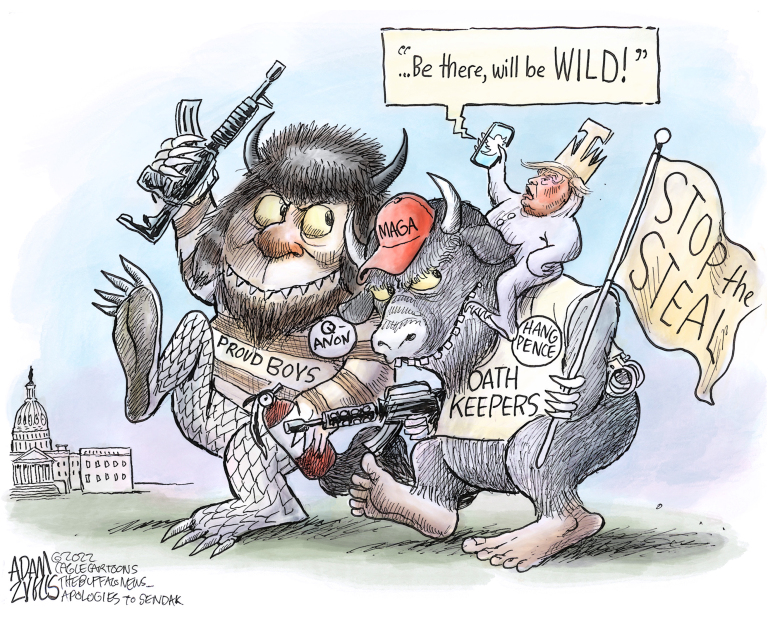
When it became clear that key departments within his administration — Justice, Homeland Security, Defense — would not abuse their powers to cooperate with his schemes, he called for a massive rally on January 6, promising it would be “wild”.
On January 6 itself, Trump knew that some members of his audience were armed when he told them to go to the Capitol.
Although a march to the Capitol was not announced in advance (even in drafts of Trump’s speech), right-wing militia groups like the Oath Keepers and Proud Boys knew it was coming. Before Trump started speaking, they were already preparing to breach the Capitol’s defenses and spearhead the mob Trump would send their way.
He intended to go to the Capitol himself, with his armed Secret Service detail, but the Secret Service refused to take him there. Instead, they returned him to the White House.
For three hours as the attack unfolded, he sat in the Oval Office dining room watching Fox News. The official White House records from that period are blank — no phone records, no photographs. During that time, virtually his entire staff pleaded for him to do something to stop the riot. But he made no effort to interfere with the attack, either by asking the mob to go home, or by mobilizing federal resources to aid the Capitol Police. Such orders, when they finally came, were given by Vice President Pence.
He knew that the mob was already angry with the vice president when he tweeted “Mike Pence didn’t have the courage to do what should have been done to protect our Country and our Constitution”. He never called Pence to make sure he was safe. Meanwhile, members of Pence’s Secret Service detail were sending messages to their families in case they died.
Although the White House call record for those three hours is blank, President Trump was calling Republican congressmen, urging them to continue the work of the mob by delaying further the counting of electoral votes.
Only when the tide had already turned, and law enforcement was beginning to regain control of the situation, did Trump ask the rioters to go home. In that video message, he repeated the false stolen-election claims that had inflamed the mob, and told the rioters “We love you. You’re very special.”
If Trump supporters are forced to comment on this narrative, they nearly always say, “That’s just the Democrats’ version. The hearings don’t present Trump’s side of the story.”
I’ve heard various responses to this point, all of which are true as far as they go:
Democrats originally wanted a bipartisan commission to investigate January 6, but Trump pushed Senate Republicans to block that proposal.
Kevin McCarthy was allowed to choose members of the committee, but when Nancy Pelosi rejected Jim Jordan (who was part of Trump’s conspiracy, and so would have been investigating himself) and Jim Banks, McCarthy pulled his other appointees off the committee.
Republicans Liz Cheney and Adam Kinzinger are important members of the committee, though Trumpists deny that these congresspeople are still Republicans. (This is known as the No True Scotsman fallacy: No true Republican criticizes Trump, so Cheney and Kinzinger can’t be Republicans any more.)
But there is a more fundamental answer that I seldom hear: Trump doesn’t have a side of the story to tell.
I know that sounds crazy: We’re often told that every story has at least two sides. But Trump has had every opportunity to tell his side of the story, and he has offered us nothing. If he wants to get his version out, he has immediate access to the vast resources of right-wing media, including Fox News, which I’m sure would love to be running shadow hearings orchestrated by his followers.
But in the last year and a half, Trump and his loyalists have made literally no positive contribution to the public record of the Capitol riot. From the beginning, Trump’s position has been consistent: No one should talk about January 6. No one should investigate it. No one should testify about it. (Josh Marshall comments on what Jim Jordan et al might have added to the hearings: “The point is to find out what happened … not to have a public presentation of findings along with another group making fart sounds and jeering and generally trying to throw the presentation or testimony off track.”)
Such comments on the hearings as Trump and his people have made are entirely negative: This event never happened, that witness shouldn’t be trusted, this testimony is hearsay, and so on.
But what did happen, Mr. Trump?
Crickets.
Well, that’s not entirely true: TrumpWorld does occasionally offer some transparent gaslighting about January 6, like when Trump described the mob that injured 150 police officers as “loving“, or Republican Congressman Andrew Clyde compared the Capitol invasion to “a normal tourist visit“, or the Republican National Committee characterized mob violence as “legitimate political discourse“.
But if any of the points in the Committee’s narrative are false, it shouldn’t be hard to assemble an alternative narrative and flesh it out with evidence. Did some investigator inside Trump’s Departments of Justice or Homeland Security (and not just amateur yahoos like Sidney Powell and the My Pillow guy) find evidence of the kind of widespread fraud that could have turned the election? (And not just a handful of people submitting false ballots, many of them for Trump?) Was there a faction — or even one person — inside DoJ’s Office of Legal Counsel or the White House Counsel’s office who supported Trump’s Pence-can-decide-what-votes-to-count theory? Can Trump tell us about any call he made to send help to the Capitol Police, and get the person he called to back him up? What’s the innocent explanation of how the Oath Keepers and Proud Boys knew ahead of time that a mob was coming to storm the Capitol?
Tell us about it. That would constitute another side of the story.
Or Trump could discuss his intentions. When he told the mob that he would go with them to the Capitol, did he mean it? Where exactly was he planning to go? What was he planning to do when he got there? Why didn’t he tell his supporters to go home sooner?
Other Trumpists could also tell us interesting facts, if they were so inclined. We know Roger Stone spent a lot of time with right-wing militia leaders prior to January 6. Maybe he could tell his side of that story (rather than pleading the Fifth in response to every question). Steve Bannon seems to have been tipped off about the riot. (“All hell is going to break loose tomorrow,” he said on his January 5 podcast. “It’s not going to happen like you think it’s going to happen.”) I’d love to discover how he knew, but he’d rather go to jail than talk about 1-6 under oath.
Mike Flynn retweeted a call for then-president Trump to declare martial law and hold a new election, and called for similar actions himself in public speeches. Other Trump officials have testified that Flynn wanted Trump to order the military to seize voting machines. Maybe he could tell us what he had in mind, rather than pleading the Fifth to a basic civics question like “Do you believe in the peaceful transition of power in the United States of America?”
Those accounts could turn into another side of the story. But it’s not the 1-6 Committee that’s preventing you from hearing such a narrative. It’s Trump.
So if you’re still a Trump supporter in spite of the evidence accumulated and presented by the Committee so far, your problem isn’t that Bennie Thompson and Liz Cheney are suppressing Trump’s side of the story.
Cassidy Hutchinson’s testimony Tuesday damaged both Trump’s image and his legal position.
The top assistant to Trump Chief of Staff Mark Meadows, whose desk was just steps away from the Oval Office, testified to the 1-6 Committee Tuesday [videotranscript]. She made an impressive witness and told a compelling story.
In my mind (and I suspect in Liz Cheney’s as well), these hearings serve two parallel purposes:
assembling evidence that will force the Justice Department’s hand and get Trump indicted,
breaking his hold on the Republican Party so that he will never return to power.
Cassidy Hutchinson’s testimony served both. Which purpose you find most important determined which part of her testimony you focused on.
Personally, I want to see Trump in jail, because I think that’s necessary to deter future fascist presidents from arranging their promotion to Führer. So I focused on the legally significant claims:
Trump had been warned before January 6 about the potential for violence.
When he told his rally crowd to march on the Capitol, he knew they had weapons.
He tried to stop the Secret Service from taking those weapons away.
Only the Secret Service prevented Trump from going to the Capitol with the mob.
He didn’t want to tell the mob to leave the Capitol, because (in Meadows’ words) “He thinks Mike deserves it. He doesn’t think they’re doing anything wrong.”
We’re still guessing what Trump planned to do if he got to the Capitol, but Hutchinson testified “I know that there was a conversation about him going into the House chamber at one point.” She said that on January 2 Rudy Giuliani told her about plans for the 6th: “The President’s going to be there. He’s going to look powerful. He’s — he’s going to be with the members. He’s going to be with the Senators.”
Breaking into the Capitol at the head of an armed mob to prevent Congress finalizing the election he lost — that sounds like something from the final days of the Roman Republic.
But if you’re mainly focused on GOP politics, probably the most significant aspect of Hutchinson’s testimony was how humiliating it was for Trump. In a dispassionate voice, she told about incidents when Trump behaved like a bratty toddler.
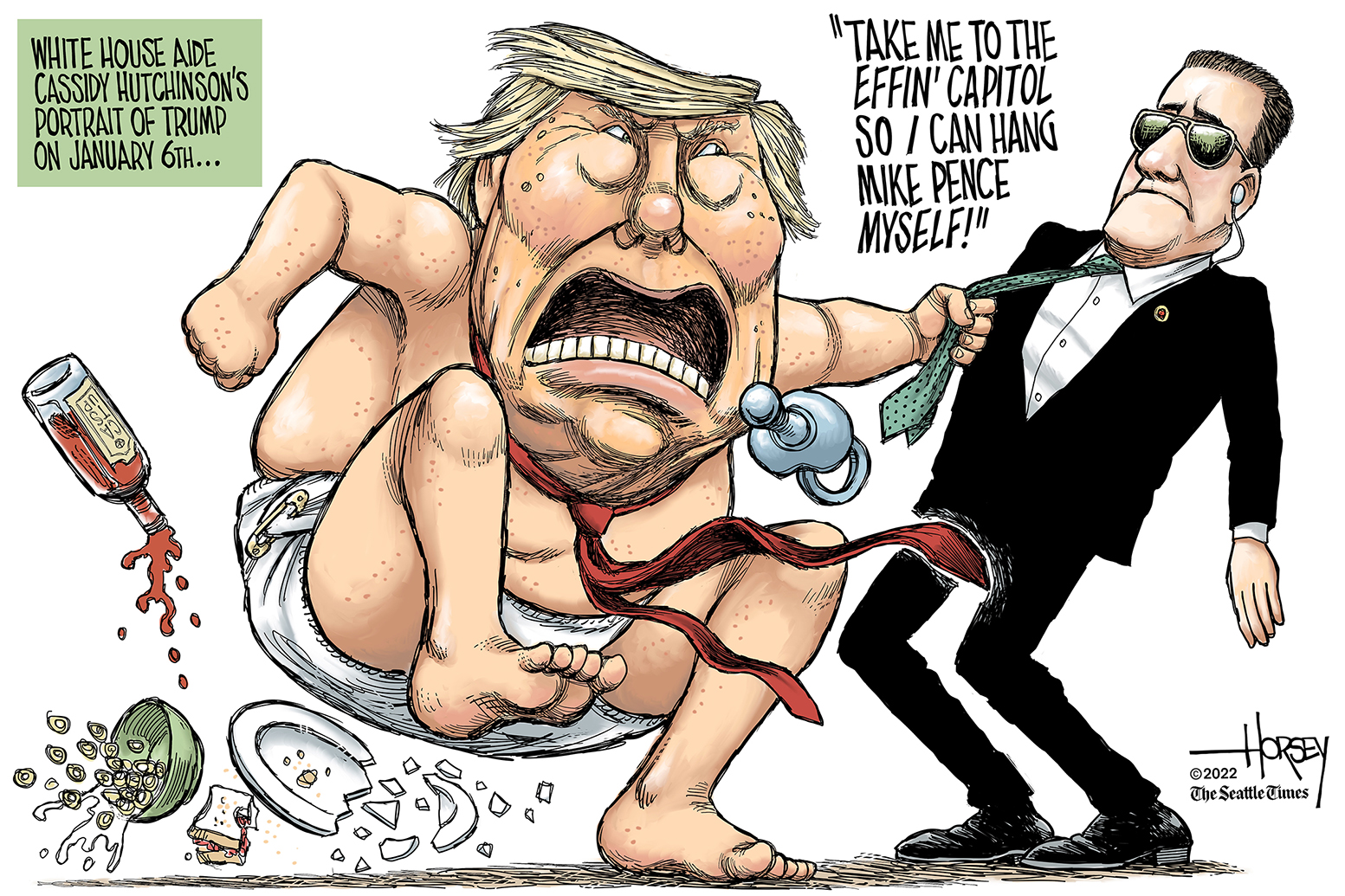
She described helping the White House valet clean ketchup off the wall of the Oval Office dining nook, after Trump had thrown his lunch at the wall. (He was upset because Bill Barr had told the public that his election-fraud claims were false.) She said that it was not the only time Trump had broken White House dishes during a fit of anger.
Putting this in presidential perspective: Remember what a scandal it was when Obama put his feet up on the Resolute Desk? “This arrogant, immature & self-centered man has no sense of honor, or of simple decency,” declared OutragedPatriots.com.
Imagine if our first Black president had broken White House china in a temper tantrum and left ketchup stains on the walls!
And then there was Hutchinson’s second-hand account of Trump trying to force the Secret Service to drive him to the Capitol.
And when [Secret Service Agent] Bobby [Engel] had relayed to him we’re not, we don’t have the assets to do it, it’s not secure, we’re going back to the West Wing, the president had a very strong, a very angry response to that.
Tony [Ornato] described him as being irate. The president said something to the effect of “I’m the f’ing president, take me up to the Capitol now” to which Bobby responded, “Sir, we have to go back to the West Wing.” The president reached up towards the front of the vehicle to grab at the steering wheel. Mr. Engel grabbed his arm, said, “Sir, you need to take your hand off the steering wheel. We’re going back to the West Wing. We’re not going to the Capitol.”
Mr. Trump then used his free hand to lunge towards Bobby Engel. And Mr. — when Mr. Ornato had recounted this story to me, he had motioned towards his clavicles.
Trump has always been more concerned about his image than about the law, so TrumpWorld responded to this account rather than the parts of Hutchinson’s testimony that were more legally damaging.
An anonymous source countered Hutchinson’s testimony-under-oath by claiming that “Two Secret Service agents are prepared to testify before Congress that then-President Donald Trump did not lunge at a steering wheel or assault them.” This is a very specific denial that I could imagine as part of testimony that supported 99% of what Hutchinson claimed. (“It was more of a reach than a lunge, and I wouldn’t describe that as an assault.”)
CNN then found other anonymous Secret Service agents who backed up Hutchinson’s account. Whether the incident happened exactly as she described it or not, it is clear that Hutchinson did not make the story up. It was circulating in the White House, as she said. She never claimed to be in the car, witnessing the tantrum herself.
We’ll see if any of this additional testimony actually happens. After all, Trump and his people have a long history of promising proof that never appears. Hutchinson made her statements under oath, and that has to give them more credibility than anonymous sources describing what somebody else might be willing to say.
In addition, I find it striking that no one from TrumpWorld stepped up to dispute the legally damaging parts of Hutchinson’s testimony. It’s scary that a guy who can’t be trusted with the White House china had the nuclear codes, but breaking dishes isn’t illegal.
Here’s a point that the I don’t think is getting enough stress in the public conversation: This is not a debate between two versions of what happened on January 6. The committee is presenting a narrative of what happened, and Trump’s people are refusing to discuss the matter — not just refusing to testify under oath, but refusing to comment at all. Trump complains about the hearings being “one-sided”, but he has chosen not to present a side.
If he had the confidence and courage to go under oath, as Hillary Clinton did during the Benghazi hearings, Trump (or Mark Meadows or Rudy Giuliani) could tell the committee (and the country) an alternate story, if he has one.
But even short of testimony, Fox News would readily give Trump all the air time he wants, with none of that annoying cross-examination or fact checks or follow-up questions or risk of perjury. He could explain why he didn’t believe his own experts when they told him that his fraud claims were false, and that Mike Pence had no power to reject electoral votes certified by the states. He could tell us which of his many debunked fraud claims he still believes, what the fake electors were for, what he intended the crowd to do when they got to the Capitol, when he first learned that violence had broken out, what he was thinking when he attacked Vice President Pence in a tweet (and in particular, did he know at the time that the crowd was already calling for Pence to be hung?), why he waited so long to ask the rioters to go home, and so on.
But he won’t do any that. His “side of the story” never gets any more detailed than saying that he did nothing wrong.
He refuses to go on the record in any form (and certainly not under oath) because he knows that he can’t defend any detailed account in which he did nothing wrong.
He knows he’s guilty.
All of which raises the question: Will it make any difference? Will the Justice Department indict Trump? Or anybody inside the White House who wasn’t physically present at the Capitol Insurrection? Lawrence Tribe says yes. Jeffrey Toobin urges DoJ not to. Jack Goldsmith says it’s a tough decision.
[This article is being written before and possibly during the second hearing, which started at 10 a.m. I will cover that material, together with Wednesday’s and Thursday’s hearings, next week. As I’ve repeated many times, this is not a breaking-news blog.]
The committee kicked off its public hearings Thursday night [videotranscript]. Remembering Bob Mueller’s testimony to Congress about his investigation, I had worried that these hearings would be dull and legalistic, or that they would rehash details that, however damning they might be, had already been widely discussed by people who were open to knowing what happened. Worst of all would have been one of those talkfests where each committee member gets five minutes to audition for national attention.
I should have had more faith. The other committee members were content to let Chair Bennie Thompson and leading Republican member Liz Cheney carry the ball, and they carried it well, particularly Cheney.
The first hour of the hearing consisted of Thompson and Cheney laying out the story that the rest of the evidence will nail down, backing up their claims with short videos of testimony that the public had not seen before — mostly from people in Trump’s inner circle: Bill Barr, Jason Miller, and even Ivanka. In the second hour the committee heard from live witnesses: Capitol Police officer Caroline Edwards (who was injured battling rioters at the barricades) and documentary film-maker Nick Quested (who spent the day following Proud Boys leader Henry Tarrio).
The key points in the Committee’s narrative are:
Trump knew that he had lost the election, and that his claims of fraud were baseless. Trump campaign advisor Jason Miller testified that (as the votes were still being counted) the campaign’s data analyst told Trump that he would not win. Trump lawyer Alex Cannon investigated the election-fraud claims, and already in November had reported to Mark Meadows that “we weren’t finding anything that would be sufficient to change the results in any of the key states”. To which Meadows replied: “So there’s no there there.” Attorney General Bill Barr said he told the President within weeks of the election that his charges of fraud were “bullshit”, and in particular that his claims about Dominion voting machines were “complete nonsense”. Ivanka was shown testifying that she believed Barr.
The attack on the Capitol was planned and organized. This wasn’t a protest that spontaneously spun out of control. In response to Trump’s tweet that 1-6 would “be wild”, the Proud Boys and Oath Keepers made plans to storm the Capitol. Before Trump even began his speech, about 200 Proud Boys had left his rally to scout the Capitol’s defenses. After Trump sent the crowd in their direction, they spearheaded breaching the barriers and leading the mob into the Capitol. (A key question going forward: Were these Trumpist militias just intuiting what their leader wanted, or does some figure — Roger Stone, say — connect them more directly with the White House’s plans?)
The rioters engaged in a bloody battle against law enforcement. If the videos of the attack didn’t make this obvious enough, Officer Edwards’ testimony brought the point home: “I saw friends with blood all over their faces. I was slipping in people’s blood. You know, I — I was catching people as they fell. I — you know, I was — it was carnage. It was chaos. I — I can’t — I can’t even describe what I saw. Never in my wildest dreams did I think that, as a police officer, as a law enforcement officer, I would find myself in the middle of a battle. You know, I — I’m trained to detain, you know, a couple of subjects and — and handle — you know, handle a crowd, but I — I’m not combat trained. And that day, it was just hours of hand-to-hand combat, hours of dealing with things that were way beyond any — any law enforcement officer has ever trained for.” This contrasts with Trump’s characterization of the mob as “loving” and Rep. Andrew Clyde’s comparing the rioters to tourists.
The riot was part of a larger plan to reverse the voters’ decision and return Trump to office for a second term. Cheney quoted conservative Judge Michael Luttig: “If Dr. Eastman and President Trump’s plan had worked, it would have permanently ended the peaceful transition of power, undermining American democracy and the Constitution.” Trump pressured the Justice Department to spread his lies about election fraud. (“Just say the election was corrupt and leave the rest to me and the Republican Congressmen,” Trump told DoJ officials.) He pressured state election officials to commit fraud. (Cheney: “You will hear additional details about President Trump’s call to Georgia officials urging them to ‘find’ 11,780 votes – votes that did not exist, and his efforts to get states to rescind certified electoral slates without factual basis and contrary to law. You will hear new details about the Trump campaign and other Trump associates’ efforts to instruct Republican officials in multiple states to create intentionally false electoral slates, and transmit those slates to Congress, to the Vice President, and the National Archives, falsely certifying that Trump won states he actually lost.”) He pressured Vice President Pence to refuse to count electoral votes certified by the states, based on a theory he had been told was illegal.
Trump cheered the violence and refused to take action to stop it. Cheney: “Not only did President Trump refuse to tell the mob to leave the Capitol, he placed no call to any element of the U.S. government to instruct that the Capitol be defended.” General Milley testified that orders to get soldiers to the Capitol came from Vice President Pence, not from Trump. When told that the rioters were chanting “Hang Mike Pence”, Trump said Pence “deserves” it. (The source of that quote — which Trump denies — has still not been revealed.)
At least a few Republican members of Congress were complicit. This was the evening’s most tantalizing and least-fleshed-out point. Cheney floated this: “Representative Scott Perry, who is also involved in trying to get Clark appointed as Attorney General, has refused to testify here. As you will see, Representative Perry contacted the White House in the weeks after January 6th to seek a Presidential pardon. Multiple other Republican Congressmen also sought Presidential pardons for their roles in attempting to overturn the 2020 election.”
Conservative counter-programming. Almost as interesting as the hearing itself was how Trump and his minions dealt with it.
Fox News went to great lengths to shield their audience from any of the information the committee presented. The network not only refused to air the hearings, but went without commercial breaks for two whole hours, so that none of their viewers would be tempted to check out one of the news channels that was actually covering the news. Comedian Stephen Colbert nailed this:
Do you understand what that means? Fox News is willing to lose money to keep their viewers from flipping over and accidentally learning information. … But I’m not surprised. That’s the first rule of any cult: Never leave the compound.
Robert Reich estimates the lost revenue at around $400K. Chris Hayes describes the next level of technical detail: How Fox made sure none of the videos of Trumpist violence would make it through to their viewers, even as a picture-in-picture with Tucker Carlson talking over it.
Truth Social, Trump’s Twitter-clone, reportedly has been banning users who try to discuss the Committee’s evidence, making a mockery of the free-speech rhetoric it was founded on. This also should not be surprising: Reciprocity is not a fascist value. Fundamentally, fascism is an us-and-them worldview, where the fascists themselves have God-given rights, but their enemies do not.
Trump himself lashed out, calling the hearings a “witch hunt” and the committee members “hacks”. He attacked Bill Barr as “weak”, and said that Ivanka had “checked out” of looking at election claims. (Unaddressed question: Why shouldn’t Trump’s other supporters check out too?) He repeated his long-debunked claims of “an Election that was Rigged and Stolen”, and praised the January 6th rioters as representing “the greatest movement in the history of our Country to Make America Great Again”.
Direct criticism. If the don’t-look-behind-the-curtain defense failed, the next line was to smear the proceedings as “propaganda” or a “show trial” or “kangaroo court”, without addressing any of the evidence presented.
The Lawfare blog will be doing next-day podcasts where people call in questions about the hearings. The final question in Friday’s podcast was whether this criticism has merit. Host Benjamin Wittes answered this himself, and made a few key points:
First, the committee is not a court at all, in that no ruling will be made and no punishment will be assessed. So accusing it of being a kangaroo court conducting a show trial is a category error.
Beyond that is the question of whether the hearings are presenting accurate information, and as far as we can tell at this point, it is.
Finally, and harder to judge, is whether the committee is ignoring or omitting information that would argue against the points the committee is making. Wittes is not aware of any such information.
It’s worth pointing out that if any of the quoted witnesses feel that their testimony has been misrepresented, nothing stops them from saying so. Ivanka still has her Twitter account, for example, but hasn’t posted since May 30. Bill Barr and Mark Milley would have no trouble getting attention if they had comments to make.
Finally, it should go without saying that if what you are presenting is true, you have no responsibility to “balance” it by presenting lies. So Trump’s complaint that the Committee “refuses to talk of the Election Fraud and Irregularities that took place on a massive scale” has no merit. The evidence says not only that Trump’s claims about the election are false, but that they are conscious lies. He has known from the beginning that they are false.
Political impact. About 20 million Americans watched the hearings live, not counting those who watched it later online. Millions more have seen highlights or have heard summaries presented by journalists, comedians, or their friends. A few key facts have probably penetrated MAGA’s darkest sanctums: Not even Ivanka believes Trump’s stolen-election bullshit.
It remains to be seen whether the hearings will fade or pick up momentum. Today’s hearing undoubtedly will get a smaller audience, simply because it’s in the morning rather than prime time. But we’ll see what kind of buzz it generates.
The most effective Republican talking point against the hearings is not that the Committee’s case isn’t true, but that 1-6 is ancient history, and that Americans are much more worried about immediate issues like inflation (which the GOP has presented no plan for stopping).
Democrats have offered Republicans many opportunities to put 1-6 behind them: They could have voted to convict Trump in his second impeachment, and made him ineligible for future political office. They could have supported a bipartisan commission to investigate 1-6 and rallied behind its conclusions. They could still denounce Trump’s insurrection, denounce the Big Lie, and denounce Trump for continuing to promote it.
In short: They could take their party back from the fascist demagogue who has dominated it these last six years.
But they won’t unless public opinion forces them. That’s why these hearings are necessary.
Rumblings. The path of least resistance going forward is for the GOP to do to Trump what they did to their last failed president, George W. Bush. Bush left office in 2009, and by the 2010 election Tea Party candidates were running away from him almost as hard as they were running against Obama. In the early days of the Iraq invasion they had seen Bush as the next face on Mount Rushmore, but by 2010 the Tea Party line was that he had never really been a conservative.
Current Republicans could do something similar to Trump: claim that they are “constitutional conservatives” as opposed to the guy who tried to overthrow the Constitution after he lost the election. If they do, then the midterm elections can be about inflation or critical race theory or immigration or transgender-kids-in-your-daughter’s-locker-room or Biden’s-gonna-take-your-guns or pretty much whatever they want. If they don’t, then Trump and the Democrats will conspire to make the midterms about Trump, which is one of the few ways Republicans can blow this election.
Some conservatives grasp this logic. Fox News may be lining up behind Trump, but the rest of the Murdoch media empire is not so sure. The Wall Street Journal recognizes the basic facts of the Committee’s case, and only defends Trump against criminal liability.
The President spread falsehoods about the election. He invited supporters to Washington on Jan. 6, tweeting on Dec. 19 that it ‘will be wild!’ He riled up the crowd and urged it to march on the Capitol. After violence began, he dawdled instead of sending help. Mr. Trump bears responsibility for the mayhem. But inspiring followers to march is not the same as leading a criminal conspiracy.
Murdoch’s New York Post takes a more purely partisan angle. It shrugs off the broader threat to democracy, but wants to jettison Trump’s 2020 claims so that Republicans can focus on more effective issues and less tainted candidates.
Trump has become a prisoner of his own ego. He can’t admit his tweeting and narcissism turned off millions. He won’t stop insisting that 2020 was “stolen” even though he’s offered no proof that it’s true. … Trump can’t look past 2020. Let him remain there. Look forward! The 2024 field is rich.
Elected Republicans could follow that lead. They could choose to jump off the Trump Titanic before it sinks. But will they?
No, he didn’t say that Black women’s deaths don’t count.
Here’s a pattern I complain about a lot: Some prominent Democrat says something that the conservative media paraphrases in a hostile way, making the statement sound much more ridiculous or offensive than it really was. That paraphrase then gets treated as if it were the actual quote, and a game of telephone proceeds from there, with each paraphrase more offensive (and further from reality) than the previous one.
Deplorables. That’s what happened, for example, when Hillary Clinton used the phrase “basket of deplorables” to describe the “racist, sexist, homophobic, xenophobic, Islamophobic” forces that had united under the Trump banner in 2016. Conservative media quickly turned that into a declaration that Trump supporters were deplorable in and of themselves, without reference to racism, sexism, homophobia, xenophobia, or Islamophobia.
At a fundraiser on Friday, Democrat presidential candidate Hillary Clinton lashed out at her opponent GOP presidential candidate Donald Trump and his supporters. She called those supporting Trump a “basket of deplorables.”
The article included a Trump spokesman’s response:
What’s truly deplorable isn’t just that Hillary Clinton made an inexcusable mistake in front of wealthy donors and reporters happened to be around to catch it, it’s that Clinton revealed just how little she thinks of the hard-working men and women of America.
By now it’s a universal belief among Trumpists: Hillary called them deplorable, for no reason at all. What’s more, Hillary was just saying the quiet part out loud; Democrats in general look down on “the hard-working men and women of America”.
During my service in the United States Congress, I took the initiative in creating the Internet. I took the initiative in moving forward a whole range of initiatives that have proven to be important to our country’s economic growth and environmental protection, improvements in our educational system.
The vice president was not claiming that he “invented” the Internet in the sense of having thought up, designed, or implemented it, but rather asserting that he was one of the visionaries responsible for helping to bring it into being by fostering its development in an economic and legislative sense.
The claim that Gore was actually trying to take credit for the “invention” of the Internet was plainly just derisive political posturing that arose out of a close presidential campaign. If, for example, Dwight Eisenhower had said in the mid-1960s that he, while president, “took the initiative in creating the Interstate Highway System,” he would not have been the subject of dozens and dozens of editorials lampooning him for claiming he “invented” the concept of highways or implying that he personally went out and dug ditches across the country to help build the roadway. Everyone would have understood that Eisenhower meant he was a driving force behind the legislation that created the highway system, and this was the very same concept Al Gore was expressing about himself with interview remarks about the Internet.
But this also has become an article of faith on the Right: Gore made an absurd claim that undermines claims he has made on other issues, like climate change.
Democracy. Those are two of the most prominent examples, but lesser ones pop up on a regular basis. In the 2020 campaign, Fox played telephone with a Biden quote until eventually Lou Dobbs did this with it:
Joe Biden says the police are “the enemy.” Those are his words, “the enemy.”
But that was a paraphrase of a paraphrase, not “his words”. Conservatives have also spread doctored videos of Biden to either distort his views or make him look senile.
I hate stuff like that, not just because it treats public figures unfairly, but because it undermines democracy. The archetypal vision of democracy is of the public having a conversation that eventually arrives at some combination of compromise and consensus. Once such a conversation has established a public will, elected representatives can carry out that will.
But that whole vision comes apart if the public conversation centers on things that never happened, or devolves into flame wars started by insults that were never said.
Wouldn’t it be great if political campaigns could revolve around things that are real, rather than issues that have been invented to raise anger?
But if that’s what we want, we have to model it. In some arenas turnabout is fair play. But here, their abuse of democracy shouldn’t give us license to abuse it too. Personally, I’d like to save democracy, not win the ground where its corpse lies.
But did he actually say those things? You don’t have to take anybody’s word for it; the whole virtual interview is on YouTube. It’s just under half an hour, but the abortion/maternal-health portion is in the first nine-and-a-half minutes.
It’s important to set the stage: Senator Cassidy, a doctor himself, is being interviewed by Politico reporter Sarah Owermohle under the auspices of Harvard’s Chan School of Public Health. This is not a campaign rally or other political event. Both Cassidy and Owermohle appear to be in their homes, but the virtual site of the conversation is Harvard.
Owermohle begins by asking about the leaked Supreme Court opinion reversing Roe, and Cassidy minimizes its impact, as if the 15-week ban at the center of the Dobbs case is the end of the story: Abortion will still be available up to that point, women will still be able to go to liberal states to get abortions, and abortion drugs will be available through the mail.
So fundamentally, the first month or two, not much would change, except for the location of where the abortion would take place.
Now, Cassidy surely knows that far stricter bans are being passed in states like Oklahoma and Tennessee, and that they will undoubtedly stand if Justice Alito’s opinion prevails. So he’s being disingenuous, but I have to admit that this is well within the bounds of normal political spin.
Owermohle then asks if Cassidy would support a federal ban on abortion, and Cassidy dodges. He says something that would argue against it:
I’m a federalist, and I think that states should be allowed to make decisions by the tenets of democracy.
But he doesn’t actually say he wouldn’t vote for a federal ban. Similarly, he argues that a national abortion ban would never get the 60 votes needed to overcome a Senate filibuster, but says nothing about the pressure Republicans would be under to scrap the filibuster if they had a majority. So this response is slippery, but again, within the normal bounds of American politics.
Owermohle asks about next steps for the pro-life movement after Roe is overturned, probably looking for Cassidy to say something about birth control, but instead Cassidy shifts the discussion to maternal health.
I truly think we need to support the mom when the child is in utero, and to support the mom afterwards, to give her everything she needs so that she can feel comfortable bringing the baby to term [and either giving the child up for adoption or raising it herself], to support that continuum of life from within the womb to without the womb.
To her credit, Owermohle doesn’t take Cassidy’s expression of concern for pregnant women at face value, and asks a polite but challenging follow-up. She notes that Louisiana “ranks very high on maternal deaths” and asks what needs to be done to improve that.
This is the section that leads to the headlines.
[In] Louisiana, about a third of our population is African American. African Americans have a higher incidence of maternal mortality. So if you correct our population for race, we’re not as much of an outlier as would otherwise appear.
Remember, Cassidy is a doctor who thinks he’s talking to the Harvard School of Public Health, so he is assuming a sophisticated audience. In that context, he’s not arguing to ignore the deaths of Black women, he’s reframing the problem: The right question, he is claiming, isn’t why so many new mothers die in Louisiana, it’s why so many new African American mothers die nationwide. That interpretation is clear if you continue the quote:
I say that not to minimize the issue, but to focus the issue as to where it [sh]ould be. For whatever reason, people of color have a higher incidence of maternal mortality.
Does he leave “whatever reason” as an unfathomable mystery, say “Sucks to be them”, and move on? No. He talks about remedies.
Now, there’s different things we can do about that. I have something called the Connected MOMS Act.
The target of this act is a pregnant woman dependent on public transit who lives 20 miles or more from her doctor. “So you’d like a better way to monitor her than asking her to come to the doctor’s office every two weeks.” The plan calls for remote blood-pressure monitoring and a few other innovations that could spot complications from a distance.
We also have the maternal health improvements grant, which again is to promote studies of this issue as well as to look at potential remedies, if you will, if there’s racial bias that is discovered in how health care is delivered.
So we’ve got a couple things that we’re floating out there trying to take care of this issue, because it is an issue for us in Louisiana as well as for folks nationwide.
I want to point out how far out on a limb he has gone, from the point of view of the far-right Republican base: Cassidy is allowing the possibility that studies could show racial bias in health care. I think it’s obvious that such bias exists and that honest studies will find it, but the Republican base voter doesn’t want to hear that. If such a possibility were raised in a school textbook, it would be “critical race theory”.
So is Cassidy saying: “Don’t bother to count Black women”? No, he’s not. I haven’t read the two pieces of legislation he’s talking about, so it’s possible they don’t do as much as he says. Or maybe the bills include other objectionable provisions that make their passage impossible or counterproductive. I can’t judge that. But at the very least he is paying lip service to the idea that Black lives do matter.
And that’s the exact opposite of what he’s being accused of.
Republicans used to unite around the interests of the rich. Now they unite around a conspiracy theory that has repeatedly inspired mass shootings.
This weekend, we learned all over again that ideas have consequences. When people believe terrible ideas, they do terrible things.
The idea this time is White Replacement Theory: A conspiracy of Jews and liberals is trying to “replace” Whites as the dominant race in America and Europe by bringing in as many non-white immigrants as possible, by encouraging Black people to breed quickly, by diluting the white race through interbreeding, and by depressing white birth rates. The ultimate goal is the extinction of the white race, an outcome also known as white genocide. [1]
If someone really believed such a theory, what might they do? We found out Saturday:
18-year-old Payton Gendron parked his car in front of the entrance to a Tops Supermarket in a Black neighborhood in Buffalo, New York. Exiting the car wearing metal armor and holding an assault rifle, he shot and killed a female employee in front of the store, and a man packing groceries into the trunk of his car. After entering the store, he murdered the store’s guard, and by the end of his killing spree, he had shot 13 people, killing 10 of them.
Eleven of the people he shot were Black, and two were white. As the manifesto he left behind makes clear, this was fully intentional. The first listed goal in his manifesto was to “kill as many blacks as possible”.
Gendron lives in rural New York state, but (according to the manifesto he posted online) drove three hours to find a zip code with a large black population. So he wasn’t seeking revenge against particular Black people that he blamed for his real or imagined problems. He was striking a blow for the white race.
Surely now people will see … Sunday, Pete Buttigieg tweeted:
It should not be hard, especially today, for every elected official and media personality in America—left, right, and center—to unequivocally condemn white nationalism, “replacement theory,” and all that comes with it.
That might seem like a small thing to ask. After all, the Buffalo shooting feels like the kind of horrifying crime that should scare everybody straight. Sure, a news-channel entertainer like Tucker Carlson might pimp WRT to juice his ratings, a politician like Donald Trump might motivate his base by hyperbolically describing immigration as an “invasion“, and countless ignorant folks on social media might pass on these ideas to justify the racism they’ve carried all their lives. But Payton Gendron has shown us that this isn’t a game. When crazy ideas are thrown around loosely, crazy people latch onto them and do terrible things. Surely everyone will realize that now, and everything will change.
That feeling should last for at least another day or two. Enjoy it.
Because we’ve been here before, and nothing changed. We were here when Dylann Roof, 21, killed nine Black Christians during a Bible study class at the Mother Emmanuel Church in Charleston (a city he also picked because of the large number of Black people living there). And when Patrick Crusius, also 21, drove from his Dallas suburb to a WalMart in El Paso, where he tried to shoot as many Mexicans as possible; he ended up murdering 23 people of various races and nationalities and injuring 23 more. John Earnest,19, hoped to kill as many Jews as possible in Poway, California, but he wasn’t very good at it; he only murdered one and wounded three others before his gun jammed. Robert Bowers, in his 40s, also went after Jews, killing 11 worshipers at the Tree of Life synagogue in Pittsburgh.
Those were all White Replacement Theory massacres. We know because the killers were only too happy to explain their actions. Posting a manifesto has become a standard part of a WRT massacre.
There have been WRT massacres in other countries as well. In New Zealand Brenton Tarrant attacked two mosques, killing 51 people. In Norway Anders Breivik’s murder spree was at the youth camp of Norway’s Labor Party; he killed 77 people in all, most of them White teens who were growing up liberal.
If conservative promoters of WRT were going to be scared straight, it would have happened by now. It might have happened after Charlottesville, when only Heather Heyer died, but the nation saw the spectacle of violent white supremacists marching down the streets chanting “Jews will not replace us.“
Nudges and dog whistles. Elected Republicans and Fox News hosts never explicitly tell anyone to go kill Blacks or Hispanics or Jews. But they do regularly say things that, if taken seriously, would logically result in race massacres. Why, for example, did Patrick Crusius take military weaponry to the biggest city on the US/Mexican border? Because he believed his country was being “invaded” by Mexicans, just as President Trump was saying.
When an army of foreigners invades your country, what can a heroic young man do other than go to the border and kill them? That’s what Ukrainians are doing now, and we all praise them for it.
In just the past year, Republican luminaries like Newt Gingrich, the former House speaker and Georgia congressman, and Elise Stefanik, the center-right New York congresswoman turned Trump acolyte (and third-ranking House Republican), have echoed replacement theory. Appearing on Fox, Mr. Gingrich declared that leftists were attempting to “drown” out “classic Americans.”
Would it surprise you to discover that some interpret “classic Americans” as “White people”?
Similarly, Tucker Carlson seldom talks about white and black in antagonistic terms. Instead, he looks into the camera and says “you” and “them”, leaving those terms open for his almost-entirely-white audience to interpret as they see fit. [2] But occasionally he almost comes right out with it.
He was more explicit in a video posted on Fox News’s YouTube account in September. Carlson said President Biden was encouraging immigration “to change the racial mix of the country, … to reduce the political power of people whose ancestors lived here, and dramatically increase the proportion of Americans newly arrived from the Third World.”
His Fox News colleague Laura Ingraham
told viewers in 2018 that Democrats “want to replace you, the American voters, with newly amnestied citizens and an ever-increasing number of chain migrants.” During a monologue on her program last year, she called immigration an “insurrection [that] seeks to overthrow everything we love about America by defaming it, silencing it, and even prosecuting it.
In her ads, Rep. Stefanik repeats the “insurrection” theme.
Radical Democrats are planning their most aggressive move yet: a PERMANENT ELECTION INSURRECTION. Their plan to grant amnesty to 11 MILLION illegal immigrants will overthrow our current electorate and create a permanent liberal majority in Washington.
She is no doubt aware that false conspiracy theories on the internet claim millions of illegal immigrants are already voting. By describing a path to citizenship (which doesn’t yet exist and would take years to walk) as an “INSURRECTION”, she justifies violence, like the violent attempt to keep President Trump in power after the voters rejected him in 2020.
Again, what would a heroic young White man logically do if he bought what Stefanik is selling? Someone is plotting an “insurrection” to “overthrow” his people. Is registering to vote or sending in $20 really an adequate response to that challenge?
The underground root system. Coincidentally, I was already planning to write something about WRT before Saturday, because this week it had shown up in an odd place: the Senate debate over codifying abortion rights through legislation. Republican Senator Steve Daines from Montana made a somewhat curious argument against that bill:
Why do we have laws in place that protect the eggs of a sea turtle or the eggs of eagles? Because when you destroy an egg, you’re killing a pre-born baby sea turtle or a pre-born baby eagle. Yet when it comes to a pre-born human baby rather than a sea turtle, that baby will be stripped of all protections in all 50 states under the Democrats’ bill we will be voting on tomorrow.
Most of the commenters on my social media feeds were mystified: What do sea turtles and eagles have to do with anything? Daines seemed to be talking in wild non sequiturs — unless you could fill in his unstated connection.
White replacement is the Rosetta Stone here: If laws protect sea turtle eggs and eagle eggs (I haven’t checked whether Daines was making that up), it’s because those species are endangered. You know what else is endangered? The white race, because White women are failing to reproduce at replacement rate. That is, in fact, why American women’s rights need to be taken away: because they’re not doing their primary job. They’re aborting their fetuses rather than producing the healthy White babies the race needs to avoid extinction.
Gendron also argues that Jews are behind the movement for transgender inclusivity, supposedly sponsoring transgender summer camps for “Scandinavian style whites”.
Likewise, accepting same-sex relationships lowers the birth rate of Gingrich’s “classic Americans”. And then there’s the demoralizing effect of critical race theory.
The section ends by blaming Jews for creating “infighting” between people and races. The example Gendron’s manifesto provides is that “Jews are spreading ideas such as Critical Race Theory and white shame/guilt to brainwash Whites into hating themselves and their people”.
From the outside, the issues that motivate the MAGA wing of the GOP seem like an incoherent mess. But white replacement is an underground root system that connects them all.
What’s more, WRT explains the intensity of the MAGA movement, which otherwise is also a mystery. How can a bland figure like Joe Biden incite the kind of hatred and panic we’ve seen? Why would the prospect of a Biden administration be so scary that people styling themselves as “patriots” would invade the Capitol and threaten to hang the vice president rather than permit an orderly transfer of power?
And no matter how many revelations come out about the crimes of the Trump administration and the threat to democracy it posed, why are only a handful of Republicans ready to make a clean break with him?
Because the perceived alternative is racial extinction. Otherwise it makes no sense.
Historically, American political parties have gone into the wilderness for a period of time after a disastrous administration. That’s where the GOP should be post-Trump, but it is being held together by white anxiety about the demographic trends. WRT channels that anxiety into positions on issues and energy for campaigns. And that’s why Republicans can’t walk away from it, even though it regularly and predictably leads to race massacres.
[1] I refuse to go down the rabbit hole of arguing that this is false. I’ll leave that to Farhad Manjoo and Chris Hayes. I will point out one thing: No matter how lily-white you may appear to be today, chances are your people met exactly the same kind of suspicion and hostility when they came to America. My people, the Germans, started arriving in large numbers in the 1700s, and Ben Franklin worried that we were so different we would never assimilate into the Pennsylvania colony. Hence the origin of the Pennsylvania Dutch (i.e., “Deutsch”).
[2] More than a year ago, Charles Blow pointed out something Carlson skips over:
[R]evealingly, he is admitting that Republicans do not and will not appeal to new citizens who are immigrants.
There’s no racial essence that predestines groups of people to vote a certain way. Black voters, for example, were loyal Republicans until FDR started to win them over in the 1930s. In 1956, Dwight Eisenhower still got nearly 40% of the Black vote, compared to the 8% Trump got in 2016.
If Republicans would abandon race-baiting and try to win over immigrants of all races and ethnicities, they might succeed. Demography is not destiny.