The misdemeanor part of his January 6 investigation seems to be over. But will he get all the way to the top?
In a speech on January 5, Merrick Garland described his strategy for investigating the insurrection. Lawfare summarized it:
Seemingly in response to criticism that mostly smaller fry defendants have been charged to date while those behind the planning of the insurrection have not, Garland described the department’s approach as consistent with “well-worn prosecutorial practices.” Large investigations, he explained, start with the more junior people and the more easily proved cases. The public at first sees short sentences (or no jail time at all) handed out, and an absence of the more notorious figures being charged. Garland strongly implied that more significant actions are coming down the pike. Junior people flip on more senior people. And perpetrators who were not directly involved in violence but played planning or other behind-the-scenes roles must be reached with more time-consuming and complex investigations.
On Thursday, federal prosecutors charged Oath Keepers leader Stewart Rhodes and 10 others with seditious conspiracy for their role in the January 6 attacks on the US Capitol. That charge — the most serious yet to come out of the investigation — is one of several in the indictment unsealed Thursday, which alleges Rhodes and his co-defendants brought small arms to the Washington, DC, area; engaged in combat training to prepare for the attacks; and made plans to stage quick-reaction forces to support insurrectionists.
The new indictment lays out a plan that goes far beyond the mob.
While certain Oath Keepers members and affiliates inside of Washington, D.C., breached the Capitol grounds and building, others remained stationed just outside the city in [quick-reaction force] teams. The QRF teams were prepared to rapidly transport arms into Washington, D.C., in support of operations aimed at using force to stop the lawful transfer of presidential power.
So the plan was to overwhelm the Capitol with numbers, then bring in the guns to hold it.
The obvious question is whether the people plotting Trump’s January 6 strategy (the so-called “Green Bay sweep“) knew about this or were complicit in its planning. GB Sweep plotter Peter Navarro claims not, but his plan seems to have had a big hole in it, which an armed militia occupying the Capitol might have filled: A Capitol occupation might have pushed the election certification past Inauguration Day, opening up a huge can of worms could justify authoritarian action.
And Roger Stone is connected to both groups. Maybe that’s why he pleaded the Fifth rather than tell the January 6 committee what he knows.
All of which leads to this week’s second development: Electoral College fraud.
When I first ran across the Eastman memo, the game plan for Trump’s attempt to steal the election he lost by seven million votes, this part made me scratch my head:
When [Vice President Pence] gets to Arizona [in the state-by-state electoral vote count], he announces that he has multiple slates of electors, and so is going to defer decision on that until finishing the other States. … At the end, he announces that because of the ongoing disputes in the 7 States, there are no electors that can be deemed validly appointed in those States.
Multiple slates of electors? Where did that come from? There have been rare cases in American history where rival slates of electors were named by rival sources of certifying authority. In 1876, for example, Florida’s Republican-dominated Board of Canvassers declared Rutherford B. Hayes the winner and certified his electors. And then the newly elected Democratic governor appointed a new Board of Canvassers that certified Tilden’s electors. So both sets submitted their credentials to Congress.
But the Electoral Count Act of 1887 was supposed to straighten all that out. Each state prepares a certificate of ascertainment signed by the governor (an example is to the right), listing the state’s electors. I could imagine a state legislature deciding that the ECA was unconstitutional and submitting a rival slate, or a state’s supreme court declaring that the governor’s signature was illegal in some way, but I hadn’t heard of anything like that happening. So: what “multiple slates of electors”?
Now we know. In seven states that Trump lost, his defeated candidates for the Electoral College signed fraudulent documents declaring themselves to be “duly elected and qualified Electors”. The fake certificates are all similar, suggesting that somebody — Mark Meadows? — distributed a template. And they didn’t do this just for personal satisfaction. They sent the fake certificates to the National Archives and to Congress as if they were real.
Given how much trouble ordinary Americans would be in if we, say, printed our own drivers licenses, I have to wonder if this forgery is illegal. George Conway, Kellyanne’s lawyer husband, tweeted:
Anyone who prepared or submitted, or aided, abetted or conspired in the preparation or submission of, false electoral-vote certificates, would presumably be guilty of a host of federal and state criminal offenses. False electoral certificates ought to be easy pickings for prosecutors.
Under state law, I think clearly you have forgery of a public record, which is a 14-year offense, and election law forgery, which is a five-year offense.
Since this is a multi-state election fraud case, she thinks the federal Department of Justice should take the lead, and has referred the matter to them. (To their credit, Fox News reported this story. It’s enlightening to read the comments as Fox viewers try hard not to understand what Fox has just explained to them. I’m reminded of what Oliver Wendell Holmes said about a closed mind: It’s “like the pupil of the eye. The more light you shine on it, the more it will contract.”)
So that ball is in Merrick Garland’s court too. He hasn’t said what he intends to do with it.
The fake electors themselves clearly know they’re in trouble. (They should ask Michael Cohen what happens to people who go along with Trump’s schemes.) Arizona State Representative Jake Hoffman was asked by a local reporter what authority he was acting under, and (after Hoffman dodged that question) how he knew to show up for the fake ceremony where Trump’s fraudulent electors cast their ballots. Hoffman said the reporter should ask the state party chair. The follow-up questions “Do you not know how you arrived at the place? Do you really not know how you got a call?” led Hoffman to walk away.
So this where we are: We finally know that Garland intends to move beyond the pawns in Trump’s mob. Now he’s at the knight-and-bishop level. But will he get all the way to the King? Does he plan to? So far there’s no sign of that.
News is supposed to be “the first rough draft of History“, but in practice News and History interface badly. Events of historical significance may happen with a bang, but they often come into focus slowly, as more and more information gets revealed and synthesized into a larger picture. But News, as its name suggests, emphasizes each new detail as it comes out, typically at the expense of the larger picture.
Today, for example, we might find out the color of the car that ran us down, and that it was a 2018 model (and not the 2017, as some at first thought). Is that important in the larger scheme of things? Not really. But it’s new.
For the reader/viewer, the News is like watching the edits to a document flash across your screen without having the document itself open. Now more than ever, a journalist worries about boring those in the audience who already know everything except the new detail. And the unfortunate result is that the public often loses sight of History’s current draft: At this moment, what do we think really happened?
That’s what anniversaries are for. On the one hand, it’s entirely meaningless that Thursday was January 6 again. The Capitol insurrection was part of the four-year presidential cycle, so nothing similar was happening or threatening to happen on Thursday. But on the other hand, the calendar was inviting us to step out of the 24/7 news cycle review the larger narrative as we now know it.
Here’s how I tell that story: It begins with Trump.
Plan B. In 2020, Donald Trump wanted the voters to re-elect him as president. But early on, he hatched a Plan B to stay in power in spite of the voters: If he lost, he would claim the election was rigged against him, and use all the powers of the presidency and of his personality cult to overturn the American people’s decision.
He began setting up Plan B well before the election, telling his supporters that the vote count would be full of fraud — which, of course, would all work against him. This was not a new idea for Trump, who never acknowledges his defeats. You may remember that a few weeks before the 2016 election he set up a similar claim:
Of course there is large scale voter fraud happening on and before election day. Why do Republican leaders deny what is going on? So naïve.
That’s Trump: He can never lose, he can only be cheated out of victory.
But what is mere immaturity in a six-year-old (“I didn’t lose. You cheated.”) and a character flaw in a private citizen becomes a threat to the Republic when it’s backed by the kind of power Trump wielded in 2020. So his crushing seven-million vote defeat at the polls led to a massive disinformation campaign, which he used to justify pushing on every weak spot in the electoral system in an attempt to reverse the clear decision of the voters.
Disinformation. His fraud claims were endless, and from the beginning they were all bullshit. [2] Due to the the unprecedented number of early and mail-in votes occasioned by the Covid pandemic, the ballots took longer than usual to count. But there was never any legitimate reason to doubt the result when it finally came in: Biden won, Trump lost.
It’s time-consuming to go through the debunking of all of the bullshit claims, particularly if you want to believe Trump really won. [3] But at this point you don’t really have to get into the details, because the claims don’t even have the shape of truth: Authentic investigations get narrower as they hone in on what really happened, while bullshitters constantly jump from one dubious claim to the next: What about this? What about that? When Trump and his supporters claim fraud today, they spew the same litany of bogus claims they made from the beginning: overseas servers, hacked voting machines, mail-in ballot fraud, dead people voting, mysterious suitcases of ballots, and so on. All bullshit, all debunked many times.
What we never hear from Trump and his allies is a single coherent theory of who did what when, backed up by credible responses to the criticisms of that theory. After having more than a year to assemble such a theory and millions of dollars to fund investigations, that deficiency should make even the most adamant Trump partisans stop and think.
I don’t think Trump himself actually believes any of his fraud claims. [4] We now know that from the beginning, his own people were telling him they were false. Trump had to go to considerable effort to find advisors who would maintain the fantasy that he had really won. [5] Unfailingly loyal Trump supporters like Jared Kushner and Mike Pence may not have openly disputed the fraud claims, but they were noticeably absent from the Stop the Steal campaign.
The point of the claims wasn’t to establish truth, but to justify action.
Overturning the election. After it became clear that he had lost the election, Trump’s Plan B had two prongs:
Push on every vulnerable point in the system that leads from an election in November to an inauguration in January.
Stir up enough doubt to make it easier for Trump partisans within the system to yield to his pressure and harder to do their duty.
What Trump realized perhaps better than any defeated president before him was that elections do not certify themselves. At every level there are people who must sign off on the results: Yes, these are the totals we counted at my precinct. Yes, this the sum of all the vote reports we received from the precincts in our county. Yes, these are the statewide totals that determine which slate of electors represents our state. And finally, January 6, when Congress would total up the electoral votes and proclaim the winner of the 2020 election.
All those people are human, and so they can be pressured or bamboozled out of doing their legally-defined duty. In Michigan, for example, Republicans on the Wayne County Board of Canvassers were pressured not to certify. Then the focus shifted to the state board, where one Republican member folded to Trump, but the other, Aaron Van Langevelde, did not. Later he told his story.
In November, we were tasked with certifying the results of the presidential election in the midst of widespread public discontent and controversy. Misinformation about the election – and election law – was rampant and growing worse by the day.
As tensions escalated, some political leaders urged the Board to withhold certification based on unproven allegations of voter fraud, even though we had no legal authority to do so. The Board was essentially asked to disregard the oath of office, to abandon its longstanding ministerial (or administrative) role, and to ignore a clear legal duty, along with a hundred years of legal precedent. We were asked to take power we didn’t have. What would have been the cost if we had done so? Constitutional chaos and the loss of our integrity. Our institutions and the rule of law were being tested. And as tensions worsened, it was clear that my family and I were in danger.
Trump put pressure on Republican state officials to block certification and substitute their own preferences for the will of the voters. His most famous attempt to suborn election fraud was recorded by Georgia Secretary of State Brad Raffensperger. After badgering Raffensperger with wild false claims, Trump makes his ask:
All I want to do is this. I just want to find 11,780 votes, which is one more than we [need] because we won the state.
And he issues this threat:
But the ballots are corrupt. And you are going to find that they are — which is totally illegal, it is more illegal for you than it is for them because, you know what they did and you’re not reporting it. That’s a criminal, that’s a criminal offense. And you can’t let that happen. That’s a big risk to you and to Ryan, your lawyer. And that’s a big risk.
In other words, what if Trump does manage to stay in power? What might his Department of Justice do to Raffensperger?
Trump filed scores of bullshit lawsuits, hoping for favorable results from judges he had appointed. He did not get them. One Trump appointee, appellate court judge Matthew Brann, wrote:
Charges of unfairness are serious. But calling an election unfair does not make it so. Charges require specific allegations and then proof. We have neither here.
Trump then pressured Republican-controlled state legislatures, pushing the dubious theory that legislatures can overrule the choices made by their voters. After meeting with Trump, the Michigan speaker of the House and Senate majority leader issued a statement:
The candidates who win the most votes win elections and Michigan’s electoral votes. We have not yet been made aware of any information that would change the outcome of the election in Michigan and, as legislative leaders, we will follow the law and follow the normal process regarding Michigan’s electors, just as we have said throughout this election
His plan to pressure Georgia legislators corruptly involved the Department of Justice. Trump sycophant Jeffrey Clark composed a letter for Acting Attorney General Jeffrey Rosen to sign that would falsely tell Georgia officials that DoJ had
identified significant concerns that may have impacted the outcome of the election in many states, including the state of Georgia.
The letter went on to recommend — as if DoJ had any business making such a recommendation — that the legislature convene a special session to investigate the election and possibly name a new slate of electors.
Rosen refused to sign the letter, and Trump decided not to sack Rosen in favor of Clark after he was threatened with mass resignations at the Department of Justice.
In the end, none of these efforts succeeded in stopping the states Trump lost from naming electors, or stopped those electors from voting for Biden.
But someone still had to count those votes: Congress, on January 6, in a joint session chaired by Vice President Mike Pence.
January 6. Three months before the election, with Trump trailing badly in the polls, I addressed the widespread Democratic worry that Trump would simply refuse to leave office.
Here’s something I have great faith in: If the joint session of Congress on January 6 recognizes that Joe Biden has received the majority of electoral votes, he will become president at noon on January 20 and the government will obey his orders. Where Donald Trump is at the time, and whatever he is claiming or tweeting, will be of no consequence.
If Trump’s tweets bring a bunch of right-wing militiamen into the streets with their AR-15s, they can cause a lot of bloodshed, but they can’t keep Trump in office. They are no match for the Army, whose Commander-in-Chief will be Joe Biden.
So if Trump wants to stay on as president, he has to screw the process up sooner; by January 6, it’s all in the bag
Congress and Pence, like Aaron Van Langevelde and Brad Raffensperger and everyone else in this long process that normally we hear nothing about, had a ministerial role to play on January 6. Their job was to count the electoral votes and announce a winner. They had no constitutional power to overrule the voters, the electors, or the states’ decision to appoint the electors. They all knew that.
Trump tried to claim otherwise. We have since heard reports from multiple sources about the pressure he put on Pence to overstep his legal powers. A memo by Trump advisor John Eastman outlines the plan:
At the end [of the session], he announces that because of the ongoing disputes in the 7 States, there are no electors that can be deemed validly appointed in those States. That means the total number of “electors appointed” – the language of the 12th Amendment — is 454. This reading of the 12th Amendment has also been advanced by Harvard Law Professor Laurence Tribe (here). A “majority of the electors appointed” would therefore be 228. There are at this point 232 votes for Trump, 222 votes for Biden. Pence then gavels President Trump as re-elected.
Alternate branches of the Eastman scenario involve Pence saying there is no majority of 270 and sending the election to the House, where the GOP controlled 26 of the 50 state delegations. Or perhaps the states could be asked to reconsider their electors, giving Trump another chance to lobby their legislatures.
Or perhaps the whole process could be sufficiently derailed that January 20 would come and go without Congress announcing a winner. Then we’d be off the constitutional track entirely, and what the Army decided to do might matter, as it does in so many third-world countries.
These are the plans Trump was referring to at the January 6 rally, where he said
John [Eastman] is one of the most brilliant lawyers in the country, and he looked at this and he said, “What an absolute disgrace that this can be happening to our Constitution.”
And he looked at Mike Pence, and I hope Mike is going to do the right thing. I hope so. I hope so. Because if Mike Pence does the right thing, we win the election. … All Vice President Pence has to do is send it back to the states to recertify and we become president and you are the happiest people.
The legal merits of the argument don’t matter very much — Eastman’s interpretation is widely derided as crazy, but the key point is that even if he’s right, he would have identified a wormhole in the Constitution permitting the vice-president to override the election results. Since the vice-president’s interests are typically aligned with the president’s, this power would allow the president’s party to stay in office through an indefinite series of elections.
It may not have been part of Navarro’s plan, but it clearly was part of Trump’s. His initial invitation to the event on December 19 promised it “will be wild!” Anyone following the social media discussion prior to January 6 knew that people were coming with violent intentions. A pro-Trump election protest in DC on December 12 now looks like a trial run: It led to violence by the Proud Boys, who were also involved on January 6.
If anyone involved in planning the January 6 rally and demonstration was worried about inciting violence, that concern barely shows up in Trump’s speech. His instruction to “peacefully and patriotically make your voices heard” at the Capitol was hard to notice in the face of his 23 admonitions to “fight”.
We fight like hell. And if you don’t fight like hell, you’re not going to have a country anymore.
We now know that Trump was watching closely on TV as his followers fought police and broke down barriers to get into the Capitol. His former press secretary Stephanie Grisham (who was still Melania’s chief of staff on January 6) told CNN
All I know about that day was that he was in the dining room, gleefully watching on his TV as he often did, “look at all of the people fighting for me,” hitting rewind, watching it again — that’s what I know.
“Fighting for me” involved setting up a gallows and chanting “Hang Mike Pence”, a sentiment that Trump has never criticized. In an interview in March, author and ABC White House reporter Jonathan Karl
reminded Trump that some of his supporters involved in the violent attack were calling for Pence to be killed.
“Well, the people were very angry,” Trump said.
“They said, ‘hang Mike Pence,’” Karl told Trump.
“It’s common sense, Jon. It’s common sense that you’re supposed to protect,” Trump said. “How can you, if you know a vote is fraudulent, right, how can you pass on a fraudulent vote to Congress?”
The possibility that his mob might have found Pence and actually tried to hang him [6] seems never to have bothered Trump.
Both Democrat and Republican members of the House of Representatives and Senate needed to read aloud the certificates inside the boxes that recorded each state’s electoral votes. Congress then needed to count those votes before Vice President Mike Pence could confirm President-elect Joe Biden as the winner of the election.
One video shows how the Senate Parliamentarian’s office had been ransacked after extremists besieged the Capitol. Papers and files were strewn across furniture and the floor, possibly suggesting the mob had been searching for the boxes containing the votes needed to certify Biden’s win.
Copies existed, but loss of the originals would have been one more step off the constitutional track, and would have opened up new avenues for procedural delays and claims of illegitimacy.
As yet, the public has not seen a smoking gun, but the overwhelming weight of the evidence we do have says that Trump intended violence from the beginning. He had two goals for his mob: to delay Congress from certifying Biden’s win, and to intimidate Pence and others into going along with his unconstitutional plan to stay in power.
But trying to stay in power after losing an election is the worst abuse of his office that any American president has ever committed. Gloating at Kevin McCarthy while a mob threatened even the Republican members of Congress — it was too much.
For a few days. Then the Party began to rally around him. McCarthy went to Mar-a-Lago to kiss Trump’s ring only 22 days later. Mitch McConnell made a tough-sounding denunciation of Trump on the Senate floor, but only after he had rallied the troops to defend him in his second impeachment trial. Lindsey Graham had announced in a January 6 speech that he was “done” with Trump, but he really wasn’t.
Instead, it’s the Republicans who defended democracy against Trump who are on the outs. Aaron Van Langevelde wasn’t renominated. Brad Raffensperger faces a tough primary. Liz Cheney was cast out of the Wyoming GOP.
The only problem today’s Republican Party has with Trump’s attempted coup was that it failed. Next time they’ll try to do better.
Perhaps the best measure of how far the Party has moved in the last year was Ted Cruz groveling to Tucker Carlson on Thursday. Cruz’ sin, for which he could not apologize abjectly enough to placate Carlson, was to call the January 6 rioters “terrorists”. They weren’t terrorists “by any definition”, Carlson claimed. To say they were is “a lie”.
The unlawful use of force or violence against persons or property in order to coerce or intimidate a government or the civilian population in furtherance of political or social objectives.
That definition could be illustrated by this iconic photo.
[1] He appointed a commission to gather evidence of the 2016 fraud, but he disbanded it before it could issue a report admitting that it had found none.
[2] Bullshit sounds pejorative, but it is actually a well defined term.
When an honest man speaks, he says only what he believes to be true; and for the liar, it is correspondingly indispensable that he considers his statements to be false. For the bullshitter, however, all these bets are off: he is neither on the side of the true nor on the side of the false. His eye is not on the facts at all, as the eyes of the honest man and of the liar are, except insofar as they may be pertinent to his interest in getting away with what he says. He does not care whether the things he says describe reality correctly. He just picks them out, or makes them up, to suit his purpose.
[3] Many of the claims have been debunked in detail by Republican election officials who were rooting for Trump to win: most recently in Arizona, but also in Michigan, Georgia, and elsewhere.
[4] Whether Trump believes anything at all is still an open question. David Roberts’ analysis from 2016 holds up pretty well.
When he utters words, his primary intent is not to say something, to describe a set of facts in the world; his primary intent is to do something, i.e., to position himself in a social hierarchy. This essential distinction explains why Trump has so flummoxed the media and its fact-checkers; it’s as though they are critiquing the color choices of someone who is colorblind.
… It’s not that Trump is saying things he believes to be false. It’s that he doesn’t seem to have beliefs at all, not in the way people typically talk about beliefs — as mental constructs stable across time and context. Rather, his opinions dissolve and coalesce fluidly, as he’s talking, like oil on shallow water.
[5] That’s how you wind up with a legal team like Rudy Giuliani and Sidney Powell.
[6] Or Nancy Pelosi or any other elected officials they went looking for.
For the first time in at least a decade, voters will have a chance to elect the legislature they want.
In the year since the January 6 coup attempt, Americans have had many opportunities to lament the decline of democracy. Voter suppression laws have passed in multiple states, while several attempts at federal legislation to protect democracy have died in the Senate. But there is good news in at least one state: Michigan.
Structural hurdles at a variety of levels often get in the way of the type of government most Americans believe in (and believe we have): majority rule with legal protections for minority rights. Instead, the Electoral College has allowed the popular-vote loser to claim the presidency in two of the last six elections. In this century, the Senate’s small-state bias has allowed Republicans to control the Senate about half of the time, even though they haven’t represented a majority of country or gotten more aggregate votes than Democrats since 1996. Gerrymandering has given Republicans a 3-5% advantage in the House; in years when the two parties split the vote evenly, Republicans will get a sizeable majority of the seats.
Few states have endured as much minority rule as Michigan. Back in 2015, Michigan State University’s Spartan Newsroom explained the state’s political situation:
By all accounts, 2014 was a good election year for Republicans in Michigan. They increased their majority in the Michigan House of Representatives by three seats, now holding 63 to Democrats’ 47. Out of the 14 congressional races, Republicans won nine.
You may assume Republicans across the state received substantially more votes than Democrats. However, that assumption would be wrong. Although Republicans won nine of the 14 congressional races, Democrats received about 50,000 more votes out of 3 million cast.
Last fall, voters statewide split their ballots essentially 50-50 between Republican and Democratic state House candidates. Yet Republicans won 57 percent of the House seats, claiming 63 seats to the Democrats’ 47. That amounted to an efficiency gap of 10.3 percent in favor of Michigan’s Republicans, one of the highest advantages among all states.
That also marked the third straight Michigan House election since redistricting with double-digit efficiency gaps favoring Republicans. [University of Chicago law professor Nick] Stephanopoulos said such a trend is “virtually unprecedented” and indicative of a durable Republican advantage.
In the 2018 elections the pattern continued: Democrats got a majority of the votes, but Republicans got a majority of seats in the legislature. In the state senate, Democrats won 51.3% of the votes, but got only 16 seats to the Republicans’ 22.
Imagine being a Michigan voter outraged by the fact that the Republican leadership of the state legislature was effectively untouchable. What could you do — ask nicely if the gerrymandered legislature would pass a law to end gerrymandering?
It turned out there was still one outlet for the popular will that Republicans hadn’t managed to choke off: ballot initiatives, where the electorate gets to change the law itself. So in 2018, Michigan voters passed Proposal 2 by a 61%-39% margin. (In 2020, Republicans in multiple states tried to put limits on ballot initiatives.)
Prop 2 created
a 13-member citizens redistricting commission made up of four Republicans, four Democrats, and five people who identify with neither party. The proposal would bar partisan officeholders, their employees, lobbyists, and others with ties to the current system from becoming commissioners.
Republicans sued to block the law from taking effect, but they lost, and so
One of the country’s most gerrymandered political maps has suddenly been replaced by one of the fairest.
The new Michigan map still has a slight Republican bias — expect the GOP to hang on to small majorities if the votes split evenly — but that’s because Democrats tend to cluster in Detroit and other cities, not because the Commission rigged things in the GOP’s favor.
And don’t be shocked if Republicans win legitimately. Michigan is a swing state that Biden won by only 2.8%, and many experts are predicting 2022 to be a bad year for Democrats. (A lot can happen between now and November, though.)
But this time, and for the rest of the decade, the voters will decide. And that’s what democracy is all about.
Maps in some other swing states are still undetermined, with a few hopeful (and a few discouraging) signs.
Ohio also passed an anti-gerrymandering ballot proposition in 2018, with an even bigger majority than in Michigan: 75%-25%. However, the legislature still had a role in drawing the new map for congressional districts, which gives Republicans an even bigger advantage than they had in the previous decade. The Ohio Supreme Court is considering whether or not they will get away with it.
Wisconsin has been one of the most gerrymandered states in the country, another state where Democratic votes often lead to substantial Republican majorities in the legislature and in Congress. In 2018, for example, Republicans lost the governorship and other statewide offices, but still held on to 63 of 99 seats in the Assembly.
Wisconsin looks likely to remain rigged: The gerrymandered Republican legislature and the Democratic governor couldn’t agree on a map, kicking the decision to the state Supreme Court. The court hasn’t yet produced a final map, but has committed itself to a minimum-change model that ignores partisan results, essentially maintaining the gerrymandered 2010-census map.
From the ancients to the Founders, a “free” citizen was one who had a voice in making the laws, not one the laws left alone.
Today, the words freedom and liberty are trademarks of the Right. In Congress, the House Freedom Caucus includes only the most right-wing members. Liberty University is where religious right-wingers send their children. FreedomWorks is an arm of the Koch octopus.
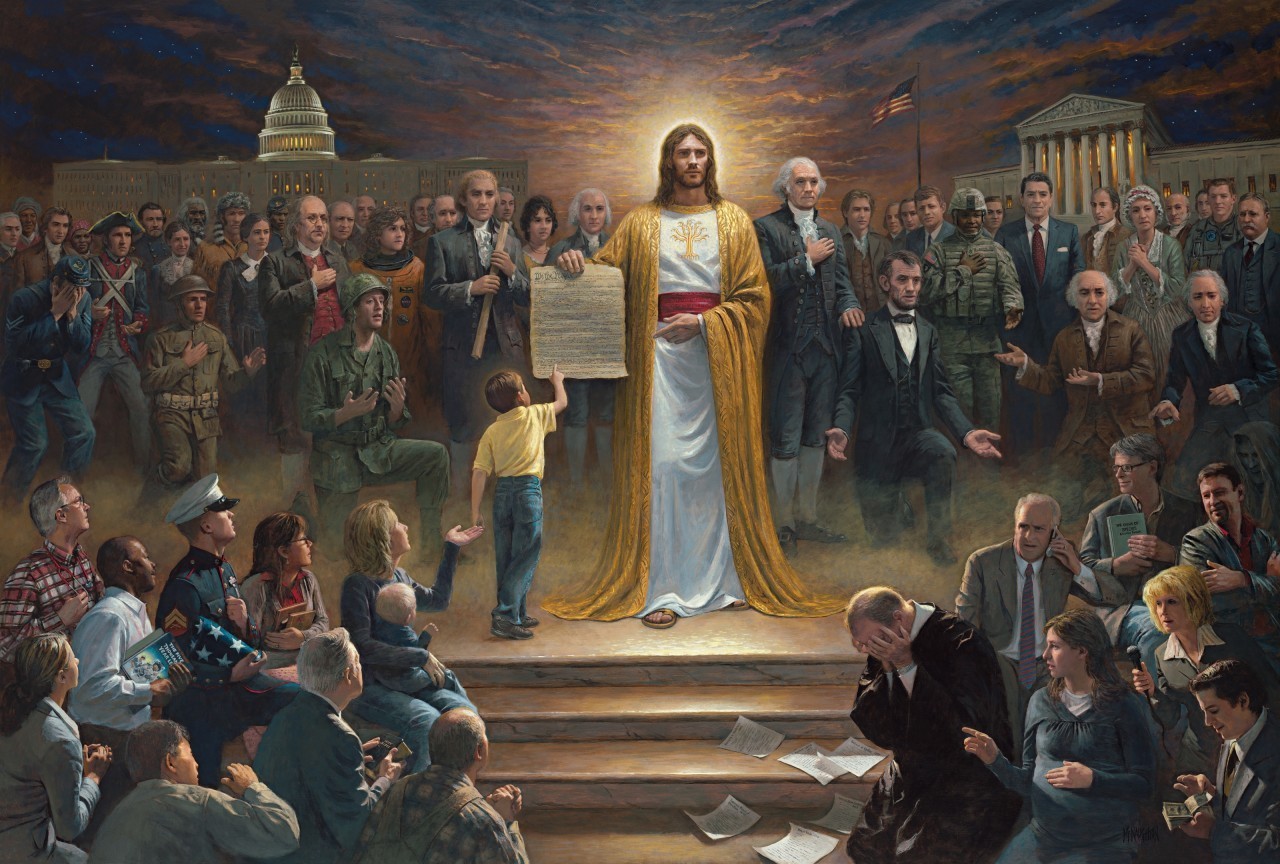
The same groups espouse a faith in the Founders that is virtually religious, and sometimes literally so. James Madison, Thomas Jefferson, George Washington … if not for monotheism these men would have ascended to godhood by now. A well-known painting by conservative artist Jon McNaughton (reproduced below) shows Jesus standing between Jefferson and Washington with the Constitution in his hands. Madison stands behind the Constitution, while a representative politician, professor, journalist, and Supreme Court justice tremble at the left hand of God in the company of Satan.
The same conservative movement has become very skeptical of democracy and elections. You’ll frequently hear conservatives explain that the Founders made us “a republic, not a democracy”. Elections are only valid if they win, and if not, perhaps it’s time for second amendment remedies to right the ship, or even another civil war. People who rioted in an attempt to usurp the 2020 election are “patriots“, while the president elected with a seven-million vote majority is a “tyrant“.
In any era, it’s tempting to think that words have always meant what they mean now. So quotes from the Founders about freedom and liberty are often co-opted into these arguments.
But is that really what the Founders meant when they they used those words? Did they mean tax cuts, deregulation, and the other standard conservative positions? Would they have been appalled by vaccine mandates and similar expressions of government power, if such power were being exercised by a government of the People, in accordance with the majority will?
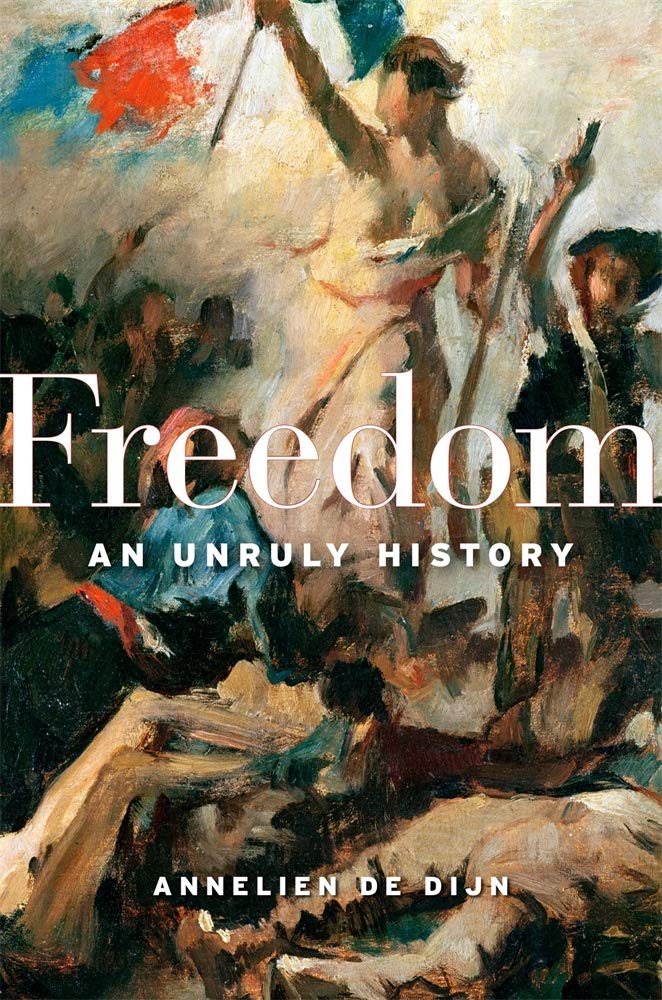
The recent book Freedom: an unruly history by Annelien de Dijn offers an alternative view.
In general, I love these history-of-an-idea books, especially if they’re surprising in some way, as this one is. De Dijn tells the story of how freedom started out meaning one thing and then changed to mean something else, and how this change got erased from popular memory.
The two kinds of freedom have been called different things at different times, but I think of them as “public freedom” and “private freedom”. Both kinds of freedom are about self-determination, but at different scales. Private freedom is the right to live your life with minimal interference from outside powers like the government — how today’s conservatives use the word. Public freedom is your right to have a voice in making the laws that govern you.
You could imagine having either kind of freedom without the other: You might live under a dictator who chooses to leave you alone, or under a democracy whose laws constantly get in the way of what you want to do.
De Dijn makes a good case that in ancient times, freedom meant public freedom. Herodotus, for example, contrasted the “free” Greeks against the “enslaved” Persians — not because the Persian laws were significantly more invasive, but because Greek city-states made their own laws rather than receiving them from an emperor. A Greek citizen (especially, but not uniquely, an Athenian) could criticize a law in the assembly and try to convince his neighbors to change it, while a Persian subject dared not. Similarly, Cicero opposed Caesar not because Caesar’s government did terrible things — on the whole, Caesar was a fairly good lawmaker, certainly no worse than the republican consuls who preceded him — but because Caesar issued decrees under his own authority, without consulting the Senate or the popular assembly.
It’s not that classical thinkers didn’t value living their lives without interference, but they regarded public freedom as a long-term precondition for private freedom: If people like you have no voice in making the laws, sooner or later the laws will oppress you.
But when the Roman emperors turned Christian, Christian leaders like St. Augustine abandoned the classical notion of liberty, and taught instead that imperial authority was sanctioned by God. This view persisted through the later Middle Ages, to the point that Dante placed Caesar’s assassins (Brutus and Cassius) next to Judas in the lowest pit of Hell. It survived into the Founding Era as the divine right of kings, which Jefferson’s Declaration of Independence rejected.
When the Renaissance humanists rediscovered classical authors, though, they also revived the classical notion of freedom, i.e., public freedom. This developed into the Enlightenment notion of the social contract, which was the basis not just of the American Revolution, but of a series of revolutions throughout Europe and the former European colonies in the New World. Again, the problem with George III’s government of the American colonies wasn’t that everyday life was oppressive, it was that he denied Americans a voice in making their own laws. The issue wasn’t high taxes, but “taxation without representation”.
The currently popular notion of freedom as purely private freedom, being left alone, is comparatively recent. It developed in the backlash after the French Revolution, and was promoted by the same aristocrats who had opposed democracy all along. This view has also consistently opposed any expansion of democracy, on the grounds that democracy is merely a means to an end (good government) and not a human right. Why, for example, do women need to vote if their husbands treat them well? Haven’t men of property been making better laws for the landless workers than such foolish and poorly educated men would make for themselves?
Along the way, de Dijn answers a question I have occasionally raised in this blog: What is the origin of the currently popular conservative distinction between a republic and a democracy, which the Right uses to justify anti-democratic fossils like the Electoral College, the Senate, and the filibuster?
[C]alls to abolish or circumvent the Electoral College in the selection of our chief executive represent the most visible sign of this democratic antipathy to our republican institutions.
Another symptom Heritage finds worrisome is “the increased dissatisfaction with the efficiency and responsiveness of our deliberative political institutions”, i.e., calls to end the filibuster. Ranked-choice voting is on a list of notions that are suspect because they represent “more effective and immediate ways to express the will of the majority”. (Notice, however, how this conservative critique of majority rule goes away when the local majority wants to ban abortion or outlaw critical race theory.)
Conservatives will tell you the republic/democracy distinction comes from the Founders, particularly James Madison in Federalist 10. If you read that essay, though, you’ll find a purely formal distinction between the two, not the anti-popular-sovereignty sentiment right-wingers now project onto it. Madison defines a democracy as “a society consisting of a small number of citizens, who assemble and administer the government in person” and a republic as “a government in which the scheme of representation takes place”. Nothing in his essay argues that a republic’s popular majority is not entitled to elect a majority of representatives, or that this legislative majority should be thwarted in passing popular laws. Madison sees representative government as a temporary buffer against volatile public moods, not a a way to permanently obstruct the will of the People, as the filibuster currently does on any number of issues.
So where does the a-republic-not-a-democracy idea really come from? From the Gilded Age of the late 1800s, not the Founding Era a century before. De Dijn traces it to a Yale professor named William Graham Sumner, who was highly influential in his day, but is now largely forgotten.
[Sumner] believed that liberty could survive only if popular power was checked by strong countermajoritarian institutions. Indeed, he explicitly rejected democratic government, arguing in favor of “republics” instead. By making this distinction, Sumner gave an entirely new meaning to the word “republican.” During the American Revolution and its immediate aftermath, “republic” had been more or less synonymous with popular government.
One final warning: By the time you check Freedom: an unruly history off your reading list, you will have a longer list. Names that were little more than placeholders in your history textbooks will suddenly seem like major holes in your education. (How did I make it this far into life without reading either Edmund Burke’s Reflections on the Revolution in France or Richard Price’s sermon “A Discourse on the Love our Our Country” that Burke was arguing against?)
The Arizona audit’s re-affirmation of Biden’s victory ought to finish off Trump’s stolen-election hoax. But it hasn’t.
The Cyber-Ninjas “forensic audit” of the 2020 election in Maricopa County, Arizona finally reported its findings, only four months later than planned. Guess what? Biden won.
“The ballots that were provided to us to count in the coliseum very accurately correlate with the official canvass numbers,” Cyber Ninjas CEO Doug Logan said during the presentation. He noted that the hand recount found President Joe Biden gaining 99 votes in Maricopa County and former President Donald Trump losing 261 votes — which he called “very small discrepancies.”
So there you have it: Not even vote-counters completely biased in Trump’s favor could come up with a way to claim he won in Arizona. The Cyber Ninjas hired by the Republican majority in the state senate tested the Maricopa County voting machines that were supposed to be haunted by the ghost of Hugo Chavez, looked for evidence of fake ballots shipped in from South Korea (or maybe China), and pursued every other lunatic theory of how Democrats could have stolen the state for Biden. They came up with nothing.
Biden won.
Maricopa County Board of Supervisors Chair Jack Sellers, a Republican, summed up:
This means the tabulation equipment counted the ballots as they were designed to do, and the results reflect the will of the voters. That should be the end of the story. Everything else is just noise.
But it’s not the end of the story, and Trump’s noise continues. The Great Steal has become dogma inside his personality cult, so inconvenient facts must be trimmed to fit.
Just asking questions. The quote from Chief Ninja Logan hints (if you listen closely) at the direction the conspiracy theory goes next: “the ballots that were provided to us” were counted properly, and show a Biden win. But what if some number of those ballots were cast illegally by people not entitled to vote? Or by legal voters who messed up in some way that should have allowed Republicans to disqualify them?
After all these months, Logan can’t point to any specific ballots that fit those descriptions. But what if? And what if those speculatively dubious ballots are all Biden votes? Then maybe Trump really should have won Arizona — and maybe Georgia and Pennsylvania as well. Maybe he should still be president, even without an insurrection.
That’s why a large chunk of the Ninjas’ report is devoted to casting doubt on “the ballots that were provided to us”, using the technique Tucker Carlson has made famous: Raise questions without doing even the simplest legwork to answer them, and then imply that there are no answers or even that powerful people don’t want you to ask.
[The Cyber Ninjas] are overstretching themselves to find dirt, claiming the things they don’t understand are evidence of something bad.
Elizabeth Howard of the Brennan Center for Justice expressed the same idea in different words.
They’re desperately trying to suggest that what are routine procedures are suspicious, because they don’t have election administration experience or knowledge.
And precisely because the Ninjas lacked so much experience and knowledge, the “things they don’t understand” were many, and even humorous at times.
The most inflammatory allegations came from [Ben] Cotton, who claimed he discovered that thousands of files had been deleted from election department servers, and that several pieces of election equipment had been connected to the internet.
One internet-connected device Cotton specifically named was REWEB1601, which Maricopa County’s twitter account explained very simply.
REWEB1601 (as you might gather from the naming convention) connects to the internet because it is the server for http://recorder.maricopa.gov. This is not the election system. We shouldn’t have to explain this.
And the deleted files? That wasn’t very sinister either.
CLAIM: Election management database purged
BOTTOM LINE: This is misleading. Nothing was purged. Cyber Ninjas don’t understand the business of elections. We can’t keep everything on the EMS server because it has storage limits. We have data archival procedures for our elections and @MaricopaVote archived everything related to the November election on backup drives. So everything still exists.
Cyber Ninjas said it found thousands of voters who potentially voted twice in Arizona. The company came to this conclusion because it found 5,047 voters with the same first, middle and last name and birth year as people who voted in other counties.
“Bottom line,” the county wrote in a tweet in response, “There are more than 7 million people in Arizona and, yes, some of them share names and birth years. To identify this as a critical issue is laughable.”
Dead voters? Sometimes living people fill out a ballot, mail it, and then die before Election Day. Sometimes computer searches confuse the dead John Smith Sr. with the living John Smith Jr. of the same address, who voted. It’s not fraud. Voters who have moved? If they went to college, joined the military, or decamped to a vacation home from which they plan to return, their vote is still legal. And so on.
In short, the Cyber Ninjas found the kind of “suspicious” ballots that appear in every election everywhere. What they didn’t find was the slightest evidence of fraud.
The Romney prophesy fulfilled. When questioned, the Republican promoters of these partisan “audits” say they’re simply responding to widespread doubt about the integrity of the 2020 election, and that the point is to restore public faith in our democracy — ignoring their party’s (and often their own) role in raising those doubts in the first place by spreading lies.
The model here is the disingenuous justification Ted Cruz and ten other senators gave last January for objecting to the certification of the Electoral College vote.
A fair and credible audit — conducted expeditiously and completed well before January 20 — would dramatically improve Americans’ faith in our electoral process and would significantly enhance the legitimacy of whoever becomes our next President. We owe that to the People.
These are matters worthy of the Congress, and entrusted to us to defend. We do not take this action lightly. We are acting not to thwart the democratic process, but rather to protect it. And every one of us should act together to ensure that the election was lawfully conducted under the Constitution and to do everything we can to restore faith in our Democracy.
Mitt Romney had the right response back on January 6:
For any who remain insistent on an audit in order to satisfy the many people who believe that the election was stolen, I’d offer this perspective: No congressional audit is ever going to convince these voters — particularly when the President will continue to say that the election was stolen. The best way we can show respect for the voters who are upset is by telling them the truth. That’s the burden, that’s the duty of leadership.
The truth is that President-elect Biden won the election. President Trump lost.
This week’s events proved Romney right. After the Arizona audit report leaked, 2020 Loser Donald Trump did continue to say the election was stolen.
The leaked report conclusively shows there were enough fraudulent votes, mystery votes, and fake votes to change the outcome of the election 4 or 5 times over. There is fraud and cheating in Arizona and it must be criminally investigated!
And his allies were still not convinced of his loss. At a rally in Georgia Saturday, Trump rehearsed a litany of false claims about fraud in Arizona. And then his endorsed candidate for secretary of state said “Nobody understands the disaster of the lack of election integrity like the people of Georgia. Now is our hour to take it back.” His lieutenant governor candidate said “I can assure you if I’d been our Lieutenant Governor, we would have gotten to the bottom of this thing.”
And the crowd cheered.
Undeterred by the objective failure of the Cyber Ninjas to either find fraud or restore confidence, Trumpists continue to push the Arizona-like audits that are either proposed or already underway in Pennsylvania, Wisconsin, and even Texas (which Trump won, but by a margin that presages future trouble for Republicans unless they do a better job suppressing the non-white vote).
In each case, Republicans claim to be “restoring confidence” in elections by responding to “doubts” about the accuracy of the 2020 outcome — doubts that they caused themselves by spreading lies. Already, we can anticipate the ninja-like outcome: reports that find no hard evidence of any miscount or fraud, but continue to “raise questions” based on nothing.
It’s almost like sowing doubt is the intention.
The goal: destabilizing democracy. WaPo’s Greg Sargent raises that issue explicitly:
Oozing with unctuously phony piety, Republicans told us again and again and again that this audit was merely about allaying the doubts of voters who have lost confidence in our elections, a specter that Republicans have widely used to justify voting restrictions everywhere.
But, now that this audit “confirmed” Biden’s win, it is still telling us that we should doubt our outcomes, and that more voting restrictions are necessary to allay those doubts. Why, it’s almost as if that was the real point all along!
The Atlantic’s David Graham points to the damage done: Whatever the outcome of the Arizona “fraudit”, its mere existence kept the stolen-election story going for five more months. The implication that there really was something to investigate (and that maybe there still is) lives on. Millions of low-information voters are left with the vague impression that there is something inherently hinky about election returns from big cities with lots of non-white voters.
The goal was to substantiate a new consensus Republican belief that Democrats cannot win elections legitimately, and that any victory they notch must be somehow tainted. It is not a coincidence that the places where audits have focused are those, like Maricopa County, or Harris County, Texas, or Milwaukee County, Wisconsin, with high levels of minority voters, who can be disparaged—mostly implicitly, but occasionally more directly—as illegitimate participants in the polity. Trump has been the foremost proponent of the theory, but he’s been joined by eager sycophants, demagogues, and conspiracists.
As for where this is going, neo-conservative thought-leader Robert Kagan presented an ominous vision in “Our Constitutional Crisis is Already Here“, where he predicted
a reasonable chance over the next three to four years of incidents of mass violence, a breakdown of federal authority, and the division of the country into warring red and blue enclaves.
Kagan foresees Trump running again in 2024, being nominated, and staging a better coup next time.
Trump and his Republican allies are actively preparing to ensure his victory by whatever means necessary. Trump’s charges of fraud in the 2020 election are now primarily aimed at establishing the predicate to challenge future election results that do not go his way. Some Republican candidates have already begun preparing to declare fraud in 2022, just as Larry Elder tried meekly to do in the California recall contest.
Trump’s attempt to overrule the voters in 2020 may have failed, but not by much, and it was not thwarted by institutional safeguards.
Trump came close to bringing off a coup earlier this year. All that prevented it was a handful of state officials with notable courage and integrity, and the reluctance of two attorneys general and a vice president to obey orders they deemed inappropriate. These were not the checks and balances the Framers had in mind when they designed the Constitution, of course, but Trump has exposed the inadequacy of those protections.
Contrary to John Adams, the Republic was saved in 2020 not by laws, but by individuals. And those brave individuals are being replaced.
[T]he amateurish “stop the steal” efforts of 2020 have given way to an organized nationwide campaign to ensure that Trump and his supporters will have the control over state and local election officials that they lacked in 2020. Those recalcitrant Republican state officials who effectively saved the country from calamity by refusing to falsely declare fraud or to “find” more votes for Trump are being systematically removed or hounded from office. Republican legislatures are giving themselves greater control over the election certification process. As of this spring, Republicans have proposed or passed measures in at least 16 states that would shift certain election authorities from the purview of the governor, secretary of state or other executive-branch officers to the legislature. [1]
In the end, the “forensic audit” movement isn’t about overturning 2020 any more: The deeper purpose is to “raise questions” about elections and about democracy in general, so that fewer people will be able or willing to take a principled stand against the Coup of 2024.
[1] The point of that shift is that gerrymandering insulates Republican majorities in key state legislatures from the voters. In Pennsylvania, for example, the Democratic voting majority that carried the state for Biden has also elected a Democratic governor and secretary of state. But the legislature is well fortified against the will of the People.
Trump’s minions had a coherent plan to keep him in power, and next time it might work.
Last November, the few days after the election were tense. On election night itself, Trump was clearly doing better than the polls had predicted, but how much better was hard to guess. He won Florida and North Carolina, which the polls had said leaned towards Biden. Ohio and Iowa, which were supposed to be close, weren’t. He had leads in Michigan, Wisconsin, and Pennsylvania, but there were still a lot of Democratic votes to count. Like Hillary Clinton, Biden had clearly gotten more votes than Trump, but the Electoral College left the final outcome in doubt.
Wednesday, as more of the mail-in ballots got counted, Biden’s chances improved. Thursday, he looked like the winner, but it wasn’t conclusive yet. The major news organizations declared his victory on Saturday.
The Gang That Couldn’t Shoot Straight. Then the focus shifted to Trump’s effort to have the voters’ decision overturned by any means necessary. His lawyers, and various others working on his behalf, filed dozens and dozens of lawsuits, each one a little crazier than the last. Some were based on bizarre conspiracy theories about computers in other countries, others on piles of affidavits described by one judge as “notable only in demonstrating no firsthand knowledge by any Plaintiff of any election fraud, misconduct, or malfeasance”. Some made claims (mainly about the rules around mail-in ballots) that might have been reasonable to raise — and were raised — before the election, but which in no way justified ignoring millions of votes cast in good faith.
I, like many other Democrats, felt uneasy about these suits, but not because of the strength of Trump’s arguments. We worried instead about all the right-wing judges Trump had appointed, including three on the Supreme Court. Maybe they would repay him by ignoring law and precedent to overthrow American democracy. [1]
But when even Trump-appointed judges threw these cases out, often with sharp criticism, the whole thing began to seem comical. Trump’s lawyers were the Gang That Couldn’t Shoot Straight. The whole effort was summed up by Rudy Giuliani in the parking lot of Four Seasons Total Landscaping, hair dye running down his face. [2] I began to look forward to court rulings, wondering what insults the next judge would come up with.
The violent insurrection on January 6 wasn’t at all funny, but was just as misguided. The riot might have turned out a whole lot worse (and nearly did), but it was never going to keep Trump in the White House. After it failed to intimidate Congress out of fulfilling its constitutional duty to count the electoral votes, QAnon kept anticipating a move by the military. But the generals had always felt uneasy about someone as ignorant and unstable as Trump being commander in chief. They certainly weren’t going to violate their oaths to keep him in power.
By Inauguration Day, I was laughing at myself for having worried so much. For four years, we had watched the Trump administration fail to organize infrastructure week. How had I imagined that they might mastermind a successful coup?
This week, though, we discovered that there actually was a coherent plan. And with just a bit more corruption at the top of the Justice Department, it might have worked.
The corruption of Justice from Sessions to Barr. When Trump appointed Jeff Sessions as his first attorney general, alarm bells went off. Sessions had been state AG in Alabama, and seemed likely to bring Alabama’s racial practices to Washington. And sure enough: The effort to control racism in local police departments went out the window. DOJ’s Civil Rights Division got retasked to focus on discrimination against Christians.
But Sessions had one saving grace none of us appreciated at the time: He actually wanted to be attorney general, and not just operate as a Trump puppet. [3] In spite of endless abuse from his boss, for example, he followed the rules and recused himself from the Russia investigation. His views on the nature of justice may have been reprehensible, but he understood that the Department of Justice needed to keep its distance from the politics of the White House.
In the end, though, even Barr’s corruption had its limits. Before the election, Barr had obediently (and falsely) cast doubt on the trustworthiness of mail-in ballots. Immediately after the election, he instructed US attorneys to investigate election fraud allegations, ignoring the usual standard of probable cause, and seemingly validating Trump’s claim that there was something substantial to investigate. But when Trump wanted Barr to falsely announce that those investigations were finding real violations, that was a bridge too far. On December 1, Barr was interviewed by an AP reporter, who then wrote:
Disputing Donald Trump’s persistent baseless claims, Attorney General William Barr declared Tuesday the U.S. Justice Department had uncovered no evidence of widespread voter fraud that could change the outcome of the 2020 election.
By Christmas, Barr was no longer attorney general. With no time for a Senate confirmation, Jeff Rosen became acting AG.
Endgame. By Christmas, it was clear that the courts were not going to keep Trump in power. Giuliani’s and Trump’s efforts to corrupt Republican election officials, or to convince state legislatures to appoint Trump electors directly, had also not succeeded: The elections had been certified, the electors appointed, and the Electoral College had voted. Sealed envelopes from each state were due to be opened in Congress on January 6.
But there was still one more card to play: badger the temporary Justice Department officials to make the kinds of claims that Barr wouldn’t, and then use the manufactured “uncertainty” of the election outcome to justify Republican state legislatures usurping the power of the voters.
The key player here was Jeffrey Clark, a minor DOJ lawyer who got elevated to head the Civil Division.
On December 27, Trump called to pressure Acting AG Rosen, and Acting Deputy AG Richard Donoghue took notes. [4]
“Understand that the DOJ can’t + won’t snap its fingers + change the outcome of the election, doesn’t work that way,” said Rosen, according to the notes.
“Don’t expect you to do that, just say that the election was corrupt + leave the rest to me and the R. Congressmen,” Trump replied, per the notes.
At another point in the call, the notes showed Rosen and Donoghue trying to convince Trump that his allegations of voter fraud were false.
“Sir we have done dozens of investig., hundreds of interviews, major allegations are not supported by evid. developed,” Donoghue told Trump, per the notes. “We are doing our job. Much of the info you’re getting is false.”
Trump however would not be swayed.
“We have an obligation to tell people that this was an illegal, corrupt election,” he said, according to the notes.
How they were supposed to “say the election was corrupt” became clear the next day, when Clark drafted a letter for Rosen and Donoghue to sign. The letter we have was addressed to Georgia’s governor, speaker of the house, and president pro tem of the senate, but similar letters were prepared for all six states Trump lost but wanted to subvert: Georgia, Arizona, Nevada, Pennsylvania, Michigan, and Wisconsin.
The Department of Justice is investigating various irregularities in the 2020 election for President of the United States. The Department will update you as we are able on investigatory progress, but at this time we have identified significant concerns that may have impacted the outcome of the election in multiple States, including the State of Georgia.
The letter contains no specific facts that the Georgia officials might evaluate or try to check. It just raises doubt about “significant concerns”. [5] It then goes on to tell the officials what to do about this uncertainty.
In light of these developments, the Department recommends that the Georgia General Assembly should convene in special session so that it’s legislators are in a position to take additional testimony, receive new evidence, and deliberate on the matter consistent with its duties under the U.S. Constitution. [6]
If the governor doesn’t see fit to call the legislature into session, the letter opines that the U.S. Constitution justifies the legislature calling itself into session for this particular purpose. It presents a speculative constitutional argument that state legislatures can do whatever they want with regard to electors.
The Georgia General Assembly accordingly must have inherent authority granted by the U.S. Constitution to come into session to appoint Electors, regardless of any time limit imposed by the state constitution or state statute requiring the governor’s approval. [7]
Rosen and Donoghue refused to sign. (“There is no chance that I would sign this letter or anything remotely like this,” Donoghue replied in email.) The New York Times reported that Clark met with Trump on January 3 to discuss a plan where Clark would replace Rosen as attorney general, and presumably provide the kind of DOJ support Trump wanted prior to Congress’ debate January 6 on accepting the electoral vote totals. Reportedly, this plan was only headed off by the threat of mass resignations at DOJ, which would have undermined the effectiveness of Clark’s claims.
Alternate history. No one can say what would have happened had Trump succeeded in bullying Rosen (or Barr) or replacing him with Clark. At numerous points in the process, Republican election officials did their jobs honorably rather than try to subvert the will of the voters. (Georgia’s Republican Secretary of State Brad Raffensperger is one example, Michigan Board of Canvassers member Aaron Van Langevelde another.) It would be pleasant to believe that patriotic, pro-democracy Republicans existed in sufficient numbers to keep state legislatures from responding to the Clark letter by holding hearings on the election-fraud conspiracy theories, and then attempting to replace their Biden electors (who had already voted by this point) with Trump electors. Or that even if one or two legislatures caved to Trump, he would not get the three states he needed to win in the Electoral College.
But who knows? And if states attempted that maneuver without their governors’ approval, in violation of the Electoral Count Act of 1887, but consistent with Trump’s self-serving interpretation of the Constitution, would Congress have accepted those ballots? Would the Supreme Court have to weigh in? What would they have said?
At the very least, the suspense would not have ended on January 6, or perhaps not even on January 20. Even if Biden had ultimately prevailed, significant damage would have been done. From then on, Americans would all know that our elections are just the first shot in a much longer drama whose ultimate outcome might have nothing to do with how we voted.
The next coup. Joe Biden won the popular vote by a margin of just over 7 million. With the exception of George W. Bush’ re-election in 2004, no Republican has won the popular vote since Bush’ father in 1988.
In the normal course of two-party politics, this persistent failure would send Republicans scrambling to reinvent themselves. Presidential hopefuls would be marketing themselves as “New Republicans”, and looking for new ways to reach out to a majority of Americans. That was Karl Rove’s “permanent majority” vision already in 2004: Jettison the racism that Richard Nixon’s “southern strategy” had brought into the party, and court the rapidly-growing bloc of socially conservative Hispanics. (Bush got 44% of the Latino vote in 2004. Trump got 32% in 2020.)
Instead, the GOP’s post-election focus has been on how to take or keep power without the backing of a majority. They aren’t pushing bright new faces, or looking for candidates who can flip Democratic voters. [8] They have unveiled no new programs or policies or even messaging strategies. But they hope to get the House back in 2022 by gerrymandering better this time and making voting even harder for pro-Democratic groups. (When was the last time you saw reports of people waiting for hours to vote in majority-Republican precincts?)
The most worrisome thing about the Republican response to their 2020 defeat is their focus on controlling how elections are run, how votes are counted, and whether the voters’ choice will matter at all. [9] The Georgia voter-suppression law that got baseball’s All-Star Game moved out of Atlanta contained one particularly ominous provision: The Republican-controlled legislature can take over the management of elections in Democratic counties. Wasting no time, the legislature has already started the process that would let it take over Fulton County, where Atlanta is.
So if 2024 is a close election, we can’t count on honest Republicans to once again do their jobs with integrity. Anyone who finds himself in that situation will know that integrity is a career-killer in the GOP. And the legislatures-can-do-whatever theory of the Electoral College won’t be sprung on the states at the last minute, after a loss, as it was in 2020. Republicans in swing states will see that coming, and will have a plan for winning even if the voters have other ideas.
And finally, what happens in Congress on January 6, 2024? If Republicans do win back the House, if Kevin McCarthy is Speaker and election-respecting Republicans like Cheney and Kinzinger have been purged from the caucus, can a Democratic victory be recognized at all?
[1] There’s an old joke about a baseball game between Heaven and Hell. “You can’t possibly win,” Saint Peter boasts. “We’ve got the greatest players of all time.”
“Maybe so,” Satan replies, “but I’ve got all the umpires.”
[2] Those were actually two different fiascos, but they have merged in my memory, and, I suspect, in most other people’s memories as well.
[3] Sessions came into office with a rather quaint view of his relationship to Trump. Trump considered every appointment a favor that the appointee had to repay with unquestioning loyalty. But Sessions had been the first senator to endorse Trump, giving his candidacy legitimacy that it very much needed at the time. So Sessions thought he was becoming attorney general because Trump owed him. He did not understand that Trump collects debts, but does not pay them.
[4] Not only was the whole conversation inappropriate — presidents are not supposed to tell the Justice Department what to investigate — but notice how backwards this conversation is. Ordinarily, the lower-level people who have actually investigated something would be telling their boss what they discovered, and the boss would make decisions based on those facts. (Rosen and Donoghue try to play that role.) But Trump isn’t interested in what facts DOJ’s investigations have uncovered, or what theories they have debunked. He is going to define the truth for them, based on his own needs.
[5] The letter couldn’t allude to any specific “concerns”, because by this point all Trump’s fraud theories were absurd and easily debunked. A few days later he would parade them during his infamous phone call to Georgia Secretary of State Brad Raffensperger, who batted them aside as quickly as Trump offered them up.
[6] Even if it really had uncovered evidence that cast doubt on Georgia’s election, DOJ has no business making such specific recommendations to a state. As Donoghue wrote: “I do not think the Department’s role should include making recommendations to a State legislature about how they should meet their Constitutional obligation to appoint Electors.”
[7] The governors of Pennsylvania, Michigan, and Wisconsin are Democrats, and Georgia’s Governor Kemp had already expressed skepticism about Trump’s Big Lie, so the governors have to be taken out of the picture. Also, this is the only legal argument I can recall that claims a legislature needn’t be bound by the constitution that created it.
[8] Monday, Chris Hayes noted the remarkable extent to which this is not happening. Florida’s Governor Ron DeSantis is considered the Republican 2024 front-runner if Trump doesn’t run. He has botched his Covid response pretty badly, with numbers that are getting worse all the time. Meanwhile, Republican Governor Phil Scott of Vermont has one of the best Covid record in the nation, and in November won a third term with 68% of the vote in a blue state.
Literally no one considers Scott to be a likely Republican presidential nominee, because what Republican wants to attract Democratic votes? Instead, DeSantis is looking over his shoulder at an even Trumpier governor with an even worse record on Covid, Kristy Noem of South Dakota. In spite of being far enough off the beaten track to miss the first Covid wave entirely, South Dakota has been hit harder than just about any other state: It’s third-worst in cases per capita and tenth in deaths per capita. (Vermont is the second-best state behind Hawaii in both measures, without the benefit of being an island.)
Hayes: “In any sane political culture, Phil Scott would obviously be a top-tier candidate for higher office. … But not only is that not the case, it’s literally the opposite of the case. The fact that Phil Scott managed the pandemic so well is disqualifying.”
[9] Returning to the joke in [1], Republicans have doubled down on the strategy of recruiting more umpires rather than better players.
Ben Rhodes raises a hard question: How did America get from the pinnacle of our Cold War victory to this sorry place?
The Berlin Wall fell on November 9, 1989, five days before Ben Rhodes‘ 12th birthday. The wall’s demise was the culmination of a series of large and (mostly) bloodless revolutions that brought down nearly all the Soviet-imposed governments of Eastern Europe. The Soviet Union itself was looking shaky, and would officially dissolve into its constituent republics in 1991.
Rhodes’ teen years were a period of undisputed American triumph. Not only were we the sole surviving superpower, but our political vision (representative democracy with constitutionally protected human rights) and economic vision (market economies gradually merging into a global free-trade zone) had also triumphed to such an extent that a US-style political economy was seriously put forward as the end-point of history.
The distant origins of the present volume lie in an article entitled “The End of History?” which I wrote for the journal The National Interest in the summer of 1989. In it, I argued that a remarkable consensus concerning the legitimacy of liberal democracy as a system of government had emerged throughout the world over the past few years, as it conquered rival ideologies like hereditary monarchy, fascism, and most recently communism. More than that, however, I argued that liberal democracy may constitute the “end point of mankind’s ideological evolution” and the “final form of human government,” and as such constituted the “end of history.”
… The most remarkable development of the last quarter of the twentieth century has been the revelation of enormous weaknesses at the core of the world’s seemingly strong dictatorships, whether they be of the military-authoritarian Right, or the communist-totalitarian Left. From Latin America to Eastern Europe, from the Soviet Union to the Middle East and Asia, strong governments have been failing over the last two decades. And while they have not given way in all cases to stable liberal democracies, liberal democracy remains the only coherent political aspiration that spans different regions and cultures around the globe. In addition, liberal principles in economics – the “free market” – have spread, and have succeeded in producing unprecedented levels of material prosperity, both in industrially developed countries and in countries that had been, at the close of World War II, part of the impoverished Third World. A liberal revolution in economic thinking has sometimes preceded, sometimes followed, the move toward political freedom around the globe.
Today, though, liberal democracy seems to be in retreat around the world, to the point that America itself has a flourishing fascist movement. Last winter, Donald Trump attempted to stay in power after losing the election, and even instigated a riot in an attempt to intimidate Congress away from recognizing Joe Biden’s victory. For a moment it appeared that he had finally gone too far, and that his own party would now turn against him. But within weeks, he had reasserted control of the GOP, which is now working to craft tools for a better coup against democracy in 2024.
But it’s not just us. Russia appeared to be democratizing in the 1990s, only to become the model of the new fascism under Vladimir Putin. Similar nativist authoritarians have since taken power in Hungary, India, Brazil, and several other countries.
China’s communist leaders once looked like dead-enders. By suppressing their own democracy movement at Tiananmen Square in 1989, China appeared to have staked out a position on the wrong side of history. Both Bill Clinton and the two Presidents Bush believed that opening up trade with China would increase the pressure on its leaders to democratize. A growing Chinese middle class, Americans of both parties agreed, would soon insist on political rights commensurate with its prosperity. Hong Kong, which Britain yielded to China in 1997, looked like a Trojan Horse. Surely the freedom and prosperity of Hong Kong would change China more than China changed Hong Kong.
Today, President Xi has more power than any Chinese leader since Mao, hundreds of thousands of Uyghurs are held in camps that could be a model for a new dystopia, Hong Kong is being brought to heel, and Chinese influence is spreading not just in Asia, but in Africa as well. Worse, numerous studies indicate that the Chinese middle class fears political change that might rock the boat of Chinese prosperity.
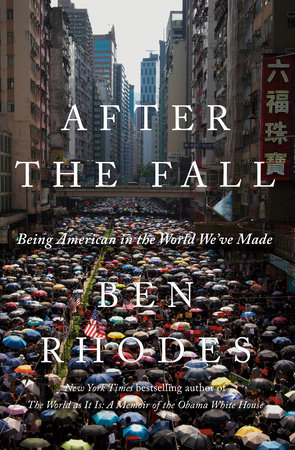
After the Fall. In his new book After the Fall: Being American in the World We’ve Made, Rhodes discusses the state of democracy around the world, and how we got here. He recounts his conversations with democracy activists in places where authoritarianism is ascendant: Hungary, Russia, and Hong Kong. Always in the background is the ghost of his younger self, who visited these places in happier times, and proudly imagined that his own democratic America was the model all other countries aspired to imitate.
Another ghost is the idealistic Rhodes who wrote speeches for Obama and believed that the 2008 landslide marked a sea change in US politics and governance. Present-day Rhodes is constantly confronted with how his work has been undone, turned around, or made meaningless.
In the final section, Rhodes humbly comes back to the US to analyze where we went wrong and what those foreign activists might have to teach us about democracy.
One thing Rhodes does well is to look past the bright shiny object that is Donald Trump. He has no illusions about what Trump represents or what a disaster his administration was for democracy and for America’s place in the world. But the anti-democracy movement in the US is part of a global anti-democracy trend that Trump did not start.
From our post-Cold-War apex, when democracy seemed to be a lesson the whole world wanted to learn, how did we get to a point where a Trump presidency was even possible?
First mistake: failing the fledgling post-Soviet democracies. Vladimir Putin did not come out of nowhere. He rose to power because the Yeltsin government in Russia was inept and corrupt. Privatizing the Soviet government’s assets and creating a capitalist economy was supposed to bring prosperity. Instead, it created a class of billionaire oligarchs and impoverished the general population. Democracy was supposed to give the people a voice in government, but instead the oligarchs bought the major media and spent lavishly to re-elect Boris Yeltsin in 1996. The legitimacy of Russia’s 1996 election was widely doubted.
These events produced a cynicism about democracy, markets, and America that is now deeply embedded in the Russian consciousness. The Yeltsin disaster didn’t just happen, it had American fingerprints all over it. American economists were everywhere in Russia in the 1990s, pushing privatization. American political consultants helped shape Yeltsin’s 1996 campaign, and President Clinton was clearly rooting for Yeltsin to prevail. At the same time, when the world price of oil collapsed and took Russia’s economy with it, the US and other Western democracies were stingy with aid.
US government and non-government advisors were so entranced by the vision of Russia joining the global market economy that we didn’t pay much attention to how it happened, or whether it was good for the Russian people.
We set the stage for Putin to raise Russian identity politics and restore national pride. And if he also turned out to be corrupt, his message that all governments are corrupt is very plausible. His elections are unfair, but no democracy plays fair. He provides order and protects Russia from foreign dominance. What more could the people expect?
Russia and the other post-Soviet republics were part of a larger pattern: Again and again, the vision of a borderless world economy trumped democratic ideals. China in particular did not have to raise its human-rights standards to get into the world economic club. There was money to be made from China’s billion-person market and its bottomless well of cheap labor, so we could overlook a few transgressions against human rights. Surely that would all get fixed after China became prosperous.
Second mistake: abandoning our principles after 9-11. America’s message abroad has always been two-sided. On the one hand, we promote democracy and human rights as universal values. On the other, we have often supported cruel dictators like the Shah of Iran or Saddam Hussein (until he invaded Kuwait).
But after 9-11, the Bush administration took the attitude that national security justified anything. We could invade any country we wanted, and launch attacks anywhere we believed the terrorists were hiding. We could ignore the Geneva Conventions and hold prisoners in legal limbo in Guantanamo, where they were protected by neither the laws of war nor American jurisprudence. American citizens could be declared “enemy combatants” and vanish into military prisons. Intelligence services could scoop up Americans’ private communications and sift them for terror-related keywords. We could even torture people if we thought they could tell us about terrorist plots.
In its post-9-11 zeal, the Bush administration created a rhetorical template for authoritarian governments around the world. If their opponents could be labeled “terrorists”, then any action against them was justifiable. Is China herding Uyghurs into concentration camps? Doesn’t matter, they’re terrorists.
Third mistake: the 2008 banking collapse and its aftermath. From the beginning, globalization had winners and losers. Opening a national economy to foreign trade both created jobs and destroyed them. Immigration simultaneously added vigor to an economy and increased competition for low-level jobs. Financial deregulation both created wealth and increased risk. The argument was that the gain outweighed the pain.
That argument was always a tough sell among working-class people, who benefited little from a rising stock market, but saw their once-secure jobs move overseas. They could buy cheap manufactured goods at Wal-Mart, but could never hope to be employed making them.
2008 underlined a problem: The gain-over-pain argument held in theory if everyone followed the same rules. But if there was one set of rules for the rich and another for everyone else, the wealth at the top would never trickle down. If bankers can profit when risky investments succeed, but get bailed out by the government when they fail, then the whole system is rigged.
Outside America, 2008 showed that globalization made local economies vulnerable to mistakes and corruption abroad, particularly in the US.
No one was ever brought to justice for the corruption behind the banking collapse. That never sat right with working-class people both in America and abroad. “I lost my job and my home,” people told each other. “What did Bank of America lose?”
Fourth mistake: Trump. The election of Donald Trump was both a cause in its own right and an effect of the previous three causes. He followed the Putin model of combining cynicism with nationalism and nativism: He was a liar and a conman, but (in his view) so was everyone else. If the system was already rigged, why not elect someone who promised to rig it in your favor?
Within the US, Trump dismantled the rules and traditions that protect democracy against authoritarianism and government corruption. He ignored the Constitution’s emoluments clause by running businesses and dues-collecting clubs that anyone seeking a favor could patronize. He bulldozed the barriers that kept the Justice Department from becoming a political weapon. His emergency declarations usurped Congress’ power of the purse. He pardoned his co-conspirators in exchange for their silence. His failure to stay in power after losing the 2020 election was more frightening than reassuring, and his supporters in state legislatures have been paving the road to make a 2024 coup proceed more smoothly.
Outside the US, Trump destroyed the idea that America is a reliable ally or a champion of democracy. He undermined NATO. He invented reasons to impose tariffs on Canada. He put the world on notice that the US would not cooperate to fight climate change. He praised dictators and denigrated democratically elected leaders. Human rights played no part in his foreign policy. If China wanted his favor, it should buy more soybeans, not allow Hong Kong the independence promised in China’s treaty with the United Kingdom.
Worse, he raised the fear (both here and abroad) that America might simply go crazy. However reasonable Joe Biden might sound today, who knows what some future president might do? Foreign leaders would be foolish to follow America’s lead or put much stock in American promises.
We’re not alone. None of the activists Rhodes talked to has yet succeeded: Putin and Orlov are still in power, and Hong Kong continues to lose its freedom. So he doesn’t conclude with a five-steps-to-restore-democracy chapter. Perhaps the central thing Rhodes learns is that the struggle against autocracy is so similar in such disparate places.
He ends up thinking we need to internationalize that struggle: Hong Kongers, for example, are not protesting for their rights; they’re protesting for human rights. We in American should take inspiration from the fact that they’re not giving up, in spite of facing oppression far beyond what we currently have to deal with. I’m reminded of an idea I’ve seen attributed to Jesse Jackson (but can’t quote from memory): You shouldn’t be fighting just to make sure that your people aren’t forced to the back of the bus. You should fight to make sure that nobody is forced to the back of the bus.
Rhodes wants to rehabilitate the notion (debased by hollow post-9-11 rhetoric) that democracy and human rights are universal values. It’s fine that Hungarians want to achieve Hungarian democracy and Americans want American democracy. But it would be so much better if, as human beings, we wanted democracy for everyone.
He closes with the idea that America might still have a key role to play. In spite of Trumpist rhetoric, there are no “real Americans”. We are a collection of peoples gathered from all corners of the Earth. If we can overcome nativism and white supremacy here, we might finally become the beacon of hope we used to believe we were.
The judicial and executive branches tussle over a bone that belongs to legislative branch. But in spite of near unanimous pro-Dreamer public opinion, Congress has wasted nine years doing nothing to protect them.
Friday, a Bush-appointed federal judge in Texas issued an injunction that stops the Department of Homeland Security from approving any new DACA applications. The judge’s opinion reviews the main arguments against the legality of the program from the beginning, but his ruling stopped short of removing its protections against deportation, and Dreamers will still be able to hold jobs. The order undoubtedly will be appealed, and will eventually end up at the Supreme Court.
In short, this was yet another incident in a very tangled legal history. President Obama established DACA by executive order in 2012 in order to protect undocumented immigrants who had been brought to the US as children. He tried to extend the program to their parents via another executive order in 2014, but the courts blocked that plan. President Trump tried to end DACA by executive order in 2017, but the courts stopped him too. Now a judge appears to want to end the program himself.
I’m tempted to do what I usually do with significant court rulings: explain in layman’s terms why the judge is right or wrong. But that kind of article would miss the point. The larger and more important story is that democracy shouldn’t work this way. And the root problem isn’t with the two dogs barking at each other: It’s not that Obama or Trump overstepped, or that the courts should or shouldn’t have let them. The problem is with the dog that hasn’t barked: Congress.
How this started. I doubt President Obama ever imagined that DACA would still be around nine years later. In the speech that announced the program, he prodded Congress to pass the DREAM Act, or take some other action to supersede his order:
This is a temporary stopgap measure that lets us focus our resources wisely while giving a degree of relief and hope to talented, driven, patriotic young people. It is the right thing to do.
Precisely because this is temporary, Congress needs to act. There is still time for Congress to pass the DREAM Act this year, because these kids deserve to plan their lives in more than two-year increments. And we still need to pass comprehensive immigration reform that addresses our 21st century economic and security needs
At the time, passing the DREAM Act didn’t seem like a heavy lift. DACA immigrants, a.k.a. Dreamers, are the poster children of the undocumented. Their parents brought them to the US as minors, when they had little choice in the matter. They have grown up here, stayed out of trouble, and gotten an education. Most speak English like natives and are full participants in American culture. Hundreds and hundreds of them have served in the US military.
Freshman year is when I first found out I was undocumented. I was waiting at registration and when the clerk was going through my paperwork, she asked if I knew my Social Security number. I told her I’d get it from my mom later. When I got home, my parents had told me about my “story”.
I haven’t been to Mexico since I left as a 3-year-old, more than 25 years ago. I have no memory of the place, and I’m culturally American — I would feel more like an outsider there than I do here. I have no clue how I would make a living, or where I would go. I had the opportunity to take some Spanish classes in college, but I speak it with an Alabama accent and can’t read or write the language well.
Put yourself in their shoes. Imagine you’ve done everything right your entire life — studied hard, worked hard, maybe even graduated at the top of your class — only to suddenly face the threat of deportation to a country that you know nothing about, with a language that you may not even speak.
In short, deporting the Dreamers to Mexico (or wherever else they might have been born) would be an obvious injustice. In poll after poll, large majorities of Americans recognize this. And while many right-wing politicians are anti-immigrant, few step up to lead an anti-Dreamer movement. Even President Trump purported to be rooting for them. As President-Elect in 2016, he told a Time interviewer:
We’re going to work something out that’s going to make people happy and proud. They got brought here at a very young age, they’ve worked here, they’ve gone to school here. Some were good students. Some have wonderful jobs. And they’re in never-never land because they don’t know what’s going to happen.
Dysfunction. So if everybody is for you and nobody is against you, you should be OK, right?
Trump has previously offered legislative proposals that would give Dreamers permanent legal protections in exchange for some of his hard-line immigration priorities, including cuts to legal immigration and border wall funding. But the offers failed in part because the president himself backed away after facing opposition from immigration hawks who accused him of going against his own campaign promises.
The American Dream and Promise Act is the latest version of the Dream Act, which Senate Republicans have filibustered five different times to prevent the taking of a vote. This year, Democrats have edged out Republicans for control of the Senate, but a sixth filibuster is all but certain as it takes 60 votes to defeat a filibuster.
But the filibuster hasn’t been the only problem. Back in 2013, the stars aligned in the Senate, but not the House, largely because Speaker Boehner enforced a different anti-democratic process: the Hastert Rule, which allowed nothing to come up for a vote without the support of a “majority of the majority”. The rule worked like this: Republicans held 234 of the 435 seats in the House, so a mere 118 Republicans would constitute a “majority of the majority”. So 27% of the House could block the other 73% from accomplishing anything.
That anti-democracy feature built on top of another one: Gerrymandering was the only reason Republicans had a House majority at all. In the 2012 elections, John Boehner’s Republicans got 47.7% of the vote, and Nancy Pelosi’s Democrats 48.8%. In other words, Republicans representing on 24% of the country held veto power over the other 76%.
So nothing happened.
Power abhors a vacuum. If you read much about American politics, you will often run into complaints about the imperial presidency, or judicial activism. Presidents of either party, and liberal or conservative judges alike, are grabbing too much power, power the Constitution never intended them to have. Examples are easy to find.
But the problem isn’t executive or judicial strength, it’s legislative weakness.
When the People want something, and Congress can’t act because it has tied itself in knots, presidents will look for a way to make it happen. (That’s where DACA comes from.) If Congress can’t wield the war power, presidents will. (Congress still hasn’t repealed or replaced the Authorization for the Use of Military Force it passed after 9-11. Maybe it will soon.)
When laws are vague, or become obsolete as times change, and Congress refuses to clarify or update them, judges will find a way to read meaning into the laws they have. (This is basically the problem with the Second Amendment, which no longer means anything independent of judicial interpretations. How does that text give you the right to own an AR-15, but not a bazooka or an exocet missile? Did the Founders really anticipate that distinction?) No judge is going to tell plaintiffs and defendants “Hell, I don’t know.” And once you have to start making something up, why not make up something you think is good according to your own lights?
So we shouldn’t be arguing year after year about whether the Supreme Court is interpreting the Religious Freedom Restoration Act properly. Congress should look at the Court’s interpretation of the old law and pass a new one that better captures the People’s will. Those debates should be happening in committee hearings, not in amicus briefs to judges.
Conversely, when powerful interests in the country want something to happen and Congress won’t stop them, they’ll get their way by manipulating the bureaucracy. If unscrupulous presidents know Congress won’t enforce the limits on their power, and that they can violate any law without fear of impeachment, bad things will happen. And whose fault will that be?
In a year or two, we may be back to deporting people who know no other country than this one, and who show every sign of the potential to be good citizens. Hardly anybody wants that to happen. But the body whose job it is to stop it is broken.
Voting Trump out of office stopped the bleeding, but the Republic isn’t out of danger yet.
The Boston Globe ran an important series this week: “Future-proofing the Presidency“. Over four years, the Trump administration shredded the laws, institutional norms, and political norms that we had previously trusted to protect the Republic from a corrupt or power-hungry president.
The fact that the voters managed to throw Trump out after four years should only comfort us up to a point. Because of the Trump precedents and the roadmap his administration provides, the next unscrupulous president — who could be Trump himself in 2025 — will begin his assault on democracy with a head start.
The Globe series proposes reforms to turn norms into laws and give teeth to the laws Trump ignored. The specific problems it diagnoses are: financial conflicts of interest, nepotism, immunity from prosecution, ability to shield co-conspirators, and power to obstruct congressional investigations. And the reforms it recommends are
require presidents to divest from all businesses and investments that could pose a conflict of interest
require presidents to publish their tax returns
require an explicit congressional waiver before a president can appoint a relative to office — even if that relative foregoes a salary
strengthen protections for government whistle-blowers, and extend those protections to political appointees
root congressional subpoena power in legislation, so that subpoenas served to the executive branch can be enforced more easily and quickly
allow a president to be indicted while in office, but delay the trial until the presidency ends
pass a constitutional amendment voiding a president’s power to pardon personal associates
The series concludes with “The Case for Prosecuting Donald Trump“. Congress’ impeachment power is broken, and can no longer be trusted to hold presidents accountable.
If Congress had played the role the Founders envisioned, by removing Trump from the presidency after his criminality became clear in the Ukraine affair, that might have been enough of a deterrent to scare future presidents straight. But lawmakers didn’t.
So now there is only one way left to restore deterrence and convey to future presidents that the rule of law applies to them. The Justice Department must abandon two centuries of tradition by indicting and prosecuting Donald Trump for his conduct in office. …
The reluctance to prosecute presidents is deep-rooted, and extreme caution does make sense. (The last thing that the country needs is for Trump to be charged, tried, and then acquitted.) But it cannot be the case that there is no line — no hypothetical act of presidential criminality that would not rise to the level of seriousness that merits setting aside our qualms. And if one accepts that there is a line, it’s hard to imagine Donald Trump didn’t cross it.
The two lawmakers in question — Adam Schiff and Eric Swalwell — were outspoken administration critics that Trump frequently attacked on Twitter. (“Shifty Schiff” was one of his playground insult names.) Swalwell became a Democratic presidential candidate. At the time, the Intelligence Committee was engaged in an investigation of Trump’s collusion with Russia.
Not only were they targeted, but so were their family members, including their children. What’s more, a gag order has kept Apple from revealing its cooperation until recently, so the congressmen did not know they were under this kind of scrutiny, and neither did House Speaker Nancy Pelosi.
“President Trump repeatedly and flagrantly demanded that the Department of Justice carry out his political will and tried to use the Department as a cudgel against his political opponents and members of the media,” Rep. Schiff told Recode in a statement. “It is increasingly apparent that those demands did not fall on deaf ears.”
The transcript of Dan McGahn’s testimony to the House Judiciary Committee on June 4 was released Wednesday, in accordance with the agreement that led to that testimony (after two years of legal wrangling that saw the courts refuse to back up congressional subpoenas). The transcript is 241 pages, and the main thing you can learn by reading large chunks of it is that McGahn was indeed a hostile witness. Releasing only a transcript (rather than video) means that his evasiveness will not be appreciated by the general public.
The pre-interview agreement limited questions to
one, information attributed to Mr. McGahn in the publicly available portions of the Mueller report and events that the publicly available portions of the Mueller report indicate involve Mr. McGahn; and, two, whether the Mueller report accurately reflected Mr. McGahn’s statements to the Special Counsel’s Office and whether those statements were truthful
In the early questioning, McGahn frequently claimed not to remember the events in question until his questioner noted a passage in the Mueller Report. McGahn would then respond with something like “what you’ve read in the report is accurate”. He tried hard not to introduce any new information. I also have to wonder if he used the interview’s ground rules to hide relevant conversations with Trump without perjuring himself. For example:
Q: Did you advise the President as to whether he personally could call Mr. Rosenstein about the investigation? A: I may have at some point in time. Do you have anything in particular? I mean, I was on the job quite a while so — Q: Understood. I’ll direct you to page 81, bottom of the paragraph.
Like Trump himself, and so many other people in his administration, McGahn seems not to recall a number of events that most other people would think of as memorable.
Q: On June 14, 2017 … The Washington Post reported for the first time that the special counsel was investigating President Trump personally for obstruction of justice. Do you recall your reaction to that reporting? A: I don’t recall my reaction to it, no. No. Q: You don’t recall your reaction, as a White House counsel, to learning that the press had reported that the President of the United States was under personal investigation by the special counsel? A: I don’t recall my subjective impression on the evening of June 14th about a news report. No, I don’t. Q: Do you recall speaking to the President that evening? A: I do recall speaking to him, yes. Q: Can you describe that conversation? A: I don’t have a crisp recollection of it.
Again and again, McGahn claimed that his memory had been fresher when Mueller questioned him, so he yielded to whatever description was in the Mueller report. That raises an obvious question: Instead of questioning McGahn about Mueller’s summary of McGahn’s testimony, why doesn’t the Judiciary Committee just look at the transcripts of those interviews? And the answer is that they can’t, at least not yet. Like the McGahn subpoena itself, this was the subject of a long legal wrangle, which the Supreme Court put off deciding until after the election. So at the moment, Congress doesn’t even have access to the still-redacted portions of the Mueller report.
After Trump lost the election, the grounds for releasing grand jury records to Congress changed completely, so Congress suspended its pursuit to coordinate with the new Biden administration. In part, McGahn’s appearance was supposed to be a substitute for the grand jury material.
So that’s where the House investigation into Trump’s obstruction of justice has led: McGahn finally appeared, but under rules that allowed him to do little more than point to quotes in the Mueller report and verify that he actually said that.
Meanwhile, Rachel Maddow has been waging an almost nightly campaign for Attorney General Merrick Garland to expose and reverse Trump administration abuses in the DoJ.
Given that those officials that knew about this are still in the Department right now, why did it take a New York Time article about this abominable behavior to spark an inspector general investigation today? I mean, this scandal wasn’t known to any of us in the public, but it was known to multiple officials inside the Justice Department. None of them thought to peep about it? …
It is clear that the Justice Department under President Biden does not want the job of investigating and rooting around what went rotten inside their own department under the previous president. But even if they don’t want that job, that is the job they have now. … Wake up, you guys! You’re going to work in an active crime scene, and there’s no other cops to call.
You have to fix this. You’re the only ones who can.
Trump and Bill Barr have provided the next would-be despot with a detailed plan for turning the Justice Department into a sword to attack enemies and a shield to protect corrupt friends. If there are no consequences for what they did, either to them or to the lower-level officials who went along, the danger has not passed.
Yesterday he came out against the For the People Act and for the filibuster, which dooms the John Lewis Voting Rights Act as well.
At the state level, Republicans have been assaulting democracy in every state where they have power. They have been restricting opportunities to vote, taking special aim at those methods frequently used by non-Whites (like ending Sunday early voting, around which Black churches have traditionally organized souls-to-the-polls drives). They support partisan gerrymandering, and hope to construct districts in ways that will give them majorities in legislative bodies, even if their voter-suppression tactics don’t deliver them a majority of votes cast. (See Max Boot’s column for details.)
Democrats have two bills aimed at protecting democracy: the For the People Act and the John Lewis Voting Rights Act. Both have passed the House, but will likely face a Republican filibuster in the Senate. This has been widely seen as Democrats’ most justifiable reason to eliminate or significantly alter the filibuster: When anti-majority tactics are used to strengthen minority rule, we are on a slippery slope towards some new form of government that does not answer to the People. (Boot concludes: “Senate Democrats have to choose between saving the filibuster and saving democracy. They can’t do both.”)
Unfortunately, we now are witnessing that the fundamental right to vote has itself become overtly politicized. Today’s debate about how to best protect our right to vote and to hold elections, however, is not about finding common ground, but seeking partisan advantage. Whether it is state laws that seek to needlessly restrict voting or politicians who ignore the need to secure our elections, partisan policymaking won’t instill confidence in our democracy — it will destroy it.
As such, congressional action on federal voting rights legislation must be the result of both Democrats and Republicans coming together to find a pathway forward or we risk further dividing and destroying the republic we swore to protect and defend as elected officials.
It’s true that passing the For the People Act will give Democrats a partisan advantage, compared to not passing it: More people voting tends to be good for Democrats. Creating a mechanism for candidates to depend on many small donors rather than a few big ones is good for Democrats. But both of those features are good for democracy, not just for Democrats. They only work against Republicans because the GOP has stopped trying to appeal to the majority of Americans.
Republicans have attacked democracy, so I suppose that makes defending democracy “partisan”. But what is the alternative?
Our founders were wise to see the temptation of absolute power and built in specific checks and balances to force compromise that serves to preserve our fragile democracy. … Do we really want to live in an America where one party can dictate and demand everything and anything it wants, whenever it wants?
I would edit Manchin’s question by replacing “one party” with “the People”. And then I would answer: “Yes, subject to the limitations of the Constitution.” The People elect representatives to the House and Senate, who then carry out the People’s will by passing laws under the umbrella of the Constitution, which mentions neither parties nor the filibuster. “Party” is a red herring, particularly when we are talking about the vision of the Founders, who hoped parties would not develop.
Manchin holds out hope that the John Lewis Voting Rights Act will be sufficient to protect democracy, and that it can pass.
The John Lewis Voting Rights Advancement Act would update the formula states and localities must use to ensure proposed voting laws do not restrict the rights of any particular group or population. My Republican colleague, Sen. Lisa Murkowski, has joined me in urging Senate leadership to update and pass this bill through regular order. I continue to engage with my Republican and Democratic colleagues about the value of the John Lewis Voting Rights Advancement Act and I am encouraged by the desire from both sides to transcend partisan politics and strengthen our democracy by protecting voting rights.
It will be wonderful if a Republican like Murkowski can find a way to vote for the Lewis Act without gutting it first. Maybe Mitt Romney or Susan Collins could vote for it too. But Mitch McConnell will not support it and there will not be 10 Republican votes to override a filibuster, which Manchin continues to support. (“I will not vote to weaken or eliminate the filibuster.”)
So despite his intention to vote for the Lewis Act, Manchin’s support of the filibuster guarantees its demise as well. Democrats control both houses of Congress, but they will do nothing to protect their voters.
At this point we have to wonder if he will ever face reality.
The two-votes-per-state structure of the Senate already penalizes large cities and gives Republicans more power than their rural voters should be able to command. If we further empower them with the filibuster, then any progressive change becomes impossible, unless something like 70% of the country supports it. (Gun control shows that even larger majorities aren’t enough sometimes.)
When a party wins the presidency and both houses of Congress, it should be able to implement its agenda, as long as it leaves voters the option to change their minds at the next election. Otherwise, Emma Goldman‘s observation applies: “If voting changed anything, they’d make it illegal.”