Tag Archives: democracy

“Unitary Executive” is a euphemism for Tyrant

How a conservative legal theory set us on a path to fascism.


If you clear your mind of preconceptions and read the Constitution end to end, I think you’ll see not just a list of rules and procedures, but a vision of the proper governance of a free people. [1] The newly established Government of the United States does not rule over its people in totality. Instead, the People have granted the government a specific list of powers to achieve specific goals.

Alexander Hamilton, for example, thought this structure made an explicit Bill of Rights unnecessary.

For why declare that things shall not be done which there is no power to do? Why, for instance, should it be said that the liberty of the press shall not be restrained, when no power is given by which restrictions may be imposed?

During the ensuing centuries, the power of the US government has grown, largely because social and economic change made the powers granted to it more significant. Interstate and international commerce, for example, was a comparatively small part of the average American’s life in 1787. Today, on the other hand, restricting your purchases to products wholly made within your home state would involve radical lifestyle choices. The power to regulate interstate commerce, consequently, opened the door to a much broader regulatory power.

Similarly, technological progress has opened up unforeseen new worlds of commerce and communication, requiring someone to define new ground rules. America’s ascension to world power likewise extended the powers of our government.

But those enhanced powers did not automatically flow to the President. The Constitution gave those expandable powers to Congress, including what has become known as the Elastic Clause, because it can be stretched in so many ways.

The Congress shall have Power… To make all Laws which shall be necessary and proper for carrying into Execution the foregoing Powers, and all other Powers vested by this Constitution in the Government of the United States, or in any Department or Officer thereof.

Other powers are split between Congress and the President. So, for example, the President can enforce the laws, but cannot make laws. The President is commander-in-chief, but cannot build an army or declare war. [2] The judiciary, in turn, defines what the laws mean.

The 20th century saw the growth of what has become known as the “administrative state”: The kind of detailed and fast-changing regulation that the government’s new powers required couldn’t be managed through a body as cumbersome as Congress. [3] And so Congress empowered a smorgasbord of agencies: FDA, SEC, EPA, Federal Reserve, and so on — each with its own power and purview.

In this manner, some of the spirit of Constitution was preserved, even as the executive branch expanded: Specific powers were granted for specific purposes. Each agency had its own mission, and while the agencies were part of the executive branch and overseen by presidential appointees, the rank-and-file employees belonged to the civil service and maintained a degree of independence. [4]

The norms of the presidency, in turn, required a President to compartmentalize, or at least to maintain the appearance of compartmentalization. So, for example, it was considered scandalous if President Obama was directing the IRS to give conservative organizations a hard time. [5] President Biden and Attorney General Merrick Garland kept their distance from Special Counsel Jack Smith’s investigation and subsequent indictment of Donald Trump.

A President is human and has enemies and resentments, but s/he is not supposed to use the government to exact personal vengeance. The person-with-enemies and the President-with-powers are intended to be kept separate.

But during the Reagan years, conservatives began to float the notion of a “unitary executive”. The theory is based on the first line of Article II of the Constitution, which says:

The executive Power shall be vested in a President of the United States of America.

For a long time this was interpreted loosely: Any grant of executive power had to pass through the President in some way, but did not come from him minute-to-minute. FBI directors, for example, were appointed by a President, but served 10-year terms that stretched well beyond the 4- or 8-year term of the appointing President, and were fired only for cause. [6] Similarly, chairs of the Federal Reserve are appointed by a President, but have never been replaced simply because a new President takes office.

But the Unitary Executive Theory says that any executive power is by definition a presidential power. The various agencies and officials of the executive branch are essentially fingers of the President’s hand. They do the detail work that is beneath the President’s notice, but have no real independence.

For a long time the unitary executive was a crank theory, but under the partisan Roberts Supreme Court it has increasingly become the law of the land. [7] In Trump’s second administration, the Court has allowed the firing of a series of people previously believed to be independent and protected by law.

“By means of such actions, this Court may facilitate the permanent transfer of authority, piece by piece by piece, from one branch of Government to another,” Justice Elena Kagan wrote for herself, as well as Justices Sonia Sotomayor and Ketanji Brown Jackson.

Most recently, Trump has attempted to reshape (and shrink by half) the Department of Education simply by firing its employees. [8]

Proponents of the unitary executive argue — as authoritarians often do — that government power will be wielded more efficiently by a single hand, and that government will be more responsive to the voters when elected officials are better able to implement the programs they ran on.

But the behavior of the Trump administration belies these claims. In a government of largely independent agencies, each wielding its own power to achieve a specific mission, American individuals and institutions have to worry about the laws and agencies as individual entities. So: You worry about the IRS at tax time, and try to make sure that your returns follow their rules. You worry about the Justice Department if you are contemplating some crime of theft or violence. A corporation worries about the SEC in its dealings with the market and their own stockholders, about the EPA when it considers what emissions its factories are putting into the environment, and about OSHA when it designs its work environment. And so on.

But under a unitary executive, when all these agencies are fingers of the same hand, everyone has to worry about being seen as enemies of the government. If we have displeased the executive in some way, any agency of government might be used to punish us or whip us back into line.

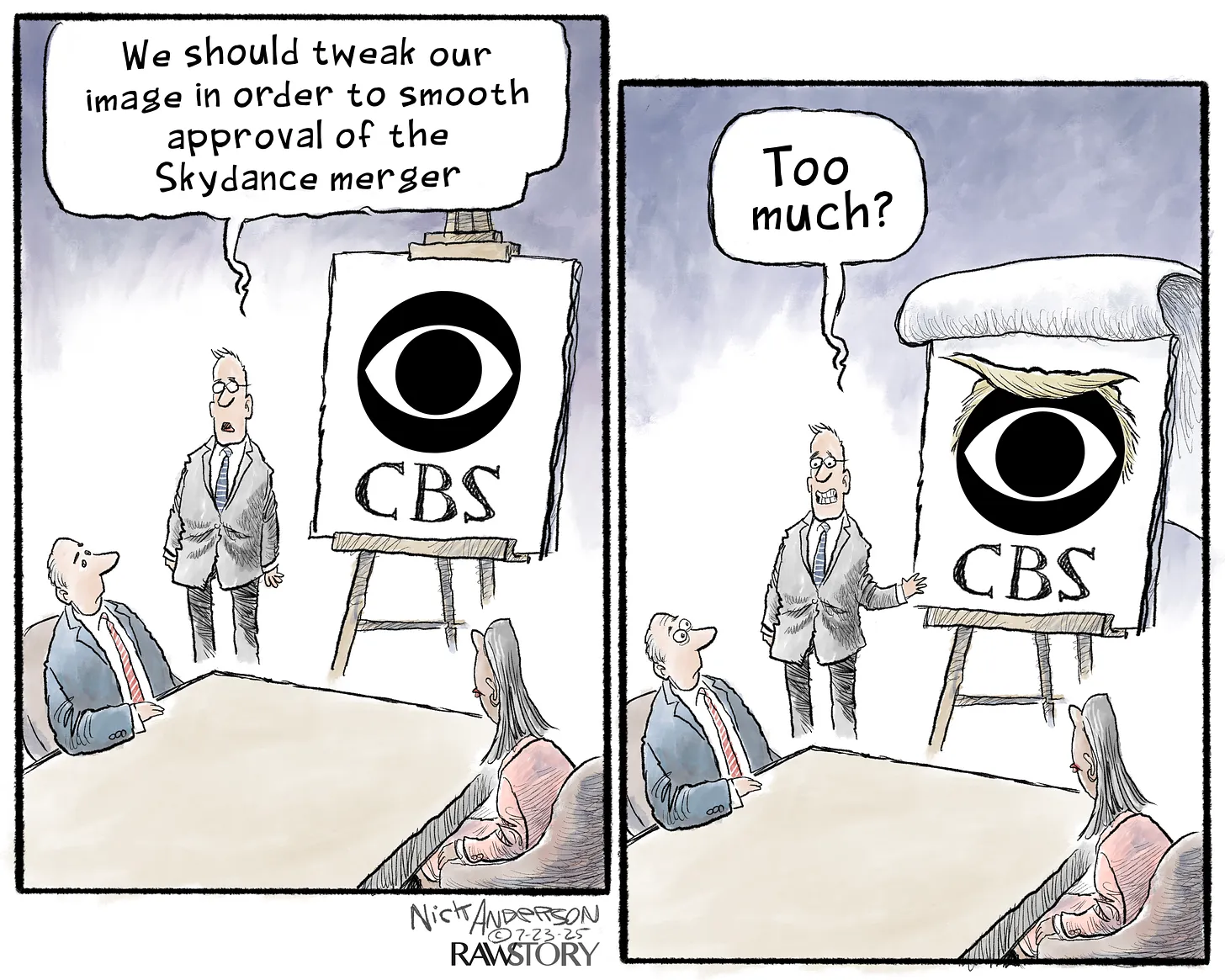
Take CBS. Does their news coverage displease Trump? Then the FCC balks at the corporate merger of CBS parent Paramount and cash-rich Skydance. It balks not until a specific public interest is satisfied, as would be the case under another administration’s FCC, but until Paramount has paid Trump $16 million to settle an otherwise baseless lawsuit, until Stephen Colbert’s show is cancelled, and until CBS agrees to have an ombudsman address complaints of anti-Trump “bias” in its news coverage.

Take Columbia University. Complaints that university wasn’t doing enough to protect Jewish students from harassment would ordinarily fall under the civil rights division of the Education Department, which might make a referral to the civil rights division of the Justice Department, with a narrow focus on the experience of the university’s Jewish students. But under a unitary executive, the offense is more general and the consequences far more sweeping: Columbia allowed pro-Palestinian demonstrations that expressed opinions contrary to Trump’s support of Israel’s government.

And so, the State Department revoked the green card and student visa of protest leader Mahmoud Khalil, allowing ICE (which is part of Homeland Security, not the the State Department) to arrest and detain Khalil for three and a half months without filing any criminal charges against him. Columbia’s research grants (primarily from the Health and Human Services Department) were frozen, and all of its federal grants were threatened. [9]

And the result? Not a specific set of adjustments to Columbia’s policies about antisemitism (antisemitism was always just a pretext), but a sweeping agreement to get Columbia right with the Trump administration, “including the re-organisation of its Middle Eastern studies department, and hiring a team of ‘special officers’ empowered to remove students from campus and make arrests”.

A similar administration assault on Harvard resulted in demands to

  • shift power from “faculty and administrators more committed to activism than scholarship” to “those most devoted to the scholarly mission of the University and committed to the changes indicated in this letter”, i.e., from Trump-hostile faculty to Trump-friendly faculty.
  • “reform its recruitment, screening, and admissions of international students to prevent admitting students hostile to the American values and institutions inscribed in the U.S. Constitution and Declaration of Independence” and “report to federal authorities … any foreign student … who commits a conduct violation”.
  • authorize an “external party” satisfactory to the government “to audit the student body, faculty, staff, and leadership for viewpoint diversity, such that each department, field, or teaching unit must be individually viewpoint diverse”. [10]

Again, the administration has mounted pressure by trying to freeze funds from a wide range of government departments. This is happening not at the end of a process in which Harvard has been found guilty of something and refused voluntary reforms, but as cudgel to beat the University into line with the administration. (Harvard is fighting this in court.)

The administration has also gone after law firms, getting concessions in exchange for release from a variety of threats that include

limiting the ability of attorneys to obtain access to government buildings, stopping any consideration for future employment with the government, canceling government contracts, and preventing any company that uses such a firm from obtaining federal contracts.

To sum up: Increasingly, we are in an environment where it is not enough to obey the laws. Instead, you need to maintain a friendly relationship with the government, and particularly not offend Trump himself. Otherwise, the full power of the government might come down on you.

The Germans have a word for this: gleichschaltung.

Gleichschaltung is a compound word that comes from the German words gleich (same) and Schaltung (circuit) and was derived from an electrical engineering term meaning that all switches are put on the same circuit allowing them all to be simultaneously activated by throwing a single master switch.

This unitary-executive metaphor goes back to the Nazis, because of course it does.

The Nazi term Gleichschaltung, meaning “synchronization” or “coordination“, was the process of Nazification by which Adolf Hitler—leader of the Nazi Party in Germany—established a system of totalitarian control and coordination over all aspects of German society “from the economy and trade associations to the media, culture and education”.

The unitary executive is precisely the person with his or her hand on that master switch. If American society retains any freedom, it will be due to the restraint of that executive, not to our inherent human rights.

So getting rid of Trump will not be enough to restore American freedom, as long as his successor — whether MAGA or some Democrat — continues to be a unitary executive holding the government’s master switch. Restoring freedom will require a sweeping change in the Supreme Court, as well as in re-establishing cultural expectations of the compartmentalization of presidential power.


[1] Recognizing, of course, that in 1787 not everyone was free. Much of our social progress in the last quarter-millennium has consisted of extending that vision of freedom more and more widely.

[2] The Founders never imagined the US achieving the kinds of world-spanning power it has today, or that it would need to maintain powerful armed forces in peacetime. Nor could they imagine a nuclear war, which could be lost before Congress could be convened.

[3] Imagine having to pass a new law each time a pharmaceutical company marketed a new drug or a food company began using a new preservative.

[4] This is the origin of the notion of a “Deep State”. President after president came into office with ideas for sweeping change, only to discover that the actual government had a great deal of bureaucratic inertia. The career employees of the various agencies had their own vision of their mission, which did not change just because they had a new boss.

You can see this today, for example, in the Justice Department, where many career employees — more than half in some offices — have quit rather than carry out orders that, by their lights, are corrupt. It’s impossible to know how many other civil servants have quietly sabotaged plans that violate what they see as their agency’s mission.

People join the EPA because they want to protect the environment, DoD because they want to defend the country, and so on. If asked to do something counter to those goals, they will do their best not to cooperate.

Properly understood, then, the Deep State is a culture, not a conspiracy.

[5] He wasn’t. IRS targeting of conservative groups for heightened scrutiny was never conclusively established, and no link to the Obama White House was ever found.

[6] Prior to Trump, only Bill Clinton had fired an FBI director — for ethical violations, in that case.

But President Trump fired FBI Director James Comey on a pretext in 2017, only four years into his term. During his transition period in 2024, Trump announced Kash Patel as his replacement for his own appointee Christopher Wray, seven years into Wray’s term. Wray might have challenged his apparent dismissal, but chose instead to resign.

[7] At least when Republicans are in the White House. The Roberts Court repeatedly found that President Biden had overstepped his legal authority. But now that Trump is president again, the bounds of presidential power have become increasingly vague and malleable.

[8] I have to wonder how well this would have worked for Biden. Would the Court have allowed him to eliminate student debt by firing all the people tasked with keeping track of it or collecting payments?

[9] Ordinarily, ending federal grants might be the conclusion of an anti-discrimination finding against a recalcitrant institution, not an opening salvo.

[10] “Viewpoint diversity” is a common MAGA euphemism for giving preference to MAGA-friendly students and professors. An economics department with no Marxists can be “viewpoint diverse”, but a biology department with no creationists might not be.

Trump only has ICE for you

The most dangerous feature of Trump’s Big Beautiful Bill is one of its least publicized: ICE becomes a massive federal police force, overseeing a system of “detention” centers that could easily become concentration camps.


Despite all the side deals necessary to get it passed, the basic structure of Trump’s Big Beautiful Bill never changed from proposal to signing: It cuts rich people’s taxes (with a few crumbs like no-tax-on-tips thrown in for working people), and partially pays for those cuts by also cutting safety-net benefits like Medicaid and SNAP (i.e., food stamps). What those cuts don’t cover gets added to the deficit. So:

  • benefits for rich people
  • cuts for poor people
  • more debt for everyone.

Probably you knew that, and maybe you also heard that there was money for immigration enforcement. But the sheer size of the new anti-immigrant money hasn’t gotten the attention it deserves. NPR estimates the total immigration enforcement appropriation as “about $170 billion“. That’s larger than the defense budget of Russia.

The bill includes $45 billion to build Trump’s border wall. (So much for claims that he nearly completed it during his first term or that Mexico would pay for it. He didn’t build much of it and Mexico isn’t contributing a dime.) But the scarier piece of this is the additional $45 billion to build more ICE detention camps. The WaPo reports:

U.S. Immigration and Customs Enforcement officials say they plan to use the [$45 billion] to roughly double the nation’s detention capacity to 100,000 beds, giving them more capacity to arrest undocumented immigrants targeted for deportation.

Lincoln Square’s Don Moynihan puts this in perspective.

For context, this is more than the combined budget for all 50 state prison systems. The current budget for the federal Bureau of Prisons is just over $8.3 billion.

There is also money to hire many more ICE agents.

The agency, which currently has about 6,000 deportation officers, would also receive billions of dollars more to hire an additional 10,000 new agents by 2029.

Masked ICE agents kidnapping people off the streets and making them disappear is already a cause for concern. So is the Trump administration’s claim that ICE’s victims should not have due process rights. Now consider the possibility that the majority of these new agents will have less loyalty to the Constitution than to Trump personally. They will be Trump hires empowered to carry out a Trump mission (with the perk that they get to beat up a lot of brown people).

Harvard political scientist Theda Skocpol comments:

Last spring, when Dan Ziblatt and I taught a comparative course on democratic backsliding, our study of the Hungarian and German (1920s-30s) cases left me slightly reassured about the United States today.  Hungary is highly centralized, and in Germany the most important state transformation happened just before Hitler was appointed Chancellor, when the previous government nationalized the Prussian police and bureaucracy, removing it from Social Democratic control in federated Germany’s largest state.  Not long after, unexpectedly, Hitler could easily turn the centralized agencies into his Gestapo core.  I thought last year that the USA was somewhat protected against any similar coerceive authoritarian takeover by its federal structure, given state and local government rights to control most U.S. police powers (I presented this argument in my Madison lecture for the Sept 2024 American Political Science Association). 

But now I see that the Miller-Trump ethno-authoritarians have figured out a devilishly clever workaround.   Immigration is an area where a U.S. President can exercise virtually unchecked legal coercive power, especially if backed by a Supreme Court majority and corrupted Department of Justice.  Now Congress has given ICE unprecedented resources – much of this windfall to be used for graft with private contractors Trump patronizes, but lots of to hire street agents willing to mask themselves and do whatever they are told against residents and fellow American citizens.  The Miller-Trumpites are not interested only in rounding up undocumented immigrants.  They will step up using ICE and DOJ enforcements use to harass Democrats, citizen critics, and subvert future elections if they can. 

Jay Kuo draws a worrisome conclusion that I share:

Once you spend that much on internal security, the system—which is profit-driven by the companies providing the apparatus—begins to feed on itself. It will demand ever more bodies in a supercharged prison/industrial complex.

And fascism expert Timothy Snyder is using the C-word:

With the passage of Trump’s death bill, we face the prospect of many great harms, including an archipelago of concentration camps across the United States.

In particular, Snyder worries that the detainees might become slave labor, which makes a perverted kind of sense: As Trump causes a labor shortage by rounding up immigrants, the detained immigrants might be rented out to do things like pick crops.

If these fears seem over-the-top, consider a little history. The Nazi concentration camps were not originally conceived as death mills. Hitler used the Reichstag Fire (in February, 1933) as evidence that a Communist revolution was at hand, and began rounding up his political enemies as Communist co-conspirators. Needing a place to put them, he opened the Dachau concentration camp in March.

At the time, Dachau was just a place political opponents could be kept outside the ordinary legal process. But as time went by, the convenience of having a black hole they could drop people into was just too tempting for the Nazi government. The mission of Dachau and the subsequent camps kept expanding, until they became the horror we now associate with concentration camps.

I find it too easy to imagine history repeating itself. ICE already sees itself as unencumbered by law, and its targets as undeserving of human rights. ICE may not, at the moment, be a Gestapo, and places like the new Alligator Alcatraz in Florida may not yet deserve the Alligator Auschwitz label critics have given it. But what prevents that progression from taking place?

All the visible forces push that way. We have already seen reality drift from the Trump administration’s rhetoric. Supposedly ICE was “making us safer” by rounding up violent criminals. But now they’re grabbing harmless people who are simply raising their children and doing their jobs, like the wife of this Marine Corps veteran and the father of three Marine sons. TracReports estimates that 71.7% of ICE detainees have no criminal record. CBS discovered that a similar percentage of the Venezuelans flown to El Salvador’s notorious CECOT prison had no criminal record.

Here’s a simple example of ICE’s sense of license: Florida law gives members of the legislature the right to make unannounced inspections of any state-run facility. Five Democratic legislators showed up to inspect Alligator Alcatraz and were denied access. Law? What law?

Imagine that someday you get scooped by ICE, maybe because you have brown skin and Spanish surname, or maybe because some AI has determined that your blog is too critical of Trump. There you are in Alligator Alcatraz or some other camp designed to hold undesirables. The letter of the law favors you, but the lawyers your family hires get the kind of run-around Kilmar Abrego Garcia has gotten. Where does your story go from there?

The Rot Goes Deeper Than Trump

Just winning the next set of elections won’t fix the underlying problems.


Zohran Mamdani’s surprise victory in New York City’s mayoral primary, and his probable ascension to the office itself, sent shock waves through the Democratic Party and reopened many longstanding debates. Maybe the word “socialist” isn’t as toxic as many think it is. Maybe the party needs younger, newer faces. Maybe a positive vision is at least as important as standing against Trump. Maybe being Muslim or pro-Palestine does not alienate potential Democratic voters. And so on.

Those are all worthwhile points to discuss, but I worry that they all revolve around a goal — taking power back from Trump and the MAGA congressmen who hold it now — that is necessary but not sufficient to save American democracy. Too easily, we get lost in the search for a new face or a new slogan or even new policies, but lose sight of the deeper problems that allowed Trump to come to power in the first place.

Remember, we beat Trump soundly in 2020. His ego will never let him admit it, but Trump got his butt kicked by Joe Biden, to the tune of more than 7 million votes. Beating Trump is not an unsolvable problem, and we don’t have to convert the MAGA cultists to do it. All we have to do is win back the voters who already voted against Trump in 2020.

But beating Trump did not end the threat then, and it won’t do it now either. We need to understand why.

Donald Trump, in my opinion, is not some history-altering mutant, like the Mule in Asimov’s Foundation trilogy. I think of him as an opportunist who exploited rifts in American society and weak spots in American culture. He did not create those rifts and weak spots, and if all we do is get rid of Trump, they will still be there waiting for their next exploiter.

I do not have solutions for the problems I’m pointing to, but I think we need to keep them in our sights, even as we look for the next face and slogan and message.

The Rift Between Working and Professional Classes. All through Elon Musk’s political ascendancy, I kept wondering: How can working people possibly believe that the richest man in the world is on their side? Similarly, how can people who unload trucks or operate cash registers imagine that Donald Trump, who was born rich and probably never did a day of physical labor in his life, is their voice in government?

The answer to that question is simple: The people who shower after work have gotten so alienated from the people who shower before work that anyone who takes on “the educated elite” seems to be their ally. In the minds of many low-wage workers, the enemy is not the very rich, but rather the merely well-to-do — people with salaries and benefits and the ability to speak the language of bureaucracy and science.

Actual billionaires like Musk or Trump or Jeff Bezos or Mark Zuckerberg are so distant that it’s hard to feel personally threatened by them. But your brother-in-law the psychologist or your cousin who got an engineering degree — you know they look down on you. Whenever they deign to discuss national affairs with you at all, it’s in that parent-to-child you-don’t-really-understand tone of voice. And let’s not even mention your daughter who comes home from college with a social justice agenda. Everything you think is wrong, and she can’t even explain why without using long words you’ve never heard before. Somebody with a college degree is telling you what to do every minute of your day, and yet you’re supposed to be the one who has “privilege”.

The tension has been building for a long time, but it really boiled over for you during the pandemic. You couldn’t go to work, your kids couldn’t go to school, you couldn’t go to football games or even to church — and why exactly? Because “experts” like Anthony Fauci were “protecting” you from viruses too small to see. (They could see them, but you couldn’t. Nothing you could see interested anybody.) Then there were masks you had to wear and shots you had to get, but nobody could explain exactly what they did. Would they keep you from getting the disease or transmitting it to other people? Not exactly. If you questioned why you had to do all this, all they could do was trot out statistics and point to numbers. And if you’ve learned anything from your lifetime of experience dealing with educated people, it’s that they can make numbers say whatever they want. The “experts” speak Math and you don’t, so you just have to do what they say.

Here’s why this is such a big problem for democracy, and how it turns into a liberal/conservative issue: Ever since the progressive era and the New Deal, the liberal project has been for government to take on issues that are too big and too complex for individuals to handle on their own. When you buy a bag of lettuce at the grocery store, how do you know it isn’t full of E coli? Some corporation has a dump somewhere upstream from you, so how can you tell what dangerous chemicals might be leeching into your water supply? How do you know your workplace is won’t kill you or your money is safe in a bank? What interest rates and tax/spending policies will keep the economy humming without causing inflation? Stuff like that.

The conservative answer to those questions is to trust corporations to police themselves subject to the discipline of the market. (So if the lettuce producers keep selling E-coli-spreading produce, eventually people will catch on and stop buying from them and they’ll go out of business.) Historically, that solution has never worked very well. Corporations are too rich and too clever and too chameleon-like for market discipline to keep them in line. But we’ve had regulations for over a century now, so most of the bad-example history happened a long time ago. (We wouldn’t have OSHA today without the Triangle Shirtwaist Factory fire.) The only people who still remember it are themselves experts of some sort.

The liberal alternative is to have what has come to be called an “administrative state”. The government runs a bunch of three-letter agencies — FDA, EPA, SEC, CDC, FCC, and so on, with an occasional four-letter agency like OSHA or FDIC thrown in. These agencies keep track of things no individual has the resources to keep track of, and they hire experts who spend their lives studying things most of us only think about once in a while, like food safety or how much cash banks should keep on hand to avoid runs or what kind of resources need to be stockpiled to deal with hurricanes.

And the liberal administrative state works like a charm as long as two conditions hold:

  • The experts are trustworthy.
  • The public trusts them.

It’s not hard to see that there are problems with both of those propositions. In his 2012 book The Twilight of the Elites, Chris Hayes outlined the ways that the expert class has become self-serving. In theory, the expert class is comprised of winners in a competitive meritocracy. But in practice, educated professionals have found ways to tip the balance in their children’s favor. Also, the experts did not do a good job running the Iraq or Afghanistan wars, and they failed to foresee the economic crisis of 2008. When they did notice it, they responded badly: Bankers got bailed out while many ordinary people lost their homes.

And then there’s the challenge of globalism: It was supposed to benefit everybody, but in practice, working-class people lost good jobs while professional-class people got cheap products made overseas.

On the public-trust side, people have been too willing to believe conspiracy theories about perfectly legitimate things like the Covid vaccine. Trump’s slashing of funding for science and research is a long-term disaster for America, and his war against top universities like Harvard and Columbia destroys one of the major advantages the US has on the rest of the world. But many cheer when revenge is taken on the so-called experts they think look down on them.

In a series of books, most recently End Times, Peter Turchin describes two conditions that historically have led to social unrest, revolution, or civil war: popular immiseration and elite overproduction. In other words: Ordinary people see their fortunes declining, and the elite classes expand beyond the number of elite roles for them to fill. (Think about how hard it is for recent college graduates to find jobs.) So there are mobs to lead, and dissatisfied members of the would-be ruling class trained and ready to lead them.

“Remember objective truth?”

Truth Decay. Democracy is supposed to work through what is sometimes called “the marketplace of ideas”. Different interest groups have their own self-interested spin, but when people with a variety of viewpoints look at the facts, truth is supposed to win out.

If you are younger than, say, 40, you may be surprised to realize how recently that actually worked. There have always been fringe groups and conspiracy theorists, but there were also powerful institutions dedicated to sorting out what really happened and how things really happen. The two most important of those institutions were the press and the scientific community.

Those two institutions still exist, and (with some exceptions) still pursue capital-T Truth. But they have lost their reality-defining power. (Part of the problem is that journalists and scientists are part of the expert class that working people no longer trust.) No current news anchor would dare end a broadcast with “And that’s the way it is”, as Walter Cronkite did every day for decades. And no scientific study, no matter how large it is or where it was done, can settle the questions our society endlessly debates.

So: Is global warming really happening, and do we cause it by burning fossil fuels? The scientific community says yes, and the experts whose livelihoods depend on the answer (like the ones in the insurance industry) accept that judgment. But the general public? Not so much, or at least not enough to commit our country to the kind of changes that need to happen.

Was the Covid vaccine safe, and did it save millions of lives worldwide? Do other vaccines (like the ones that all but wiped out measles and smallpox) bring huge benefits to our society? Again, the scientific community says yes. But that answer is considered sufficiently untrustworthy that a crank like RFK Jr. can get control of our government’s health services and put millions of lives at risk.

Did Trump lose in 2020? By the standards of objective journalism, yes he did. He lost soundly, by a wide margin. The diverse institutions of vote-counting, spread through both blue states and red ones like Georgia and (then) Arizona, support that conclusion. Every court case that has hung on the question of voter fraud or computer tampering has come out the same way: There is no evidence to support those claims. Fox News paid Dominion Voting Systems $787 million rather than argue that it could have reasonably believed Dominion’s vote-counting machines were rigged. (Not that they were rigged, but that there was any reasonable doubt about their accuracy.)

But none of that matters. No institution — not even one Trump cultists establish themselves, like the audit of Arizona’s votes — can declare once and for all that Trump lost.

Loss of Depth. Along with the lost of trust in experts and the inability of American society to agree on a basic set of facts, we are plagued by a loss of depth in our public discussions. It’s not just that Americans don’t know or understand things, it’s that they’ve lost the sense that there are things to know or understand. College professors report that students don’t know how to read entire books any more. And we all have run into people who think they are experts on a complex subject (like climate change or MRNA vaccines) because they watched a YouTube video.

Levels of superficiality that once would have gotten someone drummed out of politics — Marjorie Taylor Greene confusing “gazpacho” with “Gestapo” comes to mind — are now everyday events.

Empathy is out. Assholery is in. Remember George W. Bush’s “compassionate conservatism“? The idea in a nutshell was that if conservative policies produced a more prosperous society, the rising tide might lift more people out of poverty than liberal attempts to help people through government programs. Things never actually worked out that way, but the intention behind the phrase was clear: Conservatives didn’t want to be seen as selfish or heartless bad guys. They also want a better world, they just have a different vision of how to get there.

Later Republican candidates like John McCain and Mitt Romney worked hard to build images as good, decent men, reasonable and courteous to a fault. If the policies they supported might lead to more poverty, more suffering, or even more death, that was lamentable and surely not what they intended.

But in 2018, The Atlantic’s Adam Serwer made a shocking observation about the first Trump administration: The Cruelty is the Point. MAGA means never having to say you’re sorry. If people you don’t like are made poorer, weaker, or sicker — well, good! Nothing tastes sweeter than liberal tears.

We can hear the spectacle of cruel laughter throughout the Trump era. There were the border-patrol agents cracking up at the crying immigrant children separated from their families, and the Trump adviser who delighted white supremacists when he mocked a child with Down syndrome who was separated from her mother. There were the police who laughed uproariously when the president encouraged them to abuse suspects, and the Fox News hosts mocking a survivor of the Pulse Nightclub massacre (and in the process inundating him with threats), the survivors of sexual assault protesting to Senator Jeff Flake, the women who said the president had sexually assaulted them, and the teen survivors of the Parkland school shooting. There was the president mocking Puerto Rican accents shortly after thousands were killed and tens of thousands displaced by Hurricane Maria, the black athletes protesting unjustified killings by the police, the women of the #MeToo movement who have come forward with stories of sexual abuse, and the disabled reporter whose crime was reporting on Trump truthfully. It is not just that the perpetrators of this cruelty enjoy it; it is that they enjoy it with one another. Their shared laughter at the suffering of others is an adhesive that binds them to one another, and to Trump.

In the second Trump administration, this tendency has become even more blatant. Consider:

I could go on. It’s hard to look at any list of recent Trump administration actions without concluding that these people are trying to be assholes. It’s not an accident. It’s not a side effect of something else. The assholery is the point.

You might think this intentional assholery would get Trump in trouble with his Evangelical Christian base, because — I can’t believe I have to write this — Jesus was not an asshole. Jesus preached compassion and empathy.

But Evangelicals are making this work out by turning their backs on the teachings of Jesus. Recent books like The Sin of Empathy and Toxic Empathy explain how empathy is a bad thing — precisely because it might cause you to regret the pain that the policies you support inflict on other people.


Where does a recognition of these issues leave us? Don’t get me wrong. I would like nothing better than for a Democratic wave to sweep the 2026 midterms and then give us a non-MAGA president in 2028. But that is the beginning of the change we need, not the end.

What America needs runs far deeper than a new set of political leaders. We need some sort of spiritual or cultural reformation, one that rededicates Americans to the pursuit of truth and the responsibility to be trustworthy. It would cause us to care about each other rather than rejoice in each other’s pain. It would start us looking for leaders who bring out the best in us rather than the worst.

How do we get that reformation started? I really have no idea. I just see the need.

Trump Invades Los Angeles

It started with ICE raids at Home Depots and other places undocumented immigrants might congregate to look for work.

Xochitl, a Guatemalan mother of two, was inside a McDonald’s that shares the parking lot with the Home Depot when she said she saw numerous agents running after men she sees every day but knows only by their nicknames. She said she momentarily froze but then began walking in the opposite direction of agents who were detaining food vendors on sidewalks.

“They were just grabbing people,” she said. “They don’t ask questions. They didn’t know if any of us were in any kind of immigration process.”

Anti-ICE protesters gathered, as they do in towns and cities all over America. (There’s a weekly protest outside a Massachusetts ICE facility one town over from mine. I haven’t attended yet, but I feel like I should.) Increasingly, ICE is targeting not the violent criminals Trump campaigned against (who never existed in the numbers he claimed), but the neighbors, friends, and co-workers of ordinary Americans.

By Friday, the situation had devolved into law enforcement officers using tear gas and protesters shooting fireworks at ICE. Who started the violence? Hard to say. In this video, a man describes an ICE raid causing a traffic jam. When agents began dragging people out of a local business, people stuck in the jam began taking videos on their phones. “We’re not there to protest. We were stuck at the light.” The tear gas, the man claims, was aimed at the people taking videos on their phones. “One of the agents, I hear them: ‘Go for the people with the phones’.”

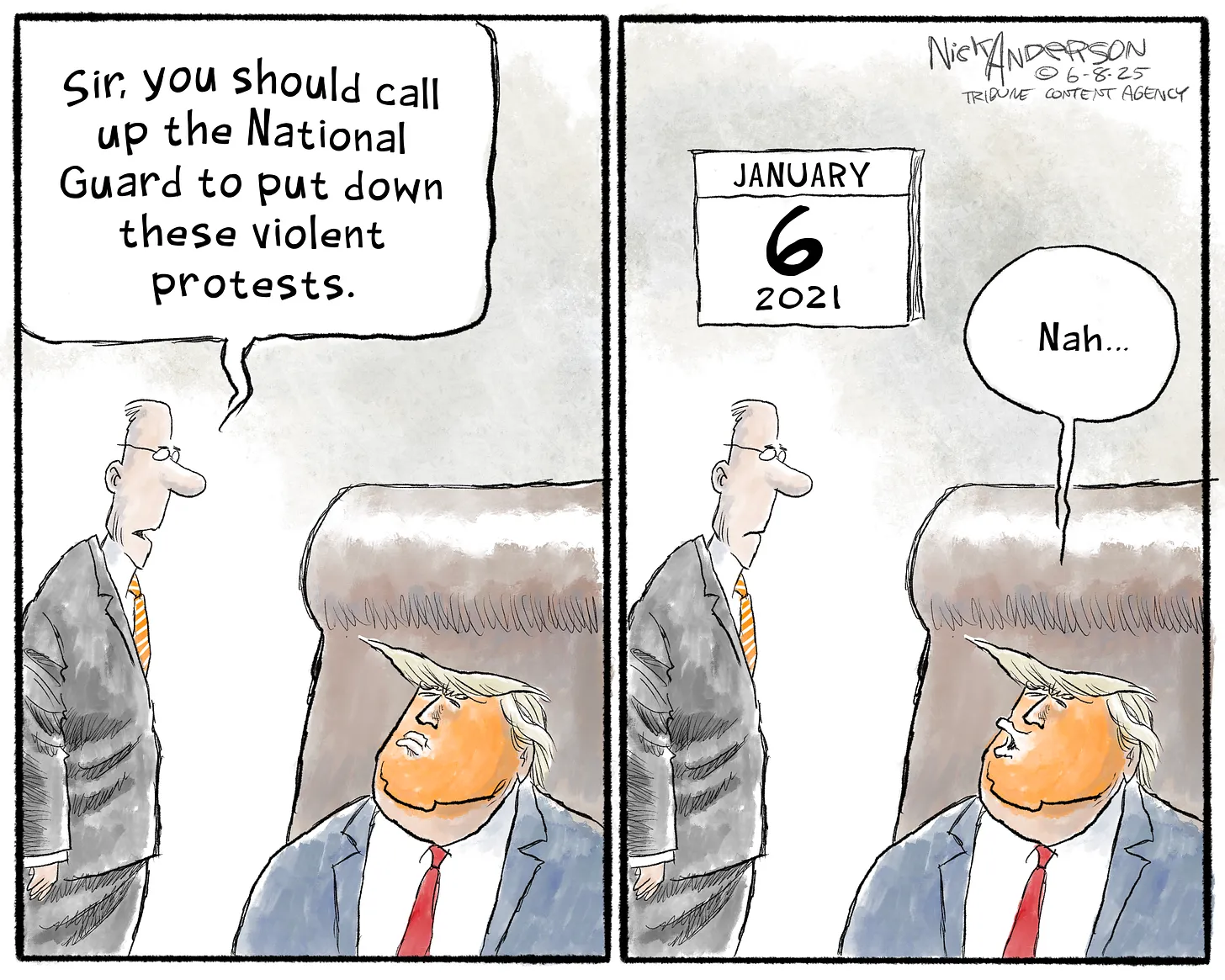
Local officials thought the police response was appropriate to the size of the disturbance, but Trump evidently disagreed. Saturday, he federalized 2000 troops from the California National Guard and placed them under the command of Defense Secretary Pete Hegseth.

Using National Guard troops to control unrest is a well established practice, but usually the troops are requested by the governor. Here, Governor Newsom (and LA Mayor Karen Bass) opposed using the troops, but Trump sent them in anyway — something that hasn’t been done since 1965, when LBJ sent troops to Alabama to protect civil rights workers.

Trump’s over-the-top response has created an additional reason to protest: the appearance of a military takeover as federalized troops are used against the citizens of a major American city. A weekly blog can’t cover breaking news, so I’ll just have to wait and see how this plays out.

The legal authority here is tricky. Jay Kuo breaks it down: Trump is invoking his authority under Title 10, which allows him to use National Guard troops to respond to “a rebellion against the authority of the Government of the United States”. Characterizing spontaneous demonstrations as “rebellion” against the US government is a bit of a stretch, but it’s the kind of stretch the Trump administration has made before, like when it claimed illegal immigration is an “invasion” that justifies invoking the Alien Enemies Act.

But Title 10 doesn’t allow martial law.

So here’s the part that’s a bit hard to grasp at first. Title 10 permits the President to federalize the troops and put them under his command. But what they are permitted to do as military troops operating on domestic soil is still governed by other laws.

And one of those laws is the Posse Comitatus Act.

The PCA doesn’t allow federal troops to play the role of local law enforcement. All they can do is protect federal buildings and federal agents carrying out their duties.

The Insurrection Act makes an exception to the Posse Comitatus Act, and so would be a step towards martial law. But so far Trump has not invoked the Insurrection Act.

Now I’ll begin to speculate: It looks like Trump wants this confrontation, and is hoping the situation escalates. This will provide lots of violent video to show on Fox News, of blue-state citizens battling US troops. After a few days of that, he can justify invoking the Insurrection Act, turning LA into a military occupation zone.

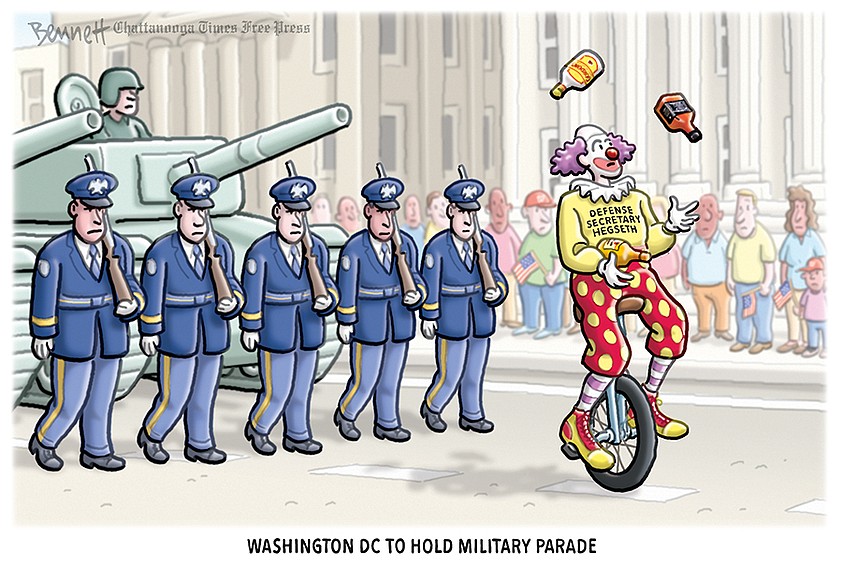
It’s hard not to connect this directly provoked confrontation with the events scheduled for next Saturday. Trump has planned a North-Korea-style military parade in Washington. Ostensibly, the parade is to celebrate the 250th birthday of the US Army. But coincidentally, Saturday is also Trump’s own birthday.

Trump’s $45 million birthday party has incited plans for thousands of counter-protests around the country, under the theme “No Kings“. Whether he intends to meet these protests with state violence remains to be seen.

What’s up with the Supreme Court?

Consider this a follow-up to last week’s post of qualified optimism about the prospects for American democracy to outlive the Trump administration. We continue to be steaming towards a direct clash between Trump and the Supreme Court. How that plays out will be a big factor in whether our way of government survives.

A lot of the pessimists I talk with say this clash has already happened and the bad guys won. Specifically, the Court told the Trump administration to bring Kilmar Abrego Garcia back from the concentration camp Trump has established in El Salvador. Trump has ignored that order and gotten away with it. So: courts and laws are powerless and Trump will do as he pleases. For all practical purposes, American democracy is already dead.

I read the situation somewhat differently. To me, the Supreme Court and the Trump administration look like two fighters circling each other warily, each waiting to see if the other really wants to do this.

It already seems clear that the Court will not endorse Trump’s most obviously illegal acts. It will not deny that the 14th Amendment guarantees birthright citizenship, no matter how badly Trump wants that denial. It won’t agree that he can invoke wartime powers (like the Alien Enemies Act) when there is no war. It won’t endorse him unilaterally unmaking agencies made and funded by Congress. The administration seems to understand this, which is why it hasn’t pushed for the Court to resolve those issues quickly.

Instead, Trump’s lawyers keep offering the Court ways to surrender quietly, by writing itself out of the picture. For example, the portion of the birthright citizenship case that the administration argued in front of the Court this week did not seek an answer to the central question. Instead, it focused on whether lower court injunctions could cover the entire country. The acting Solicitor General argued for a system in which each loss in a lower court only affected the specific plaintiffs involved, leaving the administration free to ignore the birthright citizenship of any other Americans until they sued too. Only a Supreme Court ruling could shut the administration down completely.

This leaves an enormous loophole: If the administration simply refused to appeal a series of lower-court losses, none of the cases would make it to the Supreme Court, so there could be no national ruling against them.

In other words: You don’t have to endorse our position, Supremes, just write yourself out of the picture and let us proceed.

For its part, the Court has so far treated the Trump administration as if it were a good-faith actor, which it clearly is not. In the Garcia case, the Supremes supported a lower-court order to “facilitate” Garcia’s release, leaving the details to the executive branch. (That’s appropriate if the executive branch is acting in good faith, because the executive is presumed to be better equipped to deal with foreign governments.) In essence, it was offering Trump the opportunity to stop all this nonsense and start behaving like the kind of American president the Constitution envisions.

But of course he did not. The Trump administration interpreted “facilitate” in a ridiculously narrow way, and — surprise! — the details of Garcia’s release haven’t worked out. The government continues to give the lower-court judge a run-around as to what it is or is not doing to get Garcia back.

Sooner or later, Judge Xinis is going to tire of this and order the administration to present Garcia in his court on a particular date. That order will also get appealed up to the Supreme Court, which will then have to decide whether it is ready to confront Trump or surrender to him. If it isn’t ready to surrender, then Trump will have to decide whether he recognizes the authority of the Court. If he doesn’t, that’s the crisis point.

I don’t think anyone knows whether we’ll get there, or what will happen then. Trump himself may not know, and the answer may turn on how popular Trump is at the time, how the economy is going, how vigorously Republicans in Congress are standing up for him, how well organized anti-Trump protesters are, and a lot of other factors that have nothing to do with the case at hand.

It’s worth noting that so far the Trump administration is not acting as if it had thrown off the burden of judicial oversight. For example, on Friday the Supreme Court extended its previous ban on deporting any more people under the authority of the Alien Enemies Act until the administration’s invocation of the AEA’s wartime powers can be fully adjudicated. As best we can tell, the administration is obeying the order.

At least for now.

As we approach our crisis of democracy, we’re in better shape than I expected

During my two weeks off, I drove cross-country and saw a lot of my old friends plus a few like-minded relatives. I was struck by how depressed so many of them are with the current political situation. Again and again, I had to be the voice of optimism in the room. For the sake of depressed Sift readers I didn’t see during my travels, maybe I should explain why.

Partly, I feel optimistic because I got my pessimism out of the way early. After Trump’s inauguration, I think a lot of people were expecting a second Trump administration a lot like the first. We got through that, they thought, so we’ll probably get through this too.

I was much more negative. Everything and everybody who had restrained Trump’s worst impulses during his first administration was gone now, so it seemed obvious he would make a play to become a dictator. It was also clear how that would play out: He would keep pushing until either Congress or the Supreme Court tried to stop him. Then there would be a crisis and we’d see who won.

We seem to be reaching that crisis point now, as the Supreme Court is going to have to decide whether to call Trump out on his flouting of their Abrego Garcia ruling. (To be clear, the administration is denying that it’s ignoring the Court’s order, but it’s interpreting that order in an absurd way that makes it meaningless.) So now we see whether the Court has the courage to stand up to Trump, whether Trump will decide that the Court has no power over him, and whether (if he does) Congress will just stand by and let him do it.

In addition, courts up-and-down the line have been restraining Trump’s illegal actions. And surprisingly often, Trump officials are obeying. Rümeysa Öztürk, the Turkish Tufts student masked DHS agents snatched off the streets, is now free on bail and walking the streets of Somerville rather than rotting in a Louisiana detention camp. She seems likely to prevail in her attempts to complete her degree in the US. Another detained student, Mohsen Mahdawi, is also free.

This is the point we have been headed towards ever since Trump was elected last November. What I feel good about is that we’re hitting this point in much better shape than I thought we would. For several reasons:

  • Trump is unpopular. Imagine if he had just taken credit for the good Biden economy rather than starting all this tariff nonsense. Imagine if Musk had focused on actual government waste and could point to real accomplishments.
  • He has visibly declined. Falling asleep at Pope Francis’ funeral (while wearing an inappropriate blue suit) is just the most obvious example. (Imagine if Biden had done that.) And while he’s always had moments of incoherence, it’s now unusual when he appears coherent.
  • The administration has multiple competing factions. You can see this in the persistent leaks saying Trump as about to reverse his position on something. That’s an internal faction trying to nudge him to reverse a position backed by a different faction.
  • His promises are failing. Trump has always been good at declaring victory and making his followers believe him. But he made some very definite promises that are obviously not being fulfilled: Prices did not start dropping “on Day 1”. He didn’t solve the Ukraine War in 24 hours. And so on.
  • Popular opposition is rising. Early in the administration, I kept hearing anti-Trump people express their sense of isolation. No more.
  • Congress is wavering. You can see this in the floundering negotiations over the FY 2026 budget. More and more Republican congresspeople are realizing that they can’t get reelected on Trump’s endorsement alone.

All these factors add up to give the Supreme Court a little more spine, and to make Trump and his minions waver about open defiance. If Trump were riding high in the polls, at the peak of his powers, leading a united administration, facing little public protest, and backed by a solid Republican majority in Congress, standing up to him would be far more difficult, even for somebody like John Roberts who has an independent constitutional mandate.

That’s not to say that everything is going to go smoothly. There still might be rough waters ahead, and a Trump dictatorship is not impossible. But trends are going our way, and we’re in better shape than we were on Inauguration Day.

Reclaiming the Spirit of ’75

In its 250th year, New England’s revolutionary history has become relevant again.


Here in Massachusetts, April is the month of patriotism, centering on the April 19 anniversary of the battles of Lexington and Concord.

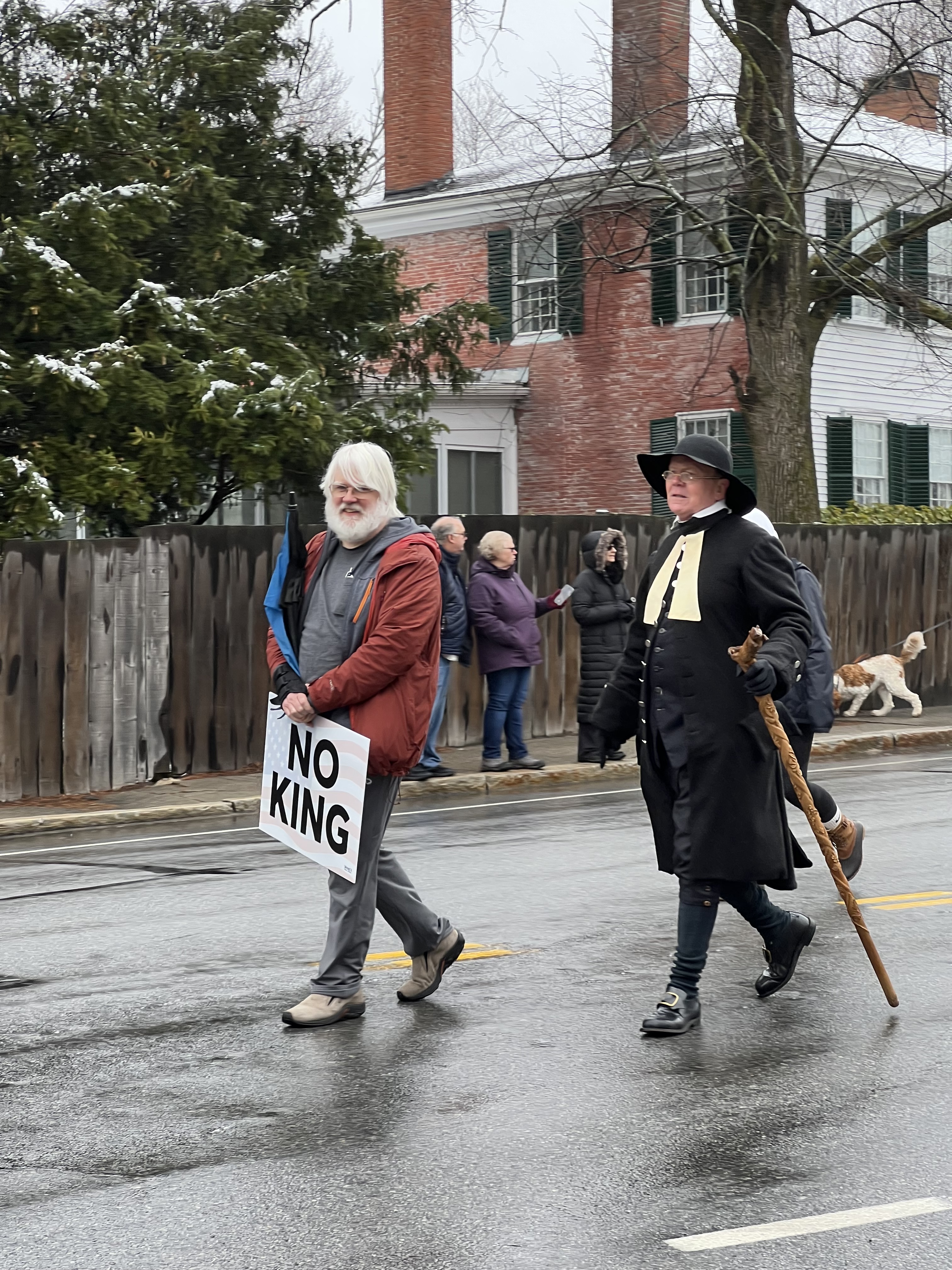
I live in Bedford, a town that sits between Lexington and Concord, and so has an understandable sense of inferiority (though Bedford’s Minutemen joined several other nearby community militias in mustering to defend Concord Bridge). Longfellow never wrote a poem about us, but we do have our own April revolutionary celebration: Pole Capping Day, on which people dress in colonial-era costumes, Minutemen march and fire muskets, and speeches are given. The center of the ritual is the erection of a pole, which some agile person climbs and adorns with a liberty cap, symbolizing Bedford’s rebellion against King George and the English monarchy.

Saturday, hundreds of people braved drizzle and sleet to celebrate. This year’s pole capping had an extra flavor, as autocratic rule no longer seems like a historical curiosity. For some while, townspeople have been decorating their yards with ambiguously historical/political signs: “No King”, “Resisting Tyranny Since 1775”, and so on. If anyone objects to these “partisan” messages, they have so far stayed quiet for fear of confessing their pro-dictatorial aspirations.

My church’s retired minister John Gibbons is the chaplain of the local Minuteman corps, and annually officiates in his colonial-parson costume. This year’s homily was cribbed from the Declaration of Independence, but seemed like a denunciation of the Trump administration’s current deeds and near-term ambitions. Consider these accusations against King George:

He has excited domestic insurrections amongst us.

He has endeavoured to prevent the population of these States; for that purpose obstructing the Laws for Naturalization of Foreigners; refusing to pass others to encourage their migrations hither

He has combined with others to subject us to a jurisdiction foreign to our constitution, and unacknowledged by our laws; giving his Assent to their Acts of pretended Legislation:

For cutting off our Trade with all parts of the world:

For imposing Taxes on us without our Consent:

For depriving us in many cases, of the benefits of Trial by Jury:

For transporting us beyond Seas to be tried for pretended offences

Back in 2009, conservatives (and various other people upset to find themselves living in a country with a Black president) misappropriated New England’s revolutionary tradition and called themselves the Tea Party. As I pointed out in 2014, in one of the Sift’s most viral posts, they were actually a Confederate party, and drew much more from John Calhoun than John Adams.

Over the next 15 months, a lot of 250th anniversaries are going to roll around. I hope we use them to reclaim the true spirit of American patriotism from the fascist posers who so often usurp that legacy. Let us rededicate “our Lives, our Fortunes and our sacred Honor” to the cause of the inalienable rights of all people, and resist all attempts to impose one-man rule on these hallowed shores.

Is this a turning point?

The scenario where American democracy survives Trump got a little more credible this week.


Consider the events of this week, all of which will be described in more detail in the weekly summary I’ll post later this morning:

It’s tricky to evaluate the significance of all this. If you look at it all pessimistically, Booker’s speech was a stunt that produced no direct congressional action, off-year elections are notoriously bad predictors of subsequent elections, Trump has announced and withdrawn tariff plans before that whipsawed the markets, and massive protests in his first term seemed to have little consequence. A month or two from now, none of this may look all that important.

But.

Six weeks ago, I posted “How Things Stand“, a summary of how Trump was threatening American democracy and where things might go from there.

So now we’ve seen Trump’s opening moves: a blizzard of executive orders claiming unprecedented powers that can be found nowhere in the Constitution. That was all predictable.

What wasn’t predictable, and is still unknown, is how the other American power centers would respond. I’m talking about Congress, the courts, the state governments, and the People. That’s all still very hard to predict, because each of those power centers will influence the behavior of the others.

It’s important for us to be neither complacent about all this nor resigned to our fate.

I projected a scenario that avoided the establishment of a lasting Trump autocracy, emphasizing that it was just a scenario, not a prediction. My point was that a way out of this was still possible. The first steps were:

  • Trump continues losing popularity. He never had much, but his brand becomes politically toxic.
  • That lack of voter support makes support from congressional Republicans waver. They may not openly defy Trump, but the slim Republican majorities (especially in the House) lose their cohesion, making it impossible to pass legislation without at least some Democratic support.

I had hoped that the looming government shutdown of March 14 would be the time when congressional support would waver, and that Republicans wouldn’t be able to pass a continuing resolution without negotiating a deal with the Democrats. That didn’t happen. Mike Johnson was able to hold his small majority together to pass the CR on a nearly party-line vote. Then Chuck Schumer folded in the Senate (for reasons I found plausible but not necessarily convincing), ending the threat of a Democratic filibuster. So the government is funded through September.

However, the events of this week show that we’re still on the path I laid out. Again, I’m not saying that success is certain, just that there is still a way out of this through political processes, without widespread riots or civil war.

There is no legal or political mechanism that directly links public opinion, market crashes, or elections for relatively minor offices to the kinds of legal or congressional action that will halt the Trump/Musk coup or lead to the restoration of American democracy. However, autocratic movements rely on a sense of inevitability and self-confidence, with each usurpation of power emboldening its leaders and foot-soldiers to dare the next one. Autocrats depend on a sense of public helplessness that demoralizes opposition and makes each successive victim feel alone and unsupported.

The narrative of Trump’s inevitability and his opposition’s powerlessness ran aground this week. He remains in office and retains his grip on the levers of executive power. But his true supporters have never been more than about 1/3 of the American public, and many in Congress, the courts, the media, the business community, and elsewhere have lined up behind him more from intimidation or a lack of attractive alternatives than real conviction.

The momentum that has swept Trump forward can turn, with each act of opposition emboldening the next. All along, there has been a scenario in which his seizure of unconstitutional power fails. That scenario is still intact, and is more credible today than it was a week ago.

The Hands Off march in Portland, Oregon Saturday.

Politics in the Attention Economy

What happens to democracy when directing and misdirecting public attention becomes more important than convincing voters to agree with you?


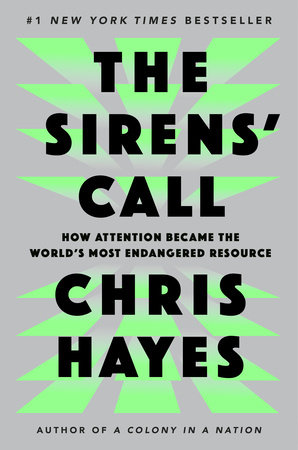
Chris Hayes’ recent book The Sirens’ Call is worth reading in its entirety, but there is one particular aspect of it that I want to highlight. Once you’ve had this thought, it’s perfectly obvious, but I’ve never seen it spelled out so clearly before: Getting attention and holding attention are two very different problems. Getting attention is easy; holding attention is hard.

If you’re in a roomful of people and you want to get their attention, you have a lot of options: Drop something breakable, start yelling obscenities, run through the room naked or covered in blood, fire a gun in the air. The possibilities are endless.

But now imagine that you want to hold people’s attention long enough to explain something to them or convince them of something. That’s much harder. If the waiter who just dropped a tray of glasses starts trying to tell you about the dangers of climate change or rising government debt, you’re probably going to tune him out pretty quickly.

Traditionally, politics has been all about holding people’s attention long enough to change their minds about something or motivate them to do something. Politically active people might want to convince you that abortion is wrong or gays are people too or the rich have too much money or government regulations stifle economic growth, just to name a few possibilities. Yes, they need to get your attention. But more than that, they need to hold your attention long enough to present their case, maybe even long enough to overcome your initial resistance.

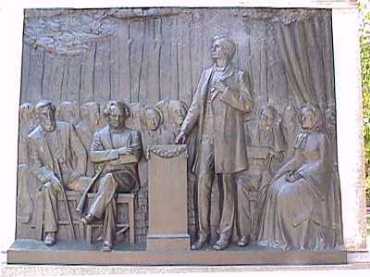
Hayes flashes back to something that seems unimaginable now: the Lincoln-Douglas debates. Back in 1858, people in Illinois more or less agreed that the biggest issue the nation faced was slavery and what to do about it. So that year’s two Senate candidates, Abraham Lincoln and Stephen Douglas, toured the state together, debating the slavery issue for three hours at a time. (My home town, Quincy, hosted one of the debates.) That format gave each man a chance to explain some fairly complex and subtle ideas.

Admittedly, that’s unusual. For well over a century, most American politics has revolved around slogans: “Equal pay for equal work”, “No third term”, “Remember the Maine”, and many others. A slogan boils a political message down to its absolute minimum. You still have to hold attention, but you don’t have to hold it very long. Sometime a slogan is just a placeholder that your supporters will flesh out later; it makes people curious to find out what the slogan means. In 2024, “Make America great again” and “Democracy is on the ballot” were both like that. If you didn’t have at least a little background, both were so vague as to be meaningless.

But Hayes describes a way of managing attention that skips the difficult hold-attention step completely. It has been pioneered by the social-media platforms and has now been adapted to politics: If you want to keep somebody on your platform for hours at a time, you don’t need to produce an epic like Lord of the Rings or Lawrence of Arabia — content capable of holding a person’s attention that long. Instead, you just grab somebody’s attention, then grab it again, and grab it again. Keep doing that for hours. That’s the secret of the infinite scroll. Hardly anybody sits down thinking they’re going to devote the next two hours to TikTok or Facebook. They just look up and realize they’re late for something.

Now apply that idea to politics. What if I’m not trying to explain anything at all, even at the slogan level? What if I’m just trying to grab your attention in a particular way and prevent my opponent from grabbing it some other way?

This is something the Trump campaign seemed to understand much better than the Harris campaign. If a voter went into the voting booth thinking about inflation, immigration, or trans athletes, probably that vote would go to Trump. But a voter thinking about democracy, climate change, racism, or healthcare probably would probably choose Harris. It almost didn’t matter what a voter thought about any of those issues. Just direct their attention and you command their vote.

That was the method behind the madness of the Trump campaign. As far back as 2015, Trump has been saying things that were supposed to be political suicide. When he said that immigrants were “animals” or spouted “facts” about them that were obviously false, it didn’t matter if he looked like an ignorant asshole, because he made you think about immigration. If he grossly overstated the price of bacon and was proven wrong the next day, so what? He made you think about inflation — and the debunking article the next morning made you think about it again.

Harris could never catch up. I kept reading columns by pundits frustrated that Harris didn’t just say X — and those columns frustrated me, because I knew that Harris DID say X, but nobody paid attention.

The big thing I got wrong about the election was that I expected voters to get serious at the end of the campaign; low-interest and low-information voters who had been checked out all summer would check back in long enough to decide who to vote for. It never happened. Right up to the last day, Trump dominated the news cycle with his look-here, look-there, look-at-this-other-thing tactics. He had no message to speak of, just the idea that things were bad and he would somehow make them better.

What we’ve been seeing these last two months is the new attention-politics as a governing strategy. In traditional politics, an incoming administration tried to focus on a few simple themes, with the idea of raising enough public support to push one or two big ideas through Congress. So George W. Bush came in promoting his tax cut. Barack Obama was focused on his stimulus plan and then healthcare. (I remember the frustration many environmentalists felt when a carbon tax and other items from a climate-change agenda were sidelined so as not to interfere with the healthcare push.)

Trump hasn’t been doing anything like that. Instead, he’s doing a million things at once, including many that circumvent Congress in a way that is flatly illegal. By ignoring Congress and relying on executive actions, he avoids the need to marshal public opinion. Quite the reverse: It’s the opposition that needs to marshal public opinion to stop him. And that’s difficult, because what opposition leader or opposition agenda can get attention when Trump grabs all the attention in the room with a new outrage every day? (Invade Greenland! Annex Canada! Brief Musk about China war plans! Defy court orders! Fire the people who keep track of nuclear weapons! Turn Gaza into a seaside resort!)

I’m frankly unsure what I ought to be rooting for. Eventually, assuming Trump doesn’t establish his own version of the Thousand-Year Reich, some Democrat will figure out how to master the new attention politics and become president. But how good is that outcome really? The new politics lends itself to autocracy. Probably a Democratic autocrat would do more things I like than Trump is doing. But I’m not sure what would take us back in the direction of democracy.

Rights, Privileges, and Mahmoud Khalil

Can a legal permanent resident be deported for expressing views the President disagrees with?


A long-standing debate runs through American history: Does the Bill of Rights enumerate human rights, i.e., something that anyone can claim by virtue of being human, or privileges of citizenship that our government can ignore when it deals with non-citizens?

The Declaration of Independence uses theistic language to promote a human-rights view: Human beings (or at least “all men”) have been “endowed” with rights “by their Creator”. To say that a man lacks rights is tantamount to claiming that he was not created by God. But in the Dred Scott decision of 1857, the Supreme Court took the opposite view: Rights derive from the social contract embodied in the Constitution. Africans residing in the United States, the Court held, were not party to that contract, and thus they “had no rights which the white man was bound to respect”.

Dred Scott has long been in the dustbin of history, and is widely viewed as one of the Court’s worst decisions. Currently binding Supreme Court precedents take an in-between view that leans towards human rights. Basically, the Court interprets the Constitution and the laws to mean exactly what they say: If lawmakers had intended a provision to apply only to citizens, they would have used the word “citizen” rather than some more general term like “person”. For example, the 14th Amendment uses both words:

No State shall make or enforce any law which shall abridge the privileges or immunities of citizens of the United States; nor shall any State deprive any person of life, liberty, or property, without due process of law; nor deny to any person within its jurisdiction the equal protection of the laws.

So there are privileges that apply only to citizens (the right to vote, for example), but due process and equal protection are not among them.

The Trump administration shows every sign of wanting to move that line. Just how far it wants to go is not clear. But the first case in point is Mahmoud Khalil.

Who is Mahmoud Khalil? Two weeks ago, Khalil (an Algerian citizen born in a Palestinian refugee camp in Syria) had the next layer of privileges short of American citizenship: He came here originally on a student visa, but became a legal permanent resident, a “green card holder”. He is married to an American citizen, who is eight months pregnant. If nothing goes wrong, in another month he’ll be the father of an American citizen.

He is also a pro-Palestine activist. Last spring, he participated in demonstrations at Columbia University, where he was a student at the time. (He has since finished his degree.) Wikipedia describes his views like this:

Following the start of the Gaza war in 2023, Khalil became involved in pro-Palestinian activism. He served as a negotiator for students associated with Columbia University Apartheid Divest (CUAD) when they were bargaining with Columbia University officials. In a 2024 interview, Khalil said, “As a Palestinian student, I believe that the liberation of the Palestinian people and the Jewish people are intertwined and go hand by hand, and you cannot achieve one without the other.” He characterized the movement as one “for social justice and freedom and equality for everyone”. Of concerns about antisemitism, Khalil said, “There is, of course, no place for antisemitism. What we are witnessing is anti-Palestinian sentiment that’s taking different forms, and antisemitism, Islamophobia, racism [are] some of these forms.”

The Trump administration describes him differently, claiming that he “led activities aligned to Hamas” and “engaged in pro-terrorist, anti-Semitic, anti-American activity“. But it has produced no specifics to back those claims up, and the language itself is slippery. What does it mean that an activity is “aligned with Hamas”? Aligned in whose view? Similarly, unless Khalil himself endorsed terrorism or attacked Jews or America in so many words — and if he had, I’d expect his critics to have produced specific quotes — “pro-terrorist, anti-Semitic, anti-American” is an opinion, not a fact.

Khalil’s arrest. A week ago yesterday, agents from the Homeland Security department arrested Khalil at his home in New York. Khalil’s wife Noor Abdalla recorded the event on her phone while simultaneously talking to Khalil’s lawyer on his phone. It isn’t exactly a classic police-state arrest — Khalil is not roughed up, for example — but it still has a lot of disturbing aspects. When Khalil’s wife asks for the names of the arresting agents, she is told “We don’t give our names.” They also refuse to say which agency they represent. All they’re willing to tell her is where Khalil is being taken: Immigration Custody at 26 Federal Plaza. They refuse to talk to Khalil’s lawyer, who is on the phone. “They’re literally running away from me,” Noor reports to the lawyer.

When Noor tried to visit Khalil at a detention center in New Jersey, she was told he was no longer there. It took some time for his lawyer to determine that Khalil had been moved to a facility in Louisiana, where at first he was not allowed to consult privately with lawyers. An immigration hearing to have him deported was scheduled for March 27.

Last Monday, a federal judge in New York ordered that Khalil not be removed from the US until a hearing in his court can determine whether deporting him violates constitutional rights.

The Just Security blog analyzes the legalities: No one in the executive branch can unilaterally revoke a green card.

To obtain authority to deport a green card holder, the government must charge (or accuse, as this is not a criminal matter) them with a condition under the immigration laws that in some way makes them “deportable.” “Deportable” is a term of art under the immigration laws. It refers to conduct defined in a set of provisions—most though not all involving criminal activity—codified at 8 U.S.C. 1227(a).

To prove that an [legal permanent resident] is deportable, the government must convene a “removal hearing” before an immigration judge. At that hearing, government attorneys must prove deportability by “clear and convincing” evidence.

Notably, the Trump administration has not accused Khalil of committing crimes, or of committing fraud in his green-card application (another deportability condition). Instead, it points to a condition that has never been used in this way before:

the government has invoked a rarely used “foreign policy” ground of deportation. That provision, located in section 237(a)(4)(C) of the Immigration and Nationality Act, makes deportable any “alien whose presence or activities in the United States the Secretary of State has reasonable ground to believe would have potentially serious adverse foreign policy consequences for the United States” (emphasis added).

The statute contains a (freedom of speech and association) safe harbor, incorporated by reference to the inadmissibility provisions, prohibiting deportation “because of the alien’s past, current, or expected beliefs, statements, or associations, if such beliefs, statements, or associations would be lawful within the United States,” but then contains an exception for the safe harbor: “unless the Secretary of State personally determines that the alien’s [presence] would compromise a compelling United States foreign policy interest” (emphasis added).

It’s worth pointing out that much of what the administration claims about Khalil (even if true) consists of “beliefs, statements, or associations would be lawful within the United States”. The First Amendment would protect an American saying “I support what Hamas did on October 7”, even if most other Americans would find that statement reprehensible. (Again, Khalil seems not to have said anything like that.)

The foreign-policy justification is pretty obviously absurd: Khalil is up for deportation because Trump promised to deport pro-Palestinian campus demonstrators. There is no “compelling US foreign policy interest” involved. What the administration will probably argue, though, is that identifying US foreign policy interests is a judgment call that belongs to the executive branch, not the judiciary.

The case, then, will turn on whether an immigration judge feels empowered to use common sense, which says that the foreign policy interest here is a pretext, not a reason.

Protests. The administration has pledged that a Khalil deportation will be “the first of many“, and has already arrested a second Columbia protester. A third has returned to India after having her student visa revoked.

Protests calling for Khalil’s release were held in several cities this weekend. The most striking was organized by Jewish Voice for Peace. Thursday, over 100 demonstrators were arrested for occupying Trump Tower in New York.

It would be a mistake to conclude from this that American Jews in general support Khalil. (A pro-Israel group is apparently fingering pro-Palestinian protesters for deportation.) But the administration’s usurpation of the fight against “antisemitism” as an excuse for curtailing freedom of speech is making a number of American Jews uneasy. Whatever pretext they claim for curtailing human rights, authoritarian governments have a way of using their powers against Jews eventually. Elon Musk’s antisemitism, as well as Trump’s and Vance’s embrace of the antisemitic Alliance for Germany party, undermines the administration’s claims to be fighting antisemitism.

In truth, the administration seems to be fighting freedom of speech, not antisemitism. The Khalil case shows the lengths it will go in order to find legal pretexts to punish people it disagrees with. That should worry all of us, no matter what we think about Palestine or Israel.