

Attack the Parkland kids? Of course they do.
We’ve seen this script play out before: One or maybe a small group of people suffer a tragedy in their lives, and it motivates them to speak out. They speak for themselves. They speak for those who didn’t survive. They speak for countless people like them who have suffered similar losses. Their voices ring with authenticity, and the public begins to listen.
And then conservatives try to rip the hell out of them.
That’s the story of Ann Coulter and the 9-11 widows. “I’ve never seen people enjoy their husbands’ deaths so much,” she wrote in her book Godless: The Church of Liberalism. “These broads are millionaires, lionized on TV … reveling in their status as celebrities. These self-obsessed women seem genuinely unaware that 9/11 was an attack on our nation and acted as if the terrorist attacks happened only to them.”
It’s the story of Donald Trump, his supporters, and the Khan family. Captain Humayun Khan had rushed at a explosive-laden taxi in Iraq. The driver then detonated prematurely, killing himself and Khan, but sparing the hundreds of soldiers in the mess hall the bomb had been intended for. Khizr and Ghazala Khan appeared at the Democratic Convention to tell Trump that Muslim families like theirs are also Americans, that many of them have paid a high price to be good Americans, and that they do not deserve his bigotry. Trump responded by demeaning their religion and their marriage, saying that Mr. Khan alone spoke to the Convention because “maybe she wasn’t allowed to have anything to say. You tell me.” His supporters (like Roger Stone) went further, claiming that the Khizr Khan was a “Muslim Brotherhood agent”. The honorary Trump campaign co-chair for New York argued to Fox News’ Alan Colmes that Khan was a “terrorist sympathizer“.
It’s the story of Trump and all the women he has molested. They’re liars paid by the Democrats, and besides, they’re too ugly to be assault bait.
After Cleveland police gunned down Tamir Rice, a black 12-year-old playing with a toy gun in his own neighborhood — and did it within seconds of arriving on the scene — a story about his father’s “history of domestic violence” got shared on Facebook over eight thousand times. The Rices aren’t victims, you see, they had it coming.
And Trayvon Martin wasn’t just an innocent teen-ager shot down by an over-zealous neighborhood watch guy, whose death the police didn’t think was worth investigating until the community protested. He wasn’t just a victim of Florida’s ridiculous stand-your-ground law that promotes gun violence. He was a “dope smoking, racist gangsta wannabe“. Even his last purchase — Skittles and a soft drink from a convenience store — became evidence of a drug habit.
No victimization is too trivial to let stand. Remember Ahmed Mohamed, the 14-year-old “Clock Boy” who tried to impress his teacher by showing her the electronic clock he had made, and wound up arrested on suspicion of building a bomb, or maybe a “hoax bomb”, or something? His experience drew attention to the excessive suspicion American Muslims live with every day, so he had to be taken down. The whole event was staged, the conspiracy theorists said. Ahmed intended to get arrested, you see. It was all a plot by his terrorist-supporting father to make their town (Irving, Texas) look bad, because its mayor had been outspoken against the Muslim threat. “For some reason Irving is important to the Islamists,” Glenn Beck speculated to the mayor, who did not dispute the point, replying only that “I would hate to think that’s true.”
If I included attacks on public figures, I could go on forever: John Kerry’s wounds in Vietnam were only “superficial”; that’s why delegates to the Republican Convention wore band-aids with purple hearts on them. Ann Coulter claimed Max Cleland was “lucky” that the accident that cost him three limbs happened in Vietnam, where it would make a better story for a political campaign. Tammy Duckworth, who lost her legs in a helicopter crash in Iraq, doesn’t “stand up” for veterans; when she argues, she “doesn’t have a leg to stand on“. On and on and on.
Sandy Hook. The most direct parallel to the Parkland kids are the Sandy Hook parents. They also were “crisis actors” participating in a “hoax” designed to take away Americans’ guns and pave the way to dictatorship.
Four years on, the genuinely crackpot notion that the attack was a staged hoax — that no one died — has persisted, and the harassment of victims and their families in the name of investigating the idea shows little sign of abating.
A recent Vice News report followed the administrator of the Sandy Hook Hoax Facebook page, as he toured Parkland and tried to project the same theories onto that shooting.
Did people die? I don’t know. But I don’t think what happened here is a genuine calamity. There was something perpetrated here that defies logic, that I think was something done deceitfully to bring about political change. It’s Sandy Hook all over again, if you ask me.
And Sandy Hook parent Lenny Pozner agrees: It’s Sandy Hook all over again.
There’s almost nothing different in the conspiracy theories relating to the Parkland shooting. The hoaxer playbook is immediately finding any inconsistency in any footage that’s being shown online, and then freeze-framing it, and drawing circles and lines and arrows on it, and claiming that this is faked, that’s staged, this person is practicing their lines.
The Parkland kids. So why should anyone be surprised to see them come after the survivors of the Parkland shooting?

Did you see the picture of Emma Gonzalez ripping the Constitution? Or David Hogg giving a Nazi salute? Did you know that Hogg wasn’t really at school during the shooting and made up everything he said about it? Did you see the videos where Gonzales is compared to the Hitler Youth and Hitler’s voice is dubbed over Hogg’s speech at the March for Our Lives?
On top of the fabrications were the insults. Gonzalez is a “skinhead lesbian“. Congressman Steven King went after Gonzalez for wearing a Cuban flag patch on her jacket:
This is how you look when you claim a Cuban heritage yet don’t speak Spanish and ignore the fact that your ancestors fled the island when the dictatorship turned Cuba into a prison camp, after removing all weapons from its citizens; hence their right to self defense. [1]
An aide to a Tampa state representative emailed the Tampa Bay Times that Gonzalez and Hogg “are not students here but actors that travel to various crisis when they happen.” They’re “poor, mushy-brained children” who are “liars” and “soulless”.
These kids have skills. To a surprising extent, though, the teens have been able to hold their own. Leslie Gibson, the Maine state legislature candidate who made the “skinhead lesbian” comment, also called Hogg “a bald-faced liar. Hogg struck back like this:
Who wants to run against this hate loving politician he’s is running UNOPPOSED RUN AGAINST HIM I don’t care what party JUST DO IT.
Maybe rivals just sensed his vulnerability rather than took orders from Hogg, but Gibson fairly quickly picked up both Republican and Democratic opposition, and then dropped out.
Fox News host Laura Ingraham also went after Hogg, needling him for getting rejected by four colleges (like that’s anybody’s business) and accusing him of “whining” about it. Hogg responded by tweeting a list of Ingraham’s largest advertisers. Advertisers started leaving Ingraham’s show, and then she gave a half-hearted apology. When that didn’t work, she took a vacation.
Probably the best response happened when The American Spectator blamed the Parkland kids for bullying the shooter, Nicholas Cruz. (See, they really did have it coming.) Isabelle Robinson wrote an op-ed in the NYT: “I tried to befriend Nicholas Cruz. He still killed my friends.”
That kind of skill has just been making the attackers more unhinged. Paul Waldman quotes National Review editor Rich Lowry whining about “The Teenage Demagogues” and how sympathetic they are.
“It is practically forbidden in much of the media to dissent from anything they say,” Lowry says, claiming for the right the status of noble victims, brutally silenced by a system that forbids them to speak their opinions out loud.
But is that true? Tell me: What opinion on the subject of guns has been declared verboten in the current American debate, never to pass the lips of a conservative lest he be banished from the media forever?
… Despite what conservatives say, no one is going to criticize them when they disagree with the Parkland students on any substantive matter. If Rich Lowry argues that the students are wrong and goes on to explain why the minimum age to buy a rifle should remain at 18, no one will respond, “How dare you disagree with those lovely teenagers?”
No, what conservatives are really mad about is that the tactic of demonizing those they disagree with … has, in this case, been taken away from them.
Just politics. It’s tempting to say that this kind of thing is “just politics”. Politics, after all, “ain’t beanbag“. As soon as you step into the arena, you’re fair game.
But revictimizing victims is a strangely one-sided kind of politics. Did the 2008 Democratic Convention make fun of John McCain’s years as a POW? In fact, nobody did that until Trump.
Kate Steinle’s death and the murder trial of her shooter became a focus for anti-immigrant anger. A bill to deny federal grants to sanctuary cities became known as “Kate’s Law“. And yet, I can’t recall a single conspiracy theory about her. No one Trayvoned her, or went after her family for wanting her death to lead to political change. Not trusting my memory, I just googled “Kate Steinle smear” and “Kate Steinle conspiracy theory”. I found nothing. The Wikipedia section on the reactions to her shooting is all about policy, not about bizarre attempts to claim she had it coming, or is still alive somewhere, or maybe never existed in the first place.
Victims-of-immigrant-crime is in fact a whole genre in conservative media. I’ve never heard anyone argue that those victims (or their families) are crisis actors. We argue the statistics of immigrant crime, and question the appropriateness of the remedies conservatives propose. But we leave the victims alone.
So what’s the difference? Why is attacking victims such an important part of conservative rhetoric that when it’s taken away (by victims who are simultaneously too sympathetic and too skilled), they feel that they’re being silenced?
It’s simple: At its root, conservative policy is about giving the powerful even more power. So, by its nature, conservatism is constantly producing victims: When guns are everywhere, people get shot. When you take away health insurance, people die. When you rev up deportations, families get ripped apart. When you restrict food stamps, people go hungry. When you defund food inspectors, people get food poisoning. When you stop policing polluters, people get cancer.
Real people. Innocent people who are just trying to live their lives. People you would sympathize with if you met them.
To be a conservative at all, you have to live in denial of all this: There are no victims. Cuts in government spending don’t impact real people, they just prevent more money from swirling down a drain somewhere. There are no transgender soldiers who just want to serve their country. There are no committed same-sex couples who just want to get married like everybody else. There are no young black men getting shot by police for no reason.
When you deny something, and then somebody tries to make you see it, you get angry. That’s how people are: I was happy in my denial, and then these victims came along and screwed everything up for me. How dare they!
When people get angry, they want to strike back. They want to make the victims go away, or at least to make them stop showing up on TV where they’re hard to ignore.
The basic pattern — denial leads to anger leads to striking back at victims — is human. You can find examples of it across the political spectrum. But denial is much more central to conservatism than to liberalism. So victim-bashing has to be at the center of nearly every issue. When that rhetorical tool is taken away, or made counterproductive, they feel disarmed.
[1] This is bogus in numerous ways. First, Cuba’s gun control isn’t particularly oppressive. There are about 4.8 privately owned guns in Cuba for every 100 residents — not as many as in “free” countries like the U.S. (101) or Yemen (54.8), but more than in such despotic nations as Ireland (4.3) and the Netherlands (3.9). Second, the Cuban flag predates Castro, and is flown or worn by many Cuban Americans. And finally, King is making up special rules for Hispanics that no one applies to Europeans. When I raise a stein for Oktoberfest, nobody shames me for not speaking German.




 For contrast, look at the two men Clinton has run against — Donald Trump and Bernie Sanders. Both men have unusual hair. Both take some ribbing for it, but it’s really not a big deal. (Clinton could never have turned a bad-hair day into a t-shirt, as Bernie did.) I doubt that either of their campaigns wasted a single minute of meeting time discussing “What are we going to do about his hair?”


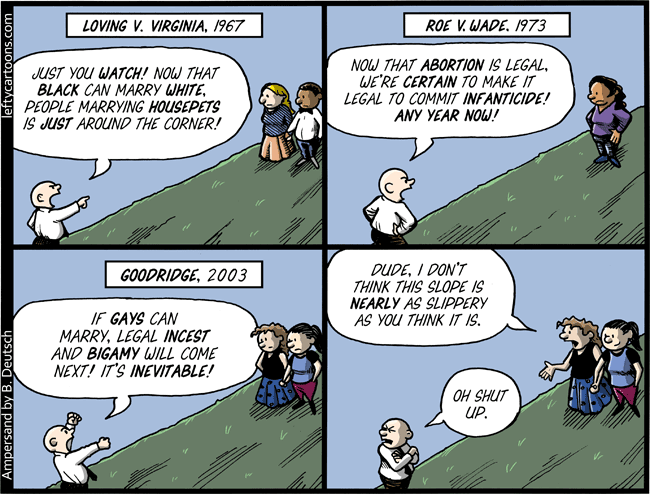
 What lies in the background of that argument is that the separation between gays/lesbians and the benefits of marriage is not something the affected individuals can easily fix on their own. Sexual orientation may or may not be innate, but it is


