Tag Archives: culture wars

Lessons from the Haitian Fright

Many Americans are ready to believe and pass on any horrifying rumor they hear about non-White immigrants, without checking their sources or looking too hard at the evidence. Trump, Vance, and other Republican politicians have been eager to exploit this gullibility.


The Simpsons is set in Springfield because there are 35 Springfields in various states, including five in Wisconsin alone. So wherever you live, the Simpson house might be just down the road. Given this near-universality, it shouldn’t be surprising that the Trump/Vance lies about the Springfield in Ohio have grabbed public attention on both sides of our political divide. If immigrants really are stealing and eating pets in Springfield, your pets may be in danger too. Conversely, if Trump can tell such a baseless and vicious lie about Springfield, he could just as easily lie about your town, your neighbors, or even you.

It’s important to be clear from the beginning: He is lying. Everybody from the local police to the city manager to the Republican governor of Ohio has denied this pernicious internet rumor, which is a lesson in how easy it is to create “evidence” for anything. (Here’s a photo that purports to show a Haitian in Springfield carrying off two geese, presumably to eat. Actually it’s a non-Haitian in Columbus, removing two road-kill geese from the pavement.)

Lots of articles trace the rumor through right-wing sources that invented it, so I’ll cover that history only briefly: The influx of legal Haitian immigrants in recent years had created discomfort among some White Springfield citizens. During Covid, city services got stretched — as services did nearly everywhere — and some locals blamed the Haitians. In any large group, somebody will eventually do something wrong; last year, an unlicensed Haitian driver killed an 11-year-old boy (whose parents have begged the public not to use their son’s death to fan hatred). That created an exploitable opportunity for neo-Nazi groups like Blood Pride, which began targeting Springfield with negative disinformation about the immigrants. From there, stories multiplied until the eating-dogs-and-cats rumor got started. It spread mainly online, and not so much by word-of-mouth in Springfield itself. Then J. D. Vance picked it up, from which it got to Trump.

If you want more detail, I can recommend a post on Justin Ling’s blog Bug-Eyed and Shameless, which relates the story to the Irish Fright of 1688, when tens of thousands of panicked Englishmen barricaded bridges and crossroads to stop the advance of marauding Irish troops, who in fact did not exist.

The Irish Fright didn’t make it into my high-school history texts, but maybe it should have. There’s a lot to learn from what what 19th-century historian Charles Mackay famously dubbed “extraordinary popular delusions“.

How racism manifests. To begin with, the Haitian Fright of 2024 provides a teaching opportunity about racism. I am constantly seeing accounts from White people online and on television, who believe they are not racist because they don’t internally experience what they imagine racism to be: a blind and senseless hatred of other races. “I don’t hate anyone,” they claim, and believe that they are telling the truth.

But the Haitian Fright points out a more subtle and widespread kind of racism: a propensity to believe (and even pass on) negative stories about other races without requiring evidence. A sudden influx of Scots or Danes could have put just as big a strain Springfield’s schools and hospitals, but I doubt we’d be hearing stories about them eating cats.

A similar lesson can be drawn from the Birther controversy of the Obama years (where Trump also was a major player). Many Whites were eager to believe that Barack Obama wasn’t a legitimate president, so they credited any justification for that belief, no matter how flimsy. The birther story served to mediate their racism: They could deny that they disapproved of Obama’s presidency because he was Black, and instead disapprove because he wasn’t really an American. But they believed that evidence-free claim because he was Black.

Myths about immigration. Similarly, many Americans claim that they don’t object to immigrants per se, but only to illegal immigrants. If people would only come to America “the right way, like my ancestors did”, they would be welcomed.

Personally, my ancestors arrived in the United States from Germany in the mid-1800s. And yes, they did come “the right way”, but at the time there was no wrong way. Other than occasional quarantines for health reasons, the US had few restrictions on immigration prior to the openly racist Chinese Exclusion Act of 1882.

You know who else is here the right way? The Haitians in Springfield. They qualify for a program known as “temporary protected status“, which provides legal status to people from countries which (because of either natural disaster or political unrest) are not safe to return to. Others came “as part of a parole program that allows citizens and lawful residents to apply to have their family members from Haiti come to the United States”.

And Springfield is lucky to have them. Governor DeWine said yesterday:

Here’s what we do know, though. What we know is that the Haitians who are in Springfield are legal. They came to Springfield to work. Ohio is on the move, and Springfield has really made a great resurgence with a lot of companies coming in. The Haitians came in to work for these companies. What the companies tell us is that they are very good workers. They’re happy to have them there. And frankly, that has helped the economy.

This matches an observation Deborah and James Fallows made in their book Our Towns, about their travels across America, particularly in the section about Dodge City, Kansas: One key difference between small towns that are dying and those that are thriving is that the thriving towns are welcoming immigrants rather than discouraging them.

Governor DeWine had previously mentioned his own trips to Haiti and observed:

[I]n Haiti education is prized. So when you look at all of these things, people who want to work, people who value their kids, who value education, you know, these are positive influences on our community in Springfield, and any comment about that otherwise, I think, is hurtful and is not helpful to the city of Springfield and the people of Springfield.

In short, whatever you may think you want out of immigrants — legal status, work ethic, family values … anything other than white skin and speaking English since birth — the Haitians of Springfield have it.

Another complaint I’ve run into is that the Biden administration “sent” the Haitians to Springfield. Here’s J. D. Vance:

Kamala Harris dropped 20,000 Haitian migrants into a small Ohio town and chaos has ensued.

But like any person with legal status in the US, the Haitians can go where they like. They weren’t “sent” or “dropped”, they came to Springfield looking for work and a low cost of living.

Thousands of new jobs had been created [in Springfield], thanks to a successful effort by the city’s leadership and Chamber of Commerce to attract new business to Springfield, which sits between Columbus and Dayton. Once a manufacturing hub, Springfield saw its economy shrink after factories closed and jobs migrated overseas. By about 2015, its population had dwindled to under 60,000, from about 80,000 in the late 1960s and early 1970s.

Companies that set up shop, however, confronted a dire labor shortage.

Haitians in Florida, Haiti and South America heard from friends and family about Springfield and its need for workers. They began arriving to take jobs in warehouses, manufacturing and the service sector, and employers urged the new workers to encourage other Haitians to join them.

We often hear how jarring it must be for a town of 60,000 to accommodate 15,000-or-so new residents. But few note that the immigrants are simply restoring Springfield to its historic size. They are making Springfield great again.

Consequences. History teaches that lies can lead to violence, particularly when they make a group of people seem monstrous or subhuman. The pet-eating lie has been likened to the blood libel against Jews, which often circulated prior to pogroms. According to the libel, Jews needed the blood of Christian children to ritually prepare matzah for Passover. So any child who went missing prior to Passover could spark a bloody attack on a town’s Jews.

Often associated with the Middle Ages, a blood libel pogrom happened as recently as 1946 in Poland. Forty-two newly returned Holocaust survivors were killed.

The pet-eating lie has not yet led to any murders in Springfield. But a series of bomb threats followed Trump’s outburst at Tuesday’s debate. City hall had to be shut down on Thursday. Friday, a middle school closed and two elementary schools had to be evacuated. Saturday, two hospitals went into lockdown. Two local colleges have temporarily shut down in-person classes. I can only imagine the bullying that Haitian children are experiencing in schools all over the country.

Thank you, Mr. Trump.

Trump has expressed no remorse and repeated the lie Friday in California, long after it had been widely debunked. On talk shows Sunday, J. D. Vance simultaneously acknowledged that the stories are false while justifying his own role in continuing to spread them.

On Sunday, Ohio’s junior senator was pressed by journalists as to why the Trump campaign was spreading a claim it could provide no evidence for beyond the anecdotal “I heard it on television” excuse Trump himself gave during the debate.

On CNN, he seemingly admitted that his claims were lies, then continued by saying that he would keep spreading such tales, even knowing them to be untrue, if they resulted in the media talking about issues he claimed were still just as real despite the deception.

“If I have to create stories so that the American media actually pays attention to the suffering of the American people, then that’s what I’m going to do,” said the senator.

It is worth pointing out that even though non-citizens can’t vote, anyone legally in the State of Ohio is Vance’s constituent. (That’s why congressional districts are distributed according to total population rather than the number of citizens, a provision Republicans are trying to overturn.) He has a responsibility to them whether he recognizes it or not.

Vance’s interviews point out something else: He and Trump are often accused of “falling for” the pet-eating lie, as if the problem were simply their gullibility in the face of an internet conspiracy theory. But they haven’t fallen for anything. They looked for a hateful lie they could tell about immigrants, and they found one.

What is a joke? The internet is now full of cat-and-dog-eating memes, most of which are intended to be humorous. Both sides are spreading them with very different motives. For Democrats, the lie is so unbelievable that people who are taken in by it deserve to be laughed at. That’s why many of my liberal friends have shared The Kiffness’ musical version of Trump’s debate lines. The song doesn’t explicitly criticize Trump, but does make him seem ridiculous.

Meanwhile, Republicans are indulging in bully-humor, as they so often do. By posting a cat-eating meme with three laugh-till-I-cry emojis, Ted Cruz can promote cruelty towards immigrants while hiding behind a veneer of comedy. When challenged, he is undoubtedly saying, “It’s a joke! Doesn’t anybody have a sense of humor any more?”

The problem, of course, is that not everyone agrees that it’s a joke. Many on the internet still take the Haitian Fright seriously, and virtually no Republicans are condemning Trump for promoting it. (Even Governor DeWine has stopped short of faulting Trump or specifically asking him to stop.) And even if they did agree, jokes can still be cruel.

As for the liberal memes, I have changed my mind several times. Yes, Trump deserves to be ridiculed for this. And yet I find myself agreeing with media studies scholar Whitney Phillips:

While Phillips said she doesn’t begrudge people “having fun online,” she warned that liberals who think they’re cutting Trump down to size risk giving oxygen to a trope that ultimately plays into his hands — and endangers the Haitians who were its original targets.

“When you’re making a joke using the frame” of immigrants as cultural invaders, she said, even if you’re pushing back on it, “the frame is still amplified.”

This week’s legal decisions

A temporary victory for abortion pills, the effective legalization of machine guns, and lower court protection for families with trans children. Meanwhile, continued stalling to protect Donald Trump from prosecution.


We’re getting near the end of the Supreme Court’s term, so the rulings will come hot and heavy for the rest of the month. Several important cases are still pending, but a few decisions came in this week.

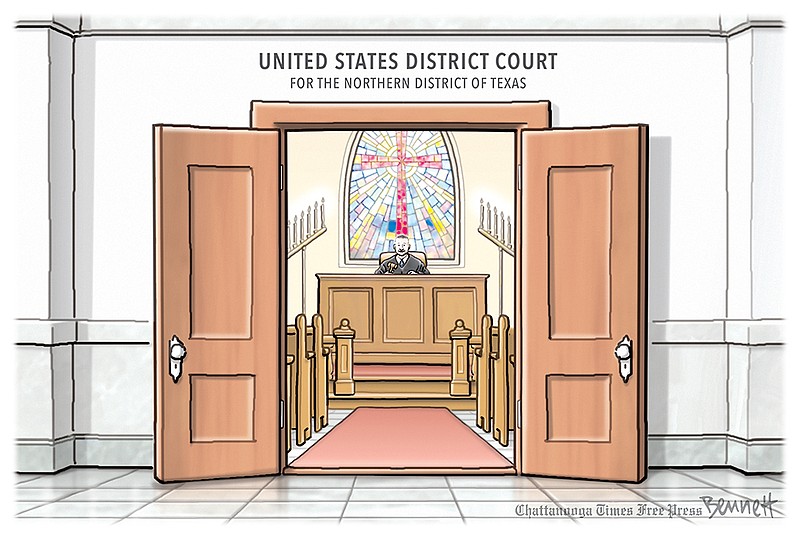
The abortion pill mifepristone got a reprieve. As I’ve explained in the past, there is a federal district around Amarillo where cases are wired to go in front of a Christian nationalist judge, Matthew Kacsmaryk, and go from there to the nation’s most conservative appeals court, the Fifth. In the spring of 2023, anti-abortion groups (established in Amarillo precisely to take advantage of this legal pipeline) targeted mifepristone, the drug used in more than half of abortions nationally.

Predictably, Kacsmaryk suspended the FDA’s approval of mifepristone, effectively banning it nationally. That decision was partially reversed by the Fifth Circuit, and then totally stayed by the Supreme Court, pending its own decision. (So far, no one has been prevented from using mifepristone in states where it would otherwise be permitted.)

There are many ways to reverse Kacsmaryk’s decision, because it is baseless both legally and scientifically. Vox described the scientific situation like this:

The case has virtually no scientific merit, and challenging the use of a drug that has been studied and safely used for over two decades is highly unusual. Jack Resneck Jr., the president of the American Medical Association, said in a statement Friday night that Kacsmaryk’s “disregard for well-established scientific facts in favor of speculative allegations and ideological assertions will cause harm to our patients and undermines the health of the nation.”

But the Court decided not to go there. Instead, it pointed to the legal ridiculousness of the lawsuit: The plaintiffs have no standing to sue. [1]

As was obvious from the beginning, these plaintiffs — primarily doctors who don’t prescribe mifepristone — have no standing. They made up, and two levels of federal courts accepted, a ridiculous explanation of how mifepristone harms them: On the rare occasions when mifepristone fails, a woman caught in the middle of a miscarriage might show up on their doorsteps or emergency rooms, and they might have to do a procedure they morally object to in order to save her life.

Putting aside the issue of how any principle requiring a doctor to do nothing while he watches a woman die can be considered “moral”, Justice Kavanaugh (writing for a rare 9-0 Court) noted that federal conscience protections already protect the doctors, so they are not injured. So the suit should never have been heard in the first place. Slate’s Dahlia Lithwich and Mark Joseph Stern comment:

A doctor who opposes abortion, the court affirmed, may stand by and watch a patient bleed out rather than treat her in contravention of his conscience. Ironically, then, an anti-abortion statute that protects anti-abortion doctors played a key role in defeating the plaintiffs’ claim. Their own lavish safeguards against terminating a pregnancy—or even just treating a patient who already terminated a pregnancy—helped defeat their attempt to pull mifepristone off the market.

They go on to observe:

Yet the decision was not a total defeat for anti-abortion activists. Among other things, Kavanaugh slipped language into his opinion that could expand protections for physicians who refuse to provide emergency abortions, potentially imperiling the lives of patients.

The Court’s ruling also left open the fundamental issue — whether the FDA was right (or within its legal authority) to approve mifepristone at all. The most likely course forward from here is that new plaintiffs with different explanations of why they are not busybodies will pick up the suit, and the whole circus will start again.

One path flows from a brief line near the end of the Alliance opinion: “[I]t is not clear that no one else would have standing to challenge FDA’s relaxed regulation of mifepristone.” Last January, Kacsmaryk ruled that three red states — Idaho, Missouri, and Kansas — could join this lawsuit and press the claim that mifepristone should be banned. 

It is far from clear how these states are injured by the mere fact that mifepristone is legal. But Kacsmaryk’s (and the Fifth Circuit’s) behavior in this case and others shows that he’s willing to bend the law into pretzels in order to rule against abortion rights. It is likely, in other words, that Kacsmaryk will simply make up some reason why the red states have standing to sue and then issue a new order attempting to ban mifepristone.

In other words, this isn’t over. Another path forward is that Trump could win the election and instruct the FDA to rescind its approval or impose new restrictions on mifepristone’s use, or reinterpret the Comstock Act of 1873 to prevent distribution of mifepristone by mail. Good luck getting a straight answer out of him on those questions.

It’s now legal to alter your AR-15 to function as a machine gun. If you’ve ever watched a gangster movie set in the Al Capone era, you’ve seen the destructive power of that era’s submachine guns, the weapon of choice in the St. Valentine’s Day Massacre of 1929.

Responding to that problem, Congress made tommy guns and other fully automatic weapons illegal for civilian use in the National Firearms Act of 1934. By 2002, though, a new technology had inserted a loophole in that ban: the bump stock. A bump stock is an add-on piece of equipment that uses a semiautomatic rifle’s recoil to release and pull the trigger over and over again, so that the shooter’s experience resembles firing a machine gun.

Most explanations of bump stocks available on the internet are by pro- or anti-gun activists, and so should be taken with a grain of salt. However, this one comes from a general how-things-work channel, Zack Nelson’s JerryRigEverything. The video was made while bump stocks were legal.

Zack refuses to state an opinion on whether bump stocks should be legal or not, saying ambiguously: “Personally, I think guns are a great hobby, but not everyone in the world is sane.”

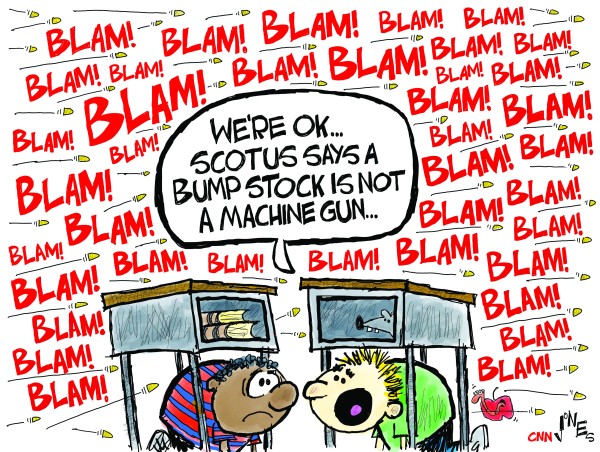
Most people had never heard of bump stocks until the Las Vegas massacre of 2017, when a gunman used one to fire more than 1,000 rounds down on a crowd gathered for a music festival. He killed 60 and wounded over 400, with an almost equal number injured in the stampede of people trying to get to safety. (Like tommy guns, bump-stocked AR-15s aren’t very accurate, making them poor sniper weapons. But if you’re firing at thousands of people, accuracy isn’t that important.) To the untrained ear, audio from the massacre certainly sounds like somebody is firing a fully automatic weapon. (For what it’s worth, real gun people claim otherwise, that a fully automatic machine gun fires even faster.)

Responding to public outrage, the Trump administration Bureau of Alcohol Tobacco and Firearms (ATF) changed its interpretation of the NFA’s machine gun ban, ruling that a bump stock converted a semiautomatic weapon into an automatic weapon, and so was illegal. That ruling was challenged in court, and the case has taken six years to make it to the Supreme Court.

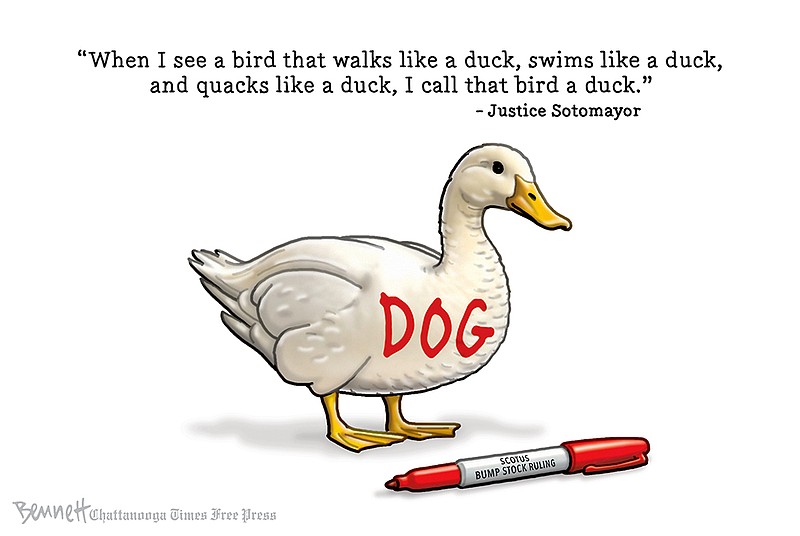
Friday, the Court struck down the bump stock ban in a ruling that split 6-3 along the usual ideological divide. The majority opinion was written by the corrupt Justice Clarence Thomas [2]. It centers on the exact definition of “machinegun” in the NFA:

any weapon which shoots, is designed to shoot, or can be readily restored to shoot, automatically more than one shot, without manual reloading, by a single function of the trigger.

Thomas goes on to focus on the “function of the trigger” in its mechanical sense: As far as the gun is concerned, its trigger is being pulled once for each shot. In her dissent, Justice Sonya Sotomayor focuses on the experience of the shooter, who pulls the trigger once and keeps his finger stationary as the gun bucks back and forth against it. The Congress of 1934, I suspect, intended to focus on the experience of the victims, but they didn’t phrase the law that way, so here we are.

In an ideal world, it’s obvious what would happen next: Congress would say “oops” and would amend the NFA based on some other criteria, like perhaps the rate of fire. That’s what President Biden wants [3], and what Justice Alito’s concurrence suggests, perhaps disingenuously.

There is a simple remedy for the disparate treatment of bump stocks and machineguns. Congress can amend the law—and perhaps would have done so already if ATF had stuck with its earlier interpretation. Now that the situation is clear, Congress can act.

The reason I suggest Alito’s recommendation might not be completely serious is that he knows his right-wing allies won’t allow this to happen. I would be amazed if Speaker Johnson allowed even the narrowest possible bump-stock ban to make it to the House floor for a vote, and Republicans would almost certainly filibuster such a bill in the Senate.

Sunday, possible Trump VP Senator Tim Scott dodged taking any position on a bump stock ban, while another Trump VP hopeful from the House, Byron Donalds went full gaslight:

A bump stock does not cause anybody to be shot in the United States. That is the shooter that does that.

Donalds might want to explain that to the families of the Las victims, many of whom would probably be alive if the shooter had not been able to use a bump stock. It’s also worth pointing out that Donalds’ logic justifies legalizing any weapon, no matter how destructive. After all, nuclear weapons don’t destroy cities, people destroy cities.

Meanwhile, a spokesman for the Republican Party’s lord and savior, convicted felon Donald Trump, for once expressed faith in our justice system.

The court has spoken and their decision should be respected.

This pattern is not a coincidence: If you make Congress dysfunctional and unresponsive to the people, and then interpret the laws and the powers of agencies like the ATF strictly, the result is that when technology changes, old regulations lapse and can’t be updated. That’s not some unfortunate bit of happenstance; it’s two sides of the same strategy. Today it results in the effective legalization of machine guns. Tomorrow the loophole will be in the Clean Air Act or the antitrust rules. When the laws stand still, malefactors adapt.

Gender-affirming care. In an important lower-court case, a judge found a Florida law banning gender-affirming care for minors to be unconstitutional. This ruling differs from the case of a similar Alabama law, which was upheld by the 11th Circuit appeals court (where this case is headed) in that Judge Robert Hinkle found malice on the part of the legislature. That issue wasn’t raised in the Alabama case.

The plaintiffs have shown that animus motivated a sufficient number of statutory decisionmakers.

Judge Hinkle found that “gender identity is real” and is distinct from an individual’s “external sexual characteristics and chromosomes”. He also noted that the treatments at issue — puberty blockers and hormones like estrogen and testosterone [4] — are legal in Florida for other purposes.

[C]onsider a child that a physician wishes to treat with GnRH agonists to delay the onset of puberty. Is the treatment legal or illegal? To know the answer, one must know whether the child is cisgender or transgender. The treatment is legal if the child is cisgender but illegal if the child is transgender, because the statute prohibits GnRH agonists only for transgender children, not for anyone else.

If these treatments have risks, parents of non-trans kids (in consultation with doctors) are allowed to judge those risks for themselves. But in trans cases, the state’s judgment prevails.

Susan Doe, Gavin Goe, and Mr. Hamel have obtained appropriate medical care. Qualified professionals have properly evaluated their medical conditions and needs in accordance with the well-established standards of care. The minors, to the extent of their limited ability, and their parents, and Mr. Hamel, all in consultation with the treating professionals, have determined that the benefits of their gender-affirming care will outweigh the risks. The parents’ and Mr. Hamel’s ability to evaluate the benefits and risks of this treatment in their individual circumstances far exceeds the ability of the State of Florida to do so.

Judge Hinkle found a motive for the State of Florida assuming the power to overrule parental and medical judgment:

The defendants [i.e., the State of Florida] have explicitly admitted that prohibiting or impeding individuals from pursuing their transgender identities is not a legitimate state interest. But the record shows beyond any doubt that a significant number of legislators and others involved in the adoption of the statute and rules at issue pursued this admittedly illegitimate interest.

The ruling quotes numerous statements by legislators or Governor DeSantis that show animus, such as referring to transgender witnesses at hearings as “mutants” and “demons”, denying the reality of gender identity, or exaggerating gender-affirming care by talking about “castrating” young boys. The fact that no one supporting the anti-care bill contested these statements, according to the judge, was evidence that such sentiments were widespread in the legislature.

Trump’s immunity. The Court continues to sit on the apparently simple issue of Donald Trump’s absolute-immunity claim, which has been rejected by every lower-court judge who heard it. By taking the case and refusing to rule promptly, the Court has made it all-but-certain that no trial can be held prior to the election on Trump’s plot to stay in power after losing in 2020. Without the Court’s interference, the public would already have heard testimony under oath from key witnesses like Mike Pence and Mark Meadows.

Particularly given the apparent bias of Justices Alito (whose home and vacation home were the site for pro-insurrection flags) and Thomas (whose wife traded texts with Mark Meadows to encourage resistance to accepting the will of the voters), it’s hard to see the Court’s actions as anything other than an attempt to put its thumb on the scale to Trump’s benefit.

My prediction is that the immunity ruling will come out on the second-to-last day of the term. Putting it last would underline the Court’s intent to delay justice, so the conservative majority will probably sacrifice a day or two of delay to avoid that poor appearance.


[1] Standing is one of the basic concepts of civil lawsuits: A court can only rule on a situation if a suit is brought by someone actually affected. For example, I can’t sue for divorce on behalf of one of my friends, no matter how convinced I am that she needs to be out of that marriage. Requiring that a plaintiff have standing is basically a no-busybodies rule.

[2] I am going to use the word corrupt whenever Thomas’ name comes up until he is either removed from the Court or is called to account in some other way. This week we found out that Thomas has received even more billionaire gifts than the $4 million that were previously known.

Thomas claims these gifts are not bribes, but fall into a loophole for gifts from “friends”. However, Thomas’ rich friends are right-wing donors he had never met before joining the Court.

So as far as this blog is concerned, “corrupt Justice Clarence Thomas” is his full name.

[3] Biden would also like to see an assault weapon ban in that amended bill, but is likely to sign a smaller reform if he gets the chance.

[4] Gender-affirming surgeries on minors, according to the judge, “are extraordinarily rare and are not involved in this litigation.”

Wide Right: that kicker’s commencement speech

Let’s not do to Harrison Butker what Trump did to Colin Kaepernick.


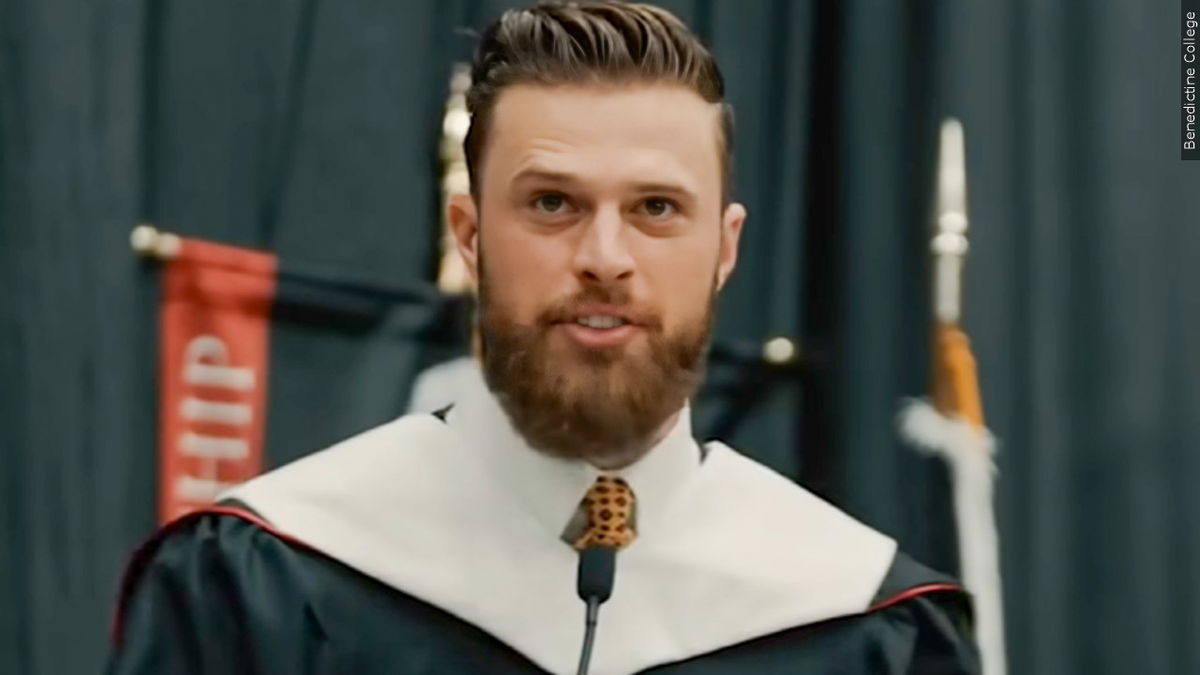
As you’ve no doubt already heard, last Saturday a football player (Kansas City Chief kicker Harrison Butker) gave the commencement address at Benedictine College in Atchison, Kansas. Much has been said and written about this speech, and there’s a petition asking the Chiefs to “dismiss Harrison Butker immediately for his inappropriate conduct”. Last I heard, more than 200K people had signed.

I try to know what I’m talking about before I write, so I watched the full speech on YouTube. (You can also read a transcript.) It’s a very traditional Catholic talk, including a lengthy endorsement of the Latin mass, so if you feel wounded by a Catholic upbringing (as many people I know do), you shouldn’t torture yourself with it.

That said, I would not sign the petition, because taking away someone’s livelihood is a big deal and should be reserved for more serious offenses.

Here’s what I think should happen: People who disagree with Butker and find themselves at a game where he takes the field should feel free to boo loudly. If you have access to any public platform, from your own TV show to a window-facing whiteboard, it would also be appropriate to make fun of him mercilessly. (Here’s an example to get you started.) I don’t know if he endorses any products, but if he does you can boycott them. All those actions just exercise the same freedoms he claims for himself.

So far, the Chiefs have said nothing and the NFL has distanced itself from his message without threatening any sanctions. That, again, is their right.

Of course, this response is nothing like what happened to Colin Kaepernick, whose NFL career ended prematurely after he knelt during the national anthem to protest racism. (Kaepernick’s unofficial shunning by teams who needed quarterbacks accorded with then-President Trump’s demand to “get that son of a bitch off the field.“) That gross injustice should not be forgotten — and in fact this is a good time to remember it — but dealing out a similar injustice to Butker will not right that wrong.

Anyway, here’s why I think Butker should not be punished beyond verbal humiliation: Benedictine College is a Catholic college that in recent years has moved to embrace traditional Catholic teachings and values. Students presumably choose to go there at least partially for that reason (though not all the graduates approved of Butker’s speech, and neither did the Benedictine Sisters associated with the College who said: “We reject a narrow definition of what it means to be Catholic”). Butker told the graduates, in essence, that they should feel good about what their school stands for. Places like Benedictine, he said, “are showing the world how an ordered, Christ-centered existence is the recipe for success.”

I have a lot of tolerance for religious groups making their case positively, as in “This is what we’re doing and it works for us. You should try it.” For the most part, that’s what the Benedictine College leadership seemed to be looking for and what Butker provided. At the end, he got a standing ovation.

Of course, Butker’s speech also included a lot annoyed me, beginning with his fairly snide remarks about “bad policies and poor leadership” during “the Covid fiasco”, which he seemed (without naming names) to attribute to Anthony Fauci but not Donald Trump (whose negligence is implicated in the deaths of hundreds of thousands of Americans). He talked about the importance of Catholics “staying in their lane”, but did not seem to do so when he criticized unnamed bishops. He denounced the “tyranny of diversity, equity, and inclusion”, and referred to “the deadly sin sort of pride that has an entire month dedicated to it”, i.e. gay pride.

He also spoke for his wife, telling “the ladies” what she “would” say about her choice to embrace her vocation as a homemaker rather than pursue her dream of having a career. For all I know he may be totally right about her lack of regret, but couldn’t he have asked her directly and then quoted her exact words, rather than ask himself and imagine her response? I was left to wonder (perhaps unfairly) how many opinions Mrs. Butker is allowed to have.

Mainly, though, he did what defenders of tradition so often do: justify a system in which he himself is privileged. Billionaires extol the virtues of low taxes, white Supreme Court justices tell us why laws protecting non-Whites are no longer needed, and Butker explains that

As men, we set the tone of the culture, and when that is absent, disorder, dysfunction, and chaos set in.

Yes, we men are being totally selfless when we demand to set the tone of the culture. We only do it so that society will be spared the chaos that would inevitably ensue if our God-given authority were ever questioned.

You’re welcome, ladies.

Republicans Scramble to Contain Their Abortion Disaster

Trump’s let-the-states-decide statement looked clever until Arizona actually decided.


All across the country, the abortion issue has been helping Democrats and hurting Republicans.

For decades it worked the other way: Pro-choice women were confident the Supreme Court would protect their rights, so they mostly ignored the extreme positions Republican politicians took and based their votes on other issues. But since the Dobbs decision reversed Roe v Wade last year, the intentions of elected officials matter again.

After taking their lumps in the 2022 elections, Republican politicians have been trying to figure out how to finesse the issue. How do they avoid the ire of female voters without alienating their personhood-at-conception base? Last fall, Virginia Governor Glenn Youngkin thought he had the formula: a “compromise” abortion ban at 15 weeks. But that idea went down in flames as Republicans lost control of the Virginia legislature.

Trump also has been searching for an answer. For a while he also toyed with a 15-week ban, but then last week he stalled for time, saying he’d make a statement this week. I was skeptical about this, because Trump often says he’s going to do something and then doesn’t. But in fact he did make a statement on Monday.

I don’t usually post Trump videos, but I think you need to see this to appreciate just how far off-the-rails this guy has gone. To start with, his make-up is comical; he almost looks like he’s wearing blackface. Then there are the obvious, how-stupid-do-you-think-we-are lies about how “all legal scholars, both sides, wanted and in fact demanded” the end of Roe, and Democrats “support abortion up to and even beyond the ninth month”. (In fact, Biden supports restoring the pre-Dobbs status quo, which drew a line at viability, i.e. 24-28 weeks. More radical people, like me, want the government to butt out completely and let women decide how to handle their own problem pregnancies. But describing that view as “support” for abortion is dishonest. I, for one, am neutral on abortion; I have never tried to persuade a woman to get one.)

But the gist of the statement is that Trump is proud of engineering the conservative Supreme Court majority that decided Dobbs, and he doesn’t want to take any public position beyond letting the states (and not women together with their families and doctors) decide when abortion is permissible. He later said he wouldn’t sign a federal abortion ban if Congress presented him with one. (But then, Trump says a lot of things, and most of them turn out not to be true. When he was president, he claimed his tax plan wouldn’t help the rich. But when Paul Ryan gave him a plan that focused most of its benefits on the rich, he signed it. And we’re still waiting to see the “terrific” health care plan he promised in 2015. )

He’s also proud of being opportunistic on the issue.

You must follow your heart on this issue. But remember: You must also win elections.

That let-the-states-decide position looked clever for about a day. But then a state decided: Tuesday, Arizona’s Supreme Court reinstated an 1864 law banning all abortions that aren’t necessary to save a woman’s life. (In the previous post, I explain why I believe this is a correct reading of a horrible legal situation. It’s the legislature, not the court, that should never have allowed this to happen.)

Then Trump had to scramble: He said Arizona went too far, and predicted the situation would be “straightened out”. Arizona’s mini-Trump, Senate candidate Kari Lake, completely reversed her position. Previously, she had specifically endorsed the 1864 law (by its number in the legal code). But now she says

I oppose today’s ruling, and I am calling on Katie Hobbs and the State Legislature to come up with an immediate common sense solution that Arizonans can support.

So far as I know, this is the first time Lake has admitted that Katie Hobbs (who defeated Lake in 2022) is indeed governor. I also love the invocation of “common sense solution”, a conservative buzz phrase Sarah Palin popularized: It’s a placeholder. You’re supposed to insert whatever position you think makes sense, and then imagine Lake said that.

But Lake hasn’t said anything. As of this moment, neither Lake nor Trump (nor any other Republican who either has real power or is running to get it) has made an actual proposal to fix Arizona’s draconian abortion law. When it comes time to govern — and not just posture — that’s what you need to do: put a real proposal on paper and vote it up or down, knowing that you’ll make some people unhappy.

Are any Republicans, at either the state or national levels, ready to govern? That’s what the coming weeks will tell us.

A Different Take on Retro Conservative Fantasy

Sometimes unrealistic fantasies raise questions that deserve serious answers.


The Washington Post’s “Tradwives, SAHGs and the dream of feminine leisure” is one of those rare articles that is way more interesting than its apparent topic. OK, there’s a “tradwife” trend of sorts: social media influencers who style themselves as classic 1950s housewives, and a parallel group of stay-at-home girlfriends (or what we used to call “kept women”). But this “trend” doesn’t represent all that many women, and you probably don’t need a major newspaper to tell you what to think about them. After all, if women had been happy in these kinds of roles, second-wave feminism would never have caught on.

But Monica Hesse takes a much more interesting approach. She doesn’t analyze tradwifery as a serious option, as in “Were women really happier before feminism?”. Instead, she approaches that vision for what it is: a fantasy. “I dream of feminine leisure”, say many of the tradwives and SAHGs. And then Hesse asks why that dream might be beguiling.

Her down-to-earth answer is simple: Life is hard these days.

The fact of the matter is that almost nobody who works for a living has the time they wish they did to look, feel or be their best, much less to cultivate a highly aesthetic relationship with a thing called ease.

What if the problem is not feminism but capitalism — specifically the American version, where work-life balance is a punchline? What if instead of 11 paid vacation days, as the average American gets, these women got the full month that is standard in the United Kingdom? What if instead of five (or six or seven) days a week, they worked the four days that countries such as South Africa and Belgium are piloting? Would that allow enough time to do a full skin-care regimen and pack a great suitcase? If college weren’t so ghastly expensive here, maybe that one lady’s daughter wouldn’t be so keen on the patriarchy as a route to leisure that bypasses the long, uphill road to financial independence.

It wasn’t fair when women had no choice to stay home. It’s not fair if women are working but are still doing the work of maintaining a home. It’s not fair if both men and women are trying to juggle it together and are still finding that there aren’t enough hours or dollars in a day.

Who wouldn’t dream of feminine leisure?

To her credit, Hesse also imagines the male side of this fantasy: Who wouldn’t want to return from work each evening to find a home in perfect order, dinner on the table, and a well-rested spouse ready to draw you into the “ease” she has been cultivating all day? (Now you just need a willing partner and a senior-vice-president salary to pay for it all.)

Hesse’s article expresses a point of view that could generalize: Maybe we’re approaching retro conservative fantasies all wrong. At root, most of them aren’t really about then, they’re critiques of now: Why does life have to be so hard? Why is it so hard to pay for college? To get a career started? To find a serious relationship partner and stay together? To afford a home? To fit children into the equation and offer them at least as good a chance as you had?

Maybe people who are trying to wish their way out of this box deserve our empathy rather than our condemnation. The various retro fantasies they indulge may not be fact-based or workable in practice, but at least they address the question: Life wouldn’t be so hard if some sugar daddy would take care of me. Or if immigrants and minorities hadn’t stolen my place in line. Or if everybody went back to Jesus. Or if the government stopped sending our money overseas. Or if we had a strong-man leader who could make our country great again (whatever era “again” is supposed to point to).

Maybe the best liberal response isn’t a screed about the evils of sexism or xenophobia or authoritarianism. Maybe we should skip past the specifics and give our own answer to the underlying question: Why is life so hard these days?

We do have such an answer, one that I believe is far more realistic and supportable than anything conservatives offer: Life is hard because sometime in the late 1970s, the US scrapped the controls that kept the rich from capturing all the growth in the economy.

We scrapped antitrust enforcement, so as a consumer you have to take whatever deal monopolies offer you. (The endless “choices” you face at the mall are often just different tentacles of the same octopus.) We scrapped unions, so as a worker you have no negotiating power. And we changed the tax system so that whatever the rich capture, they keep. The result is this graph, which every American voter should be able to draw on a napkin.

If hourly compensation had kept up, the average Americans would make more than double what they do now. So you could afford a one-income household, if that’s what your family wanted. Or you could save up for year-long sabbaticals and return to the workplace with new vision and energy. Or you could retire at 50 and see the world.

Corporate talking heads may denounce this point of view as “class warfare” or “socialism”, but such name-calling isn’t really a refutation. And it is nostalgic in a manner of speaking, but the point isn’t to recreate some past era; it’s to get back to the trends that held in the 50s, 60s, and early 70s, when economic gains were widely shared.

The Supreme Court will have to carry this case to term

The mifepristone suit from Amarillo is so embarrassingly bad that even the Court’s conservative majority can’t justify doing what it wants.


The anti-abortion-pill case that right-wing culture-war groups primed to get to the Supreme Court got to the Supreme Court. Oral arguments happened Tuesday, and did not go nearly as well as anti-abortion groups probably imagined when they filed the case. Even Amy Coney Barrett seemed skeptical.

There probably won’t be a decision until June, so there’s no sense going into great detail now. But there are a couple of things worth noting:

  • When you grease the way for a case to make it to the Supreme Court, you wind up with a greasy Supreme Court case. Legally, this was a bad argument that never should have come this far, and even some conservative justices seemed embarrassed by it.
  • US courts continue to entertain notions of “Christian conscience” that are so expansive as to be passive aggressive. The rest of us are expected to change our lives so that right-wing Christians can have a buffer zone around extensions of “conscience” they have intentionally constructed to control us.

I explained the greased slide that brought this case to the Supreme Court back when the case was first being heard in Amarillo, almost exactly a year ago: The Northern District of Texas, which contains Amarillo, has one judge who hears just about all the cases. That judge, Matthew Kacsmaryk, is a right-wing culture warrior who can be counted on to rule in the “right” way, independent of facts or the law. The Northern District sits inside Fifth Circuit, whose appellate court is not quite as lawless as Kacsmaryk, but has a similar right-wing bias and will not examine his rulings too closely.

So in this case, foes of abortion rights incorporated their group in Amarillo precisely so they could file their suit in Kacsmaryk’s court. (The Judicial Conference has since changed the rules to limit this kind of judge shopping.) Kacsmaryk did his part and issued a nationwide injunction stopping the sale of mifepristone. The 5th circuit cut that injunction down a little, leaving mifepristone legal but limiting the possibilities for prescribing it. The Supreme Court previously stayed both rulings pending its own examination of the injunction.

That’s what they were discussing Tuesday.

The big reason the case should never have come this far is the plaintiffs’ lack of standing. In non-legalese, they can’t show how the availability of mifepristone harms them, so there’s no injury for the court to try to correct.

According to the doctors, their concrete injury is that someone might take mifepristone, might experience medical complications, might go to the hospital for care, and then the physicians in question might have to complete the abortion despite their moral objections to doing so.

Standing is supposed to be real, not speculative. The injury is supposed to be either happening, or so close to happening that it seems bound to happen without an injunction. A maybe-maybe-maybe argument doesn’t give you standing. There’s a good reason for this requirement: Otherwise, judges could make pronouncements about any topic that interested them, and the awesome power our system gives the courts could be abused.

A lot of articles have covered the case’s standing issue. But I was pleased to see Dahlia Lithwick and Mark Joseph Stern raise the passive aggression issue in Slate. (They don’t use that terminology, which I started using in 2013.) Under questioning, plaintiff lawyer Erin Hawley (wife of the famously swift senator) made an even stronger claim than the quote above would imply. When you read “complete the abortion”, you probably pictured a woman taking mifepristone, her body starting to eject the fetus, but not quite succeeding in getting it out. She might then show up in an emergency room, where an ER doctor opposed to abortion might have to complete the removal of a fetus that is doomed but not yet entirely dead.

However, that grisly scenario is exceedingly unlikely. A far more likely complication (still rather uncommon) is that the woman takes mifepristone, miscarries, but then doesn’t stop bleeding afterward. In this scenario, the abortion is over, the fetus is dead, and now an ER doctor needs to treat a bleeding woman.

The plaintiffs don’t want to, because patching up a woman who has taken a drug to give herself an abortion would make them “complicit” in the abortion.

Hawley … then approached the lectern and cleared up any confusion: Yes, she insisted, treating a patient who has undergone a medication abortion violates the conscience of the plaintiff physicians even if there is no “live” fetus or embryo to terminate anymore. “Completing an elective abortion means removing an embryo fetus, whether or not they’re alive, as well as placental tissue,” Hawley told Kagan. So the plaintiffs don’t object just to taking a “life.” They also object to the mere act of removing leftover tissue, even from the placenta.

Of course, these doctors must remove “dead” fetal tissue and placentas all the time—from patients who experienced a spontaneous miscarriage. By their own admission, the plaintiffs regularly help women complete miscarriages through surgery or medication. Those women they will gladly treat. Other women, though—the ones who induced their own miscarriage via medication—are too sinful to touch. Before the plaintiffs can administer even lifesaving emergency treatment, they need to know the circumstances of this pregnancy loss: Spontaneous miscarriages are OK; medication abortions are not.

It’s impossible to imagine this logic being accepted in any non-abortion circumstance. Suppose a guy gets drunk and drives his car into a tree. When he shows up in the ER, would a doctor (maybe from a religious sect that forbids alcohol) refuse to treat him in order to avoid being complicit in his drunk driving? ERs don’t work that way. In any other circumstance, injured people show up and get treatment. The guy who stitches up participants in a barroom brawl doesn’t need to know what started it or who was right.

It is a twisted line of logic, one that should never have reached the Supreme Court in the first place. But it is also a product of the court’s past indulgence of outlandish claims about moral “complicity.” … All this is reminiscent of Little Sisters of the Poor, a case about a Catholic charitable group that was afforded an exemption from the Affordable Care Act’s contraception mandate. The Little Sisters were asked to check a box signaling to the government that they could not comply with the mandate, at which point the government would step in to cover their employees. But the Little Sisters refused, viewing this action—the checking of a box to opt out of coverage—as “complicity” in abortion because it would in turn trigger government payment for contraception (which they viewed as abortifacients). The Supreme Court and the Trump administration ultimately indulged the Little Sisters’ claim.

It may violate conservative political correctness to say so, but the Little Sisters were just being assholes in that suit. They invented an extravagant claim of conscience in order to screw up ObamaCare and interfere in other women’s lives.

Refusing to bake cakes or make web sites for same-sex weddings (other situations the Supreme Court has treated seriously) are similar examples of passive aggression. Going far beyond any legitimate Christian concern, such cases involve constructing an enormous hypersensitive conscience that will feel “complicit” in anyone’s behavior that it fails to control. Making the world safe for such a construction restricts the freedom of everyone else.

No non-Christian religious group would be allowed to do this. And Christians will keep extending such notions of “complicity” until courts tell them to stop. That should have happened a long time ago.

Sweet Home, Gilead

With its ruling affirming the rights of “extrauterine children” and invoking “the wrath of a holy God”, the Alabama Supreme Court takes a giant step towards theocracy.


Given all the bad press Alabama has gotten this week for its supreme court’s ruling that frozen embryos are “extrauterine children” covered by the state’s Wrongful Death of a Minor Act, you might imagine that the media is just piling on. You might be thinking, “It’s probably not really that bad.” Maybe if you took the time to read the full 131-page decision, you’d understand and even respect where the justices were coming from, even if you still didn’t agree.

Let me shoot that generous notion down: I read the decision. It’s even worse than it looks in the news reports. I started reading newsworthy court opinions with the 2003 Massachusetts same-sex marriage decision, and since then I’ve easily read 100 or so. I’ve never seen one this flat-out insane or this scary in its implications.

It’s tempting to go off on a rant. But instead, let me back up and give you the context.

IVF. The reason anybody freezes embryos in the first place is for in vitro fertilization (IVF), a medical procedure that helps otherwise infertile couples have their own biological children rather than adopt. It’s been going on since 1978 and it’s popular: CNN estimates that about 2% of babies born in the United States are conceived through IVF. Chances are that you know someone who conceived or was conceived through IVF. (I know I do.)

Leaving out a bunch of details, it works like this: Ova are removed from a woman’s ovaries, and then they are fertilized in a laboratory with sperm from that woman’s chosen partner (or maybe a sperm bank). The cells start dividing, and after a few days they are ready to implant in a uterus (either the woman’s own or, if the whole point is to overcome some medical problem there, the uterus of some other willing woman). This is a hit-or-miss process that may require several attempts, so typically a number of ova are fertilized simultaneously, and the embryos not used are frozen in case they are needed later.

Many of the frozen embryos will never be implanted in a uterus, where they might develop into fetuses and eventually babies. Perhaps they are defective in some way. (For example, it’s possible to test the embryos for some heritable genetic issues the parents want to avoid passing on.) Or perhaps the woman succeeds in having all the children she wants before all the embryos are used. The remainder are usually destroyed in one way or another, though they can stay frozen more-or-less indefinitely (“several decade, if not longer” according to the court’s majority opinion).

Bad theology. So far, so good, but then IVF runs into a dogma invented by Catholic and/or Evangelical theologians: At the moment of conception, the fertilized egg becomes a full human being for all moral purposes. (As I’ve explained before, this notion is not just against common sense, it’s also ahistorical and non-Biblical. Among Protestants, virtually no one believed this until after abortion became a conservative political issue in the 1970s.) If this dogma is true, then destroying these clumps of cells means murdering human beings. So unless women can be convinced (or forced) to gestate the extra embryos (even the defective ones), the only moral choice is to grant them a peculiar sort of immortality in a freezer.

An unfortunate accident in Alabama. I’ll let Justice Jay Mitchell, who wrote the Alabama supreme court’s majority opinion, sum up the incident that started the recent case:

The plaintiffs’ IVF treatments led to the creation of several embryos, some of which were implanted and resulted in the births of healthy babies. The plaintiffs contracted to have their remaining embryos kept in the Center’s cryogenic nursery. … [I]n December 2020, a patient at the Hospital managed to wander into the Center’s fertility clinic through an unsecured doorway. The patient then entered the cryogenic nursery and removed several embryos. The subzero temperatures at which the embryos had been stored freeze-burned the patient’s hand, causing the patient to drop the embryos on the floor, killing them.

So there are obvious grounds for a lawsuit: The clinic should have kept the embryos safer and the wandering patient shouldn’t have mucked with them, with the result that something the plaintiffs valued was destroyed. But rather than (or in addition to) suing under the kinds of tort laws that would apply to accidentally destroyed property, they sued under the Wrongful Death of a Minor Act, a law that would apply if, say, someone had run over their six-year-old.

The trial court didn’t buy it.

In each of its judgments, the trial court explained its view that “[t]he cryopreserved, in vitro embryos involved in this case do not fit within the definition of a ‘person’ ” or ” ‘child,’ ” and it therefore held that their loss could not give rise to a wrongful-death claim.

But then the Alabama Supreme Court got involved.

Strange coinages. Conservatives love to make fun of the “politically correct” ways that liberals use words, saying things like “enslaved person” rather than “slave” or “pregnant person” rather than “pregnant woman”. Well, I invite them to read this decision.

You’ve already run into one of the strange coinages: The embryos were stored in a “cryogenic nursery” rather than a “freezer”. (I wonder whether the freezer technicians are listed as “cryogenic nurses”.) Worse, Justice Mitchell frames the case’s main issue like this:

whether the [Wrongful Death of a Minor] Act contains an unwritten exception to that rule for extrauterine children

That’s right: “extrauterine children”. (I bet you have never thought of yourself as a “uterine child”.) And perish the thought that the authors of the 1872 act, writing more than a century before the first IVF baby was born and only two decades after the first commercial ice-making machine, weren’t thinking about frozen embryos when they said “child”, or that we shouldn’t try to guess what their opinions would have been, if some science fiction author could have explained the concept to them. No: We can stretch the notion of “child” to include frozen embryos, and the 1872 law doesn’t explicitly tell us not to. So there you are.

The stretching of “child” happens in two steps. First to “unborn children”, which Mitchell explains was always included in the notion of a “child”.

the ordinary meaning of “child” includes children who have not yet been born.

He gives two arguments for this, neither of which is particularly convincing: Long before 1872, people said that a pregnant woman was “with child”, clearly meaning that her fetus was already a child. (Of course, they also said that she was “expecting” a child, indicating that the child exists in the future, not the present. Mitchell’s cherry-picking technique does not require him to explain this.) Mitchell then misconstrues Blackstone’s 17th-century classic Commentaries on the Laws of England, which Chief Justice Tom Parker’s concurring opinion quotes more precisely: life “begins in contemplation of law as soon as an infant is able to stir in the mother’s womb.” With that larger context, Blackstone was plainly drawing a boundary at quickening, not conception.

But once you take as established law that the boundary of childhood is conception, then why should it matter whether the conception happened in a womb or in a test tube? Of course the law must protect “extrauterine children”. The law, he writes, “applies to all unborn children, regardless of their location”.

He goes on to fret over the possible unforeseen consequences of limiting the law’s protection to uterine children: What will happen in the future, when laboratories remove women from the gestation process completely?

one latent implication of the defendants’ position — though not one that the defendants seem to have anticipated — is that, under the defendants’ test, even a full-term infant or toddler conceived through IVF and gestated to term in an in vitro environment would not qualify as a “child” or “person,” … [and] then their lives would be unprotected by Alabama law.

God forbid the legislature should have to write a new law for this situation. And speaking of God …

The Chief Justice’s theological treatise. Bonkers as it is, Mitchell’s opinion sounds downright reasonable once you read the concurrence by Chief Justice Parker, a 23-page lesson in Christian theology that begins on page 26.

You see, the Alabama Constitution, which was rewritten in 2022, affirms “the sanctity of unborn life”. Parker feels compelled to interpret this “sanctity” as a uniquely Christian notion, stemming from “the creation of man ‘in the image of God.’ Genesis 1:27 (King James)”. He quotes at length from a 17th-century Protestant theological treatise on the significance of creation in God’s image, which he says accords with the opinions of Catholic saints Thomas Aquinas (13th century) and Augustine (5th century). He then says:

Man’s creation in God’s image is the basis of the general prohibition on the intentional taking of human life.

This would seem to imply that no culture outside the Judeo-Christian tradition cares about murder. Parker also gives attention to John Calvin’s writings on the subject before concluding:

In summary, the theologically based view of the sanctity of life adopted by the People of Alabama encompasses the following: (1) God made every person in His image; (2) each person therefore has a value that far exceeds the ability of human beings to calculate; and (3) human life cannot be wrongfully destroyed without incurring the wrath of a holy God, who views the destruction of His image as an affront to Himself. Section 36.06 [of Alabama’s constitution] recognizes that this is true of unborn human life no less than it is of all other human life — that even before birth, all human beings bear the image of God, and their lives cannot be destroyed without effacing his glory.

No doubt you have heard about judges threatening some malefactor with jail or fines or injunctions, but when was the last time a judge invoked “the wrath of a holy God” against those who would “efface his glory”?

Truly, Alabama has become Margaret Atwood’s Republic of Gilead.

Effects. The immediate legal effect of the ruling is not that big: It sends the case back to the court that had dismissed it, with instructions to apply the Wrongful Death Act.

But fear of the ruling’s implications has thrown Alabama’s IVF facilities into chaos. At least three have suspended operation, worrying not just about the embryos in their own freezers, but also about the possibility that the ideas expressed in this civil case might seep over into criminal law. Vox quotes Stephen Stetson, the director of Planned Parenthood Alabama.

I can appreciate the desire of lawyers who are advising fertility clinics to be conservative. No one wants to be on the hook for any legal liability or risk of criminal prosecution if some district attorney gets the wrong idea.

And then there are the Alabama women who have invested a considerable amount of money, inconvenience, and hope for the future in IVF. They are just out of luck, it seems.

Possibly the Republican-controlled state government will try to help them. A state senator has announced his intention “to introduce legislation that would clarify that embryos are not viable unless they are implanted in a uterus”. Governor Ivey has endorsed this effort.

[Senator Tim] Melson, who is also a medical doctor, says his proposal would make clear that “a human egg that is fertilized in vitro shall be considered a potential life,” but should not be legally considered a human life until it is implanted in a uterus.”

In other words, the state would be saying that ensoulment-at-conception theology is wrong. I wonder how many legislators will be willing to do that, even given how popular IVF is across party lines. (Both Mike Pence and Democratic Senator Tammy Duckworth have children conceived via IVF.)

I also wonder if legislation would be enough. Chief Justice Parker based his opinion on the state constitution and the will of God, so a mere law probably wouldn’t move him. It’s hard to say what the other justices would do. The ruling had an 8-1 majority, but several of the concurrences read like dissents. They reject the majority opinion’s reasoning (sometimes for the very reasons I’ve given above), but reach the same conclusion by a different path.

Beyond Alabama. Arizona, Missouri, and Georgia have fetal personhood laws similar to Alabama’s, though Arizona’s is currently blocked by the courts. Similar laws have been proposed in 12 other states (though the laws are unlikely to pass in some of them, like Massachusetts and New York).

Any of those states could be the site of the next IVF case. Further, a number of birth control options are technically murder, if ensoulment happens at conception. An IUD, for example, primarily works by preventing conception, but it also can prevent a fertilized ovum from implanting in the uterus, effectively killing it.

Marching towards Gilead. Amanda Marcotte examines the deeper implications of the extremist faction that wants to ban IVF. On the surface, she says, their opposition to IVF seems puzzling.

A lot of people are understandably shocked to learn that the anti-abortion movement also hates IVF. After all, the movement claims to be all about motherhood. One would think the people who are always yammering on about how a woman’s greatest purpose is giving birth would celebrate those who endure IVF, which is both painful and expensive, just so they can have a baby.

But she sees an underlying motive:

It’s important to understand that what the Christian right really wants is not motherhood, per se, but a social order where women are second class citizens. They take a dim view of not just abortion and contraception, but all reproductive technologies that make it easier for women to exercise autonomy over their lives.

It also must bug them that many lesbians use IVF to conceive.

Michael Shermer, the publisher of Skeptic Magazine, reposted a Heritage Foundation post from May which proposes to “end recreational sex”. It includes a video in which a woman proposes to “restore consequentiality” to sex by ending birth control. Chris Rufo, the conservative theorist behind the Critical Race Theory panic, replied with

“Recreational sex” is a large part of the reason we have so many single-mother households, which drives poverty, crime, and dysfunction. The point of sex is to create children—this is natural, normal, and good.

So if you’re one of those couples that has been using sex to express your love for each other rather than to conceive children (a path my wife and I have been following for nearly 40 years), Chris Rufo thinks you’re doing it wrong.

It’s important not to paint this issue with too broad a brush: Most people who call themselves Republicans, and even most people who would tell a pollster they support Trump, don’t agree with this extreme anti-sex, anti-choice position. But in the Trump era, the most radical voices consistently prevail in the GOP. Reasonable moderates, to the extent that any still exist, have been consistently unwilling to stand up to ideologues on their right flank. Will they this time? That’s not a bet I’d want to cover.

The Corruption of the Evangelical Movement

Tim Alberta indicts the religion he grew up in, but ends on a hopeful note. How convincing is that?


In the news sources I follow, Tim Alberta and his new book The Kingdom, the Power, and the Glory: American Evangelicals in an age of extremism have been everywhere lately. As of yesterday, it was the #1 best seller in Amazon’s “Christian Church history” category. The book’s web page boosts it as a “New York Times Bestseller, one of Barack Obama’s Favorite Books of the Year, and an Air Mail best book of the year.” An excerpt — the book’s prologue, in which Alberta reminisces about his Evangelical-preacher father and describes how his father’s flock assailed Alberta for his politics when he returned to the megachurch his father founded for his father’s funeral — has appeared in The Atlantic. He’s been interviewed on numerous MSNBC shows, including The 11th Hour. Michelle Goldberg wrote a column about his book, though I can’t find any clue that she read all the way to the end.

So chances are you’ve heard about Alberta, and maybe you know the thesis of his book: He surveys how right-wing politics has taken over the Evangelical movement, which today is often more about Trump than about Jesus, and whose Promised Land is not Heaven, but an America re-dominated by Christian leaders (who are probably White, male, and Republican, and definitely straight). Christianity, whose “kingdom is not of this world“, has been corrupted by a very worldly American nationalism.

What is special about Alberta’s perspective is that he critiques Evangelicalism from the inside. The fundamental problem he sees in Christian Nationalism isn’t that it violates the Constitution or opposes democracy or goes down the rabbit holes of absurd conspiracy theories, but that it is a heresy. Worshiping America (or Trump) is a form of idolatry. Jesus, in Alberta’s view, would have us change the world by channeling God’s love, not by promoting an angry, fearful, hateful brand of politics. God is eternal, and He cares little about nations, which come and go. (Galatians 3:28 says “There is neither Jew nor Greek, there is neither bond nor free, there is neither male nor female: for ye are all one in Christ Jesus.”)

Access. Alberta’s book demonstrates a level of access that I find hard to imagine. Some of the most famous — and most outrageous — characters in American Christianity sit down with him and share their unguarded (or barely guarded) thoughts.

  • Robert Jeffress (the Dallas megachurch pastor who was key in bringing Evangelicals to Trump in 2016 and in defending his worst excesses) discussed his post-1/6 doubts about how far he went to promote Trump. “I had that internal conversation with myself — and with God, too — about, you know, when do you cross the line? When does the mission get compromised?” Alberta pushed on that a little and Jeffress confessed, “I think it can be [compromised]. I think it even was, these last few years.” (Jeffress is back in the Trump fold now.)
  • Greg Locke, the Tennessee preacher whose church mushroomed when he defied public-health restrictions to stay open during the pandemic, and instead turned his church into a center of anti-vax, anti-liberal, and anti-government conspiracy theories, tells Alberta, “I’ve grown. … Are there times that it’s been perceived that I cared more about the kingdom of earth than the kingdom of heaven? Probably. And that was probably my fault. I probably shot myself in the foot and got a little too animated about things.” (Maybe he meant it.)
  • On election day 2022, Alberta had breakfast with the Christian Coalition founder Ralph Reed, who predicted a big night for Senate candidate Herschel Walker.
  • He reports numerous conversations with Russell Moore, a central character in the right/left struggles of the Southern Baptist Convention. And with Jerry Falwell Jr., who was pushed out as president of Liberty University under a cloud of scandal.

It goes on like that. List everybody you wish you could talk to about these issues, and Alberta talked to them. They appear to have taken his questions seriously rather than stiff-arming him as part of the liberal media. People who usually take a double-down, show-no-weakness attitude towards probing questions seem to have wanted Alberta to understand them and their points of view.

What point of view? Because we so seldom get our questions answered, people like me have a hard time piecing together how Evangelicals look at themselves and come to their (to me) bizarre-looking political positions. As best I can piece it together now, the logical order goes like this: Over the last 50 years or so, American culture has either de-emphasized or outright rejected many conservative Christian ideas about morality. So now abortion, homosexuality, interracial marriage, same-sex marriage, pre- and extra-marital sex, and even (in some communities) transsexuality are all OK. Evangelicals see this creep of standards as moving primarily against them, rather than in favor of previously oppressed groups like, say, gays. So they extrapolate forward to a society where they will be persecuted the way the early Christians were by Rome. When churches were closed during the pandemic — along with theaters, sporting events, and any other place where crowds typically assemble — they took it personally, as the first act of a liberal Deep State that is eager to shut them down.

This interpretation and this fear looks paranoid to me. (After all, I’m pretty liberal and I never run into anybody who is eager to shut down churches permanently and persecute their members. The suggestion just never comes up.) So I have no idea who in particular they should be afraid of. But it’s very real to them, which is why many of them have a we-are-facing-the-apocalypse mindset. Preachers and politicians have promoted this fear, preyed on it, and taken advantage of it. The result is a sense of desperation, a willingness to believe ridiculous conspiracy theories, and an eagerness approve some very un-Christ-like tactics.

That result looks to Alberta like a profound loss of faith in the message of Jesus, who said “Love your enemies and pray for those who persecute you, that you may be children of your Father in heaven.” Instead, Evangelicals find themselves looking for someone more badass than Jesus, which is what they like about Trump.

Structure. Alberta’s book is made up of three parts: The Kingdom is his tour of Evangelical churches, where he talks to the Trumpiest pastors he can find, as well as to pastors who are struggling not to lose their churches to this Christian Nationalist movement. One such church is Cornerstone Evangelical Presbyterian Church in Brighton, Michigan, which was founded by Alberta’s father and is where Tim grew up. In Chapter 1 we meet his father’s hand-picked successor, Chris Winans, who isn’t willing to endorse right-wing politics from the pulpit, and so is watching his membership plummet. But in Chapter 7 we meet Bill Bolin, whose Floodgate church in the same town is riding the right-wing wave — stolen election, vaccine horror stories, looming Christian persecution — to grow and prosper.

Part II, The Power, focuses on politicians and political operatives who are harnessing Christian Nationalism, people like the fake historian David Barton, Ralph Reed, and Charlie Kirk of Turning Point USA. Alberta attends a session of Michael Flynn’s ReAwaken America tour, which is like a tent revival for QAnon types. But he also talks to an apostate of the religion-meets-rightwing-politics movement: Cal Thomas, who anticipated much of what ultimately went wrong in his 1999 book Blinded By Might.

Part III, The Glory, is the hopeful part of the book, which I found unconvincing. He focuses on people who have survived the right-wing wave, including a return to Winans at Cornerstone, who over a period of years has rebuilt the church’s membership while keeping his message Christian rather than nationalist. Activists who want the Southern Baptist Convention to address its sex-abuse issue win a vote, and then beat back a right-wing counterrevolution. Jerry Falwell Jr. gets ousted at Liberty University, and is replaced by people who maybe maybe will start to take LU’s stated mission seriously. Stuff like that.

In the final chapter, one of the book’s sympathetic characters, LU Professor Nick Olson, delivers this optimistic vision of a revitalized Christian church:

I think the first step is reimagining the Christian worldview. And that means replacing our dominant metaphor — culture war — with something different. That’s been the running theme for evangelicals: we’re always embattled, always fighting back. But what if we laid down our defense mechanisms? What if we reframed our relationship to creation, to our neighbors, to our enemies, in ways that are more closely aligned to the Sermon on the Mount? What if we were willing to lay down our power and our status to love others, even if that comes at cost to ourselves?

Good luck with that, Nick. It’s a beautiful thought, but the currents still seem to me to be running in the other direction.

My response. In his hopeful Part III, I think Alberta underestimates how deep the structural problems in Christianity run, a case I made in a 2022 post “How did Christianity become so toxic?“.

In my experience, the style of motivated reasoning we see in the Trumpist movement (where, for example, Bill Clinton’s sexual excesses were disqualifying, but Donald Trump’s as-bad-or-worse actions are just part of his charm) began a long time ago. The willingness of Christians to deny facts, to seize on any useful misrepresentation, and to apply more favorable standards to people on their own side — I was running into this back in the 70s when fundamentalists argued against evolution, and probably it had been going on for decades before that.

Over time, anti-evolution became a template for denying anything conservative Christians didn’t want to believe: global warming, the effectiveness of vaccines, anything. The nonsense put out by the anti-abortion movement — that six-week-old fetuses have a heartbeat, 15-week fetuses feel pain, abortion can cause breast cancer, and so on — is unkillable, because conservative Christians live in a world where facts and science don’t matter. If some argument advances your position, then it must be true. Standing against this kind of nonsense means that you have turned against your faith.

Any serious attempt to clean this all up and teach sound reasoning will cost Evangelicals things they value far more than the truth. They’ll have to admit that the Earth has been around far longer than a few thousand years, that the diversity of human languages must have started much earlier than the Tower of Babel, that there never was a worldwide flood, and so on. They’ll have to account for obvious contradictions in the Bible. (The clearest, I think, is between the two genealogies of Jesus in Matthew and Luke. It’s not just a matter of the names being different; they don’t have the same number of generations between David and Jesus.)

They won’t have to give up on the teachings of Jesus, but they’ll be left with a faith far more complicated than “that old time religion” they want to believe in.

Above all else, Evangelicals believe the things they want to believe. So it’s not going to happen — which means that even if the Trumpist heresy ultimately fails, there will soon be another one, because the tools to build one are so widely distributed and easy to use.

And then there’s the propensity to invent paranoid conspiracy theories. This is baked into the theology at a very deep level: There is a Devil, who represents ultimate evil and has human minions to work his will.

When rational people confront a conspiracy theory, the unraveling usually begins with one question: Who would do all this and why? But Evangelical theology provides a ready-made answer: The Devil and his minions would do this because they’re evil. The diverse pieces of the conspiracy may have no apparent contact with each other, but they share inspiration from a being not of this world. If in addition you allow them occasional acts of supernatural power, then there’s no conspiracy you can’t rationalize.

The paranoid part comes from the fact that Devil’s primary goal is to destroy the One True Church and persecute its followers. You may belong to the biggest, richest, most powerful religion on the planet, and your pastor may meet regularly with the President of the United States, but it doesn’t matter. Some powerful entity is trying to persecute you, and you will never be safe from him.

This is not to say that all Evangelicals are necessarily paranoid and captured by false narratives that they cannot examine rationally. But the DNA of their faith makes them vulnerable to paranoia and false narratives. If they understood that fact, they could guard against those traps and call each other back when they fall down those rabbit holes. But the vulnerability that their faith builds into their thinking processes is the very first thing they are driven to deny.


POSTSCRIPT

After reading the comments, I feel like I should post some general remarks about my attitude toward religion.

I am not, in general, against religion. I belong to a church myself, albeit a Unitarian Universalist church, which some people would say is not really a religion. (I disagree.)

There are obvious social advantages in belonging to a church: In our atomized society, we usually only meet people in specific roles, and it’s hard to form the kind of relationships where the whole of my life is involved in the whole of somebody else’s life. In a church, you not only meet a person, you may also meet the person’s spouse, kids, possibly parents, and some of their friends. Deeper conversations about what we’re each trying to do with our lives and what’s stopping us from doing it — they don’t violate our roles, the way they might in another setting.

But beyond the social, a weekly church service is a way to regularly remind myself, and for a community of people to remind each other, that we want to be better than this. Overall American culture places such importance on money, status, fame, career success, and so on. It can be hard to remember that life should be about more than that.

At its best, religion can posit what a better world looks like: a place where everyone is treated with respect, where people care about each other too much to let them fall through society’s cracks, where we aspire to find truth and beauty, and where everyone has a chance to become their best self. It’s valuable to know that this vision is not just some crazy idea I dreamed up, but that a community of people shares it.

So far I haven’t said anything about God, because traditional notions of God don’t play a big role in my thinking. I sometimes describe myself as a “functional atheist”. If you have a vision of God that is meaningful for you and helps you be a better person, I won’t try to talk you out of it. I may even use your God-language in our conversations, if it helps get an idea across. But “this is what God wants me to do” usually doesn’t come up when I’m trying to make decisions in my own life.

That said, I have an appreciation of even theistic religion. If a religious community has its vision of a better world right (or even close to right), the idea that God wants this for us can be powerful. If a religion motivates its believers to do the hard work of improving the world, I’m not eager to change their minds.

Now, obviously, a lot of religion isn’t like that. Communities of people can get together each week to justify being their worst selves, or to share a vision of a world where large parts of humanity are made to suffer. I’m not defending that. I just don’t think that religion necessarily has to turn out that way.

Those University Presidents

William Faulkner’s classic story about a lynching, “Dry September“, starts with this paragraph:

Through the bloody September twilight, aftermath of sixty-two rainless days, it had gone like a fire in dry grass: the rumor, the story, whatever it was. Something about Miss Minnie Cooper and a Negro. Attacked, insulted, frightened: none of them, gathered in the barber shop on that Saturday evening where the ceiling fan stirred, without freshening it, the vitiated air, sending back upon them, in recurrent surges of stale pomade and lotion, their own stale breath and odors, knew exactly what had happened.

The beauty of that description is that by the time you get to “knew exactly what had happened”, you’ve forgotten that the subject is “none of them”. That’s how viral public outrage works sometimes: The more the story goes around, the simpler it becomes, until you start to forget how little you actually know.

We’ve had an example of viral public outrage these last two weeks: Something about Jews and genocide, and university presidents being OK with it, or not willing to condemn it, or something. It was horrible, whatever it was. And heads have rolled. Penn’s Liz Magill has already been forced out, while Harvard’s Claudine Gay and MIT’s Sally Kornbluth have managed to hang on. The House has passed a resolution citing statistics about antisemitic incidents on college campuses, “strongly condemning” the three presidents’ testimony as “evasive and dismissive”, and demanding that they all resign. The MIT Israel Alliance went a step further, calling for the resignations not just of the university’s president, but of board members “who support tacitly, or otherwise, the calls for genocide of Jews.”

The heart of the issue is a widely circulated video of a three-and-a-half-minute chunk of a five-and-a-half-hour hearing. [The video and transcript of the full hearing is available online. I’ve scanned the transcript, but I confess I have neither watched nor read the whole session. Unless otherwise sourced, the quotes below are from the transcript.] In that clip, Rep. Elise Stefanik (R-NY) badgers all three presidents to answer yes or no about whether “calling for the genocide of Jews” violates their institutions’ harassment policy. All three give similar answers to President Gay:

The rules around bullying and harassment are quite specific. And if the context in which that language is used, amounts to bullying and harassment, then we take — we take action against it.

Again and again, Stefanik rejects the suggestion that the context matters:

Yes or no, calling for the genocide of Jews does not constitute bullying and harassment?

None of the presidents is willing to give that clear yes-or-no, resulting in national outrage at their “lack of moral clarity” (to use Stefanik’s words), and costing at least one of them her job.

So why couldn’t they give that yes-or-no answer? If we’re going to understand what this exchange was really about, we’re going to have to examine — dare I use the word? — context.

Framing the hearing: not antisemitism, wokeness. The hearing was held before the House Committee on Education and the Work Force (which I honestly had never heard of before), chaired by Rep. Virginia Foxx (R-NC).

The first thing to understand about this hearing is that it was only superficially intended to discuss antisemitism. Antisemitism was just a convenient tool to use in the House Republican majority’s larger battle against “wokeness”, particularly as it appears in elite universities, which Republicans see as enemy outposts.

That purpose was announced in the opening statement given by Chair Foxx:

[A]fter the events of the past two months, it is clear that rabid anti-Semitism and the university are two ideas that cannot be cleaved from one another. We must be clear on the ideological dimension of this problem. For years, universities have stoked the flames of an ideology which goes by many names—anti-racism, anti-colonialism, critical race theory, DEI, intersectionality, the list goes on.

This value system taught in universities is absolutely foreign to 99 percent of Americans. It centers the identity on immutable racial and sexual characteristics. It presents a delusion that the color of one’s skin and expression of one’s chromosomes sort society into classes of oppressed and oppressors. And now it is clear that Jews are at the bottom of the totem pole and without protection under this critical theory framework. … Institutional anti-Semitism and hate are among the poison fruits of your institution’s cultures.

The buck for what has happened must stop on the President’s desk, along with the responsibility for making never again true on campus. Do you have the courage to truly confront and condemn the ideology driving anti-Semitism, or will you offer weak, blame shifting excuses and yet another responsibility dodging task force?

So the topic here isn’t really antisemitism, it’s “the ideology driving anti-Semitism”, which is “anti-racism, anti-colonialism, critical race theory, DEI, intersectionality.” As an example of this ideology, Foxx names courses like Harvard’s “Race and Racism in the Making of the United States as a Global Power”, whose title alone is so sinister that its wrongness needs no explanation.

Even the Harvard Divinity School has a page devoted to “Social and Racial Justice.” [1]

This larger focus is why much of the questioning by Republican members is about Blacks, not Jews. Rep Bob Good (R-VA), for example, uses Harvard’s history of affirmative action against it:

We know, of course, that Harvard has a history of dividing people based on race, based on the Supreme Court’s decision and students for Fair Admission versus Harvard.

Ranking Democrat Donald Norcross (NJ) pointed out in his opening statement that Republican interest in antisemitism or any other form of discrimination on campus has been quite selective:

Today we’ll hear from representatives of universities on their efforts to protect students and address discrimination on campus. Of note, this is an opportunity that my Republican colleagues denied us in 2017, when committee Democrats called for a hearing six years ago on campus discrimination, when white supremacists marched through the University of Virginia grounds shouting “Jews will not replace us.” We didn’t — couldn’t get a hearing back then.

And while my colleagues claim to be committed to combating discrimination on campus, they’re also contradictorily and simultaneously stoking culture wars that can be divisive and discriminatory. Moreover, House Republicans are proposing significant cuts to the Department of Education’s offices — Office of Civil Rights, the very office responsible for upholding student civil rights and investigating discrimination claims.

You can’t have it both ways. You can’t call for action then hamstring the agency charged with taking that action to protect students’ civil rights. In stark contrast, the Biden administration has taken an active role in helping institutions protect students as part of the White House’s national strategy to combat anti-Semitism. [2]

So no. They’re not talking about antisemitism because they see antisemitism as a problem. They’re using it as a bludgeon against Academia in general.

Why were the presidents called to testify? So that the committee could beat up on them. The title the committee gave the hearing was “Holding Campus Leaders Accountable and Confronting Antisemitism“. Antisemitism got second billing; humiliating university presidents was the main goal. Foxx’ opening statement was also clear about that:

Today, each of you will have a chance to answer to and atone for the many specific instances of vitriolic, hate-filled antisemitism on your respective campuses that have denied students the safe learning environment they are due. [italics added]

You might imagine calling three distinguished university presidents together in a spirit of real perplexity: How is this happening? What needs to change? But no: They’re not there to give insight; they’re there to atone.

What does it mean to “call for the genocide of Jews”? It’s important to recognize the mismatch between the questioners and the witnesses. The questioners — particularly Stefanik — were there to make particular political points to the nation. The administrators were there to protect their institutions, and so they mostly did not engage when the politicians framed larger political issues. This turned out to be a mistake on their part, and it cost them.

So what exactly counts as “genocide” or a “call for genocide”? In her questioning of President Gay, Stefanik identifies “intifada” with killing Jews in Israel, and “global intifada” with killing Jews everywhere in the world.

And you understand that the use of the term intifada in the context of the Israeli Arab conflict is indeed a call for violent armed resistance against the state of Israel, including violence against civilians and the genocide of Jews. … And there have been multiple marches at Harvard with students chanting quote, “there is only one solution intifada revolution.” and quote, “globalize the intifada.” Is that correct? … So, based upon your testimony, you understand that this call for intifada is to commit genocide against the Jewish people in Israel and globally, correct?

Gay isn’t there to fight the Palestinian/Israeli political battle, and doesn’t want to get pushed into that corner, so she doesn’t dispute Stefanik’s framing (and may not have the background to do so). No one in the room is there to argue the Palestinian case, so the intifada=genocide framing goes unquestioned. But it shouldn’t have. On the liberal Jewish website Forward, Mira Fox does the analysis that no one at the committee hearing felt called to do:

Arabic contains many words for revolts or uprisings, each with a different valence — and often understood differently in the West, and when used in English in ways that don’t capture the words’ full meaning. … Intifada connotes an uprising against an oppressor. But that’s a relatively new meaning for the word, which comes from a verb root meaning “to shake off” or “dust off.” It only acquired its revolutionary implications during the Iraqi Intifada in 1952, a series of strikes and riots protesting the monarchy at the time. In Arabic, [University of Virginia Professor Mohammed] Sawaie said, it is also used to talk about the Arab Spring, and other revolts against oppressive regimes.

… Daniel Lefkowitz, a professor of language and culture in the Middle East at the University of Virginia who lived in Israel for several years in the early 2000s, hypothesized that, for most Palestinians, the word brings up memories of the First Intifada, a largely non-violent Palestinian protest largely involving work stoppages, boycotts and demonstrations.

… But for Israelis, and many Jews, the word brings up memories, instead, of the Second Intifada, a far bloodier Palestinian uprising characterized by suicide bombings on buses and at cafés that killed about 1,000 Israeli civilians.

So it’s important to understand that when American college students call for “intifada”, they might be calling for the indiscriminate killing of Jews, but they might also be calling for resistance (which they might intend to be either violent or non-violent) to Israel’s oppression of Palestinians. Similarly “global intifada” might mean attacks on Jews or Israelis wherever, but it might also mean showing non-violent international support for Palestinian resistance to the Israeli occupation.

It depends on the context.

Similarly, the slogan “From the river to the sea, Palestine will be free.” clearly refers to the whole region between the Mediterranean Sea and the Jordan River, which includes both Israel proper as well as the areas commonly envisioned as a Palestinian state. Wanting that whole region to be “Palestine” might mean ethnically cleansing it of Jews. Or it might refer to what is known as the one-state solution: a multi-ethnic democracy where Palestinians and Jews have equal rights. Rep. Rashida Tlaib (D-MI) sees it as

“an aspirational call for freedom, human rights, and peaceful coexistence, not death, destruction, or hate.” Tlaib supports the establishment of a single, binational Palestinian-Jewish state in place of what is now Israel, the West Bank and Gaza.

Naturally, bigots can adopt ambiguous rhetoric in order to give themselves cover, so you can’t always take seriously people’s own explanations of what their slogans mean. (“All lives matter” is a good example. Taken literally, it is uncontroversial, but it is also commonly used by white supremacists to dispute the idea that Black lives matter.) But conversely, contending that you know what other people’s words mean — and they don’t — is a claim of supremacy: your interpretation is the only one that matters.

So what was Stefanik asking? The presidents also made opening statements, and all were clear about several points:

  • The Hamas attacks on October 7 were wrong and horrible. President Magill: “Let me begin by saying that I, and the University of Pennsylvania, are horrified by and condemn Hamas’s abhorrent terrorist attack on Israel on October 7th. There is no justification—none—for those heinous attacks.”
  • Antisemitism exists on campus and is unacceptable. President Kornbluth: “Let me repeat what I said in my very first message to campus. In that video, I said, ‘The brutality perpetrated on innocent civilians in Israel by terrorists from Hamas is horrifying. In my opinion, such a deliberate attack on civilians can never be justified.’ I also made clear that students were feeling unsafe ‘because of their Jewish faith, or their ties to Israel’ and said, ‘That should trouble every one of us deeply.’ I have reinforced this message, including in a November 14th campus video. As I said then, ‘Antisemitism is real, and it is rising in the world. We cannot let it poison our community’.”
  • No student (whether Jew, Muslim, or anything else), should feel unsafe, unwelcome, or intimidated on their own campus. President Gay: “I am deeply troubled by instances of inflammatory rhetoric and division on campus. Individuals are reporting feeling threatened by others in our community. The chilling effect created by these tactics threatens to turn our community of learning and trust into an environment of alienation and fear. Reckless and thoughtless rhetoric—in person and online, on campus and off—is undermining feelings of belonging among members of the Harvard community. Efforts to threaten or intimidate members of our community betray Harvard’s core values.”

The question Stefanik badgered the presidents with, though, was far more specific than whether the Hamas attacks were evil or antisemitism is wrong. She asked specifically about the harassment policies at the universities.

Does calling for the genocide of Jews violate Harvard’s rules on bullying and harassment?

That’s a legal question, and it should surprise no one that the presidents gave legalistic answers, all of which amounted to: It depends.

Their caution was undoubtedly raised by the framing Stefanik had already done: In her view, anyone who chanted or otherwise promoted common pro-Palestinian slogans was calling for genocide against Jews. Once that’s understood, and calling for genocide is defined as harassment, then any student who demonstrated in favor of Palestinian rights is subject to official punishment from their university.

It’s no wonder that the presidents didn’t want to go there.

How should context matter? You might think that a hearing lasting more than five hours would have ample time for everyone to explain themselves. But when a hearing is directed by people who don’t want to hear explanations, time can get away from you.

So if you want to know what “context” has to do with anything, I suggest looking at another Forward article “The university presidents were right and American Jews’ moral panic is wrong” by Jay Michaelson.

If someone says “Gaza should be turned into a parking lot” in the Knesset, or at some right-wing political rally, that is indeed a call for genocide. But is it harassment? No. And yet, if the same phrase is shouted in the faces of Palestinians who are marching in their own rally, or if it’s spray-painted on a mosque, then it is.

Now switch out “Gaza” for “Israel.” The same logic holds. If someone says “Israel must be pushed into the sea” in a college political science seminar, that may be a genocidal statement, even an antisemitic one, but it isn’t harassment. But if someone spray-paints it on a synagogue, or shouts it at a group of Jews, that’s harassment.

Michaelson concludes that the pain Jews feel in the aftermath of October 7 is being “exploited by people who do not have our best interests at heart.”

Just look around you. Is it not odd that, if you’re a relatively moderate or liberal American Jew, your current villain is a distinguished university president and your hero is a hard-right rabble-rouser who campaigned for a guy who praised Adolf Hitler? (Carl Paladino, if you want to look it up.) Don’t you see that you’re being played? Our pain is being weaponized as part of a longstanding hard-right attack on institutions of higher education. Do you really think that will be good for the Jews?

Blacks, not Jews. Much of Stefanik’s questioning was not about how Jews are protected by universities, but how Blacks are protected. She began one segment with

Dr. Gay, a Harvard student calling for the mass murder of African Americans is not protected free speech at Harvard, correct?

When Gay didn’t immediately say yes or no, Stefanik cut her off.

That’s a yes-or-no question. Is that correct? Is that OK for students to call for the mass murder of African Americans at Harvard? Is that protected free speech? … And isn’t it true that Harvard previously rescinded multiple offers of admissions for applicants and accepted freshmen for sharing offensive memes, racist statements, sometimes as young as 16 years old? Did Harvard not rescind those offers of admission?

This leads up to questions about what actions Harvard has taken against students who support intifada. (Stefanik knows Gay can’t answer about recent demonstrations because all those cases would be ongoing.) At times it seems like antisemitism is actually a stalking horse for another topic entirely: Not “Why are Palestinians treated so leniently when they intimidate Jews?” but “Why are white supremacists treated so harshly when they intimidate Blacks?”

Divide and conquer. Throughout history, one of the ways ruling minorities have stayed in power has been to turn disadvantaged groups against one another. Today, we can see that most clearly in the way that rural working-class Whites have been turned against Hispanic immigrants and urban Blacks. In this hearing, we see an attempt to drive a wedge between Blacks and Jews, and in particular to turn Jews against Black-led anti-racism programs.

Perhaps the primary distinction that critical theory makes is between privileged groups and underprivileged groups, but American Jews have a foot in both camps. In terms of median income, American Jews are a comparatively wealthy group. On average they have high educational achievement. Blacks and Hispanics can only envy the number of Jews (like President Kornbluth) who have risen to positions of institutional power and influence.

But on the other hand, Jews historically have always been one pogrom away from disaster. [3] Their very success makes them easy to scapegoat and subject to conspiracy theories. The recent increase in antisemitic hate crimes — not just on campus, but throughout America and the world — is very real. [4]

Like Blacks and other underprivileged groups, Jews are vulnerable to collective blame. For example, if you are against Israel’s policy towards Palestinians, it makes perfect sense to demonstrate in front of the Israeli embassy, or some other outpost of the Israeli government. But it makes no sense to demonstrate in front of a Jewish-owned restaurant. Jewishness is an ethnic and religious identity, not membership in a faction.

Victims of antisemitism and other victims of bigotry — like, say, the three young Palestinian men shot in Vermont — could look at each other and gloat: “Now maybe they’ll know what it feels like.” But for the sake of the world, we have to hope that they’ll decide instead to grasp what they have in common.

What can be done? Rep. Foxx has a clear remedy in mind: Jews, and anyone who opposes antisemitism whether they are Jewish or not, need to reject wokeness in all its forms. In particular, universities should have to worry about their government funding until they abandon any attempt to teach about structural racism, white male privilege, LGBTQ rights, or any other woke concept. In short, the US needs to follow the example of Ron DeSantis’ Florida.

In my opinion, though, the resurgence of antisemitism both on campus and in the larger world, together with the simultaneous increase in Islamophobia, anti-Asian hate, and many other forms of bigotry, deserve a better discussion than they got in this manipulative and exploitive hearing.

As so often happens when the Right stokes a controversy, we find ourselves talking about something other than the real problem. [5] As we debate about the attitudes of university presidents, the lived experience of students — Jews and Palestinians alike — who feel unsafe on campus or intimidated out of expressing their political views has faded into the background.

Of course you would expect that university presidents would see education as a key component of a solution here. President Gay in particular promises

a robust program of education and training for students, faculty, and staff on antisemitism and Islamophobia broadly and at Harvard specifically. These educational programs will provide history and
context about the roots of certain rhetoric that has been heard on our campus in recent weeks, and its impact on Jewish and Muslim members of our community. The goal is to identify antisemitism and Islamophobia in daily life and interrupt its harmful influence.

But I also think that in this hearing the Right has exploited a hole in much anti-racist literature, which (at least in what I have read, which is a non-trivial but far from comprehensive sample) says little about antisemitism. This isn’t just a failure of inclusion, it overlooks a valuable resource. Antisemitism is perhaps the longest-standing and best-documented manifestation of bigotry. Its history should be a storehouse of examples of key anti-racist concepts, such as structural bigotry and how privilege can be embedded in rules that seem to apply equally to everyone. (Requiring employees of all religions to work on Saturdays but not Sundays, for example. Jews who want to observe their religion’s day of rest can seem to be asking for “special rights”.)

The relationship between Judaism and anti-racism goes way back. Many Jews were important activists in the Civil Rights movement, and Black leaders have often used the symbolism of the Exodus (as when Martin Luther King identified himself with Moses and said he had “been to the mountaintop”). Much of our modern thinking about social justice traces its roots back to the Hebrew prophets.

That history and that commonality is too important to let the Right drive a wedge between the two communities today.


[1] I once sat in on an HDS class and thought about applying, so this hits home: Good heavens! Ministers-in-training are learning about social and racial justice? Maybe liberal professors will assign them to read radical pro-justice texts like the Book of Amos or the Sermon on the Mount. Wake up, America!

[2] Rep. Jamie Raskin (D-MD) isn’t on that committee and so wasn’t at the hearing, but fleshed out similar points in a subsequent tweetstorm, asking Stefanik five yes-or-no questions. He noted Great Replacement Theory’s role in the Pittsburgh synagogue shooting and asked if Stefanik rejected that theory. He also called attention to the antisemitic tropes employed by the Trump campaign and asked if she endorsed his candidacy.

Unsurprisingly, Stefanik dodged Raskin’s questions, and instead answered with a recitation of Trump pro-Israel policies, as if supporting the Netanyahu government were incompatible with antisemitism. In fact, the two positions can go hand-in-hand for ethno-nationalists, who support Jewish supremacy in Israel and White-Christian supremacy in the US. Many in the KKK would argue that Jews should have a homeland in Israel and they should all go there.

[3] For example, many Jews were doing quite well in Weimar Germany, but that didn’t save them when the Nazis came to power.

[4] Similar observations apply Chinese Americans, the so-called “model minority”. Many Chinese are quite successful in America, but during the recent pandemic we saw how easy it was to blame them for spreading “the Kung Flu“.

[5] For example, rather than discuss changing gender roles and how to treat people who don’t identify with either traditional gender, too often we end up discussing largely imaginary problems, like predatory men claiming to be trans so that they can enter women’s bathrooms, or the possibility that the comparatively small number of trans athletes might somehow come to dominate women’s sports.

Mike Johnson is worse than you think

Most Americans don’t know much about Christian Nationalism.
They’re about to find out.


If you hadn’t heard of Mike Johnson until this week, don’t be embarrassed. Neither had I and neither had anybody but his Louisiana constituents and the most obsessive observers of politics. And so since Wednesday, when the House Republican caucus suddenly pulled unity out of a hat and elected Johnson speaker on a party-line vote, we’ve seen a lot of scrambling to characterize him.

Matt Gaetz, who had started this three-week circus by introducing a motion to get rid of Kevin McCarthy, declared victory by christening Johnson as “MAGA Mike”. Critics pointed to his role in Trump’s election denial: He organized the 100+ House Republicans who signed an amicus brief in the Texas lawsuit challenging the electoral votes of Georgia, Michigan, Wisconsin, and Pennsylvania, and offered legal cover to the 147 Republicans who voted not to certify Joe Biden’s victory.

After initially repeating Trump’s baseless lie that voting software developed for Venezuelan dictator Hugo Chavez had flipped votes from Trump to Biden (the same lie that Fox News refused to defend in court, and so had to pay Dominion Voting Systems $787 million to compensate for), by January 6 Johnson was making a claim less obviously insane:

On the eve of the Jan. 6 votes, Mr. Johnson had honed his arguments undermining the election to be more palatable. He presented colleagues with arguments they could use to oppose the will of the voters without embracing conspiracy theories and the lies of widespread fraud pushed by Mr. Trump. Mr. Johnson instead faulted the way some states had changed voting procedures during the pandemic, saying it was unconstitutional. [1]

Other people noted his extreme views on social issues: Johnson has sponsored a six-week abortion ban. As a lawyer for Americans Defending Freedom, he defended laws criminalizing gay sex (which doesn’t sound very freedom-loving to me). He sponsored a federal version of Florida’s Don’t Say Gay law. He’s a climate-change denier who fights all efforts to discourage fossil fuel use. His discussion of the border dog-whistles the racist Great Replacement Theory. All of which caused the NYT’s Jamelle Bouie to characterize him as “an election-denying extremist who believes that his allies have the right to nullify election results so that they can impose their vision of government and society on an unwilling public”.

And that analysis is true as far as it goes, but it misses the underlying theme that justifies these views and portends worse ones we haven’t heard yet: Mike Johnson is a Christian Nationalist.

Christian Nationalism. In a nutshell, Christian Nationalism is the belief that the United States was founded not as a secular republic, but as a specifically Christian nation. In an interview with Politico, Kristin Kobes Du Mez, a historian who specializes in evangelical Christianity and politics, elaborates:

Christian nationalism essentially posits the idea that America is founded on God’s laws, and that the Constitution is a reflection of God’s laws. Therefore, any interpretation of the Constitution must align with Christian nationalists’ understanding of God’s laws. Freedom for them means freedom to obey God’s law, not freedom to do what you want.

On most contentious issues, this puts Christian Nationalists on the same side as ordinary conservatives, and makes it easy to confuse one with the other. But there’s a difference: Ordinary conservatives at least give lip service to the idea of fairness, while Christian Nationalists don’t. Their side represents God’s Truth, so of course they should win. The appropriate standards are God’s standards, so it would be ridiculous to apply abstract rules equally to both sides.

For example, one point I often make in my articles on the Supreme Court’s “religious freedom” cases is that they aren’t about freedom at all; they’re about giving special rights to Christians. (The “praying football coach” won his case because he’s Christian. No Muslim or other non-Christian coach should imagine that the Court will defend his right to lead players in prayer on the 50-yard line.) But I make that point expecting the other side to deny it. If I could argue with Sam Alito or Amy Coney Barrett, I would expect them to spin their position in a way that makes it sound scrupulously principled and fair.

Similarly, when I accuse MAGA Republicans of being against democracy, I expect them to dodge, not to confront the point. Somehow, they’ll paint gerrymandering, voter suppression, the Electoral College, and the filibuster as pro-democracy, not anti-democracy.

But in either case, a true Christian Nationalist might accept my characterization and openly defend it: Of course Christians should get special rights, because the United States is a Christian nation. And ultimate sovereignty belongs to God, not to the People. If democracy leads to the People voting down God’s laws, then democracy has to go. [2]

For example, in this broadcast radio host Brian Fischer of the American Family Association claimed that the First Amendment’s “free exercise” clause only applies to Christians.

But the point is, by “religion” the Founders were thinking of Christianity. So the purpose was to protect the free exercise of the Christian faith. It wasn’t about protecting anything else. They weren’t providing any cover or shelter for the free exercise of Islam or even Judaism or even atheism. They weren’t saying you can’t do it, I want to be clear on that. They weren’t prohibiting that. They were just saying “That’s not what we’re talking about here.” …

If we don’t understand the word “religion” to mean “Christianity” as the Founders intended it, then we have no way to stop Islam. We have no way to stop Satanism. We have no way to stop any other sort of sinister religious practice that might creep onto these fruited plains.

Mike Johnson. While Du Mez admitted she had never heard Johnson characterize himself as a Christian Nationalist, she believes the shoe fits.

I feel comfortable applying that [label]; it’s not in a pejorative way. It’s simply descriptive. As he understands it, this country was founded as a Christian nation. …

But he goes much deeper than that, and really roots that in what he would call a biblical worldview: The core principles of our nation reflect these biblical truths and biblical principles. He has gone on record saying things like, for him, this biblical worldview means that all authority comes from God and that there are distinct realms of God-ordained authority, and that is the family, the church and the government.

Now, all this authority, of course, is under this broader understanding of God-given authority. So it’s not the right of any parents to decide what’s best for their kids; it’s the right of parents to decide what’s best for their kids in alignment with his understanding of biblical law. Same thing with the church’s role: It is to spread Christianity but also to care for the poor. That’s not the government’s job.

And then the government’s job is to support this understanding of authority and to align the country with God’s laws.

You can hear his belief in God’s sovereignty in his first speech to the House as Speaker:

I want to tell all my colleagues here what I told the Republicans in that room last night. I don’t believe there are any coincidences in a manner like this. I believe that scripture, the Bible is very clear that God is the one that raises up those in authority. He raised up each of you, all of us, and I believe that God has ordained and allowed each one of us to be brought here for this specific moment in this time. [3]

In an interview he gave during his first campaign for Congress, Johnson said:

We don’t live in a democracy, because a democracy is two wolves and a lamb deciding what’s for dinner. … The Founders set [our system] up because they followed the Biblical admonition on what a civil society is supposed to look like.

And:

The Founders believed that we’re endowed by our Creator with these rights, and that we owe our allegiance ultimately to our Creator, because He’s going to be the judge of all of us. One day, every knee is going to bow before the Lord.

God ordained civil government with certain authority. But He gave it limited authority. … The overarching problem we have right now is that the government has gone beyond the scope of the authority that was ordained by God. … And when the government grows and it expands its scope of authority, it usurps it from somewhere else. It takes the power and authority that God had ordained for the Church and the Family.

The Christian-establishing Constitution is what Christian Nationalists have in mind when they talk about defending or restoring “the Constitution” — not the document that you or I might read, the one that never once mentions God, and whose meanings and intentions Americans have been arguing about since the Founding, but that document overlaid with a very specific set of interpretations rooted in an Evangelical Christian moral vision.

In this way, they are treating the Constitution much the way they treat the Bible itself — as if their own very elaborate interpretations were sitting right there in the text. As Speaker Johnson told Sean Hannity:

I am a Bible-believing Christian – someone asked me today… people are curious, “What does Mike Johnson think about any issue under the Sun?” I said, “Well, go pick up a Bible off your shelf and read it, that’s my worldview – that’s what I believe.”

But if you ever do what Johnson suggests — pick up a Bible and try to read it de novo, as if no one had ever told you what it is supposed to mean — you almost certainly will fail to find anything resembling a “worldview”, and certainly not a view that transparently applies to the 21st-century world. [4]

Instead, you’ll find a number of evocative stories open to a wide range of interpretations. To take an extreme example from the very beginning: In the Garden of Eden story, it’s not entirely clear that the serpent is the villain. What the serpent tells Eve turns out to be true, and God’s threat that she will die if she eats the forbidden fruit only becomes true because God makes it true: He banishes her and Adam from the Garden specifically so that they won’t eat from the Tree of Life. So which of the two supernatural antagonists has Eve’s best interests at heart?

In short, the people who want to bring America “back to the Bible”, or to “restore the Constitution”, aren’t talking about the actual Bible or the actual Constitution. They are talking about these revered documents with their particular sect’s interpretations pasted on top of them.

And now one of them is running the House of Representatives.


[1] Note what is not being claimed here: that Biden’s voters weren’t real or weren’t entitled to vote. Instead, the claim is that these legitimate voters cast their votes in ways that shouldn’t have counted — like by mail in districts that in previous elections had different rules about voting by mail.

Even if this claim had some legal legitimacy, which I doubt, trying to fix it two months after the election violated the way we have always done things here in America: We argue about the election rules before the election. We don’t wait to see who wins, and then, if we lose, try to invalidate the votes of fellow citizens who voted in good faith under the rules their local officials had laid out for them.

[2] Arguing with a Christian Nationalist can be jarring for precisely this reason: They happily take the position you had hoped to trap them in. It’s as if a child accused their parents of liking another child better, and the parents replied, “Of course we like Jenny better. Now shut up and clean your room.”

[3] Someone needs to ask Johnson whether God has raised up Joe Biden to his current place of authority. I can’t guess what his answer would be.

[4] Try this experiment: Find some article (like this one) listing all the Bible verses that supposedly condemn abortion. Now go to each one and read the whole chapter the verse comes from. You will discover that, in context, these verses have nothing to do with abortion.

Anti-abortion views, like many other conservative Christian views, do not come from the Bible. They come from somewhere else — largely whatever the Christian community wants to believe — and are imposed on the Bible through interpretation.