Tag Archives: constitution

Restoring the Constitution Is Now a Liberal Issue

Justice Stevens proposes constitutional amendments to fix right-wing judicial over-reach.


Once upon a time, judicial activism was an issue that belonged to conservatives. Unelected liberal judges, they claimed, had re-interpreted the Constitution to mean things that neither the Founders nor any amending super-majority had ever intended, and so some plain-spoken constitutional amendments were necessary to put our legal house back in order: a Human Life Amendment to undo Roe v Wade, a School Prayer Amendment to undo Engel v Vitale and Abington School District v Schemppa Flag Desecration Amendment to undo Texas v Johnson, and so on. Occasionally conservatives would propose an amendment to fix an oversight of the Founders — why didn’t they insist on term limits or a balanced budget? — but mostly the theme was: The Founders had it right, we just need to restore the Constitution to what it originally meant before liberal activist judges twisted it out of shape.

Levin’s Eleven versus Stevens’ Six. Given that history, it’s interesting to look at the 11 amendments talk-radio host Mark Levin proposed in his recent popular-on-the-Right book The Liberty Amendments. His rhetoric is still about restoration. (The book’s subtitle is “Restoring the American Republic”, and the National Review review  — from which I get the list of amendments; I haven’t read the book — styles it as “how to restore the Founders’ original vision of government”.) But only one of the 11 proposed amendments (a much-restricted Commerce Clause) is even arguably fixing a judicial misinterpretation.

Two of the 11 alter the clear intent of previous constitutional amendments: One repeals the 17th Amendment; it takes election of senators away from the people and returns the choice to the state legislatures. The other limits the income tax to 15%. That changes the 16th Amendment, which left the specifics of the income tax up to Congress, and corresponds in general with the Founders’ belief that regular elections are sufficient to restrain excessive taxation*.

But the other eight “liberty amendments” fix what Levin seems to regard as the Founders’ mistakes: They didn’t foresee what future generations would do within their Constitution, and so they should have locked things down better. Levin’s Founder-correcting amendments include: term limits on Congress and the Supreme Court, allowing 3/5ths of Congress to overturn a Supreme Court decision**, allowing 3/5ths of the states to reverse an act of Congress, requiring an across-the-board 5% budget cut if Congress fails to enact a balanced budget (not exceeding 17.5% of GDP) by a deadline, requiring government compensation for regulations that affect property values, requiring photo ID and proof of citizenship to vote, requiring Congress to reauthorize each federal agency every three years, and allowing 2/3rds of the states to approve a constitutional amendment without Congress’ involvement.

Other than photo ID, these are all things the Founders could have written into the Constitution, but they didn’t. And that should tell you something: Levin’s book isn’t about restoring anybody’s “original vision”; it’s about radically reshaping the American government into something it never was and was never intended to be.

Contrast this with the proposals in retired Supreme Court Justice John Paul Stevens’ new book Six Amendments. Only one of Stevens’ amendments — adding a phrase to the Eighth Amendment to define the death penalty as cruel and unusual punishment — would change what Stevens’ argues was the Founders’ original intent. (Hanging and the firing squad were common in the founding era.) He composed the other five to reverse the drift of wrong-headed judicial interpretation.

Anti-Commandeering and Sovereign Immunity. Two of Justice Stevens’ amendments address somewhat technical issues that are not widely debated by the general public. (So skip this section if you’re not interested.) In the Supremacy Clause (Article VI) the Constitution specifically says that federal laws outrank state laws and “the Judges in every State shall be bound thereby, any Thing in the Constitution or Laws of any State to the Contrary notwithstanding.” In the 1997 case Printz v United States, the Court interpreted this to mean that only judges are so bound, and that Congress is prohibited from (in Stevens’ words) “requiring state officials to perform federal duties”. Stevens points to the role state officials were assigned in the World War I draft as an example of “historical events in which the federal government relied on state officials to carry out federal programs” without lawsuits or other protests from the states.

The fact that throughout our history the federal government has required the states to play a critical role in providing the manpower to fight our wars demonstrates that the anti-commandeering rule was invented by the Printz majority.

Stevens’ amendment would change the Supremacy Clause’s “Judges” to “Judges and other public officials”.

Sovereign immunity is a principle we inherit from English common law, which said that the king could not be sued without his consent. After the Supreme Court ruled in Chisolm v Georgia in 1793 that the states did not have sovereign immunity, the Eleventh Amendment was passed:

The Judicial power of the United States shall not be construed to extend to any suit in law or equity, commenced or prosecuted against one of the United States by Citizens of another State, or by Citizens or Subjects of any Foreign State.

Through Reconstruction, this amendment was interpreted to prevent federal courts from ordering states to pay their debts to citizens of other states. It did not begin to become a blanket sovereign immunity until the 1890 decision Hans v. Louisiana. Stevens thinks that (and subsequent decisions relying on it) was a mistake, and would fix it by this amendment:

Neither the Tenth Amendment , the Eleventh Amendment, nor any other provision of this Constitution, shall be construed to provide any state, state agency, or state officer with an immunity from liability for violating any act of Congress, or any provision of this Constitution.

Gerrymandering. Gerrymandering means drawing the boundaries of districts of representation in an attempt to pre-determine the results of elections. (The current Republican majority in the House is largely the result of gerrymandering in states like Pennsylvania, where Republicans control 13 of the 18 congressional seats despite getting fewer total votes than Democrats.) Wisconsin Republican Congressman Reid Ribble described the situation like this:

I think the American people have a misperception of elections. We’re at a place now in this country where voters are not picking their representatives anymore. Representatives, through the gerrymandering process and redistricting, are picking their voters.

Current Supreme Court interpretation says that gerrymandering is illegal if its purpose is to disenfranchise a minority group — by, say, dividing up the black neighborhoods so that no city council district has a black majority — but that the courts can’t touch a gerrymander whose purpose is to gain advantage for one political party over another. In an era in which Republicans are increasingly becoming the “white man’s party“, it can be hard to tell the difference: Does Texas’ map under-represent Hispanic Democrats because they’re Hispanic, or because they’re Democrats?

That conundrum is an artifact of judicial interpretation rather than anything in the Constitution. Whether your right to choose your representatives is being undermined because of your ethnicity or your party, you’re still not getting the “equal protection of the laws” citizens are promised by the 14th Amendment, or the “Republican Form of Government” promised in Article IV, Section 4. In order to get back to the Founders’ one-man-one-vote vision, Stevens proposes:

Districts represented by members of Congress, or by members of any state legislative body, shall be compact and composed of contiguous territory. The state shall have the burden of justifying any departures from this requirement by reference to neutral criteria such as natural, political, or historic boundaries or demographic changes. The interest in enhancing or preserving the political power of the party in control of the state government is not such a neutral criterion.

Campaign Finance. You can’t blame the Founders for not addressing campaign finance or corporate rights, because neither was a major part of their world***. But Congress passed and Teddy Roosevelt signed a ban on corporate campaign contributions back in 1907, and it wasn’t particularly controversial.

For decades thereafter, Congress, most state legislators, and members of the Supreme Court apparently assumed that it was both wise and constitutional to impose greater restrictions on corporate participation in elections than on individuals.

That position was supported by a unanimous Supreme Court decision in Federal Election Commission v. National Right to Work Committee as recently as 1982. But then conservative justices started inventing the corporate right to free speech and discounting the corrupting effect of large contributions.

Such was the consensus that the first opinions written by any member of the Court arguing that corporate expenditures in election campaigns are entitled to the same constitutional protection as the activity of individual voters were not announced until 1990.

But that recent legal development is now the majority opinion on the Court. A similar evolution has happened with regard to large contributions from rich individuals. The Citizens United and McCutcheon decisions have moved towards a money-is-speech doctrine that has a perverse effect on democracy.

Unlimited expenditures by nonvoters in election campaigns —whether made by nonresidents in state elections or by Canadian citizens, by corporations, by unions, or by trade associations in federal elections —impairs the process of democratic self-government by making successful candidates more beholden to the nonvoters who supported them than to the voters who elected them.

Stevens focuses his free-speech concern on making sure that voters have access to all relevant information, not on the right of the rich to shout louder than everyone else. So while he worries that limits on campaign contributions might be set too low, he sees no problems with limits in general. He points to the limits the Court itself sets on the arguments it hears:

There are, however, situations in which rules limiting the quantity of speech are justified by the interest in giving adversaries an equal opportunity to persuade a decision maker to reach one conclusion rather than another. The most obvious example is an argument before the Supreme Court. Firm rules limit the quantity of both oral and written speech that the parties may present to the decision maker. Those rules assume that the total quantity permitted is sufficient to enable the Court to reach the right conclusion; they are adequately justified by interests in fairness and efficiency.

And so he proposes this amendment:

Neither the First Amendment nor any other provision of this Constitution shall be construed to prohibit the Congress or any state from imposing reasonable limits on the amount of money that candidates for public office, or their supporters, may spend in election campaigns.

Gun control. The Second Amendment is often abbreviated as “the right to bear arms”. But that right is set in a context:

A well regulated militia being necessary to the security of a free state, the right of the people to keep and bear arms shall not be infringed.

In the era of the Founders, this had nothing to do with sovereign citizens arming themselves in case they need to overthrow the government, as gun-rights enthusiasts sometimes claim today, twisting Founder quotes about arms and tyranny out of their original context.

You need to remember the security situation at the time: The federal standing army was miniscule, while state and local governments faced numerous local threats — armed gangs and Indian raids on the frontier, pirates on the coast, and slave rebellions in the South. Those threats were handled by citizen militias who were authorized and organized by the state and local governments. They were not self-appointed gangs of armed vigilantes or revolutionaries, like those currently at the Bundy Ranch.

The Founders worried about the possibility that the federal government might disarm the militias and create a need for an internal standing army, which then might either become the enforcers of a federal tyranny or arbiters of local laws. (For example, an abolitionist president might drag his feet about putting down a slave revolt.) The purpose of the Second Amendment was to ensure that state and local governments would maintain the right to their own law enforcement, rather than depending on a federal army.

The Second Amendment was understood that way for two centuries.

For over two hundred years following the adoption of that amendment federal judges uniformly understood that the right protected by that text was limited in two ways: first, it applied only to keeping and bearing arms for military purposes, and second, while it limited the power of the federal government, it did not impose any limit whatsoever on the power of states or local governments to regulate the ownership or use of firearms. … During the years when Warren Burger was chief justice, from 1969 to 1986, no judge or justice expressed any doubt about the limited coverage of the amendment, and I cannot recall any judge suggesting that the amendment might place any limit on state authority to do anything.

But then the NRA perpetrated what Chief Justice Burger called “one of the greatest pieces of fraud, I repeat the word ‘fraud,’ on the American public by special interest groups that I have ever seen in my lifetime.” In the Heller decision of 2008, the Roberts Court signed on to that fraud. Out of thin air, it decided that the Second Amendment protects weapons “typically possessed by law-abiding citizens for lawful purposes” from regulation by state and local governments. (Heller is an example of a Roberts-Court phenomenon I noted last month: the covert reversal. In practice, Heller reverses the Miller decision of 1939, but the Court never admits that it is doing so.)

As a result of the rulings in Heller and McDonald, the Second Amendment, which was adopted to protect the states from federal interference with their power to ensure that their militias were “well regulated,” has given federal judges the ultimate power to determine the validity of state regulations of both civilian and militia-related uses of arms.

He fixes it by changing the Second Amendment’s “right to keep and bear Arms” to “right to keep and bear Arms when serving in the Militia”.

Summary. The role of Constitution-amender is so powerful that it’s easy to be corrupted by it. At least in fantasy, you are re-writing the supreme law of the land, so it’s tempting to get all your digs in. Bad amendments are targeted at specific current outcomes that get over-specified, like Levin’s 15% income tax or limiting government spending to 17.5% of GDP. (Who knows what “income” or “GDP” will even mean 100 years from now?)

With that in mind, I find Justice Stevens amendments not just well intentioned and well thought out, but elegantly written. They are not wordy, they don’t create arbitrary limits and rules, they don’t invent procedures that have no precedent in American history, and they leave future Congresses and judges the room to do their jobs. I think I could support all of them.


* The taxing clause in Article I Section 8 (“The Congress shall have the power to lay and collect taxes”) is one of the most open-ended grants of power in the Constitution. Interestingly, the 16th Amendment was itself intended to overrule the Supreme Court’s limitation on that power. The first income tax was passed to finance the Civil War in 1861, but the Court found such a tax unconstitutional in the 1895 case Pollock v Farmers’ Loan and Trust, leading to the passage of the 16th Amendment in 1909 and its ratification in 1913.

** It’s widely believed on the Right that the Supreme Court’s power to declare a law unconstitutional was created out of thin air by Chief Justice John Marshall in Marbury v Madison in 1803, and so represents a judicial usurpation that the Founders never foresaw. Consequently, allowing Congress to reverse a Supreme Court decision might be seen as restoring the Founders’ vision. This is all completely false. Federalist #78, written by Alexander Hamilton in 1788 while the Constitution was being ratified, says:

The interpretation of the laws is the proper and peculiar province of the courts. A constitution is, in fact, and must be regarded by the judges, as a fundamental law. It therefore belongs to them to ascertain its meaning, as well as the meaning of any particular act proceeding from the legislative body. … [W]henever a particular statute contravenes the Constitution, it will be the duty of the judicial tribunals to adhere to the latter and disregard the former.

Hamilton went on to explain why the Founders had rejected one of Levin’s other proposals, term limits for the Supreme Court:

If, then, the courts of justice are to be considered as the bulwarks of a limited Constitution against legislative encroachments, this consideration will afford a strong argument for the permanent tenure of judicial offices, since nothing will contribute so much as this to that independent spirit in the judges which must be essential to the faithful performance of so arduous a duty.

*** But you should read Thom Hartman’s account of the Boston Tea Party as an anti-corporate (rather than anti-government) protest.

Cliven Bundy and the Klan Komplex

Why the rancher’s racist rant shouldn’t have surprised anybody


If you’ve been paying attention to the Cliven Bundy situation at all (as I started doing last week) you no doubt heard that Wednesday night he went off script in front of a New York Times reporter:

“I want to tell you one more thing I know about the Negro,” he said. Mr. Bundy recalled driving past a public-housing project in North Las Vegas, “and in front of that government house the door was usually open and the older people and the kids — and there is always at least a half a dozen people sitting on the porch — they didn’t have nothing to do. They didn’t have nothing for their kids to do. They didn’t have nothing for their young girls to do.

“And because they were basically on government subsidy, so now what do they do?” he asked. “They abort their young children, they put their young men in jail, because they never learned how to pick cotton. And I’ve often wondered, are they better off as slaves, picking cotton and having a family life and doing things, or are they better off under government subsidy? They didn’t get no more freedom. They got less freedom.”

Reactions varied. Bundy’s own first reaction was to claim he had been misquoted — “I didn’t say nothing about picking cotton” — until Media Matters released the video of him saying it.

Mainstream Republicans who had made a hero of Bundy — Rand Paul and Sean Hannity in particular — claimed to be shocked, and dropped the rancher like a hot rock. But the true believers promoted a smeared-by-the-liberal-media theme. InfoWars posted a longer version of the video that it claims vindicates Bundy: “his argument is actually anti-racist in that it laments the plight of black families who have been caught in the trap of dependency on government.” (I invite you to click through and examine the larger context for yourself. I don’t think it vindicates much of anything, probably because I already see the “dependency on government” meme as a racist dog whistle. I mean, we all know who those dependent-on-government people are, don’t we? We’re not talking about my white mother depending on Medicare to pay her hospital bills.)

One of the best responses came from satirist Andy Borowitz, whose invented quotes nail the hidden meaning of the mainstream Republican reaction:

“We Republicans have worked long and hard to develop insidious racial code words like ‘entitlement society’ and ‘personal responsibility,’ ” said Sen. Rand Paul (R-Kentucky). “There is no excuse for offensive racist comments like the ones Cliven Bundy made when there are so many subtler ways of making the exact same point.”

Fox News also blasted the rancher, saying in a statement, “Cliven Bundy’s outrageous racist remarks undermine decades of progress in our effort to come up with cleverer ways of saying the same thing.”

If you hear someone saying that Bundy just wasn’t “politically correct” — or that the problem is “an old man rancher isn’t media trained to express himself perfectly” —
that’s what they really mean: It’s fine to imply that slavery wasn’t so bad and to characterize black people receiving government assistance (i.e., all of them) as lazy and promiscuous and criminal, but you have to use the right words, like Paul Ryan did in March:

We have got this tailspin of culture, in our inner cities in particular, of men not working and just generations of men not even thinking about working or learning the value and the culture of work. There is a real culture problem here that has to be dealt with.

Ryan presumably does have some media training, so he didn’t say Negro or mention slavery or picking cotton —  and it’s those words (and not the ideas behind them) that make Bundy’s quote racist, right? Ryan criticized the “culture” of the “inner city” rather than black people, so his comment couldn’t be racist — “I don’t have a racist bone in my body” he said afterward — even though everybody knew who he was talking about and what he meant.

By contrast to the apparent shock of Sean Hannity, liberals mainly expressed surprise that anybody would be surprised by the discovery that Bundy is a racist. Matt Yglesias found it “clarifying” that Bundy had gone off on race “because race has not been far from my mind since the story first hit the papers.”

On Bill Mahr’s Real Time, Daily Beast editor John Avlon explained:

The reason it’s predictable is that we’ve seen a pattern, especially at a time when the face of the federal government is an African-American. The association with racists is becoming the black lung disease of the conservative movement. It’s an occupational hazard. … You start seeing a pattern and at some point you’ve got to confront it: “How come we keep making common cause with racists?” Maybe it’s got something to do with some of the appeals they’re making.

Rachel Maddow did the best job of laying that pattern out: Much of what Bundy had been saying all along were the kinds of bizarre ideas that are not themselves racist, but are way more popular in white supremacist circles than anywhere else. (It’s like an accent; you don’t have to be Canadian to end a question with “eh”, but if you do you probably are.) Rachel drilled down into the history of one particular strange notion: that county sheriffs are the ultimate in legitimate legal authority. Bundy had been urging his own county sheriff to disarm the federal agents, as if the sheriff’s authority were paramount. (In 2012, a fringe candidate for sheriff in my own Hillsborough County, NH professed a similar view of the job he imagined himself to be running for. He lost.) Rachel chased that notion back through the 20th-century Posse Comitatus movement, and from there back to the Southern resistance to Reconstruction in the 19th century.

Something I’m just beginning to appreciate is how influential the Southern anti-Reconstruction movement that birthed the KKK has been in forming the ideas that are still running around on the extreme Right. If you want initiate yourself into this mindset, I recommend reading Thomas Dixon’s 1905 best-seller The Clansman: a Historical Romance of the Ku Klux Klan, which inspired the 1915 movie classic The Birth of a Nation, and whose themes were still echoing in 1936’s Gone With the Wind. Dixon drops you into a world where the Klan are the good guys. Evil Washington politicians have conspired with corrupt and rapacious local blacks to upend the natural order and create a black-dominated society. Unable to take any more, the noble Southern whites arm and organize themselves into a freedom-seeking secret society, the KKK. Once they do, the fundamentally cowardly black troops that Washington has tried to stand up against them scatter like nine-pins.

This “historical romance” has essentially nothing to do with the actual history of the KKK, which from the beginning was focused on terrorizing blacks out of claiming their rights.

But there’s a configuration of ideas we might call the Klan Komplex — a combination of Lost Cause mythology, John Calhoun’s* misinterpretation of the Constitution and miscasting of the Founders, love of guns, and hatred of the federal government — that survives to this day in radical right-wing fringe groups. Today many of these ideas sound like nonsense to outsiders, but the whole Komplex makes sense if you picture yourself as a defeated Southern aristocrat watching victorious Union troops side with your former slaves against you, and looking to the heroic knights of the KKK to restore you to your rightful dominance.

  • The federal government is illegitimate, having grossly exceeded the authority legitimately granted by the Constitution. Government officials have no claim to represent the American people.
  • The Founders were divinely inspired men whose vision has been betrayed.
  • The true federal government was an agreement among the states, and had no direct authority over the American people.
  • The Founders intended states’ rights to be paramount and the federal government to be weak.
  • Slavery in the old South was a benevolent institution. Through slavery, African savages were civilized and taught Christianity. They were treated well by their masters.
  • Slavery is the worst thing that can happen to a white man. Any time the federal government forces a white man to do something he doesn’t want to do, he is being enslaved.
  • Federal taxes are confiscation.
  • The federal government has corrupted blacks by removing them from the benevolent authority of whites and giving them goods that it has confiscated from whites. Blacks are addicted to these government handouts, and through that addiction the government dominates them more completely than their masters ever did.
  • The United States was founded to be a white Christian nation. Non-whites and non-Christians have been generously allowed to settle and prosper here, but now they are illegitimately taking over.
  • States can nullify federal laws.
  • States have the right to secede, and the South was right to do so.
  • The Second Amendment was put into the Bill of Rights so that citizens could overthrow the federal government if it exceeded its authority.
  • The vast armament of private citizens is the only thing that keeps the federal government from establishing tyranny. Armed citizens ready to revolt against the federal government are the true American patriots.

The three-percenters are fighting a new American Revolution.

Those ideas are not related to each other in any logical sense, so it would certainly be possible to believe a few of them without the others. But they originated together in the defeated South and have spread through the same channels ever since. As a result, although lots of people believe one or two of these ideas, if you hear more than a few of them from someone, probably you’ll eventually hear all the rest. When well-armed white men are rabidly opposed to the federal government and talk at length about their love of their own freedom, chances are excellent that they will eventually start waxing nostalgic about slavery, as Cliven Bundy did.

That shouldn’t surprise anyone.


* I keep meaning to write a longer article on the seminal influence of Calhoun on the Right. (Sam Tanenhaus has already done one, but I have a different take.) Whenever right-wingers talk about “the Founders” or “the Constitution” in ways that make no historical sense, they are probably invoking John Calhoun without realizing it. Calhoun re-interpreted (i.e., misinterpreted) the Founders in a way that allowed Jefferson Davis and the other Confederate secessionists to claim that they were the true heirs of the Revolution. In particular, Calhoun cast the Constitution as a confederation agreement among the states (similar to the Articles of Confederation it replaced), ignoring that it begins “We the People” rather than “We the States”.

Combining freedom-loving rhetoric with a positive attitude towards slavery goes back to Calhoun’s 1837 Senate speech “Slavery a Positive Good“. Slave-holding founders like Washington and Jefferson had been ambivalent about slavery, regarding it as an evil but not willing to support any of the schemes to end it. (Jefferson described slavery as holding “a wolf by the ear, and we can neither hold him, nor safely let him go.” Lincoln’s campaign platform that slavery should not be extended the territories — the cause of the South’s secession — was originally Jefferson’s idea.) But by the 1830s, abolitionism had progressed to such a point that Calhoun foresaw the slave system’s destruction unless the South full-throatedly defended it as good. Already in the first paragraph, though, he uses slavery as a vision of horror, if it should happen to white people.

[E]ncroachments must be met at the beginning, and those who act on the opposite principle are prepared to become slaves.

So Calhoun urges Southern whites to stand up to the abolitionists, lest they metaphorically become slaves of the North. But he holds literal slavery to be a good thing, when it happens to an inferior race like the Africans. That fundamental hypocrisy has been with us ever since.

This Court Sucks

Whatever you think of the results, the majority opinions in both the Voting Rights Act and the DOMA cases are unworthy of the highest court in the land.


Sometimes I imagine that a judge is brilliant just because he or she agrees with me, or that judges are idiots when they don’t do what I want. That’s what made this week’s Supreme Court decisions so interesting for me.

On Tuesday the Court announced a decision whose result I thought was terrible (Voting Rights Act) and on Wednesday one I thought was great (Defense of Marriage Act). Reading the two back-to-back qualifies me to make the following non-partisan judgment: This Court sucks. Whether you love or hate the consequences, both decisions are awful pieces of legal reasoning.

Justice Kennedy’s DOMA decision. Let me start with the decision whose conclusion I like: DOMA. I’ve read all the major same-sex marriage decisions since 2003, and they are all structured the same way because they all hang on the same two issues:

  • Do laws discriminating against gays and lesbians deserve heightened scrutiny? Laws that single out a class of citizens for better or worse treatment can’t be arbitrary; some rational thought process needs to connect the discrimination to some legitimate goal of government. How good that reasoning needs to be depends on how likely it is that the law is based on simple bigotry. If a history of bigotry against the singled-out group makes that explanation seem very likely (as in race or gender cases), then the law faces some form of heightened scrutiny. At the lowest level of scrutiny, the law just needs to have some rational connection to some legitimate goal. At the highest level (strict scrutiny) the government has to have a very important goal, and the discrimination in the law has to be the minimal amount necessary to achieve it.So in a same-sex marriage case the first thing a judge needs to do is announce a standard of scrutiny: Does a history of bigotry against gays and lesbians make a law restricting their rights inherently suspect? How much so?
  • Do the justifications of the law in question meet that standard? If you want to uphold a law discriminating against same-sex couples, you announce a low standard of scrutiny and argue that the law’s justifications meet that standard. Conversely, a decision overturning a discriminatory law will announce a high standard and say that the law’s justifications don’t meet it. Really sweeping decisions, like the original 2003 Goodridge decision establishing same-sex marriage in Massachusetts, say that the law can’t even meet the lowest standard, because treating same-sex couples differently has no rational relationship at all to any legitimate government goal.

For ten years, lower courts have been practically begging the Supremes to settle the level-of-scrutiny issue with respect to gays and lesbians. With that in mind, Justice Kennedy’s majority opinion on DOMA reads like mush. When the decision was released, the initial commentary said he had defined a new standard, careful consideration. But that turned out to give him too much credit. Kennedy used the phrase, but when analysts had time to read more closely they saw that he must have meant it in its everyday sense, because he never defined it as a legal term. He just meant that he was considering carefully.

Gay-rights advocates (among whose ranks I count myself) love quoting from Kennedy’s opinion, because it is full of polemic sound-bites about “second-tier marriage” like:

The differentiation demeans the couple, whose moral and sexual choices the Constitution protects, see Lawrence, 539 U. S. 558, and whose relationship the State has sought to dignify. And it humiliates tens of thousands of children now being raised by same-sex couples.

Now that sounds really bad, but legally it amounts to nothing, because governments demean and humiliate people all the time. (I feel demeaned and humiliated when I have to take off my belt and shoes at the airport, and then let them blast me with radiation to make an image of my naked body.) The question is why they do it and how their reasons stack up against our rights.

Kennedy never lays that out. He lists many ways that DOMA disadvantages same-sex married couples, and then concludes:

The federal statute is invalid, for no legitimate purpose overcomes the purpose and effect to disparage and to injure those whom the State [of New York], by its marriage laws, sought to protect in personhood and dignity.

That’s exactly the result I want, Justice Kennedy, but how did you get there? The purposes Congress imagined DOMA serving — whatever they were; you don’t list them or examine them — don’t “overcome”, but are they failing to overcome a high standard or a low standard? Or are you saying that Congress didn’t have a legitimate purpose at all, or even that none can be imagined after the fact? That would be really sweeping … if that’s what you’re saying. But who can tell?

As my high school algebra teacher used to say: “Show your work.” You’re an effing Supreme Court justice! You can’t just list a bunch of facts and then state a conclusion, as if the logic connecting them must be obvious to everybody.

Justice Roberts’ VRA decision. I was primed to find fault with Kennedy’s decision because just the day before Justice Roberts had published a similarly mushy decision tossing out Section 4 of the Voting Rights Act, and so making Section 5 meaningless. Roberts’ failures jumped out at me, because I disagree with his conclusion and think his decision will lead to major injustices.

Some quick background: After the Civil War, black men’s right to vote was established by the 14th and 15th amendments. (Black women got the right to vote at the same time white women did, with the 19th amendment in 1920.) During Reconstruction, blacks were a majority in several southern states, and many were elected to office. But after federal troops left the South in 1877, white paramilitary groups like the KKK intimidated black voters sufficiently for whites to regain control of state governments. That led to a series of laws and practices that effectively disenfranchised blacks.

The Supreme Court initially upheld such laws (to the shame of otherwise great justices like Oliver Wendell Holmes Jr.), but started over-ruling them in 1915. The legislative process works faster than the judicial process, though, so for half a century new disenfranchising laws were passed faster than courts could throw them out. Justice Roberts notes that at the time the Voting Rights Act was passed in 1965, only 6.4% of the black population of Mississippi was registered to vote.

The VRA [text] has two key provisions: Section 2 concisely restates the rights implied by the 15th amendment:

No voting qualification or prerequisite to voting, or standard, practice, or procedure shall be imposed or applied by any State or political subdivision to deny or abridge the right of any citizen of the United States to vote on account of race or color.

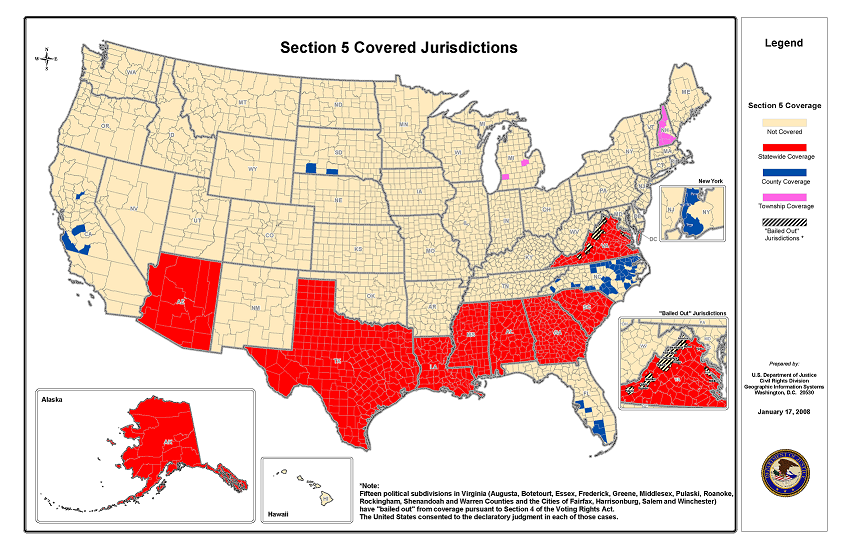
And Section 5 says that areas with a history of disenfranchisement have to  pre-clear any changes in their voting laws with the Justice Department. Section 4 spells out how those areas are defined. Mostly that turns out to be southern states, but a few other places (including parts of my state of New Hampshire) have had to endure the Justice Department looking over their shoulders whenever they change voting laws.

But in essence, the VRA puts the South on probation. Initially that was for 5 years, but the term keeps getting renewed; most recently it was renewed for another 25 years in 2006.

That’s what Roberts has a problem with. Section 4 is based on evidence that was current in 1965, and the basic formula has barely changed since. In the same way that laws need to have a reason to discriminate between citizens, they have to have really good reasons to discriminate between states, which are assumed to have “equal sovereignty”.

Past Supreme Courts have weighed the VRA’s justifications and found them sufficient. Jim Crow was an exceptional problem that required an exceptional solution. (My personal opinion: If you’re going to make an exception, voting rights is a good place to make it, because once voting gets screwed up all the non-judicial ways our system corrects itself are screwed up too.) But Roberts notes that:

Nearly 50 years later, things have changed dramatically.

This is a point you’ll hear often in conservative circles. Nobody wants to explicitly defend Jim Crow any more, but that’s all ancient history. The Age of Obama is post-racial. Things have changed.

Roberts goes on at some length about how things have changed. Minority voter-registration rates are close to parity with white Anglos, and in some elections minority turnout is above average. Minority candidates now get elected to Congress in section-5 states like Texas or South Carolina.

In 1965, the States could be divided into two groups: those with a recent history of voting tests and low voter registration and turnout, and those without those characteristics. Congress based its coverage formula on that distinction. Today the Nation is no longer divided along those lines, yet the Voting Rights Act continues to treat it as if it were. … Congress—if it is to divide the States—must identify those jurisdictions to be singled out on a basis that makes sense in light of current conditions.

Of course, Robert’s characterization of the VRA is not exactly true, because it has a bail-out provision: States and counties can permanently escape section 5 by convincing a court that they’ve stopped trying to discriminate. Parts of Virginia, North Carolina, and New Hampshire have all successfully used that procedure. So a state’s failure to bail out is itself a “current condition”. The plaintiff, Shelby County, could not meet that condition, because it continues to try to disenfranchise blacks. (During oral arguments, Justice Kagan summed it up: “You’re objecting to the formula, but under any formula Congress could devise, it would capture Alabama.”)

But never mind all that, because even making that point draws us down the rabbit hole Roberts has dug. Here’s what’s important: “Things have changed” is not a legal argument. It’s a fine point to make on a blog or at a dinner party, but a Supreme Court justice has to do better than that.

If Roberts were being a real judge here, he’d spell out what “equal sovereignty” has and hasn’t meant in American legal history. He’d enunciate an abstract standard by which Jim Crow was “exceptional” in 1965 and which justified the steps taken then. He’d explain how that standard was violated by the renewal of the VRA in 2006. And he’d lay down a set of conditions that Congress would need to satisfy to make the VRA acceptable today. (If you want to see what a real legal opinion looks like, read Justice Ginsburg’s dissent. Whether you agree with her or not, she is clearly doing something far more rigorous than what Roberts is doing.)

Roberts doesn’t do any of that. The VRA was vaguely justified in 1965 and is vaguely unjustified now, because “things have changed”. If I were a congressman, I would have no idea how to revise the VRA so that it passes constitutional muster. If Congress does revise it, lower court judges who rule on it will just be guessing about its constitutionality. It will have to go back to the Supreme Court before anyone knows whether it’s really a law again, because there are no standards in Roberts’ opinion by which a revision can be judged.

This isn’t law. It’s politics. It’s mush.

So after “careful consideration” of how “things have changed”, this is my judgment: Whether you agree with its conclusions or not, this Court sucks.

What the Court Decided About ObamaCare

Thursday, the Supreme Court announced its decision that the individual healthcare mandate, and hence the Affordable Care Act as a whole, is constitutional. It was a 5-4 decision, with Chief Justice Roberts siding with the Court’s four liberals and Justice Kennedy (the usual swing vote) joining the other three conservatives.

I was thrilled. Yes, Roberts got to that decision in an odd way (more on that later), and states were given the option to opt out of the Medicaid expansion. (I expect Republican governors to posture a lot about this, but I have a hard time believing they’ll actually refuse.) But the alternative was stark: We’d be back to square one on health care, stuck with 50 million uninsured Americans, spiraling healthcare costs that are already the highest in the world, and no plan on the table to fix any of it.

So we should all take a moment to do a happy dance.

Done? OK, now let’s look at this in a wider perspective.

History. Democrats have been trying to get some form of national health insurance since Truman. LBJ got Medicare and Medicaid passed in the 60s. Clinton tried and failed to get universal health care in the 90s.

Fear that Democrats might someday succeed in passing a Medicare-for-everybody plan that put private health insurance companies out of business caused the conservative Heritage Foundation to propose an individual mandate in the 1989 report Assuring Affordable Health Care for All Americans. The Republican alternatives to HillaryCare in the 90s usually claimed not to have mandates, but tax credits were jiggered to produce the same result: If you chose not to have insurance, you paid more to the federal government.

And of course, an individual mandate is a key and necessary provision of RomneyCare in Massachusetts, which Mitt explained here:

The interesting detail in all of this conservative campaigning for an individual mandate was that its constitutionality was never addressed as a problem. As long as it was a conservative alternative to Democratic proposals, no one challenged the mandate’s constitutionality.

In May, Salon’s Andrew Koppelman asked the question: When did the individual mandate become a constitutional issue?

The first exploration of Congress’s authority to enact a mandate was a paper by Mark Hall, which he posted on SSRN in February, 2009. (I have not been able to find even a hint of the constitutional objection before Obama’s election, even though mandates have been proposed, mainly by Republicans, since the early 1990s.) He concluded that the mandate easily followed from existing commerce clause jurisprudence. … The first published claim of unconstitutionality that I have been able to find is a July 10, 2009, Federalist Society paper by Peter Urbanowicz and Dennis G. Smith. They created the now notorious action/inaction distinction, declaring that “Congress would have to explain how not doing something – not buying insurance and not seeking health care services – implicated interstate commerce.”

Before that, nothing. Crickets.

What Roberts Said. So this is where we are: I did a happy dance because the Court’s partisan Republican majority only managed four votes to shoot down a Republican healthcare idea that Democrats finally managed to pass. Their constitutional objection was based on an ad hoc legal theory that simply did not exist until a few months before Congress passed the law.

Worse, in giving his OK to ObamaCare, Roberts still signed off on the ad hoc action/inaction theory and rejected the Commerce Clause justification that seemed obvious to everybody only two years ago. Instead, he re-interpreted the mandate as a tax and found justification for it in Congress’ constitutional power to tax:

The Federal Government does not have the power to order people to buy health insurance. Section 5000A  would therefore be unconstitutional if read as a command.  The Federal Government does have the power to impose a tax on those without health insurance. Section 5000A is therefore constitutional, because it can reasonably be read as a tax.

Now, I can’t complain too much about this, because I’ve been lamenting for months that the mandate would obviously be constitutional if Congress had just replaced the word penalty with tax. Of course, if they had done that, it’s possible that conservatives would have trumped up some novel legal theory that limited the Taxing Clause. Who knows? If you want to throw out a law badly enough, you can always come up with something.

The Ginsburg Dissent. If you want to see what would have been a 9-0 decision in the 1990s, and probably even an 8-1 or 7-2 decision two years ago, scroll past the 59 pages of Roberts’ decision and read the dissent by Justice Ginsburg. (She dissents from Roberts’ reasoning, but not his conclusion that ObamaCare is constitutional. So she is also technically part of the majority that Roberts is writing for.)

There is a very striking difference in tone between Ginsburg’s opinion and both Roberts’ opinion and the joint dissent by the four conservative justices. Ginsburg consistently talks about reality, giving examples and statistics about what is happening here and now in the healthcare market. Meanwhile, Roberts and the conservative bloc mainly discuss bizarre fantasies in which Congress might force everybody to buy broccoli.

At the root of the conservative rejection of the Commerce Clause justification is the idea that Congress’ power to regulate commerce does not include the ability to “create” commerce by forcing people to buy a product (health insurance) they otherwise would not. The objection rests on two points:

  • Individuals should be able to escape Congress’ commerce-regulating power by not participating in the regulated markets.
  • Individuals can choose not to participate in the healthcare market by not buying insurance, not going to the doctor, etc.

The first point sounds reasonable, but has no real basis in legal precedent. And Ginsburg correctly observes that because accident and illness strike even young and apparently healthy people without warning, and because emergency rooms are obligated to treat first and ask for payment later, the second point is just false. Individuals actually cannot avoid adding risk to the health-care system.

Insurance companies and health-care providers know that some percentage of healthy, uninsured people will suffer sickness or injury each year and will receive medical care despite their ina­bility to pay. In anticipation of this uncompensated care, health-care companies raise their prices, and insurers their premiums. In other words, because any uninsured person may need medical care at any moment and because health-care companies must account for that risk, every uninsured person impacts the market price of medical care and medical insurance.

This is also inherently a national problem, precisely the kind of thing that the Founders wanted Congress to have the power to solve.

States cannot resolve the problem of the uninsured on their own. Like Social Security benefits, a universal health-care system, if adopted by an individual State, would be “bait to the needy and dependent elsewhere, encouraging them to migrate and seek a haven of repose.” Helvering v. Davis, 301 U. S. 619, 644 (1937).

In normal times, that would be that. As a unanimous Court wrote in Katzenbach v. McClung (1964)

Where we find that the legislators, in the light of the testimony and facts before them, have a rational basis for finding a chosen regulatory scheme necessary to the protection of commerce, our investigation is at an end.

But these aren’t normal times, so Ginsburg has to attack Roberts’ examples directly.

An individual “is not ‘active in the car market,’” the Chief Justice observes, simply because he or she may someday buy a car. The analogy is inapt. The inevitable yet unpredictable need for medi­cal care and the guarantee that emergency care will be provided when required are conditions nonexistent in other markets. That is so of the market for cars, and of the market for broccoli as well. Although an individual might buy a car or a crown of broccoli one day, there is no certainty she will ever do so. And if she eventually wants a car or has a craving for broccoli, she will be obliged to pay at the counter before receiving the vehicle or nour­ishment. She will get no free ride or food, at the expense of another consumer forced to pay an inflated price.

So no, it doesn’t follow that Congress can make us eat broccoli if the Commerce Clause allows an individual mandate.

The Medicaid expansion. One of the ways ObamaCare increases the number of people with coverage is that it expands eligibility for Medicaid. Everybody under 65 with a household income less than 133% of the poverty line becomes eligible.

Medicaid is a federal/state partnership, so the expansion can only happen if the states go along. The ACA tries to make it painless for the states to cooperate by covering 100% of the cost of the expansion for the first two years, and 90% thereafter. It tries to make the expansion painful to turn down by saying that Medicaid is a take-it-or-leave-it deal. States can go along or lose the Medicaid funding they already get.

Roberts found that this was too coercive, though he didn’t specify what makes a non-cooperation penalty too high. Ginsburg finds that the Medicaid expansion is within the normal power of Congress to offer funding with conditions, and does not see the take-it-or-leave-it part as a penalty at all, since each year is a new appropriation, subject to its own conditions.

Future Congresses are not bound by their predecessors’ dispositions; they have authority to spend federal revenue as they see fit. The Federal Gov­ernment, therefore, is not, as the Chief Justice charges, threatening States with the loss of “existing” funds from one spending program in order to induce them to opt into another program. Congress is simply requiring States to do what States have long been required to do to receive Medicaid funding: comply with the conditions Congress prescribes for participation.

As I said above, I doubt the states will opt out anyway. If they do, then ObamaCare will cover somewhat less than 30 million new people, and the opting-out victims will be poor and near-poor people.

The conservative dissent. Justices Scalia, Thomas, Alito and Kennedy combine in a dissent that is both radical and polemic, full of scary quotes about the Commerce Clause turning into “a font of unlimited power” or “a general authority to direct the economy”.

Its conclusion is that the ACA must be thrown out in its entirety.

Think about that: Based on a legal theory that did not exist two years ago, and whose advocates are almost entirely in conservative think tanks, the Court came within one vote of striking down the biggest piece of social legislation in half a century.

Salon’s Paul Campo has an even scarier theory: Looking at internal evidence in the text, Campo speculates that the conservative dissent was originally written to be the majority opinion, and that Roberts changed his mind late in the game.

So we dodged a bullet, and the country gets to have RomneyCare. Unless it elects Romney. Then the Happy Dance will be over.

What the Court Decided About Immigration

Last Monday, the Supreme Court struck down three of the four challenged sections of Arizona’s anti-immigrant law, S.B. 1070. As usual, the media covered the event as if it were nothing but a pivotal game in a partisan play-off series, and went back and forth on whether this was victory or defeat for the Obama administration.

Don’t be distracted or confused. If you read the decision, the outcome is pretty clear: It’s a victory for people who want to see immigrants (documented or undocumented) treated fairly. It’s a defeat for anybody who wants the police to hound Hispanics out of Arizona.

S. B. 1070 was passed by the Arizona legislature and signed by Governor Jan Brewer in April, 2010. The Obama administration challenged the law in court before it could take effect, and a federal injunction has prevented Arizona from enforcing it until the case was settled.

Well, now it’s settled. Three of the four challenged provisions were struck down immediately:

  • Section 3 made it a state crime for a non-citizen to fail to carry documentation authorizing their presence in the country.
  • Section 5C made it a state crime for an undocumented alien to seek or accept employment.
  • Section 6 authorizes Arizona state police to arrest without a warrant any non-citizen who they have reason to believe has committed an offense that would make them deportable.

Justice Kennedy wrote the majority opinion, with Chief Justice Roberts and three justices from the Court’s liberal wing (Breyer, Ginsburg, and Sotomayor) concurring. Justice Kagan recused herself because she was in the Obama administration when the case was being prepared, and so might appear to have a conflict of interest. (Recusal decisions are up to the justices themselves. Liberal justices take these decisions seriously. Conservatives like Thomas and Scalia do not, even when money is involved.)

The reason Governor Brewer claimed victory and some liberals complained of defeat was that the Court did not strike down the fourth provision, 2B, which Justice Kennedy summarized like this:

Section 2(B) of S. B. 1070 requires state officers to make a “reasonable attempt . . . to determine the immigration status” of any person they stop, detain, or arrest on some other legitimate basis if “reasonable suspicion exists that the person is an alien and is unlawfully present in the United States.” Ariz. Rev. Stat. Ann. §11–1051(B) (West 2012). The law also provides that “[a]ny person who is arrested shall have the person’s immigration status de­termined before the person is released.”

This section is why S.B. 1070 became known as the “papers please” law. It conjures up visions of police harassing anybody with brown skin or an accent, and locking them up until they can prove they’re in the country legally. (You always go swimming with your passport, don’t you?) Such behavior is certainly in line with the expressed purpose of the law, which is to pressure undocumented immigrants until they “self-deport”. And I’m projecting here, but I’d guess that many S.B. 1070 supporters will consider it a bonus if legal Hispanic immigrants leave the state too.

So why didn’t the Court strike 2B down? Justice Kennedy’s reasoning shouldn’t give any comfort to the people who want to harass Mexicans. It all hangs on the timing of the case and on that phrase “reasonable attempt”.

The administration sued before the law went into effect, before Arizona police came up with enforcement guidelines, and before the state courts had a chance to rule on whether those guidelines follow the state constitution. Kennedy doesn’t want to assume that those people won’t do their jobs properly.

At this stage, without the benefit of a definitive interpretation from the state courts, it would be inappropriate to assume §2(B) will be construed in a way that creates a conflict with federal law.

Justice Kennedy could imagine state courts toning 2B’s interpretation down to something like this: As long as we’re holding you for something else already, we might as well check with ICE to see if you’re in the country legally, and if not, see what they want us to do with you.

However, Kennedy also envisioned an interpretation where police would hold brown-skinned jaywalkers (rather than just ticketing them as usual) or extend the detention of other suspects while waiting for immigration information, which (since the rest of the ruling established that immigration is federal territory) is none of their business anyway. Kennedy left little doubt that this would be seen as an unreasonable attempt to determine a person’s immigration status.

So the Court didn’t endorse 2B, it just let Arizona off with a warning. If 2B comes back to the Court as a racial profiling case with actual victims, it will get struck down then.

If you doubt that reading of the Court’s decision, think about this: None of the liberal justices felt the need to write a dissenting opinion. That should tell you who won.

Supreme Panic and other short notes

Should ObamaCare supporters panic? That was the big debate on the legal blogs after the Supreme Court’s five conservative judges asked a bunch of skeptical questions during oral arguments. Jeffrey Toobin says panic, Steve Kornacki says not to.

So far I’m siding with Kornacki. For years legal specialists have been writing that you can’t predict how judges will vote by listening to their questions, so I’m surprised so many of them think they can this time.

Asssuming that the pessimists are right, though, the Court could be headed for a Brown v Board of Education-scale ruling: If they limit the Commerce Clause, all kinds of previous rulings (including ones written by the five conservative judges) come up for review. If they decide that the Medicaid expansion is an illegal coercion of the states by the federal government, the whole federal/state relationship changes.

Two points are worth making here: First, a partisan Supreme Court is a dubious asset politically, and striking down ObamaCare would seal the impression that this Court is Republican. If ObamaCare is struck down, we’re back to worrying about the 50 million uninsured, and Republicans continue to have no plan for covering them.

Second, this is another reminder that institutions are neither good nor bad, liberal or conservative, they’re just institutional. For decades, liberals relied on the Supreme Court to limit the damage done by conservative state legislatures, and many of us got it into our heads that a powerful Supreme Court was good. On the flip side, many of us have it in our heads that global institutions like the WTO are bad because they are dominated by corporate interests. Well, maybe the WTO is also just an institution. We need to figure out how to make it work for us rather than against us, the way conservatives have done with the Court.


While we’re talking about the Court and ObamaCare, a number of liberals are making their usual mistake when they answer what has become known as the Broccoli Argument: If Congress can make us buy health insurance, can it make us buy broccoli?

There are literal legal answers to this question – BTW, the literal answer is “no” – involving the limitations of the Commerce Clause, but they miss the point. Don’t make them unless you’re trying to convince a lawyer. Politically, Akhil Reed Amar has the better answer:

The broccoli argument is like something they said when we were debating the income tax: If they can tax me, they can tax me at 100 percent! And yes, they can. But they won’t. Because you could vote them out of office. They have the power to do all sorts of ridiculous things that they won’t do because you’d vote them out of office.

I think that’s called “democracy”.


About that Santorum “bullshit” incident. I don’t really care what words the guy uses, but imagine the outcry if Obama lost his composure like that. Think of all the lies that have been told about Obama – about his citizenship, his religion, his loyalty to the United States, and a hundred other issues that Rick Santorum never has to worry about. And yet he never snaps.


While we’re on that theme: Imagine the outcry if it’s 2007 and Nancy Pelosi says the Bush generals are lying about what they need. But Paul Ryan apologizes and its all OK now.


In an April Fools’ Day op-ed, David Javerbaum introduces the “quantum theory of Mitt Romney“.

Before Mitt Romney, those seeking the presidency operated under the laws of so-called classical politics, laws still followed by traditional campaigners like Newt Gingrich. Under these Newtonian principles, a candidate’s position on an issue tends to stay at rest until an outside force — the Tea Party, say, or a six-figure credit line at Tiffany — compels him to alter his stance

But Mitt is the first “quantum candidate”, and is governed by different rules.

In much the same way that light is both a particle and a wave, Mitt Romney is both a moderate and a conservative … The act of observing cannot be separated from the outcome of the observation. By asking Mitt Romney how he feels about an issue, you unavoidably affect how he feels about it. More precisely, Mitt Romney will feel every possible way about an issue until the moment he is asked about it, at which point the many feelings decohere into the single answer most likely to please the asker.

There’s more.


Salon’s Michael Lind explains how the rich took over airport security, getting their own faster lines. He then makes this modest proposal:

Why don’t we just make the new class-based discrimination official? Instead of leaving it to airlines and other corporations to construct the new apartheid piecemeal and informally, let the government issue a Premium Elite Citizen Card, valid for multiple purposes. For the right price, a price carefully calculated to be unaffordable by the majority of Americans, those willing and able to pay would be allowed to cut in line, not only at airports, but everywhere: at taxi stands, movie theaters, restaurants. All they would have to do is flash their Premium Elite Citizen Card to force the rabble to step aside and make way.


David Wong of Cracked.com follows up his viral 6 Things Rich People Need to Stop Saying with an almost equally worthy 5 Ways Modern Men are Trained to Hate Women.


It amazes me how misunderstood hate crime laws are, even by people who ought to know better — like NYT editor Bill Keller:

In most cases, hate crime laws take offenses that would carry more modest sentences — assault, vandalism — and ratchet up the penalty two or three times because we know, or think we know, what evil disposition lurked in the offender’s mind. Then we pat ourselves on the back. As if none of us, pure and righteous citizens, ever entertained a racist thought or laughed at a homophobic slur.

Bill: It doesn’t take a genius to understand that painting “Bob loves Mary” on an underpass is a less serious crime than painting swastikas on a Jewish elementary school.


One additional point I left out of my summary of Glenn Greenwald’s With Liberty and Justice for Some: With all the discussion of ways to cut government spending, how come nobody ever proposes that we stop locking up non-violent criminals for long prison terms? Other countries don’t, and it seems to work for them.


Where Are We on Citizens United?

So far, the 2012 election cycle has been everything the critics of the Citizens United decision expected. Mitt Romney is leading the race for the Republican nomination not because voters like him or his vision for the country, but because limitless quantities of money are available to tear down any serious rival. Newt Gingrich is able to stay in the race because one tycoon has decided that’s a good idea, and Rick Santorum has a super-rich sugar daddy as well. (Even so, a Romney-supporting hedge fund billionaire thinks the ultra-wealthy have “insufficient influence” on politics. I have a hard time picturing what would please him.)

Meanwhile, it’s been reported that the Koch brothers have pledged $60 million to defeat President Obama in the fall, and other plutocrats allied to them have offered $40 million more. Karl Rove’s Crossroads SuperPACs are planning to raise and spend $240 million, and there are many, many other such groups. That’s all in addition to whatever the Republican Party and its candidate spend.

So despite being opposed to SuperPACs in theory, President Obama has come to the conclusion that going into an election without one would be like playing in the American League without a designated hitter or refusing to take 3-point shots in the NBA; whether you think a rule is good for the game or not, you don’t have the option of moving to a fantasy world where the rule doesn’t exist.

There’s an argument about whether this is hypocrisy on Obama’s part. I agree with Kevin Drum that it isn’t. One of Drum’s examples applies to me: I claim income-tax deductions that I would do away with if I had the power. Playing by the rules and wanting to change the rules are two different things.

More money, more mud. Money equals speech, says the Supreme Court, and more speech means better democracy. But in practice, more money means more negative misleading speech.

With a little bit of money a candidate can get a positive message out and present an attractive image. But before long everyone has seen the beautiful family and its adorable dog. Everyone has heard that you want to turn Washington around and make America great again. Repeating those ads 24/7 doesn’t help you.

But carpet-bombing a state with charges that your opponent wants to strangle grandmothers, sell little girls to the Chinese, and raise taxes to subsidize terrorist training camps — that works. (It works even better if the charges come not from Candidate Smith, but from some untraceable Coalition to Save America From Everyone But Smith.) The more repetition the better. So the more SuperPAC money, the more negative the campaign.

What to do? This is the world wrought by Citizens United. Even Republicans don’t like it.

According to a new poll by pollposition.com … 68% of registered Republicans want money out of the Super PACs and only 21% said they were fine with it.

Democrats and Independents oppose this new unlimited-money politics by even larger margins. Wouldn’t it be great if we had the kind of political system where large majorities could change things?

Imagine that we do. What then? We could pass legislation to mitigate the worst effects of Citizens United. Or we could pass a constitutional amendment that undoes it completely. Or we could elect people who would appoint justices who would reverse the decision. Failing at that, we could craft legal cases carefully and hope to get the Court to change its mind.

People are trying to do all those things.

Legislation. Judge Kennedy’s decision in Citizens United imagined transparency rules that would allow intelligent voters to know where campaign money was coming from. The DISCLOSE Act would have implemented some minimal transparency rules, but Republicans filibustered it in the Senate. Democrats plan to reintroduce it in 2012.

I’ve googled “Republican alternative to DISCLOSE Act” and so far found nothing. GOP.gov says:

The proposed legislation is a punitive measure for associations of persons who choose to exercise their right to free political speech as guaranteed by the Constitution, and affirmed in the Citizens United v. FEC case.

which isn’t the kind of position that leads to compromise.

The Sunlight Foundation keeps track of this stuff. They’re also pushing the SUPERPAC (Stop Undisclosed Payments in Elections from Ruining Public Accountability in Campaigns) Act.

Constitutional Amendments. Senator Sanders of Vermont introduced the Saving American Democracy Amendment. It targets corporate personhood in general:

SECTION 1. The rights protected by the Constitution of the United States are the rights of natural persons and do not extend to for-profit corporations, limited liability companies, or other private entities established for business purposes or to promote business interests under the laws of any state, the United States, or any foreign state.

It prohibits corporate campaign contributions also allows Congress to pass laws limiting campaign spending in general.

Move to Amend has a similar proposal, which goes on to say:

The judiciary shall not construe the spending of money to influence elections to be speech under the First Amendment.

Such amendments are drawing grass-root support. Several dozen Vermont town meetings passed resolutions of support earlier this month.

Vermonters are not the first Americans to urge that the Constitution be amended to renew the century-old principle that citizens have a right to prevent corporations from buying elections. Referendums have already passed in Boulder, Colorado and Madison, Wisconsin. Cities across the country, including Los Angeles, have urged Congress to begin the amendment process. State legislatures in Hawaii and New Mexico have done the same.

Lawrence Lessig points out the Citizens United is not literally a corporate-personhood decision, but instead interprets the First Amendment to protect (in Justice Scalia’s words) “speech, not speakers”. So it’s not that Exxon has a right to speak, but that Congress has no power to limit the spread of Exxon’s message. Lessig’s proposed amendment is simpler:

Nothing in this Constitution shall be construed to restrict the power to limit, though not to ban, campaign expenditures of non-citizens of the United States during the last 60 days before an election.

Non-citizens in this case means both corporations and foreign individuals.

Lessig finds it hard to imagine that any such amendment will get the 2/3 majority it needs in Congress, given that infinite corporate money will rally to defeat representatives who support it. (Several elections would go by before the amendment could be ratified.) That’s why he favors a constitutional convention.

Congress hasn’t voted on any of these yet. Any amendment faces a long, slow road. But both Left (Equal Rights Amendment) and Right (Human Life Amendment) have shown that an amendment is a good long-term goal to build a movement around, even if it doesn’t get adopted.

Judicial remedies. Russ Feingold thinks Citizens United was just a mistake, and the Court needs to undo it. “The best thing to do is to get new justices, different justices, who will do the right thing.”

But the traditions of the Court itself work against such a plan. The doctrine of stare decisis requires the Court to respect the decisions of past courts unless and until they prove unworkable. “I wouldn’t have done that” is not a good enough reason to reverse a decision. That’s why major reversals (like Brown v Board of Education) are rare, and usually come after a long process of trying and failing to make the original decision work (as David Strauss explained in The Living Constitution).

The Montana Supreme Court has attempted an interesting end run around Citizens United. Justice Kennedy’s majority opinion in Citizens United said:

We now conclude that independent expenditures, including those made by corporations, do not give rise to corruption or the appearance of corruption.

Five Montana justices said, more-or-less, “Given Montana’s unique history of corruption, things are different here.” That case has been appealed to the Supremes, and it will be interesting to see what they say. Probably they’ll overturn Montana’s decision and reaffirm Citizens United, but Justice Ginsburg might use the occasion to put the Court’s conservative majority on the spot and hold its ridiculous and unpopular reasoning up to ridicule.

Summary. At the moment, we have no immediate prospect of reversing Citizens United. But when you don’t have a bill, you have an issue. Democrats need to pound on this in 2012, because Republicans in Congress are taking positions that are out of step even with rank-and-file Republicans.

A good test case will be Scott Brown. He comes up for re-election this year, and claims to be an “Independent Voice for Massachusetts” rather than a right-wing extremist. He cited a number of reasons for voting against the DISCLOSE Act, including wanting to make it apply to unions as well as corporations, but he never put forward an alternative that he would support. (Republican moderates did the same thing on health care. Snowe, Collins, etc. — they seemed to be considering the ACA and came up with many minor objections to it, but they never said “Add this amendment and I will vote for it.”)

In the old days, the role of the moderates in each party was to craft pragmatic solutions and provide the swing votes to pass them. If they’re not doing that any more — if, instead, they’re just wringing their hands and making excuses for supporting the partisan agenda of their extremist colleagues — then there’s no reason to elect moderates.

The ball’s in your court, Scott. Do you want to do something specific about Citizens United, or are you OK with the system the way it is?

Escalating Bad Faith, Part I: Recess Appointments

This week conservatives had a new reason to be outraged at President Obama: He appointed Richard Cordray head of the new Consumer Finance Protection Bureau, plus he added three members to the National Labor Relations Board.

What’s the problem with that? Well, these are recess appointments, a power that the Constitution gave the President so that vital posts wouldn’t go unfilled during the months when Congress was out of session.

In the era of cell phones and jet planes, recess appointments are an anachronism, because it’s quick and easy to call Congress back into session for anything really important. But in the last few administrations they’ve become part of an escalating power struggle between Congress and the President. As the struggle continues, the positions of both institutions (under either party) get further and further from anything the Founders wanted or should have wanted.

The point of this series (for which recess appointments are just the most timely example) is to highlight a crisis that gets very little attention in the mainstream media: escalating bad faith in government. Whoever started it (being a Democrat, I see most fault on the Republican side), these downward spirals are very hard to stop, and they’re extremely dangerous to the future of democracy.

History. The recess-appointment struggle starts with Article II Section 2 of the Constitution:

[The President] … by and with the Advice and Consent of the Senate, shall appoint Ambassadors, other public Ministers and Consuls, Judges of the supreme Court, and all other Officers of the United States, whose Appointments are not herein otherwise provided for, and which shall be established by Law … The President shall have Power to fill up all Vacancies that may happen during the Recess of the Senate, by granting Commissions which shall expire at the End of their next Session.

For years that clause was interpreted to mean that the two branches would work together in good faith: The President would nominate reasonably acceptable people and the Senate would approve them unless they found something seriously wrong. Just disagreeing with a nominee was generally not enough — to reject him or her you needed to find a scandal of some sort. (That’s the plot of the 1959 Pulitzer-winning political novel Advise and Consent.)

Until recent decades, rejections were rare. In 1968, the Senate filibustered President Johnson’s appointee for Chief Justice, pointing to some questionable speaking fees. (The vote was roughly bipartisan, with 19 Democratic senators voting not to end the filibuster.) In 1989, President Bush’s nomination of John Tower as Secretary of Defense was rejected because of his personal life. (Only one Republican senator voted against him.)

President Reagan and the Democratic Senate both escalated the battle in 1987: Reagan slapped the new Democratic majority in the face by nominating the extreme conservative Robert Bork to the Supreme Court, and the Senate slapped back by rejecting the nomination on ideological grounds, without finding a scandal.

Filibusters on ideological grounds, at least for judicial nominations, became standard during the Clinton and Bush Jr. administrations, but most posts within the executive branch continued to be filled with only minor friction, on the principle that the President should be able to work with people of his own choosing.

Two major non-judicial nominations the Democrats held up during the Bush years were John Bolton as UN ambassador and Steven Bradbury as head of the Justice Department’s Office of Legal Counsel. Bush Jr. used a series of temporary recess appointments to put them in office long-term — clearly not what the Constitution meant that power for. The Senate struck back by holding pro forma sessions — leaving a skeleton crew in Washington to open and close the Senate every week, so that it would not legally be in recess — even though it was in recess in any practical sense.

Since their numbers increased in 2010, the Senate’s Republican minority has escalated again: Nominees are filibustered (or their nominations are simply ignored) not even because of their ideology, but because of general policy issues unrelated to the nominee. Republicans don’t want the NLRB or the Consumer Finance Protection Bureau to function at all. But they don’t have the votes to abolish them, so they refuse to consider nominations for those positions. They have defended that refusal against recess appointments with the same pro-forma-session technique the Democrats used against Bush. (With this added wrinkle: The Senate’s Democratic majority can’t end the session because the Constitution won’t let it as long as the Republican-controlled House is in session.)

Now Obama has re-escalated by refusing to recognize the pro forma sessions and making recess appointments anyway. This, Republicans say, is a “tyrannical abuse of power“.

And it is, in some sense. But without it the Senate minority’s abuse of power stands unchallenged. The Founders never intended any of this.

This is part of a pattern in which all sides are acting in bad faith, and have been for decades. (And it’s not the only example, as I’ll discuss next week. Signing statements are another.) It creates a vicious cycle in which each escalation challenges the other side to either accept a defeat that seems illegitimate or to escalate further. There seems to be no obvious place for this to stop.

Next week: At the end of this road democracy unravels, because democracy depends as much on good faith as on elections and constitutions.

Palin’s Big Con and other short notes

I told you almost a year ago why it was obvious Sarah Palin wasn’t running: She was clearly working to build the fan/hater base of an entertainer like Rush Limbaugh rather than the majority coalition of a successful candidate.

Wednesday she finally broke the news to her fans. It was time: The filing deadline for the New Hampshire primary was coming up, and she had already milked her supporters for end-of-the-quarter gifts to SarahPAC.

Jon Stewart makes the case that this was all an intentional con: A lot of SarahPAC money ultimately comes around to benefit Palin personally. Bristol Palin said in June that Sarah had already decided. And yet the September fund-raising letter made it sound as if her candidacy depended on how much money she could raise. “That,” says Stewart, “puts us in Nigerian prince territory.”

Vodpod videos no longer available.

Stephen Colbert worries that he might have offended Karl Rove by suggesting that Rove’s PACs, whose design makes money-laundering possible, might actually be laundering money. “I have hurt Karl Rove,” Stephen laments. “Legends say you need an elvish blade to do that.”

Vodpod videos no longer available.

Last week I reacted to the drone attack that killed unindicted American citizen Anwar al-Awlaki. This week we began to hear about the process for putting Americans on the government’s “kill list”.

According to Reuters, a “secretive panel of government officials” assembles the list.

There is no public record of the operations or decisions of the panel, which is a subset of the White House’s National Security Council, several current and former officials said. Neither is there any law establishing its existence or setting out the rules by which it is supposed to operate.

I feel safer already, especially knowing that this process is authorized by a secret memo from the Justice Department’s Office of Legal Counsel. But why rant, when Glenn Greenwald does it so much better than I do?


I’m starting to get annoyed by all the people who talk reverently about the Constitution without having the faintest idea what it says. Witness Hank Williams Jr., who lost his gig introducing Monday Night Football when his Hitler/Obama analogy was too much even for the hosts of Fox & Friends, and he clarified by referring to President Obama as “the enemy”.

Reasonable people can disagree about whether ABC over-reacted, but Williams’ sacking has nothing to do with his “First Amendment freedom of speech” as he claimed in an indignant public statement.

If the government tried to punish Williams for his statement, that would be a First Amendment issue. But this is just free enterprise. When you’re the public face of a popular product, you have to stay out of controversy to avoid tainting the product with your issues. That’s why you don’t see Tiger Woods in commercials nearly as often as you used to.


Another guy with his foot in his mouth was Massachusetts Senator Scott Brown. I’ll let the Boston.com tell the story:

Brown was responding to a crack [Senate challenger Elizabeth] Warren made in Tuesday’s debate, when the Democrat was asked about Scott Brown using his centerfold spread in Cosmopolitan magazine decades ago to pay for college. Warren said “I didn’t take my clothes off” to pay for school.

Asked by the WZLX disc jockey for a response, Brown said “Thank God,” eliciting laughter from the DJs.

Where to start? (1) For what it’s worth, my hunch is that Elizabeth Warren looked pretty good when she was in college. (2) If Warren had posed nude, we wouldn’t be having this conversation, because she couldn’t be in politics. (3) While no individual male deserves the blame for society’s double standards, at a minimum we ought to be apologetic about taking advantage of them.

All of which leads to (4) Scott Brown is a jerk.


Here’s what I found disappointing in Rick Perry’s response to the Niggerhead Ranch controversy: I’m a little younger than Perry and grew up in a slightly less conservative region (rural Illinois rather than west Texas), but it’s clear in my memory that we were racists. All but a few whites were racists in those days. We said nigger and told nigger-jokes. It was the culture; you breathed it in like oxygen. (I wrote about this in more detail in 2007.)

So why not just admit it? Perry could say: “I grew up in a different era. I had a lot to learn about race and I’ve worked hard to learn it.” Is that too much to ask?

One more thing: Despite what some right-wing commentators are claiming, this has gotten nowhere near the coverage that the Obama/Jeremiah Wright story got in 2008.


The headlines say alarming things like Topeka Considers De-Criminalizing Domestic Violence, but the truth is only slightly better: City and county officials are playing chicken over who is going to prosecute misdemeanor domestic battery. Both think somebody should prosecute it, but they’re both threatening not to, and the side that blinks last will save money.

This is more of that “government waste” you hear so much about. Threatening to let wife-beaters walk is so much better than making rich people pay taxes.


More than half of what looks like investment in the official stats is really consumption in disguise: new houses, home improvements, and more places to shop.


Ezra Klein wrote a great piece on the early economic decisions of the Obama administration. Economists were slow to realize just how extreme the late-2008 collapse had been. That meant that the stimulus was too small and the predictions of the unemployment rate it would produce were too rosy. So it was easy for Republicans to claim the stimulus had failed and to block further stimulus.


ConConCon: Can the Grass Roots Find Common Ground?

I think the fundamental problem in American politics is the corruption of our political system. It’s a corruption that makes it impossible for the Left to get what the Left wants and the Right to get what the Right wants.Lawrence Lessig to Cenk Uygur at the ConConCon

Left and Right alike have proposals that poll well, but never make it through Congress: taxing the rich and a public option for health care on the Left, a balanced budget amendment and (in some polls) harsher immigration policies on the Right. The grass roots on both sides object to corporate personhood (79% in one survey) and were appalled when their government responded to the 2008 financial collapse by dishing out money to the same bankers who had screwed things up.

Originally designed to be the People’s voice, Congress has become a bottleneck controlled by special interests. Consequently, Left/Right political competition has only a limited amount of meaning. No matter how many seats either party wins, we won’t see single-payer healthcare (Left) or a flat tax (Right).

On the other hand, some ideas with little-to-no public support get through Congress easily. Lessig’s favorite example is the Sonny Bono Copyright Act of 1998, which extended the life of copyrights issued since 1923 — keeping valuable characters like Mickey Mouse and Superman out of the public domain. Copyright is a temporary monopoly that the government grants to encourage creativity, but extending the copyright of works that already exist serves no public purpose whatsoever. (“No matter what the US Congress does with current law,” Lessig observes, “George Gershwin is not going to produce anything more.”) The extension, amounted to a gift from Congress to Disney and Time Warner, who lobbied for it like 10-year-olds in December.

So who gets what they want out of Congress? Lessig calls them “the Funders” — the entities that finance political campaigns. And how can the People change the system to regain control of their government? By getting Congress to pass new laws or Constitutional amendments?

Good luck with that.

That’s the origin of this idea: Without minimizing the significance of their philosophical differences, can grass roots from the Left and Right come together in a campaign to make democracy meaningful again?

Tea Party? Lessig’s Rootstrikers organization explored this idea by getting together with Mark Meckler’s right-wing Tea Party Patriots to co-sponsor a discussion of a way to end-run Congress and fix the system another way: via a constitutional convention called by the States. Hence the Conference on the Constitutional Convention held in late September at Harvard Law School. (I “attended” via the live feed on the Web. I had hoped video of the sessions would be posted by now, but they aren’t. Consequently, all quotes are from memory or my hastily scribbled notes.)

I find that whenever I mention this co-sponsorship, people jump to the conclusion that the goal must be to generate some kind of homogenized, centrist agenda. To explain, I came up with this metaphor: Imagine two swordsmen dueling over a great prize. While they swashbuckle their way around the arena, focused on each other, somebody else walks past them, calmly stuffs the prize into a sack, and walks out.

The duel is real, but it becomes pointless if the swordsmen can’t ally to protect the prize.

The Civics of Article V. The possibility of a constitutional convention is embedded in the Constitution itself.

on the Application of the Legislatures of two thirds of the several States, [Congress] shall call a Convention for proposing Amendments

Once proposed by the convention, amendments would follow the same ratification path as constitutional amendments approved by Congress: They’d have to be ratified by 3/4ths of the states — 38 of the current 50. So any 13 states could block any of the convention’s amendments.

Because this would be an orderly process authorized by the current Constitution, speakers began referring to it as an “Article V convention” rather than a general constitutional convention that could spring from nowhere and make up its own rules. (The hallowed convention that produced our current constitution was unauthorized by the Articles of Confederation that it replaced. In particular, the Articles said that any change had to be approved by all 13 states. But the new constitution wrote its own rules and said it would go into effect if only 9 states ratified it.)

Article V is about as vague as the rest of the Constitution. But since no such convention has ever been called, Article V has two centuries of rust on it rather than the reams of precedent and case law that interprets most constitutional provisions. So there are a lot of open questions, which the ConConCon’s legal panel spelled out:

  • How do 2/3rds of the states “apply” for a convention? Every now and then, some legislature passes a call for a convention to consider such-and-such an amendment. If you total all those up, we’ve already had calls from more than 2/3rds of the states. But the general opinion is that the state’s applications have to be similar in some way; they have to be calling for the same convention, not just a convention. How similar do they need to be? Lessig proposes that states pass similar wordings that call for a convention in general, and then (in a second clause) urge the convention to consider the particular amendments popular in that state.
  • What if Congress ignores the applications? A lot of the Constitution assumes that people will act in good faith, and doesn’t specify what happens if they don’t. For example, the 12th Amendment specifies that (in the presence of Congress) the President of the Senate counts the votes of the Electoral College — the final step in electing a president. What if Senate President counts the votes wrong and declares himself president? All Hell breaks loose, I think.
    Similarly, what if Congress looks at the States’ applications for a constitutional convention and says, “Not gonna happen”? Or calls a convention under rules that make it unworkable? It’s not clear that anything other than public furor keeps Congress in line.
  • How do the conventioneers get chosen? Maybe that’s defined in Congress’ call. If not, nobody knows.
  • What if the convention breaks the rules set out in Congress’ call? Again, we’ve got a good-faith issue. Probably nothing happens; if 3/4ths of the states go ahead and ratify the amendments anyway, they become part of the Constitution.

Runaway conventions. The big question everybody asks is: What if a “runaway” convention goes wild and designs some whole new country for us? What it declares a socialist republic or a Christian theocracy or something?

The simple answer is that 13 states refuse to ratify it and the whole plan goes into the dustbin of history. There are at least 13 blue states and 13 red states, so nothing could pass without bipartisan support.

This only gets tricky if the convention does what the original convention did: writes new ratification rules for itself. (Example: What if the new constitution says it will be ratified by majority vote in a national referendum?) Then you get into the fuzzier question of legitimacy: At some point the country just ignores the process and the old government continues.

What a convention could do. The consensus of the legal panel was that constitutional amendments should be about the mechanics of government, and that more specific proposals (like Prohibition) are better left to legislation that can be easily repealed if it doesn’t work.

But the Supreme Court has boxed us into a situation where the corruption of our system can’t be rooted out without constitutional changes. So we should be looking for structural changes that make legislative change possible.

In particular, Lessig wants public funding of campaigns, through a voucher system similar to the one Ackerman and Ayres proposed in Voting With Dollars.

Fear of democracy. Lessig argues that the fear of a runaway convention results from an underlying fear of democracy and fear of each other, which the Powers That Be encourage and profit from. This is backwards, he argues: The Powers That Be (and not our fellow citizens) have proven that they’re not to be trusted.

We are used to a managed democracy, where the People only choose after the options have been very tightly scripted. (As Cake put it: “Some people drink Pepsi, some people drink Coke. The wacky morning DJ says democracy’s a joke.”) A constitutional convention would be deliberative, not managed. The conventioneers would have real responsibility, and a chance to shape the questions rather than choose from a prepared list of answers.

Lessig has faith in the deliberative powers of ordinary people, and supports Sandy Levinson‘s idea that the best way to choose conventioneers would be randomly, as juries are chosen. (The one jury I’ve served on supports his case; we rose to the occasion and did a good job.)

You got a better idea? Even Lessig is not wild about a ConCon. He’s been driven to it by the failure of everything else. Would it work? Or would it be taken over the same forces that distort the rest of our political system? Would it all come to nothing or produce some crisis of legitimacy?

He doesn’t know. But he doesn’t think we can keep doing what we’re doing.

Lessig’s keynote address was one of the most inspiring speeches I’ve ever seen. Unfortunately, the most inspiring part was in the question session, which that link doesn’t include. I’ll try to fill in from my notes and from a similar talk elsewhere.

This is how he answered the will-this-work question. First, he admitted that it probably wouldn’t. But then he asked:

If a doctor told you that your child had terminal brain cancer and there was nothing you could do, would you really do nothing? Just look at the doctor and say OK?

No you wouldn’t do nothing, because that’s what it means to love: to have the willingness to act compassionately for something, even if it seems impossible.

I am acting on the faith that all over America there are people who have this kind of love of country.

It is very rare to hear a liberal grab hold of the patriotism theme like this, and to attach it to having the courage to trust each other rather than the vicarious “courage” to send soldiers into somebody else’s country. I got shivers. It’s a powerful emotional argument.

But it also makes sense. If we can’t trust each other, then we can’t be a democracy. Where does that kind of thinking lead?