This week’s news was dominated by two trends: the apparent turning of the corner in New York’s battle against coronavirus, and Trump putting pressure on state governors to relax their lockdown orders, even though their predicted peak may still be weeks off. That pressure came from below, as well as above, as Trump-inspired and Koch-organized anti-lockdown protests were staged in states across the country.
This week’s featured post focuses on the blatant contradiction between Trump’s rhetoric and the “Guidelines for Opening Up America Again” that his administration released Thursday. His rhetoric is aggressive about reopening, claiming that 29 states are nearly ready to relax restrictions, and that some should start before May 1. But the guidelines are cautious, listing prerequisites about testing and contact-tracing that no state is anywhere near fulfilling.
If you want to be catty about this (and I guess I do) the guidelines are for people who read, and the rhetoric is for people who watch Fox News. I’m sure the protesters chanting “Lock her up!” against Michigan Governor Gretchen Whitmer have no idea just how closely her position lines up with the administration’s published guidelines. (BTW, this urge to lock up powerful women — what’s that all about, anyway?)
The post will be called “Trump’s Guidelines Aren’t What He Says They Are”, and its main point is that he has set himself up to take credit for any good that comes from relaxing lockdown rules, but dump blame on the governors for anything that goes wrong. Faithfully pro-Trump governors like Ron DeSantis in Florida or Greg Abbott in Texas shouldn’t imagine that he won’t throw them under the bus if relaxing the lockdown leads to a new wave of deaths. It’s not like he’s planning to take responsibility himself; he never does. (Abbott, at least, seems to understand the trap Trump has set for him. But it’s not clear he has a way out.)
That post should be out shortly. The weekly summary will discuss the numbers, good and bad, and the basic division this crisis is showing us between what is real and what is symbolic. (Flag-waving is symbolic, staying home is real patriotism. Crowding into church on Easter is symbolic, looking out for your neighbor’s health is real Christianity.) A lot of that needs to be written yet, so I’m not entirely sure what will be in it; I have to go through my bookmarks. Let’s say the summary comes out around noon EDT.
Once we OPEN UP OUR GREAT COUNTRY, and it will be sooner rather than later, the horror of the Invisible Enemy, except for those that sadly lost a family member or friend, must be quickly forgotten. Our Economy will BOOM, perhaps like never before!!!
This week everybody was wondering if we’ll turn a corner soon
Day by day, it’s striking how little of the news actually seems new. On any given day you’re likely to hear:
The Covid-19 case and death numbers are higher.
Healthcare workers are worried about running out of protective equipment.
Trump said something false about the virus.
Somebody you’ve heard of died.
We discovered another warning Trump received (and ignored) in January or December.
More people lost their jobs.
There’s a new report about how dysfunctional and disorganized the federal response is.
The stock market made some big move up or down, — down 2% this morning — for reasons that don’t seem to have anything to do with the economy.
Trump made some new assault against democracy or transparency.
Some idiot pastor is gathering his congregation together, in defiance of statewide orders that he’s decided to take personally.
Trump touted some untested drug as a miracle cure.
Somebody else you’ve heard of died.
Some economist insisted we have to “open up” the economy and some public health expert said that would be a disaster, but neither defined what “opening up” actually means.
Some government expert who contradicted Trump might be fired.
Somebody should turn all these into a daily Bingo card. Fill the square when you hear the story.
A model at the University of Washington says that the daily number of new cases in the US peaked April 5-7, and that the number of active cases (infections minus recoveries and deaths) will peak around April 20. Of course, different regions of the country are at different stages, so the peak where you are could be earlier or later.
Trump’s announcements are meant to sound good in the moment, not to stand up to a month of scrutiny. So it’s practically cheating that NPR took a one-month-later look at the promises made when Trump declared a national emergency. He followed through on a few things, but most of the promises are still hanging. Remember all the big retail chains that were going to offer drive-through testing? And test-yourself-at-home kits? And the Google website that was going to coordinate everything?
Two weeks ago, Trump brought word of an innovative diagnostic test that can produce results in minutes instead of days or a week. … New Hampshire, for one, received 15 rapid-test machines but 120 cartridges instead of the 1,500 expected. Only two machines can be used. “I’m banging my head against the wall, I really am,” Republican Gov. Chris Sununu said Wednesday. “We’re going to keep pushing on Washington multiple times a day to get what we need.”
So Easter has come and gone without “reopening the country” as the President was talking about two weeks ago. He’s still talking about it.
A senior White House official said there’s a lot of internal energy pushing for May 1, because that’s the end of the White House’s “30 Days to Slow the Spread.”
But you have to bear in mind that this is Trump; he and his people say stuff because it sounds nice, not because some thought process has led to this conclusion. Undoubtedly that’s the case with Stephen Moore, the guy Trump wanted on the Federal Reserve Board before Republican senators noticed that he’s a complete idiot:
“May 1 has to be a hard deadline for getting things open and running,” said Stephen Moore, an economist and former Trump campaign adviser, who advocated for reopening parts of the country on a rolling basis, beginning with less impacted areas. “There has to be a calibration of the best medical advice plus the best economic advice.”
So far May 1, or whatever date they eventually come up with, is just a number on a calendar. There is no set of criteria that will be met by then, and there is no plan for how to proceed. (Trump is putting together a new task force to make a plan. Reportedly Ivanka is on it, so it’s bound to be an all-star team.)
So at some point Trump will announce with great fanfare that the economy is restarting now. And then nothing will happen, because he’ll be stepping down on a gas pedal that isn’t connected to any fuel line.
To the extent that there’s been real thinking about how to restart the economy, it’s not coming from the administration. Fortunately, a lot of people outside the administration are saying the same things about the conditions that have to be met. (I was one of them two weeks ago. Joe Biden was another yesterday.)
It’s not enough to flatten the curve or even to see it start to slope downward. The number of cases needs to fall by a considerable amount, so that the health care system has slack to absorb a possible second wave of cases. That slack would include not just beds and ventilators, but also rebuilt stockpiles of protective equipment.
The public health system needs to ramp up an enormous bureaucracy to track new cases and find their contacts before they can spread the infection further. In Wuhan, the Chinese government “dispatched 1,800 five-person teams to track down every contact to warn them they were at risk.” Over the whole US, this effort could require tens of thousands of people. But as yet there is no federal effort to do this, and Massachusetts is the only state I’m aware of that has started a program on a realistic scale.
An antibody test needs to be able to identify people who have recovered from the virus and presumably are immune for some period of time. Those tests are just starting to become available now.
The point is to allow people go out in public and trust that the odds of meeting someone who is contagious are low. The idea that all this can be accomplished by May 1 is just absurd; anyone who mentions a date like that has no idea what they’re talking about and is not worth listening to. June 1? Maybe. We’ll see how things develop.
Once we get to that point, the economy can reopen piece-by-piece, taking baby steps. In China, Starbucks began by allowing one-person-per-table seating. Businesses where everyone has been working from home might allow groups of, say, five people to come in and work in the same office, taking care to avoid contact with other working groups. Each step has to be monitored to see if it starts a new outbreak; if it does, everyone needs to step back and plan again how to take that step forward safely.
Getting “back to normal” is going to require a vaccine, which isn’t happening for maybe a year.
There have been a lot of good what-went-wrong articles. The NYT pulls together the various warnings Trump ignored in January, and then how slowly the White House moved afterward. The New Yorker looks particularly at the protective equipment issue.
As far as I know, there are no national statistics of Covid-19 deaths broken down by race. But the limited statistics we do see indicate that blacks are dying of the virus at a rate much higher than whites. It’s not hard to come up with a speculative list of factors that would make them [I’m uncomfortable classifying blacks as a “them”, but being white, I can’t say “us” either] more likely to be exposed to the disease, and to fare worse once they have it:
To the extent that black people form an economic underclass, they are more likely to have jobs where they deal directly with people and can’t work from home.
Being on average more urban and poorer than whites, blacks are more likely to rely on public transportation.
Being raised in inadequate housing makes them more likely to have a history of asthma.
Racial disparities in nutrition, health care, and work environments leave more of them with pre-existing conditions like diabetes, hypertension, and heart or lung disease. Worse, those conditions are more likely to be undiagnosed or untreated.
A combination of poor medical services, distrust of the medical services available, and concerns about expense lead to later and less aggressive medical intervention.
If you’ve ever struggled to understand the term intersectionality, look at that list. Some of it is racial, and some is due to class. Some is structural; some is cultural. Much of the problem is systemic rather than a result of active, conscious prejudice by some individuals against other individuals. But it all works together to achieve a malign result.
With so many people wearing masks, I’ve been joking that this is a good time to rob a bank. Turns out, if you’re wearing a mask and you’re black, that’s not a joking matter. Two black men posted a video of a security officer escorting them out of a WalMart for being masked.
The Denver Post describes how the crisis creates a new avenue for Trump’s corruption:
President Donald Trump is treating life-saving medical equipment as emoluments he can dole out as favors to loyalists. It’s the worst imaginable form of corruption — playing political games with lives. For the good of this nation during what should be a time of unity, he must stop.
Trump prevented Colorado’s Democratic governor, Jared Polis, from obtaining 500 ventilators, claiming them for the federal government instead. A few days later, incumbent Republican Senator Cory Gardner tweeted that Trump:
has approved National Guard assistance in Colorado in response to #COVID19, following the request of members of the Colorado congressional delegation.
Will be immediately sending 100 Ventilators to Colorado at the request of Senator Gardner!
In other words, Colorado is down 400 ventilators in all, but the lack is Polis’ fault for being a Trump opponent, and what ventilators the state does get is due to having a Trump ally as senator. This seems to be a general pattern, which Josh Marshall describes like this:
Basically the White House won’t share anything about what framework is used on the confiscation or distribution side of this equation. The most they’ll say is that they’re using some version of ‘big data’ to do it in a totally coherent, awesome way. But the details we get make it sound like the oldest sort of system: distribution by friendship networks, patronage, the generosity of the powerful in exchange for future considerations. Who knows Jared? Who knows someone who knows Jared? Who’s Trump like? At minimum a significant amount of the lifesaving goods appear to be distributed on that basis.
Wonder how other countries are seeing the United States now? Here’s a view from India.
and talking about the end of the Democratic nomination race
Bernie Sanders suspended his campaign Wednesday, leaving the nomination to Joe Biden. Biden’s path to the nomination has been an odd one, resembling John McCain’s in 2008: He was the early front-runner, then looked like he was going to fall out of the running, and finally came back to win. The difference from McCain is that Biden is trying to oust an unpopular president. McCain was trying to keep the White House Republican in spite of an unpopular president. Where the economic disaster of 2008 worked against McCain, the current economic/public health disaster should favor Biden.
I keep meaning to do a what-we-learned-from-the campaign article, but other stuff keeps getting in the way. But a number of good articles came out about why the Sanders campaign failed to win the nomination: in Vox, 538, Washington Post, New York Times, and Washington Monthly.
A few things stand out to me:
Sanders over-estimated his support in 2016. He got a lot of anti-Clinton votes that he interpreted as endorsements of his policies.
He under-estimated the loyalty that black Americans, especially older ones who remember the Civil Rights era, feel towards the Democratic Party. Villainizing the Party was not a good move. He should be trying to move the Party left, not burn it down.
His belief that class interests trump everything else just didn’t pan out. A lot of the working-class rural whites who supported him when he was running against a woman voted for Biden this time.
I can never tell how typical the Sanders supporters on my Facebook feed are. But I’m struck by the amount of denial of the fact that the voters did not agree with them. I see a lot of conspiracy theorizing about the DNC and the big donors and so forth. But if Sanders had gotten the votes, he’d have gotten the nomination. He didn’t get the votes.
Biden holds a pretty solid lead over Trump in national polls, but the race looks closer when you look at the Electoral College. Biden needs to take either Wisconsin (where he currently has a 1-point lead) or Florida (currently 1 point behind).
Here’s how Matt Yglesias analyzes Biden’s VP options, given that Biden has already said he wants to pick a woman. I think a non-white woman would be better, given the necessity of motivating a high non-white turnout.
The WaPo’s Aaron Blake rates the 11 most likely choices and has Whitmer as third, with Kamala Harris and Amy Klobuchar more likely.
and the flap between Captain Crozier and Navy Secretary Modly
It ended on Tuesday with both of them having lost their jobs. Modly relieved Crozier of command of the aircraft carrier USS Theodore Roosevelt on April 2, a few days after a letter Crozier had written (reporting the Covid-19 outbreak on his ship) appeared in the San Francisco Chronicle. Modly then flew to Guam to address the TR’s crew on Monday, saying that if Crozier thought his letter wouldn’t leak, he had been “too naïve or too stupid to be a commanding officer. … The alternative is that he did this on purpose.” Modly described that possibility as “betrayal”.
The uproar against Modly’s speech was immediate. He apologized (sort of) Monday evening, and then resigned on Tuesday.
This case is tricky to adjudicate properly. The first thing to emphasize is that Crozier’s heart was in the right place: He was protecting his sailors. The virus was spreading rapidly on the TR — we now know of 416 TR-coronavirus cases, including Crozier himself — and getting the ship to port, off-loading the infected sailors, and quarantining the rest was absolutely the right thing to do. “We are not at war, and therefore cannot allow a single Sailor to perish as a result of this pandemic unnecessarily,” Crozier’s letter said.
It’s also important to put Crozier’s actions in the context of the fundamental social contract of the US military (which was explained to me a few years ago by my friend from high school who at the time was a warrant officer in the Marines): Members of the military agree to follow their commanding officer’s orders even at the risk of their own lives, and in return the commanding officer acquires the responsibility to take care of those lives as best he can, given the mission he’s been assigned to carry out.
An officer, then, has to balance his pledged obedience to his commanders against his responsibility to his subordinates. There is a sparse, but also long and honorable, history of US officers risking their careers by defying foolish orders or otherwise crossing a line (like expressing a concern in a way likely to leak out to the public) to protect the people whose lives are in their care. So it’s no wonder that Crozier got such an emotional send-off when he left the ship, and I imagine his sailors will be drinking toasts in his name for decades to come.
The flip side of that, though, is that a career-risking move really does need to be career-risking. The military would fall apart if every officer felt free to appeal to the public whenever he disagreed with some order or policy. The logic here is similar to civil disobedience in the civilian world: I may approve of you protesting some injustice by blocking traffic. But if I am a policeman, it’s still my responsibility to arrest you. There has to be a cost to breaking the law, or else we don’t have laws at all.
So I agree that Brett Crozier is a hero for putting his career on the line to save his crew. And I also think he should have paid a price of some sort. Relieving him of command is maybe a high price, but it’s not unreasonable.
Where Modly went completely off the rails, though, was in going to the TR and denouncing Crozier to his former crew in such terms. (This is, in my mind, a typical Trump-administration stunt. They can’t just win and move on; they have to issue a fuck-you to anyone who got in their way.) He could have stayed in Washington and said nothing. He could have gone to Guam and humbly explained the situation the way I just did: “You are absolutely right to admire Captain Crozier, but I had to fire him anyway to maintain the discipline of the Navy. You will have a new commander now, and I expect you to give him proper respect.”
So while I harbor some reservations about Crozier losing his command, and I hope he lands on his feet somewhere else in the Navy, I have no reservations at all about Modly losing his job. I just wish I believed someone better would get the position next. However, that seems not to happen in this administration. Like Bill Barr replacing Jeff Sessions, Mark Meadows replacing Mick Mulvaney who replaced John Kelly, or Kayleigh McEnany replacing a long line of press secretaries back to Sean Spicer, each new person somehow manages to be even worse than the last one.
and you also might be interested in …
Michael Atkinson, the intelligence community inspector general, who forwarded to Congress the whistleblower report that eventually led to Trump’s impeachment, and whom Trump recently fired in apparent retaliation:
It is hard not to think that the President’s loss of confidence in me derives from my having faithfully discharged my legal obligations as an independent and impartial Inspector General, and from my commitment to continue to do so
The administration wants public money to bail out airlines and hotels, but not the Post Office.
A US Court of Appeals says that Donald Trump’s accountants must turn over the eight years of tax returns subpoenaed by a Manhattan district attorney. Of course Trump will appeal to the Supremes, and since the case presents a clear choice between the Leader and the Law, God only knows what they’ll do.
Trump lawyer Jay Sekulow reacts: “The issue raised in this case goes to the heart of our republic. The constitutional issues are significant.” You got that right, Jay. The issue is whether there is any way to control corruption, once it reaches the presidency.
One important thing to note is that the case is not about making the tax returns public. If nothing in the returns is relevant to a prosecutable crime, the DA is obliged to keep them confidential. If some part is relevant, it might be quoted in an indictment or appear as evidence in a trial. (I am not sure what the rules are if the returns reveal some other crime within the DA’s jurisdiction.)
So far, for example, we don’t even know exactly what investigation this pertains to. In the decision, writing for the three-judge panel, Chief Judge Robert A. Katzmann tells us only that it concerns “potential criminal conduct within the District Attorney’s jurisdiction”. The nature of the subpoena itself indicates that it has something to do with the “hush money” paid to two women, and whether the Trump Organization finagled its accounting to hide those payments.
This section strikes me as the heart of the decision:
The President relies on what he described at oral argument as “temporary absolute presidential immunity” — he argues that he is absolutely immune from all stages of state criminal process while in office, including pre-indictment investigation, and that the Mazars subpoena cannot be enforced in furtherance of any investigation into his activities. We have no occasion to decide today the precise contours and limitations of presidential immunity from prosecution, and we express no opinion on the applicability of any such immunity under circumstances not presented here. Instead, after reviewing historical and legal precedent, we conclude only that presidential immunity does not bar the enforcement of a state grand jury subpoena directing a third party to produce non-privileged material, even when the subject matter under investigation pertains to the President.
Further:
Assuming, again without deciding, that the President cannot be prosecuted while he remains in office, it would nonetheless exact a heavy toll on our criminal justice system to prohibit a state from even investigating potential crimes committed by him for potential later prosecution, or by other persons, not protected by any immunity, simply because the proof of those alleged crimes involves the President. Our “twofold aim” that “guilt shall not escape or innocence suffer”, would be substantially frustrated if the President’s temporary immunity were interpreted to shield the conduct of third parties from investigation.
I interpret much of this as Katzmann feeling the Supreme Court looking over his shoulder. He writes nothing inflammatory or polemic, and repeatedly emphasizes the narrowness of his panel’s decision. (“We express no opinion on … circumstances not presented here.”) If the Supreme Court’s partisan Republican majority wants to reverse this decision, Katzmann can’t stop them, but he is going to give them as little as possible to grab hold of.
The news media is still trying to work out the right way to cover a President who will predictably misinform and lie to the public whenever a camera is pointed at him. Former NBC News executive Mark Lukasiewicz makes some suggestions in Columbia Journalism Review:
Try covering more of what they do, and less of what they say. What President Trump says he has done, or will do, about ventilator shortages is likely untrue and largely irrelevant. What he says someone told him about the situation in New York is equally irrelevant. What is actually happening in New York, what Trump has actually done … these are facts—knowable facts—and these are what matter.
Let truth-telling be a prerequisite for appearing on live TV. Repeat offenders who lie or obfuscate with abandon, no matter their position, should not be put on live again.
As for Trump officials like Kellyanne Conway and Stephen Miller, Lukasiewicz went on to tell Rolling Stone:
Putting people on live television who you know are going to lie, it seems to me, is journalistic malpractice. I don’t think — for want of a better word — a “traditional” journalist would be sitting at their computer going, “Gee, I need an expert on biomedicine. I think I’ll call that guy who’s lied to me 10 times before and see what he has to say.” No, you wouldn’t call that guy.
Yet there are people who lie to Chris Cuomo or lie to George Stephanopoulos or lie to Chuck Todd and they’re back and they’re back again. There’s something profoundly wrong with that equation.
In the last two weeks, two of my friends (who don’t know each other) have told me about robot projects they’re working on: One is part of a team developing robots that deliver packages. Another is working on robots to replace the pickers who assemble your order at the Amazon warehouse.
Both projects share a vision of goods arriving at your door untouched by human hands. Once that seemed creepy, but a viral pandemic makes it much more appealing. The NYT is seeing the same things I am:
Before the pandemic, automation had been gradually replacing human work in a range of jobs, from call centers to warehouses and grocery stores, as companies looked to cut labor costs and improve profit. But labor and robotics experts say social-distancing directives, which are likely to continue in some form after the crisis subsides, could prompt more industries to accelerate their use of automation. And long-simmering worries about job losses or a broad unease about having machines control vital aspects of daily life could dissipate as society sees the benefits of restructuring workplaces in ways that minimize close human contact.
Do you think he knows what Good Friday is about? Maybe in November he’ll wish Jews a “joyous Kristallnacht”. Tomorrow is the 155th anniversary of Lincoln’s assassination. Let’s have a party!
World-renowned mathematician John Conway died of Covid-19 on Saturday. I never met Conway, but he and I were on the same side in a mathematical controversy in the 90s: A Berkeley professor claimed to have proved the Kepler Conjecture (about the tightest way to pack identical spheres in an infinite space), and we believed (correctly, as it turned out) that there were holes in his proof. I had to search a little to find a reference to the letter we wrote to the Mathematical Intelligencer. [J. H. Conway, T. C. Hales, D. J. Muder, and N. J. A. Sloane, On the Kepler conjecture, Math. Intelligencer 16, no. 2 (1994)] One of the other names on that letter (Tom Hales) actually did prove the Kepler Conjecture a few years later.
Conway is most famous to the larger scientific public for inventing the Game of Life, which was a landmark in the development of cellular automata.
but some of you are probably still wondering about my Covid-19 status
Last week I wrote about my week of quarantine and getting myself tested. (Yes, that turned out to be possible.)
Tuesday, my test results came back negative. A number of people have warned me about the test’s false-negative rate, and suggested I continue to act as if I were contagious. However, by the time the test came back, I had gone three days without the original symptom (low-grade fever), or any other symptom I don’t ordinarily have. (I always wake up congested, and cough in the morning.) My doctor and I discussed false negatives, and agreed that my symptoms (which had never amounted to much, even before they went away) did not justify continued quarantine.
In the days since, I continue to suffer the effects of stress and worry, like everybody else. But my temperature is back to its usual sub-normal.
I can report two things about a week of quarantine: First, if you’re already fairly reclusive and live a lot of your life inside your head, quarantine is not that difficult, especially if you have a support crew living somewhere else in the house. (Thanks, Deb and Dawn.)
Second, when I found out I could leave, my reaction surprised me: Rather than bursting out, I felt some reticence I had to overcome. “Is this OK? Am I safe?” After talking to my doctor, I finished the last ten minutes of the basketball game I’d been watching (the final game of the 1977 NBA championship series), called my wife to tell her I was coming, and then warily made my way downstairs.
I can only imagine how people must feel when they get out of prison. It must take an enormous amount of adjustment.
In this less well known piece, “The Lonesome Friends of Science“, Prine sings “I live down deep inside my head.” From now on, he’ll have to live inside the heads of the rest of us.
How much are Republicans willing to disrupt democracy to maintain their power? We’re starting to find out.
This week, partisan majorities in the Wisconsin legislature, Wisconsin Supreme Court, and US Supreme Court combined their power to rig Tuesday’s election, with the goal of safeguarding the Republican majority on the Wisconsin Supreme Court against possible interference by the voters. The cost of this exercise of raw power was both the disenfranchisement of large numbers of Wisconsin citizens and an increase in the spread of Covid-19 in the state. As a result, both votes and lives will be lost.
Wisconsin’s pre-existing condition: an ailing democracy. Before we get into the details of how Tuesday played out, it’s worth noting that Wisconsin’s claim to have a democratic form of government was already shaky. Elections are still held, but the state has been gerrymandered to the point that large Republican majorities in both houses of the legislature are just about impervious to the will of the People. Republicans have power because they have power, not because the voters of Wisconsin want them.
2018 election results in Wisconsin.
The election of 2018 proved that point: Democrats won all the statewide offices, including the governorship. Together, Democratic candidates for the lower house of the legislature — where all the seats were up for election — got 200,000 more votes than Republicans. And yet Republicans won not just a majority of the seats, but close to a supermajority: 63 out of 99.
How do they get away with that? Well, one reason is that the Wisconsin Supreme Court doesn’t protect the right of Wisconsin voters to control their government, at least not when that government is Republican.
But Supreme Court justices are elected in Wisconsin, so if Wisconsinites want their democracy back, they can vote out the Republican judges who stand in their way. At least in theory. That theory was being tested Tuesday.
What the election was going to be about. Outside of Wisconsin, Tuesday’s election mainly had been getting attention as a presidential primary. Joe Biden held a substantial delegate lead, but Bernie Sanders was still running, and Sanders had beaten Hillary Clinton soundly in Wisconsin in 2016. The recent polls weren’t looking good for Sanders this time, but if he could pull off a result similar to his 2016 victory, things might yet get interesting.
Inside the state, though, the election was about judgeships, particularly a seat on the state’s highest court. Politico explains:
The high court has played a pivotal role in upholding major pieces of GOP legislation including Act 10 in 2011,which limited public employee collective bargaining rights. The court, which now has a 5-to-2 conservative majority, also shut down a long-running investigation into the campaign of former Governor Scott Walker for campaign finance violations, and upheld the GOP Legislature’s move to limit the powers of incoming Democratic Governor Tony Evers after his defeat of Walker. The court will also play a decisive role in the upcoming fight over redistricting as well as a host of hot-button social issues such as abortion and religious liberty.
Also at stake: “three seats on the Wisconsin Court of Appeals, over 100 other judgeships, over 500 school board seats, and several thousand other positions”.
The judicial elections happening simultaneously with the primary seemed like a misfortune to Republicans, though, because (since Trump is running unopposed) more Democrats seemed likely to turn out than Republicans. If only there were some way to keep turnout down across the board …
The coronavirus election. Then coronavirus happened. Showing up to vote is a risky thing during an epidemic, especially if you have to wait in long lines with other people, some of whom are bound to be carrying the virus. Other states have recognized this problem and so a series of primaries have been postponed. In all 16 states have delayed their primaries.
Democratic Governor Tony Evers thought Wisconsin should do the same. He already had issued a stay-at-home order on March 24, and reasoned that it made little sense to tell people both to stay home and to go out and vote. On April 3 he called the legislature into special session to delay the primary. Evers wanted to convert the primary to a vote-by-mail format, and allow voters to return their ballots anytime until late May.
That, of course, would raise turnout, which is seen as a partisan issue in Wisconsin, and across the country. (If you want a lot of people to vote, you must be a Democrat.) But the gerrymandered Republican legislature could have proposed its own plan to postpone the primary, and Evers would have found himself under considerable pressure to go along with it.
Instead, the legislature came up with the best voter-suppression plan of all: Let’s make people risk their lives in order to vote! The leaders of both houses issued a joint statement: “Our Republic must continue to function.” The primary would go on as scheduled.
This looked like a trainwreck-in-the-making to Governor Evers, whose main job these days is to convince his citizens to stay home and not spread the virus. So the day before the primary — right after the legislature adjourned his special session without acting — he issued an order delaying the primary until June 9, noting the risk not just to the voters, but even moreso to the poll workers who “come into close proximity with dozens, if not hundreds, of voters”.
Wisconsin House Speaker Robin Vos and state Senate Majority Leader Scott Fitzgerald immediately challenged that order in the Wisconsin Supreme Court, which — surprise! — supported them 4-2. Vos and Fitzgerald rejoiced:
We continue to believe that citizens should be able to exercise their right to vote at the polls on Election Day, should they choose to do so … this election will proceed as planned.
What about voting absentee? OK, there’s an election. But that doesn’t mean you have to go to the polls to vote. The decision that the show must go on produced a predictable avalanche of absentee-ballot requests. Last year, when there was a spring election but not a presidential primary, 167,832 absentee ballots were requested. For the 2016 general election there were 595,914 requests. This year? 1,293,288. About 200,000 of those ballots were not returned in time to count, compared to just 30,000 in the 2016 general election.
The office that distributes absentee ballots wasn’t set up to deal with such a deluge of last-minute requests, so it soon became apparent that some number of legitimate Wisconsin voters wouldn’t get their ballots before election day.
A collection of (mostly Democratic) voters and groups sued to get an extension for absentee voters to return their ballots. A federal district court ruled in their favor, extending the deadline from election day to today, nearly a week later. The election commission was also enjoined from releasing results until then.
That ruling was overturned by the Supreme Court’s Republican* majority: Votes could continue to be counted until today, but they had to be postmarked by election day. That decision is unsigned. It mentions the problem that voters may not have received their ballots (which the lower court held was an unconstitutional burden on the right to vote), but then completely ignores it, comparing the situation to normal elections where people who request a ballot at the last minute may not have much time to fill it out and mail it. (It’s worth pointing out that the undelivered-ballot question is not just theoretical. “Three tubs of ballots for Oshkosh and Appleton have been discovered at a mail processing center in Milwaukee, according to the Wisconsin Elections Commission and a state senator.”)
Justice Ginsburg’s dissent asks a simple question:
If a voter already in line by the poll’s closing time can still vote, why should Wisconsin’s absentee voters, already in line to receive ballots, be denied the franchise?
The majority opinion doesn’t answer that question, because there is no answer.
Election day. The NYT’s Linda Greenhouse, in a column blasting the Supreme Court’s Republican majority, (and in particular skewering the majority’s use of the word “ordinarily”, as if anything about this situation were ordinary) summarized the election-day conditions.
Milwaukee voters are not ordinarily reduced to using only five polling places. Typically, 180 are open.
In a stunt that probably wasn’t as effective as he planned, Speaker Vos himself worked as an election inspector. Covered in protective equipment, he assured the public that “You are incredibly safe to go out.”
Implications for future elections. In the back of everyone’s mind is the question: What if Covid-19 turns out to have a seasonal factor? It almost certainly won’t go away completely in the summer — it’s summer all year round in Florida, and they’ve had nearly 20,000 infections — but what if it diminishes, and then comes roaring back in the fall? Or what if we re-open the economy too quickly and get a fall resurgence that way?
In either case, it’s not impossible to imagine that the general election in November could take place under very similar conditions to the ones in Wisconsin on Tuesday. Wouldn’t it be nice to make a plan for that now, rather than go through last-minute drama and see large numbers of Americans disenfranchised?
You know who has a plan for that? Elizabeth Warren. Her plan calls for online voter registration, a vote-by-mail option, and at least 30 days of early voting. Radical stuff like that.
The problem with all those ideas, of course, is that they encourage people to vote. Or at least Republicans see that as a problem. They talk a lot about fraud, which is their usual excuse for voter suppression, but that’s not their real issue. (Washington state votes entirely by mail and has for years. Voting by mail is the standard thing for our overseas military. Fraud has not been a problem.) Their issue is that if you make voting easy, more people will vote. Marginal voters tend to vote Democratic, so it’s important to make voting as hard as possible.
* Typically, the media refers to the Court’s “conservative” majority, but that characterization has not been accurate for some while. More and more often, dating back to Bush v Gore, Citizens United, and John Roberts’ evisceration of the Voting Rights Act, the Court has been making decisions that can’t be explained by legal philosophy. The point is that Republicans should win, not that some theory of constitutional interpretation is better than another. So henceforth I’ll be refusing to play along with the ruse that their rulings have something to do with limited government or the Founders’ original intent.
Some days I wonder if they’re re-running news from some previous day. You know: the death numbers have increased; health workers don’t have what they need; Trump said something stupid or offensive at the daily briefing; some idiot minister is defying the no-large-gathering order, as if the whole pandemic were a satanic plot to shut down his particular church; more people lost their jobs; and so on.
And now I’m part of it, because the weekly summary will (once again) have all that stuff in it.
With the same outrageous stuff happening week after week, it can be hard to notice when something happens that is outrageous even by our newly elevated standards of outrage. But Tuesday’s Wisconsin state elections (and incidentally, the presidential primary) was such an event. The Republican legislature (which is only Republican because of gerrymandering) used the threat of the virus as a voter-suppression technique. And then the supreme courts of both Wisconsin and the United States backed them up. So Wisconsinites were out there in face masks and garbage bags, standing as far apart as the long lines (to get into drastically fewer polling places) allowed.
Usually, the “I Voted” sticker is a mark of civic responsibility. Tuesday it was a badge of courage.
The vote still hasn’t been announced (more on that later), so we don’t know yet whether this bit of election tampering achieved the results the Republicans wanted: holding a seat on the very state supreme court that said all this was OK.
Anyway, the featured post will go into the blow-by-blow of all that. I’m aiming to get that out by 10 EDT, but I’m also moving unusually slowly this morning. The weekly summary will have this week’s versions of the news re-runs listed above, as well as a recap on the Democratic nomination race, which seems to be over now that Bernie Sanders has shut down his campaign. Speculation on Biden’s VP choice is rising. Trump’s taxes are going to the Supreme Court. And I’ll close with a John Prine song. I’ll try to get that out by noon.
There are many things I wish I could do for this country, but they are beyond my powers. … But there is one thing I can do: To a large extent, I can take partisan politics out of this struggle, and I’m going to do that right now with this announcement: I will not be a candidate for re-election in November, nor will I endorse any candidate in that election.
This week the virus was almost the only thing to talk about
OK, the numbers: Currently the US has about 340K cases, and 9679 have died. Sometime today we’ll likely cross 10,000 deaths.
One of the ominous things to watch is the percentage of the world toll we represent. When I first started paying attention to those ratios a few weeks ago, we had about 1/15th of the world’s cases and 1/50th of the deaths. Now we’re up to more than 1/4th of cases and almost 1/7th of deaths.
Europe saw further signs of hope in the coronavirus outbreak Sunday as Italy’s daily death toll was at its lowest in more than two weeks and its infection curve was finally on a downward slope. In Spain, new deaths dropped for the third straight day.
Italy, the world leader in deaths-by-country, had 525 deaths in a 24-hour period Sunday. The United States had 1165.
The virus started in the cities, because people of all sorts (including infected people) pass through cities. But no place is really an island, so the pandemic is also starting to hit rural areas. In some ways it might eventually be worse there, because rural areas don’t have the same medical and emergency infrastructure that larger cities do.
What does it mean to live though a pandemic in a place with a high number of uninsured citizens, where many counties don’t have a single hospital, and where the governor delayed requiring folks to stay home? Across the South, we are about to find out.
Grist adds a factor to that analysis: environmental hazards. Poor air quality, for example, correlates strongly with respiratory illness in general. John Showalter, chief product officer for health-data company Jvion says:
There’s definitely a biologic rationale that environmental health hazards that lead to pulmonary and cardiovascular conditions would then lead people with those conditions to do poorly during a COVID-19 outbreak.
Louisiana in particular is famous for its oil-and-chemical-industry pollution, but much of the South is also lax in regulating polluters.
New Orleans is already one of the worst-hit places in the country, and (on a per capita basis) so is a county in Georgia.
More people—thirty—had died in Dougherty County, the state’s twenty-seventh most populous county, than anywhere else in Georgia. While Dougherty is served by a well-regarded hospital, nine Georgia counties, most of them also in the southern part of the state, not only lack hospitals but have no practicing physicians at all, according to Monty Veazey, the president of the Georgia Alliance of Community Hospitals. Eighteen have no family-practice doctors. Thirty-two have no internal-medicine doctors. Seventy-six counties have no ob-gyn.
Andy Beshear, the Democratic governor of Kentucky, urged his citizens not to enter Tennessee: “We have taken very aggressive steps to try to stop or limit the spread of the coronavirus to try to protect our people,” Mr. Beshear said. “But our neighbors from the south, in many instances, are not. If you ultimately go down over that border and go to a restaurant or something that’s not open in Kentucky, what you do is you bring the coronavirus back here.”
Kentucky, which not only elected a Democratic governor but also expanded Medicaid under the Affordable Care Act, is an outlier in the South.
Renkyl recalls the March 16 conference call Tennessee Governor Bill Lee had with local officials around the state, when he urged them to pray. The old saying that “The Lord helps those who help themselves” is often used cynically to justify grabbing whatever you can get. But if you turn the saying around “The Lord doesn’t help those who refuse to help themselves”, I think it’s pretty sound Christian theology: It’s hard to picture God helping people who could take action on their own, but choose not to.
The White Bear Lake Pee Wee hockey team was on the road to New Ulm for the state tournament when it was canceled mid-route due to COVID-19. While the season ended abruptly, the team is still a team– virtually. The players and their parents have started a text chain to check in every night to see how everyone is doing and if anyone needs help.
One evening, a player’s mom shared how she is exhausted from her work as a nurse and is worried about doing her job without personal protective equipment. The next day, the hockey dads cleaned out their supplies of masks at work and in their garage. A big box was left on the nurse’s doorstep with a note that said: “Your hockey family loves you.” It left her in tears. Her hockey family is helping her through this crisis.
The Families First Coronavirus Response Act sought to protect workers and families from losing income if they fell sick with COVID-19, the disease caused by the new coronavirus. It gives workers two weeks of paid leave, 12 weeks if their children are home from school or require child care, and reimburses employers with tax credits.
It came with some carveouts, though: The law exempts businesses with over 500 employees, and companies with fewer than 50 employees could ask the Department of Labor for an exemption if they believed the rule could bankrupt them. Nearly 75% of workers are employed by companies with under 50 employees or over 500, according to the New York Times.
Now, the Department of Labor has issued a rule that lets small businesses choose whether to give workers paid sick leave, rather than apply for a waiver.
The act also created a special inspector general to oversee the $500 billion the bill appropriates to aid businesses — partly over concern that Trump will direct money into his own pocket, or use the money to reward friends and punish enemies. The inspector general he nominated comes from his White House counsel staff and was involved in his impeachment defense.
Speaking of inspectors general, Trump continued his post-impeachment purge by firing the intelligence community IG, the one who refused to quash the whistleblower report that led to Trump’s impeachment. In that episode, there is no indication that he did anything other than his job as defined by law.
Meanwhile in the Situation Room, a heated debate broke out between medical people and political appointees who don’t actually know anything and should just shut up. The topic was the untested remedy hydroxychloroquine that Trump has promoted numerous times in the daily briefings.
Meanwhile, no good deed goes unpunished. Captain Brett Crozier, who drew attention to the coronavirus outbreak on the aircraft carrier he commanded, the USS Theodore Roosevelt, was fired. He has also tested positive.
I should have pointed out that Thomas Modly, the acting secretary of the Navy who dismissed Crozier, was in that role because his predecessor, Secretary of the Navy Richard Spencer, was forced out of that job when he resisted Donald Trump’s efforts on behalf of Edward Gallagher, the former Navy SEAL who was prosecuted for war crimes in a court martial.
War criminals do well in this administration. Commanders who try to protect their men, not so much.
Andy Borowitz: “National Incompetence Stockpiles at Full Capacity”.
“The sheer tonnage of failure and impotence that is being dumped into the stockpiles on a daily basis is straining their ability to contain it,” the G.A.O. statement read.
Though there’s a lot to be said for either Mann’s “My Corona” or Brent McCollough’s BeeGees parody “Stayin’ Inside” or Jon Pumper’s “Kokoma” parody “My Corona Home“.
Update: My test came back negative. I don’t have the virus.
Drive-through virus testing at Holy Family Hospital in Haverhill, Mass.
Let me begin this post by saying that, as best I can tell, I’m doing fine. I’ve quarantined myself since Tuesday, but so far my symptoms are somewhere between minor and imaginary. Nonetheless, I got tested Friday, and I should hear results Tuesday or Wednesday.
OK, let’s go back and tell the story from the beginning: My wife has a large number of risk factors, so we are terrified of what would happen should she catch Covid-19. Both of us are in our 60s. She had a lung collapse during surgery several years ago, and it never fully reinflated, so essentially she gets by on one-and-a-half lungs. A different medical problem resulted in half her liver being removed. And she takes a drug that drags on her immune system (though I don’t think it’s that bad; she throws off colds fairly well).
So our household is hyper-vigilant. That gets tricky, because I have a number of conditions that mimic coronavirus symptoms: An allergy causes me to wake up congested every morning and spend my first waking hour coughing and blowing my nose. If I sleep in the wrong position, I’ll have a muscle ache when I do that coughing. As for aches and pains in general, I already mentioned that I’m over 60. In short, most of the early-warning symptoms of Covid-19 are normal for me.
That leaves me focused on the one symptom I don’t ordinarily have, which is fever. Quite the opposite, in fact: My body typically runs cool. A normal morning temperature for me is below 98, and can run as low as 97.4. It tends to rise through the day, but hardly ever hits 98.6.
Anyway, first thing Tuesday, I’m having my morning cough and feeling a little more discomfort in it than usual. I take my temperature and it’s 98.3 — fine for anybody else; not fine for me. And I think “Probably nothing, but …”. And then I think “If you wait until you’re sure, you’ll have waited too long.”
So I call over to my wife, tell her to keep her distance, and explain what’s happening. She grabs some stuff, and goes to occupy a room on the second floor. (While our new apartment is under construction, we’re living on the top floor of a friend’s three-story Victorian. It was bought years ago for a family with five boys, and only two of them are still here.) Except for one trip I’ll describe later on, I’ve been up here by myself ever since. My housemates prepare plates of food and leave them on the steps; I retrieve them like a caged animal. Thank God there’s a bathroom up here.
I expected the temperature thing to resolve itself by Tuesday afternoon, but it didn’t. I kept getting readings that would top out at 99 or 99.1 in the mid-afternoons. (Again, no emergency for anybody else.) Friday afternoon, the digital ear-thermometer I was using went completely wild — I couldn’t get the same reading twice — raising the possibility that the whole episode is an equipment malfunction. By the time I got hold of an old-style mercury thermometer, I was showing more normal temperature patterns, which have continued for the last few days. What to think?
Anyway, Thursday afternoon I emailed my doctor, who did a Zoom-meeting with me Friday morning. She agreed with me that (1) these are pretty sketchy symptoms, and (2) I’m in a situation where I should pay attention to sketchy symptoms. Apparently, though, tests are now plentiful enough to justify getting me one. I suspect that wouldn’t have been true a week before.
There is a drive-through testing site at Holy Family Hospital in Haverhill, Massachusetts, about a 40-minute drive away. (I should add, though, that you can’t just drive up unannounced. They require a physician order.) I went downstairs for the first time in days, was careful to touch nothing until I reached my car, and drove myself to Haverhill.
The picture above is one I took through the windshield. I had to wait in line behind two or maybe three other cars. A young woman swathed in protective garb talked to me through my open window, had me sign a form (with a pen she refused to take back), and stuck a long Q-tip-like thing up each of my nostrils. It was fast, and while I would never do it for fun, it wasn’t that bad. She told me to expect results Tuesday or Wednesday. (Those 15-minute tests you’ve been hearing about apparently aren’t in wide use yet.) Results would go to my doctor, and I shouldn’t call Holy Family. Meanwhile, she said, I should consider myself quarantined for 14 days or until I get a no-infection result.
So now I wait. And in truth, I’m not even sure what I’m rooting for. No infection would be nice, but in some ways the best result of all would be to get away with a minor-symptom case and then have some kind of immunity. On the other hand, I also have heard stories of minor symptoms that suddenly turn bad, so I get anxious every time I start to feel tired. It would be nice to have that over with.
If we’re ever going to have great presidents again, we need to hold a space in our imaginations that a great president could occupy.
Ever since Donald Trump made his famous descent down the escalator to announce his candidacy (and assert that Mexicans crossing the border are rapists), we’ve been lowering our standards to his level. Once in a great while he does something so outrageous that his opponents try (and usually fail) to draw a line in the sand. But for the most part we’ve just accepted that he will do the kinds of things he does: ignore obvious facts, insult large swathes of people who have done nothing to deserve it, funnel public money into his own businesses, deny that he said what he said, respond to his critics with schoolyard taunts, and so on. We’ve come to expect him to politicize everything, admit no mistakes, fire anyone who reveals inconvenient truths, and confront everyone who comes into his presence with the choice to flatter him or face his wrath.
At times I’ve been as guilty of this normalization as anyone. Given a choice between letting a lie or injustice go unremarked, and distracting my readers from what I saw as more important issues, I’ve often just shrugged off norm-violations that would have been major scandals in any previous American administration.
Still, every now and then I think it’s worthwhile to ask ourselves: “What would a real leader do in this situation?” Not because I imagine Trump will listen to our answer, slap his forehead, and say, “That’s a good idea!”, but just to maintain our own sense of what is good and right. If we’re ever going to have great presidents again, we need to hold a space in our imaginations that a great president could occupy.
So I have written a speech for a great president to deliver in the midst of the current crisis. There’s no reason Trump couldn’t deliver it, and I hope he does. For obvious reasons, he won’t. I accept that, but I’m still going to put the vision out there.
My fellow Americans:
Every president faces crises and makes decisions that could either save or cost lives. I have already faced my share: military conflicts in various parts of the world; hurricanes in Texas, Florida and Puerto Rico, as well as floods and tornadoes and the full run of other natural disasters. An economic crisis may not take as many lives as war or disease, but it can ruin lives, as people lose their jobs and homes and dreams for the future.
The current crisis, the one brought on by the coronavirus pandemic, is on a scale most presidents never need to confront. Thousands of Americans are dead, and some estimate that the eventual toll could be in the hundreds of thousands, or even millions. Hundreds of thousands of Americans are already sick. Tens of thousands of businesses hang in the balance, and millions of Americans have lost their jobs. Tens of millions are sheltering in their homes.
This is not only the greatest crisis of the four-year term I was elected to in 2016, but most likely it will overshadow the crises of the next four years as well. So whether I serve four years or eight, I believe I have already met the defining challenge of my presidency, the one for which history will judge me.
Public-health experts I trust tell me that we will go through the peak of this crisis in the next month or two. No one can guarantee what will happen after that, but I think it is safe to say that the most important chapters in the story of this pandemic will be written between now and the inauguration in 2021.
It is desperately important that we get this right. The decisions that are made between now and November or January — here in the White House, in Congress, throughout government at every level, and in homes all over this country — could save or cost the lives of countless human beings, and save or cost the livelihoods of countless more. When the stakes are this high, we can’t let politics interfere with doing the right thing.
And yet, how can it not, as we move towards the 2020 election? Already, both my supporters and my critics interpret everything I do in the light of that election. I deserve credit for this, blame for that — no I don’t, yes I do — it goes on and on. But none of those arguments save anyone. They just make it harder for America to move forward in unity.
When this is all over, there will be plenty of time to distribute credit and blame. There are undoubtedly many lessons to learn — both good and bad — from what we have done so far. But trying to do that analysis in the middle of the crisis, and absorbing that discussion into what was already a poisonous partisan environment before Covid-19 emerged, does not serve this country. Partisanship can only decrease the likelihood that we will judge correctly, or learn the lessons that might save us from the next plague.
Right now, there are many things I wish I could do for this country, but they are beyond my powers. I can’t banish the disease by executive order. I can’t decree a vaccine or effective treatment into existence here and now. I can’t speed time up so that we jump past the peak of the crisis and skip all the suffering Americans will have to endure in the coming weeks and months.
But there is one thing I can do: To a large extent, I can take partisan politics out of this struggle, and I’m going to do that right now with this announcement: I will not be a candidate for re-election in November, nor will I endorse any candidate in that election. Instead, I will lead the battle against this disease until my term ends in January.
The election will still happen, and I’m sure the candidates who vie to replace me will debate their views and their plans with all the vigor we expect from a presidential campaign. But I will take no part in it. If any members of my administration want to participate in that election, God bless them, but I will ask them to step away from whatever active roles they might be playing in managing our country’s response to the virus.
I cannot insist that others follow my example. But I can ask political leaders at all levels to do what they can to take partisan politics out of this effort. Most of us tell ourselves that we entered politics to do something important. Let me suggest that nothing you might do in future years from future offices will be quite so important as what you do these next few months. Lives and livelihoods are at stake.
Going forward, there are many choices to make, and I expect to hear much argument about what should happen next. A healthy democracy always has room for disagreement. But let those discussions center on the health and well-being of our citizens, not on the November elections, and especially not on me. My political future is already set: I will finish my term and then return to the private sector to await history’s judgement on my actions. I pray history will be able to say that I rallied a unified nation to take decisive and successful action.
God bless you all, and God bless the United States of America.
You know what I’m going to talk about this week, right? There’s a historic crisis happening, and I can’t justify focusing on anything else.
So this week’s two featured posts will look at it from two very different altitudes. On an extremely personal scale, the most important thing that happened this week is that I got a Covid-19 test. But you really shouldn’t worry about me. So far I’ve got either a very mild case or a hyperactive imagination. (My current bet is on the latter.) But I also have a wife with a number of risk factors, so I’ve been quarantining myself since Tuesday. I should hear results in another day or two.
I’m writing about it because I think my personal experience has some news value: At least in the part of the country where I live, people with fairly minor symptoms are getting tested now. Those 15-minute tests you read about are still science fiction, and I think we’re still a long way from the kind of widespread testing we need if we’re going to reopen the country. But a result in 3-5 days is lots better than never.
That’s the small scale. On the large scale, I asked myself what great president would say to the country right now. I know we don’t have a great president, or even an average one. But far too often, we have let our expectations of the presidency shrink to fit the tiny man who currently occupies that office. If we’re ever going to have a great president again, we need to hold a space in our imaginations that a great president could fill.
So that’s what I did. “The Speech a Great President Would Give Now” will be out soon, and contains a shocking announcement. I don’t expect Trump to give this speech, but if he does, he doesn’t even need to give me credit. Hearing the speech would be satisfaction enough.
“My Coronavirus Test” isn’t written yet, but it shouldn’t be that hard to pull out of memory, so I expect it to post between 10 and 11 EDT. Expect an abbreviated weekly summary around noon.
When you have a political movement almost entirely built around assertions that any expert can tell you are false, you have to cultivate an attitude of disdain toward expertise, one that spills over into everything. Once you dismiss people who look at evidence on the effects of tax cuts and the effects of greenhouse gas emissions, you’re already primed to dismiss people who look at evidence on disease transmission.
When a bill is this big and complex, it’s hard to know exactly what’s in it. ABC lists a few of the more prominent measures:
Individuals making less that $75K (or couples below $150K) get $1,200 ($2,400), with $500 extra per child.
Unemployment benefits are increased, last longer, and apply to more classes of workers.
Small businesses who pledge not to lay off workers can get emergency loans, which are forgiven if the workers do indeed keep their jobs.
Hospitals and health systems get $100 billion.
$500 billion is set aside for loans to big businesses, including $75 billion for airlines and hotels.
I’m sure we’ll find out over the next several months that all kinds of special-interest provisions got inserted.
Former Obama advisor Ben Rhodes makes the obvious comment:
So weird how the Tea Party isn’t rising up in opposition to all this government spending.
Obama’s stimulus proposal was about 1/3 the size of Trump’s, but it had right-wingers talking about revolution. Now they’re silent. It’s almost enough to make you think they had some other reason for not liking Obama.
There was also little bipartisan support then, despite Republican economists virtually all calling for a major stimulus. No Republican House members and only three Republican senators voted for the bill.
“My country and its economy aren’t working for the people.” Tech Support: “Have you tried turning it off and back on again?”
and the virus
First, the numbers: As of this morning, the US had 140,393 cases (compared to 33,018 a week ago) and 2,437 deaths (428 a week ago). We now have more cases than any other country in the world, though our death totals are still behind Italy (10,779), Spain, China, Iran, and France.
Dr. Anthony Fauci is now talking about between 100,000 and 200,000 deaths eventually. In his Sunday briefing, President Trump seemed to accept those numbers and move the goalposts to make them a measure of success. He quoted an estimate of “2.2 million … if we did nothing”, implying that he would take credit for any total less than that.
Wired sorts out the rumor that people shouldn’t take ibuprofen to deal with possible coronavirus fevers.
The ibuprofen furor left researchers and physicians exasperated over the distress it caused people already frightened by the virus, and also for the apparent lack of evidence. … When they’re being cautious about associating phenomena and diseases, epidemiologists will say something represents “correlation, not causation.” In other words, just because two things occurred at the same time doesn’t mean that they’re linked. But to this point, the connection between ibuprofen and severe Covid-19 may not even be a correlation, since no statistical relationship has been found.
In Italy, 9.5 percent of the people who have tested positive for the virus have succumbed to covid-19, according to data compiled at Johns Hopkins University. In France, the rate is 4.3 percent. But in Germany, it’s 0.4 percent.
In the US, the fatality rate is around 1.3%. Those numbers would make sense if the Germans had discovered some magic treatment that they wouldn’t share with anybody else, especially the Italians. But that seems not to be the case; nobody has come up with any treatment better than to give people lots of fluids, keep their temperatures down, and help them breathe. Germans also aren’t all that different from other Europeans, either genetically or in lifestyle.
But think about what the fatality rate is: a fraction. It’s the number of deaths divided by the number of cases. The difference seems to be in the denominator, not the numerator: Germany has done a better job than any other country of identifying all the people who are infected.
The biggest reason for the difference, infectious disease experts say, is Germany’s work in the early days of its outbreak to track, test and contain infection clusters. That means Germany has a truer picture of the size of its outbreak than places that test only the obviously symptomatic, most seriously ill or highest-risk patients.
Now consider the implications: If the death rate in the US is really the same as Germany’s, it means that we have three times as many cases as we think we have.
In the same way that the record of Trump clueless tweets continues to exist, tweets exist that show his “nobody saw this coming” excuse is false. Here’s Senator Murphy (D-CT) on February 5:
Just left the Administration briefing on Coronavirus. Bottom line: they aren’t taking this seriously enough. Notably, no request for ANY emergency funding, which is a big mistake. Local health systems need supplies, training, screening staff etc. And they need it now.
[Y]our failure to remove this deceptive ad … could put your station’s license in jeopardy.
This is how authoritarianism snowballs: What might (in another administration) be a controversial-but-toothless cease-and-desist letter from a campaign is now far more ominous, because Trump freely uses the power of his office for personal benefit. A station owner has to worry that there may be no distance between the Trump campaign and the FCC.
Another example of how authoritarian regimes work: Trump tells governors that they should “be appreciative” of the great job he’s doing, and implies that his administration may stop cooperating with the ones who aren’t.
[Vice President Mike Pence] calls all the governors. I tell him — I mean, I’m a different type of person — I tell him “Don’t call the governor of Washington. You’re wasting your time with him. Don’t call the woman in Michigan. … You know what I say? If they don’t treat you right, I don’t call.
The phrase “wasting your time” tells you what Trump thinks his administration should be trying to achieve: “appreciation” for the President. If he’s not going to get that appreciation, then what’s the point of doing his job and saving American lives?
Similarly, the Sunday briefing began with executives from a variety of corporations describing how they’re contributing to the virus-fighting effort — after doing North-Korean-style tributes to the “great leadership” of the President. I get tired of pointing this out, but we can’t let ourselves lose sight of it: This kind of ego-stroking has never happened in any previous administration of either party. Obama would have thrown people out of the room for trying to butter him up so blatantly, but Trump requires it.
His argument at the time was that shutting down the economy was a cure worse than the disease. A number of Trump supporters then came out and said the part Trump merely implied: A higher death toll is a price worth paying for a higher GDP. In an interview with Fox News host Tucker Carlson, Texas Lieutenant Governor Dan Patrick put it like this:
No one reached out to me and said, as a senior citizen, are you willing to take a chance for your survival in exchange for keeping the America that all America loves for your children and grandchildren? And if that’s the exchange, I’m all in. … I just think there are lots of grandparents out there in this country like me — I have 6 grandchildren — that, what we all care about, and what we love more than anything are those children. And I want to live smart and see through this but I don’t want the whole country to be sacrificed.
What’s really perverse about this is that Patrick is also a climate-change denier. So he’s willing to risk death to make a better future for his grandchildren, but not willing to limit fossil fuels. I’ll resolve this paradox with a wild guess: Patrick’s grandchildren are just a rhetorical device here; his true loyalty is to big business.
Eventually, you’d think Republicans would learn: You don’t want to be out in front of Trump, because he’s likely to switch directions and leave you hanging. I’m sure we’ll soon hear that Trump never suggested risking lives to save the economy.
OK, another amusement break: “Stay the F**k At Home” by Bob E. Kelley. (NSFW – duh):
While we’re talking about packed churches: Most of the time, I think we should respect other people’s prerogative to believe whatever they believe, even if it seems like nonsense to us. This wine has become the blood of your god? All the languages of humanity derive from the Tower of Babel? Fine, whatever. As Thomas Jefferson put it: “It does me no injury for my neighbour to say there are twenty gods, or no god. It neither picks my pocket nor breaks my leg.”
But during a public health emergency, religion can be dangerous. This happened a week ago yesterday in Louisiana:
The Life Tabernacle Church hosted 1,825 people at their Sunday morning service. 26 buses were used to pick people up from around the Baton Rouge area and transport them to Sunday service. … Throughout the service parishioners could be seen touching each other and closely gathering, very few wearing masks or gloves. [Pastor Tony] Spell says if anyone in his congregation contracts covid-19 he will heal them through God.
Another megachurch in Tampa is doing something similar, and likewise promising divine healing. And I’m sure lots of otherwise sensible Christians will find it hard to stay home on Easter Sunday.
Some people look at this from an individualistic point of view and think, “It’s their choice to make. If they’re wrong, they’ll be the ones to suffer from it.” But they won’t be the ONLY ones. As they spread the disease, their friends and family and neighbors and caregivers are also at risk. And when they show up at the ICU, they’ll compete for scarce resources with people who were more careful.
If someone in your life is making the God-will-protect-me argument, remind them of the temptation of Jesus in Luke 4 verses 9-12:
The devil led him to Jerusalem and had him stand on the highest point of the temple. “If you are the Son of God,” he said, “throw yourself down from here. For it is written: ‘He will command his angels concerning you to guard you carefully; they will lift you up in their hands, so that you will not strike your foot against a stone.’”
Jesus answered, “It is said: ‘Do not put the Lord your God to the test.'”
I interpret this to mean: It is fine to call on God when you have no way to save yourself. But don’t show off by taking unnecessary risks and creating situations where God needs to save you.
In the same way that Trump is shifting the blame for his own blunders to China, Florida Governor Ron DeSantis is shifting blame to New York: Ignore the bad decisions he has made; focus on New York.
The future is FLA Gov. DeSantis today. The governor who left the beaches and almost all commerce open as the virus spread like wildfire across the country is now blaming his state’s outbreak on New York and New Yorkers fleeing to Florida. This is the new political message.
And as I noted above, he’s also moving the goalposts: 2.2 million Americans would die if the government did nothing, so 200K deaths would be evidence that he has done a great job!
Watch: If anybody at all is still alive by November, Trump will expect them to thank him.
airports, medical and healthcare facilities, retail shopping including grocery and department stores, offices, factories and other manufacturing facilities or any Essential Business or Operation as determined by and identified below.
One of the immediate consequences of Reeves’ order is the formal declaration that most of Mississippi’s businesses qualify under it as “essential,” and thus are exempt from restrictions on public gatherings. As of press time, the Jackson Free Press has received reports from businesses in the Jackson area that have, as of today’s executive order, scuttled plans for work-from-home and ordered their employees back to work on-site.
Also included among essential services in the executive order were religious facilities, just days after the Mississippi State Department of Health told Mississippians to skip churches, weddings and funerals to help slow the spread of COVID-19.
Up until now, it’s been possible for Trump’s base to imagine that COVID-19 is a Blue America problem: New York, California, Washington, and other liberal places. When a red state like Louisiana does get hit, the epicenter is a cosmopolitan city like New Orleans.
So if you’ve been sitting in Little Town, USA and watching Fox News, the whole crisis probably seems overblown. I think that’s about to change. Viruses are a lot like fashions; they hit the big cities first, but they make it everywhere eventually. States and towns that wait to take action until the problem is local and serious will regret the delay.
and you also might be interested in …
I keep hearing people ask where Joe Biden is. And physically the answer is that he’s at home in Wilmington, doing what we all should be doing.
Think about it: He doesn’t have any current office, so he can’t announce an action, like Governor Cuomo does nearly every day. Primaries keep getting cancelled, so he can’t win them. He can’t hold rallies. Just about anything he says from Wilmington leads editors and producers to ask “Why is this news?”
Now, of course, if Trump were in this position, he would have no trouble making news. He’d do it by being an ignorant asshole: crudely insulting someone who did nothing to deserve it, saying something provably wrong or bigoted, or violating political norms in some other way. And the same thing could work for Biden as well — he could call Mike Pence a faggot or something; that would make news — but it would also break the brand he’s running on.
Lots of people (including me) have been wondering how to safely bring home food that has been handled by other people, either in the grocery or at a take-out restaurant. Here’s one healthcare professional’s response.
It looks for all intents and purposes in 1890, 1893, 1894 that the Gilded Age is here to stay, that a few rich guys are going to run everything. They have gamed the system. They’ve stolen a presidential seat. They’ve changed the mechanics so that you can’t possibly ever take the Senate again. They’ve gamed the census, so that they’re doing all the counting. And then when even still it looks bad, they’ve packed the Supreme Court for eternity. And the Supreme Court is handing down idiotic decisions, all of which have been either overturned or modified since then. …
So it looks like it’s time for everyone to pack up and go home.
And yet things changed. And it’s somewhat embarrassing for a non-violent history professor to admit how big a role assassinating President McKinley played.
It’s not going to happen soon or fast, but maybe the process begins by June.
Sadly, any serious article about restarting the economy has to begin by brushing aside the misinformation coming from the White House.
Disclaimers. The economy cannot be restarted safely any time soon.
It won’t happen on Easter (as the President was envisioning Tuesday, but has since backed off of). We won’t even reach the peak daily death total by Easter (as he predicted yesterday). If we’re lucky, we might see the daily new-cases totals peak by then, but deaths trail diagnoses by at least a week. (Italy’s new-cases peak was March 21. Deaths might or might not be peaking now.)
Public health experts agree that certain conditions and capabilities need to be in place before it will be safe to relax social distancing practices, open non-essential businesses, or allow people to start congregating. Those conditions and capabilities aren’t in place now and won’t be for at least several weeks, and probably longer. Trump’s notion that the country will be “well on our way to recovery” by June 1 seems wildly optimistic.
The talking point that shutting down the economy to stop the virus is “worse than the problem itself” (which Trump tweeted a week ago yesterday) is nonsense. COVID-19, unchecked, could kill millions of Americans (which Trump finally admitted yesterday: “Think of the number: 2.2 million people, potentially, if we did nothing.”) The idea that the economy might putter along normally while people are dying in those numbers is just absurd. (I think of this as the Masque of the Red Death theory.)
The supporting talking point that “You are going to lose a number of people to the flu [i.e., coronavirus], but you are going to lose more people by putting a country into a massive recession or depression” is likewise nonsense. Not only won’t a depression kill millions of Americans, the effect usually goes the other way: Lower economic activity means fewer overall deaths, mostly because traffic deaths and heart attacks go down.
We find that in areas where the unemployment rate is growing faster, mortality rates decline faster. So during the Great Recession in the U.S., we saw increases in the unemployment rate of about 4-5 percentage points, so that translates to about 50,000 to 60,000 fewer deaths per year
Smithsonian magazine looked further back and found that “The Great Depression had little effect on death rates.”
Prerequisites. OK, now that the decks have been cleared of some widely distributed bad information, we can start talking sensibly about how the economy restarts
The number of new cases starts going down over time.
The health system can quickly and reliably test people who may have been exposed to the virus, even if their symptoms are minor or non-existent.
Caretakers have a sufficient supply of masks and other protective equipment.
Hospitals have sufficient resources: ventilators, ICU beds, etc.
Systems are in place to trace the contacts of any new cases.
These five conditions are consistent with what Anthony Fauci and other public-health experts have been saying. Together, they paint a picture of a South-Korea-like containment: The virus hasn’t been eliminated, but the public health system has identified and isolated almost everyone in a region who is infected. As new outbreaks happen, they can be quickly found and traced, so that the newly infected can also be identified and isolated. Moreover, public health workers have the means to protect themselves, so that a new virus outbreak won’t break the system.
It should be obvious that those conditions don’t exist now. Even in New Rochelle and Seattle, early hotspots that took early action, the optimistic story is that the rate of increase in cases is down, not that the number of cases has actually peaked. (The curve is being bent sideways rather than bent down.) Some parts of the country, particularly rural areas, have not seen large numbers of cases yet. But their numbers are increasing and none of them have the virus contained in the way the experts envision. Tests are not as rare as they were a week or two ago, but the number needed has grown to stay ahead of the number provided, so they still are not plentiful. Better and quicker tests have been developed, but are still not widely available.
Perhaps the best evidence that ventilators and masks are scarce is that Trump has stopped denying it and started finding other people to blame for it.
It’s worth pointing out what’s not on this list: a vaccine or a magic anti-viral treatment that changes the whole nature of the struggle. Such advances will happen eventually, but almost certainly not in the next few months, and maybe not for a year or more.
First steps. So it’s not happening tomorrow or next week, but you don’t have to wear rose-colored glasses to imagine a time when the prerequisites have been fulfilled. No matter how bad the pandemic gets, the number of cases has to peak eventually. Tests exist and are being manufactured in ever larger numbers. Ditto for hospital equipment. Infection-tracking systems work in other countries and could work here.
So it’s anybody’s guess how long it will take to get there, but we will get there. And what happens then?
Ezekiel Emmanuel envisions how a restarting process might go. He pictures a nationwide shelter-in-place policy lasting until about June (except in places — are there any? — with so few cases that public-health officials can already track them all), during which he imagines achieving more-or-less the same things Dr. Inglesby described:
State and local health departments then need to deploy thousands of teams to trace contacts of all new Covid-19 cases using cellphone data, social media data, and data from thermometer tests and the like. We also need to get infected people to inform their own contacts. It would be easier to lift the national quarantine if we isolate new cases, find and test all their contacts, and isolate any of them who may be infected.
The national quarantine would give hospitals time to stock up on supplies and equipment, find more beds and room to treat people, get better organized and give clinical staff a respite to recuperate for the next onslaught of Covid-19 care. Without these measures, any Covid-19 resurgence would be far harsher, and economically damaging.
Whether all that happens by June or not is debatable. But even with those capabilities in place, the restart happens gradually. Nobody flips a switch or makes an all-clear announcement.
The first people Emmanuel would send back to work are those who have recovered from the virus and provably have anti-bodies to resist reinfection. And even they would need some rigorous training in safe working procedures: frequent hand-washing, avoiding unnecessary contact with others, etc.
Next, low-risk parts of the population could be allowed to congregate, while higher-risk people continue to shelter in place: Colleges might be allowed to hold in-person summer sessions. Summer school, camp, and daycare for K-12 children could be attempted — with ubiquitous testing to spot any viral resurgence.
If that works — it might not, and then retreats would have to happen — public venues could slowly start returning to almost-normal: Offices, libraries and museums, and bars and restaurants could re-open, but with reduced occupancy limits. (I heard a Starbucks executive interviewed on CNBC. He described the gradual reopening of Starbucks outlets in China: First take-out only, then dine-in with one person per table, then dine-in with at most two people per table.)
This is hardly a let-it-rip vision, and I think that it ultimately relies on some kind of treatment or vaccine developing: The economy isn’t completely closed down, but limps along for a year or so until medical developments rescue it.
Herd immunity.Thomas Friedman has tried to popularize a more ambitious opening envisioned by David Katz, who IMO gives way too much credence to the economic-contraction-will-cost-lives theory. The argument here is to focus on protecting the vulnerable (mainly the elderly), while letting the less-vulnerable behave more-or-less normally.
Even here, though, the same ideas show up: A period of lockdown, during which ubiquitous testing and research give us a much better idea of who has the virus, how it spreads, and who the vulnerable really are. (Some young people are dying too.) There is, I think, too much optimism about how quickly this period could be brought to a close. (Katz proposed two weeks, which is already about to expire without the kind of testing availability his plan needs.)
Once the vulnerable are sequestered — how you keep vulnerable parents away from their virus-exposed children and grandchildren is never specified — the virus spreads more-or-less harmlessly among the rest of the population, resulting in ever more recoveries with corresponding immunity. (We’re not totally positive immunity happens or how long it lasts, but it’s a reasonable theory.) The ultimate result is a general population with enough herd immunity that the virus no longer spreads like wildfire. As time goes by, then, more and more of the vulnerable can return to society.
Science Alert’s Gideon Meyerowitz-Katz dissents on this view: Herd immunity requires something like 90% of the population to be immune, and 20% of COVID-19 infections are serious enough to require hospitalization. So if you picture even the minimal overlap, about 10% of the population winds up being hospitalized. That will break the health-care system, even if it manages to save almost everybody — which it probably won’t.
So again, I think some kind of treatment or vaccine has to appear before the economy gets back to hitting on all cylinders.
Summing up. In every re-opening vision I’ve seen, conditions more-or-less like Dr. Inglesby’s have to be met first, and it’s hard to picture that happening much before June. By then, the $1,200 checks the government is sending out will have been used up long ago, so another trillion or two or three will have to be spent, both to keep people eating and to supply the public-health system with what it needs to get through the crisis.
And there’s not going to be an everybody-come-out-now announcement. Re-opening will happen slowly, and probably in fits and starts. Some things will reopen too quickly, start a new outbreak, and have to close again. Some new habits will have to continue for a long time, and maybe we will never go back to washing (or not washing) our hands the way we used to. Cubicle-farm offices may never reopen with the same density. Business travel may never recover. Working from home may become permanent for many jobs, or working-from-home augmented by rare trips to the home office.
When will we be able to pack into stadiums again? Or elbow-fight for armrest-space in theaters? That will probably have to wait for a vaccine, which is at least a year away.


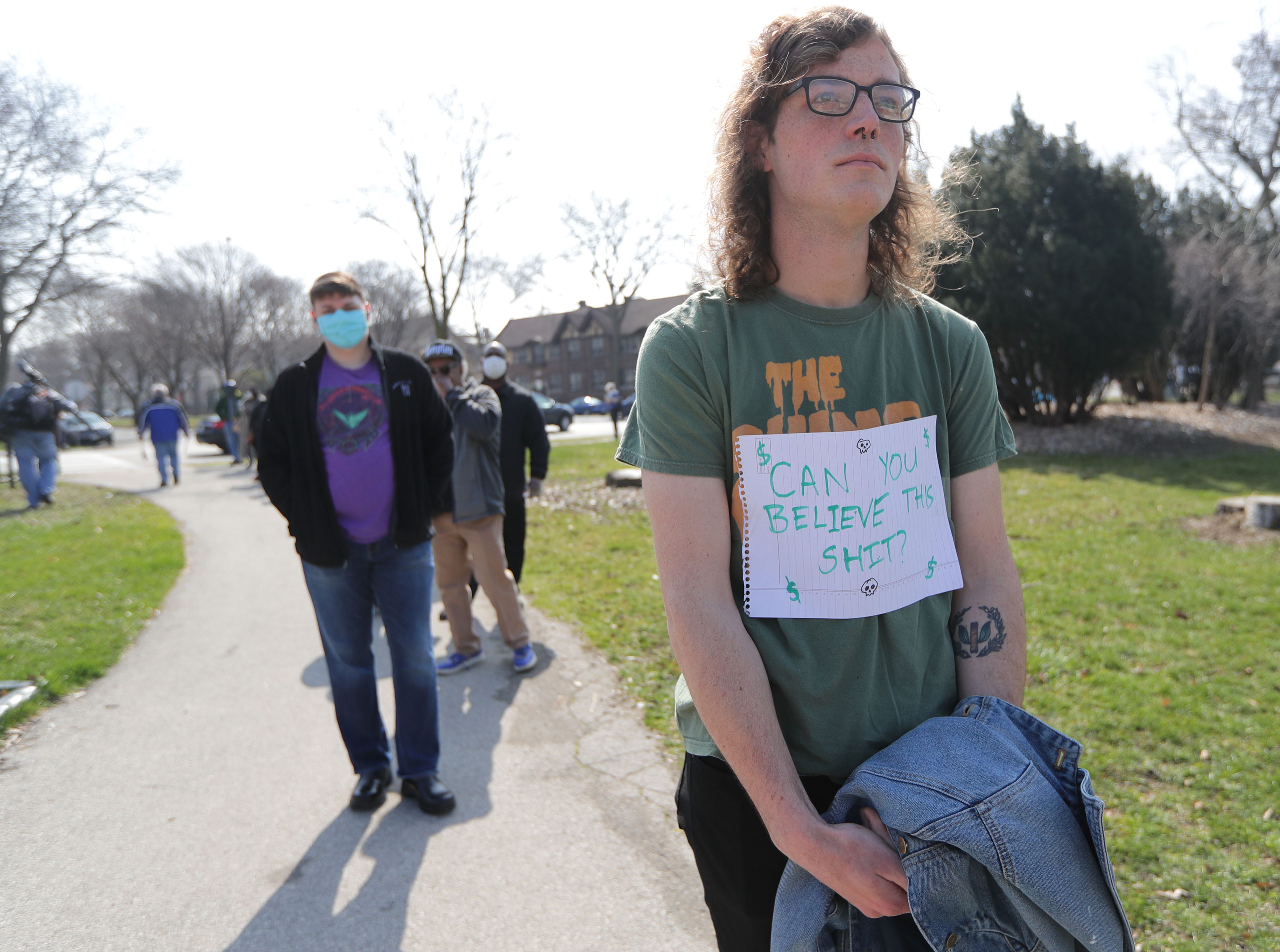
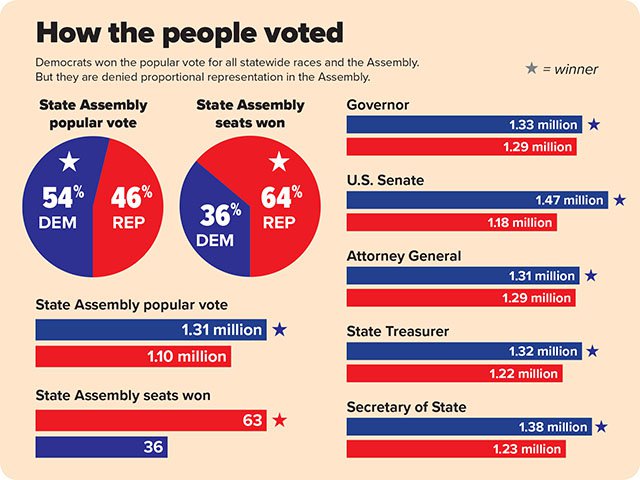




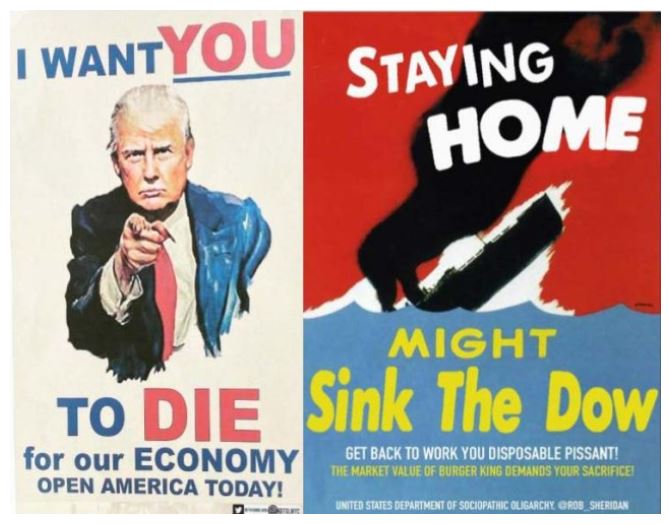


 The Weekly Sift