Events conspired to create three featured posts this week.
Super Tuesday is tomorrow, which means it’s time for me to vote in the Massachusetts primary. (I moved from New Hampshire a little over a year ago, so I’m no longer one of the elite first-in-the-nation voters. I mourn my loss of status.) I’ve already promised an article to explain my vote, and I’ll ruin the suspense by telling you now that it’s going to be for Elizabeth Warren. Rather than the usual kind of endorsement column, though, I’ll discuss how to think through a primary vote in general, which might lead you to a different decision in your state than I made in mine.
While I was writing that, one section exploded into so much material that it distracted from my main point of endorsing Warren. That’s the section on electability, which is a way more complicated concept than most pundits would have you believe. Some will tell that it’s all about swing voters, and others that it’s all about raising turnout. A third group claims that the question is unfathomable, so you shouldn’t consider it at all.
I come around to the idea that there is something to think about, but that it’s foolish to be too dogmatic about your conclusions, whatever they are. By anointing one candidate as more electable than the others, you’re placing a bet, not proving a theorem.
So anyway, the second featured article is about electability.
Then there’s the coronavirus, which was taking over the weekly summary. That eventually demanded its own article, which betrays its origin inside the weekly summary: It’s more a collection of notes than a single coherent essay.
I expect the three featured articles to come out in reverse order: the virus article first, by about 9 EST. Then electability, around 11, and the Warren endorsement by noon. The weekly summary should be fairly short and come out by 1.
Sanders’ win in the Nevada caucuses was impressive. He was a clear winner among Latino voters, a demographic that wasn’t behind him in 2016. Sanders is now the clear front-runner, partly due to his own strength and partly due to the fracturing of his opposition. Even if you wanted to vote for the stop-Bernie candidate (and from my comment stream, I can tell that a lot of you don’t), who would that be?
Now that I’m a Massachusetts voter, I have to make my choice on March 3. I’m still undecided, but I promise to explain my thinking next week, the day before I vote.
Right now I’m wondering if I’ve given Bernie a fair shake. I’ve been rooting against him, and I’m not sure whether that’s for justifiable reasons, or whether it’s because I’m still annoyed from 2016. In 2016, I was part of his big majority in the New Hampshire primary, but I was voting more to send a message to Hillary than because I seriously intended to make Bernie president. As the campaign wore on, I came to regret that vote.
Unlike some people who voted for Hillary against Trump, I don’t fault Bernie for not campaigning harder for her in the fall. I think he did as much as could have been reasonably expected. But I thought a lot of his late-primary-campaign criticism of Hillary was unfair, that it continued well past the point where he had a chance to win, and that it set up Trump’s “crooked Hillary” rhetoric. It was irresponsible, and he should have known better.
That said, this is one of those situations where turnabout is not fair play. As Bernie becomes the front-runner, I think we all should bear in mind that he may well become the nominee. And while I’m all for every candidate’s and every voter’s right to criticize, I think we need to try very hard to criticize fairly. For example, I think it’s fine to say that Bernie should release his medical records, or to ask how his plans will be paid for, or how he will get them through Congress. But I don’t think it’s fair to call him a “communist” or to lie about what his healthcare plan will do. Trump will want to do that in the fall, if Bernie is nominated, and his rhetoric will sound more convincing if it can be prefaced with “Even Democrats say …”
On electability, I don’t know what to think. Polls consistently show Sanders running as well or better against Trump than the other Democrats do — worse than Biden in some polls, but never by much. At the same time, I have yet to meet a Republican who’s afraid of facing Bernie in the fall. Many of them are actively rooting for him, including (it seems) Trump. Maybe they’re just stupid, or maybe they have some insight.
and the continuing spread of the Chinese virus
It’s now known as COVID-19. Outbreaks are now happening in Italy and South Korea, which might imply that they will eventually happen everywhere.
but you should pay more attention to Trump’s acting DNI
I also discussed this in “Accelerating Corruption and Autocracy“. Few things are could be worse than a Director of National Intelligence who tells the CIA what the President wants to hear them say, rather than tells the President what the best experts think is true.
and you also might be interested in …
As I write this morning, the stock market is plunging. The Dow is about 1300 points below the peak it hit a week or two ago. I don’t think the fall is Trump’s fault any more than the rise was, but if you live by the sword you die by the sword.
I don’t know how good her chances are, but I’ve got to root for Amy McGrath to beat Mitch McConnell. This online ad is from last summer, but it’s still worth looking at.
Remember the original justification for the assassination of Iranian General Qassim Soleimani? Supposedly it prevented one or more “imminent attacks“.
Well, never mind. The White House has sent Congress its official explanation for the raid, and the imminent-attack justification has vanished. Now the purpose of the assassination was to “deter future attacks”.
Without the threat of an imminent attack, there was no reason the administration couldn’t have consulted Congress, as envisioned in the War Powers Act. Instead, the report makes the argument that Congress intended the pre-Iraq-invasion Authorization for the Use of Military Force to include Iran, which is patently absurd.
In short, the Soleimani attack was an illegal assassination, and the President’s initial explanation of it was a lie.
Researchers at Scripps Oceanography Institute offer some good news on climate change: One of the tipping-point disaster scenarios is less likely than previously thought.
A long-feared scenario in which global warming causes Arctic permafrost to melt and release enough greenhouse gas to accelerate warming and cause catastrophe probably won’t happen.
and let’s close with something ambiguous
Sometimes it’s hard to tell who a satirist is satirizing. ABC News reported:
Pigeons wearing MAGA hats and Donald Trump wigs have been released by a shadowy protest group calling themselves P.U.T.I.N. – Pigeons United to Interfere Now — across the city of Las Vegas, Nevada
When I saw that, my first thought (after some concern about the pigeons) was “What a clever protest against Trump!” Plainly, the stunt casts MAGA-hatters as pigeons — stupid and gullible. When I heard the group was calling itself PUTIN, that cinched it.
The pigeon release was done as an “aerial protest piece in response to the arrival of the 2020 Democratic debate,” the group said. Six Democratic presidential candidates will debate Wednesday night in Las Vegas.
“The release date was also coordinated to serve as a gesture of support and loyalty to President Trump,” said a group member who goes by the alias Coo Hand Luke.
Or maybe Coo Hand Luke is spoofing the local reporter, pretending to be precisely the kind pigeon-like Trumpist the birds represent. Or not. Maybe the satire is too subtle for any of us to grasp.
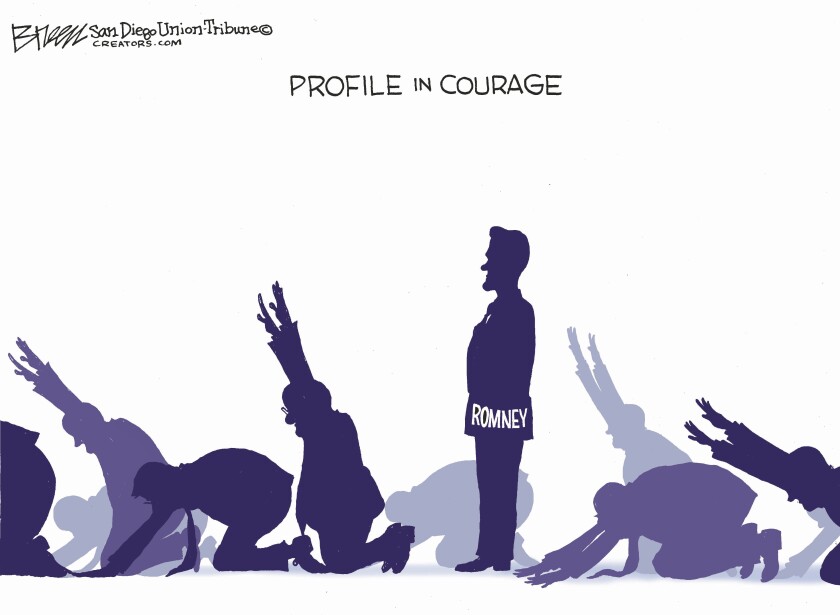
But the authoritarian drift has definitely accelerated in the three weeks since every Senate Republican but Mitt Romney voted to let Donald Trump remain in office, despite proven abuses of power. As Atlantic’s Adam Serwer puts it, Trump’s acquittal marked “the end of the Trump administration, and the first day of the would-be Trump Regime.” Think about what we’ve seen since the Senate’s abdication of its constitutional role in controlling would-be autocrats.
A purge of “disloyal” officials. The disloyalty here is not to the United States, but to the person of Donald Trump.
Lt. Colonel Alexander Vindman, for example, has behaved exactly as an officer should: When something about Trump’s Ukraine call seemed odd to him, he reported his concerns up the chain of command. When Congress subpoenaed him, he appeared and testified honestly. For this, he was not just fired, but escorted out of the White House like a criminal. His twin brother, who played no role in the impeachment hearings, was also fired just out of vindictiveness. (Fortunately, the Army has refused Trump’s suggestion that Lt. Col. Vindman be investigated and disciplined.)
The purge is expected to continue throughout the administration. (See below for purges at the Office of the Director of National Intelligence.)
Interference in the Stone trial. It’s important to understand what Roger Stone (along with Paul Manafort and Michael Flynn) represents: the last loose ends in the obstruction of the Mueller investigation. (One of the obstruction-of-justice claims explored in Part II of the Mueller Report was that Trump engaged in witness-tampering with Manafort, including hinting at a pardon.)
Stone was the Trump campaign’s link to WikiLeaks and from there to the Russians who hacked Democratic computers. Manafort was the campaign’s link to Russian oligarch Oleg Deripaska, and from there to Russian intelligence. Flynn’s relationship with Russian Ambassador Segei Kislyak (in particular why Flynn and Jared Kushner approached him about creating a “back channel” to Russia) has never been explained. These men are not just Trump’s “friends”, they’re his accomplices.
In the Stone case, Trump (through Bill Barr) reversed the prosecutors’ sentencing recommendation (causing all four prosecutors to withdraw from the case rather than participate in political corruption of the processes of justice), attacked the judge, and attacked a juror. He didn’t stop Judge Amy Berman from sentencing Stone to 40 months in prison, but he did set up his justification for a post-election pardon, along with pardons of Flynn and Manafort. This would send a clear message to anyone else who could testify against Trump: Keep your mouth shut and the boss will take care of you.
Notice what has been missing from Trump’s defense of Stone: acknowledgment of the fact that he’s guilty. Stone lied to Congress to protect Trump, and he threatened a witness who could expose that lie. A jury of his peers unanimously found that Stone’s guilt had been proved beyond a reasonable doubt.
Pardons to maintain a corrupt network. Jeffrey Toobin pointed out the authoritarian flavor of the other Tuesday pardons:
Authoritarianism is usually associated with a punitive spirit—a leader who prosecutes and incarcerates his enemies. But there is another side to this leadership style. Authoritarians also dispense largesse, but they do it by their own whims, rather than pursuant to any system or legal rule. The point of authoritarianism is to concentrate power in the ruler, so the world knows that all actions, good and bad, harsh and generous, come from a single source. …
In this era of mass incarceration, many people deserve pardons and commutations, but this is not the way to go about it. All Trump has done is to prove that he can reward his friends and his friends’ friends.
Trump’s pardons did not percolate up through the Justice Department’s Pardon Attorney. They all had some personal connection to Trump or his circle of friends and donors. Blagojevich, for example, was a contestant on “Celebrity Apprentice”, and his wife pleaded for his pardon on Fox News shows Trump is known to watch. (It’s worth noting that there is no doubt about Blagojevich’s guilt. We have the tapes.) Bernard Kerik was a crony of Rudy Giuliani.
All the beneficiaries of Trump’s mercy were convicted of the kinds of white-collar crimes Trump’s people might commit themselves. That was the point, Sarah Chayes (who covered Afghanistan for more than a decade) explained in “This Is How Kleptocracies Work“:
In return for this torrent of cash and favors and subservience, those at the top of kleptocratic networks owe something precious downwards. They owe their subordinates impunity from legal repercussions. That is the other half of the bargain, without which the whole system collapses.
That’s why moves like Trump’s have to be advertised. … Trump’s clemency came not at the end of his time in office, as is sometimes the case with such favors bestowed on cronies and swindlers, but well before that—indeed, ahead of an election in which he is running. The gesture was not a guilty half-secret, but a promise. It was meant to show that the guarantee of impunity for choice members of America’s corrupt networks is an ongoing principle.
Threats to the rule of law. The Justice Department had retained some measure of independence until Bill Barr became attorney general. Trump’s first attorney general, Jeff Sessions, shared Trump’s policy goals, but respected internal procedures for maintaining the rule of law. For example, he recused himself from the Russia investigation because of his own connection to the Trump campaign — a move which angered Trump and for which Sessions was never forgiven.
But Barr has made a number of moves in the Justice Department to shield Trump from investigation and intimidate his enemies. The best summary I’ve found is by Marcy Wheeler:
The Stormy Daniels hush-money investigation sent Michael Cohen to prison, but all the follow-up evaporated after Barr took over at DoJ. Cohen claimed he worked under Trump’s instructions, and that the Trump Organization reimbursed his illegal campaign contribution. But those leads have been dropped.
SDNY seems to be slow-walking its investigation into Rudy Giuliani’s Ukraine shennanigans, now that a new US attorney has been appointed. The head of the neighboring Eastern District of New York has been put in charge of Ukraine-related investigations that SDNY had been pursuing.
A new US attorney in D.C. has led to a “review” of investigations there, including cases involving Michael Flynn and Erik Prince.
Barr assigned Connecticut US attorney John Durham to investigate the origins of the Trump/Russia investigation. Anyone tempted to investigate further Trump wrongdoing now knows that they risk becoming targets themselves.
Barr tried to stop the Ukraine whistleblower’s account from reaching Congress, and did not recuse himself even though he is mentioned in the complaint.
Tightening control of the intelligence services. Like the Justice Department, the intelligence services maintained their independence when Dan Coates was Director of National Intelligence, and the subsequent acting heads had failed to bring them under control.
As a result, occasionally conclusions unfavorable to Trump have made it to Congress or the American public: Russia did help elect Trump in 2016. North Korea is not denuclearizing. ISIS is not defeated. Trump may not like to hear such facts, or to allow the American public to know them, but the whole point of having intelligence services is to correct the leadership’s misperceptions.
The most recent example was a February 13 briefing to House leaders of both parties, in which Shelby Pierson, an aide to then-acting DNI Joseph Maguire, reported that Russia was repeating its 2016 interference in the 2020 election process, again for the purpose of electing Trump.
You might expect an American president to react to such news by giving Vladimir Putin a stern warning to back off — as Bernie Sanders did when told that the Russians might be working to help him win the Democratic nomination. But no: Trump welcomed Russian help in 2016, sought to extort Ukrainian help with the 2020 election, and seems to welcome further Russian help now.
The intelligence report did make him angry, but at the intelligence services. He dismissed Maguire and replaced him with Richard Grenell, who has no intelligence background whatsoever. In a Washington Post column, retired Admiral William McRaven lamented Maguire’s fate:
in this administration, good men and women don’t last long.
In a different article, the WaPo quotes a former director of the National Counterterrorism Center:
Nothing in Grenell’s background suggests that he has the skill set or the experience to be an effective leader of the intelligence community. … His chief attribute seems to be that President Trump views him as unfailingly loyal.
As Ambassador to Germany (a position he still holds), Grenell was noted for his identification with right-wing parties like Alternative for Germany. (US ambassadors typically avoid such partisan interference in the politics of our NATO allies.) The German news magazine Der Spiegel couldn’t get an interview with Grenell, so it interviewed more than 30 sources including “numerous American and German diplomats, cabinet members, lawmakers, high-ranking officials, lobbyists and think tank experts.”
Almost all of these sources paint an unflattering portrait of the ambassador, one remarkably similar to Donald Trump, the man who sent him to Berlin. A majority of them describe Grenell as a vain, narcissistic person who dishes out aggressively, but can barely handle criticism. … They also say Grenell knows little about Germany and Europe, that he ignores most of the dossiers his colleagues at the embassy write for him, and that his knowledge of the subject matter is superficial.
Grenell in turn has ousted the #2 intelligence official, Andrew Hallman, replacing him with Devin Nunes staffer Kashyap Patel, who is known for promoting pro-Trump conspiracy theories. More personnel changes are expected.
The NYT reports that Grenell has “requested the intelligence behind the classified briefing last week before the House Intelligence Committee where officials told lawmakers that Russia was interfering in November’s presidential election and that President Vladimir V. Putin of Russia favored President Trump’s re-election”.
This move recalls how Vice President Cheney abused intelligence during the Bush administration: By “stovepiping” raw intelligence to his own office rather than letting it pass through the analytic process, Cheney was able to manipulate conclusions that favored the policies he preferred, most notably the invasion of Iraq.
Summing up. If you don’t follow US government closely, you may not see the problem. After all, the President is in charge. Why shouldn’t the people under him do what he wants? Isn’t that how it always works?
It isn’t, and there are good reasons why it doesn’t. One problem — you might fairly say it was THE problem — the Founders were trying to solve when they wrote the Constitution was how to control executive power. Unfettered executive power quickly becomes dictatorship, and the rights of the People are then only as safe as the Dictator allows them to be.
For that reason, power was divided among the three branches of government, so that Congress and the Courts would be able to hold the President in check. Congress got the power of the purse and the power of oversight, both of which are now in jeopardy.
Subsequent to the Founding, executive power has also been controlled through the professionalization of the various departments, each of which balances political control by the President with its own inherent mission. So the Justice Department takes its policy from the President, but pursues the departmental mission of justice. The intelligence services try to find truth, the EPA protects the environment, the CDC defends public health, the military safeguards our country and its allies, the Federal Reserve balances economic growth against the threat of inflation, and so on. For the most part, presidents have known when to keep their hands off.
Until Trump. More and more, Trump makes everything political. There is no truth other than the story Trump wants to tell. There is no mission other than what Trump wants done.
Students of authoritarianism have been warning us about his dangerous tendencies since he first began campaigning. But, as Rachel Maddow noted Friday night, we are well past the time for warnings. “The dark days are not ‘coming’,” she said. “The dark days are here.”
The last contested Democratic convention nominated Adlai Stevenson in 1952.
The results of the early Democratic primaries and caucuses have been mixed: Bernie Sanders has replaced Joe Biden as the front-runner, but the vote remains split among many candidates, nearly all of whom are continuing to campaign at least through Super Tuesday on March 3. Unlike the Republicans in 2016, Democratic primaries all award delegates proportionately, and there are no winner-take-all contests. So it’s a growing possibility that come July no candidate will arrive at the Milwaukee Convention with a majority of delegates.
If that happens, then it will be up to the Convention to make the decision, i.e., to settle on a candidate without clear instructions from the primary voters.
A number of commentators (Chris Hayes, for one) have painted this possibility as a disaster, particularly if the candidate who comes to Milwaukee with the plurality of delegates isn’t nominated. Bernie’s supporters in particular — who picture their candidate as the one most likely to come in with a lead — are already talking about how the nomination will be “stolen” from him if anyone else gets it.
I’m not seeing it. Whether or not the convention’s choice seems legitimate depends on the scenario, and in a number of the scenarios I would regard as legitimate, the candidate who comes in with a lead doesn’t leave as the nominee.
The delegates. Before getting into that, let’s make sure we understand the process. According to the Green Papers, the primaries and caucuses will choose 3979 delegates, and only those delegates get to vote on the first ballot. If that first ballot doesn’t result in a majority choice, 771 “superdelegates” are added to the mix. Superdelegates are party officials, Democrats who hold prominent offices (like governors and members of Congress), various other distinguished Democrats (Barack Obama, for one), and representatives of key Democratic constituencies (like labor leaders).
So a first-ballot majority is 1990 delegates. Any candidate who gets that many delegates out of the primaries and caucuses is the winner. On the second and all subsequent ballots, a majority is 2376.
Scenario I. A clear leader with a near miss. One possibility is that some candidate is the clear leader and falls just slightly short of that first-ballot victory. Rather than 1990 delegates, Bernie or Bloomberg or somebody else [1] winds up with, say, 1950 delegates, and the rest are scattered among half a dozen candidates, none of whom have more than a thousand. Similarly, national polls show the front-runner to be the clear leader, perhaps with majority support among Democrats or Democratic-leaning voters. The front-runner also polls as well or better than any other candidate in head-to-head match-ups with Trump.
In that case, I agree with Chris Hayes: Something untoward would have to happen to deny that candidate the nomination, and his or her supporters would be right to feel cheated. In particular, any scenario in which a majority of elected delegates forms after the first ballot (as might happen when other candidates drop out) but gets reversed by the superdelegates, would be an anti-democratic travesty.
Unlike the Bernie supporters who imagine a stop-at-nothing conspiracy against them, though, I regard that scenario as extremely unlikely. The superdelegates are there to rescue the party from a hopeless deadlock, not to overrule the voters. (It’s worth remembering that in 2016, when superdelegates could vote on the first ballot, Bernie’s campaign was arguing that they should overrule the voters. Hillary was well ahead in primary votes and elected delegates, but the Sanders campaign argued that if they finished strong, the superdelegates should respect their momentum and swing the nomination to Bernie.)
But there are other scenarios.
Scenario II. A clear delegate leader suffering voters’ remorse. A lot can happen between now and July, some of which might cause voters to change their minds after they cast their primary ballots. So imagine a delegate split like Scenario I, but also that the polls have drastically changed due to some unanticipated event that has damaged the front-runner: Bernie has another heart attack, or Biden stumbles over his words in a way that implies dementia, or some lurid sex scandal reminds Buttigieg voters of all the bad gay stereotypes.
In this scenario, the front-runner in delegates is no longer the front-runner in the polls, and running him or her against Trump is like carrying out a suicide pact.
At that point, I think we all say “Thank God for superdelegates” and prepare to unite behind somebody else.
Even then, though, it matters who Somebody Else is. The primary voters may have changed their minds about the front-runner, but there’s no reason to think they’ve changed their entire political philosophies. So the nominee should be someone who represents the voters who supported the front-runner. So replacing Sanders with, say, Warren would be legitimate in a way that replacing him with Bloomberg would not be. Ditto for replacing Biden with Klobuchar rather than Sanders.
In other words, the nomination shouldn’t automatically fall to the second-place candidate if the front-runner implodes. In this scenario it might even be legitimate to nominate a candidate who wasn’t previously running at all, but who represented a compromise between the progressive and moderate factions: Sherrod Brown, for example.
Scenario III. Several significant candidates. What if the candidate in second place is closer to the leader than the leader is to a majority? Say, for example, that three candidates are splitting the delegates 40-35-25.
In that case, I don’t think the Convention has any obligation to nominate the 40% candidate, particularly if the second and third-place candidates are similar to each other and different from the front-runner. In that case, nominating the front-runner might be going against the primary voters.
For example, imagine Sanders is leading Biden and Bloomberg, or Buttigieg is leading Warren and Sanders. In either of those scenarios, one faction of the party (moderate or progressive) represents the majority, but the front-runner comes from the other faction. Imagine that on the second ballot, the third-place candidate drops out, and his or her delegates mostly vote for the second-place candidate, who becomes the nominee. Those delegates are arguably representing the voters who sent them to the convention, so I don’t think there’s anything to complain about.
Why is this happening? Not since 1952 has a convention failed to produce a first-ballot nominee. (The 1976 Republican Convention, though, was so closely split between sitting President Gerald Ford and challenger Ronald Reagan that there was some suspense.) So why does it seem likely to happen now?
For reasons that are, by and large, good. In the past, late primaries have often been unrepresentative winner-take-all affairs, which generally allowed the leading candidate’s delegate count to go over the top. Also, campaigns were funded more by big donors who wanted a return on their investment, and so were unwilling to keep supporting a candidate with little chance to win. Now campaigns are funded more by small donors who remain loyal even if early results are disappointing (or by billionaires like Bloomberg and Steyer, who remain loyal to themselves). As a result, we have more candidates surviving deeper into the primary calendar.
If you imagine those two factors continuing into the future, we may have to get used to multi-ballot conventions again. They didn’t used to be controversial. (When I was first getting interested in politics as a teen-ager in the 1960s, contested conventions were recent enough that they were a regular feature of political novels like Fletcher Knebel’s Convention, or of movies like The Best Man.)
Abraham Lincoln, for example, was well behind William Seward (173.5 votes to 102) on the first ballot of the 1860 Republican Convention, but won on the fourth ballot. The 1932 Democratic Convention required a 2/3 supermajority, and it took four ballots for FDR to get there. In 1924 Democrats needed 103 ballots to nominate John Davis, who lost to Calvin Coolidge in the general election.
Not necessarily “brokered”. In the old days, conventions were dominated by well-established power brokers like the leaders of New York’s Tammany Hall and other big-city machines. Corruption was rampant and deals were cut without much concern for what the voters wanted. The early primaries were viewed as field tests of a candidate’s popularity, and weren’t central to the nominating process. It wasn’t until JFK’s 1960 campaign that primaries rose to prominence. (Lyndon Johnson went to the 1960 Convention as Kennedy’s main challenger, but had not campaigned in any primaries.) Nominations were decided in “smoke-filled rooms” where the power brokers cut deals.
As a result, we still refer to a convention without a first-ballot winner as a “brokered convention”, a pejorative term implying that some dirty deal is happening. But that needn’t be the case. A convention without a clear primary winner could instead function like a ranked-choice caucus, where delegates vote for their second or third choice when their first-choice candidate drops out.
There’s nothing unseemly about such a process, even if the candidate who enters the convention with a lead doesn’t leave with the nomination.
[1] In judging whether a scenario is fair, I think it’s important to imagine it happening to several candidates — not just to the one you particularly like or dislike. If it would be fair to deny Bloomberg the nomination in certain circumstances, then it would be fair to deny Bernie in similar circumstances. And vice versa.
Mornings like this remind me why I do this blog weekly: Two weeks is a lot to face all at once.
If you’re curious about where I was last week, I went down to Florida to give a talk I call “The Spirit of Democracy”. You can find an earlier version of it here. The Florida version had to be updated for recent developments, so I’ll probably post the text of that talk later this week on my Free and Responsible Search blog.
Anyway, the drift towards autocracy that we’ve been worrying about since Trump got elected has accelerated since the Republican Senate majority assured him that nothing he could possibly do would be impeachable. You can’t really call it a “drift” any more. It’s more of a direct movement. So: the purge of “disloyal” officials — i.e., people more loyal to America than to Trump — has continued. It started with the witnesses who testified in the House impeachment hearings, has extended to the top people at National Intelligence, and is threatening to spread through the whole administration. (As Admiral McRaven commented, “In this administration, good men and women don’t last long.”) We found out more of the ways that Bill Barr has corrupted the Justice Department. A report that Russia is again interfering in our politics in Trump’s favor raised the President’s anger — at the people reporting it, not at the Russians.
That will be discussed in one featured post, which I haven’t titled yet.
The other featured post will discuss the possibility of a “brokered” Democratic convention — a pejorative term I dislike, since it conjures up images of smoke-filled rooms where anonymous power brokers cook up dirty deals. I think we need to get comfortable with conventions that make decisions rather than just anoint a nominee, because the processes that make things more democratic are also making it harder for a candidate to assemble a majority of the elected delegates. If there isn’t a “brokered” convention this year, there will be in some future cycle. So I raise the question “What’s Wrong With a Decision-Making Convention?”
The weekly summary also covers the nomination process, where Joe Biden has faded and Bernie Sanders has emerged as the new front-runner. I need to make my own voting decision by Super Tuesday, and I’m not there yet, but I’ll muse about it a little. The coronavirus has only gotten scarier in the last two weeks. The Trump regime admitted that its assassination of Qassim Soleimani didn’t really have anything to do with an “imminent threat”. And a few other things happened, which I’ll try to get to.
Here’s my schedule. The convention article will post first, between 8 and 9 EST. Then the article about the recent moves towards autocracy around 11, and then the weekly summary by (I hope) 1.
No Sift next week. The next new posts will appear February 24.
With malice toward none, with charity for all, with firmness in the right as God gives us to see the right, let us strive on to finish the work we are in, to bind up the nation’s wounds, to care for him who shall have borne the battle and for his widow and his orphan, to do all which may achieve and cherish a just and lasting peace among ourselves and with all nations.
– Abraham Lincoln
2nd Inaugural Address (3-4-1865)
As everybody knows, my family, our great country, and your President, have been put through a terrible ordeal by some very dishonest and corrupt people. They have done everything possible to destroy us, and by so doing, very badly hurt our nation. They know what they are doing is wrong, but they put themselves far ahead of our great country.
– Donald Trump
at the National Prayer Breakfast (2-6-2020)
This week’s featured post is “Let’s Talk Each Other Down“. Think of it as a counterweight to all the depressing or panic-worthy stuff in this summary.
This week everybody was talking about Iowa and New Hampshire
OK, Iowa was a mess. But there’s a reliable paper trail, so there’s good reason to believe the result. Tomorrow is the New Hampshire primary, which I am amazed to discover I have not covered at all. I have not been to a single candidate event this year, despite living just over the border in Massachusetts.
To a large extent that’s because the main thing that matters to me is electing Not Trump. I have likes and opinions, but I’m all-in for whoever gets the nomination. Anyway, here’s one comment about each major contender:
Biden’s fourth-place finish in Iowa was a huge disappointment, and he doesn’t look to be running well in NH either. He’s counting on his black support to get him back in the race in South Carolina. I’ll bet Kamala Harris is kicking herself for getting out, because there is no obvious inheritor of Biden’s black support if he fails.
Bloomberg is running such an unorthodox campaign that it’s hard to know whether his strategy is working or not. But he gets Trump’s goat better than any other candidate, and that has to count for something.
Buttigieg was the biggest beneficiary of Iowa. Sanders won the popular vote, but Buttigieg was the big surprise and wound up with the most delegates. His NH polls shot up afterwards, largely, I think, because his Iowa performance gave people who already like him a reason to take his candidacy seriously. (Likeability is one of those nebulous concepts that is easy to abuse and hides a bunch of prejudices. But for what it’s worth, Pete is the candidate I feel the most affection for. That doesn’t necessarily mean I plan to vote for him, though.) It’s hard to tell whether this week’s debate blunted his momentum or not.
Klobuchar is the tortoise in this race. She also got on the map in Iowa, and is probably the second choice of a lot of Biden’s white supporters. She’s polling near zero in South Carolina, though, so she needs to do well in New Hampshire to stay in the race.
Sanders got more first-round votes than any other candidate in Iowa, but his case for beating Trump didn’t do so well. The theory of how Sanders wins in November is that (even though he may lose some voters in the center) he raises turnout by inspiring a lot of new voters to come to the polls. But turnout in Iowa was not much different from 2016, and much lower than 2008, when Obama really did inspire people. He needs a win in NH, but he also needs to win the right way, with a big turnout.
Warren is the president I would appoint, if the Universe would grant me that power. She’s got to be disappointed in her distant third-place finish in Iowa, and recent polls have her running third in NH as well. She was briefly the front-runner last fall, but it’s hard to see where her break-out state is.
Josh Marshall makes a prediction of how Trump will smear Bernie, should he become the front-runner. He also pre-debunks the smear.
and the final impeachment trial result
The biggest surprise of the Senate vote was that Trump’s acquittal wasn’t a party-line vote, and that the lone defector was a Republican, not a Democrat. After lots of speculation that Joe Manchin or some other red-state Democrat would find a way to excuse Trump, the Democrats held firm, and Mitt Romney found his conscience.
I’ve been a bit appalled at how uncharitable many of my social media friends have been, trying to see Romney’s choice as some kind of 2024 calculation. That seems really unlikely to me. Mitt is smart enough to realize that no matter how badly Trump blows up, nobody is going to get the 2024 Republican nomination by being anti-Trump. Assuming Trump even bothers to observe the term-limit rule — I mean, the Constitution is just a piece of paper — the next Republican nominee is either a Trump successor (Pence? Ivanka? Don Jr.?) or somebody who has stayed conveniently off the national stage (like Paul Ryan or a governor).
I think Mitt is at a point in his career where he sees History staring him in the face, and doesn’t want to be remembered as Trump’s accomplice. I’m amazed that more late-in-their-careers Republicans haven’t looked at things that way. Lamar Alexander, for example, has just guaranteed that none of the things he’s proud of will be remembered. The headline of his obituary will be that he shut down the witnesses to Trump’s crimes.
Mitt’s vote has provided contrast for the cowardice of the other Republican senators. We can hope other Republicans will be emboldened to take a stand as well.
and reprisals against those involved in Trump’s impeachment
Trump, by contrast, was long-winded and dishonest, and took no responsibility for the acts that started this whole national trauma.
Trump repeatedly called Democrats involved in the impeachment “evil,” “corrupt” and “vicious and mean.” He railed against the Russian investigation, former FBI director James B. Comey, and special counsel Robert S. Mueller III, adding, “It was all bullshit.”
He seemed poised for revenge, and soon began to take it. Donald Jr. made the threat explicit:
Allow me a moment to thank—and this may be a bit of a surprise—Adam Schiff. Were it not for his crack investigation skills, @realDonaldTrump might have had a tougher time unearthing who all needed to be fired. Thanks, Adam!
After the show trial, the purge. Ambassador Gordon Sondland lost his job, as did Lt. Col. Alexander Vindman at the National Security Council. Somewhat stranger, Vindman’s brother Yevgeny was also fired from his job as an NSC lawyer. But that also fits the Stalinist pattern: Once you’ve been judged to be an Enemy of the People, your relatives are also suspect. That’s probably why Mitt Romney’s niece, RNC Chair Ronna McDaniel, has been so quick to declare her fealty to the regime.
Some have suggested that the outcry sparked by Friday’s reprisals was overblown. After all, any president is, on some level, entitled to surround himself at the White House and be represented overseas by those he trusts. But the question raised by Friday’s purge is: trusts to do what? And that’s where these actions raise serious concerns for American democracy: because Trump increasingly wants an executive branch that’ll serve not the United States of America but Donald J. Trump personally.
Trump was punishing key witnesses for doing precisely what the United States Congress swore them in to do: explain what they’d seen and heard.
… [E]xploitation of America’s diplomatic, military, and law enforcement mechanisms was the very usurpation of power that got Trump impeached in the first place. At the heart of the Ukraine extortion scheme was Trump and his personal lawyer’s appropriation of those mechanisms for political benefit and to the detriment of the country’s national security interests. Having survived impeachment, Trump now seeks to accelerate the redirection of America’s instruments of power into his own instruments of power.
Trump is not the only Republican engaged in post-impeachment reprisals. During the trial, Senator Rand Paul on numerous occasions named someone he claimed was the whistleblower whose complaint started the Ukraine investigation.
Senator Paul’s actions constituted a retaliatory outing of a government witness—which is criminal conduct. Federal criminal law prohibits the obstruction of justice, and provides that “[w]hoever knowingly, with the intent to retaliate, takes any action harmful to any person, including interference with the lawful employment or livelihood of any person, for providing to a law enforcement officer any truthful information relating to the commission or possible commission of any Federal offense, shall be fined under this title or imprisoned not more than 10 years, or both.”
Paul’s outing of the whistleblower occurred not just on the floor of the Senate (where it might be constitutionally protected) but also outside the Senate and on Twitter.
If Senator Paul goes unpunished, this will be the kind of weakening of the law typical of the descent towards fascism. In the late stages of fascism, criticism of the Leader is punished by the State directly. But in earlier stages, critics simply lose the protection of the laws and can be attacked by followers of the Leader without consequence. When the Brownshirts come to beat them up, the police watch and do nothing.
Speaking of brownshirts: Immediately after Romney’s guilty vote, CPAC chair Matt Schlapp disinvited him from the flagship conservative convention. Yesterday, Schlapp said “I would actually be afraid for his physical safety” if he showed up.
At the end of the State of the Union address, Nancy Pelosi very decisively ripped up Trump’s speech. For some reason, this display of disrespect resounded across right-wing media, as if this were most uncivil thing to happen in months. I agree with Trae Crowder, a.k.a. the Liberal Redneck:
The level of disrespect she showed by, like, ripping up the president’s speech at the State of the Union like that — it’s nowhere near disrespectful enough. … This is the most disrespectful motherfucker on Planet Earth.
Medals of Freedom are essentially lifetime achievement awards that presidents give to people who make Americans proud. Usually that means other Americans, but sometimes a medal goes to a foreigner (Nelson Mandela, Stephen Hawking) who just makes us proud to be human.
Presidents have complete discretion to pick whoever they want, and for the most part they’ve done a good job. Over the years MoF awards have gone to authors like John Steinbeck and Harper Lee, artists like Georgia O’Keefe and Andrew Wyeth, musicians like Count Basie and Bob Dylan, and businessmen like Henry Ford II and IBM-founder Tom Watson. Computer-programming pioneer Grace Hopper got one, and so did photographer Ansel Adams. Holocaust survivor Elie Wiesel got one for being the conscience of the world.
In baseball’s Hall of Fame not everyone is Babe Ruth, and the same thing happens with Medals of Freedom. They’ve also gone to people who were famous and deserving of respect but not legendary, like actor Tom Hanks, Western-genre author Louis L’Amour, and Saturday Night Live creator Lorne Michaels. It happens. Presidents have their own idiosyncratic tastes. Some awards looked fine at the time, but shameful in retrospect, like President Bush giving one to Bill Cosby in 2002.
Well, Tuesday during the State of the Union address, President Trump awarded one to Rush Limbaugh. Limbaugh has been a purveyor of hate and lies for more than 30 years. Who can forget his branding of Georgetown student Sandra Fluke as a “slut” and a “prostitute” for the unpardonable sin of defending ObamaCare’s contraception mandate?
So, Ms. Fluke and the rest of you feminazis, here’s the deal. If we are going to pay for your contraceptives, and thus pay for you to have sex, we want something for it, and I’ll tell you what it is. We want you to post the videos online so we can all watch.
In short, if I were Sidney Poitier or Buzz Aldrin or some other living recipient of the Medal, I’d be looking at that award with considerably less pride than I did a week ago.
This is some of the hidden damage Trump is doing to America. Even if we get rid of him in November, it will take a while to recover the value of things he has desecrated.
and you also might be interested in …
David Fahrenthold has found yet another way that Trump is profiteering off the presidency: He’s making the Secret Service stay at his properties, and then overcharging them.
President Trump’s company charges the Secret Service for the rooms agents use while protecting him at his luxury properties — billing U.S. taxpayers at rates as high as $650 per night, according to federal records and people who have seen receipts. …
Are you surprised to learn that’s a lie? However, the really scandalous part of the story is the extent to which Trump has kept the public in the dark about his self-dealing.
The Secret Service is required to tell Congress twice a year about what it spends to protect Trump at his properties. But since 2016, it has only filed two of the required six reports, according to congressional offices. The reasons, according to Secret Service officials: key personnel left and nobody picked up the job. Even in those two reports, the lines for Bedminster and Mar-a-Lago were blank.
As I said above about Rand Paul, this is how fascism starts: Not with new laws, but with refusing to enforce the old laws.
A somewhat technical but worth-reading NYT article about Instex, a device Germany, France, and Britain set up to avoid US sanctions on countries and businesses that trade with Iran. It’s not working, but the lengths the US is going to in order to keep it from working is a lesson in how hard it is to be an independent US ally these days. Either you give up sovereignty and let Trump write your foreign policy, or the full economic fury of the United States will be unleashed on you. Sooner or later, our former allies will realize they need to work with China to balance our power.
China’s National Health Commission announced the 97 people died of coronavirus yesterday, more than any previous daily total. That brought the overall Chinese death toll to 908.
There’s been no lack of stuff to freak out about, if that’s what you feel inclined to do. You’re not wrong. I can’t tell you that all those horrors aren’t happening. But let me try to talk you down in a different way.
In general, people freak out for a very simple reason: They’ve been telling themselves “It’s all going to be OK” when they don’t really know that. When events start to crack that false sense of certainty, one natural reaction is to flip over completely to: “We’re all doomed.”
Allow me to point something out: You don’t really know that either.
So if you come to me hoping I’ll tell you it’s all going to be OK — sorry, I can’t do that. But I can tell you this: Uncertainty is the natural state of human beings. Maybe we’re doomed, but maybe things will be OK — or something in between, more likely. That’s how life is and always has been. It might be true that the arc of the Universe bends towards Justice, but you can never count on that bend being visible in any given lifetime. If you’ve comfortably lived in denial of that reality until this week, I’m sorry you had to find out like this. It’s not really my fault, but never mind: Accept my apology anyway, because probably nobody else will offer one.
You know something that’s even worse? You might be in this state of uncertainty for the rest of your life. Maybe we’re doomed, but maybe we’re not. Nobody really knows. Democracy in America might soon be over, or it might get a reprieve. Truth might finally drown in a sea of disinformation, or maybe it will figure out how to swim in that sea. People are endlessly surprising. Just when you think they’re hopeless, they do something hopeful. And vice versa.
So: Breathe. Breathe again, to make sure that one wasn’t just luck. Keep breathing. You can do this, at least for now.
And try to accept something: You don’t need to know that it’s going to be OK.
You can do something to make things better without being sure it’s going to work. Because … well, what else are you going to do? (I don’t know if you’ve ever tried giving up, but I can tell you a little about that too: It’s no fun either. Sometimes when you get worn down, you might think that waiting helplessly for inevitable destruction would be an nice relief. But trust me. It isn’t.)
Affirmations can be useful in a situation like this, but only if you choose to affirm things that are at least vaguely believable. Try this one: I don’t know that things are going to be OK, but I don’t need to know. I can try to do good things anyway.
Now say it out loud. “I don’t know that things are going to be OK, but I don’t need to know. I can try to do good things anyway.”
Maybe one or two of the things you’ve been trying to do really are doomed, and maybe that’s finally become obvious to you. You can shift your effort to something else. There’s no lack of things to do that still might be useful.
Because you don’t know what’s going to happen. We all like to think that we do, but we don’t.
Now let me tell you something about the particular challenge we’re facing now: Trump. At his core, Trump is a bluffer. He puffs himself up to make people think he’s bigger and richer and stronger than he really is. It’s the only trick he knows, but sometimes it works: He scares people into giving up or going along. (That’s what we just saw happen in the Senate. You don’t really believe that all those Republicans thought keeping him in office was good for the country, do you? Or even good for their party, or for themselves? They got scared, so they went along.)
When something like that works for him, he uses it to puff himself up further and scare more people. That’s what’s been going on this week.
Don’t help him.
Don’t run around scaring other people about how big and powerful he is. When a bluffer gets on a roll, you can never predict how far it will go. But we do know one thing about bluffers: When their empires start to collapse, they collapse quickly, because each failure causes more people to think “I don’t have to be scared of this guy.”
You can never predict exactly when that process is going to start. The balloon always looks biggest just before it pops.
This optimism should not be confused with naiveté. We all know that the Trump regime will do everything in its power to rig the 2020 election. We’ll see more voter suppression, more fearmongering, more Russian trolling.
Nihilism remains the GOP’s ultimate Trump card. They are counting on citizens of good faith to give up, to quit the field, to say “who cares?” So is the party’s most reliable ally, Vladimir Putin. And so are the oligarchs, domestic and foreign, who have converted our planet into a vast and decaying casino.
Don’t let them sucker you.
Be a fanatical optimist. Make a plan. Take action. Listen to your conscience. Vote.
A brighter dawn might await all of us, but we have to work for it.
I’ll quibble with him using the word optimism rather than hope. (I’ve written about that elsewhere.) But the key word there is might. If you’re waiting for a guarantee, for a political almanac that will tell you exactly when the sun will rise and the tide will turn, you’ll keep waiting and you’ll do nothing. Don’t go that way.
Be hopeful. Throw your effort out there and see what happens. Because you never know.
This was a week that seemed to get to a lot of people. It’s Trump’s nature to puff himself up to look as big and scary as possible, and his acquittal by the Senate blew some more air into him. So he’s out there making threats and kicking better men (like Colonel Vindman) to the curb. At the same time, the Democrats had a PR disaster in Iowa, which got a lot of folks thinking “What if we don’t beat this guy?”
The point of Trump puffing himself up is to scare people into giving up or giving in. Like mice, we’ll freeze and make ourselves small and maybe we’ll survive. That strategy is deep down there in our mammal DNA, and at times like this it pops up and almost sounds reasonable. Why we’re in this sorry position now is that dozens of Republican senators froze and made themselves small.
But that strategy is the reason why there’s no Mouse Republic. Democracy is about envisioning what could happen if we all came together, and then all coming together around that vision. It’s a fundamentally courageous way of approaching the world, and it’s precisely what the Trumps and Hitlers and Caligulas have tried to scare us out of all through history. That’s what FDR was on about when he said, “We have nothing to fear but Fear itself.”
We need to come together and get big, not stay separate and get small.
So anyway, I decided that the best thing we could all do for each other today is try to talk ourselves down. That’s the point of the featured post “Let’s Talk Each Other Down”. It should be out shortly.
The weekly summary, though, has to cover all the scary things that make us want to curl into a ball, so it does: the acquittal, the revenge tour, the mess in Iowa, the virus, the State of the Union, and a lot more. Then I close with a reference to my favorite Star Trek episode. That should be out before noon.
The proper procedure, the gathering of evidence — these things mean nothing, not anymore. Not since Hitler. He cuts through these decadent superfluities and shows us that the conclusion is everything, Gunther. You of all people should understand this. The important thing in concluding a case successfully is actually concluding it.
– SS General Johann Rattenhuber,
as fictionalized in Prussian Blue by Philip Kerr
Will we pursue the search for truth, or will we dodge, weave, and evade?
— Senator Mitch McConnell,
discussing investigations of President Clinton, 2-12-1998
Friday, the Senate voted not to hear any witnesses or subpoena any documents. The vote was 51-49, with Mitt Romney, Susan Collins, and all 47 Democrats voting to hold a real trial. The other 51 Republicans voted to join Trump’s obstruction conspiracy.
it was predictable (I predicted it Tuesday on Facebook) that the number of Republican crossovers would be either two or many. If a third Republican voted to hear witnesses the motion would still have failed, but then all 50 Republicans voting against a real trial would be personally responsible. (“You, Cory Gardner, could have made the difference and let the American people hear what John Bolton had to say, but you joined the cover-up instead.”) If exactly four voted with the Democrats, each of them would be held personally responsible by Trump’s base. Nobody wanted that kind of responsibility, so it had to be two or many.
As it is, the only surprising thing was that the Senate didn’t go straight into an acquittal vote Friday by the dark of night. Instead, Senators will get the opportunity to make speeches explaining their positions before voting to acquit Trump on Wednesday.
I intend the quote at the top of the page as a comment on the Republican approach to this trial: The conclusion was fore-ordained, and nothing mattered other than getting there. Don’t think about the evidence, don’t try to find out what happened, don’t concern yourself with the good of the country — just get to the conclusion, because that’s all that counts. It’s fundamentally a fascist approach to justice, so I think the Nazi comparisons are appropriate.
Mitt Romney’s vote to call witnesses in Trump’s impeachment trial had immediate consequences: It got him explicitly uninvited from CPAC 2020, the flagship convention of what used to be the conservative movement. Not even his niece would defend him. If she did, maybe she’d become an Enemy of the People too.
Romney’s expulsion just underlines something that should be obvious anyway: Today’s “conservative” movement is no longer about conservative principles, or any principles at all. It’s a cult of personality centered on Donald Trump. Romney’s vote didn’t subvert conservatism in any way, but it did inconvenience the Great Orange Führer. So Mitt is excommunicated.
Alan Dershowitz’s opinion that Trump’s misdeeds are not impeachable represents a complete reversal of the opinion he held during the Clinton impeachment. But he explains the difference like this:
[Then] I simply accepted the academic consensus on an issue that was not on the front burner at the time. But because this impeachment directly raises the issue of whether criminal behavior is required, I have gone back and read all the relevant historical material as nonpartisan academics should always do and have now concluded that the framers did intend to limit the criteria for impeachment to criminal type acts akin to treason, bribery, and they certainly did not intend to extend it to vague and open-ended and non-criminal accusations such as abuse of power and obstruction of Congress.
Tuesday, Josh Marshall pulled no punches in his assessment:
To put it baldly, if it’s a topic and area of study you know nothing about and after a few weeks of cramming you decide that basically everyone who’s studied the question is wrong, there’s a very small chance you’ve rapidly come upon a great insight and a very great likelihood you’re an ignorant and self-regarding asshole.
[I]f a hypothetical president of the United States said to a hypothetical leader of a foreign country, “unless you build a hotel with my name on it, and unless you give me a million dollar kickback, I will withhold the funds.” That’s an easy case. That’s purely corrupt and in the purely private interest.
But a complex middle case is, “I want to be elected. I think I’m a great president. I think I’m the greatest president there ever was. If I’m not elected the national interest will suffer greatly.” That cannot be impeachable.
A lot of people misrepresented this doctrine as saying that the president can do anything to get elected, and it’s OK. Bad as it is, it doesn’t quite go that far. A better explanation is here.
and Jared’s Mideast “Peace” plan
I originally just wanted a quick note about this, but it got out of hand and became its own post.
and the Iowa caucus
It’s tonight, and I have no idea who will win. Bernie Sanders seems to have the late momentum, but the polling is really tight. The RCP polling average has Sanders at 24.2%, Biden 20.2%, Buttigieg 16.4%, Warren 15.6%, and Klobuchar 8.6%.
and Brexit finally happened
It became official in London Friday night at 11, which was midnight in Brussels. The United Kingdom is no longer part of the European Union. There is still a lot to work out: an UK/EU trade agreement, trade arrangements with other countries that are used to dealing with the UK as part of the EU, whether Scotland will seek independence and rejoin the EU, and so forth. But at least the uncertainty is over and the adjustment can begin. I’m reminded of a quote from the South African author Alan Paton:
Sorrow is better than fear. Fear is a journey, a terrible journey, but sorrow is at least an arrival. When the storm threatens, a man is afraid for his house. But when the house is destroyed, there is something to do. About a storm he can do nothing, but he can rebuild a house.
and the Coronavirus is still spreading
The latest numbers say that 361 Chinese have died from the virus. That already makes it deadlier than the 2002 SARS outbreak, which killed 349 people in mainland China. There are more than 17,000 confirmed cases.
Large parts of the Chinese economy have shut down in response to the virus, and it’s anybody’s guess how big a hit the world economy will take. Lots of manufactured goods contain some part that is made in China and nowhere else, so it’s hard to say how far the ripple effects will go. And if your company sells products in China, your financial plan may take a hit.
you also might be interested in …
This week three news stories made Trump’s border wall look a little less “impenetrable” than advertised. Wednesday, a section of it blew down in a windstorm. (We knew that coyotes were helping migrants sneak across the border, but now it looks like the Big Bad Wolf has gotten involved as well.) Thursday, the Washington Post reported that the wall is vulnerable to flash floods, and so it will need flood gates that will have to be left open for months at a time. Also on Thursday, US officials announced the discovery of a tunnel under the border; it’s 70 feet underground and goes for nearly a mile.
Previous articles have noted how easy it is to saw through the wall or climb over it.
I’m not sure how I missed this Vox video “Why Obvious Lies Make Great Propaganda” when it came out in August, 2018. It examines the “Firehose of Falsehoods” propaganda technique, which was pioneered by Putin before it was adopted by Trump.
Unlike most propaganda, the lies in the firehose aren’t intended to be credible. The point is not to convince people that your lies are true, but to demonstrate that reality has no power to control what you say. Ultimately, the goal is to reduce everything to a struggle: There is no True or False, only Our Side vs. Their Side.
A justice of the peace in Waco has been refusing to perform same-sex marriages, despite being the only marriage-performing JP in town. When the state’s Commission on Judicial Conduct gave her an official warning, she sued. She is seeking $100K in damages. The state attorney general is refusing to defend the Commission in court, claiming that this is a “religious liberty” issue.
Once again, “religious liberty” being used as a code-word for Christian special rights. Imagine, for comparison, that a devout Hindu health inspector refused to sign any permits to open restaurants that serve beef. It’s absurd to think the Texas AG would stand up for his non-Christian religious liberty. “Religious liberty” is for conservative Christians, not for anybody else.
My position: I think public officials should either do their jobs, implement reasonable workarounds that are invisible to the public they serve, or find new jobs. No citizen should ever go to a public office, only to be told that they can’t be served because some official’s “religious liberty” allows him or her to discriminate against that citizen.
Well, I don’t exactly have nothing, I have an attack of paranoia: What if this is a prelude to mining the southern border? I haven’t heard anybody in the administration threaten to do this, so my fear is based on nothing right now.
Every week I could do a bunch of Trump-is-stupid stories, but I don’t think they serve much purpose. Occasionally, though, one is actually funny.
So after the Kansas City Chiefs won the Super Bowl last night — in a great game, BTW — Trump tweeted congratulations for how well they “represented the Great State of Kansas”. (The tweet was later removed.) The problem: Kansas City straddles the Kansas/Missouri border, and the Chiefs play on the Missouri side.
It’s such a simple idea: If the Palestinians just surrender all their claims and accept whatever Israel is willing to give them, then there will be peace!
Why didn’t somebody think of this sooner?
You have five million Palestinians who are really trapped because of bad leadership. So what we’ve done is we’ve created an opportunity for their leadership to either seize or not. If they screw up this opportunity — which, again, they have a perfect track record of missing opportunities — if they screw this up, I think they will have a very hard time looking the international community in the face, saying they’re victims, saying they have rights.
Such a charmer, that young man. I wonder if he was this endearing when he proposed to Ivanka. (“Say yes. You don’t want this relationship to fail like all your others have.”) Later on in the same interview, we get to this:
The Palestinian leadership has to ask themselves a question: Do they want to have a state? Do they want to have a better life? If they do, we have created a framework for them to have it, and we’re going to treat them in a very respectful manner. If they don’t, then they’re going to screw up another opportunity like they’ve screwed up every other opportunity that they’ve ever had in their existence.
Can’t you just feel the respect? Why wouldn’t you want to make a deal with somebody who sees you as a perennial screw-up?
Of course, Jared’s “state” is a euphemism for something far less than a state. As the map above shows, it is a collection of isolated regions, two of which are connected by a fantasy tunnel. Amir Tibon describes it like this in the Israeli newspaper Haaretz:
The solution that the Trump plan offers to this situation is the creation of a Palestinian “state” that could potentially be established four years from now, in the areas of the West Bank that will not be annexed by Israel. This future state, however, will have none of the actual characteristics of a state. The streets of all of its cities, towns and villages, as well as the roads connecting them, will be under the full control of the military of another state – Israel. It will have no control over its borders, which will also be controlled by Israel.
In addition, this state, despite Trump’s claim that it will have territorial continuity, will in fact be dissected by Israeli settlements that will remain as “enclaves” inside its territory and will be under full Israeli sovereignty. This means that Palestinian citizens of the future “state” could still stand at Israeli checkpoints – not at the border points between their state and Israel, but well inside their own state, between one town and the next. The official reason for these checkpoints could easily be given as the need to protect the Israeli communities located within Palestinian territory.
The chance that any Palestinian leader agrees to accept such a “state” under these conditions is nonexistent. What the Trump plan is offering the Palestinians is basically to take the existing reality – living under Israeli military occupation, with settlements spread in-between their cities, towns and villages – and to enshrine it by labeling it as a state.
The animating philosophy of the proposal is Might makes Right. Israel is stronger, and the Palestinians will never get rid of their Israeli overlords by force. So they should just give up. Forget about the ways they’ve been victimized, stop talking about having rights, and just take whatever the Israelis are willing to offer. Because if they don’t, the next offer will be worse. Israeli news anchor Eylon Levy said as much in the Washington Post:
[The plan] recognizes that any solution has to work with the fact that Israel has basically won, instead of denying it or attempting to reverse it. … Throughout history, the victors have always dictated the ultimate terms of peace. Is that fair? Maybe. Is it how the world works in reality? Yes. Conflicts don’t end when both sides agree they are tired of fighting; they end when one side, the loser, recognizes it can’t keep up the battle and decides to get what it can before things get worse.
You’d think a culture that makes a shrine out of Masada would understand: At some point you just don’t care that the other side is stronger. You’re not expecting victory any more; you’re just trying to make your enemies respect you.
Coincidentally, Jared’s argument resembles the one Trump used to make to the contractors he shafted: It doesn’t matter who’s right. My lawyers can bankrupt you, so just take whatever I decide to pay you and be happy.
The announcement of the plan made a nice media-distraction event for Trump and for Bibi Netanyahu. Trump, of course, had an impeachment trial going on in the Senate, while Netanyahu is under indictment for bribery, fraud, and breach of trust.
Shortly after the announcement, Netanyahu’s administration said the cabinet would vote Sunday to annex the major Jewish settlements on the West Bank, the ones that just about every country but the US and Israel think violate international law. But that vote didn’t happen, and Kushner is suggesting that it be delayed until after the Israeli elections in March.
For what it’s worth, I keep repeating the same analysis of the conflict. I see four possible resolutions.
Two states, Israel and a new state where Palestinians have actual territory and self-determination.
One democratic state, in which Palestinians become citizens of Greater Israel, and may eventually become a voting majority.
One Jewish ethno-state, where Palestinians are a subject population, possibly with a puppet-government to save face.
One Jewish ethno-state, from which Palestinians have been ethnically cleansed.
Every year, (1) and (2) seem less and less likely. Getting to either one involves building trust — Northern Ireland could be a model — but both sides seem intent on building distrust instead. Partisans of either side can give you a long list of events proving that the other side can’t be trusted and doesn’t really want peace.
The status quo is basically (3), and Jared’s peace plan seems designed to kill off (1) and lock (3) in place. Even so, though, (3) seems unstable to me. I don’t think the Palestinians will ever accept it, and at some point I think the Israelis will decide that the Palestinians are ungovernable.
That leaves (4), which is what I think will eventually happen. It will be a traumatic thing for the Israeli people to see themselves do, which is why it will take another couple decades for them to work up a sufficient self-justification. But the extreme right wing of Israeli politics is there already, and that seems to me to be the direction everything is drifting.











 The Weekly Sift