This week the US witnessed its first Fascist Party convention. Laws didn’t matter. Norms didn’t matter. Truth didn’t matter. Public health didn’t even matter. Just a lot of flags and pageantry and praise for our Great Leader. They didn’t even have a party platform — just whatever the Leader wants.
Going into the convention, I warned you not to get caught up in the small lies — the single false statements that fact-checkers love to focus on. Instead, I encouraged you to look for the big lies in the background. They are a forest that can easily get lost behind the trees.
So of course I have to take my own advice. The first featured post is “The Four Big Lies of the Republican Convention”. It should be out before 11 EDT, though it’s hard to say how much before. I’d also like to write something about the unexpected general strike we saw in the sports world this week, and what it says about the general strike as a tool if Trump manages to steal the election. But time and effort are in short supply today — I’m in the middle of moving — so I may not get to it.
The weekly summary has a lot to cover: the Kenosha shootings, both by police and by a Trump-inspired vigilante; the Portland shooting of a right-wing protester; the hurricane and wildfires; the US has its 6 millionth virus case, as the administration corrupts the CDC and FDA; and Jerry Falwell Jr. is in the middle of a sex scandal that would dominate the news if this weren’t 2020. Maybe I’ll look for a cute animal video to close on, just for the sake of sanity. I’ll predict the summary to be out by around 1.
Love is more powerful than hate. Hope is more powerful than fear. Light is more powerful than dark. This is our moment. This is our mission. May history be able to say that the end of this chapter of American darkness began here tonight as love and hope and light joined in the battle for the soul of the nation.
This week everybody was talking about the Democratic Convention.
The DNC ran Monday-to-Thursday. Unlike all previous conventions, it was virtual: No big ballroom full of people in funny hats or balloons dropping from the ceiling. To their credit, the organizers didn’t just put together a sad imitation of an in-person convention. Occasionally they took advantage of the new medium and did something creative, like the tour-of-America roll call. I suspect it was actually shorter than a traditional roll call, and much more fun.
The feel-good moment of the convention was when 13-year-old Brayden Harrington spoke about how Biden helped him with his stuttering problem, a disability Biden shares.
It is impossible to imagine Trump doing something like this. Trump never admits to any failing, and certainly doesn’t see himself in people with similar-but-worse problems. They’re nothing like him, because they’re losers and he’s a winner.
The center of every convention is the nominee’s acceptance speech. Biden is never going to be the orator Barack Obama is or Bill Clinton could be at his best, and the virtual-convention format is new and hard. (Trust me on this. I occasionally speak at churches. Talking to a congregation is much easier than talking to my computer and trusting that Zoom is putting my words out there.) But I thought he gave a powerful speech. It takes him a minute or two to get into it, but by the end it’s clear that the text represents what he really believes. (I recognize that too. When I start speaking, my head is full of good advice about where to look and what to do with my hands and which phrases I tripped over in rehearsal. But then the words hit me and I realize: “This is my speech. I want to tell people these things.”)
The visionary quote at the top comes from the speech’s conclusion, but Biden also laid out an agenda: First, deal with the virus.
As president, the first step I will take will be to get control of the virus that’s ruined so many lives. Because I understand something this president doesn’t. We will never get our economy back on track, we will never get our kids safely back to school, we will never have our lives back, until we deal with this virus. The tragedy of where we are today is it didn’t have to be this bad. Just look around. It’s not this bad in Canada. Or Europe. Or Japan. Or almost anywhere else in the world.
Then: create jobs by building infrastructure, and extend ObamaCare to provide healthcare to more people. Also: college you can access without “crushing” amounts of debt, immigration reform, labor unions, clean energy, protect Social Security, revise the tax code so that the super-rich and the big corporations pay their fair share, and embrace democratic nations and stand up to dictators, rather than the other way around.
But don’t write off the visionary stuff as meaningless, because I think that’s the message that will pull in the voters who can still be convinced: We’re really tired of having fear and hatred thrown at us every day. We don’t want a leader who endlessly focuses on resentments and grievances, and sees an enemy in anyone who doesn’t applaud his every move. We want a leader who will bring out the best in us, not the worst.
Biden’s “American darkness” contrasts with Trump’s “American carnage”. Carnage evokes anger and violence, while darkness is sad and regrettable. We don’t need to strike back at anybody, we just need some illumination.
The video where Biden answers a question about his faith was moving in its own right. And then Comedian Julia Louis-Dreyfus, the emcee for Night 4, delivered this zinger: “Joe Biden goes to church so regularly that he doesn’t even need tear gas and a bunch of federalized troops to get there.”
An interesting tactical choice: Biden did not name Trump. He mentioned “the current president” (twice), “this president” (five times), “the current occupant of the office”, “the President” (twice), and “our current president”. It was like the old commercials where the advertised product is tested against Brand X.
Trump also made some interesting choices during the Democratic Convention. He went to Pennsylvania to do some White Birtherism, claiming that because Biden’s family left when Joe was “8, 9, or 10” (actually 13 — Trump can’t tell the truth about anything), he wasn’t really born in Scranton. (Coming from a medium-size city myself, I know that isn’t how it works. We were always looking for a way to claim famous people, not a way to reject them.)
Kamala’s speech (video, text) had to cover a lot of ground: telling us who she is, explaining how her positions are rooted in where she comes from, acknowledging the historic aspect of a woman of color being on the ticket, making the case against Donald Trump, and explaining why Joe Biden is the right response to the problems Trump has created.
I thought she did a good job, and I look forward to seeing her debate Mike Pence, if that actually happens. I sense something cat-like in Kamala. She seems calm and relaxed, but there’s a spring wound tight in there, and she could pounce at any moment. I wouldn’t want to debate her.
And here’s Trevor Noah’s take on the suggestion that Kamala isn’t “really black” or isn’t “black enough”.
and getting ready for the Republican Convention
One bizarre aspect of the two conventions is that the Democratic one arguably had a more impressive list of Republican participants than the Republican Convention will have: John Kasich, Susan Molinari, Christine Todd Whitman, Colin Powell, and Cindy McCain.
By contrast, the RNC will be all Trump. He plans to appear himself all four nights (though the schedule only lists him as a speaker on Thursday), with other major speaking slots reserved for Melania, all four Trump children, and Don Jr.’s girlfriend Kimberly Guilfoyle. Ben Carson and Rand Paul are the only speakers who have run for president themselves. Living ex-President George W. Bush and 2012 nominee Mitt Romney will not appear. Neither will ex-Speakers Paul Ryan, John Boehner, or Newt Gingrich. Major Leader Mitch McConnell has no role.
It will be interesting to see how Trump answers the challenge this week. In his 2016 convention speech, he fearmongered about Muslim and Mexican immigrants. They were the primary threats to your safety, and he was going to stop them almost immediately. “Beginning on January 20th 2017, safety will be restored.” The obvious sequel would be to fearmonger about Antifa and Black Lives Matter. (But what happened to safety being “restored”? How is it that we’re still threatened nearly four years later?)
If he does that, though, I think he’s playing into Biden’s hand. Biden offered a vision of an America where we aren’t all constantly afraid and angry. If Trump just doubles down on “American carnage”, he makes Biden’s vision that much more appealing.
If your target audience has a flawed ideology, then your propaganda doesn’t have to lie to them. The lie, in some sense, has already been embedded and only needs to be activated.
You can’t be blamed for the false information, irrational prejudices, and ugly stereotypes that already sit inside people’s heads, waiting to be exploited. So good propaganda contains only enough false or repulsive information to leverage the ignorance and misinformation that’s already out there.
From those two, I drew this conclusion:
In other words, the central lie in an effective propaganda campaign is the one you never explicitly say. It’s out there already, sitting in the minds of your followers, so you just need to allude to it, suggest it, and bring it to consciousness in as many ways as you can. Your target audience will hear it, and afterwards most will believe you said it. But because you aren’t saying it in so many words, it’s immune to fact-checkers, and you barely need to defend it at all.
The Big Lie of Trump’s 2016 speech was one he never explicitly stated, but it was the constant background assumption: The main threat to your safety comes from Mexican and Muslim immigrants. That proposition was totally false and could not have been defended with facts. But it didn’t have to be, because he never specifically said it, leaving fact-checkers with no summing-up quote to grab hold of or object to.
So I advise you to look for that this week. Don’t just nitpick his speech with “This is false” and “That is false”. Listen for the Big Lie in the background, the one that goes without saying.
McSweeney’s gives its version of the RNC schedule. Tonight we can look forward to:
9:20 pm
Marjorie Taylor Greene, QAnon congressional candidate, explains why COVID-19 can’t be transmitted through the air because there is no such thing as “air.”
9:40 pm
Scott Baio triggers libs from his hot tub.
10:20 pm
Silicon Valley CEO Peter Thiel shares a PowerPoint about how minimum-wage workers can balance their budgets by scavenging for edible weeds and building traps to catch small rodents.
10:40 pm
Keynote speech: Axulythor, Sorcerer of Darkness, on the importance of restricting women’s access to reproductive healthcare.
OK, conventions have to be strange in this plague year. But one of the stranger moves was the RNC’s decision to keep its 2016 platform unchanged. And so it includes sections like this:
America has been led in the wrong direction. Our economy has become unnecessarily weak with stagnant wages. People living paycheck to paycheck are struggling, sacrificing, and suffering. Americans have earned and deserve a strong and healthy economy. Our standing in world affairs has declined significantly – our enemies no longer fear us and our friends no long[er] trust us. People want and expect an America that is the most powerful and respected country on the face of the earth. … The President appoints judges who legislate from the bench rather than apply the law.
WHEREAS, The RNC enthusiastically supports President Trump and continues to reject the policy positions of the Obama-Biden Administration, as well as those espoused by the Democratic National Committee today; therefore, be it RESOLVED, That the Republican Party has and will continue to enthusiastically support the President’s America-first agenda; RESOVLVED, That the 2020 Republican National Convention will adjourn without adopting a new platform until the 2024 Republican National Convention;
In the era of Zoom and email, there is no reason a Platform Committee couldn’t put something together, even if they couldn’t get together in the same room. (And what does it say about opening schools, if the RNC Platform Committee thought meeting was too dangerous?) The 2016 platform was assembled when the party was out of power, and focused on running against the Obama administration. But now, four years later, the accomplishments of the Trump administration are apparently so insignificant that no item of the platform needs to be updated, and no sights need to be raised. Nothing at all needs to be said about problems unforeseen in 2016, like Covid-19 or the current economic crisis.
Instead, the RNC resolution makes the GOP precisely what its critics have claimed: a personality cult. The Party has no positions on issues, but it supports whatever Trump’s agenda is.
And then there’s the question about whether the law-and-order President’s convention activities are even legal. He intends to use the White House lawn for his own and Melania’s speeches, which mixes politics with government in a manner that is at best unethical. Although the convention remains technically in Charlotte, many of the speeches will happen in D. C., and many of them on federal property.
The unusual arrangement is already drawing ethical concerns that federal resources will be used for campaign events and that administration officials will violate the law by campaigning for the president on government property. And it’s not lost on Trump critics that the president’s flagship hotel, already a gathering spot for Republicans, will be conveniently located a short walk from the Mellon Auditorium.
“Picking a venue across the street from Trump’s D.C. hotel is no coincidence,” said Rep. Dina Titus (D-Nev.), who chairs the House Transportation and Infrastructure subcommittee with jurisdiction over Trump’s Washington hotel. “The Republican National Committee has privately paid Donald Trump throughout his presidency and it’s sadly no surprise that their largest event would continue that shameful practice.”
One overarching note: There is a fair amount of overlap between this document and the Mueller report. But the Senate report covers a fair bit more ground for a few reasons. For one thing, it was not limited to information it could prove beyond a reasonable doubt in court, as Mueller was. Just as important, the committee included counterintelligence questions in its investigative remit—whereas Mueller limited himself to a review of criminal activity. So the document reads less like a prosecution memo and more like an investigative report addressing risk assessment questions.
The gist: Yes, there was a serious national-security threat for the FBI to look into. Trump campaign chair Paul Manafort was in regular (and encrypted) communication with Konstantin Kilimnik, who the report identifies as a Russian intelligence officer. Lawfare’s summary:
In other words, throughout his work on the Trump campaign, Manafort maintained an ongoing business relationship with a Russian intelligence officer, to whom he passed nonpublic campaign material and analysis.
So what did Kilimnik do with the data—and why did Manafort share it? This was one of the great mysteries left unsolved by the Mueller report, and the Senate was also unable to come up with an answer.
… Perhaps the most tantalizing suggestion in this section involves the redacted pages following the committee’s assertion that “[s]ome evidence suggests Kilimnik may be connected to the GRU hack-and-leak operation related to the 2016 election”—that is, the hacking of the Democratic National Committee and Clinton campaign chair John Podesta.
So a line can be drawn from the DNC and Podesta hacks to Kilimnik to Manafort to Trump. On the other side of the conspiracy, the Russians connect to WikiLeaks to Roger Stone to Trump.
The Senate report does not directly conclude that Trump was lying, but it gets pretty close. It draws this conclusion: “Despite Trump’s recollection, the Committee assesses that Trump did, in fact, speak with Stone about WikiLeaks and with members of his Campaign about Stone’s access to WikiLeaks on multiple occasions.”
The campaign didn’t just get advance warning about WikiLeaks intentions; they made requests.
After it became clear to Trump associates that the famous Access Hollywood tape would be coming out, Stone sought to time the much-sought-after release of Podesta emails by Wikileaks to divert attention from the tape. Corsi recalled that Stone “[w]anted the Podesta stuff to balance the news cycle” either “right then or at least coincident.”
And Stone got his wish: “At approximately 4:32 p.m. on October 7, approximately 32 minutes after the release of the Access Hollywood tape, WikiLeaks released 2,050 emails that the GRU had stolen from John Podesta, repeatedly announcing the leak on Twitter and linking to a searchable archive of the documents.”
You get the picture. All of the key figures in the Trump campaign—including Trump himself—knew about, and anticipated, the Podesta Wikileaks dump.
and Steve Bannon
Returning to the subject of conservative vulnerability to con-men that I raised two weeks ago: SDNY announced Thursday that former Trump “chief strategist” Steve Bannon had been indicted for fraud. He and three others were charged in connection with the crowdfunding campaign “We Build the Wall”, which supposedly was collecting money to build Trump’s border wall. (Text of indictment.)
In particular, to induce donors to donate to the campaign, [co-defendant Brian] KOLFAGE repeatedly and falsely assured the public that he would “not take a penny in salary or compensation” and that “100% of the funds raised . . . will be used in the execution of our mission and purpose” because, as BANNON publicly stated, “we’re a volunteer organization.”
Those representations were false. In truth, KOLFAGE, BANNON, BADOLATO, and SHEA received hundreds of thousands of dollars in donor funds from We Build the Wall, which they each used in a manner inconsistent with the organization’s public representations. In particular, KOLFAGE covertly took for his personal use more than $350,000 in funds that donors had given to We Build the Wall, while BANNON, through a non-profit organization under his control (“Non-Profit-1”), received over $1 million from We Build the Wall, at least some of which BANNON used to cover hundreds of thousands of dollars in BANNON’s personal expenses. To conceal the payments to KOLFAGE from We Build the Wall, KOLFAGE, BANNON, BADOLATO, and SHEA devised a scheme to route those payments from We Build the Wall to KOLFAGE indirectly through Non-Profit-1 and a shell company under SHEA’s control, among other avenues. They did so by using fake invoices and sham “vendor” arrangements, among other ways, to ensure, as KOLFAGE noted in a text message to BADOLATO, that his pay arrangement remained “confidential” and kept on a “need to know” basis.
Bannon, you might remember, became Trump’s campaign chairman after Paul Manafort left. Manfort was later convicted of multiple felonies.
SDNY is a traditionally independent US Attorney office that Bill Barr tried to take over a few months ago. He got the sitting US attorney to leave, but failed to install a crony. Instead, Geoffrey Berman was succeeded by his assistant Audrey Strauss, who announced the Bannon indictment. Whether a Barr crony would have swept this investigation under the rug is an interesting question. SDNY is also rumored to be working on an investigation of Rudy Giuliani.
Kris Kobach is the general counsel of the Build the Wall PAC that Steve Bannon was just arrested for being involved in as chairman. The advisory board includes Erik Prince, former CO congressman Tom Tancredo, Sheriff Dave Clarke and former pitcher Curt Schilling.
and you also might be interested in …
When the extra unemployment payments of the CARES Act ran out at the end of July, and Congress and the President couldn’t agree on a new stimulus package, it was widely predicted that many American households would be in trouble. Well, it’s happening.
In 2018 and 2019, Trump’s niece Mary taped conversations with her aunt, Donald’s sister, retired Judge Maryanne Barry. Mary says she was hoping to gather evidence to prove that Maryanne, Donald, and Robert misrepresented the size of their father (and Mary’s grandfather) Fred Trump’s estate, and so got Mary and her brother to agree to a settlement far lower than they would have sought if they had understood that the estate was worth closer to $1 billion than the $30 million they were told. [Lesson: Don’t cheat your relatives.]
The Washington Post article revealing these tapes doesn’t say whether Mary ever got the evidence she was looking for, but she did record her aunt saying a lot about the current president: “You can’t trust him”, “He has no principles. None.”, “The change of stories. The lack of preparation. The lying. Holy shit.”, and “It’s the phoniness of it all. It’s the phoniness and this cruelty. Donald is cruel.”
After this story posted online Saturday night, the White House issued this statement from the president that said in full: “Every day it’s something else, who cares. I miss my brother, and I’ll continue to work hard for the American people. Not everyone agrees, but the results are obvious. Our country will soon be stronger than ever before!”
And who can deny that the results are obvious? 180,000 Americans dead of a virus that almost all other countries have controlled much better, with another thousand still dying every day. 16.3 million unemployed. An FY2020 budget deficit that will easily top $3 trillion. (That’s more than double the previous record: $1.4 trillion in the Bush-to-Obama transition year of FY 2009.)
But will our country soon be stronger than ever before? Probably not. The virus is far from beaten, and even if there is a vaccine by spring, it will take some time for the country to recover. But Trump is way behind in the polls, so there is a good chance America will be stronger than ever in a few years.
Originally, Trump’s lawyers argued the ridiculous claim that as long as he is president he is “absolutely immune” from any legal process, including grand jury investigations into his companies and associates. (They literally claimed that if Trump shot someone on Fifth Avenue “nothing could be done”.) Every court that looked at that claim rejected it, and no justice on the Supreme Court defended it. The Supreme Court sent the case back to the federal district court with the instructions that Trump could challenge the subpoena in the same way that anybody else would, without any blanket immunity from his office.
So Trump did put together a challenge on the grounds that the Manhattan grand jury’s subpoena was too broad was issued in bad faith. His lawyers supported that claim with a narrative rather than a set of facts: Because Democrats in the House were having trouble getting Trump’s documents, they got Cy Vance to subpoena the same documents under his investigation of the Stormy Daniels and Karen McDougal pay-offs, even though most of the documents have nothing to do with that investigation. Once Vance gets the documents, he will either give them to the House Democrats or leak them to the public. So the subpoena is too broad and issued in bad faith.
Again and again in his rejection of Trump’s challenge, Judge Marrero explained that you can’t just tell a story, you need to back it up with facts. We don’t actually know (and shouldn’t know at this stage) the full scope of the grand jury’s investigation. Grand juries deserve an assumption of good faith, unless there is serious evidence otherwise. And you can’t just assume that somebody in the grand jury or in Vance’s office will break the law and leak the documents.
the Court need not deem plausible the mere possibility of misconduct.
Marrero dismissed Trump’s challenge to the subpoena “with prejudice”, meaning that he will not consider another revision.
The Court also need not ignore that the President has now twice failed to present a valid cause for relief, despite guidance from the Supreme Court, which further counsels against allowing a third attempt at litigating the threshold validity of the Mazars subpoena.
This ruling now goes up the ladder again, to an appellate court. That process has already started, with this announcement Friday:
Trump’s personal attorneys asked the New York-based U.S. Court of Appeals for the 2nd Circuit to halt Marrero’s ruling from taking effect while they mount an appeal.
The circuit court on Friday afternoon agreed to hold a Sept. 1 hearing on the issue, but declined Trump’s request for an emergency stay. It’s unclear if Manhattan district attorney Cyrus Vance Jr. will attempt to enforce the subpoena in the interim, and his office did not respond to a request for comment.
The earliest day Vance could enforce the subpoena is next Friday.
Again, grand jury investigations are secret, so Vance getting the documents doesn’t necessarily mean we the people will ever see them.
In a somewhat clueless effort to attract women’s votes, Trump pardoned Susan B. Anthony on Tuesday. Anthony was convicted of illegally voting in the 1872 election. Since accepting a pardon requires admitting committing a crime, which Anthony never did, the Anthony Museum rejected the pardon on her behalf.
I wish my memory allowed me to attribute this quip to the proper source: It’s not the first time Trump did something to a woman without first seeking consent.
Attorney General Barr met with media mogul Rupert Murdoch in October, 2019. That’s been widely reported before, and already it should raise suspicions. I mean, Barr has power over a lot of stuff Murdoch would care about. So what conversation could they possibly have that fits within ethics guidelines?
Now a new book tells us they had the worst possible kind of conversation: Barr told Murdoch that Fox News commentator Judge Andrew Napolitano had annoyed the President, and that Fox should “muzzle” him. They did.
Though Barr’s words to Murdoch “carried a lot of weight”, Stelter writes, “no one was explicitly told to take Napolitano off the air”. Instead, Stelter reports, Napolitano found digital resources allocated elsewhere, saw a slot on a daytime show disappear, and was not included in coverage of the impeachment process.
Eddie Glaude’s book Democracy in Black includes an anecdote about a family getting evicted by the police in the middle of the night. No warning, just breaking into the house to throw them out and pile their possessions in the street.
“When they came for me at three in the morning, they didn’t have a place for me and my family to go, but the animal shelter came because they knew that there were dogs there. They came with a place for my dog.”
Goodyear banned political attire at its plants, including both MAGA hats and Biden hats. Trump took offense and called for a boycott of the Ohio tire maker. So: first his bungling of the virus response causes Ohio State to cancel its football season, and now he’s going after one of the state’s major employers. A few weeks ago I didn’t expect Biden to carry Ohio, but now I wonder.
and let’s close with something to waste your time
The reddit subgroup r/disneyvacation (don’t ask me why) is a series of recaptioned images from WikiHow. Like this one:
Everyone knows that liberals and conservatives differ on policy: Liberals support abortion rights, gay rights, and gun control, while conservatives oppose all three. Conservatives want to deport undocumented immigrants and build a wall to keep more from coming, while liberals want to provide a path to citizenship for people who have been living and working here for years without incident. Liberals believe climate change is a real problem that requires serious action, while conservatives don’t. And so on.
But underneath all that are much broader and vaguer differences.
Conventions are designed to be popular TV, so they don’t go that deeply into policy. Instead, they focus on identity and present values rather than five-point plans. Consequently, watching the two conventions back-to-back is a good way to get a handle on the underlying differences. The following questions are intended to help focus your thinking as you watch.
1. Is your ideal America in the past or the future? One of President Trump’s major complaints against the Democratic Convention was that its speakers ran America down.
“Over the last week, the Democrats held the darkest and angriest and gloomiest convention in American history,” President Trump said in remarks to members of a conservative group in Arlington, Va. He accused Democrats of “attacking America as racist and a horrible country that must be redeemed.”
If you’re a liberal (as I am), you probably don’t remember the convention that way. What sticks in my mind are all the expressions of hope: We are a great people. We have it in us to overcome the current challenges and “build back better”. I saw a celebration of decency, of families that stick together through tough times, and of people’s simple desire to help each other.
This perception gap arises largely because of one of the major liberal/conservative splits: Conservatives see their ideal America in the past, while liberals see it in the future.“Make America Great Again” only makes sense if you believe that at some point in the past America was greater than it is now. Trump has always been vague about what era his “again” points to, but different segments of the MAGA community have their own favorites:
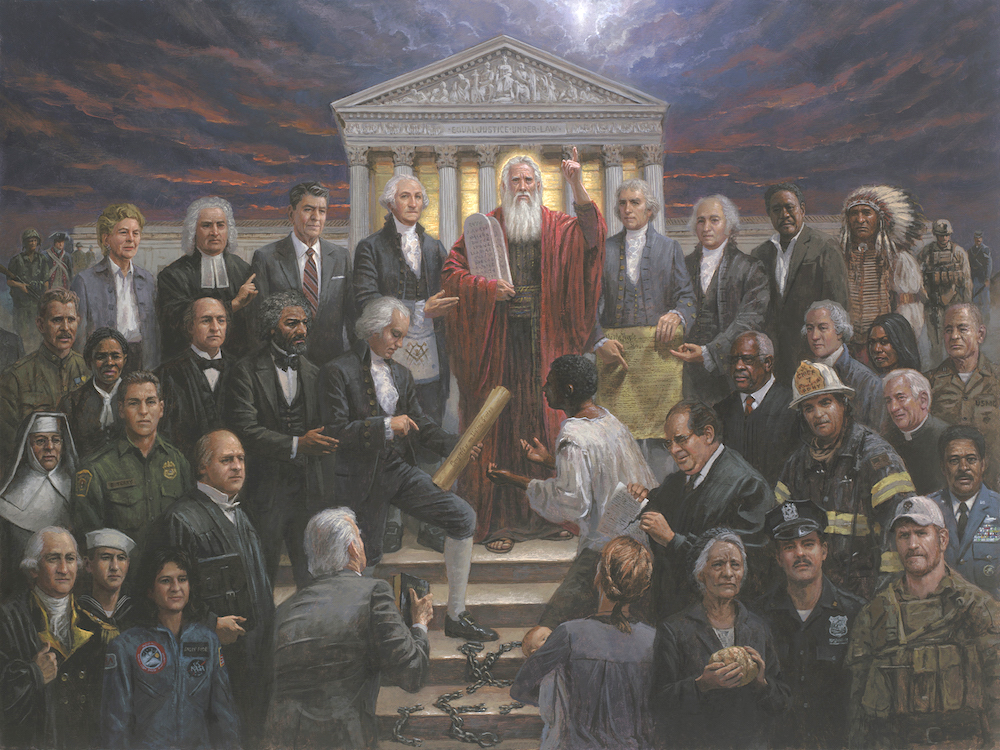
The Founding. Many Evangelicals (and Mormons) go so far as to claim that the Constitution is divinely inspired, putting the Founding Fathers on a level very near the Biblical prophets.
The Wild West. There was a magic moment just after the Native Americans had been driven away, but before civilization arrived. The land was too vast and empty for anything you did to pollute it. And you could shoot all the buffalo you wanted, because there was nobody to tell you not to.
The Gilded Age. Libertarians and Ayn Rand followers idealize the late 1800s, before antitrust laws and other progressive reforms involved government so deeply in the economy.
The Greatest Generation. According to the myth, we single-handedly saved the World from fascism and never got the gratitude we deserved.
The Happy Days. The idealized 1950s, when a white man could support his family on a single income, women knew their place was in the home, gay sex was a crime, and Negroes were invisible.
Democrats, on the other hand, have an annoying habit of throwing dirt on these beautiful images by talking about slavery, Jim Crow, the Native American genocide, or the indiscriminate massacre of civilians at Hiroshima and Nagasaki. When we honor the Founders, it’s not because their era was so great, but because they left us a vision of a government where authority bubbles up from the People rather than streams down from Heaven, and of a world where “all men are created equal”. They never achieved that vision, but they wrote a Constitution flexible enough that we could evolve towards it, and a Declaration we could edit to say “all people are created equal”. Yes, they were hypocrites to wax eloquent about their own freedom while enslaving others. But in the long run, their visionary hypocrisy has served us better than realistic cynicism would have.
Liberal patriotism revolves around the Future America, the one we could build that will finally live up to that never-achieved vision. That’s why Kamala Harris talked “the beloved community … a country where we look out for one another, where we rise and fall as one, where we face our challenges, and celebrate our triumphs—together.” But then she admitted: “Today, that country feels distant.”
Trumpists hear negativity and gloom there, while liberals find it inspiring: Even in moments as dark as this one, the American ideal is still out there, still beckoning for us to achieve it.
In contrast, the theme President Trump has chosen for the Republican Convention is “Honoring the Great American Story“. Taking a wild guess, I suspect we’ll hear a lot about “left-wing mobs” who have been tearing down or defacing statues that honor major players in that great story: mostly Confederate leaders, but occasionally non-Confederates like Columbus or even George Washington. We might also hear denunciations of the 1619 Project, an American history curriculum that emphasizes the central role slavery played the Great American Story. (Senator Cotton wants to deny federal funds to schools that teach this curriculum. Remember when conservatives opposed federal control of education?)
This next week, expect to hear a lot of reverence for the America of days gone by. But the only vision you’ll hear for our future is to return to that past greatness.
2. Do you think mainly about We orI? There’s a reason masks have proven to be such a divisive left/right issue, in spite of the overwhelming evidence that they are great tools for controlling the Covid epidemic: Masks are a we-solution, not an I-solution.
Does wearing a mask guarantee that you won’t catch the virus? No. If you walk into a crowded room and you’re the only person wearing a mask, it’s going to improve your odds of escaping infection a little, but not really that much.
So if your demand is “Give me something I can do that will keep me safe”, telling you to wear a mask is not a great answer. But if you revise that to “Give me something my community can do that will help us get the virus under control faster”, masks are a great answer. If everyone starts wearing masks when they leave the house, instead of each infected person passing the virus on to three other people, you might have three infected people passing it on to just one new person. Instead of exponential growth, you’ll have exponential decay. And in a struggle like this, that’s what victory looks like.
But conservatives hate we-solutions. They would much rather hear about snake-oil cures like hydroxychloroquine or oleandrin, because those are I-solutions: If I get sick, I take oleandrin, and I get better — if it works.
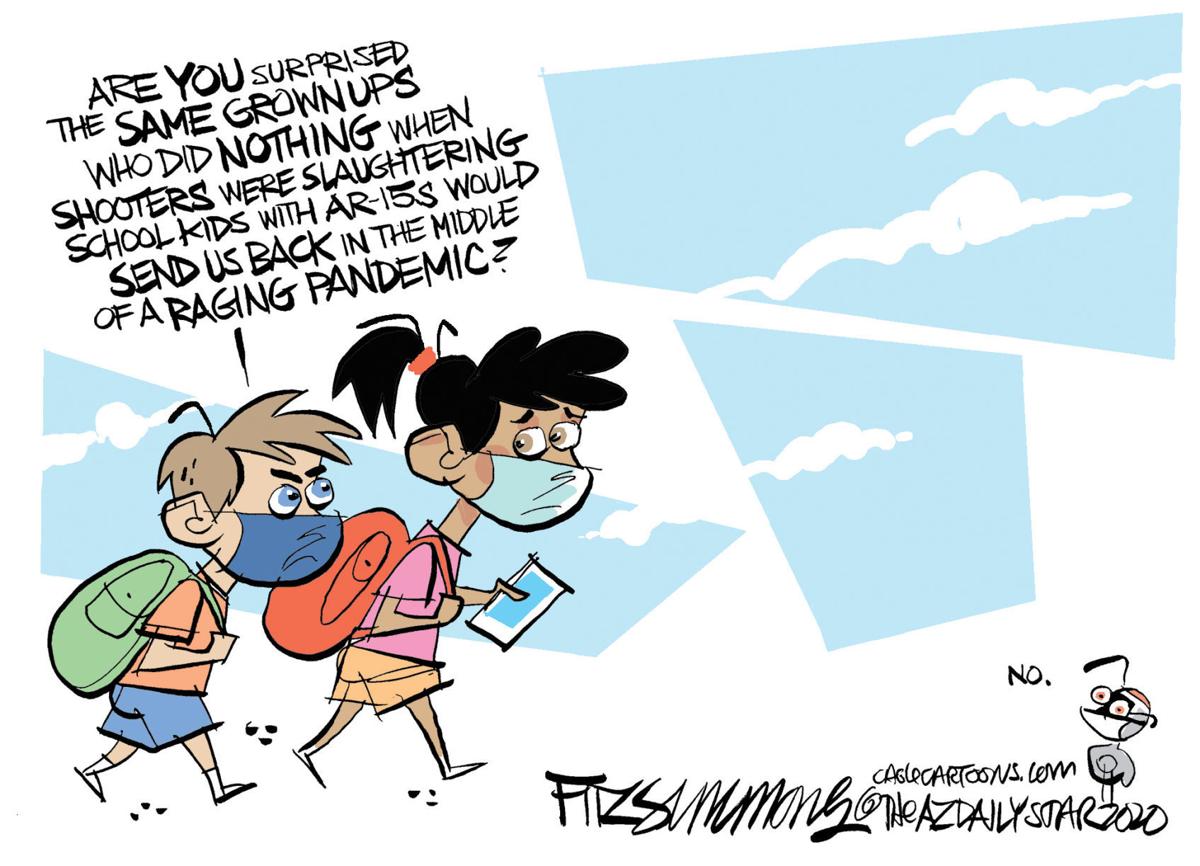
This shows up across the board. Why should I give up my AR-15, when I was never going to do anything illegal with it anyway? Well, because if we all give up our AR-15s, the next mass shooting might not have quite so much “mass” to it. If you think taxes are too low, why don’t you just make a voluntary contribution to the Treasury? Because changing my tax rate doesn’t solve any national problem, while changing the rate we all pay does. And so on.
3. Are problems solved best by punishing individuals or reforming systems? Related to the focus on I rather than We is the conservative belief that problems are caused by individuals: The crime problem is caused by the individuals who commit crimes. The drug problem is caused by smugglers and pushers. Terrorism is caused by terrorists. And so on. This leads to a belief that the way to solve a problem is to figure out who is causing it and punish them until they stop doing whatever it is they’re doing.
Liberals are more apt to ask why they are coming and if there’s some way to unplug whatever process is pushing them here. Maybe we could promote reform in the hellish places they come from, or reform the trade practices that make those countries so poor. Maybe we could fund programs there that give them reasons to stay. But no, conservatives say, that would be rewarding the behavior we want to stop. And it wouldn’t work anyway, because … well, it just wouldn’t. If you’re not punishing anybody, you’re not solving anything.
Ditto for the violence that has sometimes accompanied the protests against police brutality after George Floyd’s murder. People are making trouble, so they need to be punished. So fire the tear gas, pepper-spray the peaceful and violent protesters indiscriminately, and send police into crowds swinging their nightsticks. Systemically, it makes no sense to answer a protest against police brutality with more police brutality. But those individuals are wrong and they need to be punished.
The flip side of this way of thinking is that whenever liberal tinkering with a dysfunctional system inconveniences conservatives, they interpret it as punishment. Raising taxes on the wealthy isn’t a sound fiscal plan to raise revenue, it’s punishing success. Affirmative action isn’t a way to compensate for the old-boy networks disadvantaged groups lack, it’s punishing white men. Green taxes punish coal miners and people who drive a lot. Laws preventing discrimination against gays punish Evangelical Christians. And so on.
From a liberal perspective, the weirdest thing in this mindset is the joy they imagine we feel as we punish them. Spend much time inside the conservative bubble, and you will hear a lot about how much we liberals hate the rich, and the coal miners, and the Evangelicals, and anybody else who will be disadvantaged by a liberal policy. We’re just rubbing our hands in sadistic glee whenever Harvard turns down some deserving white male.
My only explanation is projection. They know how they feel when a policeman clubs a BLM protester, so they imagine we must feel the same way.
4. When do you trust systems, and when do you trust people? Dr. Anthony Fauci had such a long and distinguished career before Covid-19 that I must have seen him somewhere — maybe during the Ebola scare or during the height of the AIDS epidemic. But I didn’t remember him. Certainly I had no reason to either trust or distrust him as a person. However, when Covid-19 started spreading, I recognized him as the spokesman for a system of medical science that I do trust. I don’t trust it absolutely or blindly, but when there’s a new disease and I have to make decisions about how to avoid it or seek treatment for it, that’s where I look for answers.
I trust a lot of other systems within certain bounds. I trust academic climate scientists to tell me how we’re doing on climate change. (And I don’t trust scientists employed by energy companies.) Their models may or may not make perfect predictions, but like the weather service’s forecasts, they’re the best we have. I trust geologists and astrophysicists to tell me the age of the Earth, and biologists to tell me how long ago various animals evolved. I trust the Bureau of Labor Statistics to tell me the unemployment rate and the Treasury to report the deficit. I read major newspapers with a mix of trust and distrust: They don’t always characterize events properly, and they sometimes misjudge which stories are or aren’t important, but if they put quotation marks around something, I’m pretty sure somebody really said it. If there’s a publicly checkable fact, I trust that somebody has checked it. The New York Times may not be perfect, and I may or may not agree with its opinion columnists, but it is not fake news.
Those attitudes don’t have anything to do with the issues we normally think of as defining liberalism or conservatism. That last paragraph didn’t state any position on abortion or gun control or tax rates or immigration. But all the same, it marks me as a liberal. There are systems for gathering knowledge, and I believe that (with occasional but fairly rare exceptions) they work.
Conservatives, by and large, don’t share my faith in systems, and would rather trust people. Many of them (God help them) trust Trump. Some trust their religious leaders, even on topics that have little to do with religion. Some trust media personalities like Rush Limbaugh or Sean Hannity. Some trust people who share their religion or their economic class or their DNA. Or they look at a TV talking head and make their own judgment: That guy wouldn’t lie to me.
So they look at Dr. Fauci and don’t see the mouthpiece of medical science. They see a guy like any other guy — and what did he ever do for them? But that My Pillow guy, he speaks the same religious language they do, and his pillow was pretty good, and Trump likes him, so maybe he knows what he’s talking about. Maybe he’s right and Dr. Fauci is wrong.
5. Is the United States a member of the world community that leads by example? Or are we “exceptional”? Trump appears not to recognize the existence of a “world community” at all. He has been relentless about blowing up agreements that involve the US submitting to rules that bind large groups of nations. He pulled us out of the Trans-Pacific Partnership and the Paris Climate Accord and the multi-nation agreement to stop Iran from getting nuclear weapons. He supported Brexit, and chafes at the idea that he can’t have one-on-one trade agreements with the EU countries. He keeps making noises about undercutting NATO, even at one point questioning whether we would really defend some small NATO country like Montenegro.
At this point, the Republican view seems to be that the US is entirely exceptional: No rules should apply to us at all. We should be able to torture people if we want to, we can violate other nation’s sovereignty with impunity, and above all we should not get out in front of other countries to set an example. If somebody needs to be virtuous, let some other nation go first.
Liberals want our vision of the Future America to eventually spread to the Future World. Not that we will conquer the world, but that our ideals of equality and human rights will take hold everywhere once people see how they work here. In his convention speech, President Obama put it this way:
Joe knows the world, and the world knows him. He knows that our true strength comes from setting an example the world wants to follow. A nation that stands with democracy, not dictators. A nation that can inspire and mobilize others to overcome threats like climate change, terrorism, poverty, and disease.
6. Are some Americans more “real” than others? I don’t think Sarah Palin invented the phrase “real Americans”, but her 2008 vice-presidential campaign popularized it. “Real America”, she explained, is in the rural areas and small towns that just happened to support the McCain-Palin ticket rather than Obama-Biden. Since then, Republicans haven’t liked to define the term precisely, but the usage of “real Americans” favors white, native-born, English-speaking conservative Christians.
You can see the current emphasis on “real” Americans in the revived Birtherism that questions Kamala Harris’ eligibility for the vice presidency. Her parents were not citizens at the time of her birth; her mother was an immigrant from India, her father from Jamaica. But she was born in Oakland, and the 14th Amendment declares that “All persons born or naturalized in the United States, and subject to the jurisdiction thereof, are citizens of the United States and of the state wherein they reside.” So she is a citizen by birth rather than by naturalization, making her a “natural born Citizen” as demanded by the Constitution’s Article II.
While any challenge to Kamala’s 14th Amendment rights would be doomed in court — at least until Trump gets to appoint another Supreme Court justice or two — conservatives don’t like the birthright citizenship the 14th guarantees, or the “anchor babies” it makes citizens. Trump has described birthright citizenship as “frankly ridiculous” and has suggested that he might do away with it in some unspecified way. Hans von Spakovsky of the Heritage Foundation then tried to put meat on those bones by finding a loophole in “subject to the jurisdiction thereof”.
Consistent with the liberal notion that the ideal America is in the future, liberals view America as a project that anyone can join, while conservatives have a more blood-and-soil definition. They see an important difference between people who are citizens due to some legal technicality and “real” Americans.
So those are the things I recommend you listen for this week, if you decide to watch the Republican Convention: real Americans, American exceptionalism, suspicion of systems contrasted with trust in particular people, the importance of punishment, We vs. I, and whether we should be trying to move back towards an idealized past or forward to an idealized future.
Today we are at the odd and fleeting vantage point between the two conventions.
Conventions are how a party tells the country what it is all about. We’ve just seen what the Democrats are about, and we’re about to see the Republicans. (If you don’t have time to watch: The GOP is about Trump. They didn’t even write a platform this year, they just said they support Trump.)
To me, this is a good moment to contemplate the more vague attitudes and identities that form the cultural difference between the parties. It’s easy to list issues where they have different positions — immigration, guns, abortion, racism, healthcare, climate change, and so on. But if we’ve learned anything from the Trump era, it’s that positions on issues can be ephemeral. The Republican Party has changed its mind about free trade and deficits and NATO and the importance of character and a long list of other things. And yet, the party’s base consists of the same people who were there a decade ago.
So what defines the real boundary line between a liberal and a conservative? I’ll look at that in the featured post, which should be out between 10 and 11 EDT.
The weekly summary also has a lot to cover: A Senate report verifies that the Trump campaign really did collude with Russia. Steve Bannon got arrested for fraud. The Manhattan District Attorney is one step closer to seeing Trump’s tax returns. And the all-virtual Democratic Convention seems to have worked pretty well. That post should appear between noon and one.
They need that money in order to have the Post Office work so it can take all of these millions and millions of ballots. But if they don’t get those two items that means you can’t have universal mail-in voting, because they’re not equipped to have it. If we don’t make a deal, that means they don’t get the money, that means they can’t have universal mail-in voting. They just can’t have it.
This week everybody was talking about Kamala Harris
“Well, we aren’t particularly excited about him, but rumor has it that he’ll have an exciting, female No. 2.”
Even before Kamala Harris left the presidential race, backers of other candidates were talking about her as a vice-presidential candidate. As a woman of color who is two decades younger and a forceful speaker, she fills a lot of holes for the Biden ticket. There has been a lot of speculation about other women, but Harris was the leader on almost every pundit’s list from wire to wire.
Conventional wisdom says that people don’t change their votes based on the VP, and in terms of conscious thinking that’s probably true. But the second name on the ticket modifies the first as an adjective modifies a noun. A candidate’s first major choice changes how we think about him or her. When Bill Clinton went for a second white male southerner in Al Gore, that said, “I really mean it.” Ronald Reagan picking George Bush said that he wanted to change the Republican Party, but not burn it down. Barack Obama choosing Joe Biden sent a similar message.
And so Biden-Harris is a subtly different candidate than Biden-Warren or Biden-Booker or Biden-Bloomberg. In addition to the obvious demographic messages, I read something else into the Harris choice: Biden doesn’t need to be a maverick. He’s the anti-John-McCain in that sense. If the obvious choice makes sense, he’ll go with it. In the current climate, where science is being sidelined in favor of miracle cures like hydroxychloroquine or oleandrin, that’s kind of comforting. I want a president who will take the standard public-health playbook and implement it, not one who needs to be original.
Like a cover band playing a medley of bigotry’s greatest hits, Republicans went after Harris with whatever racist or sexist attacks they had left over from Barack Obama and Hillary Clinton. Unscrupulous presidents used to let hidden minions spread such dreck, but Trump came right out with this reprise of birtherism:
“I heard it today that she doesn’t meet the requirements,” Mr. Trump said of Ms. Harris. “I have no idea if that’s right,” he added. “I would have thought, I would have assumed, that the Democrats would have checked that out before she gets chosen to run for vice president.”
That’s so Trump. He makes a charge even though he has “no idea if that’s right”, and then faults somebody else for not checking things out, as if the President of the United States bears no responsibility to know what he’s talking about before opening his mouth. Friday on CBS Jared Kushner used that as a dodge:
He just said that he had no idea whether that’s right or wrong, I don’t see that as promoting it. But look, at the end of the day, it’s something that’s out there.
I keep waiting for an interviewer to throw this standard back at Trump or his spokespeople: “You know, I heard it today that President Trump owes his presidency to Vladimir Putin, and so his first loyalty is to Putin rather than the United States. I have no idea if that’s right, and I’m not promoting it, but at the end of the day it’s something that’s out there.”
BTW: There’s nothing to the Harris-is-ineligible claim. She was born in Oakland, which makes her a natural-born citizen of the United States according to the 14th Amendment. Conservatives may not like the 14th Amendment, but it’s in the Constitution all the same.
The charge was given publicity by Newsweek, which is not the magazine you may remember from years ago, and hasn’t been since 2012. The Newsweek brand has changed hands many times since 2012; the current owners have held it since 2018, have nothing to do with the original Newsweek, and do not maintain the journalistic standards you may associate with that name.
One of the sillier attacks on Harris is that she’s “not really Black” or “Black, but not African American” or something-but-not-something-else because her parents came from India and Jamaica, and so her ancestors were never enslaved in America. (Snopes says the Jamaican branch of Harris’ family are “quite likely to be descendants of slaves”. Barack Obama’s father was born in Africa, so his ancestors weren’t slaves at all.) This is one of the criticisms Trump is dog-whistling when he calls Harris “phony”.
Race is a lived experience, not a fact of your DNA. There’s a continuum of genetic variation from one local community to the next, and always has been. So at no point in history did humanity ever split neatly into some number of biological “races”. Race is a social reality, which means that your race is a matter of how you live and are treated, not some objective fact about you.
To me, then, (and as I read the NYT’s Jamelle Bouie) the key question is: Has Kamala Harris lived with the kinds of discrimination and prejudice that Black people face in America? If (as I can observe from the responses to her nomination) the answer is Yes, then I don’t really care where her parents were born.
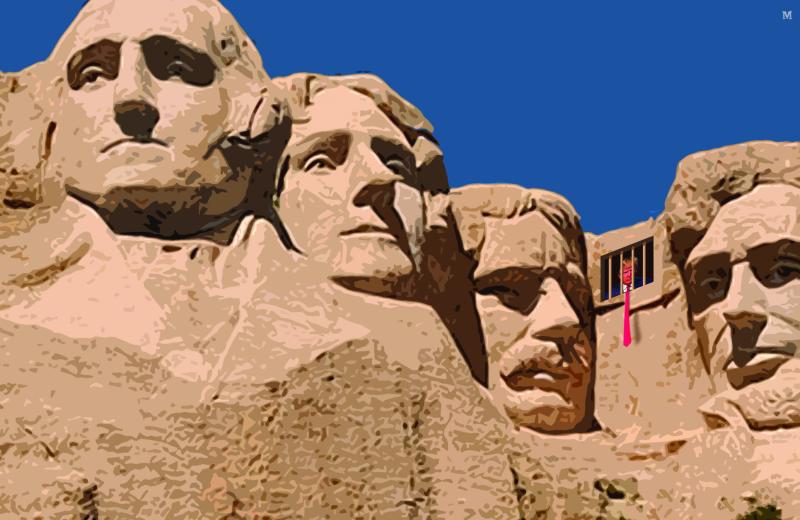
I’d love to see a female President. Just not Hillary Clinton. Or Elizabeth Warren. I am totally open to all other women leaders, but I have to admit that Kamala Harris and Amy Klobuchar are beginning to make me angry and I’m not sure why yet, but I know the reason will become clear soon, and I’m also wondering what they might look like if someone photoshopped their heads onto the bodies of prisoners and put them behind bars.
and Trump’s open admission that he’s suppressing the vote
I focused on this more in the featured post, so here I’ll just look at the reactions Trump got. I don’t think he appreciates what a live wire he picked up. One striking thing about the attack on the Post Office is how visual the response has been.
The World-o-meter death total is up to 173,000. The US death rate has stopped increasing and has leveled off at about 1200 a day.
Trump introduced a new doctor at a coronavirus briefing a week ago: Scott Atlas.
A senior fellow at Stanford’s conservative Hoover Institution, Atlas is a neuroradiologist and not an expert on infectious diseases or pandemics. But he is a frequent contributor to Fox News where he has called on schools to open, endorsed the return of college football, raised questions about mask wearing and spoken out against lockdowns and the “frenzy” of mass testing — all stances Trump has taken.
“You know that there’s no real good science on general population widespread in all circumstances wearing masks,” Atlas told Fox News host Tucker Carlson.
I continue to shake my head at the short-sightedness of everything Trump does with respect to the virus. OK, you found a doctor who is either arrogant enough or unethical enough to speak authoritatively outside his area of expertise, and that doctor says the same stuff you say. But reality gets the last word. You may convince people to open schools or go to football games or whatever, but we will all see the results. It does you no good to convince people to do stupid things, if there is enough time before the election for the results of that stupidity to become apparent.
Even if you’re just trying to get re-elected, the best thing you can do is beat the virus, not convince people that you’ve been right all along.
and schools
I was surprised that The Wall Street Journal picked my hometown (Quincy, Illinois) as a place to center their back-to-school-debate piece. If you watch the video, you’ll see exterior shots of my high school and junior high.
Florida’s Governor DeSantis has a new analogy for opening schools: It’s like the Navy SEALs taking out Bin Laden. Don’t ask me to make sense of it. But if I were teaching in Florida, it would say to me that the governor expects me to risk my life.
Will college football happen at all this year? The Big Ten and Pac 12 have canceled their seasons. The ACC, Big 12, and SEC are still planning to go ahead, at least for now. To me, though, the important question isn’t “Who starts their season?” but “Who manages to finish a season?”. I predict no one will. A number of teams (Rutgers, LSU, Clemson, Oklahoma) already have had outbreaks.
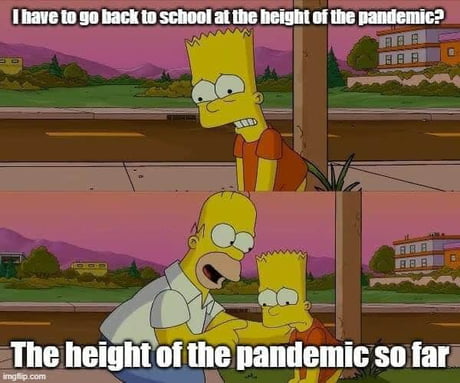
To see just how irresponsible it is to play football this year, look at how Florida State is planning to do it: Claiming that they are following CDC guidelines that limit venues to 25% capacity, they plan to have 15K-20K fans at their home games. Naturally, we can expect well-behaved college students to use that extra space for social distancing, rather than gathering together for crowd-surfing and other unsafe activities.
I think this has huge political implications. I’ve already gotten this on a Trump email list: “The Radical Left is trying to CANCEL College Football.Can you believe it?”
But I don’t think Trump is going to be able to shift the blame on this. The reason we can’t have college football is that he has screwed this up so badly. Biden should find some famous Ohio State graduate in the NFL and get him to do an ad where he says that Trump’s incompetent response to the virus is why we can’t have OSU football this year. “If we had a president who could do the job, Justin Fields would be on his way to a Heisman. It’s really that simple.” I think that argument locks up Ohio (where Biden already has a very narrow lead) and hence the Electoral College.
Technically a “derecho“, a band of high-wind thunderstorms hit Iowa last Monday. With winds above 100 mph, the system would be Category 2 on the hurricane scale. Cedar Rapids reports losing “thousands” of trees, and about 1/3 of the state’s cropland was affected.
As of midday Friday, some 140,000 customers remained without power in Iowa, according to poweroutage.us. Another 60,000 were without power in Illinois.
One of the more striking things about this storm was that nationally, nobody noticed.
If somebody is telling you that voting for Biden will make no difference, show them this link: A federal appeals court just ruled 2-1 that California’s ban on high-capacity ammunition magazines is unconstitutional. This is one of several similar bans in states around the country. The opinion was written by a judge Trump appointed. If Clinton had won in 2016, the decision would have gone the other way.
High-capacity magazines allow mass shooters get to take down more people before they have to reload. Banning them is one of the few things states have managed to do in response to mass shootings.
Ever since the Jacksonville portion of the Republican Convention got canceled, Trump has been searching for the perfect place to give his acceptance speech. For a while he was considering the Gettysburg Battlefield, site of another famously disastrous Confederate overreach. Unfortunately, holding a partisan event on federal property is probably illegal.
The president is not subject to the Hatch Act, a Depression-era law that prohibits federal employees from engaging in political activities while on the job. But everyone who works for him is. By delivering a speech with the Gettysburg battlefield as a backdrop, experts said, Mr. Trump would risk putting park rangers and other park employees at risk of a violation.
So instead, Trump plans to give the speech from the lawn of the White House, which is also a federal property. I’m sure he will not grasp the irony of delivering a law-and-order speech at an illegal venue.
In my opinion, the most appropriate spot would be Death Valley, the lowest point in the United States.
Reuters took some aerial photos of the Border Patrol’s camp for migrants near McAllen, Texas. Is this the kind of thing you want your country doing?
And speaking of immigrants:
and let’s close with something difficult
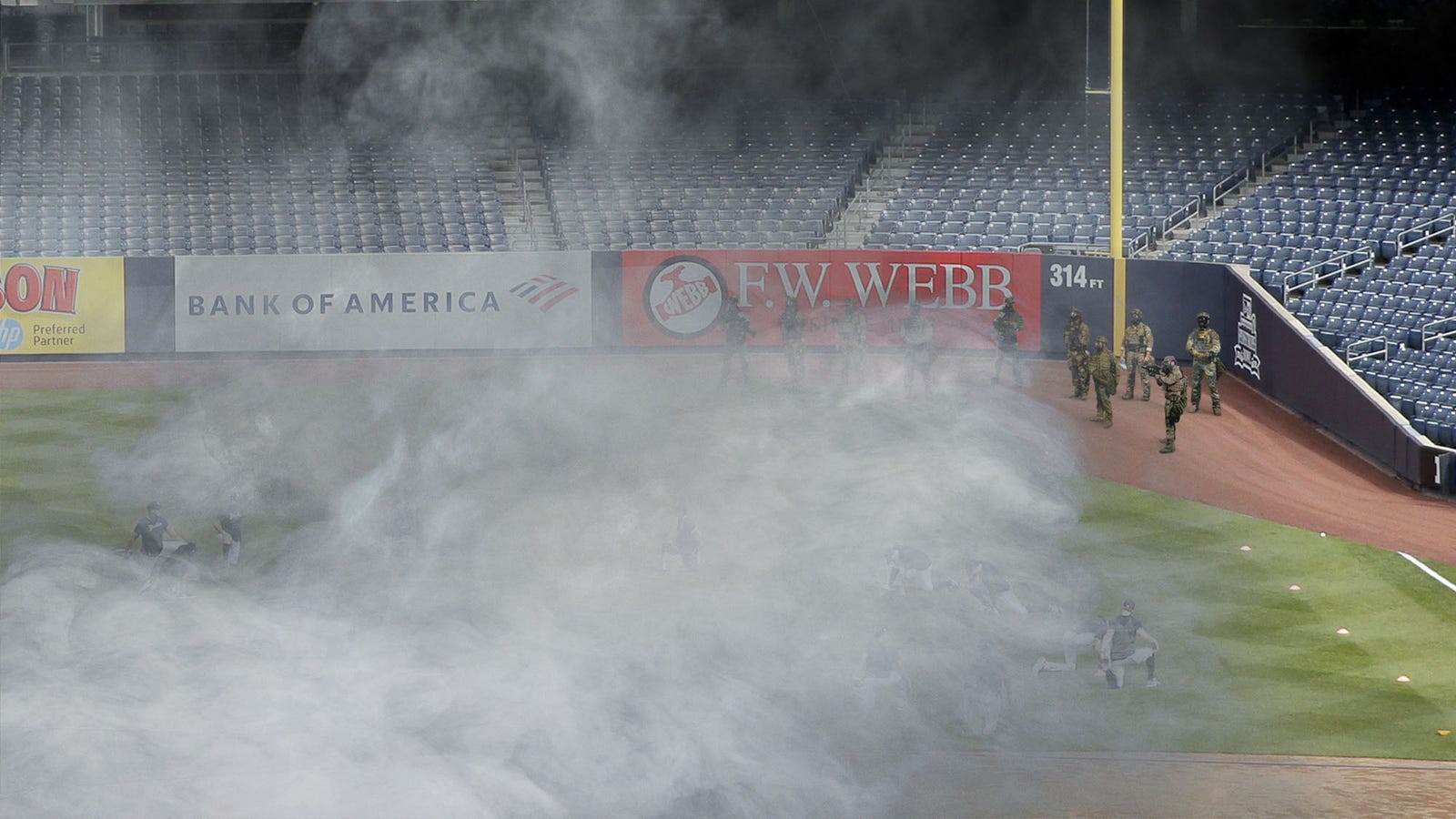
The Onion has been having a really hard time coming up with stories more ridiculous than what’s actually been happening, so I want to congratulate them on this one: “Federal Troops Tear-Gas Yankees Off Field So Trump Can Throw Out First Pitch“. The real backstory of this is that Trump announced he was throwing out the first pitch of the Yankees’ season, and then announced that he was cancelling. In fact, he had never been invited, but he was jealous of Dr. Fauci throwing out the first pitch for the Nationals. It had to be hard to top a news story that ridiculous, but The Onion was up to the job.
The most dangerous thing about Trump is that he doesn’t see his power as belonging to the Office of the Presidency. It belongs to Donald J. Trump.
When used sloppily, the word autocrat is little more than an insult. An “autocrat” may simply be an executive who makes decisions you don’t like, one who acts on his own judgment rather than factoring in your point of view. The baseball GM who trades your team’s best pitcher is an autocrat. The boss who rejects all your suggestions is an autocrat.
But the sloppiness isn’t in the word itself; autocrat and autocracy really do have meanings that can be applied precisely. Calling a government an autocracy distinguishes it from a republic under the rule of law. Under the rule of law, powers belong to offices rather than individuals. The people who occupy those offices hold those powers in trust for the republic, and are constrained to use them to fulfill the missions the law assigns.
But in an autocracy, the distinction between person and office vanishes. The powers of an office belong to the person holding it, to use as that individual sees fit, including for financial or political benefit. Lower officials may or may not be disciplined by higher officials, but the law itself does not constrain them, and the highest official is accountable to no one.
Applying that word to the current administration has seemed like a stretch for most of the last 3 1/2 years. Sure, Trump has been cutting corners, subverting democratic norms, and fairly often even breaking laws, but life in the US just hasn’t felt like North Korea or Russia or Saudi Arabia. For the most part, it still doesn’t.
However, it’s becoming increasingly clear that the non-autocratic feel of the United States has been due to Trump not getting everything he wants. He is, at heart, an autocrat. Those are the leaders he admires and the club he wants to join.
I am the State. In his heart, Trump has been an autocrat from the beginning. He has never understood or recognized the difference between his office and his person. That has been clear, for example, in the way he speaks and tweets. To him, speaking as President is no different than speaking as Donald Trump. His monologues flow easily from announcements of policy to expressions of petty resentments to grade-school insults against those who challenge him. While often hidden in the beginning, this attitude also has shown up in his behavior: Recently the public discovered that early in 2018, he tasked the Ambassador to the United Kingdom with bringing the British Open to the Trump Turnberry golf course. After all, why shouldn’t his ambassador drum up business for his golf course? He often has used his power as president to draw business to his hotels or his resorts.
His rhetoric equates threats to his personal future in politics with threats to the United States, in an I-am-the-State fashion. He has often described the Russia investigation — the attempt to discover just how involved the Trump campaign was in Russia’s effort to get him elected — as “treason” or a “coup“. His well-deserved impeachment, which flawlessly followed a process laid out in the Constitution, was likewise “treason” and a “coup“. The whistleblower who made Congress aware of his illegal attempt to extort political favors from Ukraine is “a spy”, and Trump strongly implied that he should be executed: “You know what we used to do in the old days when we were smart? Right? The spies and treason, we used to handle it a little differently than we do now.” Removing Trump from office, no matter how lawfully or justifiably, is equivalent to overthrowing the government of the United States.
In his book, James Comey tells the story of President Obama inviting him to have a conversation before nominating him to be FBI director. After the nomination, Obama tells him, they won’t be able to do this any more, because the President and the FBI director conversing outside of official channels would be improper. But Trump recognizes no such propriety. He regularly tweets out instructions for the Justice Department to investigate or lay off of people he either likes or doesn’t like. He has opinions as an individual, so why shouldn’t he express them as President?
The original purpose of the pardoning power in a lawful republic, according to Alexander Hamilton, was to temper the justice system with mercy, so that it would not “wear a countenance too sanguinary and cruel”. (Obama used his power this way, for example, when he commuted the excessively harsh sentences in hundreds of nonviolent drug cases.) But under Trump, the pardon has reverted to its royal roots: It is an expression of the sovereign’s personal beneficence, and puts the recipient in his debt, as Dinesh D’Souza clearly understands, as does Rod Blogojevich.
Adults in the room. The primary reason America hasn’t felt like an autocracy these last few years is that Trump’s efforts have not gone unopposed. The fundamental drama of the last 3 1/2 years has been the battle between Trump’s autocratic impulses and the republican values embedded in the United States government. (From the point of view of his supporters, who are rooting for the autocrat, this has been cast as a struggle against the “Deep State”.) Trump’s initial set of appointees had reputations and careers before they entered his administration, and many of them imagined that they were taking positions in a merely eccentric version of a typical Republican government. As a result, they frequently frustrated their boss’s desires.
Jeff Sessions may have been a racist and a xenophobe, but he also believed he was Attorney General of the United States. Power over the Justice Department belonged to Sessions’ office, not to him personally. And although the President had appointed him, his power did not derive from the person of Donald Trump. Sessions infuriated Trump by following Justice Department rules and recusing himself from the Russia investigation. He also ignored Trump’s repeated demands to launch investigations into “the other side”, i.e, Trump’s political opponents.
John Kelly and his deputy (and eventual replacement) Kirstjen Nielsen were anti-immigrant and went along with the cruel policy of family separations, but both saw the Department of Homeland Security as being defined by law. Nielsen was forced out after she refused to do “things that were clearly illegal, such as blocking all migrants from seeking asylum”.
Rex Tillerson shared Trump’s pro-Russia views, had a basic hostility to the institutional culture of the State Department, and signed off on the second and third Muslim bans. But he believed he represented the United States rather than Trump, whom he regarded as a “moron“. Trump, Tillerson said later, hated to be reminded that his foreign policy was bound by laws and treaties. He “grew tired of me being the guy every day that told him, ‘You can’t do that, and let’s talk about what we can do’.”
Jim Mattis and H. R. McMaster enjoyed the large budgets Trump gave the Pentagon, but held traditional conservative views about America’s special role in global security. Their primary loyalty was to the longstanding mission of the Defense Department, not to Donald Trump. Consequently, they supported NATO and resisted abandoning allies like the Kurds.
Dan Coats was an early opponent of President Obama’s nuclear deal with Iran, and shared a number of Trump’s other views. But as Director of National Intelligence he believed in the mission of the intelligence services: to figure out what is going on in the world and report it as accurately as possible. After Trump sided with Putin against the intelligence services in Helsinki, Coats was not cowed: “We have been clear in our assessments of Russian meddling in the 2016 election and their ongoing, pervasive efforts to undermine our democracy, and we will continue to provide unvarnished and objective intelligence in support of our national security.”
I’m not sure who started using this phrase, but early on these people (plus a few others) came to be known (behind Trump’s back) as “the adults in the room“. Any kind of crazy idea might pass through Trump’s head, but the “adults” would keep him from doing too much harm. Republican Senator Bob Corker even tweeted about it: “It’s a shame the White House has become an adult day care center. Someone obviously missed their shift this morning.”
It’s not my intention to idealize the “adults”, because (as I indicated above) a lot of nasty stuff happened on their watch. I also don’t want to paper over the widespread corruption in the early Trump years. In addition to the “adults”, Trump’s Class of 2017 included Scott Pruitt, Michael Flynn, Tom Price, Ryan Zinke, and many others who left in well-deserved disgrace. Wilbur Ross belongs in that group as well, but is somehow still running the Commerce Department.
In spite of their flaws, though, each “adult” in his or her own way believed in the United States as a republic under the rule of law. They believed that there were things Trump could not do, and could not order them to do.
They’re all gone now. Jeff Sessions was replaced by Bill Barr, who has no trouble using the Justice Department to protect Trump’s friends and attack his enemies. The roles Kelly and Nielsen had at DHS are now filled (illegally, it seems) by Chad Wolf and Ken Cuccinelli, who created and managed the masked federal police who invaded Portland against the will of all local officials. Dan Coats’ job is now held by Trump loyalist John Ratcliffe, who has shown little interest in telling Trump anything he doesn’t want to hear, or keeping the public informed about Russia’s continuing efforts to aid Trump’s re-election. In place of Jim Mattis, we have Mark Esper, who was slow to oppose Trump’s impulse to use active-duty troops to put down peaceful protesters, but still not docile enough to make his job secure. McGahn’s replacement Pat Cipollone was in the room when Trump discussed pressuring Ukraine for dirt on Democrats, and said nothing.
Autocratic achievement unlocked. At this point, Trump’s conquest of the executive branch of government is virtually complete. The Pentagon is still holding out, but most of the rest has become his personal instrument, to do with as he will. Two recent examples stand out: the abuse of the Justice Department to suppress Michael Cohen’s book, and the sabotage of the Postal Service to undermine voting by mail.
Trump’s former personal attorney Michael Cohen is serving a prison sentence, part of which results from him following Trump’s instructions to break the law. Like many non-violent criminals (Paul Manafort was another), Cohen was furloughed from prison to reduce crowding during the Covid-19 pandemic. But the Justice Department tried to use that situation as leverage to eliminate a problem for Trump’s reelection campaign:
But to remain at home, he was asked to sign a document that would have barred him from publishing a book during the rest of his sentence. Mr. Cohen balked because he was, in fact, writing a book — a tell-all memoir about his former boss, the president. The officers sent him back to prison. On Thursday, a federal judge ruled that the decision to return Mr. Cohen to custody amounted to retaliation by the government and ordered him to be released again into home confinement.
In America as we have known it, no one connected with overseeing a federal convict should know or care how that person’s writings will affect the presidential race. But in Trump’s autocracy, things are different. If you work for the Justice Department, you work for Trump.
Trump’s continuing failure to mobilize the country against Covid-19, a failure unparalleled in any other first-world nation, has made the prospect of voting in person in November risky. (It is still unclear how many infections resulted in Wisconsin after the Republican legislature forced voters to wait in long lines to vote in the state’s primary.) Certainly the prospect of voting in person has become less attractive, particularly to citizens with prior conditions that make them especially vulnerable.
Voting by mail, which states like Washington have been doing for years anyway, is the obvious solution. But that’s only if you want people to vote and to have their votes counted. If you’re trailing badly in the polls, as Trump is, and might be looking for an excuse to influence or challenge or ignore the election results, raising uncertainty about voting by mail is one possible strategy. And the best way to cast doubt on the viability of voting by mail is to cast doubt on the Post Office’s ability to deliver ballots in a timely way, particularly if those ballots are mailed from zip codes known to include many Democrats.
“If carriers are being told that, at the end of your shift, you need to be back at the office even if you haven’t collected all the mail that day, there could be ballots in those mailboxes,” says Tammy Patrick, a senior adviser at the nonprofit Democracy Fund Voice and a former Obama appointee to the Commission on Election Administration, a panel created in 2013 to identify best practices in running elections. “If the truck drivers are being told, ‘You leave the post office to take that day’s mail to the processing plant at your scheduled time to leave, even if all the carriers aren’t back in yet with that day’s mail,’ that can have an impact.”
If we don’t make a deal, that means they don’t get the money [for the Post Office]. That means they can’t have universal mail-in voting; they just can’t have it.
In any past election, it would be inconceivable that the President would be manipulating the Post Office in an effort to stay in power. But something has changed during the Trump administration: It’s not your Post Office any more, it’s his Post Office.
Two big pieces of news happened this week. The first was expected: Joe Biden announced his vice presidential choice. We didn’t know for sure that it would be Kamala Harris, but she had been the leading candidate since speculation on the topic began. Her selection was met with a wave of racist and sexist comments from Republicans high and low, which shouldn’t have been a surprise either. If you had ever imagined that Republicans look back at their racist attacks against Obama with shame or regret, clearly you were wrong. They’re doing it all again, up to and including Birtherism.
The second big story was more shocking: Trump admitted in so many words that he was disrupting the Post Office in order to influence the election. It had already become clear that the newly installed Trump crony running the postal service was slowing down the mail, and that his actions made voting by mail more precarious. But Trump himself connected the dots.
That admission puts us in entirely new territory. Presidents have long used the powers of the presidency to help their re-election chances in indirect ways: The ribbon-cutting on your town’s new bridge might happen to coincide with your state’s primary, for example; a diplomatic tour might happen precisely when a president needs to point out his opponent’s lack of foreign-policy experience; and so on. But this is arguably the first time since the Bad Old Days of the spoils system that the everyday machinery of government has been tied to a president’s re-election campaign. That something as historically apolitical as the Post Office could be harnessed to pull the election one way or another — and that the President takes this to be a legitimate use of his power — is completely new.
At least it’s new in the United States. But it’s business as usual in autocratic countries, which we are more and more coming to resemble. And that’s the subject of this week’s featured post “What Makes Trump an Autocrat?”. That still needs work, so I’ll predict it to appear around 11 EDT.
The weekly summary will cover Harris and the attacks against her, the continuing angst about the looming school year (including the loss of Big 10 and Pac 12 football), the inland hurricane that hit Iowa without the rest of the country noticing, an appeals court’s startling gun-control decision, the government letting methane leaks run wild, and a partial Middle East peace deal that leaves the Palestinians out in the cold. I’m still looking for a closing, but let’s say that appears around 1.
This week everybody was talking about executive orders
Saturday, Trump responded to the impasse in negotiations to extend provisions of the CARES Act by signing an executive order and three memoranda. He claimed they provide all sorts of relief to people economically stressed by the Covid-19 epidemic, especially the unemployed and those facing eviction. However, as one featured post points out, what the orders actually accomplish is much less than Trump claims, and yet they still threaten the constitutional order.
and the NRA
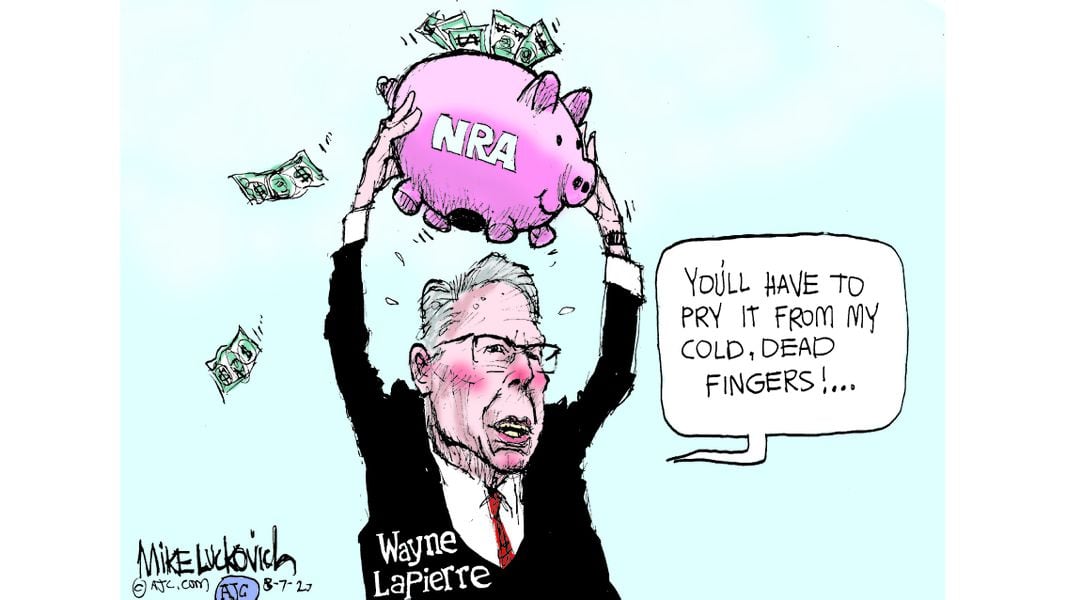
The other featured post discusses the legal problems of the National Rifle Association, which is threatened with dissolution by the New York Attorney General’s lawsuit. (The article uses that example to segue into a discussion of the conservative vulnerability to scams and con artists.) Basically, the NYAG claims that the NRA has become more about Wayne LaPierre’s luxurious lifestyle than about the Second Amendment, and that the corruption enabling this abuse is so pervasive and so top-to-bottom that no solution is possible that leaves the NRA intact.
The Washington Post satirist Alexandra Petri takes that first point and runs with it, suggesting a fund-raising letter for people who have never given to the NRA before.
We bet that what’s been holding you back all this time is the belief that if you donated to the NRA, it would help put more guns in more places and that such a goal, in your opinion, would make the United States a more dangerous place. Well, we urge you to take a second look and ask: Is that really what the NRA is doing?
A misconception that a lot of people have about the NRA is that we are some sort of gun lobby, trying to put guns into and keep them in the (cold, dead) hands of as many people as possible. But as allegations in a recent lawsuit demonstrate, the NRA is about so much more than that. We are also about subsidizing the personal travel of CEO Wayne LaPierre, his family members and a few trusted affiliates! We’re not just a gun lobby whose annual convention did not take place this year and which seems as though it hasn’t been very active around the coming election. We also believe in the power of travel, and the need to support America’s small-ship owners, or large-yacht owners, depending on your perspective.
An obvious question I didn’t get around to answering in the featured post is why these are civil lawsuits rather than criminal indictments. The answer has to do with jurisdiction. In the Daily Beast, former federal prosecutor Barbara McQuade (who appears fairly ofteny on Rachel Maddow’s show) wrote:
this easily could have been framed as a criminal case. Filing false registration and disclosure documents as part of a scheme to defraud can serve as the basis for federal mail or wire fraud, and often does in public corruption cases.
Her article strongly implies that criminal jurisdiction here belongs to Bill Barr’s Justice Department, which has no interest in prosecuting Trump’s friends. The NYAG is using a civil suit because that’s the tool at hand. However, the NYT quotes James:
It’s an ongoing investigation. If we uncover any criminal activity, we will refer it to the Manhattan district attorney. At this point in time we’re moving forward, again, with civil enforcement.
and the virus
Deaths seem to be peaking, which makes sense given that cases peaked 2-3 weeks ago. In the US, we’re up to about 165,000 dead, a number still rising at the rate of about 1,100 a day.
I worry that we are once again just seeing a transition. As the center of the virus moved from the Northeast to the South, there was an in-between period where the national numbers dropped. Now it is shifting again from the South to the Midwest, and staging a bit of a comeback in the Northeast. The national numbers may drop for a while now, but it remains to be seen if we’re really turning the corner as a nation.
Another executive order this week bans “transactions” with Chinese companies ByteDance and WeChat, beginning in 45 days. ByteDance owns TikTok, a popular social media platform that I know literally nothing about. (I also own a small amount of stock in the Chinese company TenCent, which owns WeChat, another app I have never used.)
A good summary of the possible security threats posed by a Chinese social-media app that has been downloaded onto millions of American phones is at LawFare. (A sequel discussing the current executive orders is here.) As I read that post, the risks posed by TikTok and WeChat are more-or-less the same as the ones posed by Facebook or Twitter or any other social media app, compounded by the possibility that the Chinese government might get hold of the data it collects and use it for nefarious purposes.
I’m reminded of an old Travels With Farley comic strip where Farley talks to the strip’s military character, Major Mishap. Mishap explains that it’s his job to keep nuclear weapons from falling into the wrong hands. And Farley asks, “Does that mean you think they’re in the right hands now?”
If the Chinese angle on TikTok gets everyone to take seriously what a nefarious actor could do with Google’s data trove (and why we’re so convinced that Google isn’t already that nefarious actor), that would be great. But I worry that this is just Trump acting out against a social-media universe populated by people who don’t like him, like Sarah Cooper.
If at the beginning of the year you’d asked me to list the threats to democracy, I don’t think I’d have come up with “a purge at the Post Office“.
I had this experience in Chicago years ago when I was reporting a story that was fairly routine. I had made arrangements to interview all these people. I made the arrangements over the phone to interview a number of people for this story, and all the interviews had gone well, until I got to the last one. It was the last interview of the day. I was very much looking forward to it.
The person that I was speaking with, or going to speak with, had been very excited to talk with me over the phone. But when I got there, he happened not to have been there at the time, and the place where I went — it was a retail establishment — happened not to have other people in it, so I was waiting for him to get there. The door opens and this man comes in. He was vary harried, and he’s got this overcoat on. He’s very late for an appointment, ultimately, with me. But he’s harried, he’s frazzled, he’s anxious, and the clerk who had helped me earlier told me to go up to this man, that this was the man I was there to interview.
And I went up to him and he said, “Oh no, no, no, no. I can’t talk with you right now.” And I was flummoxed by that. I mean, we’re here for the interview, why are you saying you don’t have time to talk? And he said, “No, I can’t talk with you right now, I’m getting ready for a very, very important interview. I cannot talk with you right now.” And I said, “Well, I think I’m the person interviewing you. I’m Isabel Wilkerson with The New York Times.”
And he said, “Well, how would I know that? How do I know that you’re Isabel Wilkerson?” And I said, “I am here. This is the time. It’s 4:30. You were here for the interview.” And he said, “Do you have a business card?” And I said, I actually happened not to have had any, because it was the end of the day and I’d been interviewing people all day and this was the last interview, which I was very much looking forward to. And I said, “I’m sorry, I’m out of business cards right now.” And he said, “Well, do you have something that … do you have some ID? Could I see some ID?”
And I said, “I shouldn’t have to show you ID. We’re already into the time where we were supposed to have the interview. We should be talking right now.” He said, “Well, I need to see some ID.” And so I pulled out my driver’s license to show it to him, and he said, “You don’t have anything with The New York Times on it?” And he said, “I’m sorry, I’m going to have to ask you to leave, because I have a very important interview coming. She’ll be here any minute. I’m going to have to ask you to leave.”
So I was actually accused of impersonating myself, because I was not perceived as being the person, I was not perceived as being someone who should have been in the position of a New York Times national correspondent there to interview him.
She’s goes on to explain that when something like that happens, you don’t tell your editors, for fear that they’ll lose faith in your ability to do the job. You just figure out some other way to get the story.
Recently released police body-cam video from Phoenix proves that cops kill white people too. An upstairs neighbor complained about noise from a video game Ryan Whitaker was playing with his girlfriend, and so the police showed up. AZ Central reports:
As they approach the apartment, no sounds of fighting or loud noises are heard coming from the unit.
Moments later, [Officer John] Ferragamo knocks on the door, identifying himself as Phoenix police. The officers stand to either side of the door, making it impossible for anyone looking out of the peephole to see who was there.
Whitaker opens the door, with the gun in hand and rapidly takes a couple of steps out of the apartment as Ferragamo flashes a light in his face. Ferragamo greets Whitaker and then repeatedly yells, “Hands,” according to the footage.
Whitaker is seen in the video starting to get on his knees, putting his left hand up and putting the gun behind his back when [Officer Jeff] Cooke fires into Whitaker’s back.
In the video, Whitaker appears to realize that these people are cops and start putting the gun down just before he was killed.
In addition to its influence on the national police-are-out-of-control discussion, this video also points out the problem created by the ubiquity of guns. Whitaker’s gun pushes Cook into a snap decision, which he makes badly. The number of guns in the US raises the possibility of deadly force in way too many situations, and limits people’s time to think.
After Trump pronounced Yosemite as “Yo Semite”, I joked on Facebook that soon Fox News would claim that was the actual pronunciation, and before long conservatives would all be saying “Yo Semite” just to prove they were on the right side. (The National Museum of American Jewish History is now selling “Yo Semite” t-shirts.)
Let me clarify. I’m not saying “Thighland” is how it is said in the Thai language. The French say “Paree” but that’s not how it is pronounced in English. “Thighland,” not “Tai-land,” is how English speakers around the world say it.
That’s how it is in TrumpWorld. If the Great Leader says something out of step with reality, reality needs to change. He doesn’t speak Truth, he defines Truth. I can hardly wait for the Exalted One’s tour of Thighland to take him to Fuck It (Phuket).
Kathleen Parker’s “Covid-19 isn’t going anywhere. So schools must reopen.” isn’t wrong so much as it’s just clueless. Everyone want schools to be able to open safely, and businesses to be able to open safely, and voting to be safe, and on and on and on. The question is, “What do we do when it’s not safe?” Parker has no answers for that.
I wanted to have watched Trump’s Axios interview. I really did. But even the prospect of the interviewer pushing back couldn’t sustain me through Trump’s endless bullshit. I include the link for those of you with more endurance.
and let’s close with something electric
like Toto played on Tesla coils. That much electrical discharge is likely to bring the rains down in Africa.
Like everything Trump does, they don’t match what he’s says he’s doing.
Remember the government shutdown that lasted from December 22, 2018 to January 25, 2019? Congress was refusing to fund Trump’s border wall, so he pulled out of a previously settled deal to fund the government. When public opinion didn’t rally behind his position, he relented on funding the government, but declared a state of emergency and used it to seize money Congress had appropriated for other purposes and redirect it to his wall. The Supreme Court has not yet ruled on the legality of this move, which seems to usurp Congress’ constitutional power of the purse, but it has allowed construction to continue so long that the case may become moot because the money is already spent.
Cases like these are never one-offs. Having gotten away with something once, Trump is bound to try it again.
So here we are: The CARES Act was passed in March as an emergency appropriation intended to see the country through the economic impact of the Covid-19 epidemic. At the time, no one imagined that the US would botch its response to the epidemic so badly that a thousand people a day would still be dying in August, so most of the CARES provisions ran out on July 31, including a moratorium on evictions and the $600-per-week enhanced unemployment payments.
Nancy Pelosi’s House had the foresight to pass a follow-up, the HEROES Act in May. But Mitch McConnell refused to bring it to the floor of the Senate, and did not start negotiating any CARES extensions at all until late July. With much of the Republican Senate caucus already plotting their resistance to the Biden administration, McConnell doesn’t have the votes to pass any CARES-extension bill without Democratic buy-in. So he left the negotiations to the White House team of Steve Mnuchin and Mark Meadows.
The White House refused to budge from its plan, which is about 1/3 the size of the HEROES plan, and contains no money to fill the budget gaps of state and local governments. Politically, Trump looks like the one with the most to lose if nothing gets done and the economy crashes, so Pelosi is not inclined to cave in to his demands without getting some concessions in return. So no deal has gotten done. (Has anybody noticed that our Art-of-the-Deal President never seems to get to Yes on a deal?)
So we’re back to the emergency-executive-powers trick. Or something. Maybe.
Saturday Trump signed three memos and an executive order which, in typical Trumpian fashion, don’t actually do what he claims. Here’s what is kinda/sorta in them.
A $400 unemployment enhancement to replace the CARES $600 replacement. Except that $100 has to come from the states, which may not have any money to cover it. The $300 federal contribution comes from a $44 billion pot of money that FEMA has, and of course won’t need during this record-threatening hurricane season. (This is literally an idea out of House of Cards, which FEMA officials rejected as unrealistic at the time.) Since we’re talking about 30 million unemployed people, the money will run out in about five weeks, assuming that they actually receive it and that it’s legal for Trump to spend it this way at all.
Eviction protection. Except, not really. The executive orderasks relevant government officers to “consider” doing something to stop evictions, and to “identify” existing federal appropriations that might help stressed renters and homeowners, assuming that there are any such appropriations. If your landlord has a court date for your eviction, nothing in this order interferes with that proceeding.
Cuts in payroll tax deductions. The order doesn’t actually cut what you or your employer owe in Social Security and Medicare taxes. It just stops collecting those taxes for a while. So temporarily you might see more money in your paycheck, assuming you’re still getting one from somewhere, but your arrears will be building up, and will come due after the election. If he’s re-elected, Trump wants to cancel that debt too, but that just raises a new question: How do Social Security and Medicare get funded?
So basically what we have is flim-flam put together with a constitutionally questionable claim on FEMA money. In the context of the border-wall emergency, Trump is pushing us closer and closer to a model where the President can take any money Congress appropriates and spend it however he wants. It should go without saying that this is very, very far from the process the Founders thought they were establishing.
James Fallows raises the question we should all be asking:
I am not aware of any of the “strict constructionists” who blasted Obama for executive-order overreach, who have weighed in about Trump’s l’etat-c’est-moi wave of appropriation-by-exec-order. Are there any?
To be fair, a handful of Republican lawmakers have said something that expressed concern of some sort. But most of the hand-wringing was of the “Now look what the Democrats made him do” variety. If you’re looking for a flat-out “This is unconstitutional”, you won’t find it. Apparently respect for the Constitution is like fiscal responsibility or free trade or freedom or any of the other high-minded principles Republicans have put forward over the years. All such principled expressions are made in bad faith, and go out the window as soon as they become inconvenient.
The New York and D.C. attorneys general have uncovered self-dealing, lavish spending on executive luxuries, and outright fraud at the National Rifle Association. Why is the conservative movement such fertile ground for this kind of thing?
Alarm bells. In 1973 I was a junior in high school, and a friend who had recently discovered the John Birch Society gave me a copy of their 1971 best-seller None Dare Call It Conspiracy. Thus was I introduced to the conspiracy theory of history: Forget all this talk of deep social forces evolving in unpredictable ways; in reality a cabal of powerful people has (for decades, or maybe centuries) been steering the planet towards a one-world dictatorship.
I was open to stuff like that in those days. Being 16, I wasn’t exactly invested in any other theory of history, or in established worldviews of any sort. In addition to conspiracies, I also had an open mind about ancient astronauts, lost continents, and the Velikovsky theory of the solar system. I had recently broken away from the literal-truth-of-the-Bible religion I had learned in a Christian elementary school, so the idea that authority figures of all sorts had been telling me tall tales seemed pretty credible. Why shouldn’t the world be explained by a sweeping hidden truth that the Powers That Be didn’t want me to know?
So I was undecided about NDCiC until I got to the last chapter, the one explaining what You the Reader could do to save America and the World from these sinister forces: Buy a lot of copies of None Dare Call It Conspiracy and pass them out to people in your neighborhood.
To summarize: You do not necessarily have to be an articulate salesman to make this “end run” [around what we now call “the mainstream media”]. You do not necessarily have to know all the in’s and out’s of the total conspiracy – the book is intended to do this for you. All you have to do is find the wherewithal to purchase the books and one way or another see that you blanket your precinct with them.
If 30 million copies got bought and distributed before the 1972 election, the conspiracy would be exposed beyond the conspirators ability to cover it back up again. (Apparently they fell short, because the cover of the 2014 edition claimed only 5 million copies sold. And so the Great Conspiracy rolls on.)
In short, an author was telling me that in order to save the world, I needed to “find the wherewithal” to “one way or another” make him rich. That set off alarm bells in my head, and caused me to re-evaluate the book’s whole argument.
Looking back, I now think those alarm bells are why I eventually became a liberal. Conservatives might have their internal alarm bells tuned to a variety of other threats — and perhaps are often appalled that mine stay silent when theirs start clanging — but apparently not to scams.
Grifters and their marks. As many writers have observed, entering the conservative information bubble puts you in a high-grift zone. Amanda Marcotte put it like this:
Liberal media personalities like Rachel Maddow or Chris Hayes may occasionally also have a book to sell you, but Sean Hannity endorses the Homearly Real Estate Group, which claims to donate $500 to the Wounded Warrior Project every time it sells a home. In daisy-chain fashion, Wounded Warrior has at times been a scam itself; its top executives were fired in 2016 after CBS News discovered that the “charity” was spending tens of millions of dollars a year on lavish parties at five-star resorts.
This kind of thing has been going on a long time. In his 2012 article “The Long Con“, Rick Perlstein traced it back as far as the 1970s (my high school days), and gave 2012 examples like Ann Coulter’s endorsement of a skeezy investment newsletter. (For contrast, I admire Nobel-prize winning liberal economist Paul Krugman, but it never occurs to me to wonder where he gets investment advice.)
Liberal and conservative pundits, it seems, are doing something subtly different. Liberals are telling you what is happening; conservatives are telling you who to trust. Liberals divide the world into True and False; conservatives into Good People and Bad People. Good People can introduce you to other Good People, and those introductions are worth serious money.
Foundational myths. If you wonder why conservatives are such easy prey for con-men, the answer is pretty simple. The conservative movement’s whole ideology is based on a series of easily disprovable myths: tax cuts pay for themselves, the American healthcare system is the best in the world, racism ended with Jim Crow in the 1960s, more guns make us all safer, and so on. The movement’s movers and shakers expected Obama’s decreasing deficits to enrage their people to the point of violence, but Trump’s increasing deficits to pass without comment. Obama’s executive orders (like DACA) were outrageous steps towards dictatorship, but Trump’s far more sweeping decrees (like this week’s unilateral extension of unemployment benefits without the consent of Congress) are legitimate expressions of Article II power. And so on.
The people Rush Limbaugh refers to as “dittoheads” don’t just mouth these absurdities, they actually believe them. They are, in short, easy marks. If you can collect a lot of them in one room, or on one mailing list, you have created an ideal fishing pond for hucksters.
In “The Long Con” Perlstein began with the pervasive mendacity of Mitt Romney’s 2012 presidential campaign. (I believe Romney was the first major-party nominee to continue repeating a lie after the media had fact-checked him on it; that may seem like par for the course now, but as recently as 2012 it was flabbergasting.) Then he pulled back to examine the central role con-men and scams have played in the conservative movement.
The strategic alliance of snake-oil vendors and conservative true believers points up evidence of another successful long march, of tactics designed to corral fleeceable multitudes all in one place—and the formation of a cast of mind that makes it hard for either them or us to discern where the ideological con ended and the money con began.
To adapt another bit of Perlstein imagery: Once the politicians have you worrying about an invisible river, the grifters will happily sell you an invisible bridge.
The NRA. Here’s what brings this topic to mind this week: Thursday, New York Attorney General Letitia James laid out in a lawsuit an explicit account of one of the conservative movement’s longest-running cons: the National Rifle Association. According to the NYAG’s press release:
four individual defendants [Executive Vice President Wayne LaPierre and three other top executives] failed to fulfill their fiduciary duty to the NRA and used millions upon millions from NRA reserves for personal use, including trips for them and their families to the Bahamas, private jets, expensive meals, and other private travel.
These actions contributed “to the loss of more than $64 million in just three years for the NRA”. The corruption is so pervasive that James is asking a New York court to dissolve the NRA, which it can do because the NRA has been incorporated there since 1871.
The same day, D. C. Attorney General Karl Racine sued the National Rifle Association Foundation, a charitable foundation incorporated in the District of Columbia. Donations to the NRA Foundation are tax-exempt, while donations to the NRA are not. Consequently, there are more restrictions on what the Foundation can do. (This arrangement may look suspicious, but in itself is not uncommon or necessarily corrupt. For example, the ACLU has an associated Foundation, which can pay legal fees for the ACLU’s clients, but can’t lobby for legislation. As long as the laws are followed, there shouldn’t be a problem.)
Just as James accuses executives like LaPierre of using the NRA as a “personal piggy-bank”, Racine charges that the officers of the NRA Foundation were allowing the NRA to abuse Foundation funds by making sweetheart loans to the NRA, letting the NRA overcharge it for management fees, and in general placing the interests of the NRA above the interests of the Foundation. In short, the Foundation was just a pass-through that allowed the NRA to use tax-exempt donations.
The D.C. lawsuit is not seeking to dissolve the NRA Foundation, but to force the NRA to repay the money it took from the Foundation, and to reorganize the Foundation to restore its integrity as a charitable institution.
The NRA’s grift has been almost comical in its bluntness. The group traffics in over-the-top rhetoric designed to play on some of the darkest and most irrational emotions of American conservatives, including racist fears over the nation’s changing demographics, overblown fears of crime and paranoid fantasies that liberals are trying to “take over” the country in illegitimate ways. So much of the hyperventilating conspiracy-theory discourse found on the right, especially the wild fever-dreams about progressive “violence,” starts with the NRA, which sought to convince conservatives that they needed to spend ungodly amounts of money on buying guns and on supporting the NRA itself, in order to protect themselves from the imaginary threat of gun-grabbing libtards and antifa terrorists.
Misdirected outrage. The two lawsuits led to howls of rage from conservatives pundits. You might think the howls would be directed at LaPierre and his crooked cronies, for ripping off the millions of NRA members and contributors, and for spending the conservative movement’s money on themselves. But no: The outrage is at the two attorneys general for catching them. Marcotte summarizes:
Far from thanking James for trying to shut down an organization that spreads shameless lies in order to separate conservatives from their money, Republican leaders and right-wing pundits are crying foul. Some of the defenses have been, uh, interesting.
“I prosecuted organizations or individuals who cheated their organizations, OK,” said Jeanine Pirro, the former New York prosecutor turned histrionic Fox News commentatoron Friday morning. “It happens all the time. It’s no big deal, all right?”
The previous night, Fox News host Laura Ingraham warned that this was a sign of things to come and Democrats will soon “go after pro-life groups, conservative think tanks, conservative radio shows, cable networks, even churches.”
And well they might, if executives of “pro-life groups, conservative think tanks, conservative radio shows, cable networks, even churches” have been ripping off their organizations and spending the donors’ money on their own lavish perks. Ingraham seems to be taking for granted that they are. (I’m particularly amused by the “even churches” in that quote, because mega-church and televangelist ministries have been famous for spending money collected for “the Lord’s work” on the lavish lifestyles of their ministers. The worst offenders are preachers you have probably never heard of if you don’t watch Christian cable channels, but Jerry Falwell Jr., who finally lost his job this week for a fairly silly reason, had previously been accused in Politico of self-dealing with Liberty University’s money.)
It’s not just that the NRA has been a major player in helping Republican politicians over the years, both in terms of funding and in keeping the right-wing base riled up over imaginary threats. It’s that grifting and con artistry are the backbone of the conservative movement.
If New York is actually successful in dissolving the NRA, it’s quite true that, as Ingraham suggested, similar efforts could follow against right-wing activist groups. But that won’t happen because of their ideology, but because so many of them rely on the same kinds of grifting and fraud the NRA has thrived on for years. The entire right-wing movement is awash in this kind of corruption.
Will they learn? It would be pleasant to imagine conservatives all over the country finally hearing the kinds of alarm bells I heard in 1973, and realizing that they need to be more careful about what ideas they accept and who they send their money to. But that’s almost certainly not going to happen.
When a series of televangelists had scandals in the 1980s, the effect on televangelism as a whole was small and short-lived. Believers disillusioned by one preacher mostly just changed channels and watched another. And when Jim Bakker got out of prison, he made a comeback. After all, why shouldn’t you send your money to a convicted fraudster, if he sounds good on television?
There is still considerable attraction in conservatism’s Manichean worldview, in which Good People struggle against Bad People, and you don’t need to do the work to figure out what’s true, you just need to know who to trust. It is in some perverse way comforting to believe that our problems do not arise from the fact that life is difficult, or that substantial effort is required to find solutions to hard problems. There is no need to spend your life looking for cures and treatments, like Dr. Fauci has; miracle cures like hydroxycholaquine are everywhere, and we just need to listen to the Good People like Donald Trump who tell us about them. There are simple secrets to getting rich, and we could all be rich if only we could put aside our doubts and trust the Good People who want to let us in on the ground floor. No one needs to work out the details of complex programs like Medicare for All, we just need a Good Leader with the courage to tell the healthcare system to work better.
And so, as the NRA faces a possibly fatal legal storm, Q-Anon is rising. They have a conspiracy theory that swallows all the others like the plot of Illuminatus! made real. And their founder can never be discredited, because we don’t know who it is.
And guess what? There’s plenty of merchandise you can buy.

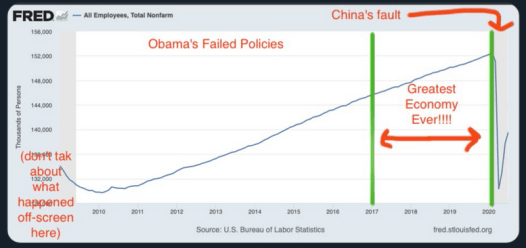

 SDNY is a traditionally independent US Attorney office that
  Originally, Trump’s lawyers argued the ridiculous claim that as long as he is president he is “absolutely immune” from any legal process, including grand jury investigations into his companies and associates. (They literally claimed that if Trump shot someone on Fifth Avenue “nothing could be done”.) Every court that looked at that claim rejected it, and