Tag Archives: 2026 election

What to do with a lawless Supreme Court?

Can democracy flourish, or even survive,
if two-thirds of the justices on the Supreme Court don’t believe in it?


[A previous version of this post didn’t load for some users, so I republished under a similar title.]

One of the great moments in American politics happened on March 15, 1965. It was barely a week since “Bloody Sunday“, when Alabama state police attacked civil rights demonstrators trying to cross the Edmund Pettis Bridge in Selma.

Police (and non-police actors like slave patrols or the Ku Klux Klan) had been beating up Black people for over 100 years, but this time it was on TV, where the whole nation could see it. Nonviolent protesters had brought the reality of oppression into the nation’s living rooms: White people could maintain their dominance, but only by being villains, by brutalizing people who posed no threat.

How would the nation respond?

President Johnson answered by addressing a joint session of Congress, saying these words in his White Texas accent:

There is no Negro problem. There is no Southern problem. There is no Northern problem. There is only an American problem. …

What happened in Selma is part of a far larger movement which reaches into every section and state of America. It is the effort of American Negroes to secure for themselves the full blessings of American life. Their cause must be our cause, too. Because it is not just Negroes, but really it’s all of us who must overcome the crippling legacy of bigotry and injustice.

And we shall overcome.

Johnson backed those words up by proposing the Voting Rights Act, which he signed into law a few months later.

Undoing that landmark piece of legislation has been the life’s work of Chief Justice John Roberts. Wednesday he finished the task.

Immediate and long-term perspectives The decision the Supreme Court released Wednesday, Louisiana v Callais (called just “Callais” in most media coverage), requires explanation both in an immediate and a long-term sense. Immediately, it blesses a practice the VRA was passed to eliminate: “cracking” minority communities and spreading them among multiple districts so that all (or nearly all) districts have a White majority. Or, looked at from the other side, Callais makes illegal the practice of intentionally gathering minority voters into a district where they might form a majority and elect a candidate of their own choosing.

Possibly immediately (if Louisiana can get away with the redistricting it now wants to do even after some absentee votes in its primary have already been mailed, and if other southern states can follow suit), but certainly by 2028, red states in the Deep South will redraw their maps so that maybe ten or so Black congresspeople are gerrymandered out of their jobs. By 2029, the congressional delegations of many Southern states may be as lily-white as they were before the VRA passed in 1965.

Bad as that outcome is, you can’t appreciate the full horror of this decision without seeing the larger context: Callais is the culmination of John Roberts’ 13-year program to repeal the VRA by judicial fiat, in contravention of the intention of the Congresses that passed it and kept renewing it. During those years, a series of corrupt decisions [1] have built on each other to get us where we are today: It is now hard to imagine any state action — no matter how racist — that could be reversed by bringing that state to court under the VRA.

In 2013’s Shelby County decision, Roberts threw out Section 5 of the VRA. Section 5 required a list of states with a history of Jim Crow election practices to get any changes to their election rules pre-cleared by the federal Justice Department. Roberts decided that this provision (which had been re-authorized by Congress as recently as 2006 and had been upheld in numerous Supreme Court precedents) violated the “equal sovereignty of the states”. He got around the precedential history by saying “things have changed dramatically” since the first version of the VRA was passed in 1965.

Here’s what I had to say about that at the time (in a piece I demurely titled “This Court Sucks“):

“Things have changed” is not a legal argument. It’s a fine point to make on a blog or at a dinner party, but a Supreme Court justice has to do better than that.

If Roberts were being a real judge here, he’d spell out what “equal sovereignty” has and hasn’t meant in American legal history. He’d enunciate an abstract standard by which Jim Crow was “exceptional” in 1965 and which justified the steps taken then. He’d explain how that standard was violated by the renewal of the VRA in 2006. And he’d lay down a set of conditions that Congress would need to satisfy to make the VRA acceptable today. (If you want to see what a real legal opinion looks like, read Justice Ginsburg’s dissent. Whether you agree with her or not, she is clearly doing something far more rigorous than what Roberts is doing.)

Roberts doesn’t do any of that. The VRA was vaguely justified in 1965 and is vaguely unjustified now, because “things have changed”. If I were a congressman, I would have no idea how to revise the VRA so that it passes constitutional muster. If Congress does revise it, lower court judges who rule on it will just be guessing about its constitutionality. It will have to go back to the Supreme Court before anyone knows whether it’s really a law again, because there are no standards in Roberts’ opinion by which a revision can be judged.

This isn’t law. It’s politics. It’s mush.

The mush has continued since. If Shelby County eliminated blocking racist election laws before they take effect, the Brnovich decision in 2021 made it harder to use Section 2 of the VRA to challenge such laws after they take effect. On a parallel track, the Rucho decision in 2019 said that partisan gerrymandering cases were “nonjusticiable”. In other words, partisan gerrymandering might be an unsavory practice, but neither the laws nor the Constitution give the courts power to do anything about it.

Sleight of hand. And that brings us to Wednesday’s Callais decision, written by Justice Alito. Once again, we are told that “things have changed”, so laws protecting minority voting rights are no longer necessary. [2] That sets up two legal sleights of hand: intent, and the confusion of partisan with racial gerrymandering.

One issue has run through the history of the VRA’s interpretation: Does the VRA only outlaw intentionally racist election practices? Or does it outlaw practices that have the effect of disenfranchising minority voters or diminishing their power, regardless of motive? The difference is important, because intent can be hard to prove in court. Many of the Jim Crow practices didn’t explicitly mention race: Poll taxes might be justified as a way to raise revenue, and the effect of discouraging poor people from voting, or the fact that Black voters are disproportionately poor — that might be portrayed as entirely accidental. Literacy tests might simply be a means of raising the quality of the average voter, unrelated to an educational system that favors White children. And so on.

This kind of thing was well understood even in 1965. [3]

As Justice Kagan explains in her dissent, the Court hobbled VRA enforcement by shifting to an “intent” interpretation in a 1980 decision. So Congress rewrote the VRA in 1982 to specify an “effects” interpretation. Alito denies that he is reinstating the “intent” view in contravention of Congress, but he is. He explicitly writes:

§2 of the VRA requires evidence giving rise to a strong inference of intentional discrimination.

The second sleight-of-hand makes use of the corrupt Rucho decision on partisan gerrymandering.

The upshot of Rucho was that, as far as federal law is concerned, a state legislature may use partisan advantage as a factor in redistricting. And litigants cannot circumvent that rule by dressing their political-gerrymandering claims in racial garb. Imposing liability “based on the racial effects of a political gerrymander in a jurisdiction in which race and partisan preference are very closely correlated . . . would, if accepted, provide a convenient way for future litigants and lower courts to sidestep our holding in Rucho that partisan-gerrymandering claims are not justiciable in federal court.” Alexander, 602 U. S., at 21. “Instead of claiming that a State impermissibly set a target Republican-Democratic breakdown, a plaintiff could simply reverse-engineer the partisan data into racial data and argue that the State impermissibly set a particular [racial] target. Our decisions cannot be evaded with such ease.”

Since intent is what matters, and a pro-Republican gerrymander looks just like a White-racist gerrymander, it’s impossible to prove racist (rather than partisan) intent. So the VRA’s protection against racial gerrymanders — effectively the last piece of the VRA still standing — is effectively dead.

But Kagan’s dissent calls Alito on his shenanigans:

[T]o its (modest) credit, the Rucho Court did not pretend that partisan gerrymanders were something in need of safeguarding. To the contrary, the Court conceded that they were “incompatible with democratic principles” and “lead to results that reasonably seem unjust.” (The Court’s rationale was only that federal courts lack competence to deal with gerrymanders, not that they were protected by law or beneficial as policy.) Today, though, the majority straight-facedly holds that the Voting Rights Act must be brought low to make the world safe for partisan gerrymanders. For how else, the majority reasons, can we preserve the authority of States to engage in this practice than by stripping minority citizens of their rights to an equal political process?

Rucho wrung its hands over partisan gerrymandering as a disreputable practice, and claimed only that the Court had no power to interfere with it. But now, Alito presents partisan gerrymandering as a state’s right, which Congress dare not impinge on and the Court is obligated to protect. There is, of course, no legal argument to back up that claim. It’s just how the Court’s Republican majority wants things to be, so Alito has slipped it between the lines. [4]

In fact, Alito has the logic exactly backwards: He says courts can’t throw out racial gerrymanders because they might accidentally throw out partisan gerrymanders. But the VRA says courts must throw out partisan gerrymanders if they have the same effect as a racial gerrymander. That’s the law as written, but under this Court, written law doesn’t mean much.

How to handle a corrupt court. Not long ago, when Democrats controlled the White House and both houses of Congress, some members of the party suggested expanding the Supreme Court to 13 justices, so that four new justices could outvote the corrupt Republican ones. This proposal never got close to implementation, because it was widely viewed as too radical. The party’s center saw raw exercises of power like that distasteful, as something dirty that we needed to keep clear of if we ever wanted to restore purity to our government.

In view of what Trump has been doing in his second term, and the increasingly aggressive partisanship of the current Supreme Court majority, that view now seems naive.

The purity viewpoint has already begun to change, as we have seen in the recent gerrymandering battle. Democrats could have clutched their pearls and held onto their purity as Texas made five Democratic seats in Congress vanish. But Gavin Newsom decided to fight fire with fire in California, and the state’s voters backed him up. More recently in Virginia, “centrist” Governor Abigail Spanberger made the same choice, and the electorate of her swing state agreed.

Legal purists worry about the Supreme Court losing authority if it is seen as just another political branch of government. But that’s what it already is, and public respect for it is waning, for good reasons.

We’ve been here before. In 1937, FDR called for a plan to expand the Supreme Court, which had been invalidating just about everything he tried to do. That proposal failed, in that it did not pass Congress. But it also succeeded in making the Court back off.

If Democrats take power again in 2029, a similar strategy is called for: Immediately pass legislation to restore voting rights, and to undo the other excesses of this corrupt Supreme Court. And have a court-expansion proposal ready to vote on if the Court tries to interfere.

The Roberts Court has become the enemy of multi-racial democracy. If we’re going to make up the ground that we’ve lost, and someday go beyond our previous accomplishments to achieve the democratic republic Americans have long envisioned, we’re not just going to have to overcome white supremacists or Republicans or oligarchs. We’re going to have to overcome a corrupt, partisan, racist Supreme Court as well.

And we shall overcome.


[1] I use the word corrupt carefully. It would be one thing if Roberts and the conservative majority that has been built around him professed some different-but-arguable legal theory that made the VRA unconstitutional or unenforceable. But I’ve been reading these decisions since Shelby County in 2013, and none of them make a recognizable legal argument. They are simply results that the Court majority wants. Josh Marshall explains:

In our thinned out political discourse people often use the term “corruption” to refer only to venal corruption – bribes, conflicts of interest mostly involving money, kept Justices like Clarence Thomas. That is neither the only nor the most significant form of corruption. In most cases venal corruption is significantly self-correcting. It gets exposed and prosecuted. The more general meaning of corruption is when a form of rot takes over an office or institution because of systemic and ingrained abuses of power. That is the case with the Supreme Court and it’s especially dangerous with the Supreme Court because a mix of history and restraint have left very few checks on its abuses. The Supreme Court is given specific powers to achieve specific ends. Over the last 15 years it has assumed vast new powers and used them consistently for anti-constitutional ends. Far from interpreting or defending the constitution it is at war with it.

[2] Justice Kagan’s dissent nails this perfectly:

So the majority moves on again, now to a grab-bag of “developments” that it somehow thinks license it to rewrite a statute. The majority first summons the slogan of Shelby County, in which the Court ordained itself the arbiter of when civil rights laws are no longer needed. “ ‘[T]hings have changed dramatically,’ ” today’s majority echoes, pointing to increases in African American voting registration and to the success of “ ‘African-Americans attain[ing] political office’ ”—“particularly in the South, where many §2 suits arise.” No doubt that is so, in large measure because of the Voting Rights Act. But it is a separate question whether those gains will endure once the Act’s protections are gone. See Shelby County, 570 U. S., at 590 (Ginsburg, J., dissenting) (noting the fallacy of “throwing away your umbrella in a rainstorm because you are not getting wet”). And surely—but apparently not—the proper actor to answer that question is Congress. … It is for the people’s representatives in Congress to decide when the Nation need no longer worry about the dilution of minority voting strength.

[3] Johnson said as much in his speech:

Every device of which human ingenuity is capable has been used to deny this right. The Negro citizen may go to register only to be told that the day is wrong, or the hour is late, or the official in charge is absent. And if he persists, and if he manages to present himself to the registrar, he may be disqualified because he did not spell out his middle name or because he abbreviated a word on the application. And if he manages to fill out an application he is given a test. The registrar is the sole judge of whether he passes this test. He may be asked to recite the entire Constitution, or explain the most complex provisions of state law. And even a college degree cannot be used to prove that he can read and write. For the fact is that the only way to pass these barriers is to show a white skin.

Experience has clearly shown that the existing process of law cannot overcome systematic and ingenious discrimination. No law that we now have on the books–and I have helped to put three of them there–can ensure the right to vote when local officials are determined to deny it.

So the VRA was designed to go beyond “the existing process of law”. That is precisely what Roberts, Alito, and their allies have undone, because (in their judgment and their judgment alone) “things have changed”.

[4] It’s tempting to give a pass to the Republican judges who didn’t write on this topic: Kavanaugh, Gorsuch, and Barrett. But they had to see the logical holes in this argument, and they then chose to vote for it without posting a dissent on any particular.

What to do about a lawless Supreme Court?

Can democracy flourish, or even survive,
if two-thirds of the justices on the Supreme Court don’t believe in it?


One of the great moments in American politics happened on March 15, 1965. It was barely a week since “Bloody Sunday“, when Alabama state police attacked civil rights demonstrators trying to cross the Edmund Pettis Bridge in Selma.

Police (and non-police actors like slave patrols or the Ku Klux Klan) had been beating up Black people for over 100 years, but this time it was on TV, where the whole nation could see it. Nonviolent protesters had brought the reality of oppression into the nation’s living rooms: White people could maintain their dominance, but only by being villains, by brutalizing people who posed no threat.

How would the nation respond?

President Johnson answered by addressing a joint session of Congress, saying these words in his White Texas accent:

There is no Negro problem. There is no Southern problem. There is no Northern problem. There is only an American problem. …

What happened in Selma is part of a far larger movement which reaches into every section and state of America. It is the effort of American Negroes to secure for themselves the full blessings of American life. Their cause must be our cause, too. Because it is not just Negroes, but really it’s all of us who must overcome the crippling legacy of bigotry and injustice.

And we shall overcome.

Johnson backed those words up by proposing the Voting Rights Act, which he signed into law a few months later.

Undoing that landmark piece of legislation has been the life’s work of Chief Justice John Roberts. Wednesday he finished the task.

Immediate and long-term perspectives The decision the Supreme Court released Wednesday, Louisiana v Callais (called just “Callais” in most media coverage), requires explanation both in an immediate and a long-term sense. Immediately, it blesses a practice the VRA was passed to eliminate: “cracking” minority communities and spreading them among multiple districts so that all (or nearly all) districts have a White majority. Or, looked at from the other side, Callais makes illegal the practice of intentionally gathering minority voters into a district where they might form a majority and elect a candidate of their own choosing.

Possibly immediately (if Louisiana can get away with the redistricting it now wants to do even after some absentee votes in its primary have already been mailed, and if other southern states can follow suit), but certainly by 2028, red states in the Deep South will redraw their maps so that maybe ten or so Black congresspeople are gerrymandered out of their jobs. By 2029, the congressional delegations of many Southern states may be as lily-white as they were before the VRA passed in 1965.

Bad as that outcome is, you can’t appreciate the full horror of this decision without seeing the larger context: Callais is the culmination of John Roberts’ 13-year program to repeal the VRA by judicial fiat, in contravention of the intention of the Congresses that passed it and kept renewing it. During those years, a series of corrupt decisions [1] have built on each other to get us where we are today: It is now hard to imagine any state action — no matter how racist — that could be reversed by bringing that state to court under the VRA.

In 2013’s Shelby County decision, Roberts threw out Section 5 of the VRA. Section 5 required a list of states with a history of Jim Crow election practices to get any changes to their election rules pre-cleared by the federal Justice Department. Roberts decided that this provision (which had been re-authorized by Congress as recently as 2006 and had been upheld in numerous Supreme Court precedents) violated the “equal sovereignty of the states”. He got around the precedential history by saying “things have changed dramatically” since the first version of the VRA was passed in 1965.

Here’s what I had to say about that at the time (in a piece I demurely titled “This Court Sucks“):

“Things have changed” is not a legal argument. It’s a fine point to make on a blog or at a dinner party, but a Supreme Court justice has to do better than that.

If Roberts were being a real judge here, he’d spell out what “equal sovereignty” has and hasn’t meant in American legal history. He’d enunciate an abstract standard by which Jim Crow was “exceptional” in 1965 and which justified the steps taken then. He’d explain how that standard was violated by the renewal of the VRA in 2006. And he’d lay down a set of conditions that Congress would need to satisfy to make the VRA acceptable today. (If you want to see what a real legal opinion looks like, read Justice Ginsburg’s dissent. Whether you agree with her or not, she is clearly doing something far more rigorous than what Roberts is doing.)

Roberts doesn’t do any of that. The VRA was vaguely justified in 1965 and is vaguely unjustified now, because “things have changed”. If I were a congressman, I would have no idea how to revise the VRA so that it passes constitutional muster. If Congress does revise it, lower court judges who rule on it will just be guessing about its constitutionality. It will have to go back to the Supreme Court before anyone knows whether it’s really a law again, because there are no standards in Roberts’ opinion by which a revision can be judged.

This isn’t law. It’s politics. It’s mush.

The mush has continued since. If Shelby County eliminated blocking racist election laws before they take effect, the Brnovich decision in 2021 made it harder to use Section 2 of the VRA to challenge such laws after they take effect. On a parallel track, the Rucho decision in 2019 said that partisan gerrymandering cases were “nonjusticiable”. In other words, partisan gerrymandering might be an unsavory practice, but neither the laws nor the Constitution give the courts power to do anything about it.

Sleight of hand. And that brings us to Wednesday’s Callais decision, written by Justice Alito. Once again, we are told that “things have changed”, so laws protecting minority voting rights are no longer necessary. [2] That sets up two legal sleights of hand: intent, and the confusion of partisan with racial gerrymandering.

One issue has run through the history of the VRA’s interpretation: Does the VRA only outlaw intentionally racist election practices? Or does it outlaw practices that have the effect of disenfranchising minority voters or diminishing their power, regardless of motive? The difference is important, because intent can be hard to prove in court. Many of the Jim Crow practices didn’t explicitly mention race: Poll taxes might be justified as a way to raise revenue, and the effect of discouraging poor people from voting, or the fact that Black voters are disproportionately poor — that might be portrayed as entirely accidental. Literacy tests might simply be a means of raising the quality of the average voter, unrelated to an educational system that favors White children. And so on.

This kind of thing was well understood even in 1965. [3]

As Justice Kagan explains in her dissent, the Court hobbled VRA enforcement by shifting to an “intent” interpretation in a 1980 decision. So Congress rewrote the VRA in 1982 to specify an “effects” interpretation. Alito denies that he is reinstating the “intent” view in contravention of Congress, but he is. He explicitly writes:

§2 of the VRA requires evidence giving rise to a strong inference of intentional discrimination.

The second sleight-of-hand makes use of the corrupt Rucho decision on partisan gerrymandering.

The upshot of Rucho was that, as far as federal law is concerned, a state legislature may use partisan advantage as a factor in redistricting. And litigants cannot circumvent that rule by dressing their political-gerrymandering claims in racial garb. Imposing liability “based on the racial effects of a political gerrymander in a jurisdiction in which race and partisan preference are very closely correlated . . . would, if accepted, provide a convenient way for future litigants and lower courts to sidestep our holding in Rucho that partisan-gerrymandering claims are not justiciable in federal court.” Alexander, 602 U. S., at 21. “Instead of claiming that a State impermissibly set a target Republican-Democratic breakdown, a plaintiff could simply reverse-engineer the partisan data into racial data and argue that the State impermissibly set a particular [racial] target. Our decisions cannot be evaded with such ease.”

Since intent is what matters, and a pro-Republican gerrymander looks just like a White-racist gerrymander, it’s impossible to prove racist (rather than partisan) intent. So the VRA’s protection against racial gerrymanders — effectively the last piece of the VRA still standing — is effectively dead.

But Kagan’s dissent calls Alito on his shenanigans:

[T]o its (modest) credit, the Rucho Court did not pretend that partisan gerrymanders were something in need of safeguarding. To the contrary, the Court conceded that they were “incompatible with democratic principles” and “lead to results that reasonably seem unjust.” (The Court’s rationale was only that federal courts lack competence to deal with gerrymanders, not that they were protected by law or beneficial as policy.) Today, though, the majority straight-facedly holds that the Voting Rights Act must be brought low to make the world safe for partisan gerrymanders. For how else, the majority reasons, can we preserve the authority of States to engage in this practice than by stripping minority citizens of their rights to an equal political process?

Rucho wrung its hands over partisan gerrymandering as a disreputable practice, and claimed only that the Court had no power to interfere with it. But now, Alito presents partisan gerrymandering as a state’s right, which Congress dare not impinge on and the Court is obligated to protect. There is, of course, no legal argument to back up that claim. It’s just how the Court’s Republican majority wants things to be, so Alito has slipped it between the lines. [4]

In fact, Alito has the logic exactly backwards: He says courts can’t throw out racial gerrymanders because they might accidentally throw out partisan gerrymanders. But the VRA says courts must throw out partisan gerrymanders if they have the same effect as a racial gerrymander. That’s the law as written, but under this Court, written law doesn’t mean much.

How to handle a corrupt court. Not long ago, when Democrats controlled the White House and both houses of Congress, some members of the party suggested expanding the Supreme Court to 13 justices, so that four new justices could outvote the corrupt Republican ones. This proposal never got close to implementation, because it was widely viewed as too radical. The party’s center saw raw exercises of power like that distasteful, as something dirty that we needed to keep clear of if we ever wanted to restore purity to our government.

In view of what Trump has been doing in his second term, and the increasingly aggressive partisanship of the current Supreme Court majority, that view now seems naive.

The purity viewpoint has already begun to change, as we have seen in the recent gerrymandering battle. Democrats could have clutched their pearls and held onto their purity as Texas made five Democratic seats in Congress vanish. But Gavin Newsom decided to fight fire with fire in California, and the state’s voters backed him up. More recently in Virginia, “centrist” Governor Abigail Spanberger made the same choice, and the electorate of her swing state agreed.

Legal purists worry about the Supreme Court losing authority if it is seen as just another political branch of government. But that’s what it already is, and public respect for it is waning, for good reasons.

We’ve been here before. In 1937, FDR called for a plan to expand the Supreme Court, which had been invalidating just about everything he tried to do. That proposal failed, in that it did not pass Congress. But it also succeeded in making the Court back off.

If Democrats take power again in 2029, a similar strategy is called for: Immediately pass legislation to restore voting rights, and to undo the other excesses of this corrupt Supreme Court. And have a court-expansion proposal ready to vote on if the Court tries to interfere.

The Roberts Court has become the enemy of multi-racial democracy. If we’re going to make up the ground that we’ve lost, and someday go beyond our previous accomplishmens to achieve the democratic republic Americans have long envisioned, we’re not just going to have to overcome white supremacists or Republicans or oligarchs. We’re going to have to overcome a corrupt, partisan, racist Supreme Court as well.

And we shall overcome.


[1] I use the word corrupt carefully. It would be one thing if Roberts and the conservative majority that has been built around him professed some different-but-arguable legal theory that made the VRA unconstitutional or unenforceable. But I’ve been reading these decisions since Shelby County in 2013, and none of them make a recognizable legal argument. They are simply results that the Court majority wants. Josh Marshall explains:

In our thinned out political discourse people often use the term “corruption” to refer only to venal corruption – bribes, conflicts of interest mostly involving money, kept Justices like Clarence Thomas. That is neither the only nor the most significant form of corruption. In most cases venal corruption is significantly self-correcting. It gets exposed and prosecuted. The more general meaning of corruption is when a form of rot takes over an office or institution because of systemic and ingrained abuses of power. That is the case with the Supreme Court and it’s especially dangerous with the Supreme Court because a mix of history and restraint have left very few checks on its abuses. The Supreme Court is given specific powers to achieve specific ends. Over the last 15 years it has assumed vast new powers and used them consistently for anti-constitutional ends. Far from interpreting or defending the constitution it is at war with it.

[2] Justice Kagan’s dissent nails this perfectly:

So the majority moves on again, now to a grab-bag of “developments” that it somehow thinks license it to rewrite a statute. The majority first summons the slogan of Shelby County, in which the Court ordained itself the arbiter of when civil rights laws are no longer needed. “ ‘[T]hings have changed dramatically,’ ” today’s majority echoes, pointing to increases in African American voting registration and to the success of “ ‘African-Americans attain[ing] political office’ ”—“particularly in the South, where many §2 suits arise.” No doubt that is so, in large measure because of the Voting Rights Act. But it is a separate question whether those gains will endure once the Act’s protections are gone. See Shelby County, 570 U. S., at 590 (Ginsburg, J., dissenting) (noting the fallacy of “throwing away your umbrella in a rainstorm because you are not getting wet”). And surely—but apparently not—the proper actor to answer that question is Congress. … It is for the people’s representatives in Congress to decide when the Nation need no longer worry about the dilution of minority voting strength.

[3] Johnson said as much in his speech:

Every device of which human ingenuity is capable has been used to deny this right. The Negro citizen may go to register only to be told that the day is wrong, or the hour is late, or the official in charge is absent. And if he persists, and if he manages to present himself to the registrar, he may be disqualified because he did not spell out his middle name or because he abbreviated a word on the application. And if he manages to fill out an application he is given a test. The registrar is the sole judge of whether he passes this test. He may be asked to recite the entire Constitution, or explain the most complex provisions of state law. And even a college degree cannot be used to prove that he can read and write. For the fact is that the only way to pass these barriers is to show a white skin.

Experience has clearly shown that the existing process of law cannot overcome systematic and ingenious discrimination. No law that we now have on the books–and I have helped to put three of them there–can ensure the right to vote when local officials are determined to deny it.

So the VRA was designed to go beyond “the existing process of law”. That is precisely what Roberts, Alito, and their allies have undone, because (in their judgment and their judgment alone) “things have changed”.

[4] It’s tempting to give a pass to the Republican judges who didn’t write on this topic: Kavanaugh, Gorsuch, and Barrett. But they had to see the logical holes in this argument, and they then chose to vote for it without posting a dissent on any particular.

Where the Gerrymandering Battle Stands After Virginia

Iran is not the only war Trump started, but appears to be losing.


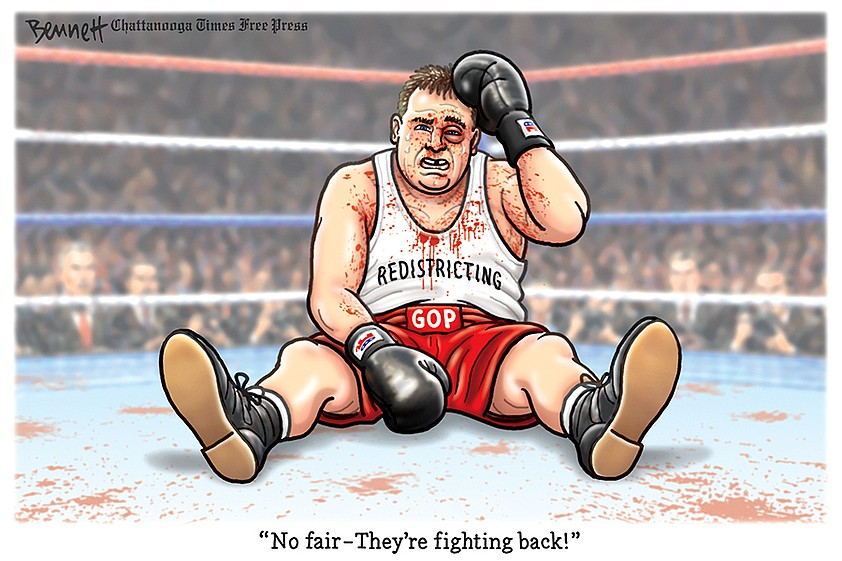
Virginia became the latest state to gerrymander its congressional districts ahead of the midterm elections. Tuesday, a referendum to redraw the state’s maps passed by 3%, 51.5%-48.5%. The likely effect is to turn the current 6-5 Democratic majority in Virginia’s US House delegation into a 10-1 advantage.

Vox estimates that this result puts the Democrats one seat ahead in the redistricting battle that Trump started in Texas. Florida could still tip the balance in the GOP’s favor, but probably not by much. [1]

Prior to the current round, partisan gerrymandering had more or less balanced out: In 2024, Republican House candidates got a small majority of the votes and their party wound up with a small majority of the seats, as they should have.

Republicans have gone to court to prevent Virginia’s new map from taking effect. A circuit-court judge blocked implementation, but was overturned by an appeals court. The case goes to the Virginia Supreme Court today. The deadline for candidates to file to be on the ballot is May 26, so this process can’t take long.

Marc Elias writes in his Democracy Docket blog:

Republicans are asking the courts to throw out 3 million votes in an election that they lost.

For Republicans, democracy is nothing more than a word. 

They are content if every person who waited in line to vote or took time off from work to cast their ballot did it for naught. They seek a result that would mean that every election worker who worked the polls wasted their time. They want the people who knocked doors or canvassed on either side of this question to feel as though they have accomplished nothing.

Meanwhile, here’s how the so-called “liberal media” has covered this story.

When Trump started this battle by pushing Texas to redraw it already-gerrymandered maps, hoping to gain five Republican House seats, The Washington Post characterized Democratic opposition as a “freakout”, and reassured its readers that “What’s happening in the Lone Star State is not a threat to democracy.”

But here’s the Post editorial board’s response to the Virginia vote: “Virginia plunges America deeper into the gerrymandering abyss“. It characterized the referendum as “a power grab by Democrats”. The New York Times produced a similar spin, highlighting how “Democrats Once Loathed Gerrymandering. Now They’re Pushing for It.

But there’s no mystery here, and no hypocrisy to expose. AOC summed up the Republican reaction to the vote as “Wah, wah, wah” and explained the larger context:

Listen, Democrats have attempted and asked Republicans for 10 years to ban partisan gerrymandering. And for 10 years, Republicans have said no. Republicans have fought for partisan gerrymanders across the United States of America, and these are the rules that they have set.

One notable attempt to end gerrymandering was the For the People Act, which Nancy Pelosi pushed through the House, but Republicans filibustered in the Senate. AOC says that deal is still available. [2]

If Republicans decide that they would like to revisit a ban on partisan gerrymandering, I welcome them. We have the bill right here to end this all today. But they don’t want to, because they like pursuing and continuing to enact an unfair electoral landscape, and so we have an obligation to defend ourselves.

This obligation to “defend ourselves” represents a major change in Democratic tactics, beginning with Gavin Newsom’s aggressive response to the Texas gerrymander. Previously, Democrats had tried to cast themselves as the good-government party, avoiding the bad-faith tactics that Republicans have used to seek power. [3]

But perversely, joining Republicans in the gutter may ultimately work a good-government purpose. Now that Republicans realize they could lose too, perhaps a bipartisan consensus against gerrymandering will finally develop.


[1] All such estimates are iffy, because voters may not vote the same way they have in recent elections.

Gerrymandering works by spreading a party’s majority thin to stretch it over more districts. So a miscalculation could result in a previously safe seat flipping.

For example: Suppose a state has a 51-49 partisan majority. The majority party could gerrymander its congressional districts so that each district gives it the same 51-49 advantage, setting up the possibility that it could win all the House seats. However, even a small shift in the political winds could turn the situation around and give the other party all the seats.

This question arises particularly in Texas, where the new maps are based on the 2024 results. However, polls indicate that many Hispanics who voted for Trump in 2024 may regret their vote, or may not see themselves as Republican voters generally. So trying to gain five seats conceivably could result in losing a few seats the GOP had thought were safe.

[2] AOC might have added that liberal Supreme Court judges have tried to find gerrymandering unconstitutional, but conservative justices have supported it, arguing that district maps are a “political question” to be decided perhaps by the very legislatures that have been gerrymandered to lock in one-party rule.

A related court case should be decided soon: In Louisiana v Callais, the Court appears to be ready to drive the final nail into the coffin of the Voting Rights Act. Current interpretations of the VRA require states to draw a certain number of minority-majority districts, so that Black or Hispanic voters have a chance to elect congresspeople to represent their interests. Without this stipulation, a state could spread its minority populations across multiple districts and elect White-only congressional delegations. While this change would likely not take effect until the 2028 elections, it could result in as many as 15 Black House members in the South losing their seats.

[3] For example, Biden re-established the wall between the White House and the Justice Department that Trump had torn down in his first term. Arguably, Merrick Garland’s desire to end DOJ’s politicization is the reason that the Trump indictments appeared so slowly, which allowed him and the partisan Supreme Court to run out the clock.

Can Democrats gain from MAGA discontent?

Trump voters are beginning to regret their decisions. But that doesn’t automatically mean they’ll turn around. What Hungary can teach us about the full process.


MAGA discontent. A running theme of many articles the last few weeks has been MAGA dissatisfaction with Trump — something I at least had given up on ever seeing. The cause doesn’t seem to be any one thing, but the constant drumbeat of betrayal: protecting the Epstein perpetrators, making inflation worse, starting an expensive foreign war for no apparent purpose, profiteering off his government power, and so on.

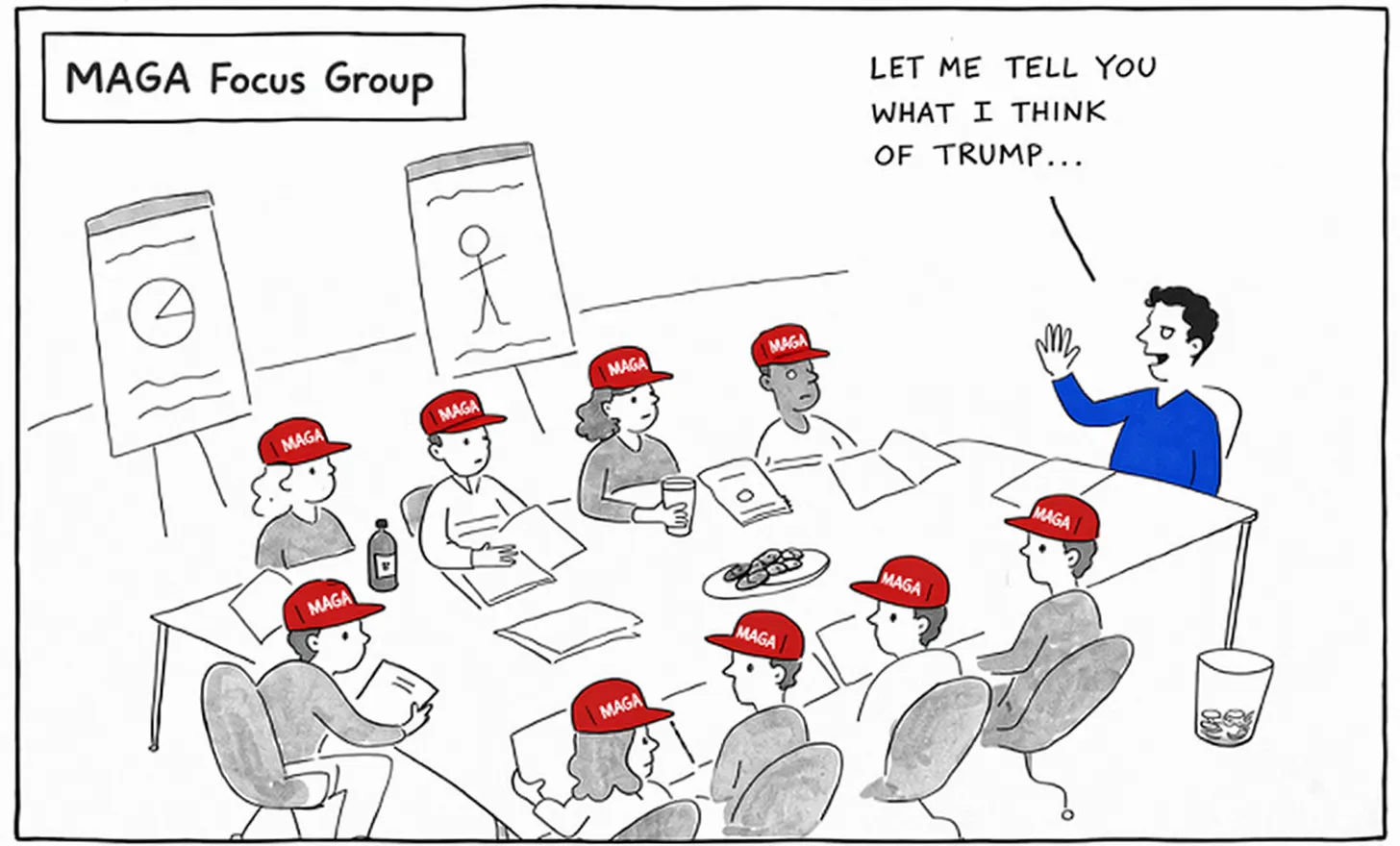
I could list a dozen articles making these points, and you’ve probably seen a number without my pointing them out. But the most interesting to me was Patrice Mersault’s “I Lied My Way into a MAGA Focus Group” (parts 1 and 2).

In a nutshell, Mersault (a pseudonym taken from a Camus novel) kept getting rejected for focus groups when he (the Camus character is male, so I’ll use male pronouns) answered questionnaires honestly, so he created an imaginary MAGAt in his mind and answered as that character. He got in, with the idea that he would pretend to turn against Trump and see how many members of the focus group he could take with him.

Not a good plan, exactly. More of a concept of a plan. The idea was to blend in, say the right things, earn a little credibility, and then, at the right moment, turn. Say what I actually think. Disrupt the room.

But once the conversation moved past why everyone in the room voted for Trump—the familiar grievances: the immigrants, the stolen elections, the belief that cruelty is somehow a form of patriotism—the room didn’t behave the way I expected it to.

It turned out that the other 11 members of the group were fed up with Trump too, even though they had all voted for him three times. (I suppose we have to consider the possibility that Mersault’s entire account is a fiction, but I’ve decided to take it seriously.) Asked to give Trump a letter grade, the participants gave him six D’s and six F’s.

Why? Food and gas prices. The war. Worries about maintaining Social Security and Medicare. Lack of jobs. Epstein.

Who knows how they felt about Trump’s outrageous tweets and behaviors a year ago? But now that they were criticizing him, they didn’t like his manner either. The rudeness, the divisiveness, seeing everyone who doesn’t agree as an enemy. The sense that everything is about him. They didn’t try to defend it; instead, they brought up those criticisms themselves.

So far, so good. But Mersault points out that the voters themselves don’t seem to have changed. He characterized them at the beginning as having a vague and inchoate sense of grievance:

The sense that something had been taken from them. Or was being taken. Or was about to be taken any minute now, unless someone stepped in and stopped it.

The grievances manifested as discontent with a familiar set of issues:

The pandemic. The border. The economy. Woke culture. The various Democratic alternatives, all described with varying degrees of contempt.

None of that has reversed. Nobody had seen the light of liberal wokeness and was saying, “I see now that Black and brown immigrants really don’t do me harm” or “I guess transgender folks aren’t as different as I thought they were” or “Women and minorities do need some government protection”.

They had looked at Trump as “a tool”, someone who would fight back against the forces that they think are taking away their country and their future. They still have that sense of grievance, and they are still looking for a tool to break a system that they see working against them.

The question is: What will they do now? The focus group showed no enthusiasm for a Trump successor like Vance or Rubio. But what are their alternatives? Find some new hero? Stay home? Switch parties?

The Hungarian example. For years, the Orbán regime in Hungary has been a model for the American Right: Get into office and start changing the rules. Get control of the media. Corrupt the courts. Destroy the independence of the universities. Use government favors and regulations as carrots and sticks to make businesses line up with you. Gerrymander. Make voting easy for your voters but hard for opposition voters.

For a long time the Orbán program worked. But then it stopped. On April 12, Hungarian voters decisively rejected Orbán’s party, in such numbers that the tilted playing field couldn’t save him.

The opposition leader Peter Magyar did something American Democrats would like to do: He didn’t just raise dissatisfaction with the Orbán regime. (In fact, he didn’t have to, it was already there.) And he didn’t just get dissatisfied Orbán voters to stay home. He got some large number of those voters to vote for him.

Americans have been trying to read that election for clues about strategy. Maybe, after years of being a model of how a right-wing authoritarian regime rises, Hungary could provide an example of how a right-wing authoritarian regime falls.

The article I like on this topic is by a Hungarian lawyer and mother who blogs under the name Zsofi: “I Lived in Orbán’s Hungary. This Is What It Actually Takes to Bring an Autocrat Down.

She makes a few salient points about how Orbán came to power and stayed there: Hungarians were really fed up with the previous government, so Orbán represented a genuine uprising. And once he got into power and controlled the media, he made sure that every potential opposition leader was “pre-smeared”. Simply proposing to run so-and-so evoked a reaction of “Oh, not him again.”

But Magyar came from nowhere and represented no previous political movement.

Magyar Péter broke this because there was nothing to work with. He was, until early 2024, essentially unknown — a private citizen with no political career, no failed government, no scandal that could be weaponized. When the attacks came, as they did immediately and ferociously, they simply didn’t stick. Not because he was beyond criticism, but because what was said about him was, from the beginning, simply false. Without a kernel of truth at the center, the whole construction kept collapsing. Voters could feel the difference, even when they couldn’t articulate it. …

He also did something that sounds simple and is extraordinarily hard: he showed up. Over two years, he visited more than 700 settlements, some of them six times. Exhausting just to watch: the energy he put into it was extraordinary. He went to places the opposition had never reached, and talked to people who had never heard an alternative from someone standing in front of them, looking them in the eye. You cannot fact-check someone out of a worldview. But presence, over time, creates the conditions where doubt becomes possible. That is slower and less satisfying than a viral moment. It is also what actually works.

She identifies two deadly ideas: that the regime is inevitable, and that society is irreparably broken into two enemy camps.

The [authoritarian] method is consistent everywhere it has been deployed. Find the genuine fault lines in a society: urban versus rural, educated versus working class, the people who feel left behind versus the people who seem not to notice. Pry those lines open. Make sure every election is a referendum on identity and culture rather than on whether the pension is adequate or the hospital is functional. Keep the two halves of society furious at each other, convinced the other half is the enemy, and make sure your coalition is always the slightly larger half. The culture war is not a byproduct of this politics. It is the mechanism.

Like Trump, Orbán had no authentic convictions.

This is worth understanding, because it changes what you’re actually fighting. You are not fighting a true believer. You are fighting a machine that is very good at finding the line that divides society just enough – and parking itself on the larger side of it.

And this seems like the key point:

The grievances that get exploited are real – that is what makes it work. The sense of being left behind, of being looked down on, of watching your children leave and not come back – that is not manufactured resentment. It is legitimate. The autocrat does not invent it. He finds it, names it, and then aims it in a direction that serves him rather than the people experiencing it. … You cannot say that grievance doesn’t exist because it doesn’t affect you. The autocrat has a ready-made answer for it – simple, emotionally satisfying, and wrong. The alternative is to have a better answer, not to pretend the question isn’t being asked.

The opposition also has to avoid “the performance of contempt”.

The moment you hate your fellow citizen more than you hate the system that is robbing you both, the system has already half-won. … The lesson, though, is not simply that these systems can be beaten. It is about how. You cannot win by playing from their script. The moment you accept their frame – that your society is divided into two enemy camps, one good and one irredeemably wrong – you have lost something you won’t easily recover. The autocrat wins not just when he stays in power, but when he gets you to see your neighbor as your enemy. When the hatred flows horizontally, between citizens, rather than upward, toward the people actually responsible.

The alternative is simpler and harder to hold onto: we belong to each other. We love the same country. We want it to be better. We disagree -sometimes bitterly, sometimes irreconcilably- about how. That disagreement is not a war: it is politics, it is normal and it is supposed to happen.

What I learned in Europe. I spent the first week or so of April on a Viking Danube cruise. I went to Prague, Nuremberg, Vienna, Budapest, and a few other places. I walked through a lot of museums and talked to a lot of tour guides, but I’m going to resist the temptation to claim that I’ve become some kind of expert on Central Europe. I speak only a smattering of German, and no Czech or Hungarian at all. Most of the locals I spoke to (in English) probably aren’t typical or representative. So don’t interpret my trip as some kind of research project. I certainly don’t.

But the Danube trip did give me a good opportunity to meditate on America, and to see patterns in other societies that I should have recognized in my own.

On a walking tour of Prague, we eventually wound up at the castle that had been the seat of the German-speaking Habsburg emperor for a number of years around 1600 or so. The castle itself goes back well into the Middle Ages. While recounting some medieval transfer of power, the guide said, “And that was the last of our kings who spoke Czech.”

That sentence stuck in my mind. One perpetual theme of MAGA influencers is that the ruling elite (whoever you might imagine them to be) don’t understand ordinary Americans. That, they claim, is how you wind up with affirmative action programs and men playing women’s sports and vaccine mandates.

But in Czech history, that sentiment is literal: The kings can’t understand the ordinary people, because they don’t speak Czech. After the Habsburgs fell in 1918, there was briefly a Czechoslovakian democracy. But that fell into dictatorship, and then the Germans took over, and then the Russians. Today, the Czech Republic governs itself, but the transnational European Union is always looking over its shoulder. Czechs are probably fairly suspicious of this, and maybe that’s why they’re one of the few EU nations that don’t use the euro.

When I tried to imagine myself as a small-town Czech nationalist, I looked at Prague with great suspicion. The whole city is subtitled in English for the benefit of travelers. Lots of shops and other businesses seem not to have a Czech name at all. Places that ought to be sacred to Czechs (like that castle complex) are barely accessible, because they’re overrun with tourists speaking every known language. I might question whether Prague is Czech at all any more; it seems a lot like Czech territory occupied by some globalist empire.

That vision gave me a new appreciation of MAGA in America. There is real grievance in rural and small-town America, something I’ve written about before. It’s a sense that the place you live, which is maybe the place you grew up, has no obvious path into the future. The jobs are leaving, the talented young people are leaving, and there seems to be no end to it.

If that were the whole grievance, though, rural and small-town anger might focus where it really belongs: on the big corporations who rig the system in their favor and don’t care where they build things; and on the billionaires who get big tax breaks and leave no money behind for schools and roads and local investment. But laid over the economic grievance is a sense of dislocation: The America I grew up in isn’t just endangered, it’s already gone in lots of places. This gets you to the demonization of immigrants and people whose lifestyles diverge from what was socially acceptable in the past.

So often, when I run into conservatives obsessed with culture-war issues, I want to ask “Why do you care?” If someone with a penis wants to wear skirts and makeup and start using a name like Susan, what’s it to you that you should feel so incensed about it? If two men or two women want to marry, and to live a life not all that different from the one you live with your opposite-sex spouse, how are you harmed?

The dislocation theory makes sense of this. They aren’t harmed in any material sense, but the culture-war issues are symbols of their grievance: This is not their world any more. They used to know how they (and their children and their communities) could thrive, but now they don’t. The culture-war issue isn’t itself a grievance, but they’ve been trained to see it as a signpost pointing to grievances.

It also explains the hostility to cities. The new world, the world where they don’t belong and can’t succeed, has already taken the cities. The cities are territory occupied by a globalist empire.

It also explains the conspiracy theories. When you feel something, any story that explains and justifies the feeling seems plausible. Fact-checking the narrative doesn’t affect that sense of plausibility.

Progressive vs. centrist. At least since the Clinton administration, conflict has been raging between two theories of why Democrats lose and how they can win. The centrist theory says that Democrats lose when they become too liberal and alienate moderate swing voters. The progressive theory says that Democrats lose when they seem inauthentic and fail to give voters a clear new vision of where the country should go.

When they actually get into office, though, the two kinds of Democrats agree on a great deal. Centrists want to focus on proposals that are immediately achievable, while progressives see those same proposals as first steps on their path into the future.

Both factions want to spin current events in their favor. But if I take the lessons of Mersault and Zsofi to heart, I think both framings miss the point: what the reachable voters are looking for is not fundamentally a more liberal or conservative policy. They’re looking for authenticity and for someone they can trust. They want candidates who care about them enough to show up, to learn what they care about, and to speak to them as if they were intelligent people with real concerns. If you do that, you can get away with taking some principled stands they disagree with.

Look at candidates who are surviving or even thriving in what should be hostile environments. Andy Beshear is popular in Kentucky, but he still gets away with vetoing an anti-trans-rights bill. (“My faith teaches me that all children are children of God and Senate Bill 150 will endanger the children of Kentucky. … I heard from children that believe this bill is picking on them, and asking — in many ways — why? I told them that I was going to show them that there is at least one person in Frankfort that cares for all of our children in the commonwealth, no matter what.”) In Texas, James Talarico’s Christianity takes him different places than MAGA Christianity does, but so far he hasn’t compromised his vision. Jon Ossoff is doing well in Georgia, largely because of his way of speaking in terms voters identify with. (Listen to him make the case against Trump’s corruption.) Pete Buttigieg isn’t currently running for anything, but he goes into enemy territory (like Fox News) and holds his own — and not by throwing unpopular Democrats or Democratic constituencies to the wolves.

Of course Democrats, like all politicians, should focus on their popular positions. But they should put themselves in positions to be challenged on unpopular positions, and they should be ready to defend those positions in easily understandable terms, tracing them back to core values that are widely shared, or at least widely appreciated. They need to answer criticism without denigrating the critic.

Most of all, Democrats need to send the message that they will look out for the country, and not just for their own voters.

The moment you hate your fellow citizen more than you hate the system that is robbing you both, the system has already half-won.

But the right path is not to pander to those you disagree with, but to address them honestly, intelligently, and respectfully

Disagreement is not a war: it is politics, it is normal and it is supposed to happen.