The temperature of the fighting goes up and down, but there is no real prospect for peace. Two articles express two very different ways to look at this situation.
There are basically two truthful ways to cover the current wave of violence between Israelis and Palestinians:
A pox on both your houses, because neither side seems to have any plan that involves making peace with the other. (See cartoon above.)
One side, Israel, bears more responsibility because it is far more powerful, is doing far more damage, and has far more ability to shape the course of events.
A good example of the first type is Vox’ “The Gaza doom loop” by Zack Beauchamp. Beauchamp does mention that the two sides are not equal, but focuses on the similarities between them.
It would seem as if the current round of violence emerged out of a complex series of events in Jerusalem, most notably heavy-handed actions by Israeli police and aggression by far-right Jewish nationalists. But in reality, these events were merely triggers for escalations made almost inevitable by the way the major parties have chosen to approach the conflict. … It’s clear that that this status quo produces horrors. The problem, though, is that these terrible costs are seen as basically tolerable by the political leadership of all the major parties.
Hamas continues to be able to rule Gaza and reaps the political benefits from being the party of armed resistance to Israeli occupation. Palestinian Authority leader Mahmoud Abbas appears cowed by Hamas’s power — most analysts believe he canceled the Palestinian election because he thought he would lose — and so is content to let Israel keep his rivals contained in Gaza.
Beauchamp similarly breaks Israeli politics into two factions: “annexationists … who want to formally seize large chunks of Palestinian land while either expelling its residents or denying them political rights — ethnic cleansing or apartheid” and “the control camp” who (rather than looking for a viable long-term solution) are just trying to minimize the damage that Palestinians can do to Israelis.
The status quo in Gaza serves both groups. From the annexationist view, keeping the Palestinians weak and divided allows Israeli settlements to keep expanding and the seizure of both the West Bank and East Jerusalem to continue apace. Lifting the blockade on Gaza, and working to promote some kind of renewed peace process involving both Hamas and the Palestinian Authority, jeopardizes the agenda of “Greater Israel.”
… Meanwhile, the “control” camp sees this as the least bad option. Any easing of the Gaza blockade would risk Hamas breaking containment and expanding its presence in the West Bank, which would be far more dangerous than the rockets — a threat heavily mitigated by Israel’s Iron Dome missile defense system. In this analysis, periodic flare-ups are a price that has to be paid to minimize the threat to Israeli lives — with heavy escalations like this one required to restore a basically tolerable status quo.
There used to be a third faction, the “equality” camp, which “believed that Palestinians deserved a political voice as a matter of principle — either in a single state or, more typically, through a two-state arrangement”, but it “collapsed after the failure of the peace process and the second intifada in the early 2000s.” Beauchamp estimates that the equality camp controls about 10% of the Knesset, and so has virtually no influence on policy.
The second type of coverage is exemplified by Branko Marcetic’s article in Jacobin: “On Palestine, the Media is Allergic to the Truth“. To Marcetic, putting the recent Hamas rocket attacks on Israel and Israeli airstrikes on Gaza “in context” would mean
explaining that the rockets came in the wake of a series of outrageous and criminal Israeli provocations in occupied East Jerusalem: a series of violent police raids on the Al-Aqsa Mosque compound, the third holiest site in Islam during its holiest month, that have damaged the sacred structure and injured hundreds, including worshippers; that Israeli forces were attacking Palestinians who were occupying Aqsa both to pray and to protect it from bands of far-right Israeli extremists who have been marching through East Jerusalem, attacking Palestinians, and trying to break into the compound; and that all of this sits in the shadow of protests against Israel’s most recent attempt to steal land from Palestinians in the city, and the ramping up of Israel’s theft of Palestinian land more broadly under Trump.
While you’re at it, you might at least make clear that the Israeli attacks on Gaza have been far more vicious and deadly than the rockets they’re supposedly “retaliating” against, having killed forty-three people so far [many more since the article was published], including thirteen children, and leveled an entire residential building. You might make clear that Hamas’s rockets are, owing to their own cheapness and Israel’s Iron Dome defense system, at this point closer to the lashing-out-in-impotent-frustration part of the spectrum (which, of course, is not to say they don’t do damage or occasionally take lives — they’ve killed six Israelis thus far). All of this would help people understand why what they’re seeing unfold on their screens is happening, and what might be done to stop it.
Marcetic skewers the even-handedness of most articles of the first type, which refer to “clashes” and “rising tensions” as if they were reporting storms at sea rather than intentional human actions. Israel doesn’t do things so much as stuff happens and a bunch of people wind up dead.
As for what American policy should be, I have no idea. I’m not sure President Biden does either. How exactly do you make peace between sides whose leaders — backed by a sizeable chunk of their constituents — don’t want to make peace?
That said, I’m glad to see the end of the Trump/Kushner policy, which I would sum up as “Fuck the Palestinians.” The Trumpists’ primary goal in the Middle East was to create an Israel/Sunni alliance against Shiite Iran. So they brokered agreements between Israel and four minor Sunni states: Morocco, Sudan, Bahrain, and the Emirates. If that spirit of cooperation could be extended to larger Sunni countries like Saudi Arabia, the Palestinians would be left without any allies, and presumably would have to take whatever deal Israel feels like offering them.
In essence, the Palestinians were in the way of the strategic realignment Kushner wanted. So to hell with them.
No doubt Israel can create a situation where the Palestinians ought to give up. Arguably, it already has. The Kushners of the world, who have lots of non-hopeless options to choose from, certainly would give up and move on to Plan B, C, or D. But I don’t think the Palestinians will. They’ll keep throwing rocks at tanks until the Israelis either deal with them or kill them.
After taking a week off, I return to a full plate of news.
I don’t enjoy writing about Israel and Palestine, because it’s a dismal situation where I have no solutions to offer. So this week I lean heavily on two other articles, “The Gaza Doom Loop” in Vox and “On Palestine, the Media is Allergic to the Truth” in Jacobin. They reflect very different views: the Vox article fairly even-handedly explains why neither side wants peace, while the Jacobin article holds Israel responsible because it has far more power to shape events. Jacobin additionally offers a devastating critique of news sources that try to stay even-handed.
So that’ll be the first featured article to appear: “What to Make of Israel/Palestine?”. Let’s say that gets out by 9 EST.
Another featured article looks at the Liz Cheney ouster, and what it means for the Republican Party going forward. “Why Liz Cheney Matters” should be out around 11 or so.
That leaves the weekly summary to discuss the new CDC guidance for fully vaccinated people (a group I join tomorrow); other Republican problems like Matt Gaetz, Marjorie Taylor Greene, and the various Trump investigations; the pipeline that got shut down by a ransomware attack; the alarming cracked girder in the bridge that takes I-40 over the Mississippi; and a few other things, before closing with the question: What if Hamilton had been done with polkas rather than hip-hop? I’ll guess that gets out between noon and one.
Before getting into the details of either Biden’s televised speech to Congress [video, transcript] or Senator Tim Scott’s Republican response [video, transcript], I want to make one view-from-orbit observation: When Democratic leaders are given a microphone, they talk about the American people, the challenges we face, and what can be done to make things come out right. When Republicans leaders are given a microphone, they list their grievances against Democrats.
Biden’s speech was about fixing things and setting the country up for future prosperity. It was hopeful and encouraging. He kept saying things like “We can do this.”
Scott started out by saying that President Biden “seems like a good man … but”. God forbid Republicans should give a Democratic president the benefit of the doubt about being a good man. “I won’t waste your time tonight with finger-pointing or partisan bickering,” Scott said, and then did essentially nothing else.
More high-level impressions of Biden’s speech are in the featured post.
I won’t do a full bulleted list of what’s in Biden’s American Families Plan and American Jobs Plan, because CBS News already has that. Basically, the Families Plan is about child care, education, paid time off, and money for parents. The Jobs Plan is about traditional infrastructure like roads, bridges, and public transportation, plus broadband, adjusting to climate change, transitioning to electric vehicles, and capital spending on schools. It also includes “workforce development” (which I think we used to call “job training”), money for taking care of the elderly in their homes rather than institutionalizing them, R&D, and a few other things.
What I found most striking in Scott’s speech was the amount of conservative Christian identity politics in it. He talked about prayer, original sin, grace, and closed with a Christian blessing.
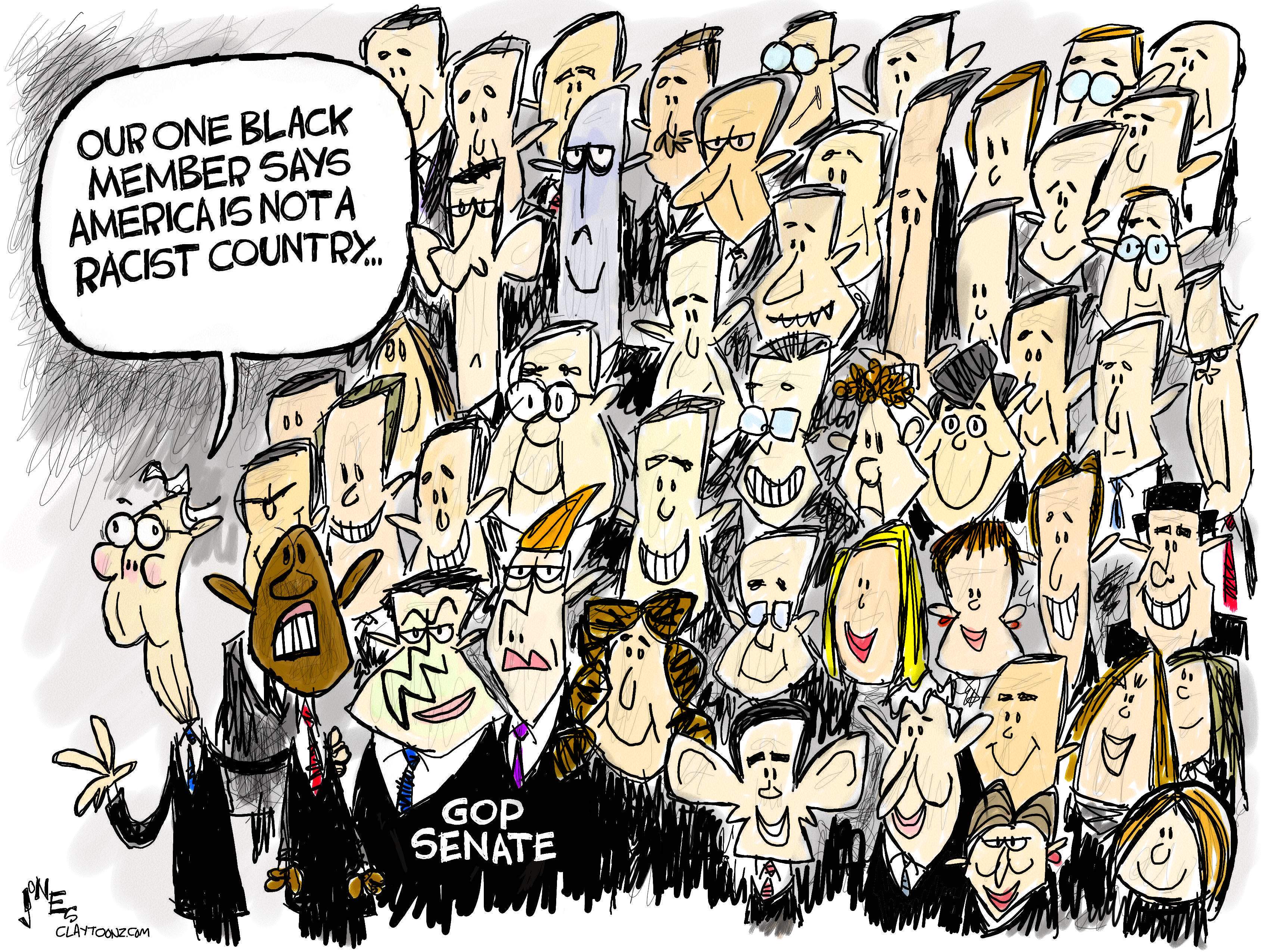
The most quoted line of Scott’s response is “America is not a racist country.” I have to agree with Matt Yglesias:
“Is America a Racist Country?” is the perfect meaningless culture war debate because it has basically no content at all. What is it asking? Compared to what?
Scott clearly wasn’t claiming America has no racism, because he also said “I have experienced the pain of discrimination.” He even allowed that American racism is not entirely in the past: “I know our healing is not finished.” So the argument he started is basically semantic: How much racism does it take to count as a “racist country”? Today’s US is not as racist as the Confederacy or Nazi Germany or the old apartheid regime in South Africa. Is that good enough? How many angels of color have to be included before we consider a pinhead dance to be integrated?
Remember: Meaningless debates serve the interests of people who have nothing to say. If you have a real vision of the future you want, avoid getting baited into arguing about nothing.
BTW: By talking about what America is or isn’t, Scott is invoking a popular trope of conservative rhetoric; he’s talking about essence rather than behavior or results. Similarly: an argument about whether certain drawings in a few Dr. Seuss books reinforce racial stereotypes — they do — becomes “Was Dr. Seuss a racist?”
The next step in that dance is to argue that we can’t know someone else’s essence, so it’s unfair to claim that so-and-so is a racist (which probably nobody did).
I saw this happen in my social media feed this week. Someone objected to Biden claiming that all police are racists. When I asked when he did that — he didn’t — she responded with a quote where Biden mentioned “systemic racism in law enforcement”, which is not at all the same thing. Systemic racism is about the results of our law enforcement system. “All police are racists” is a statement about the essence of a large number of individuals.
Another point of debate between the parties is the effect of Republican voter-suppression laws. It’s possible to cherry-pick comparisons between states, as Scott did when he claimed: “It will be easier to vote early in Georgia than in Democrat-run New York.”
But it’s important to keep your eyes on the bottom line: Where do people end up waiting in line for hours to vote? And the answer is: In Black neighborhoods, especially in states with Republican legislatures. Georgia was already particularly bad before the recent law, and now it will be worse.
Unlike voter fraud and ballot fraud, people waiting hours to vote actually happens already. It’s not a conspiracy theory or a what-if fantasy. It should deeply embarrass all Americans, and legislatures should be full of proposals to process more voters faster, especially in urban Black neighborhoods.
I live in a majority-white Boston suburb, and it takes me about five minutes to vote. Why can’t that happen in inner-city Atlanta?
Every time I checked Fox News on Thursday, they were talking how badly liberals were treating Tim Scott. WaPo columnist Kathleen Parker wrote:
The only Black Republican in the Senate, Scott was quickly trending as “Uncle Tim” on Twitter, as a tool of white supremacists and as a blind servant of the far right. Liberals just cannot handle a Black conservative.
This, my friends, is (also) what racism looks like in America today.
OK, white people should not lob racialized insults at non-white politicians of any philosophy. (Though Scott did indeed act as the mouthpiece of a party that panders to white supremacists; that’s not an insult, it’s just factual.) But Twitter was being mean? How is that news? Have you seen what conservatives tweet about AOC?
If Democratic politicians or opinion leaders are talking about “Uncle Tim”, that’s worth calling out. But I haven’t seen that. Vice President Harris responded to Scott by agreeing that American is not a racist country, but adding
We also do have to speak the truth about the history of racism in our country and its existence today. … One of the greatest threats to our national security is domestic terrorism manifested by white supremacists. And so these are issues that we must confront, and it does not help to heal our country, to unify us as a people, to ignore the realities of that.”
You can also find other sharp-but-not-racist disagreements with Scott from WaPo columnist Eugene Robinson, radio host Clay Cane, and many other liberals. Perhaps an actual discussion could be had. But Fox News does not want that.
Instead, Fox and its allies stoke conservative outrage by pointing out that there are obnoxious people on the internet, some of whom profess to be liberals. Who knew?
FBI agents with a search warrant executed a crack-of-dawn raid on Rudy Giuliani’s apartment and office Wednesday. Giuliani ally Victoria Toensing was also raided. The agents took phones and other electronic devices.
The Justice Department isn’t commenting, but unofficially told AP the investigation “at least partly involves Giuliani’s dealings in Ukraine”. Giuliani’s attorney said the warrant mentioned “possible violation of foreign lobbying laws and that it sought communications between Giuliani and people including a former columnist for The Hill, John Solomon”. Reuters claims to have seen the warrant and lists a dozen people, all of whom have some Ukraine connection.
The intelligence agencies warned the White House late last year [i.e. 2019] that Russian intelligence officers were using President Trump’s personal lawyer Rudolph W. Giuliani as a conduit for disinformation aimed at undermining Joseph R. Biden Jr.’s presidential run, according to four current and former American officials.
One question seems to be: To what extent was Giuliani knowingly working for Russia or its Ukrainian allies like Firtash?
A search warrant must be based upon probable cause and the applicant must present a sworn affidavit to a neutral and detached magistrate or judge. Within this affidavit, there must be facts sufficient to persuade that judge that a crime was committed and that searching in the locations specified within the search warrant will reveal evidence of the crime, or crimes. The locations to be searched must be described with particularity, as well as the items that will be seized from those locations.
In the case of someone like Giuliani, there would have been the requirement that those search warrants be approved by someone at the highest levels of the Department of Justice, as well as the requirement of exhaustion of other less-intrusive investigative means. Giuliani is an attorney, and an attorney’s communications with clients are usually deemed to be confidential and protected by the attorney-client privilege.
We shouldn’t jump to the conclusion that Giuliani is guilty of something, that the government already had enough evidence to indict Giuliani, or that they necessarily found the evidence they were looking for. But they clearly have more than just a desire to harass a Trump ally.
Giuliani’s lawyer called the raid “another disturbing example of complete disregard for the attorney-client privilege”, but it’s not clear that’s true. Typical practice for searching a lawyer’s office, which we saw when former Trump attorney Michael Cohen’s office was searched, is for a “clean team” to conduct the actual search, forwarding to the investigating agents only the items not privileged.
Giuliani’s son Andrew briefly stepped outside of his father’s Manhattan apartment on Wednesday afternoon to denounce the Department of Justice, saying that if this can happen to “the former president’s lawyer, this could happen to any American.”
Once you put the situation in context, the younger Giuliani’s statement is exactly right: If federal investigators can convince a judge that a crime has probably been committed and that evidence of that crime is probably in your home or office, they can get a warrant to search for that evidence, even if you’re buddies with a former president. It could happen to any American, but you’re most at risk if you’ve committed crimes.
Giuliani’s people are complaining about “politicization” of the Justice Department, but all the indications are that the political influence has been working in the other direction: Prosecutors have been investigating Giuliani since 2019, but his relationship with Trump protected him. Now that Trump is out of office, the investigation can continue the way it would against any suspected criminal.
and the virus
Good news and bad news this week. The good news is that the US definitely seems to have turned the corner on new cases. The daily average is down to about 50K. Deaths also continue their slow decline. We’re down to less than 700 per day.
more than half of adults in the United States have been inoculated with at least one dose of a vaccine. But daily vaccination rates are slipping, and there is widespread consensus among scientists and public health experts that the herd immunity threshold is not attainable — at least not in the foreseeable future, and perhaps not ever.
Instead, they are coming to the conclusion that rather than making a long-promised exit, the virus will most likely become a manageable threat that will continue to circulate in the United States for years to come, still causing hospitalizations and deaths but in much smaller numbers.
The second piece of bad news is the international picture. New cases in India continue to skyrocket, and the numbers in several South American countries are near record highs. Adding it all up, the virus worldwide is spreading faster now than it ever has.
The more Covid-19 there is in the world, the more mutations we’ll see. Eventually, some variant could beat our vaccines.
The Atlantic’s Derek Thompson listens to people not planning to be vaccinated, and isn’t optimistic about convincing them. But this is his best suggestion:
Instead of shaming and hectoring, our focus should be on broadening their circle of care: Your cells might be good enough to protect you; but the shots are better to protect grandpa.
and you also might be interested in …
Last week I wrote about Republicans in Florida and several other states trying to criminalize protest, pointing out once again that the GOP’s commitment to “liberty” and “the Constitution” is bogus.
The Florida bill would prohibit social media companies from knowingly “deplatforming” political candidates, meaning a service could not “permanently delete or ban” a candidate. Suspensions of up to 14 days would still be allowed, and a service could remove individual posts that violate its terms of service.
The state’s elections commission would be empowered to fine a social media company $250,000 a day for statewide candidates and $25,000 a day for other candidates if a company’s actions are found to violate the law
I can imagine a proposal to split up social media companies, or perhaps to turn their networks into some kind of public/private entity like the post office. But as long as they are private corporations whose users, advertisers, and employees come to them by choice, they’ve got a right to manage their own affairs and set their own policies.
It’s hard to come up with any rationale that justifies this law and also upholds previous conservative causes, like allowing a baker to refuse to bake a cake for a same-sex wedding reception, or letting Hobby Lobby object to providing birth control for its employees. If Twitter decides it no longer wants to be associated with Trump’s domestic terrorism, how is that illegitimate?
One possible but scary rationale is contained in a Zero Hedge article a friend sent me. The author was discussing a scenario where companies require their employees and/or customers to be vaccinated (which would be terrible for some reason that escapes me).
These companies do not represent private business or free markets anymore. Instead, they are appendages of establishment power that receive billions in taxpayer dollars to finance their operations. They should no longer be treated as if they have the same rights as normal businesses.
That is one way the libertarian-to-fascist pipeline might work. Businesses have rights until they do something the fascists don’t like, at which point they become “appendages of establishment power” and their rights go away.
Weird development in the Matt Gaetz scandal. The Daily Beast claims to have copies of communications between Gaetz associate Joel Greenberg and (wait for it) Roger Stone, who Greenberg was willing to pay $250,000 if he could broker a pardon from Trump. (No pardon was given and no money paid.)
In the private text messages to Stone, Greenberg described his activities with Gaetz, repeatedly referring to the Republican congressman by his initials, “MG,” or as “Matt.”
“My lawyers that I fired, know the whole story about MG’s involvement,” Greenberg wrote to Stone on Dec. 21. “They know he paid me to pay the girls and that he and I both had sex with the girl who was underage.”
If you’re wondering “Why on Earth would you ever admit that to somebody, especially in writing?”, you’re not alone.
As Biden keeps proposing things the American people like, Trumpist attacks on him are getting increasingly desperate. Here, a NewsMax talking head goes off on a clip of Biden bending down to pick a dandelion and give it to Jill. This act is labelled “bizarre” and somehow deserving of ridicule.
You know who’s a communist now? Mitt Romney. At least that’s what the hecklers at the Utah Republican Convention were calling out as he tried to speak. But a motion to censure Mitt for daring to vote to convict Donald Trump narrowly failed 711-798.
As someone who went to a few Burning Man festivals years ago, I’m not sure what I think about the proposal for a permanent art installation that generates solar electricity. Don’t-blink-or-you’ll-miss-it is a key element of the Burning Man experience. The fact that this is all going up in smoke at the end of the week teaches a lesson about being truly present.
On the other hand: renewable energy in an attractive package.
Biden’s speech and the response (or lack of response) from Republicans demonstrates that no one believes in the old nostrums any more.
The day Clinton surrendered. In the 1996 State of the Union, President Bill Clinton said, “The era of big government is over.” This has been widely marked as the moment when the Democratic Party surrendered to the Reagan revolution.
For the 12 years of the Reagan and Bush administrations, many Democrats in Congress had tried to hold the line. Then, after Clinton was elected in 1992, he set out to extend the legacy of FDR and LBJ by fulfilling the longstanding Democratic ambition to create some version of universal health care. After seeming popular at first, “HillaryCare” didn’t pass. Democrats were subsequently routed in the 1994 midterm elections, making Newt Gingrich the first Republican Speaker of the House since the legendary Sam Rayburn replaced the much-less-legendary Joseph W. Martin Jr. in 1955.
The lesson Clinton learned from that defeat was that Democrats needed to temper their ambitions. Subsequently, he worked with Gingrich to achieve goals that appealed to Republicans, like balancing the budget, ending “welfare as we know it”, passing NAFTA, and de-regulating the banking system (in ways that would blow up by 2008). There would be no more big-ticket proposals until ObamaCare in 2009. Democratic governance became little more than a kinder, more efficient version of Republican governance.
For most of the 20th century, Democrats had stood for an active government trying to solve people’s problems. FDR’s New Deal had given the country Social Security, unemployment insurance, and the minimum wage. LBJ’s Great Society had added Medicare, the War on Poverty, and the Voting Rights Act. But all that was over now. Clinton was not just refusing to advance, he was actively capitulating: “Big government” was itself a Reaganite phrase that would have been anathema to Democrats just a few years before. (To make a present-day comparison: Imagine what it would mean if major Republicans started denouncing “white privilege”.)
Meanwhile, Republicans continued to worship at the shrine of the Great Communicator. For three decades, the philosophy of the Republican Party didn’t waver: low taxes, less regulation, free trade, more spending for defense but less for social programs, and “traditional family values” — which mainly meant opposing abortion and homosexuality.
This constancy gave Republican candidates a significant branding advantage in campaigns. If you saw an R next to a politician’s name, you immediately knew what he stood for — even if you had never heard of him before. Democrats, conversely, had to put considerable effort and money into introducing themselves to voters, and explaining why they weren’t the “tax-and-spend liberals” Reagan had so successfully vilified.
That was the Reagan Era. Even if you hadn’t been born yet when he left office in 1989, you have been living in his era. Until Wednesday, when President Biden announced the end of it.
Two cycles. The Reagan Era did not end all at once. It took two complete election cycles to bring it down.
When Republicans started campaigning for the presidency in 2015, Reaganite orthodoxy still seemed solidly in control. Marco Rubio, for example, might talk about “new ideas”, but what he really meant was “new faces”. After listening to his stump speech, I wrote:
What in that plan does he think Jeb Bush will disagree with? Less regulation, lower taxes on corporations and the rich, less government spending, traditional family values, strong defense, aggressive American leadership in the world. How is that different from what every Republican has been saying since Ronald Reagan?
Rubio’s “new leadership” plea just meant that the old Reagan program needed a fresh young Hispanic spokesman, and that nobody really wanted another Bush vs. Clinton election.
But Trump upended all that. Occasionally he would wave in the direction of tax cuts and strong defense, but his real applause lines appealed to a rising white nationalist anger that Bush or Rubio could not speak for. (“Build a wall.” “Lock her up.”) Jeb Bush was “low energy” compared to the violence-promoting Trump. “Little Marco” was too mousy and too brown to stand up for the oppressed white working class.
An undercurrent of the Trump campaign was that Republicans had sold out white workers just as much as Democrats had. (In the other primary, Bernie Sanders was saying that Democrats had sold out workers just as much as Republicans had.) It was never clear just what time period the “again” in “Make America Great Again” pointed back to, but it wasn’t the Reagan administration. Maybe it was the 1950s, or the 1920s, or the Confederacy.
Trump’s speeches had a scatter-shot approach that sometimes could invoke big government positively. He told 60 Minutes that he would replace ObamaCare with a “terrific” healthcare plan that would cover all Americans “much better”. “I’m going to take care of everybody” he claimed, and “the government’s going to pay for it.”
Free trade was out and tariffs were in. And while he professed to be against regulation in general, he often threatened to interfere with American business in ways far beyond what Obama or Clinton had done. If Ford threatened to move a plant to Mexico, Trump said he would tell Ford’s CEO
Let me give you the bad news: every car, every truck and every part manufactured in this plant that comes across the border, we’re going to charge you a 35 percent tax — OK? — and that tax is going to be paid simultaneously with the transaction.
By 2020, the GOP was not even pretending to be more than a Trump personality cult. Their convention didn’t bother to write a new platform, because why weigh down the Great Leader with a specific policy agenda? Republicans would support Trump in 2020 — that’s all voters needed to know.
Supply-side economics. The beating heart of Reaganism was supply-side economics, as crystalized in the not-at-all-funny Laffer Curve, which started out as a drawing on a napkin and never got much more precise than that. The idea was that as taxes rose, economic activity shrank, with the result that sometimes a higher tax rate produced less revenue than a lower one. (At the extreme, it makes sense: If the tax rate were 100%, nobody would bother to make money.)
There was never a solid estimate of where the peak of the Laffer Curve was supposed to be, but Republicans uniformly believed that it was always at a lower rate than the current one. So tax cuts became the free lunch that economics wasn’t supposed to have: Cut taxes and the economy will grow so fast that the government will get more revenue. Everybody wins!
It didn’t work for Reagan or either of the times when Bush Jr. tried it. Lower taxes might goose the economy a little, but not enough to raise revenue beyond the previous projections. Invariably, tax cuts led to deficits.
So by the time Trump proposed a tax cut in 2017, supply-side economics had hit the same point Soviet Communism did during the Brezhnev Era: Everyone trotted out the old slogans, but no one really believed them. Trump cut rich people’s taxes because he was rich and wanted to pay less tax. McConnell and the other Republicans in Congress went along because their donors were rich and wanted to pay less tax. Mnunchin and various other hired experts might claim that it would be different this time, but soon Trump’s deficits began to approach $1 trillion a year, pre-Covid, at a time in the economic cycle when classic Keynesianism would call for a surplus. Obama had run trillion-dollar deficits to pull the economy out of the Great Recession. Trump was running them because … well, why not?
And the personality cultists in the GOP didn’t care.
When Covid hit, Trump realized that direct payments from the government were popular, and that no one cared about the deficit. So the deficit for fiscal 2020 (October, 2019 to October, 2020) clocked in at $3.1 trillion. During the fall campaign, Trump proposed another round of direct payments, plus infrastructure spending. The second round of payments passed after the election, at a lower level than either Trump or the Democrats wanted, but the infrastructure proposal never turned into a specific piece of legislation.
Biden. After Trump’s coup attempt failed and Biden took over, Republicans in Congress attempted to run the same play that had stymied Obama: Underfund and slow-roll everything, so that the economy will limp along and the new administration will be blamed.
On Covid relief, Biden decided not to play that game. He politely listened to a lowball Republican proposal that they probably would have backed away from anyway, and then pushed ahead with a reconciliation strategy (the same one Trump had used to pass his tax cut). The $2 trillion package passed quickly with only Democratic votes. It has been quite popular, and Republicans have at times tried to take credit for it, despite unanimously voting against it.
In his speech to a joint session of Congress Wednesday night, the President promoted two additional proposals — the American Jobs Plan and the American Families Plan, that together would spend over $4 trillion during the next ten years. The plans are funded by tax increases on corporations (rolling back part — but not all — of Trump cut in the corporate tax rate) and the rich (the top tax rate returns to its pre-Trump level, and capital gains are taxed as ordinary income for those making more than $1 million a year). Biden pledges not to raise taxes on those making less than $400,000 a year. The middle class, he said, “is already paying enough”.
This is all heresy against Reaganomics, which says that if taxes on the wealthy are kept low, they’ll invest their money more productively than government could, resulting in higher economic growth, more jobs, and increased wages. That was a formidable argument in the 1980s, and still had teeth even when it was used against Obama.
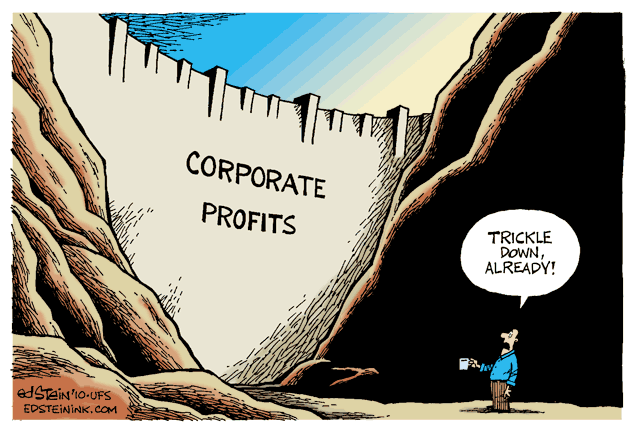
But no one believes it any more. Biden saw no need to give an elaborate justification for taxing the rich to build American infrastructure. Instead, he called supply-side economics by its liberal name, and brushed it off:
Trickle-down economics has never worked.
That simple statement is the bookend to Clinton’s “The era of big government is over.”
The true history of American infrastructure. It has now been more than two centuries since New York State began constructing the Erie Canal, which made Buffalo a boom town and promoted economic growth across the Great Lakes. Once cargoes from Lake Superior started floating down the Hudson, New York City soon replaced Philadelphia as the nation’s top port.
What the last two centuries have taught us is that the economy needs a mixture of public and private investment. The logic of that can get a little wonky, but the gist is that certain big investments, like the Erie Canal, the transcontinental railroad, the interstate highway system, or rural electrification, create what economists call “positive externalities”. In other words, they promote a general growth that no private-sector entity is broad enough to capture. (Even New York State failed to capture the growth its canal promoted in Chicago and Detroit.) So the private sector either will not build them at all, or will build them much too small and too late.
One result of Reaganism has been an under-investment in the public sector. That’s what Biden is trying to reverse. By taxing the rich, he is taking money from a bloated private sector to catch up on the public-sector investments that have gone begging for decades. Biden is betting that this shift will increase growth and create jobs — the exact reverse of what Reaganomics predicts.
In the official Republican response to Biden’s speech, Senator Tim Scott invoked trickle-down when he described Biden’s tax plan as “job-killing”, and predicted “it would lower Americans’ wages and shrink our economy”. If the Trump tax cuts — or the Bush tax cuts before them — had actually created jobs and promoted growth, as they were supposed to do, then it would make sense to predict that reversing them would kill jobs and stifle growth. But none of the promised benefits of Trump’s plan actually happened, so the jobs that it didn’t create won’t be lost when Biden goes back to pre-Trump tax rates.
Where is the Tea Party? Writing in Politico, conservative Rich Lowry waxes nostalgic about 2009, when “President Barack Obama created a spontaneous, hugely influential conservative grassroots movement on the basis of an $800 billion stimulus bill and a health care plan estimated to cost less than a trillion.”
Once upon a time, Joe Biden’s spending proposals would have launched mass demonstrations in opposition.
Little else would have been talked about in conservative media, and ambitious Republican politicians would have competed with one another to demonstrate the most intense, comprehensive resistance, up to and perhaps including chaining themselves to the U.S. Treasury building in protest.
But now, he laments, Republicans just want to talk about the border and cancel culture. No one is defending the Reagan orthodoxy, because no one believes in it any more.
This week’s big story was President Biden’s don’t-call-it-State-of-the-Union address to a joint session of Congress. No particular announcement in the speech was surprising, but his proposals for $4 trillion in new spending seemed to bookend Bill Clinton’s 1996 statement that “The era of big government is over.” Republicans were unable to mount a coherent critique, and there was no sign of the grass-roots uprising that Obama’s much smaller spending program had inspired in 2009.
My interpretation of this is that “The Reagan Era is Finally Over”. Ronald Reagan laid out a set of themes that dominated Republican politics (and even intimidated Democratic politicians) until 2016. But Trump laid waste to any principled Republican thinking, and replaced it with a cult of personality. The result is that when Biden proposes a liberal policy agenda, Republicans really have no basis for arguing against it.
Trump could do that because by 2015 supply-side economic orthodoxy had already reached the stage of Soviet Communism in the Brezhnev Era: Even the people repeating its slogans didn’t really believe in them any more. As president, Trump cut rich people’s taxes because he was rich and he wanted to pay less tax. McConnell and the rest of the Republicans got in line because their donors were rich and wanted to pay less tax. They might mouth platitudes about growth and an economic boom that would create jobs and wipe out the lost revenue, but everybody knew what the game was.
So when Biden announced Wednesday “Trickle-down economics has never worked”, there was no answering chorus of “Yes it has. Yes it does.” Of course it doesn’t. We all knew that.
Anyway, that post requires a history lesson that I’m still writing, so it probably won’t post until around 11 EST.
The weekly summary discusses some other issues in Biden’s speech and Tim Scott’s response, including what I see as a senseless debate over whether the US is a “racist country”, whatever that means. There’s also the FBI raid on Rudy Giuliani’s home and office, and what it might mean for Rudy’s legal jeopardy, and Trump’s. It was a good news/bad news week for the fight against Covid: Daily case numbers keep improving in the US, but getting worse worldwide. And we’re getting close to having vaccinated all the people who were eager to be vaccinated, but we’re still not at a herd immunity level. Florida continues to make a mockery of GOP rhetoric about “liberty”. This week they’re trying to dictate the policies of private companies like Facebook and Google. And we’ll close with a winged Cupid breaking out of a Rubens painting in the Brussels airport.
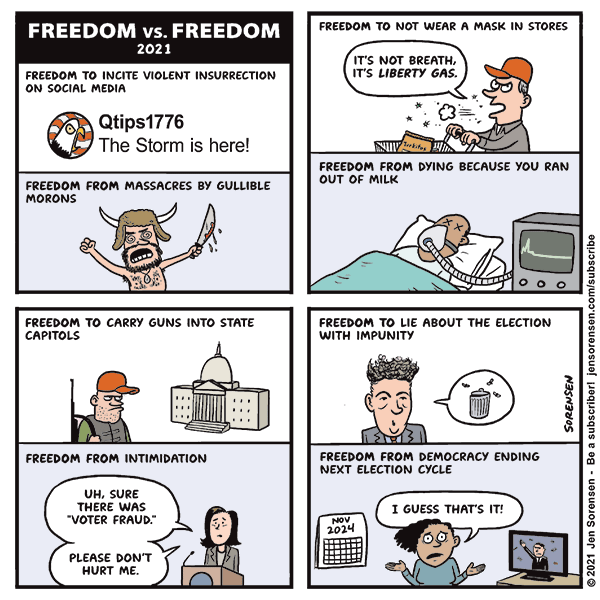
The GOP’s “freedom” rhetoric yields to its authoritarian agenda.
Standard conservative rhetoric treats the word freedom like partisan property: Republicans defend freedom, while Democrats are all Stalin-wannabees.
Usually, pro-gun rallies are where you see this trope in its purest form, but during the pandemic it has shown up in anti-public-health protests as well. Two weeks ago, we saw it in Congress, when Jim Jordan assailed Dr. Fauci with “When do Americans get their freedom back?” Occasionally, the two issues combine, as when armed protesters stormed the Oregon Capitol while the legislature debated anti-Covid measures.
Lately, though, we’ve been seeing how hollow the Right’s commitment to “freedom” is, at least when people use their freedom to support liberal causes. In previous weeks, I’ve talked at length about the anti-voting laws red-state legislatures have been passing in response to their dark-but-baseless fantasies about election fraud. But lately their focus has turned towards punishing liberal protest.
The latest push in red-state legislatures — Florida, Oklahoma, Tennessee, and Iowa so far — is for laws that criminalize protest and encourage vigilante action against protesters.
[Oklahoma] HB 1674, which Republican legislators passed earlier this week, grants civil and criminal immunity for drivers who “unintentionally” harm or kill protesters while “fleeing from a riot,” as long as there is a “reasonable belief that fleeing was necessary.”
Running over protesters is a long-standing conservative fantasy, which James Alex Fields Jr. carried out when he killed Heather Heyer in Charlottesville in 2017. If I were a Democrat in one of these legislatures, I think I’d submit a motion to rename the bill “The Heather Heyer Had It Coming Act of 2021”.
There have been at least 104 incidents of people driving vehicles into protests from May 27 through Sept. 5, including 96 by civilians and eight by police, according to Ari Weil, a terrorism researcher at the University of Chicago’s Project on Security and Threats who spoke with USA TODAY this summer.
I have some sympathy for people who unexpectedly find themselves surrounded by protesters doing threatening things, like rocking the car or pounding on its roof. But I’m not sure how many cases, if any, fit that description. In this video, for example, the driver comes back for a second pass through the crowd.
“Unintentionally” sounds like it mitigates the harm, but it actually doesn’t, because intentionality is so hard to prove in court. And the “reasonable belief” standard in the Oklahoma law creates an opening for the same kind of racial bias we see in police-shooting and stand-your-ground cases: What if the driver’s impression of danger is based on the race of the protesters, rather than any threatening actions? Might a few white jurors sympathize with a driver who got scared simply because his car was surrounded by Black people?
These laws also give the government more power to clamp down on dissent. Florida’s law, which has already been signed by Gov. DeSantis, creates new crimes that you might commit just by showing up for what you believe to be a peaceful protest.
But opponents say it would make it easier for law enforcement to charge organizers and anyone involved in a protest, even if they had not engaged in any violence.
“The problem with this bill is that the language is so overbroad and vague … that it captures anybody who is peacefully protesting at a protest that turns violent through no fault of their own,” said Kara Gross, the legislative director at ACLU Florida. “Those individuals who do not engage in any violent conduct under this bill can be arrested and charged with a third-degree felony and face up to five years in prison and loss of voting rights. The whole point of this is to instill fear in Floridians.”
If a local government chooses to decrease its law enforcement budget — to “defund the police,” as Mr. DeSantis put it — the measure provides a new mechanism for a prosecutor or a city or county commissioner to appeal the reduction to the state.
The law also increases penalties for taking down monuments, including Confederate ones, making the offense a second-degree felony punishable by up to 15 years in prison.
As with the anti-voting laws, the justification for the Florida law is largely imaginary.
Speakers including the governor said the law would protect law enforcement and private property against rioters, despite acknowledging there was little violent unrest in Florida during last year’s protests over Floyd’s death.
… Echoing DeSantis, Republican state House Speaker Chris Sprowls and Attorney General Ashley Moody vilified other states and cities for their handling of the protests last year, some of which did turn violent.
State CFO Jimmy Patronis claimed that Portland, New York and Seattle “burned to the ground” last summer.
I’m sure that’s news to the residents of those cities. If there were vast refugee camps in New Jersey, across the Hudson from burned-out New York, I’m sure I’d have heard about them. The main studios of Fox News are on Sixth Avenue, so they would just have to point a camera out the window to show us the devastation.
In general, Floridians can defend themselves with deadly force if they believe they are in imminent danger or death — and not only when they are inside their homes. The person being threatened is not required to try to flee.
If I’m protesting peacefully, and a car is bearing down on me in a threatening way, can I just shoot the driver? If his fear justifies running over me, shouldn’t my fear justify shooting him?
Conservatives don’t ask these questions, because they know they are the ones who threaten deadly violence. In a relatively small number of cases, last summer’s George Floyd protests devolved into property damage and looting. But liberals didn’t get in their cars to mow down anti-lockdown protesters, and George Floyd marchers didn’t bring their AR-15s.
Another question conservatives like to avoid is: What if D.C. had such a law on January 6? Right now, the Justice Department expects to charge about 500 Trump cultists who trespassed into the Capitol after the crowd broke windows and pushed back police (injuring over 100 of them). But a law like Florida’s would justify felony charges against the many thousands of people from Trump’s rally who walked in the direction of the Capitol, not to mention Trump himself. By the new Florida standards, anyone who stood outside the Capitol with a Trump sign is a rioter, because they participated in a protest that had turned violent.
But for some reason, conservatives never imagine that the laws they support will ever aimed at them. Consider Thomas Webster, a retired NYPD cop who has been charged for his participation in the January 6 riot.
Prosecutors say that he “attacked a police officer with an aluminum pole and ripped off his protective gear and gas mask, causing the officer to choke.”
Lawyer for Tommy Webster, retired NYPD cop accused of beating an MPD officer with flagpole on #J6, says his client is in a “dormitory setting” with people serving time for “inner-city crimes” – “for a middle aged guy whose never been arrested before this has been a shock for him”
Who could have guessed? You beat one cop with a flagpole, and suddenly people are treating you like you’re Black or something.
The day after last week’s Sift, the jury convicted Derek Chauvin on all charges. This was both expected and surprising: People who watched the video of the murder couldn’t imagine how the jury could do anything else, but those who know the history of police acquittals had just as much difficulty picturing a conviction.
So the top of the weekly summary will discuss reactions to the verdict, which ranged from “See, I told you the system works” to “This changes nothing.” I come down somewhere in between, and link to discussions of police reforms that are still needed.
I’m sure Chauvin himself was disappointed, but probably not as much as Fox News, which clearly hoped to spend the next month focusing on whatever violent reactions a not-guilty or hung-jury verdict might lead to. Instead, their cameras saw Black people celebrating, which is a real downer for their ratings. But rather than return to the Mr. Potato Head crisis, Tucker Carlson et al have been pushing a conspiracy theory in which threats of Black violence intimidated the Chauvin jury, who otherwise would surely have ruled that kneeling on somebody’s neck for nearly ten minutes is normal police behavior.
Red-state legislatures anticipated the same (non-existent) wave of post-verdict violence by passing “anti-riot” laws that could put liberals at risk of committing a felony (or getting run over by right-wing vigilantes) any time they attend a protest. Those laws will stay on the books at least until a court can look at them, so they’re worth paying attention to. That’s why this week’s featured post is “Red States Crack Down on Protests”. I focus on the enormous gap between these laws and the conservative rhetoric about “freedom”, or right-wingers’ howls of rage when social media companies deny a platform to some fascist provocateur (like Trump). What is “freedom of speech” for conservatives becomes “rioting” when liberals do it.
That should come out shortly.
The rest of the summary will include Biden’s climate proposals, Republicans’ insubstantial counterproposal to Biden’s infrastructure plan (and why I don’t feel embarrassed about predicting they wouldn’t have a counterproposal), Biden’s popularity at the 100-day mark, why you should never brag about your crimes to women you want to date, a case that combines two of my very dissimilar fascinations (the Supreme Court and cheerleaders), and a few other things, before closing with an unusual approach to bird photography.
The countries that take decisive action now to create the industries of the future will be the ones that reap the economic benefits of the clean energy boom that’s coming.
Unless you spent the week completely off the grid, you already know that Derek Chauvin was found guilty of all charges. He’s due to be sentenced in June, and probably he will appeal on a number of grounds that seem unlikely to succeed (but you never know). So it will still be a while before we can definitely attach a number of years to his name — between 12 1/2 and 40 years, if his conviction stands — but at the moment he is a convicted murderer. It was the best result the trial could have produced.
Opinions about the larger meaning of this verdict varied widely, from “See, I told you the system works” to “This one result doesn’t really change anything.”
I come down somewhere in the middle: The Chauvin verdict establishes a floor. It shows that the well of injustice is not bottomless. Police officers cannot kill Black people with complete impunity, in broad daylight, on a city street, in front of multiple witnesses who are recording video. If Chauvin had been acquitted, or if just one juror had held out to force a retrial, we still wouldn’t know where the floor is, or even if there is one.
But the Chauvin verdict doesn’t mean that the system works, or works as well for Black people as for White people. We can’t forget what the original police report said about George Floyd: “Man Dies After Medical Incident During Police Interaction.” If the video hadn’t gone viral, that most likely would have stood as the official word. You would not know the names of Derek Chauvin or George Floyd, and Chauvin would still be abusing Black people on the streets of Minneapolis.
Most of all: The killings haven’t stopped, or even slowed down. It’s hard to give ourselves credit for progress until they do.
As for the larger struggle for justice, I think this widely viewed trial begins to establish a consensus that police mistreatment of Black people really is a thing. We didn’t all imagine this murder, and it’s not a he-said/she-said situation. It’s now public knowledge that Chauvin murdered Floyd. We all saw it happen, and we can’t unsee it.
But knowing that doesn’t mean that we know what to do about it. Many people, particularly many white men, still believe the Bad Apple theory: Chauvin was a bad cop, and he’s off the force now, so the problem has been handled. Maybe there are other bad apples, but the system can deal with them too.
The problem with the Bad Apple theory is the way other cops usually rally around a cop who kills someone or otherwise abuses authority. (Hence: “Man Dies After Medical Incident”.) In case after case, we see police investigating the victim rather than the death, while official police spokespeople and the local police union president act as PR flacks for the bad-apple cop. In other words, the whole department joins Team Bad Apple.
To a large extent, that didn’t happen this time. One reason Chauvin was convicted, I believe, was that cops testified against him. They blew up his lawyer’s claims that Chauvin acted according to his training, and that his use of force was appropriate. Maybe that signals some larger change in police culture, or maybe not; we’ll see in future cases.
Pity poor Fox News, which was all geared up to cover the post-verdict violence. You know: Dangerous Black people run wild, cheered on by Democrats. Ratings gold.
Instead, they’re left with no burning buildings to televise, and a conspiracy theory about why that is: The jury might have acquitted Chauvin, but for the threat of violence that intimidated them.
At the federal level, the George Floyd Justice in Policing Act has passed the House, but is pending in the Senate, where Democrats once again lack the votes to overcome a Republican filibuster. Unlike other issues, though, this one could result in a bipartisan compromise.
Still, there are new signs of optimism that Republican and Democratic lawmakers are serious about trying to make a deal. [Democratic Rep. Karen] Bass says she hopes the two sides can put together a framework by late May, which would be the one-year anniversary of Floyd’s murder. [Republican Senator Tim] Scott floated a potential compromise last week on reforming qualified immunity, arguing that police departments could be held accountable even if individual officers are still shielded. The South Carolina Republican has said some Democrats he has spoken with are open to his compromise and he doesn’t believe Republicans are far apart on the issues.
Additionally, Attorney General Merrick Garland has restarted the Obama-administration policy of federal oversight of local police departments, which may result in lawsuits and enforceable consent decrees.
I can’t remember who first called my attention to Beau of the Fifth Column, but I’ve become a fan. He combines working-class common sense with deep insight into what’s going on under the surface of the public conversation. I envy the way he can communicate complex ideas in five or six minutes without using polysyllabic buzzwords. Here’s what he had to say about the questions people raise to justify police killing 13-year-old Adam Toledo.
to cut greenhouse gases in half by the end of this decade. That’s where we’re headed as a nation, and that’s what we can do if we take action to build an economy that’s not only more prosperous, but healthier, fairer, and cleaner for the entire planet. These steps will set America on a path of net-zero emissions economy by no later than 2050.
Setting goals is the easy part, though. The question is whether he can get the country committed to achieving them, and in particular whether that commitment can endure even after he leaves office.
One encouraging thing about this speech is that he’s not even nodding at people who make the Environment vs. Economy argument. In the same way that we can’t reopen the economy without dealing with the virus, we can’t have a healthy economy for the future if we ignore climate change.
I see an opportunity to create millions of good-paying, middle-class, union jobs.
I see line workers laying thousands of miles of transmission lines for a clean, modern, resilient grid.
I see workers capping hundreds of thousands of abandoned oil and gas wells that need to be cleaned up, and abandoned coalmines that need to be reclaimed, putting a stop to the methane leaks and protecting the health of our communities.
I see autoworkers building the next generation of electric vehicles, and electricians installing nationwide for 500,000 charging stations along our highways.
I see the engineers and the construction workers building new carbon capture and green hydrogen plants to forge cleaner steel and cement and produce clean power.
I see farmers deploying cutting-edge tools to make [the] soil of our Heartland the next frontier in carbon innovation.
Last week, I predicted that the GOP would not come up with a counterproposal to President Biden’s infrastructure plan. Thursday, they seemed to prove me wrong, announcing what The Hill described as “a $568 billion infrastructure proposal”.
I mean, their two-page big-print document has a specific number attached to it, and even breaks it down: $299 billion for roads and bridges, $61 billion for public transit, $65 billion for broadband, and so on. That’s a proposal, right?
Not exactly. A lot of key questions remain unanswered, and I suspect it’s because the GOP Senate caucus doesn’t have any answers they agree on. The big one is: Where does this $568 billion come from? Their pamphlet rejects how Biden funds his much larger proposal: no new debt, no changes to the Trump tax cut, and no “corporate or international tax increases”. It vaguely offers to “repurpose unused federal spending”, and proposes taxing electric vehicles, which Biden wants to subsidize.
It also wants to “partner with spending from state and local governments” and “encourage private sector investment and the utilization of financing tools”, whatever that means. Which raises this question: Are the anticipated state, local, and private-sector investments included in the $568 billion? How much federal money are we really talking about here? (Trump’s ill-fated 2018 proposal claimed to be a $1.5 trillion plan, but only contained $200 billion of federal money spread over 10 years. An analysis by the Wharton Business School predicted that most of the other $1.3 trillion would never appear.)
The Washington Post notes that while the GOP “plan” appears to be about a quarter the size of Biden’s $2.3 trillion plan, it’s actually not even that big.
Congress typically passes long-term transportation funding bills, currently worth about $300 billion over five years. For example, between 2016 and 2020, Congress provided the $300 billion for roads, transit and rail, with a separate measure funding airports. The Biden plan expects that Congress will continue to provide at least that much money in the coming years. But the Republican proposal includes that $300 billion as part of its total.
So if you’re talking about new money, Republicans are offering about 1/9th what Biden is asking for — and committing themselves to oppose the most obvious ways to finance even that much, without specifying an alternative.
If the GOP pamphlet were a serious proposal, they would be on their way to writing an actual piece of legislation, which some large percentage of their senators and representatives would commit to vote for.
That’s not going to happen.
and the virus
Thanks largely to India, new-case totals are soaring worldwide. In the US, they have renewed a downward track, with daily new cases averaging around 56K. Maybe the vaccinations are getting ahead of the new variants and relaxed standards of behavior. Daily US death totals are currently just above 700.
The number of vaccinations per day in the US has peaked, and is now around 2.75 million, down from around 3.3 million. 94.8 million people have been fully vaccinated.
We seem to be hitting the point where the problem is demand, not supply, particularly in Trump country. Basically, everybody who listens to President Biden or Dr. Fauci already is either vaccinated or has shots scheduled. To get the rest of the way, we all need to start exercising our personal influence. Does somebody you know need a nudge?
The @nytimes, like countless others in Western media, has a tradition of “journalism” which takes place in an Africa without leaders, without public health officials or activists. It takes place in a vacuum of knowledge and strategy. Africa has no thinkers or planners. In Western Media, Africa has no epidemiologists, infectious disease specialists, no academics, no local journalists or medical associations are quoted. Just a vast maw of African horror witnessed only by the brave souls at the UN and the Africa bureaus of western papers.
… COVID coverage in Africa ignores reality to instead reach for any other explanation that squares with a continent devoid of brains. Most writers lean on vague ideas about “genetics” and “immunity.” It smacks of “the tenacious physical traits of the negroid race” style thinking. I cannot think of any other way to explain a decided refusal to acknowledge the actions of nations like my native Botswana which, through strict lockdown measures instituted as early as February 2020, managed to keep COVID deaths to 45 by January 2021.
It appears even as its own healthcare system is brought to its knees & exposed as a hollowed out shell of its former self, America’s media need a world where Africa can produce no solutions, can give no knowledge and is devoid of the power to positively influence the world.
and you also might be interested in …
I gotta love this story: A January 6 insurrectionist bragged about storming the Capitol to a woman the Bumble app had matched him with. “We are not a match,” she replied, and reported him to the FBI. He was arrested Thursday.
The audit grew out of Arizona Republican lawmakers’ effort late last year to toss out Joe Biden’s victory in the state. The audit won’t change the certified election results.
The audit is being led, funded and supported by people with documented records of promoting the falsehood that the Arizona vote was stolen from former President Donald Trump.
Senate Republicans are spending at least $150,000 in taxpayer money for the audit, according to audit documents.
A private fund-raiser reports bringing in another $150,000 in donations from undisclosed sources. That fund raising continues.
Democrats have been suing to stop the audit, and a hearing was scheduled for today. But yesterday the judge overseeing the case withdrew. Meanwhile, Trumpist yahoos have custody of the ballots. Nothing that we hear from this point on can be trusted or checked.
In the long-but-worth-it department: Wil Wilkerson’s “The Anti-Majoritarian Mistake“. It’s a direct answer to the idea currently popular in conservative circles that we can maintain a liberal society without majority support.
The conservative theory — which is the substantive content behind the republic-not-a-democracy slogan, to the extent there is any substantive content — is that constitutional restrictions have to protect basic liberties against a tyranny of the majority. So far, so good. But they jump ahead to the conclusion that majority rule is actually not necessary.
Wilkerson’s point is that society never comes to a complete-and-permanent agreement about what “basic liberties” are. In the long term, they can’t be defined by a minority, no matter how convinced that minority is of its own righteousness.
When minorities strip majorities of their power to successfully seek redress and assert their will within the system — which is what a stacked 6-3 Republican court majority veto over Democratic unified government could amount to — sooner or later, stymied majorities will seek to protect their rights and interests outside the system. This is what it means for a political system to lose legitimacy — in the grubby, practical, nuts-and-bolts stabilizing sense of “legitimacy.” …
There’s a sense in which basic rights, whatever those turn out to be, are non-negotiable. But what they turn out to be is the product of negotiation. … Political deliberation and negotiation can be a process of discovery, but what’s discovered depends on who’s allowed in the room. Rights don’t come to us on tablets etched by the divine. They come from people who know where the shoe pinches demanding more comfortable shoes. …
[T]he peaceful management of pluralistic disagreement is perhaps the most basic problem we need our political institutions to solve.
As with so many Facebook memes, I don’t know who should get credit. But it’s too good not to share.
Speaking of Fox, I have a theory: Tucker Carlson already has the next phase of his career planned, and Step 1 is getting Fox to fire him. That’s why he keeps ramping up his white-supremacist rhetoric. Fox wants to dog-whistle to those people, not appeal to them openly. But Tucker is going to find out exactly where their line is, then go out as a martyr to the Liberal Cancel Culture that even Fox is part of.
Unlike Tucker, I try to be open about when I’m speculating beyond the evidence, and that’s what I’m doing here. I don’t know whether Step 2 is entering politics or starting some more lucrative media gig that milks subscribers (like Glenn Beck does; just because you don’t notice him any more doesn’t mean that he’s not raking in the bucks) or launching some more extreme network to out-Fox Fox. But I think there’s a method in Tucker’s increasing madness.
Fascinating set of issues in a Supreme Court case about whether a school can punish a cheerleader for something she put on Snapchat. Her personal issues are all moot — a lower court restored her to the cheerleading squad and she has graduated — but the case is still alive because of the broader implications about student speech. I’m going to have to read the appellate-court ruling before I even know which side I’m on.
Matt Yglesias called attention to a fact I hadn’t noticed: Gallup reported already in 2017 that the number of Americans who described the Bible as “fables, history, moral precepts recorded by men” exceeded the number who think of the Bible as “actual word of God to be taken literally”. Both views significantly trail the fairly stable 47% who chose “inspired by God, not to be taken literally”.
and let’s close with something both airy and timely
Xavi Bou practices an unusual form of bird photography, using time studies of individual birds and flocks of birds to create arresting patterns.
someone encountering his work for the first time could be excused for having no idea what his subject is. In a project called Ornithographies, he creates mesmerizing images by taking many photographs per second and stitching up to 3,500 or more of them together. The results are beautifully abstract, capturing the energy of flight, whether in the chaotic squiggles that result when Alpine Swifts dive and swoop for insects, or the smooth, even undulations of a gull flying over the water.
So when will it be the right moment to leave? One more year, two more years, ten more years? Ten, twenty, thirty billion dollars more above the trillion we’ve already spent?
Between the police shootings and the mass shootings, it’s been hard to keep up.
Closing arguments in the Chauvin trial are happening today, and the case should go to the jury this week. By next Monday, we might have a verdict.
The nearby Daunte Wright shooting, and claim that the police officer mistook her gun for a taser, provoked a great deal of protest and skepticism. The officer has been charged with second-degree manslaughter. Chicago police released video of the shooting of 13-year-old Adam Toledo, who appeared to be unarmed and have his hands up. The NYT reports:
Since testimony [in the Chauvin trial] began on March 29, at least 64 people have died at the hands of law enforcement nationwide, with Black and Latino people representing more than half of the dead. As of Saturday, the average was more than three killings a day.
Three people are dead after someone opened fire inside a tavern in Kenosha, Wisconsin. Another three people were killed in a shooting that police said appeared to be related to a domestic incident in Texas. Authorities said a potential mass shooting was averted at San Antonio airport when a parks officer stopped a man with a box full of ammunition and a .45 caliber handgun.
Such events underscore the easy availability of deadly weapons. The 19-year-old who killed eight people in a massacre at a FedEx facility in Indianapolis late on Thursday bought his two assault rifles legally, police said over the weekend.
According to a CNN analysis, the United States has suffered at least 50 mass shootings since March 16, when eight people were killed at three Atlanta-area spas. Six of the victims were women of Asian descent.
and the virus
We’re starting to hit the vaccine-resistance wall, particularly in areas with a lot of Trump voters. The 7-day average on vaccinations peaked at 3.3 million per day a few days ago, and has dropped slightly to 3.2 million since. 131 million Americans (including me, as of Tuesday) have gotten at least one shot, and 84.3 are fully vaccinated.
The number of new cases might be starting to head back down, after briefly going about 70K per day, but it’s too soon to declare a new trend. Deaths are down to about 750 per day.
and Russia
The Treasury Department announced sanctions against a list of Russian individuals and organizations Thursday. Well down the list was Paul Manafort’s associate Konstantin Kilimnik. The write-up revealed more about Kilimnik than had been previously known to the public:
Konstantin Kilimnik (Kilimnik) is a Russian and Ukrainian political consultant and known Russian Intelligence Services agent implementing influence operations on their behalf. During the 2016 U.S. presidential election campaign, Kilimnik provided the Russian Intelligence Services with sensitive information on polling and campaign strategy. Additionally, Kilimnik sought to promote the narrative that Ukraine, not Russia, had interfered in the 2016 U.S. presidential election.
He got that “sensitive information” from Rick Gates, working under the instructions of Manafort. This completes the collusion cycle: Russia launched a social media campaign to help Trump beat Clinton in 2016, and the Trump campaign made sure they had good data to target their efforts.
BTW, “the narrative that Ukraine, not Russia, had interfered in the 2016 U.S. presidential election” wasn’t just Russian propaganda, it was a main feature of the Trump defense in his first impeachment trial.
The US and EU have the means to do what Navalny has done so well: relentlessly detail and publicize the breadth and depths of the corruption of Putin and his people.
I am puzzled why we don’t do this. I think the Russian people deserve to know just how many billions Putin has stolen and where it all is.
To the surprise of few, it looks like there isn’t going to be a Republican alternative to Biden’s infrastructure proposal. They’re just going to say no. More about this in one of the featured posts.
Senator Ed Markey and Rep. Jerry Nadler have introduced a bill to expand the Supreme Court, but Nancy Pelosi says she’s not going to bring it up for a vote.
The Falcon and the Winter Soldier series on Disney Plus is examining race in a way I didn’t expect from the Marvel Universe, even after Black Panther.
At the end of Avengers: Endgame, Steve Rogers returned to the 1940s and left the shield of Captain America to Sam Wilson, the Falcon. What to do with that shield, and with the Captain America identity it represents, is the central issue of F&WS. And that issue ends up hinging on the question: What can or should American patriotism mean to a Black man? In this week’s episode (#5) a bitter Black super-soldier from the 1950s (Isaiah Bradley) tells Sam: “They will never let a Black man be Captain America, and no self-respecting Black man would want to be.”
Sam is becoming the Barack Obama to Bradley’s Jeremiah Wright. (“For the men and women of Reverend Wright’s generation, the memories of humiliation and doubt and fear have not gone away; nor has the anger and the bitterness of those years. … That anger is not always productive … but the anger is real; it is powerful. And to simply wish it away, to condemn it without understanding its roots, only serves to widen the chasm of misunderstanding that exists between the races.”) He’s looking for a way forward that acknowledges and respects the experience of the people who came before him.
After decades of TV series that either made Black people invisible, stereotyped them, or cast them in roles where their race really didn’t matter, lately we’ve gotten a bumper crop of high-quality race-examining major-studio TV: Lovecraft Country, Watchmen, and many others.
Paul Krugman did a responsible thing Friday: He committed his thoughts about inflation to print before actual inflation heats up.
There are indeed reasons to be worried about inflationary overheating. In fact, even those of us who think it will be OK expect to see above-normal inflation this year. We just think it will be a blip. … [I]t seems to me that we should make that argument now, so as not to be accused of making excuses after the fact. This is a good time to identify which aspects of inflation might worry us, and which shouldn’t.
In short: He expects the economy to boom in the coming year, for two reasons:
vaccinated people who have been working from home and saving their money start to get out and spend that money
the government’s emergency anti-Covid spending.
Inflation will be part of that boom, as oil prices go back up and some parts of the economy grow faster than others, creating bottlenecks.
But history shows us two very different kinds of inflation: temporary blips, like during wars, and “embedded” inflation, like in the 1970s. The first kind of inflation goes away on its own as soon as the situation that caused it abates. The second won’t end without some kind of drastic intervention, like when the Fed shut down the 1970s inflation by raising interest rates over 20% and causing a major recession.
So the tricky thing going forward will be how to interpret inflation numbers: There’s nothing to worry about when depressed prices return to normal, or when a bottleneck sends prices of some particular commodity soaring temporarily. But a general inflation, where prices go up because prices are going up, is more serious.
and let’s close with an overdose of cuteness
A boy romps with golden retriever puppies, and is mobbed by them when he falls down. One of the commenters says: “This should be prescribed as a cure for depression.”





 The Weekly Sift
