I’m on vacation this week, the first time I’ve slept away from home since February of 2020. So I’ll be taking it a little bit easy this morning: There’s no featured post, in spite of several parts of the weekly summary that are getting a bit long. As you read this, picture me sitting on the deck of a time-share condo, gazing out at the Berkshires and listening to the morning birdsong.
Wait. Where was I? OK, the weekly summary: The saga of the infrastructure bill or bills continued this week, and is likely to keep having its ups and downs for several months. That high-rise condo building in Florida collapsed for no obvious reason, making me wonder about this third-floor deck that I’m sitting on. (All over the country, I imagine, Americans are thinking about construction details they used to take for granted.) The Catholic bishops appeared to be about to deny communion to President Biden, and then backed down when the public focused more on the bishops’ greatly diminished moral authority than on Biden’s unwillingness to toe their line. The New York City mayoral primary happened, but due to ranked-choice voting, we may not know the result for some while. It was a bad week in TrumpWorld, as the Big Lie started to crumble on several fronts at once and the Trump Organization was warned about possible looming indictments. Derek Chauvin was sentenced. We found out just how bad Trump’s bout with Covid was, and how far his treatment diverged from what you or I would have received.
That should be out by 10 EDT, assuming I don’t lose too much time to the mountains and the birds.
If you don’t have money, you cling to your freedoms all the more angrily. Even if smoking kills you, even if you can’t afford to feed your kids, even if your kids are getting shot down by maniacs with assault rifles. You may be poor, but the one thing nobody can take away from you is the freedom to fuck up your life.
Joe Manchin, the Senate swing vote and the lone Democrat who wasn’t supporting the For the People Act, put forward his plan for defending voting rights. That plan got a big boost when Stacey Abrams supported it. Manchin believes he can get the 10 Republican votes he needs to overcome a filibuster, but Mitch McConnell predicts he’ll get zero.
So far, no Republican has expressed support for bringing the For the People Act to the floor, where Manchin could propose the amendments he wants. Even Romney and Murkowski have said they’ll support McConnell’s filibuster.
Ever eager to press the case against any expansion of voting rights, Republicans fell back onto an old strategy: They racialized the proposal. The moment Abrams, who is Black, expressed a measure of support for Manchin’s compromise, it became a radical, even dangerous, idea. Her name is a byword, evidence that liberals have breached an unacceptable standard. The hope is that, to the GOP’s base, she inspires a kind of fear that Manchin — older, white, and male — can’t possibly provoke.
Democrats need Manchin’s vote either to pass the infrastructure bill through reconciliation or to circumvent the filibuster on voting rights.
Manchin represents an overwhelmingly Republican state, and needs to show his voters that he is trying everything to get Republican cooperation.
Republicans are not going to cooperate, because they don’t want the economy to do well under Biden, they don’t want the full story of 1-6 to come out, and (most of all) they don’t everybody to vote and have their votes count equally.
All along, the question has been: What happens after we get through all the predictable parts of this scenario — after Manchin has tried everything to bring Republicans in, and they have clearly refused? We still don’t know.
Ezra Klein holds out hope that Manchin knows what he’s doing, and will manage to pass meaningful legislation one way or another. I (and many other people) worry that the drama itself is the point: Manchin will be happy to have held center stage and demonstrated to West Virginia that he is at least trying to do things the right way, even if ultimately nothing is accomplished.
Beyond gerrymandering, Manchin also supports several fairly modest proposals that are likely to make it easier to vote in many states. He would allow voters who show up at the wrong polling place on Election Day to still cast a ballot, although these voters might not be allowed to vote in certain local elections. And he would require at least 15 consecutive days of early voting in federal elections.
Manchin also supports the DISCLOSE Act, which requires certain groups to disclose their election-related spending, and the Honest Ads Act, which imposes disclosure requirements on online ads.
Manchin also proposes a reasonable compromise on voter ID: You’d have to show some kind of ID at the polls, but the number of acceptable IDs would expand so that any legitimate voter could easily provide one (a utility bill showing your name and address, for example). This would make voting more like getting a library card rather than a passport or a security clearance.
Manchin’s ID compromise is good politics for Democrats. Being against voter ID in any form sounds bad to a lot of people, even if they realize that voter fraud is quite rare. Americans who have an up-to-date driver’s license, know where their birth certificate is, and have lived at their current address for many years grossly underestimate the number of legal voters who have trouble assembling a rigorous collection of ID documents. Making a principle out of “no voter ID” gives Republican fantasies of massive fraud some credibility.
His proposal restores some parts of the Voting Rights Act that Chief Justice Roberts hand-waved away in 2013, but isn’t as strong as the proposed John Lewis Act. (TPM argues that Manchin’s changes to John Lewis are major, and “gut the bill”. It would still improve on the current state of the law.)
In short, passing a Manchin voting rights bill would be a great thing, if that’s really what he’s trying to do. I hope it is.
Juneteenth is now a federal holiday, but it will take a few years to determine what that means in any practical sense in most of the country. Officially, the federal government can only declare a holiday for its own workforce, so unless you work at a military base or a post office, you won’t notice much difference until your state government decides to participate.
What Juneteenth should mean for White Americans is still something of a work in progress, and there are a number of mistakes to avoid. Hardly anybody these days still remembers that Labor Day is supposed to honor the union movement. Cinco de Mayo (which isn’t an official holiday in the US) often gets celebrated in an offensive way, as Anglos wear sombreros and drink a lot of margaritas at some corporate fake-Mexican chain restaurant.
Juneteenth marks the end of slavery in the US, when a Union general began enforcing the Emancipation Proclamation in Texas. Implicit in the holiday are the gaps between January 1. 1863 (when the Proclamation was supposed to take effect), June 19, 1865 (when it actually did), and the dawn of true racial equality (still to come). So it’s both a celebration and a moment to reflect on what still needs to be done.
While the holiday will always be special for Black Americans whose ancestors were enslaved, the rest of us should also appreciate living in a country without slavery. So there is something here that everyone can celebrate.
and the Supreme Court
In a 7-2 ruling, the Court once again refused to invalidate the Affordable Care Act, i.e. ObamaCare.
This is the third time the Court has ruled on the ACA, and the challenges to it have become increasingly bizarre. The first challenge, in 2012, was based on a novel restriction on the commerce clause that literally had not come up in the year-long debate leading to the ACA’s passage in 2009.
The constitutional limits that the bill supposedly disregarded could not have been anticipated because they did not exist while the bill was being written. They were invented only in the fall of 2009, quite late in the legislative process.
The root idea of the first challenge was that the commerce clause allows Congress to regulate actions that affect interstate commerce, but not inaction. So penalizing people for not buying health insurance is unconstitutional.
No one had ever heard of this idea prior to ObamaCare, but the Court supported it 5-4. However, Chief Justice Roberts saved ObamaCare by reinterpreting the individual mandate’s penalty as a tax. (Congress could have written it as a tax from the beginning, but didn’t want the political baggage of “raising taxes”. The possibility that it might be unconstitutional as a penalty was not mentioned at the time by either the advocates or critics of the bill. Nobody decided to “chance it”; the inaction doctrine just wasn’t a thing.) So ObamaCare was 5-4 constitutional, but for a different reason than Congress had imagined.
The second challenge made even less sense. Somebody noticed that if you took one sentence of the bill completely out of context, it didn’t seem to allow the federal government to subsidize insurance policies bought on exchanges that HHS set up on behalf of states that chose not to create their own exchanges, even though the law specifically authorized HHS to set up such exchanges, which couldn’t function in anything like the way intended without the subsidies.
It was sort of a “gotcha” argument. No one claimed that anyone had ever intended the law to work that way, just that you could take that one sentence out of context and screw everything up. The Supreme Court rejected that interpretation 6-3, with Thomas, Alito, and Scalia dissenting.
Meanwhile, Republicans kept trying to repeal the ACA, and came within one Senate vote of doing so in 2017, even though no Republicans either in Congress or in the Trump administration had the faintest idea what to do about the tens of millions of people who would lose their health insurance.
Later that year, one part of Trump’s tax cut reduced the penalty/tax of the individual mandate to zero, and that set up the latest attempt to get the Supreme Court to skewer the ACA. Try to follow this one:
So, under current law, most Americans must either obtain health insurance or pay zero dollars. The Texas plaintiffs didn’t just claim that this zeroed-out tax is unconstitutional (on the theory that a zero dollar tax can’t be an exercise of Congress’s taxing power), they claimed that the entire law must be declared invalid if the zero dollar tax is stuck down.
It was an audacious ask of the Supreme Court — requesting the justices strike down the entire law despite only claiming that a single provision of Obamacare is unconstitutional. Especially since the provision that the plaintiffs challenged literally does nothing at all.
Not even Clarence Thomas would go for that one. (Oversimplifying just a little: The Court ruled that a tax of $0 causes no injury to anyone, so the plaintiffs don’t have standing to sue.) That made it a 7-2 decision, with Alito and Gorsuch approving of this nonsense.
Leaving us with this question: Is ObamaCare safe yet? Maybe Republicans need to learn a Hunting-of-the-Snark lesson: What the Supreme Court tells you three times is true. ObamaCare is constitutional.
The general lesson of these three cases should be that the Supreme Court isn’t willing to make a purely political decision to get rid of ObamaCare — and without politics, cases with so little merit would never have been filed in the first place. (Samuel Alito voted for all three challenges, and wrote the dissent on this one. That tells you all you need to know about him.)
So ObamaCare should be safe unless Republicans gain control of Congress and the Presidency again. And even then, repeal is starting to feel like tilting at windmills. If the GOP ever comes up with an actual healthcare policy — beyond Trump’s empty promise of a “beautiful” healthcare plan to be unveiled after the ACA was repealed — then ObamaCare might wind up in trouble again. But that seems unlikely.
Jonathan Chait sees the 12-year ObamaCare drama as a paradigm of Republican politics: They motivate their voters by inventing a dire threat to the American way of life — has anybody faced an “ObamaCare death panel” during the past dozen years? — and then they get trapped by their own rhetoric and can’t let it drop.
Turning a policy question over insurance-market regulation and subsidy levels into a cultural fight was a shrewd, and perhaps necessary strategy. But it left the party’s elite with no way to back down. Having persuaded their own voters the law was evil and an existential threat, they had to act as if this claim was true. Hence red states refusing to opt into the Medicaid expansion, even at the cost of punishing their own doctors and hospitals, who have been stuck with the cost of treating uninsured people who show up in the emergency room. …
For a lawyer in a Republican state, refusing to join a lawsuit to eliminate Obamacare merely because its legal merits were preposterous was therefore unthinkable. If they had ambitions to a future court nomination, how could they dare mark themselves as ideologically unreliable by opposing the holy cause of Obamacare repeal, in any form?
Something similar is going on now with respect to Trump’s Big Lie about the “stolen election”. Having whipped up such a fever with so little truth to it, they find themselves unable to deny even blatantly ridiculous conspiracy theories. That’s how 17 state AGs signed on to a baseless lawsuit to prevent four other states from certifying their electors. How could they not?
The other major case this week concerned balancing non-discrimination laws with the rights of conservative Christians. (Most news outlets are calling this “religious freedom”, but I see little evidence that the Court wants to protect religious freedom in general.) As is the pattern in several recent cases, the court ruled narrowly in favor of the Christian group, which was Catholic Social Services. They are allowed to continue receiving public funding in Philadelphia while they refuse to consider same-sex couples as candidates to be foster parents.
But the Court once again resisted making a sweeping ruling with broad implications. This means more such cases will be filed, and will rise up to the Supreme Court. I’m not sure what they’re waiting for.
and Biden’s meeting with Putin
The world will little note nor long remember President Biden’s meeting with Russian President Vladimir Putin in Geneva Wednesday, and that’s a nice change. One Trump-administration notion that deserves to be forgotten is that political relationships between major powers depend on the personal relationships between their leaders.
Trump was never America, and whether or not Putin liked him (or at least found him amusing) didn’t have much to do with anything. Ditto for President Xi of China or anybody else. North Korea was going to keep doing what North Korea does, independent of whether Trump and Kim Jong-un “fell in love“.
That said, it was good once again to see a president at least try to represent our nation’s interests, rather than his own. Trump could never separate the two; Russia helped him get elected, so Putin was a good guy. Trump and Putin could stand together against the American intelligence services, which worried about having a president indebted to one of our enemies.
As to who do I trust, they asked, Russia or our “Intelligence” from the Obama era, meaning people like Comey, McCabe, the two lovers, Brennan, Clapper, and numerous other sleezebags, or Russia, the answer, after all that has been found out and written, should be obvious.
Indeed it should.
but you should look at what George Packer has been writing
The featured post discusses his new book Last Best Hope.
you also might be interested in …
Covid case numbers are still falling: The 7-day daily average is down to 11,000. The average number of deaths per day has fallen below 300. 45% of Americans are fully vaccinated, with 53% getting at least one dose. Reported number of doses per day actually went up last week, to 1.2 million. The differences between states are getting starker. Vermont has fully vaccinated 64%, Mississippi only 29%.
Last week I anticipated the annual meeting of the Southern Baptists, which happened in Nashville this week. Tuesday, the convention narrowly defeated the most conservative candidate for president. The NYT describes the new president, Ed Litton, as a “moderate”, but in an interview with Vox, scholar Greg Thornbury pointed out that moderation is relative. (“Compared to what? Idi Amin?” Thornbury described Litton as “a pretty conservative guy”.)
The Convention also beat back a resolution denouncing critical race theory by name. The root problem seems to be that while the denomination’s recent leadership has wanted to take at least token steps towards rooting out racism and making the SBC more welcoming to people of color, the rank-and-file are still pretty comfortable with white supremacy.
I think the people who are the dyed-in-the-wool evangelicals are the people that showed up to the polls and voted for Trump in the face of four years of utter vulgarity. They did so anyway, because that’s where they are. When you looked at January 6, and you looked at the crowd that stormed the Capitol, look at how many prayer meetings there were before the storm happened? How many praise songs were being sung?
Anti-Trump Republican Peter Wehner makes a good point in an NYT column: While the SBC is trying to defend against critical race theory and wokeness, it’s ignoring a far more serious problem: QAnon and the conspiracy theory habits of thought that are taking root in evangelical congregations.
This reminds me of a rule-of-thumb I came up with years ago for separating authentic religious leaders from charlatans: An authentic religious leader challenges the congregation to think about their own failings. A charlatan flatters the congregation by talking about other people’s failings.
Not many Southern Baptists are in danger of being pulled into Marxism by critical race theory. But a lot of them are in danger of sliding into the QAnon fantasy world.
If Mike Pence can find a friendly audience anywhere, you’d think it would be at a Faith and Freedom Coalition meeting in Florida. But no. Pence was heckled Friday, facing calls of “traitor” because he refused to help Trump stay in power after losing the 2020 election.
By now, Republicans ought to understand that there’s no station where you can safely get off the Trump train. If you’re not for a full fascist takeover that makes the Donald president-for-life, eventually you’ll be discarded. Pence may not recognize that his political career is over, but it is.
The vaccine wars continue. Florida won an injunction against the CDC, which at least temporarily sets aside CDC guidelines that determine whether cruise ships can sail. A Florida law stops cruise lines from requiring passengers prove they’ve been vaccinated, but Carnival and Norwegian say they will require vaccinations anyway. Celebrity will have different rules for unvaccinated passengers, who may be charged more for testing and may not be able to get off the ship in all ports.
You know what really surprised me? I did the Heights, I did Jerusalem, and I did Iran—the Iran Deal was a disaster, right? And I also did many other things. Jewish people who live in the United States don’t love Israel enough. Does that make sense to you? I’m not talking about Orthodox Jews. I believe we got 25% of the Jewish vote, and it doesn’t make sense.
Two things he doesn’t seem to understand:
A lot of Jews take the social-justice message of the prophets seriously. They’re liberals because their God cares about the poor, the persecuted, and refugees.
American Jews are genuinely freaked out by the violent white supremacists in Trump’s base.
What doesn’t make sense to me is that 21% of American Jews — not 25%, Trump always exaggerates how much support he has — were able to put all that aside and vote for him anyway.
A guy who drove his car into a crowd of anti-police-brutality protesters in Minnesota has been charged with murder.
Meanwhile, that St. Louis couple who stood on the porch of their mansion waving guns at peaceful protesters have pled guilty to misdemeanors and paid a fine. They had to give up the specific firearms they misused, but nothing stops them from buying replacements.
They appeared at the Republican Convention last summer, because threatening Black people with violence is what the GOP stands for these days. The husband is currently running for the Senate, hoping to replace retiring Missouri Republican Roy Blunt.
This is a good time to do a reverse-the-races thought experiment: If peaceful White protesters walk past a Black family’s home, and the Black husband and wife come out and threaten them with guns, what happens next? Assuming they survive and escape prison, is there any chance Democrats want them running for office?
The First Dog has died. Champ Biden, a German shepherd, was 13. Champ is survived by his adopted brother, Major.
Meanwhile, Joe and Jill Biden celebrated their 44th anniversary on Thursday. You know who was also married in 1977? Donald and Ivana Trump, in April. But I don’t recall anybody making a big deal out of that anniversary. Media bias, I guess.
Lake Mead, created on the Colorado River by the Hoover Dam, seems to be drying up, due to a combination of climate change, development, and excessive water use. The current drought is exacerbating a 20-year trend. 25 million people depend on the lake for water.
Reuters described this week’s heat wave in the Southwest as “apocalyptic“. Las Vegas hit 116 degrees Wednesday and Phoenix got to 118 Thursday. Denver had three straight 100-degree days. Both California and Texas strained to keep up with the electricity demand. The heat wave and drought has raised anxiety about wildfires later in the summer.
and let’s close with a message about safety
The Danish Road Safety Council made a truly clever public service announcement about wearing bicycle helmets. A Viking warrior’s wife lays down the law: “You can go looting and pillaging all you want, but you have to wear a helmet.”
Americans today don’t need anyone to tell us that we’re deeply divided. Less than half a year ago, we saw our Capitol invaded and the certification of our election disrupted — not by a foreign power, but by our own citizens. Those citizens thought of themselves, and have been hailed by many other Americans, as patriots — even as I, and many Americans like me, see them as traitors to everything America stands for or should stand for.
During the campaign leading up to last fall’s election, it was common to hear from either side that if the other one won, America as we have known it would be seriously threatened. I said as much myself in this blog. In the popular press, it has not been unusual to hear comparisons to the period before the Civil War, or speculations about a new civil war.
Even if peace is maintained, democracy does not work well without a governing consensus. It’s fine for elections to be close, or for power to shift back and forth between rival parties, as long as large majorities agree on basic principles, and share a broad vision of what the nation is and where it should be trying to go. Disputes about tax rates or how to organize our healthcare system are on a different level from disputes about who we are.
In 2000, we had an election so close that many Americans still doubt that George W. Bush really won. And yet, few argued that the Republic could not survive either a Bush or a Gore presidency. For many, the larger problem was that the two parties were too similar. Ralph Nader based his third-party candidacy on the argument that it would make no real difference whether Republicans or Democrats were in charge. Under either Bush or Gore, America would continue to be America.
Is there some way to recover that kind of consensus?
We’re divided by narratives. We’re not divided into tribes, at least not yet.
The root division is not Red vs. Blue, because each of those sides has its own division. Four narratives, not two, are competing for dominance.
The significance of the first point is that narratives are fluid, while tribes are fixed. You currently tell one story about your life, but a few years from now you could be telling a different one. A Trumpist might have a transformative experience and become a social justice warrior, or vice versa. But a Serb will not so easily become a Croat, or a Palestinian an Israeli. Perhaps you have multiple stories that rise and fall depending on the situation. (Thomas Frank’s What’s the Matter With Kansas? is largely the story of how people with a political identity as union workers shifted to identify primarily as Evangelical Christians.) Over time, the stories might blend and merge, or new stories might develop.
Packer describes the main political narratives of the 1960s like this:
Through much of the 20th century, the two political parties had clear identities and told distinct stories. The Republicans spoke for those who wanted to get ahead, and the Democrats spoke for those who wanted a fair shake. Republicans emphasized individual enterprise, and Democrats emphasized social solidarity, eventually including Black people and abandoning the party’s commitment to Jim Crow.
The two narratives were shifts in emphasis, rather than diametric opposites. You could, for example, focus on getting ahead yourself inside a system that offered everyone a fair shake, or look to government to guarantee you a fair shake while not resenting the people who get ahead. (Maybe it’s fine if the Rockefellers are filthy rich, as long as I can have a secure job that pays a fair wage.)
But you will notice that neither narrative says much about our current culture wars. Abortion, sexuality, and religion play no role. The culture wars began their rise to prominence in the 70s, along with a White backlash to the advances Black people made during the civil rights era. In the decades since, the gap between rich and poor has grown, and new kinds of monopoly power have emerged. Packer names our current four narratives (with my elaboration):
Free America. America is the beacon of individual freedom. This narrative is the legacy of the Reagan era: low taxes, light regulation, low domestic spending. At the same time as it restricts government at home, America is a strong military power with a global agenda promoting capitalism and free trade. Championed by Republicans currently out of power within the party, like Paul Ryan and Liz Cheney.
Smart America. The narrative of the meritocracy. (Basically, Bill Clinton’s neo-liberalism.) Wise but complex government policies, designed by experts, help everyone go as far as their talents can take them. This narrative is optimistic, pro-technology, and comfortable with increased global interconnection and interdependence.
Real America. The populism of Sarah Palin and Donald Trump. White, Christian, small-town people are the backbone of America, but they’ve been left behind by both capitalism and the meritocracy.
Just America. The narrative of anti-racism, Me Too, and defund-the-police: Multiple systems of oppression are deeply embedded in America, and rooting them out should be our central concern. This is the narrative of a generation that grew up post-911, in the shadow of the 2008 banking crisis, carrying a huge debt load, and anticipating a climate-change catastrophe. It is cynical and deeply suspicious of anyone in power.
Red America is the uneasy alliance of Free and Real America, while Blue America is an equally uneasy alliance of Smart and Just America.
Each of the narratives has problems that prevent it from becoming dominant. The Free America policies of the Reagan-Bush years destroyed the middle class and offer no way to restore it. Smart America’s meritocracy never worked all that well, and has become increasingly corrupt as the educated classes develop new ways to pass their advantages on to their children. Real America can’t offer full equality to non-Whites, non-Christians, or people with non-traditional sexuality or gender identity; at its worst, it leans towards blood-and-soil fascism. Its antipathy towards Smart America makes it suspicious of expertise in general. (See, for example, the conspiracy theories about Dr. Fauci.) Just America offers Americans little to be proud of and little to look forward too. If almost everyone is an oppressor of one sort or another, who can you trust?
In addition to these four well-conceived frames, the value of Packer’s vision lies in his ability to look beyond the debates between the four Americas and ask: What do we need in a national narrative?
Nations, like individuals, tell stories in order to understand what they are, where they come from, and what they want to be.
And like individuals, nations require stories with some element of positivity and hope, balanced by a realistic humility. “I suck” is not a narrative that will get you far in life, and neither is “I am a helpless victim.” But “I am perfect” requires too much denial of reality, and too much repression of the voices that will point out your failures.
The history of America has plenty of positive and negative material to work with. We both enslaved people and freed them. We went to the Moon. We achieved wealth and tolerated poverty. We ended Hitler’s genocide, but committed one of our own. We out-lived Soviet Communism without giving in to the temptation of nuclear war. We enunciated high ideals that we have still not fully implemented.
If we are going to be a democratic self-governing people, we also need a story that allows us to trust each other, and to form institutions that wield legitimate power. Packer critiques Ronald Reagan’s city-on-a-hill vision like this:
The shining city on a hill was supposed to replace remote big government with a community of energetic and compassionate citizens, all engaged in a project of national renewal. But nothing held the city together. It was hollow at the center, a collection of individuals all wanting more. It saw Americans as entrepreneurs, employees, investors, taxpayers, and consumers—everything but citizens.
We need to resist narratives that define us as competitors in a zero-sum game, as well as ones that stop us from owning up to injustices and fixing them. We need to reward individual achievement, but not abandon those who can’t compete. We need to make use of all our talents. We need to both trust and be trustworthy. We need our story to tell us that we’re all in this together.
Wanting such a national narrative is still a long way from having one. But it’s hard to find something until you start looking for it.
Joe Manchin finally laid out what he wants in a voting-rights bill. It’s a significant compromise, but it’s not bad. Sadly, it’s not going to get Republican support either. So what happens next? Is the point just to frame an issue for 2022, or is something actually going to get done?
President Biden’s meeting with Putin was blessedly uneventful. Juneteenth became a national holiday. The Supreme Court refused for the third time to end ObamaCare. The heat wave has the West worried about the looming wildfire season.
That stuff, and a few other things, will get covered in the weekly summary. This week’s featured post focuses on George Packer’s framing of the four narratives of American politics: Free America, Smart America, Real America, and Just America. I think he’s done a good job of listening to the rhetoric of the current moment, and I believe we’ll be hearing about his four narratives for years to come. That post should appear between 10 and 11, EDT. I’ll try to get the summary out by noon.
While there are supposed to be laws and limits on the presidency, Trump was unrestrained, exposing just how toothless those safeguards have become and just how urgently the nation needs to reform the office of the presidency itself.
The other featured post examined how CRT is becoming just another content-free scare-label, in the tradition of cancel culture and political correctness.
and the G-7
With Biden replacing Trump, the G-7 meeting in Cornwall lacked the fireworks we’ve gotten used to. Trump had an attention-grabbing habit of insulting our democratic allies while fawning over our authoritarian enemies, but Biden has returned to more typically American behavior. It looks like we can trust him to go overseas without embarrassing us.
The seven nations all pledged to cut carbon emissions in half by 2030, and together they will donate a billion doses of Covid-19 vaccine to the developing world.
The group last met in 2018, with the 2020 meeting being canceled due to the pandemic. (If you remember, that was the meeting Trump initially awarded to his own company to host, before backing down from such a blatantly corrupt act.)
Biden is now heading to a NATO summit. From there he goes to a meeting with Vladimir Putin on Wednesday in Geneva. That’s unlikely to be the lovefest it was for Trump.
This socially distanced photo of the G-7 leaders (plus two guests I haven’t identified; I’m amazed at the news sites that will publish a nine-member G-7 photo without comment) has led to a lot of humorous response.
Before I order these figures, does anyone know if you can take them out and play with them or are they glued to the display stand?
Some people noticed the resemblance to a Star Trek crew that has just beamed down (and expressed concern about Angela Merkel’s prospects for survival, given her red top). Others thought the diplomatic meeting was about to end with a song and dance. (Both Macron and Trudeau look ready for a solo.)
and you might also be interested in
Last week I quoted Seth Abramson’s point that Trump could stop talk of a coup with a short statement saying that he would not cooperate with an effort to reinstate him as president by force. Well, this week Reuters outlined the death threats Trump supporters have been making against election officials who refused to let Trump intimidate them into overturning a legal election. This is something else Trump could probably easily stop, but doesn’t. He’s complicit.
In 2007, Jeff Bezos, then a multibillionaire and now the world’s richest man, did not pay a penny. He achieved the feat again in 2011. In 2018, Tesla founder Elon Musk, the second-richest person in the world, also paid no federal income taxes. Michael Bloomberg managed to do the same in recent years. Billionaire investor Carl Icahn did it twice. George Soros paid no federal income tax three years in a row.
As is so often the case, the scandal is not that they broke the law, but that they didn’t. The biggest loophole is that capital gains on stock aren’t taxed until the stock is sold. So as Amazon stock skyrockets, Jeff Bezos can become the world’s richest man without triggering a taxable event.
Middle-class people, whose wealth is mainly in their homes, can’t do that. Even if you don’t sell it, your home is subject to property tax. It may take a while for the assessor to catch up with the value a zooming house market puts on your home, but eventually it will happen.
Nearman was removed for the disorderly behavior of allowing rioters into the closed Capitol building during a special legislative session on Dec. 21, 2020. His actions led to dozens of people — some armed and wearing body armor — gaining access to the Capitol, thousands of dollars in damage and six injured Salem and Oregon State police officers. …
Republicans had stayed mostly silent on Nearman’s actions until the past week, after a video surfaced that showed Nearman suggesting to a crowd days before the riot that if demonstrators texted him he might let them into the Capitol.
This is one reason why it’s not unthinkable that Republican members of Congress might have collaborated in the January 6 riot. A bipartisan commission would have been a good way to look into such possibilities, if Republicans in the Senate hadn’t filibustered the proposal to create such a commission. Treason was in the air in late December and early January. It was being spread by the President of the United States, and some number of Republican officials were infected by it.
The upcoming national meeting of the Southern Baptist Convention in Nashville is the latest battleground in the culture wars. The New York Times and Wall Street Journal both have good summaries. Southern Baptists may still seem quite conservative to non-evangelicals, but from the point of view of its own conservative wing, the denomination has been “drifting” to the left.
One faction argues the SBC should step back from its role in electoral politics in order to broaden its reach and reverse a 15-year decline in membership. Another faction says the denomination has been drifting to the left, and the way to retain and attract members is to recommit to its conservative roots and stay politically engaged. Each side accuses the other of straying from the SBC’s core mission.
What’s unusual about this conflict is that it seems to have little to do with theology. One side objects to “wokeness” and wants to denounce “critical race theory”, while the other wants to be more welcoming to non-whites, and to take sexual assault accusations more seriously.
One lesson from Israel: to defeat an autocrat who attacks democratic norms and institutions, oppositions need to unify under a big tent. In Israel’s case, that even led Lapid to compromise on who would start as PM, but he understood the imperative of getting Bibi out first.
This is an increasingly common and necessary strategy around the world. In Hungary, opposition parties have agreed to put aside differences and unify in next year’s election to oust Netanyahu’s good buddy and fellow corrupt, nationalist autocrat: Viktor Orban.
and let’s close with some maps that make an interesting point
Voting Trump out of office stopped the bleeding, but the Republic isn’t out of danger yet.
The Boston Globe ran an important series this week: “Future-proofing the Presidency“. Over four years, the Trump administration shredded the laws, institutional norms, and political norms that we had previously trusted to protect the Republic from a corrupt or power-hungry president.
The fact that the voters managed to throw Trump out after four years should only comfort us up to a point. Because of the Trump precedents and the roadmap his administration provides, the next unscrupulous president — who could be Trump himself in 2025 — will begin his assault on democracy with a head start.
The Globe series proposes reforms to turn norms into laws and give teeth to the laws Trump ignored. The specific problems it diagnoses are: financial conflicts of interest, nepotism, immunity from prosecution, ability to shield co-conspirators, and power to obstruct congressional investigations. And the reforms it recommends are
require presidents to divest from all businesses and investments that could pose a conflict of interest
require presidents to publish their tax returns
require an explicit congressional waiver before a president can appoint a relative to office — even if that relative foregoes a salary
strengthen protections for government whistle-blowers, and extend those protections to political appointees
root congressional subpoena power in legislation, so that subpoenas served to the executive branch can be enforced more easily and quickly
allow a president to be indicted while in office, but delay the trial until the presidency ends
pass a constitutional amendment voiding a president’s power to pardon personal associates
The series concludes with “The Case for Prosecuting Donald Trump“. Congress’ impeachment power is broken, and can no longer be trusted to hold presidents accountable.
If Congress had played the role the Founders envisioned, by removing Trump from the presidency after his criminality became clear in the Ukraine affair, that might have been enough of a deterrent to scare future presidents straight. But lawmakers didn’t.
So now there is only one way left to restore deterrence and convey to future presidents that the rule of law applies to them. The Justice Department must abandon two centuries of tradition by indicting and prosecuting Donald Trump for his conduct in office. …
The reluctance to prosecute presidents is deep-rooted, and extreme caution does make sense. (The last thing that the country needs is for Trump to be charged, tried, and then acquitted.) But it cannot be the case that there is no line — no hypothetical act of presidential criminality that would not rise to the level of seriousness that merits setting aside our qualms. And if one accepts that there is a line, it’s hard to imagine Donald Trump didn’t cross it.
The two lawmakers in question — Adam Schiff and Eric Swalwell — were outspoken administration critics that Trump frequently attacked on Twitter. (“Shifty Schiff” was one of his playground insult names.) Swalwell became a Democratic presidential candidate. At the time, the Intelligence Committee was engaged in an investigation of Trump’s collusion with Russia.
Not only were they targeted, but so were their family members, including their children. What’s more, a gag order has kept Apple from revealing its cooperation until recently, so the congressmen did not know they were under this kind of scrutiny, and neither did House Speaker Nancy Pelosi.
“President Trump repeatedly and flagrantly demanded that the Department of Justice carry out his political will and tried to use the Department as a cudgel against his political opponents and members of the media,” Rep. Schiff told Recode in a statement. “It is increasingly apparent that those demands did not fall on deaf ears.”
The transcript of Dan McGahn’s testimony to the House Judiciary Committee on June 4 was released Wednesday, in accordance with the agreement that led to that testimony (after two years of legal wrangling that saw the courts refuse to back up congressional subpoenas). The transcript is 241 pages, and the main thing you can learn by reading large chunks of it is that McGahn was indeed a hostile witness. Releasing only a transcript (rather than video) means that his evasiveness will not be appreciated by the general public.
The pre-interview agreement limited questions to
one, information attributed to Mr. McGahn in the publicly available portions of the Mueller report and events that the publicly available portions of the Mueller report indicate involve Mr. McGahn; and, two, whether the Mueller report accurately reflected Mr. McGahn’s statements to the Special Counsel’s Office and whether those statements were truthful
In the early questioning, McGahn frequently claimed not to remember the events in question until his questioner noted a passage in the Mueller Report. McGahn would then respond with something like “what you’ve read in the report is accurate”. He tried hard not to introduce any new information. I also have to wonder if he used the interview’s ground rules to hide relevant conversations with Trump without perjuring himself. For example:
Q: Did you advise the President as to whether he personally could call Mr. Rosenstein about the investigation? A: I may have at some point in time. Do you have anything in particular? I mean, I was on the job quite a while so — Q: Understood. I’ll direct you to page 81, bottom of the paragraph.
Like Trump himself, and so many other people in his administration, McGahn seems not to recall a number of events that most other people would think of as memorable.
Q: On June 14, 2017 … The Washington Post reported for the first time that the special counsel was investigating President Trump personally for obstruction of justice. Do you recall your reaction to that reporting? A: I don’t recall my reaction to it, no. No. Q: You don’t recall your reaction, as a White House counsel, to learning that the press had reported that the President of the United States was under personal investigation by the special counsel? A: I don’t recall my subjective impression on the evening of June 14th about a news report. No, I don’t. Q: Do you recall speaking to the President that evening? A: I do recall speaking to him, yes. Q: Can you describe that conversation? A: I don’t have a crisp recollection of it.
Again and again, McGahn claimed that his memory had been fresher when Mueller questioned him, so he yielded to whatever description was in the Mueller report. That raises an obvious question: Instead of questioning McGahn about Mueller’s summary of McGahn’s testimony, why doesn’t the Judiciary Committee just look at the transcripts of those interviews? And the answer is that they can’t, at least not yet. Like the McGahn subpoena itself, this was the subject of a long legal wrangle, which the Supreme Court put off deciding until after the election. So at the moment, Congress doesn’t even have access to the still-redacted portions of the Mueller report.
After Trump lost the election, the grounds for releasing grand jury records to Congress changed completely, so Congress suspended its pursuit to coordinate with the new Biden administration. In part, McGahn’s appearance was supposed to be a substitute for the grand jury material.
So that’s where the House investigation into Trump’s obstruction of justice has led: McGahn finally appeared, but under rules that allowed him to do little more than point to quotes in the Mueller report and verify that he actually said that.
Meanwhile, Rachel Maddow has been waging an almost nightly campaign for Attorney General Merrick Garland to expose and reverse Trump administration abuses in the DoJ.
Given that those officials that knew about this are still in the Department right now, why did it take a New York Time article about this abominable behavior to spark an inspector general investigation today? I mean, this scandal wasn’t known to any of us in the public, but it was known to multiple officials inside the Justice Department. None of them thought to peep about it? …
It is clear that the Justice Department under President Biden does not want the job of investigating and rooting around what went rotten inside their own department under the previous president. But even if they don’t want that job, that is the job they have now. … Wake up, you guys! You’re going to work in an active crime scene, and there’s no other cops to call.
You have to fix this. You’re the only ones who can.
Trump and Bill Barr have provided the next would-be despot with a detailed plan for turning the Justice Department into a sword to attack enemies and a shield to protect corrupt friends. If there are no consequences for what they did, either to them or to the lower-level officials who went along, the danger has not passed.
Conservatives can’t tell you what it is, but they know it’s destroying America.
As I’ve explained at length before, conservatives regularly create boogeyman phrases — strings of words that never get defined, but are somehow the source of the current evil: political correctness, socialism, cultural Marxism, cancel culture, and now critical race theory. [1]
The purpose of imbuing these scapegoat phrases with demonic power isn’t to debate a point, it’s to create a label and give it a sinister aura. Such a phrase is supposed to invoke emotions — to cast shame on liberals, and raise outrage for conservatives — not point to an idea. Rather than contribute to discussions, these phrases end them. And so, there is no need to consider the wisdom or folly of Medicare for All; it is “socialism”, so it is evil. End of story.
If the labels were defined, the corresponding concepts could become two-edged swords. Conservatives might, for example, have to explain why it’s not “cancel culture” to drive Colin Kaepernick out of the NFL. But being undefined, the boogeyman phrases simply have usages: Kaepernick isn’t a victim of right-wing cancel culture, because that’s not how the phrase is used. The conservative faithful can simply laugh when “cancel culture” is turned back on them, the way native speakers of English might laugh when a foreigner misuses some common word.
Like the other boogeyman phrases, “critical race theory” started out as an actual thing, which Education Week described like this:
The core idea is that racism is a social construct, and that it is not merely the product of individual bias or prejudice, but also something embedded in legal systems and policies. … A good example is when, in the 1930s, government officials literally drew lines around areas deemed poor financial risks, often explicitly due to the racial composition of inhabitants. Banks subsequently refused to offer mortgages to Black people in those areas.
Many of those red-lined areas continue to be segregated ghettos today, as is well described in The Color of Lawby Richard Rothstein.
The Washington Post has a similar account of the actual critical race theory.
Critical race theory is a decades-old academic framework that holds that racism is systemic, embedded in government policies and laws that are evident in any serious examination of American history.
But in its boogeyman usage, CRT applies to any notion that White people might participate in racism without consciously hating Black people. Refusing to allow the word “racism” to have any systemic content, the conservative account of CRT has it casting individual moral blame on all Whites.
So, in Education Week’s example of red-lining, the boogeyman usage of CRT would interpret it as accusing all the White loan officers who applied the red-lining rules of consciously hating Black people — which would obviously be unfair, if anyone were actually making that accusation.
That’s how Republicans arrive at the anti-CRT laws they are passing in the red-state legislatures they control. Fortunately, laws have to at least pretend to define the things they are banning. So Oklahoma’s anti-CRT law, which was signed by Governor Kevin Stitt in May, bans any “teacher, administrator or other employee of a school district, charter school or virtual charter school” from teaching that
an individual, by virtue of his or her race or sex, is inherently racist, sexist or oppressive, whether consciously or unconsciously, … an individual’s moral character is necessarily determined by his or her race or sex, … an individual, by virtue of his or her race or sex, bears responsibility for actions committed in the past by other members of the same race or sex, … any individual should feel discomfort, guilt, anguish or any other form of psychological distress on account of his or her race or sex
All these ideas are either gross distortions of anti-racist teachings, or appeal to subjective responses White students or parents might have, especially after Fox News tells them they should feel that way. (What if teaching Oklahoma high school students about the Tulsa race massacre causes some White descendant of the rioters to feel “guilt, anguish, or … psychological distress”?)
But an obvious question to raise at this point is: If that isn’t really what anti-racists teach, what’s the problem? The law just won’t apply. After all, the legislature could ban teaching that the Moon is made of green cheese without affecting any actual astronomy classes. Josh Marshall shrugs the issue off like this:
I’ve now reviewed a wide body of articles, news reports and legislative debates and I can conclude that the public/political debate [about] critical race theory is quite stupid and laws banning it may be hard to enforce since no one has a clear idea of what it is.
Surely the goal is not to have enforceable laws but to intimidate teachers from talking about racism. A chilling effect.
A historical model here would be Tennessee’s anti-Darwin law of the 1920s, which led to the famous Scopes Monkey Trial. The law was indeed hard to enforce. (Scopes was found guilty, but the Tennessee Supreme Court set aside his fine on a technicality, and the state decided to drop the case.) But the sheer amount of hoopla that trial evoked — the fictionalized version Inherit the Wind is still streaming, and was remade for TV in 1999 — underlines Heer’s point: What teacher or school district is going to want to start something like that? Wouldn’t it be simpler just to leave out any racially charged interpretations of US history, and skip over historical events that might make White students uncomfortable? (Just about every state that is banning CRT has such an incident to sweep under the rug. Florida, for example, was the site of the Rosewood massacre in 1923. And lynchings, though concentrated in the South, happened almost everywhere.)
I will say it’s already playing out. The White teachers who started doing a little bit more teaching about race and racism are now going back to their old way of teaching. I’ve had conversations with teachers who said things like, “I’m getting so much pushback for teaching Alice Walker, I’m going to go back to teaching what I used to teach.” So all the teachers who would have done a little bit of what I was doing — anti-racism work and culturally responsive teaching — they’re not going to do anything next year. They’re already declaring, “I’m not doing nothing,” or “It’s not safe,” or “I don’t want to lose my job.”
Nonetheless, some teachers are resisting. The Zinn Education Project organized a National Day of Action on Saturday, when
thousands of educators and others gathered virtually and in person at historic locations in more than 20 cities to make clear that they would resist efforts in at least 15 Republican-led states to restrict what teachers can say in class about racism, sexism and oppression in America. … Several thousand teachers have signed a pledge that says: “We, the undersigned educators, refuse to lie to young people about U.S. history and current events — regardless of the law.”
The military is a second front in the Critical Race Theory war. Here CRT stands in for any form of diversity training. [2] The conservative Heritage Foundation is a source of rhetoric for both fronts, having published 17 articles on the topic since Biden took office.
The theme of military anti-CRT arguments is that the US military has been a paradise of racial harmony until now, when CRT-influenced diversity training has begun to stir up racial conflict.
Senior Research Fellow Dakota Wood, for example, is a White male who served in the Marines for 20 years. He didn’t notice any racism or sexism during that time, so obviously there wasn’t any.
The beauty of military service is that the uniform and common objective supplants grouping by individual identities of color, class, gender, or religion. …
What united everyone with whom I served was the singular identity of being a U.S. Marine committed to defending our country, a country comprising every sort of person from countless different backgrounds.
It didn’t matter where you came from. All that really mattered among Marines was whether you were competent in your job, committed to the mission, and were someone your fellow Marines could depend on.
Military service truly is the best example of America as the proverbial great melting pot.
And he repeats the standard conservative slander of what diversity training tries to accomplish.
Programs that emphasize differences among service members, that impose a demand for people to feel guilty about their identity and background, that elevate one group over another, or that seek to subordinate a group relative to another generate resentment, or a sense of aggrieved victimization, or entitlement to special handling.
Such initiatives destroy the fabric of military service that otherwise unites an extraordinarily diverse population in common purpose and identity. Identity politics is a cancer that corrodes good order and discipline and the necessary authorities inherent in a chain of command.
Senator Tom Cotton echoed these sentiments to Defense Secretary Lloyd Austin on Thursday:
Mr. Secretary: We’re hearing reports of plummeting morale, growing mistrust between the races and sexes where none existed just six months ago
Racism and sexism in the military! Who ever heard of such a thing before the Biden administration? Jeff Schogol, writing for the military-focused site Task and Purpose, answered that question.
The Pentagon tried to bury a 2017 survey that found nearly one-third of Black service members who responded said they had experienced racism. Moreover, 30% of Black respondents and 22% of Asian respondents felt their chances for promotion would be harmed if they reported the racial harassment and discrimination that they endured. …
But clearly, if the armed services just refuse to talk about these problems, they will go away. Diversity training is the problem, not racism or sexism.
So Cotton has proposed a bill to block such training. The press release announcing the bill cites two horrifying recent developments:
Last month, the Navy released a recommended reading list to facilitate the “growth and development” of sailors. One of the books on this list is Ibram X. Kendi’s bestseller [How to be an Antiracist] advocating Critical Race Theory and discrimination on the basis of race.
Separately, the Navy’s Second Fleet created a book club for sailors to read White Fragility by Robin DiAngelo, a book that claims white people are inherently racist, whether consciously or subconsciously, and that race is the insidious subtext for virtually all human interactions.
Cotton would end such outrages.
This bill would prevent the military from including such theories in trainings or other professional settings, if their inclusion would reasonably appear as an endorsement. It also would prohibit the military from hiring consultants to teach such theories
His ban would extend to any notion that “The United States is a fundamentally racist country” or that “The Declaration of Independence or the United States Constitution are fundamentally racist documents.”
As with high school history courses, you have to wonder about the chilling effect of such a law. What instructor would dare to point out, say, the implications of the Constitution counting a slave as three-fifths of a person?
Having given so much time to falsehood, I feel that I have to end by coming back to truth: What is it that anti-racist books and diversity trainings are trying to accomplish? If they’re not trying to convince us that “America is an evil, oppressive place” (as Cotton’s press release puts it), what ideas are they trying to communicate?
Having read a number of the books CRT critics object to, I would boil anti-racism down to a few points (which apply to sexism as well):
A culture’s fundamental assumptions get baked into institutions, laws, economic structures, and traditions that live on, even after those assumptions are no longer explicitly taught. [3]
For centuries, American culture explicitly promoted race-based rules and racial stereotypes that marginalized non-Whites, and made it either difficult or impossible for them to achieve positions of authority and influence, or even of equality with White Americans.
The structures created during those centuries are still with us, and participating in them maintains the effects of historical racism. Present-day Americans need not consciously hold racist beliefs to uphold a racist system.
Because their personal experiences do not confront them with the injustices of systemic racism, White Americans have a hard time noticing these injustices, which simply seem like “normal life” to them.
Unless systemic racism is brought to conscious awareness and actively countered, it will endure.
Put together, these points explain why the conservative notion of color-blindness, even if put forward in good faith (which it often is not), is inadequate for overcoming America’s racist heritage. None of this implies that “America is evil” or “Whites are inherently racist” or any of the other canards the Tom Cottons are pushing. But neither can we simply ignore racism and hope that it will go away.
[1] Something similar happens with people, who are demonized to the point that anything they might say is already discounted, and conspiracy theories targeting them need no evidence. Hillary Clinton is the longest-standing example. During the Trump administration, large numbers of FBI agents and officials were similarly demonized: Jim Comey, Andy McCabe, Peter Strzok, and Lisa Page. Simply mentioning their names evoked a dark conspiracy whose details never really came into focus. So far, Kamala Harris is the most prominent demon of the Biden administration. How dare she tell the country to “enjoy” the Memorial Day weekend!
[3] In assembling these points, I have to note that racist ideas are still being taught in many places. The US has an active white supremacist movement, which many conservative politicians and media figures wink-and-nod at, even while professing color-blindness in public.
Every week gives me a new reason to rejoice that Donald Trump is no longer president. This week, it’s the G-7 meeting in England, where President Biden did not insult our democratic allies, tweet something petulant, or stand in the way of shared commitments to confront climate change. Admittedly, being happy that a president can go overseas without embarrassing our country sets a low bar for Biden. But it still feels refreshingly strange to me.
Inside our borders, the question of how to repair the damage Trump did to the presidency and to the government in general is starting to come to a head. The Boston Globe did a week-long series on the reforms that are needed, culminating with prosecuting Trump himself. A new scandal emerged concerning Trump’s use of the Justice Department to go after his critics in Congress. Don McGahn’s testimony to Congress, after all this time, was both enlightening and frustrating, pointing out how completely the Trump administration defied congressional oversight. And Attorney General Garland is beginning to come under fire for standing by various questionable (or even corrupt) decisions made by his predecessor.
This looks like another two-featured-post week. The first, “Critical Race Theory is the New Boogeyman” looks at conservative efforts to make “critical race theory” a new content-free buzzphrase, in the tradition of “cancel culture” and “political correctness”. It should be out soon.
The second is still untitled, and concerns the what-to-do-about-Trump question. Biden seems to want to move on without calling the previous administration to account for its corruption and its endangerment of democracy, maybe hoping that some local jurisdiction will prosecute him for his pre-presidency crimes. Like many others, I am questioning whether that response is adequate. That still needs work, so it might not appear until noon, eastern time.
The weekly summary has the G-7 and a few other things to cover. Let’s say it gets out by 1.
We’re never gonna see eye to eye on whether I should have been hanged, but I’m proud to have been at his side (except for the one time he sent a violent mob after me and my family)
and the dimming prospects for protecting democracy
In an op-ed yesterday, Joe Manchin doubled down on his defense of the filibuster, and said he will vote against the For the People Act. I discuss this more fully in a featured post.
Tuesday, for the first time in the century since it happened, an American president showed up to observe the anniversary of the Tulsa race massacre. President Biden gave a very good speech that emphasized the massacre’s continuing significance.
When people deny American racism, they usually end up explaining the racial wealth-and-income gap in terms of some Black deficiency. Maybe Blacks lack intelligence or a work ethic or two-parent households or the ability to defer gratification. After all, it’s the only logical conclusion: If nothing is wrong with American society, something must be wrong with Black people.
But Tulsa points out a factor we can’t sweep under the rug: In the Greenwood neighborhood, Black people were building wealth the way traditional ideals say Americans are supposed to: They opened businesses, trained for professions, and owned homes. But all that was destroyed by white violence. And Tulsa was not the only place this happened.
While the Tulsa massacre was a century ago, it’s not just ancient history, because wealth has a way of sticking around and growing generation by generation. I appreciate that Biden didn’t just lay a wreath; he called our attention to what the massacre and the burning of 35 blocks of Greenwood mean in terms of Black success or lack of success.
Imagine all those hotels and diners and mom-and-pop shops that could have been passed down this past hundred years. Imagine what could have been done for Black families in Greenwood: financial security and generational wealth.
Biden tied this violent destruction (and the subsequent unwillingness of insurance companies to pay claims) to other ways that Black families have systematically been denied the opportunity to build wealth.
While the people of Greenwood rebuilt again in the years after the massacre, it didn’t last. Eventually neighborhoods were red-lined on maps, locking Black Tulsa out of homeownerships. A highway was built right through the heart of the community … cutting off Black families and businesses from jobs and opportunity. Chronic underinvestment from state and federal governments denied Greenwood even just a chance at rebuilding.
One common objection to the notion of white privilege is: “Nobody gave me what I have. I worked for it.” Nobody gave me this house — I made all the payments. Nobody gave me my education — I studied hard and my parents took out a second mortgage. Nobody gave me this job — I earned the credentials to get started and I worked my way up. Nobody gave me this business — I took the risks and made them pay off.
All that may be true. Despite notable exceptions, for the most part successful White people don’t just cruise into affluence. They have to walk the path to success step by step. When they look back, they see their struggles and resent the implication that they don’t deserve what they have.
And yet, while they (i.e., we) did have to walk that path themselves, the path was open. The loans had to be paid back, but they were available. Their parents had something to mortgage. Schools let them in, and teachers took them seriously. Teen-age hijinks didn’t land them in jail or get them killed by police. They found mentors (or investors) when they needed them. When they deserved a promotion, they got one. And after they had built something, nobody took it away.
Whites don’t usually think of those things as privileges. That’s just the way life is supposed to work for everybody. But it hasn’t always and it still doesn’t now. That’s the point.
and assault weapons
A federal judge threw out a California assault-weapons ban that has been in place for 31 years. Reading the decision leaves me puzzled. Judge Benitez roots his reasoning in the Supreme Court’s 2008 Heller decision (which Justice Stevens described as “the Supreme Court’s worst decision of my tenure“) which says the Second Amendment “elevates above all other interests the right of law-abiding, responsible citizens to use arms in defense of hearth and home.”
Benitez’ point, then, is that the AR-15 is great weapon for defense against home invaders.
While the state ought to protect its residents against victimization by a mass shooter, it ought also to protect its residents against victimization by home-invading criminals. But little is found in the Attorney General’s court filings reflecting a goal of preventing violence perpetrated against law-abiding citizens in their homes.
I’m having trouble picturing the usefulness of a long gun in a home-invader context. In a close-combat situation, I would think you’d want a weapon where the barrel is hard to grab or push aside. Special Operations Force Report claims otherwise. Still, the implied scenario in that article is multiple intruders who are themselves armed and determined to shoot it out with you, so merely killing one of them will not scare the others away. I have to wonder how often that situation occurs. Is it more or less frequent than, say, mass shootings?
Maryland banned assault weapons after the Sandy Hook massacre, and a federal appeals court upheld that law in 2016, noting that the Heller decision specifically mentioned M-16 rifles (which are close cousins of the AR-15).
Because the banned assault weapons and large-capacity magazines are “like” “M-16 rifles” —“weapons that are most useful in military service” — they are among those arms that the Second Amendment does not shield.
But that was in 2017, and the Supreme Court is different now: A man who lost the 2016 popular vote by 2.9 million votes became president, and a Republican Senate majority representing a minority of American citizens approved his three appointments to the Court. So because of that exercise of minority rule, the Constitution means something different now than it did in 2017.
The thing I find most disturbing in conservative judges’ continuing expansion of the Second Amendment is that it puts any kind of gun control permanently beyond the reach of democracy, regardless of future events. If Sandy Hooks start happening in every state on every day, nothing can be done.
and you also might be interested in …
The seven-day average of daily new Covid cases in the US is now below 15K, with less than 500 daily deaths. 51.3% of the population has received at least one vaccine shot, and 41.6% are fully vaccinated. (You’ll see higher numbers in some sources, because they are giving a percentage of adults, or of the eligible population, which is now people 12 and over.) But vaccination rates are going down, particularly in the South.
The G-7 group of advanced economies announced an historic accord to set a minimum global corporate tax rate on Saturday, taking a first step to reverse a four-decade decline in the taxes paid by multinational corporations.
As things stand now, big global corporations can play countries off against each other. “You want me to pay taxes? I’ll just go somewhere else.” If countries can work together, though, they can avoid the race-to-the-bottom on corporate tax rates.
Economist Heidi Shierholz debunks the “labor shortage” theory, which you may see popping up in Facebook memes about how people don’t want to work.
Shierholz defines a labor shortage as “accelerating wage growth, accompanied by sluggish job growth”. That’s not happening. Every recession ends with a sorting-out process, where employers evaluate how many workers they need and workers evaluate their job prospects. It usually doesn’t go all that smoothly, but it works out eventually. So far, there’s no reason to think it will be different this time.
My personal guess is that a lot of women will re-enter the job market when children go back to school in the fall.
The May jobs report can fit into just about anybody’s theory of what the economy is doing. The economy added over half a million jobs, which is good. But some economists were predicting more. The unemployment rate is dropping (now 5.8%), but is still higher than before the pandemic.
In short, the economy continues to bounce back, but it’s not all the way back yet. Maybe it will get there and maybe it won’t. The whole last year is kind of unprecedented, so there’s not a lot of history to base a prediction on.
Democrat Melanie Stansbury held the House seat vacated by Interior Secretary Deb Haaland by a 25-point margin in a special election Tuesday. A Republican victory, or even a close race, would have been shocking in this district, but Stansbury easily overcame an effort to paint her as anti-law-enforcement.
If there’s a pattern in the special elections held since November, it’s that voters show up when they expect their side to win: Republicans are outperforming in Republican districts and Democrats in Democratic districts. There hasn’t been a true swing-district special election yet.
I can’t believe we have to keep defending Anthony Fauci, but any time I scan through Fox News, they’re going after him. The narrative the Trumpists want to tell is that the whole pandemic was a conspiracy between Fauci and China, and that Trump performed admirably. It’s insane.
Is it too soon to say good-bye to Netanyahu? A bizarre coalition looks ready to form a new government, while Bibi himself seems to be plotting his own January 6.
Just learned our 9y/o did an experiment on us. Lost tooth, told no one for 3d, kept tooth under his pillow. No $. Then he tells us he lost the tooth, next night there is money under his pillow. Then confronted us with his scientific evidence that the tooth fairy isn’t real.
The kid guesses that a scam is happening, constructs a method to prove it, but doesn’t blow the whistle until after he gets his payoff.
and let’s close with something magnificently pointless
The idea of domino patterns is to build something up just so you can knock it down. I don’t know why it’s so compelling, but it is. In this video, 82 days of work are undone in about five minutes.
Yesterday he came out against the For the People Act and for the filibuster, which dooms the John Lewis Voting Rights Act as well.
At the state level, Republicans have been assaulting democracy in every state where they have power. They have been restricting opportunities to vote, taking special aim at those methods frequently used by non-Whites (like ending Sunday early voting, around which Black churches have traditionally organized souls-to-the-polls drives). They support partisan gerrymandering, and hope to construct districts in ways that will give them majorities in legislative bodies, even if their voter-suppression tactics don’t deliver them a majority of votes cast. (See Max Boot’s column for details.)
Democrats have two bills aimed at protecting democracy: the For the People Act and the John Lewis Voting Rights Act. Both have passed the House, but will likely face a Republican filibuster in the Senate. This has been widely seen as Democrats’ most justifiable reason to eliminate or significantly alter the filibuster: When anti-majority tactics are used to strengthen minority rule, we are on a slippery slope towards some new form of government that does not answer to the People. (Boot concludes: “Senate Democrats have to choose between saving the filibuster and saving democracy. They can’t do both.”)
Unfortunately, we now are witnessing that the fundamental right to vote has itself become overtly politicized. Today’s debate about how to best protect our right to vote and to hold elections, however, is not about finding common ground, but seeking partisan advantage. Whether it is state laws that seek to needlessly restrict voting or politicians who ignore the need to secure our elections, partisan policymaking won’t instill confidence in our democracy — it will destroy it.
As such, congressional action on federal voting rights legislation must be the result of both Democrats and Republicans coming together to find a pathway forward or we risk further dividing and destroying the republic we swore to protect and defend as elected officials.
It’s true that passing the For the People Act will give Democrats a partisan advantage, compared to not passing it: More people voting tends to be good for Democrats. Creating a mechanism for candidates to depend on many small donors rather than a few big ones is good for Democrats. But both of those features are good for democracy, not just for Democrats. They only work against Republicans because the GOP has stopped trying to appeal to the majority of Americans.
Republicans have attacked democracy, so I suppose that makes defending democracy “partisan”. But what is the alternative?
Our founders were wise to see the temptation of absolute power and built in specific checks and balances to force compromise that serves to preserve our fragile democracy. … Do we really want to live in an America where one party can dictate and demand everything and anything it wants, whenever it wants?
I would edit Manchin’s question by replacing “one party” with “the People”. And then I would answer: “Yes, subject to the limitations of the Constitution.” The People elect representatives to the House and Senate, who then carry out the People’s will by passing laws under the umbrella of the Constitution, which mentions neither parties nor the filibuster. “Party” is a red herring, particularly when we are talking about the vision of the Founders, who hoped parties would not develop.
Manchin holds out hope that the John Lewis Voting Rights Act will be sufficient to protect democracy, and that it can pass.
The John Lewis Voting Rights Advancement Act would update the formula states and localities must use to ensure proposed voting laws do not restrict the rights of any particular group or population. My Republican colleague, Sen. Lisa Murkowski, has joined me in urging Senate leadership to update and pass this bill through regular order. I continue to engage with my Republican and Democratic colleagues about the value of the John Lewis Voting Rights Advancement Act and I am encouraged by the desire from both sides to transcend partisan politics and strengthen our democracy by protecting voting rights.
It will be wonderful if a Republican like Murkowski can find a way to vote for the Lewis Act without gutting it first. Maybe Mitt Romney or Susan Collins could vote for it too. But Mitch McConnell will not support it and there will not be 10 Republican votes to override a filibuster, which Manchin continues to support. (“I will not vote to weaken or eliminate the filibuster.”)
So despite his intention to vote for the Lewis Act, Manchin’s support of the filibuster guarantees its demise as well. Democrats control both houses of Congress, but they will do nothing to protect their voters.
At this point we have to wonder if he will ever face reality.
The two-votes-per-state structure of the Senate already penalizes large cities and gives Republicans more power than their rural voters should be able to command. If we further empower them with the filibuster, then any progressive change becomes impossible, unless something like 70% of the country supports it. (Gun control shows that even larger majorities aren’t enough sometimes.)
When a party wins the presidency and both houses of Congress, it should be able to implement its agenda, as long as it leaves voters the option to change their minds at the next election. Otherwise, Emma Goldman‘s observation applies: “If voting changed anything, they’d make it illegal.”


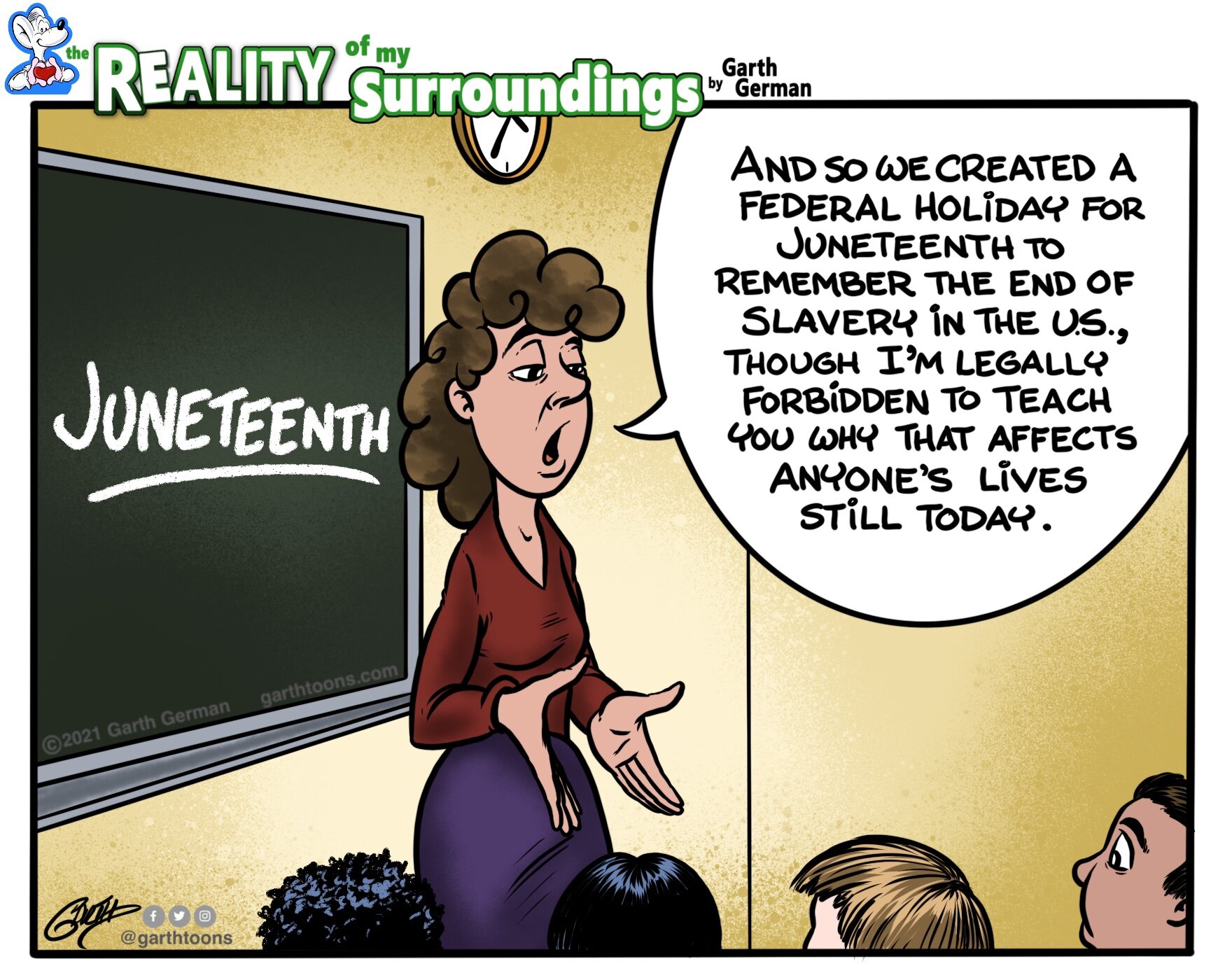



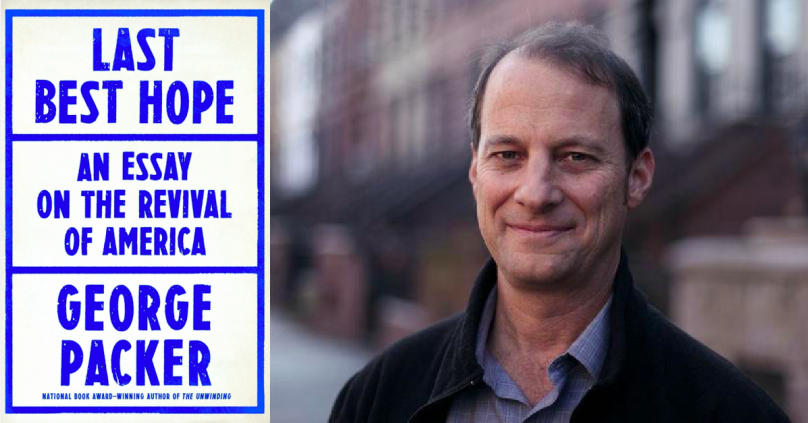


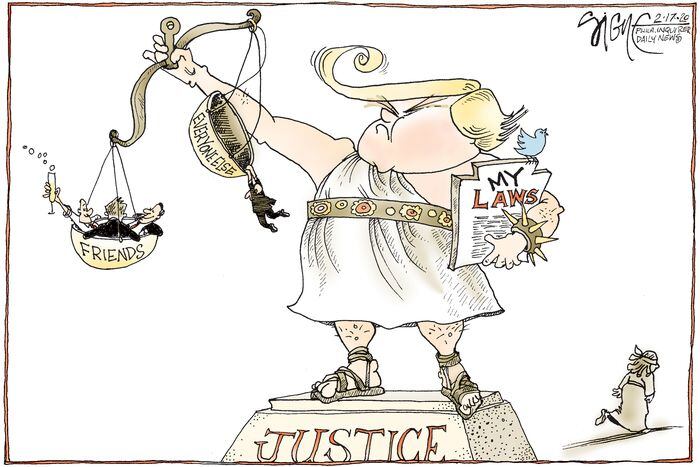


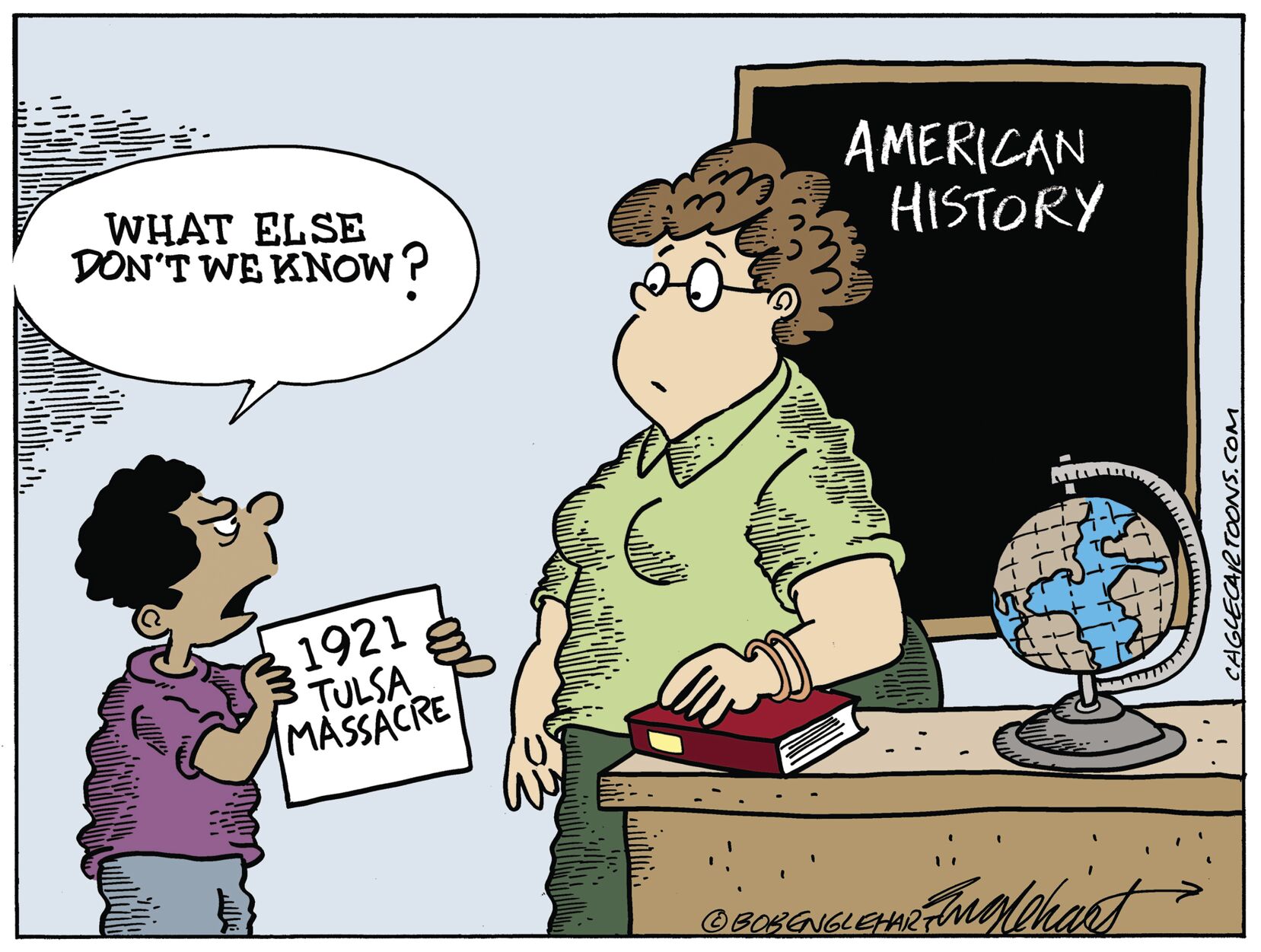


 The Weekly Sift