What They Rule

What we’re really talking about is this plan to capture the U.S. Supreme Court, to install people on it who are sure things. Not to choose people because they have reputations for being fair (or we think they might be fair), but because the people who are at the decision-making table — Leonard Leo, who chose the judges that Trump chose from — believes that they will be sure votes. … We are seeing this revolution that Leonard Leo has put in place. It is one that the American people didn’t ask for, didn’t give consent to, weren’t informed that this is why these judges were chosen. In fact, they were said to be judges who were “rule of law judges”. … Their definition of “rule of law” is not the same as most people’s, which is following precedent, respecting those rules. Instead, their definition of “rule of law” appears to be to change the law to be what they rule.

Lisa Graves, interviewed by Dahlia Lithwick

This week’s featured post is “Does the US have a spending problem?

This week everybody was talking about the debt ceiling

When House Republicans began threatening a debt-ceiling showdown shortly after winning a majority last November, most commentators (and most voters who were paying attention) assumed it would lead to the usual dance: a lot of posturing leading up to the deadline (which might come as early as June 1), then a temporary increase to give negotiations more time, and then a deal seconds before the extra time ran out.

As the date of the catastrophe gets closer, more and more people are warning that we could really go over the cliff this time.

This week’s featured post is the third in my debt-ceiling series.


Speculation about ways to circumvent the debt ceiling is getting more serious. Lawrence Tribe explains why he believes the debt ceiling is unconstitutional under the 14th Amendment:

The right question is whether Congress — after passing the spending bills that created these debts in the first place — can invoke an arbitrary dollar limit to force the president and his administration to do its bidding.

There is only one right answer to that question, and it is no.

And Eric Levitz describes how consol bonds get around the debt ceiling:

In simple terms, a consol bond is one that never matures. A normal bond commits a borrower to paying back the principal on their loan plus interest at a set date. A consol bond, by contrast, requires the borrower to make annual interest payments forever but does not require them to pay off the loan’s full value at any particular point in time.

This is handy since the legislation establishing the U.S. debt limit defines the federal debt as the amount of principal that the government is obligated to repay. Thus, while a normal U.S. Treasury bond increases the national debt as defined by the debt ceiling, a consol bond does not. If the government borrows money via bonds that have no principal — only interest-payment obligations — then it can continue funding its operations indefinitely, even in the absence of a debt-ceiling hike.

A less extreme version could resemble a traditional bond but take advantage of the same loophole: Suppose a bond had a principle of $1,000, but paid $100 a year in interest? The Treasury could sell it for a lot more than $1,000, but it would only count $1,000 towards the debt limit.

and we’re still finding out more about Clarence Thomas’ corruption

Two new Thomas scandals broke this week: Harlan Crow (the billionaire who we already knew takes the Thomases on annual vacations that would cost hundreds of thousands of dollars for them to replicate on their own) paid the private-school tuition of Thomas’ grandnephew, whom Thomas was “raising as a son”.

And Leonard Leo (who is at the center of a network of dark-money groups whose purpose is to make our courts more conservative) directed groups he influences to pay at least $100K to Thomas’ wife’s consulting firm. Leo’s instructions say nothing about work to be done, but just to “give” Ginni Thomas money, with “no mention of Ginni, of course”.

Vox is keeping a running count of the revelations. Another good summary comes from New York Magazine’s Eric Levitz, who also sums up the problem they outline:

In a world where low-level civil servants get nervous about letting friends buy them lunch, it is not easy to explain why it is totally fine for a man entrusted with enormous, democratically unaccountable power to accept hundreds of thousands of dollars’ worth of gifts from partisan political activists, let alone fail to disclose them.

Chris Hayes did a good job covering the Thomas scandals on his Friday show. His opening block reviewed the new developments and raised the question: “Just how much money has secretly flowed from right-wing donors and interests into the household of Supreme Court Justice Clarence Thomas?” His conclusion is that we just don’t know, but that it’s clearly quite a lot.

A later block of that show felt validating to me personally. Last week, I presented my theory of what Crow has been doing: He is Thomas’ “minder”, and the point of showering Thomas with expensive favors is not to “buy his vote on any particular case”, but to “give him something to lose if he should start seeing the charms of liberal philosophy” — as previous Republican-appointed justices like David Souter and John Paul Stevens had.

That interpretation seemed obvious to me, so I was wondering why I wasn’t hearing it from other commentators. Well, Friday Chris made precisely that case. So did Levitz:

The claim that none of these payments actually influenced Thomas’s jurisprudence seems plausible. Thomas was a reactionary long before he met Harlan Crow. It is possible that Crow’s largesse was motivated by a desire to insure against the risk of Thomas converting to liberalism à la David Souter.


Senator Whitehouse tells the Judiciary Committee that Clarence Thomas’ acceptance of luxurious unreported vacations has a precedent: Justice Scalia took more than 70 free vacations at expensive resorts, and declared none of them.


If you want to dig deeper into the dark-money network that is pushing the courts to the right in ways that undermine democracy, listen to the “Clarence Thomas and the Billionaires” episode of Dahlia Lithwick’s Amicus podcast. That’s where the quote at the top of the page comes from.

and the case(s) against Trump

Closing arguments are happening today in E. Jean Carroll’s defamation suit against Trump. The case, which hangs on whether Trump raped Carroll in the 1990s, will then go to the jury.

The Trump team mounted no defense, while Carroll not only described the rape under oath, but presented supporting evidence:

  • Two women testified that Carroll told them about the rape soon after it happened.
  • Two other women testified that Trump attacked them in similar fashion.
  • The jury saw the Access Hollywood tape from 2003 in which Trump bragged about assaulting women.
  • The jury also saw a Trump deposition from October. In the course of that testimony, Trump said that Carroll was “not my type”, but also mistook a photo of Carroll for his second wife, Marla Maples. (He also told Carroll’s lesbian lawyer that she wasn’t his type either. The lawyer was unfailingly polite during questioning, but I would have loved to hear her say, “With all due respect, you’re a fat old man. Nobody cares whether they’re your type.”)

The weakness of Carroll’s case is that

  • No third person saw the rape happen.
  • Carroll can’t say when it happened any more precisely than late 1995 or early 1996.

The standard of proof in a civil case is more-likely-than-not. So while I can imagine deciding that Carroll hasn’t proved her case beyond a reasonable doubt, given the vagueness of the timeframe, it’s hard for me to see how Trump’s non-defense can seem more likely than what Carroll has presented. (Trump’s lawyer is portraying the whole case as a conspiracy of Trump-hating women. But the judge will undoubtedly remind jurors that what either lawyer says is not evidence.) The defense has to be hoping that the jury contains at least one die-hard Trump cultist.

Whichever way it goes, we’re likely to get a verdict this week. It will be the first time a jury has ruled on Trump’s behavior.


If Joe Biden gave a deposition like Trump’s, Fox News would be replaying it 24/7 as evidence of dementia. Trump not only misidentified his second wife Marla Maples in a photo, but also says he can’t remember whether his affair with her started before or after his divorce from Ivana. In fact that affair was headline news at the time.

But nobody worries about that second thing being dementia, because we all — even his supporters — assume he’s lying under oath.

Ditto for his previous written responses to Robert Mueller’s questions. His answer to almost every question was that he didn’t remember.


Four members of the Proud Boys, including their former leader Enrique Tarrio, were convicted of seditious conspiracy Thursday. This is the third trial in which the Justice Department has gotten seditious conspiracy convictions against people involved in January 6. (Two previous trials convicted members of the Oath Keepers, including their founder Stewart Rhodes.)

Tarrio was convicted despite spending January 6 in Baltimore. He is the first person to be convicted of conspiring to organize the attack without directly participating in it. This suggests that DoJ is finally moving up the chain, and could eventually get to Trump.

Collectively, the three trials demonstrate that DoJ has gotten good at proving that there indeed was a seditious conspiracy on January 6. The question now is just: Who were the conspirators?

None of the convicted conspirators have been sentenced yet, but the DoJ just made its sentencing recommendation for Oath Keeper founder Stewart Rhodes: 25 years in prison. We’ll see if the judge agrees. Meanwhile, a man convicted of attacking police with a chair and bear spray was sentenced to 14 years, the most any January 6 defendant has received so far. Prosecutors had asked for 24 years.

Sentences like that increase pressure on conspirators to flip on someone higher up the chain.


Speaking of flipping, The Atlanta Journal Constitution reports that at least eight of the 16 fake electors Trump lined up to cast Georgia’s electoral votes for him (in spite of the fact that he lost the state to Joe Biden) have accepted immunity deals from Fulton County DA Fani Willis.

It’s not immediately clear what they’re going to testify to or who they’re going to testify against, but it is an indication that Willis will be seeking indictments against people higher in the fake-elector conspiracy. Willis has already warned local officials to be ready for indictments to come down (with possible violent responses from protesters) during the July 11 to September 1 grand jury term.

She hasn’t said whether she plans to indict Trump, but it’s hard to see why indictments against John Eastman or Rudy Giuliani would provoke violence.

and you also might be interested in …

King Charles III was crowned in England Saturday. I’m not sure why anybody cares about this, but a lot of people seem to.

President Biden did not attend, because no American president has ever attended an English coronation. (No offense, but kings just aren’t our thing.) He was represented by the First Lady.


The National Weather Service’s Climate Prediction Center gives a 62% chance of El Nino developing by July. If so, that will likely mean record global temperatures.

My somewhat oversimplified understanding of El Nino and the climate is that the temperature measurements we usually see are air temperatures, but global warming also affects the oceans. El Nino releases ocean heat into the air.


Jordan Neely was a homeless man acting weird on the New York subway, until someone killed him. Everyone knows who did it, but the killer hasn’t been arrested or charged with anything. Some people regard him as a hero.

To me, this is the urban version of shooting a stranger who rings your doorbell. These days, everyone who exhibits unexpected behavior seems like a threat, and many seem to believe that potentially deadly force is a reasonable response, especially if the object of your fear fits into some easily dehumanized category.


Ted Cruz has a challenger in 2024: Congressman Colin Allred, who faced an interesting choice when he graduated from college. Allred hadn’t been drafted by the NFL, but he had gotten into law school. He took the risky path and went to an NFL training camp anyway. He made the squad, and had a four-year career as a Tennessee Titans linebacker. Then he returned to the law.

I wonder if Allred has read Josh Hawley’s book on manliness yet.

Ted is already rattled. His fund-raising text against Allred used a picture of Manhattan DA Alvin Bragg instead of Allred. (Those Black people — they all look alike. Right?)


Another mass shooting in Texas and once again Republican officials are calling for prayer. They need to read the Book of Amos, which quotes God saying this:

I hate, I despise your feasts, and I take no delight in your solemn assemblies. Even though you offer me your burnt offerings and grain offerings, I will not accept them; and the peace offerings of your fattened animals, I will not look upon them. Take away from me the noise of your songs; to the melody of your harps I will not listen. But let justice roll down like waters, and righteousness like an ever-flowing stream.

In other words: “It pisses me off when you expect me to fix problems you caused and refuse to work on.”

Early indications can be misleading, but the mall shooter looks like a right-wing extremist.

Governor Abbott repeats the other popular meaningless response to our gun-violence problem:

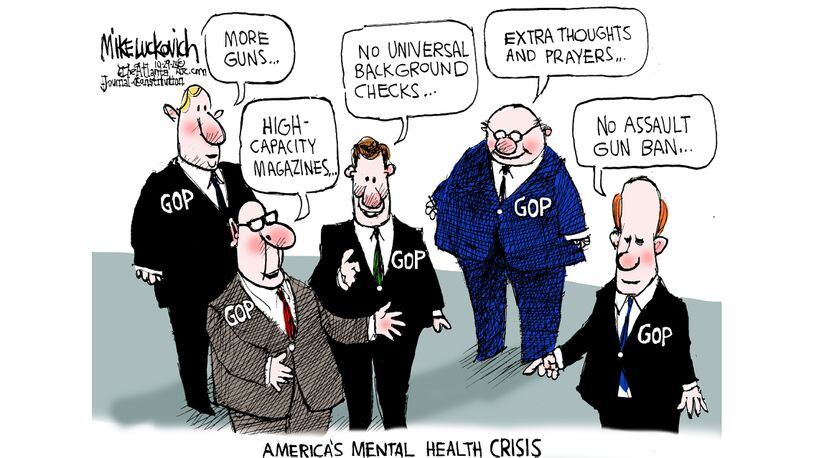
The long-term solution here is to address the mental-health issue.

But of course he’s been cutting mental-health funding. Because he doesn’t actually care about mental health; he just wants to shift attention away from gun control.

This is a popular rhetorical tactic on the Right: minimize one problem by comparing it to another, when in fact you don’t want to address either one.

So if you want to talk about how many unarmed people of color are killed by police, they’ll ask why nobody on the Left cares about the much more serious problem of black-on-black crime. But their interest in black-on-black crime goes away as soon as you stop talking about the police. Or they’ll ask why we’re sending money to Ukraine when there are homeless veterans here in the US. “OK, then,” you say, “let’s do something about homeless veterans.” Never mind. They only cared about the veterans to argue against aiding Ukraine.


Who in 1967 suspected that the unknown young Cat Stevens was writing an anthem for the 2020s, “I’m Gonna Get Me a Gun“?


Also in Texas: A car plowed into a crowd of people outside a shelter serving migrants and homeless people in Brownsville, while the driver shouted anti-migrant obscenities. Seven dead, ten injured.


Deborah Fallows borrows her husband’s Substack blog to tell her story of long Covid.


Brexit was the UK’s version of Trump’s America First policy: The rest of the world has been taking advantage of us and we’re going to put a stop to it.

Well, it’s now pretty clear that was a huge mistake, and the British economy is in bad shape.

and let’s close with something retro

The next big thing in transportation might be a ship with sails. Not big cloth ones like the old clipper ships, but huge vertical wings. Cargo ships may never against be completely wind-powered, but what if wind assistance could cut fuel use by 30% or so?

Does the US have a spending problem?

Compared to other countries, no. But if you think the US should be “exceptional” and that climate change is a hoax, maybe.


As House Republicans get closer and closer to forcing a debt-ceiling crisis that could result in the United States defaulting on commitments it has already written into law, American citizens need to raise their understanding of how all this works. Previously, I’ve written two posts on this theme: The first explained what the debt ceiling is and why we shouldn’t have one at all. (Only the US and Denmark have debt ceilings, and Denmark doesn’t play chicken with theirs. No other country inflicts these kinds of fiscal crises on itself.) The second looked at the history of the US national debt and how it accumulated.

Now it’s time to address the main argument House Republicans are making to justify playing chicken with an economic catastrophe: Sure, the US defaulting on its commitments would be bad, but it’s worse to do nothing, because our ever-increasing spending and debt is pushing us towards an even greater catastrophe.

In other words, a self-inflicted debt-ceiling crisis is the lesser evil. Steve Moore, the Club for Growth founder that Trump tried to appoint to the Federal Reserve Board, puts it like this:

The nation’s good credit standing in the global capital markets isn’t imperiled by not passing a debt ceiling. The much-bigger danger is that Congress does extend the debt ceiling, but without any reforms in the way Congress grossly overspends.

The first part of that claim is obvious nonsense: Not passing a debt ceiling certainly does imperil the US standing in credit markets. But let’s examine the second claim: Not just that the government spends more money than some people would like, but that doing so is pushing us towards a national catastrophe.

Spending. It’s a matter of simple fact that government spending and debt have gone up considerably — both in absolute terms and as a percentage of our annual GDP — in the late Trump years and since Biden took office. Basically, the Covid pandemic both cut revenue and required enormous government spending to avoid great public suffering while the private sector was largely shut down. The necessity of that deficit spending was a bipartisan conclusion; it happened under both Trump and Biden and was supported in Congress by members of both parties.

(Notice that the extreme right of the graph above is a projection to 2050, not something that has already happened.)

That increase in the debt built on a previous run-up during the Great Recession that started in 2007. Again, the stimulus spending and tax-cutting was bipartisan; it began under Bush and continued under Obama.

But looking forward, the US faces challenges that the two parties see differently. Democrats want the government to spend money on them, while Republicans don’t.

  • Democrats see climate change as a problem that requires a major restructuring of the economy, moving away from fossil fuels and towards energy from sustainable sources. However, climate change is a classic externality — a real cost that falls neither on the producer nor the consumer of fossil fuels — so the market will not make this shift without government intervention. Republicans deny that climate change is a problem.
  • Democrats want to shift healthcare — nearly 1/7th of the economy — from the private sector to the public sector. Medicare began this shift in the 1960s. ObamaCare continued it, and progressives like Bernie Sanders would like to complete it. Republicans would like to stop this shift, if not roll it back.

Abstract debates about “spending” are really about these two issues, plus the perennial question of how good a safety net the US should provide for its poor: Is it enough to keep people from starving in the streets, or should the government guarantee every American a decent life, whether they can find a job or not?

It’s worth noting that the other big government expenditure — defense — is largely bipartisan. In general, progressive Democrats would like to spend less on defense and MAGA Republicans more, but neither party has a consensus for major changes in our military posture in the world.

The politics of spending. The bill House Republicans recently passed reflected these priorities: It agreed to raise the debt ceiling for about a year (at which point we’d go through the same ordeal again), in exchange for

  • capping “discretionary spending” — basically everything but Social Security and Medicare — at FY 2022 levels and letting them increase by only 1% per year.
  • rolling back provisions in the Inflation Reduction Act to subsidize sustainable energy, while increasing production of fossil fuels

plus a few other things. The discretionary spending cap isn’t across-the-board, but also doesn’t specify the cuts. This allows Republicans to dodge when Democrats say they’ve voted to cut some popular program like veterans’ benefits. And of course, every program that gets exempted from the cuts means that deeper cuts will be needed elsewhere.

The White House has been attacking Republicans for proposing cuts to veterans’ care. Republicans in House leadership have responded that no cuts are intended. House Speaker Kevin McCarthy has promised he will protect the military from reductions, though the bill as written does not exclude them. And Kay Granger, the chairwoman of the House Appropriations Committee, has said border security remains a top priority.

This is a feature of our politics that I’ve noted before: The American people don’t really understand where government spending goes, so they support spending cuts in the abstract, while rejecting any specific list of significant cuts.

The two parties maneuver around that phenomenon: Republicans support vague spending “caps” that don’t specifically cut anything in particular, while Democrats try to pin them down. Do they want to cut defense? Veterans benefits? Health care? Education? No, of course not. They just want to cut “spending”.

Is government spending a problem? For Republicans, this is an article of faith, but it’s really not obvious. For example, look at Wikipedia’s list of countries by government spending as a percentage of GDP. (The US total accounts not just for federal spending, but state and local as well.)

As of 2022, the US was not an outlier in either direction, spending about 38% of GDP via government. That’s less that most comparable countries: the UK (45%), Germany (50%), Canada (41%), and France (58%) for example. But it’s also more than Switzerland (34%) and Israel (37%), and almost exactly the same as Australia.

And while government spending has been generally rising over the decades — it was less than 20% of GDP a century ago — the increase doesn’t look precipitous or out of control.

In short, if you argue that the US has a spending problem, what you’re implicitly saying is that we shouldn’t be like other nations. If you regard Germany or France as cautionary tales, then we need to cut spending before we wind up like them. On the other hand, if you envy countries like Denmark (49%), the Netherlands (45%), and Finland (54%) — Finland regularly comes out on top of polls about public happiness — then you can only shake your head at this “out-of-control spending” talk.

The ledger has two sides. So while the “spending problem” is debatable, it is obvious that the national debt is growing. Intuitively this seems bad (though I’ll push discussing how bad it really is off to a later post). But jumping immediately from a debt problem to a spending problem is sleight-of-hand. Spending 38% of GDP (or 50% or even more) through the public sector doesn’t necessarily create debt if we’re willing to pay taxes at that level.

Our debt problem (from the same Wikipedia list) comes from the fact that we’re only paying 33% of GDP in taxes. This is not high by comparison with other countries. South Korea pays 27% and Ireland 23%, but just about every other country we might compare ourselves to pays more: Germany 47%, Canada 41%, the United Kingdom 39%, and so on.

So it’s disingenuous to frame the debt as a national crisis, but take taxes off the table. In particular, the Trump tax cuts went mainly to corporations and the very rich, while adding trillions to the debt over a ten-year period. Most spending cuts are unpopular in themselves, but they’re particularly unpopular when you pair them with tax cuts, as in “We have to kick your cousin off Medicaid so that billionaires can keep the tax cuts Trump gave them.”

The private sector isn’t magic. Much of the debate about government spending is really about whether some necessary expense winds up in the public or private sector. We could, for example, cut government spending overnight just by closing all the public schools. Kids would still need to be educated, and most middle-class-and-above families would find some way to send their own kids to private schools (maybe with help from grandparents). Taxes could go down, but private expenses would go up.

Ditto for Social Security. We could end it an save everybody taxes. But you’d also have to worry about whether your parents or grandparents were starving, and maybe they’d have to move in with you.

All our highways could be toll roads run by private corporations. Taxes could go down, but you’d have to pay tolls.

The point I’m making here is that nothing magic happens when we move an expenditure from the public to the private sector or vice versa. Somebody still has to teach the kids, take care of the sick, and pave the highways. You don’t necessarily save anything just by paying those people out of a different piggy bank.

That observation is going to be important the next time we consider expanding national health care. Conservatives are going to freak out about the massive increase in government spending. “OMG! We can’t afford this!” But if the net effect is that taxes replace health-insurance premiums, we can. That’s the main reason government spending (and taxation) is higher in places like France and Germany: They’re buying stuff through the public sector that we buy through the private sector. People still wind up paying doctors and nurses to take care of them, but the money traverses a different route.

Spending and democracy. Finally, we need to recognize that the current situation results largely from what the American people want: The particular programs the government spends money are popular, while taxes are unpopular. The current spending and taxing levels were passed by the Congress the people elected.

The point of using the debt ceiling as a hostage-taking tactic is to circumvent democracy. Yes, the people did narrowly elect a House Republican majority in 2022, but Republican candidates ran on issues that have largely vanished from the House Republican agenda, like crime. They certainly did not run on a list of spending cuts, and in fact they still have not produced such a list, because they know it would be unpopular.

The American people have also elected a Democratic Senate majority and a Democratic President. (Both of those happened in spite of structural factors that allow Republicans to win without representing a majority of voters, like the small-state bias in the Senate and the Electoral College.) The Republican House should not get to control the agenda simply because they are apparently willing to push the economy’s self-destruct button unless they get their way.

So what should happen? The debt ceiling should play no role, and Congress should work out a budget for next year, adjusting both the taxing and spending sides of the ledger. Republicans should have a bigger say in the next budget than the last one, because they won the House majority. But both parties should publish their budget priorities and see how the American people like them.

So is there a spending problem? Not really. Not by international standards and not compared to what the people want. What the government spends money on may or may not be what you want it to spend money on. But that’s why we have elections.

The Monday Morning Teaser

As we rush ever closer towards a debt-ceiling disaster, I’ll continue my series on the national debt with “Does the US have a spending problem?” That should be out maybe around 10 EDT.

The weekly summary will catch you up on the latest Clarence Thomas scandals, which have turned into a regular feature of a typical week’s news. The various cases against Trump have continued to advance, with the E. Jean Carroll lawsuit going to the jury this week, and eight of the fake Georgia electors from 2020 taking immunity deals from the Fulton County DA. Proud Boy leaders were convicted of seditious conspiracy for January 6. There was another mass shooting and a mass homicide-by-car in Texas. A new El Nino cycle points to new global temperature records later this year. And a few other things happened. That should be out around noon.

Are We Still America?

In America, the government cannot punish you for speaking your mind.

Disney v DeSantis

This week’s featured post is “Laboratories of Autocracy“.

This week everybody was talking about the Supreme Court’s ethics problem

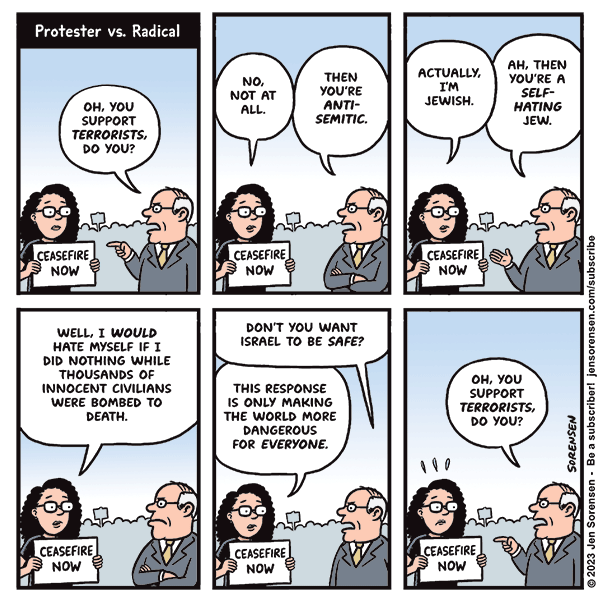
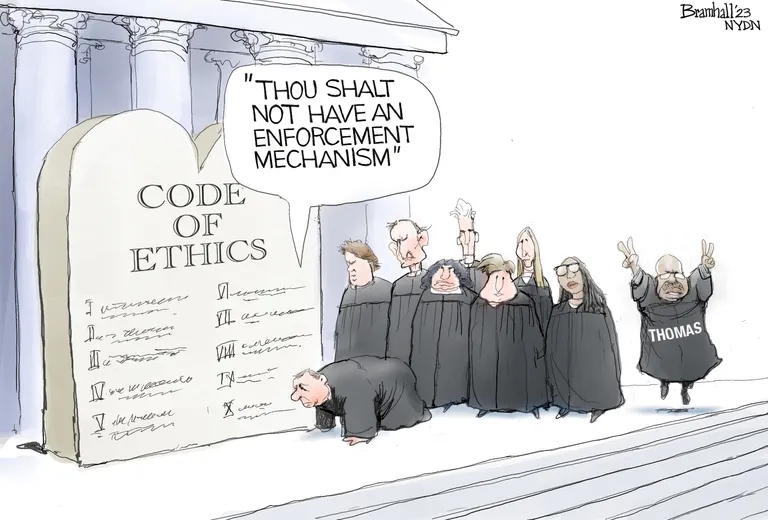
If you don’t recognize it, the cartoon refers to the taunting French soldier in Monty Python and the Holy Grail. It’s a fairly apt summary of John Roberts’ response to the Senate Judiciary Committee’s request for Roberts to come testify about the need (or absence of need) for the Court to have an enforceable ethics policy, as every other institution of government does.

Roberts observes that chief justices have seldom testified before committees (though it has happened), and that these appearances are about “mundane” matters. Presumably, he means that showing up to answer criticism would create “separation of powers concerns”. Roberts attached a “Statement on Ethics Principles and Practices” which says nothing about how justices might be held to these standards.

Vox’ Ian Milhiser characterized the response as “tone-deaf”. In Roberts’ vision, “separation of powers” makes the Court the unique institution of government to which checks and balances do not apply.


Meanwhile, questions continue to mount up. In addition to the original Clarence Thomas bribery concerns, issues related to Neal Gorsuch and Roberts himself have surfaced. In addition, we discovered more details about the cover-up that passed for an investigation of Brett Kavanaugh during his confirmation hearings.

Meanwhile, in a Wall Street Journal interview, Samuel Alito doubled down on tone-deafness.

We are being hammered daily, and I think quite unfairly in a lot of instances. And nobody, practically nobody, is defending us.

Like Roberts, he worries about the legitimacy of the Court, but sees it as everybody’s problem but his own. The onus is not on the Court to be more transparent and circumspect; it’s on the rest of us to stop criticizing them. David Roberts (no relation to John) comments:

Alito is really the conservative’s conservative: in a position of near-absolute power, free from any accountability, yet possessed by an endless sense of grievance. A whole interview about how awful it is that people criticize him!


Through all the revelations of Clarence Thomas’ apparent corruption — the millions of dollars worth of free vacations, the unreported real estate transactions, Clarence’s mom getting her home fixed up and living rent-free, and who knows what else we don’t know about yet — the most convincing defense of his innocence has gone something like this: Nobody had to bribe Clarence Thomas to be conservative; he was always conservative.

Here’s my theory on that: Harlan Crow is Thomas’ minder.

To understand what that means, you have to think back to what conservatives were worried about in the 1990s. When the first President Bush appointed Thomas to the Court in 1991, Republicans had won 7 of the last 10 presidential elections, going back to Dwight Eisenhower in 1952. They also had been lucky with the timing of Supreme Court vacancies, so when Thomas replaced Thurgood Marshall, the Court had only one justice appointed by a Democrat: JFK appointee Byron White.

The rest of the Court looked like this: The Chief Justice, William Rehnquist, had been nominated by Richard Nixon and elevated to Chief Justice by Ronald Reagan. Reagan had also appointed Justices Sandra Day O’Connor, Antonin Scalia, and Anthony Kennedy. President Ford had appointed John Paul Stevens, and Nixon appointed Harry Blackmun. Bush appointed both Thomas and David Souter.

With an 8-1 Republican majority, conservatives felt entitled to a very conservative court. And yet, judges appointed by Republicans had a (to them) disconcerting way of moving left after they were seated. So the precedents of the liberal Warren Court of the 1960s continued to stand, and in 1992 the Court (mostly) reaffirmed Roe v Wade in Casey. Bush’s previous pick, Souter, became a particular irritation for the Right, and by Bush v Gore in 2000, everyone was lumping him with the liberals.

So when Thomas took his seat in 1991, the question among conservatives wasn’t just “Is he really a conservative?”, but “How can we keep him from doing a Souter on us?”

That’s where I think Harlan Crow comes in. The point of introducing Thomas and his wife to the joys of billionaire society wasn’t to buy his vote on any particular case. It was to give him something to lose if he should start seeing the charms of liberal philosophy.

So Thomas may well believe that his relationship with Crow is a genuine friendship with no unsavory aspect. After all, what’s not to like about a guy who gives you a chance to live in a lavish world you otherwise could never approach? Thomas and Crow may not talk politics any more than friends typically do, and they probably mostly agree. Quite likely, Thomas has never changed a vote because Crow pressured him. The thought that all this luxury could go poof if he steps off the conservative path may not even be a conscious consideration.

But that’s how corruption often works. As Upton Sinclair once put it, “It is hard to get a man to understand something, when his salary depends on his not understanding it.” A mega-church pastor may genuinely believe in God, but he also recognizes that any atheistic thought crossing his mind threatens his entire career. If all your friends think X, it’s hard for not-X to get a fair hearing in your mind.

So Clarence Thomas probably has no awareness of being bribed. He just lives an enviable lifestyle that could go away if he ever changes his mind.

and Tucker Carlson

Last week, Tucker Carlson’s departure from Fox News was being announced just as I was ready to post. It wasn’t even clear yet whose decision it was; the announcement just described a parting of the ways.

By now it’s clear that Tucker was fired, though it’s still not clear why. Lots of explanations present themselves — something to do with the Dominion lawsuit or its settlement, something to do with Abby Grossberg’s lawsuit, friction with the Murdochs … — but none of the theories have accounted for the timing: Tucker signed off on Friday expecting to be back on Monday, and then he wasn’t.

One thing we know for sure is that he wasn’t cancelled for saying racist or sexist stuff. That’s been going on for years.

And that brings up the other big point of debate: whether his firing is something to celebrate. Clearly, Tucker was a force for evil in the world. But maybe that’s just the role he has been playing, and whoever takes his place will be just as bad. Or maybe he himself will be just as malignant somewhere else.

Maybe. But personally, I’m celebrating. Yes, all Fox hosts are right-wing propagandists. (That’s the clearest lesson the Dominion lawsuit established.) And no, there is no reason to think that the Murdochs are interested in seeing the network turn over a new leaf. So there’s every reason to believe that the new 8 p.m. host will be another Hannity or Ingraham.

But Tucker was worse than that. He didn’t just amplify whatever Republican talking points were making the rounds. He had become a conduit for bringing rhetoric from the White supremacist fringe into the conservative mainstream. Sure, the next 8 p.m. host will claim that tax cuts pay for themselves and Joe Biden has dementia. But s/he may not be a gateway for young men to find the nazis.


Speaking of Fox’s propaganda, Chris Hayes presents the other half of a story Fox has been hyping: The network again and again played video of a former San Francisco official being beaten by a homeless man, as if this were the kind of random violence that is rife in cities run by Democrats. (That’s a constant Fox theme: Blue-state cities are “hellholes”, a conclusion crime statistics don’t bear out. In reality, red states like Tennessee and Missouri have violent crime rates far higher than California or New York.)

But it turns out that somebody who looks a lot like the former official has been trying to chase homeless people out of the neighborhood by attacking them with bear spray. In other words, this isn’t a random-urban-violence story, it’s a fuck-around-and-find-out story. If you attack homeless people often enough, eventually one will fight back.

and the debt ceiling

The big question this week was whether Speaker McCarthy could pass his ransom demand for raising the debt ceiling. It was a close call, but he did.

What McCarthy hasn’t passed, and almost certainly can’t pass, is a Republican budget. The bill he passed would raise the debt ceiling until March while making substantial spending cuts. But the cuts are to overall spending levels, and what the government does less of is not specified.

Biden’s reelection bid

Tuesday, President Biden officially announced what he’s been hinting at for months: He’s running for reelection in 2024.

My reaction is, I suspect, fairly typical among Democrats: Biden is not an inspirational figure in the mold of JFK or Barack Obama, but he’s been a very good president. Trump (after trying everything he could think of to break democracy and hang onto power) handed him a country in pretty bad shape: Covid was killing more than 3,000 Americans every week; vaccines existed but the government had no plan for distributing them; unemployment was at 6.3%; Trump’s final budget showed a $4.8 trillion deficit; the NATO alliance was in tatters; and respect for America had plunged around the world.

Biden took office with little margin for error. Democrats in the House held a slim 222-213 margin in the House, and Vice President Harris was the tie-breaking vote in a 50-50 Senate that required 60 votes to break a filibuster.

And yet, he accomplished a great deal, including things that Trump had long promised but never delivered, like an infrastructure bill to rebuild America. The Inflation Reduction Act began addressing climate change, really for the first time ever. (President Obama had taken executive actions, but had not gotten climate-change legislation passed. President Trump was more interested in undoing climate action.)

Without Biden, it’s doubtful NATO would have given Ukraine enough aid to stave off a Russian takeover. And while the US exit from Afghanistan was messy — perhaps needlessly so — nonetheless we are out of Afghanistan. That’s another thing Trump kept promising but never delivered.

And finally, it’s wonderful to have a president who actually believes in the Constitution. If, God forbid, Biden should happen to lose the 2024 election, I have no doubt that he will leave office peacefully. There will be no scheme to create fraudulent electors, or riots to intimidate Congress into keeping him in power.


Nikki Haley (who needs to say wild things to draw attention to her own presidential candidacy) immediately took the low road, announcing that Biden’s survival to the end of a second term “is not something I find likely”. (Biden’s Deputy Press Secretary Andrew Bates responded with, “Honestly, I forgot she was running”)

Just as a matter of statistics, Haley is wrong: An 80-year-old White American male has an average life expectancy of seven years. Biden appears to be fit and has the best medical care, so if anything, his odds should be better than average.

But Haley’s macabre comment points to something Republicans do need to think about: Biden’s age could be an issue if they nominate a younger candidate like Haley or DeSantis, but it will fall flat for Trump, who is 76, fat, eats a terrible diet, and resists exercise or medical advice.

Would Republicans really bet on Trump to outlive Biden? I wouldn’t. And I wouldn’t make ridiculous claims about his superior mental competence either, as congressman and former White House doctor Ronny Jackson (a.k.a. “Candyman“) does:

Donald Trump can stand up unprompted without any teleprompter or anything else and he can talk for two hours

I think we all know old people who can drone on endlessly about their imaginary grievances. It’s not usually a sign of acuity.


Thursday was Take Your Child to Work Day at the White House.

and the Trump rape trial

Up until now, I’ve mostly been discounting E. Jean Carroll’s lawsuit against Trump. After all, it’s a civil case, so (unlike the January 6 or Mar-a-Lago documents or Georgia election interference investigations or the Stormy Daniels indictments) it can’t send him to jail. It probably won’t even result in a huge monetary settlement, like the $250 million New York is seeking in its fraud lawsuit.

But as the trial got underway this week, I finally realized what this case does: It brings Trump’s wrongdoing down to a human scale. The allegation here is not some complicated story about a larger-than-life historical figure trying overthrow our constitutional democracy. Instead, it’s very simple: Trump raped E. Jean Carroll, and when she told her story he said she was a liar who was too ugly to rape.

Fundamentally, this is the story of a man with the fame and money and power to do whatever he wants. As he bragged on the Access Hollywood tape:

When you’re a star, they let you do it. You can do anything. Grab ’em by the pussy. You can do anything.

Carroll’s lawsuit is raising the question: Is that true? Is that the kind of world we live in or want to live in? Can a man like Donald Trump really do anything and walk away unscathed?

This week, Carroll testified, and held up well under a badgering cross-examination by Trump’s lawyer. Trump himself is not going to testify or even attend. This is all beneath him, though he continues to attack Carroll on the social media platform he owns.

The Carroll trial is putting a face on a class of people we all know exist: Trump’s victims. They are real people, and at least one of them is willing to stand up to him.

but we need to keep our eyes on Republican state legislatures

That’s the subject of the featured post.

and you also might be interested in …

A family in Cleveland, Texas asked their neighbor to stop shooting his gun, so he killed them. He’s still at large


More life in Texas:

A Texas man on a date who paid $40 to park, only to learn inside a Houston burger joint that he was scammed, allegedly went back and fatally shot the man posing as an attendant and then returned for dinner, according to court records.

His date turned him in to police.

and let’s close with something self-referential

The Toronto Recursive History Project commemorates its own history of commemorating its own history.

Laboratories of Autocracy

The 20th-century Supreme Court Justice Louis Brandeis once called the American states “laboratories of democracy”. But recently the red states have been experimenting with something else entirely.


In his 2018 book Reconstructing the Gospel, Christian minister Jonathan Wilson-Hartgrove reflected on one of the paradoxes of religious fervor.

Even as we feel guilty about doing the things we know we ought not to do, and strive to do more of the good we want to do, our very worst sins are almost always things we know to be our Christian duty.

He illustrated the point with examples: the Crusades, the high priests who condemned Jesus, and the Southern “Redeemer” movement, whose violent terrorism ended Reconstruction and inaugurated Jim Crow.

Over and over, Christians support and participate in atrocious evil, not because we choose to do wrong, but because we think we’re doing the right thing — the righteous thing, even.

Not wanting to pick on Christianity, I’ll add some secular examples: the Reign of Terror, Mao’s Cultural Revolution, and the Bush administration’s torture policy. Wilson-Hartgrove is pointing to a human thing, not a uniquely Christian thing. Cruelty is often practiced by people who imagine themselves to be heroes.

Seekins-Crowe. I recalled Wilson-Hartgrove’s observation this week, when Rep. Kerri Seekins-Crowe‘s moving and highly emotional speech went viral.

Seekins-Crowe gave the speech in March, during the debate over Montana’s new law banning gender-affirming care for minors. (The bill passed and was signed Friday by Governor Greg Gianforte.) The main argument against the bill was that it would cost lives. (We’ll get to Rep. Zooey Zephyr’s “blood on your hands” comment later on.) Teens struggling with their gender identity have a high suicide rate; gender-affirming care is often an attempt to save their lives. So banning it may well increase teen suicides.

Seekins-Crowe did not shy away from that argument. She did not scoff at it or trivialize it, but took the bull by the horns. She explained that she had lived for three years with a suicidal daughter, and so she knows that some things are more important than saving your child’s life.

That seems like a brutal summation of her words, so I feel obligated to quote her at length and provide a video.

One of the big issues that we have heard today and we’ve talked about lately is that without surgery the risk of suicide goes way up. Well, I am one of those parents who lived with a daughter who was suicidal for three years. Someone once asked me, “Wouldn’t I just do anything to help save her?” And I really had to think. And the answer was, “No.”

I was not going to give in to her emotional manipulation, because she was incapable of making those decisions and I had to make those decisions for her. I was not going to let her tear apart my family and I was not going to let her tear apart me, because I had to be strong for her. I had to have a vision for her life when she had none, when she was incapable of having [one].

I was lost. I was scared. I spent hours on the floor in prayer. Because I didn’t know that when I woke up if my daughter was going to be alive or not. But I knew that I had to make those right decisions for her so that she would have a precious, successful adulthood.

Monstrous as it is, I can’t watch that video without feeling Seekins-Crowe’s sincerity. She believes what she is saying, and believes that letting her daughter suffer for three years was the right thing to do. (I have no idea how that story came out. After three years, did the daughter stop being suicidal, or just reach adulthood?) And now, she believes that passing this law is the right thing to do. I have little doubt that she would describe it as her Christian duty.

That speech is, I think, an almost perfect distillation of the authoritarian mindset: People who see the world differently than I do are deluded, so I have to be strong enough to make their decisions for them, even if it kills them.

There is, of course, room for debate about when parents ought to overrule their children’s desires. Nearly every parent, at some time or another, has forced a toddler to go to bed, or refused to let one eat all the candy. Those calls get harder as children grow, and I don’t know any clear rule about when someone is old enough to make their own decisions about gender-affirming medical interventions.

But now Seekins-Crowe has taken the next step, and is making “right decisions” for all the parents in Montana, particularly those who might not be “strong” enough to ignore their children’s anguish, or sure enough of their own convictions to close their ears to whatever their children might say. Those “weak” parents need a strong government, full of strong people like Seekins-Crowe herself.

Providing that strength is her Christian duty.

Watching Seekins-Crowe’s speech makes me realize that conservative leaders like Donald Trump and Ron DeSantis have spoiled me, because their villainy is so direct and uncomplicated. I have no doubt that Trump knows he is a grifter, and that he is consciously taking advantage of the people who support him. Likewise, DeSantis knows that critical race theory is not a thing, and that Florida’s librarians and grade school teachers are not grooming children for pedophilia.

If everyone on the other side were like that, life would be simple. But instead the world is full of Abrahams whose willingness to sacrifice Isaac makes them feel closer to their God.

What can we do with them?

I don’t have an answer for that question, so I’m just going to continue talking about the Montana legislature, and red-state governments in Texas and Florida that also gave us insight into authoritarianism this week.

Zooey Zephyr. One thing authoritarians don’t do is tolerate dissent, particularly from people they deem inferior. A few weeks ago, the Tennessee House decided not to tolerate Justin Jones and Justin Pearson, who are Black. The Justins delayed the business of the House for an hour or so by encouraging pro-gun-control demonstrators in the gallery, so they were expelled from office. But the people of their districts put them right back.

This week, the Republican supermajority in the Montana House did something similar to Zooey Zephyr, a trans woman (whose adulthood, in Seekins-Crowe’s terms, must not be “precious” or “successful”). On April 18, during debate on the bill banning gender-affirming care for minors (and several other anti-trans bills), she was blunt:

This body should be ashamed. If you vote yes on this bill and yes on these amendments I hope the next time there’s an invocation, when you bow your heads in prayer, you see the blood on your hands.

In response, the ironically-named Freedom Caucus in the Montana House called for “his” censure because of that “threatening” comment. Majority Leader Sue Vinton responded directly (and self-righteously) to the “shame” comment:

We will not be shamed by anyone in this chamber. We are better than that.

The censure resolution was not immediately taken up, but the Speaker refused to recognize Rep. Zephyr when she rose to speak, and said that he would not do so until Zephyr apologized, which she refused to do.

Last Monday, hundreds of pro-Zephyr demonstrators came to the Capitol. When Zephyr rose and was ignored, they loudly chanted “Let her speak.” The Speaker still did not recognize Zephyr, and the House ground to a halt for half an hour until the demonstrators could be removed. On his way to jail, one demonstrator explained:

In this country you don’t get many rights but one of the things you do get is an elected representative, and 11,000 Montanans are waiting for Zooey Zephyr to speak for them, to represent the interest of trans people in the state who belong in the state as well. It’s not just … the old white men who run the show over here. It’s every single person. Montana is big enough for all of us, and I think it has space for all of us.

Republicans have since inaccurately described the demonstrations as “violent” and “an insurrection”. (I commented two weeks ago on the Right’s practice of breaking words that have been used against them. Ever since January 6 they have been trying to break insurrection through misuse. It falls flat to claim that January 6 was merely a “protest”, so they have been characterizing any liberal protest as an insurrection.)

Zephyr was blamed for this breech of “decorum” (the same offense charged against the Justins). So she was banned from the House floor for the remainder of the session (which ends May 5). The resolution banning her did not also bar her from serving on committees, but all the committees she serves on then had their remaining meetings cancelled.

Like the Justins, Zephyr returned home to a large rally of her supporters. (Remember: “Large” means something different in Montana, where each House district has only about 11,000 people.) Since the legislature only meets in odd-numbered years, her term is effectively over. But she’ll be running for reelection in 2024.

Universities. Another thing authoritarians do not tolerate is an alternative source of institutional authority. That’s why the current crop of red-state authoritarians is working so hard to bring the universities under control. Universities do not wield power directly, but they are recognized sources of authoritative opinion. So they cannot be allowed to remain independent.

A number of German words have already made it into the American vocabulary — zeitgeist, schadenfreude, realpolitik, gestalt, wanderlust. Well, it’s time to learn another one: gleichschaltung, whose root words mean “same circuit”. Originally an engineering term translated as “coordination” or “synchronization”, gleichschaltung was adapted in the 1930s to describe the process of unifying German society and culture under Nazi ideology. Simply controlling the national government wasn’t good enough; the kind of German renewal the Nazis promised could only be accomplished by a unified society whose institutions all pulled in the same direction. So local governments, corporations, unions, professional associations, universities, social clubs, and youth organizations all needed “coordination”.

This week, Texas took a step towards its own gleichschaltung when its Senate passed SB-18, which would eliminate tenure in the state’s universities.

An institution of higher education may not grant an employee of the institution tenure or any type of permanent employment status.

Current tenured faculty are grandfathered in, but no new tenured appointments would be made after September 1. The Texas Tribune claims that the bill “faces an uphill battle at the Texas House”, so perhaps Texas’ university system will be spared for another term or two.

The argument for the bill is primarily political, not educational.

[Lieutenant Governor Dan] Patrick’s push to end tenure in Texas started more than a year ago after some University of Texas at Austin professors passed a nonbinding resolution defending their academic freedom to teach about issues like racial justice. The resolution came as Republicans hinted that they wanted to extend restrictions on how race is discussed in K-12 classrooms, which were approved by the Texas Legislature in 2021, to the state’s public universities.

The resolution outraged Patrick, who accused university professors of “indoctrinating” students with leftist ideas and argued that the state must stop awarding tenure because faculty with the benefit don’t face any repercussions for it.

But that’s precisely the justification for tenure: It allows academics to do their jobs without worrying about offending the politicians currently in power. In a liberal democracy, universities are not supposed to be “coordinated” with the ruling party.

Florida is another state trying to synchronize its educational institutions with government ideology. Governor DeSantis’ Stop WOKE Act created a list of ideas that cannot be taught in Florida public schools, including the state universities. The part affecting the universities has been blocked by a federal judge, whose ruling says:

The First Amendment does not permit the State of Florida to muzzle its university professors, impose its own orthodoxy of viewpoints, and cast us all into the dark.

But acts of the legislature are only one path to gleichschaltung. The governor also has executive power to appoint trustees to university boards. DeSantis’ new trustees are in the process of coordinating New College in Sarasota. At a recent meeting, all five faculty members up for tenure — including three in the supposedly apolitical hard sciences — were rejected, and the faculty chair (who had been broadly criticized for being too accommodating to the new regime) quit.

Disney. I mentioned corporations in the list of things that need to be synchronized with the ruling ideology. Well, after DeSantis passed his Don’t Say Gay law, Disney had the temerity to put out a statement saying that it opposed the law and would continue to work against it through the systems our constitution provides for reversing government actions:

Our goal as a company is for this law to be repealed by the legislature or struck down in the courts, and we remain committed to supporting the national and state organizations working to achieve that.

All in all, it was pretty tepid stuff, but it marked Disney as a company not marching to the DeSantis drum. That led DeSantis to strike at Disney in ways that fell comically flat: A bill to dissolve the special taxing district around Disney World had to be undone when nearby counties noticed they might wind up responsible for about $1 billion in bonds the district had outstanding. Then DeSantis announced a takeover of the board that oversees the district, but was again outsmarted by an agreement Disney signed with the outgoing board.

Now DeSantis is trying to get the legislature to nullify that agreement, and Disney decided it had had enough: It filed a federal lawsuit claiming that DeSantis is illegally retaliating against Disney for speech protected by the First Amendment.

There is no room for disagreement about what happened here: Disney expressed its opinion on state legislation and was then punished by the State for doing so. … This is as clear a case of retaliation as this Court is ever likely to see. …

It is a clear violation of Disney’s federal constitutional rights—under the Contracts Clause, the Takings Clause, the Due Process Clause, and the First Amendment—for the State to inflict a concerted campaign of retaliation because the Company expressed an opinion with which the government disagreed. … In America, the government cannot punish you for speaking your mind.

The reason there’s “no room for disagreement” is that DeSantis didn’t just announce in public that he was abusing state power to punish Disney for making a political statement, he wrote about it in his book. DeSantis clearly could have benefited from the class Stringer Bell taught in The Wire:

Is you taking notes on a criminal f**king conspiracy? What the f**k is you thinking, man?

DeSantis’ defense of his actions is that Disney’s control of the special taxing district around Disney World is an inappropriate merging of state and corporate power, so he is right to take it away. And in the abstract, that may even be true. But legal and even reasonable exercises of government power become unconstitutional when they are used to punish speech protected by the First Amendment, as these actions clearly were.

David French looked up the appropriate legal precedent: O’Hare Towing Service v City of Northlake (1996). Speaking for a 7-2 majority, Justice Kennedy wrote:

If the government could deny a benefit to a person because of his constitutionally protected speech or associations, his exercise of those freedoms would in effect be penalized and inhibited. Such interference with constitutional rights is impermissible.

But in spite of the governing precedent, French is still not entirely sure how the case will come out.

At the beginning of this piece, I said that DeSantis should lose, not that he will lose. Court outcomes are never completely certain, but this much is correct: A Disney defeat would represent a dangerous reversal in First Amendment jurisprudence and cast a pall of fear over private expression.

French is afraid, in other words, that gleichschaltung may already have reached the Supreme Court.

The Monday Morning Teaser

Most of the news that attracted my attention this week happened at the state level, where Republican majorities and supermajorities have gotten increasingly extreme. Separately, these are stories that might travel below your radar (like the Texas Senate passing a bill to eliminate tenure in the state universities), so I’ve pulled several of them together in a piece I’m calling “Laboratories of Autocracy”. Among other things, the post will explain why you need to learn the German word gleichschaltung. That should be out maybe around 10 EDT.

In another era, President Biden announcing his reelection bid would be the week’s lead story. But there are continuing scandals at the Supreme Court, everybody’s still speculating about the real reason Tucker Carlson was fired, and a civil trial just started that will hang on whether a jury believes the previous president committed rape. So Biden gets pushed well down the page. One of the things Biden promised was not to be in our face 24/7 like Trump was (and largely still is). That’s a promise he’s kept, but it must be frustrating not to be able to grab public attention when you really want it.

Oh, and there’s been another mass shooting. We still cover those, don’t we? They haven’t quite reached the dog-bites-man stage yet.

Anyway, I’ll aim to get the weekly summary out by noon.

People are People

Transgender people are people, representative, and deserve to be treated as such by this body too.

Justin Pearson

This week’s featured post is “Reflections on driving across America“. My time in the wilderness gave me a vision I’d like to get out of my head.

This week everybody was talking about bizarre shootings

By now, we’ve almost gotten used to mass shootings, even school shootings: Somebody goes crazy in a way that makes them want to see a lot of people dead. Even though it doesn’t make sense in any rational way, we’ve learned how to tell a story about it. You say, “There was a school shooting in Nashville” and people more-or-less know what you mean.

But the last two weeks have been marked by shootings that made the whole country go “Huh? What was that about?”

It started with the shooting of Ralph Yarl on April 13. Ralph is 16 years old, Black, and (still) lives in Kansas City, Missouri. His mother sent him to bring his younger brothers home from a friend’s house. But he got the address wrong, so he rang the doorbell of Andrew Lester, who is 84 years old and White. Lester told police he was “scared to death” to see a young man “approximately six feet tall”, so he shot him through the glass door, hitting him in the head and arm. (Yarl is actually 5’8″ and weighs about 140.) Police believe there was a “racial component” to the incident.

Yarl is home now and talking, so at least there’s that.

Two days later Kaylin Gillis, a 20-year-old White woman, was in a car full of young people who turned down the wrong driveway in Hebron, New York, a rural community near Vermont. As the car was backing out, Kevin Monahan reportedly came out of his house and fired two shotgun blasts at the car, killing Gillis.

Three days after that, just past midnight on Tuesday, four cheerleaders were in a supermarket parking lot in Elgin, Texas, regrouping after they had car-pooled to a practice session. Heather Roth got into the wrong car and saw Pedro Rodriguez Jr. in the passenger seat. She realized her mistake and returned to her friend’s car. Rodriguez allegedly got out of his car and began shooting, grazing Roth and seriously wounding her friend Payton Washington.

Also on Tuesday, a basketball rolled into Robert Singletary’s yard, and he yelled at the kids who came to retrieve it. When one of the kids’ fathers came to Singletary’s door to protest the language he had used, Singletary reportedly opened fire, wounding the father and his six-year-old daughter.

Hardly anybody even mentions the Instacart drivers who got shot at for being at the wrong address on Saturday. Nobody was hurt and they were in Florida, so local police didn’t think shooting at them broke any laws.

In each of these cases, someone got rattled or annoyed for a somewhat understandable reason — a stranger getting into your car, kids who won’t respect your property line — and then opted to shoot rather than talk or just walk away. For both Gillis and the cheerleaders, the situation was already resolving itself: the car was backing out the driveway, Roth got out on her own. If the shooter just does nothing, everyone goes home unharmed.

The NRA likes to say that “an armed society is a polite society” (a quote Psychology Today critiqued last year). But these incidents make the opposite point: In an armed society, misunderstandings and trivial conflicts easily become life-threatening. In each of these cases, someone is dead or badly wounded because there was a gun involved. In each case, we can be thankful that no “good guy with a gun” was ready to shoot back. Who knows what the body count would have been?

The more accurate slogan is: more guns, more deaths.


I have to apply this principle to the suggestion that we can solve school shootings by arming teachers. First off, until she retired, my sister was an elementary school teacher. I don’t like the image either of her feeling obligated to shoot it out with somebody wielding an AR-15, or of a gun being one more thing to keep track of in a normal day in her classroom. (I just talked to her; she doesn’t like it either.)

But second, I have to wonder how long it will be before some teacher is the shooter. Kids can be annoying. Parents can be annoying. There are arguments in teacher lounges. Teachers often feel mistreated or unfairly judged by their principals. How long before one of these situations leads to gunfire?

And finally, I am absolutely certain that armed teachers will have a higher suicide rate. Like policing, teaching is an emotionally stressful profession, full of ups and downs and occasional feelings of pointlessness or failure. As a Stanford study noted, access to a gun is a major risk factor for suicide:

Suicide attempts are often impulsive acts, driven by transient life crises. Most attempts are not fatal, and most people who attempt suicide do not go on to die in a future suicide. Whether a suicide attempt is fatal depends heavily on the lethality of the method used — and firearms are extremely lethal.

Give teachers guns, and more of them will wind up dead. More guns, more deaths.


The shootings mentioned above make another point: The sheer number of guns is only part of America’s problem. Another part is the exaggerated level of fear that gun manufacturers use to sell more guns, and that right-wing media uses to argue against sensible gun laws.

Andrew Lester’s problem wasn’t just that he had a gun. It’s that his mind so quickly jumped from seeing a Black teen at his door to stories of deadly home invasions, which are actually quite rare. And what if you need to fend off multiple home invaders? Then you don’t just need a gun, you need the kind of high-capacity magazines that anti-Second-Amendment types want to ban.

Your goal is to protect yourself and your family. Having 15 to 30 rounds in your weapon at a time will exponentially increase your ability to defend your family. You can be the greatest shot in the world, but 10 rounds runs out faster than 15 to 30. Period.

Besides, what if your attackers are equipped with high-capacity magazines themselves? In a situation where you are defending yourself and your family, you do not want to be outgunned. Having high-capacity magazines is a responsibility you can take to ensure that you won’t be outgunned

What if? What if? Our culture trains our minds to jump to the most horrifying possibilities, no matter how unlikely they are. And right-wing politicians stoke fear. As Donald Trump likes to tell his rallies: “They’re not coming after me. They’re coming after you. I’m just in the way.”

They? Who the hell are they?

Paul Waldman quotes NRA President Wayne LaPierre: “every day of every year, innocent, good, defenseless people are beaten, bloodied, robbed, raped and murdered”. Lately, though, it looks like the bigger danger is scared people with guns. If you want to feel less afraid, don’t buy a gun. Just turn off Fox News, especially when they cover Trump or LaPierre.


David French, a gun owner who was considered a staunch conservative not so long ago, describes the current right-wing attitude towards guns as “idolatry”. (French also wrote the foreward for a book discussing right-wing idolatry of another type: Christian nationalism.)

He mentions the shootings I just discussed, and connects them with people who take their guns and go looking for violent encounters: Kyle Rittenhouse and Daniel Perry, just to name two. Both are revered as heroes by a certain segment of the Right.

Whoever that guy was who said “Blessed are the peacemakers”, he has been long forgotten.

and medication abortion

Friday, the Supreme Court put a stay on Judge Kacsmaryk’s order taking the abortion drug mifepristone off the market. So the drug remains available for now.

The back-and-forth here is a little confusing, so let’s review.

  • Anti-abortion organizations filed a federal lawsuit in Amarillo, where they were guaranteed a hearing before Kacsmaryk, who is a well-know culture warrior likely to agree with them. The suit asked the court to reverse the FDA’s approval of mifepristone, which has been available for 23 years and is used in over half of all abortions.
  • Ignoring a number of clear deficiencies in the case, Kacsmaryk gave the plaintiffs what they wanted: a court order removing mifepristone from the market.
  • He put a stay on his ruling for a week to give the FDA time to appeal.
  • The FDA did appeal to the court above Kacsmaryk’s, the Fifth Circuit Court of Appeals, which might be the most conservative appellate court in the country. (Plaintiffs also knew that when they filed the suit.) The Fifth Circuit will hear arguments on the merits of the case on May 17.
  • In the meantime, the FDA asked the Fifth Circuit to stay Kacsmaryk’s ruling until it decided the appeal. But the court only suspended part of the ruling, leaving mifepristone on the market, but less available than it had been: Under their ruling, the drug couldn’t be mailed, and could only be used by women less than seven weeks pregnant rather than ten.
  • The FDA asked the Supreme Court to stay the whole ruling, pending the Fifth Circuit’s decision. Friday, the Court granted that request.

So: the temporary situation is unchanged from the time before Kacsmaryk’s ruling. The long-term situation will be decided by the Fifth Circuit sometime this summer. Given the commentary in its ruling on the stay, the Fifth Circuit is likely to impose at least some restrictions on mifepristone, which the FDA will then appeal to the Supreme Court. The ultimate decision, then, is probably at least a year away.

A few comments: The Supreme Court is unlikely to go along with Kacsmaryk when the case reaches it next year, but not because it cares about women’s health or respects their bodily autonomy. Agreeing with Kacsmaryk, though, would profoundly disrupt the pharmaceutical industry, because FDA approval could never again be taken as final. This case would establish a precedent allowing just about anybody to ask a court to remove just about any drug from the market.

By granting the stay, the Supreme Court refused to play the game many of us feared: They could have denied the lawsuit ultimately (protecting the pharmaceutical industry), while allowing mifepristone to stay off the market for more than a year as the legal machinery churned.

The two dissenters — Alito and Thomas — wanted to play that game.

and the Fox Dominion settlement

Ever since this case was filed, I’ve believed that Fox had to settle, because the damage it threatened went far beyond the money. Rupert Murdoch or Tucker Carlson answering questions under threat of perjury simply could not be tolerated.

What’s more, Dominion was always bound to accept a settlement. Settlements are zero-sum; what one party loses the other gains. But the trial would negative-sum. Beyond some point, the damage to Fox’ reputation would not be balanced by any gain to Dominion.

When parties are in a negative-sum game, the rational thing to do is get out of it. And that’s what Fox and Dominion did this week when they agreed to a $787.5 million settlement.

Now, lots of us were hoping to see that trial, where big-name Fox hosts would have to admit that Joe Biden won the 2020 election fair and square, and that they knowingly lied when they told their viewers anything else. That would have been a great thing for American democracy and for our political discourse as a whole. But Dominion’s lawyers represent the corporation and its shareholders, not American democracy. So that didn’t happen.

Will this settlement cause Fox to lose credibility with its viewers? It ought to, but it probably won’t. For comparison, think about Trump’s $25 million settlement with the people Trump University defrauded. The money was a tacit admission of fraud, just as the $787.5 million is a tacit admission that Fox lies to its viewers. But Trump’s followers didn’t want to look at it that way, so they haven’t.


I had just written a note criticizing Fox for the fact that no heads were rolling, when I noticed that Tucker Carlson is leaving the network in a blameless parting of ways. If CNN or MSNBC faced a similar scandal, Hannity and Ingraham would also be out the door. But we’ll see.

Undoubtedly Tucker has a plan, and will take his pro-Trump pro-Russia White-supremacist program somewhere else.

and the debt ceiling

So we’re now probably less than two months from a true debt ceiling crisis, one that would force the government to default on at least some of its obligations. Kevin McCarthy has the hostage, but he’s still working on his ransom letter. Maybe he’ll be able to pass a laundry list of Republican demands, or maybe his caucus can’t even get to “yes” when no Democrats are in the room. (One provision that is in all the rumored demands I’ve seen: Biden has to give back all the progress he’s made towards fighting climate change.)

I’ve previously written about why the debt ceiling shouldn’t exist at all and how we got $32 trillion in debt. I’ve promised an article on whether (or to what extent) the debt actually is a problem, and I will come through on that before the country defaults.

and you also might be interested in …

The Texas Senate has passed one bill mandating every public-school classroom display the Ten Commandments, and another allowing public and charter schools to set aside time each day for students to read the Bible or pray. The Ten-Commandments bill still has to pass the House, while the Bible-reading bill just needs the governor’s signature.

Proponents believe these are “wins for religious freedom in Texas”, and that the Supreme Court’s decision in the praying-coach case indicates these bills will pass legal muster. In the ten years since I wrote “Religious Freedom means Christian Passive-Aggressive Domination“, they just keep proving my point.


DeSantis’ war on Disney is getting increasingly hard to explain.


The WaPo has a frightening story about Ottawa County, Michigan, where anti-government MAGA types have now become the government themselves.


We have the Tennessee GOP to thank for calling national attention to Justin Pearson, who is amazing. Here, he schools a legislator pushing an anti-trans bill about American traditions.

Transgender people are people, representative, and deserve to be treated as such by this body too.


Monica Potts goes back to her Arkansas home town to try to figure out why rural and small-town women are dying young.

In 2012, a team of population-health experts at the University of Illinois at Chicago found that white women who did not graduate from high school were dying about five years younger than such women had a generation before—at about 73 years instead of 78. Their white male counterparts were dying three years younger. From 2014 to 2017, the decline in life expectancy in the U.S., driven largely by the drop among the least-educated Americans, was the longest and most sustained in 100 years.


Several red states have been changing laws to allow more child labor. The push is coming from the Foundation for Government Accountability, an organization funded by several large conservative donors.


Back when Mike Lindell was claiming he had irrefutable proof the 2020 election was stolen, he announced a $5 million challenge for anyone to disprove his data. When Robert Zeidman claimed the prize, Lindell welched. This week an arbitration panel found that Lindell owes Zeidman the $5 million.

Meanwhile, Lindell is furious that Fox News settled with Dominion Voting Systems, which is the villain in Lindell’s delusional theories. Dominion is also suing Lindell, who says he won’t settle even if Dominion pays him.


Suicide rates went down during Covid. It turns out that this is typical: When the world is trying to kill you, the desire to kill yourself diminishes.

and let’s close with something anthropomorphic

Do you ever find yourself talking to inanimate objects? Urging your car to keep going as you watch the gas gauge drop? Scolding a shoelace that keeps untying itself for no good reason? Asking your lost keys where they’re hiding this time?

Well, Ian Chillag talks to a lot of inanimate objects. In his podcast Everything is Alive, he interviews items most of us are unable to converse with: a can of off-brand cola growing old in the refrigerator, a newspaper, a baguette, a song that gets stuck in your head.

The conversations are clever and imaginative. Having just returned from a cross-country driving trip, I can testify that they passed the time while keeping me alert.

Reflections on driving across America

Why aren’t rural people even crazier than they are?


Over the last month, I’ve driven nearly six thousand miles. My wife and I started in Massachusetts, where we live, and went first to central Illinois, where I grew up. From there we struck out towards Sedona, where the red rocks are, and towards the Georgia O’Keefe landscape of Santa Fe, home of one of my favorite cuisines. On the way home, we saw family in Nashville.

Between those highlights, we strung together a series of roadside attractions, like the otherwise undistinguished corner in Winslow that the Eagles sang about, or the figuratively (but not literally) tasteless Uranus Fudge Factory in Missouri. We considered stopping for many other diversions, like the Superman statue in Metropolis, Illinois, but kept driving. We passed maybe dozens of Route 66 museums, and countless Native American trading posts that seemed far too small to contain all the wonders promised by miles and miles of billboards. My best eating days being behind me, I did not try to win the free 72-ounce steak in Amarillo.

In other words, I have been seeing America, the “real America” that gets lauded at Republican rallies and NRA conventions.

A lot of it struck me as depressing. Through much of the drive, I was plagued by the thought “Why does anybody live here?” Or, more accurately, “Why will anybody live here?”

Of course I knew why people had settled the farm country where I grew up: The soil was rich, the Native Americans had vanished through some process we preferred not to think about, and the Homestead Act had divided the newly empty land into 160-acre plots that an ordinary White man could afford. Thomas Jefferson’s vision of a nation of yeoman farmers — who might never get rich, but would have the independence that comes from owning the land they tilled — was becoming real.

That agricultural land produced surplus, which needed to get to the cities somehow. So there were river ports like Cincinnati and Louisville and (eventually) St. Louis. In return, the farmers needed whatever tools and luxuries they couldn’t produce themselves, so trading posts developed into small towns, where doctors, dentists, lawyers, and accountants could hang a shingle. Eventually you had a real economy.

When industrialization happened, those small towns turned out to be ideal places to site factories. They had transportation, and surplus labor coming off the mechanizing farms. So you had John Deere in Moline, Caterpillar in Peoria, and countless lesser enterprises dotted across the landscape.

In the mid-20th century, it all made a lot of sense. But it doesn’t any more.

For decades I’ve been making the 300-mile drive from Chicago to my hometown, Quincy, Illinois. Quincy itself has been holding steady at around 40,000 people. It’s the biggest thing for 100 miles in any direction, so it has become the regional retail center. It has lost most of the factories I remember from my youth, and the ones that remain employ far fewer people, but there appear to be jobs (of a sort) at the Home Depot and the Walmart. The small hospital where I had pneumonia when I was three is now a sprawling campus that gets bigger every time I visit. Upper-middle-class people from St. Louis or Chicago can retire to Quincy and build mansions, so a number of them do.

Population-wise, it more or less balances out.

But the drive from Chicago goes through a lot of dying towns, ones that are too small or too close to something else to become regional centers. Homestead Act farms have been amalgamated into agribusinesses that support far fewer families. As the countryside depopulates, the towns lose their supermarkets and general stores, and then eventually even their gas stations. Where two or three restaurants used to compete, now there’s maybe enough traffic to support a bar. If you live there and want a gallon of milk, you need to drive a few dozen miles to a regional center like Quincy.

While the voices coming through my satellite radio debated the future impact of artificial intelligence, I was picturing electric robot combines roaming across the endless prairie, powered by automated windmills.

Why will anybody need to live here at all? And if some people want to live here, maybe because their families have lived here for generations, what will they do?

On the way from the fudge factory to Nashville, I resisted the macabre urge to see Cairo (pronounced KAY-ro). Cairo sits at the confluence of the Ohio and the Mississippi, which sounds like it ought to be the site of a great city. St. Louis, Pittsburgh — lots of cities have been founded at the confluence of rivers. The rich, fertile land surrounding Cairo is said to be the source of the region’s nickname “Little Egypt”. As Jacob’s sons made their way to Egypt to escape a Biblical famine, so did the surplus of Little Egypt feed the areas around it.

So Cairo’s original settlers must have had visions of empire. It never quite worked out that way, but the town did prosper as a minor transportation hub, growing to about 15,000 people by the 1920s. Mansions were built there in the late 1800s.

But transportation routes changed. Symbolically, Cairo used to be a stop on the City of New Orleans train made famous by Steve Goodman’s song. But although that train has still not disappeared (as Goodman mournfully envisioned) it doesn’t stop in Cairo any more. Hardly anybody does.

In addition to its economic challenges, Cairo had a history of lynching, and did a bad job managing the racial conflicts of the 1960s. And now the town is down to about 1700 people, barely a tenth of its previous size. The downtown is mostly boarded up.

I grew up picturing ghost towns as artifacts of the western deserts. Mines created boom towns, but then the mines played out and there was no reason to live there any more. As a child, I could not have imagined ghost towns in the farm country, but now I can.

The outlook gets even worse as you go west. Much of the agriculture of the Great Plains is based on pumping water out of the ground, which has gradually depleted aquifers like the Ogallala. Long term, that land won’t even support the robot combines. As far back as 1987, Deborah Epstein Popper and Frank J. Popper were envisioning letting the whole region go back to nature, restoring the “buffalo commons” that existed before the White man came.

Driving through this empty land gives you a lot of time to think, and one of the questions I considered was “What does living in a place with no future do to your outlook on life?”

Of course, the individuals who grow up in these places do have viable paths into the future. They can, for example, do what I did: Get a scholarship to a state university and earn a marketable credential they can cash in somewhere else. In this era of diminishing state education budgets and correspondingly higher student debt, that path is not as smooth as it used to be. But it is still there.

But what if you love your home in more than just a sentimental way? What if the people and the landscape and the way of life has burrowed deep into your soul? What if catching a lifeboat out seems less like an exciting adventure and more like exile?

And what if you’re older? What if you have children and grandchildren you’d dearly love to keep around you, but you know you can’t? For their own sakes, they need to go. And they need to leave you behind.

What does that do to your outlook on the world? Maybe in that situation, you wouldn’t like thinking of yourself as the victim of History’s impersonal forces. Maybe you’d prefer to imagine conspiracies that have stolen your future from you. Maybe those conspiracies would center on your children, on pulling them away from you or turning them against you or making them unrecognizable. Somebody — let’s call them “liberals” (or maybe “Jews”) — wants to make them “woke”, or turn them gay or trans, or replace them with dark-skinned immigrants.

Imagining such things may not give you hope, but at least it gives you someone to blame. Maybe that helps.

Last week I was writing (yet again) about fascism. I observed that the Trumpist brand of fascism isn’t even pretending to offer solutions to its rural supporters. Rather than a new deal, Trump promises vengeance. “I am your retribution,” he has been telling his rallies.

Maybe that’s what passes for “telling it like it is” in certain circles. Once you see that the future is hopeless, then it’s the people making plans and promises who sound like grifters. The “straight talkers” just promise to make other people suffer, which you are confident they can do.

How do we deal with this? I keep coming back to that Obama “Hope” poster. Somehow, we have to address the widespread sense of hopelessness in America without sounding like bigger grifters than Trump is. In a contest of solutions, liberals have it all over conservatives. But if there are no solutions, why not just lash out against the people you hate?

So anyway, I have been to the wilderness and seen a vision. Now I’m trying to get it out of my head so I can get on with life. If I’ve transferred that vision into your head, I apologize.

The Monday Morning Teaser

After about a month on the road, I’m back home and producing the Sift on its usual schedule.

None of the major news stories this week — the Fox/Dominion settlement, the bizarre series of people getting shot for making common mistakes, the Supreme Court’s decision to stay the lower-court ruling banning mifepristone — seemed to me to need an in-depth analysis beyond what’s available in your usual news sources, so this week’s featured post is a more general reflection on driving through the empty places of America.

I grew up in the rural Midwest, so I understand the economic story of why the area was settled in the first place: The Homestead Act, then an economy grew up around the small family farms, and then industry came.

But then industry moved to Mexico or China, and farms don’t require that many people any more. So what’s the future of this place? Why won’t it all turn into endless fields where robot combines are powered by windmill electricity?

Living in a place that you love, but which has no obvious path into the future, might make you paranoid or depressed or resentful. And it more or less has. Maybe there’s a reason the Trump base in rural America seems so insane to the rest of the country.

Anyway, those reflections should appear by 10 EDT or so. The weekly summary will cover the stories I listed above, before closing with the most charming podcast I listened to on the drive. That should post around noon.

Not Silent

Those who seek to silence us will not have the final say.

Justin Pearson

This week’s featured post is “Why fascism? Why now?“.

This week everybody was talking about a security leak

Thursday, the FBI arrested a 21-year-old man suspected to be the source of the recent leak of hundreds of classified documents, whose publication has damaged the US relationship with its allies and possibly exposed intelligence sources to America’s enemies. He worked as a “cyber transport systems specialist” for the Massachusetts Air National Guard, which appears to have given him access to highly classified systems.

The FBI’s explanation for the leak is frightening in its ordinariness: Jack Teixeira wanted to impress his friends. He appears not to have been motivated by money, blackmail, loyalty to another country, hatred of America, or any of the other motives typically found in spy movies. I am reminded of two characters in a minor John Le Carre novel struggling to explain why someone had defected. “I knew a man once who sold his birthright because he couldn’t get a seat on the Underground.”

I was investigated for a top-secret clearance (which I got) back in the 1980s, though I probably never saw more than half a dozen classified documents. The questions the investigators asked me and my references focused on things like whether my lifestyle matched my income, did I have blackmail-worthy secrets, had I expressed bizarre political beliefs, did I have friends or relatives in hostile countries, and so on. None of it would have picked up a motive like wanting to show off for an online discussion group. I don’t know how investigators could look for that kind of risk. That’s what’s most scary about this case.

The depth and variety of the leaked documents raises another question: Why did anybody in the Massachusetts Air National Guard need to know all this stuff? Why did our systems allow access to it?


The leak may have helped Russia, and it also sort of looks like Donald Trump’s theft (and possible misuse) of classified documents. So of course Marjorie Taylor Greene defends the leaker.

and abortion drugs

The abortion-pill injunction is still working its way through the system. The initial injunction banning mifepristone was supposed to take effect Friday. The appeals court rolled back the worst of it, but still left a terrible ruling. (That’s how bad the original was.) The Justice Department appealed to the Supreme Court, which froze everything until Wednesday. Stay tuned.

The Supreme Court has an easy way out if it wants one: Under existing precedents, the plaintiffs don’t have standing to sue. The appeals court upheld their standing, which is just really bad law in general, independent of how you feel about abortion. If an organization can sue any time one of its members is statistically likely to suffer some theoretical injury sometime in the future, the courts will be swamped with frivolous suits.

and the Fox News trial

The Dominion Voting Systems defamation lawsuit against Fox News was supposed to hear opening statements today, but (in a surprise last-minute move) that was delayed until tomorrow. Maybe that means a settlement is in the works.

and even more evidence of Clarence Thomas’ corruption

Last week, we found out that for two decades Thomas has been taking expensive vacations paid for by a major Republican donor who also gives a lot of money to organizations trying to influence Supreme Court decisions. We had to find out about these trips from Pro Publica rather than Thomas himself because, you know, the gift-reporting rules are just way too complicated for a mere Supreme Court justice to understand, and it’s not like Thomas should be expected to have some kind of moral intuition that would tell him this whole arrangement smells bad.

Right-wing media raced to Thomas’ defense, because clearly Thomas was just a guy hanging out with a dear friend — who just happens to be a billionaire and just happens to have befriended Thomas after he rose to the Supreme Court. And it’s not like there’s been a pattern of conservative organizations trying to befriend justices.

This week Pro Publica let another shoe drop: In 2014 the same donor, Harlan Crow, bought real estate from Thomas, including the house where Thomas’ mother lives, for over $100K, which might or might not be market price for properties a previous Thomas disclosure form had valued at less than $15K each. Again, Thomas did not report the transaction, in spite of laws that seem to say he has to.

Crow has since been paying the property taxes on Thomas’ mom’s house, and has funded a number of improvements that I’m sure Mrs. Thomas appreciates.

Soon after the sale was completed, contractors began work on tens of thousands of dollars of improvements on the two-bedroom, one-bathroom home, which looks out onto a patch of orange trees. The renovations included a carport, a repaired roof and a new fence and gates, according to city permit records and blueprints.

Crow’s statement on the Pro Publica scoop doesn’t say whether Mrs. Thomas pays rent. Clarence himself has said nothing.

Even Fox News has more-or-less gone silent, mentioning Thomas less than 50 times (and Bud Light 183 times) since the first Pro Publica article. The substance of its reporting has been that Democrats are attacking Thomas, and that AOC wants him impeached. But that’s Democrats for you. And you know AOC, she’s like that. It’s not like there’s an actual issue here. I mean, it’s not like George Soros has been buying off a liberal justice. That would be a national scandal deserving 24/7 coverage.


Yesterday, the WaPo reported another Thomas disclosure anomaly — that he reports income from a defunct real estate firm rather than the entity that replaced it. But unless there’s more to this story, I’m willing to write this one off as sloppiness rather than corruption.

and Tennessee

Both of the Justins — Justin Jones and Justin Pearson — have returned to the Tennessee House. After they were removed by the Republican supermajority last week, both were unanimously reappointed by councils of their constituents.

Both appointments are temporary until a special election can be held. But if the Justins were popular at home before, they are rock stars now. I don’t think getting elected will be a problem.

I’ll make a prediction: One or both of them will speak at the 2024 Democratic Convention.


Republican criticism of the demonstration the Justins led has included intentional misuse of the word insurrection. It started with Speaker Sexton, and then became a more general Republican talking point.

For almost a decade, I’ve been pointing out the right-wing practice of breaking words through intentional misuse. In 2014, I recalled the effort that had gone into breaking fascism, terrorism, and religious freedom, while pointing to a then-current effort to break torture.

The American Thinker blog reports on the “real torture scandal in America“, which is abortion. General Boykin says “Torture is what we’ve done by having the IRS go after conservative groups.” The Koch-funded American Energy Alliance is calling EPA fossil-fuel regulations “torture”.

Fortunately, they failed to break torture, and we have since been able to reclaim fascism, a word that has a lot of work to do these days. In 2021, I updated my 2014 analysis to include fake news, socialism, and even, ironically, Orwellian. (The breaking of fake news was so effective that hardly anyone remembers the original meaning: imitation “news” articles from entirely fictitious “publications” like the Denver Guardian or WTOE 5 News, created to be shared online and promote a false reality. The 2016 Trump campaign was the primary beneficiary of fake news, as many people took seriously fake articles that went viral, like “Pope Francis shocks world, endorses Donald Trump for president” or “FBI agent suspected in Hillary email leaks found dead in apartment murder-suicide“. Trump hated this meaning, so he misused fake news until it broke, and instead came to mean any news report — no matter how accurate — that he doesn’t like.)

And that leads us to insurrection. It annoys Republicans that January 6 is quite accurately described as an insurrection, so they want to make that idea inexpressible. That’s what’s behind their widespread use of insurrection to describe the protest on the floor of the Tennessee House that led to the Justins’ expulsion.

That usage is literally absurd. The Tennessee House was inconvenienced for about an hour. No one was injured and no one was threatened. The state house was not damaged. At no time did anyone propose establishing a new government in Nashville outside the usual electoral process. January 6, by contrast, was the culmination of a months-long plot to install the loser of the 2020 election as president. Had it succeeded, the United States’ centuries-old tradition of constitutional government would be over. Along the way, 114 Capitol police officers were injured, and numerous member of Congress (and their staff) feared for their lives. So did Mike Pence’s Secret Service detail.

But the absurdity is the point. Expect more misuse of insurrection, until the word ceases to mean anything at all. As Orwell put it in “The Principles of Newspeak“:

The purpose of Newspeak was not only to provide a medium of expression for the world-view and mental habits proper to the devotees of Ingsoc, but to make all other modes of thought impossible. … This was done partly by the invention of new words, but chiefly by eliminating undesirable words and by stripping such words as remained of unorthodox meanings, and so far as possible of all secondary meanings whatever.

and crazy new laws

Red-state legislatures just keep upping the ante on crazy.

Idaho hasn’t just outlawed almost all abortions, it is also outlawing “abortion trafficking”.

The new “ abortion trafficking ” law signed on Wednesday, is the first of its kind in the U.S. It makes it illegal to either obtain abortion pills for a minor or to help them leave the state for an abortion without their parents’ knowledge and consent. Anyone convicted will face two to five years in prison and could also be sued by the minor’s parent or guardian. Parents who raped their child will not be able to sue, though the criminal penalties for anyone who helped the minor obtain an abortion will remain in effect.

So if an Idaho man gets his 13-year-old daughter pregnant, her grandmother can get 2-to-5 in the big house for driving her across the border to get an abortion in Washington. But at least the rapist can’t sue the grandmother, because that would push a good idea too far.


In Missouri, the House just passed a budget that defunds the state’s libraries. Reportedly, the Senate plans to put the $4.5 million back, but still. Is there any public institution that does more good for less money than the public library?

And in Llano County, the commissioners are debating whether to close their three libraries rather than submit to a judge’s order not to ban 17 books.

The banned books, which include themes of LGBTQ+ identity and race, were removed last year without public input after Llano County officials declared them pornographic and sexually explicit.

Somebody’s going to have to explain to me how Isabel Wilkerson’s Caste is pornographic. (I somehow missed the dirty parts when I read it.) Among a long list of awards and honors, Time magazine named Caste as its #1 nonfiction book of 2020. And remember: This is the public library, not a school library. It would be bad enough to keep children from reading Caste, but Llano is claiming no one should be allowed to read it, at least not on the public dime.

Another too-sexy-for-Llano book is Larry the Farting Leprechaun, which I have not read. If I do, I’ll have to stay alert so I don’t miss the pornographic sections.


Amanda Marcotte sees the defund-the-library trend as a skirmish in a more general war against public education.

Libraries are the latest battlefield, but the real white whale for the GOP is the destruction of public education.

She cites Texas Governor Greg Abbott’s “school choice” proposal, which would move money from public to private (i.e. religious) schools through a voucher program linked to “education savings accounts”.

In the Texas Observer, David Brockman goes a step further: The motive behind ESAs is Christian nationalism.

Having spent nearly a decade researching and writing about Christian nationalism—the movement to make the United States an explicitly “Christian nation” governed by Bible-based laws—I see this year’s push to fund private and religious schools as just the latest front in that movement’s decades-long battle to undermine what Thomas Jefferson called the wall of separation between church and state, and thereby establish conservative Christian dominance over government. … Though not all “school choice” supporters are Christian nationalists, it’s hard not to notice the strong Christian nationalist presence among them.

But Texans who believe in separation of church and state have an unexpected ally against Abbott’s proposal: rural Texas communities who find a civic identity in their public schools.

Many in New Home worried that political shifts in Austin threatened to leave out the voices of rural Texans, for whom the local schools — the Friday night football games and principals whose cellphone numbers you know — are essential parts of what makes a community.


While we’re talking about publicly supported religious schools, Oklahoma is deciding whether to approve its first explicitly religious charter school, which would be Catholic. If it does, the inevitable lawsuit will undoubtedly go to the Supreme Court. I think this Court will find a way to approve it on originalist grounds, despite so many of the Founders being anti-Catholic bigots. As we saw in Alito’s Dobbs opinion and Thomas’ Bruen opinion, history says whatever the six-judge majority needs it to say.


It’s not true, but you can be forgiven if you got the impression this week that 12-year-olds can marry in Missouri. (The actual minimum age is 16, with anybody under 18 requiring parental consent.) Tuesday, a debate in the legislature over an anti-trans law produced this viral clip: Missouri state Senator Mike Moon defended the idea that 12-year-olds should be allowed to marry. He claimed to know a couple that got married at 12 when the girl became pregnant. And “their marriage is thriving“.

Somehow, I don’t find that story as heartwarming as he apparently does.


Ordinarily, I’m a fan of electoral systems where a jungle primary is followed by a runoff between the top two candidates. The system should allow moderate candidates to win by marshaling support from independents and the other party, even if they couldn’t win a one-party primary.

But there’s something decidedly shady about the way Montana’s Republican legislature is planning to implement such a system: They’ve written the election-law change so that it applies once — to Jon Tester’s Senate race in 2024 — and then sunsets immediately. The point here is to keep a Libertarian candidate from siphoning votes away from Tester’s Republican challenger.

So: The jungle-primary system, I like. Changing the rules election-by-election to get the result you want, I don’t like.

and you also might be interested in …

There was another mass shooting, this one in Alabama at a teen-ager’s birthday party. Four dead, 28 injured. The birthday girl’s brother was one of the four.


Senator Chris Murphy (D-CT) on the changing politics of guns:

For decades, the most vocal voices on the issue of guns were on the side of the gun lobby. If you held a town hall and someone stood up and said “I want to talk about guns”, you knew they were going to be advocates for the Second Amendment. That’s totally flipped. Today, in red and blue states, if somebody says “I want to talk to you about guns”, they want you to pass the assault weapons ban and universal background checks.


DA Alvin Bragg is asking a federal court to get Jim Jordan off his back. Jordan’s attempt to interfere in Bragg’s prosecution of Trump is completely out of line. Heads would explode on the right if a congressional committee tried to protect a Democratic politician against a local indictment, or to intimidate the local prosecutor.


I could have mentioned the right-wing outrage at Bud Light last week, but it was just too crazy to wrap my mind around. So I’ll let Vox explain it. The gist seems to be that the parent corporation wants to sell their beer to trans people, so if you hate trans people you should boycott it.

But hey, maybe there’s money to be made off folks who drink beer to express their bigotry rather than because they like the taste.

As JoJoFromJerz tweeted:

Apparently, this is real. But if I told you it was a parody video, would you know the difference?

Anyway, there’s a long history of such performative outrage, and zero examples of it accomplishing anything beyond providing opportunities for grifters. MAGA types love to lash out, but they don’t organize and persist, as successful boycotts must. So corporations just wait for them to get over it.

Remember the Great Keurig Boycott of 2017? Or Frito-Lay in 2021? Or, more recently, when people were mad because M&Ms were girls?

Most right-wingers probably don’t remember either.


I continue to believe that the best way to bridge the culture-war gap is for all of us to listen to each other’s stories. HuffPost Personal published one mother’s story of discovering that her child was trans.


I’m occasionally asked whether we should “trust” the mainstream media. My answer is usually some form of “Trust them to do what?”

A good case in point is Thomas Friedman’s recent NYT column “America, China, and a crisis of trust“. Nobody who lived through the Iraq War will ever again trust Friedman as a prognosticator. His rolling assurances that the war would turn a corner (for the better) in the next six months led to six months being referred to as a “Friedman Unit“.

Friedman is well-spoken and has access to the top experts — his problem in Iraq was that he too easily believed Bush administration sources who wouldn’t have talked so openly to the rest of us — so he can do a very convincing Voice of Authority. But he’s not as smart as he thinks he is, and his sources aren’t as smart as he thinks they are, so his authoritative predictions often go astray.

However, Friedman is also an honest reporter. In the current column, he goes to a conference in Beijing and talks to a lot of well connected Chinese who undoubtedly would not return my calls, even if I knew their numbers. Do I believe his account of what they’re saying? Yes, I do. I also believe his observation that the Chinese are investing in infrastructure that puts ours to shame.

And then there’s this:

a story making the rounds in Beijing is that many Chinese have begun using ChatGPT to do their ideology homework for the local Communist Party cell, so they don’t have to waste time on it.

and let’s close with someone who deserves my gratitude

Like Stephen Colbert, I grew up reading Mad Magazine and enjoying the cartoons of Al Jaffee, who died last Monday at the age of 102. I picture him reaching the Afterlife and giving the gatekeeper a snappy answer to a stupid question.

Here’s Stephen’s tribute to Al, which is well deserved.