Let’s not do to Harrison Butker what Trump did to Colin Kaepernick.
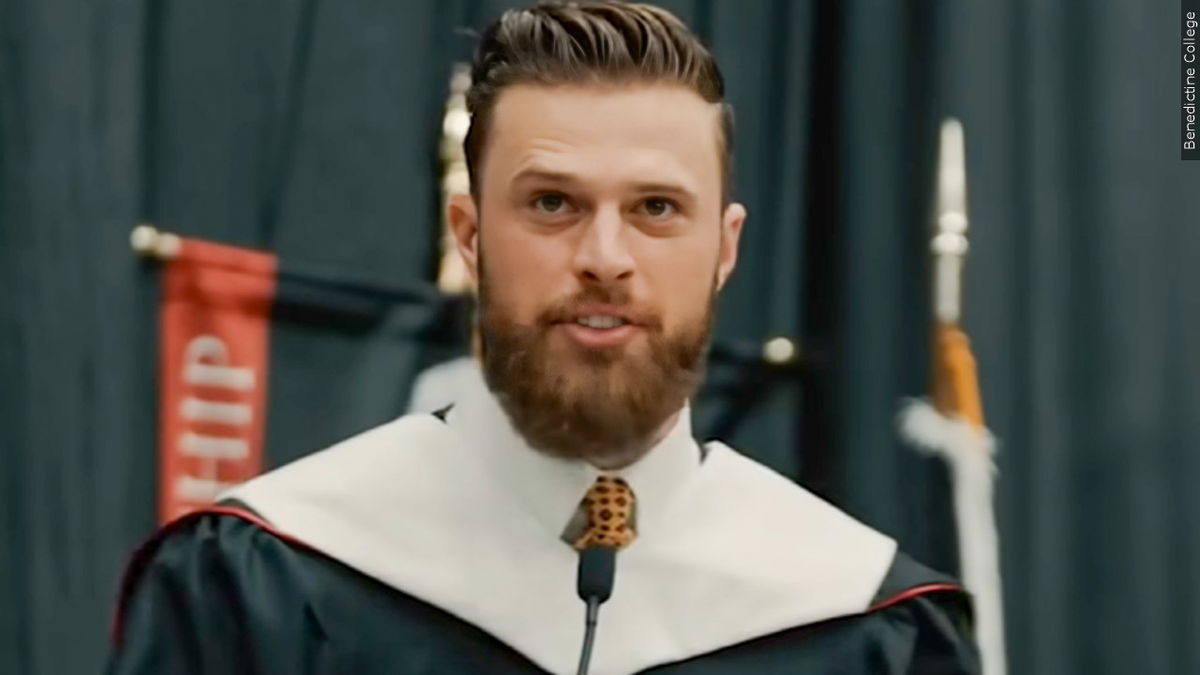
As you’ve no doubt already heard, last Saturday a football player (Kansas City Chief kicker Harrison Butker) gave the commencement address at Benedictine College in Atchison, Kansas. Much has been said and written about this speech, and there’s a petition asking the Chiefs to “dismiss Harrison Butker immediately for his inappropriate conduct”. Last I heard, more than 200K people had signed.
I try to know what I’m talking about before I write, so I watched the full speech on YouTube. (You can also read a transcript.) It’s a very traditional Catholic talk, including a lengthy endorsement of the Latin mass, so if you feel wounded by a Catholic upbringing (as many people I know do), you shouldn’t torture yourself with it.
That said, I would not sign the petition, because taking away someone’s livelihood is a big deal and should be reserved for more serious offenses.
Here’s what I think should happen: People who disagree with Butker and find themselves at a game where he takes the field should feel free to boo loudly. If you have access to any public platform, from your own TV show to a window-facing whiteboard, it would also be appropriate to make fun of him mercilessly. (Here’s an example to get you started.) I don’t know if he endorses any products, but if he does you can boycott them. All those actions just exercise the same freedoms he claims for himself.
Of course, this response is nothing like what happened to Colin Kaepernick, whose NFL career ended prematurely after he knelt during the national anthem to protest racism. (Kaepernick’s unofficial shunning by teams who needed quarterbacks accorded with then-President Trump’s demand to “get that son of a bitch off the field.“) That gross injustice should not be forgotten — and in fact this is a good time to remember it — but dealing out a similar injustice to Butker will not right that wrong.
Anyway, here’s why I think Butker should not be punished beyond verbal humiliation: Benedictine College is a Catholic college that in recent years has moved to embrace traditional Catholic teachings and values. Students presumably choose to go there at least partially for that reason (though not all the graduates approved of Butker’s speech, and neither did the Benedictine Sisters associated with the College who said: “We reject a narrow definition of what it means to be Catholic”). Butker told the graduates, in essence, that they should feel good about what their school stands for. Places like Benedictine, he said, “are showing the world how an ordered, Christ-centered existence is the recipe for success.”
I have a lot of tolerance for religious groups making their case positively, as in “This is what we’re doing and it works for us. You should try it.” For the most part, that’s what the Benedictine College leadership seemed to be looking for and what Butker provided. At the end, he got a standing ovation.
Of course, Butker’s speech also included a lot annoyed me, beginning with his fairly snide remarks about “bad policies and poor leadership” during “the Covid fiasco”, which he seemed (without naming names) to attribute to Anthony Fauci but not Donald Trump (whose negligence is implicated in the deaths of hundreds of thousands of Americans). He talked about the importance of Catholics “staying in their lane”, but did not seem to do so when he criticized unnamed bishops. He denounced the “tyranny of diversity, equity, and inclusion”, and referred to “the deadly sin sort of pride that has an entire month dedicated to it”, i.e. gay pride.
He also spoke for his wife, telling “the ladies” what she “would” say about her choice to embrace her vocation as a homemaker rather than pursue her dream of having a career. For all I know he may be totally right about her lack of regret, but couldn’t he have asked her directly and then quoted her exact words, rather than ask himself and imagine her response? I was left to wonder (perhaps unfairly) how many opinions Mrs. Butker is allowed to have.
Mainly, though, he did what defenders of tradition so often do: justify a system in which he himself is privileged. Billionaires extol the virtues of low taxes, white Supreme Court justices tell us why laws protecting non-Whites are no longer needed, and Butker explains that
As men, we set the tone of the culture, and when that is absent, disorder, dysfunction, and chaos set in.
Yes, we men are being totally selfless when we demand to set the tone of the culture. We only do it so that society will be spared the chaos that would inevitably ensue if our God-given authority were ever questioned.
Two very hard-hitting articles about Israel appeared this week. One in The Atlantic described the conflict within the government about Netanyahu’s strategy in Gaza, in particular the lack of any day-after plan and how that makes the military’s job nearly impossible. Another in the NYT lays out the decades-long history of the Israeli government turning a blind eye to crimes against Palestinians by West Bank settlers, and how the one-time radicals of that movement have become the establishment. I’ll describe the two in a featured post with an uncreative title: “Two Significant Articles about Israel”.
That should be out shortly.
A second featured post is considerably less heavy. Like everybody else, I decided to weigh in on Harrison Butker’s commencement address to Benedictine College in Kansas. I am not calling for his cancellation, because I don’t want the Colin Kaepernick fiasco to become the standard for judging outspoken athletes. That post will be called “Wide Right: That kicker’s commencement speech”. It’s also mostly done and shouldn’t take that long to get out.
In the weekly summary, I’m going to avoid a lengthy discussion of the Trump trial, because there’s not that much to say: A lot hangs on what the jury is making of Michael Cohen, and there’s just no way to know. There’s also the Alito flag incident and a few other things to cover. That should be out by noon.
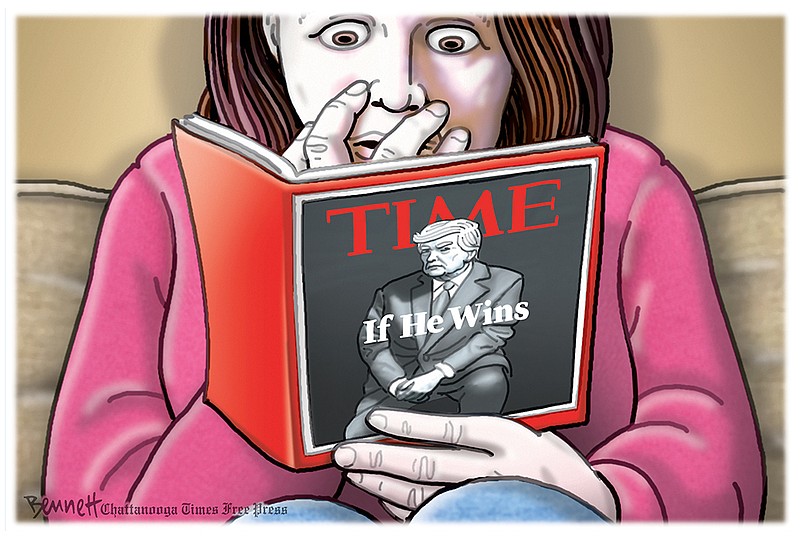
Every election is billed as a national turning point. This time that rings true. To supporters, the prospect of Trump 2.0, unconstrained and backed by a disciplined movement of true believers, offers revolutionary promise. To much of the rest of the nation and the world, it represents an alarming risk.
This week everybody was talking about Trump’s legal problems
As I reported two weeks ago, the prosecution continues to build a very strong case. The fireworks this week were over the testimony of Stormy Daniels, but it’s important to remember where she fits into the overall case: Trump is accused of falsifying business documents to cover up reimbursing Michael Cohen, who paid $130K for Daniels’ agreeing not to tell her story before the 2016 election.
So the actual truth of Daniels account isn’t relevant. The point is that her story would have damaged Trump politically, motivating him to pay her off and cover up doing so. I’ve heard a commentator describe her as an “exhibit” rather than a “witness”, i.e., the important fact is that her story exists. If it’s true, that’s just a bonus.
A great deal of Trump’s lawyer Susan Necheles’ cross-examination of Daniels attempted to make the jury doubt that her story is true. (Personally, I think Daniels sounds credible, and did a good job fending off the attempted slut-shaming.) But the fact that this story would have been damaging (especially in the weeks between the Access Hollywood tape and the election) seems indisputable. Even if you believe Trump’s claim that Daniels made her story up to extort money from him, you can still find him guilty.
After her testimony, Trump’s lawyers asked for a mistrial, on the grounds that the details of her alleged encounter with Trump were unnecessary and prejudiced the jury against him. Judge Merchan denied the motion, essentially saying that the defense had created the problem itself: It invited a detailed account by claiming in its opening statement that Daniels was lying, and failed to object to the questions that elicited the prejudicial information.
As I observed two weeks ago, the defense still tells no plausible story. The only part of the prosecution’s case that isn’t totally nailed down is that Trump knew about the payment and the reimbursement scheme. (This is the one undocumented part of the prosecution’s account. Like a Mafia boss, Trump is famously reluctant to use email or put anything in writing. Cohen will start testifying today about his instructions from Trump, but there are no corroborating documents or other witnesses.) But Trump is the only one with a motive to set the scheme in motion. Otherwise, you have to believe that Cohen completely on his own borrowed $130K to pay Daniels, that Trump CFO Allen Weisselberg came up with the reimbursement plan without telling his boss, and that the notoriously stingy Trump signed over $400K worth of checks to Cohen with no explanation beyond “legal fees”.
That’s a story, I suppose. But I don’t find it plausible enough to create reasonable doubt.
I wish this trial could be televised, because the transcript makes it look like Daniels won the battle of wits with Necheles. When Necheles characterized Daniels’ porn-directing career as “a lot of experience making phony stories about sex”, Daniels shot back: “If that story was untrue, I would’ve written it to be a lot better.”
After Daniels’ testimony, Trump asked for his gag order to be amended to allow him to respond. That motion was denied for an obvious reason: If Trump wants to respond to Daniels sworn testimony, he can take an oath and testify himself, facing the threat of perjury just like she did.
But that’s not what Trump wants. He wants to smear her in forums where he can lie without consequences.
He’s bound to make a similar request after Michael Cohen testifies, and he’ll get the same result. Trump claims it’s unfair that Daniels and Cohen aren’t gagged, so they can criticize him and he can’t respond. But they aren’t under indictment, and they have no record of inciting violence against people they attack online.
Meanwhile, the most open-and-shut case against Trump, the Mar-a-Lago documents case is indefinitely delayed. Judge Cannon plans a public hearing where Trump will get to air his baseless “malicious prosecution” theory.
ProPublica and the New York Times report on a tax problem that might cost Trump $100 million.
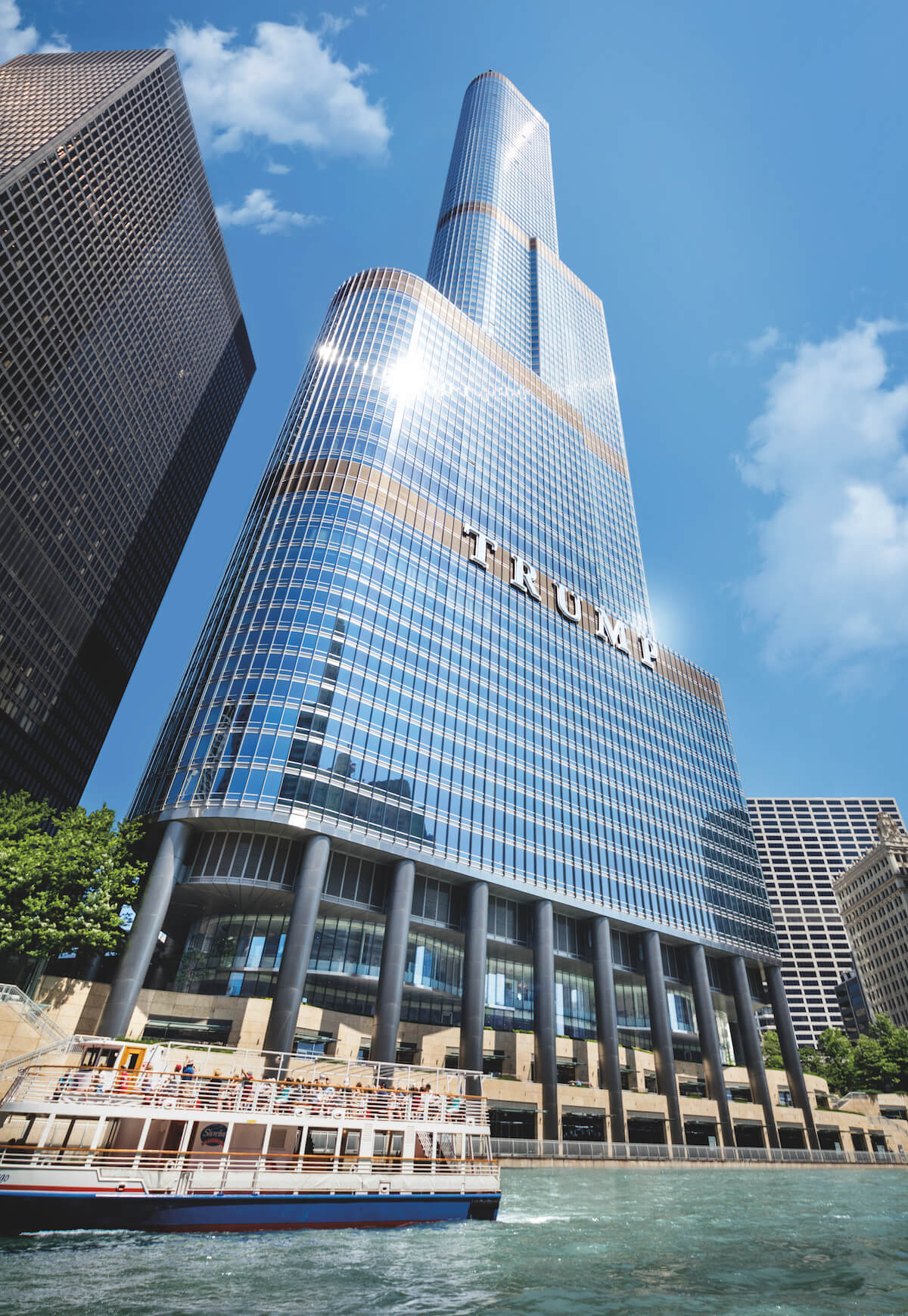
If you’ve ever wandered around downtown Chicago, you’ve undoubtedly seen the 92-story Trump International Hotel and Tower, which sits on the Chicago River proclaiming Trump’s name in giant letters. It looks like a monument to wealth and success.
Actually it’s anything but. The Tower opened into the worst of the Great Recession, and has been a money-loser from Day 1. Losing money, though, isn’t entirely bad, because it produces a tax write-off. The problem is that Trump appears to have written off the loss twice.
and Biden’s increasing rift with Netanyahu
Israel has begun attacking Rafah and is showing intentions to launch a full-scale invasion of the one piece of Gaza where civilians have been taking refuge. Wednesday, Defense Secretary Lloyd Austin told Congress that the administration was “pausing” shipments of certain weapons to Israel.
Austin said that the US is pausing the shipment of “high-payload munitions” due to Israel’s possible operations in Rafah without a plan for the civilians there.
The US says it is “reasonable to assess” that the weapons it has provided to Israel have been used in ways that are “inconsistent” with international human rights law, but that there is not enough concrete evidence to link specific US-supplied weapons to violations or warrant cutting the supply of arms.
Netanyahu continues to have no plan for governing Gaza after the killing stops. This is not just a political problem, it has turned into a military problem as Hamas reinfiltrates areas that had already been cleared.
Criticism of Prime Minister Benjamin Netanyahu has increased within the IDF and includes Defense Minister Yoav Gallant who want to know who will replace Hamas. procrastination, they say, has given the terror group space to regroup and force the IDF back into Gaza in larger numbers.
Netanyahu has argued that deciding on a new political manager for Gaza must wait until the war is over, but the IDF and Gallant have countered that during the last few months in which the military have had operational control of nearly all of Gaza avoiding a decision was a missed opportunity.
In my opinion, it is Biden and not Netanyahu who is truly looking out for Israel’s best interests. Netanyahu appears to me to think of Hamas as a leadership structure commanding some number of fighters; capture or kill all those people, and the problem is solved. But I think it’s more accurate to think of Hamas as an idea: Peace with Israel is impossible.
If at the end of this campaign Palestinians are convinced more than ever that peace with Israel is impossible, Hamas will reform — no matter how many of its current members Israel kills.
Pro-Palestine voters who are thinking of not supporting Democrats in the fall need to consider what Republicans will do if they get into power. Here, Lindsey Graham defends how Israel is prosecuting the war in Gaza by invoking the US nuclear attacks on Hiroshima and Nagasaki.
That was the right decision. Give Israel the bombs they need to end the war they can’t afford to lose.
When violent counter-protesters broke up the pro-Palestinian encampment at UCLA, the obvious people to suspect were pro-Israel students. But that appears not to be true.
researchers studying hate and anti-government groups have confirmed the presence at the counter-demonstrations of several far-right activists who have been involved in anti-LGBTQ+ and anti-vaccine protests across southern California over the past three years.
This is in line with previous reporting that anti-Muslim and antisemitic online trolls are often the same people. Spreading hate is the point. Any target of opportunity will do.
and the New York Times
I’ve seen a certain amount of debate in opinion columns about whether the NYT slants left or right. The answer, from my view, is complicated, because I think different things are happening at different levels.
You can’t really understand left/right journalistic bias without this observation: Most MAGA positions rely on believing (or at least arguing) things that simply aren’t true: an immigrant crime wave is sweeping through America’s cities, crime in general is up, climate change isn’t real, the Covid vaccine did more harm than good, the economy is terrible, Trump really won the 2020 election (which entails its own full basket of untruths: undocumented immigrants voted, dead people voted, voting machines were rigged …), healthy fetuses get aborted up to (and even past) the moment of birth, Putin’s invasion of Ukraine is justified, the Southern border is “open“, January 6 was a peaceful protest led by patriots, the Black Lives Matter protests burned American cities to the ground, and so on. (I’m sure I missed a few.)
At the reporter level, the NYT remains committed to accuracy, so to that extent it has a liberal bias. On any given day, a MAGA true believer who scans the front page of the Times will almost certainly find something to offend his beliefs about the world.
Similarly, NYT columnists are more likely to lean left than right, and conservative NYT columnists are likely to by anti-Trump. (Of course, yesterday they published a guest essay headlined “Biden is Doing it All Wrong.”) I have little doubt that as the November election approaches, the Times will officially endorse Biden.
But at the level where decisions about what to cover get made, the Times has been showing a decidedly conservative bias. Here’s some data gathered by the CSS Lab at the Annenberg School for Communication.
During the week that [Special Counsel Hur’s] report [on Biden’s retention of classified documents] came out, we examined the top 20 articles on the Times’ landing page every four hours. In that time, they published 26 unique articles about Biden’s age, of which 1 of them explored the possibility that Trump’s age was of equal or more concern. This seems like a lot of articles in a short amount of time, but it’s hard to say whether or not it is excessive without some other equally relevant issue to compare it with. Helpfully, an obvious comparison arose when, on February 10, 2024, Trump announced that if he regained power he would pull the US out of NATO and even encourage Russian invasions of democratic allies if their financial commitments were not to his liking. This announcement that Trump would upend the world’s core military alignment of the last 75+ years, garnered 10 unique articles in the timeframe.
Less quantitatively, I’ve been noticing slanted coverage of Trump/Biden polls. Polls that show Trump leading are highlighted, and sometimes garner multiple articles. Polls that show Biden leading get much less coverage. (Again, the polls themselves are reported accurately; reporters seem to be honest and objective.) Among the polls included in 538’s polling average so far in May, Biden leads in four, Trump in two, and they are tied in one. Would you have guessed that from reading the Times?
In general, if the Right wants the public to pay attention to some issue, that issue will get extensive coverage in the Times. It won’t always be covered in the (false) way the Right wants it covered, but the Times will draw its readers’ attention in that direction.
I have no inside knowledge about the NYT. But from the outside it looks like pro-Trump bias at higher levels competes with commitment to accuracy at lower levels.
and you also might be interested in …
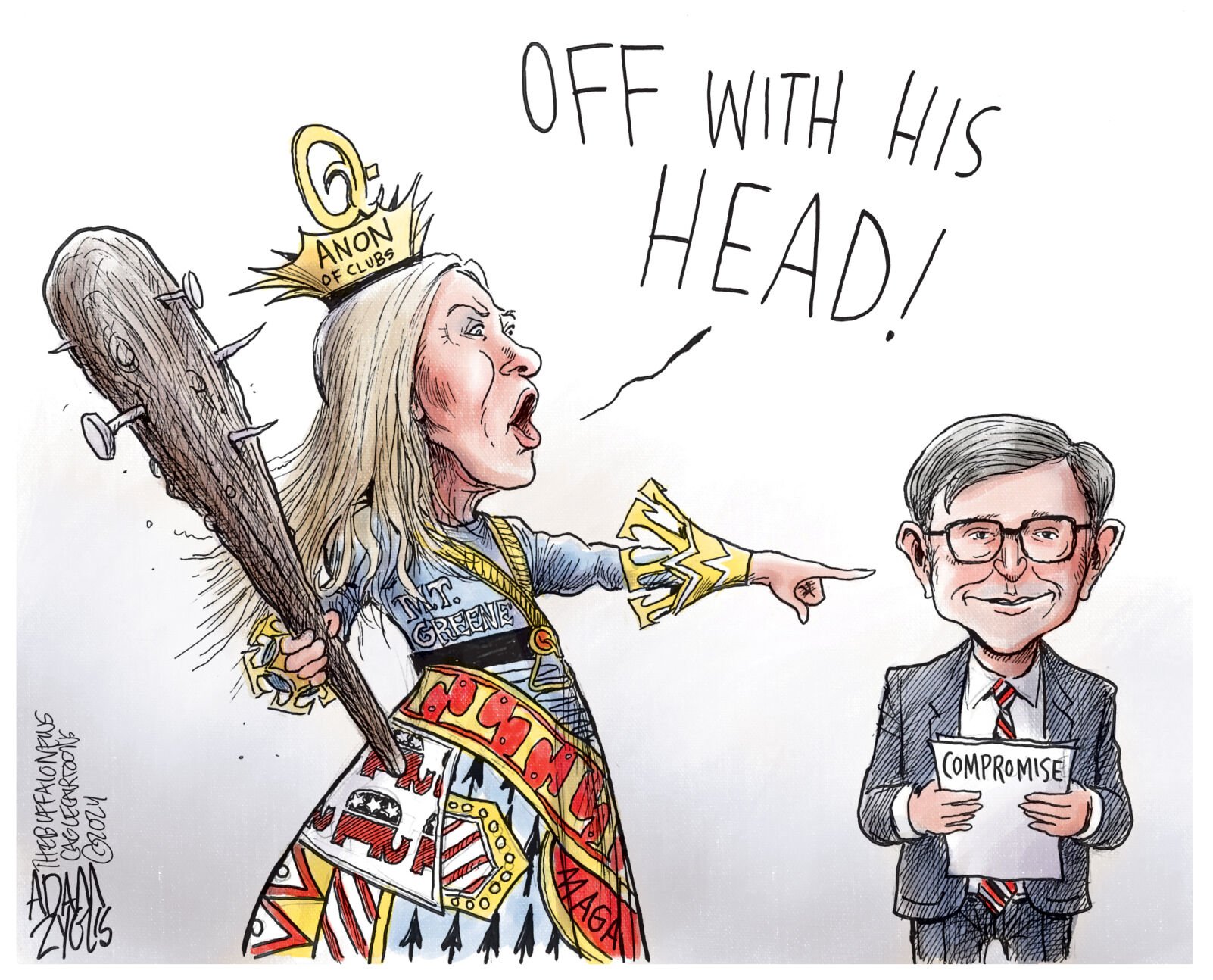
Wednesday, the House voted 359-43 to table Marjorie Taylor Greene’s motion to oust Speaker Mike Johnson. Democrats joined Republicans to avoid yet another protracted leadership battle. It’s not clear what Greene thought she would gain by presenting this motion, which protests all the times in recent months Johnson has allowed bipartisan majorities to pass legislation.
“This is the ‘uni-party’ for the American people watching,” Greene said, as if the two parties working together for common goals constituted some kind of betrayal.
Not so long ago, “Will you accept the election results even if your side loses?” wasn’t considered a gotcha question. But today’s MAGA Republicans seem to think it is. Watch Tim Scott squirm around answering it. When the interviewer tries to insist, Scott accuses her of bias: “This is why so many Americans believe that NBC is an extension of the Democrat Party.”
What Scott is indirectly pointing to is the main difference between the parties: Democrats remain committed to democracy even when they lose, but Republicans don’t.
Bannon is effectively out of appeals. He can delay a little bit longer, asking for the full court to review the decision en banc & asking SCOTUS to hear his case on cert, but neither one of those things will happen. Bannon is going to prison.
More serious than replacing one word with another, Trump increasingly utters noises that aren’t words at all, like “carrydoubtitebyrite” and “bordeninriviv“. We all call something by the wrong name occasionally, but I know I’ve never heard my verbal centers glitch like that. Something is wrong.
I was glad to see Brian Broome answer Jerry Seinfeld’s old-man complaint that America has lost its sense of humor due to “the extreme left and PC crap”.
I remember my Mom telling me that nobody was funny any more, not like Bob Hope or Red Skelton or the comedians she remembered. This was during the prime of people like Richard Pryor, Eddie Murphy, and Robin Williams, who I found hilarious.
I remember many of Mom’s favorite comedians. They made fun of drunks and mothers-in-law and so forth. At some point that stopped being funny, because comedy is always changing. If Seinfeld’s routines have stopped being funny, that’s on him, not “the extreme left”.
Until recently, though, Trump himself had said little to directly validate those worries, beyond occasional threats to “go after” the people he thinks have done him wrong. Mostly that’s because he’s been preoccupied with other topics: complaining about how persecuted he is, lying about Joe Biden and the Biden administration, painting a false rosy picture of how wonderful things were four years ago, and claiming that none of the world’s current problems would exist if he were still president. For the most part, that last point short-circuits any attempt to talk about his future policies: Why should he have to tell us how he would handle Ukraine or Gaza when those problems wouldn’t exist if he were president?
How to interview Trump. Interviewing Donald Trump presents unique challenges, because he won’t simply answer questions. To Trump, a question is an invitation to go on a long ramble which may or may not have anything to do with what he was asked. Along the way he will launch attacks, invent stories, exaggerate, make false insinuations, and sometimes lie outright.
In a live TV interview, this is a journalistic disaster. If you ignore all his false claims, you’re letting him use your platform to spread misinformation to your viewers. But if you challenge him, which false statement do you pick, understanding that you’ll probably never get back to all the others? Meanwhile, he hasn’t answered your question.
Time’s National Politics Reporter Eric Cortellessa took advantage of the print-media format to implement a unique strategy: He let Trump ramble, fact-checked in a separate article, kept returning to his questions, and then wrote a summary article focused on the answers to his questions. If you don’t read the transcript of the interview, you never see all the misinformation.
For example, the interview starts like this:
Let’s start with Day One: January 20, 2025. You have said that you will take a suite of aggressive actions on the border and on immigration—
Donald Trump: Yes.
You have vowed to—
Trump: And on energy.
Yes, yes. And we’ll come to that, certainly. You have vowed to launch the largest deportation operation in American history. Your advisors say that includes—
Trump: Because we have no choice. I don’t believe this is sustainable for a country, what’s happening to us, with probably 15 million and maybe as many as 20 million by the time Biden’s out. Twenty million people, many of them from jails, many of them from prisons, many of them from mental institutions. I mean, you see what’s going on in Venezuela and other countries. They’re becoming a lot safer.
Well, let’s just talk—so you have said you’re gonna do this massive deportation operation. I want to know specifically how you plan to do that.
Trump: So if you look back into the 1950s, Dwight Eisenhower, he’s not known for that, you know, you don’t think of him that way. Because you see, Ike, but Dwight Eisenhower was very big on illegal immigration not coming into our country. And he did a massive deportation of people. He was doing it for a long time. He got very proficient at it. He was bringing them just to the other side of the border. And they would be back in the country within a matter of days. And then he started bringing them 3,000 miles away—
What’s your plan, sir?
But what shows up in the summary article is just the eventual answer:
To carry out a deportation operation designed to remove more than 11 million people from the country, Trump told me, he would be willing to build migrant detention camps and deploy the U.S. military, both at the border and inland.
That answer, if you read the transcript, comes wrapped in a lot of fantasies: Trump doesn’t think the camps will be necessary, because the deportation operation will function smoothly and get people out quickly. He expects local police to do most of the work, because so many migrants are criminals that police “know by name”. (The statistics showing that there is no migrant crime wave are “fake news”.) The Posse Comitatus Act (which sharply limits the use of the US military inside the country) won’t constrain him because “these aren’t civilians. … This is an invasion of our country.”
If you accept all of Trump’s fantasies, he seems to be saying that Cortellessa is worrying about nothing: no detention camps, no military involvement, no long delays as courts decide the constitutionality of his plans. He’ll just collect the 15-20 million people he thinks are in the country illegally and ship them out (to somewhere) without incident.
So from the MAGA point of view, this is a hostile interview that results in a slanted article. But my own point of view is similar to Cortellessa’s: Trump’s plans often don’t go smoothly, and when they get blocked, he doesn’t calmly accept defeat. Take, for example, his Mexican wall: When Congress wouldn’t fund it, he shut down the government. And when that didn’t work, he declared a state of emergency that allowed him to take money from the defense budget. How far he’s willing to go when things don’t work out is a question well worth asking.
The answers. Contellessa’s summary of his interview continues:
He would let red states monitor women’s pregnancies and prosecute those who violate abortion bans. He would, at his personal discretion, withhold funds appropriated by Congress, according to top advisers. He would be willing to fire a U.S. Attorney who doesn’t carry out his order to prosecute someone, breaking with a tradition of independent law enforcement that dates from America’s founding. He is weighing pardons for every one of his supporters accused of attacking the U.S. Capitol on Jan. 6, 2021, more than 800 of whom have pleaded guilty or been convicted by a jury. He might not come to the aid of an attacked ally in Europe or Asia if he felt that country wasn’t paying enough for its own defense. He would gut the U.S. civil service, deploy the National Guard to American cities as he sees fit, close the White House pandemic-preparedness office, and staff his Administration with acolytes who back his false assertion that the 2020 election was stolen.
Each one of those sentences is the result of a back-and-forth similar to the one about migrant detention camps. Trump was especially cagey about abortion, saying that it wasn’t a federal matter any more, now that the Supreme Court has moved it to the states. He refused to discuss the possibility of vetoing a federal abortion ban, saying that it wouldn’t happen because it would need 60 votes to pass the Senate. (Contellessa doesn’t raise the possibility that a Republican Senate majority might do away with the filibuster precisely so that it could ban abortion.)
Contellessa then focused in on whether there was anything states couldn’t do, and Trump’s reluctant answer was no. Monitor women’s pregnancies to make sure they weren’t getting abortions? “I think they might do that. Again, you’ll have to speak to the individual states.” He dodged an issue he will have to address: how the federal government regulates the abortion drug mifepristone. He said he would have a statement out about that in the next week, but in the follow-up two weeks later that statement hadn’t appeared. (It still hasn’t.) And he refused to say how he planned to vote on Florida’s upcoming referendum about its six-week abortion ban.
His comment on being a dictator only on his first day? A joke. (Nobody has a sense of humor any more.) And Trump denied that he would seek to change the two-term limit. “I wouldn’t be in favor of it at all. I intend to serve four years and do a great job.”
He sees “a definite anti-white feeling in this country” that is “very unfair”.
Transactional government. Something Contellessa didn’t cover is Trump’s very wide-open notion of transactional government. Thursday (after the Time interview) the WaPo published an article about his meeting with oil executives at Mar-a-Lago.
As Donald Trump sat with some of the country’s top oil executives at his Mar-a-Lago Club last month, one executive complained about how they continued to face burdensome environmental regulations despite spending $400 million to lobby the Biden administration in the last year.
Trump’s response stunned several of the executives in the room overlooking the ocean: You all are wealthy enough, he said, that you should raise $1 billion to return me to the White House. At the dinner, he vowed to immediately reverse dozens of President Biden’s environmental rules and policies and stop new ones from being enacted, according to people with knowledge of the meeting, who spoke on the condition of anonymity to describe a private conversation.
Giving $1 billion would be a “deal,” Trump said, because of the taxation and regulation they would avoid thanks to him
This is far from the only example. In March, Trump abruptly reversed himself on banning TikTok. The change happened shortly after a meeting with Jeff Yass, a Trump donor who owns billions in TikTok-related stock. During his first administration, Amazon lost a valuable defense contract because Trump thought Jeff Bezos’ Washington Post wasn’t covering him favorably enough.
Summing up. It’s easy to take these issues one-by-one and feel like they wouldn’t be that big a deal. He’ll tell the Justice Department who to prosecute. He’ll deport at least 11 million people, some of whom have been in the country for decades. Ukraine may fall, leaving NATO countries to wonder whether the US will support them against Russia. He’ll establish that committing violence in his name is OK; you can count on a pardon. The civil service will lose its independence, making the federal government one big political machine. He’ll use emergency powers to circumvent Congress’ power of the purse. Companies that want a break on regulations just need to do something in return.
Now picture it all happening at once. The America we’re describing is a very different and much darker place than any we have lived in so far.
I’m back from my “vacation”, where I went back to my home town in Illinois to lead a church service about how to watch the news without going crazy. I’ve put the text on my other blog, where you can read it if you want.
The featured post this week focuses on the Time magazine article about Trump’s second term. Almost as interesting as the conclusions their interviewer draws is his strategy for interviewing Trump at all: Eric Contellessa doesn’t challenge anything in Trump’s wild rambles, but keeps coming back to the questions he asked. It’s a print-media tactic that gets around many of the problems of interviewing Trump on TV.
Anyway, that should be out before too long, certainly by 10 EDT.
The weekly summary covers Trump’s Manhattan trial, which mainly consisted of Stormy Daniels this week. Michael Cohen should start testifying today. Also Israel’s attacks on Rafah, the last refuge of Palestinian civilians, and the Biden administration’s increasing conflicts with Netanyahu. I’ve got more to say about The New York Times. Marjorie Taylor Greene’s attempt to oust Speaker Johnson came to nothing. It sure looks like Steve Bannon is going to jail at long last. And I may have missed the northern lights, but lots of people got good pictures of it.
No Sift next week. The next new posts will appear on May 13.
If someone with those kinds of powers, the most powerful person in the world, with the greatest amount of authority, could go into office knowing that there would be no potential penalty for committing crimes, I’m trying to understand what the disincentive is from turning the Oval Office into the seat of criminal activity in this country. … If the potential for criminal liability is taken off the table, wouldn’t there be a significant risk that future presidents would be emboldened to commit crimes with abandon while they’re in office?
After I pushed the button on that piece, I noticed this tweet by GOP opinion-shaper Frank Luntz:
Last night at the [White House Correspondents] dinner, I spoke privately with 4 members of Congress: 2 Dems and 2 GOPers. All 4 are big foreign policy players and all 4 are strongly pro-Israel in every way. However… All 4 spoke with significant and serious concern (bordering on anger) about Israel’s impact on humanitarian aid in Gaza. None of them called for a ceasefire, but all of them were deeply critical of what they believe is Israel’s interference and lack of cooperation in getting aid to the Palestinian people. For more than a decade, some Israeli leaders dismissed what was happening on college campuses. They were wrong then, and they would be wrong now to dismiss this warning about what’s happening in Congress.
and Trump’s trial
This is covered in another featured post. I’ll include here some details that didn’t fit into that article.
The trial has given Trump many things to complain about, from the courtroom being cold to the judge’s gag order that takes away “my constitutional rights to speak“, i.e. fairly ineffectively preventing him from trying to intimidate witnesses and jurors.
His weirdest complaint, though, was that the trial prevented him from being with his wife Melania on her birthday Friday. The court proceedings ended for the day at 4:30, so there was plenty of time for the Trumps to have a night on the town, if only Melania had decided to leave their Florida home and come to their Trump Tower apartment to support her husband during his trial. But clearly it is Judge Merchan’s cruelty and not Melania’s indifference that is keeping them apart.
Another reality-denying Trump complaint is that his supporters are being kept away from the trial. He posted:
Thousands of people were turned away from the Courthouse in Lower Manhattan by steel stanchions and police, literally blocks from the tiny side door from where I enter and leave.
None of that is true. In fact, MAGA supporters have almost unanimously ignored his pleas for them to act out. More than a year ago, Trump predicted “potential death and destruction” if he were charged in this case. Again and again, he has warned that the American people would not stand for any attempt to put him on trial, and has done his best to incite January 6 style violence. But it hasn’t worked. Every day, a mere handful of docile Trump supporters show up outside the courthouse.
and the Supreme Court
People who believe in our legal system generally found Thursday’s discussion of Trump’s “absolute immunity” claim not just annoying or enraging, but depressing. Our highest court is corrupt. There’s just no getting around that any more. I discuss why in the third featured post.
One aside, concerning several cases discussed this week: The arguments underline a basic difference between how liberals and conservatives think: Liberals are more grounded in reality. Again and again, the liberal justices referenced things that are actually happening, while the conservative justices were far more interested in imagining scenarios that could happen, but are highly unlikely.
If you’ve ever wandered into an argument over guns and gun control, you’ve undoubtedly noticed that the two sides talk past each other. Proponents of gun control quote statistics: how many more shooting deaths we have in America than there are in countries with fewer guns, how many more suicides or police deaths there are in well-armed states, and so on.
Pro-gun advocates are more likely to tell stories, and often those stories are dark what-if fantasies: What if home invaders came to kill you, kidnap your baby, or rape your teen-age daughter? What if you were a hostage in a bank robbery? What if you were at a restaurant or grocery store when terrorists broke in and started killing people? Wouldn’t you wish you had a gun then?
Such stories are easily stretched to indict even the mildest forms of gun control, like limiting magazines to ten shots: Picture your wife hiding in a closet with a handgun. Before she hid, she already gotten off a few shots at the invaders, and now she’s not sure how many shots she has left. Don’t you wish now you’d been able to buy her a gun with a larger magazine?
In the featured post on the Court, I described how Alito, Gorsuch, and Kavanaugh wanted to discuss just about every possibility other than the one in front of them, where a grand jury has found probable cause to charge Trump with crimes.
Something similar happened in the Court’s discussion of how the federal EMTALA law conflicted with Idaho’s abortion law. Conservative justices wanted to talk about bizarre hypotheticals in which deceitful women could lie about their suicidal impulses in order to get late-term abortions. Liberals wanted to talk about actual cases in which women with problem pregnancies have to wait until they are near death to get care.
You can see it across the board: Men might claim to be women to get into your daughter’s bathroom. Has that ever happened? Well, maybe not, but it could. Librarians could be grooming your children for pedophilia. Can you name one? Transwomen might drive “real” women out of women’s sports. Well, we just saw the NCAA basketball tournament. Is that happening? On and on.
Harvey Weinstein’s rape conviction was overturned by the New York court of appeals, on the grounds that the trial judge allowed the jury to hear too much about crimes that weren’t directly related. The state has the option to try him again, and in the meantime New York can send him to California, where he faces a 16-year sentence.
It’s a tricky point of the law, which comes up again in the current Trump trial: You’re supposed to be on trial for the specific crime in the indictment, and not for being a bad person in general. But if other crimes indicate a pattern of behavior, they might be relevant. So a judge has to decide: How does the illustrative value of a defendant’s previous bad behavior balance against the possibility of prejudicing the jury against him?
Texas Senator Ted Cruz may have thought his arrangement with iHeart Media circumvented both Senate rules banning outside jobs and election laws preventing candidates from coordinating with or directly raising money for their super PACs. But he may have gotten a little too clever.
Here’s the arrangement: Cruz hosts a three-episodes-a-week podcast, which would be a full-time job for a lot of people. He does it “for free” in the sense that he does not get direct payments from iHeart, which carries the podcast and sells advertising on it. However, iHeart does make regular payments to Cruz’ super PAC, which so far have totaled at least $630K and constitute more than a third of the PAC’s total contributions.
It’s undeniable that this violates the intention of the laws regulating super PACs. But it’s possible Cruz has found an unethical loophole in the law. No one can say for sure at the moment, because Cruz and iHeart refuse to reveal the exact terms of their agreement.
Cruz claims he does the podcast as a service to the public by pulling back the curtain on corruption in Washington.
I can’t argue with him there.
BTW, you might wonder how Cruz’ podcast differs from a Substack blog I often quote: Quick Update by Rep. Jeff Jackson (D-NC). The difference is that Jackson’s blog generates no revenue: subscriptions are free and there are no ads.
She includes her story about the ill-fated Cricket, she says, to illustrate her willingness, in politics as well as in South Dakota life, to do anything “difficult, messy and ugly” if it simply needs to be done.
Maybe this is where the Republican Party is these days. In 2022, many GOP candidates carried or shot guns in their ads. So maybe the next step is to show you’re not afraid to kill. Or maybe Noem is sending a message specifically to Trump, who is said to be considering her as a possible VP candidate: Mike Pence wasn’t willing to betray the Republic for you, but I’ll do whatever ugly things need doing. (And Trump famously hates dogs.)
and let’s close with something ominous
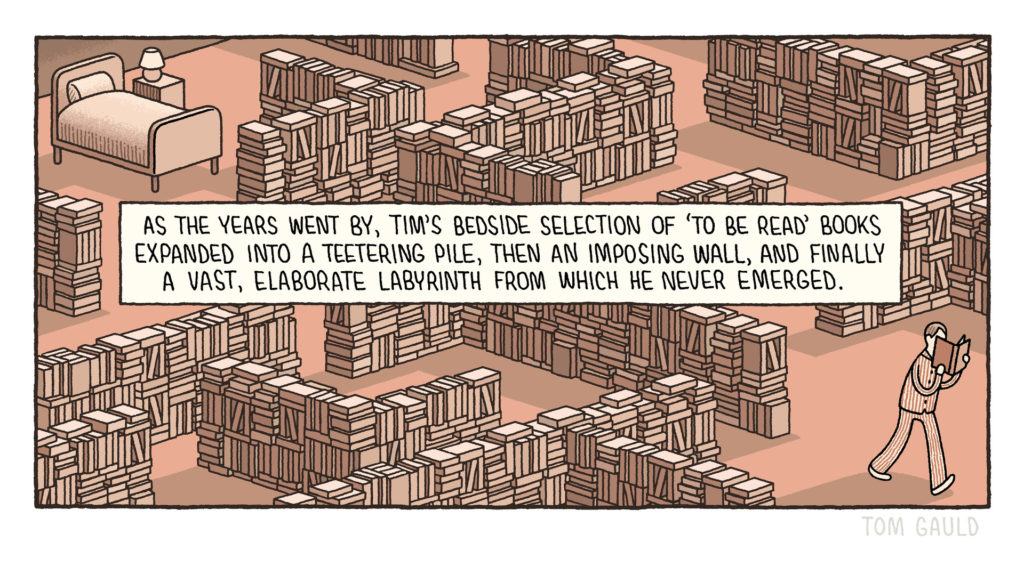
I suspect I’m not the only one who sees himself Tom Gauld’s “To Be Read” cartoon.
“My goal today is to convince you that this court is not comprised of a bunch of partisan hacks,” the conservative Barrett said, according to the Louisville Courier Journal. She said the high court is defined by “judicial philosophies” instead of personal political views. “Judicial philosophies are not the same as political parties,” Barrett said.
Most of the legal experts who have appeared on MSNBC or CNN since then have more-or-less given that view the benefit of the doubt. Sure, some things have been hard to explain. In particular, the Court’s “originalist” rulings — “originalism” being one of the philosophies Barrett cited — have been suspiciously selective about the “history” that informed their majority opinions, and overall the originalist justices have shown little interest in history as it is taught by professional historians. On its shadow docket, the Court was far more responsive to the Trump administration’s requests to move quickly than it has been to the Biden administration. And then there’s Clarence Thomas, who takes six-figure gifts from billionaire “friends” he had never met before he ascended to the Court.
But hackery? No. Surely not. This is the Supreme Court we’re talking about.
These talking-head legal experts are almost entirely institutionalists: ex-prosecutors, retired judges, law professors, and even one ex-Acting-Solicitor-General. They’re deeply invested in the idea that the legal system works.
They’ve had a tough week.
Thursday, the Court heard oral arguments on Donald Trump’s claim that he has “absolute immunity” for anything he did as president. That claim is holding up his federal prosecution in the January 6 case.
Partisan delay. It’s already been clear that the Court has been shading the process in Trump’s favor. The original purpose of this immunity claim was to delay Trump’s trial past the election, so that he can order the Justice Department to dismiss the case if he becomes president again. Both the district court and the appellate court found no legal merit in “absolute immunity” — or in any kind of immunity that would cover this case — and the Supreme Court didn’t have to hear the appeal at all.
But instead, the Court has dragged its feet. Back in December, Jack Smith asked the Court to hear the appeal immediately, skipping the appeals court, so that Trump’s trial could get under way. They refused, waited for the appellate ruling, and then spent weeks deciding whether to review that ruling. When they finally did decide to hear the case, they scheduled oral arguments on the last day of the term for hearing arguments, burning as much time as possible.
But still, the institutionalist commentators told us, while the conservative majority might manipulate the calendar in a partisan fashion, it wouldn’t distort the law to favor Trump. Surely it would find, as both lower courts did, that there was no legal merit in this claim.
After Thursday’s hearing, though, that outcome is seriously in doubt. The conservative justices gave Trump’s attorney a far more sympathetic hearing than he deserved.
Breaking faith. Slate’s Dahlia Lithwick expressed a disillusionment I heard from many professional commentators:
As a blinkered institutionalist, I’m getting blowback along the lines of: “I told you so. They’re a bunch of partisan hacks.” I truly believed that at least seven members of the court would take the potential failure of democracy as a proposition seriously enough that the partisan valence of this case went away. That didn’t happen.
Former Assistant US Attorney Andrew Weissmann said, “Big picture: I’m in a very, very depressed mode.” And his podcasting cohost Mary McCord (a former Assistant Attorney General) replied “It’s been a rough several weeks of listening to Supreme Court arguments.”
Weissmann characterized the justices’ discussion of presidential immunity as “almost like a policy debate in Congress”. (It’s worth listening to this part, because you can hear the heartbreak in his voice.)
What was missing from that [discussion] was the text of the Constitution, the intent of the Framers, the history of the United States. I mean, it so belied the originalism/textualism credo of the so-called conservative justices. … And then, even within that policy debate, what was missing from the conservative justices was any record support, in terms of 200 years of history. …
It was remarkable to me the antipathy towards the actual criminal justice system that you were hearing from Alito and Gorsuch. Which was Alito saying, “You know, you can indict a ham sandwich.” I mean, this is our criminal justice system! … It was remarkable to me that you had people sitting in the Supreme Court denigrating the entire infrastructure of and edifice of our criminal justice system that they are a huge part of creating.
Alito had [Michael] Dreeben [representing the special prosecutor’s office] walk through the layers that protect a president from a frivolous or vindictive prosecution. Then he dismissed each one out of hand. So Dreeben said: First, you need a prosecutor who’s willing to bring charges; then you need a grand jury to indict; then there’s a criminal proceeding in open court where a jury of his peers decides whether he’s been proved guilty. And Alito just laughs it off as though it’s a big joke. Because we all know Justice Department attorneys are hacks who’ll do whatever they want, right? And a grand jury will indict a ham sandwich—nobody believes a grand jury will do anything worthwhile. And then, oh, sure a jury of his peers, like that’s going to do anything. [1]
This is the justice who is, by far, the most friendly to prosecutors and hostile to criminal defendants in case after case. Who could not for the life of him find a violation of the right to trial by jury or due process. But when the defendant is Trump, he suddenly thinks this entire system of criminal prosecution is such a bad joke that the Supreme Court has to step in and essentially quash this prosecution, because we can’t trust the system to work. The system that is incarcerating so many other people whose convictions Sam Alito just rubber-stamps.
And Lithwick replied:
I felt like that was the turn for me—it was Alito winking to Dreeben, saying, in short, “We both worked in the Justice Department; we know what a racket that crap is.” This was another one of those moments when I thought, sorry: Did one of the justices of the United States Supreme Court just imply that everything that happens at the Justice Department is hackery and rigged prosecutions? …
For his part, bribe-taking Clarence Thomas said little, but his very presence in the room said much: His wife Ginny traded texts with Mark Meadows in the lead-up to January 6. She probably won’t be called as a witness, but she could be. Under any sane system of ethics, he should have recused himself from this case.
But this is Clarence Thomas. He has no ethics. And this is the Supreme Court, where ethical standards have no enforcement mechanism. So there he sat. He will presumably vote on this case and perhaps even write a self-serving opinion.
Restraint? Another longstanding principle of conservative jurisprudence is judicial restraint: A court should decide the case brought before it, and not make wide-ranging rulings that are not needed to decide that case.
But Thursday, the conservative justices could not be bothered to discuss the actual case — Trump’s attempt to stay in office despite losing the 2020 election. Kavanaugh said as much: “I’m not as concerned about the here and now, I’m more concerned about the future.” Gorsuch echoed: “I’m not concerned about this case, but I am concerned about future uses of the criminal law to target political opponents based on accusations about their motives.” And Alito added: “I want to talk about this in the abstract.”
These justices seemed to take for granted that this case is precisely the kind of vindictive prosecution Trump’s lawyers warned about, and to discount entirely that a president might abuse his power to stay in office illegally, as a grand jury has indicted Trump for doing. These prior assumptions are entirely political assessments of the situation. They cited no facts of the case that would point in this direction, and no legal problems with the indictment.
What happens next? What seems likely to come out of these arguments is a ruling — probably on the very last day of the term in June, continuing to burn as much time as possible — that attempts to define a doctrine that is not really needed in this case, and has not been needed in the two centuries of American history so far: drawing a line between presidential acts that are immune from subsequent prosecution and those that are not. Having drawn this line, the Court can remand the case to Judge Chutkan with instructions to apply the new doctrine. Her ruling, whatever it is, can then be appealed back up the ladder, pushing the trial well past the election.
Fly free, Mr. Trump!
Jay Kuo, however, finds hope in an ironic place: Amy Coney Barrett. Barrett, Kuo reports, actually seemed to be paying attention to the case at hand, and might be looking for a way for the legal system to do its job, rather than grind its gears until the case is moot. So perhaps it will fall to her to fashion a way around the partisan hacks whose existence she denied in 2021.
As I remarked in my piece yesterday, so much of our future, and indeed even the plight of the world, has depended on just one or a few traditional conservatives still managing to do the right, principled thing. It might happen again here, who knows?
Barrett was interested in drawing a line between a president’s private acts and his officials acts.
Okay. So, in the Special Counsel’s brief, on pages 46 and 47, he urges us, even if we assume that there’s—even if we were to decide or assume that there was some sort of immunity for official acts, that there was sufficient private acts in the indictment for the trial to go, for the case to go back and the trial to begin immediately.
Barrett outlined scenarios that included much of Trump’s indicted conduct, such as the conspiracy to present false electors to Congress. Kuo speculates that Barrett might convince Roberts and the three liberal justices to support a majority opinion along these lines.
Another possible way forward consists of Judge Chutkan taking the remand and getting creative with it. In deciding which of Trump’s acts might fit the Court’s brand-new definition of immunity, she might have to hold an evidentiary hearing — not a trial — in which much of the prosecution’s case could be presented. It would not result in a jury verdict, but at least testimony from witnesses like Mike Pence and Mark Meadows could get onto the record.
This is decidedly a second-best (or third- or fourth-best) result. In a nation with an uncorrupted Court, a full trial would be completed and a jury verdict reached before the election. But we don’t live in such a nation. At least until Democrats can win enough elections to rebalance the Court — hopefully naming honest jurists with liberal philosophies rather than just more partisan hacks who lean left rather than right — we’re stuck with the corrupt Court we have.
[1] It’s worth pointing out that juries were the difference between the legitimate performance of Special Counsel Robert Mueller and the politically motivated Barr-Trump special counselship of John Durham. Mueller obtained convictions of a number of Trump associates like Paul Manafort and Roger Stone. But Durham’s drawn-out expensive investigation resulted in only two jury verdicts, both unanimous acquittals.
Juries are in fact what Trump is afraid of in his current cases. If his indictments were indeed the political witch hunts he claims, he should want a jury to expose this fraud to the voters. Instead, he seeks every delay possible, so that if a jury rules at all, it will come to late to inform the electorate.
Dangerous antisemitism or peaceful protest against genocide? You can find whatever story you want to read.
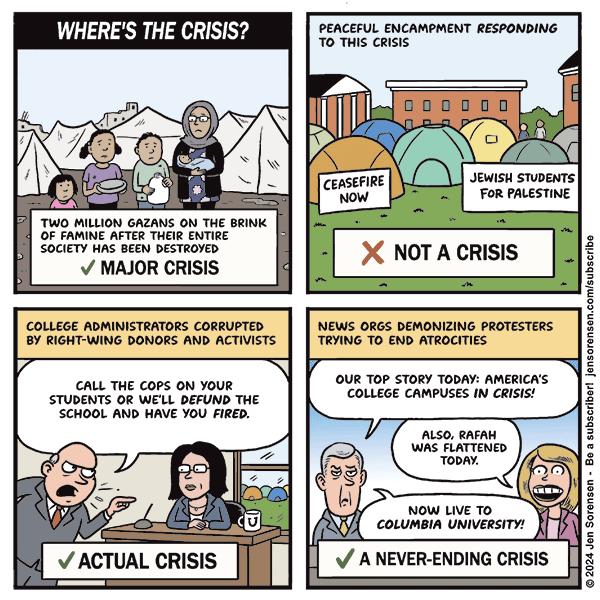
Protests against Israel’s US-backed war in Gaza have broken out on college campuses around the country, with a wide variety of responses from campus officials and police. Some of the tent encampments are being left alone, while on other campuses the demonstrators are being forcibly removed.
Similarly, press coverage has been all over the map. Some sources essentially repeat the Netanyahu claim that “antisemitic mobs have taken over the leading universities”, while others interview demonstrators with more sympathy.
Even the coverage from supposedly liberal sources has been mixed. I was listening to MSNBC’s “Morning Joe” on Wednesday when host Joe Scarborough cited the fact that students had not protested the mass killing of Arabs by Saddam in Iraq or Assad in Syria, clearly implying that Israel is being viewed differently because of antisemitism. I couldn’t decide whether Scarborough was being clueless or actively disingenuous: The obvious difference is that Israel is carrying out its operations with American funds, American weapons, and American support at the UN. Whether we see Israel’s Gaza war as just or unjust, Americans should view these Palestinian deaths differently because we are implicated in them.
Given this diverse press coverage, I should probably go visit an encampment and make my own judgment, but I haven’t. The conclusion I’ve come to from reading a variety of sources is that, as is true with any large group of people, you can find whatever you look for. If you look for antisemitism, you can find it, like the Columbia student who said “Zionists do not deserve to live.” He has been banned from campus.
The large majority of demonstrators, though, look to me to be exactly what they say they are: peaceful protesters who think the killing in Gaza is unjust, want it to stop, and want the US (and their universities) to stop supporting it.
Student protests on Columbia’s campus have been nonviolent so far. Representatives from the New York Police Department said during a press conference Monday that there had been some incidents in which Israeli flags were snatched from students and unspecified hateful things said. But they said that there have not been any reports of Columbia students being physically harmed or any credible threats made against individuals or groups associated with the university community ahead of the start of the Jewish holiday of Passover.
… On Tuesday, a student draped in an Israeli flag spoke to reporters from within the fenced-in area of the encampment. Jewish students who have been suspended from Columbia and Barnard stated that they had celebrated a Passover Seder within the encampment at a press conference.
Antisemitism should have no place in America — not on college campuses or anywhere else.
But there is nothing inherently antisemitic about condemning the ongoing bloodshed in Gaza that has so far killed at least 34,000 people, mostly women and children.
Protesting this slaughter is not hate speech. It is what should be done on a college campus — taking a stand against a perceived wrong, at least provoking discussion and debate.
In the end, you may decide that Israel’s actions in Gaza are entirely justified, given the horror of Hamas’ October 7 attacks and the likelihood of similar attacks in the future. (Or you might not.) But reasonable people can disagree about this, and they should be allowed to express their views in public.
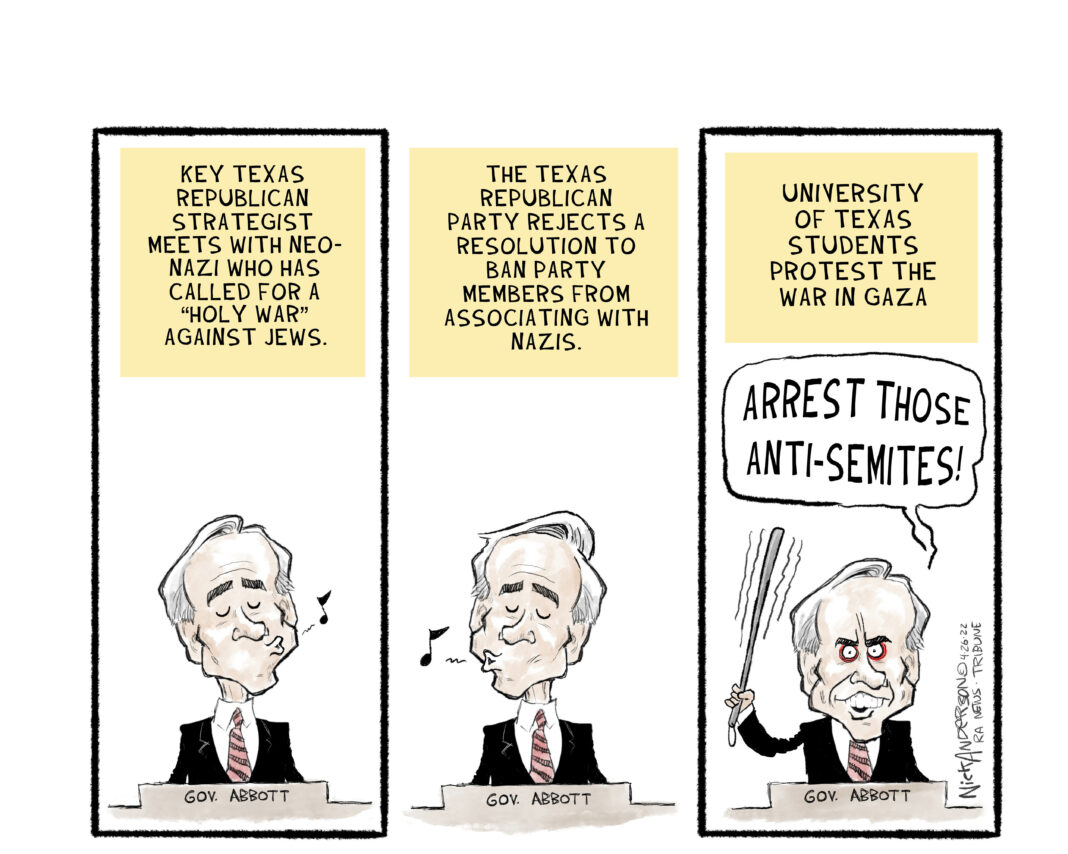
Many Republican politicians have responded cynically to the protests, trying to recreate Ronald Reagan’s successful demonization of campus protests during the Vietnam War. For example, it’s hard to take Texas Governor Greg Abbott seriously when he talks like this:
These protesters belong in jail. Antisemitism will not be tolerated in Texas. Period.
But Abbott is only intolerant of apparent left-wing antisemitism; he’s always been fine with right-wing antisemitism. Reporter Steven Monacelli of the Texas Observer comments:
I’ve seen no credible reporting of actual antisemitic incidents at the UT Austin protest. What I can tell you is that I’ve reported on numerous neo-Nazi events and Greg Abbott never once tried to put any of them in jail.
Before the trial started, I (and a lot of other people) thought prosecutors faced two big potential problems:
Their case depends on the jury believing Michael Cohen, who is a convicted perjurer.
Falsifying business records is only a felony if the false records were intended to support or cover up some other crime. Establishing that other crime might be difficult.
Well, I shouldn’t have worried. By the time Cohen takes the stand, he’ll just be coloring in a picture that has already been outlined by other evidence. Documents and more trustworthy witnesses will establish that meetings were held, topics were discussed, agreements were made, and money was paid. Very little of the case relies on believing things purely on Cohen’s say-so.
As for the other crime, at least one is already well on its way to being established. National Enquirer publisher David Pecker has told the jury that the catch-and-kill scheme that kept several bad-for-Trump stories out of publication was intended to influence the 2016 election, and that he knew at the time their agreement violated campaign finance laws.
Simultaneously, the defense looks weak. Trump’s apparent strategy is to challenge the prosecution’s points piecemeal, but his lawyers are offering no alternate narrative that pulls everything together. So it’s already easy to picture what will happen when the jury deliberates: Some juror will repeat the defense’s challenge to some detail in the prosecution’s case, and another juror will respond, “Maybe. But then why did this other thing happen?” If there was no agreement with Trump, why did The National Enquirer suppress stories that would have sold a lot of papers? If Trump didn’t order it, why did Michael Cohen borrow money to pay Stormy Daniels? (And what about that document where Allen Weisselberg added up all the numbers to arrive at Cohen’s reimbursement?) If there was no crime, then what did Cohen go to jail for? And so on.
To the extent that it tells a story at all, the defense is claiming that Trump did nothing wrong, while all around him other people were doing odd things they had no reason to do. Believing that is not impossible, I suppose, but it requires something well beyond reasonable doubt of the evidence presented. [1]
This scattershot approach is a tactic Trump uses in all his scandals: He never settles on a single explanation of what happened, leaving himself free to spin different stories at different times to different audiences: I didn’t do it. I did it, but it’s not illegal. Maybe it’s not legal, but everybody does it and gets away with it, so singling me out is political persecution. Biden, Hillary, Obama, or somebody else I don’t like has done worse. In fact, it was the right thing to do and I’m proud I did it; nobody else would have had the guts to do it.
That works in a political world of short news cycles and shifting attention spans, but in court it fails. (We’ve already seen it fail in his civil trials.) The jury is required to sit there for weeks and keep paying attention, so distracting them for a moment or two doesn’t get him off the hook. They get to see all the evidence, and they want to form a complete picture of what happened. So if one side can paint them a complete picture and the other side can’t, they notice.
[1] One thing I remember from my own jury experience was the judge’s explanation of “reasonable doubt”, which is literally doubt that has some rationality behind it. Just being able to imagine that the defendant might not be guilty is not good enough. That’s why evil-twin theories don’t usually fly in court.
It’s another multiple-featured-post week, as attempts at short notes repeatedly got out of hand. Fortunately, all three featured posts will be relatively short.
The subjects are obvious: the student protests, Trump’s Manhattan trial, and the depressing Supreme Court discussion of Trump’s immunity claim.
The main thing I learned from the Manhattan trial so far is captured in the post’s title: “The Manhattan case against Trump is stronger than I expected”. In particular, two aspects of the case I expected to be problems are looking pretty solid: The jury isn’t going to be asked to trust Michael Cohen’s word for much of anything, and connecting Trump’s fraudulent business documents to another crime shouldn’t be that hard. That post should be out shortly.
Next, the student protests. I realized I had to write about this because the mainstream coverage has been all over the map. Is it true (as Israeli Prime Minister Netanyahu claims) that “antisemitic mobs have taken over the leading universities”, or are the pro-Palestinian encampments made up of peaceful students who just want the killing to stop? That post should appear by 10 EDT.
Finally, Thursday’s arguments before the Supreme Court were deeply disillusioning to the liberal legal experts on cable news networks. Most of them are institutionalists, and had been strongly committed to the idea that the Court’s recent behavior has been due to a difference in philosophies, rather than partisanship and corruption. That view was really hard to square with what we heard Thursday, particularly from Justice Alito. A lot of crow has been eaten on CNN and MSNBC these last few days, as people who have devoted their lives to the US justice system have had to admit that, no, the Supreme Court really is a bunch of partisan hacks. I’ll try to get that out by 11.
After diverting all those stories to separate posts, the weekly summary should be short. There are new 2020-election indictments in Arizona. Harvey Weinstein’s rape conviction was overturned, but he won’t be going free anytime soon. There’s that bizarre story about Governor Noem and the dog. A few tidbits related to the Trump trials didn’t fit into the featured posts. And I’ll find a few other things. Hopefully that appears by noon.












 The Weekly Sift