The Monday Morning Teaser

In a week full of big news events, probably the biggest is the one that didn’t happen: The government didn’t shut down yesterday, and will stay open for at least another six weeks. There’s a lot to say about how that transpired and what comes next, as the MAGA wing of the House Republican caucus comes after Kevin McCarthy’s speakership.

But the government-that-didn’t-shut-down had a lot of competition for our attention: A New York judge issued summary judgment on one part of the state attorney general’s civil suit against Trump. He ruled that Trump committed fraud by inflating the value of his properties to get bank loans, and he cancelled the Trump Organization’s licenses to do business. Also, one of Trump’s co-defendants in the Georgia RICO trial pleaded guilty, New York flooded after massive rains, Joe Biden walked a picket line, and House Republicans opened their impeachment investigation against Biden.

So of course I’m going to write about Taylor Swift. This week I couldn’t help being amused by right-wingers’ ridiculous attempts to go after her online: She’s dumb, her music sucks, she’s homely, and so on. Other people know far more about Swift, her fans, and her music than I do, but this story is a hook for making a point that’s been on my mind for a while: Conservative rhetoric lauds Horatio Alger types, whom the capitalist system allows to rise to the top through talent and hard work. But in practice, right-wingers actually hate those people. How dare they have opinions of their own, or remember where they came from?

I’ll put more detail into that point in “MAGA and the Swifties”, which should by out around 9 EDT.

I’ll also contrast Democrats asking for Bob Menendez to resign from the Senate with Republicans who stay loyal to their own corrupt leaders like Donald Trump and Clarence Thomas. That piece, “When should public officials resign?” should be out a little after 10. And I’m shooting to get the weekly summary out by 11 this week.

Strange Behavior

So a Democratic Senator is indicted on serious charges, and no Democrats attacking the Justice Department, no Democrats attacking the prosecutors, no Democrats calling for an investigation of the prosecution, and no Democrats calling to defund the Justice Department. Weird, huh?

Joe Walsh

This week’s featured post is “About the Polls“.

This week everybody was talking about the looming government shutdown

Typically, a government shutdown happens because the House, Senate, and Presidency aren’t all controlled by the same party, and one party wants something the other doesn’t want to give. Attempts to work out a compromise fail, so the new fiscal year starts and big chunks of the government close for lack of money.

So in 1995, Speaker Newt Gingrich wanted major cuts in spending that President Clinton wouldn’t agree to. In 2013, Republicans wanted to defund ObamaCare. Those shutdowns resulted from a dysfunctional inability to negotiate a compromise, but they at least represented a coherent clash of policy goals.

The 2018 shutdown was a bit strange, because during the post-midterm-election session, Republicans still controlled all three power centers, pending a Democratic takeover of the House when the new Congress would be seated in January. In December, Republicans had worked out a deal to fund the government that didn’t include more money for Trump’s Wall. But when he saw how badly that deal played with his base, Trump reneged.

The government was shut down for 35 days, during which time the Democrats took control of the House, ending the possibility of passing a wall-funding bill. So Trump relented, reopened the government, and then declared a national emergency that allowed him to divert money appropriated for other purposes into wall-building.

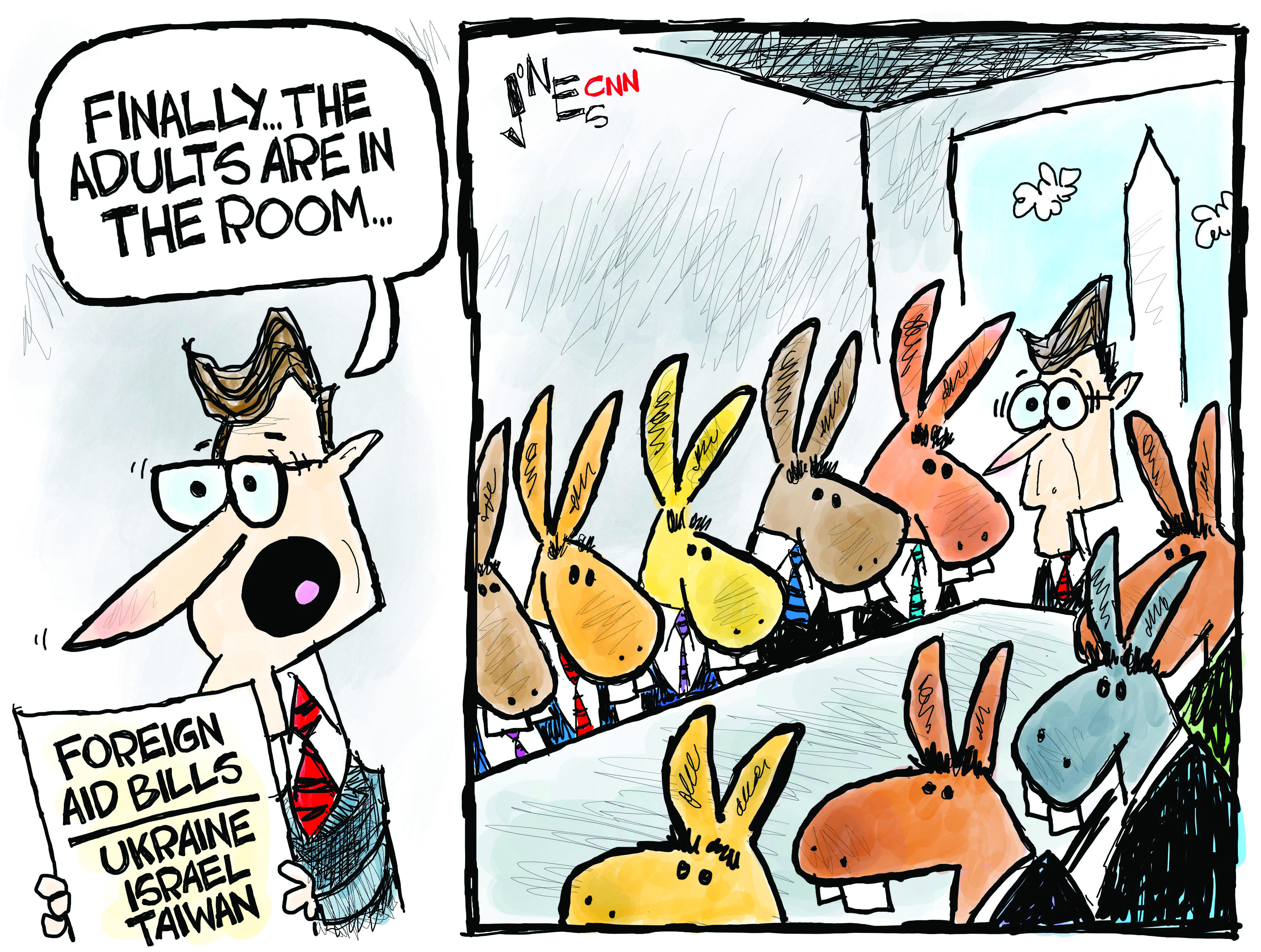
This year is stranger yet, because the Republican majority in the House can’t even agree on a set of demands, much less negotiate a compromise with the Democratic Senate and White House.

Here’s how everyone expected the process to work: Speaker McCarthy would placate the far-right “Freedom” Caucus by passing what is know as a “messaging bill” — a bill that everyone knows has no chance to become law, but which includes provisions that express what the MAGA base really wants. Of course the messaging bill would be rejected by the Senate, and then the real negotiating could begin.

The problem is that the House GOP can’t even get its messaging bill together, so negotiations with the Senate and the White House can’t start. The WaPo examines the possibilities, none of which resolve the situation in time to avoid a shutdown.

and corruption

There’s a Democratic corruption story this week: New Jersey Senator Bob Menendez got indicted for accepting bribes. New Jersey Democrats reacted the way a sane party would to such serious allegations.

Calls for his resignation mounted from ethics groups, Republicans and even longtime Democratic allies who stood by him last time, including the governor, state party chairman and the leaders of the legislature. And party strategists and elected officials were already openly speculating that one or more of a group of ambitious, young Democrats representing the state in Congress could mount a primary campaign against him.

Three-term Congressman Andy Kim has already announced his candidacy, posting:

Not something I expected to do, but NJ deserves better.

Joe Walsh comments on all the things that didn’t happen.

So a Democratic Senator is indicted on serious charges, and no Democrats attacking the Justice Department, no Democrats attacking the prosecutors, no Democrats calling for an investigation of the prosecution, and no Democrats calling to defund the Justice Department. Weird, huh?

Also: No calls for violence in the streets or civil war.

The one bad sign from Democrats is that the Democratic Senate caucus seems to be standing by Menendez. He had to resign as chair of the Foreign Relations Committee, but Majority Leader Schumer is not asking for his resignation from the Senate.


And if there’s corruption in the air, there must be a Clarence Thomas story. Pro Publica has been ahead of everybody else on Thomas scoops, and they published a new one Friday: In 2018, Thomas rode on somebody’s private jet — he never reported the trip, so we don’t know whose — to attend the winter donor summit of Stand Together, the Koch-led network of high-roller conservative money men.

During the summit, the justice went to a private dinner for the network’s donors. Thomas has attended Koch donor events at least twice over the years, according to interviews with three former network employees and one major donor. The justice was brought in to speak, staffers said, in the hopes that such access would encourage donors to continue giving.

That puts Thomas in the extraordinary position of having served as a fundraising draw for a network that has brought cases before the Supreme Court, including one of the most closely watched of the upcoming term.

Political fund-raising violates the code of ethics that applies to lower-court judges. But the Supreme Court has no formal code and is expected to police itself.

In 2021, Thomas sided with the Kochs in a 6-3 ruling allowing dark money groups to keep their donors secret. The court will soon hear a Koch-backed case that could sharply curtail the ability of government agencies to issue regulations. Pro Publica claims Thomas has flipped his position to support the Koch view.

Rep. Ted Lieu sums up:

Clarence Thomas secretly accepted millions in lavish gifts from billionaires. He secretly shows up at a fundraiser for billionaires to help raise money for a super PAC. And he votes on cases to help billionaires. This isn’t the appearance of corruption, this is corruption.

and Rupert Murdoch

While Fox News has been focusing attention on Joe Biden’s age issues, Rupert Murdoch has continued to run both Fox and News Corp at the age of 92. This week he announced he will turn the empire over to his son Lachlan, sparking a series of retrospectives about his career.

but we should be paying attention to a court case that hasn’t gotten much coverage yet

I’m becoming dangerously complacent about Supreme-Court-considers-triggering-Armageddon stories. Remember Moore v Harper and the “independent state legislature” theory? The upshot of ISL is that once you get control of a state legislature, you can gerrymander to make your control permanent, and then leverage that power to determine all the other elections in your state. “Independent” means “unchecked by the courts”, which means that if your power grab violates the state constitution, no one can call you on it.

Anyway, that was decided in June, and the Court did not in fact opt to make it easier to end democracy. It was a 6-3 decision, which means that we’re still safe from permanent minority rule, at least until John Roberts and either Brett Kavanaugh or Amy Coney Barrett change their minds. So rest easy, everybody.

Now we’ve got another end-of-the-world-as-we-know-it case coming up: Consumer Financial Protection Bureau v Community Financial Services Association, which will be argued next week and probably decided sometime in 2024.

The origin of this dispute is fairly trivial in the grand scheme of things: CFPB issued regulations cracking down on the payday-lending industry, which could use some cracking down on, because it exploits people who live paycheck-to-paycheck. CFSA represents payday lenders who would rather operate without government interference. So it sued. In the course of that lawsuit, it made an atomic-bomb-scale argument: The whole CFPB is unconstitutional.

Now, you wouldn’t expect mortgage bankers, home builders, and realtors to be fans of federal regulation, but those associations filed a brief warning that striking down all of CFPB’s rules simultaneously could cause the real estate market to seize up, disrupting some large portion of the entire economy, and possibly setting off a Depression.

But it’s actually worse than that, because of course there’s no line in the Constitution saying “Congress shall establish no consumer financial protection bureau”. So CFSA had to make a broader argument: The way CFPB is funded is unconstitutional. Congress doesn’t appropriate a specific amount of money for CFPB each year. Instead, it gets whatever funding it needs up to some cap, and the funding is perpetual until Congress says otherwise.

Here’s the problem, as described by Vox’ Ian Milhiser: If funding something without approving a specific sum each year is unconstitutional, there goes Medicare, Medicaid, Social Security, and a whole bunch of other stuff.

Under this interpretation of the Constitution, moreover, many key federal programs simply could not exist. Medicare, for example, is a health insurance program that pays for beneficiaries’ health costs as those costs arise. It is impossible for Congress to determine, in advance, the specific dollar amount that Medicare will spend in any given year. To do so, Congress would need to precisely predict which health services would be provided to every senior in the United States, and how much each one of those services would cost.

Imagine it: I recently had a fairly expensive medical test. (It came out well. Thank you for wondering.) We’re near the end of the fiscal year, so under a specific-sum appropriation system, Medicare might say, “I’m sorry, but we can’t pay for your test because medical expenses nationally ran a little high this year and we’ve already spent all the money Congress appropriated.” Every year, millions of Americans like me would game the system to get our medical care done in October rather than September. Some number of people would take their chances without care, and some of them would die.

Oh, and all those programs would be vulnerable to government shutdowns — not that we ever have to worry about that.

The hyper-conservative Fifth Circuit appeals court agreed with CFSA.

Consumer Financial reveals just how deeply delusional thinking has penetrated into the post-Trump federal judiciary. The plaintiffs’ arguments in Consumer Financial have no basis in law, in constitutional text, in precedent, or in rational thought. And they risk the sort of economic catastrophe that the United States hasn’t experienced for nearly a century.

And yet a federal appeals court bought these arguments. So now it’s up to the Supreme Court to save the United States from calamity.

It’s a safe bet that Justices Thomas and Alito will vote to blow up the system. (Alito, IMO, is the most predictable judge on the Court. You don’t need to know anything about the facts of the case or the relevant law, just who stands to benefit. He will consistently vote for Republicans over Democrats, corporations over working people, and Catholics over secularists. The CFPB protects working people from corporations, so he’ll be against it.) So we’ll need to count on two of Roberts, Kavanaugh, Gorsuch, and Barrett to save us.

and you also might be interested in …

A deal has been announced, so the writer’s strike may end soon.


Worth reading: the Atlantic article subtitled “How General Mark Milley protected the Constitution from Donald Trump.


The NYT has a disturbing article about China claiming sovereignty over the South China Sea, and how little can be done about it short of war.


Another week of Fox News, summarized by Kat Abu.


This week’s scandal: John Fetterman wears hoodies and shorts. It’s technically a violation of the Senate dress code, but when he’s dressed like that he votes from the doorway.


In the Handmaid’s-Tale dystopia known as Nebraska:

A Nebraska woman who acquired abortion pills that her teenage daughter used to end her pregnancy last year was sentenced on Friday to two years in prison.


Last week, I wondered how conservative media would erupt if AOC were caught doing something like Lauren Boebert’s lewd behavior while watching a musical. Turns out AOC was wondering the same thing.


Jimmy Carter has been in hospice for seven months, but he still enjoys peanut butter ice cream and plans to celebrate his 99th birthday this coming Sunday. Saturday he was spotted at the Plains Peanut Festival.

And while we’re talking about family values (i.e., Boebert), Jimmy and Rosalynn Carter are facing death together after 77 years of marriage.


In the silly-but-amusing category, conservative podcaster Clay Travis tweeted about Kansas City Chief tight end Travis Kelce:

Travis Kelce is doing Bud Light and covid shot commercials. He needs to fire all his marketing agents. Or he needs to just go ahead and cut his dick off, become a chick, and endorse Joe Biden.

And Ron Filipkowski replied:

He scored a touchdown today in a 41-10 win and left the game with Taylor Swift. Seems to be doing ok.


Elon Musk said he wants users to pay a monthly fee to use Twitter.

I’ve used X/Twitter for years now. I use it to cast a wider net for points of view than I’ll find in my usual news sources. I don’t often post content other than links to this blog.

Since Musk took over, I’ve thought about leaving X. And I’ve checked out Mastodon as an alternative. But inertia is powerful, so I’ve stayed.

If they start charging a fee, though, I’ll have to take positive action to stay on X. I’ll have to give them a credit card number or something. Just by doing nothing, I could quit.

I would do nothing, and see how long it took them to turn off my account. I suspect the vast majority of users would do the same. Charging a fee will probably complete Musk’s destruction of the platform, setting fire to the remainder of his $44 billion investment.

and let’s close with something uplifting

The FamilyThis web page has an article about times kids surprised their parents and older siblings with their kindness and compassion. Like this one:

had lunch with my son at school for his birthday. he can pick 2 kids to sit with him and one I had never met. i asked afterward who he was and he said “oh, i don’t really know him but no one had picked him for birthday lunch before”

About the polls

Yes, I’d enjoy seeing polls showing Biden way ahead of Trump. But it’s too soon to worry about such things. There’s more than a year of campaigning still to come.


I haven’t wanted to write about the 2024 general election polls, because I don’t think they mean much at this stage, and they’re part of the horse-race framing that I think gets way too much attention in our politics. I mean: Why talk about democracy or climate change or abortion or Ukraine or the economy or the completely senseless government shutdown that will probably start next week — or even about the issues conservatives focus on like the border — when TV’s talking heads could be discussing who’s up and who’s down? Or they could talk about image problems like Biden’s age (but not Trump’s).

But anyway, polls have been getting so much attention in the news that I know you’re thinking about them. It’s hard not to: Just about all the polls show Biden and Trump tied, with one outlier giving Biden a 6% lead and another showing Trump up by 10%. The Trump-favoring polls get more headlines, because they amount to a man-bites-dog story: A guy under multiple indictments who could well spend the rest of his life in jail is the candidate some large number of Americans want as their president.

I know: It’s crazy. Trump lost in 2020 by seven million votes, and that was before he tried to break American democracy, before the justices he appointed to the Supreme Court took away American women’s reproductive rights, and before the summer of weather disasters proved to any reasonable person that climate change is real and serious. How can this race even be close?

The case for Biden. Biden, meanwhile, has been an excellent president. He succeeded in achieving a number of things Trump promised but never accomplished: getting us started rebuilding our roads and bridges and bringing manufacturing back to the US, just to name two. The process of withdrawing our troops from Afghanistan was ugly, but the end result is that we are out of Afghanistan — another thing Trump promised but never delivered.

Trump had left NATO in tatters, with our allies wondering if the US could be counted on to fulfill its treaty obligations. But under Biden’s leadership, NATO has proved resilient against Russian aggression in Ukraine.

After the Covid shutdowns, when governments paid people not to produce — a policy of both the Trump and Biden administrations — inflation has been an issue around the world. But even there, under Biden the US is doing better than comparable economies.

And Biden has accomplished all this without the constant drama of the Trump administration. No nasty tweets. No demeaning nicknames for his opponents. No statements implying that his critics deserve to die or inviting his supporters to get violent. In short: as president, Trump was a constant embarrassment to the United States of America. Biden is not.

Polls. But OK, the polls: Why isn’t this case for Biden resulting in a polling lead? The short answer is that I don’t know, and the news coverage about the polls isn’t helping me figure it out. I’ve seen countless interviews with people who supported Trump in 2020 explaining why they’re standing by him. But he lost in 2020. The only way he can win in 2024 is if people who didn’t vote for him have changed their minds. The news media ought to be searching out those people, but so far they’re not.

Meanwhile, MAGA politicians failed badly in 2022, losing states Trump needs to win back, like Pennsylvania and Georgia. And that trend has continued into 2023: a liberal won a state supreme court election in Wisconsin by a wide margin, and MAGA candidates have continued to lose special elections.

So why hasn’t that trend shown up in the Trump/Biden polls? I have two tentative answers: The first is that so far hardly anyone has been making the case against Trump. You would ordinarily expect the people running against him for the Republican nomination to make that case, but with the exception of Chris Christie, they’re really not.

I have two windows into the primary campaign: My local TV stations are from Boston, and cover much of southern New Hampshire, so if you’re running in the New Hampshire primary, your ads appear in Boston. Also, as a Michigan State graduate, I follow Big Ten football, which means I’ve watched a number of University of Iowa games on the Big Ten network. Those games always include a number of political ads.

So far I have not seen a single attack ad against Trump. Maybe if you do a YouTube search you can find one — I didn’t — but whatever candidate made it is not airing it much.

Meanwhile, Biden has been standing aside while the justice system prosecutes Trump’s crimes. So far, then, the case against Trump has not entered the 2024 campaign. That won’t last. Trump is a very vulnerable candidate, and when those attack ads get made, they will have an effect.

Age. The second thing affecting the polls is that so far, Biden’s age has become the “but her emails” story of 2024.

Yes, Trump may be a felon who tried to stay in power in spite of the voters, and yes, his happy talk at the outset of Covid may have gotten over 100K Americans killed unnecessarily, and yes, reelecting him might lead to the end of American democracy … but Biden is old.

There is almost nothing political reporters can’t turn into a story about Biden’s age. When his campaign rolled out a new wave of TV ads and public appearances, The New York Times described the initiative this way: “As Democratic Jitters Grow, Biden Campaign Tries to Showcase His Vigor.” The paper’s story Monday on Biden’s recent trip to Asia — which even Fox News described as an “all-nighter” — was nevertheless titled, “‘It Is Evening, Isn’t It?’ An 80-Year-Old President’s Whirlwind Trip.” The next day, The Wall Street Journal ran a story headlined, “Is Biden Too Old to Run Again? We Asked People Born on His Exact Birthday.” If he shows signs of aging, it makes the front page; if he doesn’t, it’s the occasion for a discussion of how he and his advisers are working to defuse the issue. 

And yes, Biden is three years older than Trump. But he is fit and takes care of himself, while Trump is fat, avoids exercise, and reportedly lives on junk food. [1] Which one do you think is more likely to run into health issues in the next five years? I’d say Trump.

When it comes to stamina, Trump was never a hard worker. He famously started his White House days at 11, and his schedules included lots of down time that he mostly spent watching TV and tweeting.

Cognitively, Biden tends to stumble over words, which he has done all his life. Trump meanders aimlessly, shifts every conversation to his hobby-horse grievances, produces word salads that mean nothing at all, and seems helpless to control his anger issues. If you don’t think Trump has declined, watch this video from the 2015 campaign: Russian spy Maria Butina asks him about Obama’s Russia sanctions, and Trump gives an answer that is both complex and coherent. When was the last time you saw him do anything like that?

Looking forward. So do I think those factors will continue to prop Trump up until the election? No, I don’t. Eventually, Trump attack ads will get made and aired. Having seen what happened in 2016, the public will object to the but-her-emails coverage of Biden’s age. (For now, we should all be adding comments calling out the most egregious articles.) As the campaign goes forward, it will be harder to maintain the myth of Biden’s senility. And as Trump goes to trial, the public will see that the charges against him are more than just politics.

And a year from now, when the fall campaign is really happening, voters will tune in. A lot of them will want to know what these candidates intend to do for them. Biden has a vision and a record of accomplishment. Trump does not. Ultimately, that’s going to count.


[1] A frequent topic of discussion on my social media feeds is whether pictures like this are “fat shaming” Trump, which is a no-no. But if we’re honestly talking about longevity issues, weight is relevant. And we have to use pictures, because Trump lies about the numbers.

The Monday Morning Teaser

I don’t want to talk about polls this early in the campaign. One reason I began blogging in the first place was to fight the news media’s fixation with horse-race coverage of political campaigns. News reports ought to be giving voters the information they need to make their decisions, but instead they create a hall-of-mirrors effect where voters learn about what voters think, rather than about the underlying situation or the candidates’ plans, visions, and records.

But this week an outlier poll came out showing Trump with a ten-point lead over Biden — most polls show a neck-and-neck race — and it seemed to be all the weekend news shows could talk about. At a moment when Trump is pushing House Republicans to shut down the government and impeach President Biden, nobody is talking about that. Instead they talk about polls. It’s crazy.

Anyway, though, I sense that we’re all worrying, so we might as well talk: What about those polls? Should we be anxious? Is there any point to fretting over them? That’s the topic of this week’s featured post: “About the polls”, which should be out around 10 EDT.

The weekly summary has substantive issues to cover: the looming shutdown, new corruption stories about Senator Menendez and Justice Thomas, Rupert Murdoch’s retirement, and a new opportunity for the Supreme Court to crash the country. That should be out around 11.

Pride and violence

I envied the arrogant when I saw the prosperity of the wicked. Pride is their necklace; a garment of violence covers them. From their prosperity proceeds iniquity; the imaginations of their hearts run wild. They mock and speak with malice; with arrogance they threaten oppression. They set their mouths against the heavens, and their tongues strut across the earth.

Psalm 73

This week’s featured posts is “Don’t just connect the dots“. It sets the Biden impeachment in a larger context of conspiracy theory reasoning.

This week everybody was talking about the looming government shutdown

As always, the federal government’s fiscal year ends on September 30, i.e. a week from Saturday. So unless Congress passes and President Biden signs some new appropriation bills in the next two weeks, the government will shut down on Monday morning, October 2.

If the budget process were working the way it’s designed, funding the government would mean passing 12 separate appropriation bills, each covering some set of government activities, like defense. That seems extremely unlikely at this point. The Senate is more-or-less on track, but Kevin McCarthy’s Republican majority in the House can’t unite on a set of proposals, much less get together with the Senate and work out something both houses can pass.

Failing at 12 appropriation bills, the next option is one big omnibus bill, which has happened in recent years, and which House Republicans have been railing against. That doesn’t seem very likely at the moment either.

The third option is a continuing resolution, which allows the government to keep spending money at the same rate as last year, until Congress can get its act together to pass an omnibus. Currently, Kevin McCarthy is trying (and mostly failing) to build support for a continuing resolution.

The far-Right “Freedom” Caucus has made a series of demands for what any continuing resolutions would have to include, such as ending the Trump prosecutions. (Anything to avoid a trial in front of a jury, which would see the evidence and find Trump guilty.)

So we seem headed for a shutdown. The main issue in the shutdown is whether or not McCarthy will fulfill the deal he made with Biden in May to resolve the debt ceiling crisis. The “Freedom” Caucus thinks the spending targets in that deal are too high, so they want to renege.


When McCarthy agreed to open an impeachment inquiry targeting President Biden (without any evidence of wrongdoing), some speculated that he had bought himself credit with the far Right, which would give him some room to maneuver on the spending bills. But, as CNN analyst Stephen Collinson observed, “That narrative barely lasted a day.” Apparently any concession these people get only whets their appetite for more.

and Ken Paxton

Ken Paxton is the corrupt attorney general of Texas.

Even in the long, sordid history of Texas political scandals, Paxton stands out. The accusations leveled against him in 21 years of public life ranged from felonious to farcical: that he duped investors to whom he sold stock, profited from inside information on a land deal, made false claims in court about the 2020 presidential election, and purloined another lawyer’s expensive pen.

Other episodes gave grist to criticism that Paxton considered himself above the law, like when he fled his home last year, in a truck driven by his wife, to avoid being served a subpoena.

In March, the Republican Texas House overwhelmingly voted to impeach him on 16 counts, with 70% of Republicans voting against him. But Saturday, only 2 of 19 Republican senators voted to convict on any charge, and so he was acquitted and returns to office.

What changed? The politics, not the evidence. National Republican groups stirred up the grass roots.

It was made clear to Texas GOP senators that they’d face a very well-funded primary opponent in their next election if they voted to impeach.

“Christian” organizer Nate Fischer argues

I judge politicians on their effectiveness against the left. In an existential war, you do not remove an effective officer—much less cede his position to the enemy—because an affair or gambling problem comes to light. We are in a war for our civilization. Paxton and Boebert have been effective in important battles. But if God could use Samson as his instrument to deliver Israel, I’m skeptical of calls to toss one of our fighters out because he doesn’t meet some standard of conduct that is anything but a uniform rule across the political aisle.

And of course, any conspiracy-theory allegation against a Democrat is evidence that no standard of conduct is “a uniform rule across the political aisle”. So this “Christian” applies no moral standards at all to the conservatives he supports.

Matt Yglesias responds:

This is how corrupt people use culture war hysteria to bait you into sacrificing your interests to advance theirs; it’s the ultimate logic of Trumpism — he may be a thief, a liar, and a scumbag but at least he’s *our* scumbag.

the Hunter Biden indictment

Hunter was indicted on federal firearms charges Thursday. You’d think this would settle questions about the independence of the Justice Department from White House interference, but no.

Hunter could wind up at the center of a legal question that cuts across partisan lines. A federal appeals court representing a different district has found that the law he’s accused of violating conflicts with new Supreme Court precedents and so is unconstitutional. So people on all sides have to ask themselves what’s more important: getting/saving Hunter or gutting/preserving federal gun laws?

and the Trump interviews

Two female journalists did televised interviews with Donald Trump recently: Kristen Welker, as her inaugural broadcast as host of Meet the Press, and Megyn Kelly on her XM Radio show.

It’s hard to say what the point of doing either interview was. Conde Nast Legal Affairs Editor Luke Zaleski summarizes the problem:

Trump doesn’t do interviews. He tells long fake stories that provide an alternate reality in which he’s the hero and allow his audience to conflate themselves with him as he pretends to vanquish imaginary enemies like “Sleepy Joe” “Crooked Hillary” “the Deep State” & “Fake News”

The traditional power of the press comes from its ability to publicly shame a politician for lying or hypocrisy. But Trump has no shame. NYU journalism Professor Jay Rosen describes Welker’s approach as “zero innovation”, meaning that she treated Trump like a typical, shameable public figure.

Everything was predictable, nothing was surprising, and new host Kristen Welker did nothing to justify going to the well again with another Trump Q & A.

So Trump got a platform to spread his usual disinformation, and NBC got to publish a separate fact check, which (as we know) accomplishes little. Unlike a Cronkite-era politician, Trump is not shamed to be caught lying, and his cultists will brush off any fact-checking as “fake news”. Worse, traditional fact-checking is meant for correcting simple lies and misstatements. It can’t cope with a complete alternate reality.

“Pinning Trump down”, as Welker did when she got him to say he would testify under oath that he never ordered a subordinate at Mar-a-Lago to delete security video, is also useless. Making that statement serves Trump’s purposes now — it makes him sound determined and resolute — but when Trump does not testify at all in any of his trials, he will not feel shame for having said that he would.

The end result of this interview is that viewers are more poorly informed about Trump-related issues than they were before they watched. I have to agree with Rosen’s conclusion:

I would love to hear what [MSNBC’s Rachel Maddow] thought about NBC’s interview with Trump. She is the one who said on air: “There’s a cost to us as a news organization of knowingly broadcasting untrue things.” NBC willingly paid that cost today.

Tonight we’ll see a test of Maddow’s integrity: Will she call out her sister network?


Welker also asked Trump: “Is there any scenario by which you would seek a third term in office?” In other words, “Do you intend to ignore the Constitution?”

Trump said “No.” But again, he’s not going to feel bound by that answer, so what’s the point of asking? All Welker did was put into viewers’ minds the idea that seeking a third term (in defiance of the Constitution) is an option.


One upside of Kelly’s interview is that Trump said some things that Jack Smith will probably use against him in court.

I’m allowed to take these documents, classified or not classified. And frankly, when I have them, they become unclassified.

Aside from being nonsense legally, Trump’s statement sounds an awful lot like a confession that he did take classified documents.


It’s a mystery to me why Biden’s mental capabilities are being questioned, but not Trump’s. There could be a story like this every day:

Trump says Joe Biden is “cognitively impaired” and then accuses him of getting us into World War TWO.

Or consider this part of the Welker interview:

You talk about Kim Jong Un, right? I got along great with Kim Jong Un after the first month or two when we were sparring. But I got along great with him. We were in no danger. There was — President Biden said, and he felt even now, and President Obama told me when we sat down, Obama told me, and Biden still to this day, except I don’t think he knows, he’s only — he can’t put two sentences together. But President Obama told me, “Our biggest threat is from North Korea. We’re going to end up in a war.”

Yep. It’s Biden who can’t put two sentences together.

David Roberts raises a worthwhile question:

How would we even know if Trump’s age was affecting his mental acuity? He’s done nothing but ramble sub-literate nonsense since he came on the public stage. Could you even tell if he got dementia?

and Mitt Romney

I’ve always been of two minds about Mitt Romney, an ambivalence that comes through in “The Tragedy of Mitt Romney” which I posted during his primary campaign way back in 2012. At his best, Mitt is a conservative version of Joe Biden: a basically decent person who can listen to members of the other party, define common goals, and occasionally get something important done. RomneyCare, the Massachusetts health insurance program that became the model for ObamaCare, is a prime example.

Mitt’s tragic flaw is that he’s never had quite enough courage to be that person consistently. So he’s been a truth-teller, but only sometimes. Other times, he has pandered to the worst elements in his party. Two examples stand out: His 2012 presidential campaign ran away from his record as governor of Massachusetts, to the point of promising to repeal the same ObamaCare his program had inspired. And he bowed down to Trump during the 2016 transition, hoping to become secretary of state.

This week he announced that he’s not running for reelection in 2024. As a result, he is free from future political considerations and can be a truth-teller again. And so we have “What Mitt Romney Saw in the Senate“, a preview of an upcoming biography by McKay Coppins. The biography comes from long conversations with Romney, as well as access to his papers and journals.

And so we find out:

  • The Republican Senate caucus gave Trump a standing ovation, and then laughed at him after he left.
  • “A very large portion of my party really doesn’t believe in the Constitution.”
  • During Trump’s first impeachment, Mitch McConnell told Romney: “You’re lucky. You can say the things that we all think. You’re in a position to say things about him that we all agree with but can’t say.”
  • “No one has been more loyal, more willing to smile when he saw absurdities, more willing to ascribe God’s will to things that were ungodly than Mike Pence.”
  • Some Republicans wanted to vote for Trump’s second impeachment or conviction, but were intimidated by the prospect of right-wing violence against themselves and their families. At that time, Romney was paying $5K a day for security.

In return for this openness, Romney is being lauded as a man of principle and integrity. And he has been, up to a point and some of the time.

You know what I long for? Republicans who not only speak out against the MAGA usurpation of their party, but take that message to the voters rather than meekly slip out the Capitol’s side door like Romney and Jeff Flake and Lamar Alexander. Maybe such a race is hopeless — it was for Liz Cheney — but people of real principle would make a charge-of-the-light-brigade anyway. To paraphrase the MAGA god himself: If you don’t fight like hell, you’re not going to have a party anymore.

and you also might be interested in …

Climate Change summer is continuing as we approach fall. The worst catastrophes happen when natural disasters cause failures in human infrastructure.

More than 5,000 people are presumed dead and 10,000 missing after heavy rains in northeastern Libya caused two dams to collapse, surging more water into already inundated areas.

Meanwhile, Hurricane Lee spent most of its energy over the Atlantic, but was just 4-mph short of hurricane status when it hit Nova Scotia Saturday. Places like Halifax and Bar Harbor, Maine don’t usually have to worry about tropical storms.


The United Auto Workers are striking against the Big Three American automakers. The Atlantic explains that this is about more than just the usual wages and benefits: Government-subsidized investments in electric vehicle plants are being used to shift production to states that make it hard for workers to unionize.


As you may have heard, Saturday night Rep. Lauren Boebert was escorted out of a production of the musical “Beetlejuice” for vaping, taking flash pictures of the performance, and “creating a disturbance”. Afterwards, she denied vaping, said she didn’t realize she couldn’t take pictures, and admitted “laughing and singing too loud”. Unfortunately for her, the vaping is on video, along with some mutual groping with her date (Boebert’s divorce is still pending), as well as Boebert giving theater employees the finger on her way out the door.

In response to the clear evidence that her denial was a lie, Boebert apologized for the vaping (claiming she “genuinely did not recall” doing it), but did not comment on the public groping.

The incident provoked a stream of what-if comparisons on social media: How would conservative politicians and media personalities erupt if some prominent liberal woman like AOC behaved the same way? Or a woman of color? Or a gay or lesbian politician with a same-sex date? What if Biden did something inappropriate in public, denied it, and then explained away his denial by claiming he didn’t remember?

Who better to comment on Boebert’s “trashy” behavior than fellow “trash monster” Trae Crowder? Boebert’s “vaping and hollering stuff” in the theater doesn’t alarm him:

My fellow Trailer Americans, I ask you: Who among us? Right? I mean, we do that. We do. Get a little too excited at a public event, start cussing in front of the 8-year-olds, then act indignant when the bouncer shows up. “Oh, what? Is it illegal to have a good time now?”

What’s wrong with Boebert, according to Crowder, isn’t that she comes from the underclass, because “some of the most genuine, kindest, most empathetic people I’ve ever known were trailer babies”. We’d do well, he says, to have a Congress full of such people. But Boebert is a “ladder-puller”, who tries “to take away the same government benefit programs that kept her alive as a child”.

Boebert … somehow took all the wrong lessons away from her life and now spends her time spewing misplaced rage and making us all look bad.

BTW: If you want a view of how the world looks to the White rural underclass, I can recommend this year’s Pulitzer-Prize-winning novel Demon Copperhead by Barbara Kingsolver.


While we’re talking about the Party of Family Values, The New York Post claims South Dakota Governor (and rumored Trump VP candidate) Kristi Noem has been having an affair with former Trump advisor Corey Lewandowski. Both are married. All together, the two couples have seven children.


Remember Kim Davis, the county clerk in Kentucky who refused to issue marriage licenses for same-sex couples back in 2015? That case is still percolating through the system. Two couples sued her for damages, and a judge ruled in March 2022 that she had violated their rights. Wednesday, a jury awarded one couple $100K and the other nothing. (I’m not sure what distinction the jury saw between the two couples.)

Davis plans to appeal, on grounds that the current Supreme Court might find tempting:

We will argue religious accommodation under the First Amendment, and other state and federal laws. We will also argue that Obergefell v. Hodges was wrongly decided and should be overturned.

She previously had moved to have her case dismissed, on the grounds that she had immunity for acts performed in her official capacity. But the plaintiffs argued that official immunity doesn’t apply when the official is doing something clearly outside the law. An appellate court refused to dismiss, and in 2020 the Supreme Court decided not to hear her appeal. But this time around could be different, if the current Court is looking for an opportunity to reverse Obergefell.


Two thousand South African rhinos are looking for new homes.


A line too good not to repeat: After Mitch McConnell froze up a couple weeks ago, fellow Kentucky Senator Rand Paul was not all that supportive. Among other comments, he disputed the Capitol doctor’s claim that McConnell had not suffered a seizure, but only the effects of concussion recovery and dehydration.

Afterwards I heard a comment that Rand Paul is “nasty and brutish and short”.

and let’s close with something sentimental

In 1950, Oswald Laurence recorded a message telling patrons of the London underground to “mind the gap”. After Laurence died in 2003, his widow Margaret McCollum began going to the nearby Embankment tube station whenever she wanted to hear his voice.

Eventually, though, the transport company replaced Laurence’s recording with an artificially generated voice. Margaret then asked the company for a recording. But they did her one better: They restored Laurence’s announcement for exactly one station, Embankment.

Don’t just connect the dots

Connecting the dots is meaningless if you’ve never established that the dots really happened.


I remember, almost to the minute, when I became a Democrat. As a teen-ager, I had libertarian leanings that I don’t like to talk about now. In my 20s and 30s, I was a left-leaning independent, but it wasn’t hard for a moderate Republican to charm me. I spent one afternoon of 1980 on a Chicago street corner, handing out pamphlets for John Anderson. In the early 90s, I was comfortable with William Weld as my governor.

And then in 1998-99 the Clinton impeachment happened.

I watched just about every minute of the televised trial in the Senate. I had voted for Clinton twice, and had been rooting for him all through the Lewinsky scandal. But still I watched the case against him unfold, because … what if the Republican impeachment managers had something? They seemed so sure that they did.

There were two counts. The first was perjury, and what it boiled down to was a he-said/she-said conflict over precisely which sex acts Bill and Monica had performed. Was Bill telling the truth? Maybe, maybe not. But in any case it seemed like a thin reed to hang an impeachment on.

The second count was obstruction of justice, and it hinged on why Monica Lewinsky had lied to the grand jury investigating Clinton’s harassment of Paula Jones. Monica had denied that she was having an affair with Bill, which everyone now agreed was perjury. But why?

There were a number of plausible explanations. Maybe she was embarrassed to have her sex life become a matter of public record. Maybe she still had some affection for Bill and wanted to protect him from a political scandal.

But there was a more nefarious explanation: Maybe Bill had asked her to lie, and had offered to find her a good job in exchange. Quid pro quo. Conspiracy to obstruct justice.

And this much was clearly true: One of Clinton’s top advisors, Vernon Jordan, was a director of the Revlon Corporation. Jordan got Lewinsky an interview at Revlon, which then hired her.

But the theory that this was a quid-pro-quo had a problem: Everyone up and down the line denied it, even the people who had no motive to lie. Clinton denied it, of course, and so did Jordan. Jordan claimed he often helped out White House interns, and Clinton would not be the first powerful man to do a favor for a young woman after an affair. So you didn’t have to assume obstruction to make the story work.

Lewinsky denied it, even though she had immunity, and so the only way she could get in trouble now was if she lied again. And the folks at Revlon denied that Jordan had put any undue pressure on them; he just sent Lewinsky over, and she got the job on merit.

What the Republican prosecutors did in their presentation was establish a timeline: They very meticulously proved that all the people who would have needed to conspire did indeed have communication with each other during the time period when the conspiracy would have needed to take place.

In other words, they connected the dots. They firmly established that the obstruction-of-justice scenario could have happened. They presented not a shred of evidence that it actually did happen. But it could have.

That was enough for 50 Republican senators to vote to remove the President of the United States.

I’ve been a Democrat ever since.

Conspiracy theorizing. Here’s what I didn’t realize at the time: The Lewinsky obstruction presentation was a preview of the conspiracy-theory culture of the 21st century.

Just before Biden’s inauguration, the NYT published a profile of QAnon “meme queen” and “digital soldier” Valerie Gilbert. It was supposedly a moment of crisis for the movement, because none of their predictions of a Trump victory or a “storm” of arrests of high-ranking Democrats and leading celebrities had come to pass. Trump really had lost the presidency, and Biden was about to take over. Q himself had gone silent.

But Ms. Gilbert isn’t worried. For her, QAnon was always less about Q and more about the crowdsourced search for truth. She loves assembling her own reality in real time, patching together shards of information and connecting them to the core narrative. (She once spent several minutes explaining how a domino-shaped ornament on the White House Christmas tree proved that Mr. Trump was sending coded messages about QAnon, because the domino had 17 dots, and Q is the 17th letter of the alphabet.)

When she solves a new piece of the puzzle, she posts it to Facebook, where her QAnon friends post heart emojis and congratulate her.

This collaborative element, which some have likened to a massively multiplayer online video game, is a big part of what drew Ms. Gilbert to QAnon and keeps her there now.

“I am really good at putting symbols together,” she said.

But think about what she’s not doing, which is any of the traditional work of investigation. She’s not finding and interviewing witnesses to key events. She’s not checking their stories against the kind of facts that can be nailed down. She’s not tailing suspects to see where they go and who they meet.

Instead, she’s connecting the dots. She’s coming up with ever more satisfying (to her QAnon online community) stories that pull together the high points of events that they assume happened. Did they happen? Hardly anyone seems to be working on that. The dots are the dots. What’s important is weaving them into a story.

Real investigating. Real investigations are laborious and involve large chunks of time devoted to tedious activities. TV dramas tend to skip that part. You learn, say, that the police have traced an earring found at the crime scene to the shop that sold it, and you don’t see the dozens or hundreds of conversations with shops that didn’t sell it. You don’t see all the interviews with neighbors who slept through the break-in and didn’t hear the gunshot.

Investigators endure that tedium because real investigations work from the bottom up. They establish tiny little factoids, in the hope that eventually those atoms of truth will start to fit together like Lego blocks. You may have your suspicions about what the eventual answer will be, but you hold them lightly as you wait to see whether the facts will take you there.

Connecting the dots turns that process upside down. The “dots” are a collection of plot points that your audience either already believes or wants to believe. A real investigator would first drill down on those dots to make sure they’re actually true. (Like, is that really a “suitcase of illegal ballots” in the Georgia video? Turns out it isn’t.)

But a dot-connector works the other way around: Assuming the dots are real, what story can you tell to weave them together? In the end, it is the overall appeal of the story that validates the dots. That’s why dots keep coming back no matter how many times they’re debunked: They work so well in the larger narrative.

That’s also why it’s so hard to argue with a dot-connector: They have a good story to tell, and all you have are the messy details. Here’s a bit of Trump’s recent Meet the Press interview:

FMR. PRES. DONALD TRUMP:

We have thousands of essentially motion pictures of people stuffing the ballot boxes. Tens of thousands.

 KRISTEN WELKER:

But, Mr. President, they’re not stuffing the ballot boxes. And you’ve been told that by your top law enforcement officials. But let’s stay on track, because we have so much ground to cover. We have policy ground to cover, Mr. President. 

 FMR. PRES. DONALD TRUMP:

You have people that went and voted in one place, another place, another place, as many as, I understand, 28 different places in one day with seven, eight, nine ballots apiece. They can’t do it anymore, because it would look too phony. These were professional people. They were stuffing the ballot boxes. It’s there. 

 KRISTEN WELKER:

Mr. President — 

 FMR. PRES. DONALD TRUMP:

I mean, it’s there to see. A lot of people don’t like looking at it.

 KRISTEN WELKER:

 — you took your case to court in 60 different cases all across the country. You lost that. But let’s stay on track because we have so many —

 FMR. PRES. DONALD TRUMP:

We lost because the judges didn’t want to hear them.

 KRISTEN WELKER:

Mr. President, we have so many topics to cover.

Doing any actual debunking of Trump’s claims would involve going into those tedious details, and Welker doesn’t have time for that. Viewers would tune out. So she has to let the lies stand and move on to other topics.

Connecting the Biden impeachment dots. The Biden impeachment investigators in the House have little evidence, but they have a good story to tell: Biden used his political power to protect his son Hunter, and Hunter in turn used his businesses to collect bribes for his father Joe. Put it all together, and throw in Joe’s brother James, and you have “the Biden crime family”.

The problem is that no piece of that story holds up to scrutiny, except that Hunter leveraged his name to make business connections that were almost certainly unethical, though probably not illegal (and nowhere near as corrupt or lucrative as Jared Kushner’s $2 billion from the Saudi sovereign investment fund). Some of the dots were debunked years ago, while others just lack any supporting evidence.

But if you want to believe that story — and a lot of people do — then the story itself validates the dots, even the ones that have repeatedly been shown to be false. That’s what reality-oriented people will be up against in the coming months.

The Monday Morning Teaser

It’s hard to know where to start. House Republicans are moving towards impeaching President Biden for something-or-other, but they don’t seem to be moving towards funding the government, which looks increasingly likely to shut down in two weeks. The Justice Department indicted Hunter Biden, but apparently that just proves that it’s not independent, because Republicans hold that it’s not indicting Hunter for the right things — the things that implicate his father, and which they have no evidence to support.

Texas Attorney General Ken Paxton is back in office, having escaped his impeachment trial without being removed. NBC gave Trump a major platform to spew his lies, and demonstrated the complete helplessness of Cronkite-era interviewing tactics when confronting a subject who can’t be shamed.

Mitt Romney is retiring, and getting in a bunch of parting shots at his party before he goes. He’s being lauded for his courage, but I can’t help thinking that a truly courageous man wouldn’t wait until he had nothing to lose before telling the truth. And while we’re talking about character, there’s Lauren Boebert and Kristi Noem. But other than just salacious gossip, those would be stories about hypocrisy, which no one is ashamed of any more.

And then there are natural disasters: a hurricane affecting New England, an earthquake in Libya. The auto workers are striking.

You know: Just another week.

In the featured post, I take a step back from the Biden impeachment effort and look at a thought pattern we’ll undoubtedly see a lot of if it proceeds: connecting the dots. Connecting the dots is about telling a story that weaves together a collection of plot points your audience already believes or wants to believe. A true investigation would begin by drilling down on the dots themselves, to see if they’re real. Only after the dots are solidly established would the investigator begin turning them into a story.

But connecting the dots flips things around. The overall appeal of the story — the “stolen election”, the QAnon “storm”, the “Biden crime family”, the worldwide plot to unleash Covid on us and then trick us into taking vaccines that do something nefarious to our bodies or souls — is what establishes that the dots must be true.

So the featured post “Don’t just connect the dots” should post around 10 EDT. The weekly summary will be out somewhere around noon.

Basic Understanding

Your letter makes clear that you lack a basic understanding of the law, its practice, and the ethical obligations of attorneys generally and prosecutors specifically.

– Fulton County District Attorney Fani Willis
letter to Rep. Jim Jordan

This week’s featured post is “We’re all in law school now“.

This week everybody was talking about the Trump trials

We’re way past the point where I can hold all the details in my head — even just one week’s events. That’s what this week’s featured post covers.


But that post didn’t cover the freshly released report that the Fulton County special grand jury wrote to recommend indictments it didn’t have the power to issue. The headline result is that it recommended indictments not just of the 19 people who have now been charged, but of 21 others, including Senator Lindsey Graham and former Senators Kelly Loeffler and David Perdue.

The theme of the featured post is that we’re all learning law these days, and here’s the lesson I draw from this report: The special grand jury and the district attorney have different jobs. The special grand jury was answering a simple question: Is there probable cause to claim that these people broke these laws?

The prosecutor is asking a different question: What charges can I present to a trial jury and convince them beyond reasonable doubt?

A second lesson to draw is that Willis is really trying to win a case, not just make a big splash.


The WaPo has a long and fascinating article about the Reffitt family: The dad (Guy) was an armed 1-6 rioter now serving an 84-month sentence. The son (Jackson) turned him in to the FBI and testified against him. The mom (Nicole) still believes Trump won and Guy is a patriot. The daughters (Peyton and Sarah) are caught in the middle.

For years and years we’ve been hearing stories about how families get pulled apart when the kids join a cult. But these days, it’s the parents who are joining a cult.

and the Covid resurgence

Several people I know have caught Covid lately, and we’re heading into the fall, when school begins and social get-togethers move indoors.

But Vox has a reassuring article. The new variant (now named Pirola) doesn’t look that dangerous. Yes, infection rates are rising (even if they’re still nowhere near previous highs), but

over the last few days, several laboratory studies have led to sighs of relief: On a cellular level, Pirola just isn’t that alarming, meaning that the chance this variant will lead to a massive, emergency room-flooding Covid surge is pretty small. Other, less mutated omicron variants remain the dominant strains, and it seems unlikely Pirola will wreak major havoc.

So: Get the updated vaccine when it comes out (soon), use common sense about exposing yourself to crowds, and try not to worry too much otherwise unless you’re specially vulnerable.


More good advice for avoiding Covid: Stay out of Florida. With Governor DeSantis’ vocal support, Florida’s quack surgeon general Joseph Ladapo is urging Florida residents not to get the new Covid vaccine.

Dr Joseph Ladapo, the governor’s hand-picked surgeon general and a vaccine skeptic previously found to have manipulated data on vaccine safety, falsely claimed the new booster shots had not been tested on humans, and contained “red flags”.

His reasoning seems to be more religious than scientific.

Casting the dispute as spiritual warfare, Ladapo posed a rhetorical question: Why did so many people follow DeSantis instead of guidance to the contrary from the national public health establishment — “all these Ph.D.s and M.D.s?”

He imputed this thinking to those people: “I hear what they’re saying, but what he’s saying feels right.”

He continued: “Because there is something within all of us that resonates with freedom. And that something is part of our connection with God and our connection with every single thing around us, including each and every one of us.

“There are these forces out there who are relentless. And they really are relentless. It’s not that they were ever done trying, and they’re not done now. They are relentless, relentless, with every breath that they take. They are thinking about how they can control you. To what ends, only God knows, but it’s nothing pretty, right?”

That’s what passes for thought on the Right these days: It’s totally mysterious why public health officials would want to slow the spread of a deadly virus, so they must have some other motive. And it’s nothing pretty.

and Tommy Tuberville

Up until now, I’ve mostly been ignoring Senator Tuberville’s holds on military promotions, figuring it was a stunt that would come to nothing. But he’s been doing it since February, with no end in sight. More than 300 promotions that need Senate approval are in limbo, and three military services — the Marines, Army and Navy — have acting chiefs rather than Senate-confirmed ones. An estimated 650 promotions could be blocked by the end of the year.

The ostensible root issue is abortion, which now trumps national security on the far Right. When the Supreme Court overturned constitutional protections for reproductive rights in its Dobbs decision, and numerous states began restricting abortions to the point of banning them entirely, the Pentagon recognized that that it had ordered tens of thousands of servicewomen of childbearing age to serve in states where they no longer had control over their own medical care.

Defense Secretary Lloyd Austin responded in October with a policy to:

Establish travel and transportation allowances for Service members and their dependents, as appropriate and consistent with applicable federal law and operational requirements, and as necessary amend any applicable travel regulations, to facilitate official travel to access noncovered reproductive health care that is unavailable within the local area of a Service member’s permanent duty station.

This is what Tuberville objects to. (Notice that the policy does not even pay for abortions. It only pays for travel.) The promotions he is blocking have nothing to do with abortion, but they are the monkey wrench he has access to. The Senate usually passes promotion lists by unanimous consent; going through the names one-by-one could take “months” of dropping all other Senate business, according to Majority Leader Schumer. By refusing consent, Tuberville has brought the promotion process to a halt.

Short-term holds have been used before to call attention to individual officers, and even that has been rare. But shutting down the whole promotion system for months at a time is unheard of.

I said that abortion was the “ostensible” issue, because the more Tuberville talks, the clearer his real problem becomes: The US armed forces are not masculine enough to suit him. (BTW, Tuberville has never served in the military.)

This is a common complaint on the Right. In 2021, Ted Cruz attacked our “woke, emasculated military” by comparing a recruiting ad targeted at women with a much manlier ad for the Russian army. (This was before the Russian military flop in Ukraine. Today, Cruz would be laughed at for saying our armed forces should be more like Russia’s.) He subsequently claimed that Democrats were “trying to turn [our troops] into pansies“. (Cruz also has never served.)

Tuberville likewise attacks our military as too “woke”. The meaning of “woke” shifts from one minute to the next, but here it seems to mean “feminine” (or perhaps “pansylike”) in some stereotypical sense. On Laura Ingraham’s Fox News show, Tuberville said:

Right now, we are so woke in the military. We’re losing recruits right and left. Secretary Del Toro of the Navy, he needs to get to building ships, he needs to get to recruiting, and he needs to get wokeness out of our Navy. We’ve got people doing poems on aircraft carriers over the loudspeaker. It is absolutely insane the direction that we’re headed in our military.

I’ll let him take the poetry thing up with Rudyard Kipling or maybe the samurai. (If you want to get scholarly, you can trace Western warrior poetry back to Archilochus.) But recruiting is the point of this policy. Of course, if you dismiss the woke idea that women have something to contribute, then any benefit from recruiting or retaining them can be ignored, as Tuberville seems to do.

But think about it, Tommy: How many women are going to join our military if they know they risk being exiled to some backward state like Alabama, where their rights are subject to the local version of the Taliban?

And before we leave this subject, what about the “and their dependents” in Austin’s memo? Even the studliest dude in the Marines might have a wife with a problem pregnancy. What about her?

One more thing: Once again we see that the rules of the Senate were written for a different era. Holds, blue slips for judicial nominees, the filibuster — they all arise from a model of disagreement within a culture of gentlemanly courtesy. The US Senate is not such a place, if it ever was. All those practices should go.

and another week of climate change

The EU’s Copernicus Climate Change Service reports that July and August were the hottest months on record by a wide margin. June was the 8th hottest month on record and the hottest June ever, giving 2023 the hottest summer.


A new UN report analyzes how well the world is doing in living up to the Paris Agreement of 2015. I haven’t read it yet, but it looks discouraging.


All summer we’ve been hearing reports of how warm the ocean is. Now that ocean heat is feeding energy into tropical storms. Hurricane Idalia jumped from Cat 1 to Cat 4 in about 24 hours “making it one of fastest rates of tropical cyclone intensification ever observed in the Atlantic basin”.

Hurricane Lee jumped from Cat 1 to Cat 5 between 5 a.m. Thursday and 5 a.m. Friday. (It subsequently degraded, and looks like it will miss land.) In the Pacific, Jova went from a tropical storm to Cat 5, also in about 24 hours.

So far, these are just unusually strong storms and not record-breakers. But no one should be surprised if new categories have to be invented before hurricane season ends in November.


Hong Kong, which had endured a Cat-2-equivalent typhoon the previous weekend, was hit with massive rains Friday. Some parts of the city got nearly 20 inches, the most rainfall there since official records began in 1884.


Grist points out that climate-related deaths are routinely undercounted. It’s a challenging problem that requires case-by-case analysis. If someone with a history of heart trouble dies when it’s 105 and a brown-out has shut down his air conditioning, that might just be counted as a heart attack without noting the role of the heat. Similarly, suppose people die of a disease they caught by drinking polluted water after a hurricane shut down their clean water source. They may not be listed as victims of the hurricane.

and you also might be interested in …

The big news this week is the earthquake inn Morocco, which so far has led to nearly 2,500 confirmed deaths. But I have no special insight into that; I’m just watching the news like anybody else.


So Elon Musk significantly overpaid for Twitter, and has since run it into the ground. But he’s a Wiley-Coyote-level super-genius, so it can’t really be his fault. Somebody else must be to blame. I know! It’s the Jews, isn’t it? It’s the Anti-Defamation League, which has scared off advertisers by pointing out that Musk has made X/Twitter a haven for Nazis, white supremacists, antisemites, and haters of every sort.

What is being done to the ADL on Twitter right now has little to do with the group’s conduct and everything to do with the symbolic role Jews play in the conspiratorial imagination. Rather than face up to the hate that has enveloped his platform, and the errors that led to the site’s degradation, Musk is claiming that the victims have had it coming.


Nate Silver is writing a new blog these days. In this post, he gives good advice to people who are freaking out about 2024 election polls: There’s a long way to go.

There are exactly four things you need to know about the horse race right now: Joe Biden could win. Donald Trump could win. Someone other than Biden or Trump could win. The odds of these scenarios do not shift very much from day to day.

I’d argue that 1 (Biden winning) is more likely than 2 (Trump winning) which, in turn, is more likely than 3 (someone else winning). But unless you’re making trades of some kind, there probably isn’t a lot to be gained from further precision than that right now.


The push to get right-wing propaganda into public schools continues. Oklahoma has joined Florida in allowing PragerU videos to supplement civics and government lessons. (I discussed PragerU’s slick distortions of history last month.)

And the board of the Pennridge School District in Bucks County, Pennsylvania (30 miles north of Philadelphia) is mandating

a new social studies curriculum that will require teachers to incorporate lessons from the 1776 Curriculum, a controversial K-12 course of study developed by Hillsdale College, a private Christian institution that promotes right-wing ideologies.

Like the PragerU videos, Hillsdale’s 1776 Curriculum minimizes slavery’s role in American history and whitewashes the Founders’ racism.

This is a consistent pattern on the Right: Lies about liberals doing something (like “indoctrinating children“) invariably lead to conservatives doing that very thing in the name of “balance” or to “set things right”. The starkest example is Trump’s stolen-election lie, which justified his own attempt to steal the 2020 election. Similarly, false claims about Biden’s “weaponization of the Justice Department” have led to open planning by Trump to weaponize the Justice Department if he gets back in office “because they’re doing it to us“. It’s tit-for-tat where the “tat” is manufactured specifically for the purpose of justifying the desired response.


That “praying coach” who got reinstated by the Supreme Court? He quit. I’m sure he’ll make a lot more money on the right-wing talk circuit than any school district would pay him to be a part-time assistant football coach. That was probably the point all along.

and let’s close with something clever

The last couple of years have demonstrated the resilience and ingenuity of the Ukrainian people in all sorts of ways. So suppose you’re a Ukrainian farmer, and you want to plant and harvest your fields like you usually do. But the war has swept through, and who knows who might have planted mines where? There are official government minesweeping units, but they’ve got higher priorities than your wheat or sunflowers. What to do?

Well, wrecked Russian tanks are an abundant raw material, so why not jury-rig something to do the job yourself?

We’re all in law school now

Simply following the news is teaching the public more about law
than most of us ever wanted to know.


Star Wars movies are famous for building up to climaxes with three centers of simultaneous action. The decisive scenes of Return of the Jedi, for example, jump from the battle on the Planet Endor to the raid on the second Death Star to the Luke/Vader/Emperor showdown. Maintaining three centers of narrative action, it seems, optimizes something having to do with human attention: The tension builds as focus shifts from one center to the next, and viewers can keep track of all three without saying “Oh, I forgot about him” or “Where are we now?”

Sadly, though, the Trump trials have now gone well past the Lucas point, and have reached the you-can’t-tell-the-players-without-a-program stage.

This week’s run-down. Currently, four Trump indictments are pending in four different jurisdictions, two state and two federal. In New York and D.C., he is indicted by himself. In Florida he has two indicted co-conspirators, and in Georgia he has 18. The total number of counts is just under a hundred.

Worse than the sheer number of venues, defendants, and charges, the action in each jurisdiction has a way of spreading: This week, for example, the most significant developments in the Fulton County indictment were happening in federal rather than state court, and Fulton County DA Fani Willis was fending off attempted interference from Republicans in Congress. We also found out the names of 30 conspirators Willis decided not to indict, in spite of the recommendations of the special grand jury.

Two of the 19 Fulton County RICO defendants filed for a speedy trial, but neither wanted to share a trial with the other. The judge had good news and bad news for them: Your trial starts October 23, but you’re each stuck sitting next to that other loser.

In addition to the criminal cases, there are civil lawsuits. The NY attorney general’s $250 million fraud lawsuit against the Trump Organization will go to trial on October 2, assuming neither side gets the summary judgment it’s asking for. And Wednesday, E. Jean Carroll won a second defamation decision against Trump: The judge ruled that since the statements in question were so similar to ones a jury already had found defamatory, no trial was needed, other than to establish damages. Trump is already on the hook for $5 million pending appeal, and his mouth is still running.

And lest we forget: There is the open legal question of whether Trump is even eligible to be president again, given the disqualification clause of the 14th Amendment.

Then there are the criminal cases of related defendants: The trials of the January 6 rioters are not quite done yet. Tuesday, Proud Boys leader Enrique Tarrio was sentenced to 22 years in prison for his role in planning the assault on the Capitol. Commenters on the Fox News article about the sentence were incensed: “22 years and he wasn’t even there”. But if you plan a crime and recruit people to carry it out, you don’t have to be there. You could be, say, watching TV at a White House dining table and still be guilty.

And John Eastman may be a Fulton County RICO defendant, but he also had to testify at his disbarment hearing in California this week. He “doesn’t recall” making statements that Vice President Pence’s chief of staff has testified under oath that he made.

Oh, and Peter Navarro — I really had forgotten about him — was found guilty of contempt of Congress. Remember? He blew off subpoenas from the House select committee investigating January 6. (Remember them?) It turns out that ignoring subpoenas can get you into trouble. Who knew? Navarro certainly seemed shocked to discover that “Trump told me to” isn’t a universally recognized defense, particularly if Trump didn’t put those instructions in writing.

Steve Bannon (another blast from the past) was convicted of the same charge last summer and sentenced to four months. But he’s still out pending an appeal that will be heard in October. His fraud trial (for misappropriating money raised to build Trump’s wall) is scheduled for next May.

Got all that?

Federal removal law. The upside of this complexity is that (if you manage to keep paying attention) you’re getting an excellent layman’s education in law. This week’s best lesson was US District Judge Steve Jones’ ruling that denied Mark Meadows motion to move his RICO case from Georgia state court to federal court. His decision didn’t just say no; it gave an very clear explanation of the federal removal statute, what it’s for, and how it functions.

The point of the law is to keep states from interfering with federal officers enforcing federal law. For example, occasionally you’ll hear talk among Second Amendment enthusiasts about how local sheriffs should arrest federal officials who show up trying to enforce federal gun laws. If state courts then heard those cases, local police and judges could work together to effectively screw up federal law enforcement.

So instead, any federal official who gets arrested in the course of carrying out his or her duties can get the case moved to federal court. (That’s what Meadows was trying to do, and what Trump would undoubtedly try to do if Meadows succeeded.) On the other hand, just being a federal official isn’t enough. If, say, an FBI agent gets arrested for robbing a bank, his case is no different from anybody else’s.

If you keep that pair of examples in mind, the law makes perfect sense.

So Meadows had to argue that his case was more like the ATF agent than like the bank robber. In other words, Fani Willis had indicted him for carrying out his duties as White House chief of staff. And that was not a completely crazy argument, because some of the specific actions alleged in the indictment are Meadows arranging phone calls and sitting in on meetings, as any White House chief of staff would do.

But Meadows’ problem, as Jones points out, is that that acts cited in the indictment are not the crimes he’s been charged with. The crime is participating in a conspiracy to change the results of Georgia’s 2020 presidential election. The specific actions cited in the indictment simply illustrate that involvement.

So the relevant question is whether White House chiefs of staff have a legitimate role to play in overseeing how states count their votes and allocate their electors. If so, then Meadows (and Trump) might have been playing that role when, say, they pressured Brad Raffensperger to “find” more votes for Trump. It would then be up to a federal court to decide whether Meadows had been carrying out those duties within the law.

But Jones ruled that Meadow had no legitimate role to play as chief of staff: Running elections is a state matter. And under the Constitution, any federal oversight role belongs to Congress, not the president or his staff.

Jones’ ruling has two important consequences:

  • If removal had been granted, Meadows’ had already filed a motion to dismiss the charges, for basically the same reason: He was simply carrying out his federal duties. That motion is now moot.
  • While the judge explicitly wrote that he was not prejudging the claims of any other defendants (like Trump), the logic of his argument will be hard to overcome: Trump and all of his co-conspirators were meddling in something that was none of the president’s official business. None of them have a good argument for moving to federal court or having the charges dismissed.

Willis v Jordan. I think Jim Jordan was trying to intimidate Fani Willis, but it doesn’t seem to have worked. On August 24, Jordan wrote a letter to Willis under the House Judiciary Committee letterhead, saying:

Congress may probe whether former Presidents are being subjected to politically motivated state investigations and prosecutions due to the policies they advanced as President, and, if so, what legislative remedies may be appropriate.

After mentioning his subcommittee’s subpoena power, he demanded she produce by September 7 (Thursday) documents related to her investigation of former president Trump, and especially any communications with Jack Smith or other federal officials.

On Thursday, Willis responded with none of the requested documents, but a letter of her own.

Your letter makes clear that you lack a basic understanding of the law, its practice, and the ethical obligations of attorneys generally and prosecutors specifically.

She goes on to school Jordan, explaining (with detailed legal references) all the reasons that his demands are unconstitutional: They cross the line between state and federal sovereignty, as well as the line separating legislative and executive functions. They interfere with the administration of criminal justice, and violate the form of executive privilege that protects a prosecutor’s deliberative process.

Given all that, she could in good conscience ignore the arguments Jordan made.

While settled constitutional law clearly permits me to ignore your unjustified and illegal intrusion into an open state criminal prosecution, I will take a moment to voluntarily respond to parts of your letter.

Her main piece of advice is that Jordan learn to “deal with reality”, in particular the reality that Donald Trump is a citizen with no special rights.

Here is another reality you must face: Those who wish to avoid felony charges in Fulton County, Georgia — including violations of Georgia RICO law — should not commit felonies in Fulton County, Georgia. In this jurisdiction, every person is subject to the same laws and the same process, because every person is entitled to the same dignity and is held to the same standard of responsibility. Persons’ socioeconomic status, race, gender, sexual orientation, or political prominence does not entitle them to an exemption from that basic standard.

She schools Jordan on how Trump’s rights are properly defended.

[O]bjections to a criminal investigation or prosecution are properly raised—at least in the first instance—at courts with lawful jurisdiction, not through partisan legislative inquiries. The courts in the State of Georgia are fully up to the task of adjudicating the rights of all parties at issue.

Finally, in response to his implicit threats to any federal funding her office receives, she concludes with a series of suggestions for useful work Jordan’s committee might do, such as increasing federal funding for worthwhile purposes like paying witness advocates, processing rape kits, helping at-risk children avoid the criminal justice system, and upgrading state crime labs generally.

The lesson I draw from this exchange is that if you want to mess with Fani Willis, you’d better be a lot sharper than Jim Jordan.

Does the 14th Amendment disqualify Trump? This idea has been rattling around for a few weeks now, and was explained in some detail by J. Michael Luttig and Lawrence Tribe in the August Atlantic. (And in a lot of detail by a law journal article I haven’t read.) But it’s mostly been theoretical until Tuesday, when Citizens for Responsibility and Ethics in Washington (a real organization that’s been around for a while, not something put together for this purpose) filed a lawsuit in Colorado. The suit seeks an injunction forcing the Colorado Secretary of State to leave Trump’s name off the state’s Republican primary ballot, for reasons that would also apply to a general election ballot.

Presumably, this case will work its way up through the Colorado state courts and will eventually be appealed to the Supreme Court, whose ruling would then apply to all states.

Truthfully, I had never paid much attention to the 14th Amendment‘s third section. The first section is one of the most quoted parts of the Constitution: It guarantees citizenship to anyone born in the United States, as well as “due process of law” and “equal protection of the laws”. Courts are constantly arguing about precisely what those phrases mean.

But Section 3? Not so much. Here’s what it says:

No person shall be a Senator or Representative in Congress, or elector of President and Vice President, or hold any office, civil or military, under the United States, or under any state, who, having previously taken an oath, as a member of Congress, or as an officer of the United States, or as a member of any state legislature, or as an executive or judicial officer of any state, to support the Constitution of the United States, shall have engaged in insurrection or rebellion against the same, or given aid or comfort to the enemies thereof. But Congress may by a vote of two-thirds of each House, remove such disability.

Just about everybody’s initial reaction to this is that Trump would have to be convicted of some crime relating to “insurrection or rebellion” before he’d be disqualified from being president again. And since an conviction is unlikely to become final before the 2024 election, Section 3 wouldn’t apply.

But Luttig and Tribe point out that qualifications don’t work that way. No one has a right to be president, so this isn’t a matter of taking Trump’s rights away. So the criminal proof-beyond-reasonable-doubt standard shouldn’t apply.

Instead, it’s up to the individual states to determine how their presidential electors will be chosen and what candidates are qualified to receive their votes. If a secretary of state in a place like Colorado determines that Trump is ineligible to be president because he supported an insurrection, that’s no different than determining that a candidate isn’t 35 years old or hasn’t already served two terms. The question is about the fact of insurrection, not whether or not there’s been a conviction.

Now, Section 3 has never been tested, so no one knows precisely what phrases like “insurrection or rebellion” or “aid and comfort to the enemies” should mean in practice. So somebody’s going to have to hold some evidentiary hearings, and then the courts will have to make some interpretations. Somebody will have to have the last word, and that will probably be the Supreme Court.

Another objection is to say “let the voters decide”. But if that’s how we do things, why are there constitutional qualifications at all? What if the voters want to elect an 18-year-old president? Or give Obama a third term? For constitutional qualifications to mean anything at all, they have to supersede what the voters want.

Whether disqualifying Trump is politically wise is another question entirely. But legally that’s beside the point. It may not always be politically wise to protect an unpopular religion’s freedom to worship, or to enforce many of the other rights our Constitution guarantees. The point of having a constitution is that some principles have to override the politics of the moment.

Personally, I don’t have a dog in this fight. What I’d really like to see is for Trump to be rejected by the voters, either in the primaries or in the general election. If he’s allowed to run, I think that will happen, current polls notwithstanding. But disqualification is a serious question, and our legal system owes the country a serious answer.

The Monday Morning Teaser

In this morning’s featured post, I try to find the bright side in the ridiculous complexity of the Trump trials: four criminal indictments, additional civil suits, various numbers of co-conspirators, nearly 100 counts, state vs. federal procedures, civil vs criminal procedures, does the 14th Amendment ban him from running, and so on.

What a legal education we’re getting, eh?

I find myself turning into something of a law nerd. So this week I loved federal Judge Steve Jones’ denial of Mark Meadows’ motion to remove his case from Georgia state courts to federal courts. Jones took something I’d seen lawyers arguing about on TV and explained it in a way that actually makes sense. And Fani Willis’ explanation of federalism in her well-researched takedown of Jim Jordan’s attempt to intimidate her? Priceless!

I think that’s the attitude we need to take: For the next year or so, we’re not going to be able to follow the news without learning a bunch of law, so let’s try to see that as a feature rather than a bug. That’s the attitude I try to take in “We’re all in law school now”, which summarizes this week’s far-flung Trump legal developments. It should be out maybe around 10 EDT.

As for the weekly summary: The biggest news this week is the Moroccan earthquake, but I’m not equipped to cover it. So I’ll just remind you about it and point you somewhere else. The ongoing Covid resurgence looks manageable if you use common sense and get the updated vaccine when it comes out. But of course folks like DeSantis are urging their followers not to do either. I’ve finally decided I can’t ignore Tommy Tuberville any longer, so I’ll state my opinion: His promotion blockade isn’t about abortion at all, it’s about his outdated notion of masculinity. And Climate Change Summer appears to be rolling into Climate Change Fall. Elon Musk is blaming the Jews for his Twitter blunder. Right-wing indoctrination is continuing its creep into red-state public schools. And I still have to come up with a closing.

Let’s say that posts sometime after noon.