The Monday Morning Teaser

This week’s Sift was assembled against a headwind. All week I’ve been battling a fairly heavy cold, which I kept falsely promising myself would be gone by Monday. As a result, the amount of quality brain-power available to sift the news has been limited this week, and what I produce today will undoubtedly suffer from that lack. It was not a week for subtle contemplation of whether I’ve been asking the right questions.

But I can testify to this: the “fever dream” is a real phenomenon. My slightly overheated brain, whose stamina was questionable all day long, devoted its nights to constructing Byzantine plots on elaborate sets involving characters ranging from Snoop Dogg to Loki to Doc Adams from “Gunsmoke”. My normal-temperature brain wouldn’t know how to do this.

Anyway, the news: The ridiculous case against the abortion drug mifepristone had oral arguments at the Supreme Court Tuesday. The conservative majority would love to give the anti-abortion movement what it wants here, but this particular case is too badly constructed to allow that outcome. Instead, I expect to see a ruling in June that dismisses the case, but provides the movement with a road map for constructing the next one: “Here, guys. This is what we need to see.” That’s going to be the topic of the featured post.

The summary has some Trump-trial news to plow through, beginning with the NY appeals court reducing Trump’s bond and giving him ten more days to come up with it. (Until Thursday, if I count right.) That happened just before I pushed the “Post” button last Monday, and we still have no explanation of what the court was thinking.

Meanwhile, Trump misbehaved in another case, the NY state Stormy Daniels case that starts jury selection in two weeks. The judge left himself and his family out of the gag order against Trump, so he proceeded to attack the judge’s adult daughter numerous times. I wish I spoke better simian, because this appears to be some kind of primitive assertion of dominance. But I can’t decide whether the right response is to dominate back, say by revoking Trump’s bail for some period of time, or if that’s exactly what the Orange One is trying to provoke. I could go on, but let’s leave that to the summary post.

In the physical world, the big event was the collapse of the Key Bridge in Baltimore. If this were happening in a red state full of “real” Americans, the next move would be obvious: Congress would quickly pass a bipartisan bill providing money to rebuild. But Baltimore is one of those nasty cities full of Black and Brown Democrats, so things can’t be that simple.

Easter happened, so of course we were treated to a round of accusations of how the Biden administration was insulting Christians, who are the most coddled people in America. But at least they have the new Trump Bible to seek comfort in. Ronna McDaniel was quickly hired and fired by NBC. Israelis demonstrated against the Netanyahu government. And a few other things happened, some of which I even noticed.

Everything will appear at its own pace this morning. I’m vaguely intending to get the featured post out by 9 EDT and the summary by noon, but don’t count on that.

Public investment

The great improvement in health that high-income countries experienced in the nineteenth and twentieth centuries was not a result of better medicine — as William McNeill claimed — or even economic growth per se. It was, rather, the consequence of political decisions to make massive investments in drinking water, sanitation, housing and poverty reduction.

– Jonathan Kennedy, Pathogenesis: A history of the world in eight plagues

This week’s featured posts are “Is Donald Trump Still Rich?” and “What Republicans Want“. The two posts together are quite long, so I’ll be a little terser than usual in this weekly summary.

I intend the quote above as a general comment on the House Study Committee’s report on its FY 2025 budget proposals (the subject of “What Republicans Want”). If 19th century leaders had demonized “spending” the way the HSC does, we’d still be having cholera epidemics.

This week everybody was talking about Trump’s finances

At the last minute, the NY Appeals Court lowered Trump’s bond to $175 million and gave him ten more days to pay. My take on the Trump-bond issue is in one of the featured posts.

The other Trump-related thing happening today is a hearing on his New York criminal case, the one concerning the fraudulent business records that hid his payoff to Stormy Daniels prior to the 2016 election. What most observers expect to come out of today’s hearing is a trial date in April.

and funding the government

We finally have an FY 2024 budget. President Biden signed a keep-the-government open bill Saturday morning.

House conservatives are of course unhappy that the government is going to keep governing. Marjorie Taylor Greene filed a motion to recall Speaker Johnson, but did it in such a way that it won’t immediately come to the floor. She’s being coy about exactly what would cause her to force a vote.

and Gaza

The UN Security Council passed a resolution calling for a Ramadan ceasefire. The US abstained. Meanwhile, Israel agreed to a US proposal to exchange prisoners for hostages, but Hamas says there are still issues to be resolved.

An excellent Economist article outlines the problems Israel faces.

There is still narrow path out of the hellscape of Gaza. A temporary ceasefire and hostage release could cause a change of Israel’s government; the rump of Hamas fighters in south Gaza could be contained or fade away; and from the rubble, talks on a two-state solution could begin, underwritten by America and its Gulf allies. It is just as likely, however, that ceasefire talks will fail. That could leave Israel locked in the bleakest trajectory of its 75-year existence, featuring endless occupation, hard-right politics and isolation. Today many Israelis are in denial about this, but a political reckoning will come eventually. It will determine not only the fate of Palestinians, but also whether Israel thrives in the next 75 years.

If you are a friend of Israel this is a deeply uncomfortable moment. In October it launched a justified war of self-defence against Hamas, whose terrorists had committed atrocities that threaten the idea of Israel as a land where Jews are safe. Today Israel has destroyed perhaps half of Hamas’s forces. But in important ways its mission has failed.

The left wing of the Democratic Party has been skeptical of Israel for some while now. So it’s not surprising that AOC told Jake Tapper yesterday that Israel had “crossed a threshold” that justifies use of the very serious term “genocide”. Most progressives are reluctant to consider Israel’s post-Holocaust mission as a special case, and instead see the Palestinians as just another victim of Western colonialism. (Among European nations, Ireland in particular identifies with Palestine, casting Israel in the role England played in Irish history, right down to causing a famine.)

What’s new is that the Netanyahu government has alienated such committed pro-Israel Democrats as Chuck Schumer. It seems determined to alienate President Biden as well, as it announced an expansion of West Bank settlements (which the US regards as illegal) during a recent visit by Secretary of State Blinken. In a policy shift, the US recently backed a ceasefire resolution in the UN Security Council, only to see it vetoed by Russia and China.

A recent Pew Research poll found Americans marginally supporting Israel’s conduct of the war, with 38% finding it either completely or somewhat acceptable, compared to 34% who found it completely or somewhat unacceptable. This is a remarkably small margin given Americans’ longstanding sympathy with Israel, and it could quickly vanish if the famine that the World Food Programme calls “imminent” becomes a reality that Americans regularly see on their TVs.


Jared Kushner is thinking about Gaza’s “valuable waterfront property” that might become available for development after Israel moves current residents to the Negev Desert. (Plans for such a move have not been announced. So far, I think, this is just Jared’s fantasy.)

and the Moscow terrorist attack

Armed men attacked a shopping-and-entertainment complex in Moscow Friday while a concert was underway. So far 137 people are known to be dead. An offshoot of ISIS has claimed responsibility, but Putin really wants to link Ukraine to the attack.

and you also might be interested in …


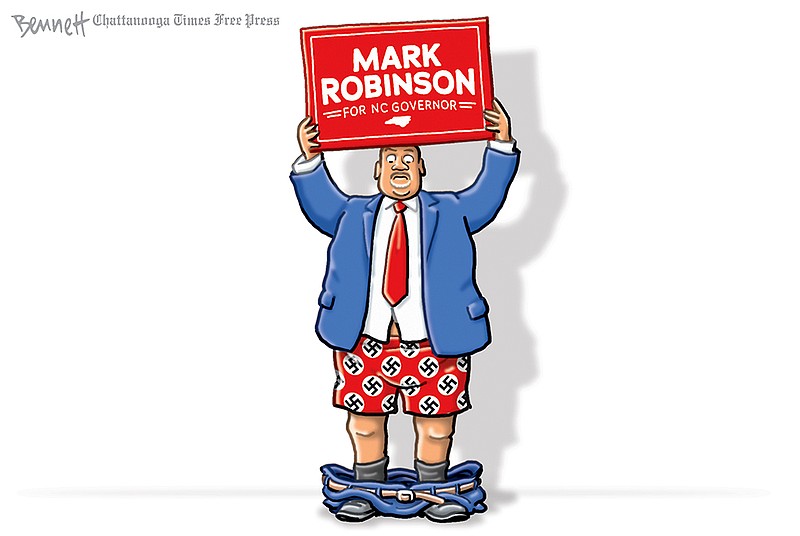
North Carolina Republicans have gotten a lot of bad press nationally for their loony candidate for governor, Mark Robinson. But the rest of the ticket is pretty far out too. Their nominee for State Superintendent of Public Instruction is Michele Morrow, who defeated the incumbent Republican Catherine Truitt in the GOP primary.

She called public schools “socialist indoctrination centers” and accused Truitt of allowing pedophiles to flourish in schools. … Morrow grabbed national attention last week when CNN ran a story highlighting her social media posts that advocated executing prominent Democrats, including Barack Obama and Joe Biden. Instead of trying to equivocate, she doubled down with a tweet accusing Obama of committing treason for drone attacks on “hundreds of innocent Muslims in Yemen.”

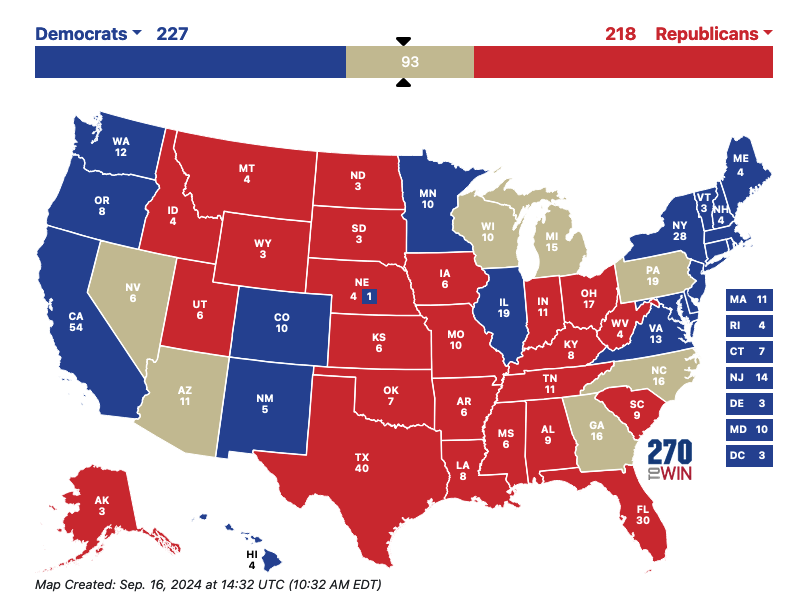
North Carolina is not that red a state any more. Due to gerrymandering, its legislature has a substantial Republican majority. But the state also has a two-term Democratic governor (Roy Cooper, who can’t run for a third term), and Trump carried it in 2020 by less than 75K votes out of more than 5 million.


Facing attention from Congress (particularly Bernie Sanders), a couple big drug makers (AstraZeneca and Boehringer Ingelheim) cut the price of their inhalers to $35 per month from as much $645. The other two major suppliers (Teva and GSK) so far have not responded.


There’s a lot of competition to be the wackiest red-state legislature, but Tennessee is definitely in the running.

Last Monday, the Tennessee Senate has passed SB2691, including an amendment “to prohibit the intentional injection, release, or dispersion, by any means, of chemicals, chemical compounds, substances, or apparatus within the borders of this state into the atmosphere with the express purpose of affecting temperature, weather, or the intensity of the sunlight”. According to The Tennessean, the amendment is based on the chemtrail conspiracy theory, which holds that the contrails of airplanes contain chemicals “sprayed for nefarious purposes undisclosed to the general public”.

But don’t worry, good citizens of Tennessee, your legislature is on the case.

and let’s close with something unexpected

Once in a while, days don’t go the way you planned. Buzzerilla collects a few examples.

What Republicans Want

A higher retirement age, an abortion ban, more tax cuts for corporations and the rich, less regulation, an end to wokeness, and to burn as much fossil fuel as humanly possible. And that’s not all.


Wednesday, the House Republican Study Committee put out a report on its budget proposals for FY 2025, which begins in October. The mainstream media publicized a few of its more controversial features, like recommending an increase in the retirement age, federally banning abortion by giving fertilized ova 14th Amendment rights, and reversing nearly everything that would hasten the day when sustainable energy replaces fossil fuels.

But the report is 180 pages, and you can’t really appreciate the steady drumbeat of wrongheadedness until you read the whole thing (which I did). This article summarizes the report in some detail. But first, let me justify why this document deserves your attention.

How political parties communicate their vision. Ordinarily, there are several ways you can figure out what a political party stands for:

  • position papers of the party’s nominee
  • a detailed platform passed by the national convention
  • bills they pass in any house of Congress they control, even if those bills fail in the other chamber or get vetoed by the president

Unfortunately, none of that works with today’s GOP. Apparently, having an “Issues” page on your campaign website is an obsolete idea. Googling either “Donald Trump for President” or “Joe Biden for President” will take you to a fundraising page with no “Issues” tab. Adding “issues” to the search helps a little with Biden, but not Trump. The Biden search will lead you to a “Priorities” page at WhiteHouse.gov, but it’s a bit out of date. (Covid-19 is still the first priority mentioned.) For Trump you’ll be directed to various news outlets’ summaries of what he stands for, not an official statement by the Trump campaign.

Of course, you could instead listen to what Trump says in his speeches, if you can make any sense out of them, beyond grasping Trump’s desire for revenge against the long list of people he feels have wronged him. As I described last week (after his “bloodbath” remark), he tends to speak in word salads that allow his partisans to claim that he didn’t really mean whatever part of his speech you found alarming.

As for platforms, the Democrats passed a fairly detailed one in 2020, which (again) is a little out of date. For example, it says “We will maintain transatlantic support for Ukraine’s reform efforts and its territorial integrity.”, but that was before Russia’s full-scale invasion started.

The Republicans don’t even offer that much. Their 2020 “platform” complains a lot about the media misrepresenting the Party’s positions, but says “the 2020 Republican National Convention will adjourn without adopting a new platform until the 2024 Republican National Convention”. What it does say is that “the Republican Party has and will continue to enthusiastically support the President’s America-first agenda”. In short: We’re for a man, not a set of ideas.

In 2021-2022, the Democrats had a House majority, but only a 50-50 position in the Senate with two Democratic senators unwilling to do away with the filibuster. So in addition to bills that became law, like the American Rescue Plan, Bipartisan Infrastructure Law, Inflation Reduction Act, CHIPS Act, Respect for Marriage Act, and so on, Nancy Pelosi’s majority passed a flurry of bills that died in the Senate: the Joe Lewis Voting Rights Act, For the People Act, George Floyd Justice in Policing Act, and a long list of others.

But the Republican majority that has controlled the House in 2023-2024 is almost completely unable to pass legislation. Simply keeping the government open has been a struggle, which finally came to a conclusion Friday, halfway through FY 2024.

Instead, their time has been dominated by battles over the speakership and investigations of the Biden family that have produced little more than talking points to raise on Fox News. The only major bill I could find that passed the House and died in the Democratic Senate was the Secure the Border Act, which would have funded a border wall and reinstituted President Trump’s wait-in-Mexico immigration policy.

So OK, you might conclude that Republicans at least have a position on the border. Of course, when Democrats tried to offer them most of what they wanted on that issue, they turned it down, preferring to retain the border as a talking point rather than take any action on it. So maybe they care about the border and maybe they don’t.

There are other places you might look to find a Republican vision for the future, but most of them are by outside groups: The Heritage Foundation, for example, has put together Project 2025, which Mother Jones has described as “a blueprint for a wannabe-White-House-autocrat”. That vision calls for undoing any effort to avoid a climate catastrophe, dismantling the civil service, and a few other things.

But that’s the Heritage Foundation, not any official GOP group. So it’s deniable.

The House Republican Study Committee report, on the other hand, actually is something. This committee is not the whole Republican conference, but it’s close: Its membership includes 166 of the 218 (or so) House Republicans. By itself, it’s the “majority of the majority” of House Republicans’ Hastert Rule. The intro letter is promising (other than the apostrophe missing in its first line – “the President of the United States cognitive decline”):

The RSC budget for Fiscal Year (FY) 25 does not shy away from the severity of the challenges America faces. As any family knows, attempting to live within your means when you are in debt is challenging. The RSC budget provides a sober pathway to balance the budget, reduce prices, preserve the programs Americans have paid into, and create economic growth and opportunity. As in previous years, the RSC budget also celebrates the work of House conservatives who have fought for legislation that preserves American values, combats Biden’s woke and weaponized government, and protects the freedoms that should be enjoyed by every American.

So OK, let’s go. What’s in it? Let’s take the sections in order.

Deregulation. This is the first section of the plan, and I was immediately unimpressed. The section’s second paragraph is:

The cost of federal regulations in 2022 was estimated to be $1.939 trillion—amounting to 7.4 percent of GDP.[footnote 1] To contextualize, the total amount of individual income tax revenues for 2022 was $2.263 trillion.[2] Despite the high fiscal toll on the American people, the Biden administration has continued to push for regulation after regulation.

Footnote [1] is a report by the Competitive Enterprise Institute, a libertarian think tank known for climate-change denial. And while that report does contain the $1.939 trillion estimate, it sends you to another footnote, and I was unable to track down what this number really means.

In general, conservative estimates of the “cost” of regulation ignore any balancing consideration of the benefits. For example, a regulation forcing utilities to replace lead water pipes with something less toxic will cost them money. However, the children whose brain development is not compromised by that lead will grow up to be more intelligent, more productive, and less likely to commit crimes (because lead exposure affects impulse control). So even if we ignore moral considerations and just talk about dollars, those are real economic benefits that any honest appraisal would have to weigh against the costs. But the CEI doesn’t do that kind of stuff.

Among the specific Biden administration regulations the RSC report calls out is “A Green New Deal emissions proposal that will make vehicles significantly more expensive”. Again, the costs of not regulating carbon emissions are ignored: stronger hurricanes, more wildfires, longer droughts, etc. The RSC targets any effort to avoid or mitigate climate change by reducing fossil fuel dependence. So: more drilling, more pipelines, less conservation, more gas-guzzling vehicles, and less accountability for energy companies.

A long list of proposals are backward-looking slaps at Covid regulations like vaccine or mask mandates. These proposals would tie the hands of public health officials in the next pandemic, whatever it is.

Another long list of proposals remove restraints from banks and other financial industries, allowing them to resume many dangerous and deceptive practices that were exposed after the 2008 financial collapse. A perennial Republican proposal is to do away with the Consumer Financial Protection Bureau, because why would consumers ever need to be protected from predatory banks and other lenders?

But OK, reasonable people can disagree about whether current federal regulations are cost-effective, or whether we need less regulation rather than more. But the proposals endorsed in this section are unlikely to lead to wiser regulatory decisions. Most of them amount to regulating the regulators, binding agencies in red tape that will make it nearly impossible for them to stop corporations who decide to make money by, in effect, killing people.

Taxes. The second section is about tax reform. You might expect Republicans to object to Biden’s tax policies, and maybe trace them back to Obama’s policies.

But no. This section begins by decrying all the taxes ever collected from Americans.

By the end of 2024, the federal government will have taken $98.9 trillion in wealth out of the hands of Americans since 1789 through taxes and other revenue.[71] To the lament of Americans everywhere, the size of government and subsequent mandatory wealth transfers have increased dramatically since the ratification of the 16th Amendment in 1913, which gave the federal government the power to tax income. From the New Deal to the Great Society, the Left has continued to tap into Americans’ hard-earned dollars to fund a bloated federal government. Put simply, bureaucrats in Washington and Democrats in Congress believe they know how to spend your money better than you.

Preach, brother! Why couldn’t the government just leave me alone to build my own interstate highway system?

The simple fact is that through government we can buy things collectively that we can’t buy as individuals: parks, clean air, defense from invaders, public health projects, and stuff like that. Precisely where to place the boundary between the public and private sectors, and how to raise the money for public-sector investments, are also questions people of good faith might legitimately argue about. But “they believe they know how to spend your money better than you” is just a stupid way to look at these questions.

And when you talk about the “bloated federal government” created by the New Deal and the Great Society, what you’re really talking about are Social Security (from the New Deal) and Medicare and Medicaid (from the Great Society). Put together, those programs make up 45% of the federal budget.

Those all fit under the general description of insurance, something government provides much more efficiently than the private sector. (To see why this is, look at medical insurance. A private insurance company devotes much of its marketing budget to making sure they attract the right kind of clients — the ones who are unlikely to get sick. But Medicare insures everybody over 65, so it can’t manipulate its client base. Also, private insurance routinely undercovers preventative care, because a company might be paying to prevent a problem that won’t appear until after the client has switched to another company.)

The HSC report makes one point about the tax system that it’s hard to argue with: “Carve-outs for special interests embody corporate cronyism”, which is bad. However, I don’t think they see the same cronies I do, because a fundamental theme of their plan is to end “high rates of taxation on investments and savings”.

I just finished doing my taxes, and, as usual, I’m appalled: Being retired, most of my income consists of dividends and capital gains, which are taxed at rates far lower than what working people pay on their wages. So even though I benefit, I see the favorable rates on investment income as “carve-outs for special interests”. Treating wages and investment income the same is what seems fair and simple to me. (Typically, the hardest part of my taxes is filling out the “Qualified Dividends and Capital Gains Worksheet”. But it saves me thousands, so I do.)

Fairest of all is cracking down on rich people who cheat on their taxes — which is why I support the Inflation Reduction Act’s increase in the enforcement budget of the IRS. (The HSC report falsely refers to this as “Providing funding to hire 87,000 new IRS agents to spy on low-and middle-income Americans.”)

And continuing their pro-global-warming agenda, the RSC wants to repeal all the fossil fuel taxes in the Inflation Reduction Act, together with any tax breaks for sustainable energy sources.

The RSC also wants to eliminate federal inheritance taxes, a.k.a. “the death tax”. Since the threshold for filing estate tax is now $13.6 million, only the estates of very wealthy people pay this tax. (If you don’t think $13.6 million sounds like wealth, you’re out of touch with the American people.)

If there’s one thing the last 50 years have proved, it’s that giving the rich tax cuts doesn’t increase revenue. But the RSC hasn’t learned this lesson.

The RSC Budget would cut taxes by nearly $5.5 trillion over the next 10 years. The pro-growth effects of these tax reductions would result in $566 billion of additional revenue.

This is what George H. W. Bush correctly called “voodoo economics” when he ran against Reagan in 1980. The RSC’s voodoo is what lets it cut taxes and claim that it produces a balanced budget.

Poverty and Welfare. The RSC report has a clear view of why people are poor: They’re lazy and need to be pushed to work more.

The RSC Budget would require all federal benefit programs be reformed to include work promotion requirements that would help people move away from dependence and toward self-sufficiency.

Here’s what the Center on Budget and Policy Priorities says about that:

Studies evaluating TANF and its predecessor’s work requirements found that the modest employment increases that occurred shortly after the requirements were first implemented faded over time (generally because most adults not subject to the requirements also found jobs, just a bit more slowly).[40] These requirements did little to reduce poverty and tended to increase rates of deep poverty (defined as income below half of the federal poverty line), rigorous evaluations found.[41] Families who lost cash assistance faced serious consequences that include higher rates of hardship, such as higher risk of homelessness, utility shutoffs, and lower school attendance among children.

Fundamentally, the Republican view of motivation is “Carrots for the rich. Sticks for the poor.” If you want rich people to do something, you have to give them a tax break or a subsidy. But if you want poor people to do something, you need to threaten them with a punishment.

But this paragraph is my favorite:

Despite two positive changes included in the Fiscal Responsibility Act, one unintended consequence was to exempt homeless individuals, veterans, and individuals aged 24 and under who were previously in foster care from the work requirement. The RSC budget supports revising existing SNAP law to ensure that these groups of people are subject to the work requirement if they do not have dependents. SNAP and our welfare system should embrace that work conveys dignity and self-sustainment and encourage individuals to find gainful employment, not reward them for staying at home.

Did you catch that? We need to be careful that we don’t reward homeless people for staying at home.

The RSC does not grasp the concept of a poverty trap, something constructive that people could theoretically do to escape poverty, but they can’t do practically because they’re too poor. For example, homeless people have trouble maintaining basic hygiene, which makes it very hard for them to get hired. But if they don’t somehow come up with jobs, we’re going to stop subsidizing their food. This is going to give them “dignity”.

Republicans also want to bundle all such programs into “block grants” that give states “flexibility to administer their own programs”. These bundles have a terrible history, because the poor can’t afford lobbyists. As a result, money in the grants tends to wind up being spent on all sorts of things other than poor people. This was at the root of the Brett Favre fraud in Mississippi.

They also want to turn child nutrition into block grants, and the report decries the “widespread fraud” in the free school lunch and breakfast program, i.e., some kids who aren’t quite poor enough are getting fed.

Defense. The RSC proposes a $895.2 billion FY 2025 defense budget, slightly more than Biden’s $850 budget. The report lists a number of things it wants to fund, but doesn’t say which ones are already in Biden’s budget.

One thing the RSC does want to do with the defense budget is fight its culture wars, eliminating any money for “woke training and programming”, such as teaching soldiers of different races, genders, and religions how to get along and respect one another. It worries about military aid to Ukraine and other nations going through international organizations that “have a history of promoting abortion or sexual orientation and gender identity programs”. It’s not enough that our money not go into such programs; the organizations associated with them are too tainted to use. It wants Defense strategy to ignore climate change, and cancels funding for efforts to run military bases on sustainable power by 2030.

DOD should not waste valuable taxpayer dollars on inefficient forms of energy. Energy needs should be met through the most cost-effective and tactically sound methods possible. The DOD should be prohibited from entering into any contract for the procurement or production of any non- petroleum-based fuel for use as the same purpose or as a drop-in substitute for petroleum. Further, the Armed Forces should be exempt from procurement requirements for clean-energy vehicles and renewable energy portfolio standards for DOD facilities.

The RSC wants to privatize as much of the military’s support positions as possible. This includes doing away with the independent school system on military bases, which is excellent.

There are long sections focused on China and Russia, but again, it’s hard to tell which proposals differ from what Biden wants to do. The report is strongly supportive of Ukraine, but does not mention that Republicans have been blocking funding since September.

The fact that Iran is “closer than ever before to a nuclear weapon” is somehow Biden’s fault, when it was Trump who cancelled the agreement that controlled Iran’s nuclear programs. The report describes Trump’s “maximum pressure” campaign against Iran as “successful”, even though this policy failed to produce the “better deal” Trump promised.

The Hamas attack on Israel is also somehow Biden’s fault, and had nothing to do with Trump’s decision to ignore the Palestinian problem entirely.

Conservative values. There’s a long section on abortion, beginning with

RSC celebrates the Dobbs v. Jackson Women’s Health Organization decision as a historic victory in the effort to defend innocent life and to return to the Constitution as it was written. … The RSC Budget applauds the following measures designed to advance the cause of life:

Then follows a long list of proposals various Republicans have advanced to limit women’s access to abortion, including ones that would federally block drug-induced abortions, prohibit abortions after the mythical six-week “fetal heartbeat”, recognize a newly fertilized ovum as a “person” under the 14th Amendment, ban abortions at 15-weeks due to mythical fetal pain, prohibit the use of fetal stem cells in research, prohibit any ObamaCare health insurance policy from covering abortion, prevent telehealth services from prescribing abortion drugs, deny federal funds to universities whose student health organizations provide abortions, and dozens of others.

The report endorses a similar list of anti-critical-race-theory proposals, which ban teaching or promoting “critical race theory” in all sorts of settings. No one can define CRT, but as best I can tell, any recognition of White privilege in America or any truthful recounting of America’s racial history violates these proposed laws.

A number of proposals to protect gun rights are lauded, including several that prevent the government from keeping track of who owns or purchases guns. The RSC also wants to defund red-flag rules that take guns away from domestic abusers, allow concealed carry across state lines, and remove regulations on silencers. The problem of mass shootings is not mentioned.

The report endorses the usual bunch of anti-trans proposals: targeting trans athletes, banning care options, mandating bathroom policies, etc. The section on the border is about what you’d expect: finish Trump’s wall, reinstitute Trump’s cruel and probably illegal treatment of migrants, etc. Some proposals (like hiring more asylum judges to process cases faster) were included in the border proposal Republicans tanked after Trump said he wanted the issue to campaign on. The RSC also wants to reinterpret the 14th Amendment so that it no longer guarantees birthright citizenship, despite what the text actually says.

Healthcare. The RSC wants to return to the bad old days before ObamaCare. The report calls for a “more market-oriented” approach to health insurance, and promises lower premiums by eliminating “ObamaCare mandates”. In other words, you could once again buy junk insurance that doesn’t cost as much but will vanish in a puff of smoke when you actually need it. States would be empowered to define what insurance plans have to cover, and insurance companies could sell across state lines. This would lead to a race-to-the-bottom among states, similar to what we saw with credit card regulation after interstate banking was approved. (There’s a reason why you have to send your payments to South Dakota.) Younger, healthier individuals could get lower-priced policies, taking them out of the insurance pool. The result would be exorbitantly expensive insurance for people who actually need care. The Inflation Reduction Act’s provisions to control drug prices would be repealed. Medicaid and the Children’s Health Insurance Program would be “streamlined” by turning them into block grants to the states.

Medicare. The RSC plan to “save” Medicare is essentially a privatization plan, where Medicare mainly provides premium supports for private insurance programs.

This plan ignores one essential fact about private health insurance: Competition between insurance companies does not center on providing better care at lower prices, but on luring healthier clients and discouraging sicker ones. Denying care is a double-win for an insurance company. Not only does the company not pay for the care, but patients who need care will be motivated to find other insurance.

Take cancer, for example. You don’t really know how good your plan’s cancer coverage will be until you get cancer. But at that point you have become an undesirable customer, so the company would rather you switched to some other insurance. Providing the kind of care and service that attracts people with cancer is a bad business model.

Social Security. The report points to the projection that the Social Security Trust Fund will run out of money in 2033, and correctly observes that there are three things to do about that: keep the program running with money from the general fund, raise taxes, or cut benefits. It rejects the first two options and proposes to cut benefits.

Recognizing political dynamite, the RSC refuses to cut current benefits for people already retired. However, Republicans would

  • force Congress to vote on cost-of-living increases every year, as opposed to the current system where COLAs are automatic
  • lower benefits for future retirees in a means-tested way
  • raise the retirement age as life expectancy rises.

None of these benefit cuts are quantified. And, as always, Republicans promise increased revenues from the (mythical) economic growth that their income tax cuts will promote. These days, though, they also add in the economic “growth” that will come from burning more fossil fuels (as long as you don’t have to account for the costs of climate change).

Raising the retirement age as people live longer and are able to work longer makes a certain intuitive sense. But there’s a problem: The gains in lifespan almost entirely benefit wealthier people. Working class and poor people, in general, have had only modest increases in life expectancy in recent decades.

MIT News reported in 2016:

[T]he study shows that in the U.S., the richest 1 percent of men lives 14.6 years longer on average than the poorest 1 percent of men, while among women in those wealth percentiles, the difference is 10.1 years on average.

This eye-opening gap is also growing rapidly: Over roughly the last 15 years, life expectancy increased by 2.34 years for men and 2.91 years for women who are among the top 5 percent of income earners in America, but by just 0.32 and 0.04 years for men and women in the bottom 5 percent of the income tables.

Also, while people who do primarily mental work can easily work into their 70s if they’re so inclined, people who do physical labor often don’t have that option. If you raise their retirement age, they’ll wind up eating cat food.

Budget reform. The RSC proposes a series of “reforms” that would lock the government into conservative priorities, no matter what the voters want. Like a constitutional amendment to cap revenues and force a balanced budget.

This proposal would bar annual spending in excess of 20 percent of GDP and prevent Congress from relying on tax increases to balance the budget, which is key to preserving a dynamic and innovative economy.

This is a seriously bad idea. For example, consider the recent pandemic. In FY 2020 (Trump’s last full year), federal spending was over 30% of GDP. That spending was what allowed Americans to stay home, and prevented many Americans from losing their homes when their jobs disappeared. If the government had been limited to 20% of GDP, Covid would have run wild and probably millions more Americans would have died. Millions of others would have been homeless.

Now start imagining various future climate-change doom scenarios — seas rising, farmlands turning to deserts, and so on. The government would just have to throw up its hands.

And not allowing Congress to raise taxes makes all sorts of policy changes impossible, whether voters want them or not. Republicans wouldn’t have to argue against Medicare for All or the Green New Deal, for example, because both would be constitutionally infeasible.

The RSC also proposes that the reconciliation process not be allowed to increase spending or taxes. In other words, if Republicans get control of the presidency and Congress, they can use reconciliation to pass their priorities (like the Trump tax cuts), but if Democrats get control, they can’t pass theirs (like the Inflation Reduction Act).

Other mandatory spending. There’s a grab-bag of stuff in here, most of which was too in-the-weeds for me to evaluate. However, I did notice the proposals to end student loan forgiveness, auction off the TVA’s non-nuclear assets, revoke the charters of home-loan guaranteeing agencies Fannie Mae and Freddie Mac, and reduce the benefits of federal employees.

Non-defense discretionary spending. Another grab-bag of (mostly) cuts. Stop the Forest Service from buying more land. Eliminate anything to do with “the left’s climate agenda”, or any program that can be tarred as “woke”. Eliminate the Consumer Product Safety Commission because it advances “Biden’s radical climate agenda, including attempting to ban gas stoves”. (This whole talking point is a canard. The footnote that supposedly supports it includes a CPSC spokesman saying the commission “isn’t coming for anyone’s gas stoves”.)

The RSC wants to cut funding for the Cybersecurity and Infrastructure Security Agency, not because cybersecurity isn’t a problem, but because CISA is trying to fight disinformation online. The Republican agenda is based on disinformation, so they see this as a threat. Similarly, Republicans want to eliminate Targeted Violence and Terrorism Prevention Grants, because the program doesn’t exempt right-wing terrorist groups. OSHA is targeted for cuts to get revenge for President Biden’s Covid vaccine mandates. Similarly, the US contribution to the World Health Organization is eliminated.

Of course Republicans want to cut funding for the EPA and leave the Paris Climate Accords. Also: stop funding Amtrak and prohibit spending on high-speed rail.

The report calls for eliminating the National Endowment for the Arts, National Endowment for the Humanities, and Corporation for Public Broadcasting, as well as cutting support for the Smithsonian (because the museum complex is too woke).

So there it is: the Republican fantasy world in its full glory. Now you know what you’re voting for if you vote Republican in November.

Is Donald Trump Still Rich?

Today we’ll find out whether Trump can raise half a billion dollars.


Today is the deadline for Trump paying an appeal bond that would put his $464 million civil fraud judgment on hold while his appeal plays out. All week news outlets have been speculating about what might happen.

Trump’s lawyers have claimed that posting the bond is “a practical impossibility” because they’ve been turned down by 30 bonding companies. Trump himself then contradicted his lawyers by claiming on Truth Social that he does have the money (more about that below), but that the judgment was “rigged and corrupt”, as if saying that absolves him from paying what he owes. All Trump spokespeople claim that he’s worth far more than the bond, but that he’s having trouble raising the money because his assets are mostly in illiquid real estate that bonding companies don’t want to take as collateral.

That explanation doesn’t make a lot of sense, for a number of reasons. First, while bonding companies may not like to hold real estate, banks make real-estate loans all the time. So if he’s really worth the money, he should be able to get a bank loan that he can either use to pay the money himself, or to show to a bonding company as evidence that he can pay it.

Trump’s lawyers also cited the time it would take to raise this much money. They were writing a week before the bond was due, which does sound like a tight timeline. But NY Attorney General James filed the lawsuit almost a year and a half ago. Judge Engoron issued a summary judgment against Trump in September, and the recent trial was just to determine the penalty.

So Trump has had plenty of time to make a what-if-I-lose plan. If he didn’t, that isn’t anybody else’s problem now.

I only see two explanations that make sense:

  • Trump can raise the money, and his lawyers were lying to the court. Maybe this was a negotiating tactic to pressure the appeals court to lower the bond. Or maybe he wanted an impending crisis to fund-raise with. Or maybe he actually wants Tish James to start seizing his properties, because that would underline his claims to the voters about how persecuted he is.
  • Trump can’t raise the money, because he’s not worth that much. Everyone agrees that the assets of the Trump Organization are worth considerably more than what the court demands. But we don’t know how much he has already borrowed against those properties, so there may not be much equity left. The Trump Organization claims its properties are “among the most valuable and prized office towers anywhere in the world“, but the value of such buildings has plummeted post-Covid. Maybe he can’t get a half-billion-dollar loan on them because the numbers just don’t add up.

One possible deus ex machina in this situation is that Truth Social is about to go public. In theory, Trump’s shares in the company would be worth billions — possibly more than he has ever actually been worth. Currently, he’s not supposed to sell the shares or use them as collateral for six months. (That’s a fairly standard IPO lockup provision.) But the board, which Trump controls, could waive the lockup.

As Jay Kuo points out, though, there’s something hinky about this whole situation: Truth Social shouldn’t be worth much at all, and certainly not billions.

Truth Social is not a successful company, at least not yet. It had only about $5 million last year in revenue, and it had lost over $30 million through the third quarter of 2023. Its user base is paltry at just 8.9 million registered users, and it’s not very likely to grow into anything like the next Facebook or Twitter. 

For comparison, X/Twitter has 335 million users and is estimated to be worth a little over $12 billion (after Musk paid over $40 billion for it).

Kuo classifies Truth Social (which will trade under the name Trump Media and the symbol DJT, Trump’s initials) as a “meme stock”, one that has few institutional investors, but is owned by individuals who hype it on social media. Such stocks typically collapse at some point. So the odds are low that Truth Social will be worth billions when Trump’s six-month lockup period runs out.

Truth Social is a speculative investment bubble that will reward those who can cash out at the high and punish those who are left holding the bag at the end. Trump is quite adept at this scam. He once sold NFT Trump “trading cards” to his base that went sky high before sales dropped 99 percent.

Ditto for Trump’s $399 gold sneakers.

In short, Trump Media is “the biggest grift of his life”. We’ll see if he pulls it off.


Trump’s lawyers talk as if nothing has been decided yet, because he can still appeal. But he lost the case. Losing in court actually means something, and courts require appeal bonds so that losers don’t abuse the appeal process just to delay paying.

The thing you have to keep in mind when Trump or his lawyers whine about the hardship of having to sell at “fire sale prices” is that paying your debts is often painful. Most Americans already understand that fact of life, and it shouldn’t change just because your name is Trump.


You have to love this Truth Social post by Trump. (I’ll spare you the all-caps.)

Through hard work, talent, and luck, I currently have almost five hundred million dollars in cash, a substantial amount of which I intended to use in my campaign for president. The often overturned political hack judge on the rigged and corrupt A. G. case, where I have done nothing wrong, knew this, wanted to take it away from me, and that’s where and why he came up with the shocking number which, coupled with his crazy interest demand, is approximately $454,000,000. I did nothing wrong except win an election in 2016 that I wasn’t expected to win, did even better in 2020, and now lead, by a lot, in 2024. This is communism in America!

The remarkable thing about this post is that almost every piece of it is false.

  • He got rich by inheriting hundreds of millions from his Dad, possibly in violation of tax laws. That could be seen as a combination of luck and fraud, but not hard work or talent.
  • Far from using his own money in his campaign, he’s been using campaign cash (mostly from his Save America PAC) to pay his personal legal bills. The idea of getting the RNC to pay his legal bills has also been floated. (See cartoon below.)
  • As for whether Judge Engoron is “frequently overturned”, I’ll have to see some evidence of that. “Political hack”, “rigged”, and “corrupt” are standard Trump insults that he throws at anyone standing in his way.
  • The size of the judgment against Trump is large, but doesn’t come out of thin air: It’s the difference between the interest rate he was offered without needing to make personal guarantees, and the interest rate he actually paid. Since the personal guarantees were backed up with fraudulent statements, the difference constitutes an ill-gotten gain which the state has demanded he disgorge. The total includes no punitive damages or anything else subjective.
  • The “crazy” 9% interest rate he’s being charged is set by law, and would apply to anyone.
  • What he did wrong was submit fraudulent financial statements.
  • Due to the Electoral College, he did unexpectedly win an election in 2016, despite Hillary Clinton getting 2.9 million more votes. And while he did get more votes in 2020 than in 2016, he lost to Joe Biden by seven million votes, which is a strange definition of doing “even better”.
  • He currently leads in some polls but not others, and never by “a lot”. The latest Economist polling average has Biden up by 1%.
  • “Communism” is another meaningless Trump insult. His situation has nothing to do with public ownership of the means of production.

So what are the odds that ” I currently have almost five hundred million dollars in cash” is true?


Trump’s predicament has given Biden a biting joke to tell on the campaign trail.

Just the other day a defeated-looking man came up to me and said, “Mr. President, I have crushing debt, and I’m completely wiped out.” And I had to look at him and say, “Donald, I’m sorry. I can’t help you.”

The Monday Morning Teaser

Big day today. We get to find out (at what time, I’m not sure) whether Trump can come up with the half-billion dollar appeal bond he needs to avoid having Tish James start seizing his assets, as the state would for any other deadbeat. There’s been a lot of coverage of what might or might not happen, which I’ll try not to duplicate. But in the featured post “Is Donald Trump Still Rich?” I’ll comment on what all this seems to mean. That should be out shortly.

Today’s other featured post (“What Republicans Want”) is a deep dive into the House Republican Study Committee’s report on its budget proposal for FY 2025. Ordinarily, a report like this wouldn’t be a big deal. But I’m calling special attention to this one because there’s very little other evidence of what the Republican Party wants or stands for. Their nominee talks in word salads full of violent imagery, their last national convention didn’t bother to write a platform, and their House majority can’t even pass stuff for the Senate to ignore or Biden to veto. So what are they running on?

Major media reports have provided snapshots of what the report contains (like an abortion ban and a proposed increase in the retirement age), but you can’t really grasp the persistent wrongheadedness of the GOP without going through the full 180 pages — which I did so you don’t have to. I’ll try to get that post out by 10 EDT or so.

The weekly summary covers the last-minute deal to yet again avoid a government shutdown, Gaza, the Moscow terror attack, other Trump trial news, and a few other things. It should appear around noon.

Fantasies

Strongman rule is a fantasy.  Essential to it is the idea that a strongman will be your strongman.  He won’t.  In a democracy, elected representatives listen to constituents.  We take this for granted, and imagine that a dictator would owe us something. But the vote you cast for him affirms your irrelevance.  The whole point is that the strongman owes us nothing.  We get abused and we get used to it.

– Timothy Snyder “The Strongman Fantasy

This week’s featured posts are “The Other Reason I’m Optimistic” about the 2024 election and “The ‘bloodbath’ statement“.

This week everybody was talking about bloodbaths

I was going to summarize the controversy over Trump’s prediction of “a bloodbath” if he doesn’t get elected, but the length got out of hand, so I made it a featured post.

and Florida

Ron DeSantis suffered two major defeats this month in his war on woke. The first was two weeks ago, when a federal appeals court blocked enforcement of one provision of his Stop-Woke law. The opinion, written by a Trump appointee, lays things out pretty clearly.

Here’s a short version: Among other things, the law bans employers from having mandatory meetings where they promote certain notions that state doesn’t like about discrimination, diversity, and so forth. On its face, this sounds like a violation of the employers’ freedom of speech, but the DeSantis administration claims it’s really a limitation on conduct (holding these meetings), not speech.

The judge rightly points out that mandatory meetings are only banned if certain ideas are presented, so there’s no way to know ahead of time whether a meeting is banned without knowing what people are going to say. That makes it a limitation on speech.

The second defeat was the settlement of a lawsuit against DeSantis’ Don’t Say Gay law. The worst thing about Don’t Say Gay has been the vagueness of it. Nobody knew exactly what ideas the law banned from Florida schools, so teachers and administrators who wanted to be safe just wouldn’t say anything at all about non-traditional gender roles or sexuality.

Under the agreement, the state must clarify the law’s scope to schools across the state, ensuring that, among other things, it does not prohibit references to LGBTQ+ persons, couples, families, or issues in literature or classroom discussions.

and the Trump trials

The trial that we thought was on track fell off track, and another one got rolling again.

The New York state trial for the pre-2016-election cover-up of the Stormy Daniels payments was supposed to start next Monday, but it’s delayed into at least April. At issue are some documents that just got released by the US Attorney’s office, and whether the defense has had adequate time to review them.

In the Georgia RICO trial, the judge has allowed Fani Willis’ office to go forward, after removing Willis’ ex-lover from the prosecution team. If the judge had disqualified Willis, it’s not clear when or whether the case would have proceeded. No trial date has yet been set.

but I want to call your attention to two books

One of my favorite observers of the intersection of technology and society is Cory Doctorow. He currently has two new books out, one fiction and one non-fiction.

The novel is The Lost Cause which takes place in a late-2030s California dealing with a much-advanced climate crisis, as well as the residue of our current political polarization. The country has had 12 years of Green New Deal administrations, and is now going through a backlash that includes a lot of old white guys in MAGA militias. To me, it’s ambiguous whether the “lost cause” in the title is the MAGA effort to maintain white male privilege or the Green New Deal effort to save the world itself.

Two things stand out: Climate-change futurism tends to bifurcate simplistically into we-save-the-world or we-don’t-save-the-world. I found it enlightening to spend time in a world where a lot of bad things have happened, but the struggle goes on. There’s a lot in this novel that is dystopian and a lot that is hopeful.

Second, I think Doctorow is right about where MAGA is headed with regard to climate change. Right now, the MAGA consensus is to ignore the problem. (Trump wants to be a dictator on Day 1 so that he can “drill, drill, drill“.) But in Doctorow’s future, they turned on a dime from “it’s a hoax” to “not everybody is going to make it, so we have to make sure our people do”. Climate change has become one more justification for anti-immigrant fascism.

The nonfiction book is The Internet Con: how to seize the means of computation. He emphasizes that the current tech and social media giants are not natural outcomes of the free market, but stem from changes in the laws, especially antitrust enforcement and copyright laws.

It’s not that there was one magical generation of entrepreneurs like Jeff Bezos, Mark Zuckerberg, et al, but that the leading corporations at a particular moment in history were allowed to cement themselves into place and insulate themselves from competition.

For example, your email app doesn’t own your email files, but Facebook owns your Facebook posts, which you’ll lose if you close your account. As a result, you can change email clients whenever you want, but switching from Facebook to some other social media platform is much more arduous. You can send email to people who use other email apps, but you can’t see X/Twitter messages on BlueSky.

The result is what Doctorow has elsewhere called the “enshittification” of the internet. Companies can implement policies for their own advantage rather than yours, and there’s little you can do about it.

The book is full of suggestions for how to turn this around.

and you also might be interested in …

The House passed a ban/forced-sale of TikTok, which is owned by a Chinese company and heavily influenced by the Chinese government. What will happen next is unclear.

Trump abruptly switched his position on this issue: He tried to ban TikTok by executive order when he was president, but now he’s against the legislative ban. The flipflop closely followed a meeting with conservative financier Jeff Yass, who is heavily invested in TikTok.

Have I mentioned that Trump needs a lot of money?


I really enjoy this Biden ad, especially the last few seconds.


Russia held its version of an election, and you’ll never guess what happened: Putin was reelected to a fifth term as president with 87% of the vote. There were other names on the ballot, but only the ones Putin allowed to be there. No candidate was vocally anti-Putin or against the Ukraine War.

Supporters of Alexei Navalny (who wanted to run against Putin, but instead died in prison), staged a subtle protest by all showing up to vote at noon. The long lines at the polling places were, in effect, Navalny demonstrations.

Russian prosecutors threatened any voters who took part in the “noon against Putin” action with five years in prison. In the southern city of Kazan, police detained more than 20 voters who had joined the protest, according to the independent rights monitor OVD-Info. Arrests were also reported in Moscow and St Petersburg.

It will be interesting to see what, if anything, the government finds to charge these people with.


When we talk about climate change, we usually focus on rising air temperatures. But maybe we should be paying more attention to how fast the oceans are heating up.


A rule change could make it much harder to go “judge shopping“.

and let’s close with something timely

Tim Blais is one of those people whose collection of talents seems unfair. He’s musical, does great videos, and also knows a lot of science. His A Capella Science YouTube channel has some amazing stuff, like a Billy Joel parody “The Arrow of Entropic Time“.

The “bloodbath” statement

The week’s most hotly debated line was Trump’s prediction of “a bloodbath … for the country” that will happen “if I don’t get elected”. Biden and others saw this as a call for political violence, while Trump apologists said the statement wasn’t really so bad “in context“.

Let’s unpack all that.

What he said, in context. First off, the reason we’re having a discussion over what Trump meant is that what he actually said is incoherent.

China is now building a couple of massive plants where they’re going to build the cars in Mexico and think, they think, that they’re going to sell those cars into the United States with no tax at the border. Let me tell you something to China. If you’re listening, President Xi — and you and I are friends — but he understands the way I deal. Those big monster car manufacturing plants that you’re building in Mexico right now, and you think you’re going to get that, you’re going to not hire Americans and you’re going to sell the cars to us? No. We’re going to put a 100% tariff on every single car that comes across the line, and you’re not going to be able to sell those cars if I get elected.

Now, if I don’t get elected, it’s going to be a bloodbath for the whole — that’s gonna be the least of it. It’s going to be a bloodbath for the country. That will be the least of it. But they’re not going to sell those cars. They’re building massive factories.

If Biden said something this disjointed, it would be taken as evidence of cognitive decline, because Biden typically makes way more sense than this. But OK, let’s play the what-did-he-mean-by-that game.

Immediate background. Chinese automakers like BYD build some really cheap cars, especially cheap electric cars, that haven’t been marketed widely in the US yet. Apparently there are plans to build such cars in Mexico, and the current trade agreement (which Trump negotiated and bragged incessantly about, remember) might allow those cars to come into the US without a tariff. NHK World (a Japanese news source) says:

A growing number of Chinese automakers have been constructing production plants in Mexico. The trade deal currently in place in North America allows tariff-free vehicle shipments from Mexico to the US if they meet strict conditions.

So at least at the outset, Trump is talking about not letting that happen: He’ll impose a 100% tariff if they try that. [1] The most generous construction to put on Trump’s words (and the one he now says he meant) is that the “bloodbath” is a metaphor describing what will happen to the US auto industry if it has to compete with those cars.

But he also said “that’s going to be the least of it”. It’s an open-ended expansion of the “bloodbath” in the auto industry to “the country”. Is it still metaphoric, referring to large job losses across all US manufacturing, or has it become literal, presaging the “civil war” that many of Trump’s supporters say they want?

Larger background. In his January 6 speech, Trump repeatedly urged his listeners to “fight”, which is a common thing to say metaphorically in a political speech. However, a mob of his listeners then did literally fight, attacking the Capitol and injuring over 100 police with bear spray and flagpoles they used as clubs.

Trump still defends those people. In the same speech where he made the “bloodbath” comment, he called them “hostages”. He has repeatedly promised to pardon them if he’s elected.

So like “fight”, Trump’s “bloodbath” is arguably metaphorical and arguably not. But in any case, it happens in the “context” of Trump’s large number of violent supporters. He knows they’re out there, just as he knew that some of the people listening to him on January 6 were armed. His promise of pardons for the January 6 rioters suggests that people who do violence for him in this election will also be pardoned.

Convenient ambiguity. Trump could, of course, clear this all up. He could give a speech where he unambiguously denounces political violence and disowns supporters who commit crimes in his name — including the January 6 rioters who are not “hostages” or political prisoners, but criminals who have been convicted by juries of their peers of breaking real laws (like assaulting police officers). He could echo what Biden said in the state of the union, that “political violence has absolutely no place — no place in America. Zero place.”

He won’t do that. Instead, he will keep doing what he did Saturday in Ohio: using violent rhetoric as part of a word salad that has no single obvious interpretation, while defending and offering aid to those who have committed crimes on his behalf. When called to account, he will howl about the biased media taking him out of context, and claim that his word salad should receive the most benign possible interpretation.

But he doesn’t deserve that kind of generousity. Voters and the media should apply a principle that lawyers call contra proferentem: If you write something ambiguous into a contract, a court will resolve the ambiguity against you.

Same thing here. Trump repeatedly and knowingly creates ambiguity about whether or not he is rallying his supporters to commit violence after he loses in November. Until he stops, that ambiguity should be resolved against him.

So yes, he did call for violence on Saturday.


[1] There’s a whole other issue here: One of Trump’s big criticisms of Biden is over inflation. But just about every economic proposal Trump has would make stuff more expensive. This is just one example.

The Other Reason I’m Optimistic

Joe Biden’s ace in the hole is Donald Trump himself, who has fallen into the Autocrat Trap.


Previously I’ve outlined why I’m optimistic that President Biden will prevail in the fall, saving the US from a Hungary-style autocracy:

  • Biden is on the right side of many issues the public cares about, like abortion, gay rights, gun violence, Ukraine, climate change, and democracy itself.
  • The economy has been improving long enough that the public has started to notice.
  • The Biden administration’s legislative accomplishments validate his view that government can do good things for the American people, like rebuild our roads and bridges, lower the cost of prescription drugs, or bring broadband internet to rural communities. (Trump’s primary legislative accomplishment was to give the wealthy a big tax cut.)
  • The electorate continues to change in Biden’s favor, as older MAGA voters die off and are replaced by younger, more liberal voters. [1]

But there is one more reason I’m optimistic — not a positive thing about Biden but a negative thing about Trump: He has fallen into the Autocrat Trap.

Trump has declined since 2016. Before I explain what that trap is, let me point out that I’m not the only one to notice that Trump is off his game. In a recent TPM newsletter, Josh Marshall started with a blunder Trump made in an interview (“there is a lot you can do in terms of entitlements in terms of cutting”, which sounds an awful lot like a threat to Social Security and Medicare), and expanded to a more general point, that Trump is “rusty” and has “lost his touch”.

Marshall paints a picture of how Trump’s rhetoric has changed since 2016.

Trump’s 2016 campaign’s success stemmed in large part from channeling the cultural and social grievance of middle aged white American men. His 2024 agenda is heavily focused on his personal grievances and doing away with all the restraints on the presidency that hobbled him and led to ego injuries in during his first term

2016 Trump communicated that your resentments were his resentments, but 2024 Trump has turned that identification around: He wants his resentments to be your resentments. 2016 Trump got upset that “the elites” weren’t giving ordinary people a fair shake. But 2024 Trump wants ordinary people to get upset that “the Deep State” isn’t giving him a fair shake.

2016 Trump literally crowd-sourced his message. “Build a wall” and “Lock her up” started as throw-away lines, but when his crowds responded to them they became the center of his campaign. But 2024 Trump’s relationship to the crowd has changed.

Even in Trumpian terms his speeches these days are disjointed, weird, discordant. And again — not by the standard of who you might want within a mile of the Oval Office. I mean even in terms of Trumpian politics. He’s not the same.

Marshall doesn’t assign a definite cause to this “rustiness”, but suspects age might be a factor, together with the sting of his 2020 defeat (which he knows was a defeat, no matter what he says), and panic about the legal peril he faces.

Whatever the precise mix, it also impacts his political agility and feel for the popular mood. It leads to stuff like this wholly unforced entitlements goof. This probably won’t be the only example. It hasn’t gotten much attention yet because even though Trump gets coverage, he hasn’t been in the mix of an actual campaign in years. We’ll see more of it because, again, he ain’t the same.

Actually, it’s already not the only example: Trump gave away his best issue by telling Speaker Johnson to torpedo the border bill that Congress was ready to pass. Now Biden has an answer to criticism on that issue: I tried to solve it, but Trump had his allies stop me. The inaction on the border is now arguably Trump’s fault, not Biden’s. [2]

And while I agree that Trump is showing some decline from aging, I don’t think that’s the main source of his recent (and future) mistakes. I think he’s fallen into what we might call the Autocrat Trap: His successful purge of his inner circle, together with his complete intimidation of the Republican Party, means that he is surrounded by sycophants. Absolutely no one is in a position to tell him “You can’t do that. That’s a bad idea.”

Even a great leader needs such people. George Washington had them. Lincoln had them. FDR had them. Trump doesn’t.

How the Autocrat Trap works. I’m going to make a Hitler comparison here, but not so that I can smear Trump by using his name in the same paragraph as one of history’s most hated people. If you want to object that Trump hasn’t started a world war or set up death camps, that’s fine; it doesn’t affect the point I’m making.

I’m mentioning Hitler because he is a well known and extreme example of an autocrat. If there were some dysfunction typical of autocrats, we’d expect to see it in Hitler. And we do.

By 1936, Hitler had eliminated public political dissent, but he still had to face behind-closed-doors resistance from his general staff (the 1930s German equivalent of “the Deep State”). In a nutshell, Hitler was a risk-taker and the generals were more cautious. The military men recognized Germany’s rearmament was incomplete, and understood that the Fatherland would lose any rematch with France and/or Britain. But Hitler grasped just how traumatized the British and French people still were by the Great War of 1914-1918, and bet that their elected leaders would avoid restarting that war, even if they would surely win it again.

So over the generals’ protests, Hitler ordered one audacious move after another: advancing into the Rhineland demilitarized zone bordering France (1936), Austria (spring of 1938), the western section of Czechoslovakia (fall of 1938), and the rest of Czechoslovakia (spring of 1939). As Hitler had foreseen, the Western Powers did nothing. The invasion of Poland (fall of 1939) brought declarations of war, but no counterattacks. Denmark and Norway (April, 1940) fell with little opposition.

By then, rearmament was complete and Germany was ready to reverse the outcome of the Great War: France, Belgium, and the Netherlands fell in May of 1940, and the air war against Britain began.

Picture Hitler at that point. He was a gambler with hot dice. He had proved again and again that when cautious people tried to hold him back, they were wrong and he was right. So why should he listen to them at all? Events had shown that he was a genius. He had a destiny.

That’s when the big mistakes started. He attacked Russia before he had finished off Britain. He let the Greek campaign delay the Russian campaign. And then, rather than postpone until the next spring, he launched his attack in late June of 1941. Due to the late start, and despite initial military successes, German forces were still short of Moscow when the fall rains turned Russia’s roads to mud. In winter, the Russians counterattacked. Hitler’s generals advised pulling back to a more defensible position and restarting the advance in spring. But why would he listen to them? They had always advised more caution, and they had always been wrong. So: no retreat, not a single inch.

German losses that winter were horrific, turning the Russia campaign into a war of attrition that put Germany at a disadvantage. And though the German advance was able to restart when the weather changed, those first-winter casualties contributed to the decisive defeat at Stalingrad in early 1943. The Allies launched D-Day from the still unconquered British Isles in 1944, and the war was soon lost.

Trump 2024 vs. Trump 2016. When Trump ran in 2016, the Republican establishment was against him. As he won one primary after another, they slowly got on board. But many got off again after the Access Hollywood tape leaked a month before the election. Some even called for him to withdraw. (Luckily for Trump, he managed to keep Stormy Daniels’ story from getting out and making things worse, and his allies at WikiLeaks were able to muddy the news cycle by releasing a batch of Democratic emails hacked by his allies in Russia.)

Thanks to the Electoral College, he won anyway, proving that he was right and the naysayers were wrong. But even as he took office, many power players in Washington had no particular loyalty to him, like Speaker Paul Ryan and Majority Leader Mitch McConnell.

A new president has to appoint thousands of executive branch officials. But who? TrumpWorld had never been that big, and McConnell’s Senate was unlikely to confirm Trump yes-men with no relevant experience. So initially, the Trump administration was staffed with veterans of the Bush administration or Congress, CEOs, and military men who saw themselves as Republican or conservative, but not necessarily MAGA. Again and again, such appointees got in Trump’s way: Attorney General Jeff Sessions (the first senator to endorse Trump’s candidacy) appointed Special Counsel Bob Mueller and refused to interfere in his investigation. National Security Advisor H. R. McMaster and Defense Secretary James Mattis repeatedly stopped him from withdrawing from Afghanistan. White House Counsel Don McGahn refused Trump’s order to fire Mueller and regularly warned him that things he wanted to do were illegal.

By 2020, many of the Trump officials more loyal to the law or the nation than to Trump had either been fired or left in frustration. But apparently not enough of them, so Trump appointed John McEntee to conduct a purge of his insufficiently loyal subordinates, many of whom were replaced with “acting” officials the Senate never confirmed.

Even so, after Trump lost the 2020 election, his effort to stay in office anyway was repeatedly hindered by members of his own administration. Vice President Mike Pence refused to cooperate in the January 6 plot. Joint Chiefs Chair Mark Milley made it clear the military would not intervene in his favor. Acting Attorney General Jeff Rosen wouldn’t sign Jeff Clark’s bogus letter telling the Georgia legislature that the Justice Department had “identified significant concerns that may have impacted the outcome of the election”, and also led a department-wide threat to resign if Trump named Clark to replace him. The previous attorney general, Bill Barr, publicly denied that the Department had found any evidence of the election fraud Trump was claiming.

All those people are gone now. They have been branded as turncoats and banished from any future Trump administration. Even Ivanka and Jared have withdrawn. [3]

In the meantime, the MAGA cult has expanded. Much of the attention this has gotten has focused on a potential second Trump administration: The Heritage Foundation has launched Project 2025 to collect resumes of loyalists hoping to staff the next administration.

Unlike previous presidential transition teams, this one is focused on personal loyalty, not experience or other qualifications. (A question from the application: “The president should be able to advance his/her agenda through the bureaucracy without hindrance from unelected federal officials. Agree/Disagree/Neither.”) So when Trump-47 decides to overthrow democracy, the only question he’ll face is “How do you want us to proceed, sir?”

But something similar has happened elsewhere, and the consequences have gotten less attention. Trump’s lawyers have become little more than mouthpieces for what he wants the public to believe about his trials, whether that strategy helps or hurts him inside the courtroom. (Judging from the size of the civil judgments against him, it hurts.) On the political side. Trump has made his daughter-in-law head of the RNC and started a purge of the staff.

So across the board, anybody who might have the independent stature to say, “I know you’re the boss, but this is dumb” is long gone. Even after a mistake is in motion, nobody is going to point it out to him.

So far, his blunders haven’t hurt him much, largely because he hasn’t been getting that much attention. He stayed away from mass-viewer events (like debates) during the primary campaign, and the mainstream media has all but stopped covering his rallies. Most voters have barely seen the 2024 version of Trump, and have barely paid attention to his pronouncements on major issues.

That has started to change, and will change more and more as the election approaches. This summer’s Republican Convention, I predict, will be a major disaster for Trump, because he will have complete control of it. And day after day, all the way to the election, a sycophant-supported Donald Trump on the campaign trail will be Joe Biden’s greatest asset.


[1] The replacement-by-illegal-immigrants story Trumpists tell is nonsense, but the fact that they are being replaced — by their children and grandchildren — is true. Trumpists helped this trend along by refusing to be vaccinated during the pandemic.

[2] Whether or not Trump’s prediction of a “bloodbath” if he doesn’t get elected is such a mistake was a point of contention this week. I’ll cover that in detail in the next post, the weekly summary.

[3] In the 2017-2021 administration, Ivanka and Jared were believed to have the ability get Trump to see reason. That’s why Susan Collins called Ivanka during the January 6 riot.

The Monday Morning Teaser

This week lacked one single dominating story. So in the featured post I’ll take a step back and explain “The Other Reason I’m Optimistic” about the fall elections. Short version: Trump has gotten rid of anybody (including Ivanka) who can tell him he’s had a bad idea. That’s a recipe for disaster, and we’re already starting to see it play out. That post should appear shortly.

The weekly summary has a few things to choose from. Fani Willis got reprimanded and her ex-lover had to leave the prosecution team, but the case will go forward. Ron DeSantis suffered some major defeats in his war on woke. The House passed a TikTok ban. And Russia had what it called an election. There was a big flap over Trump’s “bloodbath” prediction, which I’ll unravel as best I can.

One other thing: One of my favorite observers of the tech scene, Cory Doctorow, has both a novel and a nonfiction book out. They’re worth a look.

I’ll try to get the weekly summary posted by noon EDT.

Core Values

I know I may not look like it, but I’ve been around a while. When you get to be my age, certain things become clearer than ever. I know the American story. … My lifetime has taught me to embrace freedom and democracy, a future based on core values that have defined America — honesty, decency, dignity, and equality — ; to respect everyone; to give everyone a fair shot; to give hate no safe harbor.

– President Joe Biden, 2024 State of the Union

This week’s featured post is “Biden Met the Challenge“.

This week everybody was talking about the State of the Union

They were also talking about Katie Britt’s disastrous Republican response. The featured post covers both.

and Super Tuesday

As expected, Trump locked up the Republican nomination and Nikki Haley withdrew. She didn’t immediately endorse Trump, but I have to believe that’s coming. She sees what he is, but she’s going to bend the knee to him anyway.

On the Democratic side, Biden was not seriously challenged. In fact, Biden has done quite well in the primaries: His vote totals compare favorably with the percentages Obama got when he ran for reelection in 2012.

So here we are: a Biden/Trump rematch in the fall. It’s time for everybody to stop fantasizing that they’ll get some other choice and decide whether they want a democratic future or a fascist one.


Jay Kuo points out an aspect of Super Tuesday that hasn’t gotten much coverage: Polls appear to have a pro-Trump bias. Kuo means “bias” in the statistical sense, not the conspiracy-theory sense. In every state but North Carolina, Trump’s margin of victory was smaller than the polls predicted. Kuo doesn’t accuse pollsters of trying to promote Trump, but apparently something in their technique makes them more likely to include Trump voters in their samples. Kuo links to University of Michigan Professor Justin Wolfers:

By my count Trump’s actual margin in the primaries has underperformed that predicted by the polls by: 0-5%: AL, IA, TX

6-10%: CA, ME, NH, SC

10-15%: MA, MI, OK, TN, UT

16-20%: –

20% or more: MN, VA, VT (an astonishing 34%)

In Vermont, Trump was supposed to win by 30%, and instead he lost. Kuo draws the obvious conclusion:

If the national polls are overestimating Trump’s strength at anywhere near the levels that the primary polls did, then Biden would be leading Trump in all of them.


Super Tuesday also included downballot candidates. North Carolina nominated right-wing crank Mark Robinson for governor, giving Democrats a serious chance to hang onto that office as Governor Roy Cooper term-limits out.

In another widely watched race, Democrat Adam Schiff and Republican Steve Garvey (the baseball player) advanced to the November election for Senate in California.

and the NYT

For weeks I’ve been harping on the NYT’s coverage of Biden: Whatever he says or does, the story is about his age, and no good news about Biden can be presented without “balancing” it with negative possibilities. Biden regularly gets a higher percentage of primary votes than Trump does, but Trump is portrayed as romping to victory while Biden’s results are ominous.

Well, this week the chorus of NYT-critical voices swelled. Salon columnist Lucian Truscott wrote “There’s something wrong at The New York Times”.

I don’t want to bring up but her emails, but for crying out loud, why is the New York Times so clearly making the same mistakes of bias and emphasis they made in 2016 covering Hillary Clinton all over again? …

There are no scandals with the name Biden attached to them, unless you consider the lies Russian spies supplied the so-called impeachment committee with. So The New York Times has apparently devoted half a floor in its Eighth Avenue headquarters to a search for bad news about Biden, and then they reserve a space nearly every day above the fold on the front page for whatever grain of grim shit the Biden hunters have managed to come up with. They’re probably working on a story on how Biden is losing the pro-choice vote as we speak, while pointing out the wild success of Trump’s “move to the middle” on abortion with “centrist” voters.

Dan Froomkin critiqued an interview with NYT’s publisher, and “translated” the underlying message to the NYT’s reporters and editors:

One: You will earn my displeasure if you warn people too forcefully about the possible end to democracy at the hands of a deranged insurrectionist.

And two: You prove your value to me by trolling our liberal readers.

That explains a lot of the Times’s aberrant behavior, doesn’t it?

And you can always count on Andy Borowitz to get to the heart of the issue:

POLL: A majority of Americans now believe that The New York Times, which was founded 172 years ago, is too old to be an effective newspaper.

and you also might be interested in …

It looks like a government shutdown has been kicked down the road for another few weeks.

After pleading to the judge that the bond he needed to post was too high, Trump posted the $91 million on Friday, secured by an insurance subsidiary of the Chubb Group. Chubb chairman Evan Greenberg had been on an advisory committee during Trump’s administration. The bond was required in order for him to proceed to appeal the verdict.

Now he needs to come up with $454 million by March 25 to appeal his civil fraud case.

Where exactly Trump gets this money should be a political issue, because we probably won’t know where it came from or what promises Trump made to get it. I suspect, though, that these questions won’t get the attention they deserve.


Last week I talked about the Nazi tactic of dehumanizing a group by treating their crimes as special, and in particular, how that tactic is being used against undocumented immigrants by presenting the Laken Riley murder as something uniquely horrible.

Gary Andover makes that point more sharply than I did:

Republicans are very concerned about one woman who was killed by a migrant. If she had been killed in a mass shooting by an American citizen with an AR-15 they wouldn’t give a shit. Their response would be to loosen up gun laws even more.

And Fred Guttenberg, father of Jaime Guttenberg who was murdered in the Parkland school shooting, makes it personal:

To all MAGAT’s using Laken Riley, where were you when my daughter was killed by a teenage American male? Where were you when Trump lied about the Parkland murder? You don’t give two f-cks about Laken or her parents, just as you don’t about victims of gun violence by Americans.

I’ll tell you exactly where Marjorie Taylor Greene has been: Here’s a video of her harassing Parkland survivor David Hogg with false accusations.


A couple insightful articles about anti-Semitism. Franklin Foer says “The golden age of American Jews is ending“, and Daniel Drezner responds with “The State of American Jewish Anxiety“.


Trump met with Hungarian autocrat Viktor Orbán at Mar-a-Lago Friday. In his remarks, Trump painted Orbán’s government as something worth aspiring to here.

He’s a non-controversial figure because he says, “This is the way it’s going to be,” and that’s the end of it. Right? He’s the boss.

One of the ways Orbán has achieved this lack of controversy is that his government and its political allies now own all the major news outlets, and he has stacked the judiciary so that it’s useless to take him to court. He has reorganized the legislature into gerrymandered districts that his party can easily control with a minority of voter support.

Orbán is a hero to American conservatives. He has spoken at the CPAC conference here and held CPAC conferences in Budapest. Tucker Carlson has described Hungary as a “signpost to a better way“.

and let’s close with something hollow

I am filled with curiosity about Wilson’s new airless basketball, which is 3D-printed and designed to have the exact weight and bounce of an NBA ball. Unfortunately, the prototype currently goes for around $2500, so I think I won’t get my hands on one for a long time.

But Marques Brownlee did get to play with one, and here’s what he reports.