
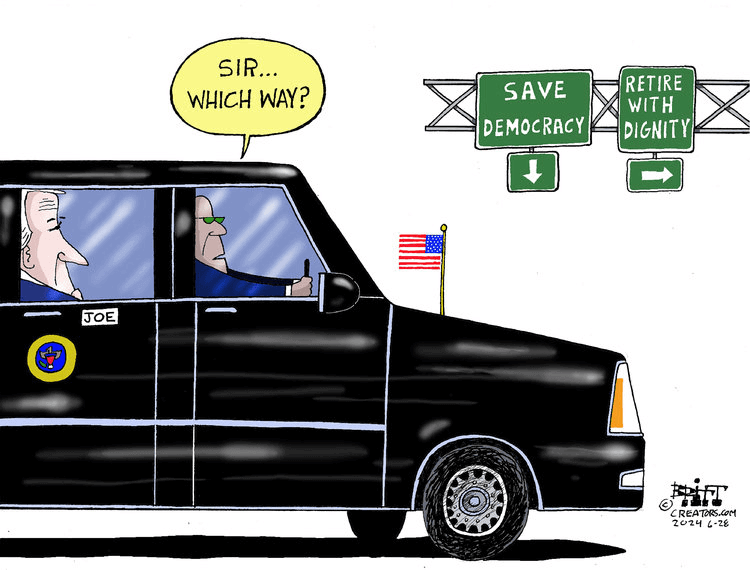
Biden and Trump each needed to reassure the small flock of undecided voters that the country would be safe in his hands for the next four years. They failed in different ways, but they both failed.
The headlines Friday morning summed things up pretty well: Biden stumbled, while Trump lied. If you were worried that Joe Biden is too old to do the job, he did nothing to give you confidence in his vigor. But if you were worried that Donald Trump can’t be trusted to respond to the real problems America faces, rather than issues spawned by his dark imagination, he also did nothing to ease your mind.
The news coverage has tended to make more of Biden’s failings, stoking talk of replacing him on the Democratic ticket (which we’ll get to down the page), but it’s not clear that Trump’s were any less significant. It’s too soon to see much post-debate polling, but while most observers said Trump won the debate, the first post-debate head-to-head Morning Consult poll showed Biden gaining a point, leading Trump 45%-44% after being tied pre-debate. I wouldn’t count on that result holding up as more data comes in, but it does indicate that few minds were changed.
Overall, Biden was low energy and not sharp. His voice was raspy and he frequently had to clear his throat. (His people afterwards said he had a cold.) His lifelong trouble finding words was worse than usual, leading to occasional incoherent statements like this:
For example, we have a thousand trillionaires in America – I mean, billionaires in America. And what’s happening? They’re in a situation where they, in fact, pay 8.2 percent in taxes. If they just paid 24 percent or 25 percent, either one of those numbers, they’d raised $500 million – billion dollars, I should say, in a 10-year period.
We’d be able to right – wipe out his debt. We’d be able to help make sure that – all those things we need to do, childcare, elder care, making sure that we continue to strengthen our healthcare system, making sure that we’re able to make every single solitary person eligible for what I’ve been able to do with the COVID – excuse me, with dealing with everything we have to do with.
Look, if – we finally beat Medicare. [time’s up]
Trump, meanwhile, seemed incapable of simply telling the truth. Here’s CNN’s post-debate fact checker:
Trump made more than 30 false claims at the Thursday debate. They included numerous claims that CNN and others have already debunked during the current presidential campaign or prior.
Trump’s repeat falsehoods included his assertions that some Democratic-led states allow babies to be executed after birth, that every legal scholar and everybody in general wanted Roe v. Wade overturned, that there were no terror attacks during his presidency, that Iran didn’t fund terror groups during his presidency, that the US has provided more aid to Ukraine than Europe has, that Biden for years referred to Black people as “super predators,” that Biden is planning to quadruple people’s taxes, that then-House Speaker Nancy Pelosi turned down 10,000 National Guard troops for the US Capitol on January 6, 2021, that Americans don’t pay the cost of his tariffs on China and other countries, that Europe accepts no American cars, that he is the president who got the Veterans Choice program through Congress, and that fraud marred the results of the 2020 election.
Trump also added some new false claims, such as his assertions that the US currently has its biggest budget deficit and its biggest trade deficit with China. Both records actually occurred under Trump.
Sadly, that kind of fact-checking was totally absent during the debate itself, as the moderators showed no interest in whether candidates answered their questions truthfully, or even answered them at all.
Democratic panic. Republicans seemed to worry not at all about Trump’s lies, just as they have not worried about his criminality. They long ago decided to nod their heads to whatever he says or does rather than worry about whether he’s talking about anything real. Some of them actually believe claims like the nonsense listed above. Those votes are not up for grabs, but I think it’s a mistake for Democrats to worry about them. They’re not a majority and Trump can’t win with the MAGA cultists alone.
Democrats, meanwhile, were shocked and saddened by Biden’s performance. Former Democratic Senator (and frequent MSNBC contributor) Claire McCaskill’s response was typical:
I have been a surrogate for some presidential candidates in my time, and I know what the job is after a debate for a surrogate. And I’ve never wanted to be a surrogate more than I do right now. Because when you’re a surrogate, you have to focus on the positives. But, as I have said very clearly and very plainly — and my job now is to be really honest — Joe Biden had one thing he had to do last night, and he didn’t do it.
The president had to reassure America that he was up to the job at his age. And he failed. … Based on what I’m hearing from a lot of people, some in high elected offices in this country, there is a lot more than hand-wringing going on. I do think people feel like we are confronting a crisis.
This debate felt like a gut punch to most people in this country, especially to those who are paying close attention and know how dangerous Trump is. And I think it’ll take a couple of days for people to recover from that punch.
From months now I’ve been chronicling the New York Times anti-Biden slant. So naturally they picked this moment to pile on. Their editorial board called on Biden to “leave the race“, and were echoed by NYT columnists Thomas Friedman, Frank Bruni, Nicholas Kristof, Maureen Dowd, and Lydia Polgreen. Jamelle Bouie, Michelle Goldberg, Bret Stephens, and Patrick Healey had a round-table discussion, with only Bouie expressing any doubt about the advisability of replacing Biden on the ticket. Ezra Klein, Michelle Cottle, and Ross Douthat had an even more one-sided conversation on Klein’s podcast. The NYT had to go to a guest essayist, Lincoln Project’s Stuart Stevens, to make the don’t-panic case.
The Times, of course, was not the only source of Biden-needs-to-quit thinking, which at times seemed to hit panic levels. I got up Friday morning feeling like something needed to happen right now. But then the voice of experience spoke up: For most of my life, decisions that I’ve made out of that sense of panic haven’t turned out very well.
We need to think about this.
Excuses for Biden. Hardly anybody is denying that the debate went badly for Biden. But the people who think it wasn’t that bad make a number of points.
- The appearance was worse than the substance. Despite occasional moments like the one I quoted above, where words didn’t come together for Biden and he ran out of time, reading the transcript leaves me with a very different impression than watching the video. In the video, Biden’s voice is soft and raspy, he has to keep stopping to clear his throat, and he fails to deliver his lines with the proper force. In the transcript, he often does the things it seemed like he wasn’t doing: calling out Trump’s lies and countering with the appropriate examples. There was a problem, but it wasn’t with his mind.
- He had a bad night. It happens. (In particular, it happened to Obama in his first debate with Romney in 2012.) But Biden did much better the next day at a rally in North Carolina, where (despite still needing to clear his throat) he forcefully delivered the sound bite I think his campaign needs to center on: “I know I’m not a young man, to state the obvious. I don’t walk as easy as I used to. I don’t speak as smoothly as I used to. I don’t debate as well as I used to. But I know what I do know: I know how to tell the truth. I know right from wrong. And I know how to do this job. I know how to get things done.”
- He had a cold. This sounds like a lame excuse, but it does match what we saw and heard: raspy voice, low energy, etc.
- There’s time to fix this. Obama came back from his debate failure, which happened after the convention in early October.
But that last point raises an important question: Is Biden’s problem fixable? Did he indeed just have a bad night, or did the debate reveal who he really is now?
How I’m thinking about this. Three weeks ago, I wrote a piece called “To Stop Fascism, Unite Around the Old Guy” in which I argued against the view that Biden should withdraw from the race. Much of what I said then is still true: Biden has a good record to run on, there’s no obvious savior waiting in the wings to replace him, and an open convention would risk splintering the party. [1]
But the first point I made is now open to question: “Biden is fine.” Is he? I was basing my analysis on the idea that the Biden-is-losing-it theory was a right-wing construction equivalent to Hillary’s emails. I had been impressed by the State of the Union address, and believed that he would continue to rise to the occasion whenever he needed to. I urged people to watch the upcoming debate: “If you’re expecting Biden to be a doddering old man, I think you’ll be surprised.”
That prediction doesn’t look so good now. The debate was an occasion, and Biden didn’t rise to it. Going forward, is that the exception or the rule? If we can count on Biden having a good second debate, a good convention speech, and a bunch of rallies like Friday’s, then the first debate will be a distant memory by the time people vote in November. In short, we’re fine if this is the real Biden, and not the man we saw Thursday night.
But is that true?
And this is a point where I have to admit that I’m not in a position to know. Other people are. Jill is, obviously. The White House staff is, and probably most of the cabinet. So are major elected Democrats like Kamala Harris, Chuck Schumer, Hakeem Jeffries, Nancy Pelosi, and several others.
What I’m noticing is that, after reacting with uncertainty Friday morning, those people are circling the wagons around Biden. The Biden-should-quit voices are mainly coming from outside his circle, people who probably don’t know any more than I do.
You might say, “Of course the party leaders and his staff have to say that.” But (other than Harris, who would hurt her own prospects by appearing disloyal) they don’t, really. Party leaders could be non-committal, saying things like “I trust President Biden. I think he’ll make the right decision now the way he always does, and I’m going to support him either way.” [2] They could be converging on the White House to do an intervention, but that doesn’t seem to be happening.
Similarly, staffers can’t express their doubts in live interviews, but they could leak. We could be seeing Washington Post stories about “informed sources in the White House” getting increasingly worried about Biden. But we’re not.
You might suppose that the insiders have an affection for Biden and don’t want to hurt his feelings. And I might believe that about Jill (though I suspect even she would rather see him avoid humiliation, if that’s what’s coming). But picture Nancy Pelosi for a moment. Do you think she’d sacrifice an election because she didn’t want to hurt somebody’s feelings? That’s not the woman I’ve been watching all these years.
In short, I think I have to trust the insiders here. That’s not a comfortable position to be in. But it’s the one that makes sense to me.
[1] Replacing Biden with Harris could happen fairly cleanly: Biden endorses her and his convention delegates follow his lead. Done right, Biden’s exit could generate a wave of positive emotion that he could transfer to Harris, who would be stepping up to answer the call of History.
But Harris also has a low approval rating and didn’t run a great primary campaign in 2020, so many Democrats don’t feel confident in her beating Trump. Those people call for Biden to endorse no one and let an open convention choose among many candidates.
Jamelle Bouie spelled out the problem with that plan:
There is a real risk that the process of choosing a new nominee could tear open the visible seams in the Democratic Party. I have noticed that only a handful of calls for Biden to leave are followed by “and Vice President Harris should take his place.” More often, there is a call for a contested convention. But why, exactly, should Harris step aside? Why should Harris not be considered the presumptive nominee on account of her service as vice president and her presence on the 2020 ticket? And should Harris be muscled out, how does this affect a new nominee’s relationship with key parts of the Democratic base, specifically those Black voters for whom Harris’s presence on the ticket was an affirmation of Biden’s political commitment to their communities?
Elie Mystal put it more bluntly:
Listening to white folks blithely talk about pushing Biden off a cliff, skipping over Harris, and trotting out some white person like ain’t nobody gonna notice that is some *hilarious* shit. Some of y’all need to phone a friend. A black one.
The nominee is going to be Biden. And if he doesn’t want to run anymore (and I don’t think he thinks a bad 90 minutes is career altering, even if others do) it’s going to be Harris. And that is the sum total of viable options. Send your Aaron Sorkin script back for editing.
And race is only one issue. If multiple candidates ran, they would face pressure to differentiate themselves from each other. So, for example, we might have the pro-Israel candidate and the anti-Israel candidate. Picking either one would alienate a slice of the party the nominee would need in November.
[2] Friday morning, a few were making those non-committal statements. But by Saturday they had gotten behind Biden. Hakeem Jeffries, for example, made a classic non-commitment statement on Friday:
I’m looking forward to hearing from President Biden. And until he articulates a way forward in terms of his vision for America at this moment, I’m going to reserve comment about anything relative to where we are at this moment, other than to say I stand behind the ticket.
Yesterday, though, he described the debate as “a setback”, but
A setback is nothing more than a setup for a comeback. And the reality is, Joe Biden has confronted and had to come back from tragedy, trials, from tribulations throughout his entire life.









 The Weekly Sift