Reasonable Creatures

So convenient a thing it is to be a reasonable creature, since it enables one to find or make a reason for everything one has a mind to do. — Benjamin Franklin

No Sift next week

In this week’s Sift:

  • Inspector Generals’ Report on Warrantless Wiretapping. It’s no substitute for a real investigation, but it makes the truth a little harder to deny: The Bush administration constructed a process to give them the answers they had already decided on.
  • Browser Wars to Become Operating System Wars. Google’s Chrome Browser is going to turn into an OS and challenge Windows. And Wolfram Alpha is interesting once it figures you out.
  • Why I’m Afraid of Sarah Palin. Conservatives say the liberal reaction to Palin is all about fear. It is, but maybe not the way they think.
  • Short Notes. A first-person healthcare saga. Nate Silver’s mathematical model of corruption. John Ensign’s scandal keeps getting worse. Six percent of scientists are Republicans. (Why so many?) And the Westboro Baptist Church uploads a music video to tell us that Hank Moody was right: God hates us all.


Inspector Generals’ Report on Warrantless Wiretapping

The 2008 amendments to the Foreign Intelligence Surveillance Act (FISA) instructed the inspector generals of the various intelligence and counter-terrorism agencies to report on what we’re now calling the President’s Surveillance Program (PSP) — warrantless wiretapping, in other words.

The unclassified version of the report came out Friday. It’s short (38 pages) and readable, but contains little that we didn’t already know. Like a whole series of the reports that have come out over the years on the Bush administration’s illegal activities, it’s main virtue is as an authoritative source. Bush supporters can more easily wave off the same information when it appears in the New York Times or in personal accounts like Jack Goldsmith’s The Terror Presidency, which I reviewed here.

As Glenn Greenwald points out, the report is no substitute for a real investigation, because the inspector generals had no power to compel anyone’s testimony (though they did get to look at a lot of classified documents). Key people like John Yoo or Dick Cheney just didn’t bother to answer questions.

Still, seeing the whole process laid out in one place is striking. I am reminded of what the Downing Street Memo said about the Bush administration’s decision to invade Iraq: “the intelligence and facts were being fixed around the policy”. It’s the same here: The authorization process for the PSP was whatever was necessary to get it authorized. The threat assessments, the legal opinions — their purpose was not to guide policy, but to justify decisions already made.

Every 45 days the PSP came up for re-authorization. CIA analysts would compose the scariest possible assessment of the terrorist threat, without knowing that it was being used to justify that an extraordinary spying program was “reasonable”. (That’s because the Fourth Amendment protects us against “unreasonable searches”.) If higher-up folks didn’t think the justification was sufficient, the threat assessment was sent back so that the analysts could make it scarier.

The legality of the program was verified like this: Of all the lawyers in Justice Department, only John Yoo and Attorney General John Ashcroft knew about the PSP. Yoo wrote an opinion that the program was legal, and every 45 days Ashcroft signed off on it. (“[C]urrent and former DOJ officials told us that this certification added value by giving the program a sense of legitimacy.”)

No one was checking Yoo’s work, and it was shoddy. A legitimate legal memo discusses how the recommended action deals with difficult parts of the law and handles difficult precedents. Yoo just ignored them.

Glenn Greenwald summarizes:

These were not legal opinions in any sense of the word. What happened, instead, is clear: Cheney and Addington knew that Yoo was a hardened ideologue who would authorize anything they wanted. So they purposely chose only him — a low-level Assistant Attorney General — to be “read into” the program, and then used his memos to give themselves legal cover.

As soon as Yoo left the Justice Department, his replacement (Patrick
Philbin) got his boss (Jack Goldsmith) and his boss’ boss (James Comey)
read into the program, and they convinced Ashcroft that there was no
legal basis for parts of the PSP. Ashcroft started refusing to sign,
and ultimately Bush himself had to vouch for the legality of the program (based on his deep understanding of constitutional law, I assume.) If you want to understand the Unitary Executive Theory in a nutshell, it comes down to one memo written by Alberto Gonzales, who was then White House Counsel. Deputy AG Comey wrote a memo about his continuing inability to find any legal basis for parts of the PSP. Gonzales wrote back:

Your memorandum appears to have been based on a misunderstanding of the President’s expectations regarding the conduct of the Department of Justice. While the President was, and remains, interested in any thoughts the Department of Justice may have on alternative ways to achieve effectively the goals of the activities authorized by the Presidential Authorization of March 11, 2004, the President has addressed definitively for the Executive Branch in the Presidential Authorization the interpretation of the law.

In other words: the President has spoken, so the Justice Department should stop worrying about justice. Like everyone else in the Executive Branch, the Justice Department is just an extension of the President’s will.

The other thing the report verifies is that the PSP includes more than what was revealed in the New York Times. How much more? The report doesn’t say. It’s still classified.

The other thing the report doesn’t say is whether the nation gained anything in exchange for abandoning the rule of law. The IGs asked whoever would talk to them in the CIA, NSA, and FBI. The answers were weak. Nobody would come out and say we got nothing, but at the same time “Most [intelligence community] officials interviewed by the PSP IG Group had difficulty citing specific instances where PSP reporting had directly contributed to counterterrorism successes.”

It goes without saying that the Obama administration is not covering itself with glory either. Laws have been blatantly broken, and there is no effort to bring the malefactors to justice. In effect, Obama is ratifying Richard Nixon’s old idea that “when the president does it, that means it’s not illegal.


Attorney General Eric Holder is hinting at prosecutions for torture, but Glenn is doubtful. The worrisome part of the Newsweek article about Holder’s thinking is:

There were startling indications that some interrogators had gone far beyond what had been authorized in the legal opinions issued by the Justice Department, which were themselves controversial.

Glenn’s concern is that Holder will focus on the little fish, as in the Abu Ghraib scandal. Sure, low-level CIA interrogators who exceeded their instructions might have committed crimes. But the real problem was that their instructions were criminal. Everything we know points to the conclusion that the Justice Department legal opinions (also written by John Yoo) were written in bad faith; the decisions had already been made and Yoo was instructed to justify them. It was a criminal conspiracy.

An analogy might help. Suppose I’m part of an agency that the president instructs to rob banks — after he orders a lawyer to tell him he has that power. In the course of robbing a bank, I hit a security guard, which is not explicitly in my instructions. Prosecuting me for assault — and letting the whole bank-robbing thing go — won’t do much to re-establish the rule of law.


Browser Wars To Become Operating System Wars

Because I use a Mac, I haven’t had the chance yet to play with Google’s Chrome browser, which has generally gotten good reviews. (Including this promising note about its security. There may be privacy issues, though.) Well, now Google is upping the ante, and things could get interesting: Chrome is going to be the basis of a new operating system that will compete with Microsoft’s Windows.

The inner workings of ChromeOS will be Linux while the user interface will be Chrome. They’re focusing on the cheap ($250-$500) netbook computers, which are based on the cloud computing model. (Netbooks can be cheap because their users do most of their storage and processing on the internet, not locally. I don’t use a netbook, but the way I create the Sift is a simple example of cloud computing: I write the text on the Google Docs word processor — I tried Zoho once, and it’s just as good — then publish it using Google’s Blogger software and email it out using GMail. If my personal hard drive crashed, the Sift wouldn’t be affected in the least, because it lives on servers on the internet.)

So far, Chrome has not threatened the dominance of Internet Explorer. But as an OS, Chrome could exploit a market niche where Google already has an advantage over Microsoft, which has been at best ambivalent about cloud computing. If trends break just the right way for Google, Windows could become mainly a business operating system and Chrome could grab the downscale computer-as-home-appliance market.


Slate’s Fahrad Manjoo is pessimistic about the Chrome OS, while Wired’s Priya Ganapati is just skeptical.


One quirky but interesting competitor to Google’s search engine is Wolfram Alpha. It gets stumped by a lot of queries that Google handles easily, but when it knows what you mean, it returns answers, not references. “Capital of Illinois” netted me the name (Springfield), population, position on a map, current time and weather, and so on. “Distance to Mars” produced an up-to-the-minute estimate (171.7 million miles). Given “sunset chicago august 1, 2009” it came back with 8:10 p.m.


Why I’m Afraid of Sarah Palin

Sarah Palin’s resignation has turned into the political junky’s version of Michael Jackson’s death. It’s incredibly easy to get so drawn into the details of the soap opera that you forget why you started watching it in the first place. As in: Did you hear what Levi said about a reality show? (Or maybe this is the reality show.) What’s up with being interviewed in hip-waders? (An Evening Sun blogger speculates that’s all she has left after the RNC reclaimed the $150,000 worth of clothes it bought her for the fall campaign.) All that stuff about Alaska spending “millions” on “frivolous” ethics complaints turned out to be false. (It’s more like a few hundred thousand, and if the complaints are all frivolous, why did she reimburse the state $8000 of travel expenses?) Is she really claiming a per diem to live in her own home? And so on.

When I take a step back, though, the more interesting question is: Why do we care? Why is Sarah Palin the bright, shiny object that otherwise thoughtful people can’t stop looking at?

The knee-jerk answer (because she’s so good-looking) doesn’t hold up. We’re not talking Anna Kournikova here. Until recently, a female politician could only achieve high office late in her career, so Palin looks great within her peer group of women like 76-year-old Dianne Feinstein or 69-year-old Nancy Pelosi. But put Palin on any national stage other than politics and she doesn’t stand out. Let CNN’s Campbell Brown interview her, for example, and we’ll see who’s attractive (and smart and articulate).

So why, then? Palin-pushing conservatives claim it’s because liberals are afraid of her authenticity. She’s the real deal, they say, like Ronald Reagan and Newt Gingrich were in the 80s and 90s. But that doesn’t explain why she generates so much hostility among non-liberals like Reagan speechwriter Peggy Noonan: “In television interviews she was out of her depth in a shallow pool. … She wasn’t thoughtful enough to know she wasn’t thoughtful enough.” Or Cathy Young: “While not an intellectual, [Reagan] was a man of ideas. Palin is not known to harbor those.”

I’ll agree with Bill Kristol this far: It is fear. I do feel a rising sense of panic when I watch Palin, similar to what I felt watching Bush run against McCain in the 2000 primaries. But (in both cases) I don’t think it has anything to do with conservative authenticity exposing my liberal false consciousness.

I think I can explain my Palin anxiety in a way that Republicans might recognize from their own experience. (They can fill in the corresponding Democrats themselves.) Like most Americans of left or right, I hold two contradictory visions of American politics. On my happy days, I picture intelligent people of good will who just disagree about how the world works. So in 2008, when Republicans talked about nominating McCain or Romney or even Huckabee, I thought: “Well, I wouldn’t vote for them, but I get it.” I could understand how somebody with a different worldview might want one of them to be president.

On my unhappy days, I fear that the other side suffers from a dangerous lunacy. Nothing but gibberish comes out of their mouths, and the idea of engaging them in rational discussion seems pointless, even foolish. I’d just be humoring their delusions. In 2000, for example, the Republicans had a choice between a charming war hero and a spoiled rich kid who had failed at everything he had ever attempted (only to be bailed out by his family connections so that he could fail again). They picked the rich kid, and what rational thing could I possibly say about that? I started to panic.

That’s how I feel when I see folks getting excited about the prospect of Palin running for president. I start to worry that my unhappy, paranoid side might be right. Maybe I’m living in an insane asylum. Maybe crazy people are the dominant voting demographic.

It’s not that I think she’s crazy; it’s the idea of her as a national leader that is crazy. It’s not her incoherent rambling or her constant misrepresentation of established facts or her family issues or anything else people attack her for. It’s: Why are we having this discussion at all? As with George W. Bush in 2000, if I start with a blank sheet of paper and try to imagine reasons why a sane person would want her to be president, the page stays blank. It’s not her lack of experience, it’s her lack of … everything.

She arrests my attention because there’s a vicious cycle running in my head: This can’t be happening. It is. This can’t be happening. It is. No, wait, if we just explained things more clearly, public sanity would re-assert itself. It won’t. No, wait.

BTW, I think my introspection — to the extent that it applies to liberals in general — points out a mistake we’re making in arguing about Palin. Our this-can’t-be-happening panic makes us want to explain to her supporters why they’re wrong. But that just feeds our energy into her persecution narrative: Those elite educated liberals don’t get it, and so on.

As a result, Palin supporters never have to make a positive case for her. The right question: “Why, of all the 300 million people who live in America, should this one be our leader?” never gets asked, much less answered.

We need to make them explain more clearly. Don’t attack; just be curious and keep asking questions.


Other interesting takes on Palin: Dahlia Lithwick, Frank Rich, and Judith Warner. And Scott Bateman’s animation and annotation of her resignation is fun.


Short Notes

Some people respond to statistics, some people respond to stories. If you had a “Yeah, I know …” reaction to the stats about the uninsured I posted last week, read Progressive Fox’s “How I Lost My Health Insurance at the Hairstylist’s.”


Last week I blamed special-interest money for the problems we’re having getting a public option into Congress’ healthcare plan. Little did I know that Nate Silver already did a mathematical analysis of this a month ago. His conclusion is that special interest money’s largest effect is to turn moderate Democrats against a public option.

if a mainline Democrat has received $60,000 from insurance PACs over the past six years, his likelihood of supporting the public option is cut roughly in half from 80 percent to 40 percent.


I was so busy catching up last week that I forgot to mention where I was during my two-week break from the Sift. I was blogging the Unitarian Universalist General Assembly in Salt Lake City. No, SLC is not sacred to UUs as well as Mormons; the General Assembly moves around. But SLC turns out to be a perfectly wonderful city; I’d happily go back there on vacation.

At General Assembly, I always like to cruise the booths that have snappy buttons and t-shirts. My favorite button, which I probably would have seen a year ago if I lived in California: “Can we vote on your marriage too?” I also liked “God is not a boy’s name.”


I also forgot to post the funniest video I had found while I was away: Jon Stewart’s reaction to Mark Sanford’s inability to keep quiet. It doesn’t get old.


Dan Froomkin has landed at Huffington Post. Firing Froomkin was just one more self-inflicted wound as the Washington Post struggles to compete.


The John Ensign scandal just keeps getting worse. And Josh Marshall asks: “Which is more emasculating? Getting paid a hundred grand by the guy who screwed your wife? Or being a fifty-something United States senator and still needing mom and dad to cut the check to pay off your mistress and her husband?”

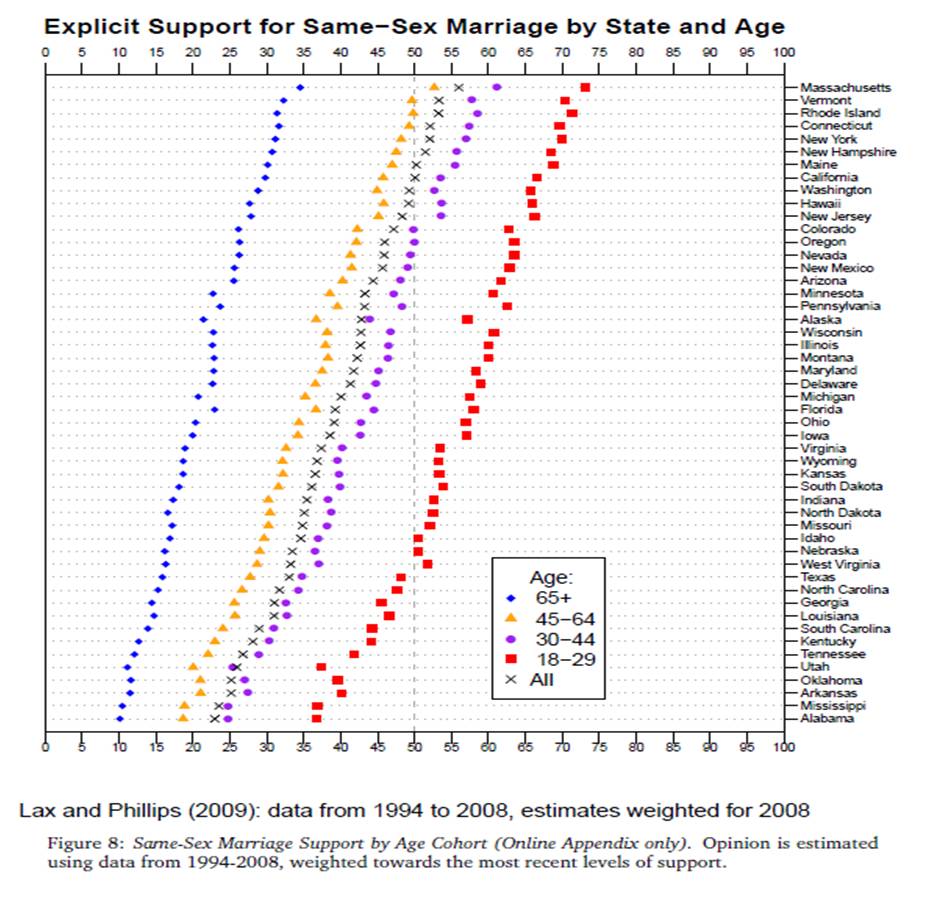
Republicans warned us their families would fall apart if gays started getting married. Why didn’t we believe them?


The Pew Research Center has an interesting statistic buried deep in a recent report: 55% of scientists say they’re Democrats, 32% Independents, and only 6% Republicans. You think maybe this has something to do with Republican efforts to sneak religion into science classes, deny global warming, and censor reports written by government scientists? It’s a theory.


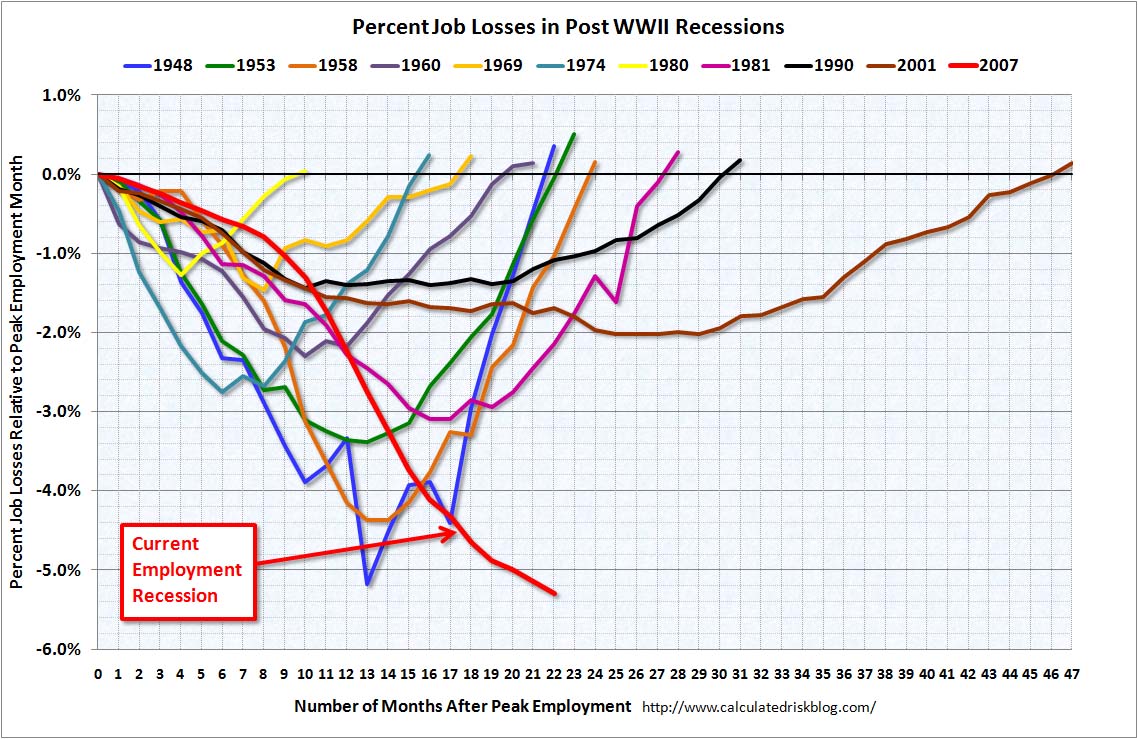
DailyKos’ leading economic chart-watcher says the economy has started to turn. But Robert Reich makes a good point: “Recovery” is the wrong way to think about it, because that implies we can go back to what we were doing before.


I know it looks like a parody, but no, they really mean it. Those lovely folks from Westboro Baptist Church (the ones who go around the country reminding us that “God Hates Fags“) have made a music video “God Hates the World” to the tune of “We Are the World”.

Everything I’m reminded of, though, really is a joke. The main character on Showtime’s Californication is the author of a novel called God Hates Us All. And in the intro to the HBO series True Blood (where vampires are a minority group seeking their rights), a roadside sign reads “God Hates Fangs“.

Dual Citizenship

Everyone who is born holds dual citizenship, in the kingdom of the well and in the kingdom of the sick. Although we all prefer to use only the good passport, sooner or later each of us is obliged, at least for a spell, to identify ourselves as citizens of that other place. ~Susan Sontag, Illness as Metaphor, 1977

In this week’s Sift:

  • A Logical Guide to Healthcare Reform. Three factors will shape any healthcare bill: What makes sense, what can be made to sound good, and what lobbyists are willing to pay money for. A public option makes sense — but will that be enough?
  • Que Sera, Sarah. Don’t look at me. I wasn’t expecting her to resign either.
  • Short Notes. New Zealand Air has nothing to hide. Antidisestablishmentarianism in Illinois. The glory days are over at the Washington Post. But the revolution in Iran may not be over for a long time.


A Logical Guide to Healthcare Reform

Almost all the debate about Obama’s healthcare plan centers on three issues:

  • How close will it come to covering everybody?
  • Will there be a public option?
  • How much will it cost?

Let’s take them one-by-one.

Coverage. The Census Bureau has estimated that 47 million Americans lacked health insurance in 2006. That number was trending upward at the time, so it was probably higher than 47 million even before last September when the economy began collapsing. Of course, that isn’t the same 47 million people from one month to the next; Families USA estimated that 86.7 million Americans were uninsured at least temporarily between the beginning of 2007 and the end of 2008.

Even that number doesn’t capture the full extent of the problem, because many people who have some kind of health insurance aren’t insured for their most serious illness, which their insurance company considers a “pre-existing condition”. In March, Time magazine writer Karen Tumulty told the story of her brother Patrick, who had been insured continuously by the same company for six years. When Patrick developed an expensive kidney condition, the company refused to pay. Why? His policy renewed every six months, and at each renewal he was considered a new customer. Since it took his doctors eight months to diagnose his problem, it was already pre-existing by the time his treatment started. Tumulty estimates that 25 million apparently insured Americans would be in a similar position if they happened to get sick.

Of all possible health plans, only single-payer (the government covers everybody) completely solves the problems of uninsurance and under-insurance. But that is off the table, because Congress is afraid that single-payer would turn us into a totalitarian state like Canada.

A second-best approach to coverage is mandate-and-subsidize: The government forces people to buy health insurance, and helps out people who can’t afford it. Massachusetts currently does this; you pay a penalty on your state income tax if you can’t prove you have health insurance. It’s not perfect, but their rate of uninsured people has dropped from 6-10% to about 2.6%. Mandate-and-subsidize, however, is considered too heavy-handed for a federal plan. (After all, the Massachusetts plan is left over from the socialist regime of Governor Mitt Romney.)

So we seem to be stuck with a third-best approach: subsidize and hope people are smart enough to recognize a good deal. Subsidize-and-hope only sort of works: The first Kennedy-Dodd proposal would have left 37 million people uninsured by 2019. And it has been revised because it was too expensive.

Public option. The most heated debate has been about whether there will be a public option. In other words, will the plan only include private health insurance or will one choice be some sort of Medicare-for-everybody? This is the most naked special-interest vs. public-interest issue, so it has the most confusing rhetoric. Your representatives can’t just say: “I’m against a public option because I need money from drug companies and insurance companies to get re-elected” or “I’m counting on making a bundle as a lobbyist after I leave Congress, so I need to keep the corporations happy.” So they need to come up with other explanations.

The basic problem is that a public option would be too good. Medicare

  • has low administrative costs;
  • doesn’t spend any money on advertising, multi-million-dollar executive salaries, or stockholder dividends;
  • is big enough to demand that healthcare providers accept reasonable prices;
  • doesn’t cancel anybody’s policy.

So if Medicare were an option for everybody, everybody might do the smart thing and choose it. And that would be a sneaky, back-door path to a single-payer system, which (as I already pointed out) would end America-as-we-know-it and make us just like the Soviet Union or Australia.

The focus-group-tested code phrase for this possibility is “government takeover of health care”. Missouri Congressman Roy Blunt, head of the Republicans’ Health Care Solutions Group, puts it like this:

If there’s a government competitor, in the very short term, you wind up with no competitors. When voters begin to understand that the government takeover of health care is really the end result of a government competitor in the marketplace, they’re not going to like that.

That’s because voters don’t want the option to pay lower rates for more secure coverage — at least not if it means that health insurance companies won’t have profits they can contribute to the campaigns of congressmen like Roy Blunt or many foot-dragging Democrats.

In his June 23 press conference, President Obama pointed out how nonsensical this rhetoric is:

Why would [a public option] drive private insurers out of business? If private insurers say that the marketplace provides the best quality healthcare, if they tell us that they’re offering a good deal, then why is it that the government — which they say can’t run anything — suddenly is going to drive them out of business? That’s not logical.

Yes, he sounds like Mr. Spock when he talks that way. But he’s right.

Cost.
Everybody understands that we need to control healthcare costs. Our current system is tremendously wasteful. Already in 2003, we were spending nearly twice as much per person as Canada or France (which is widely believed to have the world’s best healthcare system — see this comparison by the Dallas Morning News or the World Health Organization ratings). A more recent survey didn’t include France, but estimated that we spend $6697 per person each year while Canada spends $3326 — and Canadians on average live more than two years longer than we do. (If only we had their warm, healthy climate.)

Numbers don’t quite match up from one study to the next, because it’s not obvious what to count as “healthcare spending”. (Dental? Eyeglasses? Breast implants?) But just about everybody pegs our total annual cost over $2 trillion. The unimaginable scale of that number creates opportunities for rhetorical sleight-of-hand, because it’s easy to put forward plans that sound convincing and actually would cut costs, but on an insignificant scale.

Malpractice suits, for example, cost billions each year. But that’s actually a trifling part of our healthcare bill. Statistics are hard to lay your hands on for some reason, but Kaiser estimated that there were about 11,500 paid malpractice claims in the United States in 2007, and an average payout of $310,000 in 2006. Blindly multiplying those numbers together gets you an annual cost around $3.5 billion. (I don’t fully trust that calculation, but ten times that number would still be a drop in the bucket.) And on the wider question of “defensive medicine” — unnecessary tests ordered by fearful doctors — the Congressional Budget Office found “no statistically significant difference in per capita health care spending between states with and without limits on malpractice torts.”

Not all costs are equal. Even more important, we need to understand that a lot of very different things get lumped together in that simple word cost. The cost of healthcare is made up of four factors:

  1. The cost of providing the care that people need in the most efficient way.
  2. Inefficiency in providing the care that people need. For example, a late and expensive treatment for a disease that could have been spotted and treated much earlier, or treating something in the emergency room that could have been handled by a general practitioner.
  3. Overtreatment, i.e., providing care that people don’t need and may even be damaged by. Overtesting falls into this category also.
  4. Costs that have nothing to do with treatment: advertising, profit, administration, and so forth.

The best way to cut costs, if you can manage it, is to eliminate 2, 3, and 4, and then do research to come up with even more efficient ways to do 1. The worst way to cut costs is to leave 2, 3, and 4 alone and cut 1 — in other words, you make sick people go without care.

That, in a nutshell, is why I’m a liberal on this issue. If you look at conservative cost-cutting proposals, they inevitably cut 1 and increase 4.

Any proposal that calls for increasing competition in the private sector is a boon to the advertising industry. You know the ad wars between Viagra, Levitra, and Cialis? (If you watch TV at all, I’m sure you do.) Well, imagine if every piece of the medical industry had to establish a brand and compete for individual consumer attention. Do you know the difference between Laboratory Corporation of America and Quest Diagnostic? You would. They’re the duopoly that dominates lab testing. They could advertise like ATT and Verizon.

Liberals and conservatives also have different approaches to decreasing overtreatment, because they have different explanations of how overtreatment happens. In the conservative narrative, overtreatment is your fault: Because insurance is picking up the tab, you go the doctor for every little sniffle.

This is one of those rhetorical sleights-of-hand I talked about. Yes, everybody remembers a time when they took their toddler to the doctor for something that turned out to be nothing. There was an office visit and perhaps an antibiotic, and maybe it cost your insurance company $100. If every single person in America could eliminate one such episode a year, that would save $30 billion annually — which is a round-off error when you’re talking about $2 trillion.

The importance of that Atul Gawande article I linked to a few Sifts ago is that it pointed out the real culprit in overtreatment: the corruption of doctors who are either paid by the procedure or get kickbacks from the testing labs. In short, it’s a capitalist problem, not a socialist problem. Making our system more capitalistic will increase overtreatment, because it will turn doctors into healthcare salesmen.

In the conservative vision, individuals cut costs by being hard negotiators and looking for the best deal. Picture it: A doctor tells you that your daughter will die in a day or two unless he does a liver transplant. And naturally you react the way you would if a mechanic said your car needed a new transmission. You wonder if he’s just trying to make a buck, so you take her to another hospital to make sure, and then you shop around to get the cheapest possible liver transplant. Maybe you even pretend to walk away so that they’ll cut their price.

Is that going to happen? Really?

What about computers? Whenever you challenge the free-market model, somebody is bound to start talking about the computer industry. Yes, they advertise and pay high salaries and make profits, but still competition forces prices down and performance up. Why couldn’t the same thing happen in healthcare?

Now think about the difference between buying a computer and buying health insurance. You and the people you trust are going to buy many computers over the years, and you can start judging them as soon as they come out of the box. Are they fast? Convenient? Reliable? When something goes wrong does the company make it good? Even in the store, the specs are well-defined and meaningful.

Health insurance isn’t like that. Sure, you use your health insurance fairly often. But you don’t really test it. Do you know how well your insurance would perform if you got cancer or some expensive long-term condition like ALS? Or just some mysterious pain the doctors couldn’t quite diagnose? Probably not. That coverage is what you’re really paying for, why you really need insurance, and you have no idea whether you’re getting it or not.

That’s not like a computer at all. Competition in health insurance is not based on performance, because by the time you need performance, it’s too late to change your brand loyalty. (Now you have a pre-existing condition.) So competition is not going to improve performance. It’s just going to improve marketing.

My conclusion. If a single-payer system really is politically impossible (which nobody really knows, because no national leader has ever made a serious case for it) then we have to make sure that we get a real public option, one that isn’t artificially crippled with rules that make it “competitive” with private plans. If that happens, then I expect the public option really will drive the private plans out of business, because a public plan is just a more efficient way to deliver care. If I’m wrong, and the free market really can improve the efficiency of private plans, then so be it.

And I know there will be scary commercials against any plan that includes a mandate, but I think we need to try it. If we’re not willing to let the uninsured suffer and die — and I hope we’re not — then they really are being covered at least to some extent. We need to make that coverage visible rather than hiding it in the inflated costs that the rest of us pay for everything medical. When the true costs of things are visible, we can try to deal with the situation logically.

Isn’t that right, Mr. Spock?


Que Sera, Sarah

There’s still no good explanation for Sarah Palin’s announcement Friday that she’s going to resign as governor of Alaska. What she said in her rambling public statement made no sense even to other conservatives or members of her family, so we’ve been left to read tea leaves. Cenk Uygur takes you through the various possibilities.

The timing is the biggest clue. She made her announcement on a Friday between Michael Jackson’s death and the Fourth of July, so it’s clear she wanted as little coverage as she could get. Also, the absence of stagecraft made the announcement seem hurried. Given time, any good high school journalism student could have written a clearer statement. And the small audience (who look confused in the reaction shots) suggests that she just called a few friends, got a TV crew, set up a podium in her back yard, and went for it. Why so fast?

My best guess: Either she’s getting out in front of a scandal we’ll hear about soon, or her resignation was part of a deal that will keep something secret.


To me, the most puzzling thing about Palin and her fans is their conviction that she was/is persecuted by the media. The working title of a pro-Palin biography is The Persecution of Sarah Palin, for God’s sake.

I hope the book compares Palin’s treatment during the 2008 campaign with that of all the other previously unknown VP candidates whose teen-age daughters turned up pregnant in the middle of a national campaign. Wait — there isn’t anybody else like that, is there? We used to take for granted that a scandal of that magnitude would sink a candidate, but Palin was allowed to ride it out.

From my point of view, Palin has gotten unusually soft treatment. She was never asked any hard questions during the campaign. It just looked that way because she fumbled so many easy questions. I doubt Katie Couric thought she was going in for the kill when she asked what newspapers Palin reads.


When conservative blogs fulminate about satirical articles or images of Palin, the commenters almost always say that if this were done to Obama, no one would stand for it. In truth, worse stuff is done to Obama every day, and he ignores it because (1) he’s got class, and (2) he takes his job seriously, so he’s got no time for this nonsense.

Look at, say, this image. Or this one. Or maybe this or this. I could go on and on. And there are countless videos arguing that Obama is the anti-Christ or satirizing the Obamessiah. Photoshop on, wingnuts. Nobody cares.

BTW, I think this anti-Obama video done to Cake’s song “Comfort Eagle” (“we are building a religion…”) is actually pretty good.


On the other hand, Vanity Fair doesn’t like her very much.


This video of Palin telling Hillary not to “whine” about the media is priceless. And just in case her career really is over, TPM collects their top 10 Palin videos.


Short Notes

New Zealand Air has come up with a novel way to make its safety video interesting: The crew is actually naked; their uniforms are body-painted on. Strategically placed arm rests, safety belts, and life jackets avoid an R rating.


An Illinois minister celebrates Independence Day by writing a newspaper column calling for a Christian Revolutionary War: “We must not relent until our Christian heritage is established again in every aspect of society.” What do you know? A real, live antidisestablishmentarianist.


Truth-teller Dan Froomkin is gone from the Washington Post. More and more the Post opinion pages are becoming a home for neocons in exile: Charles Krauthammer, William Kristol, editor Fred Hiatt, as well as an occasional op-ed by Paul Wolfowitz and various other war criminals. When I looked at the Post ombudsman’s article about Froomkin’s firing, I counted eight approving comments. I added the 557th disapproving one.

I was already thinking I was done with the Post. Commenter mmadd summed it up: “the Post that I loved is gone.” Froomkin was just the last straw; the Watergate glory days have been over for a long time. And then they did this.


The pot continues to boil in Iran, with a major group of clerics declaring the officially re-elected government “illegitimate” and the major presidential contenders continuing to publish reports of election fraud.

Still, no popular nonviolent movement can topple a government that retains both its will to resist and the loyalty of its military. The Shah went down because soldiers and police began tearing off their uniforms and throwing their weapons into the crowd. At Tiananmen Square,
on the other hand, soldiers followed orders and the Chinese government weathered the storm. So far, the Iranian theocracy seems to be weathering the storm.

But it’s way too early to declare a winner, because in Iran these things play out over years. The major anti-Shah demonstrations started in 1977, and his government didn’t fall until 1979.

The First Duty

We have now sunk to a depth at which the first duty of intelligent men is the restatement of the obvious. — George Orwell

No Sift for the next two weeks. The Weekly Sift returns on July 6.

In this week’s Sift:

  • The Discussion We Ought To Be Having. Beyond all the divisive nonsense lies a question Right and Left ought to be collaborating on: What kinds of things should government be doing?
  • The Next Time You’re in the Bookstore … look for Big Boy Rules: America’s Mercenaries Fighting in Iraq by Steve Fainaru. He comes down hard on Blackwater, but finds a strange empathy for the guys carrying guns. Meanwhile, I suggest some beach reading.
  • The Spectrum of Crazy. Mainstream Republicans would like to a claim that a firm boundary separates them from the right-wing terrorists. But where is it?
  • Short Notes. Juan Cole on Iran’s election. Swine flu is a pandemic. The latest clever Republican wordsmithing. And more.


The Discussion We Ought To Be Having

It’s easy to make fun of the state of political discourse in America today. In both the major media and in our own conversations over coffee, we spend valuable time and energy talking about David Letterman’s jokes, Obama’s birth certificate, and the latest ridiculous thing Rush Limbaugh said. I do it too; it’s hard not to. This stuff is the junk food of politics. It gives you lots of quick energy, but does nothing to nourish our democracy. Even if you try to give it up, other people push it at you. (“Have you tried these barbecue potato chips? They’re fabulous!”)

So what should we be talking about? Where could Right and Left alike devote their attention to a meaningful discussion, one that could go somewhere? Last week I interpreted Obama’s Cairo speech in terms of rebuilding a center and depolarizing the America/Islam split. What would do the same thing for Right and Left in America?

It seems to me that the answer is obvious: We ought to be talking about the proper role of the public sector in our economy. That same basic issue shows up again and again in various forms: What should the government role be in health care? In banking? In rebuilding the electrical grid? In the transition to renewable fuels? In mitigating the consequences of global warming? How long should the government continue to own General Motors, and how active a shareholder should the Obama administration be?

In spite of all the polarizing rhetoric on both sides, there actually is a center to build up. Americans share a broad consensus about some basic principles, and our differences can be framed as differences of degree (that can be compromised on) rather than differences of kind (that can’t).

For example: Other than a negligible number of radicals on each side, Americans largely agree that we need a mixed economy. Some things the government should do directly, some things the government should stay away from, and some things should be done by private industry with greater or lesser amounts of government regulation.

The book I review in the next section examines a situation where we let the private sector go too far — mercenaries in Iraq. Military action and profit incentives don’t mix well. We want soldiers to be motivated by patriotism, by a sense of honor and duty, and by loyalty to each other — not by a big paycheck. And when military power gets misused, we need the kind of transparency you just can’t get in the private sector.

But even very far-Left liberals learned from the failure of the Soviet Union. The government does a bad job of innovating, of coming up with new products, of responding quickly to consumer preferences, and of converting to whole new models of delivering services. In a classic Adam Smith situation, where you have a bunch of commodities with a bunch of uses (none of which are matters of life and death), you can’t beat markets for allocating those resources quickly and efficiently. A lot of seed money to develop internet technologies came from porn — no government would have thought of that. One reason research in carbon-fiber materials is paying off is that people happily pay big money for ultra-light bicycles and tennis rackets and golf clubs. No one has ever been quite that excited to pay their taxes.

Health care (which I promise to discuss in more detail when the Sift comes back in July) is a difficult issue precisely because it combines both aspects. Medical emergencies are like hostage situations: “Do what we say or someone you love will die.” The free market is absolutely the wrong model here. You’re in no position to negotiate. You need to trust your doctors and believe they have your best interests at heart — not make allowances for their salesmanship or take the buyer-beware attitude that a market requires.

But routine-care delivery resembles retail. Subtle changes in technology or social preferences or skilled-to-unskilled salary ratios might completely transform the best way to deliver particular kinds of care. If some guy thinks he has a better way to manage chronic pain or do basic prevention or follow-up care for wounds or whatever — why not let him try, and profit or fail depending on his success?

We need to have a national discussion about where the borderline should be: What needs to be public? What is better kept private? Both Right and Left have a case to make. We could be having that discussion across the board — it’s in the background of almost every domestic issue we’re facing.


An article in the journal Open Medicine compares the U.S. and Canadian health care systems:

Available studies suggest that health outcomes may be superior in patients cared for in Canada versus the United States, but differences are not consistent.

Or, as Matt Yglesias summarizes: “Canada’s is probably slightly better, almost certainly no worse, and definitely cheaper.”


The NYT editorial page is also promoting that health-care article by Atul Gawande that I told you about two weeks ago. They claim President Obama is making his staff read it.


Matt Yglesias defends the value of the public sector.


The Next Time You’re at the Bookstore …

… look for Big Boy Rules: America’s Mercenaries Fighting in Iraq by Steve Fainaru. This is a current-history book that reads like an action novel because Fainaru

  • got assigned by the Washington Post to investigate a fascinating topic: the “security contractors” carrying guns in Iraq
  • got “lucky” (in the journalistic sense) when a horrifying event happened right under his nose
  • had the insight to see the parallels between his own psychology and that of the mercenaries he was covering
  • had the sense to make himself a character in the story he wrote.

When he gets to Iraq, Fainaru finds himself hanging around with Crescent Security Group, maybe the most slipshod group of mercenaries in the business. They live in Kuwait and “commute to the war” as Fainaru puts it. They guard convoys going into Iraq.

The group’s medic wears an EMT hat, but explains that he isn’t really certified: “They made me the medic because I’ve read a lot of books. I just haven’t gotten around to taking the tests.” The rules-of-engagement are … well, there aren’t any really. Just don’t lose the convoy, and shoot them before they shoot you. Those are the Big Boy Rules, not the wimpy rules that the Army and the Marines have to live by.

If you end up shooting somebody you shouldn’t have, well, that’s a shame. Fortunately there’s nobody in a position to punish you for it, because security contractors are exempt from Iraqi law and not covered by the Uniform Code of Military Justice. You should file a report about it. Or not. It doesn’t really matter.

Fainaru rides with the talkative and endlessly charming Jon Cote’. Cote’ served a tour in Iraq with the 82nd Airborne, then went home and tried to be an accounting major at the University of Florida. It didn’t work out. After the blood and explosions of war, the sights and sounds of student life barely registered. He thought it would be idyllic — Florida, the girls, the parties. But nothing was a matter of life-and-death there, so why do it? He found himself taking bigger and bigger risks until he got arrested for doing motorcycle tricks on a main drag while drunk. Coming back to Iraq as a mercenary — it got him out of a bad situation and would soon get him out of debt, plus it put him back in a world of life-and-death. So it was a win all around.

Fainaru is 21 years older — exactly, they have the same birthday — but he sees a lot of himself in Cote’. War correspondents also get addicted to blood and explosions. Fainaru had spent in a lot of time in Iraq before coming home to cover safer stories — and it didn’t work out for him either. He didn’t have to return to Iraq, but he wrangled a way. Like mercenaries and unlike soldiers, war correspondents aren’t there for their country or to save anybody’s life or freedom. They can tell an idealistic story about the people’s right to know, but really it’s about fame and fortune. And blood. And explosions. War is not pleasant, but it’s very real — and after a while, nothing else is.

Then a subplot cuts in: Fainaru abruptly goes home for one last trip with his brother and his Dad, who is dying of lung cancer. The brother has his own drama going: He’s been covering the Barry Bonds steroid scandal. He published some confidential grand jury testimony, and he’s about to go to jail if he doesn’t reveal his sources, which he’s not going to do.

The trip may have saved Fainaru’s life. While he was gone, a Crescent convoy got hijacked and several of the mercs were taken, including Cote’ and the medic. We know the story in detail because two mercs survived in the most random way possible: The insurgents threw their captives into an SUV when they heard the Army coming, and the SUV wasn’t big enough for all of them.

The convoy hijacking is a story of screw-ups. Half of a typical Crescent crew is Iraqi, and they pick them up at the border. Except the Iraqis didn’t show up that day — maybe they were tipped off. Crescent should have cancelled right there, but the convoy was half across the border by the time they figured out what had happened. Turning around would have been a mess, and the run to Basra was usually tame, so they went for it. A few hours later they were hijacked by a group of Iraqis that probably included some disgruntled former employees, who were way underpaid compared to the Americans.

Nobody claims responsibility or asks for ransom. The official investigation starts late because Crescent forgot to register the convoy with the authorities. And nobody seems to be working all that hard to find the missing mercs — not Crescent management and not the military. Soldiers (who are also way underpaid compared to the mercs) strangely are not that wild about risking their lives for guys who live by no rules and then yell for help whenever they get themselves in trouble. Who’d have thought?

Fainaru starts hanging out with the families — mercenaries have families, it turns out: parents, brothers and sisters, children, and a lot of ex-wives. For reasons of their own, they love these guys, and they’d like to know what happened to them. It takes a long time, but eventually they find out. It’s not a happy ending.

I started reading Big Boy Rules out of good intentions. I thought it was a subject I should know something about. But then I got pulled in by the story and characters, and I ended up learning about mercenaries almost by accident. But the book actually does contain a lot of information. For example, Fainaru provides the first coherent explanation I’ve ever heard about how Blackwater got so far out of control: It was a token in the turf battle between State and Defense. Early on, Don Rumsfeld outmaneuvered Colin Powell, and the State Department got shut out of any significant role in Iraq. But Blackwater fell under State’s jurisdiction, because their main contract was to guard diplomats. So when the generals had complaints about Blackwater, State wasn’t inclined to listen. And that meant that Blackwater was virtually unsupervised.

Fainaru does a good job of painting a complex reality. He has little doubt that the contractor system is inherently corrupt, and that the contracting companies are war profiteers. Killing people is just not a business that private industry ought to be in. But he is ambivalent about the mercenaries themselves. They are exploiting the situation for their own profit, but are simultaneously being exploited for someone else’s profit. Few of them manage to save much money, and most don’t even have a clear idea of what they’d be saving for. Many of them die — how many? no one counts because no one really wants to know — and some are just broken and tossed aside.

Fainaru never says this explicitly, but I think he believes that when Jon Cote’ got caught doing drunken wheelies in Florida, he should have been offered help — not a gun and a big salary. Maybe he would have found some other way to get himself killed. But maybe not.


If I’m going to be gone for two weeks, I have to suggest some beach reading. For a few months now, I’ve been chomping down Lee Child’s Jack Reacher novels like salted peanuts. They’re action mysteries with a heavy dose of weapons and tactics. But unlike Tom Clancy and Jack Ryan, Child is a real writer and Reacher is an interesting character.


The Spectrum of Crazy

Two weeks apart, we’ve had the murder of late-term abortionist Dr. George Tiller and an attack on the Holocaust Museum in Washington. Most of the Right would like to claim that these are unpredictable acts by lone-wolf crazies. And that’s even true up to a point: There’s no sign of any broader conspiracy to carry out those specific attacks.

In a broader sense, though, the spectrum of right-wing craziness stands on a slippery slope. At the far end you have the Scott Roeders and James von Brunns — people who appear to have carried out acts of right-wing terrorism. One step closer to the mainstream are the web sites and blog commenters who think that the Roeders and van Brunns are heroes.

One more step brings you to the people who wish for violence without threatening to do it themselves, like whoever took out the ad saying: “May Obama follow in the footsteps of Lincoln, Garfield, McKinley and Kennedy!” Here we find Southern Baptist pastor Wiley Drake, who was Alan Keyes’ vice president on the American Independent Party ticket last fall.

Drake thinks Tiller’s murder was the answer to his prayers. He wants to revive the practice he calls “imprecatory prayer” — praying for God to harm your enemies. “It is in the Bible,” he says, “and we are proud to say as Southern Baptists that we believe the Book.” (Hmmm. Didn’t some minor character in the Bible also say: “Love your enemies. Bless them that curse you.”? But that’s a plot twist from the second half of the Book, so maybe Drake hasn’t read that far yet.)

When radio host Alan Colmes asked Drake who else was on the wrong side of his prayer list, Drake replied: “The usurper that is in the White House is one, B. Hussein Obama.”

Colmes: Are you praying for his death?

Drake: Yes.

Colmes: So you’re praying for the death of the president of the United States?

Drake: Yes.

Another step gets you to the people who don’t advocate or even root for violence explicitly, but provide justification for it. When Bill O’Reilly repeated denounced Tiller as “the baby killer”, he didn’t ask anyone to stop Tiller by violence. But how big a leap was that? The folks (like Alan Keyes) who keep pushing the “birther” conspiracy theory (that Obama actually isn’t president because he wasn’t born in this country) — what solution are they advocating? When you combine Obama-usurper rhetoric with charges that he’s secretly a Muslim who hates whites, is ruining our American values, is about to take away our guns, and is conspiring with ACORN to rig the census and fix elections — well, what is a heroic young man who believes all that supposed to do, exactly?

One step further in brings you to mainstream Republicans who use Biblical/apocalyptic code words to pander to the crazies in a deniable way. At the recent Republican fund-raising dinner, master-of-cermonies Jon Voight advocated “staying the course to bring an end to this false prophet, Obama.” If some warrior-of-God decides to bring an end to Obama with a sniper’s rifle, I’m sure Voight will express a completely guiltless sense of shock, if he sees a need to comment at all.

Take one more step and you arrive at Newt Gingrich, Sarah Palin, and countless other big-name mainstream Republicans who attended the dinner: They applauded Voight. Senate minority leader Mitch McConnell said he “really enjoyed” Voight’s remarks.

I’m with Paul Krugman on this:

Yes, the worst terrorist attack in our history was perpetrated by a foreign conspiracy. But the second worst, the Oklahoma City bombing, was perpetrated by an all-American lunatic. Politicians and media organizations wind up such people at their, and our, peril.

Like Frank Rich, I’m waiting for some Republican leader to stop pandering to the violent and take a stand for sanity. John McCain did so a couple of times late in the 2008 campaign. Fox News’ Shepard Smith is doing it now. But who else?

And that’s the real problem: Not the fringe nutjobs, but the mainstream voices who tolerate and exploit them. We don’t need to censor the Birthers any more than we needed to censor the people who thought that Bush conspired in 9-11. But mainstream Republicans who wink and nod at this craziness are playing with fire. How many people will have to die before they stop?


Charles Krauthammer continues to advocate a polarized, Manichean world. To him, Obama’s efforts to reconstitute a center internationally represent “a disturbing ambivalence towards one’s own country.” Krauthammer also feeds the false-prophet rhetoric:

Not that Obama considers himself divine. (He sees himself as merely messianic, or, at worst, apostolic.) But he does position himself as hovering above mere mortals, mere country, to gaze benignly upon the darkling plain beneath him where ignorant armies clash by night, blind to the common humanity that only he can see.

Not that Charles would advocate striking down such a self-aggrandizing ruler. Of course not!


Scott Bateman animates Newt’s bizarre warning about Druids-under-the-bed or Stonehenge-in-your-closet or something.


Short Notes

The source I’m following about the Iranian election is Juan Cole. Cole believes the election was stolen, and that (in spite of protests) the regime will get away with it — for now. “But the regime’s legitimacy will take a critical hit, and its ultimate demise may have been hastened, over the next decade or two.” Real change, he suspects, will have to wait for a generation of leaders who never knew the Shah.


It’s official: Swine flu has been declared a pandemic by the World Health Organization.


Not all conservatives buy the party line on Sotomayor. Daniel Larison, for one.


The Plum Line blog has identified another one of those clever Republican name-changes (like changing the estate tax to the death tax). The photos of detainee abuse that the ACLU is trying to get released — they’re terrorist propaganda photos now.

The new name goes a long way towards denying what the photos are: pictures of things that actually happened. We’re not trying to prevent our enemies from telling lies about us; we’re trying to cover up what we did.


In a move that will undoubtedly endear them to factory workers across the country, right-wing yakkers Rush Limbaugh and Hugh Hewitt are urging a boycott of GM now that the U.S. government is a majority shareholder.

Meanwhile, GM’s former Saturn brand has been bought by Penske, which plans to subcontract the whole car-making part of the business. Seriously. And the Chinese own Hummer now.

What Everybody Knows

It is time for us to act on what everyone knows to be true. — President Barack Obama in Cairo Thursday

Diplomacy is not simply going in and threatening them and saying, “There, I talked to them. Okay? You guys do this again, you’re dead.” Diplomacy is not simply going in and saying, “I’ll give you this. You give me that.” It’s about changing people’s perception of their future possibilities. Wesley Clark

In this week’s Sift:

  • Obama’s Cairo Speech: How to Rebuild the Center. The speech was quite deft, if you understood what he was trying to do. Self-centeredly, I read the speech as a vindication of what I was saying in 2004.
  • Where’s the Real Media Bias? Nobody to Obama’s left is getting a seat at the pundit table. And it’s not because there’s nobody to Obama’s left.
  • Short Notes. Online socialism. A baby fashion convention. If we could rerun 1988 today, Dukakis would win. Same-sex marriage reaches New Hampshire. “Onward Christian Soldiers” isn’t just a metaphor any more. And more.


Obama’s Cairo Speech: How to Rebuild the Center

Back in 2004, I wrote a piece called Terrorist Strategy 101: a quiz, which explained that an extremist’s path to power has two major steps. Everyone knows about Step 2, which is fighting an apocalyptic war against the extremists on the opposite side. But it’s much less well understood that Step 2 only happens after Step 1: Deflate the center.

You see, the greatest threat to any power-seeking extremist is the human tendency to muddle through. All over the world, most people would rather make a living, marry their true love, and raise the next generation than fight an apocalyptic war. If nobody interrupts that process, folks on both sides of just about any divide will support moderates, and the moderates will negotiate peace with each other — maybe not a millennial lion-lying-down-with-lamb peace or even a Disney small-small-world peace, but peace enough for most people to muddle through.

If you’re an extremist, that’s a disaster. Your apocalypse never gets off the ground. But fortunately for you, you have one big ally in Step 1 — the guy you’re planning to fight in Step 2, the would-be commander of the other side in the apocalyptic war. The two of you don’t even have to conspire, because your interests just naturally coincide in a long sequence of attacks and reprisals. You get revenge on the evil bastards for their last attack, and then they get revenge on you for yours, and on and on. Of course you never defeat the extremists of the other side — what would be the point of that at this stage? — but between the two of you, you make normal life impossible. Look at, say, Gaza, or Baghdad in 2006, or many parts of Afghanistan today: There are no jobs, and planning to raise children to adulthood seems even crazier and less likely than winning a jihad. In those places, Step 1 is nearly complete.

Wittingly or unwittingly, the Bush administration played its assigned role in this process. Bush and Bin Laden both did the deflate-the-center dance: You’re either with me or you’re with him. The Other Guy is a conscienceless madman, and his threat justifies us abandoning our consciences and acting like madmen. Either Bin Laden is a demon that only Bush can defeat, or Bush is a demon that only Bin Laden can defeat. And so on until the apocalyptic war really gets rolling.

That’s the situation that President Obama has inherited: The center is deflating, the world polarizing. On both sides, the muddling-through vision of a world where people of all faiths can work and love and raise the next generation in some good-enough peace — it’s been looking more and more like naive wishful thinking. Or it’s been turning millennial: You can work and love and raise the next generation in peace only after we win the apocalyptic war.

I think Obama has as much ego as anybody, but I don’t believe he sees himself as the Great Apocalyptic Commander. He wants to stop this polarization and rebuild the center. But how?

Rebuilding the center is a process of un-spinning and de-propagandizing. It begins with stating facts calmly, respectfully, and in terms that people leaning towards the extremes can still accept if they’re not too far gone. You want to build a substantial mass of things-everybody-knows and things-everybody-knows-that-everybody-knows. That’s what Obama was doing in Cairo on Thursday. (You can read the text or watch the video.) In the middle of the speech he makes the rebuild-the-center case very clearly:

regardless of race, religion, or station in life, all of us share common aspirations — to live in peace and security; to get an education and to work with dignity; to love our families, our communities, and our God. These things we share. This is the hope of all humanity.

Here are some of the simple, common-sense points he made:

  • In America, Muslims live in peace and freedom, and are protected by the government just as Christians and Jews are. This is a constant subtext of the speech, and starts right at the beginning. Lots of commentators remarked on the “Assalaamu alaykum” in Obama’s first paragraph. Fewer noticed how he frames it: as “a greeting of peace from Muslim communities in my country.” Elsewhere he says “Islam is a part of America” and notes that the 7 million American Muslims have an average income above the national average. These American Muslims have a tremendous symbolic value: If Muslims can live well in America, non-American Muslims can live well inside the world order that America promotes.
  • Islam and American democracy share many principles. Like the Bible, the Quran can be quoted out of context to sound pacifistic or blood-thirsty or anything in between. If you pick bloodthirsty, you can frame the idealistic parts as window-dressing that’s just there to con the unwary. Obama chooses to take the idealism of Islam seriously, as moderate Muslims do. American democracy and Islam, he says, share “principles of justice and progress; tolerance and the dignity of all human beings.”
  • Obama himself knows Islam as a reality, not a caricature. He says explicitly that he is a Christian, but mentions his Muslim ancestors, his childhood in Muslim-majority Indonesia, and the American Muslims he worked with as a community organizer in Chicago. (Specifics are important here; all over the world, Muslims turned to their neighbors at this point and said, “My cousin went to Chicago.”)
  • Muslims are civilized. He called attention to Muslim contributions to civilization, like algebra. (Just about any English word that begins with al goes back to the Muslims: algorithm, for example. Even alcohol, which is banned by sharia, gets its English name from the distilling process that Muslims used to make perfumes. The Crusaders brought it back to Europe and invented whiskey.)
  • Caricatures of America are just as wrong as caricatures of Islam. Obama presents us as a nation formed in reaction to colonialism and empire; hence our ideals of equality. (Unspoken: Egypt and America were both British colonies.)
  • 9-11 really happened. Al Qaeda killed 3,000 innocent people that day. But Obama frames Al Qaeda as the common enemy, not as a taint on all Muslims. He notes that most of the innocent people killed by Al Qaeda have been Muslims. “The sooner the extremists are isolated and unwelcome in Muslim communities, the sooner we will all be safer.”
  • If Americans could be safe from further attacks, we would bring our troops home. In both Iraq and Afghanistan “we pursue no bases, and no claim on their territory or resources.”
  • The Bush administration over-reacted to 9-11. Bush is not mentioned in the speech. But Obama describes Iraq as “a war of choice” and says that 9-11 “led us to act contrary to our traditions and our ideals.” While not explicitly confessing that the Bush administration tortured people at Guantanamo, Obama forcefully says he has banned torture and will close Guantanamo.
  • The Holocaust really happened. “Denying that fact is baseless, it is ignorant, and it is hateful.” Anti-semitism is real too. America is committed to the existence of Israel, and Israel has sound historical reasons to be hyper about its security.
  • Palestinians have gotten a raw deal from history. They deserve something better than refugee camps. “The only resolution is for the aspirations of both sides to be met through two states, where Israelis and Palestinians each live in peace and security.”
  • Violence hasn’t been getting the Palestinians anywhere. Obama contrasts their continuing suffering with the accomplishments of the non-violent civil rights movement in America, in South Africa, and elsewhere. (I’ve believed for years that the Israelis are textbook targets for nonviolent tactics, because they have such a strong self-image as a moral people. Gandhi would have turned Likud inside-out by now.)
  • Building Israeli settlements on disputed land makes peace harder to achieve. This is one of those things “everyone knows” that needs to be said out loud.
  • The United States and Iran have done bad things to each other. We overthrew their democratically elected government in 1953 and put the tyrannical Shah back in power. They violated our embassy and held our people hostage in 1979.
  • A nuclear Iran would be bad for a lot of people, not just the U.S. or Israel. I think this was a subtle reminder to Sunnis that Iran is on the other side of the Sunni/Shia divide. If Iran gets a bomb, don’t the Saudis and Egyptians need one too? Where does that scenario go?
  • America wants to support democratization in Muslim countries, but not force them to be just like us. Bin Laden wants all Muslim countries to believe that if the U.S. ever gets done with Iraq, they’re next. Obama wants to assure Muslims this isn’t true. He had to tread carefully here, because Egypt is a dictatorship with some democratic stirrings. Obama didn’t want to spit in his host’s face, but he also didn’t want to give his blessing to the Mubarak government.
  • Muslim women can be free without abandoning Islam. This point was widely misunderstood in America because we take the underlying idea for granted. Many moderate Muslims of both genders don’t like the vision of womanhood they see in American media. They want a daughter to be free to get an education and a find career if she wants; they don’t want her pressured to compete with Britney Spears. The two ideas are tangled up in Muslim imaginations in ways most Americans don’t quite grasp.

Conservatives have characterized the speech as self-abasing and weak and even un-American, and the trip as an “apology tour“. For the most part, criticism was based on either not getting or actively denying the goal of rebuilding the center. I thought David Frum did the best job of stating this position:

in Cairo [Obama] exhibited the amazing spectacle of an American president taking an equidistant position between the country he leads and its detractors and enemies. It is as if he saw himself as a judge in some legal dispute, People of the Islamic World v. United States. But the job to which he was elected was not that of impartial judge, but that of leader and champion of the American nation.

Charles Krauthammer put it this way:

The problem is we are in a War on Terror, we are in a struggle against Iranian nukes. We are also in a struggle of philosophy between our way in the West and the more extreme examples of Sharia law. And if you don’t defend them unequivocally and without apology and without moral equivalence, you are conceding defeat in advance.

In other words, Frum and Krauthammer take the Bush/Bin Laden polarization for granted, and feel that it is an American president’s job to uphold the Bush pole, to present anti-Muslim pro-American-empire spin as convincingly as possible. The idea that Bush and Bin Laden are both extremists who abandoned the ideals that most Americans and Muslims share — it doesn’t even enter their minds long enough to be rejected.

Most of the rest of conservative criticism was nit-picking that supported this central point. Much was made, for example, of the fact that the word terrorism doesn’t appear in the Cairo speech. (Fox News falsely implied that Obama avoided the subject of terrorism, not just the word. And Sean Hannity went completely around the bend.) What conservatives don’t recognize and can’t admit is that they broke the word terrorism by misuse. A terrorist was any Muslim the Bush administration didn’t like; the word didn’t apply to anybody else. When Muslims hear the word terrorist now, they assume they’re just hearing anti-Muslim propaganda.

Another you-don’t-get-it criticism is “moral equivalence” charge. Whenever Obama mentions grievances of opposite sides, the Right accuses him of claiming the grievances are equal. He never makes that claim. Most of the time, such a claim wouldn’t even make sense.

But the height of cluelessness comes from Fox News’ Gretchen Carlson:

Was it only me who thought that the release of the audio of Osama bin Laden is just so extremely significant here? Because if you’re trying to reach the radical members of Islam, you haven’t.

Jon Stewart replayed that clip, and then stage whispered the obvious: “He’s not trying to reach the radical members of Islam. Those are the people he’s trying to push aside.” Then he played a clip of Carlson reading figures about America’s unpopularity in the Arab world and asking, “They don’t like us, so why are we wooing them?” To which Stewart replied (slowly, as if talking to a moron): “Because they don’t like us. That’s why you woo.”


In spite of the bad predictions I made in Question 9, Terrorist Strategy 101 holds up very well after 4 1/2 years. I was surprised to discover that separate copies of it showed up at #2 and #4 when I did a Google search on the term terrorist strategy.


While touring the pyramids, President Obama noted that an engraved figure with big ears “looks like me”. How long before somebody claims the image as evidence that Obama is the Antichrist?


I wish our pundits would learn the difference between Muslim and Islamic. It’s not that hard: Something is Islamic if it’s part of the religion of Islam. But it’s Muslim if it’s associated with the human beings who practice Islam. So if a bunch guys from the mosque rob a bank, it’s Muslim crime. It’s not Islamic crime unless bank-robbing is some kind of holy ritual.


Where’s the Real Media Bias?

An interesting discussion was started by Matt Yglesias — or maybe by Bill Kristol. In response to North Korea’s latest nuclear tests, Kristol said on Fox News that “targeted air strikes” might be the “wise” choice. And that provoked this observation from Matt: There are no pacifist pundits. If you think that war is never the answer, there’s very little chance your voice will be heard on the major networks or your writings will appear in major newspapers. But Bill Kristol, who thinks that war is always the answer, has no trouble getting major media outlets to provide a soapbox for him. Why is that?

Chris Bowers responded with this observation:

A pacifist is excluded from holding prominent national media positions not because of the invalidity or unpopularity of such a position, but primarily because they clearly do not demonstrate a willingness to use our power to damage and destroy other people. As such, they are not “serious.” Whatever else someone can say about pacifism, it is an inherently non-exploitative position, and thus actually dangerous to powerful, exploitation institutions. You aren’t serious until you demonstrate that you are willing to use power to damage other people.

E. J. Dionne makes a similar point in more general terms:

For all the talk of a media love affair with Obama, there is a deep and largely unconscious conservative bias in the media’s discussion of policy. The range of acceptable opinion runs from the moderate left to the far right and cuts off more vigorous progressive perspectives.

And then it loops back to Matt Yglesias. He points out that the economists (like Paul Krugman) who thought the stimulus package was too small got almost no airtime, and then concludes:

And you see this time and again. Yet, everyone could always tell from Obama’s voting record in the Senate, from his statements as a candidate, and from basic common sense that Obama is not, in fact, the most left-wing politician in the United States of America. On issues from climate change to health care to Afghanistan to stimulus to banking regulation there is a critique-from-the-left that doesn’t get heard at all.


Short Notes

When I was a kid, you could always count on magazines like Popular Science or Popular Mechanics to have an article on how you could make your own jet airplane in your garage for about the price of a car. I didn’t have the price of a car and my parents would never have let me take over the garage if I did, so I never found out if any of those plans worked.

These days, you can almost always count on a magazine like Wired to tell you that some radical social change has started on the Internet. With that caveat, this article (The New Socialism: Global Collectivist Society Is Coming Online by Kevin Kelly) is pretty interesting


Jon Stewart comments on Dick Cheney’s media tour. The clip starts slowly but it gets good about the 1:50 mark and the real punch is in the last minute.


The latest state to allow same-sex marriage is my own New Hampshire. We did it the old-fashioned way — not by court decision, but by a law passing the legislature and being signed by the governor. From my desk I can see the Nashua River, so if it turns to blood or there’s a plague of frogs or something, I’ll be sure to let you know.


Chris Bowers has an interesting way of demonstrating how demography is working against Republicans: Mike Dukakis would have won the 2008 election. Dukakis got 40% of the white vote, 89% of blacks, and 70% of Hispanics, which in 1988 added up to 46% of the vote. In 2008, that would have been over 50%. Bowers estimates that there’s a demographic current flowing towards the Democrats, at a rate of about 2% every four years.


As we move into summer, “The Worst Cinematic Crap That’s Ever Been Made” turns its attention to beach movies.


Unemployment hit 9.4% in the numbers released Friday. But cheer up, things are getting worse at a slower rate. (I can’t decide whether I wrote that sarcastically or not.)


The Conventional Wisdom video series takes us to a couple of mind-boggling conventions: baby and tween fashion and the latest in video games.


I’ve talked about this before, but it’s not like the problem is going away: Little by little, evangelical Christianity is taking over the armed forces of the United States.

Majestic Equality

The law, in its majestic equality, forbids the rich as well as the poor to sleep under bridges, to beg in the streets, and to steal bread.Anatole France, The Red Lily, 1894

We consider the underlying fallacy of the plaintiff’s argument to consist in the assumption that the enforced separation of the two races stamps the colored race with a badge of inferiority. If this be so, it is not by reason of anything found in the act, but solely because the colored race chooses to put that construction upon it. — Justice Henry B. Brown, Plessy v. Ferguson, 1896.

In this week’s Sift:

  • The Ideas Behind the Sotomayor Debate. The various objections and defenses of Sonia Sotomayor’s nomination are all parts of one big objection and one big defense.
  • Do We Need Another Sputnik? The sorry state of American math and science education may not be news, but it’s probably more important than a lot of things that are.
  • Prop 8 Upheld — Sort Of. The California Supreme Court upheld Proposition 8 by interpreting it to mean as little as possible.
  • Short Notes. Advertising for assassins. 100 days of Fox News reduced to five-and-a-half minutes. The downward trend in Afghanistan and maybe Iraq. What doctors’ attitudes have to do with health-care costs. And right-wing terrorism in a Wichita church.


The Ideas Behind the Sotomayor Debate

By far the biggest story this week was President Obama’s nomination of Sonia Sotomayor to the Supreme Court. I doubt you missed that story, and on all the specific points raised against her, Sotomayor’s defenders — see Rachel Maddow here and here, for example, or TPM — are doing fine without me, so I think the Sift’s time would be better spent trying to make some kind of larger sense out of the discussion.

The pro-Sotomayor and anti-Sotomayor arguments are based on two very different pictures of how the law works and what the courts should be trying to do. That’s why each side is more likely to react to the other’s points with a you-don’t-get-it headshake than with reasoned discussion. I’m far from neutral myself, but let me at least try to lay out the differences.

Conservatives are arguing from what we might call a modernist perspective. Modernists believe that a text like the Constitution has a clear and unique meaning. What they want in a judge, then, is a legal calculating machine who can work that meaning out and apply it objectively to the case at hand, uninfluenced by emotions or personal experiences. Their ideal Supreme Court is the nine “best qualified individuals” — the country’s nine best legal calculators.

Liberals are arguing from a post-modern perspective. Post-modernists believe that interpreting the Constitution is a more of an art than a science. There isn’t a unique meaning in the text, waiting for you to pull it out, because the text is often being applied to situations the authors could not have imagined, and is being asked to resolve questions the authors never considered. So rather than deducing the text’s unique meaning, an interpreter has to make reasonable choices among many possible meanings. Over time, the meaning of the text evolves through the choices that interpreters make. That’s why liberals will sometimes talk about a “living Constitution” — one whose meaning evolves through a dialog between the text and its interpreters.

Evolving phrases. That all sounds very abstract until you look at examples. Think about the Second Amendment‘s “right of the people to keep and bear arms”. What are arms? Probably in their own day, the Founders would not all have answered that question the same way. But even if they had, what do you do with weapons they couldn’t have imagined, like Stinger shoulder-fired surface-to-air missiles? Does the Second Amendment entitle me to keep and bear a Stinger near Logan Airport? There’s not one unique and obvious way to calculate an answer to that question directly from the text. But an answer (no) has evolved through a gradual process of interpretation.

Or when the authors of the 14th amendment said “nor shall any State deprive any person of life, liberty, or property, without due process of law” did they intend person to include fetuses still in the womb? Many pro-lifers think so; pro-choicers disagree. Can we really compute a right answer? Or do we have to accept that the authors weren’t thinking about that question and just make a choice?

Experience and the post-modern Court. Taking things one step further, people with different experiences will have different opinions about what interpretation is most reasonable. In 1896, for example, the Supreme Court thought separate-but-equal facilities for whites and coloreds was a reasonable way to fulfill the 14th Amendment‘s promise of “equal protection of the laws”. But in 1954, the Court decided it wasn’t. What changed? Not the 14th Amendment. But the nine white men of the 1954 Court lived in a different world than the nine white men of the 1896 Court. They brought different experiences to bear, and it led them to a different answer.

In the Henry Brown quote at the top of the page, you can hear echoes across the vast gulf that separated him from “the colored race”. The whole Plessy v. Ferguson case was a conversation among white men. Even the plaintiff, Homer Plessy, was only 1/8th black.

But by 1954, in thousands of ways great and small, the distance between the races had lessened. Willie Mays was having an MVP season; all over the country white boys were running out from under their caps and making basket catches like Willie did. The races had fought together in Korea, because President Truman had integrated the military in 1948. Most important of all, the 1954 justices had to look into the eyes of Thurgood Marshall, the NAACP attorney who argued Brown v. Board of Education. Maybe the justices couldn’t forsee that in 1967 Marshall would join the Court himself, but none of them could deny that Marshall was a human being with thoughts, feelings, and desires not so different from their own.

The 14th Amendment hadn’t changed, but the 1954 justices were beginning to be able to imagine black experience. It made a difference. In the post-modern view, it should have made a difference.

So the ideal post-modern Court is not the nine best individual legal calculators. It’s a team of justices who (in addition to having fine legal minds and good training) collectively have a wide range of experiences and individually have empathy — the ability to imagine and take seriously the experiences of others. In easy cases, where law and precedent are clear, this Court makes the same decisions as the modernist Court. But when new interpretations are necessary, its intuitions about what is reasonable should more closely reflect the nation, rather than the parochial interests of a single race, class, religion, or ethnic group.

Sotomayor. With that background, we can make more sense out of the Sotomayor debate. Conservatives are jumping on Obama’s statement that he was looking for a nominee with empathy, as well as two of Sotomayor’s statements. In a 2001 speech she said:

I would hope that a wise Latina woman with the richness of her experiences would more often than not reach a better conclusion than a white male who hasn’t lived that life.

And in a 2005 panel discussion at Duke (in which judges answered law students’ questions about legal clerkships) [sound bite, larger context, full 51-minute session] she said:

Court of appeals is where policy is made.

From a conservative modernist point of view, this all wraps together into a horror story: Sotomayor isn’t even trying to calculate the outcome of the law impartially. Instead, she’s going to ignore the law and “make policy” to favor the groups she empathizes with (women and Hispanics) over white males. The Ricci case — which we’ll get to in a minute — is supposed to show her doing just that.

Charles Krauthammer made this argument on Fox News:

Her job on the court is to be an impartial adjudicator. And if she is not, if her empathy and her concern for certain ethnicities overrides the idea of justice and equal justice, I think that is a troubling concern.

In his WaPo column, Krauthammer called Sotomayor’s appointment an example of “the racial spoils system”. Her wise-Latina quote is “identity politics, which assigns free citizens to ethnic and racial groups possessing a hierarchy of wisdom and entitled to a hierarchy of claims upon society.” John Yoo (we’re supposed to listen to John Yoo? about law? really?) wrote: “Empathy has won out over excellence.”

But from a liberal post-modern point of view, the same Obama and Sotomayor quotes look not only harmless, but (if you read them in context) obvious. Courts “make policy” whenever they choose one possible intepretation over others. The experiences that the justices have or can imagine (through empathy) affect those choices, whether the justices want them to or not. (Another Anatole France quote: “He flattered himself on being a man without any prejudices; and this pretension itself is a very great prejudice.”) The current Court is overweighted with white males and light on everything else. Consequently, Sotomayor’s Latina experience can only enrich the Court, and her mere presence is bound to change the discussion — particularly in cases involving discrimination (which was the subject of the section of the speech where her “wise Latina” quote appeared).

Without that broad base of experience, it is far too easy for the Court to accept a status quo that favors people like the justices themselves — to make, in other words, more decisions like Plessy v. Ferguson.


For an example of such status-quo thinking today, check out Friday’s Michael Gerson column. As a senator, he says, Barack Obama

opposed John Roberts for using his skills “on behalf of the strong in opposition to the weak.” He criticized Samuel Alito for siding with “the powerful against the powerless.” Obama made these distinguished judges sound monstrous because they stood for the impartial application of the law.

Gerson’s column doesn’t even address the possibility that “siding with the powerful against the powerless” might not be “impartial application of the law”. I’ll bet if he wouldn’t have oversights like that if he teamed with a Latina who grew up a housing project.


OK, the Ricci case. Frank Ricci is a white New Haven firefighter who got the top score on a written test-for-promotion in spite of being dyslexic. He studied hard and spent $1000 on tutoring, but the test was thrown out when it would have resulted in no blacks and only one Hispanic being eligible for promotion. Along with some other high-scoring white firefighters, he sued the city.

The district court found against Ricci, and Sotomayor was part of a panel that upheld the district court ruling. The case has since been heard by the Supreme Court, which should rule this month.

The best account I’ve found is by Stanford law professor Richard Thompson Ford. According to him, current affirmative action law says this: If an employment test produces an adverse effect on a discriminated-against group, the burden of proof is on the employer to show that the test faithfully reflects the requirements of the job. Ford gives a hypothetical example in which a weight-lifting test screens women out of a job where strength is not that important. Even if the test is applied fairly and the discriminatory effect is unintentional, the employer needs to do something else.

When the firefighters’ test results came back with an adverse effect on non-whites, New Haven figured it couldn’t meet that burden of proof, so it started over. That’s what current law says it should do. You’ve got to feel for Ricci — just like you’d feel for a guy in Ford’s hypothetical who worked out until he could bench-press 300 pounds — but it makes sense.

So basically, this is an example of Sotomayor doing what conservatives claim they want: applying the law in spite of the fact that the plaintiff has a sympathetic story. But it’s a white guy with a sympathetic story, so that changes everything.


The Sotomayor nomination is making Republicans choose between the white racists in their base and the Hispanic voters they’ll need in the future.

Sane Republicans have got to be pulling their hair out whenever former Colorado congressman and presidential candidate Tom Tancredo goes on TV. Thursday he compared the Hispanic civil-rights group La Raza to the KKK, and interpreted La Raza as “the Race”. (It actually means “the People”; you get “the Race” out of it by assuming that Spanish is some kind of mispronounced English. And radio talk-show host Gordon Liddy can’t even say the word Spanish. He talks about what La Raza means “in illegal alien“.) When asked Friday whether he agreed with Rush Limbaugh that the Obama administration “hates white people”, Tancredo replied: “I don’t know.


Do We Need Another Sputnik?

A lot of important issues don’t get the attention they deserve because they hardly ever make “news”. For example: the sad state of math and science education in the United States.

Day-to-day, nothing reportable happens. (Picture it: “This just in: Today 5,433 American fifth-graders gave up and decided that they will never understand fractions. Details at 11.”) Occasionally a blue-ribbon panel will issue a report or we’ll hear about SAT math scores going up or down, but even those events can’t compete with missing co-eds, celebrity drunk-driving arrests, or the latest offensive slip-of-the-tongue by some public figure.

Gadgets or pictures from outer space sometimes make news, but those things get covered as if they were magic. Rocket scientist has become slang for somebody who understands mysteries unapproachable by mere mortals, and it’s almost always used in the negative: “He’s no rocket scientist.” (In the movie Roxanne, it’s a little jarring when Steve Martin says, “Well, actually, she is a rocket scientist.“)

Recently in the Boston Globe, Boston College math professor Solomon Friedberg tried to call attention to this non-news-making subject. [Full disclosure: Sol and I were graduate students together at the University of Chicago. We once shared the bonding experience of driving from Chicago to San Diego in a $200 car.] Among other issues, he calls attention to the way that our educational culture replicates failure: If a kid is no good at math, what do you tell him or her to go into? Education.

It’s as if there were a disease that caused infected people to go into nursing. How many second- and third-grade teachers transmit the vibe that math is something hard and scary, and that you just need to get through it before you can move on to something fun like reading? I ran into a lot of their students years later when I was teaching calculus to freshmen. These were smart people — they got into the University of Chicago — but often my hardest task was to convince them that they could think about math, that they didn’t have to just memorize something and perform by rote. Where did they get that?

I don’t believe anybody wants a witch-hunt to purge all the math-phobes from the teaching profession. But the balance needs to change. One math-challenged teacher is probably not going to cripple a kid, especially if that teacher has compensating strengths elsewhere. I worry, though, about kids getting the idea that math anxiety is normal, that only a few geeks with a specialized math-module in their heads can understand this stuff. (What if kids got the same idea about reading?)

The solutions are — I guess I have to say it — not rocket science. Sol suggests targeting financial aid at math-capable students who go into education, giving more attention to math and science in teacher-training programs, continuing math-and-science opportunities for teachers already in the schools, and higher pay for math and science teachers (who are hard to retain because they could make more money elsewhere).

I’ve thought about the higher-pay idea before, and the main obstacle is the everybody-is-equal culture of teachers’ unions. Maybe we could work around that culture rather than fight it: Let math and science teachers apply for federal grants that have nothing to do with the pay they get from their school districts.

But how will we marshal the political will to make any of those changes happen? Sol finds himself rooting for another Sputnik; rather than this slow-but-steady falling behind, some sudden symbolic wound to our national pride.

Something, in other words, that would be news.


Prop 8 Upheld — Sort Of

I was disappointed when the California Supreme Court upheld Proposition 8, the constitutional amendment banning same-sex marriage in California. But having looked at the decision, I think the CSC got the law right.

The main issue in the case was whether Prop 8 was a simple amendment, which the voters could pass by majority vote, or a revision of the California Constitution, which would require a more arduous process. Prop 8 opponents argued that taking away one of your neighbors’ fundamental rights has to be a revision.

The CSC disagreed, but it did so by interpreting Prop 8 as narrowly as possible — as

eliminating equal access to the designation of marriage, and as not otherwise affecting the constitutional right of [same-sex] couples to establish an officially recognized family relationship.

The same-sex marriages already performed will stand, and civil unions in California will be marriages in all but name. Given the precedents defining the amendment/revision distinction, I don’t see how the CSC could have done more.

Now a suit has been filed in federal court to throw out Prop 8. Like John Dean, I’m skeptical. Same-sex marriage has momentum now among both voters and legislators. Why not see how far that goes before making a game-changing move?


Short Notes

Republicans claim that Democrats hated Bush just as rabidly as they hate Obama now. But I don’t remember liberals taking out newspaper ads calling for a presidential assassination.


Media Matters collects 100 Days of “Fair and Balanced” coverage of the Obama administration.


The American death toll in Iraq, which had been drifting downward since the summer of 2007, might be starting back up again. We had 9 troop deaths in March, 19 in April, 22 in May. Three data-points doesn’t make a trend, but this bears watching.

The database I follow doesn’t break deaths in Afghanistan down by both country and month, so I’ll talk about coalition deaths rather than American deaths. Deaths have been up every year since 2003: 57 coalition troops died in 2003, 294 in 2008. So far 2009 is worse. At the end of May in 2008, there were 77 deaths; there are 115 so far in 2009. The big fighting season in Afghanistan, June-through-September, is just starting.


The New Yorker’s Atul Gawande tries to figure out why a small, poor town in Texas has the nation’s most expensive health care. His conclusion: The biggest factor affecting health-care costs is whether a community’s doctors think of themselves as healers or businessmen.


Yesterday an abortion doctor was killed while ushering at church in Wichita, and the suspect belonged to anti-abortion groups. This looks like the kind of incident I’ve been predicting, and that I think we’ll see more of. Violent rhetoric eventually reaches crazy people who will carry it out. In a quick scan of Monday-morning coverage, I don’t see any major media outlet calling this incident by its true name: terrorism.

Festina Lente

Make haste slowly. -- Caesar Augustus

In this week’s Sift:

  • The Unequal Duel. Dick Cheney was speaking at the same time on the same subject, but Obama’s was the only speech worth paying attention to. He’s moving very slowly to define the new relationship between liberty and security — and that’s driving everybody nuts.
  • Why It’s Hard to Think Clearly about Social Security. We use several conflicting metaphors to describe Social Security, because of them is quite right. A time trip back to 1937 helps clarify matters.
  • Short Notes. Endangered species have no solidarity. Mancow changes his mind. Porn star challenges john for the senate. A few good online interviews. And Colbert on Guantanamo and Yoo.


The Unequal Duel

Thursday, very close to high noon, Dick Cheney [text, video] and President Obama [text, video] both gave speeches about national security. The media couldn’t resist the temptation to frame this as a debate or even a duel. They shouldn’t have. Obama’s speech was a policy address to the nation by the President of the United States, foreshadowing proposals whose details may not emerge for some time. Cheney’s was an encore performance of the golden oldies of right-wing propaganda. (He’s still playing word games that link the Iraq invasion to 9-11.) So I’ll focus on Obama and resist the temptation to give Cheney’s speech the line-by-line refutation it deserves.

This isn’t the best sound bite in Obama’s speech, but I think it’s the place to start:

After 9/11, we knew that we had entered a new era — that enemies who did not abide by any law of war would present new challenges to our application of the law; that our government would need new tools to protect the American people, and that these tools would have to allow us to prevent attacks instead of simply prosecuting those who try to carry them out. Unfortunately, faced with an uncertain threat, our government made a series of hasty decisions. … We’re cleaning up something that is, quite simply, a mess

Since Inauguration Day, Obama has moved quickly on things like the economy. But when it comes to the security/liberty trade-off, he doesn’t want to be “hasty”.

On all sides, that’s driving people nuts. Everyone wants to project ahead and react with alarm to what they see in their crystal balls. Dick Cheney sees “people more concerned about reading the rights to an al-Qaeda terrorist than they are with protecting the United States”. Glenn Greenwald sees Obama “extending the ‘preventive detention’ power beyond a handful of Guantanamo detainees to anyone, anywhere in the world, alleged to be a ‘combatant’.” Former Bush OLC director Jack Goldsmith sees a terrorism policy not radically different from Bush’s. Digby sees that “the government can capture and imprison anyone they determine to be ‘the enemy’ forever. The only thing that will change is where the prisoners are held and few little procedural tweaks to make it less capricious.”

Depending on the exact wording of Obama’s proposals and how those proposals will be implemented, any of those futures is still possible. It’s also still possible that Obama will do something fairly reasonable. I’m inclined to trust him, so let me try to put the most reasonable construction on what he said Thursday.

You don’t have to buy into the 9-11-changed-everything rhetoric to admit that Al Qaeda is a different kind of security challenge. It’s stateless, borderless, loosely organized, and though it has few directly-commanded dedicated-for-life soldiers, it has millions of sympathizers and potential recruits. It can’t be conquered like Nazi Germany. Unlike a Mafia family, its violence doesn’t simply protect its profit-making activities; quite the opposite, it raises money for the purpose of doing violence.

Captured Al Qaeda agents, then, are sort of like criminals, sort of like prisoners of war, sort of like foreign spies, and sort of like political prisoners. Laws can be applied to them, but the laws weren’t designed with them in mind. What to do?

The Bush approach was to give up on the law. Instead, he created zones outside the law, where the president could order whatever he thought necessary. Guantanamo was a physical zone outside the law. “Enemy combatant” was a classification outside the law. (Once the president had declared you an enemy combatant, you had no rights of any kind; no one outside the executive branch had the right even to check that you were still alive.) Warrantless wiretapping was an intelligence-gathering system outside the law. The original Bush military tribunal system was a procedural show that could do nothing but rubber-stamp outside-the-law decisions already made. Signing statements and the unitary-executive theory allowed the president to put aside whatever laws he found inconvenient.

That’s the “mess”. The courts have rejected a lot of the Bush system, and will probably reject all of it eventually. And so we have hundreds of people in a legal situation that should never have been allowed to happen: They have been taken outside the domain of law and held there for years. Some of them are probably dangerous and some of them probably believe they are at war with us — so just saying we’re sorry and letting them go seems really stupid. Now we need to figure out some other way to re-admit them into the domain of law.

Obama’s speech does not define exactly what “the rule of law” means to him. But at a minimum, it seems to mean that your judges are independent from your accusers, and that both are part of some organized system recognized by Congress. So far, so good, but that’s pretty vague, and is still open to wild interpretations in many directions.

On the other hand, we’re still only four months into the Obama administration. He doesn’t want to be hasty. Which I guess is OK, if he eventually gets it right.


I’m reminded of a Gahan Wilson cartoon that unfortunately I can’t find online. A westerner and a native guide are crossing the desert on two enormous tortoises. The guide says: “Our people have many sayings on the vanity of haste, effendi.”


Jane Mayer says that the al-Marri case is the one to watch.


As usual, John Stewart had the most complete coverage of the “duel”.


A Justice Department attorney blogging in his private-citizen capacity thinks Obama is open to prosecuting Bush officials who broke the law. He picks this line out of Obama’s speech: “The Department of Justice and our courts can work through and punish any violations of our laws.”


Why It’s Hard to Think Clearly About Social Security

Every year the trustees put out a report on the current state of the Social Security Trust Fund. There’s always some projected year when the SSTF starts paying out more than it takes in (now 2016), and some later year in which the SSTF’s balance is zero (2037). Every year, this report is followed by headlines about how Social Security is “going broke”. As a result, lots of young people believe that they will never see a dime out of Social Security. I thought that myself when I was 30.

How seriously should we take these fears? Is 2016 or 2037 some kind of crisis point? Do we need to drastically cut benefits, raise the retirement age, or privatize the system in order to save it?

Salon’s Michael Lind does a pretty good job of debunking the worst of the fear-mongering, including pointing out the most common rhetorical trick: Combine Social Security (which is in reasonably good shape) and Medicare (which isn’t) into one big “entitlement crisis” — then ignore Medicare and claim that this crisis forces major changes in Social Security.

In this article I’d like to take one more step back and ask: Why is it so hard to wrap our minds around Social Security, and consequently so easy to fear-monger about it? Looking back, we’ve always discussed Social Security in terms of something we understand better: insurance or pensions or charity or a big collective IRA or even a Ponzi scheme. Al Gore used to talk about putting the SSTF in a “lock box” so that the government couldn’t raid it to pay for other programs.

And that’s the problem: None of these metaphors is exactly right, so if you follow any of them too far, you end up talking nonsense.

Start at the beginning. Social Security comes out of the Great Depression, when even people who had worked hard and been thrifty all their lives might be destitute in old age because a bank or a pension fund went broke. My father once rented a room from a widow who had lost her savings in a bank failure. She had never intended to run a boarding house, but it was her only remaining option. There were lots of people like that, and many didn’t have a house to fall back on.

We sometimes talk about old people being too proud to accept charity, but that was less than half the story. The very idea of it — that no matter what you do, you still might be a charity case when you get old — sent a ripple of fear through all age groups. The public wanted to know that working while they were able would guarantee some kind of security in old age. The Depression had proved that personal savings and private pension funds couldn’t make that guarantee (as many people are rediscovering after the Crash of 2008). Only the government was big enough.

So the charity metaphor was unacceptable from the beginning. And that shows why one proposed solution — means-testing — won’t work. If only losers collect, we’ve missed the point.

The pension-fund metaphor also won’t work, because from the beginning the problem was too immediate. A pension fund is essentially a group savings plan. A large number of people pay in for many years, a trustee invests the money, and the survivors get old-age payments for as long as they live. It takes time to get rolling. But in 1937, the country didn’t have time. So in 1940 the first monthly Social Security check went out to Ida May Fuller of Ludlow, Vermont. Ida makes a good example, because she had paid in $24.75 during the previous three years, and was already ahead by her second check. She ultimately lived to be 100 and got $22,888.92. A pension fund couldn’t do that. And when younger people retired much later, they didn’t get a “pension” either — because Ida had spent their money already.

That’s why some critics call Social Security a Ponzi scheme — an investment fund that gives high returns by paying current investors the money that comes in from new investors. A Ponzi scheme is a type of fraud — Bernie Madoff is our generation’s Charles Ponzi — which inevitably collapses. But that doesn’t capture Social Security either, because Ponzi schemes collapse by exponential growth. The number of investors necessary to keep the scam going eventually becomes larger than the population of the world, so something has to give. Social Security is more disciplined than that; it grows with the population, not faster. So there’s no mathematical reason why it can’t go on forever.

Insurance is a model that allows some people (like Ida) to take out much more than they put in — like if your house burns down the day after your fire insurance policy takes effect. The insurance metaphor is why you see the acronym FICA on your paychecks: the tax was set up by the Federal Insurance Contributions Act. But Social Security isn’t really insurance either, because Ida very predicably turned 65 on her 65th birthday; it wasn’t an accident.

The macro thing. And then we get to the most mind-straining aspect of Social Security, the macro-economics. This is where Social Security runs into something else that we only sort of understand: money. On a personal level, money seems totally real, and saving it for retirement makes perfect sense: You pile it up while you’re young, then you draw down the pile when you’re old. Simple.

But now imagine that everybody in the world is the same age and that we all save our money for retirement. On the appointed day, we all retire. We all take money out of our pile, go down to the marketplace and buy … nothing. Because nobody’s making anything to buy; we’re all retired.

On a macro level, the money we saved was an illusion. If we had saved clothing or non-perishable food, if we had invested our pre-retirement effort in building shelters that would last the rest of our lives — then we’d have something. But from saving money we have nothing.

Macro-economic issues came up right away. The “Roosevelt Recession” of 1937 — a second dip within the Depression — was blamed in part on Social Security, which had started collecting taxes that year but was paying only death benefits. Retirement checks weren’t supposed to start until 1942, after the SSTF had piled up some money. It sounds sensible, but macro-economic weirdness strikes whenever the government tries to pile up money: It’s an anti-stimulus. Demand drops and the economy shrinks.

So in 1939 Congress speeded up the plan, which is why Ida started getting checks in 1940. The whole point was to avoid having a big balance in the SSTF. Think about that for a second. We’re panicking about the SSTF shrinking; in 1939 they worried about it growing.

The Boomer problem. Congress has fiddled with Social Security’s taxes and benefits many times over the years. The most recent major revision (which happened only months before the trust fund would have gone to zero) came in 1983. The payroll tax was increased and the retirement age gradually raised. (It is 66 and a couple months for me; 67 for everyone born after 1960). The point of doing that was to build up a balance that could be drawn down to pay benefits for the Baby Boomers, whose numbers would have broken the system otherwise.

So why haven’t we been in a Roosevelt Recession ever since? Simple: the rest of the government used up the Social Security surplus by running big deficits. (Raiding Al Gore’s lock box, in other words.) So there is no big pile of money waiting for the Boomers to draw it down. Instead, the SSTF owns a bunch of government bonds.

And this is where it gets confusing. On a personal level, that plan would make perfect sense: You save money for retirement and invest it in T-bills. What could be more sound than that? But on a macro level, it seems like a shell game: The “surplus” that is supposed to fund the Boomers’ retirement consists of one part of the government holding IOUs from another part.

And here’s what nobody explains: Any financial thing we might have done to prepare for the Boomers’ retirement — like a big pile of money in the SSTF — would have been equally dubious. Because (like the everybody-retires fantasy) Boomer retirement is a problem in the real economy, not the money economy.

Forget money. Independent of the paper in anybody’s wallet or the electronic blips in the computers of the Federal Reserve, 20 or 30 years from now there are going to be an unprecedented number of old Americans. Most of them are going to consume more than they produce, because … well, that’s how aging works. A lot of us 80-somethings are going to need surgery, for example, and nobody trusts an 80-something surgeon. We’re also not going to be flying airliners, breaking down the doors of serial killers, pitching for the Yankees, or waiting tables at Hooters.

Younger people are going to have to do all that stuff, and a lot more. As a group, working-age people have always produced more than they consume. Over the next few decades, that phenomenon is going to be a little more extreme. Nothing we can do with money will change that fact.

No matter how much is in the SSTF, the rest of the government is going to have to start running a surplus in not too many years — reversing the tide that’s been running since 1983. That means higher taxes, less spending, and fewer wars. It’s not impossible — Clinton was running a surplus when he left office. And the Social Security outflow will be an economic stimulus on its own, so special stimulus programs should not be necessary.

But there will be pressure to examine our priorities — all of them, not just how committed we are to the idea that hard-working people shouldn’t be poor just because they get old. Lind brings that fact home with this thought experiment:

Suppose that in an alternate Rod Serling universe our other-dimensional twins paid for Pentagon spending on the basis of a dedicated national consumption tax, while they paid for Social Security and Medicare out of general taxation. In that case, opponents of Pentagon spending might have a field day denouncing the gap between the estimated federal consumption tax revenues in, oh, let’s say, 2050 and the military threats they estimate that the U.S. will face in half a century. But in this “Twilight Zone” America, neither Social Security nor Medicare, lacking dedicated taxes, would have “unfunded liabilities” any more than the Pentagon does in our world.

So the real question is: Going forward, what are our priorities as a country? It’s a general problem, not specifically a Social Security problem.


Short Notes

I think this started as a joke, but I’m not sure it still is: Porn star Stormy Daniels has formed an exploratory committee as a first step towards running against Republican Senator David Vitter (of D.C. Madam fame). She’s got a web site and everything. Josh Marshall’s response to the Stormy Daniels Exploratory Committee: “Is that a euphemism?”


I guess endangered species don’t share a sense of solidarity. Now that the bald eagles are coming back in New England, they’re feasting on the chicks of the great cormorant.


Stephen Colbert knows what to do with the detainees after Guantanamo is closed. And he responds to the controversy over John Yoo’s newspaper column.


In previous Sifts I’ve told you about two books: The Dark Side by Jane Mayer and Torture Team by Philippe Sands. Amy Goodman interviewed both of them Wednesday about recent developments in the torture issue.


DailyKos’ top economic blogger Bonddad doesn’t think that we’ll see inflation from all the money being created.


In this video, the American News Project interviews Scott Horton and Bruce Ackerman on the subject of what should happen to the federal judgeship of torture-memo writer Jay Bybee.


How long did it take conservative talk-radio guy Erich “Mancow” Muller to change his mind about whether waterboarding is torture? Seven seconds. “It’s way worse than I thought it would be,” he said.

Respectable Gentlemen

There is small reason to fear the devil when we meet him alone, but the devil well attended by respectable gentlemen, — that is the devil who is alarming. — Theodore Parker


In this week’s Sift:

  • No Ticking Bomb. What if torture wasn’t about protecting the American people?
  • What’s Cheney Up To? On the surface, the former VP’s 24/7 media blitz looks like a political disaster. Is it some subtly brilliant trap for Democrats? Or is it just another episode in Dick’s long-running series of screw-ups?
  • The Next Time You’re in the Bookstore … look for Reza Aslan’s How to Win a Cosmic War. Aslan has great insight into fundamentalism in general, jihadism in particular, and what we should do about it.
  • Short Notes. A non sequitur from Pat Robertson. Jon Stewart finds a moral line we won’t cross to win the War on Terror. Congrats to Marcy Wheeler. And more.


No Ticking Bomb

The week’s most important story wasn’t new and is still speculative, but the pieces are starting to come together: Torture wasn’t just used to find ticking time bombs and save American lives. The Bush administration may also have tortured people for political gain.

The story has been percolating since a McClatchy Newspapers article April 21 (based on the Senate Armed Services Committee report), but the latest round started with Robert Windrem’s article in Wednesday’s online Daily Beast. Based on what has been written by Iraq Survey Group head Charles Duelfer (the guy whose report finally closed the book on Saddam’s mythical WMDs) and interviews with two anonymous intelligence officials, Windrem claims that someone in Dick Cheney’s office wanted a captured Iraqi waterboarded, even though those in the field (i.e. Duelfer) believed he was already cooperating. Why? Because he wasn’t providing the information the administration wanted: a connection between Saddam and Al Qaeda.

Along with WMDs, the supposed Saddam-AQ link had been a big part of the administration’s case for invading Iraq. Post-invasion, evidence of this link had no ticking-bomb value, but would have bolstered the administration politically.

If true, this is huge. The Bush administration has always presented its “enhanced interrogation” policy as a sound (if distasteful) moral trade-off: weighing the lives of innocent Americans against the pain of suspected terrorists. But Windrem is telling a story of pure corruption, in which the administration broke laws and flouted morality for no purpose higher than re-election.

The difficult-moral-trade-off frame has always been a key part of the argument for not investigating torture: Americans are probably happier not knowing about the ugly things that were done to keep us safe. (As George Orwell may or may not have said: “People sleep peaceably in their beds at night only because rough men stand ready to do violence on their behalf.”) But if our safety was not the point, if this is just about corruption, then how can we not investigate?

TPM provides a timeline of the torture-for-politics story, and Rachel Maddow clearly connects the dots while interviewing Duelfer and Windrem (part 1 summary, part 2 Duelfer, part 3 Windrem).


Republicans counter-attacked by trying to make Nancy Pelosi the center of the torture story. I’m startled by how nakedly thuggish this tactic is — as if one Mafia family were warning another that investigations would be bad for business. This montage of right-wing pundits and spokespeople lays out that threat very clearly.


Before Jesse Ventura was a governor or a wrestler, he was a Navy SEAL and was waterboarded during his training at the SERE school. Here’s what Jesse told Larry King last Monday:

I’ll put it to you this way: you give me a waterboard, Dick Cheney and one hour, and I’ll have him confess to the Sharon Tate murders.


A military mom responds to the claim that waterboarding can’t be torture because we do it to our own troops:

My son did NOT volunteer to be tortured. He was NOT told what would be done to him at SERE. He was told he would be taught to survive. Instead he was tortured, humiliated, degraded, shamed, and told to keep quiet about it. … These people, Cheney and his talking heads, everyone of them chicken hawks who avoided serving, should NOT be allowed to use torturing our troops as rationalization for their crimes.


What’s Cheney Up To?

For weeks now, Dick Cheney has been on a media tour defending the Bush administration’s torture policy. At a time when the Republicans are in post-defeat chaos, this has made the unpopular and untelegenic Cheney the Republicans’ most visible spokesman, and has centered public attention on torture, which is not a good issue for the Republicans. It also has pushed attention backward onto the Bush administration and away from any new faces or new ideas the party might have.

President Obama had been eager to let the whole issue drop, but Cheney’s tour has waved a red flag at Democrats, and greatly increased the likelihood of either a truth commission or actual prosecutions, possibly even prosecution of Cheney himself. So what’s Cheney up to? Surely this is all part of some ingeniously complex scheme, a trap he is baiting that will snap shut as soon as Democrats commit themselves. Right?

Maybe not. The more I study the Bush administration, the less I believe in the myth of Dick Cheney as some kind of Doctor-Doom-style mastermind. On issue after issue, Cheney comes off as a profoundly ignorant man. Looking back, it’s clear that he knew

  • nothing about Iraq. Assume for a second that he really believed we’d be “greeted as liberators“. How ignorant was that? And then there was his unshakable certainty that Saddam was an ally of bin Laden. As the administration’s WMD-hunter Charles Duelfer said: “That’s just born out of ignorance. I mean, to anyone who knew anything about the Iraqi regime … there was no logic for Saddam to have a connection at all with Al Qaeda.”
  • nothing about Afghanistan. The Bush administration made the classic mistake of would-be conquerors of Afghanistan: to (in the words of counter-insurgency guru David Kilcullen) “confuse entry with victory”. At a time when the Afghan War was just getting started, Cheney thought we had won and could move on to Iraq.
  • nothing about Islam. The tensions betwen Sunni and Shia, between secular leaders like Saddam and jihadists like bin Laden, between the traditionally recognized imams and the upstart theology of Al Qaeda, between local tribal traditions and by-the-book fundamentalism — it was all lost on Cheney. Instead of isolating Al Qaeda and finding allies all over the Muslim world, we launched a “crusade” that validated everything bin Laden was saying about us.
  • nothing about terrorism or counter-insurgency. Cheney never got beyond a kill-the-bad-guys approach to fighting insurgents. He never understood that the War on Terror is a war of ideas, and the key battlefield is in the minds of 15-year-old Muslims all over the world. By giving up inspiring American ideals like decency and the rule of law, Cheney unilaterally disarmed the United States.
  • nothing about the traditions of our military. In instituting the torture policy, one of the administration’s key problems was how to circumvent the military judge advocate generals. Ditto for instituting military tribunals, which came straight out of World War II as if the last half-century never happened. Cheney never understood the value that the JAGs — and our military in general — place on the Geneva Conventions and the Uniform Code of Military Justice.
  • nothing about the law. I’m coming to the conclusion that Cheney actually believed the absurd legal arguments put forward by administration lawyers. Numerous behind-the-scenes accounts indicate that Cheney’s legal alter-ego David Addington was actually shocked by the defeats the administration suffered in the Supreme Court.
  • nothing about interrogation. Cheney’s certainty that torture is the most effective interrogation technique does not come from our trained and experienced interrogators. Quite the opposite. Consider this advice from a memo by Major Sherwood Moran, the legendary interrogator of Japanese prisoners during World War II:

get the prisoner to a safe place, where even he knows there is no hope of escape, that it is all over. Then forget, as it were, the “enemy” stuff, and the “prisoner” stuff. I tell them to forget it, telling them I am talking as a human being to a human being, (ningen to shite). And they respond to this. … To emphasize that we are enemies, to emphasize that he is in the presence of his conqueror, etc., puts him psychologically in the position of being on the defensive, and that because he is talking to a most-patient enemy and conqueror he has no right and desire to tell anything.

The history of the Bush administration is a history of blunders — usually blunders that even a rudimentary knowledge of the field in question could have prevented. And if you trace those blunders back, you inevitably find Dick Cheney. He’s not Doctor Doom, he’s Wile E. Coyote.

So my advice to Democrats is: Take the bait. Walk into the trap. You’ll find that it’s as poorly constructed as everything else Dick Cheney had a hand in.


National Journal finds that most Republican insiders think Cheney is hurting the party. Says one: “The best thing he can do is disappear for the next 10 years.”


Speaking of unattractive Republican spokesmen … on National Review Online’s conservative blog The Corner, Jerry Taylor had the courage to suggest that (in view of Rush Limbaugh’s 19% approval rating) “the more people who think Rush Limbaugh leads the GOP, the fewer votes the GOP will get.” So of course the other NRO contributors shouted him down. Matt Yglesias’ assessment:

I just find the whole thing kind of mind-boggling. Rush’s defenders understand, I hope, that painting Rush as the all-powerful lord of conservatism before whom all else must submit was, in its origins, a political strategy devised by their enemies, right? So why are they jumping so quickly to prove that the argument is dead-on?

Memo to dittohead Republicans: 19% makes a great radio-show audience, but in any election it’s a landslide defeat. So Rush can win while you lose.


Rush may drive his favorability even lower if he keeps arguing with 97-year-old ladies like Roberta McCain.


The Next Time You’re in the Bookstore …

… look for How to Win a Cosmic War: God, Globalization, and the End of the War on Terror by Reza Aslan. This is a different kind of war-on-terror book. It doesn’t reveal new details about what happened on the battlefield or at Guantanamo or inside the Bush administration. It’s about backing up, getting context and perspective, and making sense of things.

Aslan is an Iranian-American who came here when he was seven. He’s also that rarest of birds: a liberal Muslim who can get attention from the media. His previous book No god but God (which I reviewed for UU World) retold the history of Islam as a liberal Muslim might understand it, and said that the current Muslim ferment was symptomatic of a reformation — similar to the (sometimes violent) convulsions Christianity went through in the 1500s and 1600s.

Cosmic War starts with perhaps the most mysterious aspect of the War on Terror: the number of people on both sides who view it as a cosmic event.

A cosmic war is a religious war. It is a conflict in which God is believed to be directly engaged on one side over the other. Unlike a holy war — an earthly battle between rival religious groups — a cosmic war is like a ritual drama in which participants act out on earth a battle they believe is actually taking place in the heavens.

And so the 9-11 hijackers prepared themselves as if for a religious ritual. On the American side, Lieutenant General William Boykin (speaking in uniform at a church) said “the enemy is a guy named Satan,” Donald Rumsfeld’s daily war briefings for President Bush led off with Bible quotes, and Bush himself announced that the goal of the war was to “rid the world of evil“. Such a goal, Aslan notes,

ensures that a cosmic war remains an absolute, eternal, unending, and ultimately unwinnable conflict.

Why would anyone sign up for such a thing? To say that they’re just crazy, or that religion makes people crazy, just excuses our lack of understanding; it explains nothing.

I have a rule of thumb for judging explanations of bizarre behavior. Bad explanations make the explainer feel safe. They explain why he will never do anything like that, not why the other person did. (So: the religion-makes-you-crazy argument comes from Richard Dawkins, an atheist.) Good explanations are a little threatening. They start with motives we all share, and make us realize that everyone is a lot closer to the Abyss than we like to think.

Identity and Globalization. Aslan starts with identity. We all need to have a story about who we are and why our living-and-dying is worthwhile. Identity-stories usually involve boundaries, either physical or metaphorical. (People like me are here; people not like me are over there.) But globalization is breaking boundaries, and so threatening traditional identities.

Take national identity, for example. What does it mean to be English? It used to mean a lot of things: not just that you lived on a particular island, but that you had certain racial and ethnic characteristics; you spoke and thought in English; you probably had an ancestor someplace like Waterloo or Agincourt; you were a Christian who either belonged to or was alienated from the Church of England; you shared cultural heroes like Shakespeare and Newton, and had a strong opinion about Oliver Cromwell. But today, citizenship in the UK (or the EU) implies none of that. Being English is not something you can hang your hat on anymore.

Lots of identities don’t work as well as they used to. You might live half a dozen places in your life and have two or three professions. Over time, you might have more than one spouse, more than one set of children, and a new best friend every five or ten years.

So who are you? What story explains why your living-and-dying is worthwhile? Who will carry on after you’re gone? And even if somebody wanted to, what would they carry on?

A century ago, intellectuals took for granted that religion was a relic. Surely it would fade away as science explained more and more of life’s mysteries, and as increasingly cosmopolitan people realized how parochial their local mythologies were. But the intellectuals failed to grasp something important: The modern world was killing off all the traditional identity stories, and people still needed to identify with something. So religion would thrive in the modern world; and the religions that created the most satisfying identities would thrive best.

Fundamentalism rocks as an identity. Whether you’re a Pentecostal speaking in tongues, an illegal Zionist settler reclaiming Palestine for God’s chosen people, or a jihadist training for martyrdom in the tribal areas of Pakistan — you know who you are. You know who your people are and exactly what they will carry on after you die.

Islamists vs. Jihadists. A second important point of the book is the distinction between Islamists and jihadists. The jihadist is a cosmic warrior. The problems of his fellow Muslims, either locally or far away in Palestine or Iraq, form his identity as a member of an aggrieved community — but his actions are not part of any worldly program to resolve those grievances. Rather, a jihadist acts to demonstrate the power of God, and it is ultimately God who must remake the world and solve its problems.

The Islamist, on the other hand, is motivated by his religion to solve worldly problems through worldly action. Aslan cites the Muslim Brotherhood in Egypt and the ruling Justice and Development Party of Turkey as examples. He sees them evolving into the role that the various Christian Democrat parties play in Europe. Because their goals and methods are of this world, they can compromise and learn to work with non-Muslims.

The key question for the next generation of Muslims is whether they have sufficient hope to reform the world rather than blow it up so that God can start over. Can mere people organize to replace corrupt governments like Mubarak’s in Egypt? Or must they rely on God to topple the whole world order first, starting with the United States?

How to Win. The answer promised by the book’s title is simple: The only way to win a cosmic war is not to fight one. Otherwise, both victory and defeat are apocalyptic myths. And so we must simultaneously resist the efforts of our own fundamentalists to frame the current struggle in cosmic terms, and do whatever we can to break the jihadists’ cosmic-war frame.

Aslan gives a clear picture of how jihadists — like the 7/7 London bombers — are made: First, legitimate local grievances (like the alienation of young British Muslims) are interpreted in religious (not ethnic, racial, or class) terms. Then distant problems (like the oppression of the Palestinians, Chechans, and Kashmiris) are built into an identity as an aggrieved global people. Then the apparent Muslim leaders (clerics, politicians, or tribal sheiks) are portrayed as corrupt collaborators in the current order. And finally an apocalyptic global jihad is presented as the solution.

He recommends disrupting that process at every stage: doing a better job of integrating Muslims into Western society, seeking justice for oppressed peoples worldwide, and working with non-jihadist Muslim leaders rather than regarding all Muslims as potential jihadist sympathizers.


Singapore has an interesting approach: They let Muslim clerics deprogram young jihadists. Teen-age jihadist foot-soldiers typically have only a slogan-based understanding of Islam. Like many fundamentalist Christians in this country, they can parrot scriptural proof-texts but know little about the larger context. At that age, regular one-on-one sessions with a trained Islamic scholar can make a huge difference.


Short Notes

Media Matters collects what the Right is saying about same-sex marriage. Pat Robertson has the clincher:

And what about bestiality? And ultimately, what about child molestation and pedophilia? How can we criminalize these things and at the same time have constitutional amendments allowing same-sex marriage among homosexuals?

A real conundrum, that is. Unless you actually think about it or something.


Jon Stewart connects some new dots: When the subject is torture, the Right claims we have to use “all our assets” to prevent another terrorist attack. But when the subject is don’t-ask-don’t-tell, they want to punt away assets like Arabic interpreters:

So it was OK to waterboard a guy over 80 times, but God forbid the guy who could understand what that prick was saying has a boyfriend.


An impressive set of graphics demonstrates something I’ve suspected for a while: Canada is pretty well governed.


My reaction to the Philadelphia Inquirer giving John Yoo a column: I don’t want to hear from Yoo again unless he’s under oath.


Double standard: Two guys cheat on their cancer-stricken wives. The Democrat (John Edwards) is a pariah. The Republican (Newt Gingrich) is a leading conservative spokesman.


The next time somebody tells you that newspapers do real journalism and bloggers just opinionate, have them read Marcy Wheeler, who just got a well-deserved Hillman Award.

Hope for the Economy?

The less we deserve good fortune, the more we hope for it. — Seneca

In this week’s Sift:

  • Which Way is the Economy Going? It depends on whether you focus on stocks or jobs. And the long-term irrationality of the world economy still hasn’t been addressed.
  • Who Gets to Audition for the Supremes? The white males who dominate punditry are very upset that white males aren’t being considered for the Supreme Court vacancy.
  • Onward Christian Soldiers. Al Qaeda tries to make American soldiers unpopular by calling them “crusaders”. So why are they acting like crusaders?
  • The Do-As-I-Say Theory of Teen Sex. Like many mothers of infants, Bristol Palin has discovered abstinence.
  • Short Notes. Should I have had children? The demography of religion and politics. Pork and swine flu. Arresting journalists is OK if you’re American. And the iPhone commercial you’ll never see on TV.


Which Way is the Economy Going?

Every time I try to write an article about the economy, I run into the problem that I don’t really know what to tell you. Depending on what you look at, you can argue that the economy is headed either up or down. The Dow (see this one-year chart) has already made a considerable rebound: It hit a low of 6440 in early March and (despite a bad day today) is well over 8000 as I write this.

Federal Reserve Chief Ben Bernanke expects the economy to start growing again by the end of this year, while the Fed unemployment projections have it topping out soon and starting to go down slowly in early 2010. The Obama administration is predicting a 3.5% growth rate by the end of 2009.

The problem I have putting it all together is that there are economic problems on many different time scales, a few getting better, some still getting worse.

Inventory. The shortest-term problem has been an inventory correction: When the economy crashed in September, businesses of all sorts realized they had more stuff on the shelves than they could sell, so they stopped ordering new stuff. This happens fairly often even in healthy economies and is nothing to worry about. As long as sales don’t fall to zero, eventually businesses work through their inventory and start ordering again. That’s starting to happen.

Jobs. In April, the economy was still losing a lot of jobs (539,000 of them), but not as fast as in the previous few months. Unemployment is up to 8.9% officially — a 25-year high. It’s even worse if you add in “marginally attached workers” (who would like a job and have looked for one in the recent past, but not recently enough to count in the official rate) and part-time workers who want full-time work but can’t find it. That bumps unemployment up to 15.8%, according to Americans for Democratic Action. A ZNet article on jobs notes the economy needs to generate 127,000 jobs a month just to keep up with our growing population. “In other words, the economy is currently 7.8 million jobs below where it would need to be simply to maintain pre-recession employment rates.”

Bonddad, one of my favorite economic bloggers, notes that average-weekly-hours-worked is still dropping. That’s a bad sign, because a company that is cutting hours is moving towards firing, not towards hiring. You’d expect to see employers increase hours before deciding that they need to hire more workers.

Real estate. Then there’s the housing bubble. Zillow.com reports that Americans lost $704 billion in real estate valuations during the first quarter, and that 21.9% of homeowners have negative equity. Their real-estate index is down 21.8% from its peak in 2006. The good news — and this is pretty thin for good news — is that the cities where the real estate crash started are now falling more slowly. “It’s quite a statement of current market conditions when the good news is that the bad news isn’t getting worse.”

Banks. The best news is that talk about the banking system collapsing has subsided. in the last few months, some of the best gainers in the stock market have been the big banks. A share of Citigroup was briefly below $1 in March, and is now up around $4. (Of course, it was over $50 in 2007.) You can say a lot of bad things about TARP, but in September there was a real look-out-below moment when Great Depression II seemed very likely. That seems to have passsed.

The dollar and the deficits. On a much longer time scale, though, the world economy has been doing something fundamentally unsound for a long time. The United States has a huge budget deficit and trade deficit. In the simplest possible terms, that means that the U.S. government prints dollars, which go overseas in exchange for things like sneakers and TVs. Ordinarily that would cause inflation as foreigners shipped those dollars back to America. But instead, they have been trading that paper for more paper: U.S. government bonds.

In other words, foreigners have been content to keep their savings in American paper, and haven’t demanded that we take that paper back in exchange for anything tangible. And as long as they are all content, they have every reason to be content. It’s a Yossarian Paradox. (In Catch 22, people keep asking Yossarian “What if everybody thought the way you do?” And he answers, “Then I’d be a damn fool to think any other way.”) But if significant numbers of them were ever to worry that something awful might happen to the dollar, then something awful would happen to the dollar. Maybe that will happen tomorrow, maybe 20 years from now.

The worrisome thing is that the different time scales conflict. Short term, the government needs to run a huge deficit to keep the economy going until the inventory correction is over and the housing bubble has stabilized. But it makes the long-term dollar problem worse.


Matt Yglesias explains why you can’t count on markets to correct themselves in any kind of timely fashion. His title comes from a quote often attributed to John Maynard Keynes: The Market Can Stay Irrational Longer Than You Can Stay Solvent.


Who Gets to Audition for the Supremes?

As the Mainstream Media Village considers the prospect that somebody other than a white male might be appointed to the Supreme Court, wagons are beginning to circle. WaPo’s Richard Cohen protests that such affirmative action is a relic of a bygone era:

For most Americans, race has become supremely irrelevant. Everyone knows this. Every poll shows this.

Yeah. That’s why the Obama Waffles joke was so funny. And the Obama monkey. Atrios comments:

When the white guy is chosen, all of the people who bemoan the evils of affirmative action nod and clap at how “qualified” he is, despite the fact that generally white men are the greatest beneficiaries of various forms of affirmative action in this society, from inherited wealth and privilege, to the good old boys’ club, and to, of course, fluffing by our media.

As we all know, a white man has to be over-qualified and razor-sharp to make it in this politically correct world. If you don’t believe me, look at George W. Bush. Or ask Digby, who also has her sarcasm dial set to 11:

After all, the women and the minorities are just overflowing the Supreme Court with unqualified losers and the poor white guys can’t catch a break.

So far, 43 out of 44 presidents and 106 out of 110 Supreme Court justices have been white males. Draw your own conclusions.

Ezra Klein disputes the whole most-qualified-individual premise:

[The Court] is responsible for a country that’s 51 percent female and whose law graduates are 48 percent female. Its highest profile cases revolve exclusively around things that happen in a woman’s body. If we were aware of those facts and were stocking the Court from scratch, there is no doubt that we would strive for more gender balance. Viewed from that perspective, the situation clarifies considerably. The reason white men are disadvantaged in this nomination process is pretty simple: They are not, right now, what the Court needs. They are not the best candidates for the job.

Maybe a sports analogy will help guys grasp this point: If a basketball team played the best five individuals it could find, it might wind up with five centers or five point guards. The team would suck.


I’ve got an idea for how to move the Overton window on this nomination: Obama should leak (and deny) a short list that includes Chief Justice Margaret Marshall of the Supreme Judicial Court of Massachusetts. The Right would have a hissy fit of Biblical proportions, because Marshall wrote the same-sex marriage decision of 2003. No other name on the list would get the slightest attention. The actual nominee, when announced, would seem like a compromise candidate.

Let’s put Alan Page on the list, too. As a justice on the Minnesota Supreme Court and the leader of the Vikings’ famous Purple People Eater defense of the 1970s, Page could continue the Court’s Whizzer White tradition. He would also represent a different kind of affirmative action: I don’t think a defensive player or a lineman has ever been appointed to the Court.


No matter who Obama nominates, we’re sure to hear conservatives rail about “judicial activism”. My opinion on so-called judicial activism hasn’t changed since my Wide Liberty essay of 2005, which explained why same-sex marriage or the right to privacy do not depend on judicial activism: Claims of judicial activism almost always rest on a fundamental misunderstanding of the Constitution and our founders’ views about rights. Interestingly, when Hamilton spoke against writing a Bill of Rights in Federalist #84, he predicted this misunderstanding would arise.


Onward Christian Soldiers

Here’s a great way to make American soldiers unpopular and unsafe in Muslim countries: Al Jazeera reports that military chaplains are encouraging soldiers in Afghanistan to convert Muslims to Christianity. If true, that’s a violation of military policy and probably of the U.S. Constitution. Worse, the Afghan government we’re supposedly supporting has a law against attempting to convert Muslims to another religion. The report backs up the Al Qaeda characterization of American soldiers in Muslim lands as “crusaders” — enemies of Islam.

The smoking gun here is a film of a prayer meeting of U.S. soldiers. They’ve got a stack of Bibles in the Afghan languages of Dari and Pashtu, and a chaplain seems to be leading a discussion on ways to work around the military order against proselytizing. A separate video shows the top military chaplain in Afghanistan, Lieutenant Colonel Gary Hensley, giving a sermon where he says “as Christians, we hunt people for Jesus. … That’s what we do, that’s our business.” Now this might well be exactly what the military claims — remarks taken out of context. (Hensley might be encouraging soldiers to evangelize to other American soldiers — also dubious, but at least not against Afghan law.) But I’m sure Hensley (wearing part of his uniform and holstering a gun) looks very threatening to a Muslim TV audience.

A deeper issue here is the overall corruption of the chaplain corps by evangelical Christians. Paying ministers with taxpayer dollars is tricky under the Constitution. The chaplains pass muster because they have a secular purpose: Without chaplains offering the sacraments and guidance soldiers want and believe in, the military could only recruit people who were willing to give up their religious practices for months at a time. So the chaplains are paid to serve American soldiers, not to serve God or any religious institution. When chaplains try to convert soldiers to a religion they did not hold when they enlisted, though, a line has been crossed. It’s illegal, unconstitutional, and the chaplains should be fired.


The Do-As-I-Say Theory of Teen Sex

Back in February, Bristol Palin’s interview on Fox News ventured beyond the prepared talking points, and she made an uncommon amount of sense: “Everyone should be abstinent or whatever, but it’s not realistic at all.”

I guess the deprogrammers are finished with her now, because now she’s back on message:

I just want to go out there and just promote abstinence, and just say “This is the safest choice. This is the choice that’s going to prevent teen pregnancy and prevent a lot of heartache.”

Naturally, the best person to tell you you’re full of crap is your ex. Levi Johnston (who is getting bonus time on his 15 minutes of fame) says:

I don’t just think telling young kids: “You can’t have sex” — it’s not going to work. It’s not realistic.

The NYT’s Gail Collins shares my horror:

If you have ever watched Levi Johnston on TV for two minutes you will appreciate how terrifying it is when he has the most reasonable analysis of a social issue.

But then Collins goes too far. She has the bad taste to bring facts into the discussion:

while encouraging kids to wait is obviously fine, the evidence is pretty clear that abstinence education is worse than useless. Texas, where virtually all the schools teach abstinence and abstinence alone, is a teen pregnancy disaster zone.

The alternative is to teach kids about birth control, so that the ones who do have sex won’t necessarily make babies. But according to the Right, that is a “mixed message”. Apparently they think any message more complicated than “No” just won’t fit into a teen-ager’s tiny brain.

I guess Bristol’s message sounds clear to them. Here’s how Collins sums up the moral of the Bristol’s-baby saga, as presented at the Republican Convention:

If your handsome but somewhat thuglike boyfriend gets you with child, he will clean up nicely, propose marriage, and show up at an important family event wearing a suit and holding your hand. At which point you will get a standing ovation.

Even now that Levi is history, Bristol thinks her baby is “wonderful” and “a blessing”, even if he is “a lot of work”. She isn’t sorry she has him, she just wishes she’d “waited” — about ten years, according to her Fox News interview. (Waited ten years with Levi? Or if without him, how would that be the same baby?)

That’s the abstinence message in a nutshell: Babies and sex are like pieces of chocolate cake that you can’t eat until you finish your lima beans. At a time in your life when fifth period seems like it will never end, you should swear off that chocolate cake for a decade or so. Because babies are a lot of work and … I guess you’re too lazy and stupid to deal with them.

Was there ever a message better designed to provoke an “I’m going to prove them wrong” response? I wonder about the people who compose these “unmixed” messages and convince the Bristol Palins to repeat them. Were they ever teen-agers? Have they ever listened to a teen-ager?


Even for people who don’t remember their adolescence, the general ineffectiveness of abstinence programs has been clear for at least two years. The full report is here.


In a duel of high-profile Republican daughters, Meghan McCain responds to Bristol Palin:

The key, honestly, is communication between parents and children. … Unfortunately, Republicans typically don’t like to discuss or deal with things they think are wrong or immoral. And that’s a huge mistake. If we can’t discuss birth control in addition to abstinence, and in a nonjudgmental way, kids will continue to make bad choices for lack of having access to informed, safe options. … [T]he GOP continues to struggle with open communication about serious issues most people deal with rationally, and on a regular basis. Unless we learn how to integrate that kind of discussion, our party will continue its descent into irrelevance.


Short Notes

In addition to my current-events blogging, I also write a column for the UU World web site. My day-after-Mother’s-Day column is about not being a parent, and how that decision looks as my friends’ daughter gets ready to graduate from high school.


On OpenLeft, Chris Bowers makes demographic projections about religion and politics. He breaks the country into four religious groups: white evangelicals (plus Mormons), white traditionals (i.e., Catholics and mainstream Protestants), non-Christians, and non-white Christians. Of the four, white traditionals is currently the largest (37% of the electorate), and the most bipartisan (7% advantage to McCain in 2008). The other three groups all skew at least 3-to-1 to either the Democrats or Republicans.

Using demographic data, Bowers then projects the future size of each of these groups, and comes to the conclusion that each will be about 1/4 of the electorate by 2032, with both non-Christians and non-white Christians passing the white evangelicals. In 2032, white traditionals are still the largest group, but down to 27%.

Combined, the two strongly Democratic groups, non-Christians and non-white Christians, should increase from 39% to about 52% of the electorate between now and 2032. A shift like that would add another 10% to the Democratic margin if partisan preferences within the groups remain the same.

This underlines a point I was making last week: Long-term, Republicans really need to start appealing to Hispanics. Blaming all our problems on Mexican immigrants is one of the dumbest things they could be doing.


Every now and then something reminds me that I overestimate public intelligence. Apparently, the pork industry has to waste advertising money telling people that they can’t catch swine flu by eating bacon — I got to this link by clicking through an online ad. Which makes me wonder: Is the poultry industry doing enough to educate us about chicken pox?


Iran has decided to suspend the sentence of Roxana Saberi, a free-lance journalist (BBC, NPR) who hold dual U.S. and Iranian citizenship. She was convicted of spying for the U.S., though it’s widely suspected she was just being a journalist. She’ll be released today, but she’s banned from working as a journalist in Iran for the next five years.

Glenn Greenwald notes how different this result (and its surrounding publicity) is from the cases of journalists arrested by Americans. Sudanese cameraman Sami al-Haj was working for Al Jazeera when he was arrested in Pakistan and shipped to Guantanamo. He stayed there for six years with no trial of any kind. Bilal Hussein was a photographer for Associated Press until we arrested him in Iraq and held him for two years without charges. We still refuse to release Reuters photographer Ibrahim Jassam Mohammed even after an Iraqi court has ruled that there is no evidence against him.


SlateV finds this parody of the iPhone commercial.

Prepared Minds

Chance favors the prepared mind. — Louis Pasteur

In this week’s Sift:


Swine Flu: If I’m Not Supposed to Panic, What Am I Supposed to Do?

In the same way that economists worry about another Great Depression, public health people worry about another Great Influenza of 1918. Half the population of the world caught it, and it killed more people than World War I — a lot more. Like war and unlike most flus, it was particularly lethal for the young, and it worked fast. You’d see a healthy young man walking down the street, and then hear a few days later that he was dead.

Like a Great Depression, a deadly flu pandemic is the kind of low-probability/high-impact event that humans don’t know how to think about. Evolution programed us to run from tigers and to rest when the tigers aren’t around. “Take precautions because something really bad might happen soon but probably won’t” — that thought didn’t come up very often on the plains of prehistoric Africa. And so today, we still just want to know whether it’s a tiger or not.

The swine flu is starting to look a little less tigerish than it did a few days ago, but the jury is still out. Here’s the recent good news:

Still, schools are closing here and there all over the country. And if things took a sudden turn for the worse, you could see businesses closing as well. A precaution worth taking: Stock up on essentials now, while there’s still no panic. Think about what you’d need if stores and restaurants were closed for a few weeks.


A very good book on the 1918 flu is The Great Influenza by John M. Barry. A lesson I learned from it is that public health really is public. Plagues are controlled because governments step in with quarantines, curfews, drug rationing, and other draconian measures. A libertarian society would be completely helpless against a major epidemic.


Here’s the official CDC advice. They’re tracking the cases state-by-state here.


DemFromCT answers a lot of basic questions, including what a pandemic is and why closing schools is a good early strategy. DarkSyde explains how flu-evolution works.


Dr. Charles Ericsson, head of the clinical infectious disease department at the University of Texas Medical School, describes the symptoms of swine flu: “Basically you will feel just plain rotten.” Thanks, Doc.


Judge Hawkins Schools Obama on State Secrets

Tuesday, the 9th Court of Appeals rejected the Obama administration’s interpretation of the state secrets privilege. The opinion, written by Judge Michael Daly Hawkins, is a very nice primer on what the state secrets privilege is and how it should work. It rejects the executive-supremacy claims of the Bush (and now Obama) administration.

First, what’s the case and where does it stand? Five non-American-citizens claim they were victims of rendition; the CIA flew them to countries like Egypt and Pakistan, where they were tortured. For technical reasons I don’t completely understand, they’re suing not the government, but the Boeing subsidiary that did the actual flying, Jeppesen Dataplan.*

The government has argued that the case should be thrown out because of the state secrets privilege. The lower court agreed, and the appeals court is now reversing that judgment, sending the case back to the lower court for trial.

But what is the state secret privilege and where does it come from? There are two major precedents:

  • Totten v. United States (1875). A Civil War spy sued because the government didn’t pay him. The court threw the case out, ruling that Totten’s agreement with the government (if it existed at all) must have included an implicit provision that it remain secret. “The secrecy which such contracts impose precludes any action for their enforcement.”
  • United States v. Reynolds (1953). Widows of RCA employees killed in a military air crash sued the government. They tried to force the government to produce the accident report, but the government convinced the court that revealing the report would harm national security.

In Totten, the case gets thrown out. But in Reynolds, the case goes forward without the secret evidence. (The widows and the government negotiated a settlement.) Judge Hawkins argues that Reynolds is the right model here, not Totten, and so the lower court was wrong to dismiss the case.

At issue is what precisely the state secrets privilege protects. Hawkins claims it protects evidence, not facts.

According to Reynolds, therefore, the question is not which facts are secret and may not be alleged and put to the jury’s consideration for a verdict; it is only which evidence is secret and may not be disclosed in the course of a public trial.

This makes state-secrets similar to other privileges. If, say, I tell my lawyer that I really did murder the guy, the lawyer-client privilege keeps our conversation from becoming evidence at my trial. But the fact that I murdered the guy is not privileged; if the prosecution can prove it some other way, they are free to proceed.

The government claims that “the very subject matter” of the Jeppesen case is a secret. Hawkins points out what a bad precedent this would set:

This sweeping characterization of the “very subject matter” bar has no logical limit—it would apply equally to suits by U.S. citizens, not just foreign nationals; and to secret conduct committed on U.S. soil, not just abroad. According to the government’s theory, the Judiciary should effectively cordon off all secret government actions from judicial scrutiny, immunizing the CIA and its partners from the demands and limits of the law.

Hawkins also rejects the idea that classified is the same as secret. It’s a checks-and-balances issue. The executive branch classifies documents on its own, without the participation of any other branch of government. If courts just accept that, then the executive branch is supreme; it has an unchecked power to decide what evidence courts can and can’t consider.

It follows that, while classification may be a strong indication of secrecy as a practical matter, courts must undertake an independent evaluation of any evidence sought to be excluded to determine whether its contents are secret within the meaning of the privilege.

Hawkins argues for balancing various interests, rather than letting the executive’s desire for secrecy automatically trump everybody else:

Within the Reynolds framework, the President’s interest in keeping state secrets secret is, of course, still protected: the court must balance “the circumstances of the case” and the plaintiff’s “showing of necessity” for the evidence against the “danger that compulsion of evidence will expose matters which, in the interest of national security, should not be divulged.” Where a plaintiff’s need for the evidence is “strong . . ., the claim of privilege should not be lightly accepted,” but “even the most compelling necessity cannot overcome the claim of privilege if the court is ultimately satisfied” that the privilege applies.

And a state-secret claim should not automatically dismiss a case. Instead, the privilege excludes specific evidence. The case may later be dismissed for lack of evidence, but that’s a separate judgment.

Thus, within the Reynolds framework, dismissal is justified if and only if specific privileged evidence is itself indispensable to establishing either the truth of the plaintiff’s allegations or a valid defense that would otherwise be available to the defendant.

The upshot is the beginning of a case is the wrong time to claim the state secrets privilege. It should be claimed when evidence is being introduced, on an item-by-item basis:

We simply cannot resolve whether the Reynolds evidentiary privilege applies without (1) an actual request for discovery of specific evidence, (2) an explanation from plaintiffs of their need for the evidence, and (3) a formal invocation of the privilege by the government with respect to that evidence, explaining why it must remain confidential.

Hawkins’ concluding instructions to the lower court:

On remand, the government must assert the privilege with respect to secret evidence (not classified information), and the district court must determine what evidence is privileged and whether any such evidence is indispensable either to plaintiffs’ prima facie case or to a valid defense otherwise available to Jeppesen. Only if privileged evidence is indispensable to either party should it dismiss the complaint.


*Lest you think Jeppesen is just caught in the middle here, Judge Hawkins includes this footnote:

Plaintiffs cite, among other things, the sworn declaration of Sean Belcher, a former Jeppesen employee, who stated that the director of Jeppesen International Trip Planning Services, Bob Overby, had told him, “We do all the extraordinary rendition flights,”which he also referred to as “the torture flights ” or “spook flights.” Belcher stated that “there were some employees who were not comfortable with that aspect of Jeppesen’s business” because they knew “some of these flights end up” with the passengers being tortured. He stated that Overby had explained, “that’s just the way it is, we’re doing them” because “the rendition flights paid very well.”

In other words, they’re scumbags. Don’t feel sorry for them.


Will Republicans Go Extinct?

The news that Senator Arlen Specter is defecting to the Democrats started a new round of stories about the dire state of the GOP.

  • The remaining 40 Republican senators can’t sustain a filibuster, in the unlikely event that the 60 Democrats — when Al Franken finally gets seated — all unite.
  • A new survey announced that the number of Americans calling themselves Republicans has dropped to 22%, and is still dropping.
  • The Northeast’s surviving two Republican senators — Olympia Snowe and Susan Collins from Maine (NH’s Judd Gregg is retiring) — are being asked when they’re going to switch. Certainly they don’t fit any better than Specter did. And Snowe’s NYT op-ed didn’t sound very happy with the direction of the party. (“Ideological purity is not the ticket back to the promised land of governing majorities.”)

DailyKos is gleefully trying to name the goposaur (see left) created by malacandra.

The media narrative has the GOP swirling around the drain like this: Fewer voters consider themselves Republicans; the remaining Republican voters are the extreme conservatives; in order to appeal to those primary voters, Republican candidates are going to have to take extreme conservative positions on the issues; extreme conservative positions will alienate moderates; so even fewer voters will consider themselves Republicans.

The issue that epitomizes that pattern is immigration. Karl Rove’s once-feared plan for a “permanent Republican majority” included winning over the fast-growing Hispanic demographic by appealing to their Catholic heritage on issues like abortion and gay rights. But that’s can’t work when the current Republican base is brimming over with anti-Hispanic racism. McCain was the least offensive of the Republican primary candidates, and Obama still got 67% of Hispanic votes, helping him win once-reliable red states like Colorado, New Mexico, and Nevada. If Democrats hang on to 2/3rds of the Hispanics going forward, Republicans are sunk. (Leading immigrant-basher Tom Tancredo interprets this differently, of course, referring to the “so-called Hispanic vote“.)

So is it over for the Republican Party unless they stop being so conservative? I’ve got my doubts about that.

Not so long ago, pundits all agreed that the Democrats were too liberal to survive, and that they needed to move to the center by embracing candidates like Joe Lieberman rather than Howard Dean. That’s why every Democratic senator but Feingold voted for the Patriot Act in 2001, and why Kerry, Edwards, and Hillary Clinton voted to authorize the Iraq invasion in 2002. The 2002 and 2004 elections were disasters, mostly because moving to the center gave Democrats a mushy image and no issues to run on.

Moving to the center wouldn’t work any better for Republicans now. Changing your basic philosophy to try to match the American people’s philosophy is a losing strategy because (unlike the talking heads on TV) most Americans do not have a political philosophy. Instead, they have lives. They have hopes and fears and experiences. So in order to win elections you need to

  1. stand for something
  2. connect what you stand for to ordinary people’s hopes, fears, and experiences.

Republicans are failing at step 2, not step 1. Getting fuzzy about what they stand for — like Kerry in 2004 — will just create a new problem without fixing the original one.

If you look at the pillars of Reagan conservatism — small government, low taxes, strong defense, traditional values — they all still sound good in the abstract. But the trains of reasoning that once connected those core Republican principles to people’s hopes and fears have derailed. Who still believes that cutting rich people’s taxes will create her next job? Who feels personally safer because we have troops in Iraq? Who worries that gay marriage threatens his own family? That diehard 22%, and nobody else.

On the other hand, the connections between American hopes/fears and an active liberal government are strong right now. When banks start falling like dominoes, what’s our last line of defense against a second Great Depression? Whose helicopters are going to pull us out of the floodwaters? Who’s going to keep our food safe? Who will make sure we (and our kids) get medical care if we lose our jobs? Active, competent government, that’s who.

But that doesn’t mean that the American people have a liberal philosophy now, any more than they had a conservative philosophy a few years ago.

Think about how the pendulum swung to the Right between LBJ and Ronald Reagan. It wasn’t a philosophical change, it happened because the Right spoke to everyday fears (some real and some imaginary). People were afraid they’d be mugged, afraid their children would be forced into unsafe schools, afraid affirmative action would rig the system against them, afraid environmental regulations would shut down their local factory. They had sticker shock whenever they walked into a store, and conservatives convinced them that liberal social spending had caused that inflation.

The conservative sound bites — “tax-and-spend liberals”, “law and order”, “soft on defense”, “family values” and so on — all had long tails. They were part of a network of ideas, repeated in every campaign, that connected everyday life to conservative principles. That’s what it means to have a good political brand.

From 9/11 into Bush’s second term, Democrats struggled unsuccessfully to connect Bush’s horrible policies with everyday life. The war could only kill you if you volunteered for the military. Nobody you knew was being tortured. But the conservative brand started to unravel with Katrina: They would leave me to fend for myself. Then came $4 gas and the tainted-food scares and your 401(k) tanking and not knowing whether your job was safe or not. Nobody’s looking out for me.

That’s been the switch. Rather than being afraid of government, Americans are now afraid of government neglect. All the rhetoric about freedom and individual responsibility falls flat if you’re thinking about a Katrina-like situation: You’re free to take responsbility for your own drowning.

The GOP’s problem right now is that they are stuck in abstraction, not that they’re stuck in conservative abstraction. They’ve lost their line into everyday life. Gay marriage won’t affect you if you’re not gay. Nobody’s going to force you to get an abortion. Republicans are in the position Democrats were in a few years ago: trying to make people care about things that have no direct impact on them. And they’re trying to compensate by raising their rhetoric. If calling Obama liberal didn’t work, let’s call him socialist or Marxist or even fascist.

That won’t get it done. Reinvigorating the GOP has to start with everyday life, not with philosophy — and certainly not with name-calling. What are ordinary people’s hopes and fears? How can small government, low taxes, strong defense, and traditional values address those hopes and fears?

Democrats shouldn’t get cocky; there’s no reason those questions can’t have convincing answers again.


Short Notes

So there I am, sitting in an Italian restaurant and futilely trying to remember somebody’s name while the background music croons away. What else could I do? I wrote the song parody “That’s Aphasia! ” to the tune of Dean Martin’s classic “That’s Amore!”


A number of bloggers caught this gaffe by Byron York of the Washington Examiner:

[President Obama’s] sky-high ratings among African-Americans make some of his positions appear a bit more popular overall than they actually are.

Because those silly opinion polls count blacks as if they were people or something.


Maybe Hell sets a bad example. A Pew survey says that frequent church-goers are more likely to support torture.


Charles Krauthammer has thoughtfully written a column in the WaPo explaining when torture is justified. I’m hoping it’s the first of a trilogy. The sequel could examine when slavery is justified, and in the conclusion Charles might tell us when genocide is justified.


Greg Mitchell marks the sixth anniversary of “Mission Accomplished” by looking back at the glowing coverage of President Bush’s most famous photo op. Meanwhile, 19 American soldiers died in Iraq in April, the most in any month since September. The death toll is up to 4284, compared to 139 when Bush declared victory.


Devilstower has a very good article on the disasters that led to government regulations:

No one implemented health, safety, and environmental legislation because they thought it would be fun. We didn’t do it because we hate corporations, because we wanted to make jobs for government bureaucrats, or out of some desire to snatch power away from states. We did it because that kind of freedom, marketplace freedom, was literally killing us.


Torture Justifications Unravel

Violence can only be concealed by a lie, and the lie can only be maintained by violence.
— Aleksandr Solzhenitsyn
In this week’s Sift:

  • The Devastating Senate Report on Torture. I hate to lead with torture two weeks in a row, but new info keeps coming out. You know all that stuff Jane Mayer and Phillippe Sands reported? The stuff liberals believe and conservatives don’t? A bipartisan Senate report says it’s true. The arguments that defend the Bush administration torture regime aren’t tenable any more.
  • Short Notes. To balance all these ugly thoughts about torture, I present a picture I took Friday of a soon-to-be-momma swan. And funny videos, like Lex Luthor asking for a government bailout.


The Devastating Senate Report on Torture

“In the space of a week,” writes Scott Horton, “the torture debate in America has been suddenly transformed.”

The instrument of that transformation is the Inquiry into the Treatment of Detainees in U.S. Custody report that the Senate Armed Services Committee released on Tuesday.

If you’ve been following this story on the Sift over the last year or so, and clicking the links out to reporting by people like Phillippe Sands and Jane Mayer, you may wonder what is so remarkable — because the story told by the Senate report is not new. But the significance of the Senate report is its authority and authenticity. Until now, if you didn’t want to believe that torture of detainees was a real problem, you could point to the anonymous sources in Sands’, Mayer’s, and Seymour Hersh’s reports and say they were making it all up; it was just a bunch of left-wing propaganda from the Bush-haters.

You can’t do that any more. The Armed Services Comrmittee included Republicans like John McCain, John Warner, Elizabeth Dole, and Lindsey Graham. (The report was finished by the previous Senate, in November.) It reviewed “more than 200,000 pages of classified and unclassified documents” and interviewed over 70 individuals, some under subpoena. This the most authoritative document on torture we currently have.

And — together with the testimony of newly emboldened officials who are saying in public what they previously said only off the record — it absolutely destroys the layers of disinformation that the Bush administration laid down to protect itself. Let’s take those layers one by one.

It’s not torture. President Bush said it outright in 2007: “This government does not torture people. We stick to U.S. law and our international obligations.” And Dick Cheney said in December: “We don’t do torture. We never have.” For the longest time, simply saying the word torture marked you as part of the liberal fringe. It was OK to talk about enhanced interrogation or to use euphemisms like “the gloves came off,” but not torture.

As long as the techniques were not described in detail, you could tell yourself it wasn’t really torture. Rush Limbaugh minimized it like this: “If a few terrorists get slapped around or sprinkled with water or lack air conditioning to protect us from further attacks, we can live with it.” Joe Lieberman said waterboarding was “not like putting burning coals on people’s bodies.” (Like that’s the standard.)

Well, the not-torture argument has fallen apart. In a report written in February 2007 but just leaked a few weeks ago, the International Committee of the Red Cross repeated what it had heard from 14 detainees — descriptions that now closely match the techniques OK’d in the Bybee memo — and said that this treatment “amounted to torture and/or cruel, inhuman or degrading treatment.” The Senate report quotes a CIA lawyer as saying in 2002: “If the detainee dies, you’re doing it wrong.”

Now that the American people have heard about slamming people’s heads into walls, stuffing them into boxes, soaking them in cold water and leaving them to shiver in chilly cells, and waterboarding them as much as 183 times in a month — and from Bush administration memos, not liberal reporters — you can’t make those mental images go away with Orwellian Newspeak like enhanced interrogation.

Even House Republican leader John Boehner said the newly released memos outlined “torture techniques”. (His spokeman tried to back away from those words later.) George Will (full quote to come) somewhat apologetically referred to “torture, if you will”. Increasingly, refusing to call these techniques torture marks you as part of the conservative fringe.

Even if it is torture, it’s not policy. This is the “few bad apples” defense that the Bush administration used after the Abu Ghraib photos came out. The Senate report:

The abuse of detainees in U.S. custody cannot simply be attributed to the actions of “a few bad apples” acting on their own. The fact is that senior officials in the United States government solicited information on how to use aggressive techniques, redefined the law to create the appearance of their legality, and authorized their use against detainees. … Secretary of Defense Donald Rumsfeld’s authorization of aggressive interrogation techniques for use at Guantanamo Bay was a direct cause of detainee abuse there.

Even if it is a policy of torture, it’s legal. This was the gist of the John Yoo memos: The president’s power as commander-in-chief trumps all treaties, laws, and even the Bill of Rights. So if the president wants to order torture, fine.

As long as Yoo’s memos were secret, people in the government could vaguely tell each other that the lawyers said the techniques were OK. You could almost imagine that some legal wizardry really did squeeze them into the letter of the law. But when the memos started coming out in 2004, the low quality of Yoo’s reasoning was obvious to everyone. Jack Balkin called them “arguments that make you ashamed to be a lawyer.” NYT reporter Anthony Lewis wrote:

The memos read like the advice of a mob lawyer to a mafia don on how to skirt the law and stay out of prison.

There was, in fact, no other reason to classify the Yoo torture memos. They didn’t mention any specific interrogation techniques or contain any other information that would help our enemies. The “secret” was the sheer brazenness with which Yoo declared the law to be whatever the President wanted it to be.

We’ve found out since that competent lawyers were working for the government as well, and that circumventing their accurate analysis required all of David Addington’s bureaucratic cleverness. The military judge advocate generals (JAGs) were uniformly opposed to torture. Navy General Counsel Alberto Mora tried to get the torture tactics rescinded, and thought for a while that he had succeeded. State Department lawyer (and 9-11 Commission executive director) Philip Zelikow wrote a memo dissenting from the Bush administration torture memos. He reports: “The White House attempted to collect and destroy all copies of my memo.”

Why would they do that? The Anonymous Liberal explains:

The only reason to collect and destroy all copies of this memo would be in order to preserve, for as many Bush administration officials as possible, a potential defense against later prosecution. If the extent of these activities ever became public and investigations were commenced, the White House wanted to be able to argue that everyone involved relied in good faith on the advice of counsel. That defense would be severely undermined if it could be shown that these officials were warned, by a lawyer of Zelikow’s caliber and rank within the administration, that the legal arguments they were relying on were poorly reasoned and unlikely to be sustained by a court.

Attempting to destroy all copies of Zelikow’s memo, in other words, is evidence of bad faith. They knew they were wrong.

Even if it’s illegal, it’s necessary. This is the “ticking time bomb” argument. Michael Scheuer (the former head of the CIA’s Bin Laden unit) made that argument yesterday in the Washington Post. (I feel bad about Scheuer. I learned a lot from his 2004 book Imperial Hubris, but he’s been getting wiggier and wiggier ever since.)

Here’s the problem with that argument: There has never been any reason to believe that torture is an effective interrogation strategy. The Senate report makes it painstakingly clear that our torture program was never even designed to be an interrogation strategy. The torture techniques come from the SERE school, which mimicks a Chinese program designed to get false confessions. (That same Chinese program is the root of the classic Cold War novel The Manchurian Candidate. It’s about brainwashing, not getting information.) SERE trains our own soldiers to withstand a Chinese-style brainwash. But it was always a school for the potential victims of torture, not a school for interrogators. The SERE techniques were brought into interrogations largely over the objections of trained interrogators.

Unsurprisingly, then, the McClatchy newspapers report:

The CIA inspector general in 2004 found that there was no conclusive proof that waterboarding or other harsh interrogation techniques helped the Bush administration thwart any “specific imminent attacks,” according to recently declassified Justice Department memos.

Even more damning was an article by FBI interrogator Ali Soufan published in the New York Times on Thursday.

For seven years I have remained silent about the false claims magnifying the effectiveness of the so-called enhanced interrogation techniques like waterboarding.

Using only standard FBI interrogation tactics, Soufan and another agent questioned Abu Zubaydah, the suspected terrorist whose interrogation became the subject of a Jay Bybee memo. Bybee wrote: “The interrogation team is certain that he has additional information that he refuses to divulge.” Quite the opposite, Soufan writes that Abu Zubaydah was cooperating.

There was no actionable intelligence gained from using enhanced interrogation techniques on Abu Zubaydah that wasn’t, or couldn’t have been, gained from regular tactics. In addition, I saw that using these alternative methods on other terrorists backfired on more than a few occasions — all of which are still classified.

Even if it’s illegal and unnecessary, it only hurts people who deserve it. Karl Rove was making this point in 2005 when he said: “Liberals saw the savagery of the 9/11 attacks and wanted to … offer therapy and understanding for our attackers.” No politician wants to go before the voters as a defender of terrorists’ rights.

But until detainees have been through some kind of legal process, they’re just suspects. And sometimes they turn out to be innocent, like Maher Arar, the Canadian we arrested while he was changing planes in New York and shipped off to Syria to be tortured. Our mistake cost him a little more than a year of his life. Or like Khaled al-Masri, a German citizen we abducted in Macedonia and held for four months in Afghanistan. (He had just argued with his wife, who — when he seemed to vanish into thin air — assumed he had left her and their four children.) In The Dark Side, Mayer reports: “Almost from the first moments that the CIA took custody of him, some Agency officials suspected that Masri was innocent. Yet for months they subjected him to unsparing abuse anyway.”

Finally, this story: A soldier in Iraq killed herself after refusing to participate in abusive interrogations. The Army covered it up.

Even if it’s illegal, unnecessary, and hurts innocent people, it doesn’t hurt ordinary Americans. Soufan points out one of the ways that torture makes us all less safe: It reconstructed the wall between the CIA and the FBI that the 9-11 Commission tried to tear down. Because the FBI’s purpose is to send criminals to prison under the law, an FBI investigation needs to be untainted by techniques that would get the whole case thrown out of court.

Because the bureau would not employ these problematic techniques, our agents who knew the most about the terrorists could have no part in the investigation. An F.B.I. colleague of mine who knew more about Khalid Shaikh Mohammed than anyone in the government was not allowed to speak to him. … Almost all the agency officials I worked with on these issues were good people who felt as I did about the use of enhanced techniques: it is un-American, ineffective and harmful to our national security.

The Senate report is very clear about how we’ve been hurt by our abusive interrogation tactics:

Those efforts damaged our ability to collect accurate intelligence that could save lives, strengthened the hand of our enemies, and compromised our moral authority.

This judgment about our “moral authority” flies in the face of another standard argument, made often by Dick Cheney and as recently as last Sunday by George Will:

Rahm Emanuel said that the terrorists use our enhanced interrogation — torture, if you will — as a rallying cry. [But] before we had this enhanced interrogation, we had the 1993 bombing of the World Trade Center, the attacks on the East African embassies. We had the bombing of the Cole. The terrorists weren’t waiting to be incited.

Where to start with this? First, note the hidden assumption that prior to torture America had done nothing to incite anyone. We were just minding our own imperial business, and then 9-11 happened out of the blue. But in The Accidental Guerrilla, counterterrorism expert David Kilcullen makes the opposite argument: Most of the enemies we face are “accidental” — they were the ones minding their own business when we blundered into their territory chasing terrorists.

Even if it’s illegal, unnecessary, hurts innocent people, and makes us all less safe, no one should be held accountable. This is the point that is still under argument. For example, Senators Graham, McCain, and Lieberman have issued a statement asking the administration not to prosecute the lawyers who wrote the torture memos:

Providing poor legal advice is always undesirable, and the Department of Justice is currently conducting an internal ethics review of the OLC memos, but that is a quite a different matter from making legal advice with which we may disagree into a crime.

This line of defense is no more credible than any of the others. In fact, no one is saying that bad-but-honest legal advice or bad-but-honest policy advice of any kind should be criminal. In order to prosecute someone like John Yoo or Jay Bybee, you’d need to show bad faith: that they knew they were giving bogus advice that facilitated the administration’s law-breaking. Bad faith is hard to prove, but the fact that the administration destroyed memos and lost emails is awfully suspicious. Who knows what we’d find if we did a serious investigation?

Jim White of Oxdown Gazette nailed this argument back in February:

there would be no need to “criminalize policy differences” with the Bush Administration if the policies themselves were not crimes. Torture is not a policy difference, it is a crime. Wiretapping without a warrant is not a policy difference, it is a crime. … To complete the inversion of logic here, now note that since there are indeed crimes that have been committed by the Bush Administration, when there is a call not to prosecute because Bush was the President and he and his minions were acting “for the good of the country”, this is actually a call to inject a political consideration [my emphasis] into the decision of whether to prosecute.

The way to keep politics out of the legal process is to do what Colin Powell’s former chief of staff wants: appoint a special prosecutor and let him or her follow the evidence wherever it leads.


Even over at Fox News, support for torture is starting to unravel: During the “Freedom Watch” segment Wednesday, Shepard Smith completely lost it on the air. After listening to a colleague make the point that torture helps keep us safe, Smith repeatedly slaps the desk for emphasis as he says:

We. Are. America. I don’t give a rat’s ass if it helps. We are America! We do not fucking torture! We don’t do it.


The Senate report quotes Major Paul Burney about one motivation for torture:

we were focused on trying to establish a link between AI Qaeda and Iraq and we were not being successful … The more frustrated people got in not being able to establish this link … there was more and more pressure to resort to measures that might produce more immediate resuIts.

This is the real nightmare scenario — torturing people until they say things to support the torturer’s delusions. It’s lose-lose in every direction.


Not sure why, but putting Jay Bybee’s words to music somehow captures their nonsensical quality better than just reading them on a computer screen.


You know your frame is winning out when people have arguments like this: Paul Begala said that we executed Japanese soldiers for waterboarding during World War II, but National Review’s Mark Hemingway claimed Begala exaggerated: It was only 15 years at hard labor. Begala replies: Those were two different cases.


Short Notes

The new kids on my block. My apartment building is right next to Mine Falls Park (pictured), so one couple in my neighborhood is a mating pair of swans. They tell me that it’s nesting season, and that they expect to hear the splish-splash of little cygnets any day now.


If you’ve never seen a straight steal of home, you weren’t watching the Red Sox and Yankees last night.

The “Gathering Storm” parodies just won’t stop. Here, some actors you might recognize (Alicia Silverstone, for one) get together to do one for FunnyOrDie.com.


While you’re at FunnyOrDie: If all the villainous Wall Street firms are getting bailouts, why not LexCorp? Lex Luthor (played by Mad Men star Jon Hamm) has great plans for his federal cash. And no nerds were harmed during the filming of the Malin Akerman Watchmen Tour. Alyssa Milano (from Charmed — how do they get these people?) is Lady Liberty in this parody of a trailer for “The Wrestler” — but the broken-down wrestler is Uncle Sam. Wonder what Lindsey Lohan’s eHarmony video would look like? What about the video Bristol Palin’s ex-boyfriend would make in response?


Bill Kristol has won a quarter-million-dollar prize from the conservative Bradley Foundation. Joan Walsh’s reaction: “Maybe there isn’t a God.”


Now ask the rest of us. Near the bottom of a long and otherwise standard “If the election were held today …” poll of Texans, Research 2000 asked: Do you think Texas would be better off as an independent nation or as part of the United States of America? More than 1 in 3 Texans endorsed independence, and Republicans split evenly, 48-48.