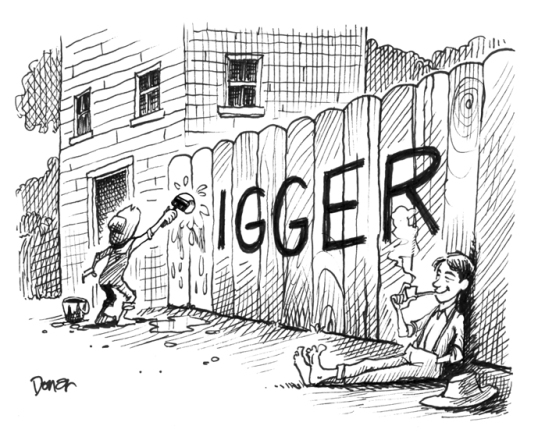
You Don’t Have to Hate Anybody to be a Bigot

Throughout American history, most bigots have been nice folks who had sincere religious reasons for treating other people badly.


Social conservatives were all over the airwaves and print media this week, explaining how and why the battle over marriage equality is not over. The Supreme Court may have spoken, but the other branches of government, they promised, could still step in somehow, if we elect the right people. Or county clerks could just refuse to issue licenses. Or ordinary people could practice civil disobedience in some unspecified way. There are, Glenn Beck has promised us, ten thousand pastors willing to “go to prison or to death” over this issue (though exactly what charges will brought against them or who might try to kill them is a bit vague).

To me, the most revealing moment of this Alamo-like refusal to surrender came when Texas Senator Ted Cruz was interviewed by Savannah Guthrie on The Today Show. Cruz was defending the “religious freedom” of Texas clerks not to issue marriage licenses to same-sex couples, when Guthrie made an analogy:

GUTHRIE: If a state clerk refused to issue a marriage license to an interracial couple, would you agree with that too?
CRUZ: There’s no religious backing for that.

Religion and interracial marriage. To anyone who remembers the 1960s or has read the history of interracial marriage (or civil rights in general), Cruz’ response is simply ridiculous. Opposition to interracial marriage was constantly expressed in religious terms.

For example, the reason the Supreme Court had to decide Loving v. Virginia, the case that legalized interracial marriage nationwide in 1967, was that when Richard and Mildred Loving tried to get their conviction for miscegenation overturned (so that they could legally come back to Virginia), Judge Leon M. Bazile was having none of it:

Almighty God created the races white, black, yellow, malay and red, and he placed them on separate continents. And, but for the interference with his arrangement, there would be no cause for such marriages. The fact that he separated the races shows that he did not intend for the races to mix.

Judge Bazile’s decision says nothing about hating black people or even interracial couples. Yahoos on the street might have taunted Richard Loving as a “nigger lover”, but the judge did no such thing. He just saw the sense in a Virginia law that upheld God’s plan for the races.

Segregation. Opposition to school desegregation could be similarly respectful and devout. In 1958, Rev. Jerry Falwell preached a sermon “Segregation or Integration: Which?”. (Like all of Falwell’s pro-segregation sermons, this one is sadly unavailable online. Perhaps Liberty University might want to rectify this.) In it, he expressed his religious objection to the Supreme Court’s Brown v. Board of Education decision.

If Chief Justice Warren and his associates had known God’s word and had desired to do the Lord’s will, I am quite confident that the 1954 decision would never have been made. The facilities should be separate. When God has drawn the line of distinction, we should not attempt to cross that line.

That polite-but-concerned religious defense of segregation goes all the way back to 1867, when the Pennsylvania Supreme Court OK’d segregated passenger trains. Chief Justice Daniel Agnew wrote:

We declare a right to maintain separate relations, as far as is reasonably practicable, but in a spirit of kindness and charity, and with due regard to equality of rights, it is not prejudice, nor caste, nor injustice of any kind, but simply to suffer men to follow the law of races established by the Creator himself, and not to compel them to intermix contrary to their instincts.

Slavery. Even slavery had religious justifications, and the breakup of the Union was presaged by the splits in major religious denominations between Northern churches who found slavery immoral and Southern churches who taught that it was part of God’s plan. As Josiah Priest wrote in 1852:

“If God appointed the race of Ham judicially to slavery, and it were a heinous sin to enslave one, or all the race, how then is the appointment of God to go into effect? …. God does never sanction sin, nor call for the commission of moral evil to forward any of his purposes; wherefore we come to the conclusion, that is is not sinful to enslave the negro race, providing it is done in a tender, fatherly and thoughtful manner.”

Hatred of men, or love of God? Like most people who oppose marriage equality for gays and lesbians today, past opponents of racial equality were not necessarily the screaming haters we see in the more dramatic videos from the civil rights movement. Far more were sedate and thoughtful people who were not aware of hating anyone. They just held a sincere belief — “in a spirit of kindness and charity”, they would tell you — that blacks were an inferior race who were better off among their own kind, or perhaps under the “tender, fatherly and thoughtful” guidance of a white master.

Most believed that God agreed with them, and could cite you chapter and verse to prove it. Freeing the slaves, desegregating the schools, allowing interracial marriage — at the time, those changes were all seen as aggressions against the religion of large numbers of American Christians.

And it is a mistake to think that such beliefs are dead relics of an era long past. There are still white supremacist churches today. As the web site of Thomas Robb Ministries in Harrison, Arkansas puts it:

For the mission God has bestowed upon His chosen people, the white race, he requires their separation.  They must honor their heritage, not despise it. Other races must honor their heritage as well. In a well ordered world, this is God’s way.

Granted, such groups are small compared to the Catholics or Southern Baptists. But your First Amendment rights don’t depend on the size of your congregation. If the religious freedom Ted Cruz wants for himself applies to Thomas Robb’s parishioners as well, then of course the county clerk must be able to refuse a marriage license to an interracial couple.

Conservatism and progress. It’s not hard to see why Cruz doesn’t want to remember or identify with the historical tradition of social conservatism: When we look back from today’s perspective, we see that the slavers and segregationists were wrong. Most of them were probably very nice people if you met them in the right circumstances, but they were wrong. They had sincerely held beliefs that were firmly anchored in their understanding of Christianity, but they were wrong.

So hardly anybody wants to claim their legacy today.

That’s the general pattern of social conservatives and progress: Eventually, progress catches up to them as well, so they can look back and see that the previous revolution in social practices and public morality was justified. The slaves should have been freed. Blacks should have been served at the Greensboro lunch counter. Women should be allowed to vote and run for office and enter the professions. (I didn’t get into the religious arguments for keeping women in the kitchen, but trust me, they were plentiful, and are also still with us.)

But this time it’s different! It always is. With no one left to defend them, our memory of the social conservatives of the past reduces to Simon Legree, KKK lynch mobs, police unleashing dogs and fire hoses against peaceful marchers, and the white rabble screaming obscenities at little black girls on their way to school. The thoughtful, intellectual, devout defenders of an unjust status quo are forgotten, because their memory embarrasses their heirs.

Consequently, in every generation, the well-considered, devout bigotry of nice people is presented to the world as a new thing. They’re nothing like the villains we recall from past social-justice movements. This time they have good reasons to block progress. They have looked deep into their souls and read their Bibles and taken it to the Lord in prayer. They don’t hate anybody, they just believe that the world as it was when they were growing up was endorsed by God, and they want to stop today’s amoral radicals from upsetting God’s appointed order.

In other words, they are just like every generation of social conservatives before them. The analogy with Josiah Priest and Chief Justice Agnew and Judge Bazile and the young Jerry Falwell (who later reversed himself, removed his segregation sermons from circulation, and quietly pretended he had never believed anything else) could not be more apt.

Bigotry is not the same as hate. Bigotry just means believing that certain groups of people do not deserve the same kind of consideration you want for yourself. Their suffering and distress doesn’t count, or they must have brought it on themselves in some obscure way. You don’t have to hate those people any more than you hate your dog when you keep him penned in your yard, or hate your children when you make them eat something they hate. (The analogy of parents and children, in fact, was often applied by pro-slavery writers to the master/slave relationship. Husbands, similarly, needed to make decisions for their wives, because women were pure but unworldly creatures. That’s what men loved about them.)

I don’t know precisely why Ted Cruz or the four dissenting judges in Obergefell believe that gays and lesbians don’t deserve the equal protection of the laws, but I doubt hate has much to do with it. It doesn’t have to. The Tennessee clerks who resigned rather than issue same-sex marriage licenses — I’ll bet they’re nice people with sincere beliefs. But they’re also bigots.

Conservatives blanch in horror at that word, when someone applies it to them. In Justice Alito’s dissent, he imagines this dystopian future:

I assume that those who cling to old beliefs will be able to whisper their thoughts in the recesses of their homes, but if they repeat those views in public, they will risk being labeled as bigots and treated as such by governments, employers, and schools.

How unfair, that those who find their neighbors’ relationships unworthy might themselves be examined and found wanting. How unfair, that they might be lumped together with the past bigots they so closely resemble. Don’t we understand that it’s different this time? That these are nice, thoughtful people of sincere beliefs?

We understand quite well.

Hidden residue. On the surface, bigotry against gays and lesbians may seem unrelated to racial bigotry. But when you deny your unattractive roots rather than repent and atone for them, their influence can linger in the back of your mind, occasionally peeking out at inopportune moments.

In an Alternet article picked up by Salon, Tim Wise called attention to the lingering racial bigotry implicit in some prominent denunciations of the recent marriage-equality ruling. Congressman Louie Gohmert, for example, warned of divine retribution:

God’s hand of protection will be withdrawn [from America] as future actions from external and internal forces will soon make clear. I will do all I can to prevent such harm, but I am gravely fearful that the stage has now been set.

Gohmert is far from the only person to make this point, and his statement contains no overt racism. But think about its implications: God kept the U.S. under His special protection and showered us with blessings while we committed genocide against the Native Americans and enslaved Africans by the millions. But as soon as we celebrate people of the same gender living together in loving, committed relationships, He’s done with us.

I don’t see an alternative to Wise’s interpretation: Gohmert’s statement only makes sense if you assume that the suffering of non-whites is beneath God’s notice.

Wise goes on to discuss another Ted Cruz interview, this one with Sean Hannity. The Obergefell decision coming so closely on the heels of the Court’s refusal to gut ObamaCare made for “some of the darkest 24 hours in our nation’s history”. (“I couldn’t say it more eloquently,” Hannity responded.)

Put aside the many-people-died events in American history (like Pearl Harbor or 9-11 or the bloodiest battles of the Civil War) and just restrict your attention to Supreme Court history. Cruz graduated magna cum laude from Harvard Law, so I assume he knows about the Korematsu decision that OK’d putting Japanese-Americans in concentration camps; and Dred Scott, where the Court declared blacks had “no rights which the white man was bound to respect”; and the 1883 decision in the Civil Rights Cases, which gave the green light to Jim Crow. To be some of the darkest 24 hours in the Court’s history, preserving ObamaCare and establishing marriage equality has to rank with those.

Again, it’s hard to avoid the conclusion that the suffering of non-whites just doesn’t count. Wise draws his conclusion:

Sometimes, racism is manifested in the subtle way a person can dismiss the lived experiences of those racial others as if they were nothing, utterly erasing those experiences, consigning them to the ashbin of history like so much irrelevant refuse.

You don’t have to hate anybody to be bigoted against them. Believing that they don’t count is more than enough.

Summing up. There’s nothing new about nice, salt-of-the-Earth people who sincerely believe that certain other people are undeserving of empathy or respect or fair treatment. There’s nothing new about those beliefs being expressed and justified in religious terms, or put forward by ministers and theologians.

Quite the opposite, that’s the normal situation. Throughout American history, most people have been pretty nice — even the bigots. America has seen nice slaveholders, nice segregationists, nice male chauvinists. And from the beginning, we have been a religious people, who could not have lived with ourselves if we couldn’t justify our bigoted beliefs in religious terms.

So we did, and we do. It’s normal.

Bigotry has a long history in the United States. And while that tradition includes haters, they’ve never been the majority. Today’s non-hateful bigots, with their sincere beliefs and their Biblical justifications, stand in a line that goes back to the beginnings of our nation. But the people in that line have consistently been wrong, and eventually even the people further up the line see it.

That’s why they never claim their legacy or own the authenticity of their place in that line. But the rest of us don’t have to humor their historical blindness. Bigotry today looks no different than bigotry 50 or 100 or 200 years ago. There’s no reason to call it anything else.

The Monday Morning Teaser

What I paid the most attention to this week was the continuing backlash of social conservatives against marriage equality. One moment that stood out for me was when Ted Cruz was asked whether the “religious freedom” to resist same-sex marriage (which he was promoting) also could be used to resist interracial marriage. Outrageously, he replied that there is “no religious backing” for opposition to interracial marriage.

That sent me to the history books, including a fascinating recent one on how interracial marriage became legal, called Almighty God Created the Races by Fay Botham. The parallels in the arguments are quite striking, as Botham herself recognizes in the final chapter.

So why, I wondered, are the Ted Cruzs so resistant to claiming their social-conservative heritage? And why was Justice Alito so concerned that his fellow marriage-equality opponents might be called “bigots”? And I came to understand the reason: Our image of the bigots of the past is that the were all haters, like the mobs being held back by federal troops in Little Rock while they yelled obscenities at the little black children going to school. No wonder Ted Cruz and Sam Alito are offended to be lumped together with them.

But when you look back more thoroughly, you find that the vast majority of segregationists and male chauvinists and even slavery defenders were just like the marriage-equality opponents of today: not conscious of hating anyone, but sincerely believing — usually for reasons rooted in their religion — that certain people shouldn’t be treated fairly, and that everyone will be better off if they remain unequal. In other words, most of the bigots of the past were probably nice folks, if you met them under the right circumstances — a lot like Ted Cruz and Sam Alito.

The result of that history project will be this week’s featured post “You Don’t Have to Hate Anybody to be a Bigot”. It should be out around 9 or 10, EDT.

The weekly summary covers yesterday’s referendum in Greece, which launches me into a reflection on how the we’re-turning-into-Greece line the Tea Party was pushing a few years ago had the economics exactly backwards. There are still more Republican presidential candidates, and pundits are finding new reasons to ignore the huge crowds Bernie Sanders is drawing. Confederate flag defenders came out in force, but I don’t think they did their cause much good. I quote a first-person response to Georgia’s open-carry law, and a couple of great Bill Maher riffs. I’m still looking for a closing. So let’s predict that to appear around noon.

Crumbling Shackles

The human imagination stubbornly refuses to die. And the moment any significant number of people simultaneously shake off the shackles that have been placed on that collective imagination, even our most deeply inculcated assumptions about what is and is not politically possible have been known to crumble overnight.

— David Graeber, The Democracy Project (2013)

Both the country and the Sift had an amazing week. What was amazing for the country is outlined below. As for the Sift, it had the most page views of any week ever — more than 150K — led by a surge of interest in last August’s post “Not a Tea Party, a Confederate Party“. (Being extensively quoted at FireDogLake may have had something to do with that.) That article got more than 120K views this week, rocketing past “The Distress of the Privileged” to become the most popular post in Weekly Sift history. (Between them, those two posts account for slightly over half of the traffic since the Sift moved to WordPress in 2011.)

This week’s featured posts are “Two Cheers for Justice Kennedy” and “Slurs: Who Can Say Them, When, and Why“.

This week everybody was talking about the Supreme Court

Thursday, the Court refused to gut ObamaCare, and Friday it legalized same-sex marriage nationwide. I broke off one piece of my Court analysis into its own article: “Two Cheers for Justice Kennedy“. Gay-rights advocates loved the rhetoric in Kennedy’s majority opinion, but his reasoning was mushy and convoluted. He provided justification for the criticism that he was redefining marriage according to his own values, and he didn’t establish a more general gay-rights precedent that was there for the taking in some of the lower-court rulings.

Roberts and polygamy. I was a little surprised that Chief Justice Roberts went for the polygamy cheap shot.

One immediate question invited by the majority’s position is whether States may retain the definition of marriage as a union of two people. Although the majority randomly inserts the adjective “two” in various places, it offers no reason at all why the two-person element of the core definition of marriage may be preserved while the man-woman element may not. Indeed, from the standpoint of history and tradition, a leap from opposite-sex marriage to same-sex marriage is much greater than one from a two-person union to plural unions, which have deep roots in some cultures around the world. If the majority is willing to take the big leap, it is hard to see how it can say no to the shorter one.

If you’ve lived anywhere that allows same-sex marriage, you’ve seen that it’s barely a leap at all. All the legal structure remains exactly the same, you just allow more people to access it. Polygamy OTOH opens up all kinds of complications, like: How does family health insurance work if you can add as many people to your family as you want? They may not be insuperable difficulties, but there’s some thinking to be done.

But what really amazed me was that Roberts learned nothing from Justice Scalia’s dissent in Lawrence, the case that threw out laws criminalizing sodomy in 2003. Scalia made a reduction-to-absurdity argument, claiming that the Court’s reasoning would lead to same-sex marriage; since that would clearly be absurd, the Lawrence ruling must be absurd also. But instead, his dissent has been quoted again and again in subsequent years, making Scalia the inadvertent prophet of marriage equality.I don’t expect to see legal polygamy anytime soon. But if it does happen, Roberts will be its inadvertent prophet.

Obamacare. For the second time — the first was three years ago — the Supreme Court refused to kill ObamaCare, with Chief Justice Roberts writing the opinion once again. This time he had Justice Kennedy with him, adding to the four liberals (Ginsburg, Breyer, Kagan, and Sotomayor) to make a 6-3 decision. The far-right faction of the Court (Thomas, Alito, Scalia) united around a dissent written by Scalia in his trademark everyone-who-disagrees-with-me-is-an-idiot style (maybe best rendered as an emo song).

[BTW: I’ll take some credit for being right about the outcome. When I examined this case last summer, I wrote: “I don’t think they’ll overturn the subsidies. The Roberts Court practices conservative activism, but prefers to do it by stealth. … I can imagine Thomas, Alito, and Scalia going that way, but Roberts and Kennedy will be reluctant.”]

Like the previous legal attack on ObamaCare, this one was basically absurd. (In the 2012 case, a new legal theory was invented precisely for the purpose of killing ObamaCare, and got four justices to endorse it. Salon‘s Andrew Koppelman wrote: “The constitutional limits that the bill supposedly disregarded could not have been anticipated because they did not exist while the bill was being written.” In fact, it got five justices: Roberts endorsed the theory, but re-interpreted the Affordable Care Act to avoid applying it.)

This challenge was more of a legal “gotcha” attack, claiming that the way one sentence was worded, the law didn’t mean what everyone involved in the legislative process thought it meant and intended it to mean. As I explained last summer, the sentence establishing the subsidies to help people pay for health insurance refers to “exchanges established by the State”, while 33 states let the federal government set up a healthcare exchange for them. So the plaintiffs in King v Burwell argued that the subsidies weren’t valid in those states. As Roberts observed in his opinion, this would likely have started a “death spiral” of health insurance in the federal-exchange states: Without the subsidies, the individual mandate wouldn’t apply to a large number of people, who then would wait until they got sick to get insurance. Insurance companies would raise their rates to compensate, pushing even more people out of the market, and so on.

According to former Republican Senator Olympia Snowe, who was lobbied heavily by the administration but ultimately voted against the ACA, the interpretation pushed by the plaintiffs was “never part of our conversations at any point”. She attributed the disputed sentence to “inadvertent language”.

Back when we had white presidents, Congress handled this kind of thing without getting the courts involved. It’s not at all unusual to discover after a law is passed that some part of it isn’t worded quite right. But these drafting errors are just fixed by new legislation, which usually passes without noticeable opposition. (No one has come up with an example of a major pre-Obama law that got skewered because of inadvertent language.) Similarly, it’s typical for a complicated piece of legislation to need minor fixes to its procedures, and Congress used to simply recognize that the fixes made the law better, rather than seeing this as a chance to refight the original battle and scuttle everything.

But in Obama Era, Republicans in Congress practice an unprecedented scorched-earth opposition, and have abandoned all previous standards of fair play. So there is no chance of getting amending legislation passed. (This is also why Obama has had to do so much through executive order. No matter how sensible a procedural change is, Congress will not pass it. Obamacare delenda est!) So the law Congress originally passed is the one the Court has to work with. Like Obama, the Court had to decide whether to take on a larger role to compensate for Congressional dysfunction.

Fortunately, Roberts and Kennedy did the sensible thing. Looking at the option of canceling the subsidies in 33 states and throwing their insurance markets into chaos, Roberts wrote: “It is implausible that Congress meant the Act to operate in this manner.”

And it is. No one who voted for the law has come forward saying s/he thought it meant what the plaintiffs claimed. And when the state legislatures were deciding whether or not to create healthcare exchanges, nobody argued that they were risking their citizens’ subsidies.

Roberts’ interpretation has an added bonus: One way the case could have come out (the way one of the appeals courts ruled) is that the sentence in question is “ambiguous”, and so the Court would defer to the IRS’ interpretation. But that would allow the next president to order the IRS to interpret the law differently. By finding on his own authority that the sentence means what the Obama administration has been saying, Roberts avoided that scenario.

So maybe now we can just let the law operate as intended. It seems to be doing pretty well.

and symbols of the Confederacy

When I wrote “Please Take Down Your Confederate Flag” last week, I had no idea how suddenly the ground would shift. I expected South Carolina’s Republican majority to rally around that flag, leading to further protests like flag-burnings.

Well, within hours after I expressed that expectation, not only did Governor Haley ask the legislature to remove the flag from the capitol grounds, but a groundswell began to remove Confederate symbols across the South. Alabama Governor Bentley removed Confederate flags from a memorial on his state capitol’s grounds. Tennessee started talking about removing the bust of KKK Grand Wizard Nathan Bedford Forrest from its capitol. Mitch McConnell called for moving the statue of Jefferson Davis in Kentucky’s capitol to a museum. Several governors said they’d eliminate the option of putting a Confederate flag emblem on state license plates. Statues people had been walking past obliviously for decades suddenly became issues in places like St. Louis and Kansas City.

On Facebook and various other forums, I’ve been amazed how quickly Confederate defenders jump to charges of “banning” Confederate symbols, which I don’t think anybody is asking for, and which would violate the Constitution anyway. What we’re asking is that governments stop endorsing the Confederacy, and that individuals and private institutions that endorse the Confederacy face criticism. It’s your First Amendment right to fly any flag or put up any statue you want, but it’s my First Amendment right to point out that you’re promoting and celebrating racism.

The encouraging thing is how quickly the country seems to have lost patience with the mythology of the Confederacy’s noble Lost Cause. President Obama summed it up in his eulogy for Rev. Clementa Pinckney

Removing the flag from this state’s capitol would not be an act of political correctness; it would not be an insult to the valor of Confederate soldiers.  It would simply be an acknowledgment that the cause for which they fought — the cause of slavery — was wrong — (applause) — the imposition of Jim Crow after the Civil War, the resistance to civil rights for all people was wrong.  (Applause.) It would be one step in an honest accounting of America’s history; a modest but meaningful balm for so many unhealed wounds.

The Confederacy fought to keep millions of African-Americans in slavery. There was no nobility to that cause. It was immoral and does not deserve to be remembered kindly or proudly. For decades, American leaders have tip-toed around those truths for fear of offending white Southerners — that’s the real political correctness in this issue. Maybe that’s over.

As for what to replace those Confederate monuments with: There’s a real shortage of monuments to the hundreds of thousands of slaves who escaped their masters and joined the army of the United States. No doubt every Confederate State has such a black hero. You can impugn the motives of many of the Northerners who fought, but these Southern blacks were the real freedom fighters of the Civil War.

Let’s not overestimate the importance of these symbolic moves. But they seemed impossible just a few weeks ago. As David Graeber has said (see quote above), political common sense can change very suddenly. It gives me hope for issues that seem hopelessly jammed today, like serious action on climate change.

and you also might be interested in …

I mentioned Obama’s Charleston eulogy above. If you haven’t seen the whole thing [transcript, video] you should.

It’s really hard to imagine how Obama could have picked up all that Christian theology at his madrassa in Indonesia. But seriously, I think people who assume authentic Christianity belongs to conservatives will be stunned.

I’ll be interested to see if we hear more of this change: Where presidents have been ending their speeches with “God bless America”, Obama ended this one with: “May God continue to shed His grace on the United States of America.” It is a more humble usage, less amenable to American exceptionalism.


Ted Cruz is calling for Texas clerks to express their “religious freedom” by not processing marriage licenses for same-sex couples. Hmmm. Would he support a clerk expressing his religious freedom by refusing to process gun-owner licenses?


Now that they’re not allowed to discriminate against gays, at least two Alabama counties have stopped issuing marriage licenses entirely. Good luck with that. I’m sure this principled civil disobedience will bring gay rights advocates to their knees. Personally, I am quivering at the thought that opposite-sex Alabama couples who can’t get married will blame me rather than their local officials.


I have already expressed my sympathy with the Bernie Sanders campaign. But if you are tempted to forward some of those anti-Hillary social media messages, you might want to explore where they come from. You might be carrying water for some right-wing group that is trying to turn Democrats against each other.

and let’s close with a inter-species musical jam

Who knew elephants could boogie? Actually, elephant intelligence is remarkable, and ought to be studied further. For example, elephants are one of the few species that can recognize their own reflections in a mirror. Unfortunately, elephant labs tend to be rather expensive, so for the foreseeable future we’ll understand white rats a whole lot better.

Here’s a question somebody ought to know the answer to: If elephants have a sense of rhythm, does that mean they’ll get in step with each other on long migrations?

Slurs: Who Can Say Them, When, and Why

Why President Obama can say “nigger” and I can’t (except when I can)


Maybe the best treatment of racial slurs ever to appear in a movie was this scene from the 2006 film Clerks 2. Randall, a fast-food worker, can’t understand why porch monkey is racist: When his non-racist grandmother used to say it, he claims, she just meant “a lazy person” not “a lazy black person”. After a black customer (played by Wanda Sykes) freaks, Randall’s friend Dante finally convinces him that porch monkey really is a racial slur (and maybe Randall’s grandmother had more racial prejudice than he remembered). But then Randall decides he’s going to “take it back”; he’s going to keep saying porch monkey, but reclaim it by using it in a non-racist way. A frustrated Dante explains to Randall that he can’t reclaim porch monkey, “because you’re not black!”

“Well listen to you,” Randall responds. “Telling me I can’t do something because of the color of my skin? You’re the racist.”

Randall’s obtuseness and Dante’s exasperation are funny, but Randall’s view is not that different from a lot of white men: Why are the rules different for us? Black rappers say nigger all the time, but when we do it’s racist. Meredith Brooks can name a song “Bitch” and Christina Aguilera can up the ante to “Super Bitch“. But when a guy says “bitch”, it’s sexist. A female writer like Lisa Miller can title her New York Magazine article “Hillary Clinton Finally Has Permission to be a Bitch” and it’s supposed to be, like, liberating or something. But when Glenn Beck referred to Clinton — the same woman! — as a “stereotypical bitch“, that was objectionable.

What’s up with that? When blacks and women can say and do things that white men can’t, isn’t that a double standard? And as Randall says, aren’t the liberals who promote that double standard the real racists and sexists?

In a word, no. But in real life — particularly when an example springs up unexpectedly, like Randall’s porch monkey — explaining why can be frustrating. A whole branch of the media is devoted to promoting what I have elsewhere called privileged distress, the feeling among white men — and Christians and English-speakers and the rich and every other privileged class in America — that they are really the persecuted ones. Their supporting examples and arguments and ways of framing the situation come easily to mind, while the explanations of why that’s the wrong way to look at it require some thought.

So let’s do some of that thinking.

Banter or insult? When blacks say “Hey, nigger” or “What’s up, nigger?” to each other, that’s banter. But if a white man like me walks up to a black and says, “What’s up, nigger?”, it’s an insult — even if I’m smiling and friendly when I do it. Why? There’s actually a color-blind rule here that’s fairly simple: An insult can be friendly banter if it can be thrown right back at you.

The reason it can be banter when one black guy says nigger to another is that the other guy can respond, “Who you calling nigger, nigger?” That doesn’t work when the white guy says it.

It’s not a double standard, because the same rule applies to me in exactly the same way. At my 40th high school reunion last fall, we were constantly making fun of how old we’ve gotten. Picture me with a too-full beer stein, and a classmate saying “Hey, old man, you sure you can lift that? Don’t want to hurt yourself.” It’s banter, and everyone laughs, because we’re all the same age.

But now imagine that the handsome and athletic young guy tending bar says the same thing to me as he serves the drink: “Hey, old man. You sure you can lift that? Don’t want to hurt yourself.” Now those are fighting words. He’s thrown an insult at me that I can’t throw right back. Now I’ve got something to prove.

The same rule applies all over: Fat people can kid each other about their weight. Tyrion Lannister can tell dwarf jokes. It’s not a double standard.

There are no white male equivalents. Sometimes you’ll hear people banter, not by throwing the same insult back and forth, but by using insults that are more-or-less equivalent. Picture two white guys at a bar, taunting each other in a friendly way with dago and pollock.

Some white guys think they should be able to use nigger the same way. The other guy can throw honky or cracker back at us, so it’s all good. Here’s the problem: honky and cracker are in no way equivalent to nigger.

If you just look them up in a dictionary you might think they are equivalent: honky is a racial slur directed at whites, nigger at blacks. What’s the difference?

Usage.

Nigger has centuries of usage behind it, and the connotation of that usage is that blacks are a subhuman race. Nigger evokes a detailed stereotype — lazy, stupid, violent, lustful, dangerous — while honky just says you’re a white guy I don’t like. For centuries, niggers weren’t really people. There’s no equivalent word for whites, because whites have always been seen as people.

If that example of the importance of usage doesn’t ring true for you, look at a different example: cow and bull. If you had recently arrived from Mars, where you learned English out of a dictionary, you might think that cow and bull are equivalent insults for women and men: Each compares a human to a bovine of the same gender.

But those words have centuries of usage behind them, and so they connote very different ideas. Calling a woman a cow implies that she’s fat, lazy, and stupid, probably good for nothing but whelping and suckling babies. Calling a man a bull, on the other hand, is a compliment. He’s powerful and headstrong. A running back can bull his way over the goal line, while someone who gets intimidated out of making a legitimate claim has been cowed.

Likewise, a Martian might think that prick and cunt are equivalent insults: They each identify a person with his or her genitalia. But a prick is a minor annoyance, while a cunt is a subhuman who is only good for sex. You might have an argument with a prick, but talking to a cunt is just stupid.

Limbaugh.

In short: No way, no how can white men banter with nigger. Neither the word itself nor any equivalent insult can be thrown back at us. Ditto for bitch or cow or cunt. A woman can shoot back with prick, asshole, bastard, or jerk, but it’s just not the same.

Taboos vs. stereotypes. White guys like Rush Limbaugh treat slurs as if they were taboos — words we’re not supposed to say just because we’re not supposed to say them, like shit or fuck. There’s no reason for it, it’s just a rule. Worse, it’s a rule that’s not applied fairly: Only white guys get called to account when they break it.

How Limbaugh pictures himself

Consequently, white guys make slurs the object of bad-boy humor. Limbaugh thinks he is being brave and daring when he calls Sandra Fluke a slut. And he thinks he’s being clever when he finds ways to come as close as possible to saying nigger without actually saying it. (It’s like those I-didn’t-really-say-a-bad-word jokes we told in grade school: “What did the fish say when he swam into a concrete wall?” “Dam!”)

That’s what white guys — and a few non-white guys who are trying too hard to fit in — mean when they brag that they’re “not PC”. It’s a James Dean pose: I’m a rebel. I can’t be bound by your arbitrary rules about what words I can or can’t say.

What’s wrong with that attitude is that society’s distaste for slurs is not a meaningless taboo. There are at least two good reasons for it:

  • In any disagreement or discussion, using a slur is cheating: You’re hitting your opponent with a club they can’t use to hit you back.
  • Every time you use a slur, you perpetuate the stereotypes it invokes. Calling a black person a nigger raises the notion — whether you’re thinking about it consciously or not — that blacks are subhumans who don’t deserve equal treatment. Calling a woman a cunt reinforces the idea that women are just good for sex, and don’t have to be treated like thinking beings.

The various disadvantaged communities are all debating whether or not it’s ever OK to use the slurs themselves. Some argue that when black rappers use nigger, they jam the stereotype rather than perpetuate it. Some women believe that saying bitch is liberating, because it shows the word doesn’t scare them. Others disagree, believing that any use of a slur promotes its stereotypes.

I think this: Those issues are for those communities to figure out. In the unlikely event that they ask my advice, I might give it. But until then, my opinion as a white guy doesn’t and shouldn’t matter.

Words as words. Now, somebody is bound to point out that in my discussion of why white guys shouldn’t use nigger, bitch, and cunt, I’ve used nigger, bitch, and cunt. Isn’t that liberal hypocrisy? Aren’t I just waving my liberal privilege in Rush’s face, saying “I can say it but you can’t!”?

I plead not guilty. There is a difference between using a word and referring to a word. I haven’t been talking about “the niggers”, I’ve been referring to the word nigger.

Why is that OK? Once again, these are not taboos. There’s no dark magic in the letters that is unleashed whenever they are put together. The power is in the use, not in the pronunciation.

That distinction is too complex for children, so we teach them not to use the words by presenting them as taboo. And this creates problems for children, as when the tattle-tale blurts out: “Teacher, Billy said shit.”

Likewise in the mass media, where children might be listening and might regard the speaker as an authoritative example — “But Mommy, the man on the radio said it.” — we insist on circumlocutions like the N-word. But when adults talk to other adults as adults, we need to be able to name the words we’re referring to. Otherwise you wind up in situations like the stoning scene from Monty Python’s Life of Brian.

Obama on WTF. So now we come to President Obama’s interview on the podcast “WTF with Marc Maron“, where he said:

Racism, we are not cured of it. And it’s not just a matter of it not being polite to say nigger in public.

And that caused a freak-out. Fox News’ Todd Starnes was one among many:

It was disappointing to say the least to hear such a vulgarity come out of the mouth of the leader of the free world.

But there you have it folks – this is man who was supposed to usher in the post-racial America. This is the man who was supposed to unite, not divide.

What President Obama said is indefensible. It soils the dignity of the Oval Office.

That’s a reaction to breaking a taboo: It would be appropriate if Obama had said fuck or shit. We don’t want our president saying crap like that.

But look at it in light of my previous analysis: We have a black man referring to the N-word in a forum not intended for children. It’s fine.

Fox’ David Webb raises this question:

Could you imagine if a Ted Cruz or somebody on the Republican side used it, in the same context, what the reaction would be.

You mean referring to it, in a discussion of racism intended for adults? I’d be fine with it.

Glee. What I’m not fine with is what Ted Nugent did: Use Obama’s example as an argument in favor of slurs and offensive symbols in general.

What sort of politically correct zombie could actually believe that the elimination of a word or a flag would reduce the evil of racism?

What sort of goofball could possibly believe that certain words are OK for one group of people but forbidden by others?

That, by the way, is the definition of racism.

I’m sure Ted and Randall could have a long talk about that, but no, it isn’t.

There’s something gleeful in Nugent’s usage of nigger, and that right there is the final test I’d recommend to any white person who’s thinking about saying it: You might think you’re referring to the word in the analytic way I have endorsed. But while analysis may at times be satisfying or even fascinating, it is almost never gleeful.

So if the word tastes delicious in your mouth, if saying it feels like a forbidden pleasure, something else is going on. Maybe you should reconsider.

Two Cheers for Justice Kennedy

By all means, celebrate. But, looking to future gay-rights cases, Justice Kennedy gave us more rhetoric than precedent.


Friday, the Supreme Court ended the decades-long legal debate on marriage equality, making same-sex marriage legal for the entire nation in Obergefell v Hodges. Across the country, supporters of gay rights were jubilant as they read to each other delicious paragraphs out of Justice Kennedy’s majority opinion. But I have a complaint: Justice Kennedy got the right result for the wrong reasons, and that will eventually cost us.

Not in other marriage cases — that’s over, just like everybody says. But Kennedy’s soaring rhetoric about the dignity of gay relationships wasn’t supported by a sound legal framework that we can use in, say, employment equality cases.

The DOMA hangover. As regular Sift readers know, I have mixed feelings about Justice Kennedy, particularly on the subject of gay rights. He tends to rule the way I want, and he’s often the swing vote that puts my position over the top. But being the swing vote, he usually ends up writing the majority opinion, and he writes it badly. That’s what happened when the Court threw out the Defense of Marriage Act (DOMA) two years ago, which I covered (along with Chief Justice Roberts’ hamstringing of the Voting Rights Act) in an article I demurely called “This Court Sucks“. And it happened again Friday.

The reason Obergefell came to the Court in the first place was that lower courts could not follow Kennedy’s mushy reasoning in the DOMA case. The Supreme Court is supposed to do more than just decide the current case, it’s supposed provide interpretive frameworks for lower courts to apply, so that future cases can be decided without involving the Supremes again. But when Judge Kean was throwing out Oklahoma’s ban on same-sex marriage, for example, he wrote that he had “gleaned” — not quoted, gleaned — two principles from Kennedy’s DOMA opinion. Other courts gleaned other principles and disagreed, so the highest court had to sort it out.

This time, Kennedy has made marriage equality the law of the land, but he’s done it with another piece of mushy reasoning that is a poor climax to the distinguished series of lower-court decisions supporting same-sex marriage, going all the way back to the 2003 Goodridge decision in Massachusetts. Instead of following the compelling logic laid out by one lower court after another, Kennedy’s opinion looks like exactly what critics of marriage equality say it is: a judge redefining marriage according to his own values. His ruling is full of beautiful tributes to the dignity of same-sex couples, but short on the kind of step-by-step legal thinking you can find in the lower-court rulings, which I summarized last month.

Due process isn’t enough. Every pro-marriage-equality judge I know of, other than Kennedy, has centered the argument on the 14th Amendment‘s guarantee of “the equal protection of the laws”. As I summarized:

In practice, that phrase has been interpreted to mean that if the government treats some people differently than others, it has to have a good reason. The more significant the discrimination, the weightier the reason needs to be.

That’s why laws that provide a marriage option to opposite-sex couples but deny it to same-sex couples are in trouble: because it’s increasingly hard to say what legitimate reason the government might have for that discrimination.

… So the claim that gays and lesbians want to “redefine marriage” has it exactly backwards. During the last century-and-a-half, marriage has already been redefined. And in marriage as it exists today — rather than during the Revolution or the Civil War — what’s our justification for refusing its advantages to same-sex couples?

Instead, Kennedy focuses on the 14th Amendment’s due-process clause, and finds a fundamental right to marry in the word liberty. His rhetoric is inspiring if you already agree with him, but if you don’t, his reasoning isn’t compelling. The dissents by Roberts, Thomas, Scalia, and Alito eviscerate his argument, and rightly so.

Kennedy’s biggest problem is that the Constitution doesn’t require governments, either federal or state, to recognize marriage at all. (If Oregon wanted to become “the free love state” and stop performing marriages entirely, that would be up to Oregonians.) Liberty traditionally means being left alone by the government, not that the government must help you in some way. So Roberts makes an argument that appears in some form in all the dissents:

Our cases have consistently refused to allow litigants to convert the shield provided by constitutional liberties into a sword to demand positive entitlements from the State.

The question Kennedy should have raised is: Once the State has defined the “positive entitlement” of marriage for some people, what’s its justification for denying those benefits to others? But that’s an equal-protection issue, not a liberty issue.

In short: the ruling came out the right way, but the people who still want to hold out against marriage equality feel vindicated in their view that the Court has usurped the power of the legislative branch by “redefining marriage”. It didn’t have to be like this. Why, oh why, couldn’t Justice Ginsburg have written this ruling?

Why it’s important. The lower courts nearly all used the equal-protection framework: Define a level of scrutiny appropriate to laws that discriminate against gays, and then examine the government’s reasons for discriminating under that level of scrutiny. One of the issues to decide, if you go that way, is whether gays and lesbians are a class that has traditionally faced discrimination, and so how much benefit of the doubt a legislature or electorate should get as to its motives.

Racial discrimination, for example, faces the highest level of scrutiny. As a matter of judicial precedent, laws that discriminate against traditionally disadvantaged racial groups are inherently suspect. Similarly, laws that discriminate against women are inherently suspect. It’s possible that some particular race- or gender-discriminating law can be justified, but a court will not give the government any benefit of the doubt.

The traditional discrimination against gays and lesbians certainly would justify giving laws against them some heightened level of scrutiny, but the Supreme Court has never done so. Kennedy doesn’t do so either.

Pro-marriage-equality judges who don’t invoke heightened scrutiny are forced to give the legislative branch the benefit of the doubt. And so they end up having to argue that same-sex marriage bans are completely irrational. That argument has been made, and was sitting there for Kennedy to endorse. He didn’t.

Going either way would have established a precedent for fighting other anti-gay discrimination: Either anti-gay discrimination would face heightened scrutiny in the future, or there would be a precedent for saying that certain kinds of anti-gay discrimination are irrational.

Instead, Justice Kennedy gave us just this result, justified by a lot of effusive rhetoric that has no further legal consequences.

The “threat to American democracy”. All four dissents lamented a judicial usurpation of powers properly belonging to the democratic branches — which is in fact a fair criticism of the argument Kennedy made. The place for flowery rhetoric is in the legislature or on the campaign trail. But it wouldn’t have been a fair criticism of the equal-protection argument Kennedy avoided.

Dahlia Lithwick raised the right question:

And all I could keep thinking was, “Where was all this five unelected judges chatter when you all handed down Citizens United? Or Shelby County? Why does this rhetoric about five elitist out-of-touch patrician fortune-cookie writers never stick when you’re in the five?”

The most-quoted Roberts line was:

Indeed, however heartened the proponents of same-sex marriage might be on this day, it is worth acknowledging what they have lost, and lost forever: the opportunity to win the true acceptance that comes from persuading their fellow citizens of the justice of their cause.

If you’re a straight person very distant from the gay community, this might sound convincing. But if you imagine yourself in the place of a same-sex couple, it isn’t convincing at all. Would you rather have widespread social approval ten years from now, or the equal protection of the laws today? The answer is pretty obvious.

The comparison to interracial marriage is apt. XKCD draws the chart:

Our fellow citizens are being persuaded of the justice of marriage equality — not, for the most part, by referendum campaigns, but by living in society with same-sex couples. That process will continue apace.

In these the-sky-will-fall-if-we-allow-this situations, most people have to see something in action before they realize the panic-mongers are conning them. As I predicted back in 2003:

Personally, I expect the same-sex marriage issue to follow the same course as interracial marriage. After a few years of Chicken-Little panic, the vast majority of Americans will recognize that the sky has not fallen, and that the new rights of homosexuals have come at the expense of no one.

Today, no one cares how interracial couples got the right to marry. Most young people have trouble believing it was ever an issue. (Have you ever tried to explain to a teen-ager why his friend’s parents’ marriage would have been illegal 50 years ago? I have.) So it will be for same-sex marriage.

The Actual Monday Morning Teaser

Yesterday, readers got a little more insight into the Sift’s inner workings than I wanted to give them. You see, I want anybody who comes to the blog on a Monday morning to at least get a promise that articles are coming; that’s what the Teaser is for. So I like to get it posted as early as I can. I’m usually a morning person, so I roll out of bed, grab a cup of coffee, walk to the computer and post.

Well, yesterday I woke up later than usual, with one of those strange I-just-woke-up beliefs that it was Monday and I was running late. Forget the coffee, I had to get to the computer and get a Teaser up right now. It was posted before I saw enough of the world to realize it was Sunday.

I could have taken it down then, but one of my policies is that once commenters notice an error, I can fix it, but I can’t pretend it didn’t happen. (The comments often contain my acknowledgement of mistakes I’ve edited out of the text.) Deleting the post would delete the comments that corrected me. So the wrong-day Teaser stays up.

Anyway, I have it on good authority that it really is Monday today. So here’s what you can expect: Unlike what I would have done yesterday, I’m going to pull my Supreme Court analysis out of the summary and make it a separate article “Two and a Half Cheers for the Supreme Court”. It should go up around 8 or 8:30.

Then I’ll post an article on racial and gender slurs that I’ve been thinking about for a while, but waiting for a news hook: The conservative furor over President Obama saying “nigger” in an interview was the hook I was waiting for, so “Slurs: Who Can Say Them, When, and Why” should go up by 10. It begins with a scene I really love from Clerks 2, and concludes with a scene from Monty Python’s Life of Brian, so I think it does a good job of mixing light and heavy.

Then the weekly summary will cover other people’s reactions to the Court decisions; the amazing crumbling of support not just for the Confederate flag in front of the South Carolina state capitol, but for Confederate symbols all over the country; Obama’s eulogy for the Charleston victims; why you should think twice before forwarding that anti-Hillary tweet; and a few other things before closing with a human/elephant musical jam. Maybe 11 or 11:30 for that.

It really is Monday, isn’t it?

The Monday Morning Teaser

Update: It’s actually Sunday and I’m not running behind at all. Thanks to the commenters for pointing this out before I actually started posting articles.


I’m moving slowly on a rainy morning. The featured post today will be “Slurs: Who Can Say Them, When, and Why”. The conservative freak-out over President Obama saying “Racism, we are not cured of it. And it’s not just a matter of it not being polite to say nigger in public” provides an occasion for me to collect some thoughts that should be obvious, but for some reason aren’t to some people. I’ll try to keep it amusing, with relevant clips from Clerks 2 and Life of Brian.

Since I’m getting a late start, it might be 10 before that appears.

There’s an amazing week to cover in the summary: two major Supreme Court decisions; Confederate symbols started coming down — not just in South Carolina, but all over; the TPP is back from the dead; and President Obama’s eulogy for the shooting victims in Charleston might go down as one of the great American speeches. Expect that around noon.

And I’ll close with something celebratory: a video of two actual, non-animated, boogying elephants.

Perhaps Mentally Ill

A black shooter is a thug, a Muslim is a terrorist, and a white attacker is perhaps mentally ill.

— an unidentified interviewer for RT network’s “In the Now

Now is the time for mourning and for healing. But let’s be clear. At some point, we as a country will have to reckon with the fact that this type of mass violence does not happen in other advanced countries. It doesn’t happen in other places with this kind of frequency.

President Barack Obama

This week’s featured post is “Please Take Down Your Confederate Flag“. But last August’s “Not a Tea Party, a Confederate Party” is also topical again; it had picked up more than 20K new hits between the Charleston shooting and 9:30 this morning, making it the second Weekly Sift post to go over a quarter million page views.

This week everybody was talking about the terrorist attack in South Carolina

But not everybody was calling it that. Since the shooter was a white supremacist and his victims were not whites, the incident was usually referred to as a tragedy, i.e., one of those bad things that happens now and then that nobody can do anything about. Rick Perry even called it an “accident“. (I discussed this phenomenon after the 2012 Sikh Temple shooting in “White Right-Wing Christian Terrorist“.) An interviewer at RT put it like this:

A black shooter is a thug, a Muslim is a terrorist and a white attacker is perhaps mentally ill.

If the subject weren’t so serious, it would have been comical to watch Republicans and their right-wing media allies struggle against the notion — obvious from the beginning to anybody without ideological blinders — that this was a racial attack. Multiple talking heads on Fox News tried to spin the shooting as an attack on Christians, because the imaginary persecution of American Christians fits within the boundaries the Fox fantasy world, while the very real persecution of blacks doesn’t. (Larry Wilmore collected the clips and added appropriately amazed commentary. Media Matters gives the chronology, showing that witness accounts of the shooter’s racist statements were already public before Fox’ Christian-persecution spin.)

Lindsey Graham and Rick Santorum played along with that farce. (Jeb Bush merely professed ignorance: “I don’t know what was on the mind or the heart of the man who committed these atrocious crimes.” — as if he shooter hadn’t announced what was on his mind.) Fox trotted out a black minister, Bishop E. W. Jackson, to make the Christian-persecution case, not bothering to mention that he is also a Republican politician. Wilmore was not impressed: “Black don’t distract,” he said. He also ridiculed Jackson’s statement that the shooter “didn’t choose a bar, he didn’t choose a basketball court, he chose a church”, suggesting that Jackson could also have listed “a chitlin farm” or “a watermelon stand” as stereotypic places where blacks congregate.

In a particularly Orwellian editorial, The Wall Street Journal saw the shooting as a chance to congratulate America on its racial progress: Unlike after the 1963 Birmingham church bombing, authorities in Charleston are not conspiring to help the perpetrator get away.

The universal condemnation of the murders at the Emanuel AME Church and Dylann Roof’s quick capture by the combined efforts of local, state and federal police is a world away from what President Obama recalled as “a dark part of our history.” Today the system and philosophy of institutionalized racism identified by Dr. King no longer exists.

In a different context, Wilmore recently introduced The Nightly Show’sExtremely Low Bar Award“. This looks like another strong candidate: Our law enforcement system is no longer conspiring with white-supremacist terrorists, so we must have this racism thing just about knocked. It makes me proud to be an American.

The New Republic‘s Jeet Heer also looked back to the Birmingham bombing, but pointed out that the conservative media’s response then was very similar to the denial of white racism we’re seeing today. He quotes a National Review editorial from 1963:

The fiend who set off the bomb does not have the sympathy of the white population in the South; in fact, he set back the cause of the white people there so dramatically as to raise the question whether in fact the explosion was the act of a provocateur—of a Communist, or of a crazed Negro.

And the significance of this particular church to a white supremacist couldn’t be clearer: One of the oldest black churches in America, Emanuel AME was founded by (among others) Denmark Vesey, who was hanged for leading a failed slave revolt in 1822.

Discussion of the Confederate flag that still flies in front of the South Carolina state capitol, and can’t even be lowered to half-mast without an act of the legislature, is a topic I pushed into its own article. My main point there is that a symbol like the Confederate flag is so powerful that your personal intentions in displaying it don’t matter: It means what it means. Maybe you associate it with country music and good barbeque and The Dukes of Hazzard, but that just doesn’t matter. It is the flag of slavery and Jim Crow and the KKK and lynchings and Dylann Roof. You can’t make that stuff go away.

Finally, there’s the frequent statement — based on more-or-less nothing — that Dylann Roof was a “loner” or a “lone wolf”. We now have what appears to be his manifesto, and it’s filled with standard white-supremacist rhetoric and references. We still don’t know whether he met other white supremacists face-to-face or had any help planning his attack. But he clearly was plugged in to that network, through the internet at the very least.

Make the parallel to Muslim terrorists and ISIS. If a Muslim shooter had been browsing ISIS web sites and wrote a manifesto full of ISIS rhetoric, would we see him as a loner, or think of him as part of ISIS? Those same Republican politicians — Lindsey Graham, for example — who cast Roof as a disturbed loner would be demanding that a similar Muslim be grilled hard (and maybe even tortured) to identify his contacts in the movement.

and the Pope’s global-warming encyclical

Charleston dominated my attention this week, so I still haven’t finished reading Laudato Si or given its message the attention it deserves. Next week.

I do want to make two strategic observations that explain why I think this is a big deal:

  • Climate-change denial is geared towards confusing people about science; it’s not well set up to oppose a religious movement that defends God’s creation. Scientists are well-known evolution-pushing liberals who are easy to cast as part of a global socialist conspiracy. A diverse consortium of religious leaders is harder to tar with that charge, and fossil-fuel conservatives look ridiculous when they try.
  • What we’ve seen in regard to both women-in-the-clergy and gay rights is that no Christian denomination wants to be the most liberal group to defend a benighted conservative position. When the Congregationalists turn, that puts pressure on the Episcopalians, and when they turn the onus shifts to the Methodists, and then the Presbyterians, and so on. The Catholic Church has been the only denomination big enough to resist that kind of pressure, and now that it has taken a strong position calling for action against climate change, there’s no telling where the dominoes stop falling. American Christianity might wind up speaking with a fairly united voice on this issue.

BTW: NOAA’s May statistics still have 2015 on its way towards being the hottest year on record, replacing last year.

and still more presidential candidates

Jeb Bush’s announcement was an anti-climax, because he’s so clearly been running for months now. And I’m left with the question: What issues will he run on? His positions on immigration and education are unpopular with the Republican base. I have heard no specific suggestions for how he would fight ISIS or terrorism in general differently than President Obama. I really don’t think his blaming Obama for “the biggest debt ever” will stick, given that Obama has drastically reduced the deficit he inherited from Jeb’s brother.

I’ll get to his speech eventually in my 2016 series, probably after I do Hillary’s, but my immediate reaction is surprise at how little is in there. There are hints of a tax plan, hints of increased defense spending, but the only number in the speech is his goal of 4% annual GDP growth. Increased growth would be good — I wonder why nobody ever thought of that before.


Jeb didn’t stay in the news very long, though, because the next day Donald Trump announced his candidacy with a rambling speech that sounded like the kind of thing you’d hear from the guy on the next stool at your favorite bar. Digby warns us that we have to take the Donald seriously. But the comedians had a different reaction: Jon Stewart looked to Heaven and said “Thank you.” Larry Wilmore unwrapped Trump’s candidacy as a gift from the Comedy Gods.

Here’s what’s going to be amazing once the debates start in August: All the minor candidates are going to be looking to make headlines by saying something outrageous, but how are they going to compete with Trump? What will they have to say?

In the 2012 cycle, the crowd reactions were bad publicity for the GOP as a whole: They booed a soldier calling in from Iraq because he was gay. They cheered the idea of letting somebody without health insurance die. What is the audience going to do when Trump says that Mexican immigrants are rapists? Or voices one of his other incredible opinions? The general public may get a chance to see just how far around the bend the Republican base really is, and how every single one of the candidates panders to that insanity.


I loved Jamelle Bouie’s take on Hillary Clinton: She was a nerd before it was cool, and her public-image ambiguity stems from trying not to look like the geeky policy wonk she really is. He thinks she should “go full nerd” and be herself.

and Rachel Dolezal

I am still trying to fathom the depth of the public reaction to Rachel Dolezal, the woman who was born to white parents and raised as a white girl, but at some point in adulthood began presenting herself as black, and eventually became president of the Spokane chapter of the NAACP.

In part, the story attracts attention because of its man-bites-dog character. Light-skinned blacks have been passing as white in America since colonial times, as I discussed last year in a review of Daniel Sharfstein’s The Invisible Line. (One member of a black-turned-white family Sharfstein researched was a Confederate officer during the Civil War and a Louisiana senator afterward.) But passing in the other direction is not something you hear about very often.

But even that doesn’t explain the urgency with which writers of all racial and political identities have been addressing this topic, as if Dolezal’s situation demanded our immediate action. I suppose if I were connected to the Spokane NAACP, I’d have a responsibility to form an opinion about Dolezal. And I can imagine that I might feel conned if I belonged to the constituency of the Spokane NAACP, and counted on it to represent my interests. I might believe that I had at least deserved the chance to know the details of Dolezal’s claim to a black identity before she was hired, so that I could decide for myself how confident I felt in her ability to represent me.

But that doesn’t make it a national issue either.

A lot of the ink spilled about Dolezal concerned what her kind of “transracialism” says about transgenderism, which was still on everybody’s mind after the Caitlyn Jenner story broke a few weeks ago. But the parallel between Dolezal and Jenner escapes me. Jenner broke the story herself, and all she asks of us is that we let her live her life (and maybe watch her TV show). What if Dolezal had done likewise? She might have said, “Hey, everybody, for a long time now I’ve been thinking of myself as black. So I’m going to darken my skin and frizz my hair and try to live in the black community as a black.” And then everybody could do what they wish with that information.

I don’t see anything to object to in that scenario.

The transgender community is already discussing how they feel about Jenner’s celebrity, which will likely offer her a de facto spokesperson role, if she wants one. But to make the case similar to Dolezal, Jenner would have to be angling for a role not just as spokesperson for transgender people, but for women. I see no sign of that at all.

If you do feel compelled to form an opinion about Dolezal, here’s an interesting thought experiment: What if one of her parents had crossed the racial line in the other direction? Then Dolezal would be reclaiming some forgotten black grandparent, but her life might have been almost exactly the same. She might have been raised as a white girl by parents everyone believed to be white, and have had all the same experiences, giving her no additional insight into the black experience in America. Intuitively, it seems like the grandparent would make her claim to blackness more authentic. But why? Is it really just genes?


In the section above, I was using a couple of abstract principles that someday I’ll have to flesh out on my philosophical/religious blog, where I post far less frequently. First, judgment is not an end in itself. Judgment is a tool for guiding action. If you can’t foresee playing a role in some relevant decision-making process, then you don’t really need to have an opinion, and there’s no inherent virtue in forming one. Sometimes thinking a case through is a worthwhile exercise that sharpens your mind. But it can also be a way to avoid other topics that really do demand your judgment. (On my Facebook news feed, I found it instructive how fast discussion of Dolezal dried up as soon as the Charleston shooting gave us a serious racial issue to think about.)

Second, the standards of judgment should serve the purposes of judgment. Just as judgment is not an end in itself, high standards are not ends in themselves either. So the answer to the question: “Do I believe Dolezal is really black?” depends on why I need to know. If it’s up to me to decide whether she gets some kind of affirmative action benefit, then I’d set a fairly high standard, and would probably say no. But if I’m her neighbor, and the question is whether I’m going to accept her for what she aspires to be, then I’d apply a lower standard and probably say yes.


And finally, if you go full Zen on the topic, all our identities are false. We talk about “true” and “false” identities, as if we were dealing with a binary category. But authenticity is a continuum like anything else. (That was the philosophical theme of my Jenner article.) Anybody’s identity is only authentic up to a point.

All of which reminds me of one of my favorite quotes from William James’ The Varieties of Religious Experience:

The first thing the intellect does with an object is to class it along with something else. But any object that is infinitely important to us and awakens our devotion feels to us also as if it must be sui generis and unique. Probably a crab would be filled with a sense of personal outrage if it could hear us class it without ado or apology as a crustacean, and thus dispose of it. “I am no such thing,” it would say; “I am MYSELF, MYSELF alone.”

I can’t help wondering what James’ crab voice sounded like when he gave the original lecture in Edinburgh in 1901.

and let’s close with something cute

It’s been a tough week. We need this.

Please Take Down Your Confederate Flag

It’s his flag, not yours.


Friday, I was walking along Main Street in Nashua, New Hampshire, a few blocks from where I live, when a pick-up truck drove by trailing a full-size Confederate battle flag behind its cab.

The truck didn’t stop, so I didn’t have a chance to ask the driver what message he thought he was sending. But I know what message I received. A little more than 36 hours had passed since Dylann Roof had murdered nine black people at a prayer meeting in Charleston, South Carolina, saying “You rape our women and you’re taking over the country. You have to go.” So, given the timing, what such a vigorous display of that flag said to me was: “Right on, Dylann.”

It’s possible that I’m misjudging that driver. Maybe he’s a Southerner stuck in New England for the summer, showing his regional pride. Maybe he’s a Lynyrd Skynyrd or Dukes of Hazzard fan who hadn’t been listening to the news at all. Maybe he’s the kind of guy who just likes to get a rise out of people like me. Maybe … I don’t know. I can spin possibilities all day, but the message I keep coming back to is: “Right on, Dylann.”

It pissed me off. I’m white, I’ve never been to Charleston, and to me Roof’s nine victims are little more than names and faces on my TV. But I imagine being gunned down in my church by someone I welcomed, and I get angry. And then I feel sad. And then I despair that we will never be done with this ancient tribal barbarism, much less ever achieve our stated national goal of “liberty and justice for all”.

As the truck went by, I didn’t respond, didn’t yell an insult or wave my middle finger or anything like that. To be honest, it was gone before I could react. But I like to think I would have restrained myself anyway. Because my anger, my sadness, my despair … maybe that was exactly what the driver wanted from me. Maybe hate-evoking-hate was exactly his purpose.

I don’t know what purpose motivates the government of South Carolina, or the legislature that put Dylann Roof’s favorite flag on top of the capitol in Columbia in 1961, and responded to an NAACP boycott in 2000 by moving it to fly in front of the capitol rather than above it. (Because the details of its presentation are enshrined in law, the flag could not be brought to half-mast in response to the Charleston massacre. So the American flag was lowered, but the Confederate flag was not.) I can’t say what motivates leaders like Governor Haley or Senator Graham to continue defending that flag.

Probably no state is more identified with the Confederacy than South Carolina, and no city more than Charleston. In 1860, South Carolina was the first state to secede from the Union. Charleston harbor was where the Civil War’s first shots were fired. Charleston is where the Southern delegates walked out off a Democratic convention set to nominate likely general-election winner Stephen Douglas, splitting the party and setting the stage for Lincoln’s election and South Carolina’s secession. (According to historian Douglas Egerton, that series of events was foreseen and intended by the walkout’s leaders.) Years before that, South Carolina was the home of John Calhoun, whose speech “Slavery a Positive Good” announced to the Senate the arrival of the defiant, self-righteous Southern attitude that laid the groundwork for secession and war. (Calhoun’s statue still stands on a pedestal high above Charleston. The Emanuel AME Church where the massacre took place is on Calhoun Street.)

For decades after Appomattox, the Confederate flag was displayed mainly at cemeteries and war monuments, but it became a political symbol again after President Truman desegregated the military in 1948 and Strom Thurmond’s Dixiecrats rebeled. Truman was succeeded by Eisenhower and Kennedy, each of whom sent federal troops to enforce the Supreme Court’s desegregation decisions. As the federal government became more and more identified with the civil rights movement, states and cities across the South began flying the Confederate flag over their official buildings. As in the 1860s, the flag represented “states rights”, but particularly a state’s right to oppress its Negro population.

South Carolina started flying it over the state capitol in 1961. After the Voting Rights Act restored the franchise to South Carolina’s blacks, the flag became a political issue. The slogan of those whites who want to keep it flying has been “heritage, not hate“, as if the heritage of South Carolina and the Confederate flag could somehow be separated from slavery, segregation, lynchings, and all the other manifestations of racism right up to Wednesday night’s massacre.

Since Wednesday, there has been a national backlash against the flag. In The Atlantic, Ta-Nehisi Coates wrote “Take Down the Confederate Flag – Now“, and many other writers and bloggers have posted some similar message, often in an angry or demanding voice. Hundreds protested in Columbia Saturday, but South Carolina’s political leadership has held firm. That intransigence has prompted calls for protesters to take more drastic action.

In that South Carolina will never willingly take down the flag, the time has come for opponents to exercise their First Amendment right to free speech and burn the Confederate flag — at the state Capitol in South Carolina, in front of the White House, in front of Fox News or maybe even outside the Grand Ol’ Opry.

One white supremacist’s merged symbol.

The writer angrily compares the flag to the Nazi hooked cross, and I’ve seen many blog articles and Facebook posts referring to it as “America’s swastika” or “the Confederate swastika“. (I found a literal Confederate swastika posted on a forum of the white supremacist group Stormfront. “I like it … a lot!” replied a commenter.)

I can imagine the feelings that lead people to say and write (and now do) stuff like that. Probably they’re a lot like what I felt when that truck went by me on Main Street. But burning Confederate flags to protest the Charleston massacre is like burning Qurans to protest 9-11. Yes, it will piss off the people who pissed you off. But how does that lead us anywhere good? I doubt that the glow of burning flags or books has ever enlightened anyone.

And enlightenment is what we need. The people who fly the Confederate flag need to come to understand the message they are sending. And understanding that message, they should take their flags down voluntarily. (Except for what I hope is the minority that really does want to say, “Right on, Dylann.” Racists have free-speech rights too.)

That’s what I’m asking, in as polite a form as I can manage: Please take your flag down.

I know you think your flag says something positive. But you need to understand that your intention does not control the message. You’re not saying what you think you’re saying.

Nobody enjoys being compared to the Nazis, but there is one way in which the swastika is an instructive example: It didn’t always mean what it means today. The swastika has a millennia-long history as a positive religious symbol. Even the word swastika has a pre-Nazi history, tracing back to a Sanscrit word that means good fortune. Particularly in India, you can see the hooked cross carved into temples built long before anyone ever heard of blitzkrieg or Kristallnacht or the Final Solution. There’s a lot in the swastika that I might want to invoke.

But I can’t.

The Nazis ruined the swastika. They own it now, because nothing captures a symbol like blood sacrifice.

Today, if I get a swastika tattoo or wear a swastika t-shirt or stencil a swastika onto the hood of my car, it doesn’t matter what I want it to mean. Whatever I think or intend, the swastika is a Nazi symbol, and no German-American like me will be able reclaim it for any other purpose for centuries.

And no, it doesn’t matter that generals like Rommel and Guderian were brilliant tacticians who revolutionized warfare, or that many of the brave German soldiers who marched under the swastika just wanted to defend their homes and families. The swastika is inextricably linked to Hitler and Auschwitz, and if I display it, I am linked to them too.

Something similar is true of the Confederate battle flag. Whatever you want it to mean, it belongs to the people who have sacrificed blood to it: the slave-masters and their defenders, the klansmen whose lynchings enforced Jim Crow, and the white supremacists who are still with us.

Dylann Roof laid his claim to the flag Wednesday night. He owns it; you don’t. What you want it to symbolize just doesn’t matter.

So take it down. It doesn’t say what you want it to say, and it won’t for generations to come.

The Monday Morning Teaser

Of course the event that overshadows everything else this week is the Charleston shooting. The events of the shooting are fairly straightforward and well known by now: We know who did it and how and why. He’s been caught.

There’s a deeper investigative report that needs to be done, but it’s a little beyond my powers: How many potentially violent white supremacists are out there? What’s the government doing to protect us from them? How do they recruit? What are the signs your teen-ager is being drawn in? And so forth. I suspect the Southern Poverty Law Center has such a report, but I haven’t searched it out yet. If you’ve seen something similar somewhere, leave a comment.

So this week I cover two intermediate-depth aspects of the shooting: (1) The amazing inability of conservative media and politicians to see and admit the obvious: that this was racially motivated terrorism. Many of them maintained (long after clear evidence to the contrary was available) that since this was a church shooting, it must be anti-Christian violence rather than racial violence. The rest just professed to have no idea why it happened. (2) The controversy that erupted after the shooting about the Confederate flag, which still flies in front of the South Carolina capitol.

The featured post “Please Take Down Your Confederate Flag” is my reaction to seeing a pick-up truck Friday — about 36 hours after the shooting — going down Main Street in my New England town, trailing a full-size Confederate flag behind the cab. That article is just about done and should be out by 7 or so.

However, the most popular post last week — and I suspect again in the week to come — is from last August: “Not a Tea Party, a Confederate Party“. The shooting made it topical again, and has given it another 18K hits so far. It was still picking up momentum yesterday.

The weekly summary covers the bizarre conservative reactions to the Charleston massacre, and then discusses (a little; more next week) the Pope’s climate encyclical, the entry of still more presidential candidates into the race, and Rachel Dolezal (whose story I punted on last week), before closing with the kind of non-disturbing video we need about now: two bear cubs playing together. Expect the summary between 10 and 11.