The Monday Morning Teaser

It’s another Monday where I may run late, but for an upbeat reason rather than a downbeat one: This weekend I flew back from visiting friends in Hawaii and lost a night’s sleep in the process. I’m still adjusting to east-coast time and moving a little slowly. But I’m explaining, not complaining. What little is left of New England winter should be pretty easy to take now.

Did anything happen these last two weeks? Oh yeah: Trump switched sides in the Ukraine War. On tariffs, he changed directions back and forth like Barry Sanders on a downfield run. He gave an extraordinarily lie-filled speech to Congress, earning wild cheers from Republican lawmakers who appear to be tired of wielding legislative power and eager for the executive branch to take it from them. Elon Musk warned Americans that empathy is an exploitable weakness, while protesters circled Tesla dealerships and the Supreme Court hinted (maybe sorta) that it might rein him in.

Personal note: While in Hawaii, I temporarily joined the impromptu Maui Justice Choir at a demonstration. We sang “Can You Hear the People Sing?” from Les Miz (leaving out the verse about the blood of martyrs; let’s hope that’s not needed). Singing turns out to be different from public speaking in churches: People actually cheer when you’re done rather than express their appreciation more sedately.

So anyway, here’s what I’ve got planned today: The featured article will try to solve the tariff mystery. Nothing Trump says about his tariffs makes any sense, so what’s really going on? That should be out by 10 EDT, maybe. As usual, I’ll aim to get the weekly summary out by noon, but again, I’m not fully recovered yet from travel.

Winged Victory

NO SIFT NEXT WEEK. THE NEXT NEW ARTICLES WILL APPEAR ON MARCH 10.

Whoever is winning at the moment will always seem to be invincible.

– George Orwell
Second Thoughts on James Burnham” (1946)

In order to understand the title of this post and its relationship to the quote, you need to know why ancient Greek statues of Nike, the goddess of victory, had wings: During a battle, birdlike Victory might flit back and forth from one side to the other before landing.

This week’s featured post is “How Things Stand“, my evaluation of the current state of Trump’s attempt to overturn American democracy.

This week everybody was talking about Musk’s chaotic attack on the federal workforce

Elon may have reached the limit of his power this weekend, as other players within the Trump administration began to resist his usurpations of their domains. Saturday, Musk tweeted on X that all federal workers would soon receive an email “requesting to understand what they got done last week. Failure to respond will be taken as a resignation.”

That was followed by an all-government-employee email from hr@opm.gov, an account Musk created specifically to broadcast to the whole federal workforce.

[Subject Line] What did you do last week?

Please reply to this email with approx. 5 bullets of what you accomplished last week and cc your manager.

Please do not send any classified information, links, or attachments.

Deadline is this Monday at 11:59pmEST.

A number of Trump-administration cabinet secretaries did not take this well. Picture it: You’re supposed to be in charge of a department, but somebody from outside your chain-of-command contacts your employees asking for progress reports and threatening their jobs. Presumably he thinks that he (and not you) is going to evaluate their performance. And what if you had something more urgent for your people to be doing on Monday?

So several people who are not Trump-administration dissidents (in any way) pushed back.

Newly confirmed FBI Director Kash Patel told his staff in a separate email later on Saturday that they should “pause any responses”. “FBI personnel may have received an email from OPM requesting information,” Patel wrote in a message obtained by CBS News.”The FBI, through the Office of the Director, is in charge of all of our review processes, and will conduct reviews in accordance with the FBI procedures.”

The state department sent a similar message, saying leadership would respond on behalf of the agency. “No employee is obligated to report their activities outside of their Department chain of command,” an email from Tibor Nagy, acting undersecretary [of State] for management, said.

The Pentagon told its staff: “When and if required, the Department will coordinate responses to the email you have received from OPM.”


From Wired today:

Federal employees at the Department of Housing and Urban Development (HUD) were greeted this morning by television sets at the agency’s Washington, DC headquarters playing what appears to be an AI-generated video of President Donald Trump kissing the feet of Elon Musk, accompanied by the words: “LONG LIVE THE REAL KING.”

A person at HUD headquarters on Monday morning shared a video with WIRED showing the scene playing out on a loop on a TV screen inside the Robert C. Weaver Federal Building. The source, who was granted anonymity over fears of repercussions, says that workers at the building had to manually turn off each TV in order to stop the video playing.


Just for a moment, and for the sake of argument, Paul Krugman takes seriously the notion that government should run like a business. And then he looks at the list of alleged costs DOGE claims to have saved the taxpayers. It doesn’t add up to anywhere near the “$55 billion” Elon claims, but that’s not the worst of it. At one point it mistakes an $8 million contract for an $8 billion contract.

Now, imagine that a publicly held company were to release a statement about its earnings that was riddled with major errors — with all the errors going in the same direction, making the company’s earnings look better than they are. What would you conclude? The answer, surely, would be to suspect that the company’s business is going very badly, but that top executives are trying desperately to hide the bad news while they sell off their own shares and possibly loot the company through sweetheart deals and so on.

and Ukraine

In case you didn’t think it could get any worse, just this morning the US voted with Russia and against our NATO allies against a UN resolution marking the three-year anniversary of the Ukraine War by condemning Russia’s invasion of Ukraine.

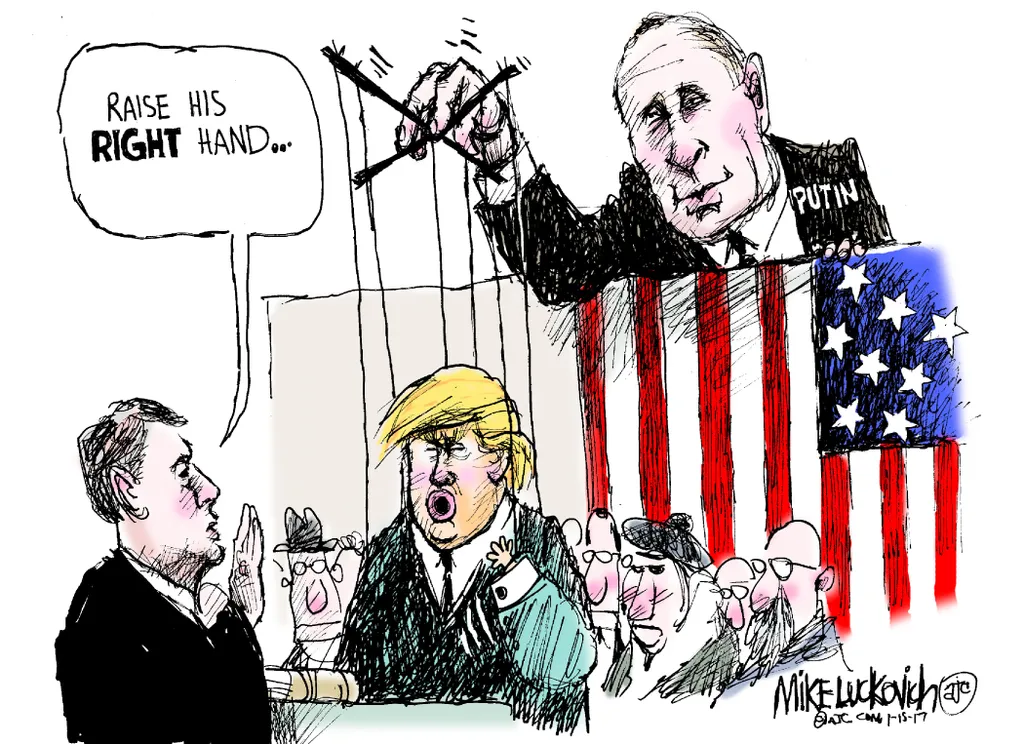
Back in 2016, Hillary Clinton said Trump would be Putin’s puppet. And so he is.


Tuesday night, Trump firmly came down on Vladimir Putin’s side in the Ukraine War. He made a number of false claims that echo Russian propaganda, including implying that Ukraine started the war

“I’m very disappointed, I hear that they’re upset about not having a seat [at the talks],” Trump told reporters at his Mar-a-Lago resort in Florida when asked about the Ukrainian reaction. The US president said a “half baked” negotiator could have secured a settlement years ago “without the loss of much land”.

“Today I heard, ‘oh, well, we weren’t invited.’ Well, you’ve been there for three years … You should have never started it. You could have made a deal,” he said.

and that Zelenskyy (but not Putin) is a dictator. The Kyiv Independent explains the electoral situation: Zelenskyy was elected to a five-year term as president in 2019 with 73% of the vote. After the Russian invasion in 2022, martial law was declared. The elections previously scheduled for 2024 were not held due to the government’s inability to establish safe voting conditions in the whole country. (The UK’s Prime Minister Keir Starmer has pointed out that Britain also suspended elections during World War II.)

Trump’s claim that Zelenskyy has a 4% approval rating was a typical Trump statistic: based on nothing. Kyiv International Institute of Sociology estimates Zelenskyy’s approval rating at 57%, far higher than Trump’s.

The Trump administration has been negotiating with Russia about the Ukraine War, but without Ukraine or Europe at the table. Statements by various people in the administration — J. D. Vance, Pete Hegseth — imply that Trump has already given in to many of Putin’s demands: Russia gains Ukrainian territory, the US commits no peacekeeping troops to Ukraine, Ukraine does not join NATO, etc. Meanwhile, Trump has been demanding Ukraine sign over half its mineral wealth to the US in exchange for past support, with no future American guarantees or responsibilities.

Trump’s embrace of a foreign dictator and previous enemy of the United States has not been sitting well with many congressional Republicans, who have pushed back against Trump’s false claims without directly criticizing Trump.

“Putin started this war. Putin committed war crimes. Putin is the dictator who murdered his opponents. The EU nations have contributed more to Ukraine. Zelensky polls over 50%,” Rep. Don Bacon (R-Neb.), a GOP Ukraine supporter, posted on social media, tackling several arguments made by Trump over the past day without naming the president. “Ukraine wants to be part of the West, Putin hates the West. I don’t accept George Orwell’s doublethink.”

and the military firings

Friday, Trump fired two members of the Joint Chiefs — the Black guy and the woman. The JCS will return to being a White men’s club, as God intended. He also fired the top lawyers of all three military services. (These are the people who are supposed to tell military leadership: “You can’t do that, it’s illegal.”)

JCS Chair and four-star General C.Q. Brown (a.k.a. the Black guy) is going to be replaced by a three-star general Trump is bringing out of retirement. Heather Cox Richardson writes:

In place of Brown, Trump has said he will nominate Air Force Lieutenant General John Dan Caine, who goes by the nickname “Razin”—as in “Razin Caine”—to be the next chairman of the Joint Chiefs of Staff. … Caine has held none of the assignments that are required for elevation to this position. His military biography says he was a career F-16 pilot who served on active duty and in the National Guard. Before he retired, he was the associate director for military affairs at the CIA. The law prohibits the elevation of someone at his level to chairman of the Joint Chiefs of Staff unless the president waives the law because “such action is necessary in the national interest.”

But of course it is Brown who is denigrated as a “DEI hire”, not the White man replacing him whose only qualification is his absolute loyalty to Trump.

and the tax/budget negotiations

The Senate has passed a budget plan different from the one the House hopes to vote on tomorrow. A budget outline has no direct effect — no money is appropriated — but it’s necessary to pass one before the reconciliation procedure can become available to circumvent Senate filibusters.

The fact that Republicans haven’t formed a common plan yet — and that the Senate went ahead and voted on its version even though Trump prefers the House plan — indicates that this might be a difficult negotiation.

Republicans got no Democratic votes for their plan, but Rand Paul crossed over to vote against it.

The Republican margin in the House is so narrow that if just two Republicans cross over and Democrats stay united, no bill can pass.


I know basically nothing about the Institute on Taxation and Economic Policy, which claims to be non-partisan and has a board of directors full of academic types. So hold the following analysis lightly.

ITEP looked at the Trump proposals as we know them so far, including his stated (but not yet fully implemented) proposals about tariffs. ITEP models tariffs as taxes eventually paid by consumers, which is what most economists expect to happen.

If you do that, you get these conclusions about how Trump’s proposals will affect taxpayers at various income levels.

but I want to back up and take a larger view

The featured post takes a broad look at how the autocracy vs. democracy struggle is going.

and you also might be interested in …

LawDork points out that even cases that look like wins for the Trump administration are actually worth fighting, because the administration is forced to put its position on the record, and may even make commitments to the judge about how it will interpret certain parts of the policy in question. Even if a lawsuit fails, it shows the administration that someone is watching what they do.


Germany’s governing party, the Social Democrats, suffered a crushing defeat Sunday in Germany’s parliamentary elections, winning only 16% of the vote. Its allies, the Green Party, added 12%.

The leading party was the conservative Christian Democrats with 29%, so the next chancellor will likely be the CDU’s Friedrich Merz. This is not a big deal in itself, since the CDU isn’t all that conservative by American standards. Long-time chancellor Angela Merkel was a Christian Democrat, and the party hasn’t changed all that much in the meantime.

The big news, though was the performance of the neo-Nazi Alliance for Germany (AfD), which got 21%, about double its performance in the previous elections in 2021. AfD was endorsed by American fascists J. D. Vance and Elon Musk.

Trump hailed the election’s outcome. “Much like the USA, the people of Germany got tired of the no-common-sense agenda, especially on energy and immigration,” he wrote in a post on Truth Social. “This is a great day for Germany.”

In addition to local German issues, the new government will play a central role in charting a course forward for Europe in the face of a rising Russian threat and an unreliable ally in America.

Merz struck a blunt tone, saying Trump had made it “clear that [his] government is fairly indifferent to Europe’s fate” and that Germany would have to wait to see “whether we will still be able to speak about Nato in its current form” when the alliance meets for its next summit in June.

“For me, the absolute priority will be to strengthen Europe as quickly as possible so that, step by step, we can really achieve independence from the USA” in defense matters.

and let’s close with something that belongs in your vocabulary

Megan Herbert is a cartoonist with a Substack blog. In a recent piece, a wife calls her husband over to the window because he urgently needs to see something whose nature isn’t revealed until the last panel: It’s a beauty emergency.

How Things Stand

The struggle to preserve American democracy is still undecided.
Neither despair nor complacency is warranted.


I keep having the same conversation with my friends, who are anxious and/or depressed about the Trump/Musk attempt to establish an autocracy, and wonder how I stay so sanguine. There are three reasons, one of which is personal and won’t help anybody else. But the other two might.

The personal reason is that my wife died in December. So from my point of view, nothing worse is going to happen anytime soon. I realize that’s a very self-centered point of view, but it is what it is.

The other two reasons, though, are generalizable and linked:

  • Nothing about the current struggle should be all that surprising.
  • The events that will tell us how it plays out haven’t happened yet.

I didn’t read all 900+ pages of Project 2025, but I did see enough of it to realize that the first few months of a second Trump administration would constitute an all-out assault on American democracy. I can’t claim that I foresaw the details of the current mess — Elon’s role in particular surprised me — but the general outline was all there. And I know Trump denied Project 2025 was his plan, but nobody should have taken that denial seriously.

So now we’ve seen Trump’s opening moves: a blizzard of executive orders claiming unprecedented powers that can be found nowhere in the Constitution. That was all predictable.

What wasn’t predictable, and is still unknown, is how the other American power centers would respond. I’m talking about Congress, the courts, the state governments, and the People. That’s all still very hard to predict, because each of those power centers will influence the behavior of the others.

It’s important for us to be neither complacent about all this nor resigned to our fate. Things really are still up in the air. Let’s look at the possible resistance centers one by one.

The People. Let’s start with the People, who elected Trump in November with 49.8% of the vote — hardly the “mandate” he likes to claim. Historically, voters have rewarded election winners with a give-the-guy-a-chance response that pundits sometimes refer to this as a president’s “honeymoon”. So, for example, Barack Obama got 52.9% of the vote in the 2008 election, but his post-inauguration approval rating bounced up to 69% (the highest it ever got).

By contrast, Trump’s post-inauguration approval (as estimated by 538’s polling average) was almost identical to his vote total: 49.7%, with disapproval at 41.5% (indicating that some Americans who voted for Harris or someone else were now neutral. By contrast, Obama’s post-inaugural disapproval was a mere 13%.) Trump’s most recent split is still positive, 48.5%-47.0%, but just barely. Some recent polls have turned sharply negative, like Ipsos, which has gone from a post-inaugural 47%-41% to a recent 44%-51%.

Polls that focus more specifically on what Trump is doing look worse for him. A WaPo/Ipsos poll showed 57% of Americans believe that Trump has overstepped his authority. 54% disapprove of his management of the federal government. Elon Musk’s approval is 15 points underwater with 49% disapproving and only 34% approving.

Short version: As people see what Trump is doing, they’re turning against him. I expect this to continue as more and more Americans notice that Trump’s “temporary” actions aren’t temporary, and aren’t solving any of the problems he campaigned on. (Bought any eggs lately?) I anticipate worse polls for Trump and a lot more demonstrations like the one I participated in February 14 in Boston.

Congress. Republicans hold slim majorities in both houses, so Democratic responses are necessarily limited: Democrats on their own cannot pass legislation, hold hearings, or subpoena witnesses. They can make speeches and create photo ops, but that’s about it. And the press, knowing Democrats can’t do much, don’t pay much attention to them. (I often hear comments like “Why don’t the Democrats say or do X?” Chances are some of them have, but you didn’t hear about it.)

Initially, congressional Republicans have been loyal Trump supporters, including confirming obviously unqualified cabinet nominees like Pete Hegseth, RFK Jr., Kash Patel, and Tulsi Gabbard. (No Democrat voted for any of the four.) But Republicans can also read polls, and apparently constituents are burning up their phone lines, so some are beginning to get uneasy about cuts that affect their home districts.

But will they do anything to rein Trump in? The real test happens when the government runs out of money on March 14. It’s easy to be for or against things until somebody puts price tags on them and adds them all up. In order to get the bill he wants, Trump will need support from almost all of the Republicans in the House. If Democrats stay united and only two Republicans vote against a spending deal, it fails.

If that happens, that’s when congressional Democrats begin to have negotiating leverage.

State and local governments. Contrasting with decades of Republican rhetoric idealizing government close to the people and villainizing know-it-alls who meddle from distant Washington, Trump is trying to use federal power to overwhelm the states and cities.

The scandal over Trump’s deal to drop federal corruption charges against New York Mayor Eric Adams is all about Trump trying to make liberal cities dance to his tune, in spite of what their voters want. So is his attempt to cancel in New York City’s congestion pricing. Ditto for border czar Tom Homan’s threat to “bring Hell” to Boston after the Boston police commissioner said he would obey local laws that don’t give him the authority to enforce federal immigration laws. In a White House meeting with governors of both parties, Trump tried to bully Maine Governor Janet Mills into submitting to his executive order banning transwomen from women’s sports. “I’ll see you in court,” Mills replied.

All in all, Democratic officials at the state and local level are standing firm against federal usurpation. Democratic attorneys general are leading a number of the lawsuits against the Trump administration’s overreach. How well they succeed, though, largely depends on the courts.

The courts. Many of the things Trump is doing are illegal or unconstitutional. His attempt to undo birthright citizenship is a blatant contradiction of the 14th Amendment. His refusal to spend money already appropriated by Congress violates both the Constitution’s assignment of spending power to Congress and the Impoundment Act of 1974. He has no authority to disband agencies created by Congress, like USAID or the Consumer Financial Protection Bureau. His treatment of federal employees violates the laws establishing the civil service, as well as union contracts signed by previous administrations.

But laws do not enforce themselves if lawbreakers are determined to ignore them. Victims of the law-breaking have to go to court. Judges have to rule in accordance with the law in spite of executive pressure against them. Court orders can be appealed, so the process can take a long time.

So far, the lower courts are following the law and the Constitution, so Trump is losing most of the cases.

This is all leading up to two questions:

  • Will the Supreme Court invent new interpretations of our laws to back Trump up, essentially ending the rule of law as we have known it?
  • If the Court does rule against Trump, will he defy the Court’s orders?

In theory, Supreme Court decisions take place in an abstract world of law. In practice, though, public opinion will play an important role. If Trump’s excesses are popular, the Court will be more likely to jump on the fascist bandwagon. But if his poll numbers keep spiraling down the drain, the Court may not want to go down with him.

Similar considerations apply to the defiance option: If the public is solidly behind Trump and sees the Court as blocking him for no good reason, he will be more likely to ignore the Court’s orders. On the other hand, if the public is turning against him, the thought that even this Supreme Court thinks he’s wrong may increase the slide.

The first of the cases has already reached the Supreme Court, briefly, sort of. Hampton Dellinger was the head of the Office of the Special Counsel, and independent agency established by Congress to do things like protect whistleblowers in the government. He was appointed by President Biden and confirmed by the Senate to a five-year term. The statute establishing the position makes provision for the President to fire the special counsel “only for inefficiency, neglect of duty, or malfeasance.” But on February 7 Trump fired Dellinger without claiming any of those things. A district reinstated Dellinger temporarily, and the Trump administration appealed, losing 2-1 at the appellate level. From there they went to the Supreme Court.

The Court also declined to overturn the district court’s order, but it’s hard to read much into that decision, because essentially it is just giving time for the lower court to complete its work. The restraining order runs out Wednesday, when the district court has a hearing scheduled.

The issues here get to the heart of the separation of powers, because it’s hard to see how the OSC can do its job if the head of it can be fired on a presidential whim. Presidents typically dislike whistleblowers, so the OSC won’t be much of a protector if it has no independence from the President. If it finds for Trump, the Court will be saying that the goal the Congress had in mind can’t be achieved.

The good scenario. Obviously, Trump is going to do a lot of harm no matter what anybody else does. The USAID freeze is already killing people in Africa, and no one knows how much damage American medical research will suffer from having its funding stream interrupted or perhaps cut off altogether. A lot of the near-term impact of the research-funding freeze will depend on unpredictable events like whether some future mutation of bird flu enables human-to-human transmission. Trump’s almost vandal-like approach to Biden’s climate change initiatives is going to make it that much harder to deal with long-term challenges that already threaten catastrophe. In short, the voters made an enormous mistake in November, and that mistake will have consequences.

But in my mind those consequences pale compared to the establishment of a lasting autocracy in the United States — and that outcome is still avoidable. The scenario that avoids it goes like this:

  • Trump continues losing popularity. He never had much, but his brand becomes politically toxic.
  • That lack of voter support makes support from congressional Republicans waver. They may not openly defy Trump, but the slim Republican majorities (especially in the House) lose their cohesion, making it impossible to pass legislation without at least some Democratic support. The lack of legislative accomplishments feeds back into public opinion: Maybe Trump isn’t such a strong leader.
  • The Supreme Court, at least partly influenced by public opinion, refuses to invent new legal principles to justify Trump’s seizures of power.
  • The refusal of congressional Republicans and Trump’s own appointees on the Supreme Court to go along with his wishes feeds back into public opinion: If even his would-be minions can’t fully support him, maybe his critics are right.
  • Facing an extreme lack of public support as well as dissension in his own ranks, Trump reluctantly obeys court orders. Or, if he doesn’t, the military refuses orders to crack down on mass public protests.
  • Republicans get soundly defeated in the November, 2025 Virginia elections, sending Republican elected officials into a panic.
  • Democrats win back control of the House in 2026, putting them in a position to block future usurpations.
  • Trump is dissuaded from trying to hang onto power in 2028. The MAGA movement splinters into its component factions — tech bros, racists, burn-it-down nihilists, etc. — none of which is able to win the national election.

That scenario is far from a sure thing, but the way is still open. We’ll learn a lot from future polls, from how Congress handles the possible March 14 government shutdown, and from what the Supreme Court does as cases arrive on its doorstep.

The Monday Morning Teaser

I have errands to run this morning, so the timing of posts will be a little iffy. And there won’t be a Sift next week, but for a good reason rather than a bad one: Friends in Hawaii have invited me to visit.

The featured post this week will examine where we are in the struggle to avoid autocracy. In general, I’ve noticed this last month that I’ve been calmer about the Trump administration than most of my friends, and this post is an attempt to explain why. There are three very different reasons, only one of which relates to optimism.

First, dealing with a personal disaster — my wife’s unexpected death in December — has put the more abstract problem of national autocracy in perspective. I realize this is a very self-centered, maybe even selfish, perspective. But there it is.

Second, I had my political depression after the election. If you took Project 2025 seriously during the campaign (which I did), nothing that has happened these last five weeks has been all that surprising. Of course there was going to be a shock-and-awe campaign to claim power unauthorized by the Constitution. Of course the guardrails of American democracy were going to face a severe test.

But third, we really don’t know yet how that test is going to come out, so defeatism is unwarranted. The scenario for getting through this is still intact. (My definition of “getting through this” is that we have meaningful elections in 2026 and 2028, and restore people to power who believe in the Constitution.) Here’s how it goes: Public opinion shifts against Trump, making his support in Congress waver enough that the slim Republican majorities in the House and Senate can’t stay together well enough to rubber-stamp his actions. Courts rule against his most illegal actions, and the Supreme Court refuses to overrule them. Trump feels the pressure of unpopularity and Republican defections enough that he doesn’t defy those rulings. Republicans get clobbered in the 2025 Virginia elections in November, sending shockwaves through the party. Democrats retake at least one house of Congress in 2026.

That scenario is still possible, but fragile. The Supreme Court might decide democracy has run its course. Trump might defy court orders and rely on a full call-out-the-troops response to put down mass public demonstrations. And the military chain of command might hold, so that American troops slaughter their countrymen and herd them into prison camps. That’s still possible too.

We’re going to find out a lot in the next month or two, as the American people realize that Trump’s “temporary” actions aren’t that temporary and aren’t solving the problems Trump campaigned on; Congress deals with the budget; and cases work their way up to the Supreme Court. Everything could still go south, but it also might not.

As I said, I don’t know when either that or the weekly summary will post.

Unwelcome Advice

I can even understand how a Chief Executive whose background is in business and politics might see the contemplated dismissal-with-leverage as a good, if distasteful, deal. But any assistant U.S. attorney would know that our laws and traditions do not allow using the prosecutorial power to influence other citizens, much less elected officials, in this way. If no lawyer within earshot of the President is willing to give him that advice, then I expect you will eventually find someone who is enough of a fool, or enough of a coward, to file your motion. But it was never going to be me.

SDNY Assistant US Attorney Hagan Scotten
writing to resign after a DoJ order
to dismiss charges against NY Mayor Eric Adams

This week’s featured post is “Can Ethical People Work in the Trump Administration?

This week everybody was talking about the DoJ resignations

The resignation of seven federal prosecutors is covered in the featured post.

and Elon Musk’s growing power

The Guardian summed up the state of things on Sunday:

Musk and his allies in the “department of government efficiency” (Doge), the unofficial committee acting as the operations arm of his cost-cutting efforts, have targeted a range of major government departments. They have moved to close the United States Agency for International Development, slashed the Department of Education and taken over the General Services Administration that controls federal IT structures. Doge staffers have also gained access to the treasury department, as well as set their sights on the Department of Defense, energy department, Environmental Protection Agency and at least a dozen others.

It’s worth pointing out that Musk’s authority is entirely delegated from President Trump, and the Constitution does not give Trump the power to do many of these things without Congress. But Congress has played no role in any of DOGE’s actions. It never established DOGE as a government department, and Musk’s appointment has never been confirmed by the Senate. Agencies like USAID and the Department of Education were set up and funded by Congress, so the President (and hence Musk) has no legal authority to close them or block the money Congress has appropriated to fund them.

The Guardian goes on to point out how Musk is benefiting personally from much of what he does.

As companies seek to benefit from Doge’s reshaping of the government, Musk also has extensive contracts worth billions of dollars through his own companies like SpaceX that are potentially set to expand under the new administration. … Musk’s influence in the White House also puts in peril the numerous federal investigations against his companies for a range of alleged wrongdoings that includes violating federal labor and securities laws. Trump has already dissolved one watchdog agency investigating Tesla. Government accountability groups have warned that Musk’s myriad of potential ethical conflicts and a lack of transparency around his actions in government carry the risk that he will use his power for political corruption.

“You don’t need to be any kind of ethics expert to to appreciate the massive problem there is with a billionaire who helped fund the president’s campaign and has government contracts of his own being given the power to root around in agency systems that impact how and when government contractors are paid,” said Donald Sherman, executive director of the Citizens for Responsibility and Ethics in Washington (Crew), a watchdog organization.

To justify himself, Trump has quoted the Emperor Napoleon: “He who saves his Country does not violate any Law.” (“Saving the country” is in the eye of the beholder. So had he succeeded, would-be assassin Thomas Matthew Crooks might have used the same justification.)


The slipshod nature of DOGE’s actions was underlined this week when it came out that DOGE had fired more than 300 employees of the Nuclear National Security Administration, the people who watch over our nuclear weapons stockpile.

Some of the fired employees included NNSA staff who are on the ground at facilities where nuclear weapons are built. These staff oversee the contractors who build nuclear weapons, and they inspect these weapons. It also included employees at NNSA headquarters who write requirements and guidelines for contractors who build nuclear weapons. A source told CNN they believe these individuals were fired because “no one has taken anytime to understand what we do and the importance of our work to the nation’s national security.”

When people who do understand what NNSA does got involved, the government tried to rescind the firings. However, the fired employees had lost access to their work email accounts, so no one immediately knew how to contact them.

Keep this in mind when you hear pronouncements about “waste” from Musk or other DOGE people: Everything looks like waste when you don’t understand it.


Another blow to the “genius” image of Musk and his minions came when it turned out that the Doge.gov web site had security problems.


Did you hear about the $50 million in condoms USAID sent to Hamas? Or the 150-year-olds collecting Social Security? Or that USAID is a criminal organization, in league with money-laundering Lutheran charities?

Complete bullshit, to use a technical term coined by philosopher Harry Frankfurt. Nothing Musk says should be believed until he provides evidence.

and the law

Proclamations of Napoleon have no legal weight in the United States, so many of Musk’s actions are being challenged in court. So far the Trump administration is losing most of those cases.

However, last year Trump also lost on his presidential-immunity argument all the way up the line until the partisan Republican Supreme Court got the case. Lower courts are obliged to follow previous precedents (though occasionally a judge goes rogue). But the Supreme Court is free to make up law as it sees fit, as it did in the immunity case.

Same thing here. A simple reading of the Constitution (in the birthright citizenship cases) or the law (in the freezing-federal-funding cases) forces a judge to rule against Trump. But the basic argument Trump is making across the board is that any law limiting his power is unconstitutional. (For example: The Impoundment Control Act of 1974 says that a president has to spend money as Congress has appropriated it. Previous Supreme Courts have upheld the Act’s constitutionality, and those precedents tie the hands of lower-court judges.)

That is an absurd argument ungrounded in the history of American law. But so was sweeping presidential immunity. During the Biden administration, the Court’s six conservative justices frequently limited the executive branch’s ability to act without authorization by Congress. But Biden was a Democrat, and in the Roberts Era the law changes depending on which party has power.

But will it change this far? We may be about to find out. Here’s the background: The US Office of the Special Counsel is an independent agency established by Congress.

OSC’s primary mission is to safeguard the merit system by protecting federal employees and applicants from prohibited personnel practices (PPPs), especially reprisal for whistleblowing.

LawDork elaborates:

The limits state that the Special Counsel is nominated by the president, subject to Senate confirmation, for a five-year term and can only be removed by the president “for inefficiency, neglect of duty, or malfeasance in office.”

This set-up makes perfect sense, because OSC can’t do its job if the same authority that wants to go after whistleblowers, i.e., the President, can also fire the Special Counsel if he gets in the way. However, Trump did fire Special Counsel Hampton Dellinger without cause. Dellinger went to court, and was granted a temporary restraining order preventing Trump from firing him. An appeals court refused the administration’s appeal 2-1, but the dissenting judge (a Trump appointee) objected that “Congress cannot constitutionally restrict the President’s power to remove the Special Counsel.”

Yesterday, the administration took its appeal to the Supreme Court, hoping that its Trump-cannot-be-bound (even though Biden could) argument prevails there. If it does, I suspect that few of the current lower-court rulings against Trump will stand.

and Ukraine

Tomorrow, a US delegation headed by Secretary of State Marco Rubio will meet with Russian counterparts to discuss ending the war in Ukraine. Notice who will not be there: a Ukrainian delegation or anyone representing our European allies.

Prior to these talks, the Trump administration already seems to have conceded much of what Russia wants. At a NATO meeting in Brussels last week, Defense Secretary Pete Hegseth said Ukraine will not restore its pre-invasion borders, and he distanced the US from any guarantees for Ukraine’s future. He called Ukraine’s desire for NATO membership “unrealistic”.

In sweeping remarks to NATO allies eager to hear how much support Washington intends to provide to the Ukrainian government, Hegseth indicated that Trump is determined to get Europe to assume most of the financial and military responsibilities for Ukraine’s defense, including a possible peacekeeping force that would not include U.S. troops.

Worse, any European troops deployed to Ukraine would not be covered by the NATO mutual-defense agreement. If Putin would decide to attack them, they would be on their own.

Afterwards, Hegseth was asked a fairly obvious question:

You have focused on what Ukraine is giving up. What concessions will Putin be asked to make?

The true answer here would be “none”, but instead Hegseth went off on a tangent about how Putin responds to “strength”, so he invaded Crimea during the Obama administration and attacked the rest of Ukraine during the Biden administration, but did not launch any new invasions during Trump’s first term.

On the one hand it’s interesting that Hegseth didn’t answer the question asked. But it’s also worth trying to figure out what question he answered instead. I postulate this one: “Should we be worried that Trump is in Putin’s pocket?”

BTW, I think his answer to that question is misleading as well. During the first Trump administration, Putin knew that time was on his side, because Trump was dismantling NATO from within. After Biden started putting NATO back together, Putin attacked because he saw his window for action shrinking.

Plus, it is absurd to characterize an American president willing to concede virtually everything Putin wants before negotiations even begin as “strong”.

and Gaza

I don’t take seriously the part of Trump’s plan for Gaza where the US claims ownership of the land and turns it into a Mediterranean resort. I think he announced that just to troll us.

However, the part of the plan where Israel ethnically cleanses Gaza, while the US pressures Arab nations to take in Gazan refugees — that seems completely serious. Saudi Arabia, Egypt, Jordan, Qatar and the United Arab Emirates will meet in Riyadh Thursday to formulate an alternative, which they will hope to take to the larger Arab League meeting in Cairo next week.

I want to make two points about this. First, unlike the West Bank, Israel does not have any historical claim on Gaza. Even in Biblical times, Gaza was a Philistine city.

Second, I want to address the comparison being made to the population transfers that happened in 1946-48 when the former British Raj was partitioned into India and Pakistan. This argument has been put forward by WSJ columnist Sadanand Dhume, and echoes a claim often made by opponents of a Palestinian state: There are already nearly two dozen Arab countries, so why does there need to be another one?

Dhume glosses over what a disaster the partition of India was.

By 1948, as the great migration drew to a close, more than fifteen million people had been uprooted, and between one and two million were dead.

Also, proponents of the Palestinians-are-just-Arabs vision are projecting a Jewish notion of identity onto Arabs. Arabs have never had a unified ethnic identity. While it’s true that many Palestinians did not identify as Palestinians until comparatively recently, prior to that they identified primarily with their local communities, not with some larger Arab nation. Palestinian identity comes up from below, not down from above.

Dhume paints the international refusal to support an ethnic cleansing in Gaza as “the world’s double standard towards Israel”. Actually, it is a single-standard reaction to the horror of the post-World-War-II population transfers.


I have not yet read Peter Beinart’s new book “Being Jewish After the Destruction of Gaza“. However, this interview with The New Yorker is worth a look.

and you also might be interested in …

Politics is all fun and games until you have to write a budget. House Republicans took their first step in that direction by passing a budget resolution out of committee and sending it to the full house. It cuts rich people’s taxes, lines up cuts in Medicaid and food stamps, and allows $3.3 trillion more debt to accumulate in the next ten years. It’s already in trouble as Republican congresspeople reckon with the number of Medicaid recipients in their districts.


The WaPo:

[D]espite the rapid infusion of resources, U.S. Immigration and Customs Enforcement is struggling to arrest higher numbers of immigrants and falling far short of the administration’s goals.

Simple reason: The invasion of criminals that Trump talked so much about during his campaign was never real. He talked a lot about unleashing local law enforcement to deport the criminal migrants because “they already know who they are”. And maybe that was true for a handful of people, but there were never “millions” of migrant criminals to deport.


The WaPo’s Catherine Rampell:

What Trump has done for US farmers so far:
-frozen their foreign aid program (and left their food to rot)
-encouraged EU to ban their products
-frozen legally-owed reimbursements for their energy efficiency upgrades etc.
-threatened to deport half their workforce
-suppressed research on bird flu


Paul Krugman explains why everything Trump is proposing — tariffs, deporting low-wage workers … — will make inflation worse. But he warns against buying inflation-protected Treasury bonds (TIPS), because they’ll only protect you against “future inflation that the U.S. government admits is happening“. Once Trump appointees start reporting the numbers Trump wants to hear, officially recognized inflation will plummet, no matter what is happening to your groceries.


The Daily Show explains how to Un-DEI your office.


Illinois Governor J. B. Pritzker has made a series of announcements: (1) Lake Michigan has been renamed Lake Illinois, (2) Illinois is annexing Green Bay for security purposes, and (3) stay tuned for an announcement regarding the Mississippi River next week.

and let’s close with something musical

Back in 2020, the pandemic forced choirs to figure out how to synchronize without being in the same room. The Unitarian Universalist General Assembly went virtual that year, and this choral performance was created for it. I find “Let the wave wash over me” to be a particularly comforting thought these days.

Can Ethical People Work in the Trump Administration?

This week seven federal prosecutors resigned rather than follow unethical orders from their bosses in Trump administration. This case raises a more general question: Given Trump’s disrespect for ethical norms intended to insulate certain key government functions from inappropriate political interference, will there be space in the Trump administration for ethical government employees to do their work?


The Guardian provides the shortest possible summary of the current situation:

[S]even prosecutors – including the acting US attorney in southern district of New York, the head of the criminal division and the head of the public integrity section – resigned in protest rather than dismiss the case [against New York Mayor Eric Adams] for political reasons.

Now let’s back up and review this story from the beginning, following a timeline compiled by ABC News: After an investigation that had been going on for at least a year, last September federal prosecutors at the Southern District of New York (SDNY) sought and received a grand jury indictment of Mayor Adams.

At the time, the Adams indictment was used in arguments that the Biden Justice Department had not been politicized or “weaponized”, as Trump frequently claimed. Yes, a special prosecutor appointed by Attorney General Merrick Garland had indicted Trump, but that was because Trump had broken numerous laws. DoJ also went after Democratic lawbreakers like Adams and New Jersey Senator Robert Menendez.

The indictment, which is unsealed the next day, alleges Adams accepted illegal gifts, including plane upgrades and hotel stays, from Turkish businessmen and officials in exchange for preferential treatment when he was Brooklyn borough president and later as mayor. The indictment also alleges Adams received illegal campaign straw donations from Turkish nationals.

Adams denied the charges, refused to resign, and pleaded not guilty. [1] A trial was scheduled to begin in April. During the transition period after Trump’s election win in November, Adams met with Trump at Mar-a-Lago and with Trump’s border czar Tom Homan. Adams attended Trump’s inauguration. The next day, Adams began claiming that his indictment was retribution for criticizing President Biden’s immigration policies (even though the timeline on that doesn’t work). On February 10, after additional meetings between Adams, his attorneys, and Trump officials, Deputy Attorney General Emil Bove sent a letter instructing SDNY to dismiss charges against Adams “without prejudice”, meaning that the charges could be refiled in the future.

Danielle Sassoon. Dismissing a federal indictment is not an automatic thing. The prosecutor’s office has to file a motion with the court asking for the dismissal. The motion typically contains some justification for the dismissal, which the judge then must rule on. And that brings Danielle Sassoon, the acting U.S. Attorney for SDNY, into the picture.

Sassoon is not anybody’s idea of a liberal Democrat. She clerked for the late Supreme Court Justice Anton Scalia, a legendary figure in conservative legal circles. Trump had appointed her as acting US attorney just three weeks before. Sassoon responded to Bove’s instructions by writing an eight-page letter to his boss, Attorney General Pam Bondi. [2]

Mr. Bove rightly has never called into question that the case team conducted this investigation with integrity and that the charges against Adams are serious and supported by fact and law. Mr. Bove’s memo, however, which directs me to dismiss an indictment returned by a duly constituted grand jury for reasons having nothing to do with the strength of the case, raises serious concerns that render the contemplated dismissal inconsistent with my ability and duty to prosecute federal crimes without fear or favor and to advance good-faith arguments before the courts. … I cannot fulfill my obligations, effectively lead my office in carrying out the Department’s priorities, or credibly represent the Government before the courts, if I seek to dismiss the Adams case on this record.

Sassoon went on to recount the Bove’s justifications for dismissing charges, the first of which she finds unethical

First, Mr. Bove proposes dismissing the charges against Adams in return for his assistance in enforcing the federal immigration laws, analogizing to the prisoner exchange in which the United States freed notorious Russian arms dealer Victor Bout in return for an American prisoner in Russia. … Adams has argued in substance and Mr. Bove appears prepared to concede that Adams should receive leniency for
federal crimes solely because he occupies an important public position and can use that position to assist in the Administration’s policy priorities.

and the second unbelievable.

Second, Mr. Bove states that dismissal is warranted because of the conduct ofthis office’s former U.S. Attorney, Damian Williams, which, according to Mr. Bove’s memo, constituted weaponization of government as defined by the relevant orders of the President and the Department. The generalized concerns expressed by Mr. Bove are not a basis to dismiss an indictment returned by a duly constituted grand jury, at least where, as here, the Government has no doubt in its evidence or the integrity of its investigation. … In short, because there is in fact nothing about this prosecution that meaningfully differs from other cases that generate substantial pretrial publicity, a court is likely to view the weaponization rationale as pretextual. [3]

The first consideration is the disturbing one, because it suggests a truly dystopian role for the Department of Justice: If elected officials refuse to play ball with the Trump administration, Trump could use a Justice Department investigation to get something on them, then hold that potential prosecution over their heads until they do what he wants.

In a footnote, Sassoon lays it out:

I attended a meeting on January 31, 2025, with Mr. Bove, Adams’s counsel, and members of my office. Adams’s attorneys repeatedly urged what amounted to a quid pro quo, indicating that Adams would be in a position to assist with the Department’s enforcement priorities only if the indictment were dismissed. Mr. Bove admonished a member of my team who took notes during that meeting and directed the collection of those notes at the meeting’s conclusion. [4]

In her letter, Sassoon asked AG Bondi for a meeting, and offered her resignation if Bondi did not want to further justify or reconsider DoJ’s position. Her resignation was accepted.

Public Integrity. The obvious next option for Bove would have been to ask SDNY’s second-in-command to file the motion to dismiss the charges, but (perhaps seeing Sassoon’s resistance as an SDNY independence issue), he pulled the case back to DoJ’s aptly named Public Integrity Section in Washington, which often handles political corruption cases. ABC reports:

However, as soon the Public Integrity Section was informed it would be taking over, John Keller, the acting head of the unit, and his boss, Kevin Driscoll, the most senior career official in the criminal division, resigned along with three other members of the unit, according to multiple sources.

The case soon claimed a seventh scalp, SDNY’s Assistant US Attorney Hagan Scotten, another prosecutor with impeccable conservative credentials, having clerked for Brett Kavanaugh and John Roberts. He expressed no hostility to the policy goals of the Trump administration, but strongly implied that someone needs to explain legal ethics to the President.

There is a tradition in public service of resigning in a last-ditch effort to head off a serious mistake. Some will view the mistake you are committing here in the light of their generally negative views of the new Administration. I do not share those views. I can even understand how a Chief Executive whose background is in business and politics might see the contemplated dismissal-with-leverage as a good, if distasteful, deal. But any assistant U.S. attorney would know that our laws and traditions do not allow using the prosecutorial power to influence other citizens, much less elected officials, in this way. If no lawyer within earshot of the President is willing to give him that advice, then I expect you will eventually find someone who is enough of a fool, or enough of a coward, to file your motion. But it was never going to be me.

Friday night, the motion did get filed, though apparently with great reluctance.

The roughly hour-long meeting, where the public integrity section weighed whether to resign en masse after agreeing that the dismissal of the Adams case was improper, culminated with [Edward] Sullivan, a veteran career prosecutor, agreeing to take the fall for his colleagues, according to two people familiar with the matter.

The judge. The judge in the case, Biden appointee Dale Ho, appears to have little choice but to ultimately accept a motion to dismiss. After all, a judge can’t also prosecute the case if the government is unwilling to do so.

However, Ho would be within his rights to hold a hearing into the circumstances of the dismissal motion. Sassoon had warned about this in her resignation letter:

Seeking leave of court to dismiss a properly returned indictment based on Mr. Bove’s stated rationales is also likely to backfire by inviting skepticism and scrutiny from the court that will ultimately hinder the
Department of Justice’s interests. In particular, the court is unlikely to acquiesce in using the criminal process to control the behavior of a political figure.

One option I can imagine (though I don’t fully understand the law here) is that Ho could give DoJ a choice: proceed with the prosecution or accept a motion to dismiss with prejudice, meaning that DoJ would lose the option to refile the charges if Adams wasn’t cooperating completely enough with Trump’s political goals. That change would take away Trump’s leverage over Adams going forward.

Larger considerations. Benjamin Wittes (founder of the Lawfare web site) takes a step back to

  • describe the inherent conflict between the way politicians behave as a matter of course (horse-trading, partisan maneuvering) and the ethical behavior we expect from prosecutors,
  • discuss the Justice Department norms intended to insulate prosecutors from politics,
  • explain how Trump has undone those norms.

Then he concludes:

There is a deep problem here and it goes way beyond the Adams case: Having ripped apart the only system that allows prosecutors to function ethically, we no longer have a mechanism by which federal prosecutors can function ethically. We have a rule in which the president can reach down to the assistant U.S. attorney level and order political favors for his friends in exchange for other remunerations. And we have ethical expectations of prosecutors that they will not entertain such demands.

The result? We have resignations. And we’re going to have more. Because if the president or his minions care about the case you’re working on, there is no place in government for an ethical prosecutor any more. …

As long as a prosecutor can do good work, my plea is to stay in place. But at this point, all federal prosecutors need to be prepared to resign. They are all one phone call away from being put in the position of facing a demand to behave unethically, one phone call away from a demand that is fundamentally political in character, not about justice. And when that call comes, it is imperative that prosecutors do as these ones did—resign publicly, showing their work along the way.

Wittes is talking specifically about prosecutors, but similar considerations apply throughout the government. Every profession within the government has its own ethical standards that protect against inappropriate political interference, and it’s not hard to imagine situations where Trump might circumvent those standards to pursue his goals. (Paul Krugman warns against buying inflation-protected TIPS bonds, precisely because Trump might make himself look good by pressuring government statisticians to minimize the rate of inflation.)

So the admonition Wittes gives to prosecutors needs to apply to federal employees across the board: As long as you can do your job ethically, keep doing it. Don’t resign and give Trump an opportunity to appoint someone more loyal to him than to the nation or to the mission of your agency. But if at some point you’re faced with a choice between your job and your soul, defend your soul and resign.

And if you can make a lot of noise on your way out the door, so much the better.


[1] New York’s state constitution gives Governor Hochul the power to remove Adams. While his case was playing out in court, it made some sense for Hochul to keep her distance. But now that the fix is in, her lack of action is mysterious.

[2] It’s worth pointing out that both Bondi and Bove had been defense lawyers for Trump before being appointed to head DoJ. They are literally Trump’s lawyers, not lawyers for the United States.

[3] A similar statement could be made about dismissing the classified-documents indictment against Trump.

[4] Not wanting anyone to take notes indicates what lawyers call “consciousness of guilt“.

The Monday Morning Teaser

As much as I would like to write about something other than the Trump administration, I have to go where the news is.

This week, the new administration ran into its first authentic scandal, as seven Justice Department prosecutors resigned rather than sign on to the corrupt deal Trump worked out with New York Mayor Eric Adams. The gist of the quid pro quo is that DoJ will drop well-founded indictments of Adams in exchange for his cooperation with Trump’s immigration enforcement policies. Such a deal skewers the nonpartisan identity of DoJ, and is as abhorrent to conservative prosecutors as liberal ones. Prosecution is supposed to be about enforcing the law, not manipulating policy outcomes.

This case points out the larger disregard Trump hold for ethical norms, and opens up a question I’ll address in the featured post “Can Ethical People Work in the Trump Administration?” That should be out before 10 EST.

Meanwhile, Elon Musk’s assault on democracy continues. Attempts to block the illegal Trump/Musk actions continue to work their way through the courts, with the first challenge lined up to hit the Supreme Court. Whatever happens there will have sweeping consequences.

Two new foreign-policy positions also deserve attention: on Ukraine and on Gaza.

Popular resistance to Trump is rising. A few weeks ago I cautioned against demonstrating prematurely, because protesting against Trump himself was unlikely to sway anyone who voted for him. However, now that there are clear actions to protest, it’s time to get out there. (“This is wrong” is a very different message than “Trump is bad”.) I went to my first post-election demonstration in Boston Friday.

I’ll try to get the weekly summary out by noon, but it’s hard to gauge.

Insurgency

Insurgent movements are not the product of hard times. They are the product of insurgent cultures.

– Lawrence Goodwyn, The Populist Moment

This week’s featured post is “How Do Things Change?

This week everybody was talking about the pushback against Trump and Musk

This week, a number of federal judges stepped in with orders to halt some of the administration’s illegal actions. Just Security keeps a continuously-updated litigation tracker to help the rest of us stay current. Here are some highlights:

Wednesday, a federal judge in Maryland granted a preliminary nationwide injunction blocking the Trump administration from enforcing its executive order ending birthright citizenship.

The Executive Order interprets the Citizenship Clause of the Fourteenth Amendment in a manner that the Supreme Court has resoundingly rejected and no court in the country has ever endorsed

The next day a judge in Washington granted a similar injunction.

Ultimately, the government’s position is unavailing and untenable. It does not have the text or precedent to support its interpretation of the Citizenship Clause. And it rehashes losing arguments from over a century ago. … The President cannot change, limit, or qualify this Constitution right via an executive order.


Yesterday, a federal judge in New Mexico blocked the administration from sending to Guantanamo three Venezuelan men currently in ICE custody. The order applies only to those three.


Thursday, a D. C. federal judge approved an order limiting DOGE access to the Treasury payments system to read-only access for two “special employees”, one of who is Marko Elez, the Musk staffer dismissed and then rehired after his racist social media posts became public. This order is at least partially superseded by the order of a New York federal judge who temporarily banned “special government employees” such as DOGE has from accessing “any Treasury Department payment record, payment systems, or any other data systems maintained by the Treasury Department containing personally identifiable information and/or confidential financial information of payees”.


Thursday, a Massachusetts federal judge paused the administration’s deferred-resignation plan until a hearing can be held today.


Last Monday, a D. C. federal judge blocked the Office of Management and Budget from enforcing its proposed funding freeze.


Friday, a D.C. federal judge blocked USAID from putting employees on administrative leave or removing them from the countries where they are stationed.


Judges in D. C. and Massachusetts blocked the transfer of transwomen inmates to federal men’s prisons.


Thursday, a D. C. judge approved an order preventing the government from releasing a list of FBI agents involved in investigating President Trump.


Many other lawsuits are pending, but have not been ruled on. It remains to be seen whether temporary orders will become permanent, or whether Trump will decide to defy some of them, a possibility J. D. Vance floated yesterday.

and leopards unexpectedly eating the wrong faces

I take for granted that Trump doesn’t care that he is upsetting people like me. “Owning the libs” is one of the goals of MAGA, not something to be avoided. But this week a number of MAGA-sympathetic groups noticed that Trump’s actions were hurting them, in a leopards-are-eating-my-face way.

The first were Christian charities that receive USAID grants.

The controversy began late Saturday evening, when Michael Flynn, a Catholic and retired Army general who previously served as an adviser to President Donald Trump, published a post on X alongside screenshots of a spreadsheet detailing federal funding disbursed to Lutheran groups in the last two years. The spreadsheet — which also included organizations that were not Lutheran — listed groups such as Lutheran Immigration and Refugee Service (now Global Refuge), one of several organizations that partner with the federal government to resettle refugees; Lutheran colleges such as Pacific Lutheran University; and various local chapters of Lutheran Social Services.

Without citing evidence, Flynn accused the groups — who have longstanding funding agreements with the government — of “money laundering,” a federal crime. He also insisted the numbers amounted to “billions” of American taxpayer dollars, a claim not supported by the attached spreadsheet.

Musk, who describes himself as a “cultural Christian,” quote-posted Flynn’s claims, saying, “the (Department of Government Efficiency) team is rapidly shutting down these illegal payments.”

Christianity Today reports:

Most of USAID’s budget goes to grants for specific development projects, including at Samaritan’s Purse, World Vision, World Relief, Catholic Relief Services, and many other faith-based groups. It supports local Christian health clinics in Malawi and groups providing orphan care.

In Kenya, PCEA Chogoria Hospital, a historic mission hospital now run by Kenyan churches, provides comprehensive health care to HIV patients through support from USAID. On January 24 the hospital received a stop-work order for that care and has had no indication of a return of funding despite Rubio’s promises that life-saving HIV care could continue.

The hospital has 3,162 HIV patients in that USAID-funded program, and 42 staff members caring for those patients.

I have to wonder whether hearing the administration lie about their own programs will cause Christians around the country to wonder about Trump’s and Musk’s truthfulness in general. In many communities, the ax is falling on local charities doing things like refugee resettlement, not distant organizations with projects in Africa.


Another group suffering from Musk’s actions are American farmers.

Farmers report missing millions of dollars of funding they were promised by the U.S. Agriculture Department, despite promises from the Trump administration that a federal funding freeze would not apply to projects directly benefiting individuals. … Farmers who signed contracts with the Agriculture Department under those programs paid up front to build fencing, plant new crops and install renewable energy systems with guarantees that the federal government would issue grants and loan guarantees to cover at least part of their costs. Now, with that money frozen, they’re on the hook.

Kansas Senator Jerry Moran, a Republican, has noticed that USAID food programs benefit Kansas farmers.

The World Food Programme estimated $340 million in U.S. food aid was idled at domestic ports by order of the Trump administration. In total, $566 million in U.S.-grown commodities designated for humanitarian purposes was locked down in warehouses throughout the world.

“Time is running out before this lifesaving aid perishes,” Moran said. “Food stability is essential to political stability, and our food aid programs help feed the hungry, bolster our national security and provide an important market for our farmers, especially when commodity prices are low.”


And another Republican Senator, Katie Britt of Alabama, is concerned about the medical research done in her home state.

While the administration works to achieve this goal at NIH, a smart, targeted approach is needed in order to not hinder life-saving, groundbreaking research at high-achieving institutions like those in Alabama.

Again, if Musk is targeting “ground-breaking research” in Alabama, maybe medical research programs in other states are being hit unfairly.


Trust McSweeney’s to find humor in the grimmest situations. Tom Ellison writes the column Elon Musk would write if he were honest: “Here at DOGE, we’ve streamlined every aspect of America’s collapse”.

did you know that before DOGE came along, government spending was influenced by an ad hoc network of billionaires behind campaign contributions, dark money groups, and shadowy think tanks? It’s far more efficient to reduce redundancy by placing the entire US Treasury under the centralized control of just one billionaire private citizen (me).

and you also might be interested in …

For a moment, it seemed like this administration might still be — just a little — vulnerable to shame. One of Musk’s young DOGE acolytes, Marko Elez, was outed for posting racist statements to social media within the last year. Elez then resigned.

Sadly, though, that wasn’t the end of the story. Elon posted a poll on X asking

Bring back @DOGE staffer who made inappropriate statements via a now deleted pseudonym?

J. D. Vance endorsed a Yes vote, arguing against the idea that “stupid social media activity should ruin a kid’s life”. The X community being what it is these days — non-racists have largely decamped to BlueSky — 78% voted for reinstatement, which apparently has now happened.

Vox points out what a sham the Musk/Trump administration’s “free speech” idealism is: Free speech is for people who agree with them about things like, say, racism; or for people who offer Nazi salutes in public. But if you are a foreign student who participated in protests of Israel’s genocide in Gaza, Trump promises to deport you.

This is not merely a case of the typical hypocrisy we expect from politicians. It is a coherent worldview coming into form: The Trump administration has been making clear that while it has plenty of tolerance for not just radical ideas but outright racist words and gestures, it has no room whatsoever for dissent or disagreement.


While we’re talking about racism and Gaza, Tuesday Trump openly endorsed ethnically cleansing Gaza so that it could become “the Riviera of the Middle East”. I mean, why should annoying Arabs get to occupy prime waterfront property just because their ancestors have lived there for centuries? They should want to leave.

I don’t think people should be going back to Gaza. I heard that Gaza has been very unlucky for them. They live like hell. They live like they’re living in hell. Gaza is not a place for people to be living, and the only reason they want to go back, and I believe this strongly, is because they have no alternative.

In Trump’s telling, the suffering of Gazans is just “unlucky”, and not the predictable result of decisions made by the US and its Israeli allies. The place just happened to turn to rubble, and it’s nobody’s fault that support from agencies like USAID is drying up.

OK, that’s the ranting of an evil man. But I’m not giving this story its own headline for a simple reason: You need to recognize when you’re being trolled. Trump is not going to occupy Gaza with US troops any more than he’s going to invade Greenland, make Canada a US state, or do a bunch of the other crazy stuff he talks about. The whole point of envisioning a US “ownership position” in Gaza was to change the news cycle, which was starting to focus too much on Musk’s illegal seizures of power.

Keep your eye on the ball.


New DNC Vice Chair David Hogg has begun posting daily updates “What Democrats Did Today“.


Global surface temperature is a combination of a long-term global warming trend and year-by-year circumstances like an El Nino. (That’s why each year isn’t always hotter than its predecessor.) But the month-by-month records for the hottest months on record have all happened since July of 2023. January 2025 set a record for reasons climate scientists haven’t completely puzzled out yet.


Trump is about to issue an executive order bringing back plastic straws. Because: priorities. Human convenience trumps animal suffering.


Somewhat to my surprise, the Gaza truce has still not collapsed.

and let’s close with an excuse to buy more books

I have a personal rule about local bookshops: If the reason I know I want a book is because I saw it in a bookstore, I have to buy it at that bookstore, even if I could get it cheaper from Amazon.

But while that works for physical books, what about e-books, which is how I read most things these days? If you’re rebelling against Amazon’s dominance of e-books, getting your books from Apple or even Kobo isn’t that much of a protest.

A new option is Bookshop.org, where profits on e-books can be directed to a local bookstore near you.

How Do Things Change?

a tentative start to a historical investigation


Last week I argued that mere election tactics — a more attractive candidate, some new slogans, a better framing of the issues — will not be enough to overcome the MAGA movement in the long run. (We defeated them soundly in the elections of 2018 and 2020, but MAGA showed amazing resilience.) MAGA itself is not just an unfortunate convergence of political forces, it is a cultural movement of some depth. Defeating it will require a counter-movement.

The 2024 campaign showed that the counter-movement can’t just be a reversion to some prior status quo. My assessment of how the Harris campaign failed is that Trump managed to tag Harris as the candidate of the status quo and present himself as the candidate who will shake things up. [1]

Harris’ problem was that (as a whole) the status quo is not working for many Americans. I listed a number of ways that things are not working, but fundamentally they boil down to this: It gets harder and harder to plan for a successful life with any confidence that your plan will succeed. Far too many Americans feel that the system is stacked against them, and that simply trying harder is not the answer.

Rather than present any coherent program, Trump has responded to the public’s justified anxiety with scapegoating and nostalgia: Immigrants, foreigners, minorities, and people who rebel against their assigned gender roles are the problem, and we should look to the greatness of America’s past — now, apparently, the high tariffs of the 1890s — for our salvation. To the extent that he has a plan — like ignoring climate change and reverting to the fossil-fuel economy of the 20th century — it is likely to be counterproductive.

But “don’t do that” has turned out to be an unpersuasive message for the Democrats. It worked when Trump was in office, actively doing unpopular things. But as soon as he was defeated, nostalgia renewed its charms. To a large extent, Trump’s 2024 message was that electing him would make it 2019 again, and all the disruption of the Covid pandemic (including the parts he brought on himself) would be behind us.

But realizing that we need a deeper movement is not the same as having one, or even knowing what it would be or how it might come together.

With that question in mind, I’ve been looking at history. Despite recently being idealized as the new “again” in Make America Great Again, the late 1800s were a low point in American history, dominated by the robber barons of the Gilded Age. Industry after industry was reorganizing as a monopolistic trust with the power to maximally exploit both workers and consumers. It was a hard time both for urban factory workers and rural small farmers.

Somehow, things got better: Antitrust laws got passed. Governments began to regulate working conditions, product safety, and child labor. Standard Oil was broken up. Unions began to win a few battles. And the gap between rich and poor narrowed. The New Deal was unthinkable in 1880, but by the 1930s it was popular. This was a profound change in what David Graeber referred to as “political common sense“. How did it happen?

A friend recommended a place to start: The Populist Moment by Lawrence Goodwyn. The book was published in 1978, so to the extent that it says something about the present day, either about MAGA or how a democratic movement might oppose it, that message arises naturally from the history, and not from some pro- or anti-Trump bias of the author. [2]

What was Populism? These days, MAGA and similar neo-fascist movements in other countries are often described as “populist”, but the version in the late 1800s was quite different. There is a surface similarity — in each case, large numbers of working class people found themselves resisting their era’s educated consensus — but from there things diverge fairly quickly.

In the 19th century, farming was still the largest American occupation, employing over half the labor force as late as 1880. But the system was stacked against small farmers in two ways: First, farmers with no capital beyond their land found themselves at the mercy of “furnishing merchants”, who would lend money for them to plant a crop (and survive through the growing season) in exchange for a contract on the harvest. Once he had contracted with a furnishing merchant, the farmer was stuck with that merchant, and would typically end up both paying high prices for his supplies and receiving a low price for his crop. [3]

But second, that long-term situation was made much worse by post-Civil-War monetary policy. The Civil War had been financed in part by printing paper currency, known as “greenbacks“. That had caused inflation during the war, and the prevailing economic wisdom of the time was that the dollar needed to be made “sound” again. In other words, the greenbacks had to be withdrawn from circulation, so that all US money could be redeemable for gold again. (Greenbacks became fully convertible to gold in 1878.)

In modern terms, the government’s policy was to shrink the money supply. If expanding the money supply had caused inflation, shrinking it could be counted on to achieve deflation; i.e., prices would come back down.

if you think like a consumer, deflation sound great. (Just last fall, that’s what Trump was promising his voters: “Prices will come down. You just watch: They’ll come down, and they’ll come down fast.”) But now imagine being a farmer who is counting on selling his wheat or cotton at the end of the season: You bought and borrowed when prices were high, and now you have to sell when prices are lower. The result was that large numbers of farmers were failing to clear their debts. Every year, many would lose their land and wind up as sharecroppers or worse.

The conventional wisdom of the time was that, sure, times were hard. But the “sound dollar” had to be restored, so farmers would just have to become more efficient. If some had to go broke in the process, well, that’s capitalism for you. Creative destruction and all that.

At some point, though, farmers began to realize that this wasn’t a story of individual failure, but of a badly structured system. And some postulated a solution: Farmers could cooperate rather than compete. They could form “farmer alliances” to pool their resources, negotiate for common supplies, and market their crops collectively.

Through the 1870s and 1880s, farmer alliances played a game of escalating pressure with the merchants and banks. Initial co-op successes would lead to new merchant strategies to freeze the co-ops out of the market, resulting in some larger co-op plan. The ultimate trump card was played by the system’s last line of defense, the bankers: Banks would take mortgages on individual farms (the old model), but they would loan nothing to a co-op backed by the land of its members.

Watching the more prosperous classes act in concert to thwart their plans radicalized the farmers and made them turn to politics. They created the People’s Party, whose presidential candidate carried four western states in the 1892 election. The party was organized around a platform, some of which was achieved decades later, but much of which might still be considered radical today. It wanted a revision of the banking system that would orient it toward the interests of “the producing classes” rather than “the money trust”. It wanted a flexible money supply (which we have today) rather than a gold standard. And it wanted government ownership of the railroads and other essential utilities that could be manipulated against working people by monopolies and trusts.

Ultimately, the People’s Party supported the Democratic candidate, William Jennings Bryan, in 1896, and then faded into insignificance.

So Populism was a failure in the sense that it never achieved power. But David Graeber once said that “one of the chief aims of revolutionary activity is to transform political common sense”. By that standard, Populism was more successful. [4]

Partisanship. The People’s Party ran into partisan loyalties that were left over from the Civil War and generally had more to do with identity than with life experience. If you were a White Southern Protestant or a Northern urban Catholic, then you were a Democrat. But if you were a Northern Protestant or a Southern Negro, you were Republican. Those loyalties were hard to break, and each party charged that the Populists were really agents of the other party. “Patriotism” meant faithfulness to the team your people played on during the War.

How movements happen. Goodwyn has a lot to say about this, and argues against the view that protest movements arise naturally during “hard times”. History, he says, does not support this.

“The masses” do not rebel in instinctive response to hard times and exploitation because they have been culturally organized by their societies not to rebel. They have, instead, been instructed in deference.

He points to parallel ways this worked in his own day on both sides of the Iron Curtain. (This is 1978, remember.)

The retreat of the Russian populace represents a simple acknowledgment of ruthless state power. Deference is an essential ingredient of personal survival. In America, on the other hand, mass resignation represents a public manifestation of a private loss, a decline in what people think they have a political right to aspire to — in essence, a decline of individual political self-respect on the part of millions of people.

He then asks the billion-dollar question:

How does mass protest happen at all then?

Which he then proceeds to answer: There are four stages:

  • forming: the creation of an autonomous institution where new interpretations can materialize that run counter to those of prevailing authority
  • recruiting: the creation of a tactical means to attract masses of people
  • educating: the achievement of a heretofore culturally unsanctioned level of social analysis
  • politicizing: the creation of an institutional means whereby the new ideas, shared now by the rank and file of the mass movement, can be expressed in an autonomous political way.

And he notes that “Imposing cultural roadblocks stand in the way of a democratic movement at every stage of this sequential project.”

For the populist movement, the first stage was the creation of farmers’ alliances. After years of experimenting, the farmers alliances came up with a mass recruitment model: large-scale cooperatives that farmers could join in hopes of getting cheaper supplies, better crop prices, and various other benefits. Then the co-ops themselves became educating institutions that taught farmers how the monetary system tilted the playing field against them, and how an alternative system might work. And finally the People’s Party itself provided an electoral outlet.

How well the People’s Party did in various states corresponded to how well the previous stages had taken hold.

In the 20th century, labor unions played a similar role to the co-ops: Masses of workers would join a union in hope of getting better pay and improved working conditions. And the union would then educate them in the issues relevant to their situation. [5]

MAGA. It’s worth considering how Goodwyn’s model applies to MAGA. You wouldn’t expect it to fit perfectly, because fundamentally MAGA isn’t a democratic movement. There has always been big money behind it, and the grassroots aspects, while genuine in some sense, also include quite a bit of astroturf. [6]

However, there are a number of parallels. The initial hurdle MAGA faced was getting its working-class foot-soldiers to believe in themselves rather than be intimidated by experts like economists, climate scientists, and medical researchers. The internet has undoubtedly made this easier, but the validation of “doing your own research” was also key.

And what was the recruiting institution that could attract masses of people and educate them in the new way of looking at the world? Evangelical churches. People came to them for the variety of reasons that always attract people to churches, and usually not for political indoctrination. But once there, they could be taught that elite scientists (like those promoting anti-Genesis ideas of evolution) were agents of the Devil. Their sense of grievance could be raised and sharpened, and the whole idea of a fact-based or reason-based worldview could be undermined. You might join because you enjoyed singing in the choir, but after a few years you were ready to believe that DEI was an anti-White conspiracy, or that economic malaise was God’s punishment for tolerating gay marriage and trans rights. You were ready to march for Trump.

Counter-movement. The lack of an obvious recruiting-and-educating institution is an obvious hole in the formation of an anti-MAGA counter-movement. Conservatives seem well aware of possible avenues — like the universities, a revitalized union movement, or even charitable activities like refugee resettlement or soup kitchens — and are committed to shutting them down.

Conversely, this is why a number of left-leaning voices (Perry Bacon, for one) are encouraging their listeners to connect with institutions where they can meet with like-minded folks.

I find the historical pattern evocative, even if I can’t immediately see how to implement it: The recruiting-and-educating institutions offer a very simple practical advantage: higher wages, say, or better crop prices. But by engaging in the institution’s core activity, people begin to see the oppressive forces arrayed against them, and begin to radicalize.


[1] And indeed, he is shaking things up. In my opinion, however, the parts of the status quo he is attacking are the best parts: the rule of law, the separation of powers, and the independence of federal institutions like the Department of Justice and the military, just to name a few.

Trump’s attacks on what he calls “the Deep State” are telling. If you know any federal employees, you probably understand that there is a Deep State, but it’s not the monster Trump paints it as.

The Deep State consists of federal workers who are more committed to the mission of their agencies than they are to the current administration. So career EPA officials will resist a president who wants to harm the environment, career prosecutors will drag their feet about harassing the current administration’s political enemies, career public health officials will do their best to support best practices against pressure from above, and so on. To the extent that the agencies are well set up and well motivated, their employees’ loyalty to the agency mission is a good thing, not a bad thing.

[2] Populism is literally just a place to start. I’m going to be delving into other aspects of the 1870-1941 period in future posts.

[3] Something similar happened to miners and factory workers who were paid in vouchers that could only be redeemed at company-approved merchants, who used that monopoly power to drive workers ever deeper into debt. As 16 tons puts it “I owe my soul to the company store.”

[4] Another movement that benefits from Graeber’s political-common-sense standard is the French Revolution. It is frequently judged a failure (especially by comparison to the American Revolution) because it didn’t achieve a lasting Republic, but instead devolved into the Reign of Terror and the dictatorship of Napoleon. However, the French Revolution changed political history. Before the revolution, absolute monarchy was still seen as a valid and plausible form of government. Afterwards, it wasn’t. The Czars of Russia might hang on for another century or so, but the writing was on the wall.

[5] It is unfortunate that farmers alliances and labor unions didn’t peak at the same time. Combined, they might have achieved significant political power.

[6] MAGA precursors, like the John Birch Society and the Tea Party, always had wealthy donors. You can see the pattern in present-day groups like Moms for Liberty. While there are indeed concerned moms in Moms For Liberty, the group’s expansion has been greased by professional consulting and seed money from wealthy establishment groups like the Heritage Foundation.

The Monday Morning Teaser

This week resistance to illegal Trump/Musk actions began to surface: Judges issued orders to halt a number of unconstitutional practices, while Republican-leaning groups noticed that federal funding freezes hurt them as well — and they heard Musk lie about their own activities, not just those of distant liberals. A few Republican senators began to stand up for their affected constituents, while still not connecting the dots about how the Trump/Musk actions are hurting Americans in general.

I’ll cover that in the weekly summary. The featured post is a look back into a poorly understood episode of American history: the Populist movement of the late 1800s. In general, I’m trying to understand how America got from the Gilded Age and the robber barons to antitrust laws and the New Deal. It wasn’t just the Depression, it involved a larger change in what David Graeber called “political common sense”. How did that happen? Late-1800s Populism is a piece of that puzzle, and it tells us something not just about what we need to do next, but illuminates how the MAGA movement became what it is.

That post should come out between 10 and 11 EST. I’ll try to get the summary done by noon.