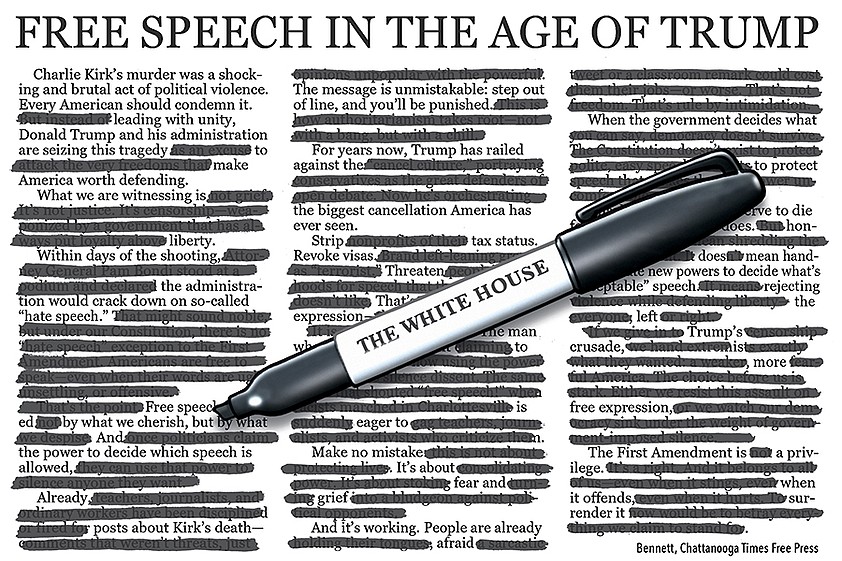
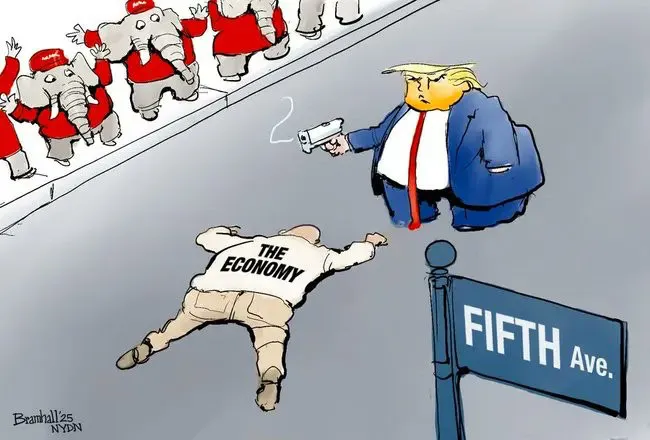
Collections of quotes that paint Kirk as a hate-monger promoting bigotry of all sorts: racism, sexism, Islamophobia, anti-LGBTQ, and so on.
Neither struck me as the whole story, so I challenged myself to form an independent opinion about Kirk. I listened to his wife’s eulogy for him, I watched most of his conversation with Gavin Newsom, I read as much of his book The MAGA Doctrine as Amazon would show me for free, and I looked for anybody else who had a view of him deeper than a partisan knee-jerk.
This is where I’ve gotten to. Unsurprisingly, I wind up mostly on the cynical side.
In Erika Kirk’s speech, I mainly heard standard Christian evangelism not all that different from what Billy Graham was saying half a century ago: Americans are in a spiritual crisis that can only be solved by turning their lives over to Jesus and living according to traditional gender roles that I don’t recall Jesus ever advocating. Kirk’s brand of Christianity was mostly Christian Nationalism, which I (and many others) believe is a perversion of Jesus’ message.
(For those of you without a Christian education, Jesus had a lot to say about feeding the poor, healing the sick, and living your life according to compassion rather than rules. The gospels paint his opponents the Pharisees as the strict rule-followers. A few years ago, I wrote a post about where I think Christianity went wrong. Later I turned it into a sermon at a Unitarian Universalist church. The sermon is a little better, in my opinion.)
Kirk and Newsom talked amicably (to the point that I was getting angry with Newsom for not challenging some very questionable assertions). Here, the evangelism played a very small role: This was two political operators comparing notes. Still, I heard Kirk’s voice and heard him speak for himself; we should all do that before we pass judgment on people.
The MAGA Doctrine is Kirk’s 2020 take on Trumpism, though I’ve seen no sign that he ever revised his the worshipful view it presents. His political worldview, to me, feels based in resentment: Both political parties are presented as uncaring, and Trump is the revenge of the neglected voter. There is a whiff of traditional conservative rhetoric: small government, individual freedom, and so on. But it’s hard to take seriously given that Kirk stuck by Trump even as Trump was expanding government power and concentrating it in an autocratic presidency. As with so many conservatives, Kirk’s idea of “freedom” was freedom for people like himself, not freedom for everybody.
One thing Kirk was very good at — and this is where all those objectionable quotes come from — was trolling people like me. He played the game of making people angry, then painting himself as the victim of that anger. (And ultimately, he did become the victim of someone who felt trolled. “I had enough of his hatred,” the accused shooter texted to a friend.)
Another thing Kirk was good at was getting funding from the very rich. Erika made a point of how little he had when he started his crusade to win young Americans for Christ (and later Trump), but Turning Point has never lacked for funding. Charlie got his first $50K at age 20 from the multimillionaire Dunn family. He soon attracted the attention of billionaire Foster Friess, and he was on his way. The Dunns eventually contributed millions. The Bradley Impact Fund gave TPUSA $8 million in 2023, and millions more came from a fund connected to Home Depot founder Bernie Marcus.
The ValueWalk website recently estimated Kirk’s net worth at $12 million, including a $4.5 million mansion in Scottsdale.
People sometimes wonder why there’s no Charlie Kirk of the Left. Well, money is one big reason: It’s hard to picture an 20-year-old liberal or socialist running into somebody at a conference and walking away with the funding to start a national organization, much less get rich in the process.
The Voice of Reason blog had an even more cynical take on Kirk’s entrepreneurial nature, painting him as a front for older, richer men.
Here is what really happened. In 2012, a 72-year-old Tea Party activist named Bill Montgomery heard Kirk give a talk at a small local event. Montgomery took one look at this kid with ambition in his eyes and told him to skip college and start an organization. Within weeks, Turning Point USA was born. Montgomery wasn’t just a mentor. He was the co-founder, treasurer, and strategist. In plain English: Kirk didn’t invent Turning Point USA. He was recruited into it by an older political operative who saw in him a useful mouthpiece.
Then came the money. Kirk didn’t scrape together pennies from bake sales. He stalked the Republican National Convention in Tampa in 2012 memorizing donor faces. That’s how he buttonholed multimillionaire Foster Friess, pitched him, and walked away with a five-figure check. Add in Bruce Rauner, the future governor of Illinois, and the DeVos family, and suddenly this “teenage entrepreneur” had more capital than most actual start-ups. By 2016, Turning Point’s budget had ballooned from $50,000 to over $5 million. That doesn’t happen because of hustle. That happens because deep-pocketed billionaires decide you are worth buying.
Amanda Marcotte doubts that Erika can keep TPUSA rolling, because so much of Charlie’s following was based on misogyny.
Charlie Kirk was an aspirational figure for his male audience. They wished they could go on campuses and condescend to cute girls, but they knew — they continue to know — that wouldn’t go well for them. They’d get ignored, mocked or worse, have campus security called on them. Charlie Kirk, though, had the charisma, money and organization to tilt the field so that he “won” every encounter — even though the kids that approached him usually had better arguments. He offered a fantasy of male domination. His audience will never accept a woman in this fake “alpha male” role.
For the first time, Trump used autocratic power in a way that the public couldn’t ignore, and a popular pushback forced a big corporation to stand up to him. Is that an anomaly or the start of a turn-around?
We hit some new lows over the weekend with the MAGA gang desperately trying to characterize this kid who murdered Charlie Kirk as anything other than one of them, and doing everything they can to score political points from it.
Four things are worth noting:
Kirk’s assassin was brought up in a conservative family, but later developments showed that Kimmel was wrong to imply that he was MAGA himself.
Kimmel was right that MAGA pundits did everything they could to score political points from the assassination.
Kimmel did not insult Kirk, or in any way make light of his assassination.
But he did make fun of Trump’s response to the assassination. He played a clip of Trump being asked about Kirk and then seguing to the new White House ballroom he wants to build. “That’s not how an adult grieves the murder of someone he called a friend,” Kimmel said. “This is how a 4-year-old mourns a goldfish.”
Appearing on Benny Johnson’s podcast on Wednesday, the Trump-appointed chairman said, “We can do this the easy way or the hard way. These companies can find ways to change conduct and take action, frankly, on Kimmel, or there’s going to be additional work for the FCC ahead.” Hours later, a spokesperson for Disney’s ABC confirmed to PEOPLE that Jimmy Kimmel Live! would be put on an indefinite hiatus.
Be sure to watch to the end of the 28-minute clip so you can see Robert De Niro play the new head of the FCC. Nobody can deliver a mafioso threat like De Niro, who clarified the new meaning of “free speech”.
“You want to say something nice about the president’s beautiful thick yellow hair and how he can do his make-up better than any broad, that’s free,” De Niro said. “But if you want to do a joke like, ‘He’s so fat he needs two seats on the Epstein jet’, that’s going to cost you.” The actor struggled to suppress a smile.
Kimmel asked: “For clarity, because it’s a pretty good joke, how much would that one cost me?”
“A couple of fingers, maybe a tooth,” came the reply.
I can’t believe ABC Fake News gave Jimmy Kimmel his job back. The White House was told by ABC that his Show was cancelled! Something happened between then and now because his audience is GONE, and his “talent” was never there. Why would they want someone back who does so poorly, who’s not funny, and who puts the Network in jeopardy by playing 99% positive Democrat GARBAGE. He is yet another arm of the DNC and, to the best of my knowledge, that would be a major Illegal Campaign Contribution. I think we’re going to test ABC out on this. Let’s see how we do. Last time I went after them, they gave me $16 Million Dollars. This one sounds even more lucrative. A true bunch of losers! Let Jimmy Kimmel rot in his bad Ratings.
His post should settle a few previously contentious points:
Trump was deeply involved in Kimmel’s suspension. Why else would ABC have told the White House that the show was cancelled? All the MAGA attempts to attribute the suspension to bad ratings or other legitimate causes were bogus.
Trump reiterated his threats of censorship. Kimmel’s criticism of Trump “puts the Network in jeopardy”. Nice network you got there; be a shame if something happened to it.
In Trump’s mind, the issue is criticism of him, and has nothing to do with Charlie Kirk. That was already apparent from Trump’s tweet of September 17, shortly after Kimmel was taken off the air: “That leaves Jimmy and Seth, two total losers, on Fake News NBC. Their ratings are also horrible. Do it NBC!!!” Late-night hosts Jimmy Fallon and Seth Meyers didn’t have a Kirk problem, they’re just Trump critics.
Trump has not won any of his media lawsuits in court. Instead, he has used his government power to extort settlements out of parent companies that need favors. (These settlements are essentially bribes, as Stephen Colbert was cancelled for pointing out.) If ABC-owner Disney stands firm, Trump’s proposed lawsuit will fail.
And yet, that howl has not produced any action so far. David Frum and Paul Krugman each suggest that Trump is in a race against time: His bid for authoritarian power is racing against his plunging popularity. At some point, he will have so much autocratic power that politics barely matters any more, but he’s not there yet. And if his targets begin to believe they can stand up to him and win, while his Republican allies begin to worry that he will drag them down with him, that autocratic creep might stop or even reverse.
Krugman summarizes the situation:
It’s clear that if Trump were subject to normal political constraints, obliged to follow the rule of law and accept election results, he would already be a political lame duck. His future influence and those of his minions would be greatly reduced by his unpopularity. But at this juncture he is a quasi-autocrat. He is the leader of a party that accommodates his every whim, backed by a corrupt Supreme Court prepared to validate whatever he does, no matter how clearly it violates the law. As a result, Trump has been able to use the vast power of the federal government to deliver punishments and rewards in a completely unprecedented way. … This has created a climate of intimidation, with many institutions preemptively capitulating to Trump’s demands as if he already had total power.
… It’s important to understand that Trump’s push to destroy democracy depends largely on creating a self-fulfilling prophecy. Behind closed doors, business leaders bemoan the destruction that Trump is wreaking on the economy. But they capitulate to his demands because they expect him to consolidate autocratic power — which, given his unpopularity, he can only do if businesses and other institutions continue to capitulate.
If this smoke-and-mirrors juggernaut starts to falter, the perception of inevitability will collapse and Trump’s autocracy putsch may very well fall apart.
Jay Kuo lists a number of areas in which Trump’s autocratic push is meeting resistance. But a key source of Kuo’s optimism is that there is a limit to how far the Supreme Court will let Trump go. So far, they have largely delayed ruling on the legality of his actions while allowing those actions to continue temporarily. One big question still to be resolved is which way they will ultimately go: Will they defend the Constitution, or will they usher in the new fascist state?
In large part that may depend on how Trump’s self-fulfilling prophecy plays out in John Roberts’ mind.
I took the last two Mondays off (and had a very restful trip to the Azores). But it looks like a lot of things happened while I was gone. This week I’ll try to catch up.
Shortly after my last blog posts, Charlie Kirk was murdered. Then Jimmy Kimmel was canceled. Then (in some order) a sniper shot at an ICE facility in Dallas, we found out about Tom Homan’s $50K bribe, Jim Comey got indicted, Trump and RFK Jr. declared definitively (and without any scientific evidence) that Tylenol causes autism, Trump made a bonkers speech to the UN, Kimmel came back, Trump announced an invasion of Portland, a guy sitting in my airplane aisle had a personal story to tell about the H1-B visa fiasco, all our generals and admirals have been called to a meeting in Virginia tomorrow, and I probably forgot something.
Looks like I picked the wrong week to take a vacation.
The short version of the last few weeks is that Trump’s bid for dictatorial power seems to be coming to a head. There’s a race against time to seize as much power as he can as his popularity plunges.
Anyway, I have choices to make about which stories to spin off into their own posts. I’m going to write about Kirk simply because much of what I read about him isn’t that good. He wasn’t a saint and he was more than just a collection of bigoted quotes. The Kimmel saga will get its own post, because it raises the question of a turning point. I’m not sure yet what else.
Anyway, the Kimmel post will come out first, maybe around 10. We’ll see what happens from there.
No Sift for the next two weeks. New articles will appear September 29.
Judges in the trenches need, and deserve, well-reasoned, bright-line guidance. Too often today, sweeping [Supreme Court] rulings arrive with breathtaking speed but minimal explanation, stripped of the rigor that full briefing and argument provide.
Trump’s assault on American democracy. Fresh off a rebuke from a California judge about the meaning of the Posse Comitatus Act, Trump seems ready to send troops to Chicago.
Gaza.Israel’s defense minister issued a “final warning” to Hamas: release the remaining hostages and lay down your weapons “or Gaza will be destroyed, and you will be annihilated.”
Ukraine. We’ve been hearing all summer that Putin was winning the war and Ukraine’s military was on the brink of collapse. But the summer offensive is all but over, and Russia has gained very little ground.
The whole point of starting Congress’ August recess sooner was to avoid voting on legislation to release the Epstein files. By September, Speaker Johnson figured, the whole thing would have died down.
Well, apparently not. Congress is back in session and the Epstein files are still a thing.
Early on, I wrote off the Epstein controversy as a Q-anon-related conspiracy theory (which it contributed to), so I didn’t pay attention to it. As a result, I completely misrepresented it when I first mentioned it here. (Commenters called me out for that, and they were right.)
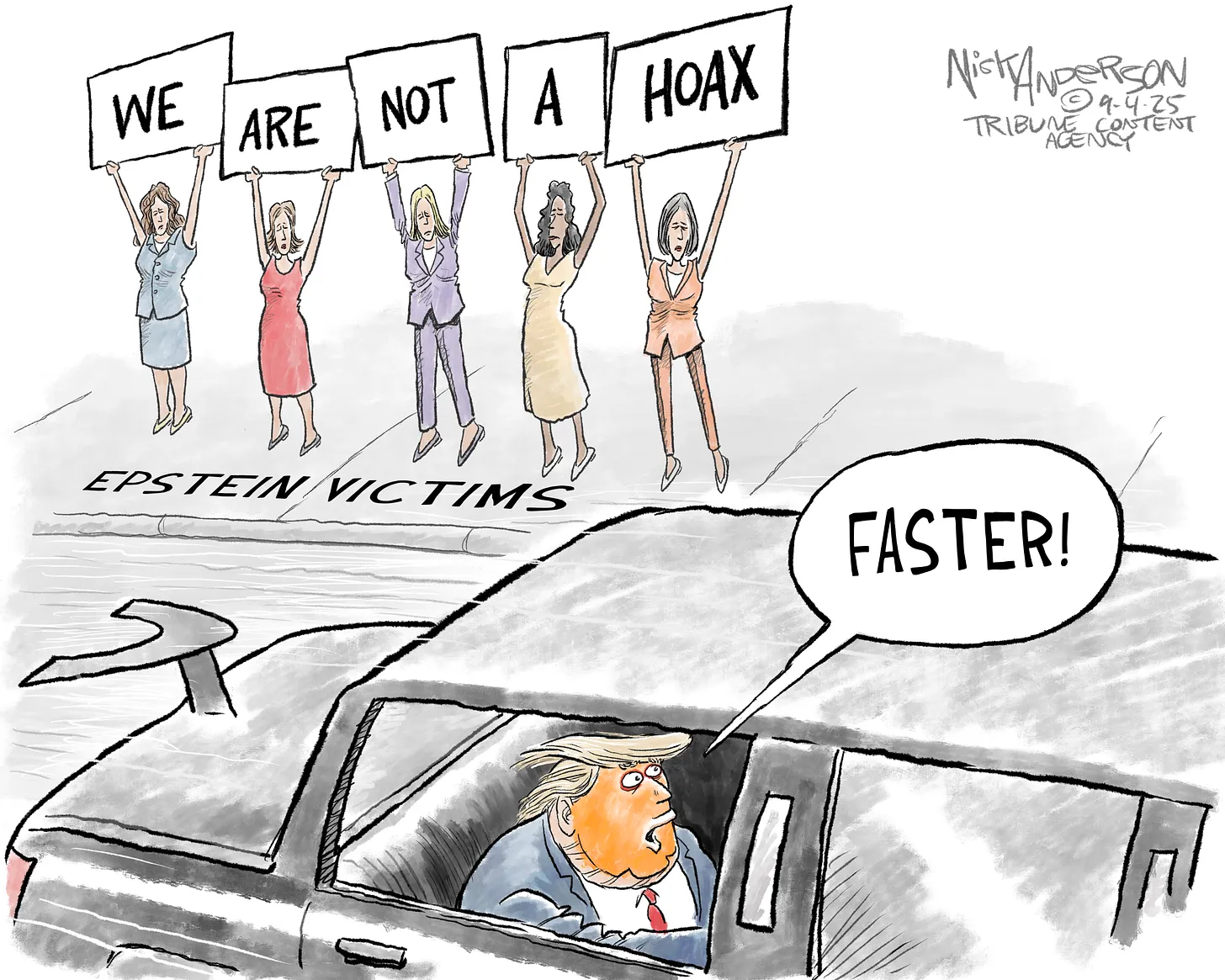
For my sins, I watched the complete two-hour rally and press conference that Epstein survivors held Wednesday. I recommend it. It’s not an easy story to hear, and the victims’ stories get a little repetitive, but that’s sort of the point: This happened over and over again; it was reported to authorities over and over again; and nothing was done.
What happened over and over was that some attractive and impressionable 14-year-old was invited to come to Epstein’s mansion either with the offer of easy money ($200 to give some old guy a massage), help launching a modelling career, or immigration to the United States. That intro turned into sexual exploitation that was difficult to escape, sometimes for years.
The purpose of the rally was to try to get two more Republicans to sign Rep. Thomas Massie (R-KY)’s discharge petition that will force a vote on legislation demanding release of all federal files on Epstein. (Marjorie Taylor Greene, Nancy Mace, and Lauren Boebert are the other Republicans on board. If you’re uncomfortable being on the same side they are, join the club.) That effort seems to be failing, but the petition might succeed anyway after a few more Democrats fill vacancies by winning special elections later this year.
Opposing this bill looks terrible for congressional Republicans: They’re siding with sexual predators against their victims. You know that most of them must want to vote for it, at the very least just to avoid criticism. The only reason they don’t is pressure from Trump. Which leads to an obvious question: What in those files is so bad for Trump that he would torpedo his own party like this?
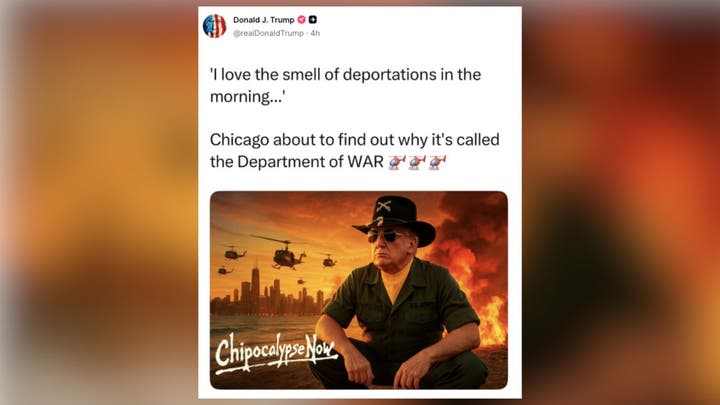
Declaring War on Chicago
That looks like a fake post some satirist made up, but it’s real. Our president put it out on social media on Saturday.
The previous Tuesday, Illinois Governor Pritzker had given a second speech [transcript, video] challenging the basis for Trump’s planned invasion: It’s not about crime and it’s not about immigration. There are proven violence-reduction programs that Trump cut, and even with majorities in Congress he has offered no plan to fix the immigration system.
Chicago has a
comprehensive evidence-based approach to crime: hiring more police officers and giving them more funding, gun and drug and gang interdiction, investing in community violence intervention, mental health supports, more substance use treatment. Those programs have shown real progress.
Then you know what happened? Donald Trump and his Republican allies in Congress cut those programs because they are unserious people who seem to know nothing about fighting crime.
Pritzker has pledged to go to court immediately if troops show up in Chicago. From previous court rulings, I think I know how that case will go. Requests for injunctions to stop Trump from sending in the National Guard have failed, because Congress really did delegate that power by law. But the next question is what those troops can do once they get somewhere: They can’t do law enforcement, because that violates the Posse Comitatus Act. Here’s the conclusion Judge Charles Breyer came to in the California lawsuit:
For the foregoing reasons, the Court ORDERS that Defendants are enjoined from deploying, ordering, instructing, training, or using the National Guard currently deployed in California, and any military troops heretofore deployed in California, to execute the laws, including but not limited to engaging in arrests, apprehensions, searches, seizures, security patrols, traffic control, crowd control, riot control, evidence collection, interrogation, or acting as informants, unless and until Defendants satisfy the requirements of a valid constitutional or statutory exception, as defined herein, to the Posse Comitatus Act.
The California injunction is stayed pending appeal, and doesn’t apply to Chicago or DC anyway. But the same principles hold once they are put before a judge: Nobody can stop Trump from sending troops to Chicago or anywhere else. But legally, they can’t do much once they get there.
Something I don’t hear discussed often enough: Why would anybody expect a temporary military presence to resolve the crime problem in a major city?
Sure: muggers, carjackers, and the like might lie low while troops are patrolling the streets. But what long-term problem is getting solved? Or are the troops themselves the long-term solution, because they stay forever?
The only way any of this makes sense is if you believe the Trump myth that big-city crime is due to undocumented immigrants. In that fantasy world, ICE could deport the whole criminal class during the occupation, leaving a crime-free city at the end.
But if crime is the result of poverty, hopelessness, poor education, drug addiction, mental illness, and the lack of legal opportunities, then it will spring back up as soon as the troops leave.
the Navy attack on a drug-smuggling boat
Tuesday, a US Navy aircraft destroyed a boat that the Trump administration claims was smuggling drugs into the US and was operated by the Venezuelan gang Tren de Aragua. Eleven people, alleged gang members, were killed.
I was skeptical of these kinds of attacks when Obama did them, so you can predict my position on this. But even more interesting is the view of Benjamin Wittes, founder of the Lawfare blog, who has long been a defender of “targeted strikes against enemy individuals or small groups”. This strike, though, is “not what I signed up for”.
Wittes makes three distinctions between this strike, and, say, the Obama drone attack that killed Anwar Al-Aulaqi (the very one I was complaining about in the link above). First is legality:
The first and most important difference is that those past strikes targeted people genuinely believed to be operational figures in terrorist groups who were at least plausibly covered by a congressional authorization to use military force, which was worded broadly to cover a broad range of worldwide operations.
Second, there were alternatives to deadly force:
When you’re dealing with one small boat heading to one’s own territory in international waters and the United States Coast Guard is available, there are plenty of options short of blowing up that boat. … [T]he United States targeted with lethal force people it believed to be civilian drug traffickers and acknowledged that it could have stopped them. This would be illegal for cops. And it should be unthinkable for the military too.
And finally, this just isn’t a military problem.
Cartel and gang members are not combatants in an armed conflict against the United States. And unless they are engaged in an ongoing or imminent military attack against the United States, it simply isn’t self-defense to attack them with lethal force either.
The question I always come back to is: What stops the President from calling in an airstrike on me? It seems like the restrictions on presidential killings are getting thinner and thinner. Ron Filipkowski expresses a similar view:
So if you are out on a boat Trump can just blow you up and kill you and everyone on board by saying you had drugs without presenting any proof? That’s how this works now?
RFK Jr. and the larger attack on science
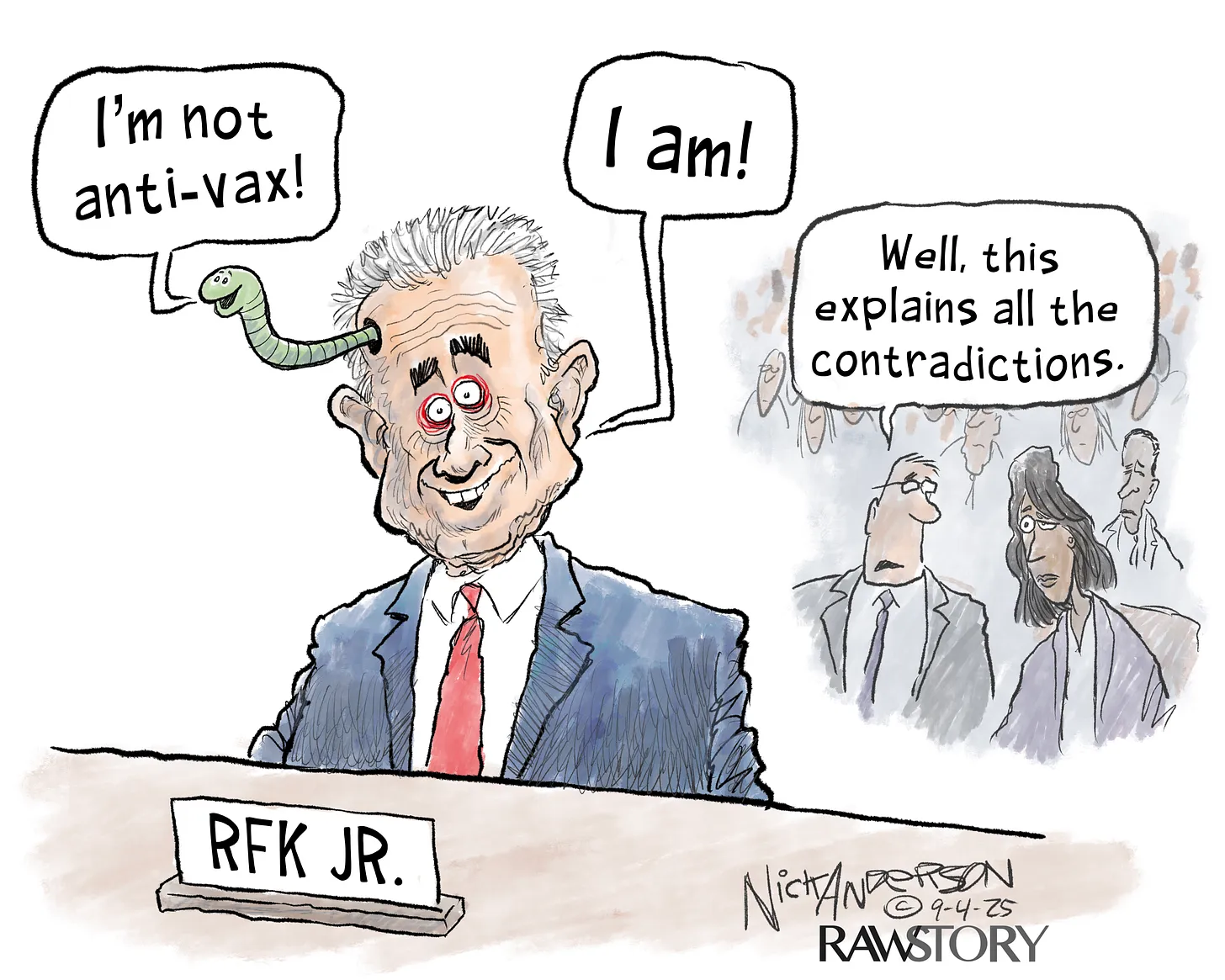
The HHS Secretary testified for three hours before the Senate Finance Committee Thursday. The hearings came just a week after Kennedy was responsible for decapitating the CDC: The Trump-appointed head was fired and three other high-ranking officials resigned, largely due to Kennedy’s moves to restrict access to vaccines, relying on cranks and conspiracy theorists rather than the scientists of the CDC.
Kennedy faced tough questioning not just from the Democratic minority on the committee, but also from Republicans Thom Tillis, John Barrasso, and especially Bill Cassidy, who had been the deciding vote on the committee that voted to approve Kennedy’s nomination in February.
Cassidy, a doctor, is like so many Republicans in Congress: He surely knew better in February, but for whatever reason decided to go along the Trump administration. In February he told the Senate about assurances he had gotten from Kennedy:
These commitments, and my expectation that we can have a great relationship to make America healthy again, is the basis of my support. He will be Secretary, but I believe he will also be a partner in working for this end.
If Mr. Kennedy is confirmed, I will use my authority as Chairman of the Senate Committee with oversight of HHS to rebuff any attempts to remove the public’s access to life-saving vaccines without ironclad, causational scientific evidence that can be defended before the mainstream scientific community and before Congress. I will carefully watch for any effort to wrongfully sow public fear about vaccines between confusing references of coincidence and anecdote.
But my support is built on assurances that this will not have to be a concern and that he and I can work together to build an agenda to make America healthy again.
Now, predictably, RFK Jr. has violated those commitments, including one to “maintain the Centers for Disease Control and Prevention’s Advisory Committee on Immunization Practices without changes” (in fact he fired the whole committee and replaced them with cranks). Cassidy is left with no recourse beyond asking tough questions. He gave up real power when he had it, and now it is gone.
I watched the first hour of the three-hour hearing. Kennedy staunchly defended an alternate reality in which all evidence of vaccine effectiveness is propaganda from Big Pharma, which controls all medical journals, just about all scientists, and any member of the committee who leaned on him too hard. He did not explain where better information would come from.
I imagine that any MAHA true believers watching the hearing felt vindicated. In a world where there are no reference points and no sources of reliable information, why not believe whoever you want to believe?
Something similar is happening with climate change. The Trump administration put out a report written by five climate-change skeptics hand-picked by Energy Secretary Chris Wright, the former CEO of a fracking company, who said before his appointment: “There is no climate crisis and we’re not in the midst of an energy transition either.”
The report was criticized by 85 climate scientists, who judged it “biased, full of errors, and not fit to inform policymaking”, mainly because it cherry-picked data to reach a pre-determined conclusion, and cited papers as proving things that those papers’ authors disagree with. Andrew Dessler, one of the 85, wrote:
I did not go into science to make money, nor did I go in to push a “liberal agenda”. I went into science because I love science. I love the rigor, I love the discipline, I love looking at data and seeing how the world operates. Most importantly, I respect science. When I read the DOE report, I saw a document that does not respect science. In fact, I saw a document that makes a mockery of science.
He compares the DoE report to “research” put out in decades past by the Tobacco Institute, denying tobacco’s connection to cancer.
Their goal was not to win the debate that cigarettes were safe — they clearly understood they could not — but to muddy the waters enough to head off regulations on their business. Thus, the DOE report is designed to do exactly the same thing: muddy the waters enough that the government can claim there’s too much uncertainty to regulate carbon dioxide.
This is the method of the current authoritarianism: There is no capital-T Truth, just your experts arguing with my experts. So we should just all do what we want and whatever we have the power to do.
and FY 2026
Money to operate the government runs out when the fiscal year ends on October 1. One of the featured posts discusses the leverage this might give Democrats and what they should do with it.
and you also might be interested in …
Apparently, firing the head of BLS didn’t fix the jobs reporting process the way Trump wanted. The August report came out Friday, and was once again disappointing, or perhaps even alarming. The economy added only 22K new jobs in August, well below the 80K economists expected, not to mention the 168K per month rate of 2024.
As usual, past months’ estimates were revised as more complete data came in. July numbers were revised upward, but June downward, for a total loss of 21K jobs. The unemployment rate rose to 4.3%, its highest level since October, 2021, during the pandemic. 4.3% is not alarming in itself, but the trend is up.
The Texas legislature has passed, and Governor Abbott is expected to sign, a new law against abortion pills, modeled on its 2023 bounty-hunter law that allowed civil cases against anyone who helped a woman get an out-of-state abortion.
The background is that out-of-state doctors prescribe to Texas women abortion pills that are illegal in Texas. Such pills are easily mailed or carried across the border. Texas is searching for ways to penalize those doctors, but it keeps running into blue-state shield laws.
White supremacist and Christian nationalist rhetoric is moving into the mainstream.
Senator Eric Schmitt (R-MO) addressed the question “What is an American?” at the National Conservatism Conference in D.C. on Tuesday. He called into question the whole idea of immigration and naturalization, and argued against the notion that anyone who believes in our system of government can become an American. [I linked to the full text because you should be able to check that I’m summarizing him fairly.]
He seemed to carefully avoid any specifically racist or fascist quote that could be pulled out for criticism, but the basic ideas were there: American was built by a particular group of people for their descendants. He doesn’t say “White people” exactly, but
We Americans are the sons and daughters of the Christian pilgrims that poured out from Europe’s shores to baptize a new world in their ancient faith.
He mentions the George Floyd “riots” as if they are code for something bad that he doesn’t want to spell out. He proudly points to his own German ancestors (arriving, like mine, in the 1840s), and the Scots-Irish who settled Missouri, who were “ideally suited to life on the edge of civilization”. He doesn’t come right out with proclaiming America a White homeland. But he closes with this:
This fight is about whether our children will still have a country to call their own. It’s about whether America will remain what she was meant to be: The apex and the vanguard of Western civilization. A strong, sovereign nation—not just an idea, but a home, belonging to a people, bound together by a common past and a shared destiny.
He cloaks this message in false class-consciousness. “They” are “the elites who rule everywhere but are not truly from anywhere.” “They” shipped your jobs overseas and brought in foreigners to compete with you. “They” are also “the Left”, which “took [America’s founding] principles and drained them of all underlying substance, turning the American tradition into a deracinated ideological creed.” [my emphasis] “They” are the ones who brought down the statues (of enslavers) and changed the names (of places honoring enslavers).
It’s perfectly rational for native-born Americans to worry about what has been happening to jobs and wages over the past 50 years. But twisting that legitimate impulse in a blood-and-soil direction is dangerous.
We’re real close to blatant ethno-nationalism here, and a vision where Blacks, Hispanics, Asians, and even Jews are not really Americans — so why not send ICE after them? This kind of thinking is not hidden any more, and it’s not fringe.
ProPublica looks at what happened when DOGE met Social Security. Social Security is a 90-year-old bureaucracy with ancient hardware and software, so a high-tech team empowered to promote “efficiency” should have been exactly what it needed. Instead, Musk’s minions went looking for non-existent fraud that might quickly provide fodder for good tweets.
and let’s close with something adorable
If you’ve made it through all this seriousness, you deserve seven minutes of escape. Here, National Geographic compiles video of cute baby animals in the wild. My favorites are the arctic foxes.
A federal judge on Wednesday ruled Donald Trump’s administration unlawfully terminated about $2.2bn in grants awarded to Harvard University and can no longer cut off research funding to the Ivy League school.
The judges in these cases have been sending a clear message: The law still counts for something, and it doesn’t change just because Trump says so.
But for that message to stick, two things have to happen: The Supreme Court has to back up the lower-court decisions, and the Trump administration has to obey the court orders once they become final. Will those things happen? I’ve seen both optimistic and pessimistic views.
There’s an understandable tendency to hear about a big court victory for the good guys but then cynically dismiss it, claiming either that the Supreme Court will overturn it, or that the Trump White House will simply ignore the courts’ orders.
I want to encourage readers to not fall into this trap. True, the Supreme Court has intervened in a few cases to lift a few injunctions imposed by lower courts, and that admittedly has been awful to see. But it hasn’t ruled substantively on much of anything yet. And that has allowed court victories by the good guys to produce some real progress.
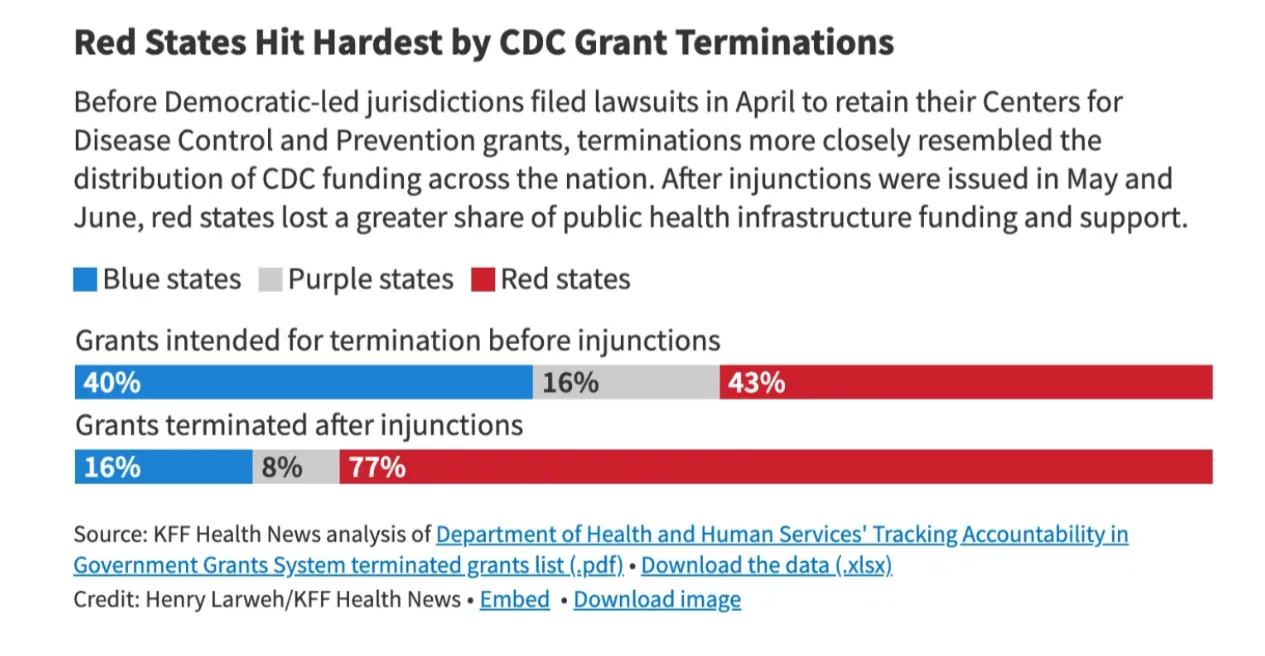
He points to blue-state attorneys general suing to claw back CDC grants the Trump administration had frozen. Red states, with their Trump-worshipping AGs, have taken the loss.
The Department of Justice wants the American public to assume that none of the orders granted by federal judges are being heeded. They want us to believe that they, and not the judiciary, are in control. But this is simply not the case.
Kuo points to the Guatemalan-children case, where (unlike in an earlier case with adults) planes in the air really did turn around, because “this time the government wasn’t up to playing more games with the courts”.
Nor is Trump the only litigant who receives this Court’s special treatment. The Republican justices favor religious conservatives so much that they will make up fake facts to bolster Christian conservative litigants. Meanwhile, they hate abortion providers so much that they once handed down an anti-abortion decision that, if taken seriously, would permit every state to neutralize any constitutional right.
If any other government official behaved this way, it would be obvious they were placing partisanship ahead of the law. It is no less obvious when these six specific government officials do so. The most reasonable explanation for the Republican justices’ behavior is that they are acting in bad faith.
It’s possible that even the most well-reasoned lower-court decisions against Trump will be reversed based on some gobbly-gook reasoning that we can expect to conveniently vanish should a Democrat ever again assume the presidency. That’s certainly what happened in the Trump immunity ruling.
But it’s worth noting that although the Court has thrown procedural hurdles in the way of those who would stop Trump’s lawlessness, and has sometimes reversed injunctions without much explanation, so far it has given Trump very few outright victories on the underlying merits of the cases. Birthright citizenship, for example, still stands.
The people caught in the middle are the lower-court judges themselves, ten of whom took the unusual step of talking anonymously to NBC News. Their problem is simple: When you do your best to apply the law as it was written and has always been interpreted, and then the Supreme Court reverses your decision in a shadow-docket ruling with little or no explanation, what do you do with the next case? You can’t apply the Court’s new reasoning, because that reasoning was never published.
In late July, the Constitution Daily Blog listed five Trump executive orders that are likely to hit the Supreme Court soon:
reversing birthright citizenship.
invoking the Alien Enemies Act to deport immigrants
using emergency powers to impose tariffs
firing heads of agencies protected by Congress
banning transgender people from serving in the military
I could imagine (but not agree with) the Court siding with Trump on the last two. But if any of the first three get the Court’s blessing, something is seriously wrong.
The government runs out of money again on October 1. That gives the Democratic minorities in Congress some rare leverage. What should they do with it?
The 2026 fiscal year starts in less than a month, and nobody yet knows what the FY2026 federal budget will have in it.
In the House, Republicans currently hold a 219-212 majority, so they can pass whatever budget they want if they have fewer than four defectors. In the Senate they have a 53-47 majority, but they need 60 votes to overcome a filibuster. So Democrats have leverage in the House only if the Republicans can’t stay unified, but Republicans need seven Democratic votes in the Senate unless they’re willing to nuke the filibuster. (Don’t count that out. Trump will almost certainly ask for it before conceding anything he cares about.)
This raises two questions: Are Democrats willing to shut down the government if Republicans don’t negotiate with them in good faith? And if they are willing to take such a stand, what concessions should they ask for?
Ezra Klein discussed the first question in yesterday’s NYT. He notes that Democrats faced a similar decision in March when the previous continuing resolution ran out. Hakeem Jeffries in the House wanted to go for a shutdown, but Chuck Schumer in the Senate didn’t. Schumer won out, and Democrats got nothing for their cooperation.
This looked really bad at the time, and demoralized Democrats around the country. But Klein notes that in the moment it actually was a close call. Schumer argued:
The courts were already reining in Trump’s excesses.
Markets were reeling from Trump’s tariff announcements; a shutdown would just give him a chance to blame Democrats for the economic chaos.
A shutdown would help DOGE eliminate government jobs and departments.
In addition, Klein notes that the Democrats weren’t ready for that battle. They hadn’t agreed on a message worth shutting down the government for.
But now, he claims, none of those arguments hold. The Supreme Court hasn’t held the line, markets have stabilized without a tariff-fueled economic catastrophe, and Elon Musk is gone.
Even more, Trump’s autocratic project is up and running now.
I want to be very clear about what I am saying here. Donald Trump is corrupting the government — he is using it to hound his enemies, to line his pockets and to entrench his own power. He is corrupting it the way the Mafia would corrupt the industries it controlled. You could still, under Mafia rule, get the trash picked up or buy construction materials. But the point of those industries had become the preservation and expansion of the Mafia’s power and wealth. This is what Trump is doing to the government. This is what Democrats cannot fund. This is what they have to try to stop.
… The case for a shutdown is this: A shutdown is an attentional event. It’s an effort to turn the diffuse crisis of Trump’s corrupting of the government into an acute crisis that the media, that the public, will actually pay attention to.
So when they get public attention, what exactly should Democrats demand? Jen Rubin makes these five suggestions:
Defend Congress’ power of the purse by undoing FY2025’s rescissions.
Reverse the Medicaid cuts that take effect after the 2026 elections.
Restrictions on DHS’ most outrageous practices: No rendition to third countries. No masks. Reports on how many people without criminal records are being rounded up.
New sanctions to pressure Russia into peace talks.
Ban stock trading for members of Congress, as well as the president and vice president.
The key test for demands is that Republicans should sound ridiculous defending what the Democrats want to put a stop to. (This is a lesson taught by the Epstein files.) Do Republicans want to shut the government down to defend Trump’s right to trade stocks? They should go right ahead.
If I had to sum up in one word the reason Democrats should give for their stand, it would be “corruption”. I think both Rubin and Klein would agree with that, and it’s also in line with what the Epstein phenomenon should be teaching Democrats.
President Donald Trump said Friday that the U.S. will host next year’s Group of 20 summit at his golf club in Doral, Florida, arguing it was “the best location” for the high-stakes international gathering but insisting his family’s business “will not make any money on it.”
Of course it won’t. Trump would never lie about something like that, and no doubt his independent Justice Department would watch like a hawk to make sure nothing corrupt happened.
Today’s Sift will be on the long side, both because a lot happened this week and because I’m about to take two weeks off.
There will be two featured posts: the first about Democrats’ strategy for the FY2026 budget, which has to involve a willingness to shut down the government, plus a message that identifies issues worth shutting down the government for. That should be out shortly.
The second concerns the run of court losses the Trump administration had this week, and the question of what it all means: Will the Supreme Court make up new legal doctrines that allow it to reverse the lower courts? If the Supreme Court does take a stand for the law and constitution, will Trump follow their orders? I’ll try to get that out by 11 EDT.
That still leaves quite a list of things for the weekly summary to cover: the Epstein victims rally, Trump declaring war on Chicago, the Navy sinking an alleged drug-smuggling boat and killing its 11 passengers, the RFK Jr. Senate hearing, another bad jobs report, and a US senator giving an ethno-nationalist speech. I’ll try to get that posted by 1.
I think many Americans wrongly believe there would be one clear unambiguous moment where we go from “democracy” to “authoritarianism.” Instead, this is exactly how it happens — a blurring here, a norm destroyed there, a presidential diktat unchallenged. Then you wake up one morning and our country is different.
Gaza. While the Israeli genocide continues, the Trump administration is picturing a fanciful reconstruction that depends on “at least a temporary relocation of all of Gaza’s more than 2 million population, either through what it calls ‘voluntary’ departures to another country or into restricted, secured zones inside the enclave during reconstruction.”
Ukraine. Same old, same old. The war continues, both on the front lines and in the bombing of Ukrainian civilians.
National Democrats have been slow to mobilize against the National Guard going to Washington D.C. Trump justified his takeover of the city’s police department by citing crime, which has been going down in recent years and is not as bad in DC as it is in red-state cities like Memphis or Little Rock. But crime is still a problem. Couple that with the number of times Democrats have been successfully smeared as “soft on crime”, and it makes leaders like Chuck Schumer and Hakeem Jeffries gunshy.
But last Monday, Illinois Governor J. B. Pritzker [text, video] responded to reports that Trump was planning a similar occupation of Chicago with proper defiance.
Earlier today in the Oval Office, Donald Trump looked at the assembled cameras and asked for me personally to say, “Mr. President, can you do us the honor of protecting our city?” Instead, I say, “Mr. President, do not come to Chicago. You are neither wanted here nor needed here.”
Pritzker rejected the whole notion that Trump’s effort to occupy Democratic cities had something to do with crime. If Trump were serious about combating crime, he would not be “defunding the police”.
He would not be cutting over $800 million in public safety and crime prevention grants nationally, including cutting $158 million in funding to Illinois for violence prevention programs that deploy trained outreach workers to deescalate conflict on our streets. Cutting $71 million in law enforcement grants to Illinois, direct money for police departments through programs like Project Safe Neighborhoods, the state and local Antiterrorism Training Program, and the Rural Violent Crime Reduction Initiative, cutting $137 million in child protection measures in Illinois that protect our kids against abuse and neglect.
A president who actually cared about urban crime would be asking local officials what they need.
If this was really about fighting crime and making the streets safe, what possible justification could the White House have for planning such an exceptional action without any conversations or consultations with the governor, the mayor, or the police?
Let me answer that question: This is not about fighting crime. This is about Donald Trump searching for any justification to deploy the military in a blue city, in a blue state, to try and intimidate his political rivals. This is about the president of the United States and his complicit lackey, Stephen Miller, searching for ways to lay the groundwork to circumvent our democracy, militarize our cities and end elections.
Pritzker made his speech flanked not just by his political allies, but by business, religious, and educational leaders of Chicago.
So far it seems to be working. The administration has subsequently announced plans to increase the ICE presence in Chicago, but is no longer talking about a complete takeover.
Pritzker did not just play the victim here; he threatened to strike back.
Finally, to the Trump administration officials who are complicit in this scheme, to the public servants who have forsaken their oath to the Constitution to serve the petty whims of an arrogant little man, to any federal official who would come to Chicago and try to incite my people into violence as a pretext for something darker and more dangerous: we are watching and we are taking names.
This country has survived darker periods than the one that we are going through right now, and eventually the pendulum will swing back, maybe even next year. Donald Trump has already shown himself to have little regard for the many acolytes that he has encouraged to commit crimes on his behalf.
You can delay justice for a time, but history shows you cannot prevent it from finding you eventually. If you hurt my people, nothing will stop me, not time or political circumstance, from making sure that you face justice under our constitutional rule of law.
I am reminded of Boris Yelstin’s response to the 1991 Soviet coup. At that time he was president of the Russian Republic of the USSR, and was armed with nothing but the dubious prestige of his office. But when tanks came to the center of government in Moscow, he stood on one of them and gave a speech pledging not just to end this coup but to hold its perpetrators to account. And he did.
This is a time to trust the perceptions of the American people. Democrats should tell it like it is, and not soft-pedal what is going on.
And finally, I want to call mainstream journalism out for its malfeasance. If you covered this speech as Pritzker positioning himself for 2028, you are part of the problem. America is facing a test of whether it can survive as a democratic republic. The 2028 horserace is a minor subplot, not the main story.
TPM calls attention to the inconsistency of sending troops because DC had become a “hellscape”, after refusing to let the District spend $1 billion of its own money.
But before Trump reached for the old D.C. standbys to justify his occupation, he and his Republican allies in Congress did everything they could to weaken the district earlier this spring. They used the district’s lack of true self-governance to withhold over $1 billion of its own money, paid by its own taxpayers, in the middle of the fiscal year.
Other steps toward and away from authoritarianism
A massive photo of Trump hangs on the Labor Department headquarters in Washington, D.C.
The big news this week was that the Federal Circuit Court of Appeals agreed with the Court of International Trade that Trump’s reciprocal tariffs — which constitute most of Trump’s tariffs — are illegal.
The tariffs will remain in place pending the Supreme Court appeal that is surely coming.
The argument against the legality of the tariffs is fairly simple: Tariffs are taxes, and the Constitution assigns the taxation power to Congress, not the president. Congress can on occasion delegate that power, but the emergency laws Trump is invoking do not specifically mention tariffs. So Trump has no such power.
Unfortunately, the ruling is not unanimous, which means that four of the 11 judges thought there was enough wiggle room in the text to let Trump proceed. (The emergency law allows him to “regulate” foreign trade, which Congress might have intended to include tariffs.) That view is a stretch, but the Supreme Court’s partisan Republican majority has been willing to stretch the law for Trump before. (After their immunity ruling, I have lost all faith in their objectivity.)
An interesting feature of the ruling is that it invokes the “major questions doctrine“, which the Supreme Court created out of whole cloth in 2000, and greatly expanded so that it could strike down things President Biden did, like cancel student debt. SCOTUSblog defines that doctrine as “the idea that if Congress wants to give an administrative agency the power to make decisions of vast economic or political significance, it must say so clearly”.
Trump’s reciprocal tariffs are reorganizing the world economic order. Their significance dwarfs Biden’s student-debt relief. If the Court thinks that big a power can be hidden inside a speculative interpretation of “regulate”, then Justice Jackson is right: They are playing Calvinball.
The WaPo points out a simple fix if the tariffs are as important as Trump says: Go to Congress to get the power that the appeals court said you don’t have.
It’s a sign of the times that Trump’s attempt to fire Fed Governor Lisa Cook is not the week’s biggest story. The Supreme Court has upheld an extreme view of unitary executive theory that has allowed Trump to fire officials previously thought to be beyond his reach, like the heads of independent agencies established by Congress. However, the Court explicitly exempted Fed governors from that ruling, so they can’t be fired at will.
So Trump is attempting to fire Cook for cause, citing an accusation that she claimed two homes simultaneously as her primary residence. If Court allows this, the Fed exemption becomes meaningless: If “cause” is whatever the President thinks is a cause, then he can make up something against anyone, and essentially fire them at will.
An executive order issued last Monday instructs the Secretary of Defense to create a “quick reaction force” of National Guardsmen who could be deployed to any state to “quell civil disturbances”. It sounds like a way to use troops to put down peaceful protests against Trump.
The Impoundment Control Act (ICA) lays out rules governing that process and allows the administration to temporarily withhold funding for 45 days while Congress considers the request. If lawmakers opt not to approve the request, the funds must be released. A pocket rescission would see the president send the same type of request to Congress within 45 days of the end of the fiscal year on Sept. 30. The request is made so late that the funding is essentially paused until it runs out at the end of the year regardless of congressional action.
In general, Trump sees congressional appropriations as a ceiling on government spending, not a floor. There are some situations where this view makes sense and others where it doesn’t. If, say, Congress appropriated $100 million for a new bridge and the administration managed to get it built for $90 million, it would be silly to object. But if the administration decides to save the whole $100 million by not building the bridge at all, that seems like a usurpation of power.
No president has used the pocket rescission in 50 years, and it throws yet another wrench into Congress’ efforts to fund the government when the new fiscal year starts on October 1. Typically, the last negotiations on a spending package are between the two parties: I’ll support your project if you support mine. But all that goes out the window if Trump can decide to spend the money on the Republican projects, but not the Democratic ones.
Alligator Alcatraz, Florida’s immigrant gulag in the Everglades, is shutting down with a major loss for the state.
US District Judge Kathleen Williams denied requests to pause her order to wind down operations, after agreeing last week with environmental groups and the Miccosukee Tribe that the state and federal defendants didn’t follow federal law requiring an environmental review for the detention center in the middle of sensitive wetlands.
and the CDC
The decapitation of the CDC was covered in the featured post.
and you also might be interested in …
India’s Prime Minister Narendra Modi went to China this week, attending the Shanghai Cooperation Summit, along with Russia’s Vladimir Putin and several other leaders. For years, US diplomacy has tried to position India as a fellow democracy in competition with China, and India has tried to appeal to US businesses as an alternative to Chinese factories. But Trump’s tariffs have changed all that. The NYT reports:
President Trump’s 50 percent tariffs landed like a declaration of economic war on India, undercutting enormous investments made by American companies to hedge their dependency on China.
Ernst’ decision may have something to do with Democrat Catelin Drey flipping an Iowa state senate seat in a very red district in a special election held Tuesday.
and let’s close with something far out
If you want to get away from the stress of everyday life, you need only look up. Well, assuming you have billions of dollars of equipment. Here, the Hubble telescope looks at the Eagle Nebula’s Pillars of Creation, formations of gas and dust that are in the process of creating new stars.
As RFK Jr. purges the CDC and cancels billions in research grants, Americans need a refresher course on what happened to Soviet biological research during the Stalin years.
In many ways, Trofim Lysenko was just the man Stalin had been looking for. He grew up in the peasantry rather than the elitist intelligentsia. He promised new techniques for growing crops that might solve the Soviet Union’s difficulty producing food in the same quantities the Czars had. And he represented a rebellion against Mendelian genetics, whose vision of evolution relied more on the individual’s struggle for survival than on the collective class struggle more in line with Marxist ideology.
From our 21st century point of view, as well as from the perspective of 20th-century geneticists, Lysenko was a crank. He espoused “vernalization”, a process by which winter wheat could be converted to spring wheat and then pass its new abilities on to its descendants. Following LeMarck rather than Mendel, he believed that acquired characteristics could be inherited — a possibility that appealed to a regime dedicated to producing the “new Soviet man”.
Lysenko’s political success was mostly due to his appeal to the Communist Party and Soviet ideology. His attack on the “bourgeois pseudoscience” of modern genetics and the proposal that plants can rapidly adjust to a changed environment suited the ideological battle in both agriculture and Soviet society. Following the disastrous collectivization efforts of the late 1920s, Lysenko’s new methods were seen by Soviet officials as paving the way to an “agricultural revolution.” Lysenko himself was from a peasant family and was an enthusiastic advocate of Leninism. The Party-controlled newspapers applauded Lysenko’s practical “success” and questioned the motives of his critics, ridiculing the timidity of academics who urged the patient, impartial observation required for science. Lysenko was admitted into the hierarchy of the Communist Party, and was put in charge of agricultural affairs.
He used his position to denounce biologists as “fly-lovers and people haters”, and to decry traditional biologists as “wreckers” working to sabotage the Soviet economy. He denied the distinction between theoretical and applied biology, and rejected general methods such as control groups and statistics:
“We biologists do not take the slightest interest in mathematical calculations, which confirm the useless statistical formulae of the Mendelists … We do not want to submit to blind chance … We maintain that biological regularities do not resemble mathematical laws.”
By 1940, Lysenko had become the director of the Institute of Genetics of the Soviet Academy of Sciences. Those who opposed him or criticized his theories did not fare well.
From 1934 to 1940, under Lysenko’s admonitions and with Stalin’s approval, many geneticists were executed (including Izrail Agol, Solomon Levit, Grigorii Levitskii, Georgii Karpechenko and Georgii Nadson) or sent to labor camps. The famous Soviet geneticist and president of the Agriculture Academy, Nikolai Vavilov, was arrested in 1940 and died in prison in 1943. In 1936, the American geneticistHermann Joseph Muller, who had moved to the Leningrad Institute of Genetics with his Drosophila fruit flies, was criticized as bourgeois, capitalist, imperialist, and a promoter of fascism, and he returned to America via Republican Spain. Iosif Rapoport, who worked on mutagens, refused to publicly repudiate chromosome theory of heredity, and suffered several years as a geological lab assistant. Dmitry Sabinin’s book on plant physiology was abruptly withdrawn from publication in 1948. He died by suicide in 1951.
His hold on power began to waver after Stalin’s death in 1953, but he remained influential far into the Krushchev years. The results were predictable:
Lysenko’s ideas and practices contributed to the famines that killed millions of Soviet people; the adoption of his methods from 1958 in the People’s Republic of China had similarly calamitous results, contributing to the Great Chinese Famine of 1959 to 1961.
Historians regard the Lysenko Era as a prime example of what can happen when ideology triumphs over science. During the same period, Soviet rocket scientists led the world in space exploration, and Soviet nuclear physicists nearly caught up with the far-better-funded Americans. But Soviet biology and agronomy could not free themselves from the ideological mud.
RFK Jr. Today, we are seeing history beginning repeat itself, with RFK Jr. as the new Lysenko. Like Lysenko, he has gained the backing of an autocratic regime; criticizing RFK Jr. or his Make America Healthy Again (MAHA) movement marks someone as anti-MAGA, exposing them to the retribution of the US government. At the moment, that just means firing from government jobs or the cancellation of research grants; it doesn’t yet send you to a labor camp. But the regime is young.
Unlike Lysenko, RFK Jr. is a child of wealth and privilege; he undoubtedly would not be where he is if his name were Smith. But he has tapped into a similar anger against elites and a distrust of expertise. He favors explanations that are sweeping and easily explained, while distrusting results that depend on careful procedures and statistical analysis.
Research. Also like Lysenko, Kennedy is a crank. His anti-vaccine ideas (which are his most prominent, but not his only departure from scientific orthodoxy) are fixed, baseless, and impervious to data. Control groups and statistics may “confirm the useless statistical formulae” of MRNA vaccines, or refute Kennedy’s hobby-horse belief that vaccines cause autism, but no matter. Henceforth, the US government will not fund MRNA research, and a report claiming that autism is caused by vaccines or other environmental factors should be out this month:
We will have announcements as promised in September, finding interventions, certain interventions, now that are clearly almost certainly causing autism. And we’re going to be able to address those in September.
Kennedy has long claimed that environmental factors like vaccines, toxins, or food additives are likely culprits behind the rising rate of autism diagnoses, arguing research to back this up has been blocked by federal authorities. In fact, research on the environmental factors related to autism had been proceeding for years at the National Institute for Occupational Safety and Health. Kennedy cancelled its funding, along with more than 50 other autism-related studies.
What is wrong with that research? It keeps coming to inconvenient conclusions. Autism, it seems, is a more complicated problem than Kennedy wants to acknowledge.
Genetic factors account for a significant portion of autism cases. Research like the kind McCanlies and other government-funded scientists have conducted over the past two decades has established that environmental factors have a role, too, and can combine with genetics. Multiple factors can even converge within the same individual. Some of those environmental risks could be reduced by the very measures the Trump administration is rolling back.
But “genetic factors” are anti-MAHA, just as they were anti-Soviet. All our ills must be traceable to human deeds in the food industry, Big Pharma, or our own lifestyle choices.
Ideology over science. This week, the Center for Disease Control was decapitated: RFK fired Director Susan Monarez, a Senate-confirmed Trump appointment who had only served for three weeks. Her attorneys said that she had “refused to rubber-stamp unscientific, reckless directives and fire dedicated health experts.”
was an early supporter of Kennedy’s Make America Healthy Again movement and a vocal critic on social media of the CDC’s role during the pandemic.
The double-tap of firing Monarez and backing new vaccine recommendations motivated more by ideology than science led to the resignations of three other top CDC officials: Chief Medical Officer Deb Houry, Daskalakis, and Dan Jernigan, who led the National Center for Emerging and Zoonotic Infectious Disease.
A key issue for Houry, Daskalakis and Jernigan are the actions Kennedy has taken that align with the views of anti-science activists. Houry told NPR that ethically they couldn’t abide the direction the agency is taking, and she said they wanted to time their departures for impact after the news broke that Monarez was being fired.
I am unable to serve in an environment that treats CDC as a tool to generate policies and materials that do not reflect scientific reality and are designed to hurt rather than to improve the public’s health. … The data analyses that supported this decision have never been shared with CDC despite my respectful requests to HHS and other leadership. This lack of meaningful engagement was further compounded by a “frequently asked questions” document written to support the Secretary’s directive that was circulated by HHS without input from CDC subject matter experts and that cited studies that did not support the conclusions that were attributed to these authors. … We are seven months into the new administration, and no CDC subject matter expert from my Center has ever briefed the Secretary. I am not sure who the Secretary is listening to, but it is quite certainly not to us. Unvetted and conflicted outside organizations seem to be the sources HHS use over the gold standard science of CDC and other reputable sources.
Thursday, CDC employees staged a brief walkout to protest the agency’s turn away from science, and to support Monarez and the resigning officials.
The medical community is beginning to adjust to a CDC that can no longer be trusted. For example, numerous non-government medical groups are preparing their own vaccine advice.
Political Pandering. Kennedy owes his position to Donald Trump, so MAHA will always serve MAGA. Trump’s EPA has been working entirely counter to Kennedy’s long-espoused views, but he has had nothing to say about that.
The Environmental Protection Agency, under Administrator Lee Zeldin, is rolling back rules and regulations that will result in an increase in air pollution, which multiplestudies have linked toautism. The agency is in the process of reversing bans on several chemicals, including TCE, one of the solvents associated with the disorder, and has told a federal court it won’t legally defend certain aspects of a ban on methylene chloride, another of the solvents linked to autism. It also began dismantling its Office of Research and Development, which has funded research into the environmental conditionscontributing to autism.
It is hard to escape the conclusion that RFK Jr. does not actually care about the things he says he cares about, but simply wants the spotlight and a position of power.
This is where we find ourselves: with current public health practices and future medical research controlled by one man who is as opinionated as he is ignorant: the American Lysenko.
As RFK Jr. dismantles American medical research and tries to reassemble it behind his crank ideas about vaccines and other hobby horses, I’ve been surprised that one historical comparison rarely comes up: Trofim Lysenko, who gained power over Soviet biological research during the Stalin years and ruthlessly pushed his own crank notions of LeMarckian evolution. Researchers who refused to abandon the scientific consensus around Mendel’s genetic theory might find themselves in labor camps or awaiting execution. Lysenkoism was not only a disaster for Soviet science, it contributed to famines and other public catastrophes.
Asking around, it turns out that few Americans know who Lysenko was or what he did. Maybe that’s why we’re so complacent about RFK Jr.’s destruction of American science. This week’s featured post “Lysenkoism Comes to America” is my attempt to fix that. It should be out by 10 EDT.
The weekly summary has a lot to report about Trump’s push towards authoritarianism and various attempts to push back. Chicago looks unlikely to submit meekly to the kind of military occupation Washington is experiencing, and Democrats in general seem to be finding their voices on this issue, putting aside their perpetual fears of seeming “soft on crime”.
An appeals court backed two other courts in declaring Trump’s tariffs illegal, teeing up yet another test of the Supreme Court’s partisanship. Trump tried out a new way to usurp Congress’ power of the purse: a pocket rescission. He’s also testing his ability to fire governors of the Federal Reserve. Alligator Alcatraz is closing after spending large amounts of money and abusing numerous detainees in such a short time.
I am admittedly light on non-Trump news this week, but I think that’s justified: A number of struggles seem to be coming to a head. I’ll try to get the weekly summary out by noon.